Safe bombs and refusing pilots

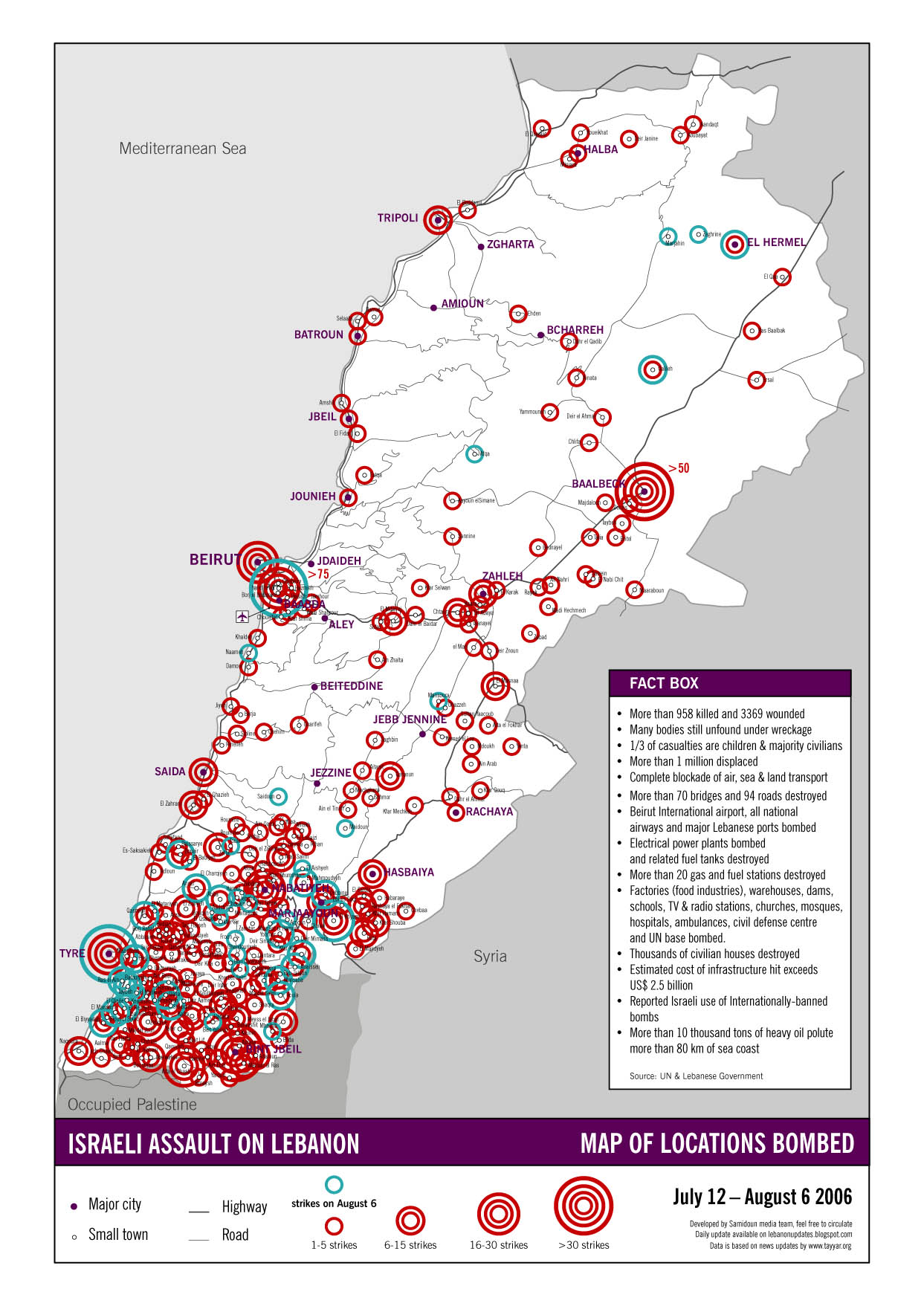
lebanon_map_jul12-Aug06My first attempt to think through the histories and geographies of bombing from the air was, appropriately enough, a plenary address to the Arab World Geographer conference in Beirut in 2006 – a meeting which had had to be postponed until December as a result of Israel’s summer-long attack on Lebanon.  Registrations fell away, especially from the United States and the U.K., but we had a wonderfully lively meeting.

I eventually turned my presentation – which, under the title “The death of the civilian”, developed the twin genealogies of the target and the civilian to address Israel’s bombing of southern Lebanon and Beirut – into an essay for the journal: “In another time zone, the bombs fall unsafely: Targets, civilians and late modern war” (published in 2007: see DOWNLOADS tab).

I began like this:

My title comes from a poem by Blake Morrison, ‘Stop’, which was reprinted in an anthology to aid children’s charities in Lebanon compiled by Anna Wilson after the Israeli assault on that country during the summer of 2006.  The poem speaks directly to the ideology of late modern war – to what Christopher Coker praises as the ‘re-enchantment’ of war through its rhetorical erasure of death– and to its dissonance from ‘another’ time and space where bombs continue to ‘fall unsafely’.  It begins like this:

 ‘As of today, the peace process will be intensified

through war.  These are safe bombs, and any fatalities

will be minors.  The targets are strictly military

or civilian.  Anomalies may occur, but none

out of the ordinary.  This release has been prepared by

official Stop.’

 Morrison perfectly captures the hypocrisy of war – the malevolent twisting of words to mean the opposite of what they say, the cosmetic face of public war put on to conceal the harrowing face of private death – and also the intimacy of the furtive, fugitive relationship between ‘targets’ and ‘civilians’ in late modern war. In what follows, I will try to lay that relationship bare by reconstructing its historical geography.  In doing so, I will also show how our meeting in Beirut to discuss ‘the European-Arab encounter’, less than six months after Israel’s war on Lebanon, must confront the connections between the political and military strategies mobilized during the summer of 2006 and a series of colonial encounters between Europe and the Arab world in the years surrounding the First World War. 

That remains one of the primary motivations for my Killing Space project.

But 2006 was not the first time that Israel had sent its fighter-bombers into the skies over Lebanon.  What I did not know when I prepared my presentation was that during the bloody invasion of Lebanon in 1982 a number of Israeli Air Force pilots had refused to bomb ‘non-military targets’.  Now there is still fierce debate over the distinction between ‘military’ and ‘non-military’ targets, and over the civilian casualties that may nevertheless result from bombing ostensibly ‘military’ targets, both in principle and in practice, and it’s an argument which is conducted on legal and ethical terrains (though we hear much more of the former than the latter).  But here I’m particularly interested in the act of refusal itself: less in the application of abstract, formal principles – important though these are – and more in the personal, rational and affective moment of abjuration.

Hagai TamirIn 2002 Ha’aretz published interviews by Avihai Becker with three IAF officers who had formally refused; the testimonies of two of them were already known, but it’s the third that I want to describe here. Hagai Tamir, a major in the IAF, grew up as one of what he calls ‘the lyric pilots’, consummating a love of flight itself:

“I wanted to feel like a bird. The whole idea of the plane as a war machine was much less appealing to me. The concept of a plane as a platform for weapons was foreign to me so I enjoyed the aerobatics much more than I did dropping ordnance. Even during my compulsory service as a young pilot, I didn’t derive any pleasure from it.”

After his compulsory military service and his move to the reserves, Tamir trained as an architect and this enhanced his sense of unease, even disengagement.

“Who knows better than me, an architect, how hard it is to build a city? So at least, don’t rejoice when you destroy houses. It takes a lot longer to build a city than it does to strike a target.”

In June 1982, one week into the invasion of Lebanon, Tamir was flying over the port city of Saida (Sidon), near the Ain El Helweh refugee camp:

“We flew in tandem above the place. The liaison officer who was with the ground forces informed me of the target, a large building on top of a hill. I looked at it and to the best of my judgment, the structure could have only been one of two things – a hospital or a school. I questioned the officer and asked why I was being given that target. His reply was that they were shooting from there. There were a thousand reasons why I didn’t think I should bomb the building. I asked him if he knew what the building was. He said he didn’t. I insisted that he find out. He got back to me with some vague answers.”

Tamir was not satisfied by the response, reported a ‘malfunction’, cut off radio contact and did not release his bombs (on some accounts, he dropped them into the sea).

The episode is significant for several reasons.  The first is that this was an intensely personal decision: Tamir did not publicise it (though the IAF did investigate the incident), and it made no material difference to the outcome since the accompanying aircraft went ahead and levelled the building (which was indeed a secondary school for boys).  Even so, Tamir was not alone; others refused similar orders, and although it’s difficult to gauge how far the ripples caused by these refusals travelled into 2006 and beyond – see Asher Kaufman‘s thoughtful discussion in Shadows of war: a social history of silence in the twentieth century here – twenty years later Tamir did join 24 other active, reserve and retired Air Force officers in signing a public letter refusing to carry out air strikes in occupied Palestine (and who were roundly abused for doing so: see here and more on the Courage to Refuse movement here).

The second is that, even though Tamir confided what happened over Saida only to his family and close friends, the story spread through the town, embellished in the telling and re-telling: so how did the people know, and what significance did they see in it?

The third is that the story has become the subject of a remarkable multimedia installation by Beiruti artist Akram Zaatari, Letter to a refusing pilot, which is the only artwork representing Lebanon at the 55th Venice Biennale this year.  Zaatari describes himself as

‘an architect, a documentary filmmaker, and an ethnographer working in the art world, so I use the tools and approaches that I have learned from those three disciplines. I have no particular method to apply, otherwise it would make my work too simple. I enjoy reflecting on complex social and political issues particularly related to geographies.’

You can find images and a commentary on the Biennale installation here and here, but Zaatari explains his project like this:

“The importance of the story is that it gives the pilot a human face. It gives what he is about to bomb, which is considered terrorist ground, it also gives that a human face. I think it’s important to remember in times of war that everyone is a human being. Taking it to this level humanizes it completely, and we’re not used to this at all.”

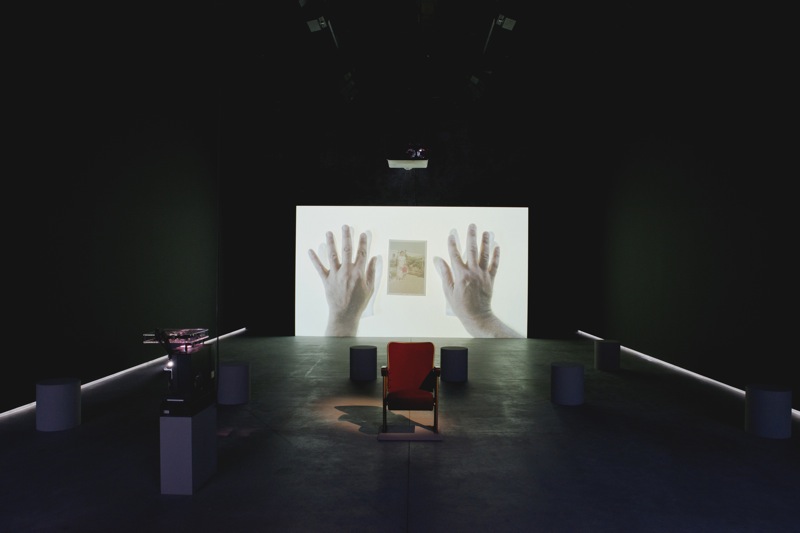
Zaatari was born in Saida – in fact his father founded the school that was the target of the IAF attack – and the film that is the heart of the art-work is, like Tamir’s decision, an intensely personal one whose resonances reach far and wide.  Zaatari met with Tamir, and the film affirms the Israeli pilot’s original impulse to fly: hands draw paper aeroplanes and, at the end of the film, two boys climb up to the roof of the school and launch them into the air.  The film is cut with family photographs and Zaatari’s own diary entries from the invasion too: you can find copies of the film on You Tube starting here.
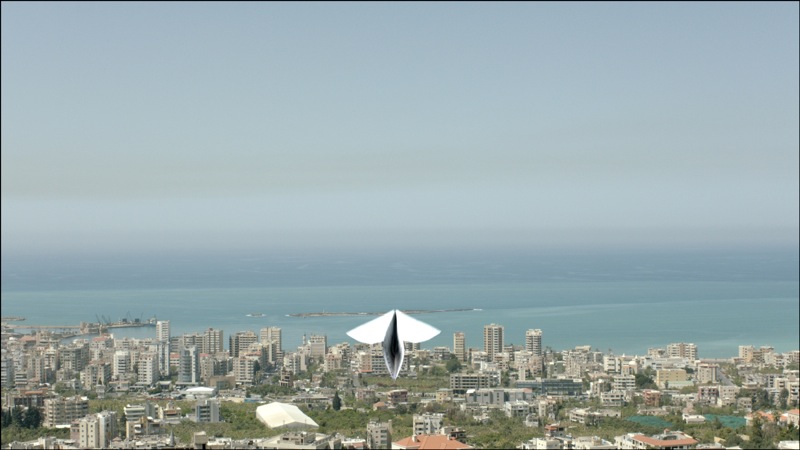
ZAATARI Letter to a refusing pilot

On the opposite wall, separated and joined by a single red cinema seat, another (shorter) film silently projects the hillside overlooking Said being systematically bombed.  The sequence derives from a series of photographs Zaatari took in 1982.
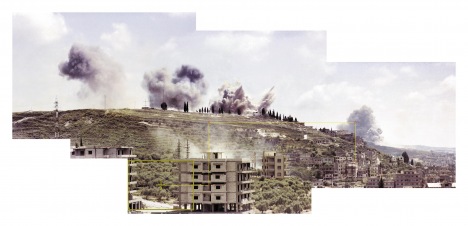
ZAATARI Saida 6 June 1982

From that seat, the viewer is invited to watch only that film, facing away from the more personal, vividly human story being told by the first film.  Negar Azimi provides a fuller discussion of the installation here, and she concludes that ‘by placing each one of us, alone, within the generous frame of the work, it seems to remind us that, not unlike the pilot, we are sometimes caught up in vexed circumstances beyond our control.’ Certainly the title of the work directly addresses the pilot and so, by extension, perhaps the pilot-observer that late modern war has invited those of us who watch wars from a safe distance to become.
5367

Perhaps.  But this is a multi-layered work, and there are other readings.  Near the beginning of the personal memory-film, and before the title appears on the screen, gloved hands turn the pages of Antoine de Saint-Exupéry‘s The Little Prince, which Negar describes as a ‘much-adored 1943 tale of youthful existentialism’.  The point here, I take it, is to reinforce or reinscribe the acknowledged affinities between Zaatari’s work and Albert Camus‘s Letters to a German friend (“I should like to be able to love my country and still love justice.”)

But, as she also, notes Saint-Exupéry was ‘a famous war-time aviator’, and in that role he had a decidedly different view of things that speaks directly to (or rather from) the object record-film of the bombing:
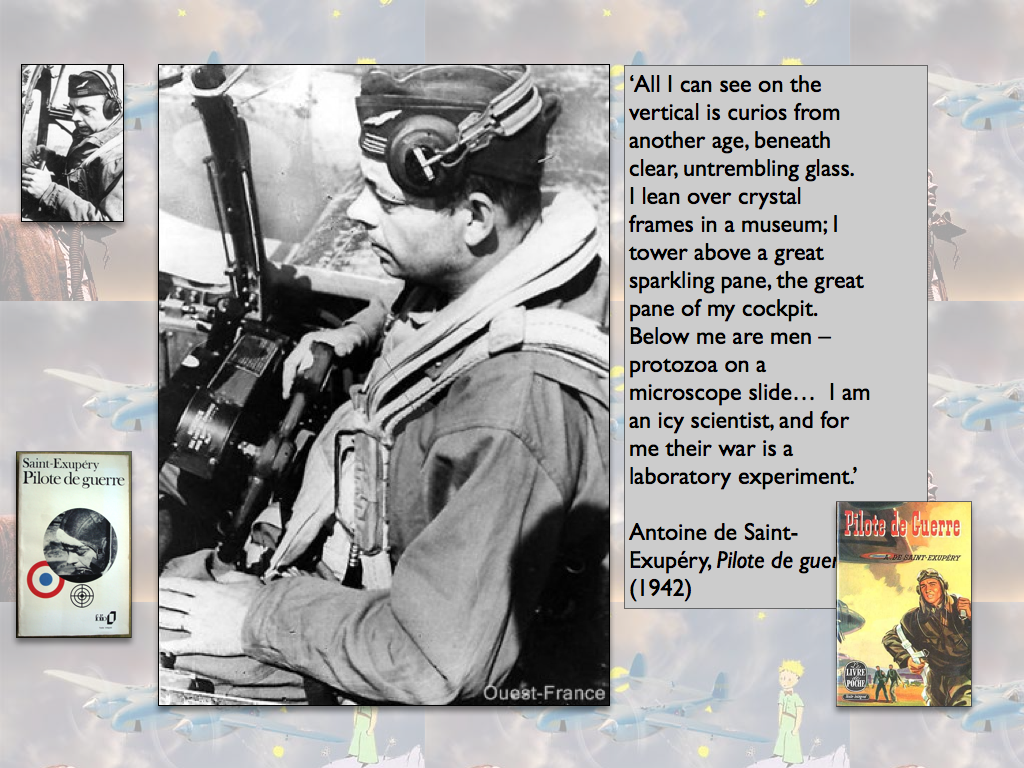
Saint-Exupéry.001

Much of Zaatari’s work, as he confirms in this exceptionally rich conversation with Chad Elias for the Tate in 2011, asks us to ‘rethink what it means to witness, survive, or even document a war’. With that in mind, in gazing at the image stream of bombs, with our backs to the lifeworld that was also for many a deathworld, is it not possible that we are also being invited from that single red chair to adopt the position of Walter Benjamin‘s Angel of History?
Falling downwards?

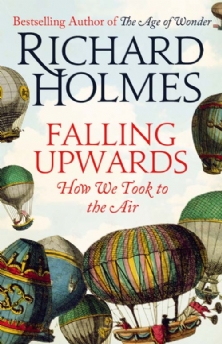
058602-FC222Richard Holmes, author – amongst many other books – of Tommy: the British soldier on the Western Front, which I’ve read with the keenest interest for my “Gabriels’s Map” project, has a wonderfully readable new book out that intersects with my “Killing Space” project on bombing: Falling upwards: how we took to the air. It’s a history of ballooning (of sorts).

Although Holmes does address the military uses of hot-air balloons, he is something of a romantic and there’s more here on the delights and dangers (for those in the air) than the prospect of war from the air they helped to usher in.

But early in the book he describes a collection of balloon memorabilia made by Sophia Banks (sister of Joseph) that included a British cartoon from December 1784 entitled “The Battle of the Balloons’ (you can see a watermarked copy here):

This shows four balloons, two flying the French fleur de lys and two the British Union Jack, manoeuvring for aerial combat. Their crews are armed with muskets, but also, more menacingly, with broadside cannons. Their muzzles point through portholes cut in the balloon wickerwork.  Here the balloon is already conceived of as a weapon of war, comparable to the navy’s ships of the line.

Less than ten years later the French would establish the first military balloon regiment, but others insisted on the essentially pacific nature of ballooning and, indeed, of manned flight more generally. In his ‘Letter on Flight’ (1864) Victor Hugo, a good friend of the celebrated aeronaut Nadar, waxed lyrical (the appropriate Icarian verb, as it turned out) on the changes the balloon would inaugurate:

‘It will bring the immediate, absolute, instantaneous, universal and perpetual abolition of all frontiers, everywhere… Armies will vanish, and with them the horrors of war, the exploitation of nations, the subjugations of populations. It will bring an immense and totally peaceful revolution. It will bring a sudden golden dawn, a brisk flinging open of the ancient cage door of history, a flooding in of light. It will mean the liberation of all mankind.’

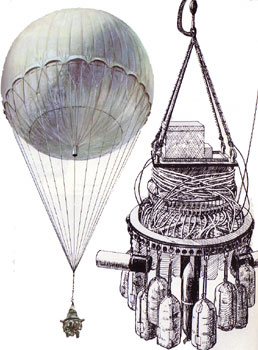
Fu-Go-bomb-balloonIf only.  There is, after all, a counter-history of ‘falling downwards’: the first bombing from the air involved unmanned balloons loaded with shrapnel launched by Austria during the siege of Venice in 1849 (though they apparently had little effect); during the American Civil War and the First World War observation balloons were a vital means of surveillance and artillery ranging; and in retaliation for the bombing of Tokyo, in the dog days of World War II the Japanese experimented with using incendiary balloons (‘fire balloons’ or ‘balloon bombs’ – see right) to attack the west coast of Canada and the United States (more here). The only one of these to appear in Holmes’s account is a splendid discussion of ballooning in the Civil War; his collection of ‘balloon stories’, as he modestly describes his project, stops at the end of the nineteenth century (and is concerned, above all, with the experience of balloonists, so ’empty’ balloons don’t count for much).

For all that, the Janus-faced history of the balloon, one peaceful and the other stridently martial, has implications for contemporary discussions of another aerial object: the drone.  The specificity of the object matters, of course, since it has particular capacities and dispositions – but their realization depends on the networks in which they are embedded.  As with balloons, so with drones.

Dronesong

shawa-cast-lead‘In 1990,’ Palestinian pop-artist Laila Shawa recalls, ‘I had breast cancer.’

While undergoing radiotherapy, I watched on television the precision bombing of Baghdad by US airplanes, forever linking the two events in my mind and in my art. The body woman and the body land amalgamate; the invasion of one is equated with the invasion of the other and the implicit fact that both leave scars.”

Jo Long made a parallel, beautifully nuanced argument in her ‘Border Anxiety’ essay in Antipode in 2006, but you can literally see what Laila Shaw means in the extraordinary Cast Lead (2011; above left).

Laila is probably still best known for her silkscreen cycle Walls of Gaza (1992-95)a different take on graffiti to most geographers’, since she insists that the situation was unique:

I believe the Gaza Graffiti differs completely from urban graffiti that one sees in big cities around the world. In Gaza, graffiti on the wall was the only method available to Palestinians to communicate with each other. The Israeli occupiers banned any form of media in Gaza, such as newspapers, radio, or television. The writing is cursive, spontaneous and hurried. It changed almost daily to update whatever was happening in Gaza.

In the Walls cycle she juxtaposed images of Palestinian children and graffiti from Gaza to expose the trauma of war and occupation, a theme to which she returned in Target (2009), a variation on an iconic panel from Walls, in which a photograph of a young child is superimposed against a graffiti-covered wall with a cross-hair centred on his face.  ‘War deprives children of their childhood,’ she says.

Much of her work depends on mixed media juxtapositions like this, which she mobilizes to brilliant effect. She explains:

‘Today, when we are desensitized by the surfeit of media violence, new strategies are needed to overcome people’s apathy and weariness for compassion.’

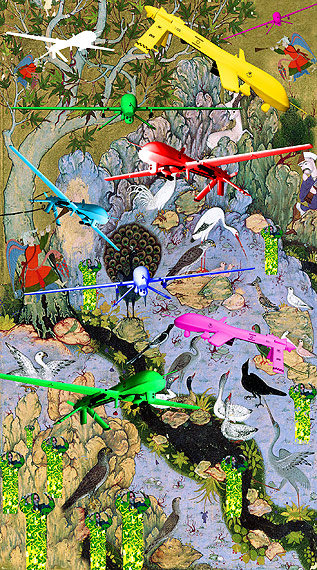
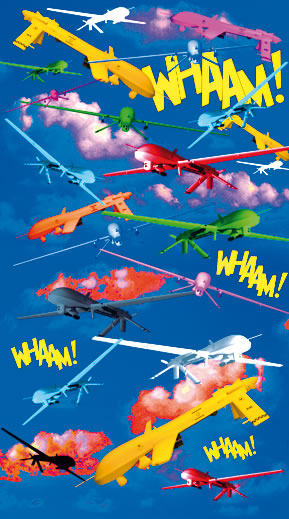
Last year she had an exhibition at London’s October Gallery, The Other Side of Paradise, which was in part provoked by a documentary on a female suicide bomber but which also included the extraordinary images shown below, Birds of Paradise and Gaza Sky, which speak directly to my previous post about other ways of visualizing drones.

SHAWA Birds of Paradise

SHAWA Gaza Sky

Laila was born in Gaza, but Gaza Sky strikes me as problematic; Israel doesn’t use Predators, so far as I know, but manufactures its own Heron drones and leases/sells them to other states.  Still, the image captures occupied Palestine since – for me – the reference isn’t only to Roy Lichtenstein‘s Whaam but also to Mahmoud Darwish‘s moving poem The earth is closing on us (which Edward Said used for his collaboration with Jean Mohr, After the last sky):

Where should we go after the last border? Where should the birds fly after the last sky?

I’m left wondering about how to draw together my first and last paragraphs – how to bring these ‘birds’ and the bodies on which they feed into the same frame.  This isn’t a compositional problem for my writing; it’s a political-aesthetic one.  So I start to think about Laila’s Target again.  For The social life of bombs, I plan to end the performance-work with a back-projected image of three children asleep under a checkered counterpane; all you you can hear is the rhythmic sound of their breathing.  As the camera moves in, it becomes clear that each checkered square is in motion; the sound gets louder.  Closer still, and each square becomes a video feed from a drone. Closer still, and one square fills the whole screen: the compound in which the children are sleeping, seen from high above (and far away).  By now the sound of breathing is incredibly loud; suddenly, an even louder explosion.  When the smoke clears, the sound dies away, and the lights slowly come up, we see three small figures, clutching the remains of their bedding – a re-staging and reworking of Noor Behram‘s to me iconic photograph of the three Bismullah children, the sole survivors of a drone strike in Waziristan.  But it could, of course, be Gaza.  Or Yemen.  Or Somalia…

Air strikes in Pakistan’s borderlands

I’m speaking about Drone strikes and the matrix of violence in Pakistan at a conference in Vancouver at the week-end – a presentation which will form part of The everywhere war – and to set some of the parameters I’ve been revisiting the changing geography of air strikes in the Federally Administered Tribal Areas.  It’s a formidably difficult question given the extraordinary dangers facing journalists, Pakistani or foreign, seeking to report from the FATA: for an incisive discussion of the media landscape inside the FATA see Sadaf Baig‘s Reporting from the frontlines.

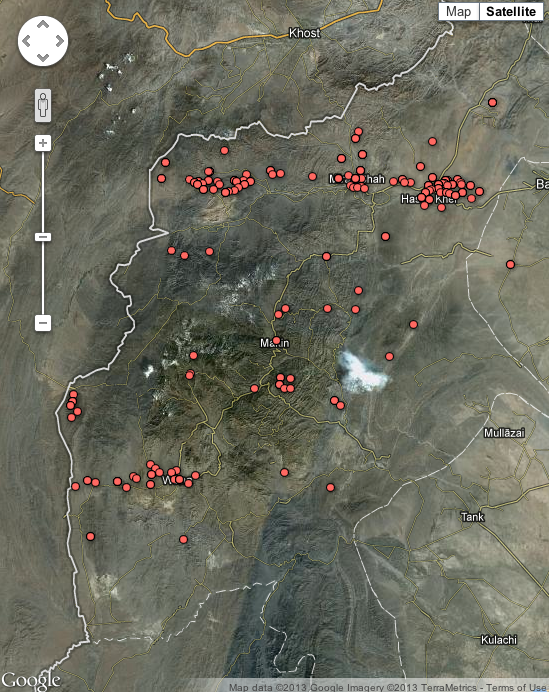
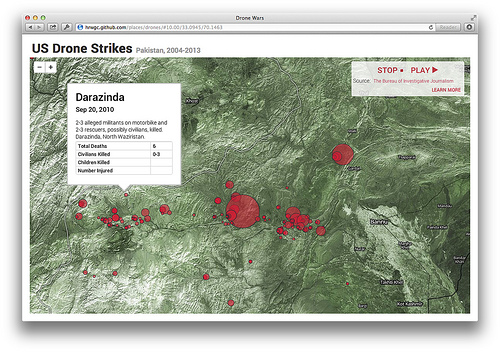
In my view, the most thorough if necessarily imperfect tabulations of US-directed strikes are those provided by the Bureau of Investigative JournalismThere have been several attempts to map this database, including the Bureau’s own use of Google maps (see below and here; but be careful: zooming in is a product of the digital platform and will give a misleading sense of the resolution level of the data).

BOJ US drone strikes in FATA

One of the most thoughtful (and dynamic) representations comes from Chris Herwig.  He described the technical basis of his mapping over at MapBox here, and you can visit his microsite here.  Go here to see the animation running (with annotations).

8448237526_92002912de

Chris’s project has also been featured on PBS here, where he also responds to several criticisms of the data and his visualizations.

Over at Slate, Chris Kirk has produced an interactive that tries to show the maximum number of estimated casualties from each strike, but the data are drawn from the New America Foundation database which has been criticised for underestimating casualties; one (to October 2012) version is here, and another (to February 2013), using a different cartographic design, is here.  More generally, Forensic Architecture‘s Unmanned Aerial Violence team is working to produce an online visualization of drone strikes not only over Pakistan but also over Afghanistan,Yemen, Somalia and Palestine. but it’s not yet operational).

But the problem doesn’t end with the cartographic piercing of the veil of semi-secrecy the White House, the CIA and JSOC cast over their remote operations, though I’ve noted before how their collective teasing of American journalists over the legal and administrative protocols they supposedly follow – especially the so-called “disposition matrix” –  works to (mis)direct attention towards Washington and away from the sites that Chris and others have struggled to map.

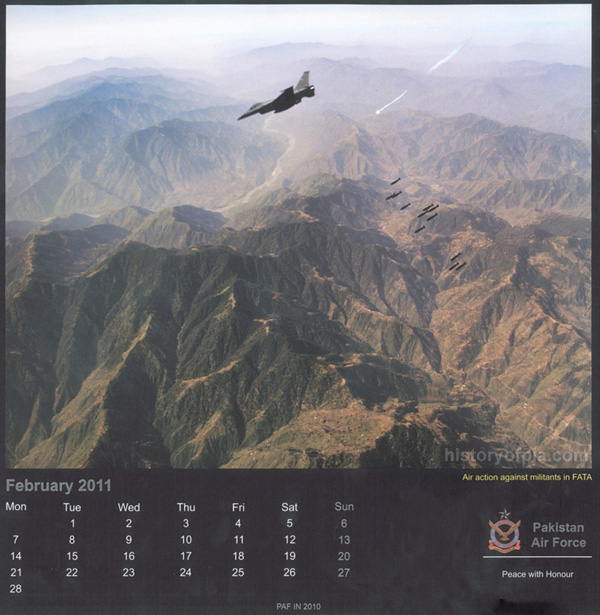
I say this because the US is not the only state carrying out air strikes in the region.  Soon after 9/11 and the US-led invasion of Afghanistan, largely in response to pressure from Washington, the Pakistan military moved into the FATA.  According to Zahid Ali Khan, Pakistan’s Frontier Corps was deployed in December 2001, but by May 2002 it was decided that a much heavier hand was needed and the Pakistan Army was ordered into the borderlands for the first time in the nation’s history.  Local people requested that military operations be limited to ground forces, but by 2004 this agreement was in shreds and – as the image below shows – ever since the Pakistan Air Force has made no secret of its continuing air strikes on the FATA.

PAF air strike in FATA

Again, there is no public tabulation, but the American Enterprise Institute‘s Critical Threats daily Pakistan Security Brief – I know, I know, it’s a neoconservative think-tank – culls this (needless to say, approving) record from reports in Pakistan media in the first two months of this year alone:

25 February PAF kills 10 TTP militants in Tirah [Kurram/Khyber, FATA]

21 February PAF bombs militants in Orakzai [NWF Province] killing 29

19-20 February PAF jets bomb TTP hideouts in Orakzai

11 February PAF jets kill 8 militants in the Tirah Valley

8 February Jets kill 9 militants in Orakzai

7 February PAF targets militants in Orakzai

6 February Jets kill 8 in Orakzai

30 January PAF kills 23 militants in Tirah Valley and 8 in Orakzai agency

28 January Pakistani jets bomb militants in Orakzai

4 January Gunships kill 3, injure more in North Waziristan retaliation

It’s a bare bones summary, clearly, and I suspect the readiness of the AEI to trust local media to report PAF strikes is in stark contrast to their attitude to local reports of US drone strikes.  I’ve also deliberately retained the original phrasing: conspicuously, there is no record of  civilian casualties. Like the United States, Pakistan routinely plays these down or denies them altogether.  Here, for example, is a typical report via the Long War Journal on 25 March 2010:

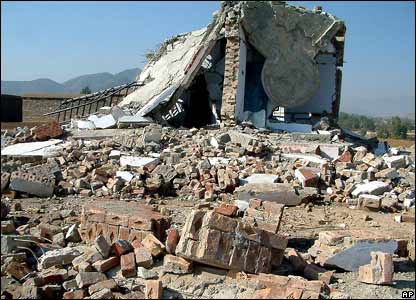
‘Pakistani fighter-bombers struck a series of targets in the Mamuzai region in [Orakzai] today. Sixty-one Taliban fighters were killed, Pakistani intelligence officials told The Associated Press. The military claimed that no civilians were killed in the attacks. The targets included a madrassa, a mosque, and a seminary run by the Tablighi Jamaat. Pakistani officials said that Taliban leaders were meeting at the Tablighi seminary.’

PAF air strike, Orakzai

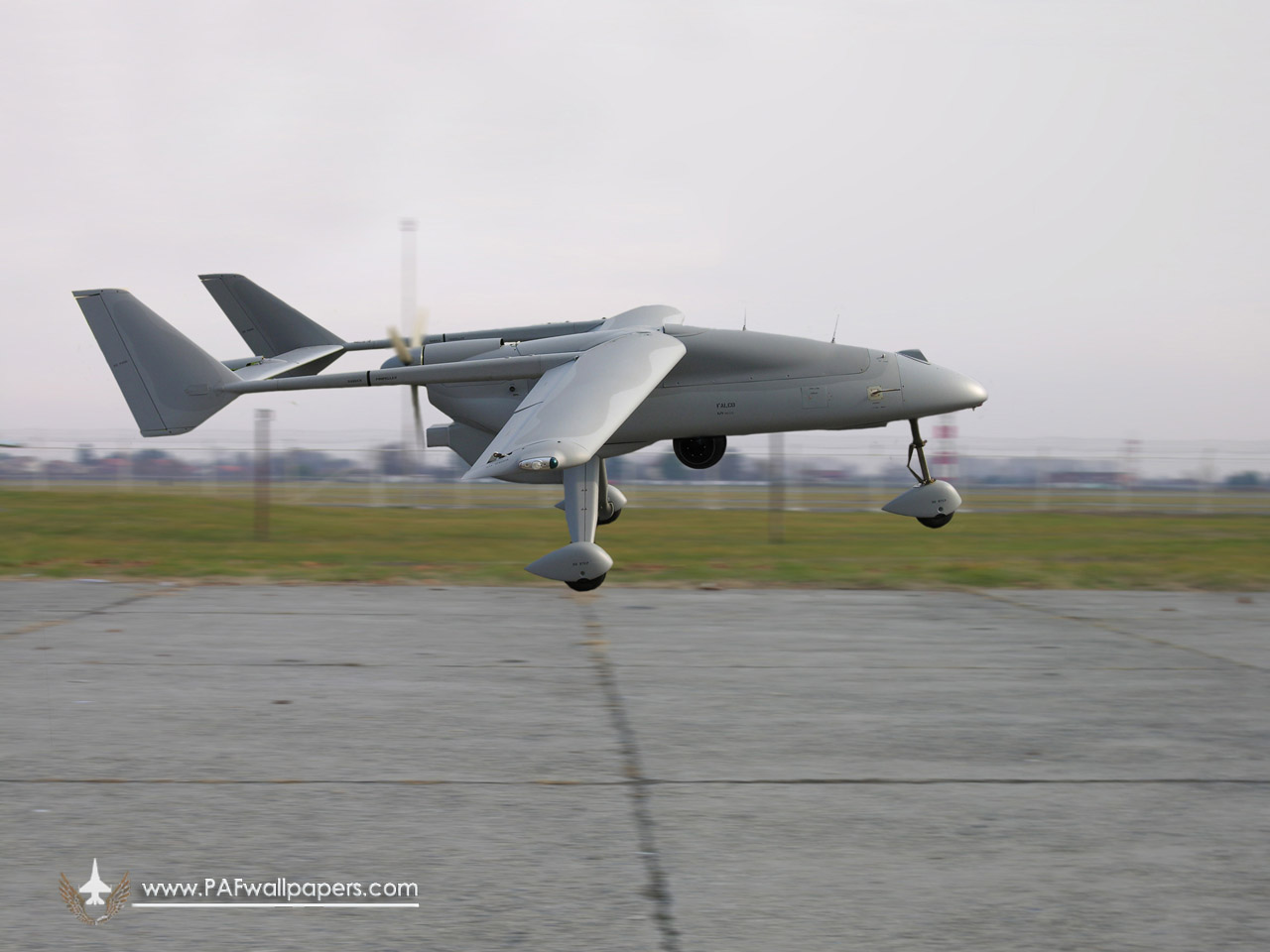
It’s unlikely that civilians were unscathed.  For the first four years at least the accuracy of the Air Force’s strikes was compromised by what Irfan Ahmad described as  its ‘lack of real time electronic intelligence and inferior technical means for command, control and communications’, by deficiencies in the targeting pods used by the PAF’s  ageing F-16 aircraft, and by the use of laser-guided missiles whose precision was reduced by clouds or poor visibility.  From 2008 new electro-optical targeting pods and sensors were being retrofitted and new ground and air capabilities for image exploitation put in place.  In 2009 the Air Force was also the launch customer for the Anglo-Italian Falco reconnaissance drone (see below), which is now co-produced in Pakistan; five systems were soon in use over the FATA, each comprising four aircraft with one held in reserve, and the Air Force was already anticipating arming them ‘with the most modern and lethal payloads’. More recently, the PAF has upgraded its F-16 fleet with new Block 52 versions and installed advanced avionics.  Throughout this period, as the military offensive periodically intensified, hundreds of thousands, perhaps millions of people were displaced from the borderlands.

falco_uav_galileo_avionica_paf_pakistan_air_force_01

It’s difficult to provide a detailed accounting of the air strikes, but in a rare admission former Air Chief Marshall Rao Qamar Suleiman claimed that the Pakistan Air Force carried out 5,000 strike sorties and dropped 11,600 bombs on 4,600 targets in the FATA between May 2008 and November 2011.  Unlike US air strikes in the region, PAF strikes are rarely ‘stand-alone’ affairs but are co-ordinated with ground forces (which is also the case with most drone strikes in Afghanistan, which operate in close concert with troops and conventional strike aircraft).

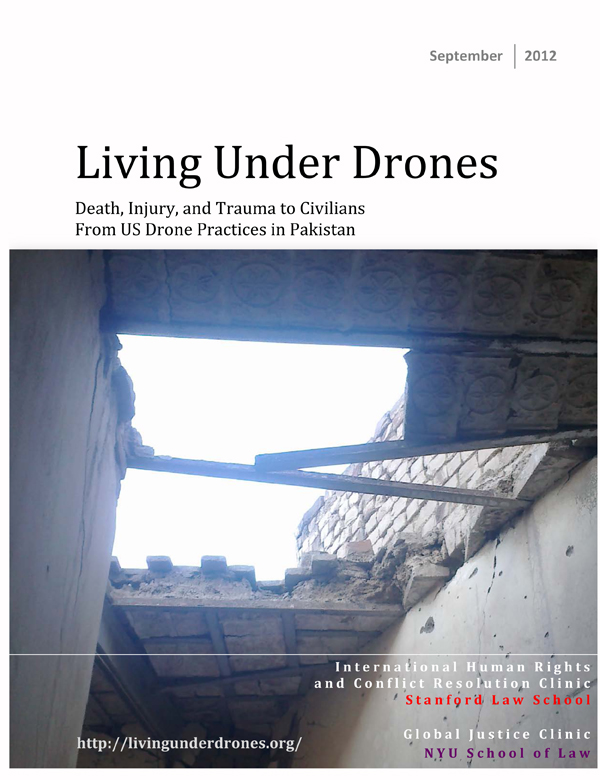
My object is recording all this is (I hope obviously) emphatically not to say that it is perfectly acceptable for the US to launch air strikes in the FATA because Pakistan is doing the same. Rather, the co-existence of the two air campaigns explains, in part, how it is possible for each party to accuse the other of carrying out an attack, as reported earlier this month.  More importantly, it also emphasises the ever-present horizon of danger within which the inhabitants of the borderlands are forced to live.  They are not only Living under drones.

Living Under Drones

The same point was sharpened by CIVIC – now the Center for Civilians in Conflict – in their (I think vital) report Civilian harm and conflict in North West Pakistan, published in October 2010. That report also details the violence meted out to civilians by militant groups in the region; for a detailed survey of the political geography of the borderlands, see Brian Fishman‘s The Battle for Pakistan: militancy and conflict across the FATA and NWFP, produced for the New America Foundation in 2010; there’s also much to think about in Daanish Mustafa and Katherine Brown, ‘Spaces of performative politics and terror in Pakistan‘, and in the same authors’ ‘The Taliban, Public Space and terror in Pakistan‘.

The existence of the two air campaigns also shows that the FATA are produced as a space of exception not only through Washington’s strenuous juggling with the Authorisation to Use Military Force and with international law (to validate the extension of its ‘global battlefield’) – whether it does so with or without Islamabad’s covert consent remains an open question – but also through Islamabad’s continued determination to treat the borderlands as legally anomalous territories for its own assertion of military violence.

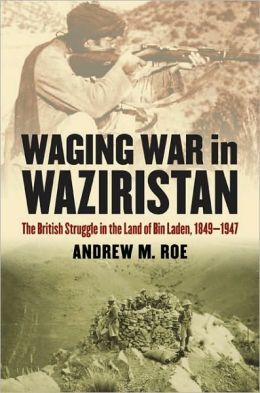
ROE Waging war in WaziristanThe last is a doubled colonial legacy.  Not only is the legal geography that structures the FATA’s relations with the Pakistani state a relict from Britain’s imperial decision to treat them as a space to be ‘excepted from state and society for the purposes of war’, as Ian Shaw and Majed Akhter put it in Antipode recently.

So too is the decision to continue to use the FATA as a laboratory for what the British called ‘air control’. Andrew Roe has provided a series of detailed discussions in the RAF’s invaluable Air Power Review, here and here and here, and brought much of his research together in Waging war in Waziristan (2010).

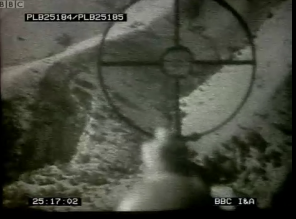
But for a rapid and sobering sense of how these campaigns were viewed from the air in the 1930s you need to watch this BBC interview with Group Captain Robert Lister, Wings over Waziristan, which includes extraordinary cine footage showing what he calls ‘tribal operations from the air’.  Lister was posted to Peshawar in 1935, and soon after he arrived both the Army and the Air Force were ordered to put down ‘a tribal insurrection or rebellion’ in Waziristan.  Their preferred method was to destroy villages by setting fire to individual houses, blowing them up, or bombing them from the air ‘to make them say “Right, it’s not worthwhile – come to terms.”‘  Listen as Lister says, in cut-glass tones, ‘It was a fair and just way of dealing with it: they started these troubles and had to be dealt with.’

Waziristan:Lister:Here's an attack being carried out

And if you want to discover a different dimension to ‘unmanning’ aerial vehicles, listen from 08.00-08.40.

UPDATE: I’ve just discovered another film shot over Waziristan in 1937 by Leonard de Ville Chisman, which covers the air and ground war against the Faqir of Ipi described by Lister.  It contains a number of strikingly similar shots, though there is of course no commentary: you can access it via Colonial Film: Moving Images of the British Empire here.  On that remarkably informative site, Francis Gooding writes:

The official record of NWFP operations during 1936-7 – a thick volume, its size indicating the scale and seriousness of the conflict – contains full details about the manner in which aircraft were employed. The flag marches of November that sparked the revolt were accompanied by aircraft reconnaissance, and the record notes that ‘air reconnaissance requirements were met by one flight of No. 5 (Army Co-operation) Squadron’ (Govt of India, op.cit., 15), and the RAF also provided close cover for troops, and this pattern – reconnaissance with close support against the enemy – was repeated throughout the operations.

Reels 14 and 15 of the Chisman collection record precisely these kinds of encounters and air operations, with footage of bombing raids and the dropping of supplies to forward positions by parachute taken from within flying aircraft. Aircraft were also used to disseminate information and warnings about future punitive action (again, this was a tried and tested method, typical of colonial air policing; see Omissi, 1990, 154-5). On 27 August 1937, for instance, ‘notices were dropped over the Shawal area warning the inhabitants that until the Faqir submitted to Government, any tribe sheltering him would be liable for punishment’ (Govt. of India, op.cit., 179), and reel 15 contains a sequence showing a pilot unfurling a large leaflet, with text in Pashto and Urdu. The following sequences show air-drops of these leaflets over hill country. There are also scenes showing armoured cars and tanks on the move, and a sequence apparently shot during a battle, with a line of artillery opening fire on hill positions. 

The Faqir’s uprising was arguably the most serious colonial insurgency of the inter-war imperial period, and the films are remarkable in that they record scenes of action from a poorly remembered but major guerrilla conflict. Beyond this historical importance they have another significance, for they offer scenes of something only very rarely captured on film, despite its regular occurrence throughout the Empire – the recourse to the punitive deployment of heavy weaponry against subject peoples in revolt.

The metal falcon

As public attention to military violence continues to contract to the use of drones, Rawan Yaghi supplements her previous account of living and dying under Israeli drones in Gaza with another despatch describing Israel’s use of conventional strike aircraft, Life under the F-16s in Gaza:

With F16s, it’s a scary roar like someone is mocking sounds in a water well. It also depends on the altitude of the plane, sometimes a high pitched roar, others a low distant one. F16s are harder to spot than drones or Apaches because they are always ahead of their roar. And since you never know where the plane is going and since buildings in Gaza are crammed into Gaza, you rarely get to see the metal falcon.

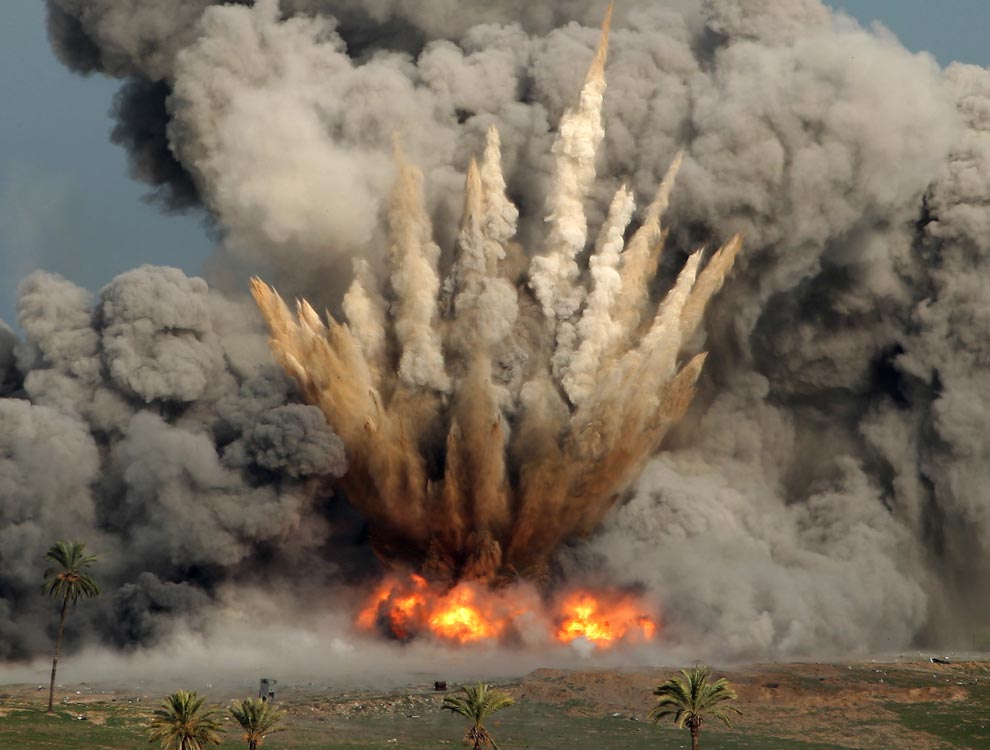
F-16 bombing Beit Hanoun, Gaza, January 2009 (Patrick Baz/AFP/Getty Images)

F-16 bombing Beit Hanoun, Gaza, January 2009 (Patrick Baz/AFP/Getty Images)

She describes the intimidating ‘mock raids’, the physical and psychological damage, and the scars that will never heal:

‘I was fourteen when the AbuSelmeyyas’ house was attacked by an F16 air strike. My body shivers as I write this. The attack killed the father and mother and seven of their children, Nasrallah 4, Aya 7, Yahya 9, Eman 12, Huda 14 who was my classmate in primary school and who had the most angelic voice I’ve ever heard, Sumayya 16, and Basma 17, leaving Awad, 19 at that time, injured and alone.  Fourteen  others were injured in that attack, since the house was located in a heavily populated neighborhood, not very far from where I live. The attack attempted to assassinate leaders of militant groups. However it failed. In October last year, The Israeli court in Jaffa refused to give any compensations to the relatives of the family and the only member if the family left, saying the house was targeted during a “combat operation”. I wasn’t allowed to see any news about the attack. I only heard some news about it. And I learned about Huda in the morning. I heard from my brother that day that the bomb was directly dropped on the room where the mother and the children were. I also heard about their body parts being found in the buildings next to their house. I was only fourteen. What did I know.

What I do know – what we all surely know – is that there is more to military violence than drones; that our attention ought not to be limited to the ‘rules’ (un)governing their operation; and that the dismal desire to wage wars outside declared war-zones neither started nor ended with George W. Bush.

Of Bombs and Men

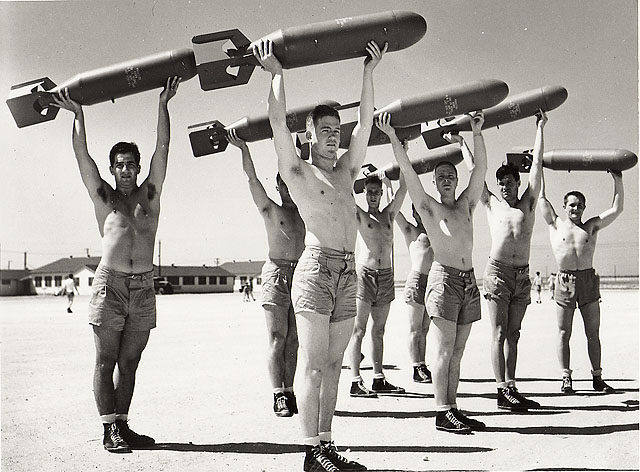
WWII Bombardier Calisthenics

When Stanley Kubrick had Major Kong (Slim Pickens) straddle a nuclear bomb in Dr Strangelove (1964) and ride it exuberantly all the way down to its target – surely the most iconic image from the film – he was making an obvious visual point about masculinism, sexuality and military violence that, as the clean-limbed image above shows, takes many other, non-nuclear forms.  Here a group of US Army Air Force bombardiers in the Second World War practices calisthenics with 100 lb bombs.  A different sort of ‘love-charm of bombs‘, you might think.

Indeed, a contemporary account made much of the ‘hard and rigid training of members of a bomber crew’ – which was supposed to be just like a football or basketball team (‘This is really the Big League in the toughest game we have ever been up against, with the pennant the survival and future of the whole nation’) – and emphasised their collective virility and heteronormativity:

‘They will have played football or basketball, have competed in the field or on the track.  Many of them will have been ardent hunters or fishermen.  Because they are healthy young men they will like girls very well indeed.’

Hunting was important; readers were told to be thankful that ‘frightened civil authorities and specific Ladies Clubs have not managed to eradicate from the country the tradition of the possession and use of firearms’, which ensured that a young man would enter the Air Force ‘with the whole background of aerial gunnery in him before he starts.’

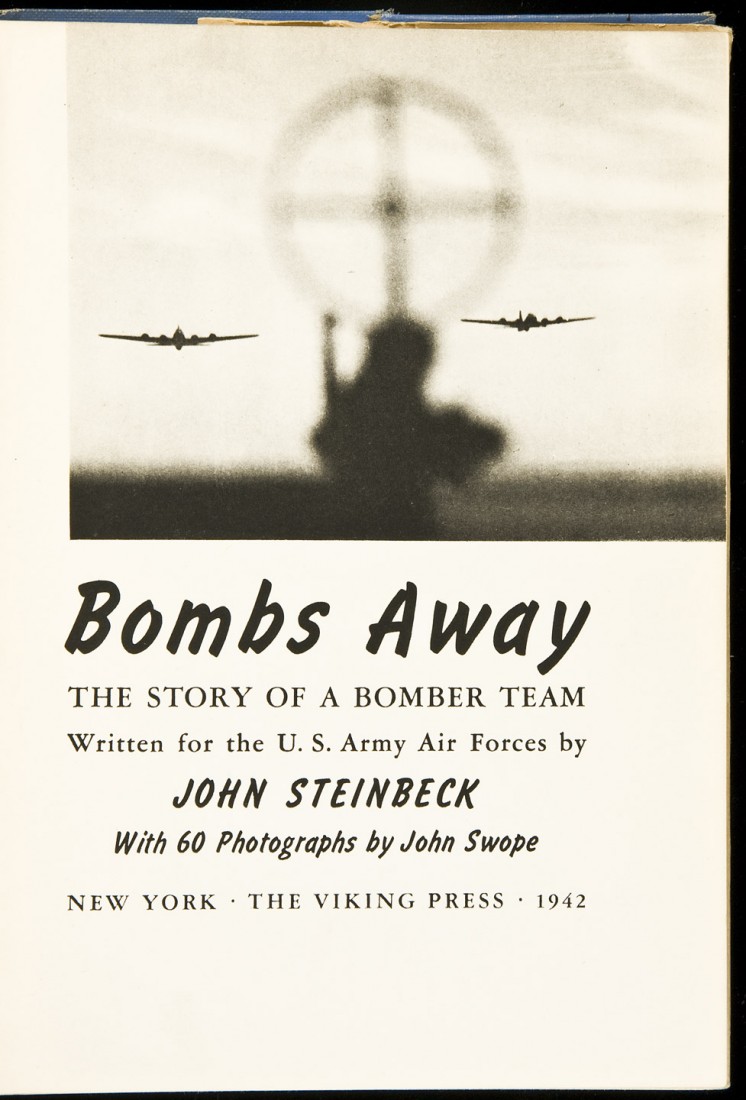
The author of all this was, astonishingly, John Steinbeck, and the book Bombs Away: the story of a bomber team, published in 1942.

STEINBECK Bombs Away

In May 1942 Steinbeck had been summoned to Washington by General Henry A. “Hap” Arnold who explained what he had in mind – an account of the training of a bomber crew that would serve as a recruiting platform – and although Steinbeck was at first reluctant a meeting with President Roosevelt convinced him to accept the assignment.  He spent the summer on the road (in fact, much of the time in the air), travelling from airbase to airbase in the United States with Hollywood photographer John Swope, who provided 60 illustrations for Bombs Away.  Swope would later be tapped by First World War veteran Edward Steichen for his US Navy photographic unit covering the war in the Pacific, where he produced a remarkable photographic portfolio and the accompanying Letter from Japan in 1945.

Steinbeck was no stranger to working with photographers.  In 1937 Horace Bristol, a freelance photographer who regularly contributed to LIFE magazine,

‘proposed a story about migrant farm workers in Calfornia’s Central Valley—a project that would include accompanying text by novelist John Steinbeck. Though LIFE turned down the story, Bristol and Steinbeck agreed to collaborate on a book-length project, and the two men spent several weekends in labor camps during the winter of 1938. Bristol took hundreds of photographs of the suffering farm workers, only to have Steinbeck withdraw from the partnership to write the story as a novel, which became his masterpiece The Grapes of Wrath.’

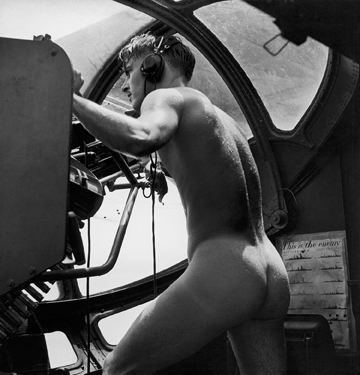
BRISTOL PBYBlisterGunnerBristol was also later recruited by Steichen, and some of his war photographs would not been out of place in Bombs Away: the image on the right, ‘RESCUE: PBY Blister Gunner’, was shot in a Catalina Flying Boat at Rabaul, Papua New Guinea, in 1944, which presumably explains the flying kit.

If Steinbeck’s collaboration with Swope turned out to be more congenial than that with Bristol, however, it was markedly less fruitful. Ernest Hemingway disliked Bombs Away so much that he famously observed that ‘I would rather cut off three fingers off my throwing hand than to have written it.’

He wasn’t alone.  A review in the New Republic declared that Bombs Away bore ‘about the same relationship to literature that a recruiting poster does to art.’  But of course it was supposed to be a recruiting poster, and it had to be written in double-quick time.

In the book Steinbeck assembles the bomber crew man by man, role by role – the bombardier, the aerial gunner, the navigator, the pilot, the aerial engineer/crew chief and the radio engineer – who together ‘must function like a fine watch’.  They are assigned a ‘ship’ – a B-17E Flying Fortress or a B-24 (‘Liberator’) – which will invariably become personalised and almost always feminized.  (There’s a considerable literature on the ‘nose art‘ of bombers, and Steinbeck will later declare that ‘Some of the best writing of the war has been on the noses of bombers’).  But it is the men that count, that constitute the elaborate clock-mechanism: ‘Men are the true weapons of the Air Force,’ Steinbeck insists, ‘and it is an understanding of this that makes our bomber crews what they are.’ Inevitably, he adds: ‘Living and working together too, they played together too.  On the beach in their free time they played football and swam in the warm water of the Gulf.’

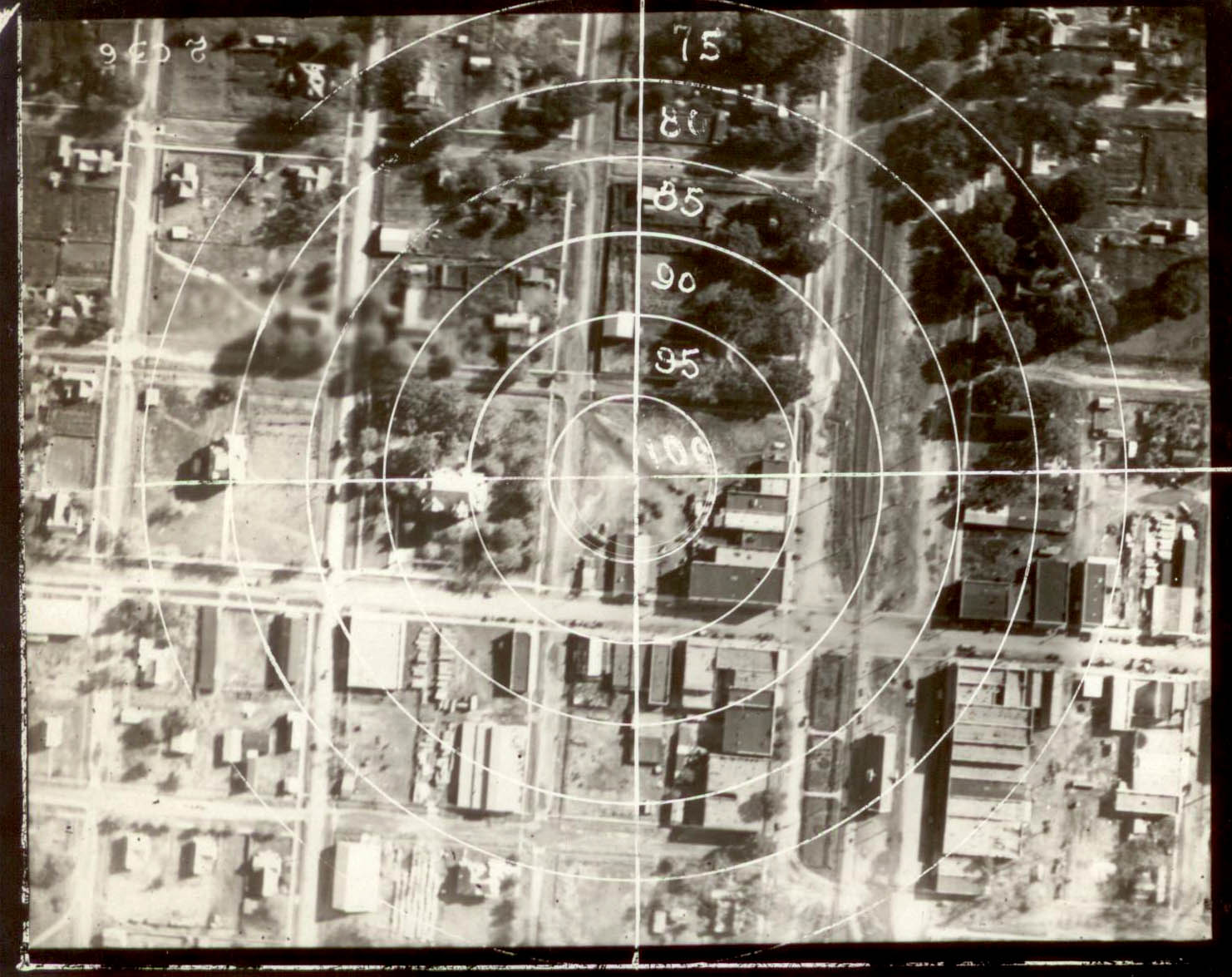
Norden bombsightSteinbeck knows, of course, that this is a deadly serious ‘game’: and one that, as he also labours to explain, is objective, scientific: ‘They knew the mathematics of destruction.’   Within this embodied, techno-cultural constellation the Norden bombsight (left) occupied a central place.

‘This bombsight has become the symbol of responsibility.  It is never left unguarded for a moment.  On the ground it is kept in a safe and under constant guard.  It is taken out of its safe only by a bombardier on mission and he never leaves it.  He is responsible not only for its safety but for its secrecy.’

I’ve noted before how often bombing depends on abstraction: on a technical division of labour within the kill-chain, on a rhetoric of scientificity (and, by extension, precision), and on a calculus that transforms places and people into the co-ordinates of a target.  Bombs Away shows this to perfection, but it shows something else even more clearly. For the ability to carry out these deadly missions also depends on an instilled and instinctive sociality (here, naturally, a homosociality) that is far from abstract.

STEINBECK Bombs Away cover

And yet there is something abstract, or at least detached, about Bombs Away, because it ends just before the crew takes off on its first mission.  In the concluding chapter, ‘Missions’, Steinbeck explains that the men ‘looked so carefully at the newspapers, and what they found in the newspapers reassured them.’

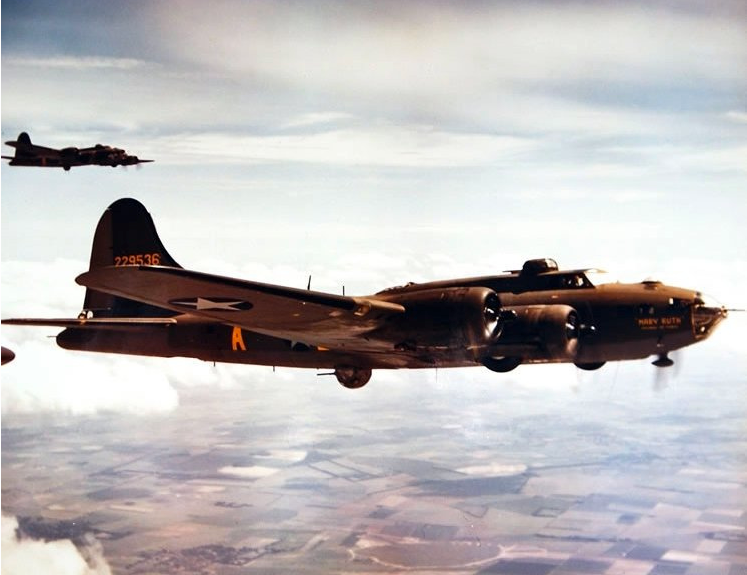
Mary Ruth nose artBut this paper knowledge turned out to be less than satisfactory.  Less than a year later, in June 1943, his request to become an air force intelligence officer refused by the draft board – a US Army intelligence report, mindful of the sympathies of Steinbeck’s pre-war novels, had concluded that there was ‘substantial doubt’ about his ‘loyalty and discretion’ and recommended that he not be offered a commission – Steinbeck was at RAF Bassingbourn (USAAF Station 121) in Cambridgeshire as a war correspondent for the New York Herald Tribune.

An old friend of his, in fact a literary agent before the war, Staff Sergeant Henry (“Maurice”) Crain was stationed there, and Steinbeck wrote nine articles centred on the crew of Crain’s ship, the “Mary Ruth: Memoirs of Mobile“, a Flying Fortress of the 91st Bomb Group of VII Bomber Command.  ‘The closer you get to the action,’ he reports Crain (the ball-turret gunner) saying, ‘the less you read the papers and war news’:

‘I remember before I joined up I used to know everything that was happening… I even had maps with pins and I drew out campaigns with colored pencils. Now I haven’t looked at a paper in two weeks.’

And when the crew did, as often as not they didn’t recognise what they saw.  The waist-gunner had read a newspaper from home:

‘It seems to me that the folks at home are fighting one war and we’re fighting another one. They’ve got theirs nearly won and we’ve just got started on ours. I wish they’d get in the same war we’re in. I wish they’d print the casualties and tell them what it’s like.’

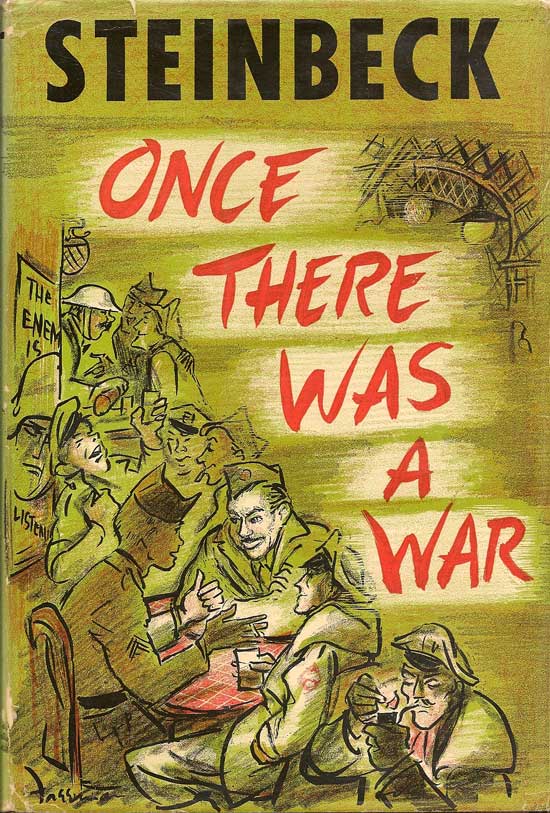
STEINBECK Once there was a warThis is a far cry from the brimming, boastful confidence of Bombs Away, and Steinbeck is clearly concerned not only to change the tone but also to surmount the limitations of his new, temporary profession (some of his despatches were republished in 1958 in Once there was a war).  He does so by invoking the the technical, instrumental armature of the mission: the precision of the briefing (‘The incredible job of getting so many ships to a given point at a given time means almost split-second timing’), the complicated process of kitting up (‘During the process the men have got bigger and bigger as layer on layer of equipment is put on; they walk stiffly, like artificial men’), and the meticulous work of the ground crews who ‘scurry about like rabbits’ as they prepare the aircraft and load the bombs.  But here too it is above all the sociality, the camaraderie that drives and dominates the narrative.

Mary Ruth

And it’s the end of this that brings Steinbeck’s reports to an abrupt end.  He had had in mind a series of 25 articles, but this was cut short when the ‘Mary Ruth’ (shown above) failed to return from a bombing raid on the Ruhr.

But this was not the end of Steinbeck’s interest in (and enthusiasm for) the US military in general and bombing in particular.  He was a vocal supporter of the Vietnam War, and in fact visited the South in December 1966-January 1967.  In private he wrote that ‘I wish the bombing weren’t necessary, but I suspect our people on the ground know more about that than I do’ , and he refused all requests to sign petitions against President Johnson’s Rolling Thunder campaign.  [For more on Steinbeck’s involvement in the two wars, see Thomas Barden, ‘John Steinbeck and the Vietnam War’, Steinbeck Review 5 (1) (2008) 11-24].

Note: Most of the crew of the ‘Mary Ruth’ survived (including Crain) and were taken prisoner of war.  The most detailed account describes the ‘Mary Ruth’ being shot down by a fighter aircraft on 22 June 1943; Steinbeck’s reports for the New York Herald Tribune begin to appear on 26 June. The discrepancy is presumably explained by a combination of the time taken for his despatches to cross the Atlantic and wartime censorship.  Both Bombs Away and Once there was a war are still available as Penguin editions, the latter with an enthusiastic foreword by Mark Bowden.

The sensual history of destruction

I’ve been in Paris this week, first for a presentation to Michel Wieviorka‘s seminar at the École des Hautes Études on Wednesday morning and then for a different presentation to Pauline Guinard‘s seminar at the École Normale Supérieure on Wednesday evening.  I hope this explains my silence!  Lots of good questions at both, and also lively conversations about the French intervention in Mali — which made today a good day to visit the Musée de l’Armée at Les Invalides.

An astonishing building, but I was disappointed at the exhibitions – too many uniforms and muskets and (especially when compared to the Imperial War Museum in London, even before its current reconstruction) remarkably little on the politics and culture of war (though there were some good three-screen videos).  Given my current preoccupation with the First World War, I expected much more from what turned out to be a lifeless series of galleries; appropriate, you might think, but I left with very few impressions of how so many French soldiers managed to survive the trenches and the barrages.  It was a far cry from the new history, anthropology and archaeology of the battlefield that has done so much to recover its raw physicality, its sensuality and even its intimacy.

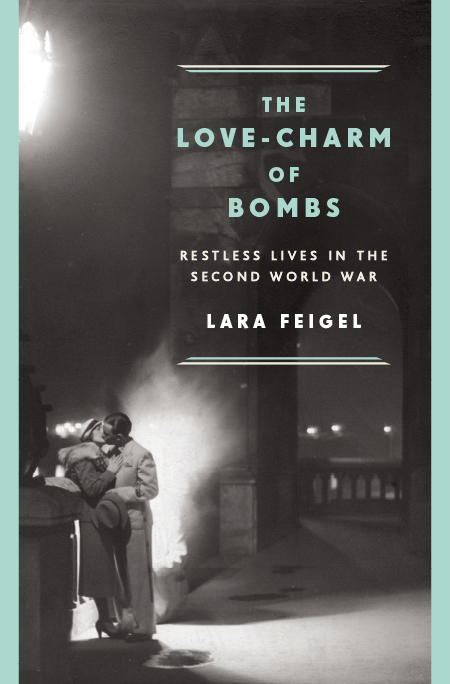
FEIGEL Love-charm of bombs (UK edition)So I returned to the hotel to start Lara Feigel‘s The love-charm of bombs: restless lives in the Second World War (Bloomsbury, 2013) which I picked up at Foyle’s on my way through London (and still the best bookshop in the world).  When people ask me to recommend books that convey the experience of being bombed, my selections always include the opening chapter of Randall Hansen‘s The fire and the fury: the Allied bombing of Germany 1942-1945, where he uses eyewitness accounts to conjure up ‘The day Hamburg died’ with extraordinary power and economy – there is now a rich literature on this in German and in English, most notably Keith Lowe‘s brilliant Inferno: the devastation of Hamburg 1943 – and the central chapters of Sarah Waters‘s stunning novel The Night-Watch.  But I think I may have to add Feigel to the list because The love-charm of bombs traffics in that difficult but vital space between the documentary (Hansen) and the imaginative (Waters).

I say ‘may’ only because I’ve just started.  But Part I, ‘One night in the lives of five writers, 26 September 1940’, uses the work and lives of five writers – Elizabeth Bowen, Graham Greene, Rose Macaulay, Hilda Spiel and Henry Yorke (‘Henry Greene’) – to address, in a remarkably fresh and compelling fashion, the relation between aesthetics and violence.  Feigel does this not in a conventional philosophical fashion, but by engaging directly with the ways in which, for these (and presumably other) writers, there was something thrilling, exhilarating and even sublime about the spectacle of military violence transforming the capital during the Blitz.  This was far more visceral than voyeurism, though Feigel is very, very good on the visuals (and would surely have been even better had she included the work of artists and photographers), because these men and women were profoundly, physically involved in the Blitz as air raid wardens, ambulance drivers, and auxiliary firemen.  The title comes from Graham Greene:

‘The nightly routine of sirens, barrage, the probing raider, the unmistakable engine (“Where are you?  Where are you?  Where are you?”), the bomb-bursts moving nearer and then moving away, hold one like a love-charm.’

FEIGEL The love-charm of bombsFeigel gives the events of that one night a peculiar intensity by beginning with what she calls a ‘newsreel’, a quick and lively summary of the Blitz, and then, as darkness falls, moving in sections from 7 p.m. (Blackout) through 10 p.m. (Fire) and 1 a.m. (Rescue) until 6 a.m., the All Clear, and the blessed arrival (for some, at least) of a new day.  It’s something of a conceit: the five writers were not dutiful scribes each at their separate desks on 26 September , so to bring them into view on this artfully re-imagined night Feigel darts back from their loosely collective present into their pasts, placing them in myriad networks of other writers and friends, inserting them into the narrative arc of the falling bombs, and freely using their writings so that they issue forth as something far more than the usual silhouettes glimpsed against the light of burning buildings.  And their involvements are profoundly sensuous: as the cover of the American edition (right) shows far better than the English edition above, and as the title intimates, even as they were unmoored from their familiar haunts and their old lives, they also sensed (and often seized) new possibilities for love as well as loss.

This is a very different ground to that crunched over by Patrick Deer in the equally brilliant Culture in camouflage: war, empire and modern British literature (still one of my favourite books about this or any other period) or Leo Mellor‘s Reading the ruins: modernism, bomb-sites and British culture (which I found remarkably austere), because its sense of culture is more sensuous, even sensual, because it addresses the erotics of surviving military violence in such an honest way, and – probably another way of saying the same two things – because it’s so close in spirit to Sarah Waters.

It’s also much closer to the way in which the humanities have recovered the Western Front.  In fact, Feigel insist that ‘these writers, firefighting, ambulance-driving, patrolling the streets,were the successors of the soldier poets of the First World War, and their story remains to be told.’  There are of course difficulties in privileging the privileged, and some of the most arresting memorials about life in the trenches were produced not by the gentlemen-officers but by the ordinary soldiers: but as Feigel shows, there are also riches to be recovered by picking their pocket-books.

After Hiroshima

slavick After HiroshimaFollowing my post on artists and bombing, and in particular the work of elin o’Hara slavick, elin has written with news of her new book, After Hiroshima, due in March from Daylight, with what she calls a ‘ridiculously brilliant essay’ from James Elkins.

If you’re interested in two different but none the less intimately related works, I recommend Paul Ham‘s Hiroshima Nagasaki (Doubleday, 2012), which is extraordinarily good at placing those terrible attacks in the context of a strategic air war waged primarily against civilians (according to the Air Force Weekly Intelligence Review at the time, ‘There are no civilians in Japan’: sound familiar?) – and this needs to be read in conjunction with David Fedman and Cary Karacas, ‘A cartographic fade to black: mapping the destruction of urban Japan in World War II’, Journal of historical geography 38 (2012) 303-26 (you can get a quick visual version here) – and Rosalyn Deutsche’s Hiroshima after Iraq: three studies in art and war (Columbia, 2010), based on her Wellek Library Lectures in Critical Theory given in 2009.

You can get a preview of elin’s ‘After Hiroshima’ project here. Scrolling down that page, my eye was caught by the image ‘Woman with burns through kimono’, taken in 1945, which transported me to another ridiculously brilliant work, Kamila Shamsie‘s dazzling novel Burnt Shadows.  I’ve been haunted by it ever since I read it, and in the draft of the first chapter of The everywhere war I start with this passage from the novel:

Burnt Shadows

And this is how I go on (and please remember this is a draft):

A man is being prepared for transfer to the American war prison at Guantanamo Bay: unshackled, he strips naked and waits on a cold steel bench for an orange jumpsuit.  ‘How did it come to this?’ he wonders.  This is the stark prologue to Kamila Shamsie’s luminous novel Burnt Shadows.  She finds her answer to his question in a journey from Nagasaki in August 1945 as the second atomic bomb explodes, through Delhi in 1947 on the brink of partition, to Pakistan in 1982-3 as trucks stacked with arms grind their way from the coast to the border training-camps, and so finally to New York, Afghanistan and Guantanamo Bay in 2001-2.   These are all, in their different ways, conflict zones and the turning-points of empires, tracing an arc from the cataclysmic end of the Second World War through the Cold War to the wars fought in the shadows of 9/11.   In this book, I follow in her wake; I find myself returning to her writing again and again.  Although this is in part the product of her lyrical sensibility and imaginative range, there are three other reasons that go to the heart of my own project and which provide the framework for this chapter.

The first flows from the historical arc of the novel.   Shamsie is adamant that Burnt Shadows is not her ‘9/11 novel’.  She explains that it is not about the attacks on the World Trade Center and the Pentagon on 11 September 2001 but about the cost and consequences of state actions before and after.  Her long view reveals that the connections between Ground Zero in 1945 and Ground Zero in 2001 are more than metaphorical.  These are connections not equivalences – and far from simple – but like Shamsie I believe that many of the political and military responses to 9/11 can be traced back to the Cold War and its faltering end and, crucially, that the de-stabilization of the distinction between war and peace was not the febrile innovation of the ‘war on terror’.  I start by mapping that space of indistinction, and it will soon become clear that the dismal architects of the ‘war on terror’ (the scare-quotes are unavoidable) not only permanently deferred any prospect of peace but claimed to be fighting a radically new kind of war that required new allegiances, new modalities and new laws. Here too there are continuities with previous claims about new wars fought by the advanced militaries of the global North, conducted under the sign of a rolling Revolution in Military Affairs and its successor projects, and quite other ‘new wars’ fought by rag-tag militias in the global South: all of them preceding 9/11.

I turn to those new wars next, and this brings me to the second reason why Shamsie’s work is relevant to my own discussion.  While she was writing Burnt Shadows she used Google Earth to disclose the textures of New York City, and marvelled at how obediently they swam into view: ‘3D models of buildings, amazingly high-resolution images, links to photographs and video streams of Manhattan.’ When she turned to Afghanistan, however, all the details dissolved into ‘an indistinct blur, and the only clues to topography came from colours within the blur: blue for rivers, brown for desert, green for fertile land.’  But that was then (2006).  Three years later, a different Afghanistan was brought into view.  ‘As I click through all the YouTube links tattooed across the skin of Afghanistan,’ she wrote, ‘I encounter video clips of American solders firing on the Taliban, Canadian politicians visiting troops, Dutch forces engaged in battle, an IED blast narrowly missing a convoy of US soldiers, a video game in which a chopper hails down missiles and bullets on a virtual city which looks more like Baghdad than Kabul.’  Shamsie uses these distinctions to remind us that ‘we’re still using maps to inscribe our stories on the world.’  So we are; and throughout this book I also turn to these violent cartographies, as Michael Shapiro calls them: maps, satellite images and other forms of visual imagery. These inscriptions and the narratives that they impose have a material form, and they shape both the ways in which we conduct ‘our’ wars and also the rhetoric through which we assert moral superiority over ‘their’ wars.  Yet even as I sketch out these contrasting imaginative geographies, another indistinction – a blurring, if you like – seeps in.  For one of the most telling features of contemporary warscapes is the commingling of these rival ‘new wars’ in the global borderlands, the ‘somewhere else’ that Abdullah reminds Kim is always the staging ground of America’s wars.

And this brings me to the final reason for travelling with Burnt Shadows: Abdullah’s insistence that war is like a disease.  This is an ironic reversal of the usual liberal prescription that justifies war – which is to say ‘our’ war – as a necessity: ‘killing to make life live’, as Michael Dillon and Julian Reid put it.  They argue that war in the name of liberalism is a profoundly bio-political strategy in which particular kinds of lives can only be secured and saved by sacrificing those of others.   You might say that war has always been thus, but what is distinctive about the contemporary conjunction of neo-liberalism and late modern war is its normative generalization of particular populations as at once the bearers and the guardians of the productive potential of ‘species-life’.  Here too there are terrible echoes of previous wars, and these brutal privileges depend, as they often did in the past, on discourses of science and economics (and on the couplings between them).  But contemporary bio-politics also draws its succour from new forms of the life sciences that treat life as ‘continuously emergent being’.  This is to conjure a world of continuous transformation in which emergence constantly threatens to become emergency: in which there is the ever-present possibility of life becoming dangerous to itself.  For this reason the social body must be constantly scanned and its pathologies tracked: security must deal not with a grid of fixed objects but a force-field of events, and war made not a periodic but a permanent process of anticipation and vigilance, containment and elimination.  Mark Duffield calls this ‘the biopolitics of unending war’ – war that extends far beyond the killing fields –in which the global borderlands become sites of special concern. Its prosecution involves the production of new geographies – new modes of division and distinction, tracing and tracking, measuring and marking – that provide new ways of continuing the liberal project of universalizing war in the pursuit of ‘peace’.  In the face of all this, Abdullah had a point.


Seen/seduced from above

BombsightPart of my histories/geographies of bombing project involves addressing the work of visual artists who have attempted to render the violence of bombing not from below but from above. There are many powerful works that show the horror of bomb-sites and broken bodies, and I’m not uninterested in them; but to convey the violence of bombing in advance, so to speak, demands a much more exacting political aesthetic.

This vantage point matters because that is typically how those outside the conflict zone see air strikes conducted in their name.  During the Second World War the British press and newsreels showed the firebombing of German cities from above (in contrast, of course, to their coverage of the Blitz), and this facilitated the representation of area bombing as ‘precision bombing’ (in contrast, again, to their coverage of the Blitz); in the weeks following the Allied invasion of Europe American and British journalists swept across the continent with the advancing armies and were stunned by what they saw on the ground in Cologne, Hamburg and other cities.

In the weeks before the US-led invasion of Iraq, Baghdad was  repeatedly represented, in graphics, aerial and satellite photographs, and online interactives, as nothing more than a series of targets: then, as I showed in The colonial present, in the very week that Saddam’s statue was toppled, maps appeared showing Baghdad for the first time as a series of neighbourhoods inhabited not by tyrants, terrorists and torturers but by people like you and me.  If those images had been the dominant representation in the weeks and months before the attack, how many more would have been on streets around the world to try to prevent the invasion?

We can’t possibly know: but we surely do know that by the time we imaginatively crouch under the bombs and empathise with their victims it’s too late.

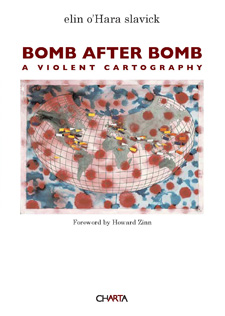
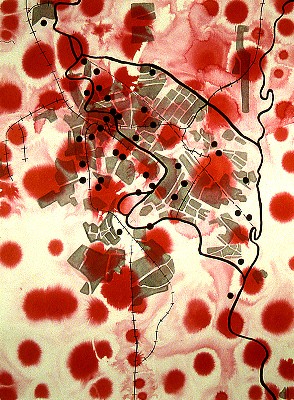
slavick, Bomb after BombThere is an appropriately long arc of work to consider, including artworks by Martin Dammann [the Überdeutschland series], Hanaa MalallahJoyce Kozloff [‘Targets’], Raquel MaulwurfGerhard Richter [Atlas], and Nurit Gur-Lavy.  I’ll post about some of the artworks later, and if anyone knows of others I ought to consider, I’d be very grateful to know about them.  But my very first engagement with these issues was through the work of ellen o’Hara slavick, now Distinguished Professor of Art at UNC Chapel Hill, and a project that was eventually called Bomb after Bomb: a violent cartography (she originally intended to call it ‘Everywhere the United States has bombed‘).  More on the series of 60-plus images and related projects herehere, here and here (the last is on Hiroshima). The book version (Charta, 2007) comes with additional essays by Cathy Lutz, Carol Mavor and the late Howard Zinn.

elin o'Hara slavick, Baghdad (1990)

In “Doors into nowhere” (DOWNLOADS tab) I glossed elin’s project like this:

She adopts an aerial view – the position of the bombers – in order to stage and to subvert the power of aerial mastery.  The drawings are made beautiful ‘to seduce the viewer’, she says, to draw them in to the deadly embrace of the image only to have their pleasure disrupted when they take a closer look. ‘Like an Impressionist or Pointillist painting,’ slavick explains, ‘I wish for the viewer to be captured by the colors and lost in the patterns and then to have their optical pleasure interrupted by the very real dots or bombs that make up the painting.’ 

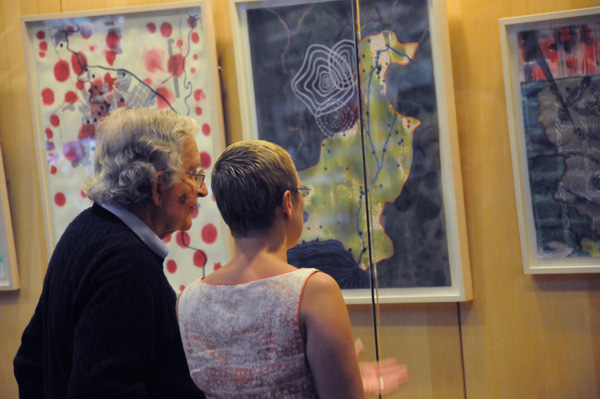
elin o'Hara slavick and Noam Chomsky

There’s much more to her work than this, as I try to show in my commentary, but what interests me here is that disturbing cascade that runs from beauty through seduction to pleasure.  There is a considerable literature on the dangers of aestheticizing violence, but plainly elin’s work is, as I said at the start, much more exacting than this.

Over at Books & Ideas Vanina Géré now has a short but pointed essay on ‘Artistic beauty as a political weapon’ that addresses these issues in helpful ways.  Political art, she writes, is always threatened by the prospect that

‘the political message will not get through because of the work’s retinal character — in other words, because the work is appreciated primarily for its formal qualities. If political art is often considered lacking in formal efficacy, formally remarkable works are often deemed lacking in political efficacy: too much plastic beauty risks making politics a topic like any other. In grappling with this demanding question, some artists have chosen to accentuate their works’ capacity for formal seduction by springing visual traps, placing viewers before realities that they did not expected to encounter in the rarefied air of a museum or a gallery.’

This is a particularly sharp dilemma for political representations of bombing, since the practice such artworks seek to apprehend and dislocate is itself ‘retinal’, formal: it is made possible by a series of performative abstractions that strip away content.  Cities as places where people live are reduced to co-ordinates, targets, pixels, flares of flight.  Géré doesn’t discuss slavick’s work, but her commentary on Brigitte Zieger‘s Eye Dust series speaks directly to the more general issues surrounding political art and military violence:

‘Using glitter eye shadow to draw clouds rising from explosions, the series creates a dialectical movement in which what we see (the makeup) hides what is (a face), yet nevertheless sheds light on a form of everyday violence. At the same time, these sumptuously executed images, which gently shine, entice the viewer to become increasingly fascinated with images of violence. Zieger’s work, by outrageously exploiting its own aesthetic quality in order to offer a critical perspective on representations and manifestations of military violence, demonstrates by this very token that behind every effort to impose beauty lurks a hidden form of violence. Beauty collaborates with politics, as the very concept of beauty is (in part) political. The challenge of such work lies in the precarious balance between the two.’

For Zieger’s own account of her work on war, violence and intimacy see this short video:

Bomb Sight

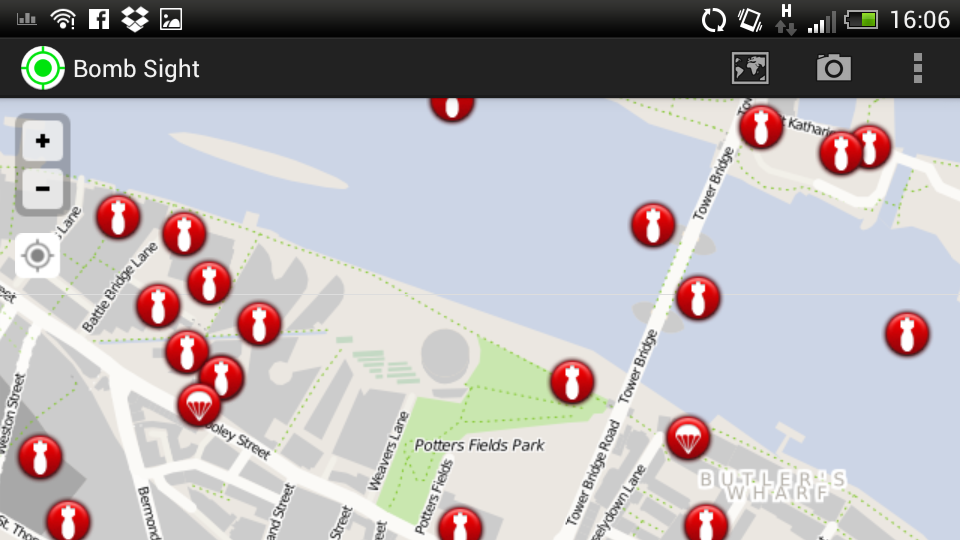
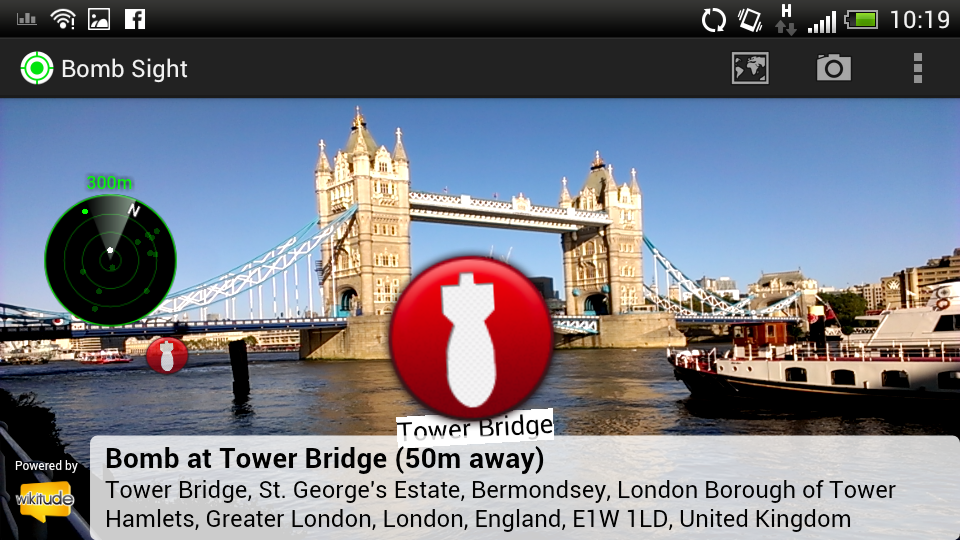
Another pre-script…. Last week I noted two projects that aimed to bring drone strikes to your smart phone, but here’s one that promises to do the same for the London Blitz.  Developed by researchers at the University of Portsmouth led by Kate Jones, in conjunction with the National Archives, and working from the official wartime Bomb Census, Bomb Sight uses web and mobile mapping technology to ‘bring to life [sic] the maps that demarcate the location of [31,000] falling bombs during the London Blitz between October 1940 and June 1941.’  It’s a truly remarkable project that intends to link the sites on the map to photographs, eye-witness accounts and memories.

The project is being developed for the Android platform but there is apparently the future possibility of porting to the iPhone – assuming that Apple doesn’t find this as objectionable as it did Josh Begley‘s Drones+ app (I’m betting it won’t).

The blog recording the development of Bomb Sight includes some screen shots – I’ve pasted some below – showing detailed maps and augmented reality views that give more insight into the intended outcome.

Unlike attempts to plot drone strikes in Pakistan and elsewhere, the Bomb Census Survey maps produced by the Ministry of Home Security make it possible to identify locations with great (though sometimes variable) precision – a capacity that was of course unavailable to those dropping the bombs in the first place – and there is a rich vein of images and testimony to tap into too.

It’s that prospect of multi-media linkage that makes this such a brilliant project.  There have been other attempts to map the Blitz; the Guardian produced this remarkable map of the ‘incidents’ to which the London Fire Brigade responded on the first night of the Blitz, 7 September 1940, for example, and made available an online interactive so that the toll could be followed hour by hideous hour:

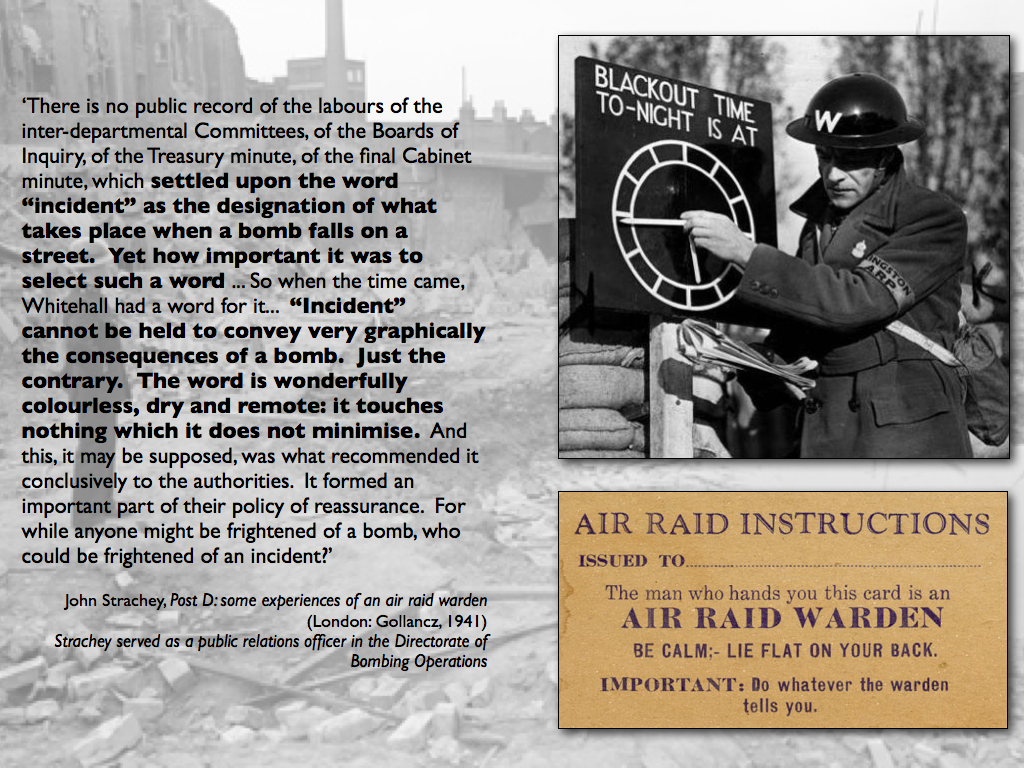
You need to ‘grow’ the markers on the map; the Guardian noted that each ‘incident’ typically involved multiple bombs.  But even more telling is the word itself: ‘incident’.  For, as John Strachey noted in his memoir of his time as an Air Raid Warden, it’s a bureaucratic, bloodless term:

In contrast, what Bomb Sight promises to do is not only to disaggregate each ‘incident’ to show every bomb dropped but, still more importantly, to deconstruct the very term itself: to link the bomb scatter to imagery and testimony and so give the lie to these bloodless abstractions.

Perhaps if something similar could be done for other cities around the world more people would be enraged at the continued recourse to bombing from the air as a legitimate political and military practice, and the politics of  ‘banning the bomb’ might be transformed into a more general demand to ban all bombs.

If you want to see more of Bomb Sight, there’s a very good video up at YouTube: