Art and atrocity

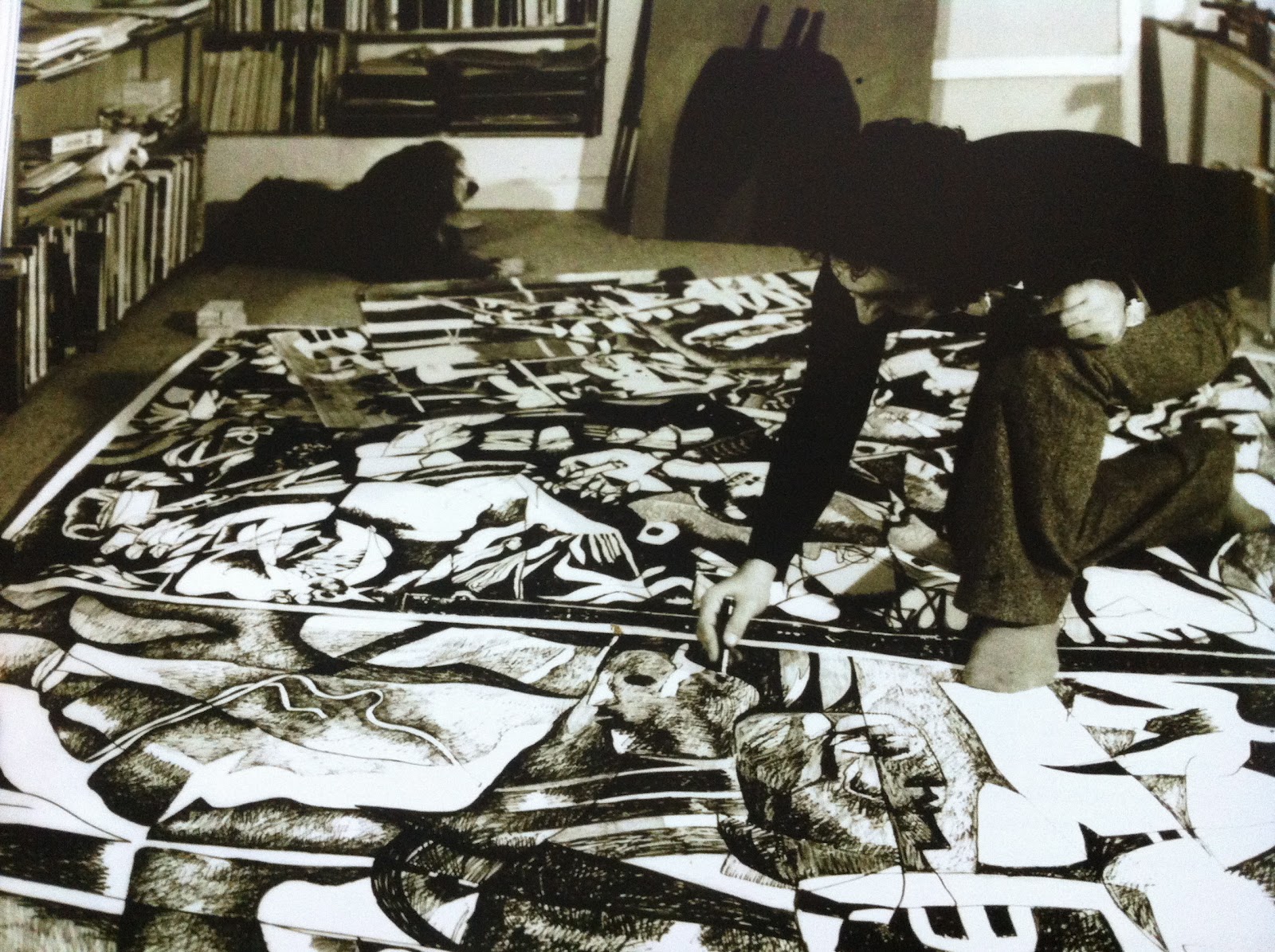
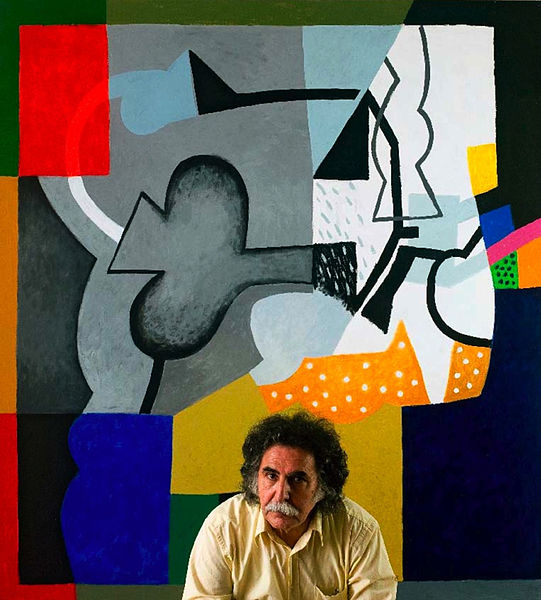
Since I read it yesterday I’ve been mesmerized by Maymanah Farwat‘s fine short essay at Jadaliyya on Baghdad-born artist Dia al-Azzawi‘s (pictured left) Sabra and Shatila Massacre currently on view at Tate Modern in London.

The artwork itself is copyright, and the Tate online pages describe but don’t display it, but if you click on the link to Jadaliyya above you can see it; it’s also – vividly – here, and there’s also a detail here and more here. The vast four-panelled work is a response to the massacre of Palestinians in two refugee camps in Lebanon in 1982 by Phalangist militias under the eyes of the Israeli Defense Force commanded by Ariel Sharon.

Within a labyrinth of death and the mundane (the remnants of domestic structures), the artist is relentless in his indictment, what he refers to as “a manifesto of dismay and anger.” Areas of white, where the eye would normally rest in a monochromatic composition, ignite horror, become corpses. Instances of Cubism are employed not to convey the dynamic movement of form but as a system of measure through which to count out cyclical disaster.

The artist started work on the project the day after the killings:

‘I had at that time a roll of paper and, without any preparatory sketches, the idea for the work came to me. I tried to visualize my previous experience of walking through this camp, with its small rooms separated by a narrow road, in the early 1970s.

But this vast composition is more than a memory work: Dia al-Azzawi was also inspired by Jean Genet‘s Quatre heures à Chatila (‘Four Hours in Shatila’) (available in the Journal of Palestine Studies 12 (3) (1983) 3-22).  As Ahdaf Soueif tells the story:

‘[Genet] was, it seems, one of the first foreigners to enter the Palestinian refugee camp of Shatila after the Christian Lebanese Phalange, with the compliance of the Israeli command, tortured and murdered hundreds of its inhabitants. There, pushing open doors wedged shut by dead bodies, Genet memorised the features, the position, the clothing, the wounds of each corpse till three soldiers from the Lebanese army drove him at gun point to their officer: “‘Have you just been there?’ [the officer] pointed to Shatila. ‘Yes.’ – ‘And did you see?’ — ‘Yes.’ — ‘Are you going to write about it?’ — ‘Yes.'”

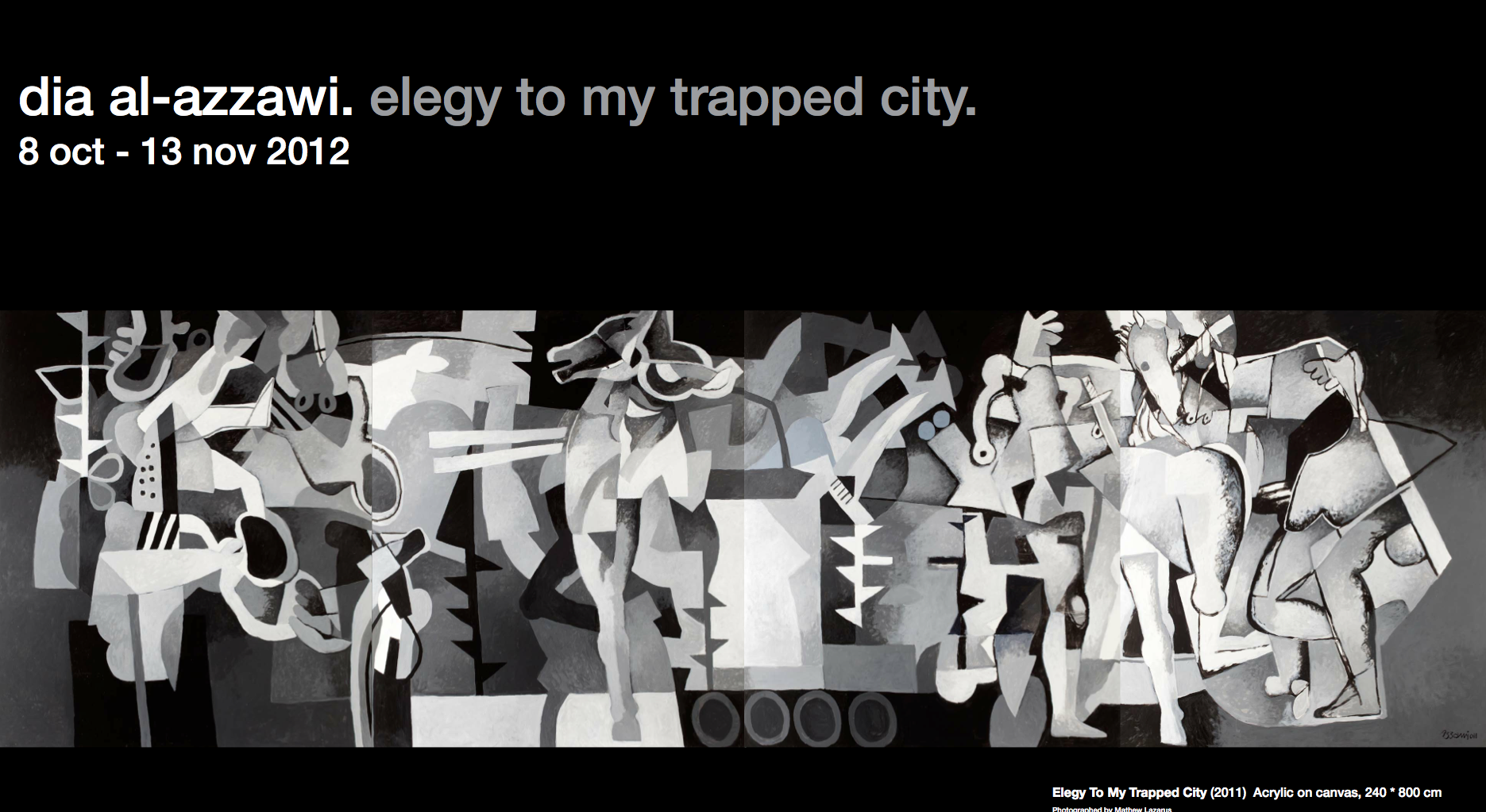
Sabra and Shatila Massacre retains that extraordinary, forensic attention to detail – to the wretched remnants of the ordinary – and it’s often compared to another, equally epic rendering of horror, Picasso‘s giant Guernica. (You can also see the parallels, I think, in the same artist’s Elegy to my trapped city (2011) below).
There’s more on the to-and-fro between the textual and the visual in relation to Sabra and Shatila in  Zahra A. Hussein Ali, ‘Aesthetics of memorialization’, Criticism 51 (2010) 589-621.  And Vimeo has an English-language version of Carlos Lapeña‘s film (2005) Four hours in Chatila inspired by Genet’s testimonial:

But if memory-work haunts these visualizations, then a film to watch in conjunction with and counterpoint to Lapeña’s is Ari Folman‘s ‘animated documentary’ Waltz with Bashir (2008) – described by Peter Bradshaw in the Guardian as ‘a military sortie into the past’ – in which the director tries to come to terms with his non-memory of being a young Israeli soldier in Lebanon in 1982 and, in so doing, converts Sabra and Shatila into lieux de mémoire.
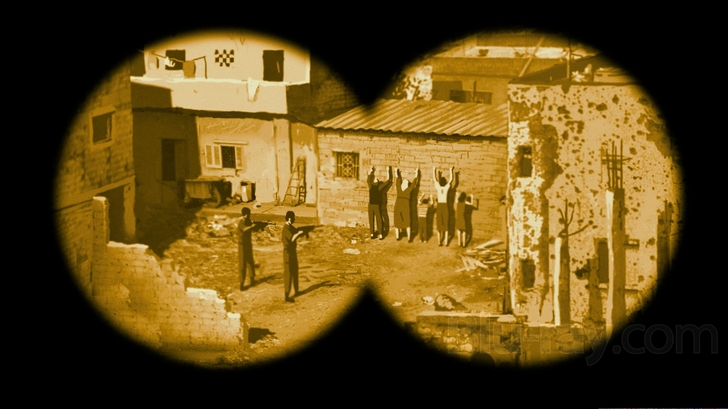
Among the many thoughtful critical responses to the film, Natasha Mansfield‘s open-access essay on ‘Loss and mourning’ at Wide Screen 2 (1) (2010) deals with the differential distance between camera and animation (Ohad Landesman and Roy Bendor develop this in more detail in animation 6 (3) (2011) 353-70), Katrina Schlunke in ‘Animated documentary and the scene of death’ in South Atlantic Quarterly 110 (2011) 949-62 treats the final cut from animation to documented images of the massacre, while  in ‘War Fantasies’, Modern Jewish Studies 9 (2010) 311-26 Raz Yosef – who also discusses these themes – objects to Folman’s focus on the Israeli ‘victim’ and its equation with the otherwise marginalised Palestinian victim.
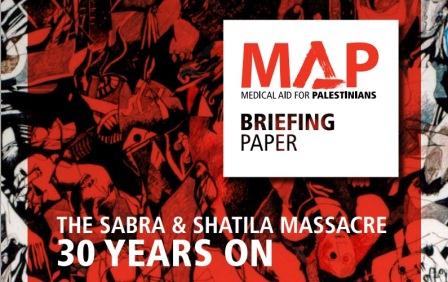
The last is particularly troubling – see also Naira Antoun at electronic intifada and Ursula Lindsey at MERIP (‘Shooting film and crying’). For reflections on the thirtieth anniversary of the massacre, I recommend Seth Anziska in the New York Times (who documents US involvement), Zeina Azzam at Jadaliyya, and Habib Battah at al Jazeera.  There’s also a moving briefing paper from Medical Aid for Palestinians here whose cover is based on Dia al-Azzawi’s artwork.

And although it doesn’t address the visual – it’s an artful ‘misreading’ of Palestinian poet Mahmoud Darwish‘s memoir of Beirut via the Goldstone report on the Israeli assault on Gaza in 2009 – Barbara Harlow‘s ‘The geography and the event’, Interventions 14 (2012) 13-23 amplifies those contemporary resonances in ways that are worth attending to:

New ‘events’ – whether Operation Peace for Galilee (Beirut, 1982) or Operation Cast Lead (Gaza, 2009) – perhaps call, after all, for new ‘geographies’, such as universal jurisdiction, a principle in international law according to which states are allowed to claim criminal jurisdiction for actions – deemed heinous and to be crimes against humanity – committed outside their boundaries.
ASAP and experimental geopolitics

My last post trafficked, amongst other things, in a geography of time-space compression, so it’s time (and space) to introduce ASAP: a title chosen by Tina di Carlo, former curator of architecture and design at New York’s Museum of Modern Art and a graduate of Eyal Weizman‘s Research Architecture programme at Goldsmith’s, to echo the English ‘as soon as possible’ – ‘to evoke a sense of urgency and speed where space collapses in time’ – and, more precisely, to signal the Archive of Spatial Aesthetics and Praxis.  Established in 2010, this is a virtual Aladdin’s cave of projects and practices, texts and objects.

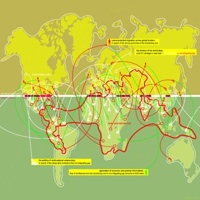
You can fossick for your own favourites – everything is accessible from the starting grid – but here are two of mine.  The first is Teddy Cruzs Political Equator project.  This uses the US/Mexico border – specifically  Tijuana/San Diego – as a platform to describe an arc through other global borderlands all located between 30 and 36 degrees North:

Along this imaginary border encircling the globe lie some of the world’s most contested thresholds: the US–Mexico border at Tijuana/San Diego, the most intensified portal for immigration from Latin America to the United States; the Strait of Gibraltar, where waves of migration flow from North African flow into Europe; the Israeli-Palestinian border that divides the Middle East, along with the embattled frontiers of Afghanistan, Iran, Iraq, and Syria, and Jordan; the Line of Control between the Indian state of Kashmir and Azad or free Kashmir on the Pakistani side; the Taiwan Strait where relations between China and Taiwan are increasingly strained as the Pearl River Delta has rapidly ascended to the role of China’s economic gateway for the flow of foreign capital, supported by the traditional centers of Hong Kong and Shanghai and the paradigmatic transformations of the Chinese metropolis also characterized by urbanities of labor and surveillance.

You can find full details of the associated meetings (‘conversations’), videos and more at the project website here.

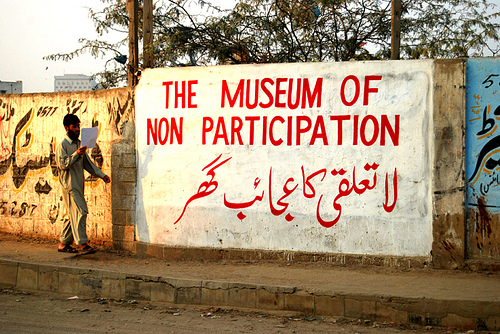
Second is Karen Mirza and Brad Butler‘s Museum of Non-Participation.   This is a travelling project that started in Islamabad in 2007.  The two artists watched the demonstrations by the Lawyers’ Movement against the dismissal of the Chief Justice by the Musharaf regime and the violent response by the military/police from a window in the National Art Gallery – more about the protests here and here – and went on to develop a multi-sited, multi-voiced project that has been staged in Karachi, in London’s Bethnal Green and elsewhere.  One of its central aims is to contest the dominant narrative (and geographical imagination) of Pakistan as a ‘rogue state’ and to find (in part, I think, through a contrapuntal rendering of London and Karachi) ‘other languages and other voices’ to convey everyday life under the sign of the postcolonial.

ASAP explains:

The Museum of Non Participation began as a critique and ultimately exploration of the political agency of the Museum through what the artists call the space of the NON… which is at once a radical critique of the Museum which often and has historically stood by as a mute witness [and [a redefinition] of [its] traditional architectural typology, transforming it from a shelter that houses objects to a literal sign that travels around.

You can download a detailed (30pp) feature from Kaleidoscope here.

The Museum was in Vancouver this month, where it included a screening of Deep State (2012) , a film developed in collaboration with China Miéville (and my thanks to Jorge Amigo for the notice). Here is a preview:

http://vimeo.com/50834391

The film takes its title from the Turkish term ‘Derin Devlet’, meaning ‘state within the state’. Although its existence is impossible to verify, this shadowy nexus of special interests and covert relationships is the place where real power is said to reside, and where fundamental decisions are made – decisions that often run counter to the outward impression of democracy.

Amorphous and unseen, the influence of this deep state is glimpsed at regular points throughout the film – most clearly surfacing in its reflexive responses to popular protest, and in legislated acts of violence and containment, but also rumbling and reverberating, deeper down, in an eternally recurring call-and-response between rhetorical positions and counter-languages, in which a raised fist, a thrown rock, a crowd surge, an occupation provoke a corresponding reaction in the form of a police charge, a baton attack, a pepper spray, assassinations.
There’s an interview with Mirza and Butler about the film here, where Mirza explains that when she read Miéville’s The city in the city she was struck by the ‘condition of unseeing in the midst of seeing’ which is at the heart of the book. Miéville’s extraordinary combination of a radical reading of international law  – in his Between equal rights: a Marxist theory of international law (2006) and also, for example, here –and what he calls his ‘weird fiction’ was not only a ‘compelling combination’ but also a creative platform from which to develop a script and then the screenplay. Michael Turner provides both a sympathetic account of the Museum project and a spirited critique of the Vancouver screening here (there’s also a constructive response: scroll down).
You can, I hope, see why these two projects – from borderlands to international law – interest me.  They are also vivid examples of the connections Alan Ingram is so deftly pursuing between contemporary art and what he calls ‘experimental geopolitics’ (a term I find much more appealing than critical geopoltiics….)

The Guantanamo Bay Museum of Art and History

While I was in Cologne I had an e-mail from Ian Paul, an artist/theorist in San Francisco who works around issues of border violence and post-national human rights.  He wanted to include my essay “The Black Flag” in an online project on Guantanamo Bay:

“The Guantanamo Bay Museum of Art and History is a project which hopes to bring together artists and writers from around the world to examine the current conditions of the Guantanamo Bay Prison as well as the possibility of its closure.  The project takes the form of a ‘speculative present’, and posits that the prison itself has been closed and has been replaced by a museum that features exhibitions and public programs which document/interrogate/examine the history of the prison. The project seeks to draw a transnational/transdisciplinary group together to critique the prison, and artists/theorists from 5 different countries have already agreed to participate.”

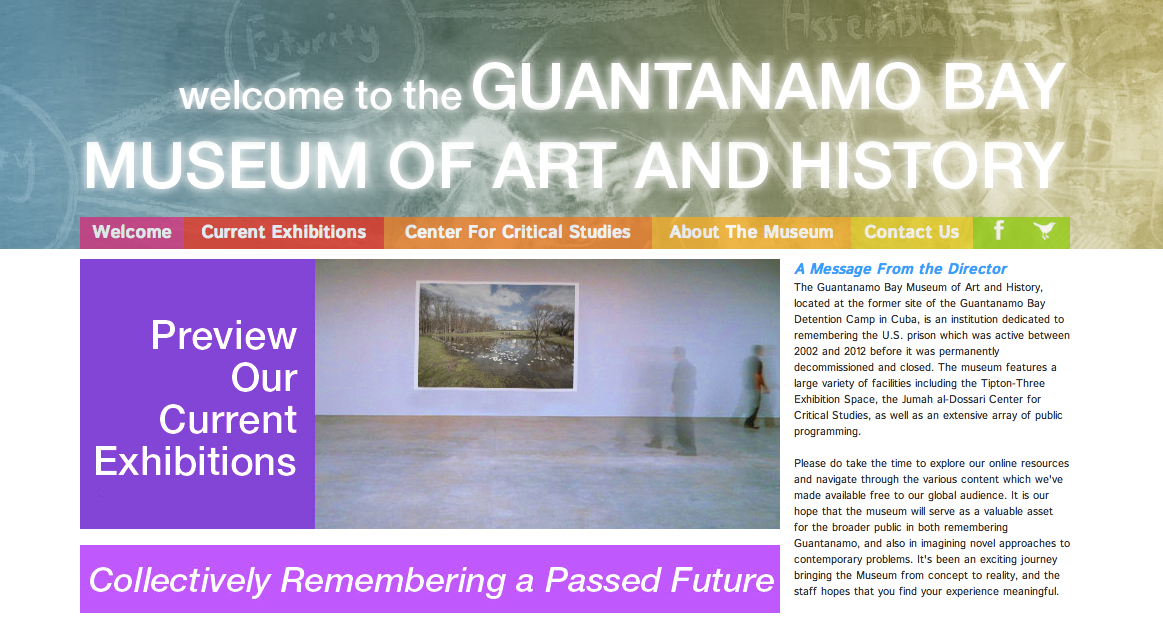
The Guantanamo Bay Museum of Art and History  has now opened its virtual doors here.  Well worth a visit. (It’s also on Facebook).

Current Exhibitions includes a specially commissioned video montage by Adam Harms, “Performing the Torture List”, while  the Jumah al-Dossari Center for Critical Studies includes “The Black Flag” and contributions from Judith Butler, Martin Puchner, Harsha Walia (and more to come).

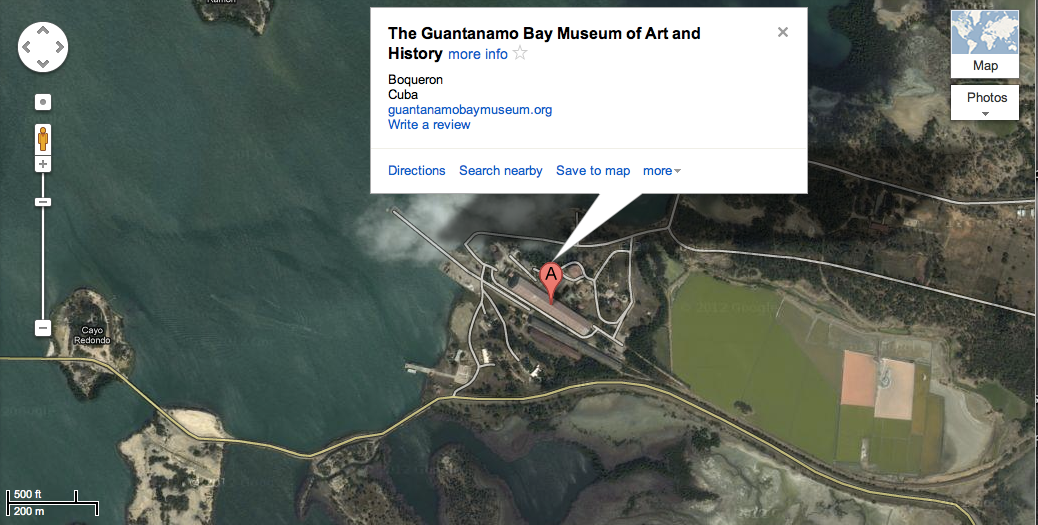
As I say, worth a visit.  As Alexis Madrigal at the Atlantic blog notes, you can find the Museum on Google maps (really) –

– and he’s captivated by the conceit:

The imaginary museum draws its power from this resonance: If Gitmo exists because of one fiction, perhaps it can be closed by another? Or put another (augmented) way, germane to this digital project: if we change Gitmo’s website, can it actually change its physical and legal reality? That’s what the museum’s organizers are hoping. 

“The museum is the result of a collaboration between artists/theorists and is meant to act as both a critique of the Guantanamo Bay Detention Facility as well as assert the possibility of its closure,” Rene Guerne, one of its organizers, told me in an email. “In this sense, it is a ‘real’ museum, although I cannot promise that there is a physical building in Guantanamo Bay.”

Benjamin Wittes at Lawfare is also intrigued by the project, and published the artists’ opening statement:

On August 29th, 2012, the website of the Guantanamo Bay Museum of Art and History was publicly launched. Designed by a group of artists from around the globe, the project creates a ‘speculative present’ in which the Guantanamo Bay Detention Facilities have been closed and replaced by an art museum whose purpose is to reflect on the history of the site.

The museum was listed as an official place on google maps ( http://goo.gl/tg72v ) and features original artworks from 6 different contemporary artists, as well as essays on Guantanamo Bay from leading contemporary scholars including Judith Butler and Derek Gregory.

Ian Alan Paul, an artist from San Francisco who coordinated and curated the project, states:

“The purpose of the project is both to explore the human rights abuses that occurred and continue to occur in Guantanamo Bay, but also to provide a space for radical imagination and potential openings and to insist that it is both possible and necessary to close the prison facility.”

The project was the result of large collaboration, with over 25 artists, writers and other volunteers contributing to the project in some way from Europe, North America and South America. Visitors to the museum were invited to plan their trip to Guantanamo Bay, become a member of the museum, apply to be an artist in residence, as well as read about the history of the museum itself.

There were over 3000 visits to the museum on the first day from 42 different countries.

In January 2009, interestingly, Florence Waters – anticipating Obama’s closure of the war prison (I wonder if she still does?) – proposed the creation of a (physical) museum on the site:

Transforming what will become an important site of memory into a museum could be an opportunity to present the facts from multiple points of view and give the subject transparency. Guantanamo detainees and guards would have the opportunity to present their stories alongside one another.

America has led the way in the post-modern world in erecting museums and sites of memory. They serve not only as burial sites of the past but also to affirm the symbolic order of a society, and head warnings to future generations…. Guantanamo Bay Museum would be a cultural and historical showcase dedicated to reinstating America’s most important values, liberty and justice, giving the detainees fair trial in the eyes of the outside world.

If only.  There are, incidentally, several other virtual Guantanamo Bays.  It was one of the founding sites for Mathias Judd and Christoph Wachter‘s  Zone Interdite, and Nonny de la Peña and Peggy Weil created a virtual Gitmo in Second Life (and, ironically, had to launch a campaign to keep Gitmo – their Gitmo – open!).

As the matchless Bryan Finoki put it on the much missed Subtopia, ‘the field guide to military urbanism’ (and still up even though Bryan stopped posting there early this year), referring to and then riffing off Zone Interdite,

 I love the idea of revealing these off-limit places this way, in a sense, de-restricting them in the process of remaking them. Altogether, rendering a de-restricted global fortress. 

What starts off as a few models of detention centers and prison camps could eventually turn into a full on game-world atlas of forbidden cities; a Borgesian labyrinth of illegal walkthroughs and blatantly trespassed border-zones, subverted checkpoints, oblique tunnel architecture, web tourists lost in the intersecting planes of bunker complexity and secret baseworld archipelago urbanism. It becomes a backlash taxonomy of exposed military installations. A virtual military-industrial-complex: “clandestinatopia.” Border fences and security walls give way now to a deterritorialized map of exploratory landscapes, overrun by mad gamers and tribes of sim-squatters preserving the world’s most closed and hidden places as endlessly wandering open space. Like a Subtopianinvoluntary park online, or a virtual spelunker’s paradise. 

So, yeah, I hope to see you there.

And as Bryan reminds us, there are many more black flags to fly over many more prisons and camps all over the world.