Bodies and bombs

Paul Rogers draws some parallels between what he calls ‘drone bombing’ and suicide bombing at Open Democracy.

Suicide-bombing allows explosives to be placed at or very close to a target, with the deliverer having considerable real-time initiative and scope for concealment. He or she can adapt to circumstances in matters of timing as well as any movement of and even the precise location of the target. Countermeasures such as blast-walls and surveillance systems can be circumvented or fooled…. 

The similarity with armed-drones is striking. Drones such as the Reaper have multiple air-to-surface missiles, can loiter for hours and are “flown” in real time by operators thousands of miles away. There is no risk to these people, no suicide factor. Drones may not have quite the precision potential of a suicide-bomber, and in the very final seconds before impact the missiles that are fired cannot be diverted or halted.’

But in essence, Paul argues, there is no difference between them: ‘drone bombing’ is ‘suicide bombing without the suicide’.

And life (or in this case death) imitates art: this week Spencer Ackerman at Danger Room reported that the US Army is soliciting bids to develop ‘a tiny suicidal drone to kill from six miles away’.  It’s a good tag line, but the story is really about the fusion of miniaturised drone and missile in a ‘Lethal Miniature Aerial Munitions System’.

I suspect that one of the imaginative devices that enables publics in the global North to accept their own militaries bombing from the air – apart from a profound lack of imagination – turns on the body itself.   In one direction, they congratulate themselves that suicide bombing is foreign to their traditions of war in part, I think, because it allows no escape from the corporeality of bombing: the body of the bomber carries the bomb.  In the other direction, they congratulate themselves on their restraint: after Hiroshima and Nagasaki they have not resorted to nuclear bombs that, at the limit, vaporize bodies (though they also leave countless other bodies broken and disfigured from the blast or sick from radiation). (In his meditation On Suicide bombing Talal Asad is very instructive on the horror generated by ‘the dissolution of the human body’ (see pp. 76-92)).

The space in between the two is occupied by conventional bombing from the air, and the production/performance of this space involves what Asad calls ‘a redefinition’ – even a re-calibration – ‘of the space of violence’.  Here – precisely because of the imaginative distance between the bomber and the bombed, which in some respects was even greater for Bomber Command aircrew over Hamburg and USAAF aircrew over Vietnam than it is for remote pilots in Nevada – it becomes possible to conceive of an air strike in purely abstract terms (which is why calibration assumes such significance): a ‘surgical’ attack on a nominated  ‘target’.  There are remarkable continuities between conventional bombing and the use of remotely-piloted aircraft, as I’ve tried to show in detail in Lines of descent (see DOWNLOADS tab), and part of my Killing Space project focuses on the ways in which mainstream British and American media coverage of the combined bomber offensive against Germany in WWII, the US air wars over Indochina, and the current drone wars over Afghanistan, Pakistan and elsewhere consistently removes the bodies of the bombed from public view.

And yet this may also reinforce Paul’s particular parallel.  If the corporeality of suicide bombing is inescapable for those who carry it out, so too (in a different sense) for those remote pilots in the continental United States.  They routinely insist that they are not thousands of miles away from their ‘target’ but eighteen inches: the distance from eye to screen.  And they are required to remain on station after a strike and, through their surveillance cameras, carry out what in previous wars would also have been called ‘bomb damage assessment’ but which, in the case of a targeted killing, involves a hideous inventory of body parts.

Fifty shades of grey: drones and the theatre of secrecy

Over the weekend I worked my way through New Inquiry‘s special issue, Game of drones – Pete Adey‘s recommendation.  For me, the stand-out essay is Madiha Tahir‘s “Louder than bombs”

A graduate of Barnard College, NYU and the Columbia School of Journalism, Madiha is currently an independent multimedia/print journalist reporting on conflict, culture and politics in Pakistan; somehow she has also found the time to co-edit Dispatches from Pakistan (LeftWord Books, 2012) with the indefatigable Vijay Prashad and Qalander Bux Memom: more about Madiha here.

“Louder than bombs” begins with harrowing and matter-of-fact (all the more harrowing because matter-of-fact) testimony from Sadaullah Wazir, a teenage boy who lost both his legs and an eye after a US drone attack in North Waziristan in Pakistan’s Federally Administered Tribal Areas; he was just 13, and three other members of his family were killed in the attack.

Madiha’s root objection is to the way in which what she calls the Obama administration’s ‘theatrical performance of faux secrecy’ over its drone war in the FATA (and elsewhere) – a repugnantly teasing dance in which the veil of secrecy is let slip once, twice, three times – functions to draw its audience’s entranced eye towards the American body politic and away from the Pakistani bodies on the ground.  The story is always in Washington and never in Waziristan.  It’s a hideously effective sideshow, in which Obama and an army of barkers and hucksters – unnamed spokesmen ‘speaking on condition of anonymity’ because they are ‘not authorised to speak on the record’,  and front-of-house spielers like Harold Koh and John Brennan – induce not only a faux secrecy but its obverse, a faux intimacy in which public debate is focused on transparency and accountability as the only ‘games’ worth playing.

But when you ask people like Sadaullah what they want, Madiha writes,

‘they do not say “transparency and accountability”.  They say they want the killing to stop. They want to stop dying.  They want to stop going to funerals – and being bombed even as they mourn.  Transparency and accountability, for them, are abstract problems that have little to do with the concrete fact of regular, systematic death.’

So we have  analysts, activists and reporters falling over themselves to determine whether targeted killings outside a war zone like Afghanistan are legal; fighting to disclose the protocols that are followed to provide legal scrutiny of the targeting process; finally reassuring us, in a peculiarly American Story of O, that Obama is fully sensible of the enormous weight that rests on his shoulders.  But all of this distracts our collective gaze from the enormous weight that has been brought to bear on Sadaullah’s shiny new prostheses.  “I had a dream to be a doctor,” he tells a reporter. “Now I can’t even walk to school.”

Any discussion of the ways in which the kill-chain has been ‘lawyered up’ needs to acknowledge that – as the very formulation implies – the law is not apart from military violence: it has become part of military violence.  In Foucault’s ringing phrase, ‘the law was born in burning towns and ravaged fields’, and in the intervening centuries it has become ever more closely entwined with military (and paramilitary) violence.   Legality now substitutes for legitimacy, silencing any questions about politics or ethics.  As Madiha says, speaking of the calibration between the deaths of militants and the deaths of civilians, it is as though ‘if we could just get the calculus right, there would be no further ethical or political questions’.  Similarly, referring to the computer programs used by the US military (and seemingly, the CIA) to predict collateral damage, and so to adjudicate between the legal principles of necessity and proportionality,  Eyal Weizman notes that ‘it is the very act of calculation – the very fact that calculation took place – that justifies their action.’   But this is never a neutral appeal to algorithms or attorneys: not for nothing do those involved refer to the ‘prosecution’ of the target,  and as Anne Orford emphasises, the relevant body of international law ‘immerses its addressees in a world of military calculations’ and ensures that proportionality will always be weighed on the military’s (or the CIA’s) own scales.  In Weizman’s words, ‘violence legislates.’

Madiha again:

Even as we debate the legal machinations, official leaks and governmental manipulations by which they are killed, the daily, material, precarious existence of the people living under the disquieting hum of american drones in Pakistan’s tribal areas rarely sits at the center of discussion.

But what if it did? if, instead of the public secret, one begins with a prosthetic limb, a glass eye, and a funeral photo, the nightmare takes form, solidifies. 

None of this means that the law does not matter; its matter-iality ought to be obvious.  But it is to say that we need to be alert to what appeals to ‘the law’ do – and what they seek to foreclose. Legal questions do matter – but their answers must not be allowed to silence other political and ethical questions.  Neither should they close our eyes to the contrapuntal geographies that are staged far beyond the peep-shows of the Washington beltway.

*****

Note: For more on drone wars, see Remote witnessing and, in detail, ‘From a view to a kill’ and ‘Lines of descent’ (DOWNLOADS tab).  I’ve also provided a preliminary reading/screening list that notes some of the same emphases and omissions that trouble Madiha here.

Saucepans, sources and bombers

Sometimes you’re blind to things close to home…  When I wrote about war and logistics I wasn’t aware of my colleague Matthew Evenden‘s excellent work on the supply of aluminium in the Second World War.  How I missed it I have no idea.

Matthew’s essay, ‘Aluminum, commodity chains and the environmental history of the Second World War’, appeared in Environmental History 16 (2011) 69-93.  Reading it made me realise that Martin van Creveld’s classic account of ‘supplying war’ misses a crucial dimension: the technical transformations of modern war constantly draw new materials (and frequently distant sources) into the supply chain.   Creveld is right to emphasize the importance of what he calls ‘the products of the factory rather than the field’ to modern war, but those products are moving targets in more ways than one.

Aluminium provides a brilliant example.  As Matthew says, its strategic importance was tied to the expansion of the air war: aluminium was lightweight, flexible and durable, and an essential component of the new generation of aircraft.  According to Leo McKinstry‘s Lancaster (John Murray, 2009), the production of each Lancaster bomber required nearly ten tons of light aluminium alloy (‘the equivalent of eleven million saucepans’).  The production process was remarkably intricate: each aircraft involved half a million different manufacturing operations spread out over 10 weeks. (For images of production lines in aircraft factories on both sides of the Atlantic, by the way, see the show-stopping series here; as far as I’m aware, there’s no British equivalent to Bill Yenne‘s The American aircraft factory in WWII [Zenith, 2006]).

McKinstry’s equivalence between saucepans and bombers was entirely appropriate.  As the demand for aluminium sky-rocketed, so wartime campaigns to recycle aluminium were started on both sides of the Atlantic: you can hear a satirical radio treatment of “Aluminum for Defense” in the United States, complete with crashing saucepans and “collection parties” (the antecedent of Tupperware parties?), here.  In Britain too saucepans and even milk bottle tops were collected for their aluminium, a campaign that began immediately after the fall of France in 1940.  According to one contemporary report:

‘Although these contributions were to be voluntary, the timing of the appeal, its tone, and the manner in which it was put forward left the impression that the country’s need for scrap aluminum was urgent. As a result, the response from the housewives was immediate and their contributions were reported to be of quite considerable proportions.  Almost as prompt were the criticisms and complaints raised from trade and parliamentary quarters, as well as by some groups of skeptical housewives. Thus many scrap metal merchants became indignant when the appeal was made, calling attention to the tons of scrap in their yards for which they were unable to find a market. To this objection it was pointed out in Parliament that not all aluminum scrap was suitable for use in aircraft production. This limitation was especially true for the scrap held by these dealers, whereas that obtained from household utensils was excellent for this purpose.’

Incidentally, those who yearn for a time when air forces have to raise funds through bake sales might contemplate the “Wings for Victory” campaign, and its enlistment of children to contribute savings stamps for the purchase of new bombers.  When one of these aircraft was exhibited in Trafalgar Square in 1943, children lined up to plaster their stamps all over a thousand-pound bomb.  Here – as in the clarion call for the nation’s saucepans – war becomes domesticated, even homely.  War enters the domestic interior in countless other ways of course – through air raids, conscription, evacuation, and rationing, for example – but the enrollment of everyday objects, like savings stamps and saucepans, contrives to make violence not ‘harmless’ exactly but certainly ordinary, mundane, as this photograph from the Imperial War Museum shows.  Here two women factory workers fill bombs covered in savings stamps in what, to my eyes at any rate, looks like a ghastly parody of cooking; the biggest so-called ‘blockbuster’ bombs were called “cookies”, perhaps not incidentally, and aluminium was a vital component in many explosive mixes too.

Aluminium was needed for aircraft besides the Lancaster:

‘Saucepans into Spitfires’ (Imperial War Museum)

And, given the demand right across the sector, the British had to look further than their doorsteps and kitchens, though surprisingly McKinstry says nothing about this in his otherwise fascinating discussion of the production process (Chapter 12: “At the machines all the time”).  The British government soon realised the need to bring domestic aluminium production under state control, and by the early 1940s an intricate system of Acts, statutory Orders and commercial contracts had extended the security of the supply chain across the Atlantic to Canada (there is an excellent, if dry account in Jules Backman and Leo Fishman, ‘British wartime control of aluminum’, Quarterly Journal of Economics 56 (1) (1941) 18-48, from which I took the previous quotation about domestic recycling).

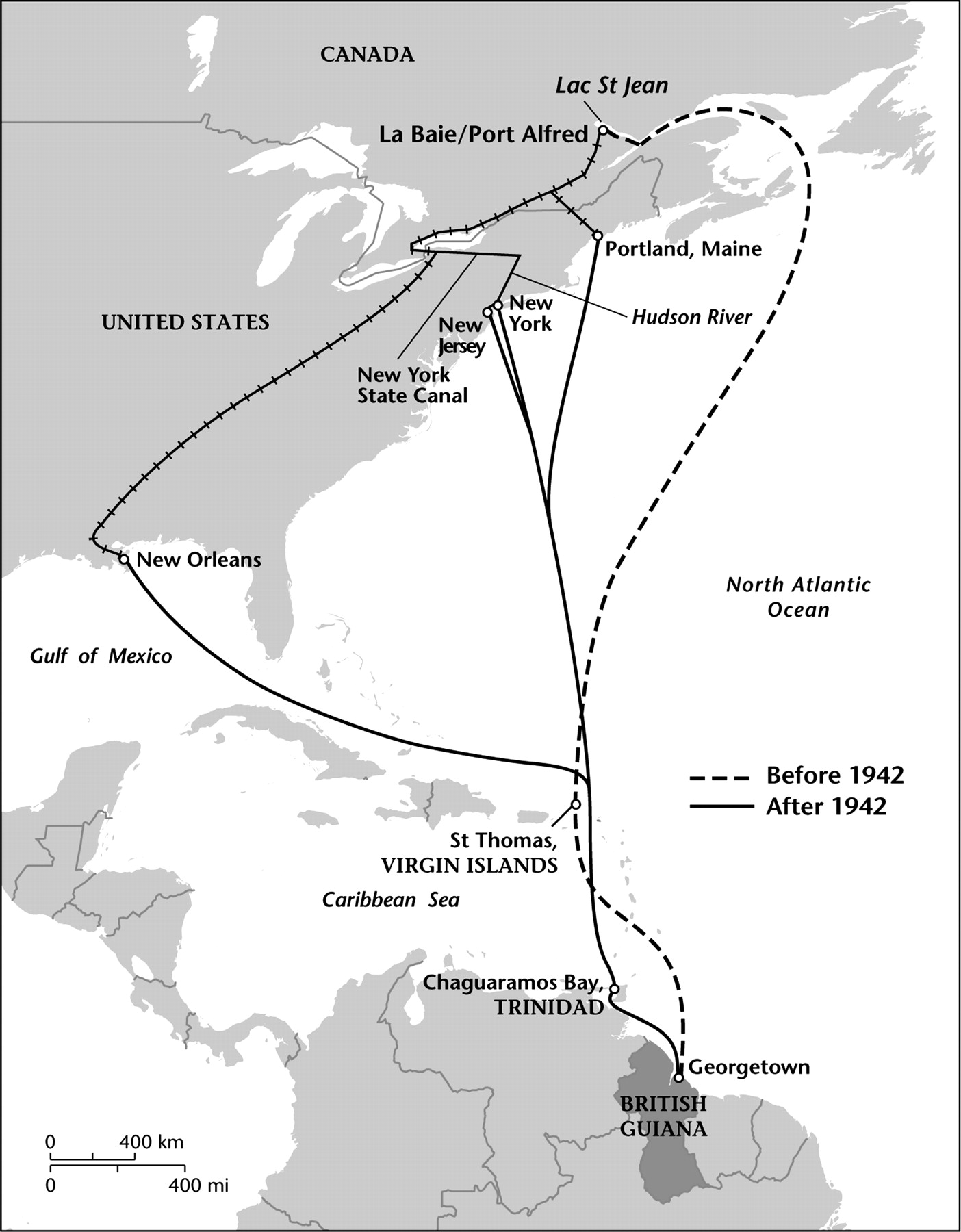
Matthew describes in detail a commodity chain that started in British Guiana (which provided most of the bauxite used in North America’s smelters), and reached across the Caribbean to the eastern seaboard of the United States, where it was transported by rail into Quebec for smelting.  The ingots were then shipped out to rolling mills and fabricating plants in Canada and the United States, across the Pacific to Australia, or across the Atlantic to Britain.  As he emphasises, the chain was militarised at every point, and a primary concern was to secure the supply chain by providing air cover or convoy escorts: the great fear was of a U-Boat attack.  The map below, taken with permission from Matthew’s essay, “reminds us of the unprecedented capacity of the Second World War to gather and scatter materials with untold human and environmental consequences, linking diverse locations with no necessary former connections.”  And here too, as I argued in a previous post, the friction of distance is no simply physical effect: it is shot through with political, economic and strategic calculations.

Not so trivia:  When Sir Charles Portal, Arthur Harris’s predecessor as commander of Bomber Command, retired from the Royal Air Force he became Chair of British Aluminium.  And the roof of the new Memorial for Bomber Command in Green Park is made from aluminium recovered from a Halifax bomber that was shot down over Belgium.

One last note: Matthew’s article is a much richer argument than I’ve conveyed here, and his primary interest is embedding this supply chain in a wider environmental history – so in a future post I want to turn my attention to some of the connections between modern war and ‘nature’…

Remote Witnessing

In an astonishing essay on ‘Drone bombings in the Federally Administered Tribal Areas’, published in the Journal of Geographical Information Systems 4 (2012) 136-141 – the places this blog is taking me! – Katrina Laygo, Thomas Gillespie, Noel Rayo and Erin Garcia (three geographers and a political scientist at UCLA) explore what they call ‘public remote sensing applications for security monitoring’.

An open-access version should be available here but there is also a manuscript version here.  (In fact news of the project appeared in the press soon after the US raid on Osama Bin Laden’s compound last year – Gillespie and John Agnew headed a team that had used satellite imagery and the theory of island biogeography (sic) to predict the location of bin Laden’s hideout in 2009 – but much of the media interest in the new work focused on the image captured by satellite of a Predator circling above an area south west of Miram Shah.)

The new project uses unclassified high-resolution imagery from QuickBird 2 (via GeoEye) to monitor drone strikes in Pakistan’s Federally Administered Tribal Areas (FATA).  The difficulties (and dangers) of eyewitness reports are well-known, and media coverage of drone strikes in the area is at best uneven – though the Bureau of Investigative Journalism, along with organizations like CIVIC and Reprieve, continue to do brave, invaluable, eye-popping work – but the UCLA team concludes that, in principle, the commercial availability of the satellite imagery means that  ‘it is possible for the public’ – a distant public – ‘to monitor drone bombings in the [FATA]’.

You can see where they might be going.  In the weeks preceding the US-led invasion of Afghanistan the Pentagon secured exclusive rights to commercial imagery from the Ikonos-2 satellite.  They didn’t need it for operational purposes; the objective was to exercise ‘shutter control’ and prevent media and other organizations from obtaining imagery that might reveal casualties from the high-level bombing campaign. It wasn’t cheap; the standard cost was around $200 per square kilometre, with a premium for rapid turnaround, and news media had been paying $500 for each image.  It’s still not cheap.  The authors of this (I presume preliminary) report concede that ‘it may be prohibitively expensive to monitor the entire region’.  They estimate that weekly data for one year’s coverage of a town like Miram Shah would cost $64,000, though this would not be beyond the reach of some organizations.

But their own test-case is not encouraging.  Working from a map of drone strikes and casualties constructed by the Center for American Progress – they don’t say why they selected this source – the team searched the satellite image for evidence of any of the 16 drone strikes around Miram Shah before 1 January 2010 included in the database.  This is what they say:

 ‘We feel confident that we were able to identify the location of one drone bombing in Figure 4(b). If the center of the compound is the target, it would appear that the drone bombing is accurate. This also suggests that the blast radius of such attacks is relatively small or less than 20 m. Indeed, the walls still appear to remain intact. This appears similar to blast radii reported for hellfire missiles which are used by both the Predator and Reaper drones.’

The claim is not only repeated but generalized in the abstract: ‘Results suggest that drone bombings are very accurate and drone missions are common in the region.’

They suggest no such thing; drone strikes are most certainly common, but the claim about their accuracy is based on a single case for which nothing is known of the intended target or the basis for its identification – was this yet another wedding party?  Neither can anything be said about civilian casualties; they don’t key this site back into their casualty database, such as it is, and in any case they note that ‘The resolution of QuickBird 2 is currently not high enough to see or quantify casualties.’  Not exactly forensic architecture then.

Not surprisingly, though, the conclusion chimes with the Center for American Progress’s own endorsement of the campaign:

Hardly a week goes by without some key figure in the Al Qaeda network and its affiliates being targeted in a range of actions, including drone strikes as well as other actions by U.S. intelligence and law enforcement agencies to prevent attacks and degrade the Al Qaeda network. The damage done to Al Qaeda by the Obama administration represents America’s greatest national security success since the fall of the Soviet Union and the peaceful integration of Eastern European countries in the 1990s.

The importance of all this goes beyond the particular case.  Susan Sontag once famously declared that ‘Being a spectator of calamities taking place in another country is a quintessentially modern experience.’  It’s a more complicated (and contentious) claim than it looks, but in any event being a spectator is not the same as being a witness.  And we surely know – or ought to know – from Lisa Parkss wonderful work that satellite and other remote technologies do not provide an unmediated window on the world. I’m thinking particularly of her ‘Satellite view of Srebrenica: tele-visuality and the politics of witnessing’ in Social identities 7 (4) (2001), and ‘Digging into Google Earth: an analysis of “Crisis in Darfur”‘ in Geoforum 40 (4) (2009), but you can get a sense of her work from the press report of her 2010 lecture to the New Zealand Geographical Society here.  She also has a new book out late this year/early next from Routledge, Coverage: media spaces and security after 9/11.

Now the use of satellite technology to conduct ‘remote witnessing’ is not alien to human rights organizations, but most of them are well aware of its problems as well as its potential.  Amnesty International sponsored the Science for Human Rights Project (originally Satellites for Human Rights) from January 2008 to January 2011:

Its primary purpose was to test the potential use of geospatial technologies for human rights impact. The purpose of the evaluation is to assess the extent to which work undertaken by Amnesty International contributed to change (intended and unintended) and to assess the potential for using geospatial technologies to contribute towards more effective advocacy and impact.

There have been a series of public examples.  Some of them have been conducted under other banners, like the celebrity Satellite Sentinel Project on Sudan.

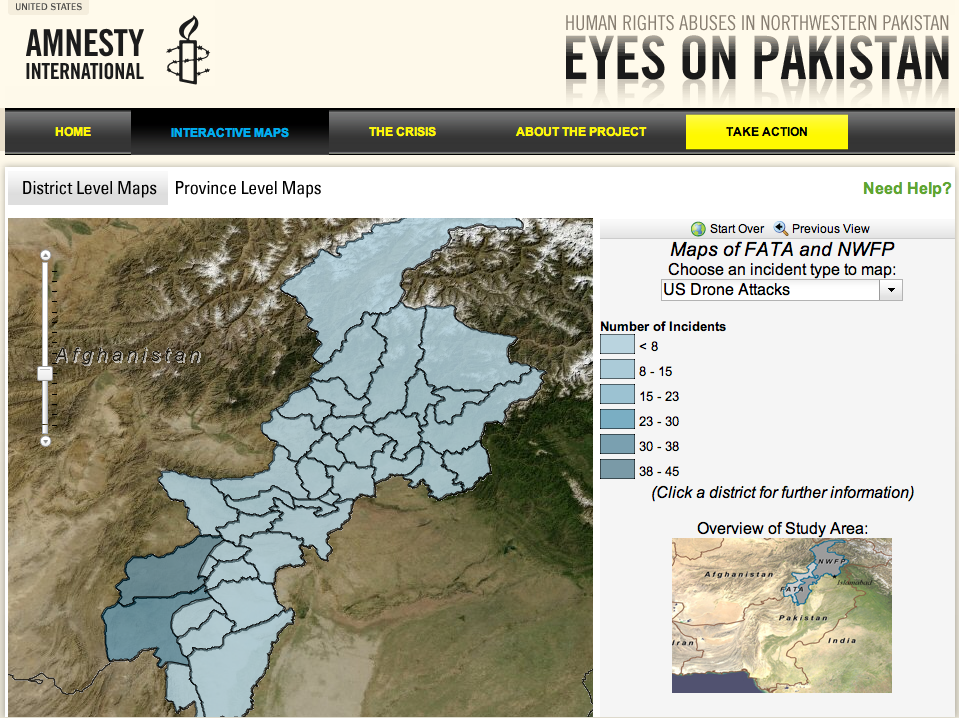
But the most directly relevant to this post is probably Amnesty’s (now terminated) Eyes on Pakistan archived here.  Although this involved interactive mapping platforms rather than the use of satellite imagery the project title gives a clear indication of the direction in which Amnesty was moving and the wider debate about witnessing of which it was a part.

Amnesty has also launched Eyes on Darfur (here too the imagery is no longer being updated) and now Eyes on Syria.  This does involve remote imagery, and there is an interesting discussion on Amnesty USA’s blog about its significance:

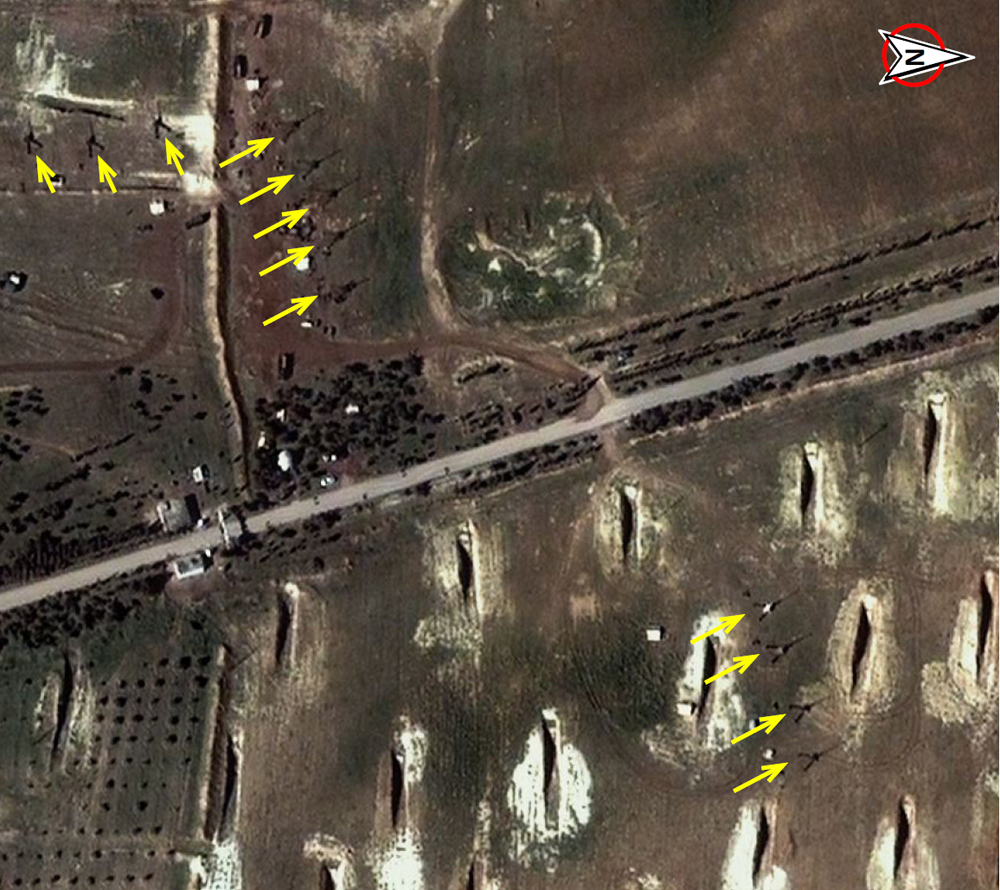
The images from Homs and Hama show clearly that armed forces have not been removed from residential areas, as demanded by the U.N. General Assembly resolution from mid February. In Hama, the images reveal an increase in military equipment over the last weeks, raising the specter of an impending assault on the city where the father of current President Bashar al-Assad unleashed a bloody 27-day assault three decades ago, with as many as 25,000 people killed.

With reports of a ground assault underway in Homs, the analysis of imagery identifies military equipment and checkpoints throughout Homs, and field guns and mortars actively deployed and pointing at Homs [see image left]. Additionally, the images show the shelling of residential areas in Homs, concentrated on the Bab ‘Amr neighborhood. Artillery impact craters are visible in large sections of Bab ‘Amr, from where we have received the names of hundreds killed throughout the period of intense shelling.

Note that last clause: to convert remote sensing into remote witnessing requires difficult, painstaking work in multiple registers because the imagery does not speak for itself.  To believe otherwise means that anyone who ventriloquises from imagery alone – academics screening imagery in California or CIA/USAF analysts scrutinising near real-time feeds from drones – runs the real risk of seeing what they are predisposed to see.  As that same blog post notes,

Satellite images can help to show the widespread and systematic nature of violations, characteristics inherent to certain international crimes such as crimes against humanity. Additionally, they can help in identifying command responsibility, a key requirement for holding individual perpetrators accountable. [Ivan] Simonovic [Assistant Secretary-General for Human Rights] pointed out that the UN Panel on Sri Lanka relied a lot on satellite images. The same holds true for the current commission of inquiry on Syria, which equally relies on satellite images. Thus, the point is that while satellite images barely deliver the “smoking gun” that leads to a conviction, they can provide major support for international investigations and accountability mechanisms.

And this brings me back to drones.  Writing in the New York Times on 30 January 2012 Andrew Sniderman and Mark Hanis proposed re-purposing drones ‘for human rights’:

DRONES are not just for firing missiles in Pakistan. In Iraq, the State Department is using them to watch for threats to Americans. It’s time we used the revolution in military affairs to serve human rights advocacy. With drones, we could take clear pictures and videos of human rights abuses, and we could start with Syria. The need there is even more urgent now, because the Arab League’s observers suspended operations last week. They fled the very violence they were trying to monitor. Drones could replace them, and could even go to some places the observers, who were escorted and restricted by the government, could not see. This we know: the Syrian government isn’t just fighting rebels, as it claims; it is shooting unarmed protesters, and has been doing so for months. Despite a ban on news media, much of the violence is being caught on camera by ubiquitous cellphones. The footage is shaky and the images grainy, but still they make us YouTube witnesses. Imagine if we could watch in high definition with a bird’s-eye view. A drone would let us count demonstrators, gun barrels and pools of blood. And the evidence could be broadcast for a global audience, including diplomats at the United Nations and prosecutors at the International Criminal Court.

This produced a series of responses:  Lauren Jenkins was appalled, Daniel Solomon sceptical, and Patrick Meier sympathetic.  The most scathing response was from anthropologist Darryl Li in Middle East Report, which provoked a heated exchange between him and Sniderman.  I see all this as part of a diffuse (and I think largely uncoordinated) campaign to rehabilitate drones in the public eye, something I’ll be writing about in a future column for open Democracy.  But whatever you make of it, and wherever your sympathies lie, the debate about ‘humanitarian drones’ clearly underscores the necessity of seeing visual technologies as political-cultural technologies enrolled in highly particular scopic regimes.

In short – and to return to where I started – remote witnessing is not a passive practice but an intervention in a field of power and as such it involves a series of investments that spiral far beyond the cost of obtaining the imagery.


Cologne and the geometry of destruction

I’m in Cologne for the International Geographical Congress.  It’s my second visit to the city – I’m on the international Scientific Committee involved in organising the IGC so I was here last year – but coming out of the main station and immediately seeing the vast cathedral again sends shivers up my spine.  This was the aiming point for Bomber Command’s first ‘Thousand Bomber’ raid (“Operation Millennium”) on the night of 30 May 1942; ironically the cathedral survived, but the bomb load, fanning out in a triangle, fell across the most densely populated part of the city.  One pilot compared the attack to ‘rush-hour in a three-dimensional circus’: 1,455 tons of bombs (high explosive and incendiaries) were dropped on the city in just ninety minutes, creating raging infernos that devastated 600 acres. The original target was Hamburg – attacked in July in “Operation Gomorrah” – but bad weather forced Bomber Command to switch the attack to Cologne (the nearest large city to Bomber Command’s bases).  By the end of the war the RAF had dropped 23,349 tons of bombs on the city and the US Eighth Air Force 15,165 tons, and according to Jörg Friedrich 20,000 people had been killed in the attacks.

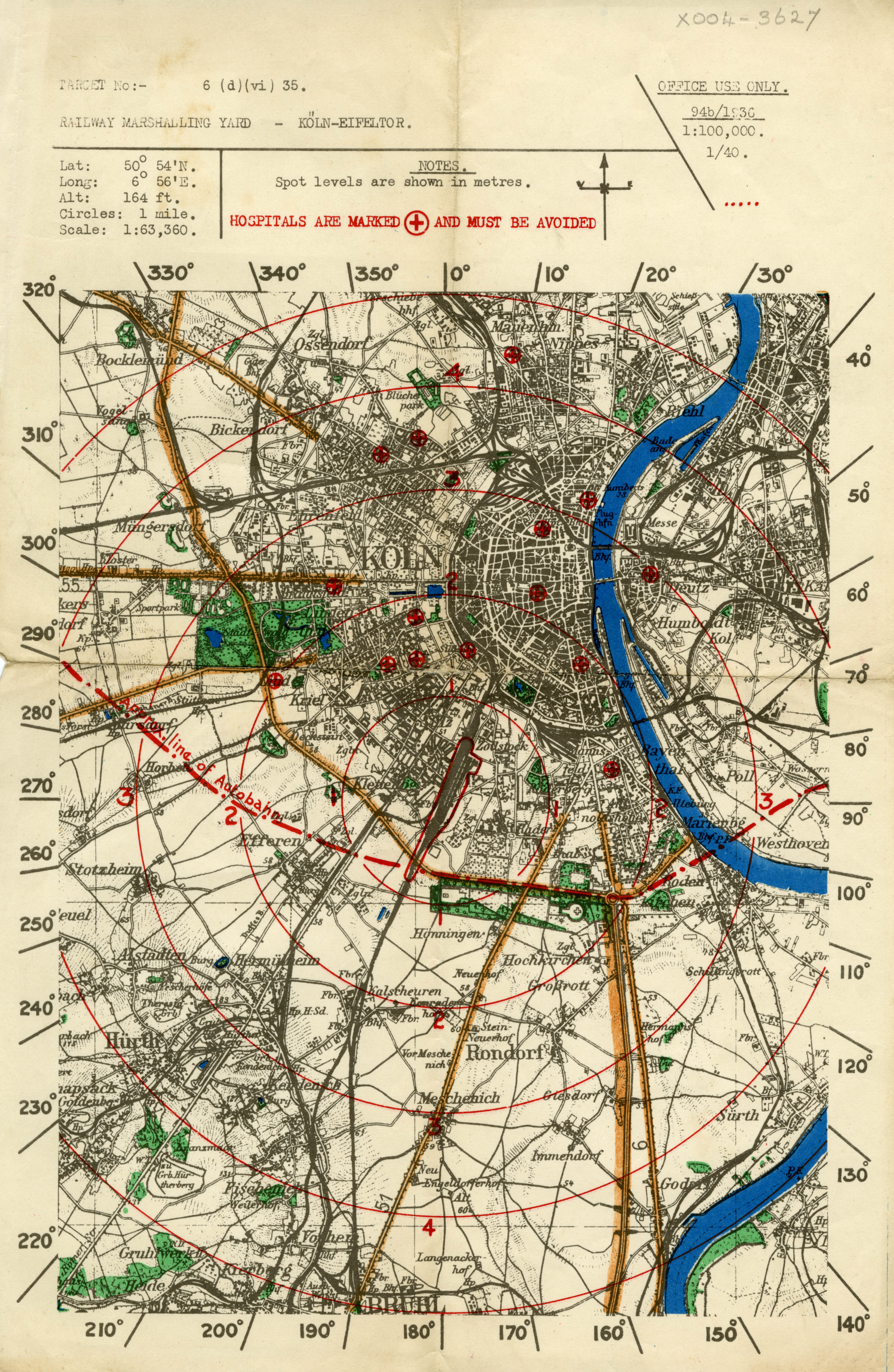
I’ve described the production of a city as a target in “Doors into nowhere” (see DOWNLOADS), and here is an early target map for Cologne; later ones were much more schematic since the detail was useless for night bombing or ‘blind bombing’ (‘bombing through cloud’) that were the characteristic modes of Bomber Command’s area bombing strategy.

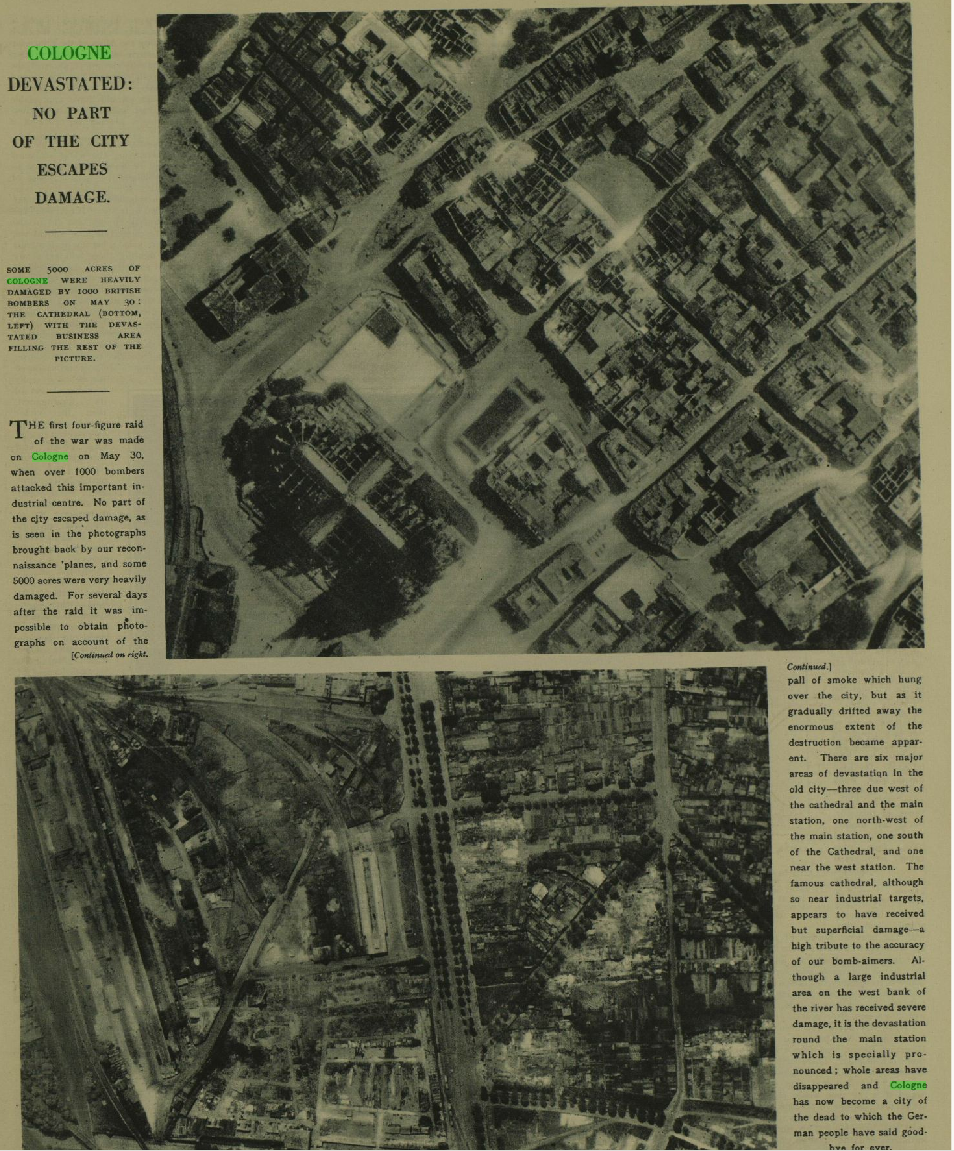
Operation Millennium gave Bomber Command a fillip, and the British press was ecstatic.  Thrilled at ‘the most gigantic air raid the world has ever seen’, the Daily Express reported that one pilot had said ‘It was almost too gigantic to be real…’ The Times noted that it was the 107th raid on the city and that, as far as the eye could see, the sky was filled with aircraft, ‘waiting their turn in the queue’ and arriving over the target one every six seconds: ‘from the point of view of the attackers it was the perfect raid’.  The News of the World had been shown daylight photographs of the aftermath: ‘No part of the city escaped, and the heavily-damaged areas total some 5,000 acres equal to an area of nearly eight square miles.  The old town has gone.  In addition to isolated points of damage, there are several major areas of devastation – due west of the cathedral and the main station; north-west of the main station; south of the cathedral; and near the west station.’  The language was abstract, one of lines and areas, because the ‘point of view’ was, like that of the aircrews who had carried out the attack, distant, and this geometric imaginary was confirmed when the photographs were published in the Illustrated London News:

Soon carefully edited cinema newsreels chimed in; at one briefing caught by the camera Cologne was hailed as ‘an old friend to many of you’, and the commentator described ‘tons and tons of beautiful bombs’ being loaded into the aircraft:

After the war, when British and American reporters could inspect the ruins of the city on the ground, they were stunned at the scale of destruction. Now the solid geometries of the city that they diagrammed were no longer clinical descriptions but chilling memorials.   Janet Flanner [‘Genêt’], in her “Letter from Cologne” published in the New Yorker on 19 March 1945, described the city as ‘a model of destruction’, lying ‘shapeless in the rubble’: ‘Our Army captured some splendid colored Stadpläne, or city maps, of Cologne, but unfortunately the streets they indicate are often no longer there.’ (She wasn’t greatly impressed by the survival of the cathedral – its Gothic nave ‘was finished in exactly 1880’ – and thought ‘the really great loss’ was Cologne’s 12 eleventh-century Romanesque churches).

Sidney Olson cabled LIFE magazine in March:

‘The first impression was that of silence and emptiness. When we stopped the jeep you heard nothing, you saw no movement down the great deserted avenues lined with empty white boxes. We looked vainly for people. In a city of 700,000 none now seemed alive. But there were people, perhaps some 120,000 of them. They had gone underground. They live and work in a long series of cellars, “mouseholes”, cut from one house to the next.’

Alan Moorehead was was shaken to the core:

‘… few people I think were prepared for Cologne.  There was something awesome about the ruins of Cologne, something the mind was unwilling to grasp, and the cathedral spires still soaring miraculously to the sky only made the débacle below more difficult to accept and comprehend…  A city is a plan on a map, and here, over a great area, there was no plan.  A city means movement and noise and people: not silence and emptiness and stillness, a kind of cemetery stillness.  A city is life, and when you find instead the negation of life the effect is redoubled.  My friends who travelled with me knew Cologne, but not this Cologne…[T]hey found themselves looking at disordered rocks, and presently they abandoned any attempt to guide our way by their memory of the city, and instead everyone fixed his eyes on the cathedral and used that only landmark as a guide across the rubble…’

Here is a compilation of contemporary film coverage, which includes Moorehead’s commentary:

Solly Zuckerman, a British scientist who had been closely involved in planning the bombing campaign, arrived early the next month and was so overwhelmed by what he saw that he found it impossible to write an essay he had promised Cyril Connolly’s Horizon: it was to be called “The natural history of destruction”.  It was left to W.G. Sebald to redeem that promise, in his own way, many years later.  But when he asked Zuckerman about his experience (their paths crossed at the University of East Anglia), all he could remember was a surreal still life: ‘the image of the blackened cathedral rising from the stony desert around it, and the memory of a severed finger that he had found on a heap of rubble.’

All this explains why the spectre of the cathedral – still blackened, rising today out of a grey and greasy wet sky – haunts me too.

‘Dresden: a Camera Accuses’

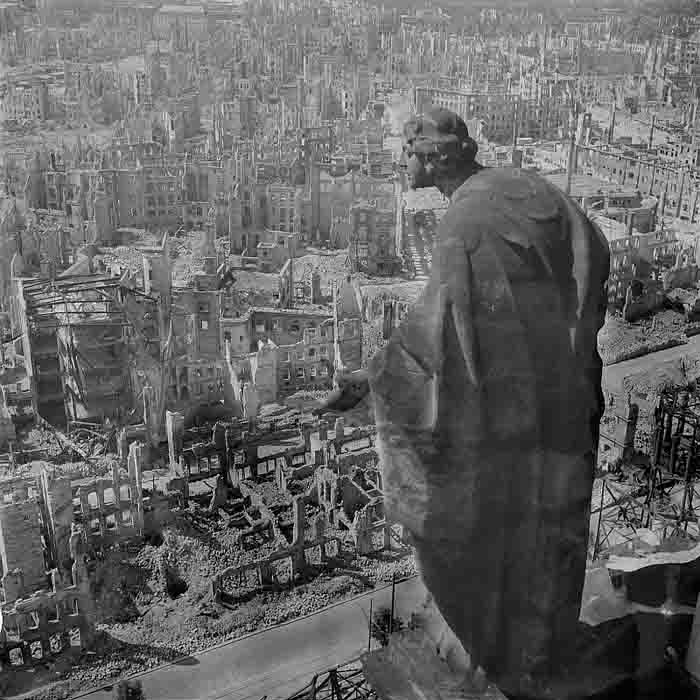
Richard Peter, Blick vom Rathaussturm, Dresden 1945 (Deutsche Fotothek)

A new essay from Steven Hoelscher, ‘Dresden, a Camera Accuses: Rubble photography and the politics of memory in a divided Germany’, just out in History of Photography 36 (3) (2012) 288-305.

This article explores memory, photography and atrocity in the aftermath of war. It takes as its case study the controversies surrounding the February 1945 firebombing of Dresden. One photograph in particular has become the iconic image of the fire- bombing and of the devastating air war more generally – Richard Peter’s View from the City Hall Tower to the South of 1945. Although arguably less divided today than it was during the Cold War, when the image became seared into local and national memory, Germany’s past continues to haunt everyday discourse and political action in the new millennium, creating new ruptures in a deeply fractured public sphere. By examining the historical context for the photograph’s creation and its dissemination through the book Dresden – A Camera Accuses, this article raises questions of responsibility, victimhood and moral obligation that are at the heart of bearing witness to wartime trauma. Peter’s Dresden photographs have long intervened in that existential difficulty and will probably continue to do so for the foreseeable future.

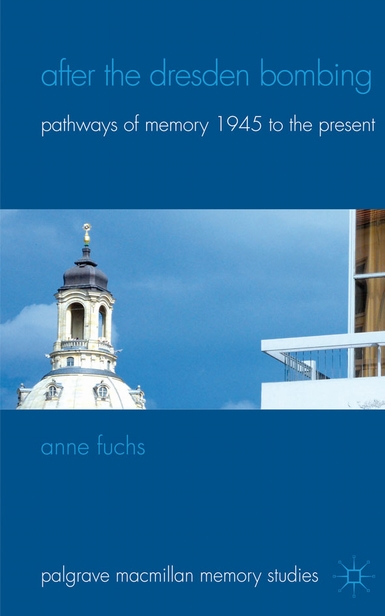
Steve sent me his essay just as I opened Anne Fuchs‘s After the Dresden bombing: pathways of memory 1945 to the present (Houndmills: Palgrave-Macmillan, 2011).  Here’s the description:

Together with Hiroshima and Nagasaki, Dresden belongs to a handful of global icons that capture the destructiveness of warfare in the twentieth century. Immediately recognisable, these icons are endowed with a powerful symbolism that cannot be explained with reference to historical cause and effect alone. This is precisely the terrain of this book, which addresses the long aftermath of the bombing in the collective and cultural imagination from 1945 to the present. The material under discussion ranges from archival documents, architectural journals, the built environment, travelogues, newspaper articles, documentaries, TV dramas, fiction, diaries, poetry to photography and fine art. As a case study of an event that gained local, national and global iconicity in the postwar period, it illuminates the media-specific transmission of cultural memory in dialogue with the changing socio-political landscape. Debating fundamental processes of cultural transmission, it exemplifies a new mode of doing cultural history that interweaves the local and the global.

Her discussion of Peters’ Eine Kamera klagt an is on pp. 32-42 and forms part of a fine extended discussion of ‘Visual mediations’.

Targeting and technologies of history

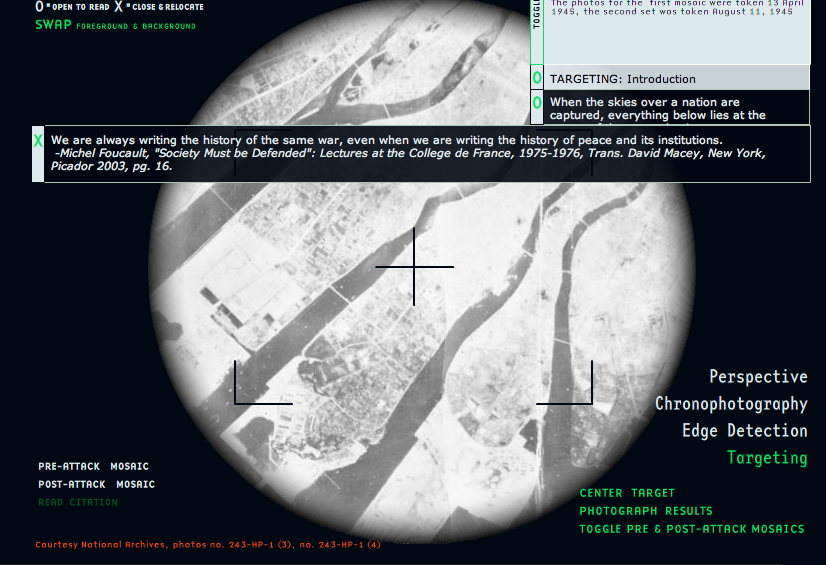
Vectors from USC has reappeared after a (too) long hiatus.  I first encountered Vectors through Caren Kaplan‘s Dead Reckoning project that tracked what she called ‘Aerial Perception and the Social Construction of Targets’.  This was in 2007, when my own interest in targeting and bombing was just kicking in as a reaction to Israel’s war on Lebanon the previous year (see ‘In another time zone…’ in DOWNLOADS).  She introduced the project like this:

‘”Dead reckoning” has a number of different meanings. For many of us, it simply means the ways in which we figure out where we are or what we are aiming at by using the naked eye-it is, then, the first order cultural construct of directional sight. In strictly navigational terms, especially at sea, it refers to the use of measured distances between points to discern longitude. A reckoning is also a form of retribution or punishment as well as a collection of accounts. Many of these meanings come into play in a militarized context where the determination of position enhanced by technology enables the annihilation of enemies. In this piece, Raegan [Kelly, her Vectors programmer and designer] and I came to see this term as the one best suited to describe what we were working through over many discussions. Although many other techniques of sight are involved in this piece, the reckoning of the cultural politics of sight in modernity leads, unfortunately, to state-sponsored death as much as to anything else and, thus, the aptness of the term becomes almost unavoidable.’

Since then Caren has continued to push the boundaries of inquiry and presentation – and the connections between the two – in extraordinarily imaginative ways, constantly circling around what she calls ‘the view from above’: see, for another example, her Precision Targets: GPS and the militarization of everyday life.

The new digital issue of Vectors contains Steve Anderson‘s Technologies of History, which intersects with my still continuing work on bombing and its representations, though its ostensible subject is different. Editor Tara Macpherson on Anderson’s project:

Within the confines of this piece, author Steve Anderson observes, “We should not ask film or video for the truth about the past, but we can look to them for clues, myths, and symptoms of historical fixations.” The project takes as its central object of analysis one of those moments of historical fixation that seems indelibly engrained in the American consciousness, the assassination of John F. Kennedy, Jr. in November, 1963. In exploring multiple mediations of this event, Anderson and designer Erik Loyer repeatedly draw our attention to the textured, layered and unstable nature of both historical representation and historical memory.

This is an argument about the truth claims of media that is instantiated via media, both through the curated collection of media artifacts assembled here and through their formation into a new interactive experience. The assortment of clips runs the gamut from historical footage to televisual re-imaginings to video game reenactments, providing a rich compendium of the tenacity of this moment within the nation’s collective memory. Various tonal registers collide: the somber, the flippant, the intimate, the nostalgic. Disparate visual styles intersect and refract one another. But this argument does not unfold solely at the level of content. The form of the piece also reconfigures and undermines the possibility of a single, authoritative history. As the user engages the piece and assembles these historical fragments into new forms, building her own history along the way, the primacy of any one meaning is collaged away.

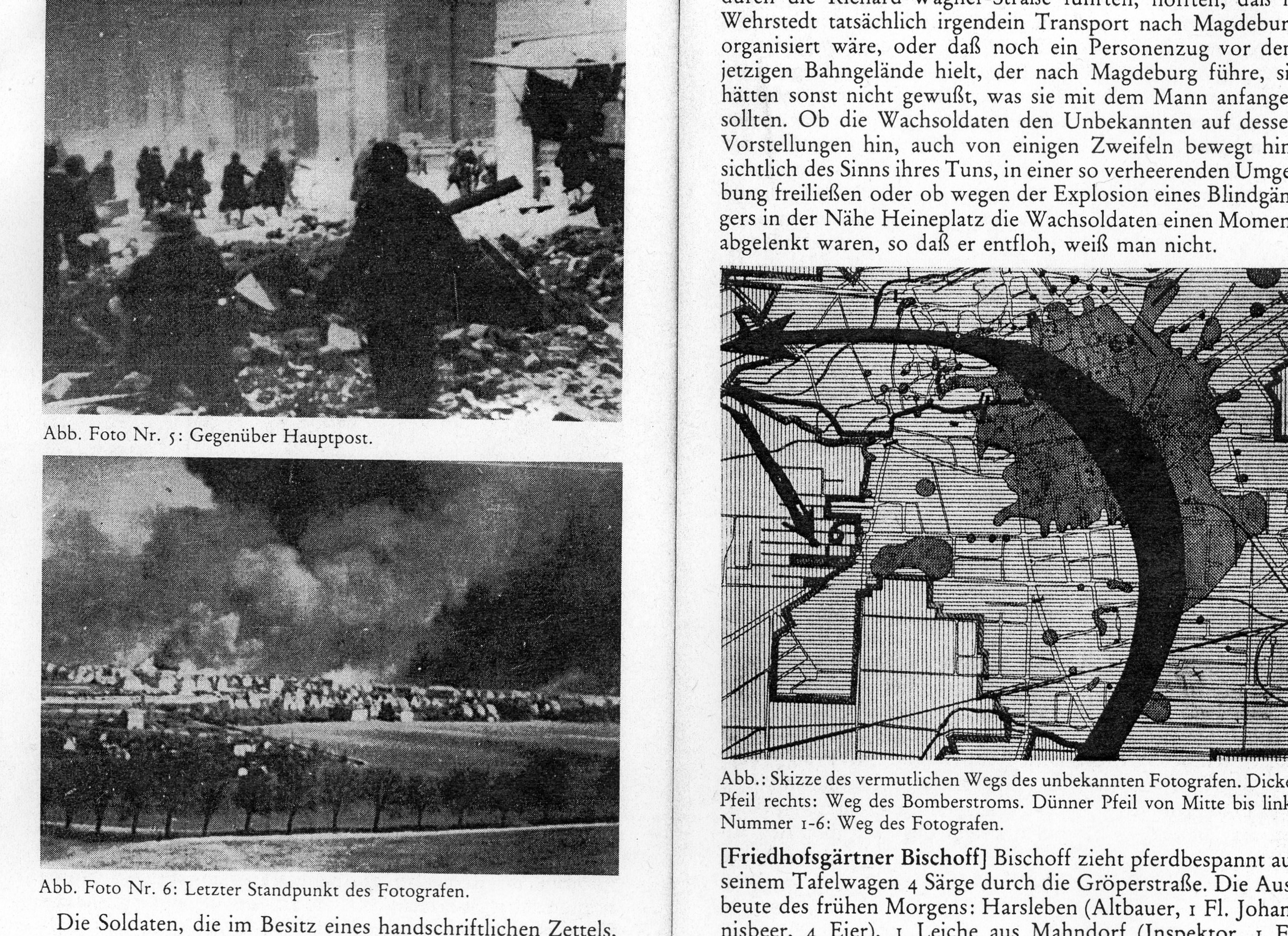
Before the digital era Alexander Kluge had experimented with the collisions of testimony and artefact, and in particular with montage-collage, to convey an American air raid on Halberstadt (his hometown) in 1945 (I drew on this in “Doors into nowhere”). Der Luftangriff auf Halberstadt am 8. April 1945 was first published in German 1977 and has been available in both his Collected Works and as a separate book for some time, but I’m thrilled to discover that an English translation by Martin Chalmers under the title Air Raid is at last due from the University of Chicago Press/Seagull Books in December 2012 with an afterword by the much lamented W.G. Sebald.

Frederic Jameson, in one of the few English-language commentaries on the text, raises a question that speaks directly to Anderson’s project:

“The Bombing of Halberstadt” is another such collage, in which individual experiences, in the form of anecdotes, are set side by side less for their structures as the acts of traditional characters … than as names and destinies, the latter being reduced in many cases to peculiar facts and accidents, of the type of Ripley’s Believe It or Not. The juxtaposition of these anecdotes with quotations from academic studies on the history of bombing and on RAF techniques, from scholarly conferences on the relation between aerial strategy and ethics (“moral bombing” is, for example, specified as a matter, not of morals, but of morale), and from interviews with the allied pilots who participated in this raid—all these materials, which we take to be nonfictional (although they may not be; the interviews in particular bear the distinctive marks of Kluge’s own provocative interview methods), raise the question of the fictionality or nonfictionality of the personal stories of the survivors as well. Halberstadt is, to be sure, Kluge’s hometown, and he is perfectly capable of having assembled a file of testimonies and eyewitness documen- tation and of using the names of real people. On the other hand, these stories, with their rich detail, afford the pleasures of fictional narrative and fictional reading. Is this text (written in the 1970s) a non-fictional novel? I believe that we must think our way back into a situation in which this question makes no sense…’ [‘War and representation’, PMLA 124 (2009) 1532-47]

Perhaps.  But Jameson’s exegesis never grapples with what is also so compelling in Anderson’s project – and, as Kaplan’s work shows, no less avoidable in any discussion of bombing – which is to say Kluge’s determination to confront the multiple visualities involved in, productive of and produced through bombing:

Cyrus Shahan [‘Less then bodies: Cellular knowledge and Alexander Kluge’s “The Air Raid on Halberstadt on 8 April 1945″‘, Germanic Review 85 (2010) 340-58] provides one of the richest discussions of Kluge’s use of montage in ‘Luftangriff’; I can’t convey the artfulness of his argument here – a blog surely isn’t the place to do so! – but here’s an extract that, again, speaks to Anderson’s project too:

‘“The Air Raid on Halberstadt on 8 April 1945” consists of thirty vignettes. The majority are accounts of what the residents of Halberstadt did during the air raid, where they were, what they were thinking, and whether they survived. These stories “from below” are interrupted for a twenty-two-page segment about “Strategy from Above,” a documentary montage of interviews with pilots, images of bomb schematics and flight formations, and pictures of pilots. The documentary aspect of Kluge’s Halberstadt essay and his Neue Geschichten [‘New Histories’] as a whole is a ruse. Rather than lend the text authenticity, Neue Geschichten uses a feigned documentary to debunk the authority of the documentary, to undermine the validity of a singular point of view, and thereby to buttress the usefulness of montage. For Kluge, montage is superior to documentary because it is “the form-world of connectivity.” In other words, while montage creates quasi-unreal perspectives with hyperconnectivity, it simultaneously contains productive political processes in which fractured factual elements articulate within a field of possibilities.’

Bombing Encyclopedia of the World

Bombing from the air re-wrote the geography of war, blurring and blasting the boundaries between ‘civilian’ and ‘military’ spaces.  But it also required a knowledge of geography.  In the Second World War the targeting cycle could extend over several weeks or even months as target folders were compiled, complete with aerial photographs, target maps and intelligence reports, but after the war the United States was determined to accelerate the process. When the US Air Force was separated from the US Army it quickly established its own Directorate of Targets, which was made responsible for the compilation of what was eventually called the ‘Bombing Encyclopedia of the World’.

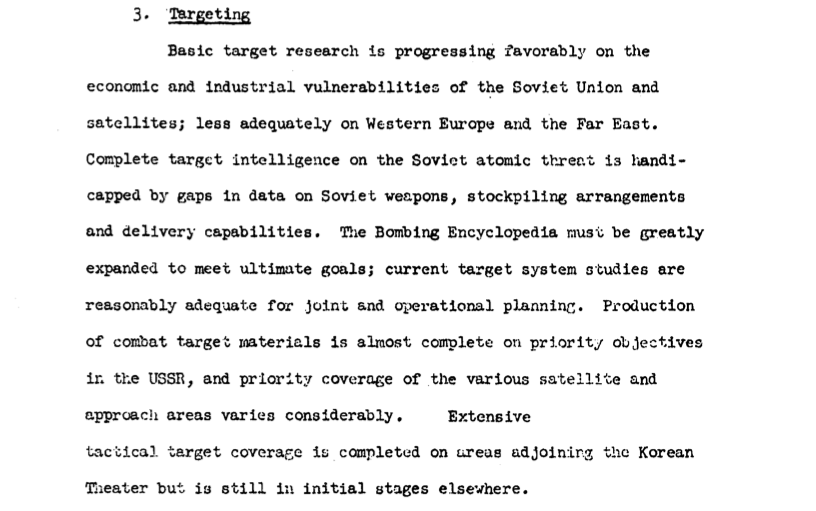
Work started in January 1946 on potential targets in the Soviet Union and in six months IBM cards were punched for 5,594 targets.  In April 1949 a rare press report noted that the volume of work had ‘doubled since last summer’ and that the Air Force was requesting more funds to hire additional intelligence officers and civilian analysts.  The database was extended to Soviet satellites and Korea, but in 1952 the National Security Council was told that while ‘basic target research’ was progressing favourably ‘the Bombing Encyclopedia must be greatly expanded to meet current goals.’

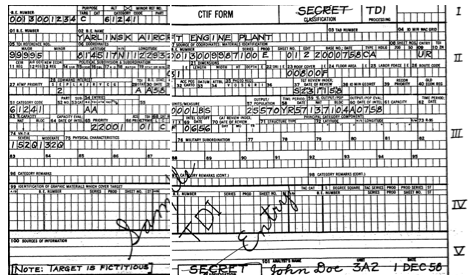
The database soon became global, and by 1960 it contained 80,000 entries. Machine processing was still in its infancy, however, and the project was bedevilled by serious problems of information management that were still unresolved by the time American forces were deployed in Vietnam.  As the number of targets steadily increased, so it became ever more difficult to integrate data from multiple sources.  Standardisation was eventually achieved through the Consolidated Target Intelligence File (shown below; the image is imperfect because it is a composite).  Outten Clinard explained that the form was divided into five sections:

I.    Codes for machine processing and hand processing.
II.  Information identifying and locating the target.
III. Information on the category of the target and its individual characteristics within the category.
IV.  References to graphic coverage on the target.
V.   Sources.

The CTIF shown here is for a fictitious (industrial) target, but Clinard explained its structure thus:

Much of the information is entered on the form uncoded and may be read directly, for example the target’s name (02), location (06), elevation in tens of feet (20), roof cover in thousands of square feet (23), and output in thousands of pounds (57).  Some of it is entered in a simple code for which the IBM 705 is keyed. On the form shown, in the country block (08) “UR” represents the USSR; under command interest (28) the figure 2 in the E block indicates that the target has been nominated by the U.S. European Command; and under category requirements (68) the letters C and F indicate that additional information is needed on capacity/output and labor force, respectively.

The CTIF was more than a resource for planning particular missions.  Stored on magnetic tapes, the data-stream of CTIFs  was also ‘susceptible of rapid and complex manipulation in electronic data-processing machines’.  In 1959, when Clinard published his (then classified) essay in Studies in Intelligence,  the targeting effort was primarily directed towards Strategic Air Command  and the prospect of long-range nuclear strikes against the Soviet Union.  For this reason, the bombing database was used to calibrate (for example) a Damage and Contamination Model:

‘This is a large and complex program, involving 58,000 targets and geographic “cells” and 700,000 to 900,000 computations. With requisite inputs from a war plan, that is, a pattern of ground zeros, weapon types, etc., this program is capable of calculating the probabilities of blast damage to some 9,000 targets, the radiation dose and contamination pattern from the weapons which were ground burst, and the fatalities and other casualties in 40,000 geographic “cells.” It will also give damage and casualty summaries by categories and by regions.’

One of the analysts responsible for ‘nominating’ targets for inclusion in the Encyclopedia was Henry Nash, who described how, ‘in order for a nominated target to win its way into the Bombing Encyclopedia … a Significant Summary Statement was prepared which briefly (roughly 50 words or less) described each target and its strategic importance.’  Years later, as a professor of political science in a liberal arts college in Virginia, Nash wondered ‘What enabled us calmly to plan to incinerate vast numbers of unknown human beings without any sense of moral revulsion?’  This was what he called the ‘bureaucratization of homicide’ I referred to in an earlier post: the compartmentalization of tasks, the collective reinforcement through membership in committees or task forces, and the reward and recognition conferred by ‘special’ security clearances.  Nash also reflected on the powers of abstraction. A preoccupation with ‘the numbers game’ – ‘The strong technological and quantitative orientation of these tasks [clearly shown in the paragraphs above] held the attention of analysts and the relationship of weapons to human life was an incidental consideration’ – was reinforced by carefully sanitized language:

‘As America’s involvement in the Vietnam War grew deeper, the Defense vocabulary expanded and displayed an even greater imaginative and anaesthetizing flair. Targets for attack were given the picturesque name of “strategic hamlets.” Bombing raids became “surgical strikes” and the forced movement and impounding of Vietnamese citizens were part of America’s “pacification program” – terms suggesting images of the hospital operating room or a Quaker meeting.’

Much of this will be familiar to analysts of bombing today.  The Bombing Encyclopedia has been re-named the Basic Encyclopedia, the targeting process has been refined and the kill-chain has been ‘lawyered up’, but the process still relies on the rapid-fire production, analysis and dissemination of a vast database and on computer modelling of damage and blast effects.  Today, the target folders are computer files but as the example below shows, the BE number is still the key (top left):

Yet there are significant changes.  The BE number refers to an ‘object target’ and its fixed, physical location, and this remains important for active (and fortunately non-nuclear) bombing missions against conventional targets.  But in the counterinsurgency and counterterrorism wars conducted by the US in Iraq, Afghanistan, Pakistan and elsewhere the target is often an individual – sometimes identified, if the person appears on a list of ‘High Value Targets’, but sometimes unknown and un-named – and almost always mobile.  And for named targets, even the CIA requires more than fifty words for inclusion on its hit list (though the dossiers submitted to its lawyers for approval are reportedly only 2-5 pages).

Still, when I was working on ‘Doors into Nowhere’ (see DOWNLOADS tab) I remember encountering elin o’Hara slavick‘s luminous work for the first time, and her remark that she had originally intended to call her series of paintings ‘Everywhere the United States has bombed’ but that, as she learned more about covert action and mis-information, she realised that was an impossible project.  How ironic, then, that behind her critical inclinations there should have been a global database that made all those bombings possible…

But the irony doesn’t end there.  For it turns out that slavick’s project was, until recently, no less difficult for the US Air Force: if not exactly mission impossible then at least mission improbable.

The other side of the Bombing Encyclopedia, verso to its recto, would indeed be a global database recording ‘everywhere the United States has bombed’, but  the data are widely scattered and unsystematic: millions of records, some on paper, some on punchcards and magnetic tape, and more recent ones in various digital forms.  Six years ago Lt Colonel Jenns Robertson started to transcribe, standardise and integrate the available records of individual strike missions from World War I down to the present, incorporating RFC/RAF data for the two World Wars.  The result, announced this week in an article by Bryan Bender in the Boston Globe, is THOR: Theater History of Operations Reports (how the military loves its acronyms).  Robertson started the project in his spare time, working at night and at weekends, but he’s now been assigned to work on it full time at the Air Force Research Institute at Maxwell Air Force Base.  His extraordinary database – which he admits is still incomplete and, in places, in need of scrubbing – can be searched in six main ways listed as follows:

  • When – date, time over target, flying hours, etc.
  • Who – campaign, country, service, unit, call-sign
  • How – aircraft, take-off location, mission type
  • What – weapons used
  • Where – location of target, BE #, release height, speed
  • Why – effects, JTAC reports, Bomb Damage Assessment

The visualizations from the project, displayed and interrogated using GIS, are often stunning – more on this in a later post – and they are designed to answer both historical strategic questions about the conduct of particular campaigns and also contemporary forensic ones about the locations of unexploded ordnance or the remains of missing aircrew killed in action.  I’m hoping that I’ll be able to access the database for my Killing Space project [see DOWNLOADS tab], which focuses on three bombing campaigns: the combined bomber offensive against Germany in World War II, the air wars over Vietnam, Laos and Cambodia, and the ‘drone wars’ over Afghanistan/Pakistan and elsewhere.  But Bender’s description of the visualizations loops back to where I began:

‘The result: a compilation that, at the click of a mouse and a few keystrokes, reveals for the first time the sheer magnitude of destruction inflicted by the US and its allies from the air in the last century…. When plotted on a satellite map, the bombs — from the biplanes of the nascent US Air Service over France in World War I to pilotless drones targeting suspected terrorists in the war in Afghanistan — blanket many thousands of square miles from Europe to Africa, the Middle East and Asia.’

UPDATE:  I returned to the Bombing Encyclopedia here.

Drones and military violence: Readings and screenings

I’m working on a presentation that will turn into a long essay that may turn into a short book – one day I will learn how to write in brief! – and I thought I’d share some of the bibliographic resources I’ve been using. This is not an exhaustive list, needless to say, but I hope it will be a useful springboard for others too; I’ve tried to indicate the range of journals and sources available, and some of the key areas of contention and concern.  Much of the debate on drones has focused on the supposedly covert US air campaign directed by the CIA in Pakistan’s Federally Administered Tribal Areas, which plainly raises vital issues of ethics, law and accountability that can also be extended to parallel campaigns in Somalia, Yemen and elsewhere.  But – as I’ve tried to show in my own work – this should not allow the overt air war in Afghanistan to escape scrutiny.  Here the operational questions often become more complex because these platforms are integrated into extended networks in which surveillance is conducted by remote operators but the strikes may be executed by conventional aircraft: the geography of the kill-chain is crucial.  For this, I’ve been drawing on a series of USAF publications and presentations.

But the focus on the US distract should not distract attention from the rapid expansion of remote capabilities by other militaries, including (as the listing below indicates) Israel, where the IDF developed a series of protocols for extra-judicial killing (assassination) long before the USAF or the CIA.

There are also important historical precedents to consider: the use of air power in colonial counterinsurgency operations, particularly by the British in Mesopotamia (Iraq), the North West frontier of India and Palestine, and the emergence of key elements of today’s remote operations in the Second World War and, in particular, during the US air wars over Indochina. For the former, the work of David Omissi, Air power and colonial control: the Royal Air Force 1919-1939 (1990), Priya Satia, Spies in Arabia: the Great war and the cultural foundations of Britain’s covert empire in the Middle east (2008) [see also her essay on ‘The defense of inhumanity: air control in Iraq and the British idea of Arabia’, American historical review 11 (2006)], and Andrew Roe, Waging war in Waziristan (2010) are key sources.  For the latter, see my ‘Lines of descent’ (DOWNLOADS tab).

There are some significant gaps in the listings that follow.  There is already a book that gives a pilot’s view of these remote missions, Matt Martin‘s Predator, and there’s no shortage of media interviews with (American) crewmembers, usually based at Creech Air Force Base in Nevada.  But, with rare exceptions, the media have shown little interest in documenting the victims of drone strikes, apart from (contentious) estimates of their numbers and claims of ‘high-value targets’ being killed.  For preliminary assessments of the distortions of media coverage, see Timothy Jones, Penelope Sheets and Charles Rowling, ‘Differential news framing of unmanned aerial drones: efficient and effective or illegal and inhumane’ (APSA, 2011: available via ssrn.com) and Tara McKelvey in the Columbia Journalism Review (listed below).

There are virtually no ethnographies of life (and death) under the drones: Shahzad Bashir and Robert Crews have recently curated some interesting essays on daily life in the Afghanistan-Pakistan borderlands, but the title Under the drones (Harvard University Press, 2012) is opportunistic.  The editors write of their desire to ‘illuminate aspects of the rich social and cultural worlds that are opaque to cameras mounted on drones flying many thousands of feet above this terrain’ – an admirable project – but not a single contributor illuminates the impact of the drone wars on those worlds.   There are some sharp questions about the missing ethnographies of death – unlike the surgical dissections of sovereignty – in Anthony Allen Marcus, Ananthakrishnan Aiyer and Kirk Dombroiwski, ‘Droning on: the rise of the machines’, Dialectical Anthropology 36 (2012) 105.   Some of the best repor­tage on the effects of drone strikes in the Federally Administered Tribal Areas of Pakistan comes from CIVIC, but its most recent report on Civilian Harm and Conflict in Northwest Pakistan was published in October 2010 (this also documents the suffering caused by Pakistan military action), though there are some updates on its blog (listed below).

Noor Behram has provided an unforgettable photographic record of the aftermath of drone attacks in the same area (200 images from 27 sites) that formed a centrepiece for the Gaming Waziristan exhibition staged in the UK, the US and Pakistan in 2011: for online galleries see here  and here.  And other visual/video artists have not been slow to reflect on these new modalities of killing: see, for example, John Butler’s The ethical governor (available on YouTube and vimeo) or Omer Fast’s Five thousand feet is the best (in which a white American family is killed in a Predator attack).
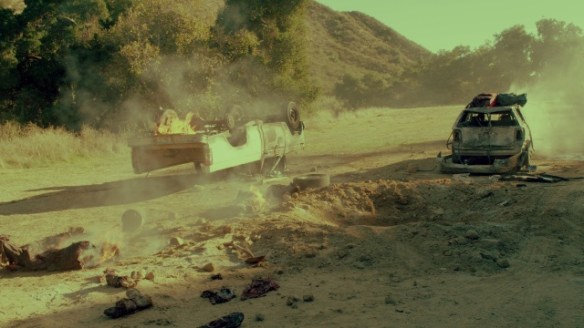
In addition, Jordan Crandall has a performance work, ‘philosophical theatre’, called Unmanned at Eyebeam that I’d love to see…. It involves the crash of a drone in a suburban backyard in the American southwest.

 If you think I’ve missed something that ought to be included, please let me know.

 Note: Most militaries disdain the term ‘drones’ since these aircraft are piloted, and prefer ‘Unmanned Aerial Vehicles’ (UAVs) or ‘Unmanned Aerial Systems’ (UAS) or ‘Remotely Piloted Aircraft’ (RPAs).   Most of the listings below are concerned with the use of these platforms to conduct air strikes; smaller drones are also deployed by ground forces for surveillance and no doubt they too will soon be able to carry out strikes.
Books

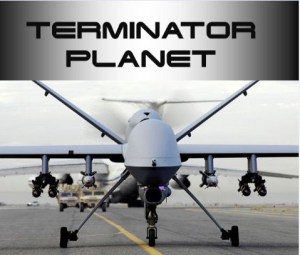
Nick Turse and Tom Engelhardt, Terminator planet: the first history of drone warfare 2001-2050 (Dispatch Books, 2012) – a sharp analysis of drone wars, past, present and future, culled from the regular reports of the TomDispatch principals; also available as an e-book

Medea Benjamin, Drone warfare: killing by remote control (OR Books, 2012)– a passionate critique from the co-founder of Code Pink and Global Exchange that also details the rise of activist campaigns against drone warfare; also available as an e-book

Matt Martin and Charles Sasser, Predator: the remote-control air war over Iraq and Afghanistan: a pilot’s story (Zenith Press, 2010) – most of the commentary on drones is concerned with covert campaigns waged by the CIA (with JSOC), but this is an account of USAF operations that also deserve close scrutiny….

Peter Singer, Wired for war: the robotics revolution and conflict in the 21st century (Penguin, 2009) – about much more than drones, but Singer has a series of perceptive observations about them scattered throughout the book.

Websites and blogs

Drone Wars UK – focuses on the British use of drones, but also includes wider commentary and information and a useful Drone Wars briefing pdf by Chris Cole [see also Convenient Killing below]

Drones Watch – advertised as ‘a coalition campaign to monitor and regulate drone use’
Understanding Empire – ‘dispatches on the drone wars: the state of our unmanned planet’ – a brilliant news aggregating source with commentary too

Our bombs – created by Neil Halloran ‘a website and documentary film that looks at the human cost and strategic implications of U.S. air strikes’, including an ‘air strike tracker’ from 9/11 through to January 2011

The Bureau of Investigative Journalism – a not-for-profit organisation based at City University, London, that provides (among many other things) a stream of indispensable reports, investigations and critical commentary on ‘the covert war on terror’ in Pakistan, Somali and Yemen

The #drones daily – what it says:  news and commentary updated daily

The Long War Journal – Bill Roggio’s site, politically distant from the sources above, but providess useful charts, maps and reports on covert US air campaigns in Pakistan and Yemen

New America Foundation – the Year of the Drone, mapping and reporting on US drone strikes in Pakistan 2004-2012 (and continuing): but its estimates of civilian casualties (in particular) have been sharply criticised by the BIJ here.

Also on Pakistan, Amnesty International has ‘Eyes on Pakistan’, focusing on human rights abuses in FATA, including maps of drone strikes, through 2009, while CIVIC (Campaign for Innocent Victims in Conflict) has a field blog that provides reports on war victims in Pakistan (and elsewhere)

Articles and essays

Although (too) many of these are behind a pay-wall, I’ve tried to list publically accessible versions wherever possible.  Please don’t assume that inclusion means agreement!

M.W. Aslam, ‘A critical evaluation of American drone strikes in Pakistan: legality, legitimacy and prudence’, Critical studies on terrorism 4 (2011) 313-29

Chris Cole, Mary Dobbing and Amy Hailwood, Convenient killing: Armed drones and the ‘Playstation’ mentality available here

Jordan Crandall, ‘Ontologies of the wayward drone: a salvage operation’, Theory beyond the codes (2011)available here

Aliya Robin Deri, ‘“Costless war”: American and Pakistani reactions to the US drone war’, Intersect 5 (2011) available here

Christian Enemark, ‘Drones over Pakistan: secrecy, ethics and counterinsurgency’, Asian Security 7 (3) (2011) 218-37

Keith Feldman, ‘Empire’s verticality: the Af/Pak frontier, visual culture and racialization from above’, Comparative American Studies 9 (4) (2011) 325-41

Jenny Garand, ‘Robotic warfare in Afghanistan and Pakistan’ (December 2010) (Medical Association for the Prevention of War, Australia) available here

Derek Gregory, ‘From a view to a kill: Drones and late modern war’, Theory, culture and society 28 (7-8) (2011) 188-215 (see DOWNLOADS tab)

Derek Gregory, ‘The everywhere war’, Geographical Journal 177 (2011) 238-250

Derek Gregory, ‘Lines of descent’, Open Democracy, 2011 (see DOWNLOADS tab)

Leila Hudson, Colin Owens, Matt Flannes, ‘Drone warfare: blowback from the New American way of war’, Middle East Policy 18 92011) 122-132

Human Rights Watch, Precisely wrong: Gaza civilians killed by Israeli drone-launched missiles (2009)

David Jaeger and Zahra Siddique, ‘Are drone strikes effective in Afghanistan and Pakistan? On the dynamics of violence between the United States and the Taliban’ (Forschungsinstitut zur Zukunft der Arbeit, Discussion Paper 6262, December 2011) (available via ssrn.com)

Jake Kosek, ‘Ecologies of empire: on the new uses of the honeybee’, Cultural anthropology 25 (4) (2010) 650-78 (see pp. 666 on)

Katrina Laygo, Thomas Gillespie, Noel Rayo and Erin Garcia, ‘Drone bombings in the Federally Administered Tribal Areas: Remote sensing applications for security monitoring’, Journal of Geographic Information Systems 4 (2012) 136-41

Jane Mayer, ‘The Predator War’, New Yorker, 26 October 2009

Tara McKelvey, ‘Covering Obama’s Secret War’, Columbia Journalism Review, May/June 2011

Avery Plaw, Matthew Fricker and Brian Glyn Williams, ‘Practice makes Perfect? The changing civilian toll of CIA drone strikes in Pakistan’, Perspectives on terrorism 5 (506) (December 2011)

Lambèr Royakkers,  Rinie van Est, ‘The cubicle warrior: the marionette of digitalized warfare’, Ethics & Information Technology 12 (2010) 289-96

Noel Sharkey, ‘The automation and proliferation of military drones and the protection of civilians’, Law, innovation and technology 3 (2) (2011) 229-240

Ian Shaw, The spatial politics of drone warfare (unpublished PhD thesis, University of Arizona, 2011) available via the university’s open repository here

Ian Shaw and Majed Akhter, ‘The unbearable humanness of drone warfare in FATA, Pakistan’, Antipode (2011) [Early View]

Jeffrey Sluka, ‘Death from above: UAVs and losing hearts and minds’, Military Review (May-June 2011) 70-76

Bradley Strawser, ‘Moral Predators: the duty to employ uninhabited aerial vehicles’, Journal of military ethics 9 (2010) 342-68

Tyler Wall and Torin Monahan, ‘Surveillance and violence from afar: the politics of drones and liminal security-scapes’, Theoretical criminology 15 (2011) 239-54

Alison Williams, ‘Enabling persistent presence? Performing the embodied geopolitics of the Unmanned Aerial Vehicle assemblage’, Political Geography [early view] doi:10.1016/j.polgeo.2011.08.002

Brian Glyn Williams, ‘The CIA’s covert Predator drone war in Pakistan, 2004-20010: the history of an assassination campaign’, Studies in conflict and terrorism 3 (2010) 871-92

There is also a rapidly developing literature on international law, lawfare and targeted killing that integrates the use of drones into its discussions:

Philip Alston, ‘The CIA and targeted killings beyond borders’, New York University School of Law Public Law and Legal Theory Research Paper Series, Working Paper 11-64 (2011)

Kenneth Anderson, ‘Targeted killing and drone warfare: how we came to debate whether there is a “legal geography of war”, American University, Washington College of aw Research Paper 2011-16 (available via ssrn.com) [there are multiple papers by Anderson on these issues, usually available via ssrn.com]

Jack Beard, ‘Law and war in the virtual era’, American Journal of International Law 103 (2009) 409-445

O. Ben-Naftali, and Karen Michaeli, ‘We must not make a scarecrow of the law: a legal analysis of the Israeli policy of targeted killings’, Cornell International Law Journal 36 (2003)

Laurie Blank, ‘After “Top Gun”: How drone strikes impact the law of war’, University of Pennsylvania Journal of International Law (2012)

Amitai Etzioni, ‘Unmanned Aircraft Systems: the legal and moral case’, Joint Forces Quarterly (57) (2010)

Neve Gordon, ‘Rationalising extra-judicial executions: the Israeli press and the legitimisation of abuse’, International journal of human rights 8 (2004) 305-24

Kyle Grayson, ‘Six theses on targeted killing’, Politics 32 (2012) 120-8

Kyle Grayson, ‘The ambivalence of assassination: biopolitics, culture and political violence’, Security dialogue 43 (2012) 25-41

Lisa Hajjar, ‘Lawfare and targeted killing: developments in the Israeli and US contexts’, Jadaliyya , 15 January 2012 here.

Chris Jenks, ‘Law from above: unmanned aerial systems, use of force and the law of armed conflict’, North Dakota Law Review 85 (2009) 649-671 [available via ssrn.com]

Sarah Kreps and John Kaag, ‘The use of unmanned aerial vehicles in combat: a legal and ethical analysis’, Polity (2012) 1-1=26 [early view]

Michael Lewis, ‘Drones and the boundaries of the battlefield’, Texas International Law Journal (2012) [available via via ssrn.com]

Nils Melzer, Targeted Killing in International Law (Oxford University Press, 2009)

Mary Ellen O’Connell, ‘Seductive drones: learning from a decade of lethal operations’, Journal of law, information and science [special edition: The law of unmanned vehicles] [available via ssrn.com]

Mary Ellen O’Connell, ‘The international law of drones’, American Society of International Law Insights 14 (36) November 2010

Mary Ellen O’Connell, ‘Unlawful killing with combat drones: a case study of Pakistan, 2004-9), Notre Dame Law School, Legal Studies Research paper 09-43 (2009) available via ssrn.com

Andrew Orr, ‘Unmanned, unprecedented and unresolved: the status of American drone strikes in Pakistan under international law’, Cornell International Law Journal 44 (2011) 729-752 [available here ]

Joseph Pugliese, ‘Prosthetics of law and the anomic violence of drones’, Griffith Law Review 20 (2011) 931-61

Noel Sharkey, ‘Saying “No!” to lethal autonomous targeting’, Journal of military ethics 9 (2010) 369-83

Ryan Vogel, ‘Drone warfare and the law of armed conflict’, available via ssrn.com

Eyal Weizman, ‘Thanato-tactics’, in in Adi Ophir, Michal Givoni and Sari Hanafi (eds), The power of inclusive exclusion: anatomy of Israeli rule in the occupied Palestinian territories (New York: Zone Books, 2009) pp. 543-573 and in Patricia Clough and Craig Willse (eds) Beyond biopolitics: essays on the government of life and death (Durham: Duke University Press, 2011)
Vancouver as the centre of the world

No, I know it isn’t – though many people who live here evidently think otherwise – but on the first full day of the London Olympics it seems appropriate to re-visit Landon Mackenzie’s Vancouver as the centre of the world, a remarkable (and huge) work commissioned by the Vancouver 2010 Cultural Olympiad.


This may seem a world away from my current preoccupations, but it isn’t – in all sorts of ways. Robin Laurence described the work ‘as a complex metaphor of power, place and ethnocentricity, the painting throbs with meaning. Throbs with menace, too. Those wine-red splatters look a lot like blood.’

‘On first viewing, Vancouver as the Centre of the World looks abstract—an enormous red oval floating on a ground of blue-green and sandy-ochre stripes. In fact, the work is highly representational, its variously translucent and opaque washes of colour inter-layered with subtle forms and ambiguous lines. Alluding to the formal problems posed by creating a two-dimensional map of our three-dimensional planet, and the weirdly distorting cultural biases of cartographers past and present, the painting folds references to moons, satellites, time zones, Internet cables, shipping lanes and airline traffic into its teeming surface. It also focuses us on the geopolitical forces that shape our vision of the world.

‘“It’s about the creation of a complex fiction,” Mackenzie says, pointing to the midden-like heap of maps that went into the painting’s making. Oceans and landforms shift and merge, national boundaries are erased, and cities like Buenos Aires, Hong Kong and Timbuktu rotate around the place that was once the end of the Earth.’

There’s also an excellent interview here with Didier Bigo, from Cultures et conflits, in which Mackenzie talks about her cartographic obsessions:

I liked the idea of this presentation because in reality all maps are a construction and a kind of fiction. In the late nineteenth century the Olympics became re-organized under nation states and so to erase national boundaries symbolically was a simple way of commenting on this relationship in contrast to most maps or globes which show a colourful spectrum of individualized territories.’

My own cartographic obsessions are rather different, as I’ll explain in another post, but I’m particularly interested in these marchlands between cartography and art.  Alan Ingram’s more general work on art, geography and war – he explains the inclusion of the middle term here – is exemplary.  In my own case, ever since I encountered elin o’Hara slavick’s “Bomb after Bomb” (see ‘Doors into nowhere’ in DOWNLOADS), I’ve been drawn to the work of artists who, like her, work to both reveal and subvert the spatial-visual logics that make possible the targeting that is the dead centre of military violence.  I’m most interested in ‘aerial works’, and I now have a long list that includes Martin Dammann [the Überdeutschland series], Joyce Kozloff [‘Targets’], Raquel Maulwurf, Gerhard Richter, and Nurit Gur-Lavy, and I’ll say more about them shortly.   But if anyone else has others I ought to include, I’d be very pleased to know of their work.