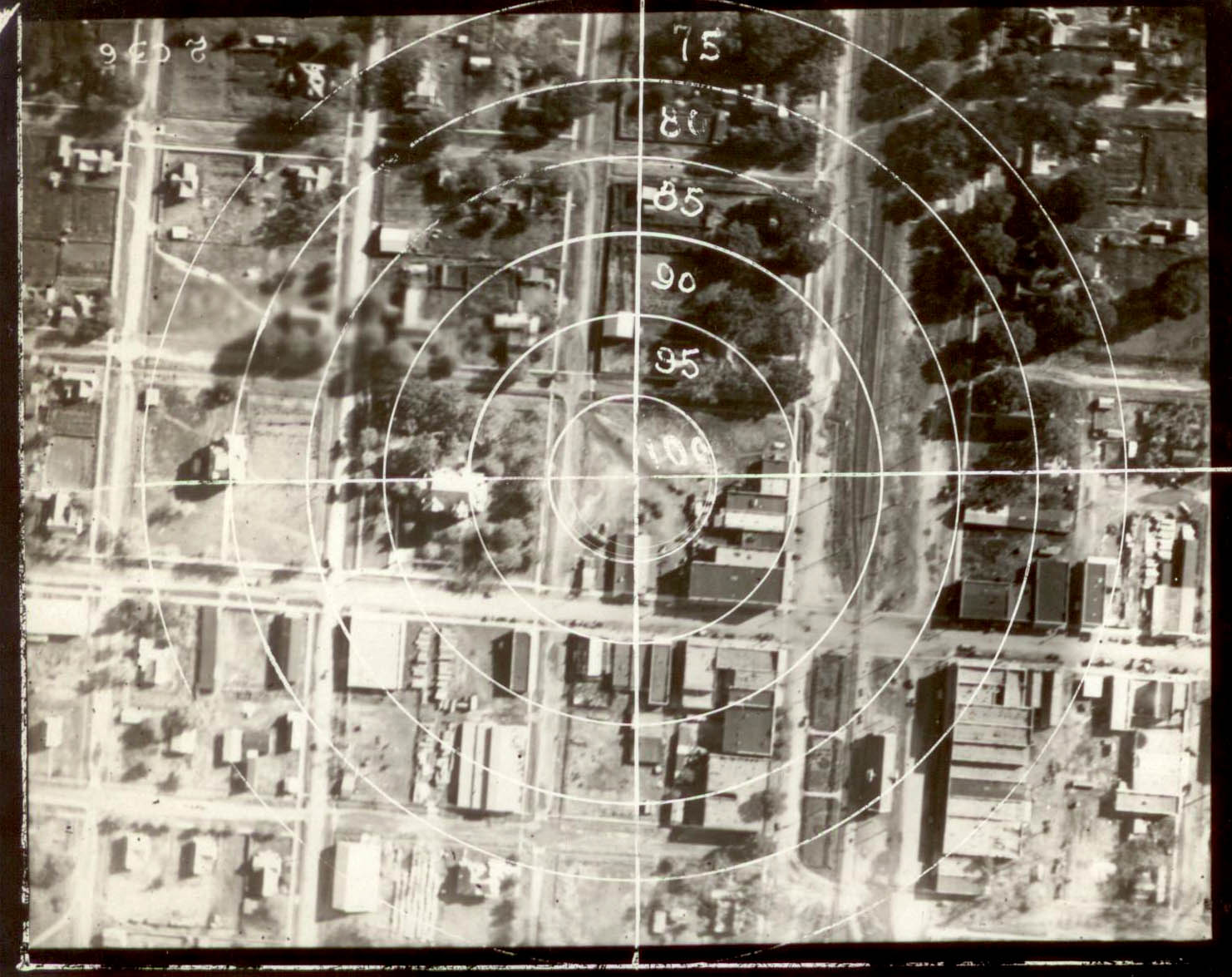
Seen/seduced from above

BombsightPart of my histories/geographies of bombing project involves addressing the work of visual artists who have attempted to render the violence of bombing not from below but from above. There are many powerful works that show the horror of bomb-sites and broken bodies, and I’m not uninterested in them; but to convey the violence of bombing in advance, so to speak, demands a much more exacting political aesthetic.

This vantage point matters because that is typically how those outside the conflict zone see air strikes conducted in their name.  During the Second World War the British press and newsreels showed the firebombing of German cities from above (in contrast, of course, to their coverage of the Blitz), and this facilitated the representation of area bombing as ‘precision bombing’ (in contrast, again, to their coverage of the Blitz); in the weeks following the Allied invasion of Europe American and British journalists swept across the continent with the advancing armies and were stunned by what they saw on the ground in Cologne, Hamburg and other cities.

In the weeks before the US-led invasion of Iraq, Baghdad was  repeatedly represented, in graphics, aerial and satellite photographs, and online interactives, as nothing more than a series of targets: then, as I showed in The colonial present, in the very week that Saddam’s statue was toppled, maps appeared showing Baghdad for the first time as a series of neighbourhoods inhabited not by tyrants, terrorists and torturers but by people like you and me.  If those images had been the dominant representation in the weeks and months before the attack, how many more would have been on streets around the world to try to prevent the invasion?

We can’t possibly know: but we surely do know that by the time we imaginatively crouch under the bombs and empathise with their victims it’s too late.
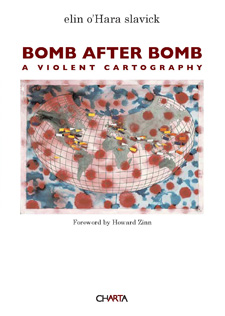
slavick, Bomb after BombThere is an appropriately long arc of work to consider, including artworks by Martin Dammann [the Überdeutschland series], Hanaa MalallahJoyce Kozloff [‘Targets’], Raquel MaulwurfGerhard Richter [Atlas], and Nurit Gur-Lavy.  I’ll post about some of the artworks later, and if anyone knows of others I ought to consider, I’d be very grateful to know about them.  But my very first engagement with these issues was through the work of ellen o’Hara slavick, now Distinguished Professor of Art at UNC Chapel Hill, and a project that was eventually called Bomb after Bomb: a violent cartography (she originally intended to call it ‘Everywhere the United States has bombed‘).  More on the series of 60-plus images and related projects herehere, here and here (the last is on Hiroshima). The book version (Charta, 2007) comes with additional essays by Cathy Lutz, Carol Mavor and the late Howard Zinn.
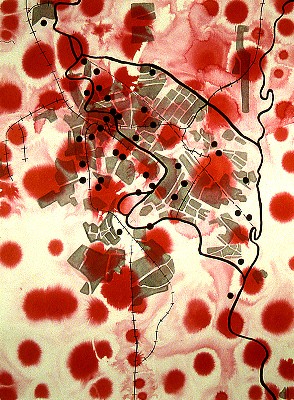
elin o'Hara slavick, Baghdad (1990)

In “Doors into nowhere” (DOWNLOADS tab) I glossed elin’s project like this:

She adopts an aerial view – the position of the bombers – in order to stage and to subvert the power of aerial mastery.  The drawings are made beautiful ‘to seduce the viewer’, she says, to draw them in to the deadly embrace of the image only to have their pleasure disrupted when they take a closer look. ‘Like an Impressionist or Pointillist painting,’ slavick explains, ‘I wish for the viewer to be captured by the colors and lost in the patterns and then to have their optical pleasure interrupted by the very real dots or bombs that make up the painting.’ 
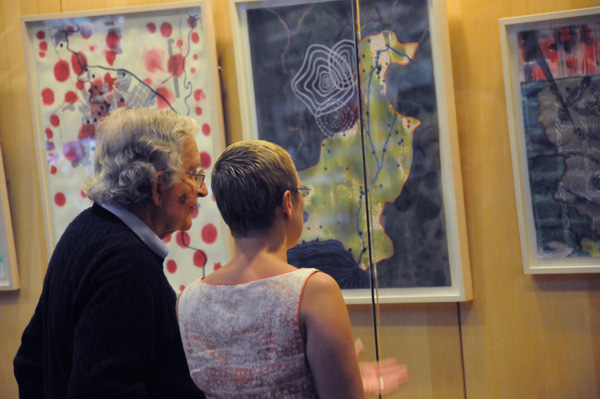
elin o'Hara slavick and Noam Chomsky

There’s much more to her work than this, as I try to show in my commentary, but what interests me here is that disturbing cascade that runs from beauty through seduction to pleasure.  There is a considerable literature on the dangers of aestheticizing violence, but plainly elin’s work is, as I said at the start, much more exacting than this.

Over at Books & Ideas Vanina Géré now has a short but pointed essay on ‘Artistic beauty as a political weapon’ that addresses these issues in helpful ways.  Political art, she writes, is always threatened by the prospect that

‘the political message will not get through because of the work’s retinal character — in other words, because the work is appreciated primarily for its formal qualities. If political art is often considered lacking in formal efficacy, formally remarkable works are often deemed lacking in political efficacy: too much plastic beauty risks making politics a topic like any other. In grappling with this demanding question, some artists have chosen to accentuate their works’ capacity for formal seduction by springing visual traps, placing viewers before realities that they did not expected to encounter in the rarefied air of a museum or a gallery.’

This is a particularly sharp dilemma for political representations of bombing, since the practice such artworks seek to apprehend and dislocate is itself ‘retinal’, formal: it is made possible by a series of performative abstractions that strip away content.  Cities as places where people live are reduced to co-ordinates, targets, pixels, flares of flight.  Géré doesn’t discuss slavick’s work, but her commentary on Brigitte Zieger‘s Eye Dust series speaks directly to the more general issues surrounding political art and military violence:

‘Using glitter eye shadow to draw clouds rising from explosions, the series creates a dialectical movement in which what we see (the makeup) hides what is (a face), yet nevertheless sheds light on a form of everyday violence. At the same time, these sumptuously executed images, which gently shine, entice the viewer to become increasingly fascinated with images of violence. Zieger’s work, by outrageously exploiting its own aesthetic quality in order to offer a critical perspective on representations and manifestations of military violence, demonstrates by this very token that behind every effort to impose beauty lurks a hidden form of violence. Beauty collaborates with politics, as the very concept of beauty is (in part) political. The challenge of such work lies in the precarious balance between the two.’

For Zieger’s own account of her work on war, violence and intimacy see this short video:
Emergency cinema

The Arab uprisings heightened interest in the politics of new social media, and much attention was directed at platforms like Twitter (which is emphatically not to say that any of this can be reduced to a ‘Twitter revolution‘).  Swirling around these discussions, breaking the 140-character limit of a tweet, was an insistently visual thematic, though this too was often limited to cellphone videos uploaded to YouTube and other sites (and then retransmitted by mainstream news media).  But there are other ways in which film/video can function as witness.

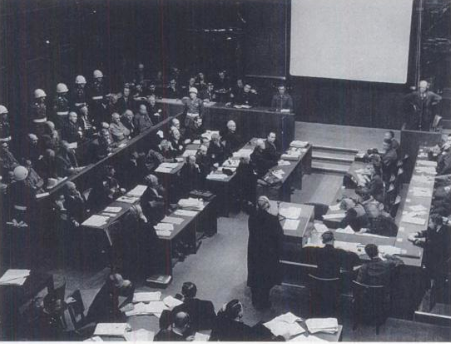
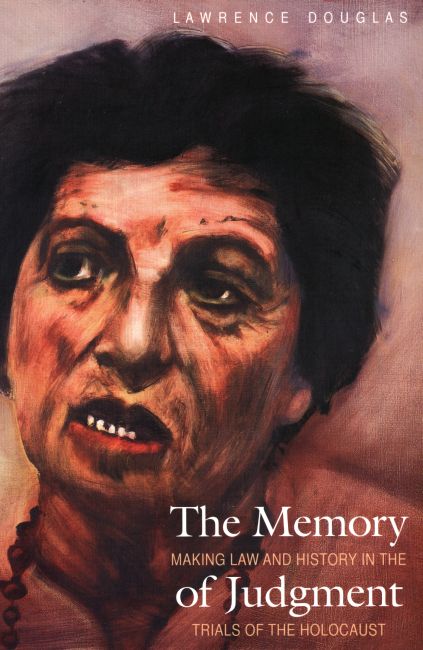
The use of film as witness is usually traced back to the International Military Tribunals in Nuremberg after the Second World War: see in particular Lawrence Douglas‘s classic The Memory of Judgment: Making law and history in the trials of the Holocaust (Yale University Press, 2001) – you can also read an early version of the key essay, ‘Film as Witness: Screening “Nazi Concentration Camps” before the Nuremberg Tribunal,’ in The Yale Law Journal,  105 (2) (1995) or access the book version (so far as I can see, without the accompanying images) online from Yale here.

Douglas’s thoughtful essay is, in a sense, framed by a remark that appears mid-way through it.  When reporter Ed Murrow described Buchenwald concentration camp in April 1945 he ended his broadcast by saying: ‘I pray you to believe what I have said about Buchenwald.  I have reported what I saw and heard, and only part of it.  For most of it, I have not words.’  When the prosecutors at Nuremberg elected to show a film compiled by former Hollywood director Lt Col George C. Stevens from black-and-white footage shot by Allied troops when they liberated the camps – Nazi Concentration Camps – they claimed , as one of them put it, that the film ‘represents in a brief and unforgettable form an explanation of what the words “concentration camp” imply.’  A horror, then, that transcended words – or, as Walter Benjamin confessed in a different context, ‘I have nothing to say, only to show’.

‘This use of film in a juridical setting was unprecedented’, Douglas notes, but it also raises a crucial question – ‘What exactly did the tribunal see when the prosecutors screened Nazi Concentration Camps?’ – that cannot be answered from the trial transcripts. These simply record:

[The film was then shown]

COL. STOREY: That concludes the presentation.

[The Tribunal adjourned until 30 November at 1000 hours]

The question is vital because it invites another: if images took the place of words that could not be found, then how was the tribunal ‘to submit unprecedented horror to principled legal judgments’ that necessarily returned to the verbal and textual?  Douglas’s pursuit of the question is what gives his essay such a compelling narrative force.  He shows in detail how even the visual faltered in the face of such horror: how the camera was confused, confounded, embarrassed – in a word, unsteadied.   He describes, too, how the film incorporates witnesses viewing the atrocities as a moment in its own witnessing: ordinary Germans being forced to view the exhumation of corpses, GIs and generals filing past dead bodies and emaciated survivors.  What these scenes do not  – cannot – do, Douglas concludes, is adjudicate responsibility:

‘Though the film provides a picture of a crime scene so extreme that its horrors have unsteadied the camera’s idiom of representation, it does not translate its images into a conventional vocabulary of wrongdoing.  Instead, the very extremity of the atrocity captured on film challenge sone to locate terms capable of naming and condemning these crimes.  How, then, was the prosecution able to assimilate evidence of unprecedented atrocity into a legal category of criminality?’

This is film as retrospective, but the questions about witnessing are no less difficult to answer when we turn to film shot ‘in the moment’ (and sometimes as a hideously staged moment of the horror). Helen Lennon carries the story forward from the Second World War tribunals to the International Criminal Tribunals for the former Yugoslavia and for Rwanda in ‘A witness to atrocity: film as evidence in International War Crimes Tribunals’ in Toby Haggith and Joanna Newman (eds), The Holocaust and the moving image: representations in film and television since 1933 (Wallflower Press, 2005).   She discusses the need to interrogate, even ‘cross-examine’ the visual testimony, but she concludes with two questions that loop back to Nuremberg:

‘It is necessary to confront the question of what is not shown at these trials, asking: In what ways are these moving images directing our attention toward certain violations, and away from others? What is the law refusing to see when ‘[the film was then shown]’ and ‘[the videotape played]’?

These are still sharp questions, but it is possible to use documentary film in ways that are not evidentiary (in the legal sense) and which deliberately avoid showing ‘the horror’ – and yet still offer a powerful, critical perspective.  I’ve been watching the work of a remarkable group of Syrian film-makers – Abou Naddara (very roughly: “Man with glasses” or, since this is also slang, something like “Goggles”) – who use film both to document and to mobilize events in Syria through what they call ‘emergency cinema‘.   The group publishes a short film on the web every Friday here (also on Vimeo) and they are, of course, also on Facebook here.  These aren’t conventional documentaries, and they certainly aren’t the YouTube uploads that I imagine most of us have become (too?) familiar with: fuzzy, jerky, grainy shots of the fighting or the shelling.

Cécile Boëx interviews the group over at Books & Ideas here.  They explain that they were already  ‘lying in wait’ for the revolution:

‘… we took up the position of a sniper, lying in ambush behind apparently harmless short films distributed anonymously on the Internet in 2010. We were hoping to reach our public right under the censors’ nose. And our hopes seemed to be coming true, because a few months after our website went live, we had already found the means to produce two series of short documentary films that also had to be made more or less clandestinely. In short, we were already lying in wait when the revolution erupted in March 2011. We were even preparing another skirmish, strengthened by the public support we were beginning to receive. The question was not, therefore, whether or not we should get involved in the revolution, but rather how to do so, and what was the best approach to take. After a month of trial and error, we made what was to be our first very short weekly film, entitled The Infiltrators, a disparaging expression used by Bachar al-Assad to refer to the anti-regime demonstrators. The film portrayed an elderly Damascan artisan letting loose against the Assad regime in a monologue that showed the personal, deep-rooted resilience of the Syrian revolt.’

As these remarks imply, their primary audience is inside Syria, and their involvement in the revolution is directed, in large measure, at reaching those who support the Assad regime.

Despite the sniper imagery, their presentations do not treat violence as spectacle – usually they avoid its direct representation altogether.  In the interview they connect this to the conditions under which they are forced to work, but they also insist that these burdens produce a paradoxical freedom:

‘Our project is basically part of the tradition of original documentary cinema, as shown by most of our very short films offering sequences from people’s lives or extracts from interviews, which we choose to film with closeness and empathy. However, we are working in a state of emergency and are subject to constraints that may or may not be justified, including access to film sites, safety of those filmed, social developments or the state of the Internet connection. We can also say that we take pleasure in working in an emergency situation because we feel an unprecedented sense of freedom. And that feeling of freedom carries us from one register to another by happily blurring the boundaries, including the one that separates documentaries and fiction. Besides, that confusion is a general characteristic of our films (Everything Is Under Control Mr. PresidentMy name is MayThe Mufti Wants to…End of Broadcast). We make aesthetic and political choices that portray the way in which our reference points have been turned upside down by the revolution. It also conveys our pledge to represent our people’s enthusiasm by ensuring they are not reduced to stereotyped characters, places or formats.’

So this isn’t ‘film as witness’ in the sense discussed by Douglas and Lennon, and it’s profoundly critical of the way in which the mainstream media now demand ever more scenes of violence that violate the Syrian people all over again.  Here is a pointed example (the screen isn’t blank, and the video takes only two minutes – do watch it).

‘When there’s talk of a ceasefire, for example, they tell us “send us images of shots being fired.”‘

When I watch these short films – some of them so short that they may be visual tweets, I suppose, but they are all carefully composed – I don’t see a parade of heroes or victims, or any of the usual cartoon characters, but a studied indictment of the ways in which the visual and the violent can otherwise lock together: an insight that will be no surprise to readers of Paul Virilio‘s War and cinema (1984; Verso trans. 1989) or to followers of David Campbell who, among many other important contributions, underscores the close relationship between the gun and the camera. (What else did you think ‘shooting’ meant?)

For more on the films (and the tradition from which they derive) see Nehme Jameli here, and for brief reports that situated the project within the wider cultural politics of resistance in Syria see Donatella Della Ratta at al Jazeera here and Amélie Rives at Near East Quarterly here.

From a kill to a view

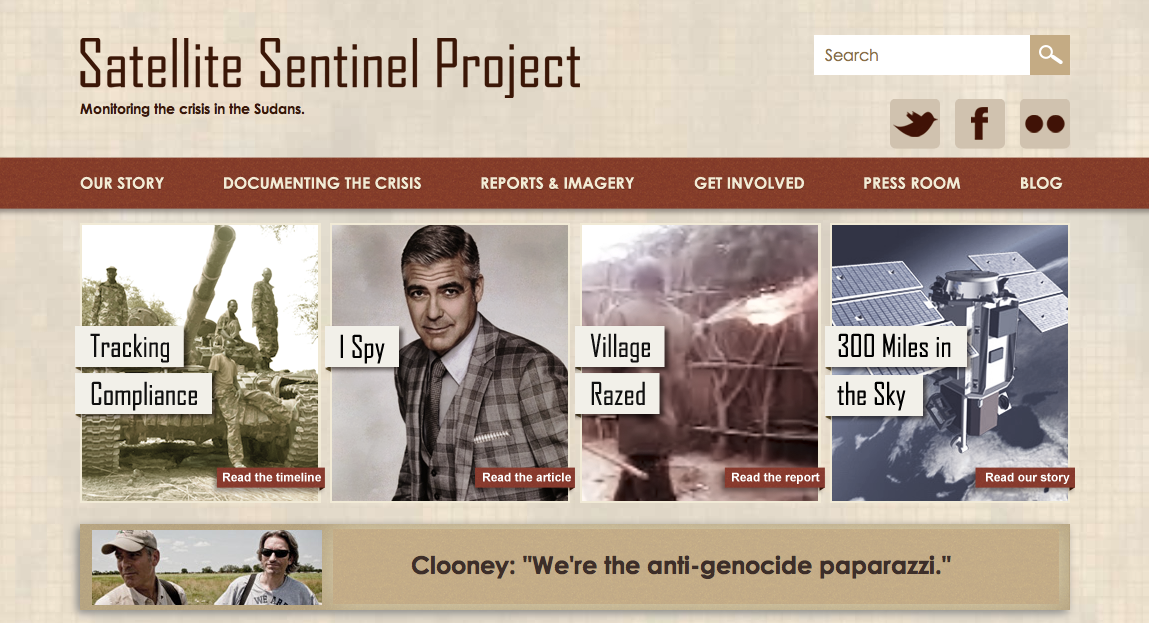
Further to my post about Remote Witnessing, Robert Beckhusen at Danger Room reports that Sudan’s President Omar al-Bashir is calling for the African Union to ‘protect’ African space from spy satellites.  Beckhusen suggests that al-Bashir has DigitalGlobe and, more particularly, the Satellite Sentinel Project squarely in his sights.

Using DigitalGlobe’s remote imagery, SSP’s website explains that

the Satellite Sentinel Project can identify chilling warning signs — elevated roads for moving heavy armor, lengthened airstrips for landing attack aircraft, build-ups of troops, tanks, and artillery preparing for invasion — and sound the alarm.

In other cases, SSP has notified the world of heinous crimes that would go otherwise undocumented and unreported. DigitalGlobe imagery supports evidence of alleged mass graves, razed villages, and forced displacement. SSP shines a spotlight on the atrocities committed in Sudan and lets alleged perpetrators know that the world is watching.

SSP‘s reports containing high resolution imagery are available to everyone, from journalists to the International Criminal Court. SSP‘s reports have been used as evidence in the International Crimal Court investigation of recent alleged crimes in Sudan.

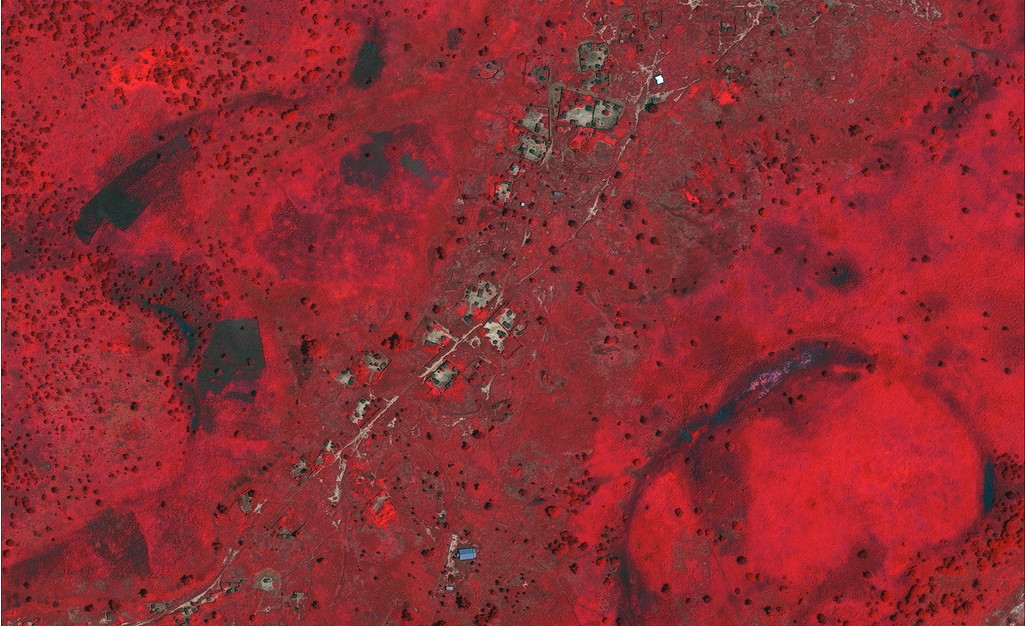
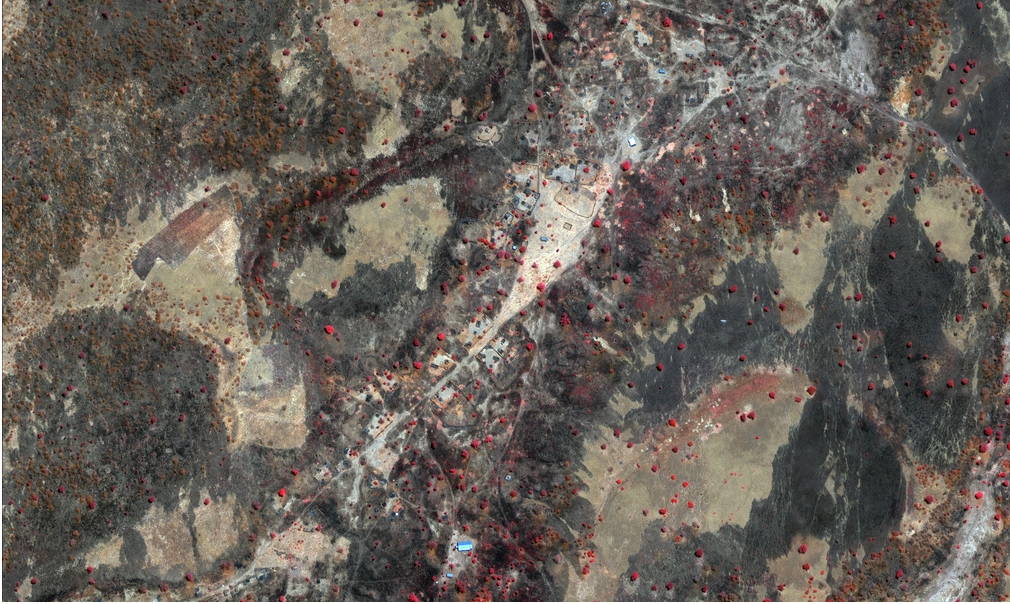
One example might indicate the scope of the project. In a report dated 20 July 2012 SSP provided compelling evidence of the deliberate razing of the village of Um Bartumbu in Sudan’s border region.  SSP compared DigitalGlobe imagery from September 2011 and March 2012 (all captions from SSP):

A DigitalGlobe satellite image, taken on September 11, 2011, shows the Sudanese village of Um Bartumbu prior to the village being destroyed by fire. The vegetation around the village (which appears red in the near-infrared imagery) appears healthy and unharmed. The village itself does not appear to be damaged in any way.

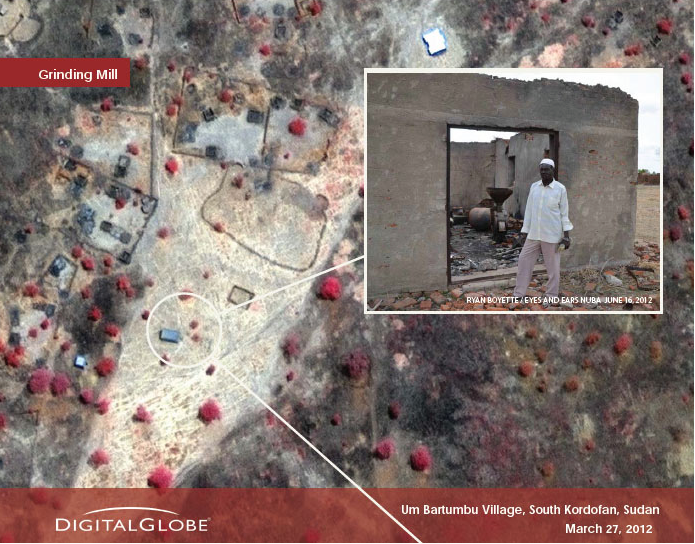
A DigitalGlobe satellite image shows the Sudanese village of Um Bartumbu, after it has been apparently destroyed by fires. A large portion of the vegetation within the village and the surrounding area has sustained extensive fire damage. Evidence of burning extends more than 6 miles (10 km) to the west and south of the village. Although it is clear that the great majority of the village suffered fire damage, satellite imagery alone cannot confirm the destruction of the clinic, mosque, storerooms, grinding mill or church because their metal roofs appear intact.

SSP claimed that its findings corroborate eyewitness reports that a joint unit of Sudan Armed Forces and Popular Defense Force militia razed the village in late 2011:

SSP has obtained new videos and photographs taken by Eyes and Ears Nuba, a team of citizen journalists based in rebel-held territory in the Nuba Mountains. The team traveled to Um Bartumbu with GPS-equipped cameras on June 16, to document evidence of the razing of this village, which sits in a no-man’s-land between opposing forces in Sudan’s ongoing conflict. An Um Bartumbu elder reported that the now-abandoned village had contained 50 homesteads of Muslims and Christians, numbering approximately 250 adults, plus an unspecified number of children.

An undated cell phone video obtained by SSP from Eyes and Ears Nuba, and available on NubaReports.org, shows Sudanese forces who call themselves “Katiba Kabreet,” Sudanese Arabic for “Match Battalion,” setting fire to a village. In the video, Sudanese men fire guns and carry torches as residential compounds burn. Most wear matching uniforms and boots, and are dressed in a manner consistent with Sudan Armed Forces. Some wear mismatched uniforms and tennis shoes, and are dressed in a manner consistent with PDF militia forces.

“Matches, where are the matches? Burn this house,” one soldier commands in Sudanese Arabic.

SSP’s case is made so compelling through its forensic triangulation of the site through satellite imagery, ground imagery and eye-witness reports; for the full suite of satellite and ground imagery, see the collection here.

The communal grinding mill in Um Bartumbu, 27 March 2012 (near infrared), 16 June (inset) and 22 January (close up).

SSP links to Eyes and Ears Nuba, which describes itself as ‘a network of citizen reporters dedicated to covering the war along the Nuba Mountains’ where, after fighting broke out in June 2011, the government of Sudan banned journalists from entry. ‘The only witnesses are Nubans’, and for this reason ‘Nuba Reports was founded in order to provide the international community and the people of Sudan with credible and compelling dispatches from the frontlines.’

Witnessing, then, becomes a multi-modal, highly mediated structure of testimony, inference and evidence: always situated, inescapably precarious, and absolutely vital.  And, as I noted in that previous post, it cannot be conducted from remote desk-tops alone.

Note: The Small Arms Survey has a helpful backgrounder on the region here, and for more on the genocide unfolding in the Nuba Mountains see here and here and here.  Nicholas Kristof has also provided a series of anguished reports for the New York Times – for example here– and Brett McDonald’s video of Kristof’s travels is available here.

Visual culture and battles for Algiers

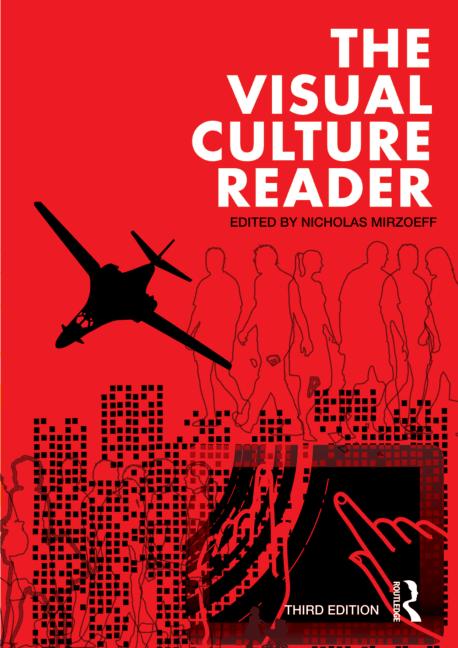
My copy of Nicholas Mirzoeff‘s newly published Visual Culture Reader was waiting for me on my return from Cologne.  It’s the third edition of a classic resource, first compiled ten years ago, and it’s been comprehensively revised, with a number of specially commissioned essays.   You can download some of Nick’s own essays here, including discussions of Abu Ghraib and US counterinsurgency.

Contents:

PART 1 

Expansions

Chapter 1: “There are No Visual Media” W. J. T. Mitchell Chapter 2: “The (In)human condition: A Visual Essay” Ariella Azoulay Chapter 3: “Mapping Non-Conformity: Post-Bubble Urban Strategies” Teddy Cruz Chapter 4: “X-reality: Interview with the Virtual Cannibal” Beth Coleman Chapter 5: “On Software, or the Persistence of Visual Knowledge” Wendy Hui Kyong Chun Chapter 6: “Notes on the Photographic Image” Jacques Rancière Chapter 7: “Queer Faces: Photography and Subcultural Lives” J. Jack Halberstam Chapter 8: “Currents of Worldmaking in Contemporary Art” Terence E. Smith Chapter 9: “Sublimated with Mineral Fury: Prelim Notes on Sounding Pandemonium Asia” Sarat Maharaj Chapter 10: “The Sea and the Land: Biopower and Visuality after Katrina” Nicholas Mirzoeff

PART 2: GLOBALIZATION, WAR AND VISUAL ECONOMY 

War and Violence

Chapter 11: “The Archaeology of Violence: The King’s Head” Zainab Bahrani Chapter 12: “The Actuarial Gaze: from 9-11 to Abu Ghraib” Allen Feldman Chapter 13: “American Military Imaginaries and Iraqi cities” Derek Gregory Chapter 14: “Zeroing In: Overheard Imagery, Infrastructure Ruins, and Datalands in Afghanistan and Iraq” Lisa Parks Chapter 15: “What Greg Roberts Saw: Visuality, Intelligibility, and Sovereignty – 36,000km Over the Equator.” Trevor Paglen Chapter 16: “Media and Martyrdom” Faisal Devji Chapter 17: “Live True Life or Die Trying” Naeem Mohaiemen Attention and Visualizing Economy Chapter 18: “Kino I, Kino World: Notes on the Cinematic Mode of Production” Jonathan L. Beller Chapter 19: “On Virtuosity” Paolo Virno Chapter 20: “Faking Globalization” Ackbar Abbas Chapter 21: “Creativity and the Problem of Free Labor” Andrew Ross Chapter 22: “It’s easier to imagine the end of the world than the end of capitalism” Mark Fisher Chapter 23: “Do It Yourself Geo-Politics” Brian Holmes

PART 3: THE BODY, COLONIALITY AND VISUALITY

Bodies and Minds

Chapter 24: “Optics” René Descartes Chapter 25: “Blindness and Visual Culture: An Eye-Witness Account” Georgina Kleege Chapter 26: “Reduplicative Desires” Carol Mavor Chapter 27: “The Persistence of Vision” Donna Haraway Chapter 28: “The body and/in representation” Amelia Jones Chapter 29: “Mami Wata: A Transoceanic Water Spirit of Global Modernity” Henry Drewal Histories and Memories Chapter 30: “The Mobilized and Virtual Gaze in Modernity: Flâneur/Flâneuse” Anne Friedberg Chapter 31: “Tourism and Sacred Ground: The Space of Ground Zero” Marita Sturken Chapter 32: “Maps, Mother/Goddesses and Martyrdom in Modern India” Sumathi Ramaswamy Chapter 33: “Museums in Late Democracies” Dipesh Chakrabarty Chapter 34: “The Fact of Blackness” Frantz Fanon Chapter 35: “The Case of Blackness” Fred Moten (Post/De/Neo)Colonial Visualities Chapter 36: “Orientalism and the Exhibitionary Order” Timothy Mitchell Chapter 37: “The Colonial Harem” Malek Alloula Chapter 38: “Vodun Art, Social History and the Slave Trade” Suzanne Preston Blier Chapter 39: “Between Cult and Culture: Bamiyan, Islamic Iconoclasm and the Museum,” Finbarr Barry Flood Chapter 40: “The Postcolonial Constellation: Contemporary Art in a State of Permanent Transition.” Okwui Enwezor Chapter 41: “Urban Warfare: Walking Through Walls” Eyal Weizman

PART 4: MEDIA AND MEDIATIONS

Chapter 42: “U.S. Operating Systems at Midcentury: The Intertwining of Race and UNIX” Tara McPherson Chapter 43: “Rethinking the Digital Age” Faye Ginsburg Chapter 44: “The Unworkable Interface” Alex Galloway Chapter 45: “On the Superiority of the Analog” Brian Massumi Chapter 46: “Race 2.0: Neoliberal Colorblindness in the Age of Participatory Media” Lisa Nakamura Chapter 47: “Imagination, Multimodality and Embodied Interaction: A Discussion of Sound and Movement in Two Cases of Laboratory and Clinical Magnetic Resonance Imaging” Lisa Cartwright and Morana Alac

In human geography – and beyond – the go-to site for matters visual is Gillian Rose‘s visual/method/culture, and her excellent Visual methodologies: an introduction to researching with visual materials (Sage, 2011) is already in its third edition too.

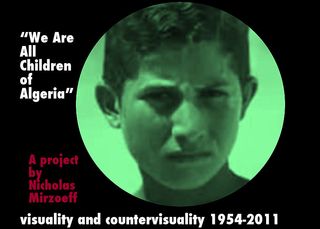
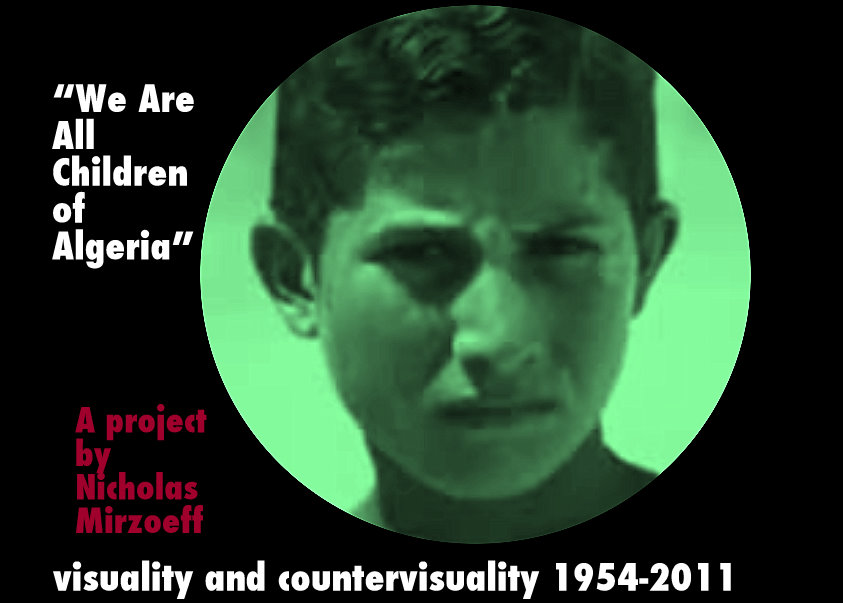
But Nick’s work also speaks directly to geography (at least with a little g, which is the sort I prefer).  Readers probably already know his most recent book, The Right to Look: a counterhistory of visuality (Duke, 2011), but this summer he produced a remarkable ‘digital extension’ of one of its chapters in conjunction with the Alliance for Networking Visual Culture called “We are all children of Algeria”: visuality and countervisuality 1954-2011 that plays with the idea of what I suppose we could call ‘spatial stories’.

In a revealing interview Nick explains why he chose to use a new open access authoring platform – Scalar – rather than his blog:

Blogging is a format that expands how it’s possible to write and think in relation to the contemporary. It makes a form over time. Scalar allows me to share a wide range of North African and European cinema, newsreel footage, guerrilla documentary and photography with the reader in a way that is obviously not possible in print.  Unlike a blog, or at least one using an off-the shelf template, I have a great deal of freedom as to the look, layout and design of each “page,” which can vary from one to the next.  More than that, it allows me to explore a more complex form of narrative in which multiple threads (or “paths” as Scalar calls them) can be developed. This opens up a new set of possibilities for comparative and cross-cultural work that have only just begun to explore in digital humanities work but which I think are among its most fruitful possibilities.

Much to think about there for me: as I noted in a previous post on Targeting and technologies of history, I’m really drawn to the visual experimentations taking place at USC – like Vectors, which showcased some of Caren Kaplan‘s work and which was also involved in Nick’s collaboration.

In “We are all children of Algeria”, then, Nick uses the metaphor of the march to tell a story about revolution and decolonization in Algeria from the outbreak of the revolution in 1954, and to illuminate affinities and connections between the post-war revolutions and the Arab uprisings that began in December 2010.

There is a march! A demonstration as they say in England, a manifestation in French. The Arabic is مسيرة. What is it? It is a means to put our bodies in space, where they are not intended to be and to make a claim. It moves, it demonstrates, it shows: it is militant research…

It asks: how can we “see” Algeria, its decolonization and revolution? Following the lead of Frantz Fanon, it takes the point of view of the child, meaning both children as such, the colonized “child” of  the parent nation, and the “infant” revolution that emerged. 

The Zapatistas say that everything they do is “walking,” a journey that has no final destination. This walking is done here by means of text, media and to-camera videos. This format, allowing as it does for a set of intersecting and interfacing threads to compose the whole, is better suited to reclaiming and exploring these histories than the linear text-based narrative.

So it is both a story about Algeria as such and a way to understand the interface of decolonization and globalization. Whether or not you work “on” or about Algeria, there is an “Algeria” in your work, meaning that there is a place where the incomplete or failed processes of decolonization and the formation of independent developing-world nations intersect with the power of financial globalization. We need to occupy that place, not erase it.
And, yes, Pontecorvo’s Battle for Algiers has a pivotal place in the march (page 5 of the Main Route).

The Guantanamo Bay Museum of Art and History

While I was in Cologne I had an e-mail from Ian Paul, an artist/theorist in San Francisco who works around issues of border violence and post-national human rights.  He wanted to include my essay “The Black Flag” in an online project on Guantanamo Bay:

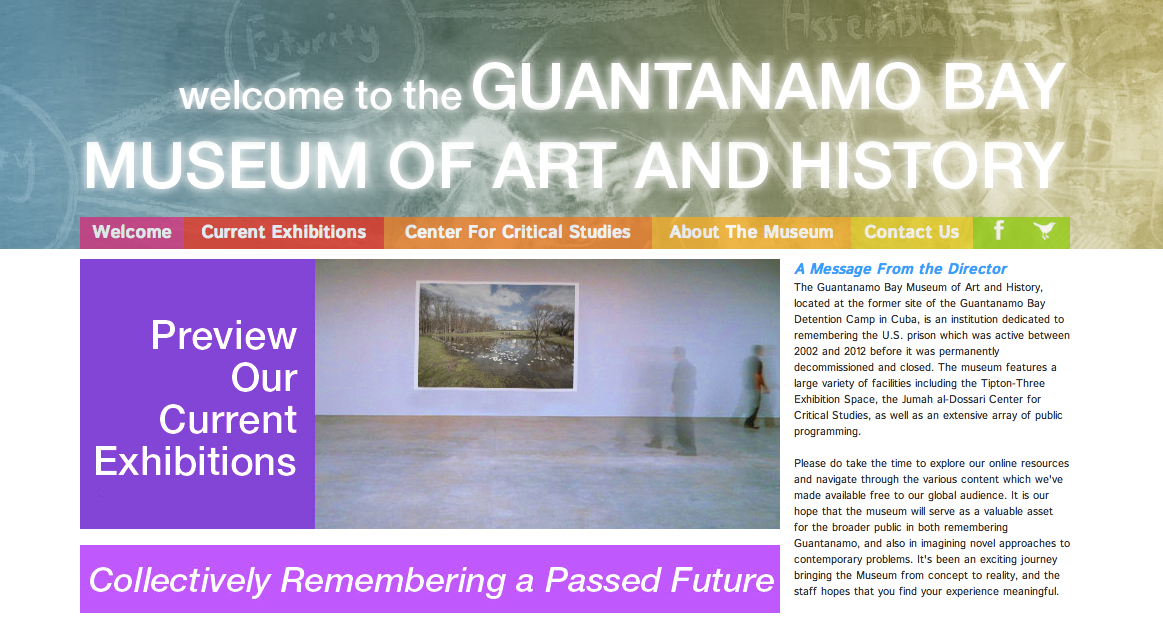
“The Guantanamo Bay Museum of Art and History is a project which hopes to bring together artists and writers from around the world to examine the current conditions of the Guantanamo Bay Prison as well as the possibility of its closure.  The project takes the form of a ‘speculative present’, and posits that the prison itself has been closed and has been replaced by a museum that features exhibitions and public programs which document/interrogate/examine the history of the prison. The project seeks to draw a transnational/transdisciplinary group together to critique the prison, and artists/theorists from 5 different countries have already agreed to participate.”

The Guantanamo Bay Museum of Art and History  has now opened its virtual doors here.  Well worth a visit. (It’s also on Facebook).

Current Exhibitions includes a specially commissioned video montage by Adam Harms, “Performing the Torture List”, while  the Jumah al-Dossari Center for Critical Studies includes “The Black Flag” and contributions from Judith Butler, Martin Puchner, Harsha Walia (and more to come).

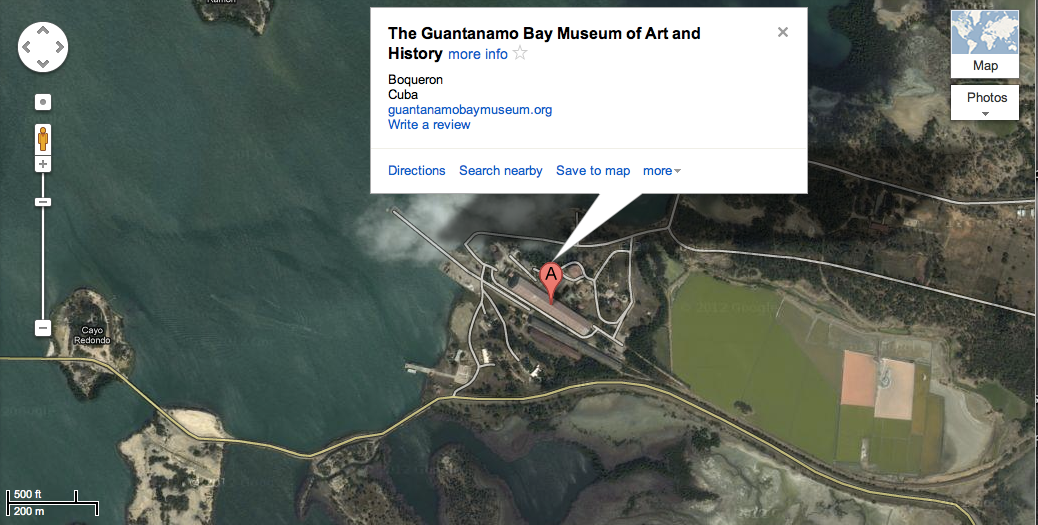
As I say, worth a visit.  As Alexis Madrigal at the Atlantic blog notes, you can find the Museum on Google maps (really) –

– and he’s captivated by the conceit:

The imaginary museum draws its power from this resonance: If Gitmo exists because of one fiction, perhaps it can be closed by another? Or put another (augmented) way, germane to this digital project: if we change Gitmo’s website, can it actually change its physical and legal reality? That’s what the museum’s organizers are hoping. 

“The museum is the result of a collaboration between artists/theorists and is meant to act as both a critique of the Guantanamo Bay Detention Facility as well as assert the possibility of its closure,” Rene Guerne, one of its organizers, told me in an email. “In this sense, it is a ‘real’ museum, although I cannot promise that there is a physical building in Guantanamo Bay.”

Benjamin Wittes at Lawfare is also intrigued by the project, and published the artists’ opening statement:

On August 29th, 2012, the website of the Guantanamo Bay Museum of Art and History was publicly launched. Designed by a group of artists from around the globe, the project creates a ‘speculative present’ in which the Guantanamo Bay Detention Facilities have been closed and replaced by an art museum whose purpose is to reflect on the history of the site.

The museum was listed as an official place on google maps ( http://goo.gl/tg72v ) and features original artworks from 6 different contemporary artists, as well as essays on Guantanamo Bay from leading contemporary scholars including Judith Butler and Derek Gregory.

Ian Alan Paul, an artist from San Francisco who coordinated and curated the project, states:

“The purpose of the project is both to explore the human rights abuses that occurred and continue to occur in Guantanamo Bay, but also to provide a space for radical imagination and potential openings and to insist that it is both possible and necessary to close the prison facility.”

The project was the result of large collaboration, with over 25 artists, writers and other volunteers contributing to the project in some way from Europe, North America and South America. Visitors to the museum were invited to plan their trip to Guantanamo Bay, become a member of the museum, apply to be an artist in residence, as well as read about the history of the museum itself.

There were over 3000 visits to the museum on the first day from 42 different countries.

In January 2009, interestingly, Florence Waters – anticipating Obama’s closure of the war prison (I wonder if she still does?) – proposed the creation of a (physical) museum on the site:

Transforming what will become an important site of memory into a museum could be an opportunity to present the facts from multiple points of view and give the subject transparency. Guantanamo detainees and guards would have the opportunity to present their stories alongside one another.

America has led the way in the post-modern world in erecting museums and sites of memory. They serve not only as burial sites of the past but also to affirm the symbolic order of a society, and head warnings to future generations…. Guantanamo Bay Museum would be a cultural and historical showcase dedicated to reinstating America’s most important values, liberty and justice, giving the detainees fair trial in the eyes of the outside world.

If only.  There are, incidentally, several other virtual Guantanamo Bays.  It was one of the founding sites for Mathias Judd and Christoph Wachter‘s  Zone Interdite, and Nonny de la Peña and Peggy Weil created a virtual Gitmo in Second Life (and, ironically, had to launch a campaign to keep Gitmo – their Gitmo – open!).

As the matchless Bryan Finoki put it on the much missed Subtopia, ‘the field guide to military urbanism’ (and still up even though Bryan stopped posting there early this year), referring to and then riffing off Zone Interdite,

 I love the idea of revealing these off-limit places this way, in a sense, de-restricting them in the process of remaking them. Altogether, rendering a de-restricted global fortress. 

What starts off as a few models of detention centers and prison camps could eventually turn into a full on game-world atlas of forbidden cities; a Borgesian labyrinth of illegal walkthroughs and blatantly trespassed border-zones, subverted checkpoints, oblique tunnel architecture, web tourists lost in the intersecting planes of bunker complexity and secret baseworld archipelago urbanism. It becomes a backlash taxonomy of exposed military installations. A virtual military-industrial-complex: “clandestinatopia.” Border fences and security walls give way now to a deterritorialized map of exploratory landscapes, overrun by mad gamers and tribes of sim-squatters preserving the world’s most closed and hidden places as endlessly wandering open space. Like a Subtopianinvoluntary park online, or a virtual spelunker’s paradise. 

So, yeah, I hope to see you there.

And as Bryan reminds us, there are many more black flags to fly over many more prisons and camps all over the world.

Sight-seeing: war and extreme tourism

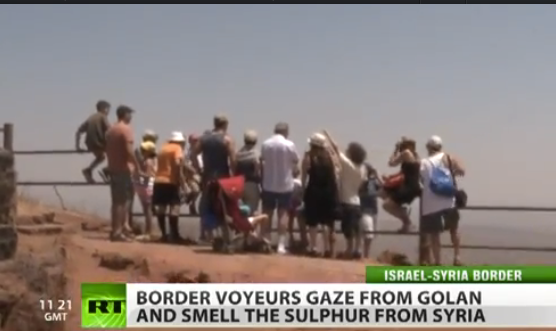
For the last several months there have been dispiriting reports of Israeli tourists travelling to the Golan Heights to gaze across the war zone in Syria: as Allison Good put it over at Foreign Policy, “Many Israelis are foregoing the pool or the beach, flocking instead to the Israel-Syria border for a little action.”

There was a thoughtful response to this voyeurism from Paul Woodward at War in Context – make no mistake, this is spectatorship not witnessing, as the video that prefaces his commentary makes clear – in which he suggested a series of ways in which he thought Israelis watching the war through binoculars was significantly different from Americans watching the war on television:

For Israelis the spectacle of regional violence is self-affirming.

It reinforces the idea that Israel is justifiably obsessed with its own security because it is surrounded by a ‘dangerous neighborhood.’

It confirms Ehud Barak’s racist notion that Israel is a villa in a jungle and that tranquility inside this villa can only be afforded by high walls.

It defines neighbors on the basis of their otherness and legitimizes indifference in preference to empathy.

I’m not so sure; there are, sadly, also American constituencies who surely see things the same way.

There are also close parallels between the voyeurs on the Golan Heights (or in this case Lows) and the ‘hill of shame’ from which the international media looked on at the Israeli attack on Gaza in 2009.  Here too the media were joined by Israeli tourists with cameras, binoculars and picnics: ‘bombing as spectator sport’, as two angry commentators described it.  There’s another personal, passionate report here.  For more on watching Gaza, see Peter Lagerquist, ‘Heard on the Hill of Shame’, at MERIP and – absolutely vital, this – David Campbell‘s  take, ‘Constructed visibility: photographing the catastrophe of Gaza (2009)’, which can be downloaded through his blog here. And Craig Jones has an excellent article culled from his MA thesis on ‘Shooting Gaza: Israel’s visual war’ in Human Geography 4 (1) (2011): abstract here.

There is also now a developing discussion of the wider, militarized landscape of ‘extreme tourism’ in Israel from Matt Carr at Ceasefire.  He pays close attention to the growth of tour companies run by former military officers and settlers, to the inclusion of the illegal settlements on the West Bank in their itineraries, and to the shooting ranges where tourists are encouraged to role play:

The sight of these ignorant, gimlet-eyed tourists in sunglasses and shorts, living out their paramilitary fantasies and teaching even young children to kill imaginary terrorists in a land under Israeli military occupation, is not the most edifying spectacle. But Caliber 3 does not only aim to thrill. Its activities are intended to combine ‘the values of Zionism with the excitement and enjoyment of shooting which makes the activity more meaningful.’ As the school’s director puts it ‘What is key here is not just shooting at targets, but hearing how we fight every day to protect the Jewish state.’

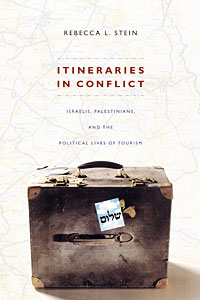
This can all be embedded in an emerging literature on ‘battlefield tourism’ or ‘war tourism’ – Richard Butler and Wantanee Suntikul have an edited collection, Tourism and war, out from Routledge this summer – but I think it’s more usefully connected to Rebecca Steins pathbreaking work on the politics of tourism, especially her book Itineraries in Conflict: Israelis, Palestinians and the political lives of tourism (Duke University Press, 2008). You can find a more recent report from her, ‘An All-Consuming Occupation’, on the fourth Jerusalem Festival of Light in June 2012 and the wretched history of tourism that was concealed in its glare, at MERIP.  She’s also provided an incisive examination of Israeli media coverage of the Gaza war – most eyes have been directed at international coverage –  in ‘Impossible witness: Israeli visuality, Palestinian testimony and the Gaza war’, Journal of cultural research 16 (2-3) (2012) 135-53.

Finally, for faint flickers of hope, there’s Caryn Aviv‘s essay on ‘The emergence of alternative Jewish tourism’, European Review of History 18 (1) (2011) 33-43.  Here’s the abstract:

This article explores the emergence of ‘alternative Jewish travel’ to the West Bank and within Israel. One programme, aimed at diaspora Jews, reframes religious, cultural, and ethnic Jewish identity to include non-violence and solidarity with Palestinians as part of what it means to be Jewish. Another programme, aimed at Israeli citizens (both Jews and non-Jews), reframes Israeli national identity to include post-Zionist solidarity with Palestinians, but is not necessarily Jewish in any religious or ethnic sense. Alternative Jewish travel programme tours explore complicated questions of justice and nationalism in different ways that reflect their simultaneously local and global positions, who organises them, and how they define Jewishness differently.

In Frames of War: when is life grievable? (2009) Judith Butler offered a series of reflections on other, no less violent visualities than those I have discussed here, but Aviv’s essay is worth reading alongside Butler’s response to the Jewish critics of her richly deserved award of the Adorno Prize by the city of Frankfurt: grace under fire.

Frithjof Voss

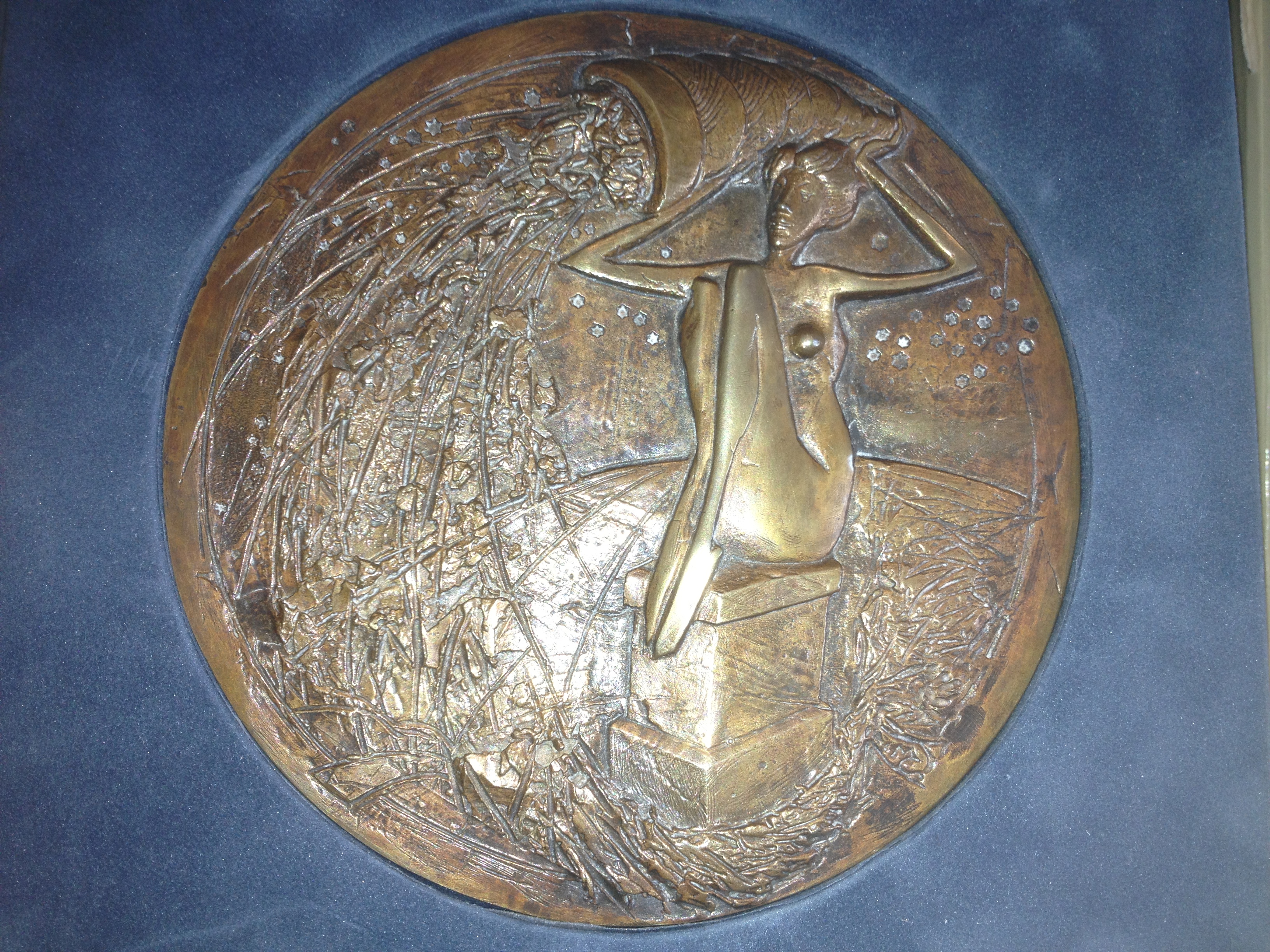
I’ve been awarded the inaugural Internationalen Wissenschaftspreis der Deutschen Geographie (International Science Award of German Geography) by the Frithjof Voss Stiftung, and the Prize was presented at the Closing Ceremony of the IGC in Cologne yesterday (30 August).  The award is to be made every four years and ‘honours the lifetime achievements of foreign scientists whose merit lies in their applied research and contribution towards building links between international geography and German-speaking geography.’

I’m really, really honoured by this.  I’ve valued my exchanges with German-speaking geographers for several decades now.  Before I left Cambridge for Vancouver in 1989 I had already come to know Benno Werlen, Dagmar Reichert and others, and in 1997 I was invited to give the first Hettner Lecture at Heidelberg.  I shall never forget that first visit.  I was staying in a hotel in the Old Town, in a large room tucked underneath the eaves, and I’d left the text of my lecture open on a bed while I was taken on a field excursion.  It rained solidly all day, and when I climbed the stairs to my room I was wet through; as I opened the door a hole appeared in the ceiling – it was a very old hotel – and water cascaded down onto the bed.  As I watched, the text of my lecture literally dissolved before my eyes.  (Probably the first time I thought that physical geography might have an impact on human geography).  I dashed downstairs and said in my best but rather frantic schoolboy German, “The rain is inside my room”, to which the gracious woman behind the desk – who had patiently been correcting my grammar and vocabulary ever since I arrived – replied (in German) “No, it is raining outside…”  I half-dragged her up the stairs,threw the door open, and she said – to my horrified satisfaction – “The rain is inside your room!!” Fortunately I had another copy of the lecture (Rule No. 1: always have a back-up).

That visit opened the door to a continuing series of conversations with colleagues at Heidelberg, and to a lasting friendship with Peter Meusburger – whose boundless energy, enthusiasm and intellectual insight I shall always treasure.  I’ve been back many times since, especially for Peter’s international seminar series on Knowledge & Space (like the ten Hettner lectures, these have been supported by the Klaus Tschira Foundation and held at the beautiful Villa Bosch just outside the city), and in 2007 – just ten years after my first visit – I was thrilled to be awarded an honorary degree by the university.  In 2011 I gave a Keynote lecture on “War in the borderlands” at the conference on New Cultural Geography at Nürnberg-Erlangen, and made more new friends; this past year I’ve been to Cologne to help plan the IGC – and made yet more new friends – and returned this week to give another Keynote  (a sawn-off version of “Deadly embrace: war, distance and intimacy”).

The subject of those last two lectures supplies a second reason for my pleasure at this Award.  It’s really heartening to discover that “applied research” is not interpreted in a narrowly instrumental way, and that the Foundation encourages a critical engagement with matters of public moment: ‘The main concern of the foundation is to demonstrate the practical value of geography when dealing with manifold social problems.’

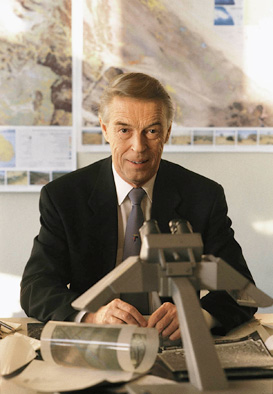
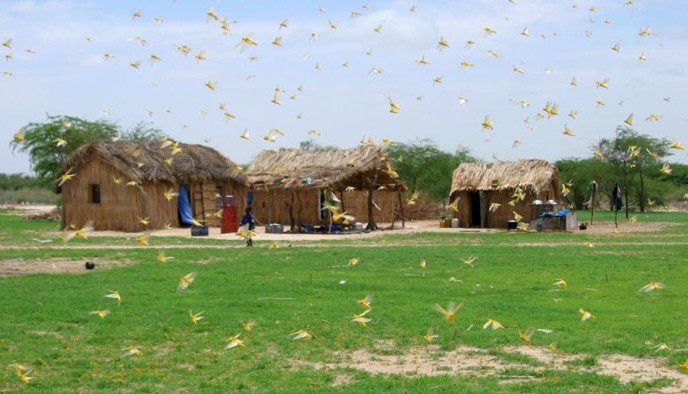
Frithjof Voss (1936-2004) was an expert on satellite imaging and mapping at the Institute of Geography at the Technical University of Berlin, and he was determined ‘”to rally high technology to offer something that materially benefits ordinary people.”  In 1991 he started using satellite imagery and remote sensing to identify the breeding grounds of locusts in the Tokar Delta in Sudan.  “Locusts do not recognise national borders,” he explained, “and neither does my system.” Ground studies confirmed the accuracy of his biotope mapping, and Voss then set about building his own satellite and linking it to GPS satellites so that real-time intelligence could be transmitted to eradication crews on the ground.

I am, of course, aware of the parallels between this aerial sensor/ground response system and other, different and deadly systems that are the focus of much of my own research on late modern war (drones, in case you’re not following this).  But Voss’s approach was a profoundly ameliorative one.   ‘Considering how quickly locusts breed, and the relative inaccessibility of many locust biotopes, Voss’s “smoke alarm” approach can literally mean the difference between life and death for many people.’ He was named an Associate Laureate of the Rolex Awards for Enterprise in 1996, and went on to extend his work to Asia.  As his work in China was drawing to a close, Voss noted that “huge locust swarms began infesting Kazakhstan and were heading to Russia. If our system had been in place in Central Asia, this could have been prevented.” Instead, as the Rolex website puts it, ‘crops were destroyed in an area the size of France, tensions between Russia and Kazakhstan were exacerbated and states of emergencies were declared across the region.’

Something else that captures my imagination – the website makes it plain that his work not only affected people far beyond the academy: it also sought audiences beyond the academy.  Long before most of us had realised the importance of ‘public geographies’, Voss was emphatically clear:

“We know nothing about public relations or how to interest the world in what we are doing… How do we reach those in positions of responsibility who have the imagination to see how great an impact such a system could have on millions around the world? Who do we see to help fund implementation?” Asked whether his remarks were a plea for an expert on such worldly matters to join his crusade, he replied, “Certainly I’m asking. It’s the business of scientists to ask.”

I wish I’d known him.

Remote Witnessing

In an astonishing essay on ‘Drone bombings in the Federally Administered Tribal Areas’, published in the Journal of Geographical Information Systems 4 (2012) 136-141 – the places this blog is taking me! – Katrina Laygo, Thomas Gillespie, Noel Rayo and Erin Garcia (three geographers and a political scientist at UCLA) explore what they call ‘public remote sensing applications for security monitoring’.

An open-access version should be available here but there is also a manuscript version here.  (In fact news of the project appeared in the press soon after the US raid on Osama Bin Laden’s compound last year – Gillespie and John Agnew headed a team that had used satellite imagery and the theory of island biogeography (sic) to predict the location of bin Laden’s hideout in 2009 – but much of the media interest in the new work focused on the image captured by satellite of a Predator circling above an area south west of Miram Shah.)

The new project uses unclassified high-resolution imagery from QuickBird 2 (via GeoEye) to monitor drone strikes in Pakistan’s Federally Administered Tribal Areas (FATA).  The difficulties (and dangers) of eyewitness reports are well-known, and media coverage of drone strikes in the area is at best uneven – though the Bureau of Investigative Journalism, along with organizations like CIVIC and Reprieve, continue to do brave, invaluable, eye-popping work – but the UCLA team concludes that, in principle, the commercial availability of the satellite imagery means that  ‘it is possible for the public’ – a distant public – ‘to monitor drone bombings in the [FATA]’.

You can see where they might be going.  In the weeks preceding the US-led invasion of Afghanistan the Pentagon secured exclusive rights to commercial imagery from the Ikonos-2 satellite.  They didn’t need it for operational purposes; the objective was to exercise ‘shutter control’ and prevent media and other organizations from obtaining imagery that might reveal casualties from the high-level bombing campaign. It wasn’t cheap; the standard cost was around $200 per square kilometre, with a premium for rapid turnaround, and news media had been paying $500 for each image.  It’s still not cheap.  The authors of this (I presume preliminary) report concede that ‘it may be prohibitively expensive to monitor the entire region’.  They estimate that weekly data for one year’s coverage of a town like Miram Shah would cost $64,000, though this would not be beyond the reach of some organizations.

But their own test-case is not encouraging.  Working from a map of drone strikes and casualties constructed by the Center for American Progress – they don’t say why they selected this source – the team searched the satellite image for evidence of any of the 16 drone strikes around Miram Shah before 1 January 2010 included in the database.  This is what they say:

 ‘We feel confident that we were able to identify the location of one drone bombing in Figure 4(b). If the center of the compound is the target, it would appear that the drone bombing is accurate. This also suggests that the blast radius of such attacks is relatively small or less than 20 m. Indeed, the walls still appear to remain intact. This appears similar to blast radii reported for hellfire missiles which are used by both the Predator and Reaper drones.’

The claim is not only repeated but generalized in the abstract: ‘Results suggest that drone bombings are very accurate and drone missions are common in the region.’

They suggest no such thing; drone strikes are most certainly common, but the claim about their accuracy is based on a single case for which nothing is known of the intended target or the basis for its identification – was this yet another wedding party?  Neither can anything be said about civilian casualties; they don’t key this site back into their casualty database, such as it is, and in any case they note that ‘The resolution of QuickBird 2 is currently not high enough to see or quantify casualties.’  Not exactly forensic architecture then.

Not surprisingly, though, the conclusion chimes with the Center for American Progress’s own endorsement of the campaign:

Hardly a week goes by without some key figure in the Al Qaeda network and its affiliates being targeted in a range of actions, including drone strikes as well as other actions by U.S. intelligence and law enforcement agencies to prevent attacks and degrade the Al Qaeda network. The damage done to Al Qaeda by the Obama administration represents America’s greatest national security success since the fall of the Soviet Union and the peaceful integration of Eastern European countries in the 1990s.

The importance of all this goes beyond the particular case.  Susan Sontag once famously declared that ‘Being a spectator of calamities taking place in another country is a quintessentially modern experience.’  It’s a more complicated (and contentious) claim than it looks, but in any event being a spectator is not the same as being a witness.  And we surely know – or ought to know – from Lisa Parkss wonderful work that satellite and other remote technologies do not provide an unmediated window on the world. I’m thinking particularly of her ‘Satellite view of Srebrenica: tele-visuality and the politics of witnessing’ in Social identities 7 (4) (2001), and ‘Digging into Google Earth: an analysis of “Crisis in Darfur”‘ in Geoforum 40 (4) (2009), but you can get a sense of her work from the press report of her 2010 lecture to the New Zealand Geographical Society here.  She also has a new book out late this year/early next from Routledge, Coverage: media spaces and security after 9/11.

Now the use of satellite technology to conduct ‘remote witnessing’ is not alien to human rights organizations, but most of them are well aware of its problems as well as its potential.  Amnesty International sponsored the Science for Human Rights Project (originally Satellites for Human Rights) from January 2008 to January 2011:

Its primary purpose was to test the potential use of geospatial technologies for human rights impact. The purpose of the evaluation is to assess the extent to which work undertaken by Amnesty International contributed to change (intended and unintended) and to assess the potential for using geospatial technologies to contribute towards more effective advocacy and impact.

There have been a series of public examples.  Some of them have been conducted under other banners, like the celebrity Satellite Sentinel Project on Sudan.

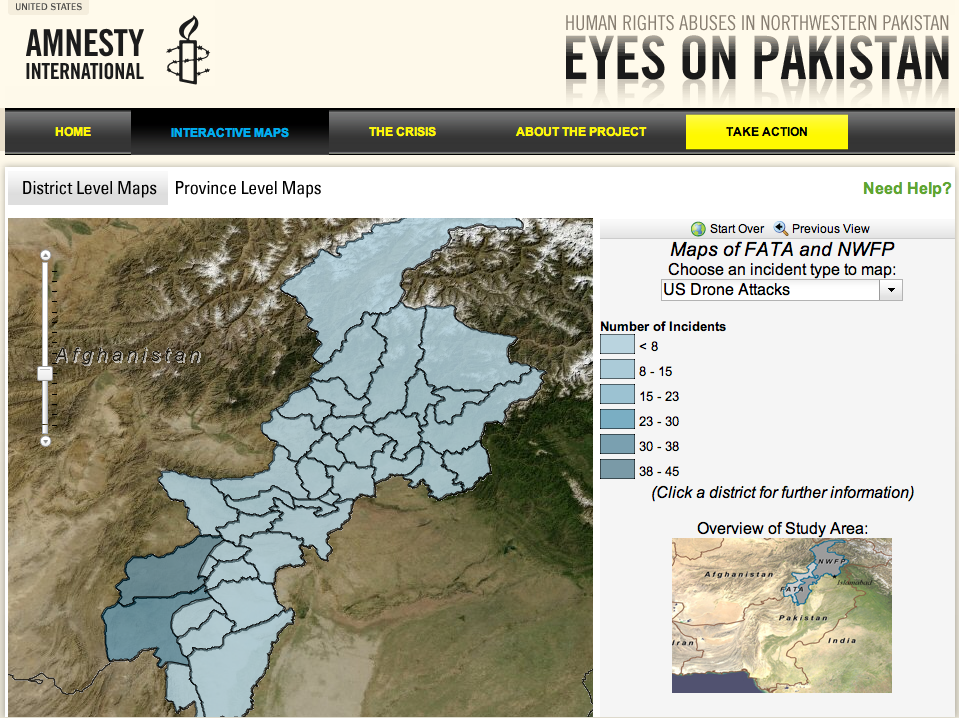
But the most directly relevant to this post is probably Amnesty’s (now terminated) Eyes on Pakistan archived here.  Although this involved interactive mapping platforms rather than the use of satellite imagery the project title gives a clear indication of the direction in which Amnesty was moving and the wider debate about witnessing of which it was a part.

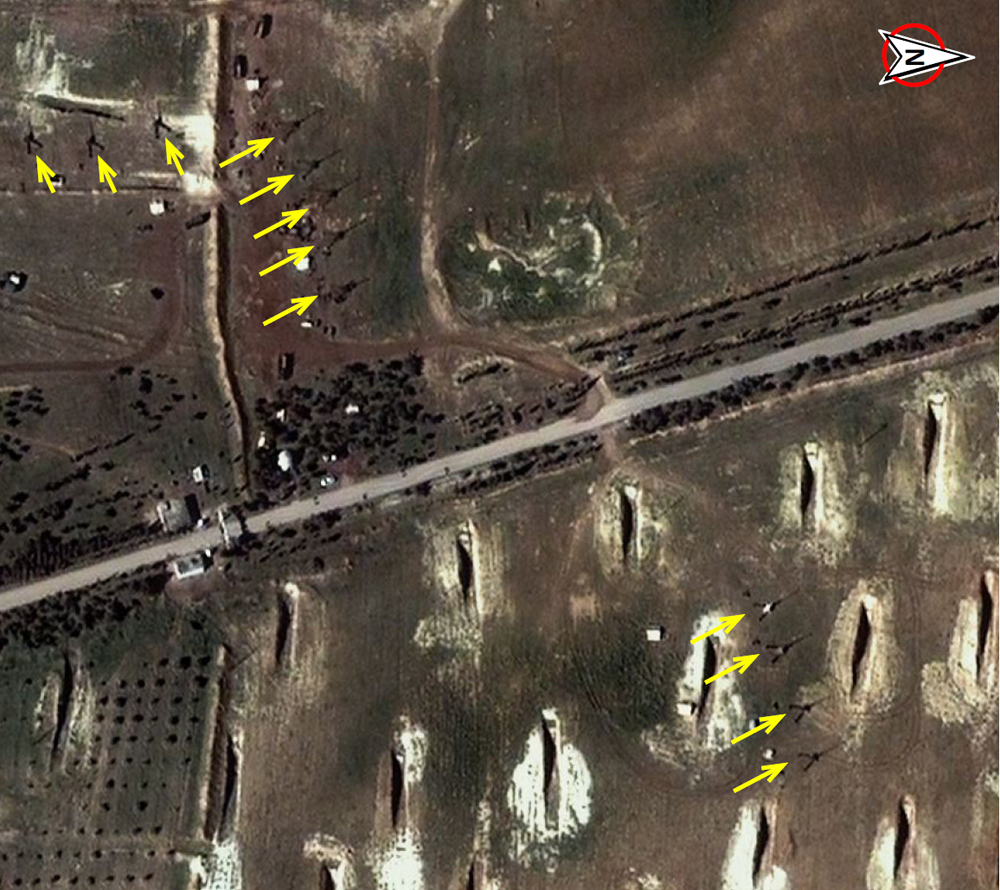
Amnesty has also launched Eyes on Darfur (here too the imagery is no longer being updated) and now Eyes on Syria.  This does involve remote imagery, and there is an interesting discussion on Amnesty USA’s blog about its significance:

The images from Homs and Hama show clearly that armed forces have not been removed from residential areas, as demanded by the U.N. General Assembly resolution from mid February. In Hama, the images reveal an increase in military equipment over the last weeks, raising the specter of an impending assault on the city where the father of current President Bashar al-Assad unleashed a bloody 27-day assault three decades ago, with as many as 25,000 people killed.

With reports of a ground assault underway in Homs, the analysis of imagery identifies military equipment and checkpoints throughout Homs, and field guns and mortars actively deployed and pointing at Homs [see image left]. Additionally, the images show the shelling of residential areas in Homs, concentrated on the Bab ‘Amr neighborhood. Artillery impact craters are visible in large sections of Bab ‘Amr, from where we have received the names of hundreds killed throughout the period of intense shelling.

Note that last clause: to convert remote sensing into remote witnessing requires difficult, painstaking work in multiple registers because the imagery does not speak for itself.  To believe otherwise means that anyone who ventriloquises from imagery alone – academics screening imagery in California or CIA/USAF analysts scrutinising near real-time feeds from drones – runs the real risk of seeing what they are predisposed to see.  As that same blog post notes,

Satellite images can help to show the widespread and systematic nature of violations, characteristics inherent to certain international crimes such as crimes against humanity. Additionally, they can help in identifying command responsibility, a key requirement for holding individual perpetrators accountable. [Ivan] Simonovic [Assistant Secretary-General for Human Rights] pointed out that the UN Panel on Sri Lanka relied a lot on satellite images. The same holds true for the current commission of inquiry on Syria, which equally relies on satellite images. Thus, the point is that while satellite images barely deliver the “smoking gun” that leads to a conviction, they can provide major support for international investigations and accountability mechanisms.

And this brings me back to drones.  Writing in the New York Times on 30 January 2012 Andrew Sniderman and Mark Hanis proposed re-purposing drones ‘for human rights’:

DRONES are not just for firing missiles in Pakistan. In Iraq, the State Department is using them to watch for threats to Americans. It’s time we used the revolution in military affairs to serve human rights advocacy. With drones, we could take clear pictures and videos of human rights abuses, and we could start with Syria. The need there is even more urgent now, because the Arab League’s observers suspended operations last week. They fled the very violence they were trying to monitor. Drones could replace them, and could even go to some places the observers, who were escorted and restricted by the government, could not see. This we know: the Syrian government isn’t just fighting rebels, as it claims; it is shooting unarmed protesters, and has been doing so for months. Despite a ban on news media, much of the violence is being caught on camera by ubiquitous cellphones. The footage is shaky and the images grainy, but still they make us YouTube witnesses. Imagine if we could watch in high definition with a bird’s-eye view. A drone would let us count demonstrators, gun barrels and pools of blood. And the evidence could be broadcast for a global audience, including diplomats at the United Nations and prosecutors at the International Criminal Court.

This produced a series of responses:  Lauren Jenkins was appalled, Daniel Solomon sceptical, and Patrick Meier sympathetic.  The most scathing response was from anthropologist Darryl Li in Middle East Report, which provoked a heated exchange between him and Sniderman.  I see all this as part of a diffuse (and I think largely uncoordinated) campaign to rehabilitate drones in the public eye, something I’ll be writing about in a future column for open Democracy.  But whatever you make of it, and wherever your sympathies lie, the debate about ‘humanitarian drones’ clearly underscores the necessity of seeing visual technologies as political-cultural technologies enrolled in highly particular scopic regimes.

In short – and to return to where I started – remote witnessing is not a passive practice but an intervention in a field of power and as such it involves a series of investments that spiral far beyond the cost of obtaining the imagery.


‘Dresden: a Camera Accuses’

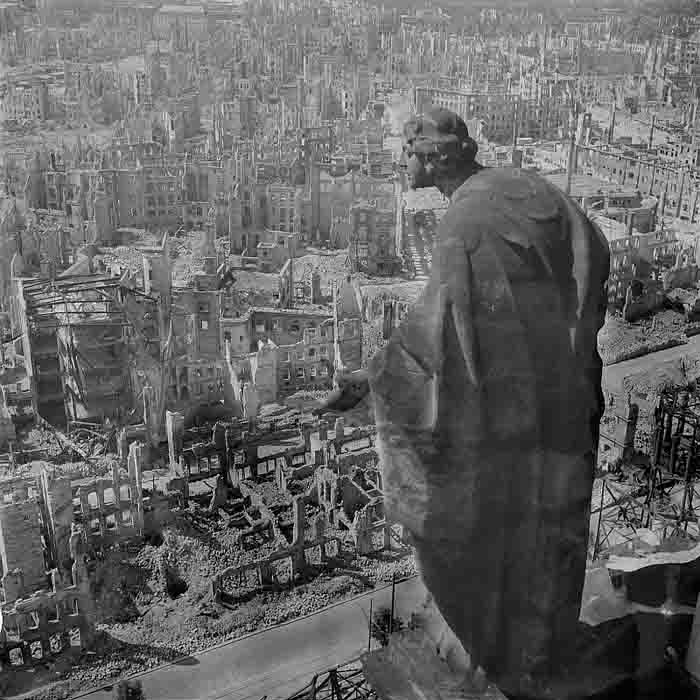
Richard Peter, Blick vom Rathaussturm, Dresden 1945 (Deutsche Fotothek)

A new essay from Steven Hoelscher, ‘Dresden, a Camera Accuses: Rubble photography and the politics of memory in a divided Germany’, just out in History of Photography 36 (3) (2012) 288-305.

This article explores memory, photography and atrocity in the aftermath of war. It takes as its case study the controversies surrounding the February 1945 firebombing of Dresden. One photograph in particular has become the iconic image of the fire- bombing and of the devastating air war more generally – Richard Peter’s View from the City Hall Tower to the South of 1945. Although arguably less divided today than it was during the Cold War, when the image became seared into local and national memory, Germany’s past continues to haunt everyday discourse and political action in the new millennium, creating new ruptures in a deeply fractured public sphere. By examining the historical context for the photograph’s creation and its dissemination through the book Dresden – A Camera Accuses, this article raises questions of responsibility, victimhood and moral obligation that are at the heart of bearing witness to wartime trauma. Peter’s Dresden photographs have long intervened in that existential difficulty and will probably continue to do so for the foreseeable future.

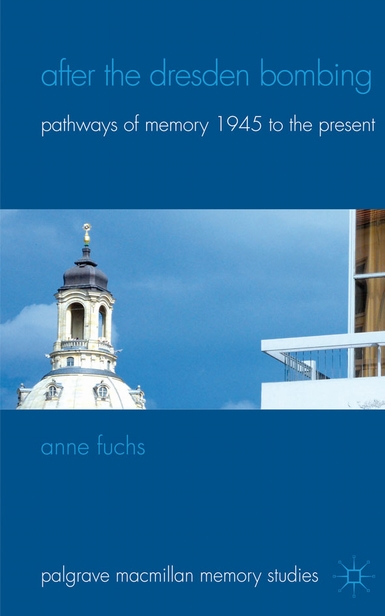
Steve sent me his essay just as I opened Anne Fuchs‘s After the Dresden bombing: pathways of memory 1945 to the present (Houndmills: Palgrave-Macmillan, 2011).  Here’s the description:

Together with Hiroshima and Nagasaki, Dresden belongs to a handful of global icons that capture the destructiveness of warfare in the twentieth century. Immediately recognisable, these icons are endowed with a powerful symbolism that cannot be explained with reference to historical cause and effect alone. This is precisely the terrain of this book, which addresses the long aftermath of the bombing in the collective and cultural imagination from 1945 to the present. The material under discussion ranges from archival documents, architectural journals, the built environment, travelogues, newspaper articles, documentaries, TV dramas, fiction, diaries, poetry to photography and fine art. As a case study of an event that gained local, national and global iconicity in the postwar period, it illuminates the media-specific transmission of cultural memory in dialogue with the changing socio-political landscape. Debating fundamental processes of cultural transmission, it exemplifies a new mode of doing cultural history that interweaves the local and the global.

Her discussion of Peters’ Eine Kamera klagt an is on pp. 32-42 and forms part of a fine extended discussion of ‘Visual mediations’.

Targeting and technologies of history

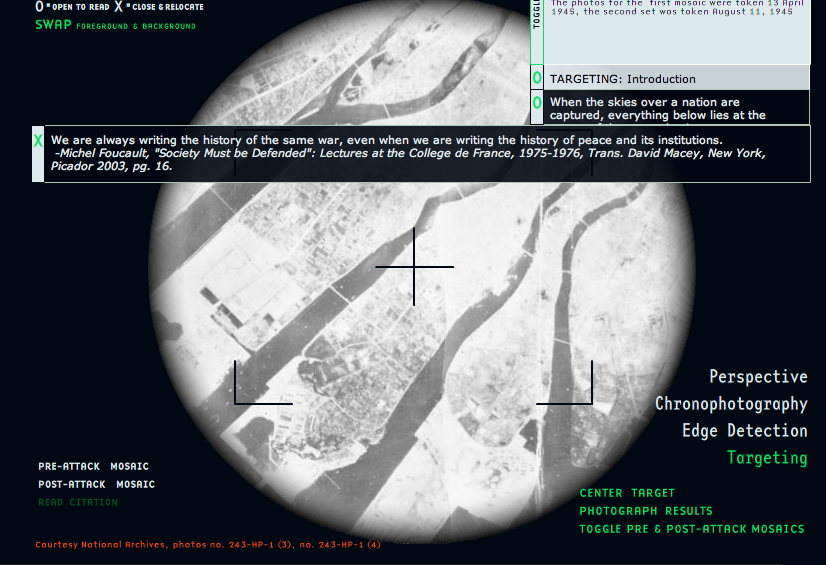
Vectors from USC has reappeared after a (too) long hiatus.  I first encountered Vectors through Caren Kaplan‘s Dead Reckoning project that tracked what she called ‘Aerial Perception and the Social Construction of Targets’.  This was in 2007, when my own interest in targeting and bombing was just kicking in as a reaction to Israel’s war on Lebanon the previous year (see ‘In another time zone…’ in DOWNLOADS).  She introduced the project like this:

‘”Dead reckoning” has a number of different meanings. For many of us, it simply means the ways in which we figure out where we are or what we are aiming at by using the naked eye-it is, then, the first order cultural construct of directional sight. In strictly navigational terms, especially at sea, it refers to the use of measured distances between points to discern longitude. A reckoning is also a form of retribution or punishment as well as a collection of accounts. Many of these meanings come into play in a militarized context where the determination of position enhanced by technology enables the annihilation of enemies. In this piece, Raegan [Kelly, her Vectors programmer and designer] and I came to see this term as the one best suited to describe what we were working through over many discussions. Although many other techniques of sight are involved in this piece, the reckoning of the cultural politics of sight in modernity leads, unfortunately, to state-sponsored death as much as to anything else and, thus, the aptness of the term becomes almost unavoidable.’

Since then Caren has continued to push the boundaries of inquiry and presentation – and the connections between the two – in extraordinarily imaginative ways, constantly circling around what she calls ‘the view from above’: see, for another example, her Precision Targets: GPS and the militarization of everyday life.

The new digital issue of Vectors contains Steve Anderson‘s Technologies of History, which intersects with my still continuing work on bombing and its representations, though its ostensible subject is different. Editor Tara Macpherson on Anderson’s project:

Within the confines of this piece, author Steve Anderson observes, “We should not ask film or video for the truth about the past, but we can look to them for clues, myths, and symptoms of historical fixations.” The project takes as its central object of analysis one of those moments of historical fixation that seems indelibly engrained in the American consciousness, the assassination of John F. Kennedy, Jr. in November, 1963. In exploring multiple mediations of this event, Anderson and designer Erik Loyer repeatedly draw our attention to the textured, layered and unstable nature of both historical representation and historical memory.

This is an argument about the truth claims of media that is instantiated via media, both through the curated collection of media artifacts assembled here and through their formation into a new interactive experience. The assortment of clips runs the gamut from historical footage to televisual re-imaginings to video game reenactments, providing a rich compendium of the tenacity of this moment within the nation’s collective memory. Various tonal registers collide: the somber, the flippant, the intimate, the nostalgic. Disparate visual styles intersect and refract one another. But this argument does not unfold solely at the level of content. The form of the piece also reconfigures and undermines the possibility of a single, authoritative history. As the user engages the piece and assembles these historical fragments into new forms, building her own history along the way, the primacy of any one meaning is collaged away.

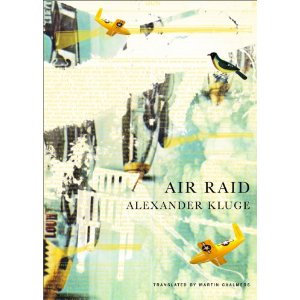
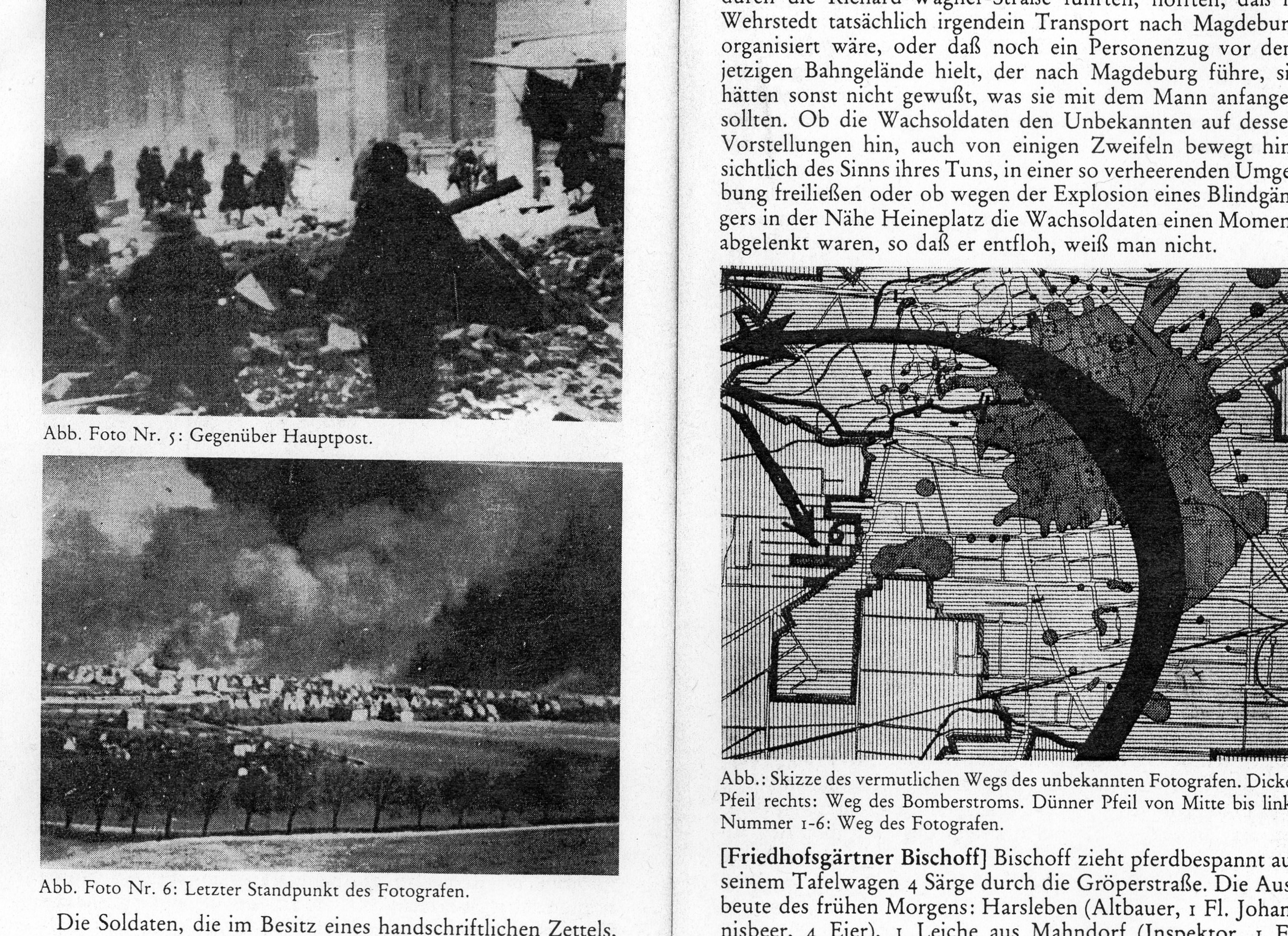
Before the digital era Alexander Kluge had experimented with the collisions of testimony and artefact, and in particular with montage-collage, to convey an American air raid on Halberstadt (his hometown) in 1945 (I drew on this in “Doors into nowhere”). Der Luftangriff auf Halberstadt am 8. April 1945 was first published in German 1977 and has been available in both his Collected Works and as a separate book for some time, but I’m thrilled to discover that an English translation by Martin Chalmers under the title Air Raid is at last due from the University of Chicago Press/Seagull Books in December 2012 with an afterword by the much lamented W.G. Sebald.

Frederic Jameson, in one of the few English-language commentaries on the text, raises a question that speaks directly to Anderson’s project:

“The Bombing of Halberstadt” is another such collage, in which individual experiences, in the form of anecdotes, are set side by side less for their structures as the acts of traditional characters … than as names and destinies, the latter being reduced in many cases to peculiar facts and accidents, of the type of Ripley’s Believe It or Not. The juxtaposition of these anecdotes with quotations from academic studies on the history of bombing and on RAF techniques, from scholarly conferences on the relation between aerial strategy and ethics (“moral bombing” is, for example, specified as a matter, not of morals, but of morale), and from interviews with the allied pilots who participated in this raid—all these materials, which we take to be nonfictional (although they may not be; the interviews in particular bear the distinctive marks of Kluge’s own provocative interview methods), raise the question of the fictionality or nonfictionality of the personal stories of the survivors as well. Halberstadt is, to be sure, Kluge’s hometown, and he is perfectly capable of having assembled a file of testimonies and eyewitness documen- tation and of using the names of real people. On the other hand, these stories, with their rich detail, afford the pleasures of fictional narrative and fictional reading. Is this text (written in the 1970s) a non-fictional novel? I believe that we must think our way back into a situation in which this question makes no sense…’ [‘War and representation’, PMLA 124 (2009) 1532-47]

Perhaps.  But Jameson’s exegesis never grapples with what is also so compelling in Anderson’s project – and, as Kaplan’s work shows, no less avoidable in any discussion of bombing – which is to say Kluge’s determination to confront the multiple visualities involved in, productive of and produced through bombing:

Cyrus Shahan [‘Less then bodies: Cellular knowledge and Alexander Kluge’s “The Air Raid on Halberstadt on 8 April 1945″‘, Germanic Review 85 (2010) 340-58] provides one of the richest discussions of Kluge’s use of montage in ‘Luftangriff’; I can’t convey the artfulness of his argument here – a blog surely isn’t the place to do so! – but here’s an extract that, again, speaks to Anderson’s project too:

‘“The Air Raid on Halberstadt on 8 April 1945” consists of thirty vignettes. The majority are accounts of what the residents of Halberstadt did during the air raid, where they were, what they were thinking, and whether they survived. These stories “from below” are interrupted for a twenty-two-page segment about “Strategy from Above,” a documentary montage of interviews with pilots, images of bomb schematics and flight formations, and pictures of pilots. The documentary aspect of Kluge’s Halberstadt essay and his Neue Geschichten [‘New Histories’] as a whole is a ruse. Rather than lend the text authenticity, Neue Geschichten uses a feigned documentary to debunk the authority of the documentary, to undermine the validity of a singular point of view, and thereby to buttress the usefulness of montage. For Kluge, montage is superior to documentary because it is “the form-world of connectivity.” In other words, while montage creates quasi-unreal perspectives with hyperconnectivity, it simultaneously contains productive political processes in which fractured factual elements articulate within a field of possibilities.’