The whites of our eyes

I’ve been re-reading Keith Feldman‘s essay on ‘Empire’s verticality’ (Comparative American Studies 9 [4] 2011 325-41), which raises a series of incisive questions about what he calls ‘racialization from above’ in the Afghanistan-Pakistan borderlands.  Keith was working on this while I was working on ‘From a view to a kill’ (see DOWNLOADS tab), and we exchanged ideas en route, but Keith’s essay provides a different and invaluable perspective.  He begins with the famous Situation Room photograph by Pete Scott in which Obama and his senior advisors gaze at a live-feed from Abbotabad on 1 May 2011: since ‘the target of imperial retribution remains just outside the visual field’ – we see no images of the raid – Keith notes that ‘we are drawn to witness the witnessing of Bin Laden’s assassination.’  He focuses on the visual identification of a Muslim Other that is supposed to be precise and yet always remains blurred.

The scopic regime of late modern war is placed under even greater pressure when ‘signature strikes’ are conducted – when the target is not a named individual but a ‘person of interest’ whose ‘pattern of life’ has roused the suspicions of the distant watchers – and this has even more serious implications for civilian casualties.

There’s a short post from Kevin Jon Heller at Opinio Juris that addresses the issue by juxtaposing two quotations.  The first is from a report in the New York Times on 29 May 2012 by Jo Becker and Scott Shane on ‘Obama’s Secret “Kill List”…’ and the CIA-controlled Predator strikes in Pakistan:

“… Mr. Obama embraced a disputed method for counting civilian casualties that did little to box him in.  It in effect counts all military-age males in a strike zone as combatants, according to several administration officials, unless there is explicit intelligence posthumously proving them innocent.  Counterterrorism officials insist this approach is one of simple logic: people in an area of known terrorist activity, or found with a top Qaeda operative, are probably up to no good.”

The second comes from Richard Falk‘s ‘Law and responsibility in warfare: the Vietnam experience’, where he quotes the man who ordered the My Lai massacre, Lt William Caley:

“If those people weren’t all VC [Viet Cong] then prove it to me. Show me that someone helped us and fought the VC. Show me that someone wanted us: one example only! I didn’t see any… Our task force commander’s staff said it’s a VC area and everyone there was a VC or a VC sympathizer. And that’s because he just isn’t young enough or old enough to do anything but sympathize.”

Heller doesn’t use the phrase, for obvious reasons, but this is another Catch-22…

But there’s another Vietnam parallel that I think is even more striking.  In Lines of descent (DOWNLOADS tab) I described the creation of ‘free bomb zones’ or ‘free fire zones’ in South Vietnam.

 In August 1965 [General] Westmoreland was authorized to order strikes in five free bomb zones that were ‘configured to exclude populated areas except those in accepted VC [Viet Cong] bases’.  Within these zones the designation of target boxes dispensed with precise co-ordinates and detailed intelligence altogether, so that they became black boxes in every sense of the phrase, and approval was given in advance ‘for execution when appropriate’. Westmoreland was perfectly clear that ‘anybody who remained had to be considered an enemy combatant’ and so strikes could proceed ‘without fear of civilian casualties’.

With this in mind, here is a section that never made it in to the final version of ‘Lines of descent’, concerning the principle of distinction (the legal requirement to discriminate between combatants and non-combatants).  My Lai makes an appearance here too, as a crucial moment after which the Pentagon agreed to provide military operations with a legal armature.  And yet, as I tried to show in both my essays, incorporating lawyers into the kill-chain provides less protection for civilians than may at first appear: the balance between concrete military advantage and ‘collateral damage’ is still calibrated on the military’s own scales.  I’m not saying that nothing has changed since Vietnam – the lines of descent are complex and tangled – but, as the final paragraph below shows, there are none the less disturbing parallels.  ‘Blind bombing’ may well belong to the past, superseded by near real-time, high-resolution full-motion video feeds from Predators and Reapers, and yet – to return to Feldman – in scanning these images we continue to privilege the whites of our own eyes.

Distinction and the air war in Vietnam

The difficulty of distinguishing between ground troops, enemy forces and non-combatants was exacerbated by the use of air power in a non-linear battlespace, the ‘war without fronts’, because ‘the absence of clearly discernible bomb lines created a fluid environment in which it was not always possible to distinguish friendly from enemy forces.’  From the air, Schlight continued, ‘all soldiers looked alike and guerrillas were indistinguishable from non-combatants.’ [1]  He insists that there was an acute sensitivity to ‘accidental loss of life’.  In Westmoreland’s (public) view, ‘one mishap, one innocent civilian killed, one civilian wounded or one dwelling needlessly destroyed, is one too many’, and this supposedly translated into ‘stringent’ rules of engagement.  In particular, strikes on hamlets and villages required political clearance from Vietnamese authorities at least at a provincial level, they had to be directed by a Forward Air Controller or radar to minimize civilian casualties, and warnings had to be issued if the attacks were not in conjunction with ground forces; if this were impossible, the ground commander could designate the target, and in ‘specified strike zones’ (whose designation was held to ‘constitute prior political clearance’) pilots ‘could use their own judgement in hitting targets.’ [2]  In this, more or less official view, air strikes still killed civilians but every effort was made to minimize the loss of innocent lives.

Others see it differently.  For some, it was a technical matter.  When van Creveld writes of ‘the American airmen’s near-complete inability to distinguish between combatants and noncombatants’, he is simply echoing McNamara’s own post-war admission that it ‘proved difficult to distinguish combatants from noncombatants’ and that Westmoreland’s heavy reliance on bombing ‘produced more and more civilian casualties’: for both men this was an inherent limitation of air power in counterinsurgency. [3]  It was inevitably compounded by the electronic battlefield, as Senator McGovern noted: ‘If ground troops sometimes will not, and usually cannot, distinguish between enemy and innocent in a guerrilla war, we know that aerial bombardment never can.  The sensor which detects body heat, the aircraft thousands of feet in the air, the computer complex many miles distant, are completely neutral and indiscriminate.’  [4]  For others, as McGovern’s first clause implies, the lack of discrimination was too often a considered decision.  The rules of engagement were elastic (in practice Vietnamese political clearance was readily obtained) and riddled with exceptions (there were many cases where clearance could be dispensed with altogether, including military necessity and specified strike zones).  Clodfelter points out that this was in marked contrast to the bombing of North Vietnam where ‘detailed restrictions [were] placed on bombing targets’ because there the American political calculus included civilian casualties.  This was not only true of the Johnson administration’s micro-management of Rolling Thunder; when President Nixon resumed the bombing of North Vietnam in 1972 he loosened the previous restrictions and returned operational control of these Linebacker campaigns to the military, but even his terror bombing of targets around the capital was circumscribed. ‘I want the people of Hanoi to hear the bombs,’ he instructed Strategic Air Command, ‘but minimize damage to the civilian population.’ In South Vietnam, however, where there were few restrictions or political restraints, Clodfelter concludes that ‘indiscriminate bombing contributed significantly to an estimated 1.16 million South Vietnamese civilian casualties during the war.’ [5]  The vital point is that many, perhaps even most of these injuries and deaths were not accidental, often not even incidental  ­– the ‘collateral damage’ that international law accepts may result from attacking military targets – but the victims of deliberate and indiscriminate attack.

Discrimination has two meanings, one strategic and the other legal.  For Kalyvas, violence against civilians is a central feature of insurgency and counterinsurgency, where historically both sides often targeted civilians to force them to comply, but it can be discriminate – directed against specific targets – or indiscriminate, based on collective attributes like place of residence. [6]  Kocher, Pepinsky and Kalyvas argue that bombing in South Vietnam was indiscriminate because it was typically directed at areas, boxes or zones: ‘it could not target individual VC supporters while sparing government supporters or the uncommitted, even when intelligence was good’.  They concede that this was, in part, a technical matter – target identification was often hit-or-miss and until Paveway laser-guided bombs were used in the Linebacker campaigns the delivery of ordnance was ‘inherently inaccurate’ – but in many cases they suggest that exposing civilian populations to aerial violence was a tactical choice.  One leaflet drop warned people that ‘when the plane returns to sow death, you will have no more time to choose’, and many commanders welcomed the bombing of civilians: when he was asked if he was worried by the civilian casualties caused by bombing and shelling, Westmoreland himself airily replied, ‘Yes, but it does deprives the enemy of population, doesn’t it?’ [7]  This is perhaps unsurprising; bombing had been an established method of colonial ‘air control’ much earlier in the century. It turned out to be as counterproductive in Vietnam as it had been in Mesopotamia and the North West Frontier. Targeting collectives means that individuals ‘cannot avoid being victimized simply by refusing to participate in the insurgency’, and bombing the South clearly increased Viet Cong control in the affected areas. [8]

Discrimination also carries a legal charge, but it has a complicated history.  After the Second World War there was an attempt to incorporate ‘protection of civilian persons in times of war’ into the Geneva Conventions, but these largely failed to address the vulnerability of civilian populations to military violence in general and to air strikes in particular. [9]  In 1956 the International Committee of the Red Cross produced a series of Draft Rules that prohibited direct attacks on the civilian population and, in particular, attacks ‘without distinction’ on areas where military targets were close to the civilian population.  This was an express attempt to outlaw area bombing, and it met with forceful opposition. In 1965 the ICRC reaffirmed the prohibition on direct attacks against the civilian population, and insisted on discrimination between those taking part in hostilities and civilians who should ‘be spared as much as possible’, and in December 1968 these basic principles were endorsed in UN Resolution 2444 on Respect for Human Rights in Armed Conflicts.  In 1972 the Pentagon confirmed that it regarded these principles as declaratory of customary international law but added two riders. The United States insisted that it was permissible to attack military targets even if there were a risk of collateral damage, and in such cases the responsibility for distinguishing military objectives from civilian devolved upon ‘the party controlling the population.’ [10] These were expedient qualifications in the (arc) light of South Vietnam, where insurgents swam in the sea of the population.  In fact MACV’s legal advisor blamed the suffering of Vietnamese civilians on the law itself, which he claimed was ‘inadequate to protect victims in wars of insurgency and counterinsurgency’ because it drew on ‘examples from World War II which simply did not fit in Vietnam’ where ‘the hazy line between civilian and combatant became even vaguer’. [11]  Another judge advocate said much the same: In Vietnam ‘the battlefield was anywhere and everywhere, with no identifiable front lines and no safe area. This meant that innocent civilians could not easily avoid the war or its suffering.’  He was silent about the responsibility of those conducting the war to avoid innocent civilians – justice, like much of the bombing, was blind – and limited his discussion to compensation payments where ‘loss or damage was caused by reckless or wanton conduct by U.S. forces.’ [12]  Not surprisingly, what is now called operational law remained strikingly undeveloped.  Judge advocates at MACV were not consulted about air operations; one judge advocate attended meetings at Seventh Air Force headquarters, but these reviewed the previous week’s operations and ‘no one consulted him about future operations, the lawfulness of striking selected targets, or compliance with the rules of engagement’; tactical air control centers had no place for judge advocates who ‘had almost no contact with the people who planned or executed air operations’, and provided neither briefings nor advice on the laws of war or the rules of engagement.  The single exception was a judge advocate based at the US Embassy in Thailand who scrutinized some target lists in North Vietnam. [13]

In fact, it was only after the publicity surrounding the My Lai massacre, in November 1974, that the Pentagon directed the armed services to implement a program to prevent violations of the Law of War; only then did the US military begin to incorporate legal oversight into its operations. [14]  Most legal scrutiny of the air war in Vietnam was after the event – hence the essays by Hays Parks on Rolling Thunder and Linebacker that conclude that both were fully consistent with (in the case of Rolling Thunder even unduly sensitive to) international law – and, no less significantly, did not address the conduct of the air war in the South. [15]  The crucial issue there is the distinction between civilians and combatants, and here Richard Falk, while granting that the law of armed conflict was inadequate and needed revision, none the less insisted that, in its promulgation of ‘free bomb zones’, in B-52 ‘pattern raids’, and much else, the US violated customary international law routinely and serially: ‘the overall American conduct of the war involve[d] a refusal to differentiate between combatants and noncombatants and between military and nonmilitary targets.’ [16]

[1] John Schlight, The war in South Vietnam: The years of the offensive, 1965-1968 (Office of Air Force History, 1969) War, p. 258.  A bombline is ‘an imaginary line arranged, if possible, to follow well-defined geographical features, prescribed by the troop commander and coordinated with the Air Force commander, forward of which air forces are free to attack targets without danger or reference to the ground forces; behind this line all attacks must be coordinated with the appropriate troop commander’: John Pearse, ‘Air power in the kill-box: Fire support co-ordination and airspace deconfliction in the future non-linear battlespace’, Thesis, School of Advanced Air and Space Studies, Maxwell Air Force Base, 2003: p. 22.

[2] Schlight, War, pp. 258-9.

[3] Martin van Creveld, The age of airpower (New York: Public Affairs, 2011) p. 199; Robert McNamara, In retrospect: the tragedy and lessons of Vietnam (New York: Vintage, 1995) p. 243.

[4] McGovern’s speech was delivered on 14 December 1971 and is excerpted in ‘Automated warfare’ (January 1972) p.2, Folder 01, Box 02, Douglas Pike Collection: Unit 03 – Technology, The Vietnam Center and Archive, Texas Tech University.

[5] Mark Clodfelter, ‘A strategy based on faith: the enduring appeal of progressive American airpower’, Joint Forces Quarterly 49 (2008) 24-31, 150-160: 31.  Clodfelter’s figure includes those wounded and killed 1965-1974, and is derived from estimates presented in Guenter Lewy, America in Vietnam (New York: Oxford University Press, 1978) p. 446.  These estimates are probably conservative, and Lewy is much more reluctant to attribute these totals to ‘allied bombing’, but he does accept that the ‘lavish use of [US] firepower’ caused ‘a large number of civilian casualties’ in the South (p. 230).  Despite the restrictions US bombing also caused casualties in the North: Lewy estimates around 65,000 civilians were killed, and other estimates run into the hundreds of thousands.

[6] Stathis Kalyvas, The logic of violence in civil wars (Cambridge: Cambridge University Press, 2006) p. 142 and passim.

[7] Matthew Kocher, Thomas Pepinsky and Stathis Kalyvas, ‘Aerial bombing and counterinsurgency in the Vietnam War’, American Journal of Political Science 55 (2011) 201-18: 205; Westmoreland’s remark was made in summer 1966 and is cited in David Halberstam, The best and the brightest (New York: Ballantine, 1969) p. 550, who adds: ‘The American command was aware of it was doing, and sanctioned it… MACV knew about it, it didn’t want to know too much, it would look the other way if possible, but it knew it was all going on out there.’

[8] Kocher, Pepinsky and Kalyvas, ‘Aerial bombing’, 203, 215.  A 1968 RAND survey found that bombing increased support for the Viet Cong, but it was never released: Robert Smith, ‘Report compiled in 68 says excessive Allied bombing in South Vietnam stirred hostility to regime’, New York Times, 22 January 1970.

[9] ‘The most conspicuous sufferers from bombing, Germany and Japan, were unable to put their case, while the bombing specialists, the USA and the UK, had every reason for preventing the case being out’: Geoffrey Best, War and law since 1945 (Oxford: Clarendon Press, 1994) p. 115.

[10] Hays Parks, ‘Air war’, 65-71.

[11] MG George Prugh, Law at war, Vietnam 1964-1973 (Washington DC: Department of the Army, 1975) p. 89.  He also conceded that there was no effective mechanism to enforce compliance.

[12] Frederic Borch, Judge Advocates in Vietnam: Army Lawyers in Southeast Asia, 1959-1975 (Combat Studies Institute, 2003) p. 92.

[13] LTC Terrie Gent, ‘The role of Judge Advocates in a Joint Air Operations Center’, Air Power Journal, Spring 1999

[14] My Lai was the scene of a massacre of hundreds of civilians by US troops on 16 March 1968; it was not widely reported until November 1969, and the subsequent courts-martial were not completed until March 1971. The problem was much wider and more pervasive than this focus suggests, however, and Greiner, War without fronts, p. 18, writes of an ‘endemic contempt’ for international law on the part of the US.  Dunlap identifies a ‘revolution in military legal affairs’, after Vietnam, beginning in 1989 with the involvement of judge advocates in planning US military operations in Panama and becoming much more visible during the first Gulf War: Charles Dunlap. ‘The revolution in military legal affairs: Air Force legal professionals in 21st century conflicts’, Air Force Law Review 51 (2001) 293-309.  Consistent with his later preoccupation with ‘lawfare’, he places particular emphasis not on advances in military technology, however, but on changes in communications technology that worked to enable media organizations to bring ‘the raw images of war’ to publics around the world ‘before leaders can censor or shape it’ (p. 294).

[15] W. Hays Parks, ‘Rolling Thunder and the law of war’, Air University Review, January-February 1982 athttp://www.airpower.maxwell.af.mil/airchronicles/aureview/1982/jan-feb/parks.html; ‘Linebacker and the law of war’, Air University Review January-February 1983 at http://www.airpower.maxwell.af.mil/airchronicles/aureview/1983/jan-feb/parks.html.

[16] Richard Falk, ‘Son My: war crimes and individual responsibility’, University of Toledo Law Review 21 (1971) 21-41:23.
Emergency cinema

The Arab uprisings heightened interest in the politics of new social media, and much attention was directed at platforms like Twitter (which is emphatically not to say that any of this can be reduced to a ‘Twitter revolution‘).  Swirling around these discussions, breaking the 140-character limit of a tweet, was an insistently visual thematic, though this too was often limited to cellphone videos uploaded to YouTube and other sites (and then retransmitted by mainstream news media).  But there are other ways in which film/video can function as witness.

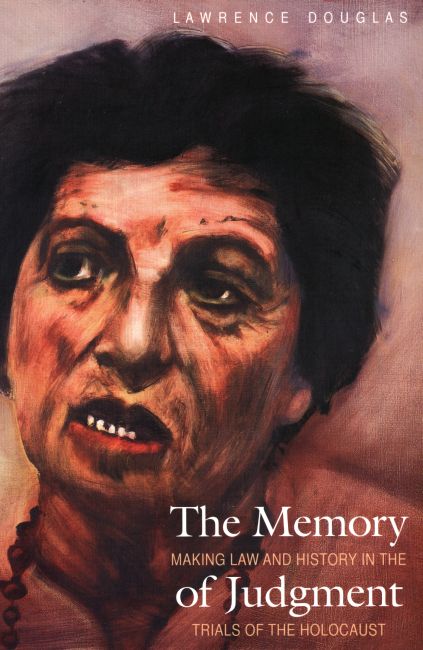
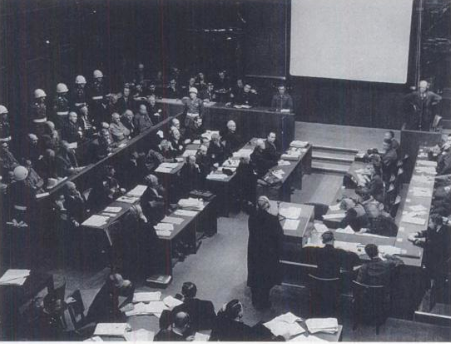
The use of film as witness is usually traced back to the International Military Tribunals in Nuremberg after the Second World War: see in particular Lawrence Douglas‘s classic The Memory of Judgment: Making law and history in the trials of the Holocaust (Yale University Press, 2001) – you can also read an early version of the key essay, ‘Film as Witness: Screening “Nazi Concentration Camps” before the Nuremberg Tribunal,’ in The Yale Law Journal,  105 (2) (1995) or access the book version (so far as I can see, without the accompanying images) online from Yale here.

Douglas’s thoughtful essay is, in a sense, framed by a remark that appears mid-way through it.  When reporter Ed Murrow described Buchenwald concentration camp in April 1945 he ended his broadcast by saying: ‘I pray you to believe what I have said about Buchenwald.  I have reported what I saw and heard, and only part of it.  For most of it, I have not words.’  When the prosecutors at Nuremberg elected to show a film compiled by former Hollywood director Lt Col George C. Stevens from black-and-white footage shot by Allied troops when they liberated the camps – Nazi Concentration Camps – they claimed , as one of them put it, that the film ‘represents in a brief and unforgettable form an explanation of what the words “concentration camp” imply.’  A horror, then, that transcended words – or, as Walter Benjamin confessed in a different context, ‘I have nothing to say, only to show’.

‘This use of film in a juridical setting was unprecedented’, Douglas notes, but it also raises a crucial question – ‘What exactly did the tribunal see when the prosecutors screened Nazi Concentration Camps?’ – that cannot be answered from the trial transcripts. These simply record:

[The film was then shown]

COL. STOREY: That concludes the presentation.

[The Tribunal adjourned until 30 November at 1000 hours]

The question is vital because it invites another: if images took the place of words that could not be found, then how was the tribunal ‘to submit unprecedented horror to principled legal judgments’ that necessarily returned to the verbal and textual?  Douglas’s pursuit of the question is what gives his essay such a compelling narrative force.  He shows in detail how even the visual faltered in the face of such horror: how the camera was confused, confounded, embarrassed – in a word, unsteadied.   He describes, too, how the film incorporates witnesses viewing the atrocities as a moment in its own witnessing: ordinary Germans being forced to view the exhumation of corpses, GIs and generals filing past dead bodies and emaciated survivors.  What these scenes do not  – cannot – do, Douglas concludes, is adjudicate responsibility:

‘Though the film provides a picture of a crime scene so extreme that its horrors have unsteadied the camera’s idiom of representation, it does not translate its images into a conventional vocabulary of wrongdoing.  Instead, the very extremity of the atrocity captured on film challenge sone to locate terms capable of naming and condemning these crimes.  How, then, was the prosecution able to assimilate evidence of unprecedented atrocity into a legal category of criminality?’

This is film as retrospective, but the questions about witnessing are no less difficult to answer when we turn to film shot ‘in the moment’ (and sometimes as a hideously staged moment of the horror). Helen Lennon carries the story forward from the Second World War tribunals to the International Criminal Tribunals for the former Yugoslavia and for Rwanda in ‘A witness to atrocity: film as evidence in International War Crimes Tribunals’ in Toby Haggith and Joanna Newman (eds), The Holocaust and the moving image: representations in film and television since 1933 (Wallflower Press, 2005).   She discusses the need to interrogate, even ‘cross-examine’ the visual testimony, but she concludes with two questions that loop back to Nuremberg:

‘It is necessary to confront the question of what is not shown at these trials, asking: In what ways are these moving images directing our attention toward certain violations, and away from others? What is the law refusing to see when ‘[the film was then shown]’ and ‘[the videotape played]’?

These are still sharp questions, but it is possible to use documentary film in ways that are not evidentiary (in the legal sense) and which deliberately avoid showing ‘the horror’ – and yet still offer a powerful, critical perspective.  I’ve been watching the work of a remarkable group of Syrian film-makers – Abou Naddara (very roughly: “Man with glasses” or, since this is also slang, something like “Goggles”) – who use film both to document and to mobilize events in Syria through what they call ‘emergency cinema‘.   The group publishes a short film on the web every Friday here (also on Vimeo) and they are, of course, also on Facebook here.  These aren’t conventional documentaries, and they certainly aren’t the YouTube uploads that I imagine most of us have become (too?) familiar with: fuzzy, jerky, grainy shots of the fighting or the shelling.

Cécile Boëx interviews the group over at Books & Ideas here.  They explain that they were already  ‘lying in wait’ for the revolution:

‘… we took up the position of a sniper, lying in ambush behind apparently harmless short films distributed anonymously on the Internet in 2010. We were hoping to reach our public right under the censors’ nose. And our hopes seemed to be coming true, because a few months after our website went live, we had already found the means to produce two series of short documentary films that also had to be made more or less clandestinely. In short, we were already lying in wait when the revolution erupted in March 2011. We were even preparing another skirmish, strengthened by the public support we were beginning to receive. The question was not, therefore, whether or not we should get involved in the revolution, but rather how to do so, and what was the best approach to take. After a month of trial and error, we made what was to be our first very short weekly film, entitled The Infiltrators, a disparaging expression used by Bachar al-Assad to refer to the anti-regime demonstrators. The film portrayed an elderly Damascan artisan letting loose against the Assad regime in a monologue that showed the personal, deep-rooted resilience of the Syrian revolt.’

As these remarks imply, their primary audience is inside Syria, and their involvement in the revolution is directed, in large measure, at reaching those who support the Assad regime.

Despite the sniper imagery, their presentations do not treat violence as spectacle – usually they avoid its direct representation altogether.  In the interview they connect this to the conditions under which they are forced to work, but they also insist that these burdens produce a paradoxical freedom:

‘Our project is basically part of the tradition of original documentary cinema, as shown by most of our very short films offering sequences from people’s lives or extracts from interviews, which we choose to film with closeness and empathy. However, we are working in a state of emergency and are subject to constraints that may or may not be justified, including access to film sites, safety of those filmed, social developments or the state of the Internet connection. We can also say that we take pleasure in working in an emergency situation because we feel an unprecedented sense of freedom. And that feeling of freedom carries us from one register to another by happily blurring the boundaries, including the one that separates documentaries and fiction. Besides, that confusion is a general characteristic of our films (Everything Is Under Control Mr. PresidentMy name is MayThe Mufti Wants to…End of Broadcast). We make aesthetic and political choices that portray the way in which our reference points have been turned upside down by the revolution. It also conveys our pledge to represent our people’s enthusiasm by ensuring they are not reduced to stereotyped characters, places or formats.’

So this isn’t ‘film as witness’ in the sense discussed by Douglas and Lennon, and it’s profoundly critical of the way in which the mainstream media now demand ever more scenes of violence that violate the Syrian people all over again.  Here is a pointed example (the screen isn’t blank, and the video takes only two minutes – do watch it).

‘When there’s talk of a ceasefire, for example, they tell us “send us images of shots being fired.”‘

When I watch these short films – some of them so short that they may be visual tweets, I suppose, but they are all carefully composed – I don’t see a parade of heroes or victims, or any of the usual cartoon characters, but a studied indictment of the ways in which the visual and the violent can otherwise lock together: an insight that will be no surprise to readers of Paul Virilio‘s War and cinema (1984; Verso trans. 1989) or to followers of David Campbell who, among many other important contributions, underscores the close relationship between the gun and the camera. (What else did you think ‘shooting’ meant?)

For more on the films (and the tradition from which they derive) see Nehme Jameli here, and for brief reports that situated the project within the wider cultural politics of resistance in Syria see Donatella Della Ratta at al Jazeera here and Amélie Rives at Near East Quarterly here.

Police/military/city

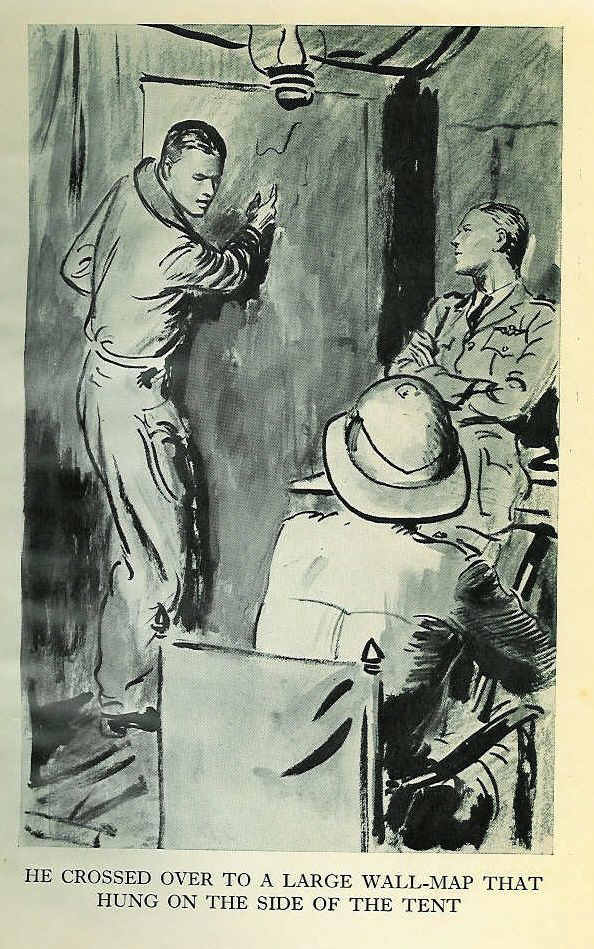
There is growing interest in thinking through the contemporary blurring of policing and military violence.  When, I wonder, did we start referring to “security forces“?  The earliest entry in the OED is from 1973 and refers to Britain’s military/police operations in Northern Ireland, but the practice is evidently much older than that. Those who grew up in Britain with Biggles (or perhaps in spite of Biggles) will surely remember Captain W.E. Johns‘s creation of the Special Air Police after the Second World War – and, as my illustration (left) from Biggles Flies East implies, these operations were about the violent production of particular spatialities –  but ‘air control’ was developed as an important police/military modality of British colonial power immediately after the First World War, when its prized sphere of operations was the Middle East and India’s North West Frontier (notably Waziristan).

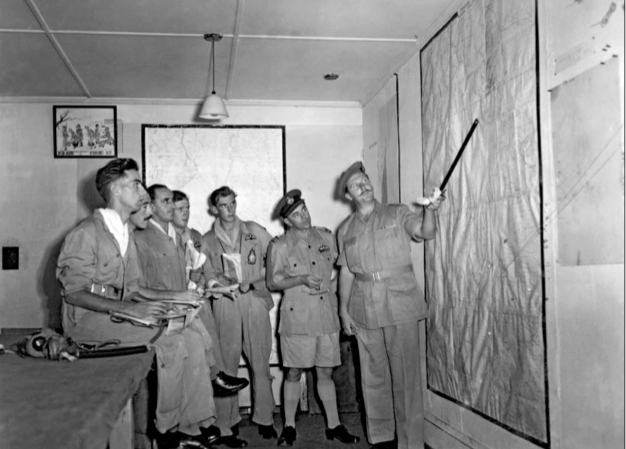
In the 1950s Britain applied similar (il)logics to the the Mau Mau insurgency in Kenya, as Clive Barnett notes here (with another, rather more serious nod to Biggles), and to the Malayan Emergency.  Bombing was a routine tactic in all these pre- and post-war campaigns – the image on the right is of an RAF briefing in Kenya in 1954 – and Britain’s ‘aerial supremacy’ was, of course, uncontested in these colonial theatres of war.  Other colonial powers used it too.  No doubt the interest shown by the US Border Patrol and US police forces in (at present, unarmed) drones can be situated within this techno-political history of air policing, though I’m aware that the lines of descent are more complicated than my cartoons can suggest.

Mark Neocleous has outlined a careful (and still longer) genealogy of the very idea of ‘policing’ that speaks directly to these issues in ‘The Police of Civilization: The War on Terror as Civilizing Offensive’, International Political Sociology 5 (2011) 144-159:

The monopoly over the means of violence that is fundamental to the fabrication of social order is the core of the police power. Although such a formal monopoly over the means of violence does not exist in the international realm—which is the very reason why so many people have found it difficult to develop the concept of ‘‘international police’’—the violence through which this realm has been structured is obvious. It has traditionally been cast under the label ‘‘war.’’… 

To say that police and war conjointly form the key activity of the project of civilization is to say nothing other than violence has remained intrinsic to the process in question. Thus, central to the idea of civilization is military-police terror (albeit, as ‘‘civilization,’’ a terror draped in law and delivered with good manners)…

The attempt to hold on to categorical distinctions between ‘‘police’’ or ‘‘military’’ for analytical, legal, and operational reasons runs the risk of losing what is at stake in the fabrication of international order: the way war imbricates itself into the fabric of social relations as a form of ordering the world, diffracting into a series of micro-operations and regulatory practices to ensure that nebulous target ‘‘security,’’ in such a way that makes war and police resemble one another. 

If, as I’ve suggested, these formulations have a direct bearing on counterinsurgency – and not only British practices: see Neocleous on Vietnam here – and on the modalities of modern colonial power more generally, they are also revealed with remarkable clarity in the contemporary city: what Steve Graham calls ‘Foucault’s boomerang’, as colonial tactics are repatriated to the metropolis.

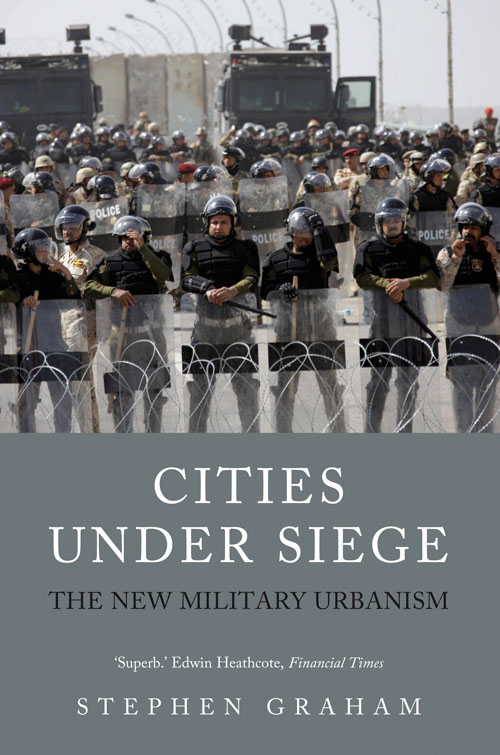
As Steve shows in exemplary detail in Cities under siege: the new military urbanism (Verso, 2010; paperback out now), a vital zone of convergence between police and military violence – what Neocleous calls their ‘violent fabrication of the world’, their ordering of it in every sense of the verb – is the city:

‘As security politics centre on anticipation and profiling as means of separating risky from risk-free people and circulations inside and outside the territorial limits of nations, a complementary process is underway.  Policing, civil law enforcement and security services are melding into a loosely, and internationally, organized set of (para)militarized security forces.  A “policization of the military” proceeds in parallel with the “militarization of the police”.’

So here is welcome news of a Live Web Seminar from Harvard’s Program on Humanitarian Policy and Conflict Research, Dangerous Cities: Urban violence and the militarization of law enforcement, 2 October 2012 0930-1100 (Eastern).

More than half of the world’s population is concentrated in urban areas. According to UNFPA, this number is expected to rise to 5 billions by 2030, reaching 2/3 of the world population, with the largest cities emerging in Africa and Asia. Regrettably, along with this mass urbanization has come an unprecedented level of violence and crime in densely populated slums and shantytowns. Cities like Baghdad, Kingston, Rio de Janeiro, Guatemala, Ciudad Juarez and Mogadishu have become the battlegrounds of contemporary conflicts.
 
In many countries, particularly in Latin America, this emerging form of violence is considered one of the greatest threats to national security. Indeed, urban violence can be as deadly and costly as traditional armed conflicts. In a 2007 report, the UNODC pointed out that the levels of violence in El Salvador in 1995 were higher than during the civil war of the 1980s.
 
To curb the violence, states have responded by deploying specially trained military units when traditional law enforcement has failed to restore security. These instances of ongoing urban violence engaging organized criminal networks, coupled with the use of military force, increasingly resemble to situations of armed conflicts.
While the militarization of law enforcement may be unavoidable when traditional law enforcement institutions lack the resources and expertise to contain urban violence, the legal and policy framework for the conduct of such operations needs yet to be developed. The regulation of the use of military force represents a major challenge in urban environments, even more so when humanitarian law is formally inapplicable and the enforcement of international human rights is weak. Such environment may require adaptation of military doctrine, training, and equipment in order to minimize abuses against civilians, detainees and those no longer engaged in violent acts.
 
Furthermore, the humanitarian sector faces formidable difficulties in the context of urban violence. First, humanitarian actors must assess whether involvement in these complex situations is appropriate under their respective mandates. Second, humanitarians must develop objective criteria to determine whether the level of violence and human suffering warrants intervention in view of the specific security and policy risks. And third, humanitarian actors must adapt to these situations and identify priority areas of humanitarian action on a case-by-case basis.
 
In light of these considerations, this Live Web Seminar will shed light on the tensions and challenges arising out of the application of humanitarian principles in urban violence. Expert panelists and participants will explore the following questions:
 
–       Whether instances of urban violence can be characterized as armed conflicts? If so, what are the advantages and disadvantages of applying International Humanitarian Law (IHL) to these situations?
–       To what extent is it necessary to develop a legal framework that incorporates both humanitarian and human rights considerations tailored to situations of urban violence?
–       What strategies and policy tools can be put in place in order to minimize human suffering and, at the same time, address the security concern of states in urban conflicts?
What is the proper role of humanitarian actors in urban conflicts? 

Registration is required: go here.

As should be obvious from the pre-seminar summary, this isn’t quite the agenda that Neocleous has in mind – but it’s also clear that his suggestions should also animate continuing discussions of our so-called ‘humanitarian present‘…

War/Law/Space

Another extremely interesting Call for Papers for the Annual Meeting of the Association of American Geographers in Los Angeles, 9-13 April 2013:

War/Law/Space

Organizers: Michael Smith (University of British Columbia) and Craig Jones (University of British Columbia)

War may have always entailed rhetorics of justification and regimes of authorization, but perhaps more than ever, late modern war requires a legal armature to secure its legitimacy and organize its conduct.  In the ‘age of lawfare’ (Weizman 2010), for example, law has become a vital weapon in asymmetric warfare, used by states and non-state actors alike. But there are many different kinds of war – including undeclared wars, metaphorical wars, even “military operations other than war” – just as there are multiple forms, systems and scales of law. War’s “nomospheres” – to borrow from Delaney (2010) – mobilizes a host of subjects, discourse, practices and institutions which in turn reconfigure the spaces of war-law, moving us toward what Derek Gregory (2011) has called an “everywhere war”. The question, then, of the interplay of war and law – how they underpin, disrupt, enable, elide, or efface one another – remains a critical site for scholarship, one that warrants more attention from geographers (c.f. Gregory 2006; Reid-Henry 2006). What is the relationship between law and (organized state) violence? How does law feature in the putative transition from the battlefield to the hyper-networked battlespace?  If war is potentially everywhere, where – so to speak – is law?

This session invites both theoretical and empirical research that engages with the intersections between war, law and space from a diverse range of approaches and perspectives. It asks contributors to consider how law makes war and vice versa, but it also asks how these productions might be interrupted and resisted. It seeks to understand the spaces of war-law through the institutions, agents and practices that authorize, enact and resist them. We welcome contributions from geographers, lawyers and other scholars on themes that may include (but are not limited to):

  • Legal violence and the law as a weapon of war: ‘lawfare’ & the ‘legal war on terror’
  • Targeted killing/assassination, detention and cyber warfare
  • International humanitarian law (IHL), human rights law (HRL) and the laws of armed conflict (LOAC)
  • Genealogies of law in armed conflict
  • The links between law and legitimacy
  • The representational regimes of law/war: new media, propaganda & the “citizen journalist”
  • How law facilitates the political economy of war: its role in the logistics, organization, privatization and marketization of war
  • War inside/outside the border: International, transnational and domestic variations of lawfare
  • Witnessing war – Legal subjectivities, narrations and testimony from those who inhabit the warscape (e.g. lawyers, soldiers, civilians)

Please submit abstracts of 250-300 words to Craig Jones (venga@interchange.ubc.ca) and Michael Smith (mdsgeog@gmail.com) before 15 October 2012.

Fifty shades of grey: drones and the theatre of secrecy

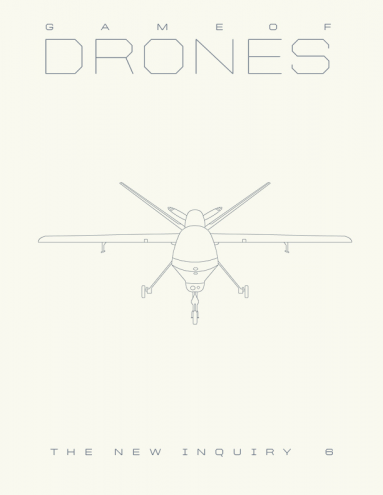
Over the weekend I worked my way through New Inquiry‘s special issue, Game of drones – Pete Adey‘s recommendation.  For me, the stand-out essay is Madiha Tahir‘s “Louder than bombs”

A graduate of Barnard College, NYU and the Columbia School of Journalism, Madiha is currently an independent multimedia/print journalist reporting on conflict, culture and politics in Pakistan; somehow she has also found the time to co-edit Dispatches from Pakistan (LeftWord Books, 2012) with the indefatigable Vijay Prashad and Qalander Bux Memom: more about Madiha here.

“Louder than bombs” begins with harrowing and matter-of-fact (all the more harrowing because matter-of-fact) testimony from Sadaullah Wazir, a teenage boy who lost both his legs and an eye after a US drone attack in North Waziristan in Pakistan’s Federally Administered Tribal Areas; he was just 13, and three other members of his family were killed in the attack.

Madiha’s root objection is to the way in which what she calls the Obama administration’s ‘theatrical performance of faux secrecy’ over its drone war in the FATA (and elsewhere) – a repugnantly teasing dance in which the veil of secrecy is let slip once, twice, three times – functions to draw its audience’s entranced eye towards the American body politic and away from the Pakistani bodies on the ground.  The story is always in Washington and never in Waziristan.  It’s a hideously effective sideshow, in which Obama and an army of barkers and hucksters – unnamed spokesmen ‘speaking on condition of anonymity’ because they are ‘not authorised to speak on the record’,  and front-of-house spielers like Harold Koh and John Brennan – induce not only a faux secrecy but its obverse, a faux intimacy in which public debate is focused on transparency and accountability as the only ‘games’ worth playing.

But when you ask people like Sadaullah what they want, Madiha writes,

‘they do not say “transparency and accountability”.  They say they want the killing to stop. They want to stop dying.  They want to stop going to funerals – and being bombed even as they mourn.  Transparency and accountability, for them, are abstract problems that have little to do with the concrete fact of regular, systematic death.’

So we have  analysts, activists and reporters falling over themselves to determine whether targeted killings outside a war zone like Afghanistan are legal; fighting to disclose the protocols that are followed to provide legal scrutiny of the targeting process; finally reassuring us, in a peculiarly American Story of O, that Obama is fully sensible of the enormous weight that rests on his shoulders.  But all of this distracts our collective gaze from the enormous weight that has been brought to bear on Sadaullah’s shiny new prostheses.  “I had a dream to be a doctor,” he tells a reporter. “Now I can’t even walk to school.”

Any discussion of the ways in which the kill-chain has been ‘lawyered up’ needs to acknowledge that – as the very formulation implies – the law is not apart from military violence: it has become part of military violence.  In Foucault’s ringing phrase, ‘the law was born in burning towns and ravaged fields’, and in the intervening centuries it has become ever more closely entwined with military (and paramilitary) violence.   Legality now substitutes for legitimacy, silencing any questions about politics or ethics.  As Madiha says, speaking of the calibration between the deaths of militants and the deaths of civilians, it is as though ‘if we could just get the calculus right, there would be no further ethical or political questions’.  Similarly, referring to the computer programs used by the US military (and seemingly, the CIA) to predict collateral damage, and so to adjudicate between the legal principles of necessity and proportionality,  Eyal Weizman notes that ‘it is the very act of calculation – the very fact that calculation took place – that justifies their action.’   But this is never a neutral appeal to algorithms or attorneys: not for nothing do those involved refer to the ‘prosecution’ of the target,  and as Anne Orford emphasises, the relevant body of international law ‘immerses its addressees in a world of military calculations’ and ensures that proportionality will always be weighed on the military’s (or the CIA’s) own scales.  In Weizman’s words, ‘violence legislates.’

Madiha again:

Even as we debate the legal machinations, official leaks and governmental manipulations by which they are killed, the daily, material, precarious existence of the people living under the disquieting hum of american drones in Pakistan’s tribal areas rarely sits at the center of discussion.

But what if it did? if, instead of the public secret, one begins with a prosthetic limb, a glass eye, and a funeral photo, the nightmare takes form, solidifies. 

None of this means that the law does not matter; its matter-iality ought to be obvious.  But it is to say that we need to be alert to what appeals to ‘the law’ do – and what they seek to foreclose. Legal questions do matter – but their answers must not be allowed to silence other political and ethical questions.  Neither should they close our eyes to the contrapuntal geographies that are staged far beyond the peep-shows of the Washington beltway.

*****

Note: For more on drone wars, see Remote witnessing and, in detail, ‘From a view to a kill’ and ‘Lines of descent’ (DOWNLOADS tab).  I’ve also provided a preliminary reading/screening list that notes some of the same emphases and omissions that trouble Madiha here.

War, Shakespeare and Shylock in Auschwitz

I’ve been thinking more about the relations between theatre and war I started to sketch in the previous post.  Stuart Elden‘s work on Shakespeare and territory (or, rather, ‘Shakespearean territories‘) is of considerable interest here – remember Homi Bhabha’s claim that ‘territory’ derives from both terra (earth) and terrere (to frighten), thus territorium as ‘a place from which people are frightened off.’   Stuart provides a more nuanced genealogy than that, needless to say, but there are also contributions that address Shakespeare’s thematics (and theatrics) of war more directly.

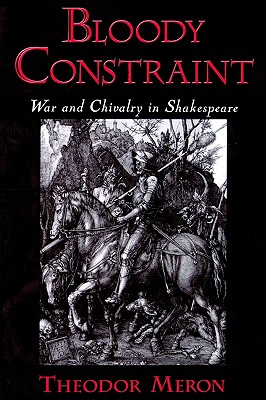
Ros King and Paul Franssen‘s Shakespeare and war (Palgrave-Macmillan, 2009) includes King’s own essay on Shakespeare’s use of a contemporary manual of war written by an English mercenary.  Of more interest to me, though, is Theodor Meron‘s Bloody Constraint: war and chivalry in Shakespeare (Oxford University Press, 1998), which builds on his earlier Henry’s Wars and Shakespeare’s Laws: perspectives on the law of war in the later Middle Ages (Oxford University Press, 1994).  As the subtitle indicates, Meron comes at this from an interesting direction: he is a professor of international law, the Charles L. Denison Professor Emeritus at NYU’s School of Law, and serves as President of the International Criminal Tribunal for the former Yugoslavia and Presiding Judge of the Appeals Chambers of the International Criminal Tribunals for the former Yugoslavia and for Rwanda.  He is also the man who, as Legal Adviser to Israel’s Foreign Ministry, wrote a secret memorandum just after the 1967 War arguing that establishing Israeli “settlements” in the occupied territories would be a violation of international law.  As all this suggests, Meron’s interest in Shakespeare is not a narrowly historical or textual one – though he shows considerable mastery of both domains –  and he artfully considers Shakespeare’s address to the present and the legacy of chivalry to modern humanitarian law.  What happens, he asks, when technology – and especially artillery – puts an end to the individualism of combat, or at any rate, marginalises face-to-face combat?  (Here Paola Pugliatti‘s more recent Shakespeare the just war tradition [Ashgate, 2010] also has much to offer and, again, considers contemporary notions of discrimination and proportionality; Part Two includes a fascinating discussion of “Theatres of War”, which is what led me down this path in the first place.)

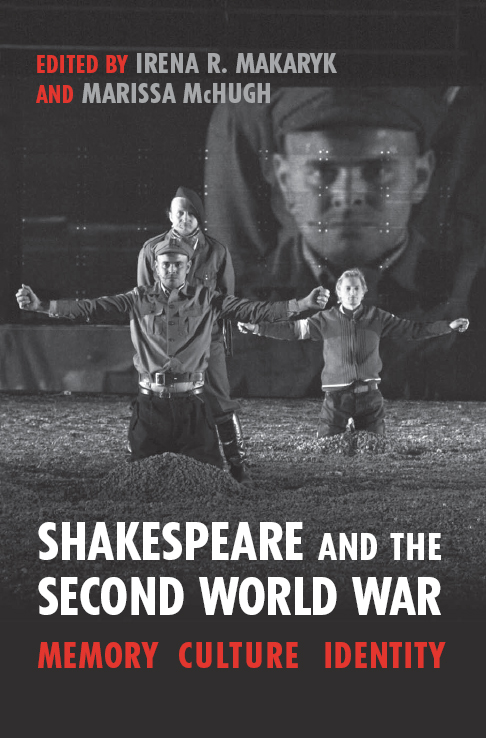
More directly related to my previous post is a new collection of essays out next month from the University of Toronto Press: Shakespeare and the Second World War: theatre, culture, identity, edited by Irena Makaryk and Marissa McHugh.  Here’s the blurb:

Shakespeare’s works occupy a prismatic and complex position in world culture: they straddle both the high and the low, the national and the foreign, literature and theatre. The Second World War presents a fascinating case study of this phenomenon: most, if not all, of its combatants have laid claim to Shakespeare and have called upon his work to convey their society’s self-image.

In wartime, such claims frequently brought to the fore a crisis of cultural identity and of competing ownership of this ‘universal’ author. Despite this, the role of Shakespeare during the Second World War has not yet been examined or documented in any depth. Shakespeare and the Second World War provides the first sustained international, collaborative incursion into this terrain. The essays demonstrate how the wide variety of ways in which Shakespeare has been recycled, reviewed, and reinterpreted from 1939–1945 are both illuminated by and continue to illuminate the War today.

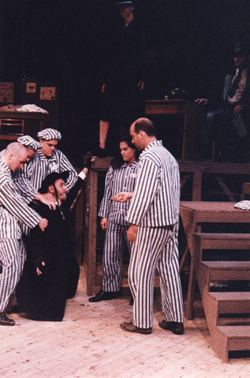
Full details are here, but two essays that I’m looking forward to reading are Mark Bayer‘s “Shylock, Palestine and the Second World War” and Tibor Egervari‘s “Shakespeare’s Merchant of Venice in Auschwitz”.  Egervari is another interesting man: Shakespeare’s Merchant of Venice in Auschwitz is a play first performed in 1977 and reworked many times since.  Informed by the writings of Primo Levi, it’s an ‘imaginative reconstruction of  what it might have meant to stage the Merchant of Venice in Auschwitz’ (Egervari wryly notes that the Nazis staged the play more than 50 times between 1933  and 1939).  You can download the script here.  The play is many things, but among them is a tart reminder that Giorgio Agamben‘s space of exception – especially as captured in Homo sacer – is almost always a profoundly theatrical space: space as performance rather product.

If this captures your imagination too, you might be interested in Arthur Horowitz‘s “Shylock after Auschwitz: The Merchant of Venice on the post-Holocaust stage – subversion, confrontation and provocation’, Journal for cultural and religious theory 8 (3) (2007) here.

Forensic architecture

Both Stuart Elden and I have drawn attention to Eyal Weizman‘s Forensic Architecture project – sketched in outline in his The least of all possible evils and the subject of his Society & Space lecture – but for those who want more…

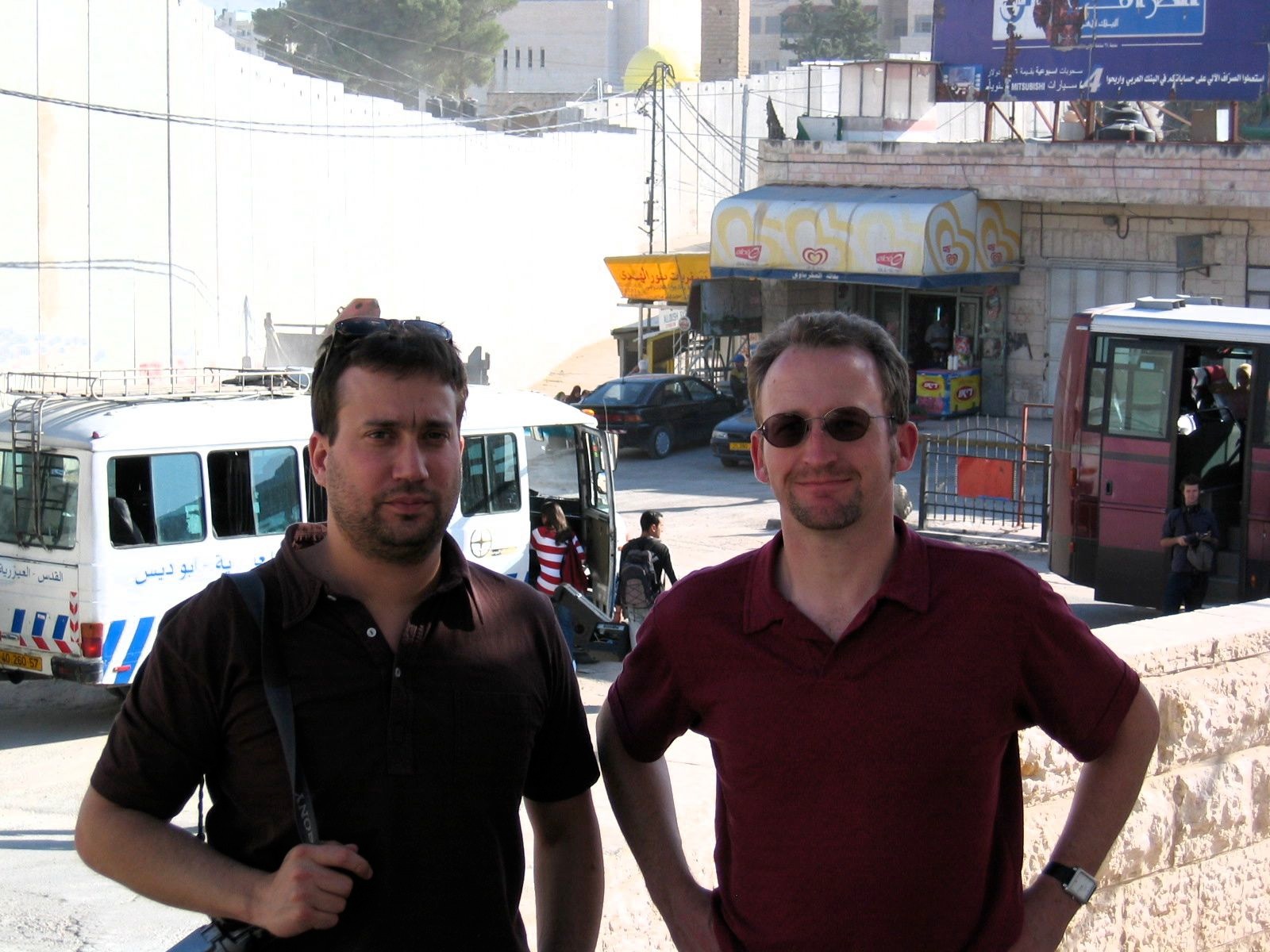
Eyal Weizman (L) and Steve Graham (R) in the occupied West Bank [Derek Gregory]

Michael Schapira and Carla Hung interview Eyal in “Thinking the Present” at  Full Stop. Here’s an extract where Eyal summarises his project:

‘Forensic Architecture is grounded in both field-work and forum-work; fields are the sites of investigation and analysis and forums the political spaces in which analysis is presented and contested. Each of theses sites presents a host of architectural and political problems.

In fields, lets say starting with Territories, I attempted to engage a kind of “archeology” of present conditions as they could be read, or misread, in architecture. This archeology is not always undertaken by direct contact with the materiality under analysis, but with images of it. The spaces that we debate, analyze, or make claims on behalf of, are very often media products. Similarly, drawing a map includes synthesizing satellite and aerial images as well as images from the ground. Some images are created by optics and some by different sensors that register spectrums beyond the visible. One needs sensors to read sensors.

So this is a kind of archaeology of spaces as they are captured in these different forms of capture and registration. You read details, speckles, pixels and patterns, connect them to larger forces, or at least you understand the impossibility of doing so, often noting paradoxes and misrepresentations. We have done this very close reading of aerial images of colonies in the West Bank, we have read almost all elements from architectural through infrastructural archaeological to horticultural ones visible in these images as a set of tools in a battlefield.

Then there is the forum: a site of interpretation, verification, argumentation and decision. International courtrooms, tribunals, and human rights councils are of course the most obvious sites of contemporary forensics. But there are other political and professional forums.

Each forum is different. The third component of forensics, beyond the architectural and aesthetic, is what you need in order to stand between that “thing” and the forum: an “interpreter.” In ancient Rome it would be the orator; in our days it is perhaps the scientist, or the architect, or the geographer — the “expert witness” that translates from the language of space to the language of the forum. This definition of forensics might help expand the meaning of the term from the legal context to all sorts of others. Politics, as it is undertaken, around the problems of space and its interpretations, is a “forensic politics” as far I understand it.

Each of the multiple political and legal forums in use today — professional, scientific, parliamentary or legal — operates by a different set of protocols of representation and debate. They each have another frame of analysis. Each embodies dominant political forces and ideologies — that is to say that each instrumentalizes forensics as a part of a different ideological structure. In the turbulence of a changing world, there are also informal, subversive and ad-hoc and crisis forms of gathering: pop-up assemblies of protest and revolt in which the debate of financial, architectural (the housing or mortgage crisis), and geopolitical issues are often articulated.

Forensic architecture should thus be understood not only as dealing with the interpretation of past events as they register in spatial products, but about the construction of new forums. It is both an act of claim-making on the bases of spatial research and potentially an act of forum-building.’

Eyal edited a special section of Cabinet magazine (#43) on “Forensics”, and there’s an early lecture (May 2010) on ‘Forensic Architecture’ here and an image-rich conversation with Open Democracy’s wonderful Rosemary Belcher on ‘Forensic Architecture and the speech of things’ here.

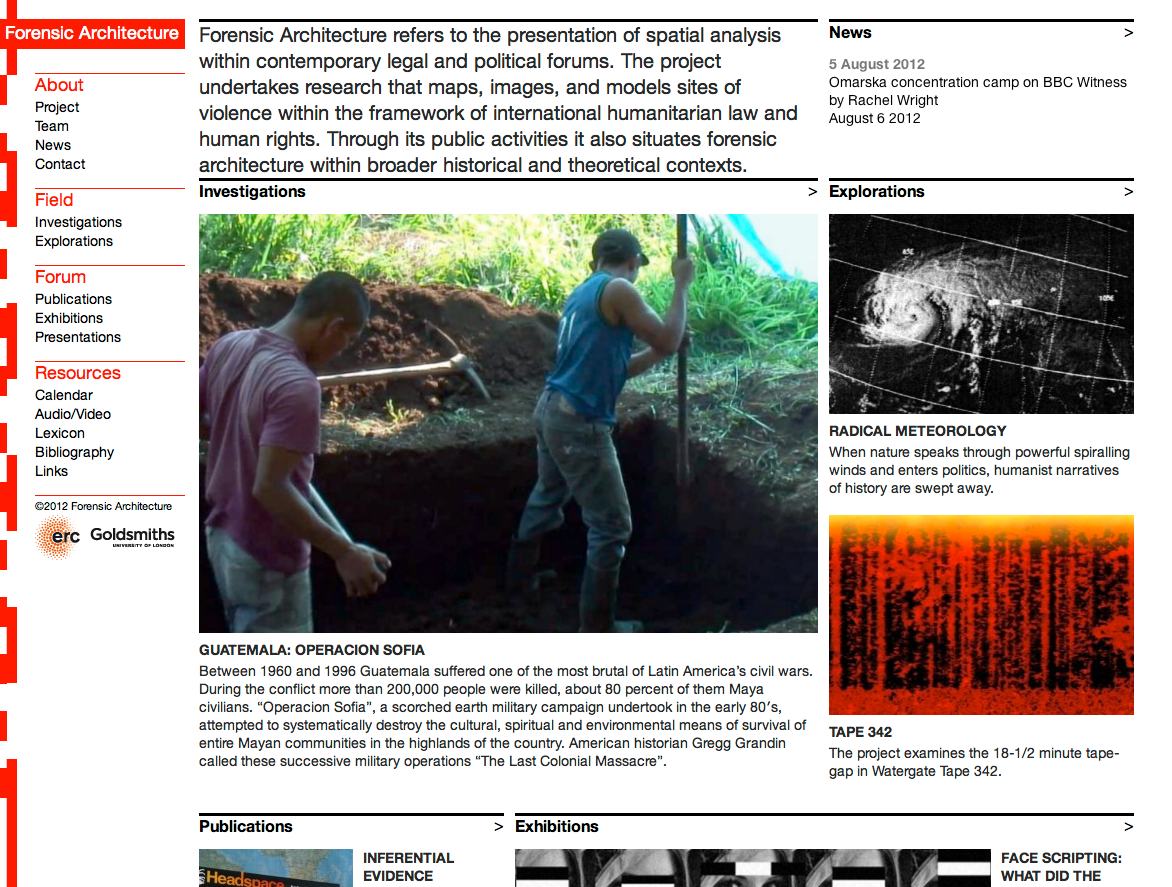
There is also a truly excellent website for the project, which is hosted by the Centre for Research Architecture at Goldsmiths University of London within the Department of Visual Cultures.

Highlights for me include:

under Investigations, Forensic Oceanography (probing the deaths of more than 1500 people fleeing Libya across the Mediterranean in 2011, including a downloadable report), a report on the effects of airborne White Phosphorus munitions in densely populated urban areas like Gaza, and a challenging (I imagine preliminary) commentary on ways of recording and investigating deaths from drone strikes in Pakistan’s Federally Administered Tribal Areas:

‘The near complete prohibition upon carrying recording equipment into this region of Pakistan, coupled with the non-existence of local maps has made the task of locating and representing the sites and consequences of drone attacks extremely difficult. This inability to produce corroborating evidence has, in turn, severely hampered the pursuit of legal claims. Forensic Architecture is working with human rights and legal justice organisations in both Pakistan and the UK to develop an alternate mapping system that can meet the unique challenges posed by the dilemma of creating accurate maps without relying upon technologies of exact recording, but only upon haptic techniques of observation and recall, or what has been called “transparency cameras”. This system needs to be matched, in turn, with a post-production methodology of transcription and interpretation of recollection data. Survivors and witnesses of drone strikes are typically brought to safe zones outside of Northwest Pakistan in cities such as Islamabad, where they are interviewed by legal staff and their stories cross-referenced and collated.’

under Explorations, a sketch of what the project calls ‘Video-to-space analysis’ derived from the recognition that ‘remote controlled vision machines (satellites and drones) and the handheld devices of citizen journalists working independently of news-desks marks a shift in the ways in which human rights violations will increasingly be charted and mapped and the ways in which the spaces of conflict themselves will increasingly become known or offer up information.’ 

under Presentations, a record of a seminar in March 2012 with Bruno Latour  who comments on a series of investigations (Paulo Tavares, “The Earth-Political”; Nabil Ahmed, “Radical Meteorology'”; John Palmesino, “North – The architecture of a territory open on all sides”): ‘Forensics is the production of public proof’ (with some interesting asides about ‘geopolitics’ and what he calls ‘politics of the earth’), and a tantalising glimpse of a conference presentation by Susan Schuppli under the title ‘War Dialling: Image Transmissions from Saigon’, which discussed the modalities through which, on June 8 1972, ‘a portable picture transmitter, took 14 minutes to relay a series of audio signals from Saigon to Tokyo and then onwards to the US where they were reassembled into a B&W image to reveal a young Vietnamese girl [Kim Phúc] running out of the inferno of an erroneous napalm attack.’

These reflect my own preoccupations, but there’s lots more – it’s a treasure trove of imagination and insight.  Oh – and a reading list.