Forensic architecture

Both Stuart Elden and I have drawn attention to Eyal Weizman‘s Forensic Architecture project – sketched in outline in his The least of all possible evils and the subject of his Society & Space lecture – but for those who want more…
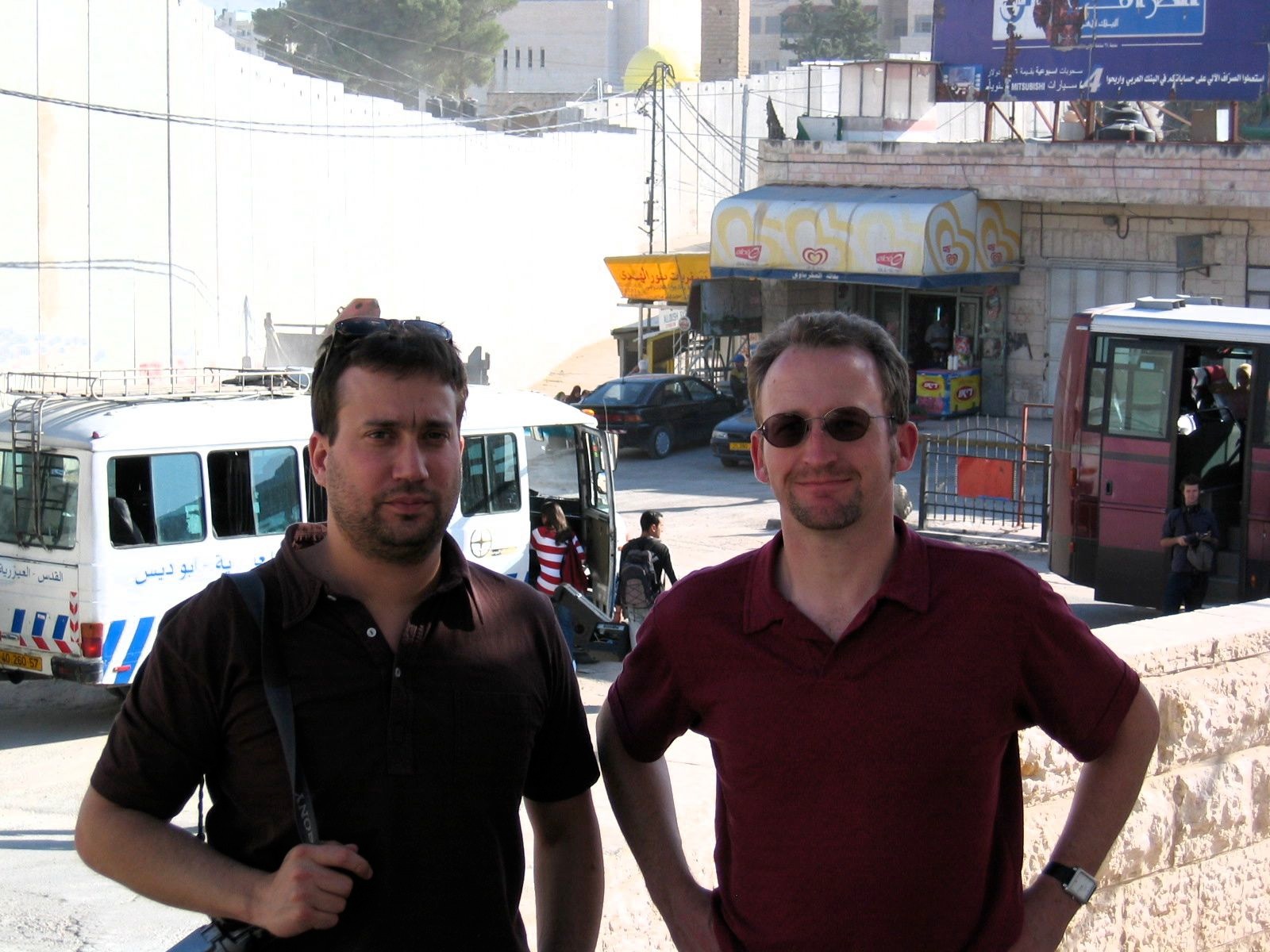
Eyal Weizman (L) and Steve Graham (R) in the occupied West Bank [Derek Gregory]

Michael Schapira and Carla Hung interview Eyal in “Thinking the Present” at  Full Stop. Here’s an extract where Eyal summarises his project:

‘Forensic Architecture is grounded in both field-work and forum-work; fields are the sites of investigation and analysis and forums the political spaces in which analysis is presented and contested. Each of theses sites presents a host of architectural and political problems.

In fields, lets say starting with Territories, I attempted to engage a kind of “archeology” of present conditions as they could be read, or misread, in architecture. This archeology is not always undertaken by direct contact with the materiality under analysis, but with images of it. The spaces that we debate, analyze, or make claims on behalf of, are very often media products. Similarly, drawing a map includes synthesizing satellite and aerial images as well as images from the ground. Some images are created by optics and some by different sensors that register spectrums beyond the visible. One needs sensors to read sensors.

So this is a kind of archaeology of spaces as they are captured in these different forms of capture and registration. You read details, speckles, pixels and patterns, connect them to larger forces, or at least you understand the impossibility of doing so, often noting paradoxes and misrepresentations. We have done this very close reading of aerial images of colonies in the West Bank, we have read almost all elements from architectural through infrastructural archaeological to horticultural ones visible in these images as a set of tools in a battlefield.

Then there is the forum: a site of interpretation, verification, argumentation and decision. International courtrooms, tribunals, and human rights councils are of course the most obvious sites of contemporary forensics. But there are other political and professional forums.

Each forum is different. The third component of forensics, beyond the architectural and aesthetic, is what you need in order to stand between that “thing” and the forum: an “interpreter.” In ancient Rome it would be the orator; in our days it is perhaps the scientist, or the architect, or the geographer — the “expert witness” that translates from the language of space to the language of the forum. This definition of forensics might help expand the meaning of the term from the legal context to all sorts of others. Politics, as it is undertaken, around the problems of space and its interpretations, is a “forensic politics” as far I understand it.

Each of the multiple political and legal forums in use today — professional, scientific, parliamentary or legal — operates by a different set of protocols of representation and debate. They each have another frame of analysis. Each embodies dominant political forces and ideologies — that is to say that each instrumentalizes forensics as a part of a different ideological structure. In the turbulence of a changing world, there are also informal, subversive and ad-hoc and crisis forms of gathering: pop-up assemblies of protest and revolt in which the debate of financial, architectural (the housing or mortgage crisis), and geopolitical issues are often articulated.

Forensic architecture should thus be understood not only as dealing with the interpretation of past events as they register in spatial products, but about the construction of new forums. It is both an act of claim-making on the bases of spatial research and potentially an act of forum-building.’

Eyal edited a special section of Cabinet magazine (#43) on “Forensics”, and there’s an early lecture (May 2010) on ‘Forensic Architecture’ here and an image-rich conversation with Open Democracy’s wonderful Rosemary Belcher on ‘Forensic Architecture and the speech of things’ here.

There is also a truly excellent website for the project, which is hosted by the Centre for Research Architecture at Goldsmiths University of London within the Department of Visual Cultures.
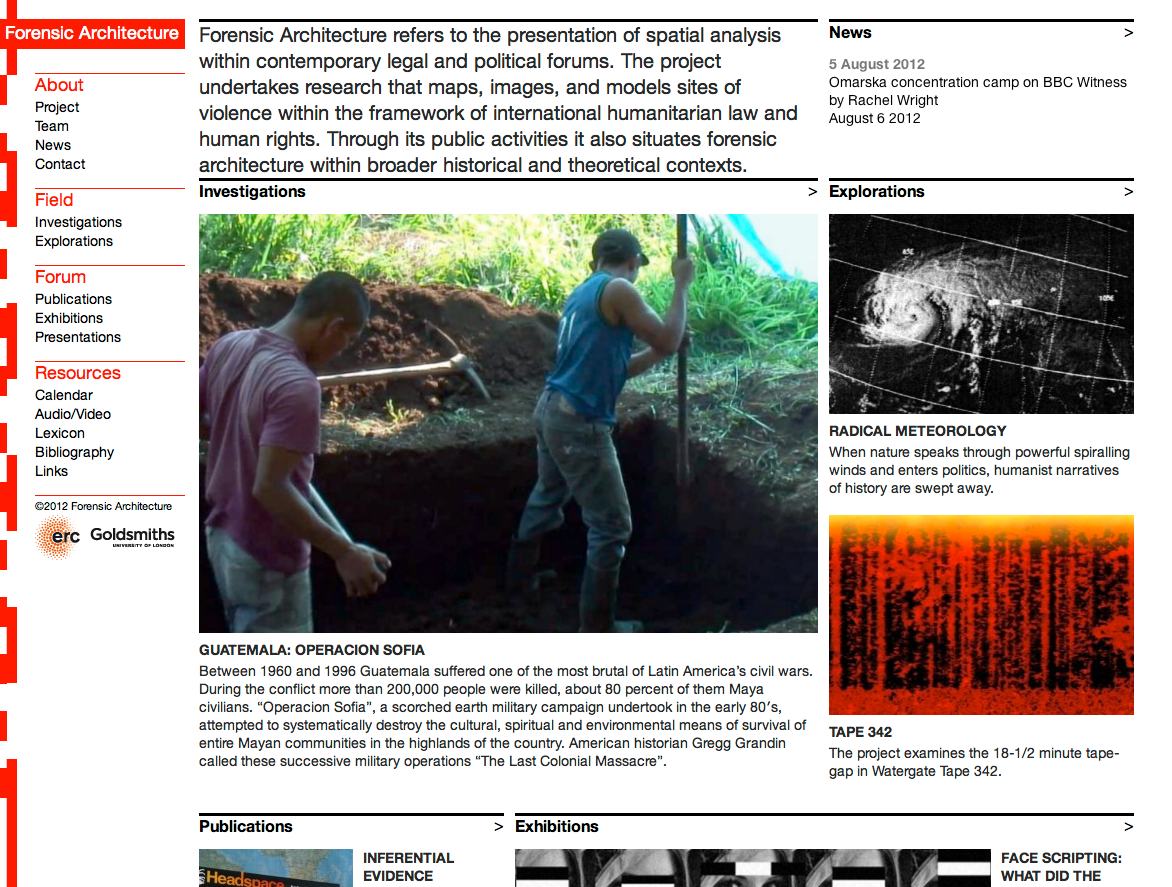
Highlights for me include:

under Investigations, Forensic Oceanography (probing the deaths of more than 1500 people fleeing Libya across the Mediterranean in 2011, including a downloadable report), a report on the effects of airborne White Phosphorus munitions in densely populated urban areas like Gaza, and a challenging (I imagine preliminary) commentary on ways of recording and investigating deaths from drone strikes in Pakistan’s Federally Administered Tribal Areas:

‘The near complete prohibition upon carrying recording equipment into this region of Pakistan, coupled with the non-existence of local maps has made the task of locating and representing the sites and consequences of drone attacks extremely difficult. This inability to produce corroborating evidence has, in turn, severely hampered the pursuit of legal claims. Forensic Architecture is working with human rights and legal justice organisations in both Pakistan and the UK to develop an alternate mapping system that can meet the unique challenges posed by the dilemma of creating accurate maps without relying upon technologies of exact recording, but only upon haptic techniques of observation and recall, or what has been called “transparency cameras”. This system needs to be matched, in turn, with a post-production methodology of transcription and interpretation of recollection data. Survivors and witnesses of drone strikes are typically brought to safe zones outside of Northwest Pakistan in cities such as Islamabad, where they are interviewed by legal staff and their stories cross-referenced and collated.’

under Explorations, a sketch of what the project calls ‘Video-to-space analysis’ derived from the recognition that ‘remote controlled vision machines (satellites and drones) and the handheld devices of citizen journalists working independently of news-desks marks a shift in the ways in which human rights violations will increasingly be charted and mapped and the ways in which the spaces of conflict themselves will increasingly become known or offer up information.’ 

under Presentations, a record of a seminar in March 2012 with Bruno Latour  who comments on a series of investigations (Paulo Tavares, “The Earth-Political”; Nabil Ahmed, “Radical Meteorology'”; John Palmesino, “North – The architecture of a territory open on all sides”): ‘Forensics is the production of public proof’ (with some interesting asides about ‘geopolitics’ and what he calls ‘politics of the earth’), and a tantalising glimpse of a conference presentation by Susan Schuppli under the title ‘War Dialling: Image Transmissions from Saigon’, which discussed the modalities through which, on June 8 1972, ‘a portable picture transmitter, took 14 minutes to relay a series of audio signals from Saigon to Tokyo and then onwards to the US where they were reassembled into a B&W image to reveal a young Vietnamese girl [Kim Phúc] running out of the inferno of an erroneous napalm attack.’

These reflect my own preoccupations, but there’s lots more – it’s a treasure trove of imagination and insight.  Oh – and a reading list.
Counterinsurgency and the humanitarian present

Laleh Khalili – whose work on the new and old classics of counterinsurgency,  on the gendering of counterinsurgency, and on the location of Palestine in global counterinsurgency – is indispensable, has just alerted me to the fate (Fate?) of one of its principal architects, David Kilcullen.

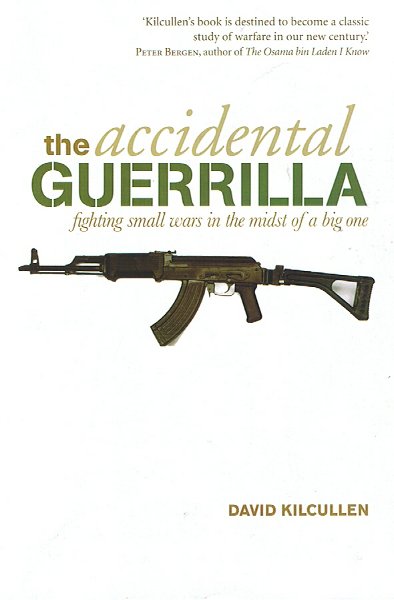
In The accidental guerilla and other writings, Kilcullen – Petraeus’s Senior Counterinsurgency Adviser in Iraq – repeatedly turned to bio-medical analogies to advance a bio-political vision of counterinsurgency: insurgency as a ‘social pathology’ whose prognosis can be traced through the stages of infection, contagion, intervention and rejection (‘immune response’).  In an interview with Fast Company, Kilcullen now explains that he

“came out of Iraq with a real conviction that we tend to think that a bunch of white guys turning up with a solution fixes all the problems. It doesn’t work like that. You actually have to really build a collaborative relationship with the people on the ground if you want to have any hope of understanding what’s going on.”

Kilcullen’s contract ended when the Obama administration came into office, and he founded Caerus Associates.  The company advertises itself as ‘a strategy and design firm’ that works to ‘help governments, global enterprises, and local communities thrive in complex, frontier environments.’  It claims to ‘bring the system into focus’ by providing ‘strategic design for a world of overlapping forces — urbanization, new market horizons, resource scarcity and conflict — to build resilience and capacity.’   The company explains its ‘strategic design process’ here, and Kilcullen’s vision of systems analysis is sketched here.  This may sound like the rapid-fire buzz-words that corporate start-ups typically shoot at their clients, but Kilcullen provides Fast Company with a sawn-off version (it’s really hard to avoid these metaphors…):

“We’re two-thirds tech, one-thirds social science, with a dash of special operations… We can go out in a community and say, ‘Let’s map who owns what land,’ or ‘Let’s map who owes the local warlord money,’ or ‘Let’s map the areas in the city where you don’t feel safe.'”

This chimes with Kilcullen’s famous description of contemporary counterinsurgency as ‘armed social work’, and in an interview with the International Review of the Red Cross published in September 2011 Kilcullen extended his vision of ‘military humanism’ beyond insurgency thus:

‘The methods and techniques used by illegal armed groups of all kinds are very similar, irrespective of their political objectives. So whether you’re talking about a gang in the drug business in Latin America, or organized crime in the gun-running or human smuggling business, or whether you’re talking about an insurgency or perhaps even a civil war involving tribes, you will see very similar approaches and techniques being used on the part of those illegal armed groups. That’s one of the reasons why I believe counter-insurgency isn’t a very good concept for the work that the international community is trying to do. I think that the idea of complex humanitarian emergencies is actually a lot closer to the reality on the ground. You almost never see just one insurgent group fighting an insurgency against the government anymore. What you typically see is a complex, overlapping series of problems, which includes one or more or dozens of armed groups. And the problem is one of stabilizing the environment and helping communities to generate peace at the grassroots level – a bottom-up peace-building process. And that’s not a concept that really fits very well with traditional counter-insurgency, which is about defeating an insurgent movement and is a top-down, state-based approach. What you have to do is create an environment where existing conflicts can be dealt with in a non-violent way.’

This is a remarkable passage for several reasons: the focus on ‘techniques’ not ‘objectives’, which works to de-politicize and de-contextualize a range of different situations in order to generalize about them, the appeal to a collective “international community” whose only interest is a generic “peace”, and hence the passage to what Eyal Weizman calls ‘the humanitarian present’. I think that’s also a colonial present, not surprisingly: ‘humanitarianism’ was often the velvet glove wrapped around the iron fist of colonialism.  But what Weizman sees as novel about the present is the way in which its ‘economy of violence is calculated and managed’ by a series of moral technologies (the term is Adi Ophir‘s) that work to continue and legitimize its operation.  In other words, there is today an intimate collusion of the ‘technologies of humanitarianism, human rights and humanitarian law with military and political powers’.

Despite  the reference to ‘special operations’ in the Fast Company interview – something which makes me think that Obama would have found Kilcullen’s continued advice invaluable – Kilcullen insists that it’s a collaborative process:

“We specialize in working with communities that are under the threat of violence in frontier environments, and I think to some extent that distinguishes us a little bit from other people. Sure we can give a slick presentation in a hotel room, but what we can also do is walk the street in dangerous places, engage with communities, and figure out what needs to happen. It’s not us figuring it out, it’s them telling us, but often we find that no one’s ever been there and asked them before.”

‘Dangerous places’, ‘frontiers’: this is still the language of adventurism.  It recalls Zygmunt Bauman‘s ‘planetary frontierland’, and even more Mark Duffield on the ‘global borderlands’:

‘The idea of the borderlands … does not reflect an empirical reality.  It is a metaphor for an imagined geographical space where, in the eyes of many metropolitan actors and agencies, the characteristics of brutality, excess and breakdown predominate.  It is a terrain that has been mapped and re-mapped in innumerable aid and academic reports where wars occur through greed and sectarian gain, social fabric is destroyed and developmental gains reversed, non-combatants killed, humanitarian assistance abused and all civility abandoned.’

It’s not surprising, then, that in the IRC interview Kilcullen should make so much of establishing ‘the rule of law’: ‘It’s a set of rules which has predictable consequences and allows the population to feel safe, and helps them know what they need to do in order to be in a safe place.’  He makes it clear that, in many (perhaps most) circumstances ‘bottom-up, community-based law, which can be transitional justice, or customary law, applied by traditional courts or religious courts, is as effective and possibly even more effective in the initial stages than central-state structures.’   But this ignores the multiple ways in which law (including international humanitarian law) is not apart from conflict but is almost always a part of conflict: as Weizman has it, ‘international law develops through its violation.  In modern war, violence legislates.’

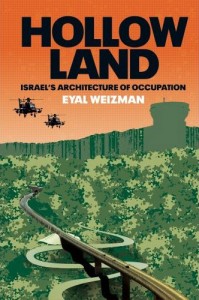
One could say much the same about maps.  Mapping is not a neutral, objective exercise; mapping is performative and its material effects depend on the constellation of powers and practices within which it is deployed. Kilcullen’s injunction – “Let’s map” – glosses over who the ‘us’ is, who is included and who is excluded, and the process through which some mappings are accorded legitimacy while others are disavowed.  This is also one of Weizman’s central claims, not least in his exposure of the torturous mappings that issued in the  Hollow Land of occupied Palestine.

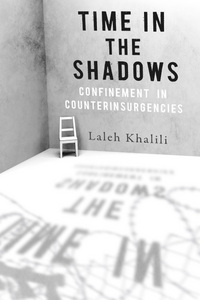
Weizman’s particular focus in his discussion of the humanitarian present is Gaza, and this winds me back to Laleh Khalili’s work which brilliantly re-reads counterinsurgency in occupied Palestine contrapuntally with US counterinsurgency practices elsewhere.  Her Essential Reading on Counterinsurgency was published by Jadaliyya, and her forthcoming book, Time in the shadows: Confinement in Counterinsurgencies (Stanford University Press, October 2012),  engages with a Medusa’s raft of counterinsurgency adviser-survivors, including Kilcullen and Andrew Exum (Abu Muqawama).

And so a final question: how would ‘strategic design’ and a ‘collaborative process’ help the people of Gaza?  Whose ‘rule of law’ is to be established?  And which maps chart a road not only to peace but to justice for the people of Palestine?