It’s a great pleasure to announce a new journal edited by Andrew Hoskins and William Merrin (full disclosure: I’m on the Editorial Board), Digital War, published by Palgrave Macmillan (now part of Springer Nature):
There is no longer war, there is only digital war.
‘Digital War is understood as the ways in which digital technologies and media are transforming how wars are fought, experienced, lived, represented, reported, known, conceptualised, remembered and forgotten.
‘Digital War identifies, not a new form of war, but an entire, emergent research field. We provide a vital and dynamic forum for addressing cutting-edge developments, responding rapidly to new wars and moreover, agenda-setting in the digital environment.
‘In recent years, Wikileaks brought us a new vision of our ongoing wars; lethal, autonomous robotics began to be publicly debated and a growing awareness of the revolutionary impact of social media in conflict-zones spread. Topics such as hacking, hacktivism, digital civil-wars and government surveillance came to the fore; the success of Islamic State meant everyone was discussing online terrorism and propaganda; wars across the world play out now on social media platforms and people’s smartphones with participation from increasingly indistinct militaries, citizens, states, and new developments in military A.I., simulation, augmentation and weaponry made the news. Soon, everyone became conversant with the subject of cyberwar and nation-state and hacking group cyberattacks, and discussions of 4chan, 8chan, trolling, the weaponization of Facebook, Twitter-bots, Troll-Farms, and Russian information war became common.
‘This journal thus sees digital war as having gone mainstream.
‘This journal meets a need for a scholarly and practitioner forum on a nascent yet already dominant field. The political, social and cultural importance of digital war have increased dramatically, with topics such as drones and cyberwar becoming key contemporary issues, whilst the rise of social media has revolutionized societal communication, impacting on how wars are fought and known and experienced, as seen, for example, in Gaza (2014), Syria (2011-present) and Ukraine (2014). New developments in information war, such as the in/visible Russian campaign against the US and Europe, threaten western electoral processes as well as broader social cohesion, whilst hacking groups of uncertain affiliation continually attack governments, companies and organisations with cyberattacks seeking to damage systems, or exfiltrate sensitive political, economic or military information. New technological developments in simulations, wearable technologies and human augmentation have direct military applications whilst we are already seeing a gradual automatization of weapons systems with the increasing application of A.I. in the military (such as in pilotless drones) and investment in robots in the US, Russia and China etc.
‘War’ itself is being transformed today as the traditional legal definitions that have governed its declaration, identification and operation no longer fit the digital reality we see around us. The aim of this journal is to critically explore what war means today, its future trajectories and consequences.
‘Digital War is driven ultimately by quality of scholarship, but rather than being restricted to publishing exclusive and narrow academic work, we welcome a range of interventions and responses, including theoretical, polemical and speculative pieces from experts in their field. Our aim is not only to be the intellectual centre of debate around contemporary war but also for emerging technological developments and their implications for the future of and as the leading and radical forum for discussions about developments in conflict.’
You can access the inaugural issuehere. And you can follow the bloghere.
(The lead image is by Shona Illingworth, from her essay with Andrew in the first issue, ‘Inaccessible war: media, memory, trauma and the blueprint’.)
This fall Middle East Report – described by Rashid Khalidi as ‘the best periodical (in English) on the Middle East—bar none’ – from the truly outstanding Middle East Research and Information Project became open access..\
Health and health care have become increasingly ungoverned over the past few decades, in tandem with a broader breakdown of the body politic. Health care workers are finding it increasingly difficult to work in settings of violent conflict and insecurity, rapidly declining health care systems, pervasive corruption and widespread economic mismanagement—all amidst the waning capacity of states to improve the health and wellbeing of their populace. While the Middle East region trains a lot of doctors, few end up staying. The winter issue of Middle East Report explores the interactions of the body politic with health and medicine and examines the entanglements of physical bodies in the institutional and political processes that govern them. The articles in this issue explore a range of different landscapes and ecologies of politics and health care, bringing the questions and problems of health and illness into the analysis of geopolitics and political economy.
Contents:
The Evolution of Conflict Medicine in the Middle East – An Interview with Ghassan Abu Sittah Ghassan Abu Sittah, Omar Dewachi, Nabil Al-Tikriti The Long Shadow of Iraq’s Cancer Epidemic and COVID-19 Mac Skelton Syrian Refugees Navigate Turkey’s Shifting Health Care Terrain Nihal Kayali Hepatitis C, COVID-19 and the Egyptian Regime’s Approach to Health Care Jennifer Derr The Dilemmas of Practicing Humanitarian Medicine in Gaza Osama Tanous Illness as Metaphor and Reality in Syria Noura Chalati COVID-19 Exposes Weaknesses in Syria’s Fragmented and War-Torn Health System Aula Abbara
I gave my last UBC lecture on 2 December (below), but I shall – of course! – continue my research and writing. So this isn’t retirement yet – and my tenure as Peter Wall Distinguished Professorship isn’t up yet either – but it does bring me to the end of a long teaching career.
I’ve been lecturing full time since I was appointed a University Assistant Lecturer at Cambridge at what now seems the incomprehensibly early age of 22. It was a strange moment; I was barely one year beyond my BA, and had gone straight into the PhD programme – the usual route at that time, though it was hardly a “programme” since there were no graduate courses, only (!) the requirement to submit a thesis.
I had wanted (very much) to be supervised by Jack Langton, but since he was leaving he was not available and my new supervisor was Tony Wrigley. A brilliant historical demographer and co-director of the Cambridge Group for the History of Population and Social Structure, I still remember my first meeting with him over lunch at Peterhouse. He talked enthusiastically about his family reconstitution project, an ambitious team effort to reconstruct the population history of England before the Census using parish registers. He described the possibilities of studying a parish in the Midlands, but all I could see was the bleak prospect of three years tracing three lines on a graph: births, marriages and deaths.
Rudderless, I turned to what has always been my first love – theatre – and spent the rest of the academic year acting and directing. At night I would make my way home from rehearsals to the house I shared with three friends, and as I crossed the bridge over the Cam I would tell myself that it was high time I settled down to some serious academic work. But these conversations always seemed to take place on a Thursday, and who turns the page on a Thursday? Much better, I told myself, to make a fresh start at the beginning of a new week.
Monday would find me walking home from rehearsals, having much the same conversation – except that it was the 29th of the month, and I convinced myself it would obviously make more sense to start my research on the 1st of the month. New month, new beginning.
The mathematically gifted among you will have realised that by the time the 1st arrived, it was inevitably a Thursday.
I could keep this up ad infinitum – I suspect I could hold a chair in Procrastination Studies if only I could get around to applying – and eventually I decided to withdraw from the PhD programme and go to drama school. I was in the attic office in Downing Place that I shared with Neil Wrigley and John Carney (the most unlikely of combinations), packing up my books, when H.C. Darby, Head of the Department of Geography, telephoned and asked me to come down to his office.
It was a summer evening, and as I went down the stairs I was thoroughly alarmed: convinced Darby had somehow discovered my future plans, I thought I was about to be booted out before I could withdraw in a seemly fashion. My alarm increased when I found him standing in his doorway holding a bottle of sherry and two glasses. I can remember little of that conversation – sherry still has that effect on me – but half-way through the bottle I realised that he was offering me a job.
I was dumbfounded. It seemed (and was) absurd: I knew that an assistant lectureship had been advertised, but I hadn’t applied – 12 months after my BA and with no research to my name, published or otherwise, it had never occurred to me to do so. All I had to show was a starred First and my contributions to discussions at Department seminars and at Alan Baker‘s legendary Occasional Discussions in Historical Geography held in his rooms at Emmanuel College far into a Friday night. I’d never presented a paper to either forum – how could I? – but I wasn’t shy in joining in the discussions.
I subsequently learned that it was Alan (who soon became one of my closest friends) who had recommended my appointment to Darby, but all I can remember of that sherry-sodden conversation is asking Darby why me – and him telling me that he wanted someone with “fire in their belly”…
I asked for the weekend to think it over. My girlfriend told me that I would be mad to turn it down, and assured me that all I had to do was teach for a few years and then I could devote myself to the stage (she was perfectly clear that it would never, ever work the other way round). She also told me that lecturing was just like acting – except that I got to write the script and mark the audience.
When I went back to accept the post it was a Monday – and (in my dreams, at any rate) the 1st of the month.
That same week I was elected a Fellow of my college, Sidney Sussex, and – to my consternation, though by now I was rolling with it – Director of Studies in Geography. Dick Chorley had been awarded a personal Chair, so I had to take over the college reins from him: an exceptionally tall order, but Dick too became a good friend and a wonderfully kind and supportive mentor. We were very different in all sorts of ways, but we shared a knockabout irreverence (I’m not sure how else to put it), a strong sense that we could take ‘our’ geography wherever we wanted to go, and a conviction that whatever else teaching involved, it had to involve performance.
For the next several years I threw myself in to teaching – lectures on historical geography, college supervisions (small groups of undergraduates who would each write an essay every week, to be discussed but never graded), and field courses – so my research had to be confined to the summer months and my thesis (on the transition from a domestic to a factory system in the Yorkshire woollen industry: I never did get to that Midlands parish) was postponed time and time again.
But I did eventually complete it (in fact, I wrote it in three weeks: as improbable as everything else in this saga, but none the less true). In the interim I’d published Ideology, science and human geography, and after my thesis had been examined by Brian Robson and David Smith and I was heading out of the door, they expressed surprise that I’d published a philosophical-theoretical critique of human geography and yet there was no trace of it in my thesis. A wise person would have politely agreed and left; but I turned round and said that my research would have been impossible without using social theory (not testing it, not ‘applying’ it, but using it).
Asked to explain, I sketched out what an analysis based on Althusser’s structural Marxism would have looked like (the subject of the very first paper I ever presented at an academic conference; it was greeted with baffled silence, apart from the redoubtable Professor Eila Campbell who bellowed “Young man, I’d like to congratulate you on the quality of your visual aids!”). Next I outlined an alternative analysis based on E.P. Thompson’s humanist Marxism (I’d become entranced by Thompson’s work, especially The making of the English working class). I’d followed neither approach, I said; instead, I had drawn on Tony Giddens‘s structuration theory to bring ‘structure’ and ‘agency’ together (how dated these formulations seem now).
I finished by saying that for me the best theory is carried in solution: if you know the theory, or better yet theories (since there’s no single body of theory capable of asking all the interesting questions or providing all the credible answers) you can recognise it, but if you don’t that’s no barrier to following the substantive narrative. At that point they declined to pass the thesis, but asked me to add an introduction explaining what I’d just told them. I did so, and when the thesis was eventually published several reviews praised the book – apart from the unnecessary introduction.
I taught at Cambridge for sixteen years before leaving in 1989 to become Professor of Geography at UBC.
Tethered to my new “standing desk” and lecturing remotely from my study at home was not how I’d planned to make my exit (still stage left) – and lecturing is performance – and I’ve missed not exactly the roar of the crowd and the smell of the greasepaint but that extraordinary shiver up the spine that inheres when you’re flying in front of a class.
For all that, I didn’t want to go out with a whimper, so I spent much of the summer attending a series of in-house workshops and figuring out how to deliver lectures remotely (UBC, to its immense credit, made that decision early so that we all had time to prepare properly, and it has been exceptionally supportive of faculty, students and staff throughout the pandemic). I rejigged both my courses (you can see drafts of the revised programme under the TEACHING tab, which involved making sure that all the readings are available online and adding a section about ‘Studying under Covid’ to help my students as best I could); and thinking how to conduct examinations in a manner that is rigorous and fair but also mindful of the exceptionally difficult and different circumstances encountered by students (many of them in different time-zones).
At first I was dismayed at how Canvas/Collaborate Ultra – the platforms used by UBC – threatened to dumb down university education: provision for taking attendance (I’ve never done that in my life and had no intention of starting now); ‘quizzes’ instead of examinations, and with an evident bias towards multiple-choice questions rather than the essays I think essential in a Faculty of Arts. I’ve stayed with the essays.
But there have been upsides. The intensity of online teaching is exhausting, as I’m sure many readers will know only too well, and yet there is (as part of that intensity) still an intimacy to it: the obligation to engage audiences through effective images and visuals – ever since Professor’s Campbell’s response, I’ve laboured hard over the design of my slides – and through speaking to create light and shade still holds, whether the audience is in front of you or scattered around the world. However remote the audience, and no matter if they are sitting at their laptops or curled up in bed in their jammies, it’s still a performance. I delivered each lecture “live”, and was pleased (and surprised) at how many students joined me: it created a sense of occasion for me and, I think, a sense of community for them – desperately important in these straitened times. I didn’t want them to feel they were entirely alone. The use of the Chat function also empowered even the shy students to ask questions that I suspect would have gone unasked in normal circumstances.
The lectures were recorded, so that those in other time zones didn’t have to struggle to the screen at 3.30 in the morning (though some did), and I had many more (and much longer) video conversations with students who wanted to discuss the course and their term papers. Sometimes I sensed that these conversations were as much pastoral as intellectual – perhaps not surprising in a pandemic, but that was a first for me at UBC on such a scale. At Cambridge, with its tutorial and supervision system, there was always an intimacy to teaching, and with it a sense of trust and support, which encouraged intellectual risk-taking in ways that I’ve found hard to maintain in a large, corporate university (apart from graduate supervision, to be sure). So one of the upsides in my final term has been re-discovering and reaffirming the joy of being able to help students in every way I can.
And, as always, I learned so much from my conversations with them.
That hasn’t changed at all. Throughout my teaching career I have – honestly, genuinely – learned so much from my students at Cambridge and at UBC. They have challenged me with ideas and issues I hadn’t considered, brought to my attention readings and sources I’d passed over, and forced me to clarify things I’d never been clear about in the first place.
As I write this, it’s neither a Monday nor the 1st of the month. I may be turning a page on my teaching career, but – as I said at the outset – the research and the writing will continue apace. I have two books in prospect. Reach from the Sky will bring together my work on genealogies and geographies of aerial violence, and Purple Testament – a title I’ve taken (if you’ve read this far, you will know how doubly appropriate this is) from Shakespeare’s Richard II: ‘the purple testament of bleeding war’ – which extends my work on trauma geographies and woundscapes from the First World War to Afghanistan and Syria.
So I hope you’ll keep watching this space. And my heartfelt thanks to everyone who has helped me fill it thus far.
A new edition of the Middle East Research and Information Project (MERIP)’s Middle East Report is now available online and OPEN ACCESS here:
The coronavirus pandemic is vividly highlighting the fundamental links between people, health and the environment. This issue on nature and politics probes the essential but also sometimes fraught relationships between people and their environments in the Middle East. It provides insights into crucial issues of energy, water and climate change and the political struggles between states and their citizens over environmental stewardship, sovereignty and the allocation of resources. It also takes us into spaces of human-environment interaction that are not so commonly discussed—bird markets, Iraqi landscapes contaminated with toxins, sinkholes around the Dead Sea and Turkish wetlands teeming with wildlife. Through these contributions, “Nature and Politics” offers a critical take on contemporary challenges across the Middle East.
Issue Editors: Jessica Barnes and Muriam Haleh Davis with Guest Editor Sophia Stamatopoulou-Robbins
Water in the Middle East: A Primer Jessica Barnes On Blaming Climate Change for the Syrian Civil War Jan Selby Global Aspirations and Local Realities of Solar Energy in Morocco Atman Aoui, Moulay Ahmed el Amrani, Karen Rignall Birth Defects and the Toxic Legacy of War in Iraq Kali Rubaii Bird Markets, Artisanal Pigeons and Class Relations in the Middle East Bridget Guarasci The Unintended Consequences of Turkey’s Quest for Oil Zeynep Oguz Terra Infirma – Dead Sea Sinkholes – A Photo Essay Simone Popperl The Lost Wetlands of Turkey Caterina Scaramelli “Algeria is not for Sale!” Mobilizing Against Fracking in the Sahara Naoual Belakhdar An Interview with Sophia Stamatopoulou-Robbins Tessa Farmer “Turkey Wants to be Part of the Nuclear Club” An Interview with Can Candan Kenan Behzat Sharpe
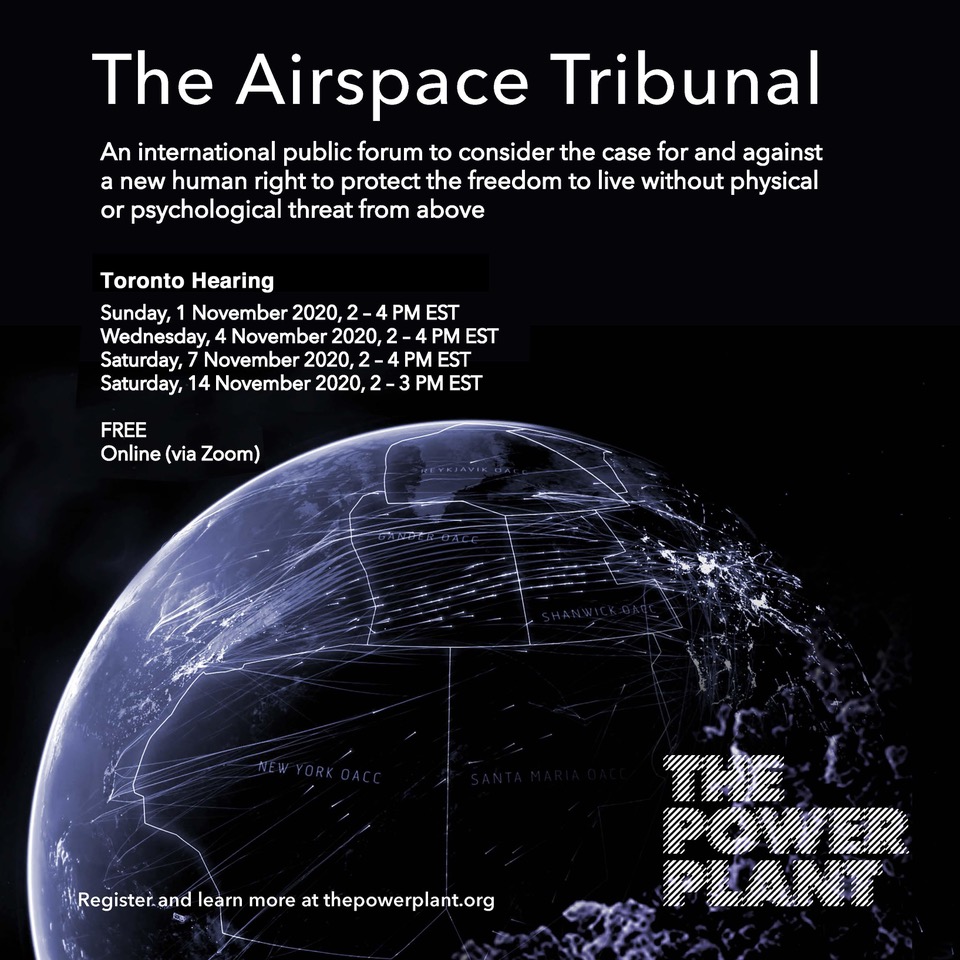
I’m taking part in the Toronto Hearing of the Airspace Tribunal on 1 November. I’ve written about the project before – see my post here – but here are the basic details:
Online (via Zoom)All times are Eastern Standard Time
The Toronto hearing of the Airspace Tribunal is co-presented by The Power Plant and the Master of Visual Studies program at the Daniels Faculty, University of Toronto. Speakers from a broad range of expertise, disciplines and lived experience – including Climate Change, Human Rights, Artificial Intelligence, Geopolitics, Contemporary Warfare, Biopolitics, Psychology and Forced Migration – will consider whether we need increased protection from threats from above through the recognition of this proposed new human right.
The hearing will take place over three 2-hour online panel discussions followed by a one 1-hour online summative session. The Power Plant’s Director, Gaëtane Verna, will be the Chair, introducing each session and all speakers. Counsel to the Tribunal, Kirsty Brimelow QC of Doughty Street Chambers (London, UK), will pose questions to the Experts. Members of the audience – our judges – will also be able to ask questions.
The Airspace Tribunal invites representations from experts across a broad range of disciplines and lived experience to consider the case for and against the recognition of a new human right to protect the freedom to exist without physical or psychological threat from above.
You can find out more (and register: it’s free) here.
There are four sessions – you can access the full program via the link above – but here is the panel for the first one (1400 to 1600 EST):
Shona Illingworth is an artist whose video and sound installations and research-led practice investigate memory, cultural erasure and structures of power and their impact on how the future is imagined in situations of social tension and conflict. She is Reader in Arts, University of Kent
Nick Grief was a member of the legal team which represented the Marshall Islands in the International Court of Justice in cases against India, Pakistan and the UK concerning the obligation to negotiate in good faith towards nuclear disarmament. He is Emeritus Professor of Law, University of Kent and practises at the Bar from Doughty Street Chambers, London, UK
Derek Gregory is Peter Wall Distinguished Professor and Professor of Geography, University of British Columbia at Vancouver, Canada. He is completing a new book, Reach from the Sky, which is is a genealogy and geography of aerial violence; his current research concerns medical care and casualty evacuation in war zones, 1914 to the present.
Gbenga Oduntan, Reader in International Commercial Law, Kent Law School, University of Kent
And for the second (on 4 November):
Jairus Grove is Associate Professor, Department of Political Science, University of Hawaii at Manoa, USA.His recent book Savage Ecology: War and Geopolitics at the End of the World develops an ecological theory of geopolitics that argues that contemporary global crises are better understood when considered within the larger history of international politics.
Jack Penashue, Director of Social Health for Sheshatshiu Innu First Nations, Sheshatshiu, Newfoundland & Labrador, Canada
Gabriele Schwab, Distinguished Professor, Comparative Literature with joint faculty appointments in Anthropology, English, European Languages and Studies, and Gender and Sexuality Studies; School of Humanities, University of California — Irvine, USA
And for the third (on 7 November):
Anthony Downey is Professor of Visual Culture in the Middle East and North Africa (Birmingham City University). His current research projects explore digital media, knowledge production, and the relationship between cultural practices and human rights. Upcoming and recent publications include Unbearable States: Digital Media and Cultural Activism (forthcoming, 2021) and Critique in Practice (Sternberg Press, 2020). He is the series editor for Research/Practice (Sternberg Press, 2019–ongoing) and sits on the editorial boards of Third Text and Digital War, respectively
Kwame McKenzie, CEO of the Wellesley Institute; Director of Health Equity, Centre for Addiction and Mental Health; and, Professor, Department of Psychiatry, University of Toronto, Canada
Renata Salecl is a philosopher and sociologist whose work has included radical re-evaluation of notions of liberal theories of democracy to offer new approaches to human rights and feminism. She is professor at the School of Law at Birkbeck College, University of London and senior researcher at the Institute of Criminology at the Faculty of Law in Ljubljana, Slovenia. Her recent book A Passion for Ignorance is an original and provocative exploration of our capacity to ignore what is inconvenient or traumatic.
The fourth session is a plenary, closing session. The Airspace Tribunal hearing in Toronto will be recorded and transcribed. Documentation will be incorporated in a special issue of the Journal of Digital War and contribute to Illingworth’s Fall 2021 exhibition at The Power Plant. It will also contribute to the drafting history, helping to build and refine the case for the proposed new human right to be submitted to the United Nations and other bodies.
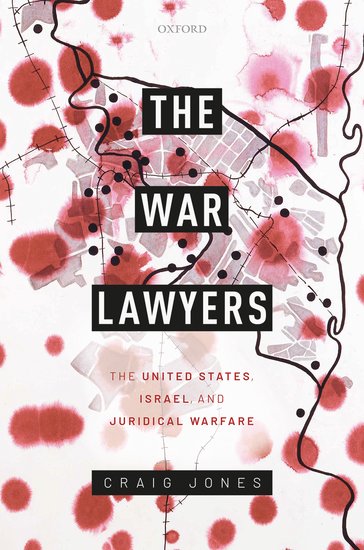
Like all my readers, I suspect, I’ve been battling many things these past months: including, right now, the intensity of teaching online. More on that later, since I doubt that’s what most of you come here for, so what better to celebrate my re-start than news of the publication of a wonderful new book,The War Lawyers: the United States, Israel and Juridical Warfare by my dear friend Craig Jones:
Over the last 20 years the world’s most advanced militaries have invited a small number of military legal professionals into the heart of their targeting operations, spaces which had previously been exclusively for generals and commanders. These professionals, trained and hired to give legal advice on an array of military operations, have become known as war lawyers.
The War Lawyers examines the laws of war as applied by military lawyers to aerial targeting operations carried out by the US military in Iraq and Afghanistan, and the Israel military in Gaza. Drawing on interviews with military lawyers and others, this book explains why some lawyers became integrated in the chain of command whereby military targets are identified and attacked, whether by manned aircraft, drones, and/or ground forces, and with what results.
This book shows just how important law and military lawyers have become in the conduct of contemporary warfare, and how it is understood. Jones argues that circulations of law and policy between the US and Israel have bolstered targeting practices considered legally questionable, contending that the involvement of war lawyers in targeting operations enables, legitimises, and sometimes even extends military violence.
Contents:
Introduction: The War Lawyers 1. Targeting without Lawyers: The Vietnam War 2. The Birth of “Operational Law” 3. “‘The Lawyers’ War” 4. Targeting in the Israeli Military 5. The Kill Chain (I): Deliberate Targeting 6. The Kill Chain (II): Dynamic Targeting Conclusion: Juridical Warfare: Limits and Possibilities
Ron Johnston – who died last night of a heart attack – was one of the kindest and most generous people I’ve ever known.
We became firm friends when I joined him, Peter Haggett, David Smith and David Stoddart as a co-editor of the first edition of the Dictionary of Human Geography; I wrote about our first collective meeting when our wonderful publisher (and another good friend) John Davey died three years ago. We all met in the bowels of John’s club (and I say bowels advisedly); I was nervous about meeting such luminaries, but Ron was warm, welcoming and immensely enthusiastic – as always – and even at that first meeting combined a tremendous sense of fun (the jokes and banter came thick and fast on all sides) with intellectual vitality (this wasn’t going to be like any other Dictionary!) and a deep sense of responsibility (without Ron’s managerial and organisational skills I doubt that even John would have been able to guilt-trip us into finishing the project).
We worked closely together on multiple future editions, each one more demanding, and yet Ron never lost those fine qualities.
I’ve found a wonderful video of him talking with Peter about their love of Geography; it’s a promo for the University of Bristol, but it’s much more than that, and it’s here.
Ron moved from Monash through Christchurch (Canterbury) and Sheffield to Bristol via an interlude at Essex. I vividly remember him resigning from the Vice-Chancellorship of at Essex to return to the world he loved most: teaching and research. I wrote to say how much I admired his decision; Bristol was so very smart to appoint him once he stepped down. His move created a sensation at the time, but it was a humble and considered decision. No careerist, Ron had no time for the brown-nosing that so many saw as the route to preferment; neither did he want to administer the work of others. No matter how high his star rose, he never saw his colleagues, co-workers or students as somehow beneath him. He was honest, forthright, and quick to acknowledge when he was wrong (apart from his love of Swindon).
He never stopped writing: writing, for Ron, was thinking – never a simple record of what he had done. So he never stopped writing because he never stopped thinking (I had a message about his most recent publication on the same day that he was taken to hospital). Writing for Ron was also living – once you knew Ron, you could hear his voice when you read his work, see the set of his jaw, the twinkle in his eye, and that lovely grin. Just look at that video.
At one conference where we were supposed to be on the same panel, he was late (a rare event: he was unfailingly courteous), and I joked that he was presumably opening the Publishers’ Exhibition – which got a laugh – and then I added “Now I think of it, he is the Publishers’ Exhibition”, which brought the house down. Ron’s productivity was (and remains) legendary. And it wasn’t jobbing-writing: I’ve always marvelled at his ability to write so much and yet to hit the target so many times.
Those who live by citation counts (Ron didn’t) might do well to look at his and shrivel.
This isn’t the place to highlight even some of Ron’s books – how to choose? But he once told me that his best selling book was his Atlas of Bells – he was a keen and talented campanologist – and I never did find out if he was joking. It was of course published by John Davey, and now I can’t ask either of them.
We did very different things, but it didn’t matter. And throughout our long friendship Ron also taught me – by doing rather than saying – that our collective work matters only in so far as it makes a difference to the world. Ron wrote and wrote and wrote, but it wasn’t a personal odyssey (though he surely gained tremendous satisfaction from it – even if he was rarely satisfied with what he wrote). He was passionate about the importance of university education, about our calling as teachers and researchers, and his textbooks spiralling through multiple editions showed that in spades; but he had no time for those who thought of universities as ‘ivory towers’, and he was more aware than most of how they are affected by and in turn affect the societies in which they are embedded. He wanted to captivate his readers, many of them students, by guiding them to the frontiers of geographical research, and cultivating in them a love of ideas – and a profound responsibility for their practical implications. Much of his substantive research focused on political geography, to which he made a host of vital contributions, but there was also a rich, deep and remarkably generous politics to all Ron’s writing and publishing.
A new book from the wonderful Susan Schuppli – I was going to say ‘of Forensic Architecture‘ fame, except that her work involves so much more than that! You can see both her entanglements with forensic architecture and the ‘so much more’ on full display in Material Witness: media, forensics, evidence (MIT Press):
In this book, Susan Schuppli introduces a new operative concept: material witness, an exploration of the evidential role of matter as both registering external events and exposing the practices and procedures that enable matter to bear witness. Organized in the format of a trial, Material Witness moves through a series of cases that provide insight into the ways in which materials become contested agents of dispute around which stake holders gather.
These cases include an extraordinary videotape documenting the massacre at Izbica, Kosovo, used as war crimes evidence against Slobodan Milošević; the telephonic transmission of an iconic photograph of a South Vietnamese girl fleeing an accidental napalm attack; radioactive contamination discovered in Canada’s coastal waters five years after the accident at Fukushima Daiichi; and the ecological media or “disaster film” produced by the Deep Water Horizon oil spill in the Gulf of Mexico. Each highlights the degree to which a rearrangement of matter exposes the contingency of witnessing, raising questions about what can be known in relationship to that which is seen or sensed, about who or what is able to bestow meaning onto things, and about whose stories will be heeded or dismissed.
An artist-researcher, Schuppli offers an analysis that merges her creative sensibility with a forensic imagination rich in technical detail. Her goal is to relink the material world and its affordances with the aesthetic, the juridical, and the political.
Susan’s own, endlessly interesting web page is here, which includes links to some of her writing here.
An age ago I was asked to contribute to a symposium in Toronto on ‘Post-atomic eyes‘; I confessed at the time that I was taken aback – what on earth were the connections between drones and nuclear weapons? Eventually I realised the root of the problem: I knew a lot about drones and other forms of more or less conventional aerial violence, but next to nothing about The Bomb (see here).
As I worked on my contribution – nervously, I freely admit – I came to realise that the connections between the two were close and intimate, and immensely consequential for both. This is a tragically overlooked episode in the genealogy of drones (and aerial violence more generally), and I was asked to turn my presentation into an essay for an edited volume based on the conference.
You can find my first attempt under the DOWNLOADS tab – “Little Boys and Blue Skies“. The essay was way overdue and over length; I’ve never found it easy to translate a presentation into a text.
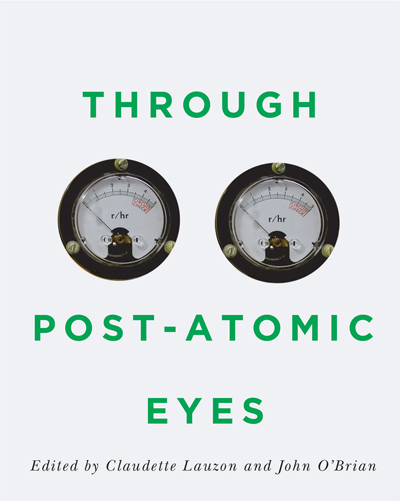
But to my surprise (and delight) the editors, Claudette Lauzon and John O’Brian, graciously accepted the essay more or less as is, and the volume (also called Through Post-Atomic Eyes) is now published by McGill-Queens University Press:
What can photography tell us about a world transformed by nuclear catastrophe?
What does it mean to live in a post-atomic world? Photography and contemporary art offer a provocative lens through which to comprehend the by-products of the atomic age, from weapons proliferation, nuclear disaster, and aerial surveillance to toxic waste disposal and climate change.
Confronting cultural fallout from the dawn of the nuclear age, Through Post-Atomic Eyes addresses the myriad iterations of nuclear threat and their visual legacy in the twentieth and twenty-first centuries. Whether in the iconic black-and-white photograph of a mushroom cloud rising over Nagasaki in 1945 or in the steady stream of real-time video documenting the 2011 meltdown at the Fukushima Daiichi nuclear power plant, atomic culture – and our understanding of it – is inextricably constructed by the visual. This book takes the image as its starting point to address the visual inheritance of atomic anxieties; the intersection of photography, nuclear industries, and military technocultures; and the complex temporality of nuclear technologies. Contemporary artists contribute lens-based works that explore the consequences of the nuclear, and its afterlives, in the Anthropocene.
Revealing, through both art and prose, startling new connections between the ongoing threat of nuclear catastrophe and current global crises, Through Post-Atomic Eyes is a richly illustrated examination of how photography shapes and is shaped by nuclear culture.
Contributors include Karen Barad (UC Santa Cruz), James Bridle (Athens), Edward Burtynsky (Toronto), Blaine Campbell(Edmonton), Eric Cazdyn (University of Toronto), Carole Condéand Karl Beveridge (Toronto), Robert Del Tredici (Atomic Photographers Guild; Concordia University), Matthew Farish (University of Toronto), Blake Fitzpatrick (Ryerson University), Lindsey A. Freeman (Simon Fraser University), Derek Gregory(University of British Columbia), Kristan Horton (Berlin), Mary Kavanagh (University of Lethbridge), Kyo Maclear (Toronto), Joseph Masco (University of Chicago), Katy McCormick (Ryerson University), Karla McManus (University of Regina), David McMillan (Winnipeg), Andrea Pinheiro (Algoma University, Sault Ste. Marie), Public Studio (Toronto), Mark Ruwedel (Long Beach, CA), Julie Salverson (Queen’s University), Susan Schuppli(Goldsmiths, University of London), Erin Siddall (Vancouver), Charles Stankievech (University of Toronto), Peter C. van Wyck (Concordia University), Donald Weber (Royal Academy of Art, The Hague), and Eyal Weizman (Goldsmiths, University of London).
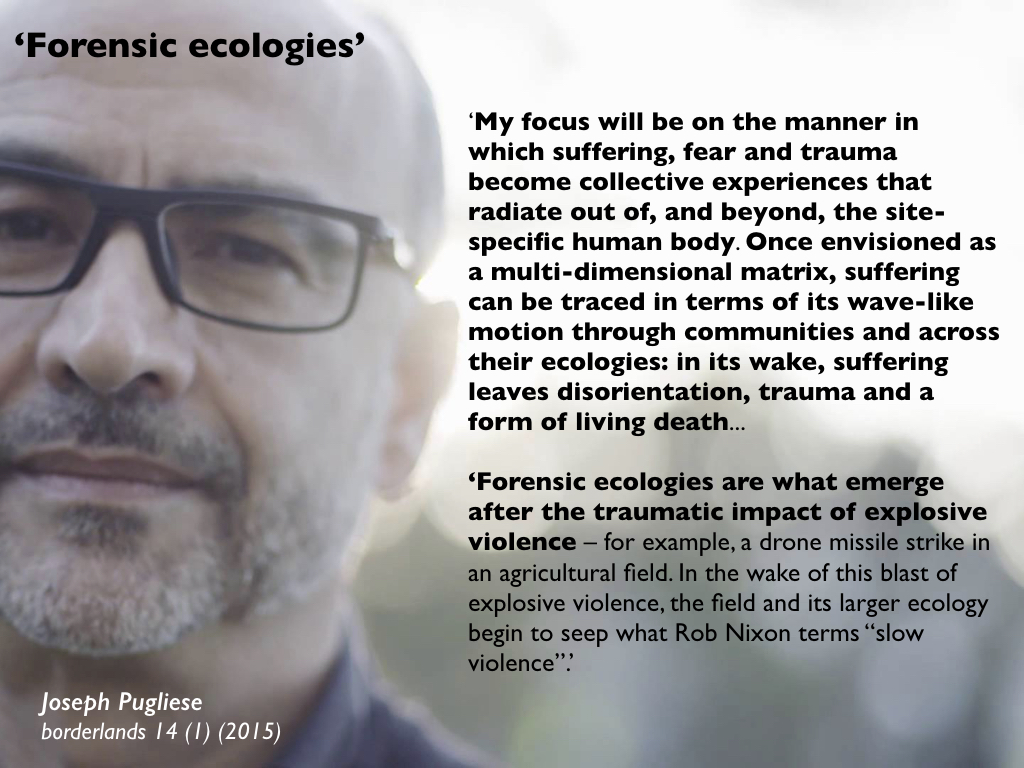
In Biopolitics of the More-Than-Human Joseph Pugliese examines the concept of the biopolitical through a nonanthropocentric lens, arguing that more-than-human entities—from soil and orchards to animals and water—are actors and agents in their own right with legitimate claims to justice. Examining occupied Palestine, Guantánamo, and sites of US drone strikes in Afghanistan, Pakistan, Somalia, and Yemen, Pugliese challenges notions of human exceptionalism by arguing that more-than-human victims of war and colonialism are entangled with and subject to the same violent biopolitical regimes as humans. He also draws on Indigenous epistemologies that invest more-than-human entities with judicial standing to appeal for an ethico-legal framework that will enable the realization of ecological justice. Bringing the more-than-human world into the purview of justice, Pugliese makes visible the ecological effects of human war that would otherwise remain outside the domains of biopolitics and law.
It is quite simply one of the most stunning, thought-provoking books I’ve read in an age:
“A mesmerizing exploration of the more-than-human dimensions of later modern war that is never less than deeply human. Linguistically inventive, analytically sobering—you keep wondering why it has taken us so long to see like this—Joseph Pugliese’s vision of forensic ecology initiates an arrestingly novel critique of military violence. At once profoundly political and deeply ethical, this is a magnificently vital achievement.” — Derek Gregory
“Joseph Pugliese’s reconfiguration of biopolitics does not simply take the politics of populations and life and extend its range to include the more than human; the very threshold between the human and ‘other’ lifeforms falls away. What is revealed is a new political-legal ethics entirely: not a question of how ‘we’ humans grant rights to others, but of how the more-than-human offers itself as an imperative to rethink the anthropocentrism of European law. Exploring indigenous and non-Western cosmologies provides a way to think about life, value, and politics that does not rely on the dignity of the human and its concomitant violence for all that is other than human. It’s rare to read a book that combines such theoretical dexterity with fascinating empirical analysis of some of our most pressing ethical issues.” — Claire Colebrook
Many readers of this blog will know Joseph’s State violence and the execution of law: Biopolitical caesurae of torture, black sites, drones (2013), also one of my favourites, but this is a radical extension and even transformation of those arguments.
I drew upon some of Joseph’s recent ideas in my extended post on Meatspacehere, and I continue to be inspired by them in the work I’m currently doing (both on aerial violence and on medical and casualty evacuation in war zones), but for a preview of his arguments in the new book I recommend:





 geographical imaginations