‘Double tap’

Glenn Greenwald – who’s moved from Salon.com to become the Guardian‘s columnist on civil liberties and US national security  – describes the vicious twist given to ‘rapid response‘ in US military and paramilitary operations in Iraq and Pakistan:

The US government has long maintained, reasonably enough, that a defining tactic of terrorism is to launch a follow-up attack aimed at those who go to the scene of the original attack to rescue the wounded and remove the dead. Morally, such methods have also been widely condemned by the west as a hallmark of savagery. Yet, as was demonstrated yet again this weekend in Pakistan, this has become one of the favorite tactics of the very same US government….

[A]ttacking rescuers (and arguably worse, bombing funerals of America’s drone victims) is now a tactic routinely used by the US in Pakistan. In February, the Bureau of Investigative Journalism documented that “the CIA’s drone campaign in Pakistan has killed dozens of civilians who had gone to help rescue victims or were attending funerals.”  Specifically: “at least 50 civilians were killed in follow-up strikes when they had gone to help victims.” That initial TBIJ report detailed numerous civilians killed by such follow-up strikes on rescuers, and established precisely the terror effect which the US government has long warned are sown by such attacks: “Yusufzai, who reported on the attack, says those killed in the follow-up strike ‘were trying to pull out the bodies, to help clear the rubble, and take people to hospital.’ The impact of drone attacks on rescuers has been to scare people off, he says: ‘They’ve learnt that something will happen. No one wants to go close to these damaged building anymore.'”

And, as Greenwald notes, the tactic – which the Department of Homeland Security called “double tap” when it condemned Hamas for using it –  intimidates not only rescuers but also journalists…

More on the Bureau of Investigative Journalism‘s report from Democracy Now here.  At the time [February 2012] Chris Woods suggested that there were indications of a change in policy and practice:

‘…the attacks on rescuers and mourners that we note, they’ve all occurred under the Obama administration between 2009 and July 2011. I think that date is quite interesting, because that’s also when Leon Panetta stepped down as head of CIA. You have an interim CIA leader, and then David Petraeus comes in. We haven’t had any reports from Pakistan since July of last year of attacks on rescuers. So there’s an indication of a policy change, and there’s also an indication of a targeting change on the ground.’

But Greenwald notes a series of later reports showing that the dismal practice had resumed by the fall.

Rapid Response

Interesting post from Ben Anderson at Berfois.  He suggests that ‘Over ten years since the advent of the war on terror it is no longer the “state of emergency” that dominates modern government’s response to emergencies. Organising for rapid response now occurs across all domains of life at a time when disparate events and conditions are grouped under the category of emergency.’  Here’s the punchline:

‘If rapid response has replaced the ‘state of emergency’ as the dominant paradigm for governing emergencies, how might those of us concerned with enhancing democratic life respond to rapid response? The critique of ‘state of emergency’ legislation is now a familiar one: in an emergency Government power is extended and liberal democracies reveal their authoritarianism. Unlike ‘state of emergency’ legislation, rapid response does not usually simply involve some form of temporary ‘suspension’ of normal rights. Quite the opposite: rapid response is the automation of exceptional but constitutional action through flexible, intersecting, protocols that govern how things should be done in response. Whilst the role of ‘state of emergency’ legislation in liberal democracies has been subject to considerable scrutiny in the post 9/11 world, there has been very little if any public reflection on the protocols that facilitate response (the only exception being post disaster inquiries and reports). This needs to change. For emergencies, and the response to emergencies, are a key occasion when lives are valued or devalued and democratic life, such as it functions today, is placed in question. How, then, can the protocols through which ‘rapid response’ is organised be opened up to public negotiation and contestation in advance of an emergency?’

Ben lists a series of’civil organisations and situations in which ‘rapid response’ is now invoked, but (as he knows very well) this often includes a set of militarized protocols.  John Morrissey has provided an excellent account of the origin of the United States’ unified combatant commands that span the globe – like CENTCOM – in which he emphasises the key role of Carter’s Rapid Deployment Joint Task Force that stood up in 1980 ‘to plan, jointly train, exercise and be prepared to deploy and employ designated forces in response to contingencies threatening US vital interests’ in the Gulf region.  Since then – in fact before then – speed and agility became the watchwords of advanced military operations, and not only internationally.  Earlier this year General Ray Odierno, the US Army’s Chief of Staff, outlined some of the changes that lie ahead in an essay in Foreign Affairs (May/June 2012), which included this passage:

‘…  the challenges in the United States itself remain daunting. Although the actions of our forces overseas have helped preclude more terrorist attacks on the U.S. homeland, the threat persists. The need for U.S. armed forces, and the army in particular, to provide planning, logistical, command-and-control, and equipment support to civil authorities in the event of natural disasters continues to be demonstrated regularly and is unlikely to diminish. And many security challenges in the Americas are transnational, including humanitarian crises, illicit trafficking, organized crime, terrorism, and weapons proliferation. Army forces will continue to be ready to contribute to broader national efforts to counter those challenges at home, if needed. Our reserve component soldiers remain the bedrock of the army’s domestic response capability, but where appropriate we will also dedicate active-duty forces, especially those with niche skills and equipment, to provide civilian officials with a robust set of reliable and rapid response options.’

That last clause lit up the blogosphere with warnings of a threat to the constitution and of martial law.  I’m not persuaded by those alarms, but I do think that the line between the suspension of rights in a ‘state of emergency’ and the constitutionality of ‘rapid response’ is a dangerously pliable one.

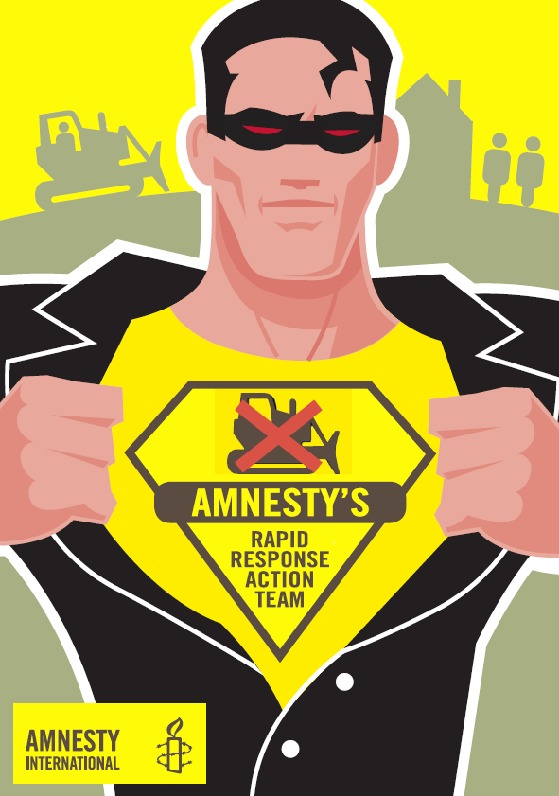
And there are other modalities of rapid response that seek to confound state action and violence, often powered by new social media; here, for example, is a project of Amnesty International against forced evictions:

Note: For more of Ben’s work on emergencies (in the UK), see Ben Anderson and Peter Adey, ‘Governing events and life: “Emergency” in UK civil contingencies’, Political Geography 31 (1) (2012) 24-33 and Peter Adey and Ben Anderson, ‘Anticipating emergencies: technologies of preparedness and the matter of security’, Security dialogue 43 (2) (2012) 99-117.

‘Dresden: a Camera Accuses’

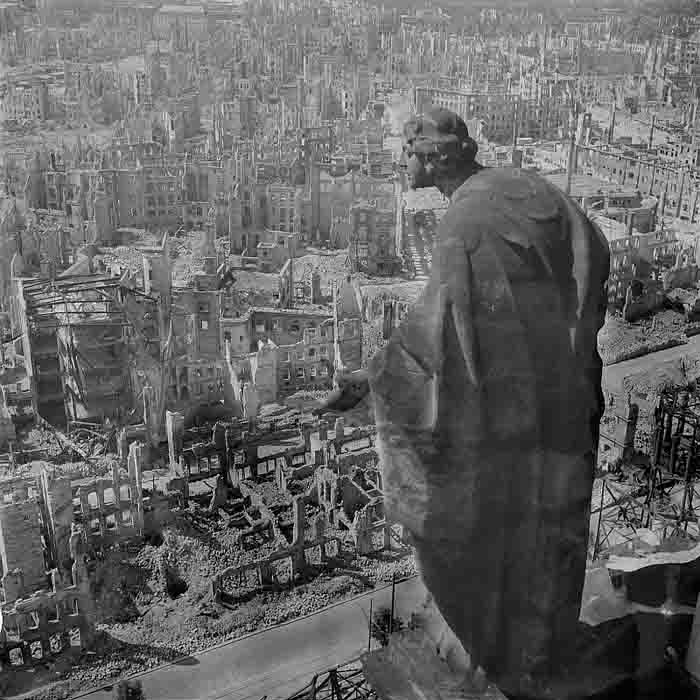
Richard Peter, Blick vom Rathaussturm, Dresden 1945 (Deutsche Fotothek)

A new essay from Steven Hoelscher, ‘Dresden, a Camera Accuses: Rubble photography and the politics of memory in a divided Germany’, just out in History of Photography 36 (3) (2012) 288-305.

This article explores memory, photography and atrocity in the aftermath of war. It takes as its case study the controversies surrounding the February 1945 firebombing of Dresden. One photograph in particular has become the iconic image of the fire- bombing and of the devastating air war more generally – Richard Peter’s View from the City Hall Tower to the South of 1945. Although arguably less divided today than it was during the Cold War, when the image became seared into local and national memory, Germany’s past continues to haunt everyday discourse and political action in the new millennium, creating new ruptures in a deeply fractured public sphere. By examining the historical context for the photograph’s creation and its dissemination through the book Dresden – A Camera Accuses, this article raises questions of responsibility, victimhood and moral obligation that are at the heart of bearing witness to wartime trauma. Peter’s Dresden photographs have long intervened in that existential difficulty and will probably continue to do so for the foreseeable future.

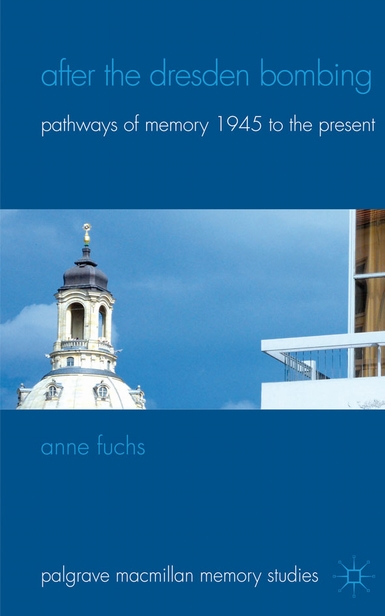
Steve sent me his essay just as I opened Anne Fuchs‘s After the Dresden bombing: pathways of memory 1945 to the present (Houndmills: Palgrave-Macmillan, 2011).  Here’s the description:

Together with Hiroshima and Nagasaki, Dresden belongs to a handful of global icons that capture the destructiveness of warfare in the twentieth century. Immediately recognisable, these icons are endowed with a powerful symbolism that cannot be explained with reference to historical cause and effect alone. This is precisely the terrain of this book, which addresses the long aftermath of the bombing in the collective and cultural imagination from 1945 to the present. The material under discussion ranges from archival documents, architectural journals, the built environment, travelogues, newspaper articles, documentaries, TV dramas, fiction, diaries, poetry to photography and fine art. As a case study of an event that gained local, national and global iconicity in the postwar period, it illuminates the media-specific transmission of cultural memory in dialogue with the changing socio-political landscape. Debating fundamental processes of cultural transmission, it exemplifies a new mode of doing cultural history that interweaves the local and the global.

Her discussion of Peters’ Eine Kamera klagt an is on pp. 32-42 and forms part of a fine extended discussion of ‘Visual mediations’.

Humanitarian space and the humanitarian present

Today (19 August: WordPress is 8 hours ahead of me!) has been designated World Humanitarian Day by the United Nations General Assembly  ‘to coincide with the anniversary of the 2003 bombing of the United Nations headquarters in Baghdad, Iraq, which killed 22 UN staff’.  From The Colonial Present:

The old Canal Hotel had been used as a base by UN weapons inspectors and sanctions monitors before the war – it became known as “the Sanctions Building” – and it remained a soft target after the UN mission moved in.  Its local secretariat had refused high-level security in order to distance the mission from the fortified compounds of the occupying power.  On August 19 a massive truck bomb exploded outside, devastating the building and a nearby hospital.  At least 23 people were killed, including the UN special representative in Iraq, Sergio Vieira de Mello, and more than 100 injured, many of them seriously.  Most Iraqis were appalled by the mass murder of civilians from many different countries, and there was considerable speculation about the identities and motives of those responsible for the atrocity.  Although there were several reasons why the United Nations could have been the object of such an attack (UN-mandated sanctions and UN Security Council Resolution 1483 to name but two), the real target seemed to be the occupation itself.  For the attack was a hideous reversal of the coalition’s own strategy of “shock and awe”.  What one journalist described as “the horrifying spectacle of a major building in the capital blown apart” was designed not only to demonstrate the strength of the opposition but also to isolate the coalition through intimidation.  Baghdad was already a city under siege, but the blast heightened the sense of impotence and vulnerability.  The primary objective was to deter others from coming to the assistance of the coalition and hence to increase the burden of the occupation upon the United States.

This year’s World Humanitarian Day campaign is called “I was here” but, as that awful anniversary ought to remind readers in the United States, the United Kingdom and elsewhere, “we were there too – and the main burden of the occupation fell upon the people of Iraq.   

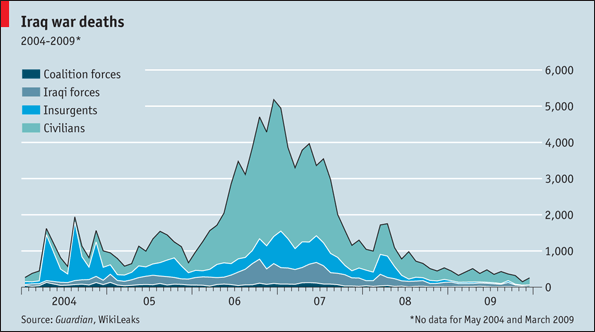
Iraq Body Count estimates that from 1 January 2003 through to 11 July 2012 (the latest date today for which figures are available) there were between 108,183 and 118,224 documented civilian deaths.  IBC notes that ‘full analysis of the Iraqi War Logs released by Wikileaks may add 13,000 civilian deaths’.  There have been several other projects that have tried to count and/or estimate deaths in Iraq, but the War Logs are particularly useful for suggesting the breakdown of total deaths:

The vast majority of casualties were indeed civilians, and the geography of their deaths was plotted on a number of websites from the Wikileaks data: Visualising data reviewed a number of these maps (with further links), and SpatialKey provided its own series of sobering maps.  (For an interactive map of coalition casualties – pairing locations in Iraq with hometowns in the USA – see here).  And Luke Condra, Jacob Shapiro and their colleagues have provided detailed quantitative analysis – using the IBC database and SIGACTS reports – in a series of papers, including”Who takes the blame?  The strategic effects of collateral damage”, American Journal of Political Science 56 (1) (2012) 167-87 and currently available on open access here.

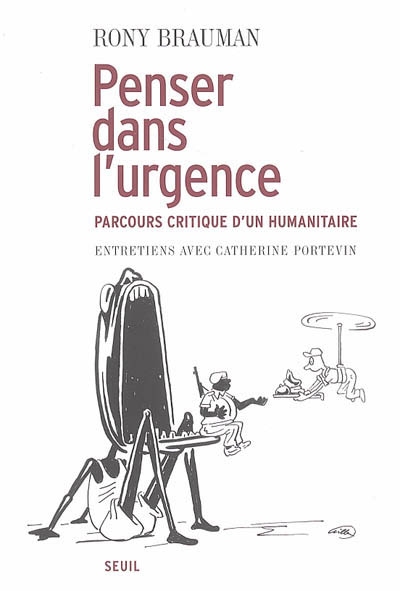
The UN website for World Humanitarian Day continues: ‘Every day humanitarian aid workers help millions of people around the world, regardless of who they are and where they are. World Humanitarian Day is a global celebration of people helping people.’  I contemplate this hard on the heels of reading Eyal Weizman on the humanitarian present in The least of all possible evils: Humanitarian violence from Arendt to Gaza (London: Verso, 2012).  I noted this book in a previous post; Weizman’s concept of ‘the humanitarian present’ emerged via a series of interviews and conversations with Rony Brauman, the former president of Médecins san Frontières and currently professeur associé at Sciences-Po Paris.  Brauman’s alternative conception of ‘humanitarian space’ is radically different from the spatial imaginary of UN agencies where, Weizman explains,

‘humanitarian spaces are clusters of extraterritorial enclaves and the protected corridors that connect them with infrastructure and transport centres.  These kinds of humanitarian spaces are often marked as circles on maps around the areas where relief operations take place – at “the internal peripheries of war”‘ (pp. 56-7).

These are the sites of the humanitarian present: platforms for the operation of those ‘moral technologies’ through which humanitarian agencies and humanitarian law work in concert with military and political power to calibrate the contemporary economy of violence and to govern ‘the displaced, the enemy and the unwanted’ (p. 4).  (Jennifer Hyndman‘s brilliant work on the politics of aid, humanitarianism and securitization speaks directly to these claims, and for a parallel critique of UN peacekeeping, see Paul Higate and Marsha Henry’s Insecure spaces: peacekeeping, power and performance in Haiti, Kosovo and Liberia (London: Zed Books, 2009)).

Against this, Brauman advances a conception of humanitarian space not as a territorial zone – thus sans frontières, without borders – but rather as what Weizman glosses as ‘a set of operational categories, or space-bound circumstantial conditions, that make independent humanitarian work possible’ – that ‘hold relief work at a distance from political and military practice’ (pp. 56-7).

There are critiques of Brauman’s views – see note (2) below – and Weizman is no camp-follower: he has important things to say about the radicalization of humanitarian space so that ‘the politics of humanitarianism’ can give ground to ‘the politics of the displaced’ (p. 61).  But in tragic measure this was exactly what motivated Sergio Vieira de Mello too: to distance his work in Baghdad from Bush’s ‘armies of compassion’ and Blair’s ‘military-humanitarian mission’.

Further notes

(1) Ashley Jackson reports that the annual incidence of major attacks against aid workers worldwide has more than doubled since 2003.

(2) For critical discussions and elaborations of ‘humanitarian space’ see D. Robert DeChaine, ‘Humanitarian space and the social imaginary: Médecins Sans Frontières/Doctors Without Borders and the rhetoric of global community’, Journal of communications inquiry 26 (4) (2002) 354-69; Dorothea Hilhorst and Bram Jansen, ‘Humanitarian space as arena: a perspective on the everyday politics of aid’, Development & Change 41 (6) (2010) 1117-39; Margo Kleinfeld, ‘Misreading the post-tsunami political landscape in Sri Lanka: the myth of humanitarian space’, Space & Polity 11 (2) (2007) 169-84; Adi Ophir, ‘The sovereign, the humanitarian and the terrorist’ (2003); Benjamin Perrin (ed), Modern warfare: armed groups, private militaries, humanitarian organizations and the law (Vancouver: UBC Press, 2012) (see Part Three: “The Humanitarian Space debate”); Maurya Wickstrom, Performances in the blockades of neoliberalism: Thinking the political anew (Houndmills: Palgrave-Macmillan, 2012) (Ch. 3 includes a discussion of Brauman and Ophir that speaks directly to Weizman’s project).

Violence and Space: Call for Papers

Philippe Le Billon (UBC, Vancouver) and Simon Springer (University of Victoria) are calling for papers on Violence and Space at the Annual Meeting of the Association of American Geographers in Los Angeles, 9-13 April 2013.  They write:

This session will provide a forum to address the interrelated questions of violence and space. Papers will examine how geography mediates the meanings, constructions, effects, foundations, discourses, and processes that inform violence in shaping its maintenance, proliferation, legitimization, or refusal in and across space. We welcome both theoretically informed and empirically grounded papers that consider the spatial dimensions of violence, ranging from routinized performances and everyday geographies of violence that serve conventional social, economic, and political norms that go largely unnoticed, through to the spectacular eruptions of ‘exceptional’ violence that capture public attention. Nonviolence is implied within all of these considerations, and we accordingly also encourage insights that contribute to scholarly understanding of the geographies of peace, resistance to violence, and emancipation from its dominating strictures.

Please send paper title, abstract, and conference PIN to Simon Springer (simonspringer@gmail.com) and Philippe Le Billon (lebillon@geog.ubc.ca) by 30 September 2012 to be considered.

Information about the conference (including registration) is here.

War and distance: logistics

My earlier post about War and distance emphasised the historical significance of the telegraph because it allowed information to be transmitted without the movement of messengers, but these systems obviously required the installation and maintenance of physical infrastructure.  Still, in August 1870 the Montreal Gazette was already anticipating the vital role of the new communications network in the emergence of frictionless war:

‘Modern science has brought each dependency of the Empire within swift reach of the controlling centre.  The communications are ever open while the command of the sea remains…  There converge in London lines of telegraphic intelligence … [and] it needs but a faint tinkle from the mechanism to despatch a compelling armament to any whither it may be called…  The old principle of maintaining permanent garrisons round the world suited very well an age anterior to that of steam and electricity.  It has passed out of date with the stage coach and the lumbering sailing transport.’

The Gazette was ahead of itself; even today, the United States garrisons the planet, and waging war over long distances still usually involves the physical movement of troops and supplies (the cardinal exception is cyberwar: more on that later).  Martin van Creveld‘s Supplying War (1977; 2004) suggested that ‘logistics make up as much as nine tenths of the business of war, and … the mathematical problems involved in calculating the movements and supply of armies are, to quote Napoleon, not unworthy of a Leibnitz or a Newton….  From time immemorial questions of supply have gone far to govern the geography of military operations.’

Halvard Buhaug and Nils Petter Gleditsch reckon that this is still the case; they concluded (in 2006) that ‘The main factor to limit the military reach of armed force is not the range of the artillery or the combat radius of attack planes.  The largest obstacles to remote military operations relate to transportation and logistics.’

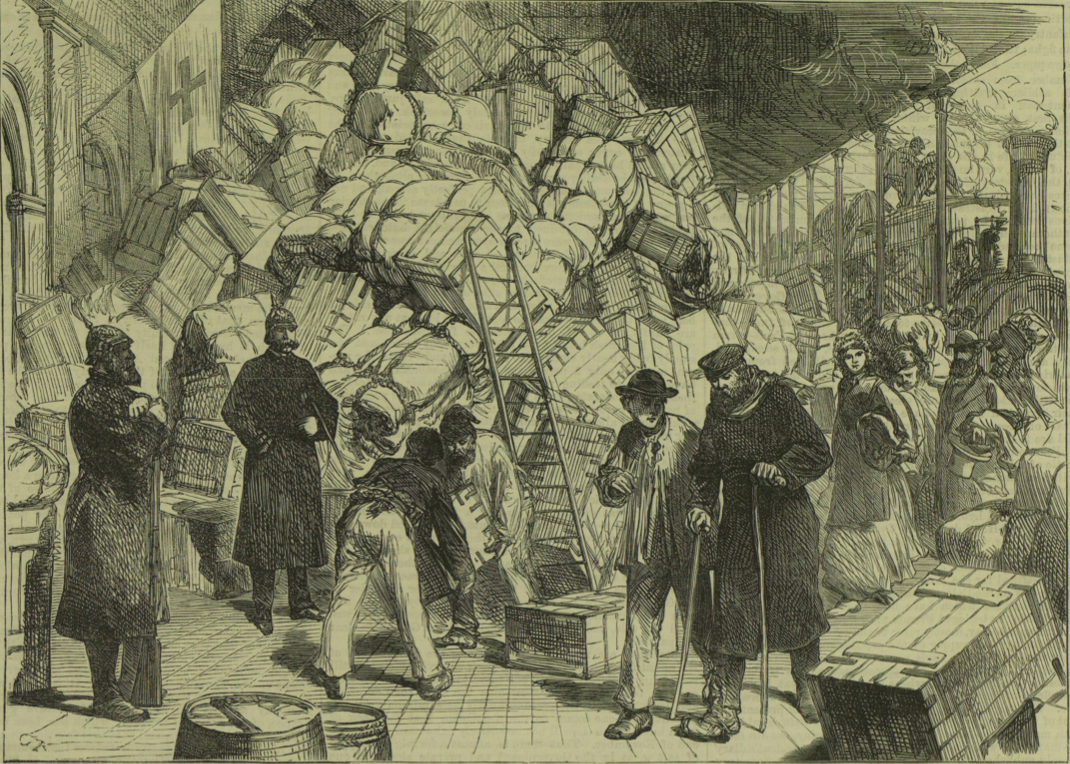
Stores for the Prussian siege of Paris at Cologne station

There is a contentious backstory to Creveld’s main thesis – that before 1914  ‘armies could only be fed as long as they kept moving’, foraging (and pillaging) as they went – which has sparked an ongoing debate about the logistics of early modern siege warfare and pitched battle.  But by the time of the Franco-Prussian War (1870-71) it was already clear – to the Prussians at least – that the railway had transformed the business of war.  ‘We are so convinced of the advantage of having the initiative in war operations that we prefer the building of railways to that of fortresses,’ Field Marshal Helmuth von Moltke had declared: ‘One more railway crossing the country means two days’ difference in gathering an army, and it advances operations just as much.’
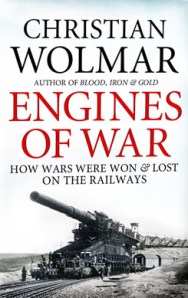
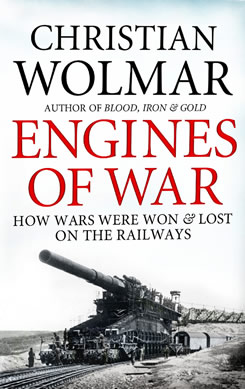
Armand Mattelart discusses the strategic implications of this in The invention of communication (1996, pp. 198-208), but the role of the railway in supplying modern war has been described in great detail by Christian Wolmar.  He contrasts the Battle of Waterloo in 1815 – ‘the last significant conflict before the invention of railways’ – which was over in less than a day, leaving 40,000 men dead, with the Battle of Verdun, ‘which lasted most of 1916’ and resulted in 700,000 dead and wounded soldiers.  The crucial difference, according to Wolmar, was the railway, that ‘engine of war’, and here – as elsewhere – the chronology is complicated.  The Franco-Prussian War was indeed a significant waystation, but events didn’t work out quite as von Moltke had envisaged.  The railways certainly speeded the mobilization of Prussian troops but, as Wolmar explains,

‘The Germans had expected to fight the war on or around the border and had even prepared contingency plans to surrender much of the Rhineland, whereas in fact they found that, thanks to French incompetence, they were soon heading for the capital.  The war, consequently, took place on French rather than German territory, much to the surprise of Moltke, upsetting his transportation plans, which had relied on using Prussia’s own railways. The distance between the front and the Prussian railheads soon became too great to allow for effective distribution, and supplies of food for both men and horses came from foraging and purchases of local produce.’

Back to a world of foraging and laying siege.  The decisive moment was probably (as Wolmar’s vignette abut Verdun suggests) the First World War of 1914-1918.  Even as late as 1870, Creveld argues, ammunition formed less than 1 per cent of all supplies, whereas in the first months of the First World War  the proportion of ammunition to other supplies was reversed:

‘‘To a far greater extent than in the eighteenth century, strategy became an appendix of logistics.  The products of the machine – shells, bullets, fuel, sophisticated engineering materials – had finally superseded those of the field as the main items consumed by armies, with the result that warfare, this time shackled by immense networks of tangled umbilical cords, froze and turned into a process of mutual slaughter on a scale so vast as to stagger the imagination.’

Empty shell casings and ammunition boxes,  a sample of the ammunition used by the British Army in the bombardment of Fricourt on the first day of the Battle of the Somme, 1 July 1916 [Australian War Memorial, AWM H08331]

In August 1914, for example, British field guns had a total of 1,000 shells available at or approaching the front lines; by June 1916 each eighteen-pound gun had 1,000 shells stockpiled at its firing position, and by 1918 Britain had over 10,000 guns, howitzers and trench mortars in the field.  An elaborate system of light ‘trench railways’ was constructed on the Western Front to transport the ammunition to the front lines. (A note for afficionados of crime fiction: see Andrew Martin’s The Somme stations [2011]).
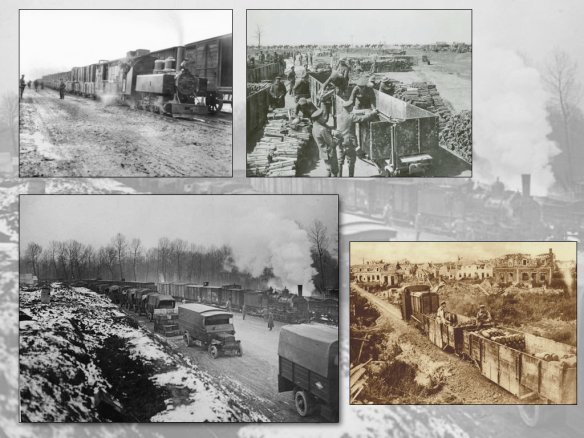
Supply of munitions on the Western Front

It’s that toxic combination of movement and stasis that was (and remains) so shattering.  As Modris Eksteins described it in Rites of Spring: The Great War and the birth of the modern age (1989),

‘The war had begun with movement, movement of men and material on a scale never before witnessed in history.  Across Europe approximately six million men received orders in early August [1914] and began to move… [And them for two years, 1916 and 1917] this new warfare that cost millions of men their lives … moved the front line at most a mile or so in either direction.’

And it was locked down in part because men and material continued to be moved up to the front lines.

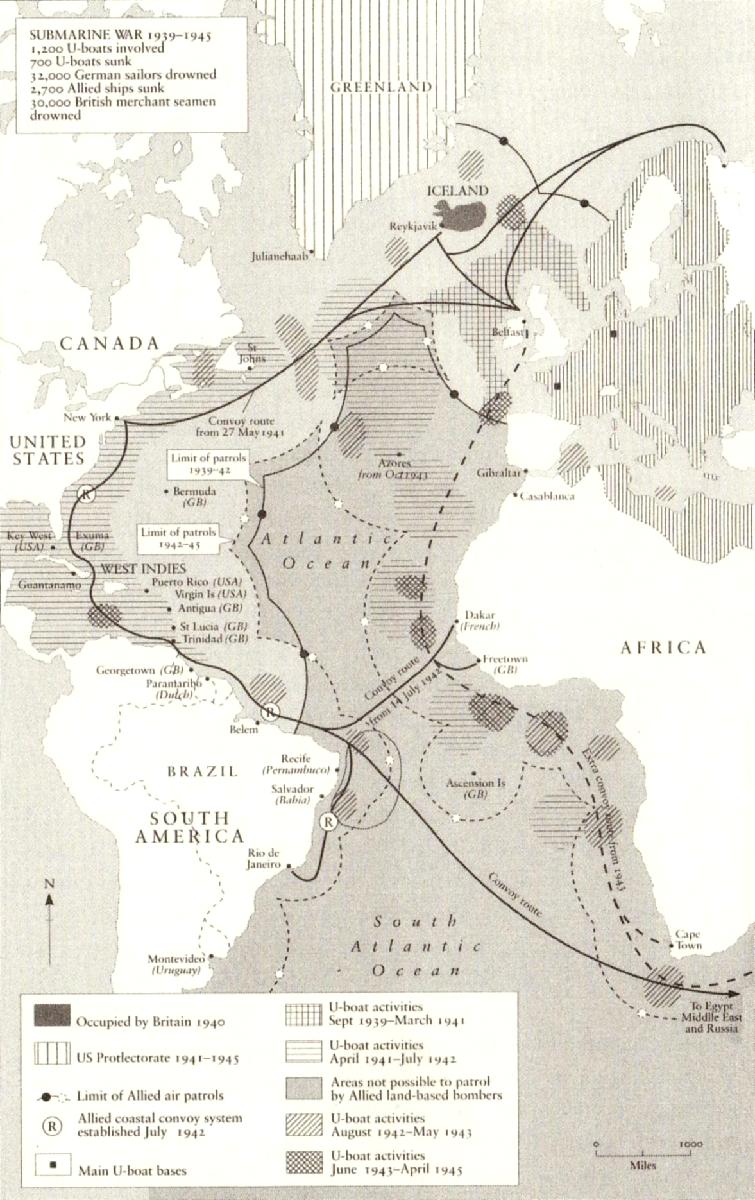
Now Creveld’s argument was limited to ground forces – he said nothing about sea power or air power – and was confined to war in Europe, and these are significant caveats.  During the Second World War the Battle for the Atlantic was crucial.  Churchill famously declared that ‘Never for one moment could we forget that everything happening elsewhere, on land, at sea, or in the air, depended ultimately on its outcome.’   There is a rich literature on convoys and submarine attacks that I’m only just beginning to explore.  Although the Allies lost 3,500 merchant ships and 175 warships, however, more than 99 per cent of ships sailing to and from the beleaguered British Isles survived the crossing.

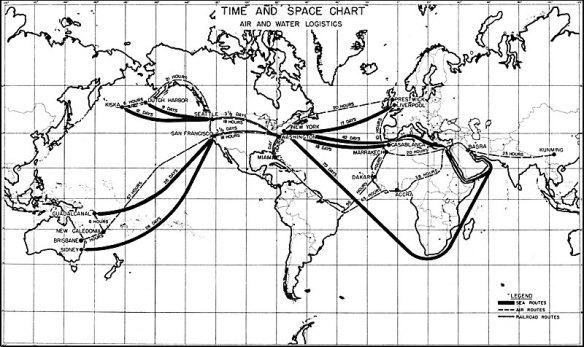
If we enlarge the scale to consider the supply of war materials beyond the European theatre – as in this graphic which shows US global logistics during the Second World War – then the complexity and vulnerability of the supply chain becomes even clearer.
The deployment of air forces also imposed logistical problems, as this graphic from the Illustrated London News showed:
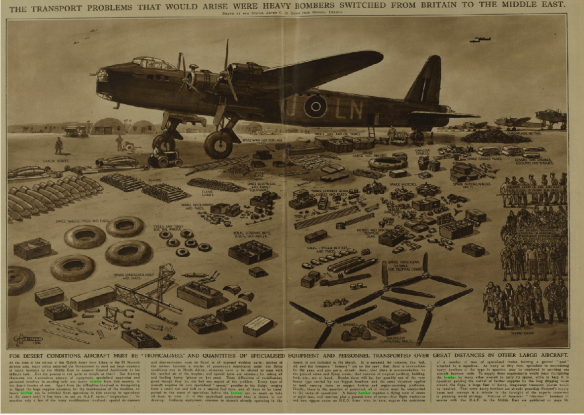
It’s worth remembering that today’s use of UAVs like the Predator and Reaper in distant theatres of war and conflict zones also requires the transport of the aircraft, ground crews and the crews responsible for take-off and landing; once airborne, the missions are usually flown from the continental United States but they involve an extended global network of supplies, personnel and communications.

In fact, writing in 2004 Creveld concluded that since 1945 the logistics burden had not eased nor had armed forces increased their operational freedom.  The two most important changes have been an even greater reliance on petrol/gasoline (a key target of Allied bombing in the final stages of the Second World War) which, by the 1990s, had displaced ammunition to become the single bulkiest commodity to be shipped to supply distant wars, and a dramatic increase in outsourcing through the use of private military contractors.

I provided a sketch of how these two developments bear on the contemporary logistics of supplying war in Afghanistan in a long essay at open Democracy, and I’ve provided a short update here. This was my conclusion:

‘Over the last decade a new political economy of war has come into view.  We have become aware of late modern war’s proximity to neoliberalism through privatisation and outsourcing (‘just-in-time war’) and its part in the contemporary violence of accumulation by dispossession.  The rapacious beneficiaries of the business of war have been swollen by the transformation of the military-industrial complex into what James der Derian calls the military-industrial-media-entertainment network (MIME-NET). And the very logic of global financial markets has been subsumed in what Randy Martin calls today’s ‘derivative wars’.  These are all vital insights, but it is important not to overlook the persistence of another, older and countervailing political economy that centres on the persistence of the friction of distance even in the liquid world of late modernity.  To repeat: the world is not flat – even for the US military.  In a revealing essay on contemporary logistics Deborah Cowen has shown how the United States has gradually extended its ‘zone of security’ outwards, not least through placing border agents around the world in places like Port Qasim [in Pakistan] so that the US border becomes the last not the first line of defence through which inbound flows of commodities must pass.   She shows, too, how the securitization security of the supply chain has involved new legal exactions and new modes of militarization that materially affect port access, labour markets and trucking systems.  Affirming the developing intimacy, truly the liaison dangereuse between military and commercial logistics, the US Defense Logistics Agency envisages a similar supply chain for its outbound flows that aim to provide ‘uninterrupted support to the warfighter’ (‘full spectrum global support’) and a ‘seamless flow of materiel to all authorized users.’  And yet, as I hope I have demonstrated, this is the ‘paper war’ that, 180 years ago, Clausewitz contrasted so scathingly with ‘real war’.  The friction of distance constantly confounds the extended supply chain for the war in Afghanistan.  This is no simple metric (‘the coefficient of distance’) or physical effect (though the difficult terrain undoubtedly plays a part).  Rather, the business of supplying war produces volatile and violent spaces in which – and through which – the geopolitical and the geo-economic are still locked in a deadly embrace.’

And, as that last phrase signals, I’ll need to deepen and extend all these arguments for the book-length version of Deadly embrace.  We are still a long way from the Montreal Gazette’s nineteenth-century dream of ‘frictionless war’.

Humanitarianism: Past, present and future

While I was thinking about  Eyal Weizman‘s reflections on what he calls ‘the humanitarian present’, I stumbled across what looks set to be a fascinating conference organised by the University of Manchester’s Humanitarian and Conflict Response Institute, 8-10 November 2012:

The provisional programme includes keynotes from (among others) Mark Duffield, ‘How did we become unprepared? From modernist to post-modernist conceptions of disaster’, Mary Kaldor, ‘The evolution of humanitarian intervention’ [with a response from Maja Zehfuss] and Janice Gross Stein and Michael Barnett, ‘The globalization of humanitarianism’, and papers from (among others) Simon Reid-Henry, ‘Humanitarian Reason, Moral Geography and the contemporary Will-to-Care’, Michael Givoni, ‘Gazing back: local perceptions and humanitarian knowledge’, Larissa Fast, ‘Aid and violence: reaffirming “Humanity” in Humanitarianism’, Gary Blank, ‘Framing Third World Victimhood: Oxfam, the “Biafra Lobby”, and the politics of famine in Britain 1968-1970’, Roland Bleier, ‘The visual dehumanization of refugees’, James Thompson, ‘Humanitarian performance’ and Kathleen Coppens, ‘Long-term conflicts and humanitarian aid’. My selections just scratch the surface, but what’s particularly interesting is the mix of presenters – scholars, professionals and activists.

Targeting and technologies of history

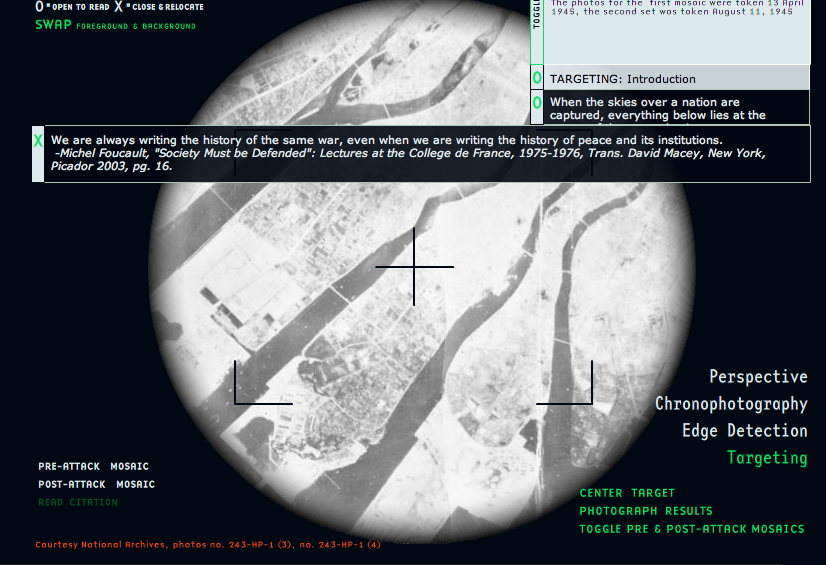
Vectors from USC has reappeared after a (too) long hiatus.  I first encountered Vectors through Caren Kaplan‘s Dead Reckoning project that tracked what she called ‘Aerial Perception and the Social Construction of Targets’.  This was in 2007, when my own interest in targeting and bombing was just kicking in as a reaction to Israel’s war on Lebanon the previous year (see ‘In another time zone…’ in DOWNLOADS).  She introduced the project like this:

‘”Dead reckoning” has a number of different meanings. For many of us, it simply means the ways in which we figure out where we are or what we are aiming at by using the naked eye-it is, then, the first order cultural construct of directional sight. In strictly navigational terms, especially at sea, it refers to the use of measured distances between points to discern longitude. A reckoning is also a form of retribution or punishment as well as a collection of accounts. Many of these meanings come into play in a militarized context where the determination of position enhanced by technology enables the annihilation of enemies. In this piece, Raegan [Kelly, her Vectors programmer and designer] and I came to see this term as the one best suited to describe what we were working through over many discussions. Although many other techniques of sight are involved in this piece, the reckoning of the cultural politics of sight in modernity leads, unfortunately, to state-sponsored death as much as to anything else and, thus, the aptness of the term becomes almost unavoidable.’

Since then Caren has continued to push the boundaries of inquiry and presentation – and the connections between the two – in extraordinarily imaginative ways, constantly circling around what she calls ‘the view from above’: see, for another example, her Precision Targets: GPS and the militarization of everyday life.

The new digital issue of Vectors contains Steve Anderson‘s Technologies of History, which intersects with my still continuing work on bombing and its representations, though its ostensible subject is different. Editor Tara Macpherson on Anderson’s project:

Within the confines of this piece, author Steve Anderson observes, “We should not ask film or video for the truth about the past, but we can look to them for clues, myths, and symptoms of historical fixations.” The project takes as its central object of analysis one of those moments of historical fixation that seems indelibly engrained in the American consciousness, the assassination of John F. Kennedy, Jr. in November, 1963. In exploring multiple mediations of this event, Anderson and designer Erik Loyer repeatedly draw our attention to the textured, layered and unstable nature of both historical representation and historical memory.

This is an argument about the truth claims of media that is instantiated via media, both through the curated collection of media artifacts assembled here and through their formation into a new interactive experience. The assortment of clips runs the gamut from historical footage to televisual re-imaginings to video game reenactments, providing a rich compendium of the tenacity of this moment within the nation’s collective memory. Various tonal registers collide: the somber, the flippant, the intimate, the nostalgic. Disparate visual styles intersect and refract one another. But this argument does not unfold solely at the level of content. The form of the piece also reconfigures and undermines the possibility of a single, authoritative history. As the user engages the piece and assembles these historical fragments into new forms, building her own history along the way, the primacy of any one meaning is collaged away.

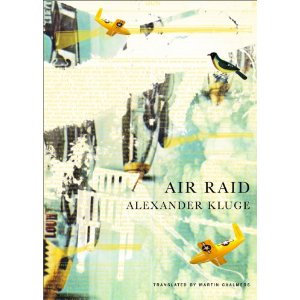
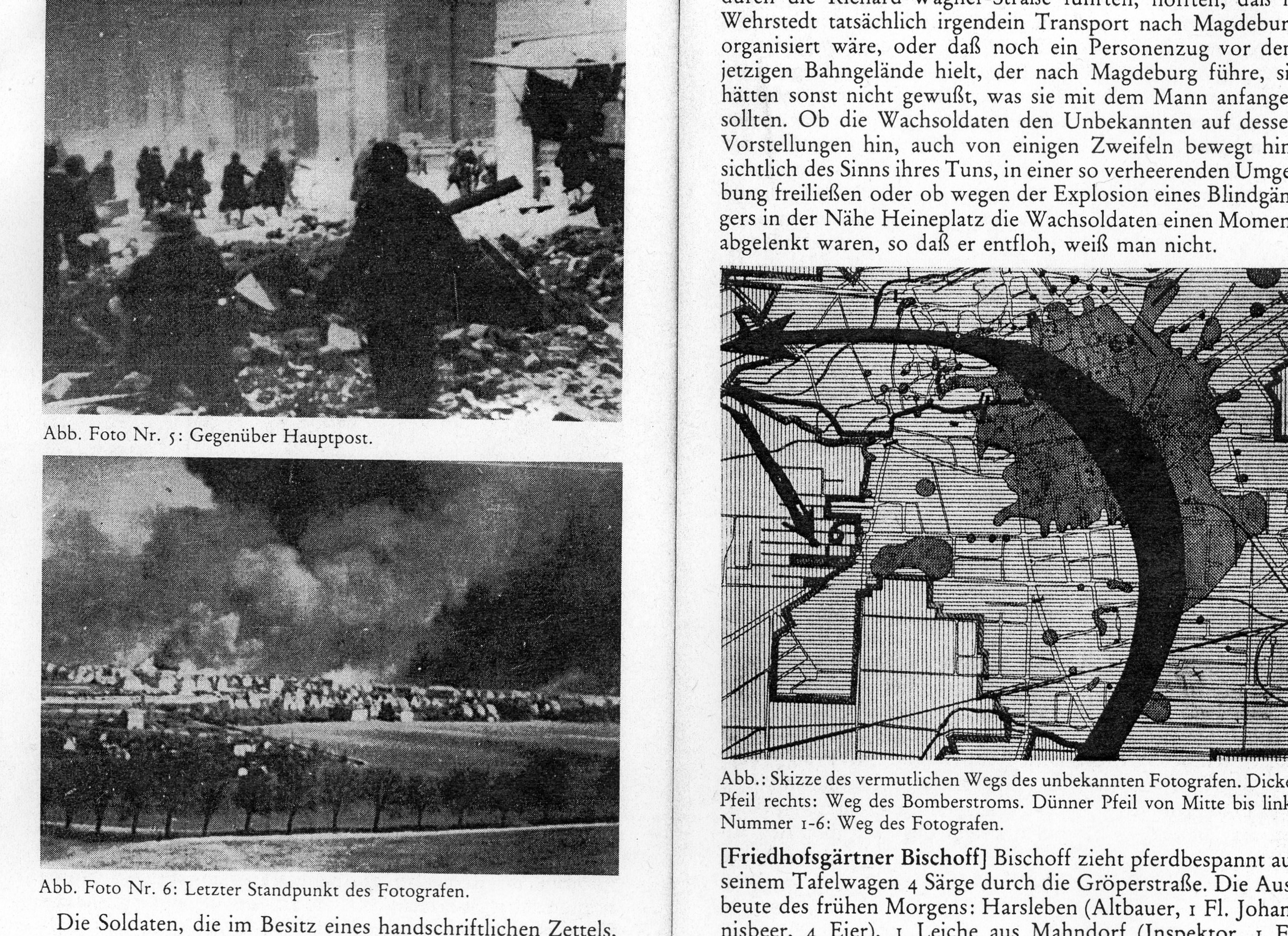
Before the digital era Alexander Kluge had experimented with the collisions of testimony and artefact, and in particular with montage-collage, to convey an American air raid on Halberstadt (his hometown) in 1945 (I drew on this in “Doors into nowhere”). Der Luftangriff auf Halberstadt am 8. April 1945 was first published in German 1977 and has been available in both his Collected Works and as a separate book for some time, but I’m thrilled to discover that an English translation by Martin Chalmers under the title Air Raid is at last due from the University of Chicago Press/Seagull Books in December 2012 with an afterword by the much lamented W.G. Sebald.

Frederic Jameson, in one of the few English-language commentaries on the text, raises a question that speaks directly to Anderson’s project:

“The Bombing of Halberstadt” is another such collage, in which individual experiences, in the form of anecdotes, are set side by side less for their structures as the acts of traditional characters … than as names and destinies, the latter being reduced in many cases to peculiar facts and accidents, of the type of Ripley’s Believe It or Not. The juxtaposition of these anecdotes with quotations from academic studies on the history of bombing and on RAF techniques, from scholarly conferences on the relation between aerial strategy and ethics (“moral bombing” is, for example, specified as a matter, not of morals, but of morale), and from interviews with the allied pilots who participated in this raid—all these materials, which we take to be nonfictional (although they may not be; the interviews in particular bear the distinctive marks of Kluge’s own provocative interview methods), raise the question of the fictionality or nonfictionality of the personal stories of the survivors as well. Halberstadt is, to be sure, Kluge’s hometown, and he is perfectly capable of having assembled a file of testimonies and eyewitness documen- tation and of using the names of real people. On the other hand, these stories, with their rich detail, afford the pleasures of fictional narrative and fictional reading. Is this text (written in the 1970s) a non-fictional novel? I believe that we must think our way back into a situation in which this question makes no sense…’ [‘War and representation’, PMLA 124 (2009) 1532-47]

Perhaps.  But Jameson’s exegesis never grapples with what is also so compelling in Anderson’s project – and, as Kaplan’s work shows, no less avoidable in any discussion of bombing – which is to say Kluge’s determination to confront the multiple visualities involved in, productive of and produced through bombing:

Cyrus Shahan [‘Less then bodies: Cellular knowledge and Alexander Kluge’s “The Air Raid on Halberstadt on 8 April 1945″‘, Germanic Review 85 (2010) 340-58] provides one of the richest discussions of Kluge’s use of montage in ‘Luftangriff’; I can’t convey the artfulness of his argument here – a blog surely isn’t the place to do so! – but here’s an extract that, again, speaks to Anderson’s project too:

‘“The Air Raid on Halberstadt on 8 April 1945” consists of thirty vignettes. The majority are accounts of what the residents of Halberstadt did during the air raid, where they were, what they were thinking, and whether they survived. These stories “from below” are interrupted for a twenty-two-page segment about “Strategy from Above,” a documentary montage of interviews with pilots, images of bomb schematics and flight formations, and pictures of pilots. The documentary aspect of Kluge’s Halberstadt essay and his Neue Geschichten [‘New Histories’] as a whole is a ruse. Rather than lend the text authenticity, Neue Geschichten uses a feigned documentary to debunk the authority of the documentary, to undermine the validity of a singular point of view, and thereby to buttress the usefulness of montage. For Kluge, montage is superior to documentary because it is “the form-world of connectivity.” In other words, while montage creates quasi-unreal perspectives with hyperconnectivity, it simultaneously contains productive political processes in which fractured factual elements articulate within a field of possibilities.’

The invisible war

Kirby Dick’s – and Amy Ziering’s – documentary film The invisible war (2011) recently won the Audience Award at the Sundance Festival and the Nestor Almendros Award at the Human Rights Watch Film Festival.  It documents, in brave detail, the incidence of rape inside the US military.  The film-makers contacted more than 100 victims, men as well as women.  The Department of Defense estimates that there were 19,000 violent sex crimes inside the military in 2010 and 22,800 in 2011; the vast majority go unreported, and of those that are there are few convictions.  Women in combat zones are more likely to be raped than killed by the enemy, but the attacks also take place far from the firing-line: on bases in the continental United States, at barracks in Washington DC.

There are powerful, thoughtful reviews of this film – including essays by Rose Aguilar, David Leonard and Marcia Yerman – and its achievements are substantial.  Gary Trudeau saw The invisible war at a special screening and used a series of Doonesbury cartoons to bring the issue to a wider public, while Rebecca Keegan reports that two days after Secretary of Defense Leon Panetta saw the film he called a press conference ‘to announce new rules on how the Pentagon would handle sex crimes.’

And yet, across all the reviews I’ve read, there’s a strange reluctance to link rape inside the military to the rape by soldiers of enemy combatants and civilians.  There is a substantial literature on rape as a weapon of war – on rape as a systematic strategy – but what I have in mind here is a structural connection between the power and cruelty involved in rape and forms of military violence. This is obviously a differentiated terrain; there was a good roundtable discussion raising a number of important issues in Eurozine in 2009, the same year that Helen Benedict’s searing account of The lonely soldier: the private war of women serving in Iraq appeared.  You can find a video of her talk at Columbia here, and there is also this short interview:

http://www.youtube.com/watch?v=gz75-3DShZU

Among more recent book-length treatments I’d recommend Janie Leatherman’s Sexual violence and armed conflict (Polity, 2011), Part III of Laura Sjoberg and Sandra Via (eds), Gender, war and militarism: feminist perspectives (Praeger, 2010), and a compelling study that makes the connection between ‘inside’ and ‘outside’ military rape that I’m urging here, Gina Marie Weaver’s Ideologies of forgetting: rape in the Vietnam War (SUNY Press, 2010).  Making those connections is one way of making war’s injuries, both there and here, abroad and at home, more visible – and those who perpetrate them more accountable.  Eight years after Abu Ghraib you’d think we’d have made more progress in exploring the relations between military violence and sexual violence.

Three additional notes: 

(1) On Monday, Wednesday and Friday this week (13 through 17 August) YouTube has a new three-part drama series on sexual assault in the US military, Lauren: I found news of this on Stars & Stripes, ‘the US military’s independent news source’….

(2)  Earlier this month al Jazeera hosted a discussion of military ‘cultures of rape’ between Morris Davis, a retired US air force colonel who led the investigation into the sexual abuse scandal at the US Air Force Academy in 2003; Ariana Klay, a former US Marine Officer, who is one of eight current and former military members who have filed a lawsuit alleging they were raped, assaulted, or harassed during their service; and Aaron Belkin, a professor of political science at San Francisco State University and the author of Bring Me Men: Military Masculinity and the Benign Façade of American Empire, 1898-2001.

(3) Belkin’s Bring Me Men (Columbia University Press, 2012) documents male-on-male rape in the US military and en route challenges a number of existing discussions of ‘military masculinity’:  “I argue in Bring Me Men that contradictions that structure warrior masculinity look a lot like contradictions that structure U.S. empire, and that both sets of contradictions get sanitized and swept out of sight at the same moments, often by outcasts (African-Americans, women, gays and lesbians) who portray the military and the empire in noble terms as part of inclusion-seeking strategies.”  You can download the first chapter from Belkin’s own website.


Kilcullen, counterinsurgency and the cultural turn

David Kilcullen‘s role in the development and implementation of US counterinsurgency will be familiar to many readers, and I’ve already noted his subsequent project to drive ‘military humanism’ still deeper into the ‘humanitarian present’.   Here he is at Columbia University’s Hertog Global Strategy Initiative in May 2012 on “The future of conflict and everything else”:

“Everything else” turns out to be a grab-bag geography.   Kilcullen starts by rehearsing Obama’s determination not to embark on major counterinsurgency or large-scale, prolonged ‘stability operations’ [which is how Obama characterises Afghanistan and Iraq], but insists that the sort of ‘overseas contingencies’ in which the US involves itself cannot be reduced to presidential will and that they have, historically, involved regular interlacings of military and civilian intervention.  (In fact, Kilcullen’s Caerus Associates joined with the Center for a New American Security to map US civilian intervention in crises and disasters since the end of the Cold War).

Then he turns to the environment in which the US ‘is likely to be operating’ in the near future. Kilcullen emphasizes the importance of urbanization, ‘littoralization’ (‘a fancy geographer’s term’, apparently) and networking in shaping future conflicts [Olivier Kramsch at Nijmegen takes a bow at 18.04 for – unless I’m mis-hearing – predicting in 2006 the geography of the Arab uprisings].  It’s an extraordinarily schematic and impressionistic set of mappings that recalls the Models in Geography diagrams of the mid-60s.  The master-diagram is copyright (wait until you see it), but you can download the Powerpoint slide here: just scroll down to NIC Blog – Kilcullen.

Now fast forward to 1.03.25: During the Q&A Kilcullen concedes that the criticisms of COIN and in particular the Human Terrain System made by the American Anthropology Association “have been quite justified in a lot of cases”, and that “There’s a clear role for the academy in making sure that people in the military don’t do stupid shit…” (1.04.12).

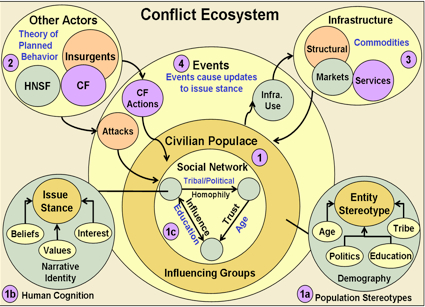
Perhaps they (we) might start by reminding them of the follies of 1960s spatial science.  As Oliver Belcher knows better than me, the US military have become ever more interested in that style of modelling and its successors – if you want a taste, purse your lips and check out the Cultural Geography Model, which is derived from Kilcullen’s earlier construction of a ‘conflict ecosystem’ thus:

The Cultural Geography Model (from Jonathan K. Alt, Leroy Jackson and Stephen Lieberman, ‘The Cultural Geography Model: an agent-based model for analysis of the impact of culture in irregular warfare’