From a kill to a view

Further to my post about Remote Witnessing, Robert Beckhusen at Danger Room reports that Sudan’s President Omar al-Bashir is calling for the African Union to ‘protect’ African space from spy satellites.  Beckhusen suggests that al-Bashir has DigitalGlobe and, more particularly, the Satellite Sentinel Project squarely in his sights.

Using DigitalGlobe’s remote imagery, SSP’s website explains that

the Satellite Sentinel Project can identify chilling warning signs — elevated roads for moving heavy armor, lengthened airstrips for landing attack aircraft, build-ups of troops, tanks, and artillery preparing for invasion — and sound the alarm.

In other cases, SSP has notified the world of heinous crimes that would go otherwise undocumented and unreported. DigitalGlobe imagery supports evidence of alleged mass graves, razed villages, and forced displacement. SSP shines a spotlight on the atrocities committed in Sudan and lets alleged perpetrators know that the world is watching.

SSP‘s reports containing high resolution imagery are available to everyone, from journalists to the International Criminal Court. SSP‘s reports have been used as evidence in the International Crimal Court investigation of recent alleged crimes in Sudan.

One example might indicate the scope of the project. In a report dated 20 July 2012 SSP provided compelling evidence of the deliberate razing of the village of Um Bartumbu in Sudan’s border region.  SSP compared DigitalGlobe imagery from September 2011 and March 2012 (all captions from SSP):

A DigitalGlobe satellite image, taken on September 11, 2011, shows the Sudanese village of Um Bartumbu prior to the village being destroyed by fire. The vegetation around the village (which appears red in the near-infrared imagery) appears healthy and unharmed. The village itself does not appear to be damaged in any way.
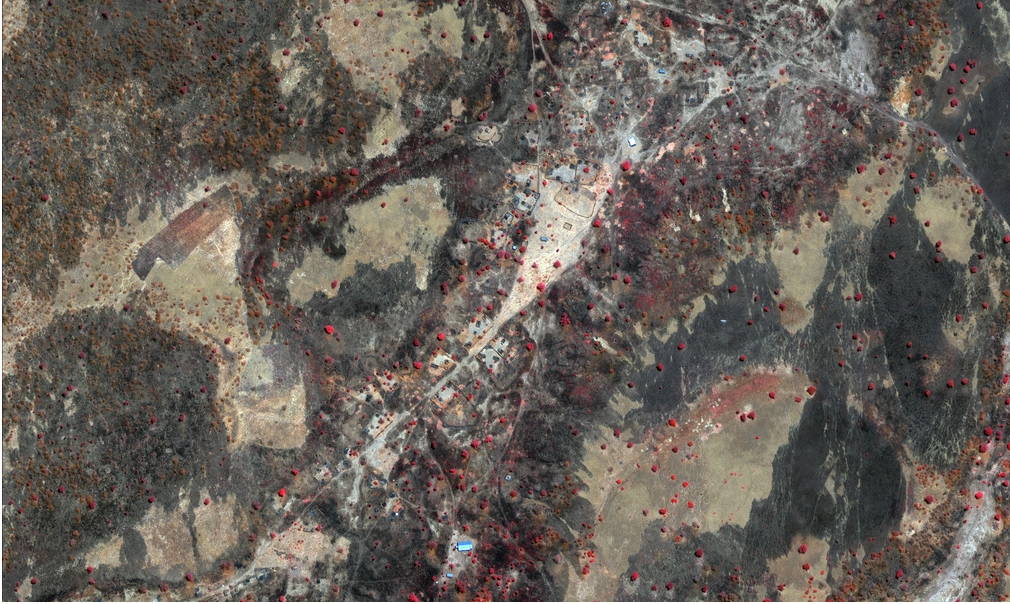
A DigitalGlobe satellite image shows the Sudanese village of Um Bartumbu, after it has been apparently destroyed by fires. A large portion of the vegetation within the village and the surrounding area has sustained extensive fire damage. Evidence of burning extends more than 6 miles (10 km) to the west and south of the village. Although it is clear that the great majority of the village suffered fire damage, satellite imagery alone cannot confirm the destruction of the clinic, mosque, storerooms, grinding mill or church because their metal roofs appear intact.

SSP claimed that its findings corroborate eyewitness reports that a joint unit of Sudan Armed Forces and Popular Defense Force militia razed the village in late 2011:

SSP has obtained new videos and photographs taken by Eyes and Ears Nuba, a team of citizen journalists based in rebel-held territory in the Nuba Mountains. The team traveled to Um Bartumbu with GPS-equipped cameras on June 16, to document evidence of the razing of this village, which sits in a no-man’s-land between opposing forces in Sudan’s ongoing conflict. An Um Bartumbu elder reported that the now-abandoned village had contained 50 homesteads of Muslims and Christians, numbering approximately 250 adults, plus an unspecified number of children.

An undated cell phone video obtained by SSP from Eyes and Ears Nuba, and available on NubaReports.org, shows Sudanese forces who call themselves “Katiba Kabreet,” Sudanese Arabic for “Match Battalion,” setting fire to a village. In the video, Sudanese men fire guns and carry torches as residential compounds burn. Most wear matching uniforms and boots, and are dressed in a manner consistent with Sudan Armed Forces. Some wear mismatched uniforms and tennis shoes, and are dressed in a manner consistent with PDF militia forces.

“Matches, where are the matches? Burn this house,” one soldier commands in Sudanese Arabic.

SSP’s case is made so compelling through its forensic triangulation of the site through satellite imagery, ground imagery and eye-witness reports; for the full suite of satellite and ground imagery, see the collection here.
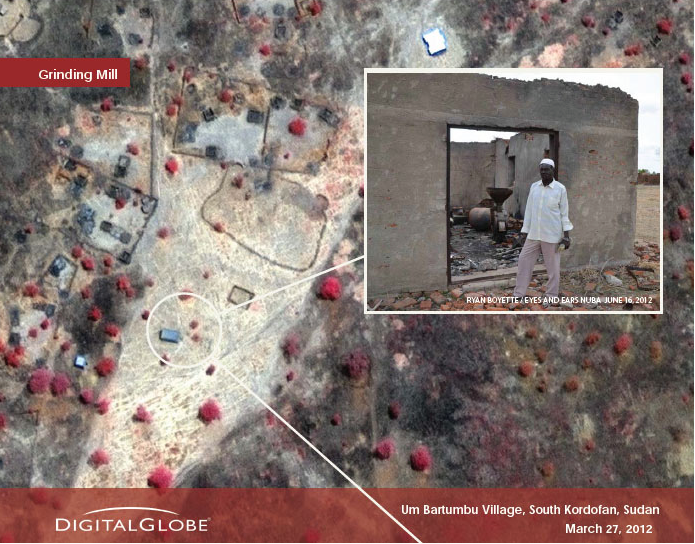
The communal grinding mill in Um Bartumbu, 27 March 2012 (near infrared), 16 June (inset) and 22 January (close up).

SSP links to Eyes and Ears Nuba, which describes itself as ‘a network of citizen reporters dedicated to covering the war along the Nuba Mountains’ where, after fighting broke out in June 2011, the government of Sudan banned journalists from entry. ‘The only witnesses are Nubans’, and for this reason ‘Nuba Reports was founded in order to provide the international community and the people of Sudan with credible and compelling dispatches from the frontlines.’

Witnessing, then, becomes a multi-modal, highly mediated structure of testimony, inference and evidence: always situated, inescapably precarious, and absolutely vital.  And, as I noted in that previous post, it cannot be conducted from remote desk-tops alone.

Note: The Small Arms Survey has a helpful backgrounder on the region here, and for more on the genocide unfolding in the Nuba Mountains see here and here and here.  Nicholas Kristof has also provided a series of anguished reports for the New York Times – for example here– and Brett McDonald’s video of Kristof’s travels is available here.
Saucepans, sources and bombers

Sometimes you’re blind to things close to home…  When I wrote about war and logistics I wasn’t aware of my colleague Matthew Evenden‘s excellent work on the supply of aluminium in the Second World War.  How I missed it I have no idea.

Matthew’s essay, ‘Aluminum, commodity chains and the environmental history of the Second World War’, appeared in Environmental History 16 (2011) 69-93.  Reading it made me realise that Martin van Creveld’s classic account of ‘supplying war’ misses a crucial dimension: the technical transformations of modern war constantly draw new materials (and frequently distant sources) into the supply chain.   Creveld is right to emphasize the importance of what he calls ‘the products of the factory rather than the field’ to modern war, but those products are moving targets in more ways than one.

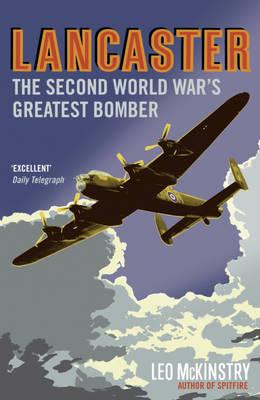
Aluminium provides a brilliant example.  As Matthew says, its strategic importance was tied to the expansion of the air war: aluminium was lightweight, flexible and durable, and an essential component of the new generation of aircraft.  According to Leo McKinstry‘s Lancaster (John Murray, 2009), the production of each Lancaster bomber required nearly ten tons of light aluminium alloy (‘the equivalent of eleven million saucepans’).  The production process was remarkably intricate: each aircraft involved half a million different manufacturing operations spread out over 10 weeks. (For images of production lines in aircraft factories on both sides of the Atlantic, by the way, see the show-stopping series here; as far as I’m aware, there’s no British equivalent to Bill Yenne‘s The American aircraft factory in WWII [Zenith, 2006]).

McKinstry’s equivalence between saucepans and bombers was entirely appropriate.  As the demand for aluminium sky-rocketed, so wartime campaigns to recycle aluminium were started on both sides of the Atlantic: you can hear a satirical radio treatment of “Aluminum for Defense” in the United States, complete with crashing saucepans and “collection parties” (the antecedent of Tupperware parties?), here.  In Britain too saucepans and even milk bottle tops were collected for their aluminium, a campaign that began immediately after the fall of France in 1940.  According to one contemporary report:

‘Although these contributions were to be voluntary, the timing of the appeal, its tone, and the manner in which it was put forward left the impression that the country’s need for scrap aluminum was urgent. As a result, the response from the housewives was immediate and their contributions were reported to be of quite considerable proportions.  Almost as prompt were the criticisms and complaints raised from trade and parliamentary quarters, as well as by some groups of skeptical housewives. Thus many scrap metal merchants became indignant when the appeal was made, calling attention to the tons of scrap in their yards for which they were unable to find a market. To this objection it was pointed out in Parliament that not all aluminum scrap was suitable for use in aircraft production. This limitation was especially true for the scrap held by these dealers, whereas that obtained from household utensils was excellent for this purpose.’

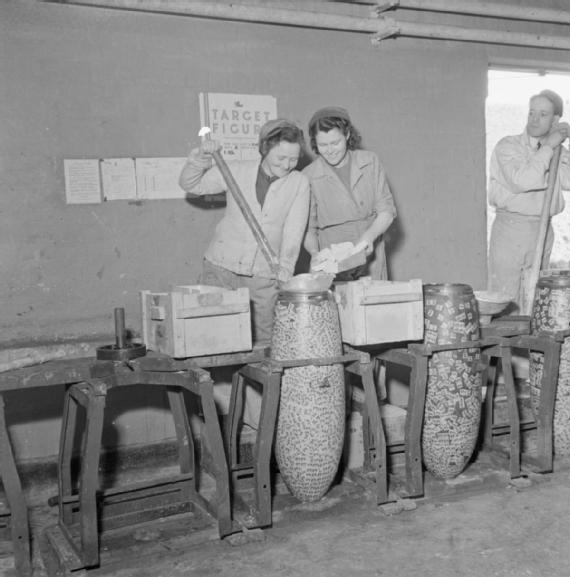
Incidentally, those who yearn for a time when air forces have to raise funds through bake sales might contemplate the “Wings for Victory” campaign, and its enlistment of children to contribute savings stamps for the purchase of new bombers.  When one of these aircraft was exhibited in Trafalgar Square in 1943, children lined up to plaster their stamps all over a thousand-pound bomb.  Here – as in the clarion call for the nation’s saucepans – war becomes domesticated, even homely.  War enters the domestic interior in countless other ways of course – through air raids, conscription, evacuation, and rationing, for example – but the enrollment of everyday objects, like savings stamps and saucepans, contrives to make violence not ‘harmless’ exactly but certainly ordinary, mundane, as this photograph from the Imperial War Museum shows.  Here two women factory workers fill bombs covered in savings stamps in what, to my eyes at any rate, looks like a ghastly parody of cooking; the biggest so-called ‘blockbuster’ bombs were called “cookies”, perhaps not incidentally, and aluminium was a vital component in many explosive mixes too.

Aluminium was needed for aircraft besides the Lancaster:

‘Saucepans into Spitfires’ (Imperial War Museum)

And, given the demand right across the sector, the British had to look further than their doorsteps and kitchens, though surprisingly McKinstry says nothing about this in his otherwise fascinating discussion of the production process (Chapter 12: “At the machines all the time”).  The British government soon realised the need to bring domestic aluminium production under state control, and by the early 1940s an intricate system of Acts, statutory Orders and commercial contracts had extended the security of the supply chain across the Atlantic to Canada (there is an excellent, if dry account in Jules Backman and Leo Fishman, ‘British wartime control of aluminum’, Quarterly Journal of Economics 56 (1) (1941) 18-48, from which I took the previous quotation about domestic recycling).

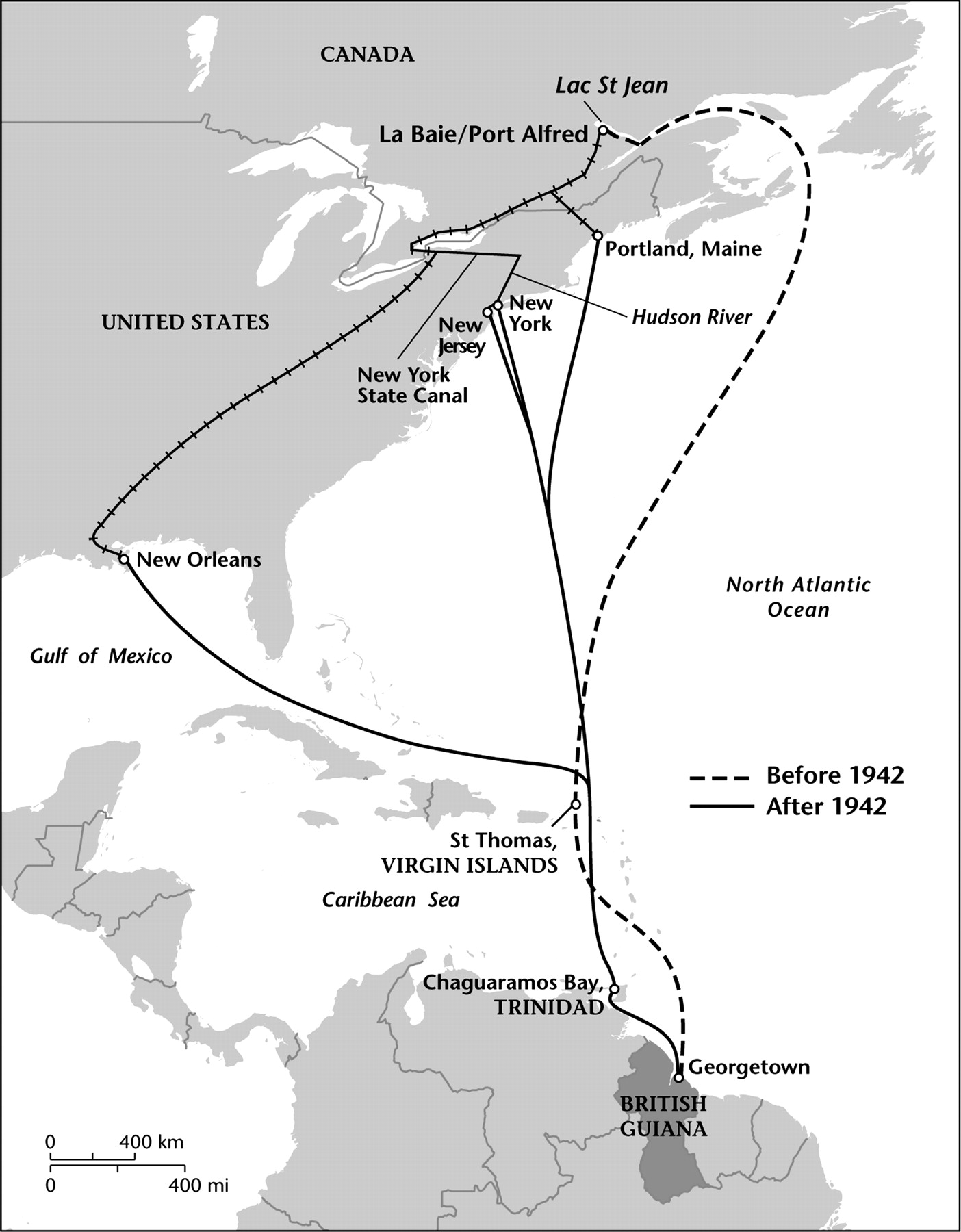
Matthew describes in detail a commodity chain that started in British Guiana (which provided most of the bauxite used in North America’s smelters), and reached across the Caribbean to the eastern seaboard of the United States, where it was transported by rail into Quebec for smelting.  The ingots were then shipped out to rolling mills and fabricating plants in Canada and the United States, across the Pacific to Australia, or across the Atlantic to Britain.  As he emphasises, the chain was militarised at every point, and a primary concern was to secure the supply chain by providing air cover or convoy escorts: the great fear was of a U-Boat attack.  The map below, taken with permission from Matthew’s essay, “reminds us of the unprecedented capacity of the Second World War to gather and scatter materials with untold human and environmental consequences, linking diverse locations with no necessary former connections.”  And here too, as I argued in a previous post, the friction of distance is no simply physical effect: it is shot through with political, economic and strategic calculations.

Not so trivia:  When Sir Charles Portal, Arthur Harris’s predecessor as commander of Bomber Command, retired from the Royal Air Force he became Chair of British Aluminium.  And the roof of the new Memorial for Bomber Command in Green Park is made from aluminium recovered from a Halifax bomber that was shot down over Belgium.

One last note: Matthew’s article is a much richer argument than I’ve conveyed here, and his primary interest is embedding this supply chain in a wider environmental history – so in a future post I want to turn my attention to some of the connections between modern war and ‘nature’…

Visual culture and battles for Algiers

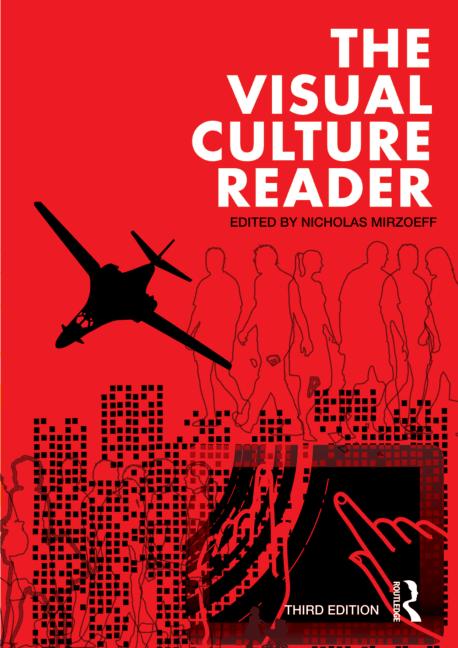
My copy of Nicholas Mirzoeff‘s newly published Visual Culture Reader was waiting for me on my return from Cologne.  It’s the third edition of a classic resource, first compiled ten years ago, and it’s been comprehensively revised, with a number of specially commissioned essays.   You can download some of Nick’s own essays here, including discussions of Abu Ghraib and US counterinsurgency.

Contents:

PART 1 

Expansions

Chapter 1: “There are No Visual Media” W. J. T. Mitchell Chapter 2: “The (In)human condition: A Visual Essay” Ariella Azoulay Chapter 3: “Mapping Non-Conformity: Post-Bubble Urban Strategies” Teddy Cruz Chapter 4: “X-reality: Interview with the Virtual Cannibal” Beth Coleman Chapter 5: “On Software, or the Persistence of Visual Knowledge” Wendy Hui Kyong Chun Chapter 6: “Notes on the Photographic Image” Jacques Rancière Chapter 7: “Queer Faces: Photography and Subcultural Lives” J. Jack Halberstam Chapter 8: “Currents of Worldmaking in Contemporary Art” Terence E. Smith Chapter 9: “Sublimated with Mineral Fury: Prelim Notes on Sounding Pandemonium Asia” Sarat Maharaj Chapter 10: “The Sea and the Land: Biopower and Visuality after Katrina” Nicholas Mirzoeff

PART 2: GLOBALIZATION, WAR AND VISUAL ECONOMY 

War and Violence

Chapter 11: “The Archaeology of Violence: The King’s Head” Zainab Bahrani Chapter 12: “The Actuarial Gaze: from 9-11 to Abu Ghraib” Allen Feldman Chapter 13: “American Military Imaginaries and Iraqi cities” Derek Gregory Chapter 14: “Zeroing In: Overheard Imagery, Infrastructure Ruins, and Datalands in Afghanistan and Iraq” Lisa Parks Chapter 15: “What Greg Roberts Saw: Visuality, Intelligibility, and Sovereignty – 36,000km Over the Equator.” Trevor Paglen Chapter 16: “Media and Martyrdom” Faisal Devji Chapter 17: “Live True Life or Die Trying” Naeem Mohaiemen Attention and Visualizing Economy Chapter 18: “Kino I, Kino World: Notes on the Cinematic Mode of Production” Jonathan L. Beller Chapter 19: “On Virtuosity” Paolo Virno Chapter 20: “Faking Globalization” Ackbar Abbas Chapter 21: “Creativity and the Problem of Free Labor” Andrew Ross Chapter 22: “It’s easier to imagine the end of the world than the end of capitalism” Mark Fisher Chapter 23: “Do It Yourself Geo-Politics” Brian Holmes

PART 3: THE BODY, COLONIALITY AND VISUALITY

Bodies and Minds

Chapter 24: “Optics” René Descartes Chapter 25: “Blindness and Visual Culture: An Eye-Witness Account” Georgina Kleege Chapter 26: “Reduplicative Desires” Carol Mavor Chapter 27: “The Persistence of Vision” Donna Haraway Chapter 28: “The body and/in representation” Amelia Jones Chapter 29: “Mami Wata: A Transoceanic Water Spirit of Global Modernity” Henry Drewal Histories and Memories Chapter 30: “The Mobilized and Virtual Gaze in Modernity: Flâneur/Flâneuse” Anne Friedberg Chapter 31: “Tourism and Sacred Ground: The Space of Ground Zero” Marita Sturken Chapter 32: “Maps, Mother/Goddesses and Martyrdom in Modern India” Sumathi Ramaswamy Chapter 33: “Museums in Late Democracies” Dipesh Chakrabarty Chapter 34: “The Fact of Blackness” Frantz Fanon Chapter 35: “The Case of Blackness” Fred Moten (Post/De/Neo)Colonial Visualities Chapter 36: “Orientalism and the Exhibitionary Order” Timothy Mitchell Chapter 37: “The Colonial Harem” Malek Alloula Chapter 38: “Vodun Art, Social History and the Slave Trade” Suzanne Preston Blier Chapter 39: “Between Cult and Culture: Bamiyan, Islamic Iconoclasm and the Museum,” Finbarr Barry Flood Chapter 40: “The Postcolonial Constellation: Contemporary Art in a State of Permanent Transition.” Okwui Enwezor Chapter 41: “Urban Warfare: Walking Through Walls” Eyal Weizman

PART 4: MEDIA AND MEDIATIONS

Chapter 42: “U.S. Operating Systems at Midcentury: The Intertwining of Race and UNIX” Tara McPherson Chapter 43: “Rethinking the Digital Age” Faye Ginsburg Chapter 44: “The Unworkable Interface” Alex Galloway Chapter 45: “On the Superiority of the Analog” Brian Massumi Chapter 46: “Race 2.0: Neoliberal Colorblindness in the Age of Participatory Media” Lisa Nakamura Chapter 47: “Imagination, Multimodality and Embodied Interaction: A Discussion of Sound and Movement in Two Cases of Laboratory and Clinical Magnetic Resonance Imaging” Lisa Cartwright and Morana Alac

In human geography – and beyond – the go-to site for matters visual is Gillian Rose‘s visual/method/culture, and her excellent Visual methodologies: an introduction to researching with visual materials (Sage, 2011) is already in its third edition too.

But Nick’s work also speaks directly to geography (at least with a little g, which is the sort I prefer).  Readers probably already know his most recent book, The Right to Look: a counterhistory of visuality (Duke, 2011), but this summer he produced a remarkable ‘digital extension’ of one of its chapters in conjunction with the Alliance for Networking Visual Culture called “We are all children of Algeria”: visuality and countervisuality 1954-2011 that plays with the idea of what I suppose we could call ‘spatial stories’.

In a revealing interview Nick explains why he chose to use a new open access authoring platform – Scalar – rather than his blog:

Blogging is a format that expands how it’s possible to write and think in relation to the contemporary. It makes a form over time. Scalar allows me to share a wide range of North African and European cinema, newsreel footage, guerrilla documentary and photography with the reader in a way that is obviously not possible in print.  Unlike a blog, or at least one using an off-the shelf template, I have a great deal of freedom as to the look, layout and design of each “page,” which can vary from one to the next.  More than that, it allows me to explore a more complex form of narrative in which multiple threads (or “paths” as Scalar calls them) can be developed. This opens up a new set of possibilities for comparative and cross-cultural work that have only just begun to explore in digital humanities work but which I think are among its most fruitful possibilities.

Much to think about there for me: as I noted in a previous post on Targeting and technologies of history, I’m really drawn to the visual experimentations taking place at USC – like Vectors, which showcased some of Caren Kaplan‘s work and which was also involved in Nick’s collaboration.

In “We are all children of Algeria”, then, Nick uses the metaphor of the march to tell a story about revolution and decolonization in Algeria from the outbreak of the revolution in 1954, and to illuminate affinities and connections between the post-war revolutions and the Arab uprisings that began in December 2010.

There is a march! A demonstration as they say in England, a manifestation in French. The Arabic is مسيرة. What is it? It is a means to put our bodies in space, where they are not intended to be and to make a claim. It moves, it demonstrates, it shows: it is militant research…

It asks: how can we “see” Algeria, its decolonization and revolution? Following the lead of Frantz Fanon, it takes the point of view of the child, meaning both children as such, the colonized “child” of  the parent nation, and the “infant” revolution that emerged. 

The Zapatistas say that everything they do is “walking,” a journey that has no final destination. This walking is done here by means of text, media and to-camera videos. This format, allowing as it does for a set of intersecting and interfacing threads to compose the whole, is better suited to reclaiming and exploring these histories than the linear text-based narrative.

So it is both a story about Algeria as such and a way to understand the interface of decolonization and globalization. Whether or not you work “on” or about Algeria, there is an “Algeria” in your work, meaning that there is a place where the incomplete or failed processes of decolonization and the formation of independent developing-world nations intersect with the power of financial globalization. We need to occupy that place, not erase it.
And, yes, Pontecorvo’s Battle for Algiers has a pivotal place in the march (page 5 of the Main Route).

Media, war and conflict

From the always interesting Geopolitics and security at Royal Holloway:

Media, war and conflict Fifth Anniversary Conference at Royal Holloway, University of London, 11-12 April 2013.

Papers are invited on a range of topics, including:

  • Contemporary and historical war reporting
  • Changing forms of credibility, legitimacy and authority
  • Media ethics in the coverage of conflict
  • The role of citizen-users and social media in conflict
  • Terrorism, media and publics
  • Intelligence operations and media
  • Digital and cyber warfare
  • Media and conflict prevention, peacekeeping and post-conflict scenarios
  • Photo and video journalism in wartime
  • War and conflict in popular culture
  • The power of the visual and other modalities
  • Commemoration and memorialisation of war and conflict

The conference is open to scholars, journalists, military practitioners and activists from around the world.

Abstracts (250 words) to Lisa.Dacunha@rhul.ac.uk by 10 October 2012.

Incidentally, for more on media, war and conflict see (even join) the War and Media Network, whose site has links to the journal and a host of other resources, together with a clutch of reviews of books, films and conferences.

The Age of Irony

Those who thought that the toppling of the Twin Towers spelled the end of irony need to follow Hillary Clinton.  Here she is in New Delhi on 19 July 2011:


No, not those bombing suspects.  Now she’s in Jakarta – this from Matthew Lee at Associated Press, 3 September 2012:

Clinton decries violence in northwestern Pakistan

No, not that violence either.

Loco/Motion

The Nineteenth Century Studies Association is meeting in Fresno, California, 7-9 March 2013, and the theme is Loco/Motion:

The long nineteenth century set the world on the move. Travel became increasingly important for business and pleasure, for war and peace. At the same time, new forms of moving people arose: the balloon, ships, undergrounds, funiculars, the railroads. Each carried riders to great distances, different locales, and novel pursuits. But motion wasn’t purely spatial; new movements arose as well, sweeping the inhabitants of the period into fresh vistas of thought and endeavor. We seek papers and panels that capture the sense of movement at work and at play during the long nineteenth century (1789-1914). Papers may address the intersections of movement/s, focus on technologies of motion in isolation, or reveal the desires—for gain, glory, greed—that set the world on its feet.

Note the second sentence, which speaks directly to some of the nineteenth-century themes I’ve sketched in previous posts on War and distance (and to much more, of course).

If you are interested, please e-mail an abstract (250 words) for a 20-minute paper including your name and the paper title in the heading, as well as a one-page cv, to Professor Toni Wein at
NCSA-2013@sbcglobal.net by 30 September 2012. Please note that submission of a proposal indicates intent to present.

Presenters will be notified in November 2012. Graduate students whose proposals are accepted may then submit complete papers in competition for a travel grant to help cover transportation and lodging expenses.

Happy New Year

The new term starts today, and while I’m determined to hang on to summer as long as I can – even as I feel it slipping between my fingers – there is something perfectly wonderful about starting a new year in September.  When I was in Cambridge there was something even more wonderful about starting in October, but either way I much prefer it to January when most (I originally wrote “normal”) people have to start their year.  At least it’s warm, even in Vancouver, there are still sunny days to linger over, the soft light is still there in the evening, and people are still relaxed enough to have time to talk.

I’ve been teaching full-time since I was 22, and honestly still enjoy it – particularly when I see the enthusiasm (mixed with trepidation) on the bright faces of new undergraduates and graduate students (I enjoy working with graduate students very much, but I prefer teaching undergraduate courses and, to be honest, I’m still unpersuaded of the value of graduate ones).

I’m teaching two third-year undergraduate courses this term, each one twice a week: Cities, space and power, which is a quirky historical geography of urbanization, and Theory and practice in human geography, which is an even quirkier attempt to combine what is usually (and I think mistakenly) taught separately, the history and the philosophy of human geography (what is sometimes called “Geographical Thought”: yuk).  If you’re interested you can download the course outlines and readings under the TEACHING tab.

I don’t use textbooks for either.  In fact I’ve never taught from one.  I don’t see the point: if a textbook covered the same ground why would I need to lecture?  I can see the need for reference books, not surprisingly, and in literature-based courses you obviously have to work with the texts.  I know too that there are subjects where there is such a premium on learning “the facts” that a textbook is indispensable.  I should say that my courses aren’t flights of fancy, but for me the trick is to show students that it’s about so much more than “the facts” – the crucial thing is what you do with all the information, the sense that “I never realised they were connected” or “I hadn’t seen it like that before”.  That’s why the two of the most important things to learn at university – I’m serious – are reading and writing: the ability to read sensitively, constructively, critically, and the ability to write rather than cut and paste.  And that’s not confined to courses in the Department of English.

No doubt all this is a hangover from my Cambridge days, when the formal teaching load was very light but  you were expected to develop your own reflections, ideas and research not just parrot other peoples’.   That teaching style seems to work just as well at UBC but, just as relevant, textbooks are inordinately expensive.  Students are already shouldering enough debt – I find it quite shocking that so many graduates of my own generation, in the UK at least, who paid no fees and were eligible for grants of various kinds, should so readily impose burdens on young people that they never had to endure themselves.  I’ve never been inspired by a textbook, but given the new ones pumped out each year by academic publishers I’m obviously in a minority.

This is all made more difficult than it should be by the absurdly large number of courses undergraduates are required to take in North American universities.  Since so many of them are also working their way through college (I still stumble over calling it “school”),  it’s often difficult for even the most dedicated to find time to read carefully and thoughtfully.  The result is that, much of the time, they necessarily resort to “skim-memorise-repeat” – a practice facilitated by textbooks with their high school parade of boxes and quizzes – so that we end up instilling a culture of coping rather than nurturing a properly critical intellectual culture.

Things are no better when it comes to helping students learn to write.  I grade my courses using a combination of written examination (essays not multiple choice) and term papers.  One of the wonderful things about the highly privileged Cambridge system was that students wrote essays each week that were discussed in small groups (“supervisions”) with faculty or graduate students, and – since no marks were given – they  were free to make mistakes, and to learn from them (and one another).  It made learning a properly collaborative not competitive venture.  And the supervisions were genuine occasions for experimentation: there was no centralised roster of topics, no approved reading lists, and our inquiries were set free from the constraints of any syllabus.  But it was, and presumably remains, an intensive process, and the course-loads here ensure that faculty and students alike are constantly pressed for time.

Shoe Factory

Shoe Factory (Photo credit: stevegarfield)

I do understand that this is no different from the rest of the workaday world, but universities ought to be places where we also learn to slow down – not only to enjoy that soft, late summer light but to feel ourselves think.  That’s increasingly difficult in the corporate university where, for all its slogans and marketing campaigns – UBC once had the truly dire “Think about it!” plastered on baseball caps – efficiency and effectiveness are measured by numbers.  That in its turn is part of a comprehensive withdrawal of trust.  Our contemporary audit culture places such a premium on accountancy – not the same thing as accountability – that everything must be tabulated and minuted.  I’m sure that universities can learn from the commercial world, and vice versa, but we might try to learn the right things from the right companies while insisting that there are also vital respects in which a university isn’t a shoe factory.

Ah me: I started out saying how much I was looking forward to all this…..

But I am.  Really.

Learning to eat soup with a silver spoon

John Nagl,  one of the principal architects of the revised US counterinsurgency strategy – and the author of Learning to eat soup with a knife: counterinsurgency lessons from Malaya and Vietnam (the title is a riff on T.E. Lawrence) – retired from the US Army in 2008 and became a Fellow at the Center for a New American Security, and its President in 2009.  In January 2012 he was elected to the Minerva Chair at the US Naval Academy.  There are more than a dozen of these Minerva Chairs: Montgomery “Mitzie” (sic) McFate, another advocate-publicist of the ‘cultural turn’ in counterinsurgency, holds one at the Naval War College.   But it’s now been announced that from July 2013 Nagl will be stepping down (or up) to become the ninth headmaster of Haverford, an exclusive prep school in Philadelphia that “prepares boys for life”.

None of this would matter very much, except that some commentators see in this the final nail in the coffin of counterinsurgency (COIN).  Over at the American Conservative, Kelley Beaucar Vlahos claims that ‘there is no better symbol for the dramatic failure of COIN, the fading of the COINdinistas and the loss that is U.S war policy in Afghanistan’ than Nagl’s move to Haverford.

Vlahos contributes to Fox ‘News’ and to antiwar.com, and her ability to walk on both sides of the street gives her an interesting perspective on counterinsurgency and the Center for a New American Security.  Three years ago she quoted – with evident approval – one retired colonel: “You will hear the same things at the Center for a New American Security as you will at the American Enterprise Institute. Nation-building at gunpoint, democracy at gunpoint. What’s the difference?”  And she concluded:

‘COIN has yet to be fully tested or even legitimated by any success outside of the [Iraq] surge narrative. So while one well-connected think tank gets top billing in Washington, the people of Iraq and Afghanistan — as well as the American men and women serving dutifully there — remain “long-term” guinea pigs. If it doesn’t work, an office on Pennsylvania Avenue might shut, but the implications for the world could be catastrophic.’

Certainly Obama has little appetite for future counterinsurgency campaigns.  He’s made his preference for a mix of covert-ish drone strikes, special forces operations and cyberwar perfectly clear: war by any other name.

But the revision of Army FM 3.24 – the new COIN Bible issued in 2006 (Nagl wrote an extended foreword for the University of Chicago Press edition) – has been under way since the end of last year.  And the US Army Combined Arms Center is no less clear on its aspirations:  ‘Simply put, the revised FM 3-24, informed by the many lessons learned after a decade of sustained land combat operations, will allow US ground forces to continue to address irregular threats in an uncertain future.’  You can download some of the preliminary briefing papers here – including notes on “Clear-Hold-Build” – and, if you’re so inclined, submit your own reflections through a questionnaire.  The process is to be completed by August 2013, and there have already been two conferences at Fort Leavenworth to discuss the revisions.

So the game is far from over, and while Ms Vlahos may be right,  I’m not convinced that the Pentagon is ready to put away these particular knives.  Or that the soup will be any easier to eat.

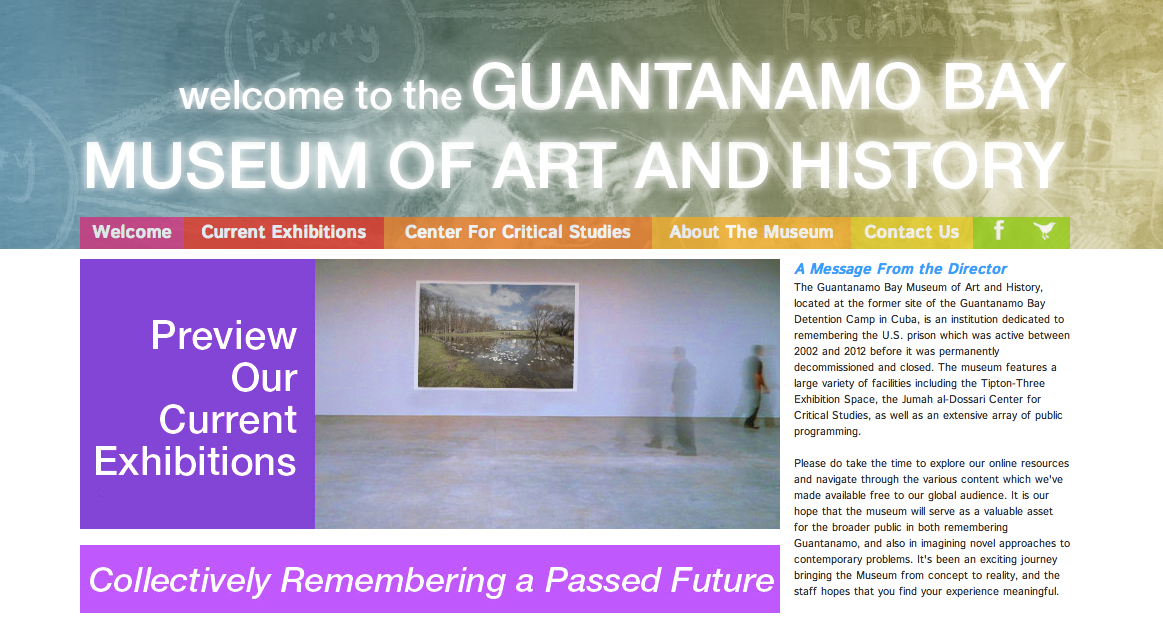
The Guantanamo Bay Museum of Art and History

While I was in Cologne I had an e-mail from Ian Paul, an artist/theorist in San Francisco who works around issues of border violence and post-national human rights.  He wanted to include my essay “The Black Flag” in an online project on Guantanamo Bay:

“The Guantanamo Bay Museum of Art and History is a project which hopes to bring together artists and writers from around the world to examine the current conditions of the Guantanamo Bay Prison as well as the possibility of its closure.  The project takes the form of a ‘speculative present’, and posits that the prison itself has been closed and has been replaced by a museum that features exhibitions and public programs which document/interrogate/examine the history of the prison. The project seeks to draw a transnational/transdisciplinary group together to critique the prison, and artists/theorists from 5 different countries have already agreed to participate.”

The Guantanamo Bay Museum of Art and History  has now opened its virtual doors here.  Well worth a visit. (It’s also on Facebook).

Current Exhibitions includes a specially commissioned video montage by Adam Harms, “Performing the Torture List”, while  the Jumah al-Dossari Center for Critical Studies includes “The Black Flag” and contributions from Judith Butler, Martin Puchner, Harsha Walia (and more to come).

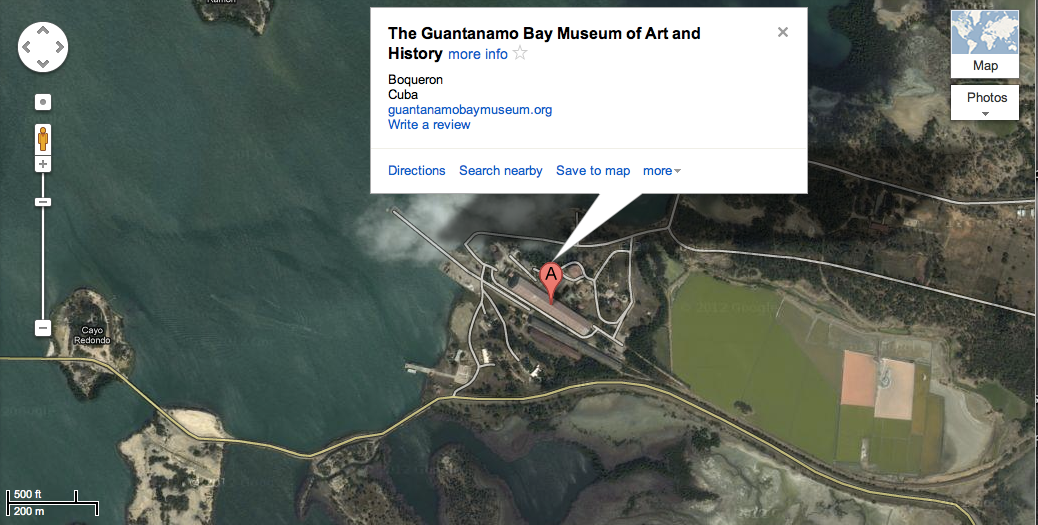
As I say, worth a visit.  As Alexis Madrigal at the Atlantic blog notes, you can find the Museum on Google maps (really) –

– and he’s captivated by the conceit:

The imaginary museum draws its power from this resonance: If Gitmo exists because of one fiction, perhaps it can be closed by another? Or put another (augmented) way, germane to this digital project: if we change Gitmo’s website, can it actually change its physical and legal reality? That’s what the museum’s organizers are hoping. 

“The museum is the result of a collaboration between artists/theorists and is meant to act as both a critique of the Guantanamo Bay Detention Facility as well as assert the possibility of its closure,” Rene Guerne, one of its organizers, told me in an email. “In this sense, it is a ‘real’ museum, although I cannot promise that there is a physical building in Guantanamo Bay.”

Benjamin Wittes at Lawfare is also intrigued by the project, and published the artists’ opening statement:

On August 29th, 2012, the website of the Guantanamo Bay Museum of Art and History was publicly launched. Designed by a group of artists from around the globe, the project creates a ‘speculative present’ in which the Guantanamo Bay Detention Facilities have been closed and replaced by an art museum whose purpose is to reflect on the history of the site.

The museum was listed as an official place on google maps ( http://goo.gl/tg72v ) and features original artworks from 6 different contemporary artists, as well as essays on Guantanamo Bay from leading contemporary scholars including Judith Butler and Derek Gregory.

Ian Alan Paul, an artist from San Francisco who coordinated and curated the project, states:

“The purpose of the project is both to explore the human rights abuses that occurred and continue to occur in Guantanamo Bay, but also to provide a space for radical imagination and potential openings and to insist that it is both possible and necessary to close the prison facility.”

The project was the result of large collaboration, with over 25 artists, writers and other volunteers contributing to the project in some way from Europe, North America and South America. Visitors to the museum were invited to plan their trip to Guantanamo Bay, become a member of the museum, apply to be an artist in residence, as well as read about the history of the museum itself.

There were over 3000 visits to the museum on the first day from 42 different countries.

In January 2009, interestingly, Florence Waters – anticipating Obama’s closure of the war prison (I wonder if she still does?) – proposed the creation of a (physical) museum on the site:

Transforming what will become an important site of memory into a museum could be an opportunity to present the facts from multiple points of view and give the subject transparency. Guantanamo detainees and guards would have the opportunity to present their stories alongside one another.

America has led the way in the post-modern world in erecting museums and sites of memory. They serve not only as burial sites of the past but also to affirm the symbolic order of a society, and head warnings to future generations…. Guantanamo Bay Museum would be a cultural and historical showcase dedicated to reinstating America’s most important values, liberty and justice, giving the detainees fair trial in the eyes of the outside world.

If only.  There are, incidentally, several other virtual Guantanamo Bays.  It was one of the founding sites for Mathias Judd and Christoph Wachter‘s  Zone Interdite, and Nonny de la Peña and Peggy Weil created a virtual Gitmo in Second Life (and, ironically, had to launch a campaign to keep Gitmo – their Gitmo – open!).

As the matchless Bryan Finoki put it on the much missed Subtopia, ‘the field guide to military urbanism’ (and still up even though Bryan stopped posting there early this year), referring to and then riffing off Zone Interdite,

 I love the idea of revealing these off-limit places this way, in a sense, de-restricting them in the process of remaking them. Altogether, rendering a de-restricted global fortress. 

What starts off as a few models of detention centers and prison camps could eventually turn into a full on game-world atlas of forbidden cities; a Borgesian labyrinth of illegal walkthroughs and blatantly trespassed border-zones, subverted checkpoints, oblique tunnel architecture, web tourists lost in the intersecting planes of bunker complexity and secret baseworld archipelago urbanism. It becomes a backlash taxonomy of exposed military installations. A virtual military-industrial-complex: “clandestinatopia.” Border fences and security walls give way now to a deterritorialized map of exploratory landscapes, overrun by mad gamers and tribes of sim-squatters preserving the world’s most closed and hidden places as endlessly wandering open space. Like a Subtopianinvoluntary park online, or a virtual spelunker’s paradise. 

So, yeah, I hope to see you there.

And as Bryan reminds us, there are many more black flags to fly over many more prisons and camps all over the world.

Logistics and the fortunes of war in Afghanistan

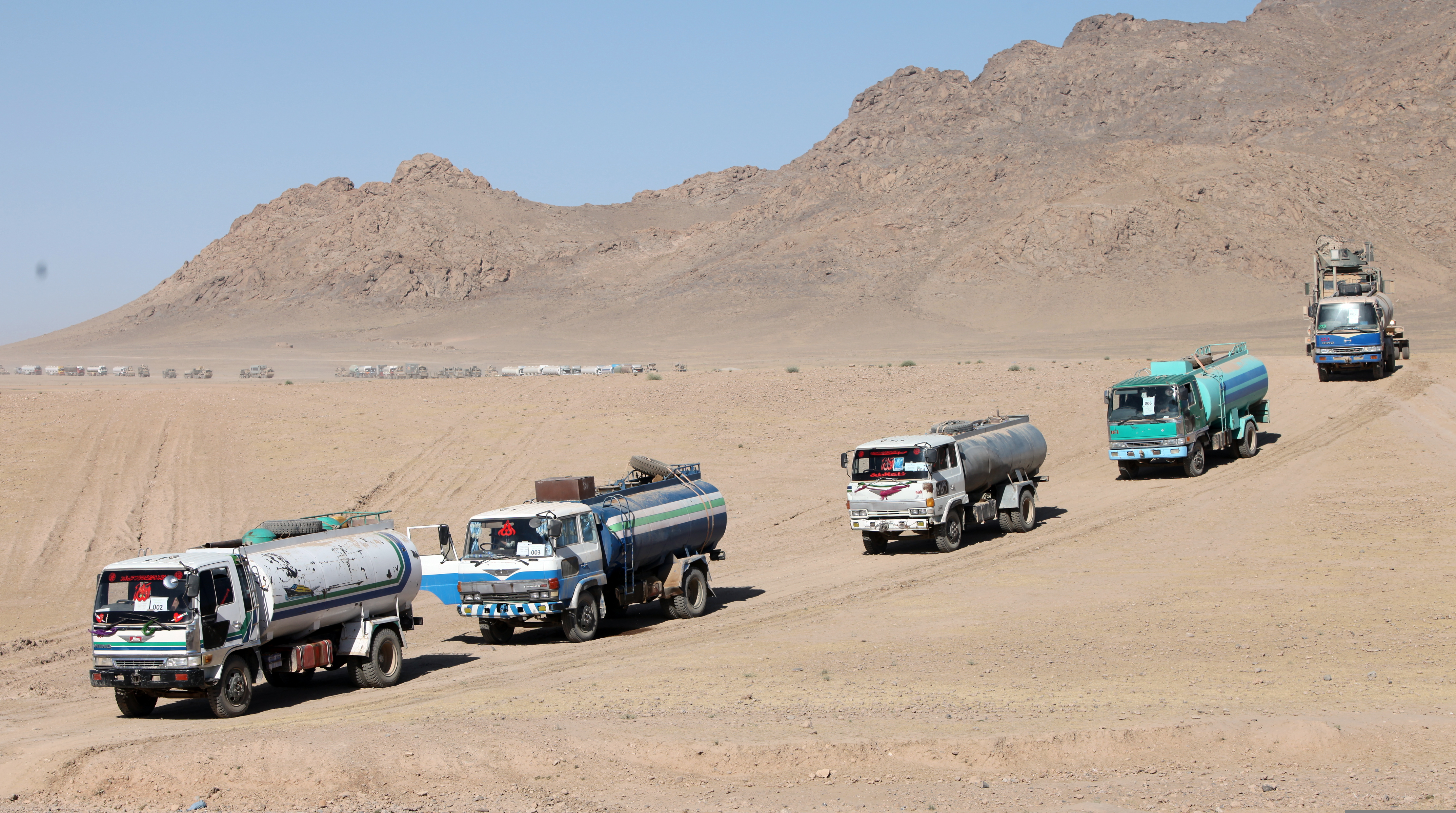
More on post-Host Nation Trucking in Afghanistan from “Mohammad Jawad” in Kabul.  Reporting for Afghanistan Today, Jawad notes that by the middle of 2012 3,515 logistics companies had been registered with the Afghan Investment Support Agency, but this has not brought an end to the monopolies and insider-dealing of the old contracts: ‘Most contracts at the giant US base at Bagram go to a handful of companies, including one run by a former interior minister.’  A primary focus of their operations continues to be supplying fuel to the military:

‘The amount of fuel needed to power the war machine is vast and it now mainly arrives at Hairatan from Uzbekistan by train in 60-ton or 110-ton wagons. “The amounts arriving at night differ, but usually it is 70 to 100 wagons coming for ISAF but only 30 to 35 wagons for civilian use,” said an Afghan oil trader at the port.  A 16-ton tanker load of fuel moved from Hairatan to Jalalabad for civilian clients earns hauliers 700-800 US dollars, according to insiders. But ISAF pays up to 220 dollars per ton, meaning the same load earns contractors around 3,500 dollars if delivered for the military.’

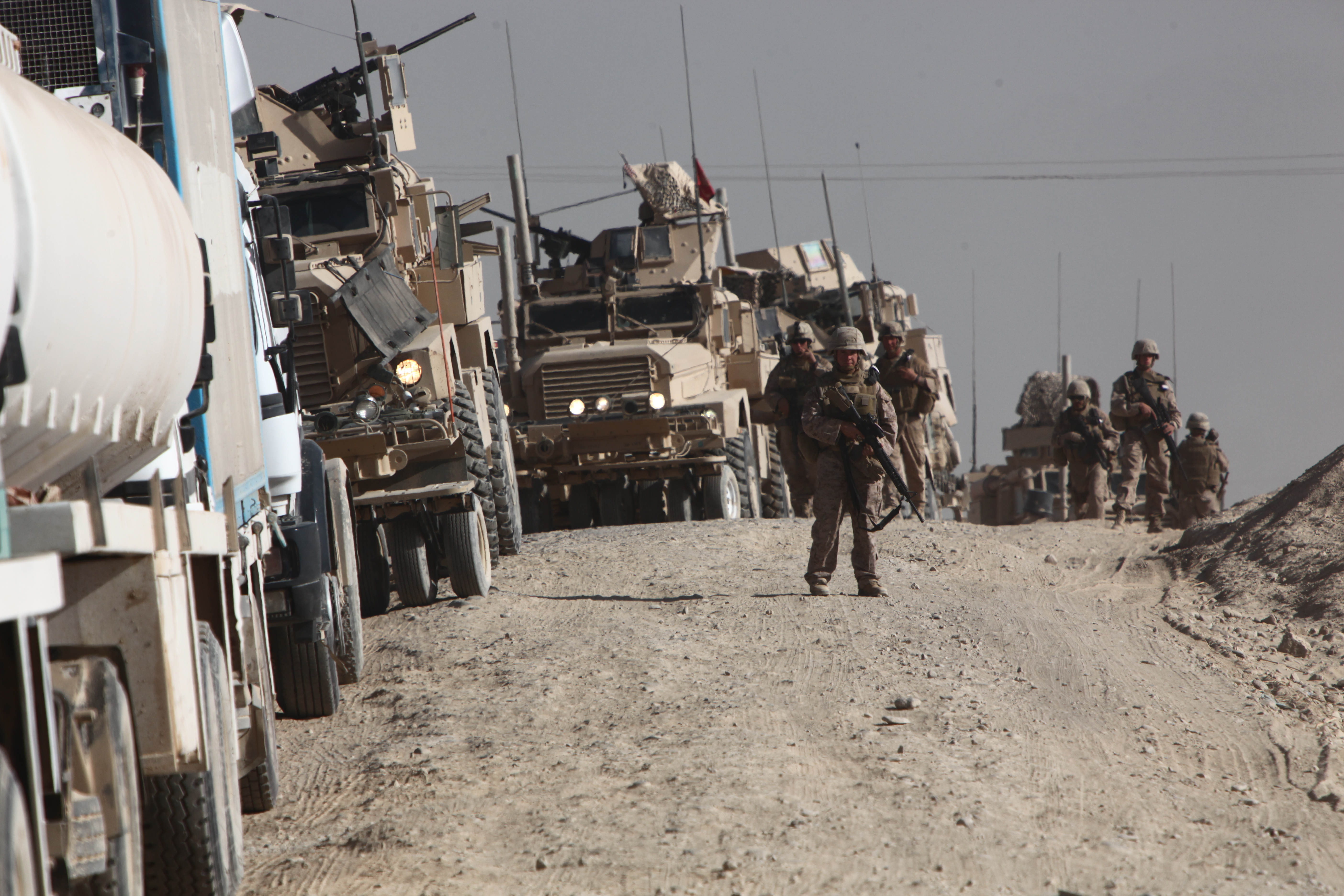
For ‘sensitive supplies’ (including fuel) in particularly dangerous areas like Helmand the US military provides an escort:

US Marines escort 35 Afghan trucks through northern Helmand, July 2011 [US Department of Defense/Sgt Rachael Moore]

US Marines escort a fuel convoy outside FOB Edinburgh, Helmand, September 2011 [US Department of Defense/Cpl Michael Augusto]

But security for much of the supply chain continues to be privatized.  Jawad again:

‘”There is no single approach for securing convoys, it varies,” said a company owner. “In some secure areas, no one is paid protection money because companies have shareholders and allies who are warlords, which ensures the convoys safely reach their destinations. In other areas, people use private security companies that have links with the Taliban, and they pay them not to touch the loads.”

The re-opening of the Pakistan Ground Lines of Communication has been uneven.  Border crossings into Afghanistan were closed to NATO convoys in November 2011 and re-opened on 5 July 2012 –  but the Torkham Gate at the Khyber Pass closed again on 24 July after an insurgent attack killed one driver and injured another.   Trans-border shipments were resumed a fortnight later (on 5 August) under paramilitary escort.  Cargoes are supposed to be restricted to non-lethal supplies, and trucks crossing at Torkham were inspected to ensure that they carried no weapons. Even so, now that the border has re-opened the black market in arms and other military supplies is picking up.  An arms dealer from Quetta told Amir Laatif that business had really suffered during the closure, “But, thank God, things have been settled down, and we are going to reactivate our business.”   Although prices shot up during the closure, dealers had little stock on hand, but now they believe “Good days are back.”

Yet many of the black-market US-made weapons circulating in Pakistan have crossed the other way: intelligence sources estimate that more than 70 per cent originate from Afghan smugglers who buy them from soldiers in the Afghan National Army or members of the Afghan National Police.

And soon NATO supplies will be flowing the other way too.  Much of logistics planning by the military is now geared towards reverse-engineering the supply chain as the draw-down of NATO forces accelerates.  Working from what they call the Reset Playbook, Graham Bowley reports the Pentagon reckons it ‘will have to wrangle 100,000 shipping containers of material and 45,000 to 50,000 vehicles like tanks and Humvees from all across Afghanistan.’  There have already been complaints from front-line troops that the roll-back is disrupting combat operations. Rob Taylor for Reuters quotes one officer: “It’s a nightmare. We barely have enough guys to cover our area, let alone get ready to pack up.”  For that reason it is possible – in fact likely – that in the short term more troops will be sent to Afghanistan to clean, pack and ship equipment back.  But they also plan to ship all weapons, ammunition and other ‘sensitive equipment’ out by air, so the arms dealers may yet be disappointed .