
Drones and the Quiet Americans

quiet-disposition

Following on from the Coded Conduct exhibition in London in April, James Bridle’s new work A Quiet Disposition opens at the Corcoran in Washington DC later this month, running from 19 June to 7 July.  He explains the background to his ongoing project on networked technologies and the in/visibility of military violence like this (my emphases):

“The Disposition Matrix” is the term used by the US Government for its intelligence-gathering and targetting processes. Overseen by the National Counterterrorism Center and in development for some time, the Matrix is usually described as a database for generating capture and “kill lists”, but the criteria for both adding to and acting on the information in the database is not public. One of the outcomes of the process is the ongoing, undeclared CIA drone war in Pakistan, Yemen and elsewhere. These attacks have killed an estimated 3105 people in Pakistan alone since June 2004, including 535 confirmed civilians and 175 children. (Sources: The Bureau of Investigative Journalism, New America Foundation.)

The architectural theorist Keller Easterling uses the term “disposition” in other contexts, to refer to the propensity or temperament of forms which produce actions. Disposition is found not in activity itself, but in the relationships or relative positions of the objects that produce action. Consider a motorway: you can describe the movement of the cars, but the active form is immanent in the concrete itself; the motorway has a disposition. If such forms can be said to have a disposition, to what extent can they be said to possess agency?

For Easterling, architectures and infrastructures perform aspects of their being: not merely spatial objects, they shape the world around them on many levels: legal, political, technological. The sociologist Erving Goffman in turn uses the term “disposition” to describe the entire performance, including – in human terms – gesture, posture, expression and intent. These subtexts are capable of overwhelming what is being merely said: the distinction between the aesthetics of what is being depicted, and what is actually being done.

Drones – the armed, unmanned planes in action around the world – are dispositional. Their significance is not wholly in their appearance, but in how they transform the space around them; both the physical space (the privileged view of the weaponised surveillance camera at 50,000 feet) and the legal, national and diplomatic spaces that as a result permits new kinds of warfare and assassination. And the Disposition Matrix is an organising principle: not a thing, not a technology, not an object, but an active form, a reorientation of intent into another dimension or mode of expression. In another sense, the Disposition Matrix is the network itself, the internet and us, an abstract machine, intangible but effective. Finally, the Disposition Matrix is an attitude and a performance.
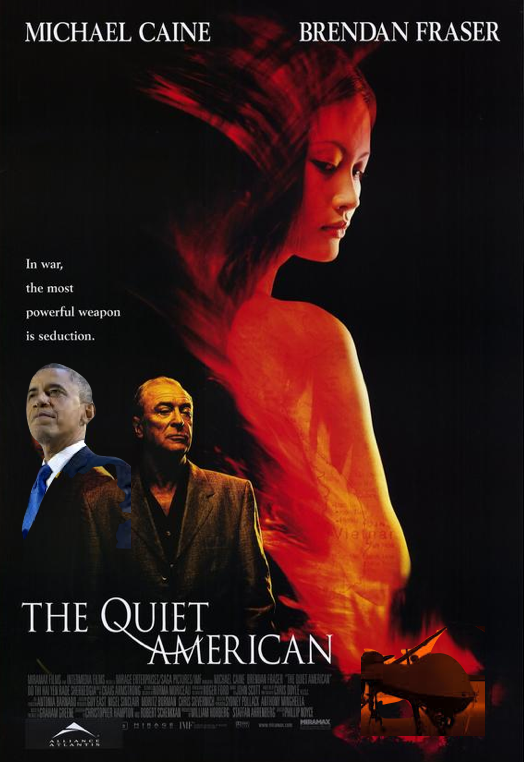
Quiet AmericanAnd the quiet disposition?  The central insight that animates much of James’s recent work around the New Aesthetic is, as he says in the lecture posted below, that ‘drones … shorten time and space very effectively but instead of using those same networked technologies to make things clearer or to bring empathy they use it to obfuscate and hide.’  You can see this – or rather not see it – in the extraordinary secrecy that cloaks so many of the sites of air attack.  160 years after the dawn of mass-mediated warfare, it is (as he says) sobering to think that we know less about what is happening in Waziristan today than the British public knew about the campaign in the Crimea. Hence Dronestagram and similar projects.  Even though the drone ‘has almost become synonymous with America and with a certain way of prosecuting war’, however, James prefers to see drones as shells or, better, prostheses, ‘extensions of  the network itself’.  For this reason The Quiet Disposition seeks to turn the network on itself, a sort of auto-immune cyberattack, through an intelligence-gathering software system (like the Obama administration’s ‘disposition matrix‘) that lives online, constantly scanning the web for reports about the drone programme and using AI to effect connections between them.
I am a camera

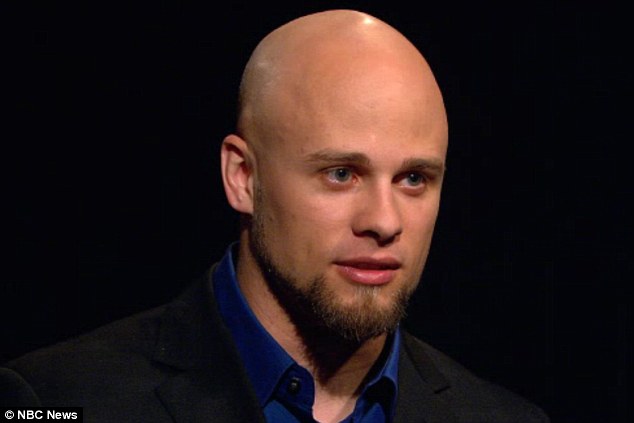
Last December Brandon Bryant, a six-year USAF veteran, told Der Spiegel of his experiences as a sensor operator in a team controlling a Predator over Iraq and Afghanistan from Creech Air Force Base in Nevada and then Cannon Air Force Base in New Mexico.  One day he wrote in his diary:

 “On the battlefield there are no sides, just bloodshed. Total war. Every horror witnessed. I wish my eyes would rot.”

When he left the Air Force he was handed a sheet informing him that all the missions in which he been involved had killed a total of 1, 626 people. This morning he appeared on NBC’s Today programme to describe in detail one of those missions.

Brandon Bryant

You can watch the interview with Richard Engel here, but since no transcript is available here is the substance of what he said:

‘I operated the camera, so like zoom in, zoom out, make sure that everyone can see a good picture, make sure it’s in focus, guide the laser, shoot the spot-tracker…

‘We’re just sitting there and like OK, it’s obvious these guys are obviously bad guys…

‘The guy in the back hears the sonic boom [from the missile] when it reaches him, and he runs forward.  We’re actually told to get the two guys in front, worry about the guy in the back later, follow him to wherever he goes.  The guy in the back runs forward between the two and we strike all three of them.  And the guy that was running forward, when the smoke clears, there’s a crater there, he’s missing his right leg.  

‘And I watch this guy bleed out and it’s clear enough that I watch him and he’s grabbing his leg and he’s rowing, like, I can almost see the agony on this guy’s face and eventually this guy becomes the same colour as the ground that he bled upon…

‘You know how people say that drone strikes are like mortar attacks, artillery, well, artillery doesn’t see this, artillery doesn’t see the result of their actions.  It’s really more intimate for us because we see the before action and then after.

‘And so I watched this guy bleed out, I watched the result of, I guess collectively it was our action, but ultimately I’m the responsible one who guides the missile in.’

He was also interviewed on CBC Radio earlier this year: listen here.  From 6.20 Bryant describes what happens in the 14-16 second interval between firing a missile and hitting the target: he says that if something happens –  like a child running into the frame – there’s an 8 second window to use the laser to divert the missile.  From Spiegel:

With seven seconds left to go, there was no one to be seen on the ground. Bryant could still have diverted the missile at that point. Then it was down to three seconds. Bryant felt as if he had to count each individual pixel on the monitor. Suddenly a child walked around the corner, he says.

Second zero was the moment in which Bryant’s digital world collided with the real one in a village between Baghlan and Mazar-e-Sharif.

Bryant saw a flash on the screen: the explosion. Parts of the building collapsed. The child had disappeared. Bryant had a sick feeling in his stomach.

“Did we just kill a kid?” he asked the man sitting next to him.

“Yeah, I guess that was a kid,” the pilot replied.

“Was that a kid?” they wrote into a chat window on the monitor.

Then, someone they didn’t know answered, someone sitting in a military command center somewhere in the world who had observed their attack. “No. That was a dog,” the person wrote.

They reviewed the scene on video. A dog on two legs?

Theory of the drone

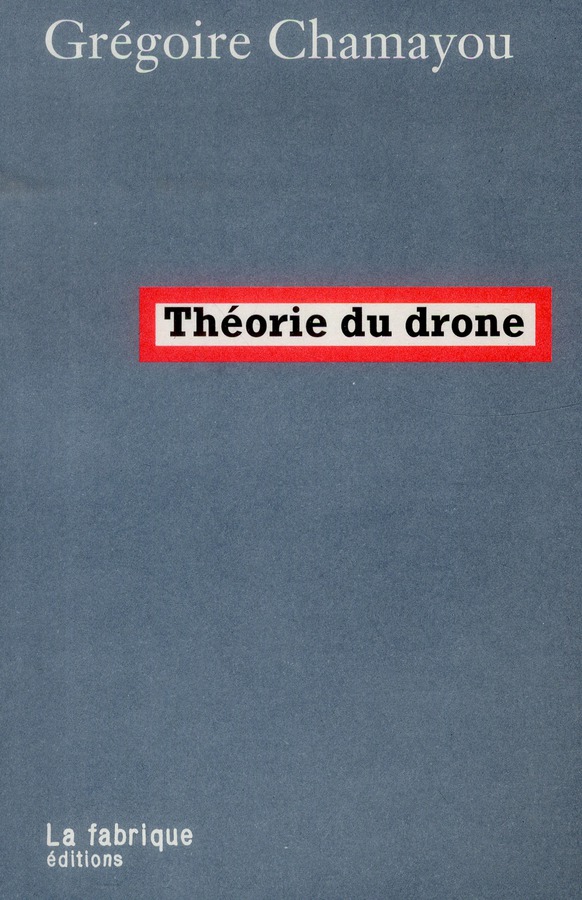
Theorie du droneI’ve been contacted by L’actualité for an interview on drones, which led me to a new book by French philosopher Grégoire Chamayou (CNRS): Théorie du drone (La fabrique, 2013).  I’ve only just ordered it, so this post is advance notice, the product of some rummaging around the web, and I’ll post a considered discussion as soon as I’ve read it.

Chamayou has translated Clausewitz into French, and readers may know one of his earlier texts, I think the only one to be translated into English thus far, Manhunts: a philosophical history (Princeton 2012; original French publication, Les chasses à l’homme: histoire et philosophie du pouvoir cynegetique (La fabrique, 2010); reviewed in English translation at Books & Ideas here).  If you want a good sense of Chamayou’s style, check out this video of a lecture in New York in 2011, ‘Hunter vs. Hunted’, artfully organised around film clips.

Manhunts doesn’t address targeted killing and drone warfare, but you can read a related essay from Radical Philosophy (169/2011) on ‘The manhunt doctrine’ that does here:

George W. Bush had warned us early on: the United States has launched itself into a new kind of war, a ‘war that requires us to be on an international manhunt’… The doctrine of the manhunt breaks with conventional warfare, which rests on the concepts of fronts, linear battles and face-to-face opposition. In 1916, General Pershing launched a large military offensive on Mexican territory to seize the revolutionary Pancho Villa. The massive deployment of force drew a blank. For the American strategists who cite this historic precedent as a counter-example, it is a question of reversing the polarity: faced with the ‘asymmetrical extremes’ posed by small mobile groups of ‘non-state actors’, one must employ small flexible units in a logic of targeted attacks. Contrary to Clausewitz’s classic definition, such cynegetic war is not, in its fundamental structure, a duel. The structure does not involve two fighters facing off, but something else: a hunter who advances and a prey who flees or who hides…

The prey who wants to escape his pursuers tries to become undetectable or inaccessible. But inaccessibility is not only a function of physical geography – such as an inextricable bush or deep crevice. The theorists of manhunting remind us that the ‘political and legal restrictions, especially in the form of jurisdictional boundaries’, are an eminent part of the ‘set of constraints that shape the rules of the game’. From this point of view, it is clear that ‘sovereign borders are among the greatest allies’ that a fugitive can have. The hunter’s power has no regard for borders. It allows itself the right of universal trespassing, in defiance of territorial integrity of sovereign states. It is an invasive power which, unlike the imperial manoeuvres of the past, is based less on a notion of right of conquest than of a right of pursuit….

In cynegetic war, armed violence seeks to pursue the prey wherever it might be. The place of hostilities is no longer defined by the locatable space of an effective combat zone, but by the simple presence of the hunted individual who carries with him everywhere a kind of little halo denoting a personal hostility zone. In this way of thinking, the very notion of armed conflict occurring in a distinct geographical space tends to vanish. Here, on the one hand, the combat zone tends to be reduced to the body of the enemy, which must then, according to the principle of distinction, be the only space that is targeted; but, on the other hand, it is believed that this mobile micro-space can be targeted wherever it happens to be. The paradox is that the principle of targeting is accompanied by a limitless virtual extension of the conflict zone: the world becomes the battlefield. Thus the classical distinction is erased between armed conflict zones, in which the use of weapons of war is allowed, and other zones in which they are not allowed…

Cynegetic war bears an ideal of non-confrontation with death, and of domination without real combat. While a duel involves a reciprocal relation of exposure to death – each participant bearing his chest to the enemy – in the hunt, on the contrary, the master barely ever confronts his prey directly. He uses intermediaries, beaters or the pack. Everything is done so that his life is never in danger, to assure him maximum protection. The use of predator drones and of Hellfire missiles, operated at a distance from American soil, illustrates this principle of absolute preservation of the life of the hunter by the mediation of hunting auxiliaries.

So far, so familiar. Chamayou treats the drone as ‘the emblem of contemporary cynegetic war’, which is to say war that ‘bears an ideal of non-confrontation with death, and of domination without real combat’: hence the new book which, like my own work, explores the complex field of death at a distance and, in a direct line of descent from Manhunts, embeds the drone into the apparatus of a new predatory state (Etat-chasseur) emphasised in this review in Le Devoir.  Here is a listing of the contents:

Theory of the drone

Prelude  — 9
Introduction — 21

I. Techniques and tactics — 33

Methodologies in a hostile environment — 35
Genealogy of the Predator— 41
Theoretical principles of the manhunt— 47
To watch and to annihilate — 57
Pattern of life analysis — 69
Kill box — 79
Counterinsurgency from the air — 91
Vulnerabilities— 109

II. Ethos et psyche— 119

Drones and the kamikazi (suicide attacks) — 121
‘That others should die’ — 131
A crisis in military ethics— 137
Psycho-pathologies of the drone— 151
Killing at a distance— 162

III. Necro-ethics — 177

Combatant immunity— 179
The humanitarian weapon — 190
Precision — 197

IV. Legal philosophy of killing— 211

Thoughtless assassins — 213
War without combat — 220
Licence to kill — 231

V. Political bodies— 241

In war and in peace — 243
Democratic militarism— 254
The essence of warriors — 269
The production of political robots — 285

Epilogue. War, at a distance — 309

21 February 2010 Uruzgan CIVCASYou can find a short extract from Théorie du drone here. This is of particular interest to me since it includes a transcript of an air strike mediated but not directly carried out by a Predator crew and its associated network/assemblage in Uruzgan province, Afghanistan on 21 February 2010, which killed 23 civilians and wounded 8 others.  It’s the mediation that is crucial, though I’m not (yet) sure that what Chayamou means by ‘intermediaries’ in the passage from RP above is quite what I have in mind: we’ll see.  In any event, I discussed the strike and Major General Timothy McHale’s subsequent investigation in ‘From a view to a kill’ (DOWNLOADS tab) and I’ve now provided a much more detailed discussion, with longer extracts from the transcript Chamayou uses here, in The everywhere war (due to be finished, please God, this summer). Chamayou uses this incident as a Prelude to his main argument which – unlike so much philosophical reflection on later modern war, and as he makes clear in his Introduction is in part inspired by the example of Simone Weil – evidently engages directly with the material conduct of military violence.

There’s another extract from the book available here. There are also many  interviews with Chamayou available, but a succinct yet wide-ranging one is available here in which, amongst other things, he assails those American and Israeli philosophers who have defended the use of drones as ‘ethical’, ‘humane’, and even as vehicles for a newly humanitarian mode of war.  He doesn’t name them, but one of those he surely has in his sights is Bradley Jay Strawser (see here,  here and here), whose edited collection on Killing by remote control: the ethics of an unmanned military was published last month by Oxford University Press.  Appropriately, you can buy a Kindle edition from Amazon in just one click.

UPDATE:  For a succinct overview of Chamayou’s work, see Kieran Aarons, ‘Cartographies of capture’, Theory & Event 16 (2) (2013).

Playing war

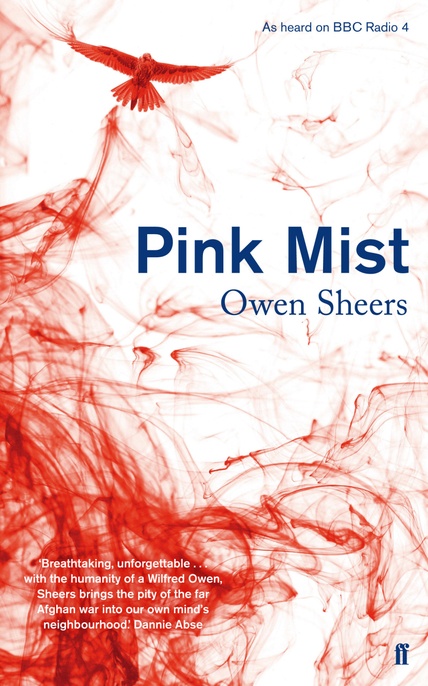
SHEERS Pink MistI’ve just finished reading – but certainly not thinking about – Owen Sheers‘ extraordinary dramatic poem, Pink Mist.

It was originally commissioned by BBC Radio 4 for its More than Words Festival in 2012 but sadly it’s not available on the BBC iPlayer Radio – though you can now get it as a physical book and an e-book.

I’ve spent much of the last several weeks reading poetry from the First and the Second World Wars, but few of those poems have affected me as much as Pink Mist.  I noted Owen Sheers’ work in passing, when I was writing about Keith Douglas’s poems from the Western Desert, but Pink Mist is insistently about the present.

It tells the story of three young men – Arthur, Hads and Taff – who grew up together in Bristol, ‘playing war’ like so many other boys. They decide, a spur of the moment thing, to enlist in the British Army and soon find themselves serving together in Afghanistan:

It’s like my recruiter said today,

it’ll be a chance to do the job

they train you for.

Otherwise it’s like going to the fair,

but staying off the rides.

So yeah, I want to go to war.

But of course it’s not a fairground ride, and nobody is ‘playing war’ any more.

Sheers captures in short bursts the surreal violence of war in Afghanistan.  The accidental killing of a farmer’s wife and two year old grand-daughter:

I can still see his face, even now.

An outdoor man, skin leathered by the sun,

The way he unwrapped the end of his turban

to wipe at his eyes, raw with what we’d done.

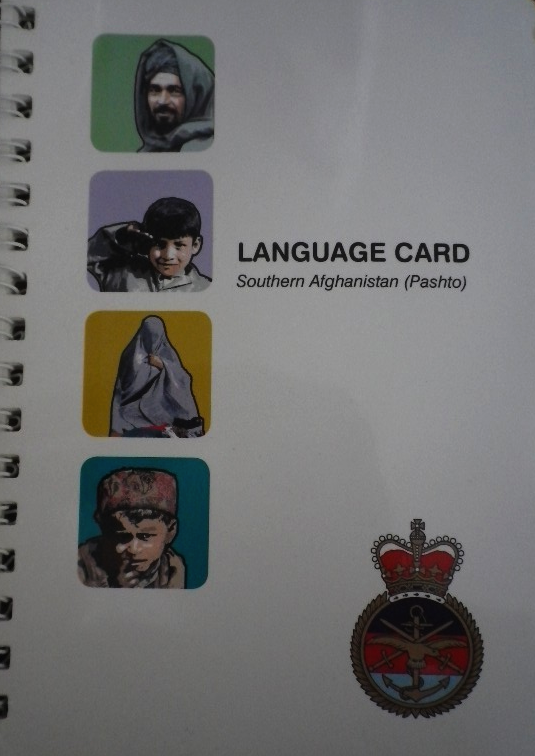
An illustrated language card issued to troops to help them communicate in Pashto and Dari, ‘a kid’s cartoon book of modern warfare’:

British Army Language CardWhere is the pain? – Dard cheri day?

Blood – Khoon

Dead – Maray

Go home – Khaana burayn

Shot – Wishtalay

Go home – Korta dzai

One at a time – Pa waar yao

One at a time.

And the three friends do go home, one at a time, wrapped in the shadows of violence that now fall across the lives of a mother, wife and girl-friend.

Hads returns without his legs, the victim of a ‘blue on blue’ air strike that killed two of his mates:

… that’s what you’re fighting for.

The man on your left and the man on your right.

Forget queen and country, the mission or belief.

It’s more about keeping your mates alive.

Or avenging the ones who’ve already died.

Taff is so consumed by by PTSD that he is haunted even by the silent, ‘Sunday-morning dead’ streets of his home town:

But all Taff’s feeling is the threat.

The echo of when a village went like this back there,

when the women and kids melted away.

That’s what he’s trying to keep at bay,

plugging in his headphones, turning the volume right up.

Eventually he becomes homeless, like many other vets, living on the streets:

There’s a spread of regiments under those blankets …  

And a spread of wars too –

Falklands, Gulf, Northern Ireland, Iraq.  

Yeah, you walk this country’ streets

and there’s our history, under your feet.

And Arthur? Read it for yourself.

It’s a profound work, I think, at once an art-work and a documentary.  As in so much of Sheers’ writing, Pink Mist is based on careful research and sensitive interviewing so detailed and so intimate you can almost feel it in the sinews of the words and the cadence of the lines.  Sheers records his debt to ‘the many service personnel and their families whose stories have informed this work, especially Lyndon Chatting-Walters and Daniel Shaw, whose own experiences are, at times, closely echoed in these pages.’

http://vimeo.com/35462502

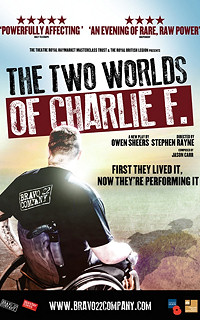
bravo22aThose interviews were, in turn, part of Sheers’s research for The Two Worlds of Charlie F, a play not only about the Army’s wounded and injured from Afghanistan but also, and remarkably, largely performed by them.  Sheers describes the project here (and see the clip above).  In Afghanistan 22 per cent of British service personnel have been injured – a higher proportion than in the Second World War – and to prepare for the play Sheers and his director travelled the UK: ‘We became well-acquainted with the names of certain drugs, types of prosthetics, military jargon. We visited barracks, PRUs (Personnel Recovery Units) and rehabilitation centres.’  And then they worked with the soldiers.  There are plans for the production to tour again this year.

I’m making so much of this for two reasons beyond the power of Sheers’s project.  The first is that Sheers has much to teach us about transcending the limitations of conventional academic genres and incorporating the arts into the research process, not only as objects of contemplation and critique but also as ways of working.  (Think how lifeless so many ethnographies and interviews become on the printed page).  The second is that Pink Mist and The Two Worlds of Charlie F ought to confound the politics of care that assumes a concern with civilian casualities is the exclusive preserve of the left, while a concern for military casualties is the exclusive preserve of the right.

As Arthur says, at the very end of Pink Mist,

So that’s all I hope for.

When the debate’s being had,

the reasons given,

that people will remember

what those three letters mean,

before starting the chant once more –

Who wants to play war?

Who wants to play war?