After Hiroshima

slavick After HiroshimaFollowing my post on artists and bombing, and in particular the work of elin o’Hara slavick, elin has written with news of her new book, After Hiroshima, due in March from Daylight, with what she calls a ‘ridiculously brilliant essay’ from James Elkins.

If you’re interested in two different but none the less intimately related works, I recommend Paul Ham‘s Hiroshima Nagasaki (Doubleday, 2012), which is extraordinarily good at placing those terrible attacks in the context of a strategic air war waged primarily against civilians (according to the Air Force Weekly Intelligence Review at the time, ‘There are no civilians in Japan’: sound familiar?) – and this needs to be read in conjunction with David Fedman and Cary Karacas, ‘A cartographic fade to black: mapping the destruction of urban Japan in World War II’, Journal of historical geography 38 (2012) 303-26 (you can get a quick visual version here) – and Rosalyn Deutsche’s Hiroshima after Iraq: three studies in art and war (Columbia, 2010), based on her Wellek Library Lectures in Critical Theory given in 2009.

You can get a preview of elin’s ‘After Hiroshima’ project here. Scrolling down that page, my eye was caught by the image ‘Woman with burns through kimono’, taken in 1945, which transported me to another ridiculously brilliant work, Kamila Shamsie‘s dazzling novel Burnt Shadows.  I’ve been haunted by it ever since I read it, and in the draft of the first chapter of The everywhere war I start with this passage from the novel:

Burnt Shadows

And this is how I go on (and please remember this is a draft):

A man is being prepared for transfer to the American war prison at Guantanamo Bay: unshackled, he strips naked and waits on a cold steel bench for an orange jumpsuit.  ‘How did it come to this?’ he wonders.  This is the stark prologue to Kamila Shamsie’s luminous novel Burnt Shadows.  She finds her answer to his question in a journey from Nagasaki in August 1945 as the second atomic bomb explodes, through Delhi in 1947 on the brink of partition, to Pakistan in 1982-3 as trucks stacked with arms grind their way from the coast to the border training-camps, and so finally to New York, Afghanistan and Guantanamo Bay in 2001-2.   These are all, in their different ways, conflict zones and the turning-points of empires, tracing an arc from the cataclysmic end of the Second World War through the Cold War to the wars fought in the shadows of 9/11.   In this book, I follow in her wake; I find myself returning to her writing again and again.  Although this is in part the product of her lyrical sensibility and imaginative range, there are three other reasons that go to the heart of my own project and which provide the framework for this chapter.

The first flows from the historical arc of the novel.   Shamsie is adamant that Burnt Shadows is not her ‘9/11 novel’.  She explains that it is not about the attacks on the World Trade Center and the Pentagon on 11 September 2001 but about the cost and consequences of state actions before and after.  Her long view reveals that the connections between Ground Zero in 1945 and Ground Zero in 2001 are more than metaphorical.  These are connections not equivalences – and far from simple – but like Shamsie I believe that many of the political and military responses to 9/11 can be traced back to the Cold War and its faltering end and, crucially, that the de-stabilization of the distinction between war and peace was not the febrile innovation of the ‘war on terror’.  I start by mapping that space of indistinction, and it will soon become clear that the dismal architects of the ‘war on terror’ (the scare-quotes are unavoidable) not only permanently deferred any prospect of peace but claimed to be fighting a radically new kind of war that required new allegiances, new modalities and new laws. Here too there are continuities with previous claims about new wars fought by the advanced militaries of the global North, conducted under the sign of a rolling Revolution in Military Affairs and its successor projects, and quite other ‘new wars’ fought by rag-tag militias in the global South: all of them preceding 9/11.

I turn to those new wars next, and this brings me to the second reason why Shamsie’s work is relevant to my own discussion.  While she was writing Burnt Shadows she used Google Earth to disclose the textures of New York City, and marvelled at how obediently they swam into view: ‘3D models of buildings, amazingly high-resolution images, links to photographs and video streams of Manhattan.’ When she turned to Afghanistan, however, all the details dissolved into ‘an indistinct blur, and the only clues to topography came from colours within the blur: blue for rivers, brown for desert, green for fertile land.’  But that was then (2006).  Three years later, a different Afghanistan was brought into view.  ‘As I click through all the YouTube links tattooed across the skin of Afghanistan,’ she wrote, ‘I encounter video clips of American solders firing on the Taliban, Canadian politicians visiting troops, Dutch forces engaged in battle, an IED blast narrowly missing a convoy of US soldiers, a video game in which a chopper hails down missiles and bullets on a virtual city which looks more like Baghdad than Kabul.’  Shamsie uses these distinctions to remind us that ‘we’re still using maps to inscribe our stories on the world.’  So we are; and throughout this book I also turn to these violent cartographies, as Michael Shapiro calls them: maps, satellite images and other forms of visual imagery. These inscriptions and the narratives that they impose have a material form, and they shape both the ways in which we conduct ‘our’ wars and also the rhetoric through which we assert moral superiority over ‘their’ wars.  Yet even as I sketch out these contrasting imaginative geographies, another indistinction – a blurring, if you like – seeps in.  For one of the most telling features of contemporary warscapes is the commingling of these rival ‘new wars’ in the global borderlands, the ‘somewhere else’ that Abdullah reminds Kim is always the staging ground of America’s wars.

And this brings me to the final reason for travelling with Burnt Shadows: Abdullah’s insistence that war is like a disease.  This is an ironic reversal of the usual liberal prescription that justifies war – which is to say ‘our’ war – as a necessity: ‘killing to make life live’, as Michael Dillon and Julian Reid put it.  They argue that war in the name of liberalism is a profoundly bio-political strategy in which particular kinds of lives can only be secured and saved by sacrificing those of others.   You might say that war has always been thus, but what is distinctive about the contemporary conjunction of neo-liberalism and late modern war is its normative generalization of particular populations as at once the bearers and the guardians of the productive potential of ‘species-life’.  Here too there are terrible echoes of previous wars, and these brutal privileges depend, as they often did in the past, on discourses of science and economics (and on the couplings between them).  But contemporary bio-politics also draws its succour from new forms of the life sciences that treat life as ‘continuously emergent being’.  This is to conjure a world of continuous transformation in which emergence constantly threatens to become emergency: in which there is the ever-present possibility of life becoming dangerous to itself.  For this reason the social body must be constantly scanned and its pathologies tracked: security must deal not with a grid of fixed objects but a force-field of events, and war made not a periodic but a permanent process of anticipation and vigilance, containment and elimination.  Mark Duffield calls this ‘the biopolitics of unending war’ – war that extends far beyond the killing fields –in which the global borderlands become sites of special concern. Its prosecution involves the production of new geographies – new modes of division and distinction, tracing and tracking, measuring and marking – that provide new ways of continuing the liberal project of universalizing war in the pursuit of ‘peace’.  In the face of all this, Abdullah had a point.

The politics of drone wars

I’m in the UK this week for – amongst other things – a seminar with Pete Adey, Sara Fregonese and some of the Geopolitics and Security students at Royal Holloway on my bombing project, Killing space; a workshop at Open Democracy for a new series on Cities in Conflict to be curated by Tom Cowan; and a lecture at Nottingham organised by Steve Legg: another outing for “Deadly Embrace”.

At the RHUL meeting the conversation frequently turned to drones; Pete made an audio recording of it, and I think at least part of what we discussed will appear on the Theory, culture & society website in the near future.  But I’d like to try to set out some of my own puzzlements and positions about the politics of drones here.

There are many ways in which individuals can take a stand against war, and there is a long and principled tradition of conscientious objection that includes pacifists in two World Wars through young Americans who resisted the draft in the 1960s and 70s to high school students in Israel who refuse to serve in the army of occupation.  In recent times most popular mobilisations against war have been against particular wars – I’m thinking of the demonstrations against the wars in S.E. Asia in the 60s and 70s, for example, or the millions of people who took to the streets to express their opposition to the US-led invasion of Iraq in 2003 – or against particular objects of violence: campaigns to ban land mines or cluster munitions, for example.  To me, the most effective political response to the use of Predators, Reapers and other UAVs in Afghanistan, Pakistan, Yemen, Somalia and elsewhere is to move between the two: to use the drone to draw publics into an apprehension of the wider fields of military violence in which they are deployed.

Global Hawk imagery of aftermath of Haiti earthquakeI think it is a mistake to focus on the object itself because, like all objects, a drone is highly unstable: it’s not a fixed, determinate ‘thing’ but its capacities and dispositions depend on the network or assemblage in which it is embedded. To see what I mean, begin by stripping the bombs and the missiles from these platforms: at present most drones are used for intelligence, surveillance and reconnaissance (ISR), and these capabilities extend far beyond the domain of offensive operations and even beyond those of the military.  In 2010 US Southern Command used a Global Hawk to provide detailed imagery of the damage caused by the Haiti earthquake (above) and the following year another Global Hawk was deployed to assess the damage to the Fukishima Daiichi nuclear plant in Japan; other, smaller and far less sophisticated drones have been used to monitor wildfires in California and to track and disrupt Japanese whaling fleets, while a series of other, broadly ecological-humanitarian projects have been proposed with varying degrees of plausibility.  I don’t rehearse these other possibilities to minimise the military and paramilitary uses of the technology – and we surely know, not least from Nick Turse‘s account in The Complex, that the military and the civilian have become ever more hopelessly entangled with one another – and neither am I indifferent to the blurring of military power and NGO relief operations in the humanitarian present,  but we need to acknowledge, to paraphrase Clive Barnett, that not all ISR operations are sinister: ‘presumptively illegitimate, undemocratic or suspect‘.

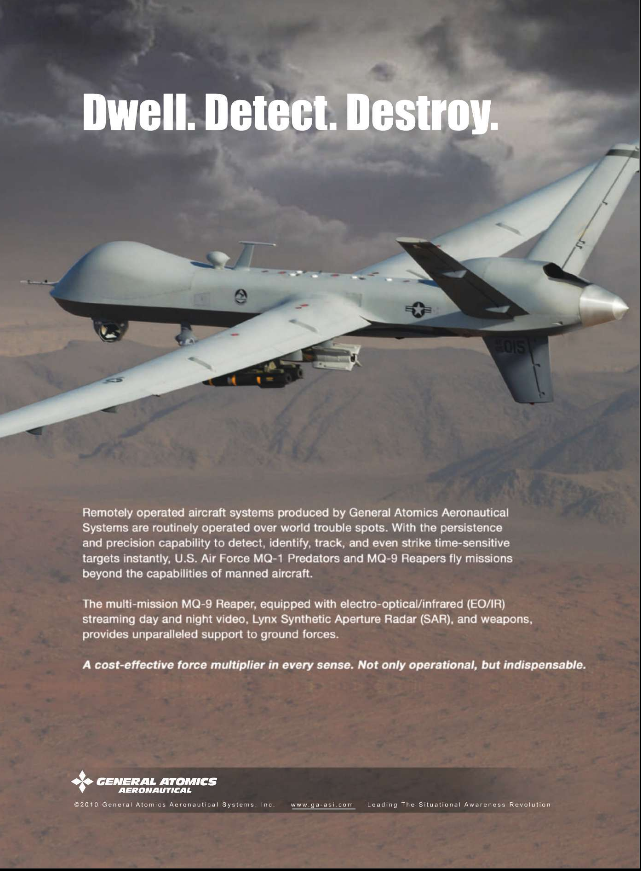
Dwell Detect Destroy drone ad

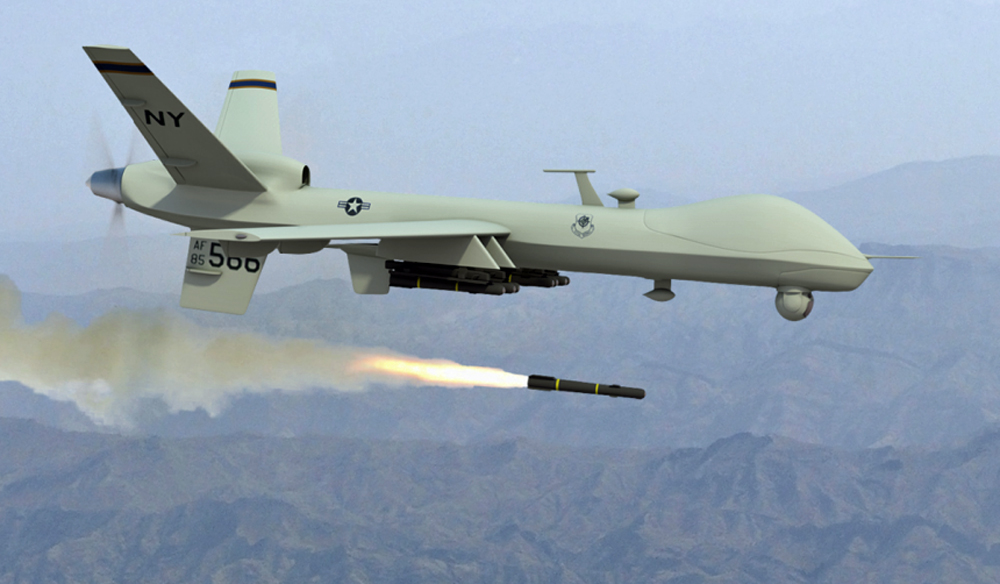
Hellfire missile launch (USAF)This is why Drone Wars UK focuses on ‘armed drones’ and Drones Watch on ‘killer drones’.  It’s clear that militarised ISR is part of a continued ‘rush to the intimate’ that is profoundly invasive and, on many occasions, extraordinarily violent. In Afghanistan the US military embeds its UAVs in a networked kill-chain in which their near real-time, high-resolution, full-motion video feeds are routinely used to call in attacks from conventional strike aircraft.  So let’s now put the bombs and missiles back on these platforms, since the Predators and Reapers are usually armed and their manufacturers boast about their capacity to compress the kill-chain: to ‘dwell, detect [and] destroy’. But it then makes no sense to object to the strikes carried out directly from them and to exempt those carried out by conventional means across the network: what is the difference between a Hellfire missile launched from a Reaper and one fired from an Apache helicopter gunship?  (To put this in perspective, according to the most recent airpower summary, USAF Predators and Reapers directly accounted for just 5-6 per cent of its ‘weapons releases’ in Afghanistan in 2009, 2010, and 2011, though the proportion climbed to 9.25 per cent in the first ten months of 2012).

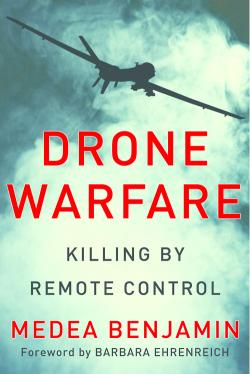
Medea BENJAMIN Drone WarfareTo answer that question critics usually cite the horror of death at a distance.  This is death from thousands of miles away, conducted by operators in the continental United States: ‘killing by remote control’.  And yet there are countless other ways in which militaries have been killing from ever increasing distances ever since the invention of the slingshot and the longbow. If you insist that it is wrong to kill somebody from 7,500 miles away, then over what distance do you think it is acceptable?  If you are determined to absolutize distance in this way, then don’t you need to consider all the other ways in which advanced militaries are able to kill their adversaries (and civilians) without ever seeing them? Again, I don’t raise the spectre of Cruise missiles launched from ships hundreds of miles from their targets, the US ‘Prompt Global Strike’ capability and its Advanced Hypersonic Weapon which is ultimately  intended to hit a target anywhere on the planet in under an hour, or the prospect of ‘frictionless’ cyberwarfare, to minimise the deaths caused by drones.  I simply want our politics to apprehend the larger field of military violence in which they are deployed.

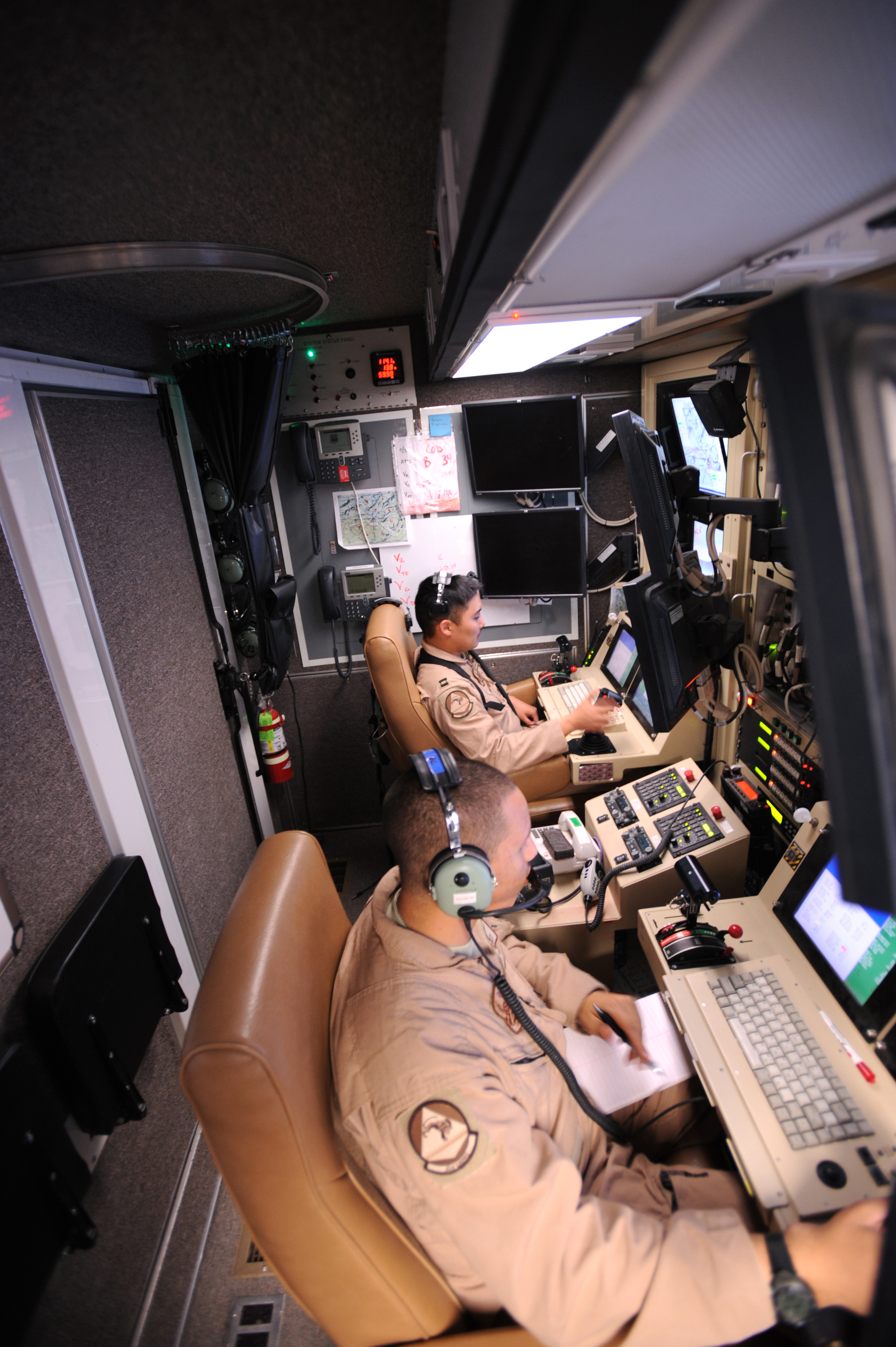
And there is something different about those deaths that draws us back into the killing fields.  I should say at once that I don’t think this is simply war reduced to a video-game – and in any case there are many other military technologies that also depend on hand-eye co-ordination, multi-tasking and spatial acuity, all skill-sets valorized by video-games – but I also think it a mistake to assume that the screen effectively insulates the viewer from the victim.  In this sense there is a parallel between the platforms, because video-games are profoundly immersive, and those who call in or carry out these strikes insist that they are not 7,500 miles from their targets at all (and Launch & Recovery crews are much closer than that) but ‘eighteen inches away’: the distance from eye to screen.  It’s a highly selective process of compression; as I’ve shown in detail in Lines of descent (DOWNLOADS tab), those involved in the remote kill-chain typically feel remarkably close to their own troops on the ground and remain distant from the life-worlds of the population at large (which in part accounts for the civilian casualties when drones are used to provide close air support).  But unlike most other forms of distant death and destruction, the pilots, sensor operators and others who are networked into these kill-chains can see their targets up close – even if their ‘seeing’ is techno-culturally conditioned and often predisposes them to treat innocent actions as hostile intentions – and they typically remain on station to carry out a ‘bomb damage assessment’ and so see for themselves, often in hideous detail, what they have done.

Flying an MQ-9 Reaper over Kandahar, Afghanistan

The most consequential change is that these new modes of air power deal not in the area bombing of cities like Cologne, Hamburg or Dresden, or the blind bombing of target boxes over the rainforests of Vietnam, Laos and Cambodia, but – in addition to close air support – in the calculated assassination of individuals or groups: so-called ‘targeted killing‘ or what the USAF calls putting ‘warheads on foreheads‘.  This does not mean that the firebombing of cities in the Second World War should become the moral standard against which we judge contemporary military violence. On the contrary, targeted killing raises its own grave legal and ethical questions – and, not incidentally, those video feeds have given military lawyers a pivotal role in these newly networked strikes – that in turn activate two other no less serious concerns about the emergent geographies of fields of military violence.

First is the fear that the use of remote platforms lowers the threshold at which military violence will be launched.  Predators and Reapers are much cheaper than conventional strike aircraft, and if there are no troops on the ground, there are no body bags to come home.  In short, drone war threatens to become risk-transfer war hypostatised; the risk is transferred wholly to the adversary population.  But at present these platforms have high failure rates – they are vulnerable to weather conditions (and I don’t mean hurricanes and monsoons, I mean clouds), they crash all too frequently and they are so slow and noisy that they can easily be shot down so they can only be used in uncontested airspace.  These limitations mean that, at present at any rate, they are less likely to incite conventional state-on-state war – though there is certainly a global arms race to acquire and develop far more advanced drone technologies.

Second and closely connected is the fear that they make it much easier to engage in war by stealth.  If one of the primary foreign policy challenges of the last Bush administration was ‘conducting war in countries we are not at war with‘, Obama’s version is the determination to wage what Martin Libicki calls ‘non-obvious warfare’: hence the Obama administration’s preference for remote operations, Special Forces and cyber-attacks.  To be sure, there are degrees of obviousness: the drone attacks in Pakistan, Yemen, Somalia and elsewhere are hardly covert – since they are hidden in plain sight – but they are, within limits, more deniable than the deployment of thousands of ground troops and so inherently less accountable to the various publics involved in them.  And in all these cases Predators and Reapers dramatically heighten the asymmetry involved in military and paramilitary operations against non-state actors, where they have made a policy of ‘kill’ rather than ‘capture’ a much more tempting (and much more pernicious) US counter-terrorism strategy.

More to come.

A shower of balls

Patrick Cockburn has an interesting historical take on targeted killing by drones at the Independent:

‘In 1812, the governor of Moscow, Count Rostopchin [right], devised a plan to get a hot-air balloon to hover over the French lines at Borodino and drop an explosive device on Napoleon. The source for this is the memoirs of the French writer, traveller and politician Chateaubriand and I have not read it anywhere else, but the story illustrates how, from the first moment man took to the air, he has seen it as a means of assassination.

‘President Barack Obama thinks much the same way as Rostopchin did 200 years ago. The enhanced and secret use of unmanned drones is one of the most striking features of his foreign policy.’

What Chateaubriand actually wrote was this:

[Rostopchin’s] vengeance promised to drop from heaven: a huge balloon, constructed at great expense, was to float above the French army, pick out the Emperor among his thousands, and fall on his head in a shower of fire and steel. In trial, the wings of the airship broke; forcing him to renounce his bombshell from the clouds…

Quite how the balloon was to ‘pick out the Emperor among his thousands’ was not disclosed – it’s still a problem for today’s remote operators – but Chateaubriand may have taken the account from Count Philippe de Ségur‘s History of the expedition to Russia, first published in two volumes in 1824 and translated into many European languages:

At the same time a prodigious balloon was constructed, by command of [Emperor] Alexander, not far from Moscow, under the direction of a German artificer. The destination of this winged machine was to hover over the French army, to single out its chief, and destroy him by a shower of balls and fire.

Ségur accompanied the expedition so this was an eyewitness account, of sorts, composed years after the event: Mark Danner has a beautiful essay on Ségur’s memoir – and some of its other modern echoes – here.

There’s also a modern and more detailed version of the story from Lee Croft, first as a blog comment:

Tsar Alexander’s secret project to construct a hydrogen-filled, rotor-wing-powered, aerostat (balloon) from which to drop timed-fuse explosives on Napoleon and his army … [was] entrusted to the administration of Moscow Governor-General Fyodor Rostopchin, and through Rostopchin to German physician George Anton Schaeffer, was designed by a mysterious German-speaking “balloon master” named Franz Leppich (1776-1818), who had actually tried previously, in 18ll, to sell the project to Napoleon. The killer balloon, which was shaped to resemble a shark, failed to ascend on the day of the Battle of Borodino (August 26 on the Russian Calendar, September 7 on the French, 1812) and was evacuated to Nizhnii Novgorod to the east on the Volga using over 130 confiscated Moscow city fire carts and horse teams, thus severely handicapping attempts subsequently to manage the destructive Moscow fire.

You can find a more detailed version in Croft’s self-published book earlier this year, George Anton Schaeffer: Killing Napoleon from the air (Lulu, 2012) (I’m no marketing expert, but I suspect switching title and subtitle could only boost sales).

Napoleon was no stranger to balloons in his military adventures –  he used balloons for observation during the Italian campaign in 1796 and had the balloon corps accompany him to Egypt in 1798 but their equipment was destroyed by the British at Aboukir; later  the French launched a hot air balloon in occupied Cairo, but the Egyptians were conspicuously unimpressed and dismissed it a child’s toy.

All that said, I don’t think the lines of descent are quite as direct as Cockburn makes out, but it’s an arresting start to an essay that otherwise treads familiar ground. Balloons have a long history of military applications, but after the first attempts at bombing from aircraft in the Italian-Turkish war of 1911-12 most of the early military uses for the new flying machines focused on reconnaissance and surveillance (and spotting for artillery): more on this soon!

Is Paris Burning?

The original question was Adolf Hitler’s to General Alfred Jodl in August 1944, but the French had long had good reason to fear the answer.  In a previous post I quoted Gustaf Janson’s pre-World War I fantasy of a future air raid on Paris:

‘Unexpectedly, without any warning dynamite begins to rain down on the city.  Each explosion follows on the heels of the last.  Hospitals, theatres, schools, museums, public buildings, private houses – all are demolished.  Roofs collapse, floors fall into cellars, the streets are blocked with the ruins of houses.  The sewers break and pour their foul contents over everything.  The water pipes burst, flooding begins.  The gas mains rupture, gas streams out, explodes, starts fires.  The electric light goes out… Above it all can be heard the detonations exploding with mathematical precision….  Men, women, children, insane with terror, wander among the ruins…. When the last flying machine has dones its work and turned northwards again, the bombardment is finished.  In Paris a stillness reigns such as never reigned before.’

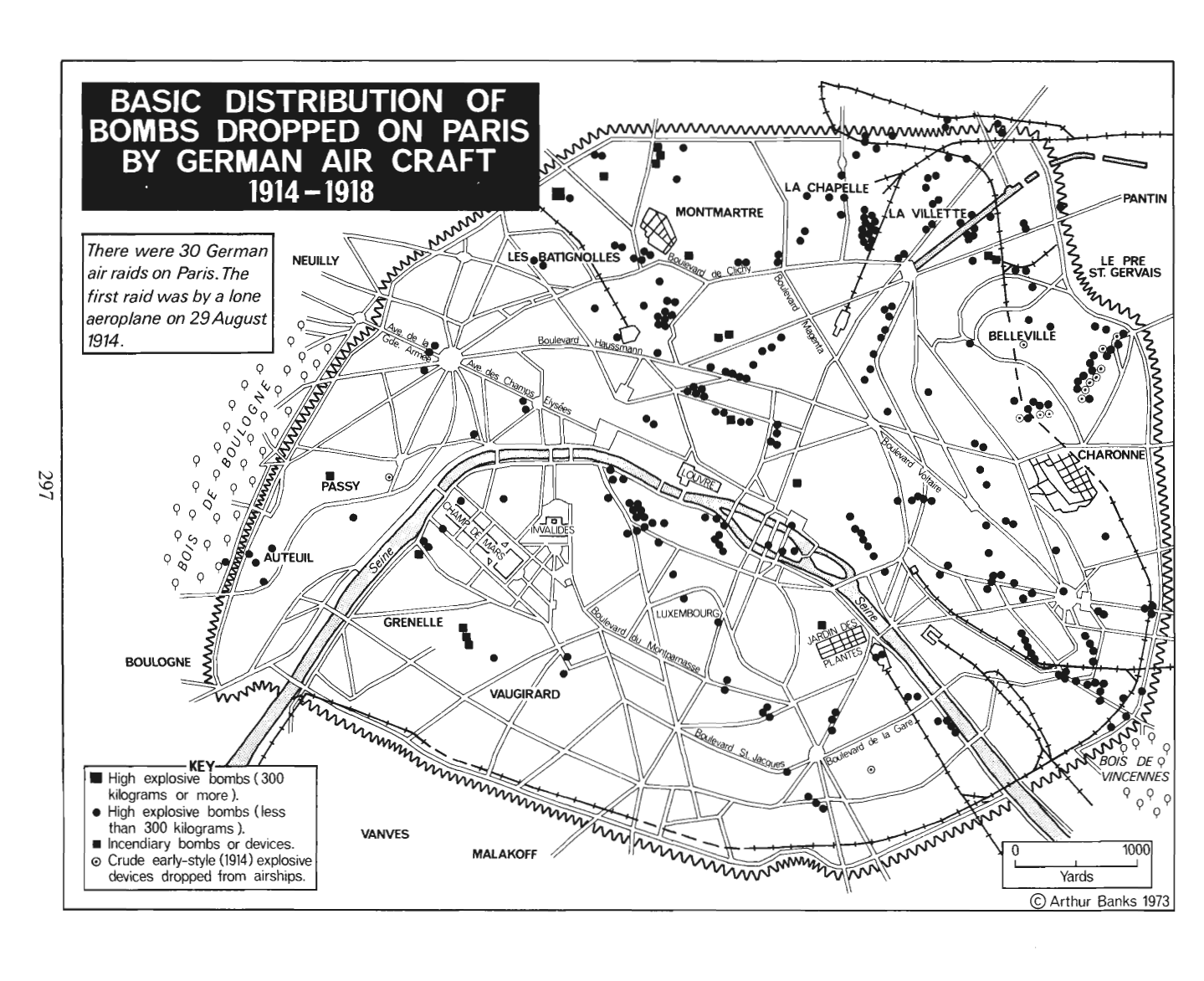
While the First World War did not see such a devastating attack on the city, there were repeated bombardments.  Paris was, after all, closer to the front than any of the other belligerent capitals. Historian Susan Grayzel provides a careful chronology of air raids on Paris in ‘The souls of soldiers”: civilians under fire in First World War France’ (Journal of modern history 78 (2006) 588-622), and it’s clear that the major bursts of activity were at the beginning and the end of the war: August-October 1914 and a crescendo between January-September 1918.  All told, Grayzel’s tabulations (from Jules Poirier’s Bombardements de Paris) show that attacks from German aircraft killed 275 people and injured 610 in the city and in the banlieu.

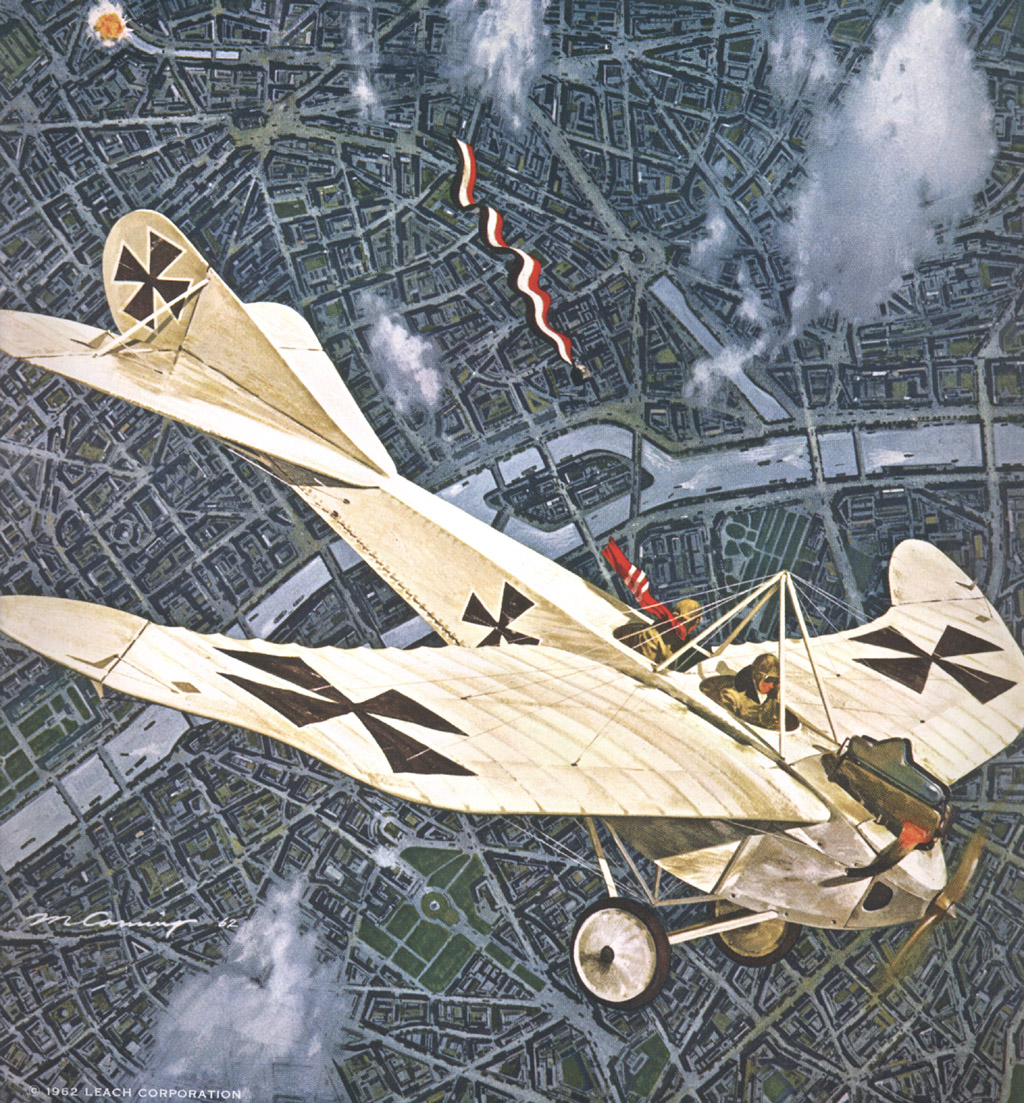
On 30 August 1914 a two-seater German Taube (‘Dove’) aircraft circled in the sky over Paris, and at 12.45 p.m. began to drop the first of four 5lb. bombs.  The final ‘bomb’ was a sack of sand with a message attached: ‘The German Army is at your gates.  You can do nothing but surrender.’  This was the first propaganda drop in aviation history and, like most subsequent leafleting raids, had little effect.

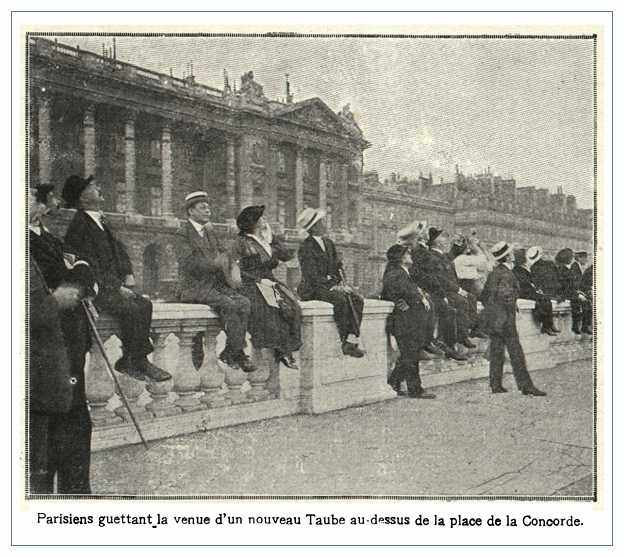
But the Germans continued to send Tarben over the city at regular intervals – and in fact at the same time each day.  The regularity turned the flights into a routine for Parisians too: see the images here. Emmanuelle Cronier (in Capital cities at war, vol. 2, eds. Jay Winter and Jean-Louis Robert, Cambridge University Press, 2007) provides a sketch of their impact (or lack of it):

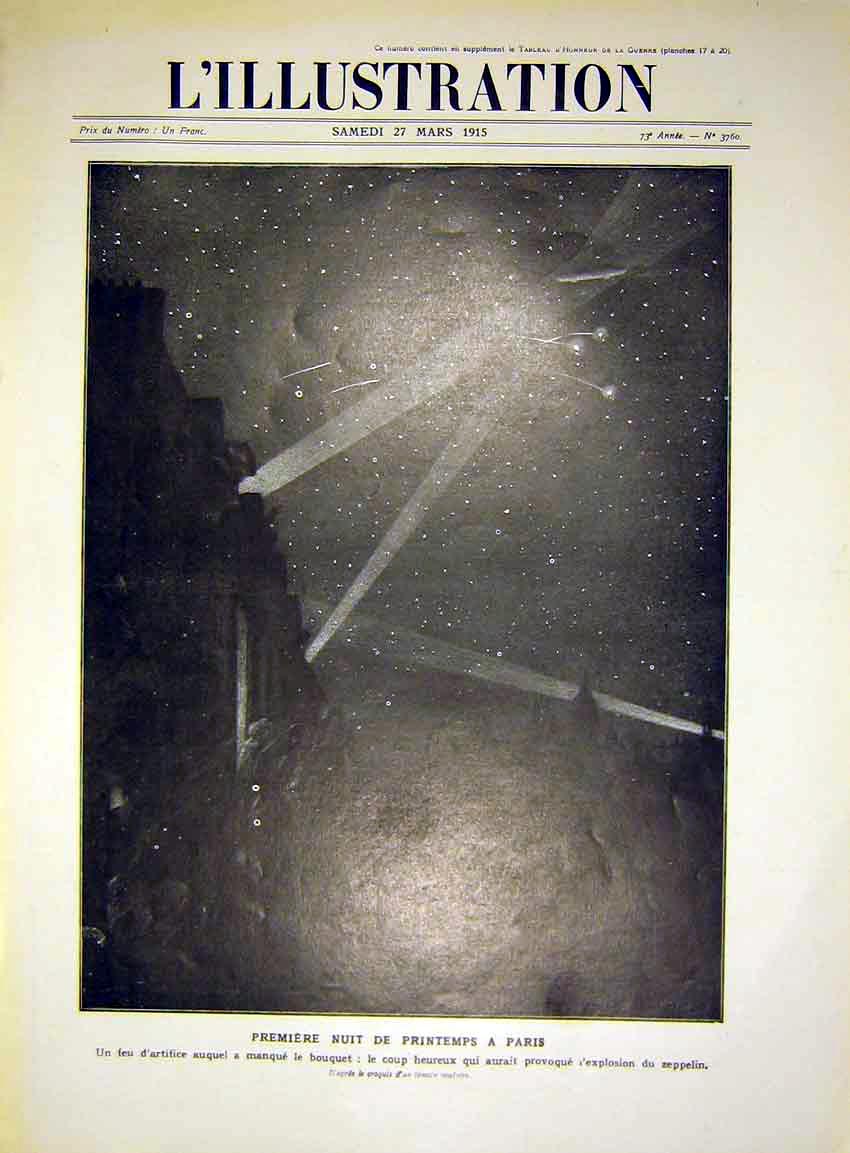
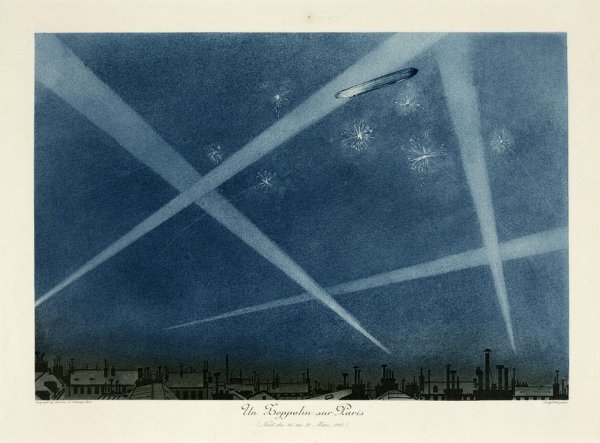
‘At “Taube time”, around 5.00 p.m., a new urban ritual developed, replacing the pre-war Parisian’s characteristic stroll with gatherings on balconies in squares, on bridges or promontories. Those with binoculars scanned the sky: “There’s one!” shouted a man.    Next the Taube is insulted, French aircraft are launched in pursuit, applauded… To some eyes this Parisian defiance of the Tauben constituted the true expression of the Paris crowd… Because these light German bombs claimed few victims, perception of the danger was deferred.  It was not until the arrival of the Zeppelins in March 1915 that the people of Paris understood the reality of the threat.’

In September 1914 the German advance towards Paris was accompanied by night raids by Tauben.  After the battle of the Marne, when the advance was finally rebuffed,  the capital returned to something approaching its pre-war life.  So much so, indeed, that many French soldiers on leave must have identified with the complaint voiced in Henri Barbusse‘s Le feu (1916), cited in Alistair Horne’s Seven ages of Paris (Knopf, 2002):

‘We are divided into two foreign countries.  The front, over there, where there is too much misery, and the rear, here, where there is too much contentment.

Air war undoes those separations, of course, and soon commentators were drawing attention to the fact.  Grayzel cites Le Petit Parisien in March 1915:

‘It’s not a trait of bravery to go dropping bombs in sleeping civilians, to profit from darkness, like a vulgar bandit … in order to assassinate women and children in their [homes].’

By then Zeppelins had made their far more sinister appearance in the night skies, and a black-out was imposed on the ‘City of Light’.  Here is one eyewitness report of the first raid on 21 March 1915 from a woman living near the Eiffel Tower:

“I was awakened by firemen’s bugles, and as we had all been warned I had no doubt what the noise meant. I dressed and hesitated whether to leave my flat on the top story, but decided to stay and see what was going to happen. I watched the police trying to extinguish a gas jet in the road below, which gave them a great deal of trouble. Then for a long time nothing happened. The night was so clear and peaceful, it seemed impossible that there could be any danger.

“Suddenly there came reports from distant guns, and then a series of vivid flashes from behind houses at no great distance, followed by a violent cannonade which made the windows rattle.

“Searchlights were playing in all directions, but at first nothing was visible except the ghostly outline of the Eiffel Tower. Then I noticed that several stars were obscured by what seemed to be a long grey cloud moving at a tremendous rate. It seemed more like a shadow than anything solid. What struck me most about it was its enormous length and extraordinary speed. When a searchlight fell on it, it was only a fraction of a second before it passed out of its field. I knew at once it was a Zeppelin. As we had been forbidden to show any light, I lit a match in a corner of the room, and looked at my watch. It was ten minutes to two.

“When I went back to the window the firing had increased in intensity, and the airship, which was far away behind the Eiffel Tower at what seemed a very great altitude, appeared to be replying to the guns. From below the long grey shadow came a series of flashes, so that I think it must have been firing machine guns at the guns firing at it. Then, suddenly, the airship disappeared like a cloud, as suddenly and mysteriously as it had come. The firing ceased and all was still for ten minutes, when everything began over again, the guns again opening fire on what was, I suppose, a second Zeppelin. This airship, however, disappeared quicker than the first.”

As Grayzel shows, contemporary reports were part of an elaborate construction of Paris as an ‘innocent, heroic, feminized city’, and the phallic Zeppelin was turned into a faux, puffed-up masculinity that was contrasted with the ‘real’ masculinity (and by extension the ‘real’ war) of ‘hand-to-hand combat with bayonets’.

There were immediate calls for reprisals.  Le Figaro offered its readers a stark choice: ‘Either we resign ourselves to accepting more and more frequently the insults these Zeppelins show us, or we decide to carry to the other side of the Rhine all the horrors of the air war.’  But, as Andrew Barros shows in ‘Strategic bombing and restraint in “Total War”, 1915-1918’ (Historical Journal 52 (2009) 413-31), French strategic bombing was remarkably restrained throughout the war, and ‘reprisal raids’ were carefully calibrated – partly for reasons of geography (the quotations below are also from Pétain):

‘German bombers had to travel short distances to strike French cities, often just 30 kilometres.  French targets in Germany were located well past the zone of occupation, often 150 to 200 kilometres behind the lines.  Bombing a city like Frankfurt was “incomparably more difficult for the Allies” than it was for the Germans to attack Paris, especially because to have any substantive effect, raids needed to be conducted in a massive way and frequently repeated.’

The restrictions on bombing were also prompted by fears of escalation: ‘Requests from flying officers for permission to conduct reprisal raids against Berlin, Hamburg, Cologne and even Constantinople were repeatedly turned down by the army command.’

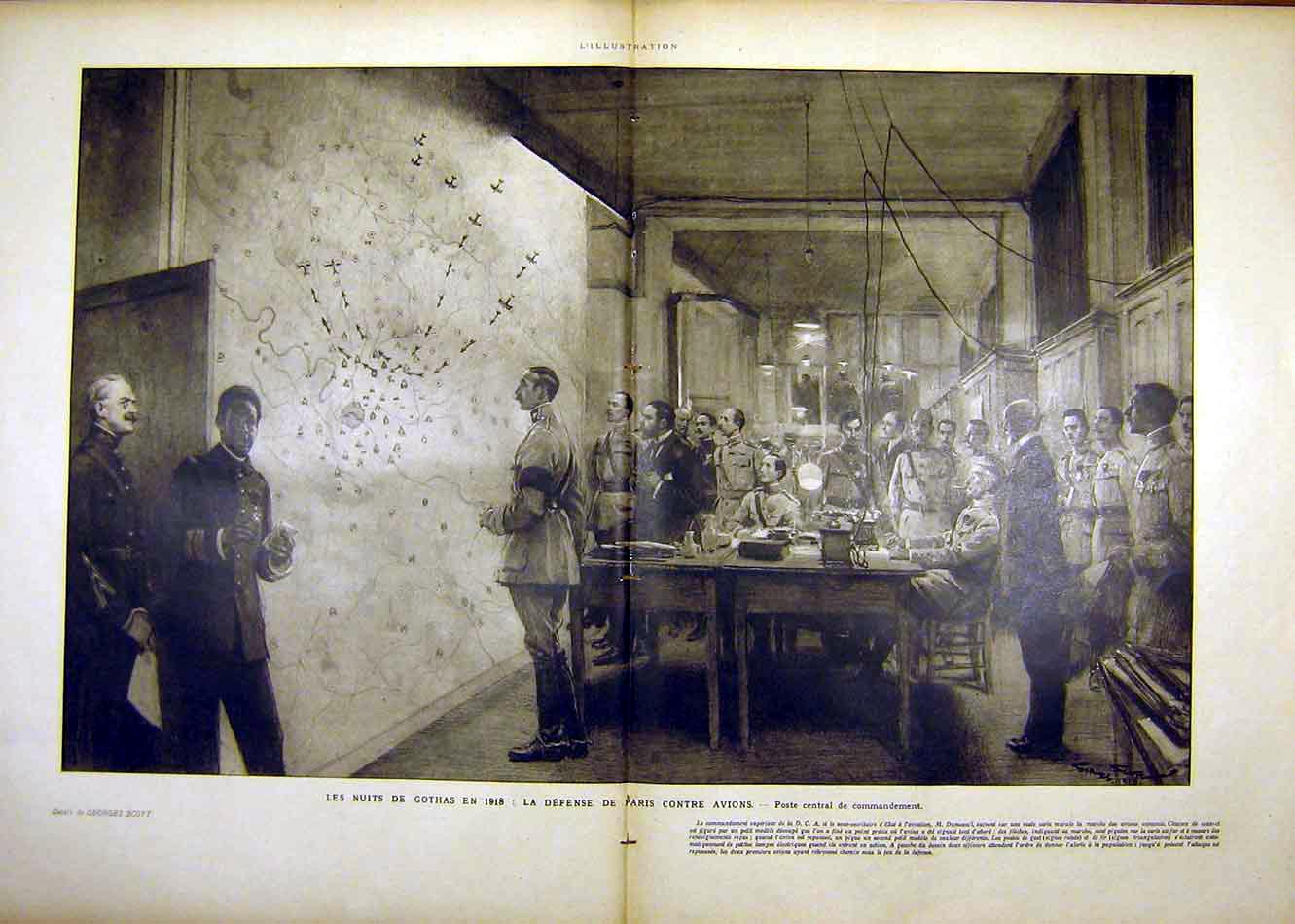
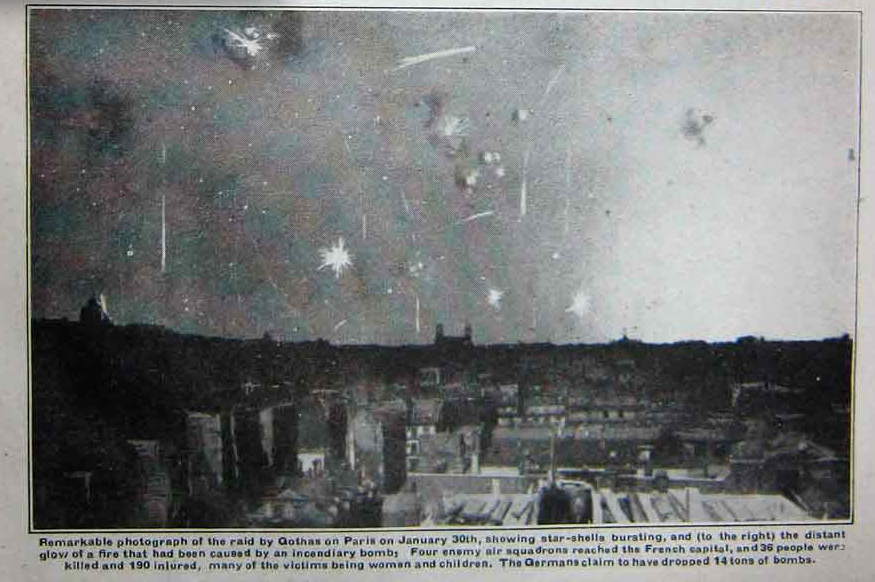
It was not until 1918 – and particularly during Ludendorff’s renewed ground offensive against the city – that, as Grayzel has it, ‘full-scale war came to Paris.’  According to Lee Kennett (The First Air War, 1914-1918) the German high command described the attacks carried out by Gotha bombers as Vergeltungsmassnahmen – reprisals for Allied attacks on cities ‘outside the region of operations’ like Mannheim and Freiburg – but they were clearly part of the calculated offensive: probes of Paris’s air defences were made in January, and the main attacks started in March.  Kennett notes that ‘the French met them with searchlights, anti-aircraft guns, night fighters and a cordon of barrage balloons that forced the bombers to come in over 3,000 meters – a height that ruled out any bombing accuracy.’  The resources commanded by Paris’s Défense Contre Avions (DCA) were much greater in 1918 than 1914 ,and the response was more carefully co-ordinated –

– but the threat was also much greater.  The Gothas were much faster and more manoeuvrable than the airships, cruising at around 80 m.p.h.  They had a much smaller bomb load – it took six aircraft to deliver the same load as one Zeppelin – but if they could fly at lower altitudes at night they could almost double their standard daylight bomb load of around 660 lbs.  The raids were also on a much larger scale and were carried out with far greater intensity than previous attacks, though targeting was still very haphazard. One French expert told the New York Times (for its 19 March edition) that

‘it was practically impossible to strike any particular objective when a plane was travelling at a rate of thirty-eight to forty yards a second.  A bomb must be dropped more or less at random, which is the reason why such form of warfare is simply criminal.  It is impossible to tell where the bomb will fall.’

The blackout was reintroduced, but it was only partially effective. The Associated Press reported on 22 March that 1500 prosecutions for violations of the new restrictions had been launched in just two days in an attempt to produce a ‘darker Paris’.  But the offenders were not confined to a careless public.

‘On the Ile de la Cité more than thirty windows were illuminated in the Palais de Justice, where all appeals from convictions in the lighting cases will be heard.  Light was also shining brilliantly from a dozen windows of the Prefecture of Police, from which was issued the order for darkening the city.’

Firemen’s bugles were no longer adequate to warn the public and new air raid sirens were installed – a sufficient novelty to spark a feature in the Illustrated London News (below): since July 1917 Britain had relied on a system of marine distress maroons to warn of approaching enemy aircraft, supplemented by Boy Scouts with bugles and policemen with placards and whistles – and Parisians now regularly took shelter in cellars or in public shelters (there were 5,000 of them).

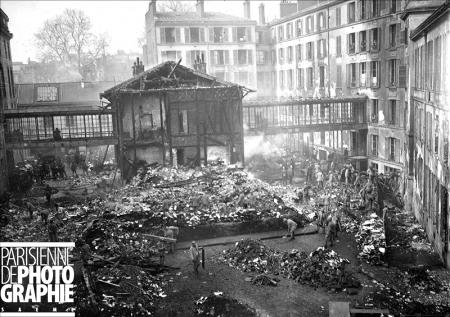
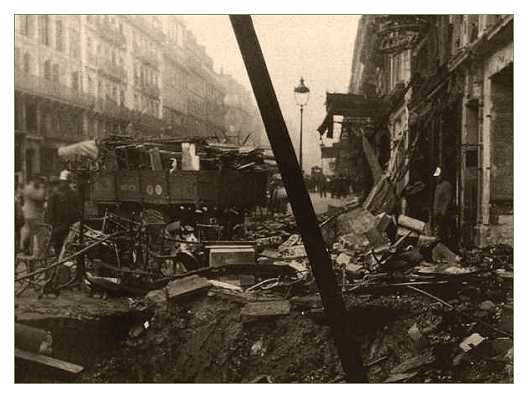
The attacks caused widespread damage – there is a sheaf of photographs here from Parisienne de Photographie (scroll down) – and yet the first reports were often once again remarkably nonchalant.  Here is Charles Grasty reporting from Paris on 23 March 1918 for the New York Times:

‘Paris was out en fête to receive the Gothas this morning… Last night there was considerable excitement following the alarm, but this morning there was more of a picnic spirit.  As I write, at 10.30 at the Matin office, there is an explosion as of a bomb around the corner.  Through the open window I see people on the roofs across the boulevard scanning the cloudless Springlike skies.  At the Ritz and other hotels many guests assembled downstairs but there was not the slightest panic.

I walked through the Rue de la Paix with Ridgely Carter and found the Place de l’Opéra crowded, everybody looking up as if watching some astronomical phenomenon.  Many taxis were standing in rank in the Boulevard des Italiens but the chauffeurs had all left them to join the gazer sin the square.

Paris is puzzled as the air raid proceeds.  The occasional explosion of a bomb makes the town aware of the continued presence of the Gothas, but the affair is quite casual and lacking in violence.’

The date was auspicious.  The explosion that morning in the Place de la République seemed (im)perfectly ordinary, and the DCA assumed that the city had suffered another air raid.

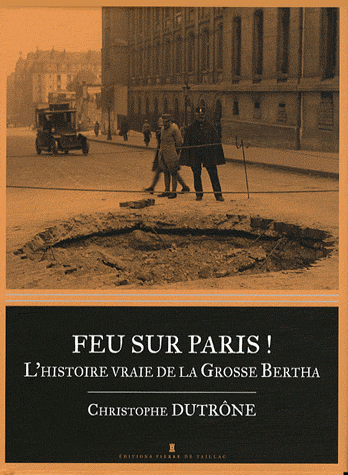
 But by the end of the day, as explosions continued at regular intervals and 16 people lay dead, it became clear that Paris was under artillery fire.  The DCA plotted the trajectory of fire from the locations of the first explosions, and sent aircraft to find the source. The battery was hidden in the forest of Courcy, an unimaginable 120 kilometres away, and Krupp’s long-range siege gun continued to shell the city until August, scattering some 20 shells across Paris each day.  This new ‘fire on Paris’ killed 250 people and caused widespread damage, but had little effect on everyday life in the city.

Marie Harrison reported from Paris on 25 April 1918:

I was in Paris during the first days of the bombardment, and I know something about the morale of the city under circumstances of acute unpleasantness. Air raids are horrible enough but they have their time limit. There is no “all clear” in an attack by the mystery gun. I remember that on Good Friday it began early in the morning, and the explosions continued throughout the day, occurring precisely at every quarter of an hour. That is a form of irritation which the Huns thought would empty Paris in a week. Some people left the city as some people have left London to escape the raid. But the greater number of Parisians went quietly about their work and did not even leave the business at hand to seek shelter from the approach of the next expected attack. Paris is so close to the war and has lived for so long beneath its shadow that it would take more than a long range-gun to disturb the normal course of its way of living.

Ironically, at the start of the war the French high command – like the other belligerents – had believed that the primary role of its own air force would be reconnaissance, and aircraft were soon soon providing crucial intelligence to range field  guns on the battlefield.  Even when the French turned to tactical and strategic bombing, air power remained, as General Pétain insisted, ‘the direct extension of artillery’, so that all efforts had to ‘converge on the essential act: the battle’.

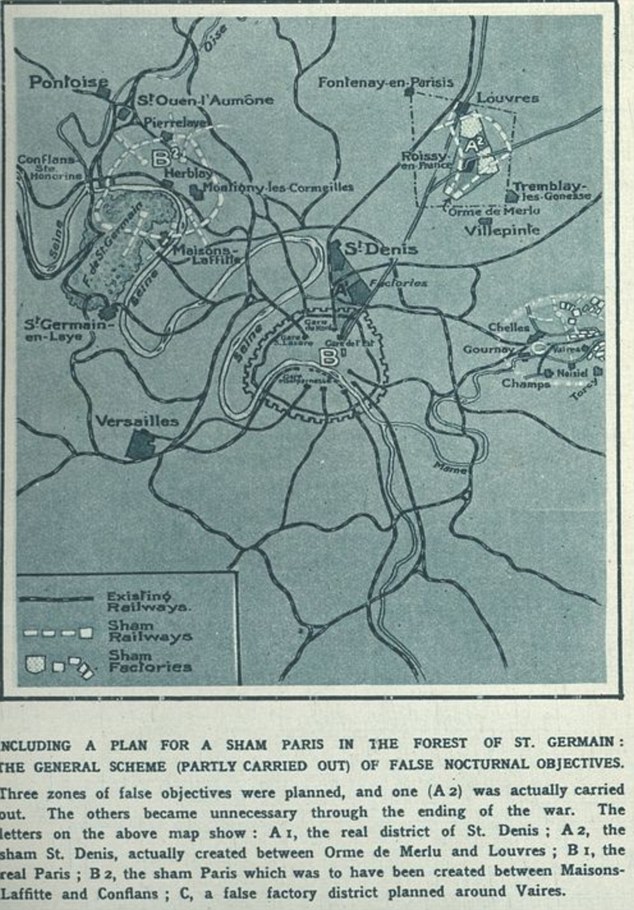
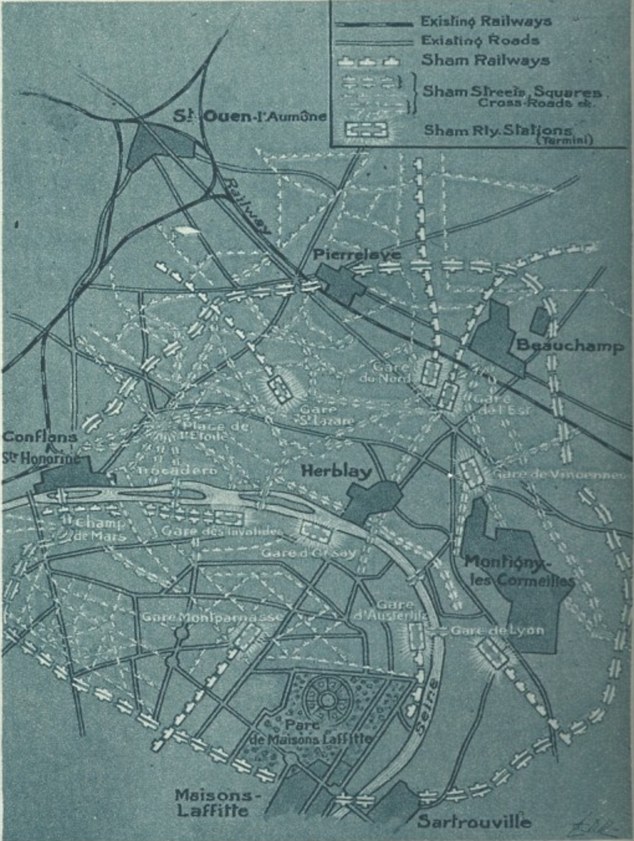
Still, the fear of escalation was real enough, and with the example of the dramatic increase in air raids on London before their eyes, in March 1918 the DCA started construction of a dispersed faux Paris on a great loop of the Seine north of the city (more here).  Three separate sites were selected to draw German night-bombers away from the capital.  Wooden buildings with canvas roofs were to be used to mimic glass-roofed factories, and the plans included a dummy Gare de l’Est and Champs-Elysées; the designers experimented with ‘all sorts of variations and colours of lights’ to convince German pilots that they were bombing Paris.  The plans, largely unrealised, were revealed in a photo-essay in the Illustrated London News on 6 November 1920, which reported that this was ‘a “city” created to be bombarded.’

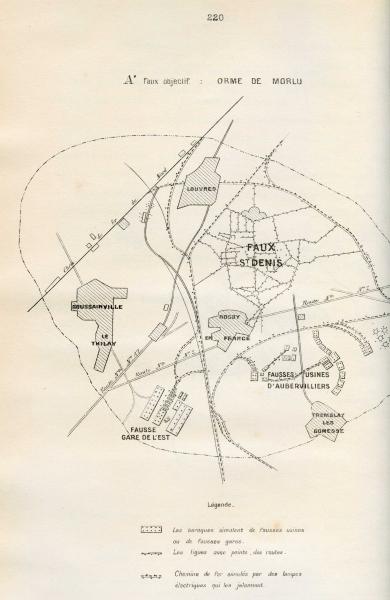
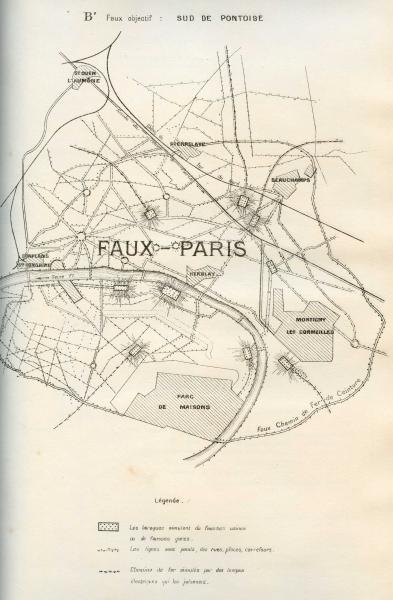
These sketches were drawn for the ILN but here are original maps from October 1918 of ‘objectif A’ and ‘objectif B’:

The danger was more imminent and more substantial than the DCA could have known.  On the night of 23 September 1918 the last of 20,000 new, deadly incendiary bombs – ‘Elektrons’ – were being loaded on to 45 heavy Giant bombers for a devastating raid on Paris.  The plan, according to Neil Hanson in First Blitz (Doubleday, 2008), pp. 330-333, was to create an immense firestorm. Some of the pilots had already completed their final checks before starting their engines. Suddenly a staff car raced across the airfield with orders from Ludendorff abruptly cancelling the mission. Whether this was the result of a fear of the reprisal raids that such a spectacular attack would provoke (a simultaneous raid was to be launched against London – the focus of Hanson’s book) or whether the high command had already realised they would have to sue for peace is unclear. What is certain is that Paris was saved at an eleventh hour 18 days before the final eleventh hour of the Armistice.

Postscript: Faux Paris remained largely a paper city, but in the not too distant future quite other ‘towns to be bombed’ would be built.

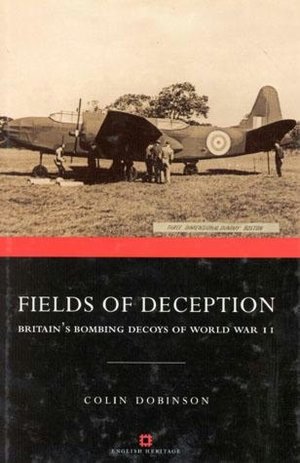
After the bombing of Coventry in 1940 Britain created a number of bombing decoys – known as Starfish sites (from SF: ‘Special Fires’) – to lure the Luftwaffe away from towns and other strategic locations.  The first was on Black Down in Somerset’s Mendip Hills, where Shepperton Film Studios created a fake Bristol (of sorts), including ‘glow boxes’ designed to simulate the streets and marshalling yards and creosote and water ‘fires’ to simulate incendiary bombs.  It was part of a dispersed system of sites standing for other parts of the city – for example, the docks and marshalling yards at Canon’s Marsh were reproduced at Burrington close by.  For an RAF photograph of the Black Down site at night see here. By the end of the war there were over 200 sites protecting 80-odd locations, including London and Manchester.  More here, and much more information in Colin Dobinson, Fields of deception: Britain’s bombing decoys of World War II (Methuen, 2000; a new edition is advertised for 2013).

All of this intersects with a rich literature on camouflage – and in geography (and anywhere else, for that matter) I’m thinking of Isla Forsyth‘s marvellous work – but we should remember that other fake towns were built during the Second World War for entirely the reverse purpose: for experimenting with fire-bombing and, ultimately, for testing the atomic bomb.

The whites of our eyes

I’ve been re-reading Keith Feldman‘s essay on ‘Empire’s verticality’ (Comparative American Studies 9 [4] 2011 325-41), which raises a series of incisive questions about what he calls ‘racialization from above’ in the Afghanistan-Pakistan borderlands.  Keith was working on this while I was working on ‘From a view to a kill’ (see DOWNLOADS tab), and we exchanged ideas en route, but Keith’s essay provides a different and invaluable perspective.  He begins with the famous Situation Room photograph by Pete Scott in which Obama and his senior advisors gaze at a live-feed from Abbotabad on 1 May 2011: since ‘the target of imperial retribution remains just outside the visual field’ – we see no images of the raid – Keith notes that ‘we are drawn to witness the witnessing of Bin Laden’s assassination.’  He focuses on the visual identification of a Muslim Other that is supposed to be precise and yet always remains blurred.

The scopic regime of late modern war is placed under even greater pressure when ‘signature strikes’ are conducted – when the target is not a named individual but a ‘person of interest’ whose ‘pattern of life’ has roused the suspicions of the distant watchers – and this has even more serious implications for civilian casualties.

There’s a short post from Kevin Jon Heller at Opinio Juris that addresses the issue by juxtaposing two quotations.  The first is from a report in the New York Times on 29 May 2012 by Jo Becker and Scott Shane on ‘Obama’s Secret “Kill List”…’ and the CIA-controlled Predator strikes in Pakistan:

“… Mr. Obama embraced a disputed method for counting civilian casualties that did little to box him in.  It in effect counts all military-age males in a strike zone as combatants, according to several administration officials, unless there is explicit intelligence posthumously proving them innocent.  Counterterrorism officials insist this approach is one of simple logic: people in an area of known terrorist activity, or found with a top Qaeda operative, are probably up to no good.”

The second comes from Richard Falk‘s ‘Law and responsibility in warfare: the Vietnam experience’, where he quotes the man who ordered the My Lai massacre, Lt William Caley:

“If those people weren’t all VC [Viet Cong] then prove it to me. Show me that someone helped us and fought the VC. Show me that someone wanted us: one example only! I didn’t see any… Our task force commander’s staff said it’s a VC area and everyone there was a VC or a VC sympathizer. And that’s because he just isn’t young enough or old enough to do anything but sympathize.”

Heller doesn’t use the phrase, for obvious reasons, but this is another Catch-22…

But there’s another Vietnam parallel that I think is even more striking.  In Lines of descent (DOWNLOADS tab) I described the creation of ‘free bomb zones’ or ‘free fire zones’ in South Vietnam.

 In August 1965 [General] Westmoreland was authorized to order strikes in five free bomb zones that were ‘configured to exclude populated areas except those in accepted VC [Viet Cong] bases’.  Within these zones the designation of target boxes dispensed with precise co-ordinates and detailed intelligence altogether, so that they became black boxes in every sense of the phrase, and approval was given in advance ‘for execution when appropriate’. Westmoreland was perfectly clear that ‘anybody who remained had to be considered an enemy combatant’ and so strikes could proceed ‘without fear of civilian casualties’.

With this in mind, here is a section that never made it in to the final version of ‘Lines of descent’, concerning the principle of distinction (the legal requirement to discriminate between combatants and non-combatants).  My Lai makes an appearance here too, as a crucial moment after which the Pentagon agreed to provide military operations with a legal armature.  And yet, as I tried to show in both my essays, incorporating lawyers into the kill-chain provides less protection for civilians than may at first appear: the balance between concrete military advantage and ‘collateral damage’ is still calibrated on the military’s own scales.  I’m not saying that nothing has changed since Vietnam – the lines of descent are complex and tangled – but, as the final paragraph below shows, there are none the less disturbing parallels.  ‘Blind bombing’ may well belong to the past, superseded by near real-time, high-resolution full-motion video feeds from Predators and Reapers, and yet – to return to Feldman – in scanning these images we continue to privilege the whites of our own eyes.

Distinction and the air war in Vietnam

The difficulty of distinguishing between ground troops, enemy forces and non-combatants was exacerbated by the use of air power in a non-linear battlespace, the ‘war without fronts’, because ‘the absence of clearly discernible bomb lines created a fluid environment in which it was not always possible to distinguish friendly from enemy forces.’  From the air, Schlight continued, ‘all soldiers looked alike and guerrillas were indistinguishable from non-combatants.’ [1]  He insists that there was an acute sensitivity to ‘accidental loss of life’.  In Westmoreland’s (public) view, ‘one mishap, one innocent civilian killed, one civilian wounded or one dwelling needlessly destroyed, is one too many’, and this supposedly translated into ‘stringent’ rules of engagement.  In particular, strikes on hamlets and villages required political clearance from Vietnamese authorities at least at a provincial level, they had to be directed by a Forward Air Controller or radar to minimize civilian casualties, and warnings had to be issued if the attacks were not in conjunction with ground forces; if this were impossible, the ground commander could designate the target, and in ‘specified strike zones’ (whose designation was held to ‘constitute prior political clearance’) pilots ‘could use their own judgement in hitting targets.’ [2]  In this, more or less official view, air strikes still killed civilians but every effort was made to minimize the loss of innocent lives.

Others see it differently.  For some, it was a technical matter.  When van Creveld writes of ‘the American airmen’s near-complete inability to distinguish between combatants and noncombatants’, he is simply echoing McNamara’s own post-war admission that it ‘proved difficult to distinguish combatants from noncombatants’ and that Westmoreland’s heavy reliance on bombing ‘produced more and more civilian casualties’: for both men this was an inherent limitation of air power in counterinsurgency. [3]  It was inevitably compounded by the electronic battlefield, as Senator McGovern noted: ‘If ground troops sometimes will not, and usually cannot, distinguish between enemy and innocent in a guerrilla war, we know that aerial bombardment never can.  The sensor which detects body heat, the aircraft thousands of feet in the air, the computer complex many miles distant, are completely neutral and indiscriminate.’  [4]  For others, as McGovern’s first clause implies, the lack of discrimination was too often a considered decision.  The rules of engagement were elastic (in practice Vietnamese political clearance was readily obtained) and riddled with exceptions (there were many cases where clearance could be dispensed with altogether, including military necessity and specified strike zones).  Clodfelter points out that this was in marked contrast to the bombing of North Vietnam where ‘detailed restrictions [were] placed on bombing targets’ because there the American political calculus included civilian casualties.  This was not only true of the Johnson administration’s micro-management of Rolling Thunder; when President Nixon resumed the bombing of North Vietnam in 1972 he loosened the previous restrictions and returned operational control of these Linebacker campaigns to the military, but even his terror bombing of targets around the capital was circumscribed. ‘I want the people of Hanoi to hear the bombs,’ he instructed Strategic Air Command, ‘but minimize damage to the civilian population.’ In South Vietnam, however, where there were few restrictions or political restraints, Clodfelter concludes that ‘indiscriminate bombing contributed significantly to an estimated 1.16 million South Vietnamese civilian casualties during the war.’ [5]  The vital point is that many, perhaps even most of these injuries and deaths were not accidental, often not even incidental  ­– the ‘collateral damage’ that international law accepts may result from attacking military targets – but the victims of deliberate and indiscriminate attack.

Discrimination has two meanings, one strategic and the other legal.  For Kalyvas, violence against civilians is a central feature of insurgency and counterinsurgency, where historically both sides often targeted civilians to force them to comply, but it can be discriminate – directed against specific targets – or indiscriminate, based on collective attributes like place of residence. [6]  Kocher, Pepinsky and Kalyvas argue that bombing in South Vietnam was indiscriminate because it was typically directed at areas, boxes or zones: ‘it could not target individual VC supporters while sparing government supporters or the uncommitted, even when intelligence was good’.  They concede that this was, in part, a technical matter – target identification was often hit-or-miss and until Paveway laser-guided bombs were used in the Linebacker campaigns the delivery of ordnance was ‘inherently inaccurate’ – but in many cases they suggest that exposing civilian populations to aerial violence was a tactical choice.  One leaflet drop warned people that ‘when the plane returns to sow death, you will have no more time to choose’, and many commanders welcomed the bombing of civilians: when he was asked if he was worried by the civilian casualties caused by bombing and shelling, Westmoreland himself airily replied, ‘Yes, but it does deprives the enemy of population, doesn’t it?’ [7]  This is perhaps unsurprising; bombing had been an established method of colonial ‘air control’ much earlier in the century. It turned out to be as counterproductive in Vietnam as it had been in Mesopotamia and the North West Frontier. Targeting collectives means that individuals ‘cannot avoid being victimized simply by refusing to participate in the insurgency’, and bombing the South clearly increased Viet Cong control in the affected areas. [8]

Discrimination also carries a legal charge, but it has a complicated history.  After the Second World War there was an attempt to incorporate ‘protection of civilian persons in times of war’ into the Geneva Conventions, but these largely failed to address the vulnerability of civilian populations to military violence in general and to air strikes in particular. [9]  In 1956 the International Committee of the Red Cross produced a series of Draft Rules that prohibited direct attacks on the civilian population and, in particular, attacks ‘without distinction’ on areas where military targets were close to the civilian population.  This was an express attempt to outlaw area bombing, and it met with forceful opposition. In 1965 the ICRC reaffirmed the prohibition on direct attacks against the civilian population, and insisted on discrimination between those taking part in hostilities and civilians who should ‘be spared as much as possible’, and in December 1968 these basic principles were endorsed in UN Resolution 2444 on Respect for Human Rights in Armed Conflicts.  In 1972 the Pentagon confirmed that it regarded these principles as declaratory of customary international law but added two riders. The United States insisted that it was permissible to attack military targets even if there were a risk of collateral damage, and in such cases the responsibility for distinguishing military objectives from civilian devolved upon ‘the party controlling the population.’ [10] These were expedient qualifications in the (arc) light of South Vietnam, where insurgents swam in the sea of the population.  In fact MACV’s legal advisor blamed the suffering of Vietnamese civilians on the law itself, which he claimed was ‘inadequate to protect victims in wars of insurgency and counterinsurgency’ because it drew on ‘examples from World War II which simply did not fit in Vietnam’ where ‘the hazy line between civilian and combatant became even vaguer’. [11]  Another judge advocate said much the same: In Vietnam ‘the battlefield was anywhere and everywhere, with no identifiable front lines and no safe area. This meant that innocent civilians could not easily avoid the war or its suffering.’  He was silent about the responsibility of those conducting the war to avoid innocent civilians – justice, like much of the bombing, was blind – and limited his discussion to compensation payments where ‘loss or damage was caused by reckless or wanton conduct by U.S. forces.’ [12]  Not surprisingly, what is now called operational law remained strikingly undeveloped.  Judge advocates at MACV were not consulted about air operations; one judge advocate attended meetings at Seventh Air Force headquarters, but these reviewed the previous week’s operations and ‘no one consulted him about future operations, the lawfulness of striking selected targets, or compliance with the rules of engagement’; tactical air control centers had no place for judge advocates who ‘had almost no contact with the people who planned or executed air operations’, and provided neither briefings nor advice on the laws of war or the rules of engagement.  The single exception was a judge advocate based at the US Embassy in Thailand who scrutinized some target lists in North Vietnam. [13]

In fact, it was only after the publicity surrounding the My Lai massacre, in November 1974, that the Pentagon directed the armed services to implement a program to prevent violations of the Law of War; only then did the US military begin to incorporate legal oversight into its operations. [14]  Most legal scrutiny of the air war in Vietnam was after the event – hence the essays by Hays Parks on Rolling Thunder and Linebacker that conclude that both were fully consistent with (in the case of Rolling Thunder even unduly sensitive to) international law – and, no less significantly, did not address the conduct of the air war in the South. [15]  The crucial issue there is the distinction between civilians and combatants, and here Richard Falk, while granting that the law of armed conflict was inadequate and needed revision, none the less insisted that, in its promulgation of ‘free bomb zones’, in B-52 ‘pattern raids’, and much else, the US violated customary international law routinely and serially: ‘the overall American conduct of the war involve[d] a refusal to differentiate between combatants and noncombatants and between military and nonmilitary targets.’ [16]

[1] John Schlight, The war in South Vietnam: The years of the offensive, 1965-1968 (Office of Air Force History, 1969) War, p. 258.  A bombline is ‘an imaginary line arranged, if possible, to follow well-defined geographical features, prescribed by the troop commander and coordinated with the Air Force commander, forward of which air forces are free to attack targets without danger or reference to the ground forces; behind this line all attacks must be coordinated with the appropriate troop commander’: John Pearse, ‘Air power in the kill-box: Fire support co-ordination and airspace deconfliction in the future non-linear battlespace’, Thesis, School of Advanced Air and Space Studies, Maxwell Air Force Base, 2003: p. 22.

[2] Schlight, War, pp. 258-9.

[3] Martin van Creveld, The age of airpower (New York: Public Affairs, 2011) p. 199; Robert McNamara, In retrospect: the tragedy and lessons of Vietnam (New York: Vintage, 1995) p. 243.

[4] McGovern’s speech was delivered on 14 December 1971 and is excerpted in ‘Automated warfare’ (January 1972) p.2, Folder 01, Box 02, Douglas Pike Collection: Unit 03 – Technology, The Vietnam Center and Archive, Texas Tech University.

[5] Mark Clodfelter, ‘A strategy based on faith: the enduring appeal of progressive American airpower’, Joint Forces Quarterly 49 (2008) 24-31, 150-160: 31.  Clodfelter’s figure includes those wounded and killed 1965-1974, and is derived from estimates presented in Guenter Lewy, America in Vietnam (New York: Oxford University Press, 1978) p. 446.  These estimates are probably conservative, and Lewy is much more reluctant to attribute these totals to ‘allied bombing’, but he does accept that the ‘lavish use of [US] firepower’ caused ‘a large number of civilian casualties’ in the South (p. 230).  Despite the restrictions US bombing also caused casualties in the North: Lewy estimates around 65,000 civilians were killed, and other estimates run into the hundreds of thousands.

[6] Stathis Kalyvas, The logic of violence in civil wars (Cambridge: Cambridge University Press, 2006) p. 142 and passim.

[7] Matthew Kocher, Thomas Pepinsky and Stathis Kalyvas, ‘Aerial bombing and counterinsurgency in the Vietnam War’, American Journal of Political Science 55 (2011) 201-18: 205; Westmoreland’s remark was made in summer 1966 and is cited in David Halberstam, The best and the brightest (New York: Ballantine, 1969) p. 550, who adds: ‘The American command was aware of it was doing, and sanctioned it… MACV knew about it, it didn’t want to know too much, it would look the other way if possible, but it knew it was all going on out there.’

[8] Kocher, Pepinsky and Kalyvas, ‘Aerial bombing’, 203, 215.  A 1968 RAND survey found that bombing increased support for the Viet Cong, but it was never released: Robert Smith, ‘Report compiled in 68 says excessive Allied bombing in South Vietnam stirred hostility to regime’, New York Times, 22 January 1970.

[9] ‘The most conspicuous sufferers from bombing, Germany and Japan, were unable to put their case, while the bombing specialists, the USA and the UK, had every reason for preventing the case being out’: Geoffrey Best, War and law since 1945 (Oxford: Clarendon Press, 1994) p. 115.

[10] Hays Parks, ‘Air war’, 65-71.

[11] MG George Prugh, Law at war, Vietnam 1964-1973 (Washington DC: Department of the Army, 1975) p. 89.  He also conceded that there was no effective mechanism to enforce compliance.

[12] Frederic Borch, Judge Advocates in Vietnam: Army Lawyers in Southeast Asia, 1959-1975 (Combat Studies Institute, 2003) p. 92.

[13] LTC Terrie Gent, ‘The role of Judge Advocates in a Joint Air Operations Center’, Air Power Journal, Spring 1999

[14] My Lai was the scene of a massacre of hundreds of civilians by US troops on 16 March 1968; it was not widely reported until November 1969, and the subsequent courts-martial were not completed until March 1971. The problem was much wider and more pervasive than this focus suggests, however, and Greiner, War without fronts, p. 18, writes of an ‘endemic contempt’ for international law on the part of the US.  Dunlap identifies a ‘revolution in military legal affairs’, after Vietnam, beginning in 1989 with the involvement of judge advocates in planning US military operations in Panama and becoming much more visible during the first Gulf War: Charles Dunlap. ‘The revolution in military legal affairs: Air Force legal professionals in 21st century conflicts’, Air Force Law Review 51 (2001) 293-309.  Consistent with his later preoccupation with ‘lawfare’, he places particular emphasis not on advances in military technology, however, but on changes in communications technology that worked to enable media organizations to bring ‘the raw images of war’ to publics around the world ‘before leaders can censor or shape it’ (p. 294).

[15] W. Hays Parks, ‘Rolling Thunder and the law of war’, Air University Review, January-February 1982 athttp://www.airpower.maxwell.af.mil/airchronicles/aureview/1982/jan-feb/parks.html; ‘Linebacker and the law of war’, Air University Review January-February 1983 at http://www.airpower.maxwell.af.mil/airchronicles/aureview/1983/jan-feb/parks.html.

[16] Richard Falk, ‘Son My: war crimes and individual responsibility’, University of Toledo Law Review 21 (1971) 21-41:23.

Project Thor and the history of bombing

In a previous post I wrote about the US Bombing Encyclopedia of the World, designed as a global database of potential targets, but for more on a different but related project that I also previewed, a database of US bombs dropped from the closing stages of the First World War to the present, see this video from the US Air Force on its Project Thor [Theater History of Operations Reports]:

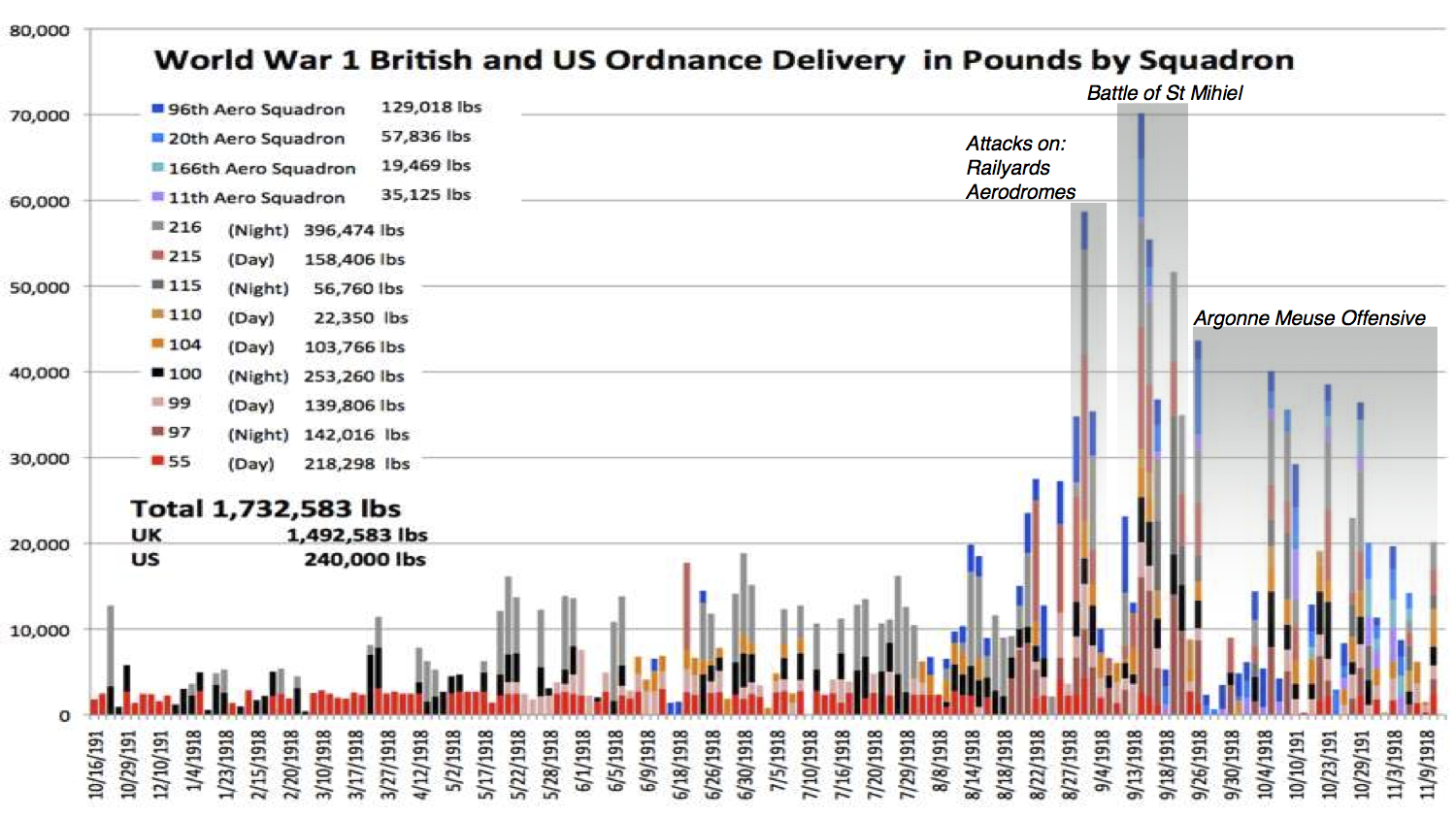
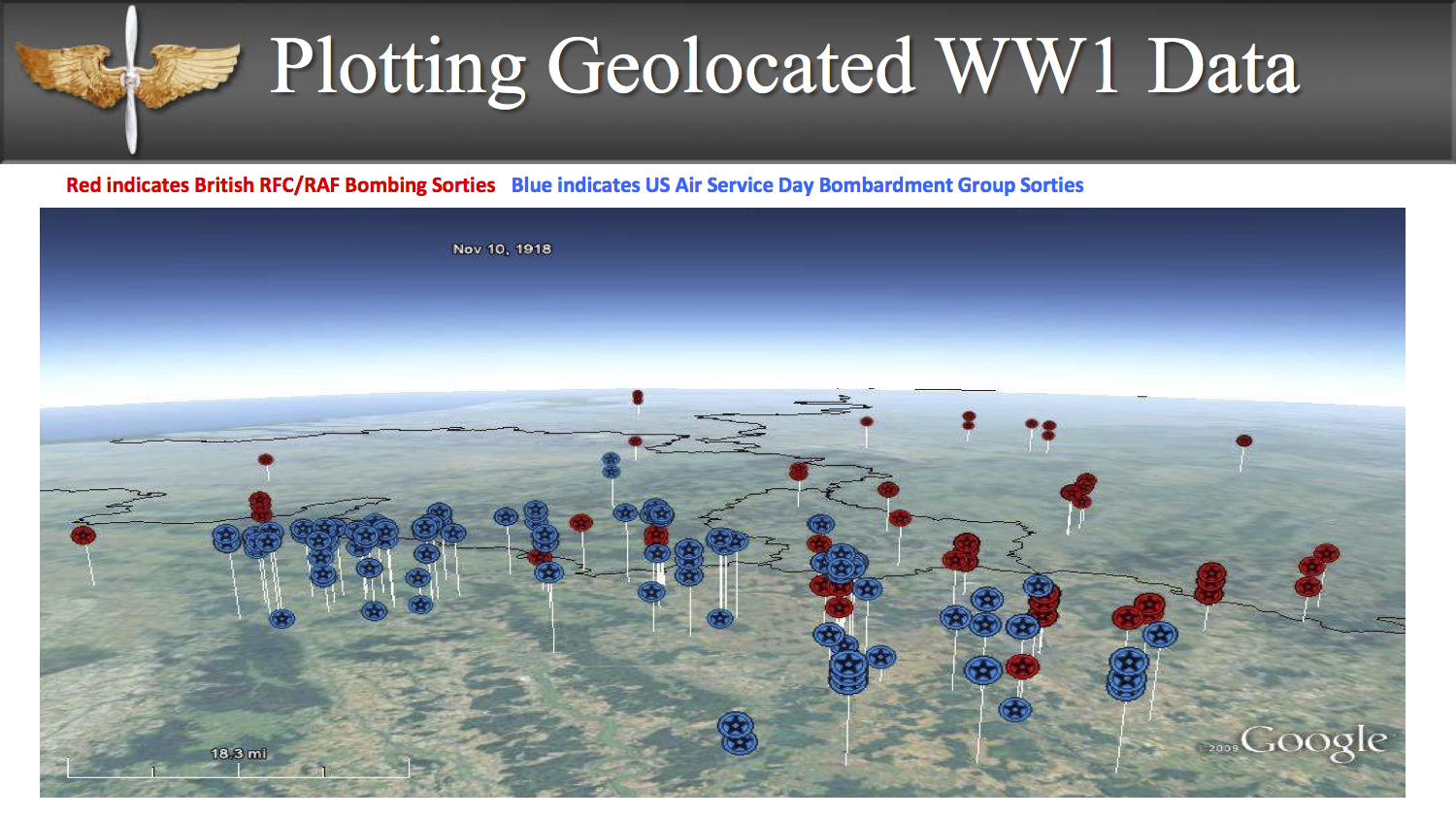
For the background to the project, look here.  And for a preview of its possibilities – the intention is apparently for the database to be open access in the near-ish future – here are two extracts from the World War I (1918) database:


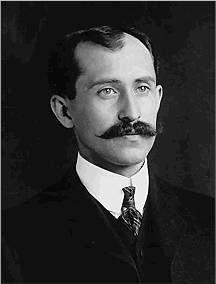
Although my own work focuses on the combined bomber offensive in World War II, the air wars over Indochina and the ‘drone wars’ over Afghanista, Pakistan and beyond, it’s not limited to these air wars, and I’ve been examining other periods and other theatres.  I’ll say more about my interest in World War I (and hence the reason for the extracts above) in a later post, but it was prompted by Orville Wright‘s arguments about the future of air war.  ‘I have never considered bomb-dropping as the most important function of the airplane,’ he told the New York Times in July 1917, ‘and I have no reason to change this opinion now that we have entered the war.’  For him – though he did not altogether discount the importance of striking particular targets, like the Krupp works at Essen – the key role of the aeroplane was reconnaissance (‘scouting’) for ground forces, including artillery:  ‘About all that has been accomplished by either side from bomb dropping has been to kill a few non-combatants, and that will have no bearing on the result of the war.’  (The use of the term ‘bomb-dropping’ rather than bombing was accurate – unlike the practice it described – and while there were air raids on towns and cities, carried out from aircraft and from Zeppelins, most air strikes during the War were tactical).

As we’ll see, aircraft were much more valuable for reconnaissance missions – here I’ve been learning much from Terrence Finnegan‘s Shooting the Front: Allied aerial reconnaissance and photographic interpretation (The History Press, 2011; first edition 2007) (reviewed for the CIA [really] here) –but Wright seemed in two minds about it insofar (in his view) it had prolonged the war:

“Did you ever stop to think that there is a very definite reason why the present war in Europe has dragged along nearly three years with neither side gaining much advantage over the other?  The reason, as I figure it out, is the airplanes.  In consequence of the scouting work done by the flying machines, each side knows exactly what the opposing forces are doing.

“There is little chance for one army to take another by surprise.  Napoleon won his wars by massing his troops at unexpected places.  The airplane has made that impossible.  It has equalized information.  Each side has such complete knowledge of the other’s movements that both sides are obliged to crawl into trenches and fight by means of slow, tedious routine rather than by quick, spectacular dashes.”

Ironically, it was precisely the subsequent rise of strategic bombing (what Mark Clodfelter calls ‘beneficial bombing’) that was hailed by its advocates as a way of bringing war to a speedy end and avoiding the carnage of the trenches.  Here is Clodfelter’s quick summary of a complex and convoluted argument (from Beneficial Bombing: the Progressive foundations of American air power, 1917-1945, University of Nebraska Press, 2010; see also his essay in Joint Forces Quarterly 49 (2008) 24-31 here):

‘The devastation and ugly realism of World War I ended the progressive era for most Americans…  Yet for Army Air Service officers like Edgar Gorrell and William “Billy” Mitchell, the carnage and waste that they witnessed on the Western Front sparked the beginning of a progressive effort that was unique – an attempt to reform war by relying on its own destructive technology as the instrument of change.  They were convinced that the airplane – used as a bombing platform – offered the means to make wars much less lethal than conflicts waged by armies or navies….

‘Aircraft would destroy the vital centers [of the enemy] by precision bombing – sophisticated technology would guarantee that bombs hit only the intended targets, and few lives would be lost in the process.  The finite destruction would end wars quickly … and thus bombing would actually serve as a beneficial instrument of war.’

My own project is, in part, designed to give the lie to these arguments and their successors.  And perhaps it will even be possible to enlist Project Thor to silence these dread thunderbolts (and Hellfire missiles).

Bombing Encyclopedia of the World

Bombing from the air re-wrote the geography of war, blurring and blasting the boundaries between ‘civilian’ and ‘military’ spaces.  But it also required a knowledge of geography.  In the Second World War the targeting cycle could extend over several weeks or even months as target folders were compiled, complete with aerial photographs, target maps and intelligence reports, but after the war the United States was determined to accelerate the process. When the US Air Force was separated from the US Army it quickly established its own Directorate of Targets, which was made responsible for the compilation of what was eventually called the ‘Bombing Encyclopedia of the World’.

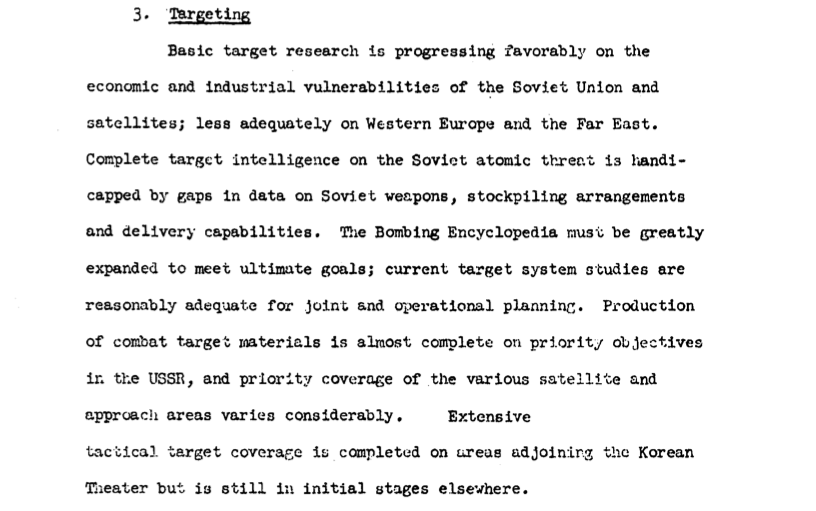
Work started in January 1946 on potential targets in the Soviet Union and in six months IBM cards were punched for 5,594 targets.  In April 1949 a rare press report noted that the volume of work had ‘doubled since last summer’ and that the Air Force was requesting more funds to hire additional intelligence officers and civilian analysts.  The database was extended to Soviet satellites and Korea, but in 1952 the National Security Council was told that while ‘basic target research’ was progressing favourably ‘the Bombing Encyclopedia must be greatly expanded to meet current goals.’

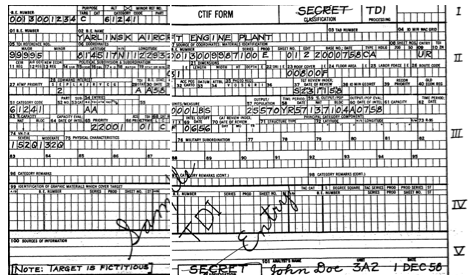
The database soon became global, and by 1960 it contained 80,000 entries. Machine processing was still in its infancy, however, and the project was bedevilled by serious problems of information management that were still unresolved by the time American forces were deployed in Vietnam.  As the number of targets steadily increased, so it became ever more difficult to integrate data from multiple sources.  Standardisation was eventually achieved through the Consolidated Target Intelligence File (shown below; the image is imperfect because it is a composite).  Outten Clinard explained that the form was divided into five sections:

I.    Codes for machine processing and hand processing.
II.  Information identifying and locating the target.
III. Information on the category of the target and its individual characteristics within the category.
IV.  References to graphic coverage on the target.
V.   Sources.

The CTIF shown here is for a fictitious (industrial) target, but Clinard explained its structure thus:

Much of the information is entered on the form uncoded and may be read directly, for example the target’s name (02), location (06), elevation in tens of feet (20), roof cover in thousands of square feet (23), and output in thousands of pounds (57).  Some of it is entered in a simple code for which the IBM 705 is keyed. On the form shown, in the country block (08) “UR” represents the USSR; under command interest (28) the figure 2 in the E block indicates that the target has been nominated by the U.S. European Command; and under category requirements (68) the letters C and F indicate that additional information is needed on capacity/output and labor force, respectively.

The CTIF was more than a resource for planning particular missions.  Stored on magnetic tapes, the data-stream of CTIFs  was also ‘susceptible of rapid and complex manipulation in electronic data-processing machines’.  In 1959, when Clinard published his (then classified) essay in Studies in Intelligence,  the targeting effort was primarily directed towards Strategic Air Command  and the prospect of long-range nuclear strikes against the Soviet Union.  For this reason, the bombing database was used to calibrate (for example) a Damage and Contamination Model:

‘This is a large and complex program, involving 58,000 targets and geographic “cells” and 700,000 to 900,000 computations. With requisite inputs from a war plan, that is, a pattern of ground zeros, weapon types, etc., this program is capable of calculating the probabilities of blast damage to some 9,000 targets, the radiation dose and contamination pattern from the weapons which were ground burst, and the fatalities and other casualties in 40,000 geographic “cells.” It will also give damage and casualty summaries by categories and by regions.’

One of the analysts responsible for ‘nominating’ targets for inclusion in the Encyclopedia was Henry Nash, who described how, ‘in order for a nominated target to win its way into the Bombing Encyclopedia … a Significant Summary Statement was prepared which briefly (roughly 50 words or less) described each target and its strategic importance.’  Years later, as a professor of political science in a liberal arts college in Virginia, Nash wondered ‘What enabled us calmly to plan to incinerate vast numbers of unknown human beings without any sense of moral revulsion?’  This was what he called the ‘bureaucratization of homicide’ I referred to in an earlier post: the compartmentalization of tasks, the collective reinforcement through membership in committees or task forces, and the reward and recognition conferred by ‘special’ security clearances.  Nash also reflected on the powers of abstraction. A preoccupation with ‘the numbers game’ – ‘The strong technological and quantitative orientation of these tasks [clearly shown in the paragraphs above] held the attention of analysts and the relationship of weapons to human life was an incidental consideration’ – was reinforced by carefully sanitized language:

‘As America’s involvement in the Vietnam War grew deeper, the Defense vocabulary expanded and displayed an even greater imaginative and anaesthetizing flair. Targets for attack were given the picturesque name of “strategic hamlets.” Bombing raids became “surgical strikes” and the forced movement and impounding of Vietnamese citizens were part of America’s “pacification program” – terms suggesting images of the hospital operating room or a Quaker meeting.’

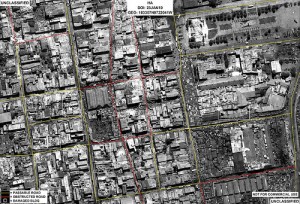
Much of this will be familiar to analysts of bombing today.  The Bombing Encyclopedia has been re-named the Basic Encyclopedia, the targeting process has been refined and the kill-chain has been ‘lawyered up’, but the process still relies on the rapid-fire production, analysis and dissemination of a vast database and on computer modelling of damage and blast effects.  Today, the target folders are computer files but as the example below shows, the BE number is still the key (top left):

Yet there are significant changes.  The BE number refers to an ‘object target’ and its fixed, physical location, and this remains important for active (and fortunately non-nuclear) bombing missions against conventional targets.  But in the counterinsurgency and counterterrorism wars conducted by the US in Iraq, Afghanistan, Pakistan and elsewhere the target is often an individual – sometimes identified, if the person appears on a list of ‘High Value Targets’, but sometimes unknown and un-named – and almost always mobile.  And for named targets, even the CIA requires more than fifty words for inclusion on its hit list (though the dossiers submitted to its lawyers for approval are reportedly only 2-5 pages).

Still, when I was working on ‘Doors into Nowhere’ (see DOWNLOADS tab) I remember encountering elin o’Hara slavick‘s luminous work for the first time, and her remark that she had originally intended to call her series of paintings ‘Everywhere the United States has bombed’ but that, as she learned more about covert action and mis-information, she realised that was an impossible project.  How ironic, then, that behind her critical inclinations there should have been a global database that made all those bombings possible…

But the irony doesn’t end there.  For it turns out that slavick’s project was, until recently, no less difficult for the US Air Force: if not exactly mission impossible then at least mission improbable.

The other side of the Bombing Encyclopedia, verso to its recto, would indeed be a global database recording ‘everywhere the United States has bombed’, but  the data are widely scattered and unsystematic: millions of records, some on paper, some on punchcards and magnetic tape, and more recent ones in various digital forms.  Six years ago Lt Colonel Jenns Robertson started to transcribe, standardise and integrate the available records of individual strike missions from World War I down to the present, incorporating RFC/RAF data for the two World Wars.  The result, announced this week in an article by Bryan Bender in the Boston Globe, is THOR: Theater History of Operations Reports (how the military loves its acronyms).  Robertson started the project in his spare time, working at night and at weekends, but he’s now been assigned to work on it full time at the Air Force Research Institute at Maxwell Air Force Base.  His extraordinary database – which he admits is still incomplete and, in places, in need of scrubbing – can be searched in six main ways listed as follows:

  • When – date, time over target, flying hours, etc.
  • Who – campaign, country, service, unit, call-sign
  • How – aircraft, take-off location, mission type
  • What – weapons used
  • Where – location of target, BE #, release height, speed
  • Why – effects, JTAC reports, Bomb Damage Assessment

The visualizations from the project, displayed and interrogated using GIS, are often stunning – more on this in a later post – and they are designed to answer both historical strategic questions about the conduct of particular campaigns and also contemporary forensic ones about the locations of unexploded ordnance or the remains of missing aircrew killed in action.  I’m hoping that I’ll be able to access the database for my Killing Space project [see DOWNLOADS tab], which focuses on three bombing campaigns: the combined bomber offensive against Germany in World War II, the air wars over Vietnam, Laos and Cambodia, and the ‘drone wars’ over Afghanistan/Pakistan and elsewhere.  But Bender’s description of the visualizations loops back to where I began:

‘The result: a compilation that, at the click of a mouse and a few keystrokes, reveals for the first time the sheer magnitude of destruction inflicted by the US and its allies from the air in the last century…. When plotted on a satellite map, the bombs — from the biplanes of the nascent US Air Service over France in World War I to pilotless drones targeting suspected terrorists in the war in Afghanistan — blanket many thousands of square miles from Europe to Africa, the Middle East and Asia.’

UPDATE:  I returned to the Bombing Encyclopedia here.

Drones and military violence: Readings and screenings

I’m working on a presentation that will turn into a long essay that may turn into a short book – one day I will learn how to write in brief! – and I thought I’d share some of the bibliographic resources I’ve been using. This is not an exhaustive list, needless to say, but I hope it will be a useful springboard for others too; I’ve tried to indicate the range of journals and sources available, and some of the key areas of contention and concern.  Much of the debate on drones has focused on the supposedly covert US air campaign directed by the CIA in Pakistan’s Federally Administered Tribal Areas, which plainly raises vital issues of ethics, law and accountability that can also be extended to parallel campaigns in Somalia, Yemen and elsewhere.  But – as I’ve tried to show in my own work – this should not allow the overt air war in Afghanistan to escape scrutiny.  Here the operational questions often become more complex because these platforms are integrated into extended networks in which surveillance is conducted by remote operators but the strikes may be executed by conventional aircraft: the geography of the kill-chain is crucial.  For this, I’ve been drawing on a series of USAF publications and presentations.

But the focus on the US distract should not distract attention from the rapid expansion of remote capabilities by other militaries, including (as the listing below indicates) Israel, where the IDF developed a series of protocols for extra-judicial killing (assassination) long before the USAF or the CIA.

There are also important historical precedents to consider: the use of air power in colonial counterinsurgency operations, particularly by the British in Mesopotamia (Iraq), the North West frontier of India and Palestine, and the emergence of key elements of today’s remote operations in the Second World War and, in particular, during the US air wars over Indochina. For the former, the work of David Omissi, Air power and colonial control: the Royal Air Force 1919-1939 (1990), Priya Satia, Spies in Arabia: the Great war and the cultural foundations of Britain’s covert empire in the Middle east (2008) [see also her essay on ‘The defense of inhumanity: air control in Iraq and the British idea of Arabia’, American historical review 11 (2006)], and Andrew Roe, Waging war in Waziristan (2010) are key sources.  For the latter, see my ‘Lines of descent’ (DOWNLOADS tab).

There are some significant gaps in the listings that follow.  There is already a book that gives a pilot’s view of these remote missions, Matt Martin‘s Predator, and there’s no shortage of media interviews with (American) crewmembers, usually based at Creech Air Force Base in Nevada.  But, with rare exceptions, the media have shown little interest in documenting the victims of drone strikes, apart from (contentious) estimates of their numbers and claims of ‘high-value targets’ being killed.  For preliminary assessments of the distortions of media coverage, see Timothy Jones, Penelope Sheets and Charles Rowling, ‘Differential news framing of unmanned aerial drones: efficient and effective or illegal and inhumane’ (APSA, 2011: available via ssrn.com) and Tara McKelvey in the Columbia Journalism Review (listed below).

There are virtually no ethnographies of life (and death) under the drones: Shahzad Bashir and Robert Crews have recently curated some interesting essays on daily life in the Afghanistan-Pakistan borderlands, but the title Under the drones (Harvard University Press, 2012) is opportunistic.  The editors write of their desire to ‘illuminate aspects of the rich social and cultural worlds that are opaque to cameras mounted on drones flying many thousands of feet above this terrain’ – an admirable project – but not a single contributor illuminates the impact of the drone wars on those worlds.   There are some sharp questions about the missing ethnographies of death – unlike the surgical dissections of sovereignty – in Anthony Allen Marcus, Ananthakrishnan Aiyer and Kirk Dombroiwski, ‘Droning on: the rise of the machines’, Dialectical Anthropology 36 (2012) 105.   Some of the best repor­tage on the effects of drone strikes in the Federally Administered Tribal Areas of Pakistan comes from CIVIC, but its most recent report on Civilian Harm and Conflict in Northwest Pakistan was published in October 2010 (this also documents the suffering caused by Pakistan military action), though there are some updates on its blog (listed below).

Noor Behram has provided an unforgettable photographic record of the aftermath of drone attacks in the same area (200 images from 27 sites) that formed a centrepiece for the Gaming Waziristan exhibition staged in the UK, the US and Pakistan in 2011: for online galleries see here  and here.  And other visual/video artists have not been slow to reflect on these new modalities of killing: see, for example, John Butler’s The ethical governor (available on YouTube and vimeo) or Omer Fast’s Five thousand feet is the best (in which a white American family is killed in a Predator attack).

In addition, Jordan Crandall has a performance work, ‘philosophical theatre’, called Unmanned at Eyebeam that I’d love to see…. It involves the crash of a drone in a suburban backyard in the American southwest.

 If you think I’ve missed something that ought to be included, please let me know.

 Note: Most militaries disdain the term ‘drones’ since these aircraft are piloted, and prefer ‘Unmanned Aerial Vehicles’ (UAVs) or ‘Unmanned Aerial Systems’ (UAS) or ‘Remotely Piloted Aircraft’ (RPAs).   Most of the listings below are concerned with the use of these platforms to conduct air strikes; smaller drones are also deployed by ground forces for surveillance and no doubt they too will soon be able to carry out strikes.

Books

Nick Turse and Tom Engelhardt, Terminator planet: the first history of drone warfare 2001-2050 (Dispatch Books, 2012) – a sharp analysis of drone wars, past, present and future, culled from the regular reports of the TomDispatch principals; also available as an e-book

Medea Benjamin, Drone warfare: killing by remote control (OR Books, 2012)– a passionate critique from the co-founder of Code Pink and Global Exchange that also details the rise of activist campaigns against drone warfare; also available as an e-book

Matt Martin and Charles Sasser, Predator: the remote-control air war over Iraq and Afghanistan: a pilot’s story (Zenith Press, 2010) – most of the commentary on drones is concerned with covert campaigns waged by the CIA (with JSOC), but this is an account of USAF operations that also deserve close scrutiny….

Peter Singer, Wired for war: the robotics revolution and conflict in the 21st century (Penguin, 2009) – about much more than drones, but Singer has a series of perceptive observations about them scattered throughout the book.

Websites and blogs

Drone Wars UK – focuses on the British use of drones, but also includes wider commentary and information and a useful Drone Wars briefing pdf by Chris Cole [see also Convenient Killing below]

Drones Watch – advertised as ‘a coalition campaign to monitor and regulate drone use’

Understanding Empire – ‘dispatches on the drone wars: the state of our unmanned planet’ – a brilliant news aggregating source with commentary too

Our bombs – created by Neil Halloran ‘a website and documentary film that looks at the human cost and strategic implications of U.S. air strikes’, including an ‘air strike tracker’ from 9/11 through to January 2011

The Bureau of Investigative Journalism – a not-for-profit organisation based at City University, London, that provides (among many other things) a stream of indispensable reports, investigations and critical commentary on ‘the covert war on terror’ in Pakistan, Somali and Yemen

The #drones daily – what it says:  news and commentary updated daily

The Long War Journal – Bill Roggio’s site, politically distant from the sources above, but providess useful charts, maps and reports on covert US air campaigns in Pakistan and Yemen

New America Foundation – the Year of the Drone, mapping and reporting on US drone strikes in Pakistan 2004-2012 (and continuing): but its estimates of civilian casualties (in particular) have been sharply criticised by the BIJ here.

Also on Pakistan, Amnesty International has ‘Eyes on Pakistan’, focusing on human rights abuses in FATA, including maps of drone strikes, through 2009, while CIVIC (Campaign for Innocent Victims in Conflict) has a field blog that provides reports on war victims in Pakistan (and elsewhere)

Articles and essays

Although (too) many of these are behind a pay-wall, I’ve tried to list publically accessible versions wherever possible.  Please don’t assume that inclusion means agreement!

M.W. Aslam, ‘A critical evaluation of American drone strikes in Pakistan: legality, legitimacy and prudence’, Critical studies on terrorism 4 (2011) 313-29

Chris Cole, Mary Dobbing and Amy Hailwood, Convenient killing: Armed drones and the ‘Playstation’ mentality available here

Jordan Crandall, ‘Ontologies of the wayward drone: a salvage operation’, Theory beyond the codes (2011)available here

Aliya Robin Deri, ‘“Costless war”: American and Pakistani reactions to the US drone war’, Intersect 5 (2011) available here

Christian Enemark, ‘Drones over Pakistan: secrecy, ethics and counterinsurgency’, Asian Security 7 (3) (2011) 218-37

Keith Feldman, ‘Empire’s verticality: the Af/Pak frontier, visual culture and racialization from above’, Comparative American Studies 9 (4) (2011) 325-41

Jenny Garand, ‘Robotic warfare in Afghanistan and Pakistan’ (December 2010) (Medical Association for the Prevention of War, Australia) available here

Derek Gregory, ‘From a view to a kill: Drones and late modern war’, Theory, culture and society 28 (7-8) (2011) 188-215 (see DOWNLOADS tab)

Derek Gregory, ‘The everywhere war’, Geographical Journal 177 (2011) 238-250

Derek Gregory, ‘Lines of descent’, Open Democracy, 2011 (see DOWNLOADS tab)

Leila Hudson, Colin Owens, Matt Flannes, ‘Drone warfare: blowback from the New American way of war’, Middle East Policy 18 92011) 122-132

Human Rights Watch, Precisely wrong: Gaza civilians killed by Israeli drone-launched missiles (2009)

David Jaeger and Zahra Siddique, ‘Are drone strikes effective in Afghanistan and Pakistan? On the dynamics of violence between the United States and the Taliban’ (Forschungsinstitut zur Zukunft der Arbeit, Discussion Paper 6262, December 2011) (available via ssrn.com)

Jake Kosek, ‘Ecologies of empire: on the new uses of the honeybee’, Cultural anthropology 25 (4) (2010) 650-78 (see pp. 666 on)

Katrina Laygo, Thomas Gillespie, Noel Rayo and Erin Garcia, ‘Drone bombings in the Federally Administered Tribal Areas: Remote sensing applications for security monitoring’, Journal of Geographic Information Systems 4 (2012) 136-41

Jane Mayer, ‘The Predator War’, New Yorker, 26 October 2009

Tara McKelvey, ‘Covering Obama’s Secret War’, Columbia Journalism Review, May/June 2011

Avery Plaw, Matthew Fricker and Brian Glyn Williams, ‘Practice makes Perfect? The changing civilian toll of CIA drone strikes in Pakistan’, Perspectives on terrorism 5 (506) (December 2011)

Lambèr Royakkers,  Rinie van Est, ‘The cubicle warrior: the marionette of digitalized warfare’, Ethics & Information Technology 12 (2010) 289-96

Noel Sharkey, ‘The automation and proliferation of military drones and the protection of civilians’, Law, innovation and technology 3 (2) (2011) 229-240

Ian Shaw, The spatial politics of drone warfare (unpublished PhD thesis, University of Arizona, 2011) available via the university’s open repository here

Ian Shaw and Majed Akhter, ‘The unbearable humanness of drone warfare in FATA, Pakistan’, Antipode (2011) [Early View]

Jeffrey Sluka, ‘Death from above: UAVs and losing hearts and minds’, Military Review (May-June 2011) 70-76

Bradley Strawser, ‘Moral Predators: the duty to employ uninhabited aerial vehicles’, Journal of military ethics 9 (2010) 342-68

Tyler Wall and Torin Monahan, ‘Surveillance and violence from afar: the politics of drones and liminal security-scapes’, Theoretical criminology 15 (2011) 239-54

Alison Williams, ‘Enabling persistent presence? Performing the embodied geopolitics of the Unmanned Aerial Vehicle assemblage’, Political Geography [early view] doi:10.1016/j.polgeo.2011.08.002

Brian Glyn Williams, ‘The CIA’s covert Predator drone war in Pakistan, 2004-20010: the history of an assassination campaign’, Studies in conflict and terrorism 3 (2010) 871-92

There is also a rapidly developing literature on international law, lawfare and targeted killing that integrates the use of drones into its discussions:

Philip Alston, ‘The CIA and targeted killings beyond borders’, New York University School of Law Public Law and Legal Theory Research Paper Series, Working Paper 11-64 (2011)

Kenneth Anderson, ‘Targeted killing and drone warfare: how we came to debate whether there is a “legal geography of war”, American University, Washington College of aw Research Paper 2011-16 (available via ssrn.com) [there are multiple papers by Anderson on these issues, usually available via ssrn.com]

Jack Beard, ‘Law and war in the virtual era’, American Journal of International Law 103 (2009) 409-445

O. Ben-Naftali, and Karen Michaeli, ‘We must not make a scarecrow of the law: a legal analysis of the Israeli policy of targeted killings’, Cornell International Law Journal 36 (2003)

Laurie Blank, ‘After “Top Gun”: How drone strikes impact the law of war’, University of Pennsylvania Journal of International Law (2012)

Amitai Etzioni, ‘Unmanned Aircraft Systems: the legal and moral case’, Joint Forces Quarterly (57) (2010)

Neve Gordon, ‘Rationalising extra-judicial executions: the Israeli press and the legitimisation of abuse’, International journal of human rights 8 (2004) 305-24

Kyle Grayson, ‘Six theses on targeted killing’, Politics 32 (2012) 120-8

Kyle Grayson, ‘The ambivalence of assassination: biopolitics, culture and political violence’, Security dialogue 43 (2012) 25-41

Lisa Hajjar, ‘Lawfare and targeted killing: developments in the Israeli and US contexts’, Jadaliyya , 15 January 2012 here.

Chris Jenks, ‘Law from above: unmanned aerial systems, use of force and the law of armed conflict’, North Dakota Law Review 85 (2009) 649-671 [available via ssrn.com]

Sarah Kreps and John Kaag, ‘The use of unmanned aerial vehicles in combat: a legal and ethical analysis’, Polity (2012) 1-1=26 [early view]

Michael Lewis, ‘Drones and the boundaries of the battlefield’, Texas International Law Journal (2012) [available via via ssrn.com]

Nils Melzer, Targeted Killing in International Law (Oxford University Press, 2009)

Mary Ellen O’Connell, ‘Seductive drones: learning from a decade of lethal operations’, Journal of law, information and science [special edition: The law of unmanned vehicles] [available via ssrn.com]

Mary Ellen O’Connell, ‘The international law of drones’, American Society of International Law Insights 14 (36) November 2010

Mary Ellen O’Connell, ‘Unlawful killing with combat drones: a case study of Pakistan, 2004-9), Notre Dame Law School, Legal Studies Research paper 09-43 (2009) available via ssrn.com

Andrew Orr, ‘Unmanned, unprecedented and unresolved: the status of American drone strikes in Pakistan under international law’, Cornell International Law Journal 44 (2011) 729-752 [available here ]

Joseph Pugliese, ‘Prosthetics of law and the anomic violence of drones’, Griffith Law Review 20 (2011) 931-61

Noel Sharkey, ‘Saying “No!” to lethal autonomous targeting’, Journal of military ethics 9 (2010) 369-83

Ryan Vogel, ‘Drone warfare and the law of armed conflict’, available via ssrn.com

Eyal Weizman, ‘Thanato-tactics’, in in Adi Ophir, Michal Givoni and Sari Hanafi (eds), The power of inclusive exclusion: anatomy of Israeli rule in the occupied Palestinian territories (New York: Zone Books, 2009) pp. 543-573 and in Patricia Clough and Craig Willse (eds) Beyond biopolitics: essays on the government of life and death (Durham: Duke University Press, 2011)