
I’ve been in Paris this week, first for a presentation to Michel Wieviorka‘s seminar at the École des Hautes Études on Wednesday morning and then for a different presentation to Pauline Guinard‘s seminar at the École Normale Supérieure on Wednesday evening. I hope this explains my silence! Lots of good questions at both, and also lively conversations about the French intervention in Mali — which made today a good day to visit the Musée de l’Armée at Les Invalides.
An astonishing building, but I was disappointed at the exhibitions – too many uniforms and muskets and (especially when compared to the Imperial War Museum in London, even before its current reconstruction) remarkably little on the politics and culture of war (though there were some good three-screen videos). Given my current preoccupation with the First World War, I expected much more from what turned out to be a lifeless series of galleries; appropriate, you might think, but I left with very few impressions of how so many French soldiers managed to survive the trenches and the barrages. It was a far cry from the new history, anthropology and archaeology of the battlefield that has done so much to recover its raw physicality, its sensuality and even its intimacy.
 So I returned to the hotel to start Lara Feigel‘s The love-charm of bombs: restless lives in the Second World War (Bloomsbury, 2013) which I picked up at Foyle’s on my way through London (and still the best bookshop in the world). When people ask me to recommend books that convey the experience of being bombed, my selections always include the opening chapter of Randall Hansen‘s The fire and the fury: the Allied bombing of Germany 1942-1945, where he uses eyewitness accounts to conjure up ‘The day Hamburg died’ with extraordinary power and economy – there is now a rich literature on this in German and in English, most notably Keith Lowe‘s brilliant Inferno: the devastation of Hamburg 1943 – and the central chapters of Sarah Waters‘s stunning novel The Night-Watch. But I think I may have to add Feigel to the list because The love-charm of bombs traffics in that difficult but vital space between the documentary (Hansen) and the imaginative (Waters).
I say ‘may’ only because I’ve just started. But Part I, ‘One night in the lives of five writers, 26 September 1940’, uses the work and lives of five writers – Elizabeth Bowen, Graham Greene, Rose Macaulay, Hilda Spiel and Henry Yorke (‘Henry Greene’) – to address, in a remarkably fresh and compelling fashion, the relation between aesthetics and violence. Feigel does this not in a conventional philosophical fashion, but by engaging directly with the ways in which, for these (and presumably other) writers, there was something thrilling, exhilarating and even sublime about the spectacle of military violence transforming the capital during the Blitz. This was far more visceral than voyeurism, though Feigel is very, very good on the visuals (and would surely have been even better had she included the work of artists and photographers), because these men and women were profoundly, physically involved in the Blitz as air raid wardens, ambulance drivers, and auxiliary firemen. The title comes from Graham Greene:
‘The nightly routine of sirens, barrage, the probing raider, the unmistakable engine (“Where are you? Where are you? Where are you?”), the bomb-bursts moving nearer and then moving away, hold one like a love-charm.’
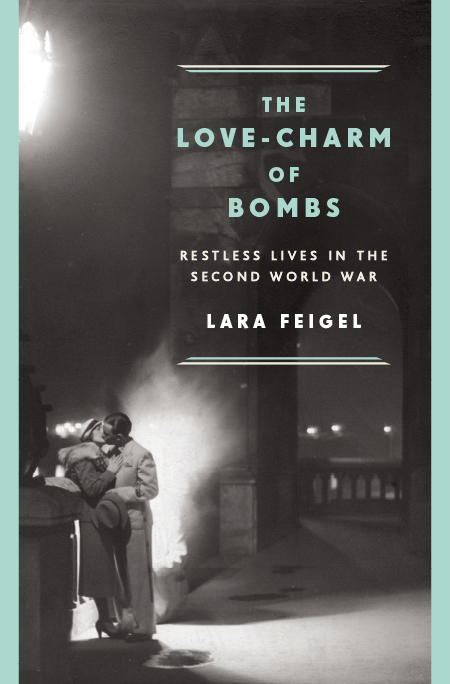 Feigel gives the events of that one night a peculiar intensity by beginning with what she calls a ‘newsreel’, a quick and lively summary of the Blitz, and then, as darkness falls, moving in sections from 7 p.m. (Blackout) through 10 p.m. (Fire) and 1 a.m. (Rescue) until 6 a.m., the All Clear, and the blessed arrival (for some, at least) of a new day. It’s something of a conceit: the five writers were not dutiful scribes each at their separate desks on 26 September , so to bring them into view on this artfully re-imagined night Feigel darts back from their loosely collective present into their pasts, placing them in myriad networks of other writers and friends, inserting them into the narrative arc of the falling bombs, and freely using their writings so that they issue forth as something far more than the usual silhouettes glimpsed against the light of burning buildings. And their involvements are profoundly sensuous: as the cover of the American edition (right) shows far better than the English edition above, and as the title intimates, even as they were unmoored from their familiar haunts and their old lives, they also sensed (and often seized) new possibilities for love as well as loss.
This is a very different ground to that crunched over by Patrick Deer in the equally brilliant Culture in camouflage: war, empire and modern British literature (still one of my favourite books about this or any other period) or Leo Mellor‘s Reading the ruins: modernism, bomb-sites and British culture (which I found remarkably austere), because its sense of culture is more sensuous, even sensual, because it addresses the erotics of surviving military violence in such an honest way, and – probably another way of saying the same two things – because it’s so close in spirit to Sarah Waters.
It’s also much closer to the way in which the humanities have recovered the Western Front. In fact, Feigel insist that ‘these writers, firefighting, ambulance-driving, patrolling the streets,were the successors of the soldier poets of the First World War, and their story remains to be told.’ There are of course difficulties in privileging the privileged, and some of the most arresting memorials about life in the trenches were produced not by the gentlemen-officers but by the ordinary soldiers: but as Feigel shows, there are also riches to be recovered by picking their pocket-books.

 geographical imaginations