Predatory eyes

Following from my last post on the art of bombing – on artists who have attempted to render the aerial perspective of conventional bombing – Honor Harger (from Lighthouse) provides a useful review of artists who are doing the same for drone strikes in his ‘Drone’s eye view’.  Honor writes:

The work of artists such as Trevor Paglen, Omer Fast, and James Bridle exists within a long tradition of artists bearing witness to events that our governments and military would prefer we didn’t see. But Bridle’s work is also part of an ongoing collective effort from both artists and engineers to reveal the technological infrastructures that enable events like drone-strikes to occur.

Omar Fast, 5000 feet is best (2011)

Honor is referring to James Bridle‘s Dronestagram and related projects that I noted earlier, and to Trevor Paglen‘s Drone Vision (see also his other drone-related projects here).  Trevor’s work includes an interview and video clip from Noor Behram, a Pakistani photo-journalist who has been painstakingly documenting CIA-directed drone strikes in the Federally Administered Tribal Areas. He’s best known for his harrowing images of the aftermath of drone strikes, but he also shot this video of a drone over his own house:

“Witnessing a drone hovering over Waziristan skies is a regular thing,” says Noor Behram, who shot this video outside his house in Dande Darpa Khel, North Waziristan.

For more than five years, Behram has been documenting the aftermath of drone attacks in Pakistan’s tribal areas, the hub of the CIA’s remote assassination program. When Behram learns of a strike, he races towards ground zero to photograph the scene. “North Waziristan,” he explained “is a big area scattered over hundreds of miles and some places are harder to reach due to lack of roads and access. At many places I will only be able to reach the scene after 6-8 hours.” Nonetheless, Behram’s photographs are some of the only on-the-ground images of drone attacks.

“[The few places where I have been able to reach right after the attack were a terrible sight” he explains, “One such place was filled with human body parts lying around and a strong smell of burnt human flesh. Poverty and the meagre living standards of inhabitants is another common thing at the attack sites.” Behram’s photographs tell a different story than official American reports that consistently deny civilian casualties from drone attacks: “I have come across some horrendous visions where human body parts would be scattered around without distinction, those of children, women, and elderly.”

For Behram, this video is nothing exceptional. “This was like any other day in Waziristan. Coming out of the house, witnessing a drone in the sky, getting along with our lives till it targets you. That day it was in the morning and I was at my home playing with my children. I spotted the drone and started filming it with my camera and then I followed it a bit on a bike.”

The third artwork in Honor’s triumvirate is Omer Fast‘s fictionalised Five Thousand Feet is the Best, which I included in my list of Readings and Screenings on drones back in August.  There’s a clip below, though the full presentation runs to 30 minutes:

The film is based on two meetings with a Predator drone sensor operator, which were recorded in a hotel in Las Vegas in September 2010. On camera, the drone operator agreed to discuss the technical aspects of his job and his daily routine. Off camera and off the record, he briefly described recurring incidents in which the unmanned plane fired at both militants and civilians – and the psychological difficulties he experienced as a result. Instead of looking for the appropriate news accounts or documentary footage to augment his redacted story, the film is deliberately miscast and misplaced: It follows an actor cast as the drone operator who grudgingly sits for an interview in a dark hotel. The interview is repeatedly interrupted by the actor’s digressions, which take the viewer on meandering trips around Las Vegas. Told in quick flashbacks, the stories form a circular plot that nevertheless returns fitfully to the voice and blurred face of the drone operator – and to his unfinished story.

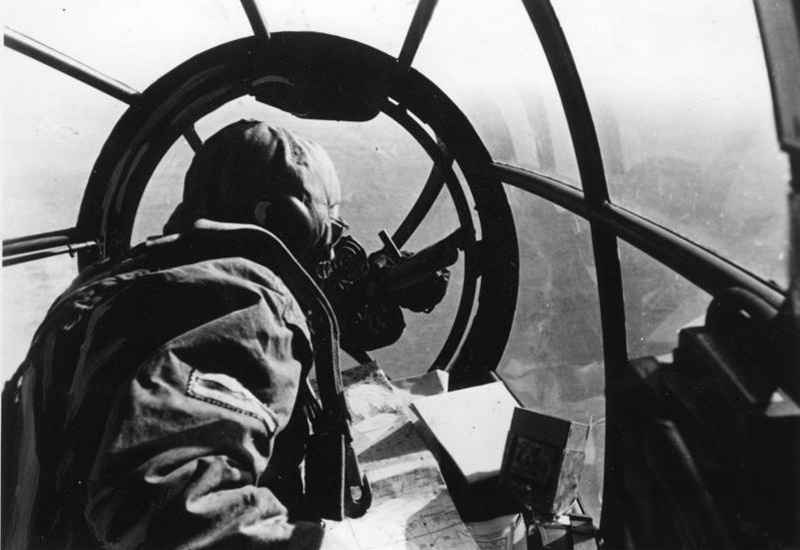
He-111 Luftwaffe bombardiers viewWhat is particularly interesting to me are the ways in which ‘seeing like a drone’ is and is not like seeing through a standard bombsight: the techno-optical regime through which conventional bombing has been conducted differs from the high-resolution full-motion video feeds that inform (and misinform) the networked bombing of late modern war.  Those feeds significantly compress the imaginative distance between the air and the ground, but they do so in a highly selective fashion.  Today’s remote operators, who may be physically thousands of miles away from the target, nevertheless claim to be just 18 inches from the conflict zone, the distance between the eye and the screen, and they (un)certainly see far more of what happens than the pilots of conventional strike aircraft.  But in Afghanistan, where remote operators are usually working with troops on the ground, they become immersed in the actions and interactions of their comrades – through visual feeds, radio and internet – whereas their capacity to interpret the actions of the local population is still strikingly limited.  So it is that local lifeworlds remain not only obdurately ‘other’ but become death-worlds.

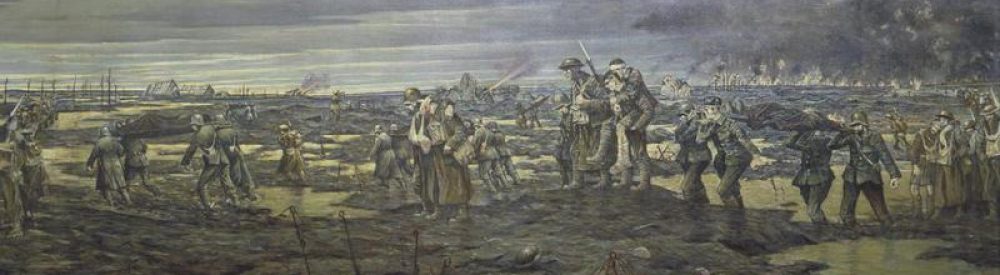
Over the top

I’ve had several inquiries about my recent posts on bombing in the First World War (here and here), all of which want to know why I’ve gone back so far.  Isn’t it all so remote? they ask.   I’d hoped I’d started to answer that in my previous posts, but Tami Davis Biddle – the author of Rhetoric and reality in air warfare (Princeton University Press, 2004) – provides a succinct answer in her ‘Learning in real time: the development and implementation of air power in the First World War’ (in Sebstian Cox and Peter Gray, eds., Air power history: turning points from Kitty Hawk to Kosovo):

‘Virtually every important manifestation of twentieth-century air power was envisioned and worked out in at least rudimentary form between 1914 and 1918.’

She has in mind many of the practices I’ve described in my previous posts – and there’s more to come – but I’ve just stumbled upon one that neither of us anticipated.  And, yes, it is ‘remote’…

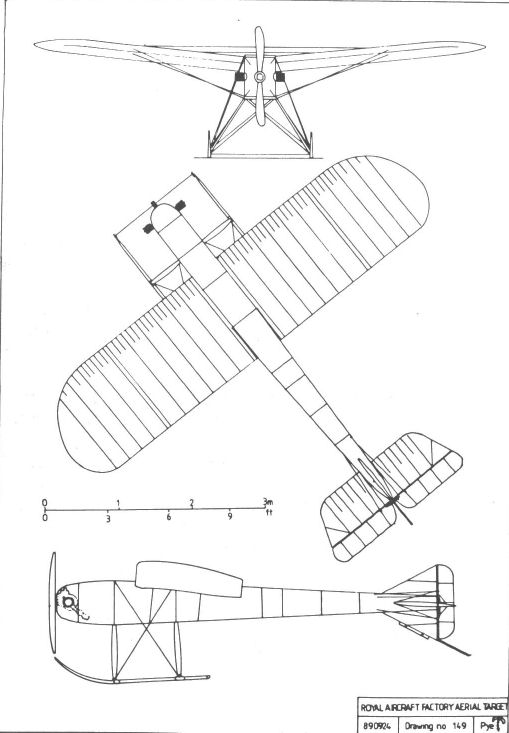
Gary Warne has a remarkable post, ‘The Predator’s ancestors: UAVs in the Great War’, in which he describes Captain Archibald Low’s Aerial Target project.  The codename was a deliberate distraction, Warne explains, because the plan was to develop a pilotless aircraft as a flying bomb, guided  by wireless from an accompanying manned aircraft to attack Zeppelins and ground targets. The fullest discussion of Low’s work that I’ve been able to find is by Paul Hare here; some of the back-story is provided by Hugh Driver in The birth of military aviation 1903-1914 (Boydell and Brewer, 1997) and there’s a wider historical discussion in Chapter 2 of Denis Larm‘s thesis here.

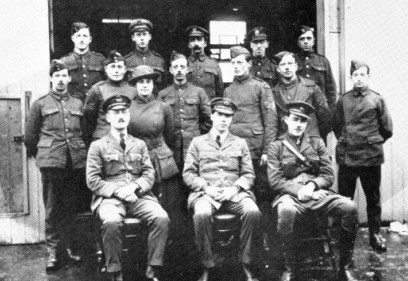
When the war started ‘Professor’ Low, as he styled himself, was already at work on artillery range-finding and, newly commissioned, was soon at the forefront of the Royal Flying Corps’s Experimental Works (below; Low is in the centre of the front row), supervising a team of 30, including jewellers, carpenters and engineers first at a Chiswick garage and later at Brooklands.

The noise of the aircraft engine interfered with the wireless transmissions, and the first demonstration flight of the Aerial Target was a disaster.  According to Steven Shaker and Alan Wise in War without Men: robots on the future battlefield (Pergamon-Brassey, 1988), ‘during a test flight for a gathering of important Allied dignitaries, the AT went astray and dove upon the guests, who scattered in every direction.’  All together six prototypes were constructed in 1917, but none of them saw combat.

That last verb is spot on, however, because in March 1914 Low had successfully demonstrated what he called TeleVista, an early version of television, and the Times reported that ‘if all goes well with this invention, we shall soon be able, it seems, to see people at a distance’ – a capability that, over 50 years later, would be integral to the USAF’s experiments with reconnaissance drones over North Vietnam (see ‘Lines of descent’, DOWNLOADS tab) and, of course, to today’s Predators and Reapers.  As the Times continued, it was an open question ‘whether Dr Low will be regarded as a benefactor, or the opposite.’

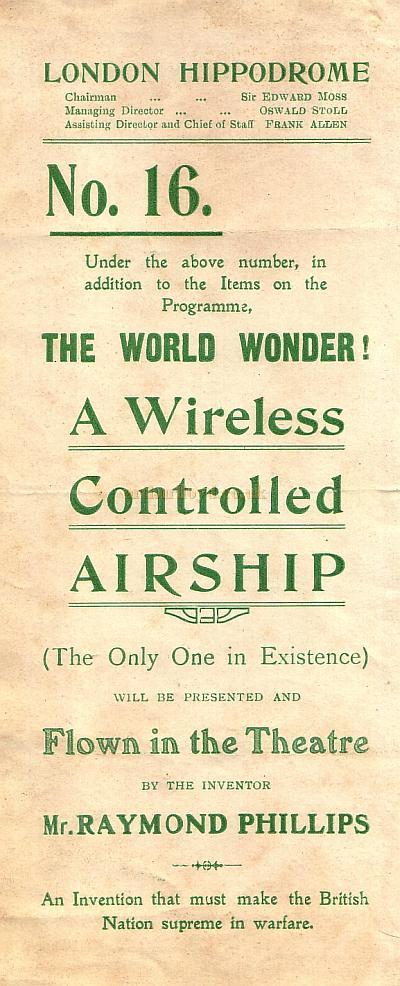
Low never linked his two projects, but in fact the prospect of seeing a distant target had been mooted before the war.  In 1910 Raymond Phillips used a twenty-foot model Zeppelin to demonstrate his wireless-controlled ‘aerial torpedo’ before an entranced crowd at the London Hippodrome. According to the New York Times (22 May 1910):

‘He claims to be able, sitting at a transmitter in London, to send a dirigible balloon through the air at any height and almost any distance.  He can load his balloon with dynamite bombs, he claims, and without leaving his office can send it over a city and wipe the city out.’

He told his audience:

I don’t want to brag, but I feel sure that if England purchases my aerial torpedo she will make short work of the enemy’s fleets and cities in any future war.  Why, I can sit in an armchair in London and drop bombs in Manchester or Paris or Berlin.’

Given the first city on his list it’s scarcely surprising that there should have been questions about navigation.  Asked how he would know that his airship was over ‘the town you purpose to destroy’, Phillips replied that he might work with a large-scale map or a ‘telephotographic lens’.  ‘I think it will do away altogether with existing methods of warfare,’ he predicted.  Much more here (scroll down).

But one of his rivals in the audience had spotted a weakness in the system.  ‘I believe that it would be possible for another operator to interfere with Mr Raymond Phillips’ control,’ speculated Harry Grindell Matthews, using what one newspaper called ‘hostile electric currents’, and he predicted that he could, ‘by manipulating an instrument of my own, compel it [the airship] to turn round and return to the place from which it was sent.’  The two men agreed to a duel between their devices, but I’ve been unable to find any record of the outcome – though the spectre that Matthews raised remains a concern for today’s remotely piloted operations.  Incidentally, Matthews would later claim to have invented a ‘death ray’…. More on him here and here.

The theatricalization of these early projects, with Phillips’s airship nosing its way around the Hippodrome – which was originally designed as a circus and had only been remodelled the previous year – and releasing its load of paper birds forty feet above the stalls, is all of a piece with the ‘bombing competitions‘ and the air displays of the pre-war years.

Here is Flight magazine on 7 May 1910:

‘There is no accounting for popular taste in the matter of public entertainment, but we must confess one could scarcely expect to witness the spectacle of a fairly big model dirigible sailing about the auditorium of the London Hippodrome, where at the moment it constitutes one of the star turns….

‘As an indication of a phase of aeronautics that is quite likely, indeed, we might as well say quite certain, to figure in the future, this display at the Hippodrome is a thoroughly interesting and instructive turn, and brings before many hundreds of people a visual demonstration of a scientific subject that in the ordinary course of events they would only be likely to read about at the best.’

Yet another instance of the theatre of war.

Phillips persisted with his dream, and in September 1913 the Illustrated London News devoted a whole page to ‘torpedoes of the air’ – what it called ‘bomb-droppers directed by wireless’ – and Robinson’s drawing was based on ‘materials provided by Mr Raymond Phillips.’

PHILLIPS Aerial Torpedo in ILN September 1913

The politics of seeing and the New Aesthetic

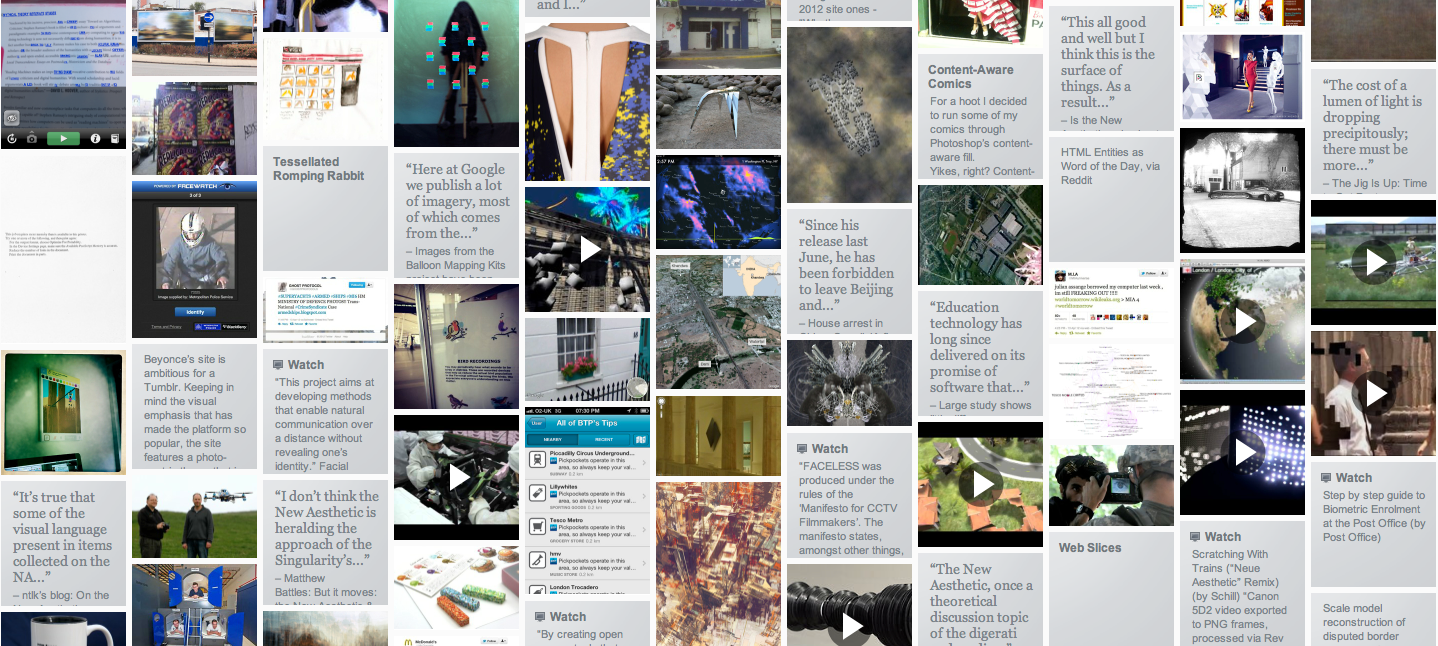
The New Aesthetic began to create its public at the Really Interesting Group in May 2011 with this post from James Bridle:

For a while now, I’ve been collecting images and things that seem to approach a new aesthetic of the future, which sounds more portentous than I mean. What I mean is that we’ve got frustrated with the NASA extropianism space-future, the failure of jetpacks, and we need to see the technologies we actually have with a new wonder. Consider this a mood-board for unknown products.

(Some of these things might have appeared here, or nearby, before. They are not necessarily new new, but I want to put them together.)

For so long we’ve stared up at space in wonder, but with cheap satellite imagery and cameras on kites and RC helicopters, we’re looking at the ground with new eyes, to see structures and infrastructures…

The post digitally curated a series of images – a sort of wunder-camera (hah!) – and soon afterwards James’s first post appeared on tumblr as The New Aesthetic.  The site grew and grew, though not quite like Topsy, and this is is how he now explains his experimental project:

Since May 2011 I have been collecting material which points towards new ways of seeing the world, an echo of the society, technology, politics and people that co-produce them.  The New Aesthetic is not a movement, it is not a thing which can be done. It is a series of artefacts of the heterogeneous network, which recognises differences, the gaps in our overlapping but distant realities.

Bruce Sterling described James as ‘a Walter Benjamin critic in an “age of digital accumulation”’ carrying out ‘a valiant cut-and-paste campaign that looks sorta like traditional criticism, but is actually blogging and tumblring.’  His site is well worth a visit, not least to wander through the back catalogue of objets trouvés (or vues):

I say ‘objet’ deliberately: for Graham Harman fans, and even for those who aren’t, there are some remarkably interesting discussions that link the New Aesthetic to object-oriented ontology: see Ian Bogost, ‘The New Aesthetic needs to get weirder‘ (not as weird as the cutesy title suggests), Robert Jackson, ‘The banality of the new aesthetic‘ (a really helpful essay for other reasons too) and Greg Borenstein, ‘What it’s like to be a 21st century thing‘ (scroll down – much more there too).

I started to follow the blog while I was working on a contribution to a conference on the Arab Uprisings [‘the Arab Spring’] held in Lund earlier this year: I’d been puzzled at the polarizing debate about whether (in the case of Tahrir Square in Cairo which most interested me, but much more generally too) whether this was ‘a Twitter revolution’ or whether it depended on what Judith Butler called (in a vitally important essay on the politics of the street to which I’ll return in a later post) ‘Bodies in Alliance‘.  It seemed clear to me – and to her, as I discovered in a series of wonderfully helpful conversations when she visited Vancouver for the Wall Exchange in May) – that this was a false choice: that the activation of a digital public sphere was important, but so too, obviously, was the animation of a public space, and that the two were intimately – virtually and viscerally – entangled.

Here (in part) is what I wrote:

Writing from Cairo in March 2011, Brian Edwards recalled that when the Internet was blocked ‘the sense of being cut off from their sources of information led many back out on to the street, and especially to Tahrir.  With the Internet down, several told me, there was nowhere else to go but outdoors.’  The reverse was also true.  ‘The irony of the curfew is that it might succeed in getting people off the streets and out of downtown, but in doing so it delivers them back to the Internet… Many of my friends are on Facebook through the night, as are those I follow on Twitter, a steady stream of tweets and links.  Active public discussions and debates about the meanings of what is taking place during the day carry on in cyberspace long after curfew.’  

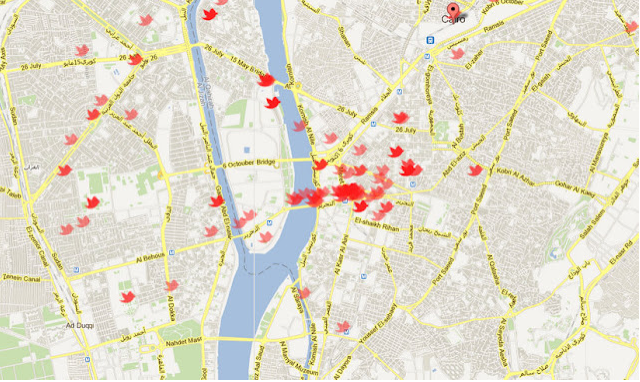
In the same essay Edwards reflects on the compression of meaning imposed by the 140-character limit of each tweet, and he suggests that the immediacy and urgency that this form implies – even imposes – ‘calls forth an immediate, almost unmediated response, point, counterpoint and so on.’This is a persuasive suggestion, I think, but that response is surely to be found not only virtually (from tweets in cyberspace) but also viscerally (from bodies in the streets).  When we see maps … showing tweets in Cairo, we need to recognize that that these are not merely symbols in cartographic space or even messages in cyberspace: they are also markers of a corporeal presence.

This matters because the urban space where ‘newness’ might enter the world does not pre-exist its performance.  Some writers examine what, following Henri Lefebvre and David Harvey, we might call the production of space, which would include the construction and re-development of Tahrir Square.  Others, also following in some part Lefebvre, prefer to emphasize spatial practices, which would include the rhythms and routines that compose everyday life for a myriad of people in Cairo.  But to emphasize the performance of space is to focus on the ways in which, as Judith Butler put it in direct reference to Tahrir Square, ‘the collective actions [of the crowd] collect the space itself, gather the pavement, and animate and organize the architecture.’  

So I started to wonder about the politics of the New Aesthetic – especially when I returned from Lund to resume my work on the techno-cultural gaze that has been my preoccupation for even longer: the surveillance platforms of remotely piloted aircraft (and killing machines) like the Predator and the Reaper.  (For a time the New Aesthetic was associated with the image of a pixellated Predator supported by balloons, ‘a bright cluster … tied to some huge, dark and lethal weight’, as Sterling put it).
And now I’ve found a revealing essay by Will Wiles on the New Aesthetic, ‘The machine gaze’, at aeon (from which I’ve also taken Sterling’s remark).  He begins with a remark that took me right back to Tahrir (though in fact he’s talking about digital media labs in east London): ‘It’s in these streets that the boundary between the digital and the physical is at its most porous — in the devices and the minds of a far-seeing local population who are among the first to understand that there might not be a boundary at all.’
So to the money question: ‘As the boundaries between digital and physical dissolve, can the New Aesthetic help us see things more clearly?’  Here is part of Wiles’s answer:

The virtual world is being integrated with the physical world and this seamlessness is presented as inherently good. No harm may be intended: it’s natural for a designer to want to smooth away the edges and conceal the joins. But in making these connections invisible and silent, the status quo is hard-wired into place, consent is bypassed and alternatives are deleted. This is, if you will, the New Anaesthetic. Instances of the New Aesthetic are often places where a glitch has exposed the underlying structure — the hardware and software. Or it is an oddity that has the unintended side effect of causing us to consider that structure. Part of a plane appearing in Google Maps makes us realise that we are looking at a mosaic of images taken by cameras far above us. We knew that already, right? Maybe we did. But a reminder may still be salutary.

This is political. The New Aesthetic was accused of being apolitical — fascinated by the oddities and wonders being thrown up by drones and surveillance cameras without thinking about the politics behind them. This is plain wrong: politics seeps from nearly every pore of the New Aesthetic. It was often hard to see, but that’s what Bridle wanted to expose.

The question is one of viewpoint. ‘As soon as you get CCTV, drones, satellite views and maps and all that kind of stuff,’ Bridle said, ‘you’re setting up an inherent inequality in how things are seen, and between the position of the viewer and the viewed. There are inherent power relations in that and technology makes them invisible. When you have a man in a watchtower, you look up at him, and that’s an obvious vision of power. When the man is in a bunker far away and you have just a little camera on a stalk … most people seem to be fine with that.’

The New Aesthetic is about seeing, then. And to see and be seen is to engage in those power relations.

More to come – watch this space….

Visual culture and battles for Algiers

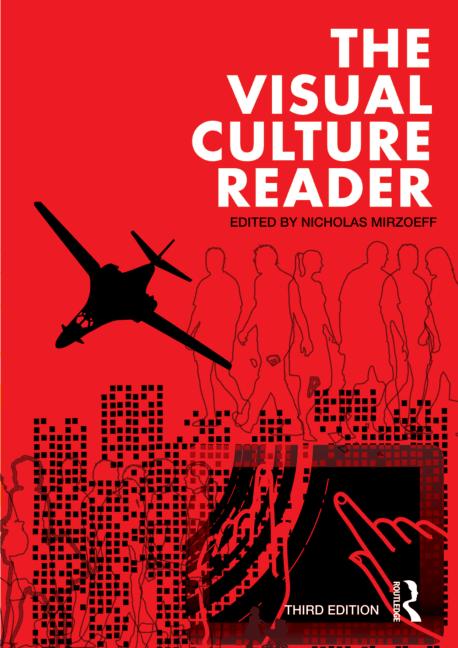
My copy of Nicholas Mirzoeff‘s newly published Visual Culture Reader was waiting for me on my return from Cologne.  It’s the third edition of a classic resource, first compiled ten years ago, and it’s been comprehensively revised, with a number of specially commissioned essays.   You can download some of Nick’s own essays here, including discussions of Abu Ghraib and US counterinsurgency.

Contents:

PART 1 

Expansions

Chapter 1: “There are No Visual Media” W. J. T. Mitchell Chapter 2: “The (In)human condition: A Visual Essay” Ariella Azoulay Chapter 3: “Mapping Non-Conformity: Post-Bubble Urban Strategies” Teddy Cruz Chapter 4: “X-reality: Interview with the Virtual Cannibal” Beth Coleman Chapter 5: “On Software, or the Persistence of Visual Knowledge” Wendy Hui Kyong Chun Chapter 6: “Notes on the Photographic Image” Jacques Rancière Chapter 7: “Queer Faces: Photography and Subcultural Lives” J. Jack Halberstam Chapter 8: “Currents of Worldmaking in Contemporary Art” Terence E. Smith Chapter 9: “Sublimated with Mineral Fury: Prelim Notes on Sounding Pandemonium Asia” Sarat Maharaj Chapter 10: “The Sea and the Land: Biopower and Visuality after Katrina” Nicholas Mirzoeff

PART 2: GLOBALIZATION, WAR AND VISUAL ECONOMY 

War and Violence

Chapter 11: “The Archaeology of Violence: The King’s Head” Zainab Bahrani Chapter 12: “The Actuarial Gaze: from 9-11 to Abu Ghraib” Allen Feldman Chapter 13: “American Military Imaginaries and Iraqi cities” Derek Gregory Chapter 14: “Zeroing In: Overheard Imagery, Infrastructure Ruins, and Datalands in Afghanistan and Iraq” Lisa Parks Chapter 15: “What Greg Roberts Saw: Visuality, Intelligibility, and Sovereignty – 36,000km Over the Equator.” Trevor Paglen Chapter 16: “Media and Martyrdom” Faisal Devji Chapter 17: “Live True Life or Die Trying” Naeem Mohaiemen Attention and Visualizing Economy Chapter 18: “Kino I, Kino World: Notes on the Cinematic Mode of Production” Jonathan L. Beller Chapter 19: “On Virtuosity” Paolo Virno Chapter 20: “Faking Globalization” Ackbar Abbas Chapter 21: “Creativity and the Problem of Free Labor” Andrew Ross Chapter 22: “It’s easier to imagine the end of the world than the end of capitalism” Mark Fisher Chapter 23: “Do It Yourself Geo-Politics” Brian Holmes

PART 3: THE BODY, COLONIALITY AND VISUALITY

Bodies and Minds

Chapter 24: “Optics” René Descartes Chapter 25: “Blindness and Visual Culture: An Eye-Witness Account” Georgina Kleege Chapter 26: “Reduplicative Desires” Carol Mavor Chapter 27: “The Persistence of Vision” Donna Haraway Chapter 28: “The body and/in representation” Amelia Jones Chapter 29: “Mami Wata: A Transoceanic Water Spirit of Global Modernity” Henry Drewal Histories and Memories Chapter 30: “The Mobilized and Virtual Gaze in Modernity: Flâneur/Flâneuse” Anne Friedberg Chapter 31: “Tourism and Sacred Ground: The Space of Ground Zero” Marita Sturken Chapter 32: “Maps, Mother/Goddesses and Martyrdom in Modern India” Sumathi Ramaswamy Chapter 33: “Museums in Late Democracies” Dipesh Chakrabarty Chapter 34: “The Fact of Blackness” Frantz Fanon Chapter 35: “The Case of Blackness” Fred Moten (Post/De/Neo)Colonial Visualities Chapter 36: “Orientalism and the Exhibitionary Order” Timothy Mitchell Chapter 37: “The Colonial Harem” Malek Alloula Chapter 38: “Vodun Art, Social History and the Slave Trade” Suzanne Preston Blier Chapter 39: “Between Cult and Culture: Bamiyan, Islamic Iconoclasm and the Museum,” Finbarr Barry Flood Chapter 40: “The Postcolonial Constellation: Contemporary Art in a State of Permanent Transition.” Okwui Enwezor Chapter 41: “Urban Warfare: Walking Through Walls” Eyal Weizman

PART 4: MEDIA AND MEDIATIONS

Chapter 42: “U.S. Operating Systems at Midcentury: The Intertwining of Race and UNIX” Tara McPherson Chapter 43: “Rethinking the Digital Age” Faye Ginsburg Chapter 44: “The Unworkable Interface” Alex Galloway Chapter 45: “On the Superiority of the Analog” Brian Massumi Chapter 46: “Race 2.0: Neoliberal Colorblindness in the Age of Participatory Media” Lisa Nakamura Chapter 47: “Imagination, Multimodality and Embodied Interaction: A Discussion of Sound and Movement in Two Cases of Laboratory and Clinical Magnetic Resonance Imaging” Lisa Cartwright and Morana Alac

In human geography – and beyond – the go-to site for matters visual is Gillian Rose‘s visual/method/culture, and her excellent Visual methodologies: an introduction to researching with visual materials (Sage, 2011) is already in its third edition too.

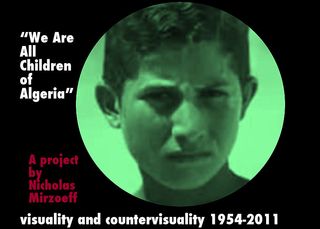
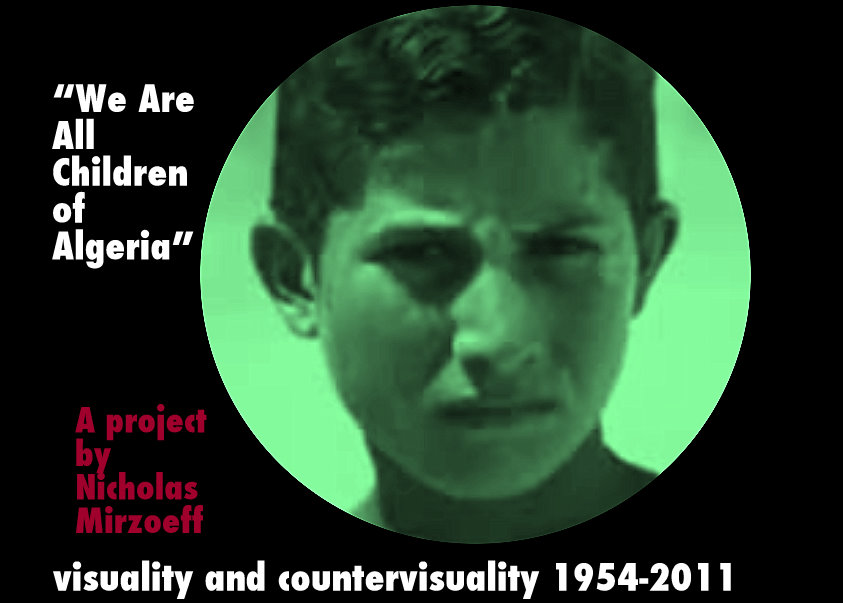
But Nick’s work also speaks directly to geography (at least with a little g, which is the sort I prefer).  Readers probably already know his most recent book, The Right to Look: a counterhistory of visuality (Duke, 2011), but this summer he produced a remarkable ‘digital extension’ of one of its chapters in conjunction with the Alliance for Networking Visual Culture called “We are all children of Algeria”: visuality and countervisuality 1954-2011 that plays with the idea of what I suppose we could call ‘spatial stories’.

In a revealing interview Nick explains why he chose to use a new open access authoring platform – Scalar – rather than his blog:

Blogging is a format that expands how it’s possible to write and think in relation to the contemporary. It makes a form over time. Scalar allows me to share a wide range of North African and European cinema, newsreel footage, guerrilla documentary and photography with the reader in a way that is obviously not possible in print.  Unlike a blog, or at least one using an off-the shelf template, I have a great deal of freedom as to the look, layout and design of each “page,” which can vary from one to the next.  More than that, it allows me to explore a more complex form of narrative in which multiple threads (or “paths” as Scalar calls them) can be developed. This opens up a new set of possibilities for comparative and cross-cultural work that have only just begun to explore in digital humanities work but which I think are among its most fruitful possibilities.

Much to think about there for me: as I noted in a previous post on Targeting and technologies of history, I’m really drawn to the visual experimentations taking place at USC – like Vectors, which showcased some of Caren Kaplan‘s work and which was also involved in Nick’s collaboration.

In “We are all children of Algeria”, then, Nick uses the metaphor of the march to tell a story about revolution and decolonization in Algeria from the outbreak of the revolution in 1954, and to illuminate affinities and connections between the post-war revolutions and the Arab uprisings that began in December 2010.

There is a march! A demonstration as they say in England, a manifestation in French. The Arabic is مسيرة. What is it? It is a means to put our bodies in space, where they are not intended to be and to make a claim. It moves, it demonstrates, it shows: it is militant research…

It asks: how can we “see” Algeria, its decolonization and revolution? Following the lead of Frantz Fanon, it takes the point of view of the child, meaning both children as such, the colonized “child” of  the parent nation, and the “infant” revolution that emerged. 

The Zapatistas say that everything they do is “walking,” a journey that has no final destination. This walking is done here by means of text, media and to-camera videos. This format, allowing as it does for a set of intersecting and interfacing threads to compose the whole, is better suited to reclaiming and exploring these histories than the linear text-based narrative.

So it is both a story about Algeria as such and a way to understand the interface of decolonization and globalization. Whether or not you work “on” or about Algeria, there is an “Algeria” in your work, meaning that there is a place where the incomplete or failed processes of decolonization and the formation of independent developing-world nations intersect with the power of financial globalization. We need to occupy that place, not erase it.
And, yes, Pontecorvo’s Battle for Algiers has a pivotal place in the march (page 5 of the Main Route).

Remote Witnessing

In an astonishing essay on ‘Drone bombings in the Federally Administered Tribal Areas’, published in the Journal of Geographical Information Systems 4 (2012) 136-141 – the places this blog is taking me! – Katrina Laygo, Thomas Gillespie, Noel Rayo and Erin Garcia (three geographers and a political scientist at UCLA) explore what they call ‘public remote sensing applications for security monitoring’.

An open-access version should be available here but there is also a manuscript version here.  (In fact news of the project appeared in the press soon after the US raid on Osama Bin Laden’s compound last year – Gillespie and John Agnew headed a team that had used satellite imagery and the theory of island biogeography (sic) to predict the location of bin Laden’s hideout in 2009 – but much of the media interest in the new work focused on the image captured by satellite of a Predator circling above an area south west of Miram Shah.)

The new project uses unclassified high-resolution imagery from QuickBird 2 (via GeoEye) to monitor drone strikes in Pakistan’s Federally Administered Tribal Areas (FATA).  The difficulties (and dangers) of eyewitness reports are well-known, and media coverage of drone strikes in the area is at best uneven – though the Bureau of Investigative Journalism, along with organizations like CIVIC and Reprieve, continue to do brave, invaluable, eye-popping work – but the UCLA team concludes that, in principle, the commercial availability of the satellite imagery means that  ‘it is possible for the public’ – a distant public – ‘to monitor drone bombings in the [FATA]’.

You can see where they might be going.  In the weeks preceding the US-led invasion of Afghanistan the Pentagon secured exclusive rights to commercial imagery from the Ikonos-2 satellite.  They didn’t need it for operational purposes; the objective was to exercise ‘shutter control’ and prevent media and other organizations from obtaining imagery that might reveal casualties from the high-level bombing campaign. It wasn’t cheap; the standard cost was around $200 per square kilometre, with a premium for rapid turnaround, and news media had been paying $500 for each image.  It’s still not cheap.  The authors of this (I presume preliminary) report concede that ‘it may be prohibitively expensive to monitor the entire region’.  They estimate that weekly data for one year’s coverage of a town like Miram Shah would cost $64,000, though this would not be beyond the reach of some organizations.

But their own test-case is not encouraging.  Working from a map of drone strikes and casualties constructed by the Center for American Progress – they don’t say why they selected this source – the team searched the satellite image for evidence of any of the 16 drone strikes around Miram Shah before 1 January 2010 included in the database.  This is what they say:

 ‘We feel confident that we were able to identify the location of one drone bombing in Figure 4(b). If the center of the compound is the target, it would appear that the drone bombing is accurate. This also suggests that the blast radius of such attacks is relatively small or less than 20 m. Indeed, the walls still appear to remain intact. This appears similar to blast radii reported for hellfire missiles which are used by both the Predator and Reaper drones.’

The claim is not only repeated but generalized in the abstract: ‘Results suggest that drone bombings are very accurate and drone missions are common in the region.’

They suggest no such thing; drone strikes are most certainly common, but the claim about their accuracy is based on a single case for which nothing is known of the intended target or the basis for its identification – was this yet another wedding party?  Neither can anything be said about civilian casualties; they don’t key this site back into their casualty database, such as it is, and in any case they note that ‘The resolution of QuickBird 2 is currently not high enough to see or quantify casualties.’  Not exactly forensic architecture then.

Not surprisingly, though, the conclusion chimes with the Center for American Progress’s own endorsement of the campaign:

Hardly a week goes by without some key figure in the Al Qaeda network and its affiliates being targeted in a range of actions, including drone strikes as well as other actions by U.S. intelligence and law enforcement agencies to prevent attacks and degrade the Al Qaeda network. The damage done to Al Qaeda by the Obama administration represents America’s greatest national security success since the fall of the Soviet Union and the peaceful integration of Eastern European countries in the 1990s.

The importance of all this goes beyond the particular case.  Susan Sontag once famously declared that ‘Being a spectator of calamities taking place in another country is a quintessentially modern experience.’  It’s a more complicated (and contentious) claim than it looks, but in any event being a spectator is not the same as being a witness.  And we surely know – or ought to know – from Lisa Parkss wonderful work that satellite and other remote technologies do not provide an unmediated window on the world. I’m thinking particularly of her ‘Satellite view of Srebrenica: tele-visuality and the politics of witnessing’ in Social identities 7 (4) (2001), and ‘Digging into Google Earth: an analysis of “Crisis in Darfur”‘ in Geoforum 40 (4) (2009), but you can get a sense of her work from the press report of her 2010 lecture to the New Zealand Geographical Society here.  She also has a new book out late this year/early next from Routledge, Coverage: media spaces and security after 9/11.

Now the use of satellite technology to conduct ‘remote witnessing’ is not alien to human rights organizations, but most of them are well aware of its problems as well as its potential.  Amnesty International sponsored the Science for Human Rights Project (originally Satellites for Human Rights) from January 2008 to January 2011:

Its primary purpose was to test the potential use of geospatial technologies for human rights impact. The purpose of the evaluation is to assess the extent to which work undertaken by Amnesty International contributed to change (intended and unintended) and to assess the potential for using geospatial technologies to contribute towards more effective advocacy and impact.

There have been a series of public examples.  Some of them have been conducted under other banners, like the celebrity Satellite Sentinel Project on Sudan.

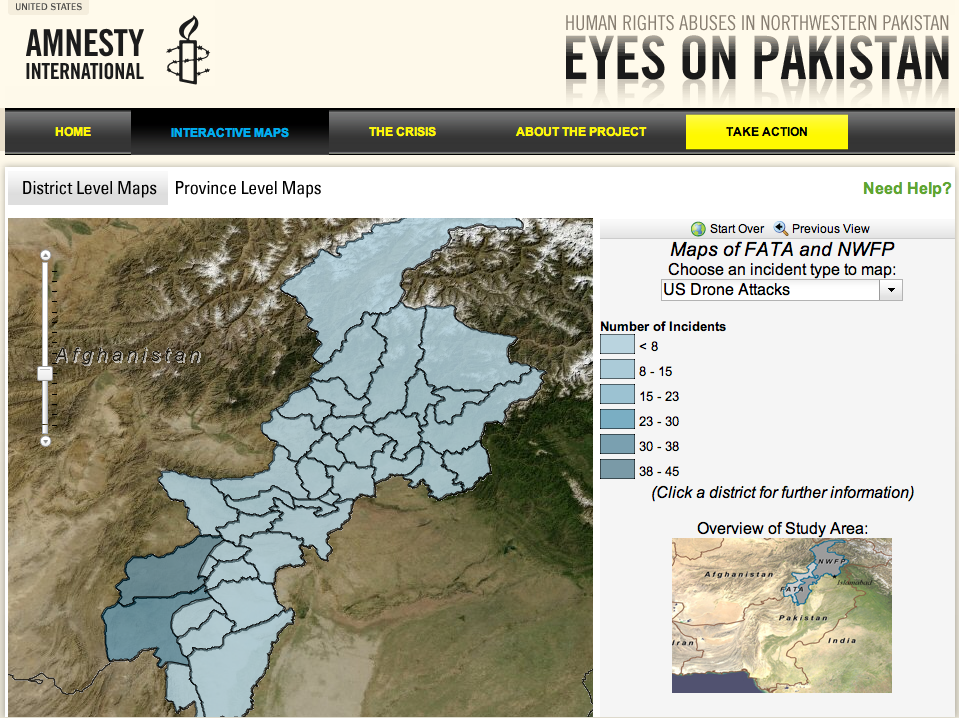
But the most directly relevant to this post is probably Amnesty’s (now terminated) Eyes on Pakistan archived here.  Although this involved interactive mapping platforms rather than the use of satellite imagery the project title gives a clear indication of the direction in which Amnesty was moving and the wider debate about witnessing of which it was a part.
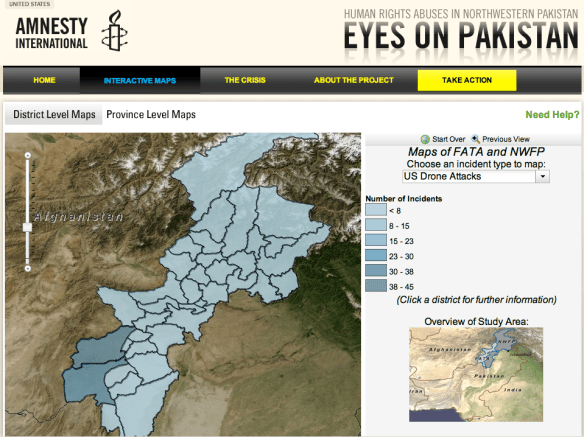
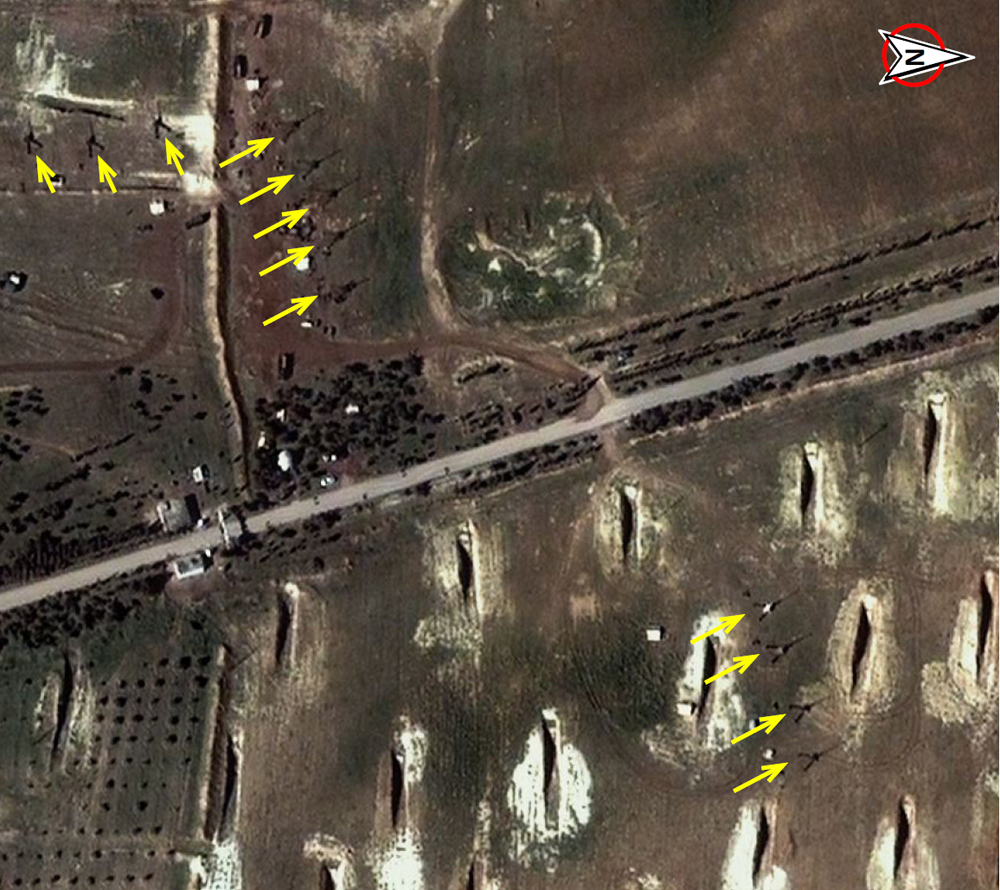
Amnesty has also launched Eyes on Darfur (here too the imagery is no longer being updated) and now Eyes on Syria.  This does involve remote imagery, and there is an interesting discussion on Amnesty USA’s blog about its significance:

The images from Homs and Hama show clearly that armed forces have not been removed from residential areas, as demanded by the U.N. General Assembly resolution from mid February. In Hama, the images reveal an increase in military equipment over the last weeks, raising the specter of an impending assault on the city where the father of current President Bashar al-Assad unleashed a bloody 27-day assault three decades ago, with as many as 25,000 people killed.
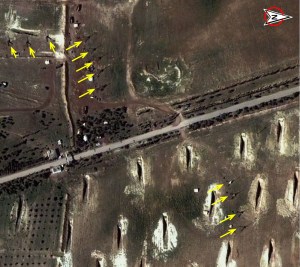
With reports of a ground assault underway in Homs, the analysis of imagery identifies military equipment and checkpoints throughout Homs, and field guns and mortars actively deployed and pointing at Homs [see image left]. Additionally, the images show the shelling of residential areas in Homs, concentrated on the Bab ‘Amr neighborhood. Artillery impact craters are visible in large sections of Bab ‘Amr, from where we have received the names of hundreds killed throughout the period of intense shelling.

Note that last clause: to convert remote sensing into remote witnessing requires difficult, painstaking work in multiple registers because the imagery does not speak for itself.  To believe otherwise means that anyone who ventriloquises from imagery alone – academics screening imagery in California or CIA/USAF analysts scrutinising near real-time feeds from drones – runs the real risk of seeing what they are predisposed to see.  As that same blog post notes,

Satellite images can help to show the widespread and systematic nature of violations, characteristics inherent to certain international crimes such as crimes against humanity. Additionally, they can help in identifying command responsibility, a key requirement for holding individual perpetrators accountable. [Ivan] Simonovic [Assistant Secretary-General for Human Rights] pointed out that the UN Panel on Sri Lanka relied a lot on satellite images. The same holds true for the current commission of inquiry on Syria, which equally relies on satellite images. Thus, the point is that while satellite images barely deliver the “smoking gun” that leads to a conviction, they can provide major support for international investigations and accountability mechanisms.

And this brings me back to drones.  Writing in the New York Times on 30 January 2012 Andrew Sniderman and Mark Hanis proposed re-purposing drones ‘for human rights’:

DRONES are not just for firing missiles in Pakistan. In Iraq, the State Department is using them to watch for threats to Americans. It’s time we used the revolution in military affairs to serve human rights advocacy. With drones, we could take clear pictures and videos of human rights abuses, and we could start with Syria. The need there is even more urgent now, because the Arab League’s observers suspended operations last week. They fled the very violence they were trying to monitor. Drones could replace them, and could even go to some places the observers, who were escorted and restricted by the government, could not see. This we know: the Syrian government isn’t just fighting rebels, as it claims; it is shooting unarmed protesters, and has been doing so for months. Despite a ban on news media, much of the violence is being caught on camera by ubiquitous cellphones. The footage is shaky and the images grainy, but still they make us YouTube witnesses. Imagine if we could watch in high definition with a bird’s-eye view. A drone would let us count demonstrators, gun barrels and pools of blood. And the evidence could be broadcast for a global audience, including diplomats at the United Nations and prosecutors at the International Criminal Court.

This produced a series of responses:  Lauren Jenkins was appalled, Daniel Solomon sceptical, and Patrick Meier sympathetic.  The most scathing response was from anthropologist Darryl Li in Middle East Report, which provoked a heated exchange between him and Sniderman.  I see all this as part of a diffuse (and I think largely uncoordinated) campaign to rehabilitate drones in the public eye, something I’ll be writing about in a future column for open Democracy.  But whatever you make of it, and wherever your sympathies lie, the debate about ‘humanitarian drones’ clearly underscores the necessity of seeing visual technologies as political-cultural technologies enrolled in highly particular scopic regimes.

In short – and to return to where I started – remote witnessing is not a passive practice but an intervention in a field of power and as such it involves a series of investments that spiral far beyond the cost of obtaining the imagery.
 

‘Dresden: a Camera Accuses’

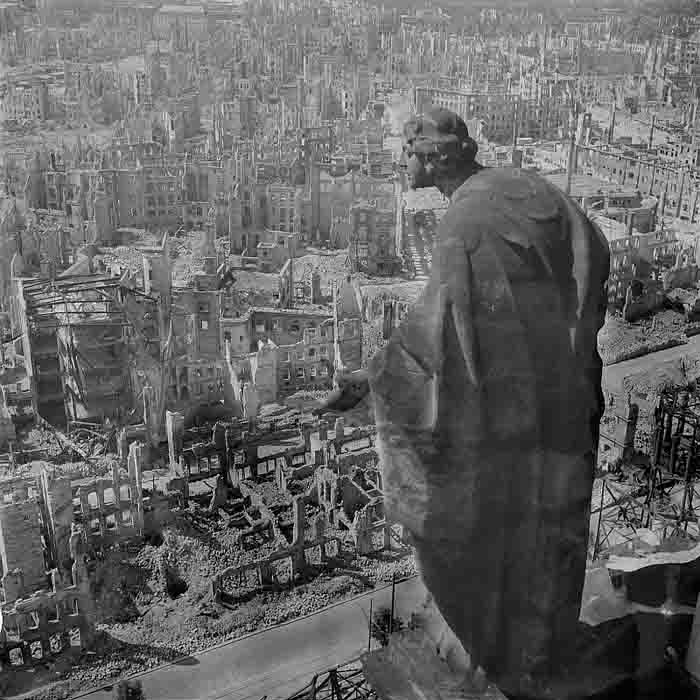
Richard Peter, Blick vom Rathaussturm, Dresden 1945 (Deutsche Fotothek)

A new essay from Steven Hoelscher, ‘Dresden, a Camera Accuses: Rubble photography and the politics of memory in a divided Germany’, just out in History of Photography 36 (3) (2012) 288-305.

This article explores memory, photography and atrocity in the aftermath of war. It takes as its case study the controversies surrounding the February 1945 firebombing of Dresden. One photograph in particular has become the iconic image of the fire- bombing and of the devastating air war more generally – Richard Peter’s View from the City Hall Tower to the South of 1945. Although arguably less divided today than it was during the Cold War, when the image became seared into local and national memory, Germany’s past continues to haunt everyday discourse and political action in the new millennium, creating new ruptures in a deeply fractured public sphere. By examining the historical context for the photograph’s creation and its dissemination through the book Dresden – A Camera Accuses, this article raises questions of responsibility, victimhood and moral obligation that are at the heart of bearing witness to wartime trauma. Peter’s Dresden photographs have long intervened in that existential difficulty and will probably continue to do so for the foreseeable future.

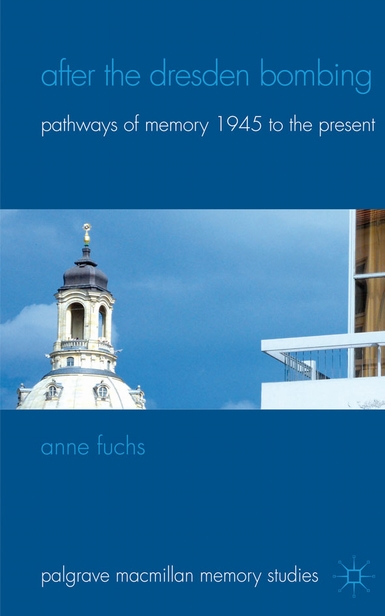
Steve sent me his essay just as I opened Anne Fuchs‘s After the Dresden bombing: pathways of memory 1945 to the present (Houndmills: Palgrave-Macmillan, 2011).  Here’s the description:

Together with Hiroshima and Nagasaki, Dresden belongs to a handful of global icons that capture the destructiveness of warfare in the twentieth century. Immediately recognisable, these icons are endowed with a powerful symbolism that cannot be explained with reference to historical cause and effect alone. This is precisely the terrain of this book, which addresses the long aftermath of the bombing in the collective and cultural imagination from 1945 to the present. The material under discussion ranges from archival documents, architectural journals, the built environment, travelogues, newspaper articles, documentaries, TV dramas, fiction, diaries, poetry to photography and fine art. As a case study of an event that gained local, national and global iconicity in the postwar period, it illuminates the media-specific transmission of cultural memory in dialogue with the changing socio-political landscape. Debating fundamental processes of cultural transmission, it exemplifies a new mode of doing cultural history that interweaves the local and the global.

Her discussion of Peters’ Eine Kamera klagt an is on pp. 32-42 and forms part of a fine extended discussion of ‘Visual mediations’.

Targeting and technologies of history

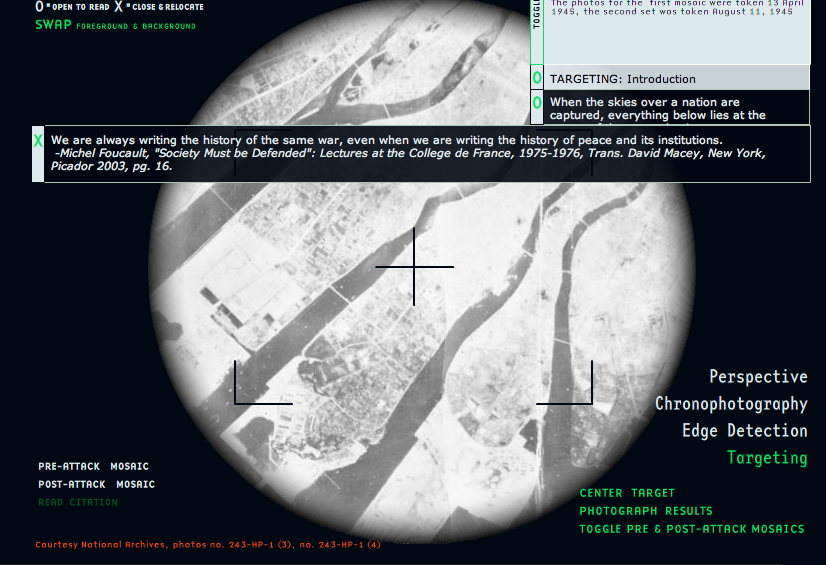
Vectors from USC has reappeared after a (too) long hiatus.  I first encountered Vectors through Caren Kaplan‘s Dead Reckoning project that tracked what she called ‘Aerial Perception and the Social Construction of Targets’.  This was in 2007, when my own interest in targeting and bombing was just kicking in as a reaction to Israel’s war on Lebanon the previous year (see ‘In another time zone…’ in DOWNLOADS).  She introduced the project like this:

‘”Dead reckoning” has a number of different meanings. For many of us, it simply means the ways in which we figure out where we are or what we are aiming at by using the naked eye-it is, then, the first order cultural construct of directional sight. In strictly navigational terms, especially at sea, it refers to the use of measured distances between points to discern longitude. A reckoning is also a form of retribution or punishment as well as a collection of accounts. Many of these meanings come into play in a militarized context where the determination of position enhanced by technology enables the annihilation of enemies. In this piece, Raegan [Kelly, her Vectors programmer and designer] and I came to see this term as the one best suited to describe what we were working through over many discussions. Although many other techniques of sight are involved in this piece, the reckoning of the cultural politics of sight in modernity leads, unfortunately, to state-sponsored death as much as to anything else and, thus, the aptness of the term becomes almost unavoidable.’

Since then Caren has continued to push the boundaries of inquiry and presentation – and the connections between the two – in extraordinarily imaginative ways, constantly circling around what she calls ‘the view from above’: see, for another example, her Precision Targets: GPS and the militarization of everyday life.

The new digital issue of Vectors contains Steve Anderson‘s Technologies of History, which intersects with my still continuing work on bombing and its representations, though its ostensible subject is different. Editor Tara Macpherson on Anderson’s project:

Within the confines of this piece, author Steve Anderson observes, “We should not ask film or video for the truth about the past, but we can look to them for clues, myths, and symptoms of historical fixations.” The project takes as its central object of analysis one of those moments of historical fixation that seems indelibly engrained in the American consciousness, the assassination of John F. Kennedy, Jr. in November, 1963. In exploring multiple mediations of this event, Anderson and designer Erik Loyer repeatedly draw our attention to the textured, layered and unstable nature of both historical representation and historical memory.

This is an argument about the truth claims of media that is instantiated via media, both through the curated collection of media artifacts assembled here and through their formation into a new interactive experience. The assortment of clips runs the gamut from historical footage to televisual re-imaginings to video game reenactments, providing a rich compendium of the tenacity of this moment within the nation’s collective memory. Various tonal registers collide: the somber, the flippant, the intimate, the nostalgic. Disparate visual styles intersect and refract one another. But this argument does not unfold solely at the level of content. The form of the piece also reconfigures and undermines the possibility of a single, authoritative history. As the user engages the piece and assembles these historical fragments into new forms, building her own history along the way, the primacy of any one meaning is collaged away.

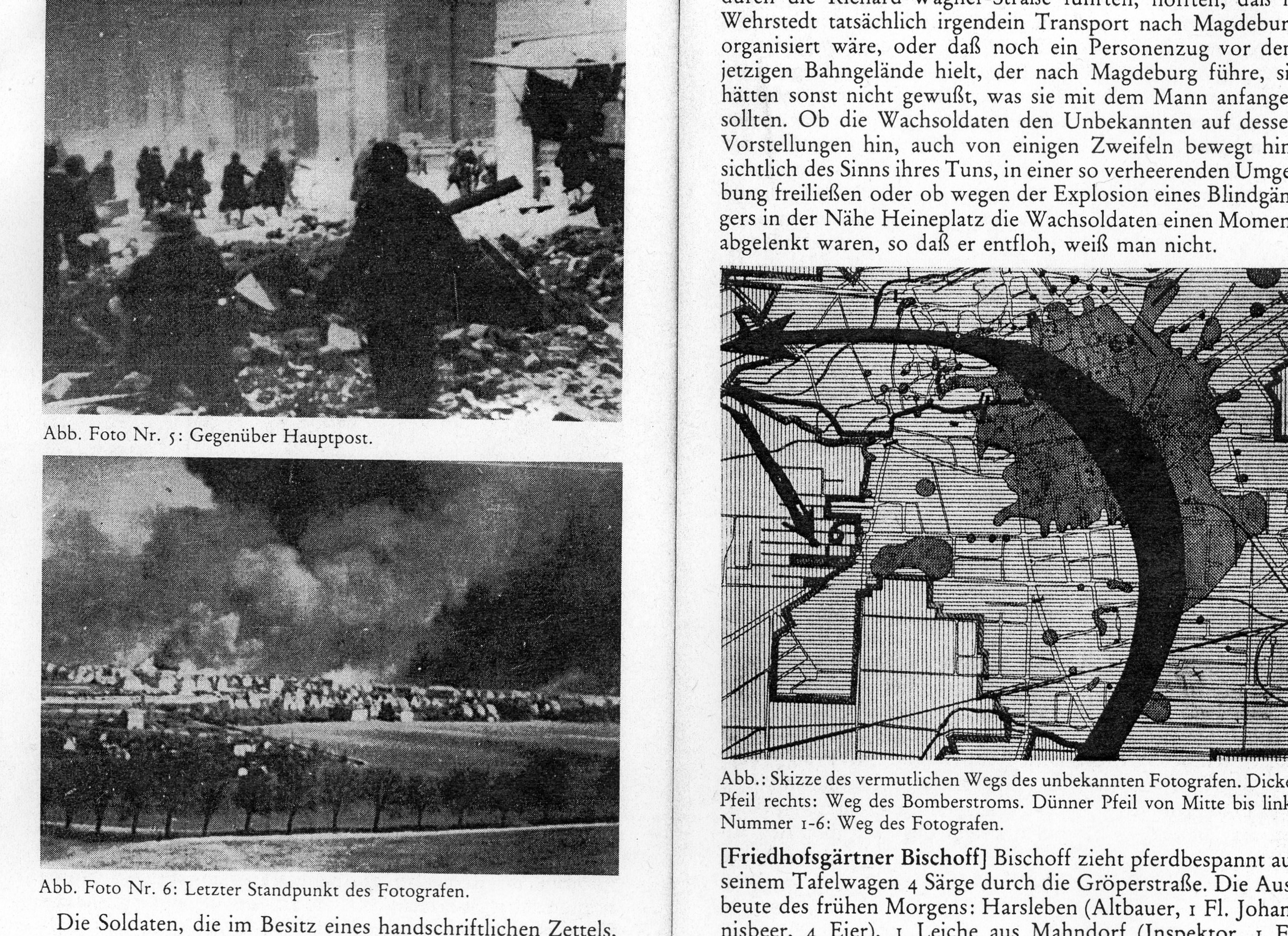
Before the digital era Alexander Kluge had experimented with the collisions of testimony and artefact, and in particular with montage-collage, to convey an American air raid on Halberstadt (his hometown) in 1945 (I drew on this in “Doors into nowhere”). Der Luftangriff auf Halberstadt am 8. April 1945 was first published in German 1977 and has been available in both his Collected Works and as a separate book for some time, but I’m thrilled to discover that an English translation by Martin Chalmers under the title Air Raid is at last due from the University of Chicago Press/Seagull Books in December 2012 with an afterword by the much lamented W.G. Sebald.

Frederic Jameson, in one of the few English-language commentaries on the text, raises a question that speaks directly to Anderson’s project:

“The Bombing of Halberstadt” is another such collage, in which individual experiences, in the form of anecdotes, are set side by side less for their structures as the acts of traditional characters … than as names and destinies, the latter being reduced in many cases to peculiar facts and accidents, of the type of Ripley’s Believe It or Not. The juxtaposition of these anecdotes with quotations from academic studies on the history of bombing and on RAF techniques, from scholarly conferences on the relation between aerial strategy and ethics (“moral bombing” is, for example, specified as a matter, not of morals, but of morale), and from interviews with the allied pilots who participated in this raid—all these materials, which we take to be nonfictional (although they may not be; the interviews in particular bear the distinctive marks of Kluge’s own provocative interview methods), raise the question of the fictionality or nonfictionality of the personal stories of the survivors as well. Halberstadt is, to be sure, Kluge’s hometown, and he is perfectly capable of having assembled a file of testimonies and eyewitness documen- tation and of using the names of real people. On the other hand, these stories, with their rich detail, afford the pleasures of fictional narrative and fictional reading. Is this text (written in the 1970s) a non-fictional novel? I believe that we must think our way back into a situation in which this question makes no sense…’ [‘War and representation’, PMLA 124 (2009) 1532-47]

Perhaps.  But Jameson’s exegesis never grapples with what is also so compelling in Anderson’s project – and, as Kaplan’s work shows, no less avoidable in any discussion of bombing – which is to say Kluge’s determination to confront the multiple visualities involved in, productive of and produced through bombing:

Cyrus Shahan [‘Less then bodies: Cellular knowledge and Alexander Kluge’s “The Air Raid on Halberstadt on 8 April 1945″‘, Germanic Review 85 (2010) 340-58] provides one of the richest discussions of Kluge’s use of montage in ‘Luftangriff’; I can’t convey the artfulness of his argument here – a blog surely isn’t the place to do so! – but here’s an extract that, again, speaks to Anderson’s project too:

‘“The Air Raid on Halberstadt on 8 April 1945” consists of thirty vignettes. The majority are accounts of what the residents of Halberstadt did during the air raid, where they were, what they were thinking, and whether they survived. These stories “from below” are interrupted for a twenty-two-page segment about “Strategy from Above,” a documentary montage of interviews with pilots, images of bomb schematics and flight formations, and pictures of pilots. The documentary aspect of Kluge’s Halberstadt essay and his Neue Geschichten [‘New Histories’] as a whole is a ruse. Rather than lend the text authenticity, Neue Geschichten uses a feigned documentary to debunk the authority of the documentary, to undermine the validity of a singular point of view, and thereby to buttress the usefulness of montage. For Kluge, montage is superior to documentary because it is “the form-world of connectivity.” In other words, while montage creates quasi-unreal perspectives with hyperconnectivity, it simultaneously contains productive political processes in which fractured factual elements articulate within a field of possibilities.’