The politics of seeing and the New Aesthetic

The New Aesthetic began to create its public at the Really Interesting Group in May 2011 with this post from James Bridle:

For a while now, I’ve been collecting images and things that seem to approach a new aesthetic of the future, which sounds more portentous than I mean. What I mean is that we’ve got frustrated with the NASA extropianism space-future, the failure of jetpacks, and we need to see the technologies we actually have with a new wonder. Consider this a mood-board for unknown products.

(Some of these things might have appeared here, or nearby, before. They are not necessarily new new, but I want to put them together.)

For so long we’ve stared up at space in wonder, but with cheap satellite imagery and cameras on kites and RC helicopters, we’re looking at the ground with new eyes, to see structures and infrastructures…

The post digitally curated a series of images – a sort of wunder-camera (hah!) – and soon afterwards James’s first post appeared on tumblr as The New Aesthetic.  The site grew and grew, though not quite like Topsy, and this is is how he now explains his experimental project:

Since May 2011 I have been collecting material which points towards new ways of seeing the world, an echo of the society, technology, politics and people that co-produce them.  The New Aesthetic is not a movement, it is not a thing which can be done. It is a series of artefacts of the heterogeneous network, which recognises differences, the gaps in our overlapping but distant realities.

Bruce Sterling described James as ‘a Walter Benjamin critic in an “age of digital accumulation”’ carrying out ‘a valiant cut-and-paste campaign that looks sorta like traditional criticism, but is actually blogging and tumblring.’  His site is well worth a visit, not least to wander through the back catalogue of objets trouvés (or vues):
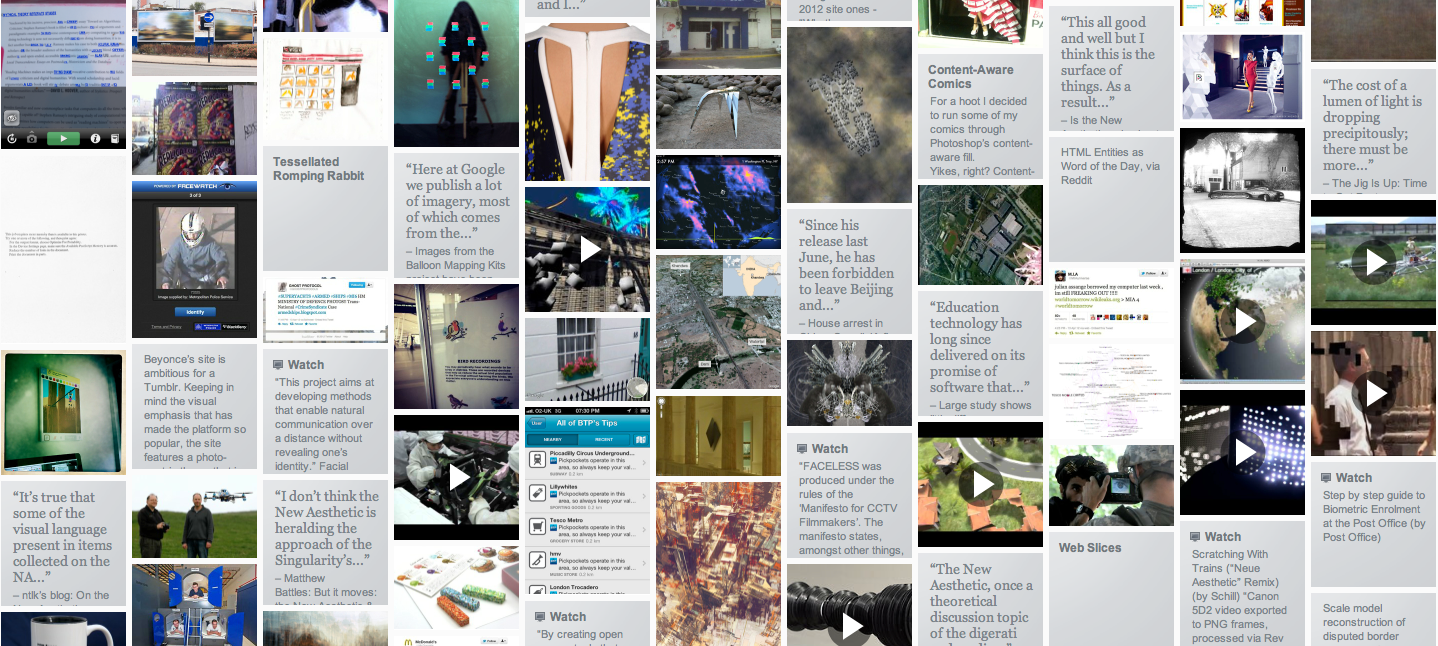
I say ‘objet’ deliberately: for Graham Harman fans, and even for those who aren’t, there are some remarkably interesting discussions that link the New Aesthetic to object-oriented ontology: see Ian Bogost, ‘The New Aesthetic needs to get weirder‘ (not as weird as the cutesy title suggests), Robert Jackson, ‘The banality of the new aesthetic‘ (a really helpful essay for other reasons too) and Greg Borenstein, ‘What it’s like to be a 21st century thing‘ (scroll down – much more there too).

I started to follow the blog while I was working on a contribution to a conference on the Arab Uprisings [‘the Arab Spring’] held in Lund earlier this year: I’d been puzzled at the polarizing debate about whether (in the case of Tahrir Square in Cairo which most interested me, but much more generally too) whether this was ‘a Twitter revolution’ or whether it depended on what Judith Butler called (in a vitally important essay on the politics of the street to which I’ll return in a later post) ‘Bodies in Alliance‘.  It seemed clear to me – and to her, as I discovered in a series of wonderfully helpful conversations when she visited Vancouver for the Wall Exchange in May) – that this was a false choice: that the activation of a digital public sphere was important, but so too, obviously, was the animation of a public space, and that the two were intimately – virtually and viscerally – entangled.
Here (in part) is what I wrote:

Writing from Cairo in March 2011, Brian Edwards recalled that when the Internet was blocked ‘the sense of being cut off from their sources of information led many back out on to the street, and especially to Tahrir.  With the Internet down, several told me, there was nowhere else to go but outdoors.’  The reverse was also true.  ‘The irony of the curfew is that it might succeed in getting people off the streets and out of downtown, but in doing so it delivers them back to the Internet… Many of my friends are on Facebook through the night, as are those I follow on Twitter, a steady stream of tweets and links.  Active public discussions and debates about the meanings of what is taking place during the day carry on in cyberspace long after curfew.’  

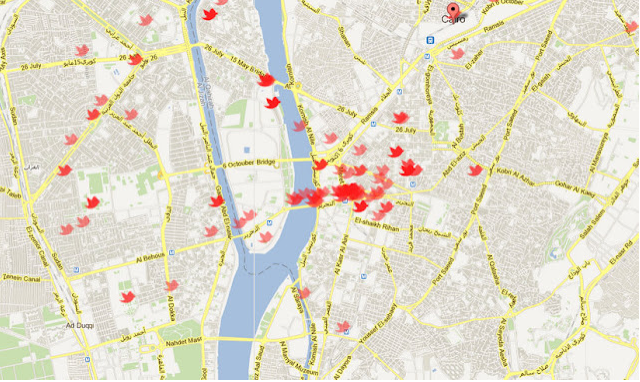
In the same essay Edwards reflects on the compression of meaning imposed by the 140-character limit of each tweet, and he suggests that the immediacy and urgency that this form implies – even imposes – ‘calls forth an immediate, almost unmediated response, point, counterpoint and so on.’This is a persuasive suggestion, I think, but that response is surely to be found not only virtually (from tweets in cyberspace) but also viscerally (from bodies in the streets).  When we see maps … showing tweets in Cairo, we need to recognize that that these are not merely symbols in cartographic space or even messages in cyberspace: they are also markers of a corporeal presence.

This matters because the urban space where ‘newness’ might enter the world does not pre-exist its performance.  Some writers examine what, following Henri Lefebvre and David Harvey, we might call the production of space, which would include the construction and re-development of Tahrir Square.  Others, also following in some part Lefebvre, prefer to emphasize spatial practices, which would include the rhythms and routines that compose everyday life for a myriad of people in Cairo.  But to emphasize the performance of space is to focus on the ways in which, as Judith Butler put it in direct reference to Tahrir Square, ‘the collective actions [of the crowd] collect the space itself, gather the pavement, and animate and organize the architecture.’  

So I started to wonder about the politics of the New Aesthetic – especially when I returned from Lund to resume my work on the techno-cultural gaze that has been my preoccupation for even longer: the surveillance platforms of remotely piloted aircraft (and killing machines) like the Predator and the Reaper.  (For a time the New Aesthetic was associated with the image of a pixellated Predator supported by balloons, ‘a bright cluster … tied to some huge, dark and lethal weight’, as Sterling put it).
And now I’ve found a revealing essay by Will Wiles on the New Aesthetic, ‘The machine gaze’, at aeon (from which I’ve also taken Sterling’s remark).  He begins with a remark that took me right back to Tahrir (though in fact he’s talking about digital media labs in east London): ‘It’s in these streets that the boundary between the digital and the physical is at its most porous — in the devices and the minds of a far-seeing local population who are among the first to understand that there might not be a boundary at all.’
So to the money question: ‘As the boundaries between digital and physical dissolve, can the New Aesthetic help us see things more clearly?’  Here is part of Wiles’s answer:

The virtual world is being integrated with the physical world and this seamlessness is presented as inherently good. No harm may be intended: it’s natural for a designer to want to smooth away the edges and conceal the joins. But in making these connections invisible and silent, the status quo is hard-wired into place, consent is bypassed and alternatives are deleted. This is, if you will, the New Anaesthetic. Instances of the New Aesthetic are often places where a glitch has exposed the underlying structure — the hardware and software. Or it is an oddity that has the unintended side effect of causing us to consider that structure. Part of a plane appearing in Google Maps makes us realise that we are looking at a mosaic of images taken by cameras far above us. We knew that already, right? Maybe we did. But a reminder may still be salutary.

This is political. The New Aesthetic was accused of being apolitical — fascinated by the oddities and wonders being thrown up by drones and surveillance cameras without thinking about the politics behind them. This is plain wrong: politics seeps from nearly every pore of the New Aesthetic. It was often hard to see, but that’s what Bridle wanted to expose.

The question is one of viewpoint. ‘As soon as you get CCTV, drones, satellite views and maps and all that kind of stuff,’ Bridle said, ‘you’re setting up an inherent inequality in how things are seen, and between the position of the viewer and the viewed. There are inherent power relations in that and technology makes them invisible. When you have a man in a watchtower, you look up at him, and that’s an obvious vision of power. When the man is in a bunker far away and you have just a little camera on a stalk … most people seem to be fine with that.’

The New Aesthetic is about seeing, then. And to see and be seen is to engage in those power relations.

More to come – watch this space….
Rethinking climate change, conflict and security

I’ve been working away on a presentation that will – eventually! – turn into an essay on the militarization of nature and the nature(s) of war, and I stumbled across a conference on Rethinking climate change, conflict and security at the ever-creative University of Sussex next month (18-19 October 2012).  Speakers include Halvard BuhaugSimon Dalby and Mike Hume.

What are the conflict and security implications of global climate change? This question has received widespread attention from policy makers in recent years, with most concluding that climate change will in all likelihood become a significant ‘threat multiplier’ to existing patterns of insecurity and discord.  Academic debate has tended to be more divided, yet despite differences in emphasis a common set of assumptions have come to dominate contemporary academic and policy discourse on climate change and security.

The guiding premise of this two-day international conference at the University of Sussex is that current academic and policy discourse on climate change, conflict and security is framed too narrowly and would benefit from both broadening and critique. Featuring many of the leading scholars of the links between climate change and security, the conference will both set out some of the most recent findings on likely conflict impacts and contest a range of prevailing orthodoxies. It will include a mix of case study and theoretical analyses, including panels on:

  • Theories of climate change and conflict
  • Sub-Saharan Africa
  • Critical discourse analysis and climate security
  • The links between water scarcities, climate change and conflict
  • Migration
  • Case studies from the Arctic to Pakistan
  • Peacemaking, cooperation and climate change

The conference will also feature two keynote addresses, plus a roundtable event featuring leading policymakers in the area of climate security.

Full details here.  Register by 9 October 2012.

I’ll post my preliminary notes for the presentation shortly – though, far from short, I fear they are running away with me…

Patches, the Pentagon and Pakistan

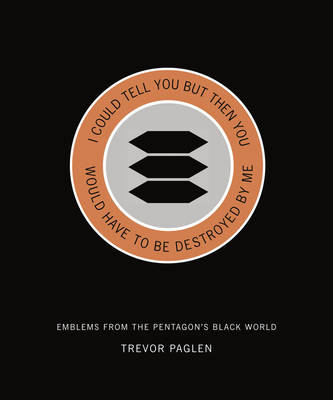
In 2010 artist-geographer-writer (and an old friend) Trevor Paglen published a collection of unofficial US military patches that showed the fraying fringes of the Pentagon’s secret operations: I could tell you but then you would have to be destroyed by me: emblems from the Pentagon’s Black World (Melville House, 2010).

As Steven Heller wrote in the New York Times,  ‘issuing patches for a covert operation sounds like a joke . . . but truth be told, these days everything is branded. Military symbols are frequently replete with heraldic imagery — some rooted in history, others based on contemporary popular arts that feature comic characters — but these enigmatic dark-op images, in some cases probably designed by the participants themselves, are more personal, and also more disturbing, than most.’

Danger Room posted several selections from Trevor’s collection here (and follow the links back for eight – yes eight – more) and here; there are also more here from MilSpecMonkey

Trevor’s wryly serious research has resurfaced twice this week.  Lowen Liu at Slate tried to unpick the stitches from one patch, from the agency that designs, builds and operates America’s intelligence satellites, the National Reconnaissance Office (“Vigilance from Above”), to investigate its use of an anagram from the movie Sneakers – “Setec Astronomy” (Too Many Secrets).  Trevor drew his attention to a 2008 memo from NRO:

Recently, two journalists compiled an article mentioning how symbols used in unclassified logos and patches can reveal information about National Reconnaissance Office (NRO) satellite identities and missions that are otherwise classified. … All briefed personnel are reminded … [of] the grave responsibility of protecting that information from improper and unauthorized disclosure and compromise. Failure to comply with these obligations can result in irreparable harm to the nation.

Liu was left wondering whether Sneakers took “Setec Astronomy” from the NRO… Who knows?

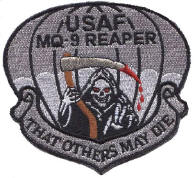
You might also shrug your shoulders and think “Who cares?”, except that those patches can indeed disclose information about the projects they simultaneously conceal and reveal.  And this week Chris Cole at Drone Wars UK published a selection of patches worn by USAF and RAF drone pilots. Described as “morale patches“, designed to raise the morale of the units they represent, most of these don’t tell us anything we didn’t already know about their remote operations – the casual way they turn killing into a cartoon is remarkable, but it’s there in the names of the aircraft they fly:

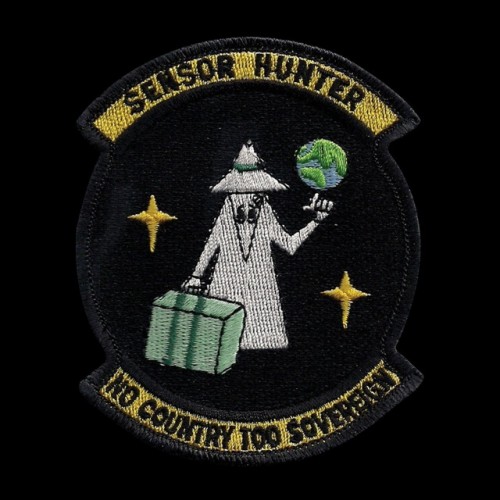
And Trevor has one other that speaks more directly to American drone operations in Pakistan and beyond than anything else I’ve seen:

Grief, tragedy and translation

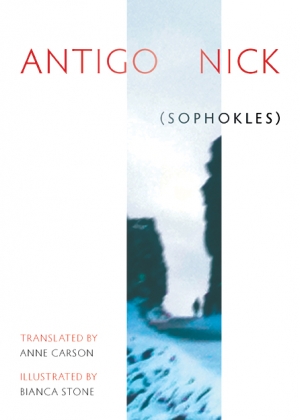
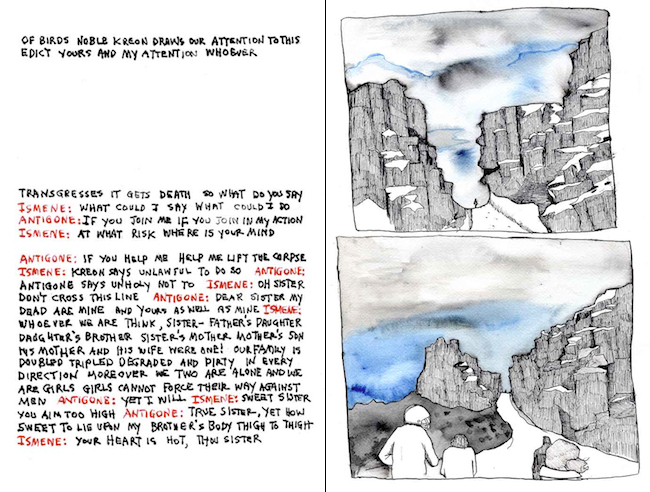
It’s been over a decade since Judith Butler reflected on Antigone, ‘the renowned insurgent’ from Sophocles’ Oedipus, in Antigone’s Claim: kinship between life and death (Columbia, 2000), but I’ve been reading and re-reading her latest thoughts, inspired by Anne Carson‘s visual-textual translation Antigonick (or is it Antigo Nick?) (New Directions, 2012) at Public Books here.

Carson’s project – she’s both a poet and a classicist – raises a series of urgent questions about translation and tragedy, and about the connective imperatives between the two.

Those links spiral in and out of Butler’s recent work too, and this is how she concludes her review-reflection:

Antigone rages forth from grief, causing new destruction, and so, too, does Kreon; they mirror each other in the midst of their opposition. So, too, do you, apparently, and everyone else as well, nodding and driving off, unless we catch ourselves in time. The reader is implicated in this recurrent alteration of grief and rage, subject to the destruction she or he is capable of inflicting, if there is no timely intervention.

Apparently “you” already know why tragedy exists. What Carson writes of Paul Celan’s direct address to the “you” offers us a formulation that may well apply to her Antigonick: “But you, by the time we reach you, are just folding yourself away into a place we cannot go: sleep. Blank spaces instead of words fill out the verses around you as if to suggest your gradual recession down and away from our grasp. What could your hands teach us if you had not vanished?”  It is a cry of grief posed in question form, emphatic, handwritten, excessive and abbreviated and, in this sense, a measured scream that gives us some sense of who or what lives on when it is all too late.

If that seems too general – I don’t think it is at all – then read Nicholas Mirzoeff‘s take on Antigo Nick on his Occupy 2012 blog here.

As predicted, Greece is having its Antigone revolution in refusing to abide by the Law in favor of kinship. For the majority who voted for Syriza and other anti-memorandum parties, mutual aid outweighs obligations to creditors. In the first days of this project, you may recall, I was very taken with a reworking of the Antigone legend in the context of the global social movements by Italian performance group Motus. The proper treatment of the dead body was later visualized by the Egyptian video collective Mosireen. And so when the chant “A-Anti-Anticapitalista” became the subject of a later post, I rewrote it in my head in my geeky way to go “A-Anti-Antigone.”

And if it’s still too elliptical, try Brian Patrick Eha‘s review of Antigonick at New Inquiry (he brilliantly describes it as ‘Antigone after Sarah Kane’, who wrote Blasted):

Never have we had so much direct access to grief. Photographs, television, and the Internet all promise to bridge the unbridgeable gap—to give us, our isolated egos, a means of ingress into the walled city of another’s suffering. What they deliver is an endless series of images like the one of the girl in the green dress that recently won a Pulitzer Prize. The photographer, Massoud Hossaini, captured the aftermath of a vicious bomb blast in Kabul, and in his picture the now-famous “girl in green,” who is eleven years old, stands amid the mangled bodies of the dead, stands crying out, in her utter anguish, as if from the bottom of a well, beyond our power to console. She screams noiselessly in the silence of the photograph, forever.

It’s easy to see why this picture won prizes. One can hardly fail to be moved by it. But at the same time that we are bombarded with compelling photographs and video footage that seem to give us access to emotions not our own, these images remain intrinsically mediated, revealing only surfaces, and our sympathy pains too often serve no utility.

Along with our hunger for grief comes impatience with emotional restraint. From the tearful confrontations of Intervention to the acting out of The Bad Girls Club, in our popular entertainments—period dramas like Downton Abbeybeing the rare exception—there’s nary a stiff upper lip in sight. Our age doesn’t do restraint, full stop. Emotions are expressed to their fullest, and these expressions are broadcast for consumption. Understated expressions of grief have largely vanished from society. We no longer dress for mourning except at hasty funerals, and even there the custom survives only in cheap black suits no less shabby than the rented tuxedos that now make our weddings feel forced. When did you last see a man wearing a black armband in remembrance of a fallen friend?

So Anne Carson’s blunt Antigonick has arrived at the right cultural moment, if not for poetry than for grief….

The humanitarian present, humanitarian reason and imperialism

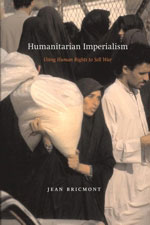
More from my continuing reflections on the humanitarian present: first, a recent interview with Jean Bricmont, the author of Humanitarian Imperialism: using human rights to sell war (Monthly Review Press, 2006) at Counterpunch here.

If you don’t know the book but the name seems familiar: Bricard co-authored Fashionable Nonsense: postmodern intellectuals’ abuse of science (Picador, 1998) with Alan Sokal (yes, that Alan Sokal).

And if the idea of ‘humanitarian imperialism’ seems to echo Noam Chomsky‘s ‘military humanism’ – remember his The new military humanism: Lessons from Kosovo (Common Courage Press, 2009), and if you do see also his A new generation draws the line: humanitarian intervention and the “responsibility to protect” today (new edition, Paradigm, 2011) – then here is Chomsky on Bricard and ‘the new doctrine of imperial right’.

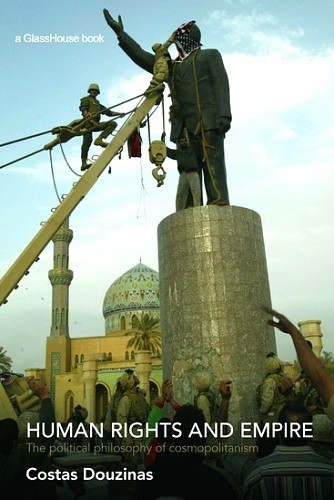
All that said, Bricard’s (and Chomsky’s) vision is considerably narrower than the sense in which Eyal Weizman develops the idea of a ‘humanitarian present‘ that involves the entanglement of military violence, international humanitarian law and NGOs. Here I think some of the sharpest contributions have come from Costas Douzinas, Professor of Law at Birkbeck, University of London.  His relevant essays have appeared all over the place, but the core arguments are assembled in his Human Rights and Empire (Routledge, 2007).

The significance of Douzinas’s project was beautifully captured by Umut Özsu writing in the European journal of international law 19 (2008):

If rights are to retain their emancipatory edge in an age that is increasingly prone to couching its wars of retribution and occupation as necessary evils en route to the attainment of perpetual peace, a considerable measure of vigilance is required to keep them from being subsumed beneath the rubric of the new arsenal of governmental techniques with which the ‘post-9/11’ West has armed itself. After all, what presents itself as a bold acceptance of responsibility may, on closer inspection, prove to be substantially indistinguishable from accommodationist opportunism. Douzinas’ work is invaluable in this regard, laying the groundwork for a form of cosmopolitanism which neither clings unquestioningly to the humanitarian tradition nor permits itself to be captured by the machinery of an ostensibly mature and conscientious pragmatism. 

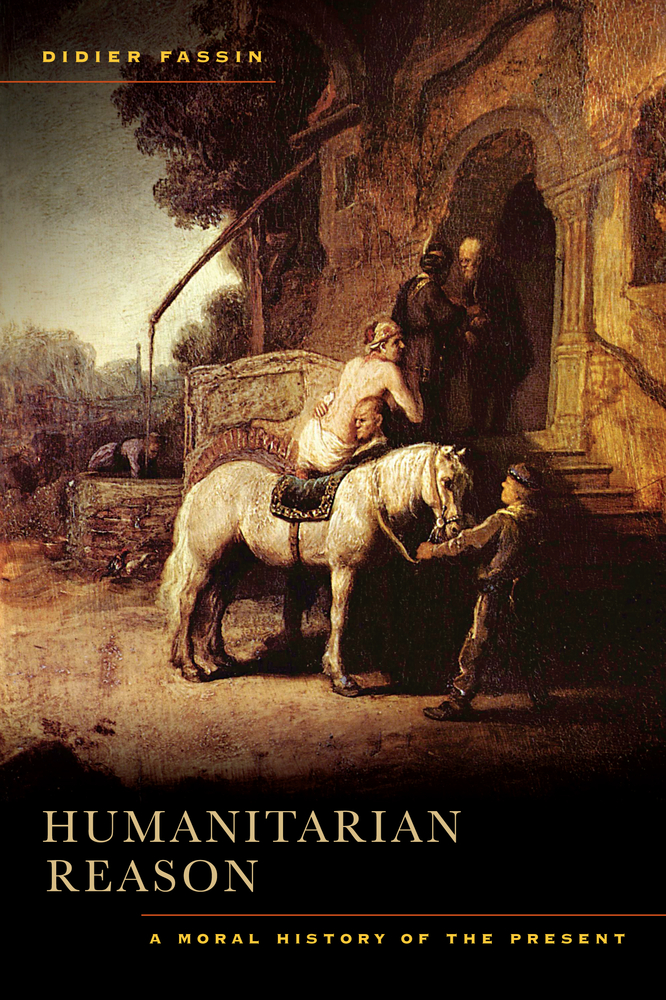
And for a genealogy of humanitarianism it’s hard to better Didier Fassin‘s monumental Humanitarian reason: a moral history of the present (University of California Press, 2011).  Trained successively in medicine, in public health and in social science in Paris, Fassin’s career spans a world of field investigations and social responsibilities, including service as Vice-President of the French National Committee on AIDS and Vice-President of Médecins Sans Frontières.  Fassin co-edited (with Mariella Pandolfi) an indispensable collection of essays, Contemporary states of emergency: the politics of military and humanitarian interventions (Zone, 2010), but Humanitarian reason is his magnum opus (in every sense of the word) – so far, at any rate.

If you don’t know his work, one of the best introductions is Fassin’s lecture on the Critique of Humanitarian Reason on 17 February 2010 at the Institute for Advanced Study at Princeton:

Humanitarianism, which can be defined as the introduction of moral sentiments into human affairs, is a major component of contemporary politics — locally and globally — for the relief of poverty or the management of disasters, in times of peace as well as in times of war. But how different is the world and our understanding of it when we mobilize compassion rather than justice, call for emotions instead of rights, consider inequality in terms of suffering, and violence in terms of trauma? What is gained — and lost — in this translation? In this lecture, Didier Fassin, James D. Wolfensohn Professor in the School of Social Science, attempts to comprehend humanitarian government, to make sense of its expansion, and to assess its ethical and political consequences.

And here he is:

For a detailed, thoughtful and compelling review of Humanitarian Reason see Steven Lukes, ‘The politics of sacred life’, in Public Books (August, 2012) here.  An extract:

The inequalities resulting from humanitarian government are, moreover, at work on the global scale, as evidenced by the contrast between refugees, gathered, protected, and assisted in huge camps in the South, and asylum seekers, subject in the North to decisions “parsimoniously made about which of them may be granted protection under the law.” For this to work the territorial and moral boundaries between the two worlds must be tightly sealed and policed, for example, “preventing refugees from the South from claiming the prerogatives granted to asylum seekers in the North.” As for the latter, if they are admitted, it is on humanitarian grounds rather than as of a right.

However, the heart of Fassin’s critique of humanitarian reason lies, not in the exposure of the disjunction between fantasy and harsh realities, but rather in the analysis of the ways in which humanitarian discourse functions to render this disjunction less visible and less troubling than it might otherwise be, thereby inhibiting possible effective practical and political interventions. Indeed, there is the suggestion here that moral discourse itself may serve to displace a more adequate understanding, deflecting attention from the deeper and wider sources of misery and suffering, thus rendering action to reduce them less feasible.

We need, Fassin writes, “to understand how this language has become established today as the most likely to generate support among listeners or readers, and to explain why people often prefer to speak about suffering and compassion than about interests or justice, legitimizing actions by declaring them to be humanitarian.” The social sciences are themselves part of this story, lending credit to the new political discourse by focusing on exclusion and misfortune, suffering and trauma, providing “the new lexicon of moral sentiments” that “has perceptible effects both in public action and in individual practices.” What, he asks, “ultimately, is gained, and what lost, when we use the terms of suffering to speak of inequality, when we invoke trauma rather than recognizing violence, when we give residence rights to foreigners with health problems but restrict the conditions for political asylum, more generally when we mobilize compassion rather than justice?”

Bodies and bombs

Paul Rogers draws some parallels between what he calls ‘drone bombing’ and suicide bombing at Open Democracy.

Suicide-bombing allows explosives to be placed at or very close to a target, with the deliverer having considerable real-time initiative and scope for concealment. He or she can adapt to circumstances in matters of timing as well as any movement of and even the precise location of the target. Countermeasures such as blast-walls and surveillance systems can be circumvented or fooled…. 

The similarity with armed-drones is striking. Drones such as the Reaper have multiple air-to-surface missiles, can loiter for hours and are “flown” in real time by operators thousands of miles away. There is no risk to these people, no suicide factor. Drones may not have quite the precision potential of a suicide-bomber, and in the very final seconds before impact the missiles that are fired cannot be diverted or halted.’

But in essence, Paul argues, there is no difference between them: ‘drone bombing’ is ‘suicide bombing without the suicide’.

And life (or in this case death) imitates art: this week Spencer Ackerman at Danger Room reported that the US Army is soliciting bids to develop ‘a tiny suicidal drone to kill from six miles away’.  It’s a good tag line, but the story is really about the fusion of miniaturised drone and missile in a ‘Lethal Miniature Aerial Munitions System’.

I suspect that one of the imaginative devices that enables publics in the global North to accept their own militaries bombing from the air – apart from a profound lack of imagination – turns on the body itself.   In one direction, they congratulate themselves that suicide bombing is foreign to their traditions of war in part, I think, because it allows no escape from the corporeality of bombing: the body of the bomber carries the bomb.  In the other direction, they congratulate themselves on their restraint: after Hiroshima and Nagasaki they have not resorted to nuclear bombs that, at the limit, vaporize bodies (though they also leave countless other bodies broken and disfigured from the blast or sick from radiation). (In his meditation On Suicide bombing Talal Asad is very instructive on the horror generated by ‘the dissolution of the human body’ (see pp. 76-92)).

The space in between the two is occupied by conventional bombing from the air, and the production/performance of this space involves what Asad calls ‘a redefinition’ – even a re-calibration – ‘of the space of violence’.  Here – precisely because of the imaginative distance between the bomber and the bombed, which in some respects was even greater for Bomber Command aircrew over Hamburg and USAAF aircrew over Vietnam than it is for remote pilots in Nevada – it becomes possible to conceive of an air strike in purely abstract terms (which is why calibration assumes such significance): a ‘surgical’ attack on a nominated  ‘target’.  There are remarkable continuities between conventional bombing and the use of remotely-piloted aircraft, as I’ve tried to show in detail in Lines of descent (see DOWNLOADS tab), and part of my Killing Space project focuses on the ways in which mainstream British and American media coverage of the combined bomber offensive against Germany in WWII, the US air wars over Indochina, and the current drone wars over Afghanistan, Pakistan and elsewhere consistently removes the bodies of the bombed from public view.

And yet this may also reinforce Paul’s particular parallel.  If the corporeality of suicide bombing is inescapable for those who carry it out, so too (in a different sense) for those remote pilots in the continental United States.  They routinely insist that they are not thousands of miles away from their ‘target’ but eighteen inches: the distance from eye to screen.  And they are required to remain on station after a strike and, through their surveillance cameras, carry out what in previous wars would also have been called ‘bomb damage assessment’ but which, in the case of a targeted killing, involves a hideous inventory of body parts.

Killam Postdoctoral Fellowships

Timing is tight – isn’t it always? – but if you are interested in applying for one of these PDFs to work with me please get in touch as soon as you can:

The UBC Geography Department welcomes applications for the Killam Postdoctoral Research Fellowships, 2013-14. The Geography Postdoctoral Committee can nominate one candidate this year to enter the university-wide competition.

Once the Geography Department selects a nominee, an adjudication committee at the Faculty of Graduate Studies reviews the selected nominee files, over 40 each year, before making final decisions. The search is for candidates whose work is “beyond excellent and whose research is convincingly innovative and ground-breaking”. Postdoctoral applicants are selected based on “academic achievement, personal qualities, and demonstrated aptitudes”. Consideration is also given to the applicant’s proposed program of study.

The fellowships are awarded for a maximum of two years, subject to review at the end of the first year, and include a stipend of CAD $50,000 per annum and a travel and research allowance. The number of awards available across campus varies between three and five per year.

To apply, you must have the support of a faculty member supervisor within the UBC Geography Department. However, there is no need to submit a letter of support from the supervisor until the Geography Postdoctoral Committee requests it.

For information about eligibility, application forms and detailed instructions, see here.

Deadline: All necessary application materials must be received at the UBC Geography Department by Friday, October 26, 2012.

Advice: To stand any chance of success, publications and major conference presentations are a must; your post-doctoral research program should build on BUT NOT DUPLICATE your PhD research; and your referees need to write at length and in detail – not the all-too-common UK-style ‘obituary notices’ limited to information that is in your c.v.

Violence in the humanitarian present

Further to my musings on the humanitarian present, a Call For Papers for the Association of American Geographers Conference in Los Angeles next year, 9-13 April 2012:

On the Question of Violence in the Humanitarian Present

Organizers: Lisa Bhungalia (Syracuse University) and Tish Lopez (University of Washington)

Discussant: Craig Jones (University of British Columbia, Vancouver)

 Humanitarianism has long had its place within colonial legacies serving often, as Derek Gregory (2012) puts it, as the “velvet glove wrapped around the iron fist of colonialism.” The recent emphasis in U.S. counterinsurgency doctrine on non-kinetic and humanitarian measures as a means of undermining insurgency would appear to confirm this point. Indeed, the lines between humanitarian and military are increasingly rendered indistinct. But more than simply a blurring or collapse we should ask: What is the relationship between humanitarianism and violence? Moreover, in what ways does humanitarianism serve as a means of managing and modulating violence? This inquiry has been at the fore of Eyal Weizman’s (2011) recent work in which he suggests that an “economy of violence is calculated and managed” through various humanitarian, moral and legal technologies that legitimate and underwrite the continued operation of violence. It is the collusion of these humanitarian technologies with military and political powers that form what he calls the “humanitarian present.”

This paper session invites theoretical and/or empirical research that engages the “humanitarian present” from a diverse range of approaches and perspectives. It explores the ways in which humanitarianism is mobilized discursively and materially as a means for modulating contemporary violence and for governing the displaced. What are the specificities and limits of the concept of the “humanitarian present?” How are displaced populations or those living in zones of ongoing war and occupation negotiating the humanitarian regimes that govern their lives? We invite papers that engage such questions through a broad range of approaches and lenses that may include but are not limited to:

–       Empirical or theoretical engagements with the relationship between humanitarianism and violence

–       Humanitarianism, modern war and biopolitics

–       Post-World War II legal regimes, international humanitarian law and human rights

–       Genealogies of humanitarianism

–       Economies of violence

–       Counterinsurgency

–       Constructions of conflict, crisis and zones of intervention

–       Geopolitics of aid

–       Colonial and post-colonial governance

–       Militarism and everyday life

Please submit abstracts of 250 words to organizers Lisa Bhungalia (lbhungal@maxwell.syr.edu) and Tish Lopez (maoquai@uw.edu) (you can also follow her here) before October 10, 2012.

Fifty shades of grey: drones and the theatre of secrecy

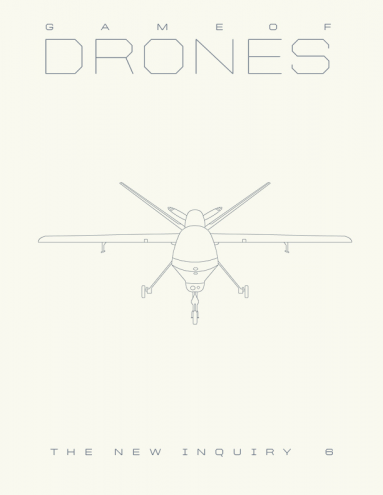
Over the weekend I worked my way through New Inquiry‘s special issue, Game of drones – Pete Adey‘s recommendation.  For me, the stand-out essay is Madiha Tahir‘s “Louder than bombs”

A graduate of Barnard College, NYU and the Columbia School of Journalism, Madiha is currently an independent multimedia/print journalist reporting on conflict, culture and politics in Pakistan; somehow she has also found the time to co-edit Dispatches from Pakistan (LeftWord Books, 2012) with the indefatigable Vijay Prashad and Qalander Bux Memom: more about Madiha here.

“Louder than bombs” begins with harrowing and matter-of-fact (all the more harrowing because matter-of-fact) testimony from Sadaullah Wazir, a teenage boy who lost both his legs and an eye after a US drone attack in North Waziristan in Pakistan’s Federally Administered Tribal Areas; he was just 13, and three other members of his family were killed in the attack.

Madiha’s root objection is to the way in which what she calls the Obama administration’s ‘theatrical performance of faux secrecy’ over its drone war in the FATA (and elsewhere) – a repugnantly teasing dance in which the veil of secrecy is let slip once, twice, three times – functions to draw its audience’s entranced eye towards the American body politic and away from the Pakistani bodies on the ground.  The story is always in Washington and never in Waziristan.  It’s a hideously effective sideshow, in which Obama and an army of barkers and hucksters – unnamed spokesmen ‘speaking on condition of anonymity’ because they are ‘not authorised to speak on the record’,  and front-of-house spielers like Harold Koh and John Brennan – induce not only a faux secrecy but its obverse, a faux intimacy in which public debate is focused on transparency and accountability as the only ‘games’ worth playing.

But when you ask people like Sadaullah what they want, Madiha writes,

‘they do not say “transparency and accountability”.  They say they want the killing to stop. They want to stop dying.  They want to stop going to funerals – and being bombed even as they mourn.  Transparency and accountability, for them, are abstract problems that have little to do with the concrete fact of regular, systematic death.’

So we have  analysts, activists and reporters falling over themselves to determine whether targeted killings outside a war zone like Afghanistan are legal; fighting to disclose the protocols that are followed to provide legal scrutiny of the targeting process; finally reassuring us, in a peculiarly American Story of O, that Obama is fully sensible of the enormous weight that rests on his shoulders.  But all of this distracts our collective gaze from the enormous weight that has been brought to bear on Sadaullah’s shiny new prostheses.  “I had a dream to be a doctor,” he tells a reporter. “Now I can’t even walk to school.”

Any discussion of the ways in which the kill-chain has been ‘lawyered up’ needs to acknowledge that – as the very formulation implies – the law is not apart from military violence: it has become part of military violence.  In Foucault’s ringing phrase, ‘the law was born in burning towns and ravaged fields’, and in the intervening centuries it has become ever more closely entwined with military (and paramilitary) violence.   Legality now substitutes for legitimacy, silencing any questions about politics or ethics.  As Madiha says, speaking of the calibration between the deaths of militants and the deaths of civilians, it is as though ‘if we could just get the calculus right, there would be no further ethical or political questions’.  Similarly, referring to the computer programs used by the US military (and seemingly, the CIA) to predict collateral damage, and so to adjudicate between the legal principles of necessity and proportionality,  Eyal Weizman notes that ‘it is the very act of calculation – the very fact that calculation took place – that justifies their action.’   But this is never a neutral appeal to algorithms or attorneys: not for nothing do those involved refer to the ‘prosecution’ of the target,  and as Anne Orford emphasises, the relevant body of international law ‘immerses its addressees in a world of military calculations’ and ensures that proportionality will always be weighed on the military’s (or the CIA’s) own scales.  In Weizman’s words, ‘violence legislates.’

Madiha again:

Even as we debate the legal machinations, official leaks and governmental manipulations by which they are killed, the daily, material, precarious existence of the people living under the disquieting hum of american drones in Pakistan’s tribal areas rarely sits at the center of discussion.

But what if it did? if, instead of the public secret, one begins with a prosthetic limb, a glass eye, and a funeral photo, the nightmare takes form, solidifies. 

None of this means that the law does not matter; its matter-iality ought to be obvious.  But it is to say that we need to be alert to what appeals to ‘the law’ do – and what they seek to foreclose. Legal questions do matter – but their answers must not be allowed to silence other political and ethical questions.  Neither should they close our eyes to the contrapuntal geographies that are staged far beyond the peep-shows of the Washington beltway.

*****

Note: For more on drone wars, see Remote witnessing and, in detail, ‘From a view to a kill’ and ‘Lines of descent’ (DOWNLOADS tab).  I’ve also provided a preliminary reading/screening list that notes some of the same emphases and omissions that trouble Madiha here.

Geography strikes back!

Jeremy Crampton has already trailed the launch of Robert D. Kaplan‘s new book, The Revenge of Geography: What the Map Tells us About Coming Conflicts and the Battle Against Fate (Random House, 2012) over at Open Geography.  

Kaplan has long been a correspondent for The Atlantic; from 2006 to 2008, he was the Class of 1960 Distinguished Visiting Professor in National Security at the United States Naval Academy at Annapolis, and since 2008 he has been a senior fellow at the Center for a New American Security.  He is currently Chief Geopolitical Analyst for Stratfor, which claims that its analysts use ‘a unique, intel-based approach to study world affairs’, and yet where Revenge is praised for its revelation of ‘timeless truths and natural facts’ (for which you presumably don’t need ‘intel’).

You can get a sense of Kaplan’s core argument in the new book from an essay published under the same lead title in Foreign Policy in May/June 2009 –  though it doesn’t appear among the ‘Article Highlights’ on his website – which the Center for a New American Security called ‘eye-opening’.  Really.  Kaplan returned to the same theme in a ‘Saturday Essay’ in today’s Wall Street Journal called “Geography strikes back”: read it here (do scroll through the comments, but you may need a stiff drink as you do) and watch a WSJ video presentation here.  If that isn’t enough, Robert Merry cheers Kaplan on in The National Interest here.

Here’s the (eye-)opening paragraph from the WSJ:

If you want to know what Russia, China or Iran will do next, don’t read their newspapers or ask what our spies have dug up—consult a map. Geography can reveal as much about a government’s aims as its secret councils. More than ideology or domestic politics, what fundamentally defines a state is its place on the globe. Maps capture the key facts of history, culture and natural resources. With upheaval in the Middle East and a tumultuous political transition in China, look to geography to make sense of it all.

Hard to know where to begin, really.  For Kaplan location is absolute not relative – he is right to deride flat-earthers like Thomas Friedman, but immediately adds a qualification: ‘Technology has collapsed distance, but it has hardly negated geography’ – which is partly why his opening paragraph can represent maps as transparent windows into the world: ‘just the maps, ma’am.’ Forty years of critical cartography dismissed in a dizzying infatuation with The Map as Fact.

The geography that Kaplan seeks to resurrect is obdurately physical: he instructs us that the Carpathian Mountains ‘still separate’ the Balkans from Central Europe (as though ‘the Balkans’ and ‘Central Europe’ are written on the surface of the earth, just there, not political and cultural constructions).  Similarly, the friction of distance is, for him, a physical calibration whereas, as I’ve tried to argue in several recent posts, the tyranny that is exercised over distance is shot through with political, economic and cultural formations.

clutch of commentators have pointed out in what Foreign Policy called ‘the revenge of the geographers‘ that Kaplan’s geography is a perversely but proudly Victorian slash (the mot juste) Edwardian one, in which a combination of global geopolitics and environmentalism drives strategic state action (for another powerful critique, see Kyle Grayson at Chasing Dragons here and here and here).

From this optic Kaplan reads ‘culture’ more or less directly – and with a confidence that beggars belief – from ‘nature’ (what he calls “the physical facts-on-the-ground”).  Both, astonishingly, are “timeless”.  It’s not only the Carpathian Mountains that haven’t moved very much:

…we descend from Afghanistan’s high tableland to Pakistan’s steamy Indus River Valley. But the change of terrain is so gradual that, rather than being effectively separated by an international border, Afghanistan and Pakistan comprise the same Indo-Islamic world. From a geographical view, it seems naive to think that American diplomacy or military activity alone could divide these long-interconnected lands into two well-functioning states.

At one in an ‘Indo-Islamic world’ (sic) that is the creature of a common bio-physical geography.

But my favourite is this gem:

Even so seemingly modern a crisis as Europe’s financial woes is an expression of timeless geography. It is no accident that the capital cities of today’s European Union (Brussels, Maastricht, Strasbourg, The Hague) helped to form the heart of Charlemagne’s ninth-century empire. With the end of the classical world of Greece and Rome, history moved north. There, in the rich soils of protected forest clearings and along a shattered coastline open to the Atlantic, medieval Europe developed the informal power relations of feudalism and learned to take advantage of technologies like movable type.

Not surprisingly, Kaplan doesn’t suggest what the solution to the current crisis might be.  An appeal to the Pope is obviously out, so unless those tectonic plates get a move on, it’s hard to see how there can be one. Perhaps that accounts for the ‘Fate’ in the sub-title.

Kaplan’s website provides a couple of revealing pre-publication reviews.  Henry Kissinger agrees with the central thesis: ‘Geography has been the predominant factor in determining the fate of nations, from pharaonic Egypt to the Arab Spring.’  As we academics instruct our students, ‘Discuss’.  And the other, by Ian Bremmer, President of Eurasia Group, says that ‘Kaplan wields geography like a scalpel’.  How very true.  But mind the blood.