Drone imaginaries

While everyone’s attention this week seems to have been captured by Pitch Interactive’s remarkable graphic of US drone strikes in Pakistan, Out of sight, Out of mindElspeth Van Veeren provides a timely reminder that there are other ways to visualise done warfare – all the more important given the central role that visual feeds play in the ‘dwell-detect-destroy’ assemblage.

2In a succinct and helpful online review she brings together several of the art projects I’ve written about in previous posts, including Omar Fast‘s video Five Thousand Feet Is The Best, Noor Behram‘s photographs from Waziristan and James Bridle‘s Dronestagram, and provides a suggestive argument about the visual politics involved:

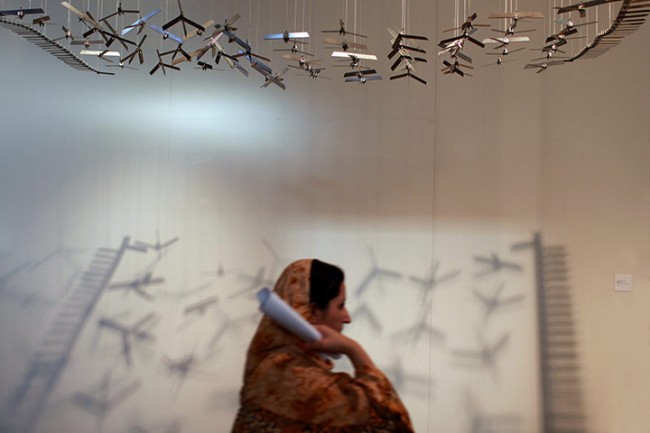
If drones are to be understood and debated, we need to pay attention to the ways in which visual politics plays into these debates. How are drones visualized? How are the politics of drone warfare made sensible? Drones as things enter into our world through the ways in which they are talked about, but also the way they are represented, repeated and circulated. They become objects and images through which we think. Their different perspectives – drone thing, drone vision, dronestream, and droneshadow – offer different and in some ways competing imaginaries of drones…. 

 Paying closer attention to these visual practices, to the sensible politics of drone warfare, offers a way to think through the many ways in which security and insecurity are produced. These drone imaginaries make drones visible and sensible, and in so doing they also tune us into the different people and identities that are connected with this technology. Imagining a drone also means imagining a viewpoint and there is more than one way to imagine a drone.

You can find other examples here – from which I’ve borrowed the image above – and in Craig Jones‘s post here.

Elspeth develops her argument about visualization and politics  in depth and detail in a paper she is presenting in a panel on Visualizing insecurity at the ISA Convention in San Francisco next month, ‘Drone imaginaries: There is more than one way to imagine a drone’, and you can download a working draft here (registration required).  She also has a book in the works from Routledge, Security collisions.

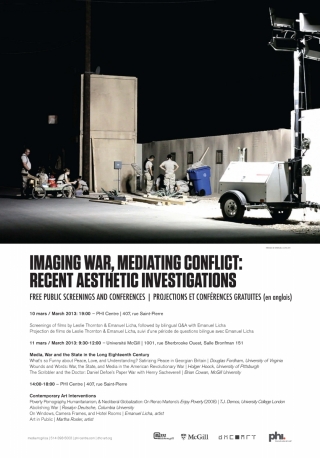
Imaging war, mediating conflict

20131301_affiche_imagingwar_2725x39_1

Last weekend Media@McGill, in collaboration with DHC/ART Foundation for Contemporary Art, hosted a screening and conference on representations of war and conflict in art and art history (I’m grateful to Max Ritts for drawing my attention to it). Here is the original summary:

 Imaging War, Mediating Conflict: Recent Aesthetic Investigations addresses the politics, aesthetics and ethics of art and media practices relating to war from the 18th century until today, and assesses how such representations help to shape the experience of current conflicts, as well as their place in history.

There were two conference sessions (click on the title links for the abstracts).  The first, on Media, war and the state in the long eighteenth century, featured:

What’s so Funny about Peace, Love, and Understanding? Satirizing Peace in Georgian Britain | Douglas Fordham, University of Virginia

Wounds and Words: War, the State, and Media in the American Revolutionary War | Holger Hoock, University of Pittsburgh

The Scribbler and the Doctor: Daniel Defoe’s Paper War with Henry Sacheverell | Brian Cowan, McGill University

The second session, on Contemporary Art Interventions, featured:

Poverty Pornography, Humanitarianism, and Neoliberal Globalization: On Renzo Martens’s Enjoy Poverty (2008) | T.J. Demos, University College London

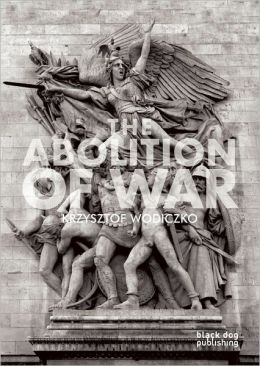
Abolishing War | Rosalyn Deutsche, Columbia University

On Windows, Camera Frames, and Hotel Rooms | Emanuel Licha, artist

Art in Public | Martha Rosler, artist

Abolishing warVideo of the presentations has now been uploaded and can be accessed here.  Two in particular caught my attention.

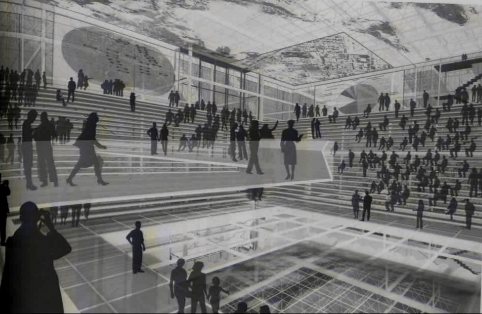
In an enviably polished and psychoanalytically informed presentation, Rosalyn Deutsche returns to an artist whose work she has considered several times in the past, Krzysztof Wodiczko (whose  Homeless Vehicle Project will be familiar to many geographers; others might know his more recent War Veteran Vehicle). Here she addresses, in a critically constructive fashion, his recent Arc de Triomphe: World Institute for the Abolition of War (though in fact he prefers the term “un-war” to “peace” for reasons Rosalyn explains at 09:51) and his extraordinary re-imagining and re-purposing of the iconic monument (see 11.13 on): what Rosalyn calls ‘disarming the Arc’.  More here and in Wodiczko’s book, The abolition of war, published last summer by Black Dog.  The same press has also published a lively volume of essays devoted to his work, Krzysztof Wodickzo (2011), which includes contributions from Rosalyn and Dick Hebdige, Dennis Hollier and Sanford Kwinter.

World Institute for the Abolition of War

Martha Rosler‘s House Beautiful: Bringing the War Home has always been a favourite of mine, and in her presentation at the McGill meeting, even as she battles with the recording system (haven’t we all?), she manages to say – and show – a great deal with a compelling economy.

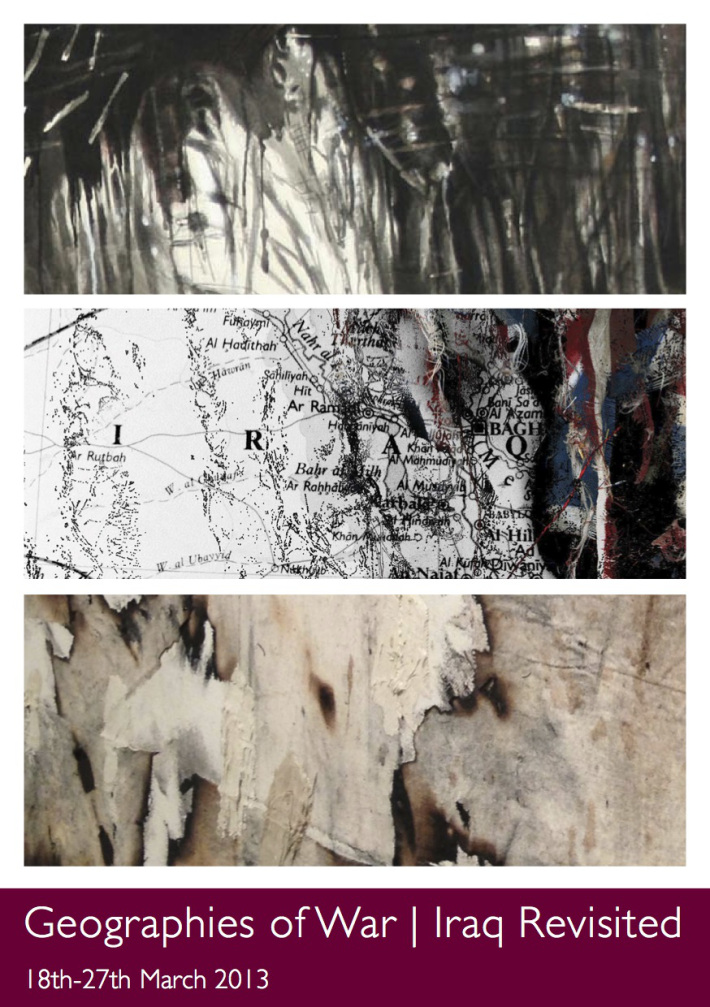
Geographies of War: Iraq revisited

geographies-of-war-iraq-revisited-a5-flier1As we approach the anniversary of the invasion of Iraq, British Foreign Secretary William Hague has reportedly advised his coalition colleagues not to discuss the war…  Fortunately we have people like Alan Ingram to help us revisit and re-imagine the war, and I’ve drawn attention to his important Art & War: responses to Iraq project before.

Now Alan has curated an exhibition, Geographies of War: Iraq revisited, which runs from 18-27 March at North Lodge, University College London, Gower Street, 11 a.m. to 6 p.m. every day.

‘This exhibition explores how artists with diverse practices and perspectives experienced the invasion and occupation of Iraq, an dhow they responded to it by engaging with questions of space, place, landscape and territory.  Bringing together artists from Iraq and Britain it shows six works that give material form to the violence, anxiety and ruin of war but which also raise questions about resistance, survival and dreams of peace.  Opening in the week of the tenth anniversary of the invasion, the exhibition presents alternative perspectives on the conflict and challenges our ways of seeing war.’

The featured artists include the indispensable Peter Kennard and Cat Phillips – you will surely have seen their photomontage of a leering Tony Blair photographing himself in front of a huge explosion – and one of my favourite Iraqi artists Hanaa Malallah.

There’s also a series of other events associated with the exhibition: a day of talks and discussions with artists and writers, ‘Art, war and peace: responses to the invasion and occupation of Iraq’ on 22 March, and a workshop on ‘Beyond the geographies of war: exploring art and peace’ on 27 March.

More information here.

Hide and Seek – and Show

Ever since I heard Isla Forsyth give one of her marvellous presentations on camouflage I’ve been fascinated by the subject – all the more so since it intersects so artfully (and, as Isla would quite rightly insist, scientifically) with my work on aerial reconnaissance, bombing and modern war.  You can get an early sense of Isla’s work from this presentation, ‘Shadow chasers: exploring the vertical and angular geometries of camouflage‘, which includes a gallery of images.  Isla’s Glasgow PhD thesis, From Dazzle to the Desert: A Cultural-Historical Geography of Camouflage, was completed last year – and I hope will appear in book form.

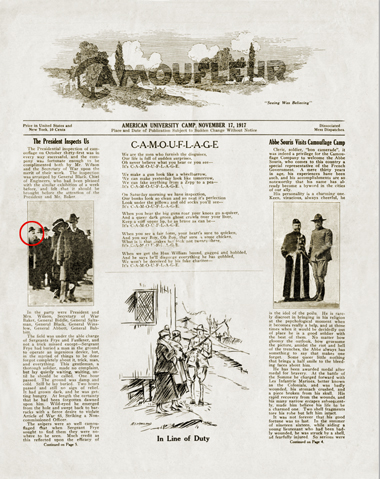
FrontPageCamoufleur

There’s a great blog on camouflage – Camoupedia – which includes an appreciative notice of Isla’s work and, amongst a feast of deceptive riches, a stunning series of posters by graphic design students to advertise a talk by Claudia Covert (that really is her splendid name) on dazzle ship camouflage in World War I, a post about the newspaper of the American Camouflage Corps in 1917 (above), and a remarkable extract from a letter from Reginald Farrer later published as The Void of War: letters from three fronts (1918):

FARRER Void of WarThe real thing about the human side of the war is the sheer fun of it. In certain aspects the war is nothing but a glorious, gigantic game of hide and seek—camouflage is nothing else. It is not only the art of making things invisible, but also of making them look like something else. Even the art of inconspicuousness is subtle and exciting. What glory it must be to splash your tents and lorries all over with wild waggles of orange and emerald and ochre and umber, in a drunken chaos, until you have produced a perfect futurist masterpiece which one would think would pierce the very vaults of heaven with its yells..

But disguise is an even higher branch of the art: you go on to make everything look like something else. Hermit crabs and caddis worms become our masters. Down from the sky peers the microscopic midget of a Boche plane: he sees a tree—but it may be a gun: he sees a gun—but it may be only a tree. And so the game of hide and seek goes on, in a steady acceleration of ingenuity on both sides, till at last the only logical outcome will be to have no camouflage at all. You will simply put out your big guns fair and square in the open, because nobody will ever believe, by that time,  that anything really is what it looks like. As far as the guns go, the war is developing into a colossal fancy dress ball, with immunity for the prize: wolves in sheep’s clothing are nothing to these gentle shepherdesses of the countryside. The more important they are, the more meekly do they shrink from notice under dominos of boughs or sods, or strawberry-netting tagged over with fluffets of green and brown rags. And sometimes they lurk under some undiscoverable knoll in a coppice, and do their barking through a little hole from which you would only expect rabbits, not shells..

And, of course, this fun sense of his [the individual] has full play in this new warfare. It is all “I spy,” on terms of life and death: the other fellow must not spy, or you hear of it instantly, through your skull. Think how it must sharpen up the civilization-sodden intelligence of a man, to have to depend for dear life on noticing every movement in a bush and every opening in a bank. Now we are getting back with one hand what we had lost by giving up the other to machinery. We are growing to make the best of both worlds, the mechanical and the human, without giving up our mental balance by relying exclusively on either. I only wish I could give you an idea of the devices and ingenuities that these grown-up hide-and-seekers have elaborated. All sorts of ludicrously simple things, the more ludicrously simple the better

Every blank-faced trench rampart of sandbags has its hidden eyes—eyes perfectly wide awake all the time, and winking at you wickedly with a rifle. But for your life you could not spot them, until you had had weeks of training, and learned the real meaning of every tiny unevenness or discoloration or bit of darkness. And even then you have to learn to guess which of these is harmless—so as to blind the others with your own fire. Or there is an innocent, untidy, earthy bank, a dump of old boots and tins and bottles and teapots without spouts. But any one of those forlorn oddments may also be the eyelid of a rifle. Only you do not know which—until you have found out! In the beginning of the war you did not find out. Everything was neat and tidy and civilized and well arranged: so you merely got killed.

I’ve quoted this at length because it seems such a radically different view of the new geometries of the First World War to that taken (as I noted here) by Charles Nevinson in his early paintings of the Western Front – at least in its celebratory temper.  And yet, in its acknowledgement of the entanglements of the machine and the human, it’s also subversively the same.  (Not surprisingly, both Isla and the author of the blog – Roy Behrens, who also wrote the book Camoupedia (2009) – pay close attention to camouflage artists, and there’s also a brief blog post on Camouflage as Futurism that notes Nevinson’s work).

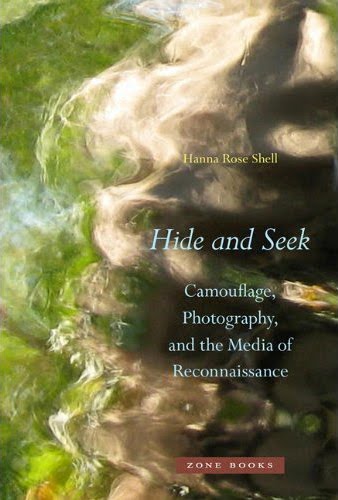
All of this is on my mind today for two reasons.  The first is that Farrer’s letter was published in part under the title ‘Hide and Seek‘, which is also the title of a brilliant book on camouflage I’ve belatedly discovered (perhaps that’s appropriate): Hanna Rose ShellHide and Seek: Camouflage, Photography and the Media of Reconnaissance, published by the ever -inventive Zone Books in March last year.  The more books I buy from Zone, the more I realise that this is a wonderful platform for books that depend on images – not surprising since they are edited by Jonathan Crary,Michel Feher, Hal Foster and Ramona Nadaff.

SHELL Hide and seek

You can get a sense of Hanna’s (early) work from this essay, ‘The crucial moment of deception’, in Cabinet.  There’s also an excellent article on her work in the Paris Review here , another at rhizome here, and a short interview with Hanna here:

The main focus of my book is on the period between the late 19th century and World War II, but I also show how photographic camouflage is present in military research today. What I call an enduring “chameleonic impulse” continues to motivate military R&D of wearable camouflage technologies. There is also an ongoing quest to develop “invisible cloaks” to serve simultaneously as skins and … screens onto which one’s visual environment might be projected.

Many times, people’s first association with camouflage is with the natural world — it’s often the story of the evolution of the “peppered moth” that schoolchildren learn in biology class. But it’s only when humans had to hide from the camera and other optical devices that animal protective concealment began to fascinate people … and then became a model for the development of new human technologies.

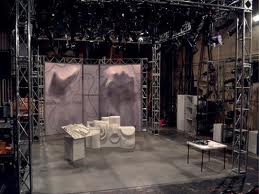
Camouflage Project

There’s a second reason.  I’m presently developing a performance work, provisionally called “The social life of bombs“, where I want (among other things) to integrate the performing and visual arts into the research process (as part of my Killing Space project).  My inspiration is in part Gerry Pratt’s Nanay, but more proximately Boca del Lupo‘s Photog, based on the experiences of four combat photographers and using cutting-edge visual technologies to mesmerising effect (I’m going to talk with them next month), and in part Ohio State University’s  The Camouflage Project (above).  The project involved OSU’s Department of Theater and the Mershon Center for International Security Studies:

The camouflage project/2The goal of The Camouflage Project is to create, organize and execute a three-part interdisciplinary endeavor linked to the theme of secret agents, camouflage, deception and disguise in World War II, specifically the F section (France) of the Special Operations Executive (SOE). The three parts are as follows:

Performance: To devise a new performance work as a collaboration between Ohio State University Theatre and the Advanced Computing Center for the Arts and Design (ACCAD). This will be a multi-media work combining digital animations and video projections with experimental use of 3D printing, 3D scanning and projection mapping.

Exhibition: To create a visual environment parallel to the performance space, which will have a second life as an installation/exhibition. The installation will feature historical background (interviews and soldier training films) on the science and art of camouflage in both World Wars organized around a visual study of selected SOE (principally female) agents and espionage circuits in France, examples of military equipment, devices, disguises, gadgets and weapons of deception.

Symposium: To organize and host an international symposium on the multiple artistic and instrumental meanings of camouflage, to be held in May 2011. The symposium will feature panels of Ohio State and international experts from military history, political science, and the Imperial War Museum addressing the subject of camouflage and the SOE.

The project offers a fresh meaning to the expression ‘theatre of war.’ On one level it theatricalizes the history of military camouflage, particularly the SOE and the role played by women agents in its espionage activity. On another it reveals the artistic dimensions of these activities: a variety of theatre artists—scenic, costume, make-up designers, and vaudeville magicians—were employed to use their theatrical skills to deceive and fool the enemy. Rather than tales of derring-do and spying, this project seeks to look at different and often hidden aspects of the war: the use and creation of camouflage, both literally and metaphorically, by people who had to work secretly behind enemy lines. The performance storyline will highlight the work of women agents, many of whose accomplishments have been concealed, erased or obscured for a variety of reasons. A narrative strategy will be to include elements of the training process involved in preparing agents for the field and the often-disastrous consequences of strategic decisions made by the SOE leadership.

This all came together in May 2011, though the performance work has subsequently been on tour; the programme for the symposium and performance is here, a review of the 90-minute performance here.  My subject is different, of course, but I’m really taken by the tripartite structure of the project and its collaborative nature.  Perhaps I have nothing to say, only to show…

‘A foreign field that is forever England’?

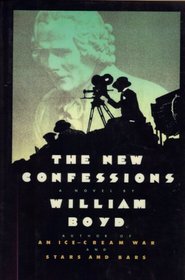
BOYD New ConfessionsI’ve already noted the effect that William Boyd‘s An Ice-Cream War (1982) had on me, but there’s another Boyd novel that also deals with the First World War – this time set on the Western Front rather than East Africa – that also offers much food for thought.

In the early sections of  The New Confessions (1987), an odyssey conducted in the obvious shadows of Rousseau, the protagonist John James Todd is serving in a Public School service battalion of the British Army just before Ypres.  In a chapter revealingly entitled ‘New geometries, new worlds’, Todd recalls the Ypres front in early June 1917 like this:

‘Take an idealized image of the English countryside – I always think of the Cotswolds in this connection…  Imagine you are walking along a country road.  You come to the crest of a gentle rise and there before you is a modest valley.  You know exactly the sort of view it provides.  A road, some hedgerowed lanes, a patchwork of fields, a couple of small villages – cottages, a post-office, a pub, a church – there a dovecote, there a farm and an old mill; here an embankment and a railway line; a wood to the left, copses and spinneys scattered randomly about.  The eye sweeps over these benign and neutral features unquestioningly.

‘Now place two armies on either side of this valley.  Have them dig in and construct a trench system.  Everything in between is suddenly invested with new sinister potential: that neat farm, the obliging drainage ditch, the village at the crossroads become key factors in strategy and survival.  Imagine running across those intervening fields in an attempt to capture positions on that gentle slope opposite so that you may advance one step into the valley beyond.  Which way will you go? What cover will you seek?  How swiftly will your legs carry you up that sudden gradient?  Will that culvert provide shelter from enfilading fire?  Is there an observation post in that barn?  Try it next time you are on a country stroll and see how the most tranquil scene can become instinct with violence.  It only requires a change in point of view.’
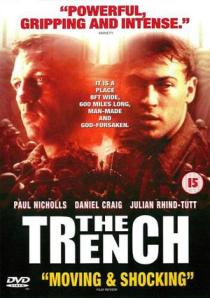
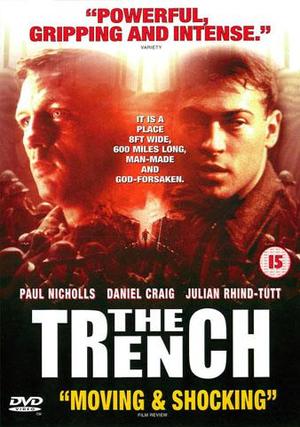
The TrenchLater Todd is recruited by the War Office Cinema Committee with strict instructions about what and may not be shown, and some ten years after he wrote the novel Boyd directed his own film, The Trench, set on the eve of the Battle of the Somme. But my point (for the moment) isn’t about photography or film but about the work of war artists on the Western Front.

During the spring of 1916 Charles Masterman, the director of the British War Propaganda Bureau, was persuaded to appoint the first Official War Artist, Muirhead Bone.  Bone was a sketcher and watercolour artist, who was duly commissioned as an honorary Second Lieutenant and arrived in France during the Battle of the Somme.  He returned to England in October, and two hundred of his drawings were published in ten monthly parts, with an accompanying commentary by C.E. Montague.

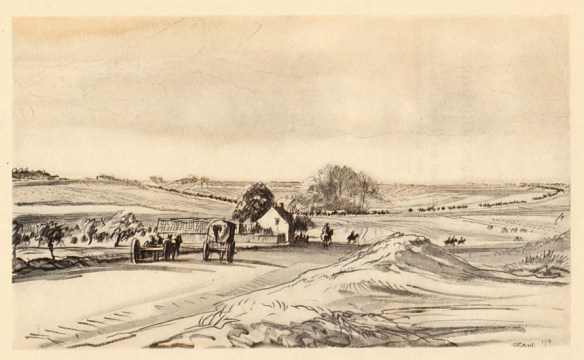
A View in Flanders behind the Lines, Showing Locre and the Tops of Dug-Outs on the Scherpenber 1916 by Sir Muirhead Bone 1876-1953

‘For many people at home,’ Samuel Hynes remarks in A war imagined, ‘they must have been an important source of their notions of what the war looked like.’  But, he continues,

‘Bone and Montague agreed that what it looked like was England; both the drawings and the commentaries imagine the war in familiarizing English terms…  They made the war look familiar, and they provided images of it from which both the dead and the suffering living had been entirely excluded.’
BONE British troops marching to the Somme

When the first two weekly installments appeared, apparently to considerable public acclaim, Wilfred Owen called them ‘the laughing stock of the army’ because they presented such a pastoralized, picturesque and sanitized view of the war: ‘To call it England!’  Many of Bone’s drawings, like the two examples I’ve shown here, rendered the landscape in the idealized terms of Boyd’s ‘country stroll’.  (There were exceptions, but even when Bone turned to the desolation of the battlefield many of his sketches were devoid of human form, alive or dead.)  To be sure, most commentators noted that in the rear a working countryside persisted, and many of them made much of the shocking transition from a landscape that was indeed familiar, largely untouched by military violence, to something unlike any landscape on earth.

And it’s exactly that anti-landscape Owen wanted to be represented.  In The soldiers’ tale Hynes writes that

‘War turns landscape into anti-landscape, and everything in that landscape into grotesque, broken, useless rubbish – including human limbs.’
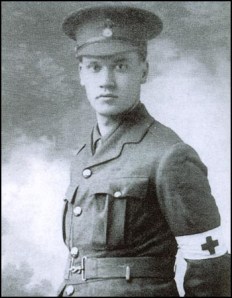
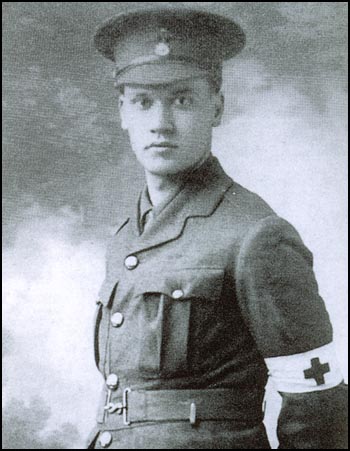
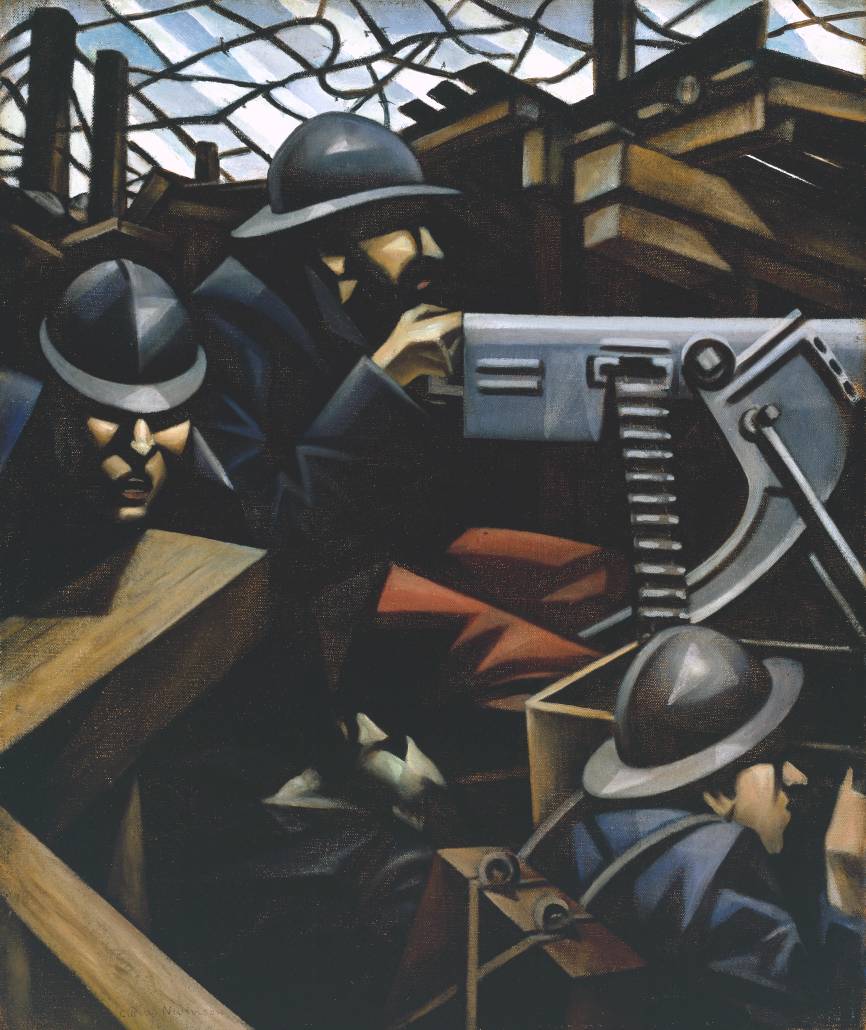
C.R.W. NevinsonAnd there were other artists who were developing Boyd’s ‘change in point of view’, a different visual vocabulary for these brutally new warscapes.  One of the most interesting, I think, is C.R.W. Nevinson.  Early in the war Nevinson served as an orderly with the Friends’ Ambulance Unit and then as an ambulance driver with the Royal Army Medical Corps.  He was invalided out in January 1916, a result of acute rheumatic fever, but in March 1916 he exhibited a series of Futurist paintings whose stark geometric planes and mechanised violence conveyed a radically different sensibility, one in which soldiers and machines were fused into shockingly new assemblages and where human bodies were caught up in and overwhelmed by the percussive force of the new military machine.  One of his most famous paintings, of a French machine-gune post, La Mitrailleuse (below), captures what Michael Walsh calls the ‘machinomorphic image’ of the war.

La Mitrailleuse 1915 by Christopher Richard Wynne Nevinson 1889-1946

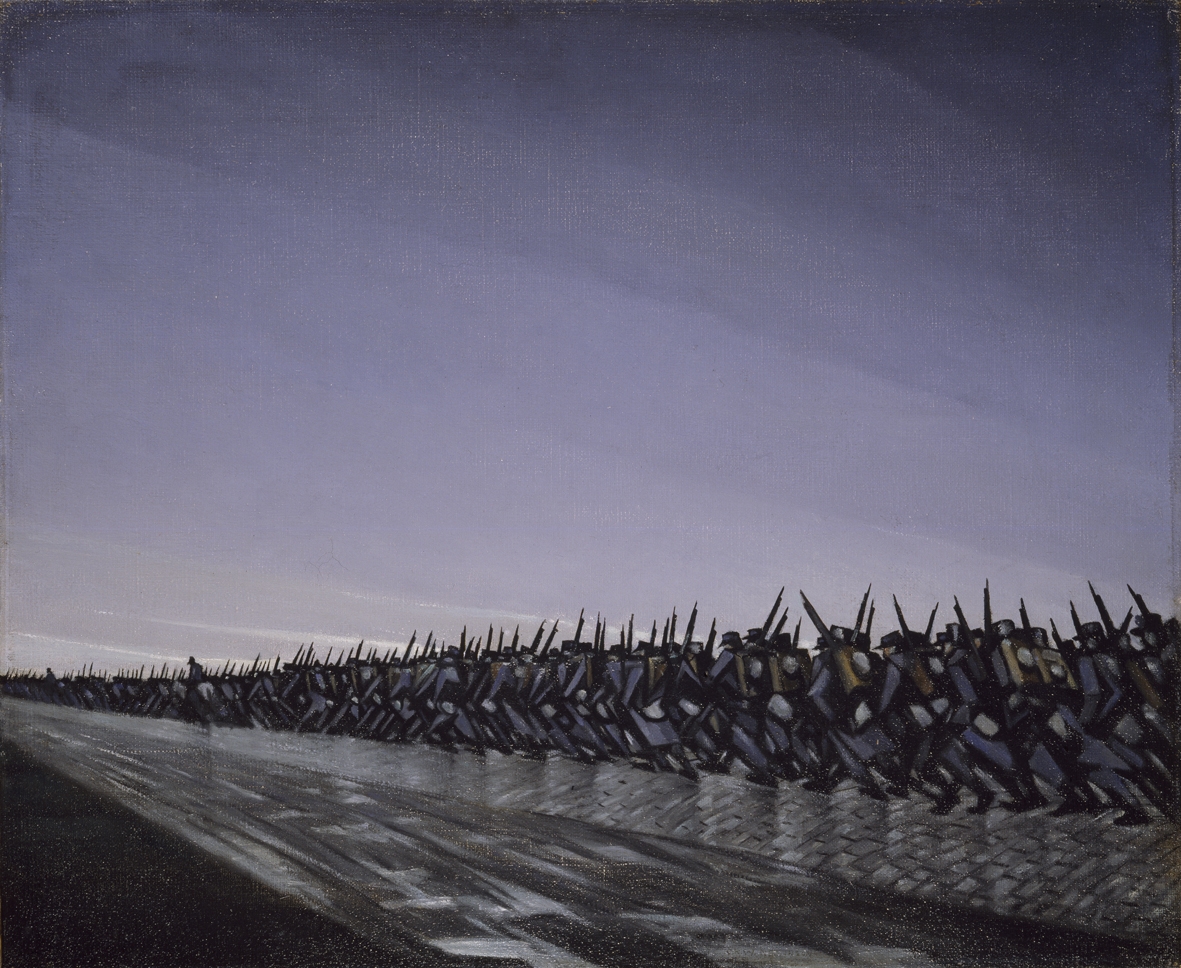
Walter Sickert claimed that La Mitrailleuse ‘will probably remain the most authoritative and concentrated utterance on the war in the history of painting’, but other Nevinson paintings of this period capture other dimensions of the automations of the killing machine, as in Column on the march (1915):
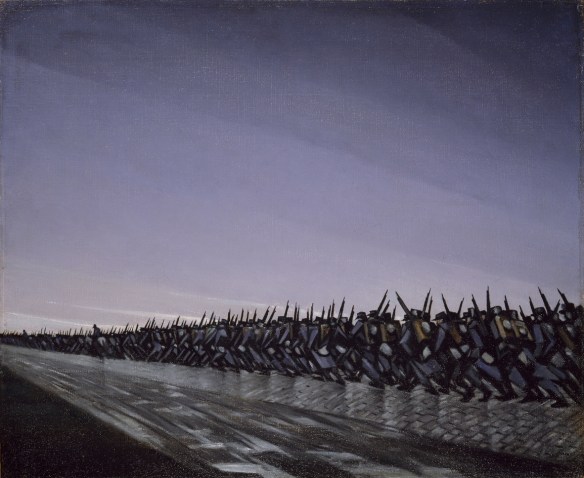
Nevinson Column on the march 1915

They also captured, through what Claude Philips praised as their ‘cold, calculated violence’ and ‘cruel, metallic angularity’, what Henri Lefebvre once called ‘the overwhelming of the human body’, as in The strafing (1915):
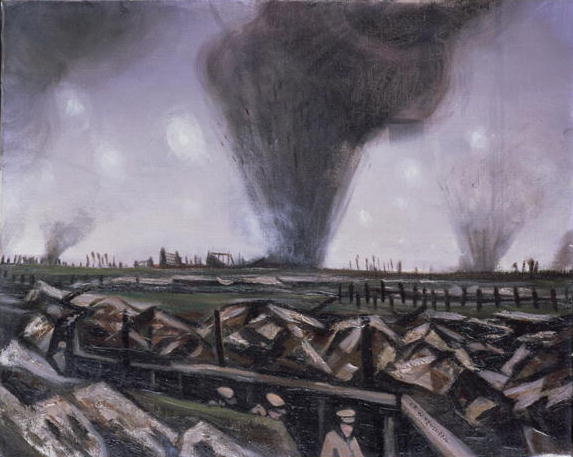
NEVINSON The strafing

In invoking Lefebvre here, I have in mind this passage from The production of space where he describes a modern, abstract, geometric space:

‘… space has no social existence independently of an intensive, aggressive and repressive visualization. It is thus – not symbolically but in fact – a purely visual space. The rise of the visual realm entails a series of substitutions and displacements by means of which it overwhelms the whole body and usurps its role.

And yet, of course, the production of this extraordinarily violent space was literally shot through with corporeal investments.
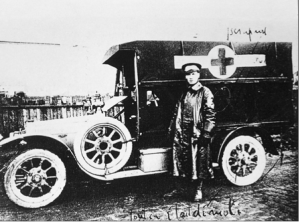
Postcard from Nevinson to MarinettiI’ve described these artworks as Futurist, but two riders are necessary.  The first, and most obvious, is that Marinetti‘s own Manifesto of Futurism expressed a desire ‘to glorify War – the only health giver of the world’, and while Nevinson was fascinated by, even infatuated with Marinetti – he sent Marinetti a postcard (right) of him posing in front of his ambulance, without any discernible sense of irony – this was a claim that Nevinson eventually explicitly repudiated (in a column for the Daily Express called ‘Painter of Smells at the Western Front’).  Bone, incidentally, liked Nevinson’s work.

The second is more interesting.  Paul Saint-Amour has described aerial photography and interpretation on the Western Front not as an applied realism but as an applied modernism – and with good reason (some interpretation manuals described ‘Cubist’ and ‘Futurist’ landscapes) – and if we extend this insight then we might say that in these artworks Nevinson was recovering and reinscribing a scopic regime that was instrumental in the very violence he sought to subvert.

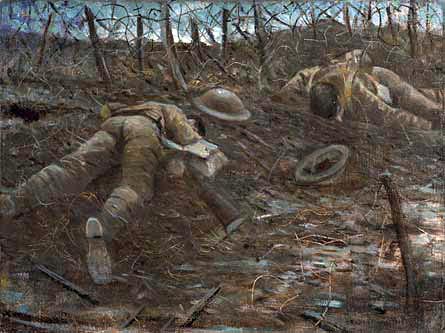
In March 1917 Nevinson was toying with the idea of putting his talents to work in the new camouflage section of the army, but by July he was back in France as an Official War Artist.  He went up in an observation balloon and claimed to be ‘the first man to paint in the air’; in fact he thought his ‘aeroplane pictures the finest work I have done’.  But in many of these later paintings he turned his back on Futurism and the machinations of the killing fields and restored the broken body to the art of war.  The most notable example is perhaps Paths of glory (1917).  Refused permission to exhibit the canvas at the Leicester Galleries in London by the War Office, Nevinson had it displayed with a brown paper sticker across the two dead bodies reading “Censored”…

NEVINSON Paths of glory

There is an excellent gallery of Nevinson’s work here, and for more discussion I recommend David Boyd Hancock, A crisis of brilliance: five young British artists and the Great War (2010); Michael Walsh, ‘C.R.W. Nevinson: conflict, contrast and controversy in paintings of war’, War in History 12 (2) (2005) 178-207, and his two books, C.R.W. Nevinson: This cult of violence (2002) and Hanging a rebel: the life of C.R.W. Nevinson (2008).
Gaza in Ruins

An important post from Craig Jones about the capacity of the creative arts to respond to and even dislocate military violence that chimes beautifully with my previous post about War/Photography, and leads me into a notice of a research seminar at King’s College London (K2.29, Strand) at 6 p.m. on 5 February 2013:

‘i have come to everyday armageddon’: Spectacular and Slow Ruin in Gaza
Anna Bernard

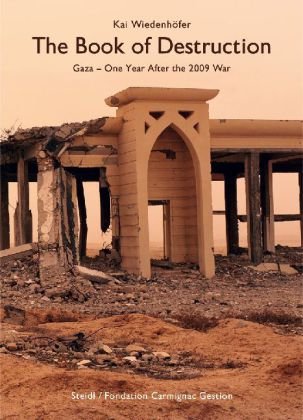
WIEDENHOFER Book of destructionThe Israeli military’s 22-day attack on Gaza in the winter of 2008-9 provoked international condemnation to a degree that the region’s daily deprivation since 2007 under Israeli and Egyptian blockade had not. After the assault, images of the ruins of Gaza – its collapsed buildings, its disabled and impoverished residents – circulated widely. Beyond recording the immediate destruction caused by the attacks, however, these representations also sought to convey a different kind of ruin: the ‘slow violence’ (Nixon 2011) of Gaza’s humanitarian crisis. Anna Bernard will explore some of the visual and narrative attempts since 2009 to draw attention to the full scale of Gaza’s devastation, including photography by Kai Wiedenhöfer and poetry by Suheir Hammad. [The title is taken from Suheir Hammad’s poem GAZA, and the video shows Wiedenhöfer’s exhibition at the Musée d’Art Moderne in Paris in 2010].

Anna Bernard works on literary and cultural representations of Israel/Palestine in international contexts. She is the author of Rhetorics of Belonging: Nation, Narration and Israel/Palestine, forthcoming from Liverpool University Press.

Ruins in Gaza – Reality and Representations
Ahmed Masoud

While the Gaza Strip is often associated with images of ruins and destruction as a result of the continuous Israeli bombardment, the rubble of destroyed buildings has also become closely associated with the national cause. In 2009, a young artist living in Jabalia Camp turned her bombed house into an installation of a tank. Her message was that holding on to living spaces was as powerful as any military machinery.

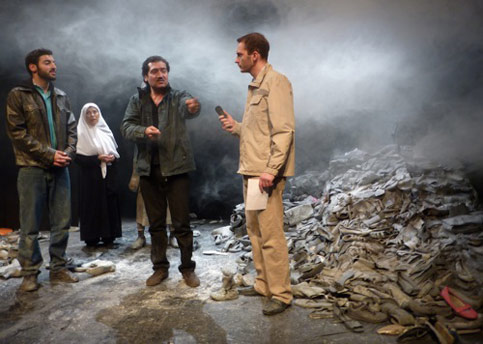
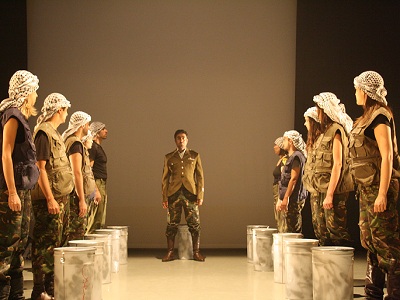
Go to Gaza drink the seaAhmed Masoud will discuss the representation of ruins in his plays Go to Gaza, Drink the Sea (2009) and Unto the Breach (2012). Working with various set designers, Ahmed chose to represent rubble using different materials. In Go to Gaza, Drink the Sea (left) destruction was represented through a mountain constructed out of thousands of old shoes, while the set of Unto the Breach compiled a collage of ripped clothes, palates, paint pails and other broken and recyclable materials. Both sets represent the hardships, but also the resourcefulness, of ordinary people living under siege. They also reflect the process of making the set and shows with a very limited budget.

Unto the breachAhmed Masoud is a Palestinian academic, writer and director. In 2005, he founded the Al Zaytouna Dance and Theatre Company. With Justin Butcher he co-wrote and directed the successful play Go to Gaza, Drink the Sea (2009), staged in London and at the Edinburgh Fringe Festival, and the BBC Radio 4 Play Escape from Gaza (January 2011). Ahmed also won the Muslim Writers Awards (sponsored by Penguin Books) in the unpublished novel category for his book Gaza Days. His latest show Unto the Breach (right) [a dance adaptation of Shakespeare’s Henry V] was performed at the Artsdepot Theatre in November 2012 and received critical acclaim.

***

All of this has prompted me to start serious work on a project I’ve had buzzing around my head for months now – a performance-work on bombing, past and present, using video, testimony, music, above all drama (and perhaps even dance).  The spur is partly my continuing frustration at conventional academic forms, partly admiration for my good friend Gerry Pratt‘s stunning drama-work Nanay (which has been performed in Vancouver and Berlin), now reinforced by Photog., and above all a desire to work on a collaborative project designed to engage the widest possible public.  Watch this space…

The Freestone Drone

Visual and media artists continue to dazzle with their interventions on the drone wars.  Pierre d’Alancaisez of waterside contemporary in London has written with news of a forthcoming video installation by George Barber, a pioneer of the Scratch Video movement of the 1980s, called The Freestone Drone, which will be at the gallery from 2 February through 23 March 2013.

Freestone Drone - main image hires

In an installation conceived specially for the gallery and consisting of three video projections, an array of domestic objects and numerous washing lines, George Barber’s The Freestone Drone follows a mission from the point of view of the machine. The drone’s camera surveys cityscapes, encounters individuals, reports, and in flight becomes aware of its own utility and destiny. Drone operators routinely study the washing to learn about their targets – it is foretold that the Freestone Drone is to die entangled in a clothes line.

The video combines found and made footage to produce an uneasy, seductive montage, anchored on the drone’s private thoughts. Barber brings together war, love, life, death, and sends the drone over not only Waziristan, but also to New York and a London suburb. The drone then travels through time, projecting images of the past and possible futures. 

While narrative unravelled on screen resists easy categorisation, the artist draws the viewer to empathise with the antagonist. Engendered with human consciousness and independence, the drone is a poet who disobeys orders and does his own thing, a child within a machine.

In the legacy of Godard and Marker, The Freestone Drone proposes the meeting place of poetry and philosophy as a site to consider contemporary ethical and political concerns. Ultimately, Barber’s work underlines the fact that technologies, and in particular modes of warfare, are symptomatic of the way we understand ourselves at our moment in history. Much now done in our name is at odds with democratic tradition: hidden, inhuman and robotic.

The child-like anthropomorphism of the drone is chillingly effective, and made me think again about the conceit I used to introduce a brief post at the end of last year, ‘Stalking in the air….’

Here is a preview:

http://vimeo.com/56444355

The waterside gallery is at 2 Clunbury Street, London N1; it makes a point of working with – not simply showing – contemporary artists, and it’s also worked with Karen Mirza and Brad Butler whose work I noted last year.

After Hiroshima

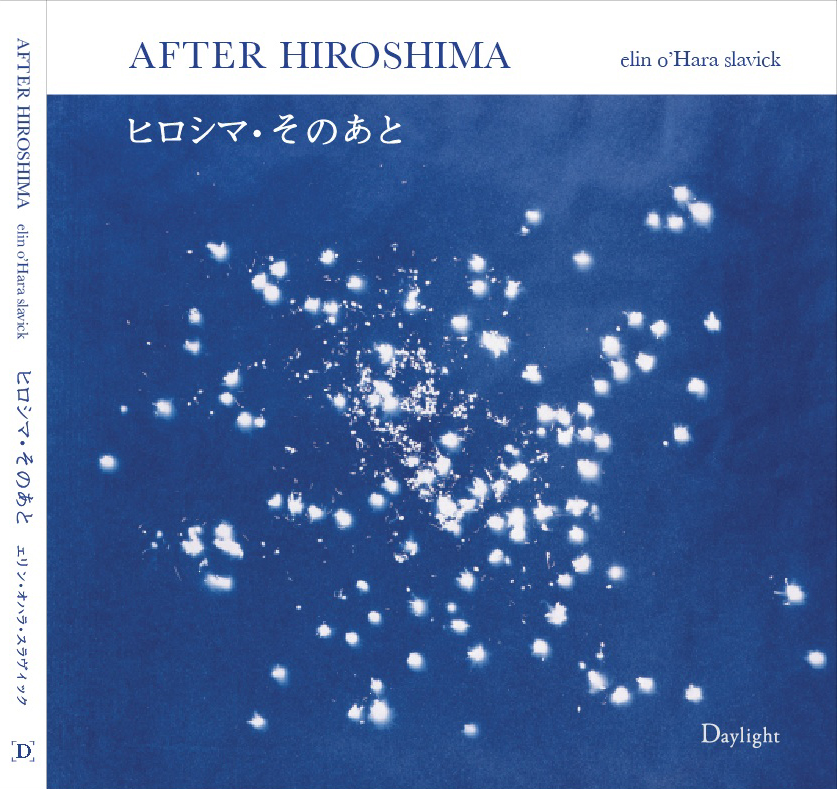
slavick After HiroshimaFollowing my post on artists and bombing, and in particular the work of elin o’Hara slavick, elin has written with news of her new book, After Hiroshima, due in March from Daylight, with what she calls a ‘ridiculously brilliant essay’ from James Elkins.

If you’re interested in two different but none the less intimately related works, I recommend Paul Ham‘s Hiroshima Nagasaki (Doubleday, 2012), which is extraordinarily good at placing those terrible attacks in the context of a strategic air war waged primarily against civilians (according to the Air Force Weekly Intelligence Review at the time, ‘There are no civilians in Japan’: sound familiar?) – and this needs to be read in conjunction with David Fedman and Cary Karacas, ‘A cartographic fade to black: mapping the destruction of urban Japan in World War II’, Journal of historical geography 38 (2012) 303-26 (you can get a quick visual version here) – and Rosalyn Deutsche’s Hiroshima after Iraq: three studies in art and war (Columbia, 2010), based on her Wellek Library Lectures in Critical Theory given in 2009.

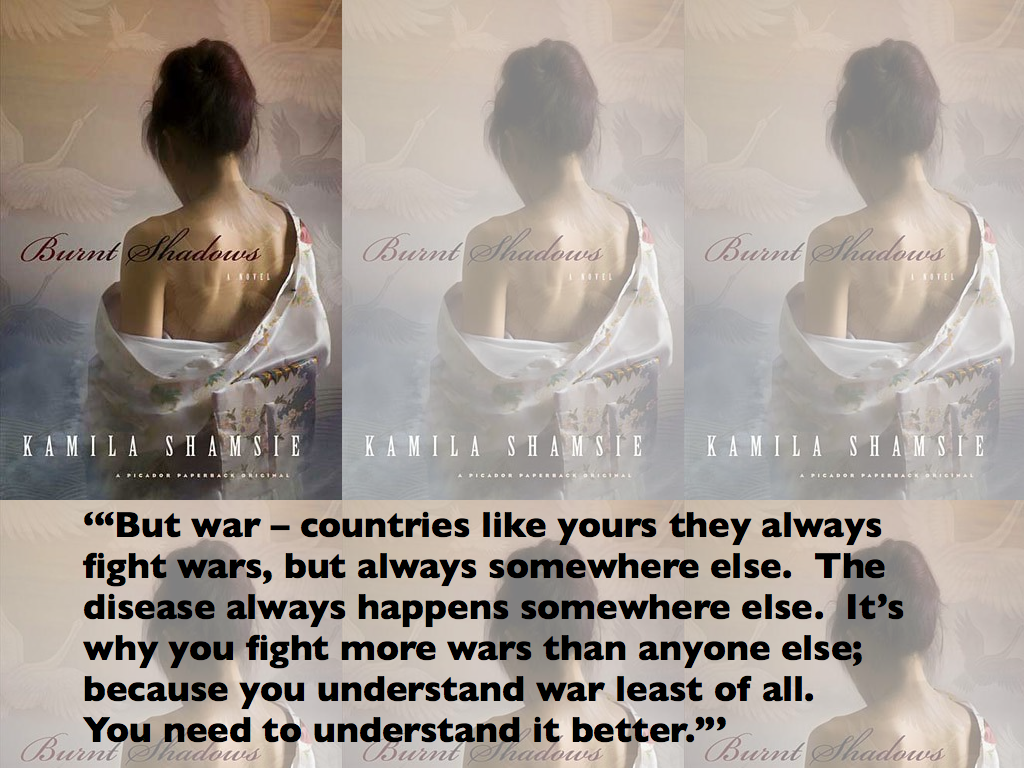
You can get a preview of elin’s ‘After Hiroshima’ project here. Scrolling down that page, my eye was caught by the image ‘Woman with burns through kimono’, taken in 1945, which transported me to another ridiculously brilliant work, Kamila Shamsie‘s dazzling novel Burnt Shadows.  I’ve been haunted by it ever since I read it, and in the draft of the first chapter of The everywhere war I start with this passage from the novel:

Burnt Shadows

And this is how I go on (and please remember this is a draft):

A man is being prepared for transfer to the American war prison at Guantanamo Bay: unshackled, he strips naked and waits on a cold steel bench for an orange jumpsuit.  ‘How did it come to this?’ he wonders.  This is the stark prologue to Kamila Shamsie’s luminous novel Burnt Shadows.  She finds her answer to his question in a journey from Nagasaki in August 1945 as the second atomic bomb explodes, through Delhi in 1947 on the brink of partition, to Pakistan in 1982-3 as trucks stacked with arms grind their way from the coast to the border training-camps, and so finally to New York, Afghanistan and Guantanamo Bay in 2001-2.   These are all, in their different ways, conflict zones and the turning-points of empires, tracing an arc from the cataclysmic end of the Second World War through the Cold War to the wars fought in the shadows of 9/11.   In this book, I follow in her wake; I find myself returning to her writing again and again.  Although this is in part the product of her lyrical sensibility and imaginative range, there are three other reasons that go to the heart of my own project and which provide the framework for this chapter.

The first flows from the historical arc of the novel.   Shamsie is adamant that Burnt Shadows is not her ‘9/11 novel’.  She explains that it is not about the attacks on the World Trade Center and the Pentagon on 11 September 2001 but about the cost and consequences of state actions before and after.  Her long view reveals that the connections between Ground Zero in 1945 and Ground Zero in 2001 are more than metaphorical.  These are connections not equivalences – and far from simple – but like Shamsie I believe that many of the political and military responses to 9/11 can be traced back to the Cold War and its faltering end and, crucially, that the de-stabilization of the distinction between war and peace was not the febrile innovation of the ‘war on terror’.  I start by mapping that space of indistinction, and it will soon become clear that the dismal architects of the ‘war on terror’ (the scare-quotes are unavoidable) not only permanently deferred any prospect of peace but claimed to be fighting a radically new kind of war that required new allegiances, new modalities and new laws. Here too there are continuities with previous claims about new wars fought by the advanced militaries of the global North, conducted under the sign of a rolling Revolution in Military Affairs and its successor projects, and quite other ‘new wars’ fought by rag-tag militias in the global South: all of them preceding 9/11.

I turn to those new wars next, and this brings me to the second reason why Shamsie’s work is relevant to my own discussion.  While she was writing Burnt Shadows she used Google Earth to disclose the textures of New York City, and marvelled at how obediently they swam into view: ‘3D models of buildings, amazingly high-resolution images, links to photographs and video streams of Manhattan.’ When she turned to Afghanistan, however, all the details dissolved into ‘an indistinct blur, and the only clues to topography came from colours within the blur: blue for rivers, brown for desert, green for fertile land.’  But that was then (2006).  Three years later, a different Afghanistan was brought into view.  ‘As I click through all the YouTube links tattooed across the skin of Afghanistan,’ she wrote, ‘I encounter video clips of American solders firing on the Taliban, Canadian politicians visiting troops, Dutch forces engaged in battle, an IED blast narrowly missing a convoy of US soldiers, a video game in which a chopper hails down missiles and bullets on a virtual city which looks more like Baghdad than Kabul.’  Shamsie uses these distinctions to remind us that ‘we’re still using maps to inscribe our stories on the world.’  So we are; and throughout this book I also turn to these violent cartographies, as Michael Shapiro calls them: maps, satellite images and other forms of visual imagery. These inscriptions and the narratives that they impose have a material form, and they shape both the ways in which we conduct ‘our’ wars and also the rhetoric through which we assert moral superiority over ‘their’ wars.  Yet even as I sketch out these contrasting imaginative geographies, another indistinction – a blurring, if you like – seeps in.  For one of the most telling features of contemporary warscapes is the commingling of these rival ‘new wars’ in the global borderlands, the ‘somewhere else’ that Abdullah reminds Kim is always the staging ground of America’s wars.

And this brings me to the final reason for travelling with Burnt Shadows: Abdullah’s insistence that war is like a disease.  This is an ironic reversal of the usual liberal prescription that justifies war – which is to say ‘our’ war – as a necessity: ‘killing to make life live’, as Michael Dillon and Julian Reid put it.  They argue that war in the name of liberalism is a profoundly bio-political strategy in which particular kinds of lives can only be secured and saved by sacrificing those of others.   You might say that war has always been thus, but what is distinctive about the contemporary conjunction of neo-liberalism and late modern war is its normative generalization of particular populations as at once the bearers and the guardians of the productive potential of ‘species-life’.  Here too there are terrible echoes of previous wars, and these brutal privileges depend, as they often did in the past, on discourses of science and economics (and on the couplings between them).  But contemporary bio-politics also draws its succour from new forms of the life sciences that treat life as ‘continuously emergent being’.  This is to conjure a world of continuous transformation in which emergence constantly threatens to become emergency: in which there is the ever-present possibility of life becoming dangerous to itself.  For this reason the social body must be constantly scanned and its pathologies tracked: security must deal not with a grid of fixed objects but a force-field of events, and war made not a periodic but a permanent process of anticipation and vigilance, containment and elimination.  Mark Duffield calls this ‘the biopolitics of unending war’ – war that extends far beyond the killing fields –in which the global borderlands become sites of special concern. Its prosecution involves the production of new geographies – new modes of division and distinction, tracing and tracking, measuring and marking – that provide new ways of continuing the liberal project of universalizing war in the pursuit of ‘peace’.  In the face of all this, Abdullah had a point.


Predatory eyes

Following from my last post on the art of bombing – on artists who have attempted to render the aerial perspective of conventional bombing – Honor Harger (from Lighthouse) provides a useful review of artists who are doing the same for drone strikes in his ‘Drone’s eye view’.  Honor writes:

The work of artists such as Trevor Paglen, Omer Fast, and James Bridle exists within a long tradition of artists bearing witness to events that our governments and military would prefer we didn’t see. But Bridle’s work is also part of an ongoing collective effort from both artists and engineers to reveal the technological infrastructures that enable events like drone-strikes to occur.

Omar Fast, 5000 feet is best (2011)

Honor is referring to James Bridle‘s Dronestagram and related projects that I noted earlier, and to Trevor Paglen‘s Drone Vision (see also his other drone-related projects here).  Trevor’s work includes an interview and video clip from Noor Behram, a Pakistani photo-journalist who has been painstakingly documenting CIA-directed drone strikes in the Federally Administered Tribal Areas. He’s best known for his harrowing images of the aftermath of drone strikes, but he also shot this video of a drone over his own house:

“Witnessing a drone hovering over Waziristan skies is a regular thing,” says Noor Behram, who shot this video outside his house in Dande Darpa Khel, North Waziristan.

For more than five years, Behram has been documenting the aftermath of drone attacks in Pakistan’s tribal areas, the hub of the CIA’s remote assassination program. When Behram learns of a strike, he races towards ground zero to photograph the scene. “North Waziristan,” he explained “is a big area scattered over hundreds of miles and some places are harder to reach due to lack of roads and access. At many places I will only be able to reach the scene after 6-8 hours.” Nonetheless, Behram’s photographs are some of the only on-the-ground images of drone attacks.

“[The few places where I have been able to reach right after the attack were a terrible sight” he explains, “One such place was filled with human body parts lying around and a strong smell of burnt human flesh. Poverty and the meagre living standards of inhabitants is another common thing at the attack sites.” Behram’s photographs tell a different story than official American reports that consistently deny civilian casualties from drone attacks: “I have come across some horrendous visions where human body parts would be scattered around without distinction, those of children, women, and elderly.”

For Behram, this video is nothing exceptional. “This was like any other day in Waziristan. Coming out of the house, witnessing a drone in the sky, getting along with our lives till it targets you. That day it was in the morning and I was at my home playing with my children. I spotted the drone and started filming it with my camera and then I followed it a bit on a bike.”

The third artwork in Honor’s triumvirate is Omer Fast‘s fictionalised Five Thousand Feet is the Best, which I included in my list of Readings and Screenings on drones back in August.  There’s a clip below, though the full presentation runs to 30 minutes:

The film is based on two meetings with a Predator drone sensor operator, which were recorded in a hotel in Las Vegas in September 2010. On camera, the drone operator agreed to discuss the technical aspects of his job and his daily routine. Off camera and off the record, he briefly described recurring incidents in which the unmanned plane fired at both militants and civilians – and the psychological difficulties he experienced as a result. Instead of looking for the appropriate news accounts or documentary footage to augment his redacted story, the film is deliberately miscast and misplaced: It follows an actor cast as the drone operator who grudgingly sits for an interview in a dark hotel. The interview is repeatedly interrupted by the actor’s digressions, which take the viewer on meandering trips around Las Vegas. Told in quick flashbacks, the stories form a circular plot that nevertheless returns fitfully to the voice and blurred face of the drone operator – and to his unfinished story.

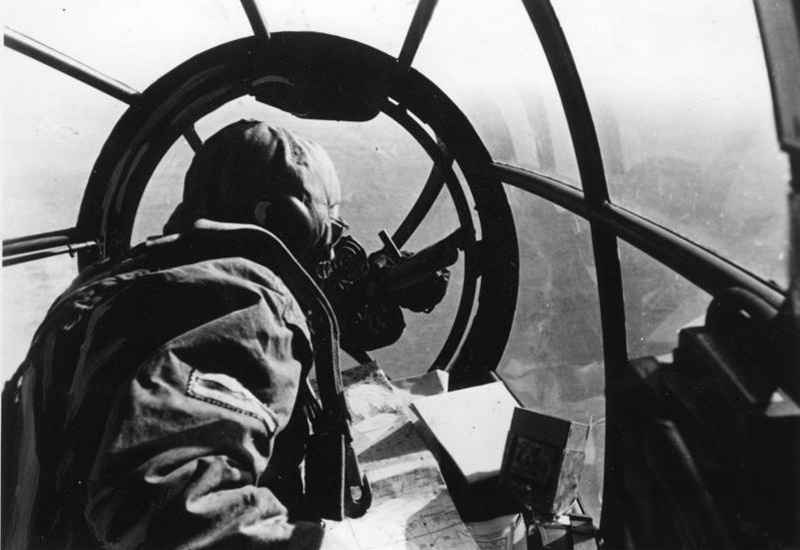
He-111 Luftwaffe bombardiers viewWhat is particularly interesting to me are the ways in which ‘seeing like a drone’ is and is not like seeing through a standard bombsight: the techno-optical regime through which conventional bombing has been conducted differs from the high-resolution full-motion video feeds that inform (and misinform) the networked bombing of late modern war.  Those feeds significantly compress the imaginative distance between the air and the ground, but they do so in a highly selective fashion.  Today’s remote operators, who may be physically thousands of miles away from the target, nevertheless claim to be just 18 inches from the conflict zone, the distance between the eye and the screen, and they (un)certainly see far more of what happens than the pilots of conventional strike aircraft.  But in Afghanistan, where remote operators are usually working with troops on the ground, they become immersed in the actions and interactions of their comrades – through visual feeds, radio and internet – whereas their capacity to interpret the actions of the local population is still strikingly limited.  So it is that local lifeworlds remain not only obdurately ‘other’ but become death-worlds.

Seen/seduced from above

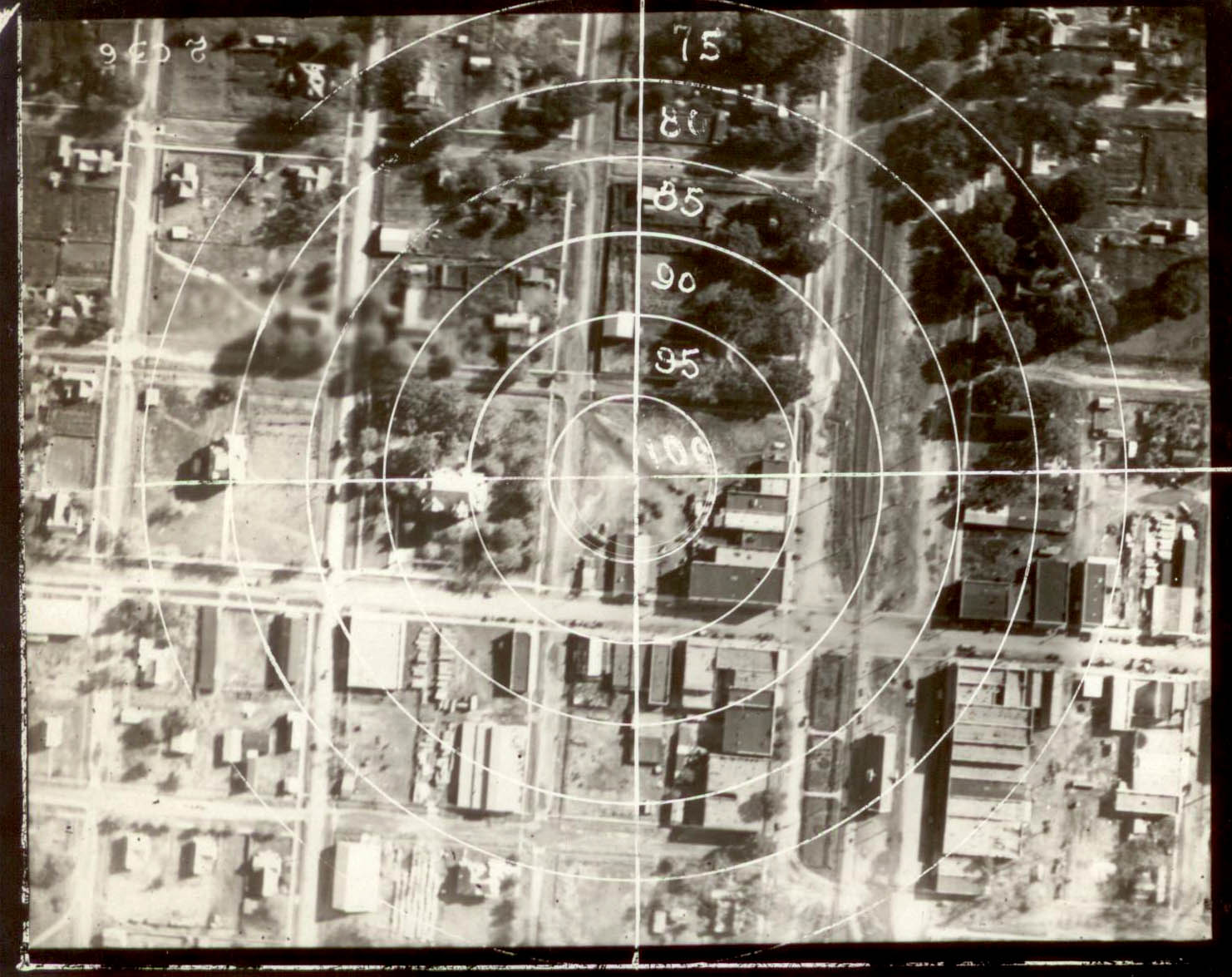
BombsightPart of my histories/geographies of bombing project involves addressing the work of visual artists who have attempted to render the violence of bombing not from below but from above. There are many powerful works that show the horror of bomb-sites and broken bodies, and I’m not uninterested in them; but to convey the violence of bombing in advance, so to speak, demands a much more exacting political aesthetic.

This vantage point matters because that is typically how those outside the conflict zone see air strikes conducted in their name.  During the Second World War the British press and newsreels showed the firebombing of German cities from above (in contrast, of course, to their coverage of the Blitz), and this facilitated the representation of area bombing as ‘precision bombing’ (in contrast, again, to their coverage of the Blitz); in the weeks following the Allied invasion of Europe American and British journalists swept across the continent with the advancing armies and were stunned by what they saw on the ground in Cologne, Hamburg and other cities.

In the weeks before the US-led invasion of Iraq, Baghdad was  repeatedly represented, in graphics, aerial and satellite photographs, and online interactives, as nothing more than a series of targets: then, as I showed in The colonial present, in the very week that Saddam’s statue was toppled, maps appeared showing Baghdad for the first time as a series of neighbourhoods inhabited not by tyrants, terrorists and torturers but by people like you and me.  If those images had been the dominant representation in the weeks and months before the attack, how many more would have been on streets around the world to try to prevent the invasion?

We can’t possibly know: but we surely do know that by the time we imaginatively crouch under the bombs and empathise with their victims it’s too late.

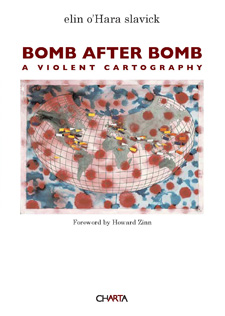
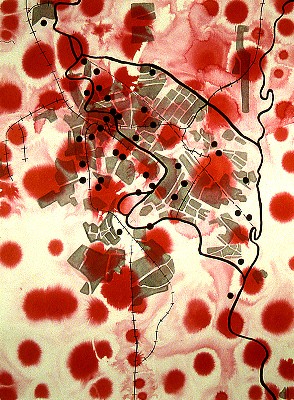
slavick, Bomb after BombThere is an appropriately long arc of work to consider, including artworks by Martin Dammann [the Überdeutschland series], Hanaa MalallahJoyce Kozloff [‘Targets’], Raquel MaulwurfGerhard Richter [Atlas], and Nurit Gur-Lavy.  I’ll post about some of the artworks later, and if anyone knows of others I ought to consider, I’d be very grateful to know about them.  But my very first engagement with these issues was through the work of ellen o’Hara slavick, now Distinguished Professor of Art at UNC Chapel Hill, and a project that was eventually called Bomb after Bomb: a violent cartography (she originally intended to call it ‘Everywhere the United States has bombed‘).  More on the series of 60-plus images and related projects herehere, here and here (the last is on Hiroshima). The book version (Charta, 2007) comes with additional essays by Cathy Lutz, Carol Mavor and the late Howard Zinn.

elin o'Hara slavick, Baghdad (1990)

In “Doors into nowhere” (DOWNLOADS tab) I glossed elin’s project like this:

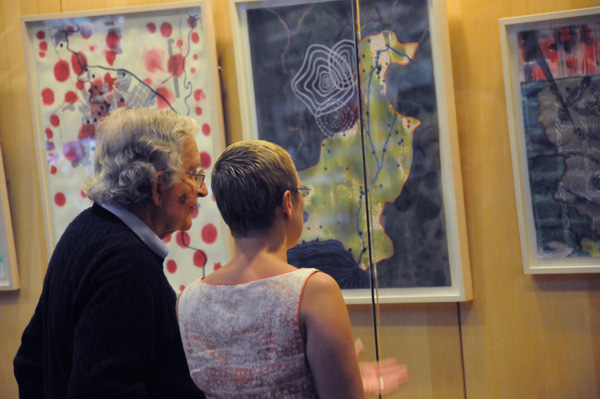
She adopts an aerial view – the position of the bombers – in order to stage and to subvert the power of aerial mastery.  The drawings are made beautiful ‘to seduce the viewer’, she says, to draw them in to the deadly embrace of the image only to have their pleasure disrupted when they take a closer look. ‘Like an Impressionist or Pointillist painting,’ slavick explains, ‘I wish for the viewer to be captured by the colors and lost in the patterns and then to have their optical pleasure interrupted by the very real dots or bombs that make up the painting.’ 

elin o'Hara slavick and Noam Chomsky

There’s much more to her work than this, as I try to show in my commentary, but what interests me here is that disturbing cascade that runs from beauty through seduction to pleasure.  There is a considerable literature on the dangers of aestheticizing violence, but plainly elin’s work is, as I said at the start, much more exacting than this.

Over at Books & Ideas Vanina Géré now has a short but pointed essay on ‘Artistic beauty as a political weapon’ that addresses these issues in helpful ways.  Political art, she writes, is always threatened by the prospect that

‘the political message will not get through because of the work’s retinal character — in other words, because the work is appreciated primarily for its formal qualities. If political art is often considered lacking in formal efficacy, formally remarkable works are often deemed lacking in political efficacy: too much plastic beauty risks making politics a topic like any other. In grappling with this demanding question, some artists have chosen to accentuate their works’ capacity for formal seduction by springing visual traps, placing viewers before realities that they did not expected to encounter in the rarefied air of a museum or a gallery.’

This is a particularly sharp dilemma for political representations of bombing, since the practice such artworks seek to apprehend and dislocate is itself ‘retinal’, formal: it is made possible by a series of performative abstractions that strip away content.  Cities as places where people live are reduced to co-ordinates, targets, pixels, flares of flight.  Géré doesn’t discuss slavick’s work, but her commentary on Brigitte Zieger‘s Eye Dust series speaks directly to the more general issues surrounding political art and military violence:

‘Using glitter eye shadow to draw clouds rising from explosions, the series creates a dialectical movement in which what we see (the makeup) hides what is (a face), yet nevertheless sheds light on a form of everyday violence. At the same time, these sumptuously executed images, which gently shine, entice the viewer to become increasingly fascinated with images of violence. Zieger’s work, by outrageously exploiting its own aesthetic quality in order to offer a critical perspective on representations and manifestations of military violence, demonstrates by this very token that behind every effort to impose beauty lurks a hidden form of violence. Beauty collaborates with politics, as the very concept of beauty is (in part) political. The challenge of such work lies in the precarious balance between the two.’

For Zieger’s own account of her work on war, violence and intimacy see this short video: