Ideology of the drone

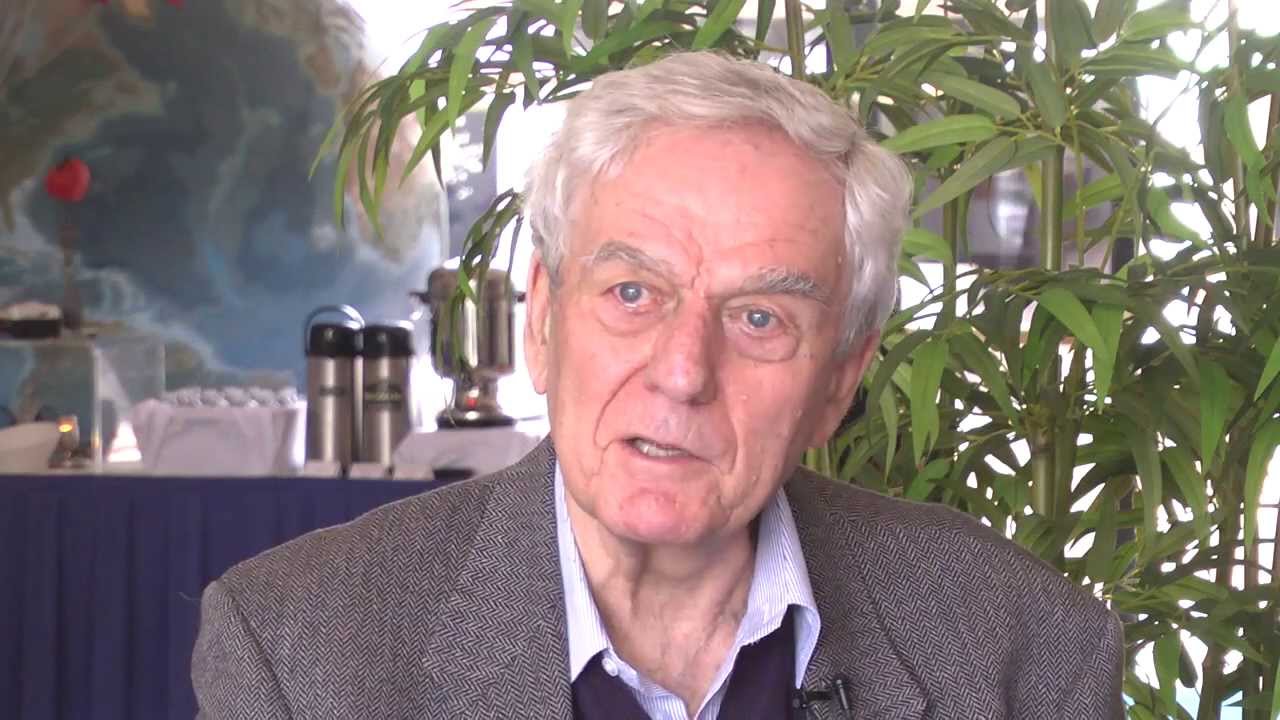
9782130583516Jean-Baptiste Jeangène Vilmer has published an extended critique of Grégoire Chamayou‘s Théorie du drone at La vie des idées under the title ‘Ideology of the drone’.  Some of the essays from that site are eventually translated into English and appear on the mirror site Books & Ideas, but I have no idea when or even whether this one will be, so I thought it would be helpful to provide a summary.

First, some background.  Vilmer has travelled via Montréal, Yale and War Studies at King’s College London to his present position at Sciences Po in Paris, where he teaches ethics and the law of war; he also teaches at the military academy at Saint-Cyr, and is a policy adviser on security issues to the Ministry of Foreign Affairs.  Vilmer is the author of more than a dozen books, of which La Guerre au nom de l’humanité : tuer ou laisser mourir (2012) is probably the best known.  If you’re not familiar with his work, here’s an English-language interview with him about La Guerre au nom de l’humanité via France 24 and the Daily Motion:

http://www.dailymotion.com/video/xpsqs8_jean-baptiste-jeangene-vilmer-author-of-war-in-the-name-of-humanity-kill-or-let-die_news

pe-3-2013I should note, too, that Vilmer’s critique trades in part on an essay published earlier this year, ‘Légalité et légitimité des drones armés’ [‘Legality and legitimacy of armed drones’], in Politique étrangère 3 (2013) 119-32, in which he rehearses a number of criticisms of Chamayou.  There Vilmer insists that the use of drones is perfectly compatible with the principles of international humanitarian law (this is about principle not practice, though, and he doesn’t address the implications of international human rights law which many critics and NGOs believe is the operative body of law for drone strikes outside war zones, like those carried out by the US in the Federally Administered Tribal Areas of Pakistan).

He also has no time for critics who turn the distance between the drone operator and the target into a moral absolute (though I don’t think Chamayou does that at all: instead, as I tried to show previously, he provides a nuanced discussion of the concept of distance).  Still, Vilmer is right to insist that the history of modern war is the history of killing the enemy from ever greater distances, and those who cling to the ‘nobility’ of hand-to-hand fighting are blind to an historical record reaching back over centuries.  If distance is a ‘moral buffer’, this is hardly unique to today’s remote operations, where in any case the greater physical distance is counterbalanced by a compression of what Vilmer calls ‘epistemic distance’ through the real-time full-motion video feeds transmitted from the drone.  The difference between the crew of a Lancaster bomber over Germany and the drone operator controlling an aircraft over Afghanistan is that the latter sees his victim.  And if conducting strikes by computer is ‘dehumanising’, the machetes used at close quarters in the Rwandan genocide were hardly less so.  What is more, Vilmer suggests, those video feeds are not only remote witnesses of the target; there is an important sense in which they also function as remote witnesses of the crew, providing a vital record for any subsequent military-judicial investigation and thus inviting and even institutionalising a regularised monitoring of ‘the conduct of conduct’.
la-theorie-du-droneNow to the extended critique of Chamayou.  Vilmer notes that Théorie du drone follows directly from Chamayou’s previous book, Chasses à l’homme [Manhunts], and in fact that’s his main problem with it: he says that Théorie reduces the function of drones to ‘hunting’, specifically to the US campaign of targeted killing, and identifies the one so closely with the other that the force of his analysis is blunted.  Vilmer thinks this is playing to the crowd: there is a considerable audience opposed to the use of drones who find Chamayou’s arguments convincing because they confirm their own views.

Indeed, Chamayou makes it plain that one of his express intentions is to provide the critics with useful tools to advance their political work.  Yet at the same time he presents Théorie as a philosophical investigation – and it is that, Vilmer concedes, erudite and at times brilliant – but in his view the objective is less to provide understanding than to provoke indignation.  In fact,  Chamayou has said in press interviews that what provoked him in the first place was the sight of philosophers collaborating with the military – and Vilmer freely admits to being one of them (though in France rather than the United States or Israel).

It’s important to examine the practice of targeted killing, Vilmer agrees, because it raises crucial ethical and legal questions.  But it’s also important not to confuse the ends with the means.  As I’ve noted in my own commentaries on Théorie, there are other ways of carrying out targeted killing (as Russian dissidents on the streets of London or Iranian scientists on the streets of Tehran have discovered to their cost) and there are many other military uses for drones.  Targeted killing gets the most publicity because it’s so controversial, Vilmer argues, but it’s far less important than the provision of intelligence, surveillance and reconnaissance (though ISR is central to lethal strikes carried out by conventional aircraft and ground troops too).

Vilmer is breezily confident about the use of drones in war-zones, where he says they are no more problematic than any other observation platform or weapons system.  Contrary to Chamayou’s assertion that drones only save ‘our’ lives, Vilmer insists that they have saved the lives of others – ‘their’ lives – in Afghanistan, Iraq, Libya and Mali.  Yet Chamayou isn’t interested in these cases; instead his ‘theory of the drone’ reduces its role to CIA-directed targeted killings in Pakistan, Yemen and Somalia, which Vilmer complains is like calling a book on Russian cyber-attacks Theory of the computer.
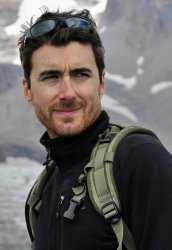
aJeangène VilmerThat said, he thinks Chamayou’s critique of signature strikes is ‘excellent’, and he deeply regrets the migration of the American campaign away from ‘personality strikes’ against High Value Targets. The widening of the target lists and the ‘industrialisation’ of targeted killing deserves condemnation – and Vilmer notes that the Obama administration, responsible for ramping up the attacks, has since cut them back in response to criticisms – but in his view this only shows that Predators and Reapers ‘have been used in an imprecise way’ not that they are intrinsically less accurate than other systems.

When Chamayou seeks to show, to the contrary, that drones are ‘inhumane’ he advances two arguments that Vilmer flatly rejects.  (I have to say that I think Chamayou’s arguments are considerably more subtle than Vilmer allows: see here and here).  The first – the claim that ‘unmanned’ aircraft are by definition ‘inhuman’ – he dismisses as sophistry, not because each operation involves almost 200 people but because the bombers that destroyed Hamburg and levelled Dresden were ‘manned’: he says that Chamayou would hardly describe the results of their missions as ‘humane’. The second – that machines dedicated to killing cannot be ‘humane’ – is an absolutism that doesn’t engage with those (like Vilmer) who argue that some weapons are more humane than others. That, after all, is precisely why some weapons are banned by international law.  And unlike Chamayou, Vilmer insists that drones allow for a greater degree of compliance with principles of distinction because they are more than weapons systems: they also provide enhanced ISR.

Vilmer agrees that it is wrong to compare drone strikes with bombing missions in the Second World War, Korea or Vietnam, but he disagrees with the contemporary alternative canvassed by Chamayou: ground troops armed with grenades.  In the case of Pakistan, Yemen or Somalia this isn’t a realistic option, he argues, and in the absence of drones the only alternative would be a Kosovo-like bombing campaign or a rain of Tomahawk missiles – neither of which would be as accurate as a Hellfire missile.  But this is to substitute one absolutism for another.  Hellfire missiles are not confined to Predators and Reapers but are also carried by conventional strike aircraft and attack helicopters; and in any case cruise missiles have been launched from US Naval vessels to attack targets in Yemen, and Special Forces have been deployed on the ground in all three killing fields.  Perhaps more to the point, however, Vilmer knows very well that conventional operations involving ground troops do not typically minimise civilian casualties.  He points to the invasions of Afghanistan and Iraq as reasons for Obama’s greater reliance on remote operations and a ‘lighter footprint’, and he also emphasises (as Chamayou does not) the casualties caused by Pakistan’s own military operations in the Federally Administered Tribal Areas (see my discussions here and here).

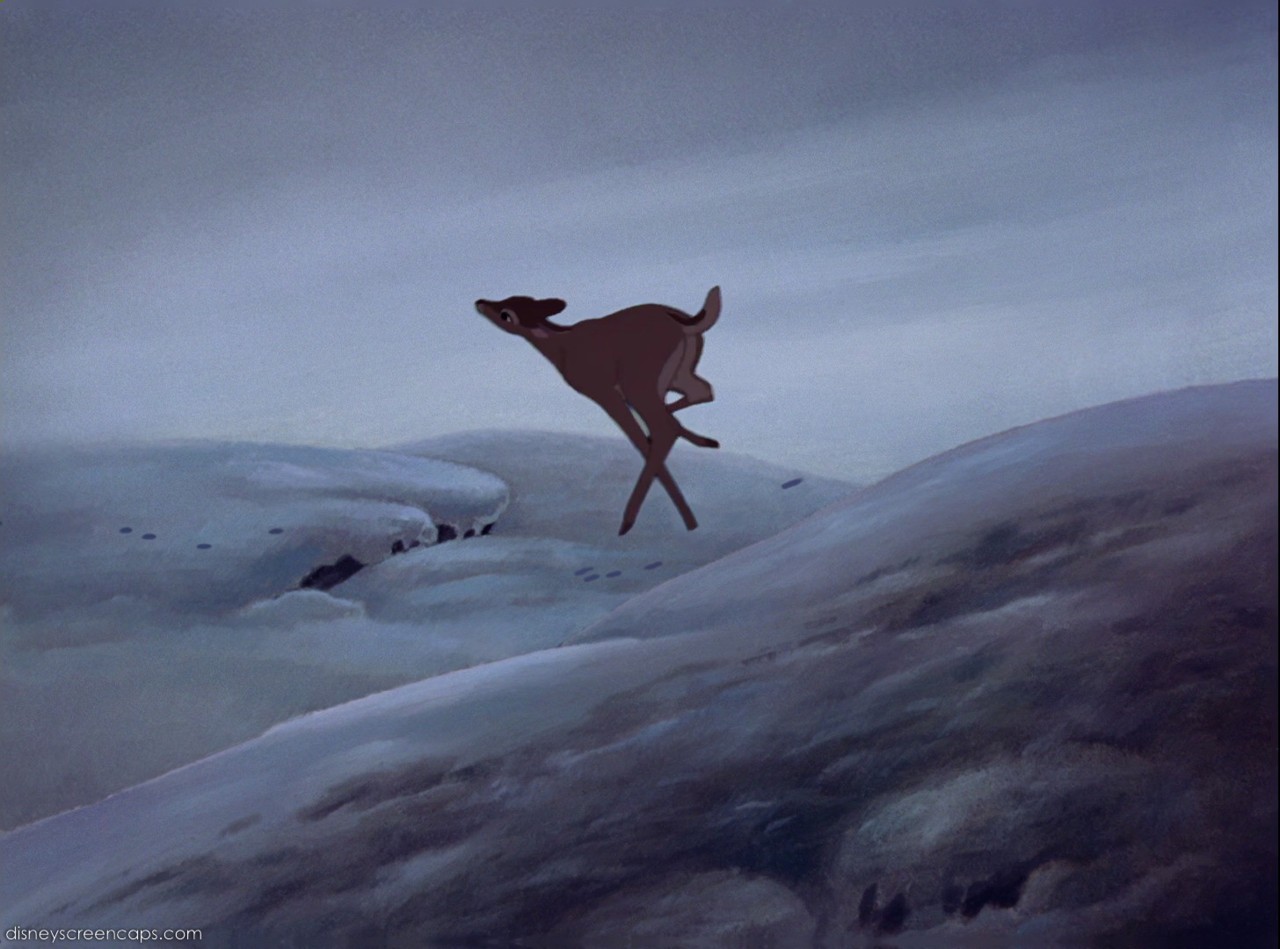
This last brings Vilmer to a key objection, which is that Chamayou provides no detailed discussion of the reasons behind the US drone strikes.  It’s not enough to attribute them to American imperialism tout court, he insists, because this is a reductive argument that turns terrorists and insurgents into freedom fighters and fails to acknowledge let alone analyse the real dangers posed, both locally and trans-nationally, by al-Qaeda and its associates.  Théorie doesn’t simply ‘disappear’ the terrorists, Vilmer writes, it turns them into victims: like so many rabbits put back in the magician’s hat.  The imagery is almost Chamayou’s – he claims that ‘one no longer fights the enemy, one eliminates them like rabbits’ – but Vilmer prefers another one.  He says that Chamayou’s talk of the predator (or Predator) advancing, the prey fleeing, makes it seem as though the drones are targeting Bambi’s mother…
Bambi's mother

It’s another clever phrase (and Vilmer excels in them), but I think Chamayou is much more sensitive to civilian casualties – and to the plight of all those innocents living under the perpetual threat of attack – than Vilmer.  There are snares and dangers out there, to be sure; but there are also an awful lot of Bambis and their mothers.

Finally, Vilmer turns to France’s decision to buy Reapers, which Chamayou contends has caused no outcry in France only because the public is badly informed about drones. On the contrary, Vilmer replies: it’s because they can tell the difference between buying the technology and using it like the Americans. Vilmer has much more to say about this in a recent open access interview in Politique étrangère, where he explains that the Air Force had deployed four unarmed drones, a version of Israel’s Heron called the Harfang, in Afghanistan, Libya and Mali, but that from the end of this year France will start to take delivery of 12 MQ-9 Reapers: these too will be unarmed.  He also speculates about the future development of drones.  Among other things, there will be a lot more of them (so he does worry about their proliferation); he also thinks they will be faster and stealthier, more lethal and more autonomous, and that they will fly in swarms.  He also believes that aircraft of the future will increasingly be produced in two versions: either conventional operations with pilots onboard or remote operations with pilots in a Ground Control Station.

Please bear in mind that this is only a summary of Vilmer’s critique, which is vulnerable to its own simplifications and caricatures, though I obviously haven’t been able to keep entirely silent.  But I’ll reserve a fuller engagement until I’ve finished my own extended commentary on Théorie du drone.
Theory of the drone 12: ‘Killing well’?

This is the 12th in a series of extended posts on Grégoire Chamayou‘s Théorie du drone and covers the final chapter in Part III: Necro-ethics, called ‘Précisions’; in French the singular means accuracy, as you might expect, but the plural means ‘details’ – which is, of course, where the devil is to be found…

One of the most common claims advanced by those who defend the use of armed drones is that they reduce ‘collateral damage’ because they are so precise.  Following directly from his previous critique of Bradley Jay Strawser, Chamayou cites him again here: ‘Drones, for all their current and potential misuse, have the potential for tremendous moral improvement over the aerial bombardments of earlier eras.’  But he dismisses this as a misleading comparison: if Dresden or Hiroshima are taken as the yardstick against which accuracy is to be measured – or, for that matter, as the standard against which military ethics are to be judged – then virtually any subsequent military operation would pass both tests with flying colours.

The comparison confuses form with function.  Compared to Lancaster bombers and Flying Fortresses (even with their famous Norden bombsights: for Malcolm Gladwell on the ‘moral importance’ of the bombsight to Norden, a committed Christian, see here and here; for more on the bombsight, see here), the Predator and the Reaper are evidently more accurate.  But Chamayou insists that the real comparison ought to be with other tactical means currently available to achieve the same objective.

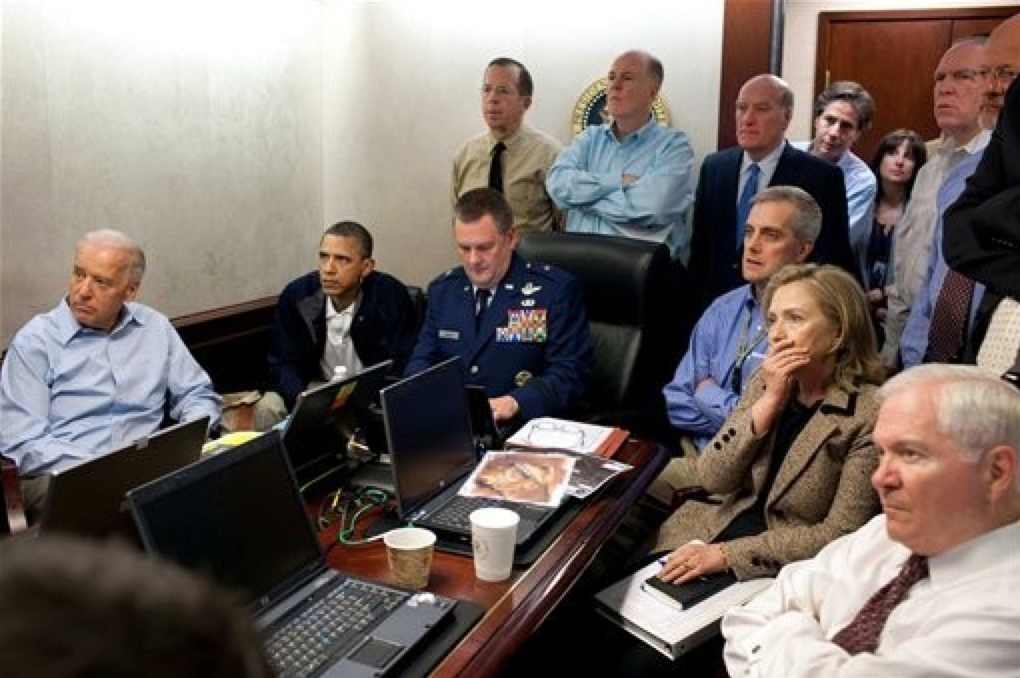
Situation Room

In the kill/capture raid against Osama Bin Laden on 1 May 2011 (assuming ‘capture’ was ever on the agenda), he argues that the choice was between drones and Special Forces not between drones and re-staging Dresden in Abbotabad.  This doesn’t quite work, since the raid was carried out by US Navy Seals who swept in from Bagram via Jalalabad by helicopter, but the mission also depended on real-time imagery from an RQ-170 stealth drone (‘the Beast of Kandahar’).  This was the source of the live video feed watched by Obama and members of his administration in the famous ‘Situation Room’ photograph [on which, see Keith Feldman on ‘Empire’s Verticality’ in Comparative American Studies 9 (4) (2011) 325-41].

The RQ-170 is an unarmed platform, but its role should remind us that drones are part of networked warfare – even when strikes are carried out by other means, the enhanced intelligence, surveillance and reconnaissance capabilities provided by the long dwell-times of these remote platforms mean that they are instrumental in the activation of the kill-chain.  This holds for military operations far beyond targeted killing: in Afghanistan between 2009 and 2011 drones were directly responsible for only 5-6 per cent of weapons released by the US Air Force, but they no doubt played a vital role in the release of many of the others.

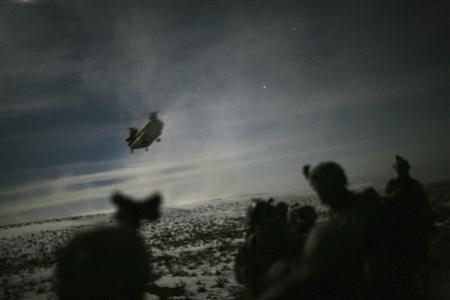
Night raidStill, Chamayou’s basic point is a sharp one – and I rehearsed similar arguments in my discussion of The politics of drone wars last year – but readers of Jeremy Scahill‘s Dirty Wars may still reasonably object that the civilian casualties resulting from JSOC’s infamous night raids in Afghanistan cast doubt on the precision and accuracy of ground forces too.  Gareth Porter has estimated that more than 1,500 civilians were killed in night raids in just ten months in 2010-11, making them ‘by far the largest cause of civilian casualties in the war in Afghanistan.’  Indeed, Afghan protests have frequently centred on the civilian toll exacted by drones and night raids.

Even if the appropriate comparison is between different modalities of military violence in the present, Chamayou argues that the discussion is bedevilled by another series of confusions about ‘accuracy’ or ‘precision’.   In fact, though he doesn’t say so, the the two terms aren’t interchangeable. Strictly speaking,  accuracy refers to the deviation from the aiming point, precision to the dispersion of the strike:

Accuracy and precision

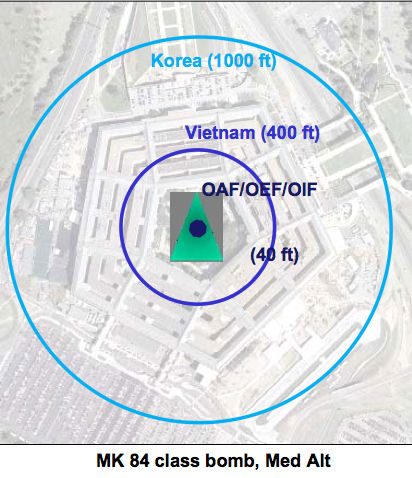
CEP in the diagram above refers to the Circular Error Probable, once described by the Pentagon as ‘an indicator of the delivery accuracy of a weapon system’, which is a circle of radius n described around the aiming point.  Assuming a bivariate normal distribution, then – all other things being equal (which they rarely are) – 50% of the time a bomb, missile or round will land within the circle: which of course means that the other half of the time it won’t, even under ideal experimental conditions.  As this is a normal distribution, then 93 per cent should land within 2n and more than 99 per cent within 3n.

Chamayou doesn’t refer to the CEP directly, only briefly to the ‘accuracy of fire’,  but – to revert to the comparison he refuses – the CEP of bombing from the air has contracted dramatically since the Second World War when it was around 3,000 feet (though this improved over time): so much so that David Deptula, when he was USAF Deputy Chief of Staff for ISR, used to talk of crossing a ‘cultural divide of precision and information’.  The image below, taken from one of his presentations, shows the contraction (notice that the aim point is the Pentagon….).

Target mensuration (USAF)

Interestingly, the most recent Joint Publication (3-60) from the Joint Chiefs of Staff on Targeting (January 2013) has explicitly removed the concept from its Terms and Definitions, citing as its authority the Department of Defense’s Dictionary of Military and Associated Terms (it was still there on 31 January 2011, but no longer).  I haven’t been able to discover the reasons for the change, though there is longstanding scepticism about the validity of the measure: see, for a specific example, Donald MacKenzie‘s classic discussion in Inventing accuracy: a historical sociology of nuclear missile guidance (1993, pp. 352-7).  I’ve seen several comments to the effect that the measure isn’t useful for ‘smart bombs’ because they don’t display the same spread as ‘dumb bombs’.  (There’s a quick primer on the emergence of smart bombs during the Vietnam War here, and an account of the evolution of ‘precision strike’ since then here; for more detail, try David Koplow‘s Death by moderation: the US military’s quest for useable weapons (2009)).

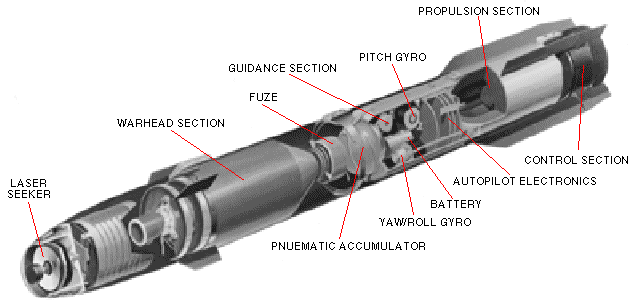
The MQ-1 Predator carries two AGM-114 Hellfire missiles [shown below, top; for acronyphiles, AGM designates an Air-to-Ground Missile, while the ‘Hellfire’ was originally developed as a ‘Helicopter-Launched Fire-and-Forget Missile’; its main platform is still an attack helicopter], while the MQ-9 Reaper can carry four AGM-114 Hellfire Missiles or replace two of them with GBU-12 Paveway II bombs [GBU = Guided Bomb Unit; shown below, bottom].

hellfire

GBU-12_xxl

Both weapons systems are laser-guided; the sensor operator, sitting beside the pilot in the Ground Control Station, uses a laser targeting marker (LTM) to ‘paint’ the target – this can also be done by ground troops in conventional combat zones – but its accuracy can be compromised by cloud, smoke, fog or dust.  (This is why the Air Force also uses GPS-guided weapons; they are less accurate but unaffected by these environmental conditions).  Once the necessary clearances have been obtained from mission commanders and military lawyers, the pilot fires the missile and the sensor operator guides it on to its target.

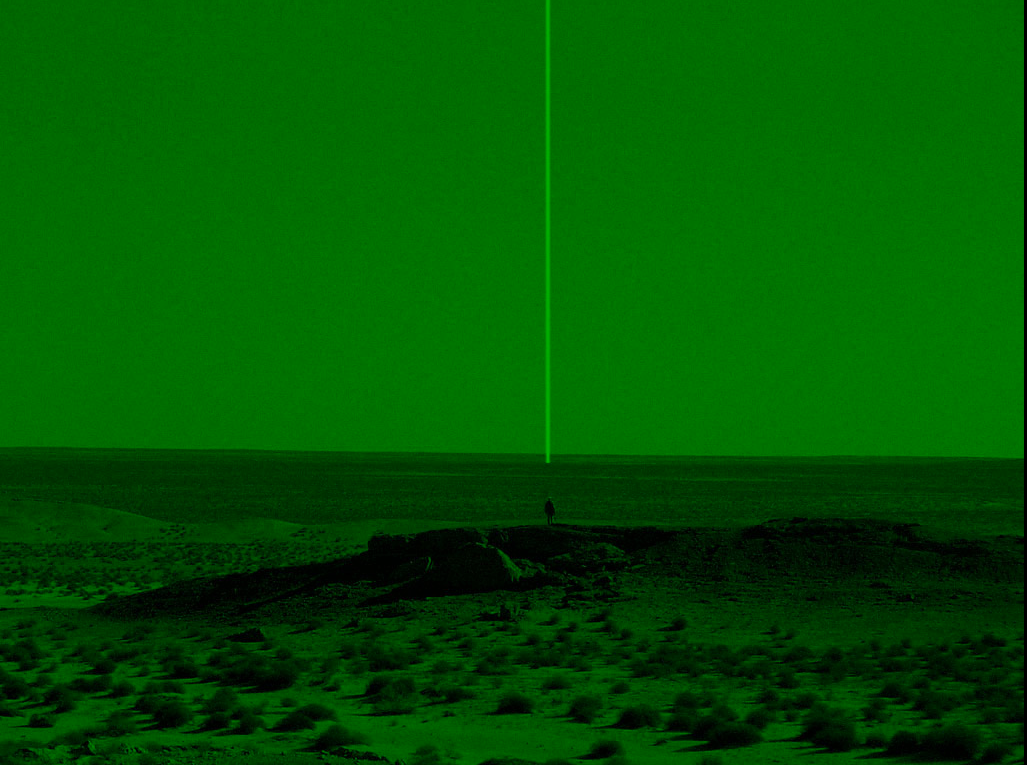
Omer Fast‘s interview with a sensor operator (‘Brandon’ –  whether this is a pseudonym or really Brandon Bryant is hard to know) for 5,000 Feet is the Best provides a series of insights into the operation in Afghanistan and Iraq.  You can’t see the beam with the naked eye, but American ground troops can see it with their infrared goggles.  According to ‘Brandon’, they call it the ‘Light of God’ (really); the image below is James Bridle‘s replication of the effect based on laser targeting night systems and a CC-licensed photograph of the Iraqi desert by Rob Bakker.

JAMES BRIDLE Light of God

‘Brandon’:

‘Usually the laser track is about half the size of this [hotel] room.  Poof!  By the time it hits the ground… a lot of times it turns into a square for some reason…  It could be anywhere from ten feet by ten feet to twenty feet by twenty feet… It starts off small and you watch it kind of open up’

This is not exactly putting ‘warheads on foreheads‘, but ‘Brandon’ explains that the crew is also required to identify a secondary ‘abort’ target.

‘… some of the contingencies we have to worry about are: if we’re firing at a building and somebody crosses – maybe – who knows, a group of children starts crossing in front of the building, we need a second site once that missile is already off the rails.  To go ahead and drop that missile so that we don’t harm the children  So usually we’ll choose an alternate site a couple hundred feet to a couple of hundred yards away.  It might be an empty field.  And we use that as the backup…

So let’s  say we get the missile off the rail and a group of kids comes into play: I call “abort” and I’ll start moving that laser over to an empty site so that we can detonate there and not cause any additional loss of life.’

Predator and Brandon Bryant

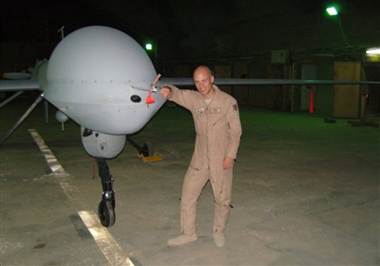
Sounds good, but the real Brandon Bryant (above) has a different story to tell; it turns out that there is an eight-second window in which the missile can be diverted:

With seven seconds left to go, there was no one to be seen on the ground. Bryant could still have diverted the missile at that point. Then it was down to three seconds. Bryant felt as if he had to count each individual pixel on the monitor. Suddenly a child walked around the corner, he says.

Second zero was the moment in which Bryant’s digital world collided with the real one in a village between Baghlan and Mazar-e-Sharif.

Bryant saw a flash on the screen: the explosion. Parts of the building collapsed. The child had disappeared. Bryant had a sick feeling in his stomach.

“Did we just kill a kid?” he asked the man sitting next to him.

“Yeah, I guess that was a kid,” the pilot replied.

“Was that a kid?” they wrote into a chat window on the monitor.

Then, someone they didn’t know answered, someone sitting in a military command center somewhere in the world who had observed their attack. “No. That was a dog,” the person wrote.

They reviewed the scene on video. A dog on two legs?

Even then, think about that blossoming square, twenty feet by twenty feet.  Then factor in the Circular Error Probable of a Hellfire missile, which is usually calculated at between 9 and 24 feet. The ‘pinpoint’ accuracy of the missile is starting to blur and the ‘surgical’ strike beginning to blunt.  In fact, the development of the Hellfire missile suggests another narrative.  In 1991 the Pentagon was already advertising the Hellfire as capable of ‘pinpoint’ accuracy, and since then it has been upgraded more than half a dozen times, each version promising greater accuracy: as Matthew Nasuti asks in his catalogue of Hellfire errors, what can be more accurate than ‘pinpoint accurate’?

In any case, narrowing the discussion to the CEP misses two things.  First, as former USAAF officer Peter Goodrich points out in his discussion of ‘The surgical precision myth‘, this ‘totally disregards what happens after the bomb explodes’.  What Goodrich has in mind is the blast and fragmentation radius, which Chamayou calls ‘the kill radius’.  Fast’s ‘Brandon’ insists

‘All of us are taught about how far those Hellfire missiles go, how far their frag goes.  And “danger close” as we call it when you have troops that are very close or civilians that are present.  They’re just factors that  you have to work in to bring down the percentages of the harm that could be done.’

In the targeting cycle the US Air Force enters those ‘factors’ into both collateral damage estimation and ‘weaponeering’, modifying the missile or bomb to restrict its blast and fragmentation radius. Chamayou reports that the Hellfire missile has a ‘kill radius’ of 50 feet (15 metres) and a ‘wounding radius’ of 65 feet (20 metres); the GBU-12 Paveway II has a ‘casualty radius’ of between 200 and 300 feet (within which 50 per cent of people will be killed).   These calculations aren’t exactly equivalent – and it’s difficult to obtain precise and comparable figures – but nothing about this is as precise as the rhetoric  implies.  As Chamayou asks:

‘In what fictional world can killing an individual with an anti-tank missile [the Hellfire] that kills every living thing within a radius of 15 metres and wounds everyone else within a radius of 20 metres be seen as “more precise”?’

All those who are killed or wounded within the casualty radius are presumably guilty by proximity.

This is Chamayou’s second rider, which relates to what happens before the bomb or missile is released: to the production – the US military sometimes calls it the ‘prosecution’ – of the target.  In this sense, the technical considerations I’ve just described are beside the point (sic).  All of the calibrations I’ve set out in such detail apply to missiles and bombs irrespective of the platform used to deliver them; what is supposed to distinguish a Predator or a Reaper from a conventional strike aircraft or attack helicopter is that it combines ‘hunter’ and ‘killer’ in a single platform and, specifically, that its real-time full-motion video feeds enable crews (and others in the loop) to see what they are doing in unprecedented detail.

Signing a Hellfire missile attached to a MQ1-C (Gray Eagle) UAV at BagramDoes this political technology of vision make it possible, as advocates claim, to distinguish between combatants and civilians more effectively than ever before?  Here Chamayou rehearses common criticisms: that in standard US military practice ‘combatant’ morphs into ‘militant’, even ‘presumed militant’ and, at the hideous limit, into ‘military-aged male’ – counting ‘all military-age males in a strike zone as combatants … unless there is explicit intelligence posthumously proving them innocent’ – and that this process of (so to speak, performative) militantisation as Chamayou calls it is underwritten by a techno-judicial probabilisation (again his term) whose ‘epistemology of suspicion’ allows signature strikes that target un-named and unknown people on the basis of their ‘pattern of life‘.

But both these procedures and, indeed, the criticisms of them, obscure what is for Chamayou, the fundamental paradox, what he calls the ‘profound contradiction’.  International law defines a combatant and thus a legitimate target in terms of direct participation in hostilities and an imminent threat.  It’s more complicated than that, as I’ll show later, but this is enough for Chamayou to fire off two key questions: How can anyone be participating in hostilities if there is no longer any combat? How can there be any imminent threat if there are no troops on the ground?  The drone, praised for its forensic ability to distinguish between combatant and non-combatant, in fact abolishes the condition necessary for such a distinction: combat itself (p. 203; also p. 208).

It’s an artful claim, but it oversimplifies the situation.  Chamayou has (once again) confined the discussion to targeted killing but, as I’ve repeatedly emphasised, Predators and Reapers have also been used for other purposes in Iraq and Afghanistan, including the provision of ‘armed overwatch’ and close air support to ground troops.  Outside these war-zones – in the Federally Administered Tribal Areas of Pakistan, Yemen, Somalia and elsewhere – the critique is a powerful one (which is not to say that Obama’s lawyers have not claimed a legal warrant for their supposedly covert drone strikes in these areas: more on this later too).  Still, Chamayou’s argument loops back to earlier discussions about the intrinsic non-reciprocity of drone warfare.

And here Chamayou closes with a powerful argument.  If ethics is classically about how to live well and die well, he suggests that necro-ethics is a doctrine of ‘killing well’.  He notes that critics of the covert drone wars demand, time and time again, transparency.  They want to know the legal armature and adjudicative apparatus for the strikes, the rules and procedures that are followed, and the lists of casualties.  But he argues that their demands turn the issue into an arid juridico-administrative formalism endorsed by bureaucratic Reason.  In the kill zones, he says ruefully, there are no legal memoranda, no columns of numbers or ballistics reports (p. 207): these are the very formularies of necro-ethics.  And, as I’ve noted, there are no air-raid warnings, no anti-aircraft defences and no air-raid shelters either.

It’s in that spirit that Chamayou closes the chapter with an extended quotation from Madiha Tahir’s Louder than bombs‘:

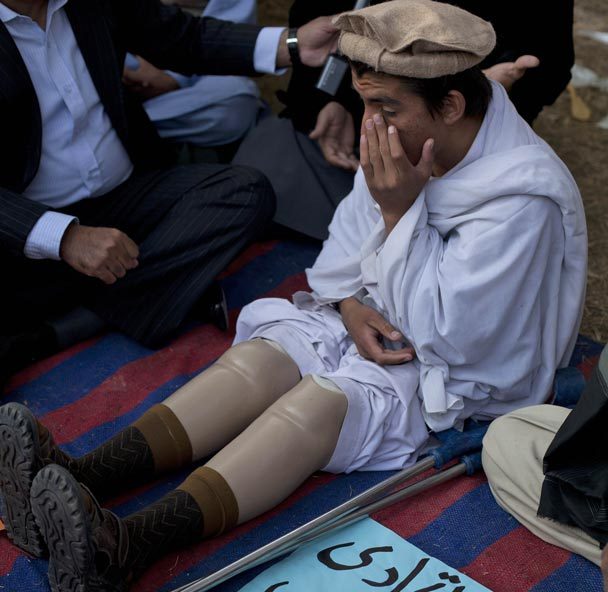
Saudallah WazirWhat is the dream?

I dream that my legs have been cut off, that my eye is missing, that I can’t do anything … Sometimes, I dream that the drone is going to attack, and I’m scared. I’m really scared.

After the interview is over, Sadaullah Wazir pulls the pant legs over the stubs of his knees till they conceal the bone-colored prostheses.

The articles published in the days following the attack on September 7, 2009, do not mention, this poker-faced, slim teenage boy who was, at the time of those stories, lying in a sparse hospital in North Waziristan, his legs smashed to a pulp by falling debris, an eye torn out by shrapnel. nor is there a single word about the three other members of his family killed: his wheelchair-bound uncle, Mautullah Jan and his cousins Sabr-ud-Din Jan and Kadaanullah Jan.  All of them were scripted out of their own story till they tumbled off the edge of the page.

Did you hear it coming?

No.

What happened?

I fainted. I was knocked out.

As Sadaullah, unconscious, was shifted to a more serviceable hospital in Peshawar where his shattered legs would be amputated, the media announced that, in all likelihood, a senior al-Qaeda commander, Ilyas Kashmiri, had been killed in the attack. The claim would turn out to be spurious, the first of three times when Kashmiri would be reported killed.

Sadaullah and his relatives, meanwhile, were buried under a debris of words: “militant,” “lawless,” “counterterrorism,” “compound,” (a frigid term for a home). Move along, the American media told its audience, nothing to see here.

Some 15 days later, after the world had forgotten, Sadaullah awoke to a nightmare.

Do you recall the first time you realized your legs were not there?

I was in bed, and I was wrapped in bandages. I tried to move them, but I couldn’t, so I asked, “Did you cut off my legs?” They said no, but I kind of knew.

When you ask Sadaullah or Karim or S. Hussein and others like them what they want, they do not say “transparency and accountability.” They say they want the killing to stop. They want to stop dying. They want to stop going to funerals — and being bombed even as they mourn. Transparency and accountability, for them, are abstract problems that have little to do with the concrete fact of regular, systematic death.’

And Madiha adds this: ‘The technologies to kill them move faster than the bureaucracies that would keep more of them alive: a Hellfire missile moves at a thousand miles per hour; transparency and accountability do not.’

Indeed they don’t; Sadaullah died last year, Mirza Shahzad Akbar reports, ‘without receiving justice or even an apology.’  Not even killing well, then.

Theory of the drone 11: Necro-ethics

This is the 11th in a series of extended posts on Grégoire Chamayou‘s Théorie du drone and covers the first two of three chapters that constitute Part III: Necro-ethics.

The title recalls Achille Mbembe‘s seminal essay on ‘Necropolitics’ [Public culture 15 (1) (2003) 11-40], where he cuts the umbilical cord between sovereignty and the state (and supranational institutions) and, inspired by Michel Foucault and Giorgio Agamben, argues that ‘the ultimate expression of sovereignty resides, to a large degree, in the power and the capacity to dictate who may live and who must die.’  Necropolitics is thus about ‘contemporary forms of subjugation of life to the power of death’ – and at the limit the creation of what Mbembe calls ‘death-worlds’.

AlexisLeran-AchilleMbembe5Mins658

Mbembe develops his thesis in part – and for good reason – in relation to the Israeli occupation of Palestine.  I imagine readers will know that the Israeli Defence Force (IDF) advertises itself, incredibly, as ‘the most moral army in the world’, and although Chamayou’s ultimate objectives are different he too begins with a critical interrogation of one version of that claim (you can find much more about it in Muhammad Ali Khalidi‘s fine essay on Gaza in the Journal of Palestine Studies 39 (3) (2010) available on open access here).

1: Combatant immunity

Chamayou argues that what distinguishes contemporary forms of imperial military violence is not so much the asymmetry of the conflict or the differential distribution of vulnerability which results as the norms that are invoked to regulate its conduct.  Towards the end of the twentieth century, he suggests, the ‘quasi-invulnerability’ of the dominant force was transformed into an over-arching politico-ethical framework.  This first came into view during NATO’s intervention in Kosovo in 1999 when force protection was established as the key consideration: not only was the NATO campaign largely confined to bombing from the air (so that, apart from Special Forces, there were few boots – and, more to the point, NATO bodies – on the ground) – but pilots were ordered not to fly below 15,000 feet.  This kept them safely beyond the range of anti-aircraft fire, even as it reduced the accuracy of air strikes and endangered the lives of those the intervention was supposed to save.

nato-bombs-convoy

This seems to violate conventional notions of a just or ethical war, effectively turning ‘humanitarian intervention’ on its head, but Chamayou claims that in fact it heralded the explicit formulation of a principle of ‘imperial combatant immunity’.  Enter the IDF, stage right.  This new doctrine was set out in detail in an essay by Asa Kasher  and Amos Yadlin, writing from the ‘Department of Professional Ethics and Philosophy of Practice’ at Tel Aviv University and the IDF College of National Defense, and published as ‘Military ethics of fighting terror: an Israeli perspective’, Journal of military ethics 4 (1) (2005) 3-32.  As their affiliation shows, this was not an abstract, academic discussion; Chamayou notes, in an artful twist on Yves Lacoste (La géographie, ça sert, d’abord, à faire la guerre), ‘What use is moral philosophy?  Among other things, to wage war…’ (‘A quoi sert la philosophie morale?  Entre autres choses, à faire la guerre’) (p. 184).

In that essay Kasher and Yadlin proposed a comprehensive reformulation of military ethics – and, by extension, international law – but Chamayou fastens on their reworking (or demolition) of  the established principle of distinction.  He cites their central thesis, thus:

One major issue is the priority given to the duty to minimize casualties among the combatants of the state when they are engaged in combat acts against terror.  According to the ordinary conception underlying the distinction between combatants and noncombatants, the former have a lighter package of state duties than the latter. Consequently, the duty to minimize casualties among combatants during combat is last on the list of priorities or next to last, if terrorists are excluded from the category of noncombatants. We reject such conceptions, because we consider them to be immoral. A combatant is a citizen in uniform. In Israel, quite often he is a conscript or on reserve duty. His blood is as red and thick as that of citizens who are not in uniform. His life is as precious as the life of anyone else. A democratic state may send him to a battlefront only because it has a duty to defend its citizens and it cannot do this without some of them defending the others, within the framework of a just system of conscription and reserve duty. The state ought to have a compelling reason for jeopardizing a citizen’s life, whether or not he or she is in uniform. The fact that persons involved in terror are depicted as noncombatants is not a reason for jeopardizing the combatant’s life in their pursuit. He has to fight against terrorists because they are involved in terror. They shoulder the responsibility for their encounter with the combatant and should therefore bear the consequences. 

(It turns out that there are limits to the privileges accorded to citizen-soldiers: more recently Ha’aretz reports that Kasher suggested in early 2012 that medical experiments can be carried out on them, even if they are not fully informed of the details, in order to ‘build the military force’, though Kasher has contested these accusations and insisted that his opinion stipulated a series of ‘conditions’ that had to be met).

I didn’t mention Lacoste casually, because part of Kasher and Yadlin’s argument turns on territory: on the duties imposed by belligerent occupation (‘when a person resides in a territory that is under effective control of the state’).  This is a Trojan Horse, needless to say, because they clearly have Gaza in their sights, and their proposal seeks to further the egregious fiction that Israel’s ‘withdrawal’ in 2005 meant that the Palestinians effectively imprisoned in Gaza are no longer subject to Israeli occupation (for more on ‘Gaza under siege’, see here).  Chamayou doesn’t dwell on this, but the emphasis on ‘effective control’ could – if you accept Kasher and Yadlin’s grotesque argument (which they insist is a general one) – be brought to bear on the US campaign of targeted killing in the Federally Administered Tribal Areas of Pakistan, in Yemen and in Somalia and be made to intersect with the usual rhetoric about ‘ungoverned spaces’ and ‘lawless zones’.

Kasher and Yadlin summarize their proposed hierarchy of privileges by setting out a tariff according to which militaries would administer injury in priority sequence:

(d.1) Minimum injury to the lives of citizens of the state who are not combatants during combat;

(d.2) Minimum injury to the lives of other persons (outside the state) who are not involved in terror, when they are under the effective control of the state;

(d.3) Minimum injury to the lives of the combatants of the state in the course of their combat operations;

(d.4) Minimum injury to the lives of other persons (outside the state) who are not involved in terror, when they are not under the effective control of the state;

(d.5) Minimum injury to the lives of other persons (outside the state) who are indirectly involved in terror acts or activities;

(d.6) Injury as required to the liberties or lives of other persons (outside the state) who are directly involved in terror acts or activities.

Chamayou concludes that the core principle they seek to advance involves replacing the distinction between civilians and combatants by a hierarchical distinction between citizens and aliens: an unbridled nationalism masquerading as ethics (p. 187).  In other words, within the frontier of state control  – Chamayou says ‘ state sovereignty’, but that’s not quite what Kasher and Yadlin say – some lives are more precious than others,  while beyond that line inferior lives (including those of what they call ‘bystanders’) are to be exposed to violence and ultimately sacrificed: as they put it, ‘the state should give priority to saving the life of a single citizen, even if the collateral damage caused in the course of protecting that citizen is much higher…’

nyrb051409Their proposals had a slow fuse but they eventually set off a firestorm of protest.  Responding to a shorter version of the main essay [‘Assassination and preventive killing’, SAIS Review of International Affairs 25 (1) (2005)  41-57] and writing in the New York Review of Books (14 May 2009), Avishai Margalit and Michael Walzer were unequivocally appalled:

‘Their claim, crudely put, is that in such a war the safety of “our” soldiers takes precedence over the safety of “their” civilians.  Our main contention is that this claim is wrong and dangerous. It erodes the distinction between combatants and noncombatants, which is critical to the theory of justice in war (jus in bello).’

They continued:

‘The point of just war theory is to regulate warfare, to limit its occasions, and to regulate its conduct and legitimate scope. Wars between states should never be total wars between nations or peoples. Whatever happens to the two armies involved, whichever one wins or loses, whatever the nature of the battles or the extent of the casualties, the two nations, the two peoples, must be functioning communities at the war’s end. The war cannot be a war of extermination or ethnic cleansing. And what is true for states is also true for state-like political bodies such as Hamas and Hezbollah, whether they practice terrorism or not. The people they represent or claim to represent are a people like any other.

The main attribute of a state is its monopoly on the legitimate use of violence. Fighting against a state is fighting against the human instruments of that monopoly—and not against anyone else….

The crucial means for limiting the scope of warfare is to draw a sharp line between combatants and noncombatants. This is the only morally relevant distinction that all those involved in a war can agree on. We should think of terrorism as a concerted effort to blur this distinction so as to turn civilians into legitimate targets. When fighting against terrorism, we should not imitate it.’

In contrast,

‘For Kasher and Yadlin, there no longer is a categorical distinction between combatants and noncombatants. But the distinction should be categorical, since its whole point is to limit wars to those—only those—who have the capacity to injure (or who provide the means to injure)….

‘This is the guideline we advocate: Conduct your war in the presence of noncombatants on the other side with the same care as if your citizens were the noncombatants. A guideline like that should not seem strange to people who are guided by the counterfactual line from the Passover Haggadah, “In every generation, a man must regard himself as if he had come out of Egypt.”

Menahem YaariTheir critique found vigorous support from Menahem Yaari, a theoretical economist whose work has addressed (amongst other things) questions of justice, uncertainty and risk, but who wrote in a subsequent issue (8 October 2009) in his capacity as President of the Israel Academy of Sciences and Humanities:

‘A military code of conduct that discriminates, in cases of hazards being inflicted upon innocent civilians, on the basis of whether these civilians are “ours” or “theirs” is all the more worrisome when viewed against a general background of growing ethnocentric and xenophobic attitudes in Israel’s traditional establishment. We see an ongoing drift from universalism and humanism toward parochialism and tribalism.’

Picking up from that last sentence, Chamayou believes that this drift has accelerated and that it is by no means confined to Israel’s ‘traditional establishment’.  In his view, the ‘evisceration’ of the core principles of international humanitarian law by a ‘nationalism of self-preservation’ has become ‘the primary guiding principle of the necro-ethics of the drone’ (p. 189).

2: Humanitarian weapon

Chamayou seeks to trace a line of descent from the previous arguments to those advanced more recently by academics who directly address (and defend) the US use of drones.  He has two men in mind: Avery Plaw, an Associate Professor of Political Science at UMass – Dartmouth, and Bradley Jay Strawser, an Assistant Professor of Philosophy in the Defense Analysis Department at the US Naval Postgraduate School at Monterey.

UMass_Drone-crop

Plaw has collaborated with several colleagues to track and evaluate drone strikes in Pakistan and is involved in the UMass DRONE project (I’ve commented on this before), but it’s an Op-Ed in the New York Times on 14 November 2012 that catches Chamayou’s attention.  ‘Drones save lives, American and others’ was the headline, and Chamayou is bemused: ‘How can an instrument of death save lives?’

The question seems to invite a biopolitical response – ‘killing in order to let live’, as Mbembe and others would no doubt have it, and Chamayou doesn’t quite provide that – but neither does Plaw quite say what the headline implies.  He suggests that ‘drone strikes are the best way to remove an all-too-real threat to American lives’ and that ‘there is evidence that drone strikes are less harmful to civilians than other means of reaching Al Qaeda and affiliates in remote, lawless regions’. Perhaps this amounts to the same thing, but it’s not quite the cold calculus that Chamayou attributes to Plaw.  And as I read his (brief) intervention, the ‘American lives’ that Plaw sees as being at risk are not those of, say, ground troops in Afghanistan but of civilians in the continental United States threatened by attacks from al-Qaeda and its affiliates  – though even then Plaw would have to explain how they are ‘saved’ by attacks on the Taliban and other militant groups which scarcely pose a trans-continental danger.

'Nobody dies' Popular Science November 1997

In any event, Chamayou challenges what he sees as the paradoxically vitalist claim that serves as the first principle of contemporary necro-ethics: drones are ‘humanitarian’ because they save lives – and specifically ‘our’ lives (p. 192), which he sees encapsulated even more succinctly than in Plaw’s Op-Ed by the tag-line in the image above (from Popular Science in November 1997): ‘Nobody dies – except the enemy.’

STRAWSER Killing by remote controlThis is where he turns to – and on – Strawser.  Like Plaw, he has had his views publicised in the media –see Rory Carroll on ‘The philosopher making the moral case for US drones’  in the Guardian here and Strawser’s hasty qualification here – but Chamayou directs his attention to Strawser’s essay ‘Moral Predators: the duty to employ uninhabited aerial vehicles’, Journal of military ethics 9 (4) (2010) 342-68.  More recently, by the way, he’s edited a collection of essays, Killing by remote control: the ethics of an unmanned military (Oxford University Press, 2013), which includes an essay by Plaw on ‘Counting the dead: the proportionality of predation in Pakistan’ and an exchange between Kasher and Plaw, in which the (I think substantial) differences between the two are clarified.  These centre on the principle of distinction: the requirement to discriminate between combatants and civilians.  Kasher makes no secret of what he calls his ‘negative attitude to the principle of distinction as it is commonly understood and practically applied’ (which doesn’t leave much room for a positive attitude).  ‘Humanitarian’, he insists, means ‘an attitude towards human beings as such, not toward a certain group of people’ – given the way in which the IDF treats Palestinians, this strikes me as pretty thick – so that the principle of distinction is really ‘civilarian’ (his term) and fails to respect ‘the human dignity of combatants in the broad sense of men and women in uniform’ (which isn’t a ‘broad sense’ at all, of course: Kasher’s combatants all wear uniform).  ‘A democratic state [sic] owes its citizens in military uniform a special justification for jeopardizing their life when they do it not for the relatively simple reason of defending their fellow citizens,’ he argues, ‘but when they are required to do it for the sake of saving the life of enemy citizens who are not combatants.’  The recourse to drones, he concludes, ‘circumvents such difficulties’.

Similarly, though not identically, Strawser regards the drone as not simply a morally permissible weapon but rather as a morally compulsory one.  He proposes a Principle of Unnecessary Risk , according to which ‘it is wrong to command someone to take on unnecessary potentially lethal risks in an effort to carry out a just action for some good’, and then extrapolates more or less directly to the compulsion to employ Unmanned Aerial Vehicles (UAVs):

‘We have a duty to protect an agent engaged in a justified act from harm to the greatest extent possible, so long as that protection does not interfere with the agent’s ability to act justly. UAVs afford precisely such protection. Therefore, we are obligated to employ UAV weapon systems if it can be shown that their use does not significantly reduce a warfighter’s operational capability.’

Strawser then qualifies his basic Principle: ‘the just warrior’s increased protection (which a UAV provides) should not be bought at an increased risk to noncombatants.’   In effect, Chamayou argues, Strawser makes Kasher and Yadlin’s principle of self-preservation subordinate to the minimisation of risks to non-combatants.  But when Strawser insists that ‘if using a UAV in place of an inhabited weapon platform in anyway whatsoever decreases the ability to adhere to jus in bello principles [of proportionality and distinction], then a UAV should not be used,’ Chamayou believes he is also playing his ‘get out of jail free’ card.  For Strawser claims that ‘there is good reason to think just the opposite is true: that UAV technology actually increases a pilot’s ability to discriminate’.   In support, Strawser cites an Israeli pilot –

‘The beauty of this seeker is that as the missile gets closer to the target, the picture gets clearer . . .The video image sent from the seeker via the fiber-optic link appears larger in our gunner’s display. And that makes it much easier to distinguish legitimate from non-legitimate targets’ 

– and Plaw’s analysis of drone strikes in Pakistan from 2004 to 2007.  Strawser concedes that the claim for enhanced distinction is an empirical one; Plaw’s analysis needs a fuller examination than I can provide in this post, but it’s important to note that 2007 is a significant cut-off.  As the chart below shows, from the splendid Bureau of Investigative Journalism, this is long before the Obama administration ramped up the attacks on the Federally Administered Tribal Areas.  Plaw’s chapter in Killing by remote control extends his analysis to 2011 and concludes that US drone strikes – particularly when weighed against casualties from insurgent attacks or Pakistan military operations in the region – most often meet the demands of proportionality; but the discussion doesn’t directly address discrimination.

All-Totals-Dash47

What Strawser does, Chamayou concludes, is offer a technical resolution of an ethical dilemma: it is not necessary to subordinate one principle to another – minimisation of risk to combatants (‘citizen-soldiers’) or minimisation of risk to non-combatants (‘alien’ or otherwise) – because this new technology of killing promises to satisfy both.  In effect, drones are supposed to introduce a new, intrinsically ethical symmetry to asymmetric warfare: they save ‘our’ lives and ‘their’ lives.  They combine the power to kill and to save, to wound and to care, a weapon at once humanitarian and military – ‘humilitaire’, as Chamayou has it.  (Others have made a case for the humanitarian uses of unarmed drones, but their arguments are a far cry from military applications).

Yet if this new military power saves lives, Chamayou demands, what is it saving them from?  His answer: from itself, from its own power to kill.  And if this seems the lesser evil, in Eyal Weizman‘s terms the ‘result of a field of calculations that seeks to compare, measure and evaluate different bad consequences’, then we need to remind ourselves, with Hannah Arendt, how quickly ‘those who choose the lesser evil forget … that they chose evil.’

Chamayou turns to Weizman deliberately; that ‘field of calculations’, the calculus that is focal to the construction through calibration of our ‘humanitarian present’, is the target of Chamayou’s next and final chapter in his critique of necro-ethics – of which more very soon.

UPDATE: Today’s Guardian has a video debate between Seumas Milne and Peter Lee (Portsmouth University): ‘Is the use of unmanned military drones ethical or criminal?’ Lee claims that, ‘used correctly’, this new technology and in particular the MQ-9 Reaper is ‘the most potentially ethical use of air power yet devised.’

Survivable life

Just back from St Andrews – the video of the Neil Smith Lecture will be available online shortly, and I’ll post a notice when it’s ready – and so much to catch up on it’s not easy to work out where to start.

THEY-WERE-SOLDIERS_by-Ann-Jones_72

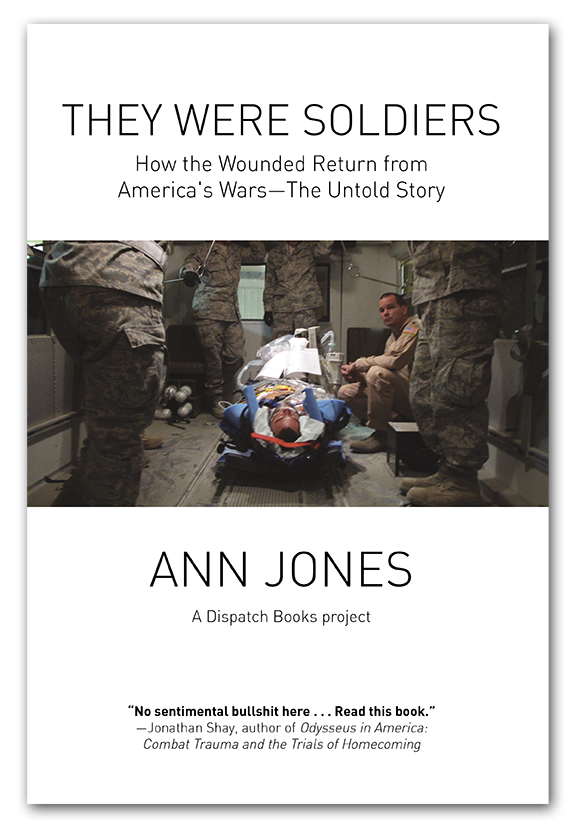
But this is as good a place as any: Ann Jones‘s new book, They were soldiers: how the wounded return from America’s wars (Haymarket, 2013):

After the American invasion of Afghanistan in 2001, Ann Jones spent a good part of a decade there working with Afghan civilians—especially women—and writing about the impact of war on their lives: the subject of Kabul in Winter (2006). That book revealed the yawning chasm between America’s promises to Afghans and its actual performance in the country. Meanwhile, Jones was pondering another evident contradiction: between the U.S. military’s optimistic progress reports to Americans and its costly, clueless failures in Afghanistan as well as Iraq. In 2010-2011, she decided to see for herself what that “progress” in Afghanistan was costing American soldiers. She borrowed some body armor and embedded with U.S. troops. On forward operating bases she saw the row of photographs of “fallen” soldiers hung on the headquarters’ wall lengthen day by day.

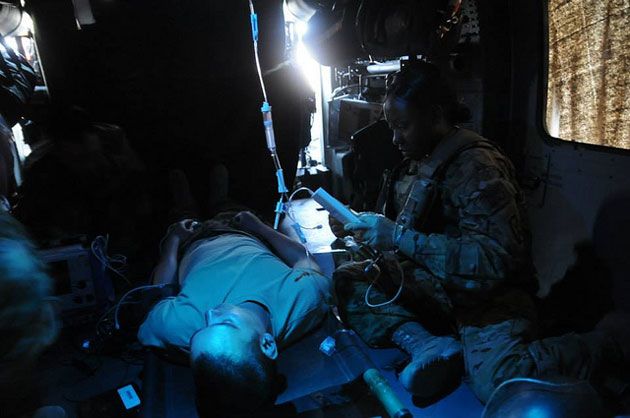
At the trauma hospital at Bagram Air Base she watched the grievously wounded carried from medevac helicopters to the emergency room and witnessed the toll that life-saving surgeries took on the doctors who performed them. She accompanied the wounded on medevac flights from Bagram to Landstuhl Regional Medical Center in Germany, then on to Walter Reed Hospital in Washington, and finally—for those who made it—back to all-American homes where, often enough, more troubles followed: violence against wives, girlfriends, children, and fellow soldiers; Big Pharma-induced drug addiction; murder, suicide, and the terrible sorrow of caretaker moms and dads who don’t know what happened to their kids. They Were Soldiers is a powerful account of how official American promises—this time to “Support Our Troops”—fall victim to the true costs of war.

Medevac

This dovetails perfectly with what I hope will be my new research project on caring for those wounded by war – combatants and civilians – between 1914 and 2014 and their precarious journeys away from the killing zones (see DOWNLOADS tab and scroll down).  As I’ve noted before, much of the critical commentary on modern war has been preoccupied with those killed – which is of course important – but the other casualties of war have all too often been marginalised.  It’s high time to supplement inquiries into what Judith Butler calls the constitution of  a ‘grievable life’ with others into the constitution of a ‘survivable life’.

Hence the vital importance of Ann’s book.  There’s an interview with Amy Goodman at Democracy Now here, and another with Truthout here, in which she deftly rejects the lazy politics in which the left supposedly cares only for ‘their’ civilians while the right cares for ‘our’ troops:

We worry – if at all – about how vets are treated when they return because of our mistaken notion that Vietnam vets suffered mightily from not being greeted as heroes. What Vietnam veterans truly suffered from was not their reception, but the war. That fact we tend to forget. Consequently, we think we can resolve all the possible nasty consequences of war by waving flags at airports as troops return. The deeper problem is that none of these veterans of the wars of choice in Iraq and Afghanistan – not one of them – should ever have been sent to war. But without a draft that can potentially strike any family in the country, those who have no fear that a family member may be compelled to serve are free to ignore the whole political and public relations process by which leaders drag the country into war and carry it on. War can be left to a supposedly “all volunteer” standing army – those poor kids with no job options or a shot at college – which is precisely what the founding fathers warned against, believing that a standing army would be used by autocrats to destroy democracy. That volunteer army, of course, is shadowed by a larger privatized for-profit army of mercenary contractors. The standing army of the poor and patriotic is alienated from the general public and left at the mercy of the president. Our recent presidents and their cronies, who hold a nearly unblemished record of evading military service, have thrown kids into war with an enthusiasm undampened by any real knowledge of what war is, while the most influential segments of the general public, feeling both grateful and guilty that their kids are safe, make no effort to restrain those war-loving leaders.

You can read an extract from They were soldiers, with a very helpful prefatory note from Nick Turse, at TomDispatch here:

In 2010, I began to follow U.S. soldiers down a long trail of waste and sorrow that led from the battle spaces of Afghanistan to the emergency room of the trauma hospital at Bagram Air Base, where their catastrophic wounds were surgically treated and their condition stabilized.  Then I accompanied some of them by cargo plane to Ramstein Air Base in Germany for more surgeries at Landstuhl Regional Medical Center, or LRMC (pronounced Larm-See), the largest American hospital outside the United States.

Once stabilized again, those critical patients who survived would be taken by ambulance a short distance back to Ramstein, where a C-17 waited to fly them across the Atlantic to Dover Air Base in Delaware. There, tall, multilayered ambulances awaited the wounded for the last leg of their many-thousand-mile journey to Walter Reed Army Medical Center in Washington D.C. or the Naval Hospital at Bethesda, Maryland, where, depending upon their injuries, they might remain for a year or two, or more.

Now, we are in Germany, halfway home.  This evening, the ambulance from LRMC heading for the flight line at Ramstein will be full of critical-care patients, so I leave the hospital early and board the plane to watch the medical teams bring them aboard.  They’ve done this drill many times a week since the start of the Afghan War.  They are practiced, efficient, and fast, and so we are soon in the air again. This time, with a full load.

 Two rows of double bunks flank an aisle down the center of the C-17, all occupied by men tucked under homemade patchwork quilts emblazoned with flags and eagles, the handiwork of patriotic American women. Along the walls of the fuselage, on straight-backed seats of nylon mesh, sit the ambulatory casualities from the Contingency Aeromedical Staging Facility (CASF), the holding ward for noncritical patients just off the flight line at Ramstein.
At the back of the plane, slung between stanchions, are four litters with critical care patients, and there among them is the same three-man CCAT (Critical Care Air Transport) team I accompanied on the flight from Afghanistan. They’ve been back and forth to Bagram again since then, but here they are in fresh brown insulated coveralls, clean shaven, calm, cordial, the doctor busy making notes on a clipboard, the nurse and the respiratory therapist checking the monitors and machines on the SMEEDs. (A SMEED, or Special Medical Emergency Evacuation Device, is a raised aluminum table affixed to a patient’s gurney.) Designed to bridge the patient’s lower legs, a SMEED is now often used in the evacuation of soldiers who don’t have any.
Here again is Marine Sergeant Wilkins, just as he was on the flight from Afghanistan: unconscious, sedated, intubated, and encased in a vacuum spine board. The doctor tells me that the staff at LRMC removed Wilkins’s breathing tube, but they had to put it back. He remains in cold storage, like some pod-person in a sci-fi film. You can hardly see him in there, inside the black plastic pod. You can’t determine if he is alive or dead without looking at the little needles on the dials of the machines on the SMEED. Are they wavering? Hard to tell.

They were soldiers is available as an e-book if, like me, you can’t wait.

Stilled life

In my last post I drew attention to China Miéville‘s essay on the Israeli Wall that gashes occupied Palestine which was, in part, a portfolio of photographs, and to Helga Tawil-Souri‘s anguished questions about photographing the monstrosity:

What am I supposed to do with a string of images? How will I put them back together to tell a story when there is no story to be told anymore? Photographing it, filming it, trying to write about it, only contradicts its very nature: a time-space of interruption, of suspension.

Others have reflected on these issues too: see, for example, Simon Faulkner, ‘The most photographed wall in the world’, Photographies 5 (2) (2012) 223-42:

On the one hand, the Wall has become a patently visible structure around which to galvanize opposition to the Israeli occupation. On the other, this very visibility is a problem in that it has tended to reduce the occupation to the Wall.

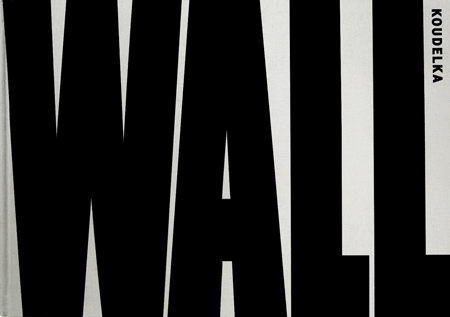
WALL

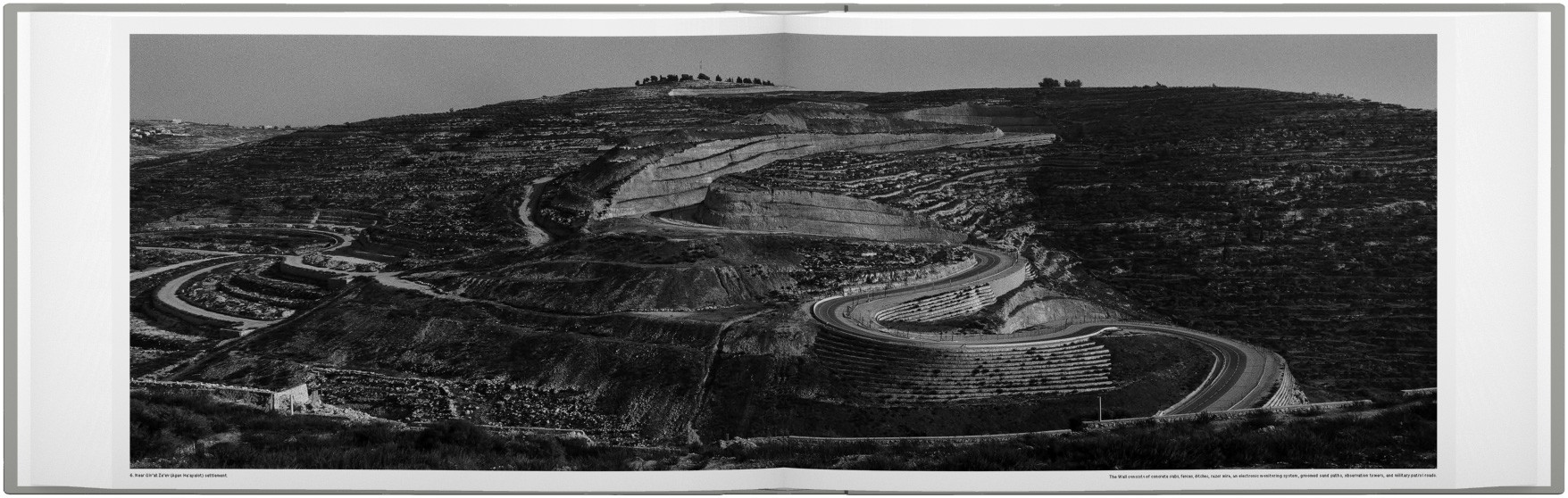
But I’m particularly taken by the work of the Czech (‘I’m not Czech like the Czechs’) engineer-turned-photographer Josef Koudelka whose Wall (published by Aperture last month) records his own encounters with the structure between 2008 and 2012 and whose gaze reaches beyond the wall itself into the wider landscape of occupation, exaction and repression.

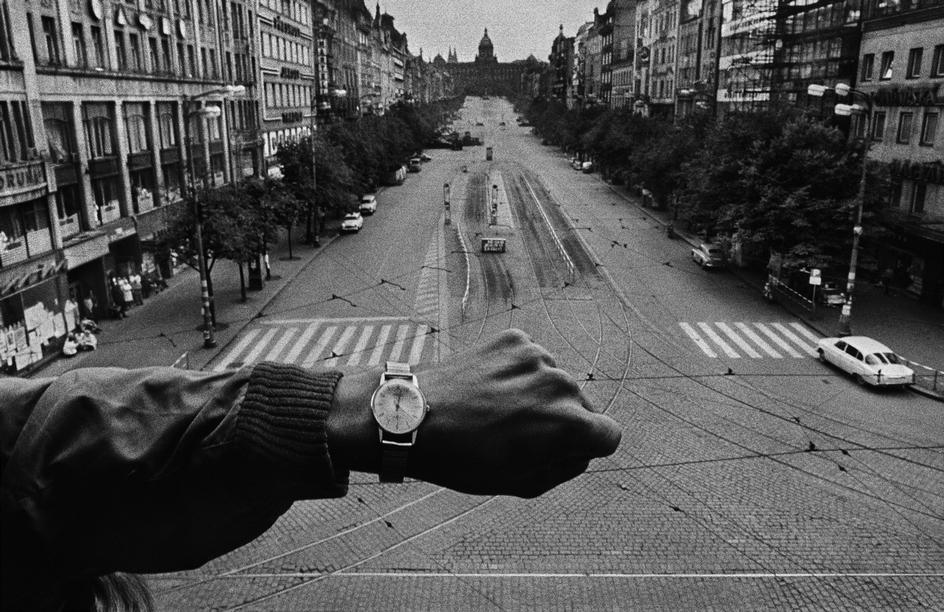
Koudelka’s work first captured public attention in 1968 when he courageously documented the Soviet-led occupation of Czechoslovakia.  ‘I grew up behind a wall,’ he told Ha’aretz, ‘and because of that experience I am very sensitive to all the people who grew up behind a wall.’

KOUDELKA Prague 68

His publisher explains that the new book is part of a larger project, This Place, initiated by photographer Frédéric Brenner:

This Place explores Israel as place and metaphor through the eyes of 12 acclaimed photographers, who were invited to look beyond dominant political narratives and to explore the complexity of the place – not to judge, but to question and to reveal.

It’s not easy to track down much information about the project, which included photographers like Jeff Wall and Gilles Peress, but a New York Times report from December 2011 described Koudelka’s response:

Though he is not a political person, he said, “it is not easy for me in this country. I don’t see things that make me very cheerful.” He said he was focusing on “the crime against the landscape, in the most holy landscape for humanity.”

KOUDELKA Wall

And over at the New York Review of Books blog David Shulman has an exceptionally fine meditation on the wall and Koudelka’s Wall, which includes a series of images from the book:

Koudelka’s pictures have an eerie, meditative texture. Many of them are structured around the glaring contrast between the Wall, always intrusive, harsh, ophidian, and the organic, still living world of hills, terraces, and valleys on either side of it. Paradoxically, these photographs are beautiful, almost too beautiful, to look at—despite, or perhaps because of, the raw wound they reveal. Look, for example, at the graveyard of decimated olive trees in an area earmarked for annexation to the east of Jerusalem. I have known Palestinian farmers who treat their olive trees—sometimes their main life support—like beloved children, and who sit in mourning when a tree is killed by settlers or soldiers…

To my mind the most powerful of Koudelka’s images is the final one in the book: Wall to the left, Wall to the right, a menacing emptiness in between, a lifeless place fixed in concrete and leading nowhere, despite the sadly hopeful sign pasted on the left-hand wall, pointing one way to Jerusalem, and the other way to Rachel’s Tomb, where the Matriarch Rachel weeps for her children.

And yet, as Shulman implies and James Johnson reiterates here, these images are empty of life and, at the limit, the panoramic gaze seems to ‘depersonalise suffering’… (which, if you follow Eyal Weizman‘s Hollow Land, should come as no surprise, though I think it’s also possible to read these photographs in other, mournful – indeed, haunted – ways).  More from Shulman in his Dark Hope: working for peace in Israel and Palestine (2003).


Urban guerrillas

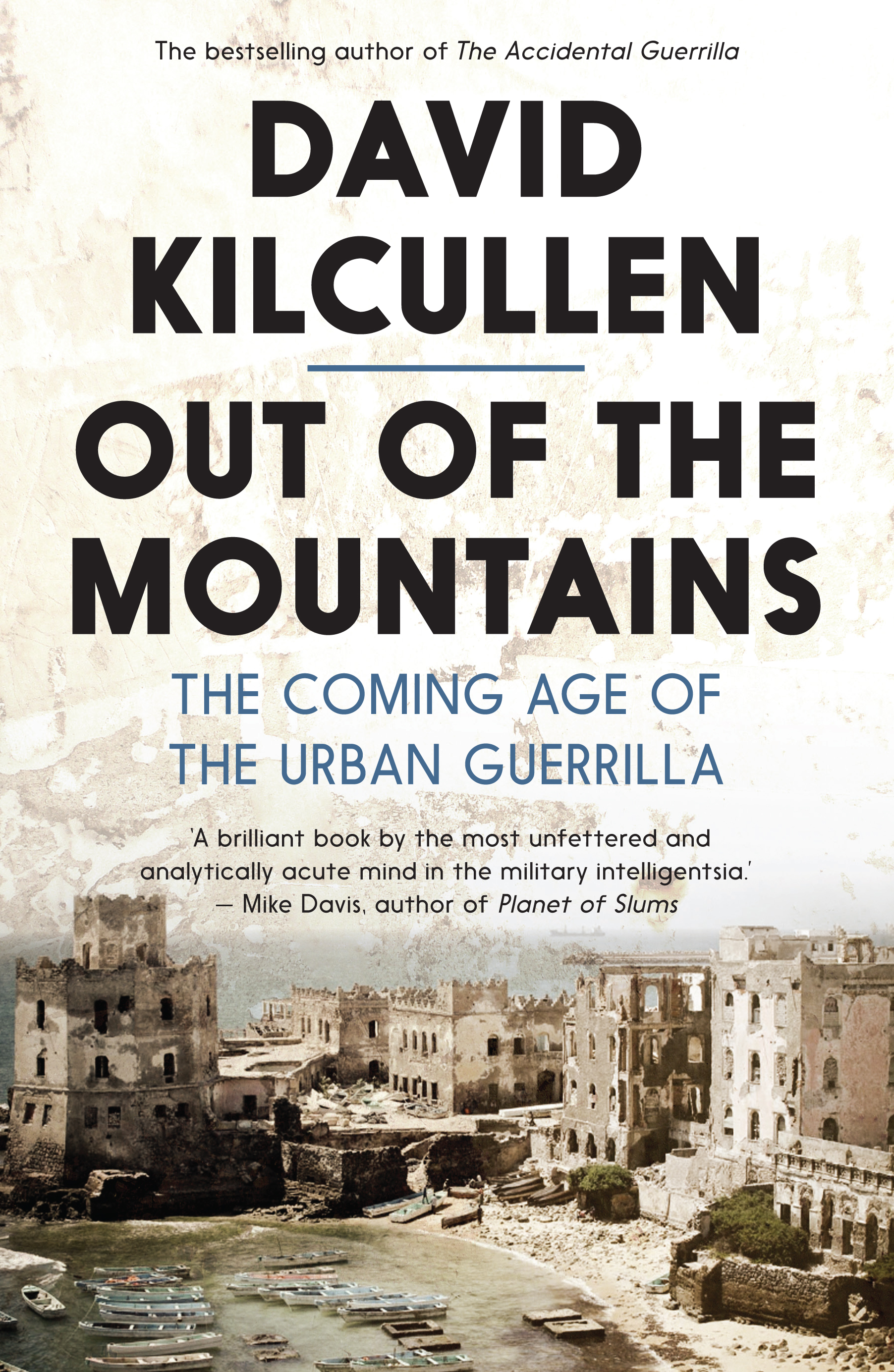
I’ve noted David Kilcullen‘s adventures into geography before, and the entanglement of his vision of counterinsurgency with the humanitarian present – here and here – and over at Gizmodo Geoff Manaugh (of the always interesting and enviably imaginative BLDGBLOG) has an interesting commentary on Kilcullen’s new book, Out of the Mountains: the coming age of the urban guerrilla (Hurst/Oxford University Press USA, 2013.  An extended excerpt is available here, if you scroll down, and a presentation on “The city as a system: future conflict and urban resilience” from last year is available here.

KILCULLEN Out of the mountains

Back to Geoff:

Kilcullen’s overall thesis is a compelling one: remote desert battlegrounds and impenetrable mountain tribal areas are not, in fact, where we will encounter the violence of tomorrow. For Kilcullen—indeed, for many military theorists writing today—the war in Afghanistan was not the new normal, but a kind of geographic fluke, an anomaly in the otherwise clear trend for conflicts of an increasingly urban nature.

The very title of Kilcullen’s book—Out of the Mountains—suggests this. War is coming down from the wild edges of the world, driving back toward our lights and buildings from the unstructured void of the desert, and arriving, at full force, in the hearts of our cities, in our markets and streets. There, conflict erupts amongst already weak or non-existent governments, in the shadow of brittle infrastructure, and what Mike Davis calls “the nightmare of endless warfare in the slums of the world” in his blurb for Kilcullen’s work, becomes uncomfortably close to reality.

Strictly speaking, Geoff’s commentary derives from a talk Kilcullen gave at the World Policy Institute, one of a large number of public appearances to promote the book on both sides of the Atlantic; here is a transcript of his talk at Chatham House, and here is his presentation to the New America Foundation last month, introduced by Peter Bergen:

Geoff is not completely convinced by it.  Some of the themes will be familiar to most readers – the bleeding of war into crime has been a staple of the ‘new wars’ thesis, for example – and you can hear distant echoes of Saskia Sassen‘s ideas about cities and later modern war.  More particularly, Steve Graham‘s brilliant work on the new military urbanism addresses many of the same issues Kilcullen raises – as Kilcullen notes himself – though he does so in a markedly different vocabulary: Geoff and I have crossed swords over this before, but while he describes “feral cities” as ‘one of my favorite phrases of all time’ I think it’s dehumanizing – though I do understand that’s exactly not Geoff’s intention).

Geoff is also (I think rightly) sceptical about the aerial-algorithmic intervention that Kilcullen touted at the WPI:

‘During the Q&A, Kilcullen briefly mentioned the work of Crisis Mappers, who have developed tools for visually analyzing urban form using satellite photos. According to Kilcullen, they are able to do this with an astonishing degree of accuracy, diagnosing what parts of cities seem most prone to failure. Whether this is due to empty lots and abandoned buildings or to infrastructural isolation from the rest of the city, the factors that determine “ferality” in the built environment is a kind of aerial application of the Broken Windows theory.

The implication—conceptually fascinating, but by no means convincing, at least for me—was that we could, in theory, develop a visual algorithm for identifying environments tending toward failure, and thus find a way to intervene before things truly fall apart. Teams of architects with their own dedicated satellites could thus scan the cities of the world from above, algorithmically identifying urban regions prone to collapse, then intervening with a neighborhood redesign.’

Have we learned nothing from almost a decade of remote-surveillance ISR and algorithmic counterinsurgency in which maps and metrics substitute for meaning?  And while the attacks in Nairobi confirm the city as a continuing arena of military and paramilitary violence in the twenty-first century, they surely can’t be directly assimilated to a ‘feral city’ thesis (though Kilcullen does his best here)?  We’ll see: I’m part way through the book, and will post a more considered response when I’m done.

Theory of the drone 10: Killing at a distance

This is the tenth in a series of extended posts on Grégoire Chamayou‘s Théorie du drone and covers the fifth and final chapter in Part II, Ethos and psyche.

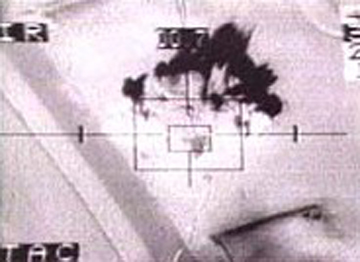
Gulf_war_target_camChamayou begins with a lecture given by German artist and film-maker Harun Farocki in Karlsruhe in 2003 called  ‘Phantom Images‘.  A ‘phantom image’, Farocki explained, is a view that is otherwise inaccessible to a human being – like the ‘bomb’s-eye view’ that became so familiar during the Gulf War (‘a suicidal camera’).  Like so many other ‘technical representations which maintain that they only represent the operative principle of a process’ these are, of course, techno-cultural performances.  They are techno-cultural because they produce a constructed and constrained space – in the Gulf War images that Farocki used to frame his argument, the battle space appears empty of people, a landscape without figures, an odyssey of destruction based on an object-ontology – and they are performances because they are what Farocki called ‘operative images’ that ‘do not represent an object but are part of an operation‘ (my emphasis).

You can find more on Farocki’s fascination with the virtual/real and Immersion here and on Images of War (at a distance) here.  Both ideas – immersion and distance – are central to Chamayou’s argument, but his starting-point is the idea of an operative image.  He wants to think of militarized vision as a ‘sighting’ that works not only to represent an object but also to act upon it and, in the case that most concerns both of us, this is the mainspring of the production of the target.

This has a long (techno-cultural) history, but drones use a video image to fix and execute the target: ‘You can click, and when you click, you kill.’  There’s something almost magical about it, Chamayou says: a hi-tech form of voodoo violence, like sticking pins into a wax doll, in which bringing someone into view – ‘pinning’ the target in the viewfinder – transports them into the killing space.

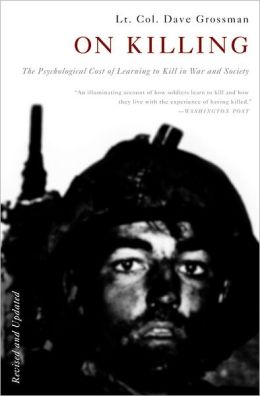
GROSSMAN On KillingBut what sort of space is it?  Chamayou considers a simple diagram from Dave Grossman‘s On Killing. For readers unfamiliar with his work, here is how Grossman describes himself on the website of his Killology Research Group:

Col. Grossman is a former West Point psychology professor, Professor of Military Science, and an Army Ranger who has combined his experiences to become the founder of a new field of scientific endeavor, which has been termed “killology.” In this new field Col. Grossman has made revolutionary new contributions to our understanding of killing in war, the psychological costs of war, the root causes of the current “virus” of violent crime that is raging around the world, and the process of healing the victims of violence, in war and peace. 

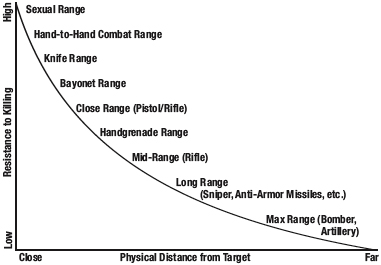
And here is the diagram, which summarises Grossman’s views on the relationship between ‘resistance to killing’ and distance from the target:

Resistance to killing as a function of distance

Grossman’s basic argument is that distance increases indifference and, as the annotations imply, there appears to be an historical sequence to all this.  Grossman’s book was published before the advent of the drone, but – given these two axes – the Predator and the Reaper presumably ought to appear on the extreme right of the diagram, representing the radicalisation of killing at a distance.

In fact, Grossman provides a discussion of videogames in which he says that the screen acts as a barrier between the player and the violence s/he unleashes in the game, making it easier to ‘kill’: exactly the argument advanced by those who claim that drones induce a ‘Playstation mentality’ to killing.

And yet, as I’ve explained in ‘From a view to a kill’ (DOWNLOADS tab), modern videogames are profoundly immersive, and the high-resolution full motion video feeds from the drones induce such an extraordinary sense of proximity, even intimacy – remember that crews frequently claim to be 18 inches from the combat zone, the distance from eye to screen – that drones are surely also pulled towards towards the extreme left of Grossman’s diagram.

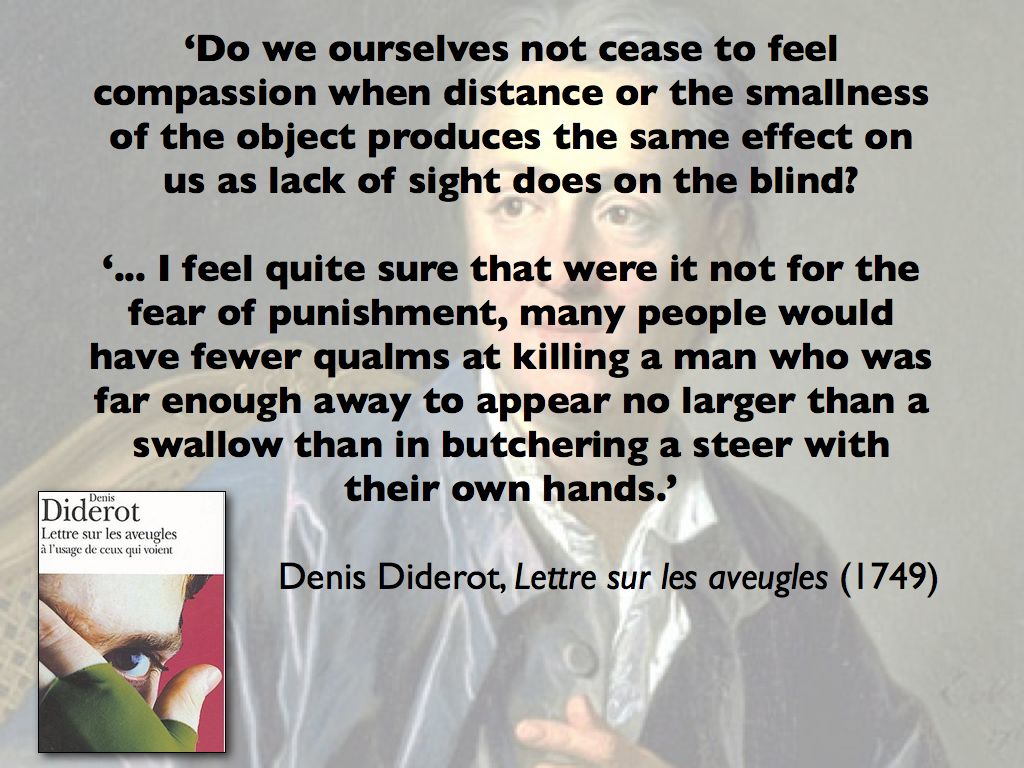
Chamayou doesn’t quote him, but Diderot’s Letter on the blind set out the original terms of the debate perfectly:

DIDEROT.001

But Chamayou is quick to show that ‘distance’ is a weasel-word, and in an extended footnote he elaborates his concept of pragmatic co-presence.  Co-presence denotes the possibility of A affecting B in some way, which means (in the absence of sorcery) that B must be within the sphere of action of A; more formally, co-presence involves the inclusion of one within the ‘range’ or ‘reach’ of another.  This is multi-dimensional – without technical mediation you can see someone much further away than you can hear them – but in many situations technical mediations are involved and so transform the relation.  This matters for two reasons.

First, there is nothing necessarily reciprocal about co-presence: what Chamayou calls ‘the structure of of co-presence’ determines what it is possible for you to do to the other, and is itself the product of struggle: each party to a conflict manouevres to produce a favourable asymmetry so that it becomes much easier for you to strike than to be hit.  In this sense, all war strives to be asymmetric – it’s not confined to wars between states and non-state actors – and it’s this that in part underwrites the history of war at a distance; as William Saletan put it, effectively re-describing Grossman’s diagram,

‘Technically, this is marvelous. Look at the history of weapons development: catapult, crossbow, cannon, rifle, revolver, machine gun, tank, bazooka, bomber, helicopter, submarine, cruise missile. Every step forward consists of a physical step backward: the ability to kill your enemy with better aim at a greater distance or from a safer location. You can hit him, but he can’t hit you.’

But – Chamayou’s second rider – ‘teletechnologies’ radically transform this sequence by severing co-presence from co-localisation.   What is distinctive about teletechnologies is not their capacity to act ‘at a distance’ but their indifference to and their interdigit(is)ation of ‘near’ and ‘far’.

This has far-reaching (sic) consequences because it produces a double disassociation.  Where, exactly, does the action take place?  Here (at Creech Air Force Base in Nevada) or there (Kandahar in Afghanistan)?  There is no single answer, of course, which is precisely Chamayou’s point.  This split – or series of splits, if you think of the wider networks involved – in turn engenders radically new forms of experience, of being-in-the-world, that can no longer be contained within the physico-corporeal confines of the conventional human subject.

Chamayou wants to show that this double disassociation is anything but ‘marvellous’.   He accepts that the targets that are produced through the full-motion video feeds from the Predators and Reapers are much less abstract: the crews see their targets – often people, not physical objects like the buildings or missile batteries that constituted Farocki’s ’empty’ battlespace – and they see the corporeal consequences of each strike.  ‘This novel combination of physical distance and visual proximity gives the lie to the old [Clausewitz-Hegelian] law of distance,’ Chamayou writes, since ‘increased distance no longer makes violence more abstract or more impersonal but, on the contrary, more graphic and more personal.’

But he insists that this proximity, even intimacy is counterbalanced by two factors which are also inscribed within the political technology of vision:

(1) ‘Proximity’ is contracted to the optical – and even this is degraded because the resolution of the video feeds reduces people to ‘avatars without faces’.  I think this is less straightforward than Chamayou implies.  He cites Salatan – ‘There’s no flesh on your monitor; just co-ordinates’ – which is a sharp remark, but the journalist was referring to the launch of long-range missiles (‘… tap a button on one continent and send a missile to another’) whereas the screens at Creech and elsewhere show human figures as well as co-ordinates.  More significant, I think, is that when drone operators provide close air support they are also in radio and online contact with troops on the ground, and this produces a pragmatic co-presence which is considerably more ‘fleshed out’ than their otherwise purely optical encounters with others in their field of view.

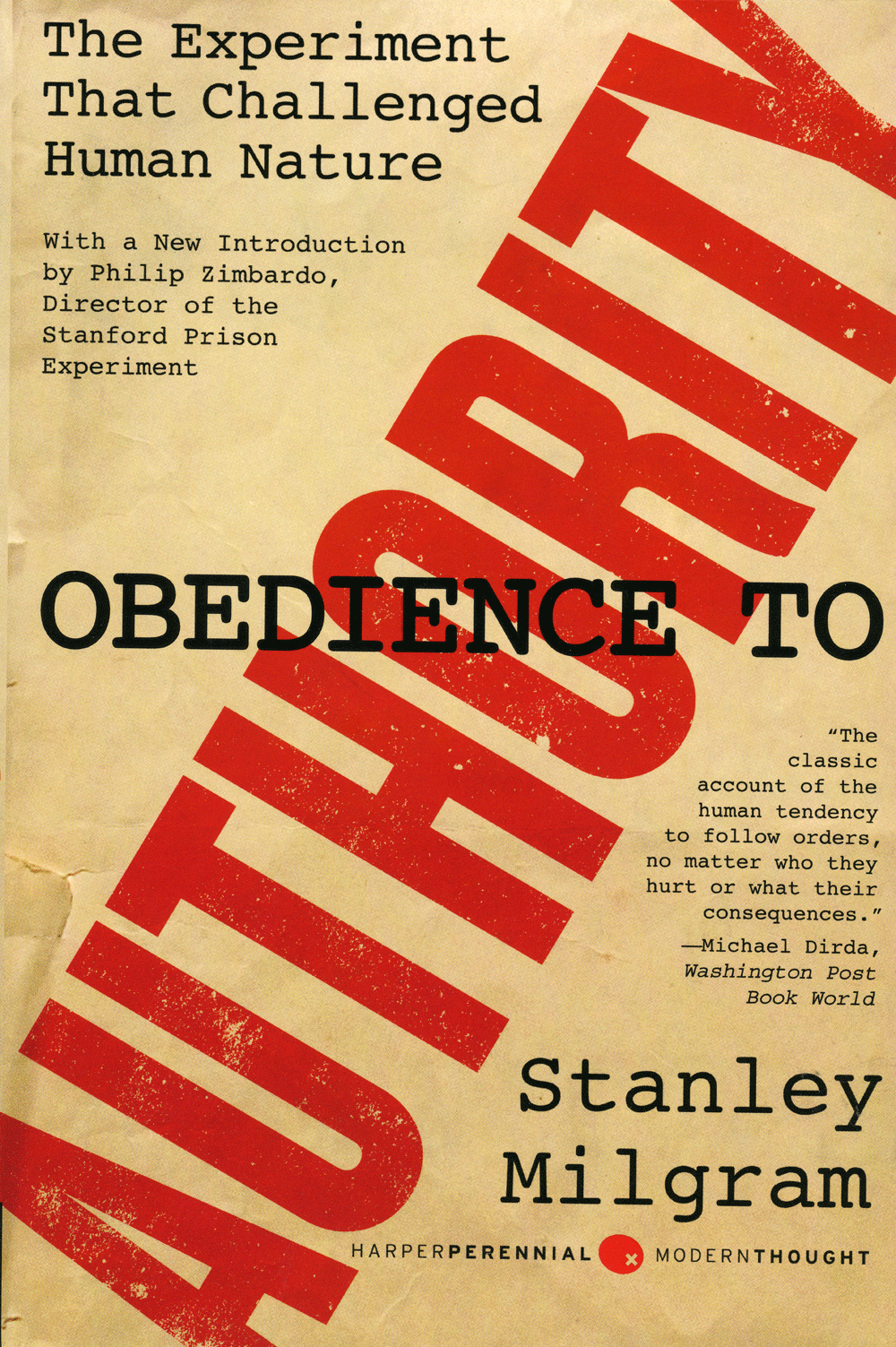
(2) Drone operators can see without being seen, and Chamayou argues that ‘the fact that the killer and his victim are not inscribed in “reciprocal perceptual fields” facilitates the administration of violence’ because it ruptures what psychologist Stanley Milgram in his notorious experiments on Obedience to authority [below] called ‘the phenomenological unity of the act’.  Milgram actually wrote “experienced”, not “phenomenological”, but you get the point; Milgram was discussing how much easier it is to hurt someone ‘if there is a physical separation of the act and its consequences’, which is radicalised in what the US Air Force calls the ‘remote split’ operations carried out by its Predators and Reapers.

MILGRAM Experiments

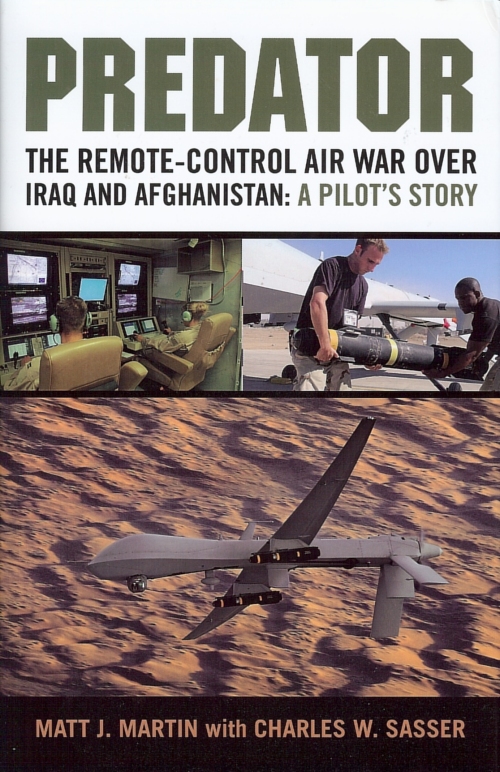
Milgram’s thesis was a general one, but to nail the sense of disassociation to the drone Chamayou quotes Major Matt Martin, a Predator operator:

‘The suddenness of action played out at long distance on computer screens left me feeling a bit stunned…  It would take some time for the reality of what happened so far away, for “real” to become real.’

Again, I think it’s more complicated than that.  Martin was clearly recalling an early experience, low on the learning curve, and interviews with other drone pilots suggest that within 6 months or so most had little difficulty in apprehending the reality, even the physicality of pragmatic co-presence. The sensor operator interviewed by Omer Fast for 5,000 Feet is the Best had this to say, for example:

‘… you get more into it the longer you’re working on the Predator.  Like my first fire mission.  You know, we fired a Hellfire missile at the target.  It didn’t quite strike [sic] me as, “Hey! I just killed someone!”  My first time.  It was within my first year there.  It didn’t quite impact.  It was like, “Yeah! I got somebody!”  You know?  And it was later on through a couple of more missions that I started to… The impact really dawned on me.  I just ended someone’s life!  That was me that did that!”‘

obedience-to-authority-milgramIt’s important to remember, too, that Milgram’s work was about structures of authority, and this has a palpable effect in the case of the military chain of command which has been transformed by the networked incorporation of video feeds from the drones and the deployment of military lawyers (JAGs) on the operations floor of the Combined Air and Space Operations Center (what I called ‘oversight’ in “From a view to a kill”),  which provides for a dispersion of responsibility across the network.

Equally important, I suspect, is that fact that drone crews are not only ‘following orders’, as the familiar jibe has it: they are also following procedures that transform military violence into a process that is at once techno-scientific and quasi-juridical and thus seen as conducted under the sign of an unimpeachable (military) Reason.

Joseph Pugliese makes a parallel argument about the incorporation of military-legal discourse into the techno-logic of the targeting process:

‘I argue that the parenthetical relation of law to technology is premised on a topical hiatus that disassociates the executioner who manipulates the killing technology of the drone from the facticity of the resultant execution. In this scenario, law is conceived of in the most radically instrumental of understandings: it enables and legitimates the execution while simultaneously suspending the connection between the doer and the deed.’

state-violence-and-the-execution-of-lawAnd yet at the same time, Pugliese explains, there is a ‘prosthetic’ relation between law and technology, in which ‘the human agent is always already inscribed by the technics of law.’ From the very beginning, he insists, the body is always already ‘instrumentalised by a series of technologies’ and also inscribed, from the very beginning, by a series of laws.  In short, ‘law is always already inscribed on the body, precisely as techné from the very first. This process of prosthetic inscription operates to constitute the very conditions of possibility for the conceptual marking of the body as”‘human’”‘: ‘The prosthesis,’ notes Bernard Stiegler, ‘is not a mere extension of the human body; it is the constitution of this body qua “human”’.’

Still, Chamayou suggests that (1) and (2) work together to sustain what Mary Cummings calls ‘moral buffering’.  In other words, and in counterpoint to optical proximity, the dispositif also provides a powerful means of distanciation.  Here is Fast’s interviewee again:

‘There’s always more of a personal touch when you’re watching something live.  And it’s even more personal when you’re the one that did it… Well, I mean you get more – I guess – emotionally distant.  As time goes on.  But I mean… I guess in my case, and some of the cases of the guys that I knew, as more time went by you put yourself more and more in the position that this is more and more real life and that you are actually there… And after a while you become emotionally distant.  But still you put yourself more and more as if you’re standing right there…’

MARTIN PredatorThis is compounded, so Chamayou argues, by a different dimension of ‘remote split’ operations. Because Predators and Reapers can stay aloft for 18 hours or more (the ‘persistent presence’ that makes them so much in demand), their crews work shifts and commute each day (or night) between home and work or, more accurately, between peace and war.  One drone operator saw this as a peculiarly strung-out existence: ‘We were just permanently between war and peace’  (my emphasis).  Matt Martin said much the same.  US-based crews ‘commute to work in rush-hour traffic, slip into a seat in front of a bank of computers, fly a warplane to shoot missiles at an enemy thousands of miles away, and then pick up the kids from school or a gallon of milk at the grocery store on [their] way home for dinner.’  He described it as living ‘a schizophrenic existence between two worlds’; the sign at the entrance to Creech Air Force Base read ‘You are now entering CENTCOM AOR [Area of Operations]’, but ‘it could just as easily have read “You are now entering C.S. Lewis’s Narnia” for all that my two worlds intersected.’

The way crews survive, Chamayou suggests, is by partitioning, ‘setting aside’, but this is extremely difficult for commuter-warriors as they regularly and rapidly move between a domestic sphere in which killing is taboo and a military sphere where (so he says) it is ‘a virtue’.   The superimposition of these two worlds – their contradictory clash – means that crews are in a sense ‘both in the rear and at the front, living in two very different moral universes between which their lives are torn.’

This is precisely the situation dramatised in George Brant‘s play Grounded, which I noted in an earlier post, and Chamayou cites a former USAF sensor operator Brandon Bryant (whose testimony I discussed here) to the same effect.  In both cases, crew members plainly are affected, even distressed by what they see on the screen; in fact Bryant has bee diagnosed with PTSD.

But Chamayou insists that this sort of testimony is rare and that most of them do manage to compartmentalise.  Fast’s sensor operator:

‘A lot of us learn real fast to leave all of our problems at the door.  You know, when we’re leaving the squadron and heading home.  Just kind of putting it on a rack and pushing it out of your mind.’

And this, Chamayou concludes, nails the real psychopathology of the drone.  He calls French philosopher Simone Weil’s Gravity and grace to his aid:
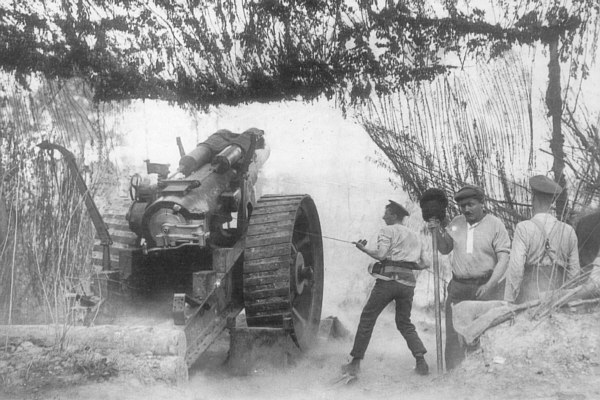
‘The faculty of setting things aside opens the door to every sort of crime…  The ring of Gyges who has become invisible – this is precisely the act of setting aside: setting oneself aside from the crime one commits; not establishing the connection between the two.’

Chamayou has used the myth of Gyges earlier in his critique, but here he invokes Weil to claim that the psychopathology of the drone is not the trauma some say that drone crews experience ‘but on the contrary the industrial production of compartmentalised psyches, protected from all possibility of reflection on the violence they have committed, just as their bodies are already protected against every possibility of exposure to the enemy.’

rwg05074-1I’m really not sure about this.  ‘Protected from all possibility of reflection’?  Much of the evidence that Chamayou cites here – like Milgram’s experiments – could be applied to most forms of military violence.  Here, for example, is Arnold Bennett describing artillery at work in Over there: war scenes on the Western Front (1915):

‘The affair is not like shooting at anything.  A polished missile is shoved into the gun.  A horrid bang – the missile has disappeared, has simply gone.  Where it has gone, what it has done, nobody in the hut seems to care.  There is a telephone close by, but only numbers and formulae – and perhaps an occasional rebuke – come out of the telephone, in response to which the  perspiring men make minute adjustments in the gun or in the next missile.

 ‘Of the target I am absolutely ignorant, and so are the perspiring men.’

I’ve found the same sentiments expressed by bomber crews during the Second World War.  The difference, clearly, is that drone strikes involve far more than ‘numbers and formulae’ – co-ordinates on the screen – and that the visual  production and so-called ‘prosecution’ of the target takes place in near real time, in vivid detail and under the eye of military lawyers.  But it is not surprising (nor, I think, especially pathological) that those who carry out these strikes conduct themselves with a certain seriousness, a ‘professionalism’ if you like, that precludes emotional investment. This is from David Wood‘s interview with a highly experienced USAF drone pilot:

Q: You must develop an emotional tie with the people on the ground that makes it hard if there is going to be a strike or a raid, people are going to be killed.

A: I would couch it not in terms of an emotional connection, but a … seriousness. I have watched this individual, and regardless of how many children he has, no matter how close his wife is, no matter what they do, that individual fired at Americans or coalition forces, or planted an IED — did something that met the rules of engagement and the laws of armed conflict, and I am tasked to strike that individual.

‘Professionalism’ shouldn’t be used as a mask to hide from critique, to be sure.  These crews are trained to perform with a calculative reason, dispassionately, through a techno-cultural and techno-legal armature, so that, as one USAF major told Nicola Abé, when she was preparing for a strike ‘there was no time for feelings’.  Or again, from another pilot operating a Predator over Afghanistan:

‘We understand that the lives we see in the screens are as real as our own…  I would not compare what I do as a job comparable to Call of Duty/any other video game, in any sense. It is very real and the seriousness of the lives on the ground is very real and instilled in all of our training. It is never something that we joke about. Very serious business.’

As I’ve noted before, there are (too) many instances in which crews do joke about their missions, the sort of ‘gallows humour’ that is no doubt a common reaction to  hunter-killer missions: but isn’t this also likely to be common amongst all military professionals who are trained to kill?  One pilot explicitly rejected the suggestion that drone crews become disassociated from what they do:

‘I wonder why people think this. We understand what we are doing is real world operations. We know our actions have consequences. I don’t understand the idea of being desensitized due to some operators not being in an actual firefight/combat zone.’

Later in the online exchange, the same pilot insists: ‘It’s very real.  Some of the stuff I’ve seen is burned into my brain’ – and then Brandon Bryant joins the conversation to ‘agree with what you guys have said.’  He’s on record as writing in his personal combat diary ‘I wish my eyes would rot.’

I realise that these passages can’t settle matters, but they surely cast doubt on the implication that drone crews are as machinic as the aircraft they fly.  Pugliese insists that the drone ‘cannot be reduced to a mindless machine of purely robotic acts’; neither, by virtue of what Pugliese calls their prosthetic relation to the drone, can the crew who fly them.   I still think that one of the most salient differences introduced by drones is the differential distanciation they allow when they provide close air support: an unprecedentedly close relation with troops on the ground and a calculative detachment from others in their field of view.

I realise, too, that this can’t apply to targeted killings, and so I leave you with this statement by Lt General Michael DeLong, who as deputy commander of US Central Command had to sign off on the first CIA-directed targeted killing, in Yemen in November 2002.  Then CIA Director George Tenet called DeLong to ask him to give the order, since the Predator was flown by a USAF crew:

delongp‘Tenet calls and said, “We got the target.” … I called General Franks [commander of CENTCOM]. Franks said, “Hey, if Tenet said it’s good, it’s good.” I said, “Okay … I’m going down to the UAV room.” … We had our lawyer there. Everything was done right. I mean, there was no hot dog. … The rules of war, the rules of combat that we had already set up, the rules of engagement ahead of time. Went by them. Okay, it’s a good target. …

I’m sitting back … looking at the wall, and I’m talking to George Tenet. And he goes, “You got to make the call?” These Predators had been lent to him, but the weapons on board were ours. So I said, “Okay, we’ll make the call. Shoot them.” 

Everything may have been ‘done right’, the procedures followed, but  when DeLong was asked ‘What does it feel like when you know you’re going down there to kill somebody?’ He replied:

‘It’s just war. It’s no different than going to the store to buy some eggs; it’s just something you got to do.’

And, as Chamayou would surely insist, it wasn’t war.  It was, as Seymour Hersh wrote in the New Yorker on 23 December 2002, a manhunt.

HERSH Manhunt

To be continued.

Nomadikon

MITCHELL Cloning terror

Henrik Gustafsson writes with an interesting supplement to my previous post on Image Wars. Last year Nomadikon, the Bergen Center for Visual Culture, convened an online discussion around ‘Image Wars’, centring on W.J.T. Mitchell’s argument in Cloning Terror: the war of images, 9/11 to the present (there’s a short extract from the opening chapter over at Berfrois here).

There are extended contributions from:

Toby MillerImperial Wars

Mikkel Bolt RasmussenThe Spectacle of State Terror and Fear

Jill CasidThe Imperative Mood

Chris Hables GrayImage War in the Age of Digital (Re)Production

Max LiljeforsNotes on ‘Image Wars’

Joanna ZylinskaLife in the battlefield of vision

And excellent untitled contributions from Marita Sturken, Jill Bennett, Iain Chambers and Kari Andén-Papadopoulos.  

There’s also a rich response (‘Image War’) from Mitchell himself:

W.J.T. Mitchell… this might be the place to make clear my own sense of limits, by insisting that the notion of image war, of a war of images, is itself an image, a metaphor, and perhaps a metapicture—that is, a second-order picture of the way that pictures operate.   A war of images is not literally a war.  Images do not go into battle and kill each other; human beings do. Images do not plan invasions, massacre populations, and shatter bodies.  That requires people.  Images are more like animals than humans, in this respect.  Animals fight and kill each other, but the mass mobilization of violence known as war seems a uniquely human institution, unless we anthropomorphize the natural behavior of certain species such as warrior ants, or the learned behavior of the war horse, image of the heroic cavalry of pre-modern warfare.  Images are “agents” of war in the sense that a “secret agent” works for a foreign power, or an “agency” is an instrument of a state.  Images are thus like machines, extensions and agents of human powers.  Which is to say that they can go out of control, go “rogue,” and be turned against their creators.   If images are agents, then, perhaps they should be thought of as double agents, capable of switching sides, capable of being “flipped” by acts of clever detournement, appropriation, and seizure for purposes quite antithetical to the intentions of their creators.   (Think here of George W. Bush’s “Mission Accomplished” photo op; or the trophy photos taken at Abu Ghraib prison).    My attribution of agency and affect and desire to images, as Max Liljefors notes, “runs the risk” of “mystifying pictures,” but I don’t think we can track the volatile lives of images without running this risk.   We cannot, in my view, utterly destroy the mystification of images, their tendency to take on the status of totems, fetishes, and idols.  In fact, the fantasy of a sovereign iconoclastic power, one that would annihilate falsely mystified images once and for all simply winds up mimicking the idolatry that it seeks to displace.

You can read the whole thing here.

Image wars

STALLABRASS Memory of FireI’m still putting together the programme for my graduate course this term (I’ll post the full outline under the TEACHING tab as soon as it’s ready), and I plan to spend some time on what I’m calling Militarized vision and imag(in)ing modern war.

Images have become increasingly important to the conduct of war; in Precarious Life Judith Butler argues that ‘there is no way to separate, under present historical conditions, the material reality of war from those representational regimes through which it operates and which rationalize its own operation.’  This requires us to think carefully about two, closely related issues – media representations of military violence and its effects, and the ways in which militaries have incorporated political technologies of vision into their operations.

I’m thinking of beginning with these two readings:

Bernd Hüppauf, ‘Experiences of modern warfare and the crisis of representation’, New German Critique 59 (1993) 41-76.

Lilie Chouliaraki, ‘The humanity of war: iconic photojournalism of the battlefield, 1914-2012’, Visual communication 12 (3) (2013) 315-340

Then I want to turn to the scopic regimes of advanced militaries, via Virilio and transcripts of several US military investigations into air strikes in Afghanistan and Iraq, to open up a discussion of targeting and political technologies of vision.  (This is probably also the place to say that, since I started to think through the relation between technoculture, targeted killing and the individuation of warfare I’ve also been thinking about the work of Bernard Stiegler; more later, but in the meantime you’ll find a truly excellent bibliography by cultural geographer Sam Kinsley here).

All of this opens up wide fields for debate, of course, but as I was putting together a list of supplementary materials I stumbled upon a new collection edited by Julian Stallabrass, Memory of fire: Images of war and the war of images (Photoworks, 2013):

This richly illustrated book is a visual, theoretical and historical resource about the photography of war, and how images are used as instruments of war. It comprises essays and interviews by prominent theorists, artists and photographers and covers the urgent issues of the depiction of war, the use of images of war by the media, various forms of censorship, the military as a PR and image-producing machine, the circulation of unofficial images and the impact of the digital mediascape.

Full details here , a four-pager in which Stallabrass discusses ‘Rearranging corpses, curatorially’ here, and a video in which he explains the project here:

There’s no shortage of work on these issues, I know, but there’s a particularly detailed engagement with Memory of Fire by Susie Linfield  author of The cruel radiance: photography and political violence (University of Chicago Press, 2010) – here and a sharp response from Stallabrass (scroll down).  There’s also a shorter but still informative review by Ashitha Nagesh at the always stimulating bookforum here.

Finally, you can find Stallabrass’s (2006) reaction to Retort’s Afflicted Powers and its engagement with ‘image wars’, ‘Spectacle and Terror’, on open access at the New Left Review here.

Theory of the drone 9: Psychopathologies of the drone

This is the ninth in a series of extended posts on Grégoire Chamayou‘s Théorie du drone and covers the fourth chapter in Part II, Ethos and psyche.

4 Psychopathologies of the drone

One of the most common media tropes in discussing ‘a day in the life’ of drone operators is their vulnerability to stress and, in particular, Post-Traumatic Stress Disorder (PTSD).  Chamayou traces this to an Associated Press report by Scott Lindlaw in August 2008, which claimed that the crews who ‘operate Predator drones over Iraq via remote control, launching deadly missile attacks from the safety of Southern California 7,000 miles away, are suffering some of the same psychological stresses as their comrades on the battlefield.’  Similar stories have circulated in other media reports.  The root claim is that, unlike pilots of conventional strike aircraft, drone crews see the results of their actions in close-up detail through their Full-Motion Video feeds and that they are required to remain on station to carry out a Battle Damage Assessment that often involves an inventory of body parts.

One recent study, ‘Killing in High Definition‘ by Scott Fitzsimmons and Karina Singha, presented at the International Studies Association in San Francisco earlier this year, makes the truly eye-popping suggestion that:

‘To reduce RPA operators’ exposure to the stress-inducing traumatic imagery associated with conducting airstrikes against human targets, the USAF should integrate graphical overlays into the visual sensor displays in the operators’ virtual cockpits. These overlays would, in real-time, mask the on-screen human victims of RPA airstrikes from the operators who carry them out with sprites or other simple graphics designed to dehumanize the victims’ appearance and, therefore, prevent the operators from seeing and developing haunting visual memories of the effects of their weapons.’

But in his original report Lindlaw admitted that ‘in interviews with five of the dozens of pilots and sensor operators at the various bases, none said they had been particularly troubled by their mission’, and Chamayou contends that the same discursive strategy – a bold claim discretely followed by denials – is common to most media reports of the stresses supposedly suffered by drone crews.  More: he juxtaposes the crews’ own denial of anything out of the ordinary with the scorn displayed towards their remote missions by pilots of conventional strike aircraft who, in online chatrooms and message boards, regard the very idea as an insult to those who daily risk their lives in combat.

The argument Chamayou develops closely follows William Saletan‘s commentary in Slate:

[The AP story] shows that operating a real hunter, killer, or spy aircraft from the faraway safety of a game-style console affects some operators in a way that video games don’t. But it doesn’t show that firing a missile from a console feels like being there — or that it haunts the triggerman the same way. Indeed, the paucity of evidence — despite the brutal work shifts, the superior video quality, and the additional burden of watching the target take the hit — suggests that it feels quite different.

Chamayou’s reading is more aggressive.  In his eyes, the repeated claim of vulnerability to stress emerged as a concerted response to criticisms of the supposed ‘Playstation mentality’ that attends remote killing and its reduction of war to a videogame.  He insists that it’s little more than an attempt to apply ‘a veneer of humanity to an instrument of mechanical murder’ – ‘crying crocodile tears’ before devouring the prey – and that it rests on absolutely no empirical foundation. This raises the stakes, of course, and it’s only fair to note that Lindlaw’s interviews with drone crews did not talk up combat-related stress and in fact a USAF white paper dismissed as ‘sensational’ the claim that PTSD rates among RPA crews were higher than those suffered by their forward-deployed counterparts.

Indeed, Chamayou himself relies on a public lecture given by Colonel Hernando Ortega, a senior medical officer attached to the USAF Intelligence, Surveillance and Reconnaissance Agency in February 2012.  Ortega reported USAF research that showed – conclusively – that drone crews are subject to often extraordinary stress.  But this is primarily a matter of their conditions of work – the demands of paying close attention to a screen hour after hour – and the rapid shift alternations between work and home (‘telecommuting to the war zone’) that allow little or no time or space for decompression.  Ortega explained that the symptoms rarely rise to the level of PTSD and are primarily the product of ‘operational stress’ rather than the result of combat-induced exposure to violence.

‘They don’t say [they are stressed] because we had to blow up a building. They don’t say because we saw people get blown up. That’s not what causes their stress — at least subjectively to them. It’s all the other quality of life things that everybody else would complain about too.’

Ortega could think of only one sensor operator who had been diagnosed with PTSD – a study by Wayne Chapelle, Amber Salinas and Lt Col Kent McDonald from the Department of Neurosurgery at the USAF School of Aerospace Medicine reported that 4 per cent of active duty RPA pilots and sensor operators were at ‘high risk for PTSD’ – but Ortega’s research questionnaires often revealed a sort of self-doubt over whether drone crews had made the right call when coming to the aid of troops in conflict rather than a direct response to a ‘physical threat event’:

‘Now it’s not to say that they don’t really feel about the physical threat to their brothers who are on the ground up there.  The band of brothers … is not just in the unit. I believe it’s on the network, and I believe the communication tools that are out there has extended the band of brothers mentality to these crews who are in contact with guys on the ground. They know each other from the chat rooms. They know each other from the whatever, however they communicate. They do it every day, same thing all the time…. So that piece of the stress, I think, when something bad happens, that really is out there…’

This sounds to me like the situation I described in ‘From a view to a kill’ (DOWNLOADS tab): the networked nature of remote operations draws operators into the conflict (which is why they so often insist that they are only 18″ from the battlefield, the distance from eye to screen) but on highly unequal, techno-culturally mediated terms that predispose them to identify with troops on the ground rather than with any others (or Others) in the immediate vicinity.  What Chamayou takes from all this is Ortega’s conclusion:

‘The major findings of the work so far has been that the popularized idea of watching the combat was really not what was producing the most just day to day stress for these guys. Now there are individual cases — like I said, particularly with, for instance, when something goes wrong — a friendly fire incident or other things like that. Those things produce a lot of stress and … more of an existential kind of guilt… could I have done better? Did I make the right choices? What could I have done more?’

DSM -5In fact for Chamayou the very idea of drone crews experiencing PTSD is an absurdity.  According to the latest edition of the Diagnostic and Statistical Manual for Mental Disorders (DSM -5, 2013; revised from the previous version cited by Chamayou, this incorporates major changes from DSM-IV, but these do not materially alter his main point), PTSD is a trauma and stressor-related disorder brought about by exposure to actual or threatened death, serious injury, or sexual violence.   The American Psychiatric Association explains:

The exposure must result from one or more of the following scenarios, in which the individual:

• directly experiences the traumatic event;

• witnesses the traumatic event in person;

• learns that the traumatic event occurred to a close family member or close friend (with the actual or threatened death being either violent or accidental); or

• experiences first-hand repeated or extreme exposure to aversive details of the traumatic event (not through media, pictures, television or movies unless work-related).

Drone crews do not ‘directly experience’ any traumatic event, Chamayou insists, and far from being ‘witnesses’  they are the perpetrators of trauma.  Those last three words in the extract I’ve just quoted do open up a third scenario – which would leave open the possibility of being affected by high-definition exposure through the FMV feeds and the Battle Damage Assessments performed by drone crews – but Chamayou hones the role of the perpetrator to explore a different though not unrelated scenario.

He takes his cue from Karl Abraham‘s discussion of neuroses in the First World War:

‘It is not only demanded of these men in the field that they must tolerate dangerous situations — a purely “passive performance — but there is a second demand which has been much too little considered, I allude to the aggressive acts for which the soldier must be hourly prepared, for besides the readiness to die, the readiness to kill is demanded of him…. [In our patients the anxiety as regards killing is of a similar significance to that of dying.’

51nCFmy0gdLChamayou is most interested in the development of this line of thought by psychologist/sociologist Rachel MacNair, who widens the field of PTSD to incorporate what she calls Perpetration-Induced Traumatic Stress (PITS): you can find a quick summary here.  (McNair is a long-time peace activist and in accordance with the ‘consistent life ethic’ she has used her work on PITS to intervene in what she calls ‘the abortion wars’; she is also associated with the Center for Global Nonkilling: see here).

Her book was written too early to address the use of drones for remote killing, but Chamayou suggests that this would be an appropriate means of putting their ‘psychopathologies’ to the test.  He thinks that individual operators lie somewhere between two poles: either they are indifferent to killing at a distance (the screen as barrier) or they feel culpable for the violence they have inflicted (the screen forcing them to confront the consequences of their actions).  It is, he concludes, an open question: though his next chapter on ‘Killing at a distance’ proposes a series of answers.

In fact, the USAF recognises the distinct possibility of PITS affecting drone crews, as this slide from a presentation by Chappelle and McDonald shows:

PTSD RPA crews CHAPPELLE

This year MacNair became President of Division 48 (Peace Psychology) of the American Psychological Association and instituted three Presidential Task Forces, the first of which specifically addresses drones.  She writes:

‘Task Force 1 is examining “The Psychological Issues of Unmanned Aerial Vehicles (Weaponized drones).” This will focus on the flying robots that kill, not the ones doing surveillance, nor the consumer drones that loom on the horizon. this is a very new field, with very little literature. We’ll look at what the psychological impact is on operators of the systems, the bureaucracy, surviving victims, and special therapeutic needs. The task force email for any feed-back or good literature citations or to request the full list of questions is dronetF@ peacepsych.org.’

The newsletter also includes a short statement from the next President of the Division, Brad Olson, setting out ‘Some thoughts for the Drone Task Force’ and an article by Marc Pilisuk on ‘The new face of war’.

Peace Psychology

Let me add three other comments.

(1) To limit the discussion to PTSD is to set the bar very high indeed, and the evidence of lower-level combat-induced stress on drone crews is less straightforward than Chamayou makes out.  In March 2013 Jean Otto and Bryant Webber reported the results of a study of ‘mental health outcomes’ covering the period 1 October 2003 to 31 December 2011 for 709 drone (RPA) pilots and 5, 526 pilots of manned aircraft (MA); they found that the crude incidence of adjustment, anxiety, depressive and other disorders among RPA pilots was considerably higher than for MA pilots, but once the samples were adjusted for age, number of deployments and other factors the ‘incidence rates among the cohorts did not significantly differ’ (my emphasis).

MH outcomes USAF

The study was experimental in all sorts of ways and it does not – could not – provide a fine-grained analysis of the nature of the pilots’ exposure to violence.  We should bear in mind, too, that the study was inevitably limited by inhibitions, both formal and informal, on admitting to any form of stress within the military.  But the report does suggest that it is a mistake to separate drone crews from the wider matrix of military violence and its effects in which they are embedded.

brandon-bryant-e1369021667128(2) If Chamayou is right in his suspicion that all this talk of drone crews being affected by what they see on their screens was a concerted strategy designed to disarm claims that remote operations reduce war to a videogame – in which case, not everybody in the Air Force was singing the same tune – the fact that most of them turn out to conduct their missions with equanimity does not prove the critics right: it does not follow that they take their responsibilities less seriously or more casually than the pilots of conventional strike aircraft.  Pilots and sensor operators undoubtedly have recourse to gallows humour (Chamayou would no doubt say that this befits their role as ‘executioners’), and there are too many reported instances of language that I too find repugnant, though I see no reason not to expect the same amongst military personnel of all stripes.  But there is also anecdotal evidence of situations in which pilots and their crews have been deeply affected by what they saw (and, yes, did).  The testimony of at least one former operator, Brandon Bryant (above, left), who has been diagnosed with PTSD, suggests that those involved probably move between these extremes – between the two poles proposed by Chamayou – dis/connecting as their actions and reactions entangle with events on the screen/ground.

(3) The most careful review I know of what is a complicated and contentious field is Peter Asaro, ‘The labor of surveillance and bureaucratized killing: new subjectivities of military drone operators, Social semiotics 23 (2) (2013) 196-22.  This combines medico-military studies, media reports and an artful reading of Omer Fast‘s film, 5,000 Feet is the Best.  as Peter says, there are many jobs that involve surveillance and many jobs that involve killing, but

‘What makes drone operators particularly interesting as subjects is not only that their work combines surveillance and killing, but also that it sits at an intersection of multiple networks of power and technology and visibility and invisibility, and their work is a focal point for debates about the ethics of killing, the effectiveness of military strategies for achieving political goals, the cultural and political significance of lethal robotics, and public concerns over the further automation of surveillance and killing.’

It’s a tour de force that navigates a careful passage between the ‘heroic’ and ‘anti-heroic’ myth of drones.  Here is what I take to be the key passage from his conclusion:

‘On the one hand, drone operators do not treat their job in the cavalier manner of a video game, but they do recognize the strong resemblance between the two. Many drone operators are often also videogame players in their free time, and readily acknowledge certain similarities in the technological interfaces of each. Yet the drone operators are very much aware of the reality of their actions, and the consequences it has on the lives and deaths of the people they watch via video streams from half a world away, as they bear witness to the violence of their own lethal decisions. What they are less aware of … is that their work involves the active construction of interpretations. The bodies and actions in the video streams are not simply ‘‘given’’ as soldiers, civilians, and possible insurgents – they are actively constructed as such. And in the process of this construction the technology plays both an enabling and mediating role. I use the term ‘‘mediating’’ here to indicate that it is a role of translation, not of truth or falsity directly, but of transformation and filtering. On the one hand there is the thermal imaging that provides a view into a mysterious and hidden world of relative temperatures. And thus these drone technologies offer a vision that contains more than the human alone could ever see. On the other hand we can see that the lived world of human experience, material practices, social interactions, and cultural meanings that they are observing are difficult to properly interpret and fully understand, and that even the highest resolution camera cannot resolve the uncertainties and misinterpretations. There is a limit to the fidelity that mediation itself can provide, insofar as it cannot provide genuine social participation and direct engagement. This applies not only to both surveillance and visuality, which is necessarily incomplete, but also to the limited forms of action and engagement that mediating technologies permit. While a soldier on the ground can use his or her hands to administer medical aid, or push a stalled car, as easily as they can hold a weapon, the drone operator can only observe and choose to kill or not to kill. Within this limited range of action, meaningful social interaction is fundamentally reduced to sorting the world into friends, enemies, and potential enemies, as no other categories can be meaningfully acted upon.’

There’s a discussion of these various issues, including many of the people mentioned in this post, at HuffPost Live here.