The World’s E.R.

VanRooyen World's Emergency RoomAs military and paramilitary attacks on hospitals and medical facilities have increased – in Afghanistan, GazaSyria, Yemen and elsewhere – even as the number of casualties has soared, Michael VanRooyen‘s new book The World’s Emergency Room (out next month from St Martin’s) promises to provide an urgent overview of what has become a routinised violation of medical neutrality:

Twenty years ago, the most common cause of death for medical humanitarians and other aid workers was traffic accidents; today, it is violent attacks. And the death of each doctor, nurse, paramedic, midwife, and vaccinator is multiplied untold times in the vulnerable populations deprived of their care. In a 2005 report, the ICRC found that for every soldier killed in the war in the Democratic Republic of the Congo, more than 60 civilians died due to loss of immunizations and other basic health services.

The World’s Emergency Room: The Growing Threat to Doctors, Nurses, and Humanitarian Workers documents this dangerous trend, demonstrates the urgent need to reverse it, and explores how that can be accomplished. Drawing on VanRooyen’s personal experiences and those of his colleagues in international humanitarian medicine, he takes readers into clinics, wards, and field hospitals around the world where medical personnel work with inadequate resources under dangerous conditions to care for civilians imperiled by conflict. VanRooyen undergirds these compelling stories with data and historical context, emphasizing how they imperil the key doctrine of medical neutrality, and what to do about it.

Michael is a professor at the Harvard Medical School and director of the Harvard Humanitarian Initiative.

From Kirkus:

A behind-the-scenes look at the nascent field of humanitarian medicine as it has evolved in recent years of civil wars, famines, tsunamis, and other natural and man-made disasters.

Since 1990, world conflicts and refugee crises have spurred the growth of a massive force of humanitarian aid workers—some 275,000 individuals with the United Nations and NGOs, most of whom lack the formal training needed to deal with complex events like the catastrophic 2010 Haiti earthquake. In that 25-year period, more than 1,000 aid workers were killed in attacks on hospitals, medical staff, and civilian patients. VanRooyen, a professor at Harvard Medical School and the co-founder and director of the Harvard Humanitarian Initiative, came of age professionally in the fields of emergency medicine and humanitarian medicine, which are the focus of this fascinating debut. “What the emergency room is to Detroit, Chicago, and Baltimore, humanitarian medical relief is to the world’s crisis zones,” he writes. Whether in an unstable inner city or a failed state, doctors provide a safety net of emergency health care for people with critical needs. The author recounts his experiences on the ground as an emergency physician in Bosnia, Chad, the Congo, Haiti, Somalia, and many other countries and how he and like-minded colleagues have sought to professionalize humanitarian efforts, which have frequently been criticized as uncoordinated and wasteful. (The Haitian relief effort was a “humanitarian free-for-all,” he writes, involving novice agencies, inexperienced surgical teams, and “disaster tourists.”) In 2005, VanRooyen and others established the Harvard Humanitarian Initiative, a first-of-its-kind, universitywide effort to pursue research, training, and innovative approaches to humanitarian aid that could be leveraged to achieve policy changes. Despite the subtitle, the author devotes relatively little attention to the increasing dangers facing aid workers, focusing mainly on the need to establish rigorous standards for the field in order to prevent the malnutrition and infectious diseases that are the biggest killers in communities in conflict.

Anatomy of a war

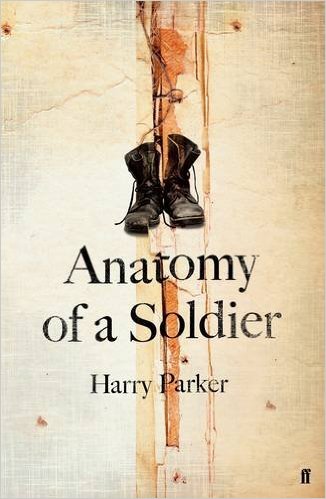
PARKER Anatomy of a soldier

‘He straightened and held me in one hand.  “Right, orders for tomorrow’s operation,” he said.   “We’re deploying most of the company for the first time and the whole platoon’s out together.  It’s a standard route security operation for the logistics convoy bringing in our supplies.  There’s nothing complicated about this patrol, but we’ll be static for long periods and that will make us vulnerable.  We have to clear all the roads in our AO and then secure it so the convoy can travel safely through.”  He moved his hand up my shaft and used me to point at the flat ground.

“Is everyone happy with the model?” he said.

There were a few silent nods from the watching men.

“Just to orientate you again.  This is our current location.”  He pointed me at a tiny block of wood near the centre of the grid that had PB43 written on it in peeling blue paint.  It was the largest of a hundred little wooden squares placed carefully across the earth and numbered in black.  “This is Route Hammer.”  He moved my end along a piece of orange ribbon that was pinned into the dirt.  “And this blue ribbon represents the river that runs past Howshal Nalay.”  I swept along the ribbon over a denser group of wooden blocks.  “These red markers are the IED finds in the last three months, so there’s quite a few on Hammer.”  I hovered over red pinheads…

He started describing the plan and used me to direct their attention to different parts of the square.  He said their mission was to secure the road and then provide rear protection.  He told them how they would move out before first light and push along the orange ribbon, past the blocks with L33 and L34 written on them.  I paused as he explained how vulnerable this point was, and that one team would provide overwatch at the block marked M13 while others cleared the road.

I was pointed at one of the men, who nodded that he understood.

He told them how they would spread out between block L42 and the green string.  Two other platoons would move through them and secure the orange ribbon farther up.  Then he swept me over the zones they were most likely to be attacked from.  He said the hardest part of the operation was to clear the crossroads at the area of interest named Cambridge; this was 6 Platoon’s responsibility.  I hovered over where the orange ribbon was crossed by white tape.

I had done it all before: secured sections of the ribbon, dominated areas of dirt, reassured little labels, ambushed red markers and attacked through clusters of wooden blocks.  I had destroyed as my end was pushed down hard and twisted into the ground.  I’d drawn lines in the sand that were fire-support positions and traced casualty evacuation routes through miniature fields.  I was master of the model.’

This passage comes from Harry Parker‘s stunning novel about the war in Afghanistan, Anatomy of a soldier (Faber, 2016).

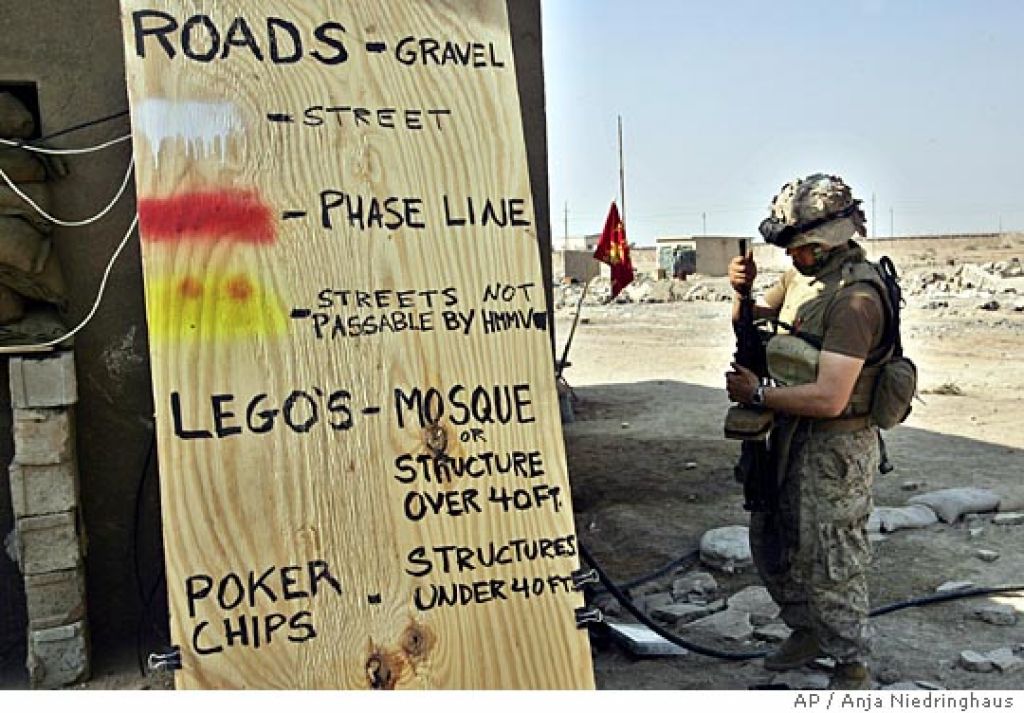
In one sense, perhaps, it’s not so remarkable: the use of improvised physical models to familiarise troops with the local terrain is a commonplace even of later modern war.  In Rush to the intimate (DOWNLOADS tab) I described how in November 2004, immediately before the second US assault on Fallujah, US Marines constructed a large model of the city at their Forward Operating Base, in which roads were represented by gravel, structures under 40′ by poker chips and structures over 40′ by Lego bricks (see image below). Infantry officers made their own physical model of the city using bricks to represent buildings and spent shells to represent mosques.
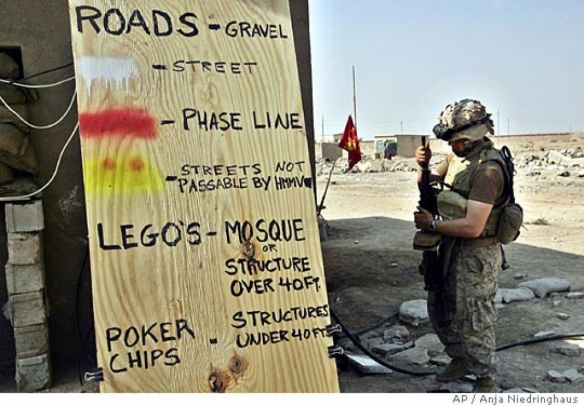
Fallujah model

I called this a ‘rush from the intimate to the inanimate’, and discussed the ways in which the rendering of the city as an object-space empty of life was a powerfully performative gesture – one in which, as Anne Barnard put it, the soldiers straddled the model ‘like Gulliver in Lilliput’.

As the passage I’ve just quoted suggests, it was standard practice in Afghanistan too; here are soldiers from the Afghan National Army studying a model for Operation Tufan/Storm, a joint ANA/UK operation in Helmand:
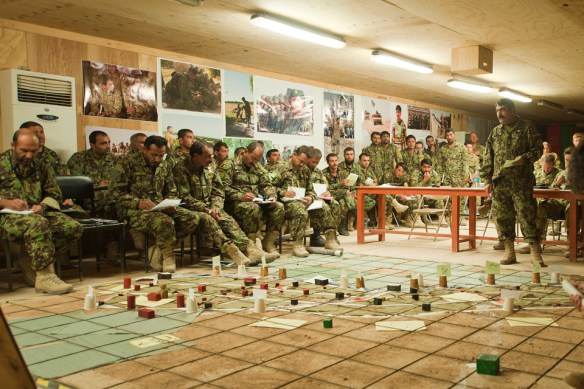
Afghan Warriors Tackle Insurgents in Huge Joint Operation with Scottish Troops

So far, then, so familiar.  But the passage with which I began is remarkable because the narrator – whose shaft is gripped by the officer’s hand, who hovers over the orange ribbon, who confesses to having done it all before – is the handle of a broken broom.  ‘My first purpose was to hold my head down against the ground as I brushed sand out of a small, dirty room,’ the chapter begins.  ‘In time, my head loosened and the nail then held it on pulled free.  Someone tried to push it back on, but my head swung round and fell off.  I was discarded.’

‘That would have been the end of me,’ the broom handle continues – ‘my head was burned with the rubbish’ – ‘but I was reinvented and became useful again.’

The novel tells the story of Captain Tom Barnes, a British army officer who steps on an IED while on patrol in Afghanistan; he is airlifted to the Role 3 hospital at Camp Bastion and then evacuated to Britain; he loses both his legs, the first to the effects of the blast and the second to infection.  And the narrative is reconstructed through the objects that are entangled in – and which also, in an extraordinarily powerful sense, animate – the events.

So, for example, a tourniquet:

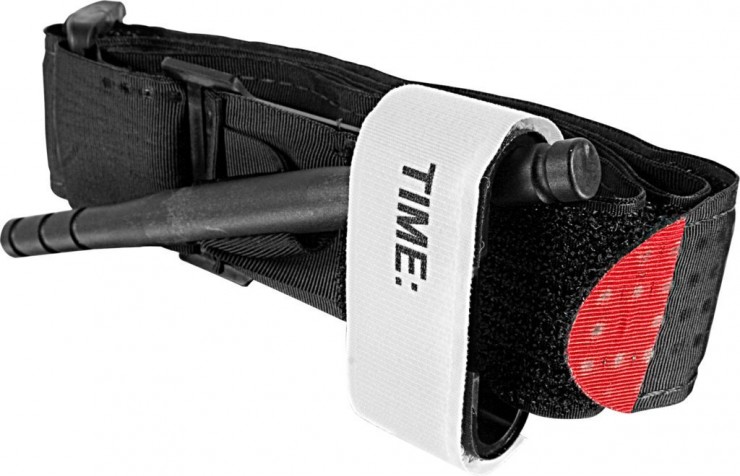
‘My serial number is 6545-01-522… A black marker wrote BA5799 O POS on me and I was placed in the left thigh pocket of BA5799’s combat trousers… At 0618 on 15 August, when I was sliding along BA5799’s thigh, I was lifted into the sky and turned over.  And suddenly I was in the light… I was pulled open by panicked fingers and covered in the thick liquid… I was wound tighter, gripping his thigh… I clung to him as we flew low across the fields and glinting irrigation ditches…’

CAT-Combat-Application-Tourniquet-740x476

The story is continued in and through other object-fragments.  On patrol, a boot; day-sack; helmet (‘My overhanging rim cut his vision as a black horizontal blur and my chinstrap bounced up against his stubble as he pounded onto each stride’); night vision goggles (‘My green light reflected off the glassy bulge of his retina’); a radio (‘His breathing deepened under the weight of the kit and condensation formed on the gauze of my microphone… I continued to play transmissions in BA5799’s ear as the other stations in the network pushed farther up the road’); an aerial photograph (‘He took me out and traced his finger across my surface… in the operations room a small blue sticker labelled B30 was moved across a map pinned to the wall.  That map was identical to me’); and his identity tags (‘I had dropped around your neck and my discs rested on the green canvas stretcher stained with your blood’).
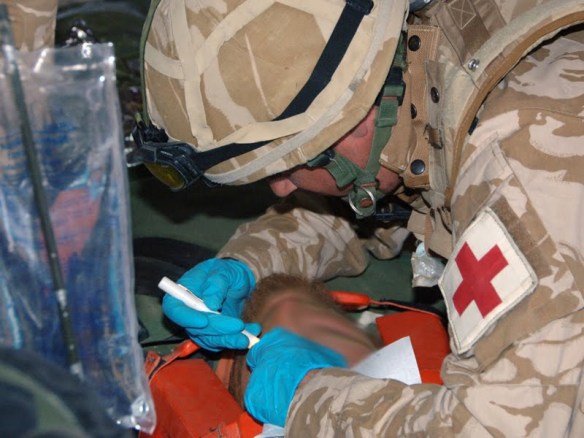
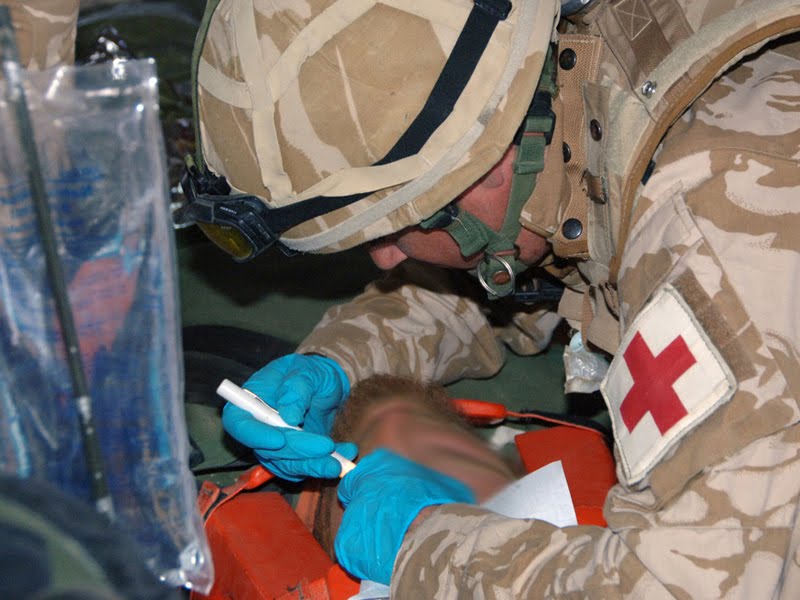
Medical care en route to Bastion

After the blast from the IED and a helicopter evacuation, the medical apparatus: a tube inserted into his throat at Camp Bastion’s trauma centre (‘I was part of a system now; I was inside you…’); a surgical saw (‘He held me like a weapon, and down at the end of my barrel was my flat stainless-steel blade… My blade-end cut through the bone, flashing splinters and dust from the thin trench I gouged out’); a plasma bag (‘I hung over you… I was empty; my plastic walls had collapsed together and red showed only around my seals.  The rest of the blood I’d carried since a young man donated it after a lecture, joking with a mate in the queue, was now in you’); a catheter; a wheelchair; his series of prosthetics (‘You pressed your stump into me and we became one for the first time… Slowly you outgrew all my parts and the man switched them over until I only existed as separate components in a cupboard and you’d progressed to a high-activity leg and a carbon-fibre socket’).

The agency of many of the objects is viscerally clear:

‘I lived in the soil.  My spores existed everywhere in the decomposing vegetable matter of the baked earth.  Something happened that meant I was suddenly inside you…  I was inside your leg, deep among flesh that was torn and churned.  I lived there for a week and wanted to take root, but it wasn’t easy… I struggled to survive.  Except they missed a small haematoma that had formed around a collection of mud in your calf…  You degraded and I survived… I made you feverish and feasted unseen on your insides…’

Or again, his first prosthetics:

‘You improved on me but you became thinner.  The pressure I exerted on you, and the weight you lost from the energy I used, made your stump shrink.  I could no longer support you properly.’

And the new ones:

‘Your hand caressed my grey surface and felt around the hydraulic piston under my knee joint… You’d been waiting for me but were nervous about what I might do for you…’

What is even more remarkable, as many of the passages I have quoted demonstrate, is that these events are narrated through objects that in all sorts of ways show how military violence reduces not only the ground but the human body to an object-space, perhaps nowhere more clearly than in this remark: ‘You were not a whole to them, just a wound to be closed or a level on a screen to monitor or a bag of blood to be changed.’  And yet: virtually every one of those passages is also impregnated with Barnes’s body: its feel – its very fleshiness – its sweat, its smell, its touch.
O'BRIEN The things they carriedI think this is an even more successful attempt to render the corporeality of war through its objects than Tim O’Brien‘s brilliant account of Vietnam in The Things They Carried (for more, see my post on ‘Boots on the Ground‘ and my essay on ‘The natures of war’: DOWNLOADS tab). This is, in part, because the narrative is not confined to those objects close to Barnes’ own body; it spirals far beyond them to include a drone providing close air support (‘I banked around the area and my sensor zoomed out again and I could see the enemy in relation to the soldiers who needed me’) and, significantly, extends to the components of the IED and the bodies of the insurgents who constructed and buried it.

There is a powerful moment when the two collide, when the father of a young insurgent killed in the drone strike wheels his son’s body to the patrol base:

‘The corpse was half in me, with my front end under it and my handles sticking up in the air.  He managed to push it farther into me and the distended head bounced off my metal side.  Dried blood showed around its ears and nose and was red in its mouth.  And then he pushed my handles down and I scooped it all up…  The corpse’s eyes had opened from the jolting and looked up at him.  He looked down into them, at his son’s face and the blue lips and purple blotching across his cheeks and he knew he had already accepted the loss.  He lowered my handles and smoothed the eyelids shut again.  He pushed me down the road.’

Barnes reaches for a compensation form, which takes up the story:

‘There was a leaflet that BA5799 had read tucked in the notebook next to me.  It described how to deal with this.  What to say, what not to say…  He was dealing with death in an alien culture and he had no idea how to relate to this man or the death of his son…  BA5799 wanted to feel compassion for this man and his dead son but only felt discomfort and the man’s eyes challenging him.  And all he cared about was getting back into the base and the loss of a potential asset in securing the area.’

All of these criss-crossing, triangulating lines capture not only the anatomy of a soldier but an anatomy of the war itself – at once calmly, coolly and shockingly abstract – in a word, objectified – and invasively, terrifyingly, ineluctably intimate.

***

Harry Parker (Ben Murphy photo)Postscript: You probably won’t be surprised to learn that Anatomy of a soldier is based on Harry Parker’s own experience.  Out on patrol with his men on 18 July 2009 in central Helmand he stepped on an IED; he lost his lower left leg in the blast and had his lower right leg amputated at Selly Oak Hospital in Birmingham (the major centre for advanced trauma care for the British military).  ‘‘Writing about the explosion felt good creatively,’ he told Christian House, ‘but also you’ve mined your personal experiences’ and the process left him ‘a sweaty mess’.  I’ve written about what Roy Scranton calls ‘the trauma hero‘ before, and so it’s important to add that Parker insists that the novel is not disguised autobiography: ‘I didn’t want to write, “I was in the Helmand valley.”’

One other note: at the AAG meeting in San Francisco next month Iain Shaw and Katherine Kindervater have organised a series of really interesting sessions on Objects of Security and War:

These sessions aim to bring together scholars working in the areas of war and security that are attentive to the materialities of contemporary violence and conflict. We are especially interested in work that seeks to place objects of security and war within a wider set of practices, assemblages, bodies, and histories. From drones and documents, to algorithms and atom bombs, the materiality of state power continues to anchor and disrupt the conduct and geography of (international) violence.

I’m part of those sessions – but reading Anatomy of a soldier has made me think about giving an altogether different presentation. I’ve long argued that we need to disrupt that lazy divide between ‘fact’ and ‘fiction’ and that literature is able to convey important truths that evade conventional academic prose (hence my unbounded admiration for Tom McCarthy‘s C, for example).  And Anatomy of a soldier convinces me that I’ll find more inspiration in novels like that than in whole libraries on object-oriented philosophy…
Targeted killings

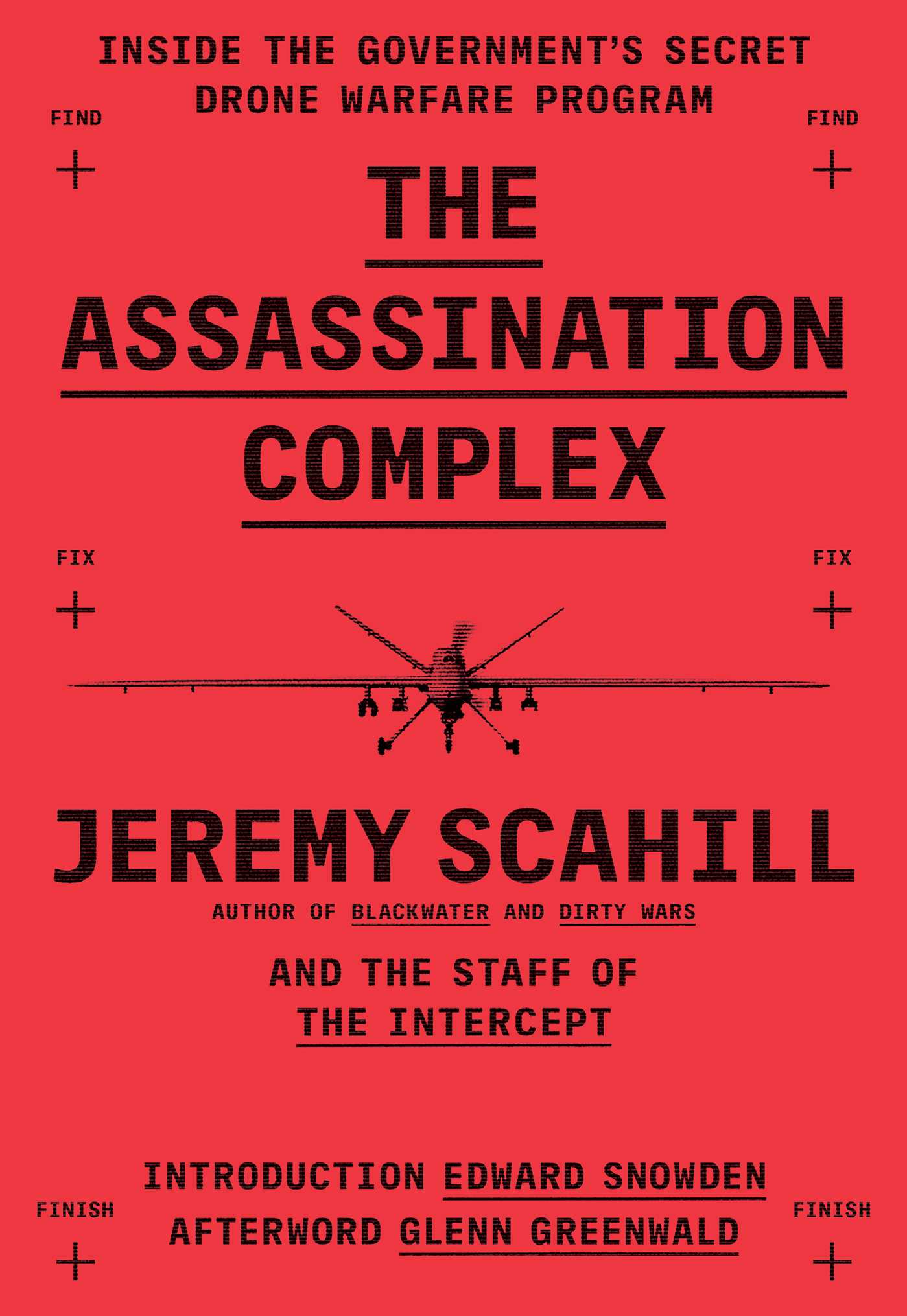
Coming from Simon and Schuster in May, a new book by Jeremy Scahill and his team at The InterceptThe Assassination Complex: Inside the Government’s Secret Drone Warfare Program.

the-assassination-complex-9781501144134_hrMajor revelations about the US government’s drone program—bestselling author Jeremy Scahill and his colleagues at the investigative website The Intercept expose stunning new details about America’s secret assassination policy.

When the US government discusses drone strikes publicly, it offers assurances that such operations are a more precise alternative to troops on the ground and are authorized only when an “imminent” threat is present and there is “near certainty” that the intended target will be killed. The implicit message on drone strikes from the Obama administration has been trust, but don’t verify.

The online magazine The Intercept exploded this secrecy when it obtained a cache of secret slides that provide a window into the inner workings of the US military’s kill/capture operations in Afghanistan, Yemen, and Somalia. Whether through the use of drones, night raids, or new platforms yet to be employed, these documents show assassination to be central to US counterterrorism policy.

The classified documents reveal that Washington’s fourteen-year targeted killing campaign suffers from an overreliance on flawed signals intelligence, an apparently incalculable civilian toll, and an inability to extract potentially valuable intelligence from terror suspects. This campaign, carried out by two presidents through four presidential terms, has been deliberately obscured from the public and insulated from democratic debate. The Assassination Complex allows us to understand at last the circumstances under which the US government grants itself the right to sentence individuals to death without the established checks and balances of arrest, trial, and appeal.

The book will include original contributions from Glenn Greenwald and Edward Snowden.

From NYU Press in July, a collection of essays edited by Kerstin Fisk and Jennifer Ramos that connects drone warfare to the Obama administration’s doctrine of ‘preventive force’ and the tangled legal armature that surrounds it: Preventive Force: Drones, Targeted Killing, and the Transformation of Contemporary Warfare.

Preventive ForceMore so than in the past, the US is now embracing the logic of preventive force: using military force to counter potential threats around the globe before they have fully materialized. While popular with individuals who seek to avoid too many “boots on the ground,” preventive force is controversial because of its potential for unnecessary collateral damage. Who decides what threats are ‘imminent’? Is there an international legal basis to kill or harm individuals who have a connection to that threat? Do the benefits of preventive force justify the costs? And, perhaps most importantly, is the US setting a dangerous international precedent?

In Preventive Force, editors Kerstin Fisk and Jennifer Ramos bring together legal scholars, political scientists, international relations scholars, and prominent defense specialists to examine these questions, whether in the context of full-scale preventive war or preventive drone strikes. In particular, the volume highlights preventive drones strikes, as they mark a complete transformation of how the US understands international norms regarding the use of force, and could potentially lead to a ‘slippery slope’ for the US and other nations in terms of engaging in preventive warfare as a matter of course. A comprehensive resource that speaks to the contours of preventive force as a security strategy as well as to the practical, legal, and ethical considerations of its implementation, Preventive Force is a useful guide for political scientists, international relations scholars, and policymakers who seek a thorough and current overview of this essential topic.

Contents are listed here.

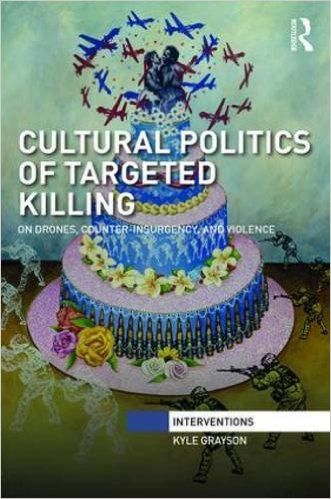
That same month comes the book I most want to read – but the eye-popping price from Routledge makes me wonder whether some mega-publishers see books as anything other than commodities.  It’s Kyle Grayson‘s Cultural Politics of Targeted Killing: On Drones, Counter-Insurgency, and Violence (hardcover only: madness).

GRAYSON Cultural politics of targeted killingThe deployment of remotely piloted air platforms (RPAs) – or drones – has become a defining feature of contemporary counter-insurgency operations. Scholarly analysis and public debate has primarily focused on two issues: the legality of targeted killing and whether the practice is effective at disrupting insurgency networks, and the intensive media and activist scrutiny of the policy processes through which targeted killing decisions have been made. While contributing to these ongoing discussions, this book aims to determine how targeted killing has become possible in contemporary counter-insurgency operations undertaken by liberal regimes.

Each chapter is oriented around a problematisation that has shaped the cultural politics of the targeted killing assemblage. Grayson argues that in order to understand how specific forms of violence become prevalent, it is important to determine how problematisations that enable them are shaped by a politico-cultural system in which culture operates in conjunction with technological, economic, governmental, and geostrategic elements. The book also demonstrates that the actors involved – what they may be attempting to achieve through the deployment of this form of violence, how they attempt to achieve it, and where they attempt to achieve it – are also shaped by culture.

The book demonstrates how the current social relations prevalent in liberal societies contain the potential for targeted killing as a normal rather than extraordinary practice.

Contents:

Chapter One: The Cultural Politics of the Targeted Killing Assemblage

Chapter Two: Beyond the Exception: The Legal Problematisation of Targeted Killing

Chapter Three: The Politics of Targeted Killing

Chapter Four: Science, Capitalism, and the RPA

Chapter Five: The Aesthetic Subjects of Targeted Killing

Chapter Six: The Quotidian Geopolitics of Targeted Killing Strikes

Chapter Seven: Concluding Remarks on the Cultural Politics of Targeted Killing

(Amazon says July, but the publisher says ‘2017’ so perhaps somebody in Taylor & Francis’s counting-house might have a serious think between now and publication; they clearly take ‘making a killing’ all too seriously).

Head in the Clouds

xa-prehistory-of-the-cloud.jpg.pagespeed.ic.MC3L6haZTGI’ve mentioned Tung-Hui Hu’s brilliant A Prehistory of the Cloud before: there’s now a wonderful interview with the author over at Rhizome (conducted by Jamie Sutcliffe).  Among many other plums, there’s a revealing history of the project itself and juggling the author’s identities as poet, network engineer, and professor of literature:

Until a year or two or ago, I tried very hard to keep these identities separate. The first academic paper I wrote when I was studying architecture was dismissed as an extended prose poem. From thenceforth it was very important for me to separate those lives. When I lived in Berkeley—across the bay from San Francisco—that was where I was an academic, and San Francisco was where I was a poet, and never should the two meet, right? But poetry is also a way of noticing patterns, of looking for events and images that rhyme or have associations. And maybe there is a kind of poetry in the juxtapositions of history: the place in the Utah desert where the telephone network is sabotaged is also the place where the artist group Ant Farm imagines a network out of truck stops; the bunker in Virginia built to house the US financial system in the event of a nuclear attack is now the place where the nation’s film reels are kept in cold storage.

Cloud computing

And there are extended riffs on the book’s central themes.  I particularly liked this one, in response to an artful question about Frederic Jameson‘s view of conspiracy as ‘a poor man’s cognitive mapping’:

I think conspiracy and paranoia are just what the cloud needs, if I can ascribe the cloud agency. The system works like a massive pyramid scheme—we all need to believe that it’s everywhere in order for it to be everywhere. I remember talking to someone who knew Facebook was a problem, but even she became annoyed when one of her friends left Facebook: “What do you mean you left Facebook, we’re all on it, we all agreed to be on it, so why do you get to opt out?” That’s the mechanism that the cloud employs; we assume that everybody is a user, that everybody is on it and freely engaged in these practices, and we feel personally offended when that’s not the case. Now, of course, the cloud isn’t everywhere, this is a particularly Western view and that’s why the book takes America as the prime example of this way of thinking. Americans think freedom means market freedom and the free movement of goods, and get violently offended when this is not the case. Our model is basically that if you’re not free, we will bomb you until you are free.

The idea of conspiracy, as Jameson tells us, is totalizing. That’s the idea of The Cloud, rather than the clouds; there is one cloud that we are all supposed to subscribe to. I think that’s the reason why paranoia about security is always part of the way that the cloud is produced, rather than unmasked or exposed. This is one reason why understanding some technical aspects of the cloud—the way it fails and doesn’t cover much territory—could change our image of it, away from one totalizing entity. Oddly enough, given my examples, the book’s goal is to get us away from simply talking about paranoia or even control, which is the dominant model now in new media studies. My problem with the “control society” model is that not only is it totalizing in the way that the cloud is totalizing, but it distracts us in some ways from looking at the real violence that’s been happening all along, so that if we start thinking about gadgets and the way that life is optimized and produced, then we forget the flip-side of that, which is the way that death is also meted out.

‘Something more interesting than the mechanics of bombing’

AGodInRuins

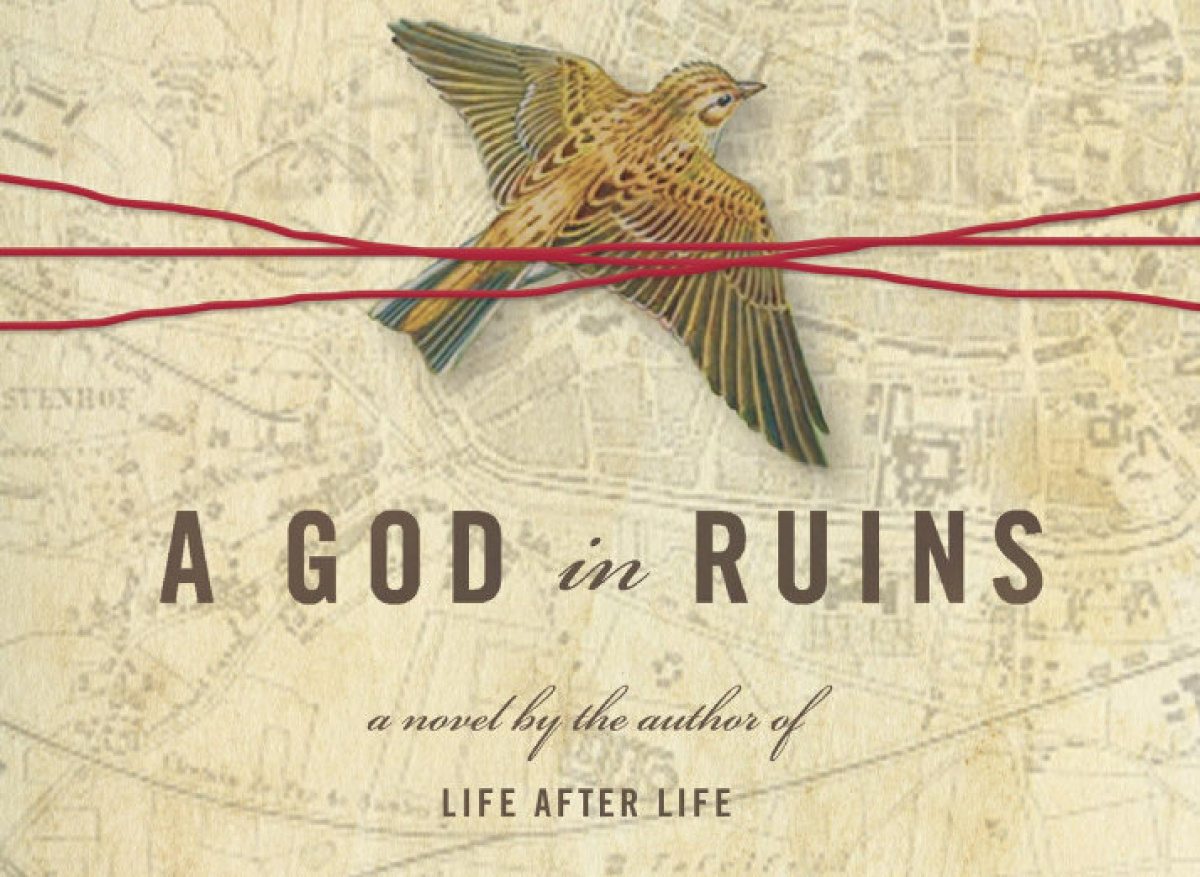
While I was in Cambridge, I managed to start Kate Atkinson‘s extraordinary novel, A god in ruins, and I’ve just finished it. It centres on the life of a bomber pilot during the Second War War, but it starts much earlier and ends around 2012 – and while its focus is on ‘Teddy’s War’ (it’s a companion to her earlier novel Life after Life (2013), with its unforgettable rendering of the Blitz, and it comes with a research bibliography), it’s about much more than that. In fact, a common refrain is ‘Let’s talk about something more interesting than the mechanics of bombing’ – though Atkinson handles those superbly well too. The best – and most affecting – novel I’ve read in an age. It’s not so much the scenes from inside Teddy’s Halifax that haunt me, brilliant though they are, or even the dilemma that lies at the heart of the novel – ‘killing people from twenty thousand feet up in the sky’ or killing a single, solitary soul – as the way in which Atkinson renders Teddy’s own death. She does so in exquisite, vivid, illuminating prose, and manages to leave a mesmerising ambiguity: as the walls close in and crash down one by one, is Teddy remembering – re-living – in the darkening present or dying in the incandescent past, ‘a blaze of light in the dark’?

Another Manhattan Project

I still regard Postmodern geographies as Ed Soja‘s finest book – his most considered and his most creative – and within that his essay on ‘Taking Los Angeles Apart‘ is surely the stand-out contribution.  By turns playful and passionate, it’s packed with insights about Los Angeles and late modern cities.  I discussed it at length in Geographical imaginations – the book not the blog – but the essay has come back to haunt me ever since I learned of an extraordinary new book which I know Ed would have read with the greatest interest.

KISHIK The Manhattan Project

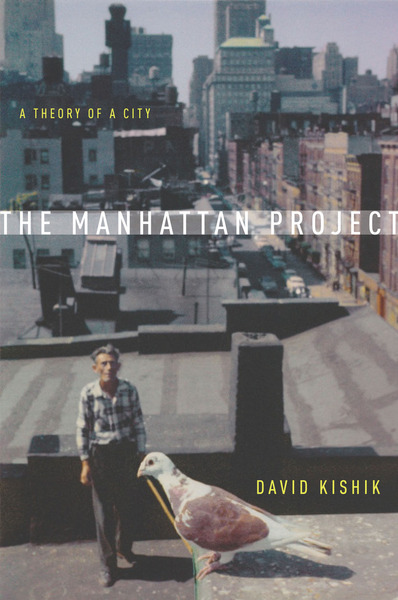
It’s David Kishik‘s The Manhattan Project, which I stumbled across because of its title and my new-found interest in seeing drones through post-atomic eyes.  But it’s not about that Manhattan Project at all.  Instead, it riffs on Benjamin’s Arcades Project in the most astonishing of ways:

In The Manhattan Project, David Kishik dares to imagine a Walter Benjamin who did not commit suicide in 1940, but managed instead to escape the Nazis to begin a long, solitary life in New York. During his anonymous, posthumous existence, while he was haunting and haunted by his new city, Benjamin composed a sequel to his Arcades Project. Just as his incomplete masterpiece revolved around Paris, capital of the nineteenth century, this spectral text was dedicated to New York, capital of the twentieth. Kishik’s sui generis work of experimental scholarship or fictional philosophy is thus presented as a study of a manuscript that was never written.

The fictitious prolongation of Benjamin’s life will raise more than one eyebrow, but the wit, breadth, and incisiveness of Kishik’s own writing is bound to impress. Kishik reveals a world of secret affinities between New York City and Paris, the flâneur and the homeless person, the collector and the hoarder, the covered arcade and the bare street, but also between photography and graffiti, pragmatism and minimalism, Andy Warhol and Robert Moses, Hannah Arendt and Jane Jacobs. A critical celebration of New York City, The Manhattan Project reshapes our perception of urban life, and rethinks our very conception of modernity.

Another good friend who is sadly no longer with us, Allan Pred, would surely have relished that too. I’m sure Ed would have insisted that Benjamin would never have gone to New York and that, in common with Adorno, he would have sought refuge in L.A. (where else? In fact Adorno left New York for LA, though it’s impossible to think of Ed calling that ‘exile’).

You can read the Introduction to The Manhattan Project here and an extract from the first chapter here; there’s also an extended interview with David about the project here.

Finally, there’s an excellent review by Dustin Illingworth at The Brooklyn Rail here.  When Dustin says this –

Like Borges’s “Aleph,” New York is “the place where, without admixture or confusion, all the places of the world, seen from every angle, coexist.” It is therefore much to Kishik’s credit that his slim volume, a drop in the vast ocean of literature on the city, packs such a considerable theoretical punch.

– then we are back with Ed Soja’s essay, which also began with an appeal to The Aleph and also packed a considerable theoretical punch.

Collateral damage

A gracious note from Antipode prompts me to add that today is also a day to remember the countless others who are victims of war and military/paramilitary violence.  And so to a new book due at the end of the month from Frederik RosénCollateral Damage: a candid history of a peculiar form of death (Hurst/Oxford University Press):

ROSEN Collateral damageThe dilemmas precipitated by the unintentional killing of civilians in war, or ‘collateral damage’, shape many aspects of military conduct, yet noticeable by its absence has been a methodical examination of the place and role of this phenomenon in modern warfare. This book offers a fresh perspective on a distressing consequence of conflict.

Rosén explains how collateral damage is linked to ideas of authority, thereby anchoring it to the existential riddles of our individual and collective lives, and that this peculiar form of death constitutes an image of what it means to be human.

His investigation of collateral damage is notable too for how the death of non-combatants sheds light on some of today’s critical challenges to war and global governance, such as the growing role of non-state actors, mercenary contractors and the impact of military privatization.

In the ethical realm those who successfully prove that collateral damage has occurred also enter the debate about which institutions may exert authority and thus how a truly decentralized world might be organized. This is why the in many ways underrepresented victims of collateral damage appear on closer inspection to have experienced a most significant form of death.

Contents:

Introduction
1. The Third Category of Death
2. Urban Warfare and Collateral Damage
3. Collateral Damage and the Question of Legal Responsibility
4. Collateral Damage and Compensation
5. Lifting the Fog of War and Collateral Damage
6. How Bad Can Be Good
7. A Death Without Sacrifice
8. Collateral Damage or Accident?
9. A Private Call for Collateral Damage?
10. A Place Between it All

This is a good moment to remember Patricia Owens’ classic and still vitally important essay, ‘Accidents don’t just happen: the liberal politics of high-technology “humanitarian” war’, Millennium 32 (3) (2003) 596-616, and to reflect on what is surely a classic-in-the-making: Emily Gilbert‘s brilliant new essay, ‘The gift of war: cash, counterinsurgency and “collateral damage”‘, Security dialogue (online early).

Then there is the intentional killing of civilians in war….

Spaces of Danger

Spaces of Danger

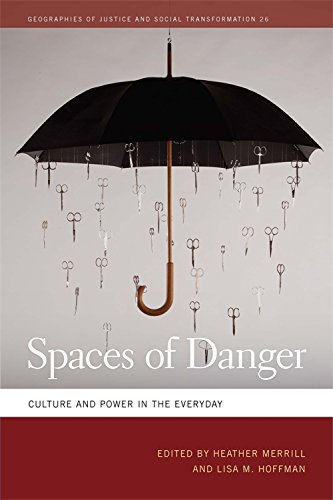
On the same day I heard the news of Ed Soja‘s untimely death I received my copy of Spaces of Danger: culture and power in the everyday, a volume in the University of Georgia Press’s Geographies of Justice and Social Transformation series.  It’s a collection of essays edited by Heather Merrill and Lisa Hoffman: all of the contributors have been inspired by the work of another friend who I also miss very much, Allan Pred.

These twelve original essays by geographers and anthropologists offer a deep critical understanding of Allan Pred’s pathbreaking and eclectic cultural Marxist approach, with a focus on his concept of “situated ignorance”: the production and reproduction of power and inequality by regimes of truth through strategically deployed misinformation, diversions, and silences. As the essays expose the cultural and material circumstances in which situated ignorance persists, they also add a previously underexplored spatial dimension to Walter Benjamin’s idea of “moments of danger.”

The volume invokes the aftermath of the July 2011 attacks by far-right activist Anders Breivik in Norway, who ambushed a Labor Party youth gathering and bombed a government building, killing and injuring many. Breivik had publicly and forthrightly declared war against an array of liberal attitudes he saw threatening Western civilization. However, as politicians and journalists interpreted these events for mass consumption, a narrative quickly emerged that painted Breivik as a lone madman and steered the discourse away from analysis of the resurgent right-wing racisms and nationalisms in which he was immersed.

The Breivik case is merely one of the most visible recent examples, say editors Heather Merrill and Lisa Hoffman, of the unchallenged production of knowledge in the public sphere. In essays that range widely in topic and setting—for example, brownfield development in China, a Holocaust memorial in Germany, an art gallery exhibit in South Africa—this volume peels back layers of “situated practices and their associated meaning and power relations.” Spaces of Danger offers analytical and conceptual tools of a Predian approach to interrogate the taken-for-granted and make visible and legible that which is silenced.

Contents:

1 Introduction: Making sense of our contemporary moment of danger

PART ONE: CRITICAL SPATIALITY

Trevor Paglen: Angelus Novus (from back)

2 Katharyne Mitchell: It’s TIME: The cultural politics of memory in the current moment of danger

3 Gunnar Olsson: Skinning the Skinning

PART TWO: SITUATED PRACTICES

Trevor Paglen: From Allan’s notes on Benjamin

4 Gillian Hart: Exposing the Nationa: entanglements of race, sexuality and gender in post-apartheid nationalism

5 Heather Merrill: In other for(l)ds: situated intersectionality in Italy

6 Damani Partridge: Monumental memory, moral superiority, and contemporary disconnects: racisms and noncitizen in Europe, then and now

PART THREE: THE URBAN AND THE SPECTACULAR

Trevor Paglen: From Allan’s notes on Benjamin

7 Richard Walker: The city and economic geography: then and now

8 Shiloh Krupar: Situated spectacle: cross-sectional soil hermeneutics of the Shanghai 2010 World Expo

PART FOUR: HISTORICAL GEOGRAPHIES OF THE PRESENT

Trevor Paglen: Angelus Novus

9 Michael Watts  Insurgent Spaces: power, place and spectacle in Nigeria

10 Nancy Postero: Even in plurinational Bolivia: indignity, development and racism since Morales

11 Derek Gregory: Moving targets and violent geographies

PART FIVE: BIOGRAPHICAL MONTAGE OF THE PRESENT

12 Cindi Katz: A Bronx chronicle

There’s also a warm and exquisitely written Foreword by Paul Rabinow, who co-taught a graduate course with Allan at Berkeley, which ends like this:

‘Dame Fortune smiled on me when she sent Allan Pred my way.  I am forever in her debt.  The glimmers of hope in these dark times continue to emanate from those rare friends, not just their magnificent work, but the way they lived – the way they patiently, unobtrusively, daringly and thoughtfully taught us how to live.’

The stunning cover image, Travelers, is by Allan’s hyper-talented daughter Michele: it shows scissors confiscated at US airports and now suspended under a vast umbrella.  Spaces of Danger indeed.

“I’ve looked at clouds from both sides now…”

Eyal Weizman‘s stunning Wall Exchange, “Forensic Architecture”, which he presented at the Vogue Theatre in Vancouver earlier this month, is now up on YouTube here and embedded below.

https://www.youtube.com/watch?v=qBDWPn7QcIg

If you are puzzled by my riff on Joni Mitchell, start around 46:10 (though you’ll miss a lot if you do…).

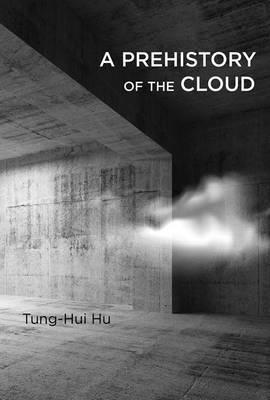
And while we’re on the subject of clouds, you’ll find a remarkable analysis of a different sort of militarized cloud in Tung-Hui Hu‘s A Prehistory of the Cloud from MIT:

We may imagine the digital cloud as placeless, mute, ethereal, and unmediated. Yet the reality of the cloud is embodied in thousands of massive data centers, any one of which can use as much electricity as a midsized town. Even all these data centers are only one small part of the cloud. Behind that cloud-shaped icon on our screens is a whole universe of technologies and cultural norms, all working to keep us from noticing their existence. In this book, Tung-Hui Hu examines the gap between the real and the virtual in our understanding of the cloud.

Hu shows that the cloud grew out of such older networks as railroad tracks, sewer lines, and television circuits. He describes key moments in the prehistory of the cloud, from the game “Spacewar” as exemplar of time-sharing computers to Cold War bunkers that were later reused as data centers. Countering the popular perception of a new “cloudlike” political power that is dispersed and immaterial, Hu argues that the cloud grafts digital technologies onto older ways of exerting power over a population. But because we invest the cloud with cultural fantasies about security and participation, we fail to recognize its militarized origins and ideology. Moving between the materiality of the technology itself and its cultural rhetoric, Hu’s account offers a set of new tools for rethinking the contemporary digital environment.

Prehistory of the Cloud

Here is Lisa Parks on what is surely one of the must-reads of the year:

“Hu’s riveting genealogy of the cloud takes us into its precursors and politics, and boldly demonstrates how fantasies of sovereignty, security, and participation are bound up in it. Much more than a data center, the cloud is a diffuse and invisible structure of power that has yielded a data-centric order. Imaginative and lucidly written, this book will be core to digital media studies.”

“What is that sound high in the air?”

Coming from MIT in April next year, a new book by the ever-creative anthropologist Hugh Gusterson, Drone: remote control warfare.

GUSTERSON DroneDrones are changing the conduct of war. Deployed at presidential discretion, they can be used in regular war zones or to kill people in such countries as Yemen and Somalia, where the United States is not officially at war. Advocates say that drones are more precise than conventional bombers, allowing warfare with minimal civilian deaths while keeping American pilots out of harm’s way. Critics say that drones are cowardly and that they often kill innocent civilians while terrorizing entire villages on the ground. In this book, Hugh Gusterson explores the significance of drone warfare from multiple perspectives, drawing on accounts by drone operators, victims of drone attacks, anti-drone activists, human rights activists, international lawyers, journalists, military thinkers, and academic experts.

Gusterson examines the way drone warfare has created commuter warriors and redefined the space of the battlefield. He looks at the paradoxical mix of closeness and distance involved in remote killing: is it easier than killing someone on the physical battlefield if you have to watch onscreen? He suggests a new way of understanding the debate over civilian casualties of drone attacks. He maps “ethical slippage” over time in the Obama administration’s targeting practices. And he contrasts Obama administration officials’ legal justification of drone attacks with arguments by international lawyers and NGOs.

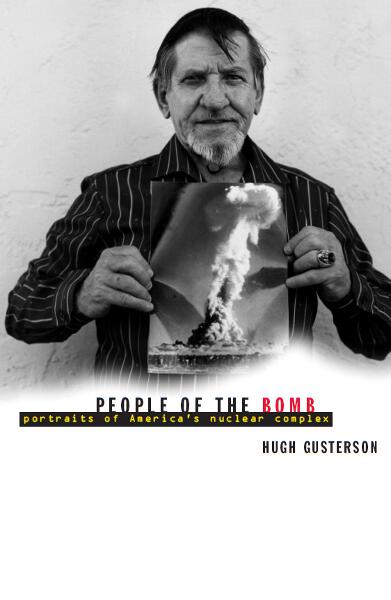
People of the bombI met Hugh at a conference on Orientalism and War in Oxford several years ago, and I’ve recently been reading his Nuclear Rites: a weapons laboratory and the end of the Cold War and People of the Bomb: Portraits of America’s Nuclear Complex as I continue my wanderings through the nuclear wastelands.

The coincidence between Hugh’s previous projects and his new one intersects with my presentation on “Little Boys and Blue Skies” in Toronto last week – see here and here – which sketched out a series of entanglements between drones and the nuclear wastelands (hence the Eliot quotation which serves as my title for this post).