Asymmetric law

1425285643_9e0a120e-3716-468a-ba00-e976b29db2851421848906

Breaking the Silence has just published a major report into the Israeli military’s tactics during its most recent offensive against Gaza and its people, so-called ‘Operation Protective Edge’ (see my posts herehere, here and here).

Based on interviews with 65 IDF soldiers, the report includes Background, Testimonies (‘This is how we fought in Gaza‘), and a media gallery.

Writing in today’s Guardian, Peter Beaumont reports:

Describing the rules that meant life and death in Gaza during the 50-day war – a conflict in which 2,200 Palestinians were killed – the interviews shed light for the first time not only on what individual soldiers were told but on the doctrine informing the operation.

Despite the insistence of Israeli leaders that it took all necessary precautions to protect civilians, the interviews provide a very different picture. They suggest that an overarching priority was the minimisation of Israeli military casualties even at the risk of Palestinian civilians being harmed….

Post-conflict briefings to soldiers suggest that the high death toll and destruction were treated as “achievements” by officers who judged the attrition would keep Gaza “quiet for five years”.

The tone, according to one sergeant, was set before the ground offensive into Gaza that began on 17 July last year in pre-combat briefings that preceded the entry of six reinforced brigades into Gaza.

“[It] took place during training at Tze’elim, before entering Gaza, with the commander of the armoured battalion to which we were assigned,” recalled a sergeant, one of dozens of Israeli soldiers who have described how the war was fought last summer in the coastal strip.

“[The commander] said: ‘We don’t take risks. We do not spare ammo. We unload, we use as much as possible.’”

“The rules of engagement [were] pretty identical,” added another sergeant who served in a mechanised infantry unit in Deir al-Balah. “Anything inside [the Gaza Strip] is a threat.  The area has to be ‘sterilised,’ empty of people – and if we don’t see someone waving a white flag, screaming: “I give up” or something – then he’s a threat and there’s authorisation to open fire … The saying was: ‘There’s no such thing there as a person who is uninvolved.’ In that situation, anyone there is involved.”

“The rules of engagement for soldiers advancing on the ground were: open fire, open fire everywhere, first thing when you go in,” recalled another soldier who served during the ground operation in Gaza City. The assumption being that the moment we went in [to the Gaza Strip], anyone who dared poke his head out was a terrorist.”

1425285424_2bdb2aee-c3f8-4679-a375-d6682afb701a1421848849

You can find an impassioned, detailed commentary on the report by Neve Gordon – who provides vital context, not least about the asymmetric ethics pursued by supposedly ‘the most ethical army in the world’ – over at the London Review of Books here, and a shorter commentary by Kevin Jon Heller at Opinio Juris here.  Kevin notes:

The soldiers’ descriptions are disturbingly reminiscent of the notorious “free fire” zones in Vietnam and the US government’s well-documented (and erroneous) belief that signature strikes directed against “military-age men in an area of known terrorist activity” comply with IHL’s principle of distinction. The testimonials are, in a word, stunning — and put the lie to oft-repeated shibboleths about the IDF being “the most moral army in the world.” As ever, the stories told by the IDF and the Israeli government are contradicted by the soldiers who actually have to do the killing and dying.

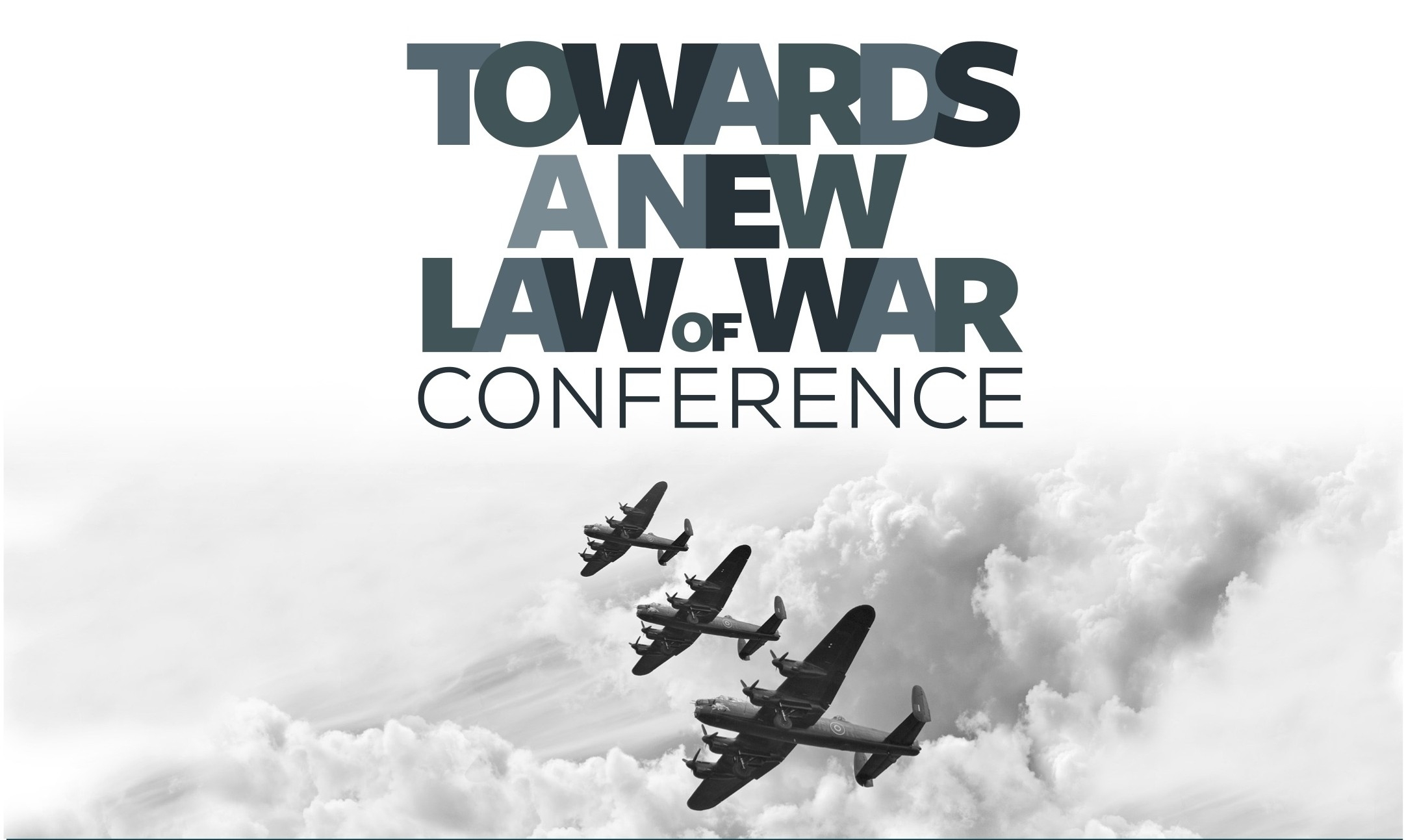
The legal and ethical framework pursued by the Israeli military – and ‘pursued’ is the mot (in)juste, since its approach to international law and ethics is one of aggressive intervention – is in full view at a conference to be held in Jerusalem this week: ‘Towards a New Law of War‘.
poster-A2_3-2480x35071-e1427212477619-2164x1293

‘The goal of the law of war conference,’ say the organisers, ‘is to influence the direction of legal discourse concerning issues critical to Israel and her ability to defend herself. The law of war is mainly unwritten and develops on the basis of state practice.’

You can find the full program here, dominated by speakers from Israel and the US, but notice in particular the session on ‘Proportionality: Crossing the line on civilian casualties‘:

CIvilian Casualties

As this makes clear, and as Ben White reports in the Middle East Monitor, law has become the target (see also my post here):

After ‘Operation Cast Lead’, Daniel Reisner, former head of the international law division (ILD) in the Military Advocate General’s Office, was frank about how he hoped things would progress.

If you do something for long enough, the world will accept it. The whole of international law is now based on the notion that an act that is forbidden today becomes permissible if executed by enough countries….International law progresses through violations.

Similarly, in a “moral evaluation” of the 2008/’09 Gaza massacre, Asa Kasher, author of the IDF’s ‘Code of Ethics’, expressed his hope that “our doctrine” will ultimately “be incorporated into customary international law.” How?

The more often Western states apply principles that originated in Israel to their own non-traditional conflicts in places like Afghanistan and Iraq, then the greater the chance these principles have of becoming a valuable part of international law.

Now Israel’s strategy becomes clearer… Israel’s assault on the laws of war takes aim at the core, guiding principles in IHL – precaution, distinction, and proportionality – in order to strip them of their intended purpose: the protection of civilians during armed conflict. If successful, the victims of this assault will be in the Occupied West Bank and Gaza Strip, Lebanon – and in occupations and war zones around the world.
Journeys from No Man’s Land

Stretcher-bearers

I’ve agreed to join a panel organised by Noam Leshem on Remnants of No Man’s Land: history, theory and excess at the Annual Meeting of the Association of American Geographers in Chicago next April (I imagine this is a follow-up to the session at the RGS/IBG in September).

The no-man’s lands of the First World War were never limited to the killing fields between the trenches. Their impact was never fully confined by the time and space of the battles: it lingered on the bodies of soldiers, in contaminated ecologies and in the radically altered post-war intellectual landscape. The violence that is unleashed in the no-man’s land and the destruction it wrought does not result in emptiness, in a terra nullius, but in excess that can never be fully contained.

This session invites additional reflections on the excessive quality of no-man’s land: its materialities, ecologies, cultural expressions and political-ideological articulations. It aims to deepen the theoretical import and conceptual power of ‘no-man’s land’, and move beyond its use as merely a convenient colloquialism. Similarly, we seek to engagements with other histories of no-man’s lands that are not solely confined to the Western Front during WWI.

LOBLEY Dugouts in the embankment near Le Cateau

Despite that last sentence, this is what I’ve come up with; these abstracts are always promissory notes, of course, written so far in advance that they can provide little real indication of what eventually transpires.  Fortunately we are now no longer lumbered with the Yellow Pages-style book of abstracts so I doubt anybody will actually read this on the day.  But here goes:

Journeys From No Man’s Land, 1914-1918

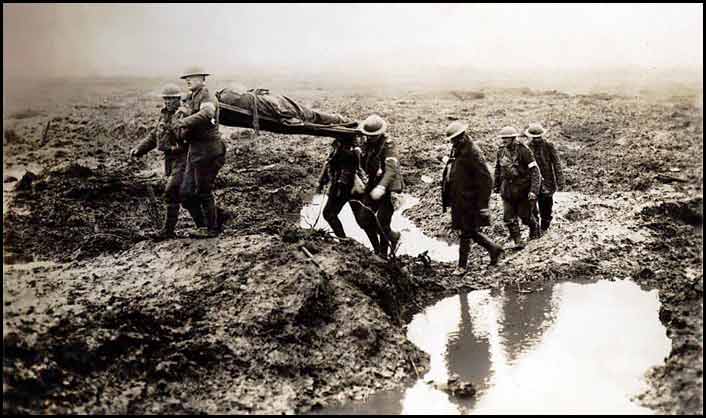
During the First World War on the Western Front a central logistical preoccupation of military planners was the deployment of troops to the front line and the evacuation of casualties from the battlefield. These priorities were closely connected – the aim was to provide medical treatment as close to the site of the wound as possible so that troops could be returned expeditiously to the line – but they also often confounded one another as hospital trains headed for the coast were shunted into sidings to allow troop trains to move up. In this presentation I address three questions. First, what it was possible to know about the ‘lie of the land’, particularly in the deadly spaces between the front-line trenches? Here I focus on the connections between aerial reconnaissance, night patrols and trench maps. A second question concerns the arrangements made in advance of major offensives – the disposition of stretcher bearers and aid posts, field ambulances and casualty clearing stations – and the ways in which these visible geometries of the medical-military machine affected the sensibilities of soldiers waiting to go ‘over the top’. Finally, how did the wounded apprehend and navigate No Man’s Land, and how did they make what Emily Mayhew calls their precarious journeys away from the fighting?

There’ll be more posts on this as I circle in towards the presentation.  It’s part of my new research project which explores military-medical machines and the casualties of war 1914-2014, but which is now widening to include other aspects of medical care in contemporary conflict zones like Gaza and Iraq/Syria and the militarisation of medical intervention in West Africa.

Alternate spaces of war 1914-2014

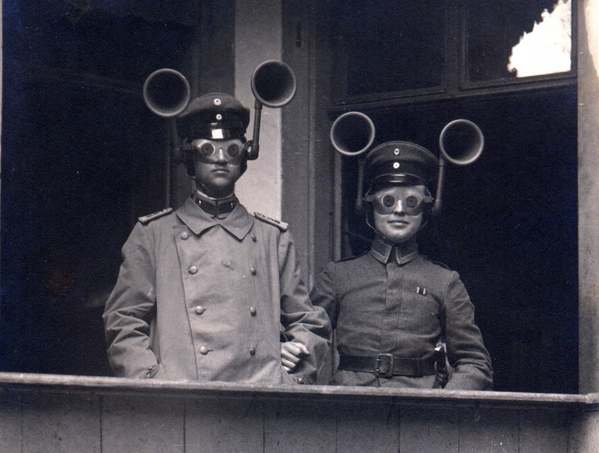
German 'sound radar' 1917

Via the War & Media Network, news of an international, interdisciplinary conference on ‘Alternate spaces of war, 1914 to the present’, to be held at Plymouth University (I think) in the UK, 6-7 July 2015.

The aim is ‘to investigate alternate spaces of war and identify new ways of understanding the experience of conflict in the modern world’:

‘This event will be organised as a part of the AHRC funded ‘Alternate Spaces’ Network set up in 2014. By expanding the timescale of the project to include the last century we are seeking to develop the ideas and outcomes of the initial network project to further investigate the legacy of the First World War in contemporary society.’

Keynote speakers:  Stephen Badsey (University of Wolverhampton); Krista Cowman (University of Lincoln); Martin Hurcombe (University of Bristol); and Mary Brewer (University of Loughborough)

Possible topics include:

Alternate viewings of the Western Front

Alternate Theatres of World War

Global implications of local conflicts since 1914

Civilians’ experience of war

Internment

Domestic Spaces in Wartime

Colonial spaces

Children’s experience of war

War in 21st Century

Literary representations of war

War and life writings

Visual cultures of war

Abstracts (2-300 words) plus a short bio (100 words) should be sent by 5 January 2015 to Angela K. Smith (aksmith@plymouth.ac.uk), Sandra Barkhof (Sandra.barkhof@plymouth.ac.uk) and Cherry Walsh (cherry.walsh@plymouth.ac.uk)

International Conference of Critical Geography in Ramallah, 2015

cropped-iccg2015-logo_web_2

7th International Conference of Critical Geography, ‘Precarious Radicalism On Shifting Grounds: Towards a Politics of Possibility’ in Ramallah, Palestine, 26-30 July 2015.

The sense of revolutionary times triggered by recent events such as the Greek revolts, the Indignados and Occupy movements, as well as the Arab uprisings and the Idle No More protests in Canada, has been gradually overshadowed by a wave of virulent and violent responses by both state and global powers. Although these and other struggles have captured our imagination, an anxious feeling of being in a permanent state of crisis seems to have taken over as we observe an increase in and normalization of socio-economic and spatial inequalities and political repression against the population. This regression, which takes the form of a rise on authoritarianisms, revanchists’ responses, encroachment of fundamental rights, precarity of subsistence, social relations, employment, or the consolidation of populist right wing and fundamentalist movements, is to a large extent eclipsing and undermining the political space and fundamental work of individuals, communities and movements around the world. It certainly is a precarious time for radicalism. This grim landscape inevitably raises crucial questions about the current moment and its prospects. Are we witnessing and experiencing a fundamental historical shift? If so, how are we to interpret this transition? Or can these times be transformed into a moment of political possibility by reconsidering and/or expanding existing paradigms as well as by reconnecting solidarities and struggles?

The aim of the 7th International Conference of Critical Geography (ICCG 2015) is to provide an inclusive venue for the discussion of these and other themes that examine the geographies of critical social theory and progressive political praxis. Despite the significance of the issues at stake, we hope to create a fun, engaging and friendly atmosphere that welcomes a wide array of scholars, activists, artists, organizers and others interested in critical socio-spatial praxis. The conference will be held in Palestine, a rich context for critical geographers and others to observe first hand, learn about, and engage with the human, political and economic geographies resulting from more than a century of European settler colonialism and US imperialism. Palestine is however much more than the ‘object’ of imperial, colonial and capitalist forces. It is a place that stands at the heart of the recent Arab uprisings as an inspiration drive to the popular struggles that have profoundly shaken the Arab World and beyond in ways yet difficult to anticipate. Palestine will undoubtedly be an ideal site from where to pursue the mission and commitment set forth in the ICCG’s statement of purpose – that is “developing the theory and practice necessary for combating social exploitation and oppression”.

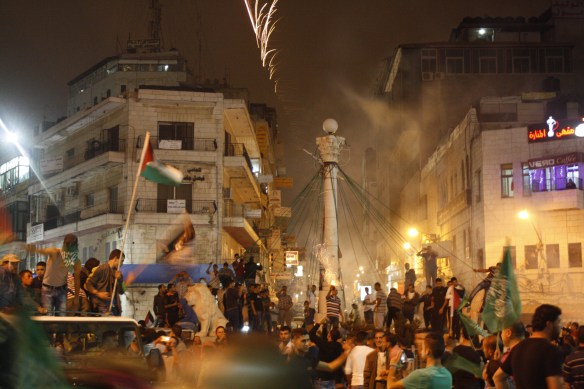
Ramallah

Deadline for submissions is 1st December 2014. We invite you to submit paper abstracts and encourage proposals for populated panels, roundtable discussions, or sessions with alternative formats that address the proposed conference themes. As indicated in the application form, we ask that you include (a) information on which conference theme your panel or paper addresses; (b) title of your paper or session; (c) a brief bio (max. 100 words) of each participant with contact information, institutional affiliation, and any titles you would like placed in the program; (d) an abstract (max 500 words). Please take into consideration that proposed activities should fit into the 90-minutes time-slots.  Full details here.  Space is limited to 250 participants.

Conference themes:

1 | Imperial, Colonial, Postcolonial and Anti-colonial geographies

2 | Articulations and spaces of capitalism

3 | Migration, Mobility and Displacement

4 | Nature, Society and Environmental Change

5 | Mapping Bodies, Corporeality and Violence

6 | Critical “Development” Geographies: perspectives from the Global South

7 | Geography and matter / materiality

8 | Remaking Space through Ideology, Culture, and Arts

9 | Knowledge Production, Education and Epistemic Agendas

The conference complies with the Palestinian Call for the Academic and Cultural Boycott of Israel.

War cultures

929px-William_Orpen_-_Zonnebeke_-_Google_Art_Project

The British Academy is holding a two-day Landmark Conference in London on 12-13 November 2014, The First World War: Literature, Culture, Modernity.  The conference is convened by Santanu Das and  Kate McLoughlin:

A hundred years after the war’s outbreak, this conference brings together some of the world’s leading experts and emerging scholars to reassess its literary and cultural impact and explore its vexed relationship to modernity. Was the war a ‘crack in the table of history’ or did it reinforce deep continuities? What is the relationship between artistic form and historical violence, and between combatant and civilian creative responses? What are the colonial and transnational dimensions of First World War literature? Spanning across literature, the visual arts and music, the conference will adopt an international perspective as it investigates the war’s continuing legacies.

Registration is required; full details here.

In association with the conference, there will be an evening of music and readings at King’s College Chapel (London) on 11 November, Terrible Beauty: Music and Writing of the First World War, and an evening of poetry reading at the British Academy on 12 November, The Past Hovering: An Evening of War Poetry; both events are free but registration is required.

War, travel, travel writing

What got me in to the work on war that has preoccupied me for the last ten years or more was an interest in travel and travel-writing.  I spent several years on European and American travellers to Egypt in the long nineteenth century between the Napoleonic invasion of 1798 and the First World War.  Inspired by Edward Said‘s Orientalism, I wanted to move the discussion away from the canonical texts that had caught Said’s attention to more mundane diaries, travel writings and guide books, together with sketches, paintings and photographs, made by travellers and tourists as they struggled to find the terms for a culture and a landscape for which most of them had no terms.  I was particularly concerned to move beyond the texts and to think about the bodily encounters,  changing transactions and material landscapes that emerged in the course of a ‘scripting’ of Egypt for modern tourism.

My original intention was to bring all this together in a book to be called Dancing on the Pyramids, and one bright September morning, on the brink of a rare sabbatical leave, I was at last ready to write.  I switched on the TV and watched a plane fly into the World Trade Center.  In the days and weeks that followed, it seemed impossible to seek refuge in past: and yet, as I watched events unfold, I realised that many of the formations that I had identified in the nineteenth century were being reactivated in the shadows of 9/11, in the United States and in Britain, and in Afghanistan, Palestine and Iraq.  That journey produced The colonial present and, while I’m still determined to return to Dancing one day, I simply haven’t been able to leave war (past and present) alone.

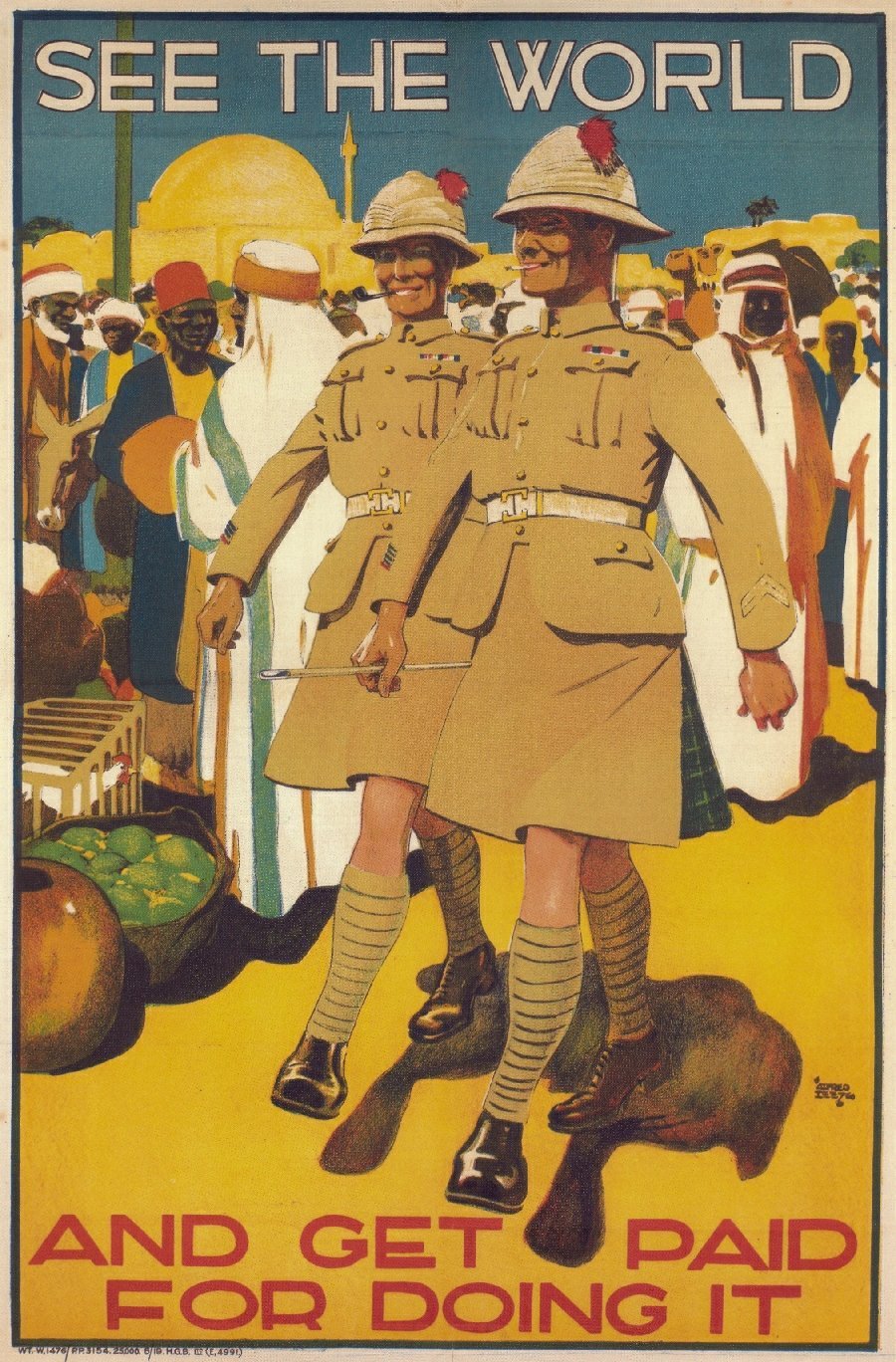
see-world

So I was particularly interested to receive via the war @ media network, hard on the heels of my last post, news of an interdisciplinary conference at the University of East Anglia on 29 November 2014 on War, travel and travel writing:

Some of the oldest Western texts – Homer’s epics or Herodotus’s Histories – combine the experience of war with encountering foreign people and places. For combatants, the protracted nostos, or homecoming, is as much part of war as was the journey to a faraway battlefield. For civilians, deportation, evacuation, expulsion and displacement are often deeply traumatic. For those observing military conflict, travelling through a war zone can be exhausting, exhilarating or exasperating. For those merely travelling around or above it, it can be just as fatal as we have seen in regards to MH017. Conditions of war also produced the kind of document now officially used for identification – the passport.

This interdisciplinary conference broadly examines all manner of issues relating to war and travel, and more specifically issues relating to the representation of war and travel in the fields of museum studies, literature, psychology, theatre, military history and war studies, ethnography, gender, film, media, and others.

Keynote Speakers:

Professor Tim Youngs is the director of the Centre for Travel Writing Studies at Nottingham Trent University and the founding editor of Studies in Travel Writing. He has written or edited nine books, mostly on travel writing, among them Beastly Journeys: Travel and Transformation at the Fin-de-Siècle (2013) and The Cambridge Introduction to Travel Writing (2013).

Dr Muireann O’Cinneide (National University of Ireland, Galway) is the author of Aristocratic Women and the Literary Nation, 1831-1867 (2008) and has published on narratives of the First Afghan War, on Victorian travellers’ bodies, and on class, authority and the reception of knowledge in women’s travel writing.

Possible Topics/research questions:

• Travel writing about war / war writing about travel.
• Gender, travel and war.
• The role of the war reporter/foreign correspondent.
• International organisations (Médecins Sans Frontières, the UN, the Red Cross, Crescent, Crystal).
• Museums and wars in foreign places.
• Forced travel, trauma and the aftermath of war.
• The encounter with the other: enemy, alien, “native”.
• “Foreign experience” in expansionist imperialist practice, military recruitment and war propaganda.
• The effect of digital media on the representation of war and travel (blogs, Twitter, social media sites, e-journalism, war games).

The conference is organised by Petra Rau (UEA) and Kate McLoughlin (University of Oxford). Please email 300-word abstracts by 20th September 2014 to P.rau@uea.ac.uk, specifying the conference title in the subject line.

header_battlefield1


I wonder, too, about contemporary ‘war tourism’, so-called ‘dark tourism‘ (who doesn’t?  see my previous post in relation to Israel/Palestine here), and about journals like Sassoon’s…  Having recently returned from a brief tour of the battlefields of the Western Front around Ypres, I’m reminded that at least one Edwardian traveller down the Nile thought it remarkably strange to spend one’s leisure time visiting tombs and cemeteries…

The Days of the Roundtable

I’m very pleased (and relieved) to say that I’ve received two new grants for my work.

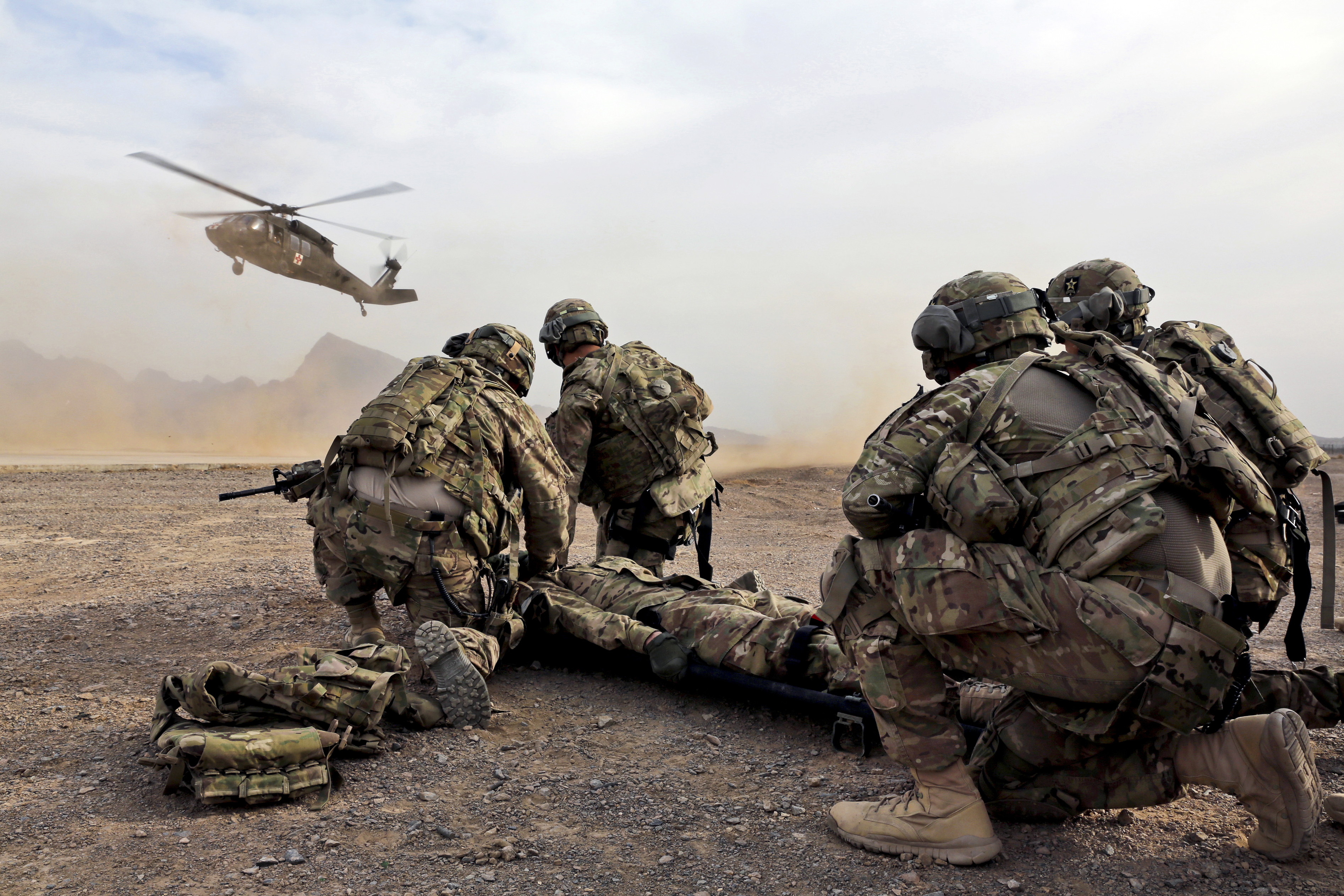
The first is an Insight Grant from the Social Science and Humanities Research Council for my project on Medical-military machines and casualties of war 1914-2014.  I’ve provided an illustrated version of the substance of the application under the DOWNLOADS tab.  The plan is to explore the human geographies of evacuation and treatment of casualties, both combatant and civilian, in four major combat zones: the Western Front 1914-1918; the Western Desert, 1942-1943; Vietnam; and Afghanistan.  Since submitting my application, though, I’ve also become interested in the medical geographies (what my good friend Omar Dewachi calls the ‘therapeutic geographies‘) in which people suffering from both war-related injuries and chronic diseases in Syria make their precarious journeys into Lebanon and Jordan for treatment.  All that in four years…

PRT Farah Conducts Medical Evacuation Training with Charlie Co., 2-211th Aviation Regiment at Forward Operating Base Farah

The second is a grant from the Peter Wall Institute for Advanced Studies at UBC to support an International Research Roundtable in May 2015 on The contours of later modern war.  This will be an invitation-only event (the grant provides for travel and accommodation for each participant), but here is the pitch.  I wrote this in an hour just before leaving for Glasgow, so forgive the rough edges:

Background

Commentators often insist that in recent years the nature of war has been transformed. Military historians who address this question display a fine-grained sensitivity to the details of armed conflict, but the imaginative (theoretical) framework they deploy usually returns to Clausewitz’s nineteenth-century theses On War. Philosophers and social scientists work with a more refined theoretical apparatus, though too often this seems to be confined to annotations of Foucault’s Paris lectures in the 1970s, and yet – unlike Foucault himself – they typically show little interest in the specifities and materialities of armed conflict. The Roundtable seeks to finesse this impasse by bringing together a group of scholars, each of whom has demonstrated both a theoretical and an empirical sensibility, to consider crucial questions about the transformations of modern war.

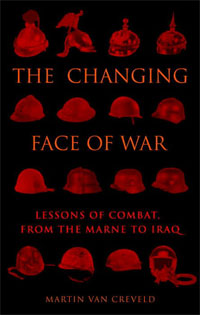
CREVELD Changing face of warThe objective is not to identify a single rupture – the Vietnam War, the end of the Cold War, the wars conducted in the wake of 9/11 – but to recognize that multiple temporalities are at work so that there are both continuities and contrasts to be identified and understood. Similarly, later modern war cannot be reduced to arguments about the Revolution in Military Affairs and its successor projects, which have indeed changed advanced military operations in all sorts of ways, or to the ‘new wars’ supposedly waged by non-state actors in the rubble of the Cold War and in the peripheries of empire: these twin modalities need to be thought together to provide a more inclusive understanding of the shifting contours of military and paramilitary violence.

In speaking of ‘later modern war’ the intention is to avoid the now tired discussions of the postmodern (what comes after that?), while indicating that the closing decades of the twentieth century witnessed a series of changes – political and legal, social and cultural, scientific and technical, legal and ethical – that started to distance armed conflict from the forms it had assumed during the First and Second World Wars. The term also suggests connections to the logics of what is sometimes called ‘late capitalism’ and to the evolving impositions of neo-liberal political and economic formations.

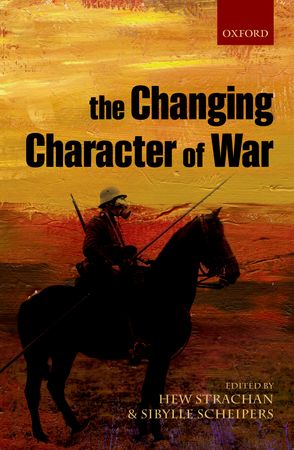
STRACHAN Changing character of warAdvanced militaries often claim that their conduct of war has become surgical, sensitive and scrupulous. The first of these relies on technical advances in intelligence, surveillance and reconnaissance (much of which now takes the form of geospatial intelligence and high-resolution, near real-time imagery) and on advances in military networks, targeting and weapons systems. The second involves the incorporation of cultural knowledge into asymmetric warfare and counter-insurgency, but it also involves a new sensitivity to public opinion: thus media operations have become central to military campaigns in an attempt to win support from populations both at home and abroad. There is also an increasing sensitivity to casualties, both combatant and civilian, and many commentators have spoken of the humanitarian armature that attends contemporary military interventions as a new ‘military humanism’. Finally, and following directly from these observations, contemporary military power is supposed to be characterized by a heightened ethical awareness and the unprecedented incorporation of international law (and military lawyers) into its operational decisions.

toc_afghan

All of these claims invite critical scrutiny, to recover their developing genealogies (how novel are they?) and to evaluate their practical consequences (what are their material effects?). They assume particular importance as interstate wars have declined, and transnational conflicts have become the dominant modality of armed conflict, as ‘war’ bleeds into terrorism, counter-terrorism and new modes of transnational policing. These changes in turn affect the sites and locations of military violence, and these in turn may be transformed not only by geopolitics and military power but also by global environmental change and the political ecologies of war. In short: is the locus of war shifting in decisive ways?

Programme

The Roundtable will address these questions through four intersecting and interlocking themes that allow for theoretical interrogation and empirical scrutiny: each of these is a stark signpost but its simplicity allows multiple questions (and the connections between them) to be addressed under each heading. In capsule form these are:

IMAGE – the role of imagery (intelligence, surveillance, reconnaissance); the images of war that circulate through media, old and new, and their role in public debate;
AGENT – the agents and vectors of military and paramilitary violence; the changing human/technological assemblages through which war is conducted;
VICTIM – the casualties of war (the dead, the wounded, the captured, the displaced); the political, cultural and legal armatures that regulate military and paramilitary violence;
LOCUS – the changing targets, spaces and ecologies of war

When they accept the invitation, each participant will be asked to provide a one-paragraph summary of their present research for posting on a dedicated website. Four weeks before the Roundtable everyone will provide a short (six page maximum) essay, written in an accessible and reference-free form, illustrated as appropriate, and drawing from their work. These may address the theme of the Roundtable in general or in detail, and will be posted on the website. Formal papers will not be presented: the emphasis will on discussion and debate.

There will be four main sessions addressing each of the four key themes:

Day 1:  Arrival

Day 2:

Morning – Walking Seminar (Stanley Park): participants will walk the Seawall as a group but in pairs, changing every 20-30 minutes, to share their research and ideas with one another.

Afternoon – IMAGE (discussion led by four participants)

Day 3:

Morning – AGENT (discussion led by four participants)

Afternoon – VICTIM (discussion led by four participants)

Evening – Public Performance: Either a staged reading of Owen Sheers’ radio play Pink Mist [about soldiers returning from Afghanistan] or George Brant’s Grounded [about a female drone operator], to be followed by public discussion led by scholars on either the Wounds of War or Drone warfare

Day 4:

Morning – Exchanges: small-group discussions (informal) about the key themes and to plan future collaborations and research projects

Afternoon – LOCUS (discussion led by four participants)

Evening – Roundtable Dinner

Day 5:  Dispersal

I also want to invite one or two visual artists to attend the Roundtable, both to take part – the visual is a vital register for both the conduct and the critique of modern war – but also to use the discussions as a provocation for their subsequent work (to be posted on and/or linked via the website).

I’ll keep you posted – I’m immensely grateful to Janis Sarra, Director of the Peter Wall Institute for Advanced Studies, and to my colleagues and friends for their support and encouragement.

I’ll keep you posted.

The God trick and the administration of military violence

JOC staring at screen 24afghan-600

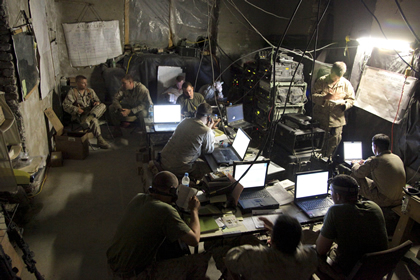
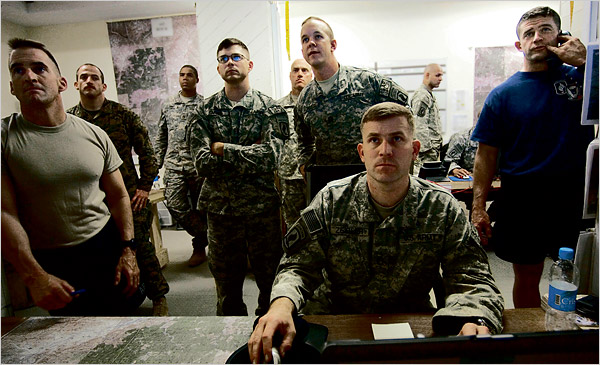
Here is the abstract for my keynote at the Lancaster symposium on Security by remote control next month; it’s a development from my presentation at the AAG in Tampa, and I’ll provide more details as I develop the argument.

The God trick and the administration of military violence

Advocates have made much of the extraordinary ability of the full motion video feeds from Predators and Reapers to provide persistent surveillance (‘the all-seeing eye’), so that they become vectors of the phantasmatic desire to produce a fully transparent battlespace.  Critics – myself included – have insisted that vision is more than a biological-instrumental capacity, however, and that it is transformed into a conditional and highly selective visuality through the activation of a distinctively political and cultural technology.  Seen thus, these feeds interpellate their distant viewers to create an intimacy with ground troops while ensuring that the actions of others within the field of view remain obdurately Other.

But the possibility of what Donna Haraway famously criticised as ‘the God-trick’ – the ability to see everything from nowhere in particular – is also compromised by the networks within which these remote platforms are deployed.  In this presentation I re-visit an air strike on three vehicles in Uruzgan province, Afghanistan, in February 2010, in which more than 20 civilians were killed in a helicopter attack prompted, in large measure, by video feeds from a Predator providing support to a Special Forces detachment in the vicinity.  Most commentaries – including mine – have treated this in terms of a predisposition on the part of the Predator crew to (mis)read every action by the victims as a potential threat.  But a close examination of the official investigations that followed, by the US Army and then the US Air Force, reveals a much more complicated situation.  The Predator was not the only ‘eye in the sky’, its feeds entered into a de-centralized, distributed and dispersed geography of vision in which different actors at different locations inside and outside Afghanistan saw radically different things, and the breaks and gaps in communication were as significant as the connections.  In short, much of later modern war may be ‘remote,’ but there’s considerably less ‘control’ than most people think.

Security by remote control

Security by remote control

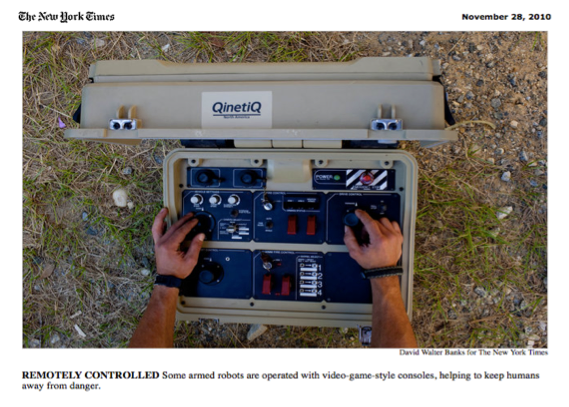
News from Lucy Suchman that the website for the Security by Remote Control conference at Lancaster, 22-23 May, is now live here.  It will be enhanced and updated as the symposium approaches – including programme details: I’m still thinking over what I might present – but registration is open now.

Despite investment in new technologies, the legitimacy and efficacy of actions taken in the name of security is increasingly in question. In April of 2013 a coalition led by Human Rights Watch initiated a campaign in favour of a legally binding prohibition on the development, production and use of fully autonomous weapon systems. Simultaneously, some military and robotics experts argue that equipping robots with the capacity to make ethical judgments is an achievable technological goal. Within these debates, the ‘human in the loop’ is posited alternately as the safeguard against illegitimate killing, or its source. Implicit across the debate is the premise of a moment of decision in which judgements of identification and appropriate response are made. This symposium will focus on on the troubling space between automation and autonomy, to understand more deeply their intimate relations, and the inherent contradictions that conjoin them.

A new natural history of destruction?

Security by remote control conference

My work on drones has been invigorated by reading an outstandingly creative essay by Lucy Suchman on ‘Situational Awareness: deadly bioconvergence at the boundaries of bodies and machines’, forthcoming at the ever-interesting Mediatropes.  It’s sparked both an e-mail conversation and an invitation to speak at a symposium on Security by remote control: automation and autonomy in robot weapon systems at Lancaster University, 22-23 May.  Here is the call for papers:

Remotely operated and robotic systems are central to contemporary military operations. Robotic weapons can select targets and deliver lethal force with varying degrees of human control, and technologies for fully autonomous weapon systems are currently in development. Alongside military reconnaissance and the prospective configuration of ‘killer- robots,’ drone technologies are being deployed for ostensibly peaceful purposes, most notably surveillance of public space, private property and national borders. More generally, the frame offered by contemporary security discourses has redrawn previous boundaries regarding the use of state violence in the name of homeland protection. But despite an extended history of investment in technologies that promise to rationalise the conflict zone and accurately identify the imminent threat, the legitimacy and efficacy of actions taken in the name of security is increasingly in question.

The purpose of this symposium is to present and debate current scholarship on the ethics and legality of robotic systems in war and beyond. By robotic systems we mean networked devices with on-board algorithms that direct machine actions (in this case, tracking, targeting and deploying force) in varying configurations of pre-programmed operation and remote human control. The line between automation and autonomy has come under renewed debate in the context of contemporary developments in remotely controlled weapon systems, most prominently uninhabited aerial vehicles or drones. For 
example, in April of 2013 a coalition led by Human Rights Watch initiated a campaign in favour of a legally binding prohibition on the development, production and use of fully autonomous weapon systems. Simultaneously, some military and robotics experts emphasize the advantages of automated weapons and argue that equipping robots with the capacity to make ethical judgments is an achievable technological goal. Within these debates, the ‘human in the loop’ is posited alternately as the safeguard against illegitimate killing, or its source. Implicit across the debate is the premise of a moment of decision in which judgements of identification and appropriate response are made.

While emerging arms control strategies focus on the ‘red line’ that would prohibit the development and use of weapons that remove human judgment from the identification of targets and the decision to fire, the question remains to what extent human judgment and decision-making are already compromised by the intensifications of speed, and associated increase in forms and levels of automation, that characterise contemporary war-fighting, particularly in situations of remote control. Rather than attempting to establish one or the other of these concerns as correct, or even as more important than the other, we seek to focus our discussion on the troubling space between automation and autonomy, to understand more deeply their intimate relations, and the inherent contradictions that conjoin them.

To explore the key stakes and lines of argument in this debate, we invite contributions from scholars in the fields of security, peace and conflict studies, international human rights law, anthropology/sociology of science and technology, technoculture and technomilitarism, computing, simulation and cyber law. The ambition for this event is to stimulate ongoing cross-disciplinary discussion and further research on this topic, drawing on the resources of the Lancaster University centres that are its co-sponsors.

Confirmed Speakers:

Patrick Crogan, Senior Lecturer in Film Studies at the University of the West of England in Bristol, scholar of technoculture, videogames and military technoscience, author of Gameplay Mode: War, Simulation, and Technoculture (2011);

Derek Gregory, Peter Wall Distinguished Professor and Professor of Geography at the University of British Columbia in Vancouver, author of multiple works interrogating social and spatial dimensions of conflict, and currently completing a book titled The Everywhere War (forthcoming);

M. Shane Riza, command pilot and former instructor at the U.S. Air Force Weapons School, author of Killing Without Heart: Limits on Robotic Warfare in an Age of Persistent Conflict (2013);

Christiane Wilke, Associate Professor in Law and Legal Studies at Carleton University, Canada. She has been researching legal responses to state violence and is working on a project about visuality, photography, and international law.

To indicate your interest in participating, or for further information, please contact Lucy Suchman l.suchman@lancaster.ac.uk.

I’m really excited about this; I’m part way through Shane Riza’s book, and it’s already clear that I’m going to learn a lot from the meeting.

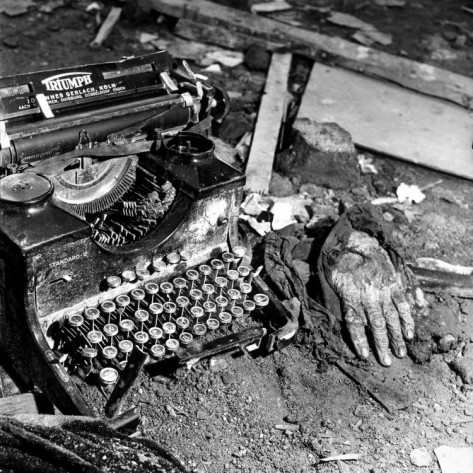
The image at the top of this post comes from the CFP, incidentally, but the image below is Margaret Bourke-White‘s classic photograph from the rubble of a bombed German city, which I use when I talk about the ways in which the trauma of air war dislocates the very sinews of language and the capacity to write and re-present (see ‘Doors in to nowhere’, an extended reflection on W.G. Sebald: DOWNLOADS tab).  Perhaps I’ll use my time at Lancaster (given the name, a peculiarly appropriate place) to join the dots between the two images and revisit ‘The natural history of destruction’ for the twenty-first century….

tumblr_m04iio5ICm1qbwvhpo1_500