War/Law/Space

Another extremely interesting Call for Papers for the Annual Meeting of the Association of American Geographers in Los Angeles, 9-13 April 2013:

War/Law/Space

Organizers: Michael Smith (University of British Columbia) and Craig Jones (University of British Columbia)

War may have always entailed rhetorics of justification and regimes of authorization, but perhaps more than ever, late modern war requires a legal armature to secure its legitimacy and organize its conduct.  In the ‘age of lawfare’ (Weizman 2010), for example, law has become a vital weapon in asymmetric warfare, used by states and non-state actors alike. But there are many different kinds of war – including undeclared wars, metaphorical wars, even “military operations other than war” – just as there are multiple forms, systems and scales of law. War’s “nomospheres” – to borrow from Delaney (2010) – mobilizes a host of subjects, discourse, practices and institutions which in turn reconfigure the spaces of war-law, moving us toward what Derek Gregory (2011) has called an “everywhere war”. The question, then, of the interplay of war and law – how they underpin, disrupt, enable, elide, or efface one another – remains a critical site for scholarship, one that warrants more attention from geographers (c.f. Gregory 2006; Reid-Henry 2006). What is the relationship between law and (organized state) violence? How does law feature in the putative transition from the battlefield to the hyper-networked battlespace?  If war is potentially everywhere, where – so to speak – is law?

This session invites both theoretical and empirical research that engages with the intersections between war, law and space from a diverse range of approaches and perspectives. It asks contributors to consider how law makes war and vice versa, but it also asks how these productions might be interrupted and resisted. It seeks to understand the spaces of war-law through the institutions, agents and practices that authorize, enact and resist them. We welcome contributions from geographers, lawyers and other scholars on themes that may include (but are not limited to):

  • Legal violence and the law as a weapon of war: ‘lawfare’ & the ‘legal war on terror’
  • Targeted killing/assassination, detention and cyber warfare
  • International humanitarian law (IHL), human rights law (HRL) and the laws of armed conflict (LOAC)
  • Genealogies of law in armed conflict
  • The links between law and legitimacy
  • The representational regimes of law/war: new media, propaganda & the “citizen journalist”
  • How law facilitates the political economy of war: its role in the logistics, organization, privatization and marketization of war
  • War inside/outside the border: International, transnational and domestic variations of lawfare
  • Witnessing war – Legal subjectivities, narrations and testimony from those who inhabit the warscape (e.g. lawyers, soldiers, civilians)

Please submit abstracts of 250-300 words to Craig Jones (venga@interchange.ubc.ca) and Michael Smith (mdsgeog@gmail.com) before 15 October 2012.
Rethinking climate change, conflict and security

I’ve been working away on a presentation that will – eventually! – turn into an essay on the militarization of nature and the nature(s) of war, and I stumbled across a conference on Rethinking climate change, conflict and security at the ever-creative University of Sussex next month (18-19 October 2012).  Speakers include Halvard BuhaugSimon Dalby and Mike Hume.

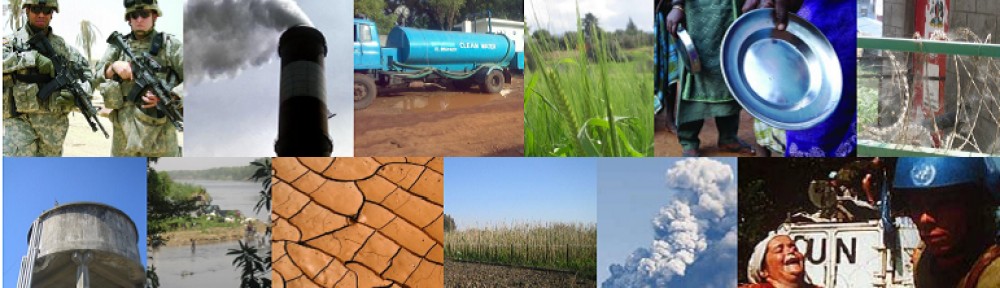
What are the conflict and security implications of global climate change? This question has received widespread attention from policy makers in recent years, with most concluding that climate change will in all likelihood become a significant ‘threat multiplier’ to existing patterns of insecurity and discord.  Academic debate has tended to be more divided, yet despite differences in emphasis a common set of assumptions have come to dominate contemporary academic and policy discourse on climate change and security.

The guiding premise of this two-day international conference at the University of Sussex is that current academic and policy discourse on climate change, conflict and security is framed too narrowly and would benefit from both broadening and critique. Featuring many of the leading scholars of the links between climate change and security, the conference will both set out some of the most recent findings on likely conflict impacts and contest a range of prevailing orthodoxies. It will include a mix of case study and theoretical analyses, including panels on:

  • Theories of climate change and conflict
  • Sub-Saharan Africa
  • Critical discourse analysis and climate security
  • The links between water scarcities, climate change and conflict
  • Migration
  • Case studies from the Arctic to Pakistan
  • Peacemaking, cooperation and climate change

The conference will also feature two keynote addresses, plus a roundtable event featuring leading policymakers in the area of climate security.

Full details here.  Register by 9 October 2012.

I’ll post my preliminary notes for the presentation shortly – though, far from short, I fear they are running away with me…

Violence in the humanitarian present

Further to my musings on the humanitarian present, a Call For Papers for the Association of American Geographers Conference in Los Angeles next year, 9-13 April 2012:

On the Question of Violence in the Humanitarian Present

Organizers: Lisa Bhungalia (Syracuse University) and Tish Lopez (University of Washington)

Discussant: Craig Jones (University of British Columbia, Vancouver)

 Humanitarianism has long had its place within colonial legacies serving often, as Derek Gregory (2012) puts it, as the “velvet glove wrapped around the iron fist of colonialism.” The recent emphasis in U.S. counterinsurgency doctrine on non-kinetic and humanitarian measures as a means of undermining insurgency would appear to confirm this point. Indeed, the lines between humanitarian and military are increasingly rendered indistinct. But more than simply a blurring or collapse we should ask: What is the relationship between humanitarianism and violence? Moreover, in what ways does humanitarianism serve as a means of managing and modulating violence? This inquiry has been at the fore of Eyal Weizman’s (2011) recent work in which he suggests that an “economy of violence is calculated and managed” through various humanitarian, moral and legal technologies that legitimate and underwrite the continued operation of violence. It is the collusion of these humanitarian technologies with military and political powers that form what he calls the “humanitarian present.”

This paper session invites theoretical and/or empirical research that engages the “humanitarian present” from a diverse range of approaches and perspectives. It explores the ways in which humanitarianism is mobilized discursively and materially as a means for modulating contemporary violence and for governing the displaced. What are the specificities and limits of the concept of the “humanitarian present?” How are displaced populations or those living in zones of ongoing war and occupation negotiating the humanitarian regimes that govern their lives? We invite papers that engage such questions through a broad range of approaches and lenses that may include but are not limited to:

–       Empirical or theoretical engagements with the relationship between humanitarianism and violence

–       Humanitarianism, modern war and biopolitics

–       Post-World War II legal regimes, international humanitarian law and human rights

–       Genealogies of humanitarianism

–       Economies of violence

–       Counterinsurgency

–       Constructions of conflict, crisis and zones of intervention

–       Geopolitics of aid

–       Colonial and post-colonial governance

–       Militarism and everyday life

Please submit abstracts of 250 words to organizers Lisa Bhungalia (lbhungal@maxwell.syr.edu) and Tish Lopez (maoquai@uw.edu) (you can also follow her here) before October 10, 2012.

Media, war and conflict

From the always interesting Geopolitics and security at Royal Holloway:

Media, war and conflict Fifth Anniversary Conference at Royal Holloway, University of London, 11-12 April 2013.

Papers are invited on a range of topics, including:

  • Contemporary and historical war reporting
  • Changing forms of credibility, legitimacy and authority
  • Media ethics in the coverage of conflict
  • The role of citizen-users and social media in conflict
  • Terrorism, media and publics
  • Intelligence operations and media
  • Digital and cyber warfare
  • Media and conflict prevention, peacekeeping and post-conflict scenarios
  • Photo and video journalism in wartime
  • War and conflict in popular culture
  • The power of the visual and other modalities
  • Commemoration and memorialisation of war and conflict

The conference is open to scholars, journalists, military practitioners and activists from around the world.

Abstracts (250 words) to Lisa.Dacunha@rhul.ac.uk by 10 October 2012.

Incidentally, for more on media, war and conflict see (even join) the War and Media Network, whose site has links to the journal and a host of other resources, together with a clutch of reviews of books, films and conferences.

Loco/Motion

The Nineteenth Century Studies Association is meeting in Fresno, California, 7-9 March 2013, and the theme is Loco/Motion:

The long nineteenth century set the world on the move. Travel became increasingly important for business and pleasure, for war and peace. At the same time, new forms of moving people arose: the balloon, ships, undergrounds, funiculars, the railroads. Each carried riders to great distances, different locales, and novel pursuits. But motion wasn’t purely spatial; new movements arose as well, sweeping the inhabitants of the period into fresh vistas of thought and endeavor. We seek papers and panels that capture the sense of movement at work and at play during the long nineteenth century (1789-1914). Papers may address the intersections of movement/s, focus on technologies of motion in isolation, or reveal the desires—for gain, glory, greed—that set the world on its feet.

Note the second sentence, which speaks directly to some of the nineteenth-century themes I’ve sketched in previous posts on War and distance (and to much more, of course).

If you are interested, please e-mail an abstract (250 words) for a 20-minute paper including your name and the paper title in the heading, as well as a one-page cv, to Professor Toni Wein at
NCSA-2013@sbcglobal.net by 30 September 2012. Please note that submission of a proposal indicates intent to present.

Presenters will be notified in November 2012. Graduate students whose proposals are accepted may then submit complete papers in competition for a travel grant to help cover transportation and lodging expenses.

Frithjof Voss

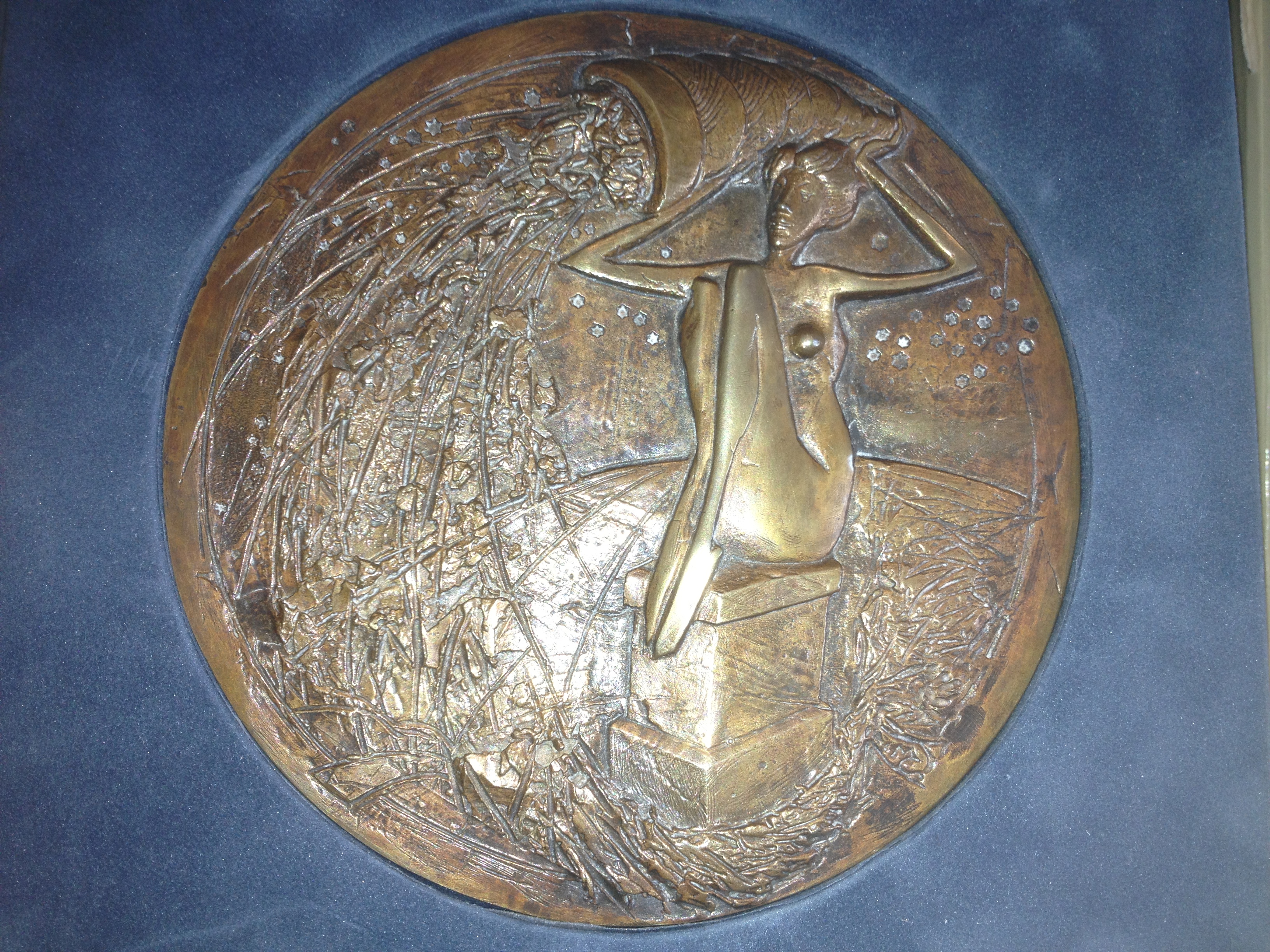
I’ve been awarded the inaugural Internationalen Wissenschaftspreis der Deutschen Geographie (International Science Award of German Geography) by the Frithjof Voss Stiftung, and the Prize was presented at the Closing Ceremony of the IGC in Cologne yesterday (30 August).  The award is to be made every four years and ‘honours the lifetime achievements of foreign scientists whose merit lies in their applied research and contribution towards building links between international geography and German-speaking geography.’

I’m really, really honoured by this.  I’ve valued my exchanges with German-speaking geographers for several decades now.  Before I left Cambridge for Vancouver in 1989 I had already come to know Benno Werlen, Dagmar Reichert and others, and in 1997 I was invited to give the first Hettner Lecture at Heidelberg.  I shall never forget that first visit.  I was staying in a hotel in the Old Town, in a large room tucked underneath the eaves, and I’d left the text of my lecture open on a bed while I was taken on a field excursion.  It rained solidly all day, and when I climbed the stairs to my room I was wet through; as I opened the door a hole appeared in the ceiling – it was a very old hotel – and water cascaded down onto the bed.  As I watched, the text of my lecture literally dissolved before my eyes.  (Probably the first time I thought that physical geography might have an impact on human geography).  I dashed downstairs and said in my best but rather frantic schoolboy German, “The rain is inside my room”, to which the gracious woman behind the desk – who had patiently been correcting my grammar and vocabulary ever since I arrived – replied (in German) “No, it is raining outside…”  I half-dragged her up the stairs,threw the door open, and she said – to my horrified satisfaction – “The rain is inside your room!!” Fortunately I had another copy of the lecture (Rule No. 1: always have a back-up).

That visit opened the door to a continuing series of conversations with colleagues at Heidelberg, and to a lasting friendship with Peter Meusburger – whose boundless energy, enthusiasm and intellectual insight I shall always treasure.  I’ve been back many times since, especially for Peter’s international seminar series on Knowledge & Space (like the ten Hettner lectures, these have been supported by the Klaus Tschira Foundation and held at the beautiful Villa Bosch just outside the city), and in 2007 – just ten years after my first visit – I was thrilled to be awarded an honorary degree by the university.  In 2011 I gave a Keynote lecture on “War in the borderlands” at the conference on New Cultural Geography at Nürnberg-Erlangen, and made more new friends; this past year I’ve been to Cologne to help plan the IGC – and made yet more new friends – and returned this week to give another Keynote  (a sawn-off version of “Deadly embrace: war, distance and intimacy”).

The subject of those last two lectures supplies a second reason for my pleasure at this Award.  It’s really heartening to discover that “applied research” is not interpreted in a narrowly instrumental way, and that the Foundation encourages a critical engagement with matters of public moment: ‘The main concern of the foundation is to demonstrate the practical value of geography when dealing with manifold social problems.’

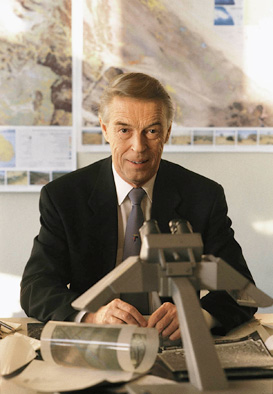
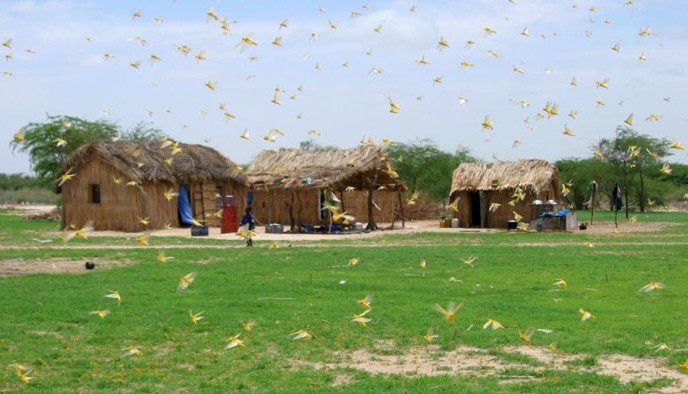
Frithjof Voss (1936-2004) was an expert on satellite imaging and mapping at the Institute of Geography at the Technical University of Berlin, and he was determined ‘”to rally high technology to offer something that materially benefits ordinary people.”  In 1991 he started using satellite imagery and remote sensing to identify the breeding grounds of locusts in the Tokar Delta in Sudan.  “Locusts do not recognise national borders,” he explained, “and neither does my system.” Ground studies confirmed the accuracy of his biotope mapping, and Voss then set about building his own satellite and linking it to GPS satellites so that real-time intelligence could be transmitted to eradication crews on the ground.

I am, of course, aware of the parallels between this aerial sensor/ground response system and other, different and deadly systems that are the focus of much of my own research on late modern war (drones, in case you’re not following this).  But Voss’s approach was a profoundly ameliorative one.   ‘Considering how quickly locusts breed, and the relative inaccessibility of many locust biotopes, Voss’s “smoke alarm” approach can literally mean the difference between life and death for many people.’ He was named an Associate Laureate of the Rolex Awards for Enterprise in 1996, and went on to extend his work to Asia.  As his work in China was drawing to a close, Voss noted that “huge locust swarms began infesting Kazakhstan and were heading to Russia. If our system had been in place in Central Asia, this could have been prevented.” Instead, as the Rolex website puts it, ‘crops were destroyed in an area the size of France, tensions between Russia and Kazakhstan were exacerbated and states of emergencies were declared across the region.’

Something else that captures my imagination – the website makes it plain that his work not only affected people far beyond the academy: it also sought audiences beyond the academy.  Long before most of us had realised the importance of ‘public geographies’, Voss was emphatically clear:

“We know nothing about public relations or how to interest the world in what we are doing… How do we reach those in positions of responsibility who have the imagination to see how great an impact such a system could have on millions around the world? Who do we see to help fund implementation?” Asked whether his remarks were a plea for an expert on such worldly matters to join his crusade, he replied, “Certainly I’m asking. It’s the business of scientists to ask.”

I wish I’d known him.

‘The terrain as medium of violence’

News from my friend and colleague Gaston Gordillo about his proposed paper for the Violence and Space sessions at the Annual Meeting of the Association of American Geographers in Los Angeles next year.  An extract from the abstract (!) for The Terrain as Medium of Violence:

In this paper, I draw from [Eyal] Weizman and also from Paul Virilio’s work on violence and vision and Derek Gregory’s research on aerial bombing and drones to examine a key principle of a theory of the terrain: the decisive importance of verticality in the deployment of state violence as a three-dimensional vector. The history of aerial bombing and the recent rise in the use of drones reveal that the control of the skies and the atmosphere —and the speed and global reach their spatial smoothness allows for— has become fundamental to imperial power.
Yet the politics of verticality pose spatial paradoxes that can only be appreciated through the actual, tangible material-political terrains in which it operates. Contra the image of absolute deterritorialization it tends to evoke, the verticality created by drones is always-already subsumed to a spatial principle as old as warfare: that the ultimate aim of controlling a higher ground through towers, mountaintops, or the sky is to create a view from above to visualize, localize, and inflict violence upon targets located primarily on the ground. In short, drones patrol the skies not to control high altitudes per se but in order to control an opaque terrain below that limits the state field of vision. And despite their capacity for unleashing massive levels of destruction, drones reveal something else about the terrains of Afghanistan, Pakistan, or Yemen endlessly scanned by their cameras: that imperial ground forces do not control those spaces. This political voiding of imperial space by local insurgencies is made possible by another ancient principle of guerrilla warfare: the fact that the mastery of heavily striated terrain (mountains, forests, urban spaces) by flexible and mobile forces allows them to avoid visual capture by the state and, in the long run, wear down and defeat more powerful militaries. The verticality generated by drones, in short, reveals not only the vast spatial reach of imperial violence but also the profound spatial limits it encounters amid the political and material striations of the global terrain.
More at Gaston’s Space and Politics blog here, with links to his other postings on these ideas and news of his book project, The After-Life of Places: Ruins and the Destruction of Space, forthcoming from Duke.  He promises more to come!
The Violence and Space sessions will evidently be very lively: Stuart Elden has also published his abstract, “Urban Territory: Violent Political Technologies in London and Kano”, on his Progressive Geographies blog here.
Horizontal notes on the vertical: I expect most readers will know of Eyal’s work on the politics of verticality, most obviously through his book Hollow Land: Israel’s architecture of occupation (2007 – paperback out this year), and Stuart has become interested in similar issues: see the video of his Secure the Volume: vertical geopolitics and the depth of power here.  Steve Graham has also called for a ‘vertical turn in urban social science‘: you can listen to it here, and read his essay with Lucy Hewitt, “Getting off the ground: on the politics of urban verticality”, in Progress in human geography (Online First: 25 April 2012) doi:10.1177/0309132512443147.  Enough to make you giddy.

Human Geography Summit

As the calls for papers for the Annual Meeting of the Association of American Geographers in Los Angeles next April fly backwards and forwards, I thought readers would be interested in another meeting (and, for the most part, another geography).

The Institute for Defense and Government Advancement (IDGA) – which describes itself as ‘a non-partisan information based organization dedicated to the promotion of innovative ideas in public service and defense’  and which ‘is not affiliated with the US government or any branch of the Armed Services’ – is holding a Human Geography Summit in Washington DC, 12-14 November 2012.  Subtitled ‘Maximizing force efficiency through intelligence in the human domain’, the brochure explains:

“The environment in which we operate is complex and demands that we employ every weapon in our arsenal, both kinetic and non-kinetic. To fully utilize all approaches, we must understand the local culture and history; Learn about the tribes, formal and informal leaders, governmental and religious structures, and local security forces. We must understand how the society functions so we can enable [Iraqis] to build a stable, self-reliant nation.” 

This Summit will bring to light the future of the Human Domain in warfare and opportunities for Military and Industry cooperation and coordination.

Operation Iraqi Freedom and Operation Enduring Freedom (OIF & OEF) in Iraq and Afghanistan created a need for a fundamental shift in the way we fight wars. It became very clear very quick that conventional warfare was doomed to failure in this particular set of operations. We were being beaten by an unconventional force that had no state backing and did not play by the rules.

In order to adapt, many hybrid theories of war have been thought up and put into place. Throughout this, one aspect that was previously overlooked has come to the fore front. Knowing who you are fighting and where you are fighting. Not simple identification and geographic data, but personality profiles, daily schedules/routines, language/dialect, cultural identities, weather patterns, market places, potential hideouts, and places of cultural and religious significance. Truly understanding the enemy, how they differ from the civilian population they are embedded in and what will make our forces either comply with their culture or blend in as they do.

The Summit will be preceded by a ‘Social and Cultural Human Geography and Intelligence Focus Day’ with four specialist workshops:

  • Maintaining connections with the local population in support of operationally directed research
  • Thinking like the Natives: Cultural immersion for US Special Operations
  • Understanding the local culture and history of Target Populations
  • Cultural and Economical Human Geography: a case study

The Summit will include presentations from the US Army Geospatial Center, the National Geospatial-Intelligence Agency,the US Army Corps of Engineers, Human Terrain Systems (US Army) and US Northern and Southern Commands.

You’ll also have the chance ‘to meet, network and engage with top government and industry professionals in the human geography space’ (sic) – a steal at $1,598 (military) or $1,835 (industry).  Uniform or business casual.

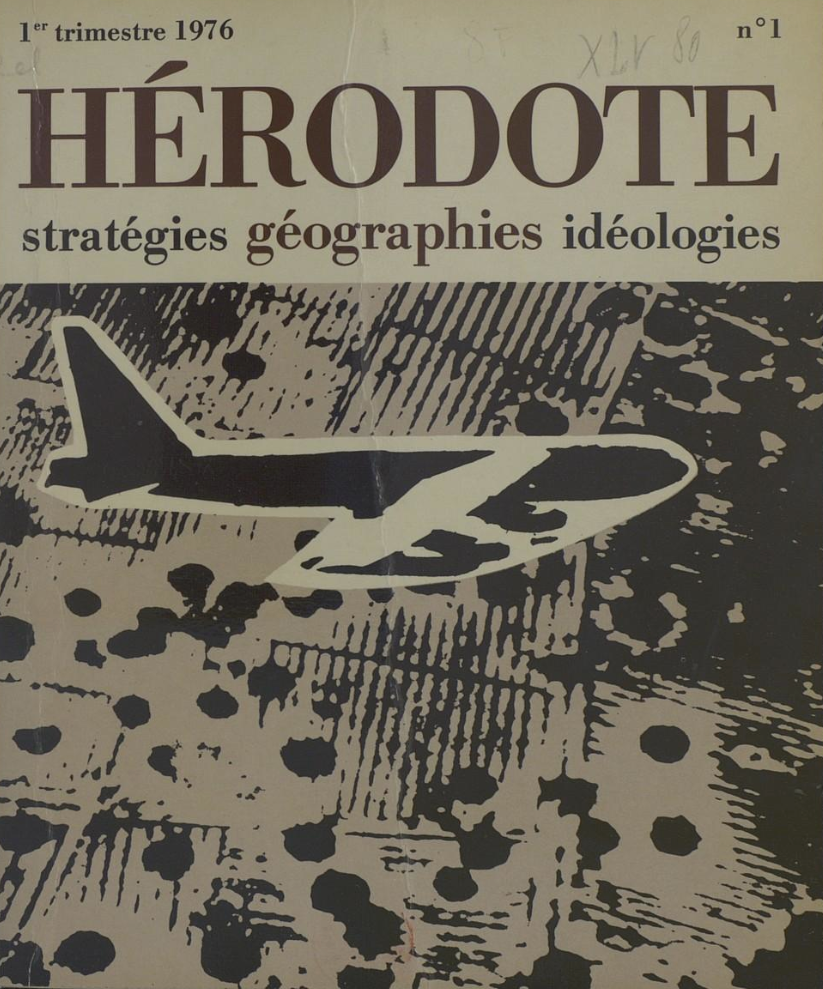
It’s thirty-odd years since Yves Lacoste insisted that La géographie, ça sert, d’abord, à fair la guerre (1976) and, as Gavin Bowd and Daniel Clayton show in “Geographical warfare in the tropics: Yves Lacoste and the Vietnam War”, he knew what he was talking about (he was also the editor of Hérodote, left): their remarkably rich essay was published in Early View by the Annals of the Association of American Geographers earlier this year.  As I say, another geography.

But these are not matters of disciplinary history alone; that is, of course, important – the terrific work of  Trevor Barnes in particular has done much to illuminate the entanglements of modern geography in the Second World War and the Cold War – but it’s also vital to pursue the ways in which geographical knowledges and practices continue to enter into the conduct of war and military violence.  In 1963 William Bunge and Bill Warntz started work on a book to be called Geography: the innocent science, a prospectus for their vision of the ‘new geography’ as spatial science.  It was far from innocent, to be sure, and in his later work – notably the Nuclear War Atlas but also what he called his ‘peace book’, Fitzgerald: geography of a revolution – Bunge displayed another side to his radical temper.  But what Trevor calls ‘the mangle’ between power and knowledge, geography and war, still includes the models and methods of spatial science – and it evidently also mangles much that lies far beyond them.

Violence and Space: Call for Papers

Philippe Le Billon (UBC, Vancouver) and Simon Springer (University of Victoria) are calling for papers on Violence and Space at the Annual Meeting of the Association of American Geographers in Los Angeles, 9-13 April 2013.  They write:

This session will provide a forum to address the interrelated questions of violence and space. Papers will examine how geography mediates the meanings, constructions, effects, foundations, discourses, and processes that inform violence in shaping its maintenance, proliferation, legitimization, or refusal in and across space. We welcome both theoretically informed and empirically grounded papers that consider the spatial dimensions of violence, ranging from routinized performances and everyday geographies of violence that serve conventional social, economic, and political norms that go largely unnoticed, through to the spectacular eruptions of ‘exceptional’ violence that capture public attention. Nonviolence is implied within all of these considerations, and we accordingly also encourage insights that contribute to scholarly understanding of the geographies of peace, resistance to violence, and emancipation from its dominating strictures.

Please send paper title, abstract, and conference PIN to Simon Springer (simonspringer@gmail.com) and Philippe Le Billon (lebillon@geog.ubc.ca) by 30 September 2012 to be considered.

Information about the conference (including registration) is here.

Humanitarianism: Past, present and future

While I was thinking about  Eyal Weizman‘s reflections on what he calls ‘the humanitarian present’, I stumbled across what looks set to be a fascinating conference organised by the University of Manchester’s Humanitarian and Conflict Response Institute, 8-10 November 2012:

The provisional programme includes keynotes from (among others) Mark Duffield, ‘How did we become unprepared? From modernist to post-modernist conceptions of disaster’, Mary Kaldor, ‘The evolution of humanitarian intervention’ [with a response from Maja Zehfuss] and Janice Gross Stein and Michael Barnett, ‘The globalization of humanitarianism’, and papers from (among others) Simon Reid-Henry, ‘Humanitarian Reason, Moral Geography and the contemporary Will-to-Care’, Michael Givoni, ‘Gazing back: local perceptions and humanitarian knowledge’, Larissa Fast, ‘Aid and violence: reaffirming “Humanity” in Humanitarianism’, Gary Blank, ‘Framing Third World Victimhood: Oxfam, the “Biafra Lobby”, and the politics of famine in Britain 1968-1970’, Roland Bleier, ‘The visual dehumanization of refugees’, James Thompson, ‘Humanitarian performance’ and Kathleen Coppens, ‘Long-term conflicts and humanitarian aid’. My selections just scratch the surface, but what’s particularly interesting is the mix of presenters – scholars, professionals and activists.