A new natural history of destruction?

Security by remote control conference

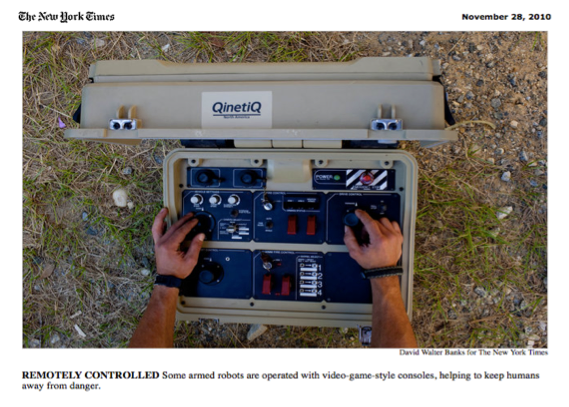
My work on drones has been invigorated by reading an outstandingly creative essay by Lucy Suchman on ‘Situational Awareness: deadly bioconvergence at the boundaries of bodies and machines’, forthcoming at the ever-interesting Mediatropes.  It’s sparked both an e-mail conversation and an invitation to speak at a symposium on Security by remote control: automation and autonomy in robot weapon systems at Lancaster University, 22-23 May.  Here is the call for papers:

Remotely operated and robotic systems are central to contemporary military operations. Robotic weapons can select targets and deliver lethal force with varying degrees of human control, and technologies for fully autonomous weapon systems are currently in development. Alongside military reconnaissance and the prospective configuration of ‘killer- robots,’ drone technologies are being deployed for ostensibly peaceful purposes, most notably surveillance of public space, private property and national borders. More generally, the frame offered by contemporary security discourses has redrawn previous boundaries regarding the use of state violence in the name of homeland protection. But despite an extended history of investment in technologies that promise to rationalise the conflict zone and accurately identify the imminent threat, the legitimacy and efficacy of actions taken in the name of security is increasingly in question.

The purpose of this symposium is to present and debate current scholarship on the ethics and legality of robotic systems in war and beyond. By robotic systems we mean networked devices with on-board algorithms that direct machine actions (in this case, tracking, targeting and deploying force) in varying configurations of pre-programmed operation and remote human control. The line between automation and autonomy has come under renewed debate in the context of contemporary developments in remotely controlled weapon systems, most prominently uninhabited aerial vehicles or drones. For 
example, in April of 2013 a coalition led by Human Rights Watch initiated a campaign in favour of a legally binding prohibition on the development, production and use of fully autonomous weapon systems. Simultaneously, some military and robotics experts emphasize the advantages of automated weapons and argue that equipping robots with the capacity to make ethical judgments is an achievable technological goal. Within these debates, the ‘human in the loop’ is posited alternately as the safeguard against illegitimate killing, or its source. Implicit across the debate is the premise of a moment of decision in which judgements of identification and appropriate response are made.

While emerging arms control strategies focus on the ‘red line’ that would prohibit the development and use of weapons that remove human judgment from the identification of targets and the decision to fire, the question remains to what extent human judgment and decision-making are already compromised by the intensifications of speed, and associated increase in forms and levels of automation, that characterise contemporary war-fighting, particularly in situations of remote control. Rather than attempting to establish one or the other of these concerns as correct, or even as more important than the other, we seek to focus our discussion on the troubling space between automation and autonomy, to understand more deeply their intimate relations, and the inherent contradictions that conjoin them.

To explore the key stakes and lines of argument in this debate, we invite contributions from scholars in the fields of security, peace and conflict studies, international human rights law, anthropology/sociology of science and technology, technoculture and technomilitarism, computing, simulation and cyber law. The ambition for this event is to stimulate ongoing cross-disciplinary discussion and further research on this topic, drawing on the resources of the Lancaster University centres that are its co-sponsors.

Confirmed Speakers:

Patrick Crogan, Senior Lecturer in Film Studies at the University of the West of England in Bristol, scholar of technoculture, videogames and military technoscience, author of Gameplay Mode: War, Simulation, and Technoculture (2011);

Derek Gregory, Peter Wall Distinguished Professor and Professor of Geography at the University of British Columbia in Vancouver, author of multiple works interrogating social and spatial dimensions of conflict, and currently completing a book titled The Everywhere War (forthcoming);

M. Shane Riza, command pilot and former instructor at the U.S. Air Force Weapons School, author of Killing Without Heart: Limits on Robotic Warfare in an Age of Persistent Conflict (2013);

Christiane Wilke, Associate Professor in Law and Legal Studies at Carleton University, Canada. She has been researching legal responses to state violence and is working on a project about visuality, photography, and international law.

To indicate your interest in participating, or for further information, please contact Lucy Suchman l.suchman@lancaster.ac.uk.

I’m really excited about this; I’m part way through Shane Riza’s book, and it’s already clear that I’m going to learn a lot from the meeting.

The image at the top of this post comes from the CFP, incidentally, but the image below is Margaret Bourke-White‘s classic photograph from the rubble of a bombed German city, which I use when I talk about the ways in which the trauma of air war dislocates the very sinews of language and the capacity to write and re-present (see ‘Doors in to nowhere’, an extended reflection on W.G. Sebald: DOWNLOADS tab).  Perhaps I’ll use my time at Lancaster (given the name, a peculiarly appropriate place) to join the dots between the two images and revisit ‘The natural history of destruction’ for the twenty-first century….

tumblr_m04iio5ICm1qbwvhpo1_500

Drone Geographies

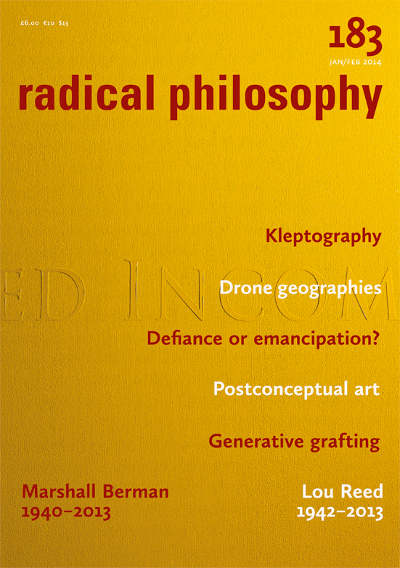
183cover_web251Radical Philosophy 183 (January/February 2014) is out now.  It includes my essay on ‘Drone Geographies’ which you can access here (and if you scroll down download a pdf).

The issue also includes Peter Hallward on ‘Defiance or emancipation?’, Antonia Birnbaum on ‘Postconceptual art’, a must-read article by Finn Brunton on ‘Kleptography’ (and ‘security theatre’; Finn is the author of Spam: a shadow history of the Internet, which is reviewed in this issue too), and Elina Steikou on ‘Generative grafting: reproductive technology and the dilemmas of surrogacy’, plus appreciations of Marshall Berman and Lou Reed and reviews by Dominiek Hoens, Nina Power, Nicolas Mendoza, Allan Stoekl, Andy Merrifield, Matthew Charles and Marieke de Goede.

Un-Christmas reading

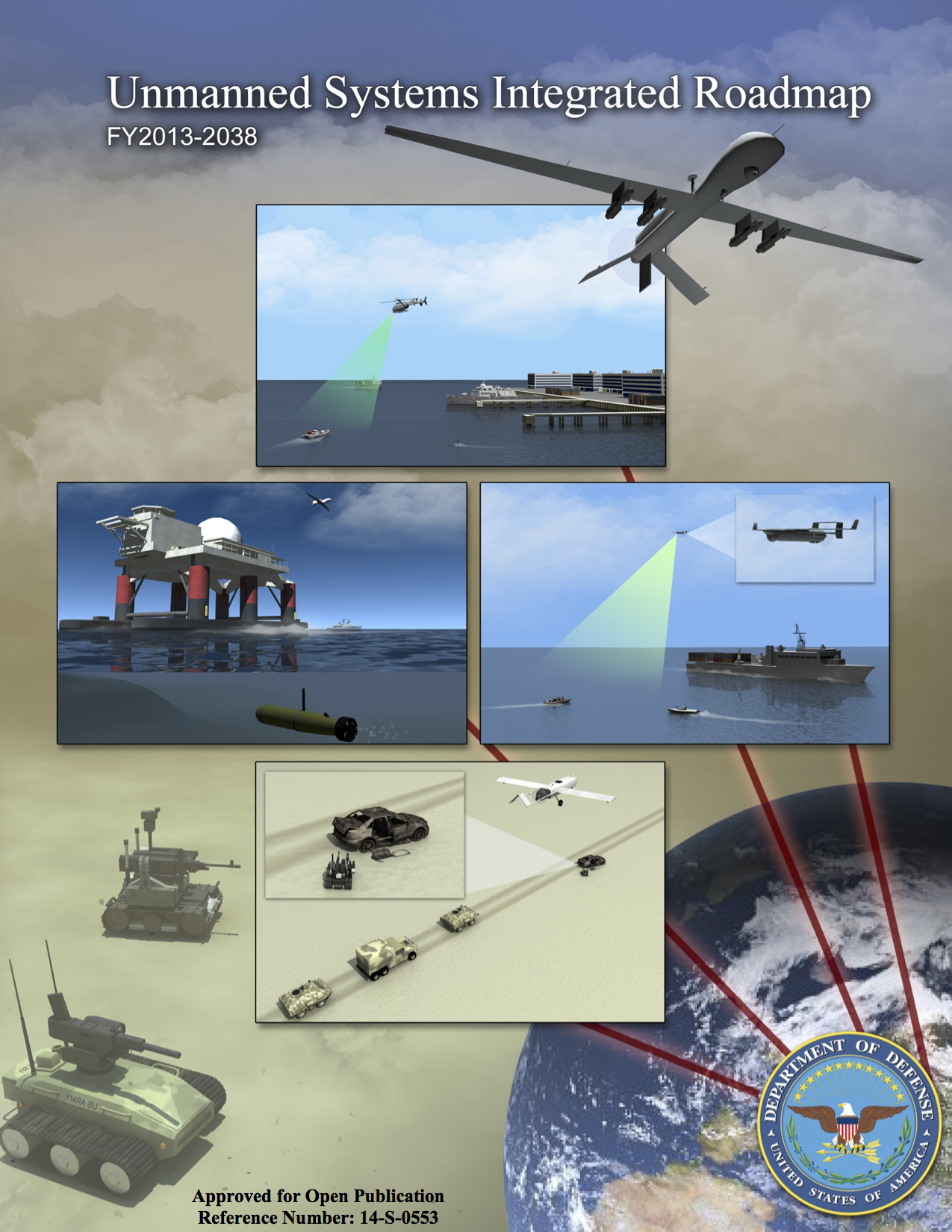
DOD-USRM-2013 (dragged)Two reports to put on the reading list.  The US military has been revising its Counterinsurgency manual, FM 3-24 (December 2006), and as part of that process the Joint Chiefs of Staff have now issued their updated JP 3-24 on Counterinsurgency (November 2013).  I haven’t had time to digest it yet, but air power is no longer relegated to the closing pages…

The US Air Force is also in the closing stages of its so-called Vector Report on Remotely Piloted Aircraft, which is supposed to map out the likely role of military UAVs over the next 25 years; its release has been delayed for what are described a minor last-minute changes, but just before Christmas the Pentagon released its Unmanned Systems Integrated Roadmap 2012-2038, which includes its plans for aerial, ground and maritime systems.

Unseen war

I’m off to Beirut in early January for CASAR’s conference on Transnational American Studies, where I’ll be talking about CIA-directed drone strikes in the Federally Administered Tribal Areas.  Even though Judith Butler had to cancel, it’s still an excellent program, including Paul Amar, Lisa Bhungalia, Brian Edwards, Keith Feldman, Waleed Hazbun, Craig Jones, Amy Kaplan, Laleh Khalileh, Vijay Prashad, Jeremy Scahill (and a screening of Dirty Wars), and an evening performance of Robert Myers‘s drone play, Unmanned.

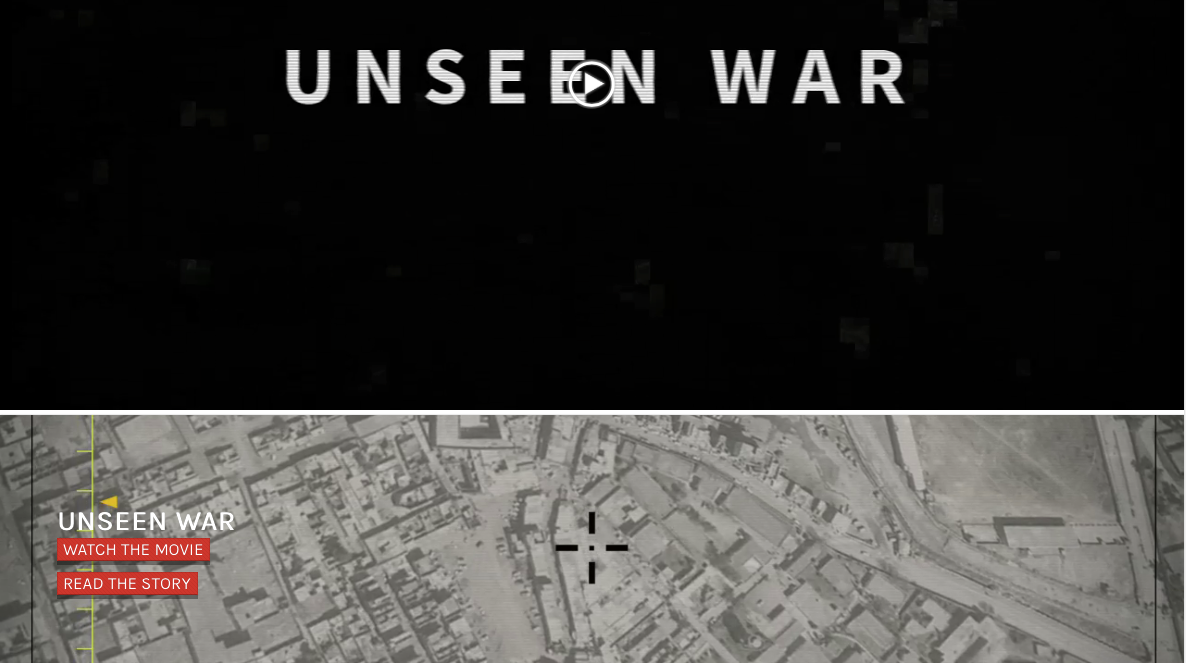
I have about a week to get my own act together, so it’s welcome news that the Tactical Technology Collective has released a series of short films, Exposing the Invisible, the most recent of which – Unseen War – focuses on the FATA.

Unseen war

There are also transcripts of the full interviews that make up the 7 ‘chapters’  of the film: Sadaf Baig from the Centre for International Media Ethics (CIME) at the London School of Economics; Taha Siddiqui, an independent journalist in Islamabad; Safdar DawarAlice Ross from the Bureau of Investigative Journalism; Noortje Marres from Goldsmiths, University of London; and James Bridle (who needs no introduction for readers of this blog).

Sadaf and Safdar are both very informative about FATA, and James provides an excellent introduction to his stream of work on drones.

Ideology of the drone

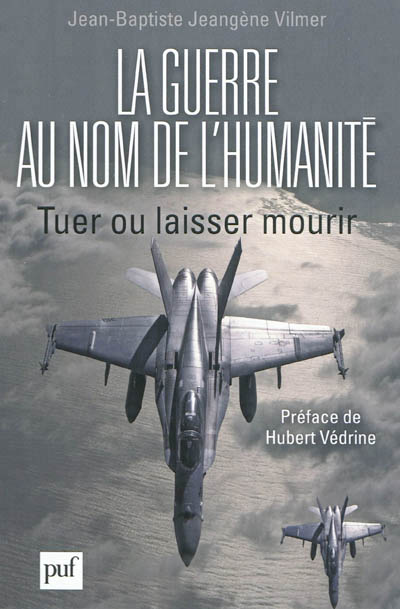
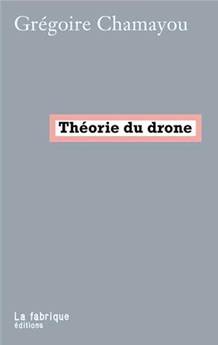
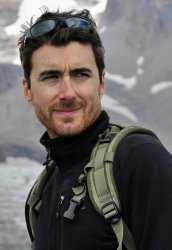
9782130583516Jean-Baptiste Jeangène Vilmer has published an extended critique of Grégoire Chamayou‘s Théorie du drone at La vie des idées under the title ‘Ideology of the drone’.  Some of the essays from that site are eventually translated into English and appear on the mirror site Books & Ideas, but I have no idea when or even whether this one will be, so I thought it would be helpful to provide a summary.

First, some background.  Vilmer has travelled via Montréal, Yale and War Studies at King’s College London to his present position at Sciences Po in Paris, where he teaches ethics and the law of war; he also teaches at the military academy at Saint-Cyr, and is a policy adviser on security issues to the Ministry of Foreign Affairs.  Vilmer is the author of more than a dozen books, of which La Guerre au nom de l’humanité : tuer ou laisser mourir (2012) is probably the best known.  If you’re not familiar with his work, here’s an English-language interview with him about La Guerre au nom de l’humanité via France 24 and the Daily Motion:

http://www.dailymotion.com/video/xpsqs8_jean-baptiste-jeangene-vilmer-author-of-war-in-the-name-of-humanity-kill-or-let-die_news

pe-3-2013I should note, too, that Vilmer’s critique trades in part on an essay published earlier this year, ‘Légalité et légitimité des drones armés’ [‘Legality and legitimacy of armed drones’], in Politique étrangère 3 (2013) 119-32, in which he rehearses a number of criticisms of Chamayou.  There Vilmer insists that the use of drones is perfectly compatible with the principles of international humanitarian law (this is about principle not practice, though, and he doesn’t address the implications of international human rights law which many critics and NGOs believe is the operative body of law for drone strikes outside war zones, like those carried out by the US in the Federally Administered Tribal Areas of Pakistan).

He also has no time for critics who turn the distance between the drone operator and the target into a moral absolute (though I don’t think Chamayou does that at all: instead, as I tried to show previously, he provides a nuanced discussion of the concept of distance).  Still, Vilmer is right to insist that the history of modern war is the history of killing the enemy from ever greater distances, and those who cling to the ‘nobility’ of hand-to-hand fighting are blind to an historical record reaching back over centuries.  If distance is a ‘moral buffer’, this is hardly unique to today’s remote operations, where in any case the greater physical distance is counterbalanced by a compression of what Vilmer calls ‘epistemic distance’ through the real-time full-motion video feeds transmitted from the drone.  The difference between the crew of a Lancaster bomber over Germany and the drone operator controlling an aircraft over Afghanistan is that the latter sees his victim.  And if conducting strikes by computer is ‘dehumanising’, the machetes used at close quarters in the Rwandan genocide were hardly less so.  What is more, Vilmer suggests, those video feeds are not only remote witnesses of the target; there is an important sense in which they also function as remote witnesses of the crew, providing a vital record for any subsequent military-judicial investigation and thus inviting and even institutionalising a regularised monitoring of ‘the conduct of conduct’.

la-theorie-du-droneNow to the extended critique of Chamayou.  Vilmer notes that Théorie du drone follows directly from Chamayou’s previous book, Chasses à l’homme [Manhunts], and in fact that’s his main problem with it: he says that Théorie reduces the function of drones to ‘hunting’, specifically to the US campaign of targeted killing, and identifies the one so closely with the other that the force of his analysis is blunted.  Vilmer thinks this is playing to the crowd: there is a considerable audience opposed to the use of drones who find Chamayou’s arguments convincing because they confirm their own views.

Indeed, Chamayou makes it plain that one of his express intentions is to provide the critics with useful tools to advance their political work.  Yet at the same time he presents Théorie as a philosophical investigation – and it is that, Vilmer concedes, erudite and at times brilliant – but in his view the objective is less to provide understanding than to provoke indignation.  In fact,  Chamayou has said in press interviews that what provoked him in the first place was the sight of philosophers collaborating with the military – and Vilmer freely admits to being one of them (though in France rather than the United States or Israel).

It’s important to examine the practice of targeted killing, Vilmer agrees, because it raises crucial ethical and legal questions.  But it’s also important not to confuse the ends with the means.  As I’ve noted in my own commentaries on Théorie, there are other ways of carrying out targeted killing (as Russian dissidents on the streets of London or Iranian scientists on the streets of Tehran have discovered to their cost) and there are many other military uses for drones.  Targeted killing gets the most publicity because it’s so controversial, Vilmer argues, but it’s far less important than the provision of intelligence, surveillance and reconnaissance (though ISR is central to lethal strikes carried out by conventional aircraft and ground troops too).

Vilmer is breezily confident about the use of drones in war-zones, where he says they are no more problematic than any other observation platform or weapons system.  Contrary to Chamayou’s assertion that drones only save ‘our’ lives, Vilmer insists that they have saved the lives of others – ‘their’ lives – in Afghanistan, Iraq, Libya and Mali.  Yet Chamayou isn’t interested in these cases; instead his ‘theory of the drone’ reduces its role to CIA-directed targeted killings in Pakistan, Yemen and Somalia, which Vilmer complains is like calling a book on Russian cyber-attacks Theory of the computer.

aJeangène VilmerThat said, he thinks Chamayou’s critique of signature strikes is ‘excellent’, and he deeply regrets the migration of the American campaign away from ‘personality strikes’ against High Value Targets. The widening of the target lists and the ‘industrialisation’ of targeted killing deserves condemnation – and Vilmer notes that the Obama administration, responsible for ramping up the attacks, has since cut them back in response to criticisms – but in his view this only shows that Predators and Reapers ‘have been used in an imprecise way’ not that they are intrinsically less accurate than other systems.

When Chamayou seeks to show, to the contrary, that drones are ‘inhumane’ he advances two arguments that Vilmer flatly rejects.  (I have to say that I think Chamayou’s arguments are considerably more subtle than Vilmer allows: see here and here).  The first – the claim that ‘unmanned’ aircraft are by definition ‘inhuman’ – he dismisses as sophistry, not because each operation involves almost 200 people but because the bombers that destroyed Hamburg and levelled Dresden were ‘manned’: he says that Chamayou would hardly describe the results of their missions as ‘humane’. The second – that machines dedicated to killing cannot be ‘humane’ – is an absolutism that doesn’t engage with those (like Vilmer) who argue that some weapons are more humane than others. That, after all, is precisely why some weapons are banned by international law.  And unlike Chamayou, Vilmer insists that drones allow for a greater degree of compliance with principles of distinction because they are more than weapons systems: they also provide enhanced ISR.

Vilmer agrees that it is wrong to compare drone strikes with bombing missions in the Second World War, Korea or Vietnam, but he disagrees with the contemporary alternative canvassed by Chamayou: ground troops armed with grenades.  In the case of Pakistan, Yemen or Somalia this isn’t a realistic option, he argues, and in the absence of drones the only alternative would be a Kosovo-like bombing campaign or a rain of Tomahawk missiles – neither of which would be as accurate as a Hellfire missile.  But this is to substitute one absolutism for another.  Hellfire missiles are not confined to Predators and Reapers but are also carried by conventional strike aircraft and attack helicopters; and in any case cruise missiles have been launched from US Naval vessels to attack targets in Yemen, and Special Forces have been deployed on the ground in all three killing fields.  Perhaps more to the point, however, Vilmer knows very well that conventional operations involving ground troops do not typically minimise civilian casualties.  He points to the invasions of Afghanistan and Iraq as reasons for Obama’s greater reliance on remote operations and a ‘lighter footprint’, and he also emphasises (as Chamayou does not) the casualties caused by Pakistan’s own military operations in the Federally Administered Tribal Areas (see my discussions here and here).

This last brings Vilmer to a key objection, which is that Chamayou provides no detailed discussion of the reasons behind the US drone strikes.  It’s not enough to attribute them to American imperialism tout court, he insists, because this is a reductive argument that turns terrorists and insurgents into freedom fighters and fails to acknowledge let alone analyse the real dangers posed, both locally and trans-nationally, by al-Qaeda and its associates.  Théorie doesn’t simply ‘disappear’ the terrorists, Vilmer writes, it turns them into victims: like so many rabbits put back in the magician’s hat.  The imagery is almost Chamayou’s – he claims that ‘one no longer fights the enemy, one eliminates them like rabbits’ – but Vilmer prefers another one.  He says that Chamayou’s talk of the predator (or Predator) advancing, the prey fleeing, makes it seem as though the drones are targeting Bambi’s mother…

Bambi's mother

It’s another clever phrase (and Vilmer excels in them), but I think Chamayou is much more sensitive to civilian casualties – and to the plight of all those innocents living under the perpetual threat of attack – than Vilmer.  There are snares and dangers out there, to be sure; but there are also an awful lot of Bambis and their mothers.

Finally, Vilmer turns to France’s decision to buy Reapers, which Chamayou contends has caused no outcry in France only because the public is badly informed about drones. On the contrary, Vilmer replies: it’s because they can tell the difference between buying the technology and using it like the Americans. Vilmer has much more to say about this in a recent open access interview in Politique étrangère, where he explains that the Air Force had deployed four unarmed drones, a version of Israel’s Heron called the Harfang, in Afghanistan, Libya and Mali, but that from the end of this year France will start to take delivery of 12 MQ-9 Reapers: these too will be unarmed.  He also speculates about the future development of drones.  Among other things, there will be a lot more of them (so he does worry about their proliferation); he also thinks they will be faster and stealthier, more lethal and more autonomous, and that they will fly in swarms.  He also believes that aircraft of the future will increasingly be produced in two versions: either conventional operations with pilots onboard or remote operations with pilots in a Ground Control Station.

Please bear in mind that this is only a summary of Vilmer’s critique, which is vulnerable to its own simplifications and caricatures, though I obviously haven’t been able to keep entirely silent.  But I’ll reserve a fuller engagement until I’ve finished my own extended commentary on Théorie du drone.

Theory of the drone 12: ‘Killing well’?

This is the 12th in a series of extended posts on Grégoire Chamayou‘s Théorie du drone and covers the final chapter in Part III: Necro-ethics, called ‘Précisions’; in French the singular means accuracy, as you might expect, but the plural means ‘details’ – which is, of course, where the devil is to be found…

One of the most common claims advanced by those who defend the use of armed drones is that they reduce ‘collateral damage’ because they are so precise.  Following directly from his previous critique of Bradley Jay Strawser, Chamayou cites him again here: ‘Drones, for all their current and potential misuse, have the potential for tremendous moral improvement over the aerial bombardments of earlier eras.’  But he dismisses this as a misleading comparison: if Dresden or Hiroshima are taken as the yardstick against which accuracy is to be measured – or, for that matter, as the standard against which military ethics are to be judged – then virtually any subsequent military operation would pass both tests with flying colours.

The comparison confuses form with function.  Compared to Lancaster bombers and Flying Fortresses (even with their famous Norden bombsights: for Malcolm Gladwell on the ‘moral importance’ of the bombsight to Norden, a committed Christian, see here and here; for more on the bombsight, see here), the Predator and the Reaper are evidently more accurate.  But Chamayou insists that the real comparison ought to be with other tactical means currently available to achieve the same objective.
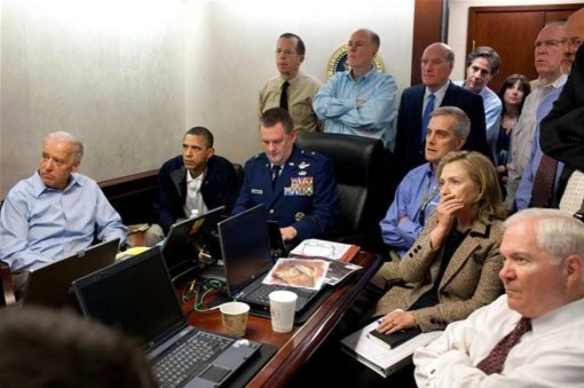
Situation Room

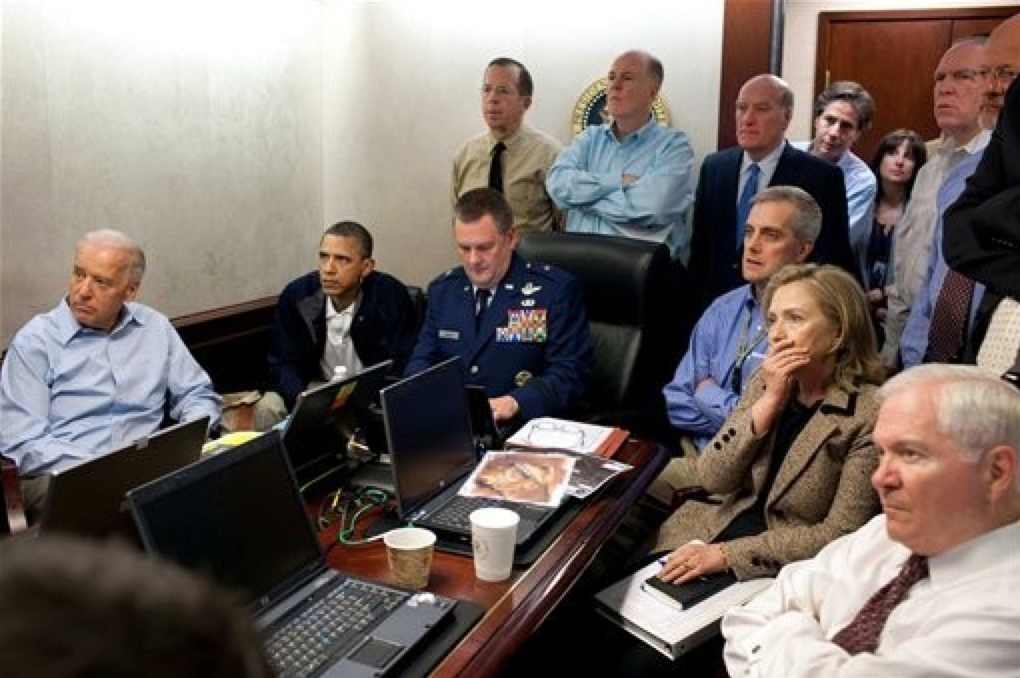
In the kill/capture raid against Osama Bin Laden on 1 May 2011 (assuming ‘capture’ was ever on the agenda), he argues that the choice was between drones and Special Forces not between drones and re-staging Dresden in Abbotabad.  This doesn’t quite work, since the raid was carried out by US Navy Seals who swept in from Bagram via Jalalabad by helicopter, but the mission also depended on real-time imagery from an RQ-170 stealth drone (‘the Beast of Kandahar’).  This was the source of the live video feed watched by Obama and members of his administration in the famous ‘Situation Room’ photograph [on which, see Keith Feldman on ‘Empire’s Verticality’ in Comparative American Studies 9 (4) (2011) 325-41].

The RQ-170 is an unarmed platform, but its role should remind us that drones are part of networked warfare – even when strikes are carried out by other means, the enhanced intelligence, surveillance and reconnaissance capabilities provided by the long dwell-times of these remote platforms mean that they are instrumental in the activation of the kill-chain.  This holds for military operations far beyond targeted killing: in Afghanistan between 2009 and 2011 drones were directly responsible for only 5-6 per cent of weapons released by the US Air Force, but they no doubt played a vital role in the release of many of the others.
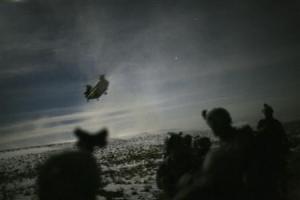
Night raidStill, Chamayou’s basic point is a sharp one – and I rehearsed similar arguments in my discussion of The politics of drone wars last year – but readers of Jeremy Scahill‘s Dirty Wars may still reasonably object that the civilian casualties resulting from JSOC’s infamous night raids in Afghanistan cast doubt on the precision and accuracy of ground forces too.  Gareth Porter has estimated that more than 1,500 civilians were killed in night raids in just ten months in 2010-11, making them ‘by far the largest cause of civilian casualties in the war in Afghanistan.’  Indeed, Afghan protests have frequently centred on the civilian toll exacted by drones and night raids.

Even if the appropriate comparison is between different modalities of military violence in the present, Chamayou argues that the discussion is bedevilled by another series of confusions about ‘accuracy’ or ‘precision’.   In fact, though he doesn’t say so, the the two terms aren’t interchangeable. Strictly speaking,  accuracy refers to the deviation from the aiming point, precision to the dispersion of the strike:
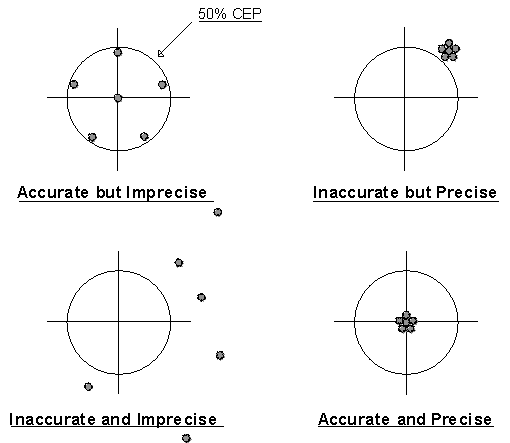
Accuracy and precision

CEP in the diagram above refers to the Circular Error Probable, once described by the Pentagon as ‘an indicator of the delivery accuracy of a weapon system’, which is a circle of radius n described around the aiming point.  Assuming a bivariate normal distribution, then – all other things being equal (which they rarely are) – 50% of the time a bomb, missile or round will land within the circle: which of course means that the other half of the time it won’t, even under ideal experimental conditions.  As this is a normal distribution, then 93 per cent should land within 2n and more than 99 per cent within 3n.

Chamayou doesn’t refer to the CEP directly, only briefly to the ‘accuracy of fire’,  but – to revert to the comparison he refuses – the CEP of bombing from the air has contracted dramatically since the Second World War when it was around 3,000 feet (though this improved over time): so much so that David Deptula, when he was USAF Deputy Chief of Staff for ISR, used to talk of crossing a ‘cultural divide of precision and information’.  The image below, taken from one of his presentations, shows the contraction (notice that the aim point is the Pentagon….).
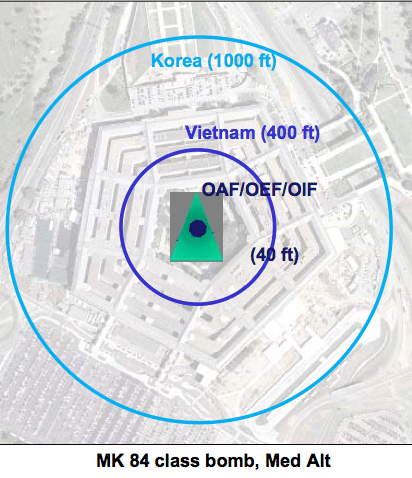
Target mensuration (USAF)

Interestingly, the most recent Joint Publication (3-60) from the Joint Chiefs of Staff on Targeting (January 2013) has explicitly removed the concept from its Terms and Definitions, citing as its authority the Department of Defense’s Dictionary of Military and Associated Terms (it was still there on 31 January 2011, but no longer).  I haven’t been able to discover the reasons for the change, though there is longstanding scepticism about the validity of the measure: see, for a specific example, Donald MacKenzie‘s classic discussion in Inventing accuracy: a historical sociology of nuclear missile guidance (1993, pp. 352-7).  I’ve seen several comments to the effect that the measure isn’t useful for ‘smart bombs’ because they don’t display the same spread as ‘dumb bombs’.  (There’s a quick primer on the emergence of smart bombs during the Vietnam War here, and an account of the evolution of ‘precision strike’ since then here; for more detail, try David Koplow‘s Death by moderation: the US military’s quest for useable weapons (2009)).

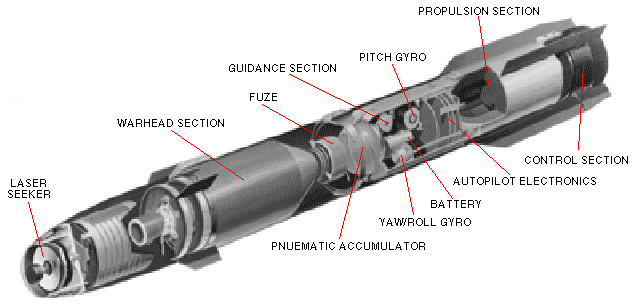
The MQ-1 Predator carries two AGM-114 Hellfire missiles [shown below, top; for acronyphiles, AGM designates an Air-to-Ground Missile, while the ‘Hellfire’ was originally developed as a ‘Helicopter-Launched Fire-and-Forget Missile’; its main platform is still an attack helicopter], while the MQ-9 Reaper can carry four AGM-114 Hellfire Missiles or replace two of them with GBU-12 Paveway II bombs [GBU = Guided Bomb Unit; shown below, bottom].
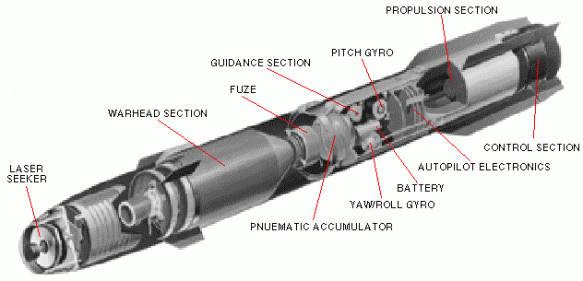

hellfire

GBU-12_xxl

Both weapons systems are laser-guided; the sensor operator, sitting beside the pilot in the Ground Control Station, uses a laser targeting marker (LTM) to ‘paint’ the target – this can also be done by ground troops in conventional combat zones – but its accuracy can be compromised by cloud, smoke, fog or dust.  (This is why the Air Force also uses GPS-guided weapons; they are less accurate but unaffected by these environmental conditions).  Once the necessary clearances have been obtained from mission commanders and military lawyers, the pilot fires the missile and the sensor operator guides it on to its target.

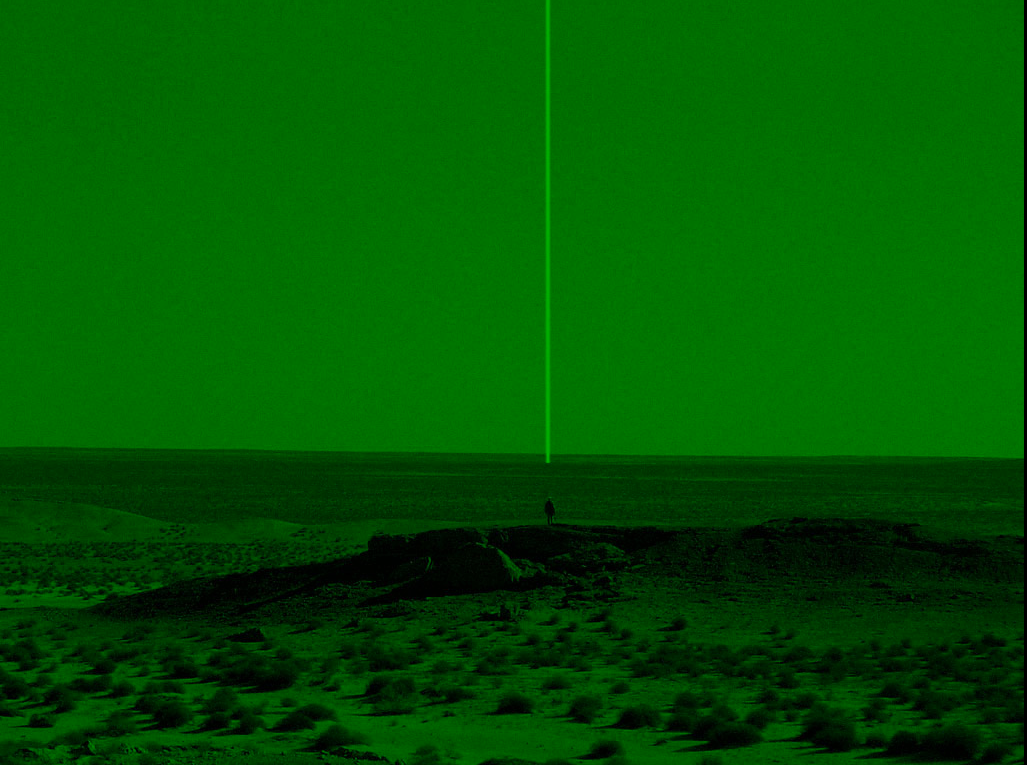
Omer Fast‘s interview with a sensor operator (‘Brandon’ –  whether this is a pseudonym or really Brandon Bryant is hard to know) for 5,000 Feet is the Best provides a series of insights into the operation in Afghanistan and Iraq.  You can’t see the beam with the naked eye, but American ground troops can see it with their infrared goggles.  According to ‘Brandon’, they call it the ‘Light of God’ (really); the image below is James Bridle‘s replication of the effect based on laser targeting night systems and a CC-licensed photograph of the Iraqi desert by Rob Bakker.
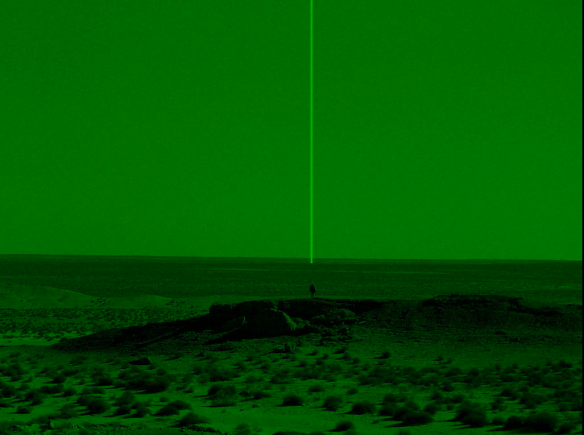
JAMES BRIDLE Light of God

‘Brandon’:

‘Usually the laser track is about half the size of this [hotel] room.  Poof!  By the time it hits the ground… a lot of times it turns into a square for some reason…  It could be anywhere from ten feet by ten feet to twenty feet by twenty feet… It starts off small and you watch it kind of open up’

This is not exactly putting ‘warheads on foreheads‘, but ‘Brandon’ explains that the crew is also required to identify a secondary ‘abort’ target.

‘… some of the contingencies we have to worry about are: if we’re firing at a building and somebody crosses – maybe – who knows, a group of children starts crossing in front of the building, we need a second site once that missile is already off the rails.  To go ahead and drop that missile so that we don’t harm the children  So usually we’ll choose an alternate site a couple hundred feet to a couple of hundred yards away.  It might be an empty field.  And we use that as the backup…

So let’s  say we get the missile off the rail and a group of kids comes into play: I call “abort” and I’ll start moving that laser over to an empty site so that we can detonate there and not cause any additional loss of life.’

Predator and Brandon Bryant

Sounds good, but the real Brandon Bryant (above) has a different story to tell; it turns out that there is an eight-second window in which the missile can be diverted:

With seven seconds left to go, there was no one to be seen on the ground. Bryant could still have diverted the missile at that point. Then it was down to three seconds. Bryant felt as if he had to count each individual pixel on the monitor. Suddenly a child walked around the corner, he says.

Second zero was the moment in which Bryant’s digital world collided with the real one in a village between Baghlan and Mazar-e-Sharif.

Bryant saw a flash on the screen: the explosion. Parts of the building collapsed. The child had disappeared. Bryant had a sick feeling in his stomach.

“Did we just kill a kid?” he asked the man sitting next to him.

“Yeah, I guess that was a kid,” the pilot replied.

“Was that a kid?” they wrote into a chat window on the monitor.

Then, someone they didn’t know answered, someone sitting in a military command center somewhere in the world who had observed their attack. “No. That was a dog,” the person wrote.

They reviewed the scene on video. A dog on two legs?

Even then, think about that blossoming square, twenty feet by twenty feet.  Then factor in the Circular Error Probable of a Hellfire missile, which is usually calculated at between 9 and 24 feet. The ‘pinpoint’ accuracy of the missile is starting to blur and the ‘surgical’ strike beginning to blunt.  In fact, the development of the Hellfire missile suggests another narrative.  In 1991 the Pentagon was already advertising the Hellfire as capable of ‘pinpoint’ accuracy, and since then it has been upgraded more than half a dozen times, each version promising greater accuracy: as Matthew Nasuti asks in his catalogue of Hellfire errors, what can be more accurate than ‘pinpoint accurate’?

In any case, narrowing the discussion to the CEP misses two things.  First, as former USAAF officer Peter Goodrich points out in his discussion of ‘The surgical precision myth‘, this ‘totally disregards what happens after the bomb explodes’.  What Goodrich has in mind is the blast and fragmentation radius, which Chamayou calls ‘the kill radius’.  Fast’s ‘Brandon’ insists

‘All of us are taught about how far those Hellfire missiles go, how far their frag goes.  And “danger close” as we call it when you have troops that are very close or civilians that are present.  They’re just factors that  you have to work in to bring down the percentages of the harm that could be done.’

In the targeting cycle the US Air Force enters those ‘factors’ into both collateral damage estimation and ‘weaponeering’, modifying the missile or bomb to restrict its blast and fragmentation radius. Chamayou reports that the Hellfire missile has a ‘kill radius’ of 50 feet (15 metres) and a ‘wounding radius’ of 65 feet (20 metres); the GBU-12 Paveway II has a ‘casualty radius’ of between 200 and 300 feet (within which 50 per cent of people will be killed).   These calculations aren’t exactly equivalent – and it’s difficult to obtain precise and comparable figures – but nothing about this is as precise as the rhetoric  implies.  As Chamayou asks:

‘In what fictional world can killing an individual with an anti-tank missile [the Hellfire] that kills every living thing within a radius of 15 metres and wounds everyone else within a radius of 20 metres be seen as “more precise”?’

All those who are killed or wounded within the casualty radius are presumably guilty by proximity.

This is Chamayou’s second rider, which relates to what happens before the bomb or missile is released: to the production – the US military sometimes calls it the ‘prosecution’ – of the target.  In this sense, the technical considerations I’ve just described are beside the point (sic).  All of the calibrations I’ve set out in such detail apply to missiles and bombs irrespective of the platform used to deliver them; what is supposed to distinguish a Predator or a Reaper from a conventional strike aircraft or attack helicopter is that it combines ‘hunter’ and ‘killer’ in a single platform and, specifically, that its real-time full-motion video feeds enable crews (and others in the loop) to see what they are doing in unprecedented detail.
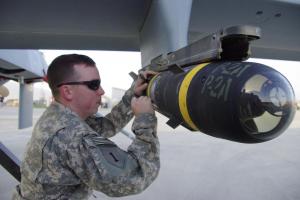
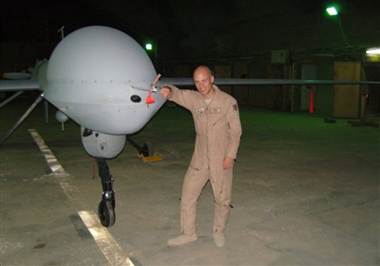
Signing a Hellfire missile attached to a MQ1-C (Gray Eagle) UAV at BagramDoes this political technology of vision make it possible, as advocates claim, to distinguish between combatants and civilians more effectively than ever before?  Here Chamayou rehearses common criticisms: that in standard US military practice ‘combatant’ morphs into ‘militant’, even ‘presumed militant’ and, at the hideous limit, into ‘military-aged male’ – counting ‘all military-age males in a strike zone as combatants … unless there is explicit intelligence posthumously proving them innocent’ – and that this process of (so to speak, performative) militantisation as Chamayou calls it is underwritten by a techno-judicial probabilisation (again his term) whose ‘epistemology of suspicion’ allows signature strikes that target un-named and unknown people on the basis of their ‘pattern of life‘.

But both these procedures and, indeed, the criticisms of them, obscure what is for Chamayou, the fundamental paradox, what he calls the ‘profound contradiction’.  International law defines a combatant and thus a legitimate target in terms of direct participation in hostilities and an imminent threat.  It’s more complicated than that, as I’ll show later, but this is enough for Chamayou to fire off two key questions: How can anyone be participating in hostilities if there is no longer any combat? How can there be any imminent threat if there are no troops on the ground?  The drone, praised for its forensic ability to distinguish between combatant and non-combatant, in fact abolishes the condition necessary for such a distinction: combat itself (p. 203; also p. 208).

It’s an artful claim, but it oversimplifies the situation.  Chamayou has (once again) confined the discussion to targeted killing but, as I’ve repeatedly emphasised, Predators and Reapers have also been used for other purposes in Iraq and Afghanistan, including the provision of ‘armed overwatch’ and close air support to ground troops.  Outside these war-zones – in the Federally Administered Tribal Areas of Pakistan, Yemen, Somalia and elsewhere – the critique is a powerful one (which is not to say that Obama’s lawyers have not claimed a legal warrant for their supposedly covert drone strikes in these areas: more on this later too).  Still, Chamayou’s argument loops back to earlier discussions about the intrinsic non-reciprocity of drone warfare.

And here Chamayou closes with a powerful argument.  If ethics is classically about how to live well and die well, he suggests that necro-ethics is a doctrine of ‘killing well’.  He notes that critics of the covert drone wars demand, time and time again, transparency.  They want to know the legal armature and adjudicative apparatus for the strikes, the rules and procedures that are followed, and the lists of casualties.  But he argues that their demands turn the issue into an arid juridico-administrative formalism endorsed by bureaucratic Reason.  In the kill zones, he says ruefully, there are no legal memoranda, no columns of numbers or ballistics reports (p. 207): these are the very formularies of necro-ethics.  And, as I’ve noted, there are no air-raid warnings, no anti-aircraft defences and no air-raid shelters either.

It’s in that spirit that Chamayou closes the chapter with an extended quotation from Madiha Tahir’s Louder than bombs‘:

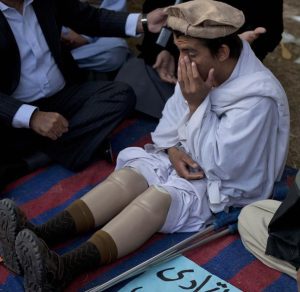
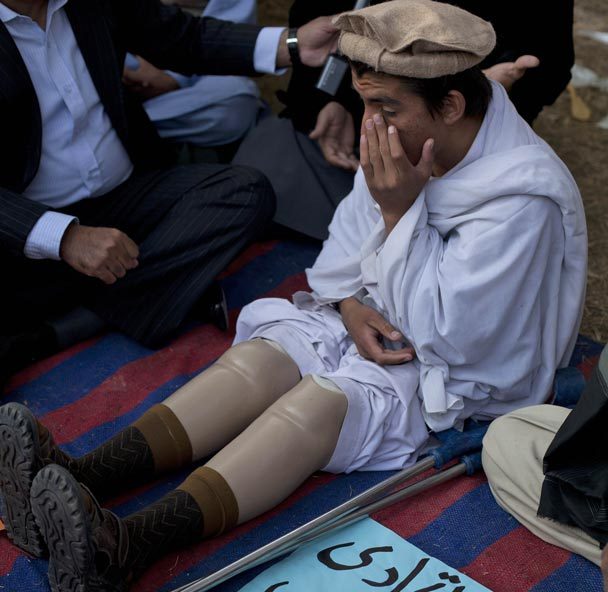
Saudallah WazirWhat is the dream?

I dream that my legs have been cut off, that my eye is missing, that I can’t do anything … Sometimes, I dream that the drone is going to attack, and I’m scared. I’m really scared.

After the interview is over, Sadaullah Wazir pulls the pant legs over the stubs of his knees till they conceal the bone-colored prostheses.

The articles published in the days following the attack on September 7, 2009, do not mention, this poker-faced, slim teenage boy who was, at the time of those stories, lying in a sparse hospital in North Waziristan, his legs smashed to a pulp by falling debris, an eye torn out by shrapnel. nor is there a single word about the three other members of his family killed: his wheelchair-bound uncle, Mautullah Jan and his cousins Sabr-ud-Din Jan and Kadaanullah Jan.  All of them were scripted out of their own story till they tumbled off the edge of the page.

Did you hear it coming?

No.

What happened?

I fainted. I was knocked out.

As Sadaullah, unconscious, was shifted to a more serviceable hospital in Peshawar where his shattered legs would be amputated, the media announced that, in all likelihood, a senior al-Qaeda commander, Ilyas Kashmiri, had been killed in the attack. The claim would turn out to be spurious, the first of three times when Kashmiri would be reported killed.

Sadaullah and his relatives, meanwhile, were buried under a debris of words: “militant,” “lawless,” “counterterrorism,” “compound,” (a frigid term for a home). Move along, the American media told its audience, nothing to see here.

Some 15 days later, after the world had forgotten, Sadaullah awoke to a nightmare.

Do you recall the first time you realized your legs were not there?

I was in bed, and I was wrapped in bandages. I tried to move them, but I couldn’t, so I asked, “Did you cut off my legs?” They said no, but I kind of knew.

When you ask Sadaullah or Karim or S. Hussein and others like them what they want, they do not say “transparency and accountability.” They say they want the killing to stop. They want to stop dying. They want to stop going to funerals — and being bombed even as they mourn. Transparency and accountability, for them, are abstract problems that have little to do with the concrete fact of regular, systematic death.’

And Madiha adds this: ‘The technologies to kill them move faster than the bureaucracies that would keep more of them alive: a Hellfire missile moves at a thousand miles per hour; transparency and accountability do not.’

Indeed they don’t; Sadaullah died last year, Mirza Shahzad Akbar reports, ‘without receiving justice or even an apology.’  Not even killing well, then.

War from afar

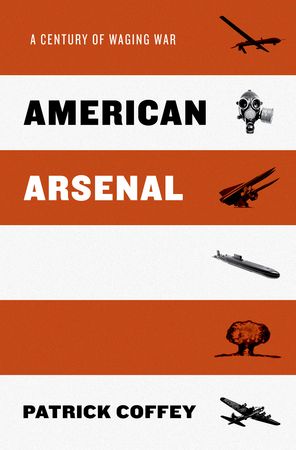
9780199959747_450My interest in tracking the history (or if you prefer, historical geography) of waging war at a distance – my ‘Deadly Embrace’ project, which will eventually produce a long-form essay for War material – has been given another boost by news of a new book from Patrick Coffey, Visiting Scholar in the Office for History of Science and Technology at the University of California, Berkeley: American Arsenal: a century of waging warfrom Oxford University Press, it’s out now in North America (at least as an e-book) and available elsewhere early next year.

When America declared war on Germany in 1917, the United States had only 200,000 men under arms, a twentieth of the German army’s strength, and its planes were no match for the Luftwaffe. Less than a century later, the United States today has by far the world’s largest military budget and provides over 40% of the world’s armaments.

In American Arsenal Patrick Coffey examines America’s military transformation from an isolationist state to a world superpower with a defense budget over $600 billion. Focusing on sixteen specific developments, Coffey illustrates the unplanned, often haphazard nature of this transformation, which has been driven by political, military, technological, and commercial interests. Beginning with Thomas Edison’s work on submarine technology, American Arsenal moves from World War I to the present conflicts in the Middle East, covering topics from chemical weapons, strategic bombing, and the nuclear standoff with the Soviet Union, to “smart” bombs, hand-held anti-aircraft missiles, and the Predator and other drone aircrafts. Coffey traces the story of each advance in weaponry from drawing board to battlefield, and includes fascinating portraits the men who invented and deployed them-Robert Oppenheimer, head of the Manhattan Project; Curtis LeMay, who sent the Enola Gray to drop the atom bomb on Hiroshima and Nagasaki; Herman Kahn, nuclear strategist and model for Stanley Kubrick’s Dr. Strangelove; Abraham Karem, inventor of the Predator and many others. Coffey also examines the increasingly detached nature of modern American warfare-the ultimate goal is to remove soldiers from the battlefield entirely-which limits casualties (211,454 in Vietnam and only 1,231 in the Gulf War) but also lessens the political and psychological costs of going to war.

I start the story much earlier – and so pay attention to other, older imperial powers too – but you can see the interest.  Here’s the Contents list:

Introduction
Edison at War
Gassing the Senator
Mitchell’s War in Three Dimensions
The Bombsight
Precision Bombing Tested
Napalm
The Switch
The Atomic Bomb
The Weapon Not Used
The Cold War and the Hydrogen Bomb
Missiles
War games
Four lessons from Vietnam
Star Wars
Smart Bombs and Drones
Epilogue

And you can read the last substantive chapter, or at any rate a version of it, at Salon here: ‘War from afar: How the Pentagon fell in love with drones‘.  Despite the title, the essay is about more than the history of drones, which Coffey links to the development of so-called ‘smart bombs’ (and yes, I do think all bombs are dumb bombs):

In the last years of the twentieth century, two weapons changed the way that America fights air wars: smart bombs (bombs that “see” a target using a television camera or a radiation sensor, or that head for a programmed location) and UAVs (unmanned aerial vehicles). Smart bombs came into their own in the first Gulf War. Reconnaissance UAVs proved their worth in Bosnia and Kosovo in the late 1990s, and offensive UAVs began firing missiles in Iraq, Afghanistan, Pakistan, and elsewhere a few years later.

The connection between the two is a tightrope on which both advocates and critics of today’s drone wars sway – as I’ll discuss in detail in my next post on Grégoire Chamayou‘s Théorie du drone.

As above, so below

 Omer Fast 5000ft is the best

News from Rob Coley of a Colloquium on Drone Culture organised by the University of Lincoln 21st Century Research Group, As Above, So Below, on Saturday 24th May; I’ll be giving one keynote and Benjamin Noys (Chichester) will be giving the other 

CALL FOR PAPERS

 The military use of aerial drones, or Unmanned Aerial Vehicles, has in recent years instigated huge controversy, dispute and protest. There continues to be much debate over the social and political implications of drone warfare, not least here in Lincoln, where, for the past year, the county has been home to the RAF’s Remotely Piloted Aircraft Squadron. As wartime base to the Lancaster bomber, Lincolnshire is, to many, still ‘Bomber County’, and today the UK’s provision of armed Reaper drones, which operate in Afghanistan on surveillance and combat missions, are controlled remotely from a base less than five miles from our university campus. The issues raised are, then, strikingly clear: the ethics of extrajudicial killing, the relation between ‘surgical’ strikes and ‘collateral’ civilian deaths, the diffusion of the conventional ‘battlefield’, the implications of the commercial use of drones in civilian airspace, the psychological effects of exerting power from a distance.

 Though motivated by these issues, this one-day colloquium has been convened in order to examine the broader questions relating to the drone as a cultural concept and, in its virtual potentials, as a more complex set of transformations which extend beyond the actuality of the unmanned aerial vehicle. Specifically, drone culture is understood here as a symptom of what McKenzie Wark has called ‘vectoral’ power, a power that, constituted by flows of information, operates in abstract communicational space so as to exploit perception at a distance. In this sense, the cultural significance of the drone is inseparable from the newly complex processes of mediation unique to the 21st century.

This event will map the immanent forces of drone culture across a variety of disciplines and phenomena, and in doing so disclose its political and ethico-aesthetic expressions in literature, cinema, music, photography, theatre and performance. For examples, we might look to science-fictional explorations of the relation between air and informational power (Ballard, Pynchon, McCarthy), the drone in political theatre (such as George Brant’s Grounded), the drone in recent cinema (such as Oblivion with Tom Cruise), and the drone in art (see the work of Josh Begley, James Bridle, Omar Fast, Adam Harvey and Trevor Paglen). In response, the colloquium will include an exhibition of art works, performances and screenings.

You are invited to submit proposals for either:

  • 20 minute paper presentation (with title and abstract of about 350 words)
  • 5 minute ‘speed papers’ – positions, potentials and provocations (with title and abstract of about 100 words)

Suggestions for topics include, but are not limited to:

  • aerial power, informational power, vectoral power
  • maps and mapping
  • speed and accelerationism
  • perception at a distance: remoteness and affect
  • video game logics
  • drone temporalities (including audio and sonic)
  • drone fictions (SF drones, drone horrors, weird drones)
  • drones and swarms
  • drone subjectivities and psychologies
  • patterns of life in software-sorted space
  • kill lists and ‘big data’
  • the long history of distance weapons and intelligent machines
  • the rhetoric of the ‘targeted’, ‘surgical’ and ‘signature’ strike
  • counterinsurgency
  • ubiquitous warfare and the normalization of crisis
  • drone sorcery, magic and glamour
  • thanatopolitics

Please include a short biographical note with all submissions and send in one word file to: abovebelow@lincoln.ac.uk 

Deadline for all submissions: 31st January, 2014

Droning on

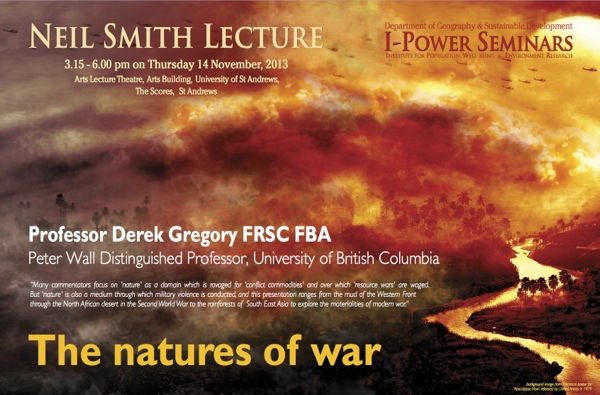
Sorry for the long silence – I’ve been prepping for my trip to St Andrews, where this afternoon I’ll be giving the Neil Smith Lecture.  Over the years I’ve given lots of lectures named after people I knew (if I knew them at all) only through their writings, and this is the first time I’ve given one named after someone I knew – and cared so much about.  There is a wonderful phrase in a commentary on Marx’s humanism (and humanity) and his critique of alienation, which talks about ‘man in the whole wealth of his being, man richly and deeply mentally alive’.  Needless to say I can’t track down the source when I need it – Ollman, maybe? – but I’ve never forgotten those words (or at least their force) since I read them years and years ago.  I can think of no other phrase that captures Neil so perfectly.

GREGORY The natures of war

Still lots to do, but I have added the final version of my general essay on drones, ‘Moving targets and violent geographies’, to the DOWNLOADS tab.  It will appear in an edited collection in honour of Allan Pred, edited by Lisa Hoffman and Heather Merrill, but I’ll also re-work it (and no doubt extend it) for The everywhere war so, as usual, I’d value any comments – preferably by e-mail to avoid the spam filters.  I’m flattered by those e-marketeers who think that my blog is a likely medium to flog everything from Viagra (well, not quite so flattered at that) to Louis Vuitton luggage, but thanks to those filters they – and perhaps you, dear reader – are out of luck…

And while I am channelling Del-Boy, another wordpress service lists the search terms that people use to navigate their way to the blog, and I’d particularly like to know what the person who was searching for – how do I put this? – a highly specialised type of basket apparently made in Vietnam made of Geographical imaginations.  I don’t expect they’d have found it on Louis Vuitton either.

Boundless Informant and the everyware war

As part of my presentation on “Drones and the everywhere war” at York, I decided to unpack this extraordinary claim made by John Nagl, one of the architects of the US military’s revised counterinsurgency doctrine:

We’re getting so good at various electronic means of identifying, tracking, locating members of the insurgency that we’re able to employ this extraordinary machine, an almost industrial-scale counterterrorism killing machine that has been able to pick out and take off the battlefield not just the top level al Qaeda-level insurgents, but also increasingly is being used to target mid-level insurgents.

It’s a remark I’ve discussed several times before.  Nagl’s ‘killing machine’ is not limited to drone strikes, of course, but subsumes the ‘night raids’  and other Special Forces operations detailed in Jeremy Scahill‘s Dirty Wars.  But at York I wanted to explore how those ‘electronic means of identifying, tracking and locating’ fed into drone strikes in Pakistan: and, thanks to Edward Snowden and Glenn Greenwald, I was able to get much closer to the belly of the beast.

Drones+ app

I’d started the presentation with a riff on Josh Begley‘s attempt to persuade Apple to include his Drones+ app in the App store.  Apple decided, for several contradictory and spurious reasons, to reject the app, and at his thesis defence Josh asked:

 ‘Do we really want to be as connected to our foreign policy as we are to our smart phones… Do we really want these things to be the site of how we experience remote war?’

Apple’s answer was ‘no’, clearly, but it turns out that others are intimately connected to drone strikes through their phones and e-mails, and it was this that I fastened on.

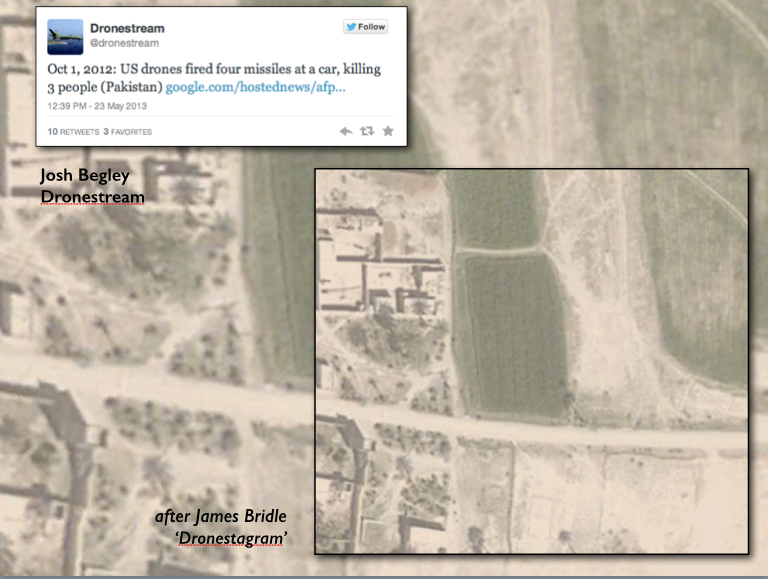
Josh, undeterred by Apple, went on to launch the Dronestream platform, from which he tweeted details of every known US drone strike.  I combined one of Josh’s tweets for 1 October 2012 with a version of James Bridle‘s Dronestagram, which uses Instagram to post images of the location of drone strikes (I say ‘a version’ because Dronestagram was launched too late for this particular strike, so this is a mock-up; in any case, it’s difficult to pinpoint the locations from available reports with much precision, but the details for this strike are available via the Bureau of Investigative Journalism, as the second slide below shows):

1 October 2012 Dronestream and Dronestagram

Bureau of Investigative Journalism 1 October 2012 strike

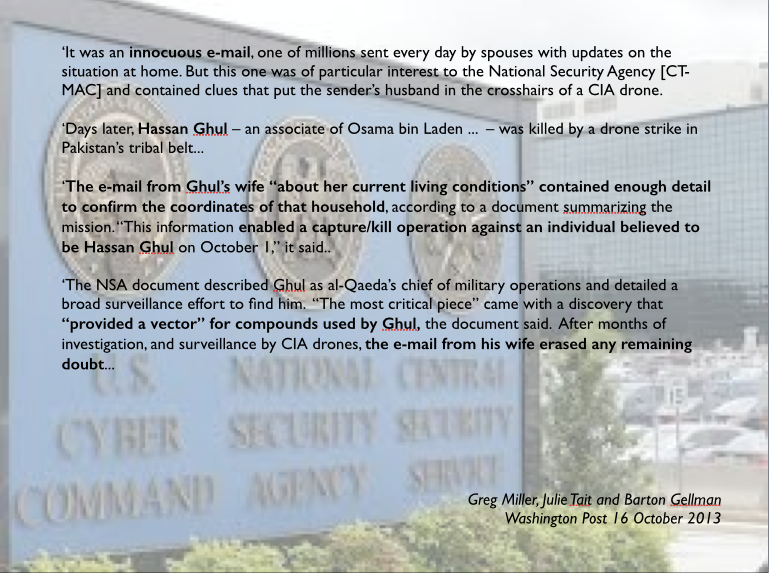
We now know that this strike was made possible as a result of interceptions made by the National Security Agency’s Counter-Terrorism Mission-Aligned Cell (CT-MAC).  Writing in the Washington Post on 16 October 2013 Greg Miller, Julie Tait and Barton Gellman explained how this strike had targeted Hassan Ghul:

Hassan Ghul NSA intercepts

Not quite ‘any doubt’; as they went on to note, ‘Although the attack was aimed at “an individual believed to be” the correct target, the outcome wasn’t certain until later, when “through SIGINT [signals intelligence] it was confirmed that Hassan Ghul was killed.”‘

So how did the intercept work?  Not surprisingly, we don’t know for sure; but the map below of NSA’s ‘Boundless Informant‘ – another dimension of what I’ve been calling ‘the everywhere war’ – offers some clues.  I’ve taken it from a report in the Guardian by Glenn Greenwald and Ewen MacAskill:

Boundless Informant March 2013 heat map

This is six months later, but it shows that Pakistan was, after Iran, the major focus of NSA’s surveillance and data mining operations (Miller and his colleagues had noted that “NSA threw the kitchen sink at FATA’, the Federally Administered Tribal Areas).  It would be wrong to assume that the targeted killing of Ghul was the result of a simple hack into hotmail, and the Post report details the multiple methods used by NSA.

Still, the geography of covert surveillance shown on the map is revealing.  Yesterday Greenwald returned to Boundless Informant and rebutted the charge that he had misinterpreted the meaning of this and other slides, and in doing so quoted from NSA’s own explanation of the system:

BOUNDLESSINFORMANT is a GAO [Global Access Operations, a branch of the NSA] prototype tool for a self-documenting SIGINT system. . . BOUNDLESSINFORMANT provides the ability to dynamically describe GAO’s collection capabilities (through metadata record counts) with no human intervention and graphically display the information in a map view, bar chart, or simple table. . . .
By extracting information from every DNI and DNR metadata record, the tool is able to create a near real-time snapshot of GAO’s collection capability at any given moment. The tool allows users to select a country on a map and view the metadata volume and select details about the collection against that country. The tool also allows users to view high level metrics by organization and then drill down to a more actionable level – down to the program and cover term.

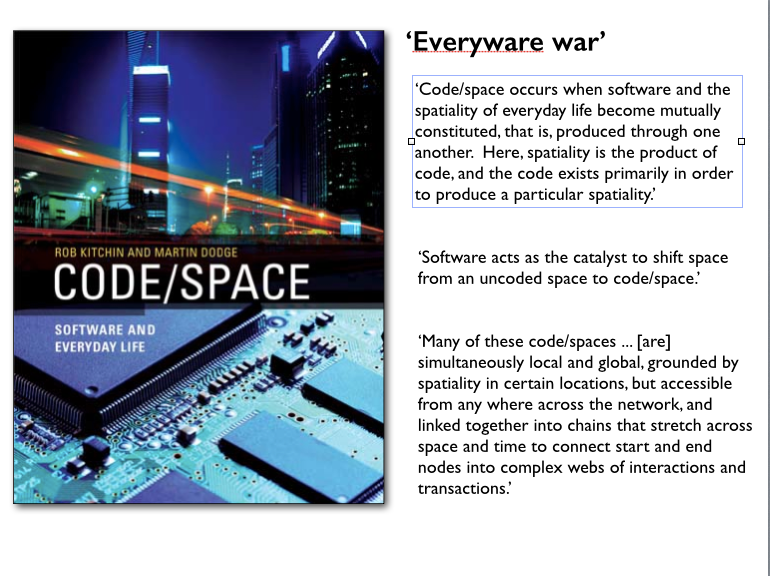
It’s not too difficult to connect the dots and draw two more general conclusions.  The first is that this is another, darker dimension to the ‘code/space’ and ‘everyware’ discussed in such impressive detail by Rob Kitchen and Martin Dodge:

Everyware war

My slide is just short-hand, of course, but you can see where I’m going, I hope – and, as we know from this week’s harrowing testimony on Capitol Hill about the murder of Mamana Bibi in Waziristan and Amnesty International’s report, Will I Be Next?, these operations and their algorithms work to turn ‘everyday life’ into everyday death.  So I’ll be thinking more carefully about code/space and its implication in the individuation of later modern war, paying closer attention to the technical production of ‘individuals’ as artefacts and algorithms as well as the production of the space of the target: more to come.

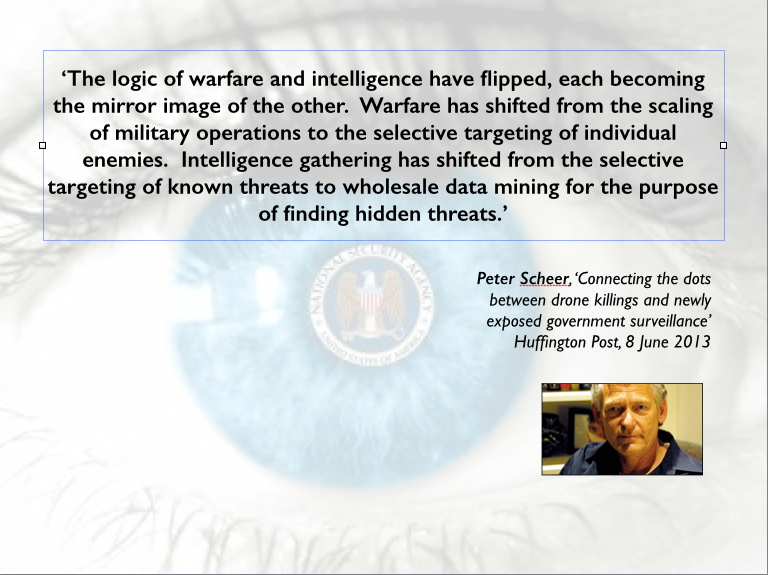
The second general conclusion I leave to Peter Scheer, who provides a more refined (and critical) gloss on John Nagl’s comment with which I began:

SCHEER Connecting the dots

I’m incorporating these and other developments into the revised and extended version of “Moving targets and violent geographies” which will appear in The everywhere war, but I hope this bare-bones account (and that first draft, available under the DOWNLOADS tab) shows that my posts are more connected than they must sometimes appear…  The slides were pulled together on the day I gave the presentation, so forgive any rough edges.