Theory of the drone 1: Genealogies

Grégoire ChamayouThis is the first of a series of posts as I work my way through Grégoire Chamayou‘s Théorie du drone (2013), which has finally arrived on my desk.  I’ve loosely summarised the project and its relation to Chamayou’s previous work before, and in these notes I’ll combine a summary of his argument with some extended readings and excerpts from his sources and some comments of my own.  I hope readers will find these useful; they are an aide-memoire for me, and a way of working out some of my own ideas too, but do let me know if all this is helpful (especially for those with no French).

I’m pleased to say that he draws on several of my essays about drone warfare, including ‘From a view to a kill’, ‘Lines of descent’, and even ‘The everywhere war’ (all available under the DOWNLOADS tab), so I won’t re-trace in any detail our (considerable) common ground.

The first section of Theory of the drone is devoted to Techniques and Tactics and, as I noted previously, it’s good to read a philosopher engaging with the materialities and corporealities of contemporary war in such close detail.  I’ll start with the first two chapters, which read together provide some more lines of flight for today’s remote operations.  I don’t call these ‘genealogies’ lightly: as you’ll see next time, there are definite and deliberate echoes of Foucault in the argument (though Chamayou is no disciple).

1: ‘Methodologies for hostile environments’

It’s become a truism to say that drones are ideally suited for ‘dirty, dangerous or difficult’ tasks, and Chamayou begins with an interesting article written by John W. Clark for the New Scientist in 1964 on ‘Remote control in hostile environments’.

Clark described the development of technologies ‘of manipulation at a distance – what he called ‘telechirics’ (a term that Chamayou appropriates for his own purposes, from the Greek tele meaning ‘distance’ and kheir meaning ‘hand’) – so that people no longer had to expose themselves to danger to earn a living: from the extremes of outer space, exposure to nuclear radiation and deep ocean exploration to more mundane, everyday projects like fire-fighting, tunnelling, or mining. The key advance was the use of ‘a vehicle operating in the hostile environment under remote control by a man in a safe environment’.

Clark emphasised the remoteness – ‘there is no direct connection between the operator and his machine’ – because in his view the system depended on the capacity of the human operator ‘to “identify himself” with his remotely-controlled machine, even though it may be completely non-anthropomorphic in appearance and configuration’. In effect, Clark wrote, ‘his consciousness is transferred to an invulnerable mechanical body’ which implies, in turn, that ‘systems of this type are no substitutes for human judgment’. (For this reason, while Clark believed that a ‘telechiric system’ could be provided with a variety of sensors, vision – ‘by far our most valuable sense’ – was typically provided through a single-channel, closed-circuit television system). Indeed, the capacity for judgment is enhanced by partitioning space, as Chamayou notes, placing the operator in a ‘safe zone’ outside the ‘danger zone’.  The danger zone is a site of surveillance and intervention (‘by a cable or by a radio-link’), Chamayou underlines, but not a site of habitation.

It’s not difficult to see how these propositions can be carried over to the use of  combat drones.  Interestingly, Clark had been employed by the Hughes Aircraft Company where he originally developed his ideas on ‘remote handing’ (what he then called mobotry). He had noted that ‘the electronic techniques which have been developed in recent years, primarily in connection with guided missiles and radar, are finding increasing application in connection with remotely controlled systems for accomplishing physical operations within areas which are uninhabitable due to the presence of a hostile environment’, and in the closing section of the research paper he noted that ‘a remotely-controlled street-sweeper employing television for guiding and steering and a simple frequency coded command system has recently completed successful tests.’

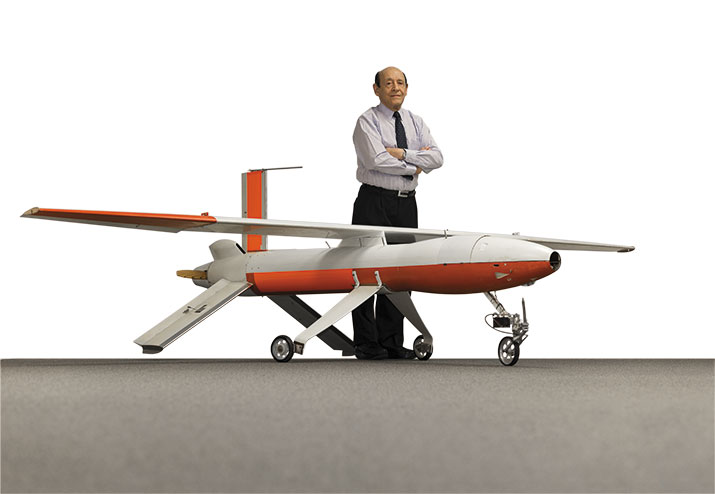
Where? The Air Force Special Weapons Center in Albuquerque, which was dedicated to R& D of atomic and other ‘unconventional’ weapns (which was presumably not especially interested in keeping the streets clean).  And at the end of the 1980s Clark’s old employer, Hughes Aircraft, would buy a fledgling drone manufacturing company, Leading Systems, from Abe Karem (‘the dronefather‘), and then promptly sell it on to General Atomics which, with Karem’s assistance, became the company responsible for the Predator.

These details are not included in Chamayou’s discussion – and I don’t mean this as a criticism: I admire both the brevity and the clarity of his account – and in fact no links to the military appeared in the New Scientist article. But Chamayou has found a subsequent, anonymous and remarkably telling comment on the article. Among the scenarios canvassed by Clark, this contributor wrote, one was conspicuous by its absence:

‘The minds of telechiricists are grappling with the problems of employing remotely-controlled machines to do the peaceful work of man amid the hazards of heat, radiation, space and the ocean floor. Have they got their priorities right? Should not their first efforts towards human safety be aimed at mankind’s most hazardous employment – the industry of war?… Why should twentieth-century men continue to be stormed at by shot and shell when a telechiric Tommy Atkins could take his place? ‘All conventional wars might eventually be conducted telechirically, armies of military robots battling it out be remote control, victory and defeat being calculated and apportioned by neutral computers, while humans sit safely at home watching on TV the lubricating oil staining the sand in sensible simile of their own blood.’

Sand? Chamayou doesn’t mention it [‘sand’ in his French translation becomes ‘dust’], but in fact the anonymous author opened his commentary by noting that the publication of Clark’s original article ‘coincided with the flare-up in the Yemen…’  The ‘flare-up’ was part of a civil war in Yemen, in which royalists (supported by Saudi Arabia) were pitted against republicans (supported by Egypt) and Britain was engaged in a series of irregular, covert operations that were repeatedly denied in Parliament.

And so it’s no accident, I think, that the anonymous contributor goes on to emphasize the importance of telechirics for asymmetric warfare:

‘Far-flung imperial conquests which were ours because we had the Maxim gun and they had the knobkerrie will be recalled by new bloodless triumphs coming our way because we have telechiric yeomanry and they, poor fuzzy-wuzzies, have only napalm and nerve-gas.’

By this means, Chamayou concludes, asymmetric warfare becomes unilateral: people still die, to be sure, but on one side only.  And, as those hideous remarks I’ve just quoted make plain, the divide is profoundly racialized.

2: Genealogy of the Predator

My own inclination would be to make that plural – genealogies – and to identify multiple lines of descent, some of which (I think plausibly) can be traced back to the early twentieth century.

But Chamayou excludes many of them, including ‘target drones’ and – more directly relevant – various ‘aerial torpedoes’, which he sees as forerunners of the cruise missile (which can only be launched once) rather than the combat drone (which can be used many times over). This distinction is useful, but it’s complicated by Project Aphrodite’s experiments with explosive-filled US bombers in the dog days of the Second World War, whose use of remote control and visual links – they’ve sometimes been called ‘video bombers’ – anticipates key elements of today’s remote operations (see also herehere, here and here).

Chamayou does notice the American use of drones for aerial surveillance over North Vietnam – though he makes nothing of other elements, including the development of ‘pattern of life’ analysis and the installation of the sensor-shooter systems of the ‘electronic battlefield’ along the Ho Chi Minh Trail, both of which (as I argued in ‘Lines of descent’) were key elements in the much later development of unmanned aerial systems.

But these developments came to nothing, Chamayou contends, and in the 1970s the development of military drones was virtually abandoned by the US: it was Israel that showed the way to the future.

During the Yom Kippur War of 1973 the Israelis used ‘decoy drones’ to draw the fire of missile batteries and then sent in conventional strike aircraft before the Egyptians could re-load: Chamayou doesn’t note it, but those drones were designed and built in under a month by Abe Karem and his team.  In 1982 the IDF repeated the tactic against Syrian batteries defending Palestinian strongholds in the Bekaa Valley.
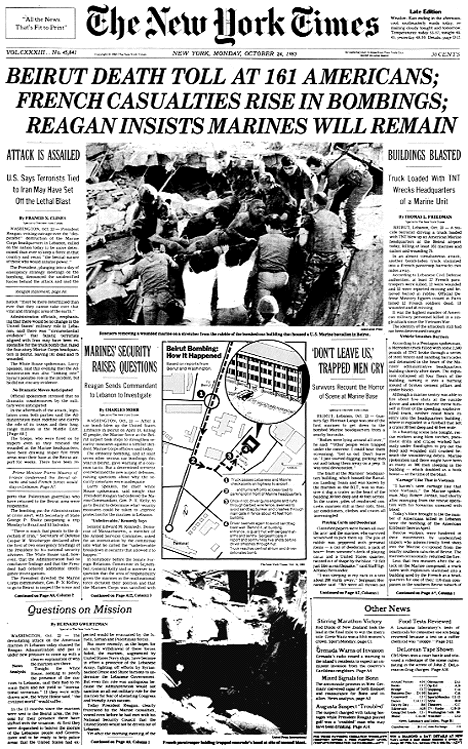
NYT Beirut barracks bombing 1983But Israel literally showed the US the way to the future in another, much more remarkable incident in 1983. Here is the original account (by Jim Schechter) on which Chamayou draws from Popular Science in October 1987:

‘Two days after a terrorist bomb destroyed the [US] Marine barracks in Beirut in October 1983, Marine Commandant Gen. P. X. Kelley secretly flew to the scene. No word of his arrival was leaked. Hours later in Tel Aviv the Israelis played back the tape for the shocked Marine general. The scene, they explained, was transmitted by a Mastiff RPV circling out of sight above the barracks.’

Peter Hellman in ‘The little airplane that could’ (in Discover, February 1987) fills in some of the details.  Kelley ‘had been photographed during his outdoor movements in Beirut — his head targeted in cross hairs‘ (my emphasis).  He explains:

‘Unobserved by the Marines, a miniaturized Israeli RPV (remotely piloted vehicle) called Mastiff had circled 5,000 feet overhead during Kelley’s visit. Despite its twelve-foot wing span (just a shade longer than a California condor’s), at that altitude the Mastiff couldn’t be seen by the naked eye. And with its fiber-glass body, it was almost impossible to detect by radar. Nor could the putt-putt of its two-cylinder 22-horsepower engine be heard. But a zoom-lensed video camera peering down from a clear plastic bubble in its belly had a splendid view of the touring general. On a signal from controllers more than 50 miles away, the mini-RPV left as furtively as it had come, and flew into a net set up outside its mobile ground station.

As Schechter laconically put it, the Americans got the message, and in the 1980s their interest in developing remotely piloted aircraft for ISR (intelligence, surveillance and reconnaissance) dramatically increased.

There are all sorts of other connections between the US and Israel when it comes to both the development of UAVs and their later use for targeted killing.  What Chamayou is most interested in is precisely the development of UAVs as hunter-killers, which (as I’ll explain in my next post in the series) he links to the transformation of warfare into man-hunting.  And, as I’ll try to show, that’s when things start to get extremely interesting…
Predators over the FATA

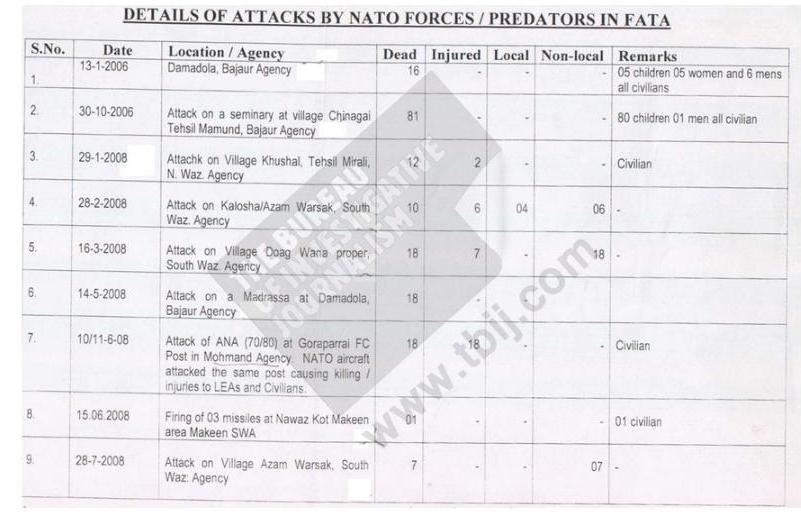
The Bureau of Investigative Journalism in London has published a confidential reportDetails of Attacks by NATO Forces/Predators in FATA, whose tabulations cover more than 70 drone strikes in Pakistan’s Federally Administered Tribal Areas between January 2006 and October 2009.

The tabulations are significant because they are not based on press reports – the standard and highly imperfect source – but on reports prepared for the FATA Secretariat and transmitted to Islamabad by government agents in the field (who rely on their own observations, and reports from the tribal police and other informants).  According to one well-placed observer, ‘There was no benefit in officials “cooking the books” here, since this document was clearly never intended to be seen outside the civilian administration.’

Predator/NATO strikes in FATA

It’s an incomplete list – the Bureau has a more comprehensive tabulation – but of the 746 deaths from these air strikes 147 (20 per cent) are identified as civilians (including 94 children).

Still, the Bureau notes some puzzling (even troubling) omissions.  In particular, reports of civilian deaths virtually disappear from the record after Obama took office: ‘In part this is because officials occasionally note that “details of casualties are yet to be ascertained.” But many credible reports of civilian deaths are simply missing. The Bureau’s own research shows that civilian deaths have been credibly reported in at least 17 of the 53 CIA drone strikes in Obama’s first year in office. Yet FATA officials report civilian deaths in only three incidents in 2009.’

There have been rumours of more comprehensive tabulations, but the Bureau acknowledges that much also depends on information provided by the Pakistani military.  And it would be interesting to see a comparable list of casualties resulting from Pakistan’s own air strikes in the FATA.

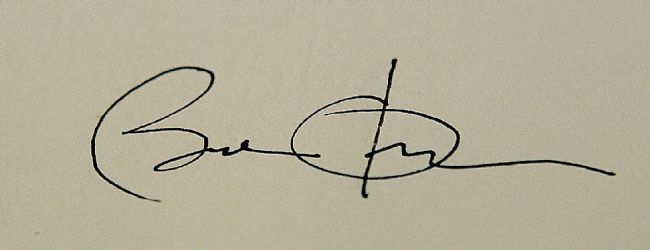
Obama’s signature

627227-signature-reveals-obama-039-s-secrets

For decades Presidents of the United States have used a machine to sign ‘personal’ letters.  According to reports, Obama used the ‘autopen’ to sign an extension to the Patriot Act when he was at a G8 summit in France and out of reach (more examples here).

autopen

But  others are never out of reach of Obama’s signature.  The ‘signature strikes’ carried out by Predators and Reapers also disclose a disconcerting entanglement of the ‘personal’ (these are not robotic: a network of human agents is actively involved and they have access to high-resolution full-motion video feeds) with the machinic (not least because the President doesn’t personally ‘sign off’ on them).  I’ve discussed them in detail here, and the Brave New Foundation has released an important video about them and the Dhatta Khel incident in March 2011 in particular.

Film-maker Robert Greenwald provides background to the video here and Arianna Huffington returns to it today.  Referring to Obama’s speech on 23 May 2013 – see my discussion here – she writes:

“Before any strike is taken,” he declared, “there must be near-certainty that no civilians will be killed or injured — the highest standard we can set.”

Though signature strikes were not mentioned, some assumed language like “near certainty” and “highest standard” meant they were no longer going to be used. That assumption was proven wrong as just days later an administration official told the New York Times that signature strikes will continue in Pakistan, a statement the Times’ Andrew Rosenthal wrote“seem[ed] to contradict the entire tenor of Mr. Obama’s speech.”

Two weeks later, on June 9, a drone struck a vehicle in Yemen, killing not only several supposed militants, but also a boy named Abdulaziz. He was 10 years old. “Near certainty” and those new “clear guidelines” apparently weren’t enough for Abdulaziz. The administration refused to comment on the boy’s death, or the strike itself. So much for accountability and transparency. And just last week, a strike in Waziristan killed 16 people and wounded five others.

I’m left thinking of those famous lines from Edward Fiztgerald‘s translation of The Rubáiyát of Omar Khayyam:

The Moving Finger writes; and, having writ, 
Moves on: nor all thy Piety nor Wit 
Shall lure it back to cancel half a Line, 
Nor all thy Tears wash out a Word of it.

Drones and civilian casualties in Afghanistan

I’ve been urging for some time now that the debate over drone strikes must not neglect what has been happening in Afghanistan: hence “From a view to a kill” (DOWNLOADS tab) and the much longer version to appear in The everywhere war.  According to a report on the Guardian website posted late on Tuesday by the resourceful Spencer Ackerman, ex-Danger Room (now sadly itself an ex-site), ‘A study conducted by a US military adviser has found that drone strikes in Afghanistan during a year of the protracted conflict caused 10 times more civilian casualties than strikes by manned fighter aircraft.’  The period under analysis (from mid-2010 to mid-2011) followed a series of measures announced by General Stanley McChrystal to reduce civilian casualties from air operations, and coincided with a dramatic increase in the number of drone strikes (which continued to increase through 2012).

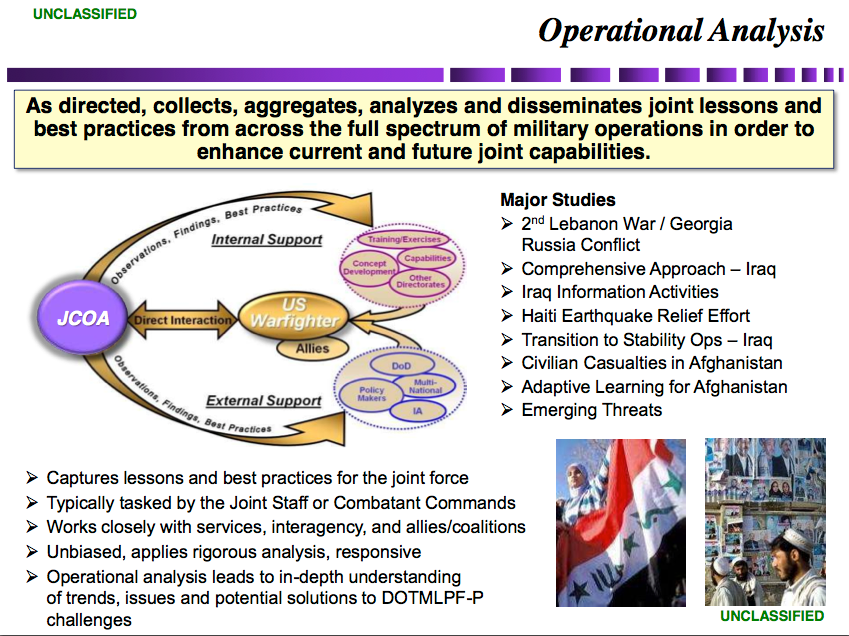
The study in question was carried out by Larry Lewis for the Joint Coalition and Operational Analysis (JCOA), a division of the Joint Staff J7 whose work is summarised in the following slide (which comes not from Edward Snowden‘s cache but from here):

JCOA

Notice ‘Civilian casualties in Afghanistan’ is #6 on the list of major studies.  The completed study is called Drone Strikes: Civilian Casualty Considerations and, apart from the Executive Summary that was published on 18 June, remains classified.  The opening paragraph is the primary source for Spencer’s story, and here it is:

‘The US government has described drone airstrikes in operations outside declared theaters of armed conflict as surgical and causing minimal civilian casualties. Analysis of air operations in Afghanistan, combined with a review of open-source reports for drone strikes in Pakistan, suggest that these fell short of intended goals. Specifically, drone strikes in Afghanistan were seen to have close to the same number of civilian casualties per incident as manned aircraft, and were an order of magnitude more likely to result in civilian casualties per engagement. Specific causal factors were identified that contributed to the relative propensity of drones to cause civilian casualties. Tailored training that addresses these causal factors could aid in reducing civilian casualties in engagements involving drones. While processes and operating forces in Afghanistan can differ from those in operations outside declared theaters of armed conflict, the factors above suggest that a dedicated analysis of civilian casualties in such operations would be worthwhile.’

The key sentence is in bold, and a version of it reappears in an essay, ‘Changing of the Guard: civilian protection for an evolving military’, that Lewis wrote with Sarah Holewinski, Executive Director of the Center for Civilians in Conflict and which appears in the latest issue of PRISM 4 (2) (2013), a journal of the Center for Complex Operations at the National Defense University (the press release from Civilians in Conflict is here).  The authors’ central concern is that ‘as Washington shifts its focus from counter-insurgency to counterterrorism, and from large-scale ground operations to more discrete and oftentimes-unmanned operations, the progress U.S. forces have made on preventing and mitigating civilian harm may soon be lost.’

They consider the risks attendant upon the increased reliance on Special Operations Forces – something that readers of Jeremy Scahill‘s Dirty Wars will need no warning of –  but also those that are likely to flow from an increased use of Unmanned Aerial Systems (UAS):

‘America’s use of force will increasing rely on new technologies, including air force capabilities to penetrate enemy defenses and strike over long distances. Unmanned Aerial Systems, sometimes referred to as “drones,” saw major use in Iraq and Afghanistan, and are slated for a big leap in funding. The Pentagon called for a nearly one-third increase in its fleet in the years ahead.

‘The use of UAS can have military advantages for avoiding civilian casualties in armed conflict, if used with that intent in mind. Their systems feature precision weapons, their sensors have increasingly high-resolution imagery to assess the ground situation, and back in the control room, trained imagery analysts scrutinize a target area prior to engaging, which isn’t always possible in a full ground operation.’

They list a series of familiar objections to the use of these remote platforms in areas outside ‘traditional combat theaters’, but they are also critical of  claims about their forensic capacity inside war-zones:

‘The assumption that UAS strikes are surgical in nature is … belied by research on recent combat operations in Afghanistan. There, UAS operations were statistically more likely to cause civilian casualties than were operations conducted by manned air platforms. One reason was limited training for UAS operators and analysts in how to minimize civilian harm. adding or improving training on civilian casualty prevention is a resource decision in direct tension with the increasing demand for more uaS and more operations, since additional training on civilian protection means time must be taken from somewhere else including the mission itself.’

They don’t say much about the reasons for this, except that they then criticise the ‘clandestine use of UAS by the US government’ because it raises ‘significant concerns that civilian casualties will not be properly monitored or investigated and thus called into question’ and then, several paragraphs later, they note that non-covert operations in Afghanistan ‘are replete with examples where all the engaged individuals were believed to be combatants, but a later investigation found many or all were civilians misidentified as combatants.’

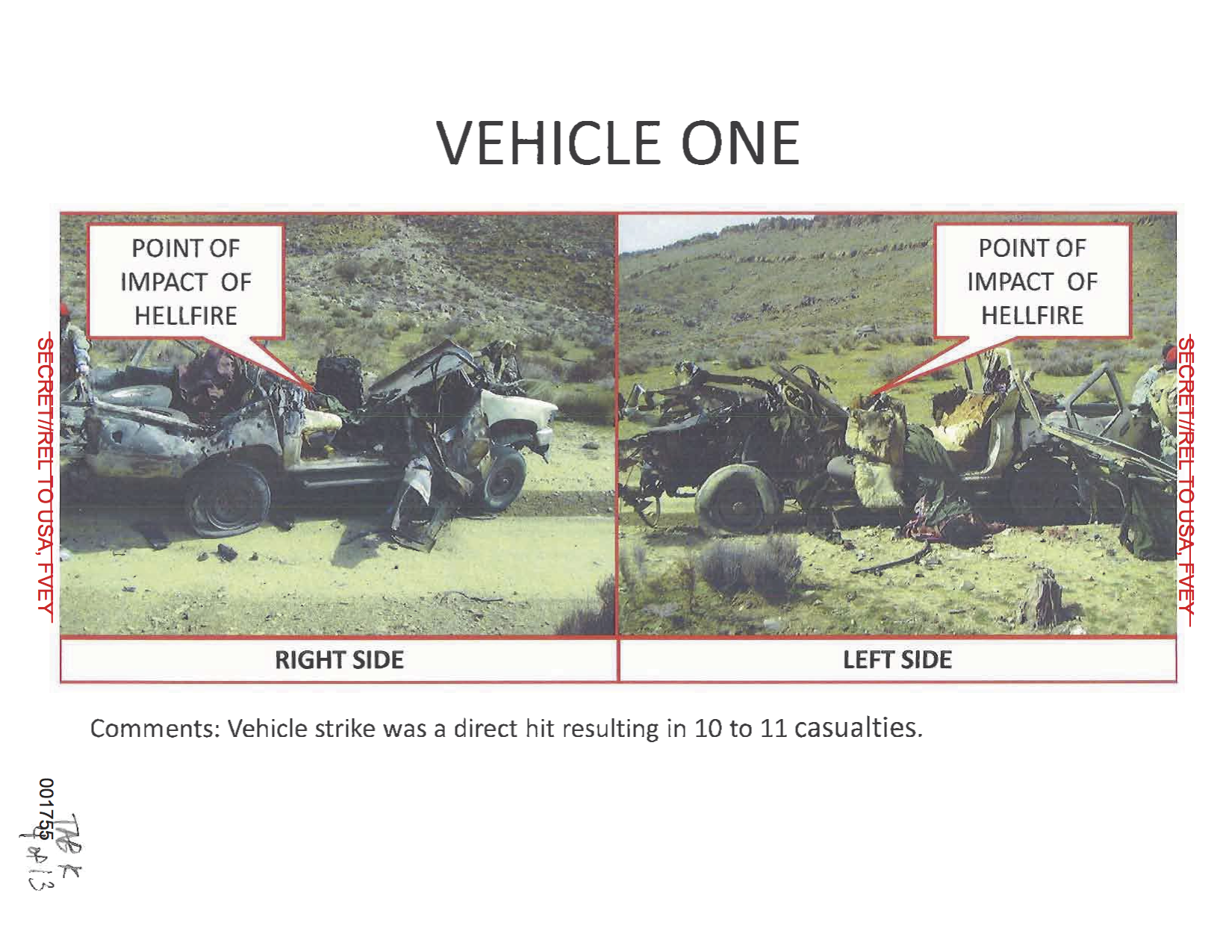
Attachment TAB A (Part 22 of 28) FOIA 10-0218 Uruzgan - Pages 1751-1800 (dragged) 1

A key issue, then appears to be misidentification, and in my examination of one hideous incident in Uruzgan province in Afghanistan in February 2010 (in “From a view to a kill”; see also the image above) – an analysis I develop in my more detail in The everywhere war – I suggested that the high-resolution video feeds from these remote platforms engender an intimacy with ground troops that belies the physical remoteness of the drone operators.  They routinely claim to be not 7,500 miles from the battlespace but just 18 inches – the distance from eye to screen – and this immersive capacity (which these feeds do indeed share with videogames) predisposes them to view virtually every proximate Afghan action as hostile:

‘… the greater incidence of civilian casualties when close air support is provided to ‘troops in contact’ may result not only from time-critical targeting and its correspondingly ‘fewer checks to determine if there is a civilian presence’ … but also from the persistent presence of the [UAS] and its video feeds immersing its remote operators in, and to some substantial degree rendering them responsible for the evolving situation on the ground. This predicament, in which proximity not distance becomes the problem, cannot be resolved by tinkering with the Rules of Engagement; high-resolution imagery is not a uniquely technical capacity but part of a techno-cultural system that renders ‘our’ space familiar even in ‘their’ space – which remains obdurately Other.’

I don’t know if this forms part of the classified report, of course, but in an earlier report, Reducing and mitigating civilian casualties: enduring lessons (dated April 2013) Lewis emphasised the importance of using ‘discrimination tools’ in ‘situations where forces need to discern whether an individual is demonstrating hostile intent’ – but what he seemed to have in mind was another technological fix, ‘higher-resolution imagery or night vision devices’, whereas the root of the problem may well not be the power to see but the capacity to make sense of what is seen.

In any event two other questions remain.

First, during the period under analysis drone strikes accounted for around 5 – 6 per cent of total weapon releases by all aircraft in Afghanistan, but many of the conventional strikes nevertheless relied on persistent surveillance of targets from Predators or Reapers and then attacks by helicopters or fighter-bombers (which was the case in the Uruzgan attack).  Does Lewis’s statistical analysis shed any light on the difference (I assume there is one) between a UAS acting as a ‘hunter-killer’ and a UAS providing only real-time ISR as part of a networked operation?

Second, what is the difference between ‘an incident’ and an ‘engagement’ in the first extract I’ve quoted?  This is a substantive issue of considerable moment: if drone strikes produce a roughly similar number of civilian casualties as conventional strike aircraft ‘per incident’ but ten times the number ‘per engagement’, it’s vital to know the difference. Protagonists of remote operations will undoubtedly seize on the first, critics on the second.

I’m trying to chase down the difference. To be continued…

Dead streaming

Readers who have followed Josh Begley‘s Dronestream project – which I commented on here  – will be interested in this video of his graduate thesis presentation at NYU:

It’s a tour de force in under 15 minutes.  Josh begins with a rapid-fire overview of over 480 more or less covert US drone strikes in 10 years killing more than 4,700 people.  ‘What can our relationship be with this story?’ he asks.

His first attempt at finding an answer was the Drones+ app that was intended to send a notification to your iPhone every time news broke of a drone strike in Pakistan, Yemen or Somalia.  Like James Bridle‘s Dronestagram (which enabled satellite images of the sites of remote strikes to be viewed on an iPhone), it was a way of projecting the remoteness of the strikes into the intimacy of our own life-worlds.  But  Drones+ was more demanding precisely because its episodic notifications made those strikes more insistent, more interruptive.  Hence Josh’s key question:

‘Do we really want to be as connected to our foreign policy as we are to our smart phones?  … which are these increasingly intimate devices, the places where we share pictures of or loved ones and communicate with our friends, the things that we pull out of our pockets when we’re lost and which auto-magically put us at the center of the map……  Do we really want these things to be the site of how we experience remote war?’

Apple’s answer was no, as he ruefully acknowledges, though I suspect that would also be the answer of many others too: that, after all, is the appeal of remote wars to those who orchestrate them.  Out of sight, out of mind: which is precisely why there is also something ‘auto-magical’ about Josh’s determination to ‘détourne‘ these remote technologies like this.

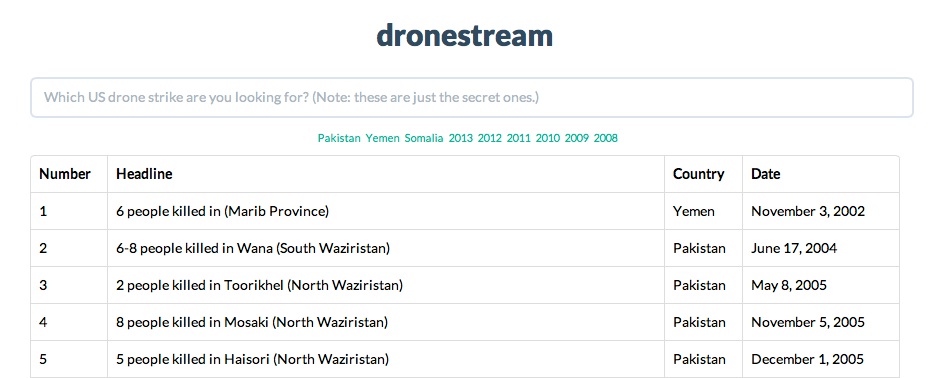
Josh’s next step was to use a Twitter account to start to tweet every recorded drone strike, which eventually morphed (via the aggregations of the Bureau of Investigative Journalism) into Dronestream: or, more accurately, Dronestre.am.

Dronestre.am

This is a publicly accessible API (Application Programming Interface) that enables the data set to be interrogated and visualized in multiple ways (and if you want a simple account of working with the API, check out Felix Haas here):

dronestream

Josh credits Trevor Paglen‘s ‘spatial analysis’ and his ongoing attempts to outline the Blank Spots on the Map as a particular inspiration for his work.  What he has sought to do, by extension, is to map ‘the blank spots in the data’: to recover what he calls ‘the negative space that these drone strikes take up’, and so enable complex stories and ordinary voices to emerge out of the swirl of Big Data.  In doing so, he argues that it becomes possible to ‘speak back’ to the drones and to the masters of dirty wars that control them, in effect artfully turning this latest version of techno-war against itself.

The trick now is to fill out these ‘blank spots on the map’, to recover the insistently human geographies that are devastated by these air strikes and the threat of more to come, so that we can overturn both the ‘face-less’ and the ‘place-less’ narrative of the covert war machine.  It thrives on being both out of sight and out of site, and Josh’s research is invaluable in reminding us that the virtual technologies that make its depredations possible are also acutely material in their form and in their effects.

Drones and ‘the world as free-fire zone’

Fred Kaplan has an interesting essay on the history and use of armed drones by the United States at MIT Technology Review: ‘The world as free-fire zone‘ (June 2013).  Kaplan provides a telling critique of Obama’s May statement about the conduct of targeted killings (though that doesn’t of course exhaust what the military uses UAVs for), but his discussion is muddied by what he says about Vietnam – and what he doesn’t.

GREINER War without frontsThe title of the essay invokes a notorious tactic deployed by the United States in South Vietnam: the creation of free-fire, free-strike or what the Air Force called free-bomb zones (the name was changed in 1967  to ‘specified fire zones’ for PR purposes, though what was specified was the zone not the fire).  This is how historian Bernd Greiner summarises the policy in War without fronts: the USA in Vietnam (2007, trans. 2009):

‘License to destroy and annihilate on a large-scale applied unrestrictedly in the so-called “Free Fire Zones”.  Set by the South Vietnamese authorities – either the civil administration or the commanders of an Army corps or division – the US forces operated within them as though outside the law: “Prior to entrance into the area we as soldiers were told all that was left in the area after civilian evacuation were Viet Cong and thus fair game.” Virtually all recollections of the war contain such a statement or something similar, simultaneously referring to the fact that anyone who did not want to be evacuated had forfeited the right to protection, since in the Free Fire Zones the distinction between combatant and non-combatant was a prior lifted.’

Matters were not quite so simple, at least in principle, since (as Nick Turse notes in Kill anything that moves: the real American war in Vietnam (2013)), ‘the “free-fire” label was not quite an unlimited license to kill, since the laws of war still applied in these areas.’  And yet, as both Greiner and Turse show in considerable detail (and I’ll have more to say about this in another post), in practice those laws and the rules of engagement were serially violated.  Whatever the situation in Vietnam, however, it’s surely difficult to extend this – as Kaplan wants to do – to US policy on targeted killings.  Invoking the Authorization for Use of Military Force passed by Congress on 14 September 2001 (as Obama does himself), Kaplan writes:

‘This language is strikingly broad. Nothing is mentioned about geography. The premise is that al-Qaeda and its affiliates threaten U.S. security; so the president can attack its members, regardless of where they happen to be. Taken literally, the resolution turns the world into a free-fire zone‘ (my emphasis).

A couple of years ago Tom Engelhardt also wrote about Obama hardening George W. Bush’s resolve to create a ‘global free-fire zone’.  Kaplan’s criticism of the conditions that the Obama administration now claims restrict counter-terrorism strikes is, I think, fair – though much of what he says derives directly from a draft Department of Justice memorandum dated 8 November 2011 on ‘the use of lethal force in a foreign country outside the area of active hostilities against a U.S. citizen who is a senior operational leader of al-Qa’ida or an associated force’ rather than Obama’s wider speech on counter-terrorism on 23 May 2013 or the ‘fact sheet on policy standards and procedures’ that accompanied it.  But they are closely connected, and Kaplan’s objections have real substance.

First, the Obama administration insists that the threat posed to the United States must be ‘imminent’, yet since the threat is also deemed to be continuing ‘a broader concept of imminence’ is required that effectively neuters the term.

Second, apprehension of the suspect must be unfeasible, yet the constant nature of the threat means that the ‘window of opportunity’ can always be made so narrow that ‘kill’ trumps ‘capture’.

But what of Obama’s third condition: that ‘before any strike is taken, there must be near-certainty that no civilians will be killed or injured’?  Kaplan accepts that this is a ‘real restriction’.  Critics of the programme differ on how successful it has been in practice, and supporters like Amitai Etzioni have turned ‘civilian’ into a weasel word that means whatever they want it to mean (which is not very much).  Still, the most authoritative record of casualties – which I take to be the Bureau of Investigative Journalism in London – clearly shows that civilian deaths in Pakistan (at least) have fallen considerably from their dismal peak in 2009-10.  Whatever one makes of all this, however, it hardly turns the world into a ‘free-fire zone’.  The war machine will continue to be unleashed outside declared war zones (or what Obama also called ‘areas of active hostilities’, which may or may not mean the same thing), and Obama and his generals will continue to conjure a battlespace that is global in extent.  But if we take the President at his word – and I understand the weight that conditional has to bear – military violence may occur everywhere but not anywhere: ‘We must define our effort not as a boundless “global war on terror” – but rather as a series of persistent, targeted efforts to dismantle specific networks of violent extremists that threaten America.’

The question is whether we can take the President at his word.  As Glenn Greenwald points out, ‘Obama’s speeches have very little to do with Obama’s actions’.  Tom Junod says much the same about what he continues to call the Lethal Presidency: ‘When a man is as successful in fusing morality and rhetoric as Barack Obama, there’s always a tendency to think that the real man exists in his words, and all he has to do is find a way to live up to them.’  Performativity is not only conditional, as it always is, but in this case also discretionary.

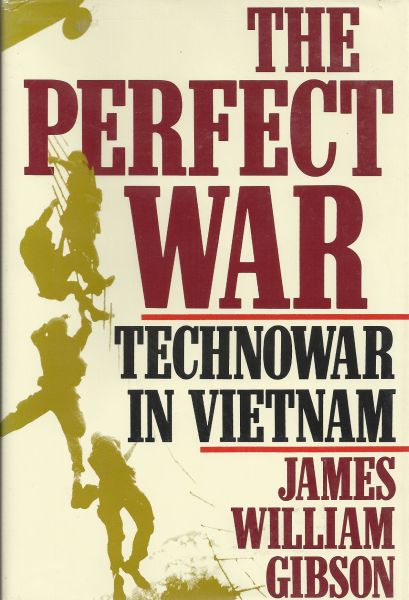
GIBSON The perfect warKaplan also refers to a notorious metric from the Vietnam war: the body-count.  As James Gibson patiently explains in his brilliant critique of The perfect war: technowar in Vietnam (1986), this was one of the central mechanisms in US Secretary of Defense Robert McNamara’s attempt to wage an appropriately Fordist war (he went to the Pentagon from being President of the Ford Motor Company).  The body-count can be traced back to the Korean War, but it came into its own in Vietnam where it was supposed to be the key metric of success – bizarrely, even of productivity – in a ‘war without fronts’ where progress could not be measured by territory gained.  Here too Turse is illuminating on the appalling culture that grew up around it, including the inflation (and even invention) of numbers, the body-count competitions, and the scores and rewards for what today would no doubt be called ‘excellence in killing’.

But what Kaplan has in mind is not quite this, but the central, absurdist assumption that there is a direct relationship between combatants killed and military success:

‘It is worth recalling the many times a drone has reportedly killed a “number 3 leader of al-Qaeda.” There was always some number 4 leader of al-Qaeda standing by to take his place. It’s become a high-tech reprise of the body-count syndrome from the Vietnam War — the illusion that there’s a relationship between the number of enemy killed and the proximity to victory.’

How else can we interpret John Nagl‘s tangled celebration (on Frontline’s ‘Kill/Capture’) of the importance of targeted killing for counterinsurgency and counter-terrorism?

‘We’re getting so good at various electronic means of identifying, tracking, locating members of the insurgency that we’re able to employ this almost industrial-scale counterterrorism killing machine that has been able to pick out and take off the battlefield not just the top level al Qaeda-level insurgents, but also increasingly is being used to target mid-level insurgents.’

Peter Scheer draws a distinction between the two moments in Nagl’s statement that helps clarify what he presumably intended (though Scheer is writing more generally):

‘The logic of warfare and intelligence have flipped, each becoming the mirror image of the other. Warfare has shifted from the scaling of military operations to the selective targeting of individual enemies. Intelligence gathering has shifted from the selective targeting of known threats to wholesale data mining for the purpose of finding hidden threats.’

In other words, the scale of intelligence has become industrial (or more accurately perhaps, post-industrial: see here), far exceeding the scale of intelligence available in Vietnam [though see here for a discussion of the connections between McNamara’s data-driven war and today’s obsession with Big Data, and here and here for an outline of the ‘security-industrial complex’], whereas the scale of killing has clearly contracted from what most certainly was industrial-scale killing in Vietnam.   Yet the networked connections between the two reveal the instantiation of the same driving logic of technowar in a radically new ‘war without fronts’.

For all these intimation of Vietnam, however, the genealogy of the drone with which Kaplan begins his essay is resolutely post-Vietnam (or at any rate outside it).  And this, I think, is a mistake.

Technological history is shot through with multiple sources of inspiration and no end of false starts, and usually has little difficulty in assembling a cast of pioneers, precursors and parallels, so I’m not trying to locate a primary origin.  Ian Shaw‘s account of the rise of the Predator (more from J.P. Santiago here) homes in on the work of Israeli engineer Abraham Karem, who built his first light-weight, radio-controlled ‘Albatross’ (sic) in his garage in Los Angeles in 1981.

Karem's Albatross (Chad Slattery)

He may have built the thing in his garage, but Karem was no hobbyist; he was a former engineering officer in the Israeli Air Force who had worked for Israel Aircraft Industries, and by 1971 he had set up his own company to design UAVs.  Neither the Israeli government nor the Israeli Air Force was interested, so Karem emigrated to the United States.  The Albatross was swiftly followed by the Amber, which was also radio-controlled, and by 1988 with DARPA seed-funding Karem’s prototype was capable of remaining aloft at several thousand feet for 40 hours or more. But fitting hi-tech sensor systems into such a small, light aircraft proved difficult and both the US Navy and the Army balked at the project.  Karem set about developing a bigger, heavier and in many ways less advanced version for a putative export market: the GNAT-750.

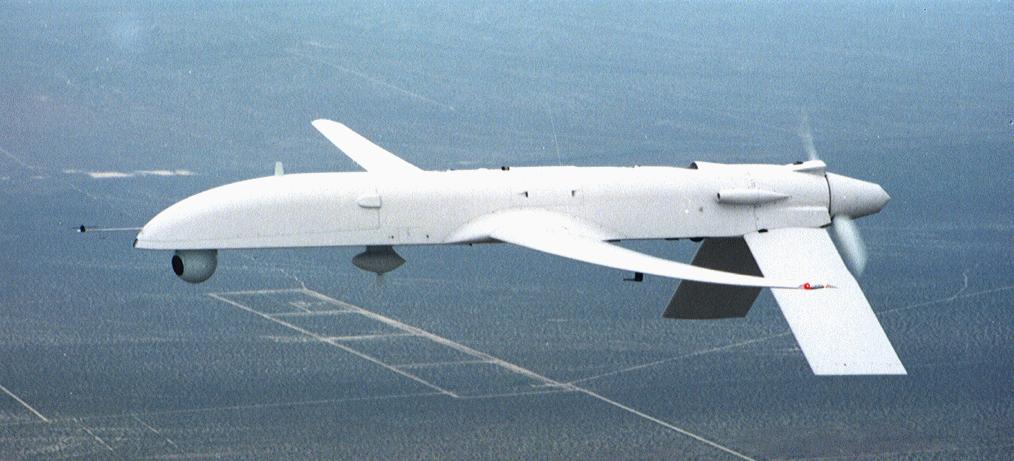
GNAT-750

This was a desperate commercial strategy that didn’t save Karem’s company, Leading Systems Inc., from bankruptcy.  But it was a sound technical strategy.  In 1990 General Atomics bought the company and the development team, and when the CIA was tasked with monitoring the rapidly changing situation in the Balkans it purchased two GNAT-750s (above) for the job.  They were modified to allow for remote control via a satellite link (the first reconnaissance missions over Bosnia in 1995 were managed by the Air Force and controlled from Albania): the new aircraft was re-named the Predator.

It’s a good story – and you can find a much more detailed account by Richard Whittle in ‘The man who invented the Predator’ at Air & Space Magazine (April 2013) here – but in this form it leaves out much of the political in-fighting.  The second part of Ian’s narrative turns to the role of the Predator in the development of the CIA’s counter-terrorism campaign, and while he notes the enlistment of the US Air Force – ‘ultimately, the CIA arranged for Air Force teams trained by the Eleventh Reconnaissance Squadron at Nellis Air Force Base [Indian Springs, now Creech AFB] to operate the agency’s clandestine drones’ – he doesn’t dwell on the ‘arranging’ or the attitude of the USAF to aircraft without pilots on board.

Kaplan does, and his story starts earlier and elsewhere:

‘The drone as we know it today was the brainchild of John Stuart Foster Jr., a nuclear physicist, former head of the Lawrence Livermore National Laboratory (then called the Lawrence Radiation Laboratory), and — in 1971, when the idea occurred to him — the director of defense research and engineering, the top scientific post in the Pentagon.’

Foster was a hobbyist – he loved making model aircraft – and thought it ought to be possible to capitalise on his passion: ‘take an unmanned, remote-controlled airplane, strap a camera to its belly, and fly it over enemy targets to snap pictures or shoot film; if possible, load it with a bomb and destroy the targets, too.’  Two years later DARPA had overseen the production of two prototypes, Praeire [from the Latin, meaning both precede and dictate] and Caler [I have no idea], which were capable of staying aloft for 2 hours carrying a 28 lb payload.  At more or less the same time, the Pentagon commissioned a study from Albert Wohlstetter, a former RAND strategist, to identify new technologies that would enable the US to respond to a Soviet invasion of Western Europe without pressing the nuclear button. ‘Wohlstetter proposed putting the munitions on Foster’s pilotless planes and using them to hit targets deep behind enemy lines, Kaplan explains, ‘Soviet tank echelons, air bases, ports.’  By the end of the decade the Pentagon was testing ‘Assault Breaker’ and according to Kaplan ‘something close to Foster’s vision finally materialized in the mid-1990s, during NATO’s air war over the Balkans, with an unmanned aerial vehicle (UAV) called the Predator.’

But the use of the mid-altitude, long-endurance (‘MALE’ – really) drones remained largely the preserve of the CIA because the senior officer corps of the Air Force was hostile to their incorporation:

‘All this changed in 2006, when Bush named Robert Gates to replace Donald Rumsfeld as secretary of defense. Gates came into the Pentagon with one goal: to clean up the mess in Iraq… He was particularly appalled by the Air Force generals’ hostility toward drones. Gates boosted production; the generals slowed down delivery. He accelerated delivery; they held up deployment. He fired the Air Force chief of staff, General T. Michael Moseley (ostensibly for some other act of malfeasance but really because of his resistance to UAVs), and appointed in his place General Norton Schwartz, who had risen as a gunship and cargo-transport pilot in special operations forces… and over the next few years, he turned the drone-joystick pilots into an elite cadre of the Air Force.’

These are both important narratives, which help to delineate multiple lines of descent, but my own inclination is to push the story back and to move it outside the North Atlantic.  It’s not difficult to find precedents for UAVs around the time of the First World War – I’ve discussed some of them here – and towards the end of the Second World War America attempted to develop remote-controlled bombers to use against Germany (see ‘Project Aphrodite’ here and here).  But if we focus less on the object – the aircraft – and more on its dispositions and the practices mobilised through the network in which it is embedded (as Kaplan’s references to ‘free-fire zones’ and ‘body counts’ imply) then I think here Vietnam is the place to look.  For as I’ve argued in ‘Lines of descent’ (DOWNLOADS tab), not only did the Air Force experiment with surveillance drones over North Vietnam, as Ian briefly notes in his own account, but the US military developed a version of ‘pattern of life analysis’ and a sensor-shooter system that would prove to be indispensable to today’s remote operations.  Seen like this, they confirm that we are witnessing a new phase of technowar in exactly the sense that Gibson used the term: except that now it has been transformed into post-Fordist war and, to paraphrase David Harvey, ‘flexible annihilation’.

Charlie Foxtrot

I’ve noted on multiple occasions the existence of several databases that try to track US drone strikes.  The three most widely used are the Bureau of Investigate Journalism,  the Long War Journal (Pakistan here and Yemen here) and the New America Foundation, while Forensic Architecture is working on its own online platform (which will break new and vital ground by including Afghanistan and occupied Palestine – long overdue) which it calls UAV: Unmanned Aerial Violence.

I’ve just encountered a new one that compiles data on US drone strikes and targeted killings in Pakistan.  It comes from the University of Massachusetts, and is the creation of Matthew Fricker, Avery Plaw and Brian Glyn Williams, who have published several articles on the subject: see, for example, Plaw and Fricker’s ‘Tracking the Predators: Evaluating the US drone campaign in Pakistan’ [International Studies Perspectives 13 (4) (2012) 344-65] and Williams’s ‘The CIA’s covert predator drone war in Pakistan 2004–2010: the history of an assassination campaign’ [Studies in Conflict and Terrorism 33 (10) (2010)].  Williams also has a book out next month, Predators: the CIA’s drone war on Al Qaeda (Potomac Books).

They call their database UMass DRONEUniversity of Massachusetts Dartmouth Research on Operational Neutralization Events.

That’s right: ‘operational neutralization events’.

It’s no secret that the language used to describe the instruments of military violence is never innocent; some terms trumpet what is being done (‘Predator’, ‘Reaper’) while others seek to muffle the drums of war (‘executive action’, ‘collateral damage’).  Acronyms play their part in this desperate game of Camo-Scrabble too, and most of them have been created by the military; in order to do my work on later modern war I’ve had to learn to speak their language, which includes an alphabet soup of shorthand.

But the spectacular insensitivity of this one truly takes my breath away.  The killing of people thousands of miles away reduced to an ‘operational neutralization event’ for the sake of a clever-clever acronym.

The site, incidentally, includes a page devoted to profiles and even photographs of ‘HVTs [High Value Targets] killed’, which I assume is intended to provide a silent justification for the strikes.  Unlike the Bureau of Investigative Journalism’s recent project, the rest remain nameless: ‘collateral damage’?

And my title?  Look it up.

Drones.

The Center for the Study of the Drone at Bard College has just posted video of a performance work “Drones.” developed by undergraduates at the College in March this year.  The Center was established in 2012 by Arthur Holland Michel, Daniel Gettinger, and a group of faculty members including Thomas Keenan, Gregory Moynahan, Roger Berkowitz, Maria Cecire, Peter Rosenblum, and Keith O’Hara:

The Center for the Study of the Drone is an interdisciplinary research and art community working to understand unmanned and autonomous vehicles. By bringing together research from diverse academic and artistic perspectives which have, up until now, remained fairly silent on the issue, we aim to encourage new creative thinking and, ultimately, inform the public debate. We want to encourage dialogue between the tech world and the non-tech world, and explore new vocabularies. This is an online space for people to follow the latest news, encounter disparate views, access good writing and art, find resources for research, and engage a diverse community of thinkers and practitioners with the shared goal of understanding the drone.

“Drones.” was created by Rose Falvey, Riley Destefano DeLuise, Julia Wallace, Christina Miliou-Theocharaki, Eamon Goodman, Megan Snyder, and Catalin Moise.  Here’s the video (the music is Massive Attack’s Paradise Circus [Zeds Dead Remix]):

The Center’s website explains:

‘What the video captures best of all is the enormous influence that drones play on our imagination. Except for the name, the video makes no overt references to drones. And yet, the name alone frames the video so that every image, every movement, is connected in the viewer’s mind to UAVs, targeted killing, aerial bombing. Because of the context, the video becomes parody, dialogue, debate, and protest. The piece exercises a kind of restraint and subtlety that is absent from much of the public discourse; and yet,  ”Drones.” forcefully demonstrates the impact of the idea of the drone on aesthetic vocabularies.’

See what you think.

Drones and the Quiet Americans

quiet-disposition

Following on from the Coded Conduct exhibition in London in April, James Bridle’s new work A Quiet Disposition opens at the Corcoran in Washington DC later this month, running from 19 June to 7 July.  He explains the background to his ongoing project on networked technologies and the in/visibility of military violence like this (my emphases):

“The Disposition Matrix” is the term used by the US Government for its intelligence-gathering and targetting processes. Overseen by the National Counterterrorism Center and in development for some time, the Matrix is usually described as a database for generating capture and “kill lists”, but the criteria for both adding to and acting on the information in the database is not public. One of the outcomes of the process is the ongoing, undeclared CIA drone war in Pakistan, Yemen and elsewhere. These attacks have killed an estimated 3105 people in Pakistan alone since June 2004, including 535 confirmed civilians and 175 children. (Sources: The Bureau of Investigative Journalism, New America Foundation.)

The architectural theorist Keller Easterling uses the term “disposition” in other contexts, to refer to the propensity or temperament of forms which produce actions. Disposition is found not in activity itself, but in the relationships or relative positions of the objects that produce action. Consider a motorway: you can describe the movement of the cars, but the active form is immanent in the concrete itself; the motorway has a disposition. If such forms can be said to have a disposition, to what extent can they be said to possess agency?

For Easterling, architectures and infrastructures perform aspects of their being: not merely spatial objects, they shape the world around them on many levels: legal, political, technological. The sociologist Erving Goffman in turn uses the term “disposition” to describe the entire performance, including – in human terms – gesture, posture, expression and intent. These subtexts are capable of overwhelming what is being merely said: the distinction between the aesthetics of what is being depicted, and what is actually being done.

Drones – the armed, unmanned planes in action around the world – are dispositional. Their significance is not wholly in their appearance, but in how they transform the space around them; both the physical space (the privileged view of the weaponised surveillance camera at 50,000 feet) and the legal, national and diplomatic spaces that as a result permits new kinds of warfare and assassination. And the Disposition Matrix is an organising principle: not a thing, not a technology, not an object, but an active form, a reorientation of intent into another dimension or mode of expression. In another sense, the Disposition Matrix is the network itself, the internet and us, an abstract machine, intangible but effective. Finally, the Disposition Matrix is an attitude and a performance.

Quiet AmericanAnd the quiet disposition?  The central insight that animates much of James’s recent work around the New Aesthetic is, as he says in the lecture posted below, that ‘drones … shorten time and space very effectively but instead of using those same networked technologies to make things clearer or to bring empathy they use it to obfuscate and hide.’  You can see this – or rather not see it – in the extraordinary secrecy that cloaks so many of the sites of air attack.  160 years after the dawn of mass-mediated warfare, it is (as he says) sobering to think that we know less about what is happening in Waziristan today than the British public knew about the campaign in the Crimea. Hence Dronestagram and similar projects.  Even though the drone ‘has almost become synonymous with America and with a certain way of prosecuting war’, however, James prefers to see drones as shells or, better, prostheses, ‘extensions of  the network itself’.  For this reason The Quiet Disposition seeks to turn the network on itself, a sort of auto-immune cyberattack, through an intelligence-gathering software system (like the Obama administration’s ‘disposition matrix‘) that lives online, constantly scanning the web for reports about the drone programme and using AI to effect connections between them.

I am a camera

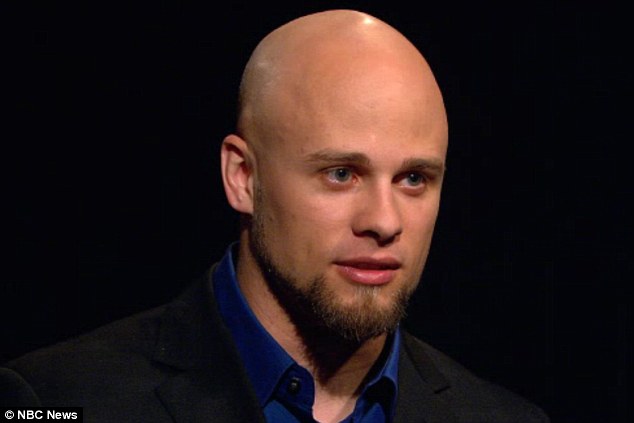
Last December Brandon Bryant, a six-year USAF veteran, told Der Spiegel of his experiences as a sensor operator in a team controlling a Predator over Iraq and Afghanistan from Creech Air Force Base in Nevada and then Cannon Air Force Base in New Mexico.  One day he wrote in his diary:

 “On the battlefield there are no sides, just bloodshed. Total war. Every horror witnessed. I wish my eyes would rot.”

When he left the Air Force he was handed a sheet informing him that all the missions in which he been involved had killed a total of 1, 626 people. This morning he appeared on NBC’s Today programme to describe in detail one of those missions.

Brandon Bryant

You can watch the interview with Richard Engel here, but since no transcript is available here is the substance of what he said:

‘I operated the camera, so like zoom in, zoom out, make sure that everyone can see a good picture, make sure it’s in focus, guide the laser, shoot the spot-tracker…

‘We’re just sitting there and like OK, it’s obvious these guys are obviously bad guys…

‘The guy in the back hears the sonic boom [from the missile] when it reaches him, and he runs forward.  We’re actually told to get the two guys in front, worry about the guy in the back later, follow him to wherever he goes.  The guy in the back runs forward between the two and we strike all three of them.  And the guy that was running forward, when the smoke clears, there’s a crater there, he’s missing his right leg.  

‘And I watch this guy bleed out and it’s clear enough that I watch him and he’s grabbing his leg and he’s rowing, like, I can almost see the agony on this guy’s face and eventually this guy becomes the same colour as the ground that he bled upon…

‘You know how people say that drone strikes are like mortar attacks, artillery, well, artillery doesn’t see this, artillery doesn’t see the result of their actions.  It’s really more intimate for us because we see the before action and then after.

‘And so I watched this guy bleed out, I watched the result of, I guess collectively it was our action, but ultimately I’m the responsible one who guides the missile in.’

He was also interviewed on CBC Radio earlier this year: listen here.  From 6.20 Bryant describes what happens in the 14-16 second interval between firing a missile and hitting the target: he says that if something happens –  like a child running into the frame – there’s an 8 second window to use the laser to divert the missile.  From Spiegel:

With seven seconds left to go, there was no one to be seen on the ground. Bryant could still have diverted the missile at that point. Then it was down to three seconds. Bryant felt as if he had to count each individual pixel on the monitor. Suddenly a child walked around the corner, he says.

Second zero was the moment in which Bryant’s digital world collided with the real one in a village between Baghlan and Mazar-e-Sharif.

Bryant saw a flash on the screen: the explosion. Parts of the building collapsed. The child had disappeared. Bryant had a sick feeling in his stomach.

“Did we just kill a kid?” he asked the man sitting next to him.

“Yeah, I guess that was a kid,” the pilot replied.

“Was that a kid?” they wrote into a chat window on the monitor.

Then, someone they didn’t know answered, someone sitting in a military command center somewhere in the world who had observed their attack. “No. That was a dog,” the person wrote.

They reviewed the scene on video. A dog on two legs?