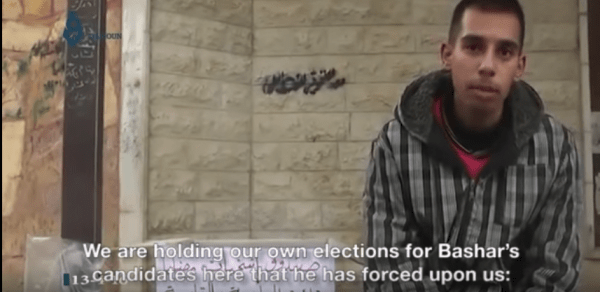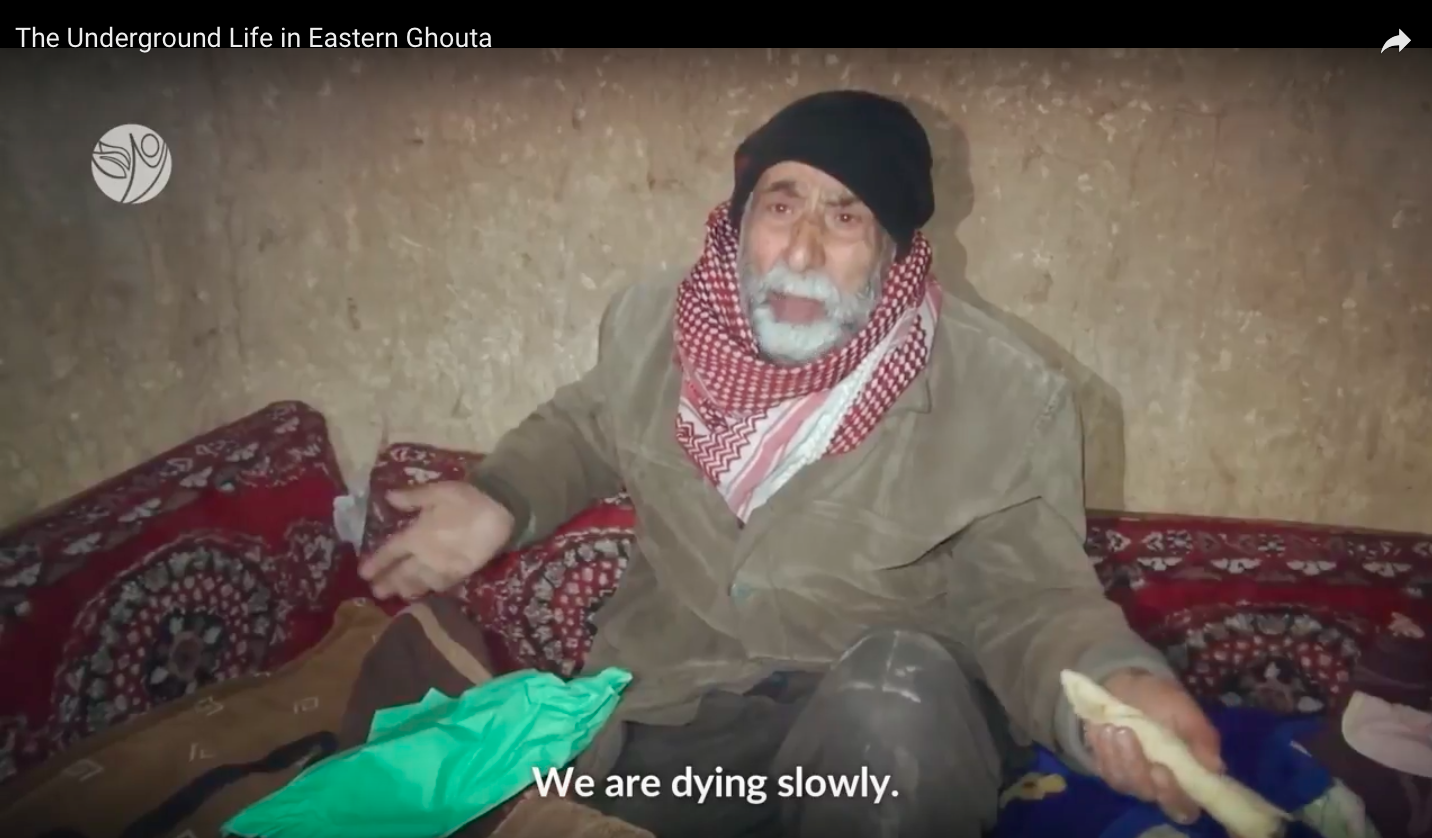
Mass Murder in Slow Motion (I): East Ghouta

This is the first of a series of posts – continuing my discussions of Cities under Siege in Syria here, here and here – that will examine the siege of East Ghouta in detail.

Today I begin with some basic parameters of East Ghouta, and in subsequent posts I’ll focus on three issues: the siege economy and geographies of precarity; military and paramilitary violence, ‘de-escalation’ and the endgame; and – the hinge linking these two and continuing my work on ‘the death of the clinic‘  – medical care under fire.
From paradise to hell on earth

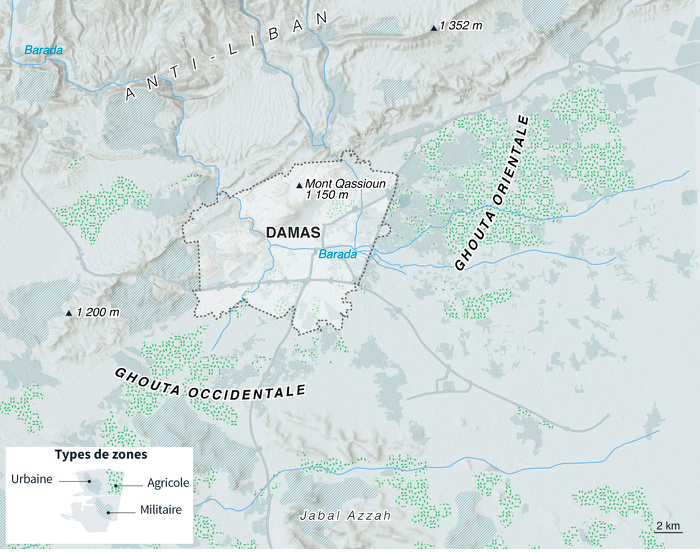
Eastern Ghouta (‘Ghouta Orientale’ on the map from Le Monde above; ‘Damas’ is of course Damascus) has often been extolled as ‘a Garden of Eden’, ‘an earthly paradise’ and an ‘oasis’.  In the fourteenth century Ibn al-Wardi described the Ghouta as ‘the fairest place on earth’:

. . . full of water, flowering trees, and passing birds, with exquisite flowers, wrapped in branches and paradise-like greenery. For eighteen miles, it is nothing but gardens and castles, surrounded by high mountains in every direction, and from these mountains flows water, which forms into several rivers inside the Ghouta.

Before the present wars much of the Ghouta was a rich, fertile agricultural landscape, a mix of small farms producing wheat and barley, fruits and vegetables (notably tomatoes, cucumbers and zucchini), and raising herds of dairy cattle whose milk and other products fed into the main Damascus markets.  Most arable production depended on irrigation delivered through a de-centralised network of water pumps, pipes and channels.
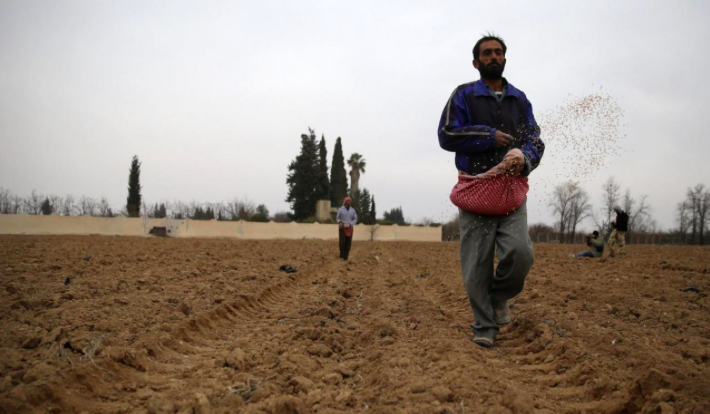
The agrarian economy was seriously disrupted by the siege imposed by the Syrian Arab Army and its allies and proxies from 2012.  The siege varied in intensity, but in its first report Siege Watch described the importance – and insufficiency – of these local resources:

While much of the population in Eastern Ghouta has become dependent on local farming 
for survival, the volume and variety of crops that are being produced is still insufficient for 
the population, since modern mechanized farming methods to water and harvest crops are unavailable and new seeds must be smuggled in. Some of the main crops being produced include wheat, barley, broad beans, and peas. The communities closest to Damascus are more urban areas with little arable land, so there is an uneven distribution of locally produced food within besieged Eastern Ghouta. Humanitarian conditions deteriorate in the winter when little locally produced food is available and prices increase.

Cutting off the electricity supply and limiting access to fuel also compromised vital irrigation systems (and much more besides), and many local people had to turn to wood for heating and cooking which resulted in extensive deforestation.
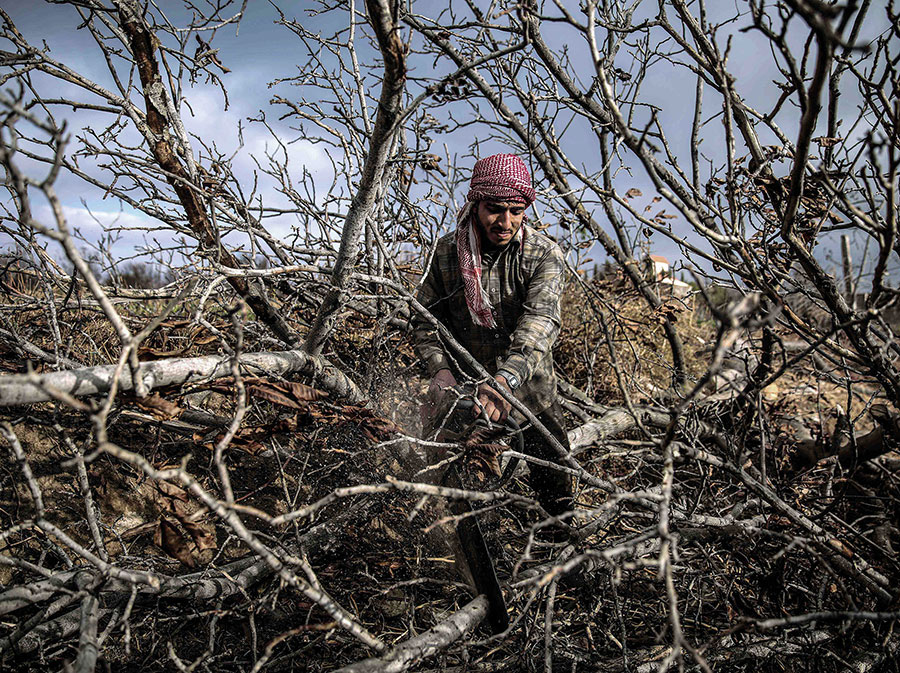
By November 2015 the price of firewood had soared:

Abu Ayman, an official in the Kafr Batna Relief Office, said that a family consisting of six people usually requires about 5 kg of firewood per day, costing up to 15,000 Syrian pounds (around $50) a month.
Fruitless trees are our first source of firewood, as well as the destroyed houses in the cities of Jobar, Ain Tarma and Harasta,” says Asaad, a firewood seller in the town of Jisreen…
Abu Shadi, the Director of Agricultural Office, said: “The orchards of Ghouta, known historically for their intense beauty, are on their way to desertification. Another year of the siege is enough to do so, especially since the urgent need for fuel prompted some people to cut down these trees without the knowledge of their owners.”


The military and paramilitary campaigns, the threats from mortars, snipers and bombs to workers in the fields, combined with a worsening drought (which made those irrigation pumps all the more important) to reduce agricultural production.  And as the regime’s forces advanced so the agricultural base available to the besieged population contracted.  (The reverse was also true: the regime desperately needed to regain access to its old ‘breadbaskets’, most of which were in rebel areas outside its control).

Much of the destruction of food resources was deliberate.  This from Dan Wilkofsky and Ammar Hamou in June 2016, shortly after the Syrian Arab Army captured wheat fields in the south of the region:

Residents of East Ghouta, where a half-million people have been encircled by the Syrian military and its allies, say the government is targeting their food supply as much as it is trying to gain ground. They say that weeks after capturing the area’s breadbasket, a stretch of farmland hundreds of acres wide, the government is using airstrikes and mortar attacks to start fires in the fields that remain in rebel hands [see photograph below].

“People gather the wheat and heap it up, only for the regime to target the piles and burn them,” Khalid Abu Suleiman…  said on Thursday from the al-Marj region.

Fires have spread quickly through wheat fields sitting under the June sun. “When wheat turns yellow, the regime can spot it easily and a small shell is enough to burn the harvest,” Douma resident Mohammed Khabiya said on Thursday.
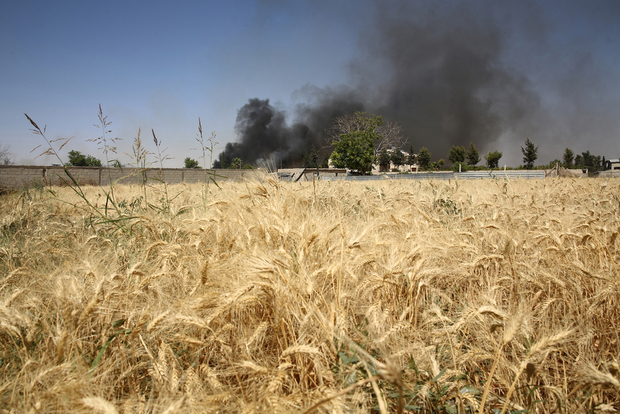
 

I’ll have much more to say about all this – and the survival strategies and smuggling routes that emerged in response – in my next post, but memories of the bounty of the region haunt those who inhabit its now ruined landscape.  ‘The area was once known for its intense carpet of fruit trees, vegetables and maize,’ wrote a former resident last month, but today ‘Ghouta is a scene of grey death.’  And here is a local doctor talking to the BBC just last weekend:

The place where Dr Hamid was born and raised had been abandoned to its own slow death…  It was a place that people came to from Damascus, with their wives and husbands and children, for weekend picnics, or to shop for cheap merchandise in the bustling markets.  “They came here from all around to smell the fresh air and the rivers and the trees,” he said. “To me it was a paradise on the Earth.” Now he prays in his cramped shelter at night that his children will one day see the place he can still conjure in his mind, “as green as it was when I was a boy”. “It may be too late for me,” he said, “but God willing, our children will see these days.”

Political rebellion and political violence

In the 1920s the Ghouta was a springboard for Syrian nationalism and its ragged, serial insurgency against French colonial occupation –  ‘its orchards and villages provided sustenance for the insurgency of 1925’, wrote Michael Provence in his account of The Great Syrian Revolt, while hundreds of villagers in the Ghouta were killed or executed during the counterinsurgency.  He continued:

Despite months of agitation and countless pamphlets and proclamations, the French bombardment of Damascus ended any organized mobilization in the city. The city’s destruction indelibly underscored the inability of the urban elite to lead resistance. But the effects of the bombardment were not what [French] mandate authorities had hoped. Resistance shifted back to the Ghuta and the surrounding countryside. The destruction of their city failed to pacify the population with fear and led to an outraged expansion of rebel activity, especially among the more humble inhabitants. Guerrilla bands soon gained control of the countryside on all sides of the city. They continually cut the lines of communication by road, telephone, and train, on all sides of the city Damascus went days on end virtually cut off from outside contact. Large areas of the old city were in rebel hands night after night. Contemporary sources document that the southern region was completely under the control of the insurgents. It took more than a year, and massive reinforcements of troops and equipment, for the mandatory power to regain effective control of the countryside of Damascus.

(You can find much more on French counterinsurgency and colonial violence in David Nef‘s Occupying Syria under the French Mandate: insurgency, space and state formation (Cambridge, 2012)).

Abu Ahmad, an activist from Kafr Batna, recalling that ‘Eastern Ghouta has always been at the heart of revolutionary struggles in Syria’, drew a direct line of descent from the Syrian Revolt to the mass mobilisations against the Assad regime during the Arab Spring.  He insisted that the contemporary rebellion in the Ghouta had retained its independent spirit:  keeping its distance from international power-brokers, so he claimed, it was ‘one of the last arenas of a real civil war’ – so much so, that its fall ‘would spell the end of the original battle between the government and the opposition.’
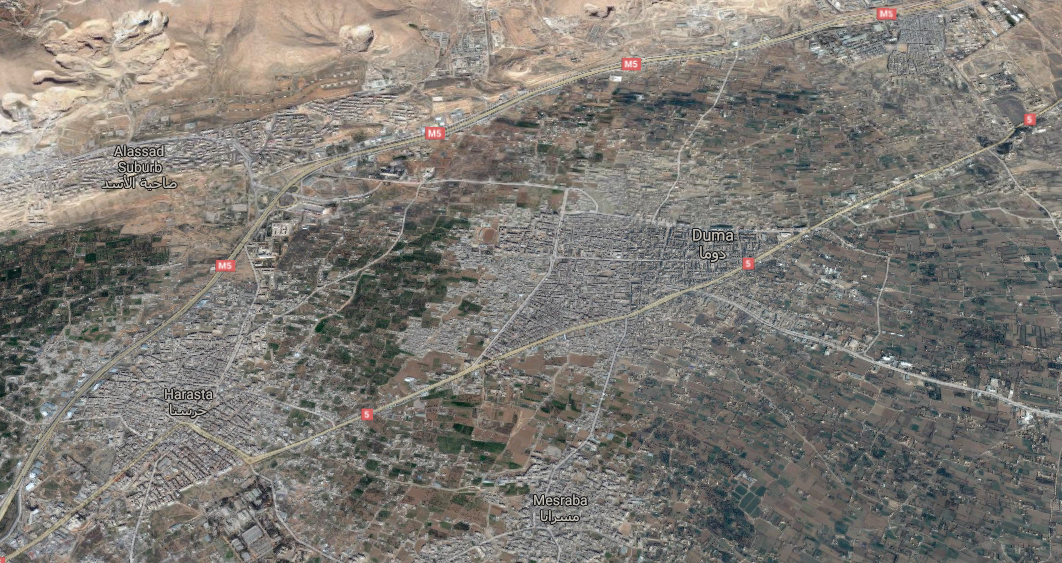
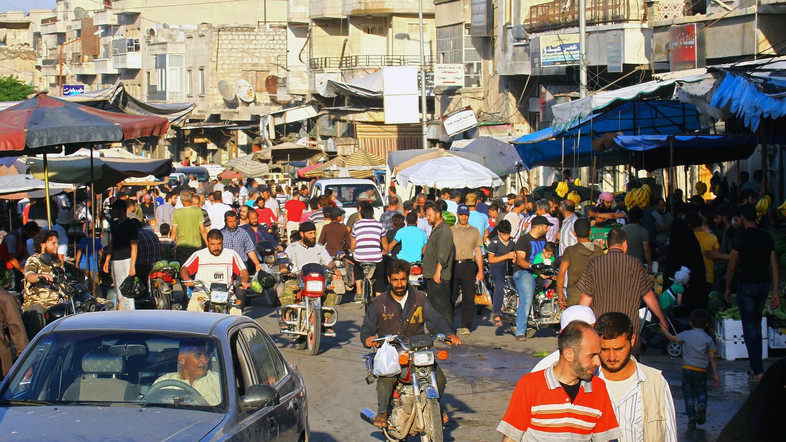
This time around these have been vigorously urban as well as rural movements.  After independence from France in 1946, in the north and west of the Ghouta, closer to Damascus, agriculture gave way to a peri-urban fringe: a scatter of hard-scrabble, cinder and concrete block towns (above).  Aron Lund takes up the story:

Wheat fields were crisscrossed by roads and power lines, while factories, army compounds, and drab housing projects spread out of the city and into the countryside. The ancient oasis seemed destined to disappear.

Douma, which had for hundreds of years been a small town of mosques and Islamic learning, grew into a city in its own right. Many villages were swallowed up by the capital, with, for example, Jobar—once a picturesque multi-religious hamlet where Muslims and Jews tended their orchards—transformed into a series of mostly unremarkable city blocks on the eastern fringes of Damascus….

Throughout the first decade of the new century, slum areas around Damascus expanded rapidly as the capital and its satellite towns took in poor migrants, while spiraling living costs forced parts of the Damascene middle class to abandon the inner city for a congested daily commute. It was as if every driver of anti-regime resentment in the late Assad era had congregated on the outskirts of Damascus: political frustration, religious revanchism, rural dispossession, and downward social mobility.

When the Arab uprisings swept into Syria in March 2011, the comparatively affluent and carefully policed central neighborhoods of the capital hardly stirred—but the Ghouta rose fast and hard in an angry, desperate rebellion.
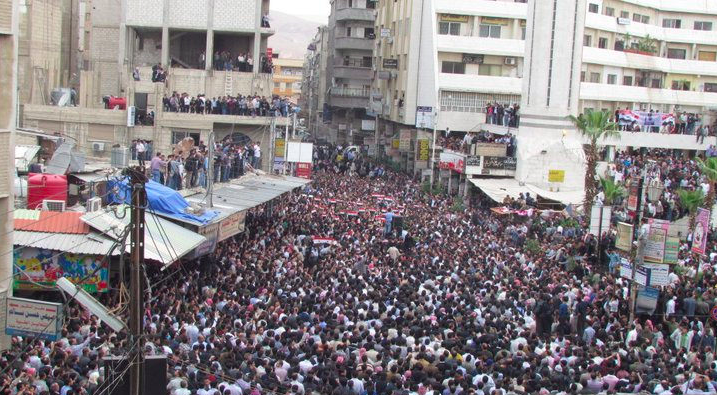
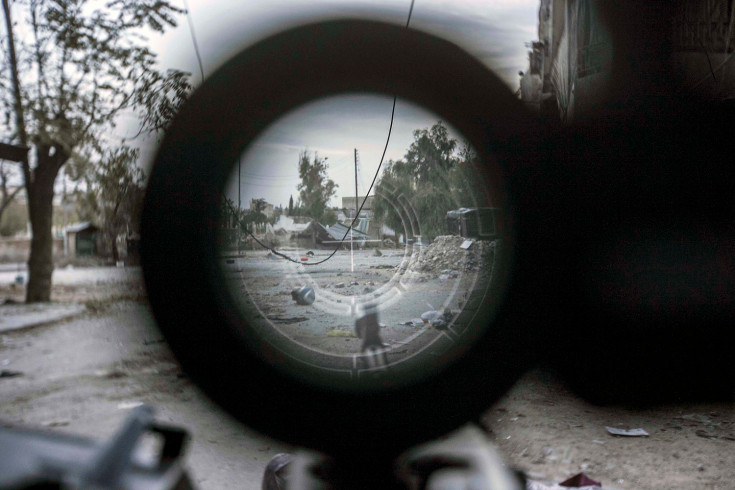
The scenario was a bleakly familiar one, and followed the script established by the security forces in response to protests in Dara’a, close to the border with Jordan, in February 2011 (see here and here).  One of the most serious incidents took place after Friday prayer on 1 April, when protesters emerged from the Great Mosque in Douma to join a demonstration against the regime (above) in the central square.  They were greeted by hundreds of riot police, who fired teargas into the crowd, beat protesters with sticks and shocked bystanders with cattle prods.  Towards the middle of the afternoon the violence escalated; rocks were thrown by some demonstrators, and the police (including snipers on the rooftops) opened fire with Kalashnikovs: 15 and perhaps as many as 22 people were killed and hundreds injured.  According to one local journalist:

“This was the systematic killing of peaceful and unarmed citizens by security forces,” said Radwan Ziadeh, head of the Damascus Centre for Human Rights, one of several organisations that has collated matching witness accounts of the incident.

Witnesses [said] that thugs were bussed in by government forces to attack demonstrators [These armed thugs act as a private pro-Assad militia, known in Syria as al- Shabeha, ‘the ghosts’]. Journalists and diplomats were prevented from reaching the area over the weekend, and phone lines to Damascus have been disrupted.
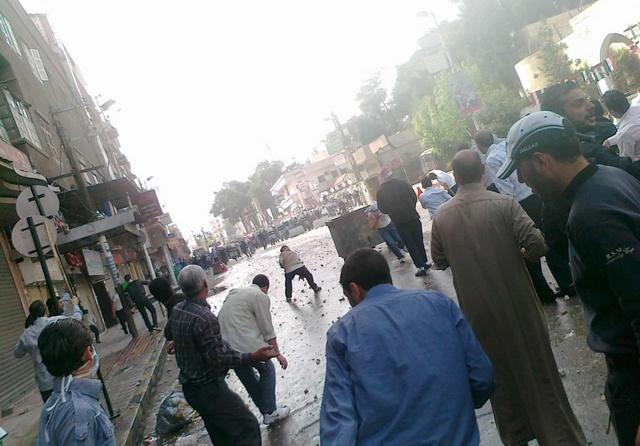
In another familiar response, the same journalist reported that state news agencies had claimed that ‘armed groups’ had opened fire and that some of the demonstrators ‘had daubed their clothes with red dye to make foreign reporters believe that they had been injured.’

Local people encircled the Hamdan hospital to try to prevent the security forces gaining access to the wounded seeking treatment.  One local source told Hugh Macleod and Annasofie Flamand:

“This is the last way we have to protect our wounded from being kidnapped by secret service…

“We held the line until live fire was used and we had to run and hide. I saw the secret police break into the hospital and later when I went back to the hospital some of the bodies and some of the injured were missing.”

The National Hospital and the al-Noor Hospital were also raided by security forces on 1 April searching for injured protesters.  And, taking another leaf from the Dara’a playbook, all doctors were ordered to refuse treatment to the wounded; those discovered to have disobeyed were arrested, including the director of Hamdan.

The protests gathered momentum, and by September the first brigades of the Free Syrian Army had formed in Eastern Ghouta – ‘ostensibly’, Amnesty International said, ‘to protect the protesters from Syrian government forces.’
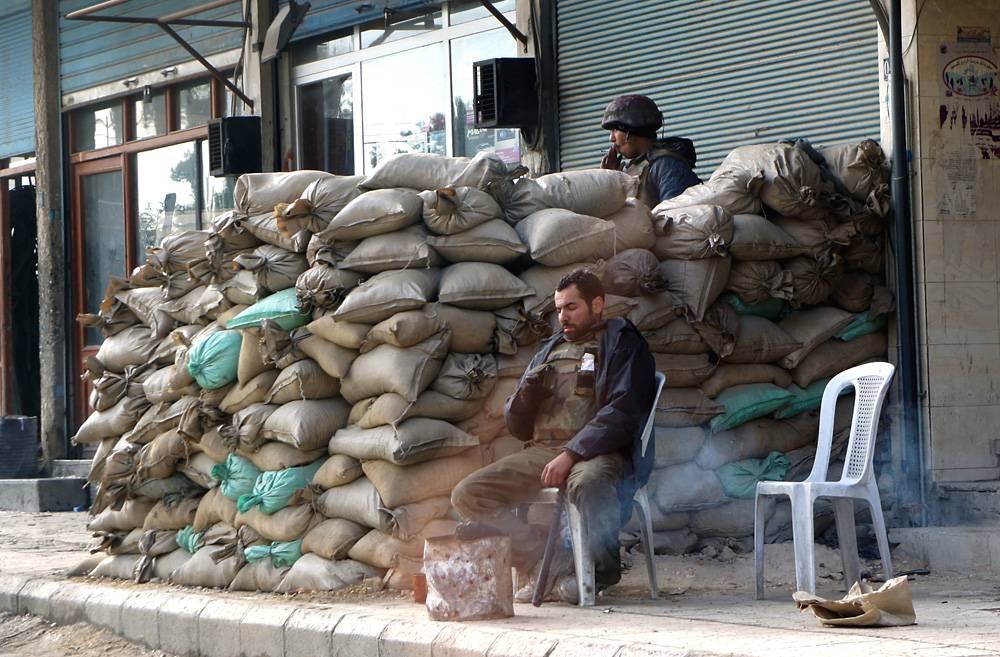
By the time Christine Marlow reported from Douma in December 2011 the city was cordoned off from Damascus by six military checkpoints (above: a Syrian Arab Army checkpoint at Douma in January 2012) and the town was effectively under martial law:

Military trucks stood parked at the end of the dark empty street. The electricity was cut, the phone signals out and apartment windows boarded up with whatever wood or metal people could find. It was to stop the bullets, activists explained. Shouting and chanting of “down down Bashar al Assad” could be heard in the distance, interspersed with the crackle of gunfire.  This is not Homs, Idlib, or any of those Syrian towns that for months have been in the throes of rebellious unrest and violent crackdown. This is Douma, a large satellite town on the edge of Damascus, the heartland of support for President Assad’s regime.

Damascus Old City continues in relative normality with the bustle of daily life. Occasional power cuts and a shortage of gas are the principal signs that all is not well.  But less than seven miles away, Douma is in lockdown. Every Friday – when protests traditionally take place after prayers in the mosques, the suburb is under a military siege.

… Residents had flooded the side streets and mud paths that riddle the town. Doors of homes were left ajar, an invitation of shelter to the demonstrators. Locals passed warnings to each other; “there are dogs in that street”, they said, referring to the army.

 The military was on edge – protesting voices of just 10 or so people was enough to prompt gunfire….
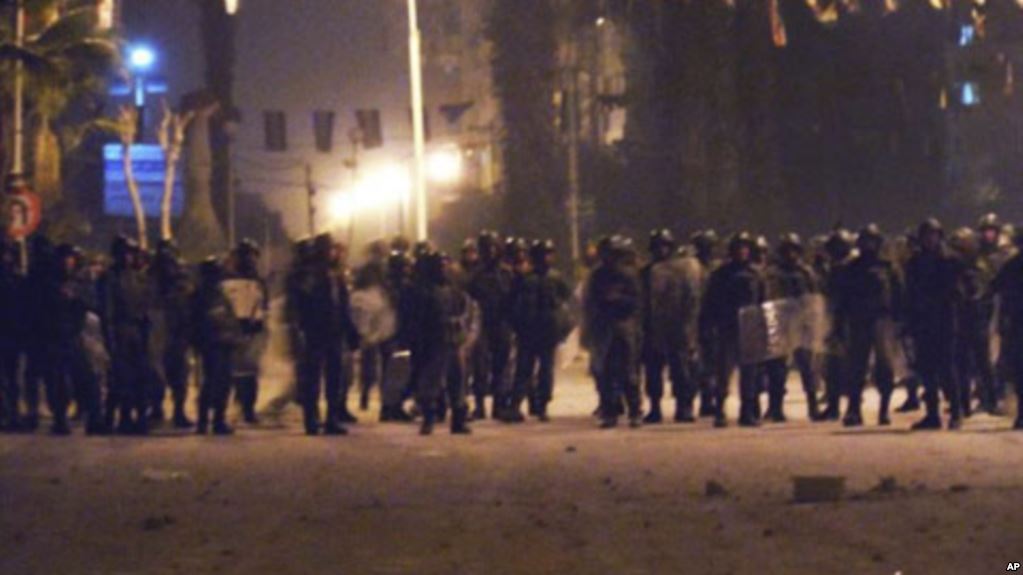
She visited a central hospital – I don’t know whether this was the Hamdan again – and found it dark and empty.  She was told that soldiers had stormed the hospital in the dead of night.  Again, I don’t know if this refers to the previous incident; I do know that Hamdan was raided several times, but so too were other hospitals in Douma: see the Centre for Documentation of Violations in Syria here.

Staff, who had been tipped off, ran to hide the wounded protesters.  “We grabbed the injured, we dragged them from the back door and down the side streets,” he recalled. “We kept some in the homes of sympathisers, others – those who could move – fled. Others hid inside cupboards in the hospital. Otherwise we think they would be killed.”

Activists say hundreds of people have been injured in the months of protests. Now they are tended by volunteers working in secret clinics inside sympathisers’ homes, with whatever medicine can be smuggled in. It is not enough. Mohammed, whose name has also been changed for his protection, received a heavy blow to the head from a security official during a protest in May. With no utensils or materials, doctors in the home clinic to which he was taken were forced to staple together the gaping, bleeding wound using a piece of old wire.

This too, as I will show in a later post, was a harbinger of the desperate future, in which hospitals would be systematically bombed,  medical supplies routinely removed from humanitarian convoys, and doctors – like everyone else – thrown back on their own limited resources and improvisations.
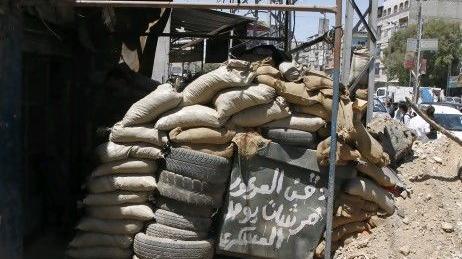
The siege of Douma – and of East Ghouta more generally – tightened, and by early 2013 the region was under the control of 16 armed opposition groups.  Theirs was a complex and volatile political geography and, as I will show in my next post, their fortunes were closely tied to their involvement in the siege economy.  They enjoyed considerable though not unconditional nor unwavering support from local people, but this too was a complicated and changing situation.  The Assad regime, its allies and agents have often portrayed the besieged population as homogeneous,  particularly after displacement reduced East Ghouta from 1.5 million to around 400,000 inhabitants at the height of the siege.  In another iteration of ‘the extinction of the grey zone‘ practiced across the absolutist spectrum – from right-wing radicals in the US to Islamic State in Iraq, Syria and elsewhere – they all became ‘terrorists’.  That term was made to cover a lot of baggage, including anyone who was involved in any form of resistance to the authority of the state. But even within that shrivelled sense of political legitimacy, it’s important to remember throughout the discussions that follow that there were also hundreds of thousands of civilians who were caught in the cross-fire between pro-government forces and the armed opposition groups.

Dying and the Douma Four
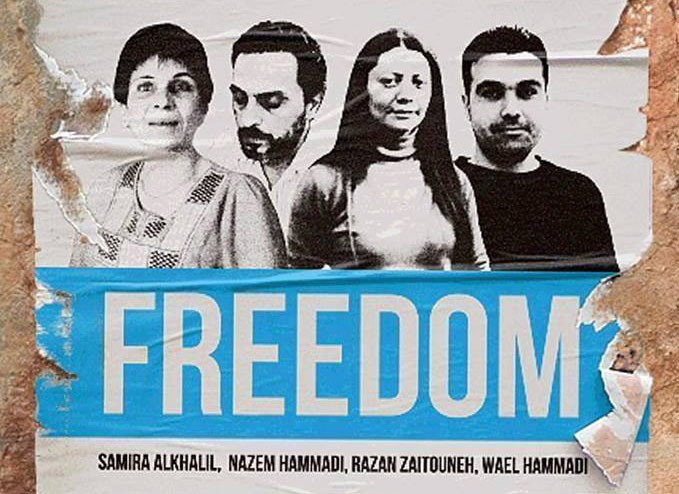
I do not mean that last sentence as a standard disclaimer, and the most direct way I can sharpen the point is by giving space to the (too short) story of a small group of courageous activists who made their home in Douma during the siege:

The savage repression of the Assad regime had made it impossible for the people to continue with their non-violent protests. They started to carry arms, and with that, their need for an ideology of confrontation and martyrdom started to eclipse their earlier enthusiasm for forgiveness and reconciliation.

For many civilian activists, the transformation of the Syrian uprising into what seemed like a full-blown civil war was unbearable. Of those who escaped death or detention, many decided to flee the country; and, from the bitterness of their exile, they began to tell a story of loss and disillusionment. But for Razan, Wael, and many of their close friends, these same developments called for more, not less, engagement. They argued that civilian activists had the responsibility now to monitor the actions of the armed rebels, to resist their excesses, and to set up the institutions for good governance in the liberated parts of the country. They also believed, much like their friend the renowned writer Yassin al-Haj Saleh, that their task as secularists was not to preach ‘enlightenment’ from a safe distance, but to join the more ordinary and devout folk in their struggle for a life lived with dignity. Only then could liberal secularism earn its ‘place’ in Syrian society and truly challenge its primordialist detractors.

It was these beliefs that set Razan Zaitouneh on her last journey in late April 2013. After two years of living underground in Damascus, she followed the example of Yassin al-Haj Saleh and moved to the liberated town of Douma. There, among a starving population that was constantly under shelling by the regime forces, Razan launched a project for women empowerment and a community development center, all while continuing her work in documenting and assisting the victims of the war. By August, al-Haj Saleh had already left for the north, but his wife Samira al-Khalil, Razan and her husband, and their friend, the poet and activist Nazem Hammadi were all settled in Douma, sharing two apartments in the same building. In the middle of the night of December 9 [2013], they were abducted from their new homes by a group of armed men that were later linked to Al-Nusra front and the Army of Islam. To this day, their fate and whereabouts remain unknown.

You can find out more about the Douma 4 here and here.  Samira al-Khalil‘s diary of the siege of Douma in 2013 has already appeared in Arabic, and will be published in English translation later this year.
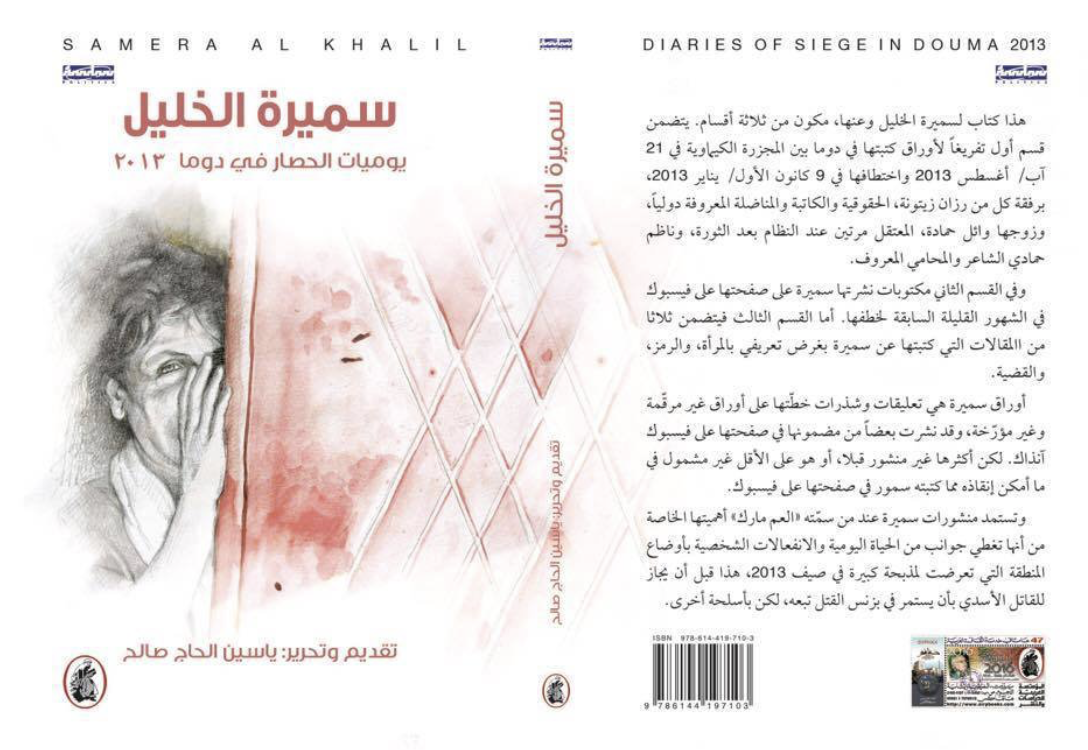
Samira wrote this in her diary:

“The world does not interfere with the fact that we are dying, it controls the ways we are dying: it does not want us dead with chemical weapons but does not protest our killing by starvation, closes the borders in the face of those who are escaping certain death with their children.  It leaves them to drown in their flimsy boats—a communal death in the sea, similar to the communal death by the chemical weapon.”

And those who remained inside East Ghouta, as the header to this post says, were all dying slowly.  As one aid worker inside East Ghouta put it yesterday, what has happened since has been ‘wholesale slaughter witnessed by a motionless world.’

To be continued.
Google eyes

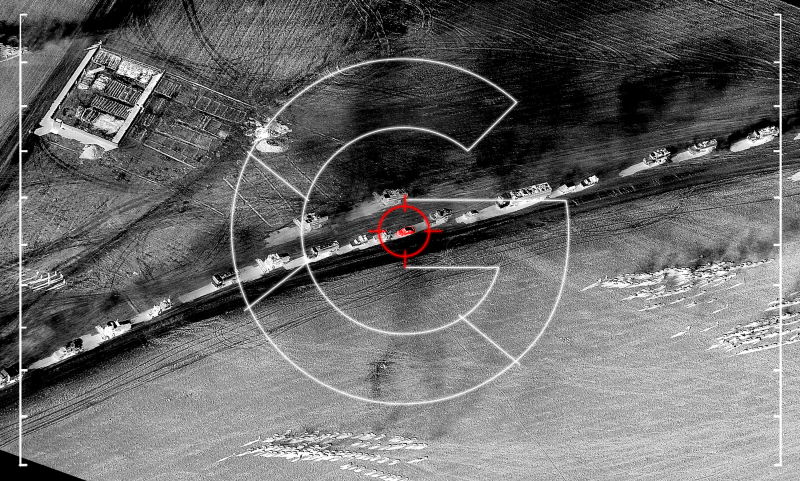
The Oxford English Dictionary recognised ‘google’ as a verb in 2006, and its active form is about to gain another dimension.  One of the most persistent anxieties amongst those executing remote warfare, with its extraordinary dependence on (and capacity for) real-time full motion video surveillance as an integral moment of the targeting cycle, has been the ever-present risk of ‘swimming in sensors and drowning in data‘.

But now Kate Conger and Dell Cameron report for Gizmodo on a new collaboration between Google and the Pentagon as part of Project Maven:

Project Maven, a fast-moving Pentagon project also known as the Algorithmic Warfare Cross-Functional Team (AWCFT), was established in April 2017. Maven’s stated mission is to “accelerate DoD’s integration of big data and machine learning.” In total, the Defense Department spent $7.4 billion on artificial intelligence-related areas in 2017, the Wall Street Journal reported.
The project’s first assignment was to help the Pentagon efficiently process the deluge of video footage collected daily by its aerial drones—an amount of footage so vast that human analysts can’t keep up, according to Greg Allen, an adjunct fellow at the Center for a New American Security, who co-authored a lengthy July 2017 report on the military’s use of artificial intelligence. Although the Defense Department has poured resources into the development of advanced sensor technology to gather information during drone flights, it has lagged in creating analysis tools to comb through the data.

“Before Maven, nobody in the department had a clue how to properly buy, field, and implement AI,” Allen wrote.

Maven was tasked with using machine learning to identify vehicles and other objects in drone footage, taking that burden off analysts. Maven’s initial goal was to provide the military with advanced computer vision, enabling the automated detection and identification of objects in as many as 38 categories captured by a drone’s full-motion camera, according to the Pentagon. Maven provides the department with the ability to track individuals as they come and go from different locations.

Google has reportedly attempted to allay fears about its involvement:

A Google spokesperson told Gizmodo in a statement that it is providing the Defense Department with TensorFlow APIs, which are used in machine learning applications, to help military analysts detect objects in images. Acknowledging the controversial nature of using machine learning for military purposes, the spokesperson said the company is currently working “to develop polices and safeguards” around its use.

“We have long worked with government agencies to provide technology solutions. This specific project is a pilot with the Department of Defense, to provide open source TensorFlow APIs that can assist in object recognition on unclassified data,” the spokesperson said. “The technology flags images for human review, and is for non-offensive uses only. Military use of machine learning naturally raises valid concerns. We’re actively discussing this important topic internally and with others as we continue to develop policies and safeguards around the development and use of our machine learning technologies.”
 

As Mehreen Kasana notes, Google has indeed ‘long worked with government agencies’:

2017 report in Quartz shed light on the origins of Google and how a significant amount of funding for the company came from the CIA and NSA for mass surveillance purposes. Time and again, Google’s funding raises questions. In 2013, a Guardian report highlighted Google’s acquisition of the robotics company Boston Dynamics, and noted that most of the projects were funded by the Defense Advanced Research Projects Agency (DARPA).

Silent Witnesses

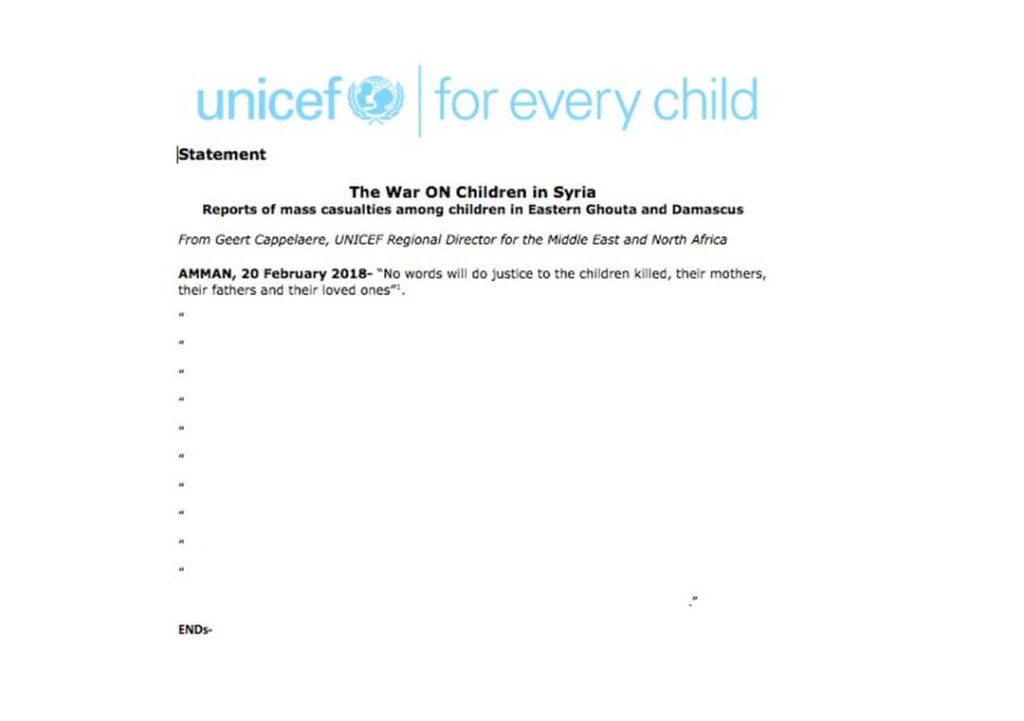
I’m still working on the mass murder in slow motion that is Ghouta; there’s so much to see, say and do that my promised post has been delayed.  Most readers will know of the stark declaration issued by UNICEF last month:

It was accompanied by this explanatory footnote:

We no longer have the words to describe children’s suffering and our outrage.  Do those inflicting the suffering still have words to justify their barbaric acts?


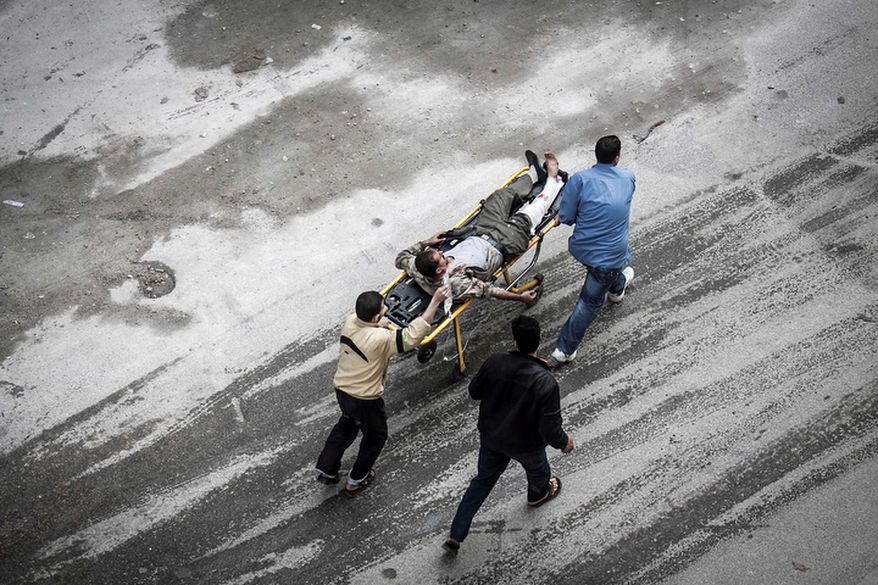
One of Allan Pred‘s favourite quotations from Walter Benjamin was this: ‘I have nothing to say.  Only to show.’  And perhaps the broken, mangled shards of montage are the most appropriate way to convey the collision of medieval and later modern violence that is sowing Syria’s killing fields with so many injured, dying and dead bodies.

You might think it’s always been so: in 1924 Ernst Friedrich introduced his collection of war photographs by insisting that ‘in the present and in the future, all the treasure of words is not enough to paint correctly the infamous carnage.’

These are suggestive claims, but two riders are necessary.  First,  images have such an extraordinary, if often insidious, subliminal power – even in our own, image-saturated culture – that they demand careful, critical interrogation and deployment.  They don’t speak for themselves.  And second, Benjamin described his method as ‘literary montage’: as Allan knew very well, words do not beat a silent retreat in the face of the image, and it’s in concert that the two produce some of their most exacting effects.

 In the course of my work on war in Syria and elsewhere I’ve encountered (and drawn upon) the work of many outstanding photographers; in some cases their images seem out-of-time, almost transcendent testimony to the enduring realities of war, while others disclose new horrors erupting in the midst of the all-too-bloody-familiar.  I think, for example, of the work of Narciso Contreras (see above and below, and also here and his collection, Syria’s War: a journal of pain, War Photo, 2014) – and I do know about the controversy over editing/cropping – or Nish Nalbandian (see also here and here and his book, A whole world blind: war and life in northern Syria, Daylight Books, 2016).


In my research on other conflicts I’ve also learned a lot from war artists, and in the case of Syria from graphic journalism: see, for example, the discussion by Nathalie Rosa Bucher here and the example of Molly Crabapple here. (Her work was based on cell-phone videos sent to her by a source inside IS-controlled Raqqa: another digital breach of siege warfare in Syria).


The point of all of this is to emphasise my debt to multiple (in this case, visual) sources that enable me – sometimes force me –  to see things differently: to turn those broken shards around, to have them catch the light and illuminate the situation anew.  And to see things I’d often rather not see.


It’s not a new experience. When I was completing The colonial present I was given access to a major image library, and in the course of three exhilarating days I learned more about Afghanistan, Palestine and Iraq than I had learned in three months of reading. The image bank included not only published but also unpublished images, which revealed aspects, dimensions, whole stories that had been left unremarked and unrecorded in the public record produced through editorial selection.

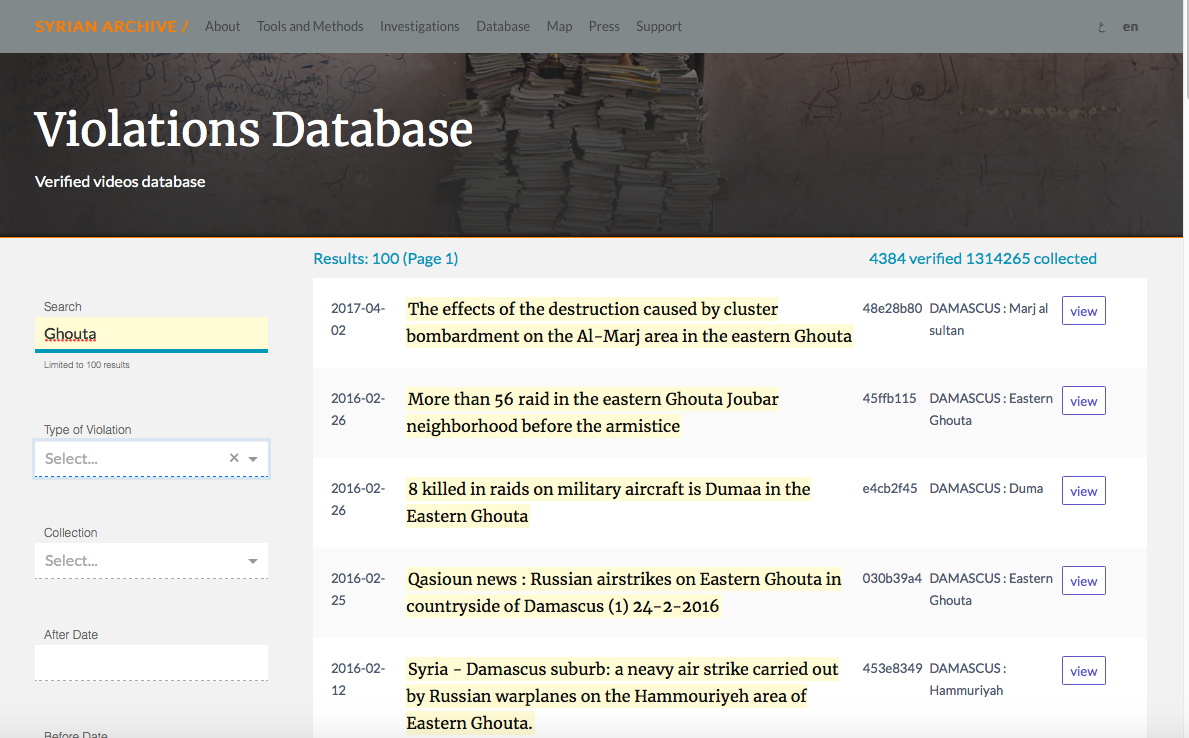
For my present work the Syrian Archive is invaluable:

The Syrian Archive is a Syrian-led and initiated collective of human rights activists dedicated to curating visual documentation relating to human rights violations and other crimes committed by all sides during the conflict in Syria with the goal of creating an evidence-based tool for reporting, advocacy and accountability purposes.


Its emphasis on visual documentation and analysis needs to be seen alongside the investigations of Forensic Architecture and bellingcat.


The Syrian Archive aims to support human rights investigators, advocates, media reporters, and journalists in their efforts to document human rights violations in Syria and worldwide through developing new open source tools as well as providing a transparent and replicable methodology for collecting, preserving, verifying and investigating visual documentation in conflict areas.

We believe that visual documentation of human rights violations that is transparent, detailed, and reliable are critical towards providing accountability and can positively contribute to post-conflict reconstruction and stability. Such documentation can humanise victims, reduce the space for dispute over numbers killed, help societies understand the true human costs of war, and support truth and reconciliation efforts.

Visual documentation is also valuable during conflict as it can feed into:

  • Humanitarian response planning by helping to identify areas of risk and need as well as contribute to the protection of civilians;
  • Mechanisms that support increased legal compliance by conflict parties and reductions in civilian harm;
  • Strengthening advocacy campaigns and legal accountability through building verified sets of materials documenting human rights violations in the Syrian conflict.

User-generated content is valuable during times of conflict. Verified visual documentation can feed into humanitarian response planning by helping to identify areas of risk and need as well as contributing to the protection of civilians.

Furthermore, visual documentation allows the Syrian Archive to tell untold stories through amplifying the voices of witnesses, victims and others who risked their lives to capture and document human rights violations in Syria. Not every incident in the Syrian conflict has been reported by journalists. The very challenging conditions have made it extremely difficult for local and especially international media to work in Syria, meaning the many incidents have been missed or under-reported.

Visual documentation aims to strengthen political campaigns of human rights advocates by providing content that supports their campaign. This could include content on the violation of children’s rights; sexual and gender based violence; violations against specifically protected persons and objects, or the use of illegal weapons.

Additionally, visual documentation aims to help human rights activists and Syrian citizens in setting up a memorialisation process and to create dialogues around issues related to peace and justice, to recognise and substantiate the suffering of citizens and provide multiple perspectives on the conflict that acts to prevent revisionist or simplified narratives while raising awareness of the situation in the country and highlighting the futility of violence to next generations. Video and images often compliments official narratives and press accounts of an event or situation, adding both detail and nuance. At other times, they directly rebut certain factual claims and contradict pervasive narratives.


Many of the videos on which this visual analysis relies (me too) were uploaded to YouTube.  Armin Rosen reports:


Google, which is YouTube’s parent company, knows how significant its platform has been during the war. “The Syrian civil war is in many ways the first YouTube conflict in the same way that Vietnam was the first television conflict,” Justin Kosslyn, the product manager for Jigsaw, formerly called Google Ideas, said during an interview on the sidelines of September’s Oslo Freedom Forum in New York, where Kosslyn had just spoken. “You have more hours of footage of the Syrian civil war on YouTube then there actually are hours of the war in real life.” In 2016, Jigsaw developed Montage, a Google Docs-like application that allows for collaborative analysis of online videos. Kosslyn said the project was undertaken with human rights-related investigations in mind.

The value of YouTube’s Syria videos is indisputable, especially since the regime and other armed actors have closed off much of the country to journalists and human rights observers. [Eliot] Higgins and his colleagues [at Bellingcat] proved beyond all doubt that Assad’s forces gassed a suburb of Damascus in August 2013, and a U.N. organization is now in the early stages of assessing YouTube’s Syria footage for its future use in war crimes trials. In December 2016, the U.N. General Assembly voted to establish the International Impartial and Independent Mechanism (IIIM) to assist in war crimes prosecutions related to Syria. In connection with the IIIM, Hiatt and his team at Benetech are developing software that can search and organize the estimated 4 million videos related to the conflict. The IIIM will facilitate the use of the videos in court if alleged human rights abusers ever face trial.

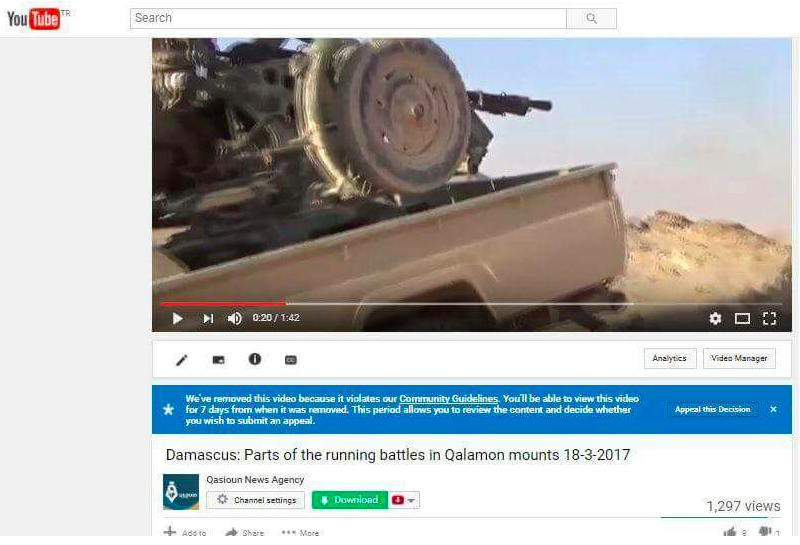
Last summer YouTube started deleting videos that violated its Terms of Service; the platform used algorithms to flag the offending materials and within days some 900 Syria-related channels were removed.

Alarm bells rang; here’s Chris Woods of Airwars talking to the New York Times:

“When the conflict in Syria started, independent media broke down and Syrians themselves have taken to YouTube to post news of the conflict…  What’s disappearing in front of our eyes is the history of this terrible war.”

And Eliot Higgins (on YouTube!):

After the concerted protests many of the videos were restored, but the cull continued and by the end of the year more than 200 channels providing over 400,000 videos had been removed.  Again, some of those were subsequently restored, but the Syrian Archive estimates that more than 200,000 videos are still offline.


The intervention was the product of an understandable desire to remove ‘propaganda’ videos – part of the fight back against ‘fake news’ – but here’s the rub:

Videos from the conflict could prove critical in cases where they might violate the site’s ToS—even ISIS propaganda videos help identify members of the organization and explain its internal hierarchies. “The difficulty in this type of work is that the information put out there on social media by the perpetrators of the violence can also be used to hold those perpetrators accountable,” Shabnam Mojtahedi [a legal analyst with the Syria Justice and Accountability Center: see also here for its statement on this issue] notes.

And it’s not just YouTube.  In an extended report for The Intercept Avi Asher Schapiro detected

a pattern that’s causing a quiet panic among human rights groups and war crimes investigators. Social media companies can, and do, remove content with little regard for its evidentiary value. First-hand accounts of extrajudicial killings, ethnic cleansing, and the targeting of civilians by armies can disappear with little warning, sometimes before investigators notice. When groups do realize potential evidence has been erased, recovering it can be a kafkaesque ordeal. Facing a variety of pressures — to safeguard user privacy, neuter extremist propaganda, curb harassment and, most recently, combat the spread of so-called fake news — social media companies have over and over again chosen to ignore, and, at times, disrupt the work of human rights groups scrambling to build cases against war criminals.

“It’s something that keeps me awake at night,” says Julian Nicholls, a senior trial lawyer at the International Criminal Court,  where he’s responsible for prosecuting cases against war criminals, “the idea that there’s a video or photo out there that I could use, but before we identify it or preserve it, it disappears.”

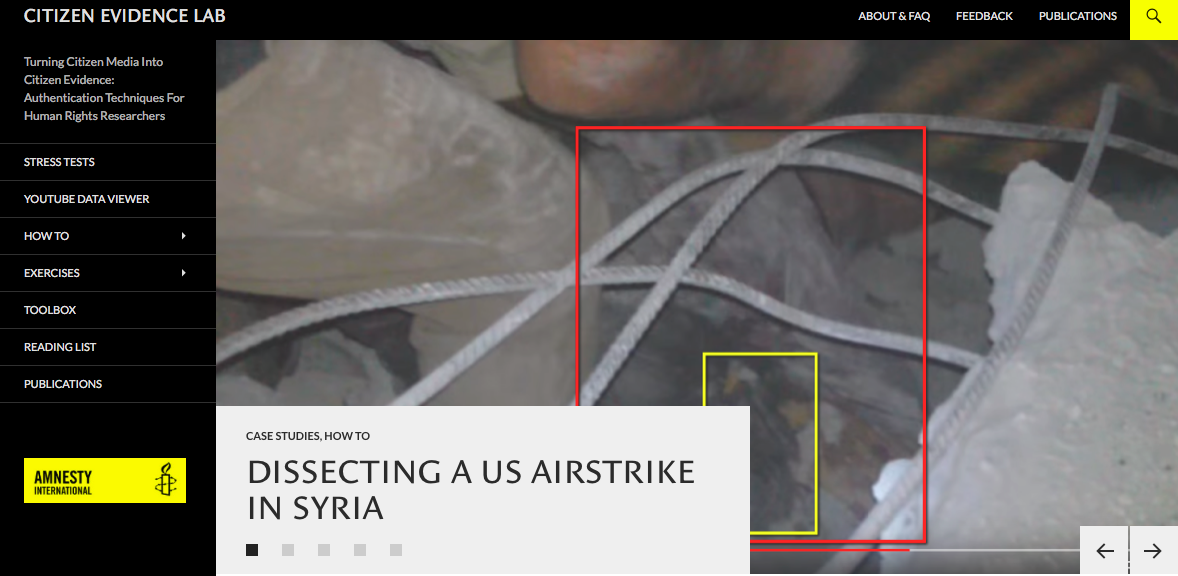
As Christoph Koettl, a senior analyst with Amnesty International and a founder of Citizen Evidence Lab put it, these social media platforms are ‘essentially privately-owned evidence lockers’.  And that should worry all of us.

The war on children

Save the Children has just published a new report, The War on Children, which you can download here.

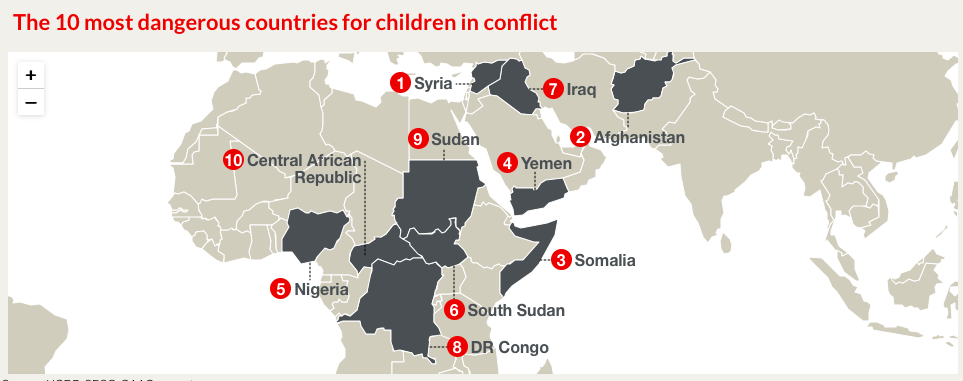
One in six children across the world are living in areas impacted by conflict, and children are more at risk in conflict now than at any time in the last 20 years. From Syria to South Sudan, Yemen to DRC, children are caught up in violence, which is not of their making. Children are being killed and maimed, raped and recruited, and being denied aid and medical care. Warring parties are bombing schools and hospitals on a scale not seen for decades.

The War on Children: Time to End Violations Against Children in Armed Conflict looks at how conflict has impacted children, and sheds light on a worrying trend of increased brutality against children in conflict, particularly in the last few years.

The findings of this report are stark, and the message is clear – we need to take concerted, collective action to turn back the tide of brutality and indifference and better protect children in conflict.

The weaponisation of social media

Following on from my last post, Foreign Policy has a thoughtful review from Sasha Polokow-Suransky of David PatrikarikosWar in 140 Characters: How Social Media Is Reshaping Conflict in the Twenty-First Century (Basic Books):

A leading foreign correspondent looks at how social media has transformed the modern battlefield, and how wars are fought.
Modern warfare is a war of narratives, where bullets are fired both physically and virtually. Whether you are a president or a terrorist, if you don’t understand how to deploy the power of social media effectively you may win the odd battle but you will lose a twenty-first century war. Here, journalist David Patrikarakos draws on unprecedented access to key players to provide a new narrative for modern warfare. He travels thousands of miles across continents to meet a de-radicalized female member of ISIS recruited via Skype, a liberal Russian in Siberia who takes a job manufacturing “Ukrainian” news, and many others to explore the way social media has transformed the way we fight, win, and consume wars-and what this means for the world going forward.


You can read the introduction here (scroll down) and find an interview with the author here.

Sasha writes:

It’s popular these days to proclaim that Clausewitz is passé and war is now waged via smartphones and Facebook feeds. Few writers have actually explored what this means in practice. The journalist David Patrikarakos’s new book, War in 140 Characters, chronicles in granular detail how social media has transformed the way that modern wars are fought. From the battlefields of eastern Ukraine to the bot factories of St. Petersburg, Patrikarakos takes us into the lives of ordinary citizens with no military training who have changed the course of conflicts with nothing more than a laptop or iPhone.

At the core of Patrikarakos’s book is the idea that narrative war has become far more important than physical war due to new technologies that shape public perceptions of conflicts in real time, regardless of what is actually happening on the battlefield. The spread of social media, he argues, has brought about a situation of “virtual mass enlistment” that gives civilians as much power as state propaganda machines — and sometimes more. Although some techno-utopians have celebrated the breakdown of centralized state control of information and the empowerment of the individual to challenge authoritarian regimes, he is not starry-eyed about the leveling of the playing field. “[B]ecause these new social media forums are structurally more egalitarian,” he writes, “many delight in holding up the Internet as the ultimate tool against tyrants.” It is not. As Patrikarakos notes, “the state will always fight back” — and it has.

And she adds, tellingly:

The greatest strength of War in 140 Characters is the author’s preference for in-depth reporting over soundbite-ready platitudes. This is not a book of Lexuses and olive trees.

A caution that should be applied more widely….

Digital breaches

In my latest posts on the wars in Syria – Cities under Siege here and here – I tried to open a space for the voices of those inside the siege lines.  To supplement those discussions, I want to notice two other digital breaches of siege lines, one in Mosul in Iraq and the other in East Ghouta in Damascus.

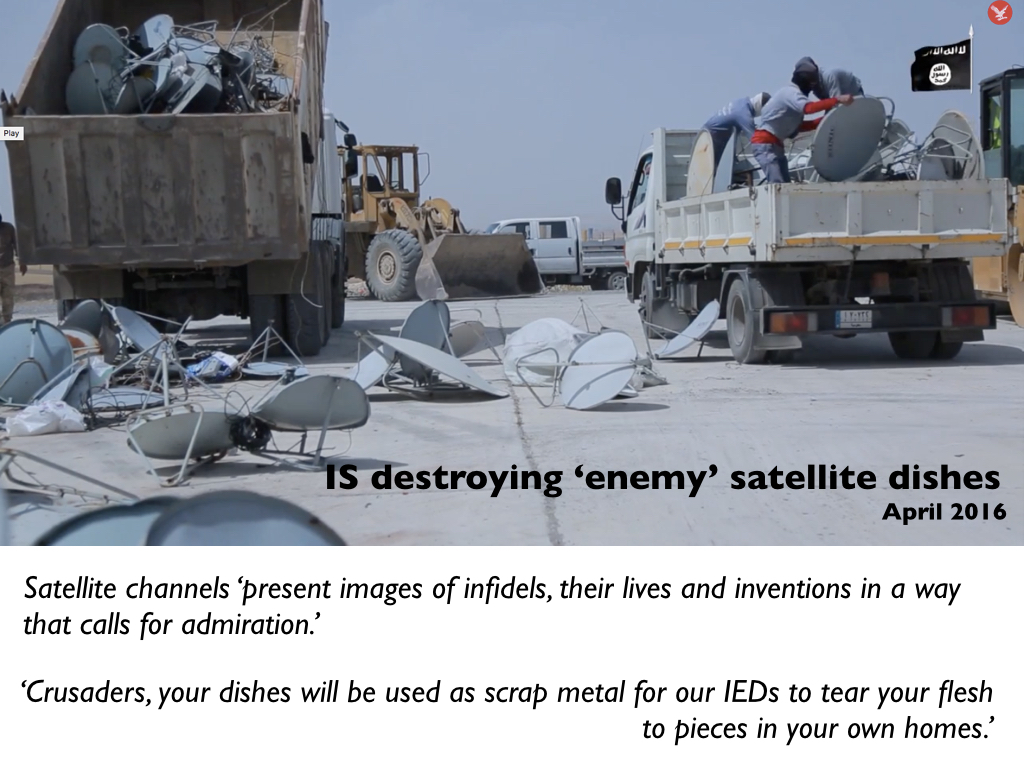
Although the Syrian regime has been either unwilling or unable to prevent digital access to the world outside its barricades (no doubt for a variety of reasons), Islamic State has persistently sought to isolate the communities it controls from within.  For example:

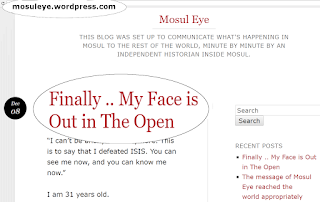
In Mosul, Omar Mohammed – a 31 year-old ‘stealth historian‘ – risked his life to chronicle life under IS in a remarkable series of posts: Mosul Eye.  When he lost his job teaching ancient history at the university in June 2014 he started an anonymous blog and became the eponymous ‘Mosul Eye’.

Lori Hinnant and Maggi Michael reported for AP:

Anonymous for more than three years, Mohammed wandered the streets of occupied Mosul by day, chatting with shopkeepers and Islamic State fighters, visiting friends who worked at the hospital, swapping scraps of information. He grew out his hair and his beard and wore the shortened trousers required by the extremists. He forced himself to witness the beheadings and deaths by stoning, so he could hear killers call out the names of the condemned and their supposed crimes.

By night, he was Mosul Eye, and from his darkened room he told the world what was happening. If caught, he knew he would be killed.

Writing in the New Yorker in October 2016,  Robin Wright explained that Mosul Eye

provided details about life under the caliphate—initially offering hourly reports regarding roads around Mosul that were safe to travel, and then, in the following weeks, reporting on the dawning anxiety about the heavily armed ISIS fighters, the power blackouts, the rising prices, the chaos in local markets, the panic over food shortages, and the occupiers’ utter brutality. Over the next year, Mosul Eye expanded into a Facebook page and a Twitter account. The posts were determinedly stoic—melancholic and inspiring at once.

For the past two weeks, as Mosul has become the epicenter of a new U.S.-backed offensive to defeat ISIS—also known as ISIL—Mosul Eye has been posting dozens of times a day on its social-media outlets. On Monday, it tweeted, “Today, Mosul has entered the atmosphere of the war. The bombardment is continuous on many areas of the city, specifically the southern and northeastern outskirts of the city.”

Mohammed paid smugglers to arrange his escape, and once outside of Mosul he eventually revealed his identity; it was not an easy decision but once he had made it, he said, he finally felt free.

Most of the published interviews with Mohammed took place once he was outside Mosul and his identity was known, but Wright managed to reach him over social media inside the besieged city and her report addressed the key questions of provenance and credibility:

Iraqis and Mideast scholars believe that the site is for real. Rasha al Aqeedi, a scholar from Mosul who now writes from Dubai, told me that “the information is reliable,” and added, “The perspective and ideology, however, reflect Mosul’s young intelligentsia: the will to review Islam and question religious texts and the fault lines along historic narratives.”

But the same questions dogged the two AP journalists en arrière, once they had met with him and he revealed his identity.  Here is their detailed response:

Omar gave us databases from his hard drive tracking the dead, noting daily events in Mosul. Each one was a separate file — totaling hundreds of files. The origin dates on each matched the date of the file, or at most was one or two days away from it. For his account of the day on the Tigris, he gave us multiple photos and a video from the day, each with an origin date in March 2015, which was when he said the events had happened. On Google Maps, he showed us the curve in the river where he picnicked, and zoomed on the marshy areas to show how it matched up with his account. As for himself blogging inside a dark room in his house in Mosul, he provided a video that AP used. He used maps to show his escape route. He showed on Google a list of the top students from his high school in Mosul, and his name was among the top five.

On the third day, just before we filmed over the course of about 90 minutes, he stepped away to make a phone call, in English, to announce that in a few minutes he would be shedding his anonymity as he didn’t want to be anonymous anymore. He showed us footage from his thesis defense, in which one of the professors accused him of secularism.

After the meetings, we asked Omar for contact information for his thesis advisor, who was among the few to figure out his identity during the early days of Mosul Eye; his younger brother, who he had told over the summer; activists and volunteers he worked with in Mosul; an American history professor he was in touch with via Skype since 2012, who knew his real identity. He provided all of this, and we spoke with all of them, including one person who, as it turns out, also figured out who he was and discovered that they have mutual friends. Omar provided us with links to his own scholarly work on Mosul. He sent over screen grabs of exchanges with a reporter from another news organization who he had worked with during the airstrikes to try and extract trapped civilians. He explained that, by that point, people were just messaging Mosul Eye in hopes he could help them. He acknowledged one other person had administrator access to the account: a Mosul woman now living in the U.S. who helped him with some of the interviews in English.

Omar explained to us how he cross-checked his information, and we put some of that into the story, but Mosul Eye isn’t an infallible source any more than anyone else, especially in a chaotic war environment. His death toll numbers, especially during the final months of the battle, are unconfirmed but in line with other estimates.That said, some of his unpublished notes read by Lori and Maggie, with origin dates from 2014 and 2015 and early 2016 especially, showed knowledge of IS that would only be published later. The leaflets he was collecting and publishing, the photos he was using to offer biographies and diagrams of their leadership showed a historian’s desire for documentation.

Several activists whom AP interviewed said that Mosul Eye was the only window to the outside world and that they have been closely following but fearing to even “like” or “share,” knowing that IS keeps an eye on social media.

I have cited this passage in its entirety because in the deformed world of “fake news” (which plainly did not start with Donald Trump, even if he embodies its digital metastasis: see also here and here), where today the alt.left is as pernicious as the alt.right in disparaging stories they don’t like, questions of veracity – and, to be sure, of positionality – have assumed a new and profoundly political importance  The vomit-inducing denial of systematic Russian and Syrian air strikes on hospitals and medical facilities across Syria is a case in point; the disingenuous disparagement of the work of MSF, the Syrian Civil Defence (the White Helmets) and a host of other non-government agencies is another.

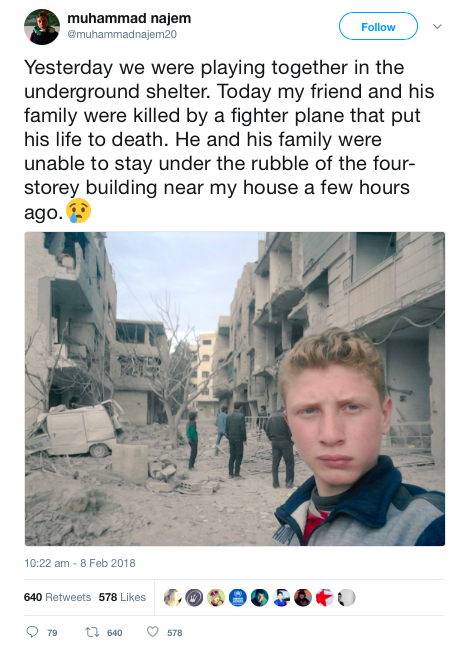
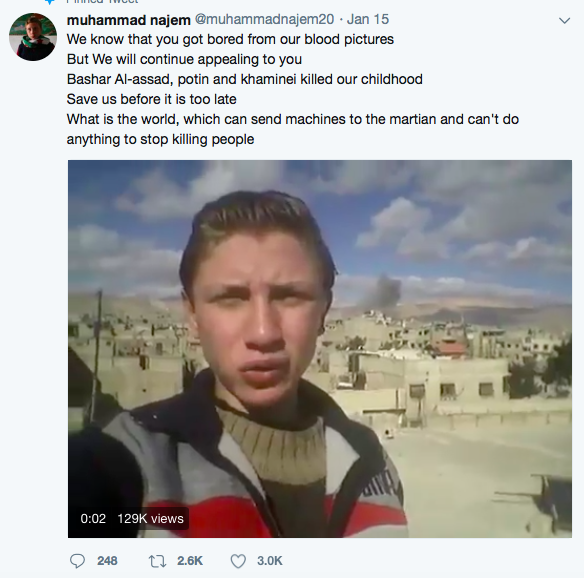
It’s a complicated terrain, of course, and my second example illustrates something of what is at stake.  It comes from East Ghouta.  I’m preparing a major post on recent events there – it should be ready next week – and, as in my previous work, here too I’ve drawn on voices from inside the siege.  Many newsrooms and digital platforms have reported the extraordinary videos posted on Twitter and YouTube by 15 year-old Muhammad Najem: see here and here.

CNN reported:

Najem’s videos have a common theme: an appeal to the world to bear witness to what is happening in Syria.
“People should know about everything happening in Syria,” he told CNN. “I want to follow my studies. I want to become a reporter when I grow up. “Our blood begs every day. You watch it daily without any reaction from you,” Najem says in one video, wearing a Syrian flag draped around his neck like a scarf. “Our hunger, cold, and displacement have become a common sight. Save our people in Ghouta.”
In one of his most powerful videos, Najem stands on a rooftop as explosions echo in the distance. “We are killed by your silence,” he says.”


(If you read some of the comments below his videos on YouTube, you will discover the killing is not only accomplished by silence.)

The CNN report added the by now standard disclaimer – ‘CNN cannot independently verify the authenticity of these videos – but the tone and texture of their coverage makes it plain that CNN doubts neither their authenticity nor their accuracy.  There is no single, plenary Truth – Donna Haraway debunked the ‘God Trick’ ages ago – but passion and partiality do not automatically disqualify someone’s voice: still less so, when their position is so precarious.

But listen to this exchange from the state-owned France 24.


In one of the videos, Najem says he wants to become a reporter “when I am grown up”. But for Franco-American [photo]journalist Jonathan Alpeyrie, who covered the Syrian conflict (in 2013, he was held captive by an Islamist group for 81 days), “a journalist shouldn’t be seen… Otherwise he becomes the subject,” he told FRANCE 24. To Alpeyrie, the teenager is more activist than journalist. “He is hostile to Bashar al-Assad but the role of the press isn’t to take a stance….”

Although several news outlets have relayed the teenager’s testimony, Alpeyrie thinks it’s dangerous to do so: “We can’t confirm the provenance of these videos. He says that he’s filming in Eastern Ghouta, but we don’t know anything.”


Describing Najem’s videos as a series of ‘selfies’, France 24’s reporter asked philosopher-psychoanalyst Elsa Godart for her take on them:

If a teenager is behind the account, his reliance on the selfie can have different motivations, said Godart. In the worst situation, aside from manipulation: “We can envision an extreme narcissism, where one plays on a tragic event under the sympathetic guise of defending humanity.”

And if we assume that the gesture is real and sincere on the part of an adolescent on the ground? “Then this could be just as it appears: a selfie as an act of resistance. The Chinese artist Ai Weiwei documented his 2009 arrest with a selfie that he later exhibited as a work of art,” said Godart.

To her, the selfie taken at war is similar: “It denounces something extraordinary. It is a testimony of something that one feels a duty to report. ‘I am attacked, and here is the photographic evidence.’”

I hope it’s obvious what I think too.

War and the body

The papers for the special section of Critical Studies on Security addressing ‘Visual representations of war and violence’ and focusing on embodiment, expertly edited by Linda Roland Danil, are now online.

Linda provides an introductory essay, and the papers that follow are:

Derek Gregory, ‘Eyes in the sky – bodies on the ground’

Catherine Baker, ‘A different kind of power’? Identification, stardom and embodiments of the military in Wonder Woman

Helen Berents and Brendan Keogh, ‘Virtuous, virtual but not visceral: (dis)embodied viewing in military-themed video games

Kandida Purnell and Natasha Danilova, ‘Dancing at the frontline: Rosie Kay’s 5SOLDIERS de-realises and re-secures war’

Counter Investigations

News from Forensic Architecture of an exhibition of their collective work at the Institute of Contemporary Arts in London, 7 March – 6 May 2018.  The official opening is Tuesday 6 March from 6 p.m. to 8 p.m; all welcome:

Counter Investigations is the first UK survey exhibition of the work of Forensic Architecture, an independent research agency based at Goldsmiths, University of London.

‛Forensic Architecture’ is not only the name of the agency but a form of investigative practice that traverses architectural, journalistic, legal and political fields, and moves from theoretical examination to practical application. In recent years Forensic Architecture has undertaken a series of investigations internationally into state crimes and human rights violations, spanning events within war zones and instances of politically and racially motivated violence and killing.

Counter Investigations presents a selection of these investigations. As historically contextualised interrogations of contemporary social and political processes, they put forward a form of ‛counter forensics’, serving as sites for the pursuit of public accountability through scientific and aesthetic means, in opposition to the monopolisation of narratives around events by state agencies.

The exhibition outlines five key concepts that raise related historical, theoretical, and technological questions. Explored in an accompanying series of public seminars, they add up to a short course in forensic architecture.

Last Sunday’s Observer had an appreciative notice from Rowan Moore of both the exhibition and FA’s work: you can find it here

The organisation’s founder and director is Eyal Weizman, a British-Israeli architect. Its primary mission is research, to “develop evidentiary systems in relation to specific cases”; in so doing, it acts as “an architectural detective agency”, working with NGOs and human rights lawyers to uncover facts that confound the stories told by police, military, states and corporations. “We think that architects need to be public figures,” says Weizman. “They should take positions, whatever they do. We map the most extreme and violent forms.”

“We’re building a new sub-discipline of architecture,” he adds. “We just have to figure it out.” They use whatever means they can to reconstruct a hybrid of physical and virtual space – the metadata surrounding phone calls and phone-camera videos, meteorology, eyewitness accounts, reconstructions. They might scrape thousands of images of a bombing off social media and match them with material facts to fix facts in space and time, as if with the coordinates of a multidimensional map. They learn from ancient as well as modern methods, such as the memorising techniques of Roman orators and Elizabethan actors, when helping ex-prisoners reconstruct the monstrous and secret prison of Saydnaya in Syria.

They are engaged in a game of wits with military and security services. Their arena is shaped by surveillance and data collection – factors that give rise to well-founded fears that they might be abused by power. Forensic Architecture aims to make these techniques benefit rather than harm human rights.

Cities under siege (II)

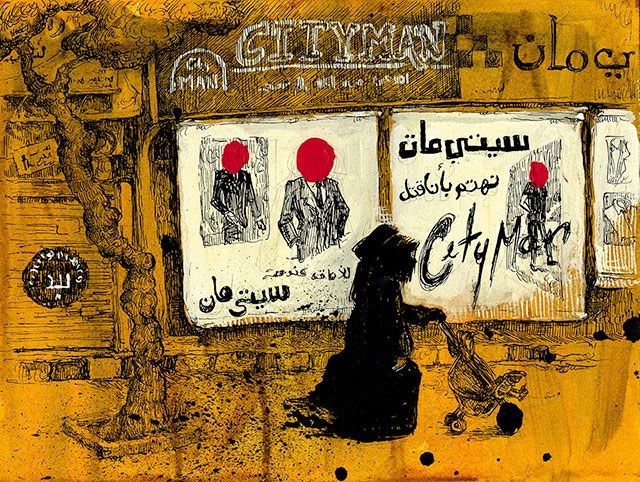
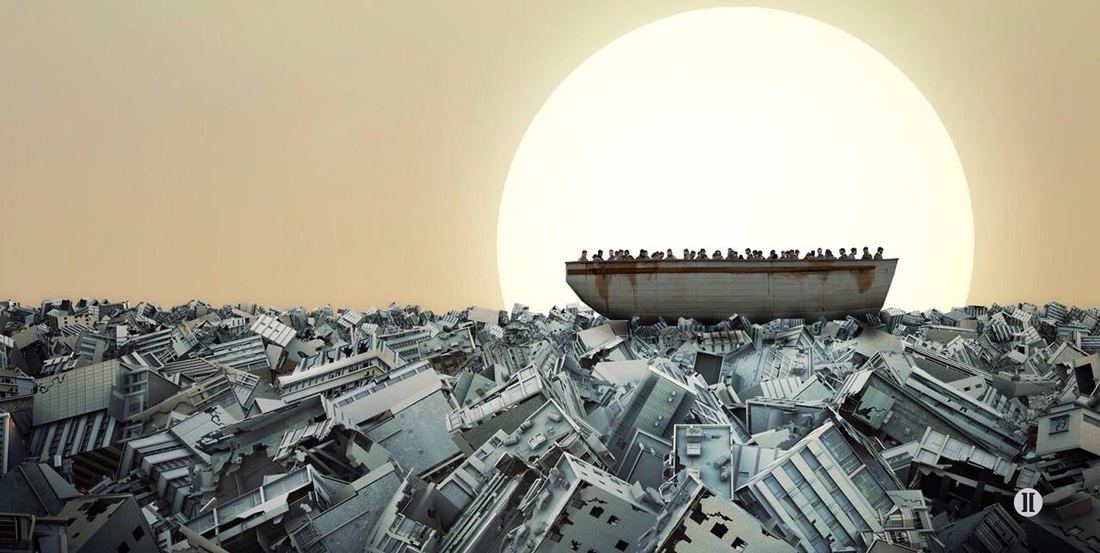
In this second post on Cities under siege I provide a back-story to the re-intensification of military and paramilitary violence against civilians in Syria I described here.  But it’s also a back-story to the stunning image above, ‘Deluge’ by Imranovi: people were evacuated to what eventually became nominally ‘de-escalation zones’ from besieged cities like Aleppo, but many more continued to flee Syria altogether – like Imranovi himself (more on Imranovi here and here).  It’s worth pausing over his artwork: every time we see video of those perilous boats crammed with desperate refugees we ought to reflect on the oceans of bloody rubble strewn across their land and the millions of other displaced people in their wake.

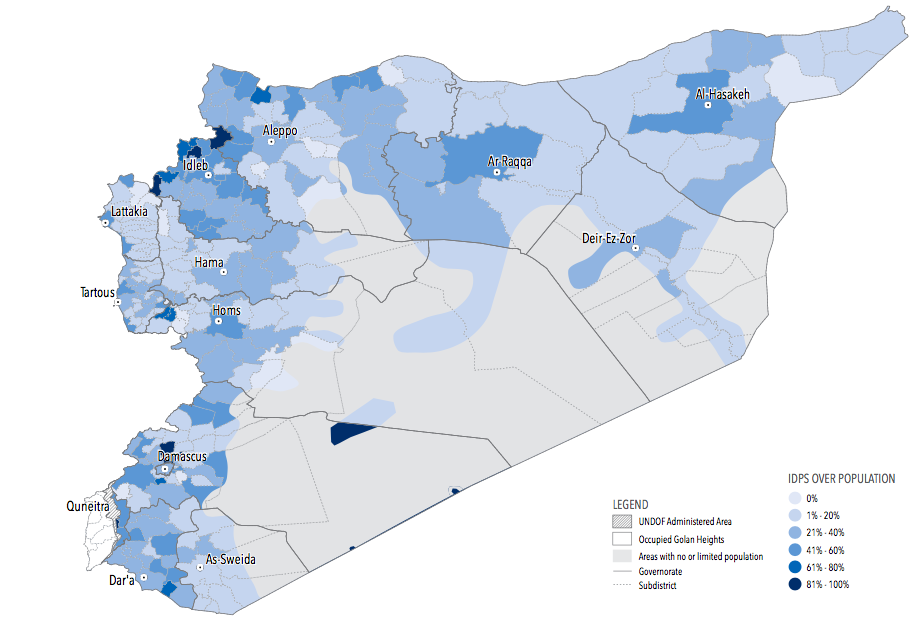
There is a close connection between internal displacement and cities under siege.  Here is the UN’s estimate of the displaced population in December 2016:

They are concentrated in towns and cities.  Many people have managed to escape areas under siege, risking their lives to do so, but many others have sought refuge in towns and cities that have themselves come under siege.  Here, for example, is Siege Watch‘s description of Eastern Ghouta in mid-2016:

The capture of besieged towns on the south and eastern sides of Eastern Ghouta had a negative impact on conditions throughout the entire besieged region. IDPs from the frontline areas fled into host communities that have also been subjected to the same long-term siege and lack the infrastructure and resources to support the newly displaced families. There is now a higher concentration of people living in temporary shelters or sleeping on the streets.

The UN defines a besieged area as ‘an area surrounded by armed actors with the sustained effect that humanitarian assistance cannot regularly enter, and civilians, the sick and wounded cannot regularly exit the area.’  

But the definition  and its application turn out to be as problematic as perhaps you would expect.  Here is Annie Sparrow:

Estimates of the number of Syrians currently living under siege vary widely, according to who is doing the reporting. For example, last December [2015], the United Nations Office for the Coordination of Humanitarian Affairs (OCHA) in Damascus communicated back to the UN secretary-general’s office that 393,700 civilians were besieged. For the same period, Siege Watch estimated that the real figure was more than one million…

From its base at the five-star Four Seasons Hotel in Damascus, OCHA decided that an area is merely “hard to reach” rather than besieged if it has received an aid convoy in the last three months, regardless of whether the supplies are sufficient for one month, let alone three.

One doesn’t need to travel far from Damascus to see how little a distinction there often is between a “hard to reach” and a “besieged” area.

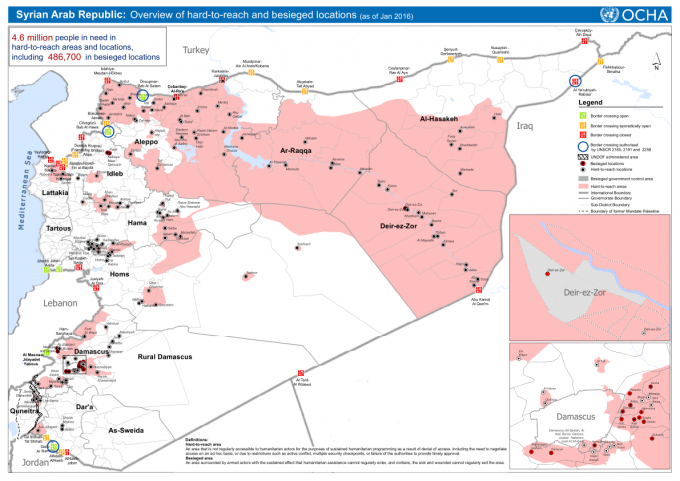
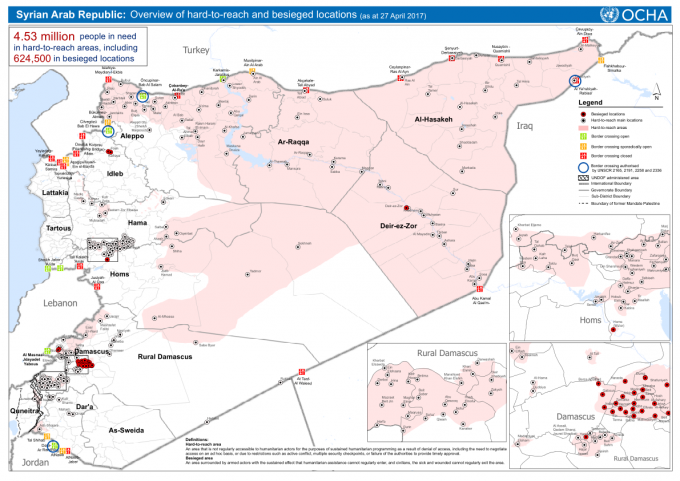
I’ll return to that last, vital point, but here are two of those OCHA maps.  The first shows the situation in January 2016 and the second in April 2017:

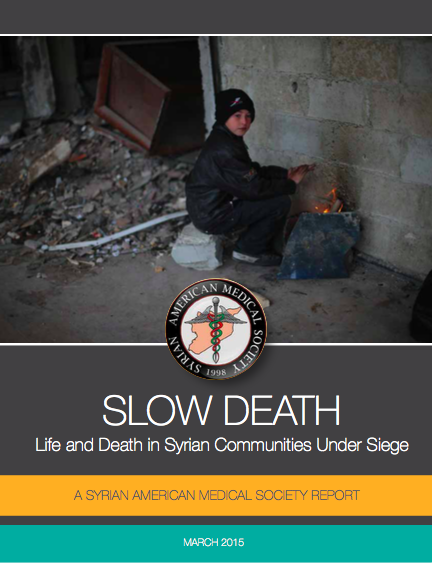
Even those attenuated maps are alarming enough, but the Syrian American Medical Society (SAMS) also believes that the OCHA reports systematically under-report the magnitude of the crisis, and in Slow Death: Life and Dearth in Syrian communities under siege (March 2015) they provided a more sensitive three-tier classification.

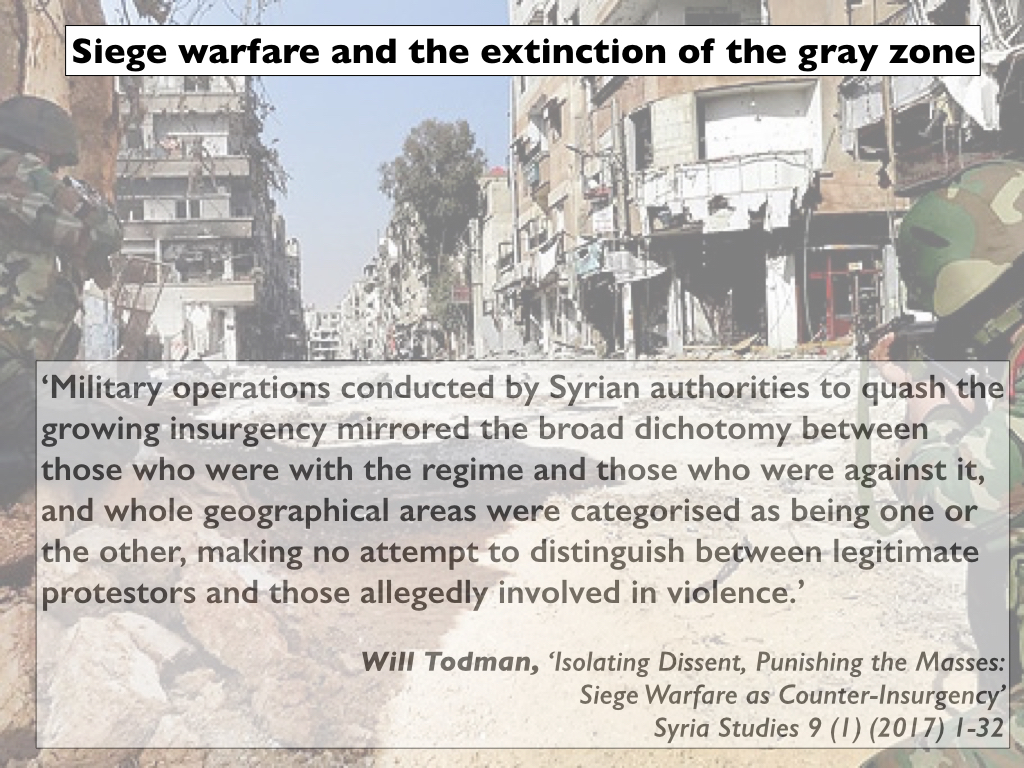
These are, of course, heterogeneous communities – none of the reports I have cited (nor those I will draw on later) conceals the presence of armed groups of various stripes within them, often jostling for control – but siege warfare renders them as homogeneous.  The presence of civilians, for the most part desperately struggling to survive in the midst of chaos and conflict, is erased; this begins as a discursive strategy but rapidly becomes a visceral reality.  In short, siege warfare becomes a version of enemy-centric counterinsurgency and counterterrorism, the Syrian government less invested in ‘performing the state’ through the provision of services than in denying services to the entire population in these areas.  By these means the Assad regime has pursued a strategy that mimics the Islamic State’s determination to ‘extinguish the grey zone‘:

Like Annie, I have been impressed by the work of Siege Watch and so I’ll start with their regular reports that have provided a series of powerful insights into the effects of sieges on everyday life.  In their first report they identified characteristics shared by all communities besieged by the Syrian government.  When that report was compiled almost 50 communities were besieged; only two of them were under siege by forces other than the Syrian government and a third was besieged on one side by the Syrian government and on the other by Islamic State.

There are three characteristics that I want to emphasise:

Deprivation:

  • ‘Civilians in the besieged areas struggle to survive. Electricity and running water are usually cut off, and there is limited (if any) access to food, fuel, and medical care. In many of these areas, civilians have died from malnutrition due to the severity with which the blockades are enforced. In all of these areas, civilians with diseases, chronic conditions, and injuries have died as a result of the lack of access to medical care. Other recorded causes of siege-related deaths include hypothermia due to the lack of heating oil in the winter, and poisoning after eating something toxic while scavenging for food. Poor sanitation conditions in the besieged areas have resulted in frequent outbreaks of infectious diseases.’

Extortion and economic development:

  • ‘The pre-war economies in all of the government-besieged areas have collapsed. They have been replaced with siege economies that depend on smuggling, bribery, and local production; and because they are nearly-closed economic systems they experience extreme price volatility. Unemployment levels in besieged areas are high, reaching 100% in some of the worst Tier 1 communities such as Jobar. The Syrian government profits off of the sieges by allowing a few pro-government traders to sell goods – sometimes expired – through the checkpoints at tremendously inflated prices and taking a cut of the profits. Sometimes civilians can pay extremely high bribes to government forces or smugglers to escape the besieged areas, although both methods entail tremendous personal risk. These extortive practices have drained the areas under long-term siege of their financial resources.’

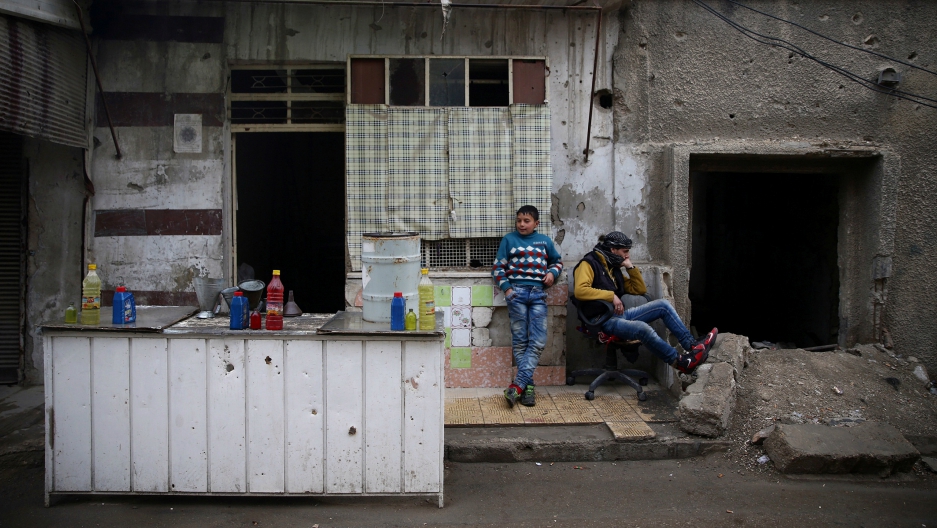
An improvised fuel stand in besieged Eastern Ghouta, February 2017

Violence:

  • ‘Most of these besieged areas are targeted with violent attacks by the Syrian armed forces and its allies. In addition to sniping and the use of explosive weapons with wide area effects in populated areas, there have also been confirmed uses of internationally banned weapons such as landmines, cluster munitions, and chemical weapons….  Most of the communities also contain AOGs [Armed Opposition Groups] which defend the the areas against incursion by pro-government forces, launch offensive attacks against the Syrian military and its allies, and coordinate with the Local Councils to varying degrees. Many Siege Watch survey respondents noted that AOGs were present only around the periphery of their communities, and a few respondents from towns in the interior of the Eastern Ghouta said that AOGs were not active in their areas at all.… [In addition] both Syrian government forces and extremists compete to recruit recruit men and boys from besieged communities using threats, blackmail, fear, propaganda, and indoctrination.’  

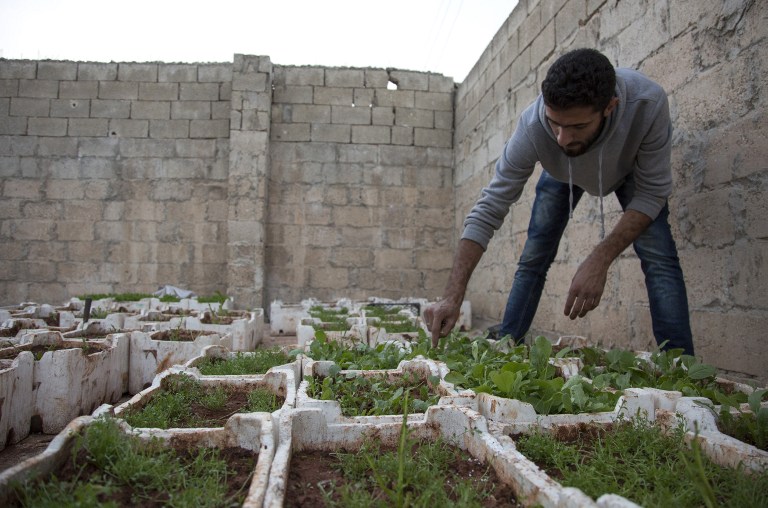
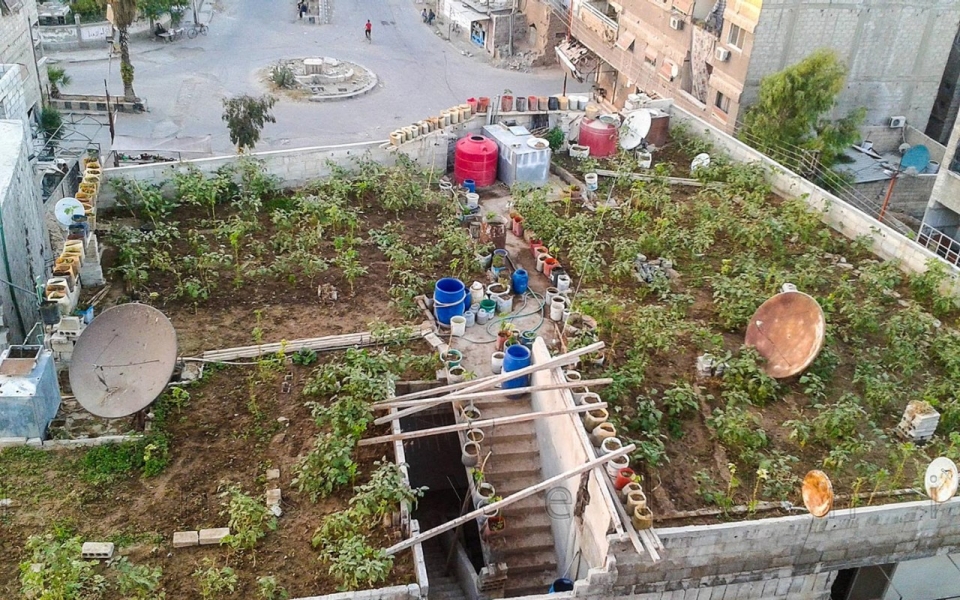
Siege Watch notes how, in consequence, ordinary people have ‘adjusted’ to these new, bleak realities: ‘Creative survival tactics such as rooftop gardening [below: eastern Aleppo], burning plastic to extract oil derivatives, and the local production of some basic medical supplies have become more common over time, and people have begun to acclimatise to a more primitive lifestyle’ [see also here].

That sentence gestures towards a sharper point made by José Ciro Martinez and Brent Eng (‘Struggling to perform the state: the politics of bread in the Syrian civil war’, International political sociology 11 (2) (2017) 130-47):

‘Most accounts [of the war in Syria] choose to privilege bellicose affairs over the humdrum concerns of daily life, which are deemed humanitarian issues separate from the violent battles and geopolitical struggles said to comprise the “actual” politics of war. This portrayal of conflict is illusory: it disregards the majority of interactions that shape both life and politics in contemporary war zones, where “most people most of the time are interacting in non-violent ways” (Tilly 2003, 12). One result of prevalent depictions of civil war is that civilians are frequently rendered powerless. If they do appear, it is as pawns in a conflict fought by armed groups autonomous from the societies they struggle to control.’

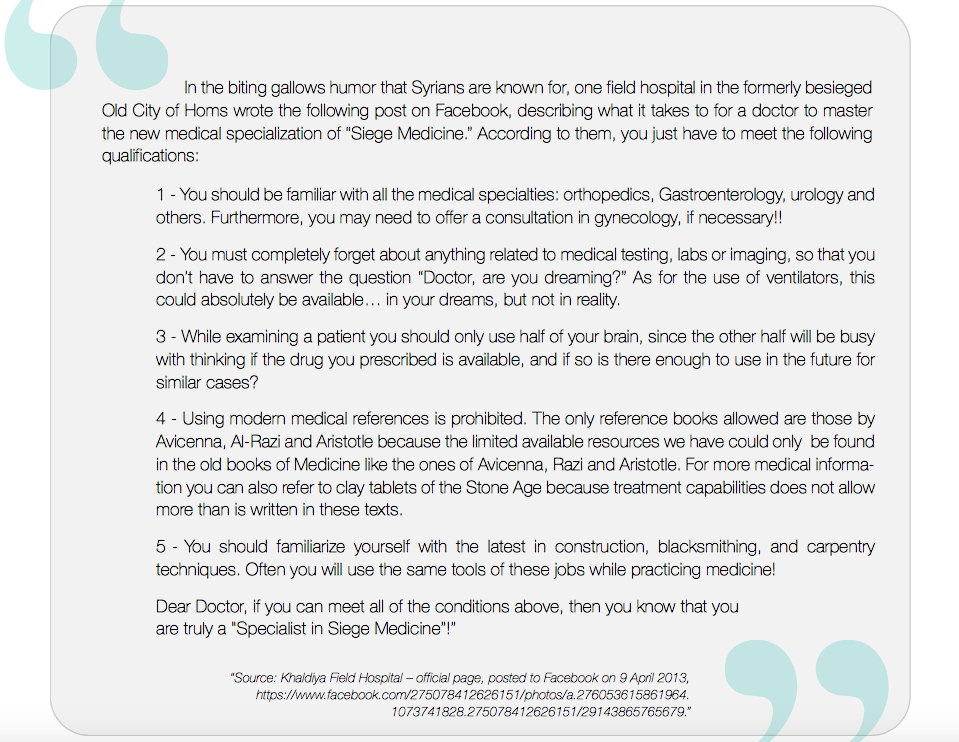
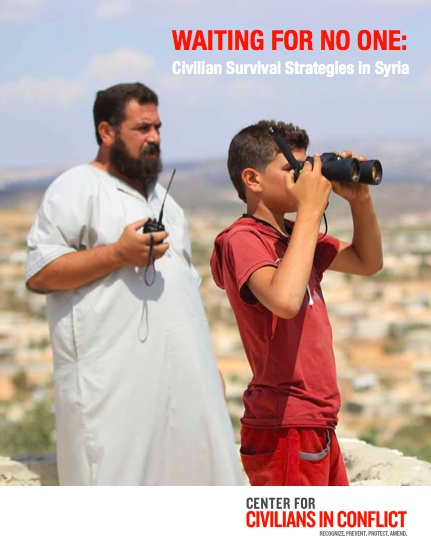
That’s an important qualification, but it plainly doesn’t erase the struggles of civilians either – which makes ‘acclimatisation’ a remarkably weak term to describe the multiple, extraordinary ways in which civilians have been forced to adjust to a new, terrifyingly abnormal ‘normal’ in order to survive.  Here, for example, is a doctor in Homs describing ‘Siege Medicine’ [more here]:The Center for Civilians in Conflict has also provided a report on civilian survival strategies that lists a series of other extraordinary, collective measures (and the title, Waiting for No One, says it all).  These strategies include the provision of makeshift early warning systems against incoming air attacks (spotter networks, radios and sirens); the provision and protection of medical infrastructure (in part through improvised field hospitals and the construction of underground hospitals); and the development of local aid and rescue teams (including the Syrian Civil Defence or White Helmets); protection from unexploded ordnance (‘the armed groups typically harvest them for their own makeshift weapons’ but the White Helmets and other groups have sought to render them harmless).

But Siege Watch – and José and Brent – have in mind something more: something in addition to strategies that are necessarily but none the less intimately related to direct, explosive and often catastrophic violence.  They also want to emphasise the ways in which otherwise ordinary, everyday activities have been compromised and ultimately transformed by siege warfare.

Here I focus on food (in)security.  Here is Annia Ciezadlo reporting from Yarmouk in Damascus:

In a dark kitchen, by the flickering light of a single safety candle, two men bundled in hats and jackets against the cold put on an impromptu video satire: live from Yarmouk, at the southernmost edge of Damascus, a cooking show for people under siege.

“This is the new dish in the camp of Yarmouk. It hasn’t even hit the market yet,” said the man on the right, 40-year-old Firas Naji, the blunt and humorous host.

He picked up a foot-long paddle of sobara, Arabic for prickly pear cactus. Holding it carefully by one end to avoid thorns, he displayed first one side and then the other for the camera.

“In the U.S., they get Kentucky [Fried Chicken], hot dogs. In Italy, spaghetti and pizza,” he said, his raspy voice caressing the names of unattainable foods. “Here in Yarmouk, we get sobara.

“It’s not enough we have checkpoints in the streets and shelling,” he added, laying the cactus back on the counter with a sad laugh. “Even our cooking has thorns.”


Yarmouk was established in 1957 as a refugee camp for Palestinians but gradually it had absorbed more and more Syrians displaced by drought, famine and eventually fighting.  As the war intensified, so the siege tightened:

The government checkpoints in and out of Yarmouk would close for four days, then five, then six. Soldiers would confiscate any amount of food over a kilo…. On July 21, 2013, the regime closed the main checkpoint into Yarmouk for good. The siege was total: Nobody could leave, and nothing could enter except what the soldiers permitted.

Over the next six months, the price of everything went up. A single radish reached $1.50 at one point; a kilo of rice was $100.

And so the inhabitants turned to gardening:

Between buildings, in abandoned lots and on rooftops, the siege gardeners of Yarmouk have been cultivating everything from eggplants to mulukhiyeh, a jute plant whose glossy leaves make a rich green stew. Come harvest time, they bag the produce into 1-kilo portions, hang the bags on the handlebars of beat-up bicycles and pedal around the camp distributing the food to their neighbors. They focus on those most in danger of starving: children, poor people and the elderly.

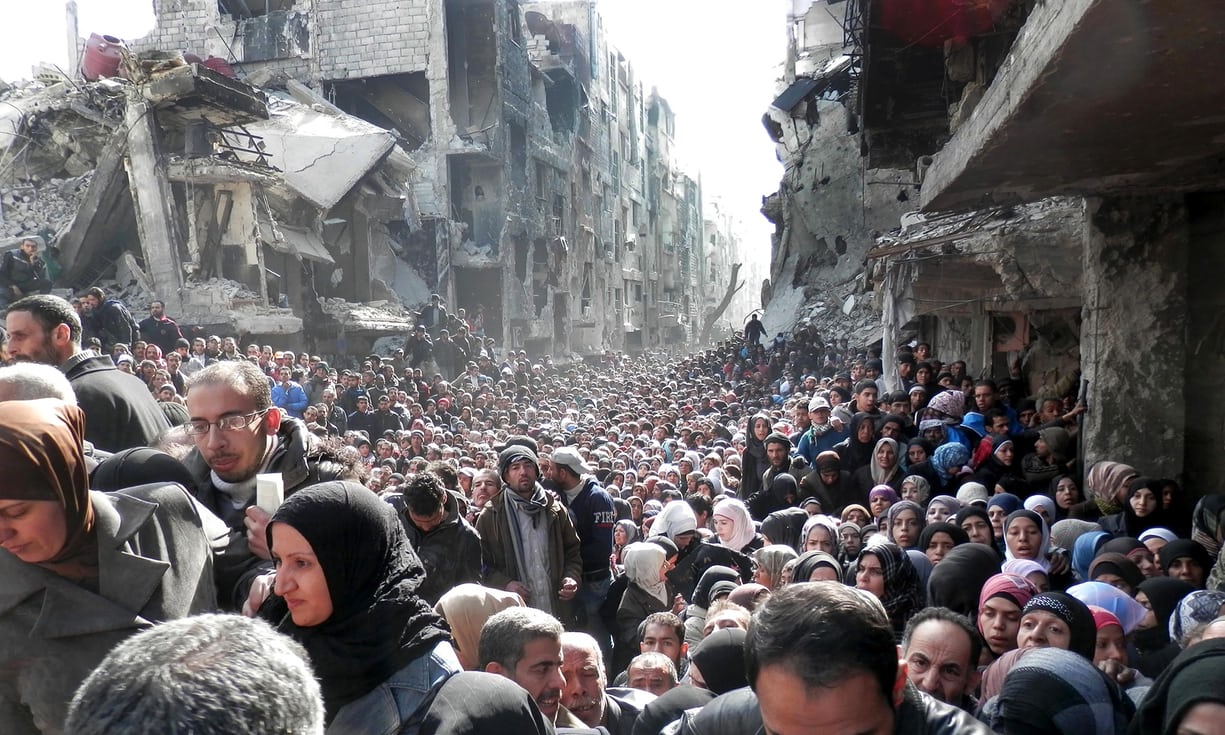
But the situation was much bleaker than the picture conjured up by that paragraph; the siege waxed and waned, and UNRWA was occasionally granted permission to deliver emergency relief, but the image below – of residents queuing for food supplies – shows how desperate the situation became.

Here is a woman in September 2014 describing the horrors of the siege to Jonathan Steele:

There was no anger or hysteria in her voice, just a calm recollection of facts. “You couldn’t buy bread. At the worst point a kilo of rice cost 12,000 Syrian pounds (£41), now it is 800 pounds (£2.75) compared to 100 Syrian pounds (34p) in central Damascus. It was 900 pounds (£3.10) for a kilo of tomatoes, compared to 100 here,” Reem recalled. “We had some stocks but when they gave out we used to eat wild plants. We picked and cooked them. In every family there was hepatitis because of a lack of sugar. The water was dirty. People had fevers. Your joints and bones felt stiff. My middle daughter had brucellosis and there was no medication,” she said. In October 2013, in a sign of how bad things had become, the imam of Yarmouk’s largest mosque issued a fatwa that permitted people to eat cats, dogs and donkeys.

Control of Yarmouk see-sawed between the Syrian Arab Army, Al-Nusrah and Islamic State, with thousands of civilians trapped behind the siege lines so that time and time again the community was thrown back on its own, desperately strained resources to survive.

Here is how Mamoon Yalabasi described a second satirical video from Yarmouk, made shortly after IS over-ran the camp, in April 2015:

“We are in the Yarmouk camp, the camp of plentifulness…  Take a look at the floor,” said the man as the camera shows water in the street. “This is not water. This is an excess of cooking [flooding the streets].”

The youth then moved on to mockingly give his viewers advice on how to lose weight.

“Would you like to lose weight? Green tea won’t work, nor will ginger … just come to Yarmouk camp for five months, in each month you’ll lose 9kg,” he said, adding the Arabic proverb: “Ask someone with experience instead of asking a doctor.”  …  “We ask the troublesome channels that claim Yarmouk camp is under siege to stop reporting that. It is ‘absolutely’ [said in English] not true,” one said.  “It’s true that my grandmother died of hunger but not because the camp was under siege but because my grandfather was so stingy – he never allowed her near the fridge,” he added.

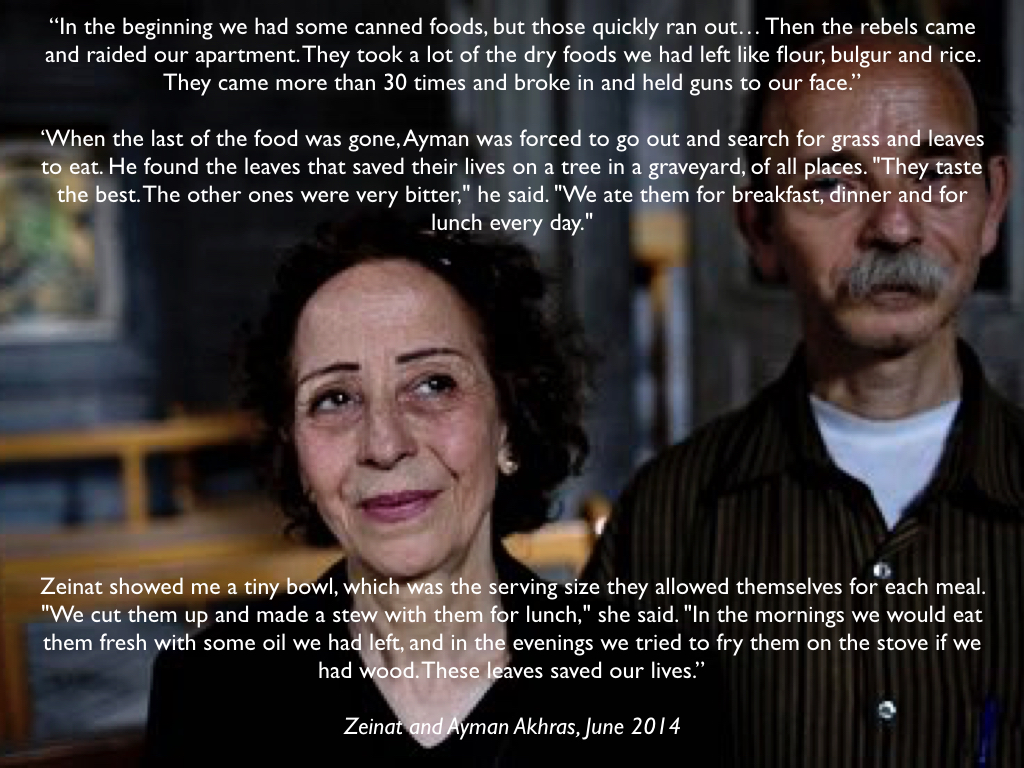
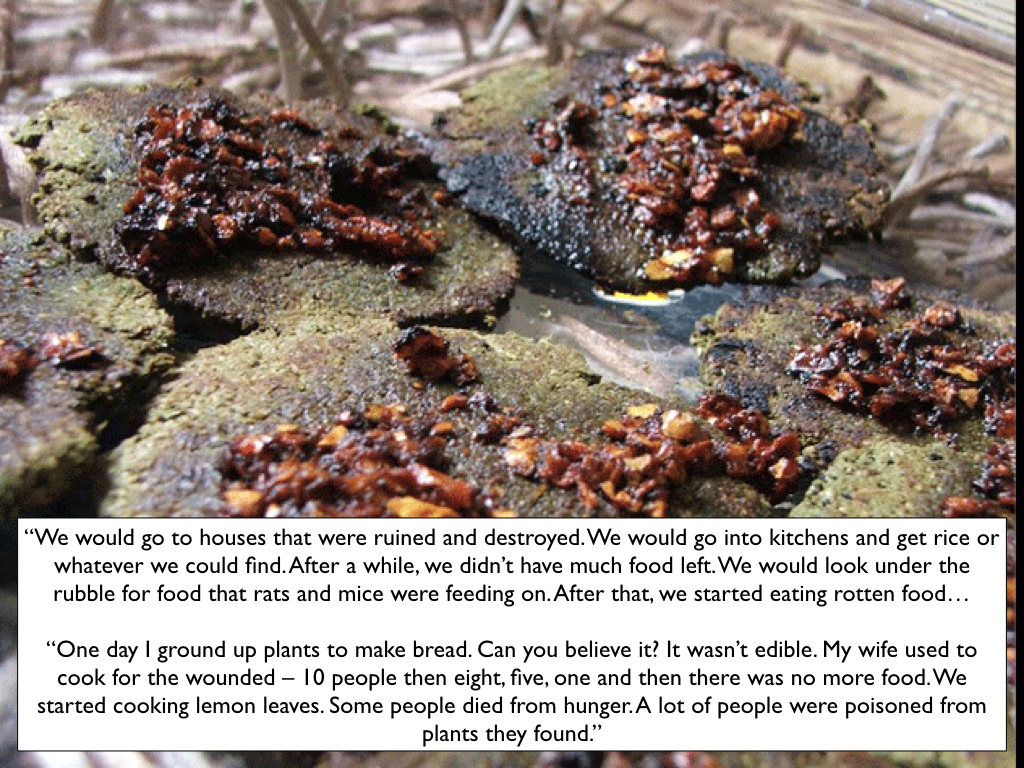
Perhaps you think all this extreme, even exceptional, comforted by those images of rooftop gardens, and believe that those who bravely tended them could somehow perform their own green revolution.  So here are Zeinat Akhras and her brother describing how they survived during the siege of Homs:

The examples can be multiplied many times over, but in a way this last testimony is exceptional – amongst those on which I’m drawing, at any rate – because it only became available once the siege had been lifted.  Those videos from Yarmouk point towards something different: the possibility of breaching siege lines through digital media.

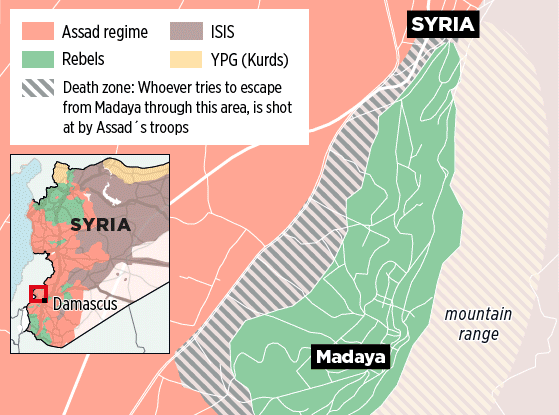
So let me turn to Madaya, a town in the Qalamoun Mountains 45 km north-west of Damascus and once famous for its fruits and vegetables.  It came under siege from the Syrian Arab Army and Hezbollah militias in July 2015: the town was encircled by 65 sniper-controlled checkpoints (below) and its surrounding countryside sown with thousands of landmines.

In January 2016 the UN still classified Madaya as a ‘hard-to-reach area’, so listen to one local resident describing conditions to Amnesty International that same month:

Every day I wake up and start searching for food. I lost a lot of weight, I look like a skeleton covered only in skin. Every day, I feel that I will faint and not wake up again… I have a wife and three children. We eat once every two days to make sure that whatever we buy doesn’t run out. On other days, we have water and salt and sometimes the leaves from trees. Sometimes organizations distribute food they have bought from suppliers, but they cannot cover the needs of all the people.

In Madaya, you see walking skeletons. The children are always crying. We have many people with chronic diseases. Some told me that they go every day to the checkpoints, asking to leave, but the government won’t allow them out. We have only one field hospital, just one room, but they don’t have any medical equipment or supplies.

I’ve described that field hospital before, but Mohammad‘s testimony reminds us that war produces not only catastrophic injuries; it also produces and intensifies chronic illnesses that a protracted siege eventually renders untreatable.  (The Syrian American Medical Society issued a report, Madaya: Starvation under Siege, which you can read here).

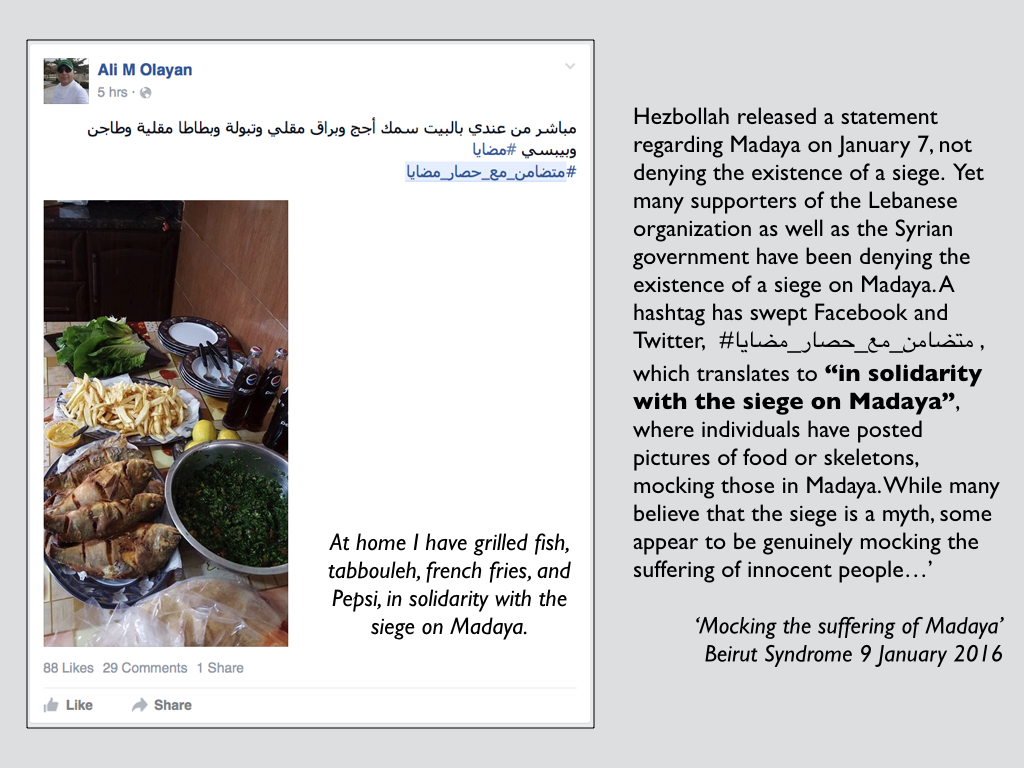
Two days later there were reports of a different digital satire: one that denied the existence of a siege in Madaya and mocked its victims.

A hashtag has swept Facebook and Twitter,  #متضامن_مع_حصار_مضايا , which translates to “in solidarity with the siege on Madaya”, where individuals have posted pictures of food or skeletons, mocking those in Madaya. While many believe that the siege is a myth, some appear to be genuinely mocking the suffering of innocent people…’

The posts were subsequently removed, but here is one I captured:

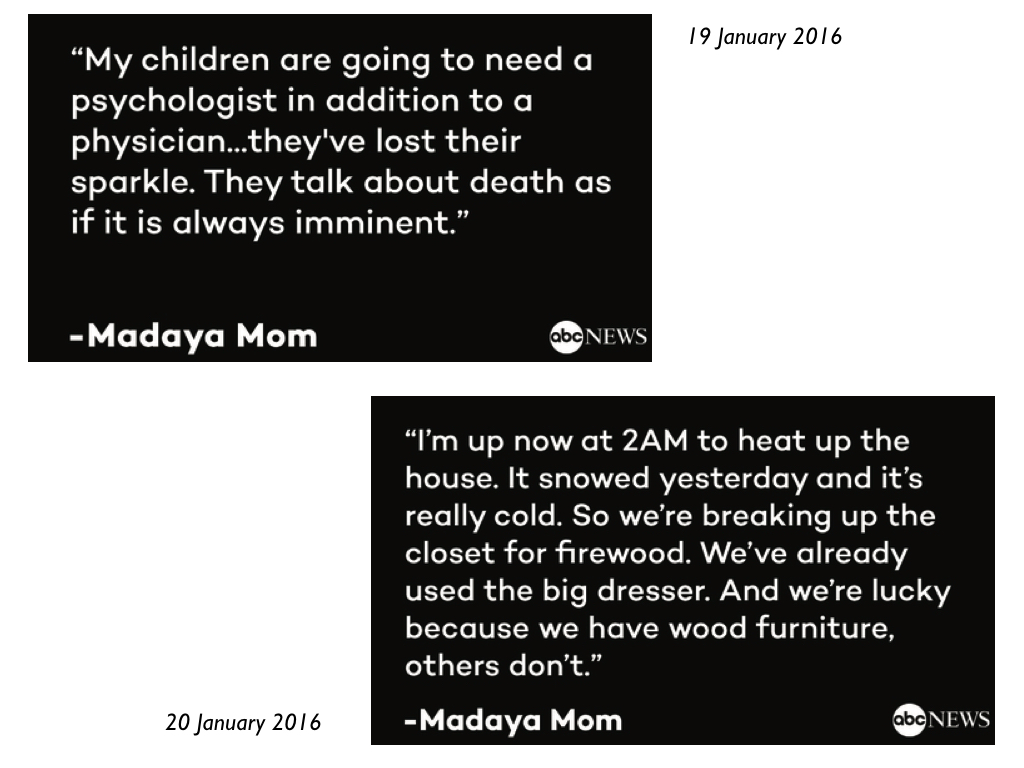
Fortunately a different digital economy was already at work.  Rym Momtaz, a producer with ABC News, had started a text exchange with a young mother of five children in Madaya:

We communicate through secure messaging apps over the phones, over the internet really. So the way we went about finding her was to go through a wide network of sources that we’ve cultivated over the years of covering the war in Syria. We had to work for a few weeks, I have to say, to identify the right person and then to get in touch with her and to gain her trust in order for her to feel comfortable enough to engage in this conversation with us because she felt and her family felt that it might put her in danger.

‘‘She would text me from the moment she woke up, which was very, very, early, like 5 a.m.,’ Rym explained, ‘and then she would text me truly throughout the day.’  And that same month – January 2016 – ABC started publishing those precious despatches from Madaya.  ‘They can’t get out of Madaya – and we can’t get in,’ ABC News’ Foreign Editor emphasised, but ‘they can tell their story to the world.’

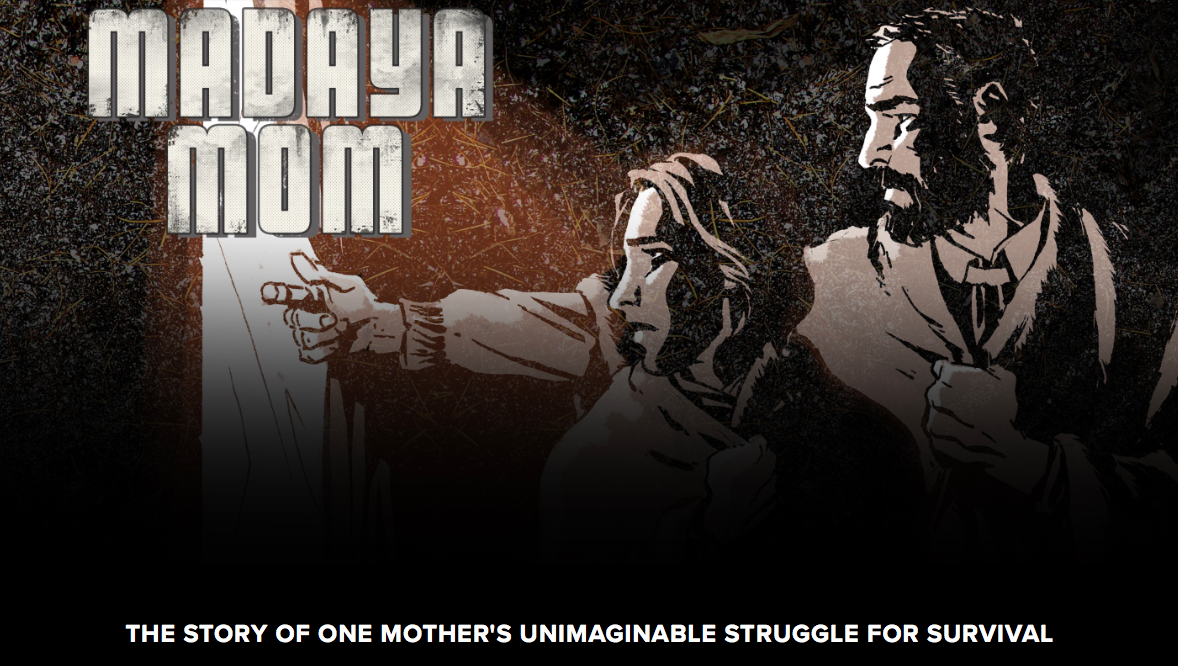
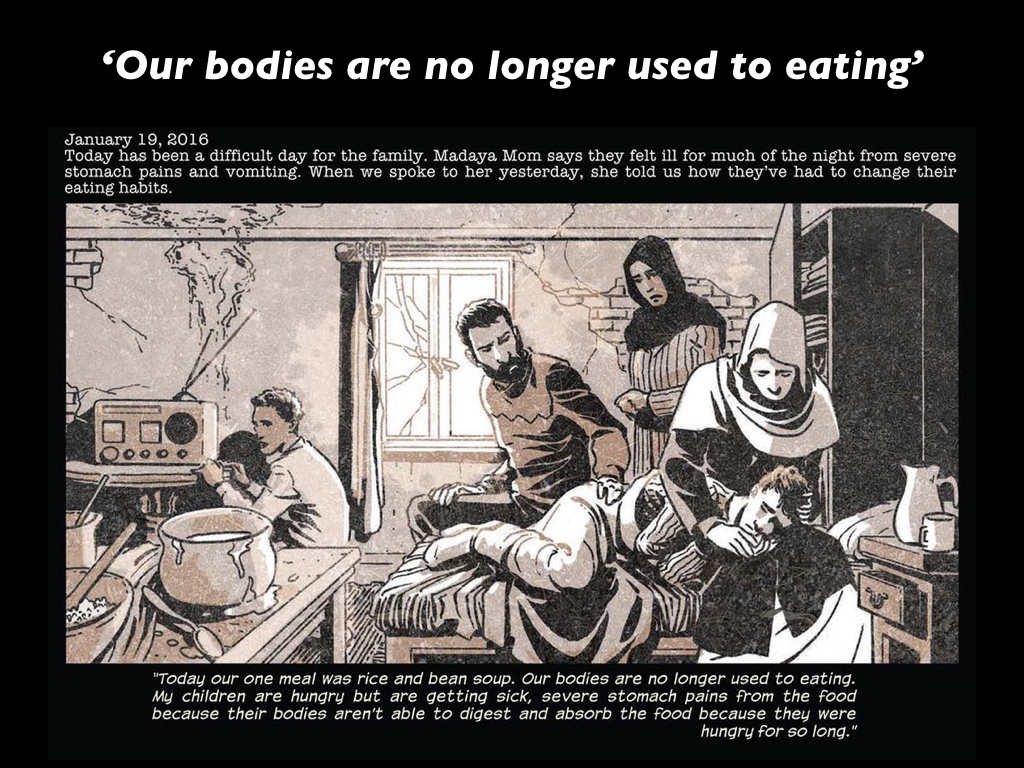
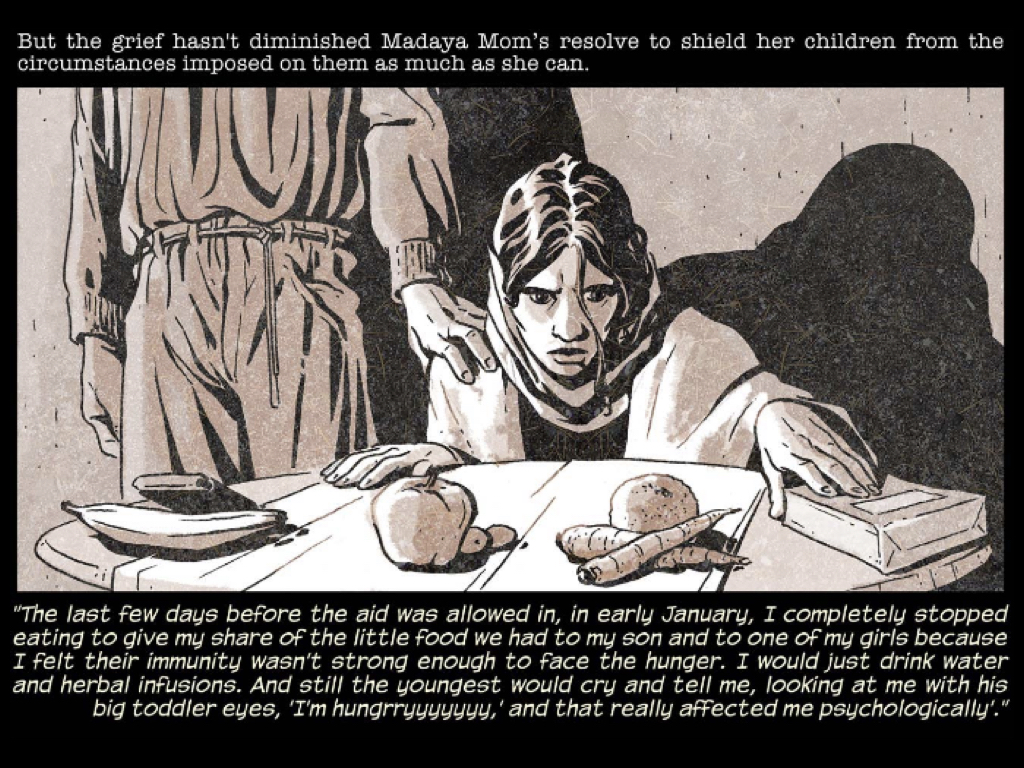
Working with Marvel Comics, ABC transformed her story into a free digital comic: Madaya Mom.

For Dalibor Talajic, the Marvel Comics illustrator who worked on the project,

The most striking parts is for me the most intimate ones as she – for instance, she decides to even though they are – they’re all starving, she decides to stop eating herself because this little amounts of supplies and food that she has, she distributes it to her children and of course husband. And she herself just stopped eating. And it’s not like a dramatic decision. It’s, like, a logical thing to do. These are the moments that stick with me most.

And it is through the assault on the intimacies of everyday life – on something as vital as feeding one’s family – that siege warfare is at its most vicious.

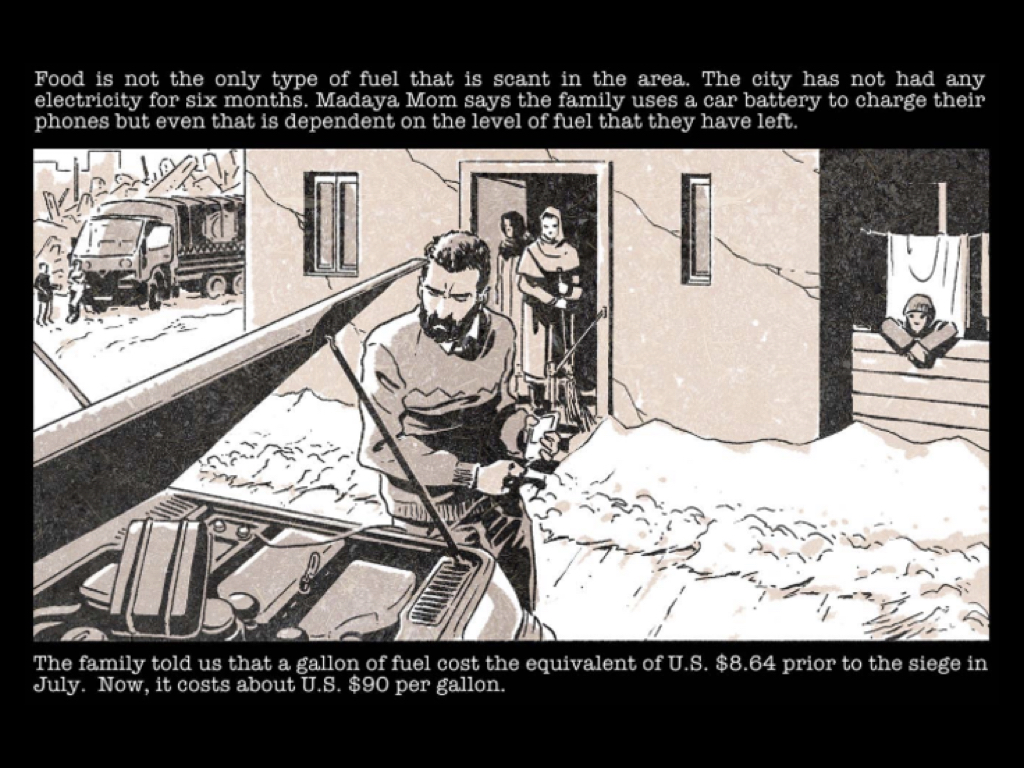
In case you are wondering how the family managed to charge their phones, not at all incidentally, here is the answer:

After protracted negotiations aid convoys were allowed in from time to time, but the situation remained grave.  An aid worker who accompanied a UNICEF convoy into Madaya in September 2016 described the stories told by patients who flocked to a makeshift medical clinic:

Parents whose children had stopped eating because their bodies could no longer tolerate only rice and beans. Children who could no longer walk straight because of the lack of Vitamin D and micronutrients that had riddled their bones with rickets, or who had stopped growing entirely, stunted from lack of essential vitamins. One mother showed us her baby’s bottle filled with rice water – the teat so worn it had to be sewn back to together. “Look at what I am feeding my child” she said.

Almost everyone we spoke to asked for protein – meat, eggs, milk, vegetables – something more to sustain themselves than the dry goods that were available. One mother explained that every time her child now smells boiled burgal, she starts to cry.

The doctor reported an increase in miscarriages, 10 cases in the last 6 months, because of the nutritional status of mothers. Over the last year alone, he has had to perform over 60 caesarian sections. This number was unheard of before the crisis, she told us  But women no longer have the strength for childbirth, and many pregnancies go over term, again because of the poor health of pregnant women.

Six months later life in Madaya remained precarious in the extreme:

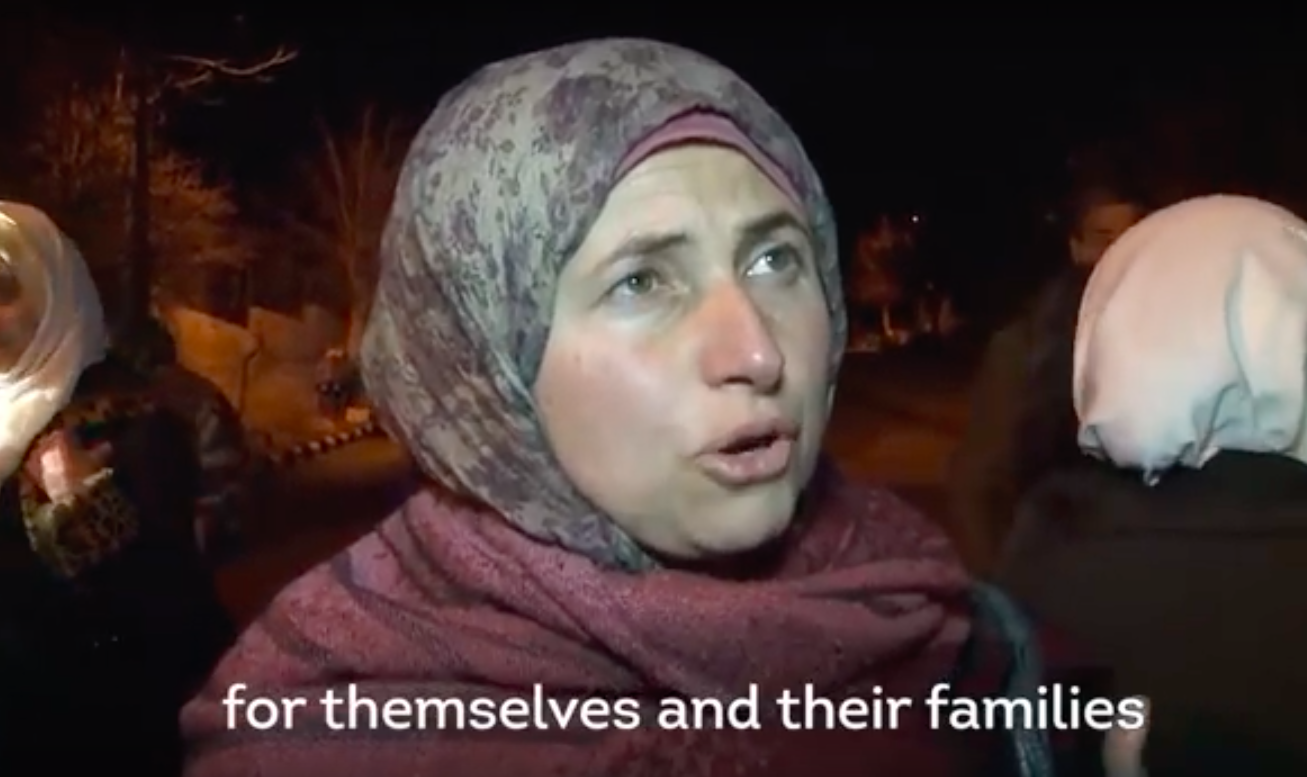
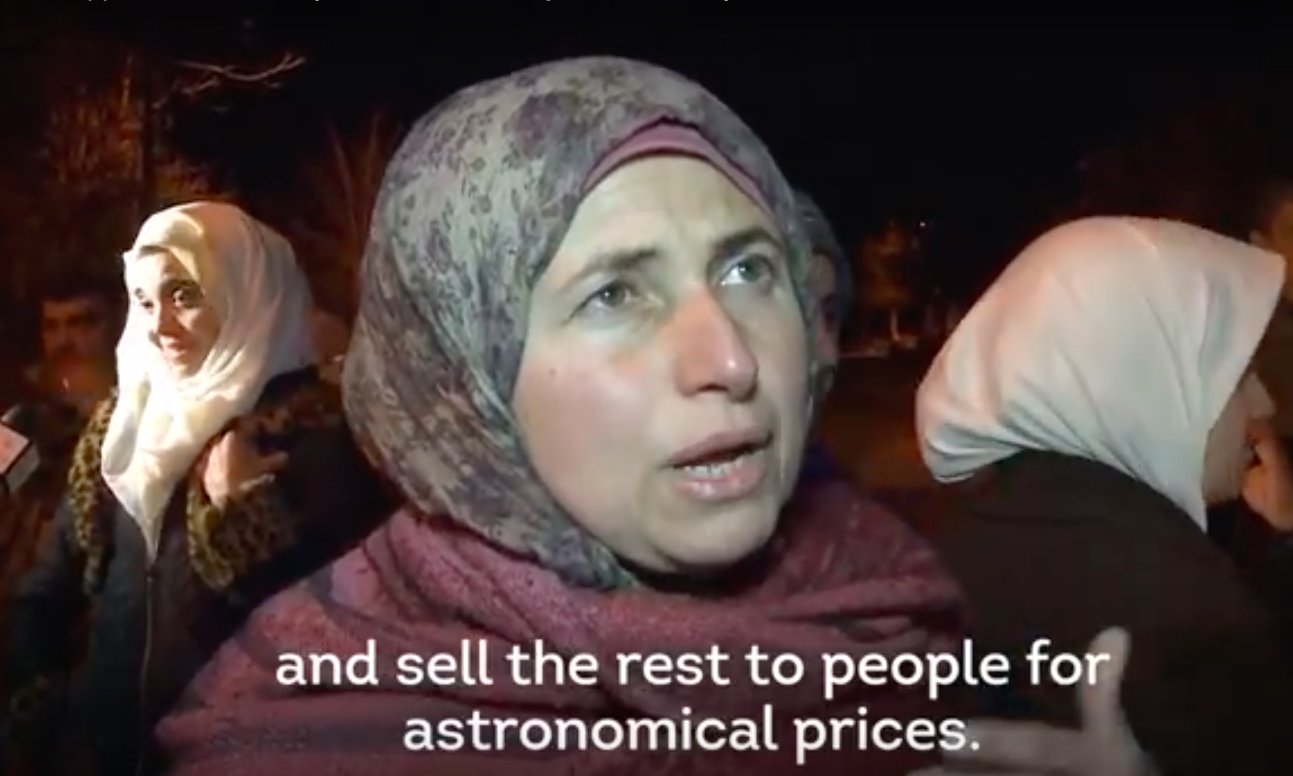
Throughout the siege there were accusations of profiteering, but these ran in both directions (it is partly through them that Hezbollah elected to acknowledge the suffering of the city – only to point the fingers of blame at the rebels inside).  According to Avi Asher-Schapiro for VICE News, who spoke to the local leader of Ahrar al-Sham, Abdulrahman, via Skype in January 2016:

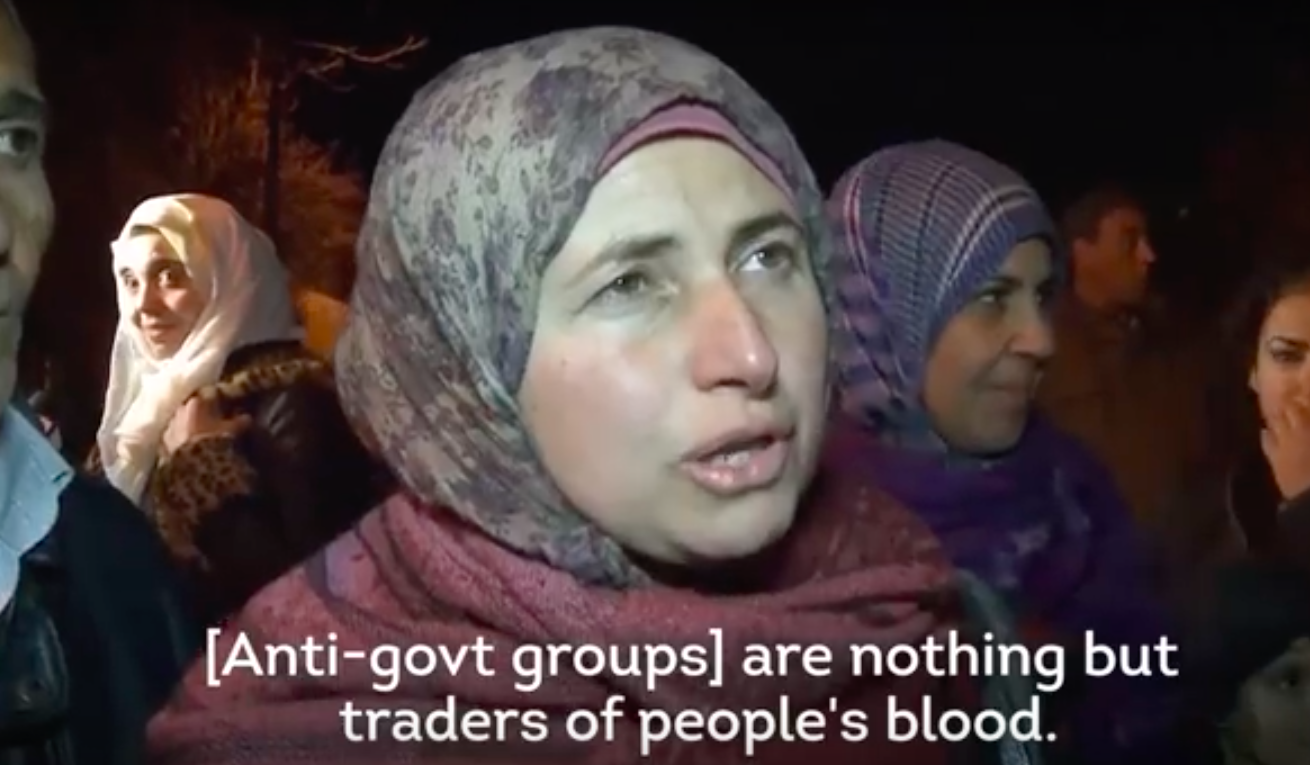
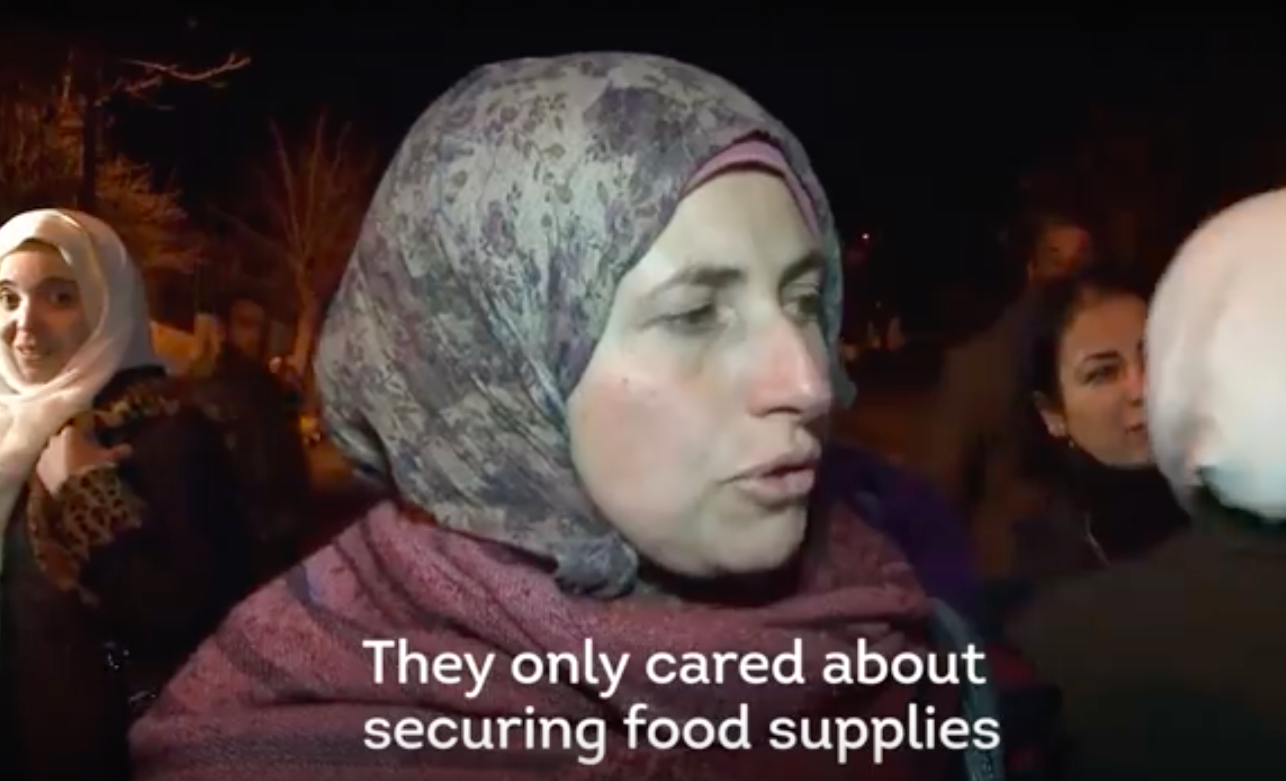
Hezbollah media outlets are accusing Abudlrahman and his men of confiscating food in Madaya, holding the population hostage, and profiteering during the crisis. In early January, a video surfaced of a woman from Madaya condemning rebels for hoarding food among themselves. The rebels are “only traders in people’s blood,” she told a scrum of reporters who gathered at the barricades outside Madaya. “They only care about securing food supplies for their families.”

That video [above] was aired around the world by Reuters and Al Jazeera. The accusations enraged Abdulrahman. “When Madaya goes hungry, we go hungry,” he says. “These are vicious lies.” VICE News spoke with another woman who claimed to be at the barricades that day. Although it was impossible to verify her claims, she said that Hezbollah fighters — who can be seen in the video frame — told women to condemn the rebels and praise Assad in exchange for food and safe passage from the town.

In a press release from early January, Hezbollah also accused Abdulrahman of profiteering. “Armed groups in Madaya control food supplies within the town and sell to whoever can afford it,” the statement read, “Thus, starvation is widespread among poor civilians.” VICE News spoke to a Hezbollah commander stationed outside Madaya who repeated these claims, and said that Hezbollah has been sending food inside the town. The rebels, he said, are keeping it for themselves. He also strongly denied that Hezbollah was trading food for propaganda.

VICE News also spoke with aid workers at the Doctors Without Borders-affiliated field hospital in Madaya, who reported no interference from Abdulrahman’s men in the dispensation of aid.

For further, still more shocking twists on the story, see here and a response here.  It’s difficult to adjudicate these competing claims in the face of skilfully organised propaganda campaigns (in which the alt.left is often as grotesque as the alt.right), but wherever the truth lies, it is clear that food has been consistently transformed into a weapon of war (‘surrender or starve‘) – a crime expressly forbidden by international humanitarian law (see also here) – and that 40,000 civilians inside Madaya were trapped in the midst of the battle.

In my previous post on this subject, I described all this as the back-story to the carnage now taking place in Idlib, in eastern Ghouta and elsewhere, but it is of course only one back-story: there are many more.  Still, on 14 April 2017 under the ‘Four Towns Agreement’ a fleet of sixty buses transported several thousand people, rebels and civilians, from Madaya – to Idlib.

Only 2,200 out of 40,000 people signed up to go, and ‘Madaya Mom’ expressed the catch-22 facing the besieged population perfectly:

If we leave, we’re labeled terrorists and we go to Idlib where the chemical attack happened last week; and if we stay we don’t know how the government will treat us.

At first, those who left were relieved and even heartened.  Deutsche Welle spoke with one young evacuee from Madaya soon after he arrived in Idlib:

I was surprised. I saw markets [below, June 2017], people walking in the streets; there is electricity, internet, ice cream and food – things we did not have in Madaya. Madaya and Zabadani are destroyed. In Idlib, the destruction is not too bad. There are a lot of cars and I was really surprised to see cars. I felt like the little children that came from Madaya to Idlib: they were surprised when they saw a banana, a cherry, biscuits or chocolate. They have never seen that before. It sounds stupid, but I felt a little bit the same when I saw cars again.

I can eat everything. The first thing I ate was fried chicken and it was great. And I have had a lot of chocolate, too.

But as the interview progressed, his elation was punctured by a growing realisation of the  bleak future ahead:

But in general, Idlib is a poor city… I started to search for jobs, but there are almost no jobs here. Idlib is like a big prison. It’s like Gaza. It’s like Madaya, but a big Madaya. So we are imprisoned here.

We know what horrors lay in wait, and we know something of what is happening in Idlib now.  But what of Madaya?  Here are extracts from a report (‘community profile’) for September 2017 (you can find more from SIRF/REACH here):

  • Movement was unrestricted within Madaya. For movement in and out of the area, two access points have been used since the implementation of the Four Towns Agreement. In September, 26-50% of the population were reportedly able to use formal access points providing they showed identi cation. However, men reportedly did not feel safe using the access points, fearing conscription and detention when crossing, while both men and women reported verbal harassment.
  • Since May 2017, commercial vehicle access has been permitted to the area. However, access restrictions on vehicle entry continued to be reported in September and included documentation requirements, confiscation of loads, required fees and limited entry depending on the day or time.
  • Humanitarian vehicle entry has reportedly not been permitted for the past six months.
  • The cost of a standard food basket in Madaya has remained stable since May 2017, with the average cost around 12% more expensive than nearby communities not classi ed as besieged or hard-to-reach.
  • Water continued to be insufficient and some residents reportedly reallocated money intended for other things to purchase water. Meanwhile, access to generators remained stable at 4-8 hours a day in all areas of the community.

I’m conscious of how much I haven’t been able to address in this post.  In particular, I’ve chosen to focus on the ‘silent violence’ of hunger and malnutrition rather than the explosive violence of mortars, missiles and bombs.  The two coincide in all sorts of ways – think, for example, of the air strikes on bakeries, what Anna Ciezadlo called ‘the war on bread‘, and on hospitals and clinics – but the contrast is really my point.  As one resident of Aleppo told Amnesty,

You need months before you die of starvation. The air strike attacks were a different story. You could die from a piece of shrapnel in a fraction of a second. Nobody was protected from the air strikes and shelling. Civilians, rebels, buildings, cars, bridges, trees, gardens etc. were all a target.

And so one final digital satire.  In April 2016 the Syrian government held elections and claimed that even opposition-held areas were enthusiastically participating.  Responding to what they called ‘the theatrics of the Assad regime’, teenagers in Madaya posted a video of their own mock hustings:The rival candidates were “Deadly Starvation”, “Deadly Illness”, and “Airstrikes”.

Journey of a wounded soldier

I’ve written before about Harry Parker‘s Anatomy of a soldier – an extraordinary novel(for multiple reasons) that reconstructs the journey of a British soldier who steps on an IED in Afghanistan through the evacuation chain to Camp Bastion and on to Selly Oak in Birmingham (see also ‘Object Lessons’, DOWNLOADS tab).  I’ve also sketched out an ‘anatomy of another soldier‘, describing in similar terms the precarious journey of a soldier wounded on the Western Front in the First World War back to Blighty.  It’s part of my project on medical care and casualty evacuation from war zones – the Western Front, the Western Desert, Vietnam, and now Afghanistan, Syria and Iraq.

Much of my archival work (on the First and Second World Wars) has been done at the Imperial War Museum and the Wellcome Library in London, and now the IWM has provided a series of short but sharp insights into the journey of a wounded soldier from Afghanistan back to Britain.

It’s not the experiment that Harry conducts – which isn’t to disparage either of them, and in fact Harry did a reading from ‘Anatomy’ at the IWM – but works through the IWM’s signature mix of objects, documentary and interview.  It includes an interview with Corporal Harry Reid, recalling his experience of being wounded;

‘… a vague recollection of spinning round in the air, not sure if I did or not…  I lay on my back, looked down, I couldn’t see my legs at that stage, a big dust cloud all around, so I couldn’t really see anything, and I couldn’t hear anything…  I weren’t in any pain at that particular time, I just felt like shock and numbness, as if I’d walked into a door…

I looked across to this left hand, thinking right, I need to get a first aid kit out here, because your training kicks in straight away, in your right-hand pouch you’ve got your tourniquets, your first field-dressing, and your morphine…  I knew something violently had just happened… I looked across and this finger was hanging off … so I kept hold of that and I thought I’m not losing that as well…  I looked across at my right arm and it were twisted up around my back so then I shouted for a medic … but obviously I shouted but I couldn’t hear myself shouting, which was quite strange…

He crawled back towards me, risking his own life … and he gave me some morphine and started putting tourniquets on.  He put  a tourniquet on my arm, pulled it obviously really tight to stop the blood flow but I felt it pinch my skin … that felt painful, I couldn’t really feel anything else, so I told him not very politely to calm down a bit because it was pinching my skin…

Then I remember being in and out of consciousness..’

That last sentence is crucial; it turns out that one of the most traumatic after-effects of blast injuries is the inability to remember what happened between the initial shock and recovering consciousness in hospital.  Many of those wounded in the First and Second World Wars recalled only too well what they suffered during their evacuation, but later modern war is accompanied by powerful narcotics that combine analgesics with amnesia.    Here is Emily Mayhew in A Heavy Burden:

As ITUs [Intensive Therapy Unit] became more advanced, so did a condition known as ITU-PTSD –the stress induced, post-traumatically, by not knowing what has happened to the patient during the hours and days that are missing from their memory.

How much worse … would this be for the soldier who fell in the desert, was swooped away by MERT {Medical Emergency Response Team], saved and nursed at Bastion, flown half a continent away and then woken, not with their unit around them dusty and shouting, but their family, strained and weeping.

Recovering those lost hours, days and even weeks is a central part of my own work (see also ‘The Geographies of Sixty Minutes’ here).

So it’s good that the web page for Journey of a Wounded Soldier also features a triptych of images from the brilliant work of David Cotterell showing evacuation from Bastion to Britain (above), and interview clips addressing treatment and rehabilitation at Birmingham.