Gaza, stripped: the deconstruction of the battlefield?

Frédéric Mégret has frequently drawn attention to the peculiar social and legal status of the battlefield:

‘[W]hilst war may and will rage, what distinguishes it from random violence is the fact that it unfolds in discreet spaces insulated from the rest of society, confining military violence to a confrontation between specialized forces whose operation should minimally disrupt surrounding life…. In that respect, the laws of war do not merely seek to regulate the battlefield. They are also part of its symbolic maintenance and even construction as a particular space defined by the norms that apply to it. In other words, the battlefield does not predate norms on warfare; rather it has always been subtly coterminous with them. The laws of war are, therefore, a crucial foundation for understanding the evolution of the battlefield and, conversely, the evolution of the battlefield is a key way in which the evolution of the laws of war can be understood.’ 

For Mégret, the deconstruction of the battlefield is now well advanced: starting in the nineteenth century, with transformations in firepower that constantly extended the range over which lethal force could be deployed, dramatically accelerated with the rise of airpower annulling the distinction between the spaces of combatants and civilians, given a further twist by remote operations conducted over vast distances from unmanned aerial systems like the Predator and the Reaper, and aggravated by the renewed significance of insurgency and counter-insurgency struggles (‘war among the people’), the relations between the spatiality of war and its legal armature have been radically transformed.  (For a visual rendering, see Mégret’s Prezi on ‘Where is the battlefield?’).

These are important ideas, but there are other dimensions that need to be taken into account when considering Israel’s latest attack on Gaza.  This is a conflict that is fully coterminous with what Helga Tawil-Souri calls Israel’s ‘digital occupation’ of Gaza.  As she writes in a superb essay in the Journal of Palestine Studies 41 (2) (2012) 27-43:

‘Disengagement has not meant the end of Israeli occupation. Rather, Israel’s balancing act “of maximum control and minimum responsibility” has meant that the occupation of Gaza has become increasingly technologized. Unmanned aerial reconnaissance and attack drones, remote-controlled machine guns, closed-circuit television, sonic imagery, gamma-radiation detectors, remote- controlled bulldozers and boats, electrified fences, among many other examples, are increasingly used for control and surveillance One way to conceptualize disengagement, then, is to recognize it as a moment marking Israel’s move from a traditional military occupation toward a high-tech one.

Rooted in Israel’s increasingly globalized security-military-high-tech industry, the technological sealing of Gaza is part of the transformation of the mechanics of Israeli occupation toward “frictionless” control that began with the first intifada and the ensuing “peace process,” which marked the shift toward the segregation of Gaza. “Frictionless” is, of course, metaphoric and purposefully ambiguous, evoking a sense of abstraction and lack of responsibility…

While high technology has become one of the means through which Israeli occupation continues, the high-tech infrastructure in the Gaza Strip — that which is used by Palestinians as opposed to the Israeli regime— is also a space of control. Technology infrastructures form part of the appa- ratus of Israeli control over Gazans. A telephone call made on a land-line, even between Gaza City and Khan Yunis, is physically routed through Israel. Internet traffic is routed through switches located outside the Gaza Strip. Even on the ubiquitous cellular phones, calls must touch the Israeli backbone at some point. Like much else about the Gaza Strip, telecommunication infrastructures are limited by Israeli policies. Geographic mobility, economic growth, political mobilization, and territory are contained, but so are digital flows: Gazans live under a regime of digital occupation.’ 

It should come as no surprise, therefore, that Israel also fights in digital space.  This takes many forms, and at the limit extends into the domain of cyberwarfare (where, as the joint US/Israeli cyber-attack on Iran’s nuclear program showed, Israel possesses advanced capabilities), but in its more mundane version it can be no less effective.

One of the characteristic features of late modern war is its mediatization, and the Israeli Defense Forces have used (even ‘weaponized‘) an array of social media platforms to shape the public construction of the battlespace.  This is a far cry from its faltering efforts during the previous assault on Gaza in 2008-9, Operation Cast Lead.  Soon after the IDF assassination that sparked the renewed air campaign this month, the IDF tweeted a headshot of the dead man, Hamas military commander Ahmed al-Jabari, with “eliminated” stamped across it, and immediately followed up with a video uploaded to its YouTube channel showing the drone strike (I’m not going to do the IDF’s job for it, but if you want to see stills and screenshots you can find them here).  The IDF continued to tweet, announcing its airstrikes in 140-character containers, and also turned to Facebook, Pinterest and Tumblr to post images and infographics (or, more accurately, propagandagraphics).

The object of the exercise has been three-fold.
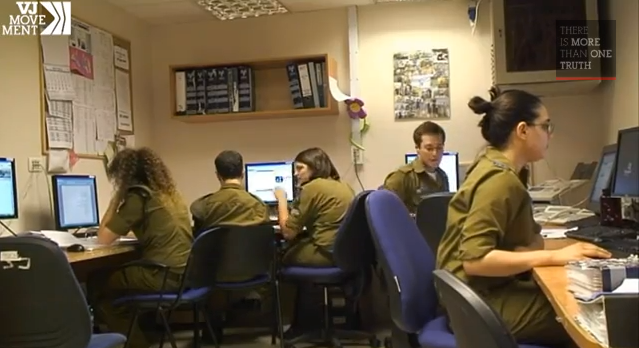
First, the IDF has been seeking direct – which is not to say unmediated: the clips, tweets and the rest follow an artfully pre-arranged script – and real-time access to domestic, regional and international publics.  The officer commanding the IDF’s 30-strong New Media desk (which is shown in the image on the left), Lt. Col. Avital Leibovich, explained that she wanted ‘to convey our message without the touch of an editor’ and to reach those who don’t turn to print media or TV for their news.

Second, the IDF has been aggressively mobilising its supporters, inside and outside Israel, encouraging them to retweet and to post their support on Facebook: using social media to puncture what Israel routinely describes as its ‘isolation’. Time reported that the IDF had activated additional ‘gamification’ features on its blog that allowed visitors ‘to rack up “points” for repeat visits or numerous tweets’: see the image on the right; more here.

Third, the IDF apparently believes that social media can send ‘a message of deterrence’ – though its tweets have surely been as likely to provoke as to intimidate.  The campaign sparked a series of responses and counter-measures – in Gaza, Hamas and its supporters, and in particular the Al-Qassam Brigades led by al-Jabari, took to social media platforms too, though Israel’s digital occupation plainly made that a vulnerable strategy, and the cyberactivist group Anonymous claimed to have defaced or disrupted nearly 700 Israeli political, military and commercial websites – so that al Jazeera described this as a ‘mass cyber-war‘ (I think that’s wrong: it’s been a social media war, but not one that has directly produced destruction – though, as I’ll suggest in a moment, it has certainly invited it).

More on the IDF’s New Media desk from Fast Company here and from the VJ Movement below:

It’s hard to know how effective this social media blitz has been: certainly, many people have been repulsed by the way the IDF ‘cheerily live-tweets infanticide’ and ‘the apparent glee with which the IDF carries out its job.’  As John Mitchell complained, ‘Innocent people are dying on all sides, and the IDF wants to reward people for tweeting about it.’  In doing so, the contemporary rendering of war as spectacle and entertainment has been turned into something at once banal and grotesque.  Alex Kantrowitz put this well:

When a military at war asks its Twitter followers to “Please Retweet,” or check out its Tumblr, or posts an image of a rocket hooking a Prime Minister’s undergarments, it is hard not to sense a disconnect between that messaging and the bombing taking place in real life. As The Verge’s Joseph L. Flatley put it, “One liveblogs award shows or CES keynotes, not armed conflict.”

When Matt Buchanan calls this live-tweeting of military and paramilitary violence ‘the most meaningful change in our consumption of war in over 20 years’ – my emphasis – then this is war reduced to consumerism: how long before military commanders start worrying that if their ratings aren’t high enough, their audience penetration too low, their war will be cancelled?  (Not such a bad idea, you might think, until they are driven to find ways to increase their market share….) Buchanan may think this is ‘How to Wage War on the Internet’, but Michael Koplow is nearer the mark: it’s precisely How Not to Wage War on the Internet.

In fact, several commentators worry that the trash-talking between the two sides, the verbal violence of response and counter-response on Twitter, was an open invitation to extend the war beyond the words:
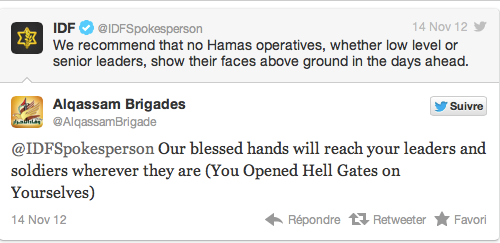

‘This is a new reality of war,’ Heather Hurlburt noted, ‘and I worry that it’s going to make it harder to stand down.’  The digital exchanges were immediate – not the language of reflection or diplomacy – and, whatever else they were about, were clearly intended to taunt the other side: Hamas and the IDF were both targeting audiences in Gaza (and the West Bank) and in Israel, by turns rallying their supporters and goading the enemy.  In short, here as elsewhere, there are crucial connections between the physical and virtual worlds that, in this case, may work to inflame the violence.

Yet for all this the digital battlespace can work to reinstate the traditional battlefield – at least virtually and rhetorically.   This is one of the maps circulated through the IDF’s social media platforms:
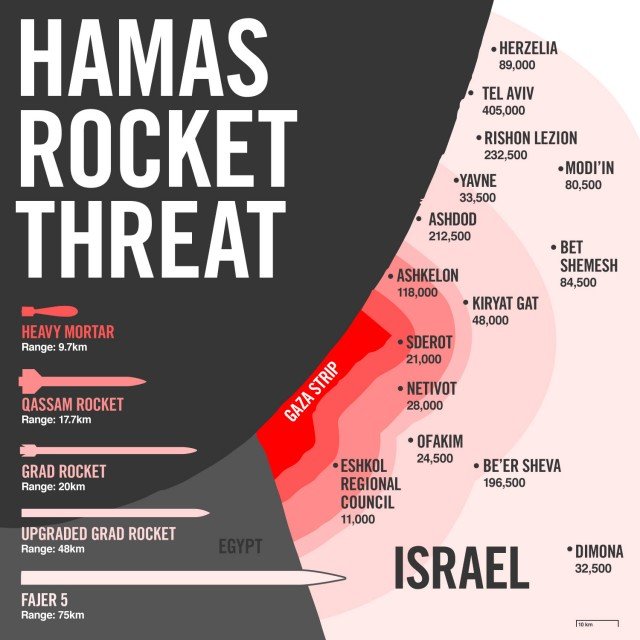
And here is the equivalent map published online by the New York Times, updated yesterday:

Here the map speaks power to truth: the ‘battlefield’ has been radically extended so that, as always, the terms of an an intensely asymmetric struggle are radically reversed.  The disproportionate concentration of Israeli firepower on Gaza is erased, while virtually all of Israel – including, as we have been endlessly reminded, for the very first time Jerusalem – is threatened by Hamas.

The Times did at least include this, separate map of Gaza:
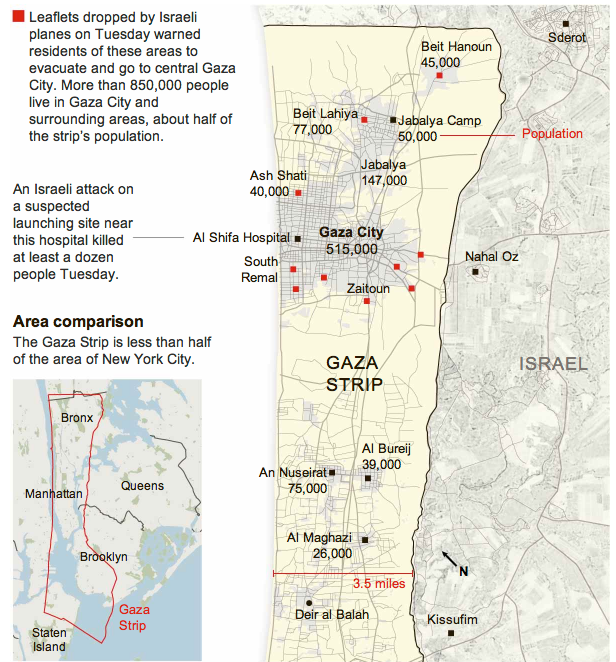
The map plots (in red) the sites of IDF leaflet drops (really).  So we have one map showing Hamas rocket ranges and ‘cities taking enemy fire’, and the other showing paper dropped on a captive population…

UPDATE: More on this from Craig Jones here.

If you want to find more meaningful maps that take in both Israel and Gaza, including air strikes and rocket attacks, deaths and casualties on both sides, you can find them at al Jazeera here.  I’ve pasted an extract from the plot of air strikes below.
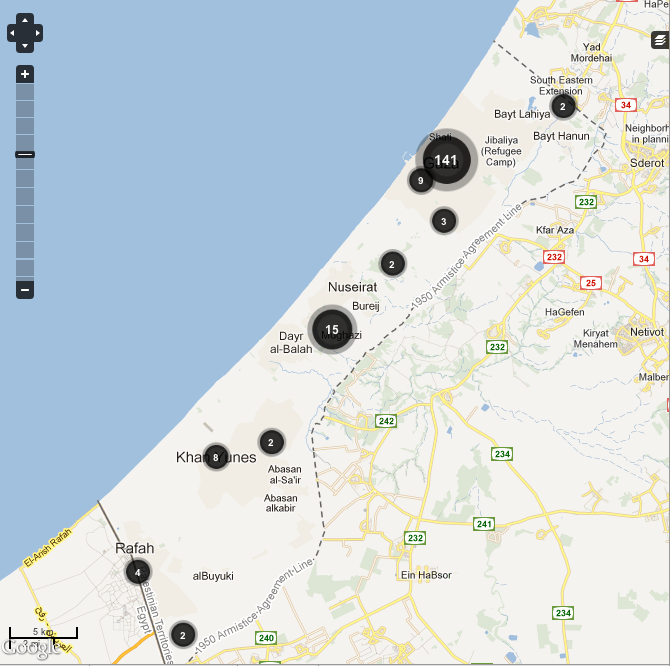
Seen like this, I’ll leave the last words to Helga Tawil-Souri:

“The underlying reasons of Israel’s propaganda are to silence the enemy, gain international support and justify wars… Their goal has not fundamentally changed over the years, only the platforms on which these are disseminated.” 
Drone’s eye view

I expect many readers will remember  that Apple rejected NYU grad student Josh Begley‘s Drones+ app last August.  It did so three times and for a multiplicity of confusing – and frankly shifty – reasons.  Apparently it was neither ‘useful’ nor ‘entertaining’; then it presented ‘excessively objectionable’ content (something to take up with the Pentagon and the CIA, surely?). As Danger Room explained, the app was bare bones stuff:

When a drone strike occurs, Drones+ catalogs it, and presents a map of the area where the strike took place, marked by a pushpin. You can click through to media reports of a given strike that the Bureau of Investigative Reporting compiles, as well as some basic facts about whom the media thinks the strike targeted.

All the more ironic, really, since the US military makes extensive use of smart phone technology – including its own (restricted) apps for the iPhone.  More on that here and here and here.

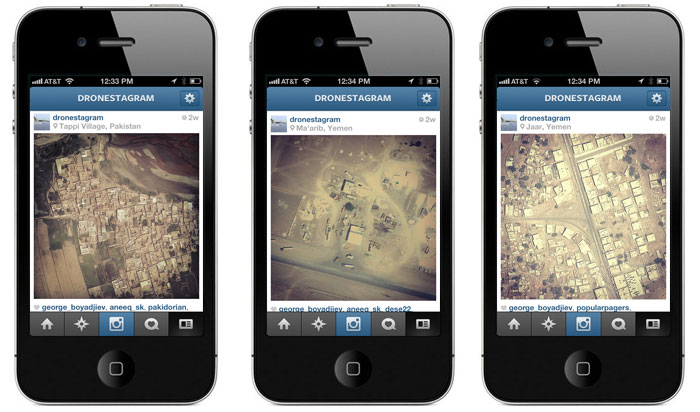
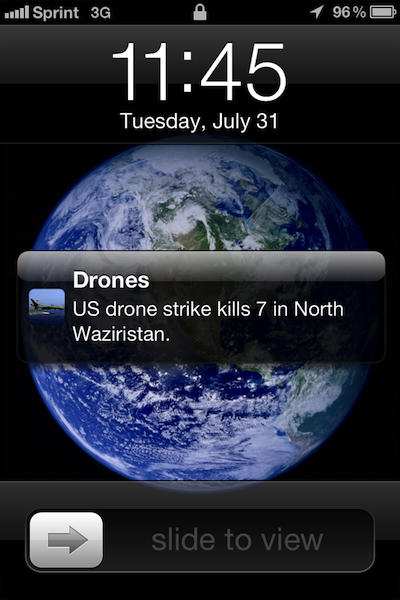
But for the past several weeks James Bridle – of New Aesthetic fame – has been posting satellite images of the distant places where drone strikes are recorded by the Bureau of Investigative Journalism to Instagram: and, as the image below shows, you can view these on your iPhone…

There are, of course, difficulties in pinpointing the locations of drone strikes– and James is evidently very well aware of them – but on his Dronestagram website he explains his desire to convert abstract targets into physical places in terms that resonate beautifully with the arguments I’m trying to develop in Deadly embrace:

The political and practical possibilities of drone strikes are the consequence of invisible, distancing technologies, and a technologically-disengaged media and society. Foreign wars and foreign bodies have always counted for less, but the technology that was supposed to bring us closer together is used to obscure and obfuscate. We use military technologies like GPS and Kinect for work and play; they continue to be used militarily to maim and kill, ever further away and ever less visibly.

Yet at the same time we are attempting to build a 1:1 map of the world through satellite and surveillance technologies, that does allow us to see these landscapes, should we choose to go there. These technologies are not just for “organising” information, they are also for revealing it, for telling us something new about the world around us, rendering it more clearly.

History, like space, is coproduced by us and our technologies: those technologies include satellite mapping, social photo sharing from handheld devices, and fleets of flying death robots. We should engage with them at every level. These are just images of foreign landscapes, still; yet we have got better at immediacy and intimacy online: perhaps we can be better at empathy too.

You can follow the images here and in much more detail via tumblr here.  More information here.

This comes at an opportune moment since I’ve been talking this week with Susan Schuppli and Eyal Weizman at Forensic Architecture about a collaborative, interactive project to bring together all the available data on drone strikes.

Geopiracy

Hard on the heels of my post about the Human Geography Summit (below), comes news of Joel Wainwright‘s Geopiracy: Oaxaca, militant empiricism and geographical thought (forthcoming from Palgrave Pivot in October):

Why have geographers remained so quiet about the resurgence of military funding for geographical research? Joel Wainwright argues that the underlying problem stems from our epistemic commitment to empiricism. Much as some would like to deny it, many geographers are executing their own ‘expeditions’ in the spirit of Isaiah Bowman, the early twentieth-century geographer who shaped the discipline’s empiricist epistemology while helping the US to build its empire (and from whom the Expeditions take their name). Geopiracy delivers a critique of the ‘Bowman expeditions’ – a project through which geographers, with funding from the US Army, are mapping the ‘human terrain’ of foreign lands. Since the beginning of the controversy surrounding the Bowman expeditions, the discipline of geography has been rocked by debates concerning research methods, the military, and the effects of geospatial technologies on everyday life. Although the ‘Oaxaca controversy’ has fomented intense discussions, the questions it raises are far from resolved. Geopiracy offers a postcolonial critique of human geography today – one that draws on contemporary social theory to raise unsettling questions about the nature of geography’s disciplinary formation.

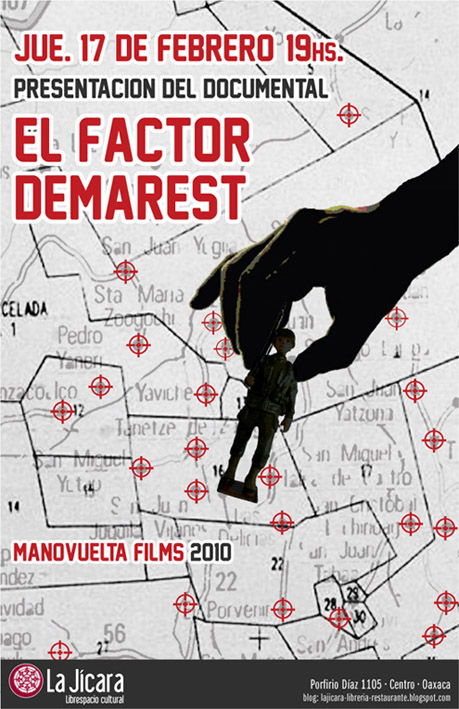
If you don’t know the background, Neil Smith‘s American Empire (2003) offers a searching examination of Bowman – ‘Roosevelt’s Geographer’ – and Zoltan Grossman provides a series of really helpful links to the contemporary controversy surrounding the Bowman Expeditions/México Indígena project here.  There’s also an online documentary, ‘The Demarest Factor: US military mapping of indigenous communities in Oaxaca, Mexico’, here.

Most of us are probably familiar with the lively debate in Anthropology about the cultural turn in counterinsurgency and, in particular, the enlistment of anthropologists in the US Army’s Human Terrain Teams and the like.  If you’re not, then check out the Network of Concerned Anthropologists.  But anthropologists aren’t the only scholars who should be concerned about the weaponization of culture and the growth of the Military-Academic-Industry-Media complex (MAIM for short).  As Joe Brian put it in an editorial in Political Geography, ‘Geographers can ill-afford to sit this debate out, lest the discipline become a means of waging war by other means.’

True enough – but, as the Human Geography Summit reveals, the train left the station long ago.  In any case, geographical knowledge is not enclosed by the discipline of Geography.  Our primary concern should not be disciplinary purity – not Joel’s or Joe’s intention, I know – but the development and dissemination of insurgent geographies that not only expose but also replace violent formations like those documented in Geopiracy.

Counterinsurgency and the humanitarian present

Laleh Khalili – whose work on the new and old classics of counterinsurgency,  on the gendering of counterinsurgency, and on the location of Palestine in global counterinsurgency – is indispensable, has just alerted me to the fate (Fate?) of one of its principal architects, David Kilcullen.

In The accidental guerilla and other writings, Kilcullen – Petraeus’s Senior Counterinsurgency Adviser in Iraq – repeatedly turned to bio-medical analogies to advance a bio-political vision of counterinsurgency: insurgency as a ‘social pathology’ whose prognosis can be traced through the stages of infection, contagion, intervention and rejection (‘immune response’).  In an interview with Fast Company, Kilcullen now explains that he

“came out of Iraq with a real conviction that we tend to think that a bunch of white guys turning up with a solution fixes all the problems. It doesn’t work like that. You actually have to really build a collaborative relationship with the people on the ground if you want to have any hope of understanding what’s going on.”

Kilcullen’s contract ended when the Obama administration came into office, and he founded Caerus Associates.  The company advertises itself as ‘a strategy and design firm’ that works to ‘help governments, global enterprises, and local communities thrive in complex, frontier environments.’  It claims to ‘bring the system into focus’ by providing ‘strategic design for a world of overlapping forces — urbanization, new market horizons, resource scarcity and conflict — to build resilience and capacity.’   The company explains its ‘strategic design process’ here, and Kilcullen’s vision of systems analysis is sketched here.  This may sound like the rapid-fire buzz-words that corporate start-ups typically shoot at their clients, but Kilcullen provides Fast Company with a sawn-off version (it’s really hard to avoid these metaphors…):

“We’re two-thirds tech, one-thirds social science, with a dash of special operations… We can go out in a community and say, ‘Let’s map who owns what land,’ or ‘Let’s map who owes the local warlord money,’ or ‘Let’s map the areas in the city where you don’t feel safe.'”

This chimes with Kilcullen’s famous description of contemporary counterinsurgency as ‘armed social work’, and in an interview with the International Review of the Red Cross published in September 2011 Kilcullen extended his vision of ‘military humanism’ beyond insurgency thus:

‘The methods and techniques used by illegal armed groups of all kinds are very similar, irrespective of their political objectives. So whether you’re talking about a gang in the drug business in Latin America, or organized crime in the gun-running or human smuggling business, or whether you’re talking about an insurgency or perhaps even a civil war involving tribes, you will see very similar approaches and techniques being used on the part of those illegal armed groups. That’s one of the reasons why I believe counter-insurgency isn’t a very good concept for the work that the international community is trying to do. I think that the idea of complex humanitarian emergencies is actually a lot closer to the reality on the ground. You almost never see just one insurgent group fighting an insurgency against the government anymore. What you typically see is a complex, overlapping series of problems, which includes one or more or dozens of armed groups. And the problem is one of stabilizing the environment and helping communities to generate peace at the grassroots level – a bottom-up peace-building process. And that’s not a concept that really fits very well with traditional counter-insurgency, which is about defeating an insurgent movement and is a top-down, state-based approach. What you have to do is create an environment where existing conflicts can be dealt with in a non-violent way.’

This is a remarkable passage for several reasons: the focus on ‘techniques’ not ‘objectives’, which works to de-politicize and de-contextualize a range of different situations in order to generalize about them, the appeal to a collective “international community” whose only interest is a generic “peace”, and hence the passage to what Eyal Weizman calls ‘the humanitarian present’. I think that’s also a colonial present, not surprisingly: ‘humanitarianism’ was often the velvet glove wrapped around the iron fist of colonialism.  But what Weizman sees as novel about the present is the way in which its ‘economy of violence is calculated and managed’ by a series of moral technologies (the term is Adi Ophir‘s) that work to continue and legitimize its operation.  In other words, there is today an intimate collusion of the ‘technologies of humanitarianism, human rights and humanitarian law with military and political powers’.

Despite  the reference to ‘special operations’ in the Fast Company interview – something which makes me think that Obama would have found Kilcullen’s continued advice invaluable – Kilcullen insists that it’s a collaborative process:

“We specialize in working with communities that are under the threat of violence in frontier environments, and I think to some extent that distinguishes us a little bit from other people. Sure we can give a slick presentation in a hotel room, but what we can also do is walk the street in dangerous places, engage with communities, and figure out what needs to happen. It’s not us figuring it out, it’s them telling us, but often we find that no one’s ever been there and asked them before.”

‘Dangerous places’, ‘frontiers’: this is still the language of adventurism.  It recalls Zygmunt Bauman‘s ‘planetary frontierland’, and even more Mark Duffield on the ‘global borderlands’:

‘The idea of the borderlands … does not reflect an empirical reality.  It is a metaphor for an imagined geographical space where, in the eyes of many metropolitan actors and agencies, the characteristics of brutality, excess and breakdown predominate.  It is a terrain that has been mapped and re-mapped in innumerable aid and academic reports where wars occur through greed and sectarian gain, social fabric is destroyed and developmental gains reversed, non-combatants killed, humanitarian assistance abused and all civility abandoned.’

It’s not surprising, then, that in the IRC interview Kilcullen should make so much of establishing ‘the rule of law’: ‘It’s a set of rules which has predictable consequences and allows the population to feel safe, and helps them know what they need to do in order to be in a safe place.’  He makes it clear that, in many (perhaps most) circumstances ‘bottom-up, community-based law, which can be transitional justice, or customary law, applied by traditional courts or religious courts, is as effective and possibly even more effective in the initial stages than central-state structures.’   But this ignores the multiple ways in which law (including international humanitarian law) is not apart from conflict but is almost always a part of conflict: as Weizman has it, ‘international law develops through its violation.  In modern war, violence legislates.’

One could say much the same about maps.  Mapping is not a neutral, objective exercise; mapping is performative and its material effects depend on the constellation of powers and practices within which it is deployed. Kilcullen’s injunction – “Let’s map” – glosses over who the ‘us’ is, who is included and who is excluded, and the process through which some mappings are accorded legitimacy while others are disavowed.  This is also one of Weizman’s central claims, not least in his exposure of the torturous mappings that issued in the  Hollow Land of occupied Palestine.

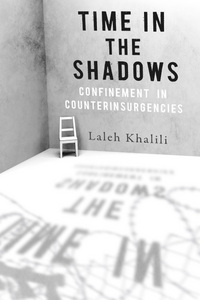
Weizman’s particular focus in his discussion of the humanitarian present is Gaza, and this winds me back to Laleh Khalili’s work which brilliantly re-reads counterinsurgency in occupied Palestine contrapuntally with US counterinsurgency practices elsewhere.  Her Essential Reading on Counterinsurgency was published by Jadaliyya, and her forthcoming book, Time in the shadows: Confinement in Counterinsurgencies (Stanford University Press, October 2012),  engages with a Medusa’s raft of counterinsurgency adviser-survivors, including Kilcullen and Andrew Exum (Abu Muqawama).

And so a final question: how would ‘strategic design’ and a ‘collaborative process’ help the people of Gaza?  Whose ‘rule of law’ is to be established?  And which maps chart a road not only to peace but to justice for the people of Palestine?