The twitter of drones

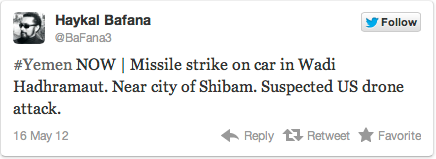
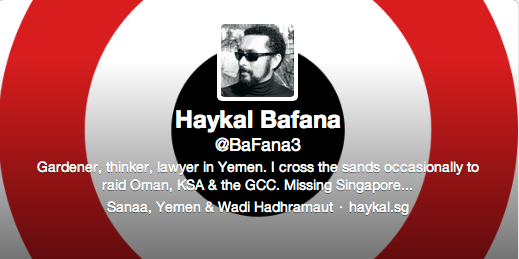
BAFANA Tweet Drone strike in YemenBack in May the Bureau of Investigative Journalism described how local activists were using Twitter and other social media platforms to spread the news of US drone strikes in Yemen.  Haykal Bafana, a lawyer living in San’a, the capital of Yemen, kept up a barrage of tweets recording the ‘covert’ strikes in near real-time, which were then amplified through Facebook and micro-news platforms in the region. You can follow him here.

Haykal Bafana

This is all of a piece with the incorporation of social media into the conduct of late modern war that was evident during Israel’s recent attack on Gaza and, as Noel Sharkey told the Bureau,

‘It is incredible how the same type of technology used by the CIA to kill people with drones in the Yemen, is empowering the Yemenis to tweet the attacks as they are happening. They can send us all pictures and bring us closer to the horror they are experiencing. Technology in the small may eventually bring down the over-use of military technology in the large.’

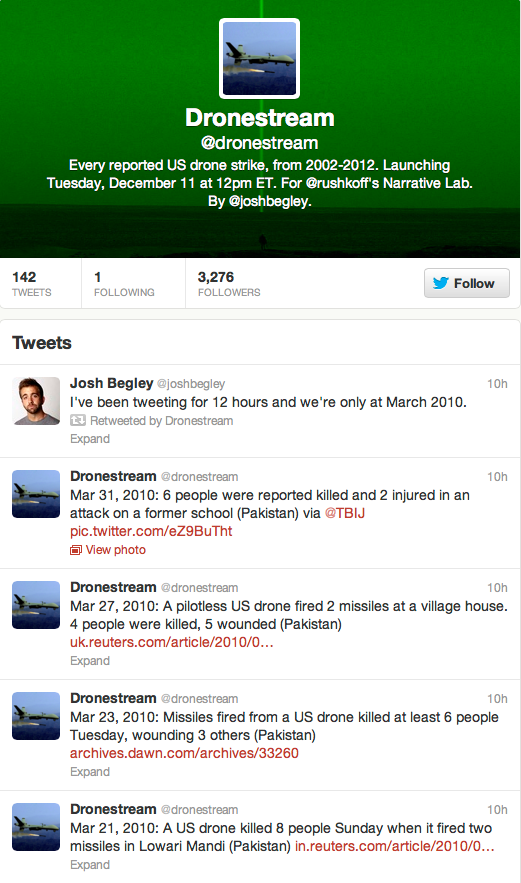
Josh BegleyDrone strikes are certainly now being made visible across a range of social media platforms, and now comes news – from the wonderful Jorge Amigo – that Josh Begley (whose Drones+ app was serially rejected by Apple) has started tweeting what Jake Heller calls ‘the entire history of US drone strikes’ in Pakistan, Yemen and Somalia as part of a graduate class at NYU, Narrative Lab, which focuses on ‘the impact of interactivity and technology on traditional narrative structure’.  Begley told Heller that, for him, ‘it’s about the way stories are told on new social-media platforms.’

Dronestream

How complete the data series can be is an open question – and the rhetorical impact would be even more devastating if Afghanistan were included – but as you can see from my screen grab above Begley, who started at noon on Tuesday 11 December, tweeted that after twelve hours ‘we’re only at March 2010’…  Follow him at Dronestream here.  And, as Connor Simpson at the Atlantic Wire commented, ‘if this project doesn’t merit an A, we would love to see one that does.’

Just looking (and shooting)

I had just finished jotting my update to the IDF’s use of social media when Alex Vasudevan drew my attention to this brilliant, searing and deeply disturbing essay by Huw Lemmey at the New Inquiry, ‘Devastation in Meatspace’:

The missile rushing over your head was processed through an Instagram filter just hours previously. As you see it pass out of sight behind the apartment block opposite some young conscript is preparing for video footage of it to be compressed and uploaded to YouTube before the hour is out. By nightfall tonight that explosion which just shook your neighborhood, in one of the most densely populated areas on earth, will have been liked over 8,000 times on Facebook. Welcome to Gaza City.

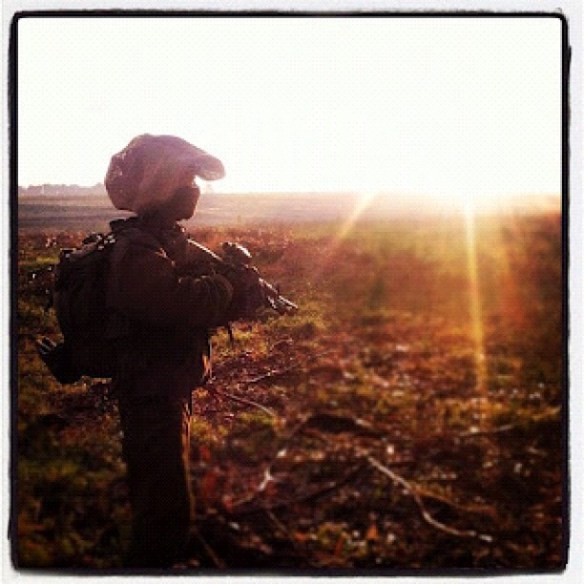
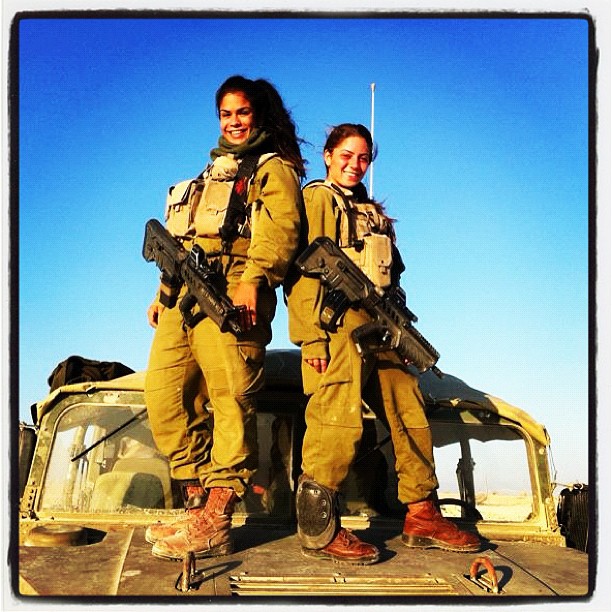
In a previous post I’d objected to the way in which some commentators advertised social media as a new way to ‘consume’ war, but  – riffing off Eyal Weizmann‘s Hollow Land –  Lemmey focuses not on the Twitter streams but on the visualizations disseminated across these digital platforms: see, for example, the IDF’s Instagram page here (and look at the comments too); more here.  You can also find a selection over at Business Insider where Geoffrey Ingersoll describes them as ‘gorgeous’, and another selection at Moral Low Ground, which reads them rather differently.

Commenting on these images, Britney Fitzgerald at the Huffington Post simply sees them as ‘the world’s newest form of war reporting” – though she does note that the ‘intimacies’ that Israel puts on display through Instagram are radically different from those with the hashtags #gaza and #palestine – but Lemmey (who describes himself as a print maker and studio technician) provides a much more compelling reading.  He shows that the IDF images do indeed resonate with a consumerist ideology – climactic versions of the desiring gaze and the lust of the eye – that has become integral to the way in which late modern war is fought:

‘[T]he [IDF] use of commercially available instagram filters replicates the visual culture favoured by much of its audience, producing images that slip easily into their feeds, naturalising the content. “These are the photos you would take if you served in the IDF,” the aesthetic says, “we are just like you, and these military decisions are the ones you would take, if you were in our situation.” They also step beyond this, including an aspirational aspect of a desirable lifestyle — impossibly handsome young troops, having fun on their downtime. This is a fighting force at play as imagined by Wolfgang Tillmans and BUTT magazine, a million miles from an occupying force…. Liking and sharing IDF visual material becomes no more controversial than sharing your favourite Nike campaign — not a matter of politics, let alone ethics, but just another part of the construction of your online persona….’

‘Like many of the more advanced lifestyle brands, the IDF are shifting the focus of image production from their own staff and creative team toward their consumers: in this case, the troops, reservists, and supporters of the IDF. Content is aggregated from individuals and fed back into the social networks of the target audience. In many ways this is an advanced form of brand-management for a such a large institution; it shows a willingness to trust the audience, allowing them to define the brand, making IDFgram perhaps the first crowdsourced propaganda campaign for a state military but also one whose identity is ever more meshed with that of its troops and supporters, emulating fashion and lifestyle brands’ movement toward consumer-led campaigns. Here the IDF becomes the avatar of a thoroughly Western consumer identity. The distance between our own lives and those of the men and women who fight in the IDF becomes ever shorter and more compressed; in collapsing this distance, the grainy and pixelated images of the Palestinian subject become more distant. This is the IDF campaign for control of the virtual environment, interjecting its brand identity into the slivers of human interaction online and thus attempting to occupy a greater portion of the market share for geopolitical allegiance.’

Lemmey says much, much more than this: please read the whole essay.

BTW: IDF stands for ‘Israel Defense Forces’, so naturally none of this should be confused with IDF Marketing, where ‘IDF stands for Innovative, Digital, Foundations’: it’s an Irish company with no connection with the Israeli military.  In case you’re now thoroughly confused, here is Arwa Mahdawi on the marketing of Israel:

Ever since it officially came into existence in 1948, Israel has gone methodically about the creation of a “Brand Israel”. This originally began with an emphasis of the religious significance of a state for the Jewish people. Then, in 2005, when it was time for a rebrand, the Israeli government consulted with American marketing executives to develop a positioning that would appeal to a new generation: an Israel that was “relevant and modern” rather than a place of “fighting and religion”. So Israel did some pinkwashing, and suddenly became a vocal champion of gay rights. It fought to retain cultural ownership of falafel, hummus, and Kafka. It poured millions of dollars into tourism campaigns that sought to replace imagery of wartorn landscapes with sun-kissed seascapes.

When it comes to winning modern wars, a robust marketing campaign is as important as a military campaign.

Saving Face(book)

An update to my post on the use of social media in Israel’s latest assault on Gaza: at the Middle East Research and Information Project (MERIP) Rebecca Stein provides an important historical perspective on the IDF’s mobilisation of these digital platforms and the resistance from senior commanders to resorting to a ‘digital vernacular’:

Even as the IDF labors to speak in a language that will be intelligible to the general public, largely abandoning traditional forms of military jargon, its Facebook and Twitter practices remain committed to the foremost military mission — that of asserting control over social media’s highly interactive field.

Rebecca also draws attention to the ways in which these military mobilisations complicate the ‘digital democracy’ narrative that emerged in the wake of the Arab uprisings.

I talked about this briefly in my essay on Tahrir Square, where I noted that it was not only the Israeli military that was learning from those events.  As Lt Col Brian Pettit put it, ‘the Arab Spring has profound implications for the US Special Operations mission of unconventional warfare’ that need to be incorporated into ‘theory, doctrine and training’.  He argued that standard ‘red force tracking’ in which the enemy is caught in a net of electronic surveillance should now be complemented by ‘social tracking’ in which social media are monitored and even enlisted.  The standard image of unconventional war, the same officer concludes, is of ‘underground resistance leaders meeting with US advisers, clustered in a dark basement around a crumpled map, secretly organizing and planning their next tactical move.’  But this is now incomplete, and future operations will need to enlist ‘a scattered network of digerati, all texting, tweeting, posting and hacking from thousands of locations.  Publicity is as paramount to the success of the digerati as is secrecy vital to the success of the traditional underground resistance cell.’  As I noted at the time, it’s not difficult to work out ‘which ‘resistance leaders’ were likely to be meeting with US advisers, nor the bodily consequences for those on the other side of the street.

But using social media is only one part of military strategy.  Writing in Joint Forces Quarterly early in 2011, Lt Col Thomas Mayfield had already accepted that ‘aggressive engagement in the social media environment can aid the commander in winning the information fight’  – bizzarely he pointed to the IDF’s ham-fisted use of social media during its previous assault on Gaza in 2008-9 – but his first priority was to monitor the use of social media to enhance ‘situational awareness’.  For a Canadian/NATO perspective on media monitoring, here is Bruce Forrester from Defence R&D Canada at Valcartier on ‘Social Media Exploitation Tools’ after the Arab uprisings.

If this is all too depressing for you, then try Richard Poplak who provides a different take on the IDF’s most recent attempts to use Facebook to save face…

Media blitz

For an interesting post-script (or pre-script) to my discussion of the mediatization of the Israeli war on Gaza, check out the ever-interesting Brett Holman over at Airminded on the ways in which print media were used to report and ridicule propaganda messages from the enemy during the Second World War.

As Brett points out, there are parallels but also significant differences:

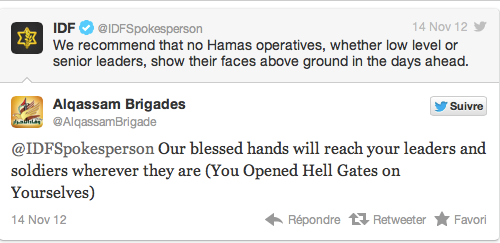
For one thing, in 1940 it was effectively impossible for British civilians to communicate with German ones, or vice versa: their debates were national, at best. Now Palestinians and Israelis — and everyone else — can talk directly to (or past) each other on the Gaza war, perhaps with the aid of Google Translate. For another, in 1940 official propaganda did not draw on the unofficial kind. Now @AlqassamBrigade and @IDFSpokesperson share photos of alleged attacks posted on Twitter by ordinary people. For yet another, in 1940 the debates in newspaper columns unfolded over days and weeks. Now the social war moves almost as fast as the real war does. A real war that, it should not be forgotten, claims real lives regardless of what happens online.

Gaza, stripped: the deconstruction of the battlefield?

Frédéric Mégret has frequently drawn attention to the peculiar social and legal status of the battlefield:

‘[W]hilst war may and will rage, what distinguishes it from random violence is the fact that it unfolds in discreet spaces insulated from the rest of society, confining military violence to a confrontation between specialized forces whose operation should minimally disrupt surrounding life…. In that respect, the laws of war do not merely seek to regulate the battlefield. They are also part of its symbolic maintenance and even construction as a particular space defined by the norms that apply to it. In other words, the battlefield does not predate norms on warfare; rather it has always been subtly coterminous with them. The laws of war are, therefore, a crucial foundation for understanding the evolution of the battlefield and, conversely, the evolution of the battlefield is a key way in which the evolution of the laws of war can be understood.’ 

For Mégret, the deconstruction of the battlefield is now well advanced: starting in the nineteenth century, with transformations in firepower that constantly extended the range over which lethal force could be deployed, dramatically accelerated with the rise of airpower annulling the distinction between the spaces of combatants and civilians, given a further twist by remote operations conducted over vast distances from unmanned aerial systems like the Predator and the Reaper, and aggravated by the renewed significance of insurgency and counter-insurgency struggles (‘war among the people’), the relations between the spatiality of war and its legal armature have been radically transformed.  (For a visual rendering, see Mégret’s Prezi on ‘Where is the battlefield?’).

These are important ideas, but there are other dimensions that need to be taken into account when considering Israel’s latest attack on Gaza.  This is a conflict that is fully coterminous with what Helga Tawil-Souri calls Israel’s ‘digital occupation’ of Gaza.  As she writes in a superb essay in the Journal of Palestine Studies 41 (2) (2012) 27-43:

‘Disengagement has not meant the end of Israeli occupation. Rather, Israel’s balancing act “of maximum control and minimum responsibility” has meant that the occupation of Gaza has become increasingly technologized. Unmanned aerial reconnaissance and attack drones, remote-controlled machine guns, closed-circuit television, sonic imagery, gamma-radiation detectors, remote- controlled bulldozers and boats, electrified fences, among many other examples, are increasingly used for control and surveillance One way to conceptualize disengagement, then, is to recognize it as a moment marking Israel’s move from a traditional military occupation toward a high-tech one.

Rooted in Israel’s increasingly globalized security-military-high-tech industry, the technological sealing of Gaza is part of the transformation of the mechanics of Israeli occupation toward “frictionless” control that began with the first intifada and the ensuing “peace process,” which marked the shift toward the segregation of Gaza. “Frictionless” is, of course, metaphoric and purposefully ambiguous, evoking a sense of abstraction and lack of responsibility…

While high technology has become one of the means through which Israeli occupation continues, the high-tech infrastructure in the Gaza Strip — that which is used by Palestinians as opposed to the Israeli regime— is also a space of control. Technology infrastructures form part of the appa- ratus of Israeli control over Gazans. A telephone call made on a land-line, even between Gaza City and Khan Yunis, is physically routed through Israel. Internet traffic is routed through switches located outside the Gaza Strip. Even on the ubiquitous cellular phones, calls must touch the Israeli backbone at some point. Like much else about the Gaza Strip, telecommunication infrastructures are limited by Israeli policies. Geographic mobility, economic growth, political mobilization, and territory are contained, but so are digital flows: Gazans live under a regime of digital occupation.’ 

It should come as no surprise, therefore, that Israel also fights in digital space.  This takes many forms, and at the limit extends into the domain of cyberwarfare (where, as the joint US/Israeli cyber-attack on Iran’s nuclear program showed, Israel possesses advanced capabilities), but in its more mundane version it can be no less effective.

One of the characteristic features of late modern war is its mediatization, and the Israeli Defense Forces have used (even ‘weaponized‘) an array of social media platforms to shape the public construction of the battlespace.  This is a far cry from its faltering efforts during the previous assault on Gaza in 2008-9, Operation Cast Lead.  Soon after the IDF assassination that sparked the renewed air campaign this month, the IDF tweeted a headshot of the dead man, Hamas military commander Ahmed al-Jabari, with “eliminated” stamped across it, and immediately followed up with a video uploaded to its YouTube channel showing the drone strike (I’m not going to do the IDF’s job for it, but if you want to see stills and screenshots you can find them here).  The IDF continued to tweet, announcing its airstrikes in 140-character containers, and also turned to Facebook, Pinterest and Tumblr to post images and infographics (or, more accurately, propagandagraphics).

The object of the exercise has been three-fold.

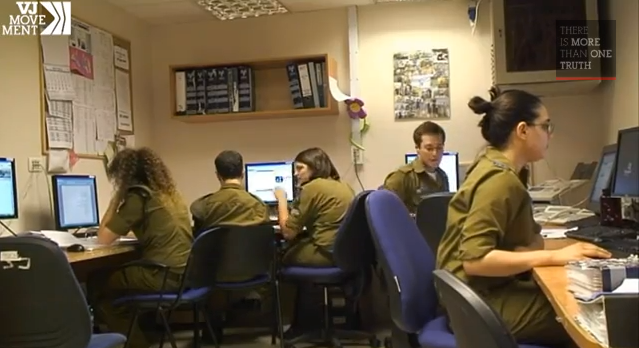
First, the IDF has been seeking direct – which is not to say unmediated: the clips, tweets and the rest follow an artfully pre-arranged script – and real-time access to domestic, regional and international publics.  The officer commanding the IDF’s 30-strong New Media desk (which is shown in the image on the left), Lt. Col. Avital Leibovich, explained that she wanted ‘to convey our message without the touch of an editor’ and to reach those who don’t turn to print media or TV for their news.

Second, the IDF has been aggressively mobilising its supporters, inside and outside Israel, encouraging them to retweet and to post their support on Facebook: using social media to puncture what Israel routinely describes as its ‘isolation’. Time reported that the IDF had activated additional ‘gamification’ features on its blog that allowed visitors ‘to rack up “points” for repeat visits or numerous tweets’: see the image on the right; more here.

Third, the IDF apparently believes that social media can send ‘a message of deterrence’ – though its tweets have surely been as likely to provoke as to intimidate.  The campaign sparked a series of responses and counter-measures – in Gaza, Hamas and its supporters, and in particular the Al-Qassam Brigades led by al-Jabari, took to social media platforms too, though Israel’s digital occupation plainly made that a vulnerable strategy, and the cyberactivist group Anonymous claimed to have defaced or disrupted nearly 700 Israeli political, military and commercial websites – so that al Jazeera described this as a ‘mass cyber-war‘ (I think that’s wrong: it’s been a social media war, but not one that has directly produced destruction – though, as I’ll suggest in a moment, it has certainly invited it).

More on the IDF’s New Media desk from Fast Company here and from the VJ Movement below:

It’s hard to know how effective this social media blitz has been: certainly, many people have been repulsed by the way the IDF ‘cheerily live-tweets infanticide’ and ‘the apparent glee with which the IDF carries out its job.’  As John Mitchell complained, ‘Innocent people are dying on all sides, and the IDF wants to reward people for tweeting about it.’  In doing so, the contemporary rendering of war as spectacle and entertainment has been turned into something at once banal and grotesque.  Alex Kantrowitz put this well:

When a military at war asks its Twitter followers to “Please Retweet,” or check out its Tumblr, or posts an image of a rocket hooking a Prime Minister’s undergarments, it is hard not to sense a disconnect between that messaging and the bombing taking place in real life. As The Verge’s Joseph L. Flatley put it, “One liveblogs award shows or CES keynotes, not armed conflict.”

When Matt Buchanan calls this live-tweeting of military and paramilitary violence ‘the most meaningful change in our consumption of war in over 20 years’ – my emphasis – then this is war reduced to consumerism: how long before military commanders start worrying that if their ratings aren’t high enough, their audience penetration too low, their war will be cancelled?  (Not such a bad idea, you might think, until they are driven to find ways to increase their market share….) Buchanan may think this is ‘How to Wage War on the Internet’, but Michael Koplow is nearer the mark: it’s precisely How Not to Wage War on the Internet.

In fact, several commentators worry that the trash-talking between the two sides, the verbal violence of response and counter-response on Twitter, was an open invitation to extend the war beyond the words:


‘This is a new reality of war,’ Heather Hurlburt noted, ‘and I worry that it’s going to make it harder to stand down.’  The digital exchanges were immediate – not the language of reflection or diplomacy – and, whatever else they were about, were clearly intended to taunt the other side: Hamas and the IDF were both targeting audiences in Gaza (and the West Bank) and in Israel, by turns rallying their supporters and goading the enemy.  In short, here as elsewhere, there are crucial connections between the physical and virtual worlds that, in this case, may work to inflame the violence.

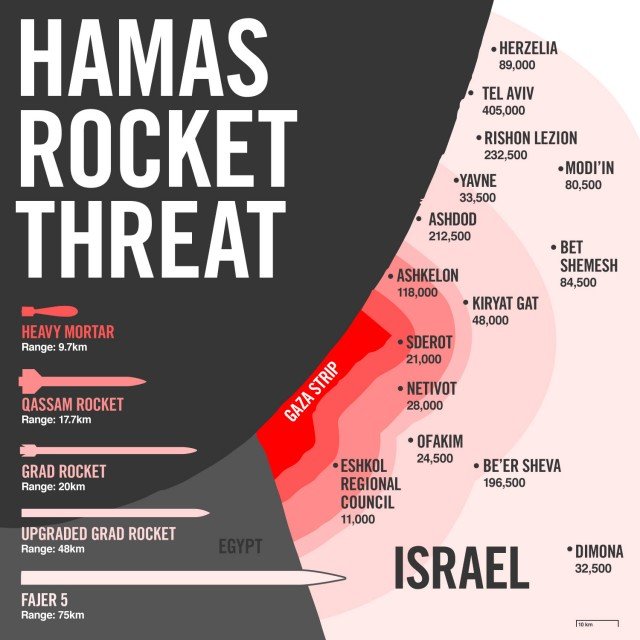
Yet for all this the digital battlespace can work to reinstate the traditional battlefield – at least virtually and rhetorically.   This is one of the maps circulated through the IDF’s social media platforms:

And here is the equivalent map published online by the New York Times, updated yesterday:

Here the map speaks power to truth: the ‘battlefield’ has been radically extended so that, as always, the terms of an an intensely asymmetric struggle are radically reversed.  The disproportionate concentration of Israeli firepower on Gaza is erased, while virtually all of Israel – including, as we have been endlessly reminded, for the very first time Jerusalem – is threatened by Hamas.

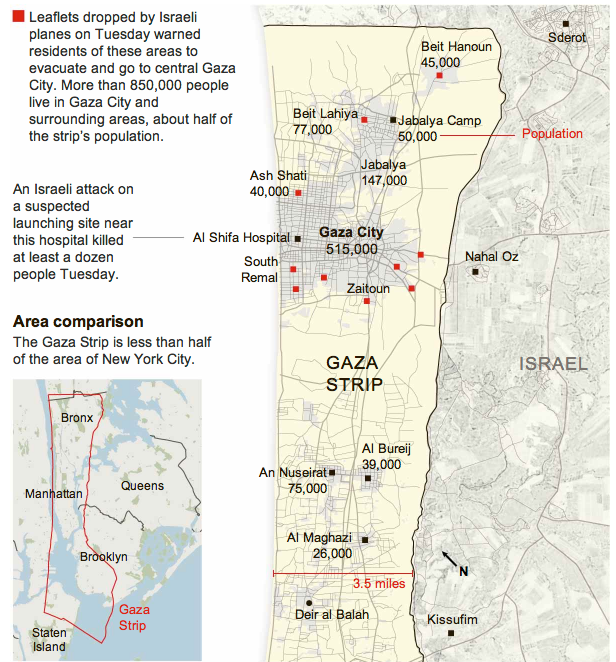
The Times did at least include this, separate map of Gaza:

The map plots (in red) the sites of IDF leaflet drops (really).  So we have one map showing Hamas rocket ranges and ‘cities taking enemy fire’, and the other showing paper dropped on a captive population…

UPDATE: More on this from Craig Jones here.

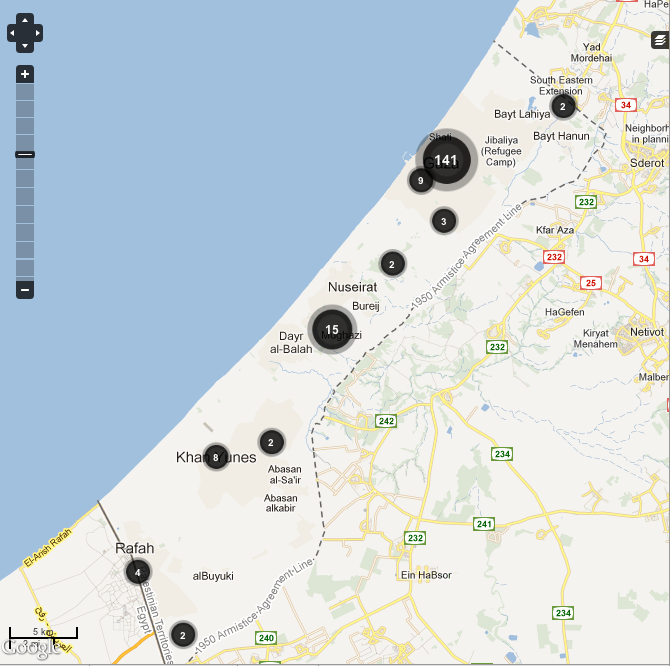
If you want to find more meaningful maps that take in both Israel and Gaza, including air strikes and rocket attacks, deaths and casualties on both sides, you can find them at al Jazeera here.  I’ve pasted an extract from the plot of air strikes below.

Seen like this, I’ll leave the last words to Helga Tawil-Souri:

“The underlying reasons of Israel’s propaganda are to silence the enemy, gain international support and justify wars… Their goal has not fundamentally changed over the years, only the platforms on which these are disseminated.” 

Bodies on the wire

Last week I had a wonderful time at the Eisenberg Institute for Historical Studies at the University of Michigan in Ann Arbor, and came away with a host of new ideas and fresh lines of inquiry.
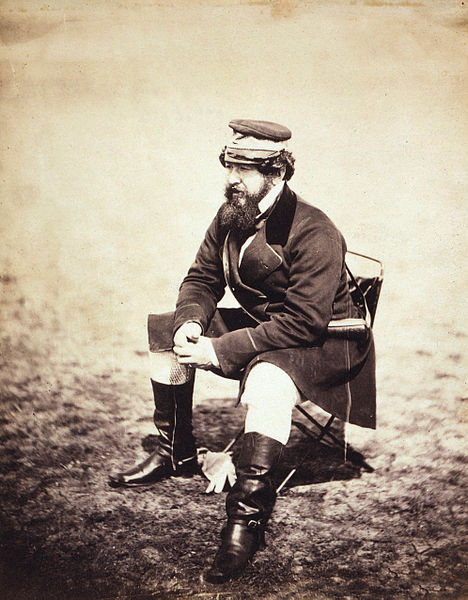
One of these concerns the role of the telegraph in modern war.  When I was doing my first researches I discovered several writers emphasised its importance in reporting the Crimean War (1853-1856), a campaign that saw the first appearance of the war correspondent in the person of W.H. Russell, whose despatches for the Times won him a central place in both political and media history.

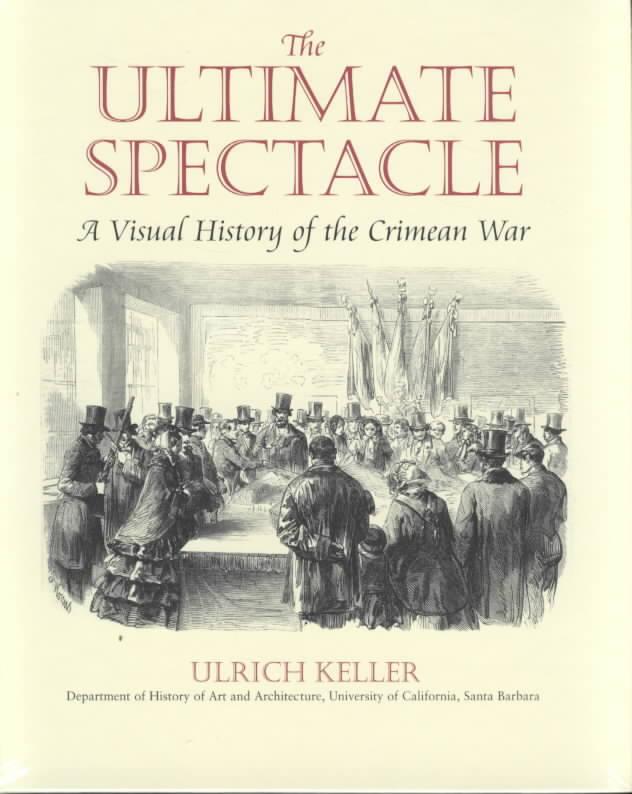
In The Ultimate Spectacle: a visual history of the Crimean War (Routledge, 2001) Ulrich Keller argued that:

‘Throughout the campaign the domestic front continuously inscribed itself on the military front, and vice versa; nothing could happen in one sphere without immediate repercussions in the other. It was of course the steamship, the telegraph and the news-press with its swift coverage of events, which created the interdependence of the two arenas.

‘Without the dramatic improvement of communication technologies during the first half of the nineteenth century, the Crimean events, evolving at a distance of 3000 miles from London, could never have become an object of constant, close and emotional public scrutiny at home…’

Russell’s reports were of tremendous significance, and the telegraph was important for the conduct of the war.  Indeed, Orlando Figes in Crimea: the last Crusade (Allen Lane, 2010) treats the Crimean War as

‘the first example of a truly modern war – with new industrial technologies, modern rifles, steamships and railways, novel forms of logistics and communication like the telegraph .. and war reporters and photographers directly on the scene.’

But it is important not to confuse the two.  The British Army had a field telegraph whose 24 mile network connected Lord Raglan’s headquarters with eight stations in the field.  The illustration below comes from Steven Roberts‘s Distant Writing which is a tremendous source of information on British telegraph companies from 1838 to 1868:
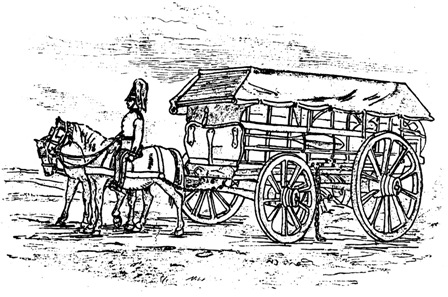
Electric Telegraph Company’s War Wagon in the Crimea, 1854

In addition, Army dispatches were sent 300 miles across the Black Sea to Varna and then overland to Bucharest (a journey of 60 hours) where they were telegraphed to London; by April 1855 a temporary submarine cable from Balaklava to Varna had reduced the overall transmission time to London to 5 hours, and the press used the same line for sending short despatches to London.  One periodical was so excited at the new proximity of war that it held out the fantasy

‘that it would not now be difficult, by some little farther novelty of invention, to cause the reverberation of the very cannons themselves, as it were, to be transmitted, in the shape of electric vibration, through the 3000 miles of intervening wire, and heard, in still continuous vibrations, finally communicated to some acoustic apparatus in the British Houses of Parliament…. There is no physical reason why the public should not know every morning, noon and night, what is at these very times going on in the seat of war.’
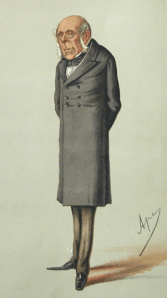
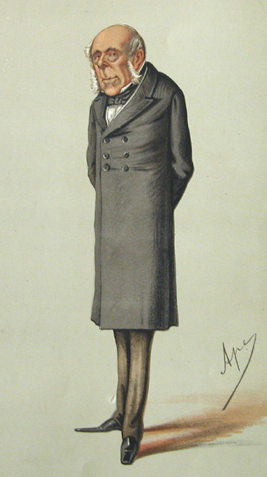
But Russell’s detailed despatches went by sea via Constantinople and took 20 days to reach London: his famous report of the Charge of the Light Brigade on 25 October 1854 was not published in the Times until 13 November, though an initial notice had appeared on 2 November.  And so it was not Russell that the Earl of Clarendon, the Foreign Secretary [right], had in his sights when he wrote to the British Ambassador in Constantinople on 23 September 1854, a month before that epic encounter (and in fact before any of Russell’s reports had been published), to complain about the press:

‘Our “own correspondents” have certainly contrived to keep our enemy informed of all he must want to know – his only disadvantage is 8 hours delay which is the time for transmitting to St P[etersburg] all that the newspapers contain and they generally publish as much as the Government knows for in one way or another some correspondent at Hd Qrs generally discovers and transmits every secret order or intended movement as well as every disaster and disharmony and the patriotic editors never think of keeping back anything injurious to the public service but on the contrary hasten to publish it all in proof of their superior means of intelligence.  The press and the telegraph are enemies we had not taken into account but as they are invincible there is no use complaining about them.’
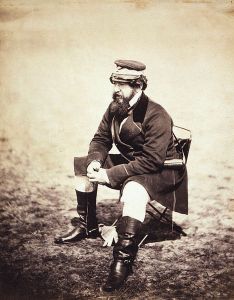
What he had in mind were the brief telegraphic despatches that were mined by all the leading newspapers in Britain. The Times was no exception, but it prided itself on its exclusive reports from Russell [left], as it explained on 21 October 1854:

The letters of our special correspondent from the scene of war, although naturally a few days in arrear of those leading communications which reach us through the agency of the telegraph, are always replete with interest, and are calculated indeed to serve far more important purposes than those of momentary amusement.  In those circumstantial descriptions of an eye-witness – in those details of actual experience and personal observation – we obtain an inexhaustible source of information…  We not only learn step by step what the army really did, and where it went, but we follow it in its march, and collect the opinions, the hopes and the feelings current among the soldiery from hour to hour.’

It may be true to say, as Andrew Lambert wrote for the BBC,  that ‘the electric telegraph enabled news to travel across the continent in hours, not weeks’ so that during the Crimea ‘war became much more immediate – a massive leap forward on the way to our age of instant global coverage by satellite.’  But beyond Europe reporting was still agonisingly slow.  In Australia, as Peter Putnis and Sarah Ailwood have shown,  ‘just when news from Europe was most eagerly wanted’, steamship services from Britain were diverted to supply troop ships for the war,  and the replacement sailing packets were so much slower and less reliable that colonial insecurities were heightened.  And even within Europe Lambert’s ‘immediacy’ was produced by terse and not always reliable telegraphic despatches that editors combined with long-form reports from their correspondents and others in the field.  The most vivid images of the war were produced by Russell’s despatches and by Roger Fenton‘s striking photographs.

For this reason, until now I had thought of the American Civil War (1861-1865) as ‘the first telegraph war‘, since the telegraph was demonstrably important both for the conduct of the war (which included military communications and, since cables were intercepted, military intelligence) and for its more detailed reporting.

But at Ann Arbor I met the redoubtable Jonathan Marwil who directed my attention to the Second Italian War of Independence (sometimes called the Franco-Austrian War) of 1859.  His Visiting modern war in Risorgimento Italy (Palgrave, 2010), which I’ve devoured on my Kindle, is a superb account of the mediatization of modern war.  By 1859, he writes,

‘armies could not expect to wage wars without journalists in attendance.  Their stories, composed from what they saw, what they were told, and what they imagined, would be read soon after they were written, given the proximity of the seat of war to the major capitals and the presence of the telegraph wire.  Those watching a war from afar were now kept abreast of events almost while they were happening. News of the first Napoleon’s victories in Italy had taken days to reach Paris; reports of his nephew’s expected triumphs would arrive in hours.  A day after a major battle in early June, a French lieutenant would write his uncle assuming that he already knew more about the battle than did the nephew who had fought in it.’

[That last remark, incidentally, recalls one of the core arguments of Jan Mieszkowski‘s Watching War (Stanford University Press, 2012): that one of the crucial dilemmas of modern war is the disconnect between the participant’s sensory disorientation (‘To be under fire is to experience the loss of control of one’s own signifying practices’) and the abstraction (or ‘perspective’) of distant observers.]

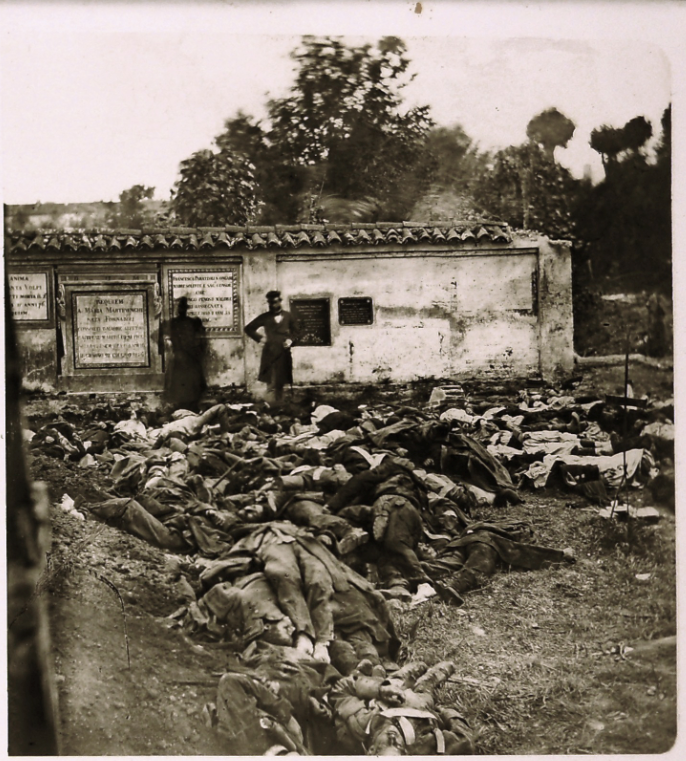
The Italian War was a war of truly awful proportions: you can find a stark description of ‘combat photography’ during the war, together with some examples, at Bill Johnson‘s Hold History in Your Hand here.  At the battle of Solferino some 40,000 were killed or injured in 15 hours, and the sight of the unrelieved suffering prompted a Swiss observer, Henry Dunant, to memorialise the scene in A memory of Solferino.  Within months of its publication in 1862 a committee started work on Dunant’s vision of an impartial relief society that would provide aid to those wounded in time of war: this would eventually become the International Committee of the Red Cross.
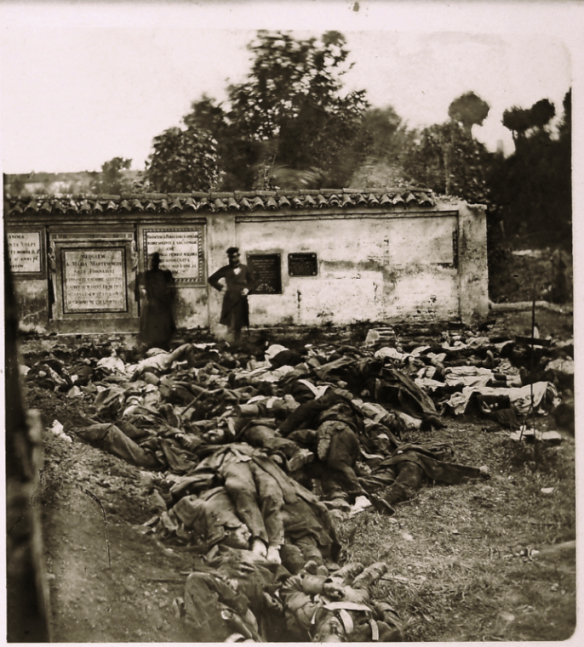
Cemetery at Melegnano, June 1859

The Times was horrified at what it called ‘the wanton and prodigal waste of life’ too, but in an editorial on 2 June 1859 it also reflected on the intimate conjuncture of killing and technological advance:

‘… revolting as war always is, it never presented itself in a form more repulsive than that which it now wears in the Italian Peninsula…   War also seems to have become more hideous from its closer contact with the greatest triumphs of our modern civilization.  The butchery of Casteggio was fed by a succession of railway trains, which disgorged their cargoes close to the human shambles, just as they carry the cattle, the sheep, and the calves which feed the daily hunger of London.

‘Science is degraded into an instrument for .. destruction…  While rival hosts are encountering each other with a ferocity which the Huns and the Vandals might envy, news of every particular of the butchery is carried by the delicate and beautiful machinery of the electric telegraph, and the pulse with which all nature throbs communicates, with a fidelity and despatch unknown to the Scourge of Mankind in former ages, every circumstance and detail of destruction.


Visual culture and battles for Algiers

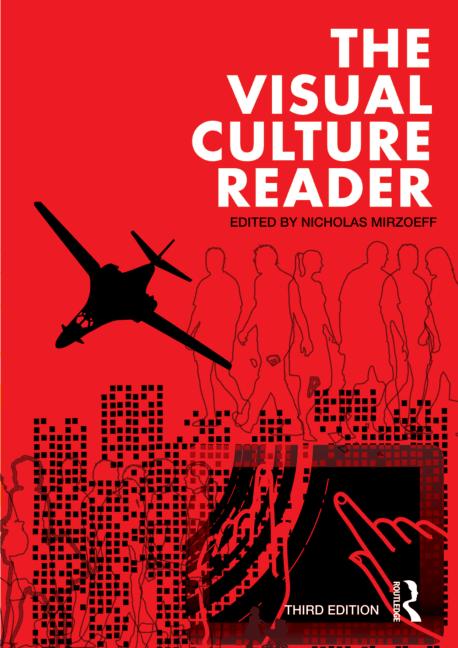
My copy of Nicholas Mirzoeff‘s newly published Visual Culture Reader was waiting for me on my return from Cologne.  It’s the third edition of a classic resource, first compiled ten years ago, and it’s been comprehensively revised, with a number of specially commissioned essays.   You can download some of Nick’s own essays here, including discussions of Abu Ghraib and US counterinsurgency.

Contents:

PART 1 

Expansions

Chapter 1: “There are No Visual Media” W. J. T. Mitchell Chapter 2: “The (In)human condition: A Visual Essay” Ariella Azoulay Chapter 3: “Mapping Non-Conformity: Post-Bubble Urban Strategies” Teddy Cruz Chapter 4: “X-reality: Interview with the Virtual Cannibal” Beth Coleman Chapter 5: “On Software, or the Persistence of Visual Knowledge” Wendy Hui Kyong Chun Chapter 6: “Notes on the Photographic Image” Jacques Rancière Chapter 7: “Queer Faces: Photography and Subcultural Lives” J. Jack Halberstam Chapter 8: “Currents of Worldmaking in Contemporary Art” Terence E. Smith Chapter 9: “Sublimated with Mineral Fury: Prelim Notes on Sounding Pandemonium Asia” Sarat Maharaj Chapter 10: “The Sea and the Land: Biopower and Visuality after Katrina” Nicholas Mirzoeff

PART 2: GLOBALIZATION, WAR AND VISUAL ECONOMY 

War and Violence

Chapter 11: “The Archaeology of Violence: The King’s Head” Zainab Bahrani Chapter 12: “The Actuarial Gaze: from 9-11 to Abu Ghraib” Allen Feldman Chapter 13: “American Military Imaginaries and Iraqi cities” Derek Gregory Chapter 14: “Zeroing In: Overheard Imagery, Infrastructure Ruins, and Datalands in Afghanistan and Iraq” Lisa Parks Chapter 15: “What Greg Roberts Saw: Visuality, Intelligibility, and Sovereignty – 36,000km Over the Equator.” Trevor Paglen Chapter 16: “Media and Martyrdom” Faisal Devji Chapter 17: “Live True Life or Die Trying” Naeem Mohaiemen Attention and Visualizing Economy Chapter 18: “Kino I, Kino World: Notes on the Cinematic Mode of Production” Jonathan L. Beller Chapter 19: “On Virtuosity” Paolo Virno Chapter 20: “Faking Globalization” Ackbar Abbas Chapter 21: “Creativity and the Problem of Free Labor” Andrew Ross Chapter 22: “It’s easier to imagine the end of the world than the end of capitalism” Mark Fisher Chapter 23: “Do It Yourself Geo-Politics” Brian Holmes

PART 3: THE BODY, COLONIALITY AND VISUALITY

Bodies and Minds

Chapter 24: “Optics” René Descartes Chapter 25: “Blindness and Visual Culture: An Eye-Witness Account” Georgina Kleege Chapter 26: “Reduplicative Desires” Carol Mavor Chapter 27: “The Persistence of Vision” Donna Haraway Chapter 28: “The body and/in representation” Amelia Jones Chapter 29: “Mami Wata: A Transoceanic Water Spirit of Global Modernity” Henry Drewal Histories and Memories Chapter 30: “The Mobilized and Virtual Gaze in Modernity: Flâneur/Flâneuse” Anne Friedberg Chapter 31: “Tourism and Sacred Ground: The Space of Ground Zero” Marita Sturken Chapter 32: “Maps, Mother/Goddesses and Martyrdom in Modern India” Sumathi Ramaswamy Chapter 33: “Museums in Late Democracies” Dipesh Chakrabarty Chapter 34: “The Fact of Blackness” Frantz Fanon Chapter 35: “The Case of Blackness” Fred Moten (Post/De/Neo)Colonial Visualities Chapter 36: “Orientalism and the Exhibitionary Order” Timothy Mitchell Chapter 37: “The Colonial Harem” Malek Alloula Chapter 38: “Vodun Art, Social History and the Slave Trade” Suzanne Preston Blier Chapter 39: “Between Cult and Culture: Bamiyan, Islamic Iconoclasm and the Museum,” Finbarr Barry Flood Chapter 40: “The Postcolonial Constellation: Contemporary Art in a State of Permanent Transition.” Okwui Enwezor Chapter 41: “Urban Warfare: Walking Through Walls” Eyal Weizman

PART 4: MEDIA AND MEDIATIONS

Chapter 42: “U.S. Operating Systems at Midcentury: The Intertwining of Race and UNIX” Tara McPherson Chapter 43: “Rethinking the Digital Age” Faye Ginsburg Chapter 44: “The Unworkable Interface” Alex Galloway Chapter 45: “On the Superiority of the Analog” Brian Massumi Chapter 46: “Race 2.0: Neoliberal Colorblindness in the Age of Participatory Media” Lisa Nakamura Chapter 47: “Imagination, Multimodality and Embodied Interaction: A Discussion of Sound and Movement in Two Cases of Laboratory and Clinical Magnetic Resonance Imaging” Lisa Cartwright and Morana Alac

In human geography – and beyond – the go-to site for matters visual is Gillian Rose‘s visual/method/culture, and her excellent Visual methodologies: an introduction to researching with visual materials (Sage, 2011) is already in its third edition too.

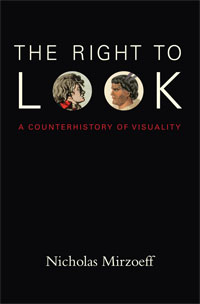
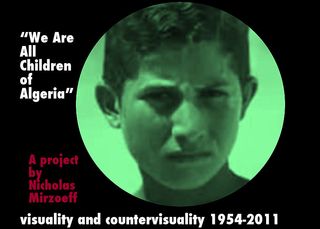
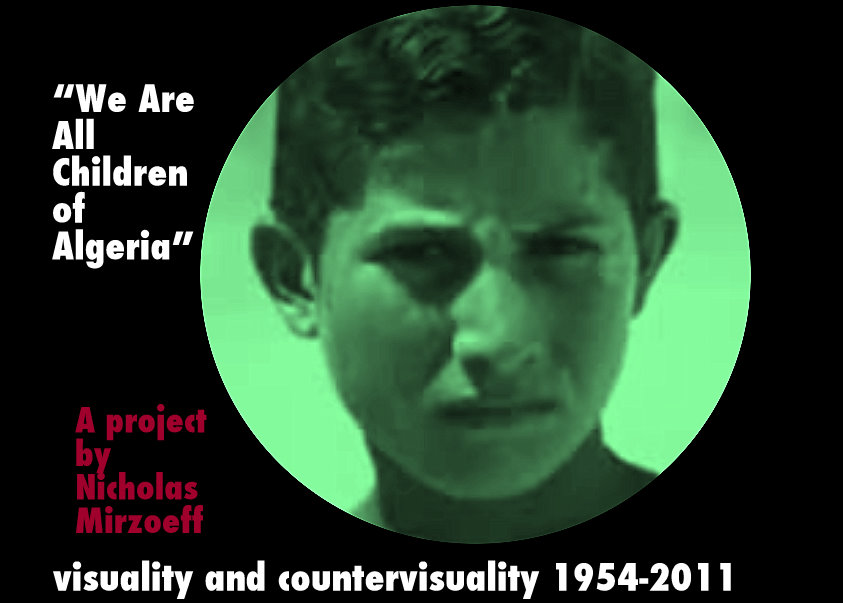
But Nick’s work also speaks directly to geography (at least with a little g, which is the sort I prefer).  Readers probably already know his most recent book, The Right to Look: a counterhistory of visuality (Duke, 2011), but this summer he produced a remarkable ‘digital extension’ of one of its chapters in conjunction with the Alliance for Networking Visual Culture called “We are all children of Algeria”: visuality and countervisuality 1954-2011 that plays with the idea of what I suppose we could call ‘spatial stories’.

In a revealing interview Nick explains why he chose to use a new open access authoring platform – Scalar – rather than his blog:

Blogging is a format that expands how it’s possible to write and think in relation to the contemporary. It makes a form over time. Scalar allows me to share a wide range of North African and European cinema, newsreel footage, guerrilla documentary and photography with the reader in a way that is obviously not possible in print.  Unlike a blog, or at least one using an off-the shelf template, I have a great deal of freedom as to the look, layout and design of each “page,” which can vary from one to the next.  More than that, it allows me to explore a more complex form of narrative in which multiple threads (or “paths” as Scalar calls them) can be developed. This opens up a new set of possibilities for comparative and cross-cultural work that have only just begun to explore in digital humanities work but which I think are among its most fruitful possibilities.

Much to think about there for me: as I noted in a previous post on Targeting and technologies of history, I’m really drawn to the visual experimentations taking place at USC – like Vectors, which showcased some of Caren Kaplan‘s work and which was also involved in Nick’s collaboration.

In “We are all children of Algeria”, then, Nick uses the metaphor of the march to tell a story about revolution and decolonization in Algeria from the outbreak of the revolution in 1954, and to illuminate affinities and connections between the post-war revolutions and the Arab uprisings that began in December 2010.

There is a march! A demonstration as they say in England, a manifestation in French. The Arabic is مسيرة. What is it? It is a means to put our bodies in space, where they are not intended to be and to make a claim. It moves, it demonstrates, it shows: it is militant research…

It asks: how can we “see” Algeria, its decolonization and revolution? Following the lead of Frantz Fanon, it takes the point of view of the child, meaning both children as such, the colonized “child” of  the parent nation, and the “infant” revolution that emerged. 

The Zapatistas say that everything they do is “walking,” a journey that has no final destination. This walking is done here by means of text, media and to-camera videos. This format, allowing as it does for a set of intersecting and interfacing threads to compose the whole, is better suited to reclaiming and exploring these histories than the linear text-based narrative.

So it is both a story about Algeria as such and a way to understand the interface of decolonization and globalization. Whether or not you work “on” or about Algeria, there is an “Algeria” in your work, meaning that there is a place where the incomplete or failed processes of decolonization and the formation of independent developing-world nations intersect with the power of financial globalization. We need to occupy that place, not erase it.
And, yes, Pontecorvo’s Battle for Algiers has a pivotal place in the march (page 5 of the Main Route).

Media, war and conflict

From the always interesting Geopolitics and security at Royal Holloway:

Media, war and conflict Fifth Anniversary Conference at Royal Holloway, University of London, 11-12 April 2013.

Papers are invited on a range of topics, including:

  • Contemporary and historical war reporting
  • Changing forms of credibility, legitimacy and authority
  • Media ethics in the coverage of conflict
  • The role of citizen-users and social media in conflict
  • Terrorism, media and publics
  • Intelligence operations and media
  • Digital and cyber warfare
  • Media and conflict prevention, peacekeeping and post-conflict scenarios
  • Photo and video journalism in wartime
  • War and conflict in popular culture
  • The power of the visual and other modalities
  • Commemoration and memorialisation of war and conflict

The conference is open to scholars, journalists, military practitioners and activists from around the world.

Abstracts (250 words) to Lisa.Dacunha@rhul.ac.uk by 10 October 2012.

Incidentally, for more on media, war and conflict see (even join) the War and Media Network, whose site has links to the journal and a host of other resources, together with a clutch of reviews of books, films and conferences.

Sight-seeing: war and extreme tourism

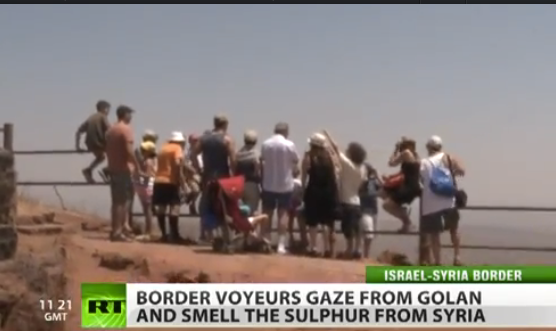
For the last several months there have been dispiriting reports of Israeli tourists travelling to the Golan Heights to gaze across the war zone in Syria: as Allison Good put it over at Foreign Policy, “Many Israelis are foregoing the pool or the beach, flocking instead to the Israel-Syria border for a little action.”

There was a thoughtful response to this voyeurism from Paul Woodward at War in Context – make no mistake, this is spectatorship not witnessing, as the video that prefaces his commentary makes clear – in which he suggested a series of ways in which he thought Israelis watching the war through binoculars was significantly different from Americans watching the war on television:

For Israelis the spectacle of regional violence is self-affirming.

It reinforces the idea that Israel is justifiably obsessed with its own security because it is surrounded by a ‘dangerous neighborhood.’

It confirms Ehud Barak’s racist notion that Israel is a villa in a jungle and that tranquility inside this villa can only be afforded by high walls.

It defines neighbors on the basis of their otherness and legitimizes indifference in preference to empathy.

I’m not so sure; there are, sadly, also American constituencies who surely see things the same way.

There are also close parallels between the voyeurs on the Golan Heights (or in this case Lows) and the ‘hill of shame’ from which the international media looked on at the Israeli attack on Gaza in 2009.  Here too the media were joined by Israeli tourists with cameras, binoculars and picnics: ‘bombing as spectator sport’, as two angry commentators described it.  There’s another personal, passionate report here.  For more on watching Gaza, see Peter Lagerquist, ‘Heard on the Hill of Shame’, at MERIP and – absolutely vital, this – David Campbell‘s  take, ‘Constructed visibility: photographing the catastrophe of Gaza (2009)’, which can be downloaded through his blog here. And Craig Jones has an excellent article culled from his MA thesis on ‘Shooting Gaza: Israel’s visual war’ in Human Geography 4 (1) (2011): abstract here.

There is also now a developing discussion of the wider, militarized landscape of ‘extreme tourism’ in Israel from Matt Carr at Ceasefire.  He pays close attention to the growth of tour companies run by former military officers and settlers, to the inclusion of the illegal settlements on the West Bank in their itineraries, and to the shooting ranges where tourists are encouraged to role play:

The sight of these ignorant, gimlet-eyed tourists in sunglasses and shorts, living out their paramilitary fantasies and teaching even young children to kill imaginary terrorists in a land under Israeli military occupation, is not the most edifying spectacle. But Caliber 3 does not only aim to thrill. Its activities are intended to combine ‘the values of Zionism with the excitement and enjoyment of shooting which makes the activity more meaningful.’ As the school’s director puts it ‘What is key here is not just shooting at targets, but hearing how we fight every day to protect the Jewish state.’

This can all be embedded in an emerging literature on ‘battlefield tourism’ or ‘war tourism’ – Richard Butler and Wantanee Suntikul have an edited collection, Tourism and war, out from Routledge this summer – but I think it’s more usefully connected to Rebecca Steins pathbreaking work on the politics of tourism, especially her book Itineraries in Conflict: Israelis, Palestinians and the political lives of tourism (Duke University Press, 2008). You can find a more recent report from her, ‘An All-Consuming Occupation’, on the fourth Jerusalem Festival of Light in June 2012 and the wretched history of tourism that was concealed in its glare, at MERIP.  She’s also provided an incisive examination of Israeli media coverage of the Gaza war – most eyes have been directed at international coverage –  in ‘Impossible witness: Israeli visuality, Palestinian testimony and the Gaza war’, Journal of cultural research 16 (2-3) (2012) 135-53.

Finally, for faint flickers of hope, there’s Caryn Aviv‘s essay on ‘The emergence of alternative Jewish tourism’, European Review of History 18 (1) (2011) 33-43.  Here’s the abstract:

This article explores the emergence of ‘alternative Jewish travel’ to the West Bank and within Israel. One programme, aimed at diaspora Jews, reframes religious, cultural, and ethnic Jewish identity to include non-violence and solidarity with Palestinians as part of what it means to be Jewish. Another programme, aimed at Israeli citizens (both Jews and non-Jews), reframes Israeli national identity to include post-Zionist solidarity with Palestinians, but is not necessarily Jewish in any religious or ethnic sense. Alternative Jewish travel programme tours explore complicated questions of justice and nationalism in different ways that reflect their simultaneously local and global positions, who organises them, and how they define Jewishness differently.

In Frames of War: when is life grievable? (2009) Judith Butler offered a series of reflections on other, no less violent visualities than those I have discussed here, but Aviv’s essay is worth reading alongside Butler’s response to the Jewish critics of her richly deserved award of the Adorno Prize by the city of Frankfurt: grace under fire.

Cologne and the geometry of destruction

I’m in Cologne for the International Geographical Congress.  It’s my second visit to the city – I’m on the international Scientific Committee involved in organising the IGC so I was here last year – but coming out of the main station and immediately seeing the vast cathedral again sends shivers up my spine.  This was the aiming point for Bomber Command’s first ‘Thousand Bomber’ raid (“Operation Millennium”) on the night of 30 May 1942; ironically the cathedral survived, but the bomb load, fanning out in a triangle, fell across the most densely populated part of the city.  One pilot compared the attack to ‘rush-hour in a three-dimensional circus’: 1,455 tons of bombs (high explosive and incendiaries) were dropped on the city in just ninety minutes, creating raging infernos that devastated 600 acres. The original target was Hamburg – attacked in July in “Operation Gomorrah” – but bad weather forced Bomber Command to switch the attack to Cologne (the nearest large city to Bomber Command’s bases).  By the end of the war the RAF had dropped 23,349 tons of bombs on the city and the US Eighth Air Force 15,165 tons, and according to Jörg Friedrich 20,000 people had been killed in the attacks.

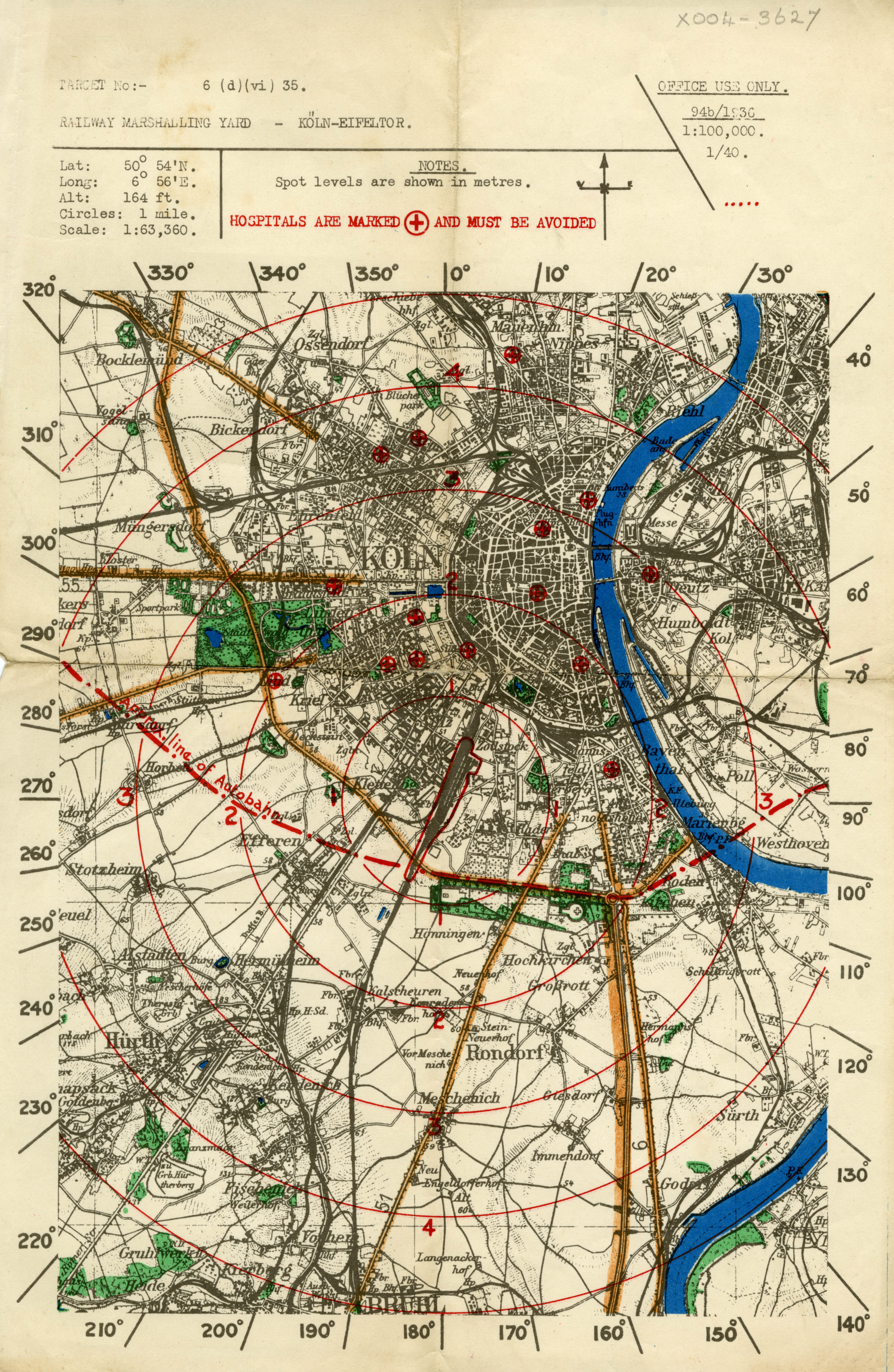
I’ve described the production of a city as a target in “Doors into nowhere” (see DOWNLOADS), and here is an early target map for Cologne; later ones were much more schematic since the detail was useless for night bombing or ‘blind bombing’ (‘bombing through cloud’) that were the characteristic modes of Bomber Command’s area bombing strategy.

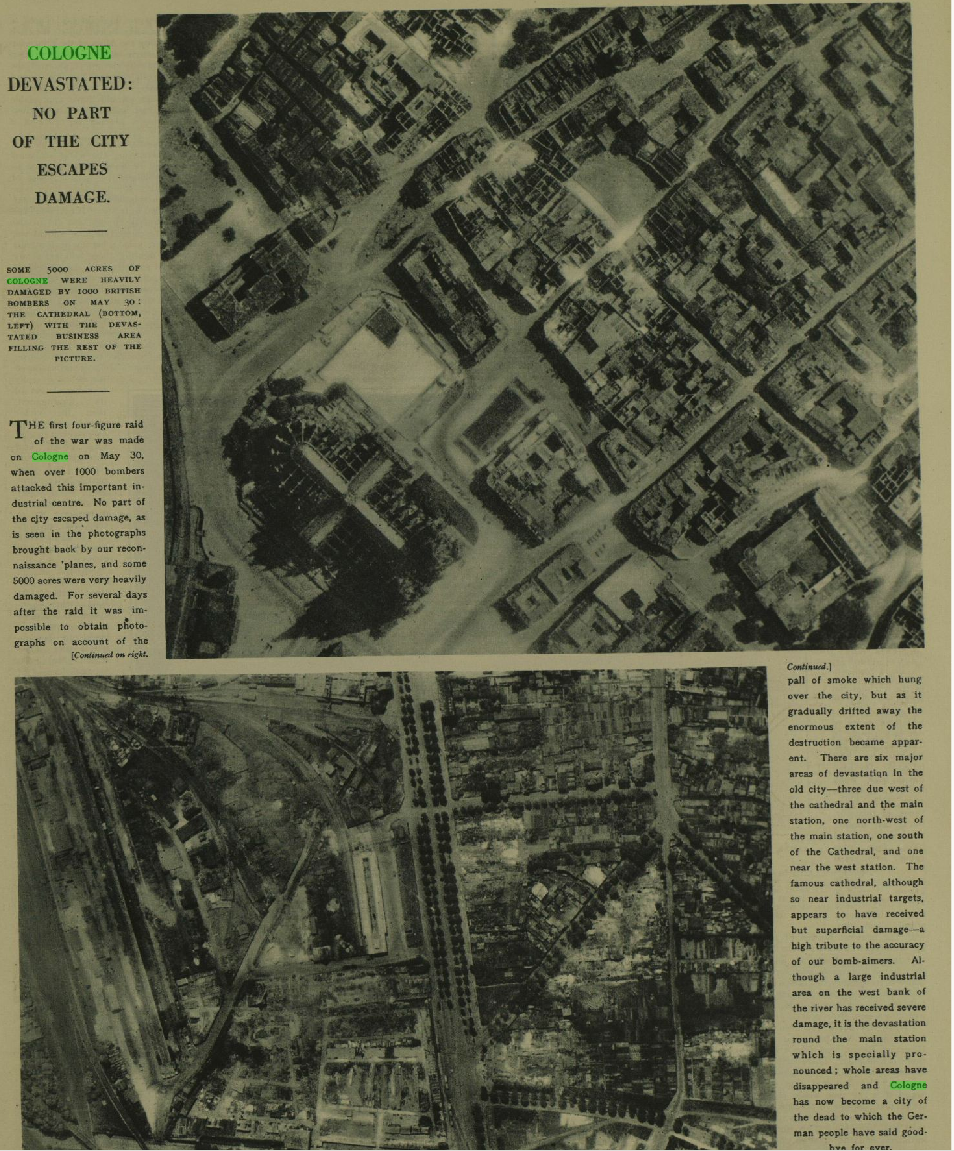
Operation Millennium gave Bomber Command a fillip, and the British press was ecstatic.  Thrilled at ‘the most gigantic air raid the world has ever seen’, the Daily Express reported that one pilot had said ‘It was almost too gigantic to be real…’ The Times noted that it was the 107th raid on the city and that, as far as the eye could see, the sky was filled with aircraft, ‘waiting their turn in the queue’ and arriving over the target one every six seconds: ‘from the point of view of the attackers it was the perfect raid’.  The News of the World had been shown daylight photographs of the aftermath: ‘No part of the city escaped, and the heavily-damaged areas total some 5,000 acres equal to an area of nearly eight square miles.  The old town has gone.  In addition to isolated points of damage, there are several major areas of devastation – due west of the cathedral and the main station; north-west of the main station; south of the cathedral; and near the west station.’  The language was abstract, one of lines and areas, because the ‘point of view’ was, like that of the aircrews who had carried out the attack, distant, and this geometric imaginary was confirmed when the photographs were published in the Illustrated London News:

Soon carefully edited cinema newsreels chimed in; at one briefing caught by the camera Cologne was hailed as ‘an old friend to many of you’, and the commentator described ‘tons and tons of beautiful bombs’ being loaded into the aircraft:

After the war, when British and American reporters could inspect the ruins of the city on the ground, they were stunned at the scale of destruction. Now the solid geometries of the city that they diagrammed were no longer clinical descriptions but chilling memorials.   Janet Flanner [‘Genêt’], in her “Letter from Cologne” published in the New Yorker on 19 March 1945, described the city as ‘a model of destruction’, lying ‘shapeless in the rubble’: ‘Our Army captured some splendid colored Stadpläne, or city maps, of Cologne, but unfortunately the streets they indicate are often no longer there.’ (She wasn’t greatly impressed by the survival of the cathedral – its Gothic nave ‘was finished in exactly 1880’ – and thought ‘the really great loss’ was Cologne’s 12 eleventh-century Romanesque churches).

Sidney Olson cabled LIFE magazine in March:

‘The first impression was that of silence and emptiness. When we stopped the jeep you heard nothing, you saw no movement down the great deserted avenues lined with empty white boxes. We looked vainly for people. In a city of 700,000 none now seemed alive. But there were people, perhaps some 120,000 of them. They had gone underground. They live and work in a long series of cellars, “mouseholes”, cut from one house to the next.’

Alan Moorehead was was shaken to the core:

‘… few people I think were prepared for Cologne.  There was something awesome about the ruins of Cologne, something the mind was unwilling to grasp, and the cathedral spires still soaring miraculously to the sky only made the débacle below more difficult to accept and comprehend…  A city is a plan on a map, and here, over a great area, there was no plan.  A city means movement and noise and people: not silence and emptiness and stillness, a kind of cemetery stillness.  A city is life, and when you find instead the negation of life the effect is redoubled.  My friends who travelled with me knew Cologne, but not this Cologne…[T]hey found themselves looking at disordered rocks, and presently they abandoned any attempt to guide our way by their memory of the city, and instead everyone fixed his eyes on the cathedral and used that only landmark as a guide across the rubble…’

Here is a compilation of contemporary film coverage, which includes Moorehead’s commentary:

Solly Zuckerman, a British scientist who had been closely involved in planning the bombing campaign, arrived early the next month and was so overwhelmed by what he saw that he found it impossible to write an essay he had promised Cyril Connolly’s Horizon: it was to be called “The natural history of destruction”.  It was left to W.G. Sebald to redeem that promise, in his own way, many years later.  But when he asked Zuckerman about his experience (their paths crossed at the University of East Anglia), all he could remember was a surreal still life: ‘the image of the blackened cathedral rising from the stony desert around it, and the memory of a severed finger that he had found on a heap of rubble.’

All this explains why the spectre of the cathedral – still blackened, rising today out of a grey and greasy wet sky – haunts me too.