The World’s E.R.

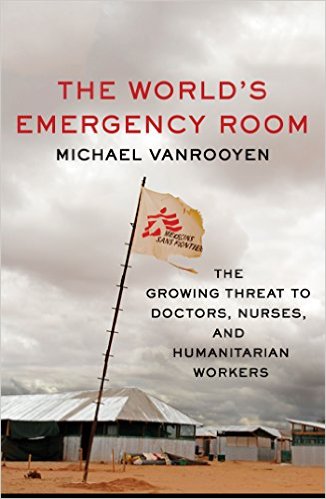
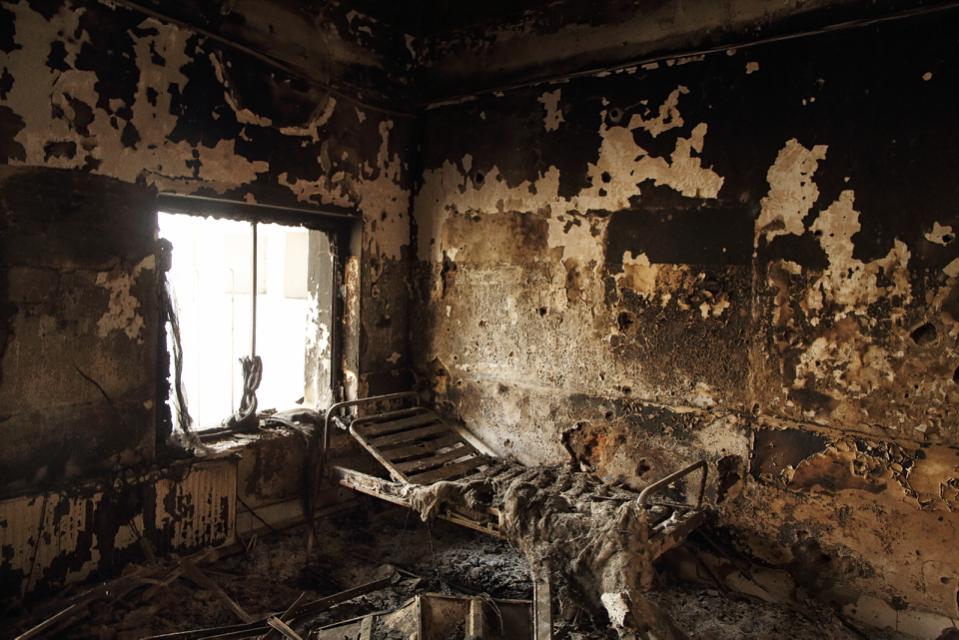
VanRooyen World's Emergency RoomAs military and paramilitary attacks on hospitals and medical facilities have increased – in Afghanistan, GazaSyria, Yemen and elsewhere – even as the number of casualties has soared, Michael VanRooyen‘s new book The World’s Emergency Room (out next month from St Martin’s) promises to provide an urgent overview of what has become a routinised violation of medical neutrality:

Twenty years ago, the most common cause of death for medical humanitarians and other aid workers was traffic accidents; today, it is violent attacks. And the death of each doctor, nurse, paramedic, midwife, and vaccinator is multiplied untold times in the vulnerable populations deprived of their care. In a 2005 report, the ICRC found that for every soldier killed in the war in the Democratic Republic of the Congo, more than 60 civilians died due to loss of immunizations and other basic health services.

The World’s Emergency Room: The Growing Threat to Doctors, Nurses, and Humanitarian Workers documents this dangerous trend, demonstrates the urgent need to reverse it, and explores how that can be accomplished. Drawing on VanRooyen’s personal experiences and those of his colleagues in international humanitarian medicine, he takes readers into clinics, wards, and field hospitals around the world where medical personnel work with inadequate resources under dangerous conditions to care for civilians imperiled by conflict. VanRooyen undergirds these compelling stories with data and historical context, emphasizing how they imperil the key doctrine of medical neutrality, and what to do about it.

Michael is a professor at the Harvard Medical School and director of the Harvard Humanitarian Initiative.

From Kirkus:

A behind-the-scenes look at the nascent field of humanitarian medicine as it has evolved in recent years of civil wars, famines, tsunamis, and other natural and man-made disasters.

Since 1990, world conflicts and refugee crises have spurred the growth of a massive force of humanitarian aid workers—some 275,000 individuals with the United Nations and NGOs, most of whom lack the formal training needed to deal with complex events like the catastrophic 2010 Haiti earthquake. In that 25-year period, more than 1,000 aid workers were killed in attacks on hospitals, medical staff, and civilian patients. VanRooyen, a professor at Harvard Medical School and the co-founder and director of the Harvard Humanitarian Initiative, came of age professionally in the fields of emergency medicine and humanitarian medicine, which are the focus of this fascinating debut. “What the emergency room is to Detroit, Chicago, and Baltimore, humanitarian medical relief is to the world’s crisis zones,” he writes. Whether in an unstable inner city or a failed state, doctors provide a safety net of emergency health care for people with critical needs. The author recounts his experiences on the ground as an emergency physician in Bosnia, Chad, the Congo, Haiti, Somalia, and many other countries and how he and like-minded colleagues have sought to professionalize humanitarian efforts, which have frequently been criticized as uncoordinated and wasteful. (The Haitian relief effort was a “humanitarian free-for-all,” he writes, involving novice agencies, inexperienced surgical teams, and “disaster tourists.”) In 2005, VanRooyen and others established the Harvard Humanitarian Initiative, a first-of-its-kind, universitywide effort to pursue research, training, and innovative approaches to humanitarian aid that could be leveraged to achieve policy changes. Despite the subtitle, the author devotes relatively little attention to the increasing dangers facing aid workers, focusing mainly on the need to establish rigorous standards for the field in order to prevent the malnutrition and infectious diseases that are the biggest killers in communities in conflict.

Anatomy of a war

PARKER Anatomy of a soldier

‘He straightened and held me in one hand.  “Right, orders for tomorrow’s operation,” he said.   “We’re deploying most of the company for the first time and the whole platoon’s out together.  It’s a standard route security operation for the logistics convoy bringing in our supplies.  There’s nothing complicated about this patrol, but we’ll be static for long periods and that will make us vulnerable.  We have to clear all the roads in our AO and then secure it so the convoy can travel safely through.”  He moved his hand up my shaft and used me to point at the flat ground.

“Is everyone happy with the model?” he said.

There were a few silent nods from the watching men.

“Just to orientate you again.  This is our current location.”  He pointed me at a tiny block of wood near the centre of the grid that had PB43 written on it in peeling blue paint.  It was the largest of a hundred little wooden squares placed carefully across the earth and numbered in black.  “This is Route Hammer.”  He moved my end along a piece of orange ribbon that was pinned into the dirt.  “And this blue ribbon represents the river that runs past Howshal Nalay.”  I swept along the ribbon over a denser group of wooden blocks.  “These red markers are the IED finds in the last three months, so there’s quite a few on Hammer.”  I hovered over red pinheads…

He started describing the plan and used me to direct their attention to different parts of the square.  He said their mission was to secure the road and then provide rear protection.  He told them how they would move out before first light and push along the orange ribbon, past the blocks with L33 and L34 written on them.  I paused as he explained how vulnerable this point was, and that one team would provide overwatch at the block marked M13 while others cleared the road.

I was pointed at one of the men, who nodded that he understood.

He told them how they would spread out between block L42 and the green string.  Two other platoons would move through them and secure the orange ribbon farther up.  Then he swept me over the zones they were most likely to be attacked from.  He said the hardest part of the operation was to clear the crossroads at the area of interest named Cambridge; this was 6 Platoon’s responsibility.  I hovered over where the orange ribbon was crossed by white tape.

I had done it all before: secured sections of the ribbon, dominated areas of dirt, reassured little labels, ambushed red markers and attacked through clusters of wooden blocks.  I had destroyed as my end was pushed down hard and twisted into the ground.  I’d drawn lines in the sand that were fire-support positions and traced casualty evacuation routes through miniature fields.  I was master of the model.’

This passage comes from Harry Parker‘s stunning novel about the war in Afghanistan, Anatomy of a soldier (Faber, 2016).

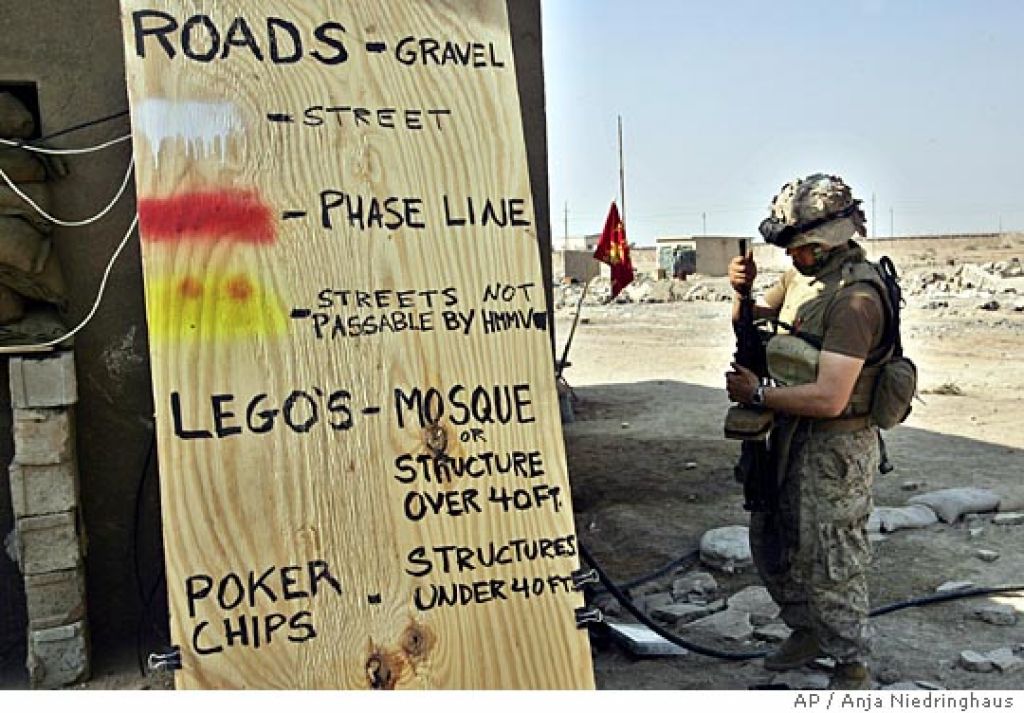
In one sense, perhaps, it’s not so remarkable: the use of improvised physical models to familiarise troops with the local terrain is a commonplace even of later modern war.  In Rush to the intimate (DOWNLOADS tab) I described how in November 2004, immediately before the second US assault on Fallujah, US Marines constructed a large model of the city at their Forward Operating Base, in which roads were represented by gravel, structures under 40′ by poker chips and structures over 40′ by Lego bricks (see image below). Infantry officers made their own physical model of the city using bricks to represent buildings and spent shells to represent mosques.

Fallujah model

I called this a ‘rush from the intimate to the inanimate’, and discussed the ways in which the rendering of the city as an object-space empty of life was a powerfully performative gesture – one in which, as Anne Barnard put it, the soldiers straddled the model ‘like Gulliver in Lilliput’.

As the passage I’ve just quoted suggests, it was standard practice in Afghanistan too; here are soldiers from the Afghan National Army studying a model for Operation Tufan/Storm, a joint ANA/UK operation in Helmand:

Afghan Warriors Tackle Insurgents in Huge Joint Operation with Scottish Troops

So far, then, so familiar.  But the passage with which I began is remarkable because the narrator – whose shaft is gripped by the officer’s hand, who hovers over the orange ribbon, who confesses to having done it all before – is the handle of a broken broom.  ‘My first purpose was to hold my head down against the ground as I brushed sand out of a small, dirty room,’ the chapter begins.  ‘In time, my head loosened and the nail then held it on pulled free.  Someone tried to push it back on, but my head swung round and fell off.  I was discarded.’

‘That would have been the end of me,’ the broom handle continues – ‘my head was burned with the rubbish’ – ‘but I was reinvented and became useful again.’

The novel tells the story of Captain Tom Barnes, a British army officer who steps on an IED while on patrol in Afghanistan; he is airlifted to the Role 3 hospital at Camp Bastion and then evacuated to Britain; he loses both his legs, the first to the effects of the blast and the second to infection.  And the narrative is reconstructed through the objects that are entangled in – and which also, in an extraordinarily powerful sense, animate – the events.

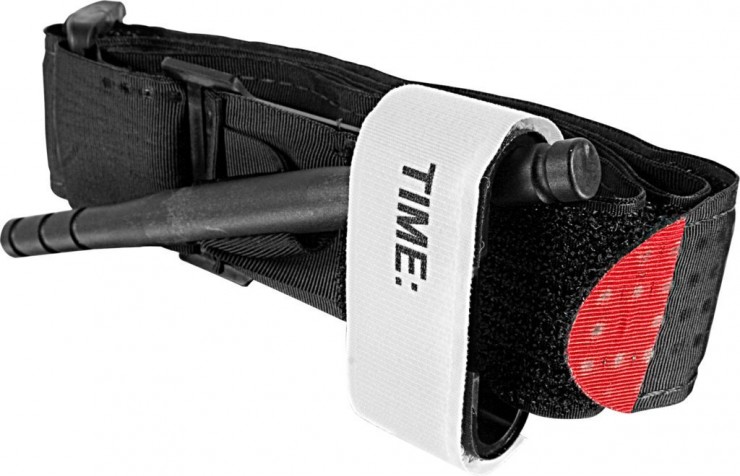
So, for example, a tourniquet:

‘My serial number is 6545-01-522… A black marker wrote BA5799 O POS on me and I was placed in the left thigh pocket of BA5799’s combat trousers… At 0618 on 15 August, when I was sliding along BA5799’s thigh, I was lifted into the sky and turned over.  And suddenly I was in the light… I was pulled open by panicked fingers and covered in the thick liquid… I was wound tighter, gripping his thigh… I clung to him as we flew low across the fields and glinting irrigation ditches…’

CAT-Combat-Application-Tourniquet-740x476

The story is continued in and through other object-fragments.  On patrol, a boot; day-sack; helmet (‘My overhanging rim cut his vision as a black horizontal blur and my chinstrap bounced up against his stubble as he pounded onto each stride’); night vision goggles (‘My green light reflected off the glassy bulge of his retina’); a radio (‘His breathing deepened under the weight of the kit and condensation formed on the gauze of my microphone… I continued to play transmissions in BA5799’s ear as the other stations in the network pushed farther up the road’); an aerial photograph (‘He took me out and traced his finger across my surface… in the operations room a small blue sticker labelled B30 was moved across a map pinned to the wall.  That map was identical to me’); and his identity tags (‘I had dropped around your neck and my discs rested on the green canvas stretcher stained with your blood’).

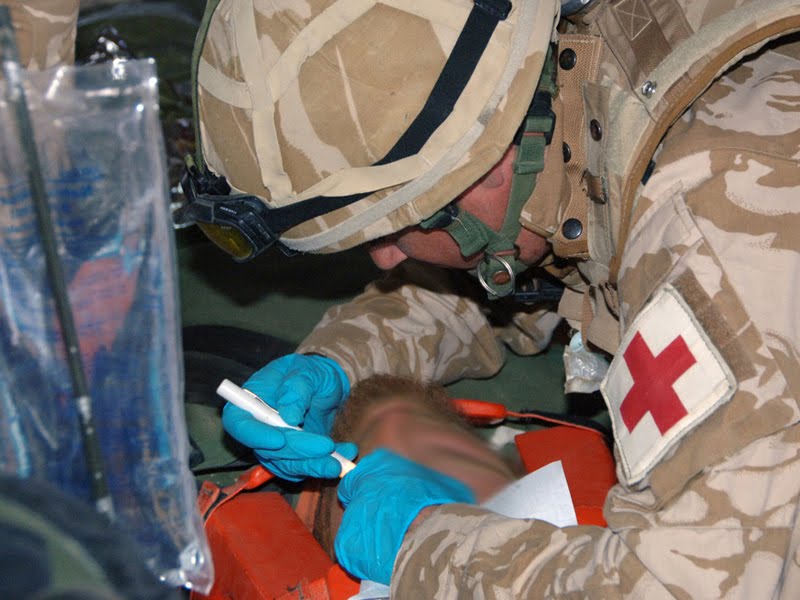
Medical care en route to Bastion

After the blast from the IED and a helicopter evacuation, the medical apparatus: a tube inserted into his throat at Camp Bastion’s trauma centre (‘I was part of a system now; I was inside you…’); a surgical saw (‘He held me like a weapon, and down at the end of my barrel was my flat stainless-steel blade… My blade-end cut through the bone, flashing splinters and dust from the thin trench I gouged out’); a plasma bag (‘I hung over you… I was empty; my plastic walls had collapsed together and red showed only around my seals.  The rest of the blood I’d carried since a young man donated it after a lecture, joking with a mate in the queue, was now in you’); a catheter; a wheelchair; his series of prosthetics (‘You pressed your stump into me and we became one for the first time… Slowly you outgrew all my parts and the man switched them over until I only existed as separate components in a cupboard and you’d progressed to a high-activity leg and a carbon-fibre socket’).

The agency of many of the objects is viscerally clear:

‘I lived in the soil.  My spores existed everywhere in the decomposing vegetable matter of the baked earth.  Something happened that meant I was suddenly inside you…  I was inside your leg, deep among flesh that was torn and churned.  I lived there for a week and wanted to take root, but it wasn’t easy… I struggled to survive.  Except they missed a small haematoma that had formed around a collection of mud in your calf…  You degraded and I survived… I made you feverish and feasted unseen on your insides…’

Or again, his first prosthetics:

‘You improved on me but you became thinner.  The pressure I exerted on you, and the weight you lost from the energy I used, made your stump shrink.  I could no longer support you properly.’

And the new ones:

‘Your hand caressed my grey surface and felt around the hydraulic piston under my knee joint… You’d been waiting for me but were nervous about what I might do for you…’

What is even more remarkable, as many of the passages I have quoted demonstrate, is that these events are narrated through objects that in all sorts of ways show how military violence reduces not only the ground but the human body to an object-space, perhaps nowhere more clearly than in this remark: ‘You were not a whole to them, just a wound to be closed or a level on a screen to monitor or a bag of blood to be changed.’  And yet: virtually every one of those passages is also impregnated with Barnes’s body: its feel – its very fleshiness – its sweat, its smell, its touch.

O'BRIEN The things they carriedI think this is an even more successful attempt to render the corporeality of war through its objects than Tim O’Brien‘s brilliant account of Vietnam in The Things They Carried (for more, see my post on ‘Boots on the Ground‘ and my essay on ‘The natures of war’: DOWNLOADS tab). This is, in part, because the narrative is not confined to those objects close to Barnes’ own body; it spirals far beyond them to include a drone providing close air support (‘I banked around the area and my sensor zoomed out again and I could see the enemy in relation to the soldiers who needed me’) and, significantly, extends to the components of the IED and the bodies of the insurgents who constructed and buried it.

There is a powerful moment when the two collide, when the father of a young insurgent killed in the drone strike wheels his son’s body to the patrol base:

‘The corpse was half in me, with my front end under it and my handles sticking up in the air.  He managed to push it farther into me and the distended head bounced off my metal side.  Dried blood showed around its ears and nose and was red in its mouth.  And then he pushed my handles down and I scooped it all up…  The corpse’s eyes had opened from the jolting and looked up at him.  He looked down into them, at his son’s face and the blue lips and purple blotching across his cheeks and he knew he had already accepted the loss.  He lowered my handles and smoothed the eyelids shut again.  He pushed me down the road.’

Barnes reaches for a compensation form, which takes up the story:

‘There was a leaflet that BA5799 had read tucked in the notebook next to me.  It described how to deal with this.  What to say, what not to say…  He was dealing with death in an alien culture and he had no idea how to relate to this man or the death of his son…  BA5799 wanted to feel compassion for this man and his dead son but only felt discomfort and the man’s eyes challenging him.  And all he cared about was getting back into the base and the loss of a potential asset in securing the area.’

All of these criss-crossing, triangulating lines capture not only the anatomy of a soldier but an anatomy of the war itself – at once calmly, coolly and shockingly abstract – in a word, objectified – and invasively, terrifyingly, ineluctably intimate.

***

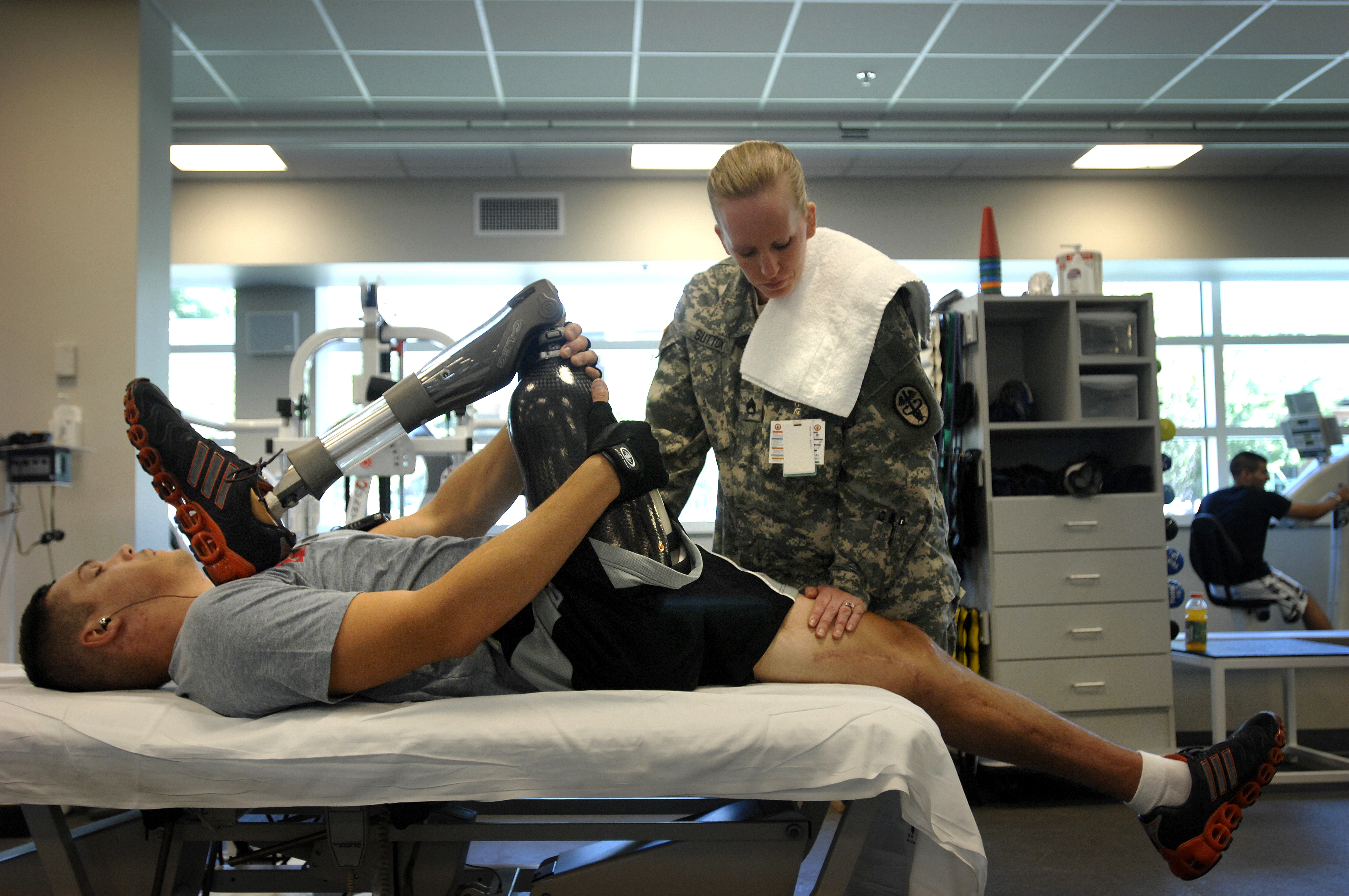
Harry Parker (Ben Murphy photo)Postscript: You probably won’t be surprised to learn that Anatomy of a soldier is based on Harry Parker’s own experience.  Out on patrol with his men on 18 July 2009 in central Helmand he stepped on an IED; he lost his lower left leg in the blast and had his lower right leg amputated at Selly Oak Hospital in Birmingham (the major centre for advanced trauma care for the British military).  ‘‘Writing about the explosion felt good creatively,’ he told Christian House, ‘but also you’ve mined your personal experiences’ and the process left him ‘a sweaty mess’.  I’ve written about what Roy Scranton calls ‘the trauma hero‘ before, and so it’s important to add that Parker insists that the novel is not disguised autobiography: ‘I didn’t want to write, “I was in the Helmand valley.”’

One other note: at the AAG meeting in San Francisco next month Iain Shaw and Katherine Kindervater have organised a series of really interesting sessions on Objects of Security and War:

These sessions aim to bring together scholars working in the areas of war and security that are attentive to the materialities of contemporary violence and conflict. We are especially interested in work that seeks to place objects of security and war within a wider set of practices, assemblages, bodies, and histories. From drones and documents, to algorithms and atom bombs, the materiality of state power continues to anchor and disrupt the conduct and geography of (international) violence.

I’m part of those sessions – but reading Anatomy of a soldier has made me think about giving an altogether different presentation. I’ve long argued that we need to disrupt that lazy divide between ‘fact’ and ‘fiction’ and that literature is able to convey important truths that evade conventional academic prose (hence my unbounded admiration for Tom McCarthy‘s C, for example).  And Anatomy of a soldier convinces me that I’ll find more inspiration in novels like that than in whole libraries on object-oriented philosophy…

Grotesque geographies

KRUPAR lecture

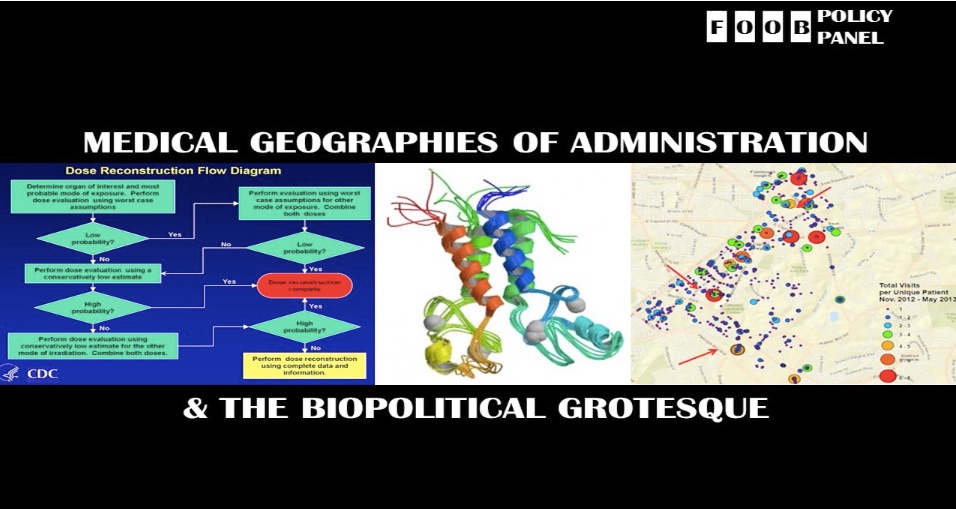
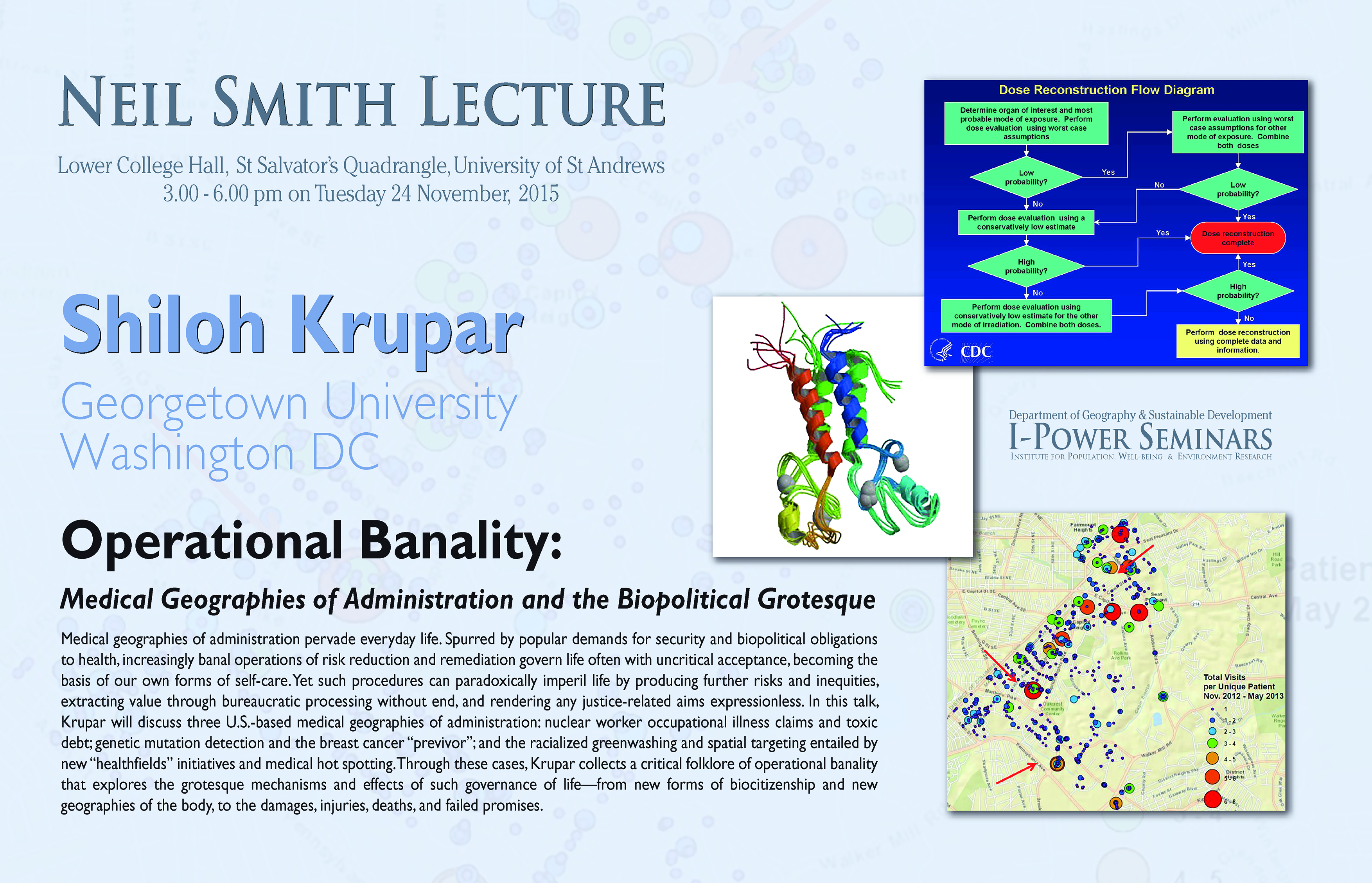
The 2nd Neil Smith Lecture at St Andrews, which was given last month by Shiloh Krupar on ‘Operational Banality: medical geographies of administration and the biopolitical grotesque‘, is now available online here.  A tour de force (plus a splendid cartoon of the spectacularly grotesque Donald Trump).

Operational Banality

The next Neil Smith Lecture will be given by the amazing Shiloh Krupar at St Andrews next week (24 November at 3 p.m.) on “Operational Banality: medical geographies of administration and the biopolitical grotesque”: online version will follow soon after.

Posters

In case the text in the poster (above) is too small:

Screen Shot 2015-11-16 at 12.21.07

I wish I could be there.

Surgical strike

Kunduz Trauma Center (Andrew Quilty)

An update to my post (which I’ve updated several times) on the US air strike on the hospital in Kunduz early last month: MSF has released an internal review of the events that took place that night.  It’s only a preliminary report – the inquiry is ongoing – but it makes for grim reading.

MSF opened its Kunduz Trauma Center in August 2011, providing free, high-quality surgical care to all those who needed it (for more on MSF and other medical charities in Afghanistan, see my post on ‘The prosthetics of military violence’ here).

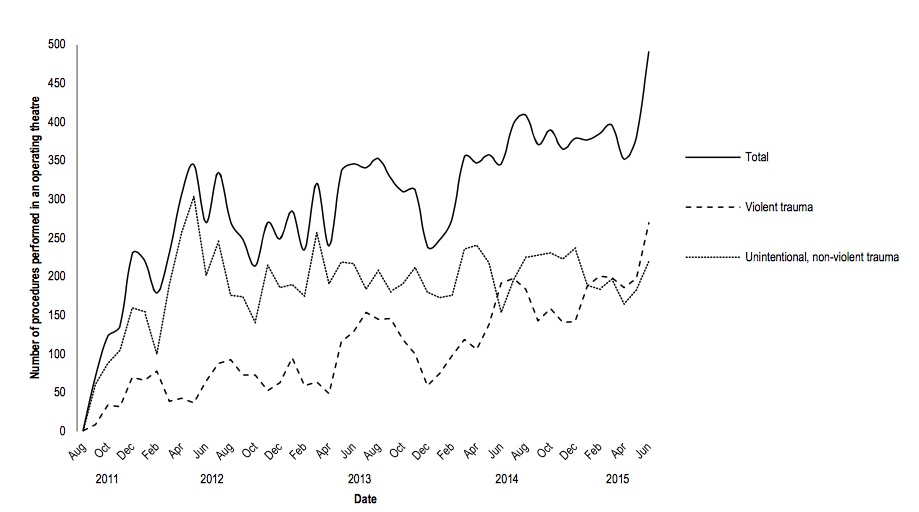
By the end of September 2015 the original 92 beds had grown to 140 as the numbers being treated grew:

Case load Kunduz Trauma Center 2011-2015 (MSF)

MSF is an experienced, highly regarded relief organisation and so it comes as no surprise to learn that it was fully aware of the cardinal principle of medical neutrality and took all possible steps to secure the legal and military foundations on which it operated:

MSF activities in Kunduz were based on a thorough process to reach an agreement with all parties to the conflict to respect the neutrality of our medical facility. In Afghanistan, agreements were reached with the health authorities of both the government of Afghanistan and health authorities affiliated with the relevant armed opposition groups. These agreements contain specific reference to the applicable sections of International Humanitarian Law including:

  • –  Guaranteeing the right to treat all wounded and sick without discrimination
  • –  Protection of patients and staff guaranteeing non-harassment whilst under medical care
  • –  Immunity from prosecution for performing their medical duties for our staff
  • –  Respect for medical and patient confidentiality
  • –  Respect of a ‘no-weapon’ policy within the hospital compound

The report makes it clear that this had been clearly endorsed by all the military and paramilitary parties to the conflict.

Fighting intensified in the week before the air strike.  Most of those treated since the Trauma Center opened had been from the Afghan government side, but from Monday 28 September ‘this shifted to primarily wounded Taliban combatants.’  The Afghan government speedily arranged the transfer of all its patients (apart from the most severely wounded cases) to another hospital.  By that night the Taliban announced that it was in control of the district.

The next day, as the numbers seeking treatment increased yet again, MSF reconfirmed the GPS co-ordinates of the Trauma Center with both the Afghan authorities and the US military.

On Thursday 1 October MSF was asked by Carter Malkasian, a a special adviser to the Chairman of the Joint Chiefs of Staff, whether the hospital ‘had a large number of Taliban “holed up” and enquired about the safety of [MSF] staff’ and was told that its staff ‘were working at full capacity’ and that the hospital ‘was full of patients including wounded Taliban combatants’.  And because the Taliban were hors de combat they were not a legitimate military target: there is absolutely no ambiguity about this.

That same day a UN civilian/military liason ‘advised MSF to remain within the GPS coordinates provided to all parties to the conflict as “bombing is ongoing in Kunduz.”’

On Friday 2 October two large MSF flags were placed on the roof of the hospital.  That night the hospital was calm, there was no fighting taking place within the vicinity and MSF insists that there were no armed combatants in the buildings or the grounds of the hospital.

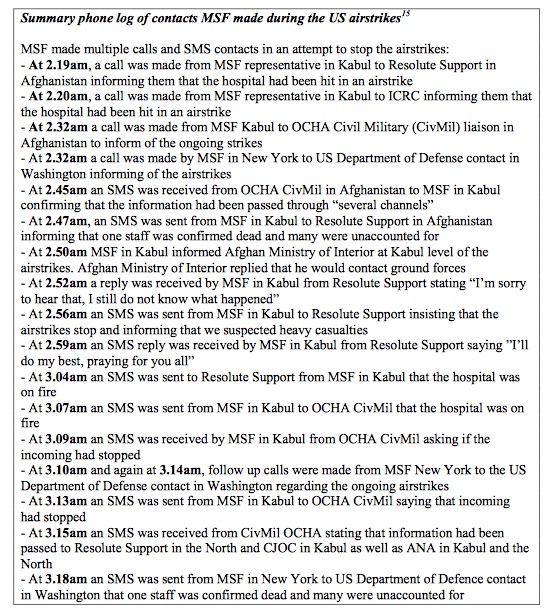
The air strikes began soon after 2 a.m. on Saturday 3 October, and throughout the attack – which lasted for over an hour – MSF made repeated attempts to stop the assault:

MSF Kunduz phone log

And yet, despite everything the US military had been told in advance and despite these repeated attempts to stop the air strikes, an AC-130 gunship made five repeated passes:

A series of multiple, precise and sustained airstrikes targeted the main hospital building, leaving the rest of the buildings in the MSF compound comparatively untouched. This specific building of the hospital correlates exactly with the GPS coordinates provided to the parties to the conflict [my emphasis].

Bombing of Kunduz Trauma Center

As MSF’s Director concludes,

‘The question remains as to whether our hospital lost its protected status in the eyes of the military forces engaged in this attack – and if so, why. The answer does not lie within the MSF hospital. Those responsible for requesting, ordering and approving the airstrikes hold these answers’.

And, as the report notes, this is the view from the inside: ‘What we lack is the view from outside the hospital – what happened within the military chains of command.’

So far, controlled leaks from the US military investigation have suggested that an Afghan ‘rapid reaction force’ requested the attack, that it had been rushed to Kunduz from elsewhere in Afghanistan, arriving ‘just days before the air strike’, and that it had no experience in working with the US ground troops from the Third Special Forces Group who relayed the request for ‘aerial fires’ to the Joint Operations Center at Kunduz airfield.  The Green Berets ‘were aware it was a functioning hospital,’ AP reported, ‘but believed it was under Taliban control.’  The report continues:

The Green Berets had asked for Air Force intelligence-gathering flights over the hospital, and both Green Berets and Air Force personnel were aware it was a protected medical facility, the records show, according to the two people who have seen the documents.

The analysts’ dossier included maps with the hospital circled, along with indications that intelligence agencies were tracking the location of [an] … operative [from Pakistan’s Inter-Services Intelligence directorate who was allegedly co-ordinating Taliban operations in the area] and activity reports based on overhead surveillance, according to a former intelligence official who is familiar with some of the documents. The intelligence suggested the hospital was being used as a Taliban command and control center and may have housed heavy weapons.

According to the Washington Post,

… the crew of the AC-130, call sign Hammer, verified their permission to fire twice before engaging the hospital. AC-130Us carry a crew of 14, often including a special forces liaison officer responsible for communicating with ground units.

And the US troops remained in contact with the AC-130 gunship throughout the attacks.

So even if you accept all these unverified claims about the intelligence (or lack of it) behind the air strikes, you surely have to wonder about the studied lack of response to the repeated calls to have the attacks stopped.  Bear in mind, too, that the AC-130 has a sophisticated sensor suite on board, including IR and low-light cameras, that the hospital kept its lights on throughout the night (it was one of the few buildings in the city whose electricity was still working), and that MSF staff were advised to remain inside the co-ordinate grid they had given to the military: which turned out to be the very co-ordinates used for the attack.  It seems dismally clear that the trauma center was precisely targeted and that it could not have been mistaken for any other building.

Regular readers will know that the US military has repeatedly relied on an elaborate bio-medical discourse to legitimise its actions (for a brilliant recent discussion, see Elke Schwarz‘s ‘Prescription drones: on the techno-biopolitical regimes of contemporary ‘ethical killing’’, online early at Security Dialogue); the most familiar version, hideously ironic given the events in Kunduz, is the claim that the US military has an unprecedented ability to carry out ‘surgical strikes’…

UPDATE:  For an excellent analysis, see Kate Clark at the Afghan Analysts Network here

‘Our daily threat’

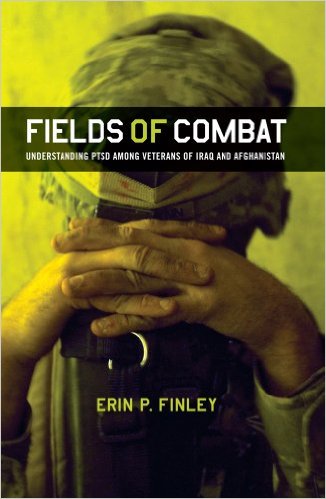
41Oi3YngcQL._SX324_BO1,204,203,200_For the longest time the only victims of Post-Traumatic Stress Disorder from the wars in Afghanistan who were accorded any media attention in Europe and North America were ground troops,  drone pilots and on occasion foreign civilians who worked in the combat zone. And much of that discussion focussed on the ways in which, as  Sebastian Junger put it, the effects of PTSD ripple far beyond the battlefield:

[Veterans] return from wars that are safer than those their fathers and grandfathers fought, and yet far greater numbers of them wind up alienated and depressed. This is true even for people who didn’t experience combat. In other words, the problem doesn’t seem to be trauma on the battlefield so much as re-entry into society.

But what about those denied re-entry into ‘normal’ society, those for whom war long ago became the ‘new normal’?  Apart from the odd glance at other combatants – ‘Do the Taliban get PTSD?Newsweek once asked – the plight of local people trapped in the battlefield, living and dying every day in the shadows of military and paramilitary violence, has been largely ignored.

There have been exceptions, like Anna Badkhen‘s report for the Pulitzer Center on Afghanistan as ‘PDSTland’ that also offered a more general commentary:

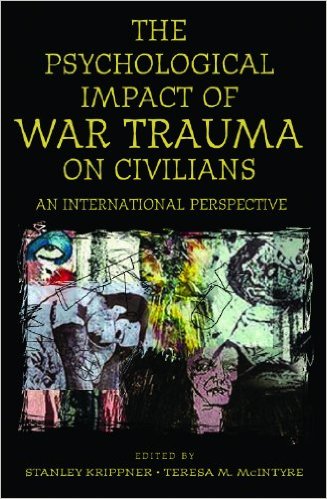
Psychological impact of war trauma on civiiliansCompared with research into the effects of conflict on U.S. war veterans, studies of combat trauma among civilians are few. But there is a growing understanding among medical scientists and conflict experts that the emotional toll of war on noncombatants is more significant than had been assumed. During World War I, when military physicians described soldiers’ traumatic reactions to war as “shell shock,” about nine out of 10 war casualties were fighters. But after nearly 50 years of the Cold War and more than 10 years of the war on terror, the way we wage war is more personal. Terrorism battlefields recognize no front lines. Vicious sectarian rampages pit neighbor against neighbor. Victims of genocidal campaigns often know their attackers by name. In the most current conflicts, at least nine out of 10 war casualties are believed to be civilians, writes psychologist Stanley Krippner in his book The Psychological Impact of War Trauma on Civilians [This is a collection of essays Krippner co-edited with Maria McIntyre]. In Iraq, where as many as 1 million people may have died since 2003, the rate might be even higher. No one kept track of civilian casualties in Afghanistan between 2001 and 2007, and estimates vary widely; given the United Nations’ tally of almost 12,000 civilian deaths since the beginning of 2007, a rough guess of between 20,000 and 30,000 civilian casualties since 2001 seems reasonable.

Communal psychological wounds – what medical anthropologist Arthur Kleinman has called “social suffering” – permeate the lives of survivors scraping by in unimaginable poverty amid collapsed infrastructure, the common afterbirth of modern combat. According to the Centers for Disease Control and Prevention, between 30 and 70 percent of people who have lived in war zones bear the scars of post-traumatic stress disorder and depression.

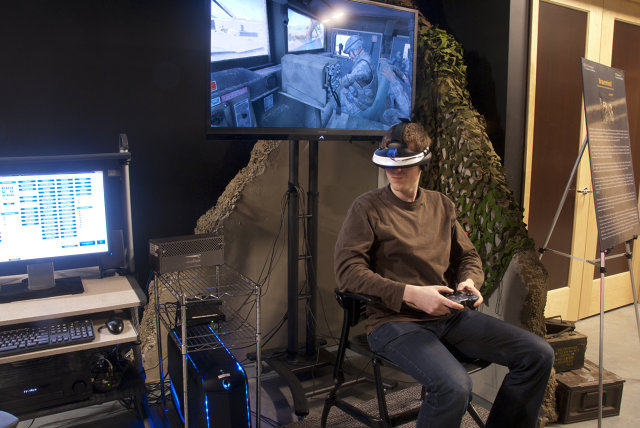
Over the years I’ve read endless reports about the ways in which the US military in particular is exploring new therapies for PTSD – including experiments in Virtual Reality as a way of helping victims re-live and ultimately come to terms with trauma, like Virtually Better‘s Bravemind staged in ‘Virtual Afghanistan’ (see below; also here, here, here and here).

bravemind

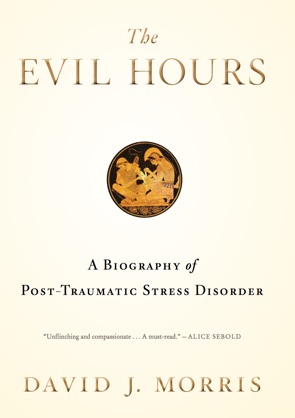
This doesn’t mean that progress is rapid or solutions straightforward, and David Morris‘s The Evil Hours ought to banish any such complacency.  Here is Tom Ricks:

From battlefields and cultural responses to traumatized warriors throughout world history to the internecine corridors of the San Diego V.A. hospital and the modern psychology establishment, Morris gives sight to the blind examining the PTSD elephant, offering up a clear understanding of what the beast is as well as the path it’s traveled across the landscape of warfare. He draws from a seemingly inexhaustible well of experience. Herding a cast that includes Hemingway, Klosterman, Sassoon, a host of anthropologists and neurologists, and the soldiers and veterans he met throughout his own odyssey, Morris accomplishes the necessary work of identifying all the necessary aspects of PTSD and still finds a way to magnify the nuances of how it affects individuals and societies.

Evil Hours Cover Final-1The “out-of-body” experience and the recurring memory of traumatic events are familiar to those afflicted by PTSD. Many describe it as watching a movie on repeat from every possible angle. It’s the mind’s vain attempt to challenge trauma like a call in a football game, gathering the referees around a screen to watch the replay over and over until the past can be rewritten in favor of justice. Others who have attempted books about PTSD have floundered in this conceit. Morris avoids that and maintains his place at the commentators’ desk — close enough to call the play-by-play, but far enough away to keep perspective. Instead of raging at length about the process of enrolling in the V.A. care system (whose bureaucracy he declares forces veterans to run “a patience marathon”), he reflects on its problematic advocacy of “large, scalable, Evidence-Supported Treatments.” Morris unearths troubling aspects in the character of these treatments as he traces the history of PTSD therapy. He finds that they are highly impersonal … and make the afflicted feel more like they’re being treated as lab rats than patients. He observes that these methods are a profound departure from the type of treatments discovered and evolved by W.H.R. Rivers during WWI and, later, Vietnam veterans groups during the 1970s. Though Morris’s own experience with prolonged exposure treatment met with poor results and he expresses misgivings about similar therapeutic methods, he remains objective about their efficacy. Rather, he takes a more important and less scrutinized view of how treatments are vetted in the first place. Questioning the practice of excluding patients who drop out of test programs from data sets instead of listing them as showing no signs of improvement, Morris asks if reports inaccurately portray success rates. This leaves the V.A.’s dogmatic insistence on evidence-based methods particularly vulnerable to skewed numbers…  His exploration of the pharmaceutical approach to PTSD reaches similar conclusions. As Morris writes, “‘Evidence-supported’ and ‘evidence-based’ mostly means that a lot of doctors happen to like it, oftentimes for reasons that have less to do with the actual value of a therapeutic protocol than with trendiness.”

So PTSD has become a medical-psychological-psychiatric and even -technological minefield, and the figure of what Roy Scranton calls ‘the trauma hero‘ still casts a long shadow over its deformations (and even contributes to them).

But when you compare these avowedly fraught therapeutic interventions with the often forcible recourse of many Afghan victims of PTSD to shrines, a radically divergent medical geography comes into view (much as it does when you compare the differential treatment for catastrophic injury: see my commentary on ‘The prosthetics of military violence’ here).  Anna writes:

Most Afghans turn for comfort to religious shrines – small mausoleums or simply fenced, coffin-sized ziggurats, painted green and laced with shreds of shiny cloth that sparkle along country roads and hillsides like jewels. Pilgrims come to kneel or lie prostrate next to the metal palisades, seeking delivery from the djinns that possess them – evil spirits that trigger sudden violent outbursts and long bouts of melancholia, that bedevil their sleepless nights with nightmares and turn their days into lethargic slogs.

This doubly dreadful world is portrayed in a new film by Jamie Doran and Najibullah Quraishi for Al Jazeera, Living beneath the drones (which you can also access on YouTube if the embedded video fails).

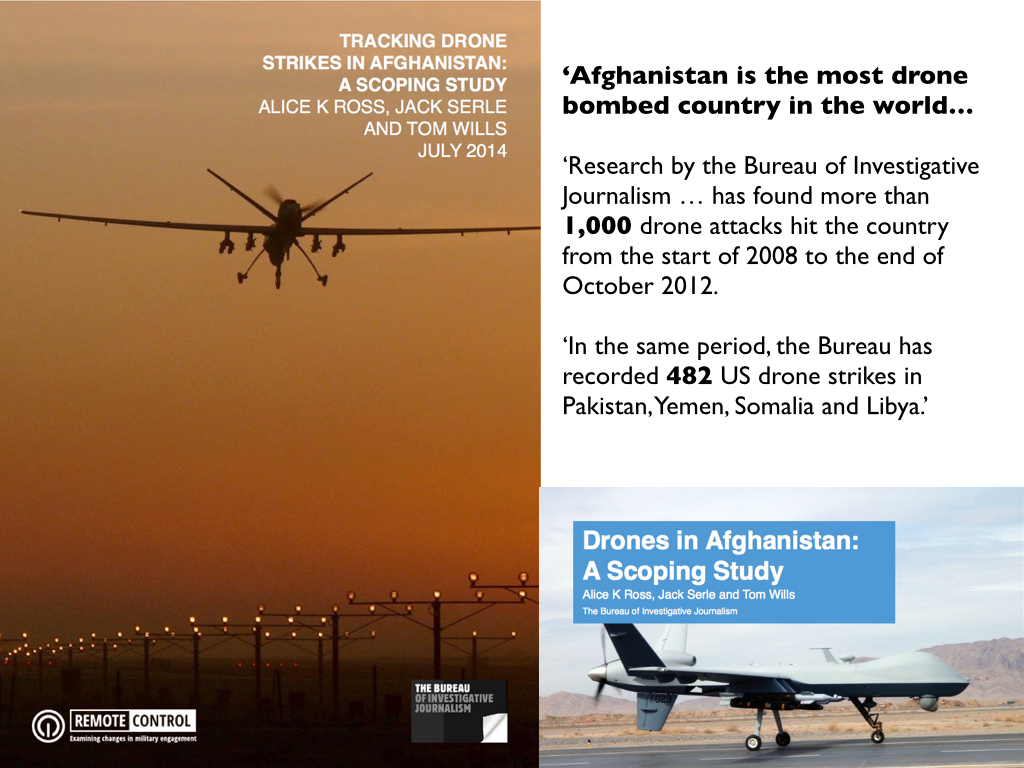
This is not the first time that the trauma of living beneath the ‘persistent presence’ of Predators and Reapers has been brought to critical attention, most vividly in the NYU/Stanford study Living Under Drones: Death, injury and trauma to civilians from US drone practices in Pakistan (2012).  But this is the first time I’ve seen such a detailed investigation of the impact of military violence on the people of Afghanistan.  As I’ve noted before, it’s taken a remarkably long time for investigators to examine the role of remote warfare in Afghanistan  – ‘remote’ in more ways than one – and Living beneath the Drones includes the standard interviews with David Deptula and Peter Singer who offer their usual contrasting views about its effects.

Afghanistan drone bombings BOIJ.001

But for me this is the least important contribution of the film; it’s the intimate exposure of the treatment meted out to traumatised victims of military and paramilitary violence that is most unsettling.  In fact, it’s not easy to disentangle the impact of Predators and Reapers from the larger matrix of violence in which they are enmeshed.  True, many of those interviewed describe how their lives are haunted by the drones, but this is a country where the dogs of war have prowled for four generations or more and trauma has never been rationed.  As Kevin Sieff’s report for the Washington Post in October 2012 showed, it’s usually impossible to fasten on a single incident or even to get an adequate history:

No one here knows the man whose left leg is shackled to the wall of cell No. 5. Last week, he finished tearing his mattress to shreds and then moved onto his clothes, ripping his shirt and pants off before falling asleep naked…

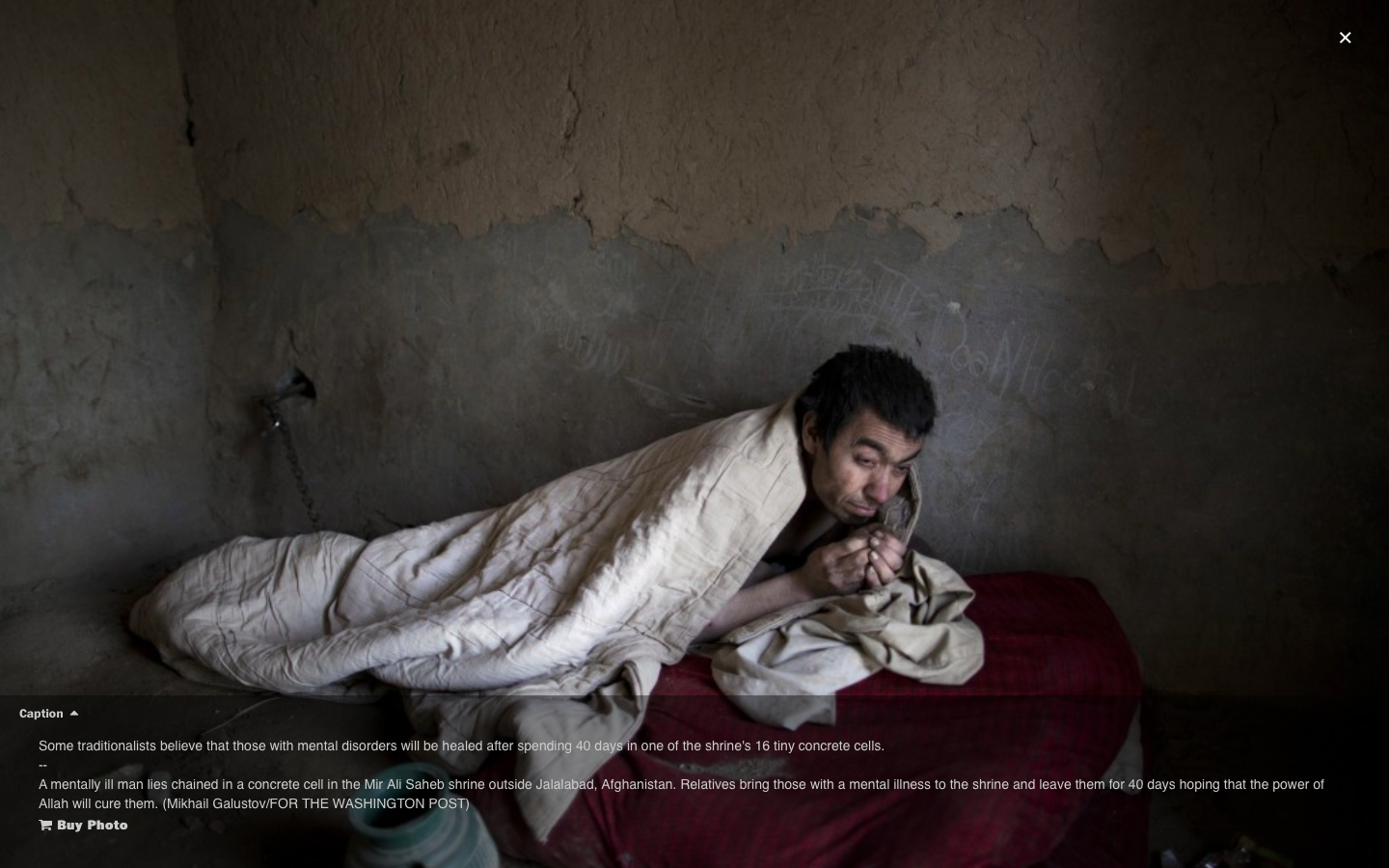
The man’s brothers drove him here from southern Kandahar province two weeks ago, drawn by the same belief that has attracted families from across Afghanistan for more than two centuries. Legend has it that those with mental disorders will be healed after spending 40 days in one of the shrine’s 16 tiny concrete cells. They live on a subsistence diet of bread, water and black pepper near the grave of a famous pir, or spiritual leader, named Mia Ali Sahib.

Every year, hundreds of Afghans bring mentally ill relatives here rather than to hospitals, rejecting a clinical approach to what many here see as a spiritual deficiency. The treatment meted out at the shrine and a handful of others like it nationwide might be archaic, but the symptoms are often a response to 21st-century warfare: 11 years of night-time raids, assassinations and suicide bombings.

For over a decade, Western donors have helped train Afghan psychiatrists, who diagnose many of their patients as having an ailment with a distinctly modern acronym: PTSD, or post-traumatic stress disorder. Mental health departments in Afghanistan are plastered with posters detailing the disorder’s symptoms. Pharmacies are stocked with antipsychotic drugs.

But many of those suffering from the disorder never see doctors or pharmacists. Instead, they are taken on the long, unmarked dirt road, through a village of mud huts, that leads to an L-shaped agglomeration of cells.

The brothers of the man in cell No. 5 drove back to Kandahar, more than 400 miles away, once the shackles were in place. They left an indecipherable phone number on a scrap of paper. They paid $20 for the treatment, as all patients must. If they told anyone the name of the man, no one remembers.

“What will I do with this man?” asked Shafiq, the shrine’s director and a descendant of Sahib. “Who is this man?”

Shafiq wondered: Was the man’s mental state a product of war? Was he a former soldier? A civilian who had seen too much horror?

Afghan shrine:Mikhail Galustov

And so here is Emma Reynolds on what I take to be the central message of Living beneath the drones:

When a Western soldier suffers from post-traumatic stress disorder, there are doctors and organisations who can help them recover from the heartbreaking legacy of war.

When it is someone from Afghanistan, where bombings regularly wreak devastation and tear families apart, you are unlikely to find any assistance, since there is little understanding of mental illness in the country.

“The most common treatment is to take your loved one to a religious shrine where they are chained to walls or trees for up to 40 days, fed stale bread, water and ground pepper, and read dubious lines from the Qur’an by individuals with no medical or, for that matter, religious training,” documentary-makers Jamie Doran and Najibullah Quraishi [said]…

Many of the shrines are nothing more than money-making enterprises run by con artists with little or no religious training…

You might have thought that civilians and soldiers living in war zones would become hardened to this life, and find it almost normal. In fact, the pervasive atmosphere of violence and fear takes a bitter toll, and this terrible truth can be seen most clearly in Afghanistan, the site of the longest war ever for Australia and the US. “When you talk to them, there is little joy in their words any more,” said UK-based director Doran…  “Anyone with a family, children, someone you love, is forever in fear of losing them. You can see it in their worn faces.”

Hope and confidence in the future had steadily dissolved, with millions now thought to be suffering from PTSD, with little hope of treatment. Only one hospital in the entire country is dedicated to mental health, despite official estimates indicating that 60 to 70 per cent of the country’s population now suffer from some mental health problem. Unofficial estimates go as high as 95 per cent. This is the real human impact of living with the daily threat of death.

Afterwar(d)s

I’ve been working my way through the proofs of ‘The natures of war’, in which (among other things) I try to show that soldiers are not only vectors of military violence but also victims of it.  My analysis fastens on the Western Front in the First World War, Northern Africa in the Second World War, and Vietnam – the final draft is under the DOWNLOADS tab and the published version should be up on the Antipode website later this month – but I hope it will be clear to readers that the implications of this claim , and the others in the essay, extend into our own present.  They also intersect with my current research on casualty evacuation from war zones, 1914-2014.

So I’ve been interested in three recent contributions that detail the aftermath of war for those who fight them.

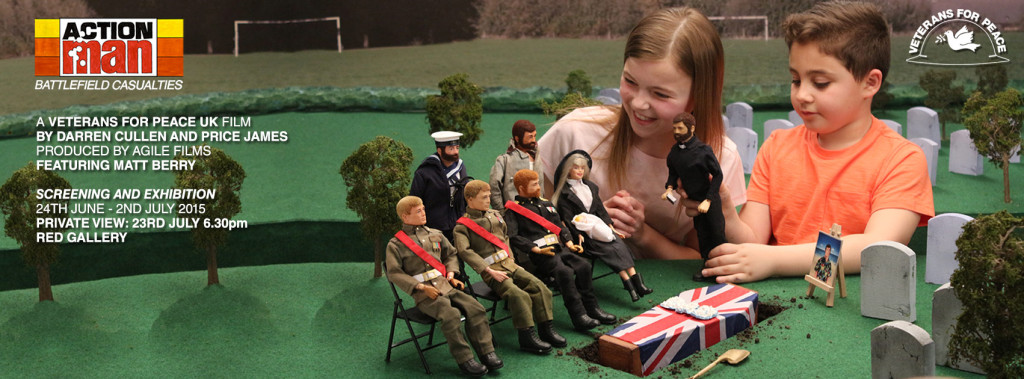
First, Veterans for Peace UK have worked with Darren Cullen to produce a short film, Action Man: Battlefield Casualties [see the clip above] in an attempt, as Charlie Gilmour explains over at Vice,

‘to show the shit beneath the shine of polished army propaganda. Featuring PTSD Action Man (“with thousand-yard stare action”), Paralysed Action Man (“legs really don’t work”) and Dead Action Man (“coffin sold separately”)…’ [see also my post on ‘The prosthetics of military violence‘]

Actionman-1024x379

In keeping with the project’s authors, Charlie insists – I think properly – that many of those who were sent to Afghanistan from the UK were child soldiers (and here I also recommend Owen Sheers‘ brilliant Pink Mist for an unforgettable portrayal of what happens when boys who grow up ‘playing war’ end up fighting it: see also here and here).  As the project’s web site notes:

The UK is one of only nineteen countries worldwide, and the only EU member, that still recruits 16 year olds into its armed forces, (other nations include Iran and North Korea). The vast majority of countries only recruit adults aged 18 and above, but British children, with the consent of their parents, can begin the application process to join the army aged just 15…

It is the poorest regions of Britain that supply large numbers of these child recruits. The army has said that it looks to the youngest recruits to make up shortfalls in the infantry, by far the most dangerous part of the military. The infantry’s fatality rate in Afghanistan has been seven times that of the rest of the armed forces.

Forces Watch JPEG

Child Soldiers International JPEG

A study by human rights groups ForcesWatch and Child Soldiers International in 2013 found that soldiers who enlisted at 16 and completed training were twice as likely to die in Afghanistan as those who enlisted aged 18 or above, even though younger recruits are, for the most part, not sent to war until they are 18.

You can find another thoughtful reflection on child soldiers by Malcolm Harris over at the indispensable Aeon here. He doesn’t include the British Army in his discussion, but once you do you can see that the implications of this passage extend beyond its ostensible locus (Nigeria):

But can a child truly volunteer to join an army? Even when they enlist by choice, child soldiers do so under a set of constraining circumstances. UNICEF makes the choices sound easy: war or dancing, war or games, war or be a doctor. No rational child would pick the former for themselves, and that’s posed as evidence that their freedom has been taken from them. But when the choice is ‘soldier or victim’, voluntarism takes on a different meaning.

FINKEL Thank you for your service

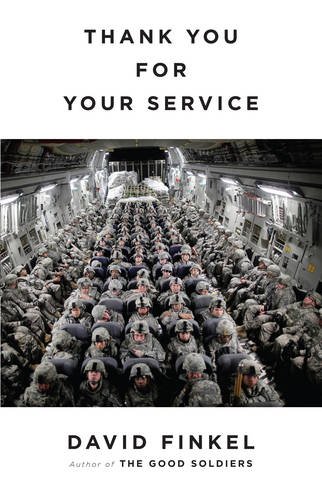
Second, moving across the Atlantic and providing an extended riff on the ‘thank you for your service’ gesture, the latest issue of New Left Review includes an essay by Joan Wypijewski, ‘Home Alone‘, that describes the journey home faced by many US veterans.  She begins by putting David Finkel‘s compelling book in context:

The term ‘Thank You for Your Service’ developed early on in the long wars. Like ‘Support the Troops’, it was a way for a sheltered people to perform unity. In towns across America yellow ribbons, yellow lawn signs, balloons and car decals sprouted like team colours on game day. War would be a sport, the people spectators, and ‘Thank you for your service’ the high-five to combatants after quick and decisive victory. When that proved a vain hope, team spirit settled into the rhythms of commerce. ‘Support the Troops’ appeared the way ‘Buy American’ once had—a slogan on shop windows, billboards, bumper stickers. War was an enterprise, security its product, the people consumers, the soldiers trained workers and ‘Thank you for your service’ a kind of tip. As the enterprise (though hardly the business) failed, the signs faded, sometimes replaced by an image of folded hands, ‘Pray for Our Troops’. War had become a problem, the soldiers exhausted, the people clueless and ‘Thank you for your service’ a bit of empty etiquette, or a penance. By the time Finkel was writing [his book was published in October 2013], what remained among civilians was a desire to move on, and among soldiers, bitterness. ‘They wouldn’t be fucking thanking me if they knew what I did’, many would say, in almost exactly the same words.

Joan works her way through Finkel’s account, and then turns to Laurent Bécue-Renard’s Of Men and War, a documentary film – five years in the making, and the second instalment in a trilogy devoted to a ‘genealogy of wrath‘ – of Trauma Group sessions at a treatment centre in the Napa Valley:

‘What we have is embarrassing as shit’, a thick, tight young white man says in the Trauma Group. ‘You feel small—you feel defective.’ And so it goes, and so men trained for toughness talk of being weak and scared and monstrous, or just diligent. Of working in Mortuary Affairs: ‘breaking the rigour down’ to get the corpse of a 19-year-old who killed himself flat enough for a body bag, or untangling the remains of a group of faceless soldiers burned in a truck who are fused ‘like a bunch of rope’. They talk of their dreams, of their frightened wives. Maybe she moved out and got a restraining order before he came home, or maybe she has the divorce papers but is holding back as long as he’s getting help. ‘I have no clue what it’s like to be a woman married to a man twice your size and that’s lethal, in the military, and takes his rage out on you—someone that’s supposed to love you’, a former medic says. He is slim, white, deer-like. You don’t know his war story yet, and you don’t know when you’ll find out, if you’ll find out, but you listen as he and one after another after another deals with a world of pain. And maybe men balk, and maybe they storm out of the room, and maybe Gusman, whom you’ve also never really met but who is always there, has to remind them that ‘being a hostage to the war zone is not a life’. You follow them out of the room, taking smokes, meditating, visiting their wives or parents, calling on locals, trying to be well or pass for well, knowing they’re not. You watch their children doing typical childlike things, running, laughing in a high-pitched scream, and you feel anxious for everyone in the room. You itch to get back to the Trauma Group and, amazingly, don’t feel like a voyeur, because this isn’t war porn; this is the shit, as they say.

It isn’t beautiful or horrible, it just is. And you don’t like all of these people, but that isn’t the point. They are all struggling to be human again, and you have to ask yourself if you know what that means.

Not so much dressing but ‘addressing their wounds is a revolution’, Bécue-Renard insists, and you can see – literally so – what he means.  Joan’s commentary ends with other, perhaps also revolutionary reflections.  In America, she argues,

… there has been no serious debate on, let alone demand for, a universal draft as a democratic check against offensive war. We talk against empire, but are beneficiaries of the imperial state’s professional and technological adjustments to the anti-war movement’s past victories. We talk about the invisible draft but, perhaps encouraged by the bravery of Iraq Veterans Against the War, still hope that soldiers whose food, clothing, shelter, families and identity depend on the job of war-fighting will mutiny en masse. We talk, from time to time, about the culture of abuse in basic training and on military posts, but are silent on the regimens of discipline that are being hyper-enforced in anticipation of downsizing, in other words layoffs. And for the one thing the military, however twistedly, provides—belonging, solidarity, a sense of honour and family-feeling as against loneliness—we have no alternatives at all.

Finally, Duke University Press has announced that Zoe Wool‘s book, After War: the weight of life at Walter Reed, will be out soon:

In After War Zoë H. Wool explores how the American soldiers most severely injured in the Iraq and Afghanistan wars struggle to build some kind of ordinary life while recovering at Walter Reed Army Medical Center from grievous injuries like lost limbs and traumatic brain injury. Between 2007 and 2008, Wool spent time with many of these mostly male soldiers and their families and loved ones in an effort to understand what it’s like to be blown up and then pulled toward an ideal and ordinary civilian life in a place where the possibilities of such a life are called into question. Contextualizing these soldiers within a broader political and moral framework, Wool considers the soldier body as a historically, politically, and morally laden national icon of normative masculinity. She shows how injury, disability, and the reality of soldiers’ experiences and lives unsettle this icon and disrupt the all-too-common narrative of the heroic wounded veteran as the embodiment of patriotic self-sacrifice. For these soldiers, the uncanny ordinariness of seemingly extraordinary everyday circumstances and practices at Walter Reed create a reality that will never be normal.

20080721-D-1852B-014

Here are two of the endorsements:

“Hollywood films and literary memoirs tend to transform wounded veterans into tragic heroes or cybernetic supercrips. Zoë H. Wool knows better. In her beautifully written and deeply empathic study of veterans of Iraq and Afghanistan at Walter Reed, Wool shows us the long slow burn of convalescence and how the ordinary textures of domestic life unfold in real time. An important and timely intervention.” — David Serlin, author of Replaceable You: Engineering the Body in Postwar America.

“This brilliant and absorbing ethnography reveals how the violence of war is rendered simultaneously enduring and ephemeral for wounded American soldiers. Zoë H. Wool accounts for the frankness of embodiment and the unstable yet ceaseless processes through which the ordinary work of living is accomplished in the aftermath of serious injury. After War is a work of tremendous clarity and depth opening new sightlines in disability and the critical politics of the human body.” — Julie Livingston, author of Improvising Medicine: An African Oncology Ward in an Emerging Cancer Epidemic.

Medical neutrality and modern war

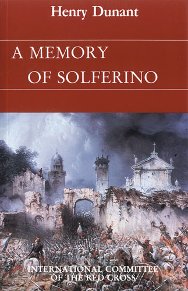
md_p0361-memory-solferinoI expect most readers know how the International Committee of the Red Cross had its origins in Henry Dunant‘s horror at the unrelieved suffering he witnessed in the aftermath of the Battle of Solferino in 1859 (see my earlier post here).

In A Memory of Solferino (1862) he asked: ‘Would it not be possible, in time of peace and quiet, to form relief societies for the purpose of having care given to the wounded in wartime by zealous, devoted and thoroughly qualified volunteers?’

Dunant’s vision of an impartial relief society to provide aid to those wounded in time of war led to the formation of a series of national relief societies and, as John Hutchinson shows in Champions of Charity: War and the rise of the Red Cross, these national societies soon became entangled with nationalism.  ‘Gripped by the passions of patriotism,’ he writes, by the time of the First World War these national societies ‘undertook to perform whatever repair work the armies required of them.’

And yet, even with these entanglements, a key principle was defended: medical neutrality.  According to Physicians for Human Rights, medical neutrality requires:

  1. The protection of medical personnel, patients, facilities, and transport from attack or interference;
  2. Unhindered access to medical care and treatment;
  3. The humane treatment of all civilians; and
  4. Nondiscriminatory treatment of the sick and injured.

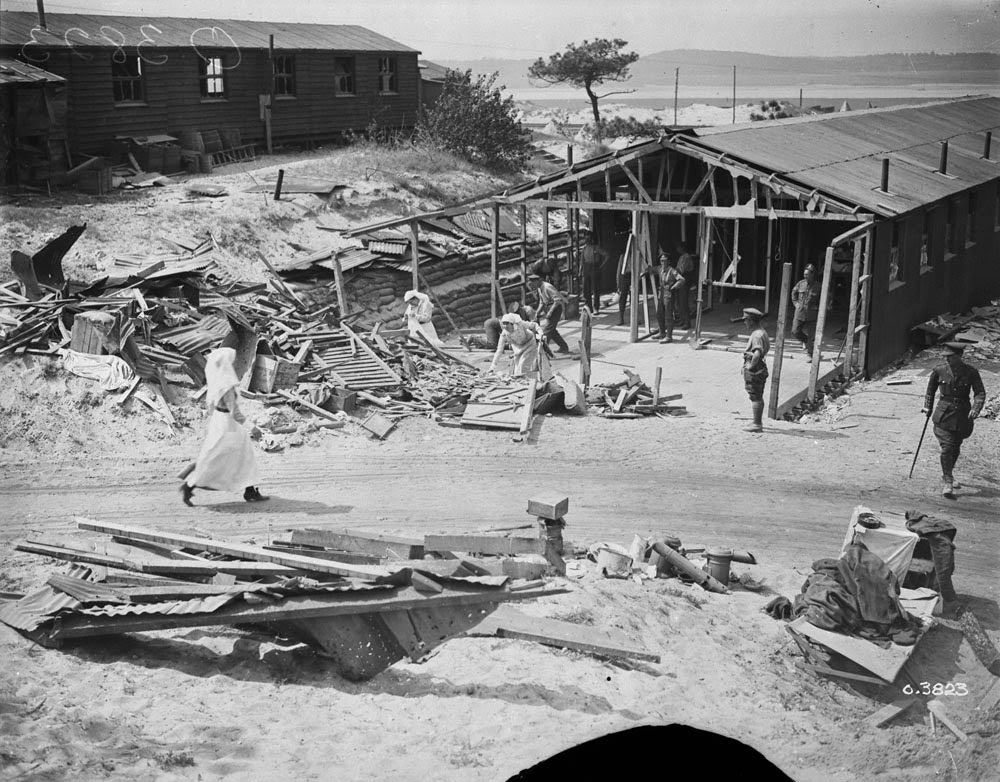
During the First World war there were complaints that the principle had been sporadically violated: that stretcher-bearers had been attacked by snipers when they sought to recover the wounded or that military hospitals had been deliberately shelled or bombed.  Here, for example, is the aftermath of one of several air raids targeting base hospitals at Etaples on the French coast between May and August 1918 (supposedly in retaliation for a British air raid on Cologne):

Lowe_Field_Hospital_bombed_LAC_PA_003747_a003747_v8.jpg_pv4a5fab25f240997c

But in the last decade of our own century such violations have become increasingly systematic. And, as more and more civilians have become trapped and even targeted in conflict zones whose ‘battlefields’ know no bounds, so those violations have extended far beyond attacks on military-medical infrastructure and personnel.

Last summer I detailed the attacks made by the Israeli military on medical facilities and emergency systems in Gaza, and I drew attention to the work of Physicians for Human Rights in documenting the precariousness of medical care there.  But the calculated production of these spaces of exception is not exceptional, and attacks like these have become part of the arsenal of later modern war.  “Instead of being protected,” says Donna McKay, executive director of PHR, “medical care is actually a target.”

HRW Attacks on Health

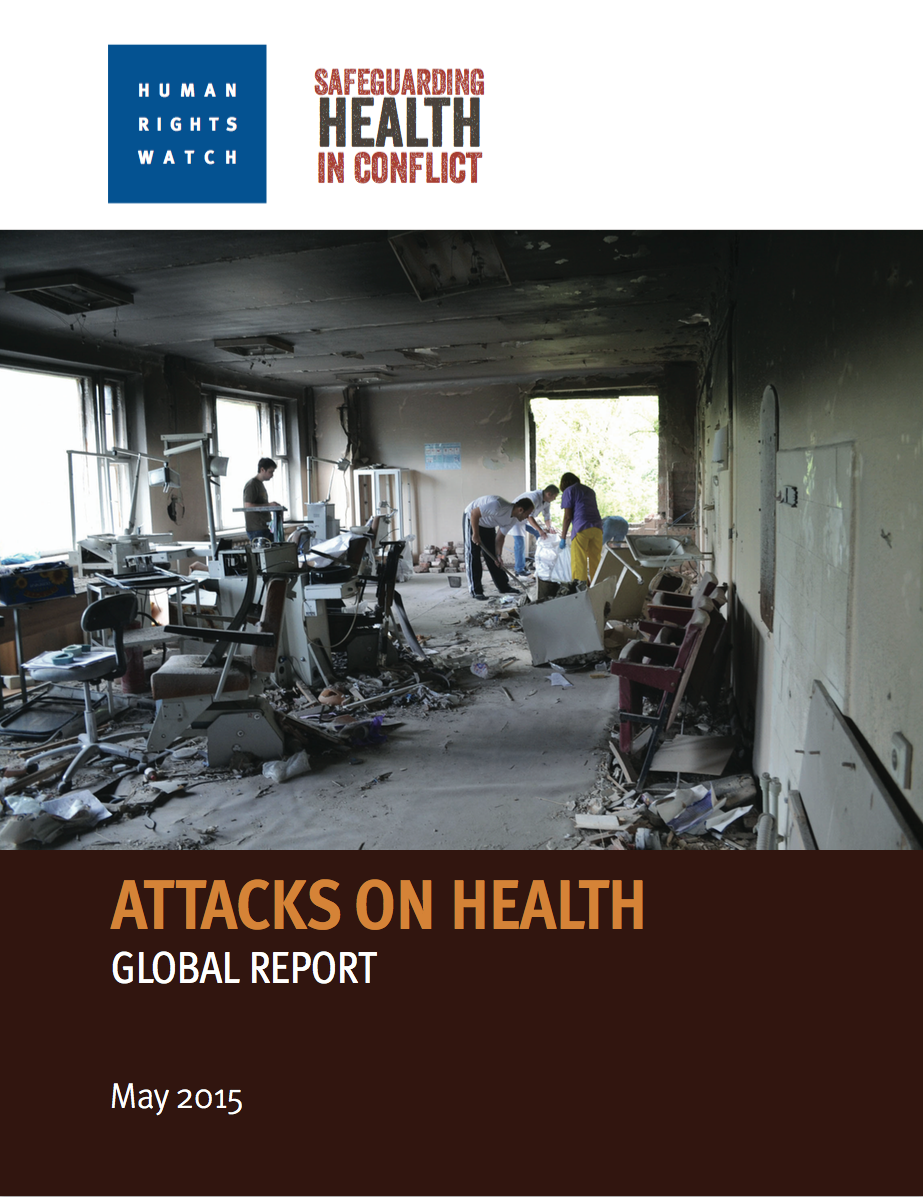
Physicians for Human Rights is part of the Safeguarding Health in Conflict Coalition which has now joined with Human Rights Watch to publish Attacks on Health: a Global Report (2015) that summarises attacks on health care facilities and health care workers around the world:

Over the past year armed groups have attacked hospitals, clinics, and health personnel in 41 incidents in Afghanistan and deliberately killed over 45 health workers, primarily polio vaccinators, in Nigeria and Pakistan. In Syria, where medical facilities in Aleppo have been hit with government barrel bombs, 194 medical personnel have been killed and 104 medical facilities attacked since 2014….

The organizations described attacks in South Sudan, where 58 people were killed in four hospitals in a series of attacks in early 2014, and in eastern Ukraine, where it is estimated that 30 to 70 percent of health workers have fled the region because of insecurity. In Yemen, Al-Qaeda in the Arabian Peninsula (AQAP) militants carried out attacks on health facilities in early 2014, and the 10-country Saudi-led coalition conducted air strikes that hit hospitals and interrupted medical supplies during the conflict in early 2015. Relying on data from Insecurity Insight’s Security in Numbers Database, the report also shows trends in attacks on health care over the course of a decade in South Sudan and Central African Republic.

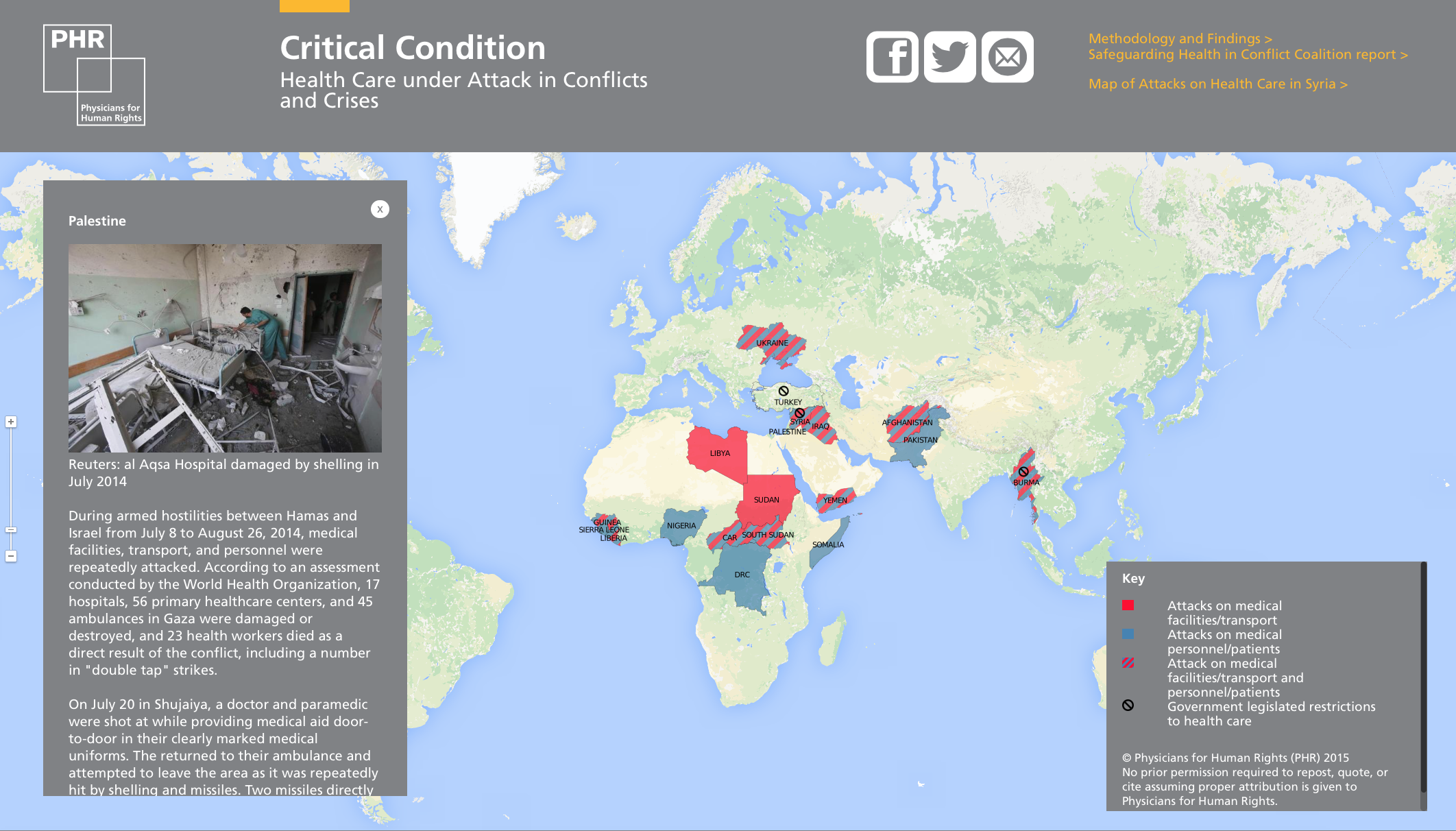
PHR Critical Condition

In close concert with the report Physicians for Human Rights have produced an interactive online map of attacks on health care around the world between January 2014 and April 2015 (see the screenshot above).

PHR Attacks on health care in Syria

The organisation has also produced a detailed map of attacks on health care systems – or what’s left of them – in Syria (see the screenshot above), which you can access here.  It needs to be supplemented by PHR’s Doctors in the crosshairs: four years of attacks on health care in Syria, which was published in March:

The symbols of the Red Cross and Red Crescent have been turned from a shield of protection into crosshairs on the backs of those who knowingly risk their lives to save others.

You can find more on the violation of medical neutrality in Syria in an open-access article by Ravi S. Katari in the Journal of global health here and in a short essay by Sasha Zients and Dylan Okabe-Jawdat for the Columbia Political Review (May 2015) here.

And you can find more on the systematic violation of medical neutrality in Bahrein and elsewhere here.

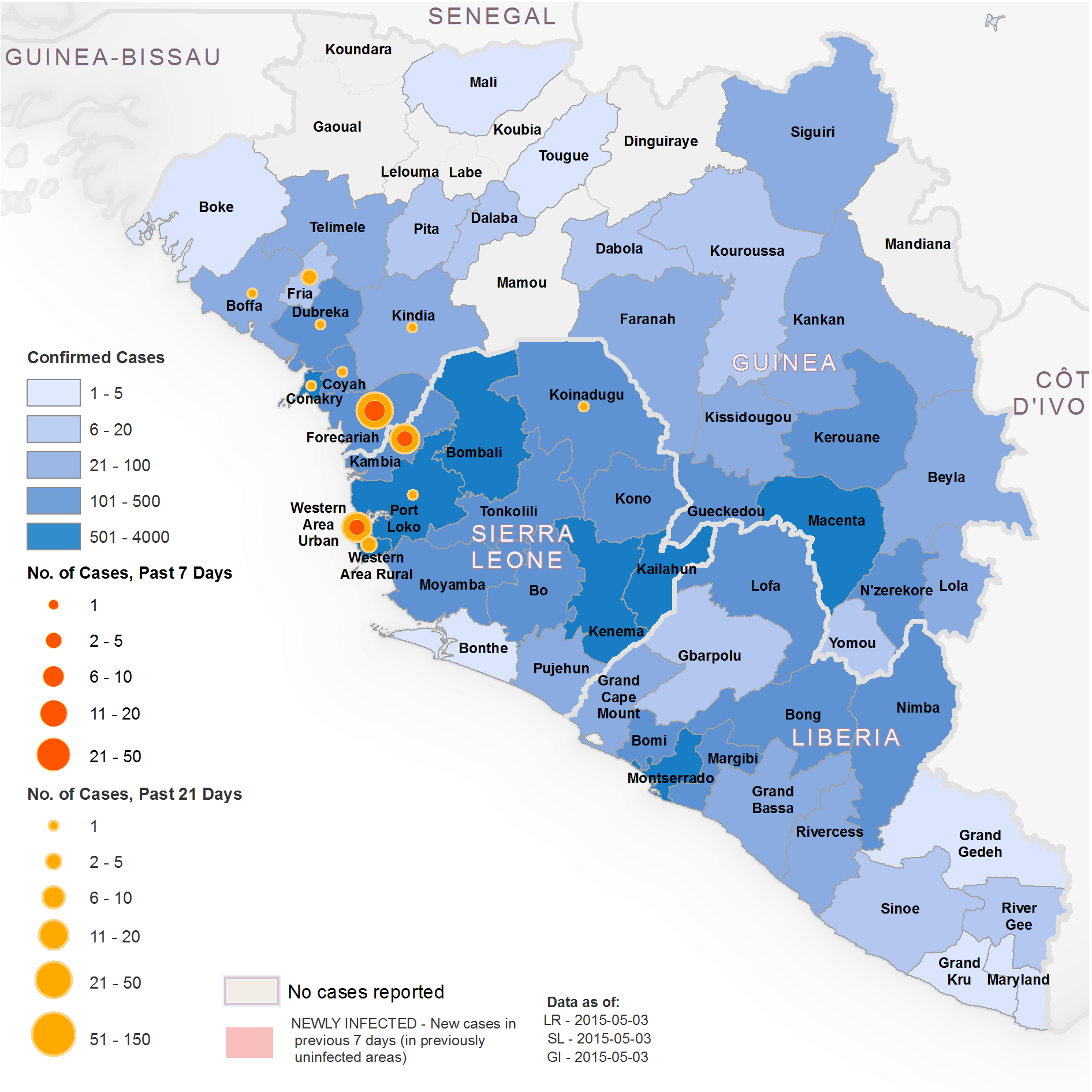
West Point and the war on Ebola

I’ve taken this map from a Situation Report issued by the World Health Organisation on 6 May, which superimposes new cases of Ebola virus disease (EVD) over total confirmed cases throughout the epidemic in West Africa:

SITREP_CASECOUNT_7

Three days later the WHO declared Liberia to be free of Ebola:

Forty-two days have passed since the last laboratory-confirmed case was buried on 28 March 2015. The outbreak of Ebola virus disease in Liberia is over.

Interruption of transmission is a monumental achievement for a country that reported the highest number of deaths in the largest, longest, and most complex outbreak since Ebola first emerged in 1976. At the peak of transmission, which occurred during August and September 2014, the country was reporting from 300 to 400 new cases every week.

During those 2 months, the capital city Monrovia was the setting for some of the most tragic scenes from West Africa’s outbreak: gates locked at overflowing treatment centres, patients dying on the hospital grounds, and bodies that were sometimes not collected for days.

So it’s high time I redeemed my promise to return to the ‘war on Ebola‘.

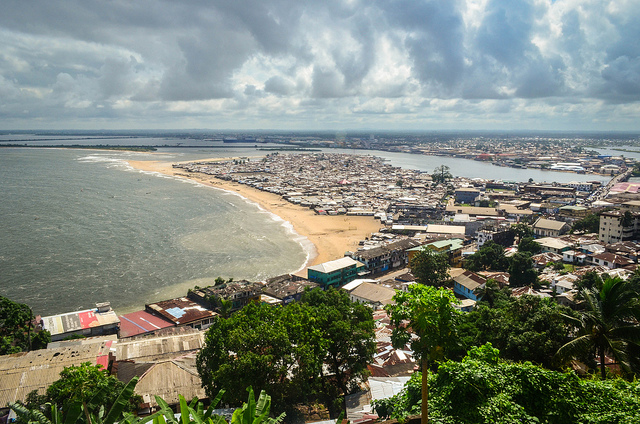
In previous commentaries I discussed the militarisation of the epidemic and, in particular, the mission of the US military under the direction of US Africa Command.  But the ‘West Point’ in my title is thousands of miles from the US Military Academy in upstate New York…   It’s a sprawling informal settlement in Monrovia, the capital of Liberia (below).

West Point, Monrovia

In an extended essay in the New Yorker earlier this year, ‘When the fever breaks‘, Luke Mogelson told the story of Omu Fahnbulleh and her husband Abraham.  They lived with their three children in Robertsport in northern Liberia.  Last summer Fahnbulleh tested positive for Ebola; by the time an ambulance arrived Abraham was sick too, and they were both loaded into the back and driven off.

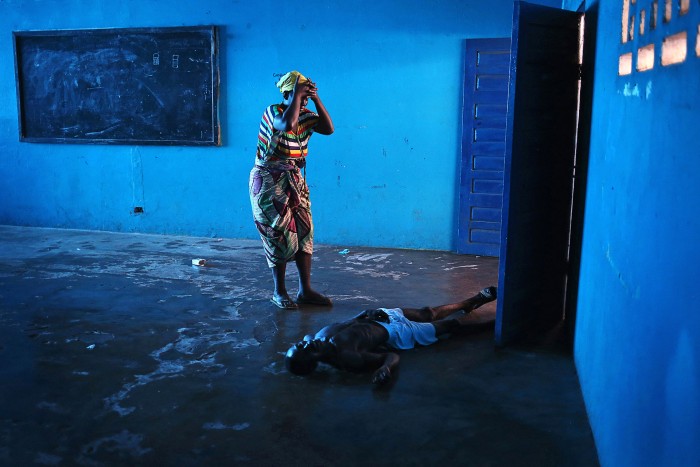
Fahnbulleh and her husband believed that they were going to a hospital. Instead, several hours later, the ambulance turned onto a narrow lane that ran past low-slung shops and shanties. Fahnbulleh realized that they were in West Point, Monrovia’s largest slum. A police officer opened a metal gate, and the ambulance stopped inside a compound enclosed by tall walls. In the middle of the compound stood a schoolhouse. The driver helped Fahnbulleh and Abraham through a door, down a hall, and into a classroom. A smeared chalkboard hung on one of the walls, which were painted dark blue. Dim light filtered through a latticed window. On the concrete floor, ailing people were lying on soiled mattresses. When Fahnbulleh lay down, she saw that the two men beside her were dead.

This was the only school in West Point, originally built by USAID, and it had been converted into a ‘holding centre’ for Ebola patients; the only ‘treatment’ on offer was provided by a man in a biohazard suit spraying the floor, the walls and the patients with chlorine.  Two nights later Abraham died, and as soon as it was light Fahnbulleh – convinced she would die too if she stayed – determined to escape.

At daybreak, after spending the night in the other classroom, she walked out of the school. Policemen loitered in the yard. When Fahnbulleh reached the gate, they let her pass, afraid to touch her.

After several nights of sleeping rough she was taken to an Ebola Treatment Unit at a government hospital, from where she was eventually discharged.

image.php

It’s a heart-breaking story, made all the more extraordinary by a photograph taken by John Moore which shows ‘Omu Fereneh’ standing over the body of her husband ‘Ibrahim’ on 15 August in the schoolhouse. The image was widely reproduced – see also here, for example – and raises important questions about the mediatisation as well as the militarisation of the crisis.  Moore’s work won him the title of  L’Iris d’Or /Sony World Photography Awards’ Photographer of the Year:

 John Moore’s photographs of this crisis show in full the brutality of people’s daily lives torn apart by this invisible enemy. However, it is his spirit in the face of such horror that garners praise. His images are intimate and respectful, moving us with their bravery and journalistic integrity. It is a fine and difficult line between images that exploit such a situation, and those that convey the same with heart, compassion and understanding, which this photographer has achieved with unerring skill. Combine this with an eye for powerful composition and cogent visual narrative, and good documentary photography becomes great.

I’m not sure that Omu Fereneh is Omu Fahnbulleh, or Ibrahim Abraham, but it would be a remarkable coincidence if they were not the same people.

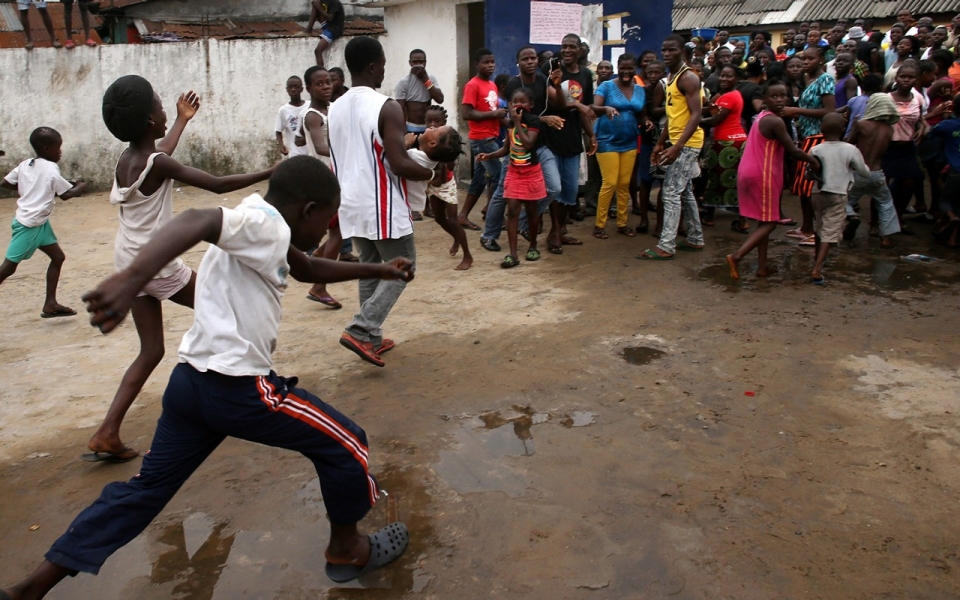
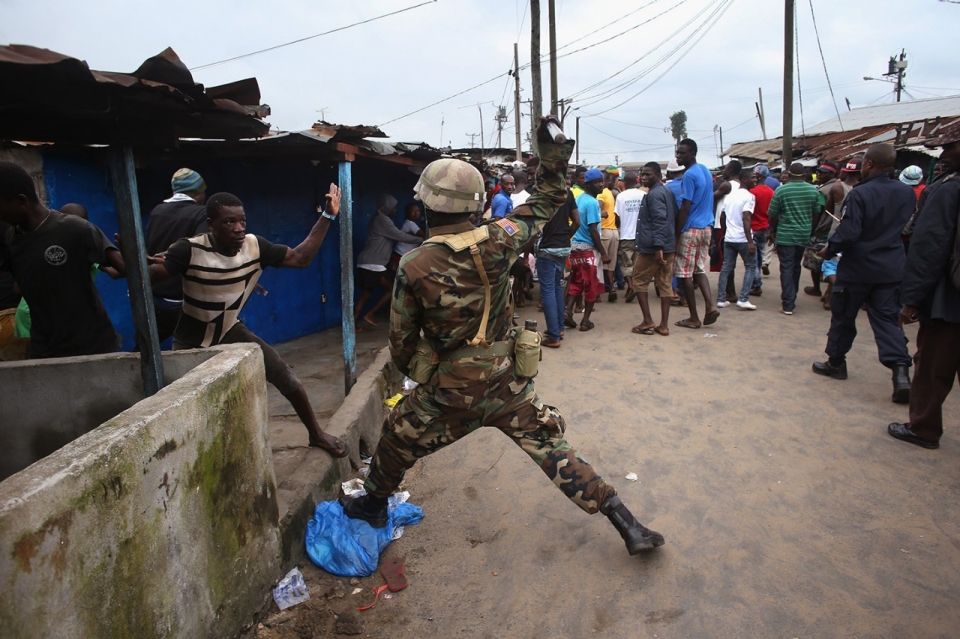
In any event, soon after the photograph was taken and soon after Fahnbulleh escaped, the situation in West Point changed dramatically.  Realising that their community had become a dumping ground for Ebola victims from all over Liberia, local residents stormed the schoolhouse and demanded it be closed.  They ransacked the building, making off with mattresses and sheets, and evicted over 20 patients who they claimed had been brought in from outside West Point.

src.adapt.960.high.west_point_ebola_1.1408545798468

Two days later the state called in its security forces which had urged the imposition of mass quarantine.  Joe Shute takes up the story:

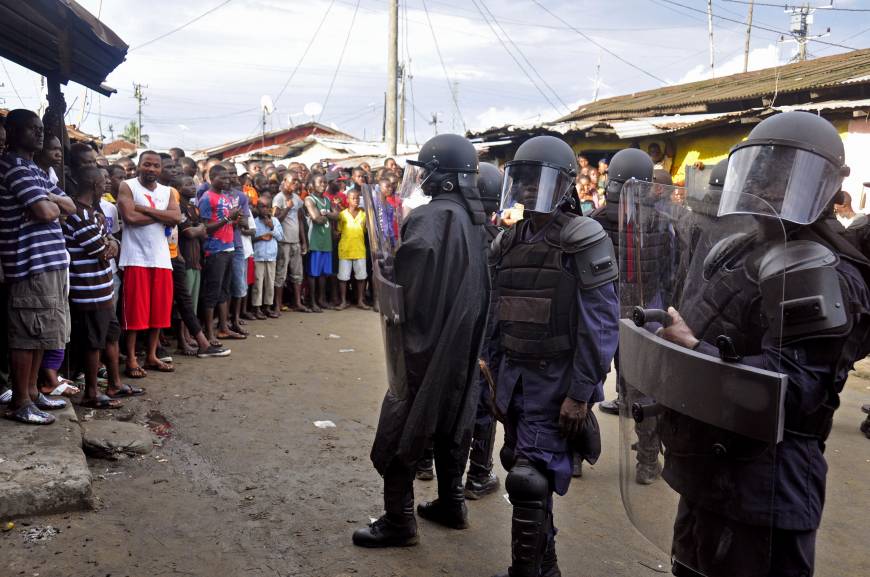
On August 20, President Ellen Johnson Sirlief ordered the only road leading in to the slum be sealed off, and the entire community placed under quarantine. As the army moved in, many of the city’s vagrants who slept in the slum at night were trapped inside.

f-libebola-a-20140822-870x577

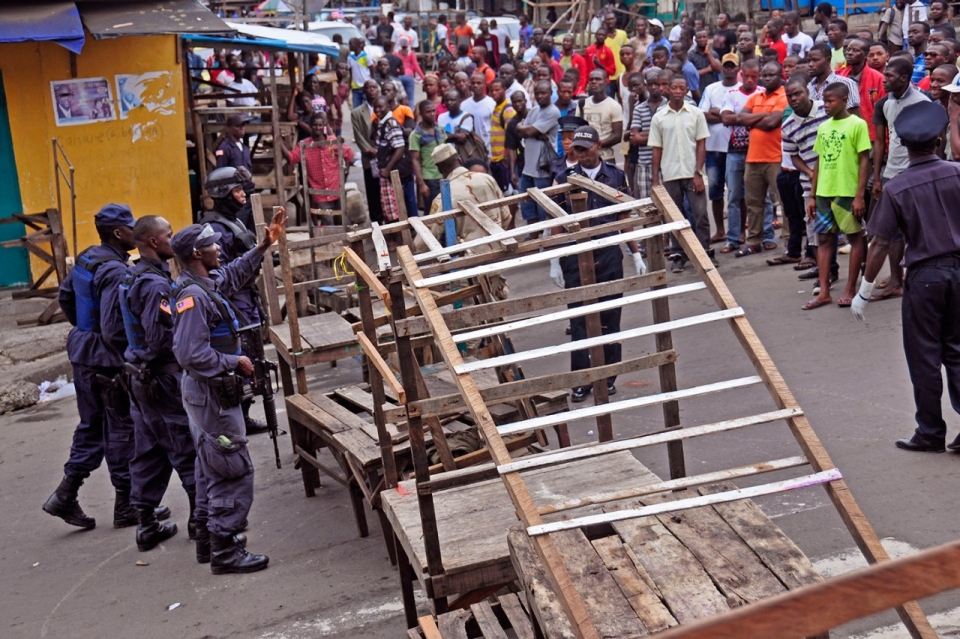
West Point was surrounded by barricades and barbed wire; police in helmets and riot-shields stopped people going out into the city; gunships patrolled the water front, and a nightly curfew was imposed on the district’s 70,000 residents.  There was, Joe reports, ‘a desperate clamour to escape, some people even trying to swim around the peninsula to enter the city’s port.’

image.adapt.960.high.westpoint_1

The imposition of a militarised quarantine was a double mis-step.

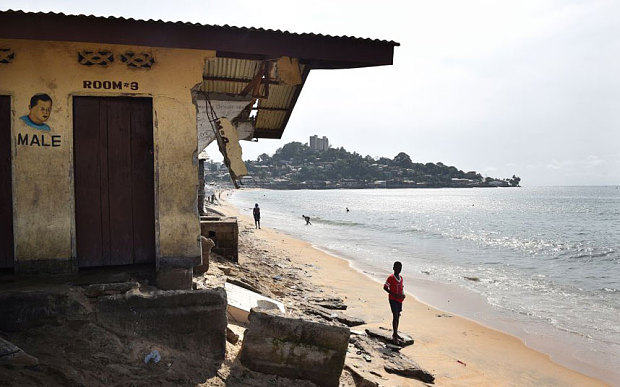
First, it exacerbated the already precarious position of West Point residents.  Many of them were refugees and child soldiers from Liberia’s civil wars; they were crowded together in makeshift corrugated-iron shacks, almost all of them without plumbing or running water.  The district is threaded by narrow sand alleys – there is only one paved road – and by open sewers.  In 2009 the UN Office for the Coordination of Humanitarian Affairs reported there were only four public toilets in West Point; to use them cost 2-3 cents, and many chose to use the beach instead.

ebola-beach_3139030b

Most of West Point’s residents were dependent on access to the city and the ocean for their livelihood, but with the imposition of the blockade food supplies dwindled and food prices sky-rocketed.  As the Institute for Development Studies argued in a Practice Paper on ‘Urbanisation, per-urban growth and zoonotic disease‘ earlier this year:

Poor peri-urban residents, with no money to purchase and store in bulk, buy essentials daily. When lock-down, intended to halt disease spread, occurs, shops, markets and transport facilities are closed, reducing opportunities for peri-urban residents to work and earn cash for food. Many of their activities continue clandestinely, undermining the health intervention. During attempts in West Point to contain the spread of Ebola, people found new ways of moving through the area quarantined in August 2014. Their concern was not exposure to Ebola, but their inability to access food and water.

Some bribed the police to let them out; others, still more desperate, even swam around the point.  Here is a report from Norimitsu Onishi writing in the New York Times:

“We suffering! No food, Ma, no eat. We beg you, Ma!” one man yelled at Ms. Johnson Sirleaf as she visited West Point … surrounded by concentric circles of heavily armed guards, some linking arms and wearing surgical gloves.

“We want to go out!” yet another pleaded. “We want to be free, Mama, please.”

Quarantine has to be seen as a political, even a biopolitical response.  As the IDS insists,

In the face of Ebola, and with the pressure on governments to act, the peri-urban area becomes an attractive place to intervene. The deployment of the military and the police to quarantine the peri-urban is a tangible manifestation of state power that is oppressive for residents. Thus quarantine-related activities fulfil the political role of assuaging the urban elite’s fears of contagion – ‘cleaning up’ the peri-urban by excluding the poor, rather than helping them or addressing the key challenges of the disease.

And, as Onishi also explained, the political implications were not lost on local residents:

“Putting the police and the army in charge of the quarantine was the worst thing you could do,” said Dr. Jean-Jacques Muyembe, a Congolese physician who helped identify the Ebola virus in the 1970s, battled many outbreaks in Central Africa and has been visiting Monrovia to advise the government. “You must make the people inside the quarantine zone feel that they are being helped, not oppressed.”

image.adapt.960.high.westpoint_5

Not surprisingly, the imposition of quarantine provoked concerted collective protest.  Hundreds of young men tried to storm the barricades and force their way through the makeshift checkpoint.  Soldiers and police opened fire, killing a fifteen-year-old boy.

As Clare Macdougall reported:

“The force was disproportionate, they were already using batons, sticks, they had access to teargas and equipment to things to control an unarmed crowd,” said Counsellor Tiawan Gongloe, Liberia’s most prominent human rights lawyer. “I find it difficult to believe that there was any justification for shooting a 15-year-old boy who was unarmed. This is not a militarized conflict, it is a disease situation and a biological problem.”

Second, as this implies, quarantine is not an effective counter-measure and may well be counter-productive.  Sealing off ‘plague towns’ was a medieval and early modern response to infectious disease – remember your Foucault! – but as one commentator noted, ‘isolating a small group of unhealthy people with a large group of healthy residents can cause more harm than good if they don’t get access to food, water and medical care — all of which are in increasingly short supply.’  In fact, transmission of Ebola occurs through bodily fluids once a patient shows symptoms of the disease, which means that the most effective response is not mass quarantine but the isolation of individual cases.  This places a premium on contact tracing (you can find another image gallery from John Moore here, tracking a tracing coordinator in West Point; see also my previous post for more details and links on contact tracing).

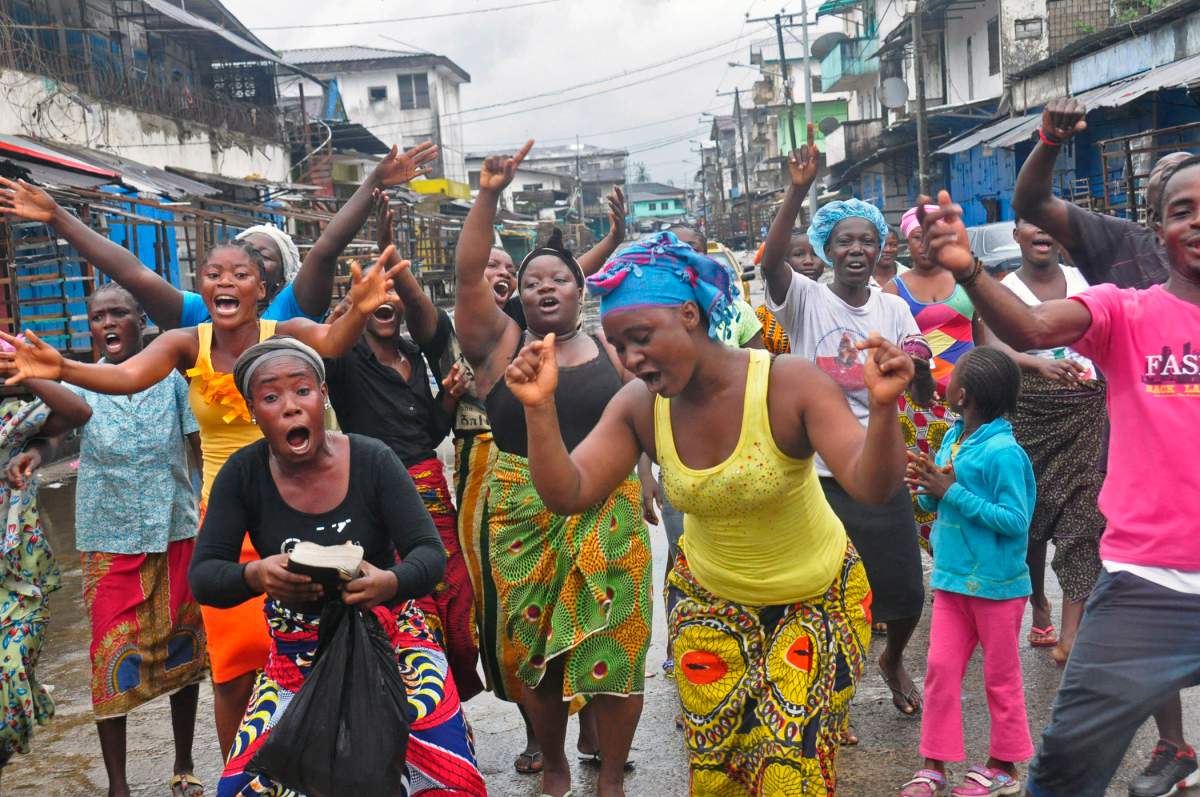
Following negotiations with community leaders, the government eventually agreed to lift the quarantine.  ‘We are out of jail!” declared one triumphant resident.

People celebrate in a street outside of West Point slum in Monrovia, Liberia, Saturday, Aug. 30, 2014. Crowds cheer and celebrate in the streets after Liberian authorities reopened a slum where tens of thousands of people were barricaded amid the countryís Ebola outbreak. The slum of 50,000 people in Liberia's capital was sealed off more than a week ago, sparking unrest and leaving many without access to food or safe water. (AP Photo/Abbas Dulleh)

People celebrate in a street outside of West Point slum in Monrovia, Liberia, Saturday, Aug. 30, 2014. Crowds cheer and celebrate in the streets after Liberian authorities reopened a slum where tens of thousands of people were barricaded amid the countryís Ebola outbreak. The slum of 50,000 people in Liberia’s capital was sealed off more than a week ago, sparking unrest and leaving many without access to food or safe water. (AP Photo/Abbas Dulleh)

Now people started to mobilise in other ways.  In return for removing the barriers and barbed wire, Luke Mogelson explained, community leaders implemented other containment measures:

identifying sick people, removing them from the community, quarantining their houses, tracking down their recent contacts, and monitoring those contacts for twenty-one days—the maximum amount of time the virus has been known to incubate before manifesting symptoms. Previously, all this was the responsibility of highly trained specialists…

In West Point, the job fell to the neighborhood. “We had to guarantee that the things that needed to be done would be done by ourselves,” Archie Gbessay, another local leader, who worked with Martu to carry out the interventions, told me one afternoon in November. We were walking down the main road that snakes through West Point. Gbessay wore a knapsack filled with case-investigation forms and kept his thumbs hooked on the chest-strap clipped across his sternum. He is twenty-eight years old but exudes a quiet force that seems to have accrued over a much longer life; his face quivers with intensity when he talks about Ebola. “If we didn’t do this, nobody was going to do it for us,” he said.

To build a network of active case-finders who could cover all of West Point, Gbessay recruited three volunteers from each of the slum’s thirty-five blocks. Most of them were young and had a degree of social clout—“credible people,” Gbessay called them. The quarantine had done little to alleviate popular skepticism of the government’s Ebola-containment policies, however, and, for a while, hostility persisted. “At first, the cases were skyrocketing,” Gbessay said. “We used to see seventy, eighty cases a day. But by the middle of September everyone started to think, Look, I better be careful. Today, you talk to your friend—tomorrow, you hear the guy is gone. So they started to pay attention.”

11-05-2014Volunteers_Ebola

Otis Bundor, a contact tracer in West Point, described his day’s work and emphasised the importance of a trust that depended on local knowledge and on being known:

At the beginning of the outbreak, people were afraid to tell us if their family members were sick. They worried about stigmatization, and they were frightened that their wife or sister or son would go to the hospital and never come back. Some people thought that health workers were injecting patients with poison. As a contact tracer, you need to have the intellectual prowess to convince doubters that Ebola is real…

At first, family members hid bodies and buried them under the cover of darkness. This is one of the reasons that the disease became an epidemic. Attitudes changed only when people noticed that in almost all of the houses where someone died, another person later got sick. In one household, more than seven people died after they vehemently prevented contact tracers from entering.

But gradually contact tracing – or, more accurately, the contact tracers – became accepted as something other than policing.  By the time Luke Mogelson visited West Point the holding centre in the schoolhouse had reopened as a transit centre:

 Now, when residents of the slum felt unwell, they came here to be diagnosed and, if necessary, wait for an ambulance that was staffed by West Pointers and managed by Martu. The average wait time had become a matter of minutes, rather than days.

In September, at the height of the outbreak in Monrovia, the C.D.C. warned that Ebola could infect 1.4 million West Africans by late January. The prediction assumed that no “changes in community behavior” would occur. By November, that assumption was obsolete in West Point. Gbessay’s active case-finders had largely prevailed on their neighbors to come forward with symptoms and observe basic precautions such as avoiding physical contact with each other and washing their hands several times a day at the hundreds of chlorine buckets stationed throughout the city. As a result, cases were waning. “Every day, patients come,” the supervisor of the transit center told me. “But it’s going down. It’s getting less and less.”

And as Lenny Bernstein noted, this turn-around ‘has occurred without the provision of a single treatment bed by the U.S. military, which has promised to build 17 Ebola facilities containing 100 beds each across Liberia.’

Divisions of Life

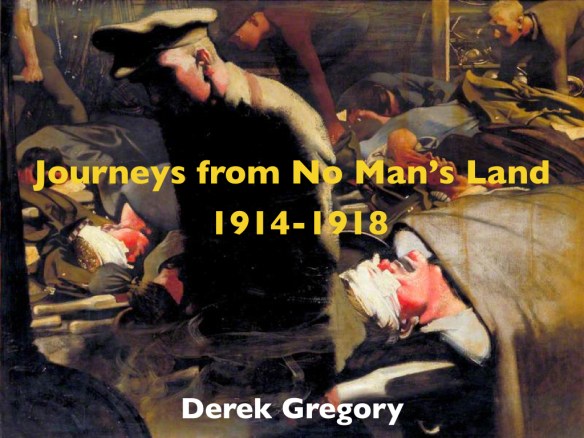
Journeys from No Man's Land.001

My main presentation at the AAG in Chicago was part of a session organised by Noam Leshem and Alasdair Pinkerton on Remnants of No Man’s Land: history, theory and excess (more on their larger project here).  Here is an extended summary of what I had to say, together with some of my slides, but bear in mind that this all had to be done in 20 minutes so there wasn’t much room for nuance.  Neither was there time to discuss civilian entanglements, both volunteers and victims, nor the sick: the presentation focuses on the wounded, even though the problems of trench foot, ‘trench flu’, and a host of other diseases were also extremely important.  They do all receive attention in the larger project from which this is extracted.  One last, geographical qualification: my discussion is limited to the evacuation of British and imperial troops from the Western Front.

My starting-point was the strange disappearance of the wounded from the field of battle.  As John Keegan wrote in The Face of Battle, in most histories the ‘wounded apparently dematerialize as soon as they are struck down’; he was writing specifically about General Sir William Napier’s account of the battle of Albuera in 1811, but the point is a sharp one that can be enlisted as part of a more general critique of military history.

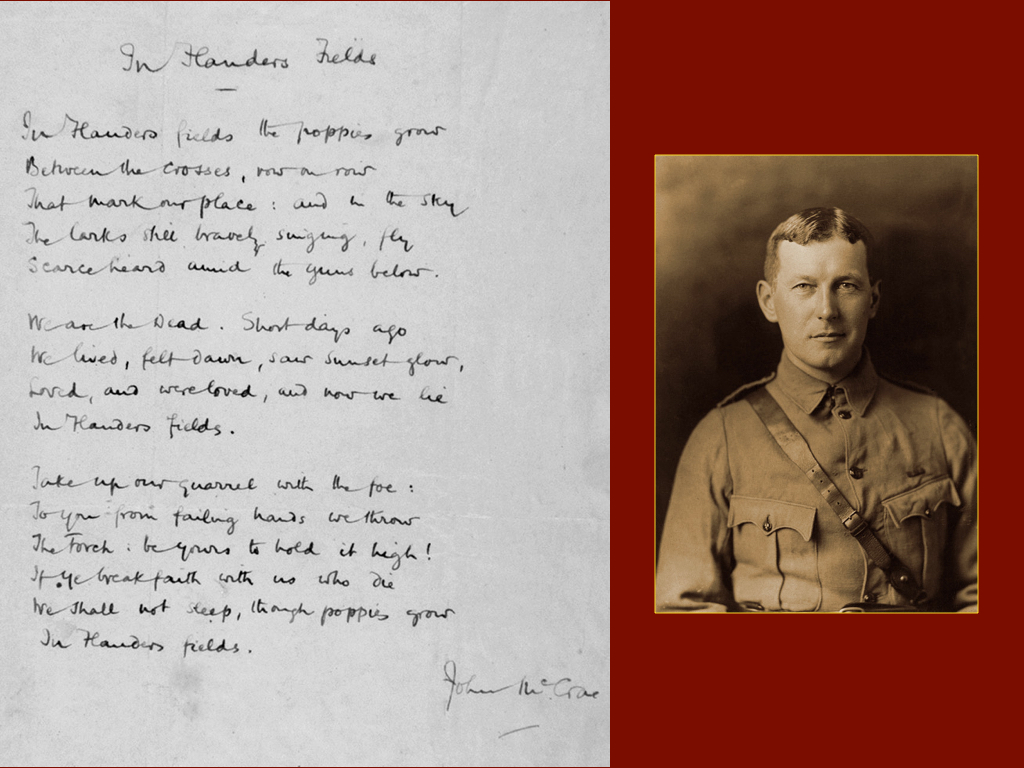
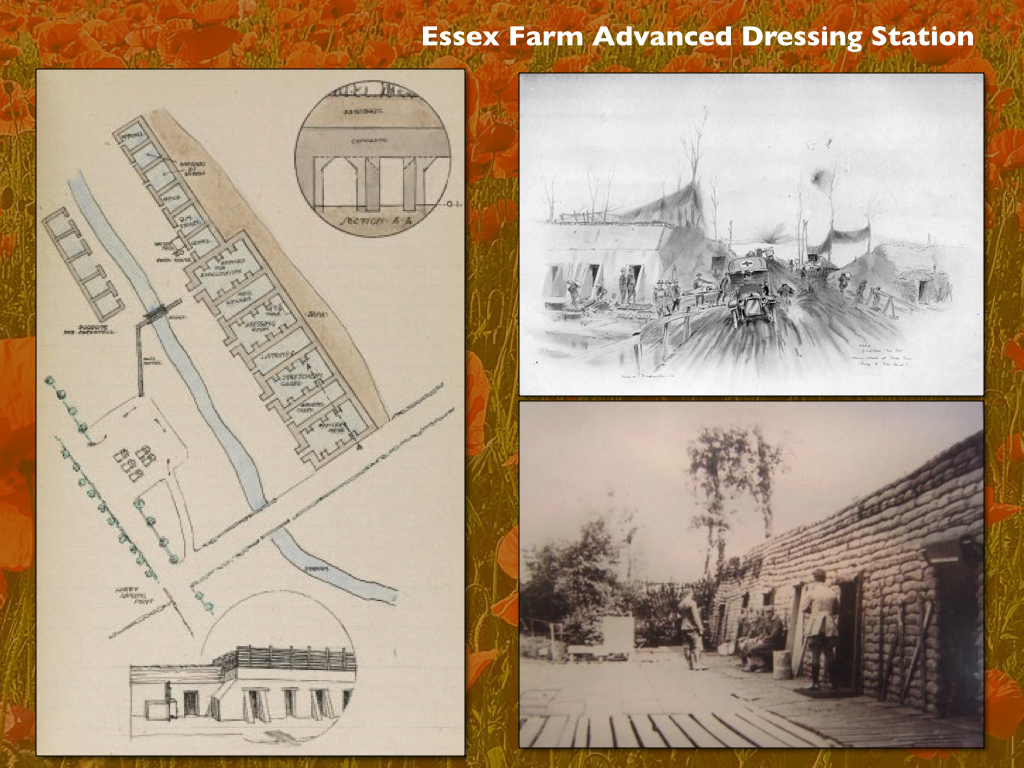
In the case of the First World War, the emphasis on those who lost their lives – on the dead not the wounded – derives not only from the sheer scale of the slaughter but also from the enduring landscape of memorialisation and commemoration.  When John McCrae‘s elegaic poem ‘In Flanders Fields’ is recited every Remembrance Day – ‘In Flanders fields the poppies grow, between the crosses, row on row’ – it is all too easy to forget that he wrote those lines not only to commemorate the death of a close friend but that he did so at Essex Farm Advanced Dressing Station:

Journeys from No Man's Land.003

Journeys from No Man's Land.004

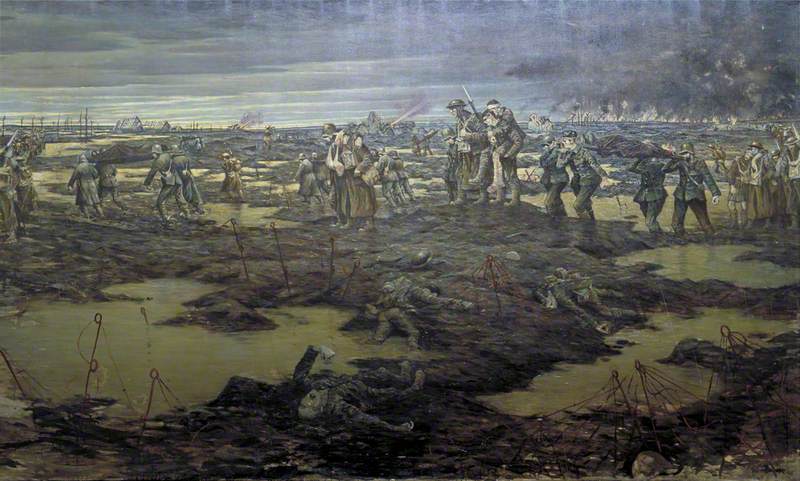
What lies behind those haunting lines – and that medical outpost – is a vast canvas of wounded men, which Christopher Nevinson captured as ‘The Harvest of Battle’ (below).  The dead occupy the foreground, but behind them is the endless, moving panorama of the wounded whose precarious journeys took most of them far beyond ‘No Man’s Land’.
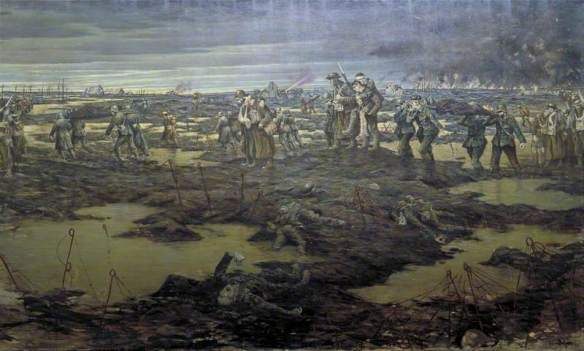
(c) IWM (Imperial War Museums); Supplied by The Public Catalogue Foundation

In fact, as Emily Mayhew reminds us, ‘being wounded was one of the most common experiences of the Great War’: on the Western Front, she writes, ‘almost every other British soldier could expect to become a casualty’.

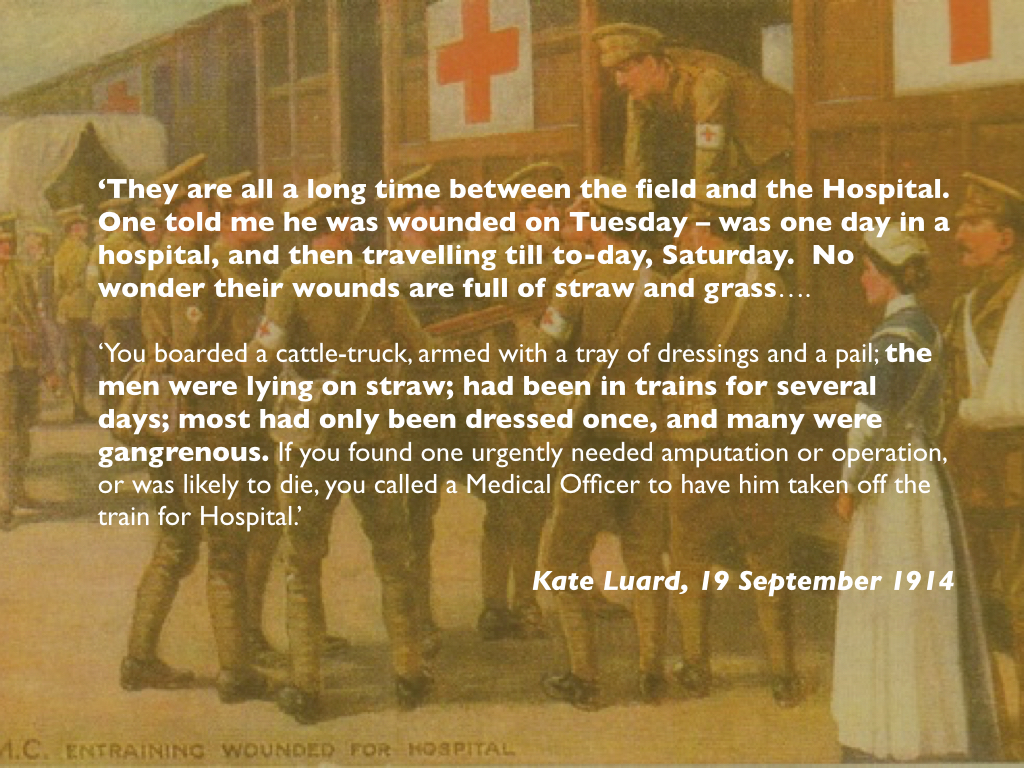
But, perhaps not surprisingly, for the first six months of the war the British Expeditionary Force was unprepared for the scale of casualties, and even with the help of civilian volunteers and aid societies – Nevinson briefly served as a medical orderly with the Friends Ambulance Unit, for example – the remarkably long time it took to evacuate the wounded combined with the perilous nature of their improvised journeys to increase the mortality rate.

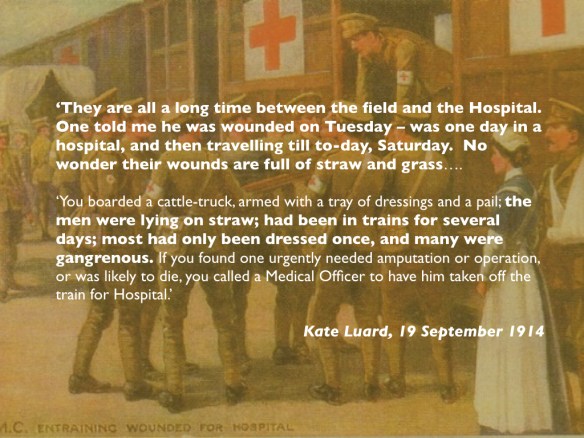
Journeys from No Man's Land.007

Journeys from No Man's Land.008

And so what Mark Harrison called the military-medical machine had to be speeded up – and moved closer to the field of battle.

Journeys from No Man's Land.016

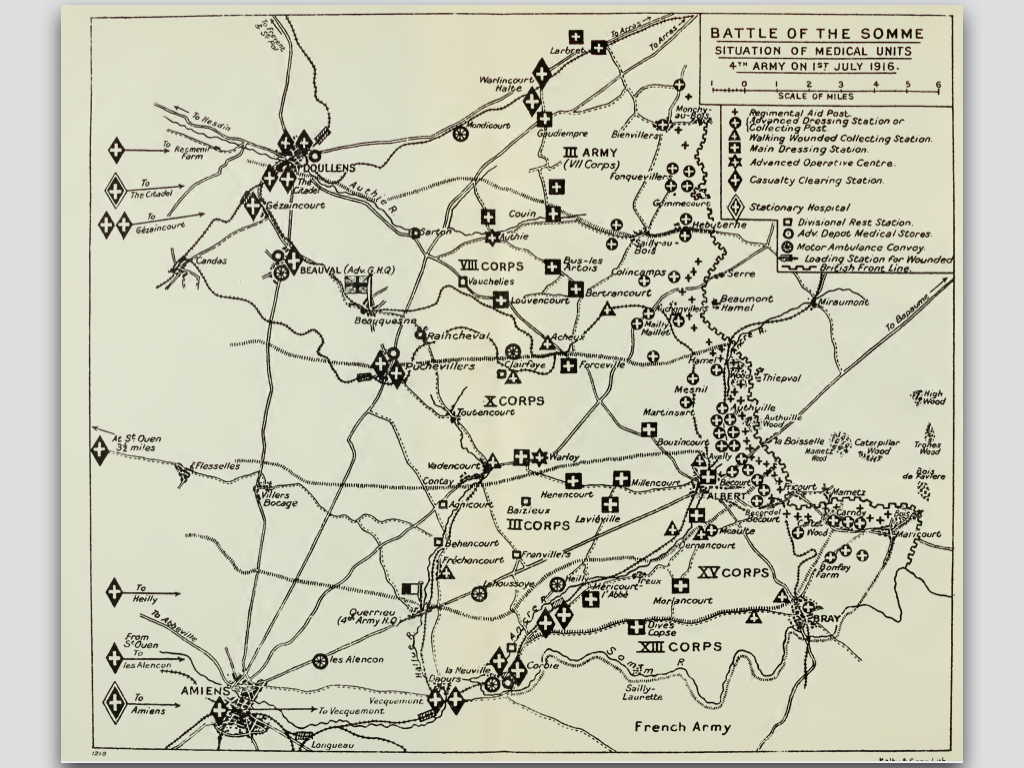
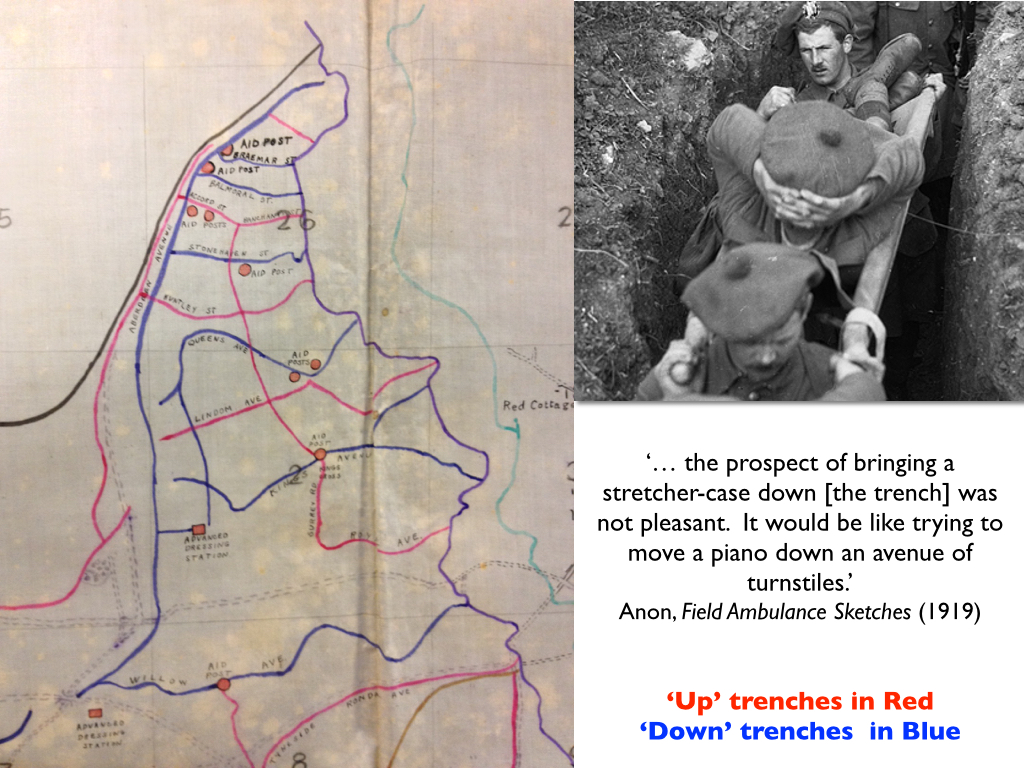
Before every major offensive elaborate plans for medical support were prepared: casualties were ‘cleared’ down the line as far and as fast as possible to make room for the newly injured, casualty clearing hospitals moved closer to the line, ambulances and stretcher-bearers made ready, and ‘down’ trenches designated for the efficient removal of the wounded (below).
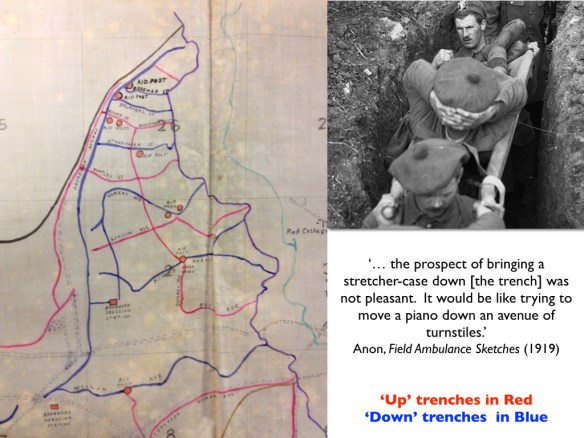
Journeys from No Man's Land.017

Soldiers wounded in ‘No Man’s Land’ – a term never recognised by the British General Staff, who insisted that they controlled the field of battle right up to the enemy front lines – were often immobilised and disoriented; some crawled into shell holes, seeking refuge below the field of fire, but it could take hours, even days before they were discovered and rescued (I’ll devote a later post to a detailed discussion of some of those cases).

Journeys from No Man's Land.022

Journeys from No Man's Land.023

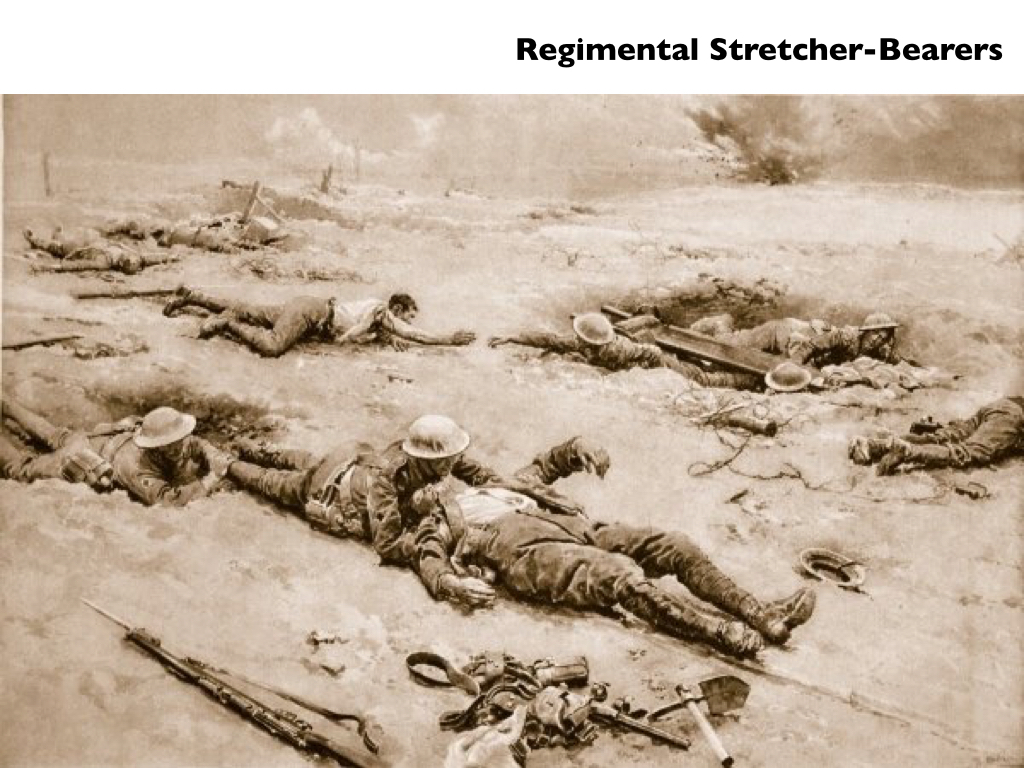
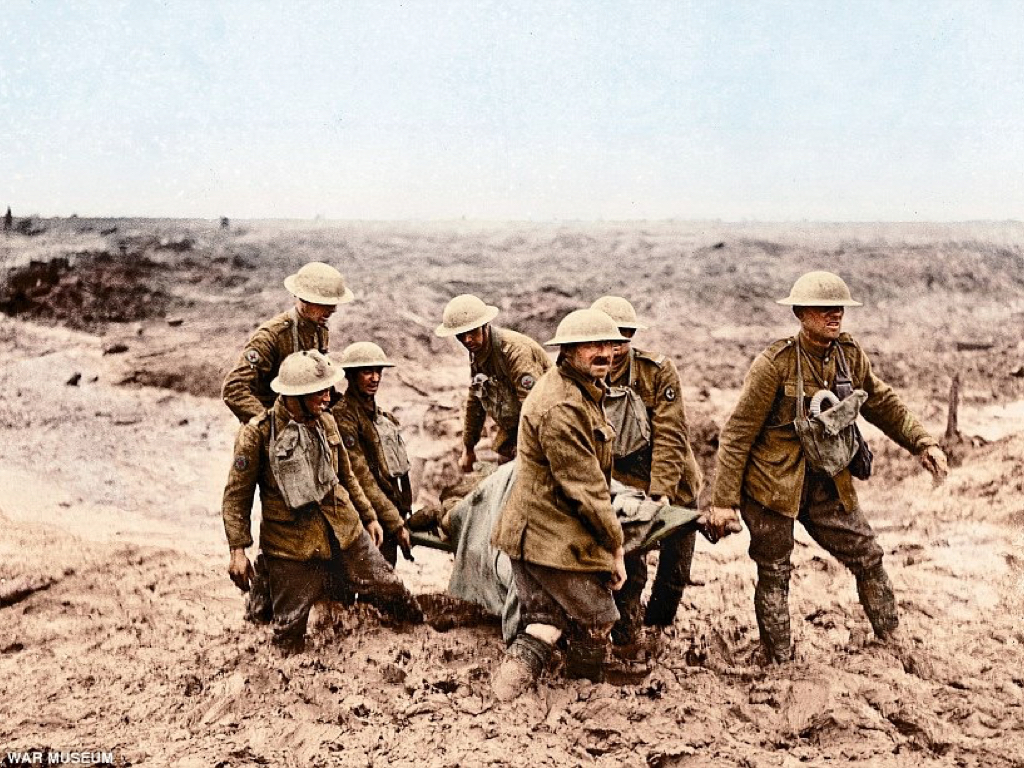
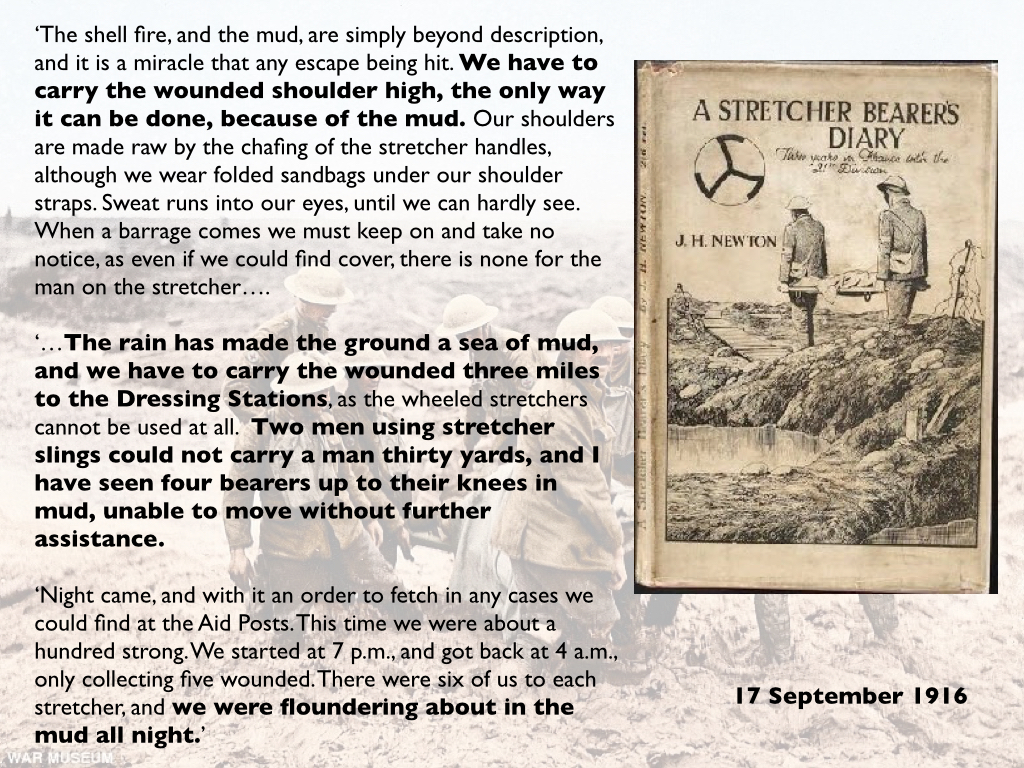
Sometimes their mates came to their rescue, sometimes the regimental stretcher bearers.  But they too had to find their way through a dangerous and devastated terrain, often with no landmarks to guide them and on occasion made virtually impassable by the thick, cloying mud that was always –  disconcertingly – much more than mud.

Journeys from No Man's Land.024

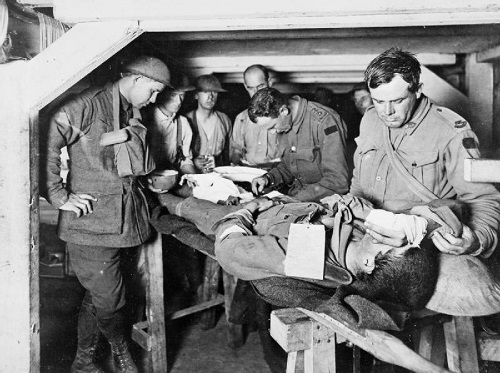
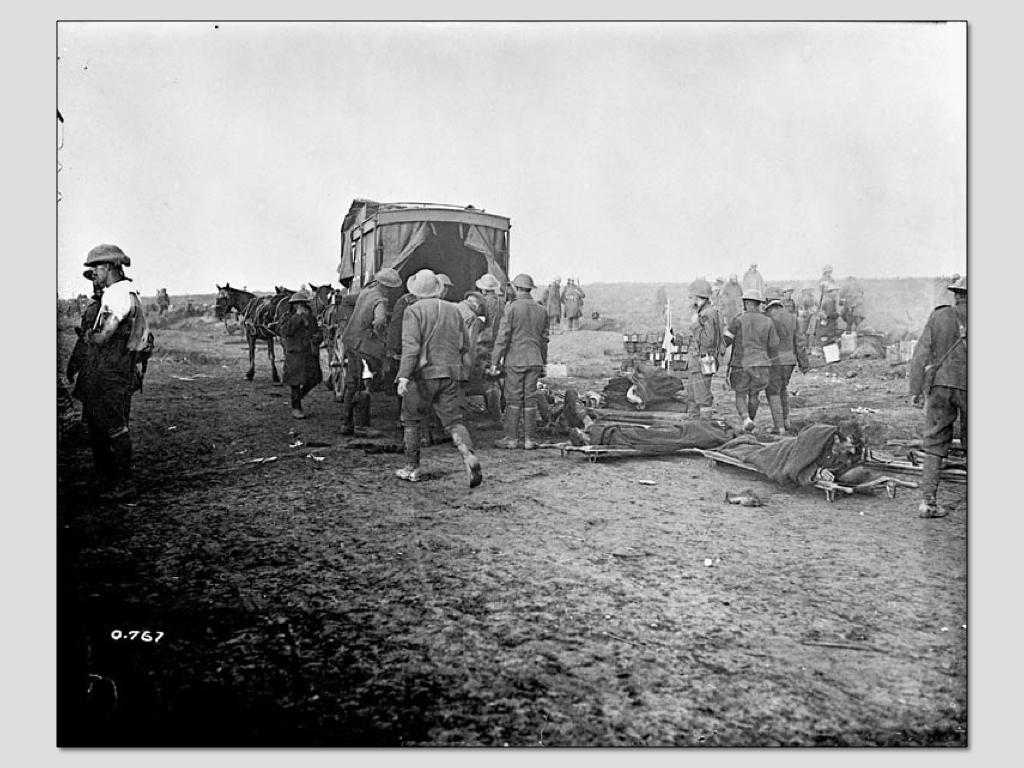
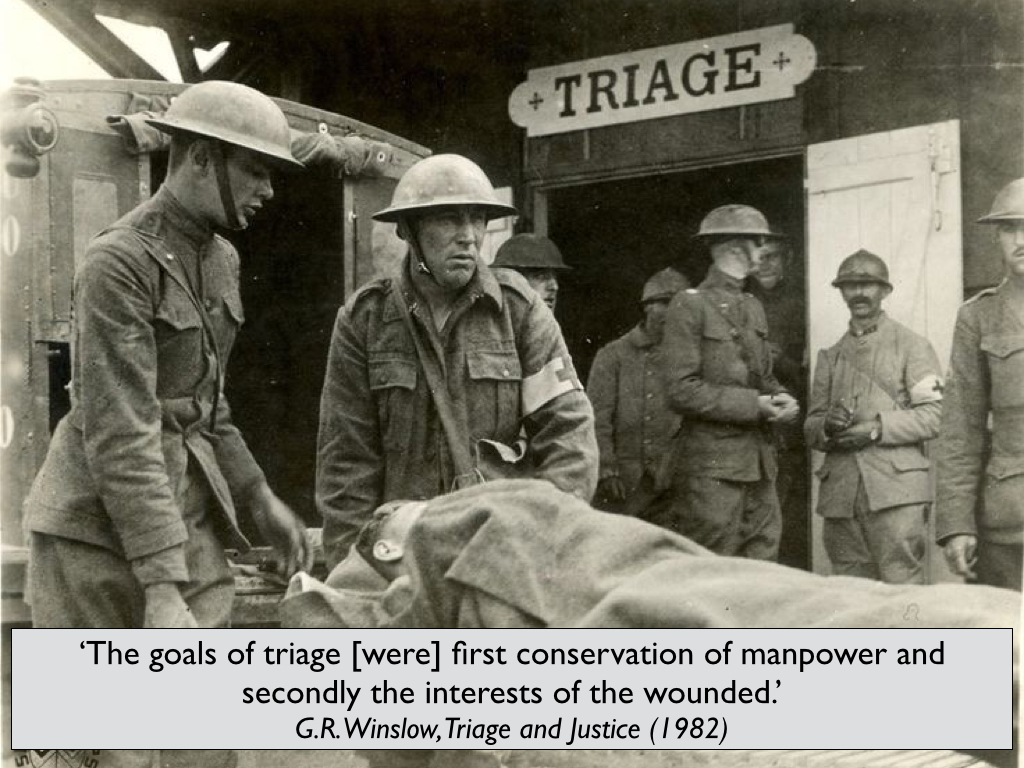
By now, they were in the care of the Royal Army Medical Corps’s Field Ambulance, and their first objective was an Advanced Dressing Station.  
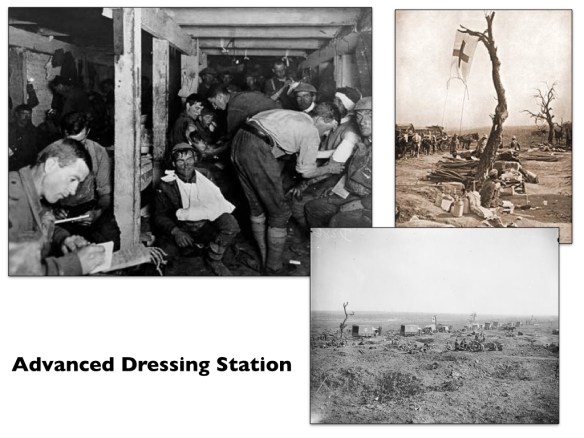
Journeys from No Man's Land.026

Treatment at ADS 1917

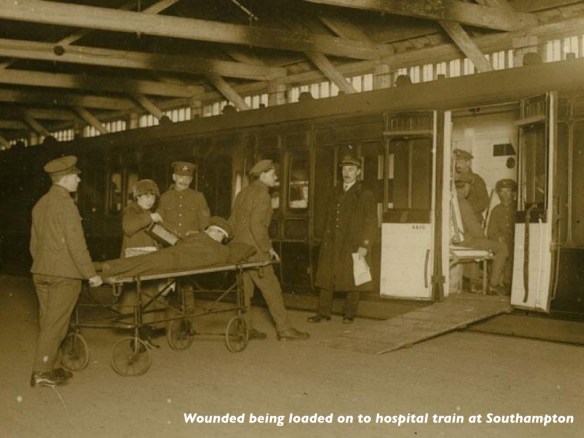
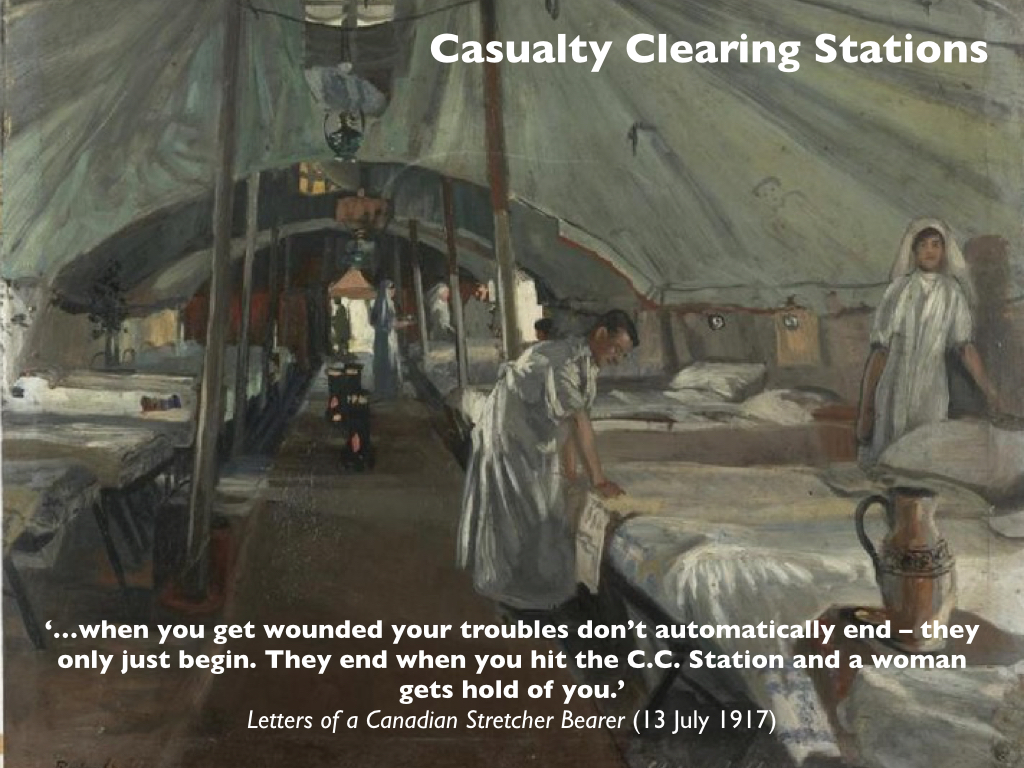
Those that needed anything beyond simple treatment or emergency surgery were sent on by horse or motor ambulance to a Casualty Clearing Station (a field hospital).

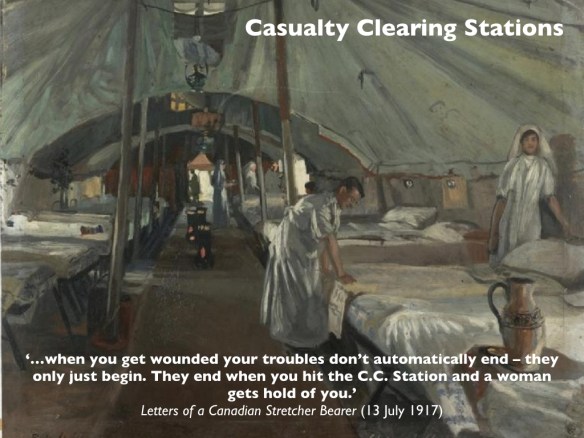
Journeys from No Man's Land.027

Journeys from No Man's Land.030

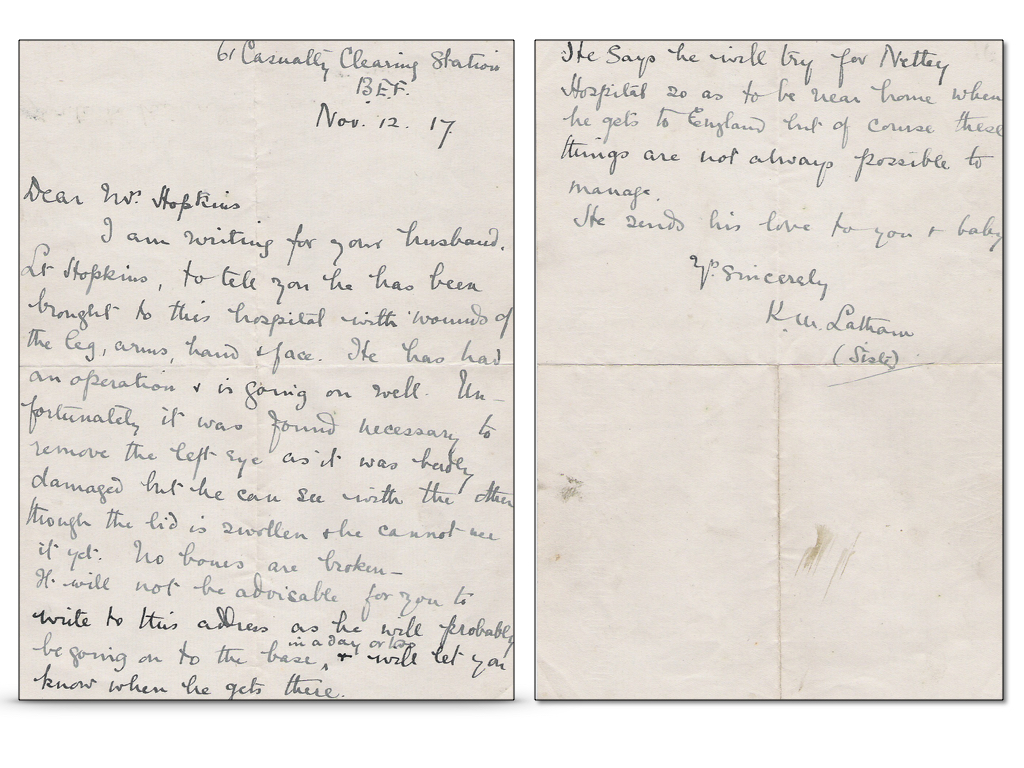
It was usually here that their first surgeries took place.  The journalist Philip Gibb was shown around a CCS at Corbie and the experience haunted him for years:

After a visit there I had to wipe cold sweat from my forehead, and found myself trembling in a queer way. It was the medical officer—a colonel—who called it that name. “This is our Butcher’s Shop,” he said, cheerily. “Come and have a look at my cases. They’re the worst possible; stomach wounds, compound fractures, and all that. We lop off limbs here all day long, and all night. You’ve no idea!”
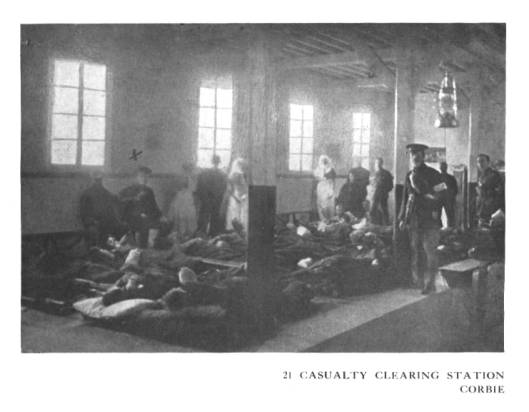
CCS Corbie

I had no idea, but I did not wish to see its reality. The M.O. could not understand my reluctance to see his show. He put it down to my desire to save his time—and explained that he was going the rounds and would take it as a favor if I would walk with him. I yielded weakly, and cursed myself for not taking to flight. Yet, I argued, what men are brave enough to suffer I ought to have the courage to see… I saw and sickened. These were the victims of “Victory” and the red fruit of war’s harvest-fields. A new batch of “cases” had just arrived. More were being brought in on stretchers. They were laid down in rows on the floor-boards. The colonel bent down to some of them and drew their blankets back, and now and then felt a man’s pulse. Most of them were unconscious, breathing with the hard snuffle of dying men. Their skin was already darkening to the death-tint, which is not white. They were all plastered with a gray clay and this mud on their faces was, in some cases, mixed with thick clots of blood, making a hard incrustation from scalp to chin. “That fellow won’t last long,” said the M. O., rising from a stretcher. “Hardly a heart-beat left in him. Sure to die on the operating-table if he gets as far as that… Step back against the wall a minute, will you?” We flattened ourselves against the passage wall while ambulance-men brought in a line of stretchers. No sound came from most of those bundles under the blankets, but from one came a long, agonizing wail, the cry of an animal in torture. “Come through the wards,” said the colonel. “They’re pretty bright, though we could do with more space and light.” In one long, narrow room there were about thirty beds, and in each bed lay a young British soldier, or part of a young British soldier. There was not much left of one of them. Both his legs had been amputated to the thigh, and both his arms to the shoulder-blades. “Remarkable man, that,” said the colonel. “Simply refuses to die. His vitality is so tremendous that it is putting up a terrific fight against mortality… There’s another case of the same kind; one leg gone and the other going, and one arm. Deliberate refusal to give in. ‘You’re not going to kill me, doctor,’ he said. ‘I’m going to stick it through.’ What spirit, eh?”…

“Bound to come off,” said the doctor as we passed to another bed. “Gas gangrene. That’s the thing that does us down.” In bed after bed I saw men of ours, very young men, who had been lopped of limbs a few hours ago or a few minutes, some of them unconscious, some of them strangely and terribly conscious, with a look in their eyes as though staring at the death which sat near to them, and edged nearer. “Yes,” said the M. O., “they look bad, some of ’em, but youth is on their side. I dare say seventy-five per cent. will get through. If it wasn’t for gas gangrene—“

He jerked his head to a boy sitting up in bed, smiling at the nurse who felt his pulse. “Looks fairly fit after the knife, doesn’t he? But we shall have to cut higher up. The gas again. I’m afraid he’ll be dead before to-morrow. Come into the operating-theater. It’s very well equipped.”

By now the bureaucratic machine had been activated: labels had been attached to the wounded and field medical cards (‘tickets’) completed; telegrams had been sent to advise families, and nurses had often written letters home on their patients’ behalf.

Journeys from No Man's Land.035Journeys from No Man's Land.036

The next stage for the most seriously wounded was evacuation by ambulance train to  a base hospital on the French coast.  There was a considerable bureaucracy involved in planning these movements, but for all the neatness and symmetry of the organisational diagrams – part of Clausewitz‘s ‘paper war’ – there were all sorts of delays.

Journeys from No Man's Land.038

Journeys from No Man's Land.040

Priority was given to trains rushing reinforcements, supplies and ammunition to the front, and ambulance trains were frequently marooned in sidings waiting for them to pass so that journeys that might have taken hours could take days.  It was not uncommon for an ambulance train to arrive at a base hospital to find that there was little or no room for new patients and all but the most grievous cases had to travel on to the next.

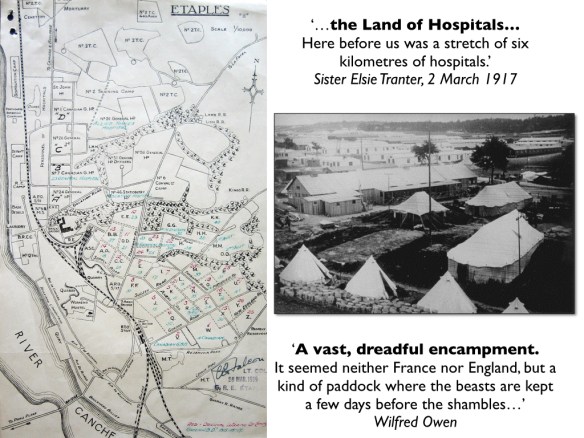
Journeys from No Man's Land.041

Journeys from No Man's Land.042

Many patients were treated at the base hospitals, but those with more serious wounds were evacuated by hospital ship to Britain.  This stage of the journey was no less dangerous than the previous one: as the war continued, there was an increasing danger of mines and submarines in the Channel.

Journeys from No Man's Land.043

Journeys from No Man's Land.044

Journeys from No Man's Land.046

A distinctive  geography of the wounded emerged.  If they arrived at Southampton, the most critical cases were taken by train straight to the Royal Victoria Military Hospital at Netley, which treated as many as 50,000 patients during the war.  According to Lyn McDonald,

 ‘Those who could not be accommodated, and those who were seriously wounded but likely to survive a longer journey, were sent on by train to Birmingham, Bristol, Exeter, Leicester, Norwich and Plymouth.  But seven out of every ten hospital trains were directed to London, and during the first days of the Somme they rolled in almost every hour to Charing Cross and Paddington stations.’

Journeys from No Man's Land.047

Journeys from No Man's Land.048

This is, of course, a highly abbreviated account of the casualty evacuation chain, and in the larger project from which this is derived I provide many more details.  But I think I’ve said enough to show that the chain was, in effect, a production line with an elaborate division of labour (again, in the larger study I show how class – or more accurately, rank – gender and race segmented the chain in various ways).  Indeed, in The Politics of Wounds Ana Carden-Coyne argues that what she calls ‘the Taylorist approach in modern war’ – and remember that this was industrial war on the grand (guignol) scale – ‘was particularly evident in the assembly-line style of evacuation and triage.’
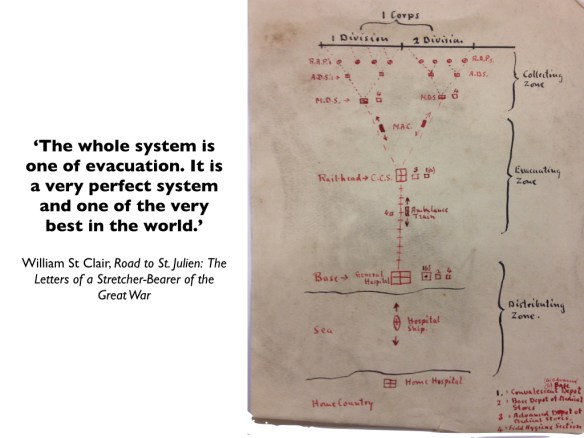
Journeys from No Man's Land.012

This prompts two concluding observations.

First, what was the instrumental logic that animated the evacuation chain?  After all, it was an expensive undertaking, as Arthur Empey (himself wounded on the Western Front) realised in this re-calculation of the chain:

It may sound heartless and inhuman, but it is a fact, nevertheless, that from a military stand-point it is better for a man to be killed than wounded.
EmpeyIf a man is killed he is buried, and the responsibility of the government ceases, excepting for the fact that his people receive a pension. But if a man is wounded it takes three men from the firing line, the wounded man and two men to carry him to the rear to the advanced first-aid post. Here he is attended by a doctor, perhaps assisted by two R.A.M.C. men. Then he is put into a motor ambulance, manned by a crew of two or three. At the field hospital, where he generally goes under an anaesthetic, either to have his wounds cleaned or to be operated on, he requires the services of about three to five persons. From this point another ambulance ride impresses more men in his service, and then at the ambulance train, another corps of doctors, R.A.M.C. men, Red Cross nurses, and the train’s crew. From the train he enters the base hospital or Casualty Clearing Station, where a good-sized corps of doctors, nurses, etc., are kept busy. Another ambulance journey is next in order — this time to the hospital ship. He crosses the Channel, arrives in Blighty — more ambulances and perhaps a ride for five hours on an English Red Cross train with its crew of Red Cross workers, and at last he reaches the hospital. Generally he stays from two to six months, or longer, in this hospital. From here he is sent to a convalescent home for six weeks.

If by wounds he is unfitted for further service, he is discharged, given a pension, or committed to a Soldiers’ Home for the rest of his life, — and still the expense piles up. When you realize that all the ambulances, trains, and ships, not to mention the man-power, used in transporting a wounded man, could be used for supplies, ammunition, and reinforcements for the troops at the front, it will not appear strange that from a strictly military standpoint, a dead man is sometimes better than a live one (if wounded).

Hence, for example, the orders recorded by A.M. Burrage:

The instructions given to stretcher-bearers are rather harsh. “ If you find two men wounded, and can take only one away, take away the one more likely to make a fit soldier again.” Therefore the one more urgently in need of attention must be left to die, because he would walk with a limp and would never again be able to carry a pack. Sound business, of course, but just a little hard.

Kate Luard captured another dimension of this when she wrote in January 1915:

‘The ambulance trains do so much bringing the British Army from the field that I hope some other  trains are busy bringing the British Army to the field, or there can’t be many left in the field…’

And Emily Mayhew provides this bleak vignette from a medical orderly that captures the seemingly insatiable drive of industrial war:

An ordinary train, similar to the one that had brought him to the front, was at one end unloading reinforcements, while at the other end it was filling up with wounded men.

The logic, then, was one of ‘salvage’; four out of every five men wounded on the Western Front were returned to the fighting, which was the over-riding objective of the military-medical machine.
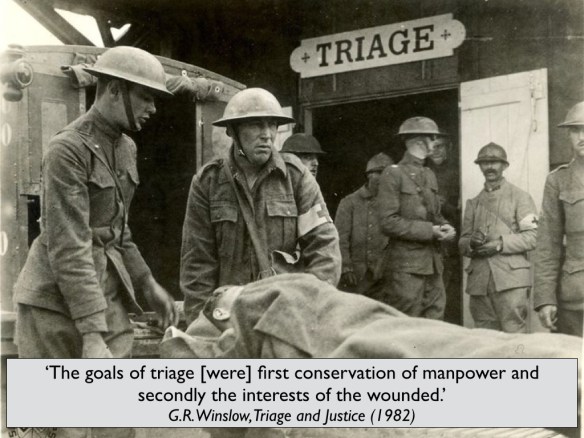
Journeys from No Man's Land.055

Second, the division of labour was also a division of life: the dead from the wounded, the dying from the ‘salvageable’, and the wounded from the unwounded or yet-to-be-wounded.  The last was not the least.  For breaching that separation could have the most unsettling consequences of all:

Journeys from No Man's Land.057

Journeys from No Man's Land.058

 ***

What started me on this journey was Emily Mayhew‘s brilliantly conceived Wounded and an excellent series of articles by Martin Bricknell in the Journal of the Royal Army Medical Corps: see in particular here.
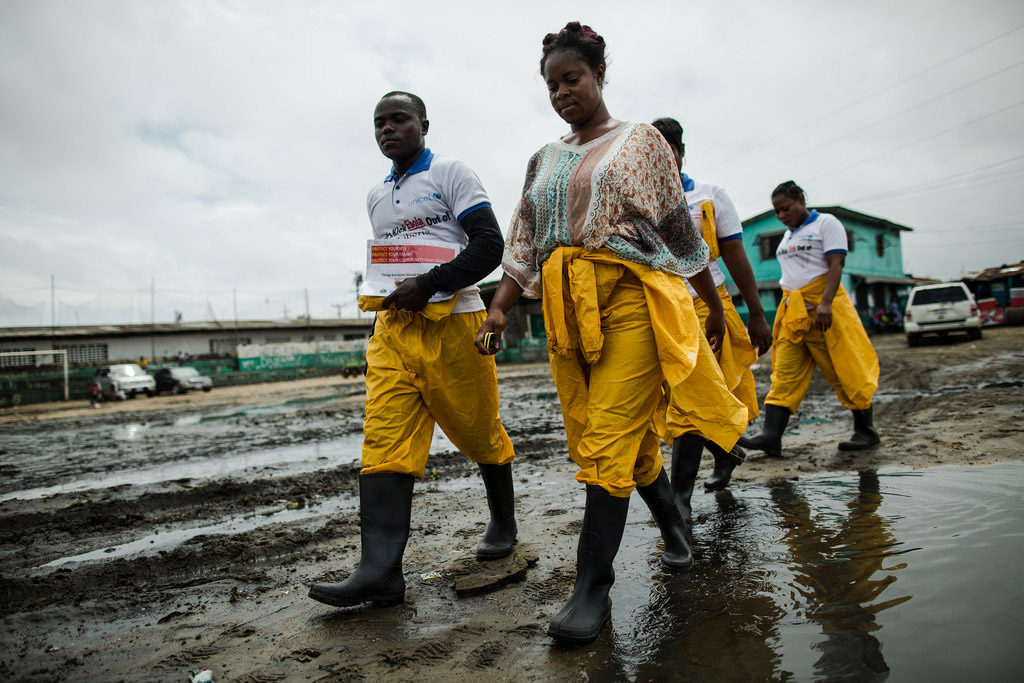
You can also find more on the casualty evacuation chain from the Western Front at Beyond the Trenches here and here, the Long, Long Trail here, the Medical Front here, and the Royal Army Medical Corps site here.

My larger project examines the evacuation of casualties, combatant and civilian, from four combat zones 1914-2014: the Western Front during the First World War, the deserts of North Africa during the Second World War, Vietnam, and Afghanistan.