The weaponisation of health care

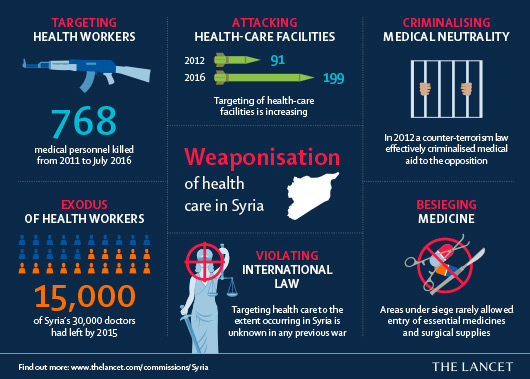
I’m continuing to work on attacks on hospitals and health care workers in conflict zones – see ‘The Death of the Clinic’ here for a general discussion – and I’ve just finished reading the preliminary report on the weaponisation of health care from The Lancet-American University of Beirut Commission on Syria.  You can find out more on the Commission here and download the open access report here.

The authors propose the ‘weaponisation of health care’ to capture ‘the phenomenon of large-scale use of violence to restrict or deny access to care as a weapon of war’:

Weaponisation is multi-dimensional and includes practices such as attacking health-care facilities, targeting health workers, obliterating medical neutrality, and besieging medicine. Through large-scale violations of international humanitarian laws, weaponisation of health care amounts to what has been called a “war-crime strategy”. Weaponisation of health care in the Syria conflict is manifested most notably in the targeting of health workers and facilities.

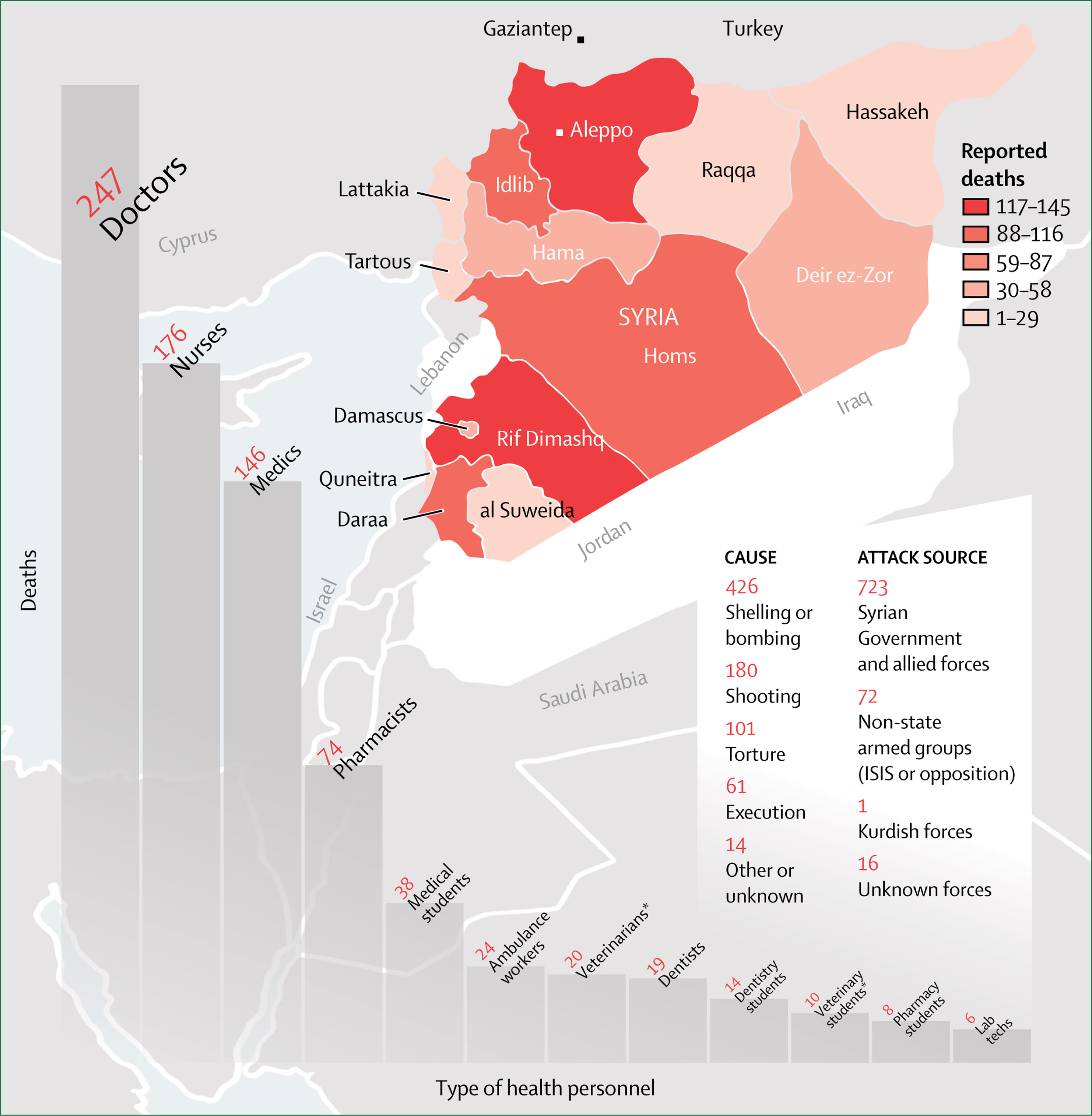
They trace the targeting of health-care workers by pro-government forces in Syria back to the earliest weeks of protest against the regime, but the ‘substantial militarisation’ that followed – especially after the ‘military surge’ that began in September 2015 when Russia joined the Syrian government forces – made those attacks ever more aggressive and ever more systematic.  This map, based on the work of Physicians for Human Rights, provides a minimal accounting of attacks on doctors, nurses and other healthcare workers:

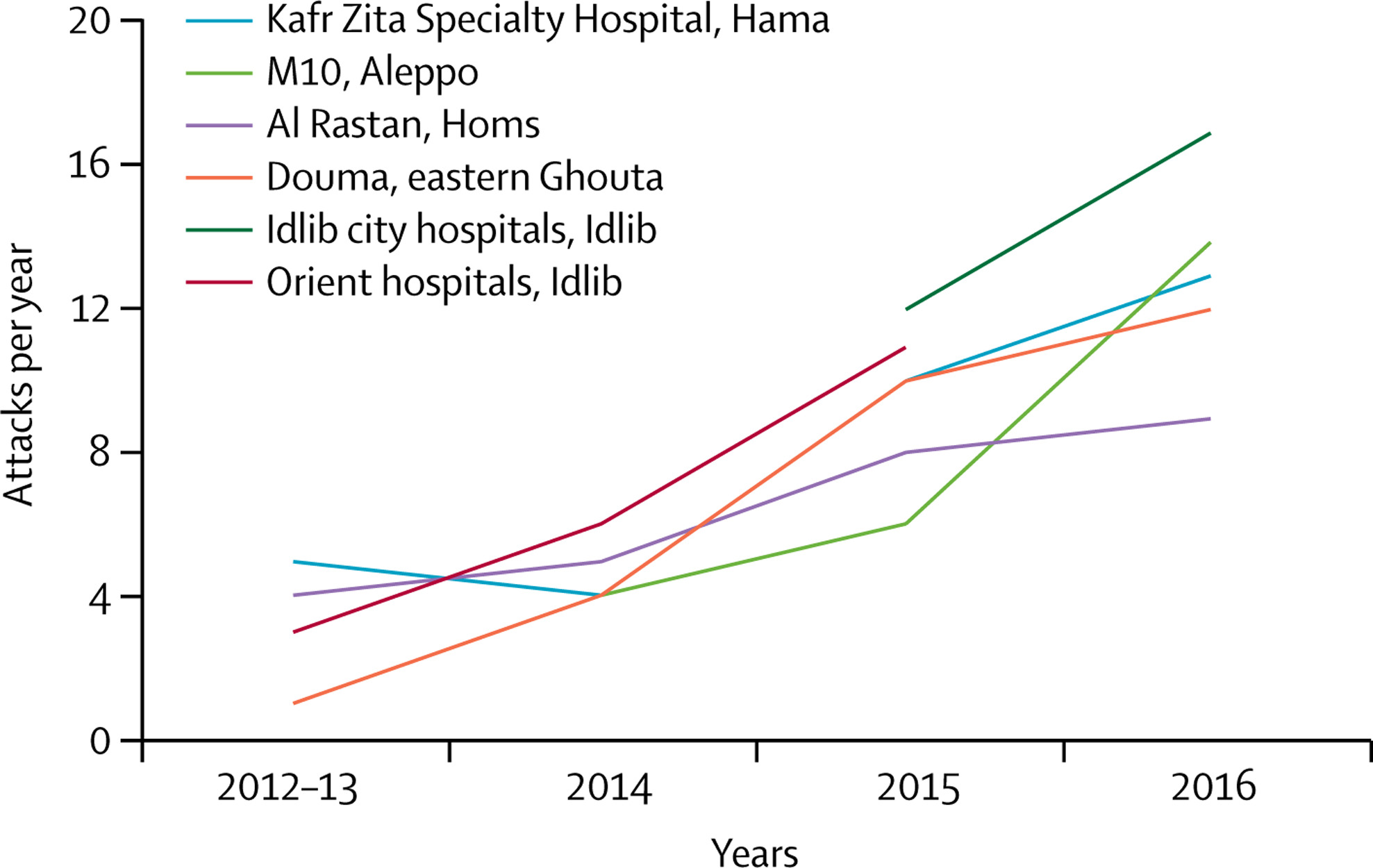
Attacks on hospitals – some of which I described in detail in a previous post – became not only more systematic but even repetitive, on a scale which the authors is wholly unprecedented.

‘Examination of attacks since 2012 on health facilities has revealed a distinct pattern of weaponisation.Analysis of attacks over several years in important opposition-held areas of Aleppo, Hama, Idlib, eastern Ghouta, and Homs reveals a pattern of repeated targeting with intention to shut access to health care, whether to impede opposition forces or to force civilian displacement.’

They list the effects of these attacks on healthcare in areas outside the control of the Syrian government – ‘rebel-held areas’ – but they also sketch the situation in areas under the control of the Islamic State:

Efforts to recruit foreign doctors through social media have reportedly helped IS to develop a functioning health system with modern facilities and equipment, qualified health workers, and a medical school in Raqqa where students train for free. But this health system is exclusive to IS, and foreign doctors are only permitted to provide care for IS members. For the rest of Raqqa’s civilians, over 1 million people, there are only 33 specialist doctors including just three obstetricians and one ophthalmologist, and just two public hospitals. Anecdotal reports indicate that health workers are forced to deliver care at gunpoint while others are arrested, abducted, or even executed for refusing to deliver care. To stop the exodus of health workers, IS uses the threat of seizure of homes and clinics in case of absence from work. Gender separation in these areas means that female health providers are subject to additional stress and restrictions, being forced to abide by IS dress code and to treat only female patients.

And for the benefit of the useful idiots inside the academy who deny these predations by the Syrian government on its own people, I should add that the report also discusses the situation inside government-controlled areas:

The bulk of Syria’s remaining health workers are in government-controlled areas, where there is variability in the capacity of health facilities and personnel. Workers from these areas have also reported challenges, but of a different nature to those working in non-government- controlled areas. Indiscriminate mortar attacks from rebel areas have adversely affected daily life and the public’s sense of security. Many health workers report facing multiple security checkpoints for their daily trip to a hospital or clinic. The collapsing economy has eroded living standards and restricted school and career options for offspring of health workers. Medical students fear the military draft and the risk of being sent to the battlefield. To avoid that fate, many seek whatever residency training positions are available upon graduation, irrespective of specialty. However, with the emigration of many experienced senior academics, fewer high-quality specialists are available to supervise the training of younger doctors. Travel restrictions due to sanctions and the need for leave permits from the government leave few choices for these doctors. Some doctors in these areas have indicated that the international media pay little attention to their plight. Others report being forced to breach ethical principles under unbearable pressure.

You can find an elaboration of these claims in personal testimonials here, which include this:

In November 2011, Dr. Zaki [a pseudonym], a military anaesthetist, was sent to Aleppo Military Hospital. This hospital usually received injured Syrian army combatants, but from the start of 2012, it began receiving civilian patients injured by pro-government forces during the peaceful demonstrations taking place in Idleb and Aleppo. Notably there was no conflict at this time in either city. These civilian patients were interrogated and tortured — either directly through electric shocks or beatings with rubber hoses, or indirectly, by leaving gunshot wounds or open fractures untreated,. A few days prior to the visit to the hospital by the UN-Arab League Special Envoy, who insisted on visiting all patients, Dr. Zaki was ordered by his superiors to find a way to keep these patients silent. The subtext of the order, issued by three generals, the first in charge of the hospital, the second, the head of military intelligence, and the third, head of the military secret police in Aleppo, was clear: “we know exactly who your family are and your wife’s family, and they will be arrested unless you comply” Under those conditions, Dr. Zaki used a combination of anaesthetic agents to sedate over 60 patients, so their wounds and shackles could literally be covered up, and no patient would be able to describe the torture and conditions of their confinement to the Special Envoy. Shortly after this, Dr. Zaki defected and fled to Turkey, along with his entire family and his wife’s family.

I urge you to read the whole report (it’s only 11 Lancet pages).

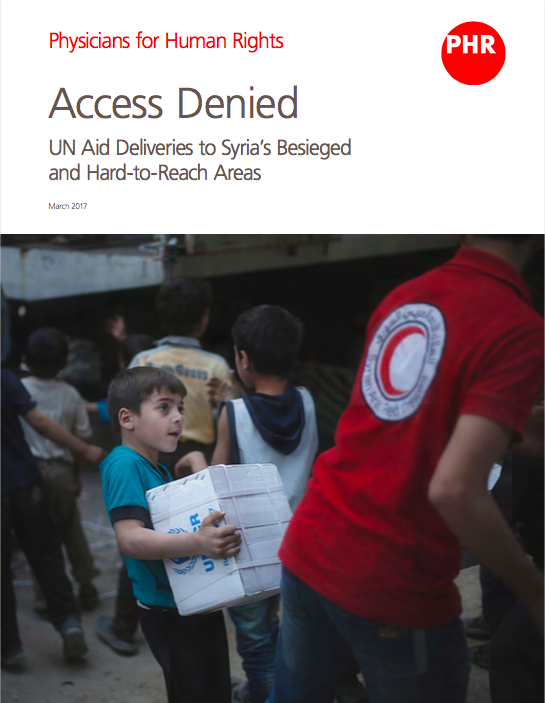
The report describes what it calls ‘siege medicine’, and for an update you can turn to another new report, this one from Physicians for Human Rights: Access Denied: UN aid deliveries to Syria’s besieged and hard-to-reach areas.

This is how it begins:

Death by infection because security forces do not allow antibiotics through checkpoints.

Death in childbirth because relentless bombing blocks access to clinics.

Death from diabetes and kidney disease because medicines to treat chronic illnesses ran out months ago.

Death from trauma because snipers stand between injured children and functioning hospitals.

And – everywhere – slow, painful death by starvation.

This is what one million besieged people – trapped mostly by their own government – face every day in Syria.

This is the unseen suffering – hidden under the shadow of barrel bombs and car bombs – that plagues the Syrian people as they enter a seventh grim year of conflict.

This is murder by siege.

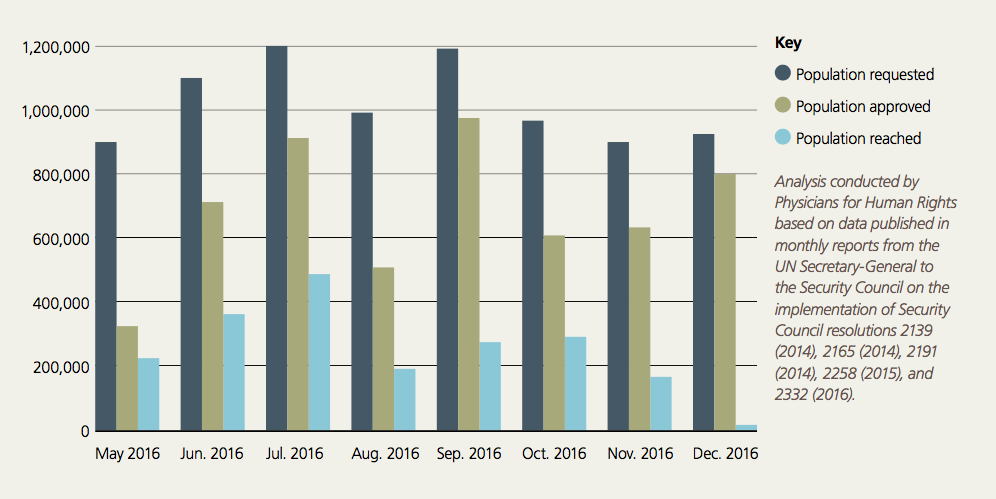
The report is limited to ‘the failure of the two-step approval process in ensuring the completion of UN interagency humanitarian convoys to besieged and hard-to-reach areas across Syria’; this excludes operations outside that approval process, but it still makes for remarkably grim reading.  Here are the raw figures tabulating aid deliveries requested, approved and completed under the two-step process:

Even within these diminished envelopes there were further specific restrictions on medical supplies:

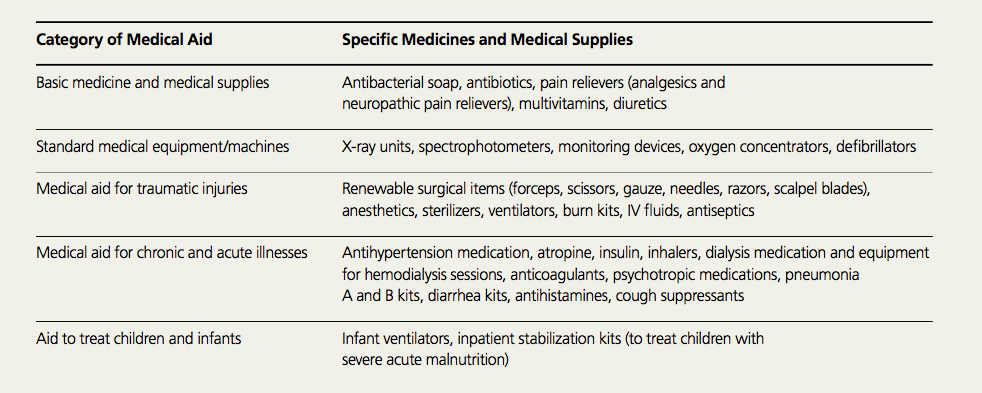
Throughout 2016, Syrian authorities specifically restricted medical aid to besieged and hard-to-reach areas, in direct violation of international humanitarian law.From February through December 2016, Syrian authorities prevented the delivery of more than 300,000 medical treatments to besieged and hard-to-reach areas.28 There is no clear definition of what constitutes a “medical treatment,” nor is there publicly available data on how much of each type of aid was removed from convoys. However, as [the examples in the tabulation below show], the disallowed medical aid included basic medicine, supplies, and equipment needed to treat traumatic, chronic, and acute conditions resulting from or aggravated by the sieges. In addition, it included medical aid speci cally meant to treat infants and children. Some of the disallowed medical aid could have been reused repeatedly to treat numerous people, thus its exclusion likely a ected large populations for prolonged periods of time.

In one particularly egregious example, Syrian government forces turned away an entire aid convoy as it was about to enter besieged Daraya in May 2016 because it contained medical aid and infant formula. Ironically, Syrian authorities in Damascus had limited the type of aid allowed on that convoy speci cally to medical aid, infant formula, and school supplies.

Unimaginative geographies

In my commentary on the terrorist attacks in Beirut and Paris in November 2015, I drew attention to Islamic State’s desire to extinguish what it called ‘the grey zone’.  As Jason Burke explained at the time:

In February this year, in a chilling editorial in its propaganda magazine, Dabiq, Isis laid out its own strategy to eliminate what the writer, or writers, called “the grey zone”.

This was, Isis said, what lay between belief and unbelief, good and evil, the righteous and the damned. It was home, too, to all those who had yet to commit to the forces of either side.

The grey zone, Isis claimed, had been “critically endangered [since] the blessed operations of September 11th”, as “these operations showed the world” the two camps that mankind must choose between.

Over the years, since successive violent acts had narrowed the grey zone to the point where by the end of 2014 “the time had come for another event to … bring division to the world and destroy the grey zone everywhere”.

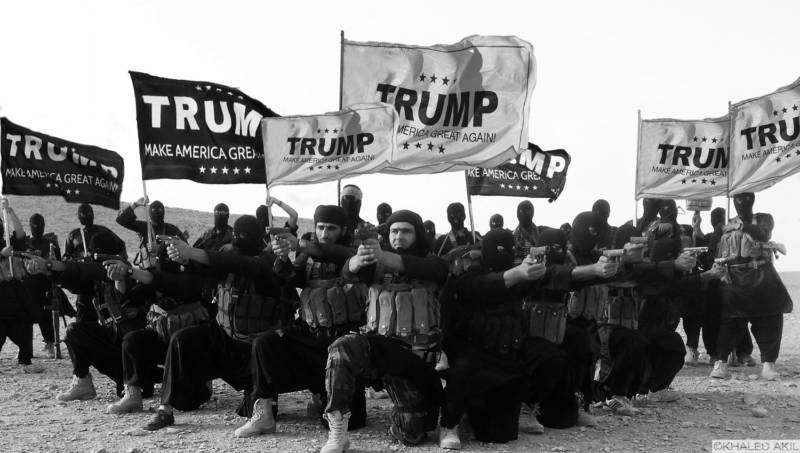
I noted then that ‘The imaginative geographies of Islamic State overlap with those spewed by the extreme right in Europe and North America and, like all imaginative geographies, they have palpable effects: not fifty shades of grey but fifty versions of supposedly redemptive violence.’

Syrian artist Khaled Akil has captured this congruence perfectly in “Hate Loves Hate“:

khaled-akil-hate-loves-hate

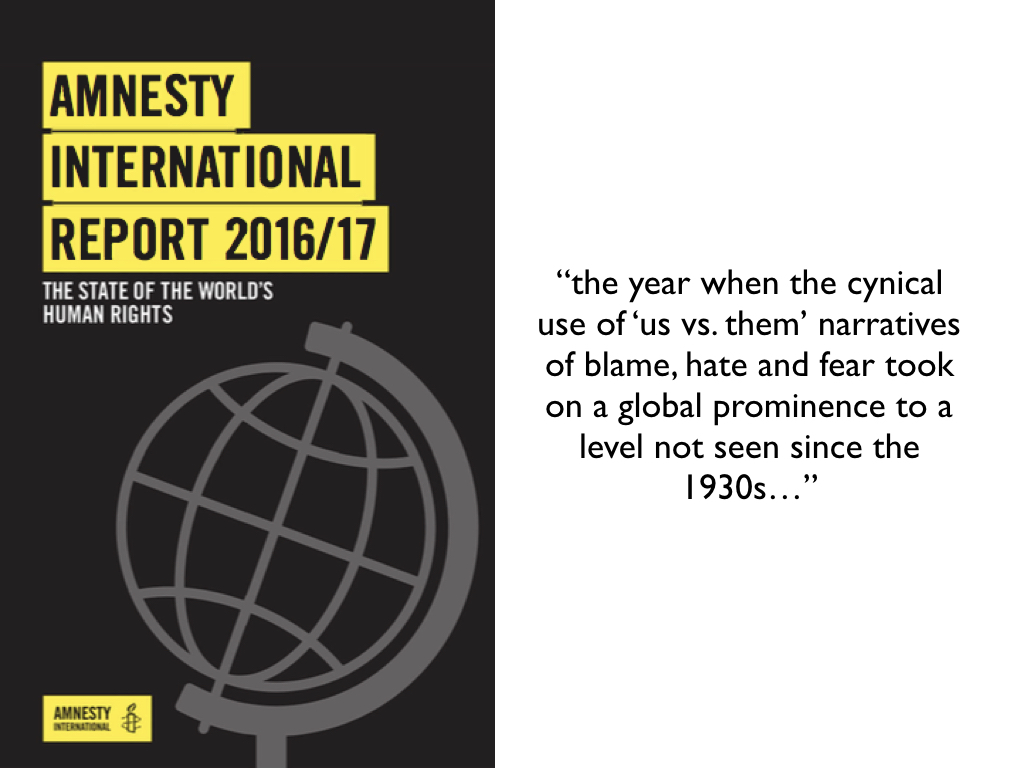
Amnesty International‘s latest report (2016/17) on Human Rights around the world confirms that this is fast becoming generalised:

Politicians wielding a toxic, dehumanizing “us vs them” rhetoric are creating a more divided and dangerous world, warned Amnesty International today as it launched its annual assessment of human rights around the world.

The report, The State of the World’s Human Rights, delivers the most comprehensive analysis of the state of human rights around the world, covering 159 countries. It warns that the consequences of “us vs them” rhetoric setting the agenda in Europe, the United States and elsewhere is fuelling a global pushback against human rights and leaving the global response to mass atrocities perilously weak.

“2016 was the year when the cynical use of ‘us vs them’ narratives of blame, hate and fear took on a global prominence to a level not seen since the 1930s. Too many politicians are answering legitimate economic and security fears with a poisonous and divisive manipulation of identity politics in an attempt to win votes,” said Salil Shetty, Secretary General of Amnesty International.

2016-us-vs-them-001

“Divisive fear-mongering has become a dangerous force in world affairs. Whether it is Trump, Orban, Erdoğan or Duterte, more and more politicians calling themselves anti-establishment are wielding a toxic agenda that hounds, scapegoats and dehumanizes entire groups of people.

“Today’s politics of demonization shamelessly peddles a dangerous idea that some people are less human than others, stripping away the humanity of entire groups of people. This threatens to unleash the darkest aspects of human nature.”…

“In 2016, these most toxic forms of dehumanization became a dominant force in mainstream global politics. The limits of what is acceptable have shifted. Politicians are shamelessly and actively legitimizing all sorts of hateful rhetoric and policies based on people’s identity: misogyny, racism and homophobia.

“The first target has been refugees and, if this continues in 2017, others will be in the cross-hairs. The reverberations will lead to more attacks on the basis of race, gender, nationality and religion. When we cease to see each other as human beings with the same rights, we move closer to the abyss.”

The Death of the Clinic Live

socmarketsstatesrsrchposter%20

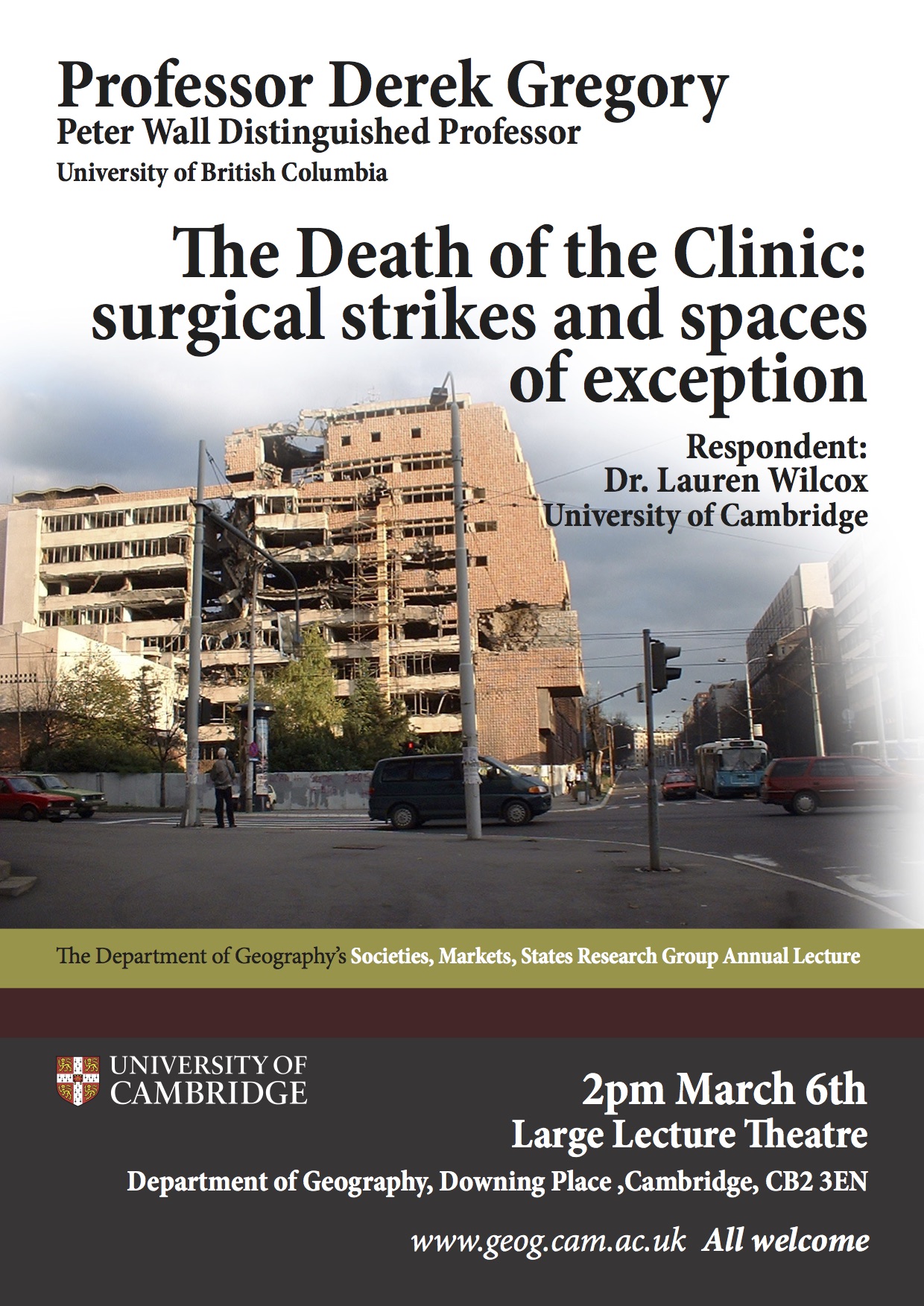
Next month I’ll be in Sweden and the UK doing all sorts of things – one of them is an updated presentation of my arguments about attacks on hospitals, medical workers and patients in Afghanistan and Syria.  Here’s the poster for its outing in Cambridge on 6 March, and – given my commentary on Meatspace? – I’m very much looking forward to Lauren Wilcox‘s response and a lively conversation afterwards.

Breaking Aleppo

screen-shot-2017-02-13-at-10-37-53The Atlantic Council has issued a new report, Breaking Aleppo, which uses satellite imagery, CCTV clips, social media and video from the Russian Ministry of Defence and the RT network to explore the siege of eastern Aleppo and in particular attacks on civilian targets and infrastructure.

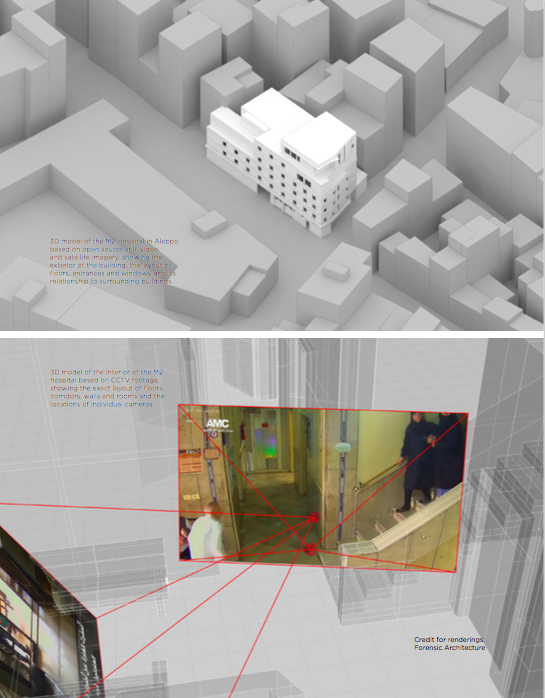
It includes an analysis by Forensic Architecture of the bombing of the ‘M2’ hospital in the Maadi district of Aleppo on 16 July 2016.

Here is part of that analysis employing Forensic Architecture’s signature methodology:

One strike [on M2] was reported on July 14; on July 16, another attack was reported, again with CCTV footage showing the moment of the attack from multiple angles. In this incident, photographs and videos from the attack allowed locations in the photographs to be firmly identified, allowing analysts to confirm that the locations featured were indeed M2 Hospital. To begin this process, a photograph taken outside the hospital after the attack, showing debris and damaged vehicles, was geolocated.

forensic-architecture-analysis-of-attack-on-m2-hospital

A video published by the Aleppo Media Center (AMC) showed the aftermath of the attack, with patients being evacuated to another medical center. During the video, a sequence showed one patient being transported through the building into an ambulance waiting outside the building. It was possible to match the balcony visible in the geolocated photograph to a balcony in the background of the exterior shot in the Aleppo Media Center video.

By following the journey of the patient in the AMC video back to its starting point inside the hospital building, it was then possible to match the route to CCTV footage showing the moment of the attack, also posted on YouTube by AMC.

This CCTV footage, from the same cameras that captured the June 24 bombing, clearly shows that the building was damaged on July 16; parts of the video show the explosion throwing debris through the air with civilians, sta , and patients caught in the attack. The images show the moment a civilian is hit by a large piece of material flung through the air by the explosive force of the attack….

Taken together, these images from multiple sources over a period of several months confirm that the M2 hospital was repeatedly struck between June and December 2016.

But this doesn’t do justice to Forensic Architecture’s analysis of the strikes on M2; for that, you can go here and also watch the video here (its privacy settings prevent me from embedding it):

From June to December 2016, according to the Syrian American Medical Society (SAMS), the Omar Bin Abdul Aziz Hospital, also known as M2, has been subject to 14 strikes by pro-government forces. The strikes have been predominantly by air to surface missiles, but also included illegal cluster munitions, barrel bombs, naval mines, and artillery. The hospital sustained significant damage in this 6 month period which has put it out of service numerous times.

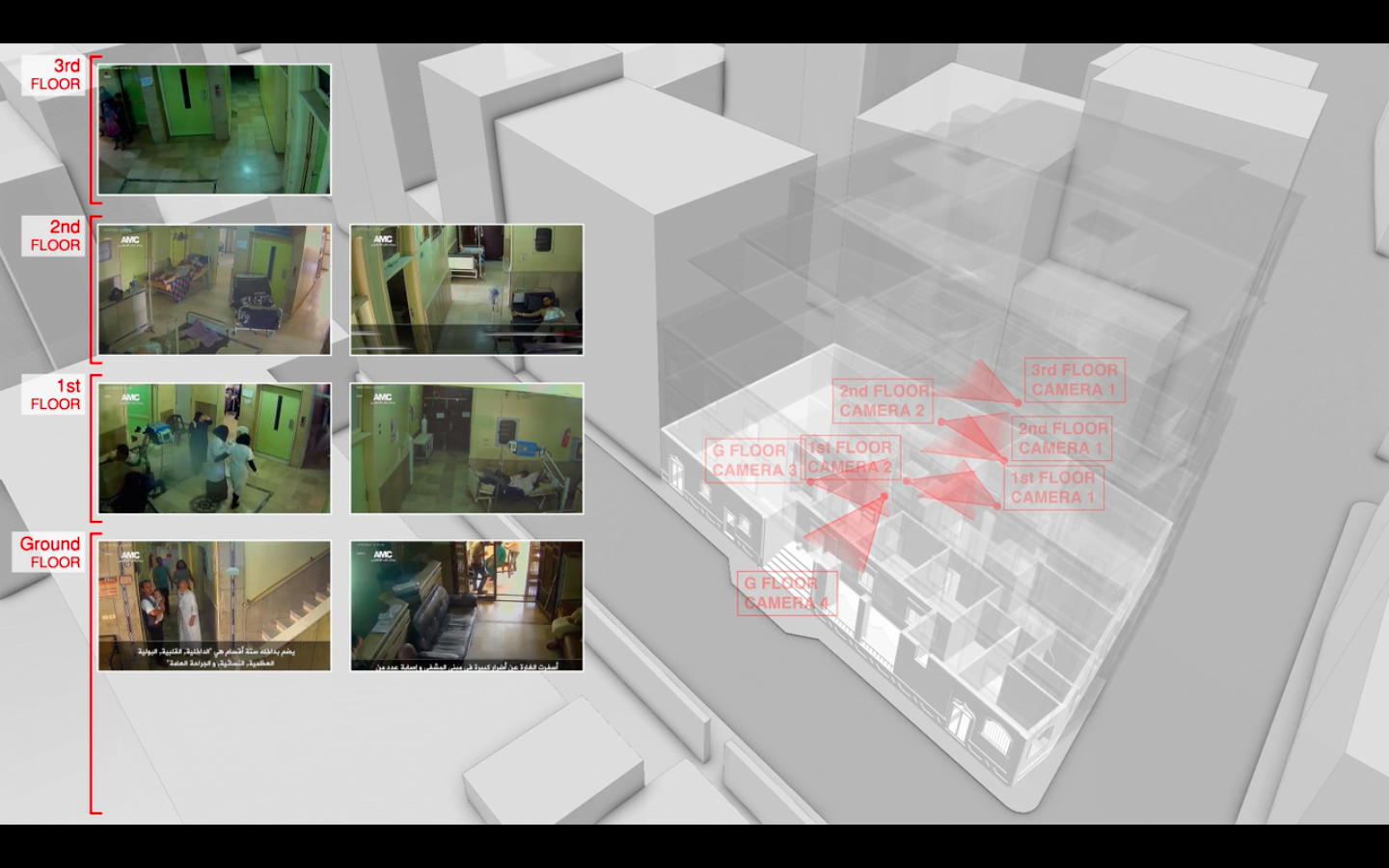
Photographs and videos taken in and around the hospital allow us to analyze some of the consequences of the strikes. Each piece of footage captures only a small part of the building, but composing and cross referencing them allows us to reconstruct the architecture of the building as a 3D model and locate the images of the bombings and their damage.The model becomes the medium through which we can navigate between the different images and videos of the incidents.

There are a number of CCTV cameras in the hospital that are continuously on, capturing every strike. We locate each camera and its orientation in the building. We integrate footage from the CCTV cameras, handheld videos, and photographs within virtual space. Locating each video clip in space provides a tangible link between them, verifying their place and constructing their relation to each other.

One essential video which moves from inside-outside becomes a hinge to the geolocation of the hospital. By analyzing what we can see in the video we can demonstrate a common disposition of the built environment in satellite imagery. Due to the spatial link we created, we are able to anchor all footage to this exact location. We therefore establish the location and multiplicity of strikes and as a result raise questions about intent.

fa-analysis-of-m2

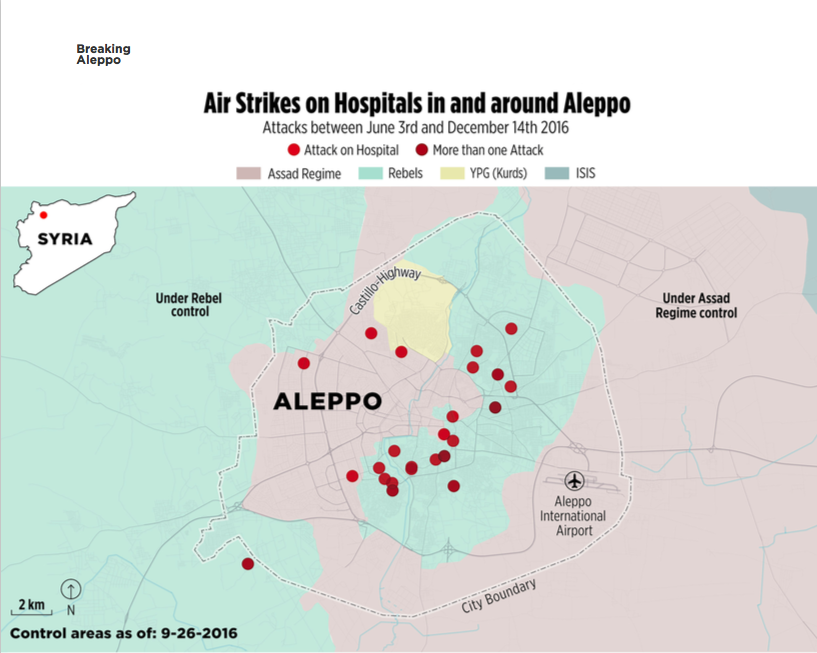
The video embeds a series of video clips and CCTV footage within the model of the hospital.  It concludes with a grim roll call of the strikes on M2 – 14 strikes in six months.  Remember that this was just one hospital attacked repeatedly – and as the map from Breaking Aleppo below shows, it was but one of many hospitals targeted.

The report takes the scale and systematicity of the attacks together with the Assad government’s ‘intimate knowledge of the terrain’ and its regular confiscation of medical supplies from humanitarian aid convoys to opposition-controlled areas across Syria as evidence that hospitals were being deliberately targeted ‘as part of a strategy intended to break the will and infrastructure of the resistance.’

You can find a version of the report with video embeds here.

Here is its key summary:

According to the Syrian Network for Human Rights (SNHR), Aleppo was hit by 4,045 barrel bombs in 2016, with 225 falling in December alone. A record of attacks compiled by the first responder organization Syrian Civil Defence, known as the ‘White Helmets’, covering the period from September 19, 2016 until the evacuation in mid-December showed 823 distinct reported incidents, ranging from cluster-munition attacks to barrel bombs. By comparing satellite images of the east of the city taken on October 18 with those taken on September 19, HRW was able to identify 950 new distinct impact sites—an average of more than one blast an hour, day and night, for a month.

Over the course of the year, the SNHR recorded 506 civilian fatalities from barrel bomb attacks, including 140 children and 63 women. Separately, the Violations Documentation Center recorded the death by military action of 3,497 civilians in Aleppo from June to mid-December 2016.

This evidence was gathered by multiple, independent witnesses using a variety of sources, from on-the-ground contacts up to satellite photographs. The sources reinforce and corroborate one another. They reveal a collage of thousands of mostly indiscriminate attacks, and their devastating impact on life and death in Aleppo during the siege.

The scale of attacks on Aleppo makes it almost impossible to compile a robust and verified record of every attack on the city. But drawing on a broad range of information, it is possible to see that an extensive aerial campaign was waged in Aleppo, and that a high proportion of the munitions deployed against the city and its population were indiscriminate.

The indiscriminate strikes were not one-sided: armed opposition groups also engaged in rocket attacks on civilians in western, government-held Aleppo. Casualty numbers are more difficult to find, but the SNHR reported sixty-four civilian deaths during the period from April 20 to April 29, 2016, and the Syrian Observatory for Human Rights recorded seventy-four civilian deaths during the opposition offensive to break the siege of Aleppo in late October 2016. The indiscriminate nature of the attacks is equally disturbing, and subject to analysis and judgement under the same international laws as any other attack on civilians in the conflict. However, there is little equivalence between the two sides when considering the scale and resources employed in the conflict.

aleppo-hospitals-bombed-3-june-to-14-december-2016

The report insists that

Aleppo was not broken in the darkness. Numerous witnesses provided evidence, some of it conflicting but much of it consistent, to substantiate claims of chemical attacks, barrel bombs, air strikes on hospitals and schools, and the deaths of thousands of civilians.

Its authors summarise an extraordinary campaign of disinformation that has three prongs: ‘denying the deeds’; ‘militarizing the victims’; and ‘attacking the witnesses’. I was astonished at the extent – and the mendacity – of this ‘campaign against the evidence’, as Breaking Aleppo calls it, when I first encountered it while analysing attacks on hospitals and medical workers in Syria.  It was (is) by no means confined to the alt.right and the devotees of Trump’s ‘alternative facts’ but reaches across to the far left, including an uncomfortable number of academics who have been willing to forego any critical understanding in order to absolve Russia and Syria of any and all culpability.

You can find my own arguments in previous posts here and here.

Human Rights Watch has also just issued a report on co-ordinated chemical attacks – illegal under international law – conducted by Syrian government forces as they advanced into eastern Aleppo between 17 November and 13 December 2016.

Striking Syria

screen-shot-2017-01-17-at-11-48-35

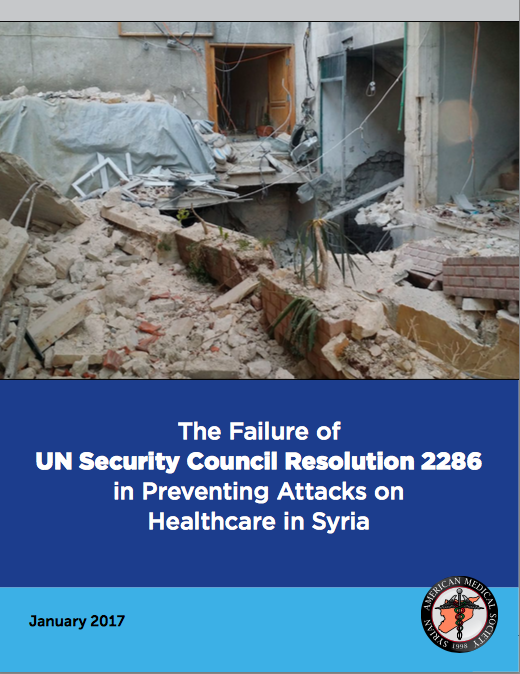
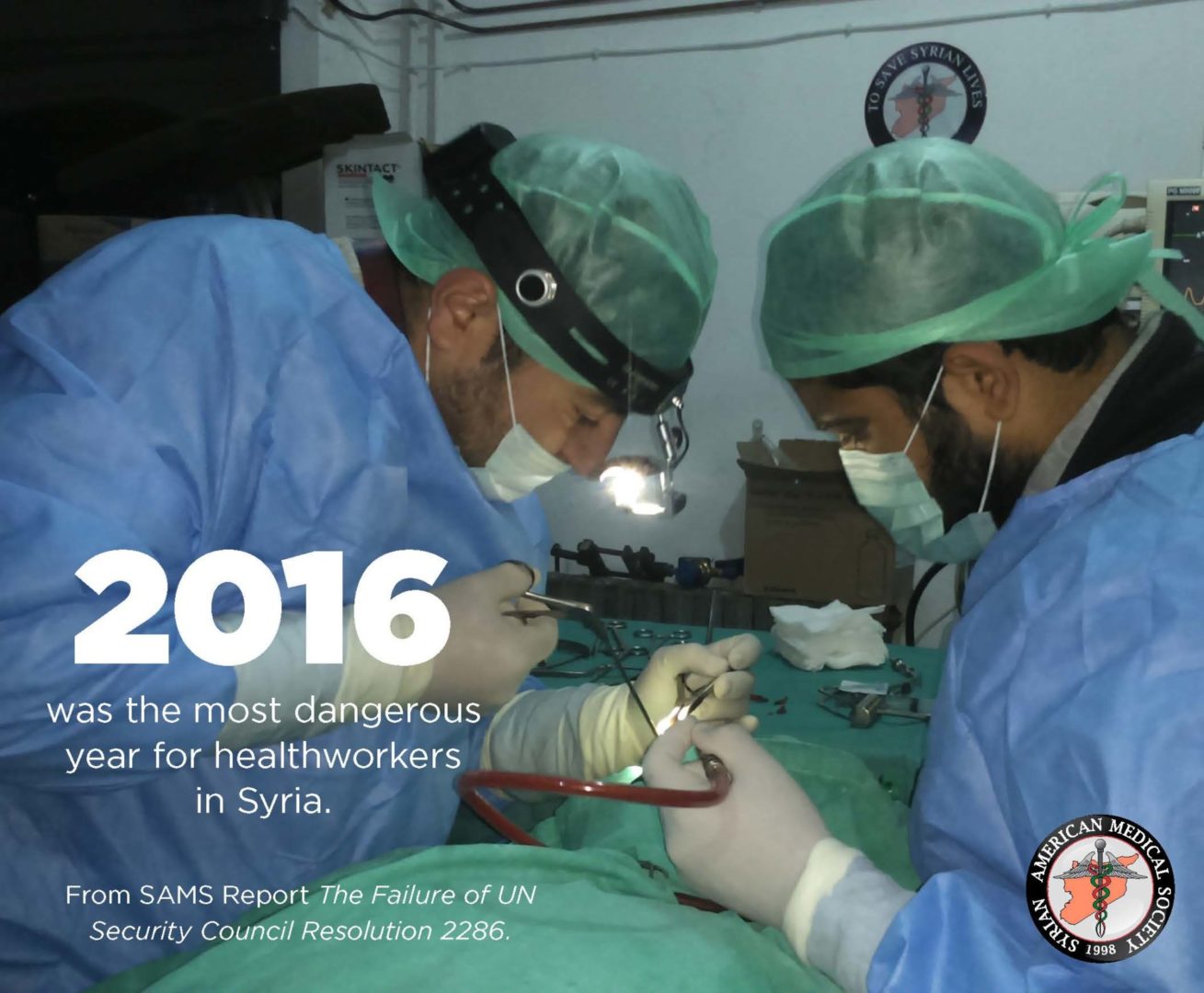
The Syrian-American Medical Society (SAMS) has published a grim report documenting the pattern of attacks on healthcare in Syria following the passage of UN Security Council Resolution 2286 on 3 May 2016 condemning attacks on medical facilities and personnel in conflict zones.  The Resolution was a general one; several states drew attention to Israel’s assault on medical facilities in Gaza, and to the US airstrike on the MSF Trauma Centre in Kunduz (Afghanistan) (see here and here).

The Resolution had the urgent support of a host of humanitarian NGOs; it was co-sponsored by more than 80 member states, and it was adopted unanimously by the Security Council.  At the time the UN Secretary-General Ban Ki-Moon described attacks on hospitals as a war crime, and declared:

When so-called surgical strikes are hitting surgical wards, something is deeply wrong… Even wars have rules…  The Council and all Member States must do more than condemn such attacks. They must use every ounce of influence to press parties to respect their obligations.

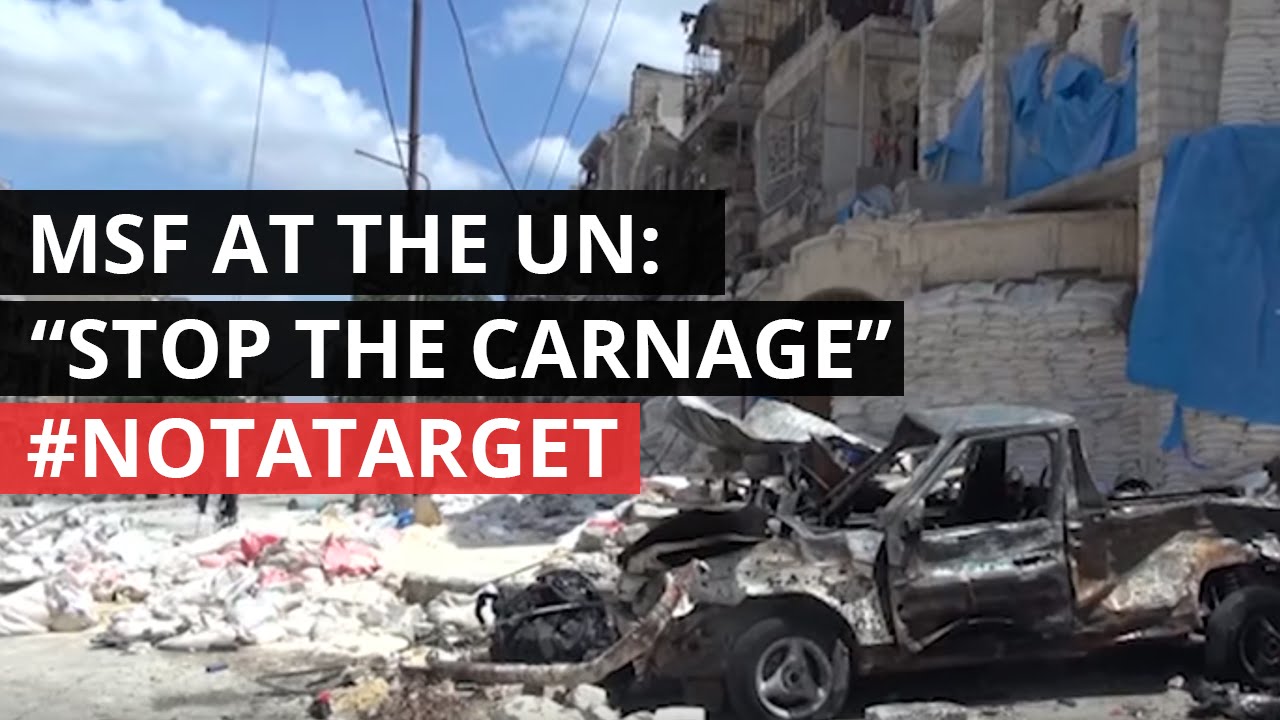
msf-at-the-un

And yet this is what SAMS found in Syria:

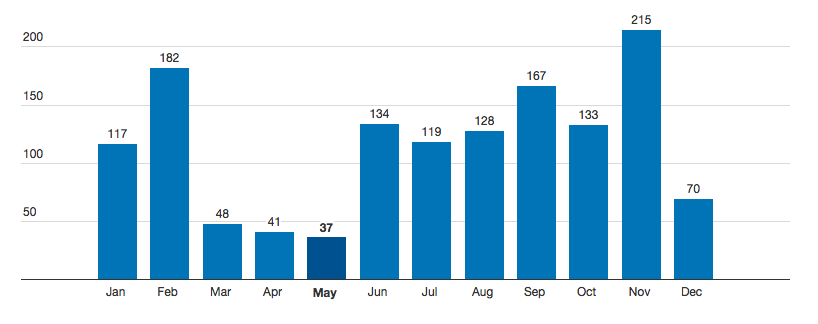
  • In 2015, the rate of targeting of medical facilities and personnel was one attack every four days.
  • In October 2015, following Russia’s intervention in support of the Syrian government, this rate doubled to one attack every 48 hours.
  • In November 2016 the rate virtually doubled again to one attack every 29 hours.

SAMS estimates that there were 252 attacks on medical facilities and personnel in 2016; 199 of them took place after the passage of UNSC Resolution 2286.

Between June and December  SAMS identified 172 attacks (all detailed in an appendix to the report): 168 of them were carried out by the Syrian government and its allies; one by non-state opposition forces; one by Islamic State; and two by unidentified parties.  Aleppo and Idlib were the principal targets: eastern Aleppo alone received a numbing 42 per cent of all attacks.

In case you are wondering about the sources for these claims, the report explains:

SAMS maintains rigid documentation standards in collaboration with partners in the WHO Health Cluster in Turkey and the Johns Hopkins University Bloomberg School of Public Health’s Center for Health and Human Rights. Our reporters on the ground rely on rst- hand testimony and photo documentation from medical sta and record the date, time, location, damages, casualties, impact on service delivery, weapon(s) used, and perpetrator of each incident. Any other source of information is not considered.

syria-attacks-graphics-03_page_6-e1484145301958

Dr Ahmad Tarakji, President of SAMS, reaches this bleak and compelling conclusion:

The failure of the international community to hold the perpetrators of these attacks accountable sends a dangerous message: that there are no lines, no limits, and no boundaries to the atrocities that are being committed against the Syrian people.

You can find more details about the targeting of doctors and hospitals in my post on the weaponisation of healthcare in Syria here; there is also a response to the passage of UNSC Resolution 2286 and its implementation by the Safeguarding Health in Conflict coalition (in September 2016) here.

Meanwhile Chris WoodsAirwars team has just released its preliminary assessment of civilian casualties from air strikes carried out by the US-led coalition and by Syrian/Russian air forces:

Syria’s civilians were under constant threat from Coalition air strikes throughout 2016, with 38% more casualty events reported in Syria than Iraq over the year. This may however reflect improved local reporting by Syrian monitors.

Overall, minimum likely civilian deaths in Syrian incidents graded by Airwars as Fair or Confirmed doubled in 2016. Across 136 incidents, between 654 and 1,058 civilians were claimed killed in total. Airwars estimates that a minimum of 818 civilians were likely injured in Fair and Confirmed events in Syria alone.

There were major spikes in February, in June and July (the Manbij campaign) and November the Raqqa campaign), all of them focused on areas held by Islamic State.

As for Syrian/Russian air strikes:

Airstrikes carried out by Moscow pummeled rebel-held areas of Syria throughout 2016, with many hundreds of civilians credibly reported killed.

Overall, there were 1,452 separate claimed civilian casualty events allegedly carried out by Russia during 2016. Between 6,228 and 8,172 civilians reportedly died in these events. Many of these incidents are likely to have been the result of actions by the Assad regime. Even so, civilian deaths from Russian strikes in 2016 far outpaced those from Coalition actions.

The pattern of civilian casualties from Russian air strikes:

screen-shot-2017-01-17-at-12-11-37

But at least three caveats are necessary.  First, these are provisional calculations:  ‘With so many allegations to assess, Airwars has a significant case backlog’, and the team has so far only completed a detailed analysis of the first four months of 2016.

Second, the report provides no separate listing of air strikes carried out by the Syrian Arab Air Force. The Airwars team concedes a ‘very high level of confusion – especially between Russia and the regime’.  Here is Kinda Haddad: ‘For many incidents we have some sources blaming the regime and others Russia – and we can’t really tell who is responsible as they use similar planes and weaponry.’  One major exception to that must be the use of barrel bombs dropped by the SAAF’s helicopters.

Third, these tabulations identify immediate casualties from the strikes: one of the reasons for attacking doctors and hospitals, as I explained previously, is to multiply subsequent and distant casualties – to deny those wounded (or simply sick) life-saving medical treatment.  So these casualty lists are minima – and not only as a result of the general problems of casualty accounting in conflict zones.

The Death of the Clinic

This is the fifth in a new series of posts on military violence against hospitals and medical personnel in conflict zones. It follows directly from my analysis of the situation in Syria here.

President Bashar al-Assad has consistently denied that his forces have attacked hospitals or doctors.  In an interview with SBS Australia on 1 July 2016 he asked his interviewer:

‘… the very simple question is: why do we attack hospitals and civilians?… No government in this situation has any interest in killing civilians or attacking hospitals. Anyway, if you attack hospitals, you can use any building to be a hospital. No, these are anecdotal claims, mendacious statements …’

president-al-assad-interview-sbs-australia-4

There are at least four answers to Assad’s disingenuous question (if you falter at the adjective, see here).

(1) Silencing the witnesses

When Widney Brown from Physicians for Human Rights testified at the Tom Lantos Human Rights Commission on 31 March 2016 she provided one clear and compelling rationale for Assad’s attacks on doctors:

‘… attacks on doctors silence particularly powerful witnesses. When the Syrian government denies its use of chemical weapons, cluster munitions, starvation, or torture, doctors can bear witnesses to these violations because they have seen and treated the victims.’

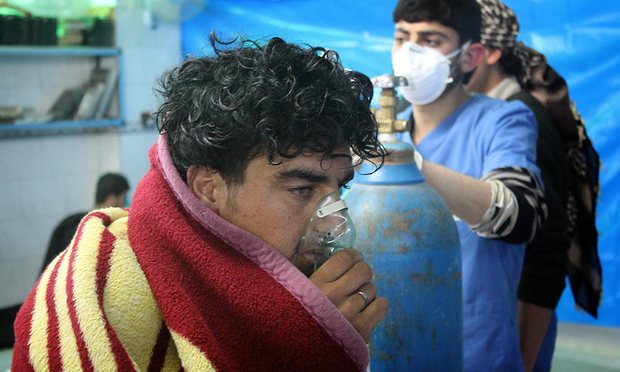
syrian-man-receiving-treatment-following-a-gas-attack

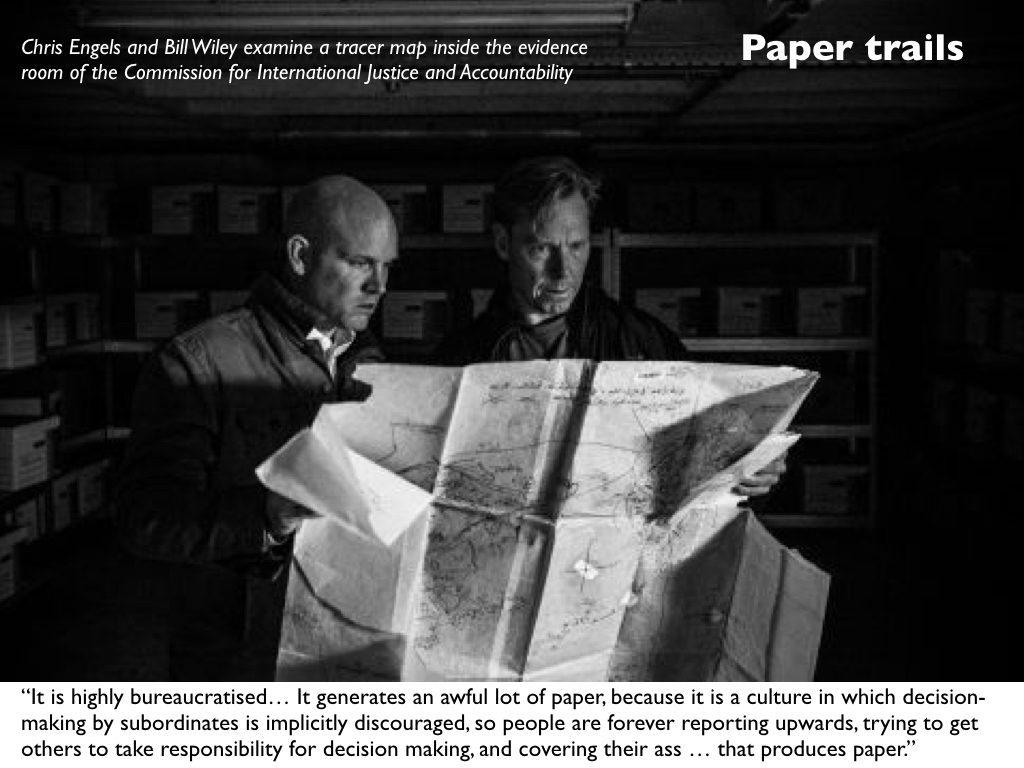
To be sure, there are other witnesses and even paper trails and photographic records.  Ben Taub, who has done so much to bring ‘Syria’s war on doctors‘ to the attention of a wider public, has also provided a detailed account of the work done by Bill Wiley and the Commission for International Justice and Accountability whose volunteers have smuggled over 600,000 documents out of Syria detailing mass torture and killings by the regime.

cija-syria-001

The war crimes have not been confined to attacks on hospitals in opposition-held areas.  A photographer known only as ‘Caesar’, who had been attached to the Defence Ministry’s Criminal Forensic Division, smuggled out thousands of high-resolution digital images exposing the horrors of the regime’s own military hospitals:

The pictures, most of them taken in Syrian military hospitals, show corpses photographed at close range – one at a time as well as in small groupings. Virtually all of the bodies – thousands of them – betray signs of torture: gouged eyes; mangled genitals; bruises and dried blood from beatings; acid and electric burns; emaciation; and marks from strangulation…

These unfortunates may have lived and died in different ways, but they were bound in death by coded numerals scribbled on their skin with markers, or on scraps of paper affixed to their bodies. The first set of numbers (for example, 2935 in the photographs at bottom) would denote a prisoner’s I.D. The second (for example, 215) would refer to the intelligence branch responsible for his or her death. Underneath these figures, in many cases, would appear the hospital case-file number (for example, 2487/B)…

[T]he system of organizing and recording the dead served three ends: to satisfy Syrian authorities that executions were carried out; to ensure that no one was improperly discharged; and to allow military judges to represent to families—by producing official-seeming death certificates—that their loved ones had died of natural causes. In many ways, these facilities were ideal for hiding “unwanted” individuals, alive or dead. As part of the Ministry of Defense, the hospitals were already fortified, which made it easy to shield their inner workings and keep away families who might come looking for missing relatives. “These hospitals provide cover for the crimes of the regime,” said Nawaf Fares, a top Syrian diplomat and tribal leader who defected in 2012. “People are brought into the hospitals, and killed, and their deaths are papered over with documentation.” When I asked him, during a recent interview in Dubai, Why involve the hospitals at all?, he leaned forward and said, “Because mass graves have a bad reputation.”

(2) Multiplying the casualties

This is a radicalisation of an old strategy.  As Sam Weber pointed out in Targets of opportunity (2005), ‘every target is inscribed in a network or chain of events that inevitably exceeds the opportunity that can be seized or the horizon that can be seen.’  So, for example, when the United States or Israel bombs a power plant it often as not explains that it has been careful to bomb in the small hours when only a skeleton staff was in the building in order to minimise collateral damage.  But this begs the question: why bomb the power plant at all?  In most instances the degradation of the electricity supply means that it becomes impossible to pump water or treat sewage; refrigerators fail and food perishes; hospitals are forced to use unreliable generators. The result – the intended, carefully calculated result – is that casualties rise at considerable distances from the target and over an extended period of time.

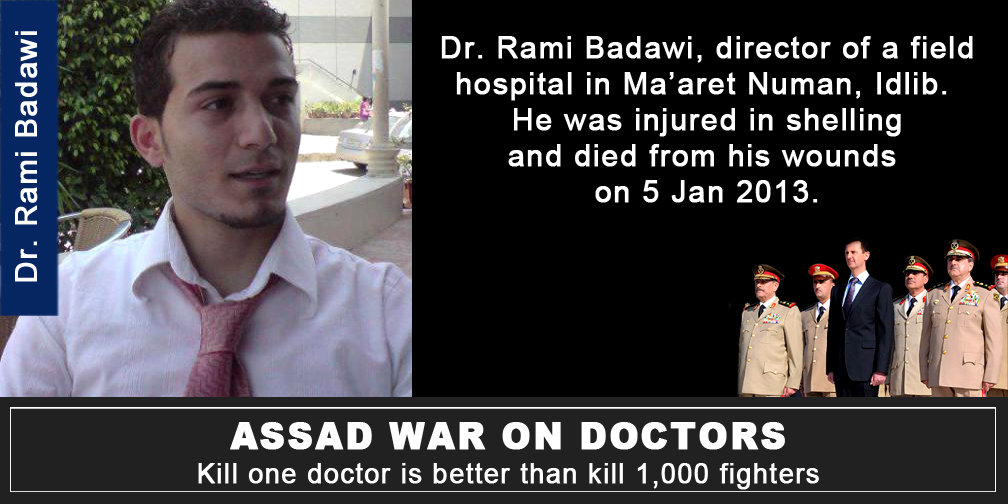
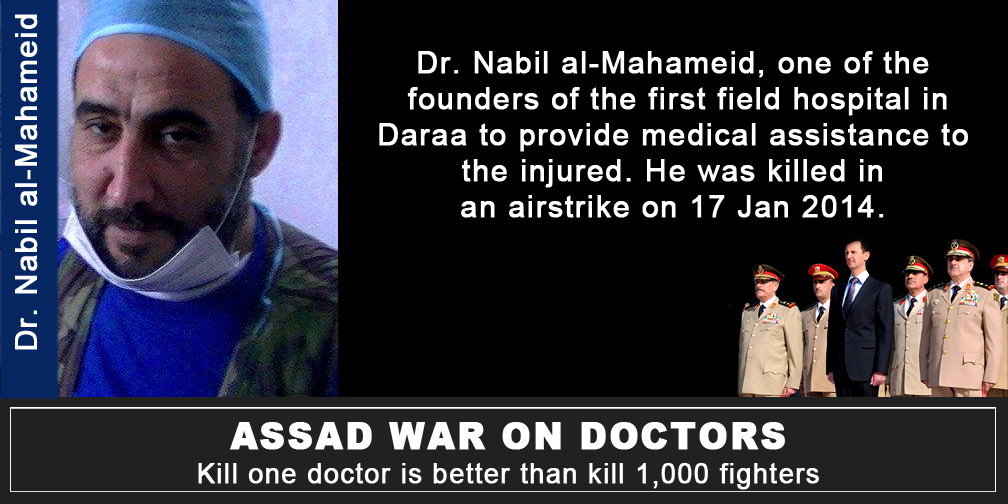
Similarly, Dr Abdulaziz Adel notes:  ‘Kill a doctor and you kill thousands.’  Simply put, patients who are sick or injured then go without treatment and in many cases their lives are put at risk.  (The images below are from Collateral Damage: more here).

syria_assad_war_crimes_murder_bomb67

syria_assad_war_crimes_murder_bomb15

syria_assad_war_crimes_murder_bomb37

Dr Rami Kalazi, a neurosurgeon from East Aleppo, agrees:

‘They are the artery of life in the city. Can you imagine a life in city without hospitals? Who will treat your kids? Who will make the surgeries for the injured people? So, they are targeting these hospitals because they know, if these hospitals were completely destroyed, the life will be completely destroyed.’

(3) ‘Moral[e] bombing’

This too is an old strategy.  The architects of ‘area bombing’ during the combined bomber offensive against Germany during the Second World War described it as ‘moral [sic] bombing’: a sustained and systematic attempt to undermine the morale of the enemy population so that they would demand their leaders sue for peace.  If this was a tried and tested strategy, however, the test showed that it was a complete failure (see my ‘Doors into nowhere’: DOWNLOADS tab).

morale-bombing-001

morale-bombing-002

But the lesson was lost in Syria, where attacks on hospitals have had a central place.  As Samir Puri argues, the strategy behind the joint Syrian and Russian air campaign seems to be:

“If there is a total collapse of any kind of trauma care, those are the sort of things that can contribute to collapsing morale very suddenly. The morale of a besieged force can look robust until it collapses.”

And Syria is not unique in contemporary wars: Israel has deployed the same strategy in its repeated assaults on Gaza (see here, here and here for ‘Operation Protective Edge’ in 2014), and the Saudi-led coalition has attacked more than 70 hospitals and health facilities in Yemen since March 2015 (in this latter case Russian media have reported MSF’s objections to the ‘utter disregard for civilian life’ without dissent: see for example here).

flashback-gaza-2014-001

‘Preventing medicine’, as Annie Sparrow puts it, has become ‘a new weapon of mass destruction’.

(4) ‘Violence legislates’

Following the attack on the UN aid convoy delivering supplies to a Syrian Red Crescent warehouse outside East Aleppo on 19 September 2016, 101 humanitarian organisations issued a joint appeal to the United Nations on 22 September; in part it read:

‘Deliberate attacks on humanitarian workers and civilians are war crimes. This must mark a turning point: the UN Security Council cannot allow increasingly brazen violations of international humanitarian law to continue with impunity.

‘Heads of state are gathered in New York this week for the United Nations General Assembly. Each one that accepts a lack of accountability for perpetrators and facilitators of war crimes colludes in the ongoing dissolution of international humanitarian law’ (my emphases).

The first paragraph is damning enough.  Ben Taub in the New Yorker again:

Nowhere has the supposed deterrent of eventual justice proved so visibly ineffective as in Syria. Like most countries, Syria signed the Rome Statute, which, according to U.N. rules, means that it is bound by the “obligation not to defeat the object and purpose of the treaty.” But, because Syria never actually ratified the document, the International Criminal Court has no independent authority to investigate or prosecute crimes that take place within Syrian territory. The U.N. Security Council does have the power to refer jurisdiction to the court, but international criminal justice is a relatively new and fragile endeavor, and, to a disturbing extent, its application is contingent on geopolitics.

But the sting comes in the second paragraph.  As I’ve noted before, international humanitarian law is not a neutral court of appeal, a deus ex machina above the fray, but has always been closely entangled with military violence.  In many respects it travels in the baggage train, constantly pulled by the trajectory of the very violence it supposedly seeks to regulate (or facilitate, depending on your point of view).  In short, as Eyal Weizman has it, ‘violence legislates‘.

There is good reason to fear that the systematic violation of medical neutrality is intended to force its dissolution.  Thomas Arcaro writes: ‘Humanitarian principles like neutrality and impartiality that once seemed so self-evident have been drawn into question, especially on the politically and ethnically complex battlefields of Iraq and Syria.’

And not only there.  In the case of the US airstrike on the MSF Trauma Centre in Kunduz in 2015, I’ve suggested that some key Afghan officers and politicians chafed at the protections afforded to wounded Taliban combatants by international humanitarian law.  They also alleged that the Trauma Centre had breached its conditional immunity because the Taliban had overrun the hospital and were firing at US and Afghan forces from its precincts.  There is no evidence to support that assertion, but it is an increasingly familiar claim.  On 7 December 2016 US Central Command justified a ‘precision strike’ requested by Iraqi forces on a building within the al-Salem hospital complex in Mosul by claiming that IS fighters had used it as a base to launch heavy and sustained machine-gun and rocket-propelled grenade attacks.  That would certainly have compromised the hospital’s immunity, but international humanitarian law still requires a warning to be issued before any attack and a proportionality analysis to be conducted; Colonel John Dorrian said that the US Air Force did not ‘have any reason to believe civilians were harmed’ but conceded that it was ‘very difficult to ascertain with full and total fidelity’ whether any medical staff or patients were in the building at the time of the air strike.

But what the Syrian case suggests is a new impatience with medical neutrality tout court: not only a hostility towards the treatment of wounded and sick combatants but also an unwillingness to extend sanctuary to wounded and sick civilians.

people-on-war-2016

And that reluctance is not confined to the Assad regime and its allies.    A survey carried out for the International Committee of the Red Cross between June and September makes for alarming reading – even once you’ve overcome your scepticism about public opinion polls.  As Spencer Ackerman reports:

Areas in active conflict record greater urgency over questions of civilian protection in wartime than do the great powers that often conduct or participate in those conflicts. In Ukraine, 83% believe everyone wounded and sick during a conflict has a right to health care, compared with 62% of Russians. A full 100% of Yemenis endorse the proposition, as do 81% of Afghans, 66% of Syrians and 42% of Iraqis – compared with 49% of Americans, 53% of Britons, 37% of the Chinese and 67% of the French.

It’s that last clause that is so disturbing: for the last four states listed are all permanent members of the UN Security Council…

So what, then, are we to make of what I’ve been calling ‘the exception to the exception’?

The exception to the exception

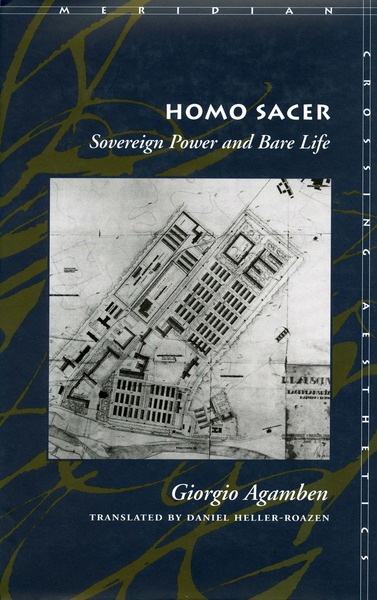
homo-sacerI think it’s a mistake to treat ‘the camp’, following Giorgio Agamben‘s vital work, as the exemplary, diagnostic site of the modern space of exception; the killing fields of today’s wars (themselves spaces of indistinction, where it is never clear where war stops and peace begins, where the geometry of the battlefield or, better, ‘battlespace’ becomes ever more fractured and blurred, and where the partitions between international and internal conflicts have been reduced to rubble) are also spaces within which groups of people are deliberately and knowingly exposed to death through the removal of legal protections that would ordinarily be afforded to them.  In short, killing and injuring become legally permissible.

Those exposed groups include both combatants and civilians, but their fate is not determined solely by the suspension of national laws (the case that concerns Agamben) because international humanitarian law continues to afford them some minimal protections.  One of its central provisions has been medical neutrality: yet if, through its serial violations in Syria and elsewhere, we are witnessing the slow ‘death of the clinic’ – which I treat as a topological figure which extends from the body of the sick or wounded through the evacuation chain to the hospital itself – and the extinction of ‘the exception to the exception’, the clinic as a (conditionally) sacrosanct space – then I think it’s necessary to add further twists to Agamben’s original conception.

As Adia Benton and Sa’ed Ashtan have argued, medical neutrality – the exception to the exception – represents a fraught attempt to restrict the state’s recourse to military violence: it is a limitation on and has now perhaps become even an affront to sovereign power and the state’s insistence that it is ‘the sole arbiter of who can live and who can die’.

Agamben describes the inhabitants of the space of exception as so many homines sacri – where sacer has the double meaning of both ‘sacred’ and ‘accursed’ – and it may be that in today’s killing fields doctors, nurses and healthcare workers are being transformed into new versions of homo sacer: once ‘sacred’ for their selfless devotion to saving lives, they are now ‘accursed’ for their principled dedication to medical neutrality.


homo-sacer_lode-kuylenstierna_press_gun

Yet the precarity of their existence under conditions of detention and torture, siege and airstrike, has not reduced them to what Agamben calls ‘bare life’.  They care – desperately – whether they live or die; they have improvised a series of survival strategies; they have not been silent in the face of almost unspeakable horror; and they have developed new forms of solidarity, support and sociality.

bodies-in-alliance-001

‘Your turn, doctor’

This is the fourth in a new series of posts on military violence against hospitals and medical personnel in conflict zones.  It follows from my analysis of air strikes on base hospitals on the coast of France in 1918 here, and of the US air strike on the MSF Trauma Centre in Kunduz, Afghanistan in 2015 here and here.  This post, together with the next in the series, is about Syria.  They all derive from a new presentation – still in active development – called ‘The Death of the Clinic: surgical strikes and spaces of exception’ that will eventually become an essay in my next book, so I would appreciate any comments or suggestions.

The eye of the storm 

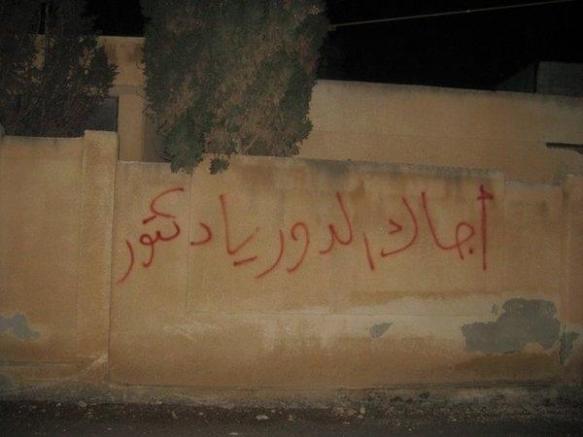
Syria’s civil war has multiple origins, but one of the most incendiary incidents took place on 16 February 2011 in the city of Dara’a 80 km south of Damascus near the Jordanian border.  Inspired by the spread of the Arab uprisings east across the Maghreb from Tunisia, and the threat they posed to a succession of autocratic regimes, a group of local teenagers decided to daub slogans on the wall of their high school.  One of them, a brave 15-year old (who now lives with his family in Jordan), painted this:
your-turn-doctor

‘Ejak el door ya Doctor’ – ‘Your turn, doctor’.

The doctor in question was Bashar al-Assad, Syria’s president, who had trained as an opthalmologist in Damacus and London.  In the months to come, Assad would give that slogan a viciously ironic twist.

The immediate response of the security forces to the graffiti was swift and draconian; the boys were rounded up, imprisoned and tortured (see herehere and here).  When their relatives protested to the officer in charge he told them:

‘Forget your children.  Just make more children. And if you don’t know how to make more, I’ll send someone to show you.’

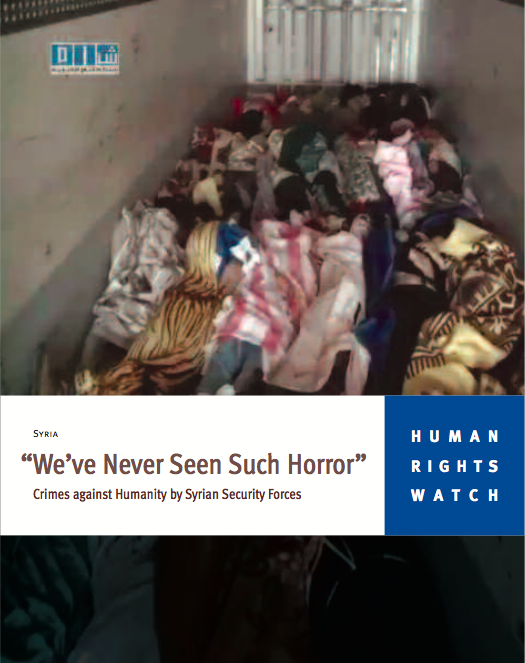
hrw-weve-never-seen-such-horrorLocal people took to the streets, and as the demonstrations spread on 22 March security forces entered the National Hospital in Dara’a, cleared it of all non-essential medical staff and stationed snipers on the roof who were under orders to fire on protesters.  The hospital remained until military control until May 2013; admissions were restricted and snipers continued to fire on the sick and wounded who tried to approach the hospital.  On 8 April security forces opened fire on thousands of demonstrators approaching a roadblock; ambulances were prevented from reaching the wounded, and a doctor, a nurse and an ambulance driver were killed when they tried to get through (UN Human Rights Council: ‘Assault on Medical Care in Syria’, 13 September 2013: download here; see also the Human Rights Watch report, ”We’ve never seen such horror’ here).
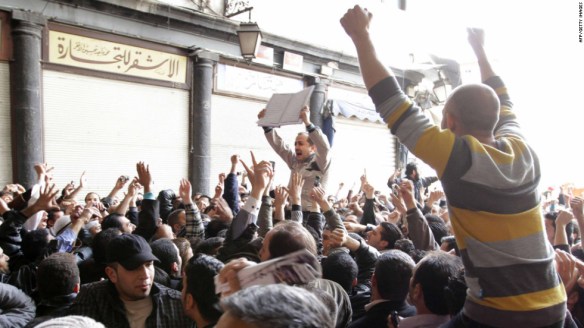
daraa-is-syria-in-damascus-2011

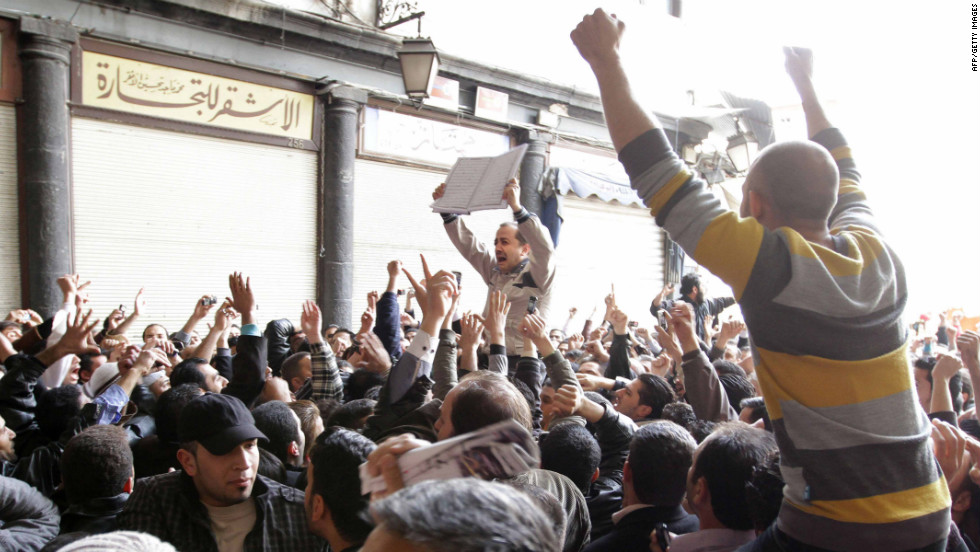
Others took up the cry, taking to the streets and chanting ‘Dara’a is Syria‘.  In many other areas the government stationed snipers, armoured personnel carriers, tanks and heavy artillery at hospitals; doctors suspected of treating protesters were arrested and tortured; security forces forcibly removed patients from hospitals, ‘claiming bullet or shrapnel wounds as evidence of participation in opposition activities’; and ambulances transporting casualties were attacked and pharmacies looted.

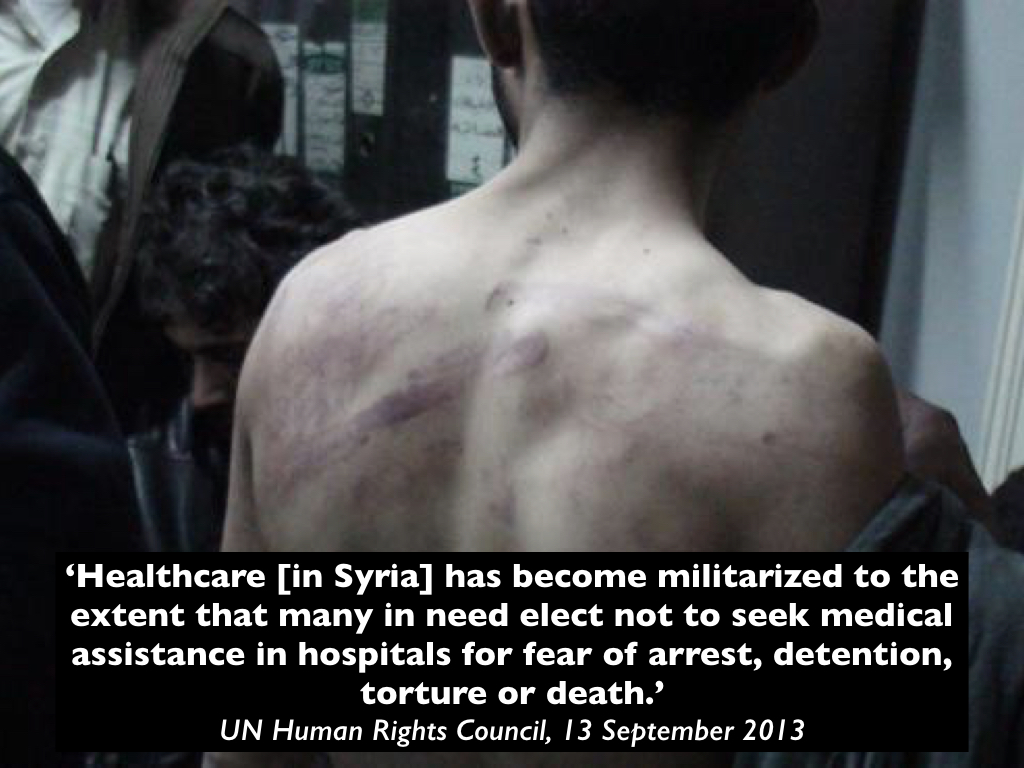
The UN Human Rights Council concluded:
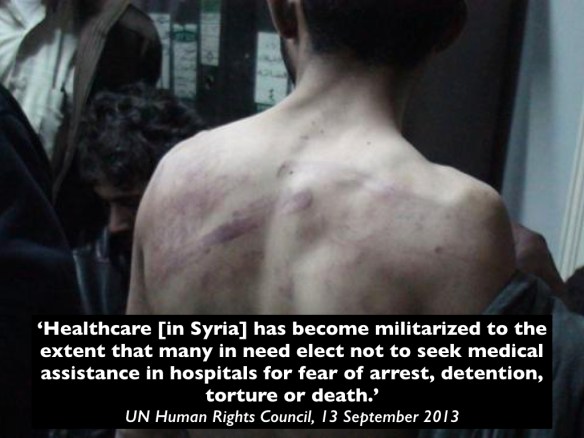
healthcare-has-become-militarised-001

This was, sadly, hardly novel.  In 2006, at the height of sectarian violence in occupied Baghdad, for example, Muqtada al-Sadr‘s Shi’a militia controlled the Health Ministry and manipulated the delivery of healthcare in order to marginalise and even exclude the Sunni population.  As Amit Paley reported:

‘In a city with few real refuges from sectarian violence – not government offices, not military bases, not even mosques – one place always emerged as a safe haven: hospitals…

‘In Baghdad these days, not even the hospitals are safe. In growing numbers, sick and wounded Sunnis have been abducted from public hospitals operated by Iraq’s Shiite-run Health Ministry and later killed, according to patients, families of victims, doctors and government officials.

‘As a result, more and more Iraqis are avoiding hospitals, making it even harder to preserve life in a city where death is seemingly everywhere. Gunshot victims are now being treated by nurses in makeshift emergency rooms set up in homes. Women giving birth are smuggled out of Baghdad and into clinics in safer provinces.’

He described hospitals as ‘Iraq’s new killing fields’, but in Syria the weaponisation of health care has been radicalised and explicitly authorized by the state.

Counterterrorism and the criminalisation of health care

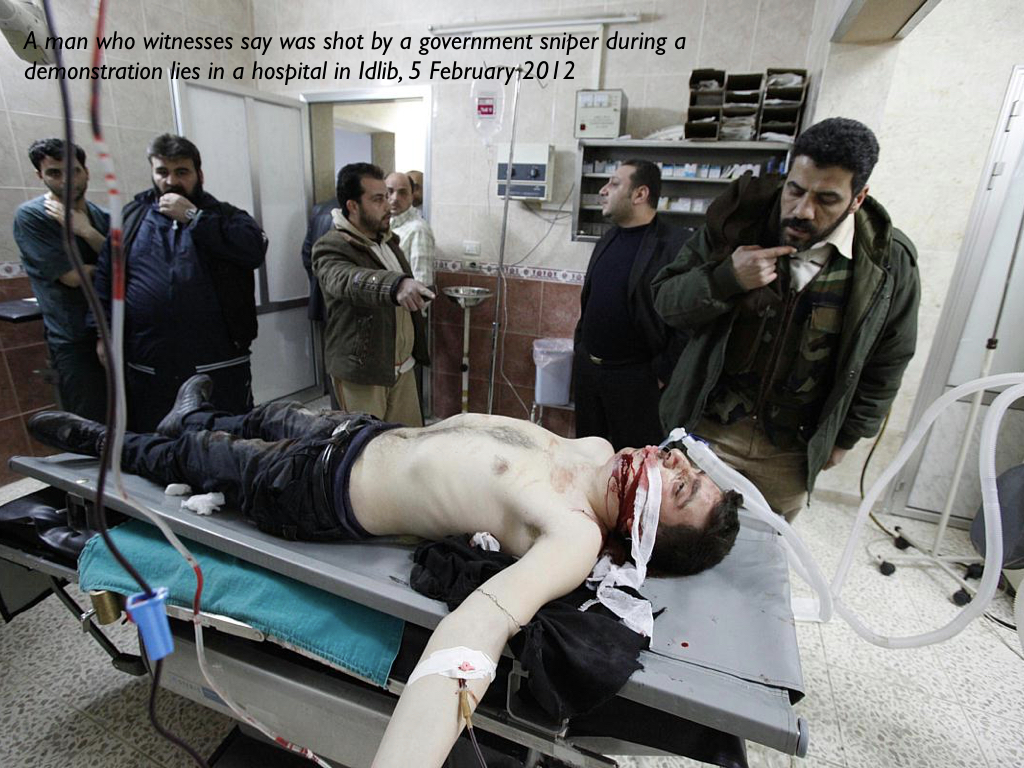
Doctors were systematically targeted for treating anyone who opposed the government.  In April 2012 one surgeon from Idlib told Annie Sparrow:

‘We were detained in the hospital for several days. Tanks parked out front, artillery in the wards, snipers on the roofs shooting patients who tried to come. They took our names, and summoned three of the five security branches – state, political and military. I was interrogated and forced to sign several commitments not to treat anyone not pro-regime. Of course, as soon as I was released I violated it immediately…the city was full of wounded and sick people. Soon after that a friend who worked in military security let me know I was now “wanted” [for my work], the charge being that I was the leader of a terrorist group. So I went into hiding, and moved my family to Turkey. In retaliation my brother was executed.’
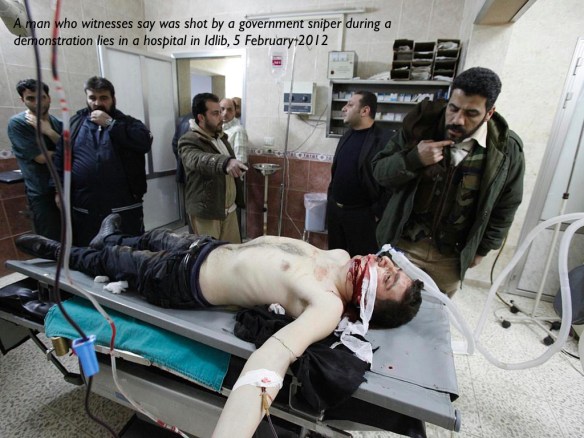
shot-by-a-sniper-001

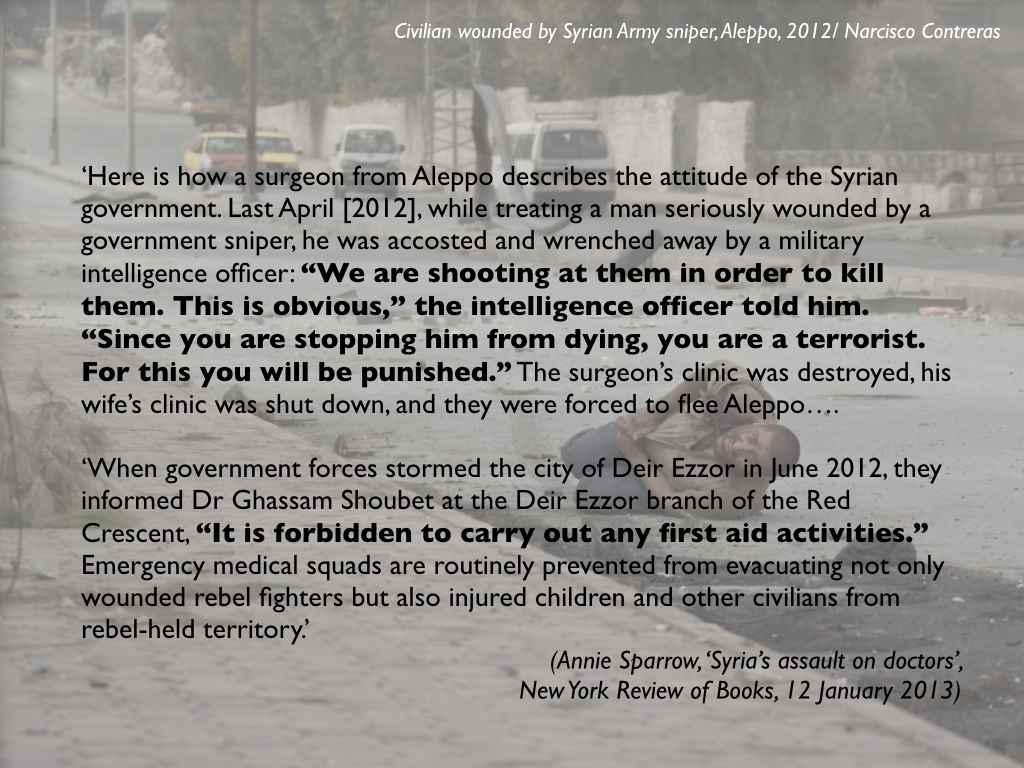
The State of Emergency that had been in force in Syria since 1962 was abruptly ended on 21 April 2012.  But on 2 July a new Counter-terrorism Law came into force that criminalised all medical aid to the opposition.  Here is Annie Sparrow again:

it-is-forbidden-to-carry-out-any-first-aid-activities-001

The parallels with the objections voiced by some members of Afghanistan’s security services against MSF’s work in Kunduz are only too clear: but in Syria they have been given explicit state sanction enforced through the law.

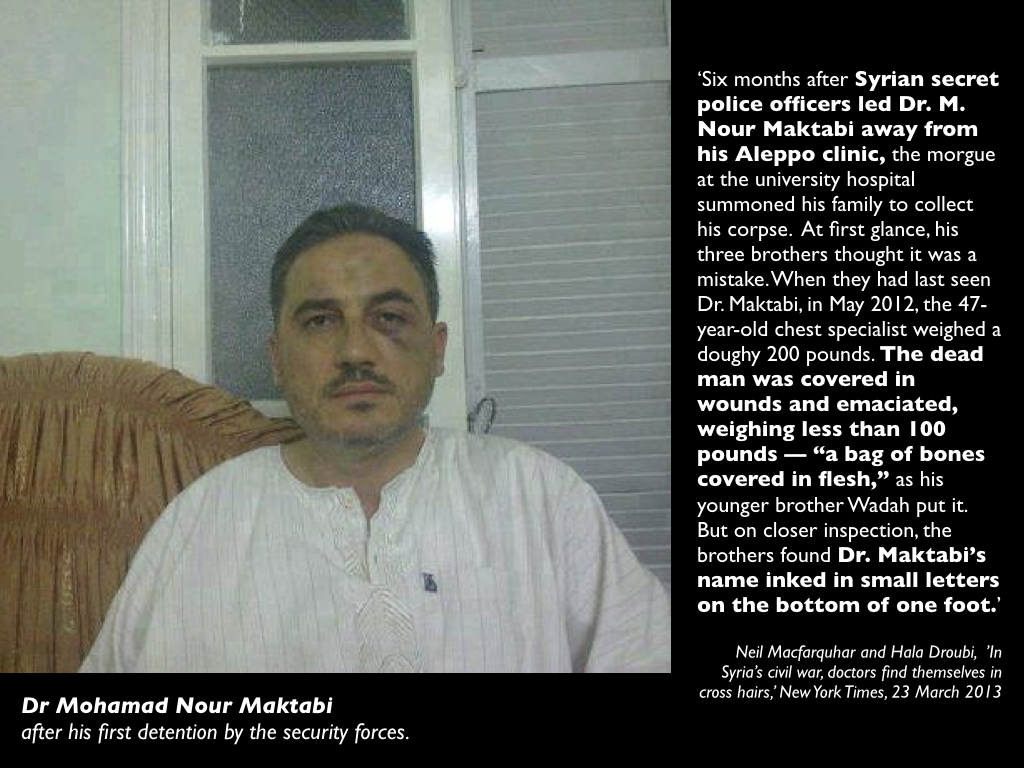
As Neil Macfarquhar and Hala Droubi reported for the New York Times in March 2013, doctors repeatedly found themselves in the cross-hairs.  Here, for example, is the case of Dr Mohamad Nour Maktabi:
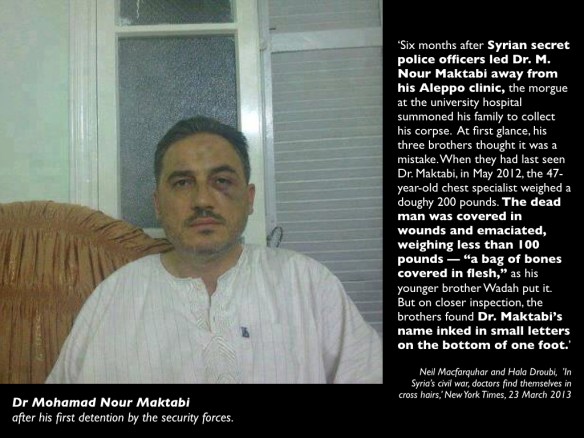
doctors-in-the-crosshairs-001

The Counter-terrorism Law also declared that all medical facilities operating in opposition-held areas without government permission were illegal – and thereby transformed them (under Syrian law, at least) into legitimate targets of military violence.

Air wars and ‘surgical strikes’

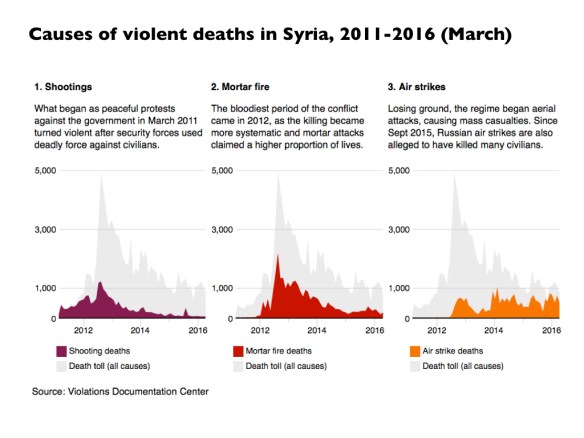
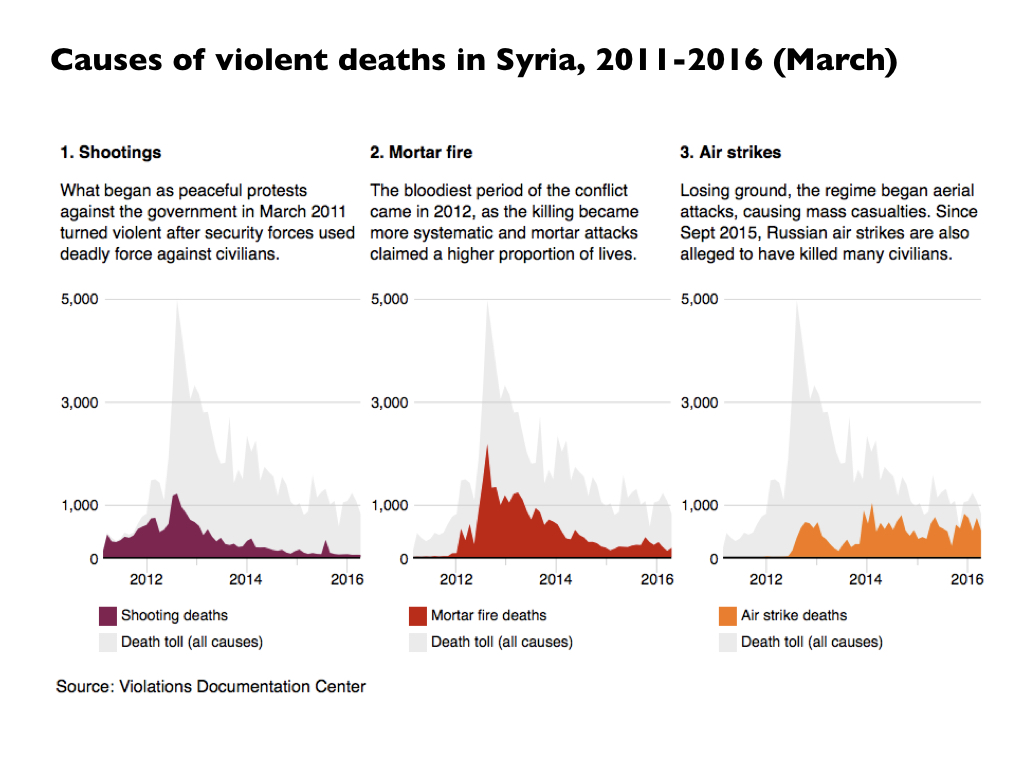
The nature of military and paramilitary violence has changed during the course of the war; shooting and mortar-fire have increasingly been supplemented by air strikes.
causes-of-violent-death-in-syria-2011-2016-001

Even in the early stages of the war doctors were confronting what one trauma specialist called ‘unimaginable injuries’.  Dr Rami Kalazi, a neurosurgeon in east Aleppo, explained:

‘In the beginning, we saw new injuries that we did not know how to treat. Fortunately, at the beginning of the revolution and when we began working in field hospitals, there was more freedom of movement. In 2012 and 2013, there was no such thing as “barrel bombs” and there was no violent shelling from airplanes, so many visiting foreign doctors came…

‘But even so, they told us that they were seeing injuries that they had never seen before in books or textbooks or in the hospitals where they worked in their home countries. Unfortunately, reality forces you to learn.’

But air strikes transformed the calculus of injury.  Many more casualties resulted from each attack, and the wounds of those who survived were often far more serious.

The US-led coalition has carried out multiple airstrikes primarily in areas controlled by IS, and the campaign has caused (minimally) hundreds and probably several thousand civilian casualties – see my analysis of specific US air strikes here and here, for example –  but the Syrian Arab Air Force has concentrated its fire on areas controlled by other rebel groups (see Jeffrey White‘s analysis here).

A favourite tactic has been the deployment of ‘barrel bombs‘ – in effect, aerial IEDs: oil drums filled with high explosive and cut rebar to act as shrapnel – dropped from helicopters (see Human Rights Watch here).  Basel al-Junaidi described witnessing their impact:

I saw the aftermath of a barrel bomb. I saw human remains scattered in the street; I heard the screaming. I’m trained as a doctor, but I was unable to act. I just stood there, petrified. The West thinks we’re used to this, but we aren’t of course. We’re like anyone else – we use computers and cars, not camels and tents…

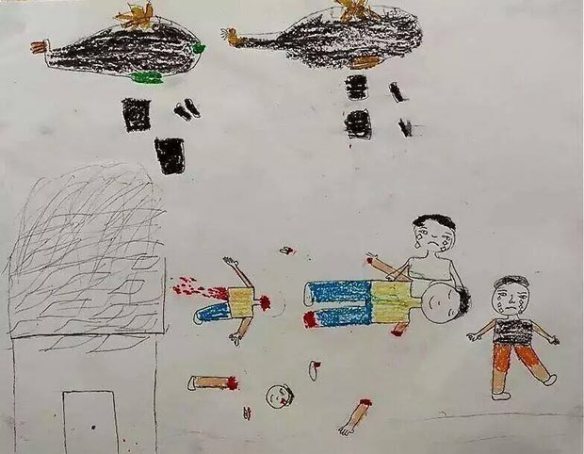
Another doctor who worked in Syria said he kept ‘a drawing from a second grader in Aleppo, showing helicopters bombing the city, blood and destruction below.’  Chillingly, ‘the dead children are smiling while the living ones are crying.’
the-dead-children-are-smiling

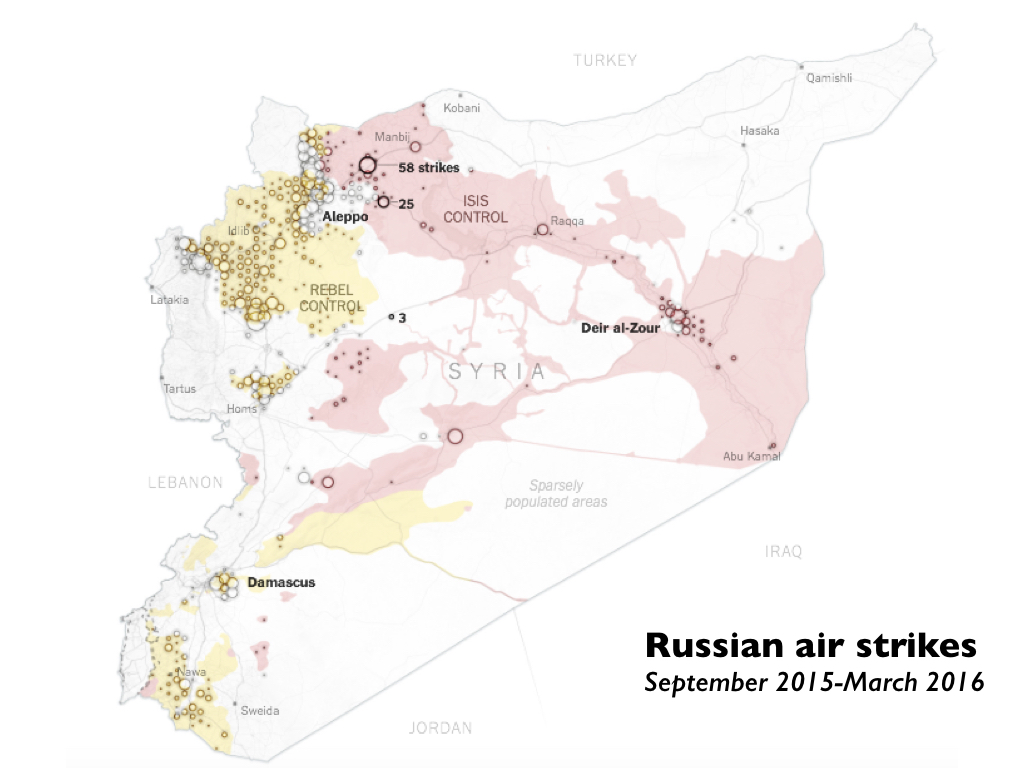
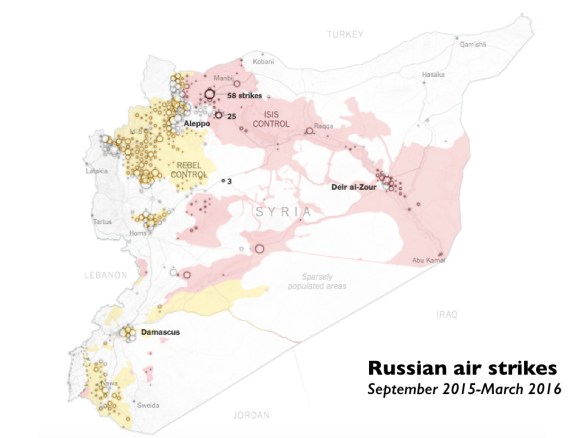
From September 2015) the Russian Air Force, often acting in concert with the Syrian Arab Air Force, has also concentrated on targets in areas controlled by other opposition groups:
russian-air-strikes-in-syria-to-march-2016-001

Russia has routinely denied these charges, but from 30 September to 12 October 2015 its Ministry of Defence published videos of 43 airstrikes. Bellingcat, aided by crowdsourcing, identified the exact location of 36 of them and overlaid them on the ministry’s own map identifying which groups controlled what parts of the country (see the full report, ‘Distract, Deceive, Destroy’, here):

‘The result revealed inaccuracy on a grand scale: Russian officials described 30 of these videos as airstrikes on Isis positions but in only one example was the area struck in fact under the control of Isis, even according to the Russian MoD’s own map.’

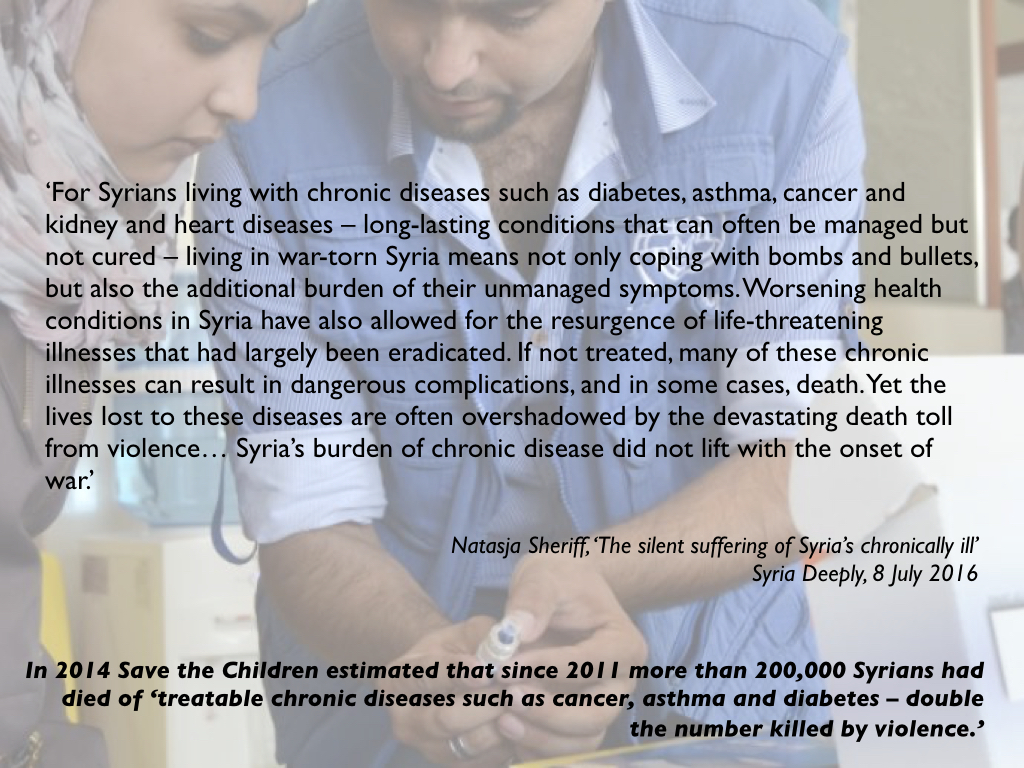
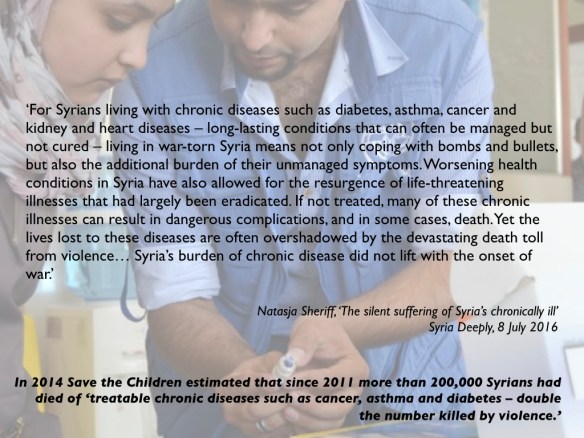
The effect of these air strikes has been devastating on the population at large.  To make matters even worse, air strikes cannot target individual doctors and have instead frequently been directed against hospitals and other medical facilities.   This compromises not only trauma care for the wounded but also the treatment of chronic and infectious diseases:
chronic-diseases-and-the-syrian-civil-war-001

(You can find a discussion of the problem of infectious diseases in Sima L. Sharara and Souha S. Kanj, ‘War and infectious diseases: challenges of the Syrian Civil War’, PLOS Pathogens 10 (11) (2014) here).

Hospitals and bomb sights

Doctors and other medical staff had to adjust to a new, sickening vulnerability.  Here is one OB/GYN who was still working in a hospital in East Aleppo when she was interviewed on Public Radio International in August 2016:

Carol Hills, PRI: Doctor Farida, did I just hear a noise there? Was that some sort of attack that I just heard?
Dr Farida Almouslem: It’s attack. [Laughs]. It’s normal. It’s away from me. Not next to me. These noises are all the time.
Hills: Do you and the doctors and patients you work with feel safe inside the place where you’re working?
Dr Farida: No. It’s not safe. I work at the third floor in my hospital. And many times the wall was perforated. So every woman came to the hospital, she knows that there is a danger on her life. So they just give the delivery, or give the birth, and then go home. She escapes to home because she knows our hospital is always targeted.

Other doctors in opposition-held areas said the same.  Here is Dr Mohamed Tennari, director of an above-the-ground field hospital in Idlib:

‘When I am in the hospital, I feel like I am sitting on a bomb. It is only a matter of time until it explodes. It is wrong − a hospital should not be the most dangerous place.  I wish I could say that targeting a hospital in Syria is unique, but is not.’

In fact, it’s far from unique: Physicians for Human Rights has issued a report detailing Attacks on Doctors, Patients and Hospitals hospitals and provided a interactive map of attacks on healthcare in Syria.

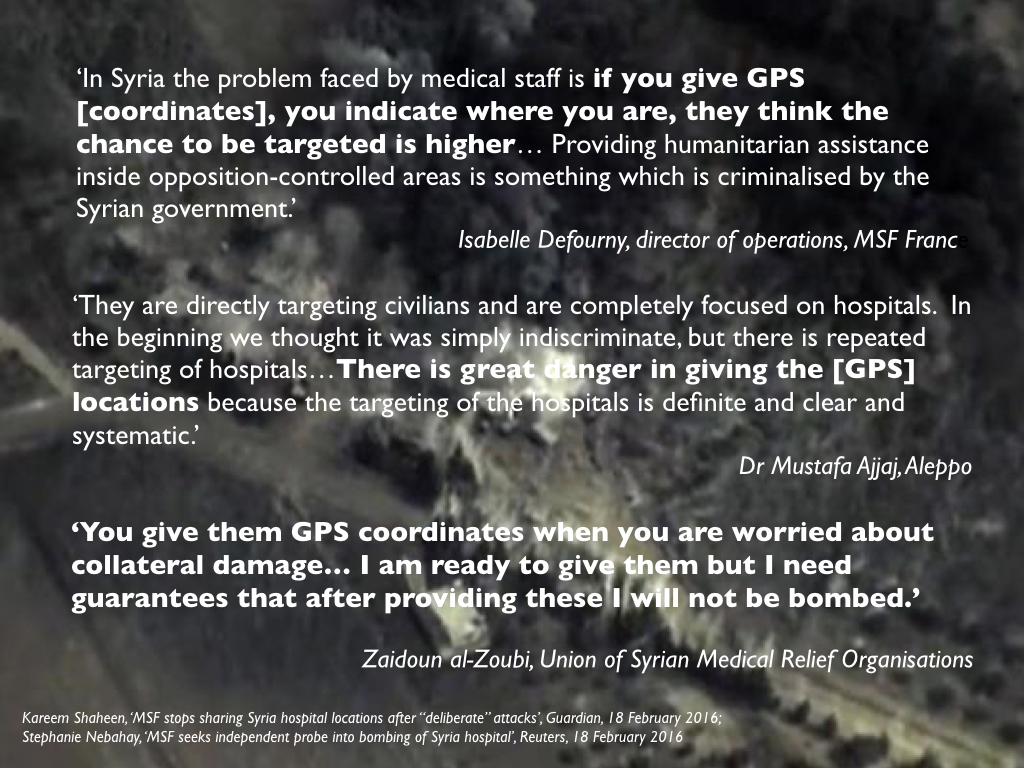
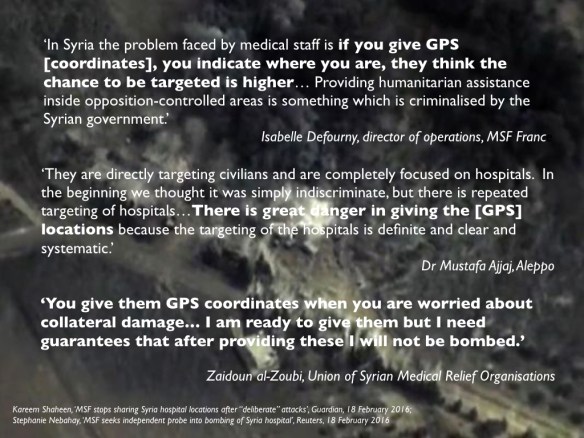
In the face of these escalating attacks, hospitals in opposition-held areas have tried to conceal their locations from the Syrian government.  In contrast to the protocol adopted by the MSF Trauma Centre in Kunduz, they have been markedly reluctant to provide their GPS coordinates (and see MSF’s explicit comparison between what happened in Kunduz and the situation in Syria here):
gps-coordinates-and-surgical-strikes-001

But this has trapped them in a grim Catch-22.  Michiel Hofman of Médecins sans Frontières – which is not permitted to operate in government-controlled areas in Syria – explains:

‘Hospitals that MSF supports in Syria are bereft of the possible protection of being clearly marked as a hospital or sharing of GPS coordinates, as the Syrian government passed an anti-terrorist law in 2012 that made illegal the provision of  humanitarian assistance – including medical care – to the opposition, forcing most health structures to go underground and operate without governmental medical registration. The bombing parties can then conveniently claim they were unaware it was a hospital they hit.’

More often, the Syrian government and its allies routinely describe the bombed building as a ‘so-called hospital’.  After an air strike on an MSF-supported hospital near Maarat al-Numan in Idlib on 15 February 2016 Bashar Jaafari, Syria’s ambassador to the United Nations, made this statement:

‘The so-called hospital was installed without any prior consultation with the Syrian government by the so-called French network called MSF which is a branch of the French intelligence operating in Syria… They assume the full consequences of the act because they did not consult with the Syrian government. They did not operate with the Syrian government permission.’

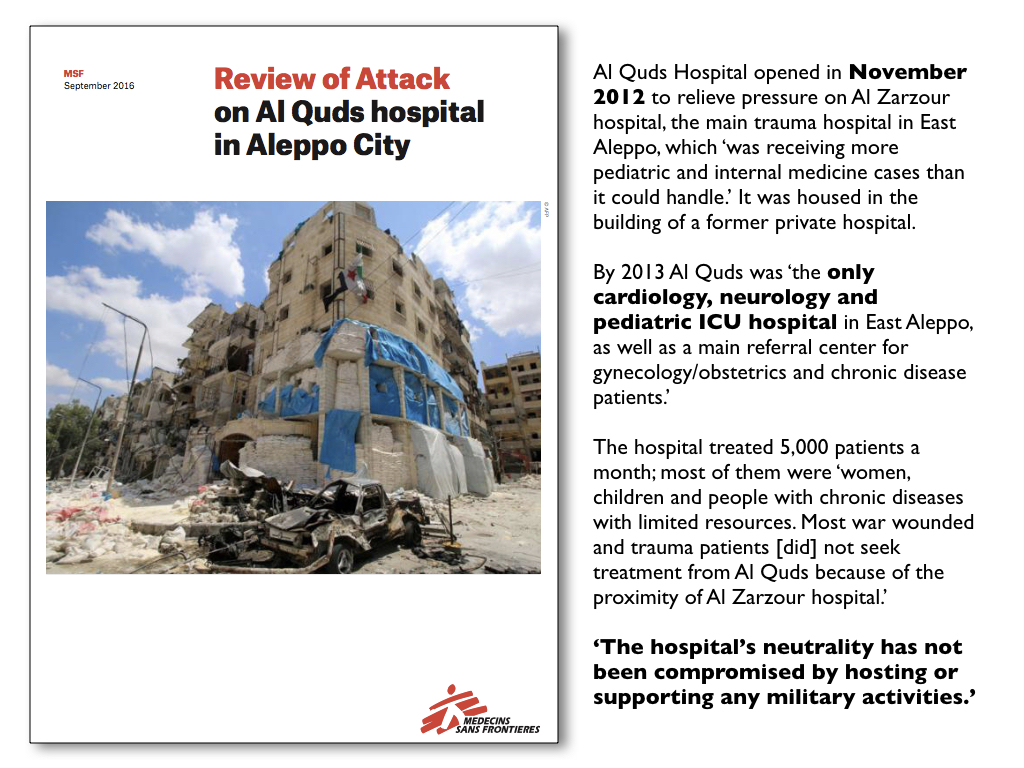
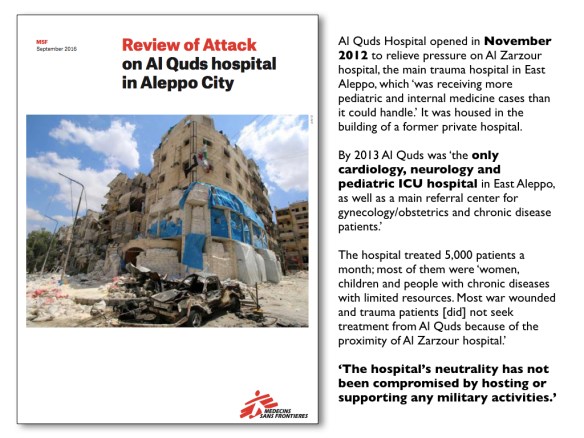
The allies of the Syria government are not confined to Russia and Iran.  On 27 April 2016 the Al Quds hospital in Aleppo was hit by two air strikes that killed 55 people  – among them two specialists, including Dr Muhammad Waseem Maaz, Al Quds’s pediatrician – and severely damaged the hospital. When it partially reopened 20 days later its capacity was reduced from 34 to 12 beds.  MSF conducted a detailed review of the operations of the hospital and the circumstances of the attack:
al-quds-hospital-attack-001

Here is Professor Tim Anderson on what he calls ‘The “Aleppo Hospital” Smokescreen‘ (and for reasons that will become obvious I am so tempted to put scare-quotes around the title that adorns his post; the Department of Political Economy at the University of Sydney lists him as a Senior Lecturer not a Professor, but perhaps anxiety over the appellation ‘Doctor’ is contagious):

‘…the story of Russian or Syrian air attacks on the ‘al Quds hospital’ gained prominence in the western media… CCTV showed people leaving this ‘hospital’ before an explosion.

‘The building is in the southern al-Sukkari district, which has been a stronghold of Jabhat al Nusra for some years. Many Aleppans had never heard of ‘al Quds hospital’. Dr Antaki [Aleppo Medical Association in Western Aleppo] says: “This hospital did not exist before the war. It must have been installed in a building after the war began”…. This facility was not a state-run or registered facility.’

Anderson is joined in his disinformation effort by Eva Bartlett writing in the ‘OffGuardian’:

Dr. Zahar Buttal, Chairman of the Aleppo Medical Association … said: “The media says the only pediatrician in Aleppo was killed in a hospital called Quds. In reality, it was a field hospital, not registered.”

As for the pediatrician, “We checked the name of the doctor and didn’t find him registered in Aleppo Medical Association records.”…

… central to the lies were the bias and propaganda of the very partial, corporate-financed Médecins Sans Frontières (MSF), which supports areas in Syria controlled by terrorists, specifically Jabhat al-Nusra…’

To repeat: the Syrian government has refused to register or recognise any hospitals operating in areas outside its control – hence the snide reference to ‘so-called hospitals’ and Anderson’s meretricious scare-quotes – and it does not permit MSF to operate in areas under its control (despite repeated requests).  As for the disappearance of Dr Muhammad Waseem Maaz from the Syrian government’s registry (though I have no doubt he was on other lists maintained by the regime) the director of the Children’s Hospital in Aleppo provides a graceful tribute to him here.  And here is the doctor whose death these commentators dismiss so lightly (if you have the stomach for it, you can see his last moments caught on CCTV here):

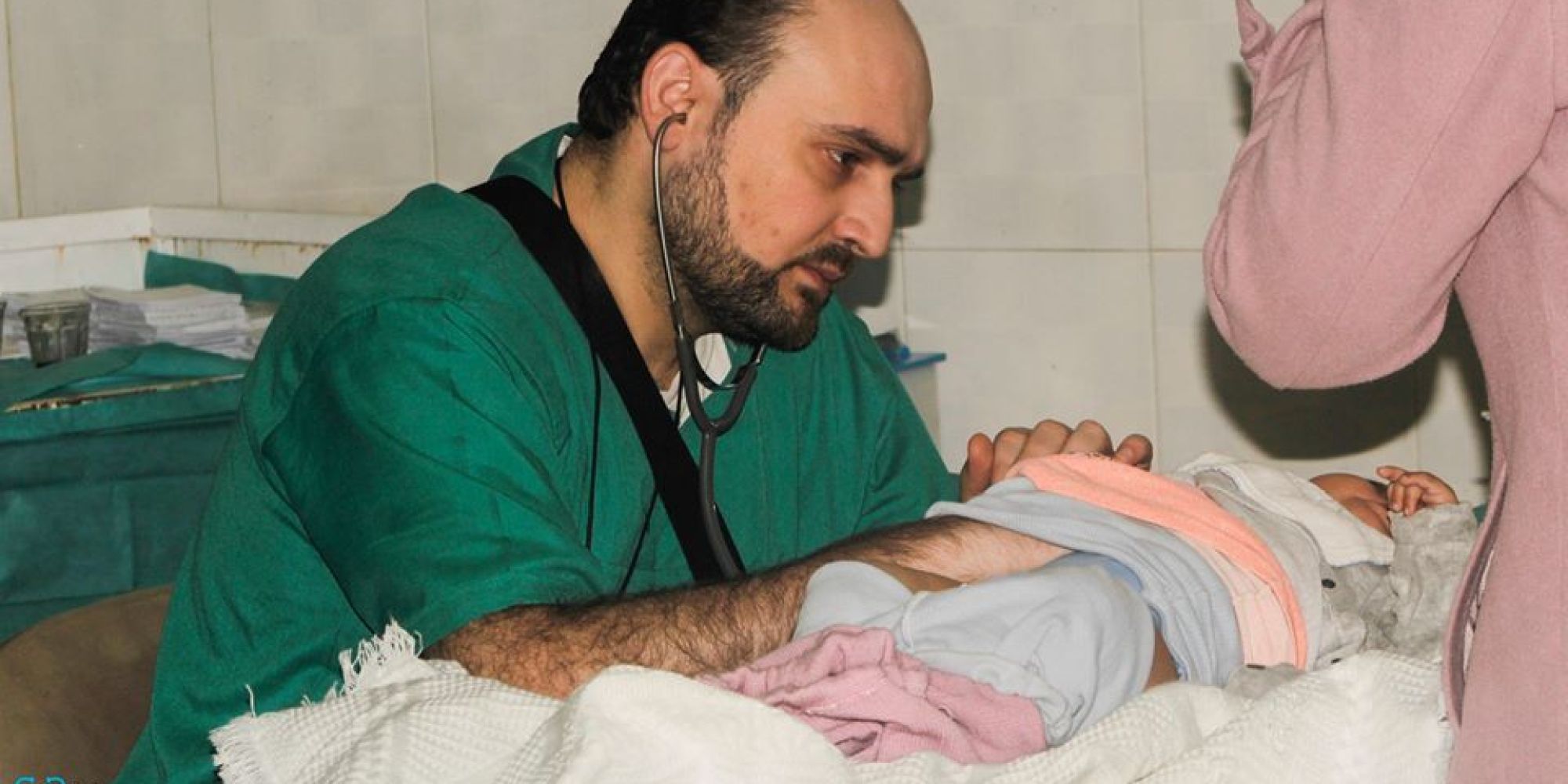
dr-muhammad-waseem-maaz

What, apart from the grotesque stipulations of the Syrian state, makes them think it proper to withdraw medical care from those living – surviving – in rebel-held areas?  International humanitarian law is unequivocal: they are entitled to medical treatment and to be protected whilst it is provided to them.

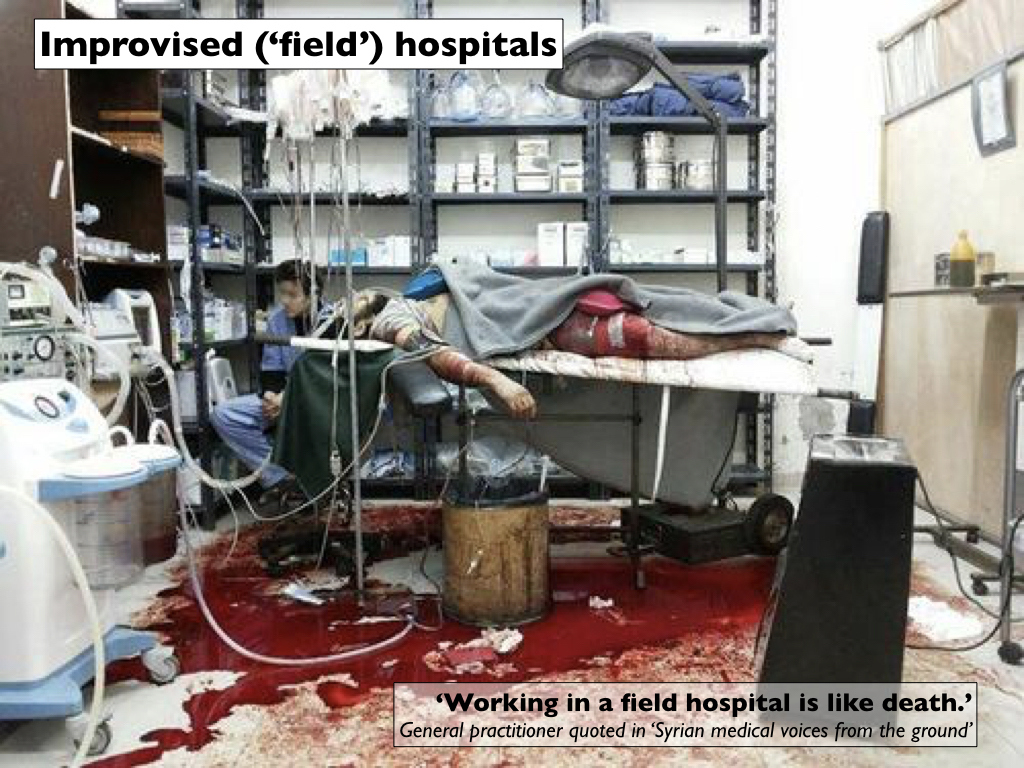
In rebel-held areas medical care has increasingly moved outside what were once established hospitals into the clandestine ‘field hospitals’ referred to above, which have been given numbered code-names to conceal their locations.  Some, like those established by MSF, follow strict medical protocols and, according to a study of one operating in Jabal al-Akrad by Miguel Trelles and his colleagues, they have (for a time) been able to provide high-quality medical care with remarkable survival rates (‘Providing surgery in a war-torn context: the Médecins Sans Frontières experience in Syria’, Conflict and Health (December 2015)).  As the attacks on them have increased and qualified personnel and medical supplies have become scarce, however, many have become exercises in improvisation:
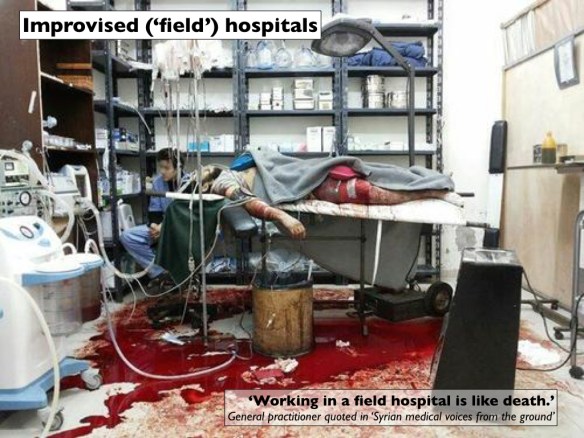
field-hospitals-001

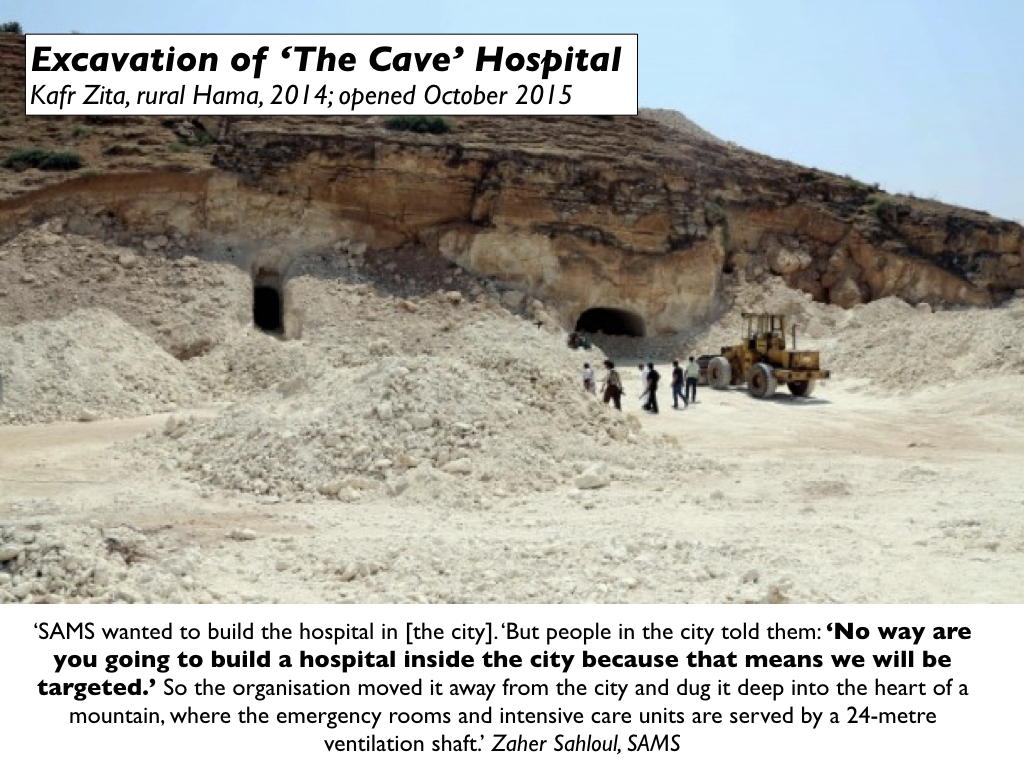
Some of these hospitals have literally gone underground.  ‘‘In our worst dreams – in our worst nightmares – we never thought we would have to fortify hospitals,’ declared Dr Zaidoun al-Zoabi of the Union of Medical Care and Relief Organizations. ‘It’s not humane. It’s impossible to comprehend.’

Subterranean locations have been used not only to protect the hospitals but also to protect local populations.  Charles Davis reported that

‘whether it’s a vehicle or a building, anything that’s identifiable as providing medical care is ripe for an airstrike, so that staff have now taken to covering up any distinguishing characteristics. Even so, [Dr Abdulaziz Adel, a surgeon in East Aleppo, admits that] local residents are “always begging us to go away, take your hospital away from us or otherwise we’ll be a target.”‘

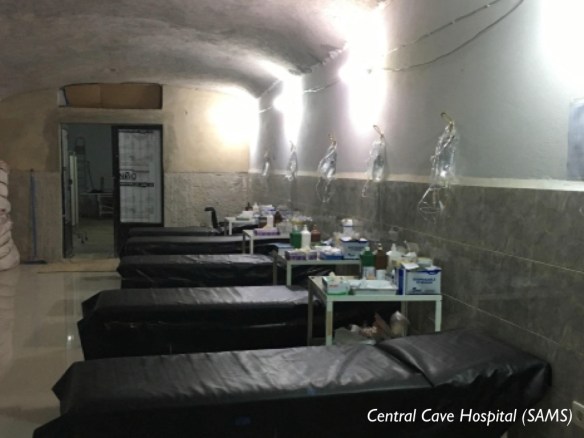
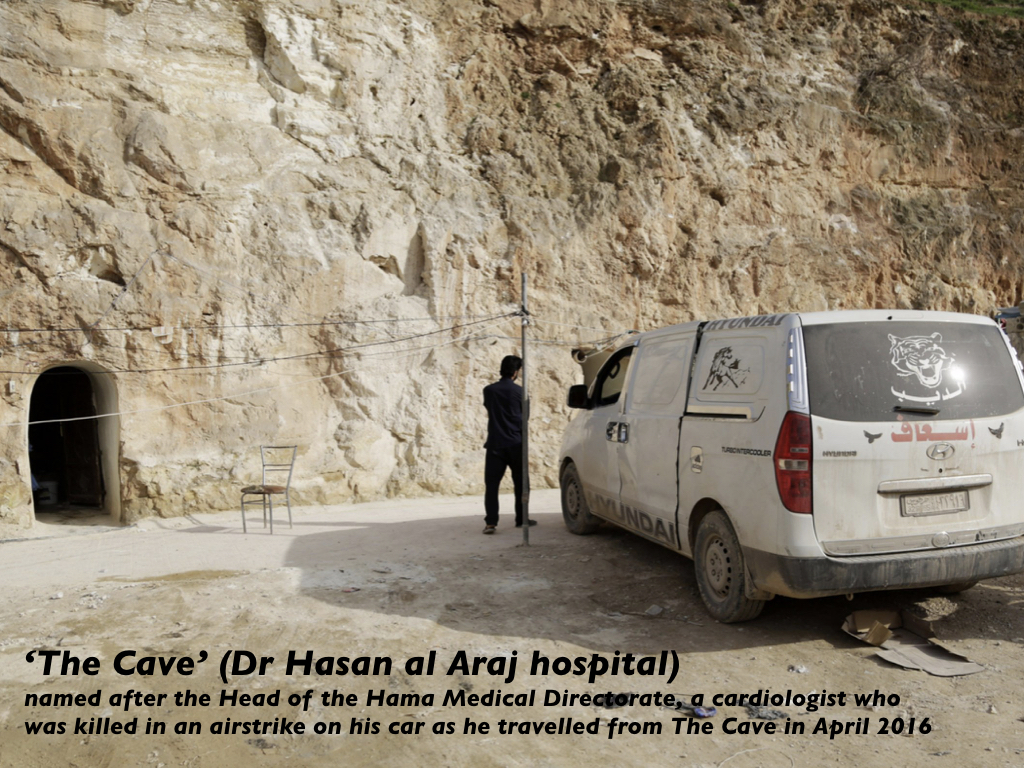
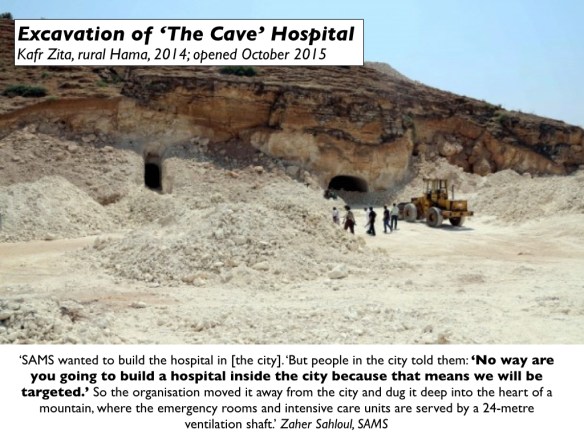
When the Syrian-American Medical Society proposed to build a hospital in Hama in 2014, local people begged them to locate it outside the city and so SAMS excavated what became the Dr Hasan al Araj Hospital, better known as ‘The Cave’:
the-cave-hospital-001

the-cave-hospital-002

the-cave-hospital-003

Supply chains and kill-chains

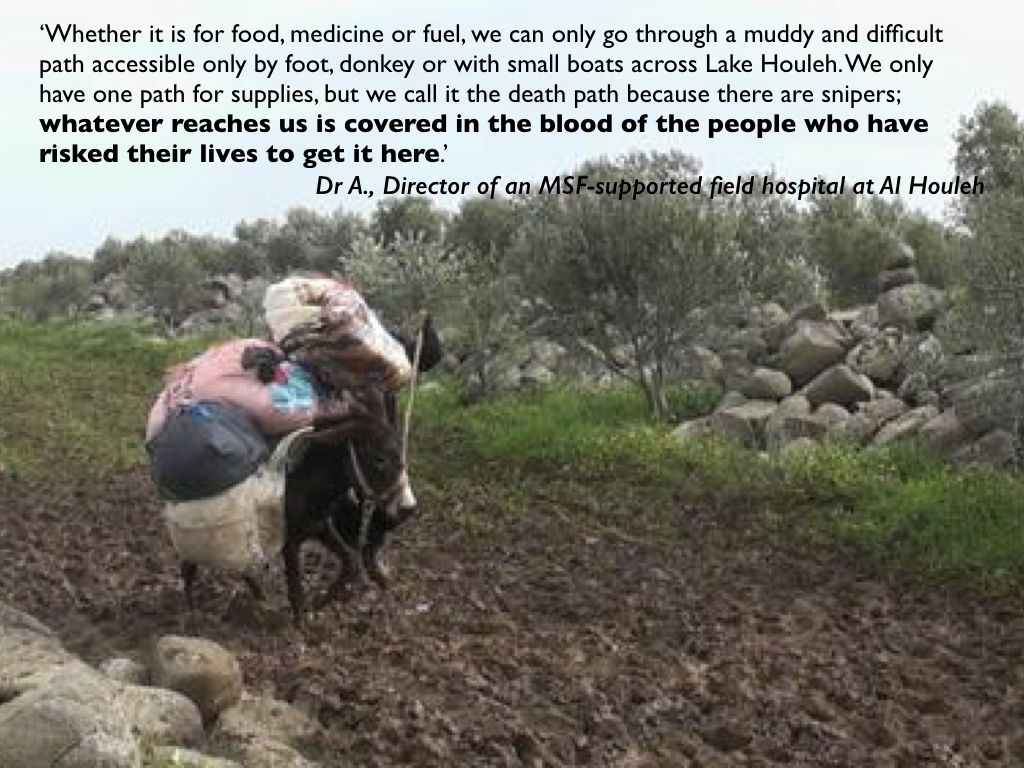
As the civil war ground on, even the most basic medical supplies became scarce and obtaining them ever more dangerous.  In March 2015 MSF reported that:

‘Even if it is available, many suppliers do not want to risk selling material like gauze or surgical threads when they know it is going to be sent into North Homs. Gauze is considered synonymous with war surgery, and often a supplier is not willing to take the risk of being arrested or shut down for supplying a besieged area.’
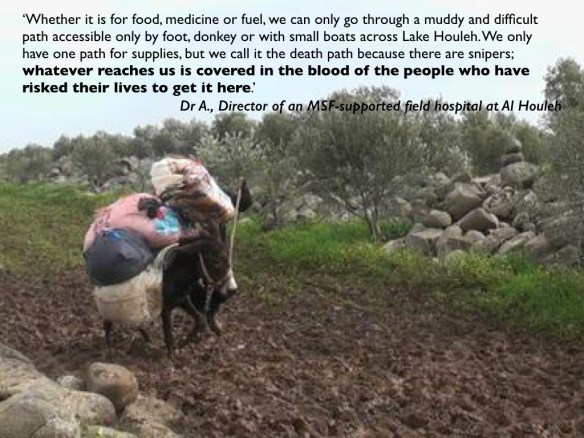
bloody-supply-chains-001

You can read more here and here.  One doctor told MSF:

‘It is precious, dangerous, incriminating. There are secret outlets supplying us with gauze.’

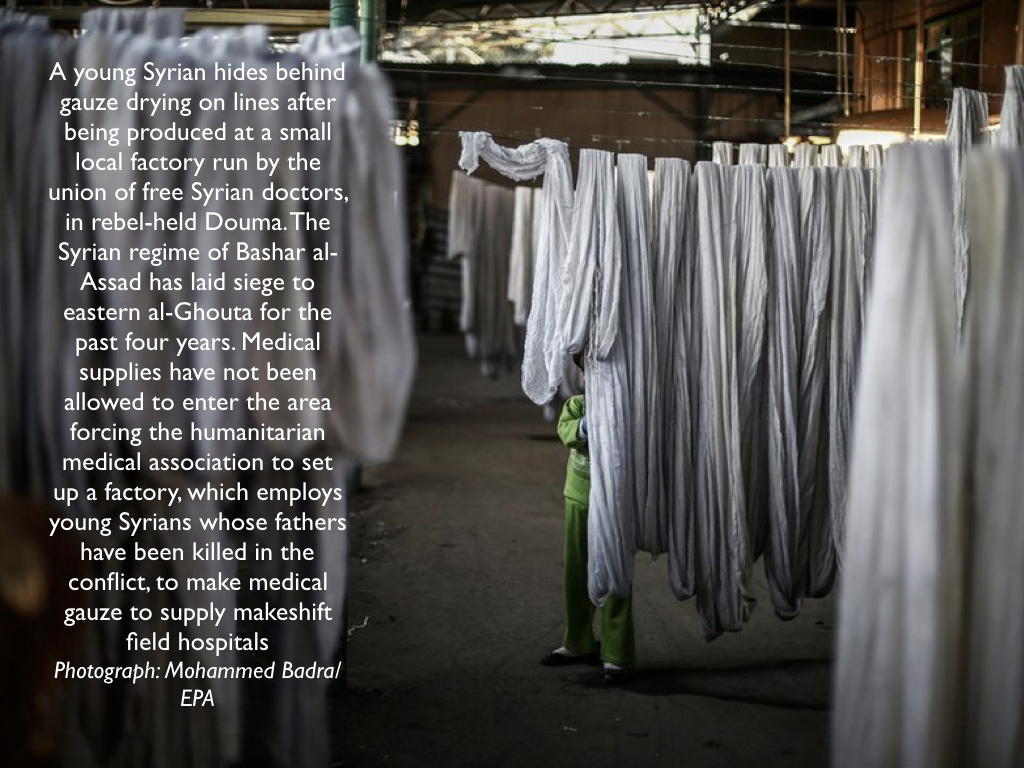
At the end of last year the Guardian provided this image of one of the secret factories:

gauze-factory-001

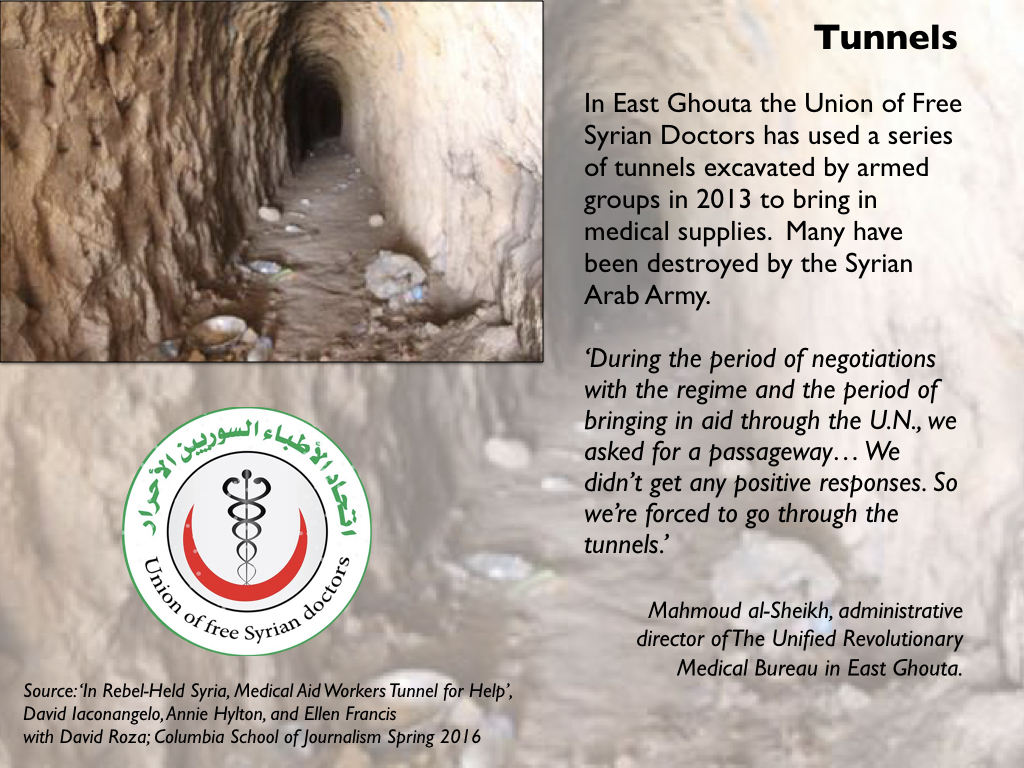
In East Ghouta, hospitals have been forced to use tunnels to bring in medical supplies (more from Ellen Francis and her colleagues here):
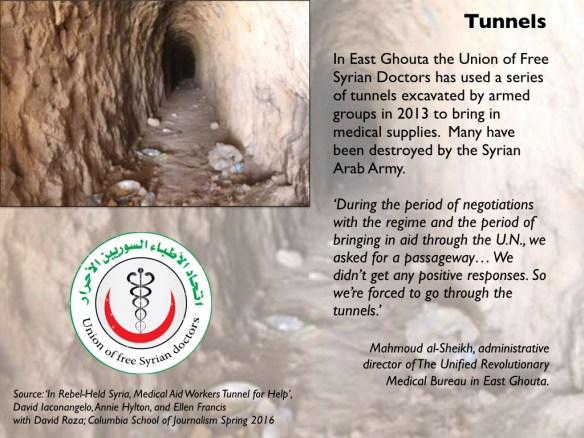
tunnels-and-the-siege-economy-in-aleppo-001

The risks are formidable and the costs have been almost prohibitive.  Ellen Francis and her colleagues at Columbia’s Graduate School of Journalism report that in January 2014 the Free Syrian Army and the Syrian Arab Army agreed an uneasy and ragged cease-fire in Barzeh, a small town on the northern edge of Damascus. There a team from the Union of Free Syrian Doctors was able to buy medical supplies from merchants who travelled out from the capital.

The merchants paid a 20 per cent ‘customs fee’ to Syrian Army soldiers; the agents for the doctors then paid a ‘tax’ to get the supplies through the Harasta checkpoint on the Army-controlled highway, and then a ‘toll’ to the rebels (‘tunnel lords’) who controlled the tunnels into Ghouta.

The combined fees inflated the price of medical supplies.  A litre of serum used to help the body replenish lost blood cost $1 in government-controlled areas and $3.50 to $10 via the tunnel route. Ghouta was using about 10,000 litres of serum per month.  The supply chain was subsequently severed once Barzeh itself came under siege and was cut off from Damascus.

Some humanitarian aid has crossed the lines by more conventional routes – conventional for a war zone at any rate – but medical supplies have routinely been removed from aid convoys.  On 19 May 2016 the UN Secretary-General reported to the Security Council:

‘[By May] 2016, WHO [had] submitted 21 individual requests to the Government of the Syrian Arab Republic to deliver medical supplies to 82 locations in 10 governorates. The Government approved five requests [while] 16 requests remained unanswered.

‘The removal of life-saving medicines and medical supplies continued, with nearly 47,459 treatments removed from convoys in April intended for locations in Homs, Aleppo and Rif Dimashq governorates. Removed items included surgical supplies, emergency kits, trauma kits, mental health medicines, burn kits and multivitamins. Removals extended to basic items, such as antibacterial soap, which was removed from midwifery kits. Items were also removed from other kits, notably surgical tools…’

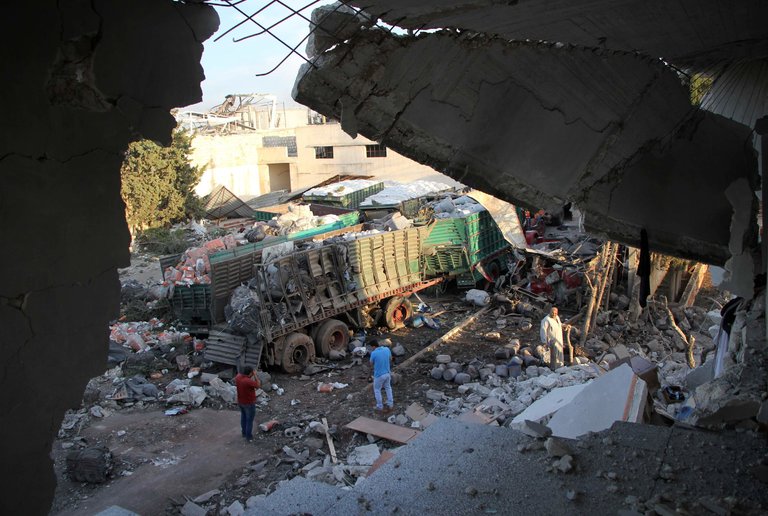
Even then, aid convoys are not safe.  Four months later to the day a UNICEF aid convoy delivering supplies to a Syrian Red Crescent warehouse at Urum al-Kubra in Aleppo was attacked from the air, killing at least 18 people and destroying 18 of the 31 trucks.  Most analysts have concluded that the Russian Air Force was responsible, perhaps acting in concert with the Syrian Arab Air Force – see for example here and here– but the Russian Ministry of Defence and the usual suspects have variously blamed spontaneous combustion, a ground attack by rebels and a US drone attack.
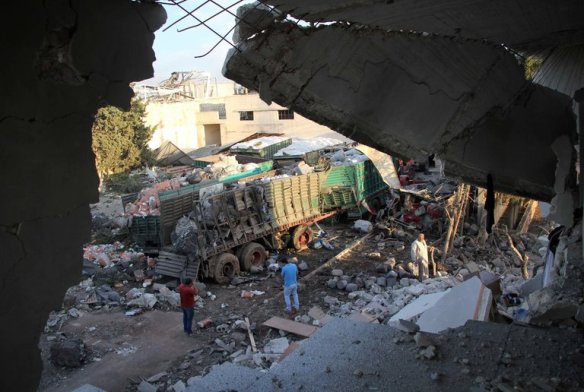
un-convoy-attacked-in-aleppo

These shortages are threaded into dispersed and precarious siege economies that gravely affect the health of local populations.  In December 2015 an estimated 400,000 people were surviving without access to life-saving aid in 15 besieged locations across Syria; the figures gathered by Siege Watch are even higher.

Surrounded by 6,000 land-mines and 65 sniper-controlled checkpoints, Madaya’s 40,000 inhabitants have been under siege since July 2015; 32 people died of starvation and malnutrition in December 2015 alone.  One resident interviewed by Amnesty International in January 2016 described the catastrophic situation:

‘Every day I wake up and start searching for food. I lost a lot of weight, I look like a skeleton covered only in skin. Every day, I feel that I will faint and not wake up again… I have a wife and three children. We eat once every two days to make sure that whatever we buy doesn’t run out. On other days, we have water and salt and sometimes the leaves from trees. Sometimes organizations distribute food they have bought from suppliers, but they cannot cover the needs of all the people.

‘In Madaya, you see walking skeletons. The children are always crying. We have many people with chronic diseases. Some told me that they go every day to the checkpoints, asking to leave, but the government won’t allow them out. We have only one field hospital, just one room, but they don’t have any medical equipment or supplies.’

An aid convoy was allowed in four days after this interview.

There are also grave shortages of skilled medical personnel.  The doctors who remain in opposition-held areas have all had to learn new skills sometimes far beyond their original training.  In March 2015 one young surgeon working in an MSF-supported hospital east of Damascus recalled:

‘There was a pregnant woman who was trapped during the time we were under full siege. She was due to deliver soon. All negotiation attempts to get her out failed. She needed a cesarean operation, but there was no maternity hospital we could get her to, and I had never done this operation before.

A few days before the expected delivery date, I was trying to get a working internet connection to read up information on doing a C-section. The clock was ticking and my fear and stress started to peak. I wished I could stop time, but the woman’s labour started…’

In 2015 OCHA estimated that more than 40 per cent of pregnant women in these areas now scheduled C-sections to reduce the risk of an attack preventing them from obtaining care.

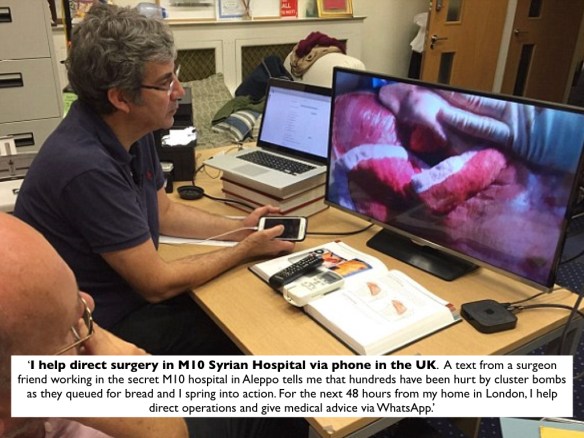
In some cases doctors can call on skilled overseas help via Skype from consultants on call 24/7 in the United States, Canada and the United Kingdom.  Ben Taub has written movingly of the extraordinary efforts of what he calls ‘the shadow doctors’ enlisted in ‘the underground race to spread medical knowledge as the Syrian regime erases it.’  One of the most active is Britain’s Dr David Nott:

dr-david-nott-and-remote-surgery-001

dr-david-nott-and-remote-surgery-002

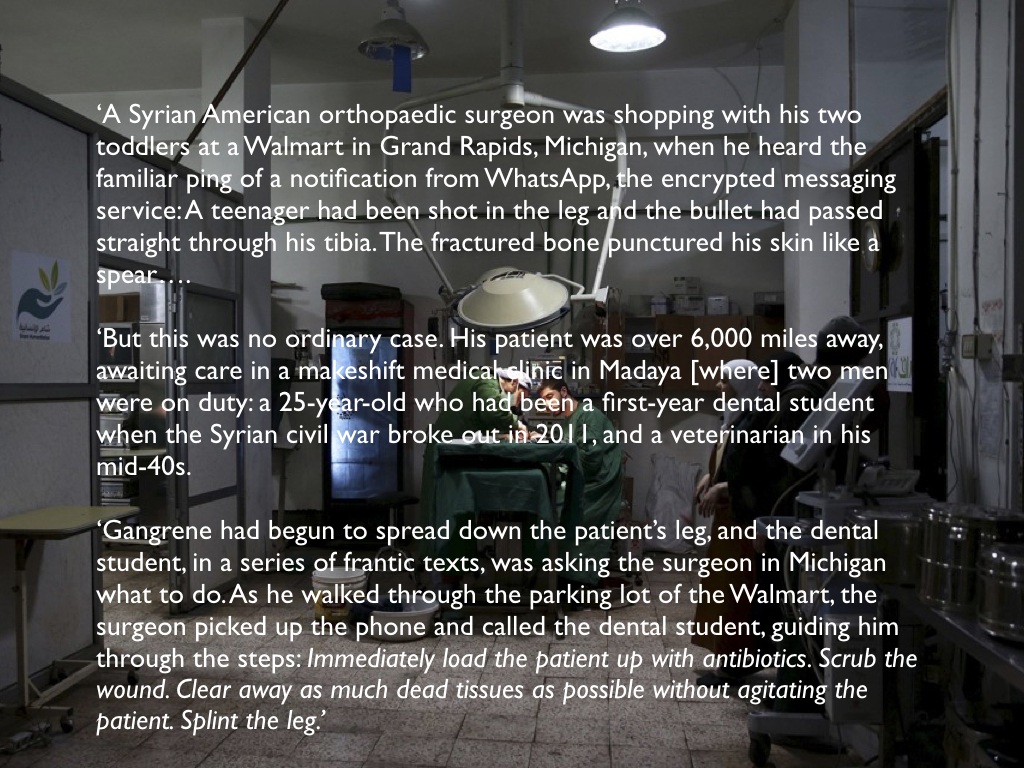
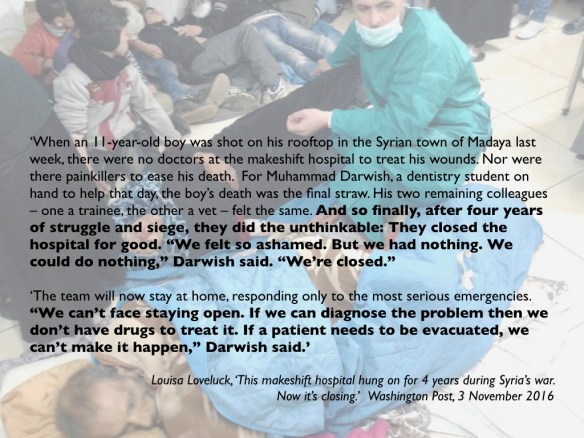
But not all those seeking specialist help are qualified surgeons.  In the field hospital serving the besieged town of Madaya medical care has been provided by a dentist, a dental student and a veterinarian.  Avi Asher-Schapiro reports:

‘The five-year civil war has plunged the Madaya clinicians into the deep end, forcing them to perform medical procedures that push them far beyond their training. They have treated countless gunshot victims, performed seven amputations, over a dozen C-sections, and diagnosed everything from meningitis to cancer.’

As he explains, this remarkable trio has also relied on remote medicine:
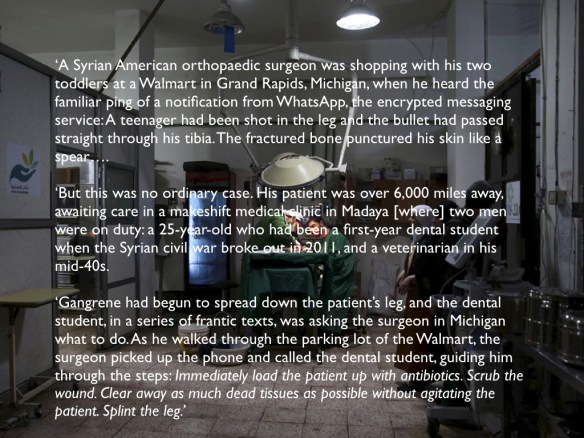
madaya-remote-medicine-001

These are all extraordinary responses to near-impossible, life-threatening situations.  But their successes have been short-lived.

The Madaya clinic was forced to close in November 2016:
closure-of-madaya-clinic-001

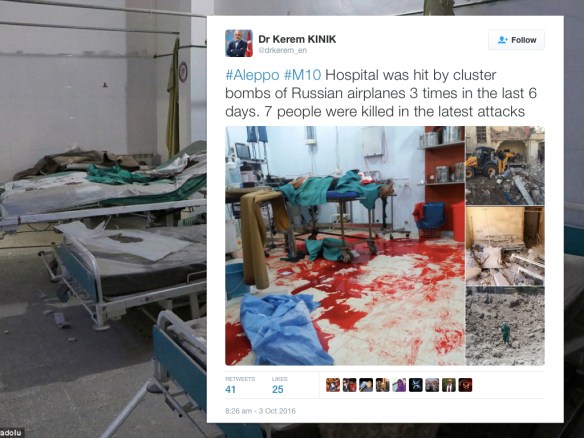
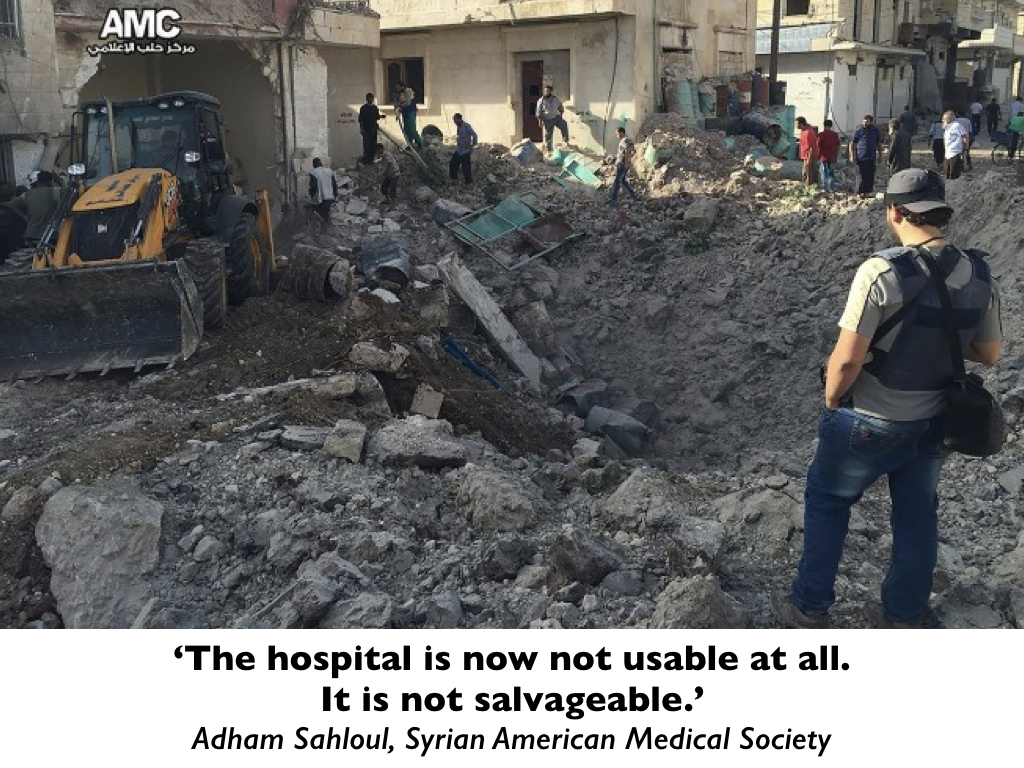
And the M10 hospital where Nott helped direct surgery – the largest trauma and ICU centre in East Aleppo – was hit by successive, catastrophic air strikes.  First, an attack on 28 September 2016 left only half the hospital operational.  On 1 October Xisco Villalonga, MSF’s Director of Operations, reported that

‘Bombs are raining from Syria-led coalition planes and the whole of east Aleppo has become a giant kill box.’

That night multiple strikes on M10 killed two people and injured ten others; the hospital had to be evacuated because one crater was so deep there were fears that the rest of the building would collapse.
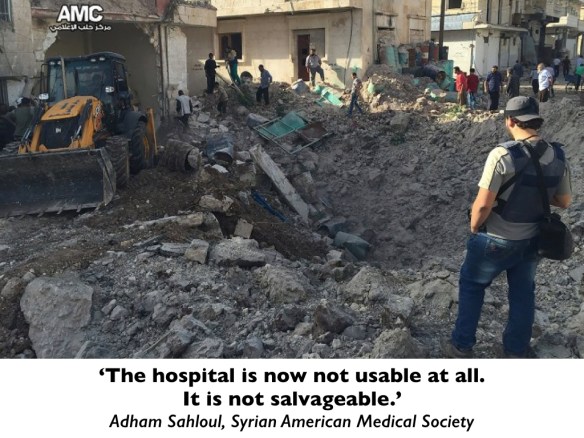
m10-hospital-bombed-001

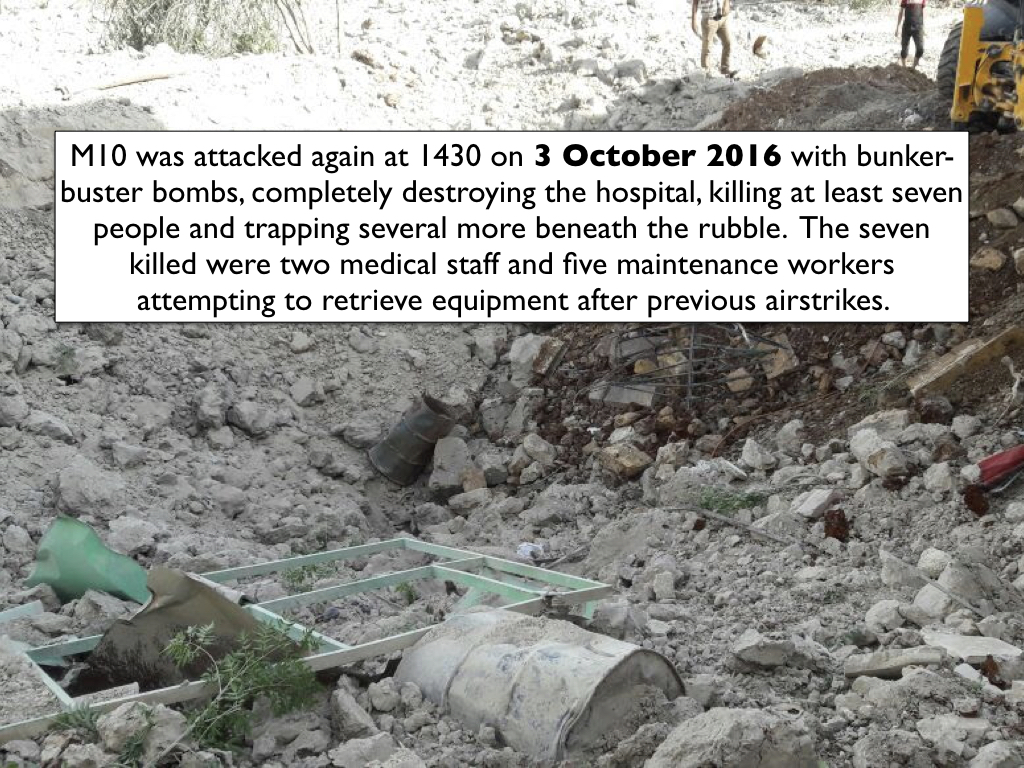
But the ordeal was not over: there were further, devastating strikes on 3 October:
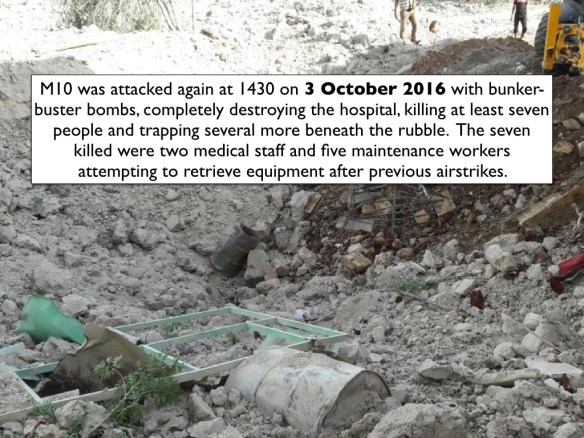
m10-hospital-bombed-002

m10-hospital-bombed-003

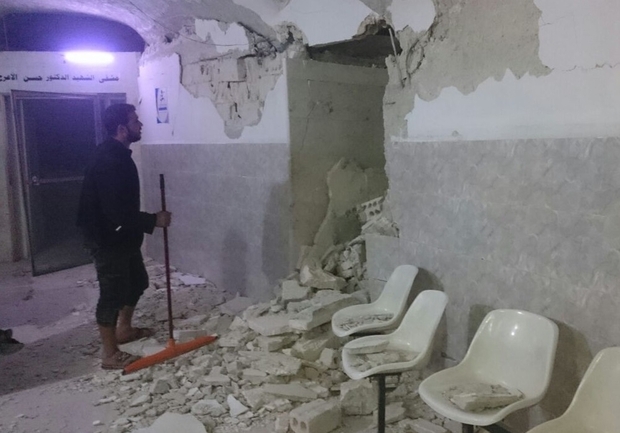
The underground hospitals have fared no better.  ‘The Cave’ – 15 metres inside a mountain, remember – was hit by two ‘bunker-buster’ bombs at 1500 on 2 October 2016. After 35 staff and patients had been evacuated a second strike occurred in the early evening involving missiles and cluster bombs. The E.R. was wrecked, ceilings collapsed, cement walls crumbled and generators, water tanks and medical equipment were destroyed (see image below).  Nobody was seriously injured but the hospital sustained critical damage and has been closed indefinitely. It used to treat 300 patients and perform 150 surgeries a month.

Cave Hospital hit by bunker-buster bombs

The exception to the exception

Once safe places under the protection of international humanitarian law – the exception to the space of exception that is the conflict zone – hospitals have become the targets of a new and extraordinarily vicious modality of modern war.  The systematic attacks on hospitals have not only threatened the lives of patients and healthcare workers; they have also made many patients reluctant to seek medical treatment at all.  In February 2015 a report from the Centre for Public Health and Human Rights at Johns Hopkins University was already warning of the consequences:

‘Unless they feel their life is in danger, many people won’t go to hospital because it is targeted for bombardment’ [Physician, Aleppo]. Two physicians reported that fear of travel and an understanding that the hospital is a target has led to a 50% decrease in clinic visits and surgery cases, even though the level of violence has not decreased.

Dr Farida, the OB/GYN in East Aleppo interviewed earlier, no longer has a hospital to work in – the last remaining hospital was reduced to rubble and closed on 18 November – and she now provides what medical care she can from a basement:

‘People know it’s a basement, but they are afraid to come here because they know any health facility is deliberately targeted by the regime. For women, they are afraid to come — but they don’t have any other option. When they don’t have a car or fuel to come here, they have to give birth at home. Women are bleeding at home and babies are born dehydrated without oxygen.’

Those that do make the precarious journey to a field hospital or other medical facility almost always now find that their care is compromised by the shortage or even the absence of doctors, nurses, medical supplies and even the most basic medical equipment.  So doctors use ordinary sewing cotton instead of surgical thread; local anaesthetic where they would normally use a general, or even home-made, improvised variants.  Dr Zaher Sahloul, who still tries to provide help to colleagues in Syria from his home in Chicago via WhatsApp, explains:

‘We operate on the mindset that they have basic things we take for granted… The reality is, they don’t have 90 percent of the things we think they have. They know better what they have and what they can do with it. These people are facing decisions we will never face in our lives. If you have 10 patients dying, who will you see first? Do you use spoiled gauze and dirty tubes at the risk of infection? It’s Hell for them.’

As I write, the Syrian Arab Army and its supporting militias are advancing into East Aleppo, where air strikes and artillery bombardments have left more than 250,000 people without access to any form of advanced medical care.  The World Health Organisation announced that ‘although some health services are still available through small clinics, residents no longer have access to trauma care, major surgeries, and other consultations for serious health conditions.’

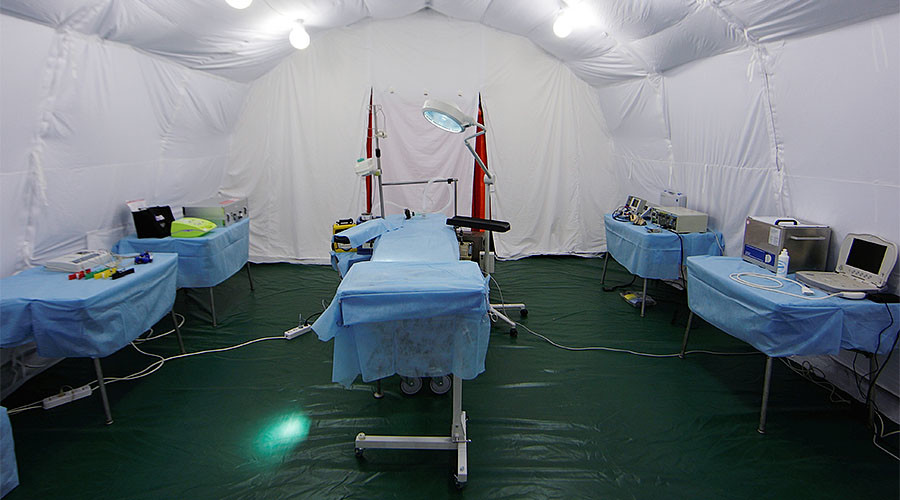
The final irony – although in this catalogue of horrors it probably isn’t the last at all – is that the Kremlin has announced that it will send two mobile hospitals to treat patients from East Aleppo.  The Defence Ministry will operate ‘a special 100-bed clinic with trauma equipment for treating children’ and the Emergencies Ministry will provide a 50-bed clinic capable of treating 200 outpatients a day.
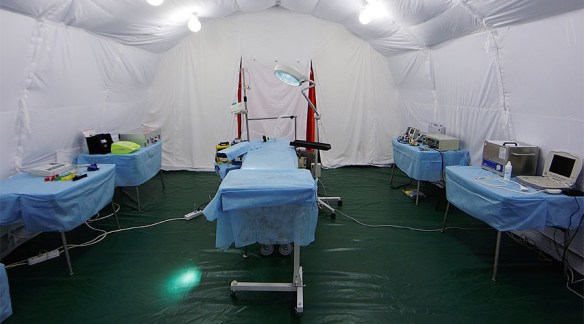
russian-mobile-hospital

While the Kremlin congratulates itself on its ‘humanity’, we need to remember that this minimalist contribution would not have been necessary at all had medical neutrality been respected and doctors and nurses, hospitals and clinics not been so ruthlessly, systematically and deliberately targeted in the first place.

UPDATE:  On 5 December the Defence Ministry’s mobile hospital (set up in West Aleppo to treat patients from East Aleppo) came under mortar fire from the crumbling opposition-held area to the east; one Russian doctor and two paramedics were killed.  It’s not clear whether the hospital was deliberately targeted – there have been accusations that the co-ordinates of the hospital must have been given to the militants for it to have been hit ‘right at the moment when it started working‘ – or whether it was caught in the indiscriminate shelling and mortar-fire that has hit other hospitals in West Aleppo.
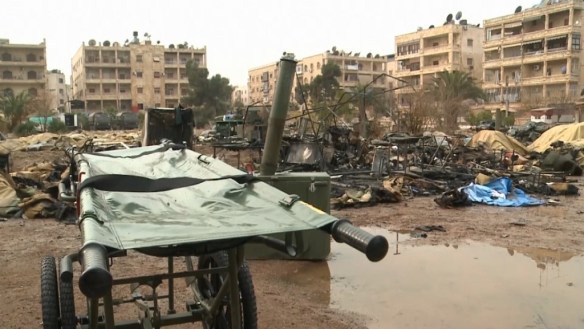
russian-mobile-hospital-attacked-in-aleppo

But I should make two things clear.  First, attacks on hospitals in West Aleppo – even though I don’t think they have exhibited anything like the scale or the systematicity of those directed against medical facilities and healthcare workers in opposition-held areas – are as reprehensible as those on hospitals in the East.  Second, the muted response from the US-led coalition to the shelling of the Russian field hospital is deeply disturbing.  The International Committee of the Red Cross announced after the attack that ‘all sides to the conflict in Syria are failing in their duties to respect and protect healthcare workers, patients, and hospitals, and to distinguish between them and military objectives.’  The Russian Ministry of Defence dismissed this as a ‘cynical’ display of indifference to the deaths of its doctors, but I don’t read it like that at all – what is cynical is the partisan appeal to medical neutrality when it suits, and its systematic violation when it doesn’t.

To be continued
50 Feet from Syria

50-feet-from-syria

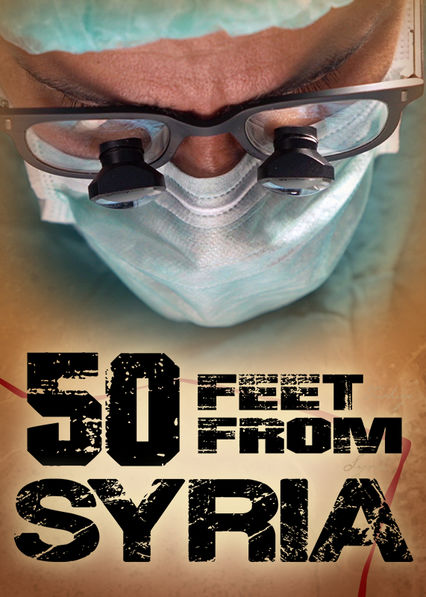
As I continue my work on the targeting of hospitals and ambulances, doctors and nurses, and on the precarious provision of medical care in Syria, I’ve been watching Skye Fitzgerald‘s remarkable documentary 50 Feet from Syria, which is now available on iTunes and (in some places) on Netflix:

With a suitcase full of donated stainless-steel bone implants, Syrian-American surgeon Hisham Bismar arrives at a Turkish hospital on the Syrian border, ready for anything. What he finds is horror, chaos, and an ocean of refugees in need of medical care: colleagues who perform operations without anesthesia, stories of Syrian government snipers targeting pregnant women and children, and images of 55 gallon barrels filled with shrapnel and TNT deliberately dropped on civilians.
With dull drill bits and ill-fitting bone and joint implants Bismar repairs the bodies of the wounded fortunate enough to find their way to the hospital – both civilians and fighters. Amongst this remarkable work, remarkable people abound: “M”, a ‘Turkish Schindler’ selflessly crossing the border each day to retrieve the wounded and ferry them to the care of surgeons, and “AM” a hero among his peers for his willingness to live for years in Syrian field hospitals repeatedly bombed by the Assad regime.

50 Feet From Syria is a portrait of a quiet and determined man, performing intricate acts of medical necessity undeterred by the chaos and complexity of war around him. The film serves as a snapshot in time for the current plight of Syrian refugees. It also indelibly communicates the human cost of one of the most brutal, dehumanizing conflicts in modern history that continues to destroy and displace millions of lives.

It’s a stark reminder of the circumstances in which, once you turn from killing to caring, 5,000 feet isn’t the best….

Someone who has demonstrated the variability of distance in these situations is the remarkable British surgeon David Nott, who has both worked in field hospitals inside Syria and also advised colleagues in Aleppo and elsewhere from London by Skype and whatsapp (the most intimate of remote medicines):

You can read much more on his work – and on the medical underground in Syria more generally – in Ben Taub‘s compelling account of ‘The shadow doctors’ at the New Yorker here.

I’ve drawn on these and many other accounts for my ‘Surgical strikes and modern war’: much more to come very soon.

Spaces of exception and enemies

Human Geography 25

I’m just back from a wonderful time at a conference in Galway organised by John Morrissey as part of The Haven Project on the refugee crisis in the Mediterranean.  The latest issue of Human Geography (Vol 9, No 2) is devoted to Geographical Perspectives on the European ‘Migration and Refugee Crisis‘ – those scare-quotes are vital – and if your library doesn’t subscribe you can contact the Institute of Human Geography at insthugeog@gmail.com (most of the articles can be downloaded here).

At Galway I gave a new presentation on ‘Surgical strikes and modern war’, describing and analyzing the ways in which hospitals and ambulances, doctors and nurses have become targets of military violence; it drew on my new series of posts (see here and here), and there will be more to come on both Kunduz and on Syria (which was my main focus), but you can find a preliminary account of the whole event from Alex Jeffrey here.

My starting point was the modern space of exception seen not as ‘the camp‘, as Giorgio Agamben would have it, but as the killing fields of contemporary military and paramilitary violence (what would once have been called ‘the battlefield‘).  For these are spaces in which groups of people are knowingly and deliberately exposed to death through the removal of legal protections that would ordinarily be afforded them; and yet these are not spaces in which the law is suspended tout court, spaces from which the law withdraws and abandons the victims of violence to their fatebut rather spaces in which law – and specifically international humanitarian law – seeks to regulate and, crucially, to sanction violence.  This is a form of martial law that Agamben never considers (I know I am taking liberties with that term, but that is precisely my point): here as elsewhere violence exists not only beyond the law but is inscribed within it.  My purpose was to show how what was once a sacred space within this zone of exception – ‘the hospital’,  a topological figure that extends from the body of the wounded through the sites of the evacuation chain to the hospital itself – has become corroded; no longer a space of immunity – of safety – an exception to the exception, it has often become a central target of contemporary violence.

The need to pull all this together largely explains my silence these last weeks, and a lot has happened in the interim.  Where to start?  A good place is the latest issue of Radical Philosophy, the last in its present form, which includes two essays of direct relevance to the theme of the Galway conference.

First, an important essay by Achille Mbembe on ‘The Society of Enmity’ which you can download here:

Desire (master or otherwise) is also that movement through which the subject – enveloped on all sides by a specific phantasy [fantasme] (whether of omnipotence, ablation, destruction or persecution, it matters little) – seeks to turn back on itself in the hope of protecting itself from external danger, while other times it reaches outside of itself in order to face the windmills of the imagination that besiege it. Once uprooted from its structure, desire then sets out to capture the disturbing object. But since in reality this object has never existed – does not and will never exist – desire must continually invent it. An invented object, however, is still not a real object. It marks an empty yet bewitching space, a hallucinatory zone, at once enchanted and evil, an empty abode haunted by the object as if by a spell.

The desire for an enemy, the desire for apartheid, for separation and enclosure, the phantasy of extermination, today all haunt the space of this enchanted zone. In a number of cases, a wall is enough to express it.  There exist several kinds of wall, but they do not fulfil the same functions. [6] A separation wall is said to resolve a problem of excess numbers, a surplus of presence that some see as the primary reason for conditions of unbearable suffering. Restoring the experience of one’s existence, in this sense, requires a rupture with the existence of those whose absence (or complete disappearance) is barely experienced as a loss at all – or so one would like to believe. It also involves recognizing that between them and us there can be nothing that is shared in common. The anxiety of annihilation is thus at the heart of contemporary projects of separation.

Everywhere, the building of concrete walls and fences and other ‘security barriers’ is in full swing. Alongside the walls, other security structures are appearing: checkpoints, enclosures, watchtowers, trenches, all manner of demarcations that in many cases have no other function than to intensify the zoning off of entire communities, without ever fully succeeding in keeping away those considered a threat.

You can already surely hear the deadly echoes of Carl Schmitt – whose spectral presence lurked in the margins of my own presentation in Galway (for geographical elaborations of Schmitt, see Steve Legg‘s Spatiality, sovereignty and Carl Schmitt and Claudio Minca and Rory Rowan‘s On Schmitt and space) – and Achille makes the link explicit:

dangerousmindThis is an eminently political epoch, since ‘the specific political distinction’ from which ‘the political’ as such is defined – as Carl Schmitt argued, at least – is that ‘between friend and enemy’.  If our world today is an effectuation of Schmitt’s, then the concept of enemy is to be understood for its concrete and existential meaning, and not at all as a metaphor or an empty lifeless abstraction. The enemy Schmitt describes is neither a simple competitor, nor an adversary, nor a private rival whom one might hate or feel antipathy for. He is rather the object of a supreme antagonism. In both body and flesh, the enemy is that individual whose physical death is warranted by their existential denial of our own being.

However, to distinguish between friends and enemies is one thing; to identify the enemy with certainty is quite another. Indeed, as a ubiquitous yet obscure figure, today the enemy is even more dangerous by being everywhere: without face, name or place. If they have a face, it is only a veiled face, the simulacrum of a face. And if they have a name, this might only be a borrowed name, a false name whose primary function is dissimulation. Sometimes masked, other times in the open, such an enemy advances among us, around us, and even within us, ready to emerge in the middle of the day or in the heart of night, every time his apparition threatening the annihilation of our way of life, our very existence.

Yesterday, as today, the political as conceived by Schmitt owes its volcanic charge to the fact that it is closely connected to an existential will to power. As such, it necessarily and by definition opens up the extreme possibility of an infinite deployment of pure means without ends, as embodied in the execution of murder.

The essay is taken from Achille’s latest book, Politiques de l’inimitié published by Découverte in 2016:

Introduction – L’épreuve du monde
1. La sortie de la démocratie
Retournement, inversion et accélération
Le corps nocturne de la démocratie
Mythologiques
La consumation du divin
Nécropolitique et relation sans désir
97827071881822. La société d’inimitié
L’objet affolant
L’ennemi, cet Autre que je suis
Les damnés de la foi
État d’insécurité
Nanoracisme et narcothérapie
3. La pharmacie de Fanon
Le principe de destruction
Société d’objets et métaphysique de la destruction
Peurs racistes
Décolonisation radicale et fête de l’imagination
La relation de soin
Le double ahurissant
La vie qui s’en va
4. Ce midi assommant
Impasses de l’humanisme
L’Autre de l’humain et généalogies de l’objet
Le monde zéro
Anti-musée
Autophagie
Capitalisme et animisme
Émancipation du vivant
Conclusion. L’éthique du passant

Asylum seekers being registered at Passau

Second, an essay by Mark Neocleous and Maria Kastrinou, ‘The EU hotspot: Police war against the migrant’, which you can download here.  They start by asking a series of provocative questions about the EU strategy of ‘managing’ (read: policing) migration through the designation of ‘hotspots’ in which all refugees are to be identified, registered and fingerprinted:

There is no doubt that in some ways the term ‘hotspot’ is meant to play on the ubiquity of this word as a contemporary cultural trope, but this obviousness may obscure something far more telling, something not touched on by the criticisms of the hotspots, which tend to focus on either their squalid conditions or their legality (for example, with routes out of Greece being closed off migrants are in many ways being detained rather than registered; likewise, although ‘inadmissibility’ is being used as the reason to ship migrants back to Turkey, in reality ‘inadmissibility’ often means nothing other than that the political and bureaucratic machine is working too slowly to adequately process asylum claims).  Neither the legality nor the sanitary state of the hotspot is our concern here. Nor is the fact that the hotspots use identification measures largely as instruments of exclusion. Rather, we are interested in what the label ‘hotspot’ might tell us about the way the EU wants to manage the crisis. What might the hotspot tell us about how the EU imagines the refugee? But also, given that the EU’s management of the refugee crisis is a means for it to manage migration flows across Europe as a whole, what might the hotspot tell us about how the EU imagines the figure of the migrant in general?

You can find an official gloss (sic) on hotspots here (and more detail here), critical readings by Frances Webber here and Glenda Garelli and Martina Taziolli here, and NGO responses from Oxfam here and Caritas here.  The Bureau of Investigative Journalism also has a useful report on Frontex, the EU’s border agency, here.

registration-at-hotspots-frontex

Here is the kernel of Mark’s and Maria’s answer to their questions – and you will see see the link with Achille’s essay immediately:

For every police war, an enemy is needed. Defining the zones as hotspots suggests that migrants have arrived as somehow already ‘illegal’ in some way, enabling them to be situated within the much wider and never-ending ‘war on crime’. Yet this process needs to be understood within the wider practice of criminalizing breaches of immigration law in western capitalist polities over the last twenty years, as individual states and the state system as a whole have increasingly sought to make the criminal law work much more closely with immigration law: ‘crimmigration’, as it has become known, means that criminal offences can now very easily result in deportation, while immigration violations are now frequently treated as criminal offences. Concerning the UK, for example, Ana Aliverti has noted that ‘the period between 1997 and 2009 witnessed the fastest and largest expansion of the catalogue of immigration crimes since 1905’.  This expansion serves to further reinforce the conception of the migrant as already tainted by crime, as the figure of the criminal and the figure of the migrant slowly merge. The term ‘illegal immigrant’ plays on this connection in all sorts of ambiguous ways. Indeed, it is significant that the very term ‘illegal immigrant’ has over the same period replaced the term ‘undocumented migrant’, so that a figure once seen as lacking papers is seen now as lacking law.

However, the fact that migrants arriving in the EU hotspots do so as propertyless (or at least apparently so) subjects adds a further significance. Why? Because by arriving propertyless the historical figure to which the migrant is most closely aligned is as much the vagrant as the criminal. Aliverti’s reference to 1905 is a reference to the Aliens Act of that year, in which any ‘alien’ landing in the UK in contravention of the Act was deemed to be a rogue and vagabond. The Act was underpinned by making such ‘aliens’ liable to prosecution under section 4 of the Vagrancy Act of 1824, usually punishable in the form of hard labour in a house of correction. As Aliverti puts it, ‘in view of the similarities between the poor laws and early immigration norms, it is no coincidence that the first comprehensive immigration legislation in 1905 penalized the unauthorized landing of immigrants with the penalties imposed on “rogues and vagabonds” and vagrancy was one of the grounds for expulsion of foreigners.’  In the mind of the state, the vagrant is the classic migrant, just as migrants arriving in the hotspots are increasingly coming to look like and be treated as the newest type of vagrant. In the mind of the state, the propertyless migrant is a kind of vagrant-migrant (which is of course one reason why welfare and migration are so frequently connected).

Vagrancy legislation has always been the ultimate form of police legislation: it criminalizes a status rather than an act (the offence of vagrancy consists of being a vagrant); it gives utmost authority to the police power (the accusation of vagrancy lies at the discretion of the police officer); and it seeks not to punish a crime as such but to instead eliminate what are regarded as threats to social order (as in section 4 of the UK’s Vagrancy Act of 1824, which enables people to be arrested and punished for being ‘idle and disorderly’, for ‘being a rogue’, for ‘wandering abroad’ or for simply ‘not giving a good account of himself or herself’; note the present tense used – section 4 of the Act of 1824 is still in operation in the UK).

And in case the links with ‘The society of enmity’ are still opaque, I leave the last word to Achille:

Hate movements, groups invested in an economy of hostility, enmity, various forms of struggle against an enemy – all these have contributed, at the turn of the twenty-first century, to a significant increase in the acceptable levels and types of violence that one can (or should) inflict on the weak, on enemies, intruders, or anyone considered as not being one of us. They have also contributed to a widespread instrumentalization of social relations, as well as to profound mutations within contemporary regimes of collective desire and affect. Further, they have served to foster the emergence and consolidation of a state-form often referred to as the surveillance or security state.

From this standpoint, the security state can be seen to feed on a state of insecurity, which it participates in fomenting and to which it claims to be the solution. If the security state is a structure, the state of insecurity is instead a kind of passion, or rather an affect, a condition, or a force of desire. In other words, the state of insecurity is the condition upon which the functioning of the security state relies in so far as the latter is ultimately a structure charged with the task of investing, organizing and diverting the constitutive drives of contemporary human life. As for the war, which is supposedly charged with conquering fear, it is neither local, national nor regional. Its extent is global and its privileged domain of action is everyday life itself. Moreover, since the security state presupposes that a ‘cessation of hostilities’ between ourselves and those who threaten our way of life is impossible – and that the existence of an enemy which endlessly transforms itself is irreducible – it is clear that this war must be permanent. Responding to threats – whether internal, or coming from the outside and then relayed into the domestic sphere – today requires that a set of extra-military operations as well as enormous psychic resources be mobilized. The security state – being explicitly animated by a mythology of freedom, in turn derived from a metaphysics of force – is, in short, less concerned with the allocation of jobs and salaries than with a deeper project of control over human life in general, whether it is a case of its subjects or of those designated as enemies.

Sound(ing)s

DAUGHTRY Listening to warMy interest in the militarisation of vision is longstanding, but it’s important not to exaggerate the salience of an increasingly ‘optical war’.  Through ‘The natures of war’ project (see DOWNLOADS tab) I’ve also been drawn to the importance of sound in conducting, surviving and even accounting for military violence (see, for example, herehere, and here).  And, as Martin Daughtry‘s remarkable Listening to war (2015) shows, sound continues to be significant in later modern war too.

Even its absence is significant, sometimes performative: think of all those video feeds from Predators and Reapers that, as Nasser Hussain so brilliantly reminded us, are silent movies – apart from the remote commentary from pilots and sensor operators:

‘The lack of synchronic sound renders it a ghostly world in which the figures seem unalive, even before they are killed. The gaze hovers above in silence. The detachment that critics of drone operations worry about comes partially from the silence of the footage.

The contemporary militarisation (or weaponisation) of sound is double-edged, and I mean that in several sense.

First, Mary Roach has a revealing chapter in Grunt: the curious science of humans at war (2016) on what she calls ‘Fighting by ear: the conundrum of noise’.  It turns out that 50 – 60 per cent of situational awareness comes from hearing – and yet the sound of war can be literally deafening.  The damage is often permanent, but in the heat of battle hearing loss makes it difficult to parse the torrent of noise – to distinguish offensive and defensive fires, to detect direction and range, and to send and receive vital communications.  Mary explains:

ROACH GruntFor decades, earplugs and other passive hearing protection have been the main ammunition of military hearing conservation programs. There are those who would like this to change, who believe that the cost can be a great deal higher. That an earplug can be as lethal as a bullet. Most earplugs reduce noise by 30-some decibels. This is helpful with a steady, grinding background din — a Bradley Fighting Vehicle clattering over asphalt (130 decibels), or the thrum of a Black Hawk helicopter (106 decibels). Thirty decibels is more significant than it sounds. Every 3-decibel increase in a loud noise cuts in half the amount of time one can be exposed without risking hearing damage. An unprotected human ear can spend eight hours a day exposed to 85 decibels (freeway noise, crowded restaurant) without incurring a hearing loss. At 115 decibels (chainsaw, mosh pit), safe exposure time falls to half a minute. The 187-decibel boom of an AT4 anti-tank weapon lasts a second, but even that ultrabrief exposure would, to an unprotected ear, mean a permanent downtick in hearing. Earplugs are less helpful when the sounds they’re dampening include a human voice yelling to get down, say, or the charging handle of an opponent’s rifle. A soldier with an average hearing loss of 30 decibels may need a waiver to go back out and do his job; depending on what that job is, he may be a danger to himself and his unit. “What are we doing when we give them a pair of foam earplugs?” says Eric Fallon, who runs a training simulation for military audiologists a few times a year at Camp Pendleton. “We’re degrading their hearing to the point where, if this were a natural hearing loss, we’d be questioning whether they’re still deployable. If that’s not insanity, I don’t know what is.”

TCAP

For that reason the US military has been experimenting with what it calls ‘Tactical Communication and Protective Systems‘ (‘Tee-caps’, shown above): ear protectors that incorporate radio communications.  They are a response both to the cacophony and the geometry of war:

No one, in the heat of a firefight, is going to pause to take off her helmet, pull back her ear, insert the plug, and repeat the whole process on the other side, and then restrap the helmet. There’s time for this on a firing range, and there might have been time on a Civil War battlefield, where soldiers got into formation before the call to charge…  You knew when the mayhem was about to start, and you had time to prepare, whether that meant affixing bayonets or messing with foamies. There’s no linear battlefield any more. The front line is everywhere. IEDs go off and things go kinetic with no warning. To protect your hearing using earplugs, you’d have to leave them in for entire thirteen-hour patrols where, 95 percent of the time, nothing loud is happening. No one does that.

Saydnaya 1 JPEG

Second, sounds can intimidate – sometimes deliberately so – but they can also be reverse-engineered to reveal the geometry of violence.  One obvious example is the use of sound-ranging to locate artillery batteries on the Western Front in the First World War; but less obvious, and of critical importance, soundscaping can form an important part of a forensic investigation into crimes of war. This brings me to yet another mesmerising project from Eyal Weizman‘s Forensic Architecture agency. Eyal explains:

In 2016 Forensic Architecture was commissioned by Amnesty International to help reconstruct the architecture of Saydnaya – a secret Syrian detention center – from the memory of several of its survivors, now refugees in Turkey.

Since the beginning of the Syrian crisis in 2011, tens of thousands of Syrians, including protestors, students, bloggers, university professors, lawyers, doctors, journalists and others suspected of opposing the regime, have disappeared into a secret network of prisons and detention centers run by the Assad government. Saydnaya, located some 25 kilometers north of Damascus in an East German-designed building dating from the 1970s, is one of the most notoriously brutal of these places.

Torture has become routinised there – and not as a weapon in the grotesque arsenal of ‘enhanced interrogation’ (which, for any Trump fans who have stumbled into this site in error, has been demonstrated countless times not to work anyway).  Amnesty could not be clearer:

There are no interrogations at Saydnaya. Torture isn’t used to obtain information, but seemingly as a way to degrade, punish and humiliate. Prisoners are targeted relentlessly, unable to “confess” to save themselves from further beatings. Survivors say they dreaded family visits as they were always followed by extensive beatings.

Eyal continues:

As there are no recent photographs of its interior spaces, the memories of Saydnaya survivors are the only resource with which to recreate the spaces, conditions of incarceration and incidents that take place inside.

In April 2016, a team of Amnesty International and Forensic Architecture researchers travelled to Turkey to meet a group of survivors who have come forward because they wanted to let the world know about Saydnaya.

To understand the role of sound in the investigation, what Eyal calls ‘ear-witnessing’, here is Oliver Wainwright writing about the project in the Guardian:

“Architecture is a conduit to memory,” says Weizman, describing how an Arabic-speaking architect [Hania Jamal] built a digital model on screen as detainees described specific memories and events. “As they experienced the virtual environment of their cells at eye level, the witnesses had some flashes of recollection of events otherwise obscured by violence and trauma.”

One drop of water

Inmates were constantly blindfolded or forced to kneel and cover their eyes when guards entered their cells, so sound became the key sense by which they navigated and measured their environment – and therefore one of the chief tools with which the Forensic team could reconstruct the prison layout. Using a technique of “echo profiling”, sound artist Lawrence Abu Hamdan was able to determine the size of cells, stairwells and corridors by playing different reverberations and asking witnesses to match them with sounds they remembered hearing in the prison.

“Like a form of sonar, the sounds of the beatings illuminated the spaces around them,” says Abu Hamdan. “The prison is really an echo chamber: one person being tortured is like everyone being tortured, because the sound circulates throughout the space, through air vents and water pipes. You cannot escape it.”

Oliver continues:

Saydnaya detainees developed an acute aural sensitivity, able to identify the different sounds of belts, electrical cables or broomsticks on flesh, and the difference between bodies being punched, kicked or beaten against the wall.
“You try to build an image based on the sounds you hear,” says Salam Othman, a former Saydnaya detainee, in a video interview. “You know the person by the sound of his footsteps. You can tell the food times by the sound of the bowl. If you hear screaming, you know newcomers have arrived. When there is no screaming, we know they are accustomed to Saydnaya.”

Architecture of sound

You can find full details of the project, of its architectural and auditory modelling, and its findings here, and there is also an excellent video on YouTube:

Documenting what is happening provides an essential platform for political and eventually legal action against those responsible.  You can joint Amnesty’s campaign here (scroll down).  Please do.