Over the top

I’ve had several inquiries about my recent posts on bombing in the First World War (here and here), all of which want to know why I’ve gone back so far.  Isn’t it all so remote? they ask.   I’d hoped I’d started to answer that in my previous posts, but Tami Davis Biddle – the author of Rhetoric and reality in air warfare (Princeton University Press, 2004) – provides a succinct answer in her ‘Learning in real time: the development and implementation of air power in the First World War’ (in Sebstian Cox and Peter Gray, eds., Air power history: turning points from Kitty Hawk to Kosovo):

‘Virtually every important manifestation of twentieth-century air power was envisioned and worked out in at least rudimentary form between 1914 and 1918.’

She has in mind many of the practices I’ve described in my previous posts – and there’s more to come – but I’ve just stumbled upon one that neither of us anticipated.  And, yes, it is ‘remote’…

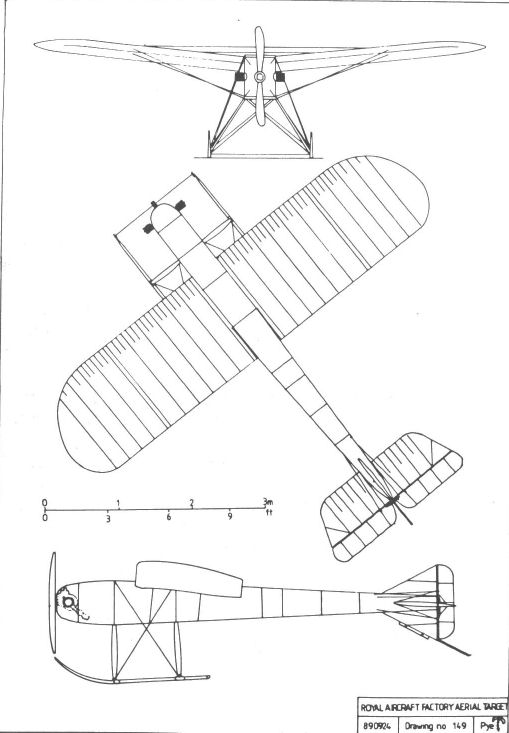
Gary Warne has a remarkable post, ‘The Predator’s ancestors: UAVs in the Great War’, in which he describes Captain Archibald Low’s Aerial Target project.  The codename was a deliberate distraction, Warne explains, because the plan was to develop a pilotless aircraft as a flying bomb, guided  by wireless from an accompanying manned aircraft to attack Zeppelins and ground targets. The fullest discussion of Low’s work that I’ve been able to find is by Paul Hare here; some of the back-story is provided by Hugh Driver in The birth of military aviation 1903-1914 (Boydell and Brewer, 1997) and there’s a wider historical discussion in Chapter 2 of Denis Larm‘s thesis here.

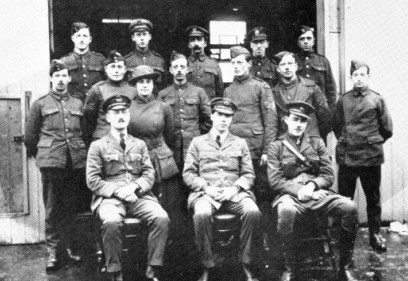
When the war started ‘Professor’ Low, as he styled himself, was already at work on artillery range-finding and, newly commissioned, was soon at the forefront of the Royal Flying Corps’s Experimental Works (below; Low is in the centre of the front row), supervising a team of 30, including jewellers, carpenters and engineers first at a Chiswick garage and later at Brooklands.

The noise of the aircraft engine interfered with the wireless transmissions, and the first demonstration flight of the Aerial Target was a disaster.  According to Steven Shaker and Alan Wise in War without Men: robots on the future battlefield (Pergamon-Brassey, 1988), ‘during a test flight for a gathering of important Allied dignitaries, the AT went astray and dove upon the guests, who scattered in every direction.’  All together six prototypes were constructed in 1917, but none of them saw combat.

That last verb is spot on, however, because in March 1914 Low had successfully demonstrated what he called TeleVista, an early version of television, and the Times reported that ‘if all goes well with this invention, we shall soon be able, it seems, to see people at a distance’ – a capability that, over 50 years later, would be integral to the USAF’s experiments with reconnaissance drones over North Vietnam (see ‘Lines of descent’, DOWNLOADS tab) and, of course, to today’s Predators and Reapers.  As the Times continued, it was an open question ‘whether Dr Low will be regarded as a benefactor, or the opposite.’

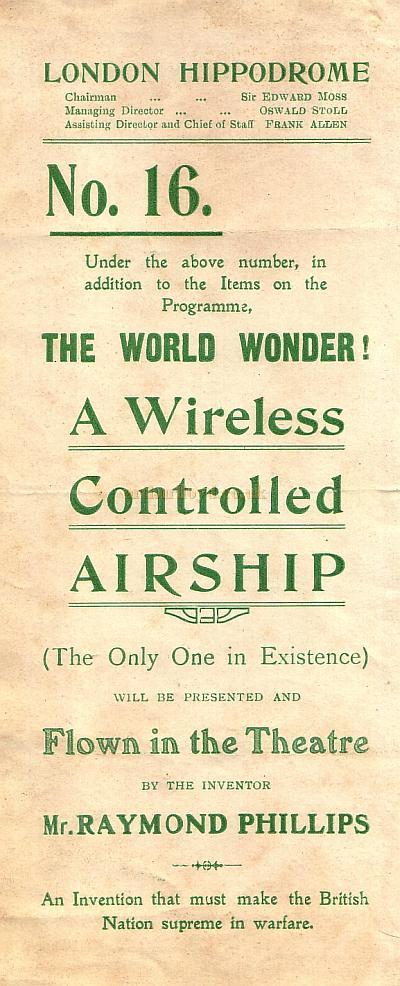
Low never linked his two projects, but in fact the prospect of seeing a distant target had been mooted before the war.  In 1910 Raymond Phillips used a twenty-foot model Zeppelin to demonstrate his wireless-controlled ‘aerial torpedo’ before an entranced crowd at the London Hippodrome. According to the New York Times (22 May 1910):

‘He claims to be able, sitting at a transmitter in London, to send a dirigible balloon through the air at any height and almost any distance.  He can load his balloon with dynamite bombs, he claims, and without leaving his office can send it over a city and wipe the city out.’

He told his audience:

I don’t want to brag, but I feel sure that if England purchases my aerial torpedo she will make short work of the enemy’s fleets and cities in any future war.  Why, I can sit in an armchair in London and drop bombs in Manchester or Paris or Berlin.’

Given the first city on his list it’s scarcely surprising that there should have been questions about navigation.  Asked how he would know that his airship was over ‘the town you purpose to destroy’, Phillips replied that he might work with a large-scale map or a ‘telephotographic lens’.  ‘I think it will do away altogether with existing methods of warfare,’ he predicted.  Much more here (scroll down).

But one of his rivals in the audience had spotted a weakness in the system.  ‘I believe that it would be possible for another operator to interfere with Mr Raymond Phillips’ control,’ speculated Harry Grindell Matthews, using what one newspaper called ‘hostile electric currents’, and he predicted that he could, ‘by manipulating an instrument of my own, compel it [the airship] to turn round and return to the place from which it was sent.’  The two men agreed to a duel between their devices, but I’ve been unable to find any record of the outcome – though the spectre that Matthews raised remains a concern for today’s remotely piloted operations.  Incidentally, Matthews would later claim to have invented a ‘death ray’…. More on him here and here.

The theatricalization of these early projects, with Phillips’s airship nosing its way around the Hippodrome – which was originally designed as a circus and had only been remodelled the previous year – and releasing its load of paper birds forty feet above the stalls, is all of a piece with the ‘bombing competitions‘ and the air displays of the pre-war years.

Here is Flight magazine on 7 May 1910:

‘There is no accounting for popular taste in the matter of public entertainment, but we must confess one could scarcely expect to witness the spectacle of a fairly big model dirigible sailing about the auditorium of the London Hippodrome, where at the moment it constitutes one of the star turns….

‘As an indication of a phase of aeronautics that is quite likely, indeed, we might as well say quite certain, to figure in the future, this display at the Hippodrome is a thoroughly interesting and instructive turn, and brings before many hundreds of people a visual demonstration of a scientific subject that in the ordinary course of events they would only be likely to read about at the best.’

Yet another instance of the theatre of war.

Phillips persisted with his dream, and in September 1913 the Illustrated London News devoted a whole page to ‘torpedoes of the air’ – what it called ‘bomb-droppers directed by wireless’ – and Robinson’s drawing was based on ‘materials provided by Mr Raymond Phillips.’

PHILLIPS Aerial Torpedo in ILN September 1913

Is Paris Burning?

The original question was Adolf Hitler’s to General Alfred Jodl in August 1944, but the French had long had good reason to fear the answer.  In a previous post I quoted Gustaf Janson’s pre-World War I fantasy of a future air raid on Paris:

‘Unexpectedly, without any warning dynamite begins to rain down on the city.  Each explosion follows on the heels of the last.  Hospitals, theatres, schools, museums, public buildings, private houses – all are demolished.  Roofs collapse, floors fall into cellars, the streets are blocked with the ruins of houses.  The sewers break and pour their foul contents over everything.  The water pipes burst, flooding begins.  The gas mains rupture, gas streams out, explodes, starts fires.  The electric light goes out… Above it all can be heard the detonations exploding with mathematical precision….  Men, women, children, insane with terror, wander among the ruins…. When the last flying machine has dones its work and turned northwards again, the bombardment is finished.  In Paris a stillness reigns such as never reigned before.’

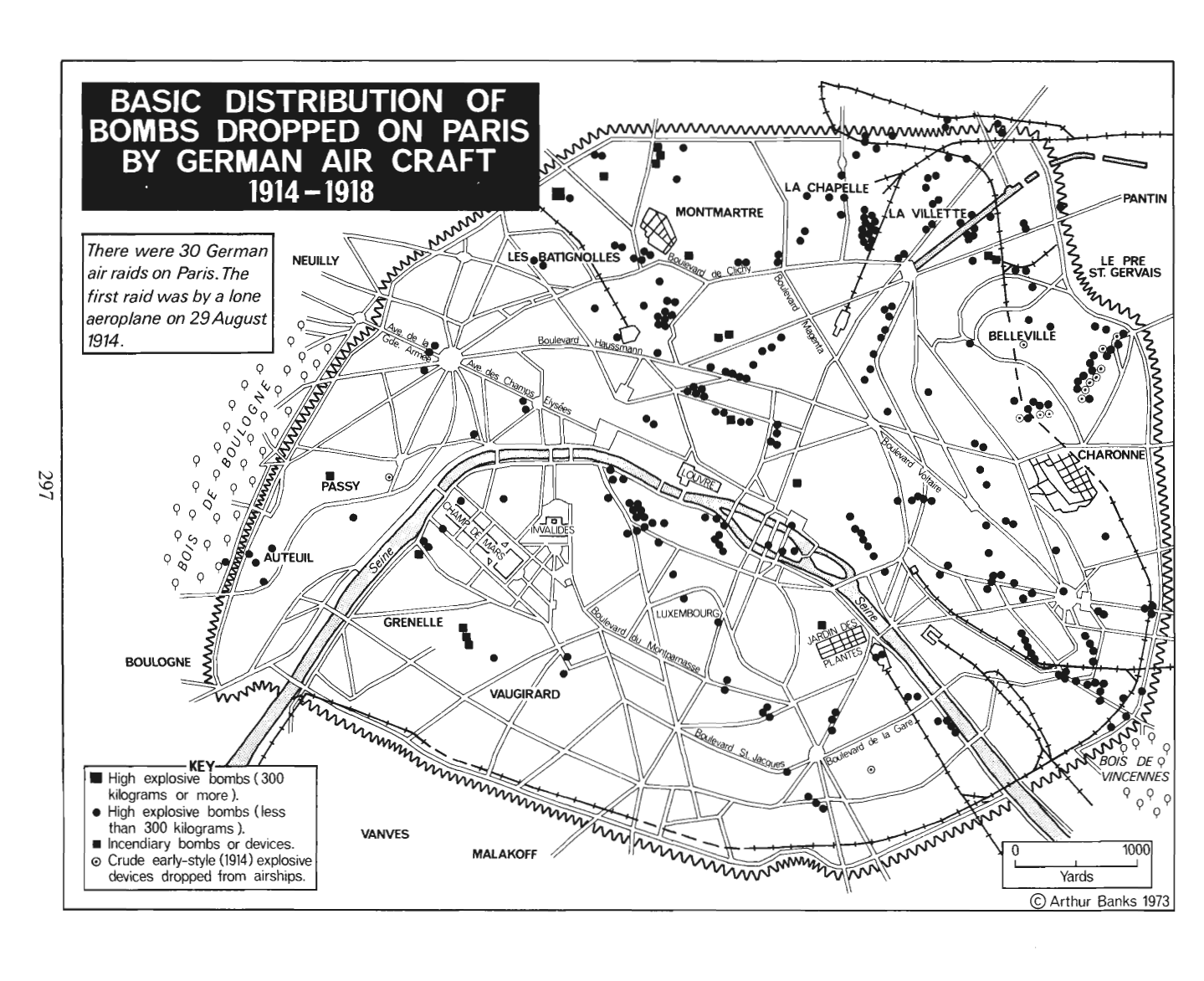
While the First World War did not see such a devastating attack on the city, there were repeated bombardments.  Paris was, after all, closer to the front than any of the other belligerent capitals. Historian Susan Grayzel provides a careful chronology of air raids on Paris in ‘The souls of soldiers”: civilians under fire in First World War France’ (Journal of modern history 78 (2006) 588-622), and it’s clear that the major bursts of activity were at the beginning and the end of the war: August-October 1914 and a crescendo between January-September 1918.  All told, Grayzel’s tabulations (from Jules Poirier’s Bombardements de Paris) show that attacks from German aircraft killed 275 people and injured 610 in the city and in the banlieu.
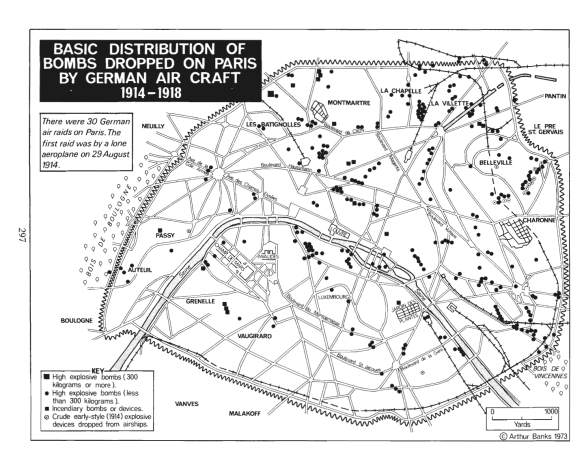
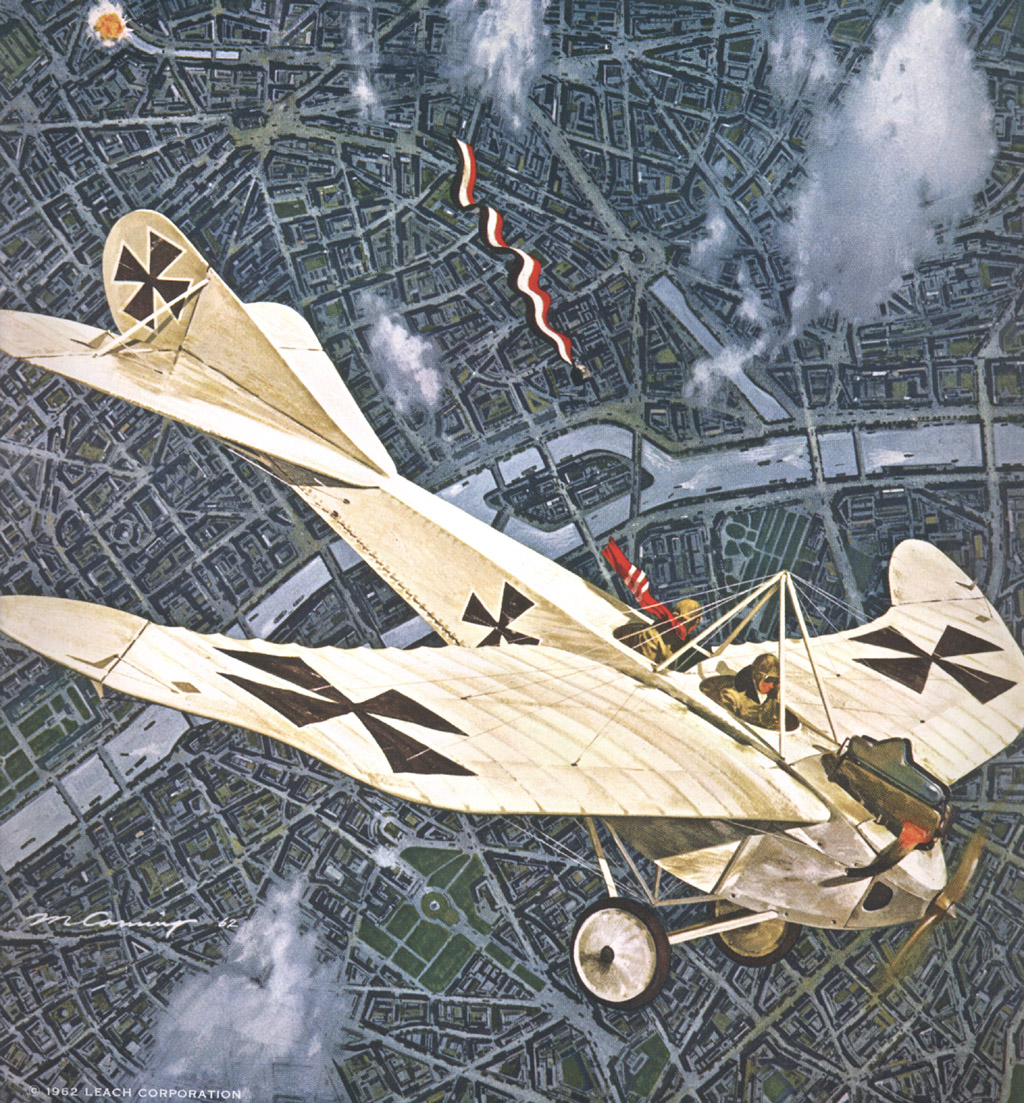
On 30 August 1914 a two-seater German Taube (‘Dove’) aircraft circled in the sky over Paris, and at 12.45 p.m. began to drop the first of four 5lb. bombs.  The final ‘bomb’ was a sack of sand with a message attached: ‘The German Army is at your gates.  You can do nothing but surrender.’  This was the first propaganda drop in aviation history and, like most subsequent leafleting raids, had little effect.
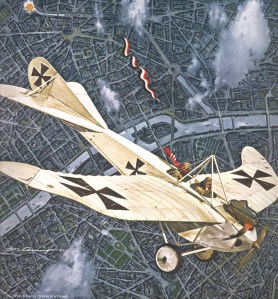
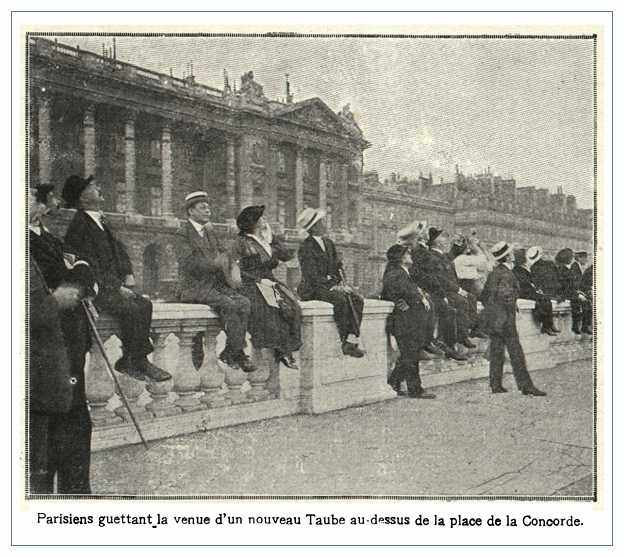
But the Germans continued to send Tarben over the city at regular intervals – and in fact at the same time each day.  The regularity turned the flights into a routine for Parisians too: see the images here. Emmanuelle Cronier (in Capital cities at war, vol. 2, eds. Jay Winter and Jean-Louis Robert, Cambridge University Press, 2007) provides a sketch of their impact (or lack of it):
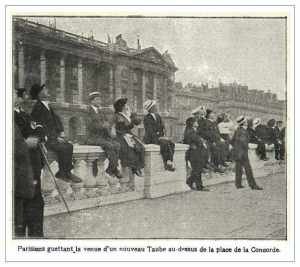
‘At “Taube time”, around 5.00 p.m., a new urban ritual developed, replacing the pre-war Parisian’s characteristic stroll with gatherings on balconies in squares, on bridges or promontories. Those with binoculars scanned the sky: “There’s one!” shouted a man.    Next the Taube is insulted, French aircraft are launched in pursuit, applauded… To some eyes this Parisian defiance of the Tauben constituted the true expression of the Paris crowd… Because these light German bombs claimed few victims, perception of the danger was deferred.  It was not until the arrival of the Zeppelins in March 1915 that the people of Paris understood the reality of the threat.’

In September 1914 the German advance towards Paris was accompanied by night raids by Tauben.  After the battle of the Marne, when the advance was finally rebuffed,  the capital returned to something approaching its pre-war life.  So much so, indeed, that many French soldiers on leave must have identified with the complaint voiced in Henri Barbusse‘s Le feu (1916), cited in Alistair Horne’s Seven ages of Paris (Knopf, 2002):

‘We are divided into two foreign countries.  The front, over there, where there is too much misery, and the rear, here, where there is too much contentment.

Air war undoes those separations, of course, and soon commentators were drawing attention to the fact.  Grayzel cites Le Petit Parisien in March 1915:

‘It’s not a trait of bravery to go dropping bombs in sleeping civilians, to profit from darkness, like a vulgar bandit … in order to assassinate women and children in their [homes].’

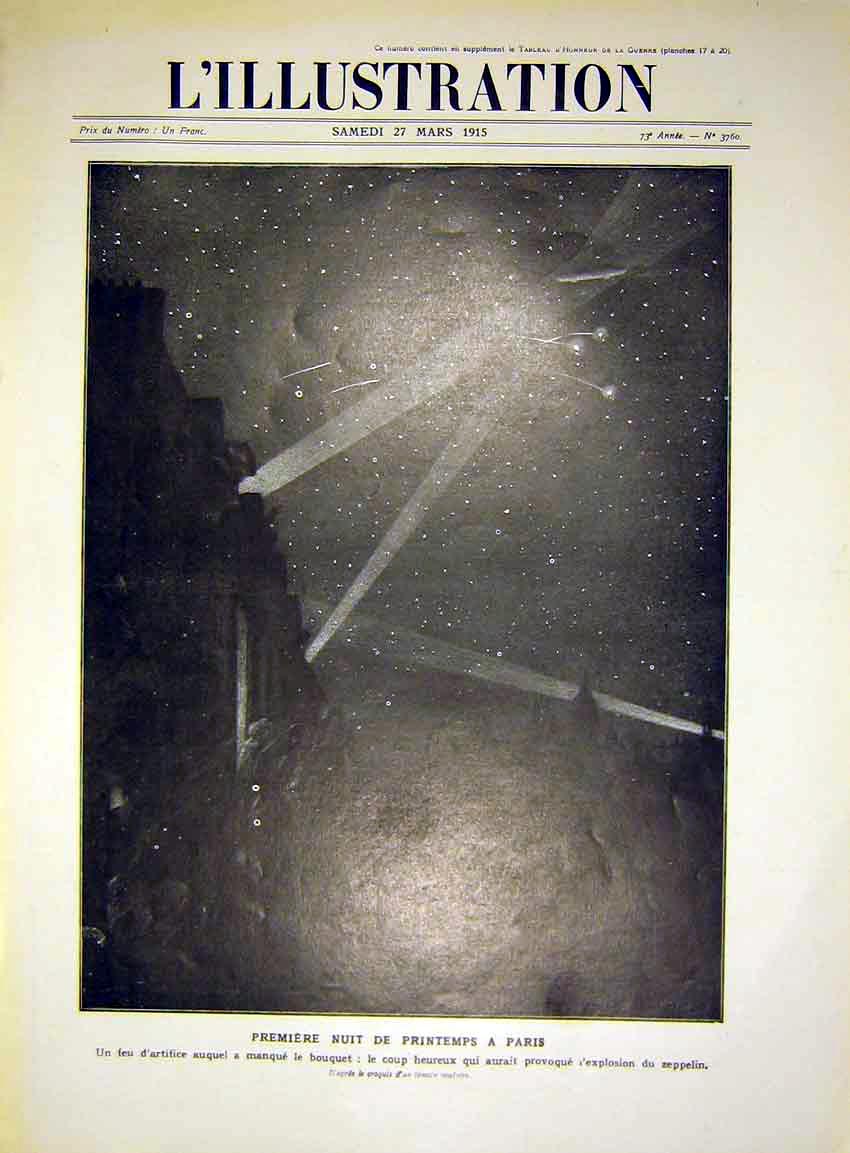
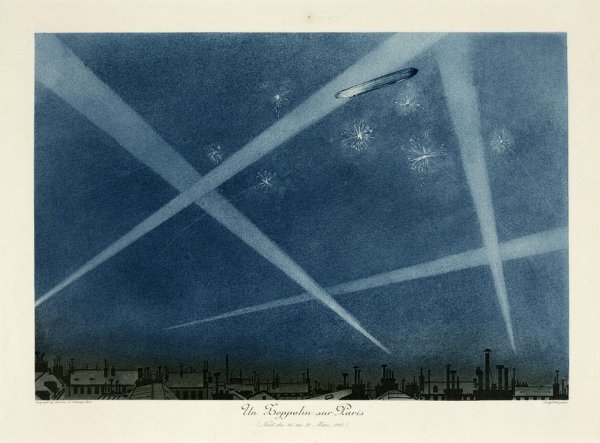
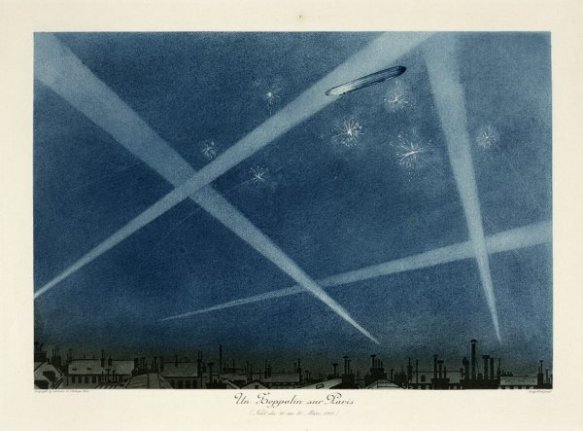
By then Zeppelins had made their far more sinister appearance in the night skies, and a black-out was imposed on the ‘City of Light’.  Here is one eyewitness report of the first raid on 21 March 1915 from a woman living near the Eiffel Tower:
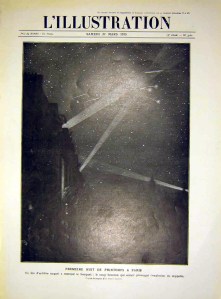
“I was awakened by firemen’s bugles, and as we had all been warned I had no doubt what the noise meant. I dressed and hesitated whether to leave my flat on the top story, but decided to stay and see what was going to happen. I watched the police trying to extinguish a gas jet in the road below, which gave them a great deal of trouble. Then for a long time nothing happened. The night was so clear and peaceful, it seemed impossible that there could be any danger.

“Suddenly there came reports from distant guns, and then a series of vivid flashes from behind houses at no great distance, followed by a violent cannonade which made the windows rattle.

“Searchlights were playing in all directions, but at first nothing was visible except the ghostly outline of the Eiffel Tower. Then I noticed that several stars were obscured by what seemed to be a long grey cloud moving at a tremendous rate. It seemed more like a shadow than anything solid. What struck me most about it was its enormous length and extraordinary speed. When a searchlight fell on it, it was only a fraction of a second before it passed out of its field. I knew at once it was a Zeppelin. As we had been forbidden to show any light, I lit a match in a corner of the room, and looked at my watch. It was ten minutes to two.

“When I went back to the window the firing had increased in intensity, and the airship, which was far away behind the Eiffel Tower at what seemed a very great altitude, appeared to be replying to the guns. From below the long grey shadow came a series of flashes, so that I think it must have been firing machine guns at the guns firing at it. Then, suddenly, the airship disappeared like a cloud, as suddenly and mysteriously as it had come. The firing ceased and all was still for ten minutes, when everything began over again, the guns again opening fire on what was, I suppose, a second Zeppelin. This airship, however, disappeared quicker than the first.”

As Grayzel shows, contemporary reports were part of an elaborate construction of Paris as an ‘innocent, heroic, feminized city’, and the phallic Zeppelin was turned into a faux, puffed-up masculinity that was contrasted with the ‘real’ masculinity (and by extension the ‘real’ war) of ‘hand-to-hand combat with bayonets’.
There were immediate calls for reprisals.  Le Figaro offered its readers a stark choice: ‘Either we resign ourselves to accepting more and more frequently the insults these Zeppelins show us, or we decide to carry to the other side of the Rhine all the horrors of the air war.’  But, as Andrew Barros shows in ‘Strategic bombing and restraint in “Total War”, 1915-1918’ (Historical Journal 52 (2009) 413-31), French strategic bombing was remarkably restrained throughout the war, and ‘reprisal raids’ were carefully calibrated – partly for reasons of geography (the quotations below are also from Pétain):

‘German bombers had to travel short distances to strike French cities, often just 30 kilometres.  French targets in Germany were located well past the zone of occupation, often 150 to 200 kilometres behind the lines.  Bombing a city like Frankfurt was “incomparably more difficult for the Allies” than it was for the Germans to attack Paris, especially because to have any substantive effect, raids needed to be conducted in a massive way and frequently repeated.’

The restrictions on bombing were also prompted by fears of escalation: ‘Requests from flying officers for permission to conduct reprisal raids against Berlin, Hamburg, Cologne and even Constantinople were repeatedly turned down by the army command.’

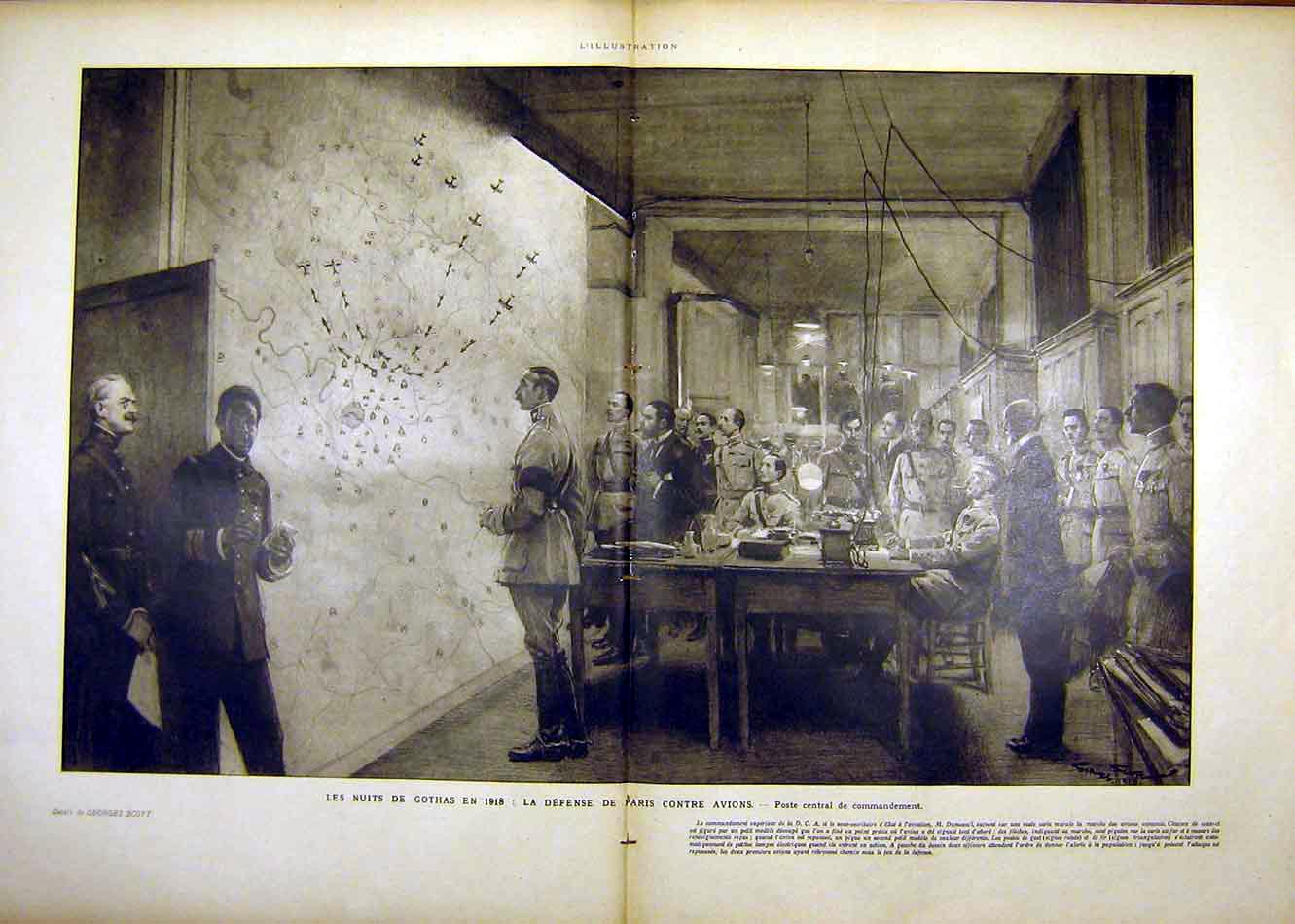
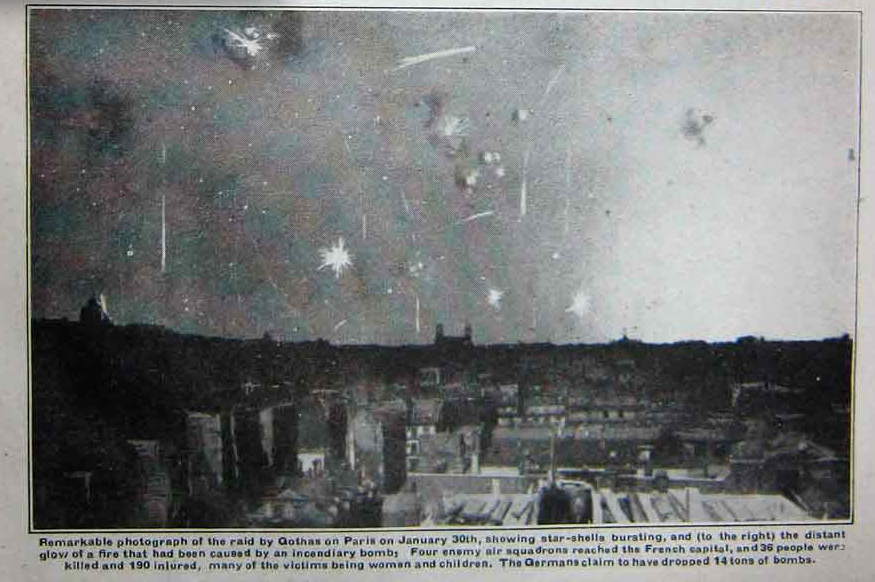
It was not until 1918 – and particularly during Ludendorff’s renewed ground offensive against the city – that, as Grayzel has it, ‘full-scale war came to Paris.’  According to Lee Kennett (The First Air War, 1914-1918) the German high command described the attacks carried out by Gotha bombers as Vergeltungsmassnahmen – reprisals for Allied attacks on cities ‘outside the region of operations’ like Mannheim and Freiburg – but they were clearly part of the calculated offensive: probes of Paris’s air defences were made in January, and the main attacks started in March.  Kennett notes that ‘the French met them with searchlights, anti-aircraft guns, night fighters and a cordon of barrage balloons that forced the bombers to come in over 3,000 meters – a height that ruled out any bombing accuracy.’  The resources commanded by Paris’s Défense Contre Avions (DCA) were much greater in 1918 than 1914 ,and the response was more carefully co-ordinated –
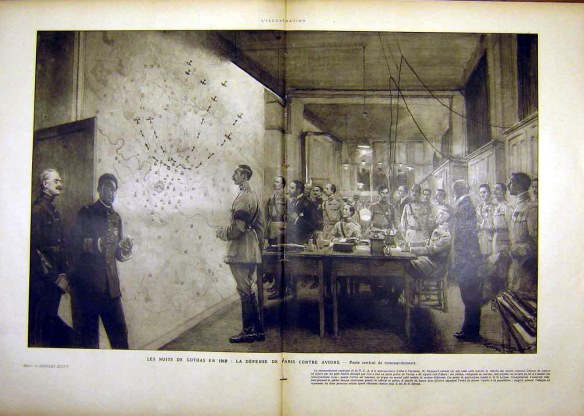
– but the threat was also much greater.  The Gothas were much faster and more manoeuvrable than the airships, cruising at around 80 m.p.h.  They had a much smaller bomb load – it took six aircraft to deliver the same load as one Zeppelin – but if they could fly at lower altitudes at night they could almost double their standard daylight bomb load of around 660 lbs.  The raids were also on a much larger scale and were carried out with far greater intensity than previous attacks, though targeting was still very haphazard. One French expert told the New York Times (for its 19 March edition) that

‘it was practically impossible to strike any particular objective when a plane was travelling at a rate of thirty-eight to forty yards a second.  A bomb must be dropped more or less at random, which is the reason why such form of warfare is simply criminal.  It is impossible to tell where the bomb will fall.’
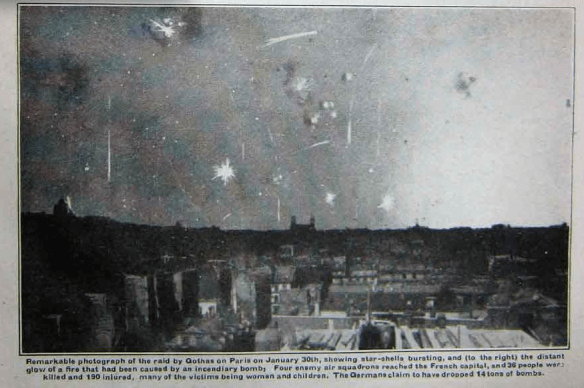
The blackout was reintroduced, but it was only partially effective. The Associated Press reported on 22 March that 1500 prosecutions for violations of the new restrictions had been launched in just two days in an attempt to produce a ‘darker Paris’.  But the offenders were not confined to a careless public.

‘On the Ile de la Cité more than thirty windows were illuminated in the Palais de Justice, where all appeals from convictions in the lighting cases will be heard.  Light was also shining brilliantly from a dozen windows of the Prefecture of Police, from which was issued the order for darkening the city.’

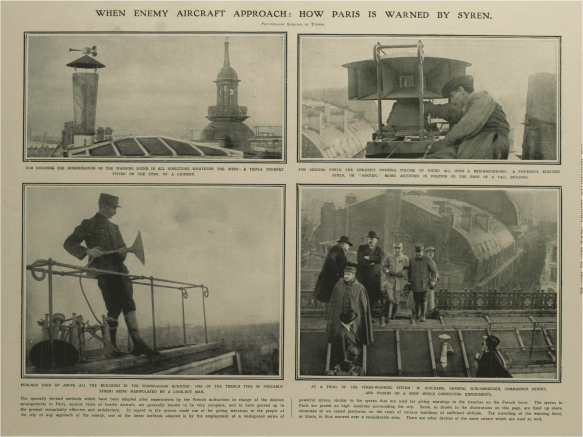
Firemen’s bugles were no longer adequate to warn the public and new air raid sirens were installed – a sufficient novelty to spark a feature in the Illustrated London News (below): since July 1917 Britain had relied on a system of marine distress maroons to warn of approaching enemy aircraft, supplemented by Boy Scouts with bugles and policemen with placards and whistles – and Parisians now regularly took shelter in cellars or in public shelters (there were 5,000 of them).
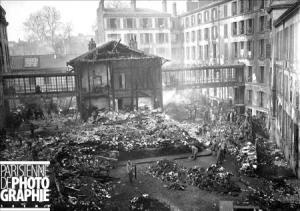
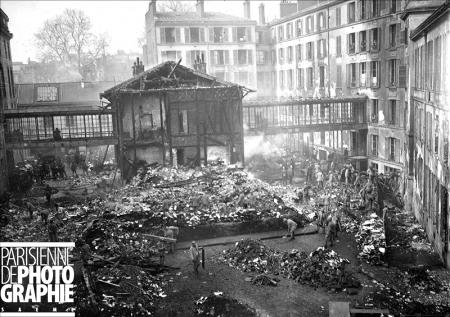
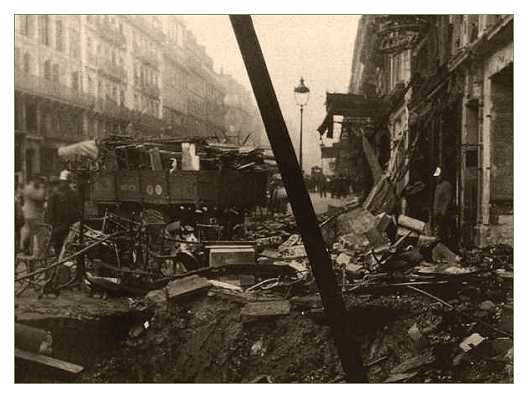
The attacks caused widespread damage – there is a sheaf of photographs here from Parisienne de Photographie (scroll down) – and yet the first reports were often once again remarkably nonchalant.  Here is Charles Grasty reporting from Paris on 23 March 1918 for the New York Times:

‘Paris was out en fête to receive the Gothas this morning… Last night there was considerable excitement following the alarm, but this morning there was more of a picnic spirit.  As I write, at 10.30 at the Matin office, there is an explosion as of a bomb around the corner.  Through the open window I see people on the roofs across the boulevard scanning the cloudless Springlike skies.  At the Ritz and other hotels many guests assembled downstairs but there was not the slightest panic.

I walked through the Rue de la Paix with Ridgely Carter and found the Place de l’Opéra crowded, everybody looking up as if watching some astronomical phenomenon.  Many taxis were standing in rank in the Boulevard des Italiens but the chauffeurs had all left them to join the gazer sin the square.

Paris is puzzled as the air raid proceeds.  The occasional explosion of a bomb makes the town aware of the continued presence of the Gothas, but the affair is quite casual and lacking in violence.’

The date was auspicious.  The explosion that morning in the Place de la République seemed (im)perfectly ordinary, and the DCA assumed that the city had suffered another air raid.
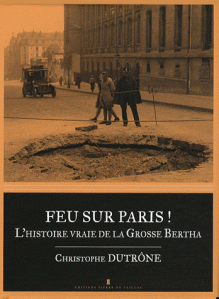
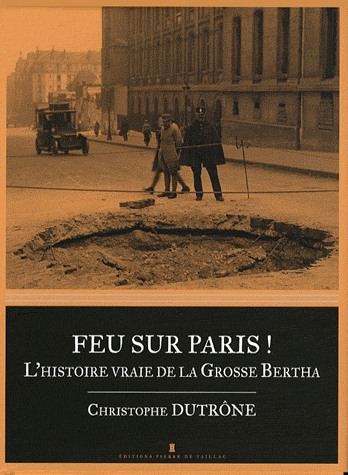
 But by the end of the day, as explosions continued at regular intervals and 16 people lay dead, it became clear that Paris was under artillery fire.  The DCA plotted the trajectory of fire from the locations of the first explosions, and sent aircraft to find the source. The battery was hidden in the forest of Courcy, an unimaginable 120 kilometres away, and Krupp’s long-range siege gun continued to shell the city until August, scattering some 20 shells across Paris each day.  This new ‘fire on Paris’ killed 250 people and caused widespread damage, but had little effect on everyday life in the city.

Marie Harrison reported from Paris on 25 April 1918:
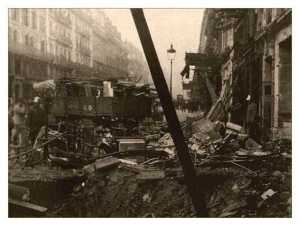
I was in Paris during the first days of the bombardment, and I know something about the morale of the city under circumstances of acute unpleasantness. Air raids are horrible enough but they have their time limit. There is no “all clear” in an attack by the mystery gun. I remember that on Good Friday it began early in the morning, and the explosions continued throughout the day, occurring precisely at every quarter of an hour. That is a form of irritation which the Huns thought would empty Paris in a week. Some people left the city as some people have left London to escape the raid. But the greater number of Parisians went quietly about their work and did not even leave the business at hand to seek shelter from the approach of the next expected attack. Paris is so close to the war and has lived for so long beneath its shadow that it would take more than a long range-gun to disturb the normal course of its way of living.

Ironically, at the start of the war the French high command – like the other belligerents – had believed that the primary role of its own air force would be reconnaissance, and aircraft were soon soon providing crucial intelligence to range field  guns on the battlefield.  Even when the French turned to tactical and strategic bombing, air power remained, as General Pétain insisted, ‘the direct extension of artillery’, so that all efforts had to ‘converge on the essential act: the battle’.

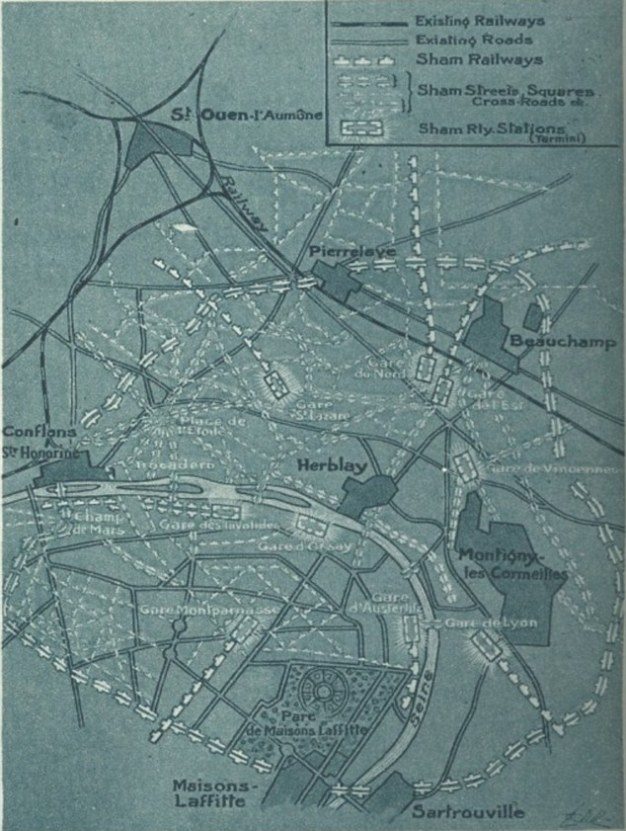
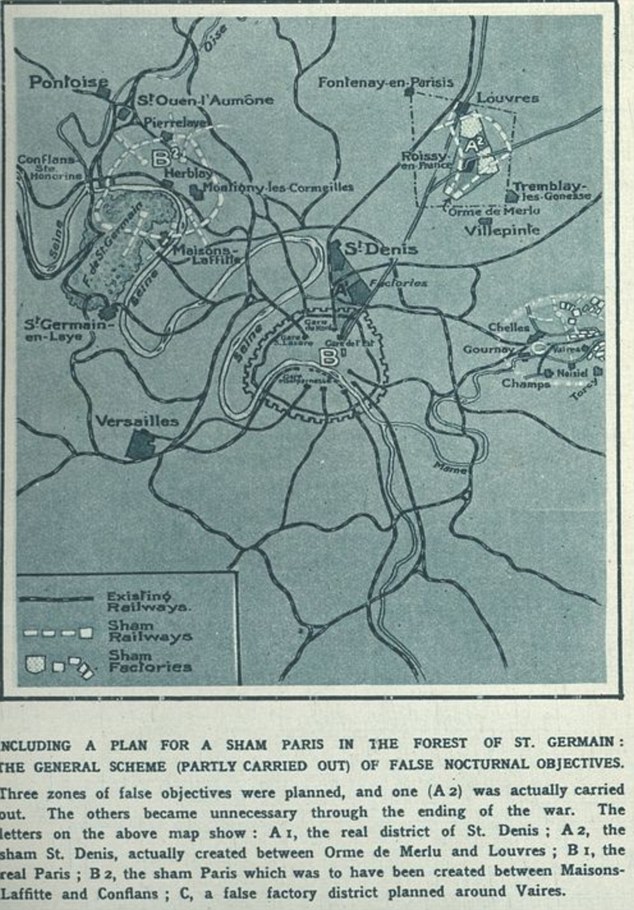
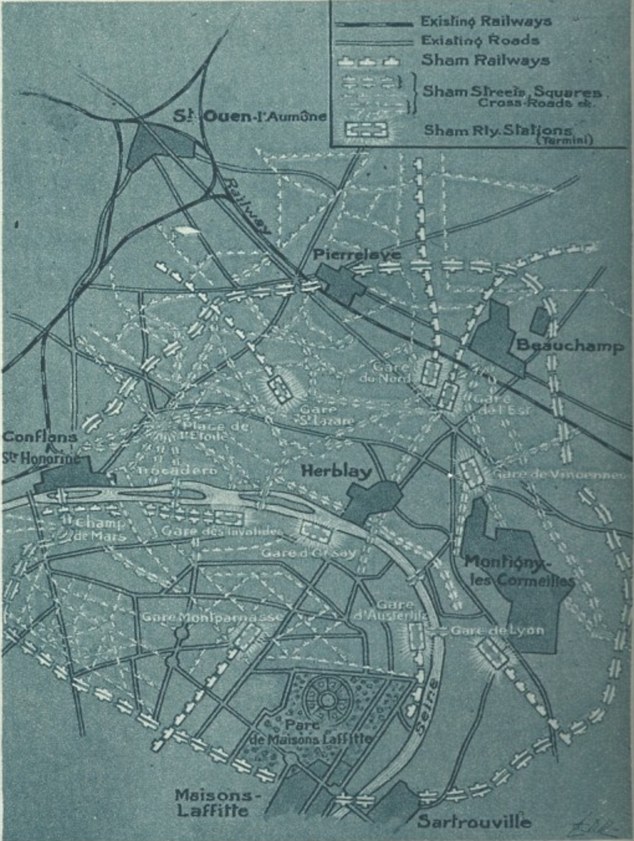
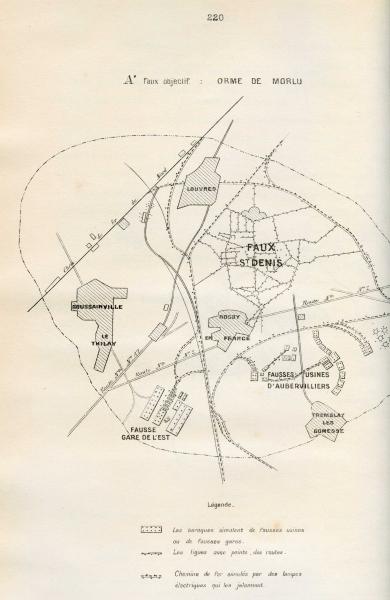
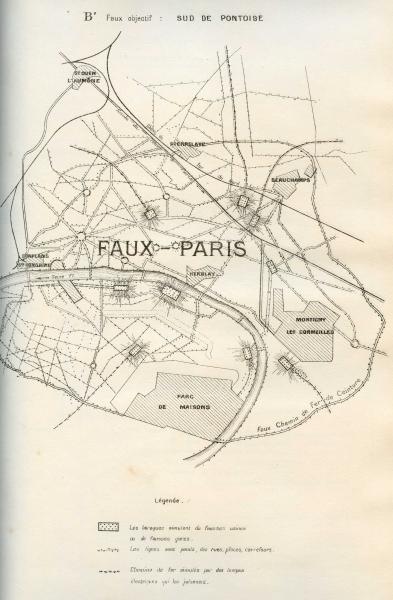
Still, the fear of escalation was real enough, and with the example of the dramatic increase in air raids on London before their eyes, in March 1918 the DCA started construction of a dispersed faux Paris on a great loop of the Seine north of the city (more here).  Three separate sites were selected to draw German night-bombers away from the capital.  Wooden buildings with canvas roofs were to be used to mimic glass-roofed factories, and the plans included a dummy Gare de l’Est and Champs-Elysées; the designers experimented with ‘all sorts of variations and colours of lights’ to convince German pilots that they were bombing Paris.  The plans, largely unrealised, were revealed in a photo-essay in the Illustrated London News on 6 November 1920, which reported that this was ‘a “city” created to be bombarded.’
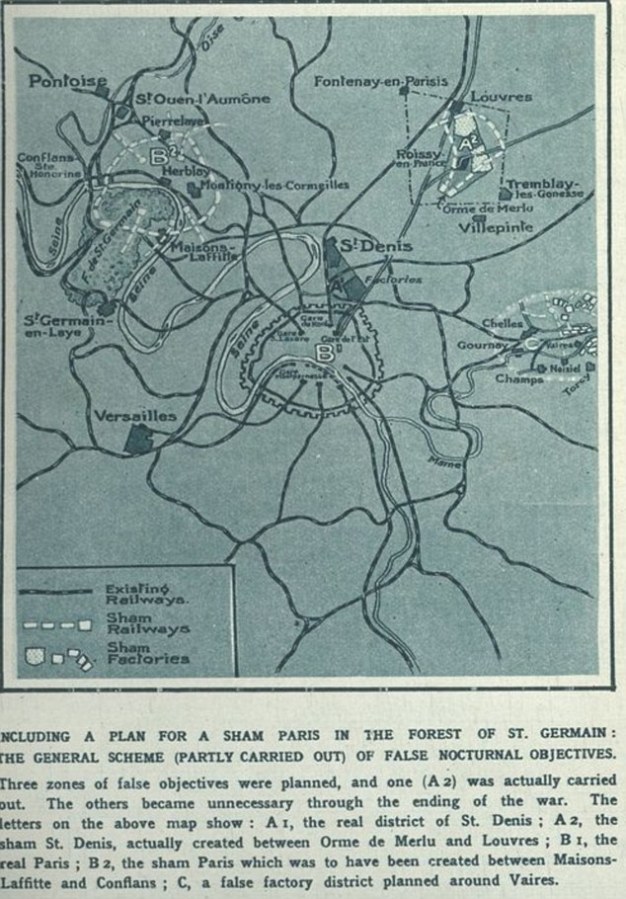
These sketches were drawn for the ILN but here are original maps from October 1918 of ‘objectif A’ and ‘objectif B’:
The danger was more imminent and more substantial than the DCA could have known.  On the night of 23 September 1918 the last of 20,000 new, deadly incendiary bombs – ‘Elektrons’ – were being loaded on to 45 heavy Giant bombers for a devastating raid on Paris.  The plan, according to Neil Hanson in First Blitz (Doubleday, 2008), pp. 330-333, was to create an immense firestorm. Some of the pilots had already completed their final checks before starting their engines. Suddenly a staff car raced across the airfield with orders from Ludendorff abruptly cancelling the mission. Whether this was the result of a fear of the reprisal raids that such a spectacular attack would provoke (a simultaneous raid was to be launched against London – the focus of Hanson’s book) or whether the high command had already realised they would have to sue for peace is unclear. What is certain is that Paris was saved at an eleventh hour 18 days before the final eleventh hour of the Armistice.

Postscript: Faux Paris remained largely a paper city, but in the not too distant future quite other ‘towns to be bombed’ would be built.
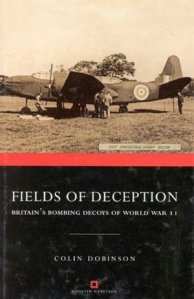
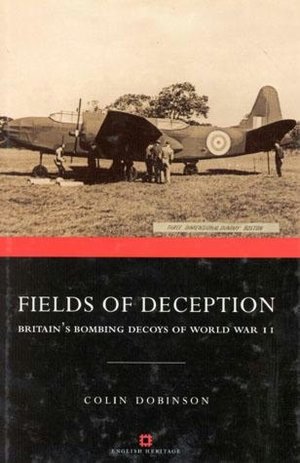
After the bombing of Coventry in 1940 Britain created a number of bombing decoys – known as Starfish sites (from SF: ‘Special Fires’) – to lure the Luftwaffe away from towns and other strategic locations.  The first was on Black Down in Somerset’s Mendip Hills, where Shepperton Film Studios created a fake Bristol (of sorts), including ‘glow boxes’ designed to simulate the streets and marshalling yards and creosote and water ‘fires’ to simulate incendiary bombs.  It was part of a dispersed system of sites standing for other parts of the city – for example, the docks and marshalling yards at Canon’s Marsh were reproduced at Burrington close by.  For an RAF photograph of the Black Down site at night see here. By the end of the war there were over 200 sites protecting 80-odd locations, including London and Manchester.  More here, and much more information in Colin Dobinson, Fields of deception: Britain’s bombing decoys of World War II (Methuen, 2000; a new edition is advertised for 2013).

All of this intersects with a rich literature on camouflage – and in geography (and anywhere else, for that matter) I’m thinking of Isla Forsyth‘s marvellous work – but we should remember that other fake towns were built during the Second World War for entirely the reverse purpose: for experimenting with fire-bombing and, ultimately, for testing the atomic bomb.
Episodes in the history of bombing

I spoke at the Shock and Awe conference in London last November, held to mark – commemorate is hardly the word – the centenary of the first bombs dropped from an aircraft (much more from openDemocracy here).  But I’m now realising that the episode and its reverberations were more complicated that I had thought.

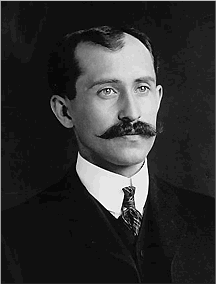
Less than two years after the Wright Brothers’ first successful flight, Orville Wright was already convinced that the most immediate use for their new flying machine would be war.  In January 1905 the Wright Brothers approached both the British military and the US War Department about a contract – ‘flying has been brought to a point where it can be made of great practical use in various ways, one of which is that of scouting and carrying messages in time of war’ – but they were rebuffed.  Undeterred, the brothers continued to search for military customers – including France and Germany – and eventually won two contracts, one with the US Army and the other with the French, which they successfully fulfilled in 1908.  By 1910 France had 36 flying machines, Germany had 5, Britain had 4, Russia had 3, and Austria, Belgium, Italy, Japan and the United States had just one each.

But the Italian-Turkish war (1911-12) – the ‘Libyan’ or ‘Tripolitanian’ war – heightened the military interest in aviation.  After the Congress of Berlin in 1878, with the Ottoman Empire visibly crumbling, Cyprus had been occupied by Britain and Tunisia by France.  There had been shadow discussions about Italy’s possible interest in Tripolitania, but this remained empty talk until 1911 when, after a series of failed negotiations, Italy declared war and its troops landed in Tripoli in October 1911.  In addition to seapower and ground forces, Italy deployed nine aircraft; the assumption, evidently, was that they would be used much as Orville Wright had imagined. Accordingly, among the firsts achieved by the Italian pilots, according to Martin van Creveld‘s The age of airpower (Perseus Books, 2011), were ‘the first recorded flight by a military aircrat over enemy territory (October 22), the first use of aircraft to lay naval gunfire (October 28), the first wartime use of wireless for air-to-ground and ground-to-air communication [Marconi himself arrived to help] … [and] the first wartime use of aerial photography (November 23)’.

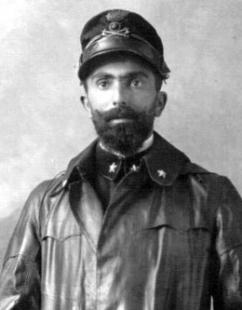
But what captured the public imagination was another first: on 1 November, when Lt. Giulio Gavotti dropped four grenades from his Taube monoplane on a Turkish-Arab encampment at Ain Zara east of Tripoli, this was the first bombing from an aircraft.  “AVIATOR LT. GAVOTTI THROWS BOMB ON ENEMY CAMP. TERRORIZED TURKS SCATTER UPON UNEXPECTED CELESTIAL ASSAULT.”

It was not a spontaneous attack. ‘Today I have decided to try to throw bombs from the aeroplane,’ Gavotti wrote to his father. ‘It is the first time that we will try this and if I succeed, I will be really pleased to be the first person to do it.’

Neither was it a purely personal decision:

“Today two boxes full of bombs arrived.  We are expected to throw them from our planes.  It is very strange that none of us have been told about this, and that we haven’t received any instruction from our superiors. So we are taking the bombs on board with the greatest precaution. It will be very interesting to try them on the Turks.’

This is how he described his mission:

 ‘As soon as the weather is clear, I head to the camp to take my plane out.  Near the seat, I have fixed a little leather case with padding inside. I have laid the bombs in it very carefully. These are small round bombs – weighing about a kilo-and-a-half each. I put three in the case and another one in the front pocket of my jacket…

‘After a while, I notice the dark shape of the oasis [Ain Zara]. With one hand, I hold the steering wheel, with the other I take out one of the bombs and put it on my lap. I am ready. The oasis is about one kilometre away. I can see the Arab tents very well. I take the bomb with my right hand, pull off the security tag and throw the bomb out, avoiding the wing. I can see it falling through the sky for couple of seconds and then it disappears. And after a little while, I can see a small dark cloud in the middle of the encampment. “I have hit the target!  I then send two other bombs with less success. I still have one left which I decide to launch later on an oasis close to Tripoli [Tagiura].

‘I come back really pleased with the result. I go straight to report to General Caneva. Everybody is satisfied.’

But the headlines were exaggerated and the satisfaction was short-lived.  A Times reporter with the Italian army wrote that ‘Bomb-dropping, whether from airship or aeroplane, does not appear to have been attended by any great measure of success, and it is not unlikely that that the possibilities of early development in this direction have been overrated.’  Creveld notes that most of the Cipelli grenades used as bombs missed their targets, ‘and the longer the war [went on], the more the Italians themselves tended to replace them with leaflets that called upon the enemy to surrender.’

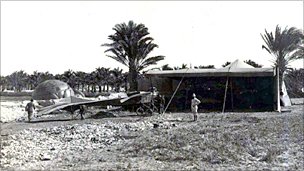
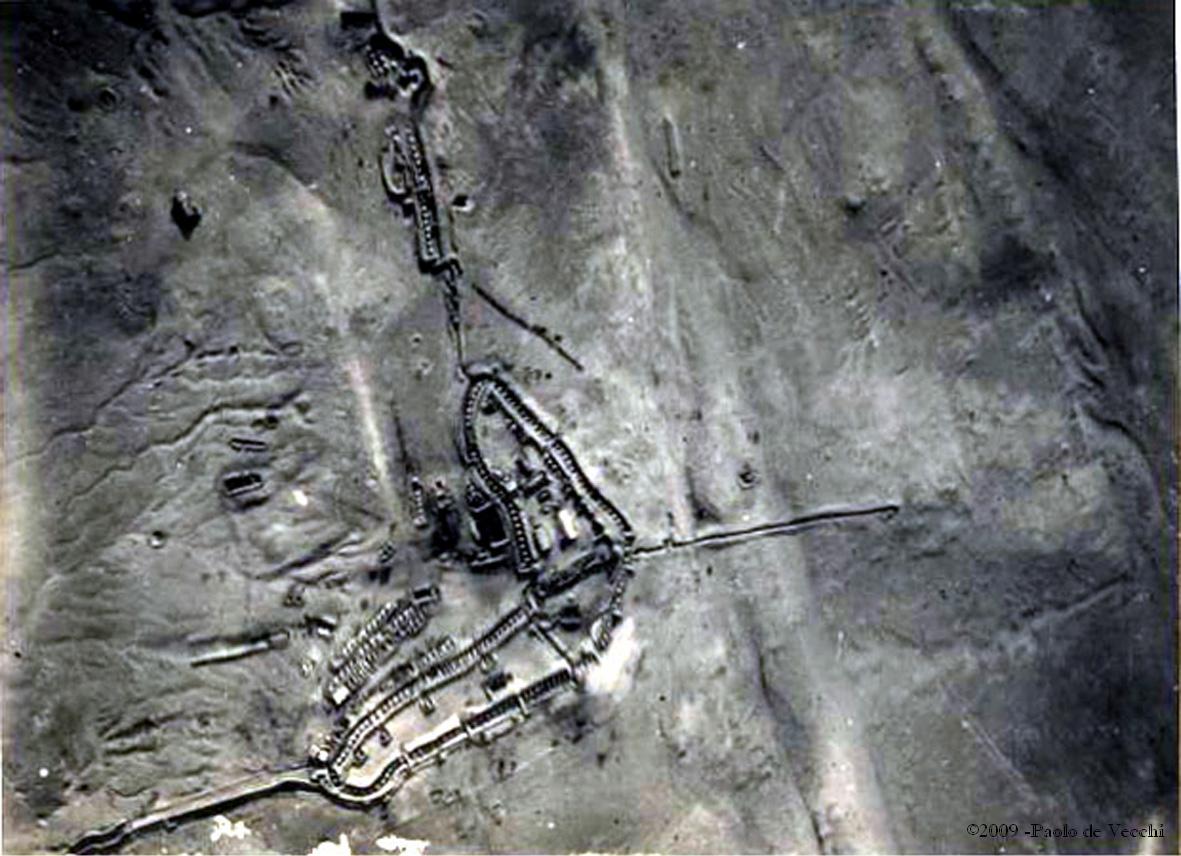
Where aircraft did excel, he concludes, was indeed in reconnaissance: identifying enemy positions and mapping the terrain.  ‘Our only certain knowledge,’ wrote General Caneva, ‘derives from what our aviators have seen with their own eyes.’  There is a selection of aerial photographs taken during the campaign here (together with extracts from more letters from Gavotti to his father) from which I’ve taken this image:

Even so, others were more impressed by the possibilities of using airpower as a directly offensive force.  In 1911, in the new Revue Générale de l’Aéronautique Militaire, a Lieutenant Poutrin conjured up the spectre of a mass German air attack on Paris:

‘The aerial squadron will not be limited to observing and reporting. It is possible and even probable that it will be an aggressive force. As research progresses on this new branch of gunnery, aerial ballistics, it might enable such a force to attack military establishments and troops on the move along roads or by rail. Even now, 500 aeroplanes, each carrying 300 kg of explosives, can leave Metz, two hours after a declaration of war, to reach and fly over Paris.’

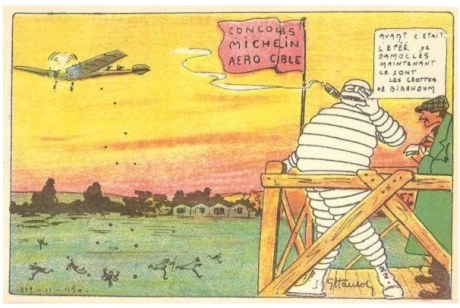
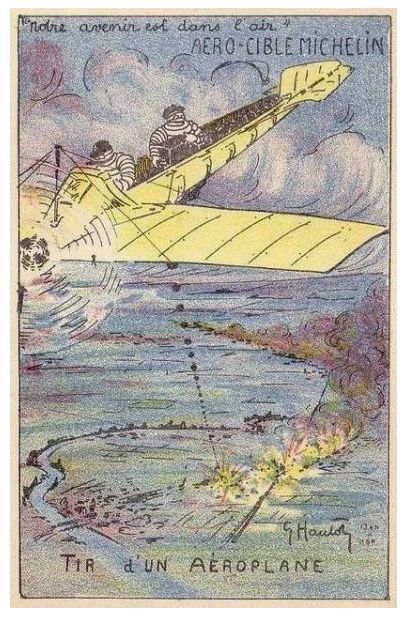
The phrasing is instructive: ‘fly over’. Poutrin was evidently under no illusions about the likely accuracy or extent of bombing in any ‘war of the future.’  But, he continued, invoking an affective response that would loom large in the next decades, ‘the effect on morale would be immense, and certain public monuments, the Élysée, the War Ministry, could be bombarded so that the normal functioning of the principal national services might become impossible.’  André Michelin was so taken by the prospect that in August 1911 (several months before Gavotti’s attack) he and his brother – their company already sponsored an Aviation Cup – wrote to the Aéro-Club de France offering to sponsor a bombing competition: ‘There is much discussion of the question of knowing whether the military aeroplane is a simple reconaissance device or whether it can become a terrible weapon of war.  Let us try to demonstrate, by facts, the power of the aeroplane.’   The Michelin Aéro-Cible or ‘Air Target’ competition was inaugurated one year later at Villacoublay near Paris.

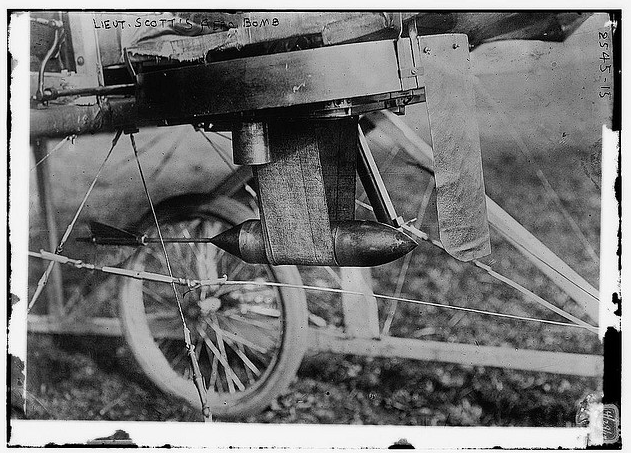
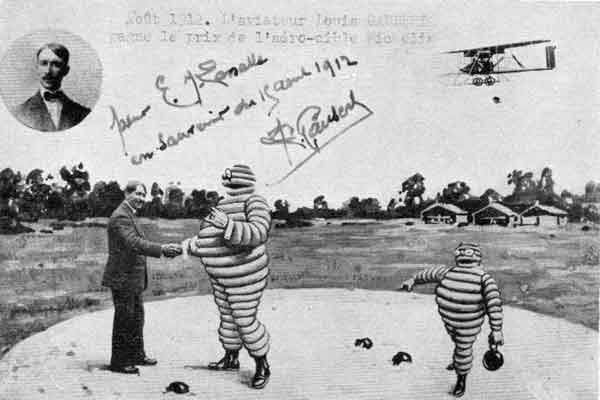
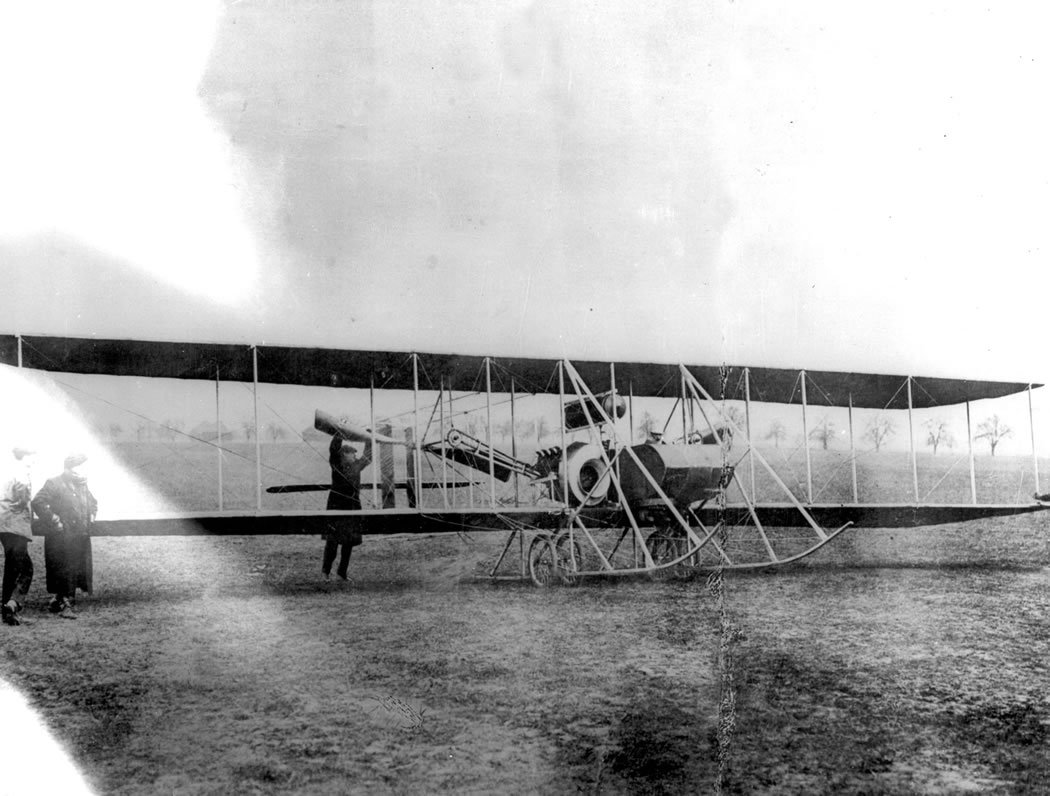
The American press reported that the first contest was won by Lt Riley Scott of the US Army Coast Artillery Corps, who beat six French aviator-bombardiess to the 50,000 franc prize by using a bombsight and mechanism (left) that he had designed himself to drop 12 out of 15 bombs within a 20-metre diameter concrete circle from an altitude of 200 metres. Not surprisingly the French press fêted Scott’s pilot, Louis Gaubert, who shared the prize with him:

These national rivalries were diagnostic; one of Michelin’s aims in sponsoring the competition had been to secure France’s ‘supremacy in the air’, and that same month – August 1912 – Germany held its own bombing competition as part of the Aeroplan-Turnier in Gotha.

One Boston newspaper spoke for many when it reported that ‘the ever increasingly rapid development of military and naval aviation gives bomb-dropping competitions ever greater importance’, and the victorious Scott had no doubt about its significance.  According to Lee Kennett in The First Air War 1914-18 (Simon & Schuster, 1991), he thought that even a limited air attack on New York would be devastating (though he didn’t say where it could possibly come from): ‘No great accuracy would be needed in the congested areas, and the loss of life from fire, high-explosive bombs, and panic would be appalling.’  Those first two clauses would cast an even longer shadow over the decades ahead.

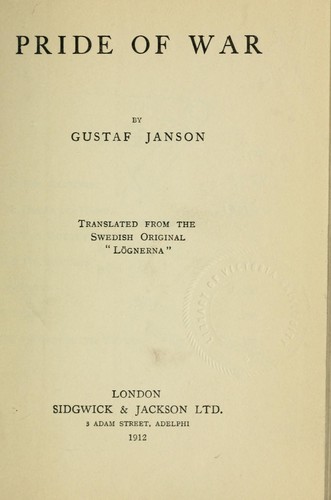
Already by the fall of 1912 a more elaborate fantasy of a German attack on Paris than Poutrin could ever have imagined was included in Gustaf Janson‘s account of the Italian-Turkish war, Pride of war.  In this vision of the future, 300 German aircraft – ironically ‘all constructed and bought in France’ – could ‘throw down ten thousand kilos of dynamite on the metropolis of the world in less than half an hour’ and Paris would be reduced ‘to a heap of ruins.’

‘Unexpectedly, without any warning dynamite begins to rain down on the city.  Each explosion follows on the heels of the last.  Hospitals, theatres, schools, museums, public buildings, private houses – all are demolished.  Roofs collapse, floors fall into cellars, the streets are blocked with the ruins of houses.  The sewers break and pour their foul contents over everything.  The water pipes burst, flooding begins.  The gas mains rupture, gas streams out, explodes, starts fires.  The electric light goes out… Above it all can be heard the detonations exploding with mathematical precision….  Men, women, children, insane with terror, wander among the ruins…. When the last flying machine has dones its work and turned northwards again, the bombardment is finished.  In Paris a stillness reigns such as never reigned before.’
By the eve of the First World War the numbers of military aircraft had soared and France had already lost its advantage.  In August 1914 Germany had 232 and Austro-Hungary 48 military aircraft, while Russia had 263, France 165, Britain 63 and Belgium 16.  Although Scott had won the Michelin prize using a Wright aircraft (right), the Wright Brothers remained sceptical of its role in bombing.  Orville Wright acknowledged the importance of striking targets like the Krupp works at Essen, as I noted in an earlier post, but he still believed the primary role for military aircraft was reconnaissance (‘scouting’).  ‘I have never considered bomb-dropping as the most important function of the airplane,’ he told the New York Times in July 1917, ‘and I have no reason to change this opinion now that we have entered the war.’

I’ll examine Wright’s claim in detail in a later post, but for now two observations are important.  First – then as now – aerial reconnaissance was increasingly and intimately involved in the fighting on the ground: aircraft (and balloons) were used to direct and co-ordinate the massive artillery barrages that shook the Western Front, missions that the fliers called ‘shoots’, and from 1916 aircraft were also routinely used in low-flying ‘contact patrols’ to monitor the advance of the infantry.  Here is Wright again (though he was, of course, hardly a disinterested observer):

‘It is the accuracy of aim now possible to both sides that results in such widespread destruction.  Gunners on both sides now hit the mark because of airplanes to direct the fire…  The war is being run absolutely from above.’

Second, although bombing missions were flown in the war zone and immediately behind the lines, and columns of troops, gun batteries, railheads and supply depots were all attacked, the most pregnant raids – though they had little strategic effect at the time – were those launched against towns and cities.  Paris did indeed come under repeated attack, and 250 people were killed in 24 air raids and three Zeppelin attacks.  But the main target for German airships and from 1917 giant Gotha bombers was ‘Fortress London’.  It wasn’t the apocalypse imagined by Janson, but it was a foretaste of the future.  Giulio Douhet, an Italian general who had been impressed by the lessons of the Tripolitania campaign, wrote in The command of the air in 1921 that

‘By virtue of this new weapon, the repercussions of war are no longer limited by the farthest artillery range of guns, but can be felt directly for hundreds and hundreds of miles… The battlefield will be limited only by the boundaries of the nations at war, and all of their citizens will become combatants, since all of them will be exposed to the aerial offensives of the enemy. There will be no distinction any longer between soldiers and civilians.’

Project Thor and the history of bombing

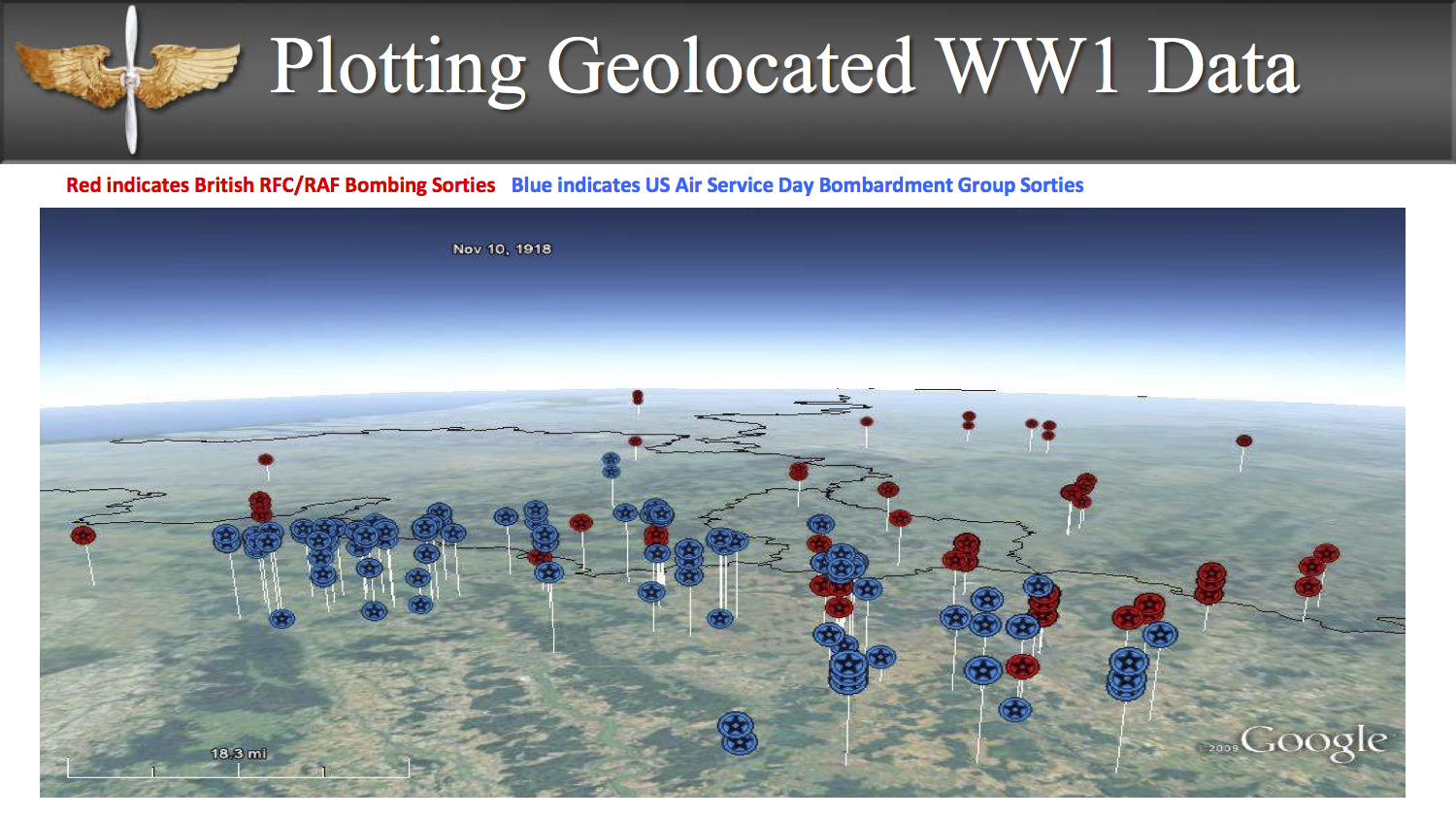
In a previous post I wrote about the US Bombing Encyclopedia of the World, designed as a global database of potential targets, but for more on a different but related project that I also previewed, a database of US bombs dropped from the closing stages of the First World War to the present, see this video from the US Air Force on its Project Thor [Theater History of Operations Reports]:

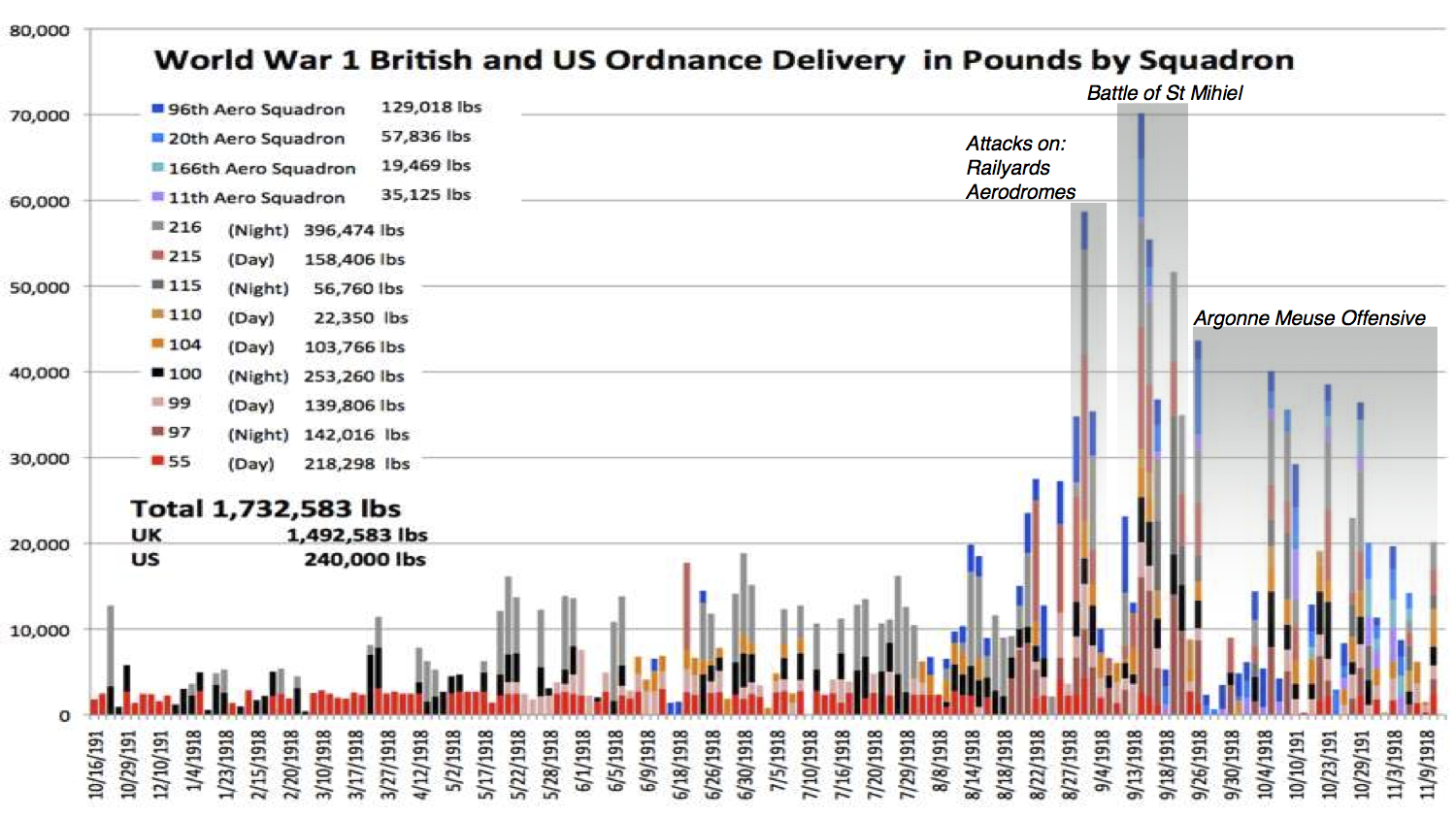
For the background to the project, look here.  And for a preview of its possibilities – the intention is apparently for the database to be open access in the near-ish future – here are two extracts from the World War I (1918) database:


Although my own work focuses on the combined bomber offensive in World War II, the air wars over Indochina and the ‘drone wars’ over Afghanista, Pakistan and beyond, it’s not limited to these air wars, and I’ve been examining other periods and other theatres.  I’ll say more about my interest in World War I (and hence the reason for the extracts above) in a later post, but it was prompted by Orville Wright‘s arguments about the future of air war.  ‘I have never considered bomb-dropping as the most important function of the airplane,’ he told the New York Times in July 1917, ‘and I have no reason to change this opinion now that we have entered the war.’  For him – though he did not altogether discount the importance of striking particular targets, like the Krupp works at Essen – the key role of the aeroplane was reconnaissance (‘scouting’) for ground forces, including artillery:  ‘About all that has been accomplished by either side from bomb dropping has been to kill a few non-combatants, and that will have no bearing on the result of the war.’  (The use of the term ‘bomb-dropping’ rather than bombing was accurate – unlike the practice it described – and while there were air raids on towns and cities, carried out from aircraft and from Zeppelins, most air strikes during the War were tactical).

As we’ll see, aircraft were much more valuable for reconnaissance missions – here I’ve been learning much from Terrence Finnegan‘s Shooting the Front: Allied aerial reconnaissance and photographic interpretation (The History Press, 2011; first edition 2007) (reviewed for the CIA [really] here) –but Wright seemed in two minds about it insofar (in his view) it had prolonged the war:

“Did you ever stop to think that there is a very definite reason why the present war in Europe has dragged along nearly three years with neither side gaining much advantage over the other?  The reason, as I figure it out, is the airplanes.  In consequence of the scouting work done by the flying machines, each side knows exactly what the opposing forces are doing.

“There is little chance for one army to take another by surprise.  Napoleon won his wars by massing his troops at unexpected places.  The airplane has made that impossible.  It has equalized information.  Each side has such complete knowledge of the other’s movements that both sides are obliged to crawl into trenches and fight by means of slow, tedious routine rather than by quick, spectacular dashes.”

Ironically, it was precisely the subsequent rise of strategic bombing (what Mark Clodfelter calls ‘beneficial bombing’) that was hailed by its advocates as a way of bringing war to a speedy end and avoiding the carnage of the trenches.  Here is Clodfelter’s quick summary of a complex and convoluted argument (from Beneficial Bombing: the Progressive foundations of American air power, 1917-1945, University of Nebraska Press, 2010; see also his essay in Joint Forces Quarterly 49 (2008) 24-31 here):

‘The devastation and ugly realism of World War I ended the progressive era for most Americans…  Yet for Army Air Service officers like Edgar Gorrell and William “Billy” Mitchell, the carnage and waste that they witnessed on the Western Front sparked the beginning of a progressive effort that was unique – an attempt to reform war by relying on its own destructive technology as the instrument of change.  They were convinced that the airplane – used as a bombing platform – offered the means to make wars much less lethal than conflicts waged by armies or navies….

‘Aircraft would destroy the vital centers [of the enemy] by precision bombing – sophisticated technology would guarantee that bombs hit only the intended targets, and few lives would be lost in the process.  The finite destruction would end wars quickly … and thus bombing would actually serve as a beneficial instrument of war.’

My own project is, in part, designed to give the lie to these arguments and their successors.  And perhaps it will even be possible to enlist Project Thor to silence these dread thunderbolts (and Hellfire missiles).

War and distance: logistics

My earlier post about War and distance emphasised the historical significance of the telegraph because it allowed information to be transmitted without the movement of messengers, but these systems obviously required the installation and maintenance of physical infrastructure.  Still, in August 1870 the Montreal Gazette was already anticipating the vital role of the new communications network in the emergence of frictionless war:

‘Modern science has brought each dependency of the Empire within swift reach of the controlling centre.  The communications are ever open while the command of the sea remains…  There converge in London lines of telegraphic intelligence … [and] it needs but a faint tinkle from the mechanism to despatch a compelling armament to any whither it may be called…  The old principle of maintaining permanent garrisons round the world suited very well an age anterior to that of steam and electricity.  It has passed out of date with the stage coach and the lumbering sailing transport.’

The Gazette was ahead of itself; even today, the United States garrisons the planet, and waging war over long distances still usually involves the physical movement of troops and supplies (the cardinal exception is cyberwar: more on that later).  Martin van Creveld‘s Supplying War (1977; 2004) suggested that ‘logistics make up as much as nine tenths of the business of war, and … the mathematical problems involved in calculating the movements and supply of armies are, to quote Napoleon, not unworthy of a Leibnitz or a Newton….  From time immemorial questions of supply have gone far to govern the geography of military operations.’

Halvard Buhaug and Nils Petter Gleditsch reckon that this is still the case; they concluded (in 2006) that ‘The main factor to limit the military reach of armed force is not the range of the artillery or the combat radius of attack planes.  The largest obstacles to remote military operations relate to transportation and logistics.’
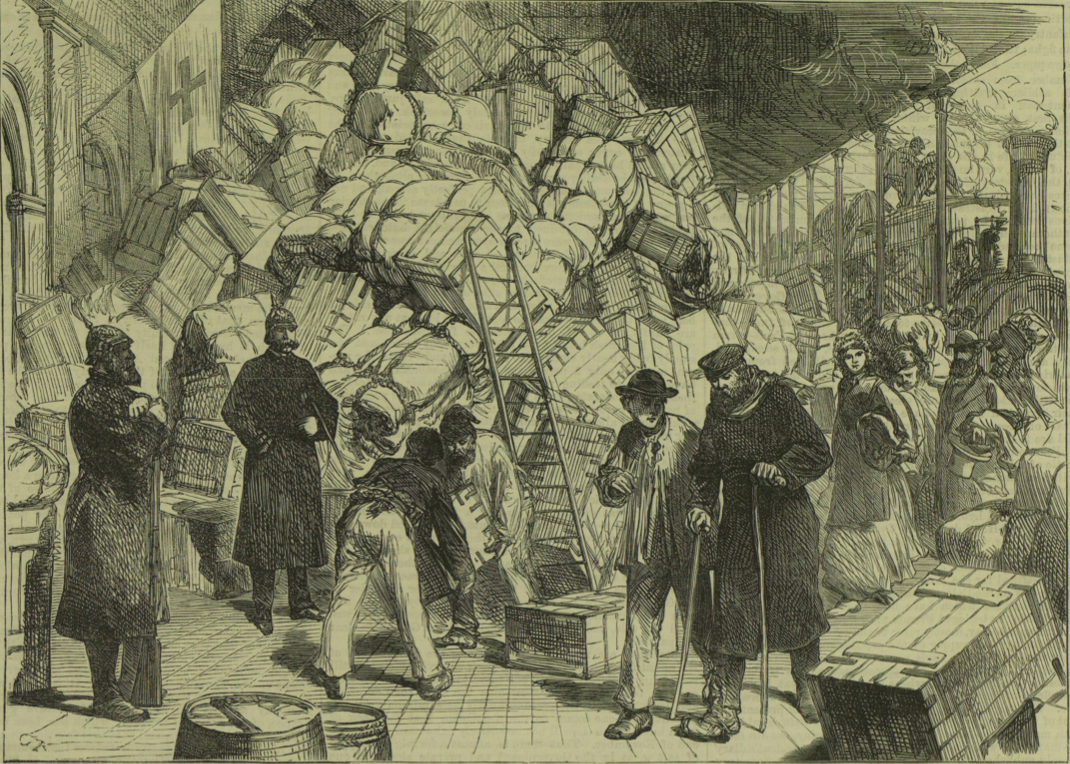
Stores for the Prussian siege of Paris at Cologne station

There is a contentious backstory to Creveld’s main thesis – that before 1914  ‘armies could only be fed as long as they kept moving’, foraging (and pillaging) as they went – which has sparked an ongoing debate about the logistics of early modern siege warfare and pitched battle.  But by the time of the Franco-Prussian War (1870-71) it was already clear – to the Prussians at least – that the railway had transformed the business of war.  ‘We are so convinced of the advantage of having the initiative in war operations that we prefer the building of railways to that of fortresses,’ Field Marshal Helmuth von Moltke had declared: ‘One more railway crossing the country means two days’ difference in gathering an army, and it advances operations just as much.’

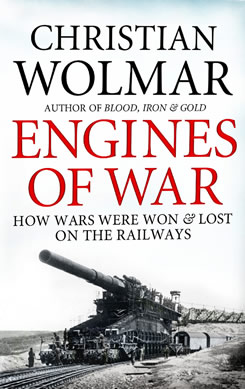
Armand Mattelart discusses the strategic implications of this in The invention of communication (1996, pp. 198-208), but the role of the railway in supplying modern war has been described in great detail by Christian Wolmar.  He contrasts the Battle of Waterloo in 1815 – ‘the last significant conflict before the invention of railways’ – which was over in less than a day, leaving 40,000 men dead, with the Battle of Verdun, ‘which lasted most of 1916’ and resulted in 700,000 dead and wounded soldiers.  The crucial difference, according to Wolmar, was the railway, that ‘engine of war’, and here – as elsewhere – the chronology is complicated.  The Franco-Prussian War was indeed a significant waystation, but events didn’t work out quite as von Moltke had envisaged.  The railways certainly speeded the mobilization of Prussian troops but, as Wolmar explains,

‘The Germans had expected to fight the war on or around the border and had even prepared contingency plans to surrender much of the Rhineland, whereas in fact they found that, thanks to French incompetence, they were soon heading for the capital.  The war, consequently, took place on French rather than German territory, much to the surprise of Moltke, upsetting his transportation plans, which had relied on using Prussia’s own railways. The distance between the front and the Prussian railheads soon became too great to allow for effective distribution, and supplies of food for both men and horses came from foraging and purchases of local produce.’

Back to a world of foraging and laying siege.  The decisive moment was probably (as Wolmar’s vignette abut Verdun suggests) the First World War of 1914-1918.  Even as late as 1870, Creveld argues, ammunition formed less than 1 per cent of all supplies, whereas in the first months of the First World War  the proportion of ammunition to other supplies was reversed:

‘‘To a far greater extent than in the eighteenth century, strategy became an appendix of logistics.  The products of the machine – shells, bullets, fuel, sophisticated engineering materials – had finally superseded those of the field as the main items consumed by armies, with the result that warfare, this time shackled by immense networks of tangled umbilical cords, froze and turned into a process of mutual slaughter on a scale so vast as to stagger the imagination.’

Empty shell casings and ammunition boxes,  a sample of the ammunition used by the British Army in the bombardment of Fricourt on the first day of the Battle of the Somme, 1 July 1916 [Australian War Memorial, AWM H08331]

In August 1914, for example, British field guns had a total of 1,000 shells available at or approaching the front lines; by June 1916 each eighteen-pound gun had 1,000 shells stockpiled at its firing position, and by 1918 Britain had over 10,000 guns, howitzers and trench mortars in the field.  An elaborate system of light ‘trench railways’ was constructed on the Western Front to transport the ammunition to the front lines. (A note for afficionados of crime fiction: see Andrew Martin’s The Somme stations [2011]).

Supply of munitions on the Western Front

It’s that toxic combination of movement and stasis that was (and remains) so shattering.  As Modris Eksteins described it in Rites of Spring: The Great War and the birth of the modern age (1989),

‘The war had begun with movement, movement of men and material on a scale never before witnessed in history.  Across Europe approximately six million men received orders in early August [1914] and began to move… [And them for two years, 1916 and 1917] this new warfare that cost millions of men their lives … moved the front line at most a mile or so in either direction.’

And it was locked down in part because men and material continued to be moved up to the front lines.

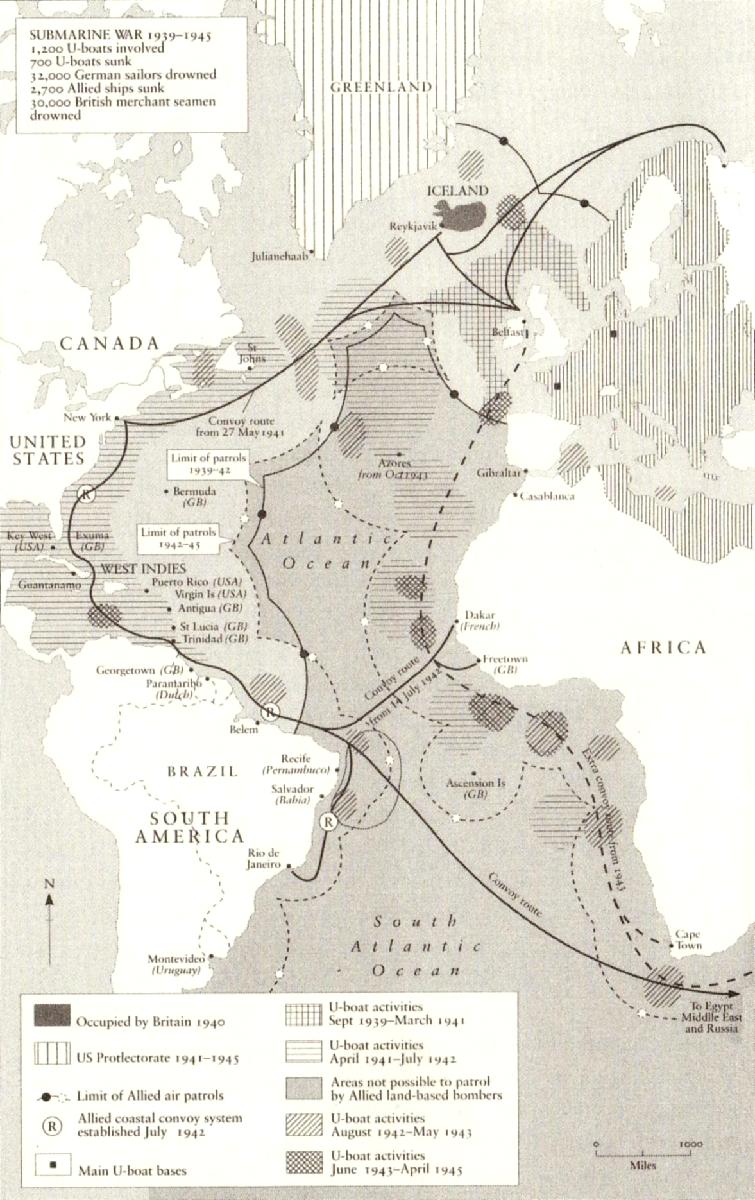
Now Creveld’s argument was limited to ground forces – he said nothing about sea power or air power – and was confined to war in Europe, and these are significant caveats.  During the Second World War the Battle for the Atlantic was crucial.  Churchill famously declared that ‘Never for one moment could we forget that everything happening elsewhere, on land, at sea, or in the air, depended ultimately on its outcome.’   There is a rich literature on convoys and submarine attacks that I’m only just beginning to explore.  Although the Allies lost 3,500 merchant ships and 175 warships, however, more than 99 per cent of ships sailing to and from the beleaguered British Isles survived the crossing.

If we enlarge the scale to consider the supply of war materials beyond the European theatre – as in this graphic which shows US global logistics during the Second World War – then the complexity and vulnerability of the supply chain becomes even clearer.

The deployment of air forces also imposed logistical problems, as this graphic from the Illustrated London News showed:

It’s worth remembering that today’s use of UAVs like the Predator and Reaper in distant theatres of war and conflict zones also requires the transport of the aircraft, ground crews and the crews responsible for take-off and landing; once airborne, the missions are usually flown from the continental United States but they involve an extended global network of supplies, personnel and communications.

In fact, writing in 2004 Creveld concluded that since 1945 the logistics burden had not eased nor had armed forces increased their operational freedom.  The two most important changes have been an even greater reliance on petrol/gasoline (a key target of Allied bombing in the final stages of the Second World War) which, by the 1990s, had displaced ammunition to become the single bulkiest commodity to be shipped to supply distant wars, and a dramatic increase in outsourcing through the use of private military contractors.

I provided a sketch of how these two developments bear on the contemporary logistics of supplying war in Afghanistan in a long essay at open Democracy, and I’ve provided a short update here. This was my conclusion:

‘Over the last decade a new political economy of war has come into view.  We have become aware of late modern war’s proximity to neoliberalism through privatisation and outsourcing (‘just-in-time war’) and its part in the contemporary violence of accumulation by dispossession.  The rapacious beneficiaries of the business of war have been swollen by the transformation of the military-industrial complex into what James der Derian calls the military-industrial-media-entertainment network (MIME-NET). And the very logic of global financial markets has been subsumed in what Randy Martin calls today’s ‘derivative wars’.  These are all vital insights, but it is important not to overlook the persistence of another, older and countervailing political economy that centres on the persistence of the friction of distance even in the liquid world of late modernity.  To repeat: the world is not flat – even for the US military.  In a revealing essay on contemporary logistics Deborah Cowen has shown how the United States has gradually extended its ‘zone of security’ outwards, not least through placing border agents around the world in places like Port Qasim [in Pakistan] so that the US border becomes the last not the first line of defence through which inbound flows of commodities must pass.   She shows, too, how the securitization security of the supply chain has involved new legal exactions and new modes of militarization that materially affect port access, labour markets and trucking systems.  Affirming the developing intimacy, truly the liaison dangereuse between military and commercial logistics, the US Defense Logistics Agency envisages a similar supply chain for its outbound flows that aim to provide ‘uninterrupted support to the warfighter’ (‘full spectrum global support’) and a ‘seamless flow of materiel to all authorized users.’  And yet, as I hope I have demonstrated, this is the ‘paper war’ that, 180 years ago, Clausewitz contrasted so scathingly with ‘real war’.  The friction of distance constantly confounds the extended supply chain for the war in Afghanistan.  This is no simple metric (‘the coefficient of distance’) or physical effect (though the difficult terrain undoubtedly plays a part).  Rather, the business of supplying war produces volatile and violent spaces in which – and through which – the geopolitical and the geo-economic are still locked in a deadly embrace.’

And, as that last phrase signals, I’ll need to deepen and extend all these arguments for the book-length version of Deadly embrace.  We are still a long way from the Montreal Gazette’s nineteenth-century dream of ‘frictionless war’.