Media blitz

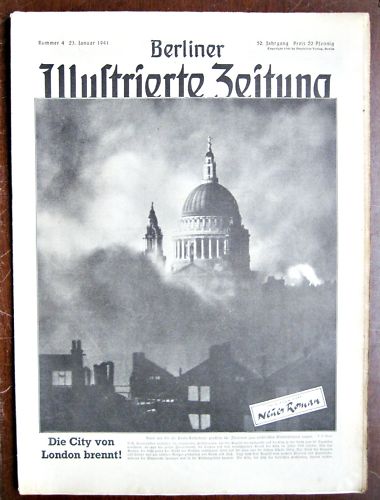
For an interesting post-script (or pre-script) to my discussion of the mediatization of the Israeli war on Gaza, check out the ever-interesting Brett Holman over at Airminded on the ways in which print media were used to report and ridicule propaganda messages from the enemy during the Second World War.

As Brett points out, there are parallels but also significant differences:

For one thing, in 1940 it was effectively impossible for British civilians to communicate with German ones, or vice versa: their debates were national, at best. Now Palestinians and Israelis — and everyone else — can talk directly to (or past) each other on the Gaza war, perhaps with the aid of Google Translate. For another, in 1940 official propaganda did not draw on the unofficial kind. Now @AlqassamBrigade and @IDFSpokesperson share photos of alleged attacks posted on Twitter by ordinary people. For yet another, in 1940 the debates in newspaper columns unfolded over days and weeks. Now the social war moves almost as fast as the real war does. A real war that, it should not be forgotten, claims real lives regardless of what happens online.

Sound targets

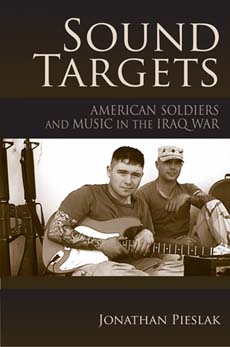
It seems an age since I talked about sound and war, but I haven’t been still(ed).  I’ve just finished Jonathan Pieslak‘s Sound Targets (Indiana, 2009), which adds another dimension to the discussion:

Though a part of American soldiers’ lives since the Revolutionary War, by World War II music could be broadcast to the front. Today it accompanies soldiers from the recruiting office to the battlefield. For this book, Jonathan Pieslak interviewed returning veterans to learn about the place of music in the Iraq War and in contemporary American military culture in general. Pieslak describes how American soldiers hear, share, use, and produce music both on and off duty. He studies the role of music from recruitment campaigns and basic training to its use “in country” before and during missions. Pieslak explores themes of power, chaos, violence, and survival in the metal and hip-hop music so popular among the troops, and offers insight into the daily lives of American soldiers in the Middle East.

As the blurb suggests, there’s a rich history to be traced here and I’ve only just started digging.

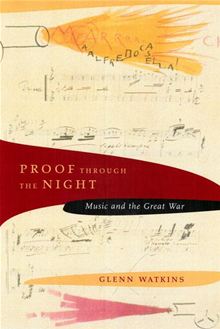
So far I’ve also enjoyed Glenn Watkins‘s Proof through the night: Music and the Great War (University of California Press, 2002) – the title is a line from the ‘Star-spangled banner’ – whose cover shows a Stravinsky manuscript on which the music for his four-hand Marche  (1914) is accompanied by percussive blasts from cannon roughed in by the composer himself.

‘Music in every nation gave “proof through the night” – ringing evidence during the dark hours of the war – not only of its historic role in the definition of nationhood and of nationalist resolve but also of its power on distant battlefields to recall home and hearth and to commemorate loss long after the guns had been stilled.’

So much is probably obvious, but there’s little else that is in this rewarding collection of essays/studies that constantly surprises by its engagements with a wider cultural politics and the sombre refrains of military violence.

High on the ‘to be read’ pile is Christina Baade’s Victory through harmony: the BBC and popular music in World War II (Oxford University Press, 2011), which has an accompanying website with music clips (but only if you’ve got the book so I haven’t included a link here).  The same publisher has also announced Annegret Fauser‘s Sounds of war: music in the United States during World War II for 1913, which apparently argues that ‘it was the role assigned specifically to classical music that truly distinguished musical life in the wartime United States’, so this may be rather narrower in scope than it looks.  Doesn’t look as though there will be much space for swing, jazz and bebop (or even Glenn Miller).

I’ve also rifled through Lee Andresen’s Battle notes: Music of the Vietnam War (Savage, 2003), which I retrieved from a bin in a second-hand bookstore, but I rapidly realised why it was where it was – so if anyone has any good suggestions for articles or books on what is such an obvious theme I’d be really Grateful (and not as in Dead).

Emergency cinema

The Arab uprisings heightened interest in the politics of new social media, and much attention was directed at platforms like Twitter (which is emphatically not to say that any of this can be reduced to a ‘Twitter revolution‘).  Swirling around these discussions, breaking the 140-character limit of a tweet, was an insistently visual thematic, though this too was often limited to cellphone videos uploaded to YouTube and other sites (and then retransmitted by mainstream news media).  But there are other ways in which film/video can function as witness.

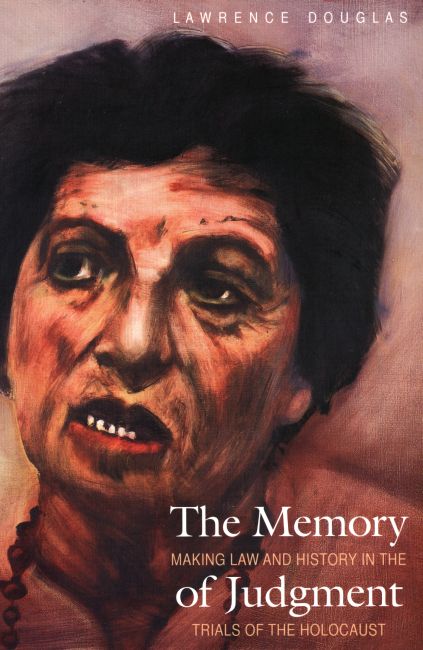
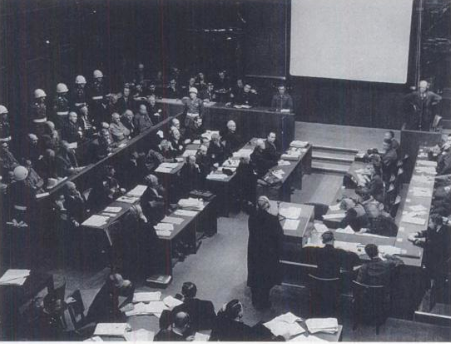
The use of film as witness is usually traced back to the International Military Tribunals in Nuremberg after the Second World War: see in particular Lawrence Douglas‘s classic The Memory of Judgment: Making law and history in the trials of the Holocaust (Yale University Press, 2001) – you can also read an early version of the key essay, ‘Film as Witness: Screening “Nazi Concentration Camps” before the Nuremberg Tribunal,’ in The Yale Law Journal,  105 (2) (1995) or access the book version (so far as I can see, without the accompanying images) online from Yale here.

Douglas’s thoughtful essay is, in a sense, framed by a remark that appears mid-way through it.  When reporter Ed Murrow described Buchenwald concentration camp in April 1945 he ended his broadcast by saying: ‘I pray you to believe what I have said about Buchenwald.  I have reported what I saw and heard, and only part of it.  For most of it, I have not words.’  When the prosecutors at Nuremberg elected to show a film compiled by former Hollywood director Lt Col George C. Stevens from black-and-white footage shot by Allied troops when they liberated the camps – Nazi Concentration Camps – they claimed , as one of them put it, that the film ‘represents in a brief and unforgettable form an explanation of what the words “concentration camp” imply.’  A horror, then, that transcended words – or, as Walter Benjamin confessed in a different context, ‘I have nothing to say, only to show’.

‘This use of film in a juridical setting was unprecedented’, Douglas notes, but it also raises a crucial question – ‘What exactly did the tribunal see when the prosecutors screened Nazi Concentration Camps?’ – that cannot be answered from the trial transcripts. These simply record:

[The film was then shown]

COL. STOREY: That concludes the presentation.

[The Tribunal adjourned until 30 November at 1000 hours]

The question is vital because it invites another: if images took the place of words that could not be found, then how was the tribunal ‘to submit unprecedented horror to principled legal judgments’ that necessarily returned to the verbal and textual?  Douglas’s pursuit of the question is what gives his essay such a compelling narrative force.  He shows in detail how even the visual faltered in the face of such horror: how the camera was confused, confounded, embarrassed – in a word, unsteadied.   He describes, too, how the film incorporates witnesses viewing the atrocities as a moment in its own witnessing: ordinary Germans being forced to view the exhumation of corpses, GIs and generals filing past dead bodies and emaciated survivors.  What these scenes do not  – cannot – do, Douglas concludes, is adjudicate responsibility:

‘Though the film provides a picture of a crime scene so extreme that its horrors have unsteadied the camera’s idiom of representation, it does not translate its images into a conventional vocabulary of wrongdoing.  Instead, the very extremity of the atrocity captured on film challenge sone to locate terms capable of naming and condemning these crimes.  How, then, was the prosecution able to assimilate evidence of unprecedented atrocity into a legal category of criminality?’

This is film as retrospective, but the questions about witnessing are no less difficult to answer when we turn to film shot ‘in the moment’ (and sometimes as a hideously staged moment of the horror). Helen Lennon carries the story forward from the Second World War tribunals to the International Criminal Tribunals for the former Yugoslavia and for Rwanda in ‘A witness to atrocity: film as evidence in International War Crimes Tribunals’ in Toby Haggith and Joanna Newman (eds), The Holocaust and the moving image: representations in film and television since 1933 (Wallflower Press, 2005).   She discusses the need to interrogate, even ‘cross-examine’ the visual testimony, but she concludes with two questions that loop back to Nuremberg:

‘It is necessary to confront the question of what is not shown at these trials, asking: In what ways are these moving images directing our attention toward certain violations, and away from others? What is the law refusing to see when ‘[the film was then shown]’ and ‘[the videotape played]’?

These are still sharp questions, but it is possible to use documentary film in ways that are not evidentiary (in the legal sense) and which deliberately avoid showing ‘the horror’ – and yet still offer a powerful, critical perspective.  I’ve been watching the work of a remarkable group of Syrian film-makers – Abou Naddara (very roughly: “Man with glasses” or, since this is also slang, something like “Goggles”) – who use film both to document and to mobilize events in Syria through what they call ‘emergency cinema‘.   The group publishes a short film on the web every Friday here (also on Vimeo) and they are, of course, also on Facebook here.  These aren’t conventional documentaries, and they certainly aren’t the YouTube uploads that I imagine most of us have become (too?) familiar with: fuzzy, jerky, grainy shots of the fighting or the shelling.

Cécile Boëx interviews the group over at Books & Ideas here.  They explain that they were already  ‘lying in wait’ for the revolution:

‘… we took up the position of a sniper, lying in ambush behind apparently harmless short films distributed anonymously on the Internet in 2010. We were hoping to reach our public right under the censors’ nose. And our hopes seemed to be coming true, because a few months after our website went live, we had already found the means to produce two series of short documentary films that also had to be made more or less clandestinely. In short, we were already lying in wait when the revolution erupted in March 2011. We were even preparing another skirmish, strengthened by the public support we were beginning to receive. The question was not, therefore, whether or not we should get involved in the revolution, but rather how to do so, and what was the best approach to take. After a month of trial and error, we made what was to be our first very short weekly film, entitled The Infiltrators, a disparaging expression used by Bachar al-Assad to refer to the anti-regime demonstrators. The film portrayed an elderly Damascan artisan letting loose against the Assad regime in a monologue that showed the personal, deep-rooted resilience of the Syrian revolt.’

As these remarks imply, their primary audience is inside Syria, and their involvement in the revolution is directed, in large measure, at reaching those who support the Assad regime.

Despite the sniper imagery, their presentations do not treat violence as spectacle – usually they avoid its direct representation altogether.  In the interview they connect this to the conditions under which they are forced to work, but they also insist that these burdens produce a paradoxical freedom:

‘Our project is basically part of the tradition of original documentary cinema, as shown by most of our very short films offering sequences from people’s lives or extracts from interviews, which we choose to film with closeness and empathy. However, we are working in a state of emergency and are subject to constraints that may or may not be justified, including access to film sites, safety of those filmed, social developments or the state of the Internet connection. We can also say that we take pleasure in working in an emergency situation because we feel an unprecedented sense of freedom. And that feeling of freedom carries us from one register to another by happily blurring the boundaries, including the one that separates documentaries and fiction. Besides, that confusion is a general characteristic of our films (Everything Is Under Control Mr. PresidentMy name is MayThe Mufti Wants to…End of Broadcast). We make aesthetic and political choices that portray the way in which our reference points have been turned upside down by the revolution. It also conveys our pledge to represent our people’s enthusiasm by ensuring they are not reduced to stereotyped characters, places or formats.’

So this isn’t ‘film as witness’ in the sense discussed by Douglas and Lennon, and it’s profoundly critical of the way in which the mainstream media now demand ever more scenes of violence that violate the Syrian people all over again.  Here is a pointed example (the screen isn’t blank, and the video takes only two minutes – do watch it).

‘When there’s talk of a ceasefire, for example, they tell us “send us images of shots being fired.”‘

When I watch these short films – some of them so short that they may be visual tweets, I suppose, but they are all carefully composed – I don’t see a parade of heroes or victims, or any of the usual cartoon characters, but a studied indictment of the ways in which the visual and the violent can otherwise lock together: an insight that will be no surprise to readers of Paul Virilio‘s War and cinema (1984; Verso trans. 1989) or to followers of David Campbell who, among many other important contributions, underscores the close relationship between the gun and the camera. (What else did you think ‘shooting’ meant?)

For more on the films (and the tradition from which they derive) see Nehme Jameli here, and for brief reports that situated the project within the wider cultural politics of resistance in Syria see Donatella Della Ratta at al Jazeera here and Amélie Rives at Near East Quarterly here.

Saucepans, sources and bombers

Sometimes you’re blind to things close to home…  When I wrote about war and logistics I wasn’t aware of my colleague Matthew Evenden‘s excellent work on the supply of aluminium in the Second World War.  How I missed it I have no idea.

Matthew’s essay, ‘Aluminum, commodity chains and the environmental history of the Second World War’, appeared in Environmental History 16 (2011) 69-93.  Reading it made me realise that Martin van Creveld’s classic account of ‘supplying war’ misses a crucial dimension: the technical transformations of modern war constantly draw new materials (and frequently distant sources) into the supply chain.   Creveld is right to emphasize the importance of what he calls ‘the products of the factory rather than the field’ to modern war, but those products are moving targets in more ways than one.

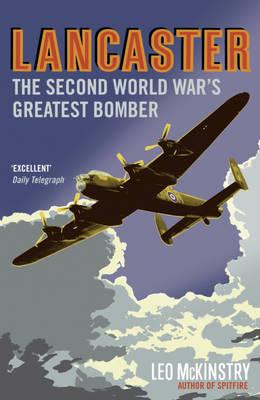
Aluminium provides a brilliant example.  As Matthew says, its strategic importance was tied to the expansion of the air war: aluminium was lightweight, flexible and durable, and an essential component of the new generation of aircraft.  According to Leo McKinstry‘s Lancaster (John Murray, 2009), the production of each Lancaster bomber required nearly ten tons of light aluminium alloy (‘the equivalent of eleven million saucepans’).  The production process was remarkably intricate: each aircraft involved half a million different manufacturing operations spread out over 10 weeks. (For images of production lines in aircraft factories on both sides of the Atlantic, by the way, see the show-stopping series here; as far as I’m aware, there’s no British equivalent to Bill Yenne‘s The American aircraft factory in WWII [Zenith, 2006]).

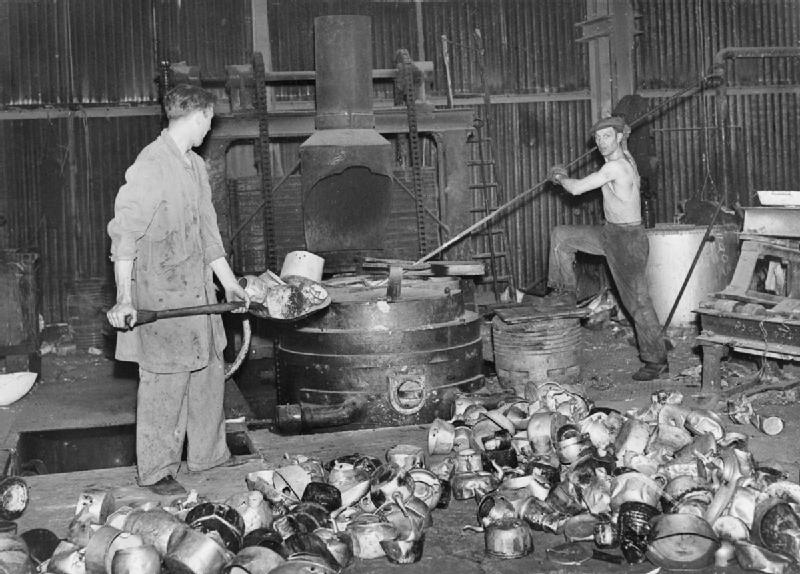
McKinstry’s equivalence between saucepans and bombers was entirely appropriate.  As the demand for aluminium sky-rocketed, so wartime campaigns to recycle aluminium were started on both sides of the Atlantic: you can hear a satirical radio treatment of “Aluminum for Defense” in the United States, complete with crashing saucepans and “collection parties” (the antecedent of Tupperware parties?), here.  In Britain too saucepans and even milk bottle tops were collected for their aluminium, a campaign that began immediately after the fall of France in 1940.  According to one contemporary report:

‘Although these contributions were to be voluntary, the timing of the appeal, its tone, and the manner in which it was put forward left the impression that the country’s need for scrap aluminum was urgent. As a result, the response from the housewives was immediate and their contributions were reported to be of quite considerable proportions.  Almost as prompt were the criticisms and complaints raised from trade and parliamentary quarters, as well as by some groups of skeptical housewives. Thus many scrap metal merchants became indignant when the appeal was made, calling attention to the tons of scrap in their yards for which they were unable to find a market. To this objection it was pointed out in Parliament that not all aluminum scrap was suitable for use in aircraft production. This limitation was especially true for the scrap held by these dealers, whereas that obtained from household utensils was excellent for this purpose.’

Incidentally, those who yearn for a time when air forces have to raise funds through bake sales might contemplate the “Wings for Victory” campaign, and its enlistment of children to contribute savings stamps for the purchase of new bombers.  When one of these aircraft was exhibited in Trafalgar Square in 1943, children lined up to plaster their stamps all over a thousand-pound bomb.  Here – as in the clarion call for the nation’s saucepans – war becomes domesticated, even homely.  War enters the domestic interior in countless other ways of course – through air raids, conscription, evacuation, and rationing, for example – but the enrollment of everyday objects, like savings stamps and saucepans, contrives to make violence not ‘harmless’ exactly but certainly ordinary, mundane, as this photograph from the Imperial War Museum shows.  Here two women factory workers fill bombs covered in savings stamps in what, to my eyes at any rate, looks like a ghastly parody of cooking; the biggest so-called ‘blockbuster’ bombs were called “cookies”, perhaps not incidentally, and aluminium was a vital component in many explosive mixes too.

Aluminium was needed for aircraft besides the Lancaster:

‘Saucepans into Spitfires’ (Imperial War Museum)

And, given the demand right across the sector, the British had to look further than their doorsteps and kitchens, though surprisingly McKinstry says nothing about this in his otherwise fascinating discussion of the production process (Chapter 12: “At the machines all the time”).  The British government soon realised the need to bring domestic aluminium production under state control, and by the early 1940s an intricate system of Acts, statutory Orders and commercial contracts had extended the security of the supply chain across the Atlantic to Canada (there is an excellent, if dry account in Jules Backman and Leo Fishman, ‘British wartime control of aluminum’, Quarterly Journal of Economics 56 (1) (1941) 18-48, from which I took the previous quotation about domestic recycling).

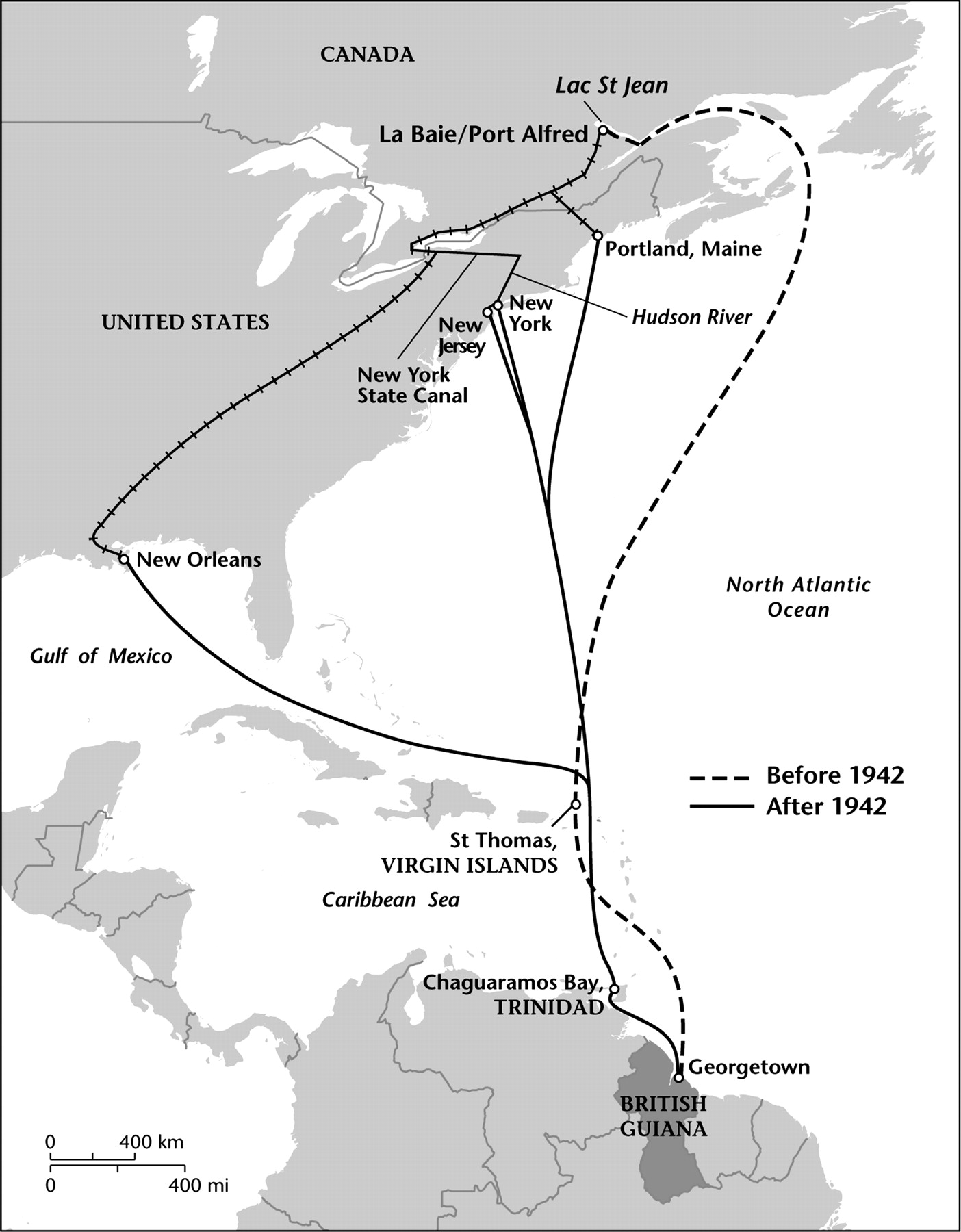
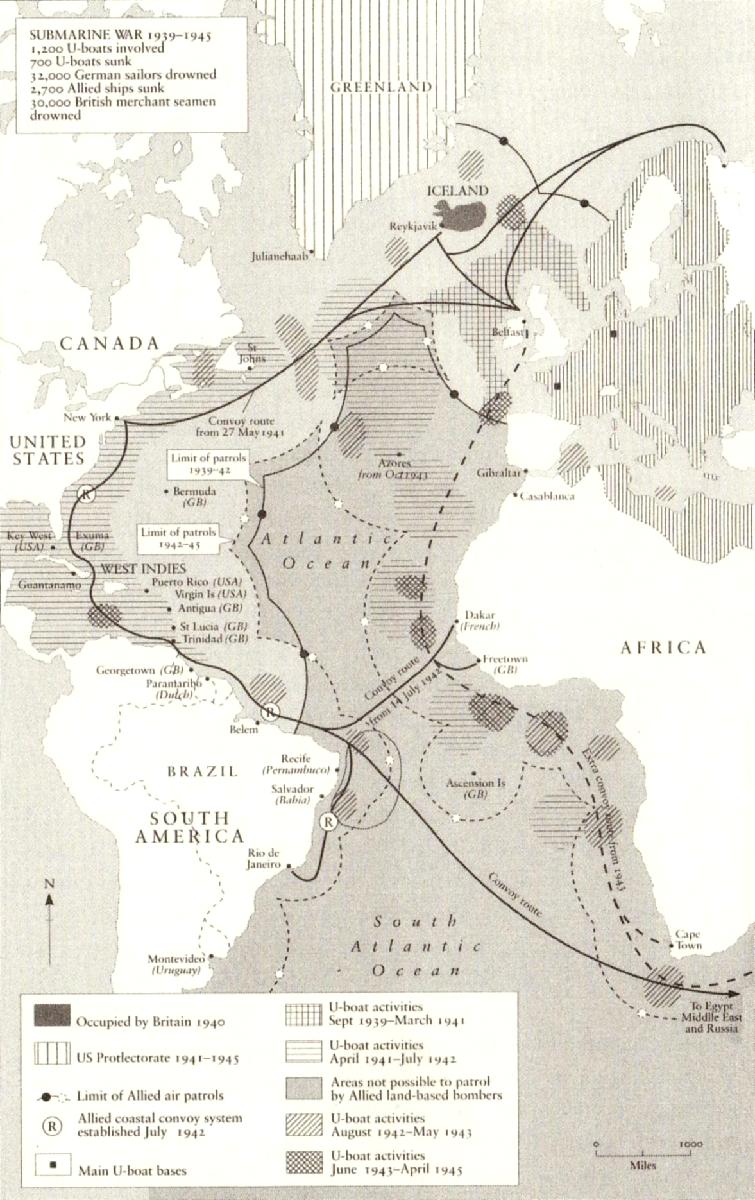
Matthew describes in detail a commodity chain that started in British Guiana (which provided most of the bauxite used in North America’s smelters), and reached across the Caribbean to the eastern seaboard of the United States, where it was transported by rail into Quebec for smelting.  The ingots were then shipped out to rolling mills and fabricating plants in Canada and the United States, across the Pacific to Australia, or across the Atlantic to Britain.  As he emphasises, the chain was militarised at every point, and a primary concern was to secure the supply chain by providing air cover or convoy escorts: the great fear was of a U-Boat attack.  The map below, taken with permission from Matthew’s essay, “reminds us of the unprecedented capacity of the Second World War to gather and scatter materials with untold human and environmental consequences, linking diverse locations with no necessary former connections.”  And here too, as I argued in a previous post, the friction of distance is no simply physical effect: it is shot through with political, economic and strategic calculations.

Not so trivia:  When Sir Charles Portal, Arthur Harris’s predecessor as commander of Bomber Command, retired from the Royal Air Force he became Chair of British Aluminium.  And the roof of the new Memorial for Bomber Command in Green Park is made from aluminium recovered from a Halifax bomber that was shot down over Belgium.

One last note: Matthew’s article is a much richer argument than I’ve conveyed here, and his primary interest is embedding this supply chain in a wider environmental history – so in a future post I want to turn my attention to some of the connections between modern war and ‘nature’…

War, Shakespeare and Shylock in Auschwitz

I’ve been thinking more about the relations between theatre and war I started to sketch in the previous post.  Stuart Elden‘s work on Shakespeare and territory (or, rather, ‘Shakespearean territories‘) is of considerable interest here – remember Homi Bhabha’s claim that ‘territory’ derives from both terra (earth) and terrere (to frighten), thus territorium as ‘a place from which people are frightened off.’   Stuart provides a more nuanced genealogy than that, needless to say, but there are also contributions that address Shakespeare’s thematics (and theatrics) of war more directly.

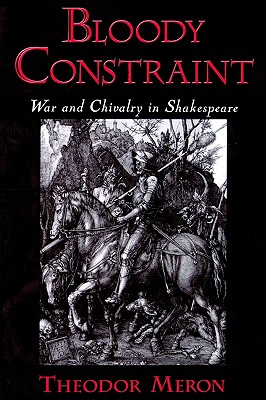
Ros King and Paul Franssen‘s Shakespeare and war (Palgrave-Macmillan, 2009) includes King’s own essay on Shakespeare’s use of a contemporary manual of war written by an English mercenary.  Of more interest to me, though, is Theodor Meron‘s Bloody Constraint: war and chivalry in Shakespeare (Oxford University Press, 1998), which builds on his earlier Henry’s Wars and Shakespeare’s Laws: perspectives on the law of war in the later Middle Ages (Oxford University Press, 1994).  As the subtitle indicates, Meron comes at this from an interesting direction: he is a professor of international law, the Charles L. Denison Professor Emeritus at NYU’s School of Law, and serves as President of the International Criminal Tribunal for the former Yugoslavia and Presiding Judge of the Appeals Chambers of the International Criminal Tribunals for the former Yugoslavia and for Rwanda.  He is also the man who, as Legal Adviser to Israel’s Foreign Ministry, wrote a secret memorandum just after the 1967 War arguing that establishing Israeli “settlements” in the occupied territories would be a violation of international law.  As all this suggests, Meron’s interest in Shakespeare is not a narrowly historical or textual one – though he shows considerable mastery of both domains –  and he artfully considers Shakespeare’s address to the present and the legacy of chivalry to modern humanitarian law.  What happens, he asks, when technology – and especially artillery – puts an end to the individualism of combat, or at any rate, marginalises face-to-face combat?  (Here Paola Pugliatti‘s more recent Shakespeare the just war tradition [Ashgate, 2010] also has much to offer and, again, considers contemporary notions of discrimination and proportionality; Part Two includes a fascinating discussion of “Theatres of War”, which is what led me down this path in the first place.)

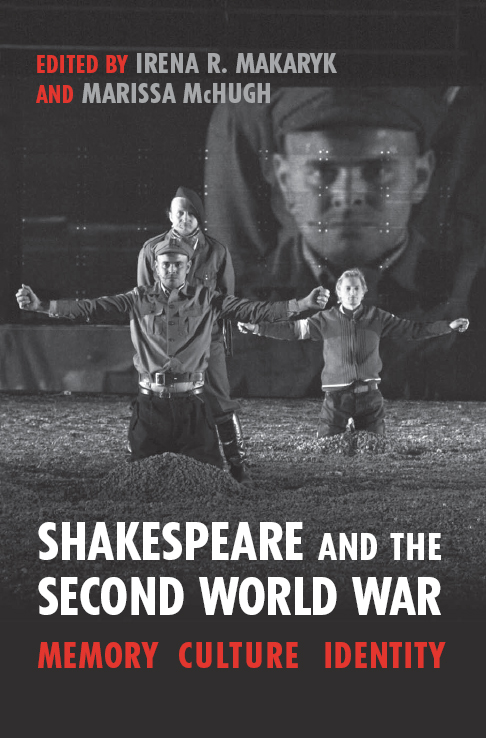
More directly related to my previous post is a new collection of essays out next month from the University of Toronto Press: Shakespeare and the Second World War: theatre, culture, identity, edited by Irena Makaryk and Marissa McHugh.  Here’s the blurb:

Shakespeare’s works occupy a prismatic and complex position in world culture: they straddle both the high and the low, the national and the foreign, literature and theatre. The Second World War presents a fascinating case study of this phenomenon: most, if not all, of its combatants have laid claim to Shakespeare and have called upon his work to convey their society’s self-image.

In wartime, such claims frequently brought to the fore a crisis of cultural identity and of competing ownership of this ‘universal’ author. Despite this, the role of Shakespeare during the Second World War has not yet been examined or documented in any depth. Shakespeare and the Second World War provides the first sustained international, collaborative incursion into this terrain. The essays demonstrate how the wide variety of ways in which Shakespeare has been recycled, reviewed, and reinterpreted from 1939–1945 are both illuminated by and continue to illuminate the War today.

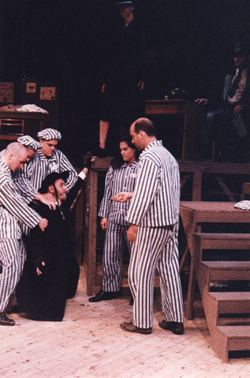
Full details are here, but two essays that I’m looking forward to reading are Mark Bayer‘s “Shylock, Palestine and the Second World War” and Tibor Egervari‘s “Shakespeare’s Merchant of Venice in Auschwitz”.  Egervari is another interesting man: Shakespeare’s Merchant of Venice in Auschwitz is a play first performed in 1977 and reworked many times since.  Informed by the writings of Primo Levi, it’s an ‘imaginative reconstruction of  what it might have meant to stage the Merchant of Venice in Auschwitz’ (Egervari wryly notes that the Nazis staged the play more than 50 times between 1933  and 1939).  You can download the script here.  The play is many things, but among them is a tart reminder that Giorgio Agamben‘s space of exception – especially as captured in Homo sacer – is almost always a profoundly theatrical space: space as performance rather product.

If this captures your imagination too, you might be interested in Arthur Horowitz‘s “Shylock after Auschwitz: The Merchant of Venice on the post-Holocaust stage – subversion, confrontation and provocation’, Journal for cultural and religious theory 8 (3) (2007) here.

Cologne and the geometry of destruction

I’m in Cologne for the International Geographical Congress.  It’s my second visit to the city – I’m on the international Scientific Committee involved in organising the IGC so I was here last year – but coming out of the main station and immediately seeing the vast cathedral again sends shivers up my spine.  This was the aiming point for Bomber Command’s first ‘Thousand Bomber’ raid (“Operation Millennium”) on the night of 30 May 1942; ironically the cathedral survived, but the bomb load, fanning out in a triangle, fell across the most densely populated part of the city.  One pilot compared the attack to ‘rush-hour in a three-dimensional circus’: 1,455 tons of bombs (high explosive and incendiaries) were dropped on the city in just ninety minutes, creating raging infernos that devastated 600 acres. The original target was Hamburg – attacked in July in “Operation Gomorrah” – but bad weather forced Bomber Command to switch the attack to Cologne (the nearest large city to Bomber Command’s bases).  By the end of the war the RAF had dropped 23,349 tons of bombs on the city and the US Eighth Air Force 15,165 tons, and according to Jörg Friedrich 20,000 people had been killed in the attacks.

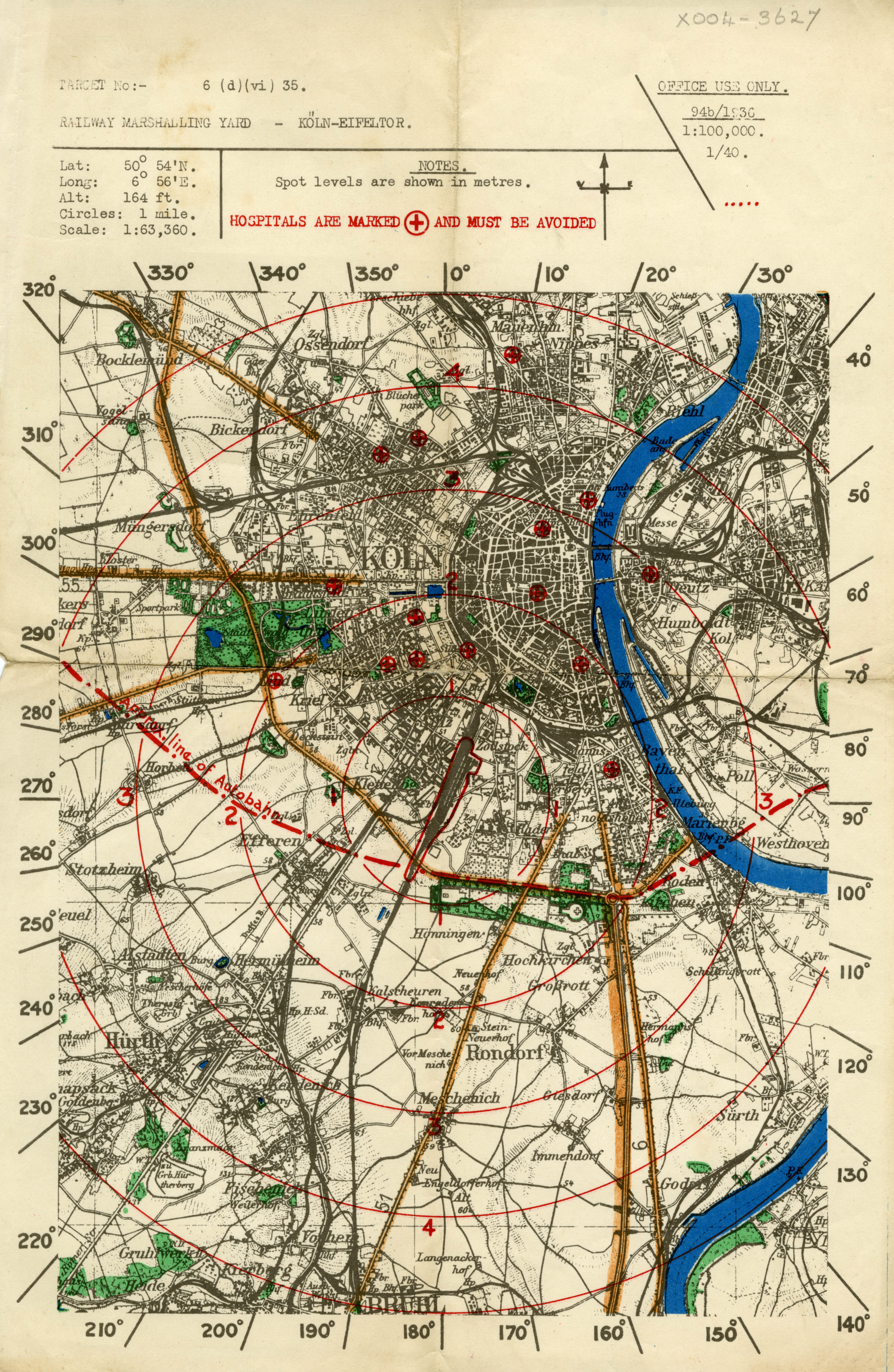
I’ve described the production of a city as a target in “Doors into nowhere” (see DOWNLOADS), and here is an early target map for Cologne; later ones were much more schematic since the detail was useless for night bombing or ‘blind bombing’ (‘bombing through cloud’) that were the characteristic modes of Bomber Command’s area bombing strategy.

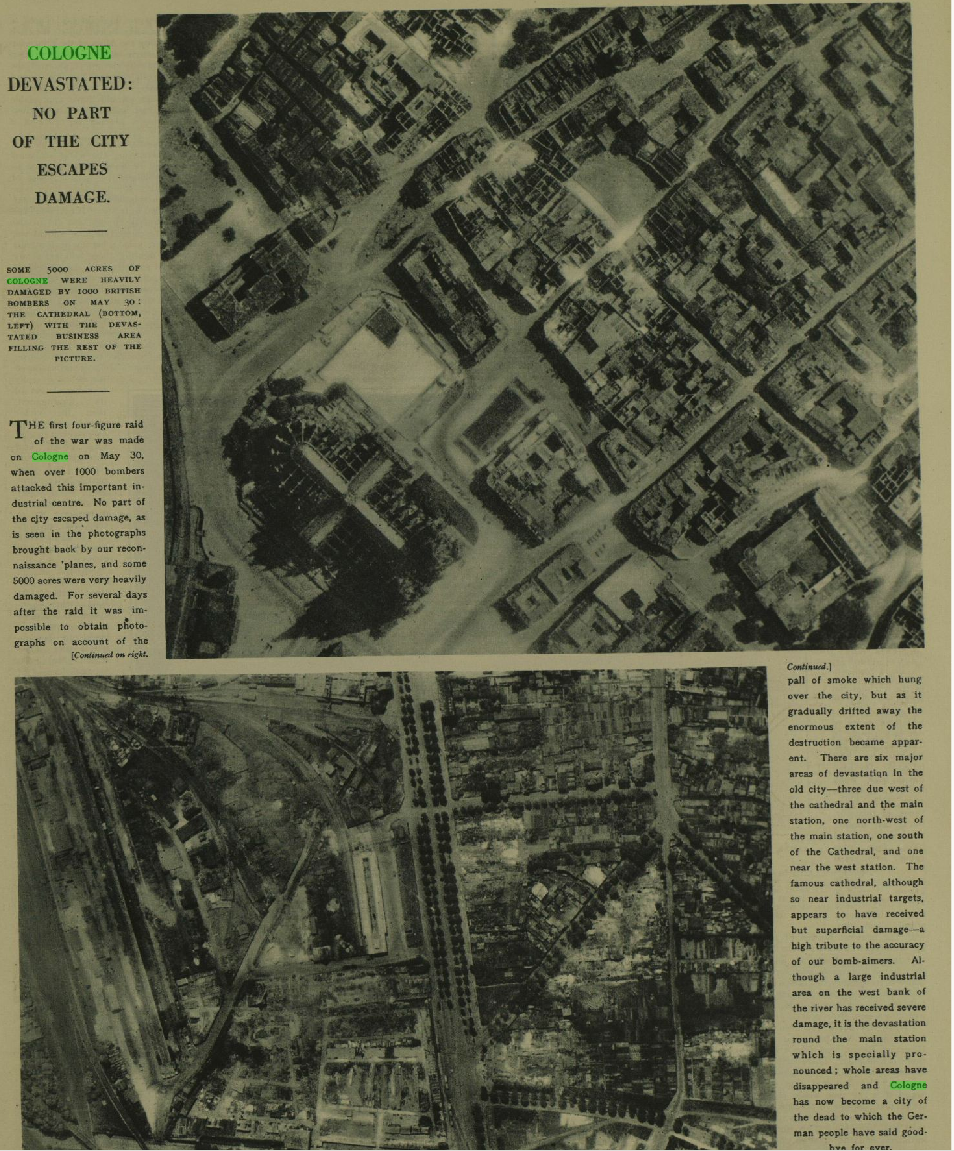
Operation Millennium gave Bomber Command a fillip, and the British press was ecstatic.  Thrilled at ‘the most gigantic air raid the world has ever seen’, the Daily Express reported that one pilot had said ‘It was almost too gigantic to be real…’ The Times noted that it was the 107th raid on the city and that, as far as the eye could see, the sky was filled with aircraft, ‘waiting their turn in the queue’ and arriving over the target one every six seconds: ‘from the point of view of the attackers it was the perfect raid’.  The News of the World had been shown daylight photographs of the aftermath: ‘No part of the city escaped, and the heavily-damaged areas total some 5,000 acres equal to an area of nearly eight square miles.  The old town has gone.  In addition to isolated points of damage, there are several major areas of devastation – due west of the cathedral and the main station; north-west of the main station; south of the cathedral; and near the west station.’  The language was abstract, one of lines and areas, because the ‘point of view’ was, like that of the aircrews who had carried out the attack, distant, and this geometric imaginary was confirmed when the photographs were published in the Illustrated London News:

Soon carefully edited cinema newsreels chimed in; at one briefing caught by the camera Cologne was hailed as ‘an old friend to many of you’, and the commentator described ‘tons and tons of beautiful bombs’ being loaded into the aircraft:

After the war, when British and American reporters could inspect the ruins of the city on the ground, they were stunned at the scale of destruction. Now the solid geometries of the city that they diagrammed were no longer clinical descriptions but chilling memorials.   Janet Flanner [‘Genêt’], in her “Letter from Cologne” published in the New Yorker on 19 March 1945, described the city as ‘a model of destruction’, lying ‘shapeless in the rubble’: ‘Our Army captured some splendid colored Stadpläne, or city maps, of Cologne, but unfortunately the streets they indicate are often no longer there.’ (She wasn’t greatly impressed by the survival of the cathedral – its Gothic nave ‘was finished in exactly 1880’ – and thought ‘the really great loss’ was Cologne’s 12 eleventh-century Romanesque churches).

Sidney Olson cabled LIFE magazine in March:

‘The first impression was that of silence and emptiness. When we stopped the jeep you heard nothing, you saw no movement down the great deserted avenues lined with empty white boxes. We looked vainly for people. In a city of 700,000 none now seemed alive. But there were people, perhaps some 120,000 of them. They had gone underground. They live and work in a long series of cellars, “mouseholes”, cut from one house to the next.’

Alan Moorehead was was shaken to the core:

‘… few people I think were prepared for Cologne.  There was something awesome about the ruins of Cologne, something the mind was unwilling to grasp, and the cathedral spires still soaring miraculously to the sky only made the débacle below more difficult to accept and comprehend…  A city is a plan on a map, and here, over a great area, there was no plan.  A city means movement and noise and people: not silence and emptiness and stillness, a kind of cemetery stillness.  A city is life, and when you find instead the negation of life the effect is redoubled.  My friends who travelled with me knew Cologne, but not this Cologne…[T]hey found themselves looking at disordered rocks, and presently they abandoned any attempt to guide our way by their memory of the city, and instead everyone fixed his eyes on the cathedral and used that only landmark as a guide across the rubble…’

Here is a compilation of contemporary film coverage, which includes Moorehead’s commentary:

Solly Zuckerman, a British scientist who had been closely involved in planning the bombing campaign, arrived early the next month and was so overwhelmed by what he saw that he found it impossible to write an essay he had promised Cyril Connolly’s Horizon: it was to be called “The natural history of destruction”.  It was left to W.G. Sebald to redeem that promise, in his own way, many years later.  But when he asked Zuckerman about his experience (their paths crossed at the University of East Anglia), all he could remember was a surreal still life: ‘the image of the blackened cathedral rising from the stony desert around it, and the memory of a severed finger that he had found on a heap of rubble.’

All this explains why the spectre of the cathedral – still blackened, rising today out of a grey and greasy wet sky – haunts me too.

‘Dresden: a Camera Accuses’

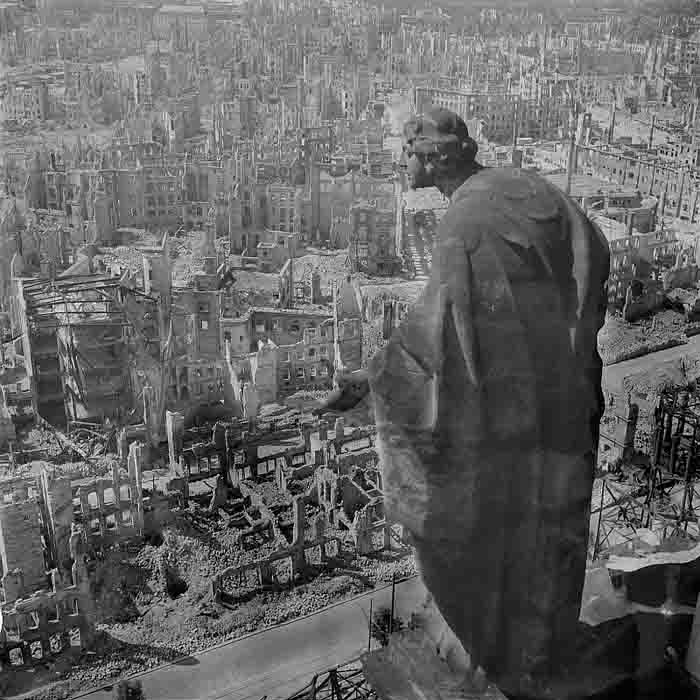
Richard Peter, Blick vom Rathaussturm, Dresden 1945 (Deutsche Fotothek)

A new essay from Steven Hoelscher, ‘Dresden, a Camera Accuses: Rubble photography and the politics of memory in a divided Germany’, just out in History of Photography 36 (3) (2012) 288-305.

This article explores memory, photography and atrocity in the aftermath of war. It takes as its case study the controversies surrounding the February 1945 firebombing of Dresden. One photograph in particular has become the iconic image of the fire- bombing and of the devastating air war more generally – Richard Peter’s View from the City Hall Tower to the South of 1945. Although arguably less divided today than it was during the Cold War, when the image became seared into local and national memory, Germany’s past continues to haunt everyday discourse and political action in the new millennium, creating new ruptures in a deeply fractured public sphere. By examining the historical context for the photograph’s creation and its dissemination through the book Dresden – A Camera Accuses, this article raises questions of responsibility, victimhood and moral obligation that are at the heart of bearing witness to wartime trauma. Peter’s Dresden photographs have long intervened in that existential difficulty and will probably continue to do so for the foreseeable future.

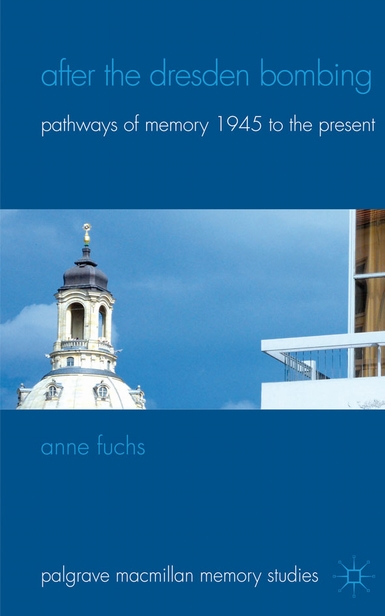
Steve sent me his essay just as I opened Anne Fuchs‘s After the Dresden bombing: pathways of memory 1945 to the present (Houndmills: Palgrave-Macmillan, 2011).  Here’s the description:

Together with Hiroshima and Nagasaki, Dresden belongs to a handful of global icons that capture the destructiveness of warfare in the twentieth century. Immediately recognisable, these icons are endowed with a powerful symbolism that cannot be explained with reference to historical cause and effect alone. This is precisely the terrain of this book, which addresses the long aftermath of the bombing in the collective and cultural imagination from 1945 to the present. The material under discussion ranges from archival documents, architectural journals, the built environment, travelogues, newspaper articles, documentaries, TV dramas, fiction, diaries, poetry to photography and fine art. As a case study of an event that gained local, national and global iconicity in the postwar period, it illuminates the media-specific transmission of cultural memory in dialogue with the changing socio-political landscape. Debating fundamental processes of cultural transmission, it exemplifies a new mode of doing cultural history that interweaves the local and the global.

Her discussion of Peters’ Eine Kamera klagt an is on pp. 32-42 and forms part of a fine extended discussion of ‘Visual mediations’.

War and distance: logistics

My earlier post about War and distance emphasised the historical significance of the telegraph because it allowed information to be transmitted without the movement of messengers, but these systems obviously required the installation and maintenance of physical infrastructure.  Still, in August 1870 the Montreal Gazette was already anticipating the vital role of the new communications network in the emergence of frictionless war:

‘Modern science has brought each dependency of the Empire within swift reach of the controlling centre.  The communications are ever open while the command of the sea remains…  There converge in London lines of telegraphic intelligence … [and] it needs but a faint tinkle from the mechanism to despatch a compelling armament to any whither it may be called…  The old principle of maintaining permanent garrisons round the world suited very well an age anterior to that of steam and electricity.  It has passed out of date with the stage coach and the lumbering sailing transport.’

The Gazette was ahead of itself; even today, the United States garrisons the planet, and waging war over long distances still usually involves the physical movement of troops and supplies (the cardinal exception is cyberwar: more on that later).  Martin van Creveld‘s Supplying War (1977; 2004) suggested that ‘logistics make up as much as nine tenths of the business of war, and … the mathematical problems involved in calculating the movements and supply of armies are, to quote Napoleon, not unworthy of a Leibnitz or a Newton….  From time immemorial questions of supply have gone far to govern the geography of military operations.’

Halvard Buhaug and Nils Petter Gleditsch reckon that this is still the case; they concluded (in 2006) that ‘The main factor to limit the military reach of armed force is not the range of the artillery or the combat radius of attack planes.  The largest obstacles to remote military operations relate to transportation and logistics.’

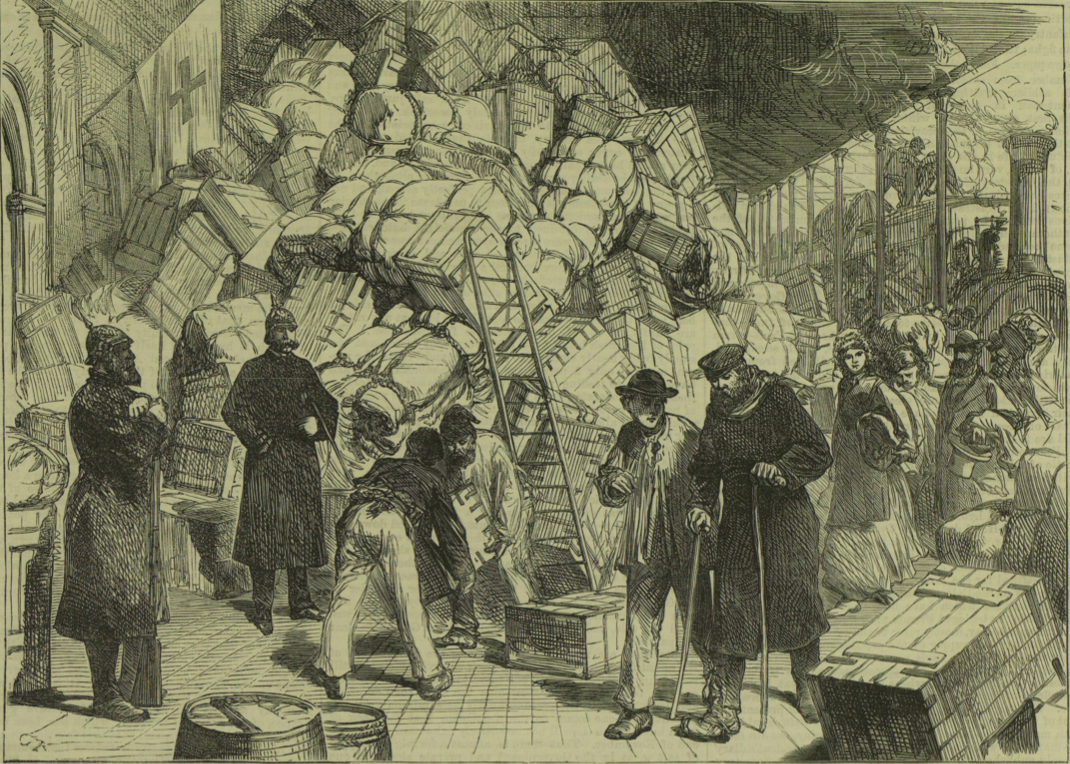
Stores for the Prussian siege of Paris at Cologne station

There is a contentious backstory to Creveld’s main thesis – that before 1914  ‘armies could only be fed as long as they kept moving’, foraging (and pillaging) as they went – which has sparked an ongoing debate about the logistics of early modern siege warfare and pitched battle.  But by the time of the Franco-Prussian War (1870-71) it was already clear – to the Prussians at least – that the railway had transformed the business of war.  ‘We are so convinced of the advantage of having the initiative in war operations that we prefer the building of railways to that of fortresses,’ Field Marshal Helmuth von Moltke had declared: ‘One more railway crossing the country means two days’ difference in gathering an army, and it advances operations just as much.’
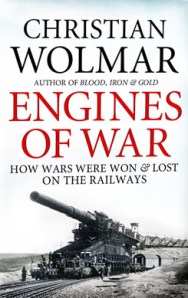
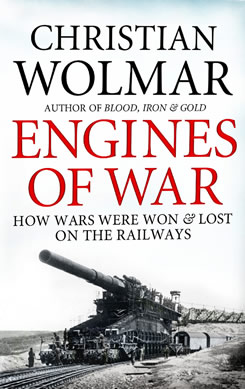
Armand Mattelart discusses the strategic implications of this in The invention of communication (1996, pp. 198-208), but the role of the railway in supplying modern war has been described in great detail by Christian Wolmar.  He contrasts the Battle of Waterloo in 1815 – ‘the last significant conflict before the invention of railways’ – which was over in less than a day, leaving 40,000 men dead, with the Battle of Verdun, ‘which lasted most of 1916’ and resulted in 700,000 dead and wounded soldiers.  The crucial difference, according to Wolmar, was the railway, that ‘engine of war’, and here – as elsewhere – the chronology is complicated.  The Franco-Prussian War was indeed a significant waystation, but events didn’t work out quite as von Moltke had envisaged.  The railways certainly speeded the mobilization of Prussian troops but, as Wolmar explains,

‘The Germans had expected to fight the war on or around the border and had even prepared contingency plans to surrender much of the Rhineland, whereas in fact they found that, thanks to French incompetence, they were soon heading for the capital.  The war, consequently, took place on French rather than German territory, much to the surprise of Moltke, upsetting his transportation plans, which had relied on using Prussia’s own railways. The distance between the front and the Prussian railheads soon became too great to allow for effective distribution, and supplies of food for both men and horses came from foraging and purchases of local produce.’

Back to a world of foraging and laying siege.  The decisive moment was probably (as Wolmar’s vignette abut Verdun suggests) the First World War of 1914-1918.  Even as late as 1870, Creveld argues, ammunition formed less than 1 per cent of all supplies, whereas in the first months of the First World War  the proportion of ammunition to other supplies was reversed:

‘‘To a far greater extent than in the eighteenth century, strategy became an appendix of logistics.  The products of the machine – shells, bullets, fuel, sophisticated engineering materials – had finally superseded those of the field as the main items consumed by armies, with the result that warfare, this time shackled by immense networks of tangled umbilical cords, froze and turned into a process of mutual slaughter on a scale so vast as to stagger the imagination.’

Empty shell casings and ammunition boxes,  a sample of the ammunition used by the British Army in the bombardment of Fricourt on the first day of the Battle of the Somme, 1 July 1916 [Australian War Memorial, AWM H08331]

In August 1914, for example, British field guns had a total of 1,000 shells available at or approaching the front lines; by June 1916 each eighteen-pound gun had 1,000 shells stockpiled at its firing position, and by 1918 Britain had over 10,000 guns, howitzers and trench mortars in the field.  An elaborate system of light ‘trench railways’ was constructed on the Western Front to transport the ammunition to the front lines. (A note for afficionados of crime fiction: see Andrew Martin’s The Somme stations [2011]).
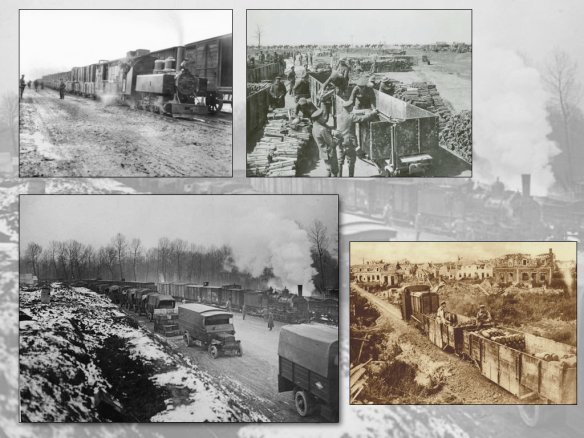
Supply of munitions on the Western Front

It’s that toxic combination of movement and stasis that was (and remains) so shattering.  As Modris Eksteins described it in Rites of Spring: The Great War and the birth of the modern age (1989),

‘The war had begun with movement, movement of men and material on a scale never before witnessed in history.  Across Europe approximately six million men received orders in early August [1914] and began to move… [And them for two years, 1916 and 1917] this new warfare that cost millions of men their lives … moved the front line at most a mile or so in either direction.’

And it was locked down in part because men and material continued to be moved up to the front lines.

Now Creveld’s argument was limited to ground forces – he said nothing about sea power or air power – and was confined to war in Europe, and these are significant caveats.  During the Second World War the Battle for the Atlantic was crucial.  Churchill famously declared that ‘Never for one moment could we forget that everything happening elsewhere, on land, at sea, or in the air, depended ultimately on its outcome.’   There is a rich literature on convoys and submarine attacks that I’m only just beginning to explore.  Although the Allies lost 3,500 merchant ships and 175 warships, however, more than 99 per cent of ships sailing to and from the beleaguered British Isles survived the crossing.

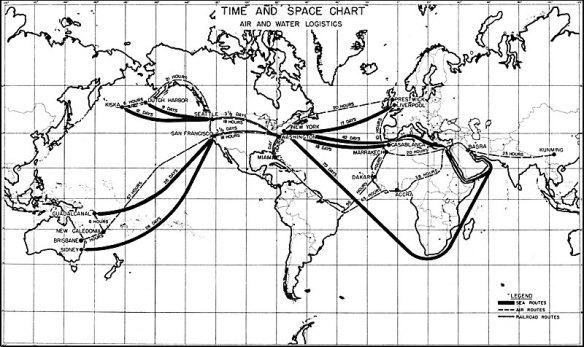
If we enlarge the scale to consider the supply of war materials beyond the European theatre – as in this graphic which shows US global logistics during the Second World War – then the complexity and vulnerability of the supply chain becomes even clearer.
The deployment of air forces also imposed logistical problems, as this graphic from the Illustrated London News showed:
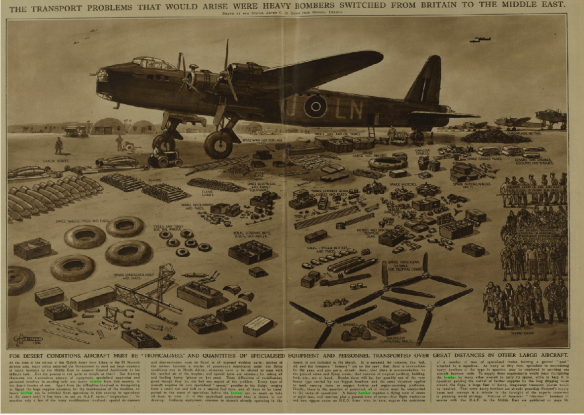
It’s worth remembering that today’s use of UAVs like the Predator and Reaper in distant theatres of war and conflict zones also requires the transport of the aircraft, ground crews and the crews responsible for take-off and landing; once airborne, the missions are usually flown from the continental United States but they involve an extended global network of supplies, personnel and communications.

In fact, writing in 2004 Creveld concluded that since 1945 the logistics burden had not eased nor had armed forces increased their operational freedom.  The two most important changes have been an even greater reliance on petrol/gasoline (a key target of Allied bombing in the final stages of the Second World War) which, by the 1990s, had displaced ammunition to become the single bulkiest commodity to be shipped to supply distant wars, and a dramatic increase in outsourcing through the use of private military contractors.

I provided a sketch of how these two developments bear on the contemporary logistics of supplying war in Afghanistan in a long essay at open Democracy, and I’ve provided a short update here. This was my conclusion:

‘Over the last decade a new political economy of war has come into view.  We have become aware of late modern war’s proximity to neoliberalism through privatisation and outsourcing (‘just-in-time war’) and its part in the contemporary violence of accumulation by dispossession.  The rapacious beneficiaries of the business of war have been swollen by the transformation of the military-industrial complex into what James der Derian calls the military-industrial-media-entertainment network (MIME-NET). And the very logic of global financial markets has been subsumed in what Randy Martin calls today’s ‘derivative wars’.  These are all vital insights, but it is important not to overlook the persistence of another, older and countervailing political economy that centres on the persistence of the friction of distance even in the liquid world of late modernity.  To repeat: the world is not flat – even for the US military.  In a revealing essay on contemporary logistics Deborah Cowen has shown how the United States has gradually extended its ‘zone of security’ outwards, not least through placing border agents around the world in places like Port Qasim [in Pakistan] so that the US border becomes the last not the first line of defence through which inbound flows of commodities must pass.   She shows, too, how the securitization security of the supply chain has involved new legal exactions and new modes of militarization that materially affect port access, labour markets and trucking systems.  Affirming the developing intimacy, truly the liaison dangereuse between military and commercial logistics, the US Defense Logistics Agency envisages a similar supply chain for its outbound flows that aim to provide ‘uninterrupted support to the warfighter’ (‘full spectrum global support’) and a ‘seamless flow of materiel to all authorized users.’  And yet, as I hope I have demonstrated, this is the ‘paper war’ that, 180 years ago, Clausewitz contrasted so scathingly with ‘real war’.  The friction of distance constantly confounds the extended supply chain for the war in Afghanistan.  This is no simple metric (‘the coefficient of distance’) or physical effect (though the difficult terrain undoubtedly plays a part).  Rather, the business of supplying war produces volatile and violent spaces in which – and through which – the geopolitical and the geo-economic are still locked in a deadly embrace.’

And, as that last phrase signals, I’ll need to deepen and extend all these arguments for the book-length version of Deadly embrace.  We are still a long way from the Montreal Gazette’s nineteenth-century dream of ‘frictionless war’.
Sounds of War

In my post on War and Distance, I referred to a BBC radio broadcast of a Bomber Command raid on Berlin on the night of 3/4 September 1943. There had been previous British broadcasts of bombing raids, notably by Richard Dimbleby who flew on twenty-odd missions with the RAF, but his commentaries were all recorded after the event.  This one was different.  Reporter Wynford Vaughan-Thomas and his sound engineer Reg Pidsley made their recording during a flight in a Lancaster bomber, “F for Freddie”, part of a force of over 300 Lancasters that attacked Berlin that night.  Their live recording was edited for transmission a couple of nights later.  You can listen to an extract here, and there is a lively discussion about whether the recording was fake or not (it evidently wasn’t), together with more details of the recording and the raid, here.

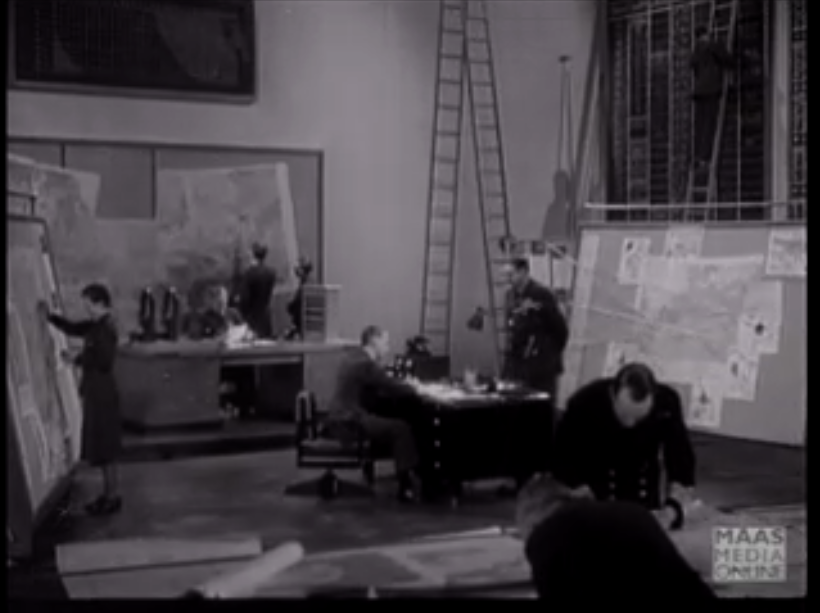
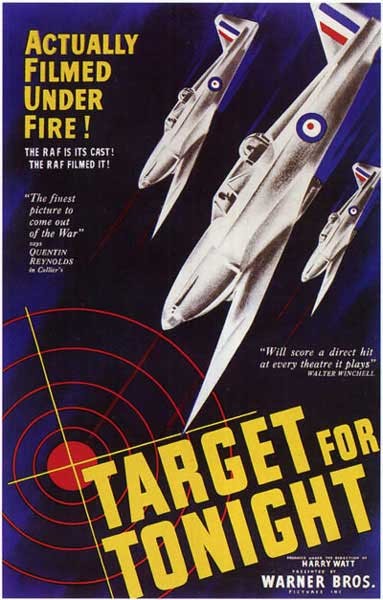
This episode is of interest for reasons that spiral beyond my original post.  Much of the discussion of the histories/geographies bombing – my own included – focuses on the visual, and there are good reasons for this.  During the combined bomber offensive against Germany, as I try to show in ‘Doors into nowhere’ [see DOWNLOADS], what today would be called the kill-chain was choreographed through a sequence of air photographs, maps, charts and visual displays.  In 1941 Harry Watt produced an extraordinary drama-documentary, Target for Tonight, for the Crown Film Unit and the Ministry of Information that tracked this visual sequence in vivid detail.  The film used RAF personnel (not actors); it was shot at RAF Mildenhall and on special sound stages at Elstree and Denham, where Bomber Command’s Operations Room at High Wycombe was recreated (with twice the number of available squadrons listed on the walls); and it followed the fortunes of  a Wellington bomber – also “F for Freddie” – on a strike against a “military-industrial target”, an oil refinery at Freihausen.

The film was a huge success.  Writing in the Spectator Graham Greene marvelled at the way in which ordinary men and women carried out ‘their difficult and dangerous job in daily routine like shop or office workers.. What we see is no more than a technical exercise…’  The New York Times reviewer said much the same; the film ‘shows the manner in which the Bomber Command lays out its operations, how instructions are transmitted to the squadrons which are to participate, how the plan of attack is “briefed” by the men of one particular squadron and then how the crew of one powerful Wellington conducts its appointed task….The true, thrilling quality of it lies in the remarkable human detail which Mr Watt has worked into it — the quiet, efficient way in which each man goes about his job.’   You can watch it here (and marvel at the cut-glass English accents: “Bad luck, Catford!”; how did the language change so much between then and now?)

[There is a much longer discussion in K.R.M. Short’s account of the film in the Historical Journal of Film, Radio and Television 17:2 (1997) 181-218 (which includes the script) and, again, I discuss its visual thematics in “Doors into nowhere”].

In the Second World War air raids were often described in cinematic terms, by observers in the air and on the ground.  As Lara Feigel notes, ‘accounts of the Blitz in both Britain and Germany frequently figure the bombs as photographic and cinematic.’  Partly, she says, this is a matter of lighting – and given the growing importance of incendiaries in the bomb mix, and the emphasis on bombing by night, you can see why – but she thinks there is also a deeper reason. ‘In seeing the war as a photograph,’ she suggests, writers were ‘detaching themselves from the world around them.’  The sense of detachment, if she is right, is not only one possible effect of the visual (or of a particular visuality); bombing was abstracted from the horror it brought to bodies through its bureaucratization – Greene’s ‘technical exercise’; the locus classicus for this discussion is still Henry Nash’s ‘The bureaucratization of homicide’ in the Bulletin of the Atomic Scientists 36: 4 (1980), describing his experience in the USAAF’s Air Targets Division in the 1950s and 60s – as well as specific forms of its visualization, and the two often operated together (as in the kill-chain, in fact).

The emphasis on the visual and, in particular, the cinematic recurs again and again – most generally in Paul Virilio‘s War and cinema: the logistics of perception (which was originally published in 1984 and is surely long overdue for critique).  Virilio draws attention to the elective affinity between flying and filming and, in relation to the combined bomber offensive in particular, describes how

‘The Allied air assault on the great European conurbations suddenly became a son-et-lumiere, a series of special effects, an atmospheric projection designed to confuse a frightened, blacked-out population.  In dark rooms that fully accorded with the scale of the drama, victims-to-be witnessed the most terrifying night-time fairy theatre, hellish displays of an invading cinema that reproduced the Nuremberg architecture of light.’

I think the emphasis on the visualities of military violence is extremely important, though I also think we need to disentangle different modes and effects, and James Der Derian’s discussion of the military-industrial-media-entertainment complex (MIME-NET) suggests that, in the decades after the Second World War, the cinematic entered even more fully into the conduct of warfare [for a discussion between Virilio and Der Derian, see here].

But what of other registers?  Specifically, what of the son that accompanied, and on occasion substituted for the lumière?  In the 1940s British cinemas showed endless black-and-white newsreels of RAF (and USAAF) bombing raids, with rousing commentaries and jaunty music; but try this rare colour version, with a contemporary soundtrack provided by Italian musician and historian Vincent Romano, and pay particular attention to the effect of the new score, especially from  2.20 on.

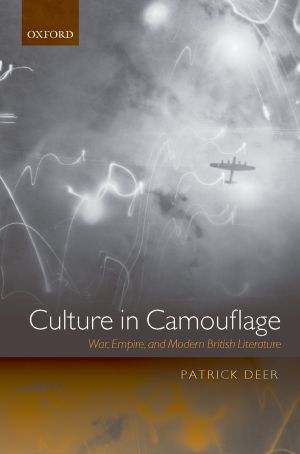
My point here is not about politics or aesthetics, particularly, but, first, to note that – in contrast to that recurrent emphasis on the visual — for many civilians, at least, the experience of an air raid was a matter of sound: the wail of the air-raid sirens, the crump-crump of the anti-aircraft guns, the boom of the explosion, the crash of glass shattering and buildings collapsing, the whistles and bells of the fire and ambulance services.  ‘Especially in darkness, and during bombings,’ Patrick Deer  in argues in his brilliant Culture in camouflage, ‘the sounds of war took on extraordinary power.’

Pete Adey gets this exactly right, I think, when he writes:

‘For geographer Kenneth Hewitt, sound “told of the coming raiders, the nearness of bombs, the plight of loved ones”. The enormous social survey of Mass Observation concluded that “fear seems to be linked above all with noise.” As one report found, “It is the siren or the whistle or the explosion or the drone – these are the things that terrify. Fear seems to come to us most of all through our sense of hearing.” Yet the power of the siren came not only from its capacity to propagate sound and to alert, but the warning held in its voice of ‘keeping silent’. “Prefacing in a dire prolepsis the post-apocalyptic event before the event”, as Bishop and Phillips put it, the stillness of silence was incredibly virtual in its affects, disclosing – in its lack of life – the lives that would be later taken.’

This isn’t a purely historical affair, of course, and in an interesting post on what he calls ‘warsound’ Geoff Manaugh mixes Dexter Filkins’ brilliant account of the visuals of The forever war with an arresting litany of its sounds:

‘The night sky echoed with pops and pings, the invisible sounds of frantic action.  Most were being made by the AC-130 gunships, whose propellers were putting out a reassuring hum. But over the droning came stranger sounds: the plane’s Gatling gun let out long, deep burps at volumes that were symphonic. Its 105mm cannon made a popping sound, the same as you would hear from a machine that served tennis balls. A pop! followed by a boom! Pop-boom. And then there was the insect buzz of the ScanEagle, the pilotless airplane that hovered above us and beamed images back to base. It was as if we were witnessing the violent struggles of an entire ecosystem, a clash of airborne nocturnal beasts we could not see.’

Those who live in the Federally Administered Tribal Areas of Pakistan know of other terrors, by day and night.  Here is Rasul Mana, who lives in Waziristan:

‘When the drone is 5 km away the sound is very different. It sounds like a missile. As they come closer, it turned into a repetitive humming. Bangana is the word we use for drones. It means bee in Pashtu. I first heard that term in 2005, and the killer bees have been all over us ever since. The kids know what the voice of the drone now. Every day we hear the voice of the drones at least six or seven times.  We listen for the voice 24 hours a day. We are afraid at night as we lie in our beds. The drones are going around and around over our heads. There may be four or five at any given time. They are normally very high, but sometimes they come down if there is a dust storm or it is cloudy.  They also tend to come down lower to attack, which is when you get very scared. When the missile is launched it makes a loud noise – zzhhooo – as it drops onto its target…’

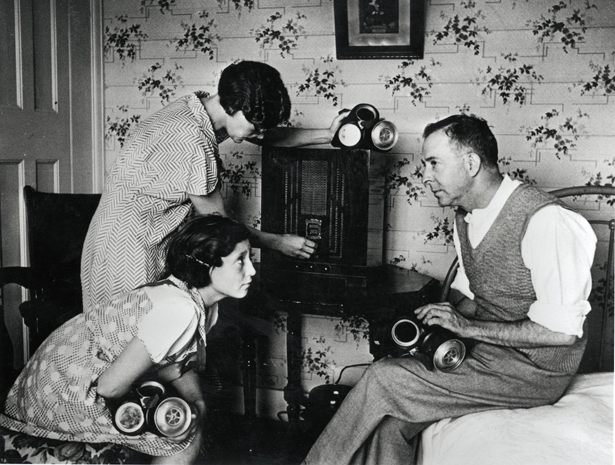
Mana talks of the voice of the drones, but there are other voices in war too.  And so, thinking of Vaughan-Thomas and Pidsley, and the audience gathered around their radio each night (not only in Britain), I also want to remind myself how important it is not to gloss over radio as temporary static in the inexorable mobilization of an insistently visual economy – from photographs through film to television and video – since, as Patrick Deer also writes, in the Second World War  ‘radio shaped the sensory landscape of wartime like no other medium’.   And that matters because a soundscape elicits a profoundly imaginative response on the part of its auditors (which is why Romano’s new soundtrack is so immensely powerful)…

These thoughts have been prompted by a series of conversations with one of our graduate students, Max Ritts, who has also pointed me in the direction of Steve Goodman’s Sonic warfare: sound, affect and the ecology of fear (MIT, 2010)