Shadow World

I am thrilled to announce our next Wall Exchange at the Vogue Theatre (Granville Street) in downtown Vancouver at 7 p.m. on Tuesday 7 November: Andrew Feinstein on ‘The shadow world of the global arms trade’.  One of my earliest posts was about what I called The death merchants, and I drew attention to Andrew’s wonderful work there.  So it will be a real treat to hear him live:

In this Wall Exchange lecture Andrew Feinstein draws back the curtain on the shadow world of the global trade in weapons—its systemic corruption, highly technical nature, and the pervasive secrecy in which deals are concluded.

Feinstein will propose mechanisms to clean up and properly regulate the global arms trade. In addition to the death and destruction caused by its products and the massive costs of the world’s defense spending, the lack of properly enforced regulation and control makes the occurrence of unintended consequences inevitable. This results in the very weapons sold by many Western governments being used against their own citizens. Nowhere is this more evident than in the so-called ‘War on Terror’, in which suspect intelligence and fluctuating alliances with non-state groups and countries such as Saudi Arabia undermine our security.

Andrew Feinstein is Executive Director of Corruption Watch, an NGO that details and exposes the impact of bribery and corruption on democracy, governance and development. Andrew was named amongst the 100 most influential people in the world working in armed violence reduction. Along with two colleagues, he was voted South Africa’s anti-corruption hero of 2014.

His critically-acclaimed book The Shadow World: Inside the Global Arms Trade reveals the corruption and malfeasance at the heart of the global arms business, both formal and illicit. A documentary feature film of the book premiered at the Tribeca Film Festival in New York in April 2016, and was awarded Best Documentary Feature at the Edinburgh International Film Festival, the Valladolid International Film Festival and the Belgian Ensor Award.

Andrew was an ANC Member of Parliament in South Africa for over seven years where he served under Nelson Mandela. He resigned in 2001 in protest at the ANC’s refusal to countenance an independent and comprehensive enquiry into a multi-billion dollar arms deal which was tainted by allegations of high level corruption.

You can read much more about the presentation here, where you can also watch a trailer for Andrew’s award-winning documentary Shadow World (which will be on PBS on 20 November 2017).

The event is free, but you need to register in advance: online here or via Ticketfly on 1-888-732-1682

Drones and atomic bombs

I’ve had my head down these past few weeks writing the long-form version of ‘Little Boys and Blue Skies’ (see here and here for preliminary notes), and en route I’ve been doing some more digging into the entanglements between nuclear weapons and drones.  And, as you’ll see, I ended up in Korea.

Until now I’ve focused on the US Air Force‘s use of B-17 drones flown by remote control from ground stations and accompanying director aircraft to sample the atomic clouds produced by tests at Bikini Atoll in the Marshall Islands from 1946, and its Project Brass Ring in the early 1950s designed to convert a B-47 Stratojet into a similarly remotely operated carrier capable of delivering the next generation of thermonuclear (hydrogen) bombs.

But the US Navy was no bystander.

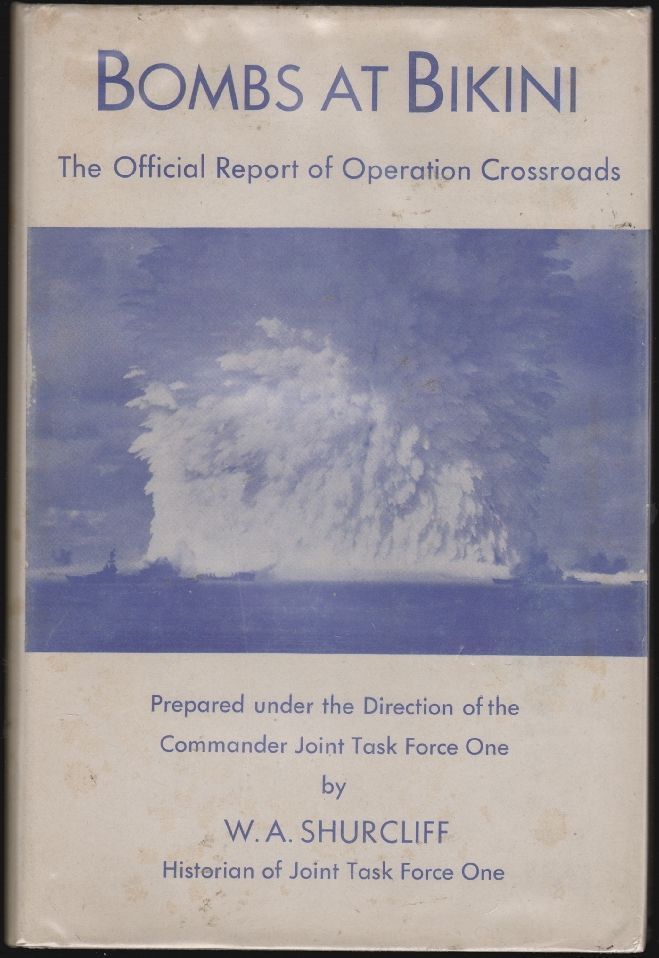
In fact, the first series of postwar atomic tests, Operation Crossroads in July 1946, was an attempt by the Navy to move centre stage after Hiroshima and Nagasaki – when the Air Force had played the leading role – and to establish that sea power was still relevant in the atomic age.  The target for the bombs was a fleet of 95 ships (ironically readied at Pearl Harbor) and now anchored in the Bikini lagoon. But critics inside and outside Congress doubted the value of the tests: the bombs would be of the same type as ‘Fat Man’, dropped over Nagasaki, so no development in weapons technology was involved, and in any event surface ships were unlikely to be the targets of such devastating weapons.   They dismissed Crossroads as an expensive, purely theatrical extravaganza. And certainly, despite the remote location, 4,000 miles from San Francisco, every effort was made to attract international attention, both public and professional; the official record trumpeted that ‘never before had a nation fanfared its most secret weapon so closely before the eyes of the world’ [the official ‘pictorial record’ is here].

As far as the Air Force was concerned, however, Crossroads would be ‘a laboratory test’ not a ‘bomb-versus-battleship stunt’ [Sidney Shalett, ‘Atomic bomb test no “stunt” to AAF’, New York Times, 21 February 1946].  It would involve not only bomb delivery by one of its bombers but also cloud monitoring by drones.   ‘Almost as dramatic as the flight of the B-29 bomber’, General W.E. Kepner told reporters, ‘will be the plunge of the unpiloted but mothered drone planes into the sky-reaching, irradiated cloud.’  ‘Where men cannot go,’ he added, ‘the drone will take electronic and other recording instruments.’  Vice-Admiral William Blaney told reporters that ‘robot aircraft will dive into the atomic blast to gather scientific data’ and ‘uncover facts of radioactive phenomena as well as supply data on blast effects on airborne aircraft.’

As I noted in my earlier post, both the Air Force and the Navy supplied the drones.
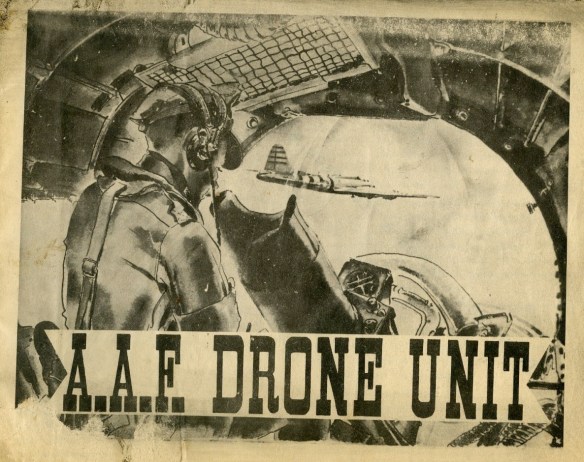
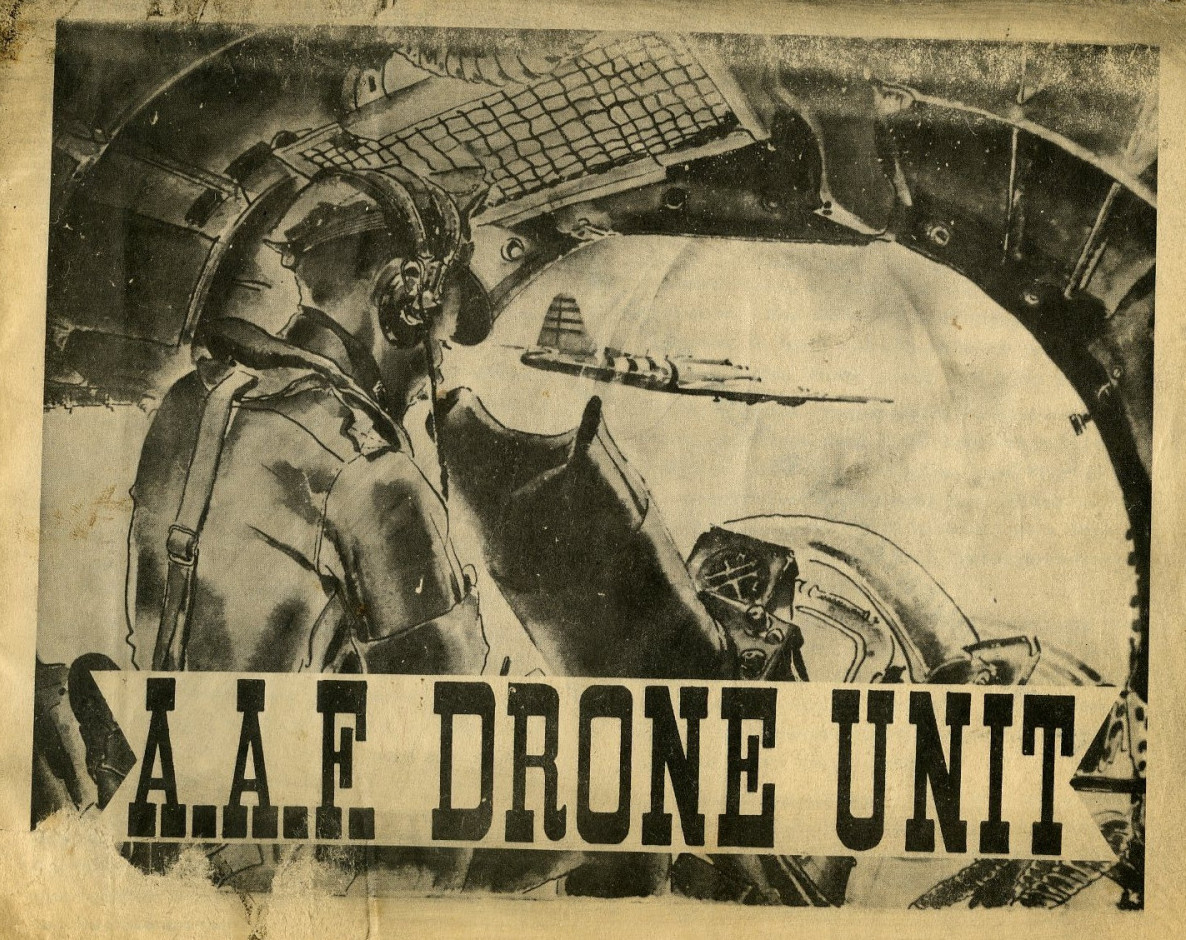
For its part, the Air Force retained its love affair with the heavy bombers that had driven its ill-fated Project Aphrodite in the dog days of the war, in which war-weary B-17 Flying Fortresses were filled with high explosives and flown from an accompanying director aircraft into enemy targets in Occupied Europe. This time its Drones Unit utilised new B-17s: four were converted into drones operated by radio-control from four others flying at a safe distance, while one acted as the master control aircraft.  The drones were stripped of all their defensive armaments and fitted with radio and television equipment; air filters were fixed to their top turrets to trap particles from the cloud and collection bags installed in their bomb bays.  Ground controllers launched the drones from control jeeps and then handed off to the airborne controllers (‘beeper pilots’) on board the accompanying B-17s who directed the aircraft into the cloud before returning them to the ground controllers who managed the landing.

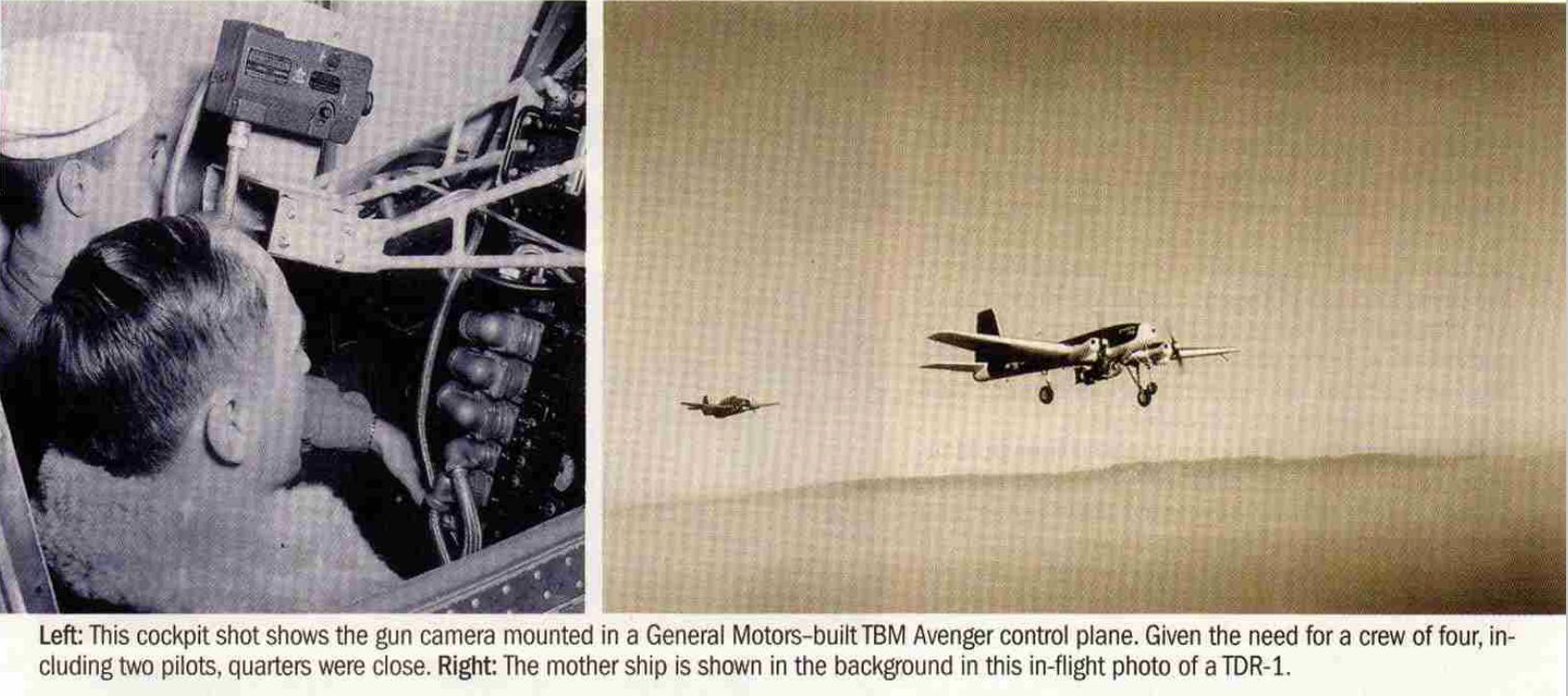
But the Navy had experimented with its smaller, carrier-based aircraft during the war too.  Its Project Option had used TDR-1 drones loaded with 500-2000 lb bombs with nose-mounted TV cameras controlled from the back seat of an Avenger Torpedo bomber.

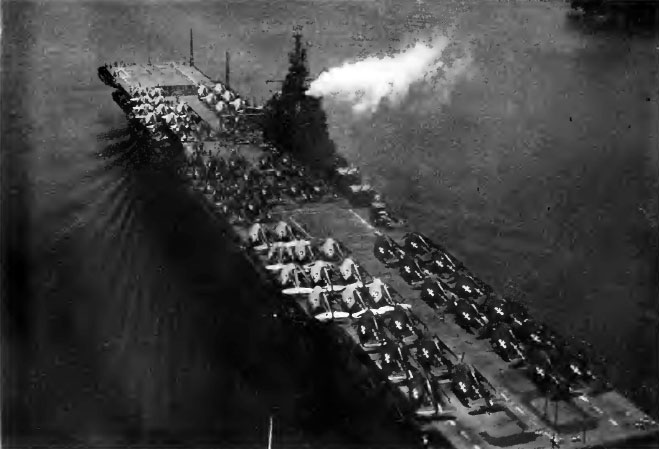
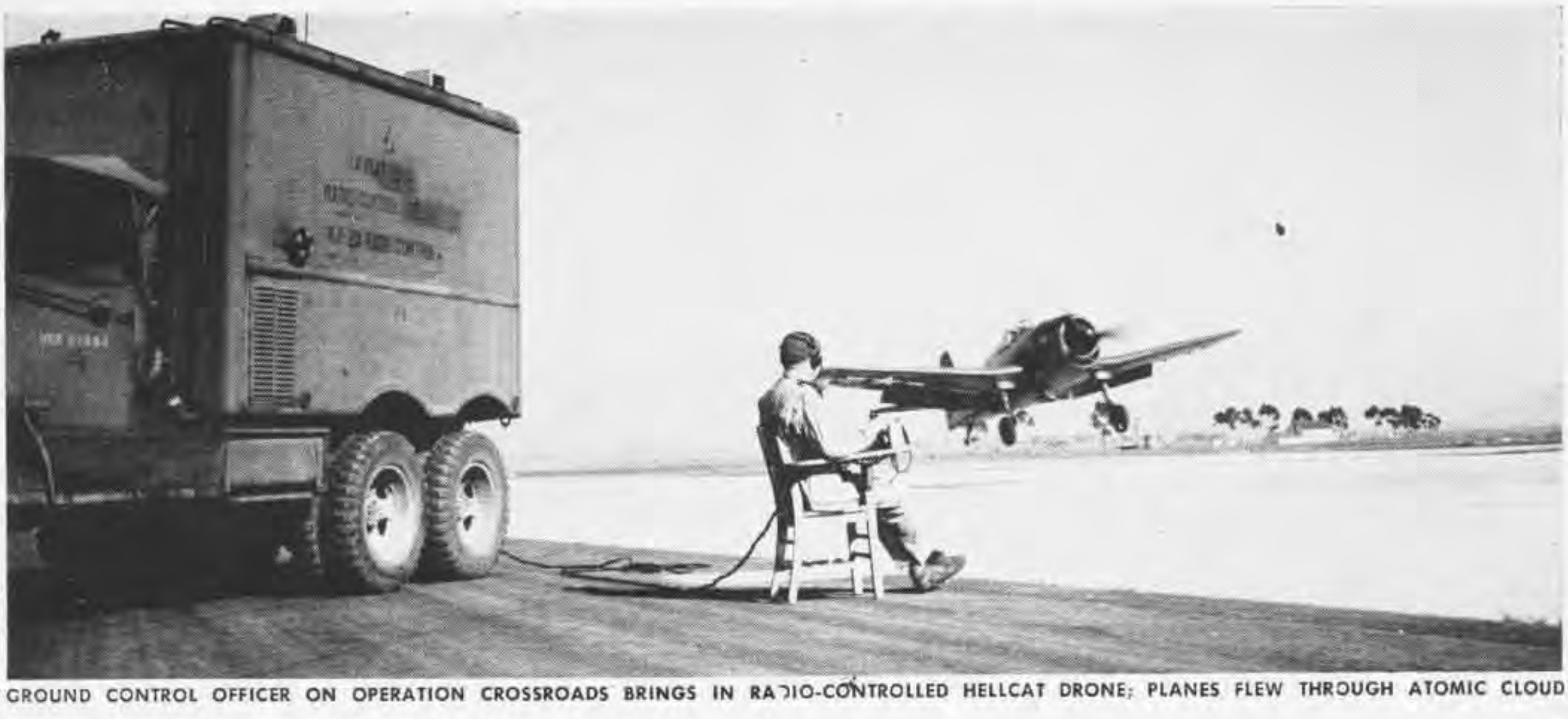
As it happens, one of the first missions of the Special Task Air Group (STAG-1) had been to deploy its drones in support of a US assault on the Marshall Islands, but the Marines landed long before the planned invasion date; the Group was then tasked with attacking targets of opportunity throughout the Solomon Islands.  In a single month, between 27 September and 26 October 1944, STAG-1 launched 46 drones, of which 29 successfully destroyed their targets.  This was a short-lived project in another sense.  As with Aphrodite, these were all in effect kamikaze missions in which the unoccupied aircraft plunged into its targets and exploded:  James Hall provides a pilot’s view in his American Kamikaze, and you can find an exquisite analysis of the project in the second chapter of Katherine Chandler‘s thesis, Drone flight and failure: the United States’ secret trials, experiments and operations in unmanning, 1936-1973.  For Crossroads, less than two years later, the Navy used carrier-based Grumman F6F-5 Hellcat fighter aircraft as drones and as control aircraft, mustering 30 drones and 26 control aircraft (below, the USS Shangri-La en route to Bikini with the drones on the flight deck).

The first shot in the series, codenamed Able, took place on 1 July 1946. At 0900 Dave’s Dream dropped the bomb over the target fleet, but the result was not the thrilling spectacle that had been advertised [below: Able shot from Enyu Island].  Visually it was a damp squib.  Judged by its own Broadway razzamatazz, one reporter jibed, it was a complete flop: ‘Operation Chloroform, the logical sequel to Operation Build-Up and Handout.’

Scientifically it was not much better.  Although Vice-Admiral Blaney initially declared that the bomb was dropped ‘with very good accuracy’, in fact it detonated off-target, exploding over one of the instrumentation vessels and compromising the readings from many others.  Even most of the high-speed cameras missed the shot. One critic concluded that ‘from the standpoint of pure science no test was ever more haphazard’ [more in Jonathan Weisgall, Operation Crossroads: the atomic tests at Bikini Atoll (1994) and Keith Parsons and Robert Zabella, Bombing the Marshall islands:a Cold War tragedy (2017)].

Against this catalogue of errors, which was glossed over in the official report, the aerial sampling missions were judged a considerable success.

(When the Partial Nuclear Test Ban Treaty put an end to atmospheric testing in 1963 you might think the need for aerial sampling disappeared with the cloud.  But the US still operates two sampling aircraft as the ‘Constant Phoenix’ program that acts as a supplement to the satellite sensor network of the US Atomic Energy Detection System: earlier this year Constant Phoenix flew sampling missions to assess North Korea’s claim to have detonated a hydrogen bomb).

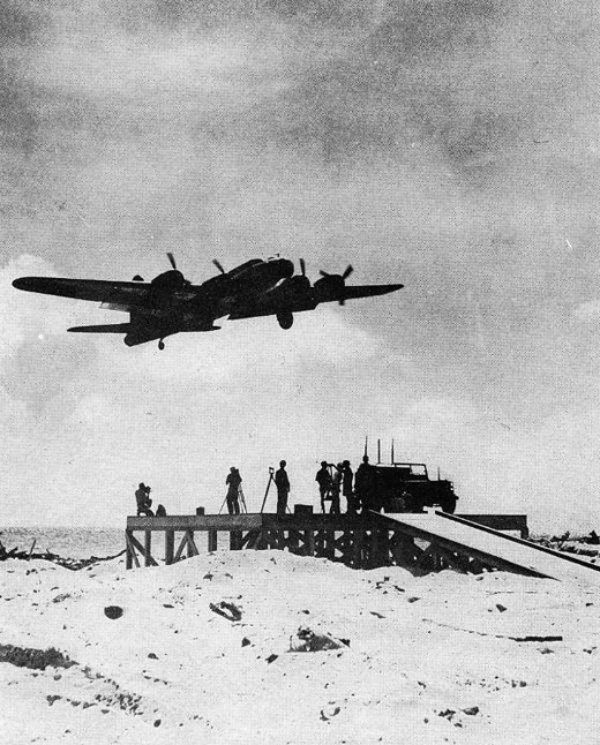
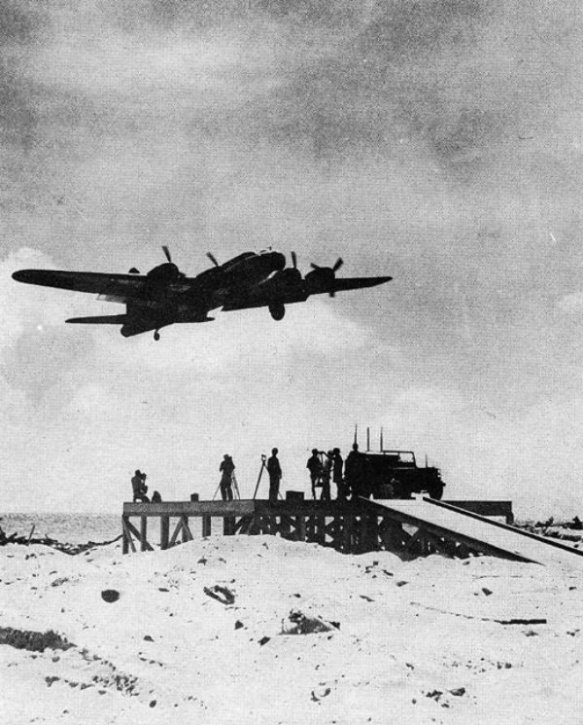
Back to the future.  As soon as the bomb was released over Bikini the first B-17 control aircraft turned its huge drone (Fox) into the cloud at an altitude of 24,000 feet; Fox was then switched to its automatic pilot, entering the cloud eight minutes after the explosion, while the control (or “beeper”) aircraft raced around the cloud and resumed control when the drone emerged on the other side.  Fox was followed by George (at 30,000 feet), How (at 18,000 feet) and Love (at 12,000 feet).  All four drones were directed back to Eniwetok atoll where they were handed back to the ground controllers in jeeps at the end of the runway who taxied them to the radiological safe area where the filters and bags were removed and flown to Los Alamos Laboratory for analysis (below).
The Navy launched four of its drones from the Shangri-La, but only three of them – Yellow, White and Blue – sampled the cloud at 5,000, 10,000 and 15,000 feet before being directed back to Roi island for a ground landing and sample recovery (below).
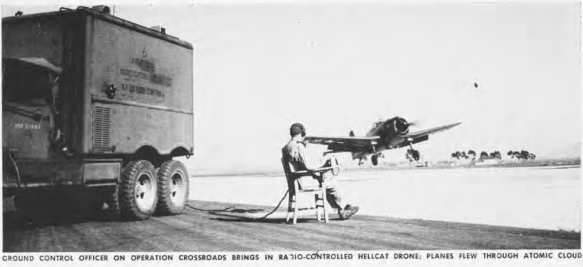
The official report emphasised that this was a notable first. ‘At Hiroshima and Nagasaki,’ it declared, ‘a few photographs and pressure measurements were made of the explosions, but almost nothing of value to physicists was learned.’ Crossroads had changed that; ‘for the first time samples had been taken from an atomic cloud’ during what one military engineer hailed as ‘the most hugely instrumented experiment in history’.
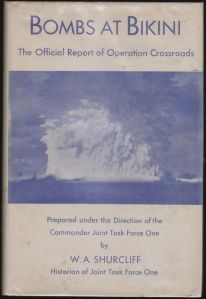
To the Air Force its drones had made crucial contributions not only to the aerial sampling programme but also to the development of remote operations more generally: ‘For the first time, four-motored drone aircraft had been flown without a safety pilot aboard.’  The author of the official report was equally impressed.  ‘With no one aboard,’ he marvelled, ‘these great planes were radio-guided through their prescribed flights across the target area, a unique and impressive feat.’  In a footnote he continued:

‘A number of Army Air Forces officials believe that the drone-plane program undertaken for Crossroads advanced the science of drone-plane operations by a year or more… Operation Crossroads was the first operation in which take-off, flight, and landing were accomplished with no one aboard.  The feat was an impressive one; many experts had thought it could never be accomplished with planes of this size.’

These were the experiments that captured the imagination of  Hanson Baldwin, a military affairs correspondent for the New York Times and Life magazine.  He had already predicted that ‘robot planes, rockets, television and radar bombing and atomic bombs will do the work today done by fleets of thousands of piloted bombers.’  Now he saw the future materialising in front of him.  ‘Today,’ he wrote in the New York Times for 25 August 1946, ‘planes without crews can be flown from almost anywhere, and can even survive… the atomic cloud.’  At Bikini the drones were controlled over a distance of eight miles or less, but Baldwin had been told that remote control up to fifty and perhaps even 100 miles was possible.  These were what today would be called line-of-sight operations, so their range was limited and Baldwin stressed that ‘an unmanned drone cannot be sent careening into a target in Europe by an operator standing at his “beep box” on La Guardia field in New York’.   But he was also adamant that a threshold had been crossed:

‘In the Pacific so much experience in the handling of drones was accumulated during the summer and the operations were so far in advance of drone operations during the war that it is safe to say that a simplified and reliable system of drone control – with all that implies – has been achieved…. Drones thus add a new and dangerous instrument to the growing armory of Mars, increase the power of the offensive and further complicate the tasks of the defensive’ [Hanson W. Baldwin, ‘The “Drone”: portent of a push-button war’, New York Times, 25 August 1946].

He was right, and the lines of descent from these post-war experiments to today’s remote operations by the US Air Force reveal continuing entanglements with nuclear weapons.

The official report of Crossroads makes no mention of the implications for remote operations of the smaller Navy drones.  Yet the Navy retained an interest in their development, and here too the connections with weapons of mass destruction are more than marginalia.
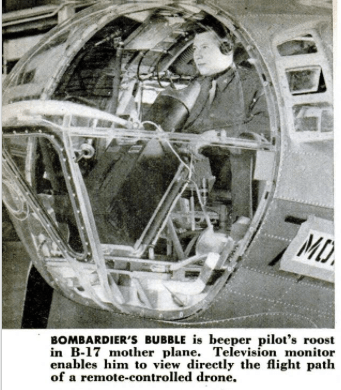
In April 1952 Herbert Johansen, an associate editor for Popular Mechanics, was invited to observe a flight of four F6F-5K Hellcats – though ‘they could just as well be our fastest jets’ – converted to drone operations at the Navy’s Pilotless Aircraft Laboratory and controlled from a single aircraft off the Atlantic coast.  Although the caption to a photograph noted that ‘Big Fellows’ – the Air Force’s Flying Fortresses – ‘can also be radio-controlled’ (see right), it was the smaller drones that got this reporter’s attention.

The Navy was ‘tight-lipped’ about its plans for the Hellcat drones, but Johansen had no difficulty imagining a future in which they would ‘carry atomic warheads and crash-dive as projectiles of destruction’ [‘No Live Operator Aboard’, Popular Mechanics 160 (4) (1952)].

Perhaps this was Johansen’s own, wild conjecture; perhaps not.  Bruce Cumings has shown that Washington had contemplated the use of nuclear weapons ‘from the first days of the Korean war’.  General MacArthur had requested atomic bombs to support ground operations as early as July 1950; in November President Truman, in response to a reporter’s question, insisted that their use was on the table, and Strategic Air Command was told that aircraft despatched to the Pacific theatre (based on Guam and Okinawa) should have ‘atomic capabilities’.  Cumings argues that ‘the US came closest to using nuclear weapons’ in April 1951, when the Pentagon prepared for immediate ‘atomic retaliation’ against any Chinese or Russian escalation; nine Mark IV bombs were transferred to the Air Force, and the President authorised their use against North Korean and Chinese targets.  But these were enormous bombs destined for the Air Force’s B-29s – each weighed 11,000 lbs and was far beyond the capacity of the Navy’s Hellcats (though not its AJ-1 bombers) – and they were never used.  Still, the Pentagon continued to consider the nuclear option, and in September and October 1951 flights of B-29s carried out simulated runs over the North, dropping dummy atomic bombs to assess their utility as battlefield weapons [see Bruce Cumings, ‘On the strategy and morality of American policy in Korea, 1950 to the present’, Social Science Japan Journal 1 (1) (1998) 57-70; see also here; Daniel Calingaert, ‘Nuclear weapons and the Korean War’, Journal of strategic studies 11 (2) (1988) 177-202; and here).

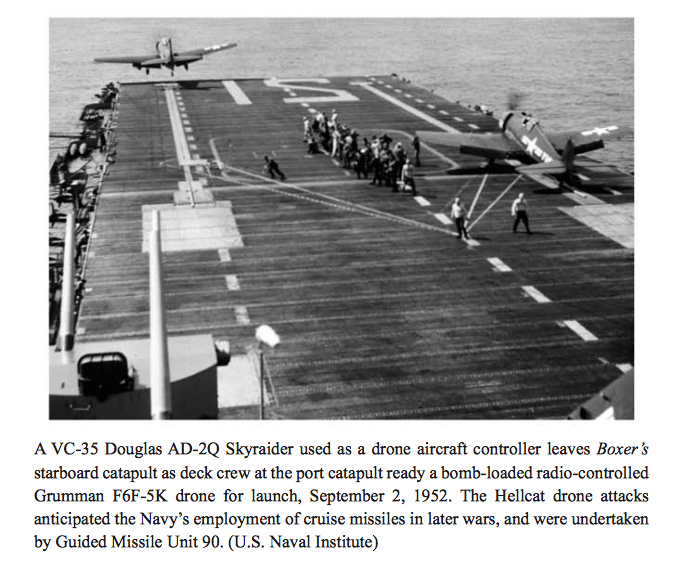
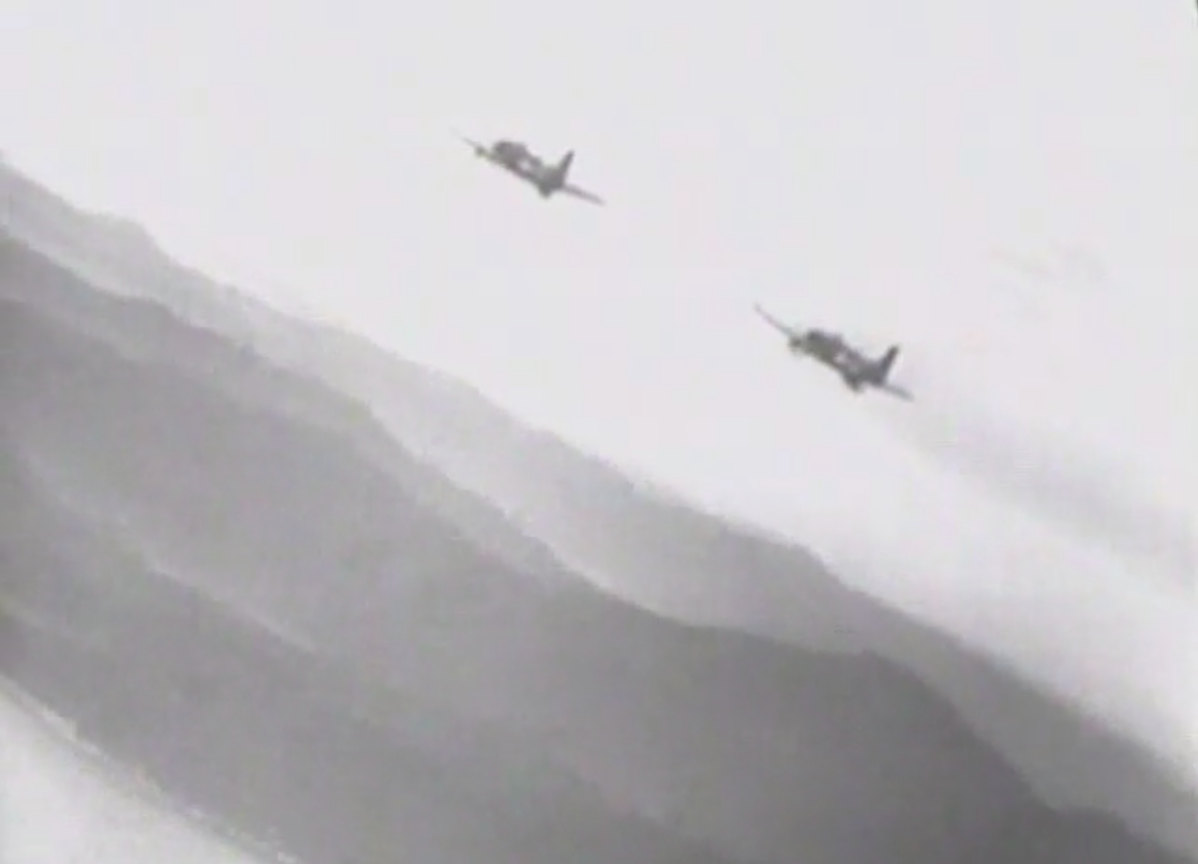
One year later the same bleak prospect as Johansen’s was conjured up by a naval officer much closer to the conflict, who was overseeing an experimental flight of Navy drones against targets in North Korea. Between 28 August and 2 September six Hellcat drones on the carrier USS Boxer were loaded with 2000 lb bombs and, with TV pods slung under their wings, yoked to director aircraft – AD-2Q Skyraiders this time – whose pilots used TV screens to guide what were now described as ‘robot missiles’ on to their targets.
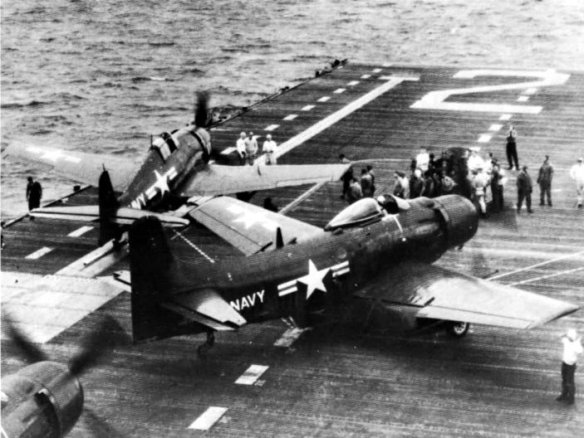
The test roared on to the front pages.  An American correspondent cabled a vivid description of what he called ‘one of the most dramatic and historical events of the Korean War’:

‘We watched a guided missile roar off a catapult, climb north-westward in a sweeping turn and head for a dangerous flak-ridden communist target in North Korea more than 150 miles away.
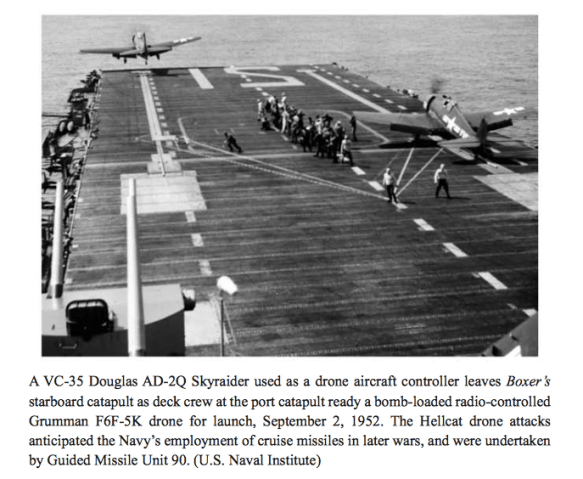
‘As the doomed craft streaked towards its target, grim-faced electronic experts, in a secret room on this ship, rode with the missile, mile by mile, through wondrous electronic instruments.  On their dials in the secret room, the experts crossed the Sea of Japan and watched the jagged peaks of Eastern Korea loom in the distance and grow larger.  Far from the missile, an automatic device transmitted every dying moment of the missile’s last hour to the USS Boxer.

‘The target – an enemy concentration in a valley between two shadowy hills – was indicated on the receiving instrument – a real flak-ridden trap for any hapless Allied pilot.

‘A second to go now – the signal of the instruments grew stronger as the guided missile dived straight at the target at hundreds of miles an hour.  Then the instruments went suddenly blank.  The screaming dive had ended squarely on the target and the missile had crashed to oblivion’ [His dispatch was dated 1 September but delayed and censored; it was published in several regional newspapers in the United States and in the Australian press almost three weeks later: ‘United States ready for push-button warfare’, Canberra Times, 19 September 1952].

With that blank screen, he continued, those on board the Boxer knew that ‘here at last in actual combat, was a new era of battle’, when ‘electronic brains will ride in tough, dangerous places, saving the lives of American pilots.’  Or, as one observing officer marvelled, ‘It’s a nice way to fight a war’ [More from Jeremy Hsu, ‘When US Navy suicide drones went to war’, here].

Although observers were ‘amazed at the drone’s sensitive response to remote control’ and the TV screen supposedly ‘enabled the controlling officer to keep the drone “on the target” until the last second, giving the missile unbelievable accuracy’, only one of the six hit its target [‘Navy uses robot missiles against targets in Korea’, New York Times, 18 September 1952].  The others recorded near-misses, but this was enough for Lt-Cdr Lawrence Kurtz, the (less than tight-lipped) commander of Guided Missile Unit 90 responsible for the trial, to boast that the United States had enough of them to ‘launch and sustain a large-scale robot campaign’.  And he then added this ominous rider: some of the ‘missile planes’ were ‘capable of carrying an atomic bomb from one continent to another’ [ ‘United States ready for push-button warfare’; ‘Guided missiles in Korean War: Deadly new US technique’, Sydney Morning Herald, 19 September 1952].

Agency reports of his comments were played down in the United States, where they evidently incurred the wrath of his superiors. Rear Admiral John Sides described the use of the Hellcat drones as an ‘interim measure’ before the development of ‘more effective guided missiles’, conceding that ‘it wouldn’t take much imagination to realize that there are better ways of doing this job.’  But he would give no further details: the Navy was ‘investigating the use of classified information in news dispatches on the employment of pilotless bombers in Korea’, but refused to elaborate [‘Korea robot raids “interim measure”’, New York Times, 19 September 1952].  Instead, Sides switched the focus from the aircraft to American lives.  The  object of the experimental programme observed by the Popular Mechanics correspondent earlier in the year was ‘to obtain air kills by individuals operating from beyond the range of the enemy’s armament’, he emphasised, and in Korea ‘a controller sitting in relative safety’ outside the range of anti-aircraft defences ‘had been able to direct an effective drop on the enemy positions.’ The previous Times report had already underlined the significance: ‘The planes were sacrificed but, of course, not a man was lost.’

On 22 September NBC broadcast a short Department of Defense film describing what it called the dawn of ‘a new era in warfare’ in Korea but which made no mention of nuclear weapons.  Instead the commentary emphasised that the pilot of the ‘robot bomber’ was ‘safely out of range’ and that these ‘guided missiles’ might ‘someday eliminate the human element’ altogether :

‘The carrier USS Boxer launches guided missiles for the first time in combat, bringing the push-button war of tomorrow into present day reality. Defense Department films show the first mission of the robot bombers, weapons that may someday eliminate the human element from air war.

The robot missile is catapulted aloft. It is a semi-obsolete Hell Cat, carrying a one-ton bomb load and a television camera instead of a pilot.
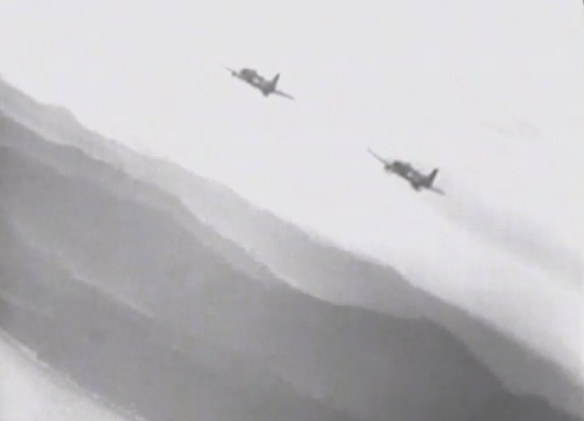
Already in the air is the mother plane, with an observer who flies the drone by remote control. Side by side, missile and mother plane head for the target. Then the pilot, safely out of range of interception and anti-aircraft fire, guides the robot directly into the target with unerring accuracy.’

And this was, of course, the larger and sharper point.  The reason drones were originally used to fly through the atomic cloud (though they were later replaced by crewed missions); the reason the Air Force needed a remotely operated aircraft to drop the next generation of nuclear weapons; the reason the Navy wanted ‘offensive drones’ and ‘robot missiles’ to attack heavily defended targets was to save the lives of American crews.  It is the same mission that continues today in the US prosecution of what are its avowedly asymmetric wars: to ‘project power without vulnerability’.

War and Art

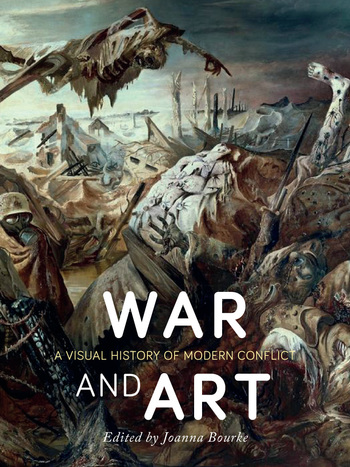
A new collection from the ever-interesting Reaktion, edited by Joanna Bourke, War and Art: a visual history of modern conflict:

This sumptuously illustrated volume, edited by eminent war historian Joanna Bourke, offers a comprehensive visual, cultural and historical account of the ways in which armed conflict has been represented in art. Covering the last two centuries, the book shows how the artistic portrayal of war changed, from a celebration of heroic exploits to a more modern, truthful depiction of warfare and its consequences.

Featuring illustrations by artists including Paul Nash, Judy Chicago, Pablo Picasso, Melanie Friend, Francis Bacon, Käthe Kollwitz, Yves Klein, Robert Rauschenberg, Dora Meeson, Otto Dix and many others, as well as those who are often overlooked, such as children, non-European artists and prisoners of war, this extensive survey is a fitting and timely contribution to the understanding, memory and commemoration of war, and will appeal to a wide audience interested in warfare, art, history or politics.

Introduction by Joanna Bourke, with essays by Jon Bird, Monica Bohm-Duchen, Joanna Bourke, Grace Brockington, James Chapman, Michael Corris, Patrick Crogan, Jo Fox, Paul Gough, Gary Haines, Clare Makepeace, Sue Malvern, Sergiusz Michalski, Manon Pignot, Anna Pilkington, Nicholas J. Saunders, John Schofield, John D. Szostak, Sarah Wilson and Jay Winter.

Among the plaudits:

‘What happens when you encourage a group of archivists, archeologists, anthropologists and historians of all sorts into the terrain of war art? An extraordinary collection, exhilarating in its ways of seeing, consistently moving in its attention to artists and the audiences – soldiers and statesmen; men, women, and children – for war’s pity and terror.’ — Carolyn Steedman

‘Beautifully illustrated and covers everything from the often neglected role of women artists to the strange decorations found in Cold War bunkers; from the works of some of the most notable war artists to questions about history and memory.  It is a must read for anyone interested in the art of war, and in our complex human responses to the violence of conflict and the commemoration of battle.’ — Alexandra Richie

War and Art will be launched at the Birkbeck Institute for the Humanities (University of London) at 1800 on 8 November: free, but pre-booking required;  full details here.

Urban Rage

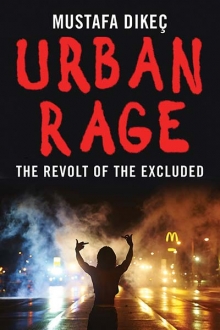
Mustafa Dikeç‘s new book, coming in January from Yale:

A timely and incisive examination of contemporary urban unrest that explains why riots will continue until citizens are equally treated and politically included.

In the past few decades, urban riots have erupted in democracies across the world. While high profile politicians often react by condemning protestors’ actions and passing crackdown measures, urban studies professor Mustafa Dikeç shows how these revolts are in fact rooted in exclusions and genuine grievances which our democracies are failing to address. In this eye-opening study, he argues that global revolts may be sparked by a particular police or government action but nonetheless are expressions of much longer and deep seated rage accumulated through hardship and injustices that have become routine.

Increasingly recognized as an expert on urban unrest, Dikeç examines urban revolts in the United States, United Kingdom, France, Sweden, Greece, and Turkey and, in a sweeping and engaging account, makes it clear that change is only possible if we address the failures of democratic systems and rethink the established practices of policing and political decision-making.

Here is Mike Davis on Urban Rage:
These comparative case-studies, richly detailed and attentive to local conditions, overthrow the hoary stereotype of the irrational mob.  Read carefully and you’ll begin to understand the rationality of urban revolts – perhaps even their necessity in our gilded world.
And Ananya Roy:
Brilliantly cutting across the North Atlantic, Mustafa Dikeç repositions the cities of the West within the long histories of colonialism and imperialism and reminds us that these wars are not over.  Urban Rage thus raises profoundly important questions about the urgent aspirations of our time: emancipation, justice, and humanity. A beautiful book.

Surveillance beyond borders and boundaries

An unusually interesting Call for Papers for a conference organised by the Surveillance Studies Network in Aarhus (Denmark) 7 – 9 June 2018. This will be their 8th conference; the banner above is ripped from their 6th in 2014.

You can download the full CfP (from which I’ve extracted the details below) here.

SURVEILLANCE BEYOND BORDERS AND BOUNDARIES

Recent years have witnessed the increasing scope, reach and pervasiveness of surveil- lance. It now operates on a scale ranging from the genome to the universe. Across the spheres of private and public life and the spaces between, surveillance mediates, documents and facilitates a wide range of activities. At the same time, surveillance practices now reach beyond the corporal and temporal boundaries of life itself, no longer resting on the individual as subject, but instead falling both within and beyond it. This emphasises the porosity of such categories. Pervasive surveillance produces new articulations of power and animates ows of people, information and capital, harbouring potential for myriad opportunities as well as harms. With this growth of surveillance comes in- creasing complexity and paradox.

Within this milieu, these issues are particularly pronounced, controversial and prescient in relation to borders and boundaries. Surveillance practices have long been associated with shoring up territorial and categorical borders, yet in the digital age such practices become accelerated, in many cases beyond the speed of human comprehension. Highly dynamic inscriptions of difference, abnormality and undesirability are now commonplace. At the same time, surveillance practices transcend and challenge erstwhile articulations of borders and boundaries, including enabling mobility for some, uniting formerly fractured assemblies of information and the capacitating borderless passage of data.

The conference

Since 2004 the Biennial Surveillance Studies Network conference has become established as the world’s most significant gathering of surveillance studies experts. The Surveillance Studies Network is a registered charitable company dedicated to the study of surveillance in all its forms, and the free distribution of scholarly information, and con- stitutes the largest association of surveillance scholars in the world. The Surveillance Studies Network owns the leading surveillance-focused peer-reviewed journal Surveillance & Society, which has held long association with the conference. We encourage presenters to submit fully formed papers to the journal to be considered for publication.

We call for papers and panels from all areas of critical enquiry that seek to examine such complex articulations and impacts of surveillance in contemporary society. We invite participants to discuss, develop or demolish the borders and boundaries of surveillance. In particular, we welcome interventions that are truly interdisciplinary, multi-disciplinary, or transdisciplinary in scope and reach, from academics, activists, artists, and policy-makers, especially those who sit on the borderlands between academia and practice-based knowledge production.

Key themes include, but are not limited to:

Authority, democracy and surveillance

Surveillance and everyday life

History of surveillance

Surveillance and digital/social media

Art, action and surveillance

Surveillance infrastructures and architectures

Managing borders and uncertainty

Theories of surveillance

Ethics, philosophy, trust and intimacy in and of surveillance

Regulation, politics and governance of surveillance

Algorithmic surveillance and big data

Resistance to surveillance

Non-technological and interpersonal surveillance

Paper Proposals

Paper sessions will be composed by the Organising Committee based on the individual Paper Proposals submitted. Paper Proposals should consist of: Name(s) of Author(s); Affiliation(s) of Author(s); Proposed Title of Paper; An abstract of up to 150 words.

On acceptance paper proposers will be invited to submit an extended abstract, presentation summary, paper outline or developed paper draft of at least 2000 words for publication in the delegates area of the conference website ahead of the event. This can be submitted anytime up until the May deadline.

Visual or other artistic submissions

We welcome and encourage alternative formats, including but not limited to visual dis- plays and other artistic installations. These may include but are not limited to lms, documentaries, photographic exhibitions, architectural modeling and digital-mediated artistic forms. Artistic submissions should consist of: Name(s) of proposer/artist; Affiliation(s); An overview of the proposed submission of up to 250 words.

Panel Proposals

Panels are sessions that bring together a diverse group of panelists with varied views on a topic related to the conference theme. The session format should engage the panelists and audience in an interactive discussion. Panels should be designed to fit in a 90-minute session. Panel Proposals should consist of: Name(s) of Organiser(s); Affiliations; Proposed Title of Panel; An abstract of up to 300 words describing the panel, including why the panel is of interest to the conference, and the proposed format of the panel; Name(s) and Affiliation(s) and abstracts for all included papers (150 words) of all proposed panelists. Speakers included in successful panel proposals also will be required to later submit the more developed extended abstract, presentation summary, paper outline or developed paper draft of at least 2000 words as per the instructions for paper proposals above. NB: Organisers must secure the agreement of all proposed panelists before submitting the Panel Proposal.

Deadline

All proposals should be submitted by December 31st 2017.  Decisions will be returned by January 31st 2018

All extended outlines/presentation summaries/paper drafts to be submitted by May 1st 2018

Submissions should be made through the EasyChair submission webportal here.

Contact: ssn2018@cc.au.dk

Periscope

Articles that have recently caught my eye through their intersections with various projects I’m working on (so forgive what may otherwise seem an idiosyncratic selection!):

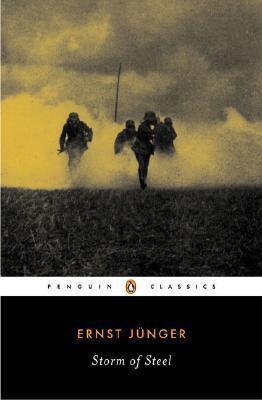
Bogdan Costea and Kostas Amiridis, ‘Ernst Jünger, total mobilization and the work of war’, Organization 24 (4) (2017) 475-490 – I keep encountering Jünger’s work, first when I was writing ‘The natures of war‘ (he served on the Western Front in the First World War: see his remarkable Storm of Steel, still available as a Penguin Classic in a greatly improved translation) and much more recently while preparing a new lecture on occupied Paris in the Second World War (he was stationed there for four years and confided a series of revealing and often critical observations to his diaries).  But his reflections on the ‘destruction line’ of modern war are no less interesting.  For parallel reflections, see:

Leo McCann, ‘Killing is our business and business is good”: The evolution of war managerialism from body counts to counterinsurgency’, Organization 24 (4) (2017) 491-515 – I’ve written about what Freeman Dyson called ‘the bureaucratization of homicide‘ before, in relation to aerial violence, but this essay provides a wider angle.

Laura Pitkanen, Matt Farish, ‘Nuclear landscapes’, Progress in human geography [Online First: 31 August 2017] (‘Places such as New Mexico’s Trinity Site have become iconic, at least in the United States, and a study of nuclear landscapes must consider the cultural force of spectacular weapons tests and related origin stories. But critical scholars have also looked beyond and below the distractions of mushroom clouds, to additional and alternative landscapes that are obscured by secrecy and relative banality’).

I’m still haunted by the reading I did for ‘Little Boys and Blue Skies‘, much of it inspired by Matt’s work (see especially here on ‘Atomic soldiers and the nuclear battlefield’); this essay should be read in conjunction with:

Becky Alexis-Martin and Thom Davis, ‘Towards nuclear geography: zones, bodies and communities’, Geography Compass [Online early: 5 September 2017] (‘We explore the diverse modes of interaction that occur between bodies and nuclear technology and point towards the scope for further research on nuclear geographies. We bring together different strands of this nascent discipline and, by doing so, highlight how nuclear technology interacts across a spectrum of geographic scales, communities, and bodies. Although nuclear geographies can be sensational and exceptionalising, such as the experiences of nuclear accident survivors and the creation of “exclusion zones,” they can also be mundane, everyday and largely unrecognised, such as the production of nuclear energy and the life-giving nature of radioactive medicine.’)

Simon Philpott, ‘Performing Mass Murder: constructing the perpetrator in documentary film’, International Political Sociology 11 (3) (2017) 257–272 – an insightful critique of Joshua Oppenheimer‘s The Act of Killing (see my posts here and here).

José Ciro Martinez and Brett Eng, ‘Struggling to perform the state: the politics of bread in the Syrian civil war’, International Political Sociology 11 (20 (2017) 130-147 – a wonderfully suggestive analysis that has the liveliest of implications for my own work on attacks on hospitals and health-care workers in Syria (notably: ‘The provision of bread to regime-controlled areas has gone hand in hand with targeted efforts to deprive rebel groups of the essential foodstuff and, by extension, their ability to perform the state. Since 2012, the regime has bombed nascent opposition-administered attempts to provide vital public services and subsistence goods, thereby presenting itself as the only viable source of such necessities.’)  But it also has far wider implications for debates about ‘performing the state’ and much else.  And in a similar vein:

Jeannie Sowers, Erika Weinthal and Neda Zawahiri, ‘Targeting environmental infrastructures, international law and civilians in the new Middle Eastern wars’, Security Dialogue 2017 [Online early] (”We focus on better understanding the conflict destruction of water, sanitation, waste, and energy infrastructures, which we term environmental infrastructures, by drawing on an author-compiled database of the post-2011 wars in the Middle East and North Africa… Comparatively analyzing the conflict zones of Libya, Syria, and Yemen, we show that targeting environmental infrastructure is an increasingly prevalent form of war-making in the MENA, with long-term implications for rebuilding states, sustaining livelihoods, and resolving conflicts.’)

Will Todman, ‘Isolating Dissent, Punishing the Masses: Siege Warfare as Counter-Insurgency,’ Syria Studies 9 (1) (2017) 1-32 – Syria Studies is an open-acess journal from the Centre for Syrian Studies at St Andrews.

Sarah El-Kazaz and Kevin Mazur, ‘The unexceptional Middle Eastern City’, City & Society 29 (1) (2017) 148-161 – a really useful introduction to a themed section, much on my mind as this term I’ll be doing my best to jolt my students out of lazy caricatures of ‘the Islamic city’ (‘The study of Middle Eastern cities has been constrained in its analytical and methodological focus by a genealogy shaped by a triad of regional exceptions–Islam, oil, and authoritarianism–and … this special section move[s] beyond those constraints in important ways. Focusing on geographical places and time periods that have remained peripheral to the study of Middle Eastern cities, the three articles ethnographically historicize the planned and unplanned processes through which cities in the region transform to transcend a genealogy of exceptionalism and the constraints it has created. They highlight the global and local connections that shape these processes to offer new perspectives on the study of scale, verticality and sensoriums in the shaping of urban transformation around the globe.’)

Rasul Baksh Rais, ‘Geopolitics on the Pakistan-Afghanistan borderland’, Geopolitics [online early: 11 August 2017] – a helpful historical review particularly for anyone interested in the exceptional construction of the Federally Administered Tribal Areas by both Washington and Islamabad.

Katharine Hall Kindervater, ‘Drone strikes, ephemeral sovereignty and changing conceptions of territory’, Territory, politics, governance (2017) 207-21 – Kate engages with her characteristic breadth of vision with some of the problems that preoccupied me in ‘Dirty dancing’ and urges a topological engagement with territory (DOWNLOADS tab) (‘This article examines the US legal frameworks for drone-targeting operations, and in particular the conceptions of territory they draw upon, to argue that contemporary strikes reflect less a disappearance of the importance of territory and sovereignty to justifications of the use of force than a reconfiguration of their meanings. Grounded in an understanding of territory that is more networked and dynamic, drone strikes reflect the emergence of a new landscape of mobile and ephemeral sovereignty.’)

Georgina Ramsay, ‘Incommensurable futures and displaced lives: sovereignty as control over time’, Public culture 29 (3) (2017) 515-38 (‘The recent mass displacement of refugees has been described internationally as a “crisis.” But crisis implies eventfulness: a distinct problem that can be solved. The urgency of solving this problem of displacement has seen the use of expansive techniques of sovereignty across Europe, the epicenter of the crisis. Focusing exclusively on the formation of sovereignty through the analytical locus of crisis continues, however, to reproduce the trope of the “refugee” as a category of exception. This essay considers the experiences of people who were resettled as refugees in Australia and whose displacement has ostensibly been resolved. Drawing attention to their continuing experiences of violence, it considers how the temporal framing of displacement is itself a way to conceal formations of sovereignty embedded in the very processes designed to resolve displacement. Doing so opens up new ways to think about control over time as a technique of sovereignty.’)

For an equally trenchant and invigorating critique of crisis-talk, see Joseph Masco‘s brilliant ‘The Crisis in Crisis’, Current Anthropology 58 Supplement 17 (2017) S65-S76, available on open access here. (‘In this essay I consider the current logics of crisis in American media cultures and politics. I argue that “crisis” has become a counterrevolutionary idiom in the twenty-first century, a means of stabilizing an existing condition rather than minimizing forms of violence across militarism, economy, and the environment. Assessing nuclear danger and climate danger, I critique and theorize the current standing of existential crisis as a mode of political mobilization and posit the contemporary terms for generating non-utopian but positive futurities.’)

Dima Saber and Paul Long, ‘”I will not leave, my freedom is more precious than my blood”: From affect to precarity – crowd-sourced citizen archives as memories of the Syrian war’, Archives and Records 38 (1) (2017) (‘Based on the authors’ mapping of citizen-generated footage from Daraa, the city where the Syria uprising started in March 2011, this article looks at the relation between crowd-sourced archives and processes of history making in times of war. It describes the ‘migrant journey’ of the Daraa archive, from its origins as an eyewitness documentation of the early days of the uprising, to its current status as a digital archive of the Syrian war. It also assesses the effects of digital technologies for rethinking the ways in which our societies bear witness and remember. By so doing, this article attempts to address the pitfalls attending the representation and narrativisation of an ongoing conflict, especially in the light of rising concerns on the precariousness and disappearance of the digital archives. Finally, by engaging with scholarship from archival studies, this article attempts to address the intellectual rift between humanities and archival studies scholars, and is conceived as a call for more collaboration between the two disciplines for a more constructive research on archival representations of conflict.’)

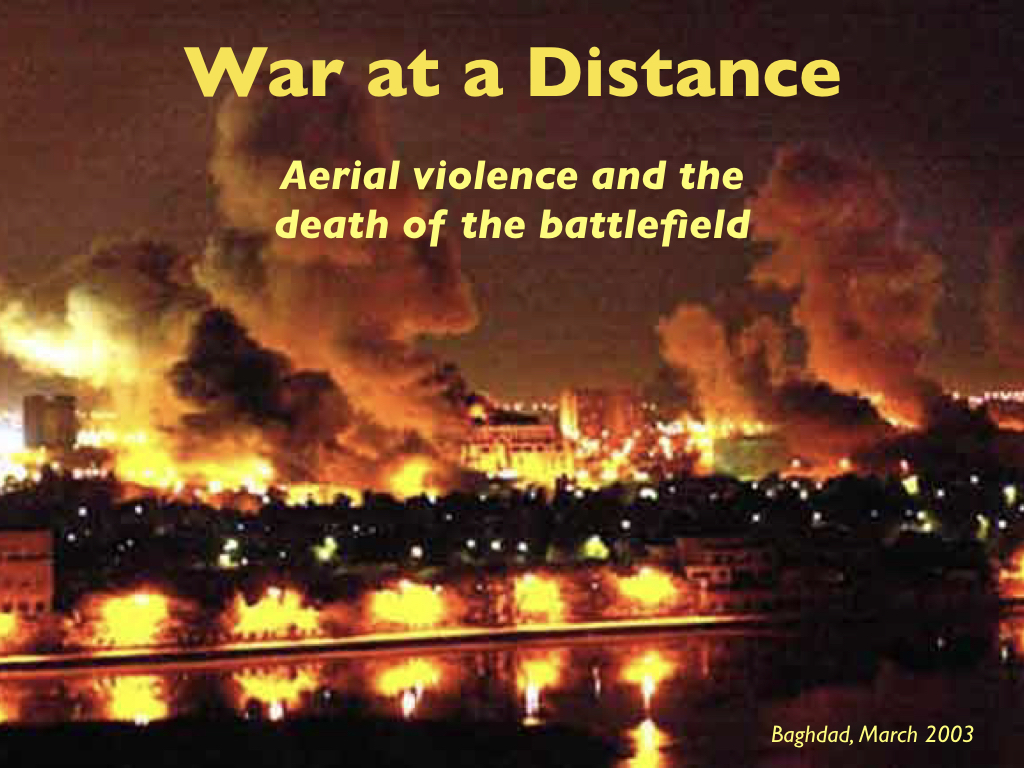
‘War at a Distance’: video

The video of my lecture at Radboud University earlier this month on ‘War at a Distance: Aerial violence and the death of the battlefield‘ has now been posted online via YouTube:

Climate change and the war in the Syria

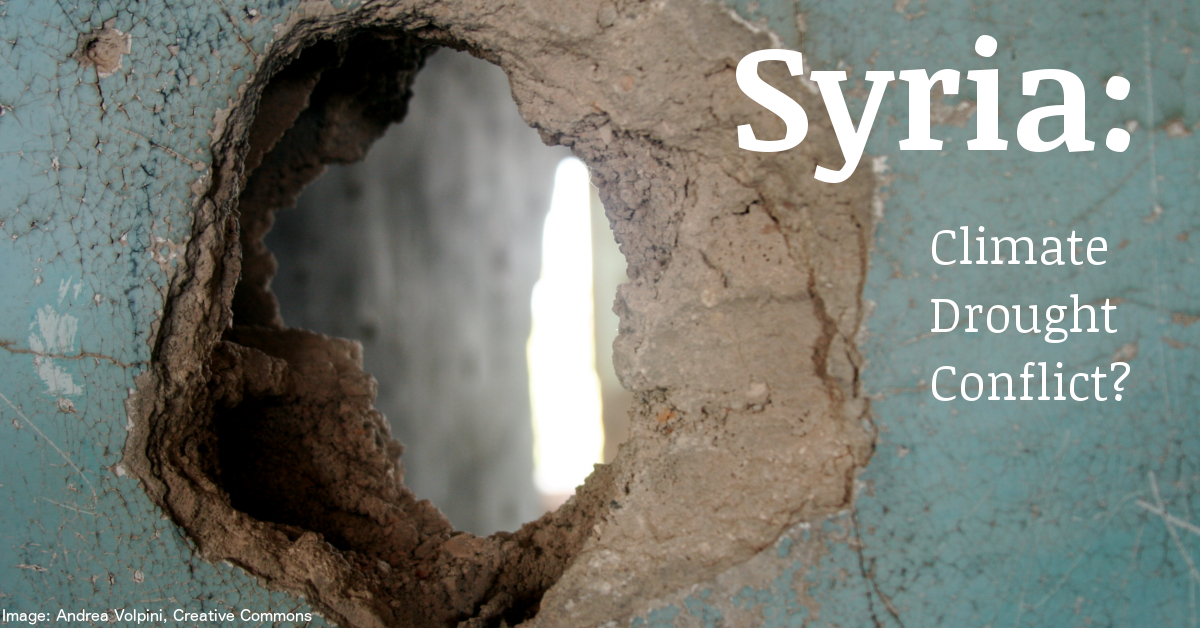
For those of you interested in the debate over global climate change and the war in Syria, there is an important exchange published online in Political Geography 60 (2017).  It starts with an essay by Jan Selby, Omar Dahi, Christiane Frölich and Mike Hulme, ‘Climate change and the Syrian civil war revisited‘:

For proponents of the view that anthropogenic climate change will become a ‘threat multiplier’ for instability in the decades ahead, the Syrian civil war has become a recurring reference point, providing apparently compelling evidence that such conflict effects are already with us. According to this view, human-induced climatic change was a contributory factor in the extreme drought experienced within Syria prior to its civil war; this drought in turn led to large-scale migration; and this migration in turn exacerbated the socio-economic stresses that underpinned Syria’s descent into war. This article provides a systematic interrogation of these claims, and finds little merit to them. Amongst other things it shows that there is no clear and reliable evidence that anthropogenic climate change was a factor in Syria’s pre-civil war drought; that this drought did not cause anywhere near the scale of migration that is often alleged; and that there exists no solid evidence that drought migration pressures in Syria contributed to civil war onset. The Syria case, the article finds, does not support ‘threat multiplier’ views of the impacts of climate change; to the contrary, we conclude, policymakers, commentators and scholars alike should exercise far greater caution when drawing such linkages or when securitising climate change.

Several of those whose work is criticised in the essay respond: Colin Kelley, Shahrzad, Mark Cane, Richard Seager and Yochanan Kushnir (their original contribution ‘claim[s] climate as one of many contributing factors to the unrest’ and ‘nothing [in the critique] refutes this, and none of their supportable arguments even offer reason for doubting this view’), and Peter Gleick (‘While the authors note in a few places that the research studies they critique do not typically claim that climate change “caused” the Syrian unrest, they themselves regularly repeat that very argument as a strawman that they then try to debunk’).

There’s also a blue-helmet response from Cullen Hendrix:

I fear getting the Syrian case “right” – or at least correcting a flawed dominant narrative – will negatively affect discussions of environmental impacts on conflict in the policy sphere. Many will read this article as “all this talk of climate change and conflict is wrong,” when in fact the evidence supports a much more limited conclusion: the impact of climatic factors on the Syrian civil war is not entirely clear. But the dramatic nature of the Syrian civil war and the vocal nature of those linking it to climate change have caused this case to exert inordinate influence on how influential non-specialists and the general public view the relationship between climate change and conflict.

There’s also a robust rejoinder from the original authors:

Firstly, we wish to emphasise that nothing in our analysis or our other writings questions the fact of anthropogenic climate change (though this really should go without saying) [Sadly it doesn’t: see here]. Second, we wish to note that, though some may read our article as evidence that ‘all this talk of climate change and conflict is wrong’, as Hendrix fears, this is not our view. Most academic studies of climate-conflict linkages are much more careful in their use of evidence, and on issues of causation, than the studies interrogated here. Moreover, though there is room for debate on where, when and howclimate change will affect conflict, we do not doubt that it will do so. Given the scale and the range of challenges posed by global climate change, it would frankly be incredible if it did not have some significant conflict implications.

And yet there is a long, sad history of people making overblown claims about climate change and conflict, the Syria example – and Al Gore’s recent extension of it to explain the UK’s vote to exit the European Union – being clear cases in point. Climate conflict discourse has historically been much more policy- and media-than research-led, and indeed policymakers and journalists often show scant regard for academic nuance on these issues (see e.g. Selby & Hoffmann, 2014). In the Syria case, this problem has been accentuated by the readiness of certain natural scientists, most prominently the authors of Kelley et al. (2015), to feed this un-nuanced policy and public discourse while using evidence casually and failing to engage with relevant social scientific research. To this extent the main implication of our analysis is simple: that far greater care is required, since without such care there really is a risk of climate conflict talk fuelling climate scepticism.

My sound-bites don’t do justice to the debate, nor to its importance.

There’s also a commentary from the Center for Climate & Security (‘a non-partisan policy institute’ whose Advisory Board is stacked with Admirals and Generals: even if the Trump administration dismisses global climate change as a hoax invented by the Chinese, the Pentagon certainly doesn’t) here.

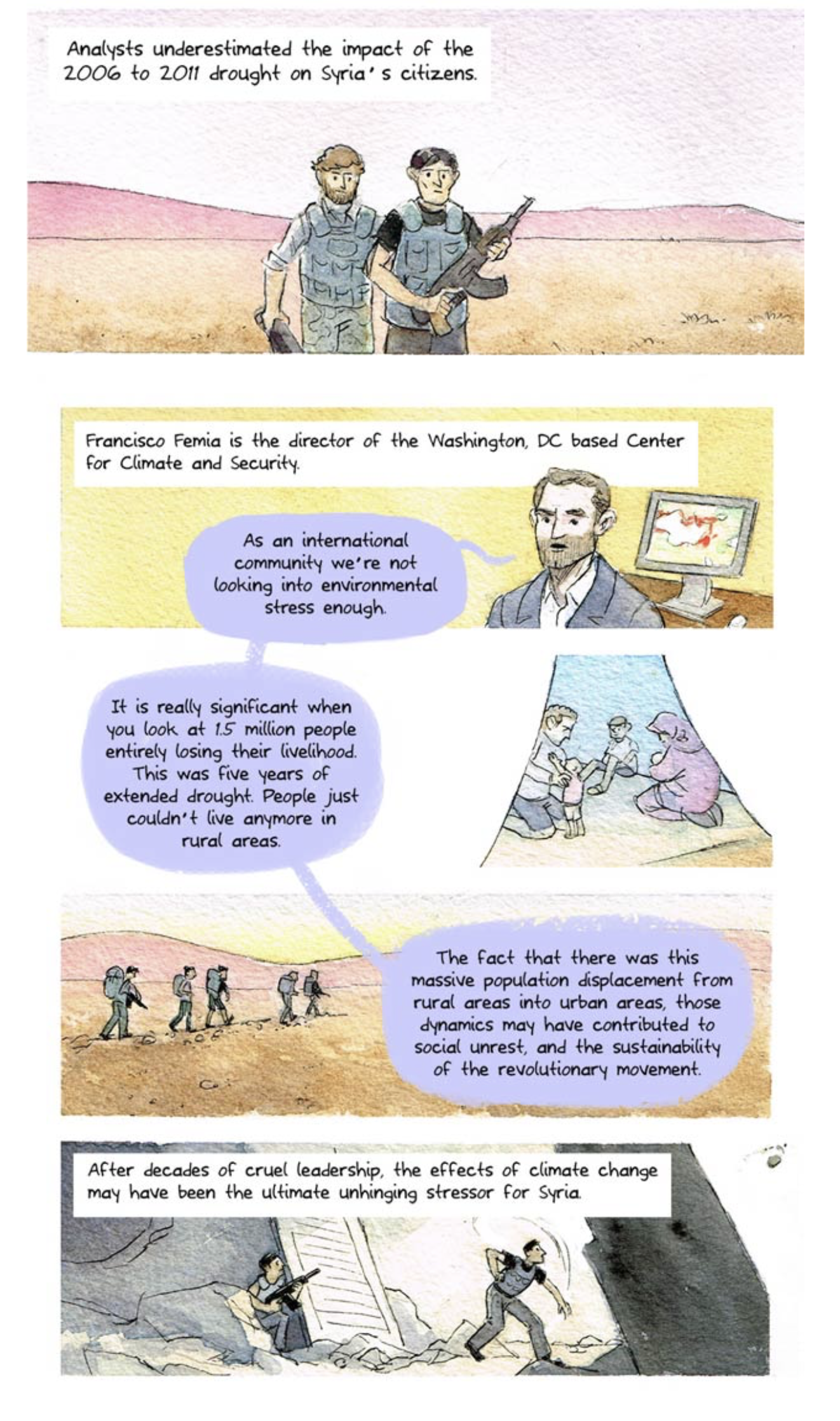
More on CCS from the Washington Post here.  The CCS was cited approvingly in a comic, “Syria’s Climate Conflict” (2014), produced by Years of Living Dangerously and Symbolia Magazine; you can access it via Mother Jones here.

If, like me, you wonder about the methodologies on which these arguments and counter-arguments rest, I recommend Thomas Ide, ‘Research methods for exploring the links between climate change and conflict‘, Wiley Interdisciplinary Reviews: Climate Change 8 (3) (2017) to jump-start the debate.

Ice Cold in Alex

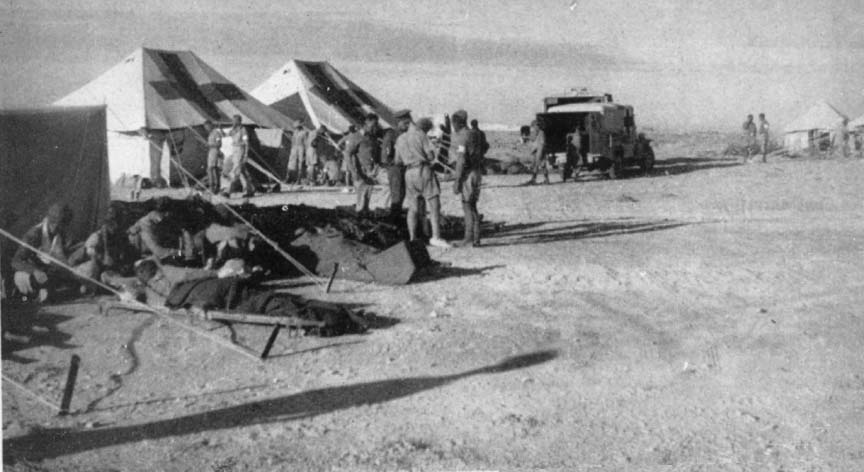
I think most of my research on medical care and casualty evacuation from the Western Front in the First World War is now complete, though there are still some loose ends to tie up and some more interviews/oral histories to listen to on-line courtesy of the wonderful Imperial War Museum.   So I spent much of the summer working on the very different situation in the deserts of North Africa during the Second World War: the material – at the IWM and the Wellcome Institute – is just as rich, though much less worked over.

If the First World War was the first industrialised war yet still  fought, for the most part, at short range, the campaigns in North Africa involved mechanised war fought over vast distances.  I had anticipated some of this in ‘The natures of war‘ (DOWNLOADS tab), particularly since some of my evidence was drawn from vivid accounts by volunteer ambulance drivers from the American Field Service working with the Allies, but now I’m finding that early essay on the entanglement of the desert terrain and the soldier’s body needs to be supplemented – often dramatically so – once the wounded body is brought into the centre of the frame.

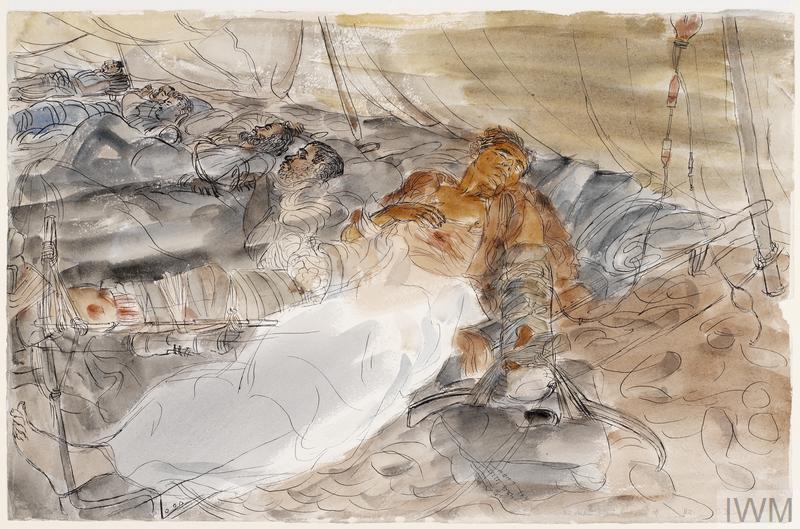
The Battle of Egypt, 1942: New Zealand and Indian Infantry Casualties (Art.IWM ART LD 2722) image: Interior of a tent with casualties lying on stretchers, main figure with arm and leg in makeshift
traction Copyright: © IWM. Original Source: http://www.iwm.org.uk/collections/item/object/11555

For the Western Front I’ve experimented with how to bring together the systems of evacuation that were put in place (with all their delays and dangers, imperfections and improvisations) with the wounded bodies that were moved through them, and – as regular readers will know – I’ve tried to incorporate the imbrications of those bodies with the changing and highly variable technological apparatus that made all this possible.  You can see some of my first attempts in Anatomy of another soldier

At the end of that essay, I worried about two issues: an anthropomorphism and a functionalism (in which everything that is pressed into service works inexorably to carry the soldier through the evacuation chain).

The spur for all this was Harry Parker‘s remarkable Anatomy of a soldier (see here and ‘Object lessons‘: DOWNLOADS tab), about the experience of a young British soldier who suffers traumatic blast injuries from an IED in Afghanistan.

But I’ve now found another, much earlier example that speaks directly to my work on North Africa.  And while the anthropomorphism remains a problem, as you’ll see the functionalism is much less secure – and for that very reason.

I’ve just finished Christopher Landon‘s Ice-Cold in Alex, a novel published in 1957 that provided the basis for J. Lee Thompson‘s celebrated film the following year, starring John Mills, Harry AndrewsSylvia Sims and Anthony Quayle.  (For a reading of the film, see Michael Leyshon and Catherine Brace, ‘Men and the desert: contested masculinities in Ice Cold in Alex’, Gender, place and culture 14 (2) (2007) 163-182).

The story describes a desperate drive in a British military ambulance from Tobruk, where the Afrika Korps is closing in, across the trackless desert to safety in Alexandria (and to a bar where the beer is always ‘ice-cold’).  Landon served with the 51st Field Ambulance and the Royal Army Service Corps in North Africa during the war, and knew what he was writing about.

Before the party sets off, Landon describes the Sergeant-Major lying underneath a lorry:

‘Above him, the bowels of the engine – gleaming crankshaft and loosened connecting rods , tied to the sides of the crank-case with wire – seemed to be grinning.  It was a challenging grin – “what’s wrong with me?”  He started back, up at the glint of metal, framed in the black space where the sump had been removed.  “It’s easier for doctors,” he thought.  “Patients can talk.  But machinery goes on uncomplaining, until it breaks.”‘

Later he has a similar conversation with one of the nurses they have been ordered to escort to Alexandria:

‘”Not so difficult, or different from your job.  They’re like humans, really.  If you give them the right food and drink – a dose occasionally – and don’t overwork them, they obey all the rules.”  He was moving the fan blades to and fro, feeling with the other hand behind it.  “The only trouble – and difference – is they can’t talk.  So that by the time you know they have a pain, it’s usually too late.”

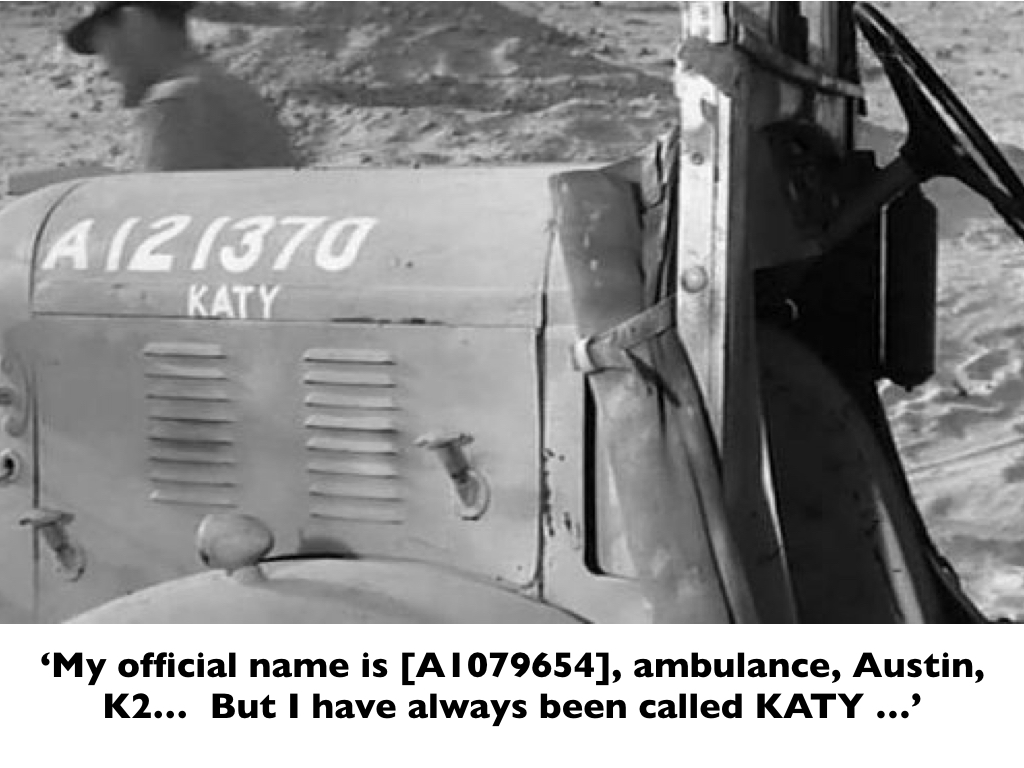
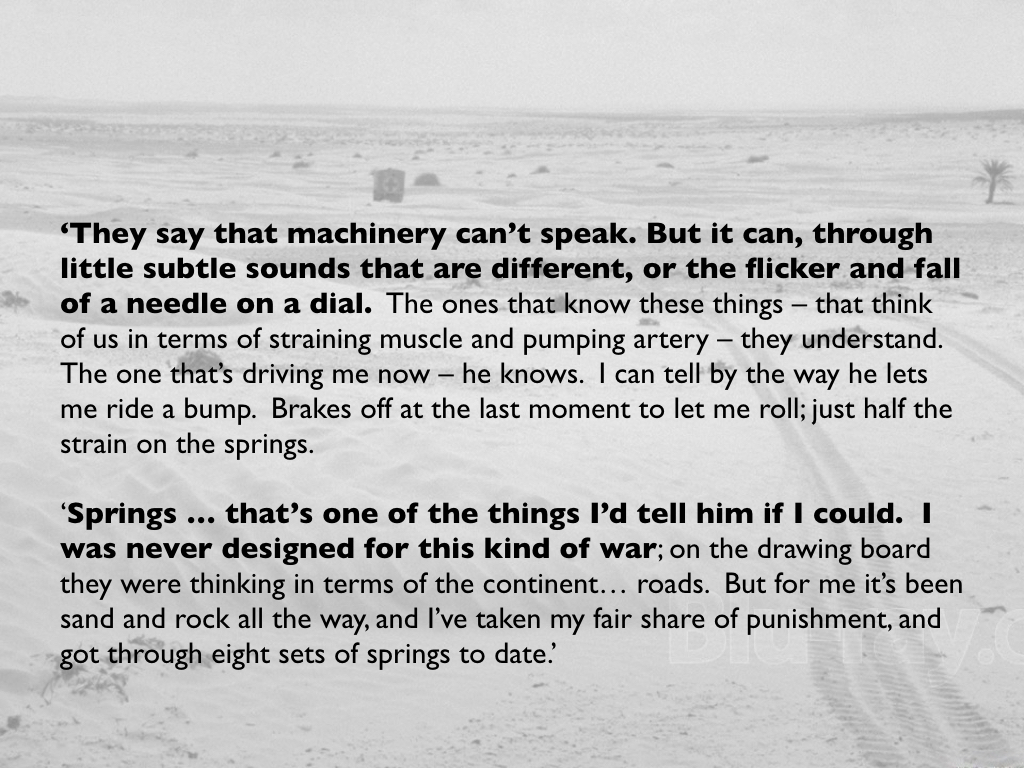
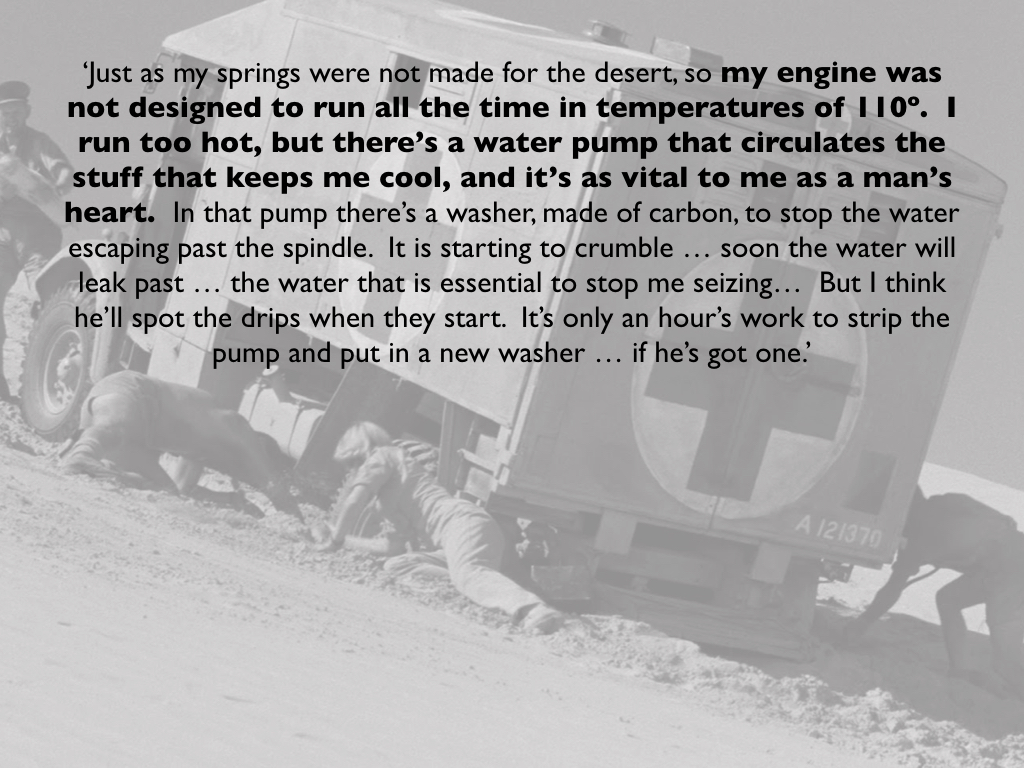
But between these two passages Landon has given the ambulance a voice.

I’m going to be rehearsing these issues at a seminar tomorrow at the Wall – I’ll be interested to see how this year’s Scholars can  help me think this through….  And I’ll be posting more about my work on the Western Desert in the months ahead.

Aerial violence and the death of the battlefield

UBC’s term started last week, but I was in Nijmegen so I’ve started this week.  I’ve posted the revised outlines and bibliographies for my two courses this term under the TEACHING tab.

I was primarily in Nijmegen to give a ‘Radboud Reflects’/Humboldt Lecture.  As usual, I had a wonderful time; I’ve pasted the abstract below – though this was written before I had put the presentation together, so it doesn’t incorporate the closing section at all (“Geographies of the Remote”).  It draws, in part, on my Tanner Lectures, “Reach from the sky“, but it also incorporates new material [see, for example, my reflections on the Blackout here].

You can download the slides as a pdf here: GREGORY War at a distance Aerial violence and the death of the battlefield [this version includes several slides that I subsequently cut to bring the thing within bounds], and the video version will be available online shortly.

War at a distance: aerial violence and the death of the battlefield

Christopher Nolan’s film “Dunkirk” is remarkable for many reasons, but prominent among them is the fact that, as the director himself notes, ‘we don’t see the Germans in the film… it’s approached from the mechanics of survival rather than the politics of the event.’ This raises a series of important questions, but central to any understanding of aerial violence is precisely what can be seen and what cannot be seen: what can those crouching under the bombs see of the perpetrators, and what can those carrying out the strikes see of their targets? You might think this becomes even more important when war is conducted at a distance, but the history of military violence shows that ‘distance’ is a complicated thing…

The first large-scale use of aircraft for offensive purposes (rather than surveillance) was on the Western Front during the First World War, when aircraft were used to ‘spot’ targets for artillery and eventually to conduct bombing operations on the battlefield. But more consequential was the use of aircraft and airships to conduct bombing raids far beyond the battlefield, on cities like London and Paris, because this brought civilians directly into the line of fire and in doing so started to dissolve the idea of the battlefield [what Frédéric Mégret calls ‘the deconstruction of the battlefield‘] and to assault the very concept of a civilian. The bombing offensives of the Second World War, especially in Europe and Japan, accelerated this dismal process, but they also reveal a deadly dialectic between intimacy and domesticity (the effects on everyday life on the ‘home’ front) and abstraction (the way in which targets were produced and made visible to bomber crews).e

That same dialectic reappears in today’s drone operations over Afghanistan, Iraq, Syria, Somalia, Yemen and elsewhere. But these new technologies of ‘war at a distance’ have their own history that overlaps and intersects with the story of manned flight. Indeed, the dream of ‘unmanned’ flight soared in lockstep with the dream of those extraordinary flying machines. This too goes back to the First World War, when inventors proposed ingenious aerial vehicles whose ‘bomb-dropping’ would be controlled by radio. These proved impractical until after the Second World War, when drones were used by the US to photograph and collect samples from atomic clouds in the Marshall Islands and Nevada [see here and here]. The over-arching principle was to protect American lives by keeping operators at a safe distance from their targets, and this is one of the logics animating contemporary drone strikes (‘projecting power without vulnerability’). But for this to work new technologies of target recognition as well as mission control were required; these were first developed during the Vietnam War, when the US Air Force tried to ‘wire’ the Ho Chi Minh Trail and connect its sensor systems to computers that would direct aircraft onto their targets (or, rather, target boxes).

The Pentagon looked forward to the installation of an ‘automated battlefield’ on a global scale [see my ‘Lines of Descent’, DOWNLOADS tab]. Although its plans were premature, the subsequent development of targeted killing using Predators and Reapers has since completed the dissolution of a distinctive battlefield: the United States Air Force boasts that it can put ‘warheads on foreheads’ and the US has claimed the right to pursue its targets wherever they go, so that (in Grégoire Chamayou’s words) ‘the body becomes the battlefield.’ These targeted bodies are at once abstract – reduced to digital traces, the products of a global system of intelligence, surveillance and reconnaissance – and yet at the same time, by virtue of the high-resolution full-motion video feeds used to track them, peculiarly intimate to those that kill them. Drone pilots operate their aircraft from thousands of miles away, yet they are much ‘closer’ to their targets than pilots of conventional strike aircraft: previously, the only aerial vehicles to approach this level of intimacy, and then but fleetingly, were the Zeppelins of the First World War. But this intimacy is conditional and even illusory, and case studies [see here, here and here] show that as the battlefield transforms into the multi-dimensional battlespace the very idea of the civilian [see here and here] is put at increased risk.

All of this will appear, in extended and elaborated form, in my new book, also called “Reach from the sky”.