The politics of drone wars

I’m in the UK this week for – amongst other things – a seminar with Pete Adey, Sara Fregonese and some of the Geopolitics and Security students at Royal Holloway on my bombing project, Killing space; a workshop at Open Democracy for a new series on Cities in Conflict to be curated by Tom Cowan; and a lecture at Nottingham organised by Steve Legg: another outing for “Deadly Embrace”.

At the RHUL meeting the conversation frequently turned to drones; Pete made an audio recording of it, and I think at least part of what we discussed will appear on the Theory, culture & society website in the near future.  But I’d like to try to set out some of my own puzzlements and positions about the politics of drones here.

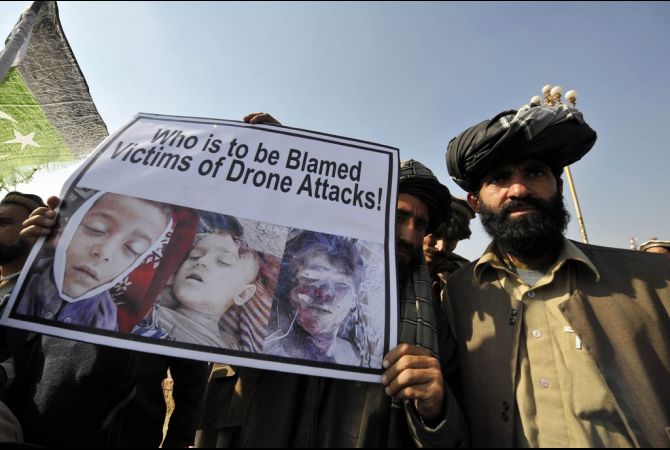
There are many ways in which individuals can take a stand against war, and there is a long and principled tradition of conscientious objection that includes pacifists in two World Wars through young Americans who resisted the draft in the 1960s and 70s to high school students in Israel who refuse to serve in the army of occupation.  In recent times most popular mobilisations against war have been against particular wars – I’m thinking of the demonstrations against the wars in S.E. Asia in the 60s and 70s, for example, or the millions of people who took to the streets to express their opposition to the US-led invasion of Iraq in 2003 – or against particular objects of violence: campaigns to ban land mines or cluster munitions, for example.  To me, the most effective political response to the use of Predators, Reapers and other UAVs in Afghanistan, Pakistan, Yemen, Somalia and elsewhere is to move between the two: to use the drone to draw publics into an apprehension of the wider fields of military violence in which they are deployed.
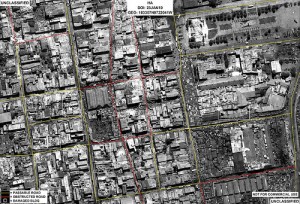
Global Hawk imagery of aftermath of Haiti earthquakeI think it is a mistake to focus on the object itself because, like all objects, a drone is highly unstable: it’s not a fixed, determinate ‘thing’ but its capacities and dispositions depend on the network or assemblage in which it is embedded. To see what I mean, begin by stripping the bombs and the missiles from these platforms: at present most drones are used for intelligence, surveillance and reconnaissance (ISR), and these capabilities extend far beyond the domain of offensive operations and even beyond those of the military.  In 2010 US Southern Command used a Global Hawk to provide detailed imagery of the damage caused by the Haiti earthquake (above) and the following year another Global Hawk was deployed to assess the damage to the Fukishima Daiichi nuclear plant in Japan; other, smaller and far less sophisticated drones have been used to monitor wildfires in California and to track and disrupt Japanese whaling fleets, while a series of other, broadly ecological-humanitarian projects have been proposed with varying degrees of plausibility.  I don’t rehearse these other possibilities to minimise the military and paramilitary uses of the technology – and we surely know, not least from Nick Turse‘s account in The Complex, that the military and the civilian have become ever more hopelessly entangled with one another – and neither am I indifferent to the blurring of military power and NGO relief operations in the humanitarian present,  but we need to acknowledge, to paraphrase Clive Barnett, that not all ISR operations are sinister: ‘presumptively illegitimate, undemocratic or suspect‘.
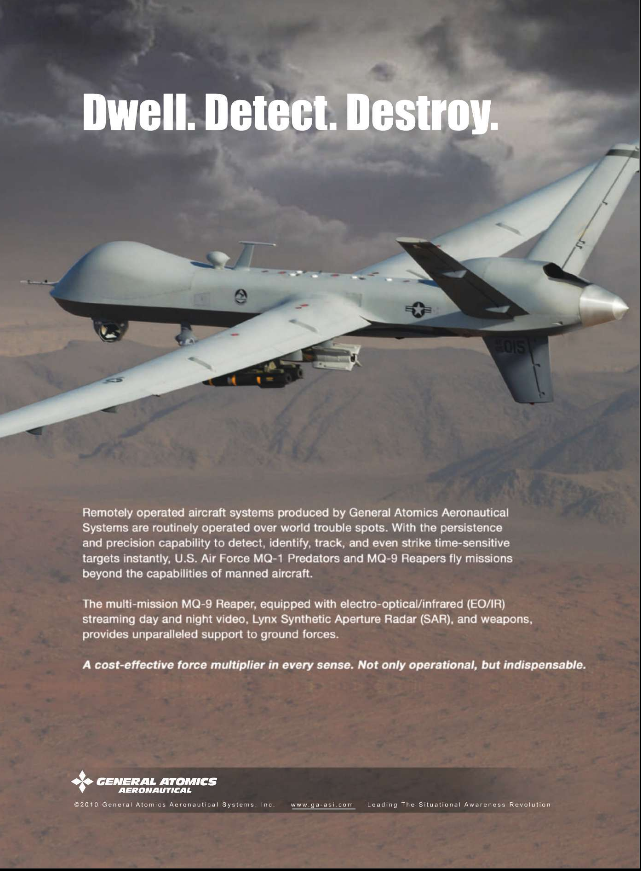
Dwell Detect Destroy drone ad

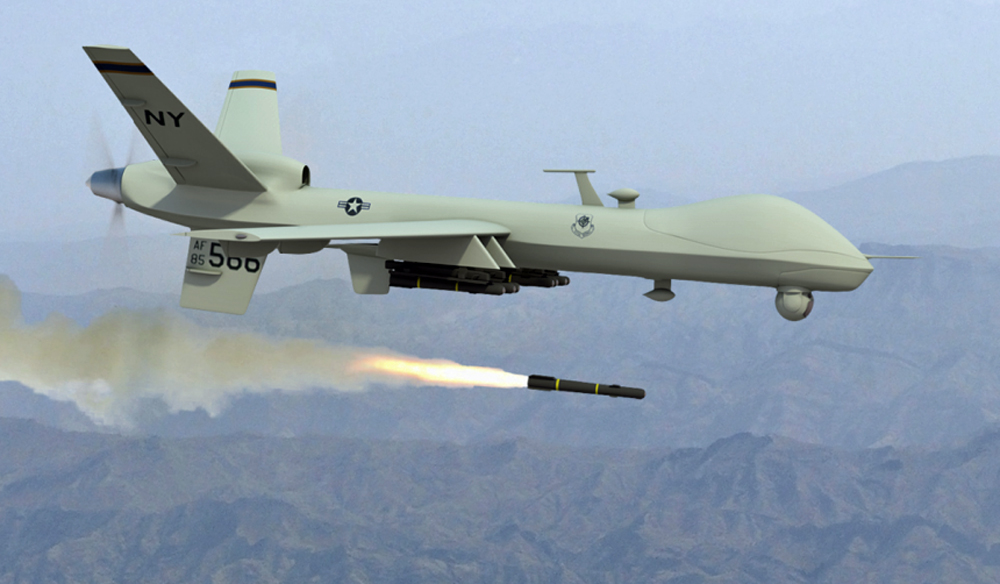
Hellfire missile launch (USAF)This is why Drone Wars UK focuses on ‘armed drones’ and Drones Watch on ‘killer drones’.  It’s clear that militarised ISR is part of a continued ‘rush to the intimate’ that is profoundly invasive and, on many occasions, extraordinarily violent. In Afghanistan the US military embeds its UAVs in a networked kill-chain in which their near real-time, high-resolution, full-motion video feeds are routinely used to call in attacks from conventional strike aircraft.  So let’s now put the bombs and missiles back on these platforms, since the Predators and Reapers are usually armed and their manufacturers boast about their capacity to compress the kill-chain: to ‘dwell, detect [and] destroy’. But it then makes no sense to object to the strikes carried out directly from them and to exempt those carried out by conventional means across the network: what is the difference between a Hellfire missile launched from a Reaper and one fired from an Apache helicopter gunship?  (To put this in perspective, according to the most recent airpower summary, USAF Predators and Reapers directly accounted for just 5-6 per cent of its ‘weapons releases’ in Afghanistan in 2009, 2010, and 2011, though the proportion climbed to 9.25 per cent in the first ten months of 2012).
Medea BENJAMIN Drone WarfareTo answer that question critics usually cite the horror of death at a distance.  This is death from thousands of miles away, conducted by operators in the continental United States: ‘killing by remote control’.  And yet there are countless other ways in which militaries have been killing from ever increasing distances ever since the invention of the slingshot and the longbow. If you insist that it is wrong to kill somebody from 7,500 miles away, then over what distance do you think it is acceptable?  If you are determined to absolutize distance in this way, then don’t you need to consider all the other ways in which advanced militaries are able to kill their adversaries (and civilians) without ever seeing them? Again, I don’t raise the spectre of Cruise missiles launched from ships hundreds of miles from their targets, the US ‘Prompt Global Strike’ capability and its Advanced Hypersonic Weapon which is ultimately  intended to hit a target anywhere on the planet in under an hour, or the prospect of ‘frictionless’ cyberwarfare, to minimise the deaths caused by drones.  I simply want our politics to apprehend the larger field of military violence in which they are deployed.

And there is something different about those deaths that draws us back into the killing fields.  I should say at once that I don’t think this is simply war reduced to a video-game – and in any case there are many other military technologies that also depend on hand-eye co-ordination, multi-tasking and spatial acuity, all skill-sets valorized by video-games – but I also think it a mistake to assume that the screen effectively insulates the viewer from the victim.  In this sense there is a parallel between the platforms, because video-games are profoundly immersive, and those who call in or carry out these strikes insist that they are not 7,500 miles from their targets at all (and Launch & Recovery crews are much closer than that) but ‘eighteen inches away’: the distance from eye to screen.  It’s a highly selective process of compression; as I’ve shown in detail in Lines of descent (DOWNLOADS tab), those involved in the remote kill-chain typically feel remarkably close to their own troops on the ground and remain distant from the life-worlds of the population at large (which in part accounts for the civilian casualties when drones are used to provide close air support).  But unlike most other forms of distant death and destruction, the pilots, sensor operators and others who are networked into these kill-chains can see their targets up close – even if their ‘seeing’ is techno-culturally conditioned and often predisposes them to treat innocent actions as hostile intentions – and they typically remain on station to carry out a ‘bomb damage assessment’ and so see for themselves, often in hideous detail, what they have done.

Flying an MQ-9 Reaper over Kandahar, Afghanistan

The most consequential change is that these new modes of air power deal not in the area bombing of cities like Cologne, Hamburg or Dresden, or the blind bombing of target boxes over the rainforests of Vietnam, Laos and Cambodia, but – in addition to close air support – in the calculated assassination of individuals or groups: so-called ‘targeted killing‘ or what the USAF calls putting ‘warheads on foreheads‘.  This does not mean that the firebombing of cities in the Second World War should become the moral standard against which we judge contemporary military violence. On the contrary, targeted killing raises its own grave legal and ethical questions – and, not incidentally, those video feeds have given military lawyers a pivotal role in these newly networked strikes – that in turn activate two other no less serious concerns about the emergent geographies of fields of military violence.

First is the fear that the use of remote platforms lowers the threshold at which military violence will be launched.  Predators and Reapers are much cheaper than conventional strike aircraft, and if there are no troops on the ground, there are no body bags to come home.  In short, drone war threatens to become risk-transfer war hypostatised; the risk is transferred wholly to the adversary population.  But at present these platforms have high failure rates – they are vulnerable to weather conditions (and I don’t mean hurricanes and monsoons, I mean clouds), they crash all too frequently and they are so slow and noisy that they can easily be shot down so they can only be used in uncontested airspace.  These limitations mean that, at present at any rate, they are less likely to incite conventional state-on-state war – though there is certainly a global arms race to acquire and develop far more advanced drone technologies.

Second and closely connected is the fear that they make it much easier to engage in war by stealth.  If one of the primary foreign policy challenges of the last Bush administration was ‘conducting war in countries we are not at war with‘, Obama’s version is the determination to wage what Martin Libicki calls ‘non-obvious warfare’: hence the Obama administration’s preference for remote operations, Special Forces and cyber-attacks.  To be sure, there are degrees of obviousness: the drone attacks in Pakistan, Yemen, Somalia and elsewhere are hardly covert – since they are hidden in plain sight – but they are, within limits, more deniable than the deployment of thousands of ground troops and so inherently less accountable to the various publics involved in them.  And in all these cases Predators and Reapers dramatically heighten the asymmetry involved in military and paramilitary operations against non-state actors, where they have made a policy of ‘kill’ rather than ‘capture’ a much more tempting (and much more pernicious) US counter-terrorism strategy.

More to come.

Judith Butler and the analytics of power

Claire Pagès and Mathieu Trachman conduct a concise but wide-ranging interview with Judith Butler at Books & Ideas, in which she asks this about neo-liberalism and the economic:

‘[I]f we claim that neo-liberalism disposes populations to become disposable, and exposes populations to precarity, we have to ask whether we are speaking about a purely economic rationale and regime of power (by “ neo-liberalism ”), a regime of power that governs the practices of subject-formation, including self-making, and the valorization of the metric of instrumentality in ways that include and exceed the sphere conventionally denoted as “ economic ”.  Indeed, does the power and pervasiveness of “ neo-liberalism” compel us to think about the heteronomy of the economic and the way that the rationalities that govern its operation exceed the purely economic. Must we give up an idea of the purely economic by virtue of neo-liberalism at the same time that we cannot do without the economic?’

Judith Butler, Parting Ways (2012)Incidentally, readers who have followed the sometimes repellent response to Judith’s receipt of the Adorno Prize can find her speech at the award ceremony in Frankfurt on 11 September  – ‘Can one lead a good life in a bad life?’ – here (I think this is the Radical Philosophy version, with images that speak to the controversy) or, in unadorned form, here.

You can also find details of her new book, Parting ways: Jewishness and the critique of Zionism (Columbia University Press) – which, in its closing chapter, engages with Edward Said and Mahmoud Darwishhere.  Like all her work, this book – which also includes reflections around Arendt, Benjamin and Levinas – admirably fulfils her own beautifully understated view of what it is to be critical: that is, to be ‘willing to examine what we sometimes presuppose in our way of thinking, and that gets in the way of making a more livable world.’

‘The cartography of one man’s consciousness’

POWERS The Yellow BirdsKevin Powers has won the Guardian‘s First Book Award for The Yellow Birds, widely praised as one of the finest American novels to have come out of the Iraq War.   Powers enlisted when he was just 17 and served as a machine-gunner in Iraq in 2004-5; the title of this post comes from the novel, but the title of the novel comes from a US Army marching song:

 “A yellow birdWith a yellow bill/

Was perched upon/ my windowsill.

“I lured him in/With a piece of bread/

And then I smashed/His fucking head.”

Writing in Time, Nate Rawlings begins his interview with Powers with an observation that speaks to my own work on war at a distance:

War has always been a strange and distant endeavor, brought home from the battlefields in letters, photographs and stories after the guns fell silent. Then beginning with the war in Vietnam, images of battlefield violence were beamed into our homes; you’d be hard pressed to find an American with a television who hasn’t seen images of troops battling in Iraq and Afghanistan. But after 11 years of war, the challenge is to make people truly understand that experience.

That was Powers’ starting-point too: he wanted to find an answer to the question he was constantly being asked: ‘What was it like over there?’  Yet he soon determined that, even in fictional form, he couldn’t do it: ‘War is only like itself’, he writes.  That terse phrase circles back to an inquiry into war and representation – representations in war and representations of war – that is focal to any understanding of contemporary conflict: an inquiry that will, inevitably, need to confront the labile limits of representation itself.  (And that is not a surreptitious bugle call for non-representational theory to gallop over the horizon to the rescue).

Minimally, The Yellow Birds is about memory and violence, about the landscape of death and the lingering foulness of war.  The protagonist of the novel is Private John Bartle, who promises the mother of Private John Murphy that he will bring him back alive…  There are thoughtful reviews from the Guardian’s John Burnside here, from Elizabeth Samet here – she’s a professor of English at the US Military Academy – and from Benjamin Percy here, and a (better) interview with Powers here.

At Slate, Jacob Silverman locates The Yellow Birds alongside three other novels from the wars in Iraq and Afghanistan.  He doesn’t like its lyricism – Powers is a poet, and it shows – but he makes a more telling point about all four novels:

‘These new American wars have bred manifold types of isolation. Here, actual indigenous peoples are rare, whether enemy or civilian; the one named Iraqi that appears in The Yellow Birds is killed almost as soon as he’s introduced. There is little attempt to explore the perspectives of the very people these wars are being waged upon.’

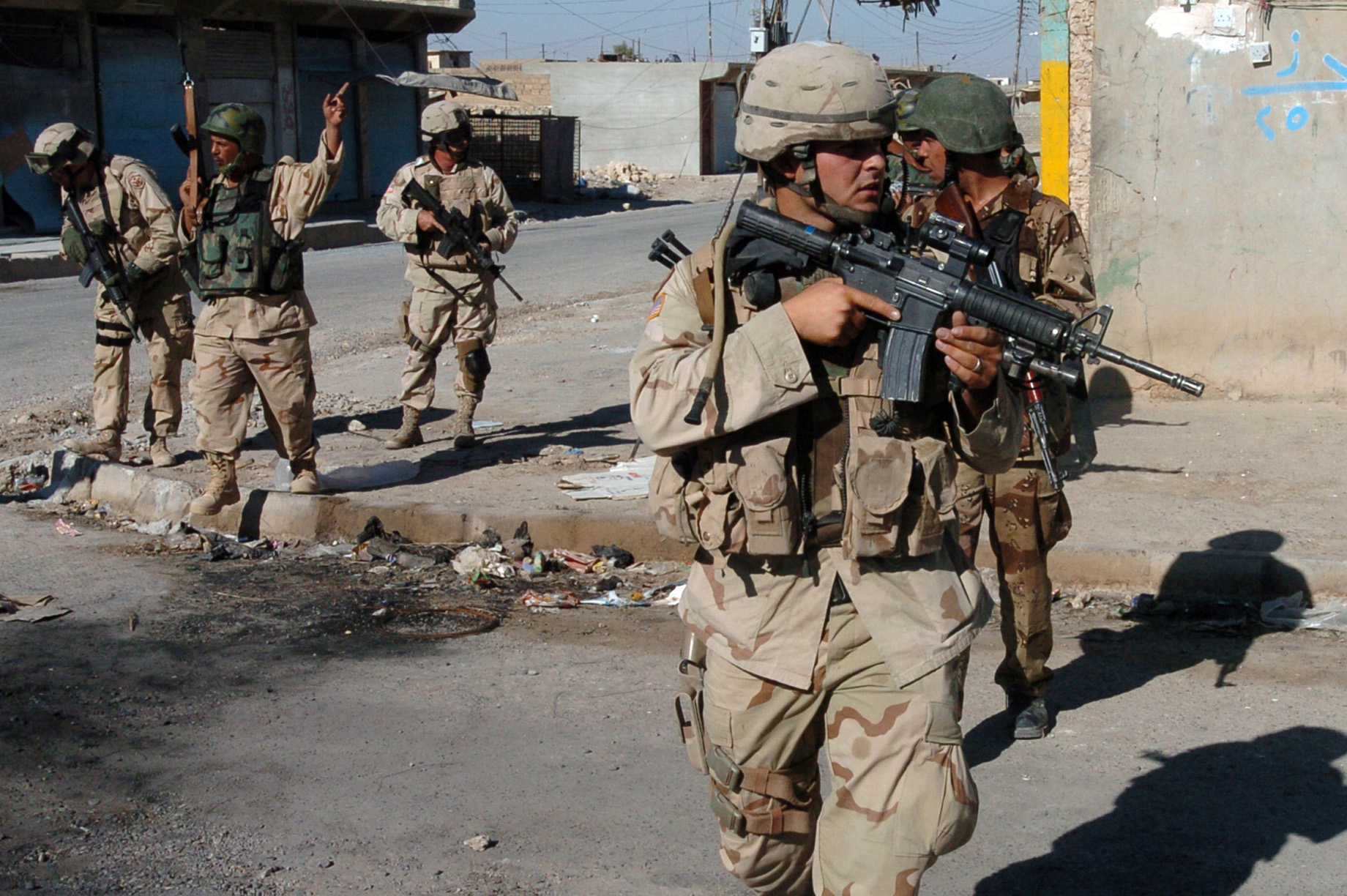
US patrol in Tal Afar, September 2005

That’s true of so many novels from other wars too, but the point is all the sharper because Powers’ novel takes place, in part, in Tal Afar: one of the key sites from which the US Army traced the ‘cultural turn’ that was to be enshrined in its new counterinsurgency strategy.  Powers left there in the spring of 2005, by which time Tal Afar was being described as ‘the next Fallujah’.  But – according to George Packer at any rate – the tide was about to turn.   In one of his Letters from Iraq, ‘The Lesson of Tal Afar‘, Packer recorded the words of one US officer who, twelve months on, had been working the fragile contact zone between the US Army and different groups in the local population:

“History teaches you that war, at its heart, is a human endeavor. And if you ignore the human side — yours, the enemy’s, and the civilians’ — you set yourself up for failure. It’s not about weapons. It’s about people.”

War is about apprehending those ‘people’ in distinctive and differentiated ways, to be sure, but it’s also about apprehending the landscape in embodied ways that transcend the maps and jottings of today’s Human Terrain Teams.  Here The Yellow Birds excels, and for a reflection on the sensuous, visceral landscape of an earlier Iraq war, one described in Anthony Swofford‘s Jarhead, you can’t do better than read Geoffrey Wright‘s fine essay, a sort of corpo-cartography of the combat zone, in  ‘The desert of experience: Jarhead and the geography of the Persian Gulf War’, PMLA 124 (2009) 1677-1689.  He addresses the later Iraq War in ‘The geography of the combat narrative: unearthing identity, narrative and agency in the Iraq War’, Genre XLIII (2010) 163-90.

And I do recommend reading The Yellow Birds too…

The new peace

The text of a lecture given by Mary Kaldor, Professor of Global Governance at the LSE,  at Tufts University on October 2012, when she was awarded the Dr Jean Mayer Global Citizens Award, named for Tufts’ former President and Chancellor.  The lecture also coincided with the publication of the third edition of Kaldor’s New and Old Wars: organized violence in a global era.

She emphasises that this lecture is a work in progress, a way-station en route to a book she is writing with Christine Chinkin, Professor of International Law who is also at the LSE.  Building on her discussion of ‘new wars’, and on her collaboration with Shannon Beebe, The ultimate weapon is no weapon: Human security and the new rules of war and peace, Kaldor argues for a ‘new peace’ in these terms:

I am arguing for international law that prohibits the use of force, as in domestic contexts, except in the very limited case of individual self-defence. The only argument for the international use of force is the scaling up of individual self-defence, e.g. genocide or massive violations of human rights. But in this case, the conduct of force is not the same as war-fighting. It is defensive, aimed at protection. Those responsible for the attacks are to be arrested where possible rather than killed. Any international use of force would take place under the authority of a reformed United Nations Security Council. Such an approach would require something like international emergency services rather like in a domestic context, we have police, fire fighters and emergency medical services.

In case this sounds excessively utopian, it is worth noting that something along these lines has been developing in parallel with the War on Terror. All sorts of new techniques have been developed in wars in the Balkans and Africa – safe havens, humanitarian corridors, the establishment of courts to try war crimes. New types of security capabilities are being developed by the European Union and in the thinking about civilian protection in the United Nations. New commitments to humanitarian intervention or Responsibility to Protect have been adopted by the African Union. Many international missions, not all successful of course, have been taking place alongside the War on Terror and have involved a learning experience. We tend to focus on Iraq and Afghanistan because they are so visible but they may well turn out to be exceptions as a consequence of a more traditional war-fighting military intervention.

To put it more simply, in difficult situations like for example Syria, it is important to identify an alternative between old-fashioned military intervention where the aim is to win and where many get killed and there is a risk of escalation, and doing nothing. Or in the case of the War on Terror, it is about taking the problem of terrorism seriously. When terrorists are treated as enemies in a war, they are elevated and legitimised. In the case of the drone attacks, for example, it is not just a problem that mistakes are made and civilians sometimes get killed, more importantly, it escalates the violence. It provides an argument and justification for mobilising more recruits to extremist causes. What I worry about is that the combination of the economic crisis and what is happening the Middle East could portend a spreading protracted new war in large parts of the world.

I think there is a slippage between the first and last paragraphs of this extract: to claim that, in the circumstances Kaldor outlines, ‘the conduct of force is not the same as war-fighting’ is to ring-fence ‘war’ in ways that are increasingly problematic, as that last sentence concedes.  And to assume that a re-calibrated international law can somehow insulate the one from the other is utopian, isn’t it?

Just looking (and shooting)

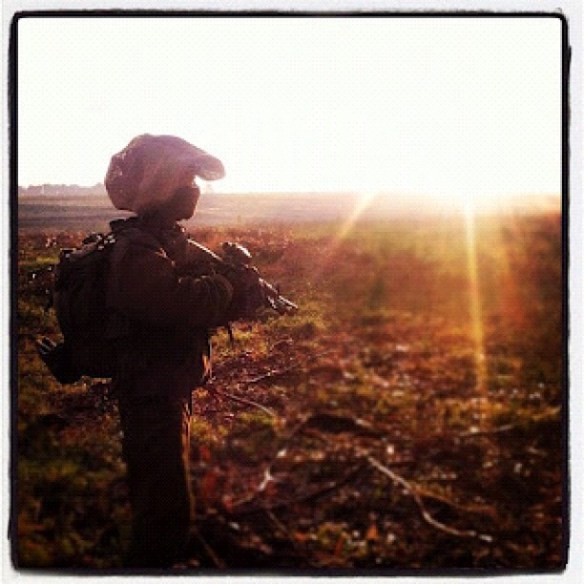
I had just finished jotting my update to the IDF’s use of social media when Alex Vasudevan drew my attention to this brilliant, searing and deeply disturbing essay by Huw Lemmey at the New Inquiry, ‘Devastation in Meatspace’:

The missile rushing over your head was processed through an Instagram filter just hours previously. As you see it pass out of sight behind the apartment block opposite some young conscript is preparing for video footage of it to be compressed and uploaded to YouTube before the hour is out. By nightfall tonight that explosion which just shook your neighborhood, in one of the most densely populated areas on earth, will have been liked over 8,000 times on Facebook. Welcome to Gaza City.

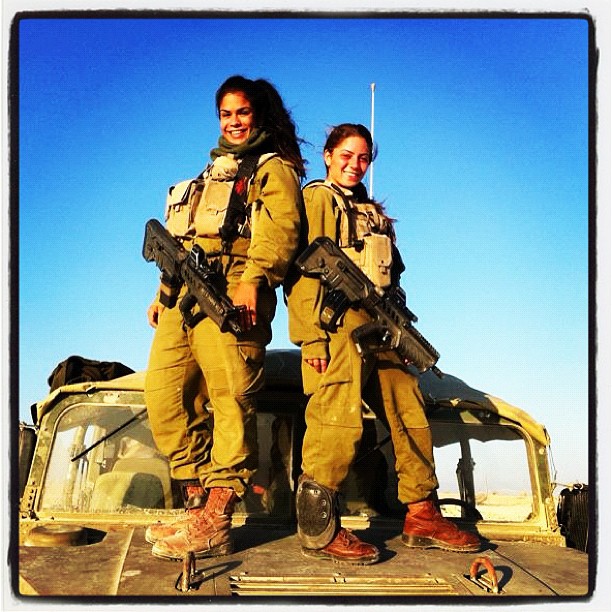
In a previous post I’d objected to the way in which some commentators advertised social media as a new way to ‘consume’ war, but  – riffing off Eyal Weizmann‘s Hollow Land –  Lemmey focuses not on the Twitter streams but on the visualizations disseminated across these digital platforms: see, for example, the IDF’s Instagram page here (and look at the comments too); more here.  You can also find a selection over at Business Insider where Geoffrey Ingersoll describes them as ‘gorgeous’, and another selection at Moral Low Ground, which reads them rather differently.

Commenting on these images, Britney Fitzgerald at the Huffington Post simply sees them as ‘the world’s newest form of war reporting” – though she does note that the ‘intimacies’ that Israel puts on display through Instagram are radically different from those with the hashtags #gaza and #palestine – but Lemmey (who describes himself as a print maker and studio technician) provides a much more compelling reading.  He shows that the IDF images do indeed resonate with a consumerist ideology – climactic versions of the desiring gaze and the lust of the eye – that has become integral to the way in which late modern war is fought:

‘[T]he [IDF] use of commercially available instagram filters replicates the visual culture favoured by much of its audience, producing images that slip easily into their feeds, naturalising the content. “These are the photos you would take if you served in the IDF,” the aesthetic says, “we are just like you, and these military decisions are the ones you would take, if you were in our situation.” They also step beyond this, including an aspirational aspect of a desirable lifestyle — impossibly handsome young troops, having fun on their downtime. This is a fighting force at play as imagined by Wolfgang Tillmans and BUTT magazine, a million miles from an occupying force…. Liking and sharing IDF visual material becomes no more controversial than sharing your favourite Nike campaign — not a matter of politics, let alone ethics, but just another part of the construction of your online persona….’

‘Like many of the more advanced lifestyle brands, the IDF are shifting the focus of image production from their own staff and creative team toward their consumers: in this case, the troops, reservists, and supporters of the IDF. Content is aggregated from individuals and fed back into the social networks of the target audience. In many ways this is an advanced form of brand-management for a such a large institution; it shows a willingness to trust the audience, allowing them to define the brand, making IDFgram perhaps the first crowdsourced propaganda campaign for a state military but also one whose identity is ever more meshed with that of its troops and supporters, emulating fashion and lifestyle brands’ movement toward consumer-led campaigns. Here the IDF becomes the avatar of a thoroughly Western consumer identity. The distance between our own lives and those of the men and women who fight in the IDF becomes ever shorter and more compressed; in collapsing this distance, the grainy and pixelated images of the Palestinian subject become more distant. This is the IDF campaign for control of the virtual environment, interjecting its brand identity into the slivers of human interaction online and thus attempting to occupy a greater portion of the market share for geopolitical allegiance.’

Lemmey says much, much more than this: please read the whole essay.

BTW: IDF stands for ‘Israel Defense Forces’, so naturally none of this should be confused with IDF Marketing, where ‘IDF stands for Innovative, Digital, Foundations’: it’s an Irish company with no connection with the Israeli military.  In case you’re now thoroughly confused, here is Arwa Mahdawi on the marketing of Israel:

Ever since it officially came into existence in 1948, Israel has gone methodically about the creation of a “Brand Israel”. This originally began with an emphasis of the religious significance of a state for the Jewish people. Then, in 2005, when it was time for a rebrand, the Israeli government consulted with American marketing executives to develop a positioning that would appeal to a new generation: an Israel that was “relevant and modern” rather than a place of “fighting and religion”. So Israel did some pinkwashing, and suddenly became a vocal champion of gay rights. It fought to retain cultural ownership of falafel, hummus, and Kafka. It poured millions of dollars into tourism campaigns that sought to replace imagery of wartorn landscapes with sun-kissed seascapes.

When it comes to winning modern wars, a robust marketing campaign is as important as a military campaign.

Saving Face(book)

An update to my post on the use of social media in Israel’s latest assault on Gaza: at the Middle East Research and Information Project (MERIP) Rebecca Stein provides an important historical perspective on the IDF’s mobilisation of these digital platforms and the resistance from senior commanders to resorting to a ‘digital vernacular’:

Even as the IDF labors to speak in a language that will be intelligible to the general public, largely abandoning traditional forms of military jargon, its Facebook and Twitter practices remain committed to the foremost military mission — that of asserting control over social media’s highly interactive field.

Rebecca also draws attention to the ways in which these military mobilisations complicate the ‘digital democracy’ narrative that emerged in the wake of the Arab uprisings.

I talked about this briefly in my essay on Tahrir Square, where I noted that it was not only the Israeli military that was learning from those events.  As Lt Col Brian Pettit put it, ‘the Arab Spring has profound implications for the US Special Operations mission of unconventional warfare’ that need to be incorporated into ‘theory, doctrine and training’.  He argued that standard ‘red force tracking’ in which the enemy is caught in a net of electronic surveillance should now be complemented by ‘social tracking’ in which social media are monitored and even enlisted.  The standard image of unconventional war, the same officer concludes, is of ‘underground resistance leaders meeting with US advisers, clustered in a dark basement around a crumpled map, secretly organizing and planning their next tactical move.’  But this is now incomplete, and future operations will need to enlist ‘a scattered network of digerati, all texting, tweeting, posting and hacking from thousands of locations.  Publicity is as paramount to the success of the digerati as is secrecy vital to the success of the traditional underground resistance cell.’  As I noted at the time, it’s not difficult to work out ‘which ‘resistance leaders’ were likely to be meeting with US advisers, nor the bodily consequences for those on the other side of the street.

But using social media is only one part of military strategy.  Writing in Joint Forces Quarterly early in 2011, Lt Col Thomas Mayfield had already accepted that ‘aggressive engagement in the social media environment can aid the commander in winning the information fight’  – bizzarely he pointed to the IDF’s ham-fisted use of social media during its previous assault on Gaza in 2008-9 – but his first priority was to monitor the use of social media to enhance ‘situational awareness’.  For a Canadian/NATO perspective on media monitoring, here is Bruce Forrester from Defence R&D Canada at Valcartier on ‘Social Media Exploitation Tools’ after the Arab uprisings.

If this is all too depressing for you, then try Richard Poplak who provides a different take on the IDF’s most recent attempts to use Facebook to save face…

Bomb Sight

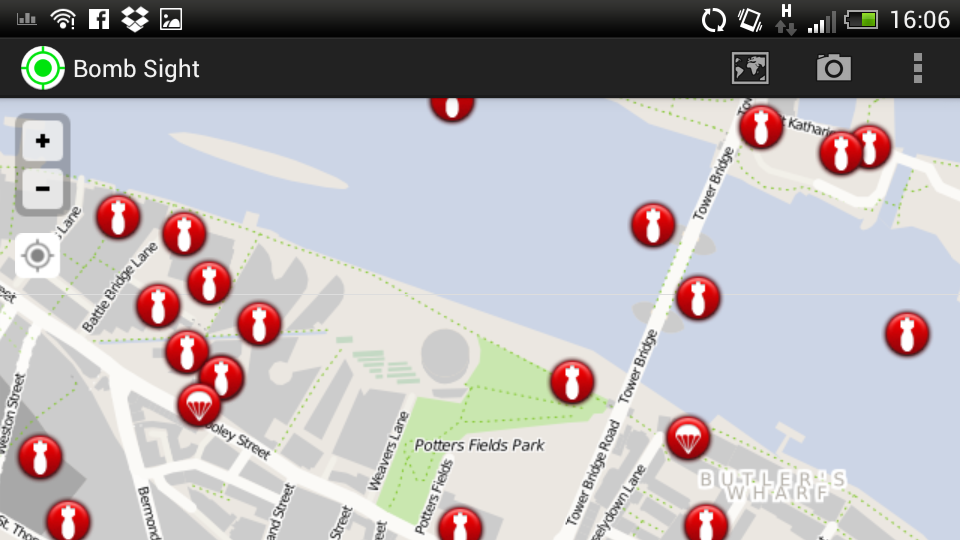
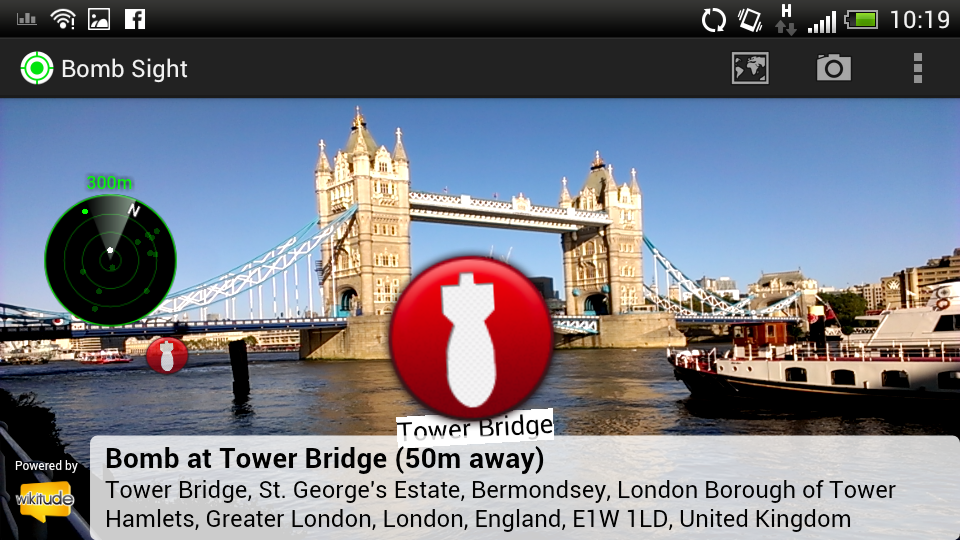
Another pre-script…. Last week I noted two projects that aimed to bring drone strikes to your smart phone, but here’s one that promises to do the same for the London Blitz.  Developed by researchers at the University of Portsmouth led by Kate Jones, in conjunction with the National Archives, and working from the official wartime Bomb Census, Bomb Sight uses web and mobile mapping technology to ‘bring to life [sic] the maps that demarcate the location of [31,000] falling bombs during the London Blitz between October 1940 and June 1941.’  It’s a truly remarkable project that intends to link the sites on the map to photographs, eye-witness accounts and memories.

The project is being developed for the Android platform but there is apparently the future possibility of porting to the iPhone – assuming that Apple doesn’t find this as objectionable as it did Josh Begley‘s Drones+ app (I’m betting it won’t).

The blog recording the development of Bomb Sight includes some screen shots – I’ve pasted some below – showing detailed maps and augmented reality views that give more insight into the intended outcome.

Unlike attempts to plot drone strikes in Pakistan and elsewhere, the Bomb Census Survey maps produced by the Ministry of Home Security make it possible to identify locations with great (though sometimes variable) precision – a capacity that was of course unavailable to those dropping the bombs in the first place – and there is a rich vein of images and testimony to tap into too.

It’s that prospect of multi-media linkage that makes this such a brilliant project.  There have been other attempts to map the Blitz; the Guardian produced this remarkable map of the ‘incidents’ to which the London Fire Brigade responded on the first night of the Blitz, 7 September 1940, for example, and made available an online interactive so that the toll could be followed hour by hideous hour:

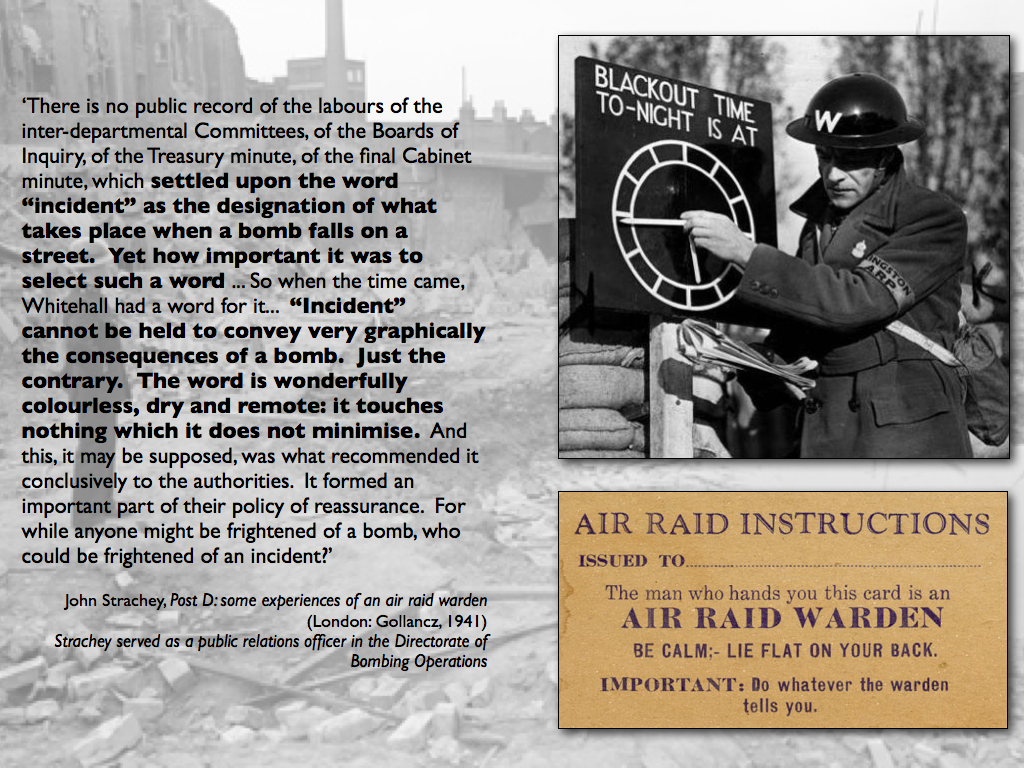
You need to ‘grow’ the markers on the map; the Guardian noted that each ‘incident’ typically involved multiple bombs.  But even more telling is the word itself: ‘incident’.  For, as John Strachey noted in his memoir of his time as an Air Raid Warden, it’s a bureaucratic, bloodless term:

In contrast, what Bomb Sight promises to do is not only to disaggregate each ‘incident’ to show every bomb dropped but, still more importantly, to deconstruct the very term itself: to link the bomb scatter to imagery and testimony and so give the lie to these bloodless abstractions.

Perhaps if something similar could be done for other cities around the world more people would be enraged at the continued recourse to bombing from the air as a legitimate political and military practice, and the politics of  ‘banning the bomb’ might be transformed into a more general demand to ban all bombs.

If you want to see more of Bomb Sight, there’s a very good video up at YouTube:

Media blitz

For an interesting post-script (or pre-script) to my discussion of the mediatization of the Israeli war on Gaza, check out the ever-interesting Brett Holman over at Airminded on the ways in which print media were used to report and ridicule propaganda messages from the enemy during the Second World War.

As Brett points out, there are parallels but also significant differences:

For one thing, in 1940 it was effectively impossible for British civilians to communicate with German ones, or vice versa: their debates were national, at best. Now Palestinians and Israelis — and everyone else — can talk directly to (or past) each other on the Gaza war, perhaps with the aid of Google Translate. For another, in 1940 official propaganda did not draw on the unofficial kind. Now @AlqassamBrigade and @IDFSpokesperson share photos of alleged attacks posted on Twitter by ordinary people. For yet another, in 1940 the debates in newspaper columns unfolded over days and weeks. Now the social war moves almost as fast as the real war does. A real war that, it should not be forgotten, claims real lives regardless of what happens online.

Spinning in the rain

Listen 0.24 in:

Here, at the start of his tour of SE Asia, President Obama, winner of the Nobel Peace Prize, defended Israel’s attack on Gaza – the always asymmetric ‘right to self-defence’ to which Craig Jones has drawn attention – by declaring that ‘There’s no country on earth that would tolerate missiles raining down on citizens from outside its borders.’  Really.

Gaza, stripped: the deconstruction of the battlefield?

Frédéric Mégret has frequently drawn attention to the peculiar social and legal status of the battlefield:

‘[W]hilst war may and will rage, what distinguishes it from random violence is the fact that it unfolds in discreet spaces insulated from the rest of society, confining military violence to a confrontation between specialized forces whose operation should minimally disrupt surrounding life…. In that respect, the laws of war do not merely seek to regulate the battlefield. They are also part of its symbolic maintenance and even construction as a particular space defined by the norms that apply to it. In other words, the battlefield does not predate norms on warfare; rather it has always been subtly coterminous with them. The laws of war are, therefore, a crucial foundation for understanding the evolution of the battlefield and, conversely, the evolution of the battlefield is a key way in which the evolution of the laws of war can be understood.’ 

For Mégret, the deconstruction of the battlefield is now well advanced: starting in the nineteenth century, with transformations in firepower that constantly extended the range over which lethal force could be deployed, dramatically accelerated with the rise of airpower annulling the distinction between the spaces of combatants and civilians, given a further twist by remote operations conducted over vast distances from unmanned aerial systems like the Predator and the Reaper, and aggravated by the renewed significance of insurgency and counter-insurgency struggles (‘war among the people’), the relations between the spatiality of war and its legal armature have been radically transformed.  (For a visual rendering, see Mégret’s Prezi on ‘Where is the battlefield?’).

These are important ideas, but there are other dimensions that need to be taken into account when considering Israel’s latest attack on Gaza.  This is a conflict that is fully coterminous with what Helga Tawil-Souri calls Israel’s ‘digital occupation’ of Gaza.  As she writes in a superb essay in the Journal of Palestine Studies 41 (2) (2012) 27-43:

‘Disengagement has not meant the end of Israeli occupation. Rather, Israel’s balancing act “of maximum control and minimum responsibility” has meant that the occupation of Gaza has become increasingly technologized. Unmanned aerial reconnaissance and attack drones, remote-controlled machine guns, closed-circuit television, sonic imagery, gamma-radiation detectors, remote- controlled bulldozers and boats, electrified fences, among many other examples, are increasingly used for control and surveillance One way to conceptualize disengagement, then, is to recognize it as a moment marking Israel’s move from a traditional military occupation toward a high-tech one.

Rooted in Israel’s increasingly globalized security-military-high-tech industry, the technological sealing of Gaza is part of the transformation of the mechanics of Israeli occupation toward “frictionless” control that began with the first intifada and the ensuing “peace process,” which marked the shift toward the segregation of Gaza. “Frictionless” is, of course, metaphoric and purposefully ambiguous, evoking a sense of abstraction and lack of responsibility…

While high technology has become one of the means through which Israeli occupation continues, the high-tech infrastructure in the Gaza Strip — that which is used by Palestinians as opposed to the Israeli regime— is also a space of control. Technology infrastructures form part of the appa- ratus of Israeli control over Gazans. A telephone call made on a land-line, even between Gaza City and Khan Yunis, is physically routed through Israel. Internet traffic is routed through switches located outside the Gaza Strip. Even on the ubiquitous cellular phones, calls must touch the Israeli backbone at some point. Like much else about the Gaza Strip, telecommunication infrastructures are limited by Israeli policies. Geographic mobility, economic growth, political mobilization, and territory are contained, but so are digital flows: Gazans live under a regime of digital occupation.’ 

It should come as no surprise, therefore, that Israel also fights in digital space.  This takes many forms, and at the limit extends into the domain of cyberwarfare (where, as the joint US/Israeli cyber-attack on Iran’s nuclear program showed, Israel possesses advanced capabilities), but in its more mundane version it can be no less effective.

One of the characteristic features of late modern war is its mediatization, and the Israeli Defense Forces have used (even ‘weaponized‘) an array of social media platforms to shape the public construction of the battlespace.  This is a far cry from its faltering efforts during the previous assault on Gaza in 2008-9, Operation Cast Lead.  Soon after the IDF assassination that sparked the renewed air campaign this month, the IDF tweeted a headshot of the dead man, Hamas military commander Ahmed al-Jabari, with “eliminated” stamped across it, and immediately followed up with a video uploaded to its YouTube channel showing the drone strike (I’m not going to do the IDF’s job for it, but if you want to see stills and screenshots you can find them here).  The IDF continued to tweet, announcing its airstrikes in 140-character containers, and also turned to Facebook, Pinterest and Tumblr to post images and infographics (or, more accurately, propagandagraphics).

The object of the exercise has been three-fold.

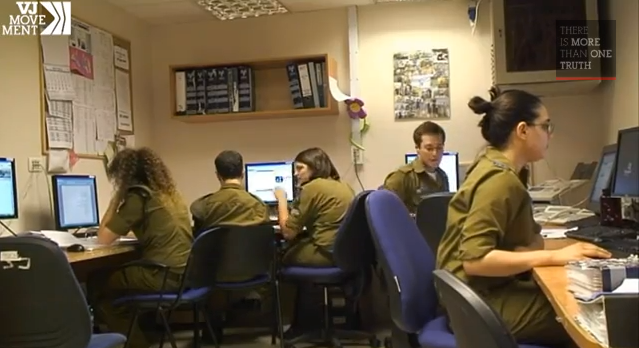
First, the IDF has been seeking direct – which is not to say unmediated: the clips, tweets and the rest follow an artfully pre-arranged script – and real-time access to domestic, regional and international publics.  The officer commanding the IDF’s 30-strong New Media desk (which is shown in the image on the left), Lt. Col. Avital Leibovich, explained that she wanted ‘to convey our message without the touch of an editor’ and to reach those who don’t turn to print media or TV for their news.

Second, the IDF has been aggressively mobilising its supporters, inside and outside Israel, encouraging them to retweet and to post their support on Facebook: using social media to puncture what Israel routinely describes as its ‘isolation’. Time reported that the IDF had activated additional ‘gamification’ features on its blog that allowed visitors ‘to rack up “points” for repeat visits or numerous tweets’: see the image on the right; more here.

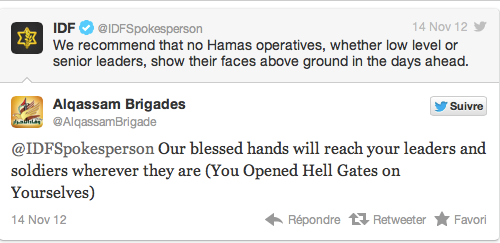
Third, the IDF apparently believes that social media can send ‘a message of deterrence’ – though its tweets have surely been as likely to provoke as to intimidate.  The campaign sparked a series of responses and counter-measures – in Gaza, Hamas and its supporters, and in particular the Al-Qassam Brigades led by al-Jabari, took to social media platforms too, though Israel’s digital occupation plainly made that a vulnerable strategy, and the cyberactivist group Anonymous claimed to have defaced or disrupted nearly 700 Israeli political, military and commercial websites – so that al Jazeera described this as a ‘mass cyber-war‘ (I think that’s wrong: it’s been a social media war, but not one that has directly produced destruction – though, as I’ll suggest in a moment, it has certainly invited it).

More on the IDF’s New Media desk from Fast Company here and from the VJ Movement below:

It’s hard to know how effective this social media blitz has been: certainly, many people have been repulsed by the way the IDF ‘cheerily live-tweets infanticide’ and ‘the apparent glee with which the IDF carries out its job.’  As John Mitchell complained, ‘Innocent people are dying on all sides, and the IDF wants to reward people for tweeting about it.’  In doing so, the contemporary rendering of war as spectacle and entertainment has been turned into something at once banal and grotesque.  Alex Kantrowitz put this well:

When a military at war asks its Twitter followers to “Please Retweet,” or check out its Tumblr, or posts an image of a rocket hooking a Prime Minister’s undergarments, it is hard not to sense a disconnect between that messaging and the bombing taking place in real life. As The Verge’s Joseph L. Flatley put it, “One liveblogs award shows or CES keynotes, not armed conflict.”

When Matt Buchanan calls this live-tweeting of military and paramilitary violence ‘the most meaningful change in our consumption of war in over 20 years’ – my emphasis – then this is war reduced to consumerism: how long before military commanders start worrying that if their ratings aren’t high enough, their audience penetration too low, their war will be cancelled?  (Not such a bad idea, you might think, until they are driven to find ways to increase their market share….) Buchanan may think this is ‘How to Wage War on the Internet’, but Michael Koplow is nearer the mark: it’s precisely How Not to Wage War on the Internet.

In fact, several commentators worry that the trash-talking between the two sides, the verbal violence of response and counter-response on Twitter, was an open invitation to extend the war beyond the words:


‘This is a new reality of war,’ Heather Hurlburt noted, ‘and I worry that it’s going to make it harder to stand down.’  The digital exchanges were immediate – not the language of reflection or diplomacy – and, whatever else they were about, were clearly intended to taunt the other side: Hamas and the IDF were both targeting audiences in Gaza (and the West Bank) and in Israel, by turns rallying their supporters and goading the enemy.  In short, here as elsewhere, there are crucial connections between the physical and virtual worlds that, in this case, may work to inflame the violence.

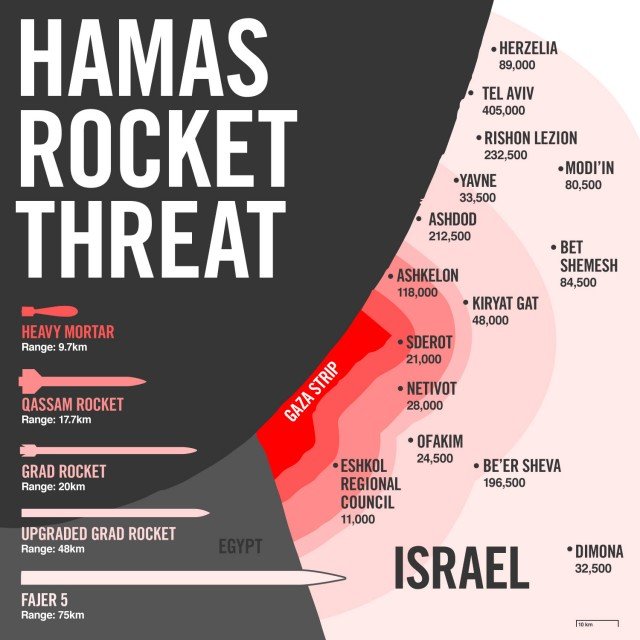
Yet for all this the digital battlespace can work to reinstate the traditional battlefield – at least virtually and rhetorically.   This is one of the maps circulated through the IDF’s social media platforms:

And here is the equivalent map published online by the New York Times, updated yesterday:

Here the map speaks power to truth: the ‘battlefield’ has been radically extended so that, as always, the terms of an an intensely asymmetric struggle are radically reversed.  The disproportionate concentration of Israeli firepower on Gaza is erased, while virtually all of Israel – including, as we have been endlessly reminded, for the very first time Jerusalem – is threatened by Hamas.

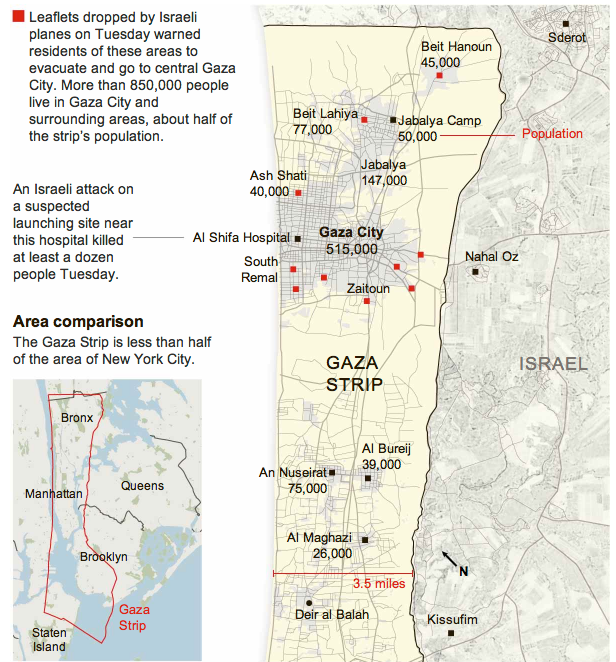
The Times did at least include this, separate map of Gaza:

The map plots (in red) the sites of IDF leaflet drops (really).  So we have one map showing Hamas rocket ranges and ‘cities taking enemy fire’, and the other showing paper dropped on a captive population…

UPDATE: More on this from Craig Jones here.

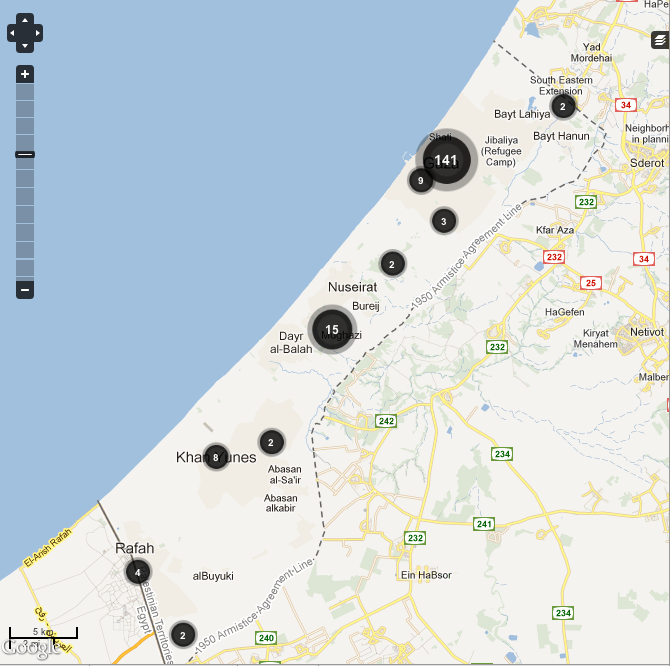
If you want to find more meaningful maps that take in both Israel and Gaza, including air strikes and rocket attacks, deaths and casualties on both sides, you can find them at al Jazeera here.  I’ve pasted an extract from the plot of air strikes below.

Seen like this, I’ll leave the last words to Helga Tawil-Souri:

“The underlying reasons of Israel’s propaganda are to silence the enemy, gain international support and justify wars… Their goal has not fundamentally changed over the years, only the platforms on which these are disseminated.”