Spinning in the rain

Listen 0.24 in:

Here, at the start of his tour of SE Asia, President Obama, winner of the Nobel Peace Prize, defended Israel’s attack on Gaza – the always asymmetric ‘right to self-defence’ to which Craig Jones has drawn attention – by declaring that ‘There’s no country on earth that would tolerate missiles raining down on citizens from outside its borders.’  Really.

Gaza, stripped: the deconstruction of the battlefield?

Frédéric Mégret has frequently drawn attention to the peculiar social and legal status of the battlefield:

‘[W]hilst war may and will rage, what distinguishes it from random violence is the fact that it unfolds in discreet spaces insulated from the rest of society, confining military violence to a confrontation between specialized forces whose operation should minimally disrupt surrounding life…. In that respect, the laws of war do not merely seek to regulate the battlefield. They are also part of its symbolic maintenance and even construction as a particular space defined by the norms that apply to it. In other words, the battlefield does not predate norms on warfare; rather it has always been subtly coterminous with them. The laws of war are, therefore, a crucial foundation for understanding the evolution of the battlefield and, conversely, the evolution of the battlefield is a key way in which the evolution of the laws of war can be understood.’ 

For Mégret, the deconstruction of the battlefield is now well advanced: starting in the nineteenth century, with transformations in firepower that constantly extended the range over which lethal force could be deployed, dramatically accelerated with the rise of airpower annulling the distinction between the spaces of combatants and civilians, given a further twist by remote operations conducted over vast distances from unmanned aerial systems like the Predator and the Reaper, and aggravated by the renewed significance of insurgency and counter-insurgency struggles (‘war among the people’), the relations between the spatiality of war and its legal armature have been radically transformed.  (For a visual rendering, see Mégret’s Prezi on ‘Where is the battlefield?’).

These are important ideas, but there are other dimensions that need to be taken into account when considering Israel’s latest attack on Gaza.  This is a conflict that is fully coterminous with what Helga Tawil-Souri calls Israel’s ‘digital occupation’ of Gaza.  As she writes in a superb essay in the Journal of Palestine Studies 41 (2) (2012) 27-43:

‘Disengagement has not meant the end of Israeli occupation. Rather, Israel’s balancing act “of maximum control and minimum responsibility” has meant that the occupation of Gaza has become increasingly technologized. Unmanned aerial reconnaissance and attack drones, remote-controlled machine guns, closed-circuit television, sonic imagery, gamma-radiation detectors, remote- controlled bulldozers and boats, electrified fences, among many other examples, are increasingly used for control and surveillance One way to conceptualize disengagement, then, is to recognize it as a moment marking Israel’s move from a traditional military occupation toward a high-tech one.

Rooted in Israel’s increasingly globalized security-military-high-tech industry, the technological sealing of Gaza is part of the transformation of the mechanics of Israeli occupation toward “frictionless” control that began with the first intifada and the ensuing “peace process,” which marked the shift toward the segregation of Gaza. “Frictionless” is, of course, metaphoric and purposefully ambiguous, evoking a sense of abstraction and lack of responsibility…

While high technology has become one of the means through which Israeli occupation continues, the high-tech infrastructure in the Gaza Strip — that which is used by Palestinians as opposed to the Israeli regime— is also a space of control. Technology infrastructures form part of the appa- ratus of Israeli control over Gazans. A telephone call made on a land-line, even between Gaza City and Khan Yunis, is physically routed through Israel. Internet traffic is routed through switches located outside the Gaza Strip. Even on the ubiquitous cellular phones, calls must touch the Israeli backbone at some point. Like much else about the Gaza Strip, telecommunication infrastructures are limited by Israeli policies. Geographic mobility, economic growth, political mobilization, and territory are contained, but so are digital flows: Gazans live under a regime of digital occupation.’ 

It should come as no surprise, therefore, that Israel also fights in digital space.  This takes many forms, and at the limit extends into the domain of cyberwarfare (where, as the joint US/Israeli cyber-attack on Iran’s nuclear program showed, Israel possesses advanced capabilities), but in its more mundane version it can be no less effective.

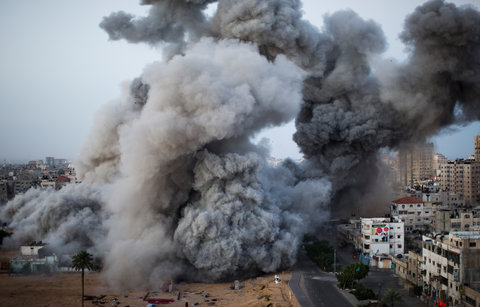
One of the characteristic features of late modern war is its mediatization, and the Israeli Defense Forces have used (even ‘weaponized‘) an array of social media platforms to shape the public construction of the battlespace.  This is a far cry from its faltering efforts during the previous assault on Gaza in 2008-9, Operation Cast Lead.  Soon after the IDF assassination that sparked the renewed air campaign this month, the IDF tweeted a headshot of the dead man, Hamas military commander Ahmed al-Jabari, with “eliminated” stamped across it, and immediately followed up with a video uploaded to its YouTube channel showing the drone strike (I’m not going to do the IDF’s job for it, but if you want to see stills and screenshots you can find them here).  The IDF continued to tweet, announcing its airstrikes in 140-character containers, and also turned to Facebook, Pinterest and Tumblr to post images and infographics (or, more accurately, propagandagraphics).

The object of the exercise has been three-fold.

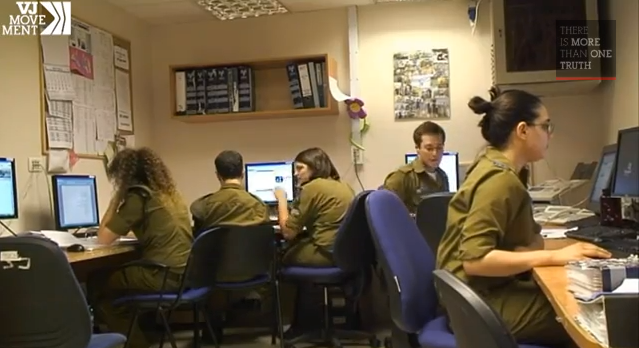
First, the IDF has been seeking direct – which is not to say unmediated: the clips, tweets and the rest follow an artfully pre-arranged script – and real-time access to domestic, regional and international publics.  The officer commanding the IDF’s 30-strong New Media desk (which is shown in the image on the left), Lt. Col. Avital Leibovich, explained that she wanted ‘to convey our message without the touch of an editor’ and to reach those who don’t turn to print media or TV for their news.

Second, the IDF has been aggressively mobilising its supporters, inside and outside Israel, encouraging them to retweet and to post their support on Facebook: using social media to puncture what Israel routinely describes as its ‘isolation’. Time reported that the IDF had activated additional ‘gamification’ features on its blog that allowed visitors ‘to rack up “points” for repeat visits or numerous tweets’: see the image on the right; more here.

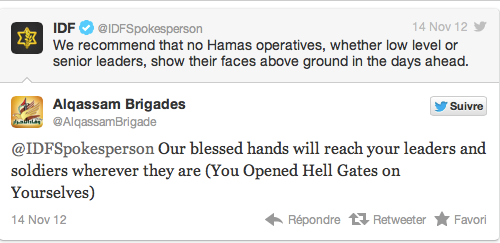
Third, the IDF apparently believes that social media can send ‘a message of deterrence’ – though its tweets have surely been as likely to provoke as to intimidate.  The campaign sparked a series of responses and counter-measures – in Gaza, Hamas and its supporters, and in particular the Al-Qassam Brigades led by al-Jabari, took to social media platforms too, though Israel’s digital occupation plainly made that a vulnerable strategy, and the cyberactivist group Anonymous claimed to have defaced or disrupted nearly 700 Israeli political, military and commercial websites – so that al Jazeera described this as a ‘mass cyber-war‘ (I think that’s wrong: it’s been a social media war, but not one that has directly produced destruction – though, as I’ll suggest in a moment, it has certainly invited it).

More on the IDF’s New Media desk from Fast Company here and from the VJ Movement below:

It’s hard to know how effective this social media blitz has been: certainly, many people have been repulsed by the way the IDF ‘cheerily live-tweets infanticide’ and ‘the apparent glee with which the IDF carries out its job.’  As John Mitchell complained, ‘Innocent people are dying on all sides, and the IDF wants to reward people for tweeting about it.’  In doing so, the contemporary rendering of war as spectacle and entertainment has been turned into something at once banal and grotesque.  Alex Kantrowitz put this well:

When a military at war asks its Twitter followers to “Please Retweet,” or check out its Tumblr, or posts an image of a rocket hooking a Prime Minister’s undergarments, it is hard not to sense a disconnect between that messaging and the bombing taking place in real life. As The Verge’s Joseph L. Flatley put it, “One liveblogs award shows or CES keynotes, not armed conflict.”

When Matt Buchanan calls this live-tweeting of military and paramilitary violence ‘the most meaningful change in our consumption of war in over 20 years’ – my emphasis – then this is war reduced to consumerism: how long before military commanders start worrying that if their ratings aren’t high enough, their audience penetration too low, their war will be cancelled?  (Not such a bad idea, you might think, until they are driven to find ways to increase their market share….) Buchanan may think this is ‘How to Wage War on the Internet’, but Michael Koplow is nearer the mark: it’s precisely How Not to Wage War on the Internet.

In fact, several commentators worry that the trash-talking between the two sides, the verbal violence of response and counter-response on Twitter, was an open invitation to extend the war beyond the words:


‘This is a new reality of war,’ Heather Hurlburt noted, ‘and I worry that it’s going to make it harder to stand down.’  The digital exchanges were immediate – not the language of reflection or diplomacy – and, whatever else they were about, were clearly intended to taunt the other side: Hamas and the IDF were both targeting audiences in Gaza (and the West Bank) and in Israel, by turns rallying their supporters and goading the enemy.  In short, here as elsewhere, there are crucial connections between the physical and virtual worlds that, in this case, may work to inflame the violence.

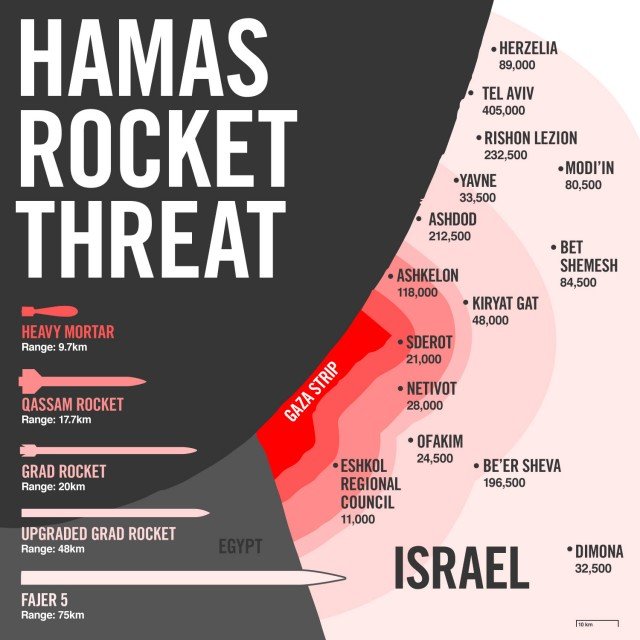
Yet for all this the digital battlespace can work to reinstate the traditional battlefield – at least virtually and rhetorically.   This is one of the maps circulated through the IDF’s social media platforms:

And here is the equivalent map published online by the New York Times, updated yesterday:

Here the map speaks power to truth: the ‘battlefield’ has been radically extended so that, as always, the terms of an an intensely asymmetric struggle are radically reversed.  The disproportionate concentration of Israeli firepower on Gaza is erased, while virtually all of Israel – including, as we have been endlessly reminded, for the very first time Jerusalem – is threatened by Hamas.

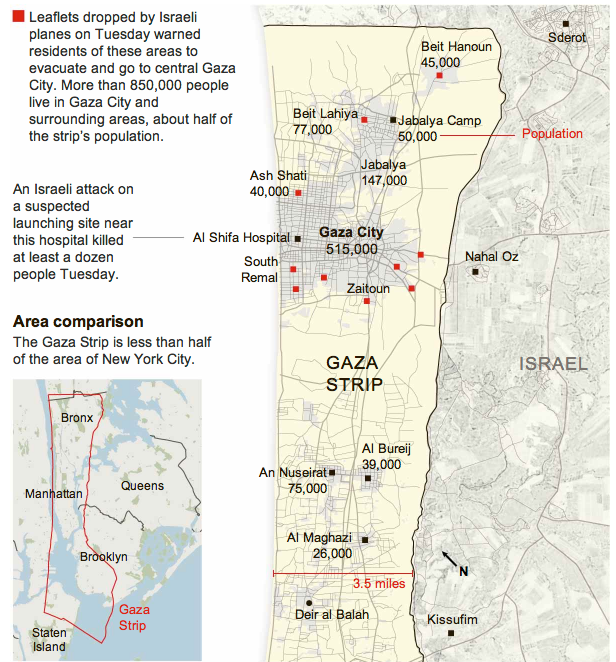
The Times did at least include this, separate map of Gaza:

The map plots (in red) the sites of IDF leaflet drops (really).  So we have one map showing Hamas rocket ranges and ‘cities taking enemy fire’, and the other showing paper dropped on a captive population…

UPDATE: More on this from Craig Jones here.

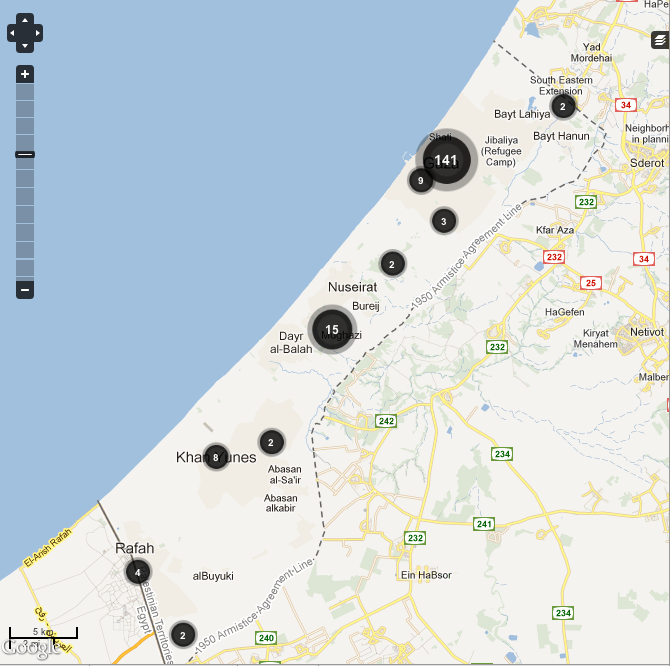
If you want to find more meaningful maps that take in both Israel and Gaza, including air strikes and rocket attacks, deaths and casualties on both sides, you can find them at al Jazeera here.  I’ve pasted an extract from the plot of air strikes below.

Seen like this, I’ll leave the last words to Helga Tawil-Souri:

“The underlying reasons of Israel’s propaganda are to silence the enemy, gain international support and justify wars… Their goal has not fundamentally changed over the years, only the platforms on which these are disseminated.” 

What does war sound like now?

Vanessa Barford‘s BBC essay – ‘What does war sound like now?‘ – complete with sound clips adds more dimensions to my previous post on the sounds of war:

Particular noises are associated with particular conflicts, both by those who watch the news and soldiers and civilians who experience it firsthand….  Some sounds – the silence of shock, the pain of the wounded and the cries of bereaved relatives – unite all wars. But others, in many ways, help define a conflict.’

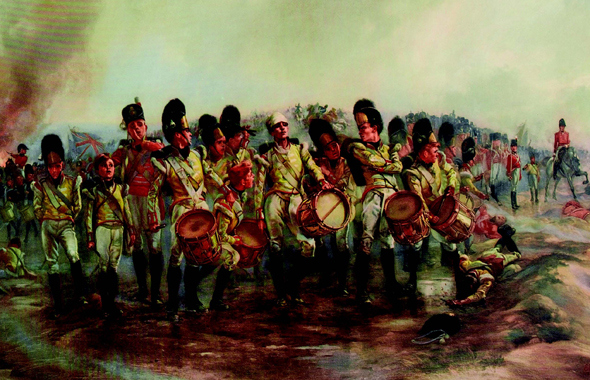
The short report travels from the drumbeats and bugle calls that were used to control the battlefield of the eighteenth century to the sounds of drones, missiles and shells over Gaza.

Writing in the New Yorker, Wasseem el Sarraj provides a much more detailed (and far more harrowing) account of the soundscape of Gaza City:

In our house we have become military experts, specializing in the sounds of Israeli and Palestinian weapons. We can distinguish with ease the sound of Apaches, F-16 missiles, drones, and the Fajr rockets used by Hamas. When Israeli ships shell the coast, it’s a distinct and repetitive thud, marked by a one-second delay between the launch and the impact. The F-16s swoop in like they are tearing open the sky, lock onto their target and with devastating precision destroy entire apartment blocks. Drones: in Gaza, they are called zananas, meaning a bee’s buzz. They are the incessant, irritating creatures. They are not always the harbingers of destruction; instead they remain omnipresent, like patrolling prison guards. Fajr rockets are absolutely terrifying because they sound like incoming rockets. You hear them rarely in Gaza City and thus we often confuse them for low-flying F-16s. It all creates a terrifying soundscape, and at night we lie in our beds hoping that the bombs do not drop on our houses, that glass does not shatter onto our children’s beds. Sometimes, we move from room to room in an attempt to feel some sense of safety. The reality is that there is no escape, neither inside the house nor from the confines of Gaza.

And this from Catherine Charrett in Gaza via Critical Legal Thinking:

A war on Gaza is com­plete with all of Israel’s latest tech­no­lo­gical killing inven­tions. “The drone” flies high in the sky, filling the airy space with a con­stant deep buzz­ing, which does not sub­side the entire night. His buddy, “the F-​16” flies lower down mak­ing a most ter­ri­fy­ing roar­ing sound which tears out the heart and car­ries it down the lane, and which is always fol­lowed by the sound of a bomb blast­ing. “The Bomb”, which crashes down, breaks the sky, rattles the win­dows, moves the chairs, pierces the ear, stops the heart and causes a deep feel­ing of sor­row and pro­found fear. The bomb that we know is always fol­lowed by death.

UPDATE: Rana Baker‘s recordings (for the Electronic Intifada) of the sound of Israeli attacks on Gaza can be heard here.

From hotels to hostilities

I’m just back from a wonderful time at Ohio State giving the Taafe Lecture, and still trying to catch my breath: lots of good conversation and good company.  More on this later – as always, I learned much from the discussions, and I’m particularly grateful to Mat Coleman, Kevin Cox, Nancy Ettlinger, Ed Malecki, Becky Mansfield, Kendra McSweeney, Mary Thomas, Joel Wainwright and a stimulating crowd of graduate students for the warmth of their welcome and the range of their questions.

While I’ve been on the road, I learned of two new blogs whose most recent posts, when read together, prompt me to think about the multiple, terrible connections between military violence in Beirut and in Gaza – not least through the IDF’s so-called Dahiyah Doctrine, named after Beirut’s southern suburb that was devastated in the summer of 2006 , which calls for the use of overwhelming and disproportionate force and the deliberate targeting of government and civilian infrastructure (more on the legal armature from Richard Falk and Raji Sourani here).

Sara Fregonese and Adam Ramadan have started Everyday Geopolitics – it’s been running since October but I’ve only just caught up, and Sara’s most recent post on Beirut is a front-line report on her work on hotels and geopolitics.  If that seems a strange combination – and it isn’t – then check out her comments and photographs, and her essay ‘Between a refuge and a battleground: Beirut’s discrepant cosmopolitanisms’, Geographical Review, 102 (2012) 316–336.

Craig Jones has started War, Law and Space that opens with an important reflection on the ongoing Israeli assault on Gaza, the parallels with ‘Operation Cast Lead‘ in 2008, and the differential granting of the ‘right to self-defence’.

Incidentally, for anyone who thinks Israel ‘withdrew’ from Gaza in 2005, I particularly recommend the following:

Lori Allen, ‘The scales of occupation: Operation Cast Lead and the targeting of the Gaza Strip’, Critique of anthropology 32 (2012) 261-84;

Lisa Bhungalia, ‘Im/mobilities in a “Hostile Territory”: Managing the Red line’, Geopolitics 17 (2012) 256-75;

Shane Darcy and John Reynolds, ‘An enduring occupation: the status of the Gaza Strip from the perspective of International Humanitarian Law’, Journal of conflict and security law 15 (2010) 211-43;

Darryl Li, ‘The Gaza Strip as laboratory: notes in the wake of disengagement’, Journal of Palestine Studies 35 (2) (2006) 38-55;

Helga Tawil-Souri, ‘Digital occupation: Gaza’s hi-tech enclosure’, Journal of Palestine Studies 41 (2) (2012) 27-43.

If you don’t have time, then at least read Samera Esmeir on ‘Colonial experiments in Gaza’ at Jadaliyya here.  In the midst of the latest, horrific attacks, it’s vitally important to realise that violence can take many forms, and that Israel’s assaults on Gaza run even deeper than the overt and spectacular violence it metes out in its spasmodic military operations.  More on this soon too, and on Israel’s ongoing air strikes.

Sight-seeing: war and extreme tourism

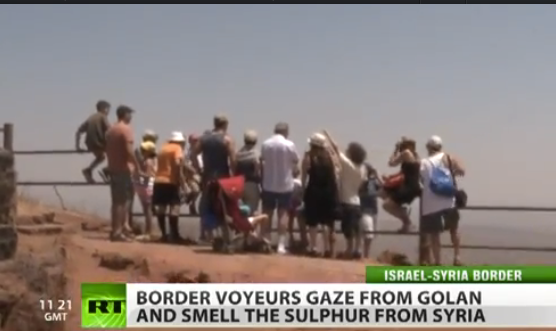
For the last several months there have been dispiriting reports of Israeli tourists travelling to the Golan Heights to gaze across the war zone in Syria: as Allison Good put it over at Foreign Policy, “Many Israelis are foregoing the pool or the beach, flocking instead to the Israel-Syria border for a little action.”

There was a thoughtful response to this voyeurism from Paul Woodward at War in Context – make no mistake, this is spectatorship not witnessing, as the video that prefaces his commentary makes clear – in which he suggested a series of ways in which he thought Israelis watching the war through binoculars was significantly different from Americans watching the war on television:

For Israelis the spectacle of regional violence is self-affirming.

It reinforces the idea that Israel is justifiably obsessed with its own security because it is surrounded by a ‘dangerous neighborhood.’

It confirms Ehud Barak’s racist notion that Israel is a villa in a jungle and that tranquility inside this villa can only be afforded by high walls.

It defines neighbors on the basis of their otherness and legitimizes indifference in preference to empathy.

I’m not so sure; there are, sadly, also American constituencies who surely see things the same way.

There are also close parallels between the voyeurs on the Golan Heights (or in this case Lows) and the ‘hill of shame’ from which the international media looked on at the Israeli attack on Gaza in 2009.  Here too the media were joined by Israeli tourists with cameras, binoculars and picnics: ‘bombing as spectator sport’, as two angry commentators described it.  There’s another personal, passionate report here.  For more on watching Gaza, see Peter Lagerquist, ‘Heard on the Hill of Shame’, at MERIP and – absolutely vital, this – David Campbell‘s  take, ‘Constructed visibility: photographing the catastrophe of Gaza (2009)’, which can be downloaded through his blog here. And Craig Jones has an excellent article culled from his MA thesis on ‘Shooting Gaza: Israel’s visual war’ in Human Geography 4 (1) (2011): abstract here.

There is also now a developing discussion of the wider, militarized landscape of ‘extreme tourism’ in Israel from Matt Carr at Ceasefire.  He pays close attention to the growth of tour companies run by former military officers and settlers, to the inclusion of the illegal settlements on the West Bank in their itineraries, and to the shooting ranges where tourists are encouraged to role play:

The sight of these ignorant, gimlet-eyed tourists in sunglasses and shorts, living out their paramilitary fantasies and teaching even young children to kill imaginary terrorists in a land under Israeli military occupation, is not the most edifying spectacle. But Caliber 3 does not only aim to thrill. Its activities are intended to combine ‘the values of Zionism with the excitement and enjoyment of shooting which makes the activity more meaningful.’ As the school’s director puts it ‘What is key here is not just shooting at targets, but hearing how we fight every day to protect the Jewish state.’

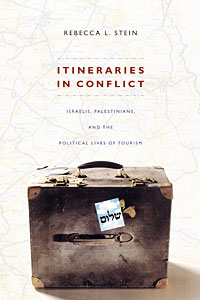
This can all be embedded in an emerging literature on ‘battlefield tourism’ or ‘war tourism’ – Richard Butler and Wantanee Suntikul have an edited collection, Tourism and war, out from Routledge this summer – but I think it’s more usefully connected to Rebecca Steins pathbreaking work on the politics of tourism, especially her book Itineraries in Conflict: Israelis, Palestinians and the political lives of tourism (Duke University Press, 2008). You can find a more recent report from her, ‘An All-Consuming Occupation’, on the fourth Jerusalem Festival of Light in June 2012 and the wretched history of tourism that was concealed in its glare, at MERIP.  She’s also provided an incisive examination of Israeli media coverage of the Gaza war – most eyes have been directed at international coverage –  in ‘Impossible witness: Israeli visuality, Palestinian testimony and the Gaza war’, Journal of cultural research 16 (2-3) (2012) 135-53.

Finally, for faint flickers of hope, there’s Caryn Aviv‘s essay on ‘The emergence of alternative Jewish tourism’, European Review of History 18 (1) (2011) 33-43.  Here’s the abstract:

This article explores the emergence of ‘alternative Jewish travel’ to the West Bank and within Israel. One programme, aimed at diaspora Jews, reframes religious, cultural, and ethnic Jewish identity to include non-violence and solidarity with Palestinians as part of what it means to be Jewish. Another programme, aimed at Israeli citizens (both Jews and non-Jews), reframes Israeli national identity to include post-Zionist solidarity with Palestinians, but is not necessarily Jewish in any religious or ethnic sense. Alternative Jewish travel programme tours explore complicated questions of justice and nationalism in different ways that reflect their simultaneously local and global positions, who organises them, and how they define Jewishness differently.

In Frames of War: when is life grievable? (2009) Judith Butler offered a series of reflections on other, no less violent visualities than those I have discussed here, but Aviv’s essay is worth reading alongside Butler’s response to the Jewish critics of her richly deserved award of the Adorno Prize by the city of Frankfurt: grace under fire.

Counterinsurgency and the humanitarian present

Laleh Khalili – whose work on the new and old classics of counterinsurgency,  on the gendering of counterinsurgency, and on the location of Palestine in global counterinsurgency – is indispensable, has just alerted me to the fate (Fate?) of one of its principal architects, David Kilcullen.

In The accidental guerilla and other writings, Kilcullen – Petraeus’s Senior Counterinsurgency Adviser in Iraq – repeatedly turned to bio-medical analogies to advance a bio-political vision of counterinsurgency: insurgency as a ‘social pathology’ whose prognosis can be traced through the stages of infection, contagion, intervention and rejection (‘immune response’).  In an interview with Fast Company, Kilcullen now explains that he

“came out of Iraq with a real conviction that we tend to think that a bunch of white guys turning up with a solution fixes all the problems. It doesn’t work like that. You actually have to really build a collaborative relationship with the people on the ground if you want to have any hope of understanding what’s going on.”

Kilcullen’s contract ended when the Obama administration came into office, and he founded Caerus Associates.  The company advertises itself as ‘a strategy and design firm’ that works to ‘help governments, global enterprises, and local communities thrive in complex, frontier environments.’  It claims to ‘bring the system into focus’ by providing ‘strategic design for a world of overlapping forces — urbanization, new market horizons, resource scarcity and conflict — to build resilience and capacity.’   The company explains its ‘strategic design process’ here, and Kilcullen’s vision of systems analysis is sketched here.  This may sound like the rapid-fire buzz-words that corporate start-ups typically shoot at their clients, but Kilcullen provides Fast Company with a sawn-off version (it’s really hard to avoid these metaphors…):

“We’re two-thirds tech, one-thirds social science, with a dash of special operations… We can go out in a community and say, ‘Let’s map who owns what land,’ or ‘Let’s map who owes the local warlord money,’ or ‘Let’s map the areas in the city where you don’t feel safe.'”

This chimes with Kilcullen’s famous description of contemporary counterinsurgency as ‘armed social work’, and in an interview with the International Review of the Red Cross published in September 2011 Kilcullen extended his vision of ‘military humanism’ beyond insurgency thus:

‘The methods and techniques used by illegal armed groups of all kinds are very similar, irrespective of their political objectives. So whether you’re talking about a gang in the drug business in Latin America, or organized crime in the gun-running or human smuggling business, or whether you’re talking about an insurgency or perhaps even a civil war involving tribes, you will see very similar approaches and techniques being used on the part of those illegal armed groups. That’s one of the reasons why I believe counter-insurgency isn’t a very good concept for the work that the international community is trying to do. I think that the idea of complex humanitarian emergencies is actually a lot closer to the reality on the ground. You almost never see just one insurgent group fighting an insurgency against the government anymore. What you typically see is a complex, overlapping series of problems, which includes one or more or dozens of armed groups. And the problem is one of stabilizing the environment and helping communities to generate peace at the grassroots level – a bottom-up peace-building process. And that’s not a concept that really fits very well with traditional counter-insurgency, which is about defeating an insurgent movement and is a top-down, state-based approach. What you have to do is create an environment where existing conflicts can be dealt with in a non-violent way.’

This is a remarkable passage for several reasons: the focus on ‘techniques’ not ‘objectives’, which works to de-politicize and de-contextualize a range of different situations in order to generalize about them, the appeal to a collective “international community” whose only interest is a generic “peace”, and hence the passage to what Eyal Weizman calls ‘the humanitarian present’. I think that’s also a colonial present, not surprisingly: ‘humanitarianism’ was often the velvet glove wrapped around the iron fist of colonialism.  But what Weizman sees as novel about the present is the way in which its ‘economy of violence is calculated and managed’ by a series of moral technologies (the term is Adi Ophir‘s) that work to continue and legitimize its operation.  In other words, there is today an intimate collusion of the ‘technologies of humanitarianism, human rights and humanitarian law with military and political powers’.

Despite  the reference to ‘special operations’ in the Fast Company interview – something which makes me think that Obama would have found Kilcullen’s continued advice invaluable – Kilcullen insists that it’s a collaborative process:

“We specialize in working with communities that are under the threat of violence in frontier environments, and I think to some extent that distinguishes us a little bit from other people. Sure we can give a slick presentation in a hotel room, but what we can also do is walk the street in dangerous places, engage with communities, and figure out what needs to happen. It’s not us figuring it out, it’s them telling us, but often we find that no one’s ever been there and asked them before.”

‘Dangerous places’, ‘frontiers’: this is still the language of adventurism.  It recalls Zygmunt Bauman‘s ‘planetary frontierland’, and even more Mark Duffield on the ‘global borderlands’:

‘The idea of the borderlands … does not reflect an empirical reality.  It is a metaphor for an imagined geographical space where, in the eyes of many metropolitan actors and agencies, the characteristics of brutality, excess and breakdown predominate.  It is a terrain that has been mapped and re-mapped in innumerable aid and academic reports where wars occur through greed and sectarian gain, social fabric is destroyed and developmental gains reversed, non-combatants killed, humanitarian assistance abused and all civility abandoned.’

It’s not surprising, then, that in the IRC interview Kilcullen should make so much of establishing ‘the rule of law’: ‘It’s a set of rules which has predictable consequences and allows the population to feel safe, and helps them know what they need to do in order to be in a safe place.’  He makes it clear that, in many (perhaps most) circumstances ‘bottom-up, community-based law, which can be transitional justice, or customary law, applied by traditional courts or religious courts, is as effective and possibly even more effective in the initial stages than central-state structures.’   But this ignores the multiple ways in which law (including international humanitarian law) is not apart from conflict but is almost always a part of conflict: as Weizman has it, ‘international law develops through its violation.  In modern war, violence legislates.’

One could say much the same about maps.  Mapping is not a neutral, objective exercise; mapping is performative and its material effects depend on the constellation of powers and practices within which it is deployed. Kilcullen’s injunction – “Let’s map” – glosses over who the ‘us’ is, who is included and who is excluded, and the process through which some mappings are accorded legitimacy while others are disavowed.  This is also one of Weizman’s central claims, not least in his exposure of the torturous mappings that issued in the  Hollow Land of occupied Palestine.

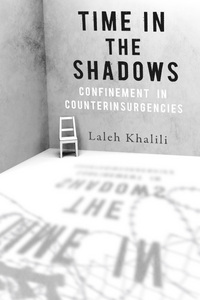
Weizman’s particular focus in his discussion of the humanitarian present is Gaza, and this winds me back to Laleh Khalili’s work which brilliantly re-reads counterinsurgency in occupied Palestine contrapuntally with US counterinsurgency practices elsewhere.  Her Essential Reading on Counterinsurgency was published by Jadaliyya, and her forthcoming book, Time in the shadows: Confinement in Counterinsurgencies (Stanford University Press, October 2012),  engages with a Medusa’s raft of counterinsurgency adviser-survivors, including Kilcullen and Andrew Exum (Abu Muqawama).
And so a final question: how would ‘strategic design’ and a ‘collaborative process’ help the people of Gaza?  Whose ‘rule of law’ is to be established?  And which maps chart a road not only to peace but to justice for the people of Palestine?