Theory of the drone 12: ‘Killing well’?

This is the 12th in a series of extended posts on Grégoire Chamayou‘s Théorie du drone and covers the final chapter in Part III: Necro-ethics, called ‘Précisions’; in French the singular means accuracy, as you might expect, but the plural means ‘details’ – which is, of course, where the devil is to be found…

One of the most common claims advanced by those who defend the use of armed drones is that they reduce ‘collateral damage’ because they are so precise.  Following directly from his previous critique of Bradley Jay Strawser, Chamayou cites him again here: ‘Drones, for all their current and potential misuse, have the potential for tremendous moral improvement over the aerial bombardments of earlier eras.’  But he dismisses this as a misleading comparison: if Dresden or Hiroshima are taken as the yardstick against which accuracy is to be measured – or, for that matter, as the standard against which military ethics are to be judged – then virtually any subsequent military operation would pass both tests with flying colours.

The comparison confuses form with function.  Compared to Lancaster bombers and Flying Fortresses (even with their famous Norden bombsights: for Malcolm Gladwell on the ‘moral importance’ of the bombsight to Norden, a committed Christian, see here and here; for more on the bombsight, see here), the Predator and the Reaper are evidently more accurate.  But Chamayou insists that the real comparison ought to be with other tactical means currently available to achieve the same objective.
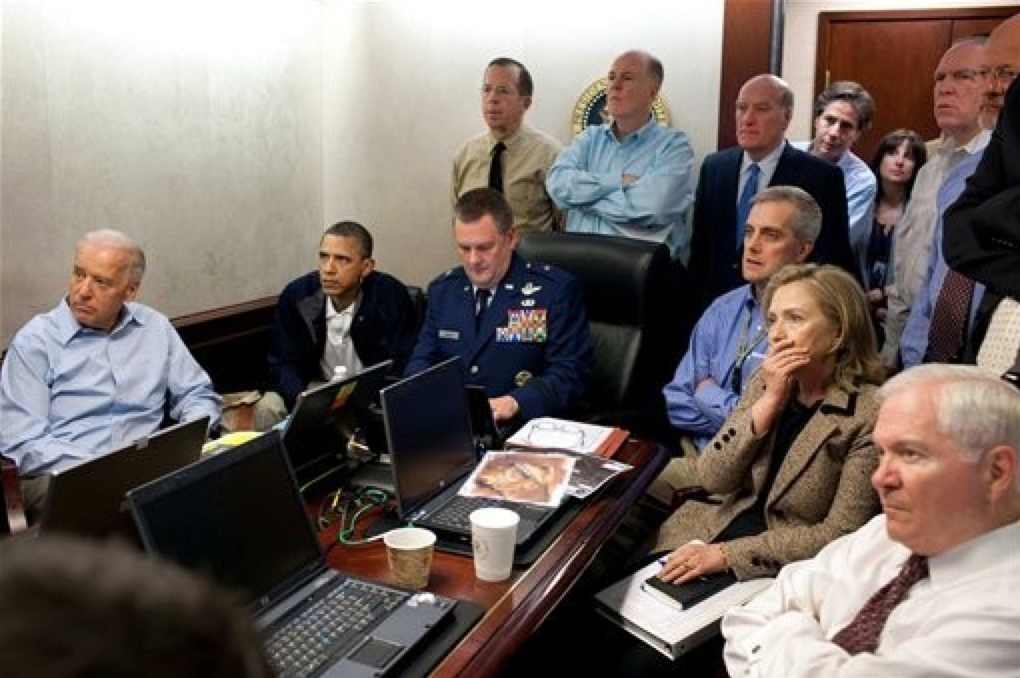
Situation Room

In the kill/capture raid against Osama Bin Laden on 1 May 2011 (assuming ‘capture’ was ever on the agenda), he argues that the choice was between drones and Special Forces not between drones and re-staging Dresden in Abbotabad.  This doesn’t quite work, since the raid was carried out by US Navy Seals who swept in from Bagram via Jalalabad by helicopter, but the mission also depended on real-time imagery from an RQ-170 stealth drone (‘the Beast of Kandahar’).  This was the source of the live video feed watched by Obama and members of his administration in the famous ‘Situation Room’ photograph [on which, see Keith Feldman on ‘Empire’s Verticality’ in Comparative American Studies 9 (4) (2011) 325-41].

The RQ-170 is an unarmed platform, but its role should remind us that drones are part of networked warfare – even when strikes are carried out by other means, the enhanced intelligence, surveillance and reconnaissance capabilities provided by the long dwell-times of these remote platforms mean that they are instrumental in the activation of the kill-chain.  This holds for military operations far beyond targeted killing: in Afghanistan between 2009 and 2011 drones were directly responsible for only 5-6 per cent of weapons released by the US Air Force, but they no doubt played a vital role in the release of many of the others.
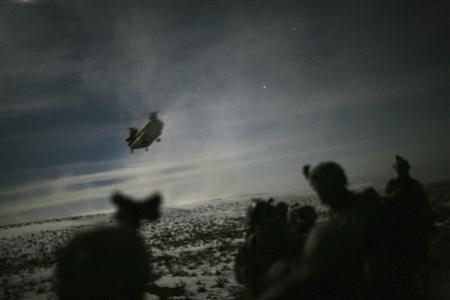
Night raidStill, Chamayou’s basic point is a sharp one – and I rehearsed similar arguments in my discussion of The politics of drone wars last year – but readers of Jeremy Scahill‘s Dirty Wars may still reasonably object that the civilian casualties resulting from JSOC’s infamous night raids in Afghanistan cast doubt on the precision and accuracy of ground forces too.  Gareth Porter has estimated that more than 1,500 civilians were killed in night raids in just ten months in 2010-11, making them ‘by far the largest cause of civilian casualties in the war in Afghanistan.’  Indeed, Afghan protests have frequently centred on the civilian toll exacted by drones and night raids.

Even if the appropriate comparison is between different modalities of military violence in the present, Chamayou argues that the discussion is bedevilled by another series of confusions about ‘accuracy’ or ‘precision’.   In fact, though he doesn’t say so, the the two terms aren’t interchangeable. Strictly speaking,  accuracy refers to the deviation from the aiming point, precision to the dispersion of the strike:

Accuracy and precision

CEP in the diagram above refers to the Circular Error Probable, once described by the Pentagon as ‘an indicator of the delivery accuracy of a weapon system’, which is a circle of radius n described around the aiming point.  Assuming a bivariate normal distribution, then – all other things being equal (which they rarely are) – 50% of the time a bomb, missile or round will land within the circle: which of course means that the other half of the time it won’t, even under ideal experimental conditions.  As this is a normal distribution, then 93 per cent should land within 2n and more than 99 per cent within 3n.

Chamayou doesn’t refer to the CEP directly, only briefly to the ‘accuracy of fire’,  but – to revert to the comparison he refuses – the CEP of bombing from the air has contracted dramatically since the Second World War when it was around 3,000 feet (though this improved over time): so much so that David Deptula, when he was USAF Deputy Chief of Staff for ISR, used to talk of crossing a ‘cultural divide of precision and information’.  The image below, taken from one of his presentations, shows the contraction (notice that the aim point is the Pentagon….).
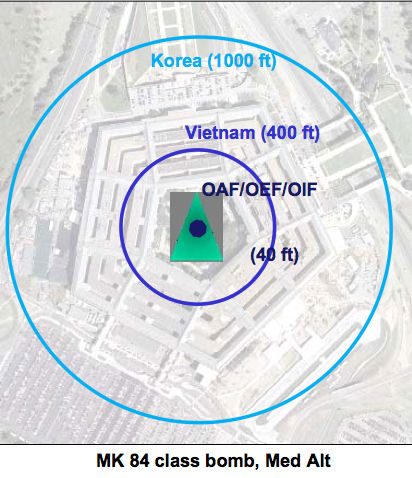
Target mensuration (USAF)

Interestingly, the most recent Joint Publication (3-60) from the Joint Chiefs of Staff on Targeting (January 2013) has explicitly removed the concept from its Terms and Definitions, citing as its authority the Department of Defense’s Dictionary of Military and Associated Terms (it was still there on 31 January 2011, but no longer).  I haven’t been able to discover the reasons for the change, though there is longstanding scepticism about the validity of the measure: see, for a specific example, Donald MacKenzie‘s classic discussion in Inventing accuracy: a historical sociology of nuclear missile guidance (1993, pp. 352-7).  I’ve seen several comments to the effect that the measure isn’t useful for ‘smart bombs’ because they don’t display the same spread as ‘dumb bombs’.  (There’s a quick primer on the emergence of smart bombs during the Vietnam War here, and an account of the evolution of ‘precision strike’ since then here; for more detail, try David Koplow‘s Death by moderation: the US military’s quest for useable weapons (2009)).

The MQ-1 Predator carries two AGM-114 Hellfire missiles [shown below, top; for acronyphiles, AGM designates an Air-to-Ground Missile, while the ‘Hellfire’ was originally developed as a ‘Helicopter-Launched Fire-and-Forget Missile’; its main platform is still an attack helicopter], while the MQ-9 Reaper can carry four AGM-114 Hellfire Missiles or replace two of them with GBU-12 Paveway II bombs [GBU = Guided Bomb Unit; shown below, bottom].
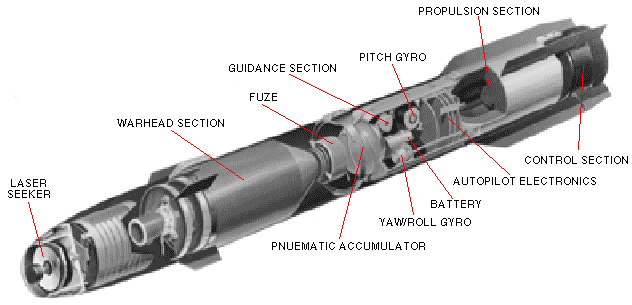

hellfire

GBU-12_xxl

Both weapons systems are laser-guided; the sensor operator, sitting beside the pilot in the Ground Control Station, uses a laser targeting marker (LTM) to ‘paint’ the target – this can also be done by ground troops in conventional combat zones – but its accuracy can be compromised by cloud, smoke, fog or dust.  (This is why the Air Force also uses GPS-guided weapons; they are less accurate but unaffected by these environmental conditions).  Once the necessary clearances have been obtained from mission commanders and military lawyers, the pilot fires the missile and the sensor operator guides it on to its target.

Omer Fast‘s interview with a sensor operator (‘Brandon’ –  whether this is a pseudonym or really Brandon Bryant is hard to know) for 5,000 Feet is the Best provides a series of insights into the operation in Afghanistan and Iraq.  You can’t see the beam with the naked eye, but American ground troops can see it with their infrared goggles.  According to ‘Brandon’, they call it the ‘Light of God’ (really); the image below is James Bridle‘s replication of the effect based on laser targeting night systems and a CC-licensed photograph of the Iraqi desert by Rob Bakker.
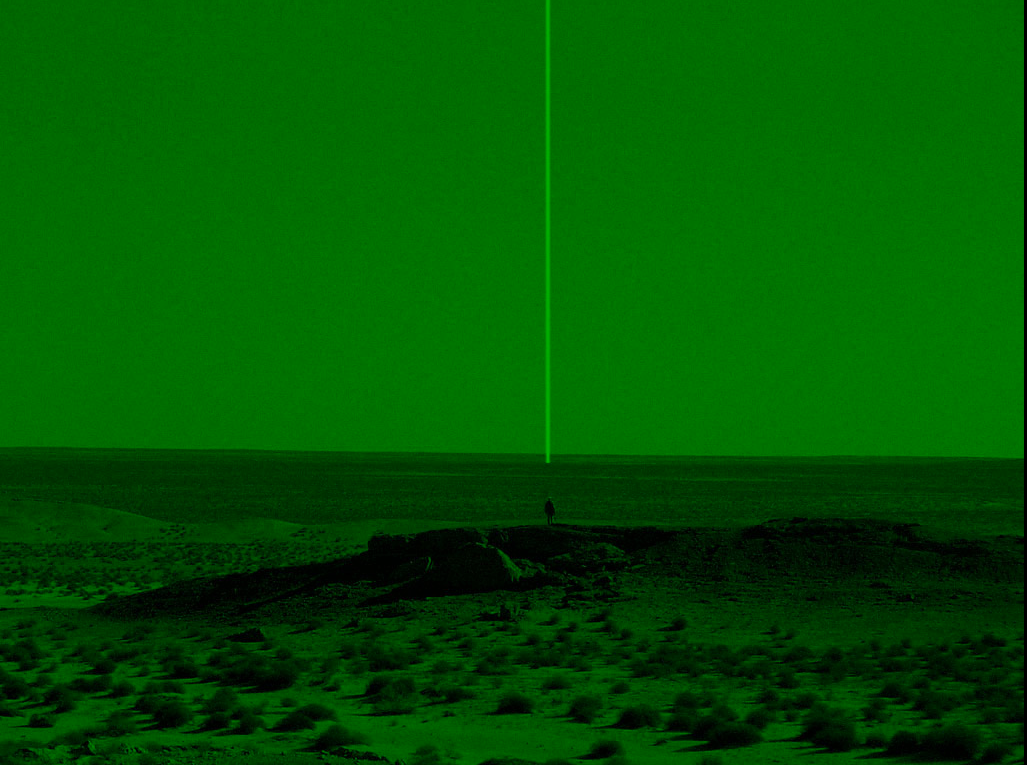
JAMES BRIDLE Light of God

‘Brandon’:

‘Usually the laser track is about half the size of this [hotel] room.  Poof!  By the time it hits the ground… a lot of times it turns into a square for some reason…  It could be anywhere from ten feet by ten feet to twenty feet by twenty feet… It starts off small and you watch it kind of open up’

This is not exactly putting ‘warheads on foreheads‘, but ‘Brandon’ explains that the crew is also required to identify a secondary ‘abort’ target.

‘… some of the contingencies we have to worry about are: if we’re firing at a building and somebody crosses – maybe – who knows, a group of children starts crossing in front of the building, we need a second site once that missile is already off the rails.  To go ahead and drop that missile so that we don’t harm the children  So usually we’ll choose an alternate site a couple hundred feet to a couple of hundred yards away.  It might be an empty field.  And we use that as the backup…

So let’s  say we get the missile off the rail and a group of kids comes into play: I call “abort” and I’ll start moving that laser over to an empty site so that we can detonate there and not cause any additional loss of life.’
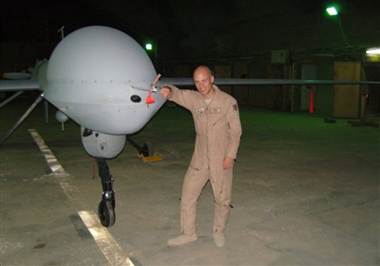
Predator and Brandon Bryant

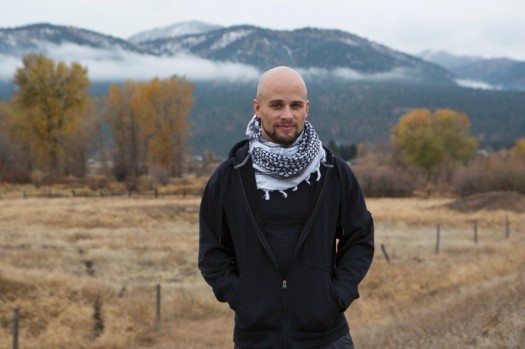
Sounds good, but the real Brandon Bryant (above) has a different story to tell; it turns out that there is an eight-second window in which the missile can be diverted:

With seven seconds left to go, there was no one to be seen on the ground. Bryant could still have diverted the missile at that point. Then it was down to three seconds. Bryant felt as if he had to count each individual pixel on the monitor. Suddenly a child walked around the corner, he says.

Second zero was the moment in which Bryant’s digital world collided with the real one in a village between Baghlan and Mazar-e-Sharif.

Bryant saw a flash on the screen: the explosion. Parts of the building collapsed. The child had disappeared. Bryant had a sick feeling in his stomach.

“Did we just kill a kid?” he asked the man sitting next to him.

“Yeah, I guess that was a kid,” the pilot replied.

“Was that a kid?” they wrote into a chat window on the monitor.

Then, someone they didn’t know answered, someone sitting in a military command center somewhere in the world who had observed their attack. “No. That was a dog,” the person wrote.

They reviewed the scene on video. A dog on two legs?

Even then, think about that blossoming square, twenty feet by twenty feet.  Then factor in the Circular Error Probable of a Hellfire missile, which is usually calculated at between 9 and 24 feet. The ‘pinpoint’ accuracy of the missile is starting to blur and the ‘surgical’ strike beginning to blunt.  In fact, the development of the Hellfire missile suggests another narrative.  In 1991 the Pentagon was already advertising the Hellfire as capable of ‘pinpoint’ accuracy, and since then it has been upgraded more than half a dozen times, each version promising greater accuracy: as Matthew Nasuti asks in his catalogue of Hellfire errors, what can be more accurate than ‘pinpoint accurate’?

In any case, narrowing the discussion to the CEP misses two things.  First, as former USAAF officer Peter Goodrich points out in his discussion of ‘The surgical precision myth‘, this ‘totally disregards what happens after the bomb explodes’.  What Goodrich has in mind is the blast and fragmentation radius, which Chamayou calls ‘the kill radius’.  Fast’s ‘Brandon’ insists

‘All of us are taught about how far those Hellfire missiles go, how far their frag goes.  And “danger close” as we call it when you have troops that are very close or civilians that are present.  They’re just factors that  you have to work in to bring down the percentages of the harm that could be done.’

In the targeting cycle the US Air Force enters those ‘factors’ into both collateral damage estimation and ‘weaponeering’, modifying the missile or bomb to restrict its blast and fragmentation radius. Chamayou reports that the Hellfire missile has a ‘kill radius’ of 50 feet (15 metres) and a ‘wounding radius’ of 65 feet (20 metres); the GBU-12 Paveway II has a ‘casualty radius’ of between 200 and 300 feet (within which 50 per cent of people will be killed).   These calculations aren’t exactly equivalent – and it’s difficult to obtain precise and comparable figures – but nothing about this is as precise as the rhetoric  implies.  As Chamayou asks:

‘In what fictional world can killing an individual with an anti-tank missile [the Hellfire] that kills every living thing within a radius of 15 metres and wounds everyone else within a radius of 20 metres be seen as “more precise”?’

All those who are killed or wounded within the casualty radius are presumably guilty by proximity.

This is Chamayou’s second rider, which relates to what happens before the bomb or missile is released: to the production – the US military sometimes calls it the ‘prosecution’ – of the target.  In this sense, the technical considerations I’ve just described are beside the point (sic).  All of the calibrations I’ve set out in such detail apply to missiles and bombs irrespective of the platform used to deliver them; what is supposed to distinguish a Predator or a Reaper from a conventional strike aircraft or attack helicopter is that it combines ‘hunter’ and ‘killer’ in a single platform and, specifically, that its real-time full-motion video feeds enable crews (and others in the loop) to see what they are doing in unprecedented detail.

Signing a Hellfire missile attached to a MQ1-C (Gray Eagle) UAV at BagramDoes this political technology of vision make it possible, as advocates claim, to distinguish between combatants and civilians more effectively than ever before?  Here Chamayou rehearses common criticisms: that in standard US military practice ‘combatant’ morphs into ‘militant’, even ‘presumed militant’ and, at the hideous limit, into ‘military-aged male’ – counting ‘all military-age males in a strike zone as combatants … unless there is explicit intelligence posthumously proving them innocent’ – and that this process of (so to speak, performative) militantisation as Chamayou calls it is underwritten by a techno-judicial probabilisation (again his term) whose ‘epistemology of suspicion’ allows signature strikes that target un-named and unknown people on the basis of their ‘pattern of life‘.

But both these procedures and, indeed, the criticisms of them, obscure what is for Chamayou, the fundamental paradox, what he calls the ‘profound contradiction’.  International law defines a combatant and thus a legitimate target in terms of direct participation in hostilities and an imminent threat.  It’s more complicated than that, as I’ll show later, but this is enough for Chamayou to fire off two key questions: How can anyone be participating in hostilities if there is no longer any combat? How can there be any imminent threat if there are no troops on the ground?  The drone, praised for its forensic ability to distinguish between combatant and non-combatant, in fact abolishes the condition necessary for such a distinction: combat itself (p. 203; also p. 208).

It’s an artful claim, but it oversimplifies the situation.  Chamayou has (once again) confined the discussion to targeted killing but, as I’ve repeatedly emphasised, Predators and Reapers have also been used for other purposes in Iraq and Afghanistan, including the provision of ‘armed overwatch’ and close air support to ground troops.  Outside these war-zones – in the Federally Administered Tribal Areas of Pakistan, Yemen, Somalia and elsewhere – the critique is a powerful one (which is not to say that Obama’s lawyers have not claimed a legal warrant for their supposedly covert drone strikes in these areas: more on this later too).  Still, Chamayou’s argument loops back to earlier discussions about the intrinsic non-reciprocity of drone warfare.

And here Chamayou closes with a powerful argument.  If ethics is classically about how to live well and die well, he suggests that necro-ethics is a doctrine of ‘killing well’.  He notes that critics of the covert drone wars demand, time and time again, transparency.  They want to know the legal armature and adjudicative apparatus for the strikes, the rules and procedures that are followed, and the lists of casualties.  But he argues that their demands turn the issue into an arid juridico-administrative formalism endorsed by bureaucratic Reason.  In the kill zones, he says ruefully, there are no legal memoranda, no columns of numbers or ballistics reports (p. 207): these are the very formularies of necro-ethics.  And, as I’ve noted, there are no air-raid warnings, no anti-aircraft defences and no air-raid shelters either.

It’s in that spirit that Chamayou closes the chapter with an extended quotation from Madiha Tahir’s Louder than bombs‘:

Saudallah WazirWhat is the dream?

I dream that my legs have been cut off, that my eye is missing, that I can’t do anything … Sometimes, I dream that the drone is going to attack, and I’m scared. I’m really scared.

After the interview is over, Sadaullah Wazir pulls the pant legs over the stubs of his knees till they conceal the bone-colored prostheses.

The articles published in the days following the attack on September 7, 2009, do not mention, this poker-faced, slim teenage boy who was, at the time of those stories, lying in a sparse hospital in North Waziristan, his legs smashed to a pulp by falling debris, an eye torn out by shrapnel. nor is there a single word about the three other members of his family killed: his wheelchair-bound uncle, Mautullah Jan and his cousins Sabr-ud-Din Jan and Kadaanullah Jan.  All of them were scripted out of their own story till they tumbled off the edge of the page.

Did you hear it coming?

No.

What happened?

I fainted. I was knocked out.

As Sadaullah, unconscious, was shifted to a more serviceable hospital in Peshawar where his shattered legs would be amputated, the media announced that, in all likelihood, a senior al-Qaeda commander, Ilyas Kashmiri, had been killed in the attack. The claim would turn out to be spurious, the first of three times when Kashmiri would be reported killed.

Sadaullah and his relatives, meanwhile, were buried under a debris of words: “militant,” “lawless,” “counterterrorism,” “compound,” (a frigid term for a home). Move along, the American media told its audience, nothing to see here.

Some 15 days later, after the world had forgotten, Sadaullah awoke to a nightmare.

Do you recall the first time you realized your legs were not there?

I was in bed, and I was wrapped in bandages. I tried to move them, but I couldn’t, so I asked, “Did you cut off my legs?” They said no, but I kind of knew.

When you ask Sadaullah or Karim or S. Hussein and others like them what they want, they do not say “transparency and accountability.” They say they want the killing to stop. They want to stop dying. They want to stop going to funerals — and being bombed even as they mourn. Transparency and accountability, for them, are abstract problems that have little to do with the concrete fact of regular, systematic death.’
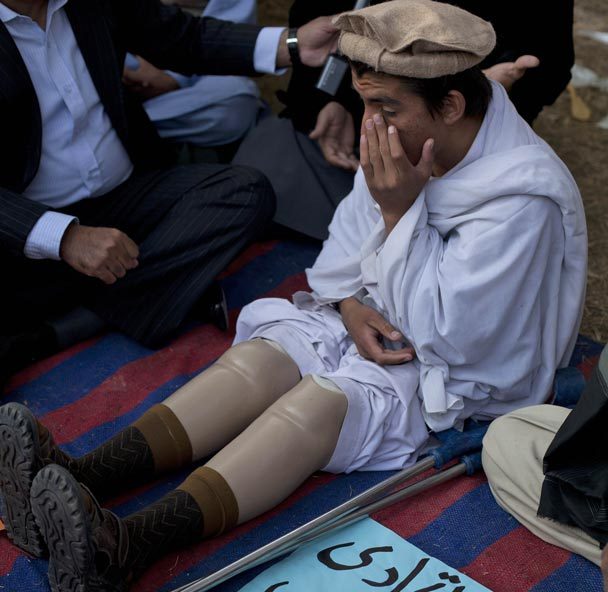
And Madiha adds this: ‘The technologies to kill them move faster than the bureaucracies that would keep more of them alive: a Hellfire missile moves at a thousand miles per hour; transparency and accountability do not.’

Indeed they don’t; Sadaullah died last year, Mirza Shahzad Akbar reports, ‘without receiving justice or even an apology.’  Not even killing well, then.

Theory of the drone 11: Necro-ethics

This is the 11th in a series of extended posts on Grégoire Chamayou‘s Théorie du drone and covers the first two of three chapters that constitute Part III: Necro-ethics.

The title recalls Achille Mbembe‘s seminal essay on ‘Necropolitics’ [Public culture 15 (1) (2003) 11-40], where he cuts the umbilical cord between sovereignty and the state (and supranational institutions) and, inspired by Michel Foucault and Giorgio Agamben, argues that ‘the ultimate expression of sovereignty resides, to a large degree, in the power and the capacity to dictate who may live and who must die.’  Necropolitics is thus about ‘contemporary forms of subjugation of life to the power of death’ – and at the limit the creation of what Mbembe calls ‘death-worlds’.

AlexisLeran-AchilleMbembe5Mins658

Mbembe develops his thesis in part – and for good reason – in relation to the Israeli occupation of Palestine.  I imagine readers will know that the Israeli Defence Force (IDF) advertises itself, incredibly, as ‘the most moral army in the world’, and although Chamayou’s ultimate objectives are different he too begins with a critical interrogation of one version of that claim (you can find much more about it in Muhammad Ali Khalidi‘s fine essay on Gaza in the Journal of Palestine Studies 39 (3) (2010) available on open access here).

1: Combatant immunity

Chamayou argues that what distinguishes contemporary forms of imperial military violence is not so much the asymmetry of the conflict or the differential distribution of vulnerability which results as the norms that are invoked to regulate its conduct.  Towards the end of the twentieth century, he suggests, the ‘quasi-invulnerability’ of the dominant force was transformed into an over-arching politico-ethical framework.  This first came into view during NATO’s intervention in Kosovo in 1999 when force protection was established as the key consideration: not only was the NATO campaign largely confined to bombing from the air (so that, apart from Special Forces, there were few boots – and, more to the point, NATO bodies – on the ground) – but pilots were ordered not to fly below 15,000 feet.  This kept them safely beyond the range of anti-aircraft fire, even as it reduced the accuracy of air strikes and endangered the lives of those the intervention was supposed to save.

nato-bombs-convoy

This seems to violate conventional notions of a just or ethical war, effectively turning ‘humanitarian intervention’ on its head, but Chamayou claims that in fact it heralded the explicit formulation of a principle of ‘imperial combatant immunity’.  Enter the IDF, stage right.  This new doctrine was set out in detail in an essay by Asa Kasher  and Amos Yadlin, writing from the ‘Department of Professional Ethics and Philosophy of Practice’ at Tel Aviv University and the IDF College of National Defense, and published as ‘Military ethics of fighting terror: an Israeli perspective’, Journal of military ethics 4 (1) (2005) 3-32.  As their affiliation shows, this was not an abstract, academic discussion; Chamayou notes, in an artful twist on Yves Lacoste (La géographie, ça sert, d’abord, à faire la guerre), ‘What use is moral philosophy?  Among other things, to wage war…’ (‘A quoi sert la philosophie morale?  Entre autres choses, à faire la guerre’) (p. 184).

In that essay Kasher and Yadlin proposed a comprehensive reformulation of military ethics – and, by extension, international law – but Chamayou fastens on their reworking (or demolition) of  the established principle of distinction.  He cites their central thesis, thus:

One major issue is the priority given to the duty to minimize casualties among the combatants of the state when they are engaged in combat acts against terror.  According to the ordinary conception underlying the distinction between combatants and noncombatants, the former have a lighter package of state duties than the latter. Consequently, the duty to minimize casualties among combatants during combat is last on the list of priorities or next to last, if terrorists are excluded from the category of noncombatants. We reject such conceptions, because we consider them to be immoral. A combatant is a citizen in uniform. In Israel, quite often he is a conscript or on reserve duty. His blood is as red and thick as that of citizens who are not in uniform. His life is as precious as the life of anyone else. A democratic state may send him to a battlefront only because it has a duty to defend its citizens and it cannot do this without some of them defending the others, within the framework of a just system of conscription and reserve duty. The state ought to have a compelling reason for jeopardizing a citizen’s life, whether or not he or she is in uniform. The fact that persons involved in terror are depicted as noncombatants is not a reason for jeopardizing the combatant’s life in their pursuit. He has to fight against terrorists because they are involved in terror. They shoulder the responsibility for their encounter with the combatant and should therefore bear the consequences. 

(It turns out that there are limits to the privileges accorded to citizen-soldiers: more recently Ha’aretz reports that Kasher suggested in early 2012 that medical experiments can be carried out on them, even if they are not fully informed of the details, in order to ‘build the military force’, though Kasher has contested these accusations and insisted that his opinion stipulated a series of ‘conditions’ that had to be met).

I didn’t mention Lacoste casually, because part of Kasher and Yadlin’s argument turns on territory: on the duties imposed by belligerent occupation (‘when a person resides in a territory that is under effective control of the state’).  This is a Trojan Horse, needless to say, because they clearly have Gaza in their sights, and their proposal seeks to further the egregious fiction that Israel’s ‘withdrawal’ in 2005 meant that the Palestinians effectively imprisoned in Gaza are no longer subject to Israeli occupation (for more on ‘Gaza under siege’, see here).  Chamayou doesn’t dwell on this, but the emphasis on ‘effective control’ could – if you accept Kasher and Yadlin’s grotesque argument (which they insist is a general one) – be brought to bear on the US campaign of targeted killing in the Federally Administered Tribal Areas of Pakistan, in Yemen and in Somalia and be made to intersect with the usual rhetoric about ‘ungoverned spaces’ and ‘lawless zones’.

Kasher and Yadlin summarize their proposed hierarchy of privileges by setting out a tariff according to which militaries would administer injury in priority sequence:

(d.1) Minimum injury to the lives of citizens of the state who are not combatants during combat;

(d.2) Minimum injury to the lives of other persons (outside the state) who are not involved in terror, when they are under the effective control of the state;

(d.3) Minimum injury to the lives of the combatants of the state in the course of their combat operations;

(d.4) Minimum injury to the lives of other persons (outside the state) who are not involved in terror, when they are not under the effective control of the state;

(d.5) Minimum injury to the lives of other persons (outside the state) who are indirectly involved in terror acts or activities;

(d.6) Injury as required to the liberties or lives of other persons (outside the state) who are directly involved in terror acts or activities.

Chamayou concludes that the core principle they seek to advance involves replacing the distinction between civilians and combatants by a hierarchical distinction between citizens and aliens: an unbridled nationalism masquerading as ethics (p. 187).  In other words, within the frontier of state control  – Chamayou says ‘ state sovereignty’, but that’s not quite what Kasher and Yadlin say – some lives are more precious than others,  while beyond that line inferior lives (including those of what they call ‘bystanders’) are to be exposed to violence and ultimately sacrificed: as they put it, ‘the state should give priority to saving the life of a single citizen, even if the collateral damage caused in the course of protecting that citizen is much higher…’

nyrb051409Their proposals had a slow fuse but they eventually set off a firestorm of protest.  Responding to a shorter version of the main essay [‘Assassination and preventive killing’, SAIS Review of International Affairs 25 (1) (2005)  41-57] and writing in the New York Review of Books (14 May 2009), Avishai Margalit and Michael Walzer were unequivocally appalled:

‘Their claim, crudely put, is that in such a war the safety of “our” soldiers takes precedence over the safety of “their” civilians.  Our main contention is that this claim is wrong and dangerous. It erodes the distinction between combatants and noncombatants, which is critical to the theory of justice in war (jus in bello).’

They continued:

‘The point of just war theory is to regulate warfare, to limit its occasions, and to regulate its conduct and legitimate scope. Wars between states should never be total wars between nations or peoples. Whatever happens to the two armies involved, whichever one wins or loses, whatever the nature of the battles or the extent of the casualties, the two nations, the two peoples, must be functioning communities at the war’s end. The war cannot be a war of extermination or ethnic cleansing. And what is true for states is also true for state-like political bodies such as Hamas and Hezbollah, whether they practice terrorism or not. The people they represent or claim to represent are a people like any other.

The main attribute of a state is its monopoly on the legitimate use of violence. Fighting against a state is fighting against the human instruments of that monopoly—and not against anyone else….

The crucial means for limiting the scope of warfare is to draw a sharp line between combatants and noncombatants. This is the only morally relevant distinction that all those involved in a war can agree on. We should think of terrorism as a concerted effort to blur this distinction so as to turn civilians into legitimate targets. When fighting against terrorism, we should not imitate it.’

In contrast,

‘For Kasher and Yadlin, there no longer is a categorical distinction between combatants and noncombatants. But the distinction should be categorical, since its whole point is to limit wars to those—only those—who have the capacity to injure (or who provide the means to injure)….

‘This is the guideline we advocate: Conduct your war in the presence of noncombatants on the other side with the same care as if your citizens were the noncombatants. A guideline like that should not seem strange to people who are guided by the counterfactual line from the Passover Haggadah, “In every generation, a man must regard himself as if he had come out of Egypt.”

Menahem YaariTheir critique found vigorous support from Menahem Yaari, a theoretical economist whose work has addressed (amongst other things) questions of justice, uncertainty and risk, but who wrote in a subsequent issue (8 October 2009) in his capacity as President of the Israel Academy of Sciences and Humanities:

‘A military code of conduct that discriminates, in cases of hazards being inflicted upon innocent civilians, on the basis of whether these civilians are “ours” or “theirs” is all the more worrisome when viewed against a general background of growing ethnocentric and xenophobic attitudes in Israel’s traditional establishment. We see an ongoing drift from universalism and humanism toward parochialism and tribalism.’

Picking up from that last sentence, Chamayou believes that this drift has accelerated and that it is by no means confined to Israel’s ‘traditional establishment’.  In his view, the ‘evisceration’ of the core principles of international humanitarian law by a ‘nationalism of self-preservation’ has become ‘the primary guiding principle of the necro-ethics of the drone’ (p. 189).

2: Humanitarian weapon

Chamayou seeks to trace a line of descent from the previous arguments to those advanced more recently by academics who directly address (and defend) the US use of drones.  He has two men in mind: Avery Plaw, an Associate Professor of Political Science at UMass – Dartmouth, and Bradley Jay Strawser, an Assistant Professor of Philosophy in the Defense Analysis Department at the US Naval Postgraduate School at Monterey.

UMass_Drone-crop

Plaw has collaborated with several colleagues to track and evaluate drone strikes in Pakistan and is involved in the UMass DRONE project (I’ve commented on this before), but it’s an Op-Ed in the New York Times on 14 November 2012 that catches Chamayou’s attention.  ‘Drones save lives, American and others’ was the headline, and Chamayou is bemused: ‘How can an instrument of death save lives?’

The question seems to invite a biopolitical response – ‘killing in order to let live’, as Mbembe and others would no doubt have it, and Chamayou doesn’t quite provide that – but neither does Plaw quite say what the headline implies.  He suggests that ‘drone strikes are the best way to remove an all-too-real threat to American lives’ and that ‘there is evidence that drone strikes are less harmful to civilians than other means of reaching Al Qaeda and affiliates in remote, lawless regions’. Perhaps this amounts to the same thing, but it’s not quite the cold calculus that Chamayou attributes to Plaw.  And as I read his (brief) intervention, the ‘American lives’ that Plaw sees as being at risk are not those of, say, ground troops in Afghanistan but of civilians in the continental United States threatened by attacks from al-Qaeda and its affiliates  – though even then Plaw would have to explain how they are ‘saved’ by attacks on the Taliban and other militant groups which scarcely pose a trans-continental danger.

'Nobody dies' Popular Science November 1997

In any event, Chamayou challenges what he sees as the paradoxically vitalist claim that serves as the first principle of contemporary necro-ethics: drones are ‘humanitarian’ because they save lives – and specifically ‘our’ lives (p. 192), which he sees encapsulated even more succinctly than in Plaw’s Op-Ed by the tag-line in the image above (from Popular Science in November 1997): ‘Nobody dies – except the enemy.’

STRAWSER Killing by remote controlThis is where he turns to – and on – Strawser.  Like Plaw, he has had his views publicised in the media –see Rory Carroll on ‘The philosopher making the moral case for US drones’  in the Guardian here and Strawser’s hasty qualification here – but Chamayou directs his attention to Strawser’s essay ‘Moral Predators: the duty to employ uninhabited aerial vehicles’, Journal of military ethics 9 (4) (2010) 342-68.  More recently, by the way, he’s edited a collection of essays, Killing by remote control: the ethics of an unmanned military (Oxford University Press, 2013), which includes an essay by Plaw on ‘Counting the dead: the proportionality of predation in Pakistan’ and an exchange between Kasher and Plaw, in which the (I think substantial) differences between the two are clarified.  These centre on the principle of distinction: the requirement to discriminate between combatants and civilians.  Kasher makes no secret of what he calls his ‘negative attitude to the principle of distinction as it is commonly understood and practically applied’ (which doesn’t leave much room for a positive attitude).  ‘Humanitarian’, he insists, means ‘an attitude towards human beings as such, not toward a certain group of people’ – given the way in which the IDF treats Palestinians, this strikes me as pretty thick – so that the principle of distinction is really ‘civilarian’ (his term) and fails to respect ‘the human dignity of combatants in the broad sense of men and women in uniform’ (which isn’t a ‘broad sense’ at all, of course: Kasher’s combatants all wear uniform).  ‘A democratic state [sic] owes its citizens in military uniform a special justification for jeopardizing their life when they do it not for the relatively simple reason of defending their fellow citizens,’ he argues, ‘but when they are required to do it for the sake of saving the life of enemy citizens who are not combatants.’  The recourse to drones, he concludes, ‘circumvents such difficulties’.

Similarly, though not identically, Strawser regards the drone as not simply a morally permissible weapon but rather as a morally compulsory one.  He proposes a Principle of Unnecessary Risk , according to which ‘it is wrong to command someone to take on unnecessary potentially lethal risks in an effort to carry out a just action for some good’, and then extrapolates more or less directly to the compulsion to employ Unmanned Aerial Vehicles (UAVs):

‘We have a duty to protect an agent engaged in a justified act from harm to the greatest extent possible, so long as that protection does not interfere with the agent’s ability to act justly. UAVs afford precisely such protection. Therefore, we are obligated to employ UAV weapon systems if it can be shown that their use does not significantly reduce a warfighter’s operational capability.’

Strawser then qualifies his basic Principle: ‘the just warrior’s increased protection (which a UAV provides) should not be bought at an increased risk to noncombatants.’   In effect, Chamayou argues, Strawser makes Kasher and Yadlin’s principle of self-preservation subordinate to the minimisation of risks to non-combatants.  But when Strawser insists that ‘if using a UAV in place of an inhabited weapon platform in anyway whatsoever decreases the ability to adhere to jus in bello principles [of proportionality and distinction], then a UAV should not be used,’ Chamayou believes he is also playing his ‘get out of jail free’ card.  For Strawser claims that ‘there is good reason to think just the opposite is true: that UAV technology actually increases a pilot’s ability to discriminate’.   In support, Strawser cites an Israeli pilot –

‘The beauty of this seeker is that as the missile gets closer to the target, the picture gets clearer . . .The video image sent from the seeker via the fiber-optic link appears larger in our gunner’s display. And that makes it much easier to distinguish legitimate from non-legitimate targets’ 

– and Plaw’s analysis of drone strikes in Pakistan from 2004 to 2007.  Strawser concedes that the claim for enhanced distinction is an empirical one; Plaw’s analysis needs a fuller examination than I can provide in this post, but it’s important to note that 2007 is a significant cut-off.  As the chart below shows, from the splendid Bureau of Investigative Journalism, this is long before the Obama administration ramped up the attacks on the Federally Administered Tribal Areas.  Plaw’s chapter in Killing by remote control extends his analysis to 2011 and concludes that US drone strikes – particularly when weighed against casualties from insurgent attacks or Pakistan military operations in the region – most often meet the demands of proportionality; but the discussion doesn’t directly address discrimination.

All-Totals-Dash47

What Strawser does, Chamayou concludes, is offer a technical resolution of an ethical dilemma: it is not necessary to subordinate one principle to another – minimisation of risk to combatants (‘citizen-soldiers’) or minimisation of risk to non-combatants (‘alien’ or otherwise) – because this new technology of killing promises to satisfy both.  In effect, drones are supposed to introduce a new, intrinsically ethical symmetry to asymmetric warfare: they save ‘our’ lives and ‘their’ lives.  They combine the power to kill and to save, to wound and to care, a weapon at once humanitarian and military – ‘humilitaire’, as Chamayou has it.  (Others have made a case for the humanitarian uses of unarmed drones, but their arguments are a far cry from military applications).

Yet if this new military power saves lives, Chamayou demands, what is it saving them from?  His answer: from itself, from its own power to kill.  And if this seems the lesser evil, in Eyal Weizman‘s terms the ‘result of a field of calculations that seeks to compare, measure and evaluate different bad consequences’, then we need to remind ourselves, with Hannah Arendt, how quickly ‘those who choose the lesser evil forget … that they chose evil.’

Chamayou turns to Weizman deliberately; that ‘field of calculations’, the calculus that is focal to the construction through calibration of our ‘humanitarian present’, is the target of Chamayou’s next and final chapter in his critique of necro-ethics – of which more very soon.

UPDATE: Today’s Guardian has a video debate between Seumas Milne and Peter Lee (Portsmouth University): ‘Is the use of unmanned military drones ethical or criminal?’ Lee claims that, ‘used correctly’, this new technology and in particular the MQ-9 Reaper is ‘the most potentially ethical use of air power yet devised.’

Theory of the drone 10: Killing at a distance

This is the tenth in a series of extended posts on Grégoire Chamayou‘s Théorie du drone and covers the fifth and final chapter in Part II, Ethos and psyche.

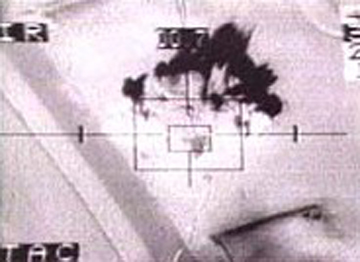
Gulf_war_target_camChamayou begins with a lecture given by German artist and film-maker Harun Farocki in Karlsruhe in 2003 called  ‘Phantom Images‘.  A ‘phantom image’, Farocki explained, is a view that is otherwise inaccessible to a human being – like the ‘bomb’s-eye view’ that became so familiar during the Gulf War (‘a suicidal camera’).  Like so many other ‘technical representations which maintain that they only represent the operative principle of a process’ these are, of course, techno-cultural performances.  They are techno-cultural because they produce a constructed and constrained space – in the Gulf War images that Farocki used to frame his argument, the battle space appears empty of people, a landscape without figures, an odyssey of destruction based on an object-ontology – and they are performances because they are what Farocki called ‘operative images’ that ‘do not represent an object but are part of an operation‘ (my emphasis).

You can find more on Farocki’s fascination with the virtual/real and Immersion here and on Images of War (at a distance) here.  Both ideas – immersion and distance – are central to Chamayou’s argument, but his starting-point is the idea of an operative image.  He wants to think of militarized vision as a ‘sighting’ that works not only to represent an object but also to act upon it and, in the case that most concerns both of us, this is the mainspring of the production of the target.

This has a long (techno-cultural) history, but drones use a video image to fix and execute the target: ‘You can click, and when you click, you kill.’  There’s something almost magical about it, Chamayou says: a hi-tech form of voodoo violence, like sticking pins into a wax doll, in which bringing someone into view – ‘pinning’ the target in the viewfinder – transports them into the killing space.

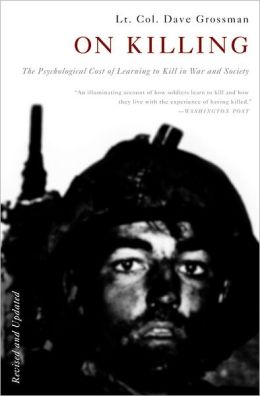
GROSSMAN On KillingBut what sort of space is it?  Chamayou considers a simple diagram from Dave Grossman‘s On Killing. For readers unfamiliar with his work, here is how Grossman describes himself on the website of his Killology Research Group:

Col. Grossman is a former West Point psychology professor, Professor of Military Science, and an Army Ranger who has combined his experiences to become the founder of a new field of scientific endeavor, which has been termed “killology.” In this new field Col. Grossman has made revolutionary new contributions to our understanding of killing in war, the psychological costs of war, the root causes of the current “virus” of violent crime that is raging around the world, and the process of healing the victims of violence, in war and peace. 

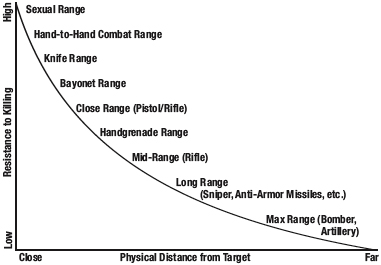
And here is the diagram, which summarises Grossman’s views on the relationship between ‘resistance to killing’ and distance from the target:

Resistance to killing as a function of distance

Grossman’s basic argument is that distance increases indifference and, as the annotations imply, there appears to be an historical sequence to all this.  Grossman’s book was published before the advent of the drone, but – given these two axes – the Predator and the Reaper presumably ought to appear on the extreme right of the diagram, representing the radicalisation of killing at a distance.

In fact, Grossman provides a discussion of videogames in which he says that the screen acts as a barrier between the player and the violence s/he unleashes in the game, making it easier to ‘kill’: exactly the argument advanced by those who claim that drones induce a ‘Playstation mentality’ to killing.

And yet, as I’ve explained in ‘From a view to a kill’ (DOWNLOADS tab), modern videogames are profoundly immersive, and the high-resolution full motion video feeds from the drones induce such an extraordinary sense of proximity, even intimacy – remember that crews frequently claim to be 18 inches from the combat zone, the distance from eye to screen – that drones are surely also pulled towards towards the extreme left of Grossman’s diagram.

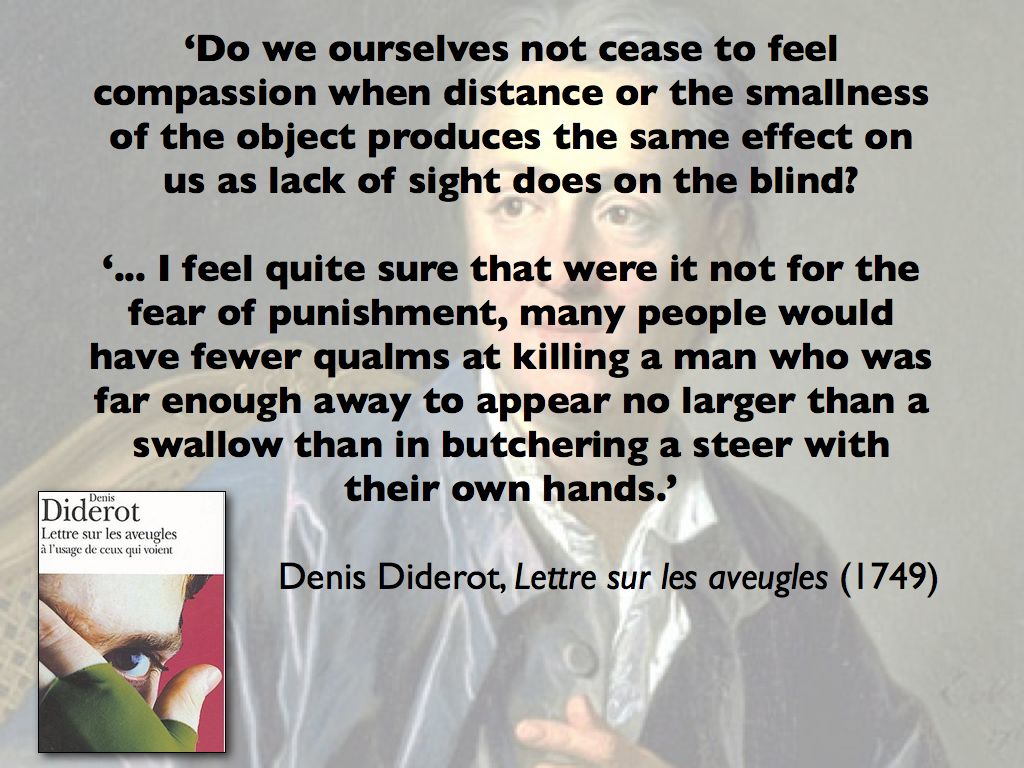
Chamayou doesn’t quote him, but Diderot’s Letter on the blind set out the original terms of the debate perfectly:

DIDEROT.001

But Chamayou is quick to show that ‘distance’ is a weasel-word, and in an extended footnote he elaborates his concept of pragmatic co-presence.  Co-presence denotes the possibility of A affecting B in some way, which means (in the absence of sorcery) that B must be within the sphere of action of A; more formally, co-presence involves the inclusion of one within the ‘range’ or ‘reach’ of another.  This is multi-dimensional – without technical mediation you can see someone much further away than you can hear them – but in many situations technical mediations are involved and so transform the relation.  This matters for two reasons.

First, there is nothing necessarily reciprocal about co-presence: what Chamayou calls ‘the structure of of co-presence’ determines what it is possible for you to do to the other, and is itself the product of struggle: each party to a conflict manouevres to produce a favourable asymmetry so that it becomes much easier for you to strike than to be hit.  In this sense, all war strives to be asymmetric – it’s not confined to wars between states and non-state actors – and it’s this that in part underwrites the history of war at a distance; as William Saletan put it, effectively re-describing Grossman’s diagram,

‘Technically, this is marvelous. Look at the history of weapons development: catapult, crossbow, cannon, rifle, revolver, machine gun, tank, bazooka, bomber, helicopter, submarine, cruise missile. Every step forward consists of a physical step backward: the ability to kill your enemy with better aim at a greater distance or from a safer location. You can hit him, but he can’t hit you.’

But – Chamayou’s second rider – ‘teletechnologies’ radically transform this sequence by severing co-presence from co-localisation.   What is distinctive about teletechnologies is not their capacity to act ‘at a distance’ but their indifference to and their interdigit(is)ation of ‘near’ and ‘far’.

This has far-reaching (sic) consequences because it produces a double disassociation.  Where, exactly, does the action take place?  Here (at Creech Air Force Base in Nevada) or there (Kandahar in Afghanistan)?  There is no single answer, of course, which is precisely Chamayou’s point.  This split – or series of splits, if you think of the wider networks involved – in turn engenders radically new forms of experience, of being-in-the-world, that can no longer be contained within the physico-corporeal confines of the conventional human subject.

Chamayou wants to show that this double disassociation is anything but ‘marvellous’.   He accepts that the targets that are produced through the full-motion video feeds from the Predators and Reapers are much less abstract: the crews see their targets – often people, not physical objects like the buildings or missile batteries that constituted Farocki’s ’empty’ battlespace – and they see the corporeal consequences of each strike.  ‘This novel combination of physical distance and visual proximity gives the lie to the old [Clausewitz-Hegelian] law of distance,’ Chamayou writes, since ‘increased distance no longer makes violence more abstract or more impersonal but, on the contrary, more graphic and more personal.’

But he insists that this proximity, even intimacy is counterbalanced by two factors which are also inscribed within the political technology of vision:

(1) ‘Proximity’ is contracted to the optical – and even this is degraded because the resolution of the video feeds reduces people to ‘avatars without faces’.  I think this is less straightforward than Chamayou implies.  He cites Salatan – ‘There’s no flesh on your monitor; just co-ordinates’ – which is a sharp remark, but the journalist was referring to the launch of long-range missiles (‘… tap a button on one continent and send a missile to another’) whereas the screens at Creech and elsewhere show human figures as well as co-ordinates.  More significant, I think, is that when drone operators provide close air support they are also in radio and online contact with troops on the ground, and this produces a pragmatic co-presence which is considerably more ‘fleshed out’ than their otherwise purely optical encounters with others in their field of view.

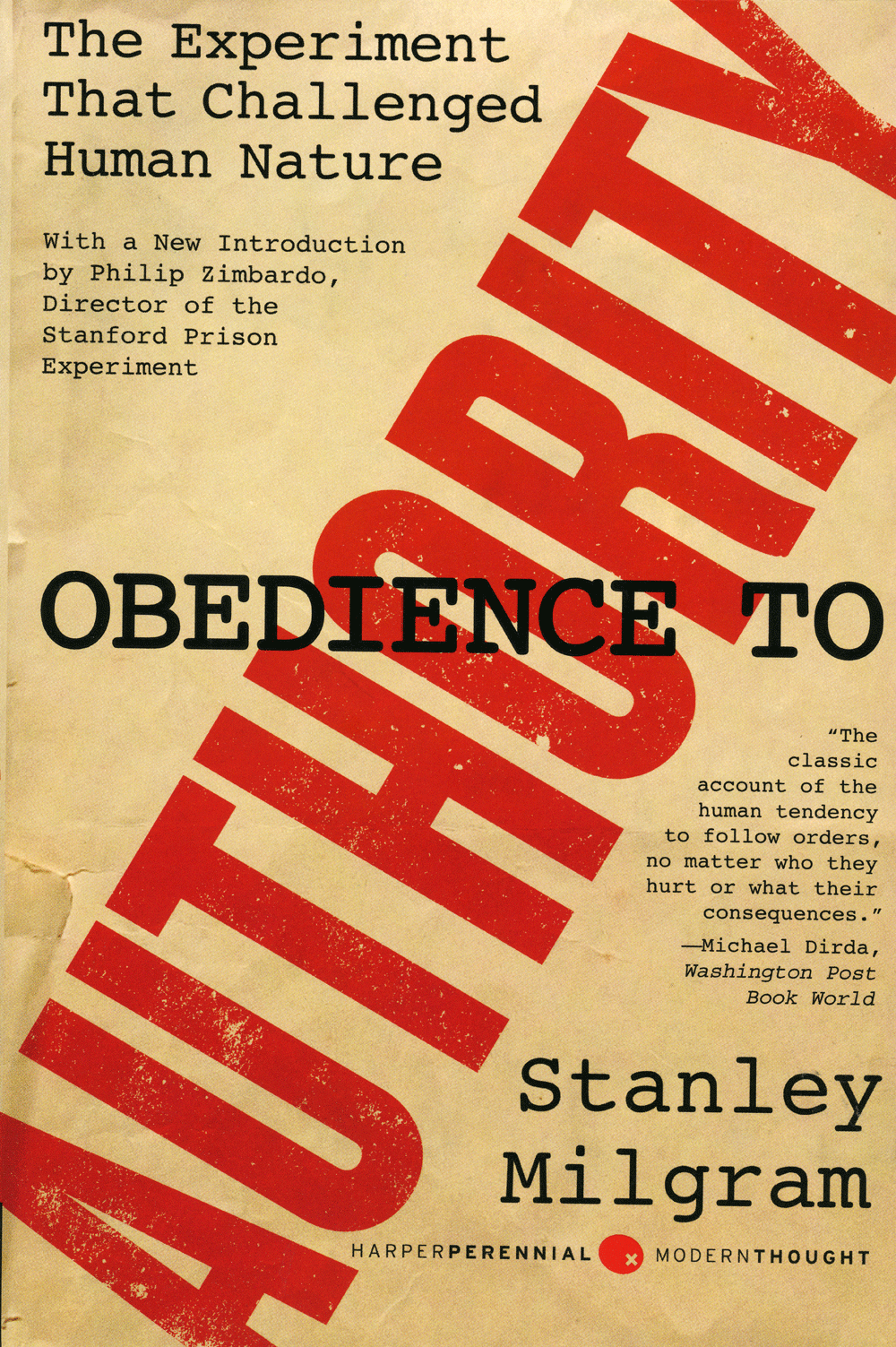
(2) Drone operators can see without being seen, and Chamayou argues that ‘the fact that the killer and his victim are not inscribed in “reciprocal perceptual fields” facilitates the administration of violence’ because it ruptures what psychologist Stanley Milgram in his notorious experiments on Obedience to authority [below] called ‘the phenomenological unity of the act’.  Milgram actually wrote “experienced”, not “phenomenological”, but you get the point; Milgram was discussing how much easier it is to hurt someone ‘if there is a physical separation of the act and its consequences’, which is radicalised in what the US Air Force calls the ‘remote split’ operations carried out by its Predators and Reapers.

MILGRAM Experiments

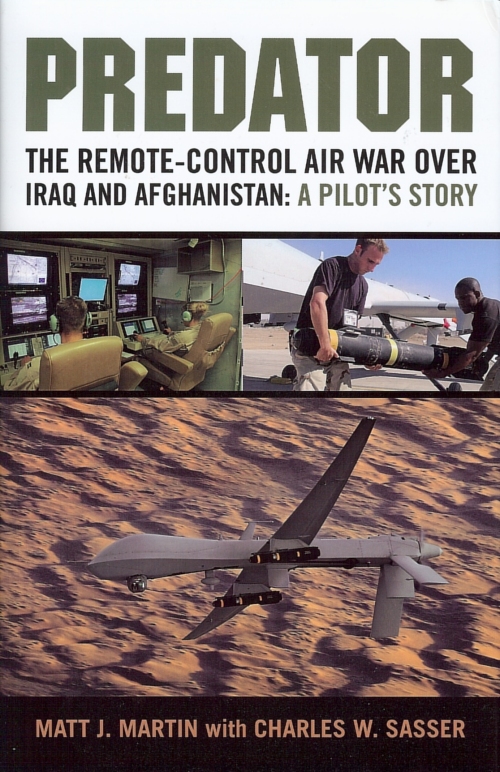
Milgram’s thesis was a general one, but to nail the sense of disassociation to the drone Chamayou quotes Major Matt Martin, a Predator operator:

‘The suddenness of action played out at long distance on computer screens left me feeling a bit stunned…  It would take some time for the reality of what happened so far away, for “real” to become real.’

Again, I think it’s more complicated than that.  Martin was clearly recalling an early experience, low on the learning curve, and interviews with other drone pilots suggest that within 6 months or so most had little difficulty in apprehending the reality, even the physicality of pragmatic co-presence. The sensor operator interviewed by Omer Fast for 5,000 Feet is the Best had this to say, for example:

‘… you get more into it the longer you’re working on the Predator.  Like my first fire mission.  You know, we fired a Hellfire missile at the target.  It didn’t quite strike [sic] me as, “Hey! I just killed someone!”  My first time.  It was within my first year there.  It didn’t quite impact.  It was like, “Yeah! I got somebody!”  You know?  And it was later on through a couple of more missions that I started to… The impact really dawned on me.  I just ended someone’s life!  That was me that did that!”‘

obedience-to-authority-milgramIt’s important to remember, too, that Milgram’s work was about structures of authority, and this has a palpable effect in the case of the military chain of command which has been transformed by the networked incorporation of video feeds from the drones and the deployment of military lawyers (JAGs) on the operations floor of the Combined Air and Space Operations Center (what I called ‘oversight’ in “From a view to a kill”),  which provides for a dispersion of responsibility across the network.

Equally important, I suspect, is that fact that drone crews are not only ‘following orders’, as the familiar jibe has it: they are also following procedures that transform military violence into a process that is at once techno-scientific and quasi-juridical and thus seen as conducted under the sign of an unimpeachable (military) Reason.

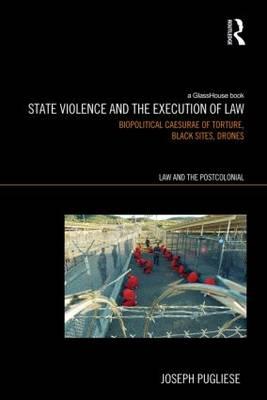
Joseph Pugliese makes a parallel argument about the incorporation of military-legal discourse into the techno-logic of the targeting process:

‘I argue that the parenthetical relation of law to technology is premised on a topical hiatus that disassociates the executioner who manipulates the killing technology of the drone from the facticity of the resultant execution. In this scenario, law is conceived of in the most radically instrumental of understandings: it enables and legitimates the execution while simultaneously suspending the connection between the doer and the deed.’

state-violence-and-the-execution-of-lawAnd yet at the same time, Pugliese explains, there is a ‘prosthetic’ relation between law and technology, in which ‘the human agent is always already inscribed by the technics of law.’ From the very beginning, he insists, the body is always already ‘instrumentalised by a series of technologies’ and also inscribed, from the very beginning, by a series of laws.  In short, ‘law is always already inscribed on the body, precisely as techné from the very first. This process of prosthetic inscription operates to constitute the very conditions of possibility for the conceptual marking of the body as”‘human’”‘: ‘The prosthesis,’ notes Bernard Stiegler, ‘is not a mere extension of the human body; it is the constitution of this body qua “human”’.’

Still, Chamayou suggests that (1) and (2) work together to sustain what Mary Cummings calls ‘moral buffering’.  In other words, and in counterpoint to optical proximity, the dispositif also provides a powerful means of distanciation.  Here is Fast’s interviewee again:

‘There’s always more of a personal touch when you’re watching something live.  And it’s even more personal when you’re the one that did it… Well, I mean you get more – I guess – emotionally distant.  As time goes on.  But I mean… I guess in my case, and some of the cases of the guys that I knew, as more time went by you put yourself more and more in the position that this is more and more real life and that you are actually there… And after a while you become emotionally distant.  But still you put yourself more and more as if you’re standing right there…’

MARTIN PredatorThis is compounded, so Chamayou argues, by a different dimension of ‘remote split’ operations. Because Predators and Reapers can stay aloft for 18 hours or more (the ‘persistent presence’ that makes them so much in demand), their crews work shifts and commute each day (or night) between home and work or, more accurately, between peace and war.  One drone operator saw this as a peculiarly strung-out existence: ‘We were just permanently between war and peace’  (my emphasis).  Matt Martin said much the same.  US-based crews ‘commute to work in rush-hour traffic, slip into a seat in front of a bank of computers, fly a warplane to shoot missiles at an enemy thousands of miles away, and then pick up the kids from school or a gallon of milk at the grocery store on [their] way home for dinner.’  He described it as living ‘a schizophrenic existence between two worlds’; the sign at the entrance to Creech Air Force Base read ‘You are now entering CENTCOM AOR [Area of Operations]’, but ‘it could just as easily have read “You are now entering C.S. Lewis’s Narnia” for all that my two worlds intersected.’

The way crews survive, Chamayou suggests, is by partitioning, ‘setting aside’, but this is extremely difficult for commuter-warriors as they regularly and rapidly move between a domestic sphere in which killing is taboo and a military sphere where (so he says) it is ‘a virtue’.   The superimposition of these two worlds – their contradictory clash – means that crews are in a sense ‘both in the rear and at the front, living in two very different moral universes between which their lives are torn.’

This is precisely the situation dramatised in George Brant‘s play Grounded, which I noted in an earlier post, and Chamayou cites a former USAF sensor operator Brandon Bryant (whose testimony I discussed here) to the same effect.  In both cases, crew members plainly are affected, even distressed by what they see on the screen; in fact Bryant has bee diagnosed with PTSD.

But Chamayou insists that this sort of testimony is rare and that most of them do manage to compartmentalise.  Fast’s sensor operator:

‘A lot of us learn real fast to leave all of our problems at the door.  You know, when we’re leaving the squadron and heading home.  Just kind of putting it on a rack and pushing it out of your mind.’

And this, Chamayou concludes, nails the real psychopathology of the drone.  He calls French philosopher Simone Weil’s Gravity and grace to his aid:

‘The faculty of setting things aside opens the door to every sort of crime…  The ring of Gyges who has become invisible – this is precisely the act of setting aside: setting oneself aside from the crime one commits; not establishing the connection between the two.’

Chamayou has used the myth of Gyges earlier in his critique, but here he invokes Weil to claim that the psychopathology of the drone is not the trauma some say that drone crews experience ‘but on the contrary the industrial production of compartmentalised psyches, protected from all possibility of reflection on the violence they have committed, just as their bodies are already protected against every possibility of exposure to the enemy.’

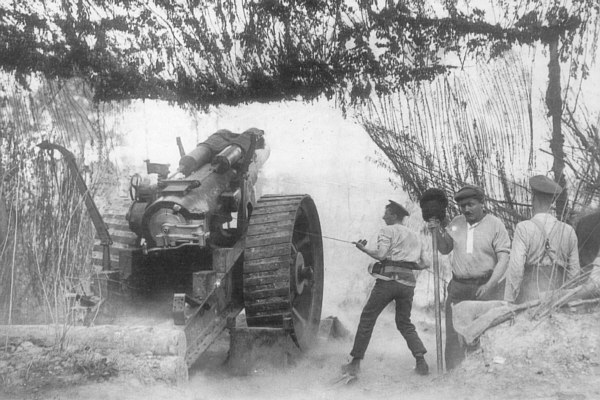
rwg05074-1I’m really not sure about this.  ‘Protected from all possibility of reflection’?  Much of the evidence that Chamayou cites here – like Milgram’s experiments – could be applied to most forms of military violence.  Here, for example, is Arnold Bennett describing artillery at work in Over there: war scenes on the Western Front (1915):

‘The affair is not like shooting at anything.  A polished missile is shoved into the gun.  A horrid bang – the missile has disappeared, has simply gone.  Where it has gone, what it has done, nobody in the hut seems to care.  There is a telephone close by, but only numbers and formulae – and perhaps an occasional rebuke – come out of the telephone, in response to which the  perspiring men make minute adjustments in the gun or in the next missile.

 ‘Of the target I am absolutely ignorant, and so are the perspiring men.’

I’ve found the same sentiments expressed by bomber crews during the Second World War.  The difference, clearly, is that drone strikes involve far more than ‘numbers and formulae’ – co-ordinates on the screen – and that the visual  production and so-called ‘prosecution’ of the target takes place in near real time, in vivid detail and under the eye of military lawyers.  But it is not surprising (nor, I think, especially pathological) that those who carry out these strikes conduct themselves with a certain seriousness, a ‘professionalism’ if you like, that precludes emotional investment. This is from David Wood‘s interview with a highly experienced USAF drone pilot:

Q: You must develop an emotional tie with the people on the ground that makes it hard if there is going to be a strike or a raid, people are going to be killed.

A: I would couch it not in terms of an emotional connection, but a … seriousness. I have watched this individual, and regardless of how many children he has, no matter how close his wife is, no matter what they do, that individual fired at Americans or coalition forces, or planted an IED — did something that met the rules of engagement and the laws of armed conflict, and I am tasked to strike that individual.

‘Professionalism’ shouldn’t be used as a mask to hide from critique, to be sure.  These crews are trained to perform with a calculative reason, dispassionately, through a techno-cultural and techno-legal armature, so that, as one USAF major told Nicola Abé, when she was preparing for a strike ‘there was no time for feelings’.  Or again, from another pilot operating a Predator over Afghanistan:

‘We understand that the lives we see in the screens are as real as our own…  I would not compare what I do as a job comparable to Call of Duty/any other video game, in any sense. It is very real and the seriousness of the lives on the ground is very real and instilled in all of our training. It is never something that we joke about. Very serious business.’

As I’ve noted before, there are (too) many instances in which crews do joke about their missions, the sort of ‘gallows humour’ that is no doubt a common reaction to  hunter-killer missions: but isn’t this also likely to be common amongst all military professionals who are trained to kill?  One pilot explicitly rejected the suggestion that drone crews become disassociated from what they do:

‘I wonder why people think this. We understand what we are doing is real world operations. We know our actions have consequences. I don’t understand the idea of being desensitized due to some operators not being in an actual firefight/combat zone.’

Later in the online exchange, the same pilot insists: ‘It’s very real.  Some of the stuff I’ve seen is burned into my brain’ – and then Brandon Bryant joins the conversation to ‘agree with what you guys have said.’  He’s on record as writing in his personal combat diary ‘I wish my eyes would rot.’

I realise that these passages can’t settle matters, but they surely cast doubt on the implication that drone crews are as machinic as the aircraft they fly.  Pugliese insists that the drone ‘cannot be reduced to a mindless machine of purely robotic acts’; neither, by virtue of what Pugliese calls their prosthetic relation to the drone, can the crew who fly them.   I still think that one of the most salient differences introduced by drones is the differential distanciation they allow when they provide close air support: an unprecedentedly close relation with troops on the ground and a calculative detachment from others in their field of view.

I realise, too, that this can’t apply to targeted killings, and so I leave you with this statement by Lt General Michael DeLong, who as deputy commander of US Central Command had to sign off on the first CIA-directed targeted killing, in Yemen in November 2002.  Then CIA Director George Tenet called DeLong to ask him to give the order, since the Predator was flown by a USAF crew:

delongp‘Tenet calls and said, “We got the target.” … I called General Franks [commander of CENTCOM]. Franks said, “Hey, if Tenet said it’s good, it’s good.” I said, “Okay … I’m going down to the UAV room.” … We had our lawyer there. Everything was done right. I mean, there was no hot dog. … The rules of war, the rules of combat that we had already set up, the rules of engagement ahead of time. Went by them. Okay, it’s a good target. …

I’m sitting back … looking at the wall, and I’m talking to George Tenet. And he goes, “You got to make the call?” These Predators had been lent to him, but the weapons on board were ours. So I said, “Okay, we’ll make the call. Shoot them.” 

Everything may have been ‘done right’, the procedures followed, but  when DeLong was asked ‘What does it feel like when you know you’re going down there to kill somebody?’ He replied:

‘It’s just war. It’s no different than going to the store to buy some eggs; it’s just something you got to do.’

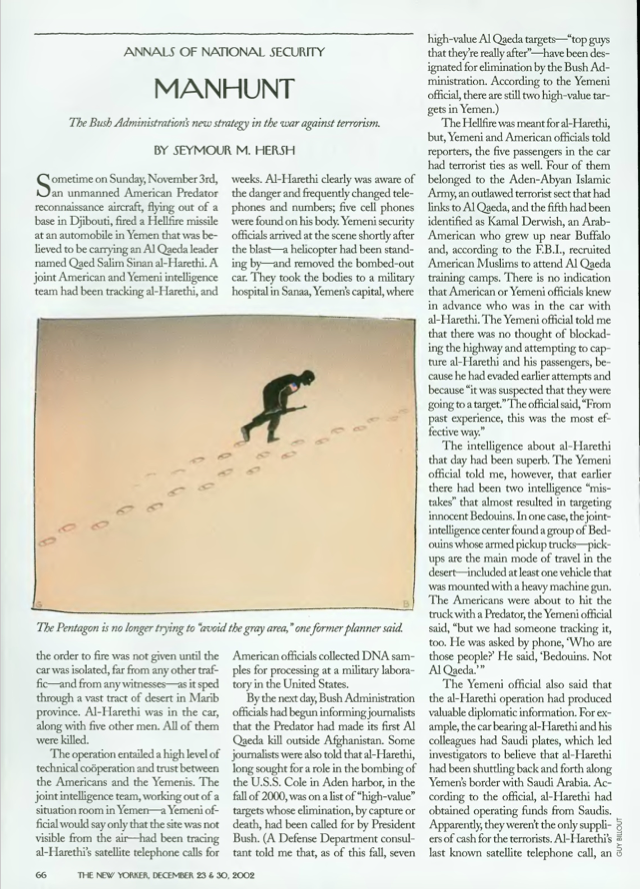
And, as Chamayou would surely insist, it wasn’t war.  It was, as Seymour Hersh wrote in the New Yorker on 23 December 2002, a manhunt.

HERSH Manhunt

To be continued.

Drones and drama

I’ve noted several performance works that address drone wars before, and I’ve now encountered two more.

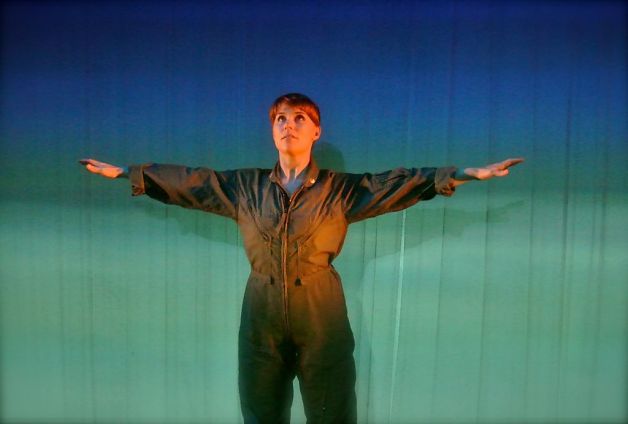
BRANT GroundedGeorge Brant‘s new play, Grounded, has been acclaimed on both sides of the Atlantic.  It’s a solo drama (‘monologue’ really doesn’t do it justice) about a US Air Force pilot who has been obliged to switch from flying F-16s to Reapers (and so to the ‘Chair Force’) after her maternity leave.

The focus is on a domestic geography of remote operations that is beginning to attract more critical attention and which resonates with what Grégoire Chamayou calls the ‘psychopathologies of the drone‘: the difficulty of switching every day, every shift, from being in the war zone, at least virtually – what she calls being “downrange” – to being at home with a young family.

‘We’ll be working in shifts. Tapping each other out and taking the controls. A never-ending mission. Home will be training too. Getting used to the routine. Driving to war like it’s shift work. Like I’m punching the clock. Used to transition home once a year. Now it’ll be once a day. Different. Definitely different.’

The pilot finds it increasingly difficult to maintain the separation – to decompress – and gradually and ever more insistently one space keeps superimposing itself over the other; the fixed, precise sensor of the Gorgon Stare yields to a blurred vision in which the pilot finds it increasingly difficult to know where (or who) she is.

She begins by familiarising herself with the landscape in Afghanistan and the spectral figures moving through it:

‘I stare at the desert. They’re twelve hours ahead there. Night. Weird. I stare at the screen. It’s not like a videogame. A videogame has color. I stare at grey. At a world carved out of putty. Like someone took the time to carve a putty world for me to stare at twelve hours a day. High-definition putty….
‘The eye in the sky waits for the putty people to get closer together. Just a little closer. Closer. Closer. There I press the button. I watch the screen. A moment. A moment. And boom. A silent grey boom.’ 
628x471-1‘It becomes your world,’ she says, a world populated by the living and the dead whose greyness bleeds one into the other:

‘Lingering over the dead. A mound of the dead. Our dead. They were ambushed and I am to linger over their bodies. I do. With no idea of who they are or how they got here. A mound of our grey. Our boys in grey. Please let me find the guilty who did this the military age males who did this send me to shred their bodies into pieces too fine for my resolution…’

But then the Nevada desert on the drive home starts to resemble the landscape in Afghanistan; the face of a little girl on the screen, the daughter of a ‘High Value Target’, becomes the face of her own child:

‘The girl Her face She stops running and I see it Her face I see it clearly I can see her It’s Sam It’s not his daughter it’s mine…’

There’s much more – much of it turning on imagery and surveillance – and it’s richer and less linear than I can convey here.  You can download the script from Amazon or buy hard copy from Oberon Books here; in the UK Grounded has just transferred from the Edinburgh Festival to the Gate in London until 28 September: details here, and other dates in the US here (scroll down).

I’ve also received a message from Hjalmar Joffre-Eichhorn, a German-Bolivian theatre-maker who has lived and worked in Afghanistan for the last six years.  Hjalmar brought the “Theatre of the Oppressed” to Afghanistan and co-founded the Afghanistan Human Rights and Democracy Organization (AHRDO).  He’s currently writing a new play to be premiered in Kabul in November, which focuses on drones and suicide bombers in Afghanistan and Pakistan: clearly another parallel with Grégoire Chamayou‘s work.

More to come, I hope, and I’ll keep you posted, but you can watch and listen to an inspiring talk by Hjalmar on Afghanistan and community-based theatre here:

Note: Back to my reading of Théorie du drone next week – this week has been filled with preparing for the new term which starts on Tuesday (so I’m updating the course outlines under the TEACHING tab).  I’ve also had a lovely e-mail from Grégoire Chamayou, and we are going to try a digital conversation – once the dust of the beginning of term has settled – and when we’re done, I’ll post the transcript here.

Dronework

Some recent open access work on drones that intersects with my ongoing reading of Grégoire Chamayou‘s Théorie du drone.

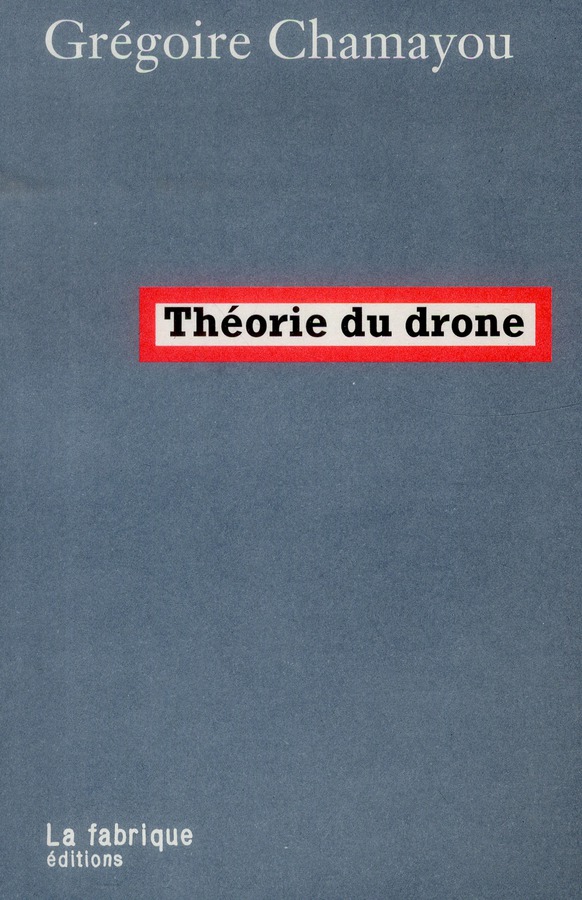
Theorie du droneFirst, Philippe Theophanidis, a PhD student at the Université de Montréal, writes with the welcome news that he’s developed an online bibliography of English and French language materials, Grégoire Chamayou: bodies, manhunts and drones, available here.

Philippe’s own research concerns the theory of community in Jean-Luc Nancy and Roberto Esposito.  He adds:

‘I’m especially preoccupied by the fact that our contemporary mode of being-together paradoxically takes the form of destructive interactions. For that reason, I’m interested about war and space in general, and more precisely about “global civil war” (Schmitt) or war in the time of globalization. That’s why Chamayou’s new book caught my attention when it came out.’

Second, another contribution to the ramifying genealogy of drones that I’ve addressed in several previous posts (for example here and here): at OSU’s Origins: current events in historical perspective, Kenneth Hough provides an extended essay on what he calls ‘the long cultural history of drones’.  He adds some interesting material, most of it about the ways in which drones have been registered in American popular culture:

Since their emergence in the late nineteenth century, Americans have regarded unmanned aerial systems as four basic cultural phenomena: heralds of human accomplishment and hope for the future, signs of inhuman depravity portending society’s doom, mechanical misfires that are both ineffective and humorous, and transcendent machines that spark existential questions about war and society, tapping into what David Nye calls our “fundamental hopes and fears.”

But his long cultural history turns out to be a remarkably narrow cultural geography in which – apart from an excursus on V-1 rockets in the Second World War – experimental laboratories outside the United States (notably Britain and Israel) disappear from view.  For all that, I’m surprised that James Cameron‘s Avatar isn’t on his cultural hit list (though I know Cameron’s Canadian): to see what I mean, and for a more general cultural critique, check out Patrick Lichty‘s interesting essay, Drone: camera, weapon, toy on ‘the aestheticization of dark technology’.

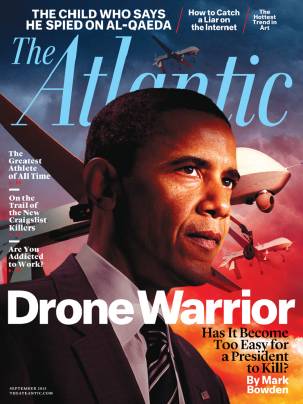
The Atlantic September 2013 Drone warriorWhich brings me to my last sighting: Mark Bowden‘s cover essay in the latest (September) issue of Atlantic on ‘The Killing Machines: how to think about drones‘.  Despite the subtitle, much of Bowden’s extended essay asks how we should feel about drones.

Anyone familiar with his previous work (from Black Hawk Down on) probably won’t be surprised by his ultimate take on matters, and the early online comments show that he’s set off a firestorm of protest by what several writers call his ‘apologia’.

As a matter of fact, I think the essay is more complicated than that, and Bowden does address one of the central issues that Chamayou returns to again and again, the ways in which remote (split) operations transform the very nature of ‘combat’:

Drone strikes are a far cry from the atomic vaporizing of whole cities, but the horror of war doesn’t seem to diminish when it is reduced in scale. If anything, the act of willfully pinpointing a human being and summarily executing him from afar distills war to a single ghastly act.

One day this past January, a small patrol of marines in southern Afghanistan was working its way at dusk down a dirt road not far from Kandahar, staying to either side to avoid planted bombs, when it unexpectedly came under fire. The men scattered for cover. A battered pickup truck was closing in on them and popping off rounds from what sounded like a big gun.

Continents away, in a different time zone, a slender 19-year-old American soldier sat at a desk before a large color monitor, watching this action unfold in startlingly high definition. He had never been near a battlefield. He had graduated from basic training straight out of high school, and was one of a select few invited to fly Predators. This was his first time at the controls, essentially a joystick and the monitor. The drone he was flying was roughly 15,000 feet above the besieged patrol, each member marked clearly in monochrome on his monitor by an infrared uniform patch. He had been instructed to watch over the patrol, and to “stay frosty,” meaning: Whatever happens, don’t panic. No one had expected anything to happen. Now something was happening.

The young pilot zoomed in tight on the approaching truck. He saw in its bed a .50-caliber machine gun, a weapon that could do more damage to an army than a platoon of Goliaths.

A colonel, watching over his shoulder, said, “They’re pinned down pretty good. They’re gonna be screwed if you don’t do something.”

The colonel told the pilot to fix on the truck. A button on the joystick pulled up a computer-generated reticle, a grid displaying exact ground coordinates, distance, direction, range, etc. Once the computer locked on the pickup, it stayed zeroed in on the moving target.

“Are you ready to help?” the colonel asked.

An overlay on the grid showed the anticipated blast radius of an AGM-114 Hellfire missile—the drone carried two. Communicating via a digital audio link, the colonel instructed the men on the ground to back away, then gave them a few seconds to do so.

The pilot scrutinized the vehicle. Those who have seen unclassified clips of aerial attacks have only a dim appreciation of the optics available to the military and the CIA.

“I could see exactly what kind of gun it was in back,” the pilot told me later. “I could see two men in the front; their faces were covered. One was in the passenger seat and one was in the driver’s seat, and then one was on the gun, and I think there was another sitting in the bed of the truck, but he was kind of obscured from my angle.”

On the radio, they could hear the marines on the ground shouting for help.

“Fire one,” said the colonel.

The Hellfire is a 100-pound antitank missile, designed to destroy an armored vehicle. When the blast of smoke cleared, there was only a smoking crater on the dirt road.

“I was kind of freaked out,” the pilot said. “My whole body was shaking. It was something that was completely different. The first time doing it, it feels bad almost. It’s not easy to take another person’s life. It’s tough to think about. A lot of guys were congratulating me, telling me, ‘You protected them; you did your job. That’s what you are trained to do, supposed to do,’ so that was good reinforcement. But it’s still tough.”

One of the things that nagged at him, and that was still bugging him months later, was that he had delivered this deathblow without having been in any danger himself. The men he killed, and the marines on the ground, were at war. They were risking their hides. Whereas he was working his scheduled shift in a comfortable office building, on a sprawling base, in a peaceful country. It seemed unfair. He had been inspired to enlist by his grandfather’s manly stories of battle in the Korean War. He had wanted to prove something to himself and to his family, to make them as proud of him as they had been of his Pop-Pop.

“But this was a weird feeling,” he said. “You feel bad. You don’t feel worthy. I’m sitting there safe and sound, and those guys down there are in the thick of it, and I can have more impact than they can. It’s almost like I don’t feel like I deserve to be safe.”

I’ve described this identification with troops on the ground before, what one of Bowden’s correspondents calls ‘a very visceral connection to operations on the ground’.  And Bowden is stacking the deck by starting with what the US military calls ‘Troops in Contact‘ in Afghanistan rather than CIA-directed targeted killing in Pakistan: only later will he turn to the legal and quasi-legal landscape through which those strikes pass (more on this in a later post) .  But he then adds this:

If the soldier who pulls the trigger in safety feels this, consider the emotions of those on the receiving end, left to pick up the body parts of their husbands, fathers, brothers, friends. Where do they direct their anger? When the wrong person is targeted, or an innocent bystander is killed, imagine the sense of impotence and rage. How do those who remain strike back? No army is arrayed against them, no airfield is nearby to be attacked. If they manage to shoot down a drone, what have they done but disable a small machine? No matter how justified a strike seems to us, no matter how carefully weighed and skillfully applied, to those on the receiving end it is profoundly arrogant, the act of an enemy so distant and superior that he is untouchable.

As I say, more to come…

Theory of the drone 9: Psychopathologies of the drone

This is the ninth in a series of extended posts on Grégoire Chamayou‘s Théorie du drone and covers the fourth chapter in Part II, Ethos and psyche.

4 Psychopathologies of the drone

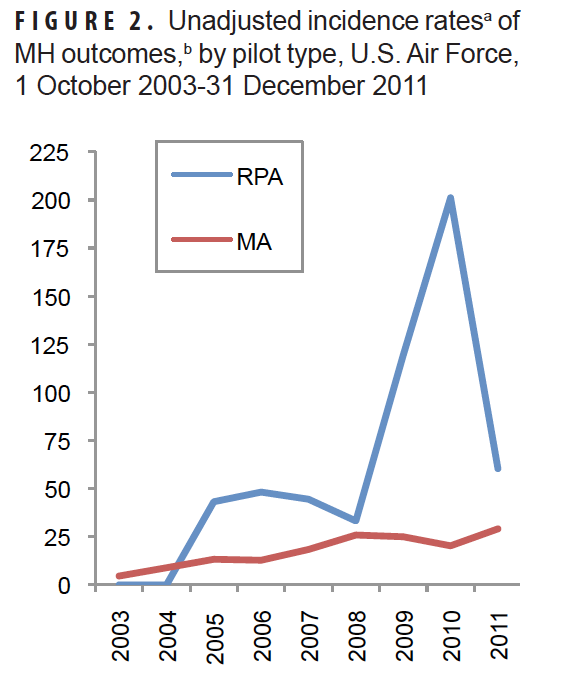
One of the most common media tropes in discussing ‘a day in the life’ of drone operators is their vulnerability to stress and, in particular, Post-Traumatic Stress Disorder (PTSD).  Chamayou traces this to an Associated Press report by Scott Lindlaw in August 2008, which claimed that the crews who ‘operate Predator drones over Iraq via remote control, launching deadly missile attacks from the safety of Southern California 7,000 miles away, are suffering some of the same psychological stresses as their comrades on the battlefield.’  Similar stories have circulated in other media reports.  The root claim is that, unlike pilots of conventional strike aircraft, drone crews see the results of their actions in close-up detail through their Full-Motion Video feeds and that they are required to remain on station to carry out a Battle Damage Assessment that often involves an inventory of body parts.

One recent study, ‘Killing in High Definition‘ by Scott Fitzsimmons and Karina Singha, presented at the International Studies Association in San Francisco earlier this year, makes the truly eye-popping suggestion that:

‘To reduce RPA operators’ exposure to the stress-inducing traumatic imagery associated with conducting airstrikes against human targets, the USAF should integrate graphical overlays into the visual sensor displays in the operators’ virtual cockpits. These overlays would, in real-time, mask the on-screen human victims of RPA airstrikes from the operators who carry them out with sprites or other simple graphics designed to dehumanize the victims’ appearance and, therefore, prevent the operators from seeing and developing haunting visual memories of the effects of their weapons.’

But in his original report Lindlaw admitted that ‘in interviews with five of the dozens of pilots and sensor operators at the various bases, none said they had been particularly troubled by their mission’, and Chamayou contends that the same discursive strategy – a bold claim discretely followed by denials – is common to most media reports of the stresses supposedly suffered by drone crews.  More: he juxtaposes the crews’ own denial of anything out of the ordinary with the scorn displayed towards their remote missions by pilots of conventional strike aircraft who, in online chatrooms and message boards, regard the very idea as an insult to those who daily risk their lives in combat.

The argument Chamayou develops closely follows William Saletan‘s commentary in Slate:

[The AP story] shows that operating a real hunter, killer, or spy aircraft from the faraway safety of a game-style console affects some operators in a way that video games don’t. But it doesn’t show that firing a missile from a console feels like being there — or that it haunts the triggerman the same way. Indeed, the paucity of evidence — despite the brutal work shifts, the superior video quality, and the additional burden of watching the target take the hit — suggests that it feels quite different.

Chamayou’s reading is more aggressive.  In his eyes, the repeated claim of vulnerability to stress emerged as a concerted response to criticisms of the supposed ‘Playstation mentality’ that attends remote killing and its reduction of war to a videogame.  He insists that it’s little more than an attempt to apply ‘a veneer of humanity to an instrument of mechanical murder’ – ‘crying crocodile tears’ before devouring the prey – and that it rests on absolutely no empirical foundation. This raises the stakes, of course, and it’s only fair to note that Lindlaw’s interviews with drone crews did not talk up combat-related stress and in fact a USAF white paper dismissed as ‘sensational’ the claim that PTSD rates among RPA crews were higher than those suffered by their forward-deployed counterparts.

Indeed, Chamayou himself relies on a public lecture given by Colonel Hernando Ortega, a senior medical officer attached to the USAF Intelligence, Surveillance and Reconnaissance Agency in February 2012.  Ortega reported USAF research that showed – conclusively – that drone crews are subject to often extraordinary stress.  But this is primarily a matter of their conditions of work – the demands of paying close attention to a screen hour after hour – and the rapid shift alternations between work and home (‘telecommuting to the war zone’) that allow little or no time or space for decompression.  Ortega explained that the symptoms rarely rise to the level of PTSD and are primarily the product of ‘operational stress’ rather than the result of combat-induced exposure to violence.

‘They don’t say [they are stressed] because we had to blow up a building. They don’t say because we saw people get blown up. That’s not what causes their stress — at least subjectively to them. It’s all the other quality of life things that everybody else would complain about too.’

Ortega could think of only one sensor operator who had been diagnosed with PTSD – a study by Wayne Chapelle, Amber Salinas and Lt Col Kent McDonald from the Department of Neurosurgery at the USAF School of Aerospace Medicine reported that 4 per cent of active duty RPA pilots and sensor operators were at ‘high risk for PTSD’ – but Ortega’s research questionnaires often revealed a sort of self-doubt over whether drone crews had made the right call when coming to the aid of troops in conflict rather than a direct response to a ‘physical threat event’:

‘Now it’s not to say that they don’t really feel about the physical threat to their brothers who are on the ground up there.  The band of brothers … is not just in the unit. I believe it’s on the network, and I believe the communication tools that are out there has extended the band of brothers mentality to these crews who are in contact with guys on the ground. They know each other from the chat rooms. They know each other from the whatever, however they communicate. They do it every day, same thing all the time…. So that piece of the stress, I think, when something bad happens, that really is out there…’

This sounds to me like the situation I described in ‘From a view to a kill’ (DOWNLOADS tab): the networked nature of remote operations draws operators into the conflict (which is why they so often insist that they are only 18″ from the battlefield, the distance from eye to screen) but on highly unequal, techno-culturally mediated terms that predispose them to identify with troops on the ground rather than with any others (or Others) in the immediate vicinity.  What Chamayou takes from all this is Ortega’s conclusion:

‘The major findings of the work so far has been that the popularized idea of watching the combat was really not what was producing the most just day to day stress for these guys. Now there are individual cases — like I said, particularly with, for instance, when something goes wrong — a friendly fire incident or other things like that. Those things produce a lot of stress and … more of an existential kind of guilt… could I have done better? Did I make the right choices? What could I have done more?’

DSM -5In fact for Chamayou the very idea of drone crews experiencing PTSD is an absurdity.  According to the latest edition of the Diagnostic and Statistical Manual for Mental Disorders (DSM -5, 2013; revised from the previous version cited by Chamayou, this incorporates major changes from DSM-IV, but these do not materially alter his main point), PTSD is a trauma and stressor-related disorder brought about by exposure to actual or threatened death, serious injury, or sexual violence.   The American Psychiatric Association explains:

The exposure must result from one or more of the following scenarios, in which the individual:

• directly experiences the traumatic event;

• witnesses the traumatic event in person;

• learns that the traumatic event occurred to a close family member or close friend (with the actual or threatened death being either violent or accidental); or

• experiences first-hand repeated or extreme exposure to aversive details of the traumatic event (not through media, pictures, television or movies unless work-related).

Drone crews do not ‘directly experience’ any traumatic event, Chamayou insists, and far from being ‘witnesses’  they are the perpetrators of trauma.  Those last three words in the extract I’ve just quoted do open up a third scenario – which would leave open the possibility of being affected by high-definition exposure through the FMV feeds and the Battle Damage Assessments performed by drone crews – but Chamayou hones the role of the perpetrator to explore a different though not unrelated scenario.

He takes his cue from Karl Abraham‘s discussion of neuroses in the First World War:

‘It is not only demanded of these men in the field that they must tolerate dangerous situations — a purely “passive performance — but there is a second demand which has been much too little considered, I allude to the aggressive acts for which the soldier must be hourly prepared, for besides the readiness to die, the readiness to kill is demanded of him…. [In our patients the anxiety as regards killing is of a similar significance to that of dying.’

51nCFmy0gdLChamayou is most interested in the development of this line of thought by psychologist/sociologist Rachel MacNair, who widens the field of PTSD to incorporate what she calls Perpetration-Induced Traumatic Stress (PITS): you can find a quick summary here.  (McNair is a long-time peace activist and in accordance with the ‘consistent life ethic’ she has used her work on PITS to intervene in what she calls ‘the abortion wars’; she is also associated with the Center for Global Nonkilling: see here).

Her book was written too early to address the use of drones for remote killing, but Chamayou suggests that this would be an appropriate means of putting their ‘psychopathologies’ to the test.  He thinks that individual operators lie somewhere between two poles: either they are indifferent to killing at a distance (the screen as barrier) or they feel culpable for the violence they have inflicted (the screen forcing them to confront the consequences of their actions).  It is, he concludes, an open question: though his next chapter on ‘Killing at a distance’ proposes a series of answers.

In fact, the USAF recognises the distinct possibility of PITS affecting drone crews, as this slide from a presentation by Chappelle and McDonald shows:

PTSD RPA crews CHAPPELLE

This year MacNair became President of Division 48 (Peace Psychology) of the American Psychological Association and instituted three Presidential Task Forces, the first of which specifically addresses drones.  She writes:

‘Task Force 1 is examining “The Psychological Issues of Unmanned Aerial Vehicles (Weaponized drones).” This will focus on the flying robots that kill, not the ones doing surveillance, nor the consumer drones that loom on the horizon. this is a very new field, with very little literature. We’ll look at what the psychological impact is on operators of the systems, the bureaucracy, surviving victims, and special therapeutic needs. The task force email for any feed-back or good literature citations or to request the full list of questions is dronetF@ peacepsych.org.’

The newsletter also includes a short statement from the next President of the Division, Brad Olson, setting out ‘Some thoughts for the Drone Task Force’ and an article by Marc Pilisuk on ‘The new face of war’.

Peace Psychology

Let me add three other comments.

(1) To limit the discussion to PTSD is to set the bar very high indeed, and the evidence of lower-level combat-induced stress on drone crews is less straightforward than Chamayou makes out.  In March 2013 Jean Otto and Bryant Webber reported the results of a study of ‘mental health outcomes’ covering the period 1 October 2003 to 31 December 2011 for 709 drone (RPA) pilots and 5, 526 pilots of manned aircraft (MA); they found that the crude incidence of adjustment, anxiety, depressive and other disorders among RPA pilots was considerably higher than for MA pilots, but once the samples were adjusted for age, number of deployments and other factors the ‘incidence rates among the cohorts did not significantly differ’ (my emphasis).

MH outcomes USAF

The study was experimental in all sorts of ways and it does not – could not – provide a fine-grained analysis of the nature of the pilots’ exposure to violence.  We should bear in mind, too, that the study was inevitably limited by inhibitions, both formal and informal, on admitting to any form of stress within the military.  But the report does suggest that it is a mistake to separate drone crews from the wider matrix of military violence and its effects in which they are embedded.

brandon-bryant-e1369021667128(2) If Chamayou is right in his suspicion that all this talk of drone crews being affected by what they see on their screens was a concerted strategy designed to disarm claims that remote operations reduce war to a videogame – in which case, not everybody in the Air Force was singing the same tune – the fact that most of them turn out to conduct their missions with equanimity does not prove the critics right: it does not follow that they take their responsibilities less seriously or more casually than the pilots of conventional strike aircraft.  Pilots and sensor operators undoubtedly have recourse to gallows humour (Chamayou would no doubt say that this befits their role as ‘executioners’), and there are too many reported instances of language that I too find repugnant, though I see no reason not to expect the same amongst military personnel of all stripes.  But there is also anecdotal evidence of situations in which pilots and their crews have been deeply affected by what they saw (and, yes, did).  The testimony of at least one former operator, Brandon Bryant (above, left), who has been diagnosed with PTSD, suggests that those involved probably move between these extremes – between the two poles proposed by Chamayou – dis/connecting as their actions and reactions entangle with events on the screen/ground.

(3) The most careful review I know of what is a complicated and contentious field is Peter Asaro, ‘The labor of surveillance and bureaucratized killing: new subjectivities of military drone operators, Social semiotics 23 (2) (2013) 196-22.  This combines medico-military studies, media reports and an artful reading of Omer Fast‘s film, 5,000 Feet is the Best.  as Peter says, there are many jobs that involve surveillance and many jobs that involve killing, but

‘What makes drone operators particularly interesting as subjects is not only that their work combines surveillance and killing, but also that it sits at an intersection of multiple networks of power and technology and visibility and invisibility, and their work is a focal point for debates about the ethics of killing, the effectiveness of military strategies for achieving political goals, the cultural and political significance of lethal robotics, and public concerns over the further automation of surveillance and killing.’

It’s a tour de force that navigates a careful passage between the ‘heroic’ and ‘anti-heroic’ myth of drones.  Here is what I take to be the key passage from his conclusion:

‘On the one hand, drone operators do not treat their job in the cavalier manner of a video game, but they do recognize the strong resemblance between the two. Many drone operators are often also videogame players in their free time, and readily acknowledge certain similarities in the technological interfaces of each. Yet the drone operators are very much aware of the reality of their actions, and the consequences it has on the lives and deaths of the people they watch via video streams from half a world away, as they bear witness to the violence of their own lethal decisions. What they are less aware of … is that their work involves the active construction of interpretations. The bodies and actions in the video streams are not simply ‘‘given’’ as soldiers, civilians, and possible insurgents – they are actively constructed as such. And in the process of this construction the technology plays both an enabling and mediating role. I use the term ‘‘mediating’’ here to indicate that it is a role of translation, not of truth or falsity directly, but of transformation and filtering. On the one hand there is the thermal imaging that provides a view into a mysterious and hidden world of relative temperatures. And thus these drone technologies offer a vision that contains more than the human alone could ever see. On the other hand we can see that the lived world of human experience, material practices, social interactions, and cultural meanings that they are observing are difficult to properly interpret and fully understand, and that even the highest resolution camera cannot resolve the uncertainties and misinterpretations. There is a limit to the fidelity that mediation itself can provide, insofar as it cannot provide genuine social participation and direct engagement. This applies not only to both surveillance and visuality, which is necessarily incomplete, but also to the limited forms of action and engagement that mediating technologies permit. While a soldier on the ground can use his or her hands to administer medical aid, or push a stalled car, as easily as they can hold a weapon, the drone operator can only observe and choose to kill or not to kill. Within this limited range of action, meaningful social interaction is fundamentally reduced to sorting the world into friends, enemies, and potential enemies, as no other categories can be meaningfully acted upon.’

There’s a discussion of these various issues, including many of the people mentioned in this post, at HuffPost Live here.

Theory of the drone 8: From invisibility to vulnerability

This is the eighth in a series of posts on Grégoire Chamayou‘s Théorie du drone and covers the third chapter in Part II, Ethos and psyche.

3: Crisis in military ethos

The track that Chamayou beats in this chapter is (perhaps appropriately) a tortured one: it twists from the invulnerability of the hunter through his defencelessness to his vulnerability to psychic harm.  And, as you’ll see, those gendered pronouns are a critical part of his argument.

Gyges (left) from Der König Kandaules

He begins with the story of Gyges.  In classical mythology Gyges was a shepherd who discovered a magical ring that could make him invisible.  Armed with his new power, Gyges eventually killed the king, married the queen and seized the throne.  ‘Invisibility’, Chamayou notes, ‘conferred upon him a kind of invulnerability.’  In Plato’s Republic the story is used to ask searching questions about virtue and justice: what happens to morality, to virtue, if it becomes possible to evade responsibility for one’s actions?

The dilemma is no longer confined to the realm of story-telling or philosophical speculation, Chamayou argues, because the thought-experiment has been realised through the political technology of the drone.  The modern answer to Plato’s question is now all too clear: invisibility produces not only invulnerability but also impunity.  In fact, in an Op-Ed last year on ‘The moral hazard of drones’ two American academics, John Kaag and Sarah Kreps, suggested that the myth of Gyges does indeed find its most telling contemporary application in the use of drones for remote killing:

One might argue that the myth of Gyges is a suitable allegory to describe the combatants who have attacked and killed American civilians and troops in the last 10 years. A shepherd from the Middle East discovers that he has the power of invisibility, the power to strike a fatal blow against a more powerful adversary, the power to do so without getting caught, the power to benefit from his deception. These, after all, are the tactics of terrorism.

But the myth of Gyges is really a story about modern counterterrorism, not terrorism.

We believe a stronger comparison can be made between the myth and the moral dangers of employing precision guided munitions and drone technologies to target suspected terrorists. What is distinctive about the tale of Gyges is the ease with which he can commit murder and get away scot-free. The technological advantage provided by the ring ends up serving as the justification of its use.

Terrorists, whatever the moral value of their deeds, may be found and punished; as humans they are subject to retribution, whether it be corporal or legal. They may lose or sacrifice their lives. They may, in fact, be killed in the middle of the night by a drone. Because remote controlled machines cannot suffer these consequences, and the humans who operate them do so at a great distance, the myth of Gyges is more a parable of modern counterterrorism than it is about terrorism.

[You can find a different version of their critique of drone warfare, which mercifully leans on materiality rather than mythology, in ‘The use of unmanned aerial vehicles in contemporary conflict: a legal and ethical analysis’, Polity  44 (2012) 260-85, available on open access here; as I’ll show in a later post, that essay intersects more directly and substantially with Chamayou’s own critique].

Chamayou accepts the force of Plato’s original question, and evidently applauds the way in which Kaag and Kreps bring it to bear on the present,  but he thinks there is another way of putting it.  Not ‘can the invisible person be virtuous?’ but ‘what sort of “virtue” is invoked by the modern Gyges?’

He develops his answer through a thumb-nail sketch of what he sees as both a crisis in and a transformation of military ethos.  Traditional military ethos privileged courage, sacrifice and heroism, qualities that worked to make killing (Chamayou actually says ‘butchery’) acceptable, even glorious.  These virtues gave war what Clausewitz saw as its presumptive moral force, which depended on a fundamental reciprocity (sometimes called the combatant’s privilege): in order to kill with honour, the soldier must be prepared to die.  War then becomes the supreme ethical experience: ‘To wage war is to learn to die.’

But what happens, Chamayou wants to know, when all of this (apart from the killing) becomes unnecessary? When it becomes possible to kill without the risk of dying?  If the combatant’s privilege is annulled, doesn’t killing become the height of cowardice and dishonour? In the contemporary age of what Edward Luttwak called ‘post-heroic war’ – what former Air Chief Marshall Brian Burridge famously and more bluntly described as ‘virtue-less war’ – those traditional military virtues are threatened.  In short, it’s not only those living under drones who see these new weapons as cowardly, and Chamayou believes that the contradiction between the new technical means of waging war and the traditional ideology that is supposed to inform its prosecution has provoked a profound crisis in the military ethos.

In fact, he says, some of the fiercest critics of remote killing are pilots of conventional strike aircraft. Chamayou cites this song written by two F-16 pilots, Chris Kurek and Rob Raymond, who perform as Dos Gringos (more here – really):

They shot down a Predator, that’s one less slot for me
They shot down a Predator and it filled my heart with glee
I had a smile when I logged on to AFPC
They shot down a Predator, that’s one less slot for me

They shot down a Predator and I say let’s send some more
Let’s fly ‘em over Baghdad and then see what’s in store
‘Cause I heard that the Air Force wants another 24
They shot down a Predator and I say let’s send some more

They shot down a Predator and I wonder how that feels
For that operator who lost his set of wheels
It must feel so defenseless; it’s like clubbing baby seals
They shot down a Predator and I wonder how that feels

As this clip makes clear, the hostility is about more than military values: the USAF now trains more crews for remote operations than for flying conventional aircraft.  But the values in question are given a particular inflection.  It would be a mistake to read ‘clubbing baby seals’ in the last verse as a reference to striking a target that can’t strike back.  After all, the song is about a Predator being shot down, and so it homes in on their inability to fight back: on their inability to engage in combat.

What is at stake here, Chamayou suggests, is a series of ‘manly’ and masculinist virtues and even virilities.  The complaint is that Unmanned Aerial Vehicles are literally ‘un-manned’ – their ‘pilots’ are not real pilots and not even real men. (You can find much more on this martial emasculation in Mary Manjikian, ‘Becoming Unmanned’ [International Feminist Journal of Politics (2013) doi: 10.1080/14616742.2012.746429]).

Even so, Chamayou is sceptical about the history being (re)written through these and similar objections.  Before announcing the end of the era of ‘manly’, heroic warfare, he suggests (in an obvious echo of Bruno Latour), we ought to ask whether ‘we’ moderns have ever fought heroic wars.  He draws attention to Walter Benjamin‘s scathing critique of a collection of essays edited by Ernst Jünger under the title War and Warrior in 1930:

‘These authors nowhere observe that the new warfare of technology and material [Materialschlacht] which appears to some of them as the highest revelation of existence,dispenses with all the wretched emblems of heroism that here and there have survived the [First] WorldWar.’

UK Approach to Unmanned Aircraft SystemsFaced with this storm of criticism, Chamayou suggests, military ethicists have found it necessary to erect an altogether different version of virtuous war.  If the drone is to be considered ‘virtuous’, several writers have argued, it is first and foremost because it rules out the possibility of casualties on ‘our’ side. Chamayou will have more to say about this in a later chapter on combatant immunity, but for now he finds confirmation in a Ministry of Defence report on The UK Approach to Unmanned Aircraft Systems in 2011 that, even as it acknowledged the ethical issues involved in abandoning the combatant’s privilege, nevertheless concluded that ‘use of unmanned aircraft prevents the potential loss of aircrew lives and is thus in itself morally justified.’

Statements like this bring into view an ongoing transformation from an ethic of sacrifice and courage to an ethic of auto-preservation (and, Chamayou adds, of cowardice): a sort of Revolution in Moral-Military Affairs.  The scale of traditional values is reversed, and in an Orwellian inversion words come to mean their opposite.  What used to be called cowardice is now called bravery, assassination becomes combat, and the spirit of sacrifice is turned into an object of opprobrium.  In Chamayou’s view we are witnessing not so much ‘virtue-less war’ as a vast operation to re-define the ‘virtues’ of war.

Dist_Warfare_Medal_800_t700

Chamayou fastens on the the Pentagon proposal late last year to award combat medals to drone operators.  Finally announcing the Distinguished Warfare Medal in February 2013, the Pentagon issued this statement:

Modern technology enables service members with special training and capabilities to more directly and precisely impact military operations at times far from the battlefield.  The Distinguished Warfare Medal will be awarded in the name of the secretary of defense to service members whose extraordinary achievements, regardless of their distance to the traditional combat theater, deserve distinct department-wide recognition.  

 “I have seen first-hand how modern tools like remotely piloted platforms and cyber systems have changed the way wars can be fought,” said Secretary of Defense Leon E. Panetta.  “We should also have the ability to honor extraordinary actions that make a true difference in combat operations, even if those actions are physically removed from the fight.”

The proposal set off a firestorm of protest in Congress and within the Air Force and online military forums.   It was withdrawn for review in less than a month and rescinded by Panetta’s successor in April.

The saga doesn’t quite do the work Chamayou wants it to do.  He uses it to reflect on the meaning of ‘bravery in combat’ – after all, he asks, what can bravery mean in circumstances ‘physically removed from the fight’? – but the Pentagon statement made it clear that the medal was to be awarded ‘for actions in any domain but not involving acts of valor.’

Still, this does not diminish the force of Chamayou’s main line of inquiry.  From the testimony of drone operators, he concludes that bravery consists not in them putting their lives on the line but in seeing the consequences of their actions online.  Drone crews are supposed to be so deeply affected by the high-resolution full-motion video feeds from their Predators and Reapers, which show in intimate detail the corporeal results of the strikes for which they are responsible, that they become highly vulnerable to Post-Traumatic Sress Disorder.  Traditionally bravery involved putting your physical body in danger; Chamayou says that it now it seems to involve putting your psychic being at risk.

This amounts to the elevation of what he calls a ‘purely psychic heroism’.  In previous wars the soldier was both the vector of violence and its potential victim, because the reciprocity of combat called on warriors to be at once executioner and potential victim.  Today the remote warrior is still required to be the executioner, but he can also become the psychological victim of his duty as executioner.

Jane Addams and delegates to the Hague conference in 1915

Chamayou is troubled by this for two reasons.

First, the idea of psychic vulnerability – of the damage inflicted on soldiers by the trauma of killing – was given form and substance in the First World War. In 1915  Jane Addams (above) – who will, I suspect, be known to most human geographers for her other achievements, particularly her work at Hull House in Chicago – returned from the International Congress of Women at the Hague to deliver a stunning address at Carnegie Hall on “The Revolt against War”.  In it, Chamayou tells us, she spoke of nurses treating ‘delirious soldiers [who] are again and again possessed by the same hallucination – that they are in the act of pulling their bayonets out of the bodies of men they have killed’, and of five young soldiers who committed suicide ‘not because they were afraid of being killed but because they were afraid they might be put into a position where they would have to kill someone else.’  To overcome these inhibitions, she noted, soldiers were routinely given a shot of rum before they went over the top.  Addams used these testimonies to develop a courageous and principled critique of military violence, and in 1931 she was awarded the Nobel Peace Prize.  (Read her Peace and Bread in time of war here). To Chamayou’s evident disgust, the trauma of war that Addams and others exposed is now being recycled into a legitimation of targeted killing.  Like a snake eating its tail, trauma is being mobilised to restore to war the ethico-heroic temper Addams insisted it had lost through trauma.

But, second, as I’ll show in the next post in this series, Chamayou is deeply sceptical of what he calls ‘the psychopathologies of the drone’.

One last comment before I go.  I don’t think the deployment of armed drones is provoking a wholesale transformation of military ethics, because that would be to absolutise their use.  The Air Force still flies conventional strike aircraft, troops are still deployed on the ground (including Special Forces) and – as the controversy over the medal confirms – the Pentagon still insists on a difference between distinguished service and bravery.  I don’t mean that drones do not raise serious ethical questions; of course they do, and I am dismayed at how often these are trumped by arguments about the legality of military violence.  But military violence takes many different forms, and it’s important not to lose sight of the larger killing fields in which drones are embedded.

Theory of the drone 7: Historical precedent and postcolonial amnesia

This is the seventh in a series of posts on Grégoire Chamayou‘s Théorie du drone; this one covers the second chapter of Part II, Ethos and psyche.

2. ‘That others may die’

Raoul CASTEXChamayou opens with a quotation from a French naval officer, Raoul Castex, on early submarine warfare.  Castex was a naval strategist of the first water (he rose to the rank of Admiral, though he was a captain when he wrote the essay Chamayou cites).  His views were canvassed as widely as those of Alfred Thayer Mahan, and they were set out in detail in his five-volume Théories strategiques published by the Société d’Editions Géographiques, Maritimes et Coloniales between 1929 and 1935.  This was hailed as recently as 1995 in a report prepared for US Navy Doctrine Command by James Tritten as ‘perhaps the most complete theoretical survey of maritime strategy to ever appear.’

Castex was not fêted so enthusiastically in the 1920s, however, when his ‘synthesis on submarine warfare’ was seen as a defence of unrestricted German submarine attacks during the First World War.  The first attacks had been against warships, but by early 1915 – and in large measure as a response to Britain’s naval blockade – the focus switched to merchant shipping.  In the course of the war Britain lost over 12 million tons of merchant shipping to U-boats.  In Castex’s view, the success of these attacks showed that the submarine was the instrument that would overturn Britain’s naval supremacy.

Tramp steamer sinking after U-boat attack

Britain bridled at the suggestion, and Castex’s supposedly exculpatory views were quoted in (mis)translation by Britain’s First Lord of the Admiralty at the Committee on Limitation of Armaments in Washington in December 1921; they were repudiated by the senior French naval delegate and provoked a fierce political and public controversy in Britain.  The British delegation had gone to the Washington conference to demand the total abolition of submarine warfare: submarines were virtually impossible to detect, and there was little defence against them (depth charges became available in early 1916, but these had minimal effect).  Before the War, Admiral Sir Arthur Wilson had denounced submarines as “unfair, underhand, and damned un-British”, and during the war there were repeated condemnations of the sinking of merchantmen (and arguments over their ‘noncombatant’ status).   By 1921 the focus of debate had switched back to military targets, and the Admiralty was gravely concerned that the ‘battlefleets of the world” – crucially, of course, those of the Royal Navy – “would be at the mercy of  flotillas of submarines of improved design.”  Britain’s position was opposed by France, Italy and Japan, and the attempt at abolition failed.  Chamayou doesn’t bother with any of this detail – it’s all back-story and you can find much more here – but its relevance for drone warfare and campaigns against it should be obvious.

In his synthesis Castex noted that the practitioners of submarine warfare believed that it had finally realised the dream of risk-less warfare. Here is the passage that Chamayou cites (and its prefiguration of Chamayou’s hunting thematic could not be plainer):

‘They were invulnerable.  War should be a game for them, a sport, a kind of hunting, where, having delivered and spread murder, all that would be left for them to do would be to revel in the sight of their victims’ agony.  Meanwhile they would be safe from retaliation and, once back in port, they would busy themselves with stories of their hunting prowess.’

In Chamayou’s view, drones have reincarnated this myth – and these sentiments – in even stronger terms.  They have transformed the meaning of ‘going to war’; the traditional model of combat is now being displaced by an altogether different ‘state of violence’ that degenerates into slaughter or hunting.  One no longer fights the enemy, Chamayou contends, the enemy is simply eliminated as though one were shooting rabbits.

In the sixteenth century Chamayou says that the iconography of Death often portrayed a soldier fighting a skeleton – most famously in Holbein’s Dance of Death – in a struggle that was always pointless because Death mocked his adversary and always triumphed in the end.   The imagery has now been appropriated in this unofficial patch produced for Reaper crews, where the soldier now assumes the position of Death itself (and becomes synonymous with the MQ-9 Reaper); the slogan – which is in fact a parody of “That others may live”, used as a patch by the USAF’s Pararescue teams  – gives Chamayou the title for his chapter.

That others might die

In a sense, then, both the submarine and the drone trumpet asymmetry as virtue.  And as that parallel implies, the pursuit of asymmetry is by no means novel.  Here is Sebastian Junger:

JUNGER WarA man with a machine gun can conceivably hold off a whole battalion, at least for a while, which changes the whole equation of what it means to be brave in battle…. Machine guns forced infantry to disperse, to camouflage themselves, and to fight in small and independent units. All that promoted stealth over honor and squad loyalty over blind obedience….

As a result much of modern military tactics is geared toward maneuvering the enemy into a position where they can essentially be massacred from safety. It sounds dishonorable only if you imagine that modern war is about honor: it’s not. It’s about winning, which means killing the enemy on the most unequal terms possible. Anything less simply results in the loss of more of your own men.

Historical precedent cannot issue an ethical warrant, however, and Junger admits as much.  Yet Chamayou notes that this is exactly the strategy used time and time again to justify drone warfare and to silence its critics.  His example is an essay by David Bell directed at what he called ‘the increasingly vocal critics who doubt the morality, effectiveness, and political implications of “remote control warfare.”‘

‘[C]ritics tend to present this new frontier of warfare as something largely novel — a sinister science fiction fantasy come to life, and one that has the power to radically change the political dynamics of warfare. But if our current technology is new, the desire to take out one’s enemies from a safe distance is anything but. There is nothing new about military leaders exploiting technology for this purpose. And, for that matter, there is nothing new about criticizing such technology as potentially immoral or dishonorable.  In fact, both remote control warfare, and the queasy feelings it arouses in many observers, are best seen as parts of a classic, and very old history.’

This is perfectly true, as far as it goes, and in my own work I have traced the historical curve of ‘killing at a distance’.  I accept, too, that it is reasonable to ask those who object to killing from (say) 7,500 miles away to stipulate the distance from which they do consider it acceptable to kill (though I’m not sure how Chamayou would respond to such a question).  As Bell wryly remarks, ‘None of today’s critics, as far as I know, have expressed any nostalgia for the pike, or other hand-to-hand weapons.’

BELL First Total WarBell is a professor of history at Princeton, and I greatly admire his revisionist account of The first total war which troubles the usual identification of ‘total war’ with the bloody twentieth century and insists, instead, on Napoleon as the midwife of ‘warfare as we know it’.  In fact, I’ve drawn on Bell’s work for my exploration of the French occupation of Egypt at the end of the eighteenth century.

But that’s the irony: Chamayou argues that it was precisely Europe’s colonial wars that epitomised the desire to kill others from a safe distance, whereas these are conspicuously absent from Bell’s defence of drone warfare.  They don’t loom large in The first total war either, where Bell anticipates Chamayou’s challenge.  He accepts that The first total war deals ‘only rarely with the world beyond Europe’ – the principal exception is indeed Egypt – and he acknowledges that ‘colleagues often suggested to me that the origins of modern total war are surely to be found on the early modern impperial frontier’:

‘Surely it was here, long before the French Revolution, that Europeans first dispensed with notions of chivalric restraint and waged brutal wars of extermination against supposed “savages”.  Did not Europeans learn their worst behavior from imperial encounters in Asia, Africa, and the Americas?’

His answer, in fact, is no:

‘The horrendous slaughters of the Reformation-era wars of religion began well before most European empires had developed much beyond trading posts, and the worst examples occurred in the German states, which had no colonies.  The development of the French and British overseas empires coincided with the introduction of relative moderation and restraint into European warfare, not with their disappearance.’

Bell attributes this state of affairs to the ‘dependence’ of Europeans on indigenous populations. When later imperial armies embarked on Kipling’s ‘savage wars of peace’ in the nineteenth and early twentieth centuries, he argues, ‘the colonial setting mostly offered Europeans a laboratory for testing their own preexisting ideas about war’:  ideas that had been honed, so he insists, by the Napoleonic wars that are the focus of his book.

These are convenient and far from uncontroversial claims, but three riders are necessary that, taken together, reinstate the importance of colonial and imperial modalities of power.

First, Bell’s book glosses over the extraordinary violence of the French occupation of Egypt between 1798 and 1801, including the terrible victory at the Battle of the Pyramids and the French army’s savage and exemplary response to two insurrections in Cairo (he’s not alone: remarkably, Edward Said does much the same in Orientalism).  The violence included close-quarter butchery but also stand-off artillery bombardments that rained shells down onto the city from the Citadel above.  Here is an eye-witness account of the first insurrection:

‘The situation worsened by the time of the afternoon prayer.  Violence and the atmosphere of siege increased.  At that point (the French) fired their guns and bombarded the houses and the quarters, aiming especially at al-Azhar.  They trained cannons and mortars on it, as well as on the positions of the fighters close to it, such as Ghawriya Market and al-Fahhamin.  When this bombardment fell on the people, it was something which they had never witnessed in their whole life… ’ 

Second, whatever the origins of those ‘ideas about war’ – and they were, I think, clearly multiple – they were put into often spectacular effect during the colonial wars of the nineteenth and early twentieth centuries.  And it is those wars that show the most direct continuity with the places and the peoples who are now condemned to live and die under the shadow of the drone.

Third, as Chamayou shows in his discussion of ‘Counterinsurgency from the Air’, so-called ‘air control’ in the early twentieth century was an intrinsically colonial doctrine.  The first experiments in bombing from aircraft took place over Libya before the First World War, and while bombing of civilian targets in Britain, France and Germany took place in the last years of the war, the use of airpower against peoples who had no capacity to strike back was a cornerstone of British policy in Iraq, Afghanistan and on the North-West Frontier of British India.

Chamayou argues that defenders of drone warfare who invoke the ‘nothing new under the sun’ argument do so in an attempt to relativise, even sedate contemporary violence.  They invoke historical precedent – in effect: ‘This has happened time and time again before, so why all the fuss now?’ – but then fail to describe the bloody continuity that yokes past to present.  Hence, as Chamayou concludes: ‘The drone is the weapon of an amnesiac post-colonial violence.’

My own inclination is to press this further.  In The Colonial Present I suggested that what Chamayou describes here as a version of postcoloniality – I still think that term sadly premature – is haunted by Terry Eagleton‘s  ‘terrible twins’: amnesia and nostalgia.  Or, as Eagleton put it, ‘the inability to remember and the incapacity to do anything else.’   Drone strikes in Pakistan, Yemen, Somalia and elsewhere not only suppress the wretched consequences of previous ‘air control’ regimes but also yearn for the swagger and seemingly effortless domination that they imposed.

Theory of the drone 6: Sacrifice, suicide and drones

This is the sixth in a series of posts on Grégoire Chamayou‘s Théorie du drone.  I had planned to cover Part II, Ethos and psyche, in a single post, but I’ve received several requests not to speed up, so I’m continuing chapter by chapter, with supplementary readings and comments as I go.

1.  Drones and kamikazes

Soon after Oliver Belcher started his research programme with me – and I’m delighted to say his thesis on ‘The afterlives of counterinsurgency’ has now been submitted – we had one of many rich conversations about what he called ‘the art of war in an age of digital reproduction’.  The reference, of course, was to Walter Benjamin‘s famous essay, usually translated as ‘The work of art in an age of mechanical reproduction.’  This seems to be widely regarded as the standard, even canonical version since its inclusion in the volume of Benjamin’s essays edited by Hannah Arendt and published as Illuminations.

But it has a more complicated history.  Here is Eric Larsen:

‘After fleeing the Nazi government in 1933, Benjamin moved to Paris, from where he published the first edition of “Work of Art” in 1936. This publication appeared in French translation under the direction of Raymond Aron in volume 5, no. 1 of the Zeitschrift für Sozialforschung. Benjamin subsequently rewrote the essay and after editorial work by Theodore and Margarethe Adorno it was posthumously published in its commonly recognized form in his Schriften of 1955.’

Benjamin Work of ArtIn fact there were four versions of the essay, and several critics regard the second version as the most daring of all (you can find the third version here).  In the third volume of Harvard’s Selected Writings this is translated as ‘The work of art in the age of its technological reproducibility’ (1936) – it’s also available separately in the little book shown on the left – and includes this remarkable passage in an expanded Section VI:

Compared to that of the machine age, of course, this [pre-historic] technology was undeveloped. But from a dialectical stand-point, the disparity is unimportant. What matters is the way the orientation and aims of that technology differ from those of ours. Whereas the former made the maximum possible use of human beings, the latter reduces their use to the minimum. The achievements of the first technology might be said to culminate in human sacrifice; those of the second, in the remote-controlled aircraft which needs no human crew. The results of the first technology are valid once and for all (it deals with irreparable lapse or sacrificial death, which holds good for eternity). The results of the second are wholly provisional (it operates by means of experiments and endlessly varied test procedures). The origin of the second technology lies at the point where, by an unconscious ruse, human beings first began to distance themselves from nature.  It lies, in other words, in play.

It’s extraordinary to read these words 75 or so years after Benjamin wrote them, and their intimations of armed drones and even the supposed ‘Playstation mentality’ that misguides those who operate them (though I think that argument misunderstands the extraordinary immersive capacity of videogames, but that’s another story that I’ve told elsewhere).

Chamayou starts his exploration of ‘Ethos and psyche’ by invoking yet another version of Benjamin’s iconic essay, but his basic point shines through the version I’ve quoted above.  His purpose is to juxtapose one technology or at least its limit-case, sacrifice, which engages the human in the most direct and intimate way possible, once and for all, to another, from which (so he says) the human is disengaged in a mechanical act that is, in principle, endlessly repeatable.

Yet it turns out that this isn’t an historical succession in any simple sense at all: what Chamayou sees instead are two different genealogies – the kamikaze pilot and suicide-bomber on one side and the drone on the other – entwined in a truly deadly embrace.

The linchpin of his argument is provided by a Russian emigré engineer working for RAC, Vladimir Zworykin. Apparently alarmed by press reports in 1934 that the Japanese were considering the formation of a ‘Suicide Corps to control surface and aerial torpedoes’, Zworkyin proposed to use technology to counter the threat.  Previous experiments with radio-controlled aerial torpedoes were all very well, but these were ‘blind weapons’ that inevitably lacked precision.  The Japanese proposed to solve the  problem by using human pilots to guide the explosive platform on to its target – Zworykin’s contrary solution was to guide the aerial torpedo through an ‘electric eye’ (a sort of proto-television).

Zworykin aerial torpedo

The torpedo would be a glider,

‘carried on an airplane to the proximity of where it is to be used, and released.  After it has been released the torpedo can be guided to its target with shortwave radio control, the operator being able to see the target through the “eye” [or Iconoscope] of the torpedo as it approaches.’

In 1935 Zworykin submitted a memorandum to the War and Navy Departments describing a television-controlled missile that could be guided beyond the line of sight, and five years later the US approved ‘Project Block‘ for RCA to develop TV-guided ‘assault drones’ in concert with the US Navy.  When the first Japanese kamikaze units were formed they were indeed deployed against naval targets – but this wasn’t until 1944, so I’m not sure about the source of those much earlier reports that fired Zworykin’s imagination.

I described some earlier experiments with aerial torpedoes here, and you can find much more about Zworykin here and in Alexander Magoun‘s Television: the life story of a technology, pp. 78-84.  He notes that the US Army Air Force was a latecomer to these experiments, and didn’t demonstrate a TV-controlled drone until October 1943, largely because its major investment was in heavy bombers capable of inflicting major destruction on cities and military-industrial targets.  Project Aphrodite did experiment with the use of television to guide war-weary Flying Fortresses filled with explosives and napalm on to targets in Germany, but the attempts were largely unsuccessful and singularly irrelevant to the strategic bombing campaigns of World War II.

Nevertheless, Chamayou argues that to some degree Zworykin had identified the core principle that would later be used to develop the smart bomb and the drone.  His sharper point is that the forerunner of the drone was an anti-kamikaze; sharper because this conceptual origin places the drone within a distinctive ethico-technical economy of life and death.

This ethico-technical economy can be read as an ethic of heroic sacrifice on one side and an ethic of auto-preservation on the other, each a mirror image of its other, ‘two visions of horror’.    Chamayou joins several other commentators to connect the kamikaze attacks of the Second World war to suicide-bombers today, and so argues that in the global North today the cardinal opposition is usually expressed as ‘defiance of death’ versus ‘love of life’: the frequently repeated claim, as at once an explanation and a condemnation of suicide-bombing, that ‘they’ don’t value life as much as ‘we’ do.  Yet, as Chamayou insists, it’s not ‘life in general’ that we value at all: it’s our lives that we cherish.

To develop this argument (which he will later elaborate in other dimensions), Chamayou cites Richard Cohen‘s editorial in the Washington Post on 6 October 2009:

As for the Taliban fighters, they not only don’t cherish life, they expend it freely in suicide bombings. It’s difficult to imagine an American suicide bomber.

He then uses anthropologist Hugh Gusterson‘s response to sharpen his point still further.  Gusterson wonders, with Jacqueline Rose,  why ‘dropping cluster bombs from the air is not only less repugnant [than suicide bombing]: it is somehow deemed, by Western leaders at least, to be morally superior.’  He then reverses the terms of the argument (and in going so prefigures Chamayou’s own argument about the substitution of hunting for combat in many areas of later modern warfare and about the colonial antecedents of drone strikes):

ASAD On suicide bombing[M]any people in the Middle East feel about U.S. drone attacks the way Richard Cohen feels toward suicide bombers. The drone attacks are widely perceived in the Middle East as cowardly, because the drone pilot is killing people on the ground from the safety of an air-conditioned pod in Nevada, where there is no chance that he can be killed by those he is attacking. He has turned combat into hunting. In this regard, the drone is the culmination of a long tradition of colonial war-fighting technologies — going back at least to the machine guns with which British and French colonial soldiers mowed down spear-carrying Africans –that ensure that the “natives” die, in an unfair fight, in considerably larger numbers than the colonial soldiers.

The drone operator is also a mirror image of the suicide bomber in that he too deviates, albeit in the opposite direction, from our paradigmatic image of combat as an encounter between warriors who meet as equals risking the wounding or killing of their own bodies while trying to wound or kill the others’ bodies. The honorable drama of combat lies in the symmetrical willingness of warriors to wager their bodies against each other for a cause. But now, in the words of the anthropologist Talal Asad, in his book On Suicide Bombing, U.S. “soldiers need no longer go to war expecting to die, but only to kill. In itself, this destabilizes the conventional understanding of war as an activity in which human dying and killing are exchanged.”

But there are two other twists to this story that Chamayou doesn’t pursue.

First, in his essay for the Bulletin of the Atomic Scientists Gusterson confounds Cohen’s difficulty in imagining ‘an American suicide bomber’ like this:

‘For decades loyal U.S. soldiers in nuclear missile silos have trained to launch their weapons in the expectation that they would be killed almost immediately afterwards in the ensuing nuclear war. I once interviewed a former special-forces officer who was trained to hike behind enemy lines with a tactical nuclear weapon on his back and place it near an important target. Although the weapon had a timer, he expected to die at ground zero.

If such men were the elite nuclear suicide bombers whose mission was prepared but never carried out, the Cold War turned the whole country into a suicide bomber rehearsing obsessively for the moment when we would “push the button” and take down millions of our enemies with us. Seen in this light, Americans trained for the biggest suicide bombing mission of all.’

Second, there have been ‘successful’ American suicide bombers.  To some historians the first candidate is Andrew Kehoe, who set off an explosion at a schoolhouse in Bath, Michigan in May 1927, killing 44 people, before setting off dynamite in his truck and killing himself and several other people.  Whether you count this as a suicide bombing in the modern sense of the term depends on the criteria you think appropriate.  Many commentators exclude Kehoe and identify three other, more recent American suicide bombers: Shirwa Ahmed, who drove a car bomb into a government compound in Puntland in October 2008, killing as many as 30 people; Farah Mohamed Beledi, who killed himself and three soldiers at a military checkpoint in Mogadishu in June 2011; and Abdisalan Hussein Ali, who attacked African Union troops in Mogadishu six months later.  All three were Somali-Americans who had lived in Minnesota and were recruited by al-Shabaab.

But to exclude Kehoe and claim that these three were not ‘really American’ is to immediately trigger one of Chamayou’s key arguments about the ways in which killing and dying in the age of the drone are racialized.  More soon.

ASBACoda:

As I finished up this post,  I discovered a young American performance artist, Ethan Fishbane, whose show American Suicide Bomber Association has been staged in New York and previously in Indonesia and South Africa.

Apparently he threw one of his stage ‘bombs’ into the garbage last week and unwittingly set off a bomb scare in Manhattan.

“I felt the response [by the police] was wholly appropriate,” he said. “Even if it’s just a prop for a theater piece, they were on top of it.”

Theory of the drone 5: Vulnerabilities

This is the fifth in a series of posts on Grégoire Chamayou‘s Théorie du drone.  My next post on the book will consider Chamayou’s second section, ‘Ethos and psyche‘, in its entirety, and when I’ve worked my way through the book in separate, detailed posts (three more sections to go after the next one) I’ll provide a critical overview of the project as a whole: I hope that will help (I must be doing something right – or wrong – since these posts have been picked up by the splendid ARmy Rumour SErvice, which – despite its equally splendid acronym – is not quite a digital child of the Wipers Times).

8: Vulnerabilities

Far from being ‘unmanned’, each US Air Force combat air patrol (CAP) capable or providing coverage 24 hours a day 7 days a week involves a suite of four Predators (MQ1) or Reapers (MQ9) supported by a total of 192 personnel (the exact figures vary and are subject to change, but I’ve taken these from a June 2011 presentation by Colonel J.R. Gear, Director of the US Air Force’s Remotely Piloted Aircraft Task Force).

As you can see from his presentation slide below, most of these (133) are based outside the combat zone, and 84 of those are devoted to ‘PED’ –processing, exploiting and disseminating the feeds from the airborne sensors, especially the full-motion video (FMV) streams.

That leaves 59 who are forward deployed inside the combat zone: three pilots and three sensor operators to handle take-off and landing (which require a line-of-sight link to the aircraft because the Ku-band satellite link used for in-flight operations imposes a response delay that is too great for near-ground manoeuvres).  One of the four aircraft is held on the ground for maintenance and, given the technical problems that continue to dog what Jordan Crandall calls the wayward drone, no fewer than 53 people are involved in keeping them flying.  [More on drone crashes and glitches here, here and here].

Still, less than half the total complement (44 per cent) is in the combat zone, and all of them work from the relative safety of an airbase.

GEAR Manning Unmanned Aircraft

Hence the tag line repeatedly used by the US Air Force to advertise the core advantage of using drones: ‘projecting power without projecting vulnerability’:

Projecting power without vulerability

I’ve always liked to take metaphors stubbornly literally, and given what is happening to the polar ice we need to ask about the invulnerability of these remote operations.

Chamayou reminds us that in classical mythology and in fable invulnerability has always been a myth; so it is with the drone.  He distinguishes two sets of vulnerabilities, one technical and the other political-strategic.

(A) Technical

Chamayou says virtually nothing about the technical imperfections of the Predator and the Reaper, especially the crashes and other failures that I noticed above, but concentrates on two other issues.

(1) ‘Mastery of the air’: At present, Predators and Reapers can only operate in uncontested airspace; they are slow, noisy and far from agile, which makes them highly vulnerable to attack from ground-to-air missiles or conventional strike aircraft.  This is not a problem in Afghanistan – even during the invasion US Secretary of Defense Donald Rumsfeld was able to proclaim ‘air superiority’ by 10 October, just three days after launching the first attacks: ‘Afghan skies secure‘ – and according to some reports it never became a serious issue in Iraq either.  During Operation Southern Watch, tasked with enforcing no-fly zones over Iraq between the first Gulf War and the US-led invasion in 2003, Eric Reidel reported that

‘Predators were used as bait to stir up Iraqi fighters and air defenses. Surface-to-air missiles eventually brought down two of the drones and an Iraqi fighter jet shot down a third, but it didn’t come that easy to the enemy.’

But that was a contest against a military machine degraded by a sanctions regime.  What is now called A2/AD (anti-access, area denial) may well become a serious obstacle to future conflicts. In 2011 Colonel Dean Bushey, deputy director of the joint Unmanned Aircraft Systems Center of Excellence, told Reidel:

“We’re thinking about the next war, thinking about the next fight, thinking about the next campaign…  We’ve fought in a very permissive environment where there are no enemy attacks against our unmanned aircraft … It would be foolish for us to imagine that we could continue to fly unmanned systems in an environment that is not only friendly but is not GPS-denied, that is not communications-denied.”

With Obama’s ‘pivot to the Pacific’, the Pentagon has redoubled its efforts to harden its drones for combat (several commentators are sufficiently sceptical about the prospects that they see a renewed commitment to conventional strike-stealth aircraft rather than to UAVs).  But perhaps the sharper point is contained in Bushey’s final sentence, and Chamayou spends much more time on this second, vital vulnerability.

(2) ‘Mastery of the waves’: Chamayou documents a series of incidents in which signals were jammed or hacked.

In 2009 the Wall Street Journal reported that insurgents in Iraq had been using commercial off-the-shelf software (costing just $26) to intercept the video feeds from Predators for at least a year, and there was similar evidence from Afghanistan.  The Pentagon had known of the vulnerability since the aircraft were deployed over Bosnia in the 1990s, but had not bothered to encrypt the signals because they ‘assumed local adversaries wouldn’t know how to exploit it.’ You might think the solution – encryption of the Common Data Link feeding images to ROVERS (receivers) used by troops on the ground – would be easy, but four years after the story broke Noah Schachtman and David Axe reported that more than half the US fleet of Predators and Reapers were still broadcasting their video feeds in the clear:

”Standard unencrypted video is basically a broadcast to whoever can figure out the right carrier frequency, so essentially, we are simulcasting to battlefield commanders and the opposing force. If that opposing force knows we can see them and from where, they can take better evasive maneuvers.”

UT Adaptive Flight Hornet MiniIf signals transmitted from the drone can be hacked then, as Bushey noted, so can signals to the drone.  This is known as GPS spoofing, and the basic principle is remarkably simple; for a technical exposition that isn’t, see this research paper ‘On the requirements for successful GPS spoofing attacks’ by four Swiss computer scientists (who also propose counter-measures), but for a more user-friendly discussion see Pierluigi Paganini‘s excellent overview of ‘Hacking drones’ here.  As Chamayou says, the principle was put into practice in June 2012 , when a group of researchers from the Radionavigation Laboratory at the University of Texas at Austin successfully hijacked a small civilian helicopter-drone at the White Sands Missile Range in Nevada.  It was an experiment carried out for the Department of Homeland Security, the target was a tiny Adaptive Flight Hornet Mini (shown above) not a Predator or a Reaper, and the intercept took place at an altitude of less than 20 metres (60 feet) from a distance of 1 kilometre.  This year they intend to repeat the experiment but from a distance of 10 kilometres.  This is all part of an ongoing project to devise systems to disrupt spoofing, but Chamayou suggests that ‘the air pirates of the future’ will surely try to take control of larger drones from an even greater distance.

(B) Political-strategic

Here Chamayou is not addressing wider political, legal and ethical objections to which remote operations are indeed vulnerable – as I’ll describe in later posts – but rather the possibility of more direct responses to the deployment of drones.

SHAW The new Western way of war(1) Reprisals: Remote operations radicalise what Martin Shaw described in 2005 as The new Western way of war: ‘risk-transfer war‘.  Although Shaw emphasised global surveillance, the minimisation of military casualties and an overwhelming reliance on airpower amongst other things – and his ‘rules of risk-transfer war’ are still essential if depressing reading – it is a sign of how far the world has turned since then that he provided no discussion of remote operations or the incorporation of drones as essential vectors of later modern war.

Perhaps for this reason Chamayou makes no mention of Shaw, but fastens on a short thesis submitted in 2009 by Major Trent Gibson of the US Marine Corps for the Master of Military Studies from Quantico, ‘Hell-bent on Force Protection’.  This was a critique of what Gibson called ‘force protection fetishism’.  He traced it back to the US military’s experience in Vietnam but argued that it was alive and well in Afghanistan and Iraq.  In a key passage quoted by Chamayou, Gibson wrote:

‘Attempts to armorize our force against all potential enemy threats … shifts the ‘burden of risk’ from a casualty-averse military force onto the populace. In doing so, we have lifted that burden from our own shoulders and placed it squarely upon those who do not possess the material resources to bear it – the civilian populace.’

Gibson was reaffirming one of the central tenets of the new counterinsurgency doctrine issued three years earlier, and he doesn’t discuss drones and remote operations either.  But what both FM 3-24 and by extension Gibson objected to was the physical separation of troops from the very people they were supposed to protect.  One of its cardinal – strategic – weaknesses – was sequestering troops inside vast, heavily defended Forward Operating Bases from which they issued out on sporadic armoured patrols.  It was, in part, on overcoming this siege mentality that the so-called “Surge” in Baghdad was predicated (see “The biopolitics of Baghdad”: DOWNLOADS tab).  General David Petraeus‘s ‘Commander’s Guidance‘ could not have been plainer:

‘Live among the people. You can’t commute to this fight. Position Joint Security Stations, Combat Outposts, and Patrol Bases in the neighborhoods we intend to secure. Living among the people is essential to securing them and defeating the insurgents.’

UAV pilot driving to workRemote operations hypostatise that ‘commute to the fight’ (see here).  Here is one UAV pilot talking to Der Spiegel:

‘In the morning you carpool or you take a bus and drive into work, you operate for an eight-hour shift, and then you drive back home… Before you were at war 24/7, and when you’re home you’re home. This is different. I do e-mails in the morning, rush to the airplane, come out, go to the [Base Exchange], get myself a hamburger, do some more e-mail, do it again, drive home.’

I’ll say more about that compartmentalisation in my next post – it’s a central concern in the next section of Théorie du drone – but Chamayou’s central point here is that the safety of ‘home’ is illusory and that the war cannot be contained within external ‘danger zones’.  He’s not talking about insurgent attacks against US air bases or crew (though one recent story, ‘A day job waiting for a kill-shot a world away’, reported that ‘the Air Force, citing what it says are credible threats, forbids pilots to disclose their last names’).  What Chamayou has in mind is the possibility of reprisals within the continental United States more generally: risk transferred back to the American public at large.  He explicitly endorses the conclusion to Mike Davis‘s Buda’s Wagon: a brief history of the car bomb, where Davis writes:

‘… every laser-guided missile falling on an apartment house in southern Beirut or a mud-walled compound in Kandahar is a future suicide truck bomb headed for the center of Tel Aviv or perhaps downtown Los Angeles.’

This is not a wild scenario.  Here is Michael Boyle on the costs and consequences of drone warfare:

On 21 June 2010, Pakistani American Faisal Shahzad told a judge in a Manhattan federal court that he placed a bomb at a busy intersection in Times Square as payback for the US occupations of Afghanistan and Iraq and for its worldwide use of drone strikes. When the judge asked how Shahzad could be comfortable killing innocent people, including women and children, he responded: ‘Well, the drone hits in Afghanistan and Iraq, they don’t see children, they don’t see anybody. They kill women, children, they kill everybody. It’s a war and in war, they kill people. They’re killing all Muslims.’  In a videotape [below] released after his arrest, Shahzad revealed that among his motives for the attack on New York City was revenge for the death of Baitullah Mehsud, a Pakistani Taliban leader killed in a drone strike in August 2009. While his comments were reported in the American press, the Obama administration never acknowledged that it was revulsion over drone strikes—which Shahzad was rumoured to have seen at first hand when training with militant groups in Pakistan—that prompted his attack.

faisal-shahzad-martyrdom-tape

Although the incident would have strengthened his argument, Chamayou doesn’t mention it.  You can find more here; another video featured Pakistani Taliban leader Qari Hussain Mehsud claiming responsibility for what he described as retaliation against US drone attacks in the FATA (more detail here).

FUKUYAMA End of History(2) Re-purposing: Drones can be adapted for civilian use – they have been used to monitor herds of caribou and to track the progress of wild fires – and there is a rapidly expanding market for small DIY drones amongst geeks and hobbyists.  As Chamayou notes, after reading about the US Army’s small RQ-11 surveillance drone even Francis Fukyama built his own small surveillance drone in his backyard in February 2012.  What he doesn’t report, though, is the string of questions that Fukuyama raised in one of his early accounts of the project (Fukuyama now has three drones; updates including video here and here):

‘What will the world look like when not just the US but many other countries around the world operate fleets of drones; and when powerful, sophisticated drones are owned by lots of private individuals? What would our attitude be if our enemies could pick off visiting dignitaries as they stepped off the aeroplane in a supposedly friendly country, or attack soldiers in their bases in Europe or Asia? Or if Americans became vulnerable in Florida or New York? Drones might become an inexpensive delivery vehicle for terrorists or rogue states that can’t afford to deliver payloads in ballistic missiles. Some of the remotely controlled aeroplanes that hobbyists build are a third to half the size of their full-scale counterparts. As the technology becomes cheaper and more commercially available, moreover, drones may become harder to trace; without knowing their provenance, deterrence breaks down. A world in which people can be routinely and anonymously targeted by unseen enemies is not pleasant to contemplate.’

The last sentence is pretty rich: the world Fukuyama envisages is already a reality for thousands of people in Pakistan, Yemen, Somalia and elsewhere, and they have to do rather more than ‘contemplate’ it.

Still, these are Chamayou’s questions too.  It is precisely the proliferation, diffusion and and above all the down-sizing and down-marketing of small drones that interest him.  If they can be ‘demilitarised’ for civilian uses, including Fukuyama’s photographic obsessions, then he contends that it’s perfectly possible for them to be ‘re-militarised’ at remarkably low cost to constitute what Eugene Miasnikov was already calling six years ago ‘an army of suicide bombers on steroids’.  This may well be true – and, in a different vein, since October 2012 there have been (conflicting) reports of Israel shooting down two Iranian-made Hezbollah drones, so their adoption by non-state actors seems to be in train already – but it’s still a far cry from the hi-tech world of Predators and Reapers and the globalised killing machine for which they act as spears.

I’ll return to that world in my next summary and commentary on the book.

This completes my extended discussion of the eight chapters that form Part I of Théorie du drone: Techniques and tactics.