Emergency Response

I’ve been catching up on a stream of publications by Pete Adey and Ben Anderson on emergencies, including ‘Affect and security: exercising emergency in UK “civil contingencies”‘, Society & Space 29(6) (2011) 1092-1109; ‘Anticipating emergencies: Technologies of preparedness and the matter of security’, Security dialogue 43 (2) (2012) 99-117; and ‘Governing events and life: “Emergency” in UK Civil Contingencies’, Political Geography 31 (1) (2012) 24-33.

This has been prompted by a continuing conversation with Theo Price about a series of political/artistic interventions under the rubric of COBRA RES, in which he’s invited me to take part. COBRA, as many readers will know, is

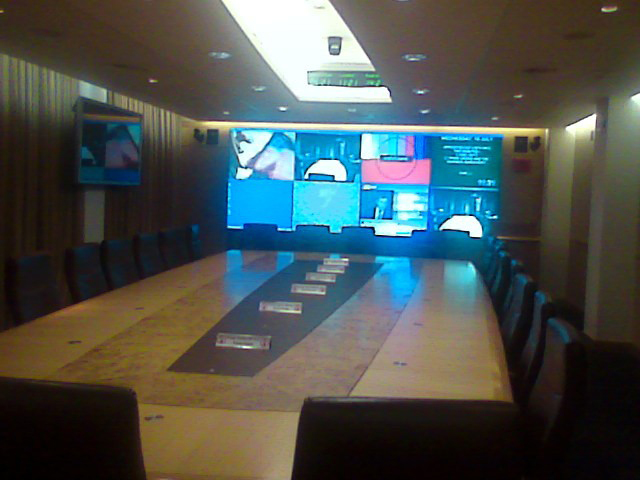
the British Government’s emergency response committee set up to respond to a national or regional crisis. Standing for Cabinet Office Briefing Room A [below], the COBRA Committee comes together in moments of perceived crisis under the chairmanship of either the Prime Minister or the Home Secretary. At COBRA meetings, decisions and a possible response, sometimes simply a press conference, are made under real or imagined conditions of emergency and/or crisis. 

Cabinet_Office_Briefing_Room

The committee can evoke emergency powers such as suspending Parliament or restricting movement. Such emergency-based responses have ranged from tackling Ash Dieback disease to the deployment of military hardware on civilian rooftops during the London Olympics.  Emergency and crisis-based politics are becoming increasingly common as modes of contemporary governance in an age of hyped terrorism and economic and environmental crises.
COBRA RES is a critical response, holding up a mirror to COBRA ‘as a way of producing different information, new perspectives and alternative narratives, while existing in a mimetic relationship to the emergency Committee itself and the situation it is responding to.’

COBRA RES aims to re-frame the response from an aesthetic perspective, while operating as an active-archive that follows, traces and maps the constantly changing tide of emergency politics. COBRA RES is a collective of artists and writers who aim to ask critical questions of COBRA through a series of creative responses. Reflecting and mimicking the structure of the COBRA Committee, the artists, writers and filmmakers are chosen for their relevance to the given context of the COBRA meeting.

The artists and writers are given nine days from the initial COBRA meeting in which to respond to either COBRA or the context it is meeting under. For the process to work, it is important that pressure is applied to the artists and writers so as prevent too much consideration, with limited facts available, in an attempt to re-create a parallel action of response. 
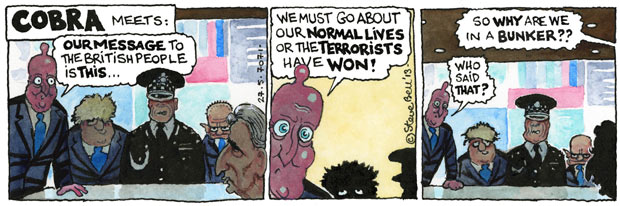
Steve Bell's If …

You can read more from Theo about the project in ‘Art in an Emergency’ here:

Art allows a certain freedom to explore and reimagine politics, offering a reflective surface on which to review the distorted image projected by the state in moments of crisis. But in recent years, it is politics that has increased its use of aesthetics to help manipulate and develop – often in a favourable light – its own agenda.

This image-based politics is a politics of presentation, of appearance and constructed images that tell a certain story, often a moral story of good v evil, of citizen v terrorist. Such morals are created through aesthetic and performative means to convince the general public that not only is the government protecting them, but that new terror legislation is necessary and justified. This approach is not new, but when political spin is used in ’emergency’ events, from which new terror legislation may then emerge, surely it is better to deal in fact than gesture.

Not all political situations invite an artistic response, but the government’s Cobra committee, and the ’emergencies’ prompting its meetings, offer a wide array of unknown variables that leave an open space for interpretation and imagination. Often Cobra closes this gap with its publicly announced meeting – we aim to re-open it.

As politics and society become increasingly brand-aware, with digital images and presentation the preferred power-tools to promote a political position, art becomes the obvious medium through which to ask questions. Art can only respond to the world around it and if politics and politicians increasingly attempt to define, promote and manipulate their position by aesthetic and performative means, art must reflect, mimic and respond in kind.

1a807d_1af2366c17ff43d3af3e28a47d5764b1.jpg_srz_144_51_75_22_0.50_1.20_0.00_jpg_srz

COBRA and thus COBRA RES have met five times since January 2013:

COBRA 1.0 Our first response was an exhibition after COBRA had met when hostages had been held in the Tiguentourine gas plant in Algeria.

COBRA 1.1 The second response was a book of artistic and written responses to the COBRA meeting following the killing of soldier Lee Rigby in Woolwich, south London.

Artists: Steve Bell, Hugh Jordan, Kennardphillipps, Nima Esmailpour, Nicolas Hausdorf, & Alex Goller ( H+Corp), Frida Go, Chie Konishi, Samuel Stevens, Theodore Price, Adam Ferguson, Jenny Richards, Richard Wilson, Robert Malt  Writers: Iain Boal (foreword), Nicolas Hausdorf, Theodore Price, Philip Howe, Samuel Stevens

COBRA 1.2 Responding to the situation in Nairobi shopping centre, secret postal responses were submitted to COBRA RES by a selection of artists. This work will not be viewed or opened until the final COBRA RES exhibition in 2018.

COBRA 1.3 DVD of artist films with accompanying book of texts, which responded to the extensive flooding to hit large parts of the United Kingdom.

Artists: Adam Chodzko, Stephen Connolly, Alison Ballard, Margaret Dickinson, John Jordan, Theodore Price, Stina Wirfelt, Samuel Stevens, Rose Butler, Nabli Ahmed, Daniel Shanken, Oliver Bancroft, James Connelly, Stevie Deas, Wonderland Collective  Writers: Nina Power ( Lead Essay) Christopher Collier, Jenny Richards, Nicolas Hausdorf, John Jordan, Isabelle Fremeaux, Theodore Price, Samuel Stevens, Stephen Connolly.
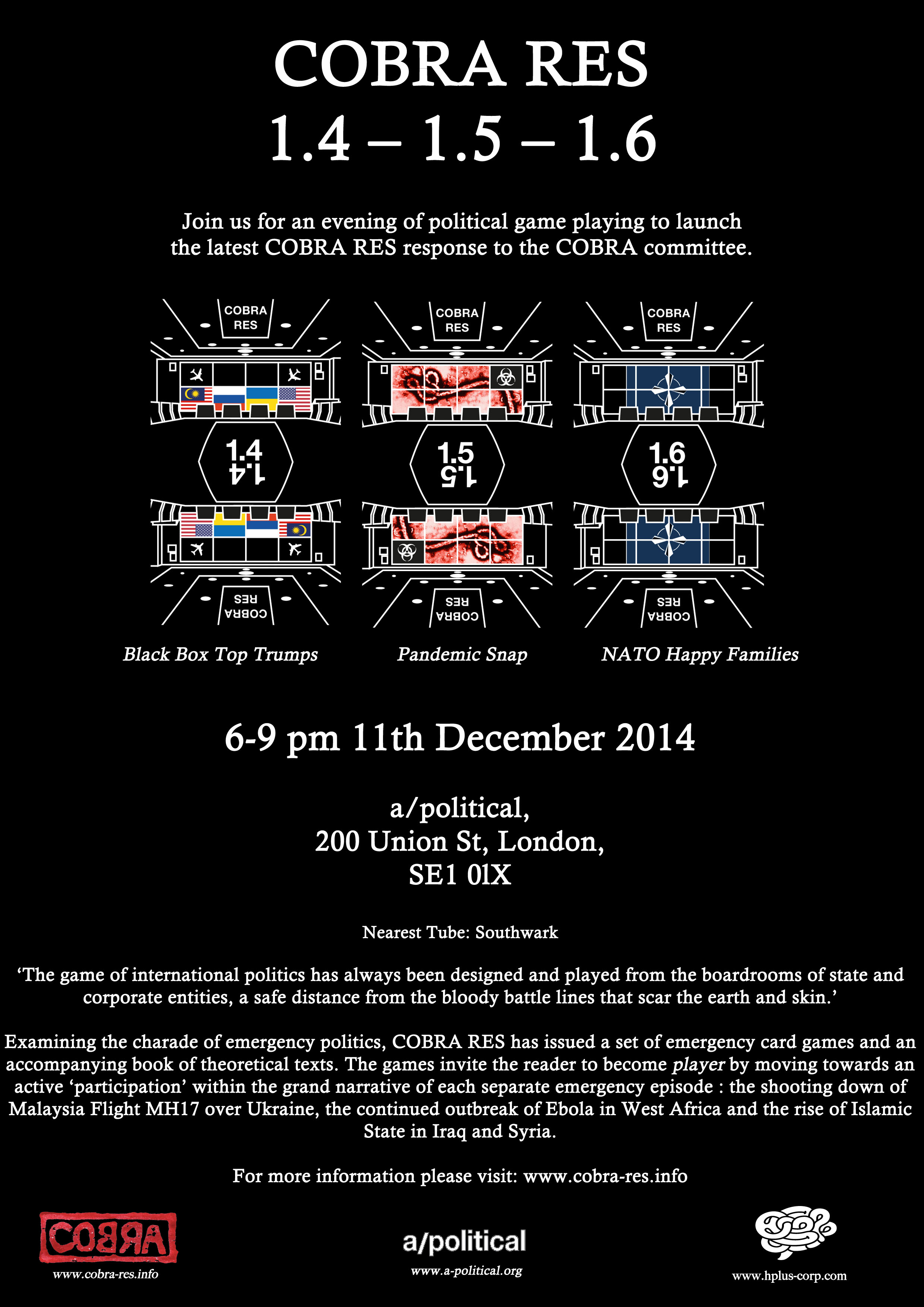
COB1.4_1.6_invite

The most recent (fifth) COBRA RES production (see above) is in response to three COBRA meetings in July and August 2014:

18th July 2014 in response to the shooting down of Malaysia Airlines Flight MH17 over Ukraine (Chaired by Prime Minister David Cameron)

30th July 2014 in response to the continued outbreak of Ebola in West Africa (Chaired by newly appointed Foreign Secretary Philip Hammond)

8th August 2014 in response to Islamic State forcing thousands to flee their homes and take refuge on Mount Sinjar, Iraq (Chaired by newly appointed Defence Secretary Michel Fallon)

Examining the inter-play of emergency politics, COBRA RES has issued a set of emergency card games and an accompanying book of theoretical texts. The games invite the reader to become player by moving towards an active ‘participation’ within the grand narrative of each separate emergency episode.

Cards by: COBRA RES and H+Corp  Texts by: Richard Barbrook, Roland Bleiker, David Campbell, Derek Gregory, Nicolas Hausdorf, Emma Hutchinson, Theodore Price and Strategic Optimism Football Club.

The book accompanying the latest COBRA RES includes my ‘Drone geographies’ (see DOWNLOADS tab) and my post on ‘The war on Ebola‘ (artfully and graciously re-crafted by Theo),
Staging the landscapes of war – with noises off

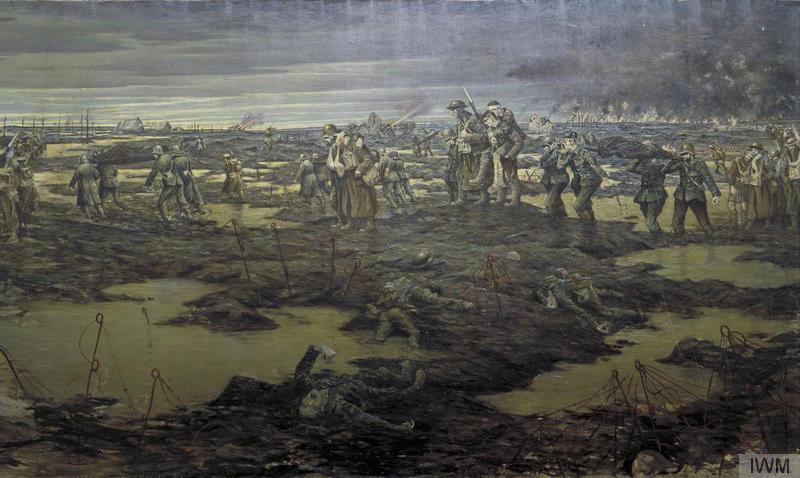
NEVINSON The harvest of battle

I’ve been tracing commentaries on Kurt Lewin‘s classic essay on what we might call the topological phenomenology of the battlefield, published in 1917 as ‘Kriegslandschaft‘ (‘landscape of war’ or, loosely, ‘warscape’), which was based on his experience on the Western Front in the First World War. I’ve been particularly interested in his account of the way in which an ordinary landscape is transformed by war.

William Boyd captured what I have in mind in The new confessions:

‘Take an idealized image of the English countryside – I always think of the Cotswolds in this connection… You know exactly the sort of view it provides. A road, some hedgerowed lanes, a patchwork of fields, a couple of small villages… The eye sweeps over these benign and neutral features unquestioningly.

‘Now, place two armies on either side of this valley. Have them dig in and construct a trench system. Everything in between is suddenly invested with new sinister potential: that neat farm, the obliging drainage ditch, the village at the crossroads become key factor sin strategy and survival. Imagine running across those intervening fields in an attempt to capture positions on that gentle slope opposite… Which way will you go? What cover will you seek? … Try it the next time you are on a country stroll and see how the most tranquil scene can become instinct with violence. It only requires a change in point of view.’

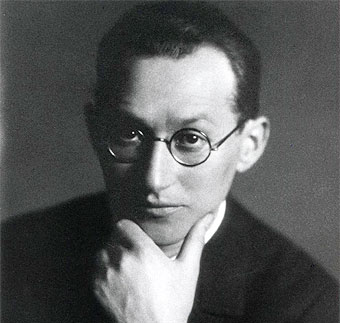
lewin_kurtI’ve discussed this passage before, but what interested Lewin was the way in which the landscape changed for the soldier as he approached the front, moving from a ‘landscape of peace’ to a ‘landscape of war’ – what he described as the production of a ‘directive landscape’.  You can find an English translation here, but it’s behind a paywall I can’t scale: Art In Translation, 1 (2)( 2009) 199-209.  (If anybody has a ladder, please let me know).

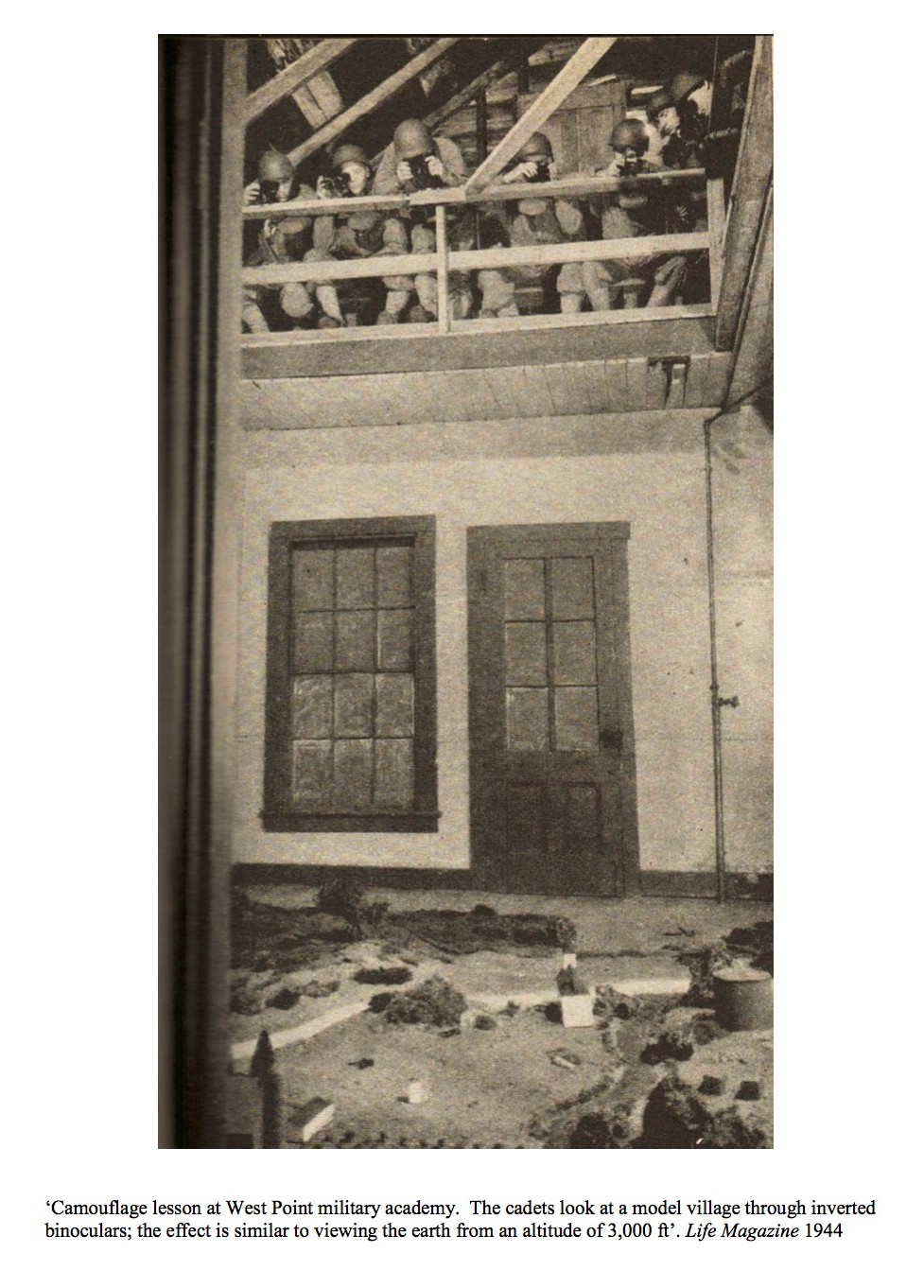
En route, I stumbled on a fascinating PhD thesis by Greer Crawley, Strategic Scenography: staging the landscape of war (University of Vienna, 2011). I’ve discussed various conceptions of the ‘theatre of war’ several times before (see for example here, here and here), but Greer provides a much fuller and richer account.  Here is the abstract:

This dissertation is concerned with the construction of ‘theatres of war’ in the target landscapes of 20th century military conflict in Europe and America. In this study of the scenography of war, I examine the notion of the staged landscape and the adoption of theatrical language and methodologies by the military. This is a multi-disciplinary perspective informed by a wide range of literature concerning perception, the aerial view, camouflage and the terrain model. It draws on much original material including declassified military documents and archival photographs. The emphasis is on the visualisation of landscape and the scenographic strategies used to create, visualise and rehearse narratives of disguise and exposure. Landscape representation was constructed through the study of aerial photographs and imaginative projection. The perceptual shifts in scale and stereoscopic effects created new optical and spatial ‘truths’. Central to this analysis is the place of the model as strategic spectacle, as stage for rehearsal and re-enactment through performance and play. This research forms the context for an exploration of the extension and translation of similar scenographic strategies in contemporary visual art practice. Five case studies demonstrate how the artist as scenographer is representing the political and cultural landscape.

2011-02-25_0648070 (dragged)

And the Contents (the summaries are Greer’s own):

Chapter 1: Scenographic strategies

Theatre of War/Strategic Fantasy/Staging the Landscape

This chapter identifies the scenographic strategies that produce the performance landscape for the rehearsal and re-enactment of the Theatre of War. The aim is to define what is meant by strategic scenography and to establish the basic theoretical foundations upon which to build my argument.

Chapter 2: The Aerial Perspective

Aerial Theatre/The Stereoscopic View

This chapter focuses on the aerial view and the methodology of the stereoscope. This analysis of the relationship between scenography and topography from an aerial perspective expands on theories of aerial perception and stereoscopy. Drawing on the experiences of the reconnaissance pilots and photo interpreters during wartime, it attempts to understand the scopic conditions under which they visualised the landscape.

Chapter 3: Strategies of Perception

Camouflage Strategies/Fake Nature/The Scenic Effects

This is a key chapter which looks at the work of Kurt Lewin’s important contribution to an understanding of the perception of landscape. The second section deals specifically with the camouflage strategies adopted by the camoufleurs when staging their illusions in the First and Second World Wars. It provides a historical overview of the main camouflage strategies and then focus on particular scenic elements, e.g. scenery, lighting, props, sound, costume.

Chapter 4: The Territory of the Model

Maps, Models and Games/ The Model as Spectacle/The Terrain Model

This chapter begins with an examination of the methodologies of the map, model and games; the role of mimesis and performativity and the representation of the terrain. What follows is a consideration of the model as a strategic spectacle and its use to represent political ideologies, commercial and military interests and utopian visions. Within an historical context, it examines how the application of new technologies and scopic regimes has expanded the scenographic possibilities of the terrain model.

Chapter 5: Artists’ Manoeuvres

Wafa Hourani and Michael Ashkin − Nomos/Gerry Judah − The Crusader/Mariele Neudecker – Seduction Chaff/Katrin Sigurdardottir – Mappings/Hans Op de Beeck – St Nazaire

This chapter is an exploration of the deployment of scenographic strategies in contemporary artistic practice. Through five case studies it examines how the artist as scenographer has adopted theatrical practices and the methodologies of the model, camera and film as means of representing the political and cultural landscape.

Greer is currently a lecturer in Scenography at Royal Holloway, University of London and in BA and MA Spatial Design at Buckinghamshire New University.  You can download her thesis here – it’s a feast of delights, with marvellous illustrations and a perceptive text.

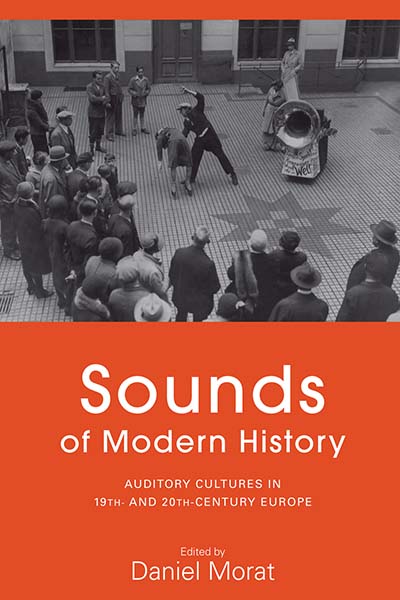
MoratSoundsAs you can see, Greer’s work focuses on the visual, and I’m equally interested in the role of the other senses in apprehending and navigating the battlefield – hence my continuing interest in corpography (see here and here).  So I was also pleased to find a newly translated discussion of the soundscape of the Western Front: Axel Volmar,  ‘”In storms of steel”: the soundscape of World War I’, in Daniel Marat (ed), Sounds of modern history: auditory cultures in 19th and 20th century Europe (Oxford: Berghahn, 2014) pp. 227-255; a surprising amount of the text can be accessed via Google Books, but you can also download the draft version via academia.edu.  More on Axel’s work (and other downloads, in both German and English) here.

And this too takes us back to Lewin:

‘…new arrivals to the front had not only had to leave behind their home and daily life, but also the practices of perception and orientation to which they were accustomed. With entry into the danger zone of battle, the auditory perception of peacetime yields to a, in many respects, radicalized psychological experience—a shift that the Gestalt psychologist, Kurt Lewin, attempted to articulate with the term “warscape”: for the psychological subject, objects lost most of their peacetime characteristics during wartime because they were henceforth evaluated from a perspective of extreme pragmatism and exclusively in terms of their fitness for war….

‘In place of day-to-day auditory perception, which tended to be passive and unconscious, active listening techniques came to the fore: practices of sound analysis, which might be described as an “auscultation” of the acoustic warscape—the method physicians use to listen to their patients by the help of a stethoscope. In these processes, the question was no longer how the noises as such were structured (i.e. what they sounded like), but rather what they meant, and what consequences they would bring with them for the listeners in the trenches. The training of the ear was based on radically increased attentiveness.

The subject thrust to the front thus comprised the focal point of an auditory space in which locating and diagnostic listening practices became vital to survival.’

For more on sound analysis, see my discussion of sound-ranging on the Western Front here, and the discussion in ‘Gabriel’s Map’ (DOWNLOADS tab).

Under American Skies

I’ll be in Berlin in December for a conversation with James Bridle about drone wars and related issues, and I’m already looking forward to it since I’m a great admirer of his work. I particularly admire the way in which he challenges so many of our assumptions about ‘looking’ through his presentations about militarised vision and violence, and I’ve noted before the filiations between his various projects and Josh Begley‘s.

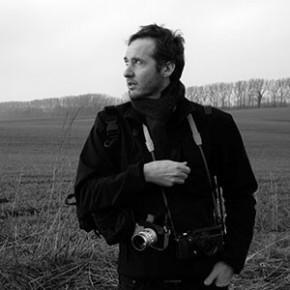
Tomas van HoutryveSo I was interested to read about photographer Tomas van Houtryves (right) project Blue Sky Days.  He begins with an arresting observation with which both James and Josh would be only too familiar:

‘Although a huge amount of [full motion video] footage has been collected [by US drones], the program is classified, and few people have ever seen images of the drone war and its casualties. This seems like a paradox in our thoroughly media-connected age. How can America be involved in a decade-long war where the sky is buzzing with cameras, and yet the public remains totally in the dark?’

But his response to the question is distinctly different: he repatriates the drone wars from Pakistan to the United States (here the most appropriate comparison is with Omar Fast‘s 5,000 Feet is the Best).

Tomas van Houtryve 1

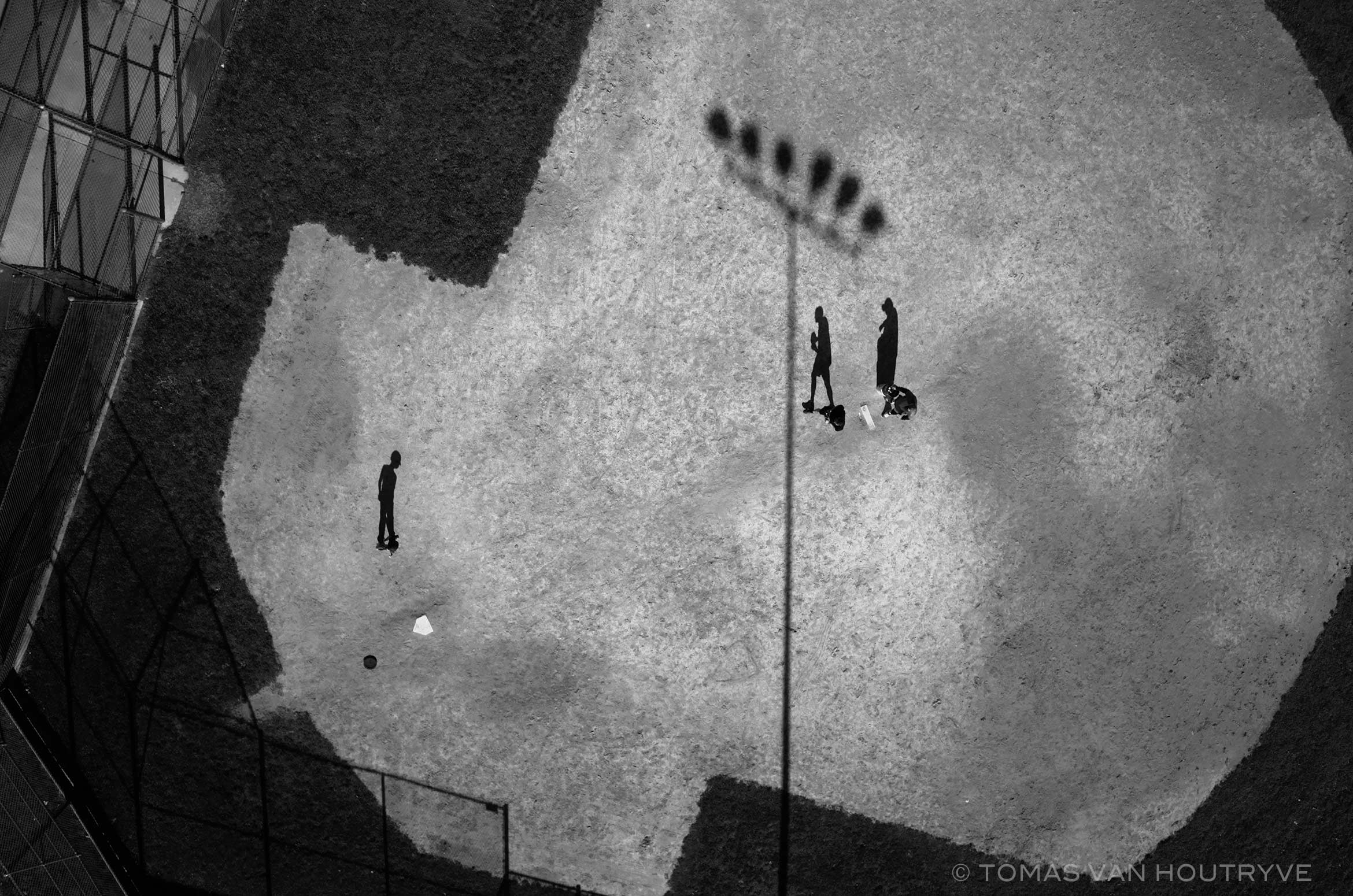
To do so, Tomas travelled across America with a small quadcopter drone bought from Amazon.com attached to his camera.  His concept was simple, Rena Silverman explains in the New York Times:

Take the idea of foreign drone strikes and instead target similar domestic situations, putting them under surveillance using his drone in public spaces. He made a list of hundreds of different strike reports, gleaning as many details about the circumstances…

He rented a black car with tinted windows and placed himself, his drones, his batteries and lists in the car. He spent six weeks in late 2013 averaging between seven and 10 drone flights daily, sleeping in a different town every night. He would pull the car into an empty lot, get out, launch the drone for about five to 10 minutes — about as long as its power lasted — take footage, land the drone, drive away and recharge the batteries while en route to the next location…

He followed his list carefully, trying to imitate “signature strikes,” referring to a May 2012 New York Times article in which some State Department officials complained about the lax criteria for identifying a terrorist “signature.” The joke was that “three guys doing jumping jacks” could be enough suspicious activity for the C.I.A. to conclude it could be a terrorist training camp. In other words, targeting people based on behavior rather than identity.

Tomas van Houtryve 2 copy

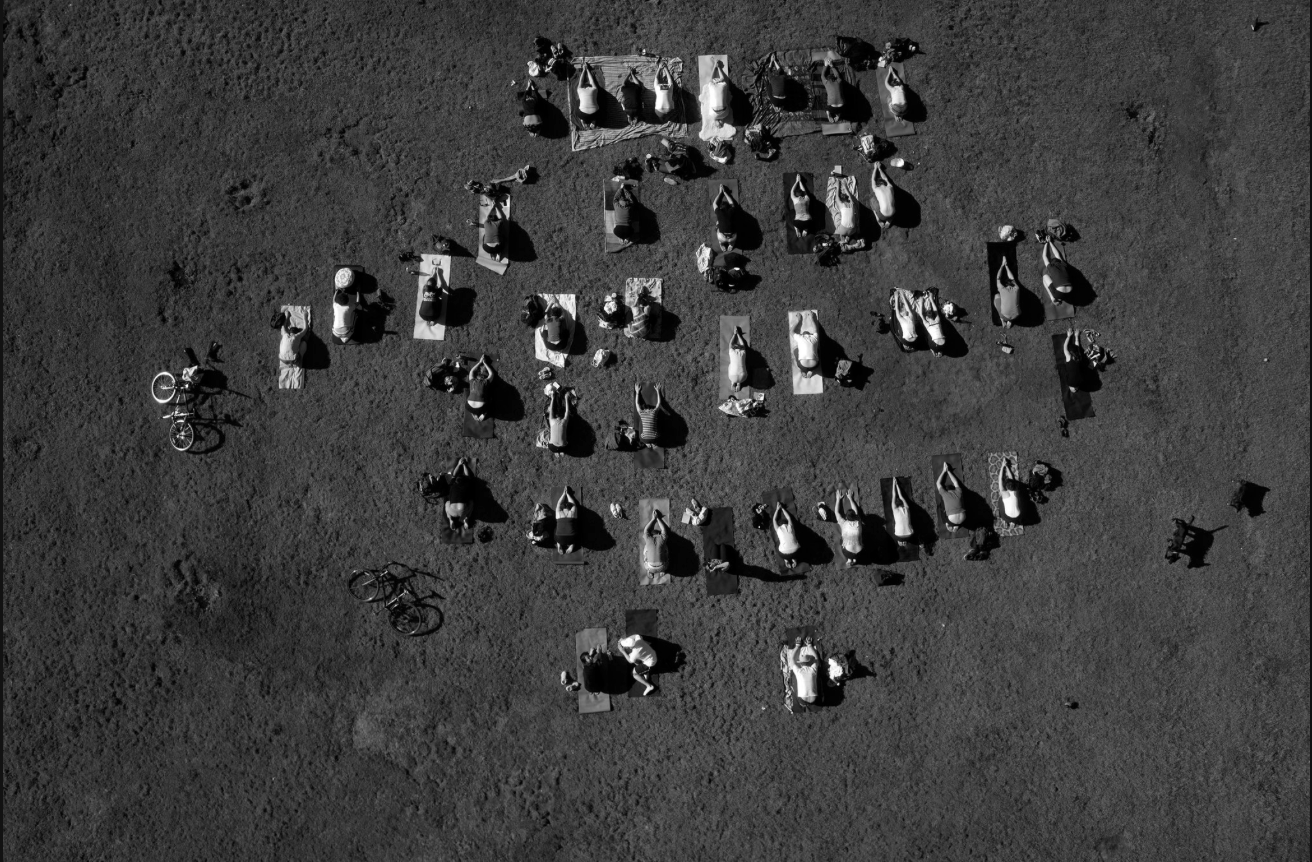
He photographed people exercising in Philadelphia, their shadows long and pinned against the grid of a park. He noticed more “signature” behavior while driving through San Francisco, where he encountered a group doing yoga [above]. When Mr. van Houtryve recently printed the image, he asked viewers if they thought the subjects were praying or exercising. It was a toss-up.

Although these images are not quite ‘what drone attacks in America would look like’, as Pete Brook suggested in WIRED – Tomas’s drone was flying much lower (‘only about six stories high’) and these images are pin-point sharp: there’s none of the ambiguity of infra-red heat signatures here – none the less that last sentence really says it all.  Images do not speak for themselves and interpretation counts for everything – which is why, as I’ve repeatedly argued, it matters so much what pilots, sensor operators and image analysts are pre-disposed to see.

It turns out that a particular incident provoked Tomas’s project – the murder of Mamana Bibi at Ghunda Kala in North Waziristan on 24 October 2012, which I described here –  and also gives it its title.

Zubair RehmanIn October 2012, a drone strike in northeast Pakistan killed a 67-year-old woman picking okra outside her house. At a briefing held in 2013 in Washington, DC, the woman’s 13-year-old grandson, Zubair Rehman, spoke to a group of five lawmakers. “I no longer love blue skies,” said Rehman, who was injured by shrapnel in the attack. “In fact, I now prefer gray skies. The drones do not fly when the skies are gray.”

There’s more from Tomas at Harper’s here, which originally co-sponsored the project with the Pulitzer Center, and you can see more of his drone’s eye view images at the National Geographic here.

There’s also a revealing interview conducted by Bard College’s Center for the Study of the Drone here; it contains all sorts of interesting observations, but one in particular resonated.  Asked about the tension between the beauty of his photographic compositions and the horror of what he is seeking to convey, Tomas says this:

‘The base subject that I’m trying to raise awareness about and get people to think about in less abstract terms is the foreign drone war. If you take the time to read through the particular airstrikes, a lot of them are quite horrifying. But on the other hand, as a photographer, I know that beauty is one of the tools that we use to get people to look at a picture. Beauty has a lot of power, so there’s a tension between trying to seduce people with the language of photography, which is beautiful composition, and trying to reveal something that might be uncomfortable or difficult to digest, once people fully grasp it.’

Another of my art icons, elin o’Hara slavick, says something very similar about her mesmerising sequence of aerial images of places bombed by the US, Bomb after bomb (see also Brian Howe‘s discussion here and my own in ‘Doors in to Nowhere’ [DOWNLOADS tab], from which I’ve taken this passage):

‘She adopts an aerial view—the position of the bombers—in order to stage and to subvert the power of aerial mastery. The drawings are made beautiful “to seduce the viewer,” she says, to draw them into the deadly embrace of the image only to have their pleasure disrupted when they take a closer look. “Like an Impressionist or Pointillist painting,” slavick explains, “I wish for the viewer to be captured by the colors and lost in the patterns and then to have their optical pleasure interrupted by the very real dots or bombs that make up the painting.”’

A tart reminder that there are multiple ways of ‘just looking‘.

Gazonto

I’ve discussed the political-aesthetic practice of transposition before – superimposing war ‘over there’ on a city ‘over here’ – in relation to both Baghdad and Gaza.  For the most part, these have been cartographic exercises or art performances (see the closing sections of  ‘War and peace’ [DOWNLOADS tab] for some more examples).

Film-maker John Greyson has just released this short video, Gazonto, which is doubly different.  It takes the rash of video games about Gaza – many of which glorify successive Israeli assaults – and turns them to critical account, and it re-locates the air strikes from Gaza to Toronto (the flipping of the map near the beginning is inspired).

More here; if you are trying to remember where you’ve heard of John before, he was arrested and jailed in Egypt last summer, en route to Gaza with Tarek Loubani, an ER doctor who is one of the main architects of the Canada-Gaza collaboration that is responsible for taking Canadian doctors to Gaza to train local physicians.  They spent fifty days in a Cairo jail after John was seen filming Tarek treating demonstrators who had been shot by police in Ramses Square, where they had been protesting the military coup.  It was never clear which was the greater crime – treating the demonstrators or witnessing the emergency treatment.

This, of course, is one of the many appalling back-stories spawned by the intimacy between the al-Sisi government in Egypt and the Netanyahu government in Israel: what the splendid Richard Falk calls ‘neighbourly crimes of complicity’.  Geopolitics is rooted in these ‘accommodations’, and it cultivates all sorts of deadly blossoms.

But the tendrils reach far beyond the region, and many readers will appreciate why it is so important for a Canadian film-maker to re-stage the attacks on Gaza in a Canadian city.  For those who don’t, check out this report on the Harper government’s own video, released as the Israeli assault on Gaza was intensifying, affirming Canada’s support for Israel “Through Fire and Water”.   Really.

While I’m on this subject, Laleh Khalili has an excellent essay at the Society & Space open site to accompany the virtual issue on Israel/Palestine.  It’s called ‘A habit of destruction’:

The devastation to which Gaza has been subjected in the last few weeks seems to be yet another repetition of Israeli settler-colonial apparatus’ habit of destruction. Gaza has become emblematic of this habit, because in recent years it has so frequently been subjected to bombing while under a state of siege, but like all settler-colonialisms, the violence of the state is rooted not in an episodic “cycle of violence” but in the very ideology and practice of the settler-colonial movement…. 

The lesson of the most recent Israeli assault on Gaza, as in all previous assaults, is that civilians are not “collateral” or accidental casualties of war between combatants, but the very object of a settler-colonial counterinsurgency. The ultimate desire of such asymmetric warfare is to transform the intransigent population into a malleable mass, a docile subject, and a yielding terrain of domination.

And, as she concludes, ‘That ever so frequently the Israeli military plunges Palestinians into conflagrations of lead and steel and concrete dust and destruction is the clearest sign that it has failed at making Palestinians into such a docile population.’

War cultures

929px-William_Orpen_-_Zonnebeke_-_Google_Art_Project

The British Academy is holding a two-day Landmark Conference in London on 12-13 November 2014, The First World War: Literature, Culture, Modernity.  The conference is convened by Santanu Das and  Kate McLoughlin:

A hundred years after the war’s outbreak, this conference brings together some of the world’s leading experts and emerging scholars to reassess its literary and cultural impact and explore its vexed relationship to modernity. Was the war a ‘crack in the table of history’ or did it reinforce deep continuities? What is the relationship between artistic form and historical violence, and between combatant and civilian creative responses? What are the colonial and transnational dimensions of First World War literature? Spanning across literature, the visual arts and music, the conference will adopt an international perspective as it investigates the war’s continuing legacies.

Registration is required; full details here.

In association with the conference, there will be an evening of music and readings at King’s College Chapel (London) on 11 November, Terrible Beauty: Music and Writing of the First World War, and an evening of poetry reading at the British Academy on 12 November, The Past Hovering: An Evening of War Poetry; both events are free but registration is required.

The art of Homo Sacer

132_img9872-1

 James Bridle‘s new installation, Homo Sacer, has opened at FACT (Foundation for Art and Creative Technology) in Liverpool, as part of its Science Fiction: New Death exhibition:

Explore how our relationship with technology has blurred the lines between the real and the virtual; making our everyday lives feel increasingly like science fiction. Artists including James Bridle, Jon Rafman, Mark Leckey, Larissa Sansour and Ryan Trecartin, plus award-winning science fiction author China Miéville present works which explore how technology is creating new ways of living (and dying), of fashioning identities and the growth of cult-like communities.

The exhibition runs until 22 June, and you can (at least virtually) walk through it with Regine here.

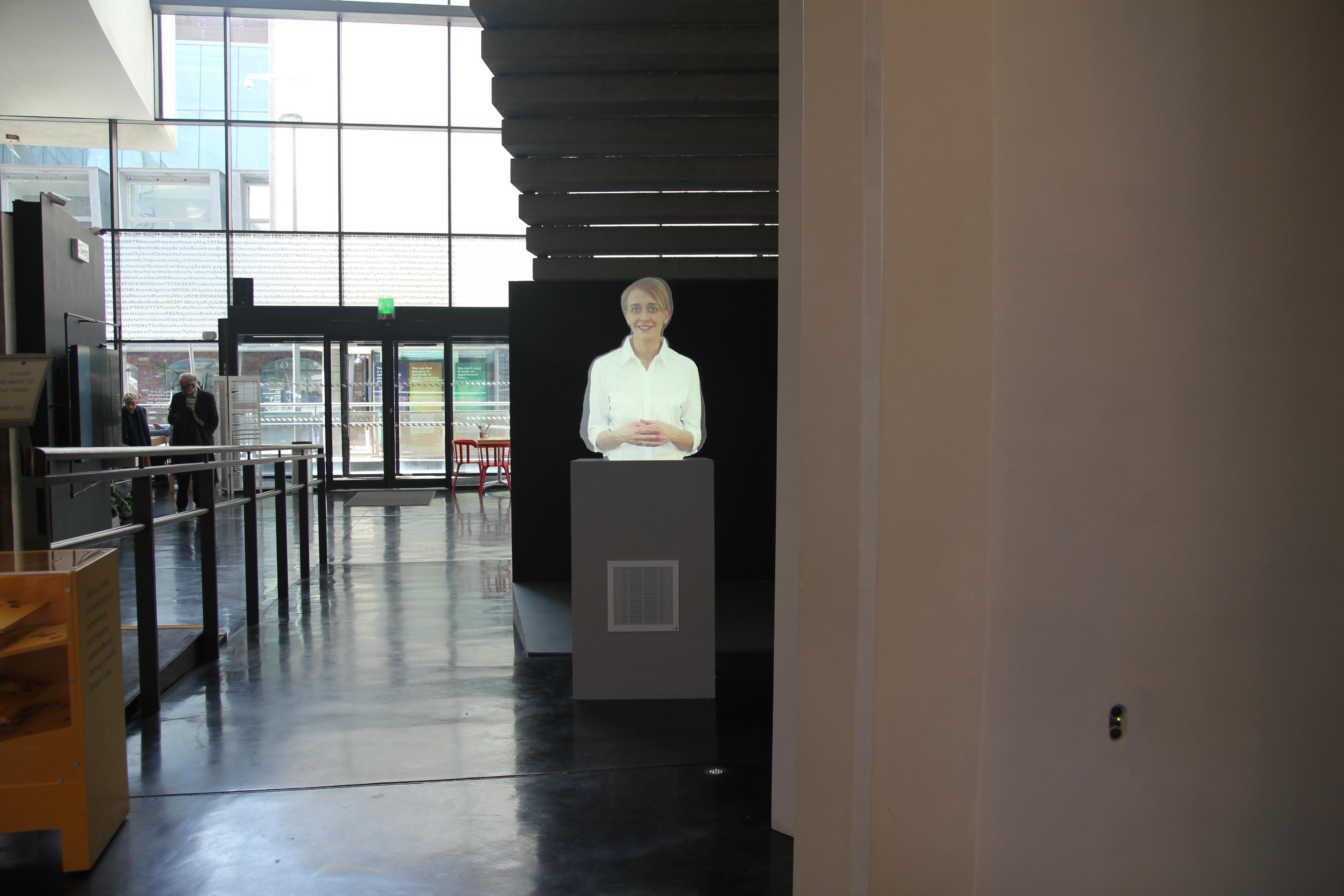
There’s not much detail or documentation of Homo Sacer yet  – though see the image above – but James promises a video clip soon.  Meanwhile he explains:

The installation consists of a projected “hologram” in the entranceway to the gallery, of the kind increasingly found in airports, railway stations and government buildings. The hologram speaks lines from UK, EU and UN legislation, as well as quotations from government ministers, regarding the nature of citizenship in the 21st century, and how it can be revoked, which potentially fatal consequences.

BEN YOUNG Homo sacer

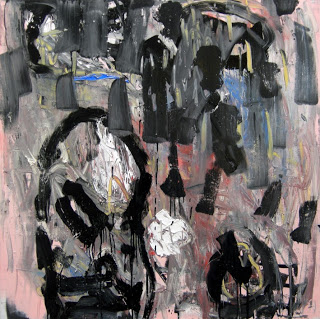
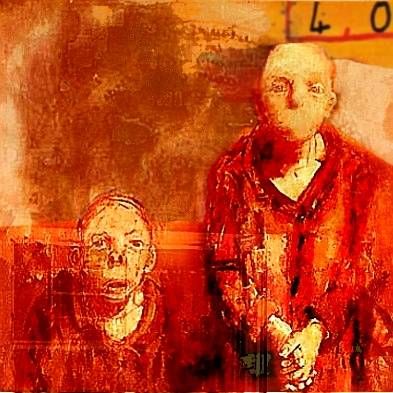
Other artists have been inspired by Giorgio Agamben‘s discussion(s) of Homo Sacer too (and, for those who take the Latin stubbornly literally, Femina Sacra), of life knowingly and deliberately exposed to death.  (If you want an artful preview of the final volume in Agamben’s series, The use of bodies, you can read Adam Kotsko‘s ‘What is to be done?  The endgame of the Homo Sacer series’ here.)  But back to art.  There’s Ben Young‘s Homo Sacer (above), for example, philosopher-artist Adolfo Vásquez Rocca‘s Homo Sacer (below), and and Tarek Tuma‘s haunting Homo Sacer series of canvases showing the faces of suffering in Syria (see here and here), which almost viscerally captures the double meaning of ‘sacra’, sacred and accursed.

ROCCA Homo Sacer

In a related vein, as I noted previously, there’s the State of Exception installation which showed what undocumented migrants abandoned as they crossed the US-Mexico border; first staged at the University of Michigan’s Institute for the Humanities, it’s currently at Detroit’s Museum of Contemporary Art.  (The wall of backpacks conjures up an after-image of the suitcases on display at Auschwitz, and although they gesture in different directions – one where movement comes to a hideous full stop and the other where flight takes off – both are redolent of Agamben’s preoccupations).  For a more wide-ranging view of States of Exception, see Angel Calabres‘s much earlier collaboration here, which trades on Agamben’s work to explore prison subjugation, torture and slaughter houses…

And this in turn brings me (back) to Abdelali Dahrouch‘s installation, Homo Sacer (2009) (below), which is a meditation on the waterboarding of ‘enemy combatants’ by the CIA:

Dahrouch

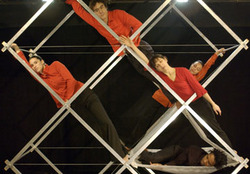
Agamben’s work has inspired not only visual artists.  There’s Christoph Winkler‘s dance-work Homo Sacer, for example, now ten years old,  which tanzjournal described like this:

The choreographer has truly succeeded in formulating a position that is both an aesthetic and ethical one. Life may be a sacred possession – in the face of sanctioned (war) crimes it becomes a disposable commodity. Dance cannot intervene in this state of affairs. But it can champion life, by displaying it in its vulnerability. Homo Sacer is not only in this respect Winkler’s most impressive piece to date.

Sophiensaele Homo Sacer

And Frankfurter Rundschau like this:

One after another, the other seven dancers climb out of the resting niches. All look distraught in the glaringly lit space, whose angularity contrasts with the fragile bodies. Following abrupt impulses, the dancers break out of themselves, only to quickly fall back into the frozen pose. Humans fleeing and hesitating in the same moment, developing an icy atmosphere of vulnerability … But in the following choreographic sequence, in which the dancers seem to be wrestling with themselves as if the truth were strangling them in its grasp, is a brilliant scene in which the ensemble intertwines and connects into complex structures that, only moments later are again severed. Energy shoots up like suddenly occurring memories – symbolizing the sudden convulsion of that very “base existence”…

And there’s even music – although Martin Kücher released only 250 copies of his solo jazz album Homo Sacer…  You can also listen to Vancouver’s own Dubstawk‘s remix Homo Sacer here.

Martin Kuchen homo sacer

All sorts of artworks have been used on the cover of Agamben’s texts, of course, and they can be revealing too: I know it’s often wrong to judge a book by its cover (but not always), and my favourite essay in Geographical imaginations is in fact my reading of the cover of David Harvey‘s The condition of postmodernity.  In any case, it’s interesting to track movements in the other direction and to see how artists engage with texts – particularly if you believe that artwork is part of the research/investigative/analytical process rather than merely one of its products.

Drones, militarized vision and civilian casualties

I’m just back from the AAG Conference in Tampa, and there’s a lot to catch up on.

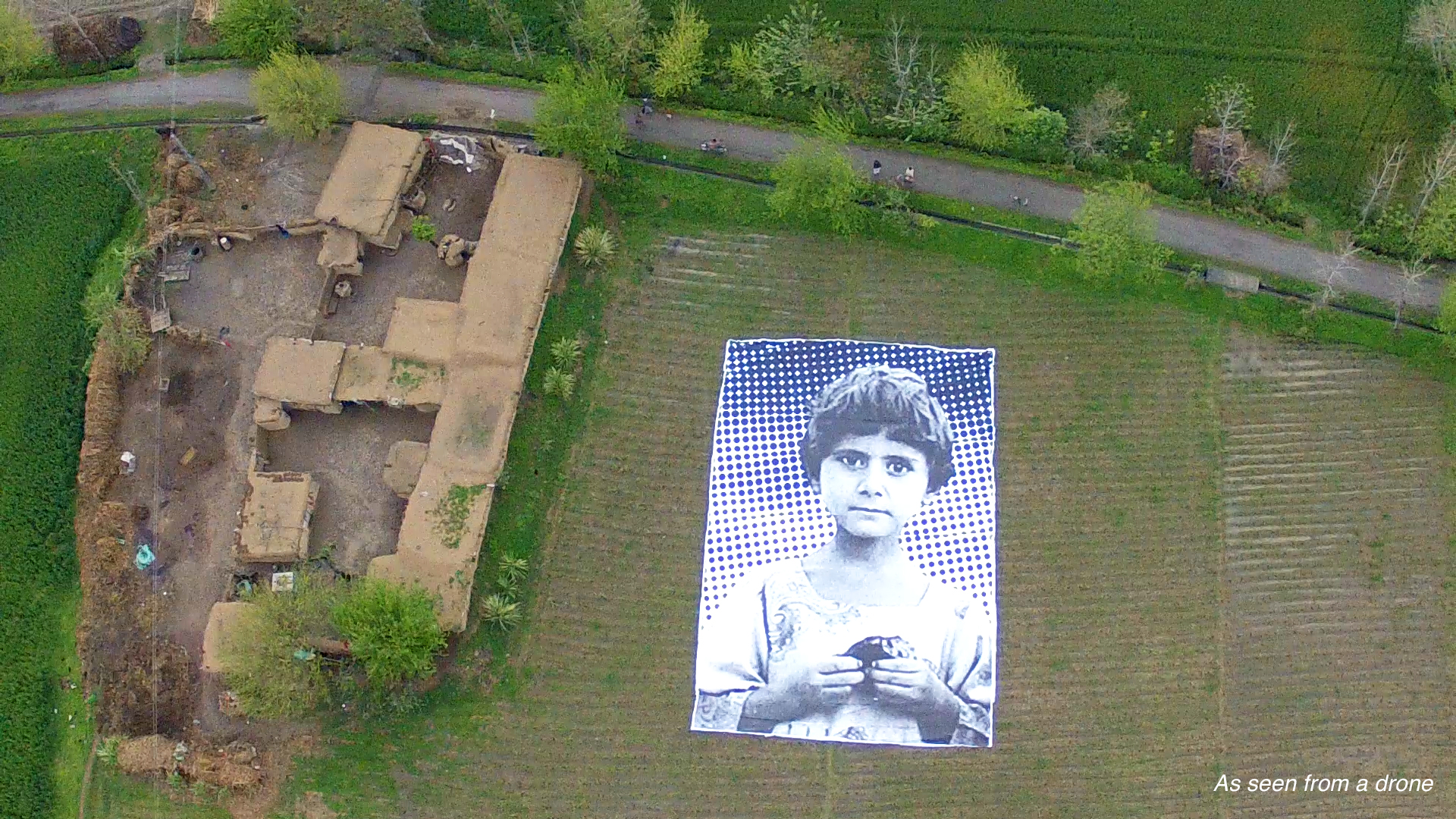
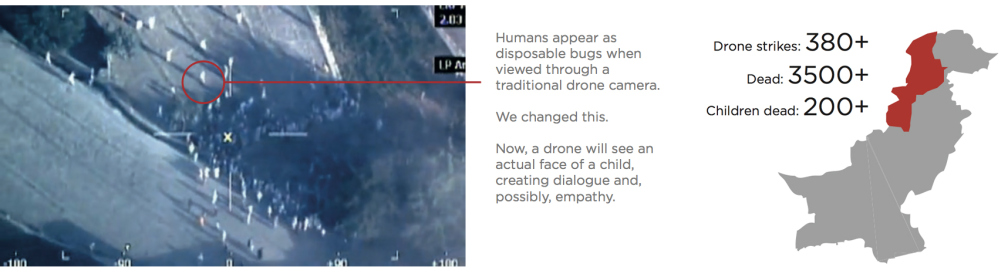
First, an art installation in Pakistan called #NotABlugSplat that reverses the paramilitary gaze and ‘targets Predator drone operators sitting thousands of miles away who refer to kills as BugSplats.’  Now they’ll see on their screens the face of a child who lost her parents and two young siblings in a drone strike.

jr_kpk_full

It’s a collaboration between Pakistani and American artists, working with Reprieve and the Foundation for Fundamental Rights, who also designed it ‘to be captured by satellites in order to make it a permanent part of the landscape on online mapping sites.’

667989206390250307

It’s an arresting project – but if you scroll through the comments that followed gizmodo‘s report you’ll see that ‘hope’ and ’empathy’ remain dismally distant for many people.

LEWIS Drone strikes in PakistanPerhaps some of them would benefit from a new report for the Center of Naval Analyses (CNA) by Larry Lewis, Drone strikes in Pakistan: reasons to assess civilian casualties.  I’ve noted his (largely classified) work on Drone strikes and civilian casualties in Afghanistan before, and in this – unclassified – report he leverages what we know about US military drone strikes in Afghanistan to address the cross-border attacks directed by the CIA.  Lewis makes two key points.

First, he notes that the US government’s claims about civilian casualties for its supposedly covert operations in Pakistan are significantly lower than ‘nearly every other estimate available’.  (En route, he draws attention to something that is usually overlooked in these calculations: under International Humanitarian Law, ‘the burden of proof is to determine whether a casualty is a combatant’, and where in doubt the casualty must be regarded and recorded as a civilian).  Based on his previous work in Afghanistan, Lewis suggests three overlapping reasons – apart from a disinclination to tell the truth – that ‘complicate the estimation process’:

  • An irregular enemy –  it is exceptionally difficult to distinguish combatants from civilians in irregular warfare, and this is exacerbated by combatants ‘co-locating with the local population’;
  • Misidentifications – ‘US forces mistakenly believe civilians to be enemy combatants’; I’m not sure how this is different from the first, but Lewis provides two examples that suggest he has in mind specific rather than general characteristics: mistaking men digging drainage ditches for militants burying an IED, for example, or assuming all those in close proximity to an engagement were involved (‘guilt by association’);
  • Battle Damage Assessments (BDA) based on aerial surveillance – determining the consequences of an air strike without ‘boots on the ground’ is likely to be defective

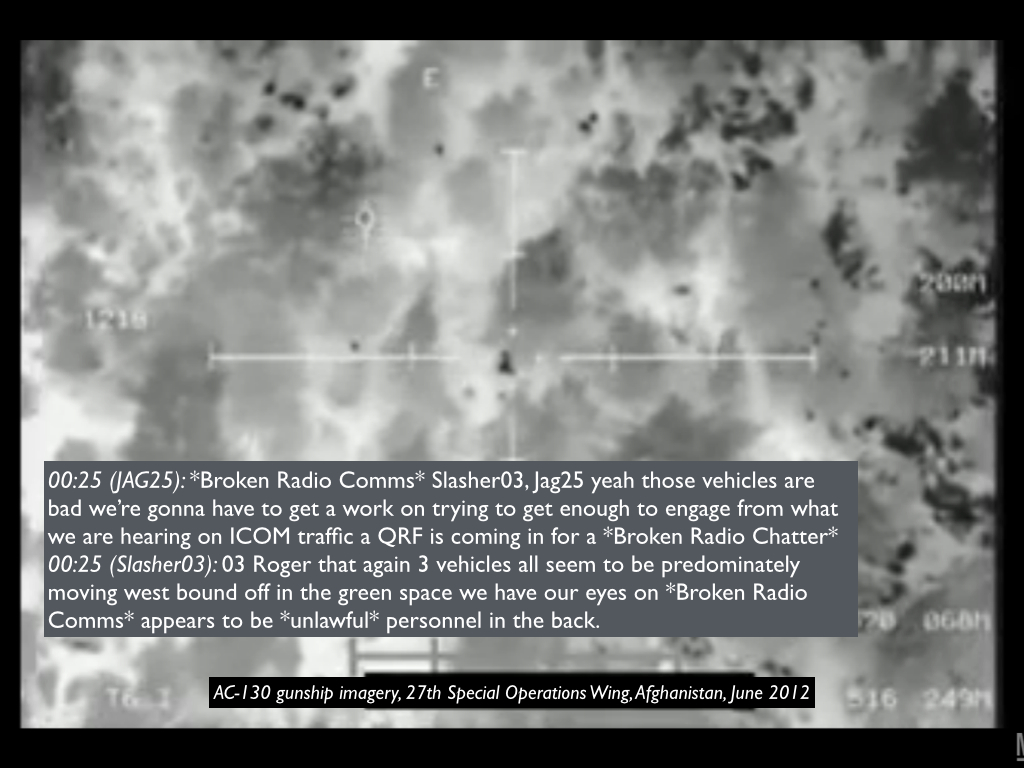
Of all of these, Lewis suggests that it is misidentification that is likely to be ‘the basis for the majority of civilian casualty incidents’ and cites the case that I discussed in detail in Tampa: the strike carried out by two attack helicopters following persistent surveillance from a Predator of a ‘convoy’ of three vehicles in Uruzgan province in Afghanistan in February 2010.  I’ll post my version of events shortly, since I think it is a mistake to collapse this episode into a monotonic ‘Predator vision’; there were other eyes in the sky [see the image below], and – still more significantly – military vision is not a uniquely technical process (which is why the concept of visuality is so important) and in this case involved different interpretations of the Full Motion Video Feed from the drone by different people at different locations. In short, there was a de-centralized, distributed and dispersed geography of militarized vision that was never resolved into a plenary (still less totalizing) frame.

AC 130 Gunship Imagery Afghanistan.001


That said, Lewis’s second point is about process not platform.  He has no truck with claims like Avery Plaw’s – ‘Where civilian casualties cannot be avoided they must be minimized.  This is what drone strikes do’ – because they mistake ‘platform precision for a comprehensive process that minimizes civilian casualties’ and are in fact ‘contradicted by operational data’.  He cites his earlier analysis of 2010-2011 data from Afghanistan, which ‘showed that several forms of attack, including engagements by manned air platforms, were less likely to cause civilian casualties than drone strikes’ (my emphasis; see my earlier discussion here). In his view, then, ‘minimizing civilian casualties is less a matter of platform or ordnance selection as it is using an approach that considers factors that lead to civilian casualties and then effectively takes them into account.’

The point is sharpened by Mark Gubrud in a response to a report from Charli Carpenter at the Duck of Minerva:

‘…drones use the same targeting pods and precision-guided weapons as the manned platforms they replace; in fact, the quality of imagery from the drones is degraded by the limited bandwidth and frequent interruptions of satellite links, as well as the transmission delay which can frustrate last-moment aborts. On top of the “soda straw” vision as compared with low-flying aircraft in close air support, these factors mean that, if anything, the drones are actually inherently less discriminate.’

Again, all of these factors were in play in the Uruzgan attack: degradations and interruptions of both video and audio transmissions were of critical importance – again, see the image from my Tampa presentation above – but even more significant was the way in which the military field of view expanded, contracted and even closed at different locations as the episode unfolded.  More to come.

Imag(in)ing drones

rpa-vector

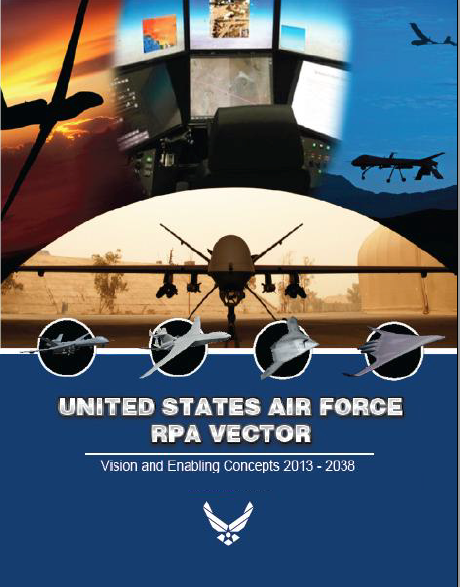
The USAF has at last published its RPA Vector: Vision and enabling concepts, 2013-2048, outlining its projected future for Remotely Piloted Aircraft: you can download it here.

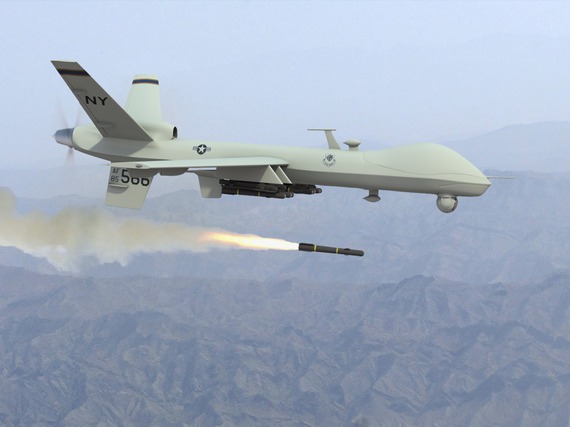
I’ll be working my way through this in detail in the next several days, but scanning its 100 pages my eyes were drawn to Figure 4 on p. 18.  Noting that the Air Force is transitioning to an all-Reaper flight, the images is captioned ‘MQ-9 firing an AGM-114 Hellfire.’

dronerender-thumb-570x427-116317

As James Bridle noted, the image is everywhere; it’s also nowhere: a fake.

At first, the feeling was just unease. Staring at it for some time, seeing it endlessly reproduced across the web and in print, it began to seem unreal, a fiction, too smooth, too perfect. But that’s an effect of drones: they always appear otherworldly…

Of course, it’s not just that. The Canon Drone is indeed entirely unreal. A close inspection, and comparison with other Reaper images, including 09-4066, bears this out almost immediately. The level of detail is too low: missing hatches on the cockpit and tail, the shape of the air intake, the greebling on the fins and body. That ‘NY’ on the tail: it’s not aligned properly, it’s a photoshop. Finally, the Canon Drone’s serial, partly obscured, appears to be 85-566. The first two numbers of USAF serials refer to the year an aircraft entered service: there were no Reapers back in 1985 (development didn’t even begin until 2001).

The Canon Drone does not exist, it never has. It is computer generated rendering of a drone, a fiction. It flies over an abstracted landscape…

In fact, as Alexis Madrigal revealed last year, the image is a computer rendering produced by Michael Hahn:

“I had never seen an image of a drone actually firing a missile so that is what I decided to create,” he said. And suddenly, everyone else, who also had never seen a drone actually firing a missile, had a way of seeing with their own eyes.

Strange then, that the US Air Force – which surely has seen countless drones firing countless missiles – should resort to a computer-generated, photoshopped image.  And an inaccurate one at that.

Endless War and the machine

When I wrote ‘Seeing Red: Baghdad and the event-ful city’ (DOWNLOADS tab) I was intrigued by the way in which the US military apprehended the city as a field of events:

‘In Baghdad, these security practices performed a continuous audit that compiled reports of events (Significant Activity Reports or SIGACTS) and correlated the incidence of ‘enemy-initiated attacks’ and other ‘enemy actions’ with a series of civil, commercial and environmental indicators of the population at large: moments in the production of what Dillon and Lobo-Guerrero call a generalized bio-economy.’  

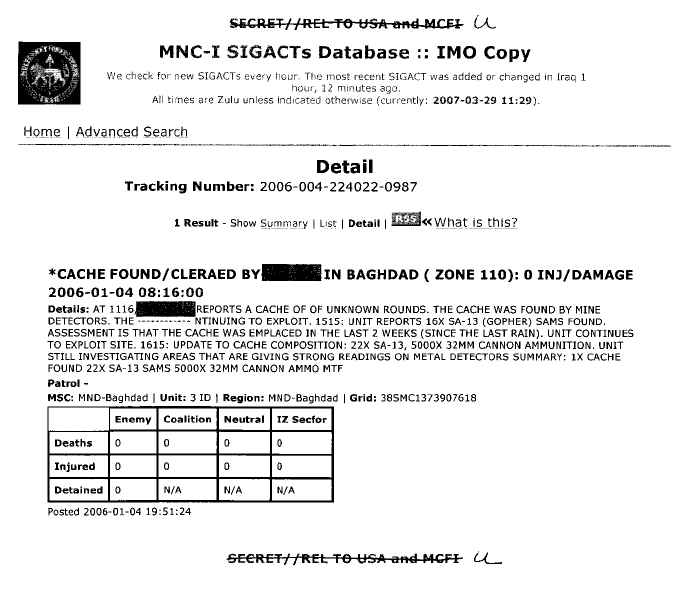
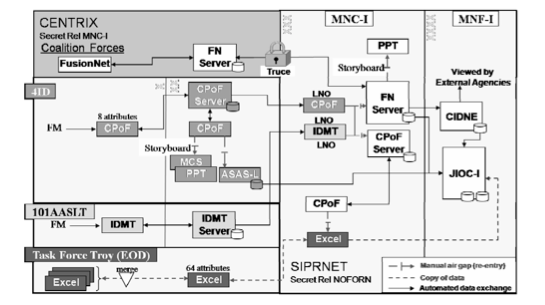
The animating core of the system was the SIGACT  – shown below – and these were eventually fed into a single reporting and analysis platform, the Combined Information Data Network Exchange (CIDNE).

SIGACT

‘The primary transcription of an event, its constitution as a SIGACT, with all its uncertainties and limitations, was transmitted downstream to be digitized and visualized, correlated and ‘cleansed’, so that it could be aggregated to show trends or mapped to show distributions.  All the systems for SIGACT recording and analysis interfaced with visualization and presentation software, which was used to generate ‘storyboards’ at every level in the chain.’

The chain as it was constituted in Iraq in May 2006 is shown below; CENTRIX (top left) is the Combined Enterprise Regional Information Exchange System that provided information exchange across the US-led coalition;  CPoF (scattered across the centre field) is the Command Post of the Future, a distributed GIS system I discussed in the original essay that provided a command-level visualization of the battlespace as a field of events (a system that has since been upgraded multiple times); and at the centre right you can see the key automated data exchanges to and from CIDNE:

MNF-I Event Reporting, May 2006 (Wortman)

Since I wrote, scholars have used SIGACT reports much more systematically to analyse the connective tissue between ethno-sectarian violence and the ‘surge’ – see, for example, Stephen Biddle, Jeffrey Friedman and Jacob Shapiro, ‘Testing the surge’, International Security 37 (1) (2012) 7-40; Nils Weidmann and Idean Saleyhan, ‘Violence and ethnic segregation: a computational model applied to Baghdad‘, International Studies Quarterly 57 (2013) 52-64 – to explore the political dynamics of civilian casualties – see, for example, Luke Condra and Jacob Shapiro, ‘Who takes the blame?  The strategic effects of collateral damage’, American Journal of Political Science 56 (1) (2012) 167-87 – and to conduct more general evaluations of counterinsurgency in Iraq: see, for example, Eli Berman, Jacob Shapiro and Joseph Felter, ‘Can hearts and minds be bought? The economics of counterinsurgency in Iraq’, Journal of political economy 119 (4) (2011) 766-819.

I’ve been revisiting these modelling exercises for The everywhere war, because they require me to rework my essay on ‘The biopolitics of Baghdad’ (though not, I think, to change its main argument).  I’m struck by the idiom they use – my critique of spatial science written in another age would have been substantially different had it been less preoccupied with the detecting of spatial pattern, had its methods been applied more often to issues that matter, and had its architects been less convinced of the self-sufficiency of their methods.

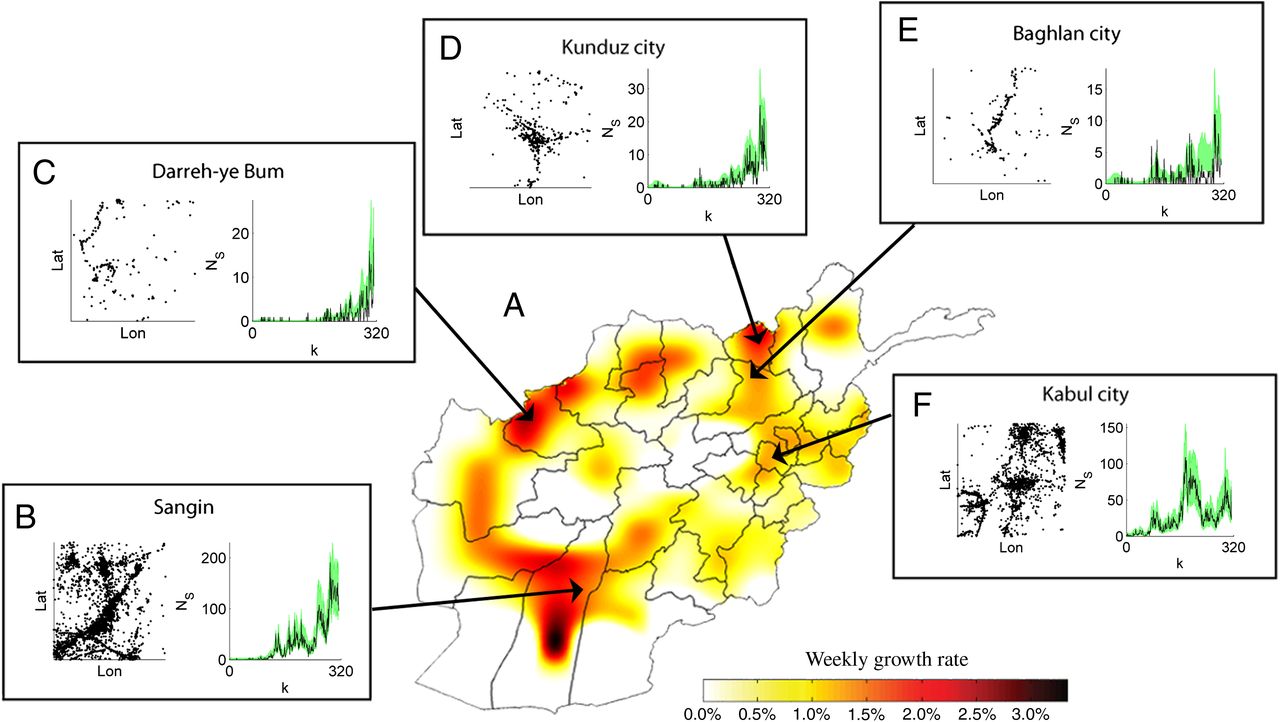
But I’m also struck by the idiom of the SIGACT itself.  We’ve since become much more accustomed to its staccato rhythm through Wikileaks’ release of the Afghan and Iraq War Diaries, whose key source was CIDNE.  Again, these have been visualised and analysed in all sorts of ways: see, for example, herehere, here and here (and especially Visualizing Data and its links here).  The image below comes from Andrew Zammit-Mangion, Michael Dewar, Visakan Kadirkamanathan and Guido Sanguinetti,’Point-process modelling of the Afghan War Diaries’, Proceedings of the National Academy of Sciences 109 (31) (2012) and shows the time-space incidence of events recorded in the Diaries (here I suspect I’m channelling half-remembered conversations with Andrew Cliff….)

F2.large

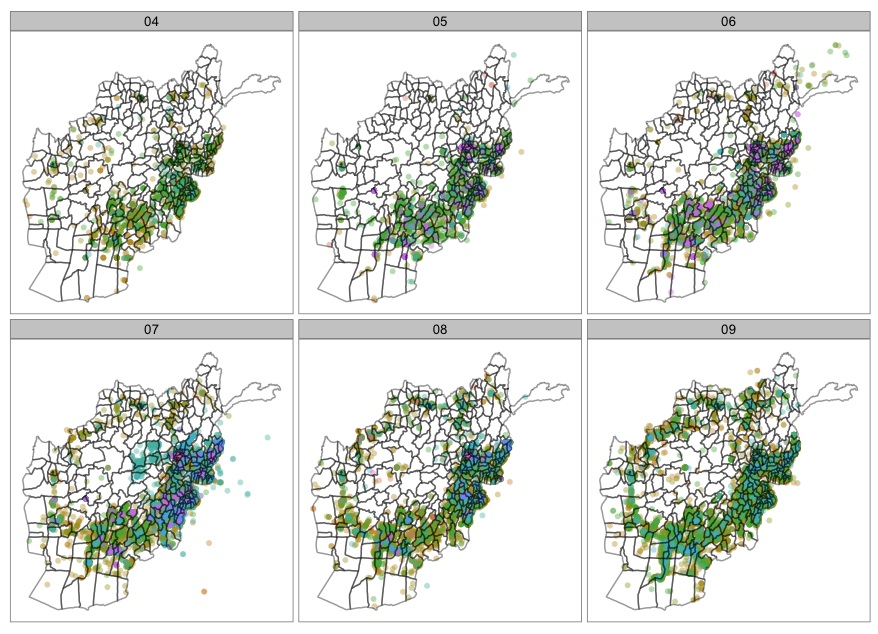
And here, rather more prosaically, is another version – by Drew Conway and Mike Dewar – that provides a time-sequence of the mounting intensity of the war 2004-2009 (for Danger Room‘s discussion and gloss, see here):

events_by_label_map

Now David Pinder has kindly drawn my attention to an extraordinarily suggestive essay by Graham Harwood,Endless War: on the database structure of armed conflict’ over at rhizome, and to the art-work that is it subject, which together have returned me to my original interest in the ‘event-field’ of later modern war and the automated interactions between its data platforms.

Graham’s central question is deceptively simple: ‘How does the way war is thought relate to how it is fought?’ SIGACTS populate the digital battlespace with events and invite a calculative and algorithmic apprehension of the field of military violence.  To show what this means, Graham and his partner Matsuko Yokokoji (who together compose YoHa: English translation ‘aftermath’) joined with his Goldsmith’s colleague Matthew Fuller to produce an intriguing artwork, Endless War.

It processes the WikiLeaks Afghan War Diary data set as a collection of analytic viewpoints, both machine and human. A software-driven system, Endless War reveals the structure of these viewpoints by using N-gram fingerprints, a method that allows sorting of the text as an anonymous corpus without having to impose predetermined categories on it. Presented as a gallery installation, the system includes a computer that processes the data in real time, projections of the results, and coil pick-up microphones on the central processing unit that sonify the inner working of the machine.

The torrent files released by WikiLeaks in 2010 are the residue of the system that created them, both machine and human. They seem to hint at the existence of a sensorium, an entire sensory and intellectual apparatus of the military body readied for battle, an apparatus through which the Afghan war is both thought and fought.

You can get a sense of the result from vimeo’s record of the installation at the Void Gallery in Derry:

This is a video, obviously, but Endless War isn’t a video.  As the artists explain in a note added to the vimeo clip:

Just as an algorithm is an ‘effective procedure’, a series of logical steps required to complete a task, the Afghan War Diary shows war as it is computed, reduced to an endless permutation of jargon, acronyms, procedure recorded, cross-referenced and seen as a sequence or pattern of events.

Endless War is not a video installation but a month-long real-time processing of this data seen from a series of different analytical points of view. (From the point of view of each individual entry; in terms of phrase matching between entries; and searches for the frequency of terms.) As the war is fought it produces entries in databases that are in turn analysed by software looking for repeated patterns of events, spatial information, kinds of actors, timings and other factors. Endless War shows how the way war is thought relates to the way it is fought. Both are seen as, potentially endless, computational processes. The algorithmic imaginary of contemporary power meshes with the drawn out failure of imperial adventure.

This computational assemblage (think not only of the cascading algorithms but also of the people and the handshakes between the machines: a political technology ‘full of hungry operators’, as Graham has it) is performative: it is at once an inventory – an archive – and a machine for producing a particular version of the military future. Graham again:

‘A SigAct necessarily retains evidential power that reflects its origin outside of the system that will now preserve it, but once isolated from blood and guts, sweat and secretions of the theatre of action (TOA), the SigActs are reassembled through a process of data atomisation. This filter constructs a domain where the formal relation, set theory, and predicate logic has priority over the semantic descriptions of death, missile strikes, or the changing of a tank track and the nuts and bolts needed…

This system of record keeping can be seen as a utopia of war. It is idealized, abstracted, contained; time can be rolled back or forward at a keystroke, vast distances traversed in a query, a Foucauldian placeless place that opens itself up behind the surface of blood-letting and hardware maintenance and the ordering of toilet rolls. A residue that casts a shadow to give NATO visibility to itself. As the ensemble of technical objects and flesh congeal, they create an organ to collectively act to rid itself of some perceived threat—this time from Al Qaeda or the Taliban—faulty vehicles, bad supplies, or invasive politics. This organ also allows NATO’s human souls to imagine themselves grasping the moment, the contingency of now. All of the war, all of the significant events, all of the time, all of the land, coming under the symbolic control of a central administration through the database, affording governance to coerce down the chain of command.’

This is a much more powerful way of capturing – and, through the physical installation itself, conveying – what I originally and imperfectly argued in ‘Seeing Red’:

‘… optical detachment is threatened by a battle space that is visibly and viscerally alive with death; biopolitics bleeds into necropolitics. And yet the Press Briefings that are parasitic upon these visualizations move in a dialectical spiral, and their carefully orchestrated parade of maps, screens and decks reinstates optical detachment. For even as the distancing apparatus of the world-as-exhibition is dissolved and the map becomes the city, so the city becomes the map: and in that moment – in that movement – Baghdad is transformed into an abstract geometry of points and areas and returned to the field of geopolitics. And as those maps are animated, the body politic is scanned, and the tumours visibly shrink, so Baghdad is transformed into a biopolitical field whose ‘death-producing activities [are hidden] under the rhetoric of making live’ (Dauphinee and Masters 2007: xii). In this looking-glass world bodies are counted but they do not count; they become the signs of a pathological condition and the vector of recovery. These processes of abstraction are, of course, profoundly embodied. This is not algorithmic war, and behind every mark on the map/city is a constellation of fear and terror, pain and grief. For that very reason our disclosure of the infrastructure of insight cannot be limited to the nomination of the visible.’

When war comes home

After the US invasion of Iraq there were all sorts of artistic interventions that sought to bring home to Americans what was happening in Baghdad.  I described some of them in ‘War and peace’ (DOWNLOADS tab), noting that many of them seemed to take their cue from Martha Rosler‘s double photomontage of ‘Bringing the war home’, in which she re-staged first Vietnam and then the Iraq war in American domestic interiors:

Captives are paraded around gleaming kitchens on leashes, combat troops stalk in living rooms, while beyond the drapes fires flicker, a grieving woman slumps on the deck, and an Army patrol files by. Domestic critics have frequently noted the interchange between security regimes inside and outside the United States; they insist that the ‘war on terror’ ruptures the divide between inside and outside, and draw attention to its impact not only ‘there’ but also ‘here’. But Rosler’s sharper point is to goad her audience beyond what sometimes trembles on the edge of a critical narcissism (‘we are vulnerable too’) to recognise how often ‘our’ wars violate ‘their’ space: her work compels us to see that what she makes seem so shocking in ‘our’ space is all too terrifyingly normal in ‘theirs’.

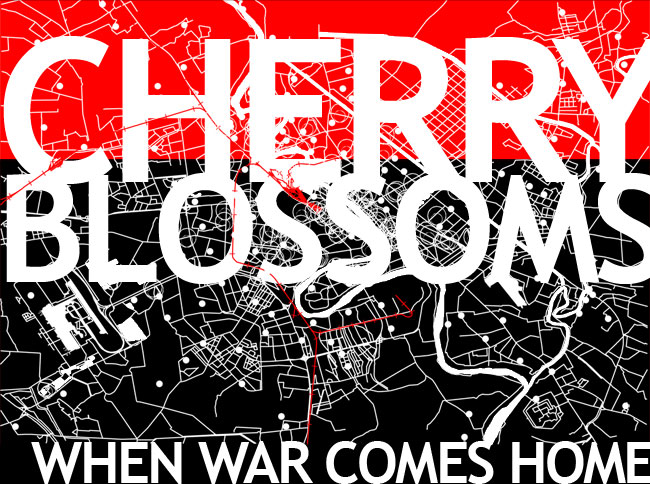
Several projects made cartographic transpositions or mash-ups: superimposing the bombing of Baghdad on San Francisco (Paula Levine‘s Shadows from another place) or Boston (Alyssa Wright‘s Cherry Blossoms), for example, or choreographing a situationist tour of Baghdad in Brooklyn.  I’ve been more hesitant about these interventions; I know that these three projects were linked to – and in the last case depended on – ground performances, and I know too that it’s possible to undo the abstractness of conventional cartography, to turn it against itself (here I’m thinking of elin o’Hara slavick‘s brilliant Bomb after bomb).

WRIGHT Cherry Blossoms

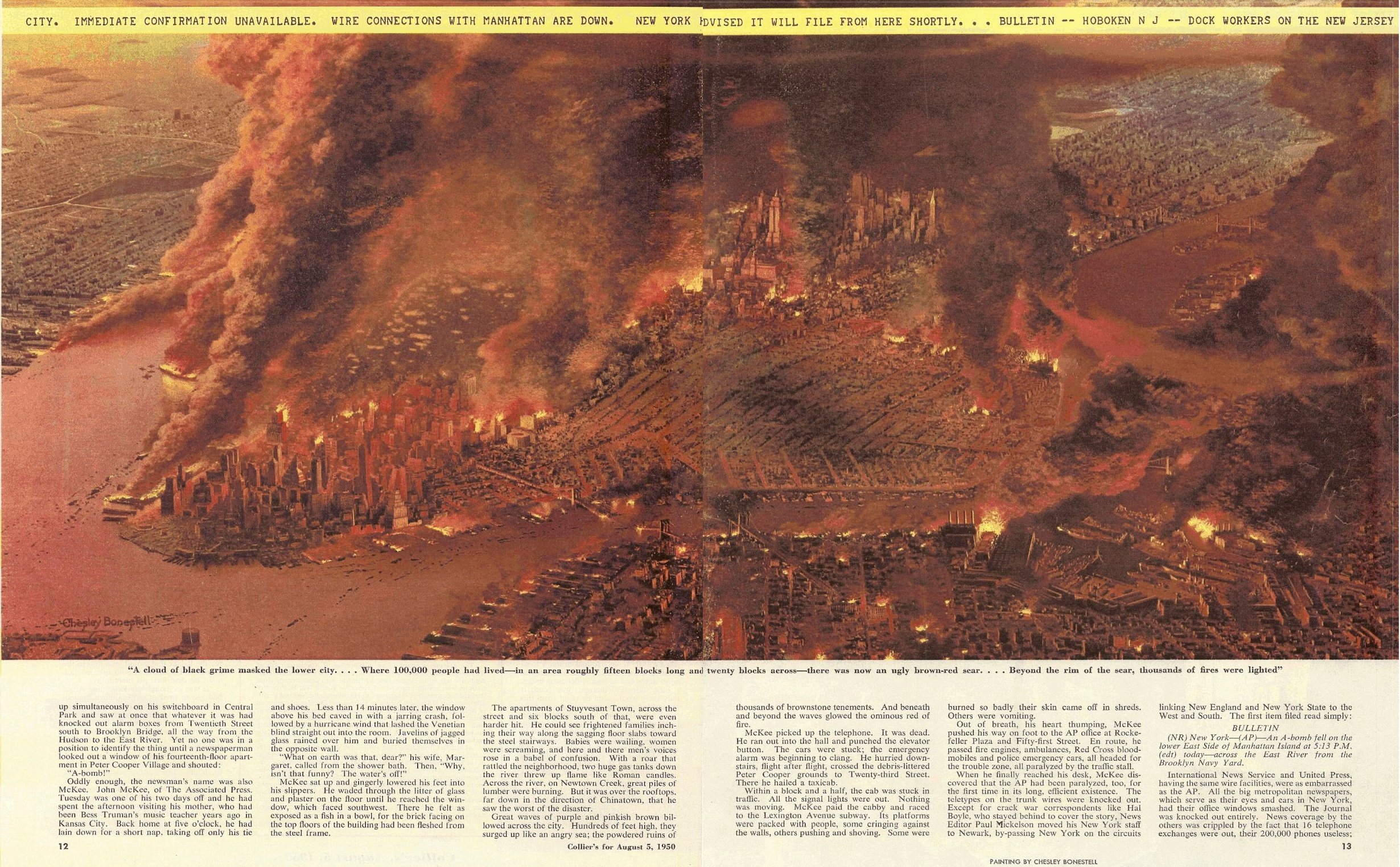
I’ve now seen a different cartographic transposition that dramatizes the firebombing of Japan during the Second World War by juxtaposing a map of the United States with a map of Japan.  Almost as soon as the war was over there were several visualizations of a nuclear attack on US cities.  The image below comes from Collier’s Magazine in 1950, for a cover story called ‘Hiroshima, USA’; you can access the original here and read more here.  But projects like these still deflect the critical gaze from the horror of what happened there to the horror of what might happen here.  Indeed, that was precisely the point, as Joseph Masco shows in his brilliant essay, ‘”Survival is Your Business”: Engineering ruins and affect in nuclear America’, Cultural Anthropology 23:2 (2008) 361-98; reprinted in Ann Laura Stoler (ed), Imperial debris: on ruins and ruination (Duke, 2013).

Colliers-03-04-1

The problem is redoubled in the case of Hiroshima and Nagasaki, because those two hideous mushroom clouds have so often blocked our view of the firebombing of Japanese cities that preceded the two nuclear attacks.  Here the work of David Fedman and Cary Karacas on bombing Japan is indispensable, not least for its illuminating discussion of the central role of cartography (see Cary’s bilingual historical archive here).

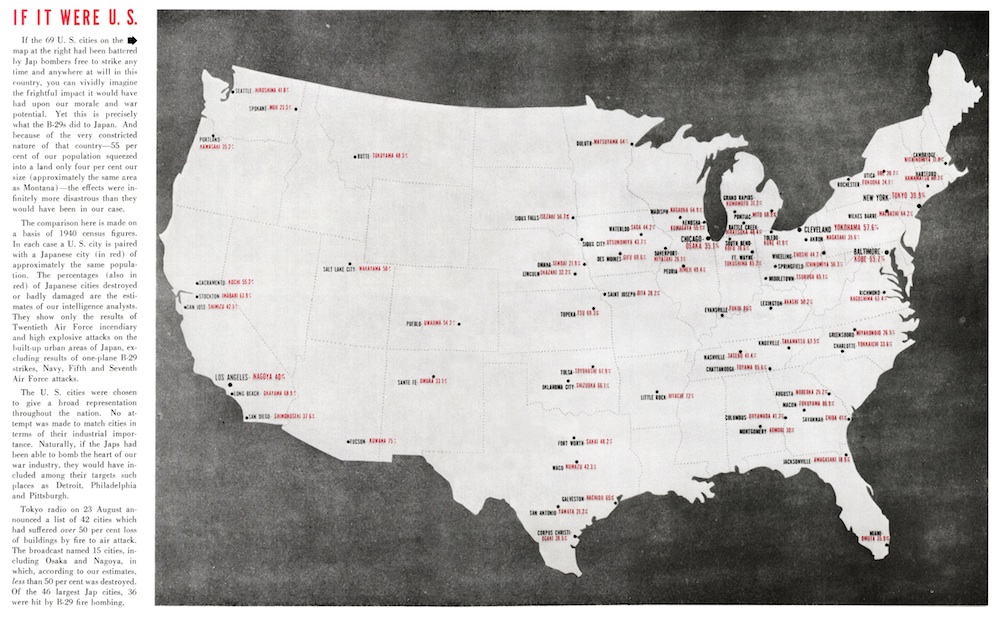
In fact in 1945 the United States Air Force produced a map in which the earlier bombing campaign was projected on to a map of the United States:

FirebombsMapFinal-1.jpg.CROP.original-original

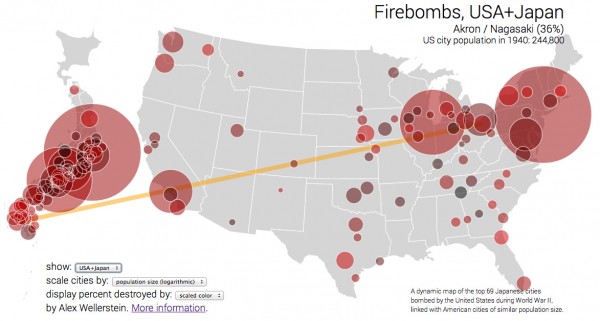
And this was the starting-point for Alex Wellerstein‘s remarkable intervention, whose critical force comes precisely from its juxtaposition (rather than simple superimposition) of the two maps: what happened in Japan is visibly there, magnified rather than marginalized through the map of the continental United States.  In fact, when you click on the interactive a line appears linking an American city to its equivalent target-city in Japan:

Firebombs-USA-interactive-600x321