Tanner respondents

I’m delighted that Grégoire Chamayou and Chris Woods have both accepted invitations to act as discussants and interlocutors for my Tanner Lectures, “Reach from the Sky: aerial violence and the everywhere war“, in Cambridge in January.

The format for the Lectures is for me to give two presentations on the first day; the next day a panel of four respondents offers reactions and comments, and then we open up into general debate and discussion.

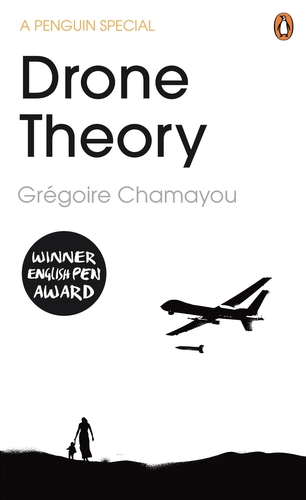
9780241970355I provided a series of detailed commentaries on Grégoire’s variously titled Drone Theory/A Theory of the Drone when it was originally published in French (see here for a full listing: scroll down), and we met last year at a wonderful workshop on Secrecy and Transparency at the Humanities Research Institute at Irvine, so I’m thrilled that the tables will be reversed.  Grégoire’s creative imagination seems to know no bounds – see, for example, here and here – and we keep in close touch so I know this will be a rewarding conversation.

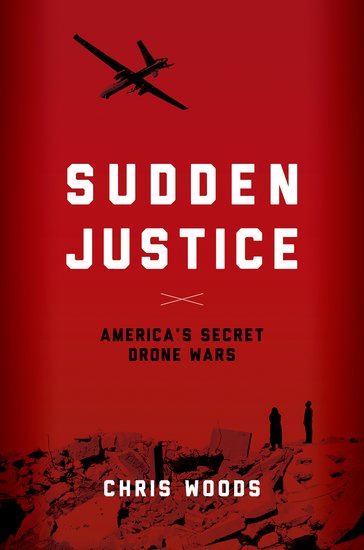
9780190202590I’ve never met Chris, but I’m really looking forward to doing so: he has worked with the Bureau of Investigative Journalism; his Sudden Justice: America’s secret drone wars is the gold standard for books about the conduct of US remote operations; and he is now busy at Airwars monitoring coalition air strikes over Iraq and Syria.  I greatly admire Chris’s combination of probing analysis and lucid prose, and his determination to bring the results to the widest possible public audience is an inspiration.

More on other respondents later.

Archives of the Insensible

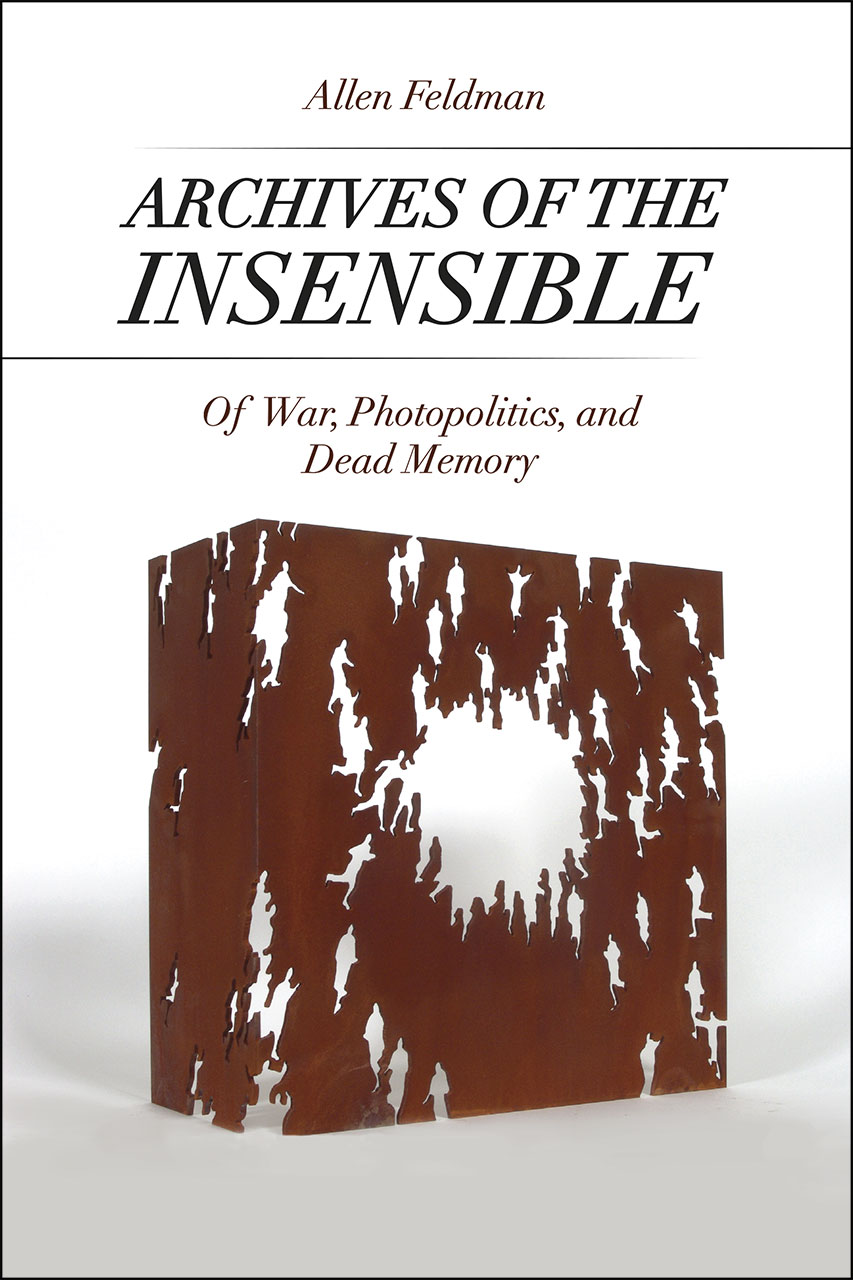
9780226277332News from the ever interesting Allen Feldman of his new book, Archives of the Insensible: of war, photopolitics and dead memory, coming from Chicago in December:

In this jarring look at contemporary warfare and political visuality, renowned anthropologist of violence Allen Feldman provocatively argues that contemporary sovereign power mobilizes asymmetric, clandestine, and ultimately unending war as a will to truth. Whether responding to the fantasy of weapons of mass destruction or an existential threat to civilization, Western political sovereignty seeks to align justice, humanitarian right, and democracy with technocratic violence and visual dominance. Connecting Guantánamo tribunals to the South African Truth and Reconciliation Commission, American counterfeit killings in Afghanistan to the Baader-Meinhof paintings of Gerhard Richter, and the video erasure of Rodney King to lynching photography and political animality, among other scenes of terror, Feldman contests sovereignty’s claims to transcendental right — whether humanitarian, neoliberal, or democratic—by showing how dogmatic truth is crafted and terror indemnified by the prosecutorial media and materiality of war.

Excavating a scenography of trials —formal or covert, orchestrated or improvised, criminalizing or criminal — Feldman shows how the will to truth disappears into the very violence it interrogates. He maps the sensory inscriptions and erasures of war, highlighting war as a media that severs factuality from actuality to render violence just. He proposes that war promotes an anesthesiology that interdicts the witness of a sensory and affective commons that has the capacity to speak truth to war. Feldman uses layered deconstructive description to decelerate the ballistical tempo of war to salvage the embodied actualities and material histories that war reduces to the ashes of collateral damage, the automatism of drones, and the opacities of black sites. The result is a penetrating work that marries critical visual theory, political philosophy, anthropology, and media archeology into a trenchant dissection of emerging forms of sovereignty and state power that war now makes possible.

Here is the wonderful Talal Asad on the book:

Archives of the Insensible is a remarkable diagnosis of our time, tracing with great subtlety the multiple ways in which violence is transformed into justice and justice gives birth to destruction. This is a startling book written with passion and insight, and a valuable contribution to our understanding of the relationship of violence to international law in the contemporary world.

You can see why I’m so interested…

Bombs and books

Among a million and one other things, I’ve returned to my work on the history of bombing for my Reach from the Sky lectures in January.

Secret History of the Blitz

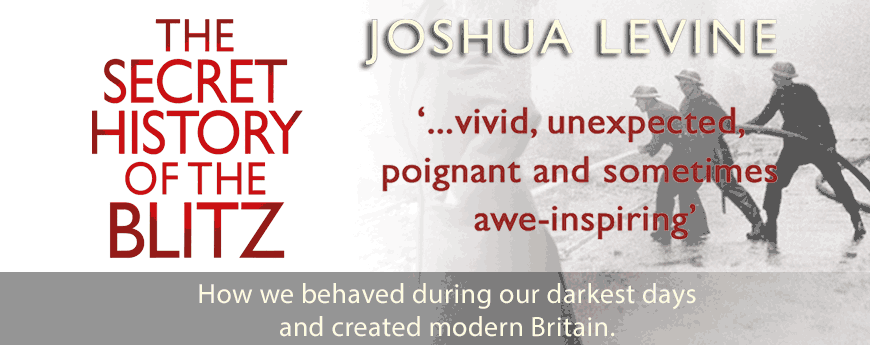
I’ve long admired Joshua Levine‘s work, and his Secret History of the Blitz is thoroughly impressive.  Many others have picked their way across the bomb-sites before, of course, but there are genuinely novel insights to be found amidst the rubble and Levine is an excellent (and wonderfully literate) collector.

2015 is the 75th anniversary of the the Blitz of 1940-41. It is one of the most iconic periods in modern British history – and one of the most misunderstood. The ‘Blitz spirit’ is celebrated by some, whereas others dismiss it as a myth. Joshua Levine’s thrilling biography rejects the tired arguments and reveals the human truth: the Blitz was a time of extremes of experience and behaviour. People were pulling together and helping strangers, but they were also breaking rules and exploiting each other. Life during wartime, the author reveals, was complex and messy and real.

From the first page readers will discover a different story to the one they thought they knew – from the sacrifices made by ordinary people to a sudden surge in the popularity of nightclubs; from secret criminal trials at the Old Bailey to a Columbine-style murder in an Oxford college. There were new working opportunities for women and the appearance of unfamiliar cultures: whilst prayers were offered up in a south London mosque, Jamaican sailors were struggling to cross the country. Unlikely friendships were fostered and surprising sexualities explored – these years saw a boom in prostitution and even the emergence of a popular weekly magazine for fetishists. On the darker side, racketeers and spivs made money out of the chaos, and looters prowled the night to prey on bomb victims.

From the lack of cheese to the decreased suicide rate, this astonishing and entertaining book takes the true pulse of a ‘blitzed nation’. And it shows how social change during this time led to political change – which in turn has built the Britain we know today.

You can find good reviews from the Independent here and from the Telegraph here.

Le gouvernement du ciel

Very different in reach and tone (but also impressively literate), and in many ways much closer to some of the themes I want to address in Cambridge in January,  is Thomas Hippler‘s Le gouvernment du ciel: histoire globale des bombardements aériens.  Readers interested in these things will surely know his remarkable account of Giulio Douhet,  Bombing the People: Giulio Douhet and the Foundations of Air-Power Strategy, 1884–1939; the new book picks up from the last chapter of the previous one in many ways.

Here is the Contents List:

Prologue

The earth, the sea and the sky

Towards perpetual peace

The colonial matrix

Civilisation, cosmopolitanism and democracy

The people and the populace

Philosophy of the bomb

Making and unmaking a people

Under the nuclear shield, ‘revolutionary war’

World governance and perpetual war

As you can perhaps divine from the chapter titles, this is at once an attempt to write a global history of the twentieth century through diagnostic episodes in bombing’s bleak history and a discussion of the political formations that aerial violence both presupposed and installed.

Chamayou:Hippert

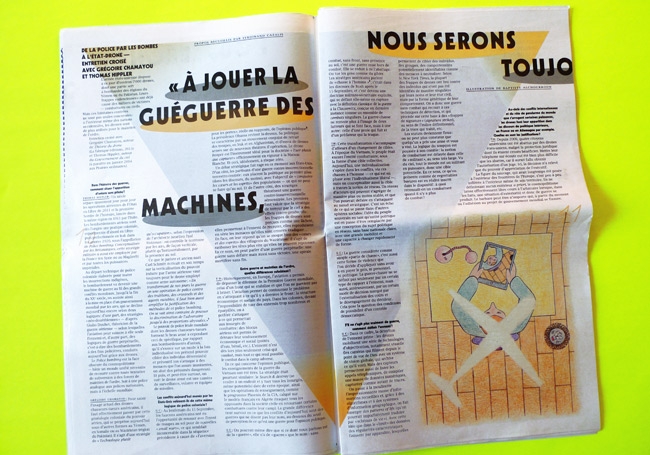
I stumbled upon a fascinating conversation between Thomas and Grégoire Chamayou (above) and since I provided a detailed commentary on Théorie du drone for those who can’t read French (you can access the full set here: scroll down for the links) I’ll try to do the same for Le gouvernment du ciel in the weeks ahead (and I’ll include some snippets from that extended conversation).

I don’t think my commentaries have been superceded by the publication of the translation, Theory of the drone, so I’m hoping the same will be true if there is an English version of Le gouvernment du ciel (though I can’t find any sign of one yet).

Doomsday Books

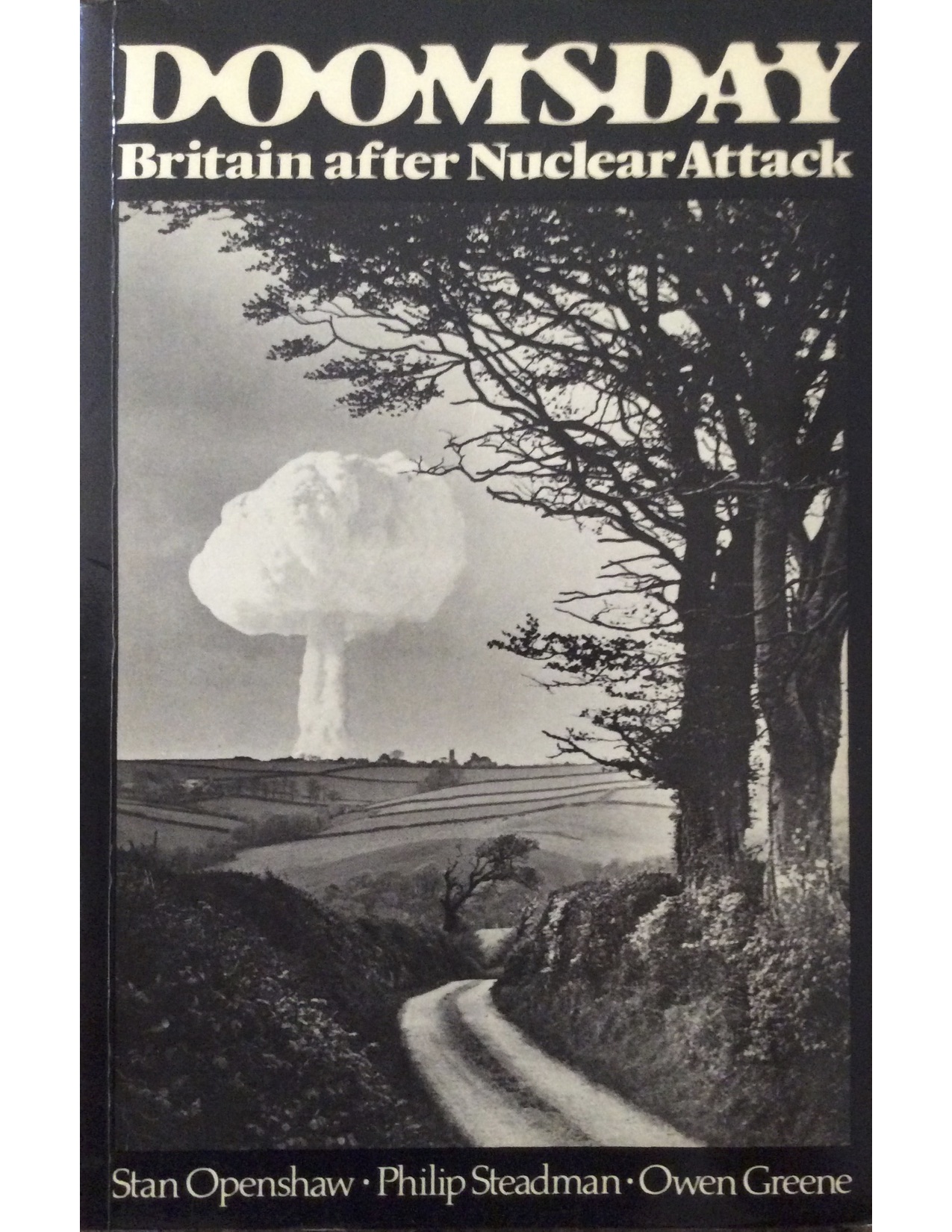
DOOMSDAYStill wandering through the nuclear wastelands… (see also here, here and here).  Not surprisingly, there is a considerable literature on the United States and nuclear war, but much less on the UK.  I still have my tattered copy of Doomsday:  Britain after nuclear attack by Stan Openshaw, Philip Steadman and Owen Greene, published more than thirty years ago.  Those were heady days: the authors were members of Scientists Against Nuclear Arms, and the book was put together soon after the European Nuclear Disarmament Appeal launched by E. P. Thompson (who famously announced he had “left his desk” to further the campaign), Mary Kaldor, Dan Smith and Ken Coates.

Next to Doomsday is my equally battered and well-thumbed copy of a book of essays edited by two other British geographers, David Pepper and Alan Jenkins, The geography of peace and war, which appeared in 1985.  It was in three Parts, ‘The geography of the Cold War and the arms race’, ‘The geography of nuclear war’ (which included an update from Stan and Philip) and ‘The geography of peace’ (with an essay on nuclear weapon free zones).

Fast forward twenty years, and these emphases are in stark contrast to Colin Flint‘s edited collection, Geography of war and peace, in which nuclear war receives just passing mention(s).  The same is true of Audrey Kobayashi‘s still more recent Geography of peace and armed conflict – apart from one brief chapter concerned with Iran.

HOGG British Nuclear CultureAll of this will explain why I am looking forward to the publication of Jonathan Hogg‘s British Nuclear Culture: official and unofficial narratives in the long 20th century, coming from Bloomsbury in January:

The advent of the atomic bomb, the social and cultural impact of nuclear science, and the history of the British nuclear state after 1945 is a complex and contested story. British Nuclear Culture is an important survey that offers a new interpretation of the nuclear century by tracing the tensions between ‘official’ and ‘unofficial’ nuclear narratives in British culture.

In this book, Jonathan Hogg argues that nuclear culture was a pervasive and persistent aspect of British life, particularly in the years following 1945. This idea is illustrated through detailed analysis of various primary source materials, such as newspaper articles, government files, fictional texts, film, music and oral testimonies. The book introduces unfamiliar sources to students of nuclear and cold war history, and offers in-depth and critical reflections on the expanding historiography in this area of research.

Chronologically arranged, British Nuclear Culture reflects upon, and returns to, a number of key themes throughout, including nuclear anxiety, government policy, civil defence, ‘nukespeak’ and nuclear subjectivity, individual experience, protest and resistance, and the influence of the British nuclear state on everyday life. The book contains illustrations, individual case studies, a select bibliography, a timeline, and a list of helpful online resources for students of nuclear history.

Joseph Masco – author of The nuclear borderlands: The Manhattan Project in post-Cold War New Mexico and The theater of operations: National security affect from the Cold War to the War on Terror  – likes it, which is more than enough for me:

We know the atomic bomb fundamentally transformed modern life, but Jonathan Hogg shows us that it did not do so in the same way everywhere. This is a important contribution to nuclear studies as it takes both nation and region seriously in the production of a nuclear culture. Hogg does not just follow expert concerns or defense policy debates, he also attends to the vernacular forms of local activisms across British cities and generations. British Nuclear Culture leads the way to a new comparative nuclear studies, and with it, a deeper understanding of the nuclear revolution.

Here is the Contents List:

Introduction
1. Early Nuclear Culture
2. The Manhattan Project
3. 1945 – 1950: Early Responses to the Bomb
4. 1950 – 1958: Maturing Responses
5. 1958 – 1979: Radicalised and Realist Responses
6. 1979 – 1989: Extreme Realism
7. 1989 – 2011: The Persistence of Nuclear Culture
8. Conclusion

For those who don’t think it surprising that – apart from people like Michael Curry, Matt FarishScott Kirsch and Fraser MacDonald– human geographers should have turned away from a critical scrutiny of atomic geographies so speedily with the presumptive waning of the Cold War, notice the title of Chapter 7…

War Material

SARGENT Two soldiers at Arras

I’m thrilled to say that the (very!) long-form version of The Natures of War, the 1st Neil Smith Lecture which I gave at the University of St Andrews in November 2013, is now online (‘Early View’) at Antipode, all 54 pages of it.

Here is the abstract:

“Nature” is more than a resource bank whose riches can trigger armed conflict and finance its depredations; it is also a medium through which military and paramilitary violence is conducted. The militarisation of nature is part of a dialectic in which earthy, vibrant matter shapes the contours of conflict and leaves its marks on the bodies of soldiers who are both vectors and victims of military violence. Three case studies identify some of the central bio-physical formations that became entangled with armed conflict in the twentieth century: the mud of the Western Front in the First World War, the deserts of North Africa in the Second World War, and the rainforests of Vietnam. Taken together, these reveal vital connections between the materiality and corporeality of modern war and their continued relevance to its contemporary transformations.

You can still find the original, non-Harvard style version under the DOWNLOADS tab – and I’m truly grateful to Andy Kent for relieving me of the task of converting my original MS into the Harvard system.

The image above, incidentally, is John Singer Sargent‘s Two soldiers at Arras (1917), and is a perfect illustration of this passsage from the essay:

In the face of these horrors, some soldiers came to regard themselves as having become as “un-natural” as the militarised, industrialised natures in which they were embedded. The Tommy “will soon be like nothing on earth”, wrote one officer on the Somme in January 1916. “If only we could be clothed in rubber all over and fed through a tube I think some real progress in our equipment might have been made”. He was only half-joking. The next phase in the emergence of this cyborg warrior can be seen in the tank battles that raged across the deserts of North Africa during the Second World War. But, as I must now show, even in the midst of this more fully mechanised warfare, bio-physical entanglements remained immensely powerful—and the human body intensely vulnerable.

I then do the same for Vietnam.

My plan is to rework this version: to incorporate as many of the images I used in the Vietnam extracts I posted online here and here (together with others from the Western Front and the Western Desert), to add a fourth case study of Afghanistan, and to include the revised version in a new book of essays that I’m calling War material.

The plan looks like this (in each case the original essays, apart from the intro, are available under the DOWNLOADS tab too; I’m re-working those versions, planing away any overlaps, and adding more images):

Chapter 1: War material

Chapter 2: Gabriel’s map

Chapter 3: The Natures of War

Chapter 4: Doors into Nowhere

Chapter 5: Lines of Descent

These are all more or less ready to go, apart from the introduction, but I’m debating whether to add a sixth chapter, called ‘Wounds of war’, which would parallel ‘The Natures of War’ in many ways and chart the changing geographies of casualty evacuation from war zones, 1914-2014.

Each of the essays in the book, even in their present form, has something to say about the way in which the conduct of modern war has – and has not – changed over the last hundred years, but the title also tilts at those who seem to think that everything we need to know about modern military violence was uncannily anticipated by Michel Foucault in his (I too think brilliant) Paris lectures in the 1970s so that this absolves them of the need for any research or even reading into the materialities of war (a strangely non-Foucauldian assumption, given his own frequent immersion in the archive and his densely empirical way of working).

I’d be grateful for any comments or suggestions.

“This ain’t Jamaica”

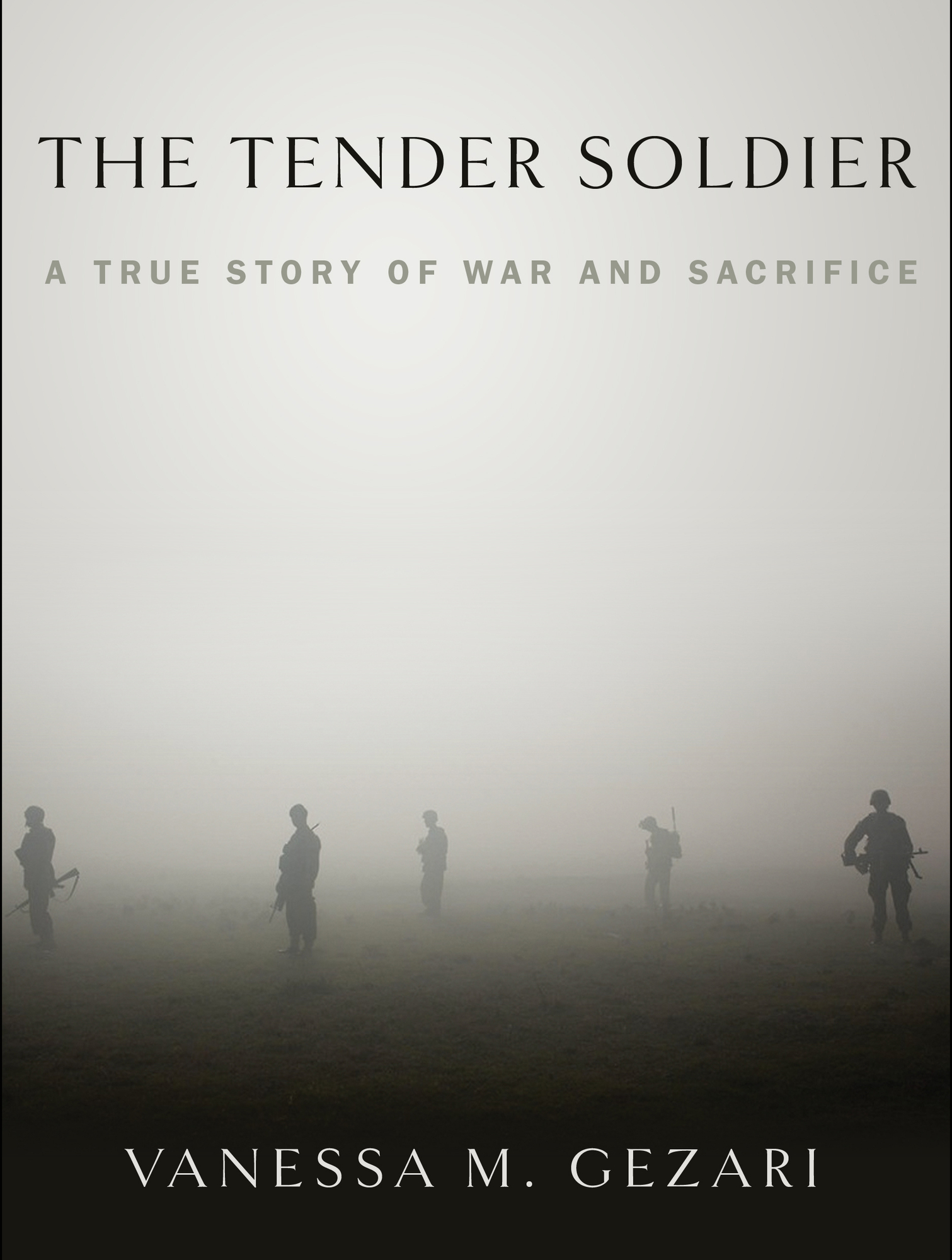
The Tender SoldierA follow-up to my post on the demise of the US military’s Human Terrain System: an interesting report from Vanessa Gezari in the New York Times.  She’s the author of The Tender Soldier, a first-hand account of the Human Terrain System, and she starts her Times essay by recalling her own experience accompanying a US patrol in Afghanistan in 2010:

Cultural training and deep, nuanced understanding of Afghan politics and history were in short supply in the Army; without them, good intelligence was hard to come by, and effective policy making was nearly impossible. Human Terrain Teams, as Human Terrain System units were known, were supposed to include people with social-science backgrounds, language skills and an understanding of Afghan or Iraqi culture, as well as veterans and reservists who would help bind the civilians to their assigned military units.

On that winter day in Zormat, however, just how far the Human Terrain System had fallen short of expectations was clear. Neither of the social scientists on the patrol that morning had spent time in Afghanistan before being deployed there. While one was reasonably qualified, the other was a pleasant 43-year-old woman who grew up in Indiana and Tennessee, and whose highest academic credential was an advanced degree in organizational management she received online. She had confided to me that she didn’t feel comfortable carrying a gun she was still learning how to use. Before arriving in Afghanistan, she had traveled outside the United States only once, to Jamaica — “and this ain’t Jamaica,” she told me…

The shortcomings I saw in Zormat were hardly the extent of the Human Terrain System’s problems. The project suffered from an array of staffing and management issues, coupled with internal disagreements over whether it was meant to gather intelligence, hand out protein bars and peppermints, advise commanders on tribal conflicts or all three — a lack of clear purpose that eventually proved crippling. It outraged anthropologists, who argued that gathering information about indigenous people while embedded in a military unit in active combat posed an intractable ethical conflict. Once the subject of dozens of glowing news stories, the program had fallen so far off reporters’ radar by last fall that the Army was able to quietly pull the plug without a whisper in the mainstream media.

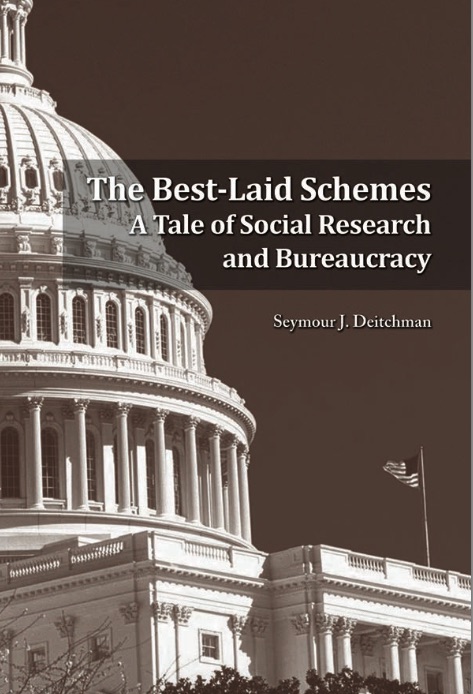
DEITCHMAN jpegShe suggests that the military could – and should – have learned from its previous attempts to enlist social scientists in Vietnam, Central America and elsewhere, and points to Seymour Deitchman‘s  The Best-Laid Schemes: A tale of social science research and bureaucracy (1976), which is available as an open access download from the US Marine Corps University Press here.

Deitchman worked for the Pentagon as a counterinsurgency advisor (among many other roles), and his account was a highly personal, take-no-prisoners affair.

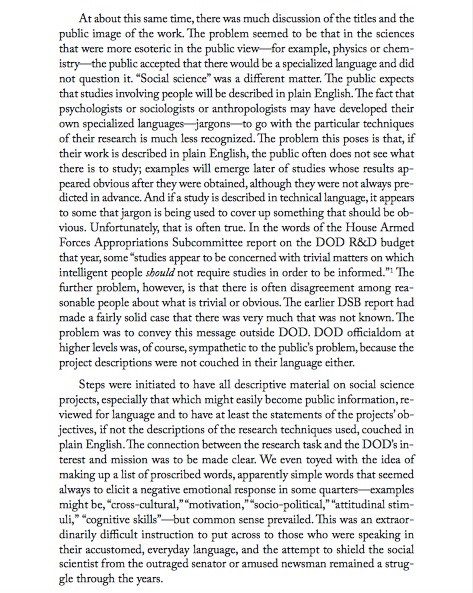
Part of the problem, he insisted, was the language of the social sciences:

DEITCHMAN p. 138 jpeg

There’s much more in a similar vein, and not surprisingly, Deitchman’s conclusion about the military effectiveness of social science was a jaundiced one.

The community of social science is likely to urge and has urged that increased government support of research on the great social problems of the day. With due recognition for the government’s need to collect data to help it plan and evaluate the social programs it is expected to undertake, I have reached the conclusion, nevertheless, that the opposite of the social scientists’ recommendation is in order. The research is needed, without question. Some of it, especially in the evaluation area, is necessary and feasible for government to sponsor. Beyond this, its support should be subject to the economic and political laws of the intellectual marketplace. And the government should do less, not more, to influence the workings of that marketplace. It should support less, not more, research into the workings of society.

You couldn’t make it up (or perhaps they did).   But this isn’t Vanessa’s view.  ‘The need for cultural understanding isn’t going away,’ she insists:

The rise of drones and sociocultural modeling, which uses data to simulate and sometimes predict human responses to conflict and crisis, have given some in the defense establishment the idea that we can do all our fighting safely, from a distance. But we’ve had this idea before, in the decades following Vietnam, and the wars in Iraq and Afghanistan should have reminded us of its falsity.

Oikological warfare

OWENS Counterinsurgency

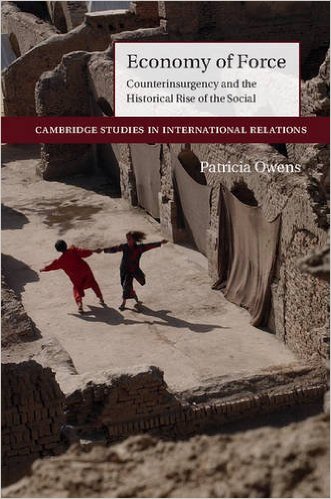
A new book from the ever-innnovative Patricia Owens, Economy of Force: counterinsurgency and the historical rise of the Social (Cambridge University Press, 2015).

There’s an excellent interview with Patricia at e-IR here, which includes her own summary of the book:

The book retrieves the older, but surprisingly neglected, language of household governance, oikonomia, to show how the techniques and domestic ideologies of household administration are highly portable and play a remarkably central role in international and imperial relations. In contrast to the ahistorical and anachronistic adoption of social language across IR, I think there is an important story to be told of when, where, and why the social realm first emerged as the domain through which human life could be intervened in and transformed. Economy of Force tells this story in terms of modern transformations in and violent crises of household forms of rule. In two late-colonial British emergencies in Malaya (1948-1960) and Kenya (1952-1960), US counterinsurgency in Vietnam (1954-1975), and US-led campaigns in Afghanistan (2001-2014) and Iraq (2003-2011), so-called ‘armed social work’ policies were the continuation of oikonomia – not politics – by other means. Though never wholly succeeding, counterinsurgents drew on and innovated different forms of household governance to create units of rule in which local populations were domesticated. Military strategists conceived population control as sociological warfare because the social realm itself and distinctly social forms of thought are modern forms of oikonomikos, the art and science of household rule.

The argument has big implications for international theory, as well as the history and theory of counterinsurgency. Rather than objective theories of modern society and their interrelations, various forms of liberalism, political realism, social constructivism, and Marxism need to be situated within the history of the rise and violent transformation of the social realm. They are fragments of competing paradigms of social regulation. Ironically, the dominance of distinctly social forms of thought has obscured the household ontology of the modern social realm. Each of the major traditions is explicitly based on, or implicitly accepts, the erroneous notion that modern capitalism destroyed large-scale forms of household rule. So the book not only offers a new history and theory of counterinsurgency. It offers a new history of the rise of the social realm and political history and theory of household governance.

Research for the book was supported by a yearlong fellowship at the Radcliffe Institute for Advanced Study at Harvard University. There’ll be a symposium on Economy of Force at Disorder of Things later in 2015.

Here’s the Contents list:

1. Introduction: oikonomia in the use of force
2. The really real? A history of ‘social’ and ‘society’
3. Out of the confines of the household?
4. The colonial limits of society
5. ‘More than concentration camps’: the battle for hearths in two late-colonial emergencies
6. Society itself is at war: new model pacification in Vietnam
7. Oikonomia by other means: counterinsurgency in Afghanistan and Iraq
8. Conclusion: ‘it’s the oikos, stupid’.

Among the many pre-publication plaudits, here’s Didier Fassin‘s:

“Through a combination of historical perspective on the colonial world and contemporary inquiry into the imperial enterprise, Economy of Force invites us to rethink the laws of warfare and politics of counterinsurgency by paying attention to the pacification of local populations understood as a form of domestication. It thus unveils the genealogy of the blurred line between military and humanitarian interventions.”

You can get a taste of Patricia’s argument (particularly if you shrink from CUP’s extortionate pricing, even for the e-edition) in her ‘Human security and the rise of the social’, Review of International Studies 38 (2012) 547-567 and ‘From Bismarck to Petraeus:the question of the social and the social question in counterinsurgency’, European journal of international relations 19 (1) (2013) 139-161.

I’ve just heard from Patricia, who tells me that CUP will publish Economy of Force next year in paperback (which ought to make it much more accessible); she’s also made available the proofs of the Introduction on her academia.edu page here.

Travelling through words

How-We-Write-cover-EAt Stuart Elden‘s suggestion, I’ve been invited to join a collaborative project initiated and edited by Suzanne Akbari called ‘How we write‘: it’s an interdisciplinary collection of short essays each of which describes how we write (and emphatically not how you ought to write…).

It will be published in remarkably short order by Punctum Books as a free downloadable volume; the contributors are Suzanne Conklin Akbari, Michael Collins, Alexandra Gillespie, Alice Hutton Sharp, Asa Simon Mittman, Jeffrey Jerome Cohen, Maura Nolan, Rick Godden, Bruce Holsinger, Stuart Elden and Steve Mentz.

There’s certainly not one way of writing, and as I roughed out my contribution I realised through talking with friends that even in my own field(s) the variety of writing practices is enormous and seemingly endless.  Trevor Barnes told me over lunch yesterday that he had once thought everyone wrote like him.  It turns out that we have much in common – we both find writing difficult, and neither of us writes every day – and we are worlds away from a close colleague who writes in bed from 6 to 10 a.m., longhand on a yellow legal pad, everything tumbling out perfectly formed…

So here is what I came up with (with some links added):

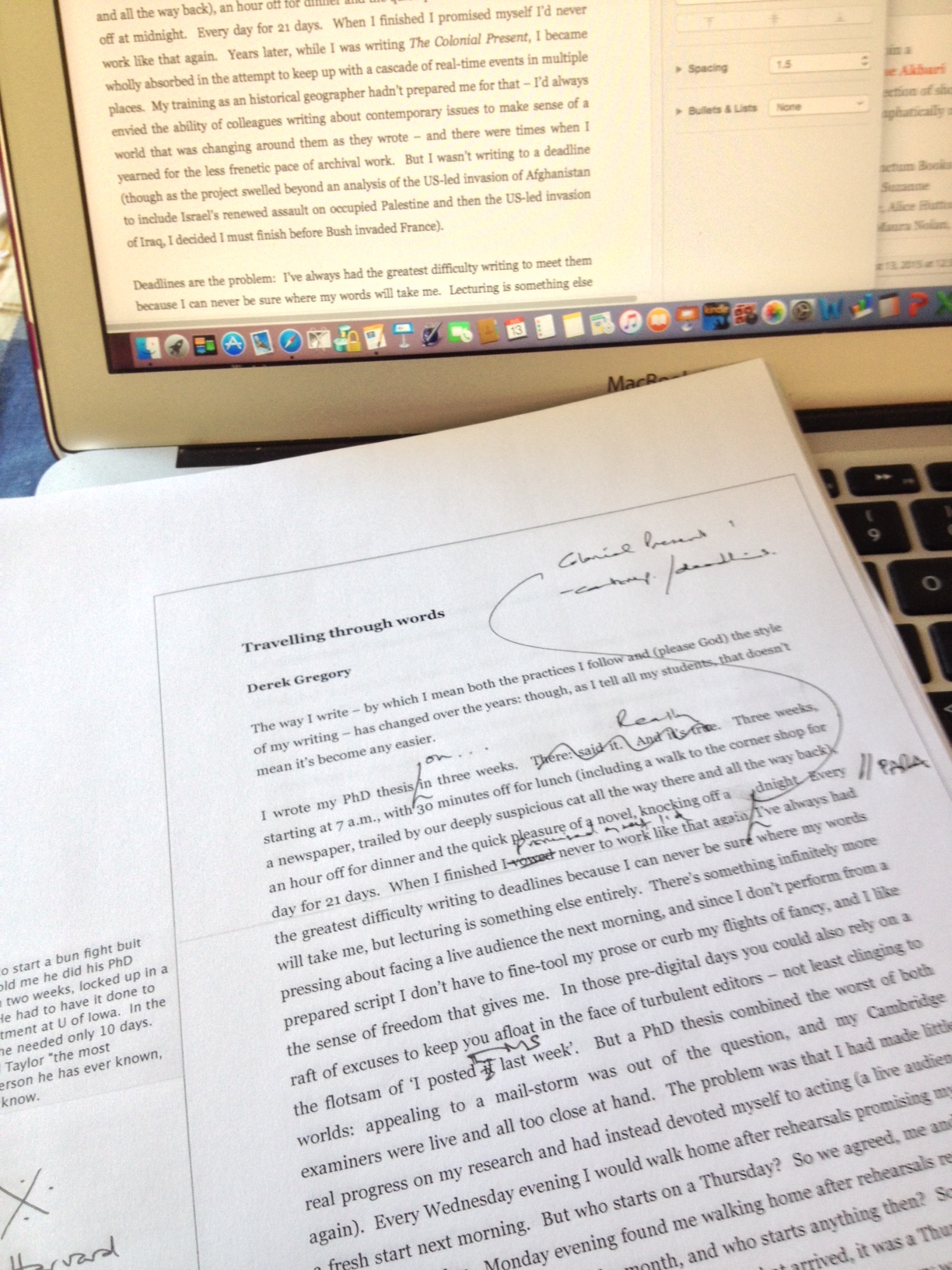
Travelling through words

 The way I write – by which I mean both the practices I follow and (please God) the style of my writing – has changed over the years: though, as I tell all my students, that doesn’t mean it’s become any easier.

I wrote my PhD thesis (on the woollen industry in Yorkshire between 1780 and 1840) in three weeks. Really. Starting at 7 a.m., with thirty minutes off for lunch (including a walk to the corner shop for a newspaper, trailed by our deeply suspicious cat all the way there and all the way back), an hour off for dinner and the quick pleasure of a novel, knocking off at midnight. Every day for twenty-one days. When I finished I promised myself I’d never work like that again. Years later, while I was writing The Colonial Present, I became wholly absorbed in the attempt to keep up with a cascade of real-time events in multiple places. My training as an historical geographer hadn’t prepared me for that – I’d always envied the ability of colleagues writing about contemporary issues to make sense of a world that was changing around them as they wrote – and there were times when I yearned for the less frenetic pace of archival work. But I wasn’t writing to a deadline – though as the project swelled beyond an analysis of the US-led invasion of Afghanistan to include Israel’s renewed assault on occupied Palestine and then the US-led invasion of Iraq, I decided I must finish before Bush invaded France.

Deadlines are the problem: I’ve always had the greatest difficulty writing to meet them because I can never be sure where my words will take me. Lecturing is something else entirely. There’s something infinitely more pressing about facing a live audience the next morning, and since I don’t perform from a prepared script I don’t have to fine-tool my prose or curb my flights of fancy, and I like the sense of freedom that gives me. Anyone writing in those pre-digital days could also rely on a raft of excuses to stay afloat in the face of turbulent editors – not least clinging to the flotsam of “I posted the manuscript last week.” But a PhD thesis combined the worst of both worlds: appealing to a mail-storm was out of the question, and my Cambridge examiners were live and all too close at hand. The problem was that I had made little real progress and instead had devoted myself to acting (a live audience again). Every Wednesday evening I would walk home after rehearsals promising myself a fresh start the following morning. But who starts on a Thursday? So we agreed, me and I, to wait until Monday. Monday evening found me walking home after rehearsals renewing my vows. But it was the 29th of the month, and who starts anything then? So we both agreed to wait until the 1st of the month. And when that arrived, it was a Thursday. You could keep this up forever, or at least I could. In this case, the back story was that I had been married for just three months when my mother-in-law asked my wife to accompany her on an extended visit to her family in Colombia, and I realized that this was an opportunity for uninterrupted, distraction-free writing.

Those two adjectives tell the real story: how I welcomed those interruptions and distractions! There always seemed to be good reasons to defer putting pen to paper (or, more accurately in those days, fingers to the keys of my electric typewriter). As you will have gathered I was, and remain, a past master at procrastination. I know that many writers have an iron will and obediently follow a strict self-discipline. Perhaps the most extreme, though probably apocryphal, example is Victor Hugo, who supposedly instructed his manservant to confiscate all his clothes so that he couldn’t leave the house while he was working on a novel. But that’s not me (I don’t have a manservant).

Or at any rate, it’s not me until I immerse myself in the writing. And that’s always been my first problem: starting. Over the years I’ve learned to know and trust myself. So I know I can write in the morning, sometimes in the evening but never in the afternoon – so I’ve stopped trying. And if the words aren’t there on Monday morning, there is no point in spending the day staring at the screen and hesitantly pecking at the keys, because I know very well that the next morning I will come in, read the print-out and tear the whole thing up. Better to find other things to do – especially if I can convince myself that they are getting me into the right space to start the next day. The converse is also true. If the words are leaking out of my fingertips dismally early on a Sunday morning, then out they must come (and, in case you are wondering, I’m still married to my wife – who learned all this long before I did). The irony is that once the text is moving, I’ve always wondered why it took me so long to get started.

I invariably wonder about that because I actually enjoy the process once it’s under way, though each time I also wonder whether I’ll be able to pull it off again. Whenever I sit at my desk, or increasingly these days my laptop, there’s almost always a flicker of doubt: will the words come this time? I imagine (another conceit, I know) that it’s something like the moment just before the diver launches himself into space. I pause, waiting to break the still surface of the screen.

I have my own swimming-pool library, of course. I’ll have read and read and then read some more, and I’ll have organized my notes, quotations, comments, thoughts and ideas into a long working – I was going to say draft, but it’s more of a storyboard. In the past, the storyboard would have been the product of reading and thinking, by which I mean it was a verbal-textual product-in-formation. Reading is a creative process, to be sure, though it’s usually an internal one as you work with the text to understand what the author is arguing (and why they could possibly be arguing that) while at the same time making it your own: not just putting it into your own words but working out what you make of it, where it’s taking you (and whether you want to go there), and installing it into your own library (where it may well magically move from one shelf to another). So I’ve got endless notes – Kindle Highlights now saves me hours of transcription, and I work through them, highlighting key passages in bold, adding comments and organizing them into digital files – and I’ll have extracted what I need, and cut-and-pasted everything into a rough map that still doesn’t commit me to any single route.

I know that it’s also a long way from the text I’m going to write; I open that up as a separate document, control my fear at its blankness by formatting the page, giving the document a title (I actually can’t write without a title), saving it, and then – well, wait or write.

I don’t read (or write) with a single purpose; on the way all sorts of other ideas flicker into being, rarely fully formed, that might end up in the essay I’m working on at the moment but might just as well end up as the spur for something else altogether. My sources are all over the place, and ideas are as likely to emerge from fiction as they are from anywhere else. Years ago I read William Boyd’s An Ice-Cream War, and one passage – “Gabriel thought maps should be banned. They gave the world an order and reasonableness it didn’t possess” – stayed with me, like a burr clinging to my jeans. I used it as an epigraph in one of the chapters in Geographical Imaginations, but years later I surprised myself by returning not only to that passage but also to the incident it described, and unfolding it into a completely new essay on cartographic vision and what I called “corpography” in the First World War (in which another novel, Tom McCarthy’s C, also occupies a central place: I can’t think of a more beautiful combination of skilled research and superb writing). I called the essay “Gabriel’s Map” [DOWNLOADS tab] – of course – but, more figuratively for my present purposes, working on it confirmed that there’s something deeply deceptive about mapping, a false sense of security that has to be supplemented by lively interruptions activated through the body.

So I also like to be free of the text – springing away from the board, if you like (and I do like) – so that for me there’s always been another moment in creative work that is an intensely physical, even corporeal process, thinking that is best conducted on the move, sometimes in front of a class but often out walking, alive to the world around me until it disappears (or I do) into my own fabricated world. I’ve always had the sensation of feeling myself think: of ideas moving around, words forming in my mouth, whole phrases springing to my lips (the real trick is to remember them!). I often talk to myself, even say passages out loud, because the rhythm and cadence of the prose matters to me, and I know it does to some readers too. I remember Roger Lee, when he was editor of the Transactions of the Institute of British Geographers, writing to tell me that he had just spent a summer’s afternoon wandering around his garden reading aloud parts of my manuscript on the Egyptian journeys of Florence Nightingale and Gustave Flaubert. It was a characteristically thoughtful and wonderfully appreciative remark, and I’ve never forgotten it. In some measure, I think, I always have Roger and his garden in my mind’s eye as I try to coax more words into the world.

Even writing is a corporeal process. I can’t think with my laptop on my lap – it has to be on a table or a desk – and I need a chair that I can push back or pull up; I need space to get up, scoot to a book-case, stand and gaze out of the window; and I write best in bare feet (seriously: perhaps that’s where the diving metaphor comes from). I usually write three or four pages without much editing. This is never the whole argument or story, just the first three or four pages, and – like those crime novelists whose work I most admire – I’m never sure where I’m going next. (How I despair of those who tell me they have finished their research so that all – all! – they have to do is “write it up,” as though writing is not part of the creative research process: if what you’ve written is merely a record of what you’ve done or thought, then perhaps you should work in a laboratory). Three or four hot pages uncurl from the printer, and then I take myself off – sometimes to my office at the university, sometimes to a coffee shop – where I go over what I’ve written. It’s much better editing hard copy than trying to do so on the screen, and for some reason I have to use a black roller-ball; pencil doesn’t work, and blue ink is a disaster. By the time I’ve re-written the draft, expanded sentences that I now see are shorthand for something that needs much more explication, and added notes to myself about work that needs to be done to fill out gaps, I’ve also got a sense of where the writing is taking me next.
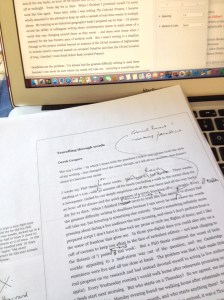
photo-3So it’s back to the keyboard – and back to the beginning of the manuscript. I rework my original pages, and by the time I’ve finished (scribbling on my original storyboard and annotating the map while I’m writing the essay, adding footnotes which will sometimes make it into the finished version but are just as likely to be notes to myself, and pushing further out into the unknown) those three or four pages will have grown to six or seven. I use footnotes constantly, sometimes as commentary, often as placeholders for paragraphs to be drafted in the next round of revisions, and always as a holding pen for references. I never use the Harvard reference system while I’m composing – to me, the arch-enemy of good writing [see Gregory D (1990)] – and the final labour of transforming (deforming) my prose into the obstacle course of brackets, names and dates required by most journals is the most depressing part of the whole business. Once my six or seven pages are on the screen the cycle starts again: back to the beginning, editing, annotating, moving some of those footnotes into the text (which is often the best place for them) and composing another three or four pages, slowly pushing on.

It’s a discontinuous process, but I’m always writing from the beginning towards the end, although I never know in advance where that will be. It isn’t seamless, and sometimes everything comes to a juddering halt. These days I use my blog as (among other things) a sort of five-finger exercise, practicing ideas for long-form essays and getting the words to flow across the screen, but some days that’s not enough. In fact, I can look back at virtually all of my published work and remember how the gaping white space between this paragraph and that marks a week, sometimes (far) longer, when nothing was working. That’s almost always been because I didn’t know enough or because I’d tried to dodge a difficulty. So I eventually admit to myself that I need to read and think some more, to go back and undo the preceding paragraphs, even – the horror of it! – to delete whole passages (that’s easily the hardest part, but I’ve learned to save those deletions in case they can be given a new lease of life somewhere else), and often to re-order or even re-think the narrative. This also usually involves going off to find new source materials, reading more essays and more books, so that the whole journey opens up again.
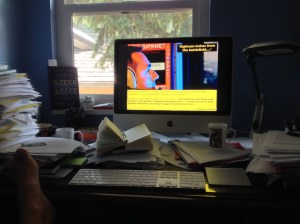
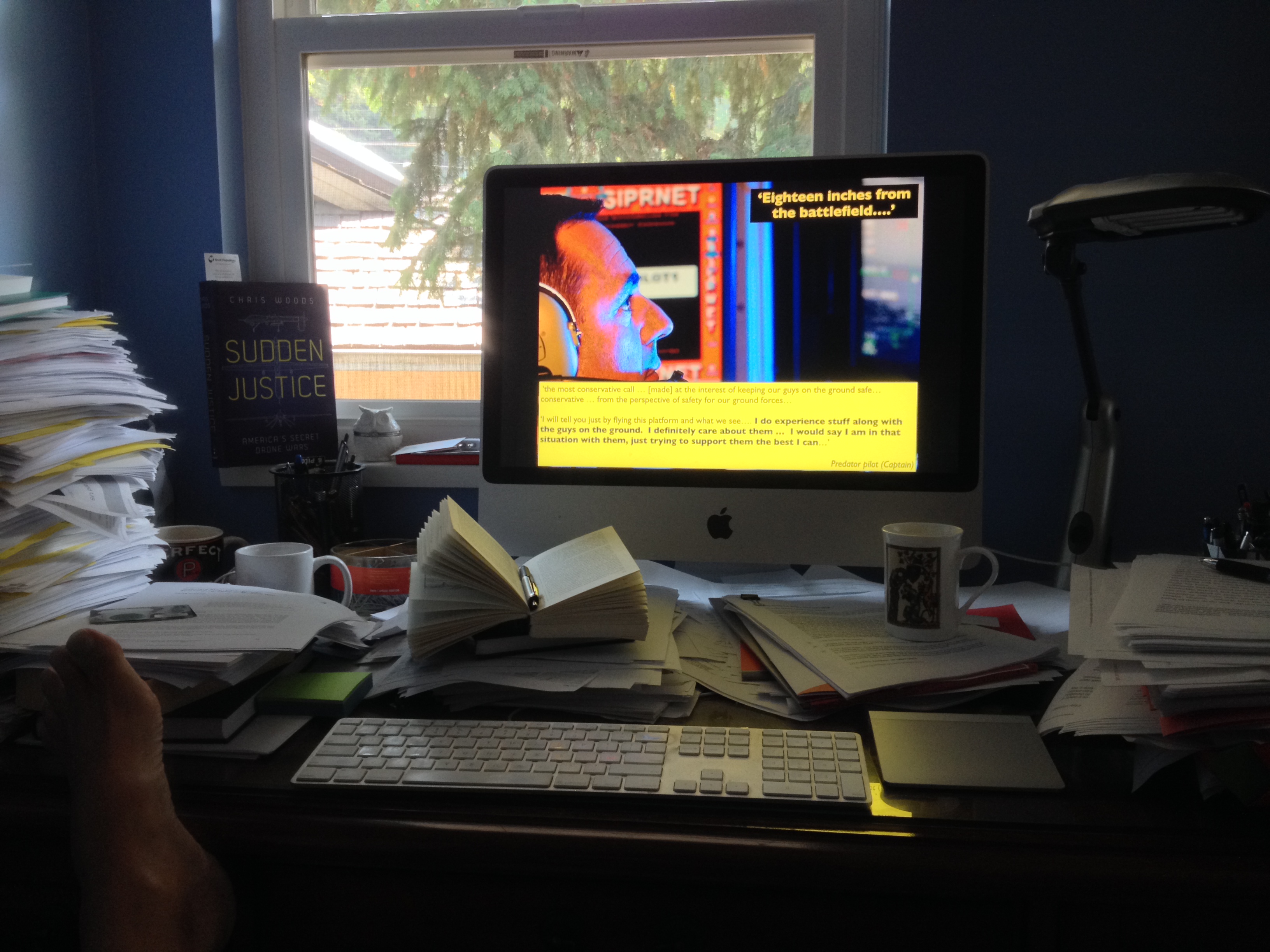
photo-6En route, my desk becomes steadily more cluttered with piles of books, previous print-outs, pages from articles and far too many black roller-ball pens. There’s no trail of breadcrumbs to take me back to the beginning, but there are several coffee mugs in different stages of decomposition which mark the stages of my increasing immersion in the text. Friends and family know when I’m not working on something: my desk is tidy. But once I’m in that space (the zone?) I never, ever stop the research and switch to writing.

I’ve described all this as working with a storyboard, largely because I think of what I do now as telling stories. This means two things. First, I think it’s a mistake to front-load theory into any essay; unless what you are about is textual exegesis – I did a lot of that in the past, but if I do it now it’s en passant – that act will needlessly limit the story you tell. You may think that’s a good thing – after all, you can’t say everything and you need to keep what you write within bounds – but I’ve come to think of writing as a journey that takes me (and, crucially, my readers) to unexpected places. Front-loading theory is the intellectual equivalent of a conjurer coming on stage and showing the audience how a trick is done before they do it. There’s a reason they don’t do that. I realize that this is a device which helps a lot of writers magic words onto the page, but it gives the impression that theory is something to be ‘applied,’ that it provides a template, whereas I try to treat it as a medium in which I work – and one that will be changed by the substantive materials I use. (In much the same way, my ‘map’ is constantly changed as I travel with it: it’s not the map but the mapping that matters). I also think that the best sort of theory is carried in solution: if you know your Michel Foucault or Judith Butler, say, you will recognize their hand in what I write, but if you don’t you are not disqualified from grasping what I’m saying. It follows, too, that theory in my writing is always impure and hybrid; I borrow from multiple sources, since I still haven’t found anyone who asks all the interesting questions or provides all the satisfying answers, and I’m usually aware of the tensions and contradictions between them. But ultimately the story is the thing.

Second, writing is no longer a purely verbal-textual process for me because I now work from a visual storyboard. Everything I’ve written for the past five or six years (apart from this essay, ironically) has emerged out of presentations that I’ve tried to design to make as visually arresting as possible. I’ve found a real pleasure in image research – which often takes me to sources I would never have found any other way, and opens up avenues of inquiry I’d never have glimpsed otherwise – but it’s also a way of ‘slow thinking’: of trying to work out how best to show what I mean, and even of figuring out what I mean. One of Allan Pred’s favourite Benjamin quotations was “I have nothing to say, only to show,” and at long last I’m discovering the power of that resonant phrase. So as I search for images, and juggle text boxes and fonts, I’m thinking about how this will look and in consequence what it will say…instead of lines of text marching across the screen, words appearing from I never know quite where, everything slows down and, again, I feel myself think. I’ve found this even more immersive than pure writing, a process of creation that constantly draws me in and draws me back and pushes me on. It’s also interactive: it’s much easier to re-jig a presentation, which I do every time depending on the previous audience’s reaction and the Q&A, than it is to re-work a text (and reading a paper to an audience is in most cases one of the least effective ways of communicating anything of substance to anyone). I should probably add that I prefer Keynote to PowerPoint, I never use pre-set templates and there’s not a bullet-point in sight. Since I don’t have a script to accompany the presentation, the only disadvantage is that once I’ve performed the thing enough times for me to be more or less satisfied with the argument, at least for the moment, I then have to convert a cascade of images and quotations into a text…. Sometimes, to be honest, that means I don’t; I’ve done the fun part, and I shrink from the labor of conversion. Sometimes I do – in which case the whole process starts all over again, using the presentation as the basis for the storyboard and adding more notes, ideas and sources to track down.

There’s also another, more traditional sense of interactivity involved in my work, because there comes a time when writing has to join up with reading: communication is, after all, a collaborative not a competitive process. So I’ve always relied on good friends (colleagues and graduate students alike) who are willing to read my far too long drafts and tell me exactly what they disagree with, what they don’t get, and what is wrong with them; they almost always suggest other things to think about and other sources to track down. Referees are often a different kettle of fish, particularly if you haven’t referred to them (which is what some of them seem to think “refereeing” means). But here too there is an opportunity for dialogue – there’s no point in acceding to every criticism and suggestion if you’re not persuaded by them, and I’ve learned most from those editors who have identified the points which they think are particularly sharp while leaving me to make up my own mind so long as I can justify it.

In this sense, writing – like reading – can be a never-ending process. In much the same way that you can’t read the same book twice, because you are no longer the same person that read it first time round, you read your own work differently when you see it through someone else’s eyes. And that’s one of the best things about the whole process. There are times when writing is a solitary and remarkably lonely affair. There’s a passage at the very end of E.P. Thompson’s Whigs and Hunters – one of my political and intellectual heroes ever since I worked on my PhD – where he describes himself sitting in his study, the clock ticking towards midnight, the desk covered with notes, photocopies and drafts. I identify with that; but there is also that wonderful moment when you are released back into the world that lies outside the text – with your text in your hands and in your reader’s. There’s no greater reward.

UPDATE:  Two things.  My daughter Jaimie reminds me that I missed out a key confession: I type with just two fingers.  I’ve never learned to touch type, but I do type fast — so much so that in the Dark Ages of the typewriter I frequently caused the levers to jam…  And How we write is now available to download for free from Punctum Books, though if you do so PLEASE consider making a donation to the press who have produced a beautiful book in an amazingly short space of time.

Bodies of violence

wilcox-bodies-of-violence

I’m finally working my way through Lauren Wilcox‘s impressive Bodies of Violence (see my earlier notice here), both to develop my ideas about corpography in general (see here, here and here) and to think through her arguments about drones in particular (in the penultimate chapter, ‘Body counts: the politics of embodiment in precision warfare’).

More on both later, but in the meantime there’s an extremely interesting symposium on the book over at The Disorder of Things that went on for most of last month.  I’ll paste some extracts below to give a flavour of the discussion, which is well worth reading in its entirety.

Lauren Wilcox on ‘Bodies of Violence: Theorizing embodied subjects in International Relations’.

[W]hile war is actually inflicted on bodies, or bodies are explicitly protected, there is a lack of attention to the embodied dynamics of war and security…. I focus on Judith Butler’s work, in conversation with other theorists such as Julia Kristeva, Donna Haraway and Katherine Hayles. I argue, as have others, that there is continuity between her works on “Gender” from Gender Trouble and Bodies that Matter and her more explicitly ethical and political works such as Precarious Life and Frames of War. A central feature of Butler’s concept of bodily precarity is that our bodies are formed in and through violence….
My book makes three interrelated arguments:

First, contemporary practices of violence necessitate a different conception of the subject as embodied. Understanding the dynamics of violence means that our conceptual frameworks cannot remain ‘disembodied’. My work builds on feminist and biopolitical perspectives that make the question of embodiment central to interrogating power and violence.

Second, taking the embodied subject seriously entails conceptualizing the subject as ontologically precarious, whose body is not given by nature but formed through politics and who is not naturally bounded or separated from others. Feminist theory in particular offers keen insights for thinking about our bodies as both produced by politics as well as productive of [politics].

Third, theorizing the embodied subject in this way requires violence to be considered not only destructive, but also productive in its ability to re-make subjects and our political worlds.

Antoine Bousquet on ‘Secular bodies of pain and the posthuman martial corps

[I]t increasingly appears that the attribution of rights is made to hinge on the recognition of their putative holder’s ability to feel pain, even where this might breach the species barrier or concern liminal states of human existence. As such, any future proponents of robot rights may well have to demonstrate less the sentient character of such machines than their sensitivity to pain (of course, it may well turn out that one entails the other). In relation to Bodies of Violence, if we are indeed to take the liberal conception of pain as purely negative as limiting (and we should perhaps not be too hastily dismissive of the moral and societal progresses that can be attributed to it), how does the recognition of ‘vulnerable bodies’ advocated by Wilcox depart from such an understanding? Is it simply a call for dismantling the asymmetries that render the pain of certain subjects less acknowledgeable than others or does it propose to actually restore a ‘positivity’ to suffering within a post-Christian worldview?…

[A]s our knowledge of the human as an object of scientific study grows, our conception of the human as a unitary and stable entity becomes increasingly untenable, incrementally dissipating into a much broader continuum of being to be brought under the ambit of control. But where does such an expanded framing of human life leave the ‘normative model of the body’ as ‘an adult, young, healthy, male, cisgendered, and non-racially marked body’ (p.51) from which all minoritarian deviations are to be variously silenced, regulated and policed? Does the technicist efficiency-driven mobilisation of human life not corrode those normative hierarchies that do not contribute to or might even impede such a process? As Wilcox notes, the traditional investment of masculinist values in the military institution is unsettled when ‘the precision bomber or drone operator is seen as a “de-gendered” or “post-gendered” subject, in which it does not matter whether the pilot or operator is a male or female’ (p.135). Indeed, there seems to be no inherent reason why any number of deviations from the normative body would be an obstacle to their integration into the assemblage of military drones, to stay with that example. One can even conceive of cases where they could be beneficial – might not certain ‘disabilities’ offer particularly propitious terrain for the successful grafting of cybernetic prosthetics? In this context, corporeal plasticity and ontological porosity seem less like the adversaries of posthuman martiality than its necessary enablers.

Kevin McSorley on ‘Violence, norms and embodiment

[W]hat sense there might be any particular limits to the explanatory value of the key sensitising theoretical framework of embodied performativity and ‘normative violence’ that is deployed across all the numerous case studies considered here. Notwithstanding the supplementary engagement in certain chapters with further vocabularies of e.g. abjection or the posthuman to problematize bodily boundaries, the social embodiment of violent norms is really the major theoretical underpinning of all of the analyses undertaken in each of the five different case studies selected for interpretation. My sense was that Bodies of Violence was primarily concerned with establishing broad proof of concept that such theoretical deployment could work rather than engaging with detailed questions about the potential limits of its conceptual purchase and differences in explanatory value across the five varied case studies. The analyses undertaken propose if anything a near-universal analytic utility for the conceptual framework deployed in that there is a consistent interpretation that underlying normative violences operate within each of the different case studies. Additional comparative analysis, that specifically highlighted and attempted to think through where and why the interpretative framework might be especially productive, or indeed where and why it might feel less resonant and begin to break down, may potentially be insightful for further theoretical elaboration….

[W]hat might happen if the many embodied subjects theorised were able to more consistently speak back to theory, if their feelings and desires were more enfleshed in the analysis[?] Would the stability of this conceptual grid of intelligibility remain intact and unmoved if such encounters and dialogues were able to be staged, if the complex emotions and meaning-worlds of those socially embodied subjects actively negotiating normative violences could have a more audible place in the analysis?

Alison Howell on ‘Bodies, and Violence: Thinking with and beyond feminist IR

Can a theory rooted in a singular concept of ‘the body’ take full account of difference? Can it register the diverse ways in which different bodies become subject to and constituted through power and violence, or management and governance?

Wilcox does amply illustrate that there is no such unitary thing as ‘the body’… [but] there are long-standing traditions of theorizing embodiment and de-naturalizing ‘the body’ in anti-racist, postcolonial, and disability scholarship. These critical traditions should not be subsumed under the category of feminist scholarship, though they do certainly engage with feminist theory, often critically. They make unique contributions to theorizing embodiment, often through intersectional analyses.

Bodies of Violence does take up many texts from these traditions, but, for instance makes use of Margrit Shildrick’s and Jasbir Puar’s earlier work on the body, without also contemplating each of their more recent work on disability and debility…. A second line of inquiry a renewed focus on embodiment potentially suggests might center around the as-yet unmet potential for studying the role of medicine in IR. The sine qua non of medicine is, after all, the body, and if embodiment is important in the study of IR, then we should also be studying that system of knowledge and practice that has taken for itself authoritative dominion over bodies and that does the kind of productive work in relation to embodiment that Wilcox is interested in illuminating.  As with disability studies, there is a significant literature, in this case emanating out of medical anthropology, medical sociology, bio-ethics and history of medicine….

But what of the book’s other titular concept: violence?  Bodies of Violence suggests that to study embodiment is also to study violence. Yet violence is a concept and not merely a bare fact: ‘violence’ is a way of making sense and grouping together a number of practices….

Butler’s work has been central to de-essentializing both sex and gender, thus undermining radical feminist theories of violence that ascribe peacefulness to women and violence to men.Yet Butler’s work is less useful as a tool for excavating the particularly racist and Eurocentric forms that radical feminist thought on violence has taken. Instead, we might look towards Audre Lorde’s debates with Mary Daly, and to the succeeding traditions of anti-racist feminist thought.

Pablo K [Paul Kirby] on ‘Bodies, what matter?

Thinking about the value of bodies draws us into a contemplation of human life and its treatment. Which is why the mere act of recognising bodies can seem tantamount to calling for the preservation and celebration of life. Drawing attention to bodies to highlight an equality of concern due to those who have otherwise been rendered invisible is itself to engage in materialisation, making those bodies matter in a different way. It is a way to turn bodies (which are, on the whole, visible to us) into persons (entities with value and meaning which we may not recognise). And yet the body – precisely because it is inescapable and ubiquitous – is also evasive, and the form of its mattering elusive.

For Judith Butler, ‘mattering’ is the conjoined process of materialisation (suggestive of the way bodies are produced or come into being) and meaning (how bodies are recognised and invested with worth). The stress in contemporaneous and subsequent work on material-isation (on matter-ing) is thus intended to signal a break with ideas of matter as simply there, as idle or inert, and therefore as a kind of brute fact which is inescapable or consistent in its ahistorical role. Thus we are pushed to examine not the characteristics of matter, but the historical process of mattering; not the innate sex that simply bears gender constructions, but the moments which seemed to establish bodies (or body parts) as prior to the sign system which names them. The point is well taken, and has consequences for a theory of embodiment…

And so what is needed is a deeper excavation of the form, degree and value of mattering.

For the so-called new materialists, such a theory means attributing a certain agency to bodily substance (genetics, morphology, neural pathways, flesh itself). As Karen Barad has insisted:

any robust theory of the materialization of bodies would necessarily take account of how the body’s materiality – for example its anatomy and physiology – and other material forces actively matter to the process of materialization.

This is importantly different to saying that political regimes interpret and work bodies in distinct ways. In Bodies of Violence, despite the emphasis on how bodies produce politics, it is mainly politics that produces bodies. Or better, politics that intervenes on and shapes bodies.

Lauren Wilcox, ‘Theorizing embodiment and making bodies “matter“‘

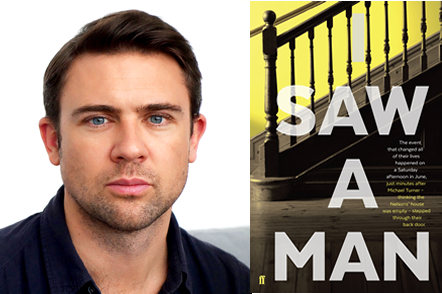
I saw a man

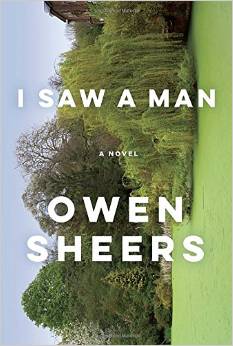
SHEERS I saw a man N Am ednLast week I was in Bloomington for the drones conference – more on that later – but while I was there I managed to finish Owen Sheers‘ new novel, I saw a man.  All of the reviews I’ve seen so far (and they have been very, very good: see here, here and here, for example) praise the way in which Owen so beautifully recovers the circles of grief that spiral from a drone strike on the Afghanistan-Pakistan border that accidentally killed a party of foreign journalists, including Caroline, the wife of the book’s narrator.  ‘Despite its “fire and forget” name tag,’ we are assured, ‘once a Hellfire had been released there would always be someone who never would.’

In fact, Owen and I had corresponded about the details of drone strikes and casualty investigations while he was working on the book, and he certainly treats mourning and memory with extraordinary skill and empathy.  Restricting the victims to those outside the region, apart from a local driver and interpreter, may make the task easier – much of the story plays out in Hampstead – but it’s still formidably difficult.

Owen-Sheers-I-Saw-a-Man

Yet the book is also, equally centrally, about distancing.  Michael is an author with a reputation for effacing himself from his narratives.  Towards the end, in a phrase that powers the book’s meta-fictional twist (and which in some editions is captured on a cover from which Sheers’ own name is absent), Michael is told:

 “Isn’t that what you’re always saying? You need distance to see anything clearly? To become your own editor.”

Even when he tries to lose himself in his fencing lessons, his instructor insists:

“DISTANCE! DISTANCE MICHAEL! It’s your best defence!”

And it is of course distance that is focal to the fateful drone strike.  Those most directly involved in the kill-chain are soon effaced from the official narrative:

“A U.S. drone strike.” That was all the press release said. No mention of Creech, screeners, Intel coordinator, an operator, a pilot. It was as if the Predator had been genuinely unmanned. As if there had been no hand behind its flight, no eye behind its cameras.

And those who were killed are artfully turned into the authors of their own destruction (a tactic that is routinely used on Afghan and Pakistani victims too), even sacrificed for a greater good (international humanitarian law’s vengeful doctrine of ‘necessity’):

[T]he Pentagon statement also made mention of the journalists “working undercover,” of “entering a high-risk area.” They had known, it was implied, the dangers of their actions. And, the same statement reminded the world, an influential terrorist had been successfully targeted. The weight of blame, Michael knew, from the moment it happened, was being dissipated, thinned.

But distance is not a moral absolute (one of the most egregious mistakes of critics of drone warfare: if you think it wrong to kill someone from 7,000 miles away, over what distance do you think it is acceptable?).  In a narrative arc that will be familiar to many readers, the pilot of the drone (Daniel) is haunted by what happened, and by the dismal intimacy of death.

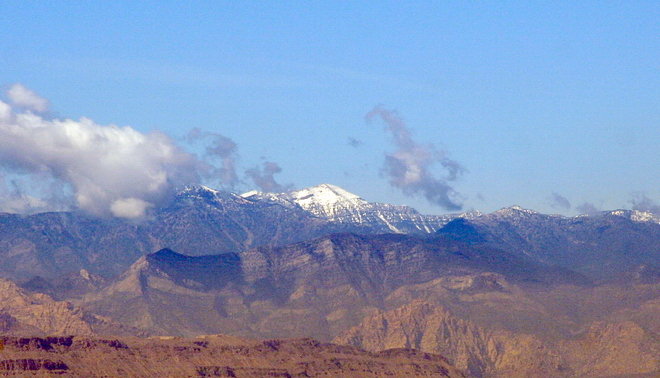
Charleston Mountains NV

Each morning, as he sets off from his home outside Las Vegas to drive to Creech Air Force Base, Daniel reflects on the similarity of the distant Charleston mountains to those over which he would soon be flying his Predator or Reaper.  It’s a common trope, actually: George Brant makes much of it in his play Grounded.  ‘Despite their proximity,’ though, Daniel hadn’t been into them and didn’t really know them.

They were his daily view but not yet his landscape, a feature of his geography but not yet his territory. Unlike those other mountains, 8,000 miles away. Those mountains Daniel knew intimately. He’d never climbed in them, either, but he was still familiar with the villages silted into their folds, the shadows their peaks threw at evening and the habits of the shepherds marshalling their flocks along their lower slopes. Recently he’d even been able to anticipate, given the right weather conditions, at what time the clouds would come misting down the higher peaks into the ravines of the valleys. Over the last few months he’d begun to feel an ownership over them. Were they not as much his workplace as that of those shepherds? For the troops operating in the area they were simply elevation, exhaustion, fear. They were hostile territory. But for Daniel they were his hunting ground, and as such it was his job not just to know them but to learn them, too. To love them, even, so that from the darkness of his control station in Creech, he might be able to move through their altitudes as naturally as the eagles who’d ridden their thermals for centuries.

It’s a brilliant paragraph, reflective and revealing, that captures the ways in which the pilot’s optical knowledge is transmuted into ‘ownership’, knowledge pinned to power, and distanced from the corpographies of troops on the ground for whom the mountains meant only ‘elevation, exhaustion, fear’ [see also here].  Daniel was freed from all that, soaring high above them, precisely because his territory appeared elsewhere.  If, as Stuart Elden suggests, territory can be conceived as a political technology that asserts a claim over bodies-in-spaces, then one of the most perceptive passages in I saw a man is the description of Daniel scanning ‘the territory of his screen (my emphasis)’…

Screen Shot 2015-07-11 at 12.48.14 PM

Distance, intimacy, experience: all mediated by political technology and in consequence highly conditional and always partial.  That is how the pilot is made free to pursue what Grégoire Chamayou calls his ‘man-hunting‘: because what appears on the screen is a target – not a man or a woman.

Or, as the book’s epigraph says: ‘I saw a man who wasn’t there….’