Those who don’t count and those who can’t count

An excellent article from the unfailing New York Times in a recent edition of the Magazine: Azmat Khan and Anand Gopal on ‘The Uncounted‘, a brilliant, forensic and – crucially – field-based investigation into civilian casualties in the US air war against ISIS:

American military planners go to great lengths to distinguish today’s precision strikes from the air raids of earlier wars, which were carried out with little or no regard for civilian casualties. They describe a target-selection process grounded in meticulously gathered intelligence, technological wizardry, carefully designed bureaucratic hurdles and extraordinary restraint. Intelligence analysts pass along proposed targets to “targeteers,” who study 3-D computer models as they calibrate the angle of attack. A team of lawyers evaluates the plan, and — if all goes well — the process concludes with a strike so precise that it can, in some cases, destroy a room full of enemy fighters and leave the rest of the house intact.

The coalition usually announces an airstrike within a few days of its completion. It also publishes a monthly report assessing allegations of civilian casualties. Those it deems credible are generally explained as unavoidable accidents — a civilian vehicle drives into the target area moments after a bomb is dropped, for example. The coalition reports that since August 2014, it has killed tens of thousands of ISIS fighters and, according to our tally of its monthly summaries, 466 civilians in Iraq.

What Azmat and Anand found on the ground, however, was radically different:

Our own reporting, conducted over 18 months, shows that the air war has been significantly less precise than the coalition claims. Between April 2016 and June 2017, we visited the sites of nearly 150 airstrikes across northern Iraq, not long after ISIS was evicted from them. We toured the wreckage; we interviewed hundreds of witnesses, survivors, family members, intelligence informants and local officials; we photographed bomb fragments, scoured local news sources, identified ISIS targets in the vicinity and mapped the destruction through satellite imagery. We also visited the American air base in Qatar where the coalition directs the air campaign. There, we were given access to the main operations floor and interviewed senior commanders, intelligence officials, legal advisers and civilian-casualty assessment experts. We provided their analysts with the coordinates and date ranges of every airstrike — 103 in all — in three ISIS-controlled areas and examined their responses. The result is the first systematic, ground-based sample of airstrikes in Iraq since this latest military action began in 2014.

We found that one in five of the coalition strikes we identified resulted in civilian death, a rate more than 31 times that acknowledged by the coalition. It is at such a distance from official claims that, in terms of civilian deaths, this may be the least transparent war in recent American history [my emphasis].  Our reporting, moreover, revealed a consistent failure by the coalition to investigate claims properly or to keep records that make it possible to investigate the claims at all. While some of the civilian deaths we documented were a result of proximity to a legitimate ISIS target, many others appear to be the result simply of flawed or outdated intelligence that conflated civilians with combatants. In this system, Iraqis are considered guilty until proved innocent. Those who survive the strikes …  remain marked as possible ISIS sympathizers, with no discernible path to clear their names.

They provide immensely powerful, moving case studies of innocents ‘lost in the wreckage’.  They also describe the US Air Force’s targeting process at US Central Command’s Combined Air Operations Center (CAOC) at Al Udeid Air Base in Qatar (the image above shows the Intelligence, Surveillance and Reconnaissance Division at the CAOC, which ‘provides a common threat and targeting picture’):

The process seemed staggeringly complex — the wall-to-wall monitors, the soup of acronyms, the army of lawyers — but the impressively choreographed operation was designed to answer two basic questions about each proposed strike: Is the proposed target actually ISIS? And will attacking this ISIS target harm civilians in the vicinity?

As we sat around a long conference table, the officers explained how this works in the best-case scenario, when the coalition has weeks or months to consider a target. Intelligence streams in from partner forces, informants on the ground, electronic surveillance and drone footage. Once the coalition decides a target is ISIS, analysts study the probability that striking it will kill civilians in the vicinity, often by poring over drone footage of patterns of civilian activity. The greater the likelihood of civilian harm, the more mitigating measures the coalition takes. If the target is near an office building, the attack might be rescheduled for nighttime. If the area is crowded, the coalition might adjust its weaponry to limit the blast radius. Sometimes aircraft will even fire a warning shot, allowing people to escape targeted facilities before the strike. An official showed us grainy night-vision footage of this technique in action: Warning shots hit the ground near a shed in Deir al-Zour, Syria, prompting a pair of white silhouettes to flee, one tripping and picking himself back up, as the cross hairs follow.

Once the targeting team establishes the risks, a commander must approve the strike, taking care to ensure that the potential civilian harm is not “excessive relative to the expected military advantage gained,” as Lt. Col. Matthew King, the center’s deputy legal adviser, explained.

After the bombs drop, the pilots and other officials evaluate the strike. Sometimes a civilian vehicle can suddenly appear in the video feed moments before impact. Or, through studying footage of the aftermath, they might detect signs of a civilian presence. Either way, such a report triggers an internal assessment in which the coalition determines, through a review of imagery and testimony from mission personnel, whether the civilian casualty report is credible. If so, the coalition makes refinements to avoid future civilian casualties, they told us, a process that might include reconsidering some bit of intelligence or identifying a flaw in the decision-making process.

There are two issues here.  First, this is indeed the ‘best-case scenario’, and one that very often does not obtain.  One of the central vectors of counterinsurgency and counterterrorism is volatility: targets are highly mobile and often the ‘window of opportunity’ is exceedingly narrow.  I’ve reproduced this image from the USAF’s own targeting guide before, in relation to my analysis of the targeting cycle for a different US air strike against IS in Iraq in March 2015, but it is equally applicable here:

Second, that ‘window of opportunity’ is usually far from transparent, often frosted and frequently opaque.  For what is missing from the official analysis described by Azmat and Anand turns out to be the leitmotif of all remote operations (and there is a vital sense in which all forms of aerial violence are ‘remote’, whether the pilot is 7,000 miles away or 30,000 feet above the target [see for example here]):

Lt. Gen. Jeffrey Harrigian, commander of the United States Air Forces Central Command at Udeid, told us what was missing. “Ground truth, that’s what you’re asking for,” he said. “We see what we see from altitude and pull in from other reports. Your perspective is talking to people on the ground.” He paused, and then offered what he thought it would take to arrive at the truth: “It’s got to be a combination of both.”

The military view, perhaps not surprisingly, is that civilian casualties are unavoidable but rarely intentional:

Supreme precision can reduce civilian casualties to a very small number, but that number will never reach zero. They speak of every one of the acknowledged deaths as tragic but utterly unavoidable.

Azmat and Anand reached a numbingly different conclusion: ‘Not all civilian casualties are unavoidable tragedies; some deaths could be prevented if the coalition recognizes its past failures and changes its operating assumptions accordingly. But in the course of our investigation, we found that it seldom did either.’

Part of the problem, I suspect, is that whenever there is an investigation into reports of civilian casualties that may have been caused by US military operations it must be independent of all other investigations and can make no reference to them in its findings; in other words, as I’ve noted elsewhere, there is no ‘case law’: bizarre but apparently true.

But that is only part of the problem.  The two investigators cite multiple intelligence errors (‘In about half of the strikes that killed civilians, we could find no discernible ISIS target nearby. Many of these strikes appear to have been based on poor or outdated intelligence’) and even errors and discrepancies in recording and locating strikes after the event.
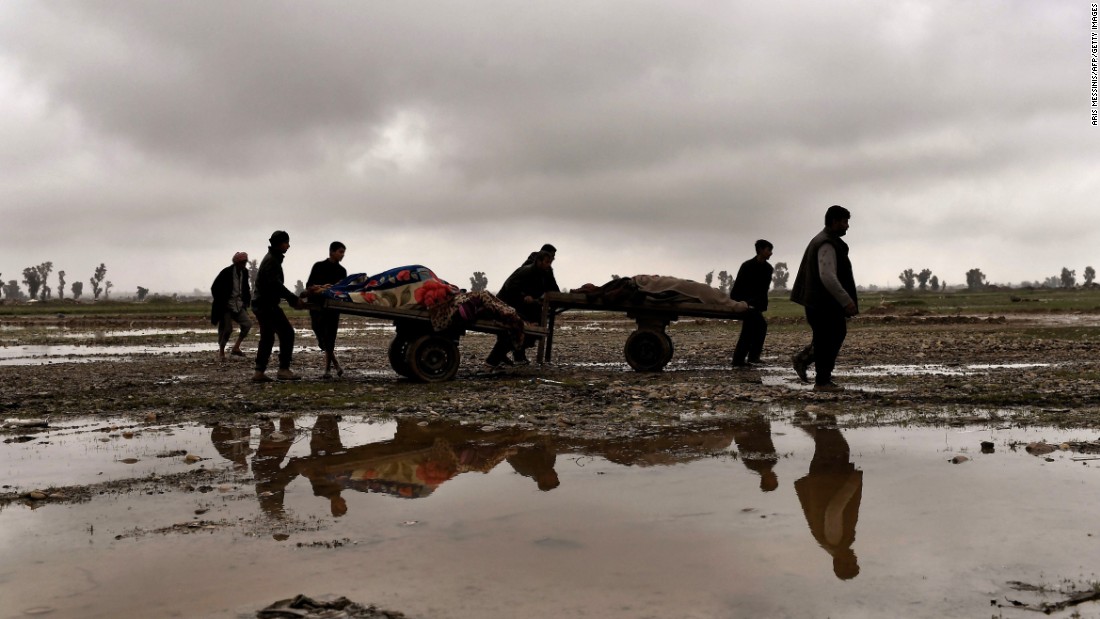
It’s worth reading bellingcat‘s analysis here, which also investigates the coalition’s geo-locational reporting and notes that the official videos ‘appear only to showcase the precision and efficiency of coalition bombs and missiles, and rarely show people, let alone victims’.  The image above, from CNN, is unusual in showing the collection of the bodies of victims of a US air strike in Mosul, this time in March 2017; the target was a building from which two snipers were firing; more than 100 civilians sheltering there were killed.  The executive summary of the subsequent investigation is here – ‘The Target Engagement Authority (TEA) was unaware of and could not have predicted the presence of civilians in the structure prior to the engagement’ – and report from W.J. Hennigan and Molly Hennessy-Fiske is here.

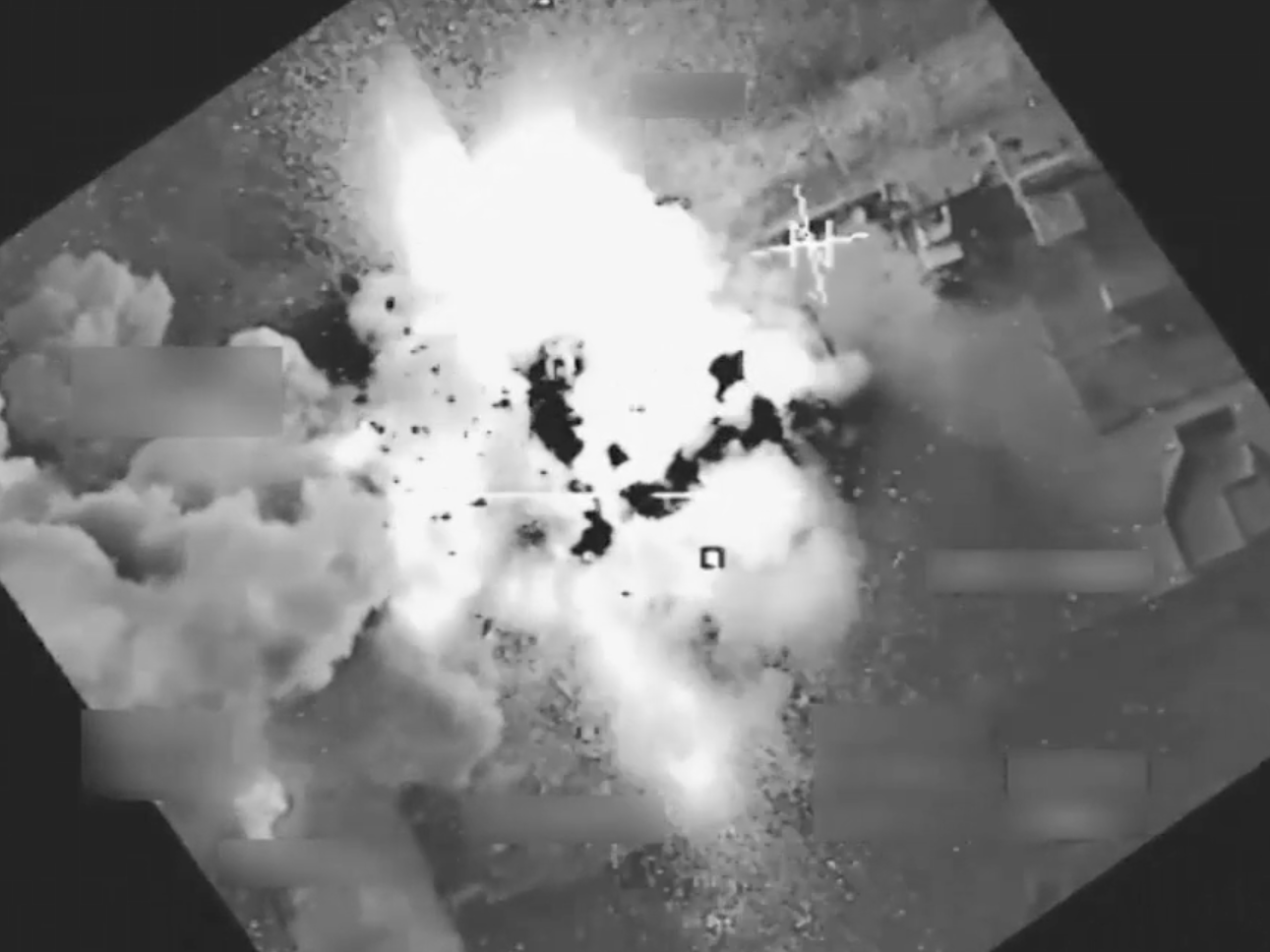
Included in bellingcat’s account is a discussion of a video which the coalition uploaded to YouTube and then deleted; Azmat retrieved and archived it – the video shows a strike on two buildings in Mosul on 20 September 2015 that turned out to be focal to her investigation with Anand:

The video caption identifies the target as a ‘VBIED [car bomb] facility’.  But Bellingcat asks:

Was this really a “VBIED network”? Under the original upload, a commenter starting posting that the houses shown were his family’s residence in Mosul.

“I will NEVER forget my innocent and dear cousins who died in this pointless airstrike. Do you really know who these people were? They were innocent and happy family members of mine.”

Days after the strike, Dr Zareena Grewal, a relative living in the US wrote in the New York Times that four family members had died in the strike. On April 2, 2017 – 588 days later – the Coalition finally admitted that it indeed bombed a family home which they confused for an IS headquarters and VBIED facility.

“The case was brought to our attention by the media and we discovered the oversight, relooked [at] the case based on the information provided by the journalist and family, which confirmed the 2015 assessment,” Colonel Joe Scrocca, Director of Public Affairs for the Coalition, told Airwars.

Even though the published strike video actually depicted the killing of a family, it remained – wrongly captioned – on the official Coalition YouTube channel for more than a year.

This is but one, awful example of a much wider problem.  The general conclusion reached by Azmat and Anand is so chilling it is worth re-stating:

According to the coalition’s available data, 89 of its more than 14,000 airstrikes in Iraq have resulted in civilian deaths, or about one of every 157 strikes. The rate we found on the ground — one out of every five — is 31 times as high.
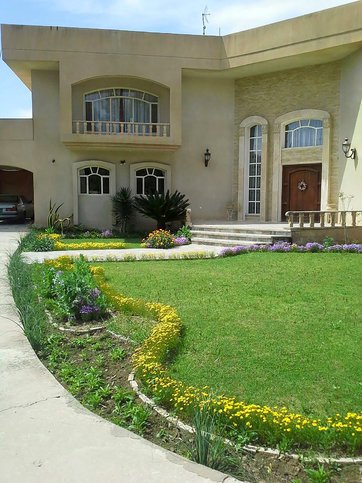
One of the houses [shown above] mistakenly identified as a ‘VBIED facility’ in that video belonged to Basim Razzo, and he became a key informant in Azmat and Anand’s investigation; he was subsequently interviewed by Amy Goodman: the transcript is here. She also interviewed Azmat and Anand: that transcript is here.  In the course of the conversation Anand makes a point that amply and awfully confirms Christiane Wilke‘s suggestion – in relation to air strikes in Afghanistan – that the burden of recognition, of what in international humanitarian law is defined as ‘distinction’, is tacitly being passed from combatant to civilian: that those in the cross-hairs of the US military are required to perform their civilian status to those watching from afar.

It goes back to this issue of Iraqis having to prove that they are not ISIS, which is the opposite of what we would think. We would think that the coalition would do the work to find out whether somebody is a member of ISIS or not. Essentially, they assume people are ISIS until proven otherwise.

To make matters worse, they have to perform their ‘civilianness’ according to a script recognised and approved by the US military, however misconceived it may be.  In the case of one (now iconic) air strike in Afghanistan being an adolescent or adult male, travelling in a group, praying at one of the times prescribed by Islam, and carrying a firearm in a society where that is commonplace was enough for civilians to be judged as hostile by drone crews and attacked from the air with dreadful results (see here and here).

This is stunning investigative journalism, but it’s more than that: the two authors are both at Arizona State University, and they have provided one of the finest examples of critical, probing and accessible scholarship I have ever read.
Hersey Wars

I have very nearly finished the long-form version of ‘Little Boys and Blue Skies‘ (really), and en route I’ve re-read John Hersey‘s stunning essay on Hiroshima that took up a whole issue of the New Yorker in 1946 (you can read it online here).

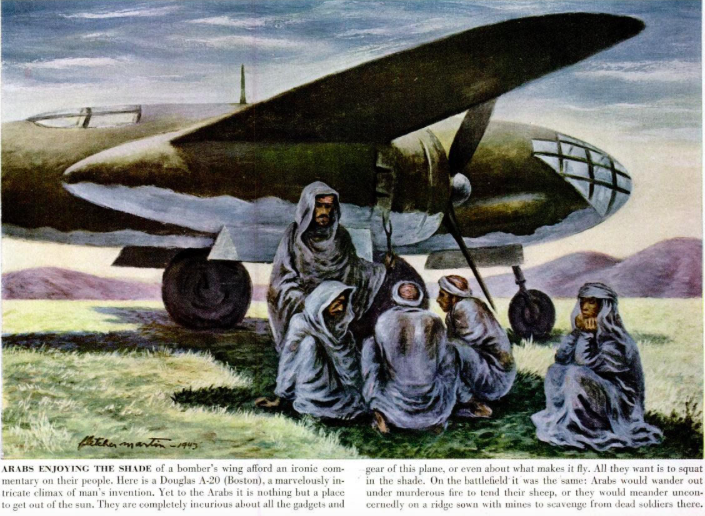
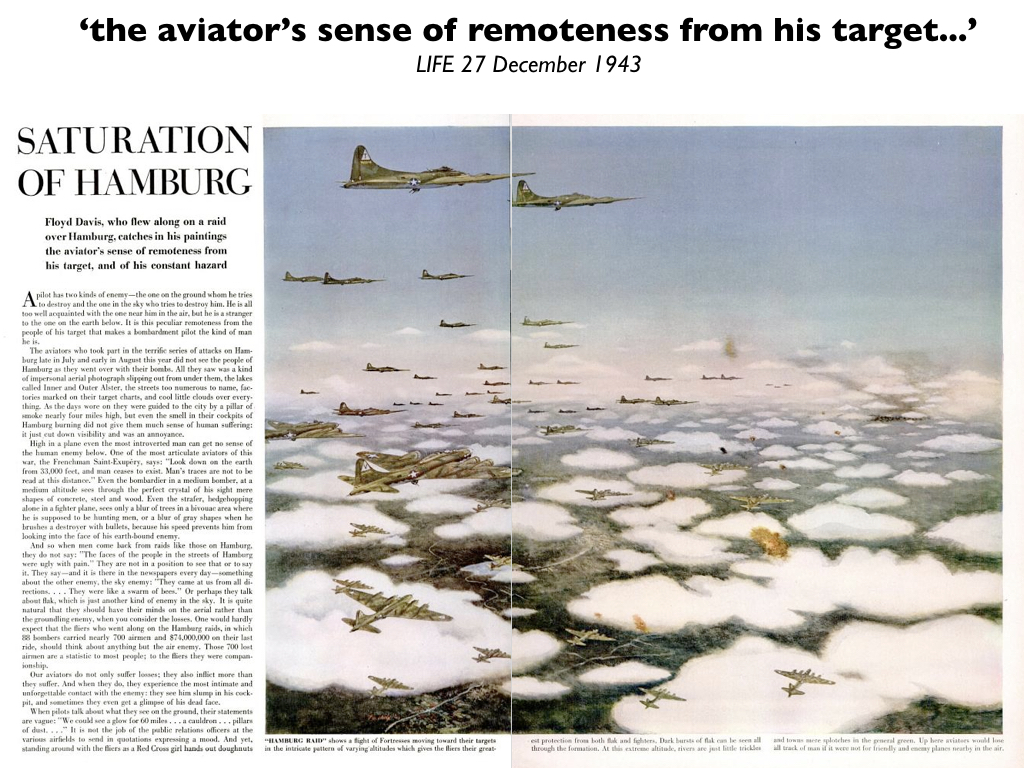
As so often happens, to me anyway, I was lured down all sorts of other paths while I was digging around.  One of them, which looped back to my wider work on aerial violence, led me to another essay by Hersey.  In several of my presentations on bombing I’ve used this image from Life magazine on 27 December 1943:

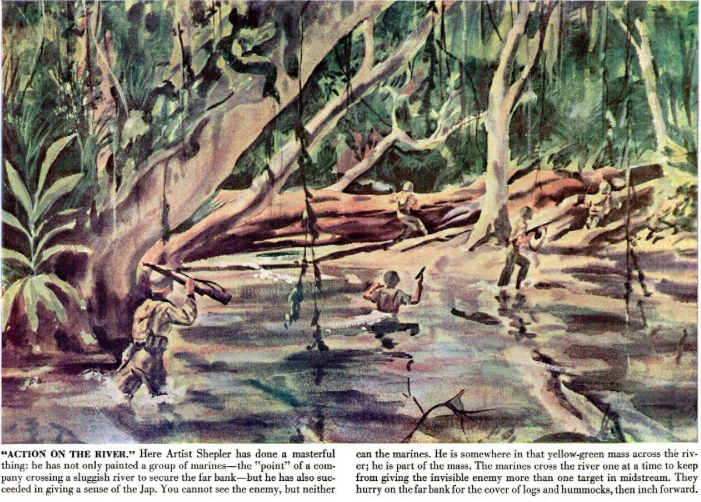
But what I had missed was the author of the essay wrapped around Floyd Davis‘s image: it was John Hersey.  Called ‘Experience by Battle’ it accompanied a 32-page portfolio of paintings by six American war artists of different theatres of war.  ‘Each battleground and each type of warfare has a distinctive effect on the men it involves,’ Hersey wrote.  ‘The pictures bring out the differences.  They are universal war, but they are also particular war.’

Hersey explained that he wasn’t interested in artistic technique – he probably wasn’t the person to write about that – but in a combination of memory and mood.  In his view, a painting was ‘a kind of memory – of an event, of a place, of an idea – and if it is good, it will give the person who sees it a pang quite like that of a vivid memory.’

In order the theatres and artists were:

Guadalcanal (Dwight Shepler):

Submarine warfare (Paul Sample):

Hill 609 in Tunisia (Fletcher Martin):

The saturation bombing of Hamburg (Floyd Davis; shown at the top of this post)

Rendova (Aaron Bohrod):

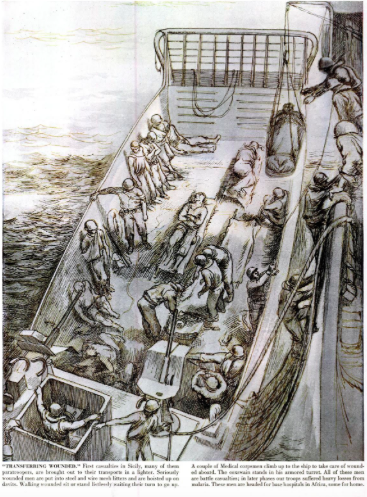
Sicily (Mitchell Jamieson):

Hersey was a master at conveying the experience of war – it was precisely that gift that he used to such extraordinary effect in ‘Hiroshima’, and at a time when so many American writers and artists had turned their eyes away from Japan to imagine instead ‘Hiroshima USA’….

He also had a remarkable ability to imagine military violence  from both sides.  In the text that accompanies Davis’s painting of the saturation bombing of Hamburg, Hersey had this to say:

‘It was not for our fliers to see in their minds’ eyes that Hamburg was as bad as the seventh circle of Dante’s hell, where flakes of fire fell on naked sinners.  They could not afford to spend too much time imagining the scene in the tunnel under the Elbe River, where thousands of people had taken shelter, at the moment when a bomb burst one end and the water rushed in.  As fliers with an important job to do they could not afford to have nightmares about people driven from shelters by heat into an ocean of flame outside; or about the city gradually dying – water no longer running, gas gone out of the mains, telephones silent, buses stopped, food distribution crippled – finally a city populated by people either dead or blank in the face.’

It’s a remarkable passage, conjuring up what Hersey acknowledges the aircrews could not see and dared not imagine.  He later explained that in ‘Hiroshima’ he wanted to ‘write about what happened not to buildings but to bodies’…

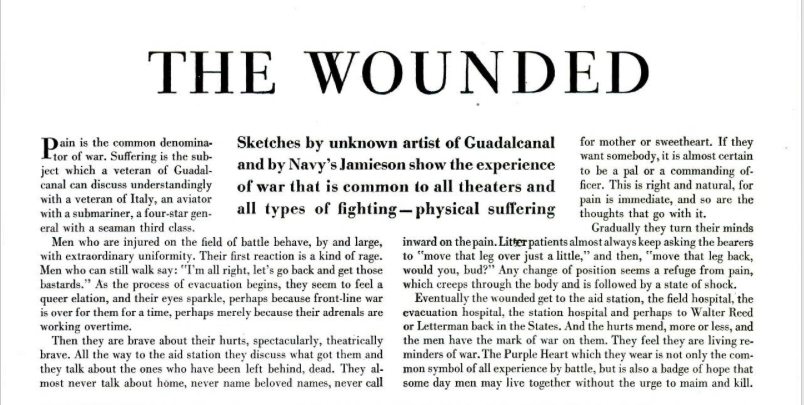
And the final panel of the Life portfolio returns me to my current work on wounded bodies:

In case you are wondering – you can access the full run of Life via Google Books: it is a truly excellent resource.

Periscope

Articles that have recently caught my eye through their intersections with various projects I’m working on (so forgive what may otherwise seem an idiosyncratic selection!):

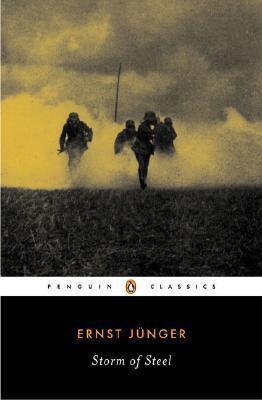
Bogdan Costea and Kostas Amiridis, ‘Ernst Jünger, total mobilization and the work of war’, Organization 24 (4) (2017) 475-490 – I keep encountering Jünger’s work, first when I was writing ‘The natures of war‘ (he served on the Western Front in the First World War: see his remarkable Storm of Steel, still available as a Penguin Classic in a greatly improved translation) and much more recently while preparing a new lecture on occupied Paris in the Second World War (he was stationed there for four years and confided a series of revealing and often critical observations to his diaries).  But his reflections on the ‘destruction line’ of modern war are no less interesting.  For parallel reflections, see:

Leo McCann, ‘Killing is our business and business is good”: The evolution of war managerialism from body counts to counterinsurgency’, Organization 24 (4) (2017) 491-515 – I’ve written about what Freeman Dyson called ‘the bureaucratization of homicide‘ before, in relation to aerial violence, but this essay provides a wider angle.

Laura Pitkanen, Matt Farish, ‘Nuclear landscapes’, Progress in human geography [Online First: 31 August 2017] (‘Places such as New Mexico’s Trinity Site have become iconic, at least in the United States, and a study of nuclear landscapes must consider the cultural force of spectacular weapons tests and related origin stories. But critical scholars have also looked beyond and below the distractions of mushroom clouds, to additional and alternative landscapes that are obscured by secrecy and relative banality’).

I’m still haunted by the reading I did for ‘Little Boys and Blue Skies‘, much of it inspired by Matt’s work (see especially here on ‘Atomic soldiers and the nuclear battlefield’); this essay should be read in conjunction with:

Becky Alexis-Martin and Thom Davis, ‘Towards nuclear geography: zones, bodies and communities’, Geography Compass [Online early: 5 September 2017] (‘We explore the diverse modes of interaction that occur between bodies and nuclear technology and point towards the scope for further research on nuclear geographies. We bring together different strands of this nascent discipline and, by doing so, highlight how nuclear technology interacts across a spectrum of geographic scales, communities, and bodies. Although nuclear geographies can be sensational and exceptionalising, such as the experiences of nuclear accident survivors and the creation of “exclusion zones,” they can also be mundane, everyday and largely unrecognised, such as the production of nuclear energy and the life-giving nature of radioactive medicine.’)

Simon Philpott, ‘Performing Mass Murder: constructing the perpetrator in documentary film’, International Political Sociology 11 (3) (2017) 257–272 – an insightful critique of Joshua Oppenheimer‘s The Act of Killing (see my posts here and here).

José Ciro Martinez and Brett Eng, ‘Struggling to perform the state: the politics of bread in the Syrian civil war’, International Political Sociology 11 (20 (2017) 130-147 – a wonderfully suggestive analysis that has the liveliest of implications for my own work on attacks on hospitals and health-care workers in Syria (notably: ‘The provision of bread to regime-controlled areas has gone hand in hand with targeted efforts to deprive rebel groups of the essential foodstuff and, by extension, their ability to perform the state. Since 2012, the regime has bombed nascent opposition-administered attempts to provide vital public services and subsistence goods, thereby presenting itself as the only viable source of such necessities.’)  But it also has far wider implications for debates about ‘performing the state’ and much else.  And in a similar vein:

Jeannie Sowers, Erika Weinthal and Neda Zawahiri, ‘Targeting environmental infrastructures, international law and civilians in the new Middle Eastern wars’, Security Dialogue 2017 [Online early] (”We focus on better understanding the conflict destruction of water, sanitation, waste, and energy infrastructures, which we term environmental infrastructures, by drawing on an author-compiled database of the post-2011 wars in the Middle East and North Africa… Comparatively analyzing the conflict zones of Libya, Syria, and Yemen, we show that targeting environmental infrastructure is an increasingly prevalent form of war-making in the MENA, with long-term implications for rebuilding states, sustaining livelihoods, and resolving conflicts.’)

Will Todman, ‘Isolating Dissent, Punishing the Masses: Siege Warfare as Counter-Insurgency,’ Syria Studies 9 (1) (2017) 1-32 – Syria Studies is an open-acess journal from the Centre for Syrian Studies at St Andrews.

Sarah El-Kazaz and Kevin Mazur, ‘The unexceptional Middle Eastern City’, City & Society 29 (1) (2017) 148-161 – a really useful introduction to a themed section, much on my mind as this term I’ll be doing my best to jolt my students out of lazy caricatures of ‘the Islamic city’ (‘The study of Middle Eastern cities has been constrained in its analytical and methodological focus by a genealogy shaped by a triad of regional exceptions–Islam, oil, and authoritarianism–and … this special section move[s] beyond those constraints in important ways. Focusing on geographical places and time periods that have remained peripheral to the study of Middle Eastern cities, the three articles ethnographically historicize the planned and unplanned processes through which cities in the region transform to transcend a genealogy of exceptionalism and the constraints it has created. They highlight the global and local connections that shape these processes to offer new perspectives on the study of scale, verticality and sensoriums in the shaping of urban transformation around the globe.’)

Rasul Baksh Rais, ‘Geopolitics on the Pakistan-Afghanistan borderland’, Geopolitics [online early: 11 August 2017] – a helpful historical review particularly for anyone interested in the exceptional construction of the Federally Administered Tribal Areas by both Washington and Islamabad.

Katharine Hall Kindervater, ‘Drone strikes, ephemeral sovereignty and changing conceptions of territory’, Territory, politics, governance (2017) 207-21 – Kate engages with her characteristic breadth of vision with some of the problems that preoccupied me in ‘Dirty dancing’ and urges a topological engagement with territory (DOWNLOADS tab) (‘This article examines the US legal frameworks for drone-targeting operations, and in particular the conceptions of territory they draw upon, to argue that contemporary strikes reflect less a disappearance of the importance of territory and sovereignty to justifications of the use of force than a reconfiguration of their meanings. Grounded in an understanding of territory that is more networked and dynamic, drone strikes reflect the emergence of a new landscape of mobile and ephemeral sovereignty.’)

Georgina Ramsay, ‘Incommensurable futures and displaced lives: sovereignty as control over time’, Public culture 29 (3) (2017) 515-38 (‘The recent mass displacement of refugees has been described internationally as a “crisis.” But crisis implies eventfulness: a distinct problem that can be solved. The urgency of solving this problem of displacement has seen the use of expansive techniques of sovereignty across Europe, the epicenter of the crisis. Focusing exclusively on the formation of sovereignty through the analytical locus of crisis continues, however, to reproduce the trope of the “refugee” as a category of exception. This essay considers the experiences of people who were resettled as refugees in Australia and whose displacement has ostensibly been resolved. Drawing attention to their continuing experiences of violence, it considers how the temporal framing of displacement is itself a way to conceal formations of sovereignty embedded in the very processes designed to resolve displacement. Doing so opens up new ways to think about control over time as a technique of sovereignty.’)

For an equally trenchant and invigorating critique of crisis-talk, see Joseph Masco‘s brilliant ‘The Crisis in Crisis’, Current Anthropology 58 Supplement 17 (2017) S65-S76, available on open access here. (‘In this essay I consider the current logics of crisis in American media cultures and politics. I argue that “crisis” has become a counterrevolutionary idiom in the twenty-first century, a means of stabilizing an existing condition rather than minimizing forms of violence across militarism, economy, and the environment. Assessing nuclear danger and climate danger, I critique and theorize the current standing of existential crisis as a mode of political mobilization and posit the contemporary terms for generating non-utopian but positive futurities.’)

Dima Saber and Paul Long, ‘”I will not leave, my freedom is more precious than my blood”: From affect to precarity – crowd-sourced citizen archives as memories of the Syrian war’, Archives and Records 38 (1) (2017) (‘Based on the authors’ mapping of citizen-generated footage from Daraa, the city where the Syria uprising started in March 2011, this article looks at the relation between crowd-sourced archives and processes of history making in times of war. It describes the ‘migrant journey’ of the Daraa archive, from its origins as an eyewitness documentation of the early days of the uprising, to its current status as a digital archive of the Syrian war. It also assesses the effects of digital technologies for rethinking the ways in which our societies bear witness and remember. By so doing, this article attempts to address the pitfalls attending the representation and narrativisation of an ongoing conflict, especially in the light of rising concerns on the precariousness and disappearance of the digital archives. Finally, by engaging with scholarship from archival studies, this article attempts to address the intellectual rift between humanities and archival studies scholars, and is conceived as a call for more collaboration between the two disciplines for a more constructive research on archival representations of conflict.’)

Attachments to War

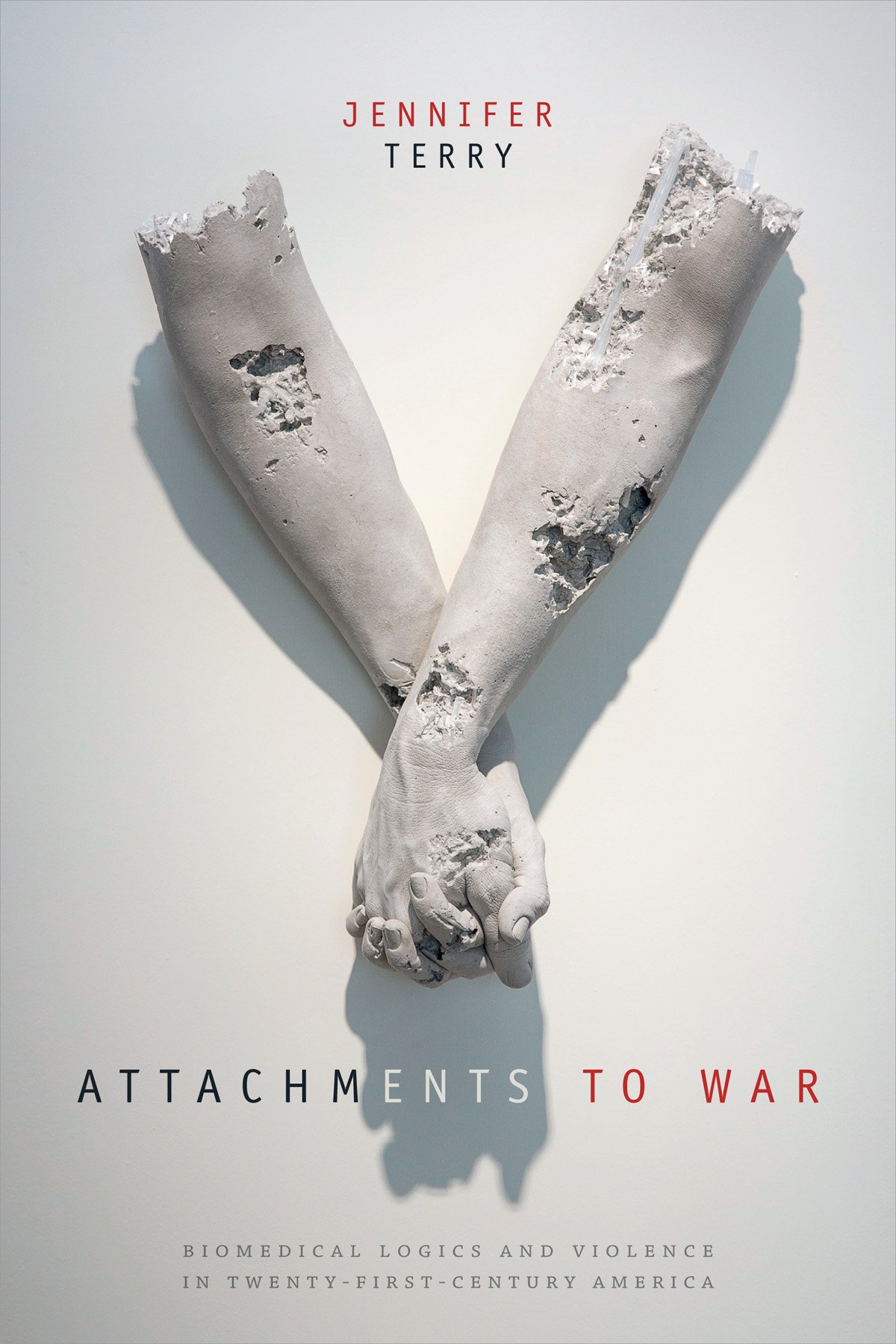
And in lockstep with my last post and my continuing interest in the prosthetics of military violence…   A new book from Jennifer Terry, Attachments to War: biomedical logics and violence in twenty-first century America, also due from Duke University Press in November:

In Attachments to War Jennifer Terry traces how biomedical logics entangle Americans in a perpetual state of war. Focusing on the Afghanistan and Iraq wars between 2002 and 2014, Terry identifies the presence of a biomedicine-war nexus in which new forms of wounding provoke the continual development of complex treatment, rehabilitation, and prosthetic technologies. At the same time, the U.S. military rationalizes violence and military occupation as necessary conditions for advancing medical knowledge and saving lives. Terry examines the treatment of war-generated polytrauma, postinjury bionic prosthetics design, and the development of defenses against infectious pathogens, showing how the interdependence between war and biomedicine is interwoven with neoliberal ideals of freedom, democracy, and prosperity. She also outlines the ways in which military-sponsored biomedicine relies on racialized logics that devalue the lives of Afghan and Iraqi citizens and U.S. veterans of color. Uncovering the mechanisms that attach all Americans to war and highlighting their embeddedness and institutionalization in everyday life via the government, media, biotechnology, finance, and higher education, Terry helps lay the foundation for a more meaningful opposition to war.

Contents:

Introduction
1. The Biomedicine-War Nexus
2. Promises of Polytrauma: On Regenerative Medicine
3. We Can Enhance You: On Bionic Prosthetics
4. Pathogenic Threats: On Pharmaceutical War Profiteering
Epilogue

And here is the (equally brilliant) Laleh Khalili:

This brilliant book is a thoughtful and profoundly original study of how war becomes an object of attachment and support in the United States. Jennifer Terry’s discussion of wounding, injury, trauma, and prosthetics is one of the most fascinating, moving, and intensely generative studies I have read about how war is normalized, made everyday, and embedded in practices and beliefs and affect(ion)s of ordinary folks.

You can read the Introduction over at Catalyst: feminism, theory, technoscience here, and watch presentations on ‘Militarization, medicalization, responsibility’ (from 2015) by Jennifer and Nadia Abu el-Haj on You Tube here.

The Right to Maim

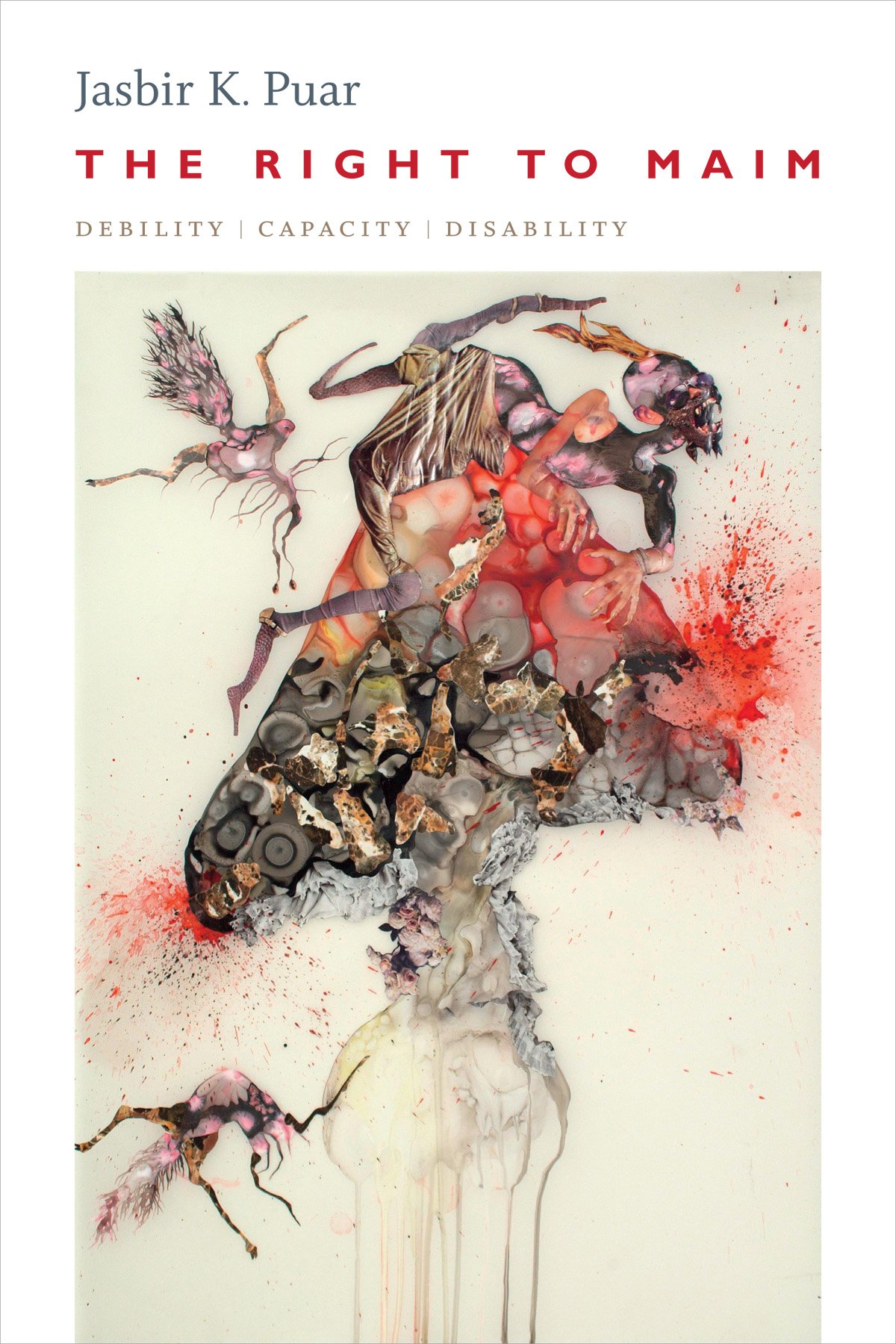
Following all too closely on the heels of my last post, a new book from Jasbir Puar, out from Duke University Press in November: The Right to Maim: debility, capacity, disability:

In The Right to Maim Jasbir K. Puar brings her pathbreaking work on the liberal state, sexuality, and biopolitics to bear on our understanding of disability. Drawing on a stunning array of theoretical and methodological frameworks, Puar uses the concept of “debility”—bodily injury and social exclusion brought on by economic and political factors—to disrupt the category of disability. She shows how debility, disability, and capacity together constitute an assemblage that states use to control populations. Puar’s analysis culminates in an interrogation of Israel’s policies toward Palestine, in which she outlines how Israel brings Palestinians into biopolitical being by designating them available for injury. Supplementing its right to kill with what Puar calls the right to maim, the Israeli state relies on liberal frameworks of disability to obscure and enable the mass debilitation of Palestinian bodies. Tracing disability’s interaction with debility and capacity, Puar offers a brilliant rethinking of Foucauldian biopolitics while showing how disability functions at the intersection of imperialism and racialized capital.

Contents:

Introduction: The Cost of Getting Better
1. Bodies with New Organs: Becoming Trans, Becoming Disabled
2. Crip Nationalism: From Narrative Prosthesis to Disaster Capitalism
3. Disabled Diaspora, Rehabilitating State: The Queer Politics of Reproduction in Palestine/Israel
4. “Will Not Let Die”: Debilitation and Inhuman Biopolitics in Palestine  1
Postscript: Treatment without Checkpoints

Here are three pre-publication reviews, first from Elizabeth Povinelli:

In signature style, Jasbir K. Puar takes readers across multiple social and textual terrains in order to demonstrate the paradoxical embrace of the politics of disability in liberal biopolitics. Puar argues that even as liberalism expands its care for the disabled, it increasingly debilitates workers, subalterns, and others who find themselves at the wrong end of neoliberalism. Rather than simply celebrating the progressive politics of disability, trans identity, and gay youth health movements, The Right to Maim shows how each is a complex interchange of the volatile politics of precarity in contemporary biopower.

Paul Amar:

Jasbir K. Puar’s must-read book The Right to Maim revolutionizes the study of twenty-first-century war and biomedicine, offering a searingly impressive reconceptualization of disability, trans, and queer politics. Bringing together Middle East Studies and American Studies, global political economy and gendered conflict studies, this book’s exciting power is its revelation of the incipient hegemony of maiming regimes. Puar’s shattering conclusions draw upon rigorous and systematic empirical analysis, ultimately offering an enthralling vision for how to disarticulate disability politics from this maiming regime’s dark power.

And Judith Butler:

Jasbir K. Puar’s latest book offers us a new vocabulary for understanding disability, debility, and capacity, three terms that anchor a sharp and provocative analysis of biopolitics of neoliberalism, police power, and militarization. Gaining recognition for disability within terms that instrumentalize and efface its meanings carries a great risk. So too does opting out of discourse altogether. Puar references a wide range of scholarly and activist resources to show how maiming becomes a deliberate goal in the continuing war on Palestine, and how the powers of whiteness deflect from the demographics of disability and ability. Lastly, her deft understanding of how the attribution of ‘capacity’ can work for and against people in precarious positions will prove crucial for a wiser and more radical struggle for justice.

If you can’t wait until November, you can get a taste of Jasbir’s arguments in her essay for borderlands 14 (1) (2015) ‘The ‘Right’ to Maim: Disablement and Inhumanist Biopolitics in Palestine‘ available as an open access pdf here.  I’ve been attending closely to Jasbir’s vital arguments as I re-think the sketches I made in Meatspace? and The prosthetics of Military Violence: more soon.

Distinction and the ethics of violence

In another lifetime, or so it seems, I wrote a short essay on ‘The death of the civilian’ (DOWNLOADS tab), and I seem to have spent much of the intervening years developing those early ideas.  So I’m thrilled to see an important new paper from Nicola Perugini and Neve Gordon, ‘Distinction and the Ethics of Violence: on the legal construction of liminal subjects and spaces’, available online now at Antipode:

This paper interrogates the relationship among visibility, distinction, international humanitarian law and ethics in contemporary theatres of violence. After introducing the notions of “civilianization of armed conflict” and “battlespaces”, we briefly discuss the evisceration of one of international humanitarian law’s axiomatic figures: the civilian. We show how liberal militaries have created an apparatus of distinction that expands that which is perceptible by subjecting big data to algorithmic analysis, combining the traditional humanist lens with a post-humanist one. The apparatus functions before, during, and after the fray not only as an operational technology that directs the fighting or as a discursive mechanism responsible for producing the legal and ethical interpretation of hostilities, but also as a force that produces liminal subjects. Focusing on two legal figures—“enemies killed in action” and “human shields”—we show how the apparatus helps justify killing civilians and targeting civilian spaces during war.

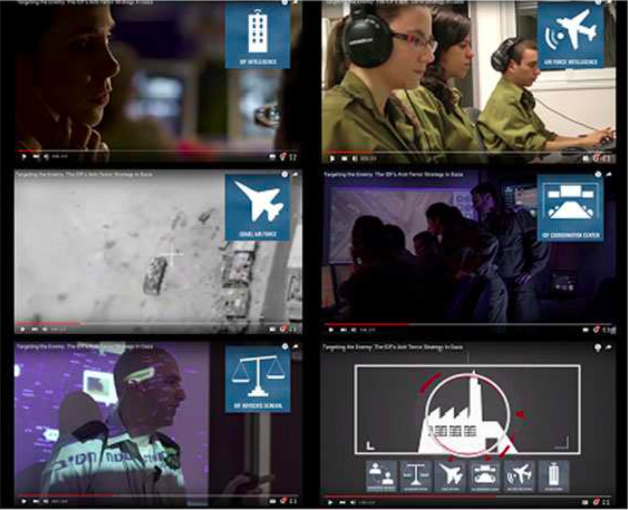
Their two case studies focus on US drone attacks in Pakistan and the use of human shields in Gaza (the image below, taken from the article, shows the Israeli Defence Force’s ‘Laboratory of Discrimination’ (sic)).

You can watch a video where Nicola and Neve discuss their ideas on the Antipode website here, which also provides a less formal gloss:

[Their paper] examines how militaries actually make distinctions in the battlefield, given that today most fighting takes place in urban settings where distinguishing between combatant and civilian is becoming increasingly difficult.

Their paper shows how liberal militaries are utilizing new technologies that aim to expand that which is perceptible within the fray. Combining the more traditional forms of making distinctions such as binoculars and cameras with cutting edge hi-tech, militaries subject big data to algorithmic analysis aimed at identifying certain behavioral patterns. The technologies of distinction function before, during, and after the fray not only in order to direct the fighting and to help produce the legal and ethical interpretation of hostilities, but also as a mechanism that identifies and at times creates new legal figures.

Focusing on two legal figures—“enemies killed in action” and “human shields”—Nicola and Neve show how technologies of distinction help justify killing civilians and targeting civilian spaces during war. Ultimately, they maintain that distinction, which is meant to guarantee the protection of civilians in the midst of armed conflict, actually helps hollow the notion of civilian through the production of new liminal legal figures that can be legitimately killed.

For more on the intersections between international law, military protocols and the (in)visibility of the civilian, I also recommend the insightful work of Christiane Wilke (see ‘Seeing Civilians (or not)’ here).

A modern space of terror

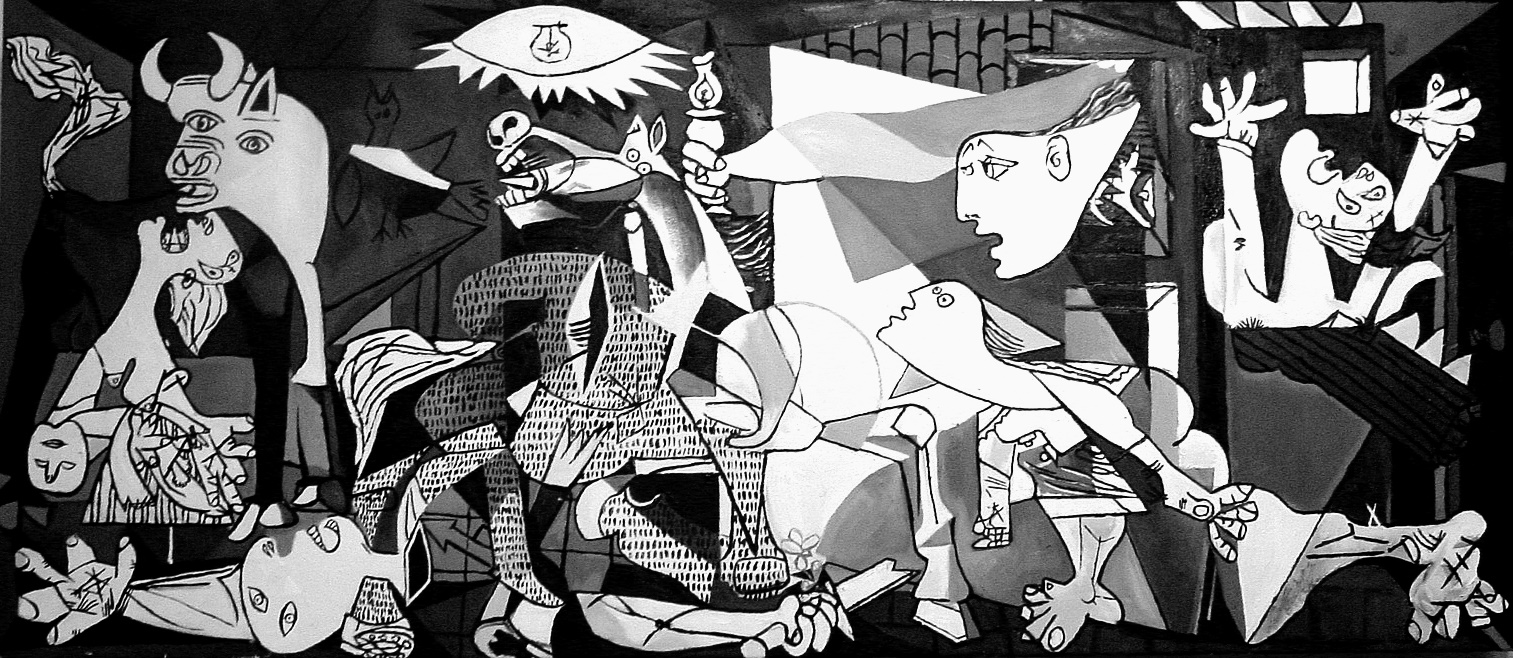
Several years ago, while my work on the geographies and genealogies of aerial violence was in its early stages, I was in Madrid: one of my main objectives was to see Pablo Picasso‘s Guernica.

I’d written (briefly) about it in a short essay – ”In another time-zone, the bombs fall unsafely….’: Targets, civilians and late modern war’ (DOWNLOADS tab):

In 1937 Europe’s world was turned upside down. The theme of the Exposition Universelle that was due to open in Paris later that year was the celebration of modern technology, ‘Art et technique dans la vie moderne’, and Pablo Picasso had been invited to paint a mural for the Spanish Pavilion. By the spring, he was still casting around for a subject.

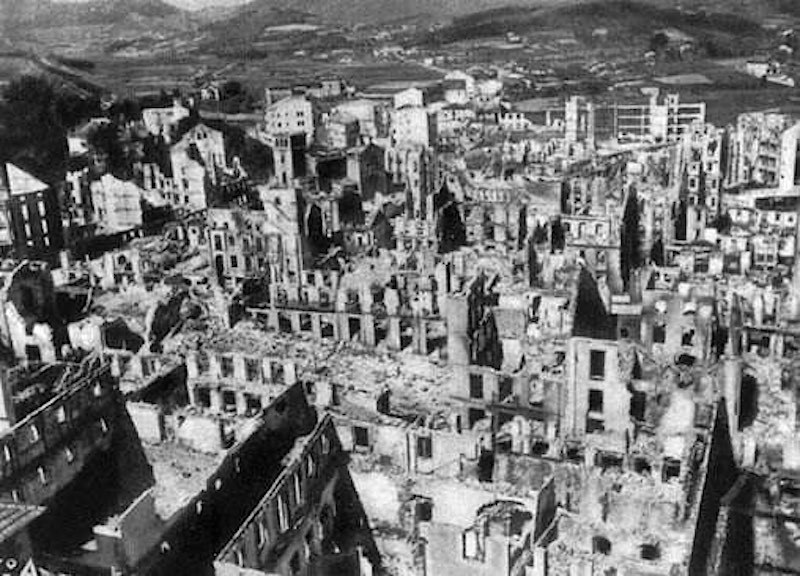
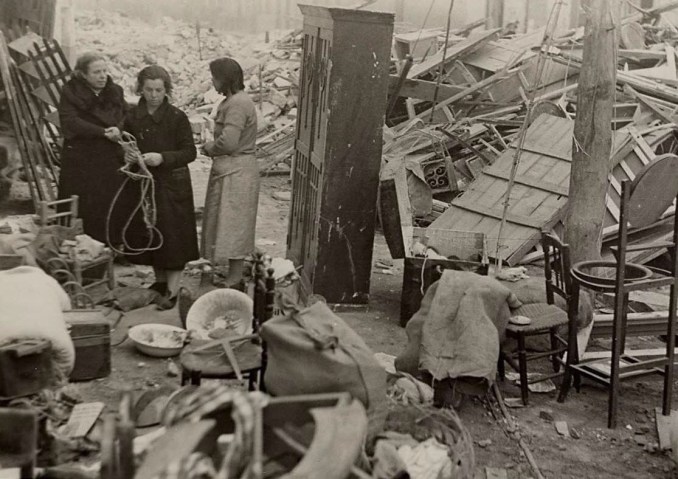
27 April was market day in Guernica (Gernika), and the Basque city was crowded with refugees from the Civil War and people from out of town attending the market.  Towards the end of the afternoon, the town was attacked from the air: first by a single German aircraft, then by three Italian aircraft, then by three waves of German and Italian aircraft. Later, in the early evening, the attack was resumed with astonishing ferocity by squadrons from the German Condor Legion whose high explosive and incendiary bombs set off a firestorm that destroyed three quarters of the town and left as many as 1, 600 people dead and over 800 injured. The next day a passionate eyewitness account of the devastation by journalist George Steer was published in The Times [see here for a reading of his report by his biographer Nicholas Rankin and for more contemporary imagery]. His report was syndicated around the world and set off a firestorm of its own. Franco’s immediate response was to deny that an air raid had taken place, and to blame the destruction on Republican and Anarchist forces defending the town. The commander of the Condor Legion, Wolfram von Richthofen, claimed that the raid had been directed against a military target, the bridge over the Rio Mundaca, and that its purpose was to cut off the Republican line of retreat; but his own standing orders required military targets to be attacked ‘without regard for the civilian population’, and in a secret report to Berlin he described ‘the concentrated attack on Guernica’ as ‘the greatest success’ in extinguishing resistance to the Nationalist-Fascist forces.

Picasso now had his subject:

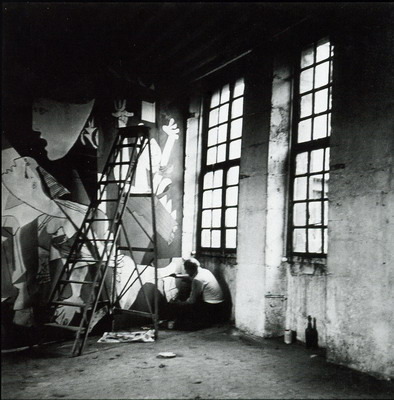
‘It was an enormous canvas, so large that Picasso needed a ladder and brushes strapped to sticks in order to paint its heights… Working from the ladder when he needed to, and sometimes on his knees, the artist began to paint on May 11, 1937, and he did so with a hot and focused intensity that was unusually keen even for him. He was determined to transform the vacant canvas into a monumental mural that would disturb and shock its viewers, reminding them … that people similarly suffered unimaginable terror in every place and time.’

‘Guernica’ as both place and painting became a symbol of a technological sublime terrifyingly different from that anticipated by the organizers of the Exposition Universelle. It was a sort of imaginative counter-geography that wrenchingly displaced the complacent Euro-American fiction that aerial warfare was always waged in ‘their’ space and that its horrors could remain unregistered.

But, as you can see, I said remarkably little about the canvas itself.  And I confess that when I finally stood in front of it in Madrid I continued to struggle with the composition.

In a wonderful essay on ‘Picasso and Tragedy’ in this month’s London Review of Books T.J. Clark has come to my aid – not least because he flips my uncertainty about the composition into a careful consideration of its spatiality.  First, this:

What marks Guernica off from most other murals of its giant size is the fact that it registers so powerfully as a single scene. Certainly it is patched together out of fragments, episodes, spotlit silhouettes. Part of its agony is disconnectedness – the isolation that terror is meant to enforce. But this disconnectedness is drawn together into a unity: Guernica does not unwind like a scroll or fold out like a strip cartoon (for all its nods to both idioms); it is not a procession of separate icons; it is a picture – a distinct shape of space – whose coherence is felt immediately by the viewer for all its strangeness.

‘Space’ is shorthand, I recognise. In the case of Guernica, what seems to matter most is the question of where the viewer is standing in the bombed city. Are we inside some kind of room? There are certainly walls, doors, windows, a table in the half-dark, even the dim lines of a ceiling. But doesn’t the horse opposite us look to be screaming in a street or courtyard, with a woman holding a lamp pushing her head through a window – a filmy curtain billowing over her forearm – to see what the noise is outside? Can we talk of an ‘outside’ and ‘inside’ at all in Guernica? Are the two kinds of space distinct? We seem to be looking up at a room’s high corners top left and right, but also, above the woman with the lamp, at the tiles on a roof. There is a door flapping on its hinges at the picture’s extreme right edge, but does it lead the way into safety or out to the void? How near to us are the animals and women? If they are close by, as appears likely, looming over us – so many giants – does that proximity ‘put us in touch’ with them? Does proximity mean intimacy? How does the picture’s black, white and grey monochrome affect our looking? Does it put back distance – detachment – into the scene, however near and enormous individual bodies may seem? Where is the ground in Guernica? Do we have a leg (or a tiled floor) to stand on? Literally we do – the grid of tiles is one of the last things Picasso put in as the picture came to a finish. But do any of the actors in the scene look to be supported by it? Does it offer viewers a foothold in the criss-cross of limbs?

The reader will have understood that the best answer to almost all of these questions is: ‘I’m not sure.’ And spatial uncertainty is one key to the picture’s power. It is Picasso’s way of responding to the new form of war, the new shape of suffering.


And then this:

Guernica is a tragic scene – a downfall, a plunge into darkness – but distinctively a 20th-century one. Its subject is death from the air. ‘That death could fall from heaven on so many,’ Picasso told an interviewer later, ‘right in the middle of rushed life, has always had a great meaning for me.’ A great meaning, and a special kind of horror. The historian Marc Bloch had this to say in 1940:

The fact is that this dropping of bombs from the sky has a unique power of spreading terror … A man is always afraid of dying, but particularly so when to death is added the threat of complete physical disintegration. No doubt this is a peculiarly illogical manifestation of the instinct of self-preservation, but its roots are very deep in human nature.

Bombing of the kind experimented with in April 1937 – ‘carpet bombing’, ‘strategic bombing’ ‘total war’ – is terrifying. Because the people on the ground, cowering in their shelters, may imagine themselves suddenly gone from the world – ripped apart and scattered, vanished without trace. Because what will put an end to them so completely comes out of the blue – Picasso’s ‘from heaven’ – and has no imaginable form. Because death from now on is potentially (‘strategically’) all-engulfing: no longer a matter of individual extinctions recorded on a war memorial, but of whole cities – whole ‘worlds’, whole forms of life – snuffed out in an hour or so.

And finally this:

We could say that the nowhere-ness and isolation in Guernica are what terror – terror with von Richthofen’s technology at its disposal [he called it ‘absolutely fabulous’] – most wants to produce. It is the desired state of mind lurking behind the war-room euphemisms: ‘undermining civilian morale’, ‘destroying social cohesion’, ‘strategic bombing’, ‘putting an end to war-willingness’. But surely Guernica would not have played the role it has for the past eighty years if all it showed was absolute negativity. It is a scene, after all, not a meaningless shambles. It presents us, at the degree zero of experience, with an image of horror shared – death as a condition (a promised end, a mystery) that opens a last space for the human…

It is difficult, maybe impossible, to describe what is happening here without one’s language tipping into the falsely redemptive. Nothing that takes place in Guernica, to make my own feeling clear, strikes me as redeemed or even transfigured by the picture’s black-and-white reassembly of its parts. Fear, pain, sudden death, disorientation, screaming immediacy, disbelief, the suffering of animals – none of these realities ‘falls into place’. Judith Butler in a recent essay, looking for a basis on which a future politics might be built, asks her readers to consider the idea of a collectivity founded on weakness. ‘Vulnerability, affiliation and collective resistance’: these, she argues, are such a commonality’s building blocks. I believe that Guernica’s usefulness – its continuing life in so many different contexts – may derive from the fact that it pictures politics in much the same way.

My extended extracts don’t do justice to the richness and the subtlety – nor the passion – of the original, which is easily the best essay I’ve read all summer – and long before.

So, two resolutions: I want to go back to Madrid; and I want to say much more about Picasso’s unsettling composition and its continuing resonance in my next book, Reach from the sky: aerial violence and the everywhere war.

Solatia

Many readers will know Emily Gilbert‘s stunning work on the financialization of the battlespace through consolation payments made by the US and their allies to victims of military violence (‘solatia’).  If you’re not among them, see her ‘The gift of war: cash, counterinsurgency and “collateral damage“‘ in Security Dialogue 46 (2015) 403-21; also her essay on ‘Tracing military compensation’ available here.

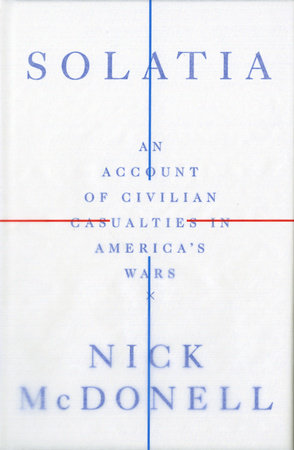
In a similar vein (I imagine) is a forthcoming book by journalist and novelist Nick McDonell: Solatia: an account of civilian casualties in America’s wars:

Since 2003, America’s wars in Iraq and Afghanistan have killed hundreds of thousands of civilians — by some counts, more than a million — and the number continues to grow. Of the many questions arising from these deaths — for which no one assumes responsibility, and which have been presented, historically, as unavoidable — perhaps the most fundamental question, for Americans, is this: if all men are created equal, why are we willing to kill foreign civilians?

Solatia (the term for money the U.S. pays to the families of civilian dead), sets out to answer that question. In all its wars, the United States both condemns and causes civilian casualties. But what exactly constitutes a civilian casualty? Why do they occur? What do our officials know of those reasons? How do they decide how many people they are willing to kill “by accident” — in a night raid, or drone strike, or invasion? And who, exactly, gets to decide?

Solatia is a globe-trotting, decade-spanning exploration into one of the most fundamental issues of our time. Following an array of officials, combatants, and civilians trying to survive — spies and senators, police chiefs and accountants caught in air strikes, orphaned street kids and widowed mothers, Iranian milita leaders, Taliban spokesmen and Marine special forces operators — Solatia confronts the U.S.’ darkest history abroad, illuminates its ongoing battles, and offers an original view of what it means to be a citizen of America at war.

It’s due in March from Penguin/Random House.

Death and the Contemporary

The latest (double) issue of New Formations (89/90: 2017) is devoted to ‘Death and the Contemporary’, and it includes two essays likely to be of particular interest to readers of this blog.

First, François Debrix, ‘Horror beyond Death: Geopolitics and the pulverisation of the human‘:

From territorial conquests or wars of attrition to the concentration camps or policies of control of displaced populations, the biopolitical capture of human life in configurations of geopolitical power has often involved the putting to death of populations. While, following Foucault’s work, we can argue that late modern political power has been concerned with the management of people’s lives or with the ‘health’ of a population, this capacity to ‘make live and let die’ (as Foucault put it) is never separate from a modality of force premised upon a right to put to death. Thus, the distinction between biopolitics and what has been called thanatopolitics or necropolitics can no longer be guaranteed. The goal of this essay is to push further the biopolitical/ necropolitical argument by showing that, in key contemporary instances of geopolitical violence and destruction, the life and/or death of populations and individual bodies is not a primary concern. What is of concern, rather, is what I have called the pulverization of the human. I consider this targeting of the human, or of humanity itself, to be a matter of horror. Horror’s aim, when it enters the domain of geopolitical destruction, appears to be to put bodies to death. But, more crucially, its aim is to render human bodies, beyond the fact of life and death, unrecognizable, unidentifiable, and sometimes undistinguishable from non-human matter. Horror does not care to recompose human life or humanity. This essay briefly details the argument about horror and horror’s ‘objectives’ beyond death. It also takes issue with recent theories that have argued that traces of human life can be recovered from contemporary instances of geopolitical violence and destruction. Finally, this essay offers two contemporary illustrations of horror’s targeting of the human by examining the role and place of horror in suicide bombings and in drone attacks.

Second, Andrea Brady, ‘Drone poetics‘:

‘Drone Poetics’ considers the challenge to the theory and practice of the lyric of the development of drone warfare. It argues that modernist writing has historically been influenced by aerial technology; drones also affect notions of perception, distance and intimacy, and the self-policing subject, with consequences for contemporary lyric. Indeed, drone artworks and poems proliferate; and while these take critical perspectives on drone operations, they have not reckoned with the phenomenological implications of execution from the air. I draw out six of these: the objectification of the target, the domination of visuality, psychic and operational splitting, the ‘everywhere war’, the intimacy of keyhole observations, and the mythic or psychoanalytic representation of desire and fear. These six tropes indicate the necessity for a radical revision of our thinking about the practice of writing committed poetry in the drone age.

Bombs, bunkers and borders

Here is the first of a series of updates on Syria, this one identifying recent work on attacks on hospitals and health care which I’ve been reading while I turn my previous posts into a long-form essay (see ‘Your turn, doctor‘ and ‘The Death of the Clinic‘).

First, some context.  Human Rights Watch has joined a chorus of NGOs documenting attacks on hospitals and health care around the world.  On 24 May HRW issued this bleak statement:

Deadly attacks on hospitals and medical workers in conflicts around the world remain uninvestigated and unpunished a year after the United Nations Security Council called for greater action, Human Rights Watch said today.

On May 25, 2017, UN Secretary-General Antonio Guterres is scheduled to brief the Security Council on the implementation of Resolution 2286, which condemned wartime attacks on health facilities and urged governments to act against those responsible. Guterres should commit to alerting the Security Council of all future attacks on healthcare facilities on an ongoing rather than annual basis.

“Attacks on hospitals challenge the very foundation of the laws of war, and are unlikely to stop as long as those responsible for the attacks can get away with them,” said Bruno Stagno-Ugarte, deputy executive director for advocacy at Human Rights Watch. “Attacks on hospitals are especially insidious, because when you destroy a hospital and kill its health workers, you’re also risking the lives of those who will need their care in the future.”

The statement continues:

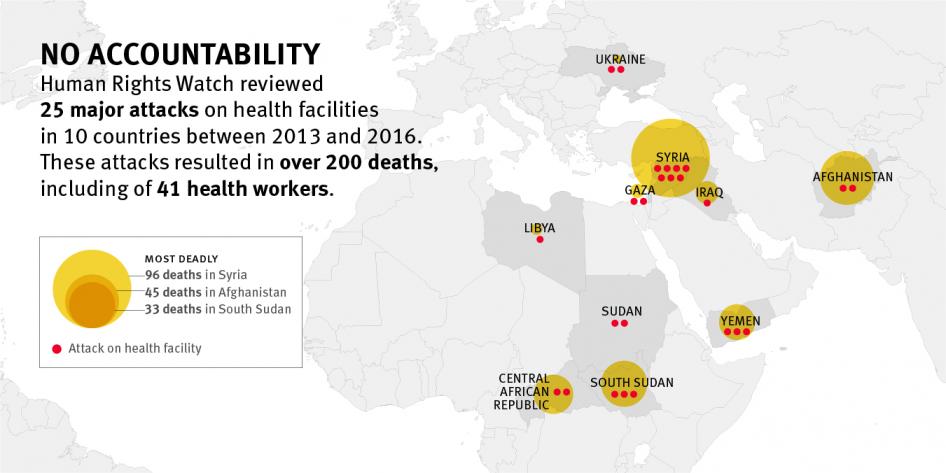
International humanitarian law, also known as the laws of war, prohibits attacks on health facilities and medical workers. To assess accountability measures undertaken for such attacks, Human Rights Watch reviewed 25 major attacks on health facilities between 2013 and 2016 in 10 countries [see map above]. For 20 of the incidents, no publicly available information indicates that investigations took place. In many cases, authorities did not respond to requests for information about the status of investigations. Investigations into the remaining five were seriously flawed…

No one appears to have faced criminal charges for their role in any of these attacks, at least 16 of which may have constituted war crimes. The attacks involved military forces or armed groups from Afghanistan, Central African Republic, Iraq, Israel, Libya, Russia, Saudi Arabia, South Sudan, Sudan, Syria, Ukraine, and the United States.

More here.

The World Health Organisation reached similar conclusions in its report of 17 May 2017:

Alexandra Sifferlin‘s commentary for Time drew attention to the importance of attacks on medical facilities in Syria:

In a 48-hour period in November, warplanes bombed five hospitals in Syria, leaving Aleppo’s rebel-controlled section without a functioning hospital. The loss of the Aleppo facilities — which had been handling more than 1,500 major surgeries each month — was just one hit in a series of escalating attacks on health care workers in 2016, the World Health Organization (WHO) reported on Friday.

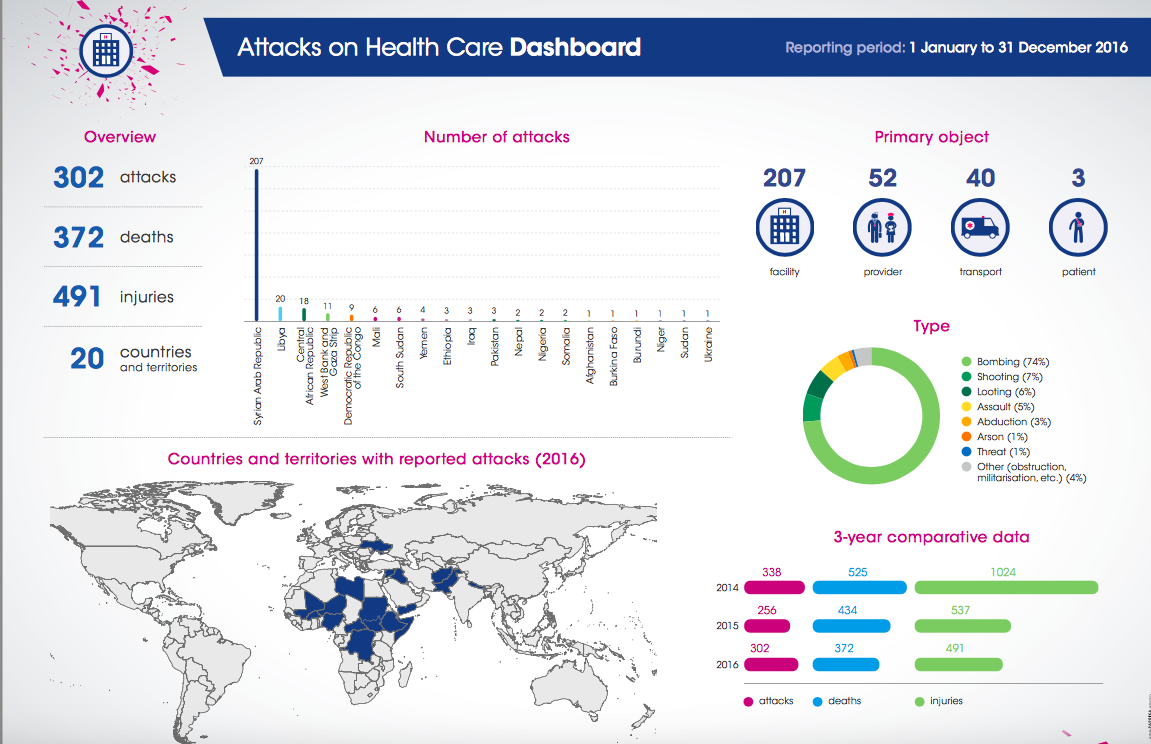
Violent attacks on hospitals and health workers “continue with alarming frequency,” the WHO said in its new report. In 2016, there were 302 violent attacks, which is about an 18% increase from the prior year, according to new data. The violence — 74% was in the form of bombings — occurred in 20 countries, but it was driven by relentless strikes on health facilities in Syria, which the WHO has previously condemned. Across the globe, the 302 attacks last year resulted in 372 deaths and 491 injuries…

After the spate of attacks on Syrian hospitals last November, the WHO reported that three of the bombed hospitals in Aleppo had been providing over 10,000 consultations every month. Two other bombed hospitals in the city of Idleb were providing similar levels of care, including 600 infant deliveries. One of the two hospitals in Idleb was a primary referral hospital for emergency childbirth care.

“The attack…is an outrage that puts many more lives in danger in Syria and deprives the most vulnerable – including children and pregnant women – of their right to health services, just at the time when they need them most,” the WHO said.

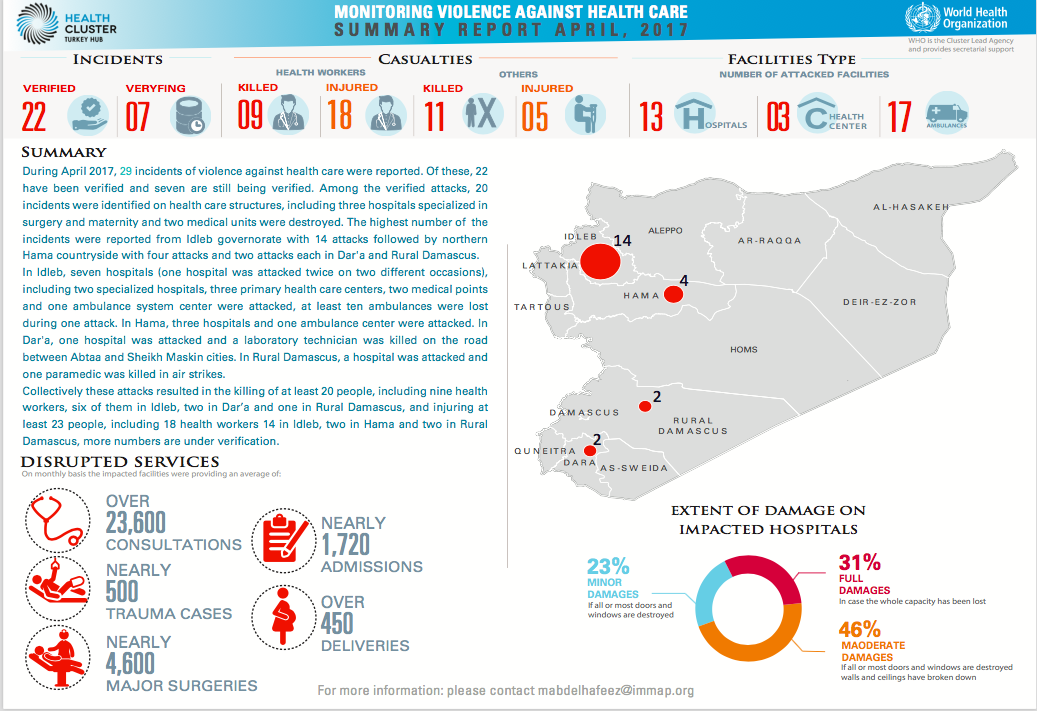
The WHO has also provided a series of reports on attacks on hospitals and health care in Syria; here is its summary for last month:

But the WHO’s role in the conflict in Syria has been sharply criticised by Annie Sparrow, who has accused it of becoming a de facto apologist for the Assad regime.  Writing in Middle East Eye earlier this year, she said:

For years now, the World Health Organisation (WHO) has been fiddling while Syria burns, bleeds and starves. Despite WHO Syria having spent hundreds of millions of dollars since the conflict began in March 2011, public health in Syria has gone from troubling in 2011 to catastrophic now…

Yet WHO Syria has been anything but an impartial agency serving the needy. As can be seen by a speech made by Elizabeth Hoff, WHO’s representative to Syria, to the UN Security Council (UNSC) on 19 November 2016, WHO has prioritised warm relations with the Syrian government over meeting the most acute needs of the Syrian people.

Annie singles out three particularly problematic issues.

  • She claims that the WHO parrots the Assad regime’s claim that before the conflict its vaccination programmes had covered 95 per cent of the population (or better), whereas she insists that vaccinations had been withheld from children ‘in areas considered politically unsympathetic, such as the provinces of Idlib, western Aleppo, and Deir Ezzor.’  On her reading, in consequence, the re-emergence of (for example) polio ‘is consistent with pre-existing low immunisation rates and the vulnerability of Syrian children living in government-shunned areas.’
  • It was not until 2016 that the WHO reported attacks on hospitals at all, and when its representative condemned ‘repeated attacks on healthcare facilities in Syria’ she failed to note that the vast majority of those attacks were carried out by the Syrian Arab Air Force and its Russian ally.  The geography of deprivation was erased: ‘It is only in opposition-held areas that healthcare is compromised because of the damage and destruction resulting from air strikes by pro-government forces.’
  • Those corpo-materialities – an elemental human geography, so to say – did emerge when the WHO accused the Assad regime of of ‘withholding approval for the delivery of surgical and medical supplies to “hard-to-reach” and “besieged” locations.’  But Annie objects to these ‘politically neutral terms’ because they are ‘euphemisms for opposition-controlled territory, and so [avoid] highlighting the political dimension of the aid blockages, or the responsibility of the government for 98 percent of the more than one million people forced to live in an area under siege.’

You can read WHO’s (I think highly selective) response here.

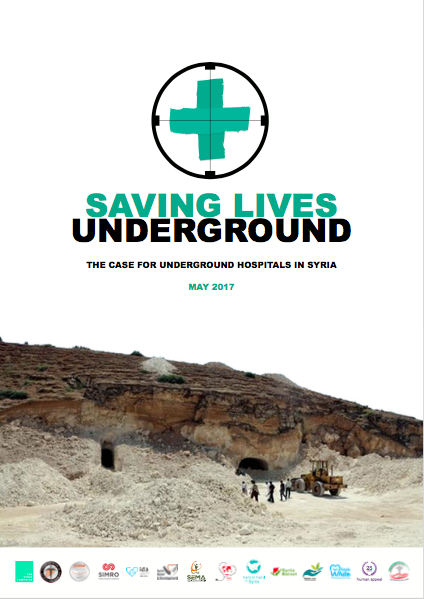
Earlier this month 13 Syrian medical organisations combined with the Syria Campaign to document how attacks on hospitals have driven hospitals and health facilities underground (I described this process – and the attacks on the Cave Hospital and the underground M10 hospital in Aleppo – in ‘Your turn, doctor‘).  In Saving Lives Underground, they write:

Health facilities in Syria are systematically targeted on a scale unprecedented in modern history.

There have been over 454 attacks on hospitals in the last six years, with 91% of the attacks perpetrated by the Assad government and Russia. During the last six months of 2016, the rate of attacks on healthcare increased dramatically. Most recently, in April 2017 alone, there were 25 attacks on medical facilities, or one attack every 29 hours.

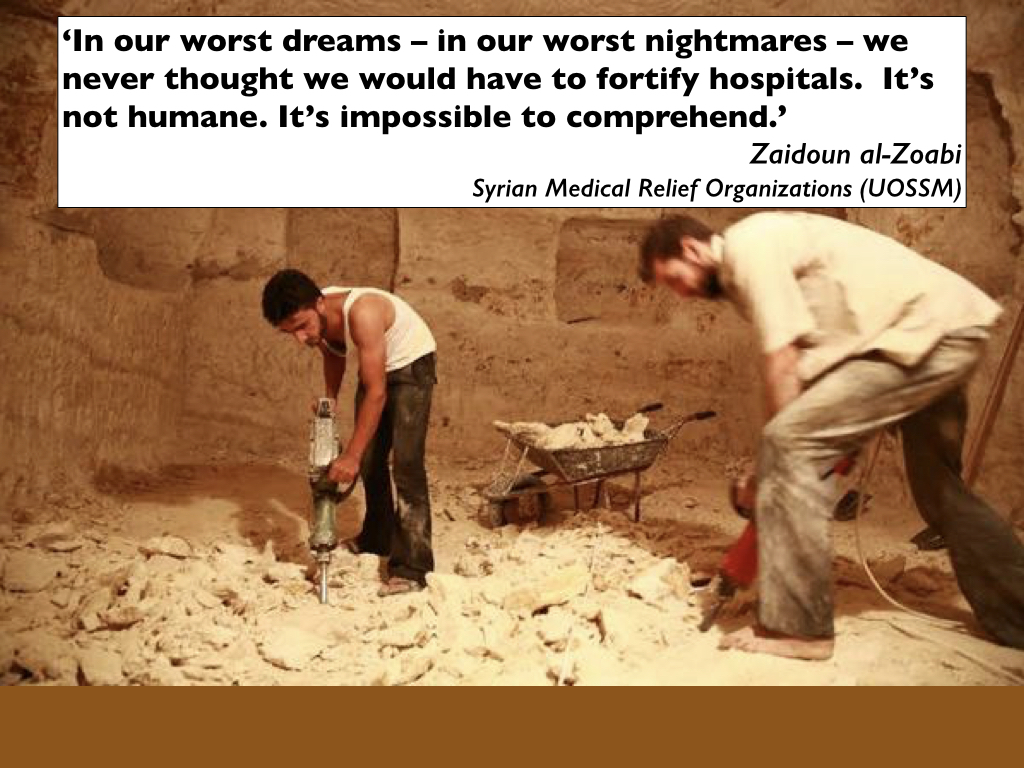
While the international community fails to protect Syrian medics from systematic aerial attacks on their hospitals, Syrians have developed an entire underground system to help protect patients and medical colleagues as best they can. The fortification of medical facilities is now considered a standard practice in Syria. Field hospitals have been driven underground, into basements, fortified with sandbags and cement walls, and into caves. These facilities have saved the lives of countless health workers and patients, preserved critical donor-funded equipment, and helped prevent displacement by providing communities with emergency care.

But all this comes at a cost:

Donors often see the reinforcement and building of underground medical facilities exclusively as long-term aid, or development work. However, as the Syria crisis is classified as a protracted emergency conflict, medical organizations do not currently have access to such long-term funds.

Budget lines for the emergency funding they receive can include “protection” work, but infrastructure building, even for protective purposes, often falls outside of their mandate. The divide between emergency humanitarian and development funding is creating a gap for projects that bridge the two, like protective measures for hospitals in Syria.

For this reason, as Emma Beals reported in the Guardian, many projects have resorted to crowdfunding:

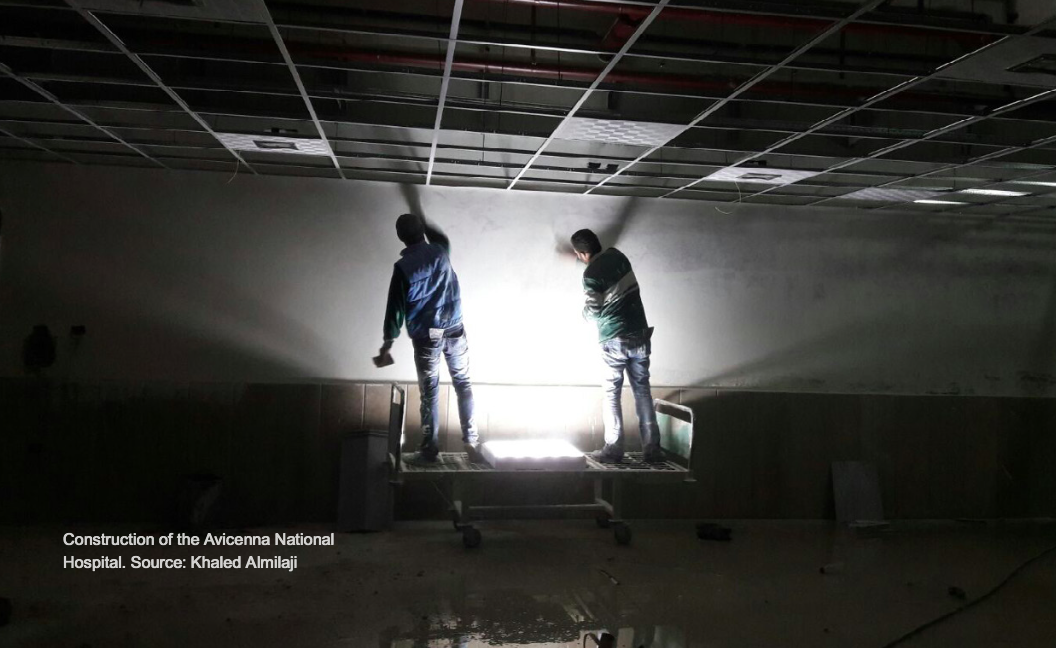
The latest underground medical project seeking crowdfunding to complete building works is the Avicenna women and children’s hospital in Idlib City, championed by Khaled al-Milaji, head of the Sustainable International Medical Relief Organisation.

Al-Milaji is working to raise money with colleagues from Brown University in the US, where he studied until extreme security vetting – the Trump administration’s “Muslim ban” – prevented him re-entering the country after a holiday in Turkey.

He has instead turned his attention to building reinforced underground levels of the hospital, sourcing private donations to meet the shortfall between donor funding and actual costs…

Crowdfunding was an essential part of building the children’s Hope hospital, near Jarabulus in northern Syria. The project is run by doctors from eastern Aleppo, who were evacuated from the city in December after it was besieged for nearly six months amid a heavy military campaign. Doctors worked with the People’s Convoy, which transported vital medical supplies from London to southern Turkey as well as raising funds to build the hospital, which opened in April. More than 4,800 single donations raised the building costs, with enough left over to run the hospital for six months.

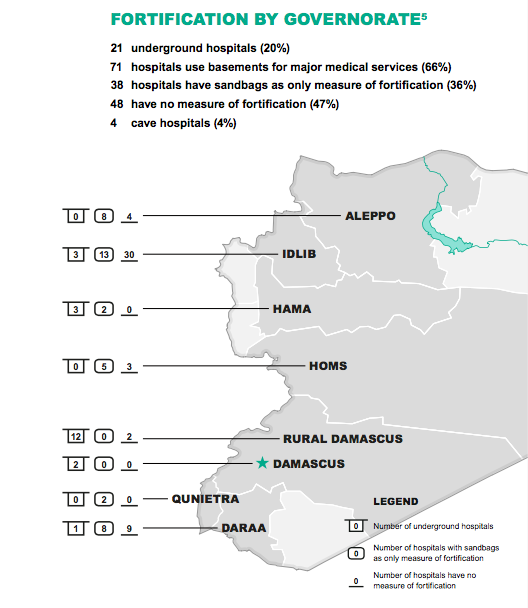
Saving Lives Underground distinguishes basement hospitals (the most common response to aerial attack by aircraft or shelling: 66 per cent of fortified hospitals fall into this category; the average cost is usually around $80–175,000, though more elaborate rehabilitation and repurposing can run up to $1 million); cave hospitals (‘the more effective protection model’ – though there are no guarantees – which accounts for around 4 per cent of fortified hospitals and which typically cost around $200–800,000) and purpose-built underground hospitals (two per cent of the total; these can cost from $800,000 to $1,500,000).

It’s chilling to think that hospitals have to be fortified and concealed in these ways: but even more disturbing, the report finds that 47 per cent of hospitals in these vulnerable areas have no fortification at all.

Seriously ill or wounded patients trapped inside besieged areas have few choices: medical facilities are degraded and often makeshift; access to vital medical supplies continues to be capriciously controlled and often denied; and attempts to evacuate them depend on short-lived ceasefires and deals (or bribes).  In Aleppo control of the Castello Road determined whether ambulances could successfully run the gauntlet from eastern Aleppo either west to hospitals in Reyhanli in Turkey or out to the Bab-al Salama Hospital in northern Aleppo and then across the border to state-run hospitals in Kilis: but in the absence of a formal agreement this was often a journey of last resort.

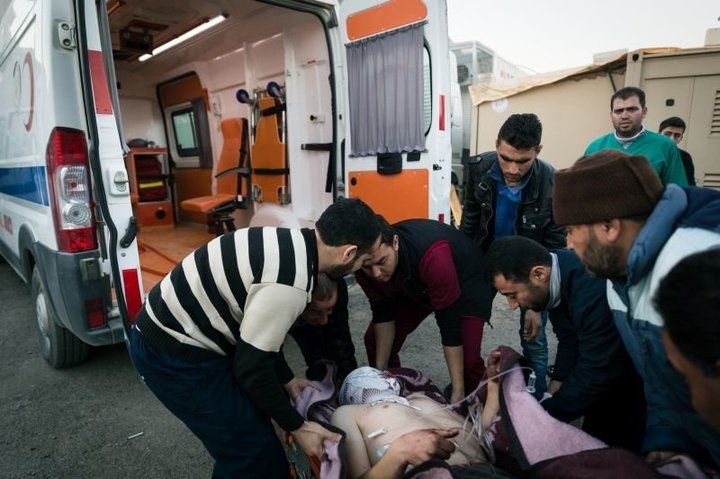
A victim of a barrel bomb attack in Aleppo is helped into a Turkish ambulance on call at the Bab al Salama Hospital near the Turkish border.

In October 2016 there were repeated attempts to broker medical evacuations from eastern Aleppo; eventually an agreement was reached, but the planned evacuations were stalled and then abandoned.  In December a new ‘humanitarian pause’ agreed with Russia and the Syrian government allowed more than 100 ambulances to be deployed by the Red Cross and the Red Crescent from Turkey; 200 critical patients were ferried from eastern Aleppo to hospitals in rural Aleppo, Idlib or Turkey – but the mission was abruptly terminated 24 hours after it had started.

The sick and injured have continued to make precarious journeys to hospitals in Turkey (Bab al-Hawa, Kilis, Reyhanli and other towns along the  border: see here, here and here), and also Jordan (in Ramtha and Amman, and in the Zaatari refugee camp: see here and here), Lebanon (in Beirut, Tripoli and clinics in the Bekaa Valley), and even Israel (trekking across the Golan Heights into Northern Israel: see here, herehere and especially here).

But there are no guarantees; travelling within Syria is dangerous and debilitating for patients, and access to hospitals outside Syria is frequently disrupted by border closures (which in turn can thrust the desperate into the hands of smugglers).  In March 2016, for example, Amnesty International reported:

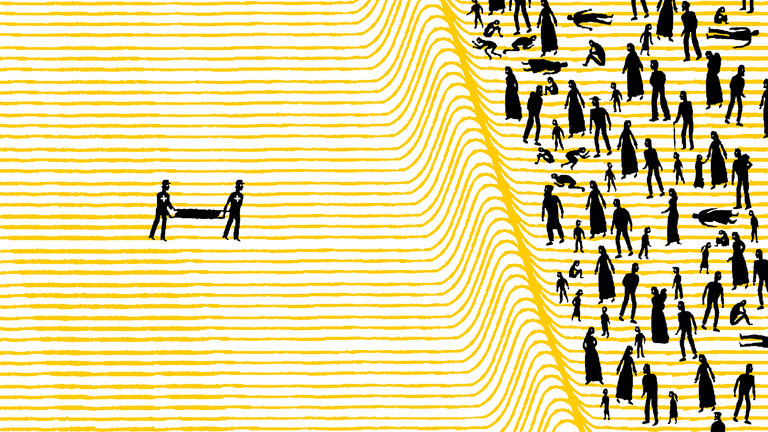
 Since 2012 Jordan has imposed increasing restrictions on access for Syrians attempting to enter the country through formal and informal border crossings. It has made an exception for Syrians with war-related injuries.  However, Amnesty International has gathered information from humanitarian workers and family members of Syrian refugees with critical injuries being denied entry to Jordan for medical care, suggesting the exceptional criteria for entry on emergency medical grounds is inconsistently applied. This has led to refugees with critical injuries being returned to field hospitals in Syria, which are under attack on a regular basis, and to some people dying at the border.

In June Jordan closed the border, after an IS car bomb killed seven of its soldiers, and by December MSF had been forced to close its clinic at the Zaatari camp, which had provided post-operative care for casualties brought in from Dara’a.

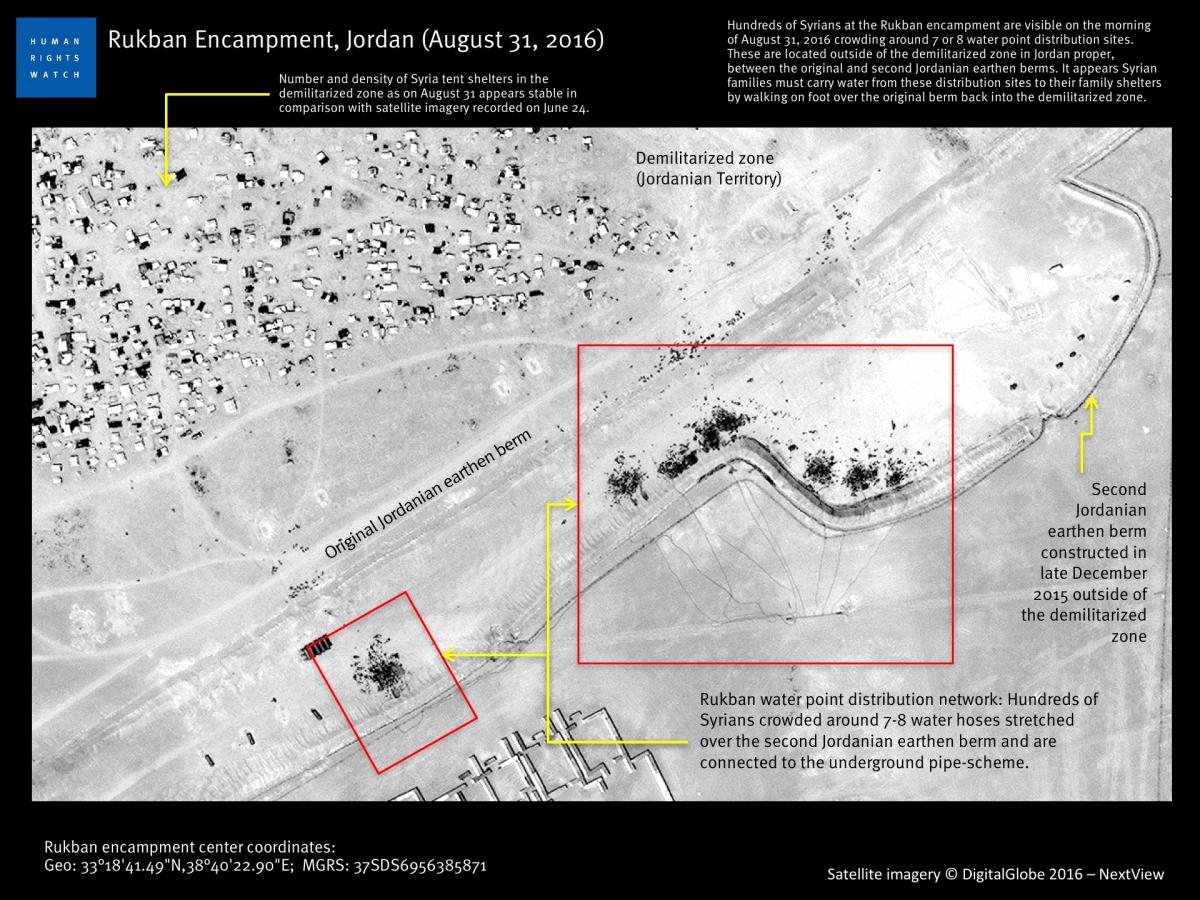
Tens of thousands of refugees are now trapped in a vast, informal encampment (see image above) between two desert berms in a sort of ‘no man’s land‘ between Syria and Jordan.  From there Jordanian troops transport selected patients to a UN clinic, located across the border in a sealed military zone – ‘and then take them back again to the checkpoint after they are treated.’

(For the image above, and a commentary by MSF’s Jason Cone, see here).

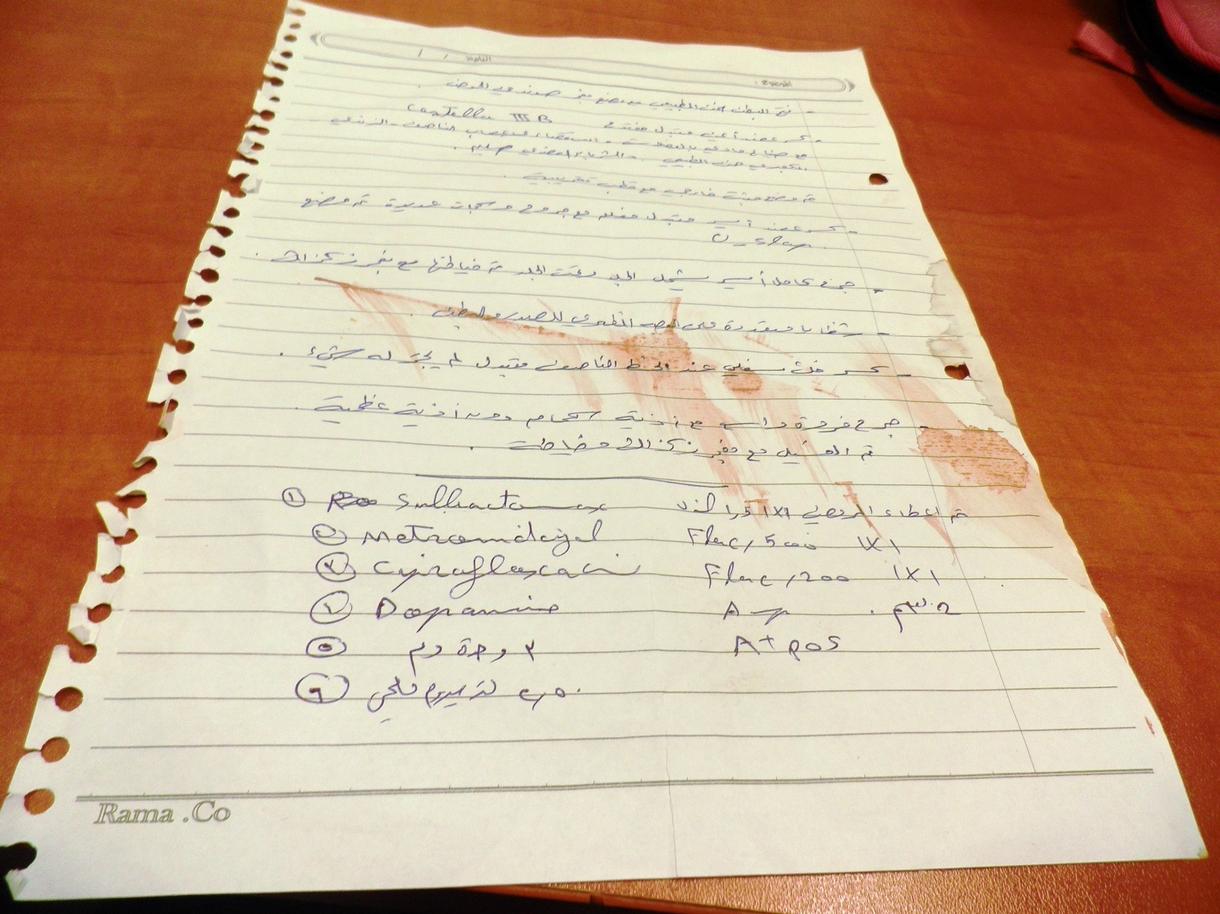
For patients who do manage to make it across any of these borders, it’s far from easy for doctors to recover their medical history – as the note below, pinned to an unconscious patient who was admitted to the Ziv Medical Center in Safed implies – and in the case of Syria (as in Iraq) everything is further complicated by a fraught politics of the wound.

Here, for example, is Professor Ghassan Abu-Sitta, head of plastic and reconstructive surgery at the medical centre in Beirut, talking earlier this month with Robert Fisk:

In Iraq, patients wounded in Saddam’s wars were initially treated as heroes – they had fought for their country against non-Arab Iran.  But after the US invasion of 2003, they became an embarrassment.  “The value of their wounds’ ‘capital’ changes from hero to zero,” Abu-Sitta says.  “And this means that their ability to access medical care also changes.  We are now reading the history of the region through the wounds.  War’s wounds carry with them the narrative of the wounding which becomes political capital.”

In the bleak wars that have scarred Syria, and which continue to open up divisions and divides there too, the same considerations come into play with equal force.