Insurgent thoughts

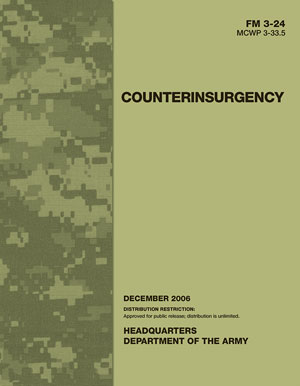
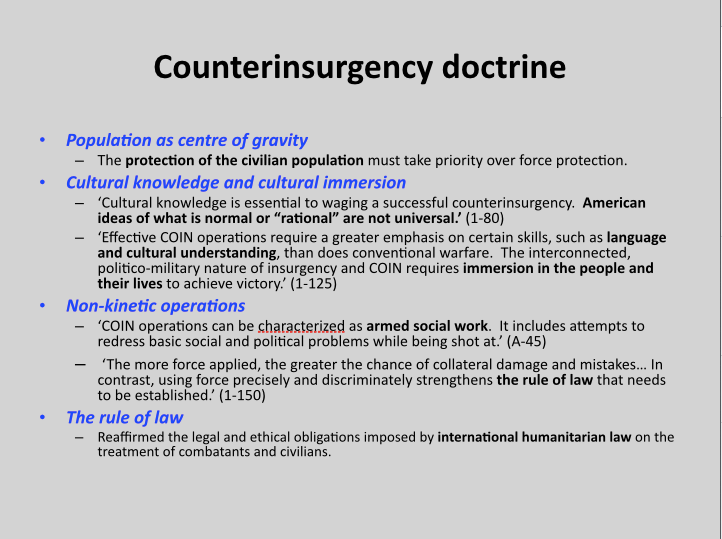
fm3-24When the US Army and Marine Corps issued their revised Field Manual 3-24 on Counterinsurgency in December 2006 there was an extraordinary public fanfare: a round of high-profile media appearances by some of its architects (you can watch John Nagl with Jon Stewart here) and, even though you could download the Manual for free – there were two million downloads in the first two months – the University of Chicago Press rushed out a paperback edition that hit the best-seller lists.  This was all to advertise counterinsurgency as what David Petraeus called ‘the graduate level of war’ and to inaugurate what I called, in ‘The rush to the intimate’ (DOWNLOADS tab), the US military’s ‘cultural turn’.  And as the media campaign made clear, it was also about the production of a public that would rally behind the new strategy to be put to work in Iraq.  The message was that the military had put the horrors of Abu Ghraib behind it – which were in any case artfully blamed on ‘rotten apples’ rather than the political-military manufacturers of the barrel that contained them – and was now marching beneath the banner of a kinder, gentler and above all smarter war (see my summary slide below).

COIN doctrine 2006

The new doctrine, first field-tested in Iraq and then applied to operations in Afghanistan, was not without its critics, both inside and outside the military.  Insiders complained that this was all smoke and mirrors – or more accurately, perhaps, too many mirrors and not enough smoke – because it was a distraction from the ‘real’ (the implication was, I think, ‘manly’) business of war-fighting, while outsiders objected to its weaponisation of culture and to the biopolitical project that it sought to advance.

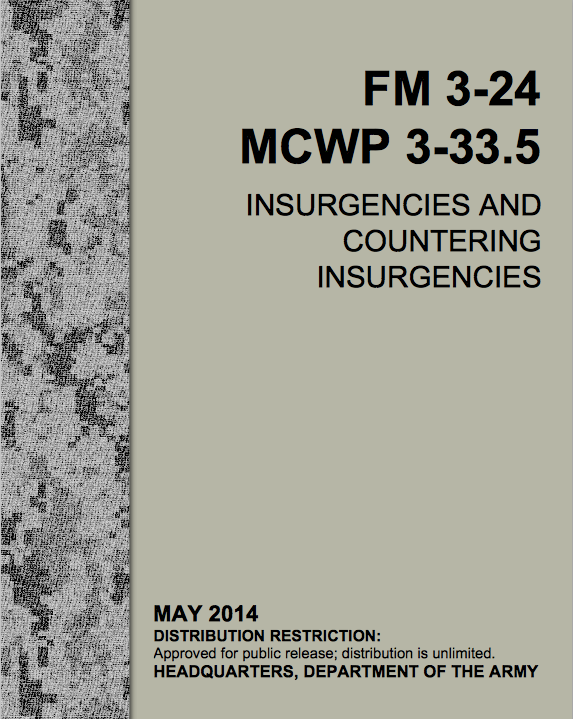
FM 3-24 2014The debate grumbled on, and many insiders insisted that COIN was dead and buried, interred in the killing fields of Afghanistan.  But a revised version of the doctrine has now been issued.  It was trailed by the Joint Publication 3-24 on Counterinsurgency last December (issued by the Army, Marine Corps, Navy, Air Force and – interestingly – the Coastguard Service), which you can download here (for an early review, see Robert Lamb and Brooke Shawn‘s ‘Is revised COIN manual backed by political will? here).  But the new Field Manual has been comprehensively re-written and even re-titled: Insurgencies and countering insurgencies, which you can download here.

I’m going to work my way through it in the next week or so – I can hardly complete The everywhere war without doing so – and I’ll post a commentary in due course, but it’s worth setting out its structure now:

PART ONE: STRATEGIC AND OPERATIONAL CONTEXT

1: Understanding the strategic context

2: Understanding an operational environment

3: Culture

PART TWO: INSURGENCIES

4: Insurgency prerequisites and fundamentals

5: Insurgency threat characteristics

PART THREE: COUNTERINSURGENCIES

6: Mission command and control

7: Planning for counterinsurgencies

8: Intelligence

9: Direct approaches to counter an insurgency

10: Indirect methods for countering insurgencies

11: Working with host-nation forces

12: Assessments

13: Legal considerations

I’m still interested in how the revision treats ‘culture’, of course, but I’m also keenly interested in the discussion of ‘intrastate war’ and insurgency, the direct incorporation of air power (which was relegated to an appendix in the previous edition), the attention paid to intelligence in it multiple guises, the role of biometrics (biopolitics again!) – and in that remarkable last chapter.  One of the central diagnostics of later modern war, in my view at any rate, is its reflexivity.  You can see that in the discussions of assessment and reassessment in the new FM 3-24 (Ch 12 in particular), but attention to metrics and ‘lessons learned’ is hardly novel even if the means of monitoring have changed.  What I have in (closer) mind is a preoccupation with the public reception of military operations and military violence – which involves a distinctive emphasis on its intellectual provenance (‘the graduate level of war’ again),  on media strategies (‘strategic communications’), and on the provision of a legal armature that works to inform and legitimate its operations (hence that last chapter).

I’m sure the new manual will be the subject of intense discussion over at the always provocative and thoroughly indispensable Small Wars Journal (see, for example, Bing West‘s opening salvo here and David Maxwell‘s more measured critique here), and elsewhere too, but I doubt that it will attract the public fanfare FM 3-24 received in 2006-7.  We’ll see.

Biometric war

The US military’s obsession with biometrics is, in part, the product of its phantasmatic desire to make the battlespace fully transparent, as its incorporation within the targeting cycle makes clear:

afghan-biometrics-cycle-1

But it’s also a vital means of furthering the profoundly biopolitical project embedded in later modern war (something that intersects, in various ways, with Mark Neocleous‘s arguments about military violence – war power/police power – and ‘ordering’):

The stated goal of the Afghan effort is no less than the collection of biometric data for every living person in Afghanistan. At a conference with Afghan officials in 2010, the commander of the U.S. Army’s Task Force Biometrics Col. Craig Osborne told the attendees that the collection of biometric data is not simply about “identifying terrorists and criminals,” but that “it can be used to enable progress in society and has countless applications for the provision of services to the citizens of Afghanistan.”

CALL-AfghanBiometrics-1I touched on some of this in a different context in ‘The biopolitics of Baghdad’ DOWNLOADS tab), and Public Intelligence has just released the U.S. Army Commander’s Guide to Biometrics in Afghanistanfrom which I’ve taken the image above, and which provides a much more detailed accounting.

The release also includes an illuminating short essay, ‘Identity dominance: the U.S. Military’s biometric war in Afghanistan‘, that provides a gloss on and a guide to the program:

In a section titled “Population Management,” the U.S. Army’s guide recommends that “every person who lives within an operational area should be identified and fully biometrically enrolled with facial photos, iris scans, and all ten fingerprints (if present).” The soldiers must also record “good contextual data” about the individual such as “where they live, what they do, and to which tribe or clan they belong.” According to the guide, popuation management actions “can also have the effect of building good relationships and rapport” by sending the message that the “census” is intended to protect them from “the influence of outsiders and will give them a chance to more easily identify troublemakers in their midst.”

For a wider, wonderfully critical commentary on biometric war, see Colleen Bell, ‘Grey’s Anatomy goes South: Global racism and suspect identities in the colonial present’, in the Canadian journal of sociology 38 (4) (2013) 465-486 available open access here.

Endless War and the machine

When I wrote ‘Seeing Red: Baghdad and the event-ful city’ (DOWNLOADS tab) I was intrigued by the way in which the US military apprehended the city as a field of events:

‘In Baghdad, these security practices performed a continuous audit that compiled reports of events (Significant Activity Reports or SIGACTS) and correlated the incidence of ‘enemy-initiated attacks’ and other ‘enemy actions’ with a series of civil, commercial and environmental indicators of the population at large: moments in the production of what Dillon and Lobo-Guerrero call a generalized bio-economy.’  

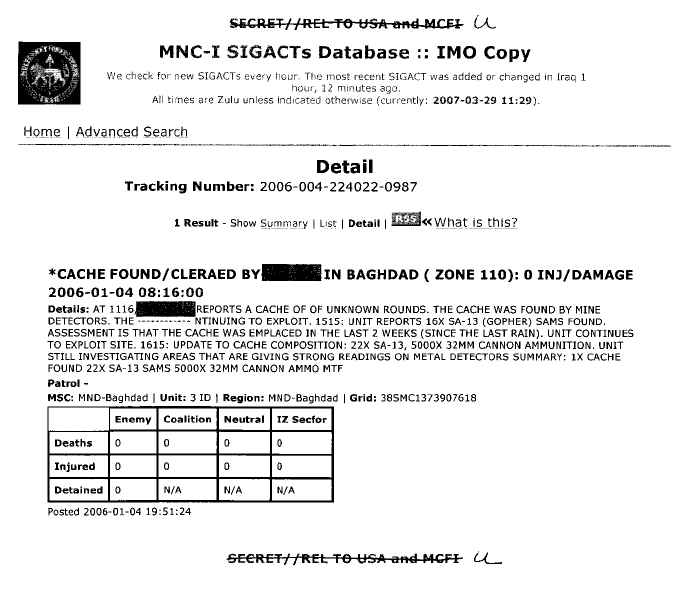
The animating core of the system was the SIGACT  – shown below – and these were eventually fed into a single reporting and analysis platform, the Combined Information Data Network Exchange (CIDNE).

SIGACT

‘The primary transcription of an event, its constitution as a SIGACT, with all its uncertainties and limitations, was transmitted downstream to be digitized and visualized, correlated and ‘cleansed’, so that it could be aggregated to show trends or mapped to show distributions.  All the systems for SIGACT recording and analysis interfaced with visualization and presentation software, which was used to generate ‘storyboards’ at every level in the chain.’

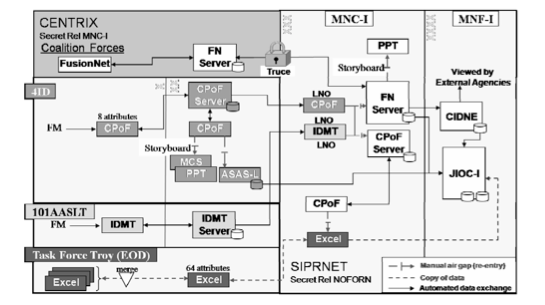
The chain as it was constituted in Iraq in May 2006 is shown below; CENTRIX (top left) is the Combined Enterprise Regional Information Exchange System that provided information exchange across the US-led coalition;  CPoF (scattered across the centre field) is the Command Post of the Future, a distributed GIS system I discussed in the original essay that provided a command-level visualization of the battlespace as a field of events (a system that has since been upgraded multiple times); and at the centre right you can see the key automated data exchanges to and from CIDNE:

MNF-I Event Reporting, May 2006 (Wortman)

Since I wrote, scholars have used SIGACT reports much more systematically to analyse the connective tissue between ethno-sectarian violence and the ‘surge’ – see, for example, Stephen Biddle, Jeffrey Friedman and Jacob Shapiro, ‘Testing the surge’, International Security 37 (1) (2012) 7-40; Nils Weidmann and Idean Saleyhan, ‘Violence and ethnic segregation: a computational model applied to Baghdad‘, International Studies Quarterly 57 (2013) 52-64 – to explore the political dynamics of civilian casualties – see, for example, Luke Condra and Jacob Shapiro, ‘Who takes the blame?  The strategic effects of collateral damage’, American Journal of Political Science 56 (1) (2012) 167-87 – and to conduct more general evaluations of counterinsurgency in Iraq: see, for example, Eli Berman, Jacob Shapiro and Joseph Felter, ‘Can hearts and minds be bought? The economics of counterinsurgency in Iraq’, Journal of political economy 119 (4) (2011) 766-819.

I’ve been revisiting these modelling exercises for The everywhere war, because they require me to rework my essay on ‘The biopolitics of Baghdad’ (though not, I think, to change its main argument).  I’m struck by the idiom they use – my critique of spatial science written in another age would have been substantially different had it been less preoccupied with the detecting of spatial pattern, had its methods been applied more often to issues that matter, and had its architects been less convinced of the self-sufficiency of their methods.

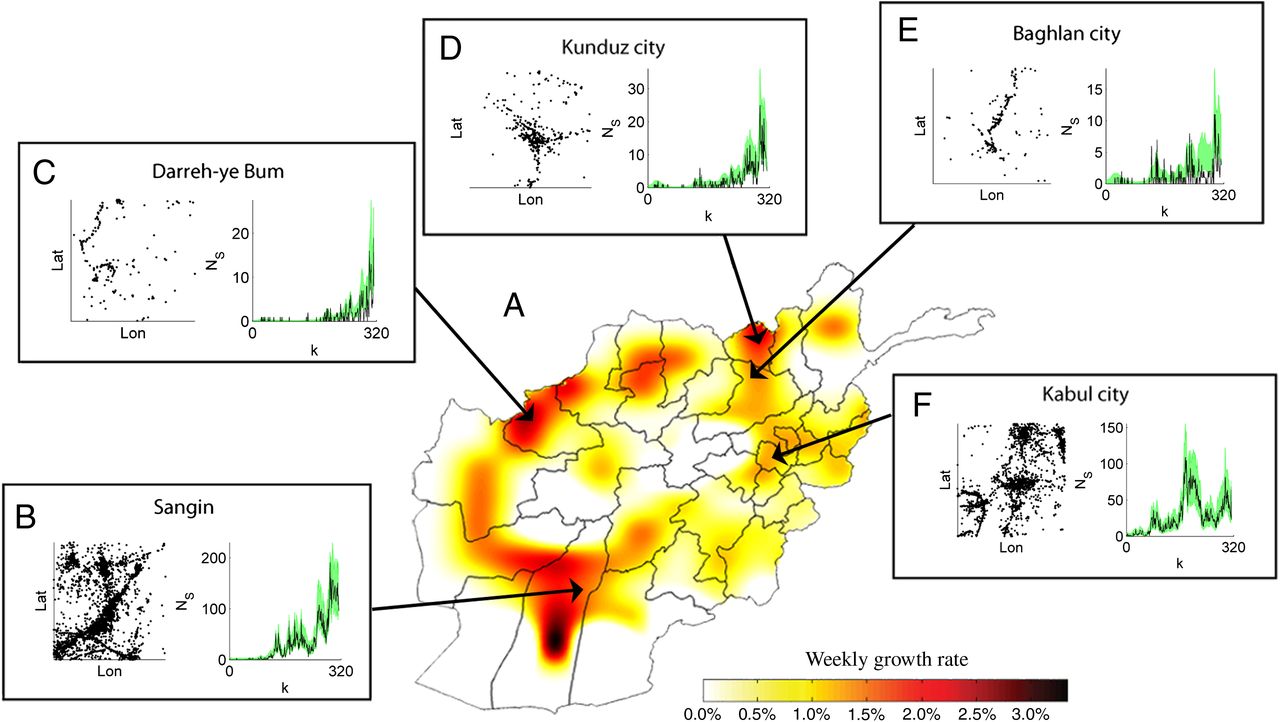
But I’m also struck by the idiom of the SIGACT itself.  We’ve since become much more accustomed to its staccato rhythm through Wikileaks’ release of the Afghan and Iraq War Diaries, whose key source was CIDNE.  Again, these have been visualised and analysed in all sorts of ways: see, for example, herehere, here and here (and especially Visualizing Data and its links here).  The image below comes from Andrew Zammit-Mangion, Michael Dewar, Visakan Kadirkamanathan and Guido Sanguinetti,’Point-process modelling of the Afghan War Diaries’, Proceedings of the National Academy of Sciences 109 (31) (2012) and shows the time-space incidence of events recorded in the Diaries (here I suspect I’m channelling half-remembered conversations with Andrew Cliff….)

F2.large

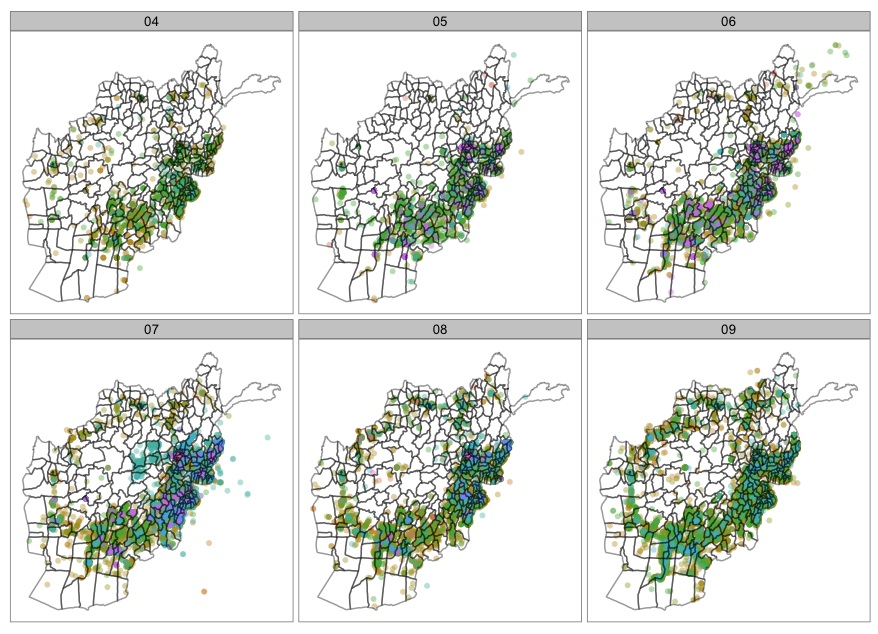
And here, rather more prosaically, is another version – by Drew Conway and Mike Dewar – that provides a time-sequence of the mounting intensity of the war 2004-2009 (for Danger Room‘s discussion and gloss, see here):

events_by_label_map

Now David Pinder has kindly drawn my attention to an extraordinarily suggestive essay by Graham Harwood,Endless War: on the database structure of armed conflict’ over at rhizome, and to the art-work that is it subject, which together have returned me to my original interest in the ‘event-field’ of later modern war and the automated interactions between its data platforms.

Graham’s central question is deceptively simple: ‘How does the way war is thought relate to how it is fought?’ SIGACTS populate the digital battlespace with events and invite a calculative and algorithmic apprehension of the field of military violence.  To show what this means, Graham and his partner Matsuko Yokokoji (who together compose YoHa: English translation ‘aftermath’) joined with his Goldsmith’s colleague Matthew Fuller to produce an intriguing artwork, Endless War.

It processes the WikiLeaks Afghan War Diary data set as a collection of analytic viewpoints, both machine and human. A software-driven system, Endless War reveals the structure of these viewpoints by using N-gram fingerprints, a method that allows sorting of the text as an anonymous corpus without having to impose predetermined categories on it. Presented as a gallery installation, the system includes a computer that processes the data in real time, projections of the results, and coil pick-up microphones on the central processing unit that sonify the inner working of the machine.

The torrent files released by WikiLeaks in 2010 are the residue of the system that created them, both machine and human. They seem to hint at the existence of a sensorium, an entire sensory and intellectual apparatus of the military body readied for battle, an apparatus through which the Afghan war is both thought and fought.

You can get a sense of the result from vimeo’s record of the installation at the Void Gallery in Derry:

This is a video, obviously, but Endless War isn’t a video.  As the artists explain in a note added to the vimeo clip:

Just as an algorithm is an ‘effective procedure’, a series of logical steps required to complete a task, the Afghan War Diary shows war as it is computed, reduced to an endless permutation of jargon, acronyms, procedure recorded, cross-referenced and seen as a sequence or pattern of events.

Endless War is not a video installation but a month-long real-time processing of this data seen from a series of different analytical points of view. (From the point of view of each individual entry; in terms of phrase matching between entries; and searches for the frequency of terms.) As the war is fought it produces entries in databases that are in turn analysed by software looking for repeated patterns of events, spatial information, kinds of actors, timings and other factors. Endless War shows how the way war is thought relates to the way it is fought. Both are seen as, potentially endless, computational processes. The algorithmic imaginary of contemporary power meshes with the drawn out failure of imperial adventure.

This computational assemblage (think not only of the cascading algorithms but also of the people and the handshakes between the machines: a political technology ‘full of hungry operators’, as Graham has it) is performative: it is at once an inventory – an archive – and a machine for producing a particular version of the military future. Graham again:

‘A SigAct necessarily retains evidential power that reflects its origin outside of the system that will now preserve it, but once isolated from blood and guts, sweat and secretions of the theatre of action (TOA), the SigActs are reassembled through a process of data atomisation. This filter constructs a domain where the formal relation, set theory, and predicate logic has priority over the semantic descriptions of death, missile strikes, or the changing of a tank track and the nuts and bolts needed…

This system of record keeping can be seen as a utopia of war. It is idealized, abstracted, contained; time can be rolled back or forward at a keystroke, vast distances traversed in a query, a Foucauldian placeless place that opens itself up behind the surface of blood-letting and hardware maintenance and the ordering of toilet rolls. A residue that casts a shadow to give NATO visibility to itself. As the ensemble of technical objects and flesh congeal, they create an organ to collectively act to rid itself of some perceived threat—this time from Al Qaeda or the Taliban—faulty vehicles, bad supplies, or invasive politics. This organ also allows NATO’s human souls to imagine themselves grasping the moment, the contingency of now. All of the war, all of the significant events, all of the time, all of the land, coming under the symbolic control of a central administration through the database, affording governance to coerce down the chain of command.’

This is a much more powerful way of capturing – and, through the physical installation itself, conveying – what I originally and imperfectly argued in ‘Seeing Red’:

‘… optical detachment is threatened by a battle space that is visibly and viscerally alive with death; biopolitics bleeds into necropolitics. And yet the Press Briefings that are parasitic upon these visualizations move in a dialectical spiral, and their carefully orchestrated parade of maps, screens and decks reinstates optical detachment. For even as the distancing apparatus of the world-as-exhibition is dissolved and the map becomes the city, so the city becomes the map: and in that moment – in that movement – Baghdad is transformed into an abstract geometry of points and areas and returned to the field of geopolitics. And as those maps are animated, the body politic is scanned, and the tumours visibly shrink, so Baghdad is transformed into a biopolitical field whose ‘death-producing activities [are hidden] under the rhetoric of making live’ (Dauphinee and Masters 2007: xii). In this looking-glass world bodies are counted but they do not count; they become the signs of a pathological condition and the vector of recovery. These processes of abstraction are, of course, profoundly embodied. This is not algorithmic war, and behind every mark on the map/city is a constellation of fear and terror, pain and grief. For that very reason our disclosure of the infrastructure of insight cannot be limited to the nomination of the visible.’

The scene of the crime: customary law and forensic architecture

I returned from a wonderful visit to Glasgow last week – thanks so much to Jo Sharp, who ensured I had a criminally good time – and I’ve spent this week trying to catch up.  It rained most of the time I was there, and in fact my first impression of the University was of a quadrangle turned into a quagmire: a case of mire in the flood, you might say.  But nothing could dampen my spirits, and in the gaps between marvellous restaurants, coffee shops that would make anyone in Vancouver (or Seattle) green with envy, the best lunch ever, and truly excellent conversation, I gave two talks: one on my skeletal ideas about my new project on Medical-military machines and casualties of war, 1914-2014, and the other a more formal affair on ‘Dirty dancing: drone strikes, spaces of exception and the everywhere war.’ The purpose of the first talk was to explore, largely for graduate students, how I work; it generated a lively discussion, so I thought I would try to do the same in this post but in relation to the second presentation.  And in doing so, I’ll also have more to say about the scene of a real crime.

I’d prepared my formal presentation before I left Vancouver, and as I’ve explained before I now never read from a written text: I design the slides carefully (see my ‘Rules’ here) and talk to them, so that I retain as much flexibility as possible.  It’s a sort of semi-scripted improv, I suppose, and it also means that the argument can develop from one presentation to the next.

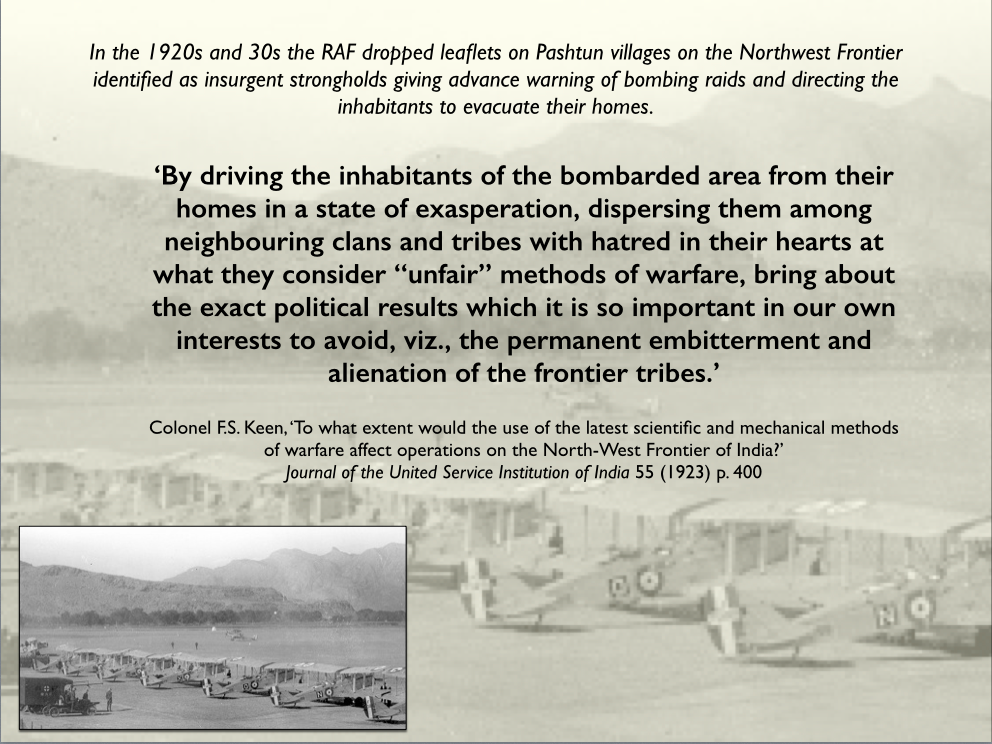
On the train up from London I started to think some more about the air strikes on the Federally Administered Tribal Areas (see also herehere and here).  Part of my purpose was to trace a narrative of air attack that, for those now ‘living under drones’, stretched back (at least in memory) to British air control and counterinsurgency on the North West Frontier in the 1920s and the 1930s.

Waziristan bombing 1920s and 30s PNG

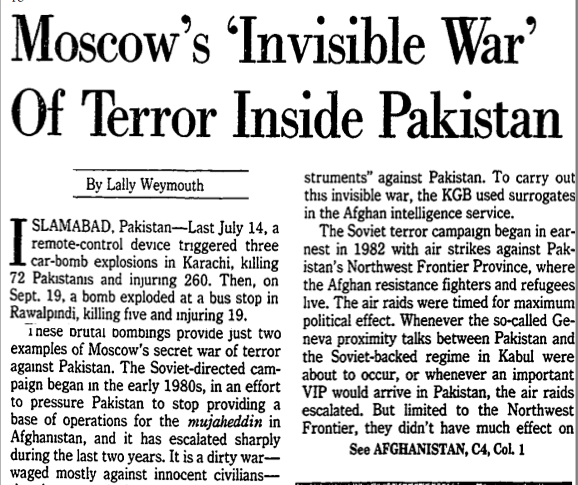
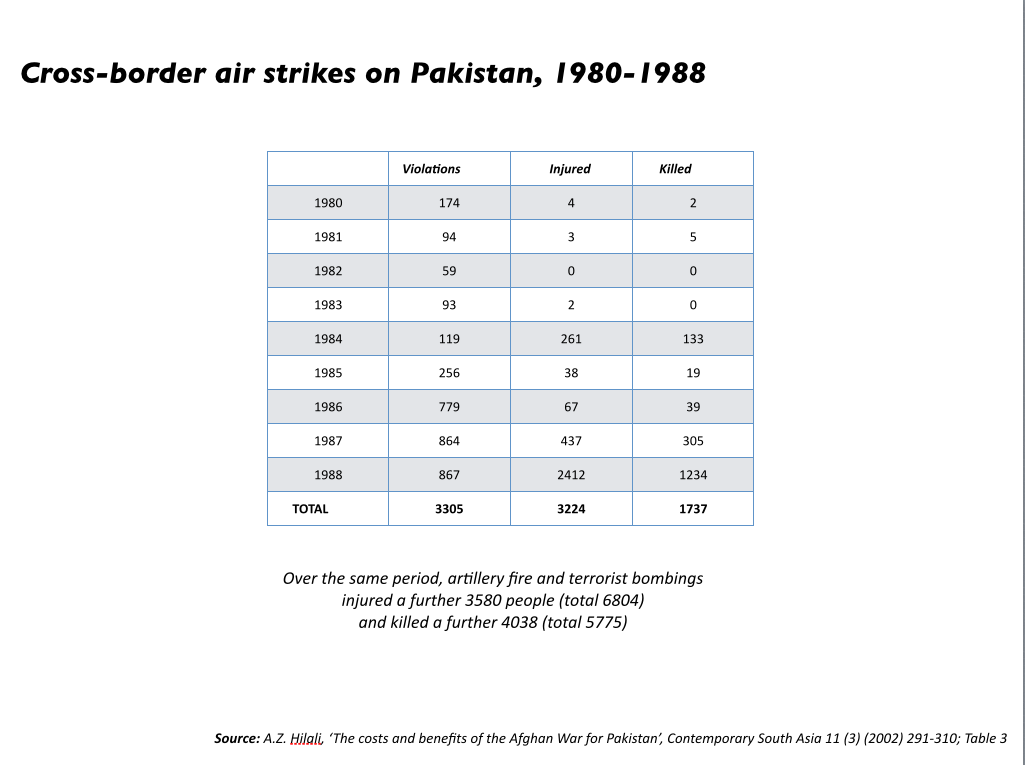
War of Terror inside Pakistan PNGI’d made this point before, and sharpened it during an earlier version of the presentation in Beirut, but I’d since realised that the narrative was resumed by the Soviet and Afghan Air Forces striking mujaheddin bases in Pakistan during the Soviet occupation of Afghanistan.  I hadn’t paid much attention to this in The colonial present, where my focus was on the aid provided by the CIA to mujaheddin striking across the border in the opposite direction, but these air raids were described by the Washington Post on 13 March 1988 as part of the USSR’s “war of terror” (really).  They are an important moment in the genealogy of air strikes and counterinsurgency in the FATA, and I’d managed to unearth some estimates of the number of cross-border violations of Pakistani air space and the number skilled and injured in the strikes:

Afghan:Soviet cross-border air strikes 1980-88

Then, in one of the ironic twists of our post 9/11 world, the (il)logic of air war was revived and ramped up by the CIA-directed drone strikes that have convulsed the borderlands since 2004.

I wanted to show, as I’ve argued in previous posts, that this narrative was more than a cross-border affair and that the Pakistan Air Force has been also actively involved in a series of domestic air campaigns: since 2008 it has carried out thousands of air strikes against what it describes as militants, insurgents and terrorists in the FATA.  In fact, the offensive was resumed earlier this year, when F-16 aircraft and helicopter gunships attacked targets in North Waziristan, driving thousands of people from their homes.

the-frontier-crimes-regulationIn some measure, all of these air campaigns raise the spectre of colonial power, but so too does the legal status of the FATA and its exceptional relation to the rest of Pakistan.  This is usually traced back to Lord Curzon’s Frontier Crimes Regulations (1901), which were retained by Pakistan after independence in 1947.  They were minimally revised in 2011, but the FATA are still under the direct executive control of the President through his appointed Political Agents who have absolute authority to decide civil and criminal matters. The exceptional status of the FATA was confirmed by the Actions (in Aid of Civil Power) Regulations in 2011 which exclude the high court from jurisdiction on fundamental rights issues in any area where the Pakistan armed forces have been deployed ‘in aid of the civil power’.

All of this indicates that the FATA constitute a ‘space of exception’ in something like Giorgio Agamben‘s sense of the term: a space in which particular people are knowingly exposed to death through the juridical or quasi-juridical removal of legal protections from them.  This was, in part, my argument, but I was also concerned to show that this was not a matter of a legal void: rather, military and paramilitary violence was orchestrated, as it almost always is, through the law.

But there is quite another sense in which the FATA is not a legal void, despite all the rhetoric about them being ‘lawless’ lands.  So I started to think through the intersections between these formal legal geographies (and the state violence they sanction) and the system of customary law known as Pashtunwali (loosely, “the way of the Pashtuns”).  The system is far from static, but it still governs many areas of life among Pashtuns on both sides of the Afghanistan-Pakistan border whose cultures and communities were bisected when the Durand Line was drawn in 1893.  I’d been reading as much as I could by anthropologists and others to help me understand its contemporary relevance: for recent surveys, see Tom Ginsburg‘s ‘An economic interpretation of the Pashtunwali’ from the University of Chicago Legal Forum (2011) here,  Lutz Rzehak‘s ‘Doing Pashto’ here, and Thomas Ruttig‘s qualifications in relation to the Taliban here.  For a sense of how the US military understands Pashtunwali, as part of its ‘cultural turn’, see Robert Ross‘s thesis here.

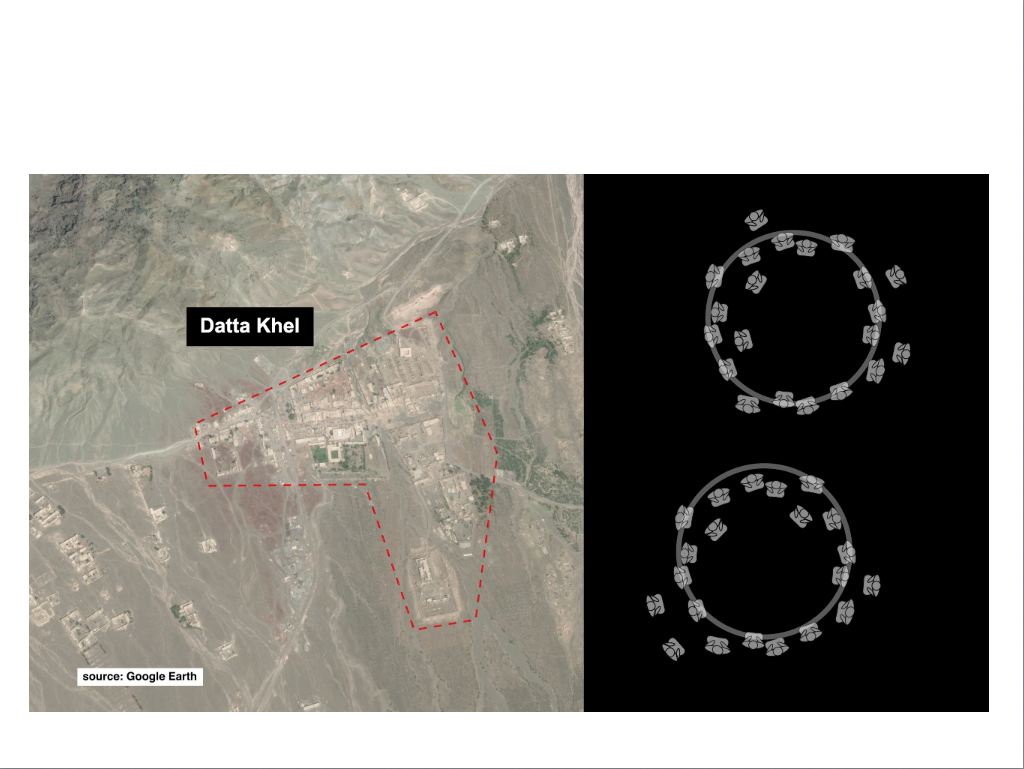
Pashtunwali is more than a legal system, of course, but I was particularly interested in its legal force and how this is put into practice.  Many commentators have shown that Pashtunwali is precisely the sort of ‘mobile’ legal system that you would expect to find among (originally) nomadic peoples, for whom the fixed statutes of a centralised state had neither appeal nor purchase.  It includes obligations of hospitality and protection, asylum and refuge, and revenge and restitution, and provides for a system of resolution through a council (or Jirga).  Within its patriarchal and masculinist framework, the system is resolutely non-hierarchical: the men who compose the Jirga sit in a circle and each, as a symbol of authority and equality, carries a gun.

Sitting in a circle, the Jirga has no speaker, no president, no secretary or convener. There are no hierarchical positions and required status of the participants. All are equal and everyone has the right to speak and argue, although, regard for the elders is always there without any authoritarianism or privileged rights attached to it. The Jirga system ensures maximum participation of the people in administering justice and makes sure that justice is manifestly done.

On my way over to the UK I’d read an extremely interesting essay in the International Review of Law and Economics 37 (2014) 108-20 – stored on Good Reader on my iPad – in which Bruce Benson and Zafar Siddiqui argued that the system works not only to provide a decentralised, local and regional system of order and regulation – so Hobbes was wrong: without the state people do not automatically revert to a ‘state of nature’ (Tom Ginsburg is very good on this) – but also to defend the Pashtun from the incursions of the central state.  Indeed, the Frontier Crimes Regulations specifically recognised the validity and autonomy of the Jirga: much more here.  The message from all this was clear: ‘The Pashtun tribes who inhabit the rugged mountains between Afghanistan and Pakistan are neither lawless nor defenceless.’

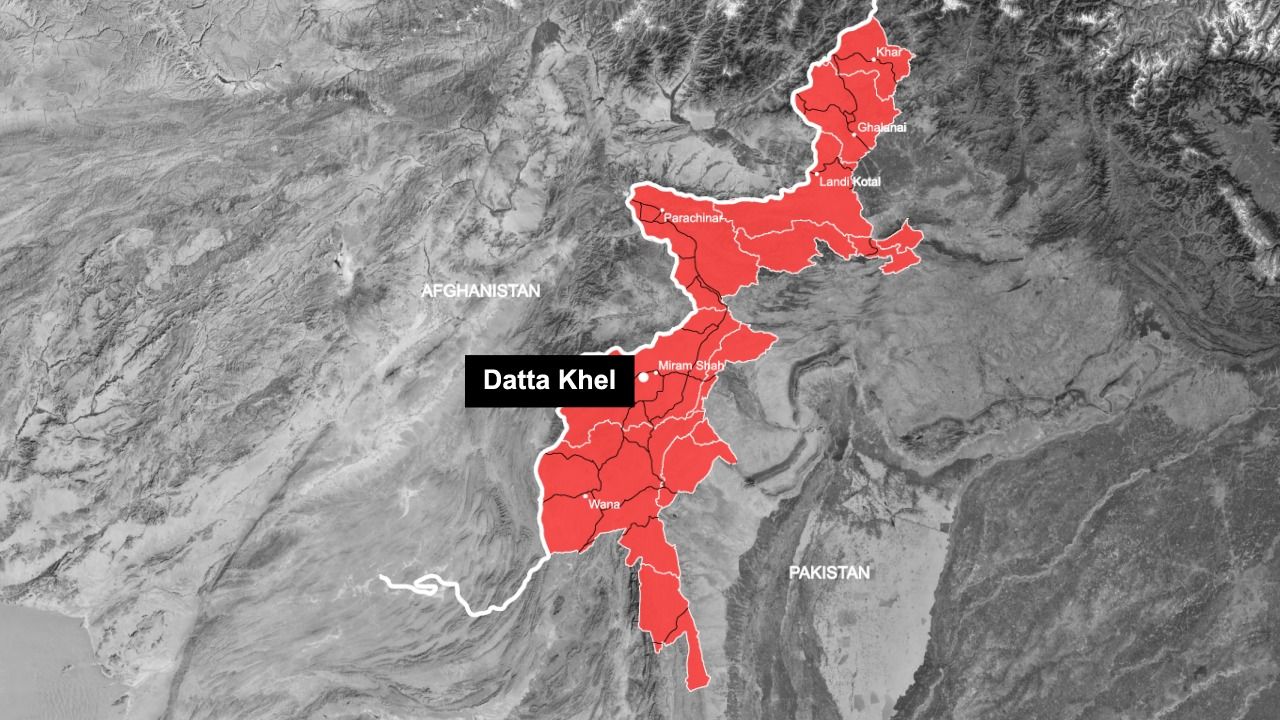
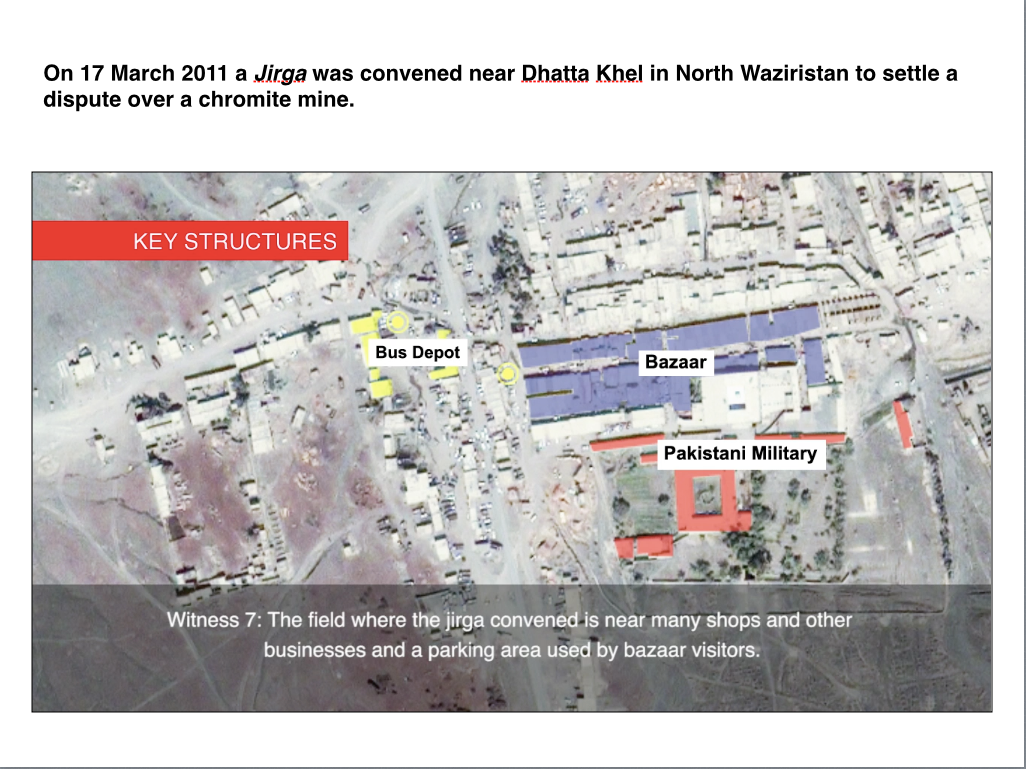
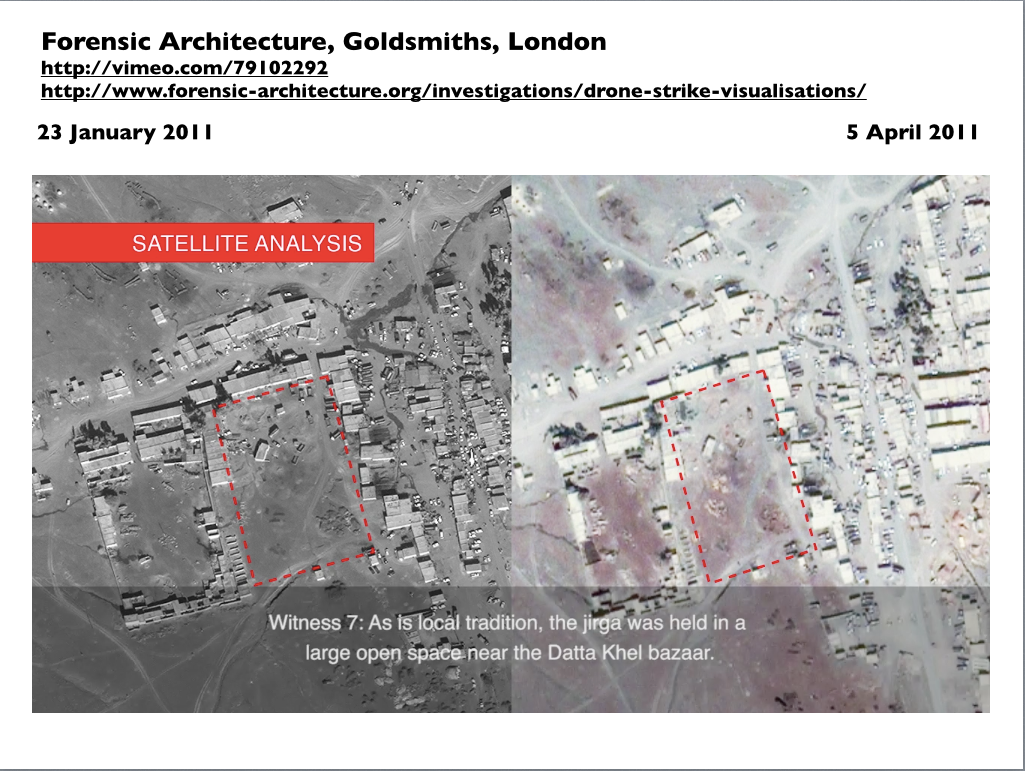
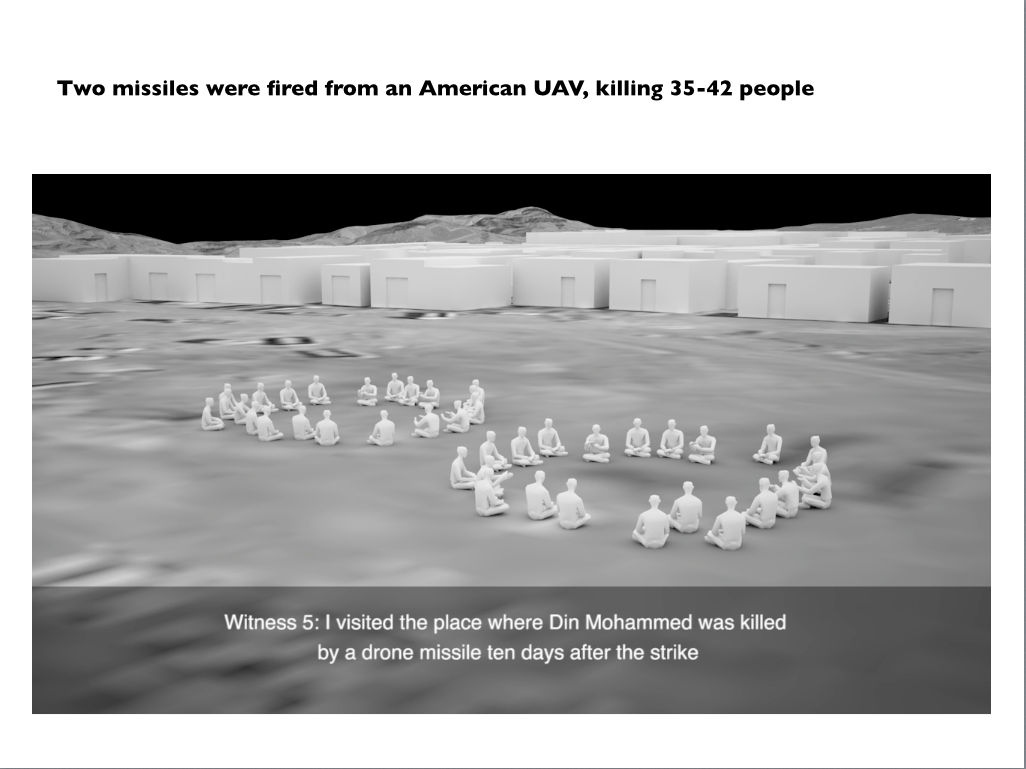
The Pakistan Taliban know this very well, not surprisingly, and in many instances work with Pashtunwali to mediate disputes in the FATA.  In fact, as the train curved around the Lake District I remembered reading about a Jirga being convened in Datta Khel in March 2011 to resolve a dispute over a chromite mine.  It’s odd how some things stick in your mind, like burrs on your jeans, but this incident had stayed with me because the Jirga had been targeted by the CIA and two Hellfire missiles were launched from a drone, killing more than 40 people.  In itself, that probably wouldn’t have been enough for me to remember it in any detail since it was all too common – but the usual faceless and anonymous US official, speaking off the record because he was not authorised to comment in his official capacity, had offered a series of ever more bizarre justifications for the strike: and I remembered those (as you’ll see in a moment, you could hardly forget them).

uekEs60GsR-YpEwf3VWpqOYckWFvgZ-CMcsK2DT0grQ

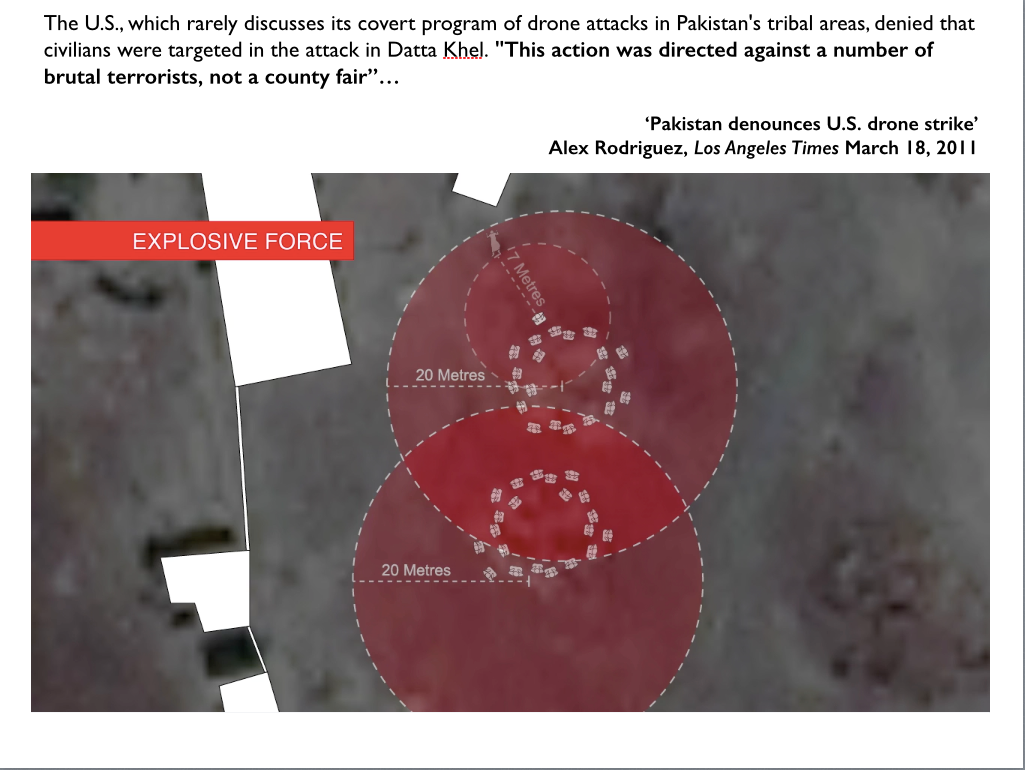
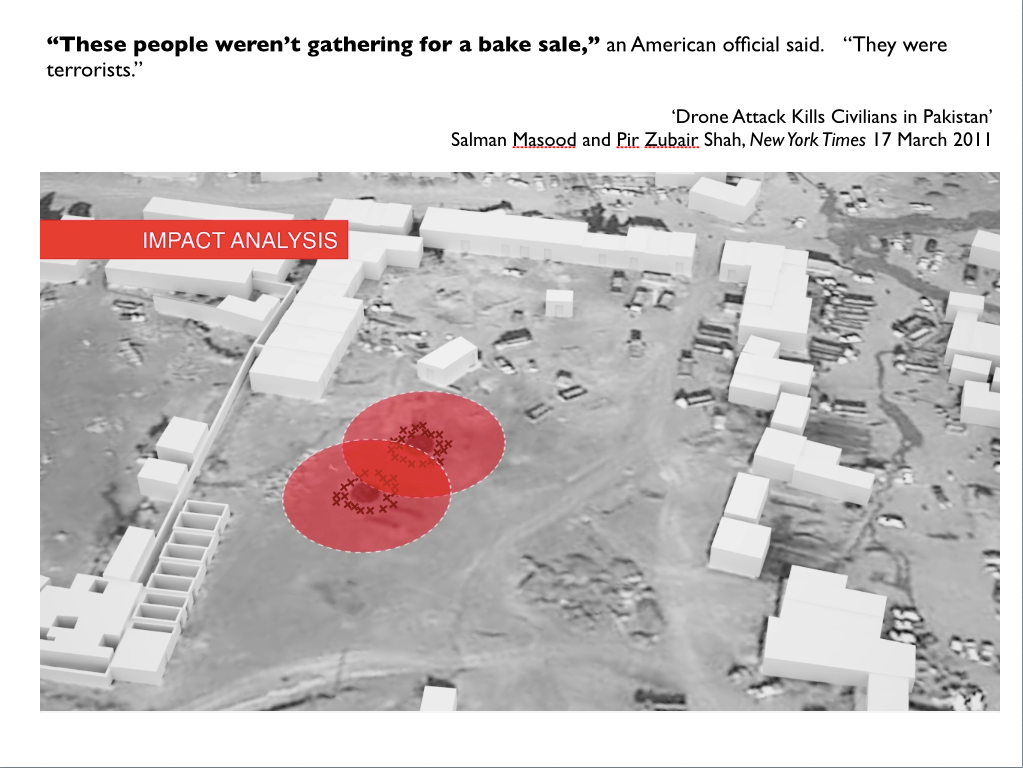
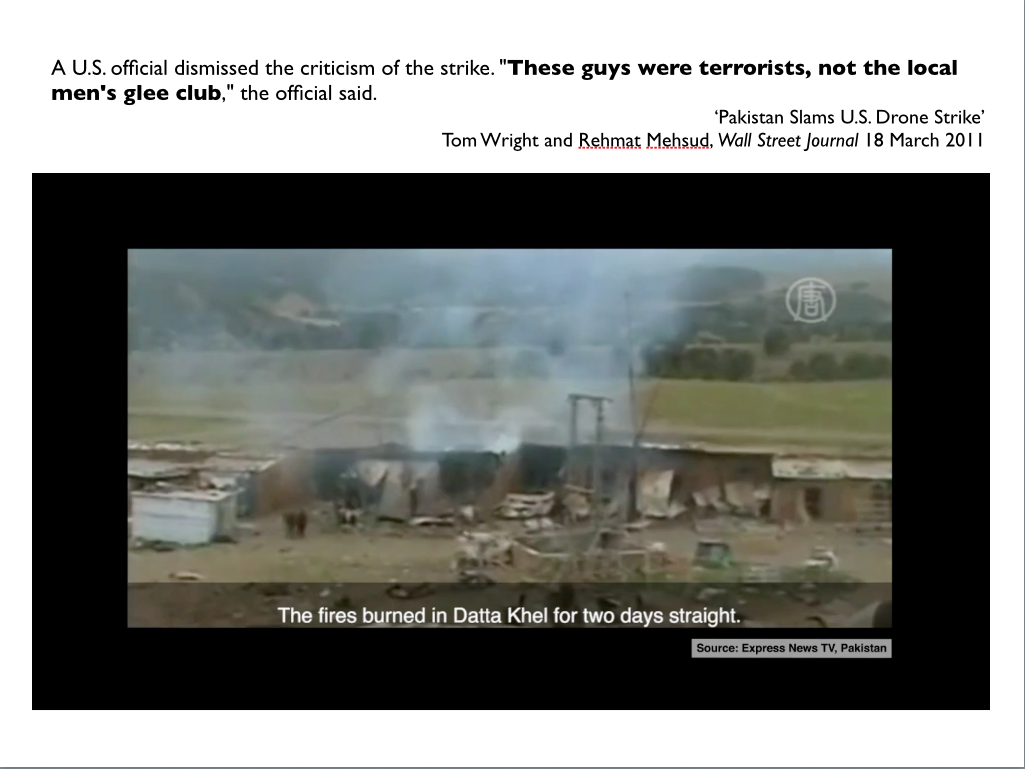
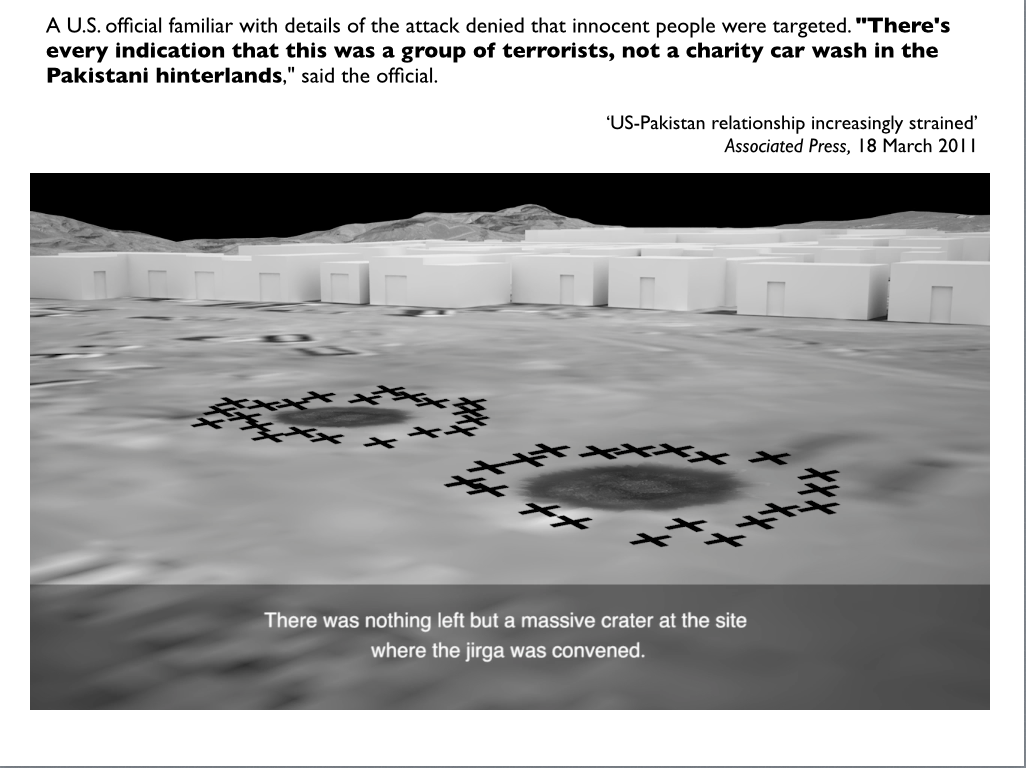
So I started to dig some more – WiFi on the train – and discovered that Eyal Weizman and his brilliant colleagues at Goldsmith’s Forensic Architecture had reconstructed this very strike (the image above is from their work):

‘In the absence of on-the-ground photographic or video documentation, and with no visible impact on buildings, this investigation unfolded by cross-referencing witness testimonies with satellite imagery. An examination of before and after satellite imagery indicated two areas with surface disturbance consistent with the reported missile strikes, thus allowing us to confirm the location of the strike. From the testimonies of survivors and eye-witnesses, we harvested spatial information that helped us to generate a 3D model of the site of the drone strike on the Jirga.’

Then all (!) I had to do was go back in to my e-files (each morning I work my way through the press, copying and pasting reports and commentaries into a series of files so that I have my own searchable archive), recover the glosses provided by that anonymous official, and put them together with the reconstruction.  Here’s the result:

Dhatta Khel 1 PNGDhatta Khel 2 PNGDhatta Khel 3 PNG

Dhatta Khel 4 PNGDhatta Khel 5 PNGDhatta Khel 6 PNGDhatta Khel 7 PNGDhatta Khel 8 PNG

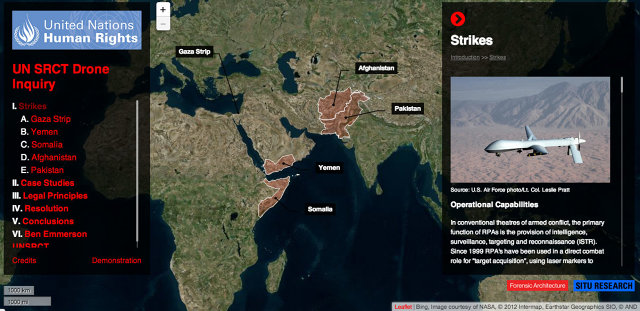
You can read more about these reconstructions here (‘The forensics of a lethal drone attack’).  This strike is one of several investigated by the UN’s Special Rapporteur Ben Emmerson, and you can find much more information at the interactive website produced in collaboration with Forensic Architecture and SITU Research that accompanies his written report to the United Nations (28 February 2014) (the Datta Khel incident is summarised in paragraph 50, but the website provides a far richer understanding).  You can also download hi-res versions of Forensic Architecture’s stills and videos here.

3027475-inline-i-un-srct-drone-inquiry

What I find so significant is that the anonymous official provided a series of different and, as I’ve said, bizarre (even offensive) descriptions of what the assembly in Datta Khel was not: but he was clearly incapable of recognising what it was.  This was certainly another performance of the space of exception, but it was plainly not a legal ‘black hole’, as some commentators gloss Agamben.  The only ‘black holes’ were the craters in the ground and the conspicuous failure to recognise the operative presence of customary law.

Un-Christmas reading

DOD-USRM-2013 (dragged)Two reports to put on the reading list.  The US military has been revising its Counterinsurgency manual, FM 3-24 (December 2006), and as part of that process the Joint Chiefs of Staff have now issued their updated JP 3-24 on Counterinsurgency (November 2013).  I haven’t had time to digest it yet, but air power is no longer relegated to the closing pages…

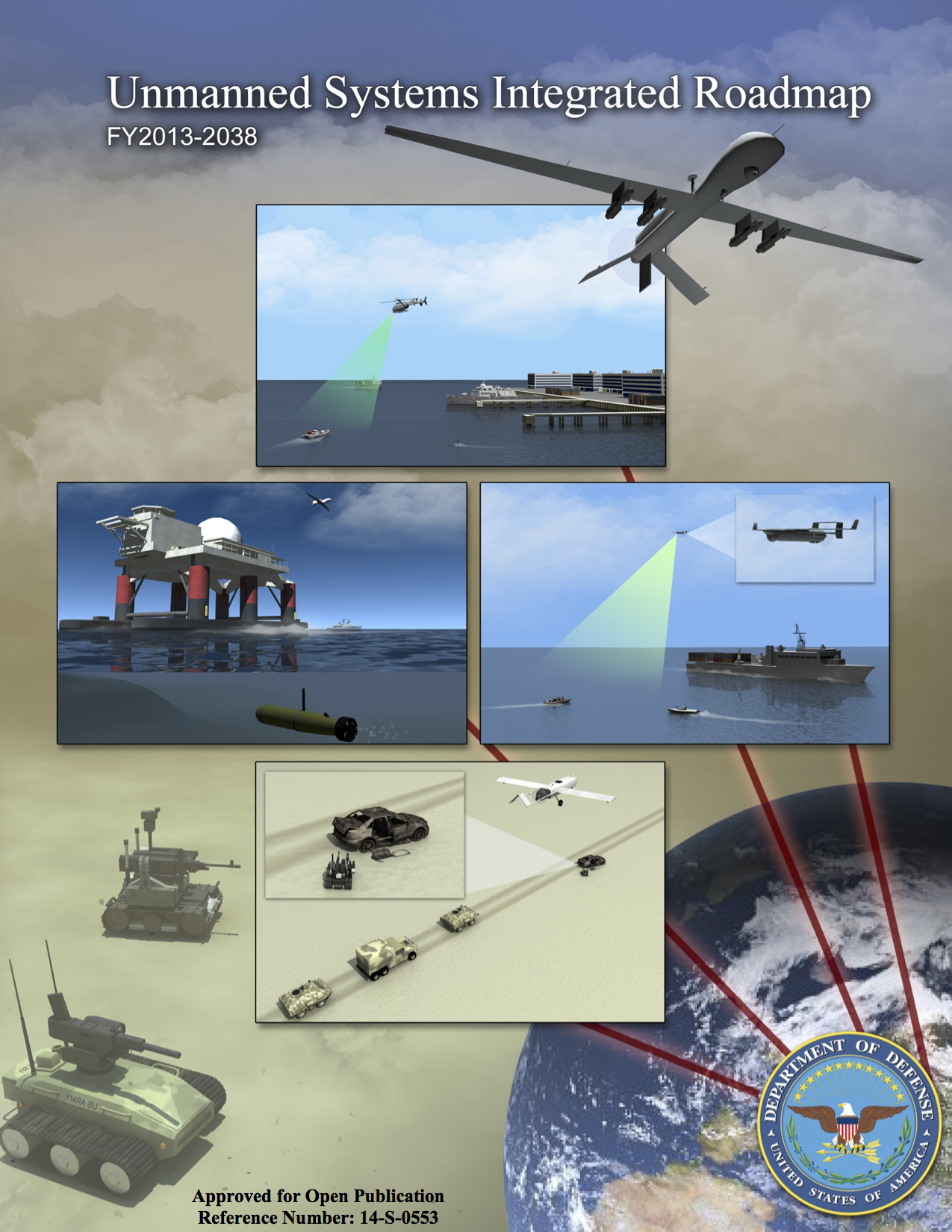
The US Air Force is also in the closing stages of its so-called Vector Report on Remotely Piloted Aircraft, which is supposed to map out the likely role of military UAVs over the next 25 years; its release has been delayed for what are described a minor last-minute changes, but just before Christmas the Pentagon released its Unmanned Systems Integrated Roadmap 2012-2038, which includes its plans for aerial, ground and maritime systems.

Urban guerrillas

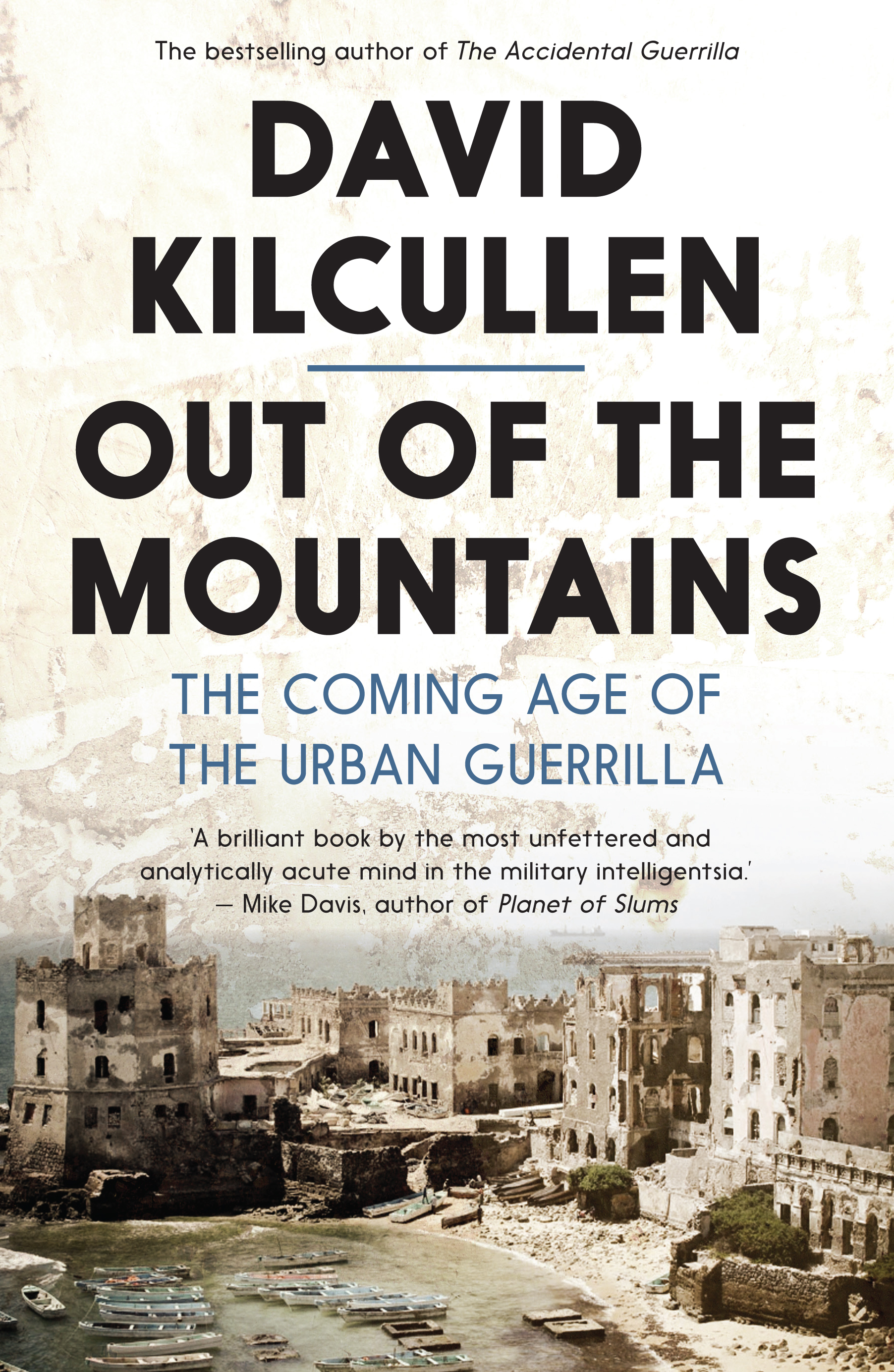
I’ve noted David Kilcullen‘s adventures into geography before, and the entanglement of his vision of counterinsurgency with the humanitarian present – here and here – and over at Gizmodo Geoff Manaugh (of the always interesting and enviably imaginative BLDGBLOG) has an interesting commentary on Kilcullen’s new book, Out of the Mountains: the coming age of the urban guerrilla (Hurst/Oxford University Press USA, 2013.  An extended excerpt is available here, if you scroll down, and a presentation on “The city as a system: future conflict and urban resilience” from last year is available here.

KILCULLEN Out of the mountains

Back to Geoff:

Kilcullen’s overall thesis is a compelling one: remote desert battlegrounds and impenetrable mountain tribal areas are not, in fact, where we will encounter the violence of tomorrow. For Kilcullen—indeed, for many military theorists writing today—the war in Afghanistan was not the new normal, but a kind of geographic fluke, an anomaly in the otherwise clear trend for conflicts of an increasingly urban nature.

The very title of Kilcullen’s book—Out of the Mountains—suggests this. War is coming down from the wild edges of the world, driving back toward our lights and buildings from the unstructured void of the desert, and arriving, at full force, in the hearts of our cities, in our markets and streets. There, conflict erupts amongst already weak or non-existent governments, in the shadow of brittle infrastructure, and what Mike Davis calls “the nightmare of endless warfare in the slums of the world” in his blurb for Kilcullen’s work, becomes uncomfortably close to reality.

Strictly speaking, Geoff’s commentary derives from a talk Kilcullen gave at the World Policy Institute, one of a large number of public appearances to promote the book on both sides of the Atlantic; here is a transcript of his talk at Chatham House, and here is his presentation to the New America Foundation last month, introduced by Peter Bergen:

Geoff is not completely convinced by it.  Some of the themes will be familiar to most readers – the bleeding of war into crime has been a staple of the ‘new wars’ thesis, for example – and you can hear distant echoes of Saskia Sassen‘s ideas about cities and later modern war.  More particularly, Steve Graham‘s brilliant work on the new military urbanism addresses many of the same issues Kilcullen raises – as Kilcullen notes himself – though he does so in a markedly different vocabulary: Geoff and I have crossed swords over this before, but while he describes “feral cities” as ‘one of my favorite phrases of all time’ I think it’s dehumanizing – though I do understand that’s exactly not Geoff’s intention).

Geoff is also (I think rightly) sceptical about the aerial-algorithmic intervention that Kilcullen touted at the WPI:

‘During the Q&A, Kilcullen briefly mentioned the work of Crisis Mappers, who have developed tools for visually analyzing urban form using satellite photos. According to Kilcullen, they are able to do this with an astonishing degree of accuracy, diagnosing what parts of cities seem most prone to failure. Whether this is due to empty lots and abandoned buildings or to infrastructural isolation from the rest of the city, the factors that determine “ferality” in the built environment is a kind of aerial application of the Broken Windows theory.

The implication—conceptually fascinating, but by no means convincing, at least for me—was that we could, in theory, develop a visual algorithm for identifying environments tending toward failure, and thus find a way to intervene before things truly fall apart. Teams of architects with their own dedicated satellites could thus scan the cities of the world from above, algorithmically identifying urban regions prone to collapse, then intervening with a neighborhood redesign.’

Have we learned nothing from almost a decade of remote-surveillance ISR and algorithmic counterinsurgency in which maps and metrics substitute for meaning?  And while the attacks in Nairobi confirm the city as a continuing arena of military and paramilitary violence in the twenty-first century, they surely can’t be directly assimilated to a ‘feral city’ thesis (though Kilcullen does his best here)?  We’ll see: I’m part way through the book, and will post a more considered response when I’m done.

The individuation of warfare?

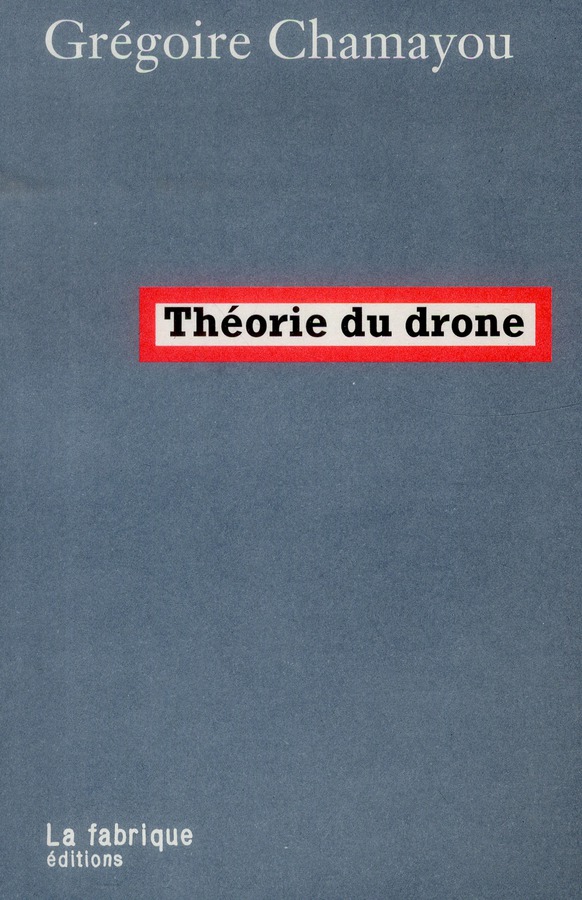
chamayou-manhuntsBefore I resume my reading of Grégoire Chamayou‘s Théorie du drone, I want to approach his thesis from a different direction. As I’ve noted, much of his argument turns on the reduction of later modern war to ‘man-hunting’: the profoundly asymmetric pursuit of individuals by activating the hunter-killer capacities of the Predator or the Reaper in a new form of networked (para)military violence. He describes this as a ‘state doctrine of non-conventional violence’ that combines elements of military and police operations without fully corresponding to either: ‘hybrid operations, monstrous offspring [enfants terribles] of the police and the military, of war and peace’.

These new modalities increase the asymmetry of war – to the point where it no longer looks like or perhaps even qualifies as war – because they preclude what Joseph Pugliese describes as ‘“a general system of exchange” [the reference is to Achille Mbembe’s necropolitics] between the hunter-killer apparatus ‘and its anonymous and unsuspecting victims, who have neither a right of reply nor recourse to judicial procedure.’

Pugliese insists that drones materialise what he calls a ‘prosthetics of law’, and the work of jurists and other legal scholars provides a revealing window into the constitution of later modern war and what, following Michael Smith, I want to call its geo-legal armature. To date, much of this discussion has concerned the reach of international law – the jurisdiction of international law within (Afghanistan) and beyond (Pakistan, Yemen and Somalia) formal zones of conflict – and the legal manoeuvres deployed by the United States to sanction its use of deadly force in ‘self-defence’ that violates the sovereignty of other states (which includes both international law and domestic protocols like the Authorization for the Use of Military Force and various executive orders issued after 9/11) . These matters are immensely consequential, and bear directly on what Frédéric Mégret callsthe deconstruction of the battlefield’.

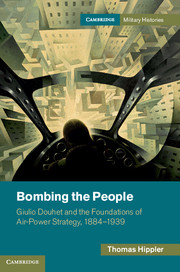
HIPPLER Bombing the PeopleIt’s important to understand that the ‘battlefield’ is more than a physical space; it’s also a normative space – the site of ‘exceptional norms’ within whose boundaries it is permissible to kill other human beings (subject to particular codes, rules and laws). Its deconstruction is not a new process. Modern military violence has rarely been confined to a champ de mars insulated from the supposedly safe spaces of civilian life. Long-range strategic bombing radically re-wrote the geography of war. This was already clear by the end of the First World War, and in 1921 Giulio Douhet could already confidently declare that

‘By virtue of this new weapon, the repercussions of war are no longer limited by the farthest artillery range of guns, but can be felt directly for hundreds and hundreds of miles… The battlefield will be limited only by the boundaries of the nations at war, and all of their citizens will become combatants, since all of them will be exposed to the aerial offensives of the enemy. There will be no distinction any longer between soldiers and civilians.’

The laboratory for these experimental geographies before the Second World War was Europe’s colonial (dis)possessions – so-called ‘air control’ in North Africa, the Middle East and along the North-West Frontier – but colonial wars had long involved ground campaigns fought with little or no distinction between combatants and civilians.

What does seem to be novel about more recent deconstructions, so Mégret argues, is ‘a deliberate attempt to manipulate what constitutes the battlefield and to transcend it in ways that liberate rather than constrain violence.’

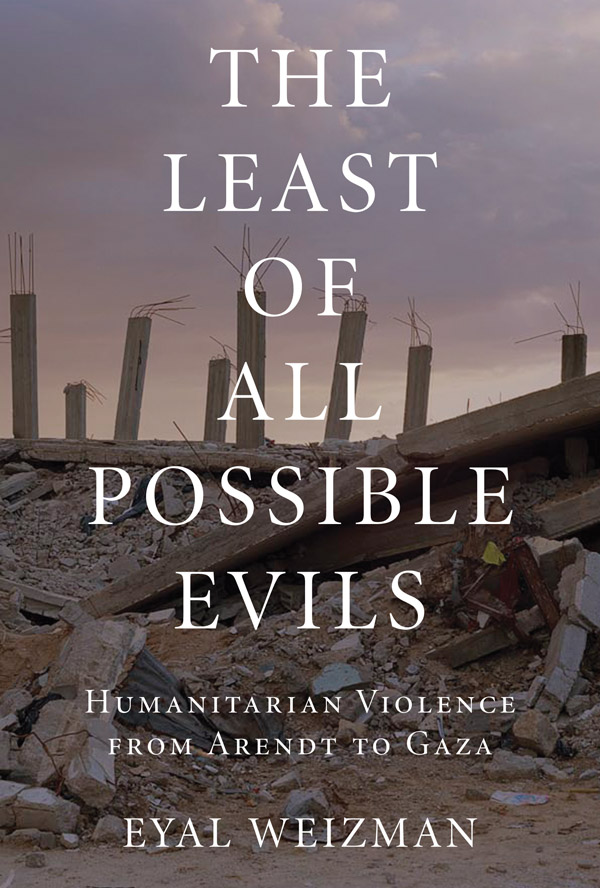
9781844676477 Least of All Possible EvilsThis should not surprise us. Law is not a deus ex machina that presides over war as impartial tribune. Law, Michel Foucault reminds us, ‘is born of real battles, victories, massacres and conquests’; law ‘is born in burning towns and ravaged fields.’ Today so-called ‘operational law’ has incorporated military lawyers into the kill-chain, moving them closer to the tip of the spear, but law also moves in the rear of military violence: in Eyal Weizman’s phrase, ‘violence legislates.’ In the case that most concerns him, that of the Israel Defense Force, military lawyers work in the grey zone between ‘the black’ (forbidden) and ‘the white’ (permitted) and actively seek to turn the grey into the white: to use military violence to extend the permissive envelope of the law.

The liber(alis)ation of violence that Mégret identifies transforms the very meaning of war. In conventional wars combatants are authorised to kill on the basis of what Paul Kahn calls their corporate identity:

‘…the combatant has about him something of the quality of the sacred. His acts are not entirely his own….

‘The combatant is not individually responsible for his actions because those acts are no more his than ours…. [W]arfare is a conflict between corporate subjects, inaccessible to ordinary ideas of individual responsibility, whether of soldier or commander. The moral accounting for war [is] the suffering of the nation itself – not a subsequent legal response to individual actors.’

The exception, Kahn continues, which also marks the boundary of corporate agency, is a war crime, which is ‘not attributable to the sovereign body, but only to the individual.’ Within that boundary, however, the enemy can be killed no matter what s/he is doing (apart from surrendering). There is no legal difference between killing a general and killing his driver, between firing a missile at a battery that is locking on to your aircraft and dropping a bomb on a barracks at night. ‘The enemy is always faceless,’ Kahn explains, ‘because we do not care about his personal history any more than we care about his hopes for the future.’ Combatants are vulnerable to violence not only because they are its vectors but also because they are enrolled in the apparatus that authorizes it: they are killed not as individuals but as the corporate bearers of a contingent (because temporary) enmity.

It is precisely this model that contemporary military violence now challenges through the prosthetics of law embodied and embedded in drone warfare – and this, Kahn insists, has transformed the political imaginary of warfare (You can find his full argument here: ‘Imagining warfare’, European journal of international law 24 (1) (2013) 199-216).

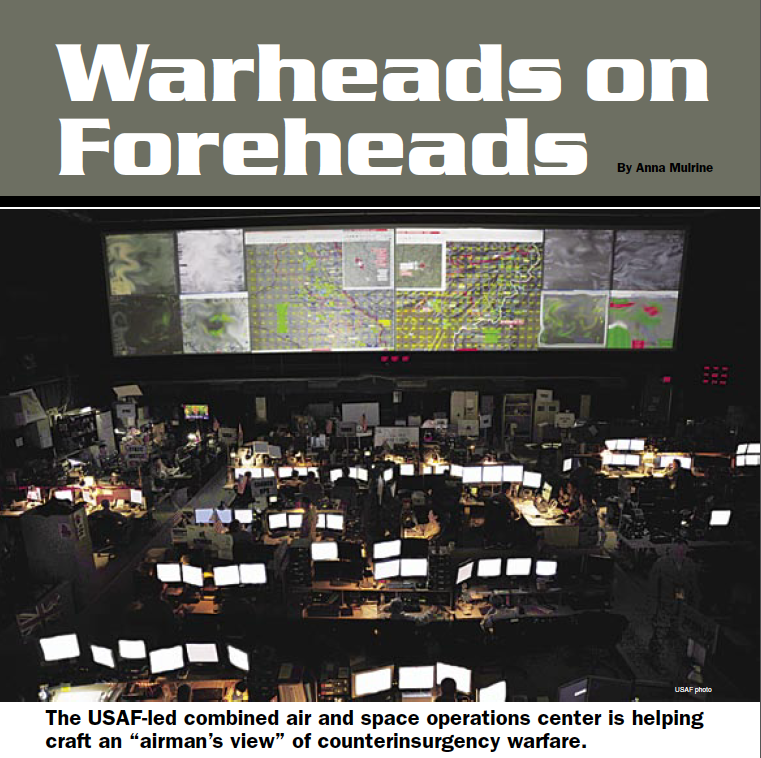
Warheads on foreheads

In a parallel argument, Samuel Issacharoff and Richard Pildes describe this development as the individuation of military force, driven in part by the affordances and dispositions of drone warfare which makes it possible to put ‘warheads on foreheads.’  Targets are no longer whole areas of cities – like Cologne or Hamburg in the Second World War – or extensive target boxes like those ravaged by B-52 ‘Arc Light’ strikes over the rainforest of Vietnam.  The targets are individuals and, since the United States claims the right to target them wherever they are found, this partly explains the dispersed geography of what I’ve called ‘the everywhere war’.   What interests Issacharoff and Pildes, like Kahn, is not so much the technology that makes this possible as the apparatus that makes it permissible.

Their presentation wavers uncertainly between counterinsurgency and counter-terrorism, and they also write more generally of ‘the new face of warfare’ and the use of ‘military force’, so that (as now happens in practice) the distinctions between the US military and the CIA become blurred.  But their core argument is that military force is now directed against specific individuals on the basis of determinate acts that they have committed or, by pre-emptive extension, are likely to commit.  In Kahn’s terms, this inaugurates a radically different (though in his eyes, highly unstable) political subjectivity through which the enemy is transformed into the criminal.  ‘The criminal is always an individual,’ Kahn explains; ‘the enemy is not.’

For Issacharoff and Pildes this new state of affairs requires an ‘adjudicative apparatus’ to positively identify, detect and prosecute the individual-as-target, which drives the military system ever closer to the judicial system:

 ‘As the fundamental transformation in the practice of the uses of military force moves, even implicitly, toward an individuated model of responsibility, military force inevitably begins to look justified in similar terms to the uses of punishment in the criminal justice system. That is, to the extent that someone can be targeted for the use of military force (capture, detention, killing) only because of the precise, specific acts in which he or she as an individual participated, military force now begins to look more and more like an implicit “adjudication” of individual responsibility.’

They suggest that this makes it inevitable that the boundaries between the military system and the judicial system ‘will become more permeable’ – a confirmation of the active constitution of the war/police assemblage (on which see Colleen Bell, Jan Bachmann and Caroline Holmqvist’s forthcoming collection, The New Interventionism: perspectives on war-police assemblages).

Kahn is, I think, much more troubled by this than Issacharoff and Pildes.  He concludes (like Chamayou):

‘Political violence is no longer between states with roughly symmetrical capacities to injure each other; violence no longer occurs on a battlefield between masses of uniformed combatants; and those involved no longer seem morally innocent. The drone is both a symbol and a part of the dynamic destruction of what had been a stable imaginative structure. It captures all of these changes: the engagement occurs in a normalized time and space, the enemy is not a state, the target is not innocent, and there is no reciprocity of risk. We can call this situation ‘war’, but it is no longer clear exactly what that means.

‘The use of drones signals a zone of exception to law that cannot claim the sovereign warrant. It represents statecraft as the administration of death. Neither warfare nor law enforcement, this new form of violence is best thought of as the high-tech form of a regime of disappearance. States have always had reasons to eliminate those who pose a threat. In some cases, the victims doubtlessly got what they deserved. There has always been a fascination with these secret acts of state, but they do not figure in the publicly celebrated narrative of the state. Neither Clausewitz nor Kant, but Machiavelli is our guide in this new war on terror.’

He is thoroughly alarmed at the resuscitation of what he calls ‘the history of administrative death’, whereas Issacharoff and Pildes – ironically, given what I take to be their geopolitical sympathies –treat the institution and development of an ‘adjudicative apparatus’ within the US programme of targeted killings as a vindication of their execution (sic).

I want to set aside other contributions to the emerging discussion over the ‘individuation’ of warfare – like Gabriella Blum‘s depiction of an ‘individual-centred regime’ of military conduct, which pays close attention to its unstable movement between nationalism and cosmopolitanism – in order to raise some questions about the selectivity of ‘individuation’ as a techno-legal process.  I intend that term to connote three things.

Target phase

(1) First, and most obviously, Issacharoff and Pildes fasten on the technical procedures that have been developed to administer targeted killings – which include both the ‘disposition matrix’ [see here] and its derivatives and the more directly instrumental targeting cycle [the diagram above shows the ‘Target’ phase of the Find-Fix-Track-Target-Engage-Assess cycle] , both of which admit legal opinions and formularies – that convert targeted killing into what Adi Ophir calls a quasi-juridical process.  This encoding works to contract the ethical horizon to the legal-juridical (see here for a critical commentary) while simultaneously diverting attention from the substantive practice – which, as I showed in ‘Lines of descent’ (DOWNLOADS tab), is shot through with all sorts of limitations that confound the abstract calculations of the targeting cycle (see, for example, Gregory McNeal here, who turns ‘accountability’ into accountancy).

(2) Second, ‘individuation’ refers to the production of the individual as a technical artefact of targeting.  S/he is someone who is apprehended as a screen image and a network trace;  s/he may be named in the case of a ‘personality strike’ but this serves only as an identifier in a target file, and the victims of ‘signature strikes‘ are not accorded even this limited status.  Others who are killed in the course of the strike almost always remain unidentified by those responsible for their deaths – ‘collateral damage’ whose anonymity confirms on them no individuality but only a collective ascription.  (For more, see Thomas Gregory, ‘Potential lives, impossible deaths: Afghanistan, civilian casualties and the politics of intelligibility’, International Feminist Journal of Politics 14 (3) (2012) 327-47; and ‘Naming names’ here).

(3) Third, the adjudication of ‘individual responsibility’ bears directly on the production of the target but not, so it seems, on the producers of the target.  Lucy Suchmann captures this other side – ‘our’ side – in a forthcoming essay in Mediatropes (‘Situational awareness: deadly bioconvergence at the boundaries of bodies and machines’):

‘A corollary to the configuration of “their” bodies as targets to be killed is the specific way in which “our” bodies are incorporated into war fighting assemblages as operating agents, at the same time that the locus of agency becomes increasingly ambiguous and diffuse. These are twin forms of contemporary bioconvergence, as all bodies are locked together within a wider apparatus characterized by troubling lacunae and unruly contingencies.’

Caroline Holmqvist, sharpens the same point in ‘Undoing war: war ontologies and the materiality of drone warfare’, Millennium (1 May 2013) d.o.i. 10.1177/0305829813483350); so too, and more directly relevant to the operations of a techno-legal process,  does Joseph Pugliese‘s figure of drone crews as ’embodied prostheses of the law of war grafted on to their respective technologies’.

These various contributions identify a dispersion of responsibility across the network in which the drone crews are embedded and through which they are constituted.  The technical division of labour is also a social division of labour – so that no individual bears the burden of killing another individual – but the social division of labour is also a technical division of labour through which ‘agency’ is conferred upon what Pugliese calls its prostheses:

‘Articulated in this blurring of lines of accountability is a complex network of prostheticised and tele-techno mediated relations and relays that can no longer be clearly demarcated along lines of categorical divisibility: such is precisely the logic of the prosthetic. As the military now attempts to grapple with this prostheticised landscape of war, it inevitably turns to technocratic solutions to questions of accountability concerning lethal drone strikes that kill the wrong targets.’

If the mandated technical procedures (1 above) fail to execute a sanctioned target (2 above) and if this triggers an investigation, the typical military response is to assign responsibility to the improper performance of particular individuals (which protects the integrity of the process) and/or to technical malfunctions or inefficiencies in the network and its instruments (which prompts technical improvements).  What this does not do – is deliberately designed not to do – is to probe the structure of this ‘techno-legal economy of war at a distance’ (Pugliese’s phrase) that turns, as I’ve tried to suggest, on a highly particular sense of individuation.  Still less do these inquiries disclose the ways in which, to paraphrase Weizman, ‘drones legislate’ by admitting or enrolling into this techno-legal economy particular subjectivities and forcefully excluding others .

More to come.

***

Note: Here are the citations for Issacharoff and Pildes’ full argument(s); the first is excerpted from the second, which deals with ‘capture’ (detention) as well as killing:

Samuel Issacharoff and Richard Pildes, ‘Drones and the dilemma of modern warfare’, in Peter Bergen and Daniel Rothenberg (eds) Drone wars: the transformation of armed conflict and the promise of law (Cambridge University Press, 2013); available here as NYU School of Law, Public Law & Legal Theory Research Paper Series Working Paper No. 13-34, June 2013

Samuel Ischaroff and Richard Pildes, ‘Targeted warfare: individuating enemy responsibility’, NYU School of Law, Public Law & Legal Theory Working Papers 343 (April 2013); available here.

Dronework

Some recent open access work on drones that intersects with my ongoing reading of Grégoire Chamayou‘s Théorie du drone.

Theorie du droneFirst, Philippe Theophanidis, a PhD student at the Université de Montréal, writes with the welcome news that he’s developed an online bibliography of English and French language materials, Grégoire Chamayou: bodies, manhunts and drones, available here.

Philippe’s own research concerns the theory of community in Jean-Luc Nancy and Roberto Esposito.  He adds:

‘I’m especially preoccupied by the fact that our contemporary mode of being-together paradoxically takes the form of destructive interactions. For that reason, I’m interested about war and space in general, and more precisely about “global civil war” (Schmitt) or war in the time of globalization. That’s why Chamayou’s new book caught my attention when it came out.’

Second, another contribution to the ramifying genealogy of drones that I’ve addressed in several previous posts (for example here and here): at OSU’s Origins: current events in historical perspective, Kenneth Hough provides an extended essay on what he calls ‘the long cultural history of drones’.  He adds some interesting material, most of it about the ways in which drones have been registered in American popular culture:

Since their emergence in the late nineteenth century, Americans have regarded unmanned aerial systems as four basic cultural phenomena: heralds of human accomplishment and hope for the future, signs of inhuman depravity portending society’s doom, mechanical misfires that are both ineffective and humorous, and transcendent machines that spark existential questions about war and society, tapping into what David Nye calls our “fundamental hopes and fears.”

But his long cultural history turns out to be a remarkably narrow cultural geography in which – apart from an excursus on V-1 rockets in the Second World War – experimental laboratories outside the United States (notably Britain and Israel) disappear from view.  For all that, I’m surprised that James Cameron‘s Avatar isn’t on his cultural hit list (though I know Cameron’s Canadian): to see what I mean, and for a more general cultural critique, check out Patrick Lichty‘s interesting essay, Drone: camera, weapon, toy on ‘the aestheticization of dark technology’.

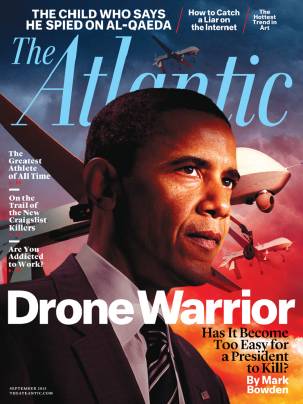
The Atlantic September 2013 Drone warriorWhich brings me to my last sighting: Mark Bowden‘s cover essay in the latest (September) issue of Atlantic on ‘The Killing Machines: how to think about drones‘.  Despite the subtitle, much of Bowden’s extended essay asks how we should feel about drones.

Anyone familiar with his previous work (from Black Hawk Down on) probably won’t be surprised by his ultimate take on matters, and the early online comments show that he’s set off a firestorm of protest by what several writers call his ‘apologia’.

As a matter of fact, I think the essay is more complicated than that, and Bowden does address one of the central issues that Chamayou returns to again and again, the ways in which remote (split) operations transform the very nature of ‘combat’:

Drone strikes are a far cry from the atomic vaporizing of whole cities, but the horror of war doesn’t seem to diminish when it is reduced in scale. If anything, the act of willfully pinpointing a human being and summarily executing him from afar distills war to a single ghastly act.

One day this past January, a small patrol of marines in southern Afghanistan was working its way at dusk down a dirt road not far from Kandahar, staying to either side to avoid planted bombs, when it unexpectedly came under fire. The men scattered for cover. A battered pickup truck was closing in on them and popping off rounds from what sounded like a big gun.

Continents away, in a different time zone, a slender 19-year-old American soldier sat at a desk before a large color monitor, watching this action unfold in startlingly high definition. He had never been near a battlefield. He had graduated from basic training straight out of high school, and was one of a select few invited to fly Predators. This was his first time at the controls, essentially a joystick and the monitor. The drone he was flying was roughly 15,000 feet above the besieged patrol, each member marked clearly in monochrome on his monitor by an infrared uniform patch. He had been instructed to watch over the patrol, and to “stay frosty,” meaning: Whatever happens, don’t panic. No one had expected anything to happen. Now something was happening.

The young pilot zoomed in tight on the approaching truck. He saw in its bed a .50-caliber machine gun, a weapon that could do more damage to an army than a platoon of Goliaths.

A colonel, watching over his shoulder, said, “They’re pinned down pretty good. They’re gonna be screwed if you don’t do something.”

The colonel told the pilot to fix on the truck. A button on the joystick pulled up a computer-generated reticle, a grid displaying exact ground coordinates, distance, direction, range, etc. Once the computer locked on the pickup, it stayed zeroed in on the moving target.

“Are you ready to help?” the colonel asked.

An overlay on the grid showed the anticipated blast radius of an AGM-114 Hellfire missile—the drone carried two. Communicating via a digital audio link, the colonel instructed the men on the ground to back away, then gave them a few seconds to do so.

The pilot scrutinized the vehicle. Those who have seen unclassified clips of aerial attacks have only a dim appreciation of the optics available to the military and the CIA.

“I could see exactly what kind of gun it was in back,” the pilot told me later. “I could see two men in the front; their faces were covered. One was in the passenger seat and one was in the driver’s seat, and then one was on the gun, and I think there was another sitting in the bed of the truck, but he was kind of obscured from my angle.”

On the radio, they could hear the marines on the ground shouting for help.

“Fire one,” said the colonel.

The Hellfire is a 100-pound antitank missile, designed to destroy an armored vehicle. When the blast of smoke cleared, there was only a smoking crater on the dirt road.

“I was kind of freaked out,” the pilot said. “My whole body was shaking. It was something that was completely different. The first time doing it, it feels bad almost. It’s not easy to take another person’s life. It’s tough to think about. A lot of guys were congratulating me, telling me, ‘You protected them; you did your job. That’s what you are trained to do, supposed to do,’ so that was good reinforcement. But it’s still tough.”

One of the things that nagged at him, and that was still bugging him months later, was that he had delivered this deathblow without having been in any danger himself. The men he killed, and the marines on the ground, were at war. They were risking their hides. Whereas he was working his scheduled shift in a comfortable office building, on a sprawling base, in a peaceful country. It seemed unfair. He had been inspired to enlist by his grandfather’s manly stories of battle in the Korean War. He had wanted to prove something to himself and to his family, to make them as proud of him as they had been of his Pop-Pop.

“But this was a weird feeling,” he said. “You feel bad. You don’t feel worthy. I’m sitting there safe and sound, and those guys down there are in the thick of it, and I can have more impact than they can. It’s almost like I don’t feel like I deserve to be safe.”

I’ve described this identification with troops on the ground before, what one of Bowden’s correspondents calls ‘a very visceral connection to operations on the ground’.  And Bowden is stacking the deck by starting with what the US military calls ‘Troops in Contact‘ in Afghanistan rather than CIA-directed targeted killing in Pakistan: only later will he turn to the legal and quasi-legal landscape through which those strikes pass (more on this in a later post) .  But he then adds this:

If the soldier who pulls the trigger in safety feels this, consider the emotions of those on the receiving end, left to pick up the body parts of their husbands, fathers, brothers, friends. Where do they direct their anger? When the wrong person is targeted, or an innocent bystander is killed, imagine the sense of impotence and rage. How do those who remain strike back? No army is arrayed against them, no airfield is nearby to be attacked. If they manage to shoot down a drone, what have they done but disable a small machine? No matter how justified a strike seems to us, no matter how carefully weighed and skillfully applied, to those on the receiving end it is profoundly arrogant, the act of an enemy so distant and superior that he is untouchable.

As I say, more to come…

Theory of the drone 5: Vulnerabilities

This is the fifth in a series of posts on Grégoire Chamayou‘s Théorie du drone.  My next post on the book will consider Chamayou’s second section, ‘Ethos and psyche‘, in its entirety, and when I’ve worked my way through the book in separate, detailed posts (three more sections to go after the next one) I’ll provide a critical overview of the project as a whole: I hope that will help (I must be doing something right – or wrong – since these posts have been picked up by the splendid ARmy Rumour SErvice, which – despite its equally splendid acronym – is not quite a digital child of the Wipers Times).

8: Vulnerabilities

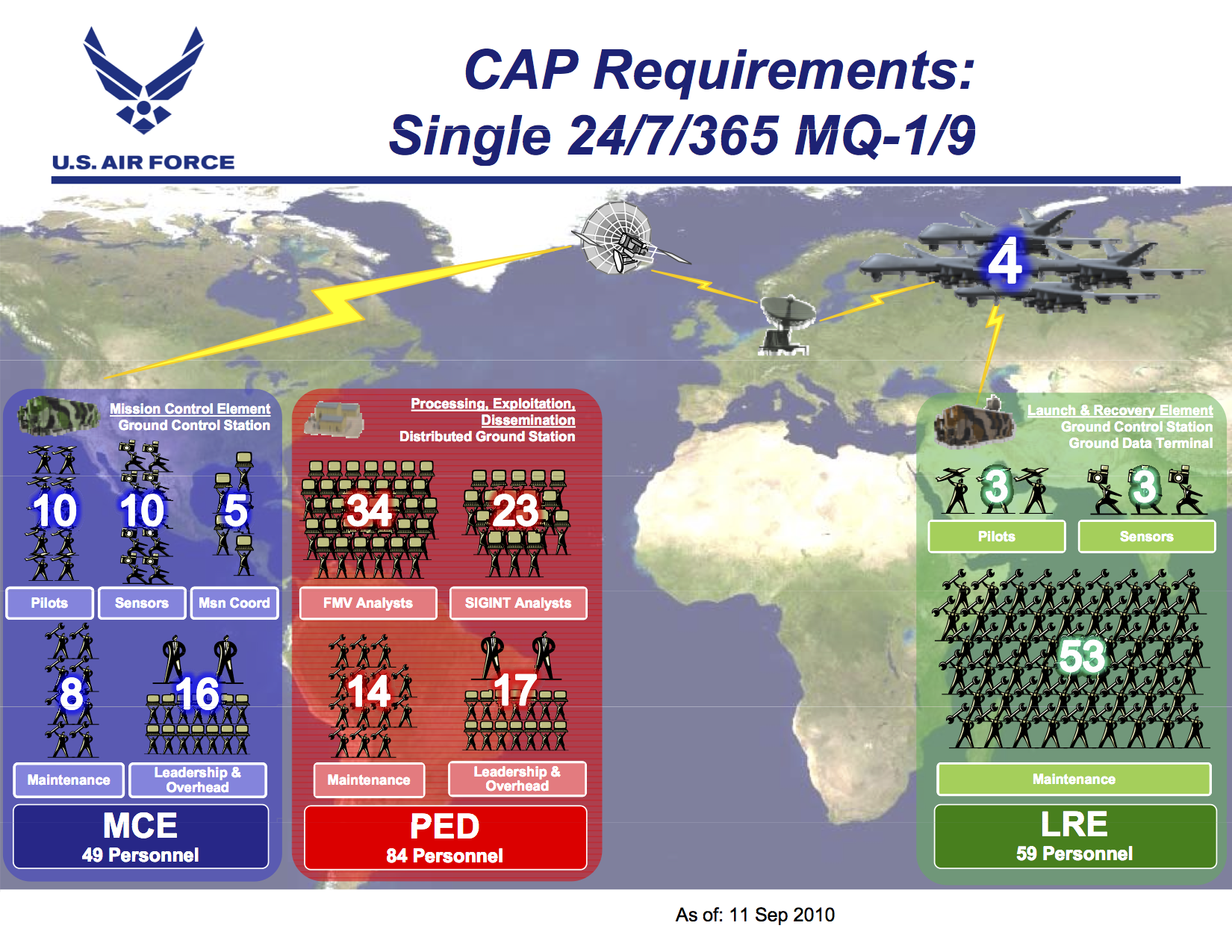
Far from being ‘unmanned’, each US Air Force combat air patrol (CAP) capable or providing coverage 24 hours a day 7 days a week involves a suite of four Predators (MQ1) or Reapers (MQ9) supported by a total of 192 personnel (the exact figures vary and are subject to change, but I’ve taken these from a June 2011 presentation by Colonel J.R. Gear, Director of the US Air Force’s Remotely Piloted Aircraft Task Force).

As you can see from his presentation slide below, most of these (133) are based outside the combat zone, and 84 of those are devoted to ‘PED’ –processing, exploiting and disseminating the feeds from the airborne sensors, especially the full-motion video (FMV) streams.

That leaves 59 who are forward deployed inside the combat zone: three pilots and three sensor operators to handle take-off and landing (which require a line-of-sight link to the aircraft because the Ku-band satellite link used for in-flight operations imposes a response delay that is too great for near-ground manoeuvres).  One of the four aircraft is held on the ground for maintenance and, given the technical problems that continue to dog what Jordan Crandall calls the wayward drone, no fewer than 53 people are involved in keeping them flying.  [More on drone crashes and glitches here, here and here].

Still, less than half the total complement (44 per cent) is in the combat zone, and all of them work from the relative safety of an airbase.

GEAR Manning Unmanned Aircraft

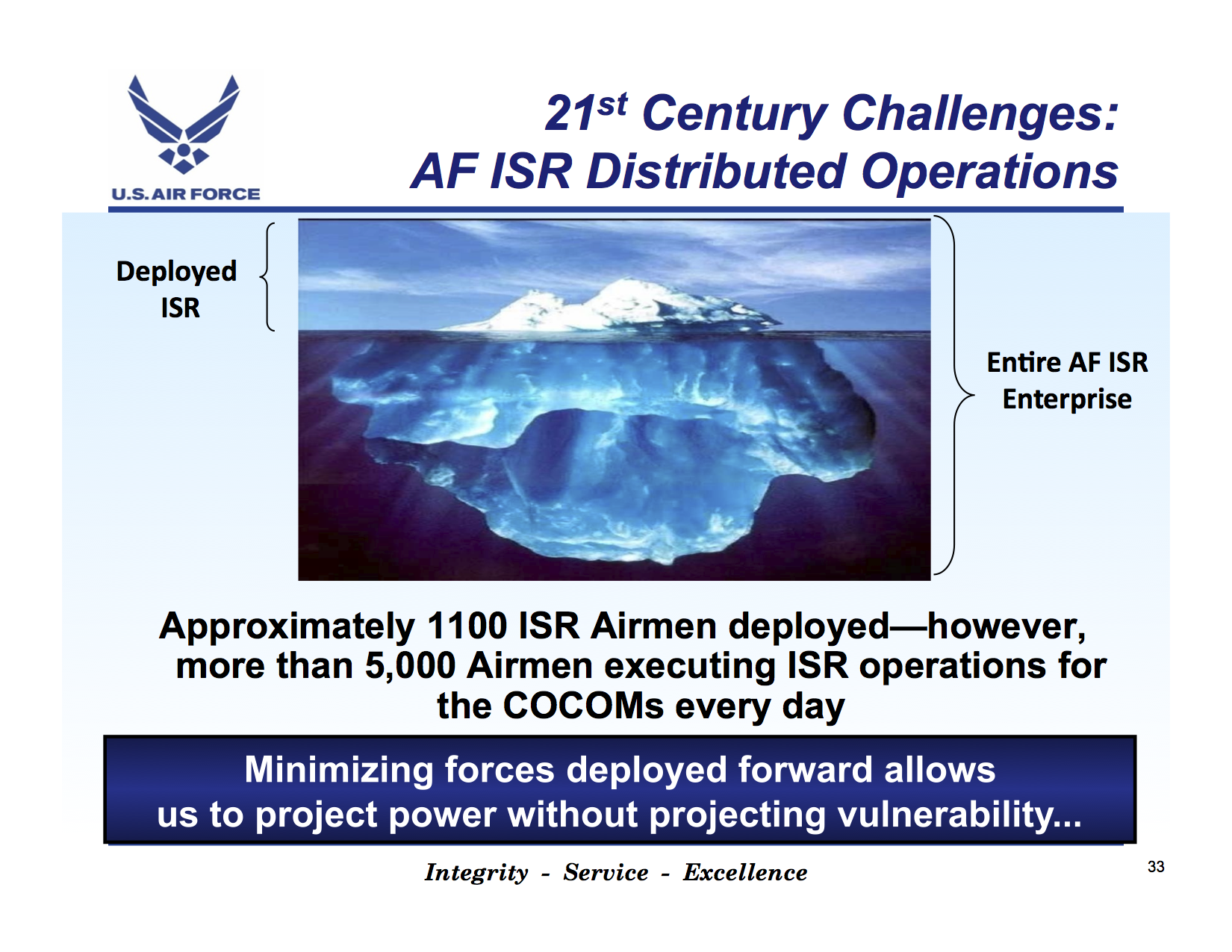
Hence the tag line repeatedly used by the US Air Force to advertise the core advantage of using drones: ‘projecting power without projecting vulnerability’:

Projecting power without vulerability

I’ve always liked to take metaphors stubbornly literally, and given what is happening to the polar ice we need to ask about the invulnerability of these remote operations.

Chamayou reminds us that in classical mythology and in fable invulnerability has always been a myth; so it is with the drone.  He distinguishes two sets of vulnerabilities, one technical and the other political-strategic.

(A) Technical

Chamayou says virtually nothing about the technical imperfections of the Predator and the Reaper, especially the crashes and other failures that I noticed above, but concentrates on two other issues.

(1) ‘Mastery of the air’: At present, Predators and Reapers can only operate in uncontested airspace; they are slow, noisy and far from agile, which makes them highly vulnerable to attack from ground-to-air missiles or conventional strike aircraft.  This is not a problem in Afghanistan – even during the invasion US Secretary of Defense Donald Rumsfeld was able to proclaim ‘air superiority’ by 10 October, just three days after launching the first attacks: ‘Afghan skies secure‘ – and according to some reports it never became a serious issue in Iraq either.  During Operation Southern Watch, tasked with enforcing no-fly zones over Iraq between the first Gulf War and the US-led invasion in 2003, Eric Reidel reported that

‘Predators were used as bait to stir up Iraqi fighters and air defenses. Surface-to-air missiles eventually brought down two of the drones and an Iraqi fighter jet shot down a third, but it didn’t come that easy to the enemy.’

But that was a contest against a military machine degraded by a sanctions regime.  What is now called A2/AD (anti-access, area denial) may well become a serious obstacle to future conflicts. In 2011 Colonel Dean Bushey, deputy director of the joint Unmanned Aircraft Systems Center of Excellence, told Reidel:

“We’re thinking about the next war, thinking about the next fight, thinking about the next campaign…  We’ve fought in a very permissive environment where there are no enemy attacks against our unmanned aircraft … It would be foolish for us to imagine that we could continue to fly unmanned systems in an environment that is not only friendly but is not GPS-denied, that is not communications-denied.”

With Obama’s ‘pivot to the Pacific’, the Pentagon has redoubled its efforts to harden its drones for combat (several commentators are sufficiently sceptical about the prospects that they see a renewed commitment to conventional strike-stealth aircraft rather than to UAVs).  But perhaps the sharper point is contained in Bushey’s final sentence, and Chamayou spends much more time on this second, vital vulnerability.

(2) ‘Mastery of the waves’: Chamayou documents a series of incidents in which signals were jammed or hacked.

In 2009 the Wall Street Journal reported that insurgents in Iraq had been using commercial off-the-shelf software (costing just $26) to intercept the video feeds from Predators for at least a year, and there was similar evidence from Afghanistan.  The Pentagon had known of the vulnerability since the aircraft were deployed over Bosnia in the 1990s, but had not bothered to encrypt the signals because they ‘assumed local adversaries wouldn’t know how to exploit it.’ You might think the solution – encryption of the Common Data Link feeding images to ROVERS (receivers) used by troops on the ground – would be easy, but four years after the story broke Noah Schachtman and David Axe reported that more than half the US fleet of Predators and Reapers were still broadcasting their video feeds in the clear:

”Standard unencrypted video is basically a broadcast to whoever can figure out the right carrier frequency, so essentially, we are simulcasting to battlefield commanders and the opposing force. If that opposing force knows we can see them and from where, they can take better evasive maneuvers.”

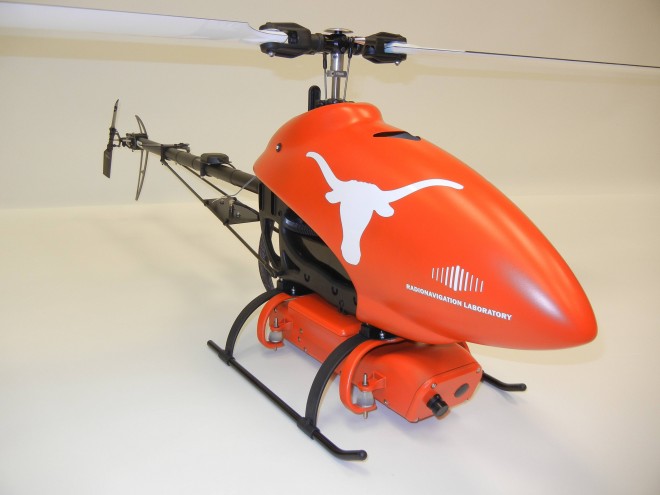
UT Adaptive Flight Hornet MiniIf signals transmitted from the drone can be hacked then, as Bushey noted, so can signals to the drone.  This is known as GPS spoofing, and the basic principle is remarkably simple; for a technical exposition that isn’t, see this research paper ‘On the requirements for successful GPS spoofing attacks’ by four Swiss computer scientists (who also propose counter-measures), but for a more user-friendly discussion see Pierluigi Paganini‘s excellent overview of ‘Hacking drones’ here.  As Chamayou says, the principle was put into practice in June 2012 , when a group of researchers from the Radionavigation Laboratory at the University of Texas at Austin successfully hijacked a small civilian helicopter-drone at the White Sands Missile Range in Nevada.  It was an experiment carried out for the Department of Homeland Security, the target was a tiny Adaptive Flight Hornet Mini (shown above) not a Predator or a Reaper, and the intercept took place at an altitude of less than 20 metres (60 feet) from a distance of 1 kilometre.  This year they intend to repeat the experiment but from a distance of 10 kilometres.  This is all part of an ongoing project to devise systems to disrupt spoofing, but Chamayou suggests that ‘the air pirates of the future’ will surely try to take control of larger drones from an even greater distance.

(B) Political-strategic

Here Chamayou is not addressing wider political, legal and ethical objections to which remote operations are indeed vulnerable – as I’ll describe in later posts – but rather the possibility of more direct responses to the deployment of drones.

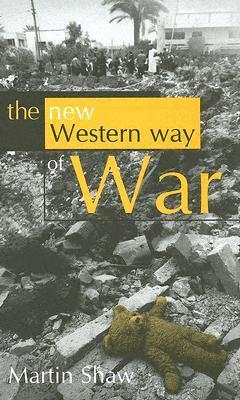
SHAW The new Western way of war(1) Reprisals: Remote operations radicalise what Martin Shaw described in 2005 as The new Western way of war: ‘risk-transfer war‘.  Although Shaw emphasised global surveillance, the minimisation of military casualties and an overwhelming reliance on airpower amongst other things – and his ‘rules of risk-transfer war’ are still essential if depressing reading – it is a sign of how far the world has turned since then that he provided no discussion of remote operations or the incorporation of drones as essential vectors of later modern war.

Perhaps for this reason Chamayou makes no mention of Shaw, but fastens on a short thesis submitted in 2009 by Major Trent Gibson of the US Marine Corps for the Master of Military Studies from Quantico, ‘Hell-bent on Force Protection’.  This was a critique of what Gibson called ‘force protection fetishism’.  He traced it back to the US military’s experience in Vietnam but argued that it was alive and well in Afghanistan and Iraq.  In a key passage quoted by Chamayou, Gibson wrote:

‘Attempts to armorize our force against all potential enemy threats … shifts the ‘burden of risk’ from a casualty-averse military force onto the populace. In doing so, we have lifted that burden from our own shoulders and placed it squarely upon those who do not possess the material resources to bear it – the civilian populace.’

Gibson was reaffirming one of the central tenets of the new counterinsurgency doctrine issued three years earlier, and he doesn’t discuss drones and remote operations either.  But what both FM 3-24 and by extension Gibson objected to was the physical separation of troops from the very people they were supposed to protect.  One of its cardinal – strategic – weaknesses – was sequestering troops inside vast, heavily defended Forward Operating Bases from which they issued out on sporadic armoured patrols.  It was, in part, on overcoming this siege mentality that the so-called “Surge” in Baghdad was predicated (see “The biopolitics of Baghdad”: DOWNLOADS tab).  General David Petraeus‘s ‘Commander’s Guidance‘ could not have been plainer:

‘Live among the people. You can’t commute to this fight. Position Joint Security Stations, Combat Outposts, and Patrol Bases in the neighborhoods we intend to secure. Living among the people is essential to securing them and defeating the insurgents.’

UAV pilot driving to workRemote operations hypostatise that ‘commute to the fight’ (see here).  Here is one UAV pilot talking to Der Spiegel:

‘In the morning you carpool or you take a bus and drive into work, you operate for an eight-hour shift, and then you drive back home… Before you were at war 24/7, and when you’re home you’re home. This is different. I do e-mails in the morning, rush to the airplane, come out, go to the [Base Exchange], get myself a hamburger, do some more e-mail, do it again, drive home.’

I’ll say more about that compartmentalisation in my next post – it’s a central concern in the next section of Théorie du drone – but Chamayou’s central point here is that the safety of ‘home’ is illusory and that the war cannot be contained within external ‘danger zones’.  He’s not talking about insurgent attacks against US air bases or crew (though one recent story, ‘A day job waiting for a kill-shot a world away’, reported that ‘the Air Force, citing what it says are credible threats, forbids pilots to disclose their last names’).  What Chamayou has in mind is the possibility of reprisals within the continental United States more generally: risk transferred back to the American public at large.  He explicitly endorses the conclusion to Mike Davis‘s Buda’s Wagon: a brief history of the car bomb, where Davis writes:

‘… every laser-guided missile falling on an apartment house in southern Beirut or a mud-walled compound in Kandahar is a future suicide truck bomb headed for the center of Tel Aviv or perhaps downtown Los Angeles.’

This is not a wild scenario.  Here is Michael Boyle on the costs and consequences of drone warfare:

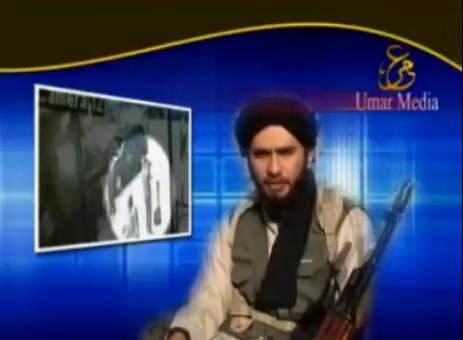
On 21 June 2010, Pakistani American Faisal Shahzad told a judge in a Manhattan federal court that he placed a bomb at a busy intersection in Times Square as payback for the US occupations of Afghanistan and Iraq and for its worldwide use of drone strikes. When the judge asked how Shahzad could be comfortable killing innocent people, including women and children, he responded: ‘Well, the drone hits in Afghanistan and Iraq, they don’t see children, they don’t see anybody. They kill women, children, they kill everybody. It’s a war and in war, they kill people. They’re killing all Muslims.’  In a videotape [below] released after his arrest, Shahzad revealed that among his motives for the attack on New York City was revenge for the death of Baitullah Mehsud, a Pakistani Taliban leader killed in a drone strike in August 2009. While his comments were reported in the American press, the Obama administration never acknowledged that it was revulsion over drone strikes—which Shahzad was rumoured to have seen at first hand when training with militant groups in Pakistan—that prompted his attack.

faisal-shahzad-martyrdom-tape

Although the incident would have strengthened his argument, Chamayou doesn’t mention it.  You can find more here; another video featured Pakistani Taliban leader Qari Hussain Mehsud claiming responsibility for what he described as retaliation against US drone attacks in the FATA (more detail here).

FUKUYAMA End of History(2) Re-purposing: Drones can be adapted for civilian use – they have been used to monitor herds of caribou and to track the progress of wild fires – and there is a rapidly expanding market for small DIY drones amongst geeks and hobbyists.  As Chamayou notes, after reading about the US Army’s small RQ-11 surveillance drone even Francis Fukyama built his own small surveillance drone in his backyard in February 2012.  What he doesn’t report, though, is the string of questions that Fukuyama raised in one of his early accounts of the project (Fukuyama now has three drones; updates including video here and here):

‘What will the world look like when not just the US but many other countries around the world operate fleets of drones; and when powerful, sophisticated drones are owned by lots of private individuals? What would our attitude be if our enemies could pick off visiting dignitaries as they stepped off the aeroplane in a supposedly friendly country, or attack soldiers in their bases in Europe or Asia? Or if Americans became vulnerable in Florida or New York? Drones might become an inexpensive delivery vehicle for terrorists or rogue states that can’t afford to deliver payloads in ballistic missiles. Some of the remotely controlled aeroplanes that hobbyists build are a third to half the size of their full-scale counterparts. As the technology becomes cheaper and more commercially available, moreover, drones may become harder to trace; without knowing their provenance, deterrence breaks down. A world in which people can be routinely and anonymously targeted by unseen enemies is not pleasant to contemplate.’

The last sentence is pretty rich: the world Fukuyama envisages is already a reality for thousands of people in Pakistan, Yemen, Somalia and elsewhere, and they have to do rather more than ‘contemplate’ it.

Still, these are Chamayou’s questions too.  It is precisely the proliferation, diffusion and and above all the down-sizing and down-marketing of small drones that interest him.  If they can be ‘demilitarised’ for civilian uses, including Fukuyama’s photographic obsessions, then he contends that it’s perfectly possible for them to be ‘re-militarised’ at remarkably low cost to constitute what Eugene Miasnikov was already calling six years ago ‘an army of suicide bombers on steroids’.  This may well be true – and, in a different vein, since October 2012 there have been (conflicting) reports of Israel shooting down two Iranian-made Hezbollah drones, so their adoption by non-state actors seems to be in train already – but it’s still a far cry from the hi-tech world of Predators and Reapers and the globalised killing machine for which they act as spears.

I’ll return to that world in my next summary and commentary on the book.

This completes my extended discussion of the eight chapters that form Part I of Théorie du drone: Techniques and tactics.

Theory of the drone 4: Pennies from Heaven

This is the fourth in a series of posts on Grégoire Chamayou‘s Théorie du drone.

7: Counter-insurgency from the air

The focus of the new US Army /US Marine Corps Counterinsurgency Manual FM 3-24 that was issued in 2006 was, naturally enough, on ground operations in which the Army and the Marine Corps would take the lead.  To the anger of many Air Force officers, air operations were relegated to a supporting role outlined in the last appendix, the last five pages of 335, which acknowledged the contribution of intelligence, surveillance and reconnaissance (ISR) from ‘air- mounted collection platforms’ and (in certain circumstances) the ‘enormous value’ of ‘precision air attacks’.
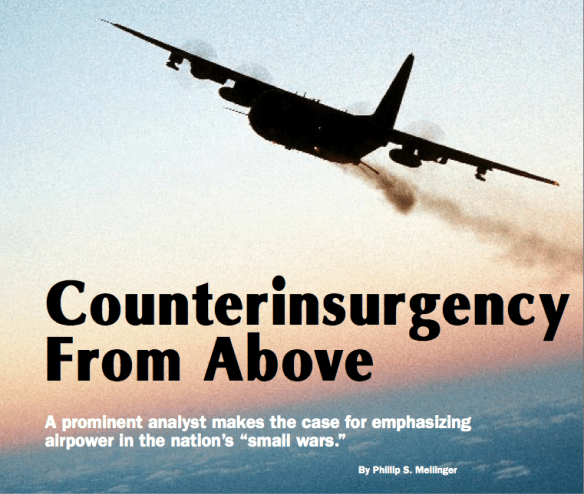
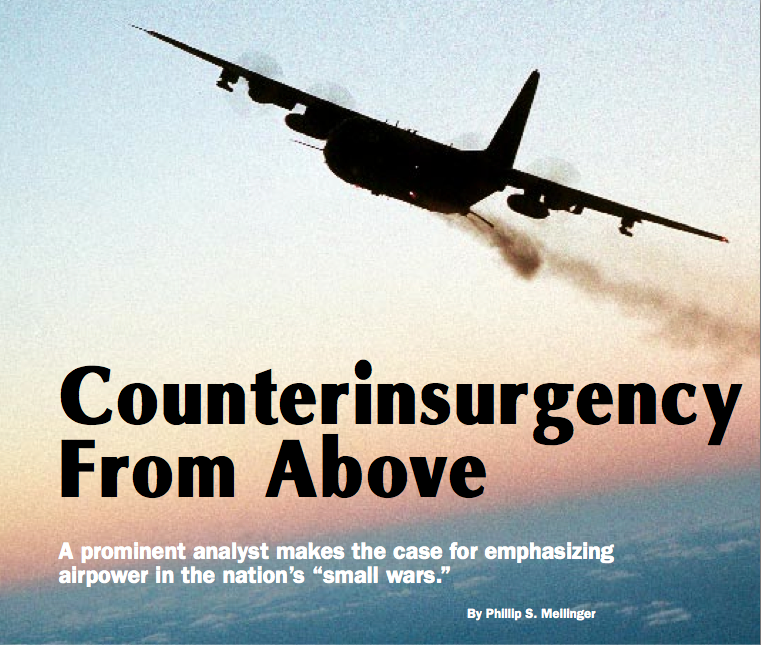
MEILINGER COIN from above

And yet in practice, as Chamayou argues, the balance was already being reversed; the incorporation of drones into counterinsurgency (COIN) was soon so advanced that there were calls (from air power advocates) for the promulgation of an official doctrine reflecting the new intrinsically three-dimensional reality.  So – to take the example Chamayou gives – Phillip Meilinger, a retired command pilot and former Dean of the School of Advanced Airpower Studies at the USAF’s Air University at Maxwell AFB, complained that the Field Manual had already been overtaken by events:

The role for airpower in COIN is generally seen as providing airlift, ISR capabilities, and precision strike. This outdated paradigm is too nar- rowly focused and relegates airpower to the support role while ground forces perform the “real” work. Worse, marginalizing airpower keeps it in support of ground-centric strategies that have proved unsuccessful.

He called for the Pentagon to

‘re-examine the paradigm that was so successful in Bosnia, Kosovo, Afghanistan, and Iraq. That was the use of air and space power, combined with [Special Operations Forces], indigenous ground forces, and overwhelming ISR. Given the outstanding results already demonstrated, an air-centric joint COIN model should be one of the first options for America’s military and political leaders.’

As the image heading his article makes clear, Meilinger – a gifted military historian – was not limiting the role of airpower to drones; far from it.  But his repeated references to the Air Force’s ‘more sophisticated and effective sensor aircraft and satellites’ signalled their indispensable importance in the transformation of counterinsurgency from a ground-centric to an air-centric model.

fm-3-24-counterinsurgency_500A similar salvo was fired at more or less the same time by Charles Dunlap, Deputy Judge Advocate General for the USAF, who castigated FM 3-24 for conceiving air power ‘as aerial artillery’ whose weapons were ‘somehow more inaccurate than other kinds of fires.’

‘In perhaps no other area has the manual been proven more wrong by the events of 2007…. [T]he profound changes in airpower’s capabilities have so increased its utility that it is now often the weapon of first recourse in COIN operations, even in urban environments.’

Dunlap was quick to say that this myopia wasn’t the result of inter-service rivalry (‘parochialism’):

‘Rather, FM 3-24 draws many of its lessons from counterinsurgency operations dating from the 1950s through the 1970s. While this approach is remarkably effective in many respects, it inherently undervalues airpower. The revolutions in airpower capabilities that would prove so effective during 2007 were unavailable to counterinsurgents in earlier eras.’ 

Those ‘revolutions’ – what Dunlap identified as ‘the precision and persistence revolutions’ – placed armed drones at the leading edge of counterinsurgency and, as Chamayou glosses these arguments, consigned previous objections to the dustbin of history.

Recalling my post yesterday about ‘pattern of life’ analysis, Dunlap argued that ‘visual observations have a grammar all their own’, and he cited with approval this paragraph from journalist Mark Benjamin‘s Killing “Bubba” from the skies’:

‘The Air Force recently watched one man in Iraq for more than five weeks, carefully recording his habits—where he lives, works, and worships, and whom he meets . The military may decide to have such a man arrested, or to do nothing at all. Or, at any moment they could decide to blow him to smithereens.’

It’s a revealing essay that accords closely with Chamayou’s central thesis: Benjamin reported that, from the Combined Air Operations Center in Qatar, ‘they are stalking prey’ and that the US Air Force had turned the art of searching for individuals into a science.

But Dunlap cooly added: ‘The last statement may be more insightful than perhaps even Benjamin realized.’  For it was not only a matter of killing, ‘blowing a man to smithereens’, and what Dunlap had in mind was not only persistent presence but also persistent threat: the ability to ‘dislocate the psychology of the insurgents’ who now never knew where or when they might be attacked.

For this reason Chamayou suggests that the drone effects a sort of détournement on the strategies and weapons of the insurgent-terrorist – the skirmish and the ambush, the IED and the suicide bomb – to become what he calls, through this radical reversal, ‘the weapon of State terrorism’.  Its short-lived engagements happen without warning and target individuals without compunction.

And yet, for all its technological sophistication, Chamayou insists that this is not a new strategy. Military historians ought to look further back, he suggests, to the policies of colonial ‘air control’ developed in the inter-war period (the image below shows a bomb dropped by the RAF on Sulaimaniyah in Iraq on 27 May 1924: more here).  He develops this argument in a later chapter, where he describes the drone as ‘the weapon of an amnesiac post-colonial violence’ (p. 136): a postcolonialism that has forgotten – or suppressed – its own wretched history.

British bomb dropped on Sulaimaniyah, Iraq, 1924

Indeed it has.  The twenty-first century version of counterinsurgency has made much of the iconic, inspirational figure of ‘Lawrence of Arabia’.  But as I’ve argued in ‘DisOrdering the Orient’ (DOWNLOADS tab):

‘… long before he resigned his Army commission and re-enlisted in the Royal Air Force as Aircraftsman Ross, [Lawrence] had been drawn to the wide open spaces of the sky as well as those of the desert. Patrick Deer suggests that in Lawrence’s personal mythology ‘air control in the Middle East offered a redemptive postscript to his role in the Arab Revolt of 1916-18’. He imagined the Arab Revolt ‘as a kind of modernist vortex,’ Deer argues, fluid and dynamic, ‘without front or back,’ and in Seven Pillars he recommended ‘not disclosing ourselves till we attack.’ To Lawrence, and to many others at the time, the intimation of a nomadic future war gave air power a special significance. ‘What the Arabs did yesterday,’ he wrote, ‘the Air Forces may do tomorrow – yet more swiftly.’  As Priya Satia has shown, this rested not only on a military Orientalism that distinguished different ways of war but also on a cultural Orientalism that represented bombing as signally appropriate to the people of these lands. This was, minimally, about intelligence, surveillance and reconnaissance. ‘According to this perverse logic’, Satia explains, ‘the RAF’s successful persecution of a village testified to their intimacy with the people on the ground, without which they would not have been able to strike it accurately.’ More than this, however, ‘the claim to empathy ultimately underwrote the entire air control system with its authoritative reassurances that bombardment was a tactic that would be respected and expected in this unique land.’ From this perspective, Satia continues, Arabs saw bombing as ‘pulling the strings of fate from the sky.’ They understood it ‘not as punishment,’ Lawrence informed his readers, ‘but as misfortune from heaven striking the community.’ And if women and children were killed in the process that was supposedly of little consequence to them: what mattered were the deaths of ‘the really important men.’’
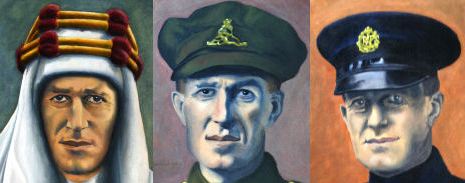
JONGBLOED Lawrence triptych

As far as I know, Lawrence has not been invoked by any of the contemporary advocates of airpower in counterinsurgency – though he has been called ‘Lawrence of Airpower‘ – but many of these formulations and their successors, translated into an ostensibly more scientific vocabulary, reappear in contemporary debates about the deployment of drones in counterinsurgency.

In fact, Meilinger had conceded the relevance of these historical parallels. ‘It would be useful to revisit the “air control” operations employed by the Royal Air Force in the Middle East in the 1920s and 1930s,’ he wrote. ‘These operations were not always successful in objective military terms, but they were unusually successful in political terms, in part because they carried a low cost in both financial and casualty terms’ (my emphasis).

That is an extraordinary sentence, although Chamayou doesn’t quote it, because what is missing from the air power advocates’ view (so Chamayou argues) is – precisely – an apprehension of the politics of counterinsurgency in general and air strikes in particular.  Indeed, when the imaginary conjured up by Lawrence and his successors reappears in contemporary debates it is entered on both sides of the ledger: not only as economical and effective but also as cowardly and counter-productive.   Here is Colonel Keen, complaining about the bombing of Pashtun villages on the North West Frontier in 1923:

‘By driving the inhabitants of the bombarded area from their homes in a state of exasperation, dispersing them among neighbouring clans and tribes with hatred in their hearts at what they consider ‘‘unfair’’ methods of warfare … [these attacks] bring about the exact political results which it is so important in our own interests to avoid, viz., the permanent embitterment and alienation of the frontier tribes.’ 

Both Chamayou and I cite this passage, and you can find more about the colonial bombing of Waziristan in a previous post (scroll down).

This sentiment reappeared in different form in the critique of drone strikes in Pakistan’s Federally Administered Tribal Areas  – the same region described by Keen – published by David Kilcullen and Andrew Exum in the New York Times in 2009, ‘Death from above, Outrage down below‘. Their core argument was that the campaign was making the cardinal mistake of ‘personalizing’ the struggle against al-Qaeda and the Taliban – going after individuals – while causing considerable civilian casualties: ‘every one of these dead noncombatants represents an alienated family, a new desire for revenge, and more recruits for a militant movement that has grown exponentially even as drone strikes have increased.’

Estimates of combatant and civilian casualties remain contentious, of course, including those used by Kilcullen and Exum; Chamayou doesn’t discuss this in any detail, but most sources (including the Bureau of Investigate Journalism) suggest that civilian casualties in Pakistan have fallen from their peak in 2009-10.  Others have argued that drone strikes are more effective than their critics claim.  Their confidence typically rests on a combination of assertion and anecdote, but a recent quantitative study by Patrick Johnston and Anoop Sarbahi (from which I’ve borrowed the map below) purports to show that, contrary to Kilcullen and Exum’s original claim, US drone strikes between January 2007 and September 2011 reduced the incidence of militant activity in the FATA.

JOHNSTON and SARBAHI Figure 1 Drone strikes and militant activity in FATA

I mention these qualifications neither to adjudicate them nor to blunt Chamayou’s argument: simply to note that the situation is far from static or settled. Chamayou uses the Kilcullen-Exum critique, in conjunction with Kilcullen’s other, more extended contributions, to leverage two linked claims:

(1) counterinsurgency is a politico-military strategy that depends, for its effectiveness, on a sustained presence amongst a population: a politics of verticality (described in my previous post) cannot substitute for, and usually confounds, a properly population-centric campaign, which can only be won on the ground.

(2) the ‘dronisation’ of US military operations signals a shift away from counterinsurgency and towards counter-terrorism, which is a police-security strategy that prioritises an individual-centric campaign.

Chamayou owes the distinction to Kilcullen [‘Countering global insurgency’, Journal of strategic studies 28 (2005) 597-617]:

‘Under this [counter-terrorism] paradigm … terrorists are seen as unrepresentative aberrant individuals, misfits within society. Partly because they are unrepresentative, partly to discourage emulation, ‘we do not negotiate with terrorists’. Terrorists are criminals, whose methods and objectives are both unacceptable. They use violence partly to shock and influence populations and governments, but also because they are psychologically or morally flawed (‘evil’) individuals. In this paradigm, terrorism is primarily a law enforcement problem, and we therefore adopt a case-based approach where the key objective is to apprehend the perpetrators of terrorist attacks…

‘The insurgency paradigm is different. Under this approach, insurgents are regarded as representative of deeper issues or grievances within society. We seek to defeat insurgents through ‘winning the hearts and minds’ of the population, a process that involves compromise and negotiation. We regard insurgents’ methods as unacceptable, but their grievances are often seen as legitimate, provided they are pursued peacefully… We see insurgents as using violence within an integrated politico-military strategy, rather than as psychopaths. In this paradigm, insurgency is a whole-of-government problem rather than a military or law enforce- ment issue. Based on this, we adopt a strategy-based approach to counterinsurgency, where the objective is to defeat the insurgent’s strategy, rather than to ‘apprehend the perpetrators’ of specific acts.’

in Chamayou’s terms, ‘manhunting by drones’ represents the triumph, at once doctrinal and practical, of counter-terrorism over counterinsurgency.  In this optic, a space of representation substitutes for lived space: ‘The body count, the list of hunting trophies, substitutes for the strategic evaluation of the political effects of military violence.  Success is turned into statistics.  Their evaluation is disconnected from effects on the ground.’

It’s an engaging argument, but I think it’s over-stated for several reasons.

First, contemporary counterinsurgency clearly has not ceded the statistical battleground to anyone. Under David Petraeus in particular, cascades of PowerPoint slides sluiced a tidal wave of metrics over military and public audiences, and these too were often disconnected from events on the ground.  As I showed in “Seeing Red” (DOWNLOADS tab), for example, at the height of the violence in Baghdad military briefers preferred the virtual-cartographic to the visceral-physical city, ‘walking’ reporters through maps of the capital because, for all their upbeat assessments, it was far too dangerous to walk them through the real city that lay beyond the Green Zone.  And so far it has proved impossible to obtain any figures of fatalities from drone strikes in the FATA from Obama’s otherwise garrulous ‘off-the-record’ (and, remarkably, never prosecuted) officials.

Second, contemporary counterinsurgency is not only about deploying ‘soft power’ and exploiting the humanitarian-military nexus; this is a one-sided view.  Kilcullen himself conceded that ‘there’s always a lot of killing, one way or another’, in counterinsurgency, but in the wake of the nightmare that was Abu Ghraib the publicity campaign that surrounded the release of FM 3-24 directed attention to ‘hearts and minds’ – to a kinder, gentler, culturally-informed and compassionate military – rather than to bullets and bombs.   But as Petraeus reminded Noah Schachtman in November 2007,  the manual

‘doesn’t say that the best weapons don’t shoot. It says sometimes the best weapons don’t shoot. Sometimes the best weapons do shoot.”

As I showed in “The rush to the intimate” (DOWNLOADS tab), more often than one might think. Chamayou is perfectly correct to say that ‘drones are excellent at crushing bodies from a distance, but they are perfectly  inappropriate for winning “hearts and minds”‘: but counterinsurgency, even in its supposedly radically new form, involves both.

Third, for that very reason counterinsurgency has continued to incorporate air power into its operations, and ground troops and commanders in Afghanistan continue to clamour for Predators and Reapers to provide close air support.  In October 2009 the Joint Chiefs of Staff issued Joint Publication 3-24 on Counterinsurgency Operations, which was far more positive about air power than the Field Manual three years earlier:

‘Video downlink and datalink technology have revolutionized real-time air to ground employment allowing air assets to seamlessly integrate into and support the ground commander’s scheme of maneuver. Armed overwatch missions provide ground forces with the critical situational awareness, flexibility, and immediate fire support necessary to succeed in the dynamic COIN environment.’

Fourth, later modern war is intrinsically hybrid, and military operations under its sign are likely to involve an unstable and often contradictory mix of counterinsurgency and counter-terrorism. Writing a year or so into Obama’s first term, Colleen Bell and Brad Evans [in ‘Terrorism to insurgency: Mapping the post-intervention security terrain’, Journal of intervention and statebuilding 4 (4) (2010) 371-390] described a reverse movement from counter-terrorism to counterinsurgency in Afghanistan:

‘Counterterrorist interventionism has, until relatively recently, been principally rooted in an exterminatory logic that demands a sovereign commitment to the violent excision of enemies. The shift towards the problem of insurgency, however, is more expansive. It demonstrates a strategic focus on political opposition as embedded within besieged, illiberal and underdeveloped populations…. [The] focus on insurgency in terms of population represents a break from the preoccupation with terrorism as a form of incalculable danger to the mobilization of a different rationality of risk, that of insurance, which seeks to govern the future on the basis of the collective probabilities emanating from within host societies today.’
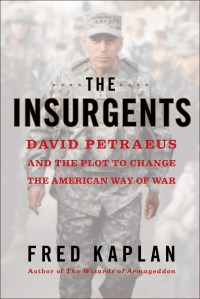
kaplan_the-insurgents_cover-finalThey treat this as a transformation of what Chamayou would call the ‘logics’ of intervention: from ‘a conventional struggle to eliminate adversaries’ to a ‘productive reconstitution of the life of a population’ (which requires ‘marking out what qualities the “good” life must possess, whilst in the process positively rendering dangerous all “other” life which does not comply with the productive remit).  In other words (their words), a switch from sovereign power to bio-power.  I have my reservations about the theoretical argument, but in any case the transformation was far from stable or straightforward.  In December 2009 Obama committed thousands of extra ground troops as part of a revitalized counterinsurgency campaign in Afghanistan; they were supported by a continued increase in drone operations. And Obama had also authorised a dramatic increase in CIA-directed drone strikes in Pakistan.  But in June 2011 he announced the withdrawal of those additional troops: as Fred Kaplan puts in The insurgents, ‘pulling the plug on COIN.’  All of this va-et-vient was, as Kaplan shows in exquisite detail, more than a philosophico-logical affair: it was also profoundly political, and included considerations of domestic US politics, concerns over the Afghan state in general and the re-election of Hamid Karzai in particular, and no doubt calculations of advantage within the US military.  In short, while Chamayou is surely right to accentuate the politics of military violence this is not confined to the ‘inside’ of counterinsurgency – COIN as ‘applied social work’, as Kilcullen once described it – because politics also provides one of its activating armatures. (I’ve discussed Kaplan’s view of drone strikes and what he sees as an emerging imaginary of ‘the world as free-fire zone’ here).
For all that, Chamayou’s dissection of the ‘reverse logics’ of these particular forms of counterinsurgency and counter-terrorism is analytically helpful, and adds another dimension to his argument about the transformation of war from battlefields to hunting grounds and from armies to individuals.   He insists that the commitment to targeted killing (by drone or, I would add, Special Forces) is a commitment to ‘an infinite eradicationism’ in which it becomes impossible to kill leaders (‘High Value Targets’) faster than they can be replaced. In his vivid image, the hydra constantly regenerates itself as a direct response  to the very strikes that seek to decapitate it.

‘Advocates for the drone as the privileged weapon against terrorism promise a war without loss or defeat.  They fail to note that this will also be war without victory’ (p. 108).