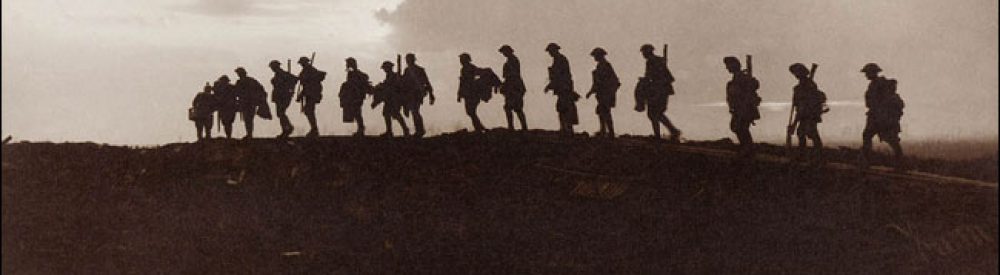
Inhumanned

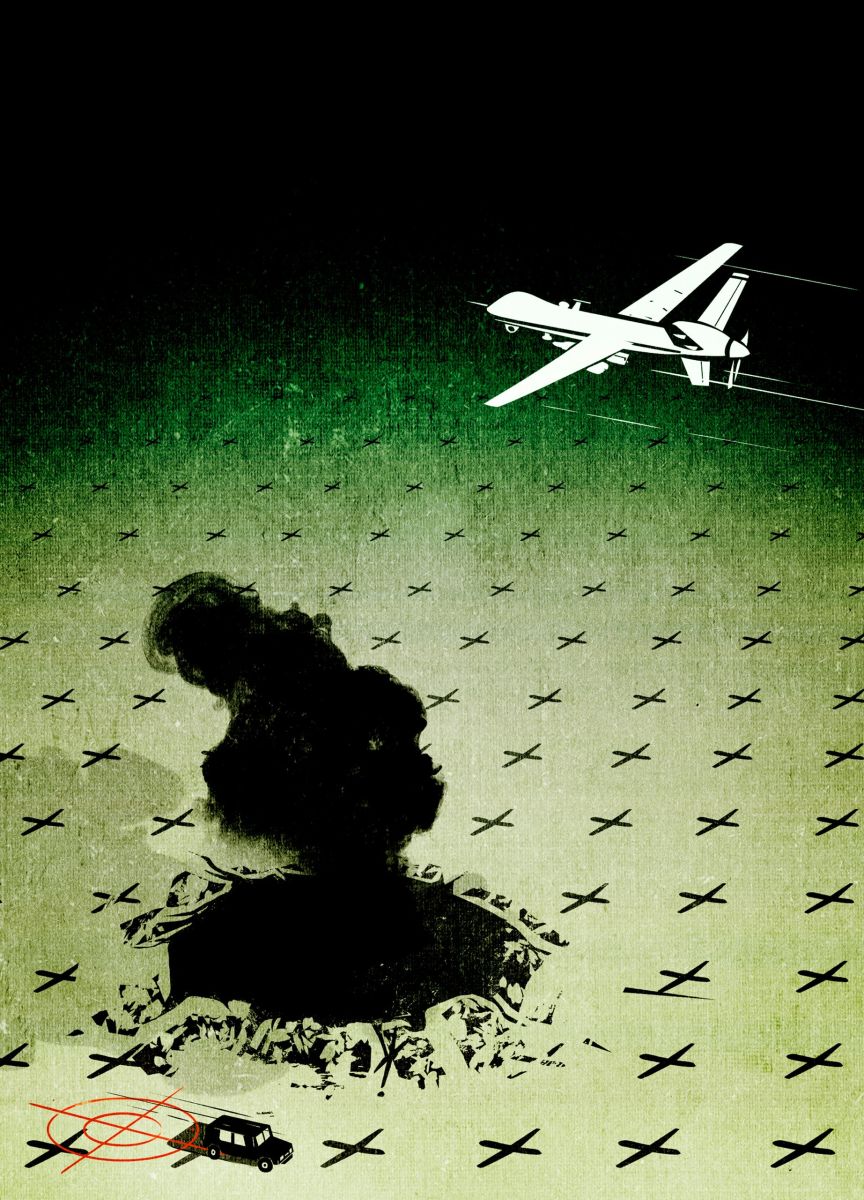
Drones_Poster_cropped

Better late than never…  I talked about Robert Greenwald‘s Unmanned before – the video documentary he produced to accompany the Stanford/NYU report Living under Drones – and I’ve now discovered you can still watch all 61 minutes here.

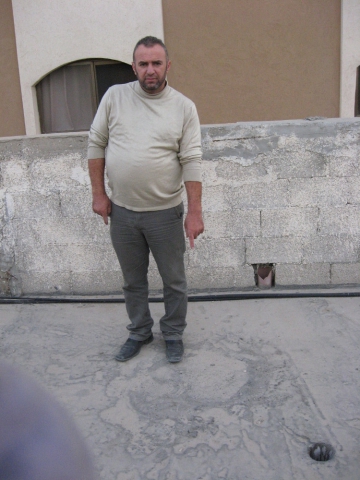
Beginning at 39:08 there is a harrowing account of the murder of Mamana Bibi in Waziristan on 24 October 2012.  There is a detailed investigation in Amnesty’s Will I be next? and its forensic detail is compelling, but watching and listening to the surviving members of her family adds a new dimension to the horror.

So too, though in a radically different way, does reading C. Christine Fair‘s partisan dismissal of both the Amnesty report and the testimony of the Rehman family here.  It was published under the title ‘Ethical and methodological issues in assessing drones’ civilian impacts in Pakistan’ – without a trace of irony – but for once the comments below the line give me hope…

FOOTNOTE:  I’ve been asked to elaborate that last paragraph.  Fair suggests – on the flimsiest of bases – that the strike was carried out by the Pakistan Air Force, and clumsily attempts to discredit both Reprieve and Amnesty’s research.  I’ve written before about the PAF’s repeated assaults on the FATA – here and here for example – but here is part of a report from the Guardian on the murder of Mamana Bibi that describes how Amnesty’s local researcher Mustafa Qadri went about his work:

Qadri reached out to trusted sources in North Waziristan. The family members and their neighbors were interviewed independently on multiple occasions, unaware that a human-rights group was behind the questions they were asked. Over the course of many weeks, Qadri found the family’s account to be consistent. He determined it was highly unlikely that any militants were present at the time of the strike and that the missiles were likely fired by a US drone.

“It was a number of things,” Qadri told the Guardian. “We got the missiles, the large fragments that the family has that we got analyzed by [an] expert who says this is very likely to be a Hellfire missile. We also had family members who saw drones physically. We also have the eyewitness of the family who said they heard the noise of missiles fired from the sky and then separate noises of missiles impacting on the ground. We have the evidence of a double sound, with each single strike.”

I doubt that he needs any lessons on ethics or methodology.

Bodies on the line

The more I think about corpography (see also ‘Corpographies under the DOWNLOADS tab) – especially as part of my project on casualty evacuation from war zones – the more I wonder about Grégoire Chamayou‘s otherwise artful claim that with the advent of armed drones the ‘body becomes the battlefield’.  He means something very particular by this, of course, as I’ve explained before (see also here).

But let me describe the journey I’ve been taking in the last week or so that has prompted this post. Later this month I’m speaking on ‘Wounds of war, 1914-2014‘, where I plan to sketch a series of comparisons between casualty evacuation on the Western Front (1914-18) and casualty evacuation from Afghanistan.  I’ve already put in a lot of work on the first of these, which will appear on these pages in the weeks and months ahead, but it was time to find out more about the second.

800px-Medical_Emergency_Response_Team_Recovers_a_Casualty_in_Afghanistan_MOD_45151884

En route I belatedly discovered the truly brilliant work of David Cotterrell who is, among many other things, an installation artist and Professor of Fine Art at Sheffield Hallam University.  He became interested in documenting the British military casualty evacuation chain from Afghanistan, and in 2007 secured access to the Joint Medical Forces’ operations at Camp Bastion in Helmand.  He underwent basic training, a course in even more basic battlefield first-aid, and then found himself on an RAF transport plane to Bastion.  The Role 3 Hospital was, as he notes, a staging-ground. ‘Field hospitals are islands between contrasting environments,’ he wrote in his diary, ‘between the danger and dirt of the Forward Operating Bases and the order and convention of civilian healthcare.’  You can read a long, illustrated extract from the diary (3 – 26 November 2007) here, follow the photo-essay as a slideshow here, and explore David’s many other projects on his own website here.

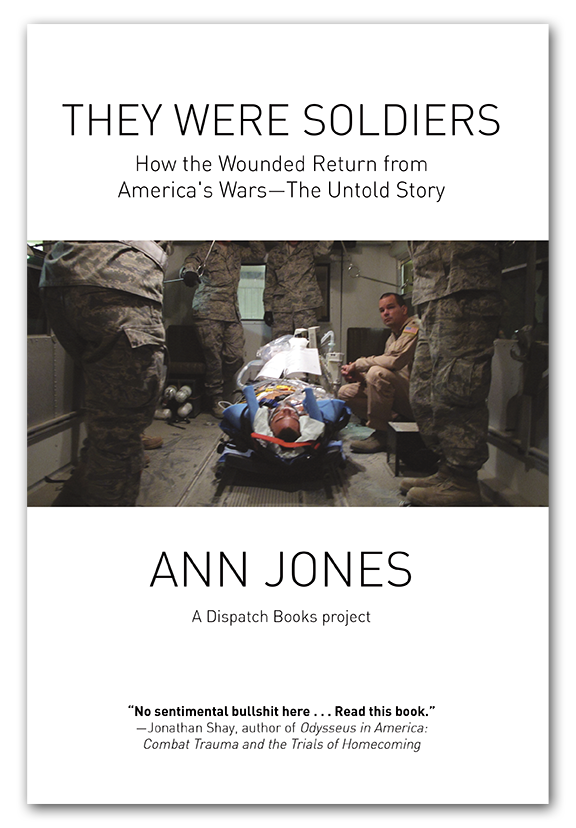
THEY-WERE-SOLDIERS_by-Ann-Jones_72The diary is immensely interesting and informative in its own right, not least about the exceptional personal and professional difficulties involved in documenting the evacuation process.  Here there’s a helpful comparison to be made with journalist Ann Jones‘s no less brilliant They were soldiers: how the wounded return from America’s wars (more on this in a later post), which starts at the US military’s own Level III Trauma Center, the Craig Joint Theater Hospital at Bagram, and moves via Landstuhl Regional Medical Center in Germany, the largest US hospital outside the United States, to the Walter Reed Army Medical Center in Washington DC.

David’s visual record is even more compelling, as you would expect from a visual artist, not only in its documentary dimension but also in the installations that have been derived from it.  In Serial Loop, for example, we are confronted with a looped film showing the endless arrival of casualties at Bastion: ‘The sound of a continuously arriving and departing Chinook helicopter accompanies images of a bleak and wasted landscape; the banality of the film’s fixed perspective masks the dramas that unfold within the ambulances as they travel to triage.’

9-liner explores what David calls ‘the abstraction of experience within conflict’:

9-Liner explores the dislocation between the parallel experiences of casualties within theatre. It is a quiet study of a dramatic event: the attempt to bring an injured soldier to the tented entrance of the desert field hospital. The screens show apparently unrelated information. JCHAT – a silent scrolling codified message – runs on a central screen. Our interpretation of it is enabled through its relationship between one of two radically different but equally accurate views of the same event. To the left we see the Watchkeeper – a soldier manning phones and reading computer screens in a crowded office. On the right we view the MERT flight – the journey of the Medical Emergency Response Team in a Chinook helicopter.

SHU’s REF submission includes this summary of David’s work (one of the very few useful things to come out of that otherwise absurdist exercise):

The research made clear that soldiers recovering from life-changing injuries had limited means of reconstructing the narrative of their transformative experiences. From the time of wounding through to secondary operations in the UK, many soldiers remained sedated or unconscious for a period of up to five days. The radical physical transformation that had occurred during this period was not adequately reconciled through medical notes, and the embargo on photographic documentation of incident and subsequent medical procedures served further to obscure this period of lost memory.

A culture of secrecy meant that medical professionals were unable to access documentation of the expanded care pathway with which they, and their colleagues, were engaged. This fragmentation of experience and understanding within the process of evacuation, treatment and rehabilitation meant that the assessment of the contradictions and disorientation experienced by casualties and medical practitioners was denied to front-line staff.

Family members, colleagues and members of the public outside the immediate environment of the military were unable to visualise or understand the transformative effects of conflict on directly affected civilians and soldiers. Partly as a result, the scope for public debate to engage meaningfully with the longer term societal cost of contemporary conflict was limited.

The submission goes on to list an impressive series of debriefings, presentations to military and medical professionals, major exhibitions, and follow-through research in Birmingham.

5-soldiers_header

And it’s one of those follow-throughs that prompted me to think some more about corpographies.  I’d noted the connection between corpography and choreography in my original post, but David’s extraordinary collaboration with choreographer Rosie Kay and her dance company gives that a much sharper edge.  Again, there’s a comparison to be drawn – this time with Owen Sheers‘s impressively researched and executed body of work, not only the astonishing Pink Mist but also The Two Worlds of Charlie F (2012)which was a stage play based on the experiences of wounded soldiers who also made up the majority of the cast (see my discussion of these two projects here).

5 Soldiers started life as a stage presentation in 2010 (watch some extracts here):

A dance theatre work with 5 dancers, it looks at how the human body is essential to, and used in, warfare. 5 SOLDIERS explores the physical training that prepares you for war, as well as the possible effects on the body, and the injury caused by warfare.

Featuring Kay’s trademark intense physicality and athleticism, 5 SOLDIERS weaves a journey of physical transformation, helping us understand how soldiers are made and how war affects them.

5 SOLDIERS is a unique collaboration between award-winning choreographer Rosie Kay, visual artist David Cotterrell and theatre director Walter Meierjohann. It follows an intense period of research, where Rosie learnt battle training with The 4th Battalion The Rifles and David spent time in Helmand Province with the Joint Forces Medical Group.

Rosie explained her commitment to the project (and her training with The Rifles) like this:

“I wanted to look at how the physicality of a soldier’s job defines them –like a dancer, the soldier is drilled, trained, their responses becoming automatic, but can anything prepare you for the realities of war? It is young soldiers and their bodies that are the ultimate weapon in war – their strength and weaknesses may win or lose a battle, their ability to harm or injure others is key to victory. While war is surrounded with weaponry, uniforms, history and ceremony, the real business is human, dirty, messy, painful and happening right now.”

(She is, not coincidentally, an affiliate of the School of Anthropology at Oxford).

5 Soldiers installation PNG

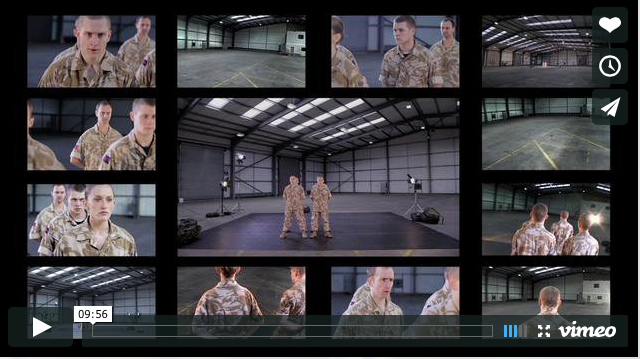
And now there’s a film version that works as a multi-screen installation (screen shot above).

Instead of just creating a short film, the team wanted the web user to get a truly interactive way to watch dance, and actually feel that they can go inside the minds and the body of the work. The 80-minute work was cut to just 10 minutes long, and the company spent one week filming in a huge aircraft hangar at Coventry Airport…

Using a variety of cutting edge filming techniques, the collaborative team have created a 13 angle edit that takes you into the heart of the work, follows each of the dancers, and zooms out so that the performers appear to be like ants in a huge empty landscape.

You can see the interactive, multi-perspectival version here.  This relied on helmetcams, and there’s a fine, more general commentary on this in Kevin McSorley‘s ‘Helmetcams, militarized sensation and “somatic war”‘ here.  But here’s the short, ‘director’s cut’ version:

And look at the tag-line: ‘The body is the frontline’.  It’s not only drones that make it so.

Crossing the line

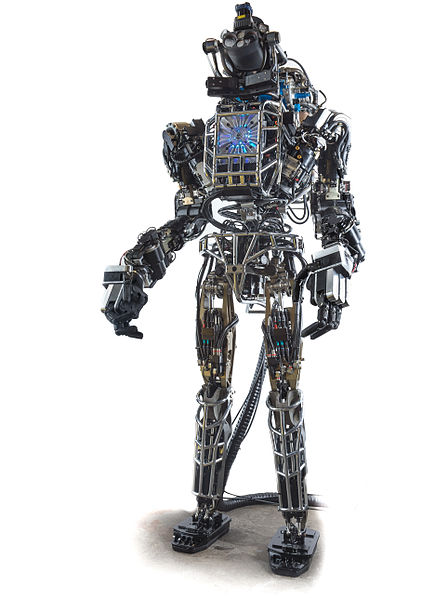
435px-Atlas_frontview_2013News from Lucy Suchman of an important essay she’s just completed with Jutta Weber on Human-Machine Autonomies, available from Academia.edu here.

This is how they begin:

This paper takes up the question of how we might think about the increasing automation of military systems not as an inevitable ‘advancement’ of which we are the interested observers, but as an effect of particular world-making practices in which we need urgently to intervene. We begin from the premise that the foundation of the legality of killing in situations of war is the possibility of discrimination between combatants and non-combatants. At a time when this defining form of situational awareness seems increasingly problematic, military investments in the automation of weapon systems are growing. The trajectory of these investments, moreover, is towards the development and deployment of lethal autonomous weapons; that is, weapon systems in which the identification of targets and initiation of fire is automated in ways that preclude deliberative human intervention. Challenges to these developments underscore the immorality and illegality of delegating responsibility for the use of force against human targets to machines, and the requirements of International Humanitarian Law that there be (human) accountability for acts of killing. In these debates, the articulation of differences between humans and machines is key.

Our aim in this paper is to strengthen arguments against the increasing automation of weapon systems, by expanding the frame or unit of analysis that informs these debates. We begin by tracing the genealogy of concepts of autonomy within the philosophical traditions that inform Artificial Intelligence (AI), with a focus on the history of early cybernetics and contemporary approaches to machine learning in behaviour-based robotics. We argue that while cybernetics and behaviour-based robotics challenge the premises of individual agency, cognition, communication and action that comprise the Enlightenment tradition, they also reiterate aspects of that tradition in the design of putatively intelligent, autonomous machines. This argument is made more concrete through a close reading of the United States Department of Defense Unmanned Systems Integrated Roadmap: FY2013-2038, particularly with respect to plans for future autonomous weapon systems. With that reading in mind, we turn to resources for refiguring agency and autonomy provided by recent scholarship in science and technology studies (STS) informed by feminist theory. This work suggests a shift in conceptions of agency and autonomy, from attributes inherent in entities, to effects of discourses and material practices that variously conjoin and/or delineate differences between humans and machines. This shift leads in turn to a reconceptualization of autonomy and responsibility as always enacted within, rather than as separable from, particular human- machine configurations. We close by considering the implications of these reconceptualizations for questions of responsibility in relation to automated/autonomous weapon systems. Taking as a model feminist projects of deconstructing categorical distinctions while also recognising those distinctions’ cultural-historical effects, we argue for simultaneous attention to the inseparability of human-machine agencies in contemporary war fighting, and to the necessity of delineating human agency and responsibility within political, legal and ethical/moral regimes of accountability.

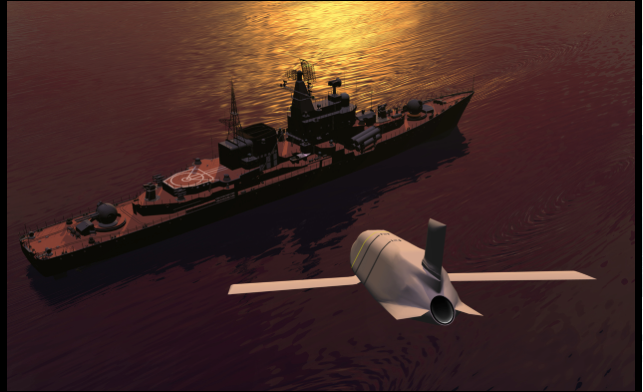
LRASM (Lockheed-Martin photo) PNG

It’s a must-read, I think, especially in the light of a report from the New York Times of the Long Range Anti-Ship Missile (above) developed for the US military by Lockheed Martin:

On a bright fall day last year off the coast of Southern California, an Air Force B-1 bomber launched an experimental missile that may herald the future of warfare.

Initially, pilots aboard the plane directed the missile, but halfway to its destination, it severed communication with its operators. Alone, without human oversight, the missile decided which of three ships to attack, dropping to just above the sea surface and striking a 260-foot unmanned freighter…

The Pentagon argues that the new antiship missile is only semiautonomous and that humans are sufficiently represented in its targeting and killing decisions. But officials at the Defense Advanced Research Projects Agency, which initially developed the missile, and Lockheed declined to comment on how the weapon decides on targets, saying the information is classified.

“It will be operating autonomously when it searches for the enemy fleet,” said Mark A. Gubrud, a physicist and a member of the International Committee for Robot Arms Control, and an early critic of so-called smart weapons. “This is pretty sophisticated stuff that I would call artificial intelligence outside human control.”

Paul Scharre, a weapons specialist now at the Center for a New American Security who led the working group that wrote the Pentagon directive, said, “It’s valid to ask if this crosses the line.”

And the Israeli military and armaments industry, for whom crossing any line is second nature, are developing what they call a ‘suicide drone’ (really).  At Israel Unmanned Systems 2014, a trade fair held in Tel Aviv just three weeks after Israel’s latest assault on Gaza, Dan Cohen reported:

Lieutenant Colonel Itzhar Jona, who heads Israel Aerospace Industries, spoke about “loitering munitions” — what he called a “politically correct” name for Suicide Drones. They are a hybrid of drone and missile technology that have “autonomous and partially autonomous” elements, and are “launched like a missile, fly like an UAV [unmanned aerial vehicle],” and once they identify a target, revert to “attack like a missile.” Jona called the Suicide Drone a “UAV that thinks and decides for itself,” then added, “If you [the operator] aren’t totally clear on the logic, it can even surprise you.”

Jona praised the advantage of the Suicide Drone because the operator “doesn’t have to bring it home or deal with all sorts of dilemmas.” The Suicide Drone will quickly find a target using its internal logic, which Jona explained in this way: “It carries a warhead that eventually needs to explode. There needs to be a target at the end that will want to explode. Or it won’t want to and we will help it explode.”

So thoughtful to protect ‘the operator’ from any stress (even if s/he might be a little ‘surprised’).  Here is Mondoweiss‘s subtitled clip from the meeting, which opens with a short discussion of the major role played by UAVs in the air and ground attacks on Gaza, and then Jona describes how ‘we always live on the border’:

Kill Chain

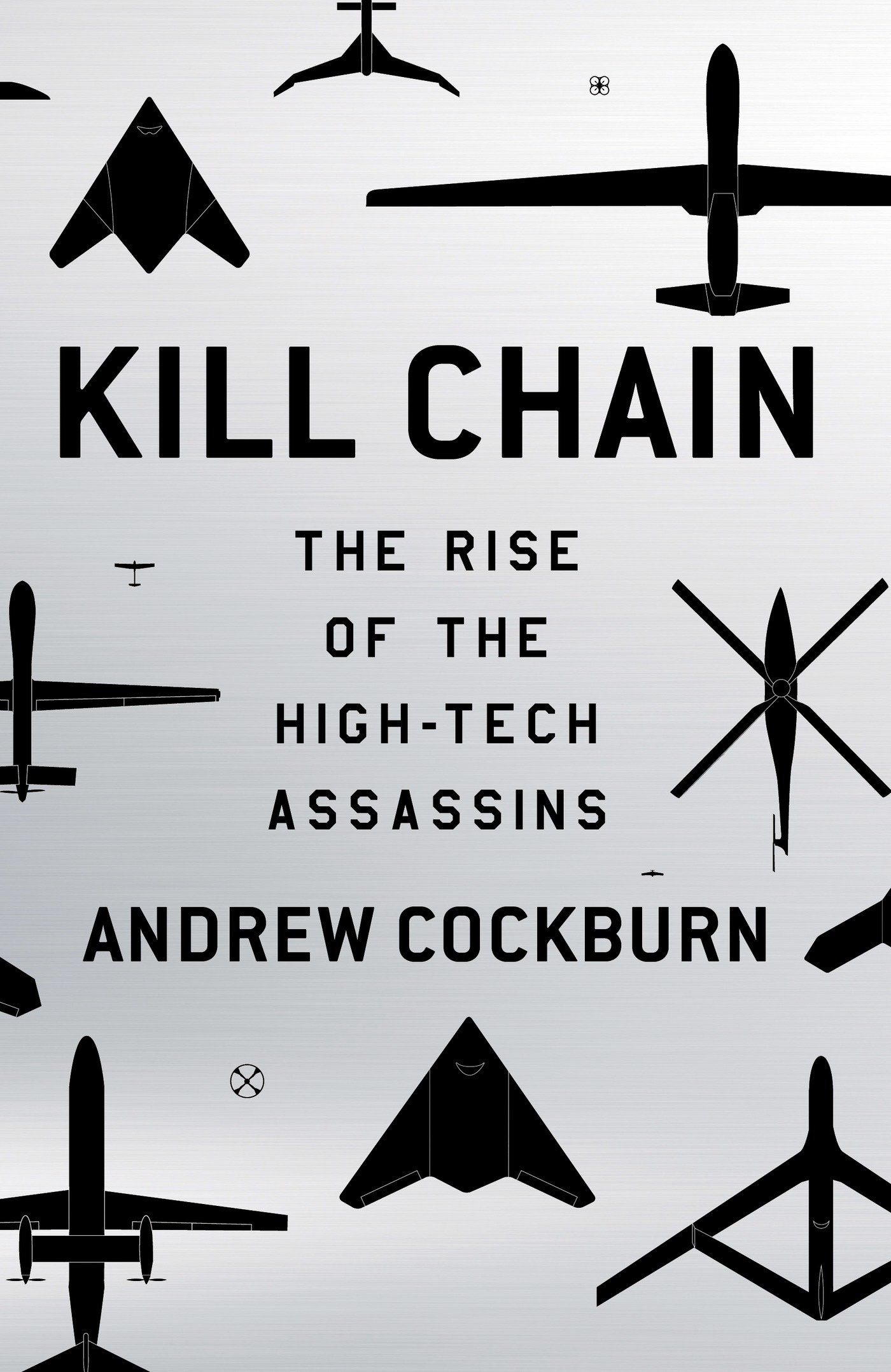
COCKBURN Kill chain 1

Yet more on targeted killing/assassination: new from Verso and Henry Holt in March, Andrew Cockburn‘s Kill Chain: the rise of the high-tech assassins.

Kill Chain uncovers the real and extraordinary story of drone warfare, its origins in long-buried secret programs, the breakthroughs that made drone operations possible, the ways in which the technology works, and, despite official claims, does not work. Through the well-guarded world of national security, the book reveals the powerful interests—military, CIA, and corporate—that have led the drive to kill individuals by remote control. Most importantly of all, the book describes what has really happened when the theories underpinning the strategy—and the multi billion-dollar contracts they spawn—have been put to the test.

Andrew is the author of the brilliant Rumsfeld: an American disaster, and he’s also been writing around the issue of military and paramilitary violence for some time.  There’s an early review of Kill Chain from Kirkus here, and Andrew discusses writing the book in a short audio clip here.

If you can’t wait until March, there’s a taster in ‘Drones, baby, drones‘, which appeared in the London Review of Books (8 March 2012); if you aren’t a subscriber you can obtain 24-hour access free of charge.

Time and again, the military has claimed that advances in technology have finally made warfare predictable and precise. That was the promise of Igloo White in Vietnam [see my ‘Lines of descent’: DOWNLOADS tab], the video-game spectacle of the Gulf War, the war for Kosovo and the counter-guerrilla wars of the past ten years. Time and again, the military’s claims have been disproved. Will drones change everything? Robert Gates, secretary of defence from 2006 to 2011, expressed the official view in his address to the CIA Officers Memorial Foundation annual dinner last March. Confessing that he hadn’t initially done enough to quash resistance to innovation from ‘flyboys in silk scarves’, Gates said: ‘From now on, it’s drones, baby, drones.’

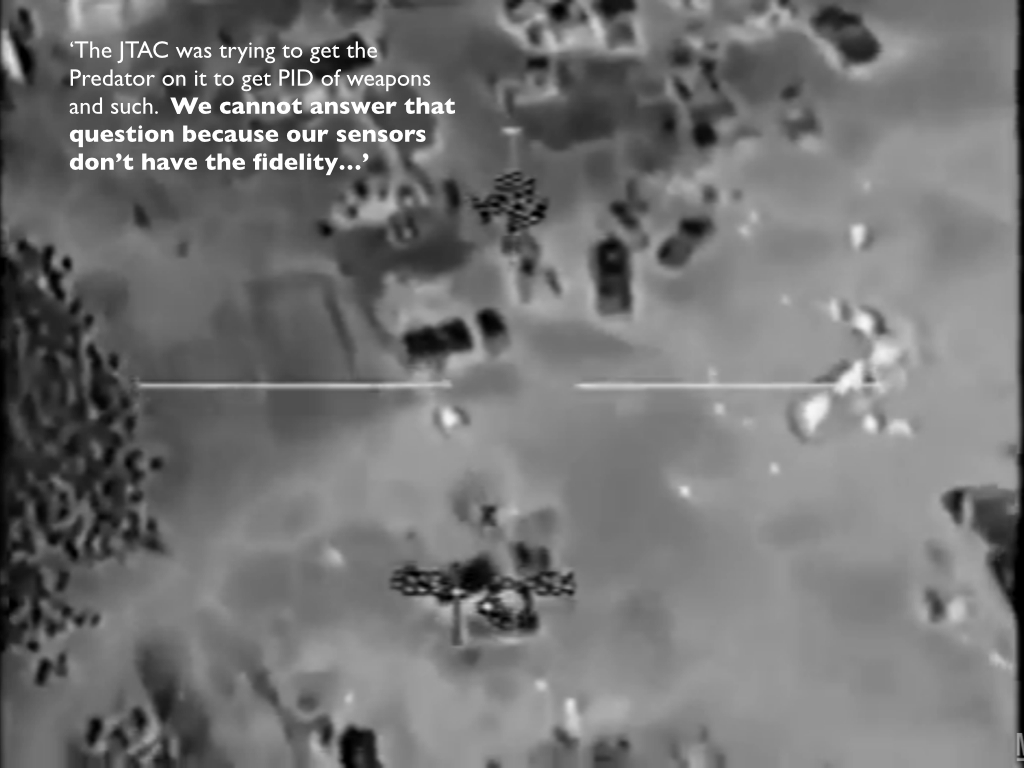
In the audio clip Andrew insists that the full-motion video feeds from Predators and Reapers are far less clear than most commentators make out, and in subsequent contributions Andrew has perceptively linked the fantasies of the God-trick with militarized vision more generally: see, for example, his ‘Tunnel vision‘ (about the comparative merits of the A10 and the B1 bomber) which appeared in Harper’s in February 2014 and ‘Flying Blind‘, which appeared on Harper’s blog in September.

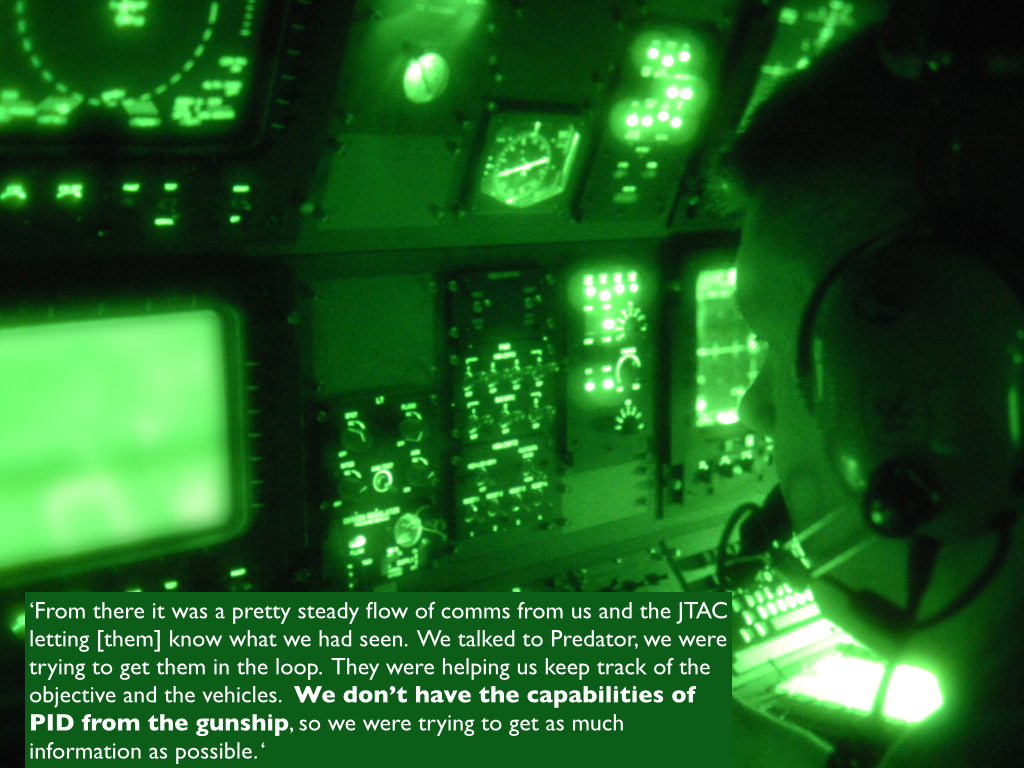
I’m not convinced that the A-10 is able to ‘observe the battleground with such precision, and safely to target enemy forces a stone’s throw away from friendly troops’ as Andrew maintains, but his more general point is a sharp one.  Too often we forget that other aircraft rely on optical sensors and video screens too, not only Predators and Reapers, and that these political technologies differ from platform to platform, as the following slides from ‘Angry eyes’ indicate (where the captain of an AC-130 gunship in fact defers to the crew of a Predator):

Angry eyes VISION.001

Angry eyes VISION.002

And, as Andrew also makes clear, these technologies produce their own interpellations:

Video will often supply a false clarity to preconceived notions. One A-10 pilot described to me an afternoon he spent circling high over southern A ghanistan in May 2010, watching four people—tiny figures on his cockpit screen—clustering at the side of a road before they retreated across a field to- ward a house. Everything about their movements suggested a Taliban I.E.D.- laying team. Then the door to the house opened and a mother emerged to hustle her children in to supper.

“On the screen,” he explained, “the only way to tell a child from an adult is when they are standing next to each other. Otherwise everyone looks the same.”

“We call the screens face magnets,” remarked another veteran, Lieutenant Colonel Billy Smith, a former A-10 squadron commander who flew tours over Bosnia, Iraq, and Afghanistan. “They tend to suck your face into the cockpit, so you don’t pay attention to what’s going on outside.”

All of this intersects with my continuing work on militarized vision, and in the next several weeks I’ll be uploading a series of new essays that deal with drone strikes in Pakistan [based on my ‘Dirty dancing‘ presentations], the Sangin Valley in Afghanistan (a ‘friendly fire’ incident), and an air strike in Uruzgan in Afghanistan that was orchestrated by a drone [based on my ‘Angry Eyes’ presentations]. So watch this space…

Incidentally, ‘kill chain’ is both the extended, networked apparatus that leads from air targeting to execution – for all platforms, remote and conventional – and the injunction that is typed into US military chat rooms (mIRC) to close down ‘chatter’ that might distract pilots once they are cleared to engage (see my discussion here).

Theories and counter-theories of the drone

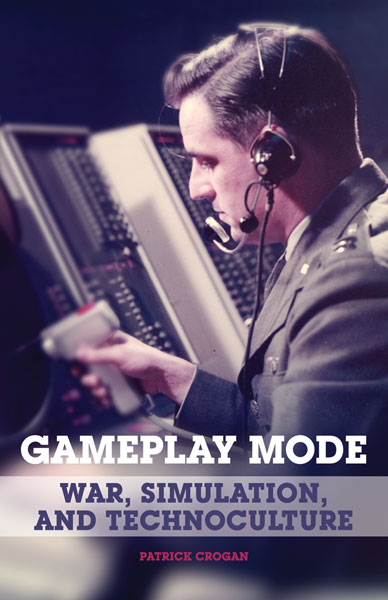
CROGAN Gameplay modeI expect many readers will know Patrick Crogan‘s Gameplay mode: war, simulation and technoculture (Minnesota, 2011).  He has now uploaded what I think is a draft of Drones and global technicity: automation and (dis)individuation at academia.  Here’s the extended abstract:

This paper (for General Organology conference [held last month at the University of Kent]) will explore the expansion of military drone usage by Western powers in the “war on terror” over the last decade or so in relation to Bernard Stiegler’s organological approach to questions concerning human historical, cultural and technological becoming.. Theorists approaching drones from different fields such as Grégoire Chamayou, Derek Gregory and Eyal Weizman have argued that the systematic and growing deployment of unmanned aerial vehicles should be understood as the “avant-garde” of a general movement toward remote and increasingly autonomous robotic systems by all branches of the armed forces of the U.S. and many of allies and competitors. These developments put into question all established cultural political, legal and ethical framings of war, peace, territory, civilian and soldier in the societies of the “advanced powers” on behalf of which these systems are deployed. Animating this indetermination is what Chamayou calls the “tendency inherent in the material development of drones” leading to this profound undoing of cultural and geopolitical moorings. I will explore the organological nature of this tendency inherent in drone materiality and technology, concentrating on the virtualizing, realtime digital developments in remotely controlled and increasingly automated robotic systems.

The projection of a simulational model of the contested space over the inhabited world is a constitutive part of this tendency. Indeed, the inhabitants of the spaces of concern in the war on terror—which in principle and increasingly in practice are everywhere—are better understood as environmental elements or “threats” in what simulation engineer and theorist Robert Sargent has called the “problem space” the computer simulation designer seeks to model conceptually in order to make the simulation serve as an effective solution. A specifically designed spatio-temporality is enacting a performative, “operational” and automated reinvention of the lived experience of both inhabiting and contesting the control of space in time.

If, as the above writers have shown, this projection of and over “enemy territory” has clear precedents in European colonialist strategies and procedures, what is unprecedented today is the digitally-enabled expansion and intensification of this spatio-temporal reanimation of the world. This reanimation must be understood as key contributor to a transformative and extremely problematic pathway toward the automation of military force projection across the globe. This essay will analyse the nature and implications of these transformative digital modellings of the enemy in and as milieu, a milieu as tiny as the space around a single ‘target’ and as large as the world, existing both in a brief “window of opportunity” and within a permanent realtime of preemptive pan-spectrum surveillance.

From an organological perspective developments in drone technics must also be approached as a particularly pressing political and ethical challenge of the global transformations of human technicity in the digital “epoch”—or rather, in the generalised crisis of epochality and spatio-temporal orientation that Stiegler sets out to thematise and respond to in his “philosophical activism”. If as Stiegler provocatively suggests in Technics and Time 1: The Fault of Epimetheus) human being had a “second origin” in the historical development of the West which achieved its culmination its “worldwide extension”, it is one whose epoch has led us tendentially and increasingly rapidly to the crisis of ethnocultural idiomatic differentiation and specificity (as he argues in Technics and Time 2: Disorientation). The history of Western techno-capitalist, imperial colonisations, wars and subsequent post-colonial globalisation is attaining its full extent and its exacerbation, readable in the above noted indeterminations of war, peace, sovereignty, citizenship and so on. What goes with this is a doubled movement (which Virilio termed “endocolonisation”) of intensification of the reorganisation of social and individual surveillance, control and regulation via realtime, pervasive digital technical regimes. The systematic deployment of computational abstraction, simulational virtualisation and anticipatory, realtime preemptive materialisation of this doubled movement is perceivable in all its cultural-political, conceptual and technological complexity in drone technics. Indeed, drones are a major driver of research and development in automation and AI for the spectrum of what the U.S.A.F calls the “perceive and act vector”, as well as for “big data” processing in realtime to handle ever-growing monitoring and surveillance feeds.

Today a voluntarist and cynical (and nihilist in Stiegler’s view) adoption of the automatising potentials of digital technics supports the rapid advances in drone systems (and I have proposed that an “elective naivety” sustains this in the academy, across scientific and humanities disciplinary contexts). From Stiegler’s organological perspective, I will argue that the autonomy of human agency is always composed with various automated functions that form part of our material, prosthetic conditions of existence. By addressing some of the inherent contradictions arising from the proposed development of fully autonomous military robotic systems, I hope to contribute toward the urgently needed “redoubling” of the first adoption of the possibilities of digital automation evidenced in drone technics (as the “logical” outcome in strategic-political terms of the latest advances of computer technology). To “re-double” technocultural becoming reflectively, critically, in the name of a less inhuman potential of automated digital technics is the responsibility of those able to read and write, to reflect and respond to the accelerating epochal transformation of the world in this “our” era of the permanent war on terror. This is the horizon in which “we” maintain the possibility of a non-inhuman future (or further “re-birth”) for contemporary humanity. For, as Stiegler has argued in What Makes Life Worth Living, this is a better way to think the present and future than that implied in the term “post-human”, for the human remains a project and a projection and not a superceded entity.

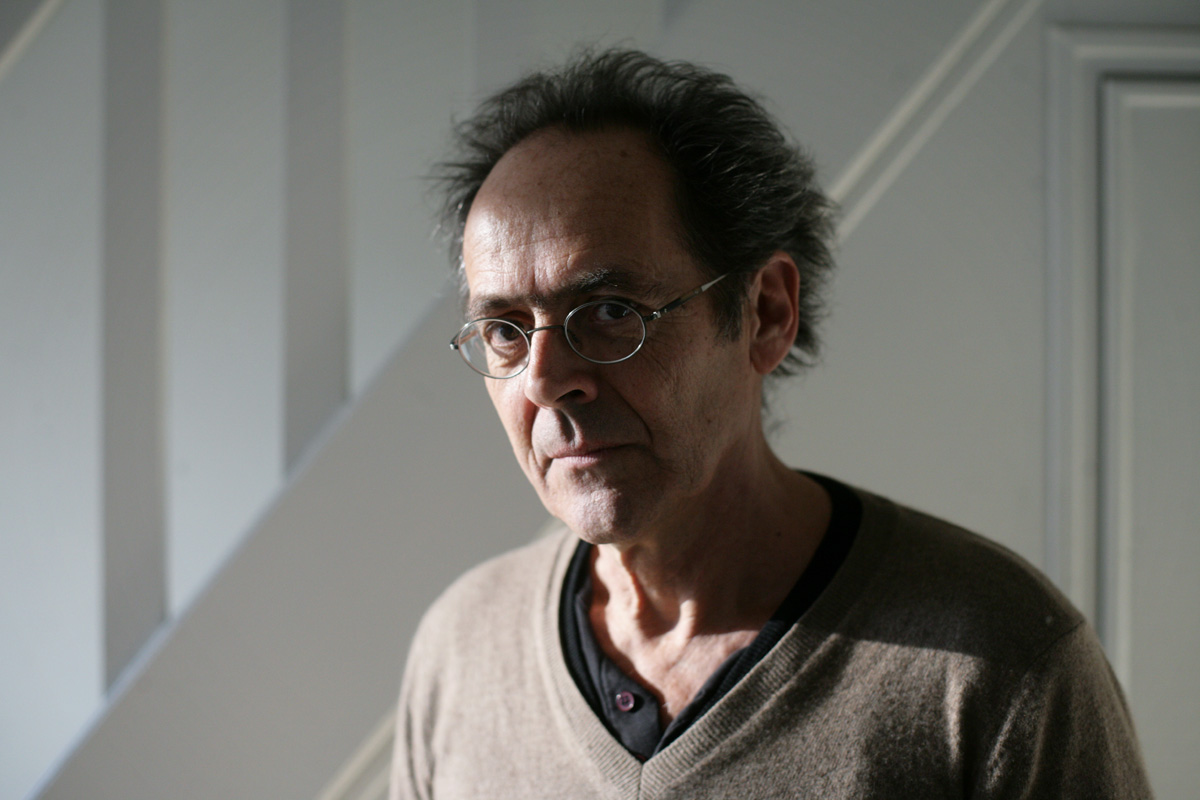
ac_bernard_stiegler_1200_02

Bernard Stiegler (above) was a keynote speaker at the conference, and if you want some tantalising glimpses into some of the other possibilities opened out by his ideas for the analysis of drones, I’d recommend James Ash, ‘Technology and affect: Towards a theory of inorganically organised objects’, Emotion, space and society (in press, 2014) – incidentally, James reviews Gameplay mode in Cultural politics 8 (3) (2012) 495-497 – and Sam Kinsley‘s ‘The matter of virtual geographies’, Progress in human geography (2014) 38 (3) (2014) 364-84.

As you can see from the abstract, Patrick also engages with my work and, crucially, Gregoire Chamayou‘s, and since the English-language translation of Theory of the drone is published at the end of this month I thought it might be helpful to list and link to my detailed commentaries on the book in one place, so here they are:

theory_of_the_drone_final

Theory of the drone 1: Genealogies

Theory of the drone 2: Hunting

Theory of the drone 3: Killing grounds

Theory of the drone 4: Pennies from heaven [on counterinsurgency/COIN]

 Theory of the drone 5: Vulnerabilities

Theory of the drone 6: Sacrifice, suicide and drones

Theory of the drone 7: Historical precedents and postcolonial amnesia

Theory of the drone 8: From invisibility to vulnerability

Theory of the drone 9: Psychopathologies of the drone

Theory of the drone 10: Killing at a distance

Theory of the drone 11: Necro-ethics

Theory of the drone 12: ‘Killing well’?

You can also find my essay on ‘Drone geographies’ from Radical Philosophy (2014) under the DOWNLOADS tab.

Jean-Baptiste Jeangène Vilmer‘s combative review of Theory of the drone, ‘Ideology of the drone’, is here and my extended commentary on that review is here.  Simon Labrecque provides another review here, invoking the USAF’s own description of its remote missions: ‘Projeter du pouvoir sans projeter de vulnérabilité.’

Meanwhile over at the Funambulist Papers, Stuart Elden suggested one way of wiring Grégoire’s previous book Manhunts to Theory of the drone here, while Grégoire’s own postscript (which suggests another route) is here.

Expect more commentary once the English edition is out.

Situation Rooms

I’m back from Europe at last, including a presentation of Angry Eyes at Hebbel am Ufer in Berlin.  It was a sort of Berlin Wall Exchange, and I had a wonderful time; my interlocutor was Martin Gak, who raised a series of probing and thoughtful questions about drones and military violence to which I plan to return, and I had some exhilarating conversations extending over two nights about HAU’s three performance spaces and in particular its investment in documentary drama.

gun_icon

Which brings me to Rimini Protokoll’s Situation Rooms playing at HAU 2 also as part of its Waffenlounge (‘Weapons Lounge’: its logo above uses a silhouette that must rank alongside the AK-47 as one of the most iconic – and in this case, of course, German – guns in the world; one of the aims of ‘Weapons Lounge’ is to drive home the point that, after the USA and Russia, Germany is the third largest arms exporter in the world).

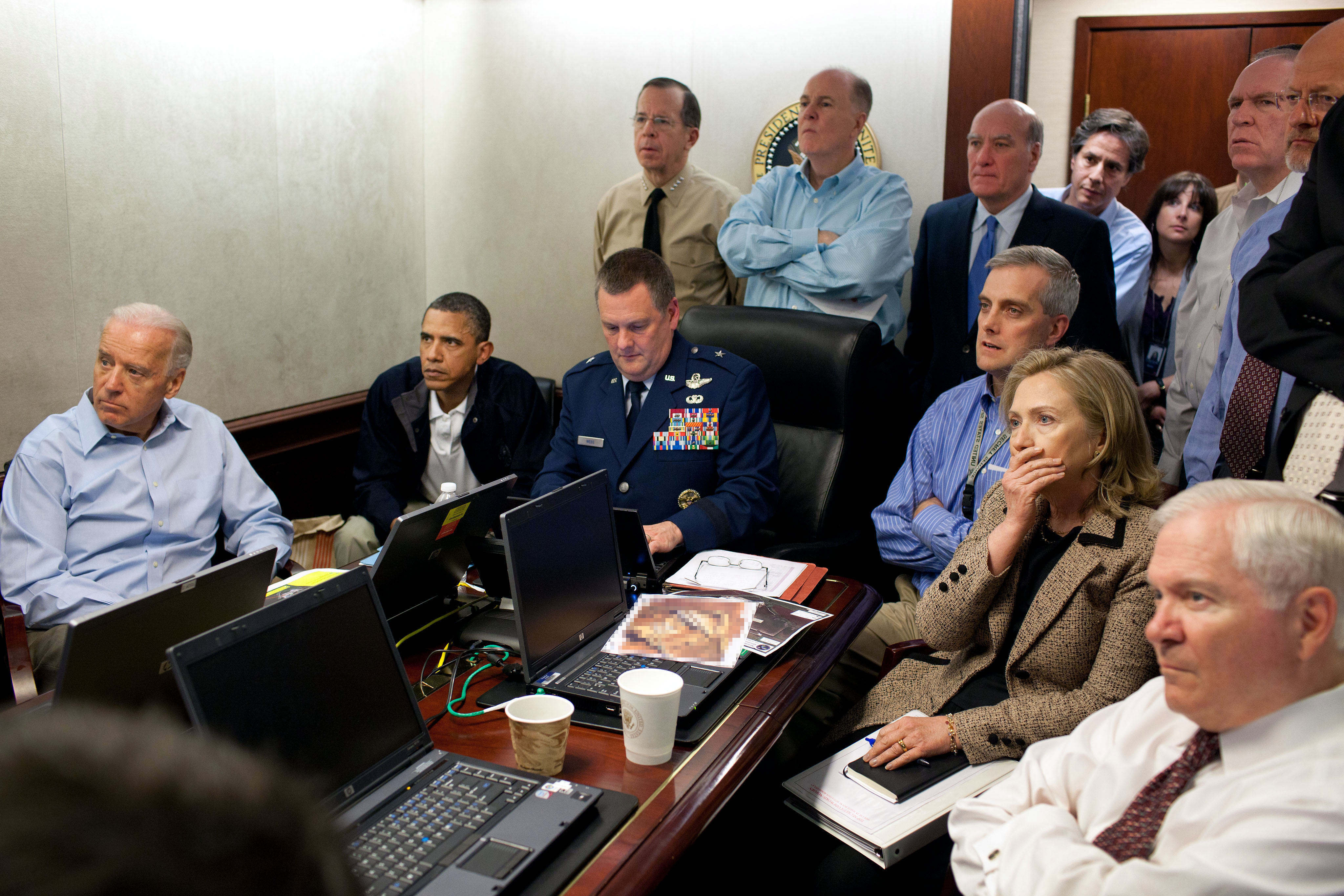
The title Situation Rooms is of course provoked by this famous image:

Obama_and_Biden_await_updates_on_bin_Laden

Here, incidentally, I recommend Keith Feldman‘s bravura reading in ‘Empire’s verticality: the Af/Pak frontier, visual culture and racialization from above‘ in Comparative American Studies 9 (4) (2011) 325-41; I’ll return to its relevance at the end.

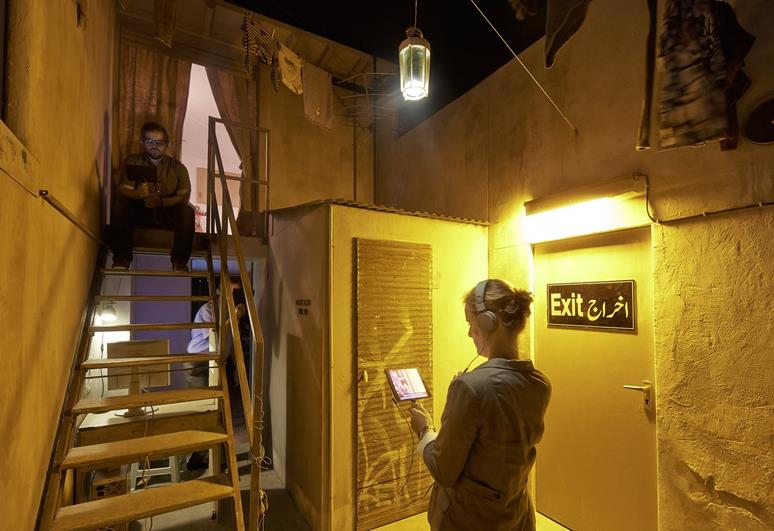
But Situation Rooms provides an even more dispersed, global mapping of contemporary military violence:

Situation Rooms gathers together from various continents 20 people whose biographies have been shaped by weapons in a film set that recreates the globalised world of pistols and rocket-propelled grenades, of assault rifles and drones, of rulers and refugees, becoming a parcours of unexpected neighbourhoods and intersections.

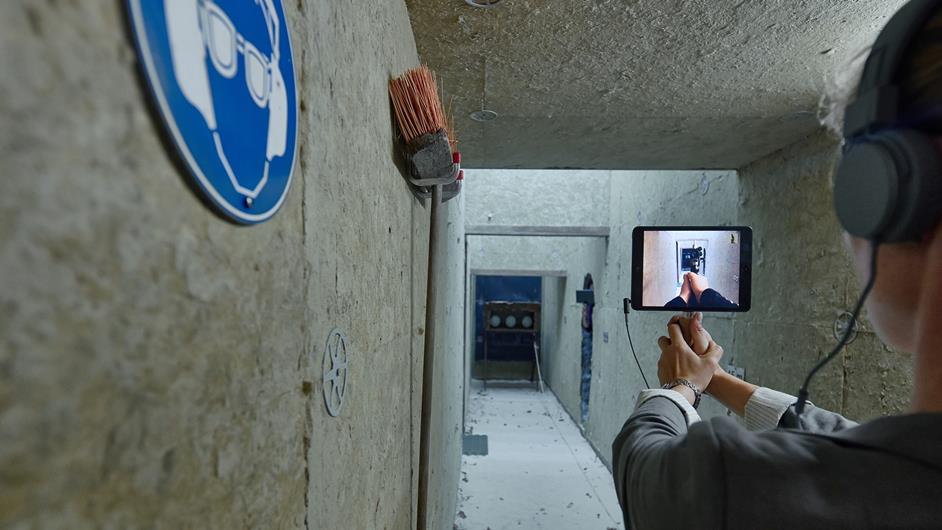
With the personal narratives of the ‘inhabitants’, the images start to move and the audience follows the individual trails of the cameras they have been given. They start to inhabit the building, while following what they see and hear on their equipment. The audience does not sit opposite the piece to watch and judge it from the outside; instead, the spectators ensnare themselves in a network of incidents, slipping into the perspectives of the protagonists, whose traces are followed by other spectators.
One spectator sits at the desk of a manager for defence systems. At the same time, another follows the film of a Pakistani lawyer representing victims of American drone attacks in a cramped room with surveillance monitors. On her way there, she sees a third spectator who follows his film into the shooting range of a Berlin gun club, listening Germany’s parcours shooting champion. Around the corner stands another spectator in the role of a doctor carrying out amputations in Sierra Leone, while in the room next door a press photographer sorts pictures of German army missions in Afghanistan, only to stand in the shooting range himself a little later to do exactly what he was able to observe in passing just a while ago, thereby becoming a subject for observation himself.

The audience gradually becomes entangled in the film set’s spatial and material labyrinth; each individual becoming part of the re-enactment of a complicatedly elaborated multi-perspective “shooting”.

rimini_protokoll_situation_rooms_3_jo_rg_baumann

As some readers will recognise, there are all sorts of formal parallels (as well as the obvious disjunctures) with Gerry Pratt and Caleb Johnston‘s  Nanay: a testimonial play – in staging, in evidentiary base – which was in fact performed at HAU in 2009 as well as in Vancouver and Manila.

You can read an extremely informative interview with Helgard Haug, Stefan Kaegi and Daniel Wetzel, the three architects of Rimini Protokoll, here, and what they have to say collectively about the politics of staging – about perspective, spectatorship and situation – is particularly illuminating:

‘We’re … creating a way to access what certain people, who have experience with weapons, arms trade, weapons use and war, have to say… It is not the experts that can be seen, but the situation in which they find themselves, from their perspective. That’s the shift. Instead of looking at a protagonist from outside, to a certain degree you look at an event “from inside”…

‘You hear their voices through headphones. On the iPad or as you walk through the rooms of the film set you see their typical work situations. The visitor is always following the path, so to speak, that the expert in each case has paved by narrating/filming. This kind of approach is quite different than it would be looking at these people from a comfortable theatre seat. The piece operates from the sentence that is often used to explain things in conflicts: Put yourself in my shoes! It is about creating a form of proximity that is also perhaps a bit disturbing…

‘You don’t look into a room from outside, but instead find yourself in it – in this case, although it’s theatre, there are four and not three walls. You also see the behaviour of other participants who are following the films of other experts. The 20 perspectives of the 20 experts collectively produce a sort of clockwork. The participant lands in a mechanism, and it has a certain rhythm. It jumps back to zero every 7 minutes. Then it moves the participant on into the perspective of a different expert, from which you can suddenly also observe the role that you had previously assumed.’

rimini_protokoll_situation_rooms_2_jo_rg_baumann-1

With good reason, this started me thinking about the multiple ‘situations’ folded into a single air strike orchestrated by a drone.  Daniel emphasises that the different situations are connected ‘through their lack of connectedness’, and yet what comes into view is precisely the dispersed, uneven and labile formation of what Foucault called a dispositif.  Daniel again:

‘First “you are” an off-duty general from the Indian Air Force. He sees drones as the military device of the future, a boon for humanity. Seven minutes later “you are” a Pakistani lawyer who represents victims of drone attacks and says that they trample on human rights…’

So the challenge for me, now, is to think about how I might stage the multiple situations that punctuate and animate the ‘incident’ in Afghanistan that I describe in Angry Eyes.… and, in particular, to incorporate the ‘situations’ of the Afghan victims who survived the attacks and who were treated in military hospitals for their awful injuries.

Thinking explicitly about how to stage all this is a way not only of presenting research differently but of conducting research differently.  Because once you start to think in these terms, you begin to see things that were otherwise at best at the very edges of your field of view.  Daniel insists that there is no overarching point of view, no ‘God trick’ (which, in a different register, is precisely what I sought to show in Angry Eyes):

‘The ten stories that everyone sees, the 20 stories [from which they are drawn], are also only a small excerpt from an infinite number of stories. What you see is an excerpt of an excerpt of an excerpt. What you don’t see, and the knowledge that there’s a lot that you don’t see – this is just as important as what you end up seeing. “Situation Rooms” is also a project at the interface of film and theatre.’

It’s also at the creative interface of the performing arts and critical research and I think offers another way of disclosing ‘Empire’s verticality’ and its imbrications with ‘Angry Eyes’…

Tortured geographies

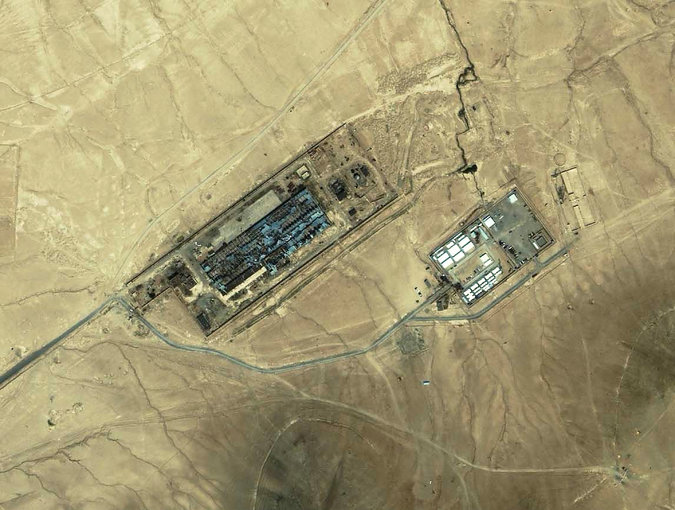
Guantanamo 'Suicides' In what now seems another life, I wrote about US torture during the early years of the “war on terror”, in ‘The Black Flag’ (which was specifically about Guantanamo, and which opened with three ‘suicides’ that we now have good reason to believe were anything but: see here and here) and ‘Vanishing Points’ (which extended the argument to Abu Ghraib and the archipelago of black sites like the ‘Salt Pit’ [shown below] within the global war prison).  Both are available in their original forms under the DOWNLOADS tab, and form part of the material I’ve been working with for a new essay to be included in The everywhere war.

Salt Pit

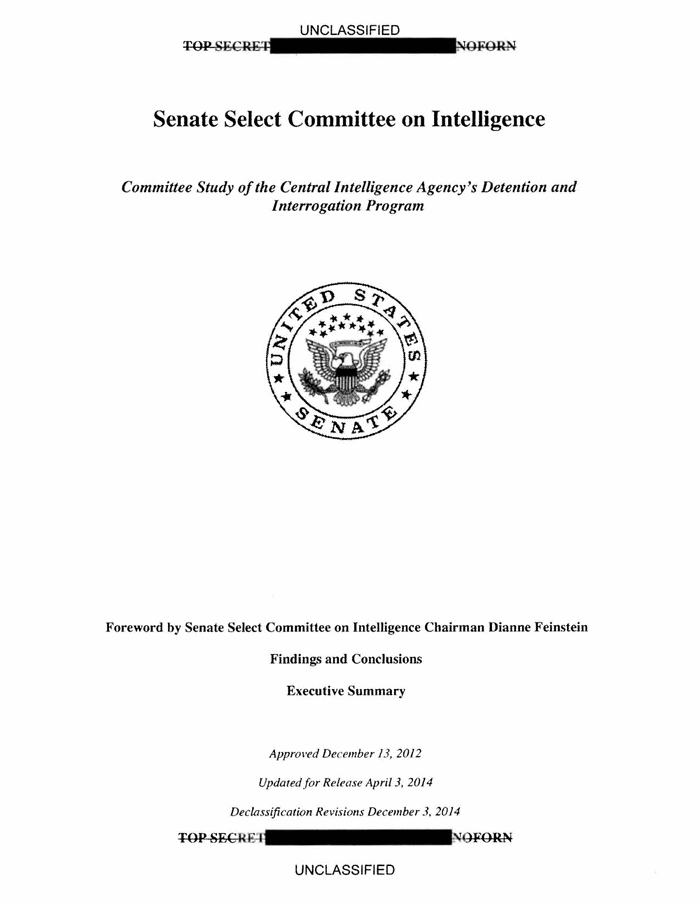
cia-report-p1-normalNow I’m digesting the Executive Summary that has been released by the Senate Select Committee on Intelligence on the CIA’s Detention and Interrogation Program, but you can download the original (redacted) summary here, ‘Other Views’ here, and the Minority View from the Republicans – and please God it remains a minority view – here.

The New York Times‘ coverage is here, the Washington Post‘s here, and the Guardian‘s here.

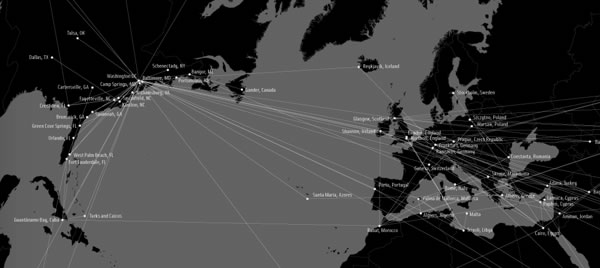
In the meantime, some of the best work on the dispersed geography of this vast apparatus was carried out by Trevor Paglen (see my updated discussion here).

map_paglen_emerson_r1_c1

Readers of his Blank spaces on the map will know of Trevor’s own attempt to see the ‘Salt Pit’ for himself, on the ground rather than from the air, and the images that result from this dimension of his work make clear – in plain sight, so to speak – their constitutive difficulties: see, for example, Jonah Weiner‘s essay on his work, ‘Prying eyes’, that appeared in the New Yorker here.

But here is part of what Trevor had to say about the mappings like the one above involved in his Torture Taxi and Terminal Air projects in An Atlas of Radical Cartography:

I’ve actually tried to stay away from cartography and “mapping” as much as possible in my work. The “God’s eye” view implicit in much cartography is usually not helpful in terms of describing everyday life, nor in describing the qualities of the relationships that cartography depicts. Because of what cartography cannot represent… it becomes pretty clear why it (and the forms of power that the cartographic viewpoint suggests) have traditionally been such powerful instruments of both colonialism and the contemporary geopolitical ordering of the world (which of course very much comes out of colonialism)…

I tend to be far more attracted to “on the ground” viewpoints and to embrace their fragmentedness and incompleteness. This project, as well as the “Terminal Air” project with the Institute for Applied Autonomy, are of course notable exceptions. With both of these projects that use the cartographic viewpoint, I was interested in taking what might seem like a familiar image and trying to and make it strange – trying to capture the feeling I had when I first started following CIA flights: it was the constant domestic flights to places like Tulsa, Las Vegas, Fresno, Fort Lauderdale and such that made a big impression on me. In working with John Emerson and the IAA, I insisted that we try to show a continuum between the domestic landscape and the landscape “somewhere else.” Neither of these projects are in my view not particularly useful as didactic tools but are instead useful in helping to see the point that we talked about above: that the “darkest” spaces of the war on terror blur into the everyday landscapes here “at home” and are in many way mutually constitutive. In this sense, they’re … images rather than analytic tools.

As I’ve noted before, this is part of the ‘capture’ side of the US kill-capture apparatus that uses drones (and often Special Forces) for the ‘kill’.  I say ‘US’, but it’s clear – not least from the map above – that a network of other states that radiates far beyond the other ‘Five Eyes‘ which have been so deeply involved in providing geospatial intelligence for drone strikes (and more) has been complicit in the production and concealment of this global archipelago of torture.

But there’s an irony in all this: even as the Obama administration ramped up drone strikes – and after a lull they have been resumed with a vengeance in Pakistan’s Federally Administered Tribal Areas – it was also condemning torture and, last month, committed the United States to acknowledging the extraterritorial reach of the Convention Against Torture (see Sarah Cleveland at Just Security here and Ryan Goodman and Eric Messenger here).  The refusal of the Bush administration to do so was a central part of the argument about legal geographies that I developed in both ‘The Black Flag’ and ‘Vanishing Points’.

So now we have an administration that recognises extra-territoriality to proscribe torture – and insists on it (or its own version of extra-territoriality) to authorise targeted killing.

A short history of schematic bodies

While I was in Irvine last month for the Secrecy and Transparency workshop, I had a series of rich conversations with Grégoire Chamayou — who also made a brief but brilliant presentation on targeting, signature strikes and time-space tracking.  He now writes to say that he has elaborated his ideas in a longer contribution to Léopold Lambert‘s Funambulist papers: ‘A very short history of schematic bodies‘.

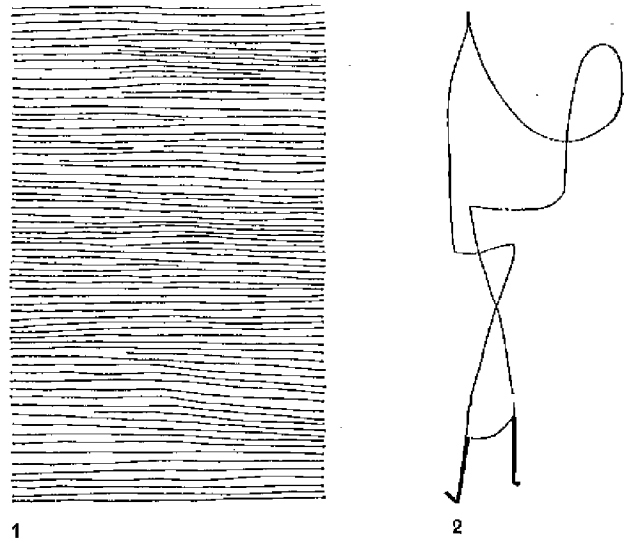
(Even more) briefly, Grégoire connects Torsten Hågerstrand‘s time geography – which Anne Buttimer once saw as a danse macabre – to the activity-based intelligence that supposedly ‘informs’ CIA-directed drone strikes [see my ‘Lines of descent’ essay: DOWNLOADS tab] via three diagrams drawn from Paul Klee.

16

The first two (above) distinguish (1) ‘dividuals‘ from (2) ‘individuals‘: so, following Deleuze, Grégoire distinguishes (1) ‘societies of control articulated through the dyad of “dividuals” and databanks’ from (2) ‘disciplinary societies structured around a relationship between the individual and the mass.’ Seen thus, Hagerstrand’s project mapped the reverse move from (1) to (2), from ‘statistical dividuality’ to ‘chronospatial individuality’.

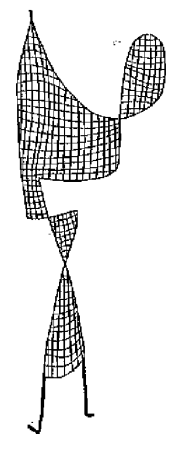
But Grégoire suggests that targeting involves a third fabrication, a co-construction of (1) and (2), thus:

17

He writes:

The corresponding object of power here is neither the individual taken as an element in a mass, nor the dividual appearing with a code in a databank, but something else: a patterned individuality that is woven out of statistical dividualities and cut out onto a thread of reticular activities, against which it progressively silhouettes in time as a distinctive perceptible unit in the eyes of the machine.

The production of this form of individuality belongs neither to discipline nor to control, but to something else: to targeting in its most contemporary procedures, whose formal features are shared today among fields as diverse as policing, military reconnaissance and marketing. It might well be, for that matter, that we are entering targeted societies.

This speaks directly to current theses about the individuation of military violence as one (and only one) modality of later modern war, but we need to remember that targeting appears at the interface of the market and the military, as Sam Weber shows in Targets of opportunity.  

It’s also important to think through the ‘body’ that is made to appear in the sights and as a sight; it’s not a fleshy body but a digital-statistical trace that is literally ‘touched’ by the cross-hairs (the apparatus of the drone as prosthesis).  As I wrote in ‘Drone geographies’ (DOWNLOADS tab),

[People] are brought within the militarized field of vision through the rhythmanalysis and network analysis of a suspicious ‘pattern of life’, a sort of weaponized time-geography… 

Killing is made the culmination of a natural history of destruction – in precisely not the sense intended by W.G. Sebald – and the targets are rendered as ‘individuals’ in a calculative rather than corporeal register.

Here Ian Hacking‘s ideas about ‘making up people‘ are also relevant.  In his classic British Academy lecture, ‘Kinds of people: moving targets‘, he described how ‘a new scientific classification may bring into being a new kind of person’ – in this case, the target – and how ‘a classification may interact with the people classified.’  A signature strike is surely the deadliest version of this ‘interaction’…

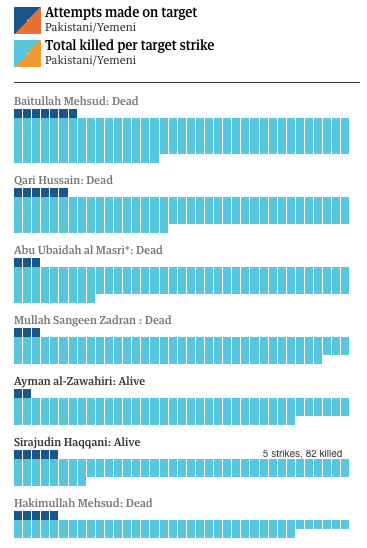
Incidentally, anyone who thinks that so-called ‘personality strikes’ are somehow less deadly needs to read REPRIEVE‘s latest report, You only die twice: multiple kills in the US drone program.  Spencer Ackerman has a good summary (and graphic, extracted below) here, describing the multiple deaths involved in the search for specific, named targets:

'Personality strikes' in Pakistan


Keeping up with the Drones

Patrick Svensson:Unblinking stare

Several recent contributions on military drones – what Forensic Architecture calls Unmanned Aerial Violence – you might be interested in.

First, Steve Coll has a long essay in the latest New Yorker on ‘The Unblinking Stare‘ (and, yes, I do know that those watching the screens blink.  Duh) about the drone war in Pakistan.  Many readers will remember that it was the New Yorker that published Jane Mayer‘s classic essay on ‘The Predator War‘ (26 October 2009), so it’s high time for an up-date since so much has happened since then.  It’s a very helpful survey.  Much of it will not be news, but Steve does provide some interesting background to the deadly gavotte between the US and Pakistan (what I’ve called ‘dirty dancing‘; see also here):

Pakistan’s generals and politicians, who come mainly from the country’s dominant, more developed province of Punjab, treated Waziristan’s residents “as if they were tribes that were living in the Amazon,” the journalist Abubakar Siddique, who grew up in the region and is the author of “The Pashtun Question,” told me.

In 2002, Musharraf sent Pakistan’s Army into South Waziristan to quell Al Qaeda and local sympathizers. In 2004, the Army intensified its operations, and, as violence spread, Musharraf allowed the C.I.A. to fly drones to support Pakistani military action. In exchange, Musharraf told me, the Bush Administration “supplied us helicopters with precision weapons and night-operating capability.” He added, “The problem was intelligence collection and targeting. . . . The Americans brought the drones to bear.”

Musharraf allowed the C.I.A. to operate drones out of a Pakistani base in Baluchistan. He told me that he often urged Bush Administration officials, “Give the drones to Pakistan.” That was not possible, he was told, “because of high-technology transfer restrictions.”

We know that close co-operation and even co-ordination between Washington and Islamabad was still the order of the day until at least 2011.  We know, too, that local people live under a double threat, and the essay reports on a group interview in Islamabad with half a dozen young men, mainly university students, from Waziristan.  On one side, recalling the Stanford/NYU ‘Living under dronesreport:

Being attacked by a drone is not the same as being bombed by a jet. With drones, there is typically a much longer prelude to violence. Above North Waziristan, drones circled for hours, or even days, before striking. People below looked up to watch the machines, hovering at about twenty thousand feet, capable of unleashing fire at any moment, like dragon’s breath. “Drones may kill relatively few, but they terrify many more,” Malik Jalal, a tribal leader in North Waziristan, told me. “They turned the people into psychiatric patients. The F-16s [of the Pakistan Air Force] might be less accurate, but they come and go.”

On the other side:

Families in North Waziristan typically live within large walled compounds. Several brothers, their parents, and their extended families might share a single complex. Each compound may contain a hujra, or guesthouse, which usually stands just outside the main wall. In the evening, men gather there to eat dinner and talk war and politics. A rich man signals his status by building a large hujra with comfortable guest rooms for overnight visitors. The less well-heeled might have a hujra with just two rooms, carpets, rope cots, and cushions.

Taliban and Al Qaeda commanders moved from hujra to hujra to avoid detection. The available records of drone strikes make clear that the operators would regularly pick up commanders’ movements, follow them to a hujra attached to a private home, watch for hours—or days—and then fire. Many documented strikes took place after midnight, when the target was presumably not moving, children were asleep, and visitors would have returned home.

North Waziristan residents and other Pakistanis I spoke with emphasized how difficult it would be for a drone operator to distinguish between circumstances where a Taliban or Al Qaeda commander had been welcomed into a hujra and where the commander had bullied or forced his way in. If the Taliban “comes to my hujra and asks for shelter, you have no choice,” Saleem Safi, a journalist who has travelled extensively in Waziristan, told me. “Now a potential drone target is living in a guest room or a guesthouse on your compound, one wall away from your own house and family.”

“You can’t protect your family from a strike on a hujra,” another resident of North Waziristan said. “Your children will play nearby. They will even go inside to play.” The researcher in Islamabad said, “There is always peer pressure, tribal pressure, to be hospitable.” He went on, “If you say no, you look like a coward and you lose face. Anyway, you can’t say no to them. If a drone strike does take place, you are a criminal in the courts of the Taliban,” because you are suspected of espionage and betrayal. “You are also a criminal to the government, because you let the commander sleep in your hujra.” In such a landscape, the binary categories recognized by international law—combatant or noncombatant—can seem inadequate to describe the culpability of those who died. Women, children, and the elderly feel pressure from all sides. A young man of military age holding a gun outside a hujra might be a motivated Taliban volunteer, a reluctant conscript, or a victim of violent coercion.

This speaks directly to a general point made by Christiane Wilke: in today’s wars the requirement that combatants identify themselves as combatants (a standard obligation of international humanitarian law) has effectively been transferred to civilians, so that it becomes their responsibility to make themselves known as non-combatants.  Even to an unblinking eye at 20,000 feet.

Screen_shot_2014-1_3111155c

Second, this week the Telegraph carried a video and an interview with ‘Major Yair’, the pseudonym for the pilot of a Israeli Heron TP drone based near Tel Aviv.  He reports that roughly 65 per cent of Israeli air operations are conducted by drones.  ‘Yair’ served in all three Israeli assaults on Gaza and he says nothing about Israel’s targeted killing – the focus is on the provision of Close Air Support.  But the claims he makes will be all too familiar to those familiar with USAF air strikes in Afghanistan:

As Israeli ground units pressed into Gaza, they would call Major Yair for close air support. “They’d be saying ‘we keep getting fire from within those buildings’ and I’m sitting at a distance – on a neat floorspace with screens and air conditioning systems – but you’re sweating and it’s ‘what do I do, what do I do’? How do I not cause more damage than help?”

I’ve repeatedly noted the affinity – even proximity – USAF crews working out of Creech Air Force Base in Nevada feel with troops on the ground in Afghanistan.  But ‘Yair’ doesn’t elaborate on the Israeli ground assault.  Instead, remarkably, persistently – unblinkingly, you might say – he circles around his own last sentence:

Major Yair stressed how he was constrained by rules of engagement designed to avoid innocent deaths. Hamas operatives, he added, routinely exploited this restraint by hiding behind civilians. One sequence shot by a Heron showed four men preparing to launch a salvo of rockets under a screen of trees. Seconds later, the men were shown running to a nearby street filled with children.

“They’re untouchable now,” said Major Yair, pointing at the screen. “I know that no mission commander, under current directions given by the chief of staff, will engage in this situation. No way.”

He added: “It is sometimes frustrating because you feel that you’re fighting with your hands tied. There are a lot of situations where you see your targets, but you will not engage because they’re next to kindergartens, because they’re driving with their wives and their kids.”

drone2_3111097c

David Blair presses him on the large number of Palestinian civilians killed in Gaza, including children, only to be told:

“We do make mistakes… but it’s nature. People make mistakes. We learn from those mistakes. You’ll see no smiling face after an incident where kids were killed. None of us wants to be in a position where he does these mistakes. We learn and try to avoid this as much as we can.”…

“You learn to live with it,” he said. “It’s not easy. I’ve made mistakes that, for many years, will come back at me. But it’s something that people have to do. It’s not easy. We do not shove it back somewhere in our minds and try to avoid talking about it. We talk about it, we support each other.”

And so, as so often happens in the United States (and elsewhere) too, our gaze is directed away from the victims and towards the torment suffered by those who inflict military violence from the air.

But, third, Corporate Watch has just published the fifth in its series of reports on living under drones in Gaza.  These eyewitness reports are indispensable because there are serious problems in using satellite imagery to reconstruct drone strikes.  Nobody is better at doing so than Forensic Architecture, but as they note, there is a threshold of detectability:

IMG_0076rsSome drone-fired missiles can drill a hole through the roof before burrowing their way deep into buildings, where their warheads explode. The size of the hole the missile leaves is smaller than the size of a single pixel in the highest resolution to which publicly-available satellite images are degraded [a square that translate sin to 50 cm by 50 cm of terrain].  The hole is thus at the “threshold of visibility” and might appear as nothing more than a slight color variation, a single darker pixel perhaps. This has direct implications for the documentation of drone strikes in satellite imagery, which is often as close to the scene as most investigators can get. When the figure dissolves into the ground of the image, it is the conditions—legal, political, technical—that degrade the image, or that keep it at a lower resolution that become the relevant material for forensic investigations.

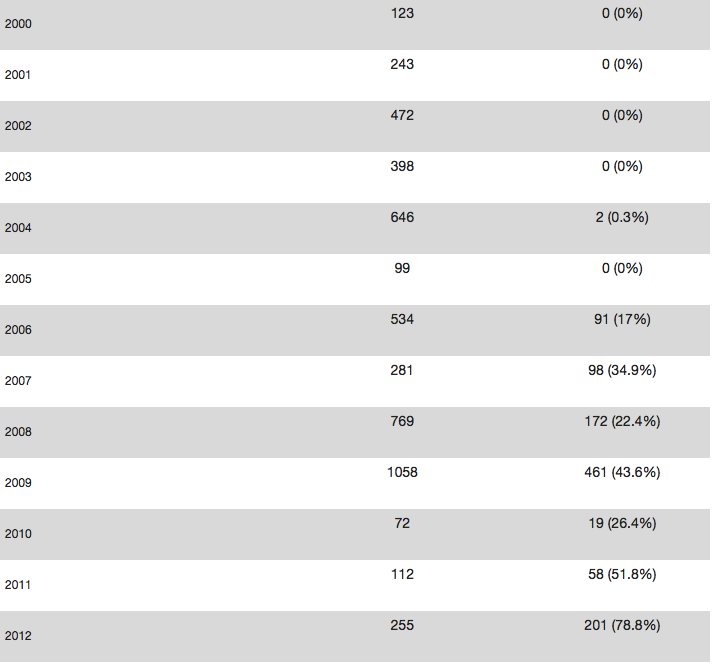
The Corporate Watch report also includes a remarkable tabulation from the Al Mezan Centre for Human Rights in Gaza, showing the numbers of people killed by the Israeli military in Gaza (col. 2) and the proportion killed by drone strikes (col. 3):

Israeli drone strikes in Gaza

I’m not sure what the sources for these tabulations might be: as Craig Jones has emphasised in a vitally important post, it’s exceptionally difficult to parse Israel’s targeted killings in occupied Palestine, and while these tabulations clearly include many other situations I have no idea how you begin to separate different killing machines in what is, after all, a networked mode of military violence in which drones are likely to perform vital surveillance operations for strikes carried out from other platforms. But the increased reliance on drones chimes with the report from David Blair.

Degrees of intimacy

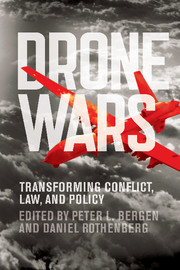
Drone warsNext month Cambridge University Press is publishing a book of essays edited by Peter Bergen and Daniel Rothenberg, Drone wars: transforming conflict, law and policy, due out from Cambridge University Press at the end of the year.  Here’s the blurb:

Drones are the iconic military technology of many of today’s most pressing conflicts, a lens through which U.S. foreign policy is understood, and a means for discussing key issues regarding the laws of war and the changing nature of global politics. Drones have captured the public imagination, partly because they project lethal force in a manner that challenges accepted rules, norms, and moral understandings. Drone Wars presents a series of essays by legal scholars, journalists, government officials, military analysts, social scientists, and foreign policy experts. It addresses drones’ impact on the ground, how their use adheres to and challenges the laws of war, their relationship to complex policy challenges, and the ways they help us understand the future of war. The book is a diverse and comprehensive interdisciplinary perspective on drones that covers important debates on targeted killing and civilian casualties, presents key data on drone deployment, and offers new ideas on their historical development, significance, and impact on law and policy. Drone Wars documents the current state of the field at an important moment in history when new military technologies are transforming how war is practiced by the United States and, increasingly, by other states and by non-state actors around the world.

And here is the Contents List:

Part I. Drones on the Ground:

1. My guards absolutely feared drones: reflections on being held captive for seven months by the Taliban David Rohde
2. The decade of the drone: analyzing CIA drone attacks, casualties, and policy Peter Bergen and Jennifer Rowland
3. Just trust us: the need to know more about the civilian impact of US drone strikes Sarah Holewinski
4. The boundaries of war?: Assessing the impact of drone strikes in Yemen Christopher Swift
5. What do Pakistanis really think about drones? Saba Imtiaz

Part II. Drones and the Laws of War:

6. It is war at a very intimate level USAF pilot
7. This is not war by machine Charles Blanchard
8. Regulating drones: are targeted killings by drones outside traditional battlefields legal? William Banks
9. A move within the shadows: will JSOC’s control of drones improve policy? Naureen Shah
10. Defending the drones: Harold Koh and the evolution of US policy Tara McKelvey
Part III. Drones and Policy Challenges:
11. ‘Bring on the magic’: using drones in combat Michael Waltz
12. The five deadly flaws of talking about emerging military technologies and the need for new approaches to law, ethics, and war P. W. Singer
13. Drones and cognitive dissonance Rosa Brooks
14. Predator effect: a phenomenon unique to the war on terror Meg Braun
15. Disciplining drone strikes: just war in the context of counterterrorism David True
16. World of drones: the global proliferation of drone technology Peter Bergen and Jennifer Rowland

Part IV. Drones and the Future of Warfare:

17. No one feels safe Adam Khan
18. ‘Drones’ now and what to expect over the next ten years Werner Dahm
19. From Orville Wright to September 11: what the history of drone technology says about the future Konstantin Kakaes
20. Drones and the dilemma of modern warfare Richard Pildes and Samuel Issacharoff
21. How to manage drones, transformative technologies, the evolving nature of conflict and the inadequacy of current systems of law Brad Allenby
22. Drones and the emergence of data-driven warfare Daniel Rothenberg

Over at Foreign Policy you can find an early version of Chapter 6, which is an interview with a drone pilot conducted by Daniel Rothenberg.  There are two passages in the interview that reinforce the sense of the bifurcated world inhabited by drone crews that I described in ‘From a view to a kill’ and ‘Drone geographies’ (DOWNLOADS tab).  On the one side the pilot confirms the inculcation of an intimacy with ground troops, particularly when the platforms are tasked to provide Close Air Support, which is in some degree both reciprocal and verbal:

“Because of the length of time that you’re over any certain area you’re able to engage in lengthy communications with individuals on the ground. You build relationships. Things are a little more personal in an RPA than in an aircraft that’s up for just a few hours. When you’re talking to that twenty year old with the rifle for twenty-plus hours at a time, maybe for weeks, you build a relationship. And with that, there’s an emotional attachment to those individuals.

“You see them on a screen. That can only happen because of the amount of time you’re on station. I have a buddy who was actually able to make contact with his son’s friend over in the AOR [area of responsibility]. If you don’t think that’s going to make you focus, then I don’t know what will.

“Many individuals that have been over there have said, ‘You know, we were really happy to see you show up’; ‘We knew that you were going to keep us from being flanked’; ‘We felt confident in our ability to move this convoy from ‘A’ to ‘B’ because you were there.’ The guy on the ground and the woman on the ground see how effective we are. And it gives them more confidence.”
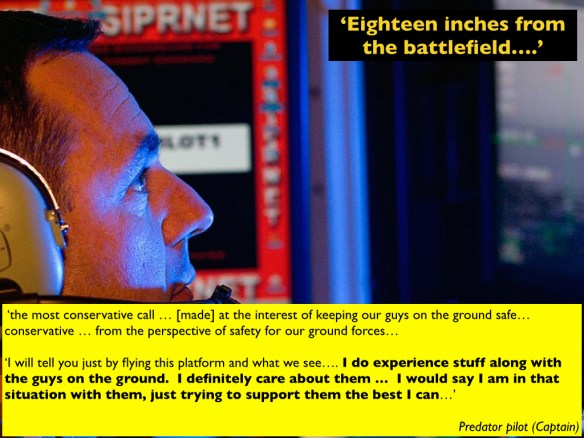
GREGORY Angry Eyes Extract.001

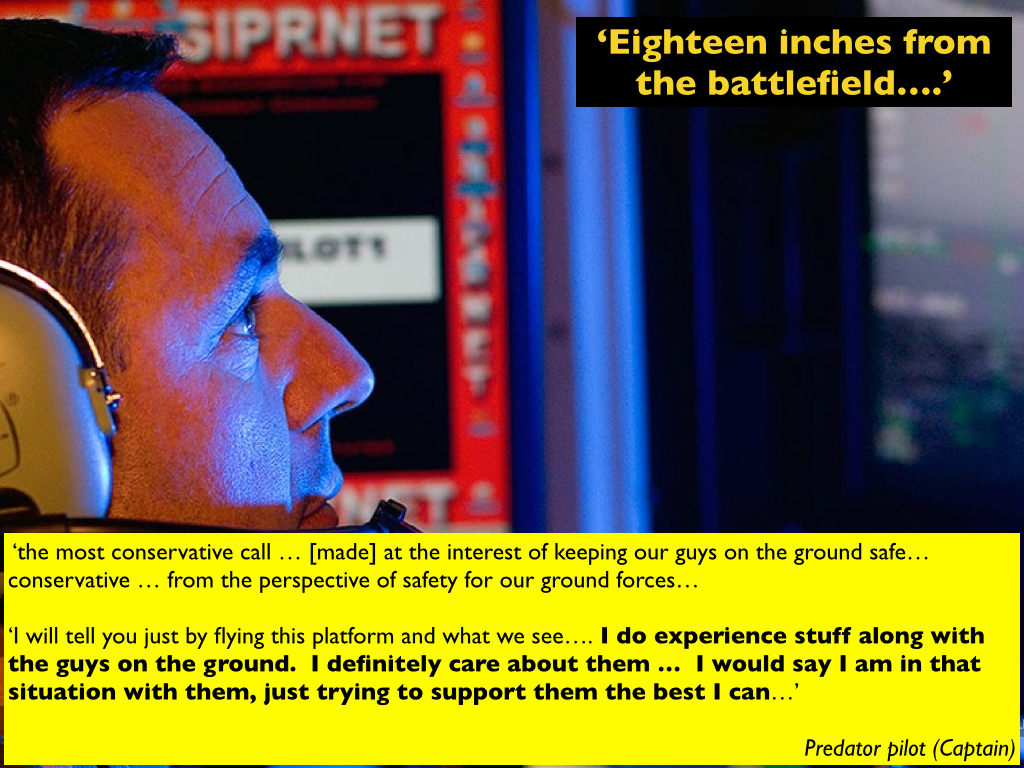
[The image above is taken from my ‘Angry Eyes’ presentation; the Predator pilot in this instance was involved in orchestrating the air strike in Uruzgan province, Afghanistan on 21 February 2010, and the quotation is taken from the US Army investigation into the incident.  I’m converting the presentation into the final chapter for The everywhere war, and I’ll post the draft as soon as I’m finished.]

But when the pilot in Rothenberg’s interview goes on to claim that ‘Targeting with RPAs is very intimate’ and that ‘It is war at a very intimate level’, he reveals on the other side an altogether different sense of intimacy: one that is strictly one-sided, limited to the visual, and which resides in a more abstracted view:

“Flying an RPA, you start to understand people in other countries based on their day-to-day patterns of life. A person wakes up, they do this, they greet their friends this way, etc. You become immersed in their life. You feel like you’re a part of what they’re doing every single day. So, even if you’re not emotionally engaged with those individuals, you become a little bit attached. I’ve learned about Afghan culture this way. You see their interactions. You’re studying them. You see everything.”

The distinction isn’t elaborated, but the claims of ‘immersion’ and becoming ‘part of what they’re doing every day’ are simply astonishing, no?  You can find more on the voyeurism of ‘pattern of life analysis’ and the remarkable conceit that ‘you see everything’ here.
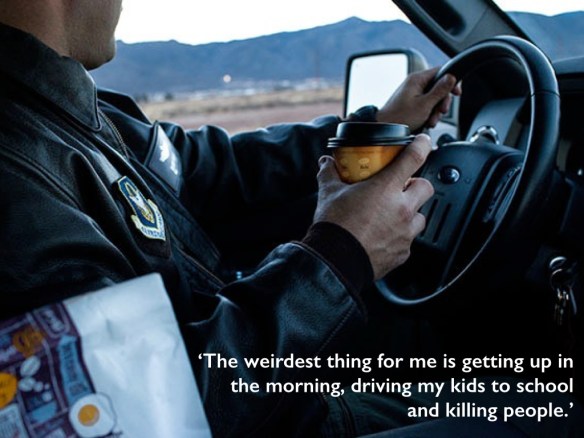
GREGORY Drones and the everywhere war 2014 Homeland insecurities.001

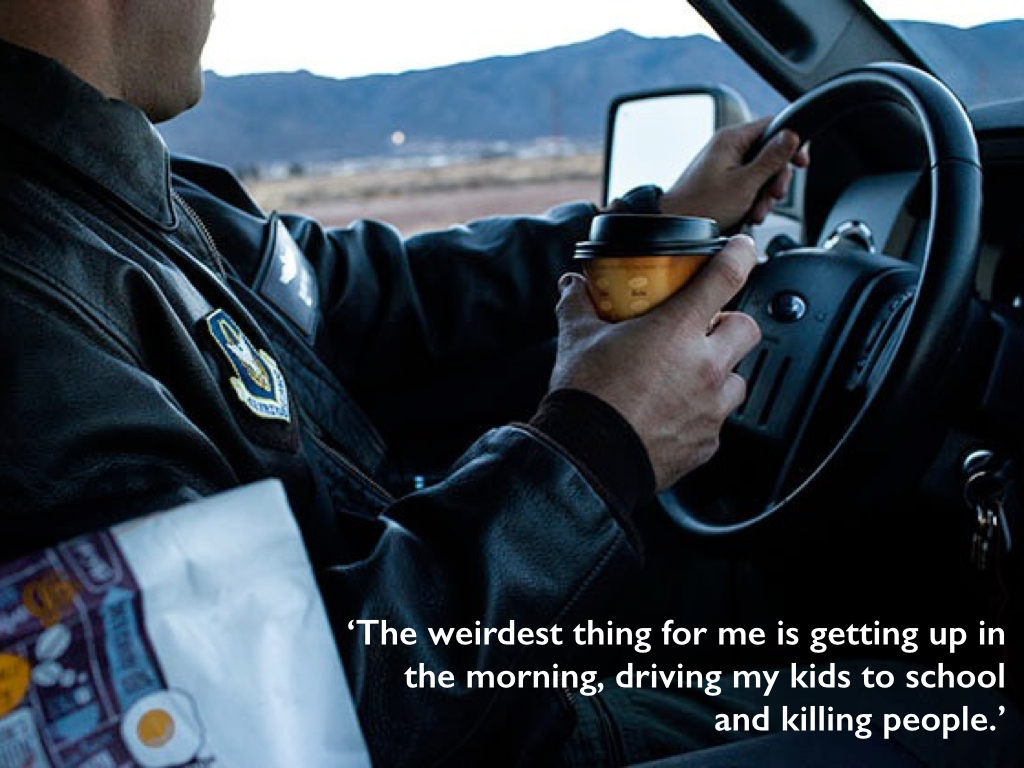
[The image above is taken from my ‘Drone geographies’ presentation]

The interview emphasises a different bifurcation, which revolves around the alternation between ‘work’ and ‘home’ when remote operations are conducted from the United States:

“”When you’re doing RPA operations, you’re mentally there, wherever there is. You’re flying the mission. You’re talking to folks on the ground. You’re involved in kinetic strikes. Then you step out the ground control station (GCS) and you’re not there anymore…

“Those are two very, very different worlds. And you’re in and out of those worlds daily. I have to combine those two worlds. Every single day. Multiple times a day. So, I am there and then I am not there and then I am there again. The time between leaving the GCS [Ground Control Station] and, say, having lunch with my wife could be as little as ten minutes. It’s really that fast.”

You can find much more on these bifurcations in my detailed commentary on Grégoire Chamayou‘s Théorie du drone here and in ‘Drone geographies’ (DOWNLOADS tab).

There’s one final point to sharpen.  In my developing work on militarized vision, and especially the ‘Angry eyes’ presentation/essay,  I’ve tried to widen the focus beyond the strikes carried out by Predators and Reapers to address the role they play in networked operations where the strikes are carried out by conventional strike aircraft.  Here is what Rothenberg’s pilot says about what I’ve called the administration of military violence (where, as David Nally taught me an age ago, ‘administration’ has an appropriately double meaning):

‘”Flying an RPA is more like being a manager than flying a traditional manned aircraft, where a lot of times your focus is on keeping the shiny side up; keeping the wings level, putting the aircraft where it needs to be to accomplish the mission. In the RPA world, you’re managing multiple assets and you’re involved with the other platforms using the information coming off of your aircraft.

“You could use the term ‘orchestrating’; you are helping to orchestrate an operation.”

***

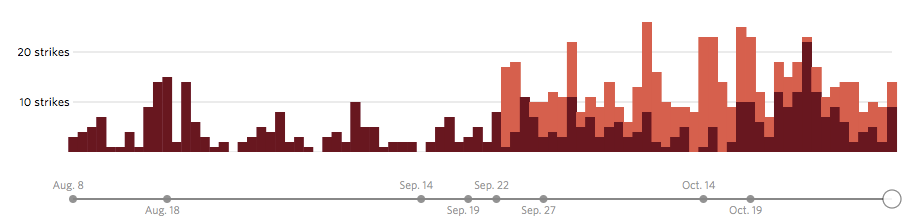
Drone wars appears just as remote operations over Iraq and Syria are ramping up: you can find an excellent review by Chris Cole at Drone Wars UK here, ‘Drones in Iraq and Syria: What we know and what we don’t.’  The images below are from the Wall Street Journal‘s interactive showing all air strikes reported by US Central Command 8 August through 3 November 2014:
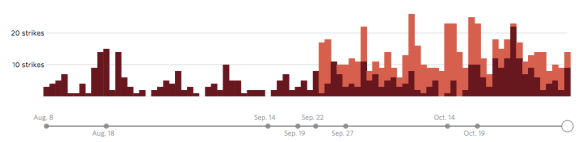
Air strikes in Iraq and Syria

During this period  769 coalition air strikes were reported: 434 in Syria (the dark columns), including 217 on the besieged border city of Kobane, and 335 in Iraq (the light columns), including 157 on Mosul and the Mosul Dam.
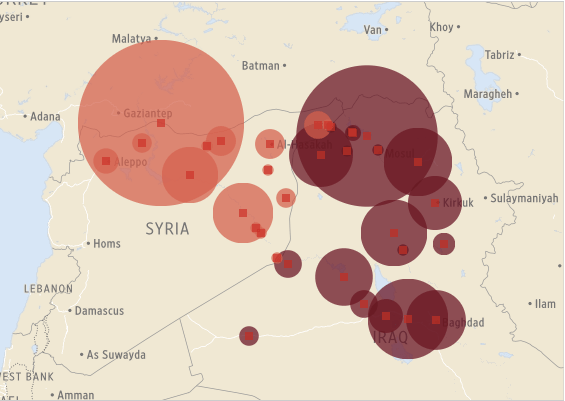
Air strikes in Iraq and Syria August-November 2014

But bear in mind these figures are for all air strikes and do not distinguish between those carried out directly by drones and those carried out by conventional strike aircraft.  As Chris emphasises:

‘Since the start of the bombing campaign, US drones have undertaken both surveillance and strike missions in Iraq and Syria but military spokespeople have refused to give details about which aircraft are undertaking which strikes repeatedly using the formula “US military forces used attack, fighter, bomber and remotely-piloted aircraft to conduct airstrikes.”’

Although the USAF has used a mix of MQ-1 (Predator) and MQ-9 (Reaper) drones, F-15E, F-16, F/A-18 and F-22 fighters, B-1 bombers, AC-130 gunships and AH-64 Apache helicopters in these operations, it seems likely that its capacity to use remote platforms to provide intelligence, surveillance and reconnaissance is limited by its continuing commitments in Afghanistan (though Britain’s Royal Air Force has now deployed its Reapers for operations in both Iraq and Syria).

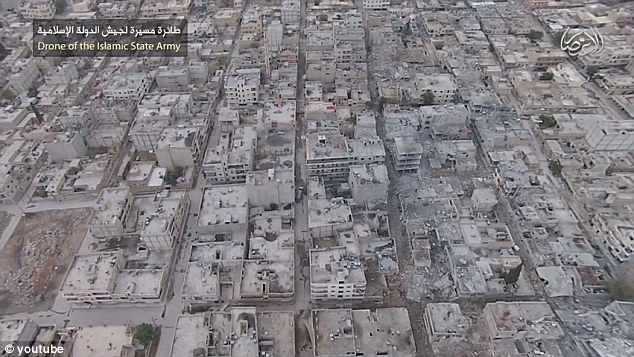
IS (Islamic State) claims to have its own drones too.  In February it released video of its aerial surveillance of Fallujah in Iraq, taken from a DJI Phantom FC40 quadcopter, in August it released video of Taqba air base in Syria taken from the same platform, tagged as ‘a drone of the Islamic State army’, and in September a propaganda video featuring hostage John Cantile showed similar footage of Kobane (below).
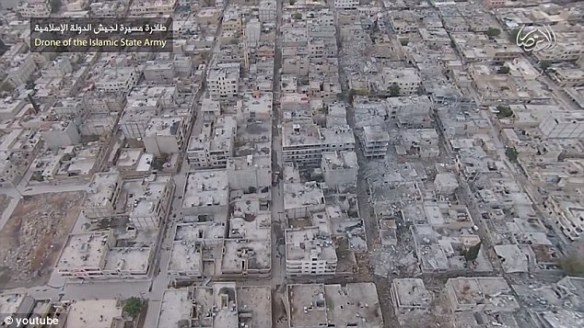
1414438887900_wps_7_IS_have_released_a_new_vi

These image streams are all from commercial surveillance drones, but in September the Iranian news agency Fars reported that Hezbollah had launched an air strike from Lebanon against a command centre of the al-Nursra Front outside Arsal in Syria using an armed (obviously Iranian) drone.

You can find Peter Bergen’s and Emily Schneiders view on those developments here, and a recent survey of the proliferation of drone technologies among non-state actors here.

The details of both the state and non-state air strikes remain murky, but I doubt that much ‘intimacy’ is claimed for any of them.