Unmanned and unmoored

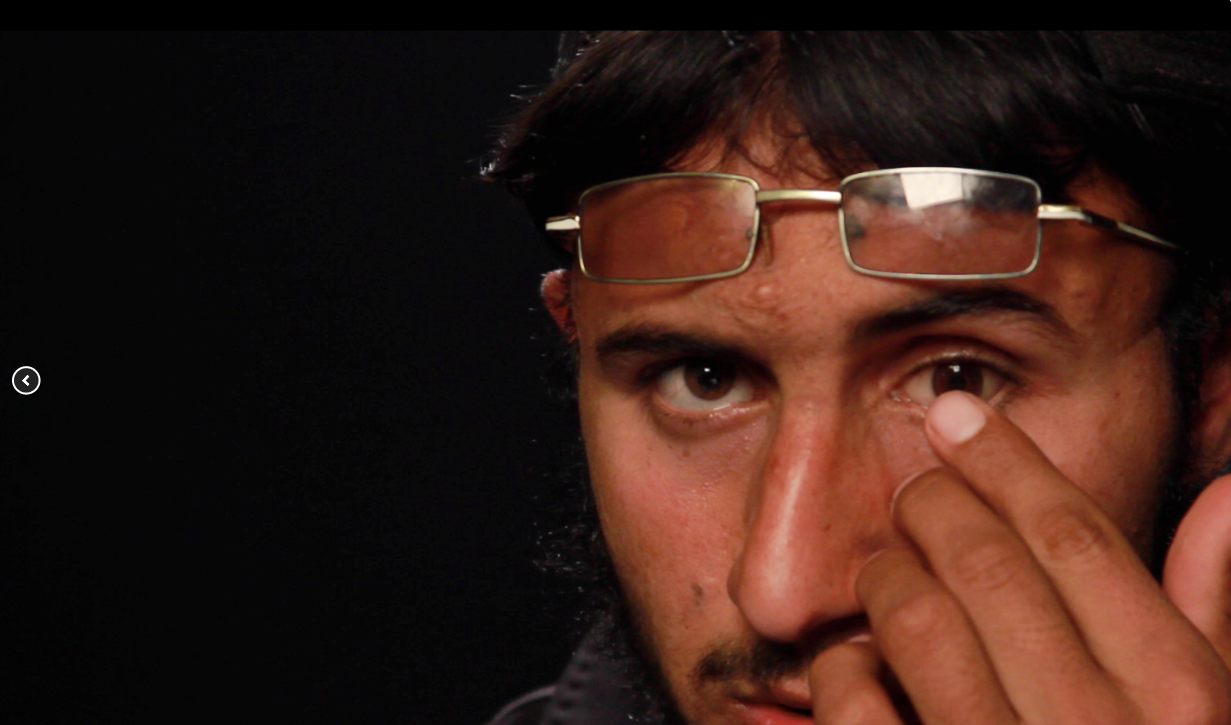
Robert Greenwald‘s feature-length documentary film Unmanned: America’s drone wars is being released on 30 October: it will be streaming online for a limited time, but if you sign up here you will be able to watch it thanks to Brave New Foundation free of charge (and no, this isn’t piracy).  Thanks to Jorge Amigo and Sara Koopman for the heads-up.

As I noted last summer, Greenwald prepared the video to accompany the Stanford/NYU report Living under Drones, and you can find more about the background to the film in George Zornick‘s article for the Nation here.  Like the crew that made Madiha Tahir‘s Wounds of Waziristan, Greenwald travelled to Pakistan, but the twist here is that Greenwald is bringing some of the witnesses to Capitol Hill this week:

“What we’ve been able to do is put a face to policy. Bring over living, breathing, human beings who can look the camera, or the congresspeople, or reporters, in the eye and say, ‘Yes, my grandmother was in the field. She was killed by a drone,’ ” he explained. “ ‘My mother, who I miss every day, was killed by a drone. How could she possibly, under any set of circumstances, be called a terrorist?’”

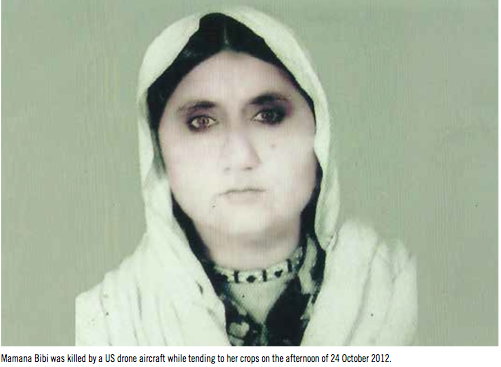
For more details on the project to bring them to the United States and the horrors that they witnessed, see Ryan Devereux‘s chilling report here about the murder of Mamana Bibi.

Mamana Bibi

Zubair, now 13, said the sky was clear the day his grandmother died. He had just returned home from school. Everyone had been in high spirits for the holiday, Zubair said, though above their heads aircraft were circling. Not airplanes or helicopters, Zubair said.

“I know the difference,” Zubair said, explaining the different features and sounds the vehicles make. “I am certain that it was a drone.” Zubair recalled a pair of “fireballs” tearing through the clear blue sky, after he stepped outside. After the explosion there was darkness, he said, and a mix of smoke and debris.

“When it first hit, it was like everyone was just going crazy. They didn’t know what to make of it,” Zubair said. “There was madness.” A piece of shrapnel ripped into the boy’s left leg, just above his kneecap. A scar approximately four inches in length remains. “I felt like I was on fire,” he said. The injury would ultimately require a series of costly operations.

Nabeela, the little girl, was collecting okra when the missiles struck. “My grandma was teaching me how you can tell if the okra is ready to be picked,” she said. “All of the sudden there was a big noise. Like a fire had happened.

“I was scared. I noticed that my hand was hurting, that there was something that had hit my hand and so I just started running. When I was running I noticed that there was blood coming out of my hand.”

Nabeela continued running. The bleeding would not stop. She was eventually scooped up by her neighbors. “I had seen my grandmother right before it had happened but I couldn’t see her after. It was just really dark but I could hear [a] scream when it had hit her.”

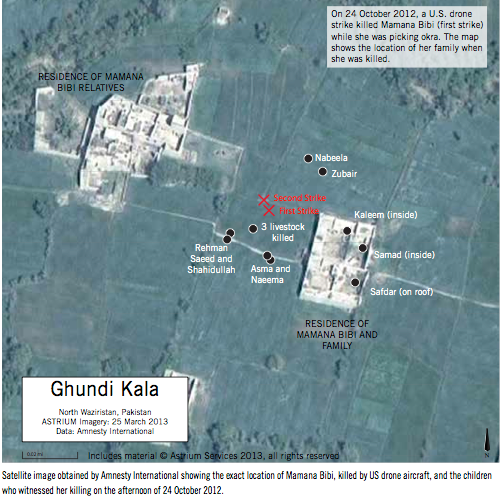
This is the same attack detailed in Amnesty’s report, Will I be next? last week.  Amnesty’s account of the strike, on Ghundi Kala in North Waziristan on 24 October 2012, included this photograph showing the position of Mamana Bibi‘s family when the drone struck while she was working in the fields:

Ghundi Kala drone killing October 2012

This is exactly that I meant when I said that all these targeted killings – and this was one which surely went hideously wrong (though I’m not sure what going right would look like) – have effects that reach far beyond the individual victim.  The ‘individuation of warfare‘ is never confined to an individual; and in this case, like so many others, it’s not warfare either.

More soon.

UPDATE:  The Independent carries an early report of the testimony of Mamana Bibi’s son here and the Guardian here (‘Bibi’ simply means ‘grandmother’ and is an honorific – the family name is Rehman).

“Nobody has ever told me why my mother was targeted that day,” Rehman said, through a translator. “Some media outlets reported that the attack was on a car, but there is no road alongside my mother’s house. Others reported that the attack was on a house. But the missiles hit a nearby field, not a house. All of them reported that three, four, five militants were killed.”

Instead, he said, only one person was killed that day: “Not a militant but my mother.”

“In urdu we have a saying: aik lari main pro kay rakhna. Literally translated, it means the string that holds the pearls together. That is what my mother was. She was the string that held our family together. Since her death, the string has been broken and life has not been the same. We feel alone and we feel lost.”

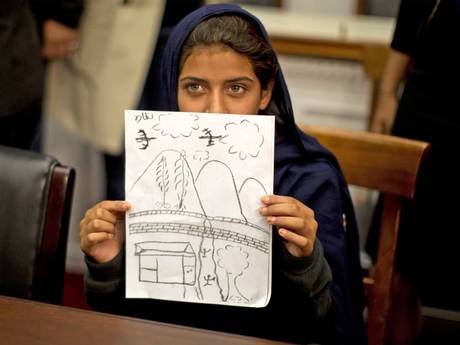
In the image below, her grand-daughter is holding her drawing of the attack.

Nabila Rehman

Read this alongside Kenneth Anderson and Benjamin Wittes here – with their double-act doublespeak of Amnesty International’s ‘coyness’ and its ‘blithe claims’ (do they know what these words mean??) – and retch.


Precarious life

Just back from a wonderful trip to Toronto and York, where (among other things) I gave a new presentation on “Drones and the everywhere war“.  It turned out to have been timely: there’s been a flurry of revelations and reports about the US campaign of targeted killing in Pakistan and Yemen, and I managed to incorporate some of them into the argument.

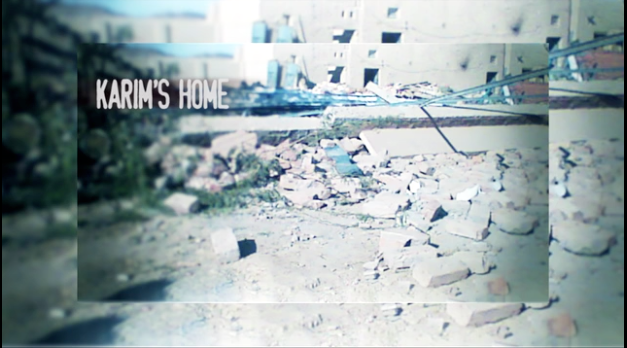
Karim's Home

I’ll be posting about all this shortly, but in the meantime – and directly related – news from Madiha Tahir that Wounds of Waziristan premieres on VICE Motherboard on line for a limited period today.

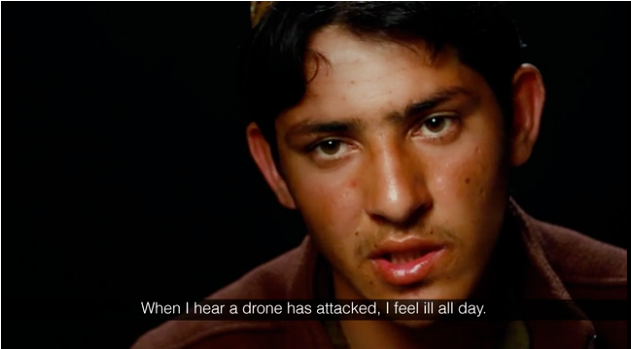
It’s smart and stunning, and addresses a swath of vital issues about the drone strikes in just 25 minutes: from their colonial antecedents in ‘air policing’ and the special laws imposed on the Federally Administered Tribal Areas by the British state through extraordinary testimony from survivors to the collusion between the US and Pakistan in exposing the population of FATA to military violence.

Waziristan I feel sick all day

The testimony should be read alongside the reports from Amnesty International [“WIll I Be Next? Drone strikes in Pakistan“] and Human Rights Watch [“Between a drone and al-Qaeda“, on Yemen]  issued earlier this week.  There’s a short video from AI on their report:

Reading and thinking about these testimonies has helped convince me that the root problem with drones is not that they enable killing from a distance: as I’ve said before, if you object to killing someone 7,500 miles away, over what distance do you think it is acceptable?   In fact, although Predators and Reapers are controlled from the continental United States they have to be deployed close to their targets: these are not weapons of global reach.  One of the most fundamental issues is that they can only be used in uncontested air space, so that they are limited to haunting the skies over some of the most vulnerable and marginal populations on earth, whose own governments care little about them and where the distinction between a combatant and a civilian is made to count for precious little.  One of my next tasks is to revise “Moving targets and violent geographies” (DOWNLOADS tab) to incorporate these reports and to emphasise this conclusion.

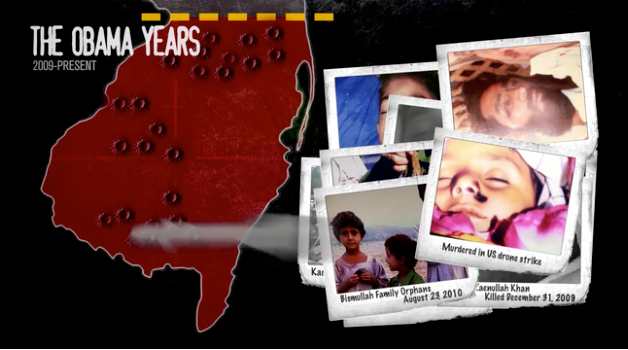
In one sequence, repeating a tactic which has been used by other artists in Iraq in particular, “Wounds” projects US drone strikes in Waziristan onto a map of Madiha’s home state, New Jersey:

Obama Years

Madiha also appears on a panel on “Life Under Drones” at the Drones & Aerial Robotics Conference in New York earlier this month, with Wazhmah Osman, Chris Rogers and Tara McKelvey, also now up at YouTube:

Reporting from FATA

An update to my post about Wounds of Waziristan: there’s an excellent long-form interview with Madiha Tahir here (and a sawn-off version of the same discussion at Counterpunch).  As you would expect, she is very good indeed about Pakistan’s politics, the complexity of the situation in the Federally Administered Tribal Areas (FATA) and Pakistani attitudes to US drone strikes, but she also has some sharp observations about how these are read in the United States:

Paul Gottinger: Can you talk about how the issue of drones is debated on the left in the U.S.?

Madiha Tahir: I was there when the Code Pink marched in Pakistan in October. Code Pink went with the Pakistani politician Imran Khan. We marched to South Waziristan, and we met some survivors and families of victims. Medea Benjamin, the founder of Code Pink, published an article in which she talks about her discomfort that Karim Khan, whose brother and son were killed by drones in December 2009, seeks a desire for revenge.  According to her article, several people in the delegation were uncomfortable with his desire for revenge. I find that very strange. It seems like the right wants the drone victims to be completely evil, and the left wants them to be pure. Both ways of seeing the victims is dehumanizing.

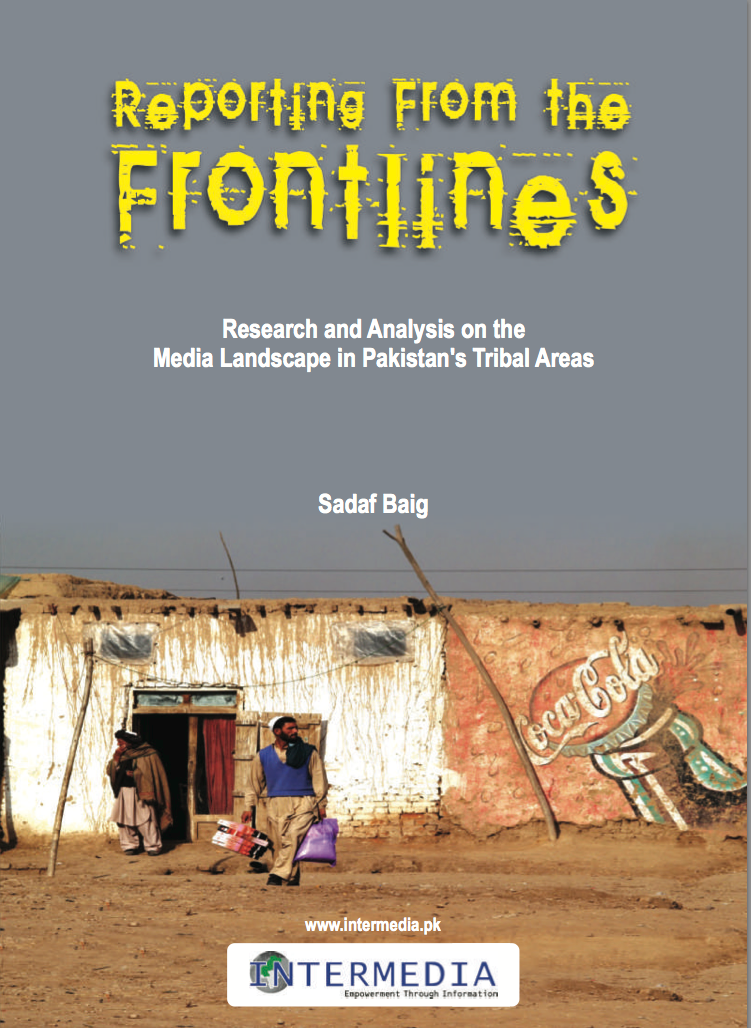
BAIG Reporting from the FrontlinesIn the background of all this is the extraordinary difficulty and danger involved in reporting from FATA.  There is a general survey of the ‘media landscape’ of FATA here and an excellent monthly review from Borderbuzz here, but I’ve found other, more personal sources to be more informative.  The Bureau of Investigative Journalism has addressed the issue directly and explained how its outstanding coverage of drone strikes in North and South Waziristan has been indebted to skilled local reporters like Mushtaq Yusufzai.

Some analysts claim that reporting from the tribal areas is often unreliable. Yusufzai is inclined to agree: ’There is some truth to it. Reporting can be very, very poor and if you rely on your local stringers and journalists they may never ever tell you the truth, because they’re rarely paid, they don’t want to risk upsetting people. The Taliban or security officials or local people might blame him for doing his job. So sometimes it’s easier for him to say nothing – or the wrong thing,’ he says.

Despite the risks, the militant groups can be an important source of information: ’There are a number of people who know, among the Taliban’s leadership, among the fighters, what’s actually happening. So I tell them that I want to write a story about these things if they can help. To some extent they will allow you, but if it’s related to their senior people, to the commanders, they may not allow you to do it and tell you instead to use their public statements.’

State sources such as the military and Pakistan’s powerful intelligence service, the ISI, can be less well-informed. ’Often they don’t themselves have access to those areas,’ says Yusufzai.

Journalists are at risk of interference from the army and ISI. Yusufzai assumes that his phone is often listened to, which he believes can put journalists in danger. ’Sometimes it becomes very dangerous, and the Taliban suspect it is possible you are working for spy agencies, for the government.’

In fact local journalists are afforded little protection by the state – and even local residents are denied access to information – as this short documentary Theater of Conflict – reporting from FATA makes clear:

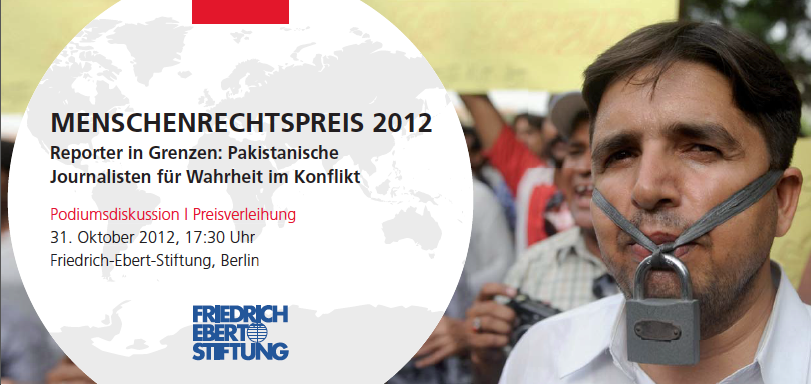
Last year the Tribal Union of Journalists was awarded the Friedrich Ebert Stiftung Human Rights Award; watch the video and you’ll see why.

Friedrich-Ebert-Stiftung 2012

Moving targets

I’ve added a draft of a new essay, ‘Moving targets and violent geographies’, under the DOWNLOADS tab.  It’s a general essay on drones, summarising both their genealogies and geographies, and I would welcome any comments, preferably by e-mail so they don’t get lost in the spam nets: again, this is a draft, so please treat it as such.  I wrote it for a volume of essays in honour of the work of my great friend Allan Pred, though I’ll incorporate a different version in The everywhere war.  This raw draft doesn’t feature any images (despite the references to Figure 1, etc): I’m still trying decide what to include.

You’ll see that it draws on a number of posts on the blog – a large number, now I’ve realised just how how many drone sightings there have been on geographicalimaginations.com! – as well as recent presentations.  I’ve noted before that I find presentations a useful way to prepare for an essay; I treat these visuals as storyboards and, once the essay has been drafted, it’s time to move on to other presentations: reading to an audience from a finalised script seems a waste of time to me.  But I’ve also found those scattered posts immensely helpful too, and I’ve been surprised at the consistent themes that emerged from them once I started to put them together.  This is more than cut-and-paste (or at least I hope so), and there are new arguments in the essay.  Let me know what you think.

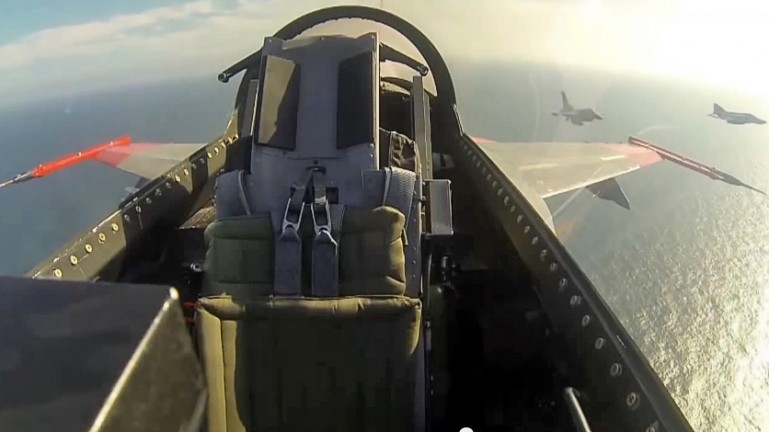
f-16-fighter-jet-unmanned-drone

Drones are moving targets in all sorts of ways – not only because, as I explain in the essay, they are currently unable to operate in contested  A2/AD (‘anti-access/area denial’) environments, and not even because Boeing has recently converted some of its mothballed F-16 fighter aircraft into target drones (see the image above; there’s a long history of target drones, of course) – but also because advanced militaries are re-evaluating their role and capabilities.

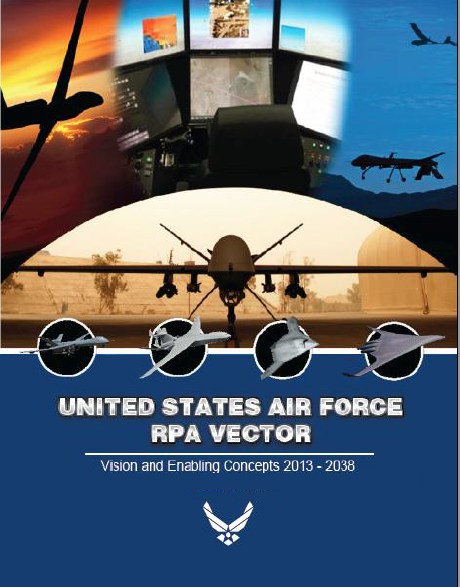
RPA VectorThe Pentagon issued its first integrated ‘UAS roadmap‘ in 2005, a review of all unmanned systems in 2007 and an update in 2011.  The Air Force produced its own ‘UAS Flight Plan‘ in 2009 (see the briefing slides here) and has promised its new ‘RPA [Remotely Piloted Aircraft] Vector’ report in the very near future.

It’s keenly awaited because there are indications that the Air Force is re-thinking its infatuation with Predators and Reapers. The commander of Air Combat Combat, General Mike Hostage, has made it plain that they are ‘useless in a contested environment‘ and so are unlikely to have a prominent place in Obama’s ‘pivot’ to Asia/Pacific.

While you are waiting, you can get a taste of what is to come from this June 2013 briefing by Jeffrey Eggers.

How we kill in war

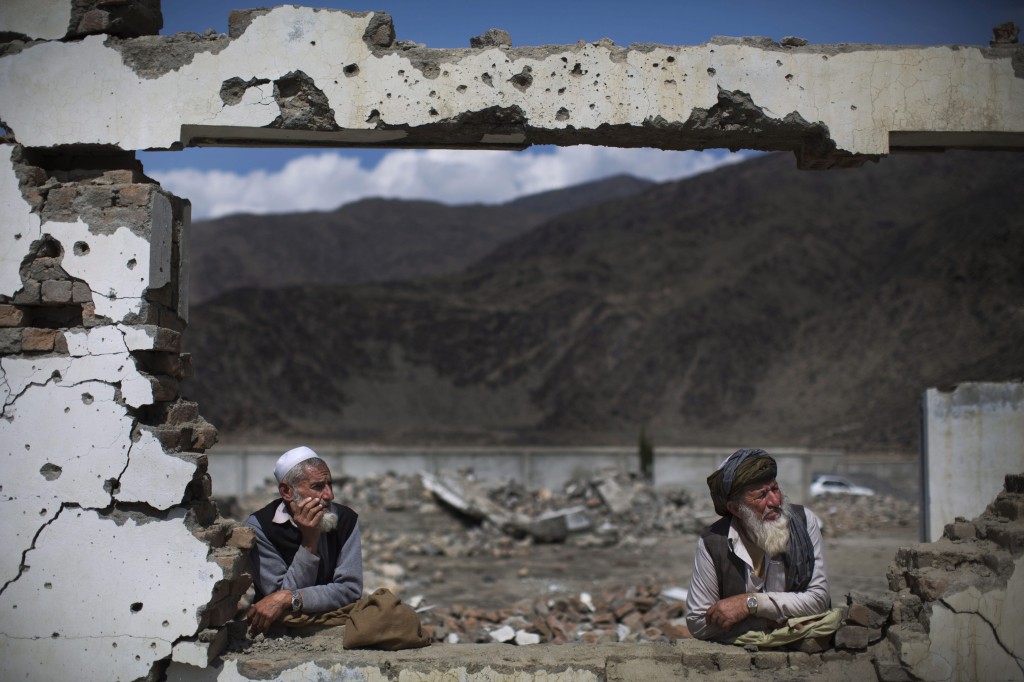
Afghanistan Living With Drones

A new CBC Ideas program, How we kill in war, airs tonight at 9 p.m.

With every evolution in military technology comes a shift in military tactics. And each shift in tactics pushes our understanding of what is permissible and what is ethical behaviour in war. The American military’s use of drones brings with it uncomfortable moral questions. Journalist Naheed Mustafa visits Pakistan and explores the dilemmas posed by drone warfare.

Participants include:

Karim Khan – Journalist with Al Jazeera. Currently suing the CIA for the drone killing of his son and brother.

Marvi Sirmed – Democracy promoter and human rights activist.

Shahzad Akbar – Lawyer, currently representing victims of American drone strikes.

Derek Gregory – Peter Wall Distinguished Professor and Professor of Geography at University of British Columbia.

John Kaag – Associate Professor of Philosophy, University of Massachusetts at Lowell.

Bradley Strawser – Assistant Professor of Philosophy in the Defense Analysis Department, US Naval Postgraduate School.

I had an extended phone conversation with Naheed to prep for this, and then an hour-long interview (don’t worry: the extracts used are much shorter!).  She really does know her stuff, and the programme includes interviews with some of those who live under the shadow of drone attacks in the Federally Administered Tribal Areas.

You can listen in online here.

More unfinished business: haunting Waziristan

I’m just finishing up a new essay on drones and later modern war – “Moving targets and violent geographies” – and I’ll post the draft as soon as I’m done (this weekend, I hope).

Next up is the essay version of my various posts and presentations on air strikes in Pakistan’s Federally Administered Tribal Areas, past and present, by the US and by the Pakistan Air Force [see here and here], so I was heartened by news from Madiha Tahir [see my post here] of progress with her short documentary film, Wounds of Waziristan (they are down to the final edits):

More about the project and crowd-sourcing here, and you can find more information at the film’s website, which includes an image gallery and opens with some of the most hauntingly beautiful music composed by André Barros (shades of Arvo Part‘s Spiegel im Spiegel):

Haunting indeed.  In a report for Delhi’s Sunday Guardian, Tanishree Bhasin writes:

When Barack Obama finally admitted to the needless loss of life in Pakistan’s Waziristan area due to American drone attacks, he spoke about how the death of innocents would haunt him forever. Interrogating this notion of ‘haunting’ and what it means for those affected by these attacks is Pakistani filmmaker Madiha Tahir in her film Wounds of Waziristan….

With Wounds of Waziristan, Tahir tries to foreground the people who materially experience loss and absence — not as abstract body counts, but as the absence of a brother or a niece or a wife. “Haunting is the insistence by the dead that they be acknowledged, that the social conditions that brought about their demise be made known and rectified. So, haunting is about unfinished business. And, it’s thoroughly social and political. This film focuses on the people who live in Waziristan and who live among loss. Material conditions, whether it’s the rubble after a drone attack or the grave of one’s kin, persist in reminding the living of what they have lost,” she explains.

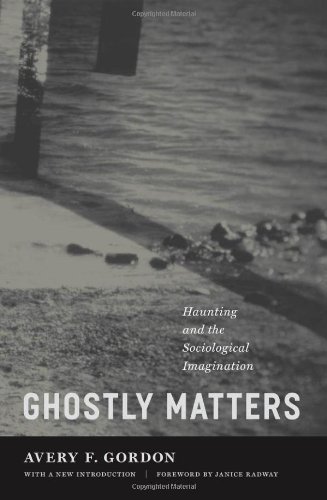
GORDON Ghostly matters

On her blog, Madiha wryly notes that her interest in the question of haunting may show ‘my academic side coming out’ – as well as an independent journalist she’s also a graduate  from NYU and Columbia, where she’s currently working on her PhD – and human geographers will probably be no strangers to the idea, from research by Steve Pile and Karen Till and most recently Alison Mountz‘s analysis of detention centres and Akin Akinwumi‘s work on Truth and Reconciliation Commissions.

Much of this has been indebted to Avery Gordon‘s by now classic study, Ghostly matters:

‘Haunting is one way in which abusive systems of power make themselves known and their impacts felt in everyday life, especially when they are supposedly over and done with or when their oppressive nature is denied… Haunting is not the same as being exploited, traumatized, or oppressed, although it usually involves these experiences or is produced by them. I used the term haunting to describe those singular yet repetitive instances when home becomes unfamiliar, when your bearings on the world lose direction, when the over-and-done-with comes alive, when what’s been in your blind spot comes into view.’

It’s not difficult to see how this applies to air strikes in Waziristan – the sense of familiarity unmoored by the devastations of state violence – but Madiha’s starting point is a two-page note Max Horkheimer and Theodor Adorno appended to Dialectic of Enlightenment, ‘On the theory of ghosts’, that also figured briefly in Gordon’s book (where she described it as an ‘unfilled promissory note’):

Only the conscious horror of destruction creates the correct relationship with the dead: unity with them because we, like them, are the victims of the same condition and the same disappointed hope.

It’s that first clause that animates Madiha’s work:

Only the conscious horror of destruction creates the correct relationship with the dead.

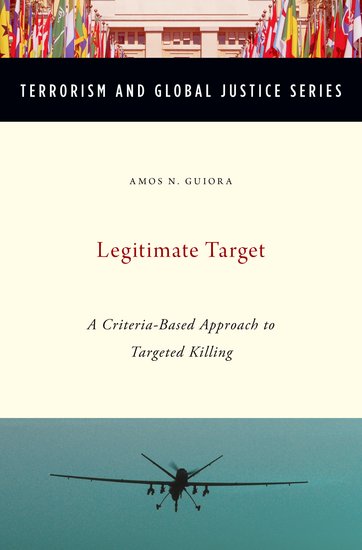
Legitimate TargetShe notes that so much (too much) of the contemporary debate about drones is framed by the language of international law and its grammar of execution that is deeply embedded in military violence: as operational law has become a central discourse in the animation and legitimation of the kill-chain, so it turns targeted killing into a quasi-juridical process.  In consequence, as she says with a nod to Eyal Weizman, ‘international law is caught up in constructing the proper order of violence.’

And as a journalist she is dismayed at the complicity of journalists in popularizing law

‘as the only frame through which we can talk about drone attacks and moral standards. Journalists regularly fail to look beyond the usual “experts” in policy and legal circles to other fields that may have an alternative to offer. We are becoming vulgar empiricists who seem to think that a truth not attached to a number (say, the number of “militants” vs. “civilians” killed), or a legal rule (for example: whether an action does/does not violate international law) is no truth at all.’

So Madiha proposes haunting as an alternative frame ‘through which one can re-direct the conversation from issues of legal standards to the lives lived and lives lost under the drones in Waziristan and elsewhere’:

‘The questions then turn on the material conditions and the loss suffered – not as evidence for legal arguments but as queries about what it does to a person to live in such conditions. The question is not, ‘Do I stick him in the “militant” or “civilian” column?’ but instead, who survives him? How do they deal with that loss? What is it like to live among the rubble?

It isn’t through legal standards but though trying to understand the horror of the destruction that we create the correct relationship — with the dead, yes — but with the living, too.’

This matters so much – and reappears in a different form in ‘Moving targets’ – because the contemporary individuation of ‘war’ (if it is war) works to sanitize the battlefield: to confine attention to the individual-as-target (which is itself a technical artefact separated from the exploded fleshiness that flickers briefly on the Predator’s video screens) and to foreclose the way in which every death ripples across a family, a community, a district and beyond [see my brief discussion with Ian Shaw here].

Fahim Qureshi Attack date 23 January 2009

And, as Madiha explained to the Sunday Guardian, these effects ripple across time as well as space, tearing the very fabric of history:

Speaking about her experiences while making this film, she explained that it’s not just a question of life being lost, but also the obliteration of history. “When drone attacks destroy homes — as they often do — they erase entire family histories. Homes in this area are built over time as families grow. There may be as many as 50 members of a family living in one house. When you destroy structures like that, you not only destroy people, you also destroy their history. The rubble that’s left in the wake of an attack is a living memory of what happened there. It embodies loss. The people in Waziristan have to live around this loss, near it, in it. They have to live among ghosts,” says Tahir.

Theory of the drone 10: Killing at a distance

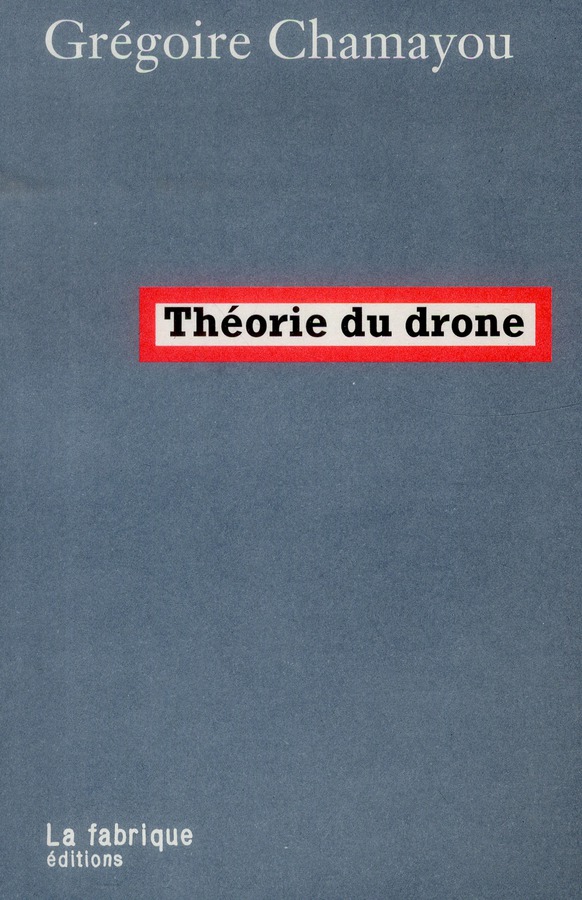
This is the tenth in a series of extended posts on Grégoire Chamayou‘s Théorie du drone and covers the fifth and final chapter in Part II, Ethos and psyche.
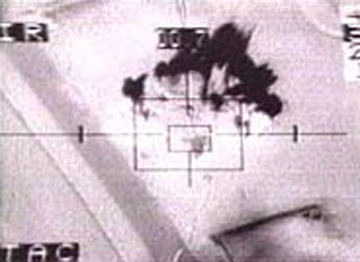
Gulf_war_target_camChamayou begins with a lecture given by German artist and film-maker Harun Farocki in Karlsruhe in 2003 called  ‘Phantom Images‘.  A ‘phantom image’, Farocki explained, is a view that is otherwise inaccessible to a human being – like the ‘bomb’s-eye view’ that became so familiar during the Gulf War (‘a suicidal camera’).  Like so many other ‘technical representations which maintain that they only represent the operative principle of a process’ these are, of course, techno-cultural performances.  They are techno-cultural because they produce a constructed and constrained space – in the Gulf War images that Farocki used to frame his argument, the battle space appears empty of people, a landscape without figures, an odyssey of destruction based on an object-ontology – and they are performances because they are what Farocki called ‘operative images’ that ‘do not represent an object but are part of an operation‘ (my emphasis).

You can find more on Farocki’s fascination with the virtual/real and Immersion here and on Images of War (at a distance) here.  Both ideas – immersion and distance – are central to Chamayou’s argument, but his starting-point is the idea of an operative image.  He wants to think of militarized vision as a ‘sighting’ that works not only to represent an object but also to act upon it and, in the case that most concerns both of us, this is the mainspring of the production of the target.

This has a long (techno-cultural) history, but drones use a video image to fix and execute the target: ‘You can click, and when you click, you kill.’  There’s something almost magical about it, Chamayou says: a hi-tech form of voodoo violence, like sticking pins into a wax doll, in which bringing someone into view – ‘pinning’ the target in the viewfinder – transports them into the killing space.
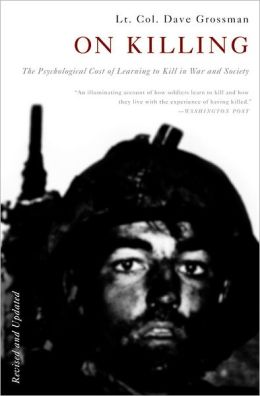
GROSSMAN On KillingBut what sort of space is it?  Chamayou considers a simple diagram from Dave Grossman‘s On Killing. For readers unfamiliar with his work, here is how Grossman describes himself on the website of his Killology Research Group:

Col. Grossman is a former West Point psychology professor, Professor of Military Science, and an Army Ranger who has combined his experiences to become the founder of a new field of scientific endeavor, which has been termed “killology.” In this new field Col. Grossman has made revolutionary new contributions to our understanding of killing in war, the psychological costs of war, the root causes of the current “virus” of violent crime that is raging around the world, and the process of healing the victims of violence, in war and peace. 

And here is the diagram, which summarises Grossman’s views on the relationship between ‘resistance to killing’ and distance from the target:
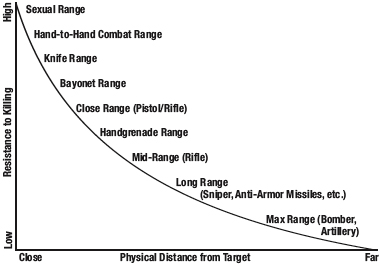
Resistance to killing as a function of distance

Grossman’s basic argument is that distance increases indifference and, as the annotations imply, there appears to be an historical sequence to all this.  Grossman’s book was published before the advent of the drone, but – given these two axes – the Predator and the Reaper presumably ought to appear on the extreme right of the diagram, representing the radicalisation of killing at a distance.

In fact, Grossman provides a discussion of videogames in which he says that the screen acts as a barrier between the player and the violence s/he unleashes in the game, making it easier to ‘kill’: exactly the argument advanced by those who claim that drones induce a ‘Playstation mentality’ to killing.

And yet, as I’ve explained in ‘From a view to a kill’ (DOWNLOADS tab), modern videogames are profoundly immersive, and the high-resolution full motion video feeds from the drones induce such an extraordinary sense of proximity, even intimacy – remember that crews frequently claim to be 18 inches from the combat zone, the distance from eye to screen – that drones are surely also pulled towards towards the extreme left of Grossman’s diagram.

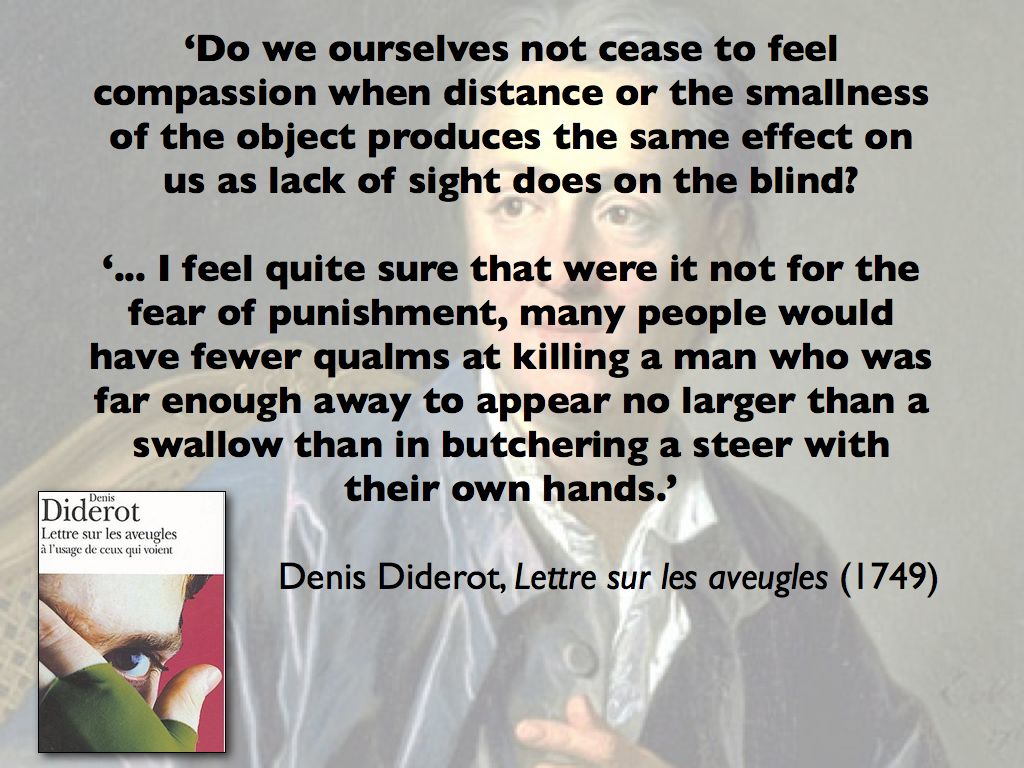
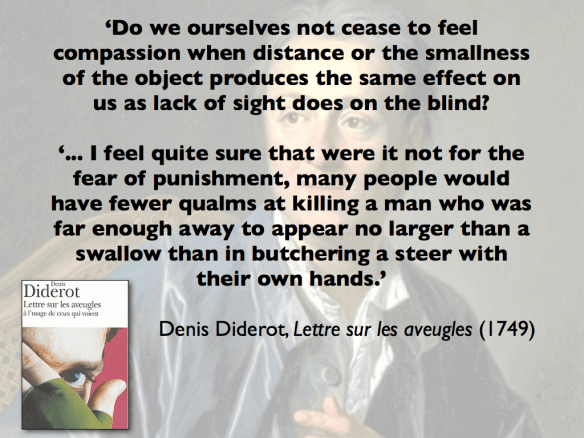
Chamayou doesn’t quote him, but Diderot’s Letter on the blind set out the original terms of the debate perfectly:
DIDEROT.001

But Chamayou is quick to show that ‘distance’ is a weasel-word, and in an extended footnote he elaborates his concept of pragmatic co-presence.  Co-presence denotes the possibility of A affecting B in some way, which means (in the absence of sorcery) that B must be within the sphere of action of A; more formally, co-presence involves the inclusion of one within the ‘range’ or ‘reach’ of another.  This is multi-dimensional – without technical mediation you can see someone much further away than you can hear them – but in many situations technical mediations are involved and so transform the relation.  This matters for two reasons.

First, there is nothing necessarily reciprocal about co-presence: what Chamayou calls ‘the structure of of co-presence’ determines what it is possible for you to do to the other, and is itself the product of struggle: each party to a conflict manouevres to produce a favourable asymmetry so that it becomes much easier for you to strike than to be hit.  In this sense, all war strives to be asymmetric – it’s not confined to wars between states and non-state actors – and it’s this that in part underwrites the history of war at a distance; as William Saletan put it, effectively re-describing Grossman’s diagram,

‘Technically, this is marvelous. Look at the history of weapons development: catapult, crossbow, cannon, rifle, revolver, machine gun, tank, bazooka, bomber, helicopter, submarine, cruise missile. Every step forward consists of a physical step backward: the ability to kill your enemy with better aim at a greater distance or from a safer location. You can hit him, but he can’t hit you.’

But – Chamayou’s second rider – ‘teletechnologies’ radically transform this sequence by severing co-presence from co-localisation.   What is distinctive about teletechnologies is not their capacity to act ‘at a distance’ but their indifference to and their interdigit(is)ation of ‘near’ and ‘far’.

This has far-reaching (sic) consequences because it produces a double disassociation.  Where, exactly, does the action take place?  Here (at Creech Air Force Base in Nevada) or there (Kandahar in Afghanistan)?  There is no single answer, of course, which is precisely Chamayou’s point.  This split – or series of splits, if you think of the wider networks involved – in turn engenders radically new forms of experience, of being-in-the-world, that can no longer be contained within the physico-corporeal confines of the conventional human subject.

Chamayou wants to show that this double disassociation is anything but ‘marvellous’.   He accepts that the targets that are produced through the full-motion video feeds from the Predators and Reapers are much less abstract: the crews see their targets – often people, not physical objects like the buildings or missile batteries that constituted Farocki’s ’empty’ battlespace – and they see the corporeal consequences of each strike.  ‘This novel combination of physical distance and visual proximity gives the lie to the old [Clausewitz-Hegelian] law of distance,’ Chamayou writes, since ‘increased distance no longer makes violence more abstract or more impersonal but, on the contrary, more graphic and more personal.’

But he insists that this proximity, even intimacy is counterbalanced by two factors which are also inscribed within the political technology of vision:

(1) ‘Proximity’ is contracted to the optical – and even this is degraded because the resolution of the video feeds reduces people to ‘avatars without faces’.  I think this is less straightforward than Chamayou implies.  He cites Salatan – ‘There’s no flesh on your monitor; just co-ordinates’ – which is a sharp remark, but the journalist was referring to the launch of long-range missiles (‘… tap a button on one continent and send a missile to another’) whereas the screens at Creech and elsewhere show human figures as well as co-ordinates.  More significant, I think, is that when drone operators provide close air support they are also in radio and online contact with troops on the ground, and this produces a pragmatic co-presence which is considerably more ‘fleshed out’ than their otherwise purely optical encounters with others in their field of view.

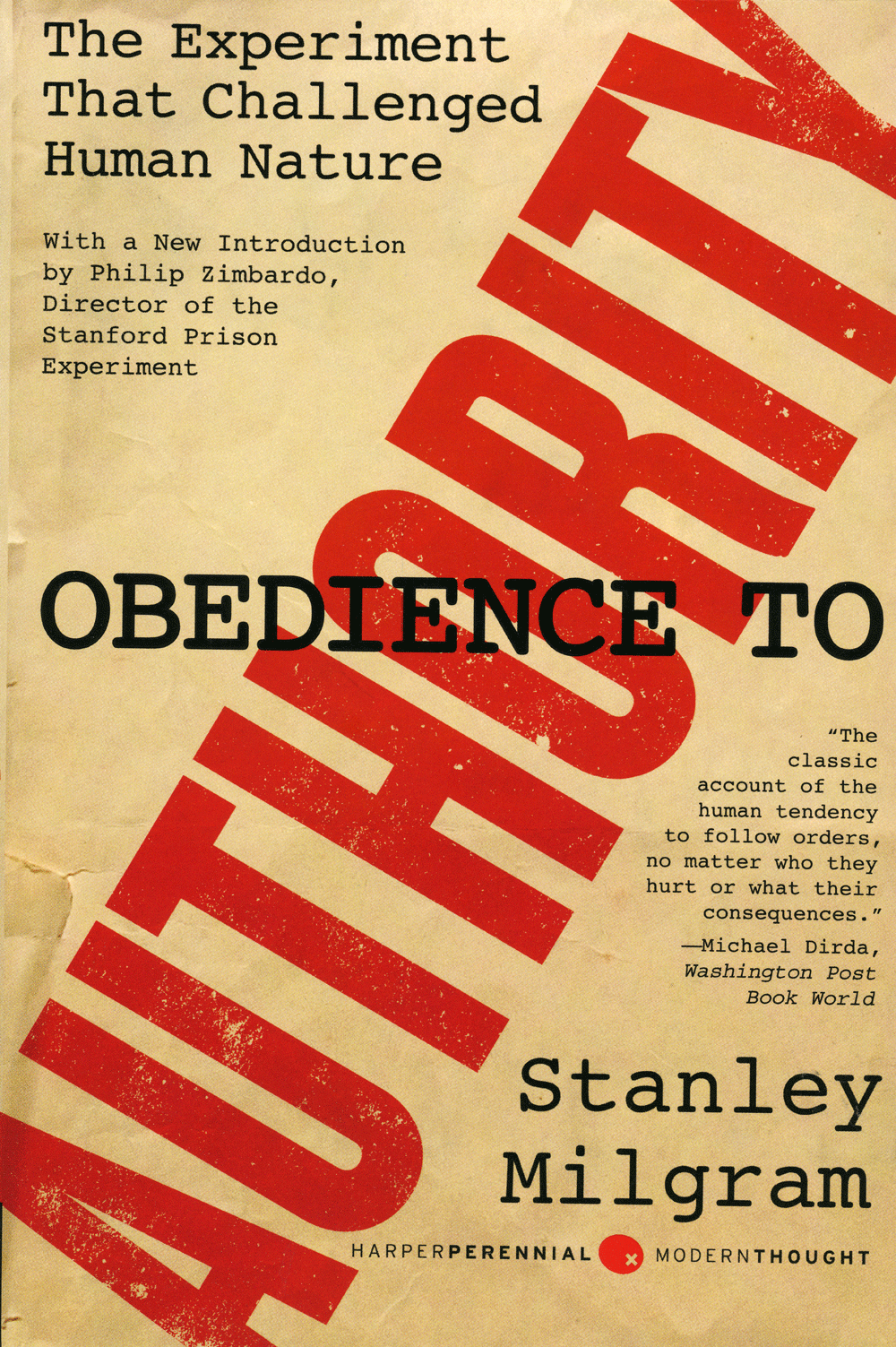
(2) Drone operators can see without being seen, and Chamayou argues that ‘the fact that the killer and his victim are not inscribed in “reciprocal perceptual fields” facilitates the administration of violence’ because it ruptures what psychologist Stanley Milgram in his notorious experiments on Obedience to authority [below] called ‘the phenomenological unity of the act’.  Milgram actually wrote “experienced”, not “phenomenological”, but you get the point; Milgram was discussing how much easier it is to hurt someone ‘if there is a physical separation of the act and its consequences’, which is radicalised in what the US Air Force calls the ‘remote split’ operations carried out by its Predators and Reapers.

MILGRAM Experiments

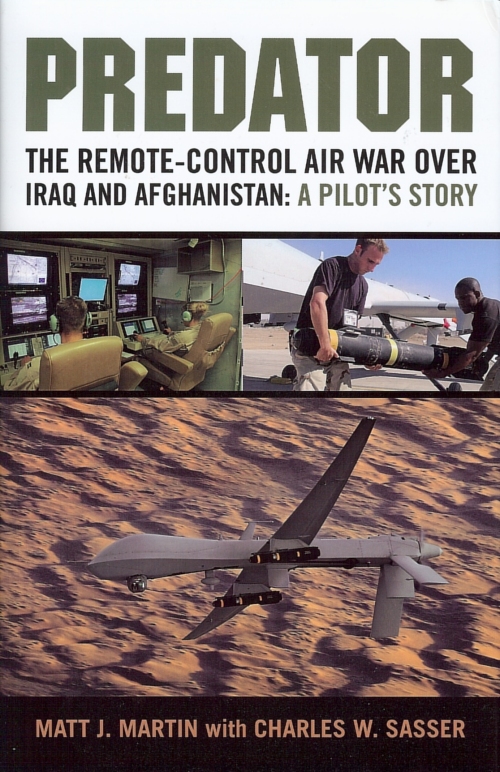
Milgram’s thesis was a general one, but to nail the sense of disassociation to the drone Chamayou quotes Major Matt Martin, a Predator operator:

‘The suddenness of action played out at long distance on computer screens left me feeling a bit stunned…  It would take some time for the reality of what happened so far away, for “real” to become real.’

Again, I think it’s more complicated than that.  Martin was clearly recalling an early experience, low on the learning curve, and interviews with other drone pilots suggest that within 6 months or so most had little difficulty in apprehending the reality, even the physicality of pragmatic co-presence. The sensor operator interviewed by Omer Fast for 5,000 Feet is the Best had this to say, for example:

‘… you get more into it the longer you’re working on the Predator.  Like my first fire mission.  You know, we fired a Hellfire missile at the target.  It didn’t quite strike [sic] me as, “Hey! I just killed someone!”  My first time.  It was within my first year there.  It didn’t quite impact.  It was like, “Yeah! I got somebody!”  You know?  And it was later on through a couple of more missions that I started to… The impact really dawned on me.  I just ended someone’s life!  That was me that did that!”‘
obedience-to-authority-milgramIt’s important to remember, too, that Milgram’s work was about structures of authority, and this has a palpable effect in the case of the military chain of command which has been transformed by the networked incorporation of video feeds from the drones and the deployment of military lawyers (JAGs) on the operations floor of the Combined Air and Space Operations Center (what I called ‘oversight’ in “From a view to a kill”),  which provides for a dispersion of responsibility across the network.

Equally important, I suspect, is that fact that drone crews are not only ‘following orders’, as the familiar jibe has it: they are also following procedures that transform military violence into a process that is at once techno-scientific and quasi-juridical and thus seen as conducted under the sign of an unimpeachable (military) Reason.

Joseph Pugliese makes a parallel argument about the incorporation of military-legal discourse into the techno-logic of the targeting process:

‘I argue that the parenthetical relation of law to technology is premised on a topical hiatus that disassociates the executioner who manipulates the killing technology of the drone from the facticity of the resultant execution. In this scenario, law is conceived of in the most radically instrumental of understandings: it enables and legitimates the execution while simultaneously suspending the connection between the doer and the deed.’
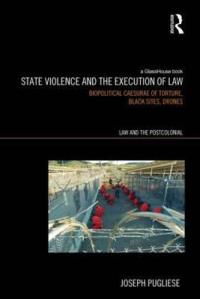
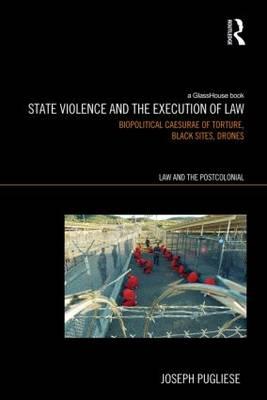
state-violence-and-the-execution-of-lawAnd yet at the same time, Pugliese explains, there is a ‘prosthetic’ relation between law and technology, in which ‘the human agent is always already inscribed by the technics of law.’ From the very beginning, he insists, the body is always already ‘instrumentalised by a series of technologies’ and also inscribed, from the very beginning, by a series of laws.  In short, ‘law is always already inscribed on the body, precisely as techné from the very first. This process of prosthetic inscription operates to constitute the very conditions of possibility for the conceptual marking of the body as”‘human’”‘: ‘The prosthesis,’ notes Bernard Stiegler, ‘is not a mere extension of the human body; it is the constitution of this body qua “human”’.’

Still, Chamayou suggests that (1) and (2) work together to sustain what Mary Cummings calls ‘moral buffering’.  In other words, and in counterpoint to optical proximity, the dispositif also provides a powerful means of distanciation.  Here is Fast’s interviewee again:

‘There’s always more of a personal touch when you’re watching something live.  And it’s even more personal when you’re the one that did it… Well, I mean you get more – I guess – emotionally distant.  As time goes on.  But I mean… I guess in my case, and some of the cases of the guys that I knew, as more time went by you put yourself more and more in the position that this is more and more real life and that you are actually there… And after a while you become emotionally distant.  But still you put yourself more and more as if you’re standing right there…’
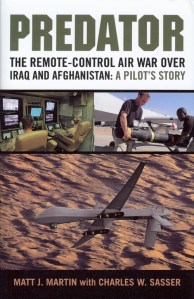
MARTIN PredatorThis is compounded, so Chamayou argues, by a different dimension of ‘remote split’ operations. Because Predators and Reapers can stay aloft for 18 hours or more (the ‘persistent presence’ that makes them so much in demand), their crews work shifts and commute each day (or night) between home and work or, more accurately, between peace and war.  One drone operator saw this as a peculiarly strung-out existence: ‘We were just permanently between war and peace’  (my emphasis).  Matt Martin said much the same.  US-based crews ‘commute to work in rush-hour traffic, slip into a seat in front of a bank of computers, fly a warplane to shoot missiles at an enemy thousands of miles away, and then pick up the kids from school or a gallon of milk at the grocery store on [their] way home for dinner.’  He described it as living ‘a schizophrenic existence between two worlds’; the sign at the entrance to Creech Air Force Base read ‘You are now entering CENTCOM AOR [Area of Operations]’, but ‘it could just as easily have read “You are now entering C.S. Lewis’s Narnia” for all that my two worlds intersected.’

The way crews survive, Chamayou suggests, is by partitioning, ‘setting aside’, but this is extremely difficult for commuter-warriors as they regularly and rapidly move between a domestic sphere in which killing is taboo and a military sphere where (so he says) it is ‘a virtue’.   The superimposition of these two worlds – their contradictory clash – means that crews are in a sense ‘both in the rear and at the front, living in two very different moral universes between which their lives are torn.’

This is precisely the situation dramatised in George Brant‘s play Grounded, which I noted in an earlier post, and Chamayou cites a former USAF sensor operator Brandon Bryant (whose testimony I discussed here) to the same effect.  In both cases, crew members plainly are affected, even distressed by what they see on the screen; in fact Bryant has bee diagnosed with PTSD.

But Chamayou insists that this sort of testimony is rare and that most of them do manage to compartmentalise.  Fast’s sensor operator:

‘A lot of us learn real fast to leave all of our problems at the door.  You know, when we’re leaving the squadron and heading home.  Just kind of putting it on a rack and pushing it out of your mind.’

And this, Chamayou concludes, nails the real psychopathology of the drone.  He calls French philosopher Simone Weil’s Gravity and grace to his aid:

‘The faculty of setting things aside opens the door to every sort of crime…  The ring of Gyges who has become invisible – this is precisely the act of setting aside: setting oneself aside from the crime one commits; not establishing the connection between the two.’

Chamayou has used the myth of Gyges earlier in his critique, but here he invokes Weil to claim that the psychopathology of the drone is not the trauma some say that drone crews experience ‘but on the contrary the industrial production of compartmentalised psyches, protected from all possibility of reflection on the violence they have committed, just as their bodies are already protected against every possibility of exposure to the enemy.’
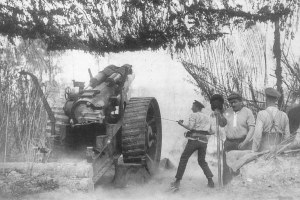
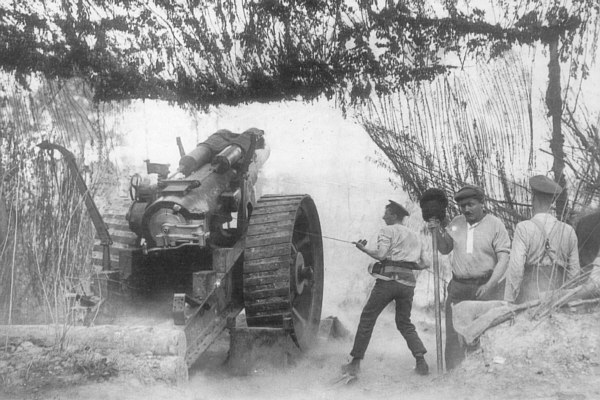
rwg05074-1I’m really not sure about this.  ‘Protected from all possibility of reflection’?  Much of the evidence that Chamayou cites here – like Milgram’s experiments – could be applied to most forms of military violence.  Here, for example, is Arnold Bennett describing artillery at work in Over there: war scenes on the Western Front (1915):

‘The affair is not like shooting at anything.  A polished missile is shoved into the gun.  A horrid bang – the missile has disappeared, has simply gone.  Where it has gone, what it has done, nobody in the hut seems to care.  There is a telephone close by, but only numbers and formulae – and perhaps an occasional rebuke – come out of the telephone, in response to which the  perspiring men make minute adjustments in the gun or in the next missile.

 ‘Of the target I am absolutely ignorant, and so are the perspiring men.’

I’ve found the same sentiments expressed by bomber crews during the Second World War.  The difference, clearly, is that drone strikes involve far more than ‘numbers and formulae’ – co-ordinates on the screen – and that the visual  production and so-called ‘prosecution’ of the target takes place in near real time, in vivid detail and under the eye of military lawyers.  But it is not surprising (nor, I think, especially pathological) that those who carry out these strikes conduct themselves with a certain seriousness, a ‘professionalism’ if you like, that precludes emotional investment. This is from David Wood‘s interview with a highly experienced USAF drone pilot:

Q: You must develop an emotional tie with the people on the ground that makes it hard if there is going to be a strike or a raid, people are going to be killed.

A: I would couch it not in terms of an emotional connection, but a … seriousness. I have watched this individual, and regardless of how many children he has, no matter how close his wife is, no matter what they do, that individual fired at Americans or coalition forces, or planted an IED — did something that met the rules of engagement and the laws of armed conflict, and I am tasked to strike that individual.

‘Professionalism’ shouldn’t be used as a mask to hide from critique, to be sure.  These crews are trained to perform with a calculative reason, dispassionately, through a techno-cultural and techno-legal armature, so that, as one USAF major told Nicola Abé, when she was preparing for a strike ‘there was no time for feelings’.  Or again, from another pilot operating a Predator over Afghanistan:

‘We understand that the lives we see in the screens are as real as our own…  I would not compare what I do as a job comparable to Call of Duty/any other video game, in any sense. It is very real and the seriousness of the lives on the ground is very real and instilled in all of our training. It is never something that we joke about. Very serious business.’

As I’ve noted before, there are (too) many instances in which crews do joke about their missions, the sort of ‘gallows humour’ that is no doubt a common reaction to  hunter-killer missions: but isn’t this also likely to be common amongst all military professionals who are trained to kill?  One pilot explicitly rejected the suggestion that drone crews become disassociated from what they do:

‘I wonder why people think this. We understand what we are doing is real world operations. We know our actions have consequences. I don’t understand the idea of being desensitized due to some operators not being in an actual firefight/combat zone.’

Later in the online exchange, the same pilot insists: ‘It’s very real.  Some of the stuff I’ve seen is burned into my brain’ – and then Brandon Bryant joins the conversation to ‘agree with what you guys have said.’  He’s on record as writing in his personal combat diary ‘I wish my eyes would rot.’

I realise that these passages can’t settle matters, but they surely cast doubt on the implication that drone crews are as machinic as the aircraft they fly.  Pugliese insists that the drone ‘cannot be reduced to a mindless machine of purely robotic acts’; neither, by virtue of what Pugliese calls their prosthetic relation to the drone, can the crew who fly them.   I still think that one of the most salient differences introduced by drones is the differential distanciation they allow when they provide close air support: an unprecedentedly close relation with troops on the ground and a calculative detachment from others in their field of view.

I realise, too, that this can’t apply to targeted killings, and so I leave you with this statement by Lt General Michael DeLong, who as deputy commander of US Central Command had to sign off on the first CIA-directed targeted killing, in Yemen in November 2002.  Then CIA Director George Tenet called DeLong to ask him to give the order, since the Predator was flown by a USAF crew:

delongp‘Tenet calls and said, “We got the target.” … I called General Franks [commander of CENTCOM]. Franks said, “Hey, if Tenet said it’s good, it’s good.” I said, “Okay … I’m going down to the UAV room.” … We had our lawyer there. Everything was done right. I mean, there was no hot dog. … The rules of war, the rules of combat that we had already set up, the rules of engagement ahead of time. Went by them. Okay, it’s a good target. …

I’m sitting back … looking at the wall, and I’m talking to George Tenet. And he goes, “You got to make the call?” These Predators had been lent to him, but the weapons on board were ours. So I said, “Okay, we’ll make the call. Shoot them.” 

Everything may have been ‘done right’, the procedures followed, but  when DeLong was asked ‘What does it feel like when you know you’re going down there to kill somebody?’ He replied:

‘It’s just war. It’s no different than going to the store to buy some eggs; it’s just something you got to do.’

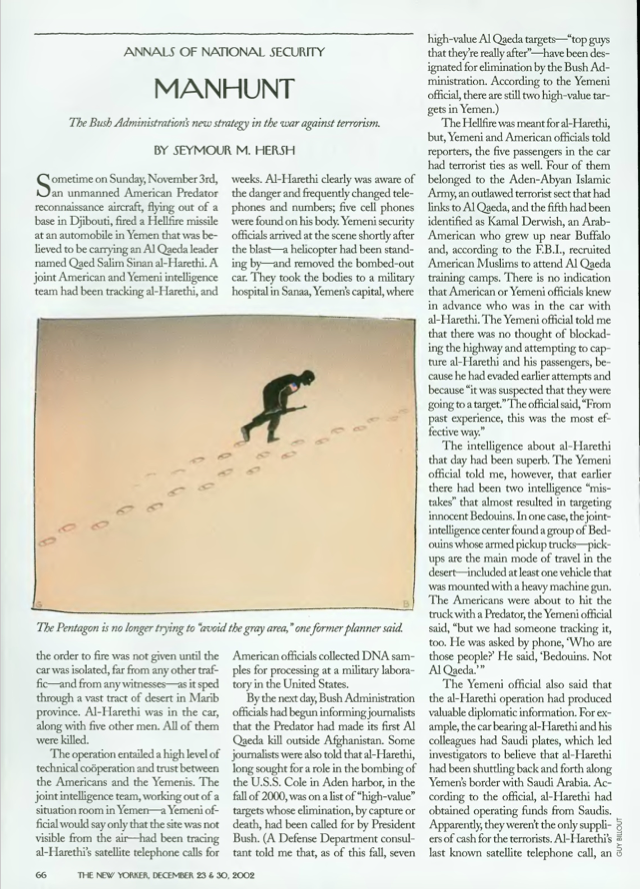
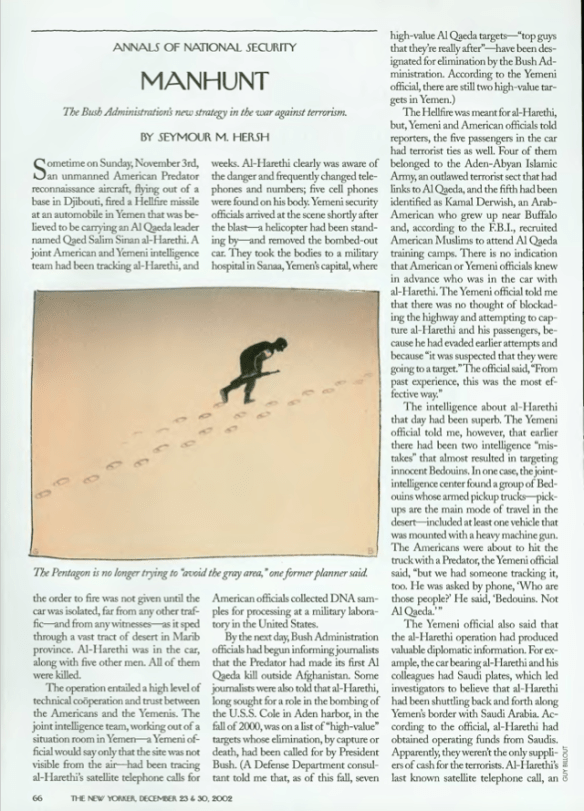
And, as Chamayou would surely insist, it wasn’t war.  It was, as Seymour Hersh wrote in the New Yorker on 23 December 2002, a manhunt.
HERSH Manhunt

To be continued.
Drones and drama

I’ve noted several performance works that address drone wars before, and I’ve now encountered two more.

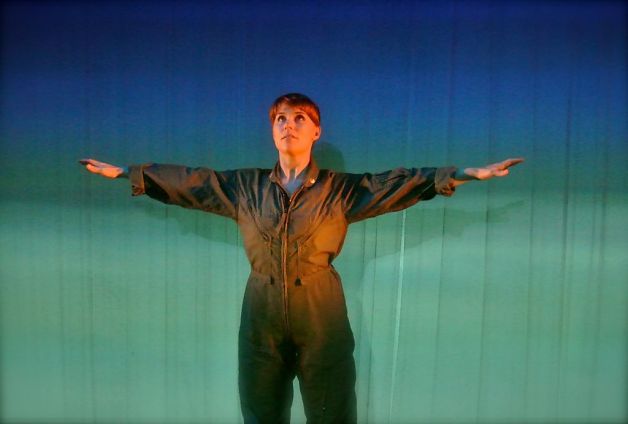
BRANT GroundedGeorge Brant‘s new play, Grounded, has been acclaimed on both sides of the Atlantic.  It’s a solo drama (‘monologue’ really doesn’t do it justice) about a US Air Force pilot who has been obliged to switch from flying F-16s to Reapers (and so to the ‘Chair Force’) after her maternity leave.

The focus is on a domestic geography of remote operations that is beginning to attract more critical attention and which resonates with what Grégoire Chamayou calls the ‘psychopathologies of the drone‘: the difficulty of switching every day, every shift, from being in the war zone, at least virtually – what she calls being “downrange” – to being at home with a young family.

‘We’ll be working in shifts. Tapping each other out and taking the controls. A never-ending mission. Home will be training too. Getting used to the routine. Driving to war like it’s shift work. Like I’m punching the clock. Used to transition home once a year. Now it’ll be once a day. Different. Definitely different.’

The pilot finds it increasingly difficult to maintain the separation – to decompress – and gradually and ever more insistently one space keeps superimposing itself over the other; the fixed, precise sensor of the Gorgon Stare yields to a blurred vision in which the pilot finds it increasingly difficult to know where (or who) she is.

She begins by familiarising herself with the landscape in Afghanistan and the spectral figures moving through it:

‘I stare at the desert. They’re twelve hours ahead there. Night. Weird. I stare at the screen. It’s not like a videogame. A videogame has color. I stare at grey. At a world carved out of putty. Like someone took the time to carve a putty world for me to stare at twelve hours a day. High-definition putty….

‘The eye in the sky waits for the putty people to get closer together. Just a little closer. Closer. Closer. There I press the button. I watch the screen. A moment. A moment. And boom. A silent grey boom.’ 

628x471-1‘It becomes your world,’ she says, a world populated by the living and the dead whose greyness bleeds one into the other:

‘Lingering over the dead. A mound of the dead. Our dead. They were ambushed and I am to linger over their bodies. I do. With no idea of who they are or how they got here. A mound of our grey. Our boys in grey. Please let me find the guilty who did this the military age males who did this send me to shred their bodies into pieces too fine for my resolution…’

But then the Nevada desert on the drive home starts to resemble the landscape in Afghanistan; the face of a little girl on the screen, the daughter of a ‘High Value Target’, becomes the face of her own child:

‘The girl Her face She stops running and I see it Her face I see it clearly I can see her It’s Sam It’s not his daughter it’s mine…’

There’s much more – much of it turning on imagery and surveillance – and it’s richer and less linear than I can convey here.  You can download the script from Amazon or buy hard copy from Oberon Books here; in the UK Grounded has just transferred from the Edinburgh Festival to the Gate in London until 28 September: details here, and other dates in the US here (scroll down).

I’ve also received a message from Hjalmar Joffre-Eichhorn, a German-Bolivian theatre-maker who has lived and worked in Afghanistan for the last six years.  Hjalmar brought the “Theatre of the Oppressed” to Afghanistan and co-founded the Afghanistan Human Rights and Democracy Organization (AHRDO).  He’s currently writing a new play to be premiered in Kabul in November, which focuses on drones and suicide bombers in Afghanistan and Pakistan: clearly another parallel with Grégoire Chamayou‘s work.

More to come, I hope, and I’ll keep you posted, but you can watch and listen to an inspiring talk by Hjalmar on Afghanistan and community-based theatre here:

Note: Back to my reading of Théorie du drone next week – this week has been filled with preparing for the new term which starts on Tuesday (so I’m updating the course outlines under the TEACHING tab).  I’ve also had a lovely e-mail from Grégoire Chamayou, and we are going to try a digital conversation – once the dust of the beginning of term has settled – and when we’re done, I’ll post the transcript here.

The individuation of warfare?

chamayou-manhuntsBefore I resume my reading of Grégoire Chamayou‘s Théorie du drone, I want to approach his thesis from a different direction. As I’ve noted, much of his argument turns on the reduction of later modern war to ‘man-hunting’: the profoundly asymmetric pursuit of individuals by activating the hunter-killer capacities of the Predator or the Reaper in a new form of networked (para)military violence. He describes this as a ‘state doctrine of non-conventional violence’ that combines elements of military and police operations without fully corresponding to either: ‘hybrid operations, monstrous offspring [enfants terribles] of the police and the military, of war and peace’.

These new modalities increase the asymmetry of war – to the point where it no longer looks like or perhaps even qualifies as war – because they preclude what Joseph Pugliese describes as ‘“a general system of exchange” [the reference is to Achille Mbembe’s necropolitics] between the hunter-killer apparatus ‘and its anonymous and unsuspecting victims, who have neither a right of reply nor recourse to judicial procedure.’

Pugliese insists that drones materialise what he calls a ‘prosthetics of law’, and the work of jurists and other legal scholars provides a revealing window into the constitution of later modern war and what, following Michael Smith, I want to call its geo-legal armature. To date, much of this discussion has concerned the reach of international law – the jurisdiction of international law within (Afghanistan) and beyond (Pakistan, Yemen and Somalia) formal zones of conflict – and the legal manoeuvres deployed by the United States to sanction its use of deadly force in ‘self-defence’ that violates the sovereignty of other states (which includes both international law and domestic protocols like the Authorization for the Use of Military Force and various executive orders issued after 9/11) . These matters are immensely consequential, and bear directly on what Frédéric Mégret callsthe deconstruction of the battlefield’.

HIPPLER Bombing the PeopleIt’s important to understand that the ‘battlefield’ is more than a physical space; it’s also a normative space – the site of ‘exceptional norms’ within whose boundaries it is permissible to kill other human beings (subject to particular codes, rules and laws). Its deconstruction is not a new process. Modern military violence has rarely been confined to a champ de mars insulated from the supposedly safe spaces of civilian life. Long-range strategic bombing radically re-wrote the geography of war. This was already clear by the end of the First World War, and in 1921 Giulio Douhet could already confidently declare that

‘By virtue of this new weapon, the repercussions of war are no longer limited by the farthest artillery range of guns, but can be felt directly for hundreds and hundreds of miles… The battlefield will be limited only by the boundaries of the nations at war, and all of their citizens will become combatants, since all of them will be exposed to the aerial offensives of the enemy. There will be no distinction any longer between soldiers and civilians.’

The laboratory for these experimental geographies before the Second World War was Europe’s colonial (dis)possessions – so-called ‘air control’ in North Africa, the Middle East and along the North-West Frontier – but colonial wars had long involved ground campaigns fought with little or no distinction between combatants and civilians.

What does seem to be novel about more recent deconstructions, so Mégret argues, is ‘a deliberate attempt to manipulate what constitutes the battlefield and to transcend it in ways that liberate rather than constrain violence.’

9781844676477 Least of All Possible EvilsThis should not surprise us. Law is not a deus ex machina that presides over war as impartial tribune. Law, Michel Foucault reminds us, ‘is born of real battles, victories, massacres and conquests’; law ‘is born in burning towns and ravaged fields.’ Today so-called ‘operational law’ has incorporated military lawyers into the kill-chain, moving them closer to the tip of the spear, but law also moves in the rear of military violence: in Eyal Weizman’s phrase, ‘violence legislates.’ In the case that most concerns him, that of the Israel Defense Force, military lawyers work in the grey zone between ‘the black’ (forbidden) and ‘the white’ (permitted) and actively seek to turn the grey into the white: to use military violence to extend the permissive envelope of the law.

The liber(alis)ation of violence that Mégret identifies transforms the very meaning of war. In conventional wars combatants are authorised to kill on the basis of what Paul Kahn calls their corporate identity:

‘…the combatant has about him something of the quality of the sacred. His acts are not entirely his own….

‘The combatant is not individually responsible for his actions because those acts are no more his than ours…. [W]arfare is a conflict between corporate subjects, inaccessible to ordinary ideas of individual responsibility, whether of soldier or commander. The moral accounting for war [is] the suffering of the nation itself – not a subsequent legal response to individual actors.’

The exception, Kahn continues, which also marks the boundary of corporate agency, is a war crime, which is ‘not attributable to the sovereign body, but only to the individual.’ Within that boundary, however, the enemy can be killed no matter what s/he is doing (apart from surrendering). There is no legal difference between killing a general and killing his driver, between firing a missile at a battery that is locking on to your aircraft and dropping a bomb on a barracks at night. ‘The enemy is always faceless,’ Kahn explains, ‘because we do not care about his personal history any more than we care about his hopes for the future.’ Combatants are vulnerable to violence not only because they are its vectors but also because they are enrolled in the apparatus that authorizes it: they are killed not as individuals but as the corporate bearers of a contingent (because temporary) enmity.

It is precisely this model that contemporary military violence now challenges through the prosthetics of law embodied and embedded in drone warfare – and this, Kahn insists, has transformed the political imaginary of warfare (You can find his full argument here: ‘Imagining warfare’, European journal of international law 24 (1) (2013) 199-216).

Warheads on foreheads

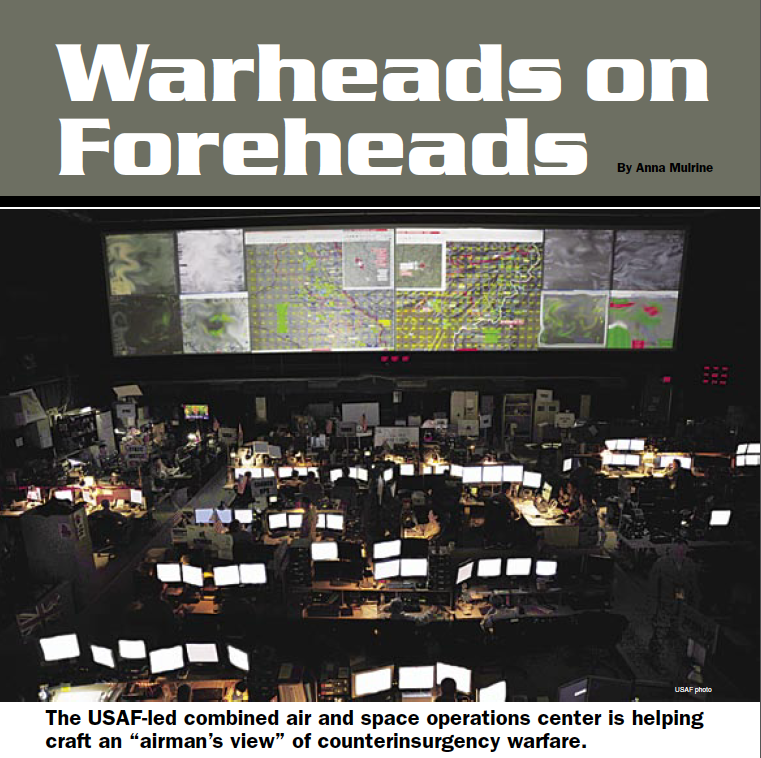
In a parallel argument, Samuel Issacharoff and Richard Pildes describe this development as the individuation of military force, driven in part by the affordances and dispositions of drone warfare which makes it possible to put ‘warheads on foreheads.’  Targets are no longer whole areas of cities – like Cologne or Hamburg in the Second World War – or extensive target boxes like those ravaged by B-52 ‘Arc Light’ strikes over the rainforest of Vietnam.  The targets are individuals and, since the United States claims the right to target them wherever they are found, this partly explains the dispersed geography of what I’ve called ‘the everywhere war’.   What interests Issacharoff and Pildes, like Kahn, is not so much the technology that makes this possible as the apparatus that makes it permissible.

Their presentation wavers uncertainly between counterinsurgency and counter-terrorism, and they also write more generally of ‘the new face of warfare’ and the use of ‘military force’, so that (as now happens in practice) the distinctions between the US military and the CIA become blurred.  But their core argument is that military force is now directed against specific individuals on the basis of determinate acts that they have committed or, by pre-emptive extension, are likely to commit.  In Kahn’s terms, this inaugurates a radically different (though in his eyes, highly unstable) political subjectivity through which the enemy is transformed into the criminal.  ‘The criminal is always an individual,’ Kahn explains; ‘the enemy is not.’

For Issacharoff and Pildes this new state of affairs requires an ‘adjudicative apparatus’ to positively identify, detect and prosecute the individual-as-target, which drives the military system ever closer to the judicial system:

 ‘As the fundamental transformation in the practice of the uses of military force moves, even implicitly, toward an individuated model of responsibility, military force inevitably begins to look justified in similar terms to the uses of punishment in the criminal justice system. That is, to the extent that someone can be targeted for the use of military force (capture, detention, killing) only because of the precise, specific acts in which he or she as an individual participated, military force now begins to look more and more like an implicit “adjudication” of individual responsibility.’

They suggest that this makes it inevitable that the boundaries between the military system and the judicial system ‘will become more permeable’ – a confirmation of the active constitution of the war/police assemblage (on which see Colleen Bell, Jan Bachmann and Caroline Holmqvist’s forthcoming collection, The New Interventionism: perspectives on war-police assemblages).

Kahn is, I think, much more troubled by this than Issacharoff and Pildes.  He concludes (like Chamayou):

‘Political violence is no longer between states with roughly symmetrical capacities to injure each other; violence no longer occurs on a battlefield between masses of uniformed combatants; and those involved no longer seem morally innocent. The drone is both a symbol and a part of the dynamic destruction of what had been a stable imaginative structure. It captures all of these changes: the engagement occurs in a normalized time and space, the enemy is not a state, the target is not innocent, and there is no reciprocity of risk. We can call this situation ‘war’, but it is no longer clear exactly what that means.

‘The use of drones signals a zone of exception to law that cannot claim the sovereign warrant. It represents statecraft as the administration of death. Neither warfare nor law enforcement, this new form of violence is best thought of as the high-tech form of a regime of disappearance. States have always had reasons to eliminate those who pose a threat. In some cases, the victims doubtlessly got what they deserved. There has always been a fascination with these secret acts of state, but they do not figure in the publicly celebrated narrative of the state. Neither Clausewitz nor Kant, but Machiavelli is our guide in this new war on terror.’

He is thoroughly alarmed at the resuscitation of what he calls ‘the history of administrative death’, whereas Issacharoff and Pildes – ironically, given what I take to be their geopolitical sympathies –treat the institution and development of an ‘adjudicative apparatus’ within the US programme of targeted killings as a vindication of their execution (sic).

I want to set aside other contributions to the emerging discussion over the ‘individuation’ of warfare – like Gabriella Blum‘s depiction of an ‘individual-centred regime’ of military conduct, which pays close attention to its unstable movement between nationalism and cosmopolitanism – in order to raise some questions about the selectivity of ‘individuation’ as a techno-legal process.  I intend that term to connote three things.

Target phase

(1) First, and most obviously, Issacharoff and Pildes fasten on the technical procedures that have been developed to administer targeted killings – which include both the ‘disposition matrix’ [see here] and its derivatives and the more directly instrumental targeting cycle [the diagram above shows the ‘Target’ phase of the Find-Fix-Track-Target-Engage-Assess cycle] , both of which admit legal opinions and formularies – that convert targeted killing into what Adi Ophir calls a quasi-juridical process.  This encoding works to contract the ethical horizon to the legal-juridical (see here for a critical commentary) while simultaneously diverting attention from the substantive practice – which, as I showed in ‘Lines of descent’ (DOWNLOADS tab), is shot through with all sorts of limitations that confound the abstract calculations of the targeting cycle (see, for example, Gregory McNeal here, who turns ‘accountability’ into accountancy).

(2) Second, ‘individuation’ refers to the production of the individual as a technical artefact of targeting.  S/he is someone who is apprehended as a screen image and a network trace;  s/he may be named in the case of a ‘personality strike’ but this serves only as an identifier in a target file, and the victims of ‘signature strikes‘ are not accorded even this limited status.  Others who are killed in the course of the strike almost always remain unidentified by those responsible for their deaths – ‘collateral damage’ whose anonymity confirms on them no individuality but only a collective ascription.  (For more, see Thomas Gregory, ‘Potential lives, impossible deaths: Afghanistan, civilian casualties and the politics of intelligibility’, International Feminist Journal of Politics 14 (3) (2012) 327-47; and ‘Naming names’ here).

(3) Third, the adjudication of ‘individual responsibility’ bears directly on the production of the target but not, so it seems, on the producers of the target.  Lucy Suchmann captures this other side – ‘our’ side – in a forthcoming essay in Mediatropes (‘Situational awareness: deadly bioconvergence at the boundaries of bodies and machines’):

‘A corollary to the configuration of “their” bodies as targets to be killed is the specific way in which “our” bodies are incorporated into war fighting assemblages as operating agents, at the same time that the locus of agency becomes increasingly ambiguous and diffuse. These are twin forms of contemporary bioconvergence, as all bodies are locked together within a wider apparatus characterized by troubling lacunae and unruly contingencies.’

Caroline Holmqvist, sharpens the same point in ‘Undoing war: war ontologies and the materiality of drone warfare’, Millennium (1 May 2013) d.o.i. 10.1177/0305829813483350); so too, and more directly relevant to the operations of a techno-legal process,  does Joseph Pugliese‘s figure of drone crews as ’embodied prostheses of the law of war grafted on to their respective technologies’.

These various contributions identify a dispersion of responsibility across the network in which the drone crews are embedded and through which they are constituted.  The technical division of labour is also a social division of labour – so that no individual bears the burden of killing another individual – but the social division of labour is also a technical division of labour through which ‘agency’ is conferred upon what Pugliese calls its prostheses:

‘Articulated in this blurring of lines of accountability is a complex network of prostheticised and tele-techno mediated relations and relays that can no longer be clearly demarcated along lines of categorical divisibility: such is precisely the logic of the prosthetic. As the military now attempts to grapple with this prostheticised landscape of war, it inevitably turns to technocratic solutions to questions of accountability concerning lethal drone strikes that kill the wrong targets.’

If the mandated technical procedures (1 above) fail to execute a sanctioned target (2 above) and if this triggers an investigation, the typical military response is to assign responsibility to the improper performance of particular individuals (which protects the integrity of the process) and/or to technical malfunctions or inefficiencies in the network and its instruments (which prompts technical improvements).  What this does not do – is deliberately designed not to do – is to probe the structure of this ‘techno-legal economy of war at a distance’ (Pugliese’s phrase) that turns, as I’ve tried to suggest, on a highly particular sense of individuation.  Still less do these inquiries disclose the ways in which, to paraphrase Weizman, ‘drones legislate’ by admitting or enrolling into this techno-legal economy particular subjectivities and forcefully excluding others .

More to come.

***

Note: Here are the citations for Issacharoff and Pildes’ full argument(s); the first is excerpted from the second, which deals with ‘capture’ (detention) as well as killing:

Samuel Issacharoff and Richard Pildes, ‘Drones and the dilemma of modern warfare’, in Peter Bergen and Daniel Rothenberg (eds) Drone wars: the transformation of armed conflict and the promise of law (Cambridge University Press, 2013); available here as NYU School of Law, Public Law & Legal Theory Research Paper Series Working Paper No. 13-34, June 2013

Samuel Ischaroff and Richard Pildes, ‘Targeted warfare: individuating enemy responsibility’, NYU School of Law, Public Law & Legal Theory Working Papers 343 (April 2013); available here.

Dronework

Some recent open access work on drones that intersects with my ongoing reading of Grégoire Chamayou‘s Théorie du drone.

Theorie du droneFirst, Philippe Theophanidis, a PhD student at the Université de Montréal, writes with the welcome news that he’s developed an online bibliography of English and French language materials, Grégoire Chamayou: bodies, manhunts and drones, available here.

Philippe’s own research concerns the theory of community in Jean-Luc Nancy and Roberto Esposito.  He adds:

‘I’m especially preoccupied by the fact that our contemporary mode of being-together paradoxically takes the form of destructive interactions. For that reason, I’m interested about war and space in general, and more precisely about “global civil war” (Schmitt) or war in the time of globalization. That’s why Chamayou’s new book caught my attention when it came out.’

Second, another contribution to the ramifying genealogy of drones that I’ve addressed in several previous posts (for example here and here): at OSU’s Origins: current events in historical perspective, Kenneth Hough provides an extended essay on what he calls ‘the long cultural history of drones’.  He adds some interesting material, most of it about the ways in which drones have been registered in American popular culture:

Since their emergence in the late nineteenth century, Americans have regarded unmanned aerial systems as four basic cultural phenomena: heralds of human accomplishment and hope for the future, signs of inhuman depravity portending society’s doom, mechanical misfires that are both ineffective and humorous, and transcendent machines that spark existential questions about war and society, tapping into what David Nye calls our “fundamental hopes and fears.”

But his long cultural history turns out to be a remarkably narrow cultural geography in which – apart from an excursus on V-1 rockets in the Second World War – experimental laboratories outside the United States (notably Britain and Israel) disappear from view.  For all that, I’m surprised that James Cameron‘s Avatar isn’t on his cultural hit list (though I know Cameron’s Canadian): to see what I mean, and for a more general cultural critique, check out Patrick Lichty‘s interesting essay, Drone: camera, weapon, toy on ‘the aestheticization of dark technology’.

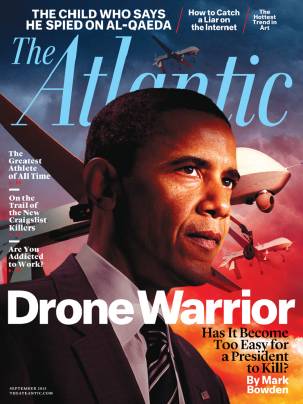
The Atlantic September 2013 Drone warriorWhich brings me to my last sighting: Mark Bowden‘s cover essay in the latest (September) issue of Atlantic on ‘The Killing Machines: how to think about drones‘.  Despite the subtitle, much of Bowden’s extended essay asks how we should feel about drones.

Anyone familiar with his previous work (from Black Hawk Down on) probably won’t be surprised by his ultimate take on matters, and the early online comments show that he’s set off a firestorm of protest by what several writers call his ‘apologia’.

As a matter of fact, I think the essay is more complicated than that, and Bowden does address one of the central issues that Chamayou returns to again and again, the ways in which remote (split) operations transform the very nature of ‘combat’:

Drone strikes are a far cry from the atomic vaporizing of whole cities, but the horror of war doesn’t seem to diminish when it is reduced in scale. If anything, the act of willfully pinpointing a human being and summarily executing him from afar distills war to a single ghastly act.

One day this past January, a small patrol of marines in southern Afghanistan was working its way at dusk down a dirt road not far from Kandahar, staying to either side to avoid planted bombs, when it unexpectedly came under fire. The men scattered for cover. A battered pickup truck was closing in on them and popping off rounds from what sounded like a big gun.

Continents away, in a different time zone, a slender 19-year-old American soldier sat at a desk before a large color monitor, watching this action unfold in startlingly high definition. He had never been near a battlefield. He had graduated from basic training straight out of high school, and was one of a select few invited to fly Predators. This was his first time at the controls, essentially a joystick and the monitor. The drone he was flying was roughly 15,000 feet above the besieged patrol, each member marked clearly in monochrome on his monitor by an infrared uniform patch. He had been instructed to watch over the patrol, and to “stay frosty,” meaning: Whatever happens, don’t panic. No one had expected anything to happen. Now something was happening.

The young pilot zoomed in tight on the approaching truck. He saw in its bed a .50-caliber machine gun, a weapon that could do more damage to an army than a platoon of Goliaths.

A colonel, watching over his shoulder, said, “They’re pinned down pretty good. They’re gonna be screwed if you don’t do something.”

The colonel told the pilot to fix on the truck. A button on the joystick pulled up a computer-generated reticle, a grid displaying exact ground coordinates, distance, direction, range, etc. Once the computer locked on the pickup, it stayed zeroed in on the moving target.

“Are you ready to help?” the colonel asked.

An overlay on the grid showed the anticipated blast radius of an AGM-114 Hellfire missile—the drone carried two. Communicating via a digital audio link, the colonel instructed the men on the ground to back away, then gave them a few seconds to do so.

The pilot scrutinized the vehicle. Those who have seen unclassified clips of aerial attacks have only a dim appreciation of the optics available to the military and the CIA.

“I could see exactly what kind of gun it was in back,” the pilot told me later. “I could see two men in the front; their faces were covered. One was in the passenger seat and one was in the driver’s seat, and then one was on the gun, and I think there was another sitting in the bed of the truck, but he was kind of obscured from my angle.”

On the radio, they could hear the marines on the ground shouting for help.

“Fire one,” said the colonel.

The Hellfire is a 100-pound antitank missile, designed to destroy an armored vehicle. When the blast of smoke cleared, there was only a smoking crater on the dirt road.

“I was kind of freaked out,” the pilot said. “My whole body was shaking. It was something that was completely different. The first time doing it, it feels bad almost. It’s not easy to take another person’s life. It’s tough to think about. A lot of guys were congratulating me, telling me, ‘You protected them; you did your job. That’s what you are trained to do, supposed to do,’ so that was good reinforcement. But it’s still tough.”

One of the things that nagged at him, and that was still bugging him months later, was that he had delivered this deathblow without having been in any danger himself. The men he killed, and the marines on the ground, were at war. They were risking their hides. Whereas he was working his scheduled shift in a comfortable office building, on a sprawling base, in a peaceful country. It seemed unfair. He had been inspired to enlist by his grandfather’s manly stories of battle in the Korean War. He had wanted to prove something to himself and to his family, to make them as proud of him as they had been of his Pop-Pop.

“But this was a weird feeling,” he said. “You feel bad. You don’t feel worthy. I’m sitting there safe and sound, and those guys down there are in the thick of it, and I can have more impact than they can. It’s almost like I don’t feel like I deserve to be safe.”

I’ve described this identification with troops on the ground before, what one of Bowden’s correspondents calls ‘a very visceral connection to operations on the ground’.  And Bowden is stacking the deck by starting with what the US military calls ‘Troops in Contact‘ in Afghanistan rather than CIA-directed targeted killing in Pakistan: only later will he turn to the legal and quasi-legal landscape through which those strikes pass (more on this in a later post) .  But he then adds this:

If the soldier who pulls the trigger in safety feels this, consider the emotions of those on the receiving end, left to pick up the body parts of their husbands, fathers, brothers, friends. Where do they direct their anger? When the wrong person is targeted, or an innocent bystander is killed, imagine the sense of impotence and rage. How do those who remain strike back? No army is arrayed against them, no airfield is nearby to be attacked. If they manage to shoot down a drone, what have they done but disable a small machine? No matter how justified a strike seems to us, no matter how carefully weighed and skillfully applied, to those on the receiving end it is profoundly arrogant, the act of an enemy so distant and superior that he is untouchable.

As I say, more to come…