Air strikes in Pakistan’s borderlands

I’m speaking about Drone strikes and the matrix of violence in Pakistan at a conference in Vancouver at the week-end – a presentation which will form part of The everywhere war – and to set some of the parameters I’ve been revisiting the changing geography of air strikes in the Federally Administered Tribal Areas.  It’s a formidably difficult question given the extraordinary dangers facing journalists, Pakistani or foreign, seeking to report from the FATA: for an incisive discussion of the media landscape inside the FATA see Sadaf Baig‘s Reporting from the frontlines.

In my view, the most thorough if necessarily imperfect tabulations of US-directed strikes are those provided by the Bureau of Investigative JournalismThere have been several attempts to map this database, including the Bureau’s own use of Google maps (see below and here; but be careful: zooming in is a product of the digital platform and will give a misleading sense of the resolution level of the data).
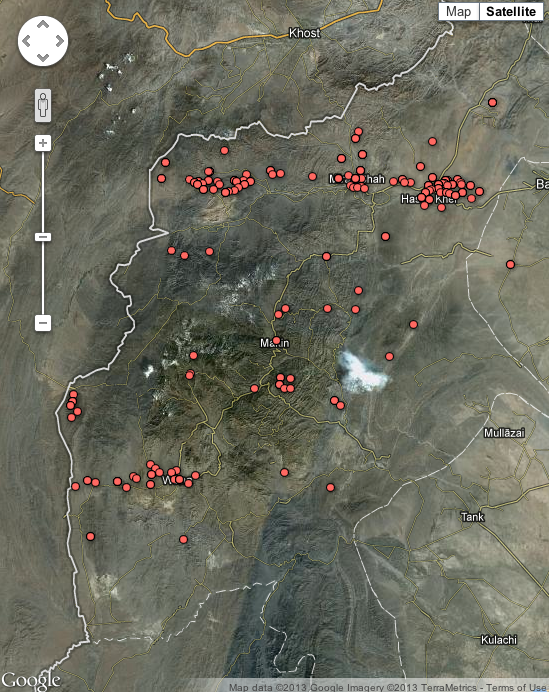
BOJ US drone strikes in FATA

One of the most thoughtful (and dynamic) representations comes from Chris Herwig.  He described the technical basis of his mapping over at MapBox here, and you can visit his microsite here.  Go here to see the animation running (with annotations).
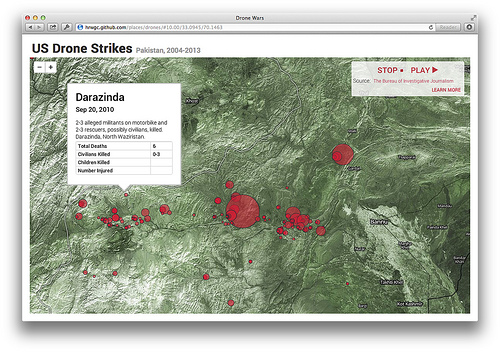
8448237526_92002912de

Chris’s project has also been featured on PBS here, where he also responds to several criticisms of the data and his visualizations.

Over at Slate, Chris Kirk has produced an interactive that tries to show the maximum number of estimated casualties from each strike, but the data are drawn from the New America Foundation database which has been criticised for underestimating casualties; one (to October 2012) version is here, and another (to February 2013), using a different cartographic design, is here.  More generally, Forensic Architecture‘s Unmanned Aerial Violence team is working to produce an online visualization of drone strikes not only over Pakistan but also over Afghanistan,Yemen, Somalia and Palestine. but it’s not yet operational).

But the problem doesn’t end with the cartographic piercing of the veil of semi-secrecy the White House, the CIA and JSOC cast over their remote operations, though I’ve noted before how their collective teasing of American journalists over the legal and administrative protocols they supposedly follow – especially the so-called “disposition matrix” –  works to (mis)direct attention towards Washington and away from the sites that Chris and others have struggled to map.

I say this because the US is not the only state carrying out air strikes in the region.  Soon after 9/11 and the US-led invasion of Afghanistan, largely in response to pressure from Washington, the Pakistan military moved into the FATA.  According to Zahid Ali Khan, Pakistan’s Frontier Corps was deployed in December 2001, but by May 2002 it was decided that a much heavier hand was needed and the Pakistan Army was ordered into the borderlands for the first time in the nation’s history.  Local people requested that military operations be limited to ground forces, but by 2004 this agreement was in shreds and – as the image below shows – ever since the Pakistan Air Force has made no secret of its continuing air strikes on the FATA.
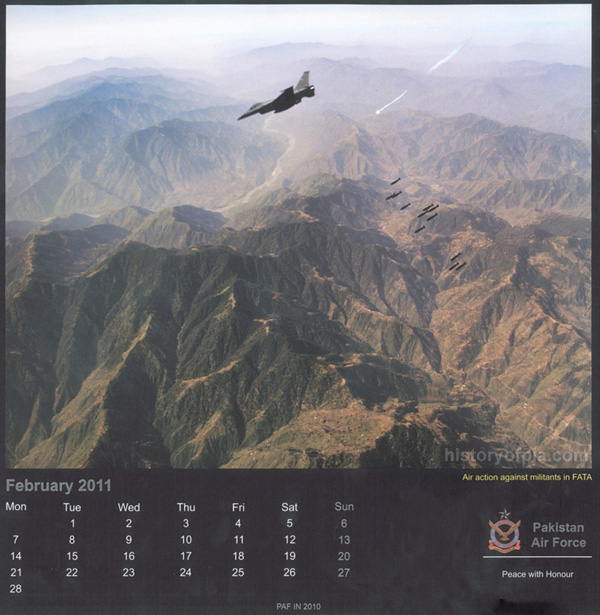
PAF air strike in FATA

Again, there is no public tabulation, but the American Enterprise Institute‘s Critical Threats daily Pakistan Security Brief – I know, I know, it’s a neoconservative think-tank – culls this (needless to say, approving) record from reports in Pakistan media in the first two months of this year alone:

25 February PAF kills 10 TTP militants in Tirah [Kurram/Khyber, FATA]

21 February PAF bombs militants in Orakzai [NWF Province] killing 29

19-20 February PAF jets bomb TTP hideouts in Orakzai

11 February PAF jets kill 8 militants in the Tirah Valley

8 February Jets kill 9 militants in Orakzai

7 February PAF targets militants in Orakzai

6 February Jets kill 8 in Orakzai

30 January PAF kills 23 militants in Tirah Valley and 8 in Orakzai agency

28 January Pakistani jets bomb militants in Orakzai

4 January Gunships kill 3, injure more in North Waziristan retaliation

It’s a bare bones summary, clearly, and I suspect the readiness of the AEI to trust local media to report PAF strikes is in stark contrast to their attitude to local reports of US drone strikes.  I’ve also deliberately retained the original phrasing: conspicuously, there is no record of  civilian casualties. Like the United States, Pakistan routinely plays these down or denies them altogether.  Here, for example, is a typical report via the Long War Journal on 25 March 2010:

‘Pakistani fighter-bombers struck a series of targets in the Mamuzai region in [Orakzai] today. Sixty-one Taliban fighters were killed, Pakistani intelligence officials told The Associated Press. The military claimed that no civilians were killed in the attacks. The targets included a madrassa, a mosque, and a seminary run by the Tablighi Jamaat. Pakistani officials said that Taliban leaders were meeting at the Tablighi seminary.’
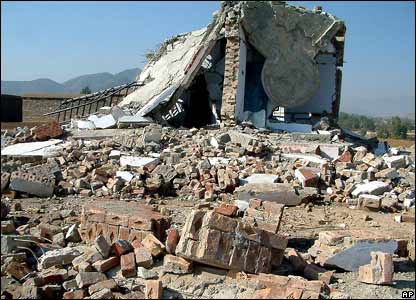
PAF air strike, Orakzai

It’s unlikely that civilians were unscathed.  For the first four years at least the accuracy of the Air Force’s strikes was compromised by what Irfan Ahmad described as  its ‘lack of real time electronic intelligence and inferior technical means for command, control and communications’, by deficiencies in the targeting pods used by the PAF’s  ageing F-16 aircraft, and by the use of laser-guided missiles whose precision was reduced by clouds or poor visibility.  From 2008 new electro-optical targeting pods and sensors were being retrofitted and new ground and air capabilities for image exploitation put in place.  In 2009 the Air Force was also the launch customer for the Anglo-Italian Falco reconnaissance drone (see below), which is now co-produced in Pakistan; five systems were soon in use over the FATA, each comprising four aircraft with one held in reserve, and the Air Force was already anticipating arming them ‘with the most modern and lethal payloads’. More recently, the PAF has upgraded its F-16 fleet with new Block 52 versions and installed advanced avionics.  Throughout this period, as the military offensive periodically intensified, hundreds of thousands, perhaps millions of people were displaced from the borderlands.
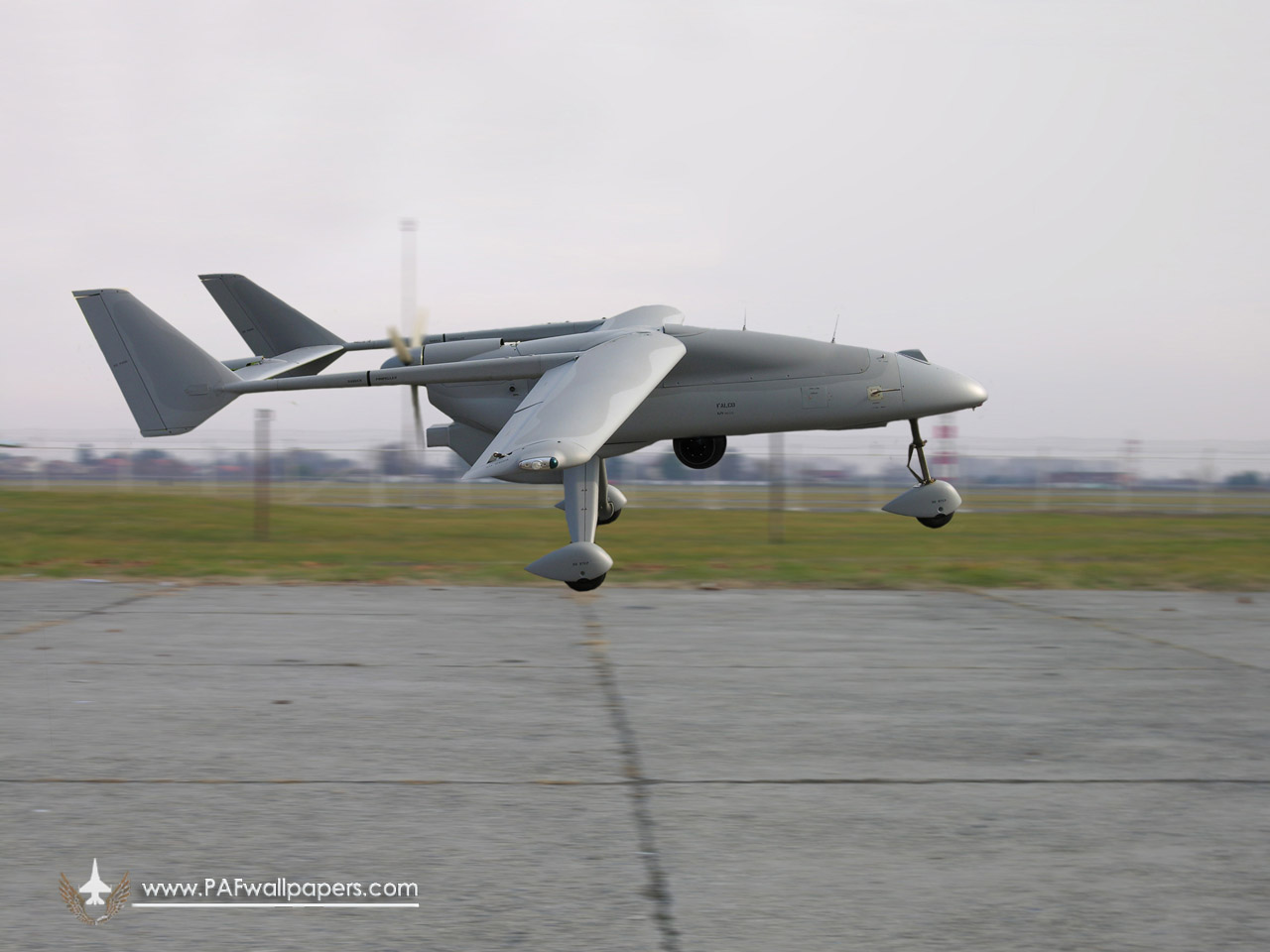
falco_uav_galileo_avionica_paf_pakistan_air_force_01

It’s difficult to provide a detailed accounting of the air strikes, but in a rare admission former Air Chief Marshall Rao Qamar Suleiman claimed that the Pakistan Air Force carried out 5,000 strike sorties and dropped 11,600 bombs on 4,600 targets in the FATA between May 2008 and November 2011.  Unlike US air strikes in the region, PAF strikes are rarely ‘stand-alone’ affairs but are co-ordinated with ground forces (which is also the case with most drone strikes in Afghanistan, which operate in close concert with troops and conventional strike aircraft).

My object is recording all this is (I hope obviously) emphatically not to say that it is perfectly acceptable for the US to launch air strikes in the FATA because Pakistan is doing the same. Rather, the co-existence of the two air campaigns explains, in part, how it is possible for each party to accuse the other of carrying out an attack, as reported earlier this month.  More importantly, it also emphasises the ever-present horizon of danger within which the inhabitants of the borderlands are forced to live.  They are not only Living under drones.
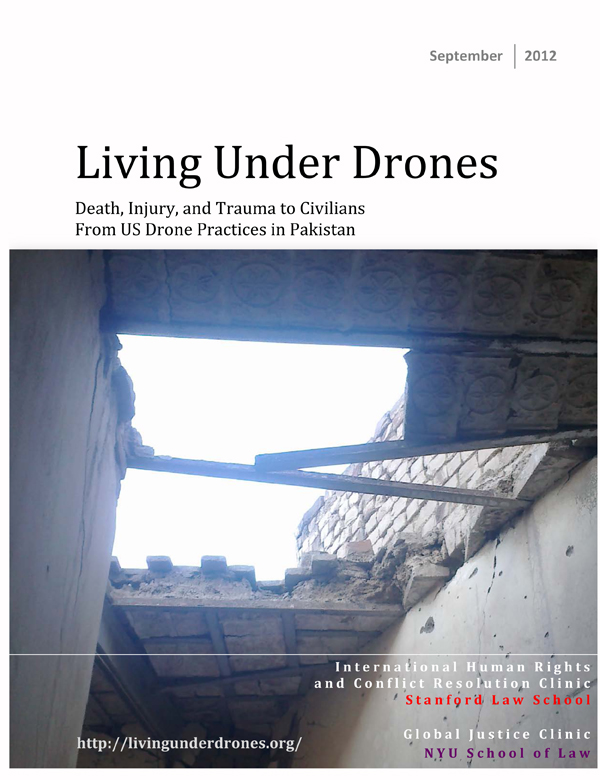
Living Under Drones

The same point was sharpened by CIVIC – now the Center for Civilians in Conflict – in their (I think vital) report Civilian harm and conflict in North West Pakistan, published in October 2010. That report also details the violence meted out to civilians by militant groups in the region; for a detailed survey of the political geography of the borderlands, see Brian Fishman‘s The Battle for Pakistan: militancy and conflict across the FATA and NWFP, produced for the New America Foundation in 2010; there’s also much to think about in Daanish Mustafa and Katherine Brown, ‘Spaces of performative politics and terror in Pakistan‘, and in the same authors’ ‘The Taliban, Public Space and terror in Pakistan‘.

The existence of the two air campaigns also shows that the FATA are produced as a space of exception not only through Washington’s strenuous juggling with the Authorisation to Use Military Force and with international law (to validate the extension of its ‘global battlefield’) – whether it does so with or without Islamabad’s covert consent remains an open question – but also through Islamabad’s continued determination to treat the borderlands as legally anomalous territories for its own assertion of military violence.

ROE Waging war in WaziristanThe last is a doubled colonial legacy.  Not only is the legal geography that structures the FATA’s relations with the Pakistani state a relict from Britain’s imperial decision to treat them as a space to be ‘excepted from state and society for the purposes of war’, as Ian Shaw and Majed Akhter put it in Antipode recently.

So too is the decision to continue to use the FATA as a laboratory for what the British called ‘air control’. Andrew Roe has provided a series of detailed discussions in the RAF’s invaluable Air Power Review, here and here and here, and brought much of his research together in Waging war in Waziristan (2010).

But for a rapid and sobering sense of how these campaigns were viewed from the air in the 1930s you need to watch this BBC interview with Group Captain Robert Lister, Wings over Waziristan, which includes extraordinary cine footage showing what he calls ‘tribal operations from the air’.  Lister was posted to Peshawar in 1935, and soon after he arrived both the Army and the Air Force were ordered to put down ‘a tribal insurrection or rebellion’ in Waziristan.  Their preferred method was to destroy villages by setting fire to individual houses, blowing them up, or bombing them from the air ‘to make them say “Right, it’s not worthwhile – come to terms.”‘  Listen as Lister says, in cut-glass tones, ‘It was a fair and just way of dealing with it: they started these troubles and had to be dealt with.’
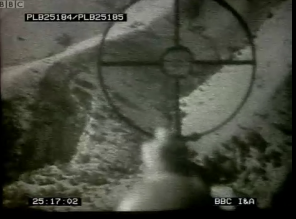
Waziristan:Lister:Here's an attack being carried out

And if you want to discover a different dimension to ‘unmanning’ aerial vehicles, listen from 08.00-08.40.

UPDATE: I’ve just discovered another film shot over Waziristan in 1937 by Leonard de Ville Chisman, which covers the air and ground war against the Faqir of Ipi described by Lister.  It contains a number of strikingly similar shots, though there is of course no commentary: you can access it via Colonial Film: Moving Images of the British Empire here.  On that remarkably informative site, Francis Gooding writes:

The official record of NWFP operations during 1936-7 – a thick volume, its size indicating the scale and seriousness of the conflict – contains full details about the manner in which aircraft were employed. The flag marches of November that sparked the revolt were accompanied by aircraft reconnaissance, and the record notes that ‘air reconnaissance requirements were met by one flight of No. 5 (Army Co-operation) Squadron’ (Govt of India, op.cit., 15), and the RAF also provided close cover for troops, and this pattern – reconnaissance with close support against the enemy – was repeated throughout the operations.

Reels 14 and 15 of the Chisman collection record precisely these kinds of encounters and air operations, with footage of bombing raids and the dropping of supplies to forward positions by parachute taken from within flying aircraft. Aircraft were also used to disseminate information and warnings about future punitive action (again, this was a tried and tested method, typical of colonial air policing; see Omissi, 1990, 154-5). On 27 August 1937, for instance, ‘notices were dropped over the Shawal area warning the inhabitants that until the Faqir submitted to Government, any tribe sheltering him would be liable for punishment’ (Govt. of India, op.cit., 179), and reel 15 contains a sequence showing a pilot unfurling a large leaflet, with text in Pashto and Urdu. The following sequences show air-drops of these leaflets over hill country. There are also scenes showing armoured cars and tanks on the move, and a sequence apparently shot during a battle, with a line of artillery opening fire on hill positions. 

The Faqir’s uprising was arguably the most serious colonial insurgency of the inter-war imperial period, and the films are remarkable in that they record scenes of action from a poorly remembered but major guerrilla conflict. Beyond this historical importance they have another significance, for they offer scenes of something only very rarely captured on film, despite its regular occurrence throughout the Empire – the recourse to the punitive deployment of heavy weaponry against subject peoples in revolt.
Naming names

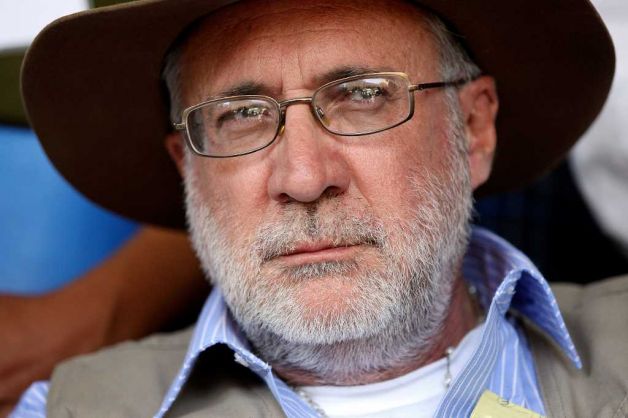
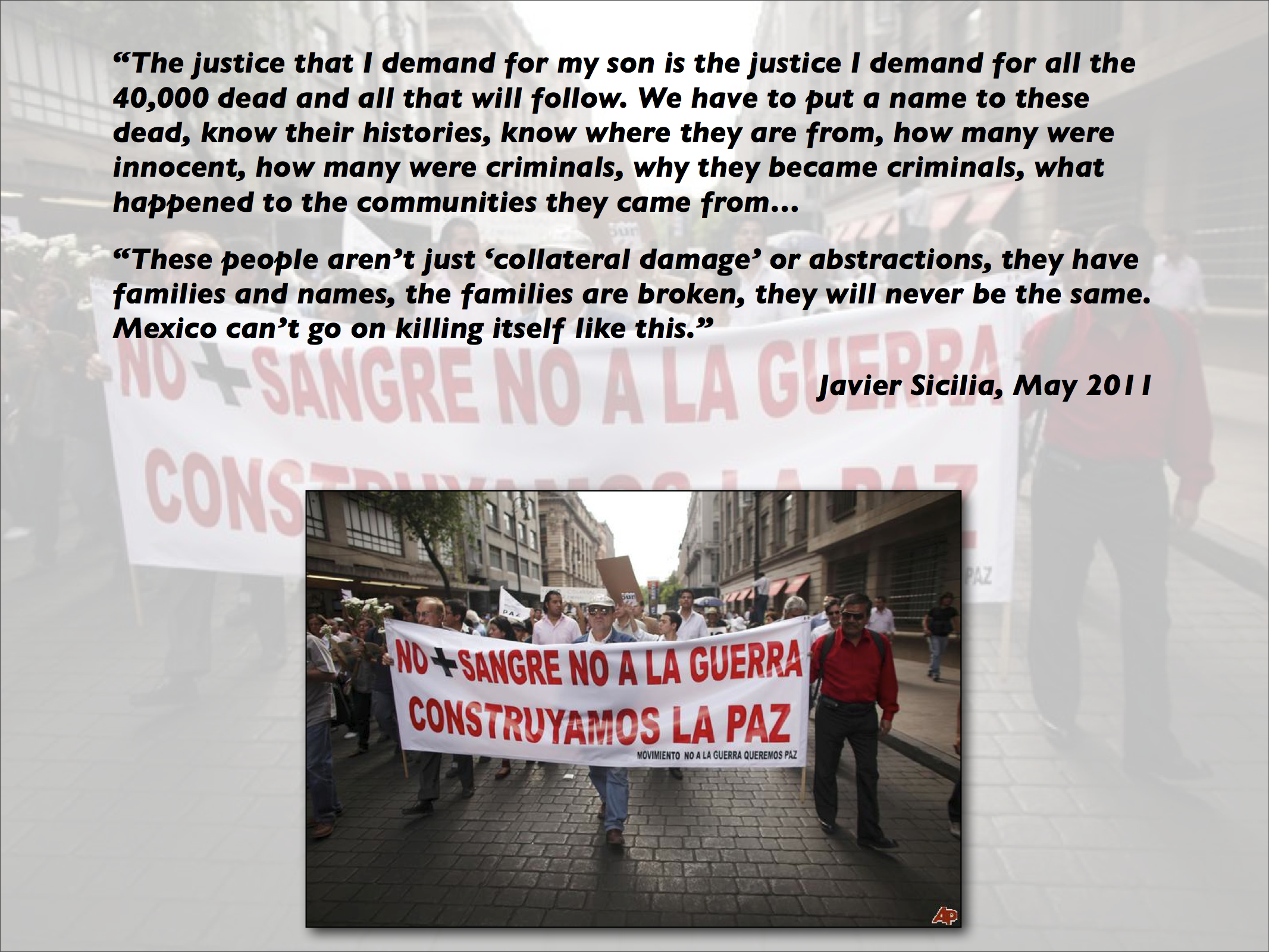
Mexican-poet-Javier-SiciliaIn March 2011 members of a Mexican drug cartel tortured and murdered a young student, Juan Francisco Sicilia Ortega, along with six of his friends in the city of Cuernavaca in Morelos.  His father, Javier Sicilia (right), poet, professor and journalist, later told Time:

‘When I got to Cuernavaca… I was in a lot of emotional pain. But when I arrived at the crematorium I had to deal with the media. I asked the reporters to have some respect; I told them I’d meet them the next day in the city plaza. When I got there I found they’d put a table [for a press conference] out for me, and I realized this was going to be bigger than I’d anticipated.

‘I had never thought of starting a movement or being a spokesman for anything. I’m a poet, and poets are better known for working with more obscure intuitions. But in those moments I was reminded that the life of the soul can be powerful too. My chief intuition then was that we had to give name and form to this tragedy and somehow put that into action with real citizens as a way to tell the government, “We need something new, especially new institutions to fight our lawlessness and corruption and impunity, not just that of the drug cartels but the state.”‘

Sicilia's call

Sicilia’s demand (above) started the Movement for Peace with Justice and Dignity (“Haste la Madre!”), but the call to abjure the aggregations and anonymizations of mass violence – by state and non-state actors – has been taken up in other political arenas too.

It’s in this spirit that I read the Open Society‘s detailed listing of 136 people who were subjected to secret detention or extraordinary rendition by the CIA.

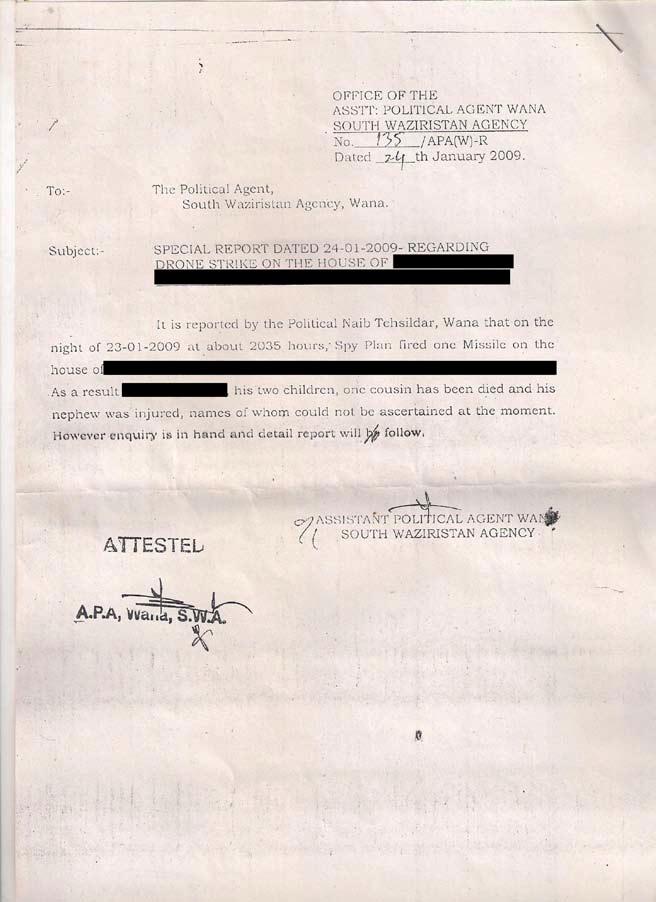
Sth-Wana-letter-Jan-20091And now – to turn to a program that is in many respects the flip side of extraordinary rendition (assuming a dark side can have another dark side) – the Bureau of Investigative Journalism in London has announced an ambitious campaign to identify and name all the victims of US-directed air strikes in Pakistan.

The Bureau’s Chris Woods explains:

‘Part of the justification for the US carrying out drone strikes without consent is their reported success. And naming those militants killed is key to that process. Al Qaeda bomber Fahd al-Quso’s death was widely celebrated.  Yet how many newspapers also registered the death of Mohamed Saleh Al-Suna,  a civilian caught up and killed in a US strike in Yemen on March 30? By showing only one side of the coin, we risk presenting a distorted picture of this new form of warfare. There is an obligation to identify all of those killed…’

And, yes, we also need to recover the names of those killed by other actors too.  None of  them are ‘just “collateral damage” or abstractions’.

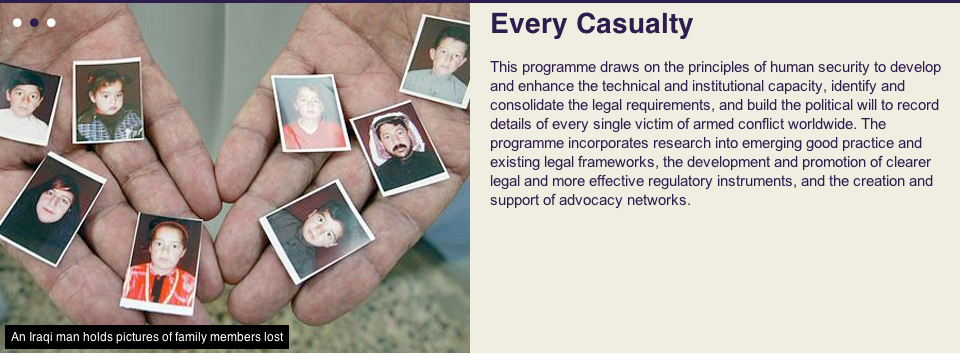
The principle is developed more generally by the Every Casualty project of the Oxford Research Group.

The purpose of the Every Casualty (EC) programme is to enhance the technical, legal and institutional capacity, as well as the political will, to record details of every single casualty of armed conflict throughout the world, civilian as well as combatant. Civilian deaths are particularly poorly documented, and often not recorded at all. Where death tolls are limited to purely numerical assessments, exaggerated, politicised claims and counter-claims frequently abound. By contrast, where Western nations are engaged in conflicts, they meticulously record their military dead not as numbers but by name.

Such detailed, verifiable and comprehensive recording when extended to all victims provides both a memorial for posterity and public recognition of our common humanity. Careful and respectful records ensure that the human cost of conflict is better understood and can become an immediately applicable resource for conflict prevention and post-conflict recovery and reconciliation.

Every casualty

But I think it’s probably a mistake to privilege names over numbers: numbers matter too, and  – whatever the legal-humanitarian reasons for recovering the names – they also help us to imagine what the raw numbers mean.  There are other ways of achieving the same end, and they don’t necessarily involve abandoning anonymity.  I’ve never forgotten the final scene in Richard Attenborough‘s film of “Oh, what a lovely war!”; the shot begins with a single white cross and then pans back and back and back, seemingly without end, until the screen is filled with a sea of 100, 000 crosses [start at 2:21].

The metal falcon

As public attention to military violence continues to contract to the use of drones, Rawan Yaghi supplements her previous account of living and dying under Israeli drones in Gaza with another despatch describing Israel’s use of conventional strike aircraft, Life under the F-16s in Gaza:

With F16s, it’s a scary roar like someone is mocking sounds in a water well. It also depends on the altitude of the plane, sometimes a high pitched roar, others a low distant one. F16s are harder to spot than drones or Apaches because they are always ahead of their roar. And since you never know where the plane is going and since buildings in Gaza are crammed into Gaza, you rarely get to see the metal falcon.

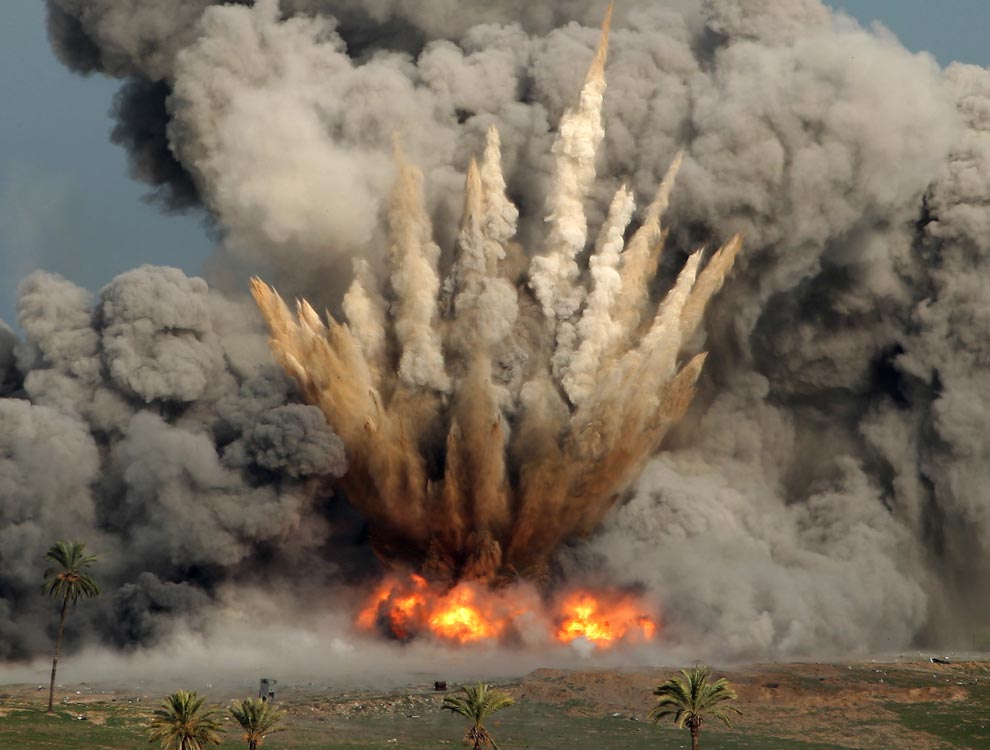
F-16 bombing Beit Hanoun, Gaza, January 2009 (Patrick Baz/AFP/Getty Images)

F-16 bombing Beit Hanoun, Gaza, January 2009 (Patrick Baz/AFP/Getty Images)

She describes the intimidating ‘mock raids’, the physical and psychological damage, and the scars that will never heal:

‘I was fourteen when the AbuSelmeyyas’ house was attacked by an F16 air strike. My body shivers as I write this. The attack killed the father and mother and seven of their children, Nasrallah 4, Aya 7, Yahya 9, Eman 12, Huda 14 who was my classmate in primary school and who had the most angelic voice I’ve ever heard, Sumayya 16, and Basma 17, leaving Awad, 19 at that time, injured and alone.  Fourteen  others were injured in that attack, since the house was located in a heavily populated neighborhood, not very far from where I live. The attack attempted to assassinate leaders of militant groups. However it failed. In October last year, The Israeli court in Jaffa refused to give any compensations to the relatives of the family and the only member if the family left, saying the house was targeted during a “combat operation”. I wasn’t allowed to see any news about the attack. I only heard some news about it. And I learned about Huda in the morning. I heard from my brother that day that the bomb was directly dropped on the room where the mother and the children were. I also heard about their body parts being found in the buildings next to their house. I was only fourteen. What did I know.

What I do know – what we all surely know – is that there is more to military violence than drones; that our attention ought not to be limited to the ‘rules’ (un)governing their operation; and that the dismal desire to wage wars outside declared war-zones neither started nor ended with George W. Bush.

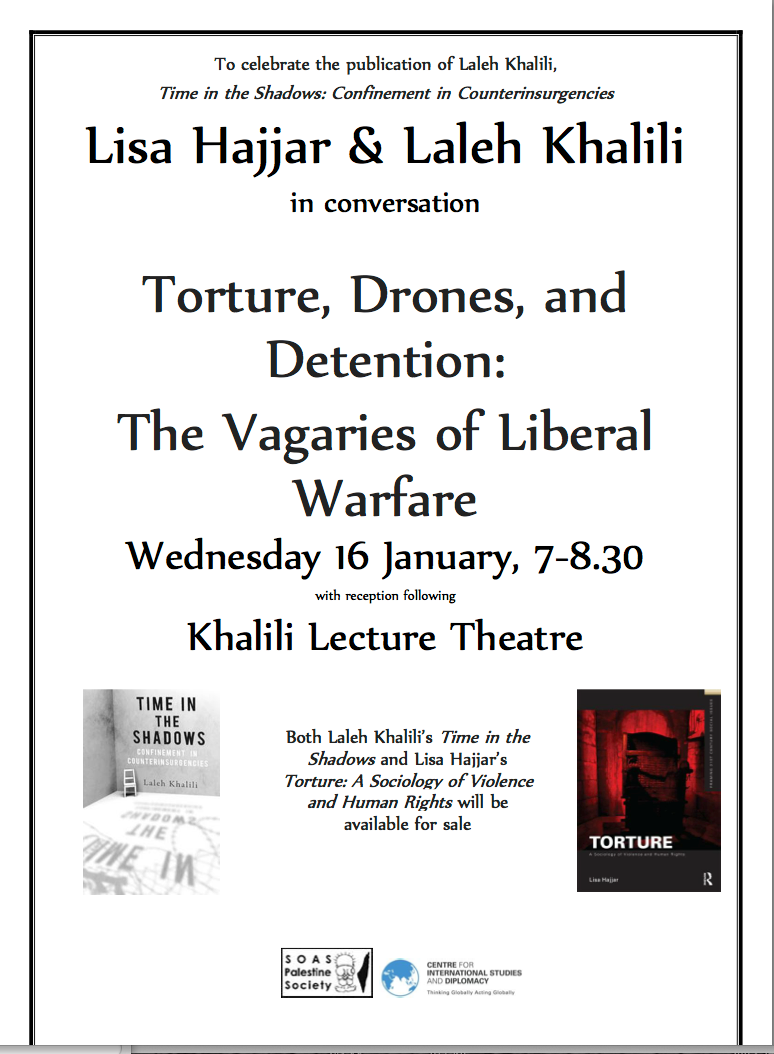
Torture, drones and detention


Hajjar and Khalili
Lisa Bhungalia writes with the welcome news that Jadaliyya has audio of a conversation between Laleh Khalili and Lisa Hajjar on ‘Torture, drones and detention’ at SOAS earlier this month.

The publication of Laleh’s Time in the shadows: confinement in counterinsurgencies (Stanford, 2012) and Lisa’s Torture: a sociology of human rights and violence (Routledge, 2012) is the occasion for a wide-ranging discussion of ‘the vagaries of liberal warfare’, including the intimacies between humanitarianism  (indeed, the very idea of the human) and war.

The Freestone Drone

Visual and media artists continue to dazzle with their interventions on the drone wars.  Pierre d’Alancaisez of waterside contemporary in London has written with news of a forthcoming video installation by George Barber, a pioneer of the Scratch Video movement of the 1980s, called The Freestone Drone, which will be at the gallery from 2 February through 23 March 2013.

Freestone Drone - main image hires

In an installation conceived specially for the gallery and consisting of three video projections, an array of domestic objects and numerous washing lines, George Barber’s The Freestone Drone follows a mission from the point of view of the machine. The drone’s camera surveys cityscapes, encounters individuals, reports, and in flight becomes aware of its own utility and destiny. Drone operators routinely study the washing to learn about their targets – it is foretold that the Freestone Drone is to die entangled in a clothes line.

The video combines found and made footage to produce an uneasy, seductive montage, anchored on the drone’s private thoughts. Barber brings together war, love, life, death, and sends the drone over not only Waziristan, but also to New York and a London suburb. The drone then travels through time, projecting images of the past and possible futures. 

While narrative unravelled on screen resists easy categorisation, the artist draws the viewer to empathise with the antagonist. Engendered with human consciousness and independence, the drone is a poet who disobeys orders and does his own thing, a child within a machine.

In the legacy of Godard and Marker, The Freestone Drone proposes the meeting place of poetry and philosophy as a site to consider contemporary ethical and political concerns. Ultimately, Barber’s work underlines the fact that technologies, and in particular modes of warfare, are symptomatic of the way we understand ourselves at our moment in history. Much now done in our name is at odds with democratic tradition: hidden, inhuman and robotic.

The child-like anthropomorphism of the drone is chillingly effective, and made me think again about the conceit I used to introduce a brief post at the end of last year, ‘Stalking in the air….’

Here is a preview:

http://vimeo.com/56444355

The waterside gallery is at 2 Clunbury Street, London N1; it makes a point of working with – not simply showing – contemporary artists, and it’s also worked with Karen Mirza and Brad Butler whose work I noted last year.

The military and the mob

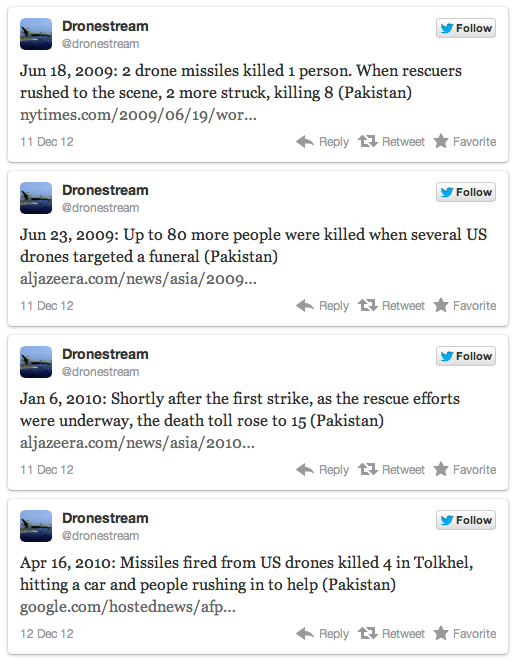
Double Tap streamMichael Kelley notes that Josh Begley‘s tweeted enumeration of US drone strikes in Pakistan, Yemen and Somalia at Dronestream confirms the vile ‘double-tap‘ strategy in which a first strike is rapidly followed by a second targeting rescuers.  As Kelley notes, ‘A 2007 report by the Homeland Security Institute called double taps a “favorite tactic of Hamas” and the FBI considers it a tactic employed by terrorists.’

The militarised practice has been widely reported – not least in Staford/NYU’s Living under Drones – but Begley’s cascade of tweets provides a powerful statement of its relentless rhythm.  In September Mirza Shahzad Akbar, a Pakistani lawyer who represents victims of the attacks, told Britain’s Independent newspaper:

“These strikes are becoming much more common…  In the past it used to be a one-off, every now and then. Now almost every other attack is a double tap. There is no justification for it.”

Far from any justification, the UN Special Rapporteur on Extrajudicial Killings argues that such attacks constitute war crimes.  In fact, as Gwynne Dyer points out,

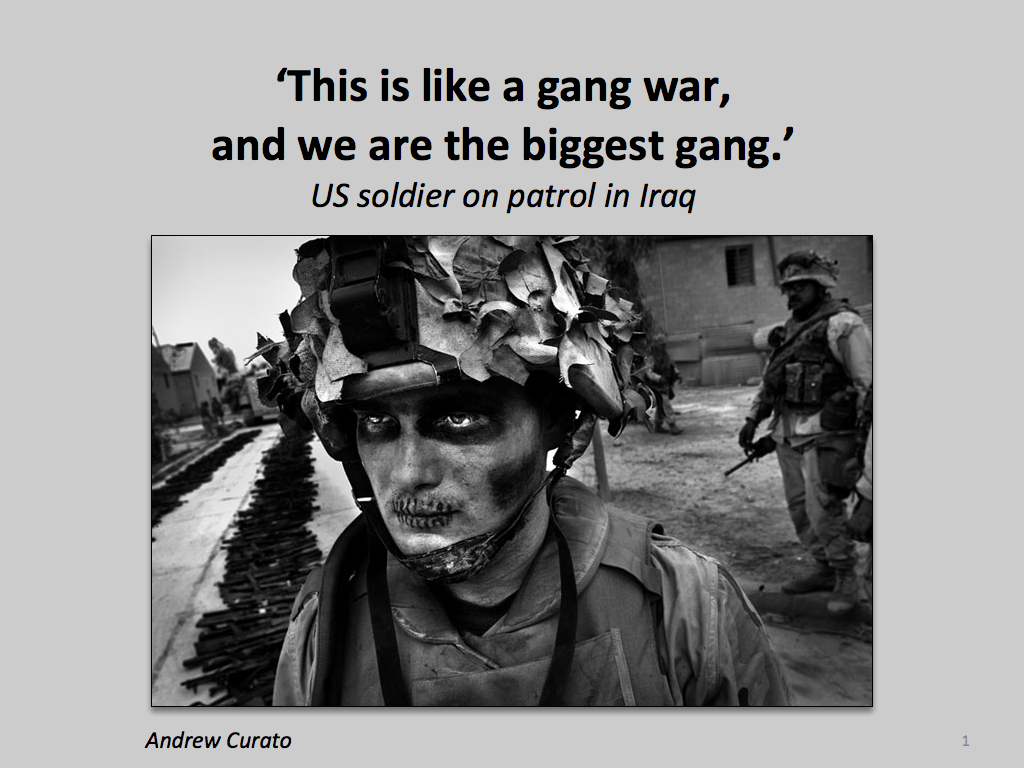
“DOUBLE TAP” IS what mobsters do when they put somebody down. One bullet in the heart, one in the head. That way they stay down. It’s practically standard operating procedure among hitmen.

Street gangs of Baghdad.001

It’s not so long ago that the Pentagon was alarmed at the presence of members of US street gangs among its soldiers patrolling the streets of Baghdad (see Frank Main, ‘Gangs claim their turf in Iraq’, Chicago Sun-Times 1 May 2006).  It’s high time the US took a look at mobsters patrolling the skies too.

Thanks to my good friend Oliver Belcher for the original link.

‘Stalking in the air…’

My title is of course a riff on Howard Blake’s song for the film version of Raymond Briggs‘s The Snowman.  Briggs himself despairs of the saccharine treatment of his original story, which was intended to teach kids about mortality… so at this time of year it’s a starkly appropriate way into Drone Week at Open Canada (a project of the Canadian International Council).

Drone-Week-Banner

One you navigate to the site, click through on Kill, Watch and then Aid.

Kill: The series opens with a feature essay from Micah Zenko on Lethal Drones, and commentary from Amitai Etzioni (‘Why drones win’), Denis Stairs (‘Drone proliferation’)  and Jennifer Welsh (‘The slow death of the noncombatant’).

Watch: The series continues with a feature essay from Peter Singer on the Robotics Revolution, and commentary from Matthew Schroyer (‘Drones for good’), Ryan Calo (‘Letting drones reach their potential’), Joshua Foust (‘Drone knows and unknowns) and Fraser Holman (‘Are drones right for Canada?’).

Aid: The final section has a feature essay from Jack Chow on The case for humanitarian drones with a response from Nathaniel A. RaymondBrittany Card and Ziad Al Achkar (‘The case against humanitarian drones’).

And there’s more to come…

UPDATE: My own invited contribution – Where drones fit in fields of violence – is here.  In case you’re wondering, I didn’t provide the title – or the subtitle…

(Open Canada also has similar portfolios on Surviving violence: Civilian Protection in Armed Conflict and Twitter and Diplomacy – both worth checking out).

The twitter of drones

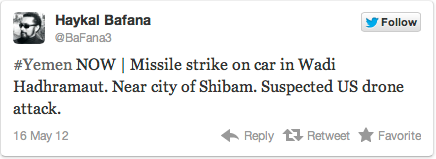
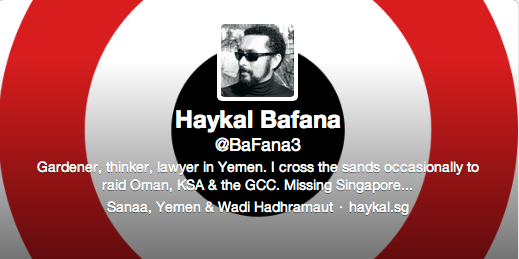
BAFANA Tweet Drone strike in YemenBack in May the Bureau of Investigative Journalism described how local activists were using Twitter and other social media platforms to spread the news of US drone strikes in Yemen.  Haykal Bafana, a lawyer living in San’a, the capital of Yemen, kept up a barrage of tweets recording the ‘covert’ strikes in near real-time, which were then amplified through Facebook and micro-news platforms in the region. You can follow him here.

Haykal Bafana

This is all of a piece with the incorporation of social media into the conduct of late modern war that was evident during Israel’s recent attack on Gaza and, as Noel Sharkey told the Bureau,

‘It is incredible how the same type of technology used by the CIA to kill people with drones in the Yemen, is empowering the Yemenis to tweet the attacks as they are happening. They can send us all pictures and bring us closer to the horror they are experiencing. Technology in the small may eventually bring down the over-use of military technology in the large.’

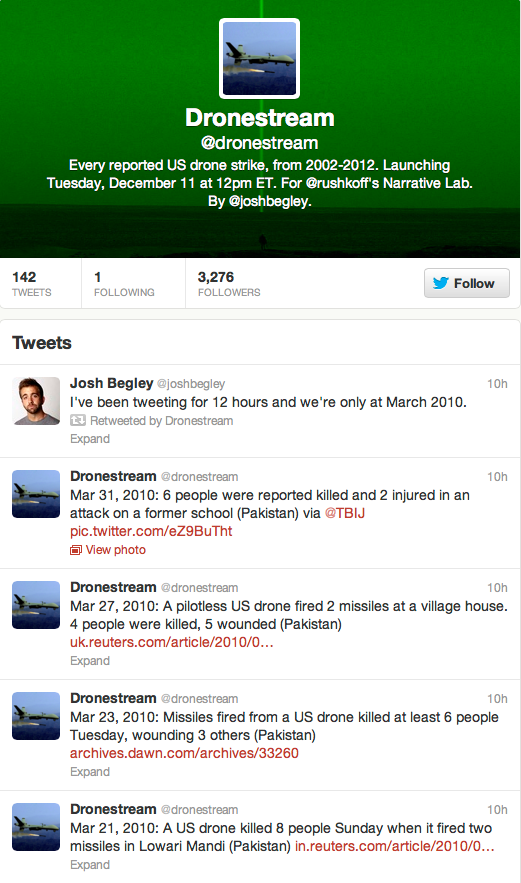
Josh BegleyDrone strikes are certainly now being made visible across a range of social media platforms, and now comes news – from the wonderful Jorge Amigo – that Josh Begley (whose Drones+ app was serially rejected by Apple) has started tweeting what Jake Heller calls ‘the entire history of US drone strikes’ in Pakistan, Yemen and Somalia as part of a graduate class at NYU, Narrative Lab, which focuses on ‘the impact of interactivity and technology on traditional narrative structure’.  Begley told Heller that, for him, ‘it’s about the way stories are told on new social-media platforms.’

Dronestream

How complete the data series can be is an open question – and the rhetorical impact would be even more devastating if Afghanistan were included – but as you can see from my screen grab above Begley, who started at noon on Tuesday 11 December, tweeted that after twelve hours ‘we’re only at March 2010’…  Follow him at Dronestream here.  And, as Connor Simpson at the Atlantic Wire commented, ‘if this project doesn’t merit an A, we would love to see one that does.’

Predatory eyes

Following from my last post on the art of bombing – on artists who have attempted to render the aerial perspective of conventional bombing – Honor Harger (from Lighthouse) provides a useful review of artists who are doing the same for drone strikes in his ‘Drone’s eye view’.  Honor writes:

The work of artists such as Trevor Paglen, Omer Fast, and James Bridle exists within a long tradition of artists bearing witness to events that our governments and military would prefer we didn’t see. But Bridle’s work is also part of an ongoing collective effort from both artists and engineers to reveal the technological infrastructures that enable events like drone-strikes to occur.

Omar Fast, 5000 feet is best (2011)

Honor is referring to James Bridle‘s Dronestagram and related projects that I noted earlier, and to Trevor Paglen‘s Drone Vision (see also his other drone-related projects here).  Trevor’s work includes an interview and video clip from Noor Behram, a Pakistani photo-journalist who has been painstakingly documenting CIA-directed drone strikes in the Federally Administered Tribal Areas. He’s best known for his harrowing images of the aftermath of drone strikes, but he also shot this video of a drone over his own house:

“Witnessing a drone hovering over Waziristan skies is a regular thing,” says Noor Behram, who shot this video outside his house in Dande Darpa Khel, North Waziristan.

For more than five years, Behram has been documenting the aftermath of drone attacks in Pakistan’s tribal areas, the hub of the CIA’s remote assassination program. When Behram learns of a strike, he races towards ground zero to photograph the scene. “North Waziristan,” he explained “is a big area scattered over hundreds of miles and some places are harder to reach due to lack of roads and access. At many places I will only be able to reach the scene after 6-8 hours.” Nonetheless, Behram’s photographs are some of the only on-the-ground images of drone attacks.

“[The few places where I have been able to reach right after the attack were a terrible sight” he explains, “One such place was filled with human body parts lying around and a strong smell of burnt human flesh. Poverty and the meagre living standards of inhabitants is another common thing at the attack sites.” Behram’s photographs tell a different story than official American reports that consistently deny civilian casualties from drone attacks: “I have come across some horrendous visions where human body parts would be scattered around without distinction, those of children, women, and elderly.”

For Behram, this video is nothing exceptional. “This was like any other day in Waziristan. Coming out of the house, witnessing a drone in the sky, getting along with our lives till it targets you. That day it was in the morning and I was at my home playing with my children. I spotted the drone and started filming it with my camera and then I followed it a bit on a bike.”

The third artwork in Honor’s triumvirate is Omer Fast‘s fictionalised Five Thousand Feet is the Best, which I included in my list of Readings and Screenings on drones back in August.  There’s a clip below, though the full presentation runs to 30 minutes:

The film is based on two meetings with a Predator drone sensor operator, which were recorded in a hotel in Las Vegas in September 2010. On camera, the drone operator agreed to discuss the technical aspects of his job and his daily routine. Off camera and off the record, he briefly described recurring incidents in which the unmanned plane fired at both militants and civilians – and the psychological difficulties he experienced as a result. Instead of looking for the appropriate news accounts or documentary footage to augment his redacted story, the film is deliberately miscast and misplaced: It follows an actor cast as the drone operator who grudgingly sits for an interview in a dark hotel. The interview is repeatedly interrupted by the actor’s digressions, which take the viewer on meandering trips around Las Vegas. Told in quick flashbacks, the stories form a circular plot that nevertheless returns fitfully to the voice and blurred face of the drone operator – and to his unfinished story.

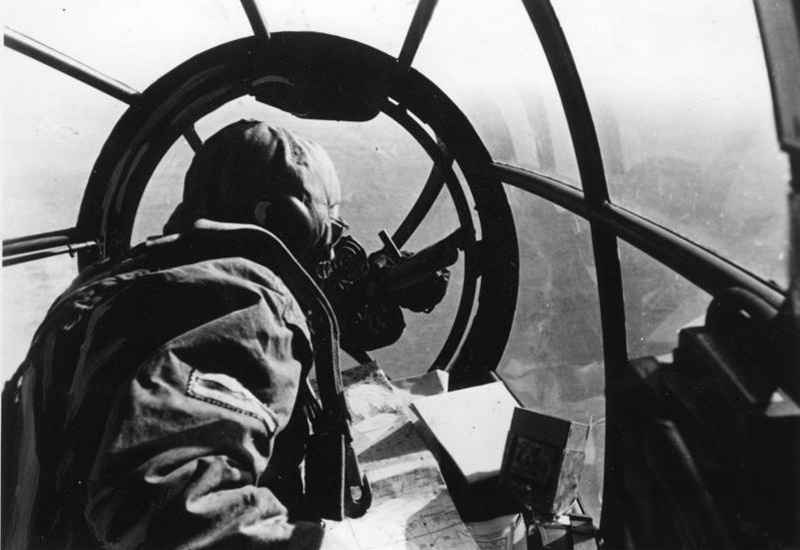
He-111 Luftwaffe bombardiers viewWhat is particularly interesting to me are the ways in which ‘seeing like a drone’ is and is not like seeing through a standard bombsight: the techno-optical regime through which conventional bombing has been conducted differs from the high-resolution full-motion video feeds that inform (and misinform) the networked bombing of late modern war.  Those feeds significantly compress the imaginative distance between the air and the ground, but they do so in a highly selective fashion.  Today’s remote operators, who may be physically thousands of miles away from the target, nevertheless claim to be just 18 inches from the conflict zone, the distance between the eye and the screen, and they (un)certainly see far more of what happens than the pilots of conventional strike aircraft.  But in Afghanistan, where remote operators are usually working with troops on the ground, they become immersed in the actions and interactions of their comrades – through visual feeds, radio and internet – whereas their capacity to interpret the actions of the local population is still strikingly limited.  So it is that local lifeworlds remain not only obdurately ‘other’ but become death-worlds.

The politics of drone wars

I’m in the UK this week for – amongst other things – a seminar with Pete Adey, Sara Fregonese and some of the Geopolitics and Security students at Royal Holloway on my bombing project, Killing space; a workshop at Open Democracy for a new series on Cities in Conflict to be curated by Tom Cowan; and a lecture at Nottingham organised by Steve Legg: another outing for “Deadly Embrace”.

At the RHUL meeting the conversation frequently turned to drones; Pete made an audio recording of it, and I think at least part of what we discussed will appear on the Theory, culture & society website in the near future.  But I’d like to try to set out some of my own puzzlements and positions about the politics of drones here.

There are many ways in which individuals can take a stand against war, and there is a long and principled tradition of conscientious objection that includes pacifists in two World Wars through young Americans who resisted the draft in the 1960s and 70s to high school students in Israel who refuse to serve in the army of occupation.  In recent times most popular mobilisations against war have been against particular wars – I’m thinking of the demonstrations against the wars in S.E. Asia in the 60s and 70s, for example, or the millions of people who took to the streets to express their opposition to the US-led invasion of Iraq in 2003 – or against particular objects of violence: campaigns to ban land mines or cluster munitions, for example.  To me, the most effective political response to the use of Predators, Reapers and other UAVs in Afghanistan, Pakistan, Yemen, Somalia and elsewhere is to move between the two: to use the drone to draw publics into an apprehension of the wider fields of military violence in which they are deployed.

Global Hawk imagery of aftermath of Haiti earthquakeI think it is a mistake to focus on the object itself because, like all objects, a drone is highly unstable: it’s not a fixed, determinate ‘thing’ but its capacities and dispositions depend on the network or assemblage in which it is embedded. To see what I mean, begin by stripping the bombs and the missiles from these platforms: at present most drones are used for intelligence, surveillance and reconnaissance (ISR), and these capabilities extend far beyond the domain of offensive operations and even beyond those of the military.  In 2010 US Southern Command used a Global Hawk to provide detailed imagery of the damage caused by the Haiti earthquake (above) and the following year another Global Hawk was deployed to assess the damage to the Fukishima Daiichi nuclear plant in Japan; other, smaller and far less sophisticated drones have been used to monitor wildfires in California and to track and disrupt Japanese whaling fleets, while a series of other, broadly ecological-humanitarian projects have been proposed with varying degrees of plausibility.  I don’t rehearse these other possibilities to minimise the military and paramilitary uses of the technology – and we surely know, not least from Nick Turse‘s account in The Complex, that the military and the civilian have become ever more hopelessly entangled with one another – and neither am I indifferent to the blurring of military power and NGO relief operations in the humanitarian present,  but we need to acknowledge, to paraphrase Clive Barnett, that not all ISR operations are sinister: ‘presumptively illegitimate, undemocratic or suspect‘.

Dwell Detect Destroy drone ad

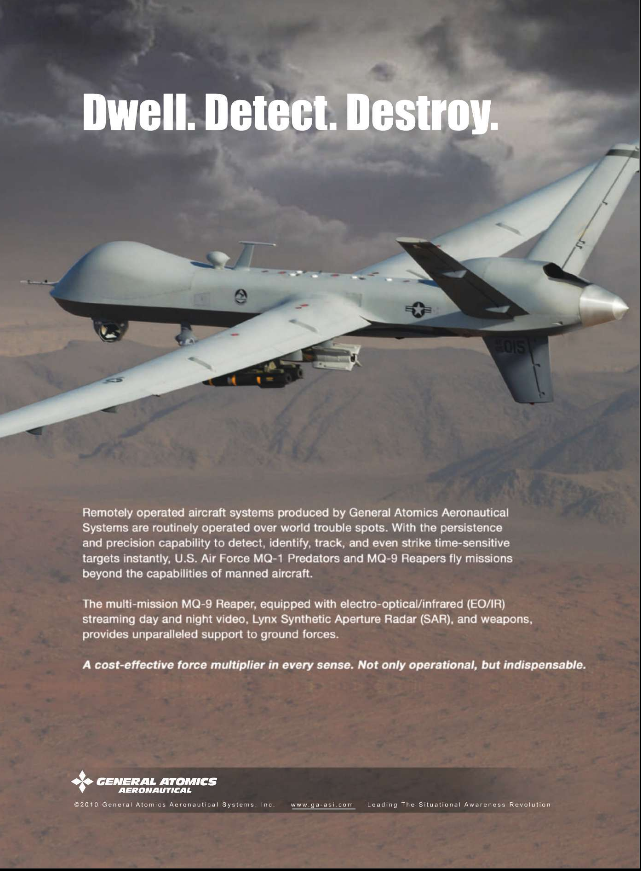
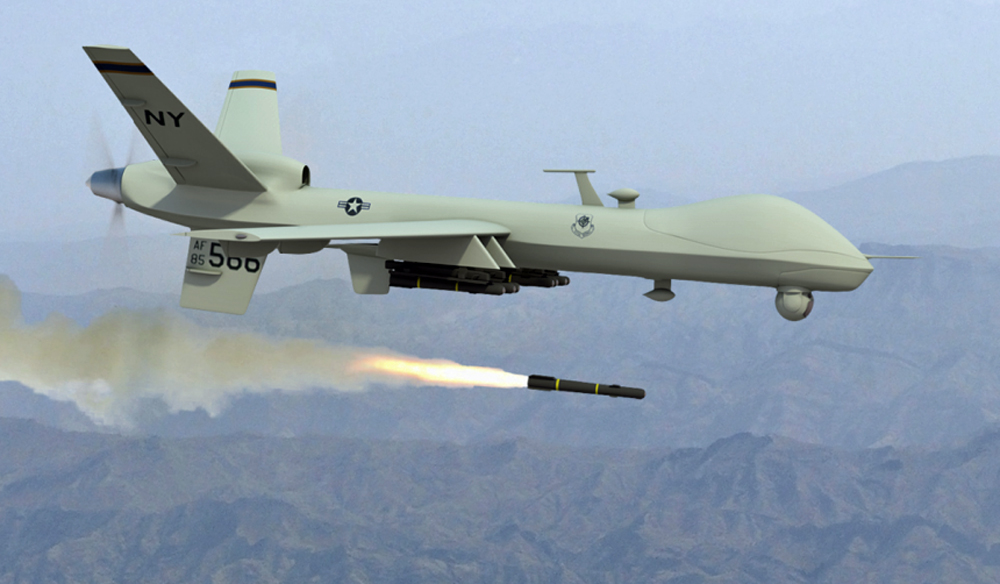
Hellfire missile launch (USAF)This is why Drone Wars UK focuses on ‘armed drones’ and Drones Watch on ‘killer drones’.  It’s clear that militarised ISR is part of a continued ‘rush to the intimate’ that is profoundly invasive and, on many occasions, extraordinarily violent. In Afghanistan the US military embeds its UAVs in a networked kill-chain in which their near real-time, high-resolution, full-motion video feeds are routinely used to call in attacks from conventional strike aircraft.  So let’s now put the bombs and missiles back on these platforms, since the Predators and Reapers are usually armed and their manufacturers boast about their capacity to compress the kill-chain: to ‘dwell, detect [and] destroy’. But it then makes no sense to object to the strikes carried out directly from them and to exempt those carried out by conventional means across the network: what is the difference between a Hellfire missile launched from a Reaper and one fired from an Apache helicopter gunship?  (To put this in perspective, according to the most recent airpower summary, USAF Predators and Reapers directly accounted for just 5-6 per cent of its ‘weapons releases’ in Afghanistan in 2009, 2010, and 2011, though the proportion climbed to 9.25 per cent in the first ten months of 2012).

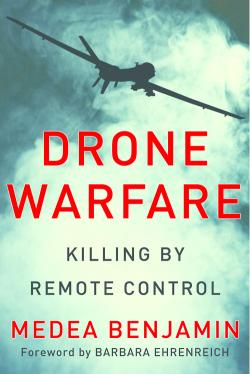
Medea BENJAMIN Drone WarfareTo answer that question critics usually cite the horror of death at a distance.  This is death from thousands of miles away, conducted by operators in the continental United States: ‘killing by remote control’.  And yet there are countless other ways in which militaries have been killing from ever increasing distances ever since the invention of the slingshot and the longbow. If you insist that it is wrong to kill somebody from 7,500 miles away, then over what distance do you think it is acceptable?  If you are determined to absolutize distance in this way, then don’t you need to consider all the other ways in which advanced militaries are able to kill their adversaries (and civilians) without ever seeing them? Again, I don’t raise the spectre of Cruise missiles launched from ships hundreds of miles from their targets, the US ‘Prompt Global Strike’ capability and its Advanced Hypersonic Weapon which is ultimately  intended to hit a target anywhere on the planet in under an hour, or the prospect of ‘frictionless’ cyberwarfare, to minimise the deaths caused by drones.  I simply want our politics to apprehend the larger field of military violence in which they are deployed.

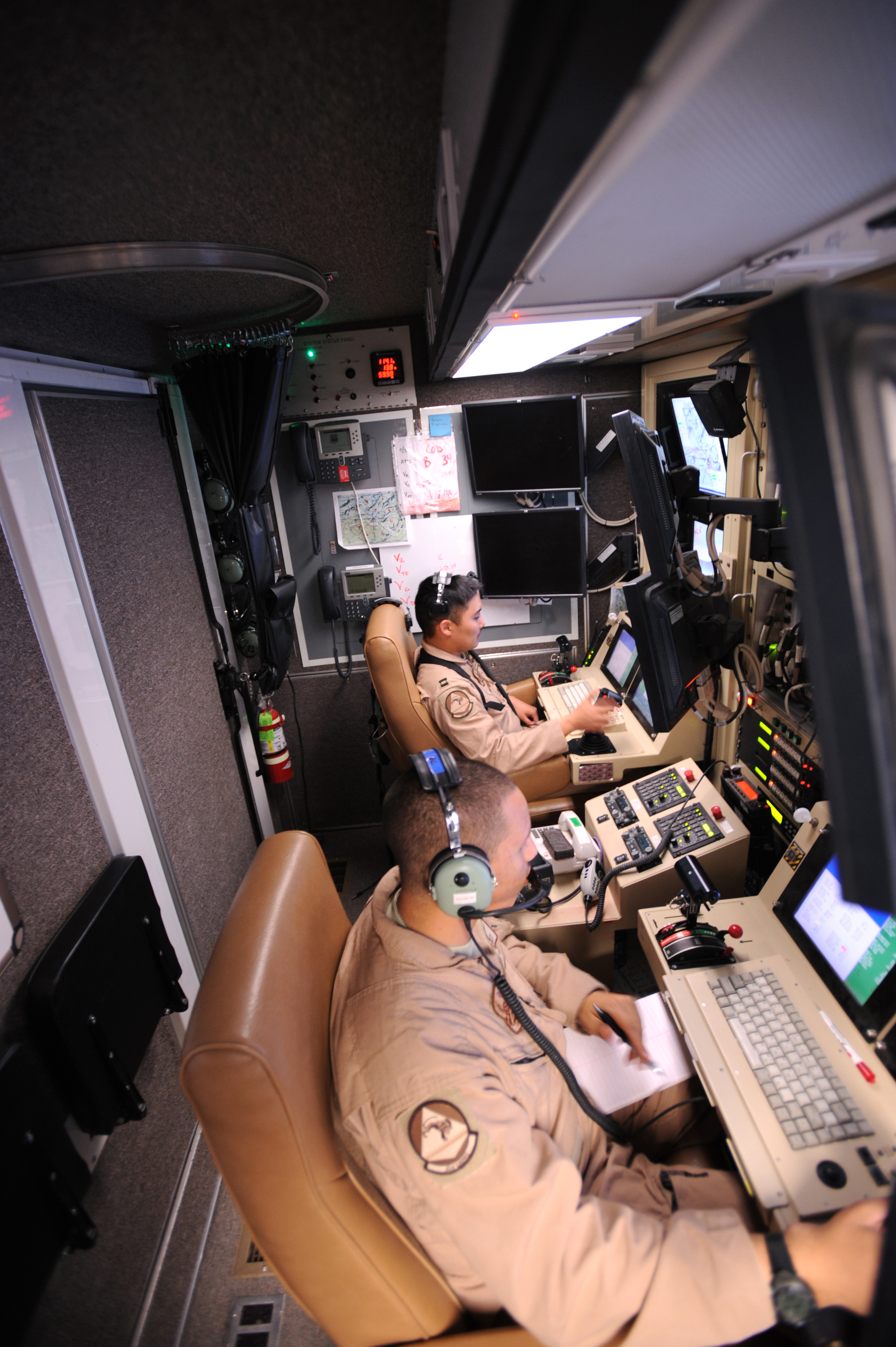
And there is something different about those deaths that draws us back into the killing fields.  I should say at once that I don’t think this is simply war reduced to a video-game – and in any case there are many other military technologies that also depend on hand-eye co-ordination, multi-tasking and spatial acuity, all skill-sets valorized by video-games – but I also think it a mistake to assume that the screen effectively insulates the viewer from the victim.  In this sense there is a parallel between the platforms, because video-games are profoundly immersive, and those who call in or carry out these strikes insist that they are not 7,500 miles from their targets at all (and Launch & Recovery crews are much closer than that) but ‘eighteen inches away’: the distance from eye to screen.  It’s a highly selective process of compression; as I’ve shown in detail in Lines of descent (DOWNLOADS tab), those involved in the remote kill-chain typically feel remarkably close to their own troops on the ground and remain distant from the life-worlds of the population at large (which in part accounts for the civilian casualties when drones are used to provide close air support).  But unlike most other forms of distant death and destruction, the pilots, sensor operators and others who are networked into these kill-chains can see their targets up close – even if their ‘seeing’ is techno-culturally conditioned and often predisposes them to treat innocent actions as hostile intentions – and they typically remain on station to carry out a ‘bomb damage assessment’ and so see for themselves, often in hideous detail, what they have done.

Flying an MQ-9 Reaper over Kandahar, Afghanistan

The most consequential change is that these new modes of air power deal not in the area bombing of cities like Cologne, Hamburg or Dresden, or the blind bombing of target boxes over the rainforests of Vietnam, Laos and Cambodia, but – in addition to close air support – in the calculated assassination of individuals or groups: so-called ‘targeted killing‘ or what the USAF calls putting ‘warheads on foreheads‘.  This does not mean that the firebombing of cities in the Second World War should become the moral standard against which we judge contemporary military violence. On the contrary, targeted killing raises its own grave legal and ethical questions – and, not incidentally, those video feeds have given military lawyers a pivotal role in these newly networked strikes – that in turn activate two other no less serious concerns about the emergent geographies of fields of military violence.

First is the fear that the use of remote platforms lowers the threshold at which military violence will be launched.  Predators and Reapers are much cheaper than conventional strike aircraft, and if there are no troops on the ground, there are no body bags to come home.  In short, drone war threatens to become risk-transfer war hypostatised; the risk is transferred wholly to the adversary population.  But at present these platforms have high failure rates – they are vulnerable to weather conditions (and I don’t mean hurricanes and monsoons, I mean clouds), they crash all too frequently and they are so slow and noisy that they can easily be shot down so they can only be used in uncontested airspace.  These limitations mean that, at present at any rate, they are less likely to incite conventional state-on-state war – though there is certainly a global arms race to acquire and develop far more advanced drone technologies.

Second and closely connected is the fear that they make it much easier to engage in war by stealth.  If one of the primary foreign policy challenges of the last Bush administration was ‘conducting war in countries we are not at war with‘, Obama’s version is the determination to wage what Martin Libicki calls ‘non-obvious warfare’: hence the Obama administration’s preference for remote operations, Special Forces and cyber-attacks.  To be sure, there are degrees of obviousness: the drone attacks in Pakistan, Yemen, Somalia and elsewhere are hardly covert – since they are hidden in plain sight – but they are, within limits, more deniable than the deployment of thousands of ground troops and so inherently less accountable to the various publics involved in them.  And in all these cases Predators and Reapers dramatically heighten the asymmetry involved in military and paramilitary operations against non-state actors, where they have made a policy of ‘kill’ rather than ‘capture’ a much more tempting (and much more pernicious) US counter-terrorism strategy.

More to come.