The whites of our eyes

I’ve been re-reading Keith Feldman‘s essay on ‘Empire’s verticality’ (Comparative American Studies 9 [4] 2011 325-41), which raises a series of incisive questions about what he calls ‘racialization from above’ in the Afghanistan-Pakistan borderlands.  Keith was working on this while I was working on ‘From a view to a kill’ (see DOWNLOADS tab), and we exchanged ideas en route, but Keith’s essay provides a different and invaluable perspective.  He begins with the famous Situation Room photograph by Pete Scott in which Obama and his senior advisors gaze at a live-feed from Abbotabad on 1 May 2011: since ‘the target of imperial retribution remains just outside the visual field’ – we see no images of the raid – Keith notes that ‘we are drawn to witness the witnessing of Bin Laden’s assassination.’  He focuses on the visual identification of a Muslim Other that is supposed to be precise and yet always remains blurred.

The scopic regime of late modern war is placed under even greater pressure when ‘signature strikes’ are conducted – when the target is not a named individual but a ‘person of interest’ whose ‘pattern of life’ has roused the suspicions of the distant watchers – and this has even more serious implications for civilian casualties.

There’s a short post from Kevin Jon Heller at Opinio Juris that addresses the issue by juxtaposing two quotations.  The first is from a report in the New York Times on 29 May 2012 by Jo Becker and Scott Shane on ‘Obama’s Secret “Kill List”…’ and the CIA-controlled Predator strikes in Pakistan:

“… Mr. Obama embraced a disputed method for counting civilian casualties that did little to box him in.  It in effect counts all military-age males in a strike zone as combatants, according to several administration officials, unless there is explicit intelligence posthumously proving them innocent.  Counterterrorism officials insist this approach is one of simple logic: people in an area of known terrorist activity, or found with a top Qaeda operative, are probably up to no good.”

The second comes from Richard Falk‘s ‘Law and responsibility in warfare: the Vietnam experience’, where he quotes the man who ordered the My Lai massacre, Lt William Caley:

“If those people weren’t all VC [Viet Cong] then prove it to me. Show me that someone helped us and fought the VC. Show me that someone wanted us: one example only! I didn’t see any… Our task force commander’s staff said it’s a VC area and everyone there was a VC or a VC sympathizer. And that’s because he just isn’t young enough or old enough to do anything but sympathize.”

Heller doesn’t use the phrase, for obvious reasons, but this is another Catch-22…

But there’s another Vietnam parallel that I think is even more striking.  In Lines of descent (DOWNLOADS tab) I described the creation of ‘free bomb zones’ or ‘free fire zones’ in South Vietnam.

 In August 1965 [General] Westmoreland was authorized to order strikes in five free bomb zones that were ‘configured to exclude populated areas except those in accepted VC [Viet Cong] bases’.  Within these zones the designation of target boxes dispensed with precise co-ordinates and detailed intelligence altogether, so that they became black boxes in every sense of the phrase, and approval was given in advance ‘for execution when appropriate’. Westmoreland was perfectly clear that ‘anybody who remained had to be considered an enemy combatant’ and so strikes could proceed ‘without fear of civilian casualties’.

With this in mind, here is a section that never made it in to the final version of ‘Lines of descent’, concerning the principle of distinction (the legal requirement to discriminate between combatants and non-combatants).  My Lai makes an appearance here too, as a crucial moment after which the Pentagon agreed to provide military operations with a legal armature.  And yet, as I tried to show in both my essays, incorporating lawyers into the kill-chain provides less protection for civilians than may at first appear: the balance between concrete military advantage and ‘collateral damage’ is still calibrated on the military’s own scales.  I’m not saying that nothing has changed since Vietnam – the lines of descent are complex and tangled – but, as the final paragraph below shows, there are none the less disturbing parallels.  ‘Blind bombing’ may well belong to the past, superseded by near real-time, high-resolution full-motion video feeds from Predators and Reapers, and yet – to return to Feldman – in scanning these images we continue to privilege the whites of our own eyes.

Distinction and the air war in Vietnam

The difficulty of distinguishing between ground troops, enemy forces and non-combatants was exacerbated by the use of air power in a non-linear battlespace, the ‘war without fronts’, because ‘the absence of clearly discernible bomb lines created a fluid environment in which it was not always possible to distinguish friendly from enemy forces.’  From the air, Schlight continued, ‘all soldiers looked alike and guerrillas were indistinguishable from non-combatants.’ [1]  He insists that there was an acute sensitivity to ‘accidental loss of life’.  In Westmoreland’s (public) view, ‘one mishap, one innocent civilian killed, one civilian wounded or one dwelling needlessly destroyed, is one too many’, and this supposedly translated into ‘stringent’ rules of engagement.  In particular, strikes on hamlets and villages required political clearance from Vietnamese authorities at least at a provincial level, they had to be directed by a Forward Air Controller or radar to minimize civilian casualties, and warnings had to be issued if the attacks were not in conjunction with ground forces; if this were impossible, the ground commander could designate the target, and in ‘specified strike zones’ (whose designation was held to ‘constitute prior political clearance’) pilots ‘could use their own judgement in hitting targets.’ [2]  In this, more or less official view, air strikes still killed civilians but every effort was made to minimize the loss of innocent lives.

Others see it differently.  For some, it was a technical matter.  When van Creveld writes of ‘the American airmen’s near-complete inability to distinguish between combatants and noncombatants’, he is simply echoing McNamara’s own post-war admission that it ‘proved difficult to distinguish combatants from noncombatants’ and that Westmoreland’s heavy reliance on bombing ‘produced more and more civilian casualties’: for both men this was an inherent limitation of air power in counterinsurgency. [3]  It was inevitably compounded by the electronic battlefield, as Senator McGovern noted: ‘If ground troops sometimes will not, and usually cannot, distinguish between enemy and innocent in a guerrilla war, we know that aerial bombardment never can.  The sensor which detects body heat, the aircraft thousands of feet in the air, the computer complex many miles distant, are completely neutral and indiscriminate.’  [4]  For others, as McGovern’s first clause implies, the lack of discrimination was too often a considered decision.  The rules of engagement were elastic (in practice Vietnamese political clearance was readily obtained) and riddled with exceptions (there were many cases where clearance could be dispensed with altogether, including military necessity and specified strike zones).  Clodfelter points out that this was in marked contrast to the bombing of North Vietnam where ‘detailed restrictions [were] placed on bombing targets’ because there the American political calculus included civilian casualties.  This was not only true of the Johnson administration’s micro-management of Rolling Thunder; when President Nixon resumed the bombing of North Vietnam in 1972 he loosened the previous restrictions and returned operational control of these Linebacker campaigns to the military, but even his terror bombing of targets around the capital was circumscribed. ‘I want the people of Hanoi to hear the bombs,’ he instructed Strategic Air Command, ‘but minimize damage to the civilian population.’ In South Vietnam, however, where there were few restrictions or political restraints, Clodfelter concludes that ‘indiscriminate bombing contributed significantly to an estimated 1.16 million South Vietnamese civilian casualties during the war.’ [5]  The vital point is that many, perhaps even most of these injuries and deaths were not accidental, often not even incidental  ­– the ‘collateral damage’ that international law accepts may result from attacking military targets – but the victims of deliberate and indiscriminate attack.

Discrimination has two meanings, one strategic and the other legal.  For Kalyvas, violence against civilians is a central feature of insurgency and counterinsurgency, where historically both sides often targeted civilians to force them to comply, but it can be discriminate – directed against specific targets – or indiscriminate, based on collective attributes like place of residence. [6]  Kocher, Pepinsky and Kalyvas argue that bombing in South Vietnam was indiscriminate because it was typically directed at areas, boxes or zones: ‘it could not target individual VC supporters while sparing government supporters or the uncommitted, even when intelligence was good’.  They concede that this was, in part, a technical matter – target identification was often hit-or-miss and until Paveway laser-guided bombs were used in the Linebacker campaigns the delivery of ordnance was ‘inherently inaccurate’ – but in many cases they suggest that exposing civilian populations to aerial violence was a tactical choice.  One leaflet drop warned people that ‘when the plane returns to sow death, you will have no more time to choose’, and many commanders welcomed the bombing of civilians: when he was asked if he was worried by the civilian casualties caused by bombing and shelling, Westmoreland himself airily replied, ‘Yes, but it does deprives the enemy of population, doesn’t it?’ [7]  This is perhaps unsurprising; bombing had been an established method of colonial ‘air control’ much earlier in the century. It turned out to be as counterproductive in Vietnam as it had been in Mesopotamia and the North West Frontier. Targeting collectives means that individuals ‘cannot avoid being victimized simply by refusing to participate in the insurgency’, and bombing the South clearly increased Viet Cong control in the affected areas. [8]

Discrimination also carries a legal charge, but it has a complicated history.  After the Second World War there was an attempt to incorporate ‘protection of civilian persons in times of war’ into the Geneva Conventions, but these largely failed to address the vulnerability of civilian populations to military violence in general and to air strikes in particular. [9]  In 1956 the International Committee of the Red Cross produced a series of Draft Rules that prohibited direct attacks on the civilian population and, in particular, attacks ‘without distinction’ on areas where military targets were close to the civilian population.  This was an express attempt to outlaw area bombing, and it met with forceful opposition. In 1965 the ICRC reaffirmed the prohibition on direct attacks against the civilian population, and insisted on discrimination between those taking part in hostilities and civilians who should ‘be spared as much as possible’, and in December 1968 these basic principles were endorsed in UN Resolution 2444 on Respect for Human Rights in Armed Conflicts.  In 1972 the Pentagon confirmed that it regarded these principles as declaratory of customary international law but added two riders. The United States insisted that it was permissible to attack military targets even if there were a risk of collateral damage, and in such cases the responsibility for distinguishing military objectives from civilian devolved upon ‘the party controlling the population.’ [10] These were expedient qualifications in the (arc) light of South Vietnam, where insurgents swam in the sea of the population.  In fact MACV’s legal advisor blamed the suffering of Vietnamese civilians on the law itself, which he claimed was ‘inadequate to protect victims in wars of insurgency and counterinsurgency’ because it drew on ‘examples from World War II which simply did not fit in Vietnam’ where ‘the hazy line between civilian and combatant became even vaguer’. [11]  Another judge advocate said much the same: In Vietnam ‘the battlefield was anywhere and everywhere, with no identifiable front lines and no safe area. This meant that innocent civilians could not easily avoid the war or its suffering.’  He was silent about the responsibility of those conducting the war to avoid innocent civilians – justice, like much of the bombing, was blind – and limited his discussion to compensation payments where ‘loss or damage was caused by reckless or wanton conduct by U.S. forces.’ [12]  Not surprisingly, what is now called operational law remained strikingly undeveloped.  Judge advocates at MACV were not consulted about air operations; one judge advocate attended meetings at Seventh Air Force headquarters, but these reviewed the previous week’s operations and ‘no one consulted him about future operations, the lawfulness of striking selected targets, or compliance with the rules of engagement’; tactical air control centers had no place for judge advocates who ‘had almost no contact with the people who planned or executed air operations’, and provided neither briefings nor advice on the laws of war or the rules of engagement.  The single exception was a judge advocate based at the US Embassy in Thailand who scrutinized some target lists in North Vietnam. [13]

In fact, it was only after the publicity surrounding the My Lai massacre, in November 1974, that the Pentagon directed the armed services to implement a program to prevent violations of the Law of War; only then did the US military begin to incorporate legal oversight into its operations. [14]  Most legal scrutiny of the air war in Vietnam was after the event – hence the essays by Hays Parks on Rolling Thunder and Linebacker that conclude that both were fully consistent with (in the case of Rolling Thunder even unduly sensitive to) international law – and, no less significantly, did not address the conduct of the air war in the South. [15]  The crucial issue there is the distinction between civilians and combatants, and here Richard Falk, while granting that the law of armed conflict was inadequate and needed revision, none the less insisted that, in its promulgation of ‘free bomb zones’, in B-52 ‘pattern raids’, and much else, the US violated customary international law routinely and serially: ‘the overall American conduct of the war involve[d] a refusal to differentiate between combatants and noncombatants and between military and nonmilitary targets.’ [16]

[1] John Schlight, The war in South Vietnam: The years of the offensive, 1965-1968 (Office of Air Force History, 1969) War, p. 258.  A bombline is ‘an imaginary line arranged, if possible, to follow well-defined geographical features, prescribed by the troop commander and coordinated with the Air Force commander, forward of which air forces are free to attack targets without danger or reference to the ground forces; behind this line all attacks must be coordinated with the appropriate troop commander’: John Pearse, ‘Air power in the kill-box: Fire support co-ordination and airspace deconfliction in the future non-linear battlespace’, Thesis, School of Advanced Air and Space Studies, Maxwell Air Force Base, 2003: p. 22.

[2] Schlight, War, pp. 258-9.

[3] Martin van Creveld, The age of airpower (New York: Public Affairs, 2011) p. 199; Robert McNamara, In retrospect: the tragedy and lessons of Vietnam (New York: Vintage, 1995) p. 243.

[4] McGovern’s speech was delivered on 14 December 1971 and is excerpted in ‘Automated warfare’ (January 1972) p.2, Folder 01, Box 02, Douglas Pike Collection: Unit 03 – Technology, The Vietnam Center and Archive, Texas Tech University.

[5] Mark Clodfelter, ‘A strategy based on faith: the enduring appeal of progressive American airpower’, Joint Forces Quarterly 49 (2008) 24-31, 150-160: 31.  Clodfelter’s figure includes those wounded and killed 1965-1974, and is derived from estimates presented in Guenter Lewy, America in Vietnam (New York: Oxford University Press, 1978) p. 446.  These estimates are probably conservative, and Lewy is much more reluctant to attribute these totals to ‘allied bombing’, but he does accept that the ‘lavish use of [US] firepower’ caused ‘a large number of civilian casualties’ in the South (p. 230).  Despite the restrictions US bombing also caused casualties in the North: Lewy estimates around 65,000 civilians were killed, and other estimates run into the hundreds of thousands.

[6] Stathis Kalyvas, The logic of violence in civil wars (Cambridge: Cambridge University Press, 2006) p. 142 and passim.

[7] Matthew Kocher, Thomas Pepinsky and Stathis Kalyvas, ‘Aerial bombing and counterinsurgency in the Vietnam War’, American Journal of Political Science 55 (2011) 201-18: 205; Westmoreland’s remark was made in summer 1966 and is cited in David Halberstam, The best and the brightest (New York: Ballantine, 1969) p. 550, who adds: ‘The American command was aware of it was doing, and sanctioned it… MACV knew about it, it didn’t want to know too much, it would look the other way if possible, but it knew it was all going on out there.’

[8] Kocher, Pepinsky and Kalyvas, ‘Aerial bombing’, 203, 215.  A 1968 RAND survey found that bombing increased support for the Viet Cong, but it was never released: Robert Smith, ‘Report compiled in 68 says excessive Allied bombing in South Vietnam stirred hostility to regime’, New York Times, 22 January 1970.

[9] ‘The most conspicuous sufferers from bombing, Germany and Japan, were unable to put their case, while the bombing specialists, the USA and the UK, had every reason for preventing the case being out’: Geoffrey Best, War and law since 1945 (Oxford: Clarendon Press, 1994) p. 115.

[10] Hays Parks, ‘Air war’, 65-71.

[11] MG George Prugh, Law at war, Vietnam 1964-1973 (Washington DC: Department of the Army, 1975) p. 89.  He also conceded that there was no effective mechanism to enforce compliance.

[12] Frederic Borch, Judge Advocates in Vietnam: Army Lawyers in Southeast Asia, 1959-1975 (Combat Studies Institute, 2003) p. 92.

[13] LTC Terrie Gent, ‘The role of Judge Advocates in a Joint Air Operations Center’, Air Power Journal, Spring 1999

[14] My Lai was the scene of a massacre of hundreds of civilians by US troops on 16 March 1968; it was not widely reported until November 1969, and the subsequent courts-martial were not completed until March 1971. The problem was much wider and more pervasive than this focus suggests, however, and Greiner, War without fronts, p. 18, writes of an ‘endemic contempt’ for international law on the part of the US.  Dunlap identifies a ‘revolution in military legal affairs’, after Vietnam, beginning in 1989 with the involvement of judge advocates in planning US military operations in Panama and becoming much more visible during the first Gulf War: Charles Dunlap. ‘The revolution in military legal affairs: Air Force legal professionals in 21st century conflicts’, Air Force Law Review 51 (2001) 293-309.  Consistent with his later preoccupation with ‘lawfare’, he places particular emphasis not on advances in military technology, however, but on changes in communications technology that worked to enable media organizations to bring ‘the raw images of war’ to publics around the world ‘before leaders can censor or shape it’ (p. 294).

[15] W. Hays Parks, ‘Rolling Thunder and the law of war’, Air University Review, January-February 1982 athttp://www.airpower.maxwell.af.mil/airchronicles/aureview/1982/jan-feb/parks.html; ‘Linebacker and the law of war’, Air University Review January-February 1983 at http://www.airpower.maxwell.af.mil/airchronicles/aureview/1983/jan-feb/parks.html.

[16] Richard Falk, ‘Son My: war crimes and individual responsibility’, University of Toledo Law Review 21 (1971) 21-41:23.
(C)overt killing

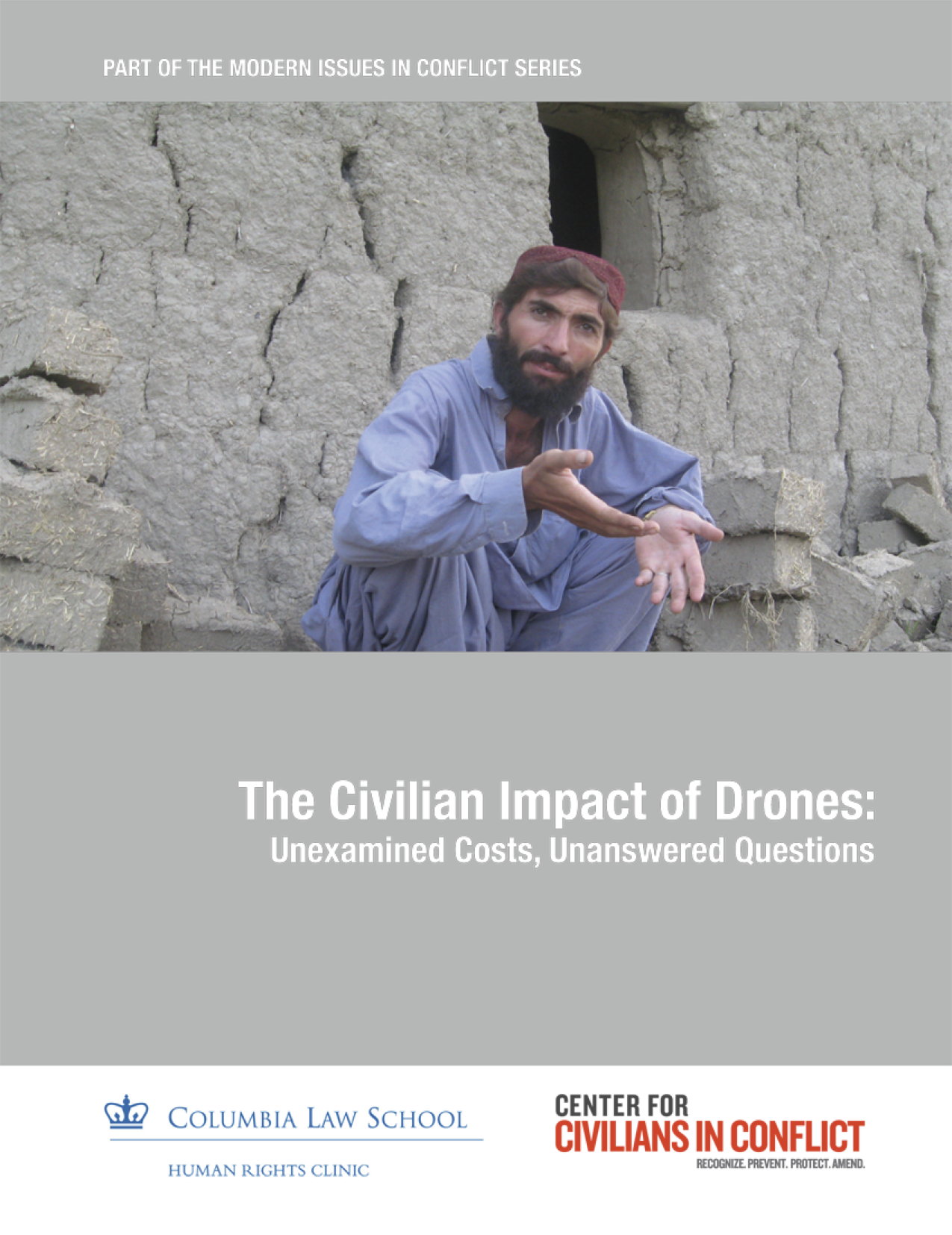
Hard on the heels of my post about Living under drones, the joint report from the International Human Rights and Conflict Resolution Clinic at Stanford and the Global Justice Clinic at NYU, comes another joint report, The civilian impact of drones, this one from the Human Rights Clinic at Columbia Law School and the Center for Civilians in Conflict.  Download it here.

It’s particularly valuable for its careful parsing of ‘personality’ strikes (against named individuals) and ‘signature’ strikes (based on ‘pattern of life’ analysis) and, most of all, for its detailed discussion of the blurring of CIA operations and military operations carried out by Joint Special Operations Command (JSOC).

I drew attention to this in ‘Lines of descent’ (DOWNLOADS tab), using many of the same sources, but while I applaud the report for its principled reflections on the ethical and legal implications of these (c)overt operations in Pakistan, Somalia and Yemen, it does not accord USAF operations in Afghanistan the same level of scrutiny.  For reasons I also set out in both ‘Lines of descent’ and ‘From a view to a kill’ I think this is a mistake: military protocols are indeed more public, even transparent, as the authors note, but the space between principle and practice is still wide enough to inflict an unacceptably heavy burden on the civilian population.

And, as I’ve argued before, these issues cannot be resolved by co-ordinated Congressional scrutiny or by demands for ‘transparency’ alone.

Living (and dying) under drones

Earlier this month I commented on the theatre of secrecy within which US drone strikes in the Federally Administered Tribal Areas of Pakistan is staged: a discreditable rhetorical device that works to divert the public gaze from Waziristan to Washington.  I drew on a brilliant essay by Madiha Tahir, in which she objects to the way the Obama administration’s ‘theatrical performance of faux secrecy’ over its drone war in the FATA (and elsewhere) – a repugnantly teasing dance in which the veil of secrecy is let slip once, twice, three times – functions to draw its audience’s entranced eye towards the American body politic and away from the Pakistani bodies on the ground.

Tonight our eyes are drawn back to Pakistan with the publication of a field report called Living Under Drones from the International Human Rights and Conflict Resolution Clinic of Stanford Law School and the Global Justice Clinic at NYU.  At the time of writing the report has not been released for public distribution, but early versions were made available to media outlets under embargo. The most detailed coverage that I have found so far is from firedoglake (a three part report) but there are also good reports from the Los Angeles Times and in the UK the Guardian and the Independent – with, I hope, more to follow.  There is also a YouTube video summarising the report:

Robert Greenwald and Brave New Foundation prepared the video to accompany the report. Sarah Knuckey of New York University and James Cavallero of Stanford University describe how they compiled the report and explain they were able to gain access to people in an “area cordoned off and into which virtually no one can enter.”

From the media summaries and the video it’s clear that Living under drones directly challenges the dominant narrative of ‘precision strikes’ with few civilian casualties.  Its most original contribution derives from personal testimony by those directly affected.  Working in concert with both Reprieve , a London-based law and human rights organisation, and the Foundation for Fundamental Rights, a human rights organisation in Pakistan, the American researchers interviewed 139 people over a nine-month period, including 69 survivors or relatives of victims. The report provides first-hand accounts of three specific drone strikes and details the ‘considerable and under-accounted for harm to the daily lives of ordinary civilians, beyond death and physical injury.’ It also documents the hideous practice of ‘double tap‘ – follow-up strikers on rescuers – that, in a radically different context, was vigorously condemned by the United States just days ago when the attack on its diplomatic mission in Benghazi was followed by an attack on the survivors and rescuers.

Hayatullah stopped, got out of his own car, and slowly approached the wreckage, debating whether he should help the injured and risk being the victim of a follow-up strike. He stated that when he got close enough to see an arm moving inside the wrecked vehicle, someone inside yelled that he should leave immediately because another missile would likely strike. He started to return to his car and a second missile hit the damaged car and killed whomever was still left inside. He told us that nearby villagers waited another twenty minutes before removing the bodies, which he said included the body of a teacher from Hayatullah’s village.

Not surprisingly, this fear has a catastrophic effect on daily life in the region: on everything from going to school to mourning at a funeral.  Sarah Knuckey, one of the lead authors of the report, explained that people “have a constant fear that they’ll be hit, even though they know they’re civilians.”

When I’ve lectured about the supposedly covert campaign, there’s almost always been someone in the audience to tell me that there is a vast difference between targeting individuals in Pakistan and levelling whole areas of a city like Cologne.  So there is.  But there are also significant differences.

First, the combined bomber offensive against Germany – whatever one thinks about it, and I’ve made my own criticisms of it clear in “Doors into nowhere” (see DOWNLOADS tab) – was carried out during a declared state of war: the United States is not at war with Pakistan (even though one of the preoccupations of the previous US administration, and presumably the present one, was, precisely, how to conduct ‘war in countries we’re not at war with‘).

Second, when most people imagine (or remember) air raids in the Second World War I suspect most of them conjure up the sound of air raid sirens, the crump-crump of the anti-aircraft batteries, and the clatter down to the air-raid shelter.  In the FATA there are no sirens, no air defences and no shelters.

Noor Behram, Orphans of a drone strike, Waziristan, August 2010

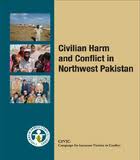
Living under drones is particularly important because there are serious state restrictions on reporting from (or even in) the region; foreign journalists require military permission to enter, and all journalists operate under constant threat: see, for example, here and here.  The last detailed field survey in the region was carried out by the Campaign for Innocent Victims in Conflict (CIVIC) – now the Center for Civilians in Conflict– which interviewed over 160 civilians in 2009-2010 who had experienced direct losses in either FATA or the Khyber Pakhtunkhwa (KPK, formerly Northwest Frontier Province).  The results were published as Civilian Harm and Conflict in North West Pakistan (2010) though it should be emphasized that the report makes it clear that the CIA is not the only perpetrator, and that the researchers also detailed losses from both Taliban violence and counterinsurgency operations by the Pakistani military, including strikes by the Pakistan Air Force).  Since then, the Obama administration has stepped up its campaign to minimise or even deny civilian casualties from its covert war, and in stark counterpoint Appendix B of Living under drones provides a weekly accounting of strikes and casualties since 2010.  The Bureau of Investigative Journalism has also done vital, brilliant work in documenting the casualties, amplifying the voices of the survivors, and exposing the horrors that would otherwise pass unnoticed by those who have had their eyes fixed on Washington rather than Waziristan (see, for example, here).

Today the findings of these individuals and organisations have been confirmed by another courageous group of researchers.  And the answer, as Madiha Tahir made perfectly clear, is not to be found in ‘transparency’.  That may be a start – but it must not be the end.

Note:  You should be able to download the report Living under Drones: Death, injury and trauma to civilians from US drone practices in Pakistan here but if not then try here (and many thanks to Nicholas Dahmann for the mirror).  More when I’ve worked through the report, but in the meantime here is the incomparable Glen Greenwald.

The politics of seeing and the New Aesthetic

The New Aesthetic began to create its public at the Really Interesting Group in May 2011 with this post from James Bridle:

For a while now, I’ve been collecting images and things that seem to approach a new aesthetic of the future, which sounds more portentous than I mean. What I mean is that we’ve got frustrated with the NASA extropianism space-future, the failure of jetpacks, and we need to see the technologies we actually have with a new wonder. Consider this a mood-board for unknown products.

(Some of these things might have appeared here, or nearby, before. They are not necessarily new new, but I want to put them together.)

For so long we’ve stared up at space in wonder, but with cheap satellite imagery and cameras on kites and RC helicopters, we’re looking at the ground with new eyes, to see structures and infrastructures…

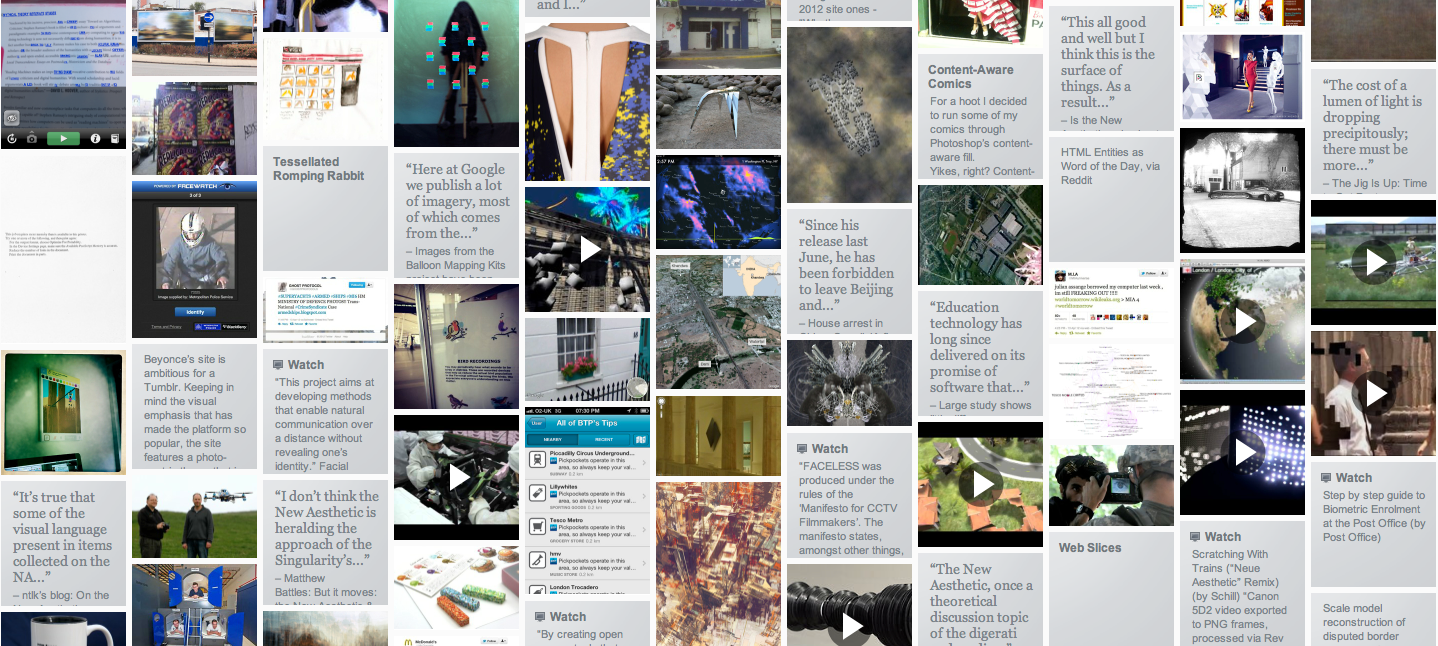
The post digitally curated a series of images – a sort of wunder-camera (hah!) – and soon afterwards James’s first post appeared on tumblr as The New Aesthetic.  The site grew and grew, though not quite like Topsy, and this is is how he now explains his experimental project:

Since May 2011 I have been collecting material which points towards new ways of seeing the world, an echo of the society, technology, politics and people that co-produce them.  The New Aesthetic is not a movement, it is not a thing which can be done. It is a series of artefacts of the heterogeneous network, which recognises differences, the gaps in our overlapping but distant realities.

Bruce Sterling described James as ‘a Walter Benjamin critic in an “age of digital accumulation”’ carrying out ‘a valiant cut-and-paste campaign that looks sorta like traditional criticism, but is actually blogging and tumblring.’  His site is well worth a visit, not least to wander through the back catalogue of objets trouvés (or vues):

I say ‘objet’ deliberately: for Graham Harman fans, and even for those who aren’t, there are some remarkably interesting discussions that link the New Aesthetic to object-oriented ontology: see Ian Bogost, ‘The New Aesthetic needs to get weirder‘ (not as weird as the cutesy title suggests), Robert Jackson, ‘The banality of the new aesthetic‘ (a really helpful essay for other reasons too) and Greg Borenstein, ‘What it’s like to be a 21st century thing‘ (scroll down – much more there too).

I started to follow the blog while I was working on a contribution to a conference on the Arab Uprisings [‘the Arab Spring’] held in Lund earlier this year: I’d been puzzled at the polarizing debate about whether (in the case of Tahrir Square in Cairo which most interested me, but much more generally too) whether this was ‘a Twitter revolution’ or whether it depended on what Judith Butler called (in a vitally important essay on the politics of the street to which I’ll return in a later post) ‘Bodies in Alliance‘.  It seemed clear to me – and to her, as I discovered in a series of wonderfully helpful conversations when she visited Vancouver for the Wall Exchange in May) – that this was a false choice: that the activation of a digital public sphere was important, but so too, obviously, was the animation of a public space, and that the two were intimately – virtually and viscerally – entangled.

Here (in part) is what I wrote:

Writing from Cairo in March 2011, Brian Edwards recalled that when the Internet was blocked ‘the sense of being cut off from their sources of information led many back out on to the street, and especially to Tahrir.  With the Internet down, several told me, there was nowhere else to go but outdoors.’  The reverse was also true.  ‘The irony of the curfew is that it might succeed in getting people off the streets and out of downtown, but in doing so it delivers them back to the Internet… Many of my friends are on Facebook through the night, as are those I follow on Twitter, a steady stream of tweets and links.  Active public discussions and debates about the meanings of what is taking place during the day carry on in cyberspace long after curfew.’  

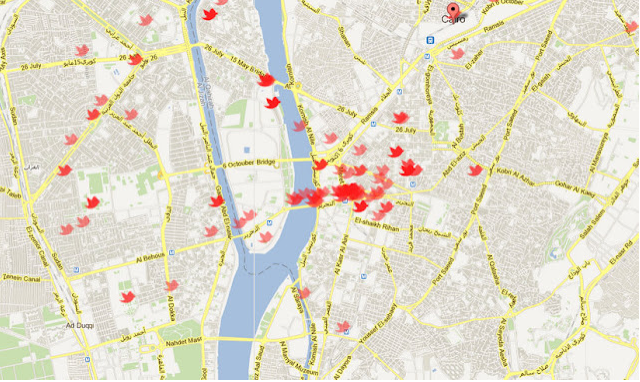
In the same essay Edwards reflects on the compression of meaning imposed by the 140-character limit of each tweet, and he suggests that the immediacy and urgency that this form implies – even imposes – ‘calls forth an immediate, almost unmediated response, point, counterpoint and so on.’This is a persuasive suggestion, I think, but that response is surely to be found not only virtually (from tweets in cyberspace) but also viscerally (from bodies in the streets).  When we see maps … showing tweets in Cairo, we need to recognize that that these are not merely symbols in cartographic space or even messages in cyberspace: they are also markers of a corporeal presence.

This matters because the urban space where ‘newness’ might enter the world does not pre-exist its performance.  Some writers examine what, following Henri Lefebvre and David Harvey, we might call the production of space, which would include the construction and re-development of Tahrir Square.  Others, also following in some part Lefebvre, prefer to emphasize spatial practices, which would include the rhythms and routines that compose everyday life for a myriad of people in Cairo.  But to emphasize the performance of space is to focus on the ways in which, as Judith Butler put it in direct reference to Tahrir Square, ‘the collective actions [of the crowd] collect the space itself, gather the pavement, and animate and organize the architecture.’  

So I started to wonder about the politics of the New Aesthetic – especially when I returned from Lund to resume my work on the techno-cultural gaze that has been my preoccupation for even longer: the surveillance platforms of remotely piloted aircraft (and killing machines) like the Predator and the Reaper.  (For a time the New Aesthetic was associated with the image of a pixellated Predator supported by balloons, ‘a bright cluster … tied to some huge, dark and lethal weight’, as Sterling put it).
And now I’ve found a revealing essay by Will Wiles on the New Aesthetic, ‘The machine gaze’, at aeon (from which I’ve also taken Sterling’s remark).  He begins with a remark that took me right back to Tahrir (though in fact he’s talking about digital media labs in east London): ‘It’s in these streets that the boundary between the digital and the physical is at its most porous — in the devices and the minds of a far-seeing local population who are among the first to understand that there might not be a boundary at all.’
So to the money question: ‘As the boundaries between digital and physical dissolve, can the New Aesthetic help us see things more clearly?’  Here is part of Wiles’s answer:

The virtual world is being integrated with the physical world and this seamlessness is presented as inherently good. No harm may be intended: it’s natural for a designer to want to smooth away the edges and conceal the joins. But in making these connections invisible and silent, the status quo is hard-wired into place, consent is bypassed and alternatives are deleted. This is, if you will, the New Anaesthetic. Instances of the New Aesthetic are often places where a glitch has exposed the underlying structure — the hardware and software. Or it is an oddity that has the unintended side effect of causing us to consider that structure. Part of a plane appearing in Google Maps makes us realise that we are looking at a mosaic of images taken by cameras far above us. We knew that already, right? Maybe we did. But a reminder may still be salutary.

This is political. The New Aesthetic was accused of being apolitical — fascinated by the oddities and wonders being thrown up by drones and surveillance cameras without thinking about the politics behind them. This is plain wrong: politics seeps from nearly every pore of the New Aesthetic. It was often hard to see, but that’s what Bridle wanted to expose.

The question is one of viewpoint. ‘As soon as you get CCTV, drones, satellite views and maps and all that kind of stuff,’ Bridle said, ‘you’re setting up an inherent inequality in how things are seen, and between the position of the viewer and the viewed. There are inherent power relations in that and technology makes them invisible. When you have a man in a watchtower, you look up at him, and that’s an obvious vision of power. When the man is in a bunker far away and you have just a little camera on a stalk … most people seem to be fine with that.’

The New Aesthetic is about seeing, then. And to see and be seen is to engage in those power relations.

More to come – watch this space….

Patches, the Pentagon and Pakistan

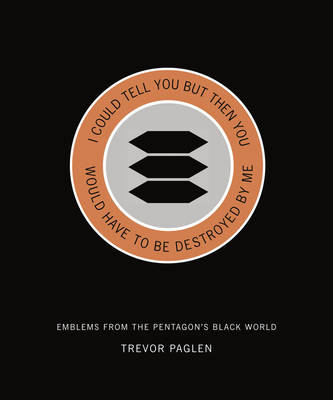
In 2010 artist-geographer-writer (and an old friend) Trevor Paglen published a collection of unofficial US military patches that showed the fraying fringes of the Pentagon’s secret operations: I could tell you but then you would have to be destroyed by me: emblems from the Pentagon’s Black World (Melville House, 2010).

As Steven Heller wrote in the New York Times,  ‘issuing patches for a covert operation sounds like a joke . . . but truth be told, these days everything is branded. Military symbols are frequently replete with heraldic imagery — some rooted in history, others based on contemporary popular arts that feature comic characters — but these enigmatic dark-op images, in some cases probably designed by the participants themselves, are more personal, and also more disturbing, than most.’

Danger Room posted several selections from Trevor’s collection here (and follow the links back for eight – yes eight – more) and here; there are also more here from MilSpecMonkey

Trevor’s wryly serious research has resurfaced twice this week.  Lowen Liu at Slate tried to unpick the stitches from one patch, from the agency that designs, builds and operates America’s intelligence satellites, the National Reconnaissance Office (“Vigilance from Above”), to investigate its use of an anagram from the movie Sneakers – “Setec Astronomy” (Too Many Secrets).  Trevor drew his attention to a 2008 memo from NRO:

Recently, two journalists compiled an article mentioning how symbols used in unclassified logos and patches can reveal information about National Reconnaissance Office (NRO) satellite identities and missions that are otherwise classified. … All briefed personnel are reminded … [of] the grave responsibility of protecting that information from improper and unauthorized disclosure and compromise. Failure to comply with these obligations can result in irreparable harm to the nation.

Liu was left wondering whether Sneakers took “Setec Astronomy” from the NRO… Who knows?

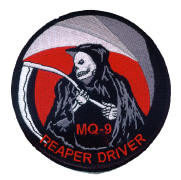
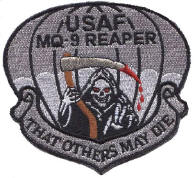
You might also shrug your shoulders and think “Who cares?”, except that those patches can indeed disclose information about the projects they simultaneously conceal and reveal.  And this week Chris Cole at Drone Wars UK published a selection of patches worn by USAF and RAF drone pilots. Described as “morale patches“, designed to raise the morale of the units they represent, most of these don’t tell us anything we didn’t already know about their remote operations – the casual way they turn killing into a cartoon is remarkable, but it’s there in the names of the aircraft they fly:

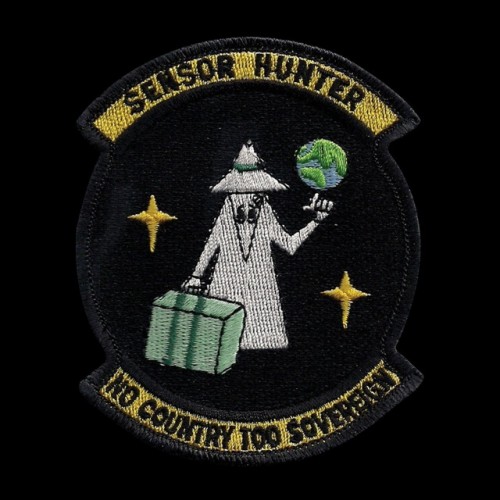
And Trevor has one other that speaks more directly to American drone operations in Pakistan and beyond than anything else I’ve seen:

Bodies and bombs

Paul Rogers draws some parallels between what he calls ‘drone bombing’ and suicide bombing at Open Democracy.

Suicide-bombing allows explosives to be placed at or very close to a target, with the deliverer having considerable real-time initiative and scope for concealment. He or she can adapt to circumstances in matters of timing as well as any movement of and even the precise location of the target. Countermeasures such as blast-walls and surveillance systems can be circumvented or fooled…. 

The similarity with armed-drones is striking. Drones such as the Reaper have multiple air-to-surface missiles, can loiter for hours and are “flown” in real time by operators thousands of miles away. There is no risk to these people, no suicide factor. Drones may not have quite the precision potential of a suicide-bomber, and in the very final seconds before impact the missiles that are fired cannot be diverted or halted.’

But in essence, Paul argues, there is no difference between them: ‘drone bombing’ is ‘suicide bombing without the suicide’.

And life (or in this case death) imitates art: this week Spencer Ackerman at Danger Room reported that the US Army is soliciting bids to develop ‘a tiny suicidal drone to kill from six miles away’.  It’s a good tag line, but the story is really about the fusion of miniaturised drone and missile in a ‘Lethal Miniature Aerial Munitions System’.

I suspect that one of the imaginative devices that enables publics in the global North to accept their own militaries bombing from the air – apart from a profound lack of imagination – turns on the body itself.   In one direction, they congratulate themselves that suicide bombing is foreign to their traditions of war in part, I think, because it allows no escape from the corporeality of bombing: the body of the bomber carries the bomb.  In the other direction, they congratulate themselves on their restraint: after Hiroshima and Nagasaki they have not resorted to nuclear bombs that, at the limit, vaporize bodies (though they also leave countless other bodies broken and disfigured from the blast or sick from radiation). (In his meditation On Suicide bombing Talal Asad is very instructive on the horror generated by ‘the dissolution of the human body’ (see pp. 76-92)).

The space in between the two is occupied by conventional bombing from the air, and the production/performance of this space involves what Asad calls ‘a redefinition’ – even a re-calibration – ‘of the space of violence’.  Here – precisely because of the imaginative distance between the bomber and the bombed, which in some respects was even greater for Bomber Command aircrew over Hamburg and USAAF aircrew over Vietnam than it is for remote pilots in Nevada – it becomes possible to conceive of an air strike in purely abstract terms (which is why calibration assumes such significance): a ‘surgical’ attack on a nominated  ‘target’.  There are remarkable continuities between conventional bombing and the use of remotely-piloted aircraft, as I’ve tried to show in detail in Lines of descent (see DOWNLOADS tab), and part of my Killing Space project focuses on the ways in which mainstream British and American media coverage of the combined bomber offensive against Germany in WWII, the US air wars over Indochina, and the current drone wars over Afghanistan, Pakistan and elsewhere consistently removes the bodies of the bombed from public view.

And yet this may also reinforce Paul’s particular parallel.  If the corporeality of suicide bombing is inescapable for those who carry it out, so too (in a different sense) for those remote pilots in the continental United States.  They routinely insist that they are not thousands of miles away from their ‘target’ but eighteen inches: the distance from eye to screen.  And they are required to remain on station after a strike and, through their surveillance cameras, carry out what in previous wars would also have been called ‘bomb damage assessment’ but which, in the case of a targeted killing, involves a hideous inventory of body parts.

Fifty shades of grey: drones and the theatre of secrecy

Over the weekend I worked my way through New Inquiry‘s special issue, Game of drones – Pete Adey‘s recommendation.  For me, the stand-out essay is Madiha Tahir‘s “Louder than bombs”

A graduate of Barnard College, NYU and the Columbia School of Journalism, Madiha is currently an independent multimedia/print journalist reporting on conflict, culture and politics in Pakistan; somehow she has also found the time to co-edit Dispatches from Pakistan (LeftWord Books, 2012) with the indefatigable Vijay Prashad and Qalander Bux Memom: more about Madiha here.

“Louder than bombs” begins with harrowing and matter-of-fact (all the more harrowing because matter-of-fact) testimony from Sadaullah Wazir, a teenage boy who lost both his legs and an eye after a US drone attack in North Waziristan in Pakistan’s Federally Administered Tribal Areas; he was just 13, and three other members of his family were killed in the attack.

Madiha’s root objection is to the way in which what she calls the Obama administration’s ‘theatrical performance of faux secrecy’ over its drone war in the FATA (and elsewhere) – a repugnantly teasing dance in which the veil of secrecy is let slip once, twice, three times – functions to draw its audience’s entranced eye towards the American body politic and away from the Pakistani bodies on the ground.  The story is always in Washington and never in Waziristan.  It’s a hideously effective sideshow, in which Obama and an army of barkers and hucksters – unnamed spokesmen ‘speaking on condition of anonymity’ because they are ‘not authorised to speak on the record’,  and front-of-house spielers like Harold Koh and John Brennan – induce not only a faux secrecy but its obverse, a faux intimacy in which public debate is focused on transparency and accountability as the only ‘games’ worth playing.

But when you ask people like Sadaullah what they want, Madiha writes,

‘they do not say “transparency and accountability”.  They say they want the killing to stop. They want to stop dying.  They want to stop going to funerals – and being bombed even as they mourn.  Transparency and accountability, for them, are abstract problems that have little to do with the concrete fact of regular, systematic death.’

So we have  analysts, activists and reporters falling over themselves to determine whether targeted killings outside a war zone like Afghanistan are legal; fighting to disclose the protocols that are followed to provide legal scrutiny of the targeting process; finally reassuring us, in a peculiarly American Story of O, that Obama is fully sensible of the enormous weight that rests on his shoulders.  But all of this distracts our collective gaze from the enormous weight that has been brought to bear on Sadaullah’s shiny new prostheses.  “I had a dream to be a doctor,” he tells a reporter. “Now I can’t even walk to school.”

Any discussion of the ways in which the kill-chain has been ‘lawyered up’ needs to acknowledge that – as the very formulation implies – the law is not apart from military violence: it has become part of military violence.  In Foucault’s ringing phrase, ‘the law was born in burning towns and ravaged fields’, and in the intervening centuries it has become ever more closely entwined with military (and paramilitary) violence.   Legality now substitutes for legitimacy, silencing any questions about politics or ethics.  As Madiha says, speaking of the calibration between the deaths of militants and the deaths of civilians, it is as though ‘if we could just get the calculus right, there would be no further ethical or political questions’.  Similarly, referring to the computer programs used by the US military (and seemingly, the CIA) to predict collateral damage, and so to adjudicate between the legal principles of necessity and proportionality,  Eyal Weizman notes that ‘it is the very act of calculation – the very fact that calculation took place – that justifies their action.’   But this is never a neutral appeal to algorithms or attorneys: not for nothing do those involved refer to the ‘prosecution’ of the target,  and as Anne Orford emphasises, the relevant body of international law ‘immerses its addressees in a world of military calculations’ and ensures that proportionality will always be weighed on the military’s (or the CIA’s) own scales.  In Weizman’s words, ‘violence legislates.’

Madiha again:

Even as we debate the legal machinations, official leaks and governmental manipulations by which they are killed, the daily, material, precarious existence of the people living under the disquieting hum of american drones in Pakistan’s tribal areas rarely sits at the center of discussion.

But what if it did? if, instead of the public secret, one begins with a prosthetic limb, a glass eye, and a funeral photo, the nightmare takes form, solidifies. 

None of this means that the law does not matter; its matter-iality ought to be obvious.  But it is to say that we need to be alert to what appeals to ‘the law’ do – and what they seek to foreclose. Legal questions do matter – but their answers must not be allowed to silence other political and ethical questions.  Neither should they close our eyes to the contrapuntal geographies that are staged far beyond the peep-shows of the Washington beltway.

*****

Note: For more on drone wars, see Remote witnessing and, in detail, ‘From a view to a kill’ and ‘Lines of descent’ (DOWNLOADS tab).  I’ve also provided a preliminary reading/screening list that notes some of the same emphases and omissions that trouble Madiha here.

‘The terrain as medium of violence’

News from my friend and colleague Gaston Gordillo about his proposed paper for the Violence and Space sessions at the Annual Meeting of the Association of American Geographers in Los Angeles next year.  An extract from the abstract (!) for The Terrain as Medium of Violence:

In this paper, I draw from [Eyal] Weizman and also from Paul Virilio’s work on violence and vision and Derek Gregory’s research on aerial bombing and drones to examine a key principle of a theory of the terrain: the decisive importance of verticality in the deployment of state violence as a three-dimensional vector. The history of aerial bombing and the recent rise in the use of drones reveal that the control of the skies and the atmosphere —and the speed and global reach their spatial smoothness allows for— has become fundamental to imperial power.
Yet the politics of verticality pose spatial paradoxes that can only be appreciated through the actual, tangible material-political terrains in which it operates. Contra the image of absolute deterritorialization it tends to evoke, the verticality created by drones is always-already subsumed to a spatial principle as old as warfare: that the ultimate aim of controlling a higher ground through towers, mountaintops, or the sky is to create a view from above to visualize, localize, and inflict violence upon targets located primarily on the ground. In short, drones patrol the skies not to control high altitudes per se but in order to control an opaque terrain below that limits the state field of vision. And despite their capacity for unleashing massive levels of destruction, drones reveal something else about the terrains of Afghanistan, Pakistan, or Yemen endlessly scanned by their cameras: that imperial ground forces do not control those spaces. This political voiding of imperial space by local insurgencies is made possible by another ancient principle of guerrilla warfare: the fact that the mastery of heavily striated terrain (mountains, forests, urban spaces) by flexible and mobile forces allows them to avoid visual capture by the state and, in the long run, wear down and defeat more powerful militaries. The verticality generated by drones, in short, reveals not only the vast spatial reach of imperial violence but also the profound spatial limits it encounters amid the political and material striations of the global terrain.
More at Gaston’s Space and Politics blog here, with links to his other postings on these ideas and news of his book project, The After-Life of Places: Ruins and the Destruction of Space, forthcoming from Duke.  He promises more to come!
The Violence and Space sessions will evidently be very lively: Stuart Elden has also published his abstract, “Urban Territory: Violent Political Technologies in London and Kano”, on his Progressive Geographies blog here.
Horizontal notes on the vertical: I expect most readers will know of Eyal’s work on the politics of verticality, most obviously through his book Hollow Land: Israel’s architecture of occupation (2007 – paperback out this year), and Stuart has become interested in similar issues: see the video of his Secure the Volume: vertical geopolitics and the depth of power here.  Steve Graham has also called for a ‘vertical turn in urban social science‘: you can listen to it here, and read his essay with Lucy Hewitt, “Getting off the ground: on the politics of urban verticality”, in Progress in human geography (Online First: 25 April 2012) doi:10.1177/0309132512443147.  Enough to make you giddy.

Remote Witnessing

In an astonishing essay on ‘Drone bombings in the Federally Administered Tribal Areas’, published in the Journal of Geographical Information Systems 4 (2012) 136-141 – the places this blog is taking me! – Katrina Laygo, Thomas Gillespie, Noel Rayo and Erin Garcia (three geographers and a political scientist at UCLA) explore what they call ‘public remote sensing applications for security monitoring’.

An open-access version should be available here but there is also a manuscript version here.  (In fact news of the project appeared in the press soon after the US raid on Osama Bin Laden’s compound last year – Gillespie and John Agnew headed a team that had used satellite imagery and the theory of island biogeography (sic) to predict the location of bin Laden’s hideout in 2009 – but much of the media interest in the new work focused on the image captured by satellite of a Predator circling above an area south west of Miram Shah.)

The new project uses unclassified high-resolution imagery from QuickBird 2 (via GeoEye) to monitor drone strikes in Pakistan’s Federally Administered Tribal Areas (FATA).  The difficulties (and dangers) of eyewitness reports are well-known, and media coverage of drone strikes in the area is at best uneven – though the Bureau of Investigative Journalism, along with organizations like CIVIC and Reprieve, continue to do brave, invaluable, eye-popping work – but the UCLA team concludes that, in principle, the commercial availability of the satellite imagery means that  ‘it is possible for the public’ – a distant public – ‘to monitor drone bombings in the [FATA]’.

You can see where they might be going.  In the weeks preceding the US-led invasion of Afghanistan the Pentagon secured exclusive rights to commercial imagery from the Ikonos-2 satellite.  They didn’t need it for operational purposes; the objective was to exercise ‘shutter control’ and prevent media and other organizations from obtaining imagery that might reveal casualties from the high-level bombing campaign. It wasn’t cheap; the standard cost was around $200 per square kilometre, with a premium for rapid turnaround, and news media had been paying $500 for each image.  It’s still not cheap.  The authors of this (I presume preliminary) report concede that ‘it may be prohibitively expensive to monitor the entire region’.  They estimate that weekly data for one year’s coverage of a town like Miram Shah would cost $64,000, though this would not be beyond the reach of some organizations.

But their own test-case is not encouraging.  Working from a map of drone strikes and casualties constructed by the Center for American Progress – they don’t say why they selected this source – the team searched the satellite image for evidence of any of the 16 drone strikes around Miram Shah before 1 January 2010 included in the database.  This is what they say:

 ‘We feel confident that we were able to identify the location of one drone bombing in Figure 4(b). If the center of the compound is the target, it would appear that the drone bombing is accurate. This also suggests that the blast radius of such attacks is relatively small or less than 20 m. Indeed, the walls still appear to remain intact. This appears similar to blast radii reported for hellfire missiles which are used by both the Predator and Reaper drones.’

The claim is not only repeated but generalized in the abstract: ‘Results suggest that drone bombings are very accurate and drone missions are common in the region.’

They suggest no such thing; drone strikes are most certainly common, but the claim about their accuracy is based on a single case for which nothing is known of the intended target or the basis for its identification – was this yet another wedding party?  Neither can anything be said about civilian casualties; they don’t key this site back into their casualty database, such as it is, and in any case they note that ‘The resolution of QuickBird 2 is currently not high enough to see or quantify casualties.’  Not exactly forensic architecture then.

Not surprisingly, though, the conclusion chimes with the Center for American Progress’s own endorsement of the campaign:

Hardly a week goes by without some key figure in the Al Qaeda network and its affiliates being targeted in a range of actions, including drone strikes as well as other actions by U.S. intelligence and law enforcement agencies to prevent attacks and degrade the Al Qaeda network. The damage done to Al Qaeda by the Obama administration represents America’s greatest national security success since the fall of the Soviet Union and the peaceful integration of Eastern European countries in the 1990s.

The importance of all this goes beyond the particular case.  Susan Sontag once famously declared that ‘Being a spectator of calamities taking place in another country is a quintessentially modern experience.’  It’s a more complicated (and contentious) claim than it looks, but in any event being a spectator is not the same as being a witness.  And we surely know – or ought to know – from Lisa Parkss wonderful work that satellite and other remote technologies do not provide an unmediated window on the world. I’m thinking particularly of her ‘Satellite view of Srebrenica: tele-visuality and the politics of witnessing’ in Social identities 7 (4) (2001), and ‘Digging into Google Earth: an analysis of “Crisis in Darfur”‘ in Geoforum 40 (4) (2009), but you can get a sense of her work from the press report of her 2010 lecture to the New Zealand Geographical Society here.  She also has a new book out late this year/early next from Routledge, Coverage: media spaces and security after 9/11.

Now the use of satellite technology to conduct ‘remote witnessing’ is not alien to human rights organizations, but most of them are well aware of its problems as well as its potential.  Amnesty International sponsored the Science for Human Rights Project (originally Satellites for Human Rights) from January 2008 to January 2011:

Its primary purpose was to test the potential use of geospatial technologies for human rights impact. The purpose of the evaluation is to assess the extent to which work undertaken by Amnesty International contributed to change (intended and unintended) and to assess the potential for using geospatial technologies to contribute towards more effective advocacy and impact.

There have been a series of public examples.  Some of them have been conducted under other banners, like the celebrity Satellite Sentinel Project on Sudan.

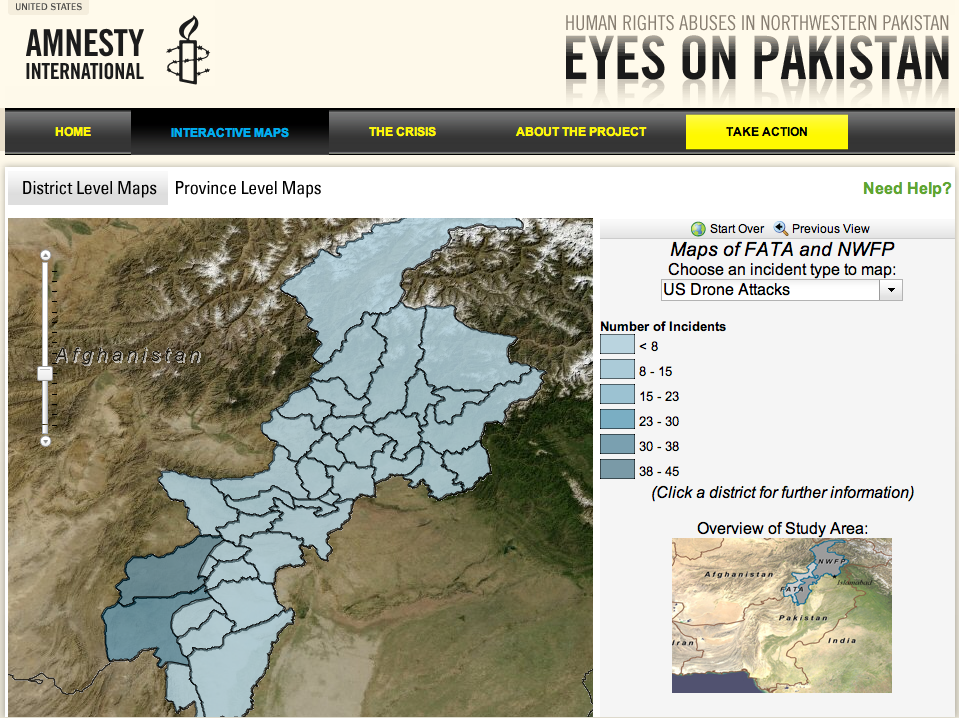
But the most directly relevant to this post is probably Amnesty’s (now terminated) Eyes on Pakistan archived here.  Although this involved interactive mapping platforms rather than the use of satellite imagery the project title gives a clear indication of the direction in which Amnesty was moving and the wider debate about witnessing of which it was a part.

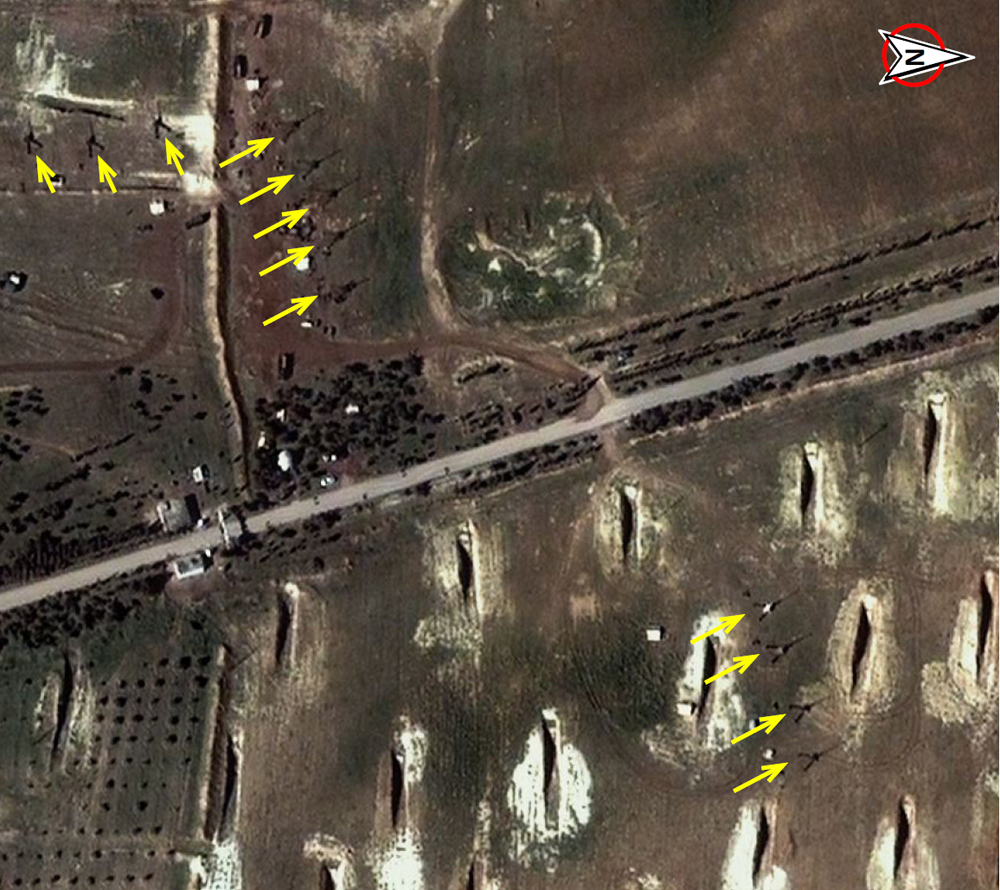
Amnesty has also launched Eyes on Darfur (here too the imagery is no longer being updated) and now Eyes on Syria.  This does involve remote imagery, and there is an interesting discussion on Amnesty USA’s blog about its significance:

The images from Homs and Hama show clearly that armed forces have not been removed from residential areas, as demanded by the U.N. General Assembly resolution from mid February. In Hama, the images reveal an increase in military equipment over the last weeks, raising the specter of an impending assault on the city where the father of current President Bashar al-Assad unleashed a bloody 27-day assault three decades ago, with as many as 25,000 people killed.

With reports of a ground assault underway in Homs, the analysis of imagery identifies military equipment and checkpoints throughout Homs, and field guns and mortars actively deployed and pointing at Homs [see image left]. Additionally, the images show the shelling of residential areas in Homs, concentrated on the Bab ‘Amr neighborhood. Artillery impact craters are visible in large sections of Bab ‘Amr, from where we have received the names of hundreds killed throughout the period of intense shelling.

Note that last clause: to convert remote sensing into remote witnessing requires difficult, painstaking work in multiple registers because the imagery does not speak for itself.  To believe otherwise means that anyone who ventriloquises from imagery alone – academics screening imagery in California or CIA/USAF analysts scrutinising near real-time feeds from drones – runs the real risk of seeing what they are predisposed to see.  As that same blog post notes,

Satellite images can help to show the widespread and systematic nature of violations, characteristics inherent to certain international crimes such as crimes against humanity. Additionally, they can help in identifying command responsibility, a key requirement for holding individual perpetrators accountable. [Ivan] Simonovic [Assistant Secretary-General for Human Rights] pointed out that the UN Panel on Sri Lanka relied a lot on satellite images. The same holds true for the current commission of inquiry on Syria, which equally relies on satellite images. Thus, the point is that while satellite images barely deliver the “smoking gun” that leads to a conviction, they can provide major support for international investigations and accountability mechanisms.

And this brings me back to drones.  Writing in the New York Times on 30 January 2012 Andrew Sniderman and Mark Hanis proposed re-purposing drones ‘for human rights’:

DRONES are not just for firing missiles in Pakistan. In Iraq, the State Department is using them to watch for threats to Americans. It’s time we used the revolution in military affairs to serve human rights advocacy. With drones, we could take clear pictures and videos of human rights abuses, and we could start with Syria. The need there is even more urgent now, because the Arab League’s observers suspended operations last week. They fled the very violence they were trying to monitor. Drones could replace them, and could even go to some places the observers, who were escorted and restricted by the government, could not see. This we know: the Syrian government isn’t just fighting rebels, as it claims; it is shooting unarmed protesters, and has been doing so for months. Despite a ban on news media, much of the violence is being caught on camera by ubiquitous cellphones. The footage is shaky and the images grainy, but still they make us YouTube witnesses. Imagine if we could watch in high definition with a bird’s-eye view. A drone would let us count demonstrators, gun barrels and pools of blood. And the evidence could be broadcast for a global audience, including diplomats at the United Nations and prosecutors at the International Criminal Court.

This produced a series of responses:  Lauren Jenkins was appalled, Daniel Solomon sceptical, and Patrick Meier sympathetic.  The most scathing response was from anthropologist Darryl Li in Middle East Report, which provoked a heated exchange between him and Sniderman.  I see all this as part of a diffuse (and I think largely uncoordinated) campaign to rehabilitate drones in the public eye, something I’ll be writing about in a future column for open Democracy.  But whatever you make of it, and wherever your sympathies lie, the debate about ‘humanitarian drones’ clearly underscores the necessity of seeing visual technologies as political-cultural technologies enrolled in highly particular scopic regimes.

In short – and to return to where I started – remote witnessing is not a passive practice but an intervention in a field of power and as such it involves a series of investments that spiral far beyond the cost of obtaining the imagery.


‘Double tap’

Glenn Greenwald – who’s moved from Salon.com to become the Guardian‘s columnist on civil liberties and US national security  – describes the vicious twist given to ‘rapid response‘ in US military and paramilitary operations in Iraq and Pakistan:

The US government has long maintained, reasonably enough, that a defining tactic of terrorism is to launch a follow-up attack aimed at those who go to the scene of the original attack to rescue the wounded and remove the dead. Morally, such methods have also been widely condemned by the west as a hallmark of savagery. Yet, as was demonstrated yet again this weekend in Pakistan, this has become one of the favorite tactics of the very same US government….

[A]ttacking rescuers (and arguably worse, bombing funerals of America’s drone victims) is now a tactic routinely used by the US in Pakistan. In February, the Bureau of Investigative Journalism documented that “the CIA’s drone campaign in Pakistan has killed dozens of civilians who had gone to help rescue victims or were attending funerals.”  Specifically: “at least 50 civilians were killed in follow-up strikes when they had gone to help victims.” That initial TBIJ report detailed numerous civilians killed by such follow-up strikes on rescuers, and established precisely the terror effect which the US government has long warned are sown by such attacks: “Yusufzai, who reported on the attack, says those killed in the follow-up strike ‘were trying to pull out the bodies, to help clear the rubble, and take people to hospital.’ The impact of drone attacks on rescuers has been to scare people off, he says: ‘They’ve learnt that something will happen. No one wants to go close to these damaged building anymore.'”

And, as Greenwald notes, the tactic – which the Department of Homeland Security called “double tap” when it condemned Hamas for using it –  intimidates not only rescuers but also journalists…

More on the Bureau of Investigative Journalism‘s report from Democracy Now here.  At the time [February 2012] Chris Woods suggested that there were indications of a change in policy and practice:

‘…the attacks on rescuers and mourners that we note, they’ve all occurred under the Obama administration between 2009 and July 2011. I think that date is quite interesting, because that’s also when Leon Panetta stepped down as head of CIA. You have an interim CIA leader, and then David Petraeus comes in. We haven’t had any reports from Pakistan since July of last year of attacks on rescuers. So there’s an indication of a policy change, and there’s also an indication of a targeting change on the ground.’

But Greenwald notes a series of later reports showing that the dismal practice had resumed by the fall.