Art and atrocity

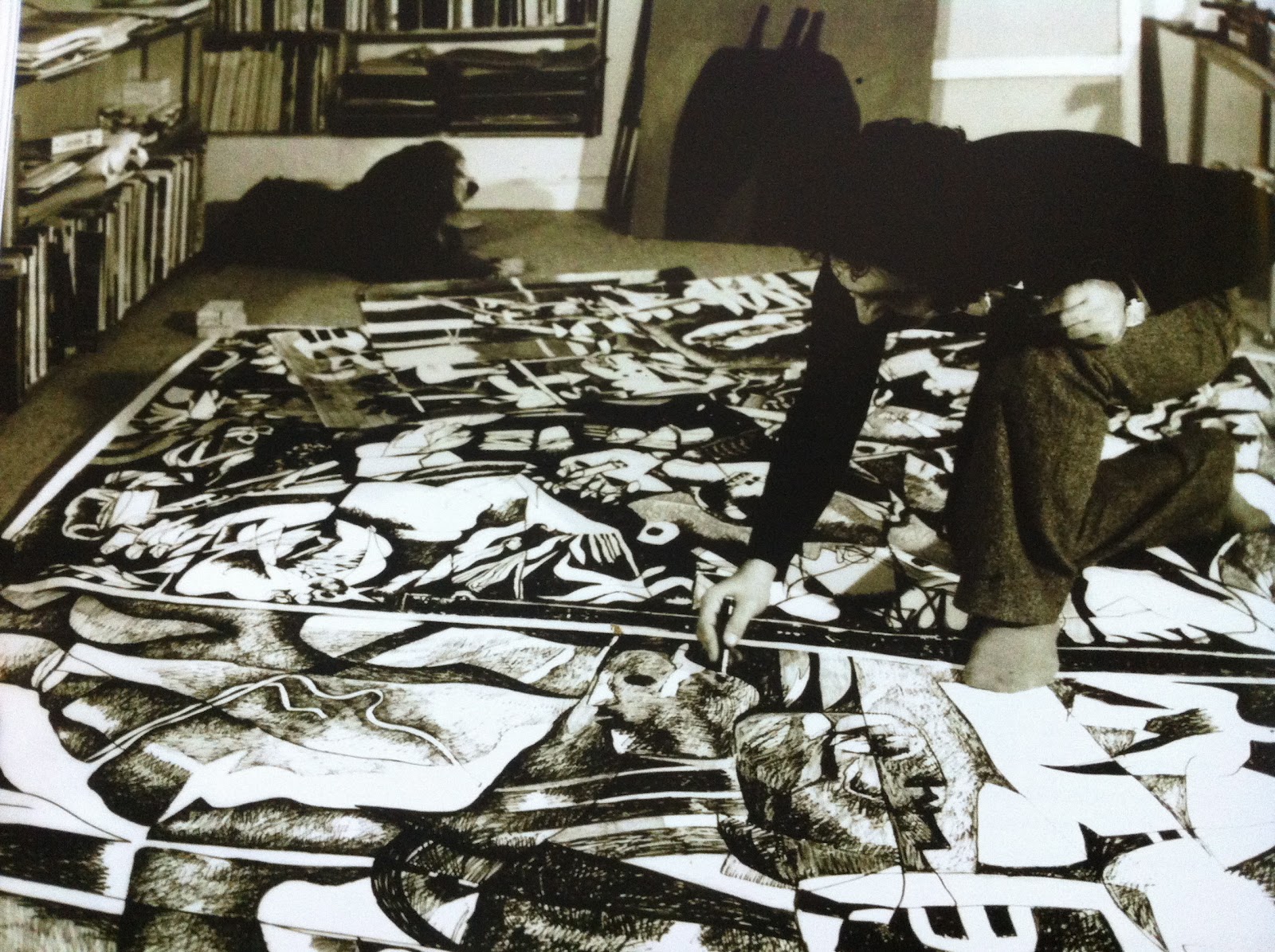
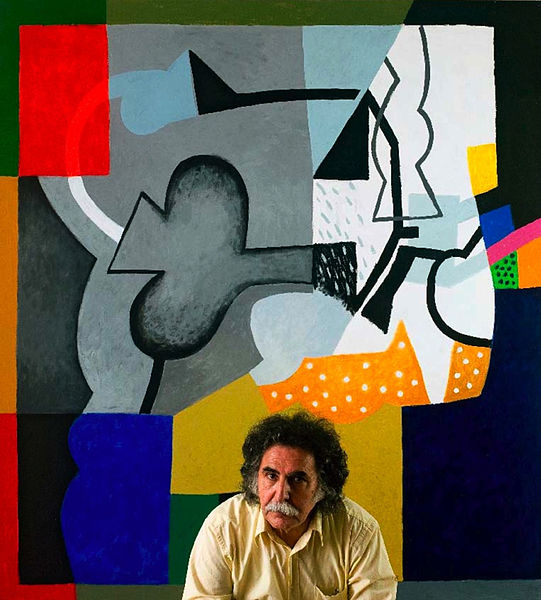
Since I read it yesterday I’ve been mesmerized by Maymanah Farwat‘s fine short essay at Jadaliyya on Baghdad-born artist Dia al-Azzawi‘s (pictured left) Sabra and Shatila Massacre currently on view at Tate Modern in London.

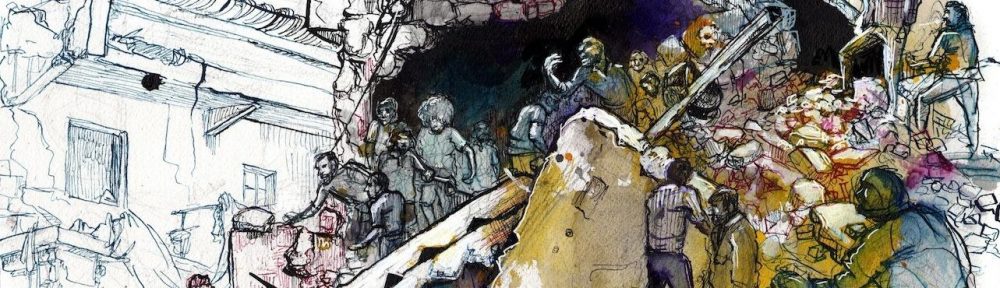
The artwork itself is copyright, and the Tate online pages describe but don’t display it, but if you click on the link to Jadaliyya above you can see it; it’s also – vividly – here, and there’s also a detail here and more here. The vast four-panelled work is a response to the massacre of Palestinians in two refugee camps in Lebanon in 1982 by Phalangist militias under the eyes of the Israeli Defense Force commanded by Ariel Sharon.

Within a labyrinth of death and the mundane (the remnants of domestic structures), the artist is relentless in his indictment, what he refers to as “a manifesto of dismay and anger.” Areas of white, where the eye would normally rest in a monochromatic composition, ignite horror, become corpses. Instances of Cubism are employed not to convey the dynamic movement of form but as a system of measure through which to count out cyclical disaster.

The artist started work on the project the day after the killings:

‘I had at that time a roll of paper and, without any preparatory sketches, the idea for the work came to me. I tried to visualize my previous experience of walking through this camp, with its small rooms separated by a narrow road, in the early 1970s.

But this vast composition is more than a memory work: Dia al-Azzawi was also inspired by Jean Genet‘s Quatre heures à Chatila (‘Four Hours in Shatila’) (available in the Journal of Palestine Studies 12 (3) (1983) 3-22).  As Ahdaf Soueif tells the story:

‘[Genet] was, it seems, one of the first foreigners to enter the Palestinian refugee camp of Shatila after the Christian Lebanese Phalange, with the compliance of the Israeli command, tortured and murdered hundreds of its inhabitants. There, pushing open doors wedged shut by dead bodies, Genet memorised the features, the position, the clothing, the wounds of each corpse till three soldiers from the Lebanese army drove him at gun point to their officer: “‘Have you just been there?’ [the officer] pointed to Shatila. ‘Yes.’ – ‘And did you see?’ — ‘Yes.’ — ‘Are you going to write about it?’ — ‘Yes.'”

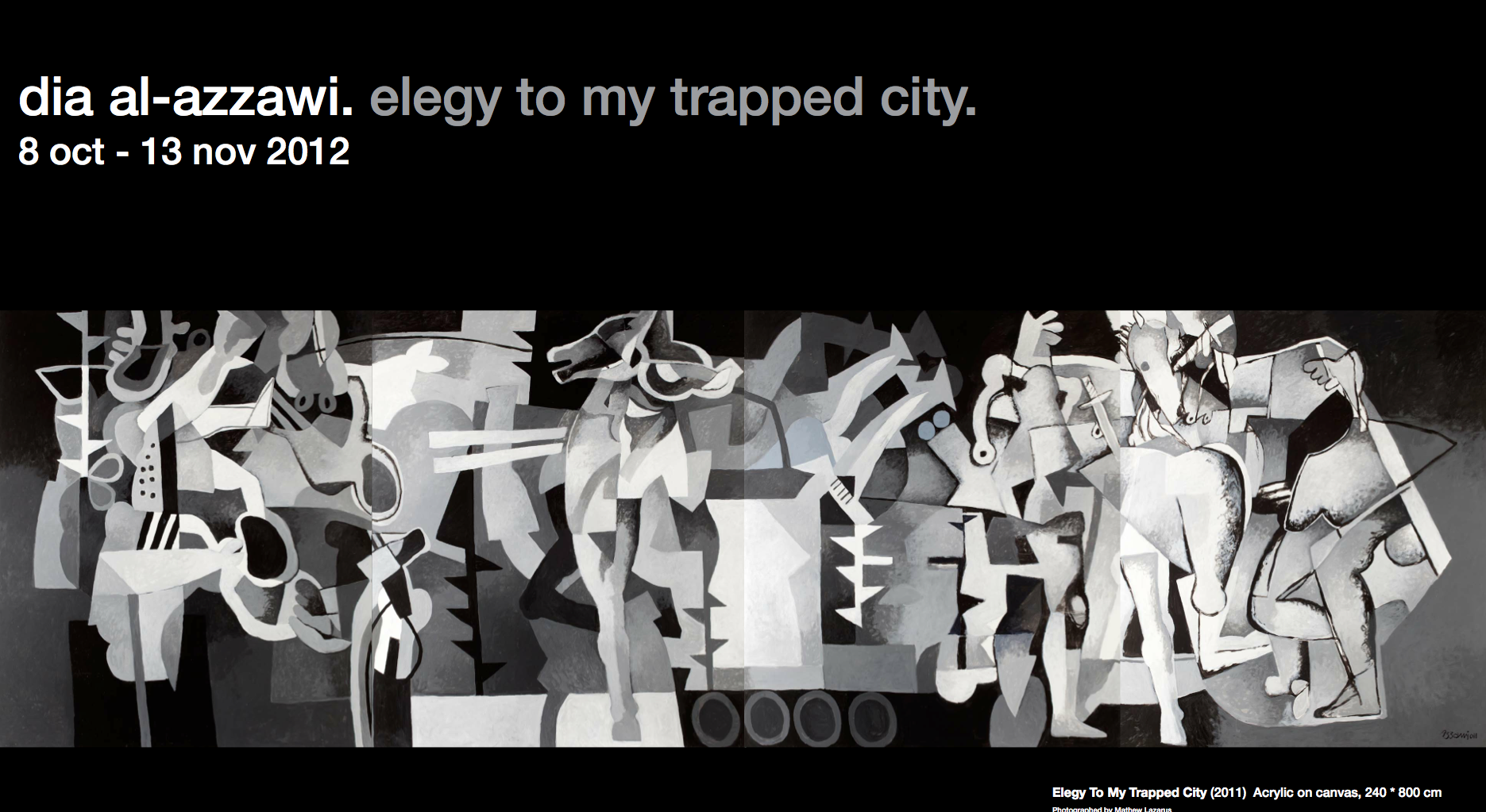
Sabra and Shatila Massacre retains that extraordinary, forensic attention to detail – to the wretched remnants of the ordinary – and it’s often compared to another, equally epic rendering of horror, Picasso‘s giant Guernica. (You can also see the parallels, I think, in the same artist’s Elegy to my trapped city (2011) below).
There’s more on the to-and-fro between the textual and the visual in relation to Sabra and Shatila in  Zahra A. Hussein Ali, ‘Aesthetics of memorialization’, Criticism 51 (2010) 589-621.  And Vimeo has an English-language version of Carlos Lapeña‘s film (2005) Four hours in Chatila inspired by Genet’s testimonial:

But if memory-work haunts these visualizations, then a film to watch in conjunction with and counterpoint to Lapeña’s is Ari Folman‘s ‘animated documentary’ Waltz with Bashir (2008) – described by Peter Bradshaw in the Guardian as ‘a military sortie into the past’ – in which the director tries to come to terms with his non-memory of being a young Israeli soldier in Lebanon in 1982 and, in so doing, converts Sabra and Shatila into lieux de mémoire.
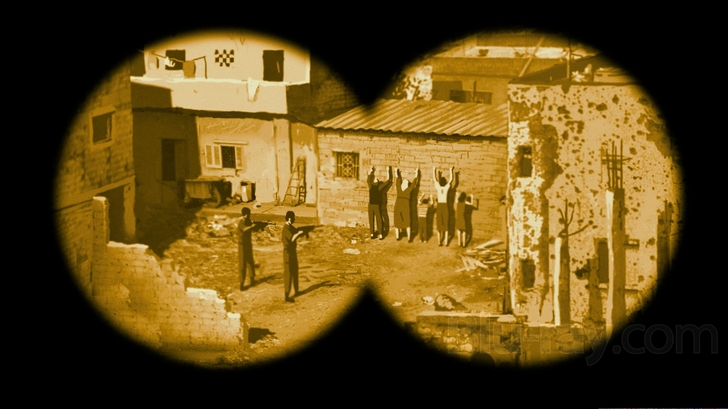
Among the many thoughtful critical responses to the film, Natasha Mansfield‘s open-access essay on ‘Loss and mourning’ at Wide Screen 2 (1) (2010) deals with the differential distance between camera and animation (Ohad Landesman and Roy Bendor develop this in more detail in animation 6 (3) (2011) 353-70), Katrina Schlunke in ‘Animated documentary and the scene of death’ in South Atlantic Quarterly 110 (2011) 949-62 treats the final cut from animation to documented images of the massacre, while  in ‘War Fantasies’, Modern Jewish Studies 9 (2010) 311-26 Raz Yosef – who also discusses these themes – objects to Folman’s focus on the Israeli ‘victim’ and its equation with the otherwise marginalised Palestinian victim.
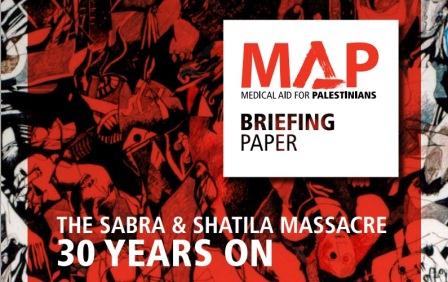
The last is particularly troubling – see also Naira Antoun at electronic intifada and Ursula Lindsey at MERIP (‘Shooting film and crying’). For reflections on the thirtieth anniversary of the massacre, I recommend Seth Anziska in the New York Times (who documents US involvement), Zeina Azzam at Jadaliyya, and Habib Battah at al Jazeera.  There’s also a moving briefing paper from Medical Aid for Palestinians here whose cover is based on Dia al-Azzawi’s artwork.

And although it doesn’t address the visual – it’s an artful ‘misreading’ of Palestinian poet Mahmoud Darwish‘s memoir of Beirut via the Goldstone report on the Israeli assault on Gaza in 2009 – Barbara Harlow‘s ‘The geography and the event’, Interventions 14 (2012) 13-23 amplifies those contemporary resonances in ways that are worth attending to:

New ‘events’ – whether Operation Peace for Galilee (Beirut, 1982) or Operation Cast Lead (Gaza, 2009) – perhaps call, after all, for new ‘geographies’, such as universal jurisdiction, a principle in international law according to which states are allowed to claim criminal jurisdiction for actions – deemed heinous and to be crimes against humanity – committed outside their boundaries.
ASAP and experimental geopolitics

My last post trafficked, amongst other things, in a geography of time-space compression, so it’s time (and space) to introduce ASAP: a title chosen by Tina di Carlo, former curator of architecture and design at New York’s Museum of Modern Art and a graduate of Eyal Weizman‘s Research Architecture programme at Goldsmith’s, to echo the English ‘as soon as possible’ – ‘to evoke a sense of urgency and speed where space collapses in time’ – and, more precisely, to signal the Archive of Spatial Aesthetics and Praxis.  Established in 2010, this is a virtual Aladdin’s cave of projects and practices, texts and objects.

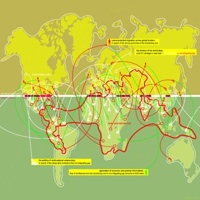
You can fossick for your own favourites – everything is accessible from the starting grid – but here are two of mine.  The first is Teddy Cruzs Political Equator project.  This uses the US/Mexico border – specifically  Tijuana/San Diego – as a platform to describe an arc through other global borderlands all located between 30 and 36 degrees North:

Along this imaginary border encircling the globe lie some of the world’s most contested thresholds: the US–Mexico border at Tijuana/San Diego, the most intensified portal for immigration from Latin America to the United States; the Strait of Gibraltar, where waves of migration flow from North African flow into Europe; the Israeli-Palestinian border that divides the Middle East, along with the embattled frontiers of Afghanistan, Iran, Iraq, and Syria, and Jordan; the Line of Control between the Indian state of Kashmir and Azad or free Kashmir on the Pakistani side; the Taiwan Strait where relations between China and Taiwan are increasingly strained as the Pearl River Delta has rapidly ascended to the role of China’s economic gateway for the flow of foreign capital, supported by the traditional centers of Hong Kong and Shanghai and the paradigmatic transformations of the Chinese metropolis also characterized by urbanities of labor and surveillance.

You can find full details of the associated meetings (‘conversations’), videos and more at the project website here.

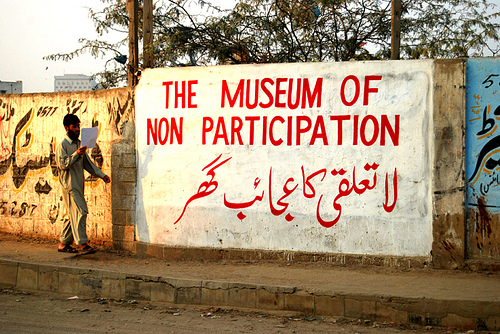
Second is Karen Mirza and Brad Butler‘s Museum of Non-Participation.   This is a travelling project that started in Islamabad in 2007.  The two artists watched the demonstrations by the Lawyers’ Movement against the dismissal of the Chief Justice by the Musharaf regime and the violent response by the military/police from a window in the National Art Gallery – more about the protests here and here – and went on to develop a multi-sited, multi-voiced project that has been staged in Karachi, in London’s Bethnal Green and elsewhere.  One of its central aims is to contest the dominant narrative (and geographical imagination) of Pakistan as a ‘rogue state’ and to find (in part, I think, through a contrapuntal rendering of London and Karachi) ‘other languages and other voices’ to convey everyday life under the sign of the postcolonial.

ASAP explains:

The Museum of Non Participation began as a critique and ultimately exploration of the political agency of the Museum through what the artists call the space of the NON… which is at once a radical critique of the Museum which often and has historically stood by as a mute witness [and [a redefinition] of [its] traditional architectural typology, transforming it from a shelter that houses objects to a literal sign that travels around.

You can download a detailed (30pp) feature from Kaleidoscope here.

The Museum was in Vancouver this month, where it included a screening of Deep State (2012) , a film developed in collaboration with China Miéville (and my thanks to Jorge Amigo for the notice). Here is a preview:

http://vimeo.com/50834391

The film takes its title from the Turkish term ‘Derin Devlet’, meaning ‘state within the state’. Although its existence is impossible to verify, this shadowy nexus of special interests and covert relationships is the place where real power is said to reside, and where fundamental decisions are made – decisions that often run counter to the outward impression of democracy.

Amorphous and unseen, the influence of this deep state is glimpsed at regular points throughout the film – most clearly surfacing in its reflexive responses to popular protest, and in legislated acts of violence and containment, but also rumbling and reverberating, deeper down, in an eternally recurring call-and-response between rhetorical positions and counter-languages, in which a raised fist, a thrown rock, a crowd surge, an occupation provoke a corresponding reaction in the form of a police charge, a baton attack, a pepper spray, assassinations.
There’s an interview with Mirza and Butler about the film here, where Mirza explains that when she read Miéville’s The city in the city she was struck by the ‘condition of unseeing in the midst of seeing’ which is at the heart of the book. Miéville’s extraordinary combination of a radical reading of international law  – in his Between equal rights: a Marxist theory of international law (2006) and also, for example, here –and what he calls his ‘weird fiction’ was not only a ‘compelling combination’ but also a creative platform from which to develop a script and then the screenplay. Michael Turner provides both a sympathetic account of the Museum project and a spirited critique of the Vancouver screening here (there’s also a constructive response: scroll down).
You can, I hope, see why these two projects – from borderlands to international law – interest me.  They are also vivid examples of the connections Alan Ingram is so deftly pursuing between contemporary art and what he calls ‘experimental geopolitics’ (a term I find much more appealing than critical geopoltiics….)

Emergency cinema

The Arab uprisings heightened interest in the politics of new social media, and much attention was directed at platforms like Twitter (which is emphatically not to say that any of this can be reduced to a ‘Twitter revolution‘).  Swirling around these discussions, breaking the 140-character limit of a tweet, was an insistently visual thematic, though this too was often limited to cellphone videos uploaded to YouTube and other sites (and then retransmitted by mainstream news media).  But there are other ways in which film/video can function as witness.

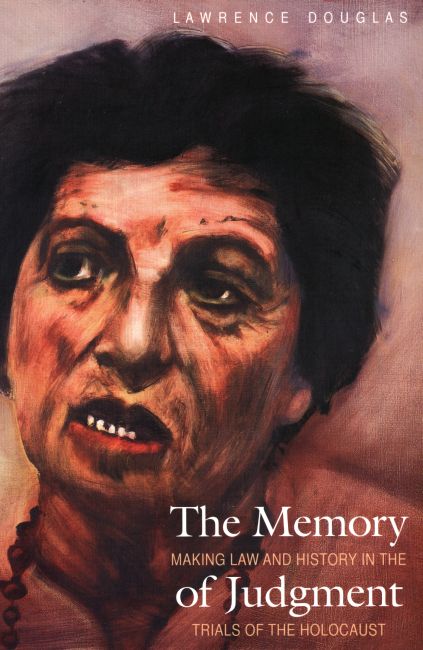
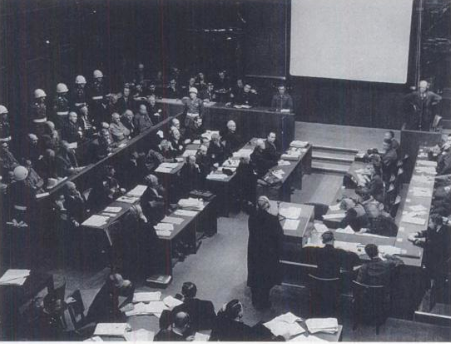
The use of film as witness is usually traced back to the International Military Tribunals in Nuremberg after the Second World War: see in particular Lawrence Douglas‘s classic The Memory of Judgment: Making law and history in the trials of the Holocaust (Yale University Press, 2001) – you can also read an early version of the key essay, ‘Film as Witness: Screening “Nazi Concentration Camps” before the Nuremberg Tribunal,’ in The Yale Law Journal,  105 (2) (1995) or access the book version (so far as I can see, without the accompanying images) online from Yale here.

Douglas’s thoughtful essay is, in a sense, framed by a remark that appears mid-way through it.  When reporter Ed Murrow described Buchenwald concentration camp in April 1945 he ended his broadcast by saying: ‘I pray you to believe what I have said about Buchenwald.  I have reported what I saw and heard, and only part of it.  For most of it, I have not words.’  When the prosecutors at Nuremberg elected to show a film compiled by former Hollywood director Lt Col George C. Stevens from black-and-white footage shot by Allied troops when they liberated the camps – Nazi Concentration Camps – they claimed , as one of them put it, that the film ‘represents in a brief and unforgettable form an explanation of what the words “concentration camp” imply.’  A horror, then, that transcended words – or, as Walter Benjamin confessed in a different context, ‘I have nothing to say, only to show’.

‘This use of film in a juridical setting was unprecedented’, Douglas notes, but it also raises a crucial question – ‘What exactly did the tribunal see when the prosecutors screened Nazi Concentration Camps?’ – that cannot be answered from the trial transcripts. These simply record:

[The film was then shown]

COL. STOREY: That concludes the presentation.

[The Tribunal adjourned until 30 November at 1000 hours]

The question is vital because it invites another: if images took the place of words that could not be found, then how was the tribunal ‘to submit unprecedented horror to principled legal judgments’ that necessarily returned to the verbal and textual?  Douglas’s pursuit of the question is what gives his essay such a compelling narrative force.  He shows in detail how even the visual faltered in the face of such horror: how the camera was confused, confounded, embarrassed – in a word, unsteadied.   He describes, too, how the film incorporates witnesses viewing the atrocities as a moment in its own witnessing: ordinary Germans being forced to view the exhumation of corpses, GIs and generals filing past dead bodies and emaciated survivors.  What these scenes do not  – cannot – do, Douglas concludes, is adjudicate responsibility:

‘Though the film provides a picture of a crime scene so extreme that its horrors have unsteadied the camera’s idiom of representation, it does not translate its images into a conventional vocabulary of wrongdoing.  Instead, the very extremity of the atrocity captured on film challenge sone to locate terms capable of naming and condemning these crimes.  How, then, was the prosecution able to assimilate evidence of unprecedented atrocity into a legal category of criminality?’

This is film as retrospective, but the questions about witnessing are no less difficult to answer when we turn to film shot ‘in the moment’ (and sometimes as a hideously staged moment of the horror). Helen Lennon carries the story forward from the Second World War tribunals to the International Criminal Tribunals for the former Yugoslavia and for Rwanda in ‘A witness to atrocity: film as evidence in International War Crimes Tribunals’ in Toby Haggith and Joanna Newman (eds), The Holocaust and the moving image: representations in film and television since 1933 (Wallflower Press, 2005).   She discusses the need to interrogate, even ‘cross-examine’ the visual testimony, but she concludes with two questions that loop back to Nuremberg:

‘It is necessary to confront the question of what is not shown at these trials, asking: In what ways are these moving images directing our attention toward certain violations, and away from others? What is the law refusing to see when ‘[the film was then shown]’ and ‘[the videotape played]’?

These are still sharp questions, but it is possible to use documentary film in ways that are not evidentiary (in the legal sense) and which deliberately avoid showing ‘the horror’ – and yet still offer a powerful, critical perspective.  I’ve been watching the work of a remarkable group of Syrian film-makers – Abou Naddara (very roughly: “Man with glasses” or, since this is also slang, something like “Goggles”) – who use film both to document and to mobilize events in Syria through what they call ‘emergency cinema‘.   The group publishes a short film on the web every Friday here (also on Vimeo) and they are, of course, also on Facebook here.  These aren’t conventional documentaries, and they certainly aren’t the YouTube uploads that I imagine most of us have become (too?) familiar with: fuzzy, jerky, grainy shots of the fighting or the shelling.

Cécile Boëx interviews the group over at Books & Ideas here.  They explain that they were already  ‘lying in wait’ for the revolution:

‘… we took up the position of a sniper, lying in ambush behind apparently harmless short films distributed anonymously on the Internet in 2010. We were hoping to reach our public right under the censors’ nose. And our hopes seemed to be coming true, because a few months after our website went live, we had already found the means to produce two series of short documentary films that also had to be made more or less clandestinely. In short, we were already lying in wait when the revolution erupted in March 2011. We were even preparing another skirmish, strengthened by the public support we were beginning to receive. The question was not, therefore, whether or not we should get involved in the revolution, but rather how to do so, and what was the best approach to take. After a month of trial and error, we made what was to be our first very short weekly film, entitled The Infiltrators, a disparaging expression used by Bachar al-Assad to refer to the anti-regime demonstrators. The film portrayed an elderly Damascan artisan letting loose against the Assad regime in a monologue that showed the personal, deep-rooted resilience of the Syrian revolt.’

As these remarks imply, their primary audience is inside Syria, and their involvement in the revolution is directed, in large measure, at reaching those who support the Assad regime.

Despite the sniper imagery, their presentations do not treat violence as spectacle – usually they avoid its direct representation altogether.  In the interview they connect this to the conditions under which they are forced to work, but they also insist that these burdens produce a paradoxical freedom:

‘Our project is basically part of the tradition of original documentary cinema, as shown by most of our very short films offering sequences from people’s lives or extracts from interviews, which we choose to film with closeness and empathy. However, we are working in a state of emergency and are subject to constraints that may or may not be justified, including access to film sites, safety of those filmed, social developments or the state of the Internet connection. We can also say that we take pleasure in working in an emergency situation because we feel an unprecedented sense of freedom. And that feeling of freedom carries us from one register to another by happily blurring the boundaries, including the one that separates documentaries and fiction. Besides, that confusion is a general characteristic of our films (Everything Is Under Control Mr. PresidentMy name is MayThe Mufti Wants to…End of Broadcast). We make aesthetic and political choices that portray the way in which our reference points have been turned upside down by the revolution. It also conveys our pledge to represent our people’s enthusiasm by ensuring they are not reduced to stereotyped characters, places or formats.’

So this isn’t ‘film as witness’ in the sense discussed by Douglas and Lennon, and it’s profoundly critical of the way in which the mainstream media now demand ever more scenes of violence that violate the Syrian people all over again.  Here is a pointed example (the screen isn’t blank, and the video takes only two minutes – do watch it).

‘When there’s talk of a ceasefire, for example, they tell us “send us images of shots being fired.”‘

When I watch these short films – some of them so short that they may be visual tweets, I suppose, but they are all carefully composed – I don’t see a parade of heroes or victims, or any of the usual cartoon characters, but a studied indictment of the ways in which the visual and the violent can otherwise lock together: an insight that will be no surprise to readers of Paul Virilio‘s War and cinema (1984; Verso trans. 1989) or to followers of David Campbell who, among many other important contributions, underscores the close relationship between the gun and the camera. (What else did you think ‘shooting’ meant?)

For more on the films (and the tradition from which they derive) see Nehme Jameli here, and for brief reports that situated the project within the wider cultural politics of resistance in Syria see Donatella Della Ratta at al Jazeera here and Amélie Rives at Near East Quarterly here.

Targeting and technologies of history

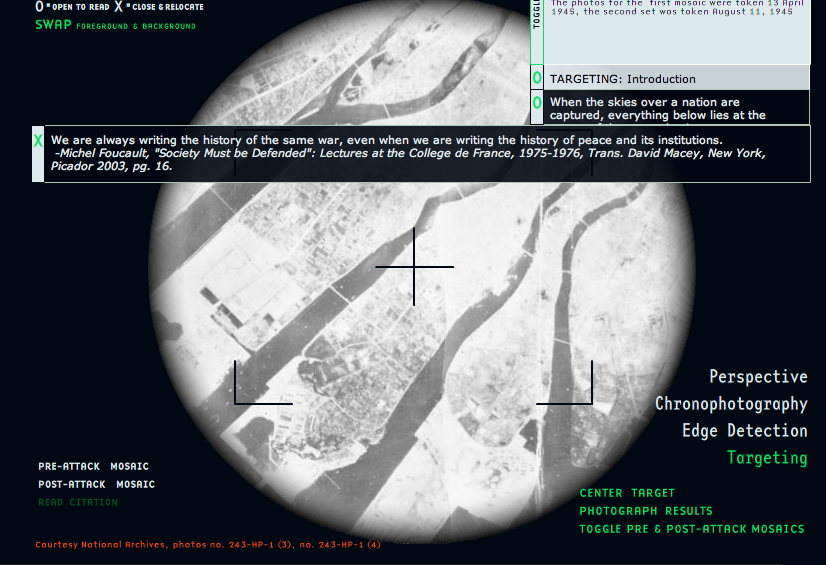
Vectors from USC has reappeared after a (too) long hiatus.  I first encountered Vectors through Caren Kaplan‘s Dead Reckoning project that tracked what she called ‘Aerial Perception and the Social Construction of Targets’.  This was in 2007, when my own interest in targeting and bombing was just kicking in as a reaction to Israel’s war on Lebanon the previous year (see ‘In another time zone…’ in DOWNLOADS).  She introduced the project like this:

‘”Dead reckoning” has a number of different meanings. For many of us, it simply means the ways in which we figure out where we are or what we are aiming at by using the naked eye-it is, then, the first order cultural construct of directional sight. In strictly navigational terms, especially at sea, it refers to the use of measured distances between points to discern longitude. A reckoning is also a form of retribution or punishment as well as a collection of accounts. Many of these meanings come into play in a militarized context where the determination of position enhanced by technology enables the annihilation of enemies. In this piece, Raegan [Kelly, her Vectors programmer and designer] and I came to see this term as the one best suited to describe what we were working through over many discussions. Although many other techniques of sight are involved in this piece, the reckoning of the cultural politics of sight in modernity leads, unfortunately, to state-sponsored death as much as to anything else and, thus, the aptness of the term becomes almost unavoidable.’

Since then Caren has continued to push the boundaries of inquiry and presentation – and the connections between the two – in extraordinarily imaginative ways, constantly circling around what she calls ‘the view from above’: see, for another example, her Precision Targets: GPS and the militarization of everyday life.

The new digital issue of Vectors contains Steve Anderson‘s Technologies of History, which intersects with my still continuing work on bombing and its representations, though its ostensible subject is different. Editor Tara Macpherson on Anderson’s project:

Within the confines of this piece, author Steve Anderson observes, “We should not ask film or video for the truth about the past, but we can look to them for clues, myths, and symptoms of historical fixations.” The project takes as its central object of analysis one of those moments of historical fixation that seems indelibly engrained in the American consciousness, the assassination of John F. Kennedy, Jr. in November, 1963. In exploring multiple mediations of this event, Anderson and designer Erik Loyer repeatedly draw our attention to the textured, layered and unstable nature of both historical representation and historical memory.

This is an argument about the truth claims of media that is instantiated via media, both through the curated collection of media artifacts assembled here and through their formation into a new interactive experience. The assortment of clips runs the gamut from historical footage to televisual re-imaginings to video game reenactments, providing a rich compendium of the tenacity of this moment within the nation’s collective memory. Various tonal registers collide: the somber, the flippant, the intimate, the nostalgic. Disparate visual styles intersect and refract one another. But this argument does not unfold solely at the level of content. The form of the piece also reconfigures and undermines the possibility of a single, authoritative history. As the user engages the piece and assembles these historical fragments into new forms, building her own history along the way, the primacy of any one meaning is collaged away.

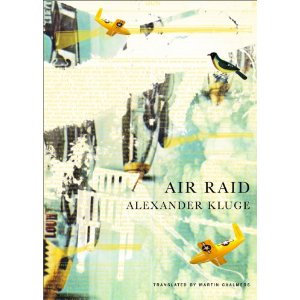
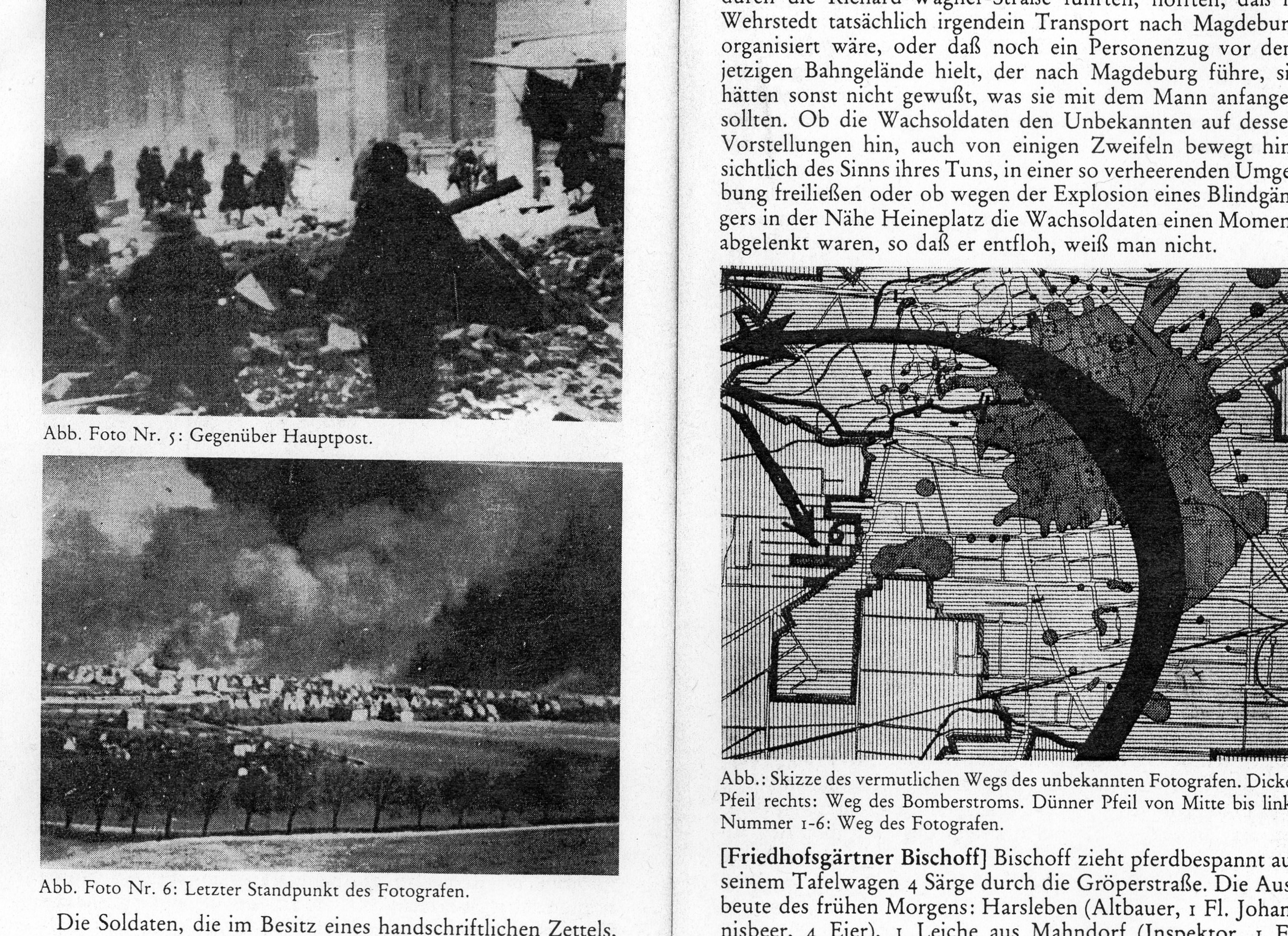
Before the digital era Alexander Kluge had experimented with the collisions of testimony and artefact, and in particular with montage-collage, to convey an American air raid on Halberstadt (his hometown) in 1945 (I drew on this in “Doors into nowhere”). Der Luftangriff auf Halberstadt am 8. April 1945 was first published in German 1977 and has been available in both his Collected Works and as a separate book for some time, but I’m thrilled to discover that an English translation by Martin Chalmers under the title Air Raid is at last due from the University of Chicago Press/Seagull Books in December 2012 with an afterword by the much lamented W.G. Sebald.

Frederic Jameson, in one of the few English-language commentaries on the text, raises a question that speaks directly to Anderson’s project:

“The Bombing of Halberstadt” is another such collage, in which individual experiences, in the form of anecdotes, are set side by side less for their structures as the acts of traditional characters … than as names and destinies, the latter being reduced in many cases to peculiar facts and accidents, of the type of Ripley’s Believe It or Not. The juxtaposition of these anecdotes with quotations from academic studies on the history of bombing and on RAF techniques, from scholarly conferences on the relation between aerial strategy and ethics (“moral bombing” is, for example, specified as a matter, not of morals, but of morale), and from interviews with the allied pilots who participated in this raid—all these materials, which we take to be nonfictional (although they may not be; the interviews in particular bear the distinctive marks of Kluge’s own provocative interview methods), raise the question of the fictionality or nonfictionality of the personal stories of the survivors as well. Halberstadt is, to be sure, Kluge’s hometown, and he is perfectly capable of having assembled a file of testimonies and eyewitness documen- tation and of using the names of real people. On the other hand, these stories, with their rich detail, afford the pleasures of fictional narrative and fictional reading. Is this text (written in the 1970s) a non-fictional novel? I believe that we must think our way back into a situation in which this question makes no sense…’ [‘War and representation’, PMLA 124 (2009) 1532-47]

Perhaps.  But Jameson’s exegesis never grapples with what is also so compelling in Anderson’s project – and, as Kaplan’s work shows, no less avoidable in any discussion of bombing – which is to say Kluge’s determination to confront the multiple visualities involved in, productive of and produced through bombing:

Cyrus Shahan [‘Less then bodies: Cellular knowledge and Alexander Kluge’s “The Air Raid on Halberstadt on 8 April 1945″‘, Germanic Review 85 (2010) 340-58] provides one of the richest discussions of Kluge’s use of montage in ‘Luftangriff’; I can’t convey the artfulness of his argument here – a blog surely isn’t the place to do so! – but here’s an extract that, again, speaks to Anderson’s project too:

‘“The Air Raid on Halberstadt on 8 April 1945” consists of thirty vignettes. The majority are accounts of what the residents of Halberstadt did during the air raid, where they were, what they were thinking, and whether they survived. These stories “from below” are interrupted for a twenty-two-page segment about “Strategy from Above,” a documentary montage of interviews with pilots, images of bomb schematics and flight formations, and pictures of pilots. The documentary aspect of Kluge’s Halberstadt essay and his Neue Geschichten [‘New Histories’] as a whole is a ruse. Rather than lend the text authenticity, Neue Geschichten uses a feigned documentary to debunk the authority of the documentary, to undermine the validity of a singular point of view, and thereby to buttress the usefulness of montage. For Kluge, montage is superior to documentary because it is “the form-world of connectivity.” In other words, while montage creates quasi-unreal perspectives with hyperconnectivity, it simultaneously contains productive political processes in which fractured factual elements articulate within a field of possibilities.’

The invisible war

Kirby Dick’s – and Amy Ziering’s – documentary film The invisible war (2011) recently won the Audience Award at the Sundance Festival and the Nestor Almendros Award at the Human Rights Watch Film Festival.  It documents, in brave detail, the incidence of rape inside the US military.  The film-makers contacted more than 100 victims, men as well as women.  The Department of Defense estimates that there were 19,000 violent sex crimes inside the military in 2010 and 22,800 in 2011; the vast majority go unreported, and of those that are there are few convictions.  Women in combat zones are more likely to be raped than killed by the enemy, but the attacks also take place far from the firing-line: on bases in the continental United States, at barracks in Washington DC.

There are powerful, thoughtful reviews of this film – including essays by Rose Aguilar, David Leonard and Marcia Yerman – and its achievements are substantial.  Gary Trudeau saw The invisible war at a special screening and used a series of Doonesbury cartoons to bring the issue to a wider public, while Rebecca Keegan reports that two days after Secretary of Defense Leon Panetta saw the film he called a press conference ‘to announce new rules on how the Pentagon would handle sex crimes.’

And yet, across all the reviews I’ve read, there’s a strange reluctance to link rape inside the military to the rape by soldiers of enemy combatants and civilians.  There is a substantial literature on rape as a weapon of war – on rape as a systematic strategy – but what I have in mind here is a structural connection between the power and cruelty involved in rape and forms of military violence. This is obviously a differentiated terrain; there was a good roundtable discussion raising a number of important issues in Eurozine in 2009, the same year that Helen Benedict’s searing account of The lonely soldier: the private war of women serving in Iraq appeared.  You can find a video of her talk at Columbia here, and there is also this short interview:

Among more recent book-length treatments I’d recommend Janie Leatherman’s Sexual violence and armed conflict (Polity, 2011), Part III of Laura Sjoberg and Sandra Via (eds), Gender, war and militarism: feminist perspectives (Praeger, 2010), and a compelling study that makes the connection between ‘inside’ and ‘outside’ military rape that I’m urging here, Gina Marie Weaver’s Ideologies of forgetting: rape in the Vietnam War (SUNY Press, 2010).  Making those connections is one way of making war’s injuries, both there and here, abroad and at home, more visible – and those who perpetrate them more accountable.  Eight years after Abu Ghraib you’d think we’d have made more progress in exploring the relations between military violence and sexual violence.

Three additional notes: 

(1) On Monday, Wednesday and Friday this week (13 through 17 August) YouTube has a new three-part drama series on sexual assault in the US military, Lauren: I found news of this on Stars & Stripes, ‘the US military’s independent news source’….

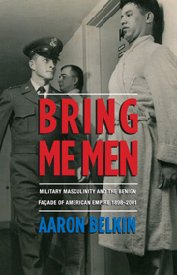
(2)  Earlier this month al Jazeera hosted a discussion of military ‘cultures of rape’ between Morris Davis, a retired US air force colonel who led the investigation into the sexual abuse scandal at the US Air Force Academy in 2003; Ariana Klay, a former US Marine Officer, who is one of eight current and former military members who have filed a lawsuit alleging they were raped, assaulted, or harassed during their service; and Aaron Belkin, a professor of political science at San Francisco State University and the author of Bring Me Men: Military Masculinity and the Benign Façade of American Empire, 1898-2001.

(3) Belkin’s Bring Me Men (Columbia University Press, 2012) documents male-on-male rape in the US military and en route challenges a number of existing discussions of ‘military masculinity’:  “I argue in Bring Me Men that contradictions that structure warrior masculinity look a lot like contradictions that structure U.S. empire, and that both sets of contradictions get sanitized and swept out of sight at the same moments, often by outcasts (African-Americans, women, gays and lesbians) who portray the military and the empire in noble terms as part of inclusion-seeking strategies.”  You can download the first chapter from Belkin’s own website.