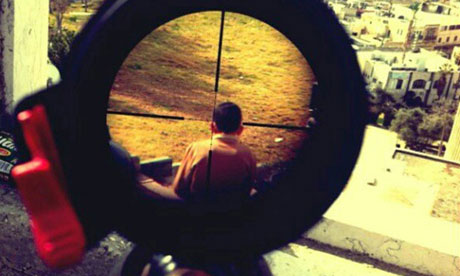
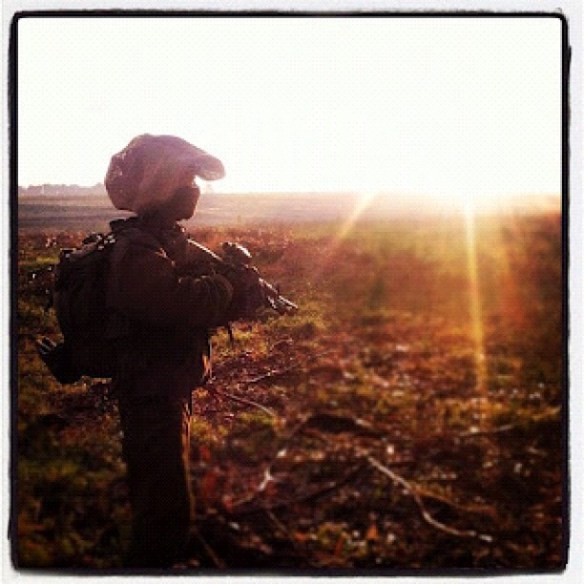
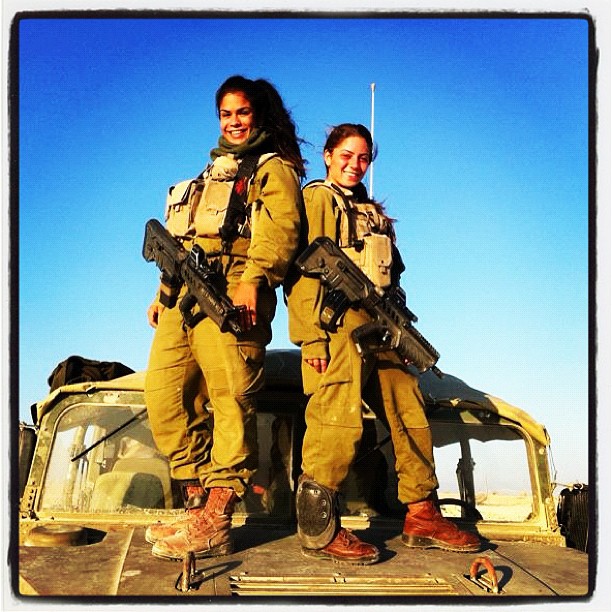
Or perhaps four million (roughly the Palestinian population in the Occupied Territories). I’ve posted about the use of Instagram by the IDF and IDF soldiers before, but this vile image – which 20 year-old IDF sniper Mor Ostrovski claims he just “found on the Internet” – serves to bring into focus (sic) both the indiscriminate violence of the occupation, its casual, stomach-churning “because I can” arrogance, and the parallels between targeted killing from remote and near platforms.
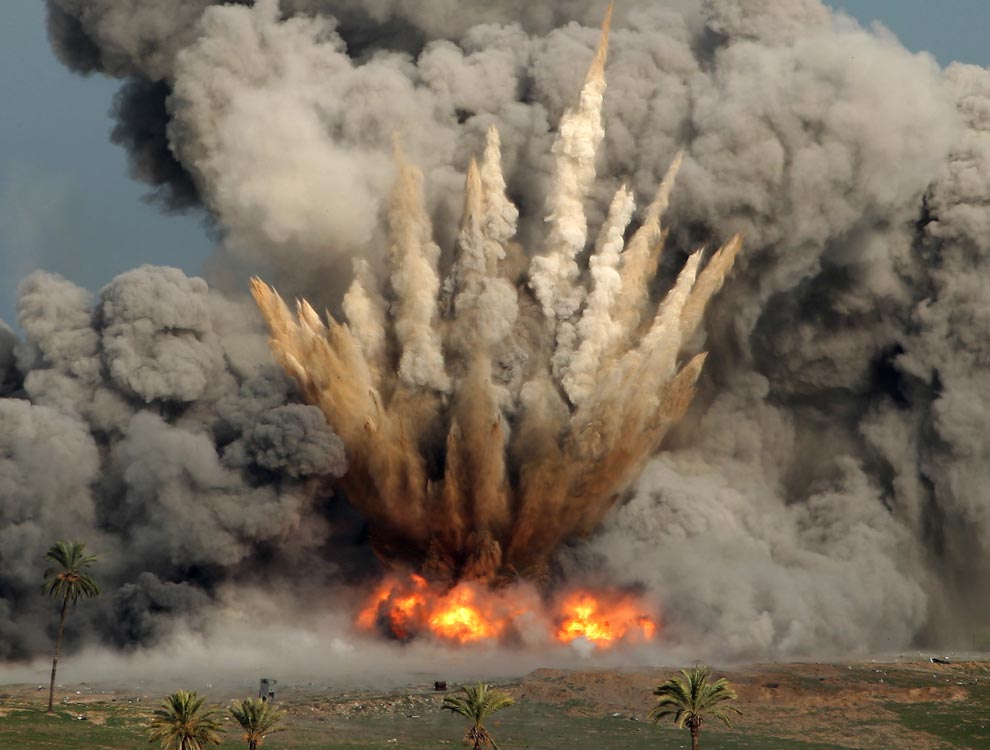
As public attention to military violence continues to contract to the use of drones, Rawan Yaghisupplements her previous account of living and dying under Israeli drones in Gaza with another despatch describing Israel’s use of conventional strike aircraft, Life under the F-16s in Gaza:
With F16s, it’s a scary roar like someone is mocking sounds in a water well. It also depends on the altitude of the plane, sometimes a high pitched roar, others a low distant one. F16s are harder to spot than drones or Apaches because they are always ahead of their roar. And since you never know where the plane is going and since buildings in Gaza are crammed into Gaza, you rarely get to see the metal falcon.
F-16 bombing Beit Hanoun, Gaza, January 2009 (Patrick Baz/AFP/Getty Images)
She describes the intimidating ‘mock raids’, the physical and psychological damage, and the scars that will never heal:
‘I was fourteen when the AbuSelmeyyas’ house was attacked by an F16 air strike. My body shivers as I write this. The attack killed the father and mother and seven of their children, Nasrallah 4, Aya 7, Yahya 9, Eman 12, Huda 14 who was my classmate in primary school and who had the most angelic voice I’ve ever heard, Sumayya 16, and Basma 17, leaving Awad, 19 at that time, injured and alone. Fourteen others were injured in that attack, since the house was located in a heavily populated neighborhood, not very far from where I live. The attack attempted to assassinate leaders of militant groups. However it failed. In October last year, The Israeli court in Jaffa refused to give any compensations to the relatives of the family and the only member if the family left, saying the house was targeted during a “combat operation”. I wasn’t allowed to see any news about the attack. I only heard some news about it. And I learned about Huda in the morning. I heard from my brother that day that the bomb was directly dropped on the room where the mother and the children were. I also heard about their body parts being found in the buildings next to their house. I was only fourteen. What did I know.‘
An important post from Craig Jones about the capacity of the creative arts to respond to and even dislocate military violence that chimes beautifully with my previous post about War/Photography, and leads me into a notice of a research seminar at King’s College London (K2.29, Strand) at 6 p.m. on 5 February 2013:
‘i have come to everyday armageddon’: Spectacular and Slow Ruin in Gaza Anna Bernard
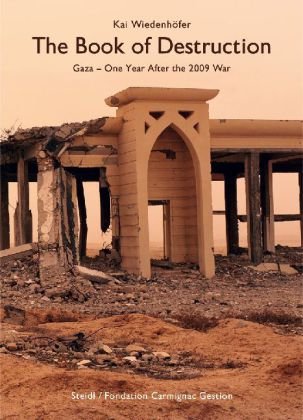
The Israeli military’s 22-day attack on Gaza in the winter of 2008-9 provoked international condemnation to a degree that the region’s daily deprivation since 2007 under Israeli and Egyptian blockade had not. After the assault, images of the ruins of Gaza – its collapsed buildings, its disabled and impoverished residents – circulated widely. Beyond recording the immediate destruction caused by the attacks, however, these representations also sought to convey a different kind of ruin: the ‘slow violence’ (Nixon 2011) of Gaza’s humanitarian crisis. Anna Bernard will explore some of the visual and narrative attempts since 2009 to draw attention to the full scale of Gaza’s devastation, including photography by Kai Wiedenhöferand poetry by Suheir Hammad. [The title is taken from Suheir Hammad’s poem GAZA, and the video shows Wiedenhöfer’s exhibition at the Musée d’Art Moderne in Paris in 2010].
Anna Bernard works on literary and cultural representations of Israel/Palestine in international contexts. She is the author of Rhetorics of Belonging: Nation, Narration and Israel/Palestine, forthcoming from Liverpool University Press.
Ruins in Gaza – Reality and Representations Ahmed Masoud
While the Gaza Strip is often associated with images of ruins and destruction as a result of the continuous Israeli bombardment, the rubble of destroyed buildings has also become closely associated with the national cause. In 2009, a young artist living in Jabalia Camp turned her bombed house into an installation of a tank. Her message was that holding on to living spaces was as powerful as any military machinery.
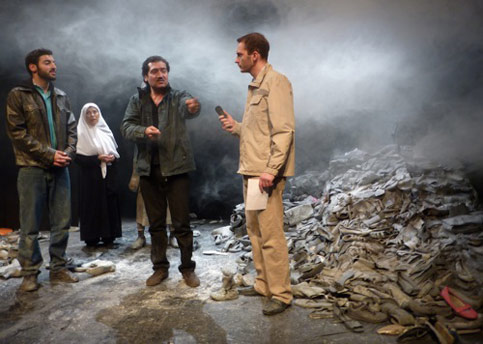
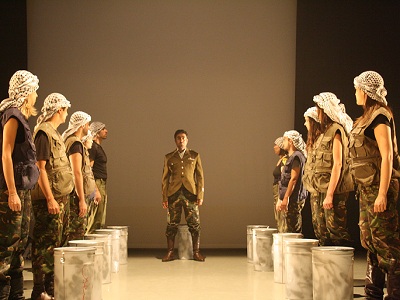
Ahmed Masoud will discuss the representation of ruins in his plays Go to Gaza, Drink the Sea (2009) and Unto the Breach (2012). Working with various set designers, Ahmed chose to represent rubble using different materials. In Go to Gaza, Drink the Sea (left) destruction was represented through a mountain constructed out of thousands of old shoes, while the set of Unto the Breach compiled a collage of ripped clothes, palates, paint pails and other broken and recyclable materials. Both sets represent the hardships, but also the resourcefulness, of ordinary people living under siege. They also reflect the process of making the set and shows with a very limited budget.
Ahmed Masoud is a Palestinian academic, writer and director. In 2005, he founded the Al Zaytouna Dance and Theatre Company. With Justin Butcher he co-wrote and directed the successful play Go to Gaza, Drink the Sea (2009), staged in London and at the Edinburgh Fringe Festival, and the BBC Radio 4 Play Escape from Gaza (January 2011). Ahmed also won the Muslim Writers Awards (sponsored by Penguin Books) in the unpublished novel category for his book Gaza Days. His latest show Unto the Breach (right) [a dance adaptation of Shakespeare’s Henry V] was performed at the Artsdepot Theatre in November 2012 and received critical acclaim.
***
All of this has prompted me to start serious work on a project I’ve had buzzing around my head for months now – a performance-work on bombing, past and present, using video, testimony, music, above all drama (and perhaps even dance). The spur is partly my continuing frustration at conventional academic forms, partly admiration for my good friend Gerry Pratt‘s stunning drama-work Nanay (which has been performed in Vancouver and Berlin), now reinforced by Photog., and above all a desire to work on a collaborative project designed to engage the widest possible public. Watch this space…
An update to my post on social media and late modern war (also here): Rebecca Stein writes with the excellent news that she has published an extended version of her MERIP commentary on Israel’s Twitter-war on Gaza: “StateTube: Anthropological reflections on social media and the Israeli state”, in Anthropological Quarterly 85 (3) (2012) 893-916. The essay complicates what she calls the usual narrative about digital militancy (which is the theme of a special section of the journal): ‘the notion of new technologies that organically liberate from below, and of states invested chiefly in their repression from above.’
That said, some Israelis seem to have an astonishingly obdurate view of the power of social media – Rebecca quotes one member of Likud claiming that “Facebook pages … have as much impact as a tank – and sometimes even more” – and, as she notes, remarkably little sense of the countervailing possibilities.
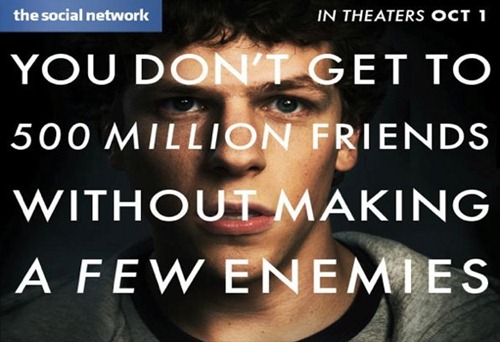
All of which makes me wonder about a sequel to David Fincher‘s film about Facebook founder Mark Zuckerberg, The social network (2010): in the light of Rebecca’s ethnographic work, the original poster (reproduced above) suggests an altogether different scenario….
Claire Pagès and Mathieu Trachman conduct a concise but wide-ranging interview with Judith Butler at Books & Ideas, in which she asks this about neo-liberalism and the economic:
‘[I]f we claim that neo-liberalism disposes populations to become disposable, and exposes populations to precarity, we have to ask whether we are speaking about a purely economic rationale and regime of power (by “ neo-liberalism ”), a regime of power that governs the practices of subject-formation, including self-making, and the valorization of the metric of instrumentality in ways that include and exceed the sphere conventionally denoted as “ economic ”. Indeed, does the power and pervasiveness of “ neo-liberalism” compel us to think about the heteronomy of the economic and the way that the rationalities that govern its operation exceed the purely economic. Must we give up an idea of the purely economic by virtue of neo-liberalism at the same time that we cannot do without the economic?’
Incidentally, readers who have followed the sometimes repellent response to Judith’s receipt of the Adorno Prize can find her speech at the award ceremony in Frankfurt on 11 September – ‘Can one lead a good life in a bad life?’ – here (I think this is the Radical Philosophy version, with images that speak to the controversy) or, in unadorned form, here.
You can also find details of her new book, Parting ways: Jewishness and the critique of Zionism (Columbia University Press) – which, in its closing chapter, engages with Edward Said and Mahmoud Darwish – here. Like all her work, this book – which also includes reflections around Arendt, Benjamin and Levinas – admirably fulfils her own beautifully understated view of what it is to be critical: that is, to be ‘willing to examine what we sometimes presuppose in our way of thinking, and that gets in the way of making a more livable world.’
I had just finished jotting my update to the IDF’s use of social media when Alex Vasudevan drew my attention to this brilliant, searing and deeply disturbing essay by Huw Lemmey at the New Inquiry, ‘Devastation in Meatspace’:
The missile rushing over your head was processed through an Instagram filter just hours previously. As you see it pass out of sight behind the apartment block opposite some young conscript is preparing for video footage of it to be compressed and uploaded to YouTube before the hour is out. By nightfall tonight that explosion which just shook your neighborhood, in one of the most densely populated areas on earth, will have been liked over 8,000 times on Facebook. Welcome to Gaza City.
In a previous post I’d objected to the way in which some commentators advertised social media as a new way to ‘consume’ war, but – riffing off Eyal Weizmann‘s Hollow Land – Lemmey focuses not on the Twitter streams but on the visualizations disseminated across these digital platforms: see, for example, the IDF’s Instagram page here (and look at the comments too); more here. You can also find a selection over at Business Insider where Geoffrey Ingersoll describes them as ‘gorgeous’, and another selection at Moral Low Ground, which reads them rather differently.
Commenting on these images, Britney Fitzgerald at the Huffington Post simply sees them as ‘the world’s newest form of war reporting” – though she does note that the ‘intimacies’ that Israel puts on display through Instagram are radically different from those with the hashtags #gaza and #palestine – but Lemmey (who describes himself as a print maker and studio technician) provides a much more compelling reading. He shows that the IDF images do indeed resonate with a consumerist ideology – climactic versions of the desiring gaze and the lust of the eye – that has become integral to the way in which late modern war is fought:
‘[T]he [IDF] use of commercially available instagram filters replicates the visual culture favoured by much of its audience, producing images that slip easily into their feeds, naturalising the content. “These are the photos you would take if you served in the IDF,” the aesthetic says, “we are just like you, and these military decisions are the ones you would take, if you were in our situation.” They also step beyond this, including an aspirational aspect of a desirable lifestyle — impossibly handsome young troops, having fun on their downtime. This is a fighting force at play as imagined by Wolfgang Tillmans and BUTT magazine, a million miles from an occupying force…. Liking and sharing IDF visual material becomes no more controversial than sharing your favourite Nike campaign — not a matter of politics, let alone ethics, but just another part of the construction of your online persona….’
‘Like many of the more advanced lifestyle brands, the IDF are shifting the focus of image production from their own staff and creative team toward their consumers: in this case, the troops, reservists, and supporters of the IDF. Content is aggregated from individuals and fed back into the social networks of the target audience. In many ways this is an advanced form of brand-management for a such a large institution; it shows a willingness to trust the audience, allowing them to define the brand, making IDFgram perhaps the first crowdsourced propaganda campaign for a state military but also one whose identity is ever more meshed with that of its troops and supporters, emulating fashion and lifestyle brands’ movement toward consumer-led campaigns. Here the IDF becomes the avatar of a thoroughly Western consumer identity. The distance between our own lives and those of the men and women who fight in the IDF becomes ever shorter and more compressed; in collapsing this distance, the grainy and pixelated images of the Palestinian subject become more distant. This is the IDF campaign for control of the virtual environment, interjecting its brand identity into the slivers of human interaction online and thus attempting to occupy a greater portion of the market share for geopolitical allegiance.’
Lemmey says much, much more than this: please read the whole essay.
BTW: IDF stands for ‘Israel Defense Forces’, so naturally none of this should be confused with IDF Marketing, where ‘IDF stands for Innovative, Digital, Foundations’: it’s an Irish company with no connection with the Israeli military. In case you’re now thoroughly confused, here is Arwa Mahdawion the marketing of Israel:
Ever since it officially came into existence in 1948, Israel has gone methodically about the creation of a “Brand Israel”. This originally began with an emphasis of the religious significance of a state for the Jewish people. Then, in 2005, when it was time for a rebrand, the Israeli government consulted with American marketing executives to develop a positioning that would appeal to a new generation: an Israel that was “relevant and modern” rather than a place of “fighting and religion”. So Israel did some pinkwashing, and suddenly became a vocal champion of gay rights. It fought to retain cultural ownership of falafel, hummus, and Kafka. It poured millions of dollars into tourism campaigns that sought to replace imagery of wartorn landscapes with sun-kissed seascapes.
When it comes to winning modern wars, a robust marketing campaign is as important as a military campaign.
An update to my post on the use of social media in Israel’s latest assault on Gaza: at the Middle East Research and Information Project (MERIP) Rebecca Stein provides an important historical perspective on the IDF’s mobilisation of these digital platforms and the resistance from senior commanders to resorting to a ‘digital vernacular’:
Even as the IDF labors to speak in a language that will be intelligible to the general public, largely abandoning traditional forms of military jargon, its Facebook and Twitter practices remain committed to the foremost military mission — that of asserting control over social media’s highly interactive field.
Rebecca also draws attention to the ways in which these military mobilisations complicate the ‘digital democracy’ narrative that emerged in the wake of the Arab uprisings.
I talked about this briefly in my essay on Tahrir Square, where I noted that it was not only the Israeli military that was learning from those events. As Lt Col Brian Pettit put it, ‘the Arab Spring has profound implications for the US Special Operations mission of unconventional warfare’ that need to be incorporated into ‘theory, doctrine and training’. He argued that standard ‘red force tracking’ in which the enemy is caught in a net of electronic surveillance should now be complemented by ‘social tracking’ in which social media are monitored and even enlisted. The standard image of unconventional war, the same officer concludes, is of ‘underground resistance leaders meeting with US advisers, clustered in a dark basement around a crumpled map, secretly organizing and planning their next tactical move.’ But this is now incomplete, and future operations will need to enlist ‘a scattered network of digerati, all texting, tweeting, posting and hacking from thousands of locations. Publicity is as paramount to the success of the digerati as is secrecy vital to the success of the traditional underground resistance cell.’ As I noted at the time, it’s not difficult to work out ‘which ‘resistance leaders’ were likely to be meeting with US advisers, nor the bodily consequences for those on the other side of the street.
But using social media is only one part of military strategy. Writing in Joint Forces Quarterly early in 2011, Lt Col Thomas Mayfield had already accepted that ‘aggressive engagement in the social media environment can aid the commander in winning the information fight’ – bizzarely he pointed to the IDF’s ham-fisted use of social media during its previous assault on Gaza in 2008-9 – but his first priority was to monitor the use of social media to enhance ‘situational awareness’. For a Canadian/NATO perspective on media monitoring, here is Bruce Forrester from Defence R&D Canada at Valcartier on ‘Social Media Exploitation Tools’ after the Arab uprisings.
If this is all too depressing for you, then try Richard Poplak who provides a different take on the IDF’s most recent attempts to use Facebook to save face…
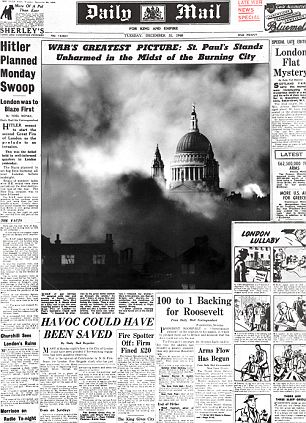
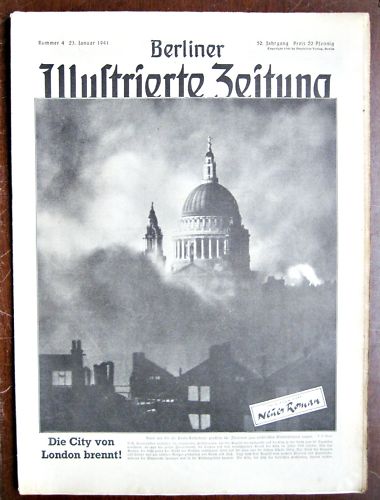
For an interesting post-script (or pre-script) to my discussion of the mediatization of the Israeli war on Gaza, check out the ever-interesting Brett Holman over at Airmindedon the ways in whichprint mediawere used to report and ridicule propaganda messages from the enemy during the Second World War.
As Brett points out, there are parallels but also significant differences:
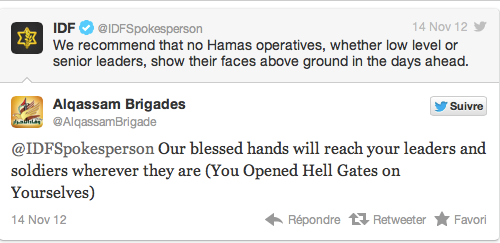
For one thing, in 1940 it was effectively impossible for British civilians to communicate with German ones, or vice versa: their debates were national, at best. Now Palestinians and Israelis — and everyone else — can talk directly to (or past) each other on the Gaza war, perhaps with the aid of Google Translate. For another, in 1940 official propaganda did not draw on the unofficial kind. Now @AlqassamBrigade and @IDFSpokesperson share photos of alleged attacks posted on Twitter by ordinary people. For yet another, in 1940 the debates in newspaper columns unfolded over days and weeks. Now the social war moves almost as fast as the real war does. A real war that, it should not be forgotten, claims real lives regardless of what happens online.
Here, at the start of his tour of SE Asia, President Obama, winner of the Nobel Peace Prize, defended Israel’s attack on Gaza – the always asymmetric ‘right to self-defence’ to which Craig Jones has drawn attention – by declaring that ‘There’s no country on earth that would tolerate missiles raining down on citizens from outside its borders.’ Really.
Frédéric Mégret has frequently drawn attention to the peculiar social and legal status of the battlefield:
‘[W]hilst war may and will rage, what distinguishes it from random violence is the fact that it unfolds in discreet spaces insulated from the rest of society, confining military violence to a confrontation between specialized forces whose operation should minimally disrupt surrounding life…. In that respect, the laws of war do not merely seek to regulate the battlefield. They are also part of its symbolic maintenance and even construction as a particular space defined by the norms that apply to it. In other words, the battlefield does not predate norms on warfare; rather it has always been subtly coterminous with them. The laws of war are, therefore, a crucial foundation for understanding the evolution of the battlefield and, conversely, the evolution of the battlefield is a key way in which the evolution of the laws of war can be understood.’
For Mégret, the deconstruction of the battlefield is now well advanced: starting in the nineteenth century, with transformations in firepower that constantly extended the range over which lethal force could be deployed, dramatically accelerated with the rise of airpower annulling the distinction between the spaces of combatants and civilians, given a further twist by remote operations conducted over vast distances from unmanned aerial systems like the Predator and the Reaper, and aggravated by the renewed significance of insurgency and counter-insurgency struggles (‘war among the people’), the relations between the spatiality of war and its legal armature have been radically transformed. (For a visual rendering, see Mégret’s Prezi on ‘Where is the battlefield?’).
These are important ideas, but there are other dimensions that need to be taken into account when considering Israel’s latest attack on Gaza. This is a conflict that is fully coterminous with what Helga Tawil-Souri calls Israel’s ‘digital occupation’ of Gaza. As she writes in a superb essay in the Journal of Palestine Studies 41 (2) (2012) 27-43:
‘Disengagement has not meant the end of Israeli occupation. Rather, Israel’s balancing act “of maximum control and minimum responsibility” has meant that the occupation of Gaza has become increasingly technologized. Unmanned aerial reconnaissance and attack drones, remote-controlled machine guns, closed-circuit television, sonic imagery, gamma-radiation detectors, remote- controlled bulldozers and boats, electrified fences, among many other examples, are increasingly used for control and surveillance One way to conceptualize disengagement, then, is to recognize it as a moment marking Israel’s move from a traditional military occupation toward a high-tech one.
Rooted in Israel’s increasingly globalized security-military-high-tech industry, the technological sealing of Gaza is part of the transformation of the mechanics of Israeli occupation toward “frictionless” control that began with the first intifada and the ensuing “peace process,” which marked the shift toward the segregation of Gaza. “Frictionless” is, of course, metaphoric and purposefully ambiguous, evoking a sense of abstraction and lack of responsibility…
While high technology has become one of the means through which Israeli occupation continues, the high-tech infrastructure in the Gaza Strip — that which is used by Palestinians as opposed to the Israeli regime— is also a space of control. Technology infrastructures form part of the appa- ratus of Israeli control over Gazans. A telephone call made on a land-line, even between Gaza City and Khan Yunis, is physically routed through Israel. Internet traffic is routed through switches located outside the Gaza Strip. Even on the ubiquitous cellular phones, calls must touch the Israeli backbone at some point. Like much else about the Gaza Strip, telecommunication infrastructures are limited by Israeli policies. Geographic mobility, economic growth, political mobilization, and territory are contained, but so are digital flows: Gazans live under a regime of digital occupation.’
It should come as no surprise, therefore, that Israel also fights in digital space. This takes many forms, and at the limit extends into the domain of cyberwarfare (where, as the joint US/Israeli cyber-attack on Iran’s nuclear program showed, Israel possesses advanced capabilities), but in its more mundane version it can be no less effective.
One of the characteristic features of late modern war is its mediatization, and the Israeli Defense Forces have used (even ‘weaponized‘) an array of social media platforms to shape the public construction of the battlespace. This is a far cry from its faltering efforts during the previous assault on Gaza in 2008-9, Operation Cast Lead. Soon after the IDF assassination that sparked the renewed air campaign this month, the IDF tweeted a headshot of the dead man, Hamas military commander Ahmed al-Jabari, with “eliminated” stamped across it, and immediately followed up with a video uploaded to its YouTube channel showing the drone strike (I’m not going to do the IDF’s job for it, but if you want to see stills and screenshots you can find them here). The IDF continued to tweet, announcing its airstrikes in 140-character containers, and also turned to Facebook, Pinterest and Tumblr to post images and infographics (or, more accurately, propagandagraphics).
The object of the exercise has been three-fold.
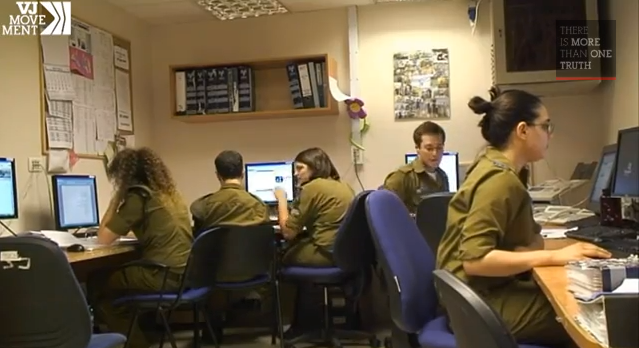
First, the IDF has been seeking direct – which is not to say unmediated: the clips, tweets and the rest follow an artfully pre-arranged script – and real-time access to domestic, regional and international publics. The officer commanding the IDF’s 30-strong New Media desk (which is shown in the image on the left), Lt. Col. Avital Leibovich, explained that she wanted ‘to convey our message without the touch of an editor’ and to reach those who don’t turn to print media or TV for their news.
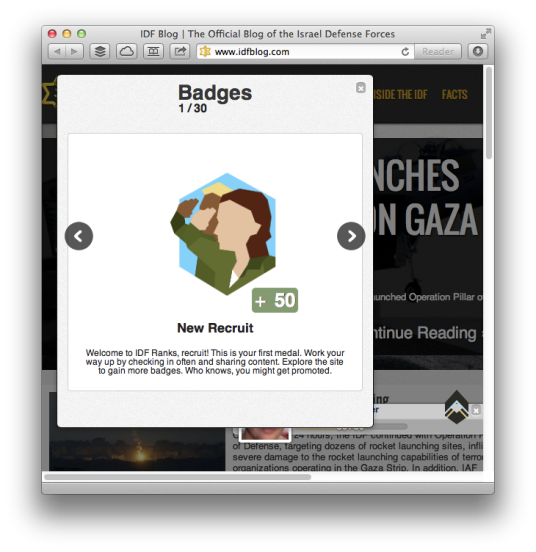
Second, the IDF has been aggressively mobilising its supporters, inside and outside Israel, encouraging them to retweet and to post their support on Facebook: using social media to puncture what Israel routinely describes as its ‘isolation’. Timereported that the IDF had activated additional ‘gamification’ features on its blog that allowed visitors ‘to rack up “points” for repeat visits or numerous tweets’: see the image on the right; more here.
Third, the IDF apparently believes that social media can send ‘a message of deterrence’ – though its tweets have surely been as likely to provoke as to intimidate. The campaign sparked a series of responses and counter-measures – in Gaza, Hamas and its supporters, and in particular the Al-Qassam Brigades led by al-Jabari, took to social media platforms too, though Israel’s digital occupation plainly made that a vulnerable strategy, and the cyberactivist group Anonymous claimed to have defaced or disrupted nearly 700 Israeli political, military and commercial websites – so that al Jazeera described this as a ‘mass cyber-war‘ (I think that’s wrong: it’s been a social media war, but not one that has directly produced destruction – though, as I’ll suggest in a moment, it has certainly invited it).
More on the IDF’s New Media desk from Fast Companyhere and from the VJ Movement below:
It’s hard to know how effective this social media blitz has been: certainly, many people have been repulsed by the way the IDF ‘cheerily live-tweets infanticide’ and ‘the apparent glee with which the IDF carries out its job.’ As John Mitchellcomplained, ‘Innocent people are dying on all sides, and the IDF wants to reward people for tweeting about it.’ In doing so, the contemporary rendering of war as spectacle and entertainment has been turned into something at once banal and grotesque. Alex Kantrowitz put this well:
When a military at war asks its Twitter followers to “Please Retweet,” or check out its Tumblr, or posts an image of a rocket hooking a Prime Minister’s undergarments, it is hard not to sense a disconnect between that messaging and the bombing taking place in real life. As The Verge’s Joseph L. Flatley put it, “One liveblogs award shows or CES keynotes, not armed conflict.”
When Matt Buchanancalls this live-tweeting of military and paramilitary violence ‘the most meaningful change in our consumption of war in over 20 years’ – my emphasis – then this is war reduced to consumerism: how long before military commanders start worrying that if their ratings aren’t high enough, their audience penetration too low, their war will be cancelled? (Not such a bad idea, you might think, until they are driven to find ways to increase their market share….) Buchanan may think this is ‘How to Wage War on the Internet’, but Michael Koplow is nearer the mark: it’s precisely How Not to Wage War on the Internet.
In fact, several commentators worry that the trash-talking between the two sides, the verbal violence of response and counter-response on Twitter, was an open invitation to extend the war beyond the words:
‘This is a new reality of war,’ Heather Hurlburtnoted, ‘and I worry that it’s going to make it harder to stand down.’ The digital exchanges were immediate – not the language of reflection or diplomacy – and, whatever else they were about, were clearly intended to taunt the other side: Hamas and the IDF were both targeting audiences in Gaza (and the West Bank) and in Israel, by turns rallying their supporters and goading the enemy. In short, here as elsewhere, there are crucial connections between the physical and virtual worlds that, in this case, may work to inflame the violence.
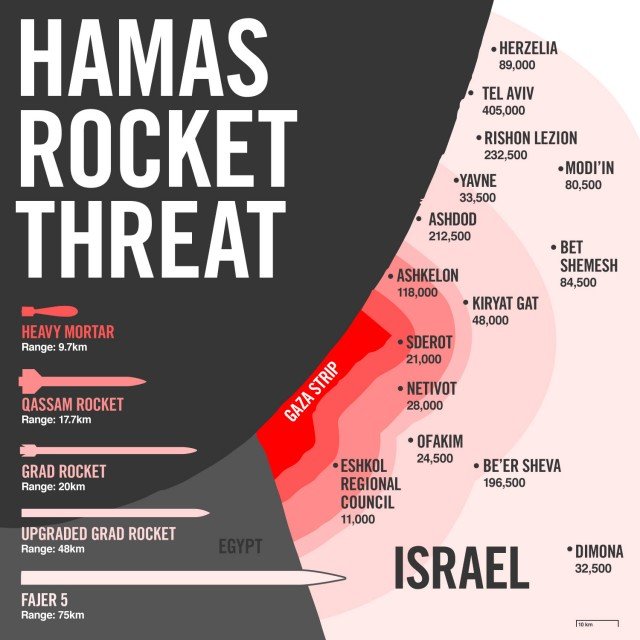
Yet for all this the digital battlespace can work to reinstate the traditional battlefield – at least virtually and rhetorically. This is one of the maps circulated through the IDF’s social media platforms:
And here is the equivalent map published online by the New York Times, updated yesterday:
Here the map speaks power to truth: the ‘battlefield’ has been radically extended so that, as always, the terms of an an intensely asymmetric struggle are radically reversed. The disproportionate concentration of Israeli firepower on Gaza is erased, while virtually all of Israel – including, as we have been endlessly reminded, for the very first time Jerusalem – is threatened by Hamas.
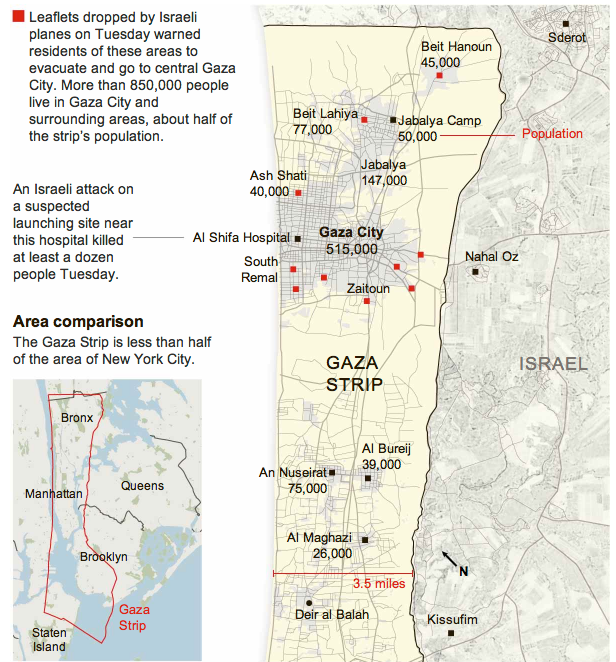
The Times did at least include this, separate map of Gaza:
The map plots (in red) the sites of IDF leaflet drops (really). So we have one map showing Hamas rocket ranges and ‘cities taking enemy fire’, and the other showing paper dropped on a captive population…
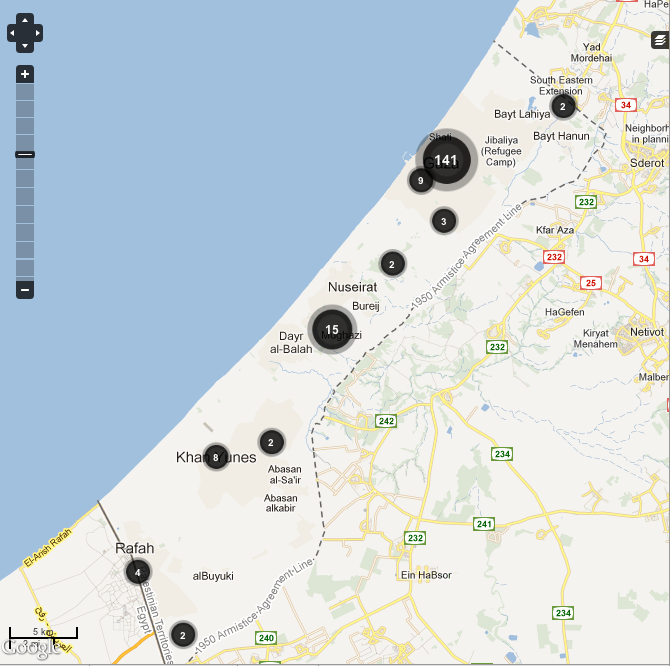
If you want to find more meaningful maps that take in both Israel and Gaza, including air strikes and rocket attacks, deaths and casualties on both sides, you can find them at al Jazeera here. I’ve pasted an extract from the plot of air strikes below.
Seen like this, I’ll leave the last words to Helga Tawil-Souri:
“The underlying reasons of Israel’s propaganda are to silence the enemy, gain international support and justify wars… Their goal has not fundamentally changed over the years, only the platforms on which these are disseminated.”




 geographical imaginations