Rooting for the uprooted

There’s an excellent account by Michael Hodges of Eyal Weizman‘s Forensic Architecture project (he now calls it a research agency) over at Wired UK.  Unlike some media versions, this is fully – and appropriately – embodied and materialised, following Eyal through East Jerusalem and into the West Bank in August 2015.  He explains:

“The idea is to use forensic architecture as a method that extends deep into the facts and looks at them and maps them out to see the materialisation of political forces. Forensic Architecture assumes that every bit of material reality is the product of a complex force field that extends in space and time. So you can take an inanimate object and see into it, almost like a crystal ball.”

That’s as good a summary of the project as you’ll find, but en route you also understand the ‘situatedness’ of the project – that’s an inadequate formulation, I increasingly think, since it’s also about extending deep into what, for want of a batter word, we might call the field: it’s about the rootedness of Forensic Architecture in the lives of the uprooted.

FA Waziristan 2010 reconstruction

In consequence, what also comes into view during the report is the passionate commitment of its investigators to the witnesses whose experiences they recover:

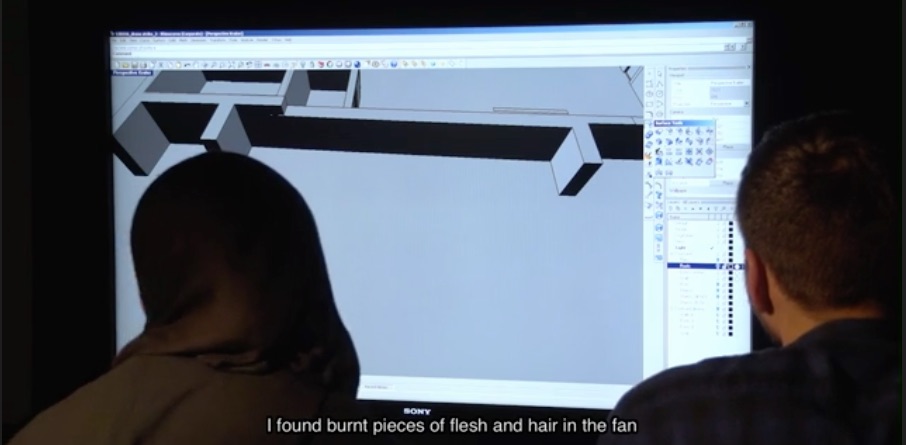
“We understand the relationship between memory, architecture and violence,” Weizman says. “Take the woman who survived the drone strike in Waziristan [above; see also the video here: scroll down to case 2]. She was very traumatised; she lost relatives in there. We returned her digitally to the site of the attack and built it together with her, reconstructed her family house that had been hit by the drone [above]. During the modelling process she was meticulous about every window, every object we placed in there, every person. But she was very obsessed with a fan. In the beginning she said it was on the ceiling. Then she said no, it was a standing fan. She asked us to move it to the left and then to the right and then back again, until we were wondering, what is it about the fan? But when we made her walk through the space she recollected exactly where it had been, and that after the strike had killed her family she had found bits of human flesh on the blades of the fan. You see, the fan acted as an anchor for her memory and in the end we reassembled that memory in a digital space.”

And as you follow Eyal through occupied Palestine, you also realise that there is something vitally defiant in so thoroughly challenging Israel’s rhetorical claim to the ‘facts on the ground’.

Still reaching from the skies…

Sorry for the long silence – I’ve had my head down since soon after Christmas preparing the Tanner Lectures which I gave this past week in Cambridge [‘Reach from the sky: aerial violence and the everywhere war’].  The lectures were recorded and the video will be available on the Clare Hall website in a fortnight or so: more when I know more.

In outline – and after a rare panic attack the night before, which had me working until 2.30 in the morning –  I organised the two Lectures like this:

ONE

Prelude: The historical geography of bombing

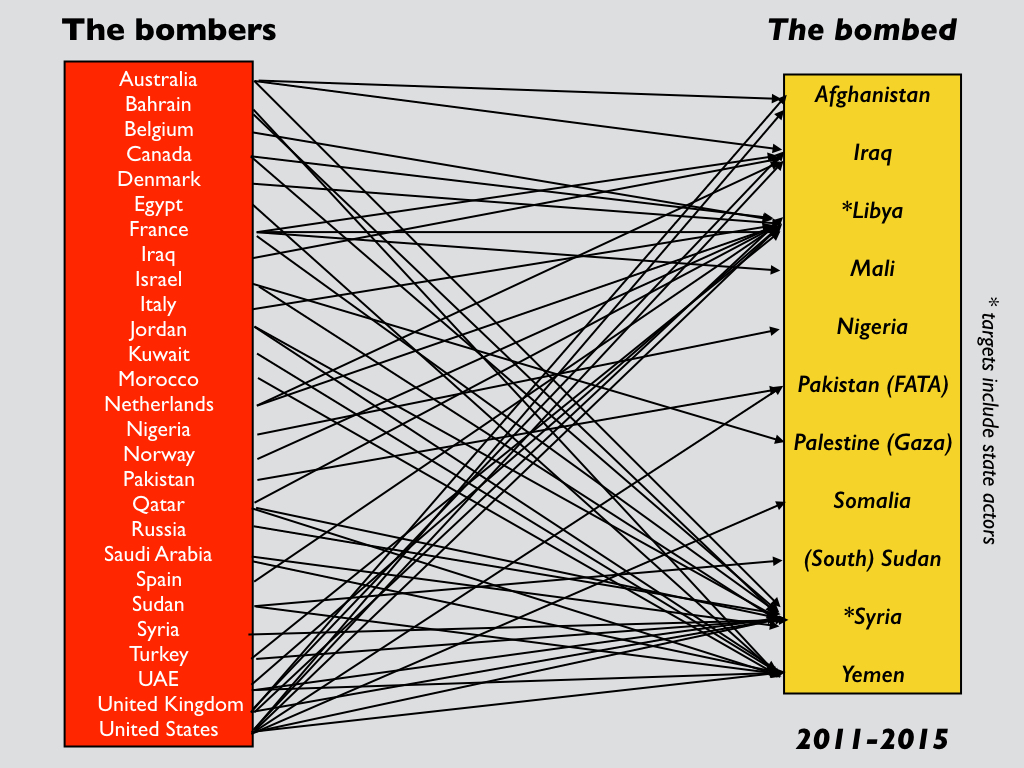
Bombing is back in the headlines but it never really left – and yet those who remain advocates of aerial violence don’t seem to have learned from its dismal history.  They also ignore the geographies that have been intrinsic to its execution, both the division between ‘the bombers and the bombed’ (the diagram below is an imperfect and fragmentary example of what I have in mind) and the pulsating spaces through which bombing is performed.
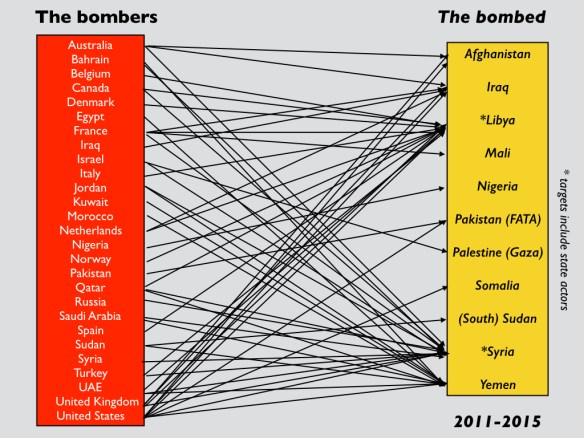
The bombers and the bombed.001

Good bomb, bad bomb

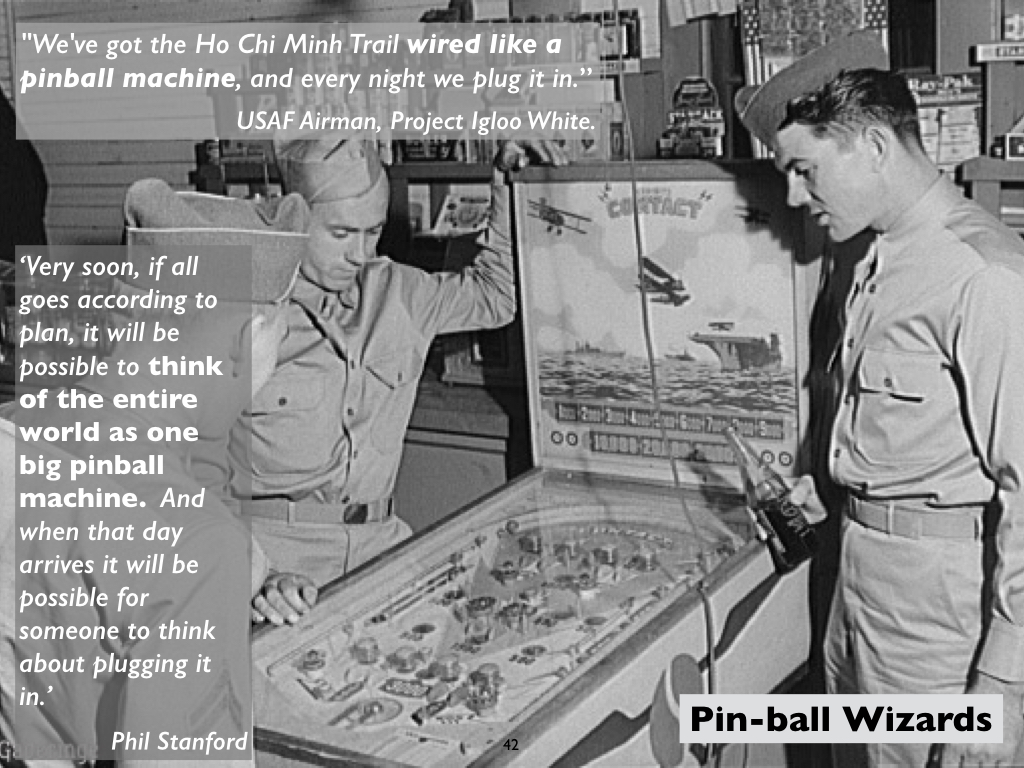
(with apologies to Mahmood Mamdani….)  In the first part I traced The machinery of bombing from before the First World War through to today’s remote operations.  Even though most early commentators believed that the primary role of military aircraft would be in reconnaissance, it was not long before they were being used to orchestrate artillery fire and to conduct bombing from the air. This sequence parallels the development of the Predator towards the end of the twentieth century.  In fact, almost as soon as the dream of flight had been realised the possibility of ‘unmanned flight’ took to the air.  Perhaps the most significant development, though, because it directs our attention to the wider matrix within which aerial violence takes place, was the development of the electronic battlefield in Laos and Cambodia. I’ve written about this in detail in ‘Lines of Descent‘ (DOWNLOADS tab); the electronic battlefield was important not because of what it did – the interdiction program on the Ho Chi Minh Trail was a spectacular failure (something which too many historians have failed to recognise)  – but because of what it showed: it conjured up an imaginative landscape, an automated killing field, in which sensors and shooters were linked through computer systems and automatic relays.  Contemporaries described the system as a vast ‘pinball machine’ (see the image below: you can have no idea how long it took me to track it down…).
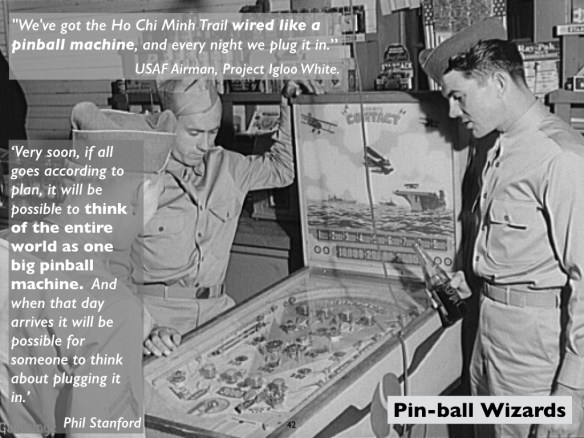
Pinball wizards.001

The analogy allowed me to segue into the parallel but wholly inadequate characterisation of today’s remote operations as reducing military violence to a video game.

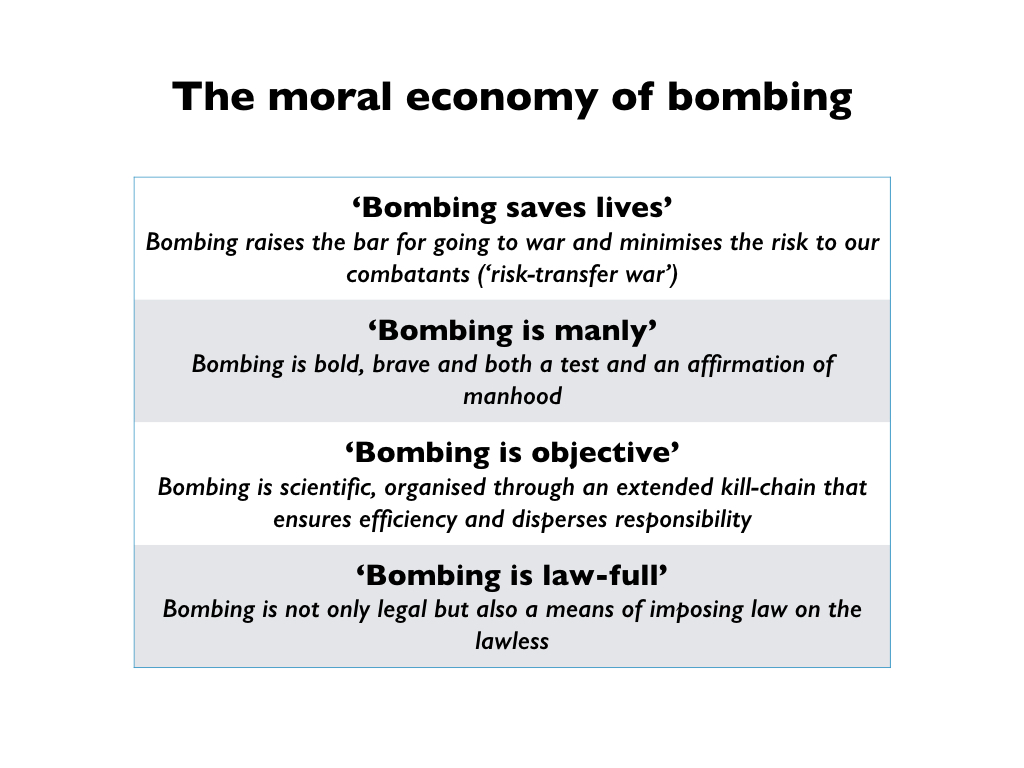
That is an avowedly ethical objection, of course, so I then turned to The moral economy of bombing.  Here I dissected four of the main ways in which bombing has been justified.  These have taken different forms at different times, and they intersect and on occasion even collide.  But they have been remarkable persistent, so in each case I tracked the arguments involved and showed how they have been radicalised or compromised by the development of Predators and Reapers.
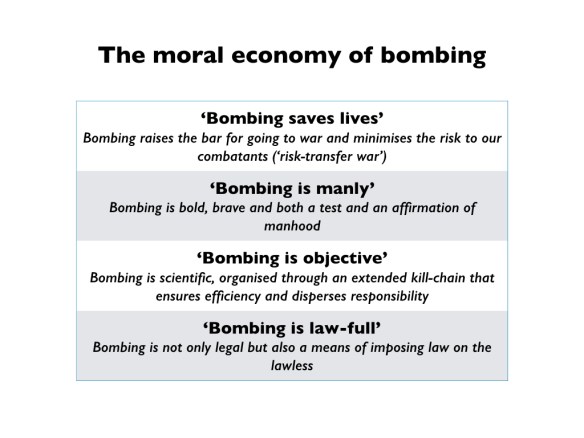
Moral economy of bombing.001

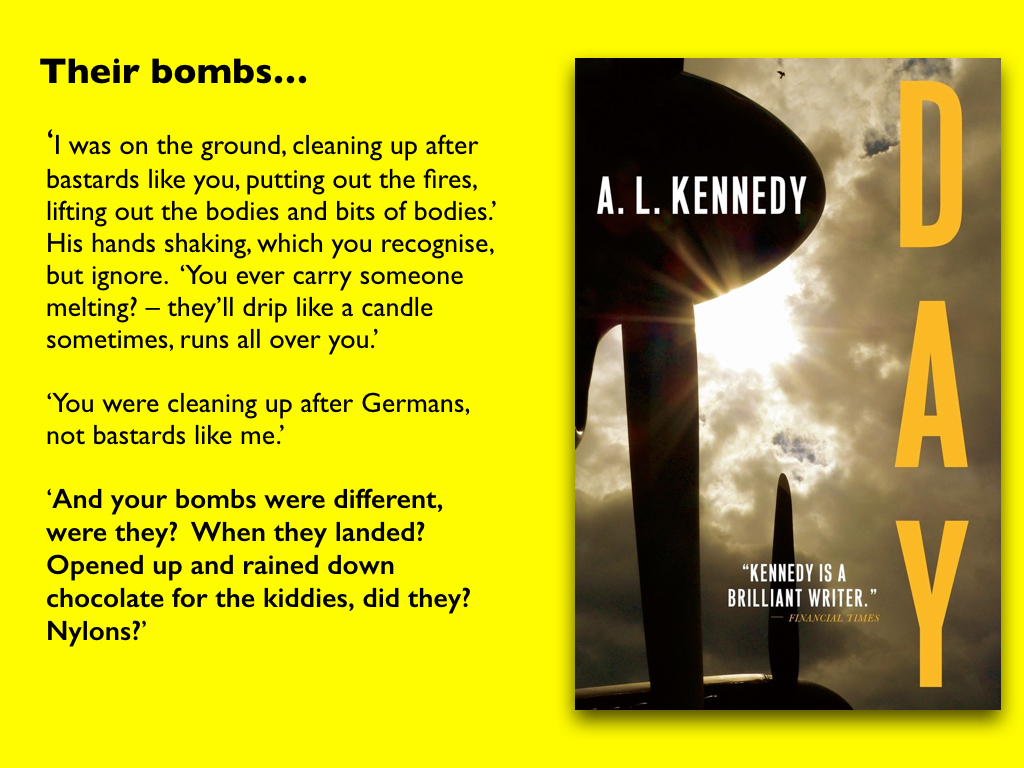
All of these justifications applied to ‘our bombs’, needless to say, which become ‘good bombs’, not to ‘their bombs’ – the ‘bad bombs’.

Their bombs.001

TWO

Killing Space

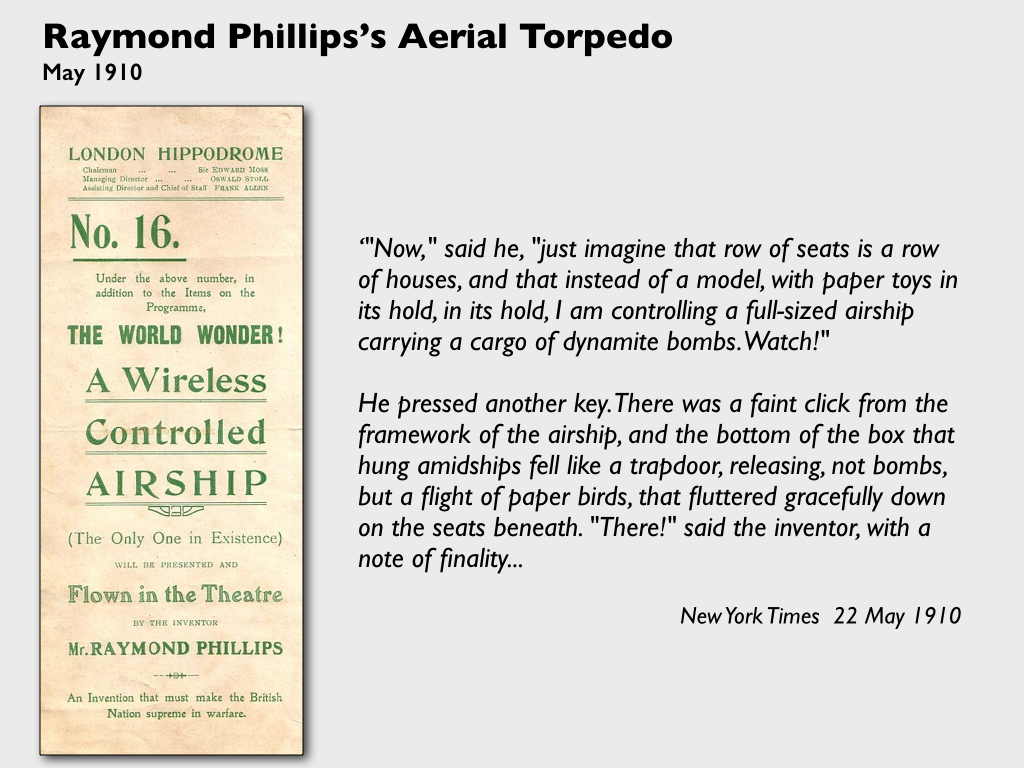
Phillips' Aerial Torpedo.001

I started the second lecture by discussing The deconstruction of the battlefield; the wonder of Raymond Phillips’s fantasies of ‘aerial torpedoes‘ before the First World War was not so much their promise of ‘bomb-dropping by wireless’ but the targets:
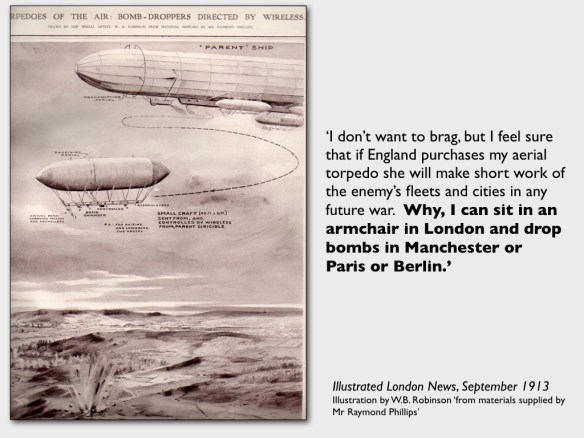
Phillips' bomb-dropping by wireless.001

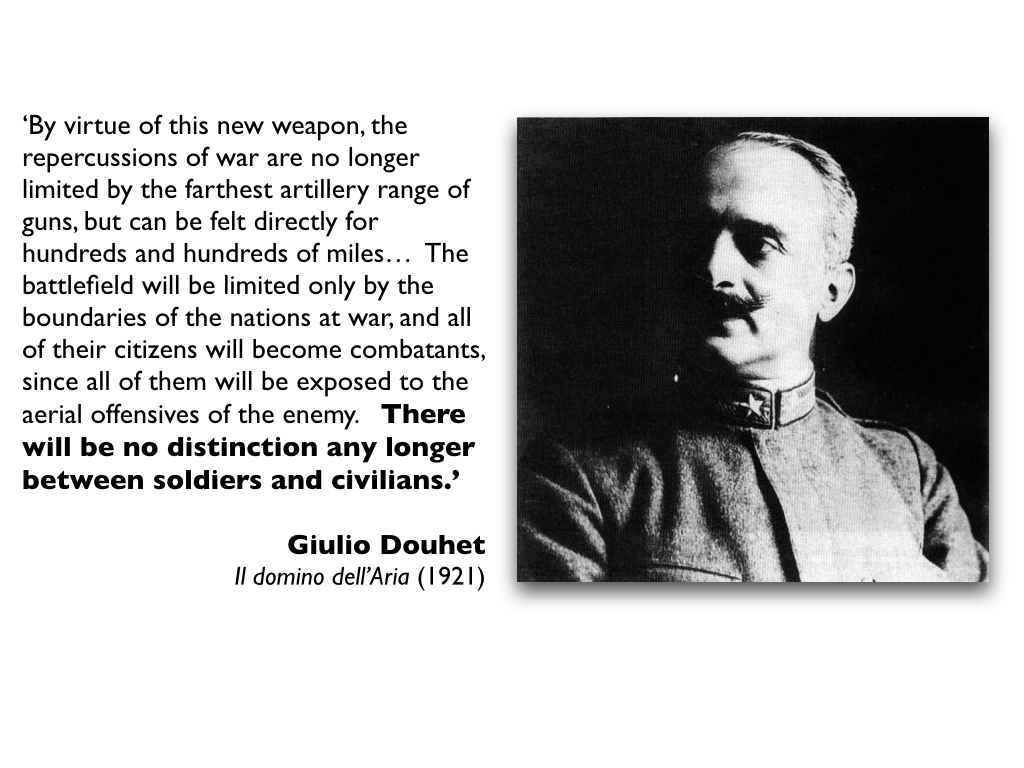
It was this radical extension of the battle space that counted.  In the event,  it was not British airships that dropped bombs on Berlin but German Zeppelins that bombed London and Paris, but the lesson was clear:
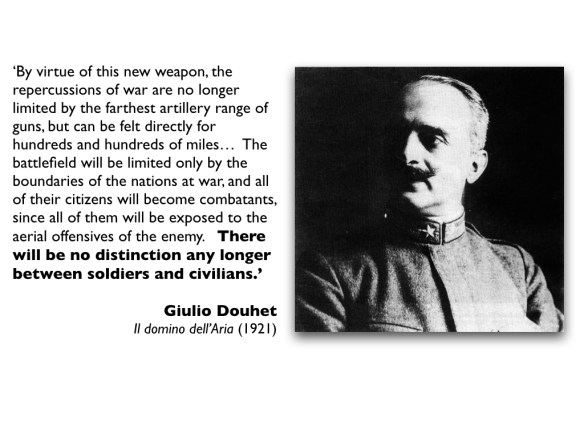
Douhet.001

To explore the formations and deformations of the battlespace in more detail, I used the image of The dark heart of bombing to describe a battlespace that alternately expanded and contracted.  So Allied bombing in the Second World war extended its deadly envelope beyond Germany, Italy and Japan into Belgium, Bulgaria, Denmark, France, the Netherlands, Norway and Romania; later the United States would bomb North Vietnam but reserved most of its ordnance for South Vietnam, Laos and Cambodia; and US air strikes in Afghanistan and Iraq would eventually spill over into Pakistan, Syria and elsewhere.  In the course of those air wars, the accuracy of targeting improved until it was possible to aim (if not always to hit) point-targets – individual buildings and eventually individual people – but this contraction of the killing space was accompanied by its expansion.  These ‘point-targets’ were selected because they were vital nodes that made possible the degradation or even destruction of an entire network.  Hence, for example, the Israeli attack on the Gaza power station (more in a previous post here):
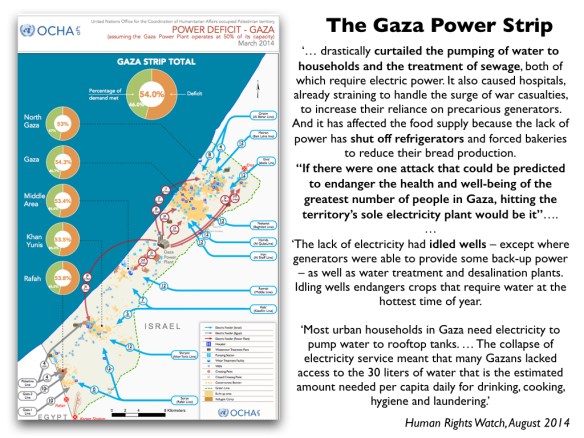
Gaza Power Strip.001

A similar argument can be made about the US Air Force’s boast that it can now put ‘warheads on foreheads’, and I linked the so-called individuation of warfare to the US determination to target individuals wherever they go – to what Jeremy Scahill and others describe as the production of a newly expanded ‘global battlefield’.  What lies behind this is more than the drone, of course, since these killing fields rely on a global system of surveillance orchestrated by the NSA, and I sketched its contours and showed how they issued in the technical production of an ‘individual’ not as a fleshy, corporeal person but as a digital-statistical-spatial artefact (what Ian Hacking once called ‘making people up’ and what Grégoire Chamayou calls ‘schematic bodies‘).

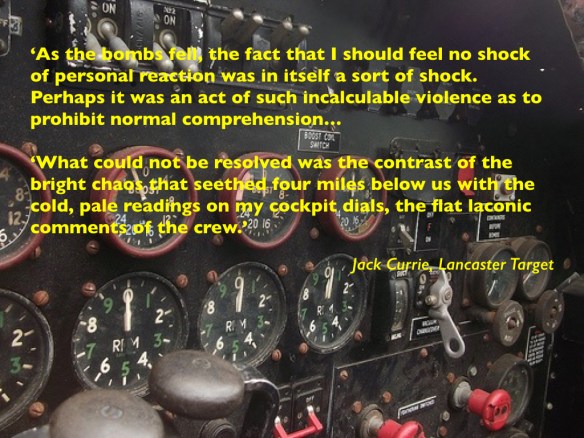
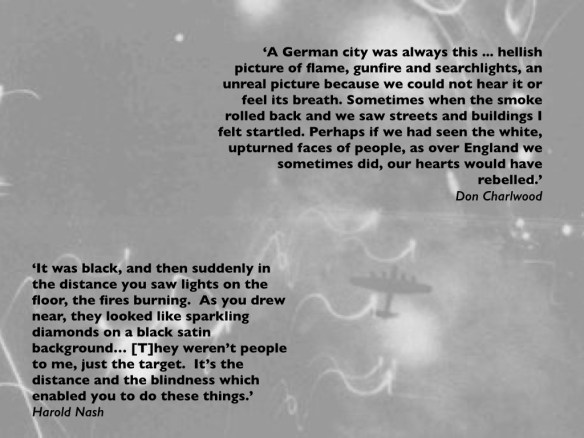
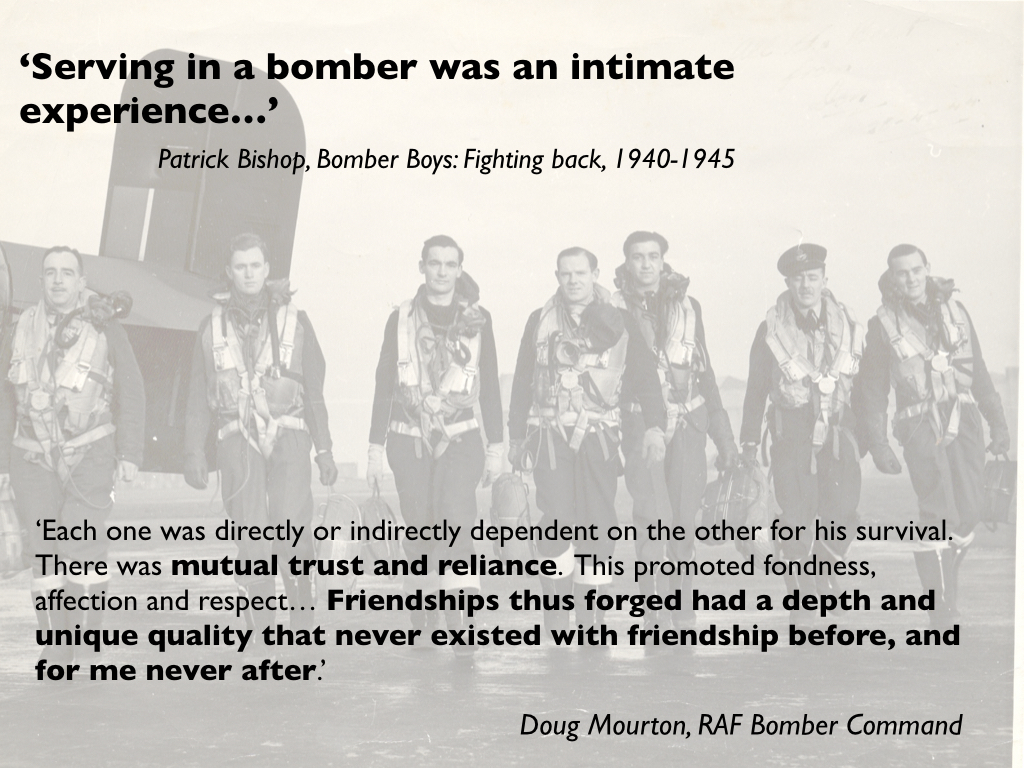
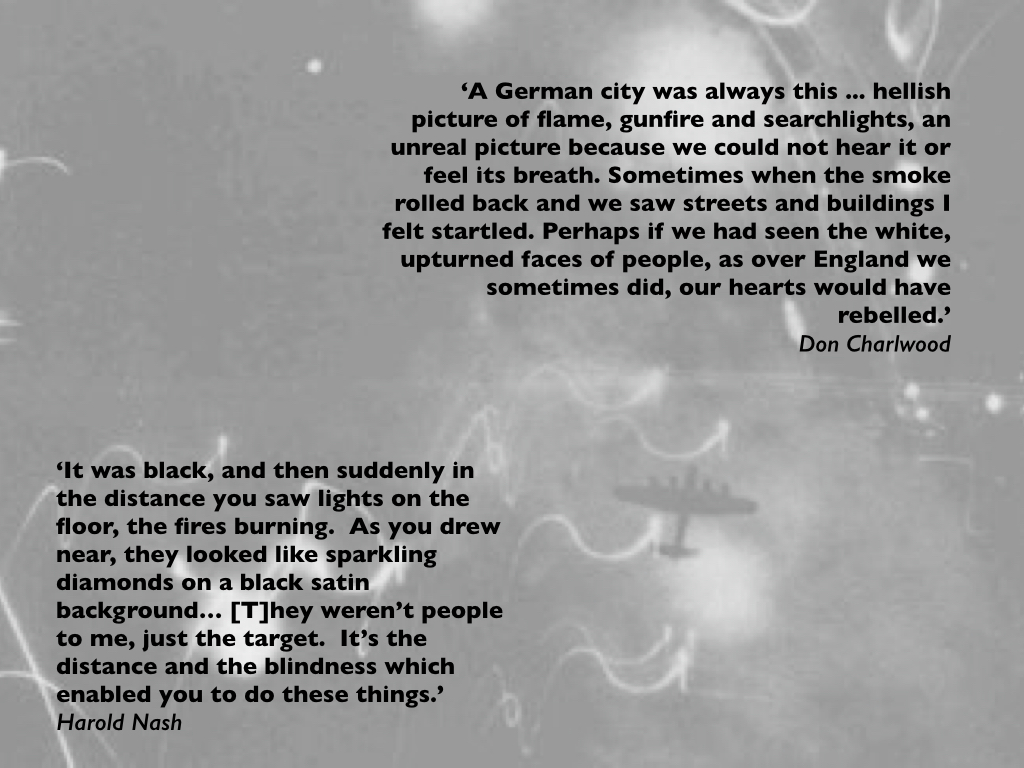
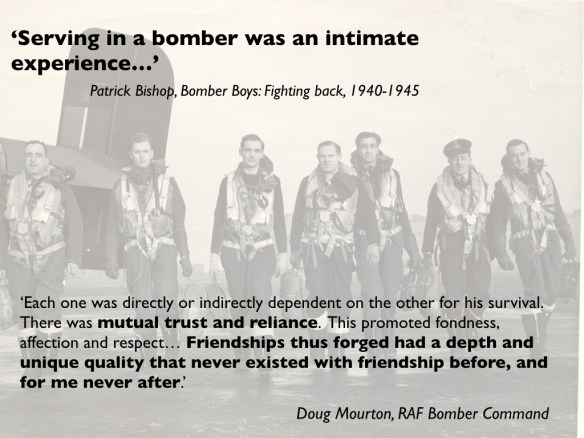
Next I explored a different dialectical geography of the battlespace: Remote splits: intimacy and detachment.  I started with RAF Bomber Command and traced in detail the contrast between the intimacy between members of bomber crews (a mutual dependence reinforced by the bio-convergence between their bodies and the machinery of the bomber itself) and the distance and detachment through which they viewed their targets.
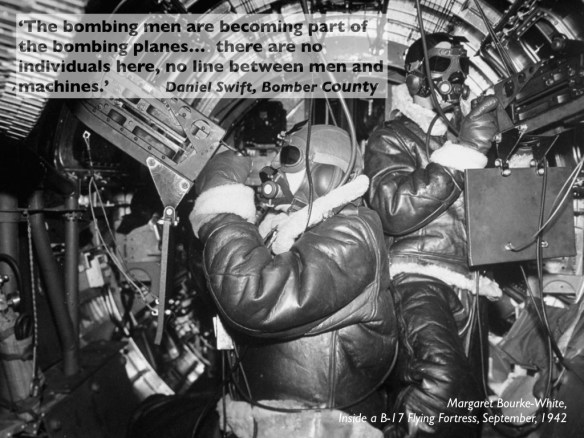
Bioconvergence and the bomber crew.001

Intimacy in Bomber Command.001

The Good Wife.001

Cockpit dials.001

Distance and blindness.001

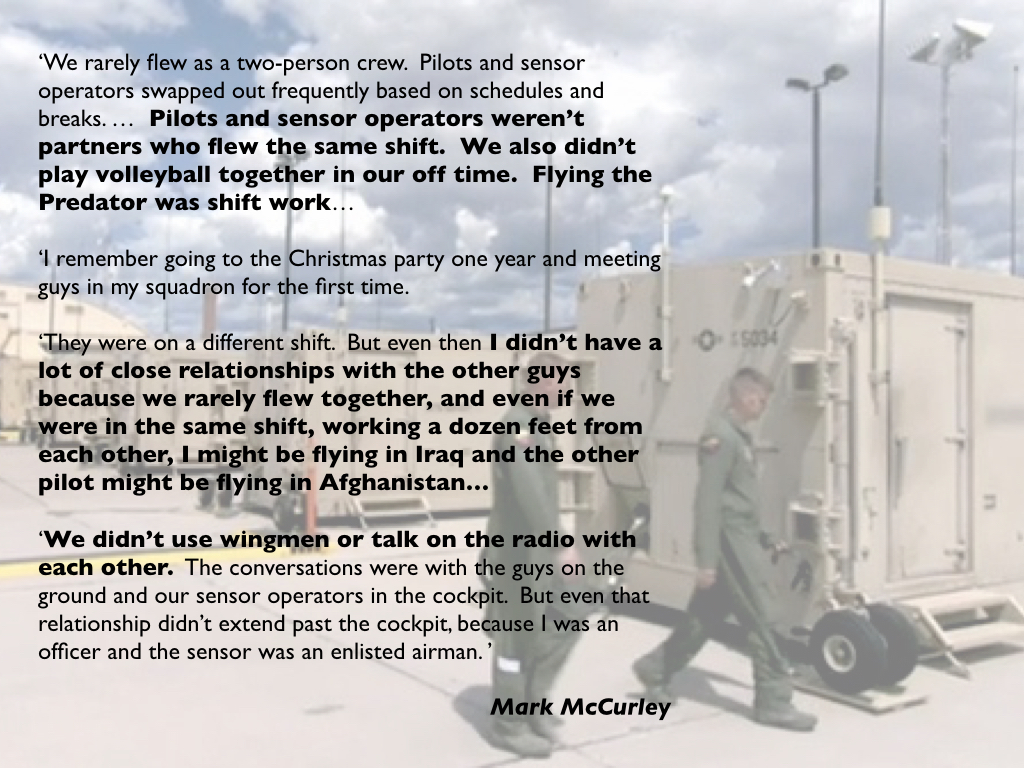
There’s much more on this in ‘Doors into nowhere‘ (DOWNLOADS tab), though I think my discussion in the Lectures breaks new ground. All of this is in stark contrast to today’s remote operations, where – as Lucy Suchman reminds us – there remains a remarkable (though different) degree of bioconvergence and yet now a persistent isolation and anomie is felt by many pilots and sensor operators who work in shifts:
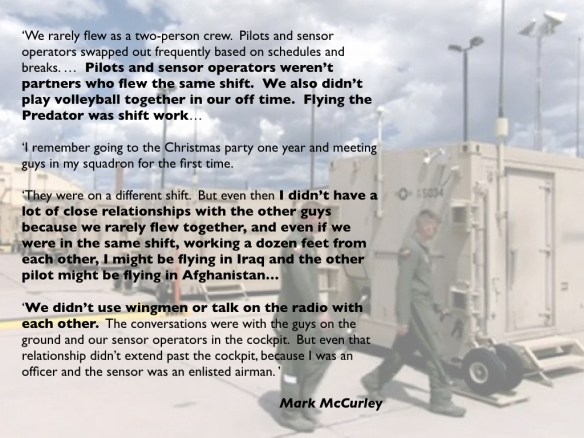
Anomie and the drone.001

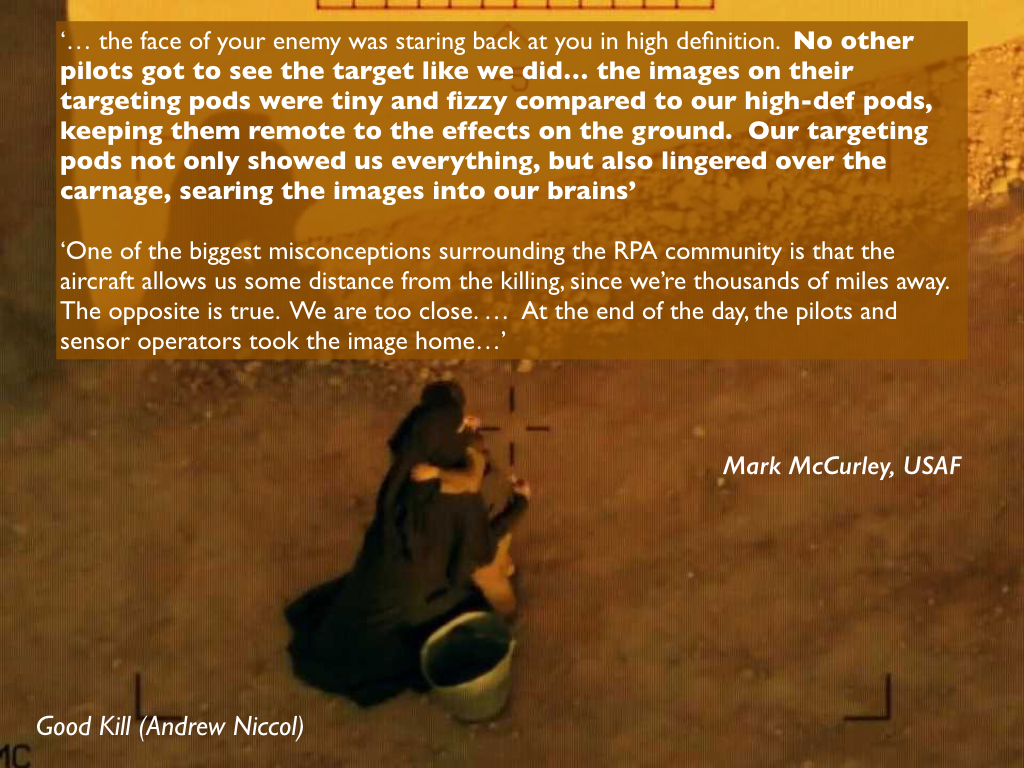
This is thrown into relief by the closeness remote operators feel to the killing space itself, an immersion made possible through the near real-time full-motion video feeds, the internet relay chatter and the radio communications with troops on the ground (where there are any). In contrast to the bomber crews of the Second World War – or those flying over the rainforests of Vietnam, Laos and Cambodia – there is a repeated insistence on a virtualized proximity to the target.
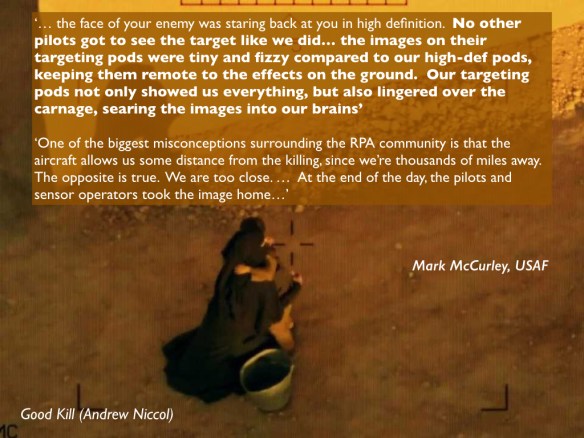
Good Kill in high-definition.001

But I used a discussion of Andrew Niccol‘s Good Kill to raise a series of doubts about what drone crews really can see, as a way into the next section, Sweet target, which provided an abbreviated presentation of the US air strike in Uruzgan I discuss in much more (I hope forensic) detail in Angry Eyes (see here and here).  That also allowed me to bring together many of the key themes I had isolated in the course of the two lectures.

As I approached my conclusion, I invoked Thomas Hippler‘s Le gouvernement du ciel: Histoire globale des bombardements aériens, (I’ve just discovered that Verso will publish the English-language version later this year or early next: Governing from the skies: a global history of aerial bombing):
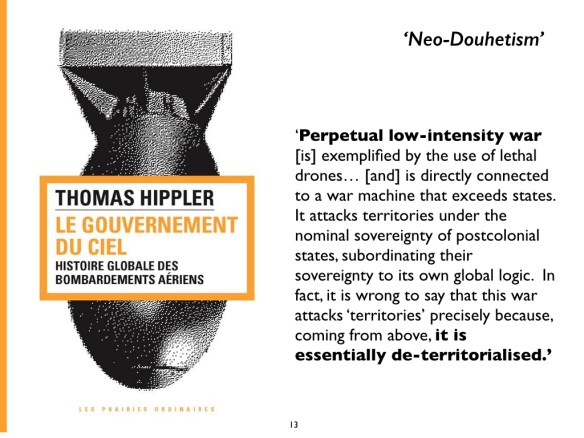
Hippler Neo-douhetism.001

I’m not convinced that the military and paramilitary violence being visited on people today is all ‘low-intensity’ (Gaza? Afghanistan? Iraq? Syria? Yemen?).  But neither do I think it’s ‘de-territorialised’, unless the word is flattened into a conventionally Euclidean frame.  Hence, following Stuart Elden‘s lead, I treated territory as a political-juridical technology whose calibrations and enclosures assert, enable and enforce a claim over bodies-in-spaces.  And it was those ‘bodies-on-spaces’ that brought me, finally, to The loneliest space of all:  the irreducible, truly dreadful loneliness of death and grief:

Counting the dead.001

Behind the body-counts and the odious euphemisms of collateral damage and the rest lies the raw, inconsolable loss so exquisitely, painfully rendered in ‘Sky of Horoshima‘…

In the coming days I’ll post some of the key sections of the Lectures in more detail, which I’ll eventually develop into long-form essays.

I learned a lot from the expert and wonderfully constructive commentaries after the Lectures from Grégoire Chamayou, Jochen von Bernstorff and Chris Woods, and I’ll do my best to incorporate their suggestions into the final version.

In his response Grégoire traced my project on military violence in general and bombing/drones in particular back to a series of arguments I’d developed in Geographical imaginations in 1994 about vision, violence and corporeality; I had overlooked these completely, full of the conceit that my work had never stood still…. I shall go back, re-read and think about that some more, since some of the ideas that Grégoire recovered (and elaborated) may be even more helpful to me now.  Jochen and Chris also gave me much food for thought, so I shall be busy in the coming months, and I’m immensely grateful to all three of them.
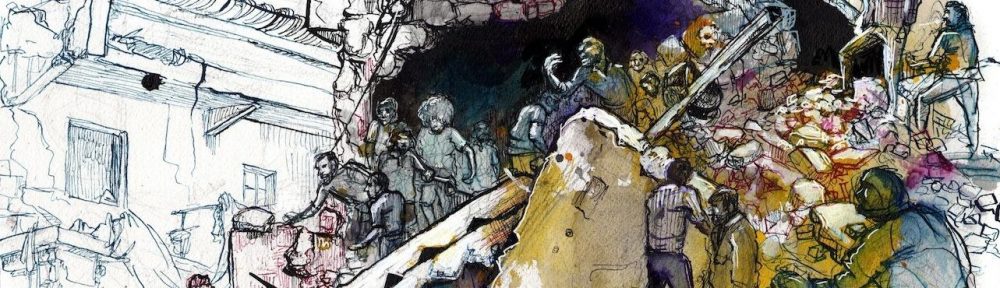
“I’ve looked at clouds from both sides now…”

Eyal Weizman‘s stunning Wall Exchange, “Forensic Architecture”, which he presented at the Vogue Theatre in Vancouver earlier this month, is now up on YouTube here and embedded below.

https://www.youtube.com/watch?v=qBDWPn7QcIg

If you are puzzled by my riff on Joni Mitchell, start around 46:10 (though you’ll miss a lot if you do…).

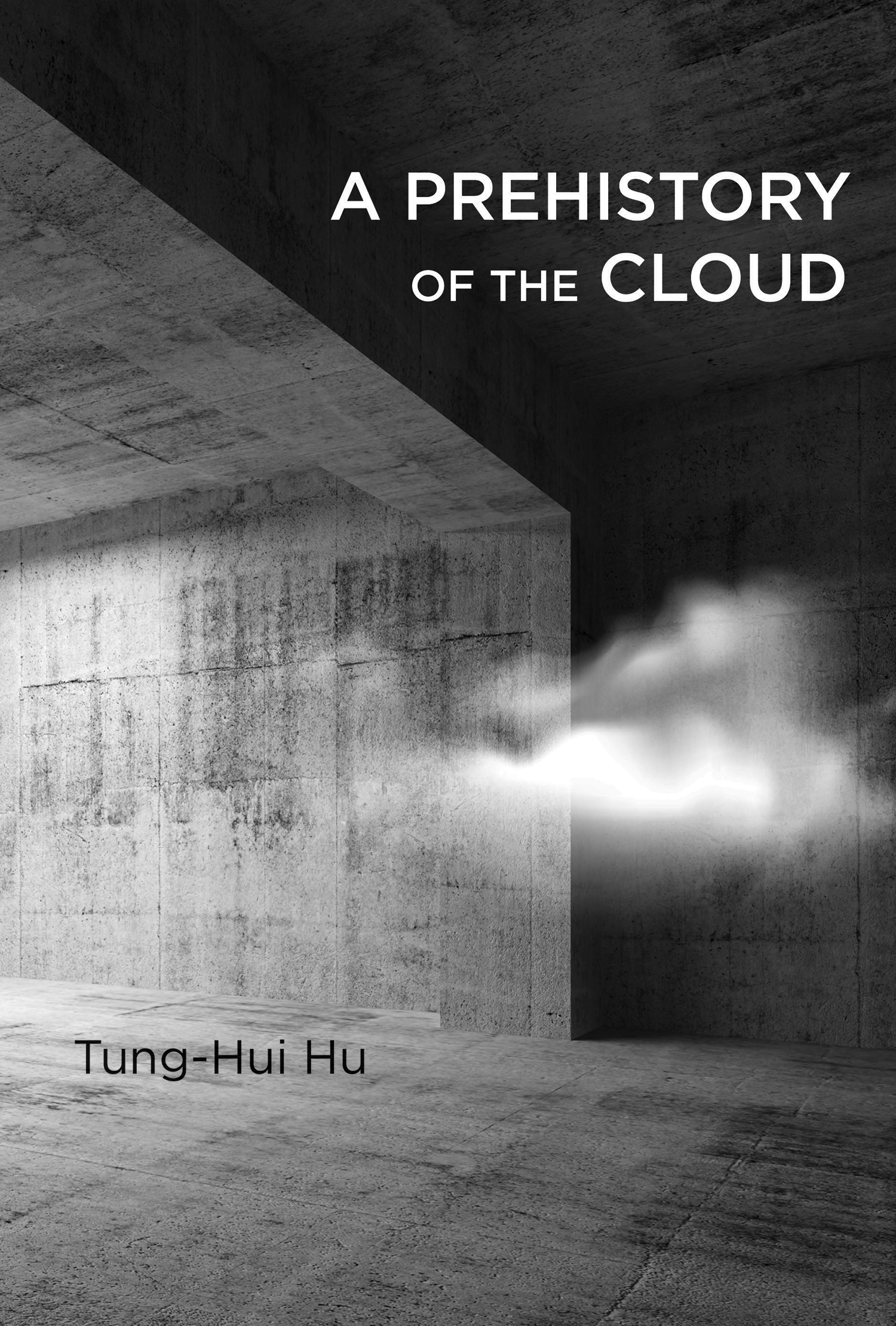
And while we’re on the subject of clouds, you’ll find a remarkable analysis of a different sort of militarized cloud in Tung-Hui Hu‘s A Prehistory of the Cloud from MIT:

We may imagine the digital cloud as placeless, mute, ethereal, and unmediated. Yet the reality of the cloud is embodied in thousands of massive data centers, any one of which can use as much electricity as a midsized town. Even all these data centers are only one small part of the cloud. Behind that cloud-shaped icon on our screens is a whole universe of technologies and cultural norms, all working to keep us from noticing their existence. In this book, Tung-Hui Hu examines the gap between the real and the virtual in our understanding of the cloud.

Hu shows that the cloud grew out of such older networks as railroad tracks, sewer lines, and television circuits. He describes key moments in the prehistory of the cloud, from the game “Spacewar” as exemplar of time-sharing computers to Cold War bunkers that were later reused as data centers. Countering the popular perception of a new “cloudlike” political power that is dispersed and immaterial, Hu argues that the cloud grafts digital technologies onto older ways of exerting power over a population. But because we invest the cloud with cultural fantasies about security and participation, we fail to recognize its militarized origins and ideology. Moving between the materiality of the technology itself and its cultural rhetoric, Hu’s account offers a set of new tools for rethinking the contemporary digital environment.

Prehistory of the Cloud

Here is Lisa Parks on what is surely one of the must-reads of the year:

“Hu’s riveting genealogy of the cloud takes us into its precursors and politics, and boldly demonstrates how fantasies of sovereignty, security, and participation are bound up in it. Much more than a data center, the cloud is a diffuse and invisible structure of power that has yielded a data-centric order. Imaginative and lucidly written, this book will be core to digital media studies.”

Continuing catastrophes

VP-AlHaq-GazaVillages

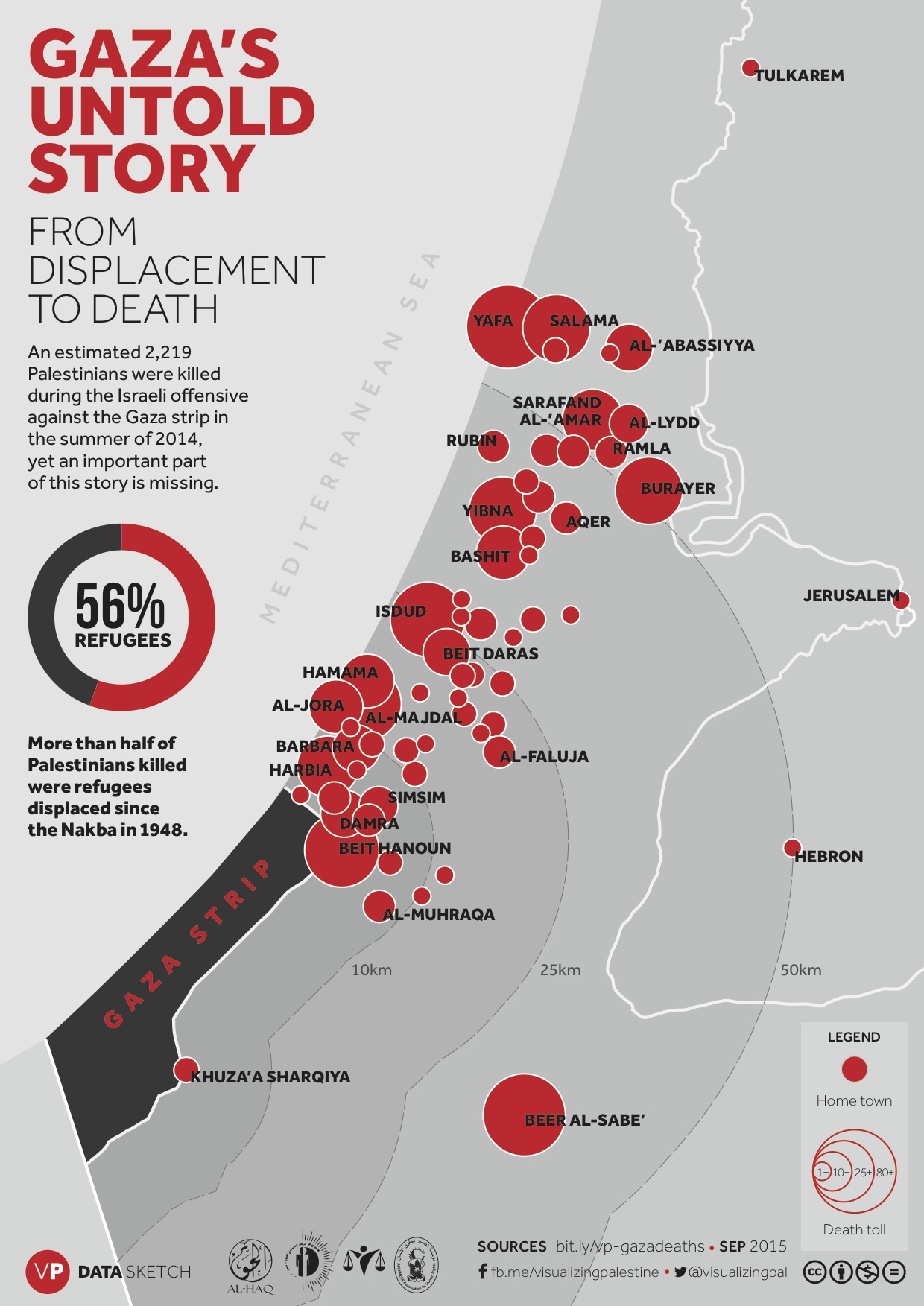
At a time when the plight of refugees from the wars in Iraq, Syria, Libya, Somalia and elsewhere is – at last – commanding the attention of a global audience, it’s important not to forget other refugees: including those from Palestine.  Al-Haq, which co-sponsored the infographic above, explains:

August 26, 2015 marked the first anniversary of Israel’s offensive on the Gaza Strip, during which 2,219 Palestinians were killed. However, a large part of the story is left untold. Over half of those killed were refugees who were displaced from their homes in Yafa, Salama, Isdud, and many other villages and towns, as a result of and following the Nakba [‘catastrophe’] in 1948. The majority of those killed lived in refugee camps in the Gaza Strip within a 30 mile (50 km) radius of their homes of origin. A total of 1,236 refugees were killed during the 2014 offensive, including at least 309 children.

This infographic visually represents the untold story of Gaza’s refugees. Created by Visualizing Palestine in collaboration with four Palestinian human rights organizations, Al-Haq, the Al Mezan Centre for Human Rights, the Palestine Centre for Human Rights, and Al-Dameer Association for Human Rights, who launched a joint campaign to document Israel’s attacks during the 2014 offensive against the Gaza Strip.

For Palestinian refugees, the Nakba did not end in 1948, as they have experienced a continued denial of justice. There are 1.3 million refugees residing in Gaza who are spread over eight refugee camps, making up almost three quarters of the total population of the Gaza Stip. Refugees residing in Gaza have faced multiple consequent internal displacements due to Israeli policies, including Israel’s three military offensives against Gaza over the last six years. Israel’s deadly military operations, as well as its eight-year closure of Gaza have had devastating effects on the entire population in Gaza. While all Palestinians in Gaza endure harsh living conditions, including irregular electricity and water supplies, these issues are even more acute in the refugee camps.

You can find the data and other notes on the visualization here.  And if you are wondering about my title, here is Joseph Massad writing in 2008 on ‘Resisting the Nakba‘:

[T]here is much at stake in all of this, in rendering the Nakba an event of the past, a fact on the ground that one cannot but accept, admit, and finally transcend; indeed that in order to move forward, one must leave the Nakba behind. Some have even suggested that if Israel acknowledges and apologizes for the Nakba, the Palestinians would forgive and forget, and the effects of the Nakba would be relegated to historical commemorations, not unlike the one we are having this year.

In my view, the Nakba is none of these things, and the attempt to make this year [2008] the 60th anniversary of the Nakba’s life and death is a grave error. The Nakba is in fact much older than 60 years and it is still with us, pulsating with life and coursing through history by piling up more calamities upon the Palestinian people…  Much as the world would like to present Palestinians as living in a post-Nakba period, I insist that we live thoroughly in Nakba times. What we are doing this year is not an act of commemorating but an act of witnessing the ongoing Nakba that continues to destroy Palestine and the Palestinians. I submit, therefore, that this year is not the 60th anniversary of the Nakba at all, but rather one more year of enduring its brutality; that the history of the Nakba has never been a history of the past but decidedly a history of the present.

The conflict shoreline, colonialism and climate change

Conflict_Shoreline_web

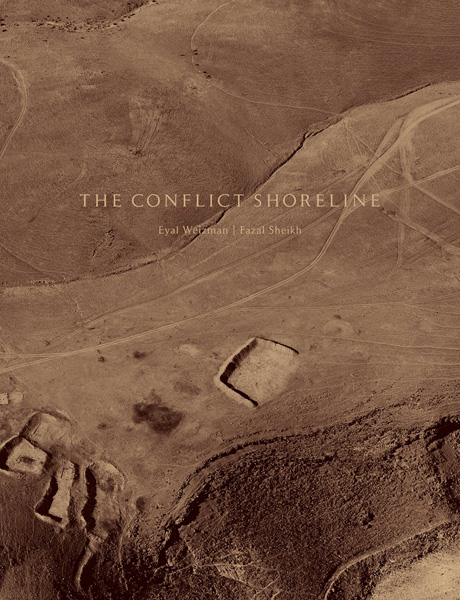
When Eyal Weizman was in Vancouver last March – joining us for Gaston Gordillo‘s  workshop on Space, materiality and violence at the Peter Wall Institute for Advanced Studies – he delivered a public lecture on The Conflict Shoreline: Colonialism as Climate Change.

It’s now available as an extended essay (96 pp) from Steidl in association with Cabinet Books:

The village of al-‘Araqib has been destroyed and rebuilt more than seventy times in the “battle over the Negev,” an ongoing Israeli state campaign to uproot the Bedouins from the northern threshold of the desert. Unlike other frontiers fought over during the Israel–Palestine conflict, however, this threshold is not demarcated by fences and walls but advances and recedes in response to cultivation, colonization, displacement, urbanization, and climate change.

The fate of al-‘Araqib, like that of other Bedouin villages along the desert’s threshold, its “aridity line,” is bound up with deep environmental changes. But whereas even the most committed environmentalists today conceive of climate change as an accidental and unintentional side effect of modernity, Israeli architect and theorist Eyal Weizman argues that from the point of view of colonial history, climate change has never been simply collateral damage. It has always been a stated goal; “making the desert bloom” is, in effect, “changing the climate.”

In examining this history, Weizman outlines attempts—from the Ottoman era through the period of European colonization to the present—to scientifically define, measure, and map the threshold of the desert. Such efforts have been important because imperial and, later, national governments—whose laws have never recognized property rights in the desert—aimed to push back this threshold as they tried to expand the limits of arable land and bring the nomads under state control. In the Negev, the displacement of the weather and the displacement of the Bedouins have gone hand in hand. But while the desert edge, and the Bedouins, have been driven further and further south, global climate change today acts as a major counterforce. Predictably, the Bedouins are caught in the middle.

Brilliantly researched and argued, Weizman’s text—part detective story, part history lesson, and part scientific analysis—explores the changing threshold of the Negev through the extraordinary contemporary photographs of American artist Fazal Sheikh, as well as an array of documents, maps, and images, including historical aerial imagery, remote sensing data, state plans, court testimonies, and nineteenth-century travelers’ accounts. Together, these disparate forms of evidence establish the “conflict shoreline” as a border along which climate change and political contestation are deeply, perilously entangled.

You can find some of the background, and the relation to Eyal’s Forensic Architecture project, in an interview earlier this year:

I’m mostly trying to establish forensic architecture as a critical field of practice and as an agency that produce and disseminate evidence about war crimes in urban context. Recent forensic investigations in Guatemala and in the Israeli Negev involved the intersection of violence and environmental transformations, even climate change. For trials and truth commissions, we analyze the extent to which environmental transformation intersect with conflict.

The imaging of this previously invisible types of violence—‘environmental violence’ such as land degradation, the destruction of fields and forests (in the tropics), pollution and water diversion, and also long term processes of desertification—we use as new type of evidence of processes dispersed across time and space. There are other conflicts that unfold in relation to climatic and environmental transformations and in particular in relation to environmental scarcity.

Conflict has reciprocal interaction with environment transformation: environmental change could aggravate conflict, while conflict tends to generate further environmental damage. This has been apparent in Darfur, Sudan where the conflict was aggravated by increased competition over arable due to local land erosion and desertification. War and insurgency have occurred along Sahel—Arabic for ‘shoreline’—on the southern threshold of the Sahara Desert, which is only ebbing as million of hectares of former arable land turn to desert. In past decades, conflicts have broken out in most countries from East to West Africa, along this shoreline: Eritrea, Ethiopia, Somalia, Sudan, Chad, Niger, Mali, Mauritania, and Senegal. In 2011 in the city of Daraa, farmers’ protests, borne out of an extended cycle of droughts, marked the beginning of the Syrian civil war. Similar processes took place in the eastern outskirts of Damascus, Homs, al-Raqqah and along the threshold of the great Syrian and Northern Iraqi Deserts. These transformations impact upon cities, themselves a set of entangled natural/man-made environments. The conflict and hardships along desertification bands compel dispossessed farmers to embark upon increasingly perilous paths of migrations, leading to fast urbanization at the growing outskirts of the cities and slams.

I’m trying to understand these processes across desert thresholds. There has been a very long colonial debate about what is the line beyond which the desert begins. Most commonly it was defined as 200 mm rain per annum. Cartographers were trying to draw it, as it represented, to a certain extent, the limit of imperial control. From this line on, most policing was done through bombing of tribal areas from the air. Since the beginning, the emergence of the use of air power in policing in the post World War I period—aerial control, aerial government—took form in places that were perceived, at the time, as lying beyond the thresholds or edges of the law. The British policing of Iraq, the French in Syria, and Algeria, the Italians in Libya are examples where control would hover in air.

Up to now I was writing about borders that were physical and manmade: walls in the West Bank or Gaza and the siege around it—most notably in Hollow Land (2007). Now I started to write about borders that are made by the interaction of people and the environment—like the desert line—which is not less violent and brutal. The colonial history of Palestine has been an attempt to push the line of the desert south, trying to make it green or bloom—this is in Ben Gurion’s terms—but the origins of this statement are earlier and making the desert green and pushing the line of the desert was also Mussolini’s stated aim. On the other hand, climate change is now pushing that line north.

Following not geopolitical but meteorological borders, helps me cut across a big epistemological problem that confines the writing in international relations or geopolitics within the borders organize your writing. Braudel is an inspiration but, for him, the environment of the Mediterranean is basically cyclically fixed. The problem with geographical determinism is that it takes nature as a given, cyclical, milieu which then affects politics—but I think we are now in a period where politics affects nature in the same way in which nature affects politics. The climate is changing in the same speed as human history.

fazal-sheikh-desert-bloom-web

The conflict shoreline was originally commissioned in response to Fazal Sheikh’s Desert Bloom series (part of his remarkable Erasure trilogy: see image stream above, and also here).

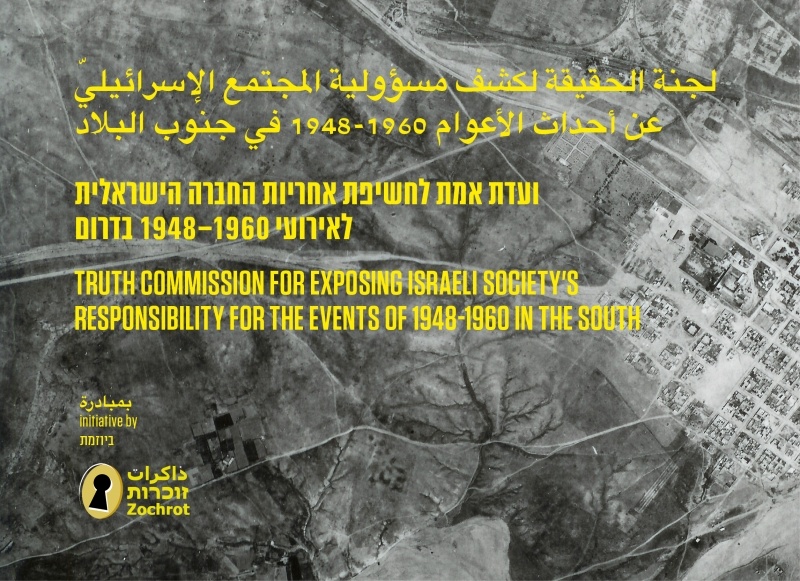
Truth Commission

It has also been submitted as evidence for Zochrot‘s project on transitional justice, the Truth Commission on the responsibility of Israeli society for the events of 1948–1960 in the South.

Transitional justice mechanisms address the needs of communities and countries in conflict to cope with systematic abuses and structural injustices in order to facilitate reconciliation. Communities in conflict, both victims and victimizers, have developed a variety of innovative approaches to addressing the needs that result from ongoing conflicts. Hitherto, practices informed by the transitional justice paradigm have been used mainly to accompany and heal societies and communities in political transitions such as from totalitarian to democratic rule, or from an apartheid regime as in South Africa to an egalitarian democratic regime. Usually, these practices have been applied after a violent conflict had ended in a peace agreement, as in the former Yugoslavia, or in an armistice, as in Cyprus or Northern Ireland.

Many activists around the world have demonstrated time and again that silencing and ignoring the past prevent conflict resolution and the attainment of true reconciliation. Therefore, even in situations of seemingly intractable conflicts, several initiatives by civil society organizations, trade union or social religious organizations similar to state-sponsored mechanisms of transitional justice have sprung around the world. For the past 40 years, these initiatives have acted without government backing to bring resolve violent conflicts.

The Truth Commission established by Zochrot now joins these initiatives. The first of its kind in Israel/Palestine, the Commission is unique in that … it is active while the conflict is still ongoing, and against the background of the regime’s evasion of responsibility to the events of the Nakba, which began in 1948 and is still ongoing [the Nakba or ‘catastrophe’ refers to the forced eviction and dispossession of the Palestinian people set in motion by the war of 1948]. The Truth Commission for Exposing Israeli Society’s Responsibility for the Events of 1948-1960 in the South which started its deliberations in late October 2014…

The Commission seeks to expose the events of the Nakba during those years – events that have profound implications for the ongoing Nakba experienced by the Palestinian Bedouins to this day. The Commission examines testimonies by Palestinian displaced persons and refugees, as well as Jews who lived in the south and Jewish fighters who took part in displacement and expulsion operations in the area. In addition, the Commission peruses relevant archive materials. The Commission’s report will be designed to encourage the Jewish society in Israel to accept responsibility for past injustices in the south, with reference to the ongoing Nakba, and for redressing them.

You can also read Tom Pessah‘s report for +972 here.

Wall Exchange: Forensic Architecture

diehlgroup

“When war happens in the city, people die in buildings, the majority in their homes; when the dust settles ruins become evidence with which we could reconstruct controversial events.”
Eyal Weizman

I’m delighted to announce that my good friend Eyal Weizman will deliver the next Wall Exchange on Forensic Architecture at the Vogue Theatre in downtown Vancouver on 15 October 2015:

Can architecture provide new tool of political analysis and intervention? This question is central to the work of Eyal Weizman, Israeli architect and scholar. Since 2010 he has been directing Forensic Architecture, an innovative forensic agency that investigates the sites of contemporary conflicts and monitors the crimes of states. His teams examine buildings, ruins, maps, satellite imagery and increasingly an emergent type of testimony — images and clips taken by citizens and uploaded online. His talk will unpack new modes of exposing the logic behind state violence from the frontier regions of Pakistan, through the forests of south America to the Israel-Palestine conflict.

I’ve noted the work of Forensic Architecture many times – see here and here, for example, and our Acting Director Gastón Gordillo‘s excellent review essay on Forensis [introduction available here; full version appeared in Environment & Planning D: Society and Space 33 (2) (2015) 382 – 388 and is available here] – so if you are (or can be) in Vancouver in the fall, do come along.

Like all Wall Exchanges, the lecture is sponsored by UBC’s Peter Wall Institute for Advanced Studies and is free and open to the public – though you do need to book in advance.  Full details and a link to book will be available on the PWIAS website from 8 September onwards.

Bearing witness

ICCG Ramallah 2015

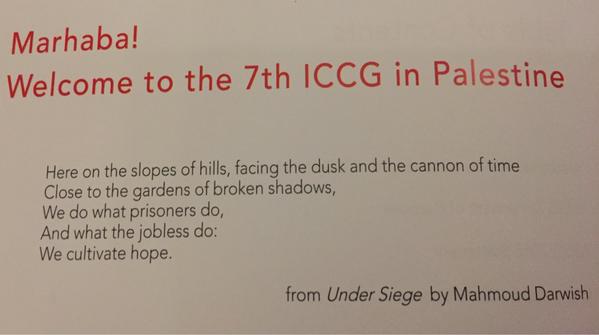
Lisa Tilley provides some sobering reflections on the recent International Conference of Critical Geography at Ramallah here:

The settler colonial condition can be fully understood only by those who live it. But the rest of us can at least bear witness in the place (Palestine) where it is most legible….

Yet in spite of the overtly political and defiant tone, the organisers had agonised over the decision to hold the event in the West Bank because doing so effectively excluded most Arab and Muslim scholars from other parts of the world, as well as Israeli allies who are prohibited from entering Palestinian urban areas, lest Israeli-Palestinian solidarities bloom. Some registered participants were turned away by border forces after being interrogated upon arrival at Tel Aviv, others, especially those with links to Arab or predominantly Muslim countries were subject to invasive interrogation and humiliation either on arrival or on departure.

Yet even these denials, sacrifices, indignities, and border dramas, much as they caused individual pain, actually served in their own way to fortify the overall political message of the conference by becoming part of the anti-normalcy performance of the event itself. Beyond this, physically being in the ‘critical’ geographies of the West Bank was politically and intellectually productive in a way that would be impossible to recreate in another time and place…

Palestine always stays on our lips, confronts our concepts and categories, even rendering worthless some of our carefully spun arguments. The real lessons took place in fertile valleys, poisoned by settler toxins, alongside the walls in which blast holes remain, at the sites of shootings and repressed Selma-style marches, witnessed by nobody…

There were moments when we all simply turned our faces away and wept. But the tears of three hundred critical geographers falling on Palestinian soil will not bring down walls or shatter a violent racist project. “We do not need pity” was stated from the start by Palestinian scholars. So instead the task is to bear witness to Palestine, to say that we know Palestine, that we know it exists, that it has existed, and will continue to exist. Palestinians continue the process of writing back, we can only echo what they say and join in the task of writing/speaking/thinking back in order to bring into being a global Palestine.

More (tweets) here.  I so wish I could have been there.

The Platform Edge

I should have drawn attention to these two further, vital resources in my post on Black Friday, Israel’s assault on Rafah during ‘Operation Protective Edge‘.

Gaza Platform INTRO SCREEN

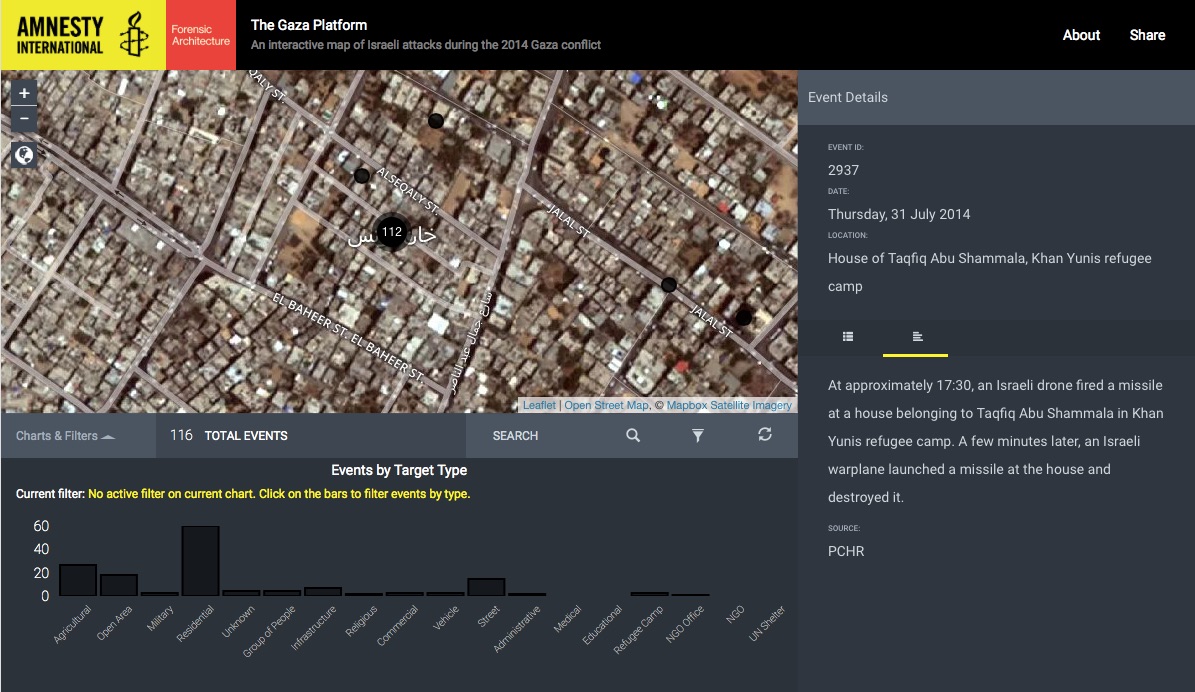
First, Forensic Architecture‘s wider collaboration with Amnesty International (in association with the Al-Mezan Centre for Human Rights/Palestinian Centre for Human Rights) has produced The Gaza Platform:

The Gaza Platform is an interactive map of attacks by Israeli forces on Gaza between 8 July and 26 August 2014.

It enables its users to explore a vast collection of data, collected on the ground by the Al Mezan Center for Human Rights and the Palestinian Centre for Human Rights (PCHR), as well as Amnesty International, during and after the conflict.

Produced through a year-long collaboration between Forensic Architecture and Amnesty International, the Gaza Platform is a new gateway to this precious, first-hand information: it not only gives access to a large quantity of otherwise dispersed data, but helps make sense of it.

The Gaza Platform is the most comprehensive public repository of information about attacks carried out during the 2014 Gaza conflict to date. At the time of its launch on 8 July 2015, it featured over 2,750 individual events, recording the deaths of more than 2,200 people, including 1,800 civilians and 600 children. As a digital interface, it enables access not only to text reports, but also to photos, videos, audio recordings and satellite imagery documenting the war – all in one place.

It is important to note that the Gaza Platform does not provide a complete record of the impact of Israeli attacks during the 2014 conflict. It does not cover every single attack that took place during the conflict, but only those for which a report is available. Therefore, the total number of casualties presented in the Gaza Platform falls short of the one recorded by the UN across the entire conflict.

However, the Gaza Platform does more than provide overall figures and statistics about the conflict. Each death is linked to a specific event, for which all available details and context are given, thus providing the granular details of each individual event recorded. It also helps to reveal trends by making links between dispersed individual events and detecting patterns of attacks across the 50-day time span of the conflict, thereby contributing to an assessment of the conduct of Israeli forces and its conformity or otherwise with the provisions of international humanitarian law (the laws of war). As such, the Gaza Platform is a tool aimed at uncovering the truth about the attacks on Gaza and contributing to accountability efforts for crimes under international law committed by both sides during the 2014 conflict, the third such conflict in six years.

According to Doug Bolton writing in the Independent:

Phillip Luther, the Director of Amnesty International‘s Middle East and North Africa programme, said it “has the potential to expose the systematic nature of Israeli violations committed during the conflict.”

He added: “Our aim it for it to become an invaluable resource for human rights investigators pushing for accountability for violations committed during the conflict.”…

Francesco Sebregondi, the director of the project at Forensic Architecture, said the map “exploits the power of new digital tools to shed light on complex events such as the latest war in Gaza.”

“It enables users to move across scales, from the granular details of each incident to the big picture of the overall conflict, by revealing connections between scattered events.”

I’m not going to link to them, but the hysterical response from apologists for the indiscriminate violence of the Israeli assault on Gaza shows that the Gaza Platform has hit a nerve: as it should.

Incidentally, there’s a short article in today’s Guardian about the ongoing transformation of humanities research: the growth of the ‘digital humanities’,  ‘tech-savvy’ analysis of large data sets, collaborations with non-academic professionals, and a determination to show how ‘research can benefit society’.  The Gaza Platform isn’t mentioned, but it surely exemplifies exactly what the author has in mind.

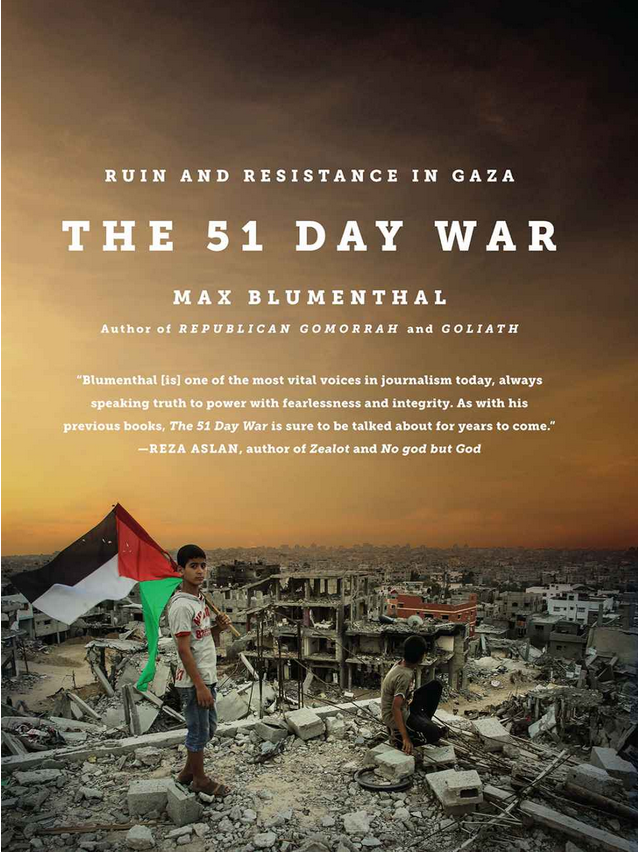
BLUMENTHAL 51 Day War

Second, Max Blumenthal‘s coruscating chronicle of The 51 Day War: ruin and resistance in Gaza, out now from Verso.  As Juan Cole put it, ‘Max Blumenthal audaciously takes in-your-face, on-the-ground journalism into the realm of geopolitics.’  You can find Glenn Greenwald‘s interview with Max at The Intercept here:

What shook me the most was how well I was treated in the rubble. How after interviewing families who would tell me about witnessing their neighbors being destroyed by a missile, that they would beseech me to have lunch with them. I didn’t even know where the lunch would come from. They would chase me down after denouncing my government and insisting that the Obama administration was no better than Netanyahu, and hand me sweets, and tell me that they see a clear difference between the American people and the American government. I mean, that kind of treatment showed me how impeccable the character of these people was, even as they were facing their own immiseration and ruin.

That was kind of deceptive, because I started to adjust, in a weird way, to being in the rubble with these people. Then the bombing started again, and then I had to deal with the terror of night after night of bombings, and naval shelling throughout the day, and drones swooping closely overhead, searching for targets. And I became shell-shocked. So I couldn’t have even imagined going through 51 days of that, especially as a child under the age of seven.

We have to recognize that the Gaza Strip is a ghetto of children. The majority of the people in the Gaza strip are under age 18, and a substantial percentage of those under 18 are under the age of seven, which means they have known nothing in their lives but these three atrocious wars, which have left almost 20 percent of the entire area of the Gaza Strip in ruins.

What’s on those children’s mind? What kind of lives can they have? Can they ever be normal as they go through life without therapy, without relief, without recourse and without justice, with continuous traumatic stress disorder?

Black Friday

Just released: a joint investigation by Amnesty International and Forensic Architecture reconstructs Israel’s siege of Rafah during its assault on Gaza in 2014.  You can read the Executive Summary here and access the full report, Black Friday: carnage in Rafah, here.

In Rafah, the southernmost city in the Gaza Strip, a group of Israeli soldiers patrolling an agricultural area west of the border encountered a group of Hamas fighters posted there. A fire fight ensued, resulting in the death of two Israeli soldiers and one Palestinian fighter. The Hamas fighters captured an Israeli officer, Lieutenant Hadar Goldin, and took him into a tunnel. What followed became one of the deadliest episodes of the war; an intensive use of firepower by Israel, which lasted four days and killed scores of civilians (reports range from at least 135 to over 200), injured many more and destroyed or damaged hundreds of homes and other civilian structures, mostly on 1 August.

In this report, Amnesty International and Forensic Architecture, a research team based at Goldsmiths, University of London, provide a detailed reconstruction of the events in Rafah from 1 August until 4 August 2014, when a ceasefire came into effect. The report examines the Israeli army’s response to the capture of Lieutenant Hadar Goldin and its implementation of the Hannibal Directive – a controversial command designed to deal with captures of soldiers by unleashing massive firepower on persons, vehicles and buildings in the vicinity of the attack, despite the risk to civilians and the captured soldier(s).

The report recounts events by connecting various forms of information including: testimonies from victims and witnesses including medics, journalists, and human rights defenders in Rafah; reports by human rights and other organizations; news and media feeds, public statements and other information from Israeli and Palestinian official sources; and videos and photographs collected on the ground and from the media.

Satellite imagery Rafah 1 August 2014

Amnesty International and Forensic Architecture worked with a number of field researchers and photographers who documented sites where incidents took place using protocols for forensic photography. Forensic Architecture located elements of witness testimonies in space and time and plotted the movement of witnesses through a three-dimensional model of urban spaces. It also modelled and animated the testimony of several witnesses, combining spatial information obtained from separate testimonies and other sources in order to reconstruct incidents. Three satellite images of the area, dated 30 July, 1 August and 14 August, were obtained and analysed in detail; the image of 1 August reveals a rare overview of a moment within the conflict. Forensic Architecture also retrieved a large amount of audiovisual material on social media and employed digital maps and models to locate evidence such as oral description, photography, video and satellite imagery in space and time. When audiovisual material from social media came with inadequate metadata, Forensic Architecture used time indicators in the image, such as shadow and smoke plumes analysis, to locate sources in space and time….

Public statements by Israeli army commanders and soldiers after the conflict provide compelling reasons to conclude that some attacks that killed civilians and destroyed homes and property were intentionally carried out and motivated by a desire for revenge – to teach a lesson to, or punish, the population of Rafah for the capture of Lieutenant Goldin.

There is consequently strong evidence that many such attacks in Rafah between 1 and 4 August were serious violations of international humanitarian law and constituted grave breaches of the Fourth Geneva Convention or other war crimes.

It really is worth accessing the full report and closely examining the video animations produced by Forensic Architecture.

Lambert Hannibal Directive JPEG

You can find a commentary on the project and its wider implications, which also draws on a lecture FA’s Eyal Weizman gave at Médecins sans Frontières in Paris earlier this month, by Léopold Lambert over at Warscapes here: ‘The Hannibal Directive and the economy of lives: making sense of Black Friday in Gaza‘.

The Hannibal Directive exists because of the historical asymmetrical characteristics of prisoner exchanges between the Israeli government and Palestinian and Lebanese political groups like Hamas and Hezbollah. The armed sections of these groups evidently rely on this precise asymmetrical relationship and undertake kidnappings of one or multiple Israeli soldiers when possible to negotiate the liberation of several Palestinians held in Israeli prisons. However, the economy of lives that can be perceived through this asymmetry is profoundly disturbing. The hidden message in the enunciation of the 2011 Shalit exchange is the following: One Israeli life is worth 1,027 Palestinian lives. The very fact that many of us know Shalit’s name, but not one of the 1,027 liberated Palestinian prisoners’, is symptomatic. In the case of “Black Friday,” this economy of lives exposes its violence through even more extreme and perverse forms: for the Israeli army, 135 to 200 Palestinian lives are worth ending in order to end an Israeli one, so to avoid freeing Palestinian prisoners.

We should not think of the concept of economy of lives as a retrospective reading of the Israeli Army’s crimes: This logic is at work in most Western military decision making, as Weizman shows in his book The Least of All Possible Evils (Verso 2011) through interviews with Human Rights Watch consultant Marc Garlasco, a former Pentagon “chief of high-value targeting” during the first years of the 2003 US war in Iraq. For each airstrike against an Iraqi political or military figure that Garlasco designed, he had to follow a “correct balance of civilian casualties in relation to the military value of a mission. ” In other words, there is a number of civilians the US army allows itself to kill as “collateral damage” when targeting a strategic assassination. In Iraq, this number was 30, Garlasco reveals. “In this system of calculation,” writes Weizman, “twenty-nine deaths designates a threshold. Above it, in the eyes of the US military lawyers, is potentially ‘unlawful killing’; below it, ‘necessary sacrifice.’” Here, again, lives are disincarnated into statistics calculated in relation to military and ideological objectives.

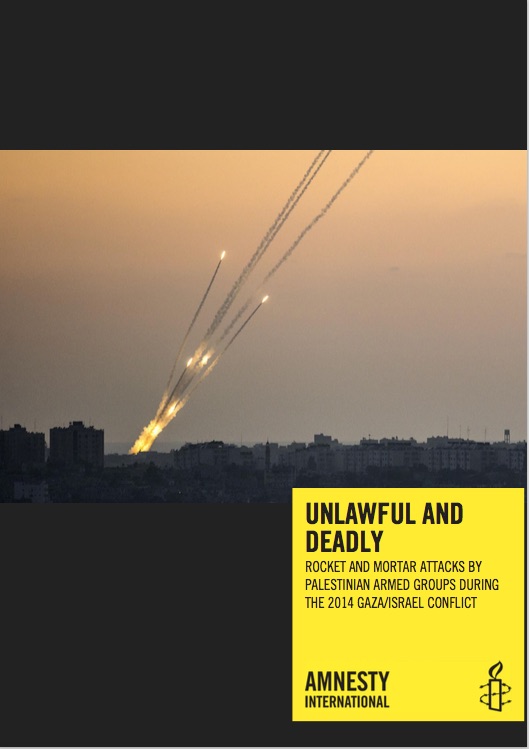
AI Unlawful and deadly JPEGI should not that there are also important critiques of Amnesty’s other investigations into ‘Operation Protective Edge’, most significantly from Normal Finkelstein at Jadaliyya.  

He takes particular exception to Amnesty’s Unlawful and Deadly: Rocket and mortar attacks by Palestinian armed groups during the 2014 Gaza/Israel conflict.

He insists that Amnesty too often cites official Israeli sources in ways that ‘magnify Hamas’s and diminish Israel’s criminal culpability’. You can access what he describes as his ‘forensic analysis’ of that report in two parts, here and here.

My own posts on ‘Operation Protective Edge’ are here, here, here, here, here (my own attempt at a forensic analysis of sorts), and here.

Banquet’s ghosts

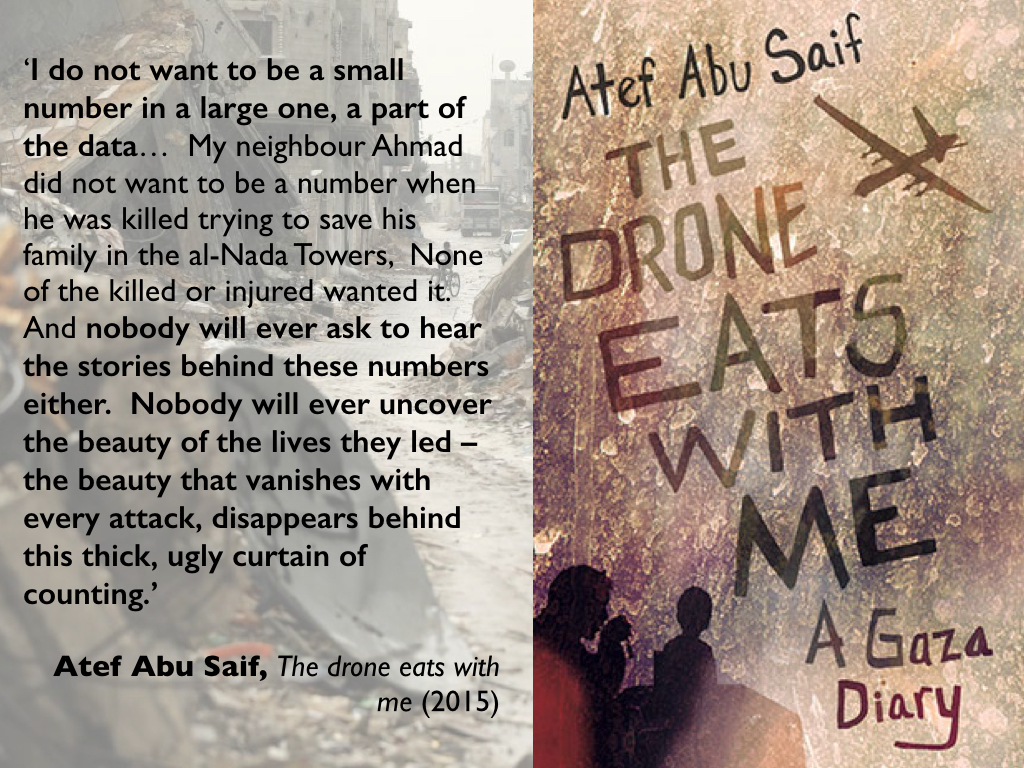
I’ve just finished a remarkable book by Atef Abu Saif, The drone eats with me: diaries from a city under fire (Comma Press, 2015).  The city in question is Gaza:

The Drone Eats With Me COVER IMAGE-Atef Abu SaifOn 7 July 2014, in an apparent response to the murder of three teenagers, Israel launched a major offensive against the Gaza Strip, lasting 51 days, killing 2145 Palestinians (578 of them children), injuring over 11,000, and demolishing 17,200 homes.

The global outcry at this collective punishment of an already persecuted people was followed by widespread astonishment at the pro-Israeli bias of Western media coverage. The usual news machine rolled up, and the same distressing images and entrenched political rhetoric were broadcast, yet almost nothing was reported of the on-going lives of ordinary Gazans – the real victims of the war.

One of the few voices to make it out was that of Atef Abu Saif, a writer and teacher from Jabalia Refugee Camp, whose eye-witness accounts (published in The Guardian, The New York Times, and elsewhere) offered a rare window into the conflict for Western readers. Here, Atef’s complete diaries of the war allow us to witness the full extent of last summer’s atrocities from the most humble of perspectives: that of a young father, fearing for his family’s safety, trying to stay sane in an insanely one-sided war.

Over at the electronic intifada Pam Bailey explains:

Although already the author of four novels and a political science text, Abu Saif did not write this book with publication in mind. Rather, it began as entries to his diary, printed only after Ra Page, founder of Comma Press, recognized the potential in the passages shared by his friend in Gaza.

The writing alternates between poignant simplicity and dramatic flourishes and haunting metaphors. Abu Saif often uses a comparison to hunger and eating to describe the rapaciousness of war and those who “feed” off of it. “Destruction is a rich meal for the media,” he writes. “Their camera does not observe the fast of Ramadan, it devours and devours. It is constantly eating new images.”

The diary begins on 6 July — two days before the officially declared beginning of the war — with this chilling observation: “When it comes, it brings with it a smell, a fragrance even. You learn to recognize it as a kid growing up in these narrow streets. You develop a knack for detecting it, tasting it in the air. You can almost see it. It lurks in the shadows, follows you at a distance wherever you go. If you retain this skill, you can tell that it’s coming — hours, sometimes days, before it actually arrives. You can’t mistake it. War.”

KAFKA Metamorphosis

I’ve been asked to speak on drones later this year at a conference at UC Santa Barbara on Metamorphosis: Animal, Human, Armor – the image above is from the extraordinary British film of Kafka’s novella: you can catch a clip on YouTube here – and no doubt partly for this reason I too have been taken by the ways in which, as Pam notes, Abu Saif turns again and again to tropes of human-machines feeding (captured in the title of the book too).  I’d read parts of the diary as it was being composed – see here, for example – but the imaginary of predation is now even more compelling and even more shocking:

As the noise of the explosion subsides, it’s replaced by the inevitable whir of a drone, sounding so close it could be right beside us. It’s like it wants to join us for the evening, and has pulled up a chair.

Later:

The food is ready. I wake the children and bring them in. We all sit around five dishes: white cheese, hummus, orange jam, yellow cheese, and olives. Darkness eats with us. Fear and anxiety eat with us. The unknown eats with us. The F16 eats with us. The drone, and its operator somewhere out in Israel, eat with us.

More once I’ve worked out what I want to say at the conference, but for now there is a particularly thoughtful review and response to Abu Saif by Jacob Bacharach at The Rumpus here.