I’ve added a revised version of my Keynote Address to the IGC in Cologne last August to the DOWNLOADS page. This version will appear in the Conference Proceedings, but if you download it please bear in mind that this is a preliminary and highly compressed version of part of the argument I’ve been developing in my presentations under the general heading “Deadly Embrace: war, distance and intimacy”. I’m working on a much longer version, which will see all three of the main sections in the Keynote (news, logistics, weapons) greatly expanded and a new section (on intelligence) added. I’m aware that I need to say much more about contemporary news coverage of distant wars than I do here; I think I have the arguments about contemporary logistics and weapons more or less sorted, but I’m still reading and thinking about our own sensibility towards distant violence. And in order to live up to the subtitle I’ll also say much more about the dialectic between distance and intimacy.
I’ve trailed some of the ideas in previous posts here and here.
The result is likely to be a long essay (with many illustrations) so I have no idea what I’m going to do with it — probably incorporate it into a book that will include other essays on the genealogy of what I’m now calling later modern war (partly because I think, for all the continuities, there are also significant differences between wars in the first half of the twentieth century and today’s military and paramilitary violence, and partly because I really don’t want to treat this as ‘postmodern’ war). I’ll post a manuscript version as soon as it’s ready since, as always, I would really value comments,criticisms and suggestions. I hope, too, that this substantive inquiry will also have something to say about theorisations of space – something I only gesture towards in this conference version.
A CFP from Shane Brighton, via Tarak Barkawi, for a workshop on Critical War Studies to be held at the University of Sussex on 11 September 2013:
Critical War Studies: emerging field, developing agendas
What is left out when critical reflection on armed conflict is conducted under the sign of ‘security’? What happens to ‘war’ itself in critical scholarship? What are the forms of contemporary militarism? How can the discourses and practices of fighting, transition to ‘peace’, war preparation and military and strategic thought be engaged reflexively? How might militaries be understood as sites of subaltern labour, resistance and critique? How can attentiveness to experiences of war generate critical resources within international relations, sociology, geography, anthropology, history and other disciplines?
Multi-disciplinary proposals – initially an abstract or position statement – are invited for a one–day workshop convened by the University of Sussex Centre for Conflict and Security Research. The organisers welcome contributions engaging the idea of Critical War Studies, the themes outlined above and below, or suggesting other appropriate topics. It is envisaged that this will be the first of several events leading to opportunities for peer-reviewed publication.
Here’s the preliminary outline:
Panel 1: What is ‘Critical War Studies’?
What’s in a name? ‘War’, ‘security’ and the analytical status of fighting
Critical approaches within strategic theory: who is strategy ‘for’?
Theory and the experience of war
War in/and society
Panel 2: Political Sociologies of fighting
Technologies, transformations of war, transformations of self
Subaltern military labour and military history in Europe and beyond
It should be an excellent event; the SCSR has lots of lively people associated with its work. And presumably there’ll be room for an equally lively discussion of the privatisation of war…
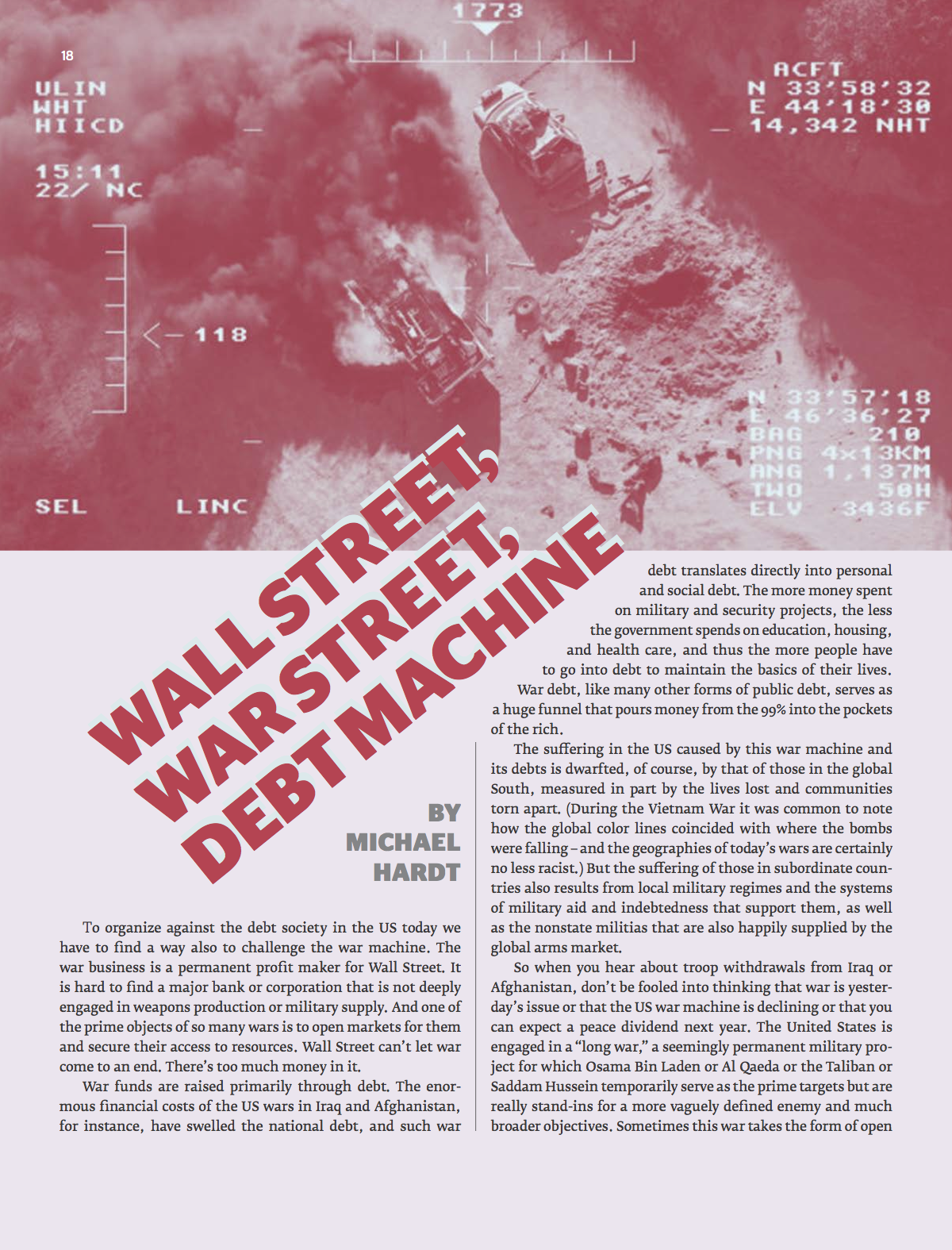
The latest issue of Tidal:Occupy Theory, Occupy Strategy (open access online) includes a brief (two-page) article by Michael Hardtthat offers a sharp reminder:
‘To organize against the debt society in the US today we have to find a way also to challenge the war machine. The war business is a permanent profit maker for Wall Street… War funds are raised primarily through debt. So when you hear about troop withdrawals from Iraq or Afghanistan, don’t be fooled into thinking that war is yesterday’s issue or that the US war machine is declining or that you can expect a peace dividend next year. The United States is engaged in a “long war,” a seemingly permanent military project for which Osama Bin Laden or Al Qaeda or the Taliban or Saddam Hussein temporarily serve as the prime targets but are really stand-ins for a more vaguely defined enemy and much broader objectives.’
Hardt identifies three drivers (or ‘logics’) of the war machine – imperialist, neo-liberal and humanitarian – that will be familiar to most readers (at least in this capsule – pod? – form). He concludes:
‘There are many reasons to oppose the US war machine, with its complex of military and security operations, installations, and institutions. It is a killing machine, a racist machine, a misery machine, and much more. It’s also a debt machine, and thus perhaps, when engaged together with other contemporary issues posed by debt, a movement can also begin to erode the foundations for our seemingly permanent state of war.’
What interests me is not simply the neoliberal ‘logic’ pursued by our masters of war – and Jamie Peck‘s work surely shows that we need to be assiduous in unpacking its multiple logics and (trans)formations – but also the way in which it reaches deep into the practices of military violence. We need to expose not only the ‘business of war’ – the parasitic synergies between advanced militaries and the corporations of the international arms industry (‘Big Arma‘), and the deadly embrace between advanced militaries and the private contractors to whom more and more tasks are outsourced – but also the ways in which (at least since the days of McNamara’s ‘technowar’) advanced militaries have increasingly internalized the language, models and metrics of the Corporation. Fans of Joel Bakan will know why I use the capital – I’m talking about more than PowerPoint.
It’s over six years since I wrote ‘The Black Flag’ and ‘Vanishing points’, two linked essays about Guantanamo, Abu Ghraib and the global war prison (see DOWNLOADS tab), and I’m currently updating, revising and integrating them for The everywhere war.
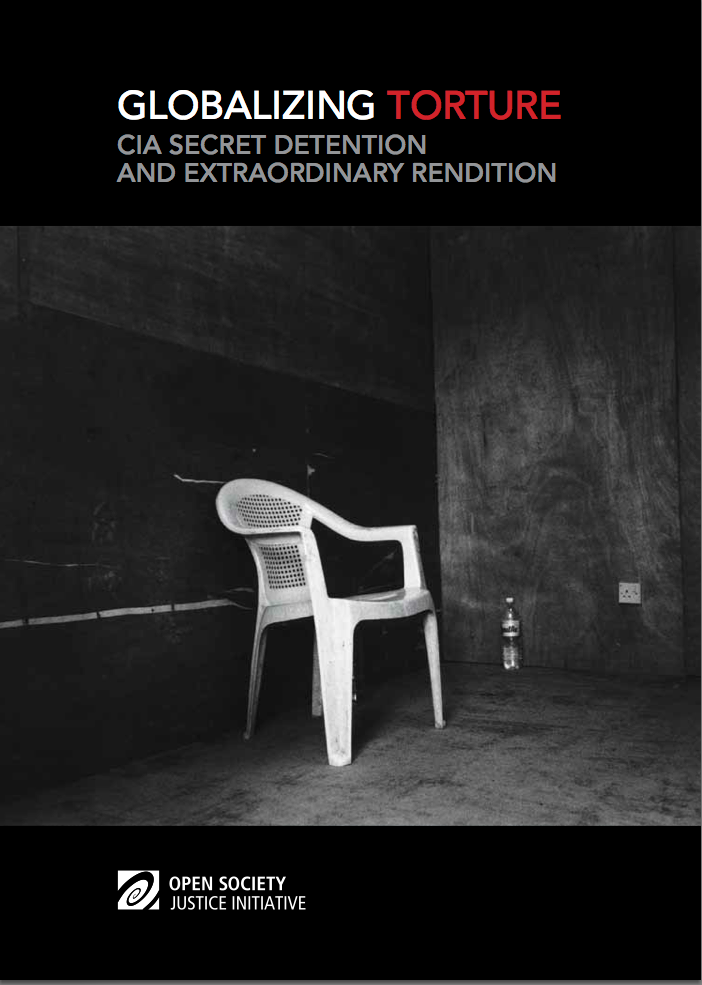
Today there’s news of a new report by Amrit Singh, Senior Legal Officer for the Open Society Justice Initiative’s National Security and Counterterrorism program, Globalizing torture, that lists 136 people who were subjected to CIA secret detention and/or extraordinary rendition. The list – the most comprehensive to date: you can find it on pp. 30-60 – combines secret detention and extraordinary rendition ‘because the two programs had similar modalities, and torture, enforced disappearance, arbitrary detention, and the abuses were common to both.’
The report also identifies 54 states that were complicit in the programs: ‘hosting CIA prisons [“black sites”] on their territories; detaining, interrogating, torturing, and abusing individuals; assisting the CIA in the capture and transportation of detainees; permitting the use of their airspace and airports for secret CIA flights transporting detainees; providing intelligence leading to the CIA’s secret detention and extraordinary rendition of individuals; and interrogating individuals who were being secretly held in the custody of other governments. ‘ Only one state has issued an apology (over a single case), and only four have provided financial compensation to victims. You can find this ghastly gazetteer, carefully annotated, on pp. 62-118. (There are some conspicuous omissions; the Guardian has an infog[eog]raphic here).
In case you think this is a purely historical geography, the report notes that:
‘the Obama administration did not end extraordinary rendition, choosing to rely on anti-torture diplomatic assurances from recipient countries and post-transfer monitoring of detainee treatment. As demonstrated in the cases of Maher Arar, who was tortured in Syria, and Ahmed Agiza and Muhammed al-Zery, who were tortured in Egypt, diplomatic assurances and post-transfer monitoring are not effective safeguards against torture. Soon after taking office in 2009, President Obama did issue an executive order that disavowed torture, ordered the closure of secret CIA detention facilities, and established an interagency task force to review interrogation and transfer policies and issue recommendations on “the practices of transferring individuals to other nations.” But the executive order did not repudiate extraordinary rendition, and was crafted to preserve the CIA’s authority to detain terrorist suspects on a short-term transitory basis prior to rendering them to another country for interrogation or trial.’
And, as the New York Times reports, ‘the Senate Intelligence Committee recently completed a 6,000-page study of the C.I.A. detention and interrogation program, but it remains classified, and it is uncertain whether and when it might be even partially released.’
Following my post on artists and bombing, and in particular the work of elin o’Hara slavick, elin has written with news of her new book, After Hiroshima, due in March from Daylight, with what she calls a ‘ridiculously brilliant essay’ from James Elkins.
If you’re interested in two different but none the less intimately related works, I recommend Paul Ham‘s Hiroshima Nagasaki(Doubleday, 2012), which is extraordinarily good at placing those terrible attacks in the context of a strategic air war waged primarily against civilians (according to the Air Force Weekly Intelligence Review at the time, ‘There are no civilians in Japan’: sound familiar?) – and this needs to be read in conjunction with David Fedman and Cary Karacas, ‘A cartographic fade to black: mapping the destruction of urban Japan in World War II’, Journal of historical geography 38 (2012) 303-26 (you can get a quick visual version here) – and Rosalyn Deutsche’s Hiroshima after Iraq: three studies in art and war (Columbia, 2010), based on her Wellek Library Lectures in Critical Theory given in 2009.
You can get a preview of elin’s ‘After Hiroshima’ project here. Scrolling down that page, my eye was caught by the image ‘Woman with burns through kimono’, taken in 1945, which transported me to another ridiculously brilliant work, Kamila Shamsie‘s dazzling novel Burnt Shadows. I’ve been haunted by it ever since I read it, and in the draft of the first chapter of The everywhere warI start with this passage from the novel:
And this is how I go on (and please remember this is a draft):
A man is being prepared for transfer to the American war prison at Guantanamo Bay: unshackled, he strips naked and waits on a cold steel bench for an orange jumpsuit. ‘How did it come to this?’ he wonders. This is the stark prologue to Kamila Shamsie’s luminous novel Burnt Shadows. She finds her answer to his question in a journey from Nagasaki in August 1945 as the second atomic bomb explodes, through Delhi in 1947 on the brink of partition, to Pakistan in 1982-3 as trucks stacked with arms grind their way from the coast to the border training-camps, and so finally to New York, Afghanistan and Guantanamo Bay in 2001-2. These are all, in their different ways, conflict zones and the turning-points of empires, tracing an arc from the cataclysmic end of the Second World War through the Cold War to the wars fought in the shadows of 9/11. In this book, I follow in her wake; I find myself returning to her writing again and again. Although this is in part the product of her lyrical sensibility and imaginative range, there are three other reasons that go to the heart of my own project and which provide the framework for this chapter.
The first flows from the historical arc of the novel. Shamsie is adamant that Burnt Shadows is not her ‘9/11 novel’. She explains that it is not about the attacks on the World Trade Center and the Pentagon on 11 September 2001 but about the cost and consequences of state actions before and after. Her long view reveals that the connections between Ground Zero in 1945 and Ground Zero in 2001 are more than metaphorical. These are connections not equivalences – and far from simple – but like Shamsie I believe that many of the political and military responses to 9/11 can be traced back to the Cold War and its faltering end and, crucially, that the de-stabilization of the distinction between war and peace was not the febrile innovation of the ‘war on terror’. I start by mapping that space of indistinction, and it will soon become clear that the dismal architects of the ‘war on terror’ (the scare-quotes are unavoidable) not only permanently deferred any prospect of peace but claimed to be fighting a radically new kind of war that required new allegiances, new modalities and new laws. Here too there are continuities with previous claims about new wars fought by the advanced militaries of the global North, conducted under the sign of a rolling Revolution in Military Affairs and its successor projects, and quite other ‘new wars’ fought by rag-tag militias in the global South: all of them preceding 9/11.
I turn to those new wars next, and this brings me to the second reason why Shamsie’s work is relevant to my own discussion. While she was writing Burnt Shadows she used Google Earth to disclose the textures of New York City, and marvelled at how obediently they swam into view: ‘3D models of buildings, amazingly high-resolution images, links to photographs and video streams of Manhattan.’ When she turned to Afghanistan, however, all the details dissolved into ‘an indistinct blur, and the only clues to topography came from colours within the blur: blue for rivers, brown for desert, green for fertile land.’ But that was then (2006). Three years later, a different Afghanistan was brought into view. ‘As I click through all the YouTube links tattooed across the skin of Afghanistan,’ she wrote, ‘I encounter video clips of American solders firing on the Taliban, Canadian politicians visiting troops, Dutch forces engaged in battle, an IED blast narrowly missing a convoy of US soldiers, a video game in which a chopper hails down missiles and bullets on a virtual city which looks more like Baghdad than Kabul.’ Shamsie uses these distinctions to remind us that ‘we’re still using maps to inscribe our stories on the world.’ So we are; and throughout this book I also turn to these violent cartographies, as Michael Shapiro calls them: maps, satellite images and other forms of visual imagery. These inscriptions and the narratives that they impose have a material form, and they shape both the ways in which we conduct ‘our’ wars and also the rhetoric through which we assert moral superiority over ‘their’ wars. Yet even as I sketch out these contrasting imaginative geographies, another indistinction – a blurring, if you like – seeps in. For one of the most telling features of contemporary warscapes is the commingling of these rival ‘new wars’ in the global borderlands, the ‘somewhere else’ that Abdullah reminds Kim is always the staging ground of America’s wars.
And this brings me to the final reason for travelling with Burnt Shadows: Abdullah’s insistence that war is like a disease. This is an ironic reversal of the usual liberal prescription that justifies war – which is to say ‘our’ war – as a necessity: ‘killing to make life live’, as Michael Dillon and Julian Reid put it. They argue that war in the name of liberalism is a profoundly bio-political strategy in which particular kinds of lives can only be secured and saved by sacrificing those of others. You might say that war has always been thus, but what is distinctive about the contemporary conjunction of neo-liberalism and late modern war is its normative generalization of particular populations as at once the bearers and the guardians of the productive potential of ‘species-life’. Here too there are terrible echoes of previous wars, and these brutal privileges depend, as they often did in the past, on discourses of science and economics (and on the couplings between them). But contemporary bio-politics also draws its succour from new forms of the life sciences that treat life as ‘continuously emergent being’. This is to conjure a world of continuous transformation in which emergence constantly threatens to become emergency: in which there is the ever-present possibility of life becoming dangerous to itself. For this reason the social body must be constantly scanned and its pathologies tracked: security must deal not with a grid of fixed objects but a force-field of events, and war made not a periodic but a permanent process of anticipation and vigilance, containment and elimination. Mark Duffield calls this ‘the biopolitics of unending war’ – war that extends far beyond the killing fields –in which the global borderlands become sites of special concern. Its prosecution involves the production of new geographies – new modes of division and distinction, tracing and tracking, measuring and marking – that provide new ways of continuing the liberal project of universalizing war in the pursuit of ‘peace’. In the face of all this, Abdullah had a point.
I had just finished jotting my update to the IDF’s use of social media when Alex Vasudevan drew my attention to this brilliant, searing and deeply disturbing essay by Huw Lemmey at the New Inquiry, ‘Devastation in Meatspace’:
The missile rushing over your head was processed through an Instagram filter just hours previously. As you see it pass out of sight behind the apartment block opposite some young conscript is preparing for video footage of it to be compressed and uploaded to YouTube before the hour is out. By nightfall tonight that explosion which just shook your neighborhood, in one of the most densely populated areas on earth, will have been liked over 8,000 times on Facebook. Welcome to Gaza City.
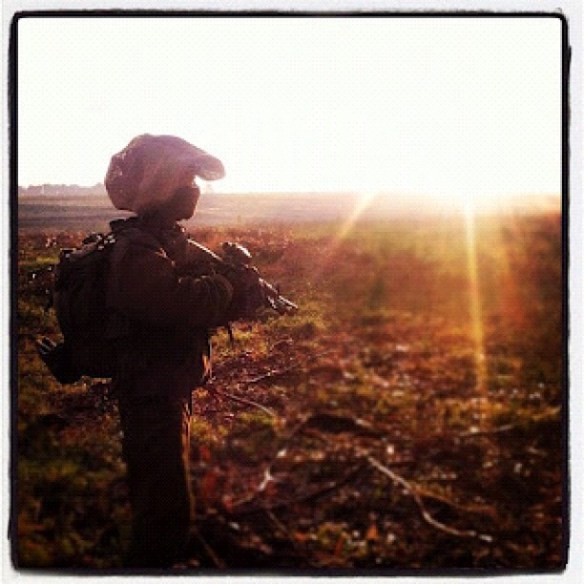
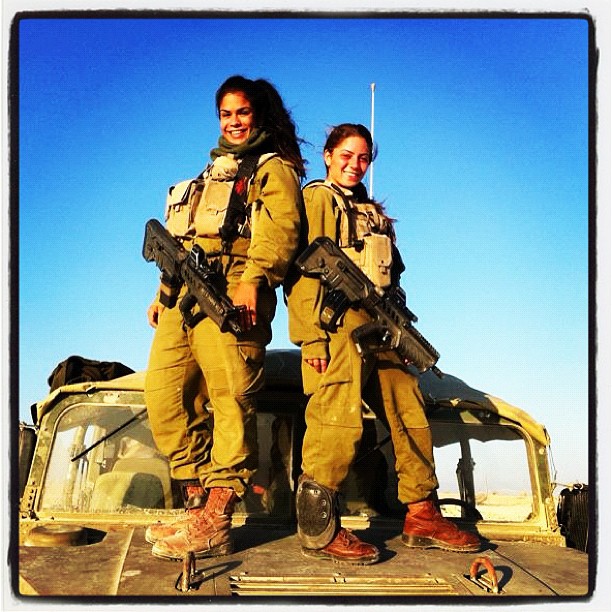
In a previous post I’d objected to the way in which some commentators advertised social media as a new way to ‘consume’ war, but – riffing off Eyal Weizmann‘s Hollow Land – Lemmey focuses not on the Twitter streams but on the visualizations disseminated across these digital platforms: see, for example, the IDF’s Instagram page here (and look at the comments too); more here. You can also find a selection over at Business Insider where Geoffrey Ingersoll describes them as ‘gorgeous’, and another selection at Moral Low Ground, which reads them rather differently.
Commenting on these images, Britney Fitzgerald at the Huffington Post simply sees them as ‘the world’s newest form of war reporting” – though she does note that the ‘intimacies’ that Israel puts on display through Instagram are radically different from those with the hashtags #gaza and #palestine – but Lemmey (who describes himself as a print maker and studio technician) provides a much more compelling reading. He shows that the IDF images do indeed resonate with a consumerist ideology – climactic versions of the desiring gaze and the lust of the eye – that has become integral to the way in which late modern war is fought:
‘[T]he [IDF] use of commercially available instagram filters replicates the visual culture favoured by much of its audience, producing images that slip easily into their feeds, naturalising the content. “These are the photos you would take if you served in the IDF,” the aesthetic says, “we are just like you, and these military decisions are the ones you would take, if you were in our situation.” They also step beyond this, including an aspirational aspect of a desirable lifestyle — impossibly handsome young troops, having fun on their downtime. This is a fighting force at play as imagined by Wolfgang Tillmans and BUTT magazine, a million miles from an occupying force…. Liking and sharing IDF visual material becomes no more controversial than sharing your favourite Nike campaign — not a matter of politics, let alone ethics, but just another part of the construction of your online persona….’
‘Like many of the more advanced lifestyle brands, the IDF are shifting the focus of image production from their own staff and creative team toward their consumers: in this case, the troops, reservists, and supporters of the IDF. Content is aggregated from individuals and fed back into the social networks of the target audience. In many ways this is an advanced form of brand-management for a such a large institution; it shows a willingness to trust the audience, allowing them to define the brand, making IDFgram perhaps the first crowdsourced propaganda campaign for a state military but also one whose identity is ever more meshed with that of its troops and supporters, emulating fashion and lifestyle brands’ movement toward consumer-led campaigns. Here the IDF becomes the avatar of a thoroughly Western consumer identity. The distance between our own lives and those of the men and women who fight in the IDF becomes ever shorter and more compressed; in collapsing this distance, the grainy and pixelated images of the Palestinian subject become more distant. This is the IDF campaign for control of the virtual environment, interjecting its brand identity into the slivers of human interaction online and thus attempting to occupy a greater portion of the market share for geopolitical allegiance.’
Lemmey says much, much more than this: please read the whole essay.
BTW: IDF stands for ‘Israel Defense Forces’, so naturally none of this should be confused with IDF Marketing, where ‘IDF stands for Innovative, Digital, Foundations’: it’s an Irish company with no connection with the Israeli military. In case you’re now thoroughly confused, here is Arwa Mahdawion the marketing of Israel:
Ever since it officially came into existence in 1948, Israel has gone methodically about the creation of a “Brand Israel”. This originally began with an emphasis of the religious significance of a state for the Jewish people. Then, in 2005, when it was time for a rebrand, the Israeli government consulted with American marketing executives to develop a positioning that would appeal to a new generation: an Israel that was “relevant and modern” rather than a place of “fighting and religion”. So Israel did some pinkwashing, and suddenly became a vocal champion of gay rights. It fought to retain cultural ownership of falafel, hummus, and Kafka. It poured millions of dollars into tourism campaigns that sought to replace imagery of wartorn landscapes with sun-kissed seascapes.
When it comes to winning modern wars, a robust marketing campaign is as important as a military campaign.
Frédéric Mégret has frequently drawn attention to the peculiar social and legal status of the battlefield:
‘[W]hilst war may and will rage, what distinguishes it from random violence is the fact that it unfolds in discreet spaces insulated from the rest of society, confining military violence to a confrontation between specialized forces whose operation should minimally disrupt surrounding life…. In that respect, the laws of war do not merely seek to regulate the battlefield. They are also part of its symbolic maintenance and even construction as a particular space defined by the norms that apply to it. In other words, the battlefield does not predate norms on warfare; rather it has always been subtly coterminous with them. The laws of war are, therefore, a crucial foundation for understanding the evolution of the battlefield and, conversely, the evolution of the battlefield is a key way in which the evolution of the laws of war can be understood.’
For Mégret, the deconstruction of the battlefield is now well advanced: starting in the nineteenth century, with transformations in firepower that constantly extended the range over which lethal force could be deployed, dramatically accelerated with the rise of airpower annulling the distinction between the spaces of combatants and civilians, given a further twist by remote operations conducted over vast distances from unmanned aerial systems like the Predator and the Reaper, and aggravated by the renewed significance of insurgency and counter-insurgency struggles (‘war among the people’), the relations between the spatiality of war and its legal armature have been radically transformed. (For a visual rendering, see Mégret’s Prezi on ‘Where is the battlefield?’).
These are important ideas, but there are other dimensions that need to be taken into account when considering Israel’s latest attack on Gaza. This is a conflict that is fully coterminous with what Helga Tawil-Souri calls Israel’s ‘digital occupation’ of Gaza. As she writes in a superb essay in the Journal of Palestine Studies 41 (2) (2012) 27-43:
‘Disengagement has not meant the end of Israeli occupation. Rather, Israel’s balancing act “of maximum control and minimum responsibility” has meant that the occupation of Gaza has become increasingly technologized. Unmanned aerial reconnaissance and attack drones, remote-controlled machine guns, closed-circuit television, sonic imagery, gamma-radiation detectors, remote- controlled bulldozers and boats, electrified fences, among many other examples, are increasingly used for control and surveillance One way to conceptualize disengagement, then, is to recognize it as a moment marking Israel’s move from a traditional military occupation toward a high-tech one.
Rooted in Israel’s increasingly globalized security-military-high-tech industry, the technological sealing of Gaza is part of the transformation of the mechanics of Israeli occupation toward “frictionless” control that began with the first intifada and the ensuing “peace process,” which marked the shift toward the segregation of Gaza. “Frictionless” is, of course, metaphoric and purposefully ambiguous, evoking a sense of abstraction and lack of responsibility…
While high technology has become one of the means through which Israeli occupation continues, the high-tech infrastructure in the Gaza Strip — that which is used by Palestinians as opposed to the Israeli regime— is also a space of control. Technology infrastructures form part of the appa- ratus of Israeli control over Gazans. A telephone call made on a land-line, even between Gaza City and Khan Yunis, is physically routed through Israel. Internet traffic is routed through switches located outside the Gaza Strip. Even on the ubiquitous cellular phones, calls must touch the Israeli backbone at some point. Like much else about the Gaza Strip, telecommunication infrastructures are limited by Israeli policies. Geographic mobility, economic growth, political mobilization, and territory are contained, but so are digital flows: Gazans live under a regime of digital occupation.’
It should come as no surprise, therefore, that Israel also fights in digital space. This takes many forms, and at the limit extends into the domain of cyberwarfare (where, as the joint US/Israeli cyber-attack on Iran’s nuclear program showed, Israel possesses advanced capabilities), but in its more mundane version it can be no less effective.
One of the characteristic features of late modern war is its mediatization, and the Israeli Defense Forces have used (even ‘weaponized‘) an array of social media platforms to shape the public construction of the battlespace. This is a far cry from its faltering efforts during the previous assault on Gaza in 2008-9, Operation Cast Lead. Soon after the IDF assassination that sparked the renewed air campaign this month, the IDF tweeted a headshot of the dead man, Hamas military commander Ahmed al-Jabari, with “eliminated” stamped across it, and immediately followed up with a video uploaded to its YouTube channel showing the drone strike (I’m not going to do the IDF’s job for it, but if you want to see stills and screenshots you can find them here). The IDF continued to tweet, announcing its airstrikes in 140-character containers, and also turned to Facebook, Pinterest and Tumblr to post images and infographics (or, more accurately, propagandagraphics).
The object of the exercise has been three-fold.
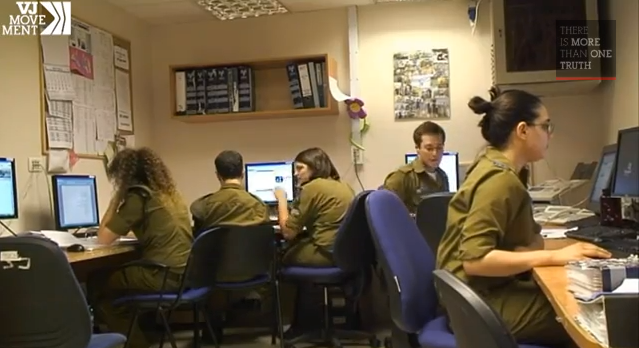
First, the IDF has been seeking direct – which is not to say unmediated: the clips, tweets and the rest follow an artfully pre-arranged script – and real-time access to domestic, regional and international publics. The officer commanding the IDF’s 30-strong New Media desk (which is shown in the image on the left), Lt. Col. Avital Leibovich, explained that she wanted ‘to convey our message without the touch of an editor’ and to reach those who don’t turn to print media or TV for their news.
Second, the IDF has been aggressively mobilising its supporters, inside and outside Israel, encouraging them to retweet and to post their support on Facebook: using social media to puncture what Israel routinely describes as its ‘isolation’. Timereported that the IDF had activated additional ‘gamification’ features on its blog that allowed visitors ‘to rack up “points” for repeat visits or numerous tweets’: see the image on the right; more here.
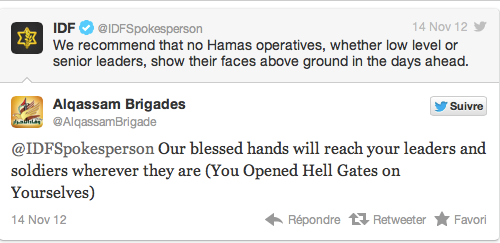
Third, the IDF apparently believes that social media can send ‘a message of deterrence’ – though its tweets have surely been as likely to provoke as to intimidate. The campaign sparked a series of responses and counter-measures – in Gaza, Hamas and its supporters, and in particular the Al-Qassam Brigades led by al-Jabari, took to social media platforms too, though Israel’s digital occupation plainly made that a vulnerable strategy, and the cyberactivist group Anonymous claimed to have defaced or disrupted nearly 700 Israeli political, military and commercial websites – so that al Jazeera described this as a ‘mass cyber-war‘ (I think that’s wrong: it’s been a social media war, but not one that has directly produced destruction – though, as I’ll suggest in a moment, it has certainly invited it).
More on the IDF’s New Media desk from Fast Companyhere and from the VJ Movement below:
It’s hard to know how effective this social media blitz has been: certainly, many people have been repulsed by the way the IDF ‘cheerily live-tweets infanticide’ and ‘the apparent glee with which the IDF carries out its job.’ As John Mitchellcomplained, ‘Innocent people are dying on all sides, and the IDF wants to reward people for tweeting about it.’ In doing so, the contemporary rendering of war as spectacle and entertainment has been turned into something at once banal and grotesque. Alex Kantrowitz put this well:
When a military at war asks its Twitter followers to “Please Retweet,” or check out its Tumblr, or posts an image of a rocket hooking a Prime Minister’s undergarments, it is hard not to sense a disconnect between that messaging and the bombing taking place in real life. As The Verge’s Joseph L. Flatley put it, “One liveblogs award shows or CES keynotes, not armed conflict.”
When Matt Buchanancalls this live-tweeting of military and paramilitary violence ‘the most meaningful change in our consumption of war in over 20 years’ – my emphasis – then this is war reduced to consumerism: how long before military commanders start worrying that if their ratings aren’t high enough, their audience penetration too low, their war will be cancelled? (Not such a bad idea, you might think, until they are driven to find ways to increase their market share….) Buchanan may think this is ‘How to Wage War on the Internet’, but Michael Koplow is nearer the mark: it’s precisely How Not to Wage War on the Internet.
In fact, several commentators worry that the trash-talking between the two sides, the verbal violence of response and counter-response on Twitter, was an open invitation to extend the war beyond the words:
‘This is a new reality of war,’ Heather Hurlburtnoted, ‘and I worry that it’s going to make it harder to stand down.’ The digital exchanges were immediate – not the language of reflection or diplomacy – and, whatever else they were about, were clearly intended to taunt the other side: Hamas and the IDF were both targeting audiences in Gaza (and the West Bank) and in Israel, by turns rallying their supporters and goading the enemy. In short, here as elsewhere, there are crucial connections between the physical and virtual worlds that, in this case, may work to inflame the violence.
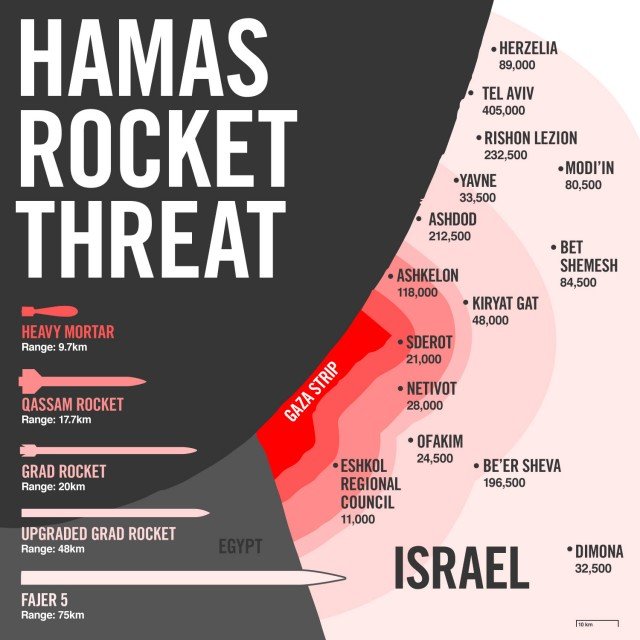
Yet for all this the digital battlespace can work to reinstate the traditional battlefield – at least virtually and rhetorically. This is one of the maps circulated through the IDF’s social media platforms:
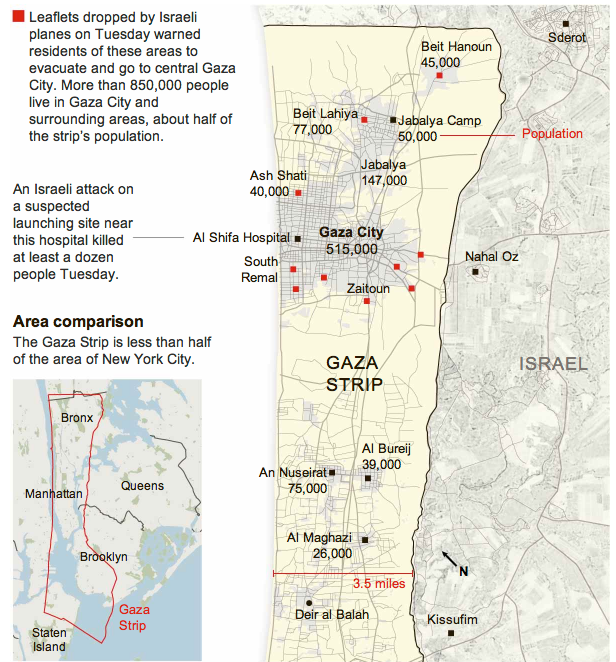
And here is the equivalent map published online by the New York Times, updated yesterday:
Here the map speaks power to truth: the ‘battlefield’ has been radically extended so that, as always, the terms of an an intensely asymmetric struggle are radically reversed. The disproportionate concentration of Israeli firepower on Gaza is erased, while virtually all of Israel – including, as we have been endlessly reminded, for the very first time Jerusalem – is threatened by Hamas.
The Times did at least include this, separate map of Gaza:
The map plots (in red) the sites of IDF leaflet drops (really). So we have one map showing Hamas rocket ranges and ‘cities taking enemy fire’, and the other showing paper dropped on a captive population…
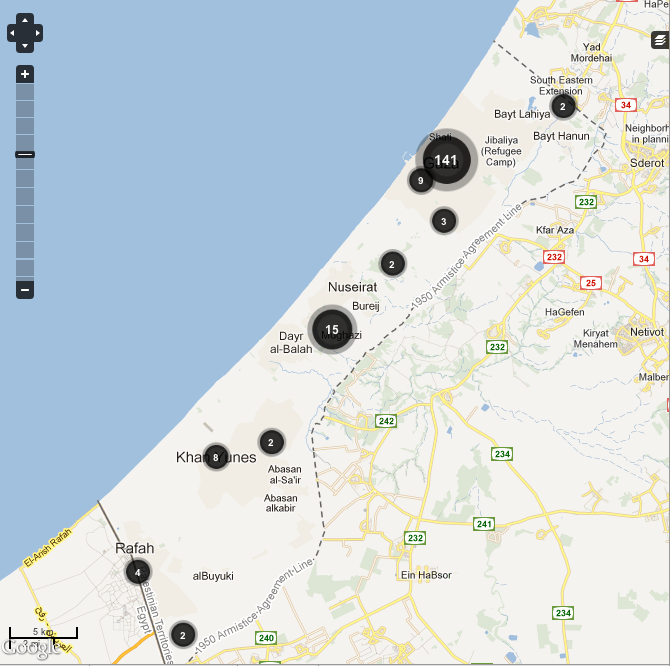
If you want to find more meaningful maps that take in both Israel and Gaza, including air strikes and rocket attacks, deaths and casualties on both sides, you can find them at al Jazeera here. I’ve pasted an extract from the plot of air strikes below.
Seen like this, I’ll leave the last words to Helga Tawil-Souri:
“The underlying reasons of Israel’s propaganda are to silence the enemy, gain international support and justify wars… Their goal has not fundamentally changed over the years, only the platforms on which these are disseminated.”
Oliver‘s favourite historian, Alfred McCoy, recently co-edited a fine new collection, Endless Empire: Spain’s retreat, Europe’s eclipse, America’s decline (University of Wisconsin Press, 2012), and there’s an excellent taster of McCoy’s argument at both Tomdispatchand Guernica. The title – ‘Beyond bayonets and battleships’ – is not only a rejoinder to Romney’s complaint during the last Presidential debate; it’s also a reply to Obama and his predecessors.
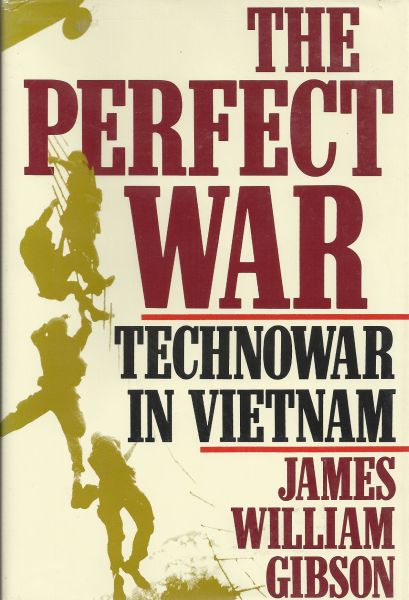
McCoy traces the long historical curve of what, in another age, was called America’s techno-war: the phrase comes from James Gibson’s stunning The perfect war: technowar in Vietnam (Monthly Review Press, 1986; Atlantic, 2000), and like Gibson McCoy insists on the importance of the wars in Indochina for the matrix within which late modern war is now conducted.
Many of his themes resonate with my own work – the key elements for today’s remote operations were assembled over the skies of Vietnam, Laos and Cambodia, and these have been radically extended by biometric identification, electronic surveillance and cyberwarfare – and McCoy also peers into a not-do-distant but desperately dark future in which the contemporary politics of verticality and what Stuart Elden describes as projects to ‘secure the volume‘ will be dwarfed by a triple-tier canopy (‘Just how high is national sovereignty? … Some puckish Pentagon lawyer might reply: only as high as you can enforce it’):
It’s 2025 and an American “triple canopy” of advanced surveillance and armed drones fills the heavens from the lower- to the exo-atmosphere. A wonder of the modern age, it can deliver its weaponry anywhere on the planet with staggering speed, knock out an enemy’s satellite communications system, or follow individuals biometrically for great distances. Along with the country’s advanced cyberwar capacity, it’s also the most sophisticated militarized information system ever created and an insurance policy for U.S. global dominion deep into the twenty-first century. It’s the future as the Pentagon imagines it; it’s under development; and Americans know nothing about it.
I’m drafting the introduction to The everywhere warnow, and this is a superb essay for me to engage – if you read one thing this week, make it this.







 geographical imaginations