War, law and visibilities

Two more forthcoming books on war.

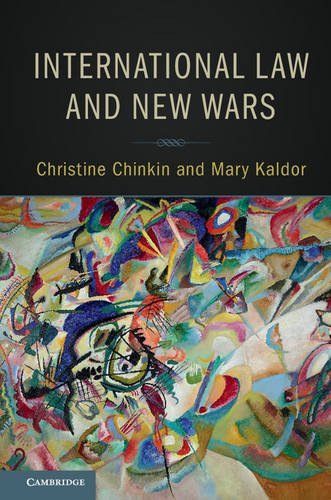
Coming in May from Cambridge University Press, a book Richard Falk hails as ‘the most significant book on international law published in the last decade’, International law and New Wars by Christine Chinkin and Mary Kaldor:

International Law and New Wars examines how international law fails to address the contemporary experience of what are known as ‘new wars’ – instances of armed conflict and violence in places such as Syria, Ukraine, Libya, Mali, the Democratic Republic of Congo and South Sudan. International law, largely constructed in the nineteenth and twentieth centuries, rests to a great extent on the outmoded concept of war drawn from European experience – inter-state clashes involving battles between regular and identifiable armed forces. The book shows how different approaches are associated with different interpretations of international law, and, in some cases, this has dangerously weakened the legal restraints on war established after 1945. It puts forward a practical case for what it defines as second generation human security and the implications this carries for international law.

At 595 pages it’s clearly a blockbuster.  Here is the detailed Contents list:

Part I. Conceptual Framework:
1. Introduction
2. Sovereignty and the authority to use force
3. The relevance of international law
Part II. Jus ad Bellum:
4. Self-defence as a justification for war: the geopolitical and war on terror models
5. The humanitarian model for recourse to use force
Part III. Jus in Bello:
6. How force is used
7. Weapons
Part IV. Jus Post-Bellum:
8. ‘Post-conflict’ and governance
9. The liberal peace: peacemaking, peacekeeping and peacebuilding
10. Justice and accountability
Part V. The Way Forward:
11. Second generation human security
12. What does human security require of international law?

Coming in June from Rutgers University Press, In/Visible War: the culture of war in twenty-first century Americaedited by John Louis Lucaites and Jon Simons:

In/Visible War addresses a paradox of twenty-first century American warfare. The contemporary visual American experience of war is ubiquitous, and yet war is simultaneously invisible or absent; we lack a lived sense that “America” is at war. This paradox of in/visibility concerns the gap between the experiences of war zones and the visual, mediated experience of war in public, popular culture, which absents and renders invisible the former. Large portions of the domestic public experience war only at a distance. For these citizens, war seems abstract, or may even seem to have disappeared altogether due to a relative absence of visual images of casualties. Perhaps even more significantly, wars can be fought without sacrifice by the vast majority of Americans.
Yet, the normalization of twenty-first century war also renders it highly visible. War is made visible through popular, commercial, mediated culture. The spectacle of war occupies the contemporary public sphere in the forms of celebrations at athletic events and in films, video games, and other media, coming together as MIME, the Military-Industrial-Media-Entertainment Network.

Here’s the main Contents List:

Part I: Seeing War

Chapter 1: How Photojournalism Has Framed the War in Afghanistan – David Campbell Chapter 2: Returning Soldiers and the In/visibility of Combat Trauma – Christopher J. Gilbert and John Louis Lucaites Chapter 3: (Re)fashioning PTSD’s Warrior Project – Jeremy G. Gordon Chapter 4: Unremarkable Suffering: Banality, Spectatorship, and War’s In/visibilities – Rebecca A. Adelman and Wendy Kozol “War Is Fun,” a Photo-Essay – Nina Berman Chapter 5: Laying bin Laden to Rest: A Case Study of Terrorism and the Politics of Visibility – Jody Madeira

Part II: Not Seeing War

Chapter 6: Digital War and the Public Mind: Call of Duty Reloaded, Decoded – Roger Stahl Chapter 7: A Cinema of Consolation: Post-9/11 Super Invasion Fantasy – De Witt Douglas Kilgore Chapter 8: Differential Configurations: In/visibility through the Lens of Kathryn Bigelow’s The Hurt Locker (2008) – Claudia Breger Chapter 9: Canine Rescue, Civilian Casualties, and the Long Gulf War – Purnima BosePart III:

Theorizing the In/visibility of War 

Chapter 10: The In/visibility of Liberal Peace: Perpetual Peace and Enduring Freedom – Jon Simons Chapter 11: Why War? Baudrillard, Derrida, and the Absolute Televisual Image – Diane Rubenstein Chapter 12: War in the Twenty-first Century: Visible, Invisible, or Superpositional? – James Der Derian

The Death of the Clinic Live

socmarketsstatesrsrchposter%20

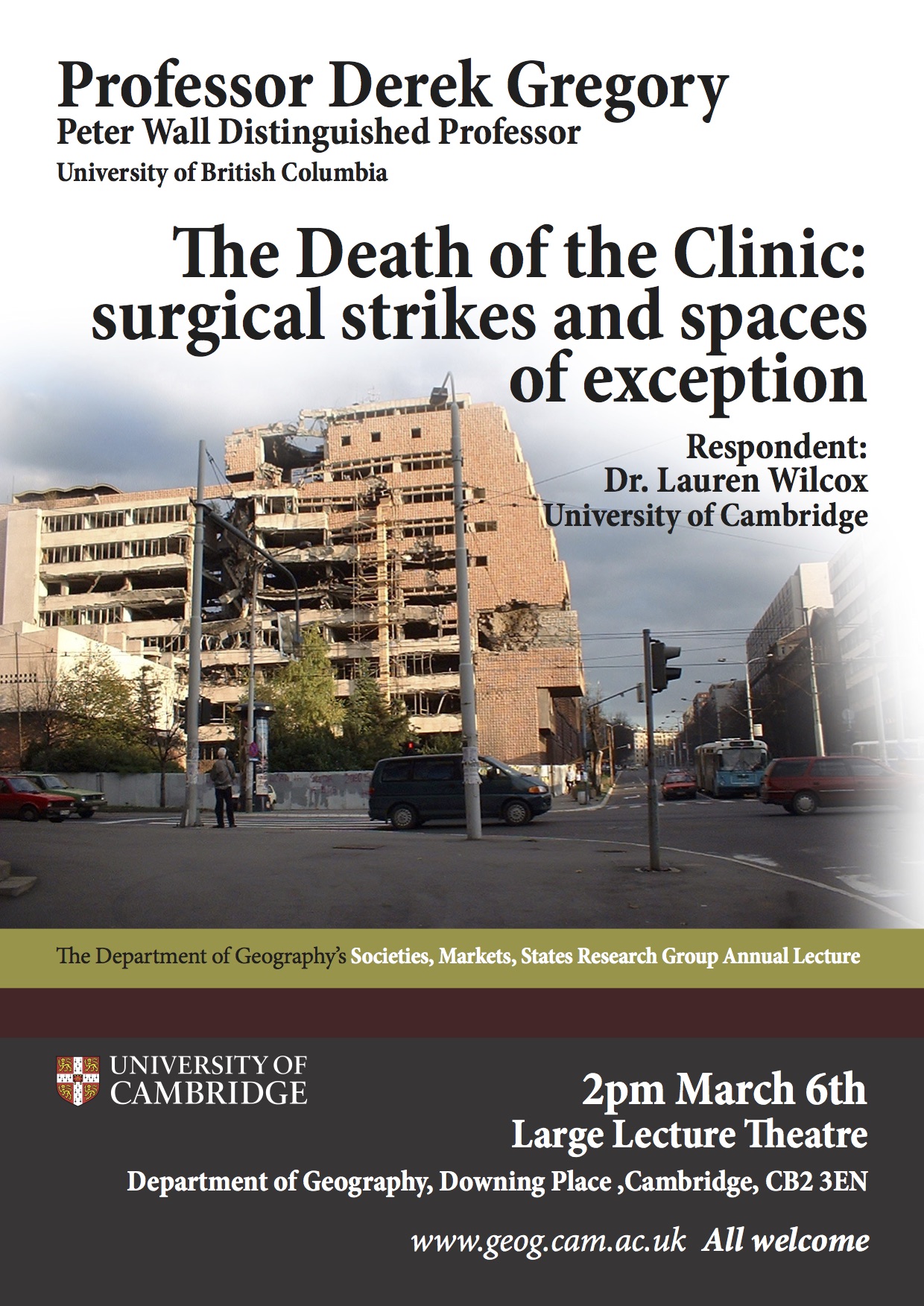
Next month I’ll be in Sweden and the UK doing all sorts of things – one of them is an updated presentation of my arguments about attacks on hospitals, medical workers and patients in Afghanistan and Syria.  Here’s the poster for its outing in Cambridge on 6 March, and – given my commentary on Meatspace? – I’m very much looking forward to Lauren Wilcox‘s response and a lively conversation afterwards.

The Death of the Clinic

This is the fifth in a new series of posts on military violence against hospitals and medical personnel in conflict zones. It follows directly from my analysis of the situation in Syria here.

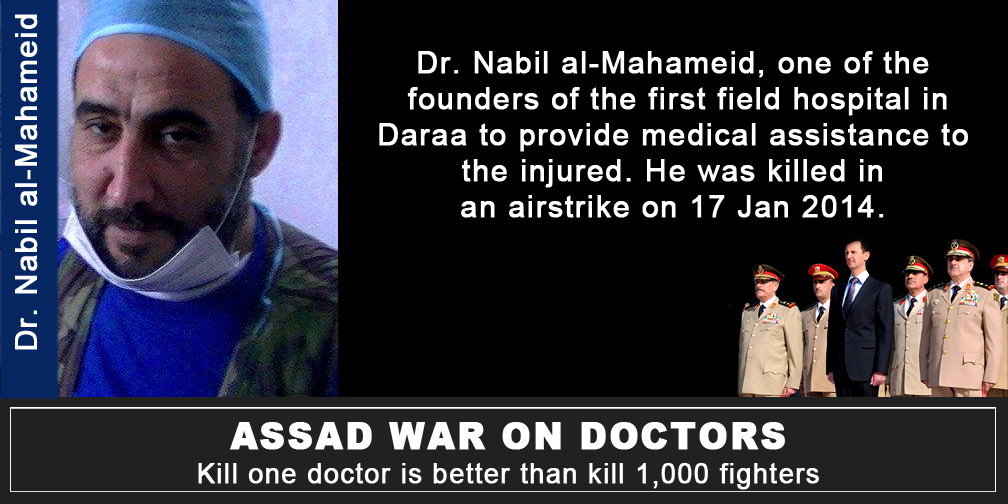
President Bashar al-Assad has consistently denied that his forces have attacked hospitals or doctors.  In an interview with SBS Australia on 1 July 2016 he asked his interviewer:

‘… the very simple question is: why do we attack hospitals and civilians?… No government in this situation has any interest in killing civilians or attacking hospitals. Anyway, if you attack hospitals, you can use any building to be a hospital. No, these are anecdotal claims, mendacious statements …’

president-al-assad-interview-sbs-australia-4

There are at least four answers to Assad’s disingenuous question (if you falter at the adjective, see here).

(1) Silencing the witnesses

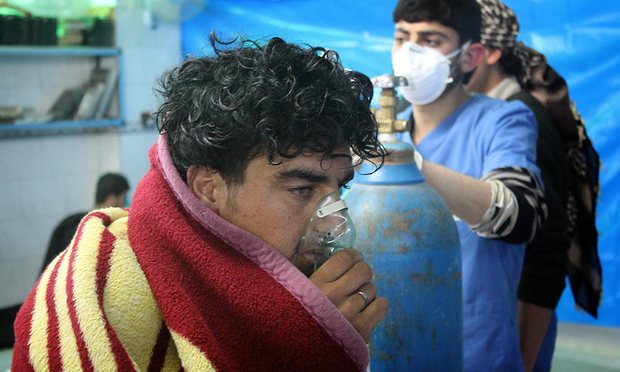
When Widney Brown from Physicians for Human Rights testified at the Tom Lantos Human Rights Commission on 31 March 2016 she provided one clear and compelling rationale for Assad’s attacks on doctors:

‘… attacks on doctors silence particularly powerful witnesses. When the Syrian government denies its use of chemical weapons, cluster munitions, starvation, or torture, doctors can bear witnesses to these violations because they have seen and treated the victims.’

syrian-man-receiving-treatment-following-a-gas-attack

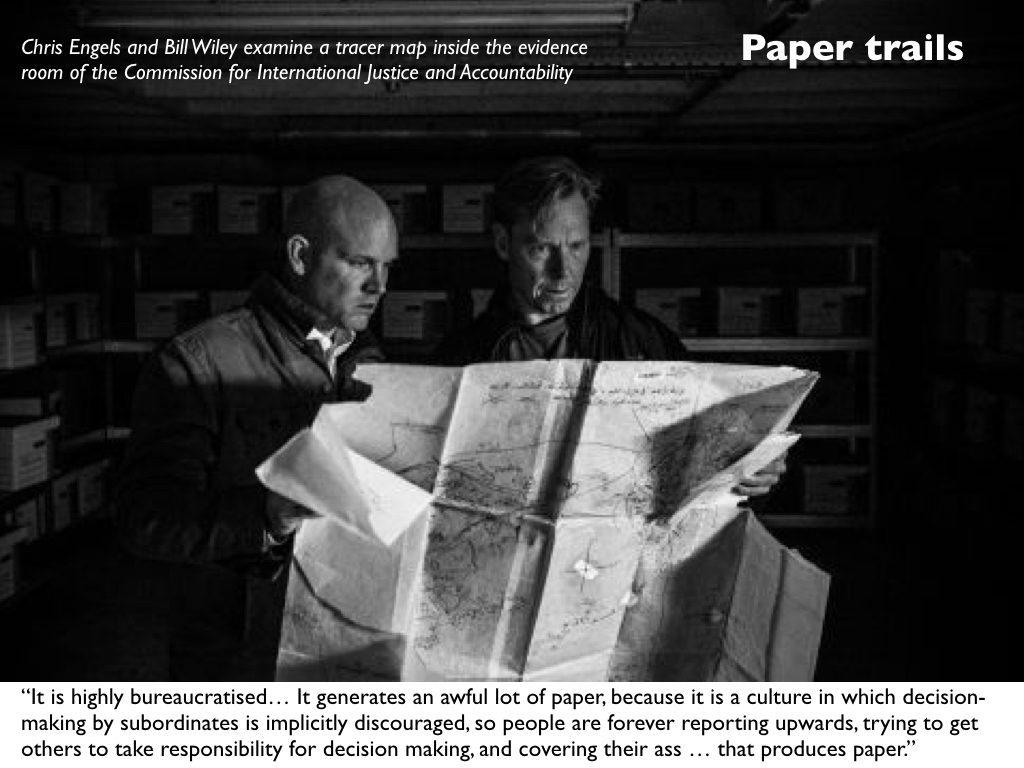
To be sure, there are other witnesses and even paper trails and photographic records.  Ben Taub, who has done so much to bring ‘Syria’s war on doctors‘ to the attention of a wider public, has also provided a detailed account of the work done by Bill Wiley and the Commission for International Justice and Accountability whose volunteers have smuggled over 600,000 documents out of Syria detailing mass torture and killings by the regime.

cija-syria-001

The war crimes have not been confined to attacks on hospitals in opposition-held areas.  A photographer known only as ‘Caesar’, who had been attached to the Defence Ministry’s Criminal Forensic Division, smuggled out thousands of high-resolution digital images exposing the horrors of the regime’s own military hospitals:

The pictures, most of them taken in Syrian military hospitals, show corpses photographed at close range – one at a time as well as in small groupings. Virtually all of the bodies – thousands of them – betray signs of torture: gouged eyes; mangled genitals; bruises and dried blood from beatings; acid and electric burns; emaciation; and marks from strangulation…

These unfortunates may have lived and died in different ways, but they were bound in death by coded numerals scribbled on their skin with markers, or on scraps of paper affixed to their bodies. The first set of numbers (for example, 2935 in the photographs at bottom) would denote a prisoner’s I.D. The second (for example, 215) would refer to the intelligence branch responsible for his or her death. Underneath these figures, in many cases, would appear the hospital case-file number (for example, 2487/B)…

[T]he system of organizing and recording the dead served three ends: to satisfy Syrian authorities that executions were carried out; to ensure that no one was improperly discharged; and to allow military judges to represent to families—by producing official-seeming death certificates—that their loved ones had died of natural causes. In many ways, these facilities were ideal for hiding “unwanted” individuals, alive or dead. As part of the Ministry of Defense, the hospitals were already fortified, which made it easy to shield their inner workings and keep away families who might come looking for missing relatives. “These hospitals provide cover for the crimes of the regime,” said Nawaf Fares, a top Syrian diplomat and tribal leader who defected in 2012. “People are brought into the hospitals, and killed, and their deaths are papered over with documentation.” When I asked him, during a recent interview in Dubai, Why involve the hospitals at all?, he leaned forward and said, “Because mass graves have a bad reputation.”

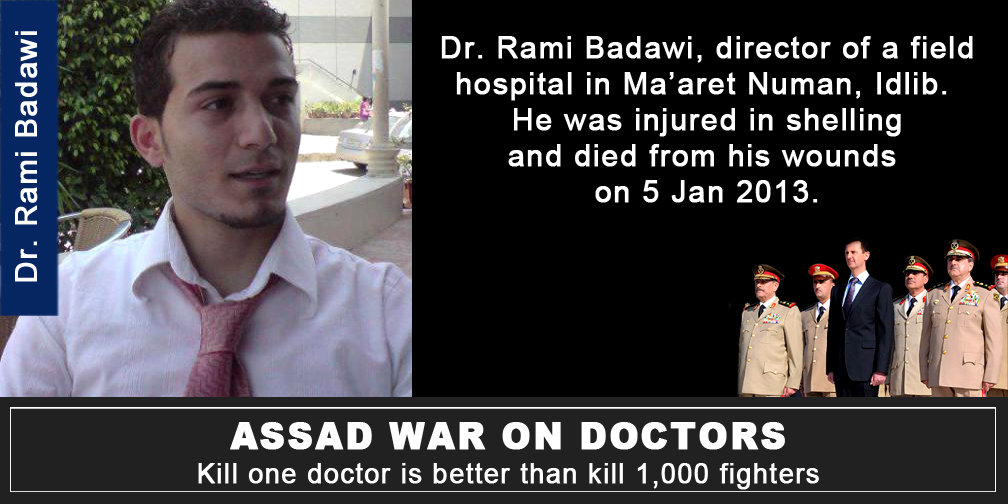
(2) Multiplying the casualties

This is a radicalisation of an old strategy.  As Sam Weber pointed out in Targets of opportunity (2005), ‘every target is inscribed in a network or chain of events that inevitably exceeds the opportunity that can be seized or the horizon that can be seen.’  So, for example, when the United States or Israel bombs a power plant it often as not explains that it has been careful to bomb in the small hours when only a skeleton staff was in the building in order to minimise collateral damage.  But this begs the question: why bomb the power plant at all?  In most instances the degradation of the electricity supply means that it becomes impossible to pump water or treat sewage; refrigerators fail and food perishes; hospitals are forced to use unreliable generators. The result – the intended, carefully calculated result – is that casualties rise at considerable distances from the target and over an extended period of time.

Similarly, Dr Abdulaziz Adel notes:  ‘Kill a doctor and you kill thousands.’  Simply put, patients who are sick or injured then go without treatment and in many cases their lives are put at risk.  (The images below are from Collateral Damage: more here).

syria_assad_war_crimes_murder_bomb67

syria_assad_war_crimes_murder_bomb15

syria_assad_war_crimes_murder_bomb37

Dr Rami Kalazi, a neurosurgeon from East Aleppo, agrees:

‘They are the artery of life in the city. Can you imagine a life in city without hospitals? Who will treat your kids? Who will make the surgeries for the injured people? So, they are targeting these hospitals because they know, if these hospitals were completely destroyed, the life will be completely destroyed.’

(3) ‘Moral[e] bombing’

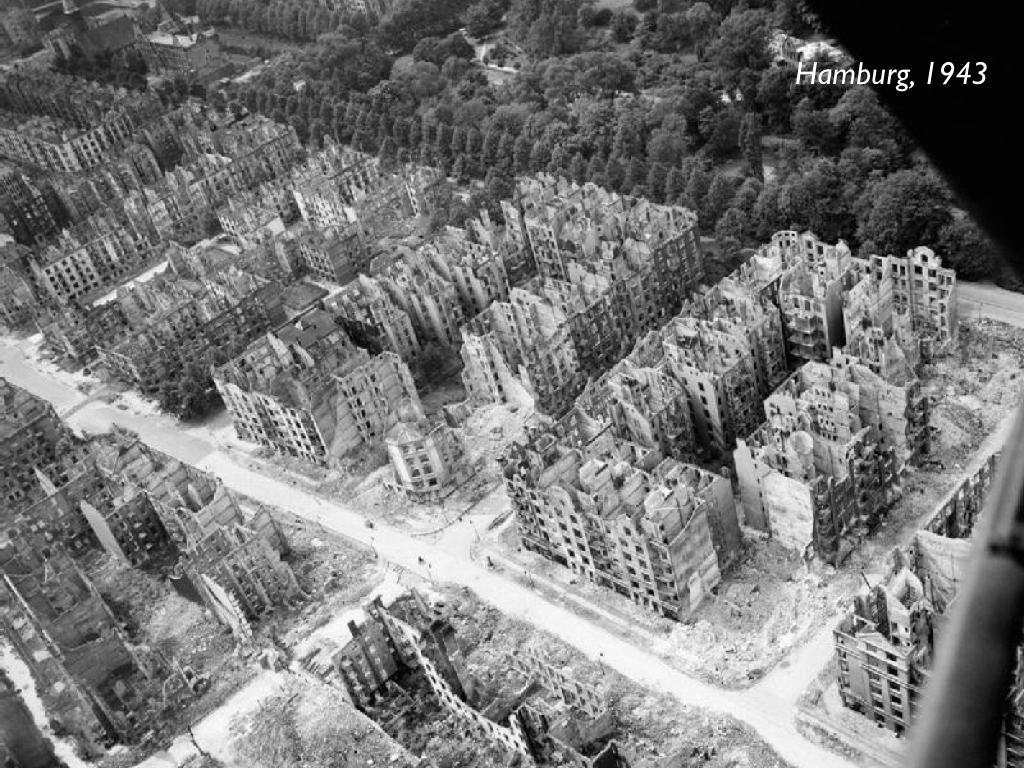
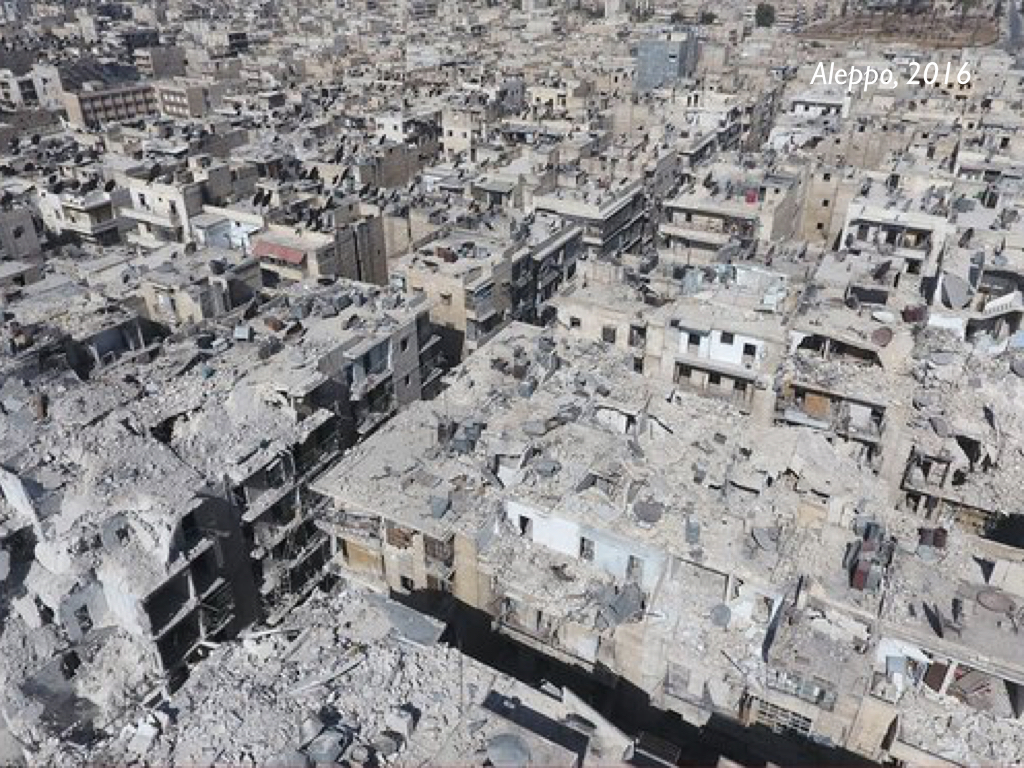
This too is an old strategy.  The architects of ‘area bombing’ during the combined bomber offensive against Germany during the Second World War described it as ‘moral [sic] bombing’: a sustained and systematic attempt to undermine the morale of the enemy population so that they would demand their leaders sue for peace.  If this was a tried and tested strategy, however, the test showed that it was a complete failure (see my ‘Doors into nowhere’: DOWNLOADS tab).

morale-bombing-001

morale-bombing-002

But the lesson was lost in Syria, where attacks on hospitals have had a central place.  As Samir Puri argues, the strategy behind the joint Syrian and Russian air campaign seems to be:

“If there is a total collapse of any kind of trauma care, those are the sort of things that can contribute to collapsing morale very suddenly. The morale of a besieged force can look robust until it collapses.”

And Syria is not unique in contemporary wars: Israel has deployed the same strategy in its repeated assaults on Gaza (see here, here and here for ‘Operation Protective Edge’ in 2014), and the Saudi-led coalition has attacked more than 70 hospitals and health facilities in Yemen since March 2015 (in this latter case Russian media have reported MSF’s objections to the ‘utter disregard for civilian life’ without dissent: see for example here).

flashback-gaza-2014-001

‘Preventing medicine’, as Annie Sparrow puts it, has become ‘a new weapon of mass destruction’.

(4) ‘Violence legislates’

Following the attack on the UN aid convoy delivering supplies to a Syrian Red Crescent warehouse outside East Aleppo on 19 September 2016, 101 humanitarian organisations issued a joint appeal to the United Nations on 22 September; in part it read:

‘Deliberate attacks on humanitarian workers and civilians are war crimes. This must mark a turning point: the UN Security Council cannot allow increasingly brazen violations of international humanitarian law to continue with impunity.

‘Heads of state are gathered in New York this week for the United Nations General Assembly. Each one that accepts a lack of accountability for perpetrators and facilitators of war crimes colludes in the ongoing dissolution of international humanitarian law’ (my emphases).

The first paragraph is damning enough.  Ben Taub in the New Yorker again:

Nowhere has the supposed deterrent of eventual justice proved so visibly ineffective as in Syria. Like most countries, Syria signed the Rome Statute, which, according to U.N. rules, means that it is bound by the “obligation not to defeat the object and purpose of the treaty.” But, because Syria never actually ratified the document, the International Criminal Court has no independent authority to investigate or prosecute crimes that take place within Syrian territory. The U.N. Security Council does have the power to refer jurisdiction to the court, but international criminal justice is a relatively new and fragile endeavor, and, to a disturbing extent, its application is contingent on geopolitics.

But the sting comes in the second paragraph.  As I’ve noted before, international humanitarian law is not a neutral court of appeal, a deus ex machina above the fray, but has always been closely entangled with military violence.  In many respects it travels in the baggage train, constantly pulled by the trajectory of the very violence it supposedly seeks to regulate (or facilitate, depending on your point of view).  In short, as Eyal Weizman has it, ‘violence legislates‘.

There is good reason to fear that the systematic violation of medical neutrality is intended to force its dissolution.  Thomas Arcaro writes: ‘Humanitarian principles like neutrality and impartiality that once seemed so self-evident have been drawn into question, especially on the politically and ethnically complex battlefields of Iraq and Syria.’

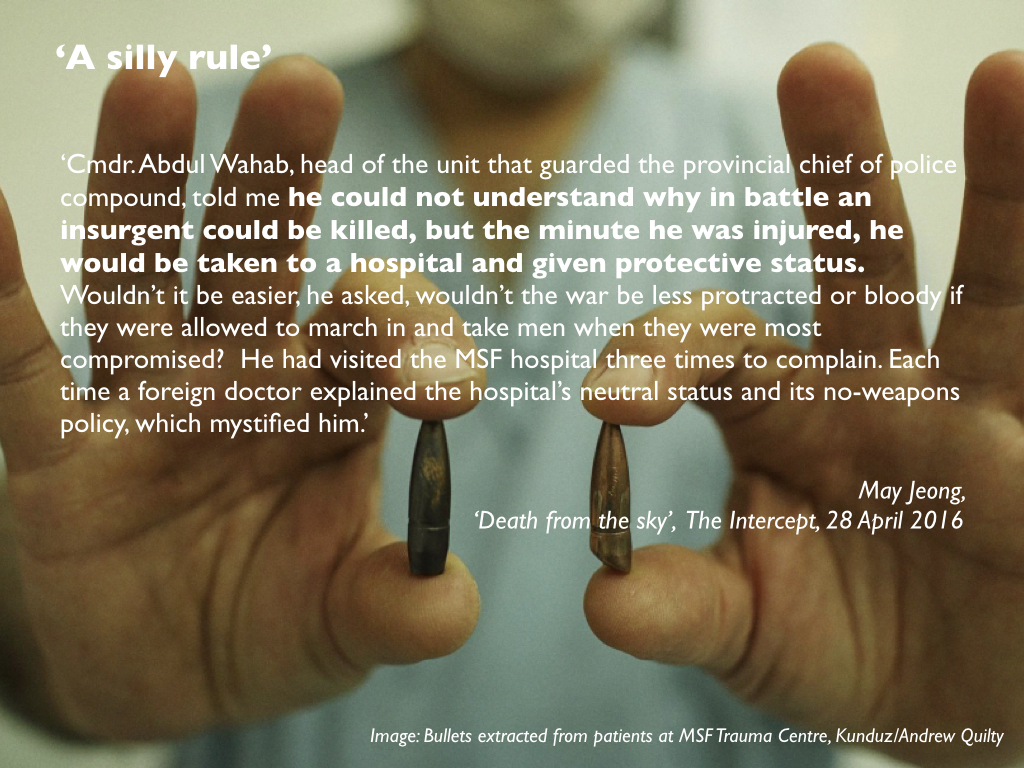
And not only there.  In the case of the US airstrike on the MSF Trauma Centre in Kunduz in 2015, I’ve suggested that some key Afghan officers and politicians chafed at the protections afforded to wounded Taliban combatants by international humanitarian law.  They also alleged that the Trauma Centre had breached its conditional immunity because the Taliban had overrun the hospital and were firing at US and Afghan forces from its precincts.  There is no evidence to support that assertion, but it is an increasingly familiar claim.  On 7 December 2016 US Central Command justified a ‘precision strike’ requested by Iraqi forces on a building within the al-Salem hospital complex in Mosul by claiming that IS fighters had used it as a base to launch heavy and sustained machine-gun and rocket-propelled grenade attacks.  That would certainly have compromised the hospital’s immunity, but international humanitarian law still requires a warning to be issued before any attack and a proportionality analysis to be conducted; Colonel John Dorrian said that the US Air Force did not ‘have any reason to believe civilians were harmed’ but conceded that it was ‘very difficult to ascertain with full and total fidelity’ whether any medical staff or patients were in the building at the time of the air strike.

But what the Syrian case suggests is a new impatience with medical neutrality tout court: not only a hostility towards the treatment of wounded and sick combatants but also an unwillingness to extend sanctuary to wounded and sick civilians.

people-on-war-2016

And that reluctance is not confined to the Assad regime and its allies.    A survey carried out for the International Committee of the Red Cross between June and September makes for alarming reading – even once you’ve overcome your scepticism about public opinion polls.  As Spencer Ackerman reports:

Areas in active conflict record greater urgency over questions of civilian protection in wartime than do the great powers that often conduct or participate in those conflicts. In Ukraine, 83% believe everyone wounded and sick during a conflict has a right to health care, compared with 62% of Russians. A full 100% of Yemenis endorse the proposition, as do 81% of Afghans, 66% of Syrians and 42% of Iraqis – compared with 49% of Americans, 53% of Britons, 37% of the Chinese and 67% of the French.

It’s that last clause that is so disturbing: for the last four states listed are all permanent members of the UN Security Council…

So what, then, are we to make of what I’ve been calling ‘the exception to the exception’?

The exception to the exception

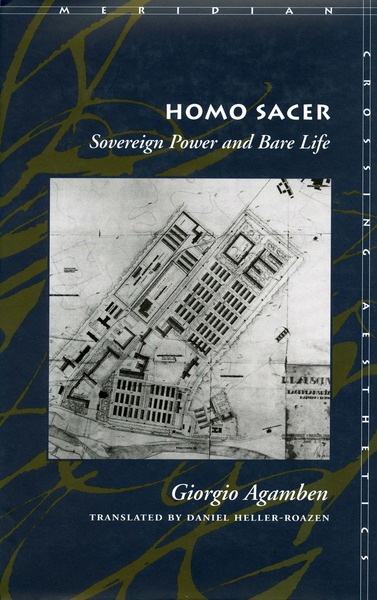
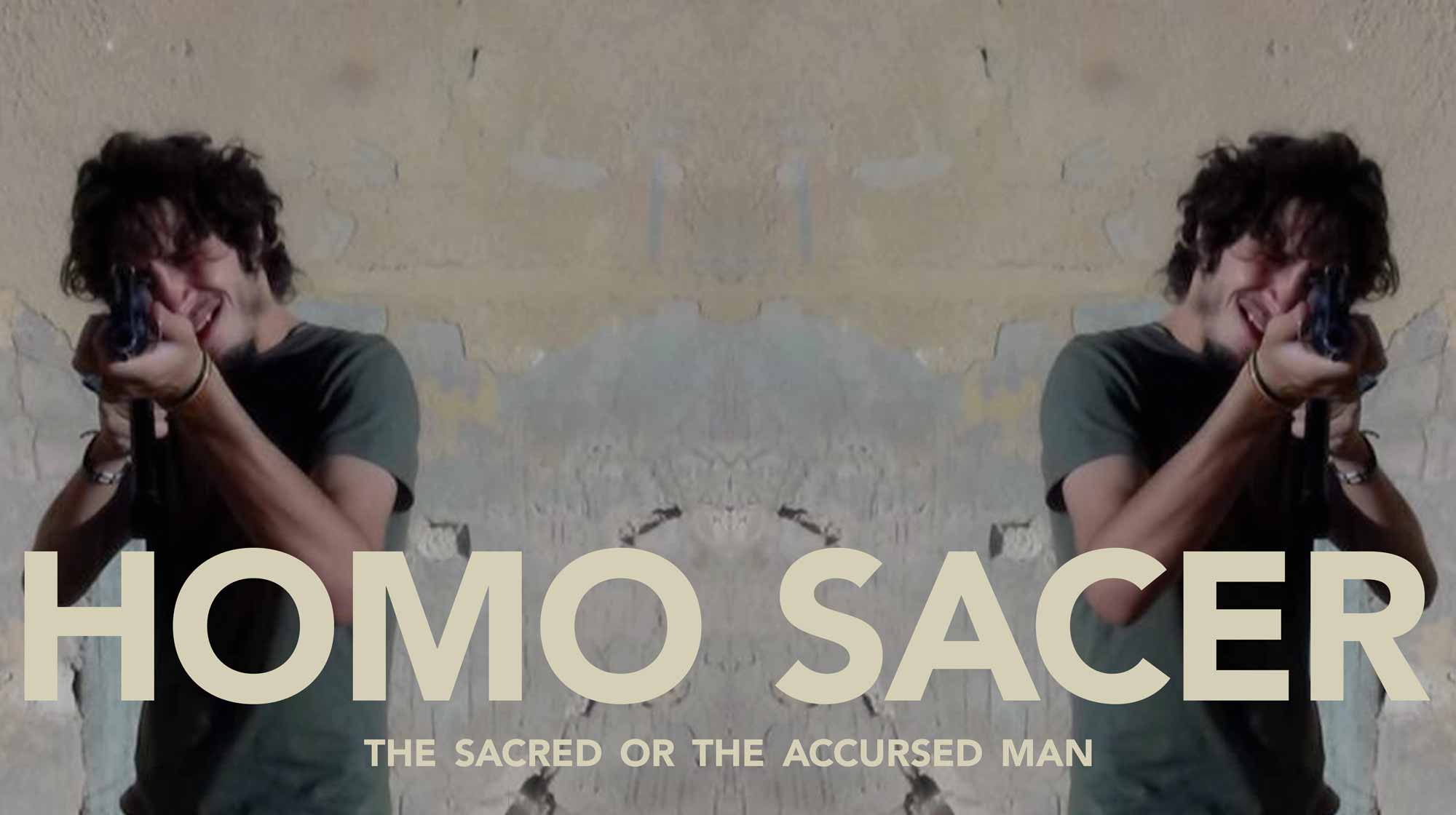
homo-sacerI think it’s a mistake to treat ‘the camp’, following Giorgio Agamben‘s vital work, as the exemplary, diagnostic site of the modern space of exception; the killing fields of today’s wars (themselves spaces of indistinction, where it is never clear where war stops and peace begins, where the geometry of the battlefield or, better, ‘battlespace’ becomes ever more fractured and blurred, and where the partitions between international and internal conflicts have been reduced to rubble) are also spaces within which groups of people are deliberately and knowingly exposed to death through the removal of legal protections that would ordinarily be afforded to them.  In short, killing and injuring become legally permissible.

Those exposed groups include both combatants and civilians, but their fate is not determined solely by the suspension of national laws (the case that concerns Agamben) because international humanitarian law continues to afford them some minimal protections.  One of its central provisions has been medical neutrality: yet if, through its serial violations in Syria and elsewhere, we are witnessing the slow ‘death of the clinic’ – which I treat as a topological figure which extends from the body of the sick or wounded through the evacuation chain to the hospital itself – and the extinction of ‘the exception to the exception’, the clinic as a (conditionally) sacrosanct space – then I think it’s necessary to add further twists to Agamben’s original conception.

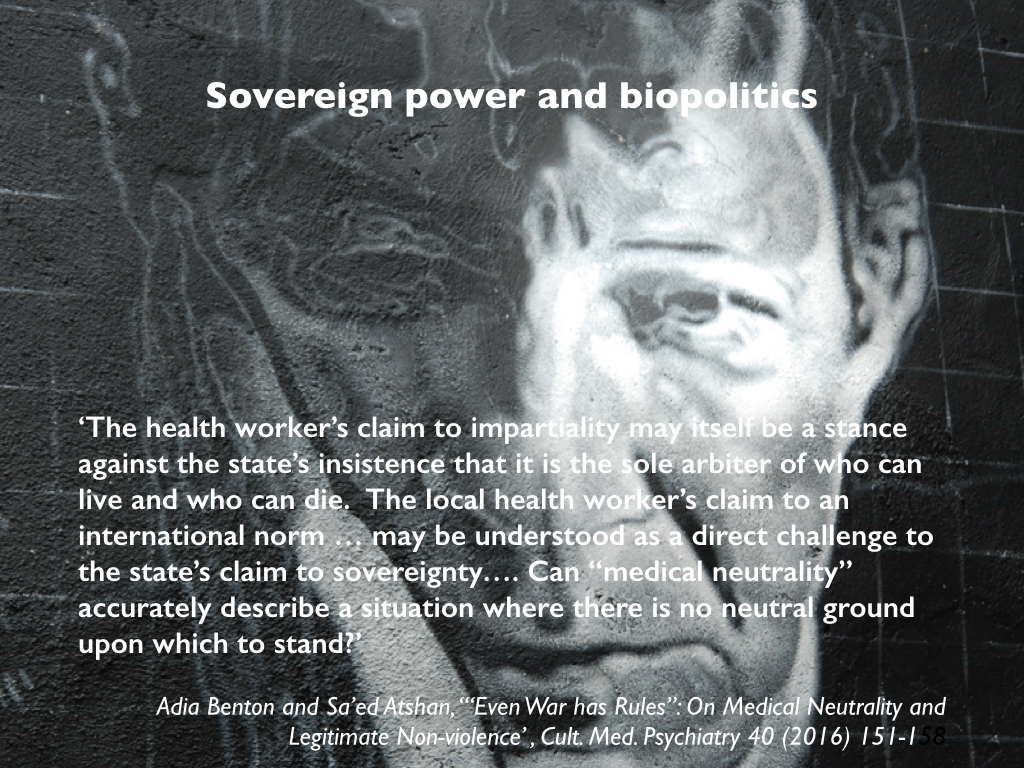
As Adia Benton and Sa’ed Ashtan have argued, medical neutrality – the exception to the exception – represents a fraught attempt to restrict the state’s recourse to military violence: it is a limitation on and has now perhaps become even an affront to sovereign power and the state’s insistence that it is ‘the sole arbiter of who can live and who can die’.

Agamben describes the inhabitants of the space of exception as so many homines sacri – where sacer has the double meaning of both ‘sacred’ and ‘accursed’ – and it may be that in today’s killing fields doctors, nurses and healthcare workers are being transformed into new versions of homo sacer: once ‘sacred’ for their selfless devotion to saving lives, they are now ‘accursed’ for their principled dedication to medical neutrality.


homo-sacer_lode-kuylenstierna_press_gun

Yet the precarity of their existence under conditions of detention and torture, siege and airstrike, has not reduced them to what Agamben calls ‘bare life’.  They care – desperately – whether they live or die; they have improvised a series of survival strategies; they have not been silent in the face of almost unspeakable horror; and they have developed new forms of solidarity, support and sociality.

bodies-in-alliance-001

The evolution of warfare

irrc-2016

The latest issue of the International Review of the Red Cross (open access here) focuses on the evolution of warfare:

To mark the 100th anniversary of the First World War, the Review asked historians, legal scholars and humanitarian practitioners to look back at the wars of the past century from a humanitarian point of view. In using what we know of the past to illuminate the present and the future, this issue of the Review adopts a long-term perspective, with the aim to illustrate the changing face of conflict by placing human suffering ‒ so often relegated to the backdrop of history ‒ front and center. It focuses on WWI and the period immediately leading up to it as a turning point in the history of armed conflict, drawing important parallels between the past and the changes we are witnessing today.

Among the highlights: an interview with Richard Overy on the history of bombing; Eric Germain, ‘Out of sight, out of reach: Moral issues in the globalization of the battlefield’; Lindsey Cameron, ‘The ICRC in the First World War: Unwavering belief in the power of law?’; Rain Liivoja, ‘Technological change and the evolution of the law of war’; Claudia McGoldrick, ‘The state of conflicts today: Can humanitarian action adapt?’; and Anna Di Lellio and Emanuele Castano, ‘The danger of “new norms” and the continuing relevance of IHL in the post-9/11 era’.

Incidentally, there may be something Darwinian about the trajectory of modern war – but I’m not sure that ‘evolution’ is exactly the right word…

‘Your turn, doctor’

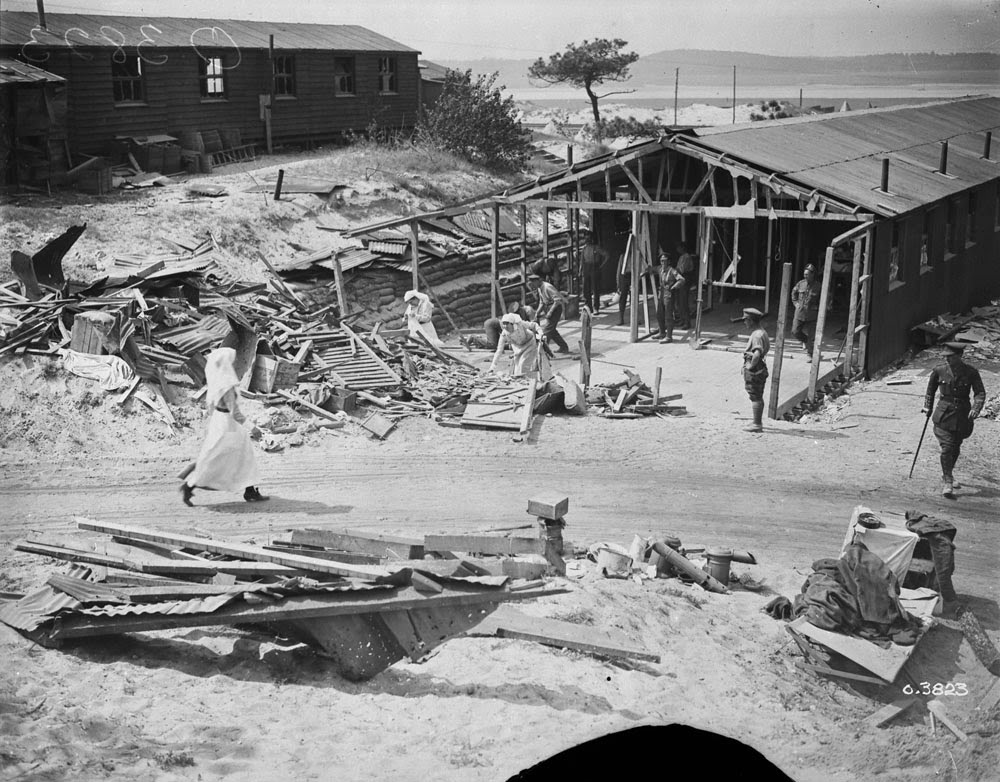
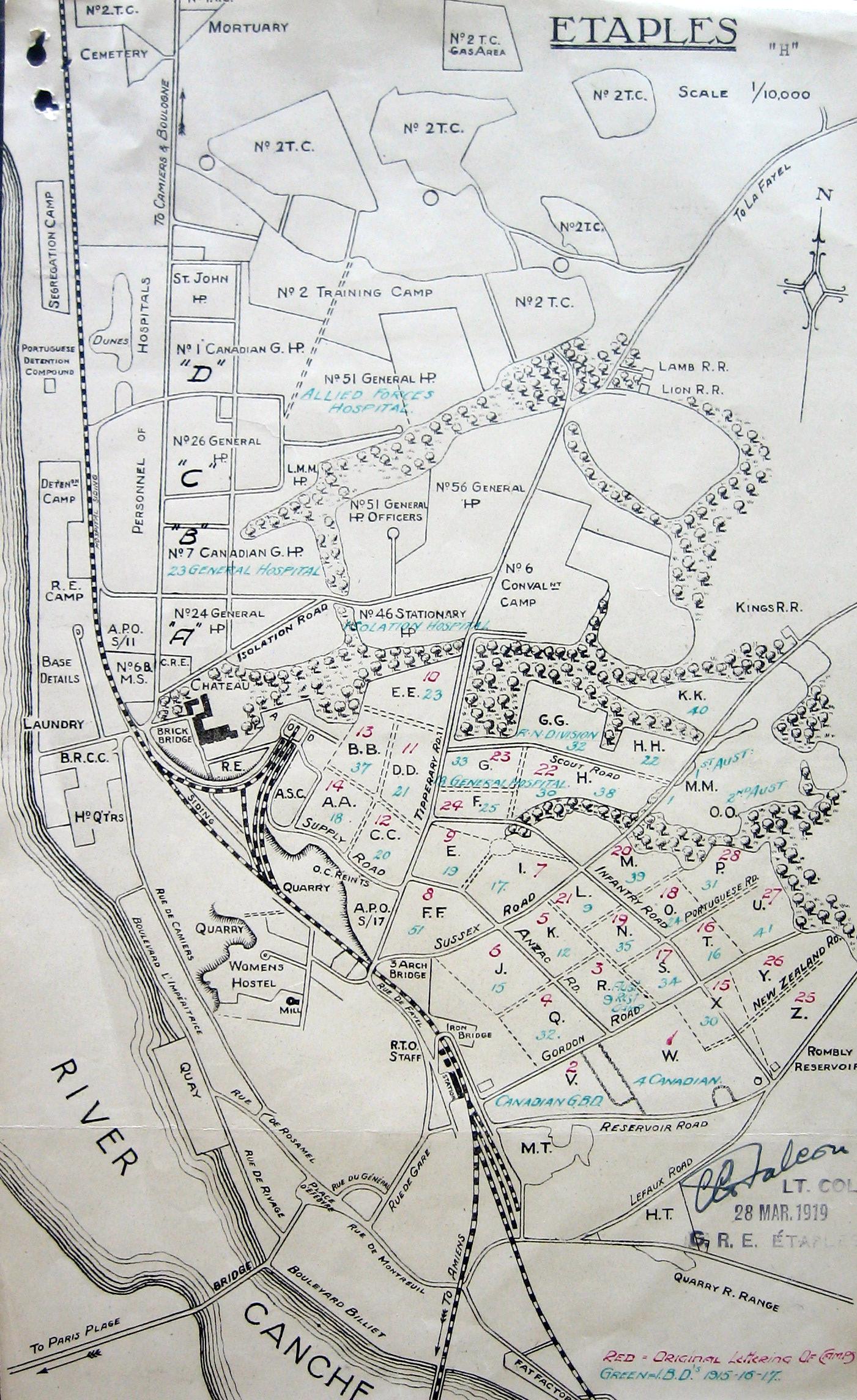
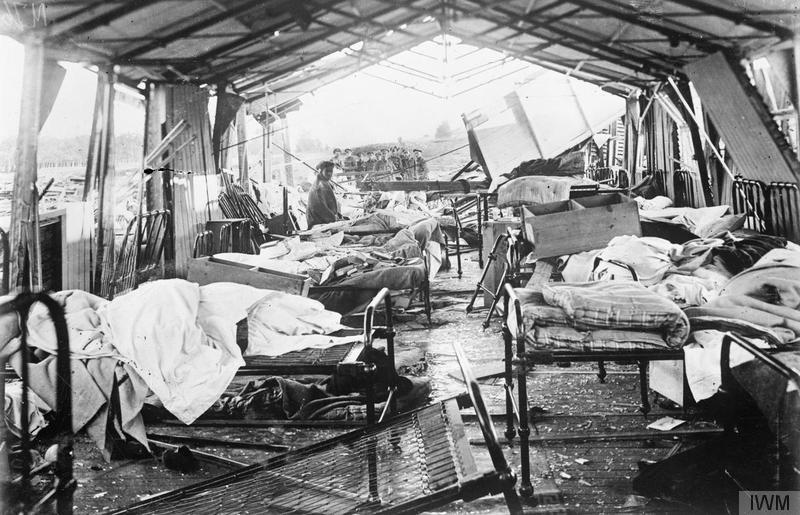
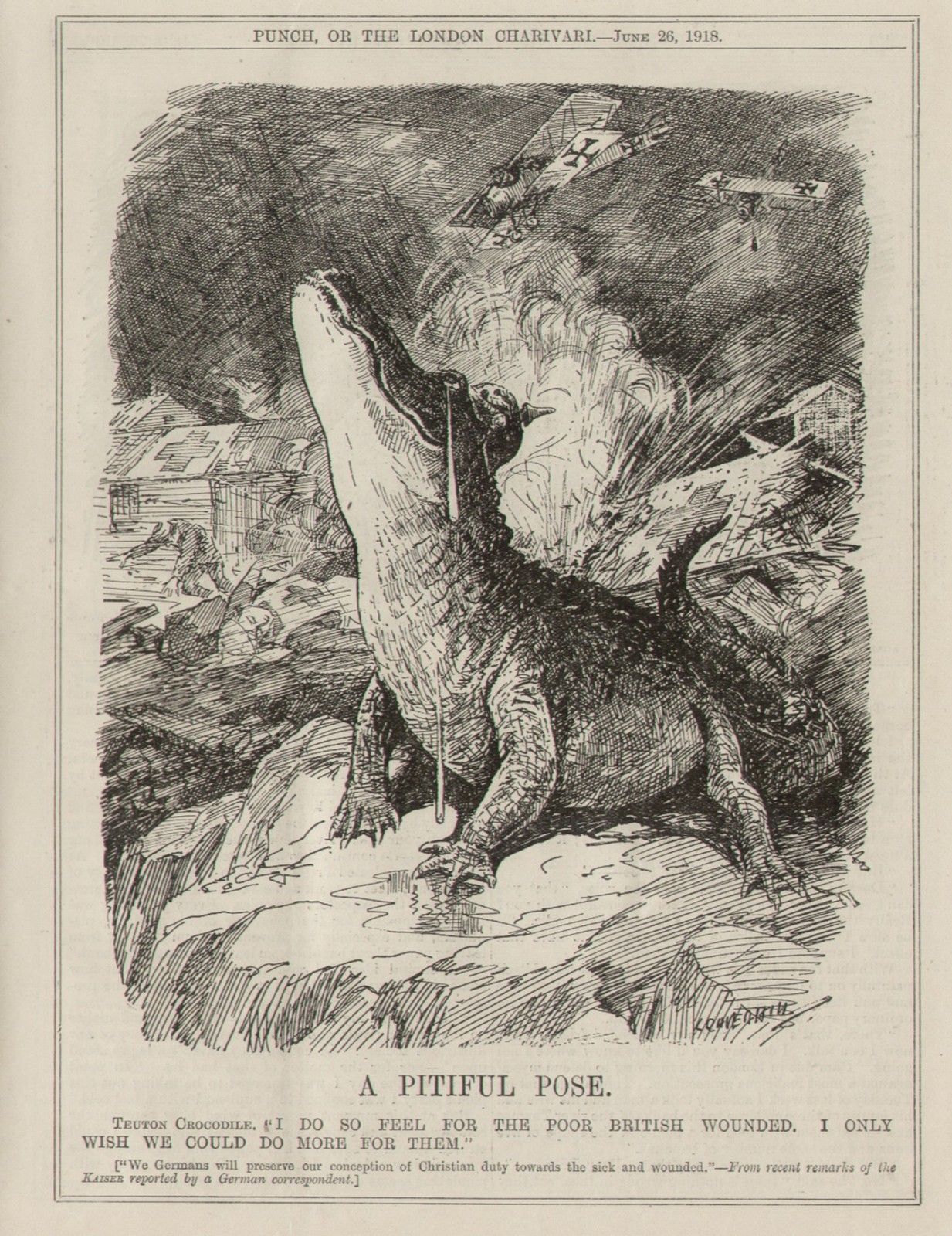
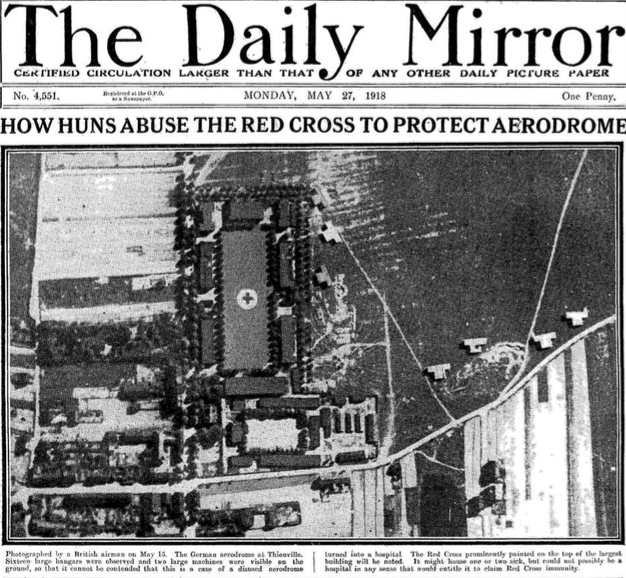
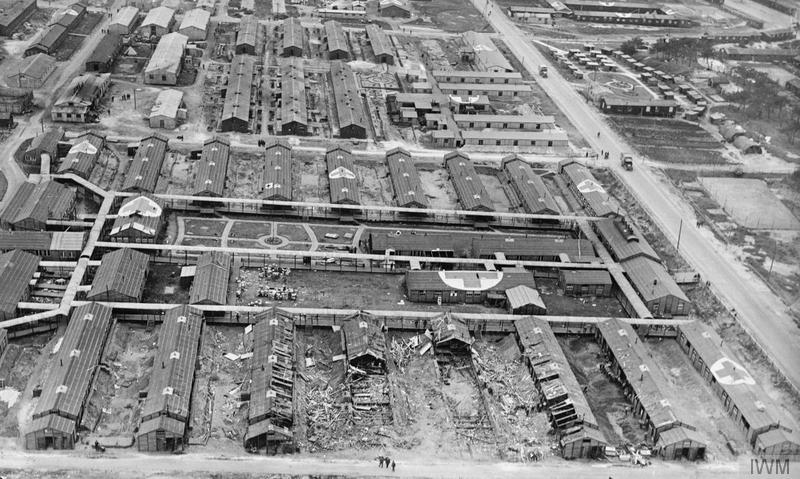
This is the fourth in a new series of posts on military violence against hospitals and medical personnel in conflict zones.  It follows from my analysis of air strikes on base hospitals on the coast of France in 1918 here, and of the US air strike on the MSF Trauma Centre in Kunduz, Afghanistan in 2015 here and here.  This post, together with the next in the series, is about Syria.  They all derive from a new presentation – still in active development – called ‘The Death of the Clinic: surgical strikes and spaces of exception’ that will eventually become an essay in my next book, so I would appreciate any comments or suggestions.

The eye of the storm 

Syria’s civil war has multiple origins, but one of the most incendiary incidents took place on 16 February 2011 in the city of Dara’a 80 km south of Damascus near the Jordanian border.  Inspired by the spread of the Arab uprisings east across the Maghreb from Tunisia, and the threat they posed to a succession of autocratic regimes, a group of local teenagers decided to daub slogans on the wall of their high school.  One of them, a brave 15-year old (who now lives with his family in Jordan), painted this:
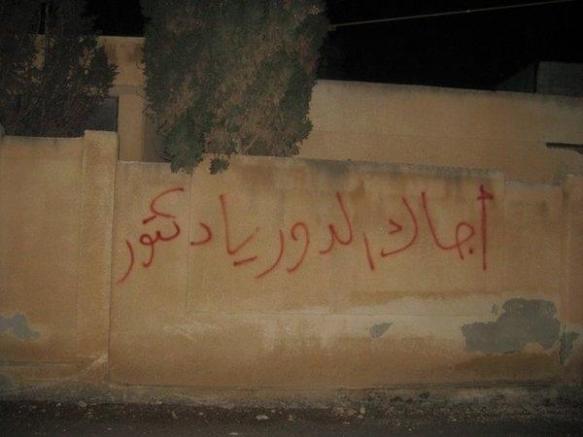
your-turn-doctor

‘Ejak el door ya Doctor’ – ‘Your turn, doctor’.

The doctor in question was Bashar al-Assad, Syria’s president, who had trained as an opthalmologist in Damacus and London.  In the months to come, Assad would give that slogan a viciously ironic twist.

The immediate response of the security forces to the graffiti was swift and draconian; the boys were rounded up, imprisoned and tortured (see herehere and here).  When their relatives protested to the officer in charge he told them:

‘Forget your children.  Just make more children. And if you don’t know how to make more, I’ll send someone to show you.’

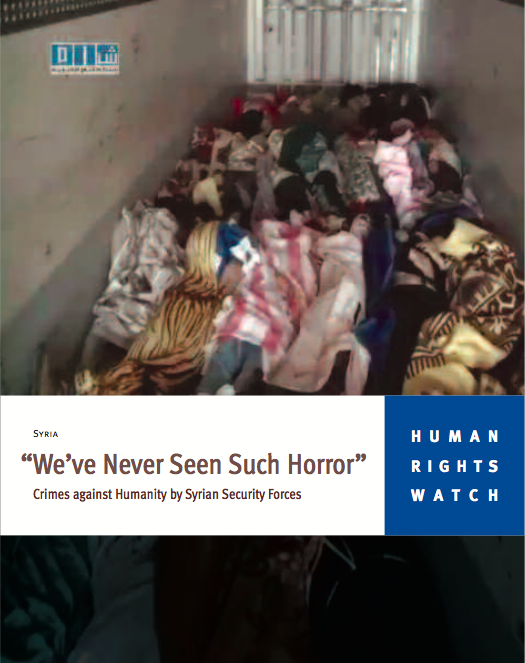
hrw-weve-never-seen-such-horrorLocal people took to the streets, and as the demonstrations spread on 22 March security forces entered the National Hospital in Dara’a, cleared it of all non-essential medical staff and stationed snipers on the roof who were under orders to fire on protesters.  The hospital remained until military control until May 2013; admissions were restricted and snipers continued to fire on the sick and wounded who tried to approach the hospital.  On 8 April security forces opened fire on thousands of demonstrators approaching a roadblock; ambulances were prevented from reaching the wounded, and a doctor, a nurse and an ambulance driver were killed when they tried to get through (UN Human Rights Council: ‘Assault on Medical Care in Syria’, 13 September 2013: download here; see also the Human Rights Watch report, ”We’ve never seen such horror’ here).
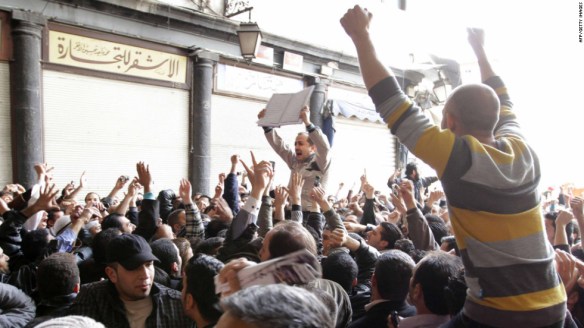
daraa-is-syria-in-damascus-2011

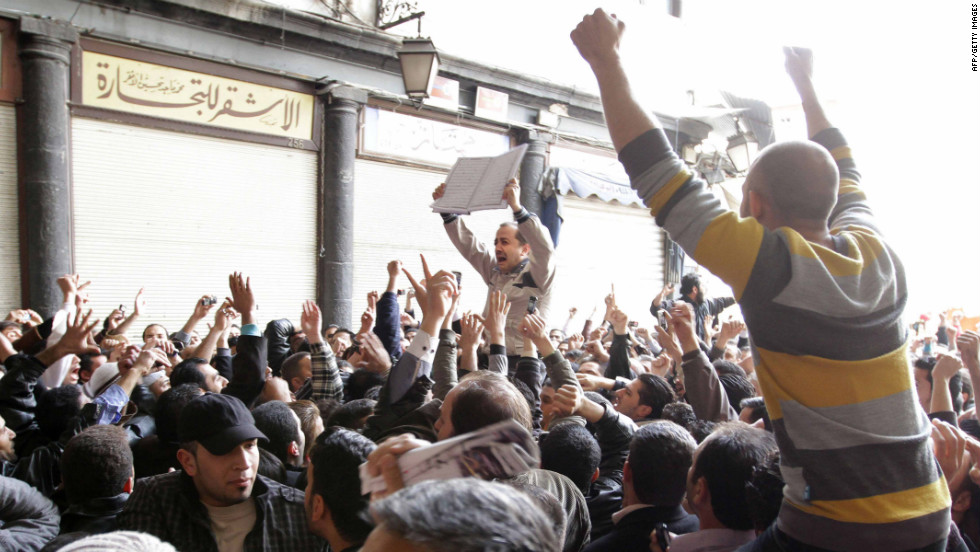
Others took up the cry, taking to the streets and chanting ‘Dara’a is Syria‘.  In many other areas the government stationed snipers, armoured personnel carriers, tanks and heavy artillery at hospitals; doctors suspected of treating protesters were arrested and tortured; security forces forcibly removed patients from hospitals, ‘claiming bullet or shrapnel wounds as evidence of participation in opposition activities’; and ambulances transporting casualties were attacked and pharmacies looted.

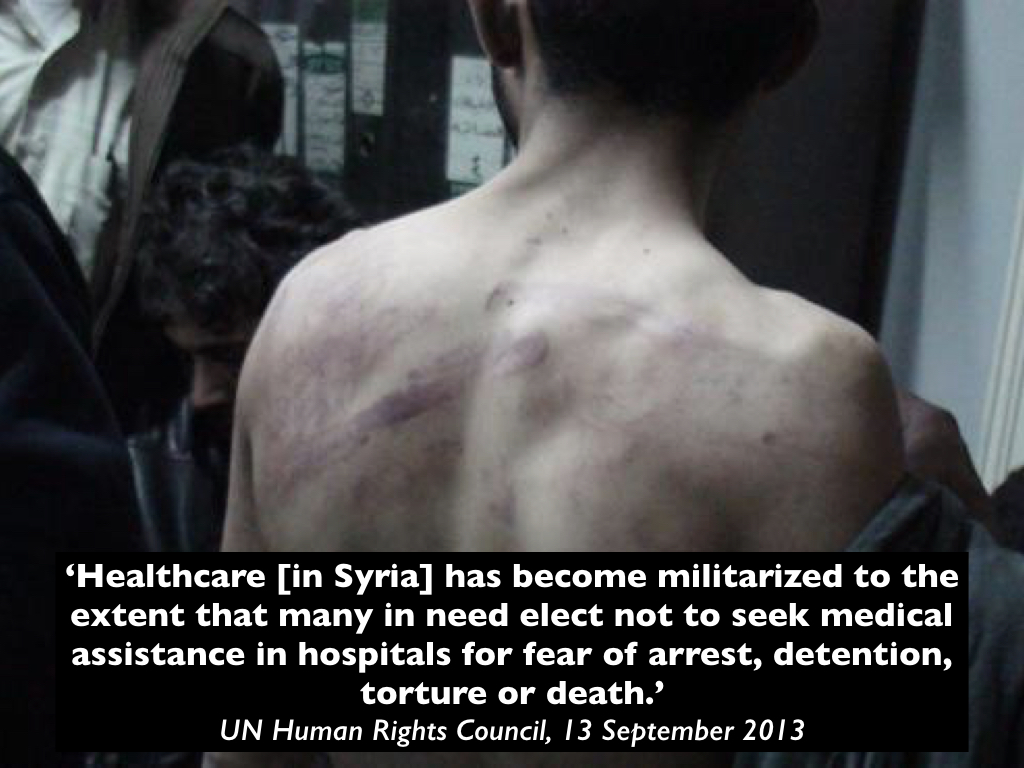
The UN Human Rights Council concluded:
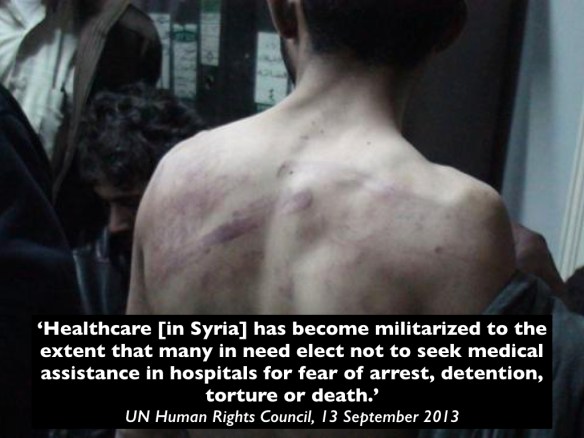
healthcare-has-become-militarised-001

This was, sadly, hardly novel.  In 2006, at the height of sectarian violence in occupied Baghdad, for example, Muqtada al-Sadr‘s Shi’a militia controlled the Health Ministry and manipulated the delivery of healthcare in order to marginalise and even exclude the Sunni population.  As Amit Paley reported:

‘In a city with few real refuges from sectarian violence – not government offices, not military bases, not even mosques – one place always emerged as a safe haven: hospitals…

‘In Baghdad these days, not even the hospitals are safe. In growing numbers, sick and wounded Sunnis have been abducted from public hospitals operated by Iraq’s Shiite-run Health Ministry and later killed, according to patients, families of victims, doctors and government officials.

‘As a result, more and more Iraqis are avoiding hospitals, making it even harder to preserve life in a city where death is seemingly everywhere. Gunshot victims are now being treated by nurses in makeshift emergency rooms set up in homes. Women giving birth are smuggled out of Baghdad and into clinics in safer provinces.’

He described hospitals as ‘Iraq’s new killing fields’, but in Syria the weaponisation of health care has been radicalised and explicitly authorized by the state.

Counterterrorism and the criminalisation of health care

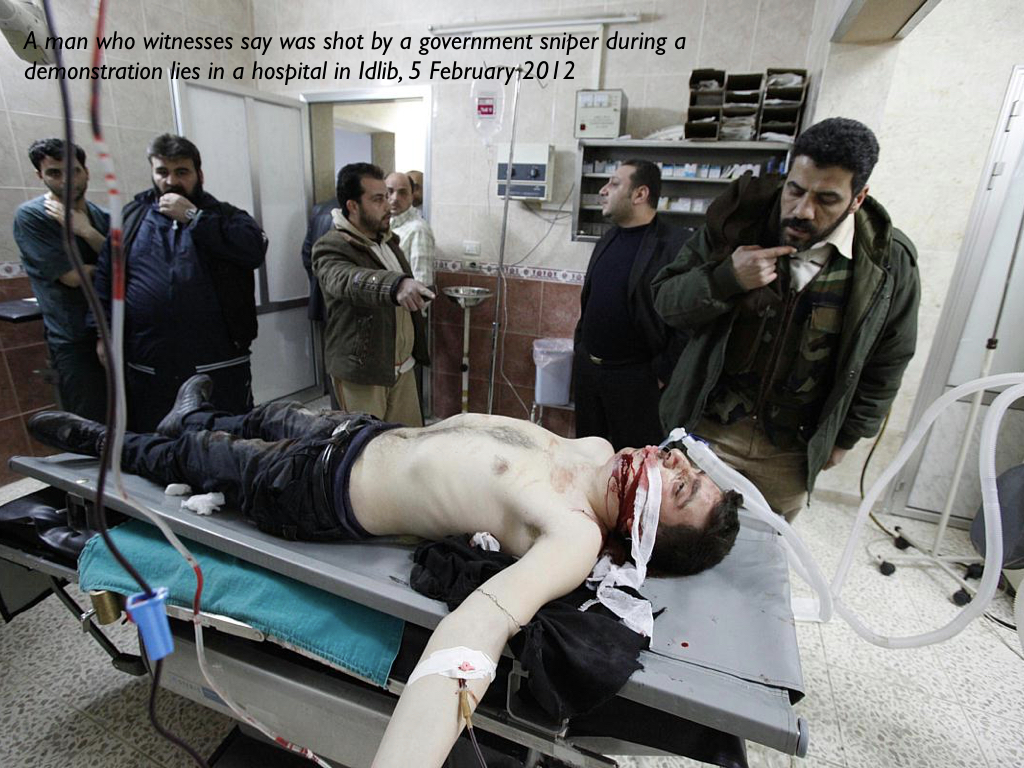
Doctors were systematically targeted for treating anyone who opposed the government.  In April 2012 one surgeon from Idlib told Annie Sparrow:

‘We were detained in the hospital for several days. Tanks parked out front, artillery in the wards, snipers on the roofs shooting patients who tried to come. They took our names, and summoned three of the five security branches – state, political and military. I was interrogated and forced to sign several commitments not to treat anyone not pro-regime. Of course, as soon as I was released I violated it immediately…the city was full of wounded and sick people. Soon after that a friend who worked in military security let me know I was now “wanted” [for my work], the charge being that I was the leader of a terrorist group. So I went into hiding, and moved my family to Turkey. In retaliation my brother was executed.’
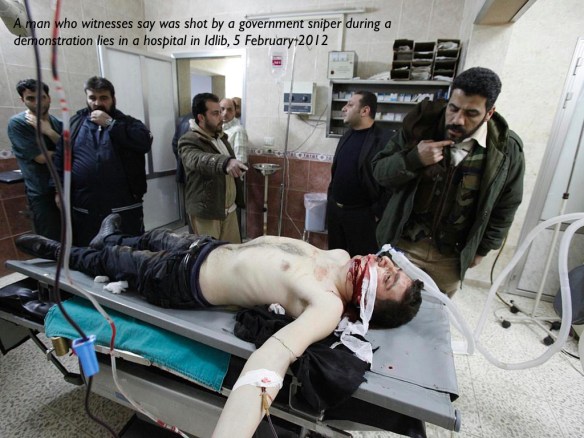
shot-by-a-sniper-001

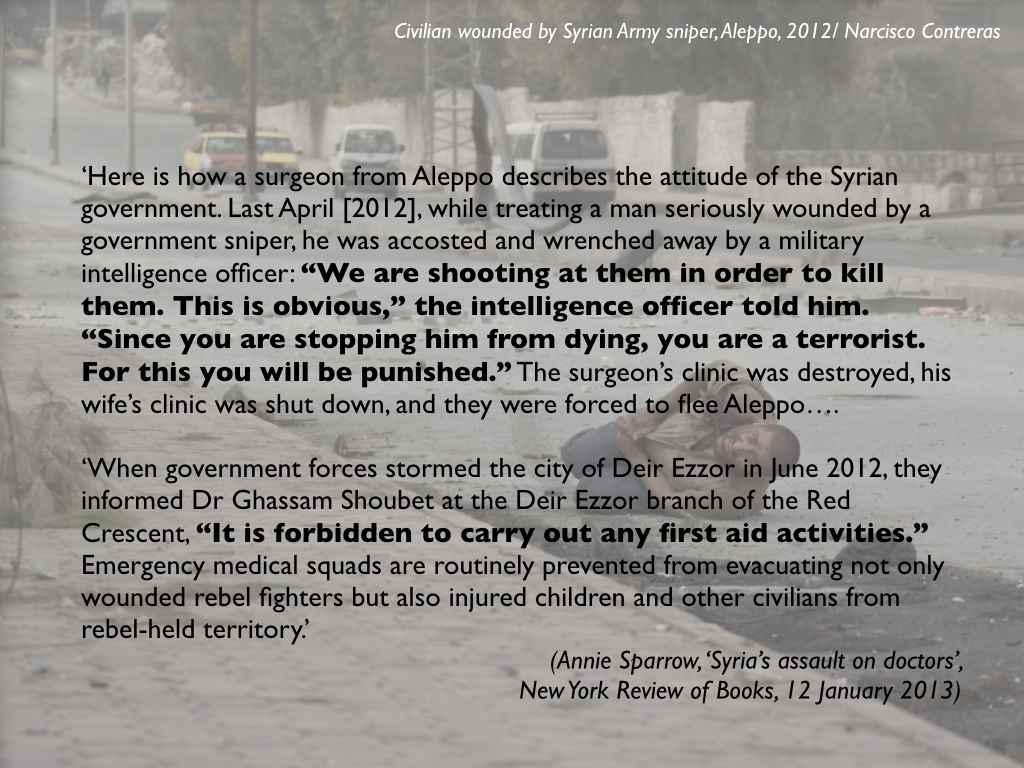
The State of Emergency that had been in force in Syria since 1962 was abruptly ended on 21 April 2012.  But on 2 July a new Counter-terrorism Law came into force that criminalised all medical aid to the opposition.  Here is Annie Sparrow again:

it-is-forbidden-to-carry-out-any-first-aid-activities-001

The parallels with the objections voiced by some members of Afghanistan’s security services against MSF’s work in Kunduz are only too clear: but in Syria they have been given explicit state sanction enforced through the law.

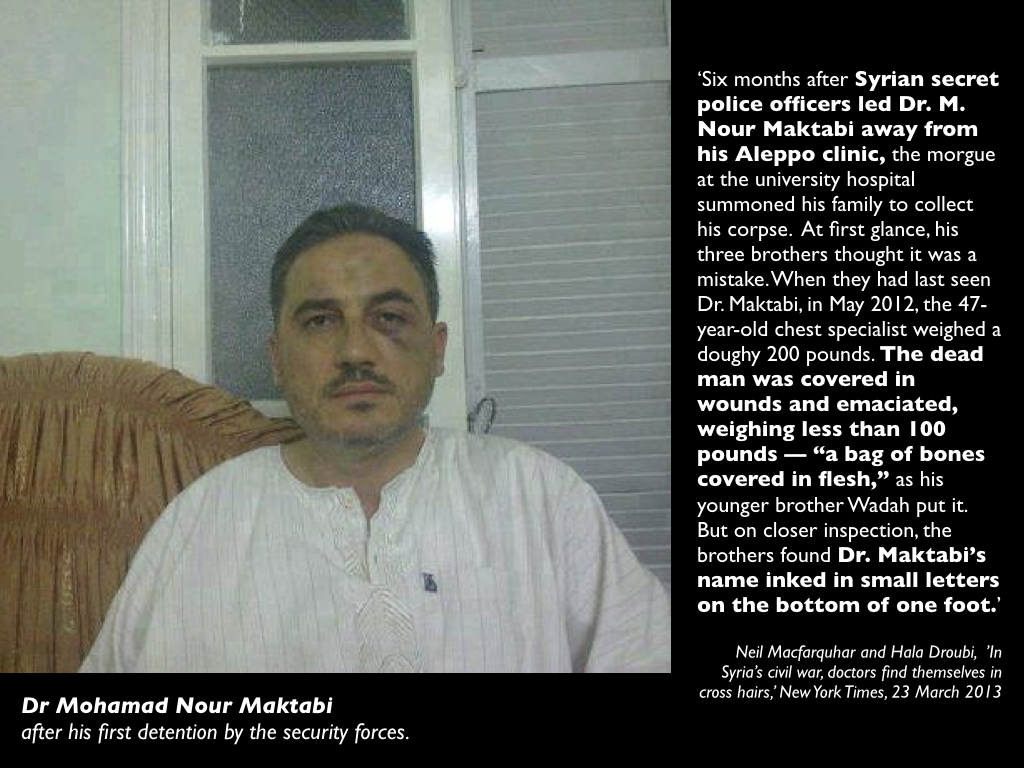
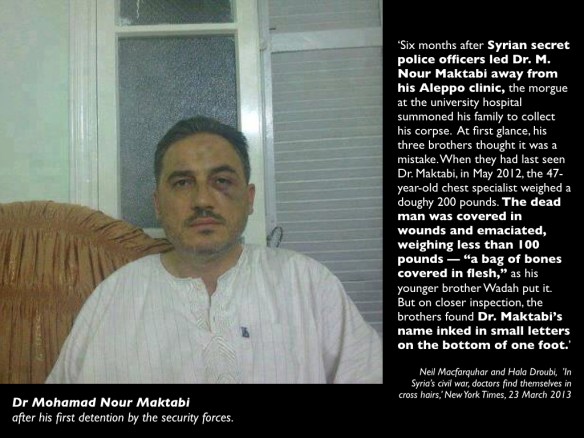
As Neil Macfarquhar and Hala Droubi reported for the New York Times in March 2013, doctors repeatedly found themselves in the cross-hairs.  Here, for example, is the case of Dr Mohamad Nour Maktabi:
doctors-in-the-crosshairs-001

The Counter-terrorism Law also declared that all medical facilities operating in opposition-held areas without government permission were illegal – and thereby transformed them (under Syrian law, at least) into legitimate targets of military violence.

Air wars and ‘surgical strikes’

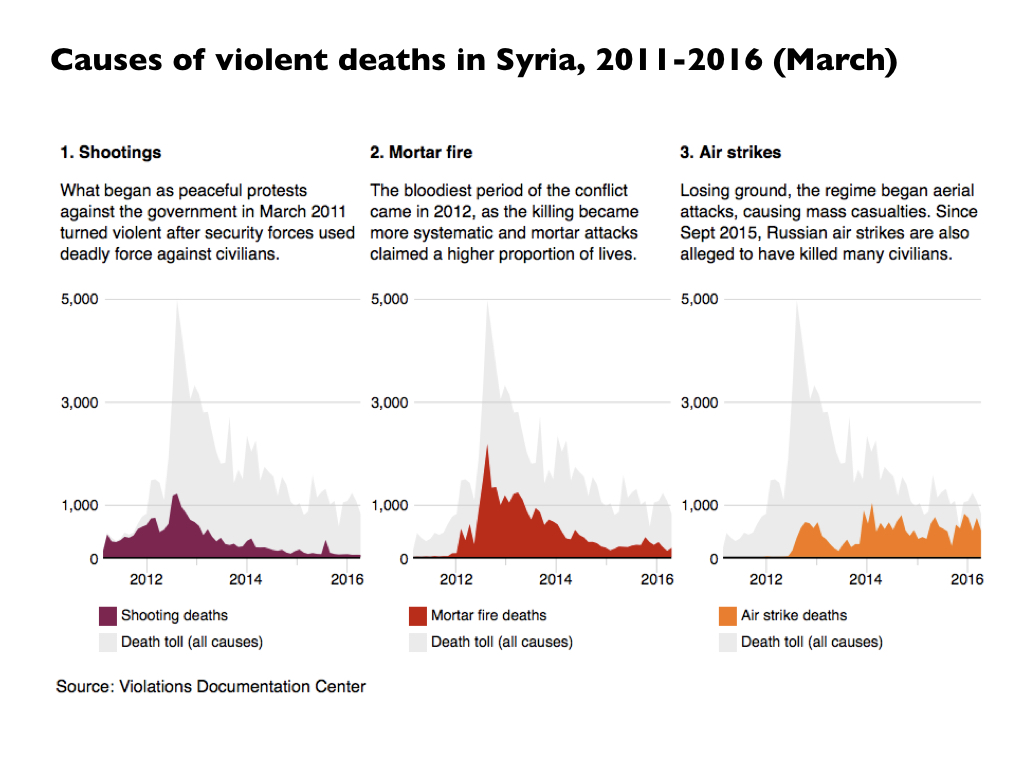
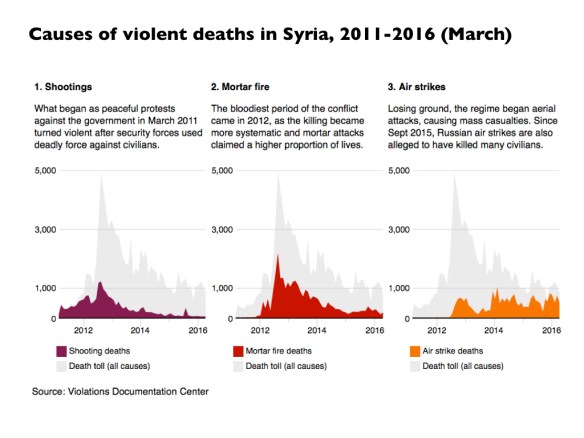
The nature of military and paramilitary violence has changed during the course of the war; shooting and mortar-fire have increasingly been supplemented by air strikes.
causes-of-violent-death-in-syria-2011-2016-001

Even in the early stages of the war doctors were confronting what one trauma specialist called ‘unimaginable injuries’.  Dr Rami Kalazi, a neurosurgeon in east Aleppo, explained:

‘In the beginning, we saw new injuries that we did not know how to treat. Fortunately, at the beginning of the revolution and when we began working in field hospitals, there was more freedom of movement. In 2012 and 2013, there was no such thing as “barrel bombs” and there was no violent shelling from airplanes, so many visiting foreign doctors came…

‘But even so, they told us that they were seeing injuries that they had never seen before in books or textbooks or in the hospitals where they worked in their home countries. Unfortunately, reality forces you to learn.’

But air strikes transformed the calculus of injury.  Many more casualties resulted from each attack, and the wounds of those who survived were often far more serious.

The US-led coalition has carried out multiple airstrikes primarily in areas controlled by IS, and the campaign has caused (minimally) hundreds and probably several thousand civilian casualties – see my analysis of specific US air strikes here and here, for example –  but the Syrian Arab Air Force has concentrated its fire on areas controlled by other rebel groups (see Jeffrey White‘s analysis here).

A favourite tactic has been the deployment of ‘barrel bombs‘ – in effect, aerial IEDs: oil drums filled with high explosive and cut rebar to act as shrapnel – dropped from helicopters (see Human Rights Watch here).  Basel al-Junaidi described witnessing their impact:

I saw the aftermath of a barrel bomb. I saw human remains scattered in the street; I heard the screaming. I’m trained as a doctor, but I was unable to act. I just stood there, petrified. The West thinks we’re used to this, but we aren’t of course. We’re like anyone else – we use computers and cars, not camels and tents…

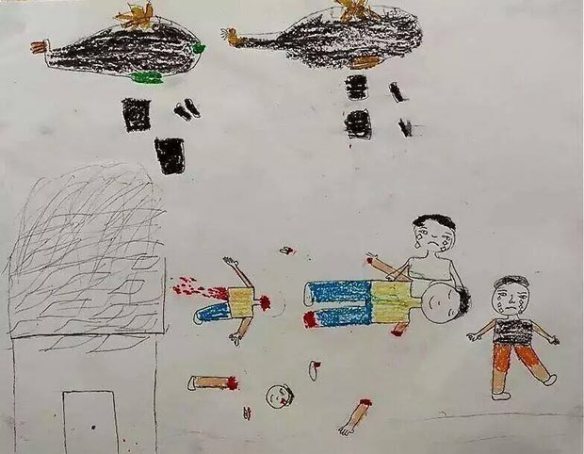
Another doctor who worked in Syria said he kept ‘a drawing from a second grader in Aleppo, showing helicopters bombing the city, blood and destruction below.’  Chillingly, ‘the dead children are smiling while the living ones are crying.’
the-dead-children-are-smiling

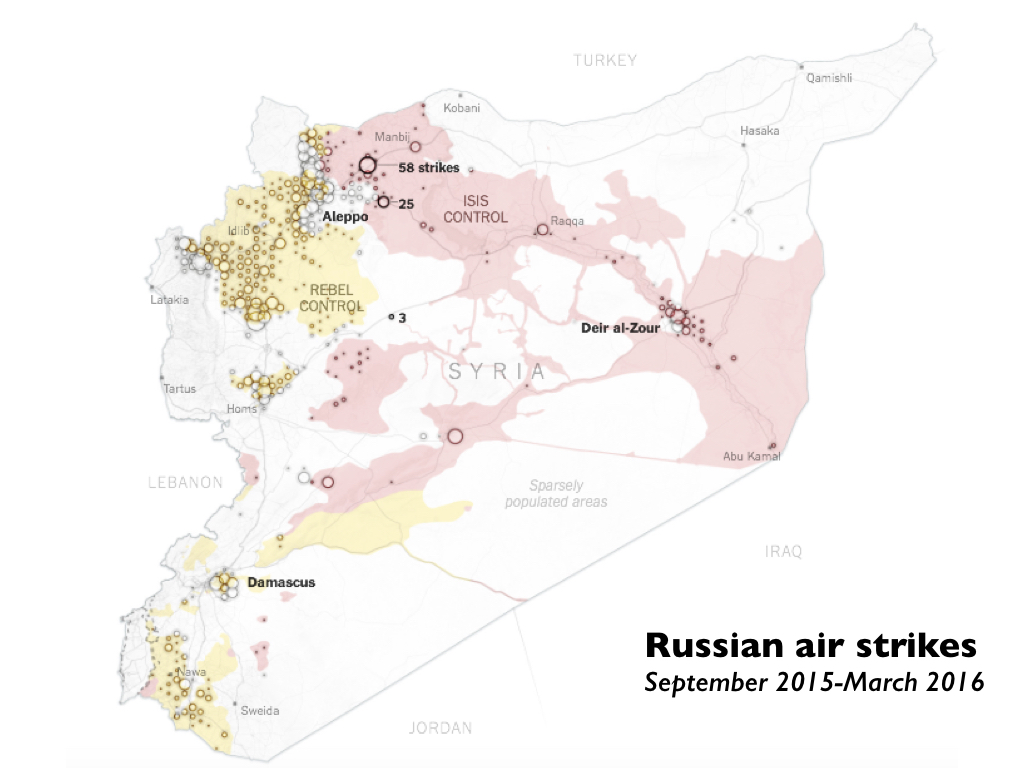
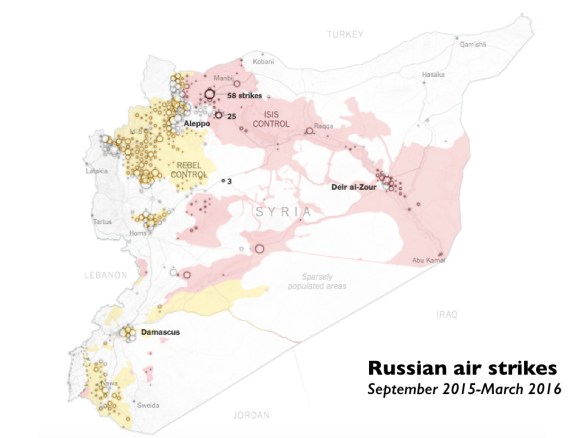
From September 2015) the Russian Air Force, often acting in concert with the Syrian Arab Air Force, has also concentrated on targets in areas controlled by other opposition groups:
russian-air-strikes-in-syria-to-march-2016-001

Russia has routinely denied these charges, but from 30 September to 12 October 2015 its Ministry of Defence published videos of 43 airstrikes. Bellingcat, aided by crowdsourcing, identified the exact location of 36 of them and overlaid them on the ministry’s own map identifying which groups controlled what parts of the country (see the full report, ‘Distract, Deceive, Destroy’, here):

‘The result revealed inaccuracy on a grand scale: Russian officials described 30 of these videos as airstrikes on Isis positions but in only one example was the area struck in fact under the control of Isis, even according to the Russian MoD’s own map.’

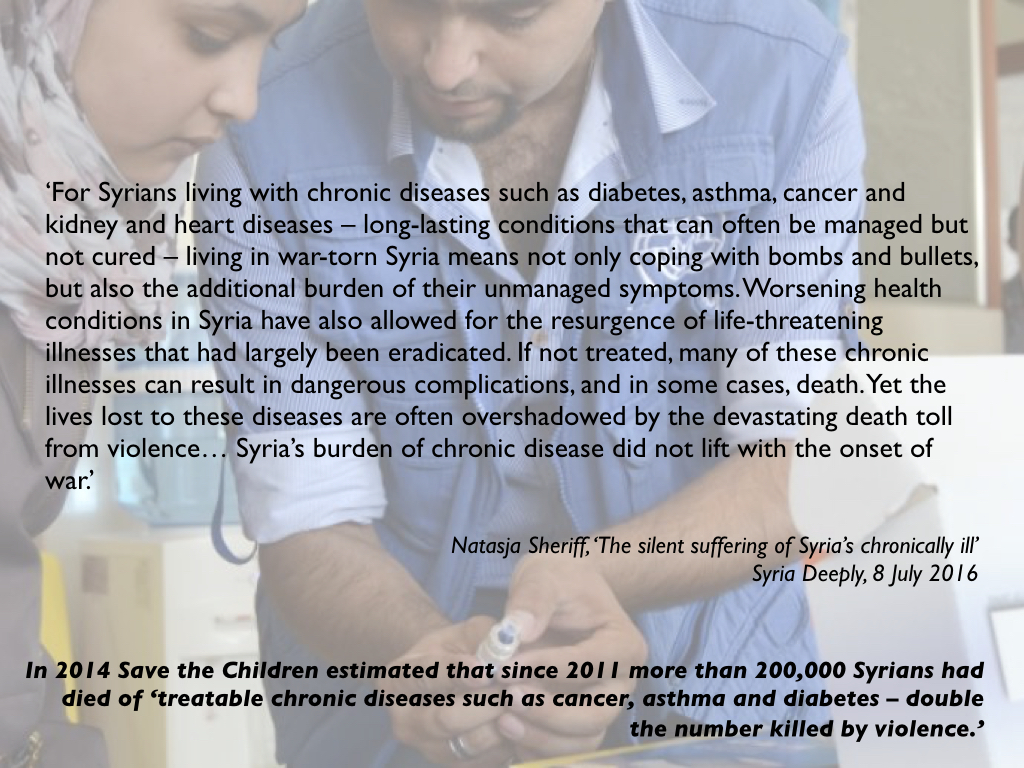
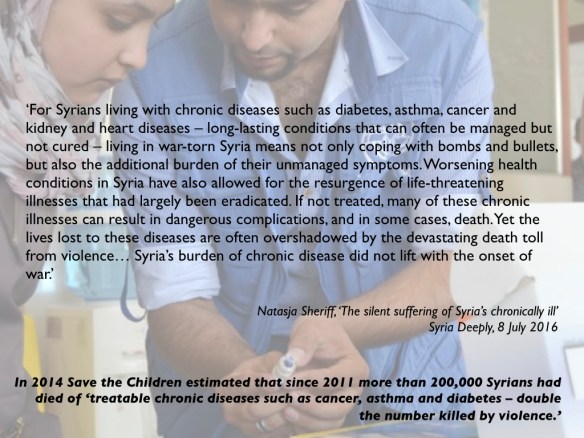
The effect of these air strikes has been devastating on the population at large.  To make matters even worse, air strikes cannot target individual doctors and have instead frequently been directed against hospitals and other medical facilities.   This compromises not only trauma care for the wounded but also the treatment of chronic and infectious diseases:
chronic-diseases-and-the-syrian-civil-war-001

(You can find a discussion of the problem of infectious diseases in Sima L. Sharara and Souha S. Kanj, ‘War and infectious diseases: challenges of the Syrian Civil War’, PLOS Pathogens 10 (11) (2014) here).

Hospitals and bomb sights

Doctors and other medical staff had to adjust to a new, sickening vulnerability.  Here is one OB/GYN who was still working in a hospital in East Aleppo when she was interviewed on Public Radio International in August 2016:

Carol Hills, PRI: Doctor Farida, did I just hear a noise there? Was that some sort of attack that I just heard?
Dr Farida Almouslem: It’s attack. [Laughs]. It’s normal. It’s away from me. Not next to me. These noises are all the time.
Hills: Do you and the doctors and patients you work with feel safe inside the place where you’re working?
Dr Farida: No. It’s not safe. I work at the third floor in my hospital. And many times the wall was perforated. So every woman came to the hospital, she knows that there is a danger on her life. So they just give the delivery, or give the birth, and then go home. She escapes to home because she knows our hospital is always targeted.

Other doctors in opposition-held areas said the same.  Here is Dr Mohamed Tennari, director of an above-the-ground field hospital in Idlib:

‘When I am in the hospital, I feel like I am sitting on a bomb. It is only a matter of time until it explodes. It is wrong − a hospital should not be the most dangerous place.  I wish I could say that targeting a hospital in Syria is unique, but is not.’

In fact, it’s far from unique: Physicians for Human Rights has issued a report detailing Attacks on Doctors, Patients and Hospitals hospitals and provided a interactive map of attacks on healthcare in Syria.

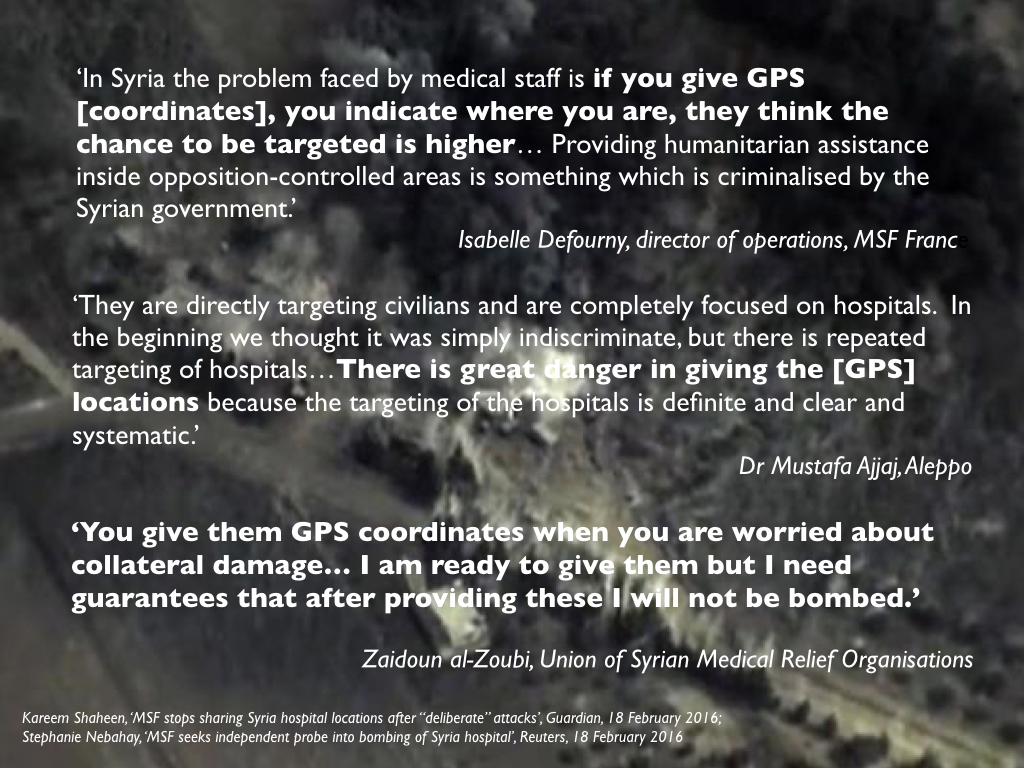
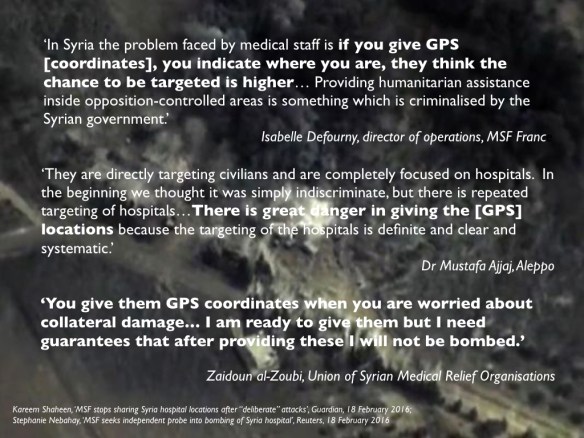
In the face of these escalating attacks, hospitals in opposition-held areas have tried to conceal their locations from the Syrian government.  In contrast to the protocol adopted by the MSF Trauma Centre in Kunduz, they have been markedly reluctant to provide their GPS coordinates (and see MSF’s explicit comparison between what happened in Kunduz and the situation in Syria here):
gps-coordinates-and-surgical-strikes-001

But this has trapped them in a grim Catch-22.  Michiel Hofman of Médecins sans Frontières – which is not permitted to operate in government-controlled areas in Syria – explains:

‘Hospitals that MSF supports in Syria are bereft of the possible protection of being clearly marked as a hospital or sharing of GPS coordinates, as the Syrian government passed an anti-terrorist law in 2012 that made illegal the provision of  humanitarian assistance – including medical care – to the opposition, forcing most health structures to go underground and operate without governmental medical registration. The bombing parties can then conveniently claim they were unaware it was a hospital they hit.’

More often, the Syrian government and its allies routinely describe the bombed building as a ‘so-called hospital’.  After an air strike on an MSF-supported hospital near Maarat al-Numan in Idlib on 15 February 2016 Bashar Jaafari, Syria’s ambassador to the United Nations, made this statement:

‘The so-called hospital was installed without any prior consultation with the Syrian government by the so-called French network called MSF which is a branch of the French intelligence operating in Syria… They assume the full consequences of the act because they did not consult with the Syrian government. They did not operate with the Syrian government permission.’

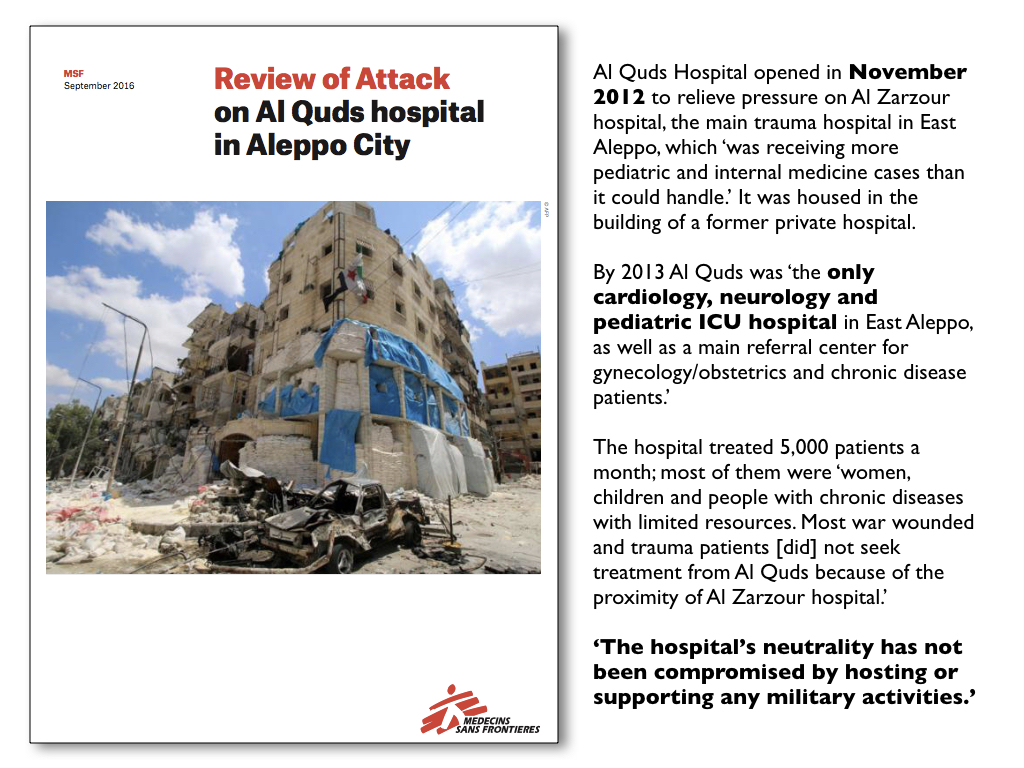
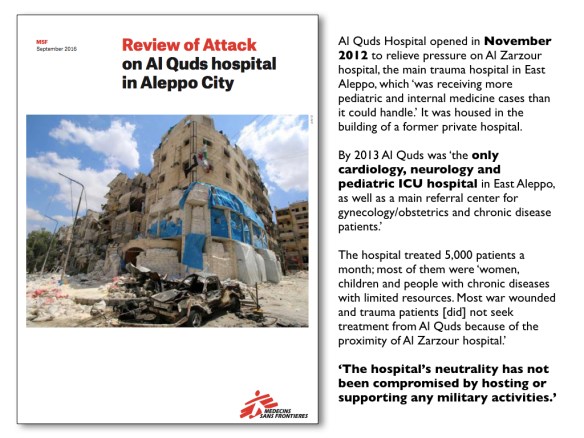
The allies of the Syria government are not confined to Russia and Iran.  On 27 April 2016 the Al Quds hospital in Aleppo was hit by two air strikes that killed 55 people  – among them two specialists, including Dr Muhammad Waseem Maaz, Al Quds’s pediatrician – and severely damaged the hospital. When it partially reopened 20 days later its capacity was reduced from 34 to 12 beds.  MSF conducted a detailed review of the operations of the hospital and the circumstances of the attack:
al-quds-hospital-attack-001

Here is Professor Tim Anderson on what he calls ‘The “Aleppo Hospital” Smokescreen‘ (and for reasons that will become obvious I am so tempted to put scare-quotes around the title that adorns his post; the Department of Political Economy at the University of Sydney lists him as a Senior Lecturer not a Professor, but perhaps anxiety over the appellation ‘Doctor’ is contagious):

‘…the story of Russian or Syrian air attacks on the ‘al Quds hospital’ gained prominence in the western media… CCTV showed people leaving this ‘hospital’ before an explosion.

‘The building is in the southern al-Sukkari district, which has been a stronghold of Jabhat al Nusra for some years. Many Aleppans had never heard of ‘al Quds hospital’. Dr Antaki [Aleppo Medical Association in Western Aleppo] says: “This hospital did not exist before the war. It must have been installed in a building after the war began”…. This facility was not a state-run or registered facility.’

Anderson is joined in his disinformation effort by Eva Bartlett writing in the ‘OffGuardian’:

Dr. Zahar Buttal, Chairman of the Aleppo Medical Association … said: “The media says the only pediatrician in Aleppo was killed in a hospital called Quds. In reality, it was a field hospital, not registered.”

As for the pediatrician, “We checked the name of the doctor and didn’t find him registered in Aleppo Medical Association records.”…

… central to the lies were the bias and propaganda of the very partial, corporate-financed Médecins Sans Frontières (MSF), which supports areas in Syria controlled by terrorists, specifically Jabhat al-Nusra…’

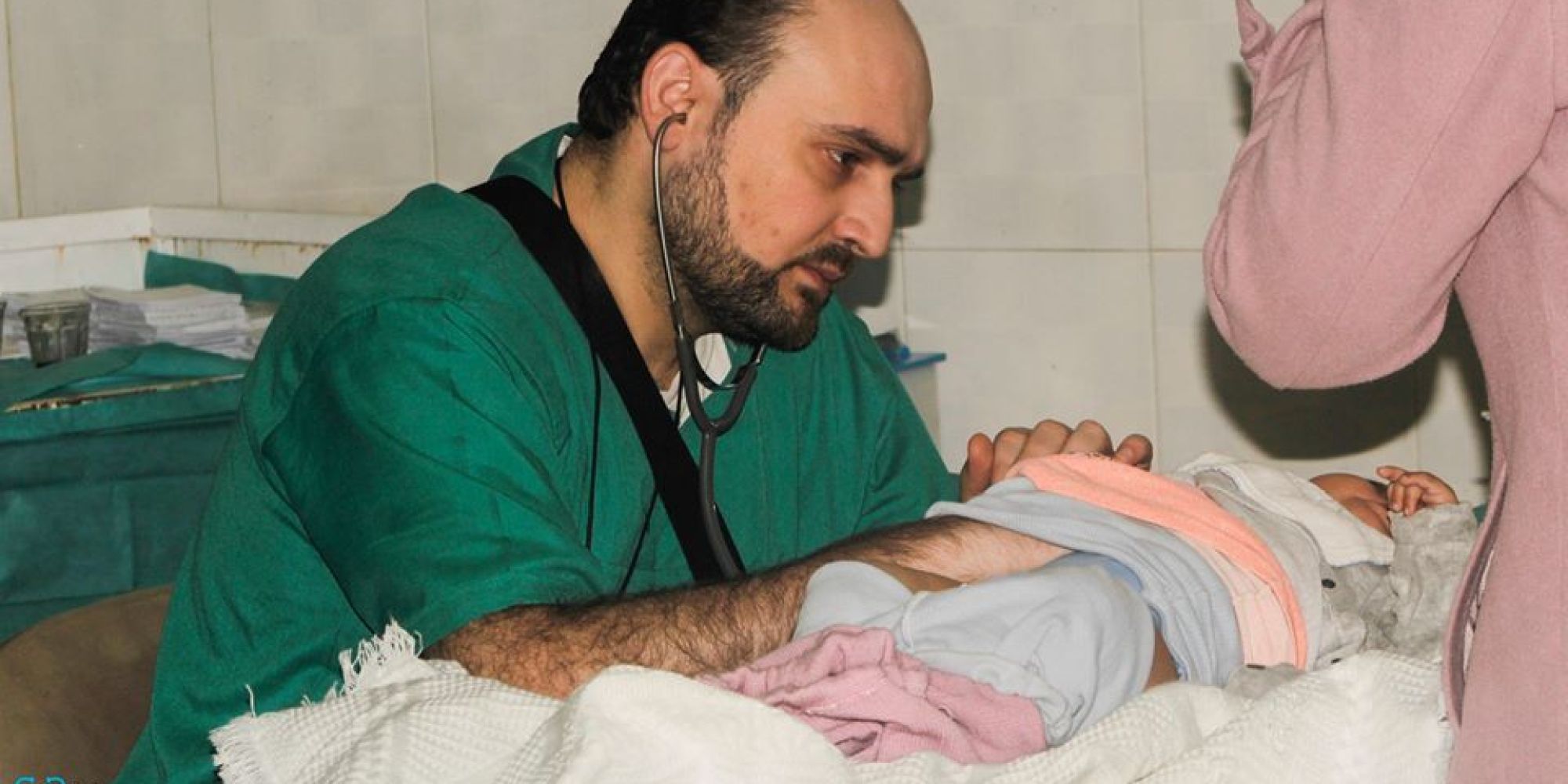
To repeat: the Syrian government has refused to register or recognise any hospitals operating in areas outside its control – hence the snide reference to ‘so-called hospitals’ and Anderson’s meretricious scare-quotes – and it does not permit MSF to operate in areas under its control (despite repeated requests).  As for the disappearance of Dr Muhammad Waseem Maaz from the Syrian government’s registry (though I have no doubt he was on other lists maintained by the regime) the director of the Children’s Hospital in Aleppo provides a graceful tribute to him here.  And here is the doctor whose death these commentators dismiss so lightly (if you have the stomach for it, you can see his last moments caught on CCTV here):

dr-muhammad-waseem-maaz

What, apart from the grotesque stipulations of the Syrian state, makes them think it proper to withdraw medical care from those living – surviving – in rebel-held areas?  International humanitarian law is unequivocal: they are entitled to medical treatment and to be protected whilst it is provided to them.

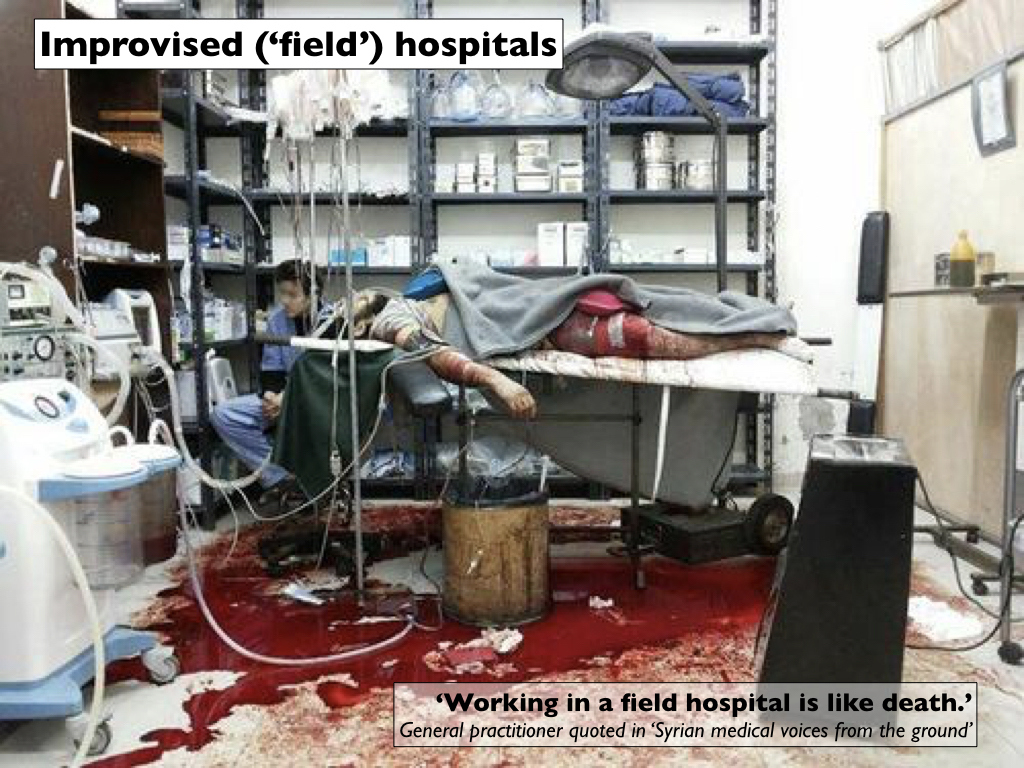
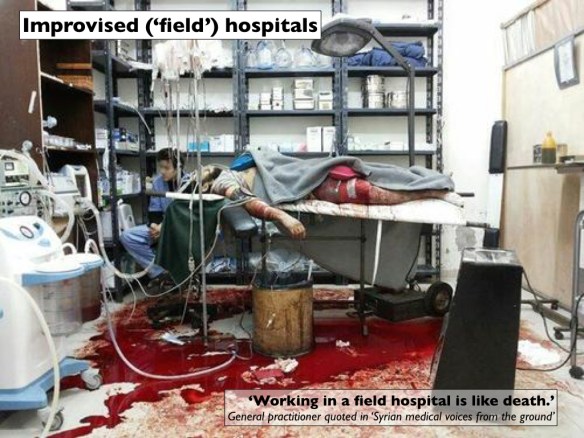
In rebel-held areas medical care has increasingly moved outside what were once established hospitals into the clandestine ‘field hospitals’ referred to above, which have been given numbered code-names to conceal their locations.  Some, like those established by MSF, follow strict medical protocols and, according to a study of one operating in Jabal al-Akrad by Miguel Trelles and his colleagues, they have (for a time) been able to provide high-quality medical care with remarkable survival rates (‘Providing surgery in a war-torn context: the Médecins Sans Frontières experience in Syria’, Conflict and Health (December 2015)).  As the attacks on them have increased and qualified personnel and medical supplies have become scarce, however, many have become exercises in improvisation:
field-hospitals-001

Some of these hospitals have literally gone underground.  ‘‘In our worst dreams – in our worst nightmares – we never thought we would have to fortify hospitals,’ declared Dr Zaidoun al-Zoabi of the Union of Medical Care and Relief Organizations. ‘It’s not humane. It’s impossible to comprehend.’

Subterranean locations have been used not only to protect the hospitals but also to protect local populations.  Charles Davis reported that

‘whether it’s a vehicle or a building, anything that’s identifiable as providing medical care is ripe for an airstrike, so that staff have now taken to covering up any distinguishing characteristics. Even so, [Dr Abdulaziz Adel, a surgeon in East Aleppo, admits that] local residents are “always begging us to go away, take your hospital away from us or otherwise we’ll be a target.”‘

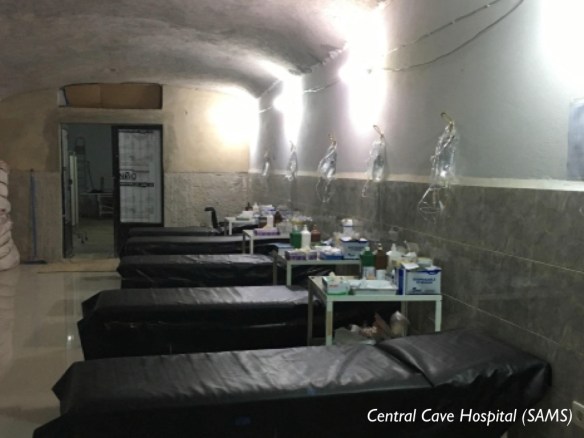
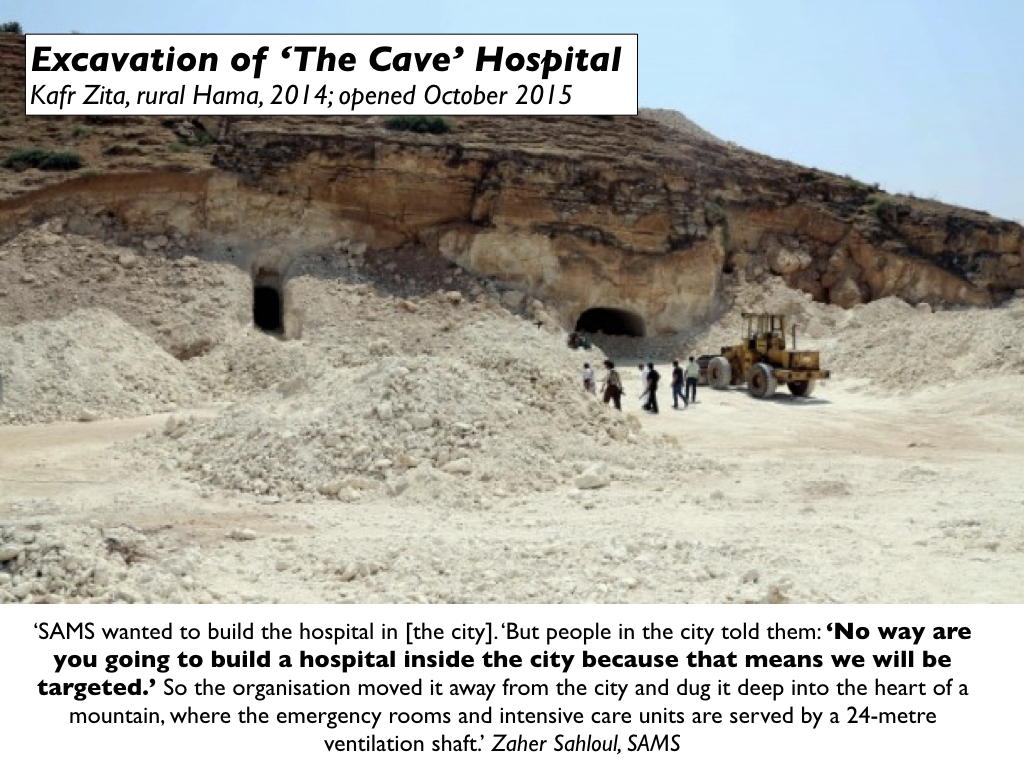
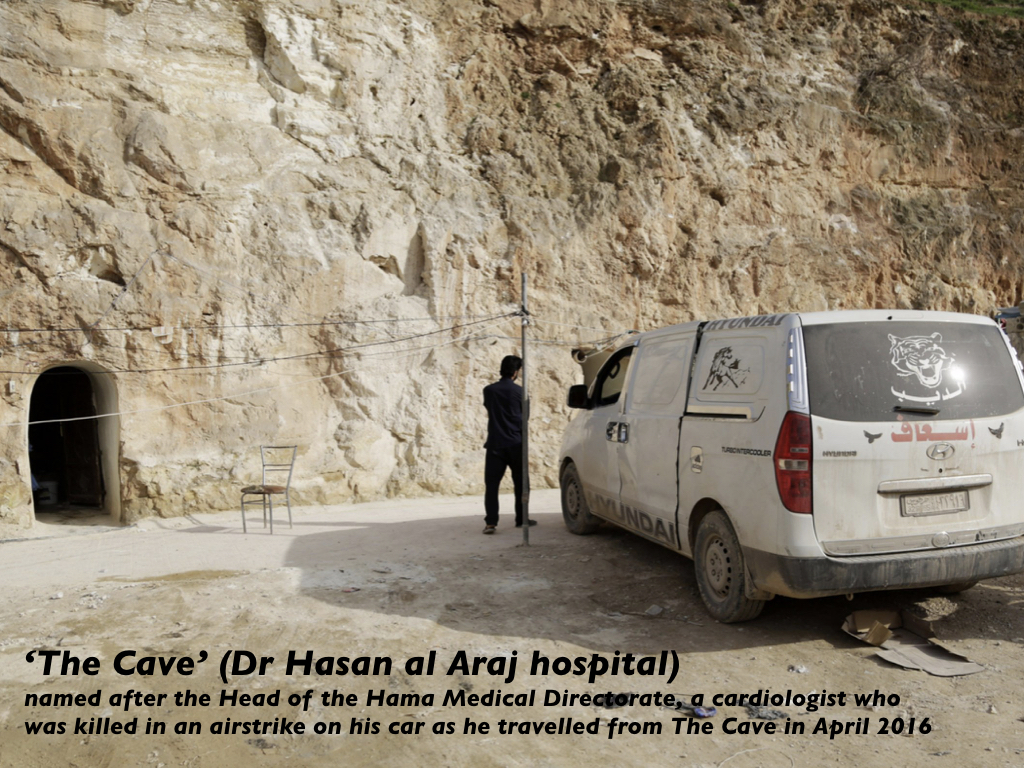
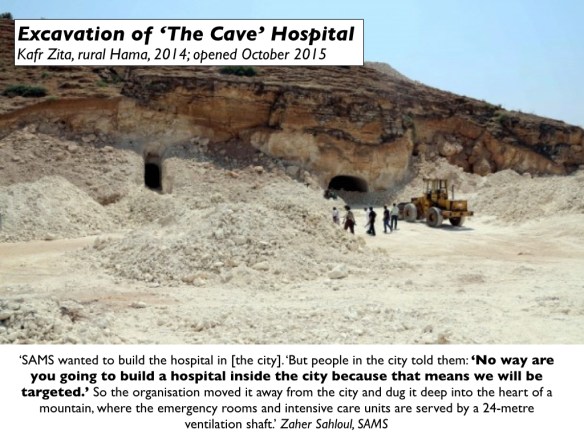
When the Syrian-American Medical Society proposed to build a hospital in Hama in 2014, local people begged them to locate it outside the city and so SAMS excavated what became the Dr Hasan al Araj Hospital, better known as ‘The Cave’:
the-cave-hospital-001

the-cave-hospital-002

the-cave-hospital-003

Supply chains and kill-chains

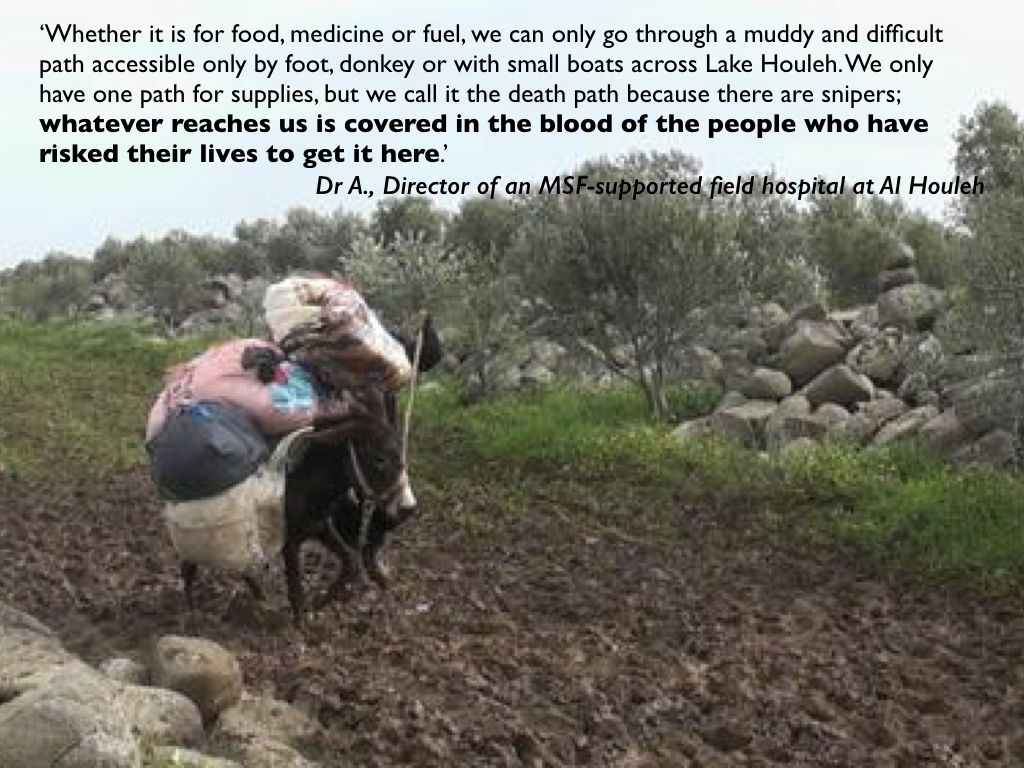
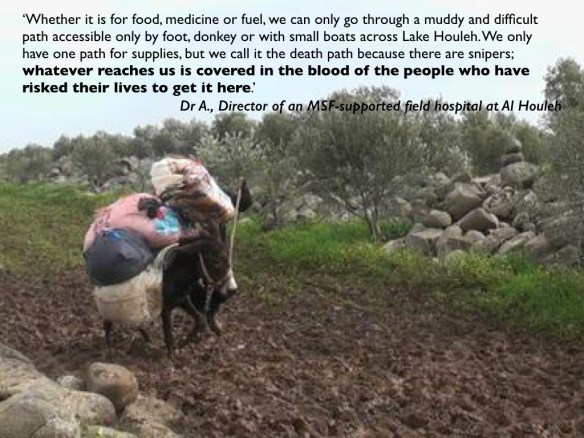
As the civil war ground on, even the most basic medical supplies became scarce and obtaining them ever more dangerous.  In March 2015 MSF reported that:

‘Even if it is available, many suppliers do not want to risk selling material like gauze or surgical threads when they know it is going to be sent into North Homs. Gauze is considered synonymous with war surgery, and often a supplier is not willing to take the risk of being arrested or shut down for supplying a besieged area.’
bloody-supply-chains-001

You can read more here and here.  One doctor told MSF:

‘It is precious, dangerous, incriminating. There are secret outlets supplying us with gauze.’

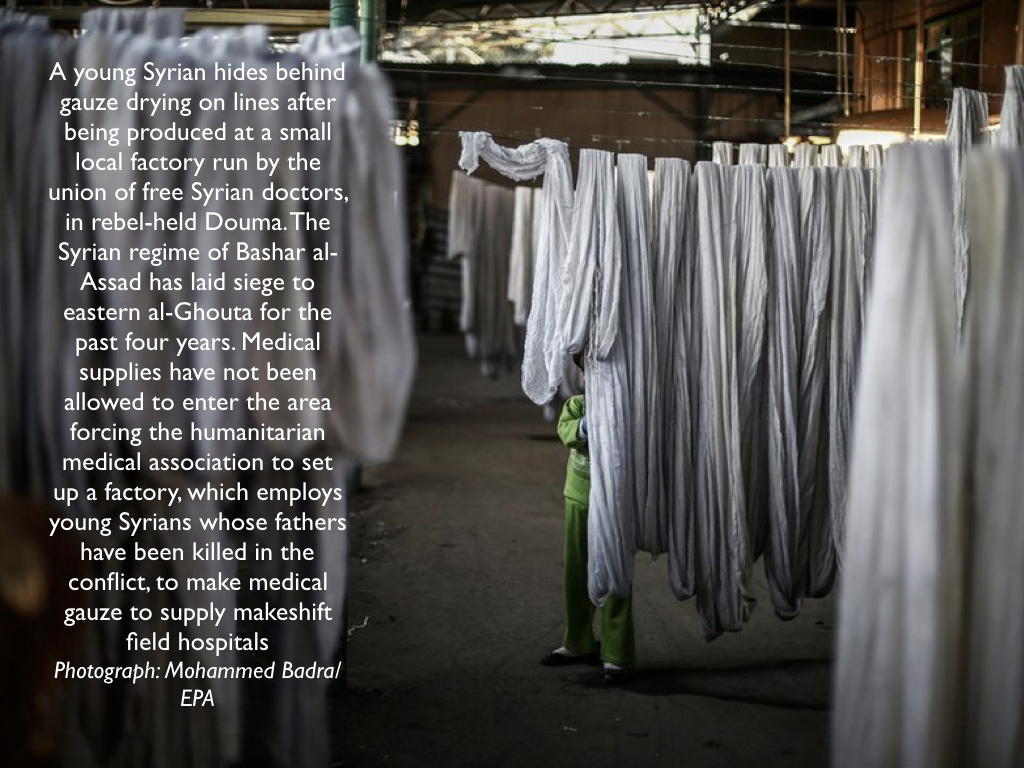
At the end of last year the Guardian provided this image of one of the secret factories:

gauze-factory-001

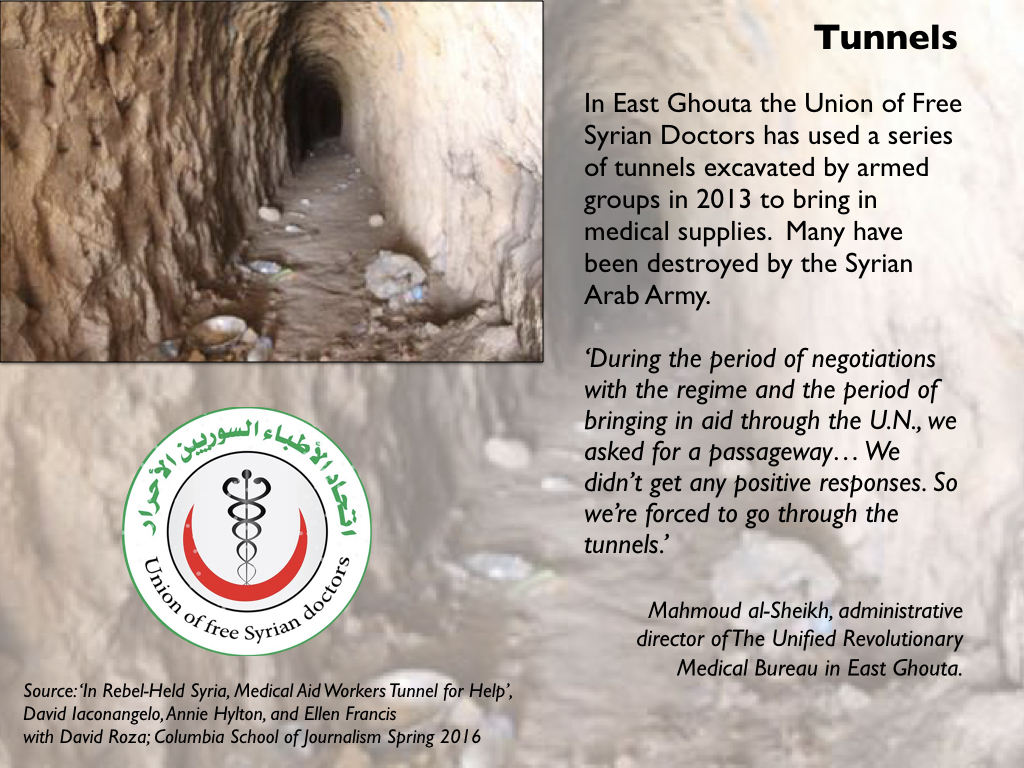
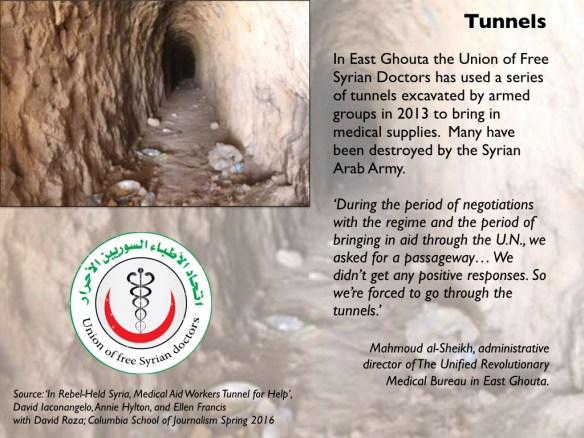
In East Ghouta, hospitals have been forced to use tunnels to bring in medical supplies (more from Ellen Francis and her colleagues here):
tunnels-and-the-siege-economy-in-aleppo-001

The risks are formidable and the costs have been almost prohibitive.  Ellen Francis and her colleagues at Columbia’s Graduate School of Journalism report that in January 2014 the Free Syrian Army and the Syrian Arab Army agreed an uneasy and ragged cease-fire in Barzeh, a small town on the northern edge of Damascus. There a team from the Union of Free Syrian Doctors was able to buy medical supplies from merchants who travelled out from the capital.

The merchants paid a 20 per cent ‘customs fee’ to Syrian Army soldiers; the agents for the doctors then paid a ‘tax’ to get the supplies through the Harasta checkpoint on the Army-controlled highway, and then a ‘toll’ to the rebels (‘tunnel lords’) who controlled the tunnels into Ghouta.

The combined fees inflated the price of medical supplies.  A litre of serum used to help the body replenish lost blood cost $1 in government-controlled areas and $3.50 to $10 via the tunnel route. Ghouta was using about 10,000 litres of serum per month.  The supply chain was subsequently severed once Barzeh itself came under siege and was cut off from Damascus.

Some humanitarian aid has crossed the lines by more conventional routes – conventional for a war zone at any rate – but medical supplies have routinely been removed from aid convoys.  On 19 May 2016 the UN Secretary-General reported to the Security Council:

‘[By May] 2016, WHO [had] submitted 21 individual requests to the Government of the Syrian Arab Republic to deliver medical supplies to 82 locations in 10 governorates. The Government approved five requests [while] 16 requests remained unanswered.

‘The removal of life-saving medicines and medical supplies continued, with nearly 47,459 treatments removed from convoys in April intended for locations in Homs, Aleppo and Rif Dimashq governorates. Removed items included surgical supplies, emergency kits, trauma kits, mental health medicines, burn kits and multivitamins. Removals extended to basic items, such as antibacterial soap, which was removed from midwifery kits. Items were also removed from other kits, notably surgical tools…’

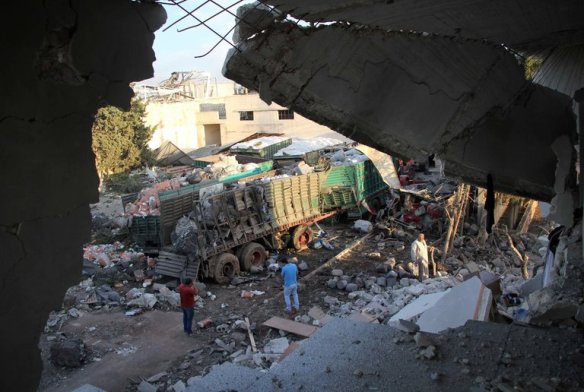
Even then, aid convoys are not safe.  Four months later to the day a UNICEF aid convoy delivering supplies to a Syrian Red Crescent warehouse at Urum al-Kubra in Aleppo was attacked from the air, killing at least 18 people and destroying 18 of the 31 trucks.  Most analysts have concluded that the Russian Air Force was responsible, perhaps acting in concert with the Syrian Arab Air Force – see for example here and here– but the Russian Ministry of Defence and the usual suspects have variously blamed spontaneous combustion, a ground attack by rebels and a US drone attack.
un-convoy-attacked-in-aleppo

These shortages are threaded into dispersed and precarious siege economies that gravely affect the health of local populations.  In December 2015 an estimated 400,000 people were surviving without access to life-saving aid in 15 besieged locations across Syria; the figures gathered by Siege Watch are even higher.

Surrounded by 6,000 land-mines and 65 sniper-controlled checkpoints, Madaya’s 40,000 inhabitants have been under siege since July 2015; 32 people died of starvation and malnutrition in December 2015 alone.  One resident interviewed by Amnesty International in January 2016 described the catastrophic situation:

‘Every day I wake up and start searching for food. I lost a lot of weight, I look like a skeleton covered only in skin. Every day, I feel that I will faint and not wake up again… I have a wife and three children. We eat once every two days to make sure that whatever we buy doesn’t run out. On other days, we have water and salt and sometimes the leaves from trees. Sometimes organizations distribute food they have bought from suppliers, but they cannot cover the needs of all the people.

‘In Madaya, you see walking skeletons. The children are always crying. We have many people with chronic diseases. Some told me that they go every day to the checkpoints, asking to leave, but the government won’t allow them out. We have only one field hospital, just one room, but they don’t have any medical equipment or supplies.’

An aid convoy was allowed in four days after this interview.

There are also grave shortages of skilled medical personnel.  The doctors who remain in opposition-held areas have all had to learn new skills sometimes far beyond their original training.  In March 2015 one young surgeon working in an MSF-supported hospital east of Damascus recalled:

‘There was a pregnant woman who was trapped during the time we were under full siege. She was due to deliver soon. All negotiation attempts to get her out failed. She needed a cesarean operation, but there was no maternity hospital we could get her to, and I had never done this operation before.

A few days before the expected delivery date, I was trying to get a working internet connection to read up information on doing a C-section. The clock was ticking and my fear and stress started to peak. I wished I could stop time, but the woman’s labour started…’

In 2015 OCHA estimated that more than 40 per cent of pregnant women in these areas now scheduled C-sections to reduce the risk of an attack preventing them from obtaining care.

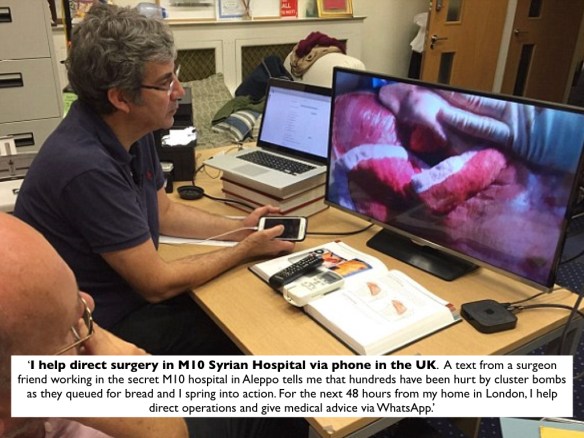
In some cases doctors can call on skilled overseas help via Skype from consultants on call 24/7 in the United States, Canada and the United Kingdom.  Ben Taub has written movingly of the extraordinary efforts of what he calls ‘the shadow doctors’ enlisted in ‘the underground race to spread medical knowledge as the Syrian regime erases it.’  One of the most active is Britain’s Dr David Nott:

dr-david-nott-and-remote-surgery-001

dr-david-nott-and-remote-surgery-002

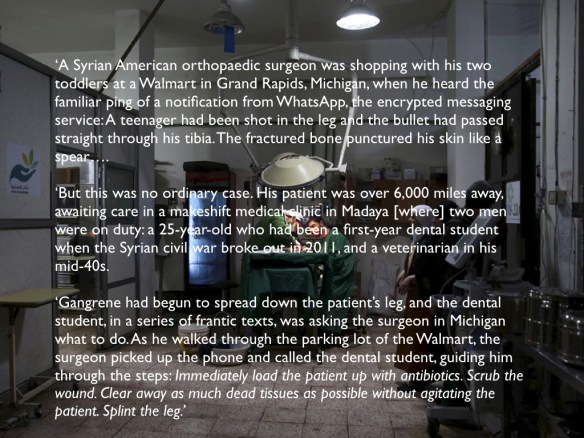
But not all those seeking specialist help are qualified surgeons.  In the field hospital serving the besieged town of Madaya medical care has been provided by a dentist, a dental student and a veterinarian.  Avi Asher-Schapiro reports:

‘The five-year civil war has plunged the Madaya clinicians into the deep end, forcing them to perform medical procedures that push them far beyond their training. They have treated countless gunshot victims, performed seven amputations, over a dozen C-sections, and diagnosed everything from meningitis to cancer.’

As he explains, this remarkable trio has also relied on remote medicine:
madaya-remote-medicine-001

These are all extraordinary responses to near-impossible, life-threatening situations.  But their successes have been short-lived.

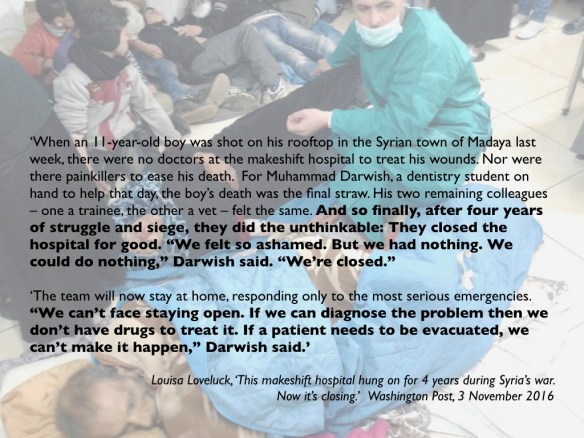
The Madaya clinic was forced to close in November 2016:
closure-of-madaya-clinic-001

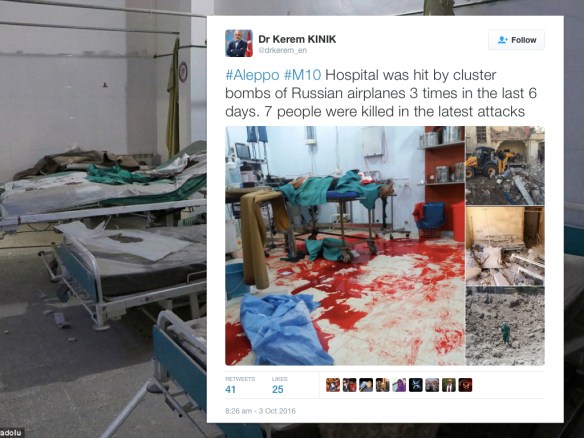
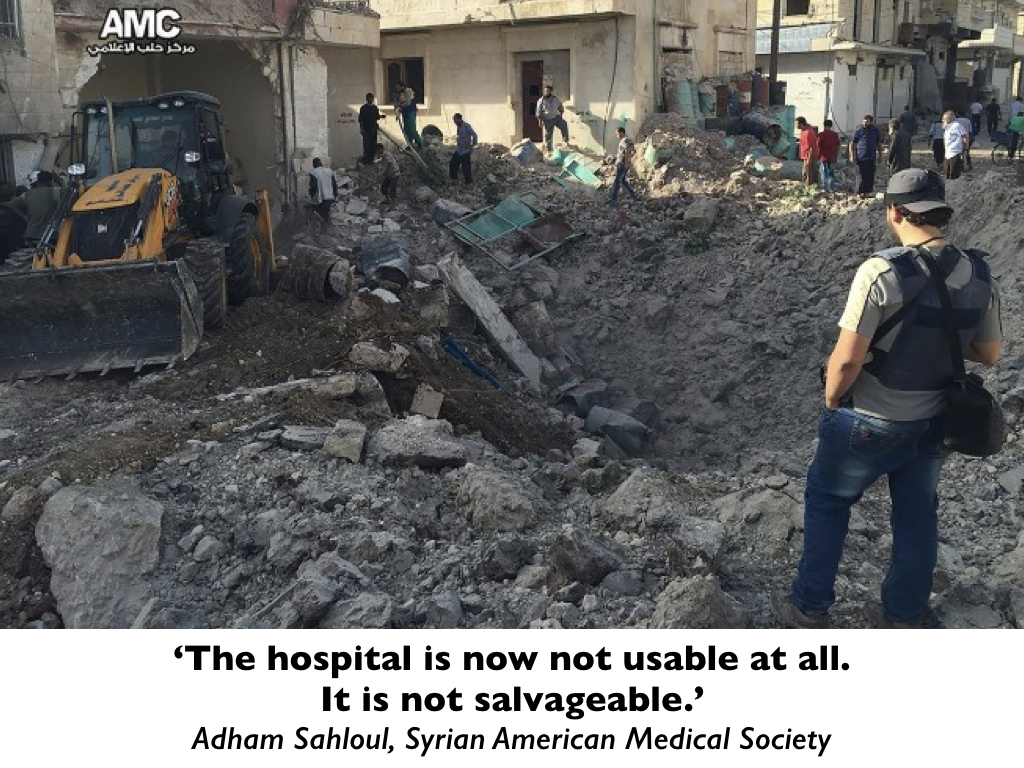
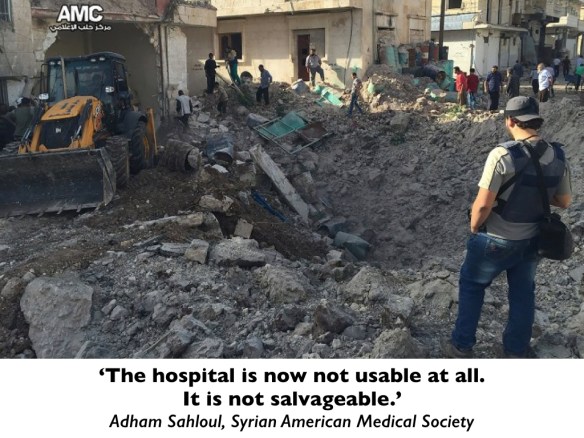
And the M10 hospital where Nott helped direct surgery – the largest trauma and ICU centre in East Aleppo – was hit by successive, catastrophic air strikes.  First, an attack on 28 September 2016 left only half the hospital operational.  On 1 October Xisco Villalonga, MSF’s Director of Operations, reported that

‘Bombs are raining from Syria-led coalition planes and the whole of east Aleppo has become a giant kill box.’

That night multiple strikes on M10 killed two people and injured ten others; the hospital had to be evacuated because one crater was so deep there were fears that the rest of the building would collapse.
m10-hospital-bombed-001

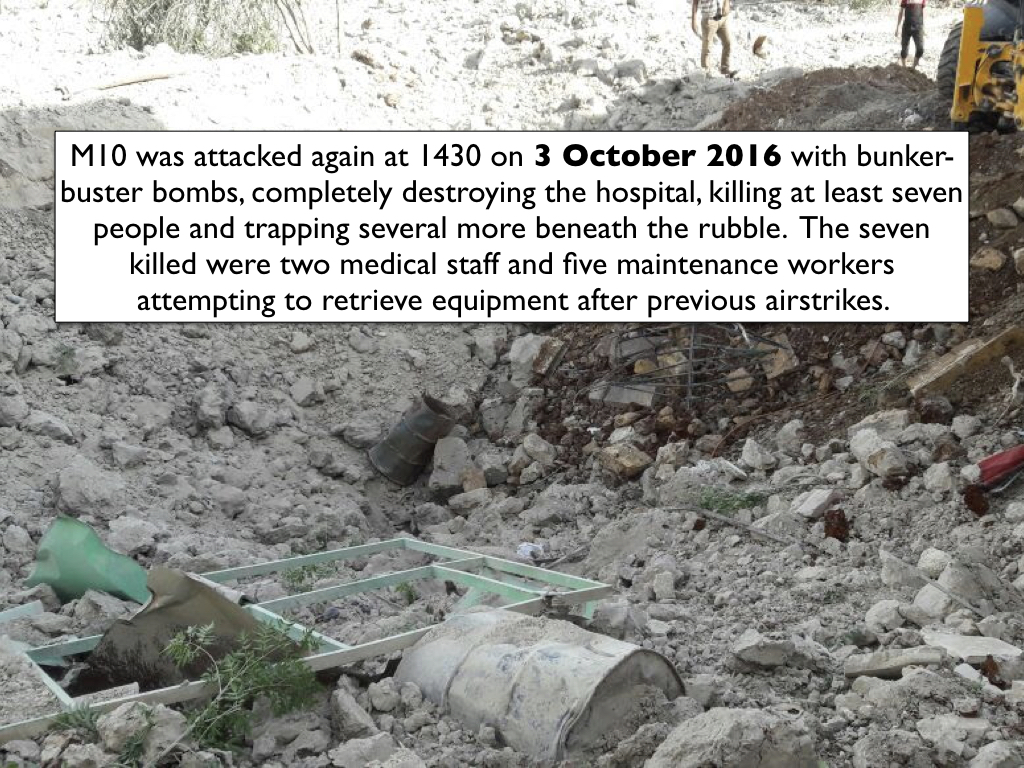
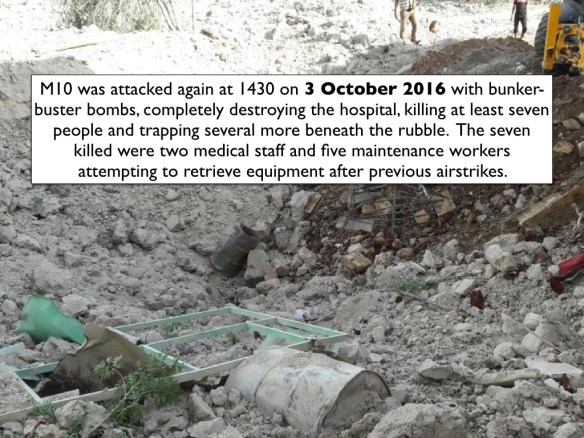
But the ordeal was not over: there were further, devastating strikes on 3 October:
m10-hospital-bombed-002

m10-hospital-bombed-003

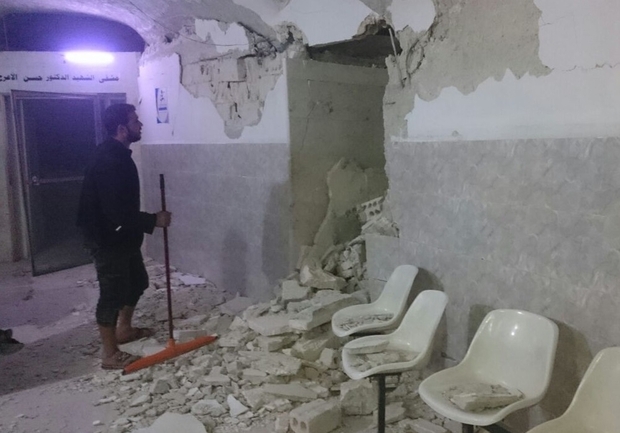
The underground hospitals have fared no better.  ‘The Cave’ – 15 metres inside a mountain, remember – was hit by two ‘bunker-buster’ bombs at 1500 on 2 October 2016. After 35 staff and patients had been evacuated a second strike occurred in the early evening involving missiles and cluster bombs. The E.R. was wrecked, ceilings collapsed, cement walls crumbled and generators, water tanks and medical equipment were destroyed (see image below).  Nobody was seriously injured but the hospital sustained critical damage and has been closed indefinitely. It used to treat 300 patients and perform 150 surgeries a month.

Cave Hospital hit by bunker-buster bombs

The exception to the exception

Once safe places under the protection of international humanitarian law – the exception to the space of exception that is the conflict zone – hospitals have become the targets of a new and extraordinarily vicious modality of modern war.  The systematic attacks on hospitals have not only threatened the lives of patients and healthcare workers; they have also made many patients reluctant to seek medical treatment at all.  In February 2015 a report from the Centre for Public Health and Human Rights at Johns Hopkins University was already warning of the consequences:

‘Unless they feel their life is in danger, many people won’t go to hospital because it is targeted for bombardment’ [Physician, Aleppo]. Two physicians reported that fear of travel and an understanding that the hospital is a target has led to a 50% decrease in clinic visits and surgery cases, even though the level of violence has not decreased.

Dr Farida, the OB/GYN in East Aleppo interviewed earlier, no longer has a hospital to work in – the last remaining hospital was reduced to rubble and closed on 18 November – and she now provides what medical care she can from a basement:

‘People know it’s a basement, but they are afraid to come here because they know any health facility is deliberately targeted by the regime. For women, they are afraid to come — but they don’t have any other option. When they don’t have a car or fuel to come here, they have to give birth at home. Women are bleeding at home and babies are born dehydrated without oxygen.’

Those that do make the precarious journey to a field hospital or other medical facility almost always now find that their care is compromised by the shortage or even the absence of doctors, nurses, medical supplies and even the most basic medical equipment.  So doctors use ordinary sewing cotton instead of surgical thread; local anaesthetic where they would normally use a general, or even home-made, improvised variants.  Dr Zaher Sahloul, who still tries to provide help to colleagues in Syria from his home in Chicago via WhatsApp, explains:

‘We operate on the mindset that they have basic things we take for granted… The reality is, they don’t have 90 percent of the things we think they have. They know better what they have and what they can do with it. These people are facing decisions we will never face in our lives. If you have 10 patients dying, who will you see first? Do you use spoiled gauze and dirty tubes at the risk of infection? It’s Hell for them.’

As I write, the Syrian Arab Army and its supporting militias are advancing into East Aleppo, where air strikes and artillery bombardments have left more than 250,000 people without access to any form of advanced medical care.  The World Health Organisation announced that ‘although some health services are still available through small clinics, residents no longer have access to trauma care, major surgeries, and other consultations for serious health conditions.’

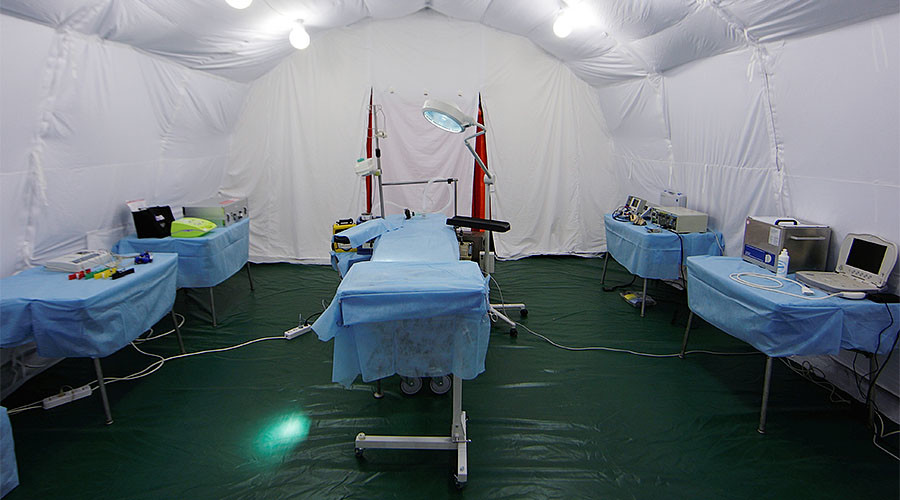
The final irony – although in this catalogue of horrors it probably isn’t the last at all – is that the Kremlin has announced that it will send two mobile hospitals to treat patients from East Aleppo.  The Defence Ministry will operate ‘a special 100-bed clinic with trauma equipment for treating children’ and the Emergencies Ministry will provide a 50-bed clinic capable of treating 200 outpatients a day.
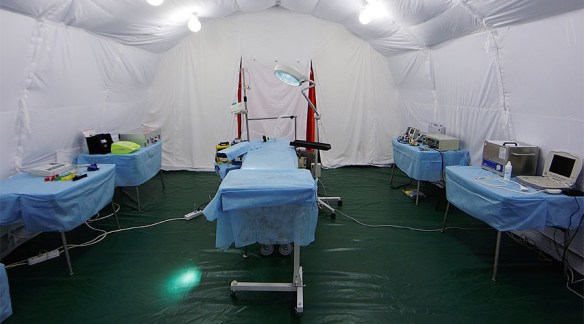
russian-mobile-hospital

While the Kremlin congratulates itself on its ‘humanity’, we need to remember that this minimalist contribution would not have been necessary at all had medical neutrality been respected and doctors and nurses, hospitals and clinics not been so ruthlessly, systematically and deliberately targeted in the first place.

UPDATE:  On 5 December the Defence Ministry’s mobile hospital (set up in West Aleppo to treat patients from East Aleppo) came under mortar fire from the crumbling opposition-held area to the east; one Russian doctor and two paramedics were killed.  It’s not clear whether the hospital was deliberately targeted – there have been accusations that the co-ordinates of the hospital must have been given to the militants for it to have been hit ‘right at the moment when it started working‘ – or whether it was caught in the indiscriminate shelling and mortar-fire that has hit other hospitals in West Aleppo.
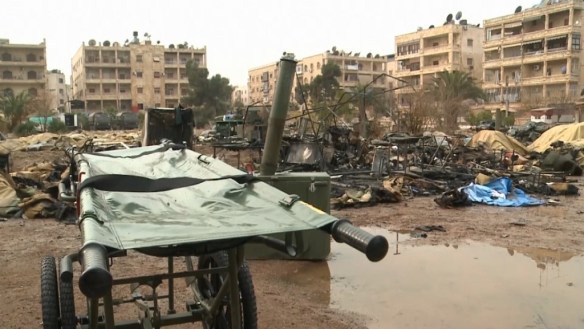
russian-mobile-hospital-attacked-in-aleppo

But I should make two things clear.  First, attacks on hospitals in West Aleppo – even though I don’t think they have exhibited anything like the scale or the systematicity of those directed against medical facilities and healthcare workers in opposition-held areas – are as reprehensible as those on hospitals in the East.  Second, the muted response from the US-led coalition to the shelling of the Russian field hospital is deeply disturbing.  The International Committee of the Red Cross announced after the attack that ‘all sides to the conflict in Syria are failing in their duties to respect and protect healthcare workers, patients, and hospitals, and to distinguish between them and military objectives.’  The Russian Ministry of Defence dismissed this as a ‘cynical’ display of indifference to the deaths of its doctors, but I don’t read it like that at all – what is cynical is the partisan appeal to medical neutrality when it suits, and its systematic violation when it doesn’t.

To be continued
Fighting over Kunduz

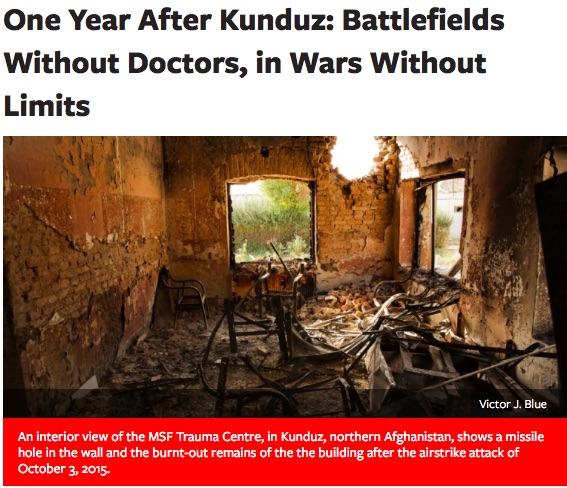
This is the third in a new series of posts on military violence against hospitals and medical personnel in conflict zones. It examines some of the key issues arising from the US attack on the Trauma Centre run by Médecins Sans Frontières (MSF) in Kunduz on 3 October 2015; it follows directly from my detailed analysis of the attack here and prepares the ground for a still more detailed analysis of attacks on hospitals, doctors and casualties in Syria to follow.

There are at least four main issues arising from the US attack on the MSF Trauma Centre in Kunduz that spiral out into a wider argument about what I will later call ‘The Death of the Clinic’.  I’m treating ‘the clinic’ here as a topological figure that extends from the body of the wounded through the evacuation chain to the hospital itself.  The clinic has been accorded a privileged status within the space of exception that is the modern conflict zone – a complicated, fractured space in which killing is made permissible subject to the protocols of international humanitarian law –  so that the clinic becomes an exception to the exception and its inhabitants granted a conditional immunity from attack.

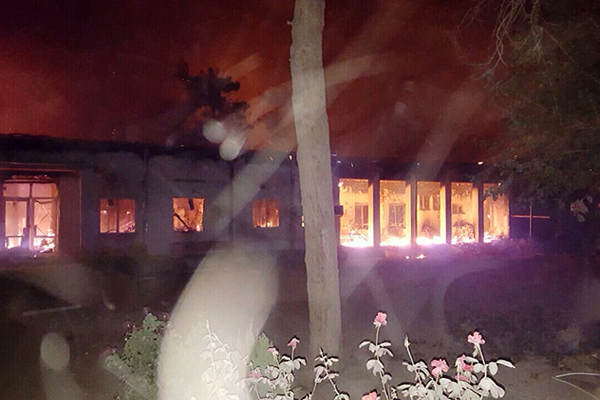
msf-trauma-centre-burning

It’s important to understand that this legal armature is not immutable, and that changes (and challenges) to it arise through both (geo)political and military actions; international humanitarian law is not a deus ex machina, somehow above the fray, but is thoroughly entangled with the prosecution of military violence.  More on this to come, but for now it will be enough to list some of the major protections accorded to the clinic in war-time.

The first Geneva Convention (1864) (‘the Red Cross Convention’):

Ambulances and military hospitals shall be acknowledged to be neuter, and, as such, shall be protected and respected by belligerents so long as any sick or wounded may be therein.  Such neutrality shall cease if the ambulances or hospitals should be held by a military force … A distinctive and uniform flag shall be adopted for hospitals, ambulances and evacuations.

Under the Hague Regulations (1899/1907) that were in force during the hospital raids in France at the end of the First World War:

… all necessary steps must be taken to spare, as far as possible, … hospitals, and places where the sick and wounded are collected, provided they are not being used at the time for military purposes. It is the duty of the besieged to indicate the presence of such buildings or places by distinctive and visible signs, which shall be notified to the enemy beforehand.

Geneva Conventions 1949 care of woundedUnder the Geneva Conventions (1949) – whose provisions applied to the attack on the MSF Trauma Centre a hundred years later – there is a similar immunity granted to the military-medical machine:

The protection to which fixed establishments and mobile medical units of the Medical Service are entitled shall not cease unless they are used to commit, outside their humanitarian duties, acts harmful to the enemy. Protection may, however, cease only after a due warning has been given, naming, in all appropriate cases, a reasonable time limit and after such warning has remained unheeded.

And this is explicitly extended beyond the military-medical machine to institutions like the MSF Trauma Centre:

Civilian hospitals organized to give care to the wounded and sick, the infirm and maternity cases, may in no circumstances be the object of attack but shall at all times be respected and protected by the Parties to the conflict.

The protection to which civilian hospitals are entitled shall not cease unless they are used to commit, outside their humanitarian duties, acts harmful to the enemy. Protection may, however, cease only after due warning has been given, naming, in all appropriate cases, a reasonable time limit and after such warning has remained unheeded.

In so doing the treatment of hostile combatants is also explicitly provided for and protected:

The fact that sick or wounded members of the armed forces are nursed in these hospitals, or the presence of small arms and ammunition taken from such combatants and not yet been handed to the proper service, shall not be considered to be acts harmful to the enemy.

The language and specifications change, but there is nevertheless a consistent thread running through these provisions.  It has been stretched – and perhaps broken – by the attack on the MSF Trauma Centre, and here I’ll focus on four issues that have proved contentious.  First, the visual identification of the Trauma Centre; second, the alleged breach of its conditional immunity; third, the construal of the attack as a war crime; and fourth, the putative rejection of medical neutrality altogether.

(1) Visual identification

International humanitarian law (IHL) requires those responsible for hospitals ‘to indicate their presence’ – the language varies – in order to ensure their protection, and here the US military investigation made this finding (all page numbers in brackets refer to the redacted report):

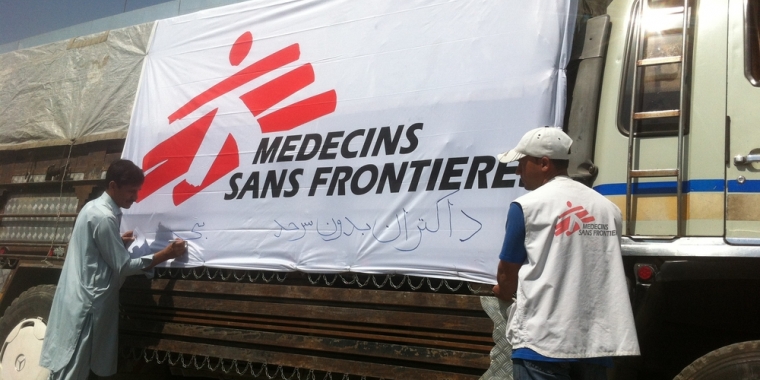
The center roof of the MSF Trauma Center was marked with two rectangular MSF flags… The front and sides of the MSF hospital were marked from the street view and a MSF flag flew in the courtyard.  The MSF Trauma Center was not marked with any internationally recognized symbols such as a red cross, red crescent or a red “H”.  If it had been marked with these symbols, it is possible the Trauma Center would not have been engaged. (082)

This counterfactual does not loom large in the report or its recommendations, but Charles Dunlap (at Lawfire) has seized upon it to berate MSF:

Ask yourself: wasn’t it a mistake for [MSF] – and a serious one – not to have marked its facility in accordance with Protocol III to the Geneva Conventions which designates “the only emblems recognized by nations signifying the protected status of individuals or objects bearing them during armed conflict”?  Had, for example, the hospital been marked with large Red Crosses/Red Crescents or one of the other internationally-recognized symbols (as the U.S. does) or something that would make its protected use clear from the air, isn’t it entirely plausible that the aircrew (or someone) might have recognized the error and stopped the attack before it began?

Put another way, isn’t it foreseeable that in an exceptionally chaotic combat situation (where a belligerent is making use of civilian buildings to conduct combat operations) that mistakes could occur in identifying a protected structure absent Protocol III markings or at least something to make it identifiable at a distance, especially when it’s known that attacking aircraft are being used?  Wouldn’t reasonably prudent persons have marked their medical facility with an internationally-recognized symbol or something of similar clarity to the warring parties?  Wouldn’t due care demand it in that situation?

In accusing MSF of ‘imprudence’ and even recklessness Dunlap applies a double standard.  He repeatedly insists that the US and the Afghan militaries confronted ‘an extraordinarily intense situation’ in Kunduz, that they faced ‘terrible urgency’ and ‘enormous pressure’ as they operated ‘in the turmoil of a war zone’ – all of which is undoubtedly true – but he uses this to excuse their mistakes while refusing to extend the same privilege to MSF.

_85907418_85907417

Let me remind you of Dr Kathleen Thomas‘s account of working in the ER (above) once the city had fallen to the Taliban:

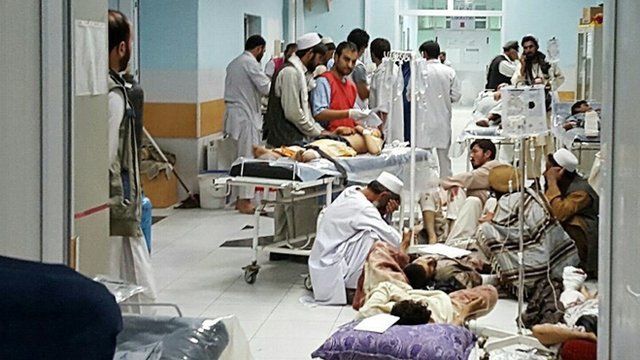
The first day was chaos – more than 130 patients poured through our doors in only a few hours. Despite the heroic efforts of all the staff, we were completely overwhelmed. Most patients were civilians, but some were wounded combatants from both sides of the conflict. When I reflect on that day now, what I remember is the smell of blood that permeated through the emergency room, the touch of desperate people pulling at my clothes to get my attention begging me to help their injured loved ones, the wailing, despair and anguish of parents of yet another child lethally injured by a stray bullet whom we could not save, my own sense of panic as another and another and another patient was carried in and laid on the floor of the already packed emergency department, and all the while in the background the tut-tut-tut-tut of machine guns and the occasional large boom from explosions that sounded way too close for comfort.

In any case, MSF had clearly ‘indicated their presence’ to both the US and Afghan authorities by providing them with the GPS co-ordinates of the Trauma Centre (see my previous discussion here). Dunlap finds this ‘commendable’ but ‘legally problematic’.

Instead, he is fixated on the absence of a Red Cross flag from the roof, in which case he might reflect on another passage from the report.  On 2 October, the day before the air strike, MSF phoned the Special Operations Task Force in Bagram to develop a contingency plan: while the Taliban were respecting the neutrality of the Trauma Centre and ‘treating the government casualties well’, they wanted to know the feasibility of extracting their patients should conditions deteriorate.  During that conversation they were advised to ‘take the signs normally affixed to the sides of the trucks and to install them on the top of the vehicles for easy identification by aircraft during this or any future MSF resupply operations‘ (503; my emphasis).  This surely makes it clear that the US military anticipated no difficulty in recognising MSF’s flag and logo as symbols of medical neutrality.

msf153147

(2)  Conditional immunity

IHL makes it clear that treating wounded combatants does not compromise the protections afforded to a medical facility; that occurs only if it is used as a base from which ‘to commit, outside their humanitarian duties, acts harmful to [one of the belligerents]’.  I’ll address the intervening clause – ‘outside their humanitarian duties’ – under (4) and confine my discussion here to the alleged militarisation of the clinic.

msf153705-1

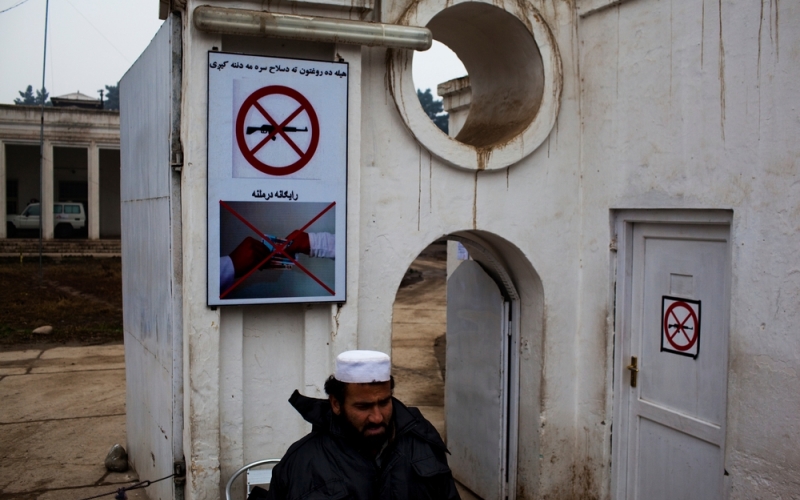
MSF’s internal review found that its unambiguous ‘no weapons‘ policy was adhered to:

All of the MSF staff reported that the no weapons policy was respected in the Trauma Centre. [Since the KTC opened, there were some rare exceptions when a patient was brought to the hospital in a critical condition and the gate was opened to allow the patient to be delivered to the emergency room without those transporting the patient being first searched. In each of these instances, the breach of the no weapon policy was rapidly rectified.]  In the week prior to the airstrikes, the ban of weapons inside the MSF hospital in Kunduz was strictly implemented and controlled at all times and all MSF staff positively reported in their debriefing on the Taliban and Afghan army compliance with the no-weapon policy.

The US military investigation accepted this was indeed the case:

Evidence provided to the investigation team supports the MSF internal initial report’s characterization that their no-weapons policy was adhered to with rare exceptions (038, note 15).

msf112743

Mathieu Aikins‘s interviewees also confirmed the absence of weapons from the Trauma Centre:

Though the MSF hospital was crowded with fighters, whether patients or caretakers (each patient was allowed one), staff members and civilians who were present said the insurgents respected the rules. They left their weapons outside or handed them over at the gun lockers at the entrance. One employee recalled seeing a fighter give up his weapon but forget his ammunition vest; when the employee nervously approached the fighter about it, the man apologized profusely and handed it over. “We had respect for the hospital, as they were serving the people,” said Shahid, the Taliban commander. “I myself went there once when one of our men was wounded, and before entering we submitted our weapons outside.”

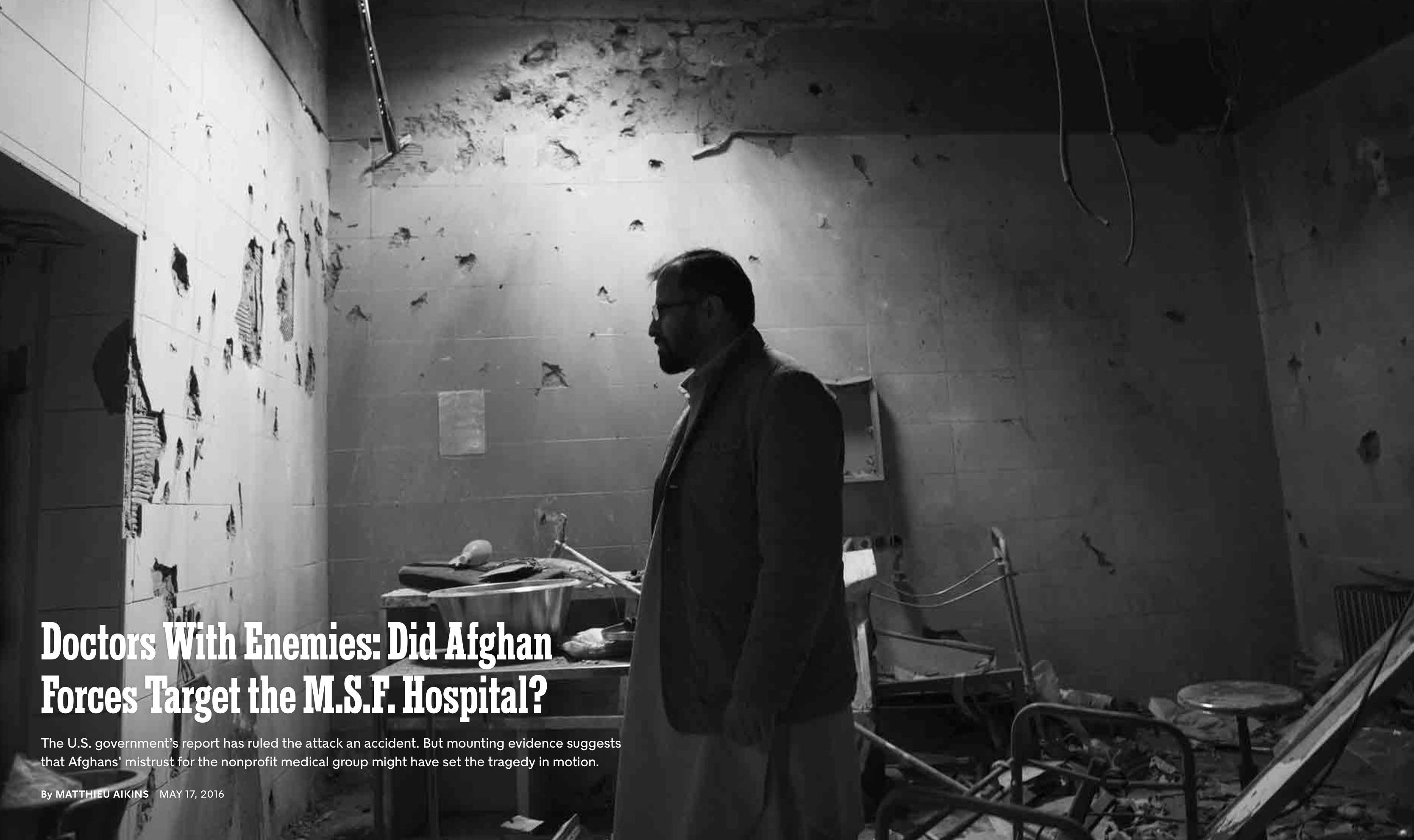
Aikins goes on to report that patients were allowed to retain their cellphones, and some of their caretakers retained hand-held radios whose transmissions were intercepted by Afghan special forces.  They in turn concluded that not only were the Taliban inside the hospital but were using it as a base: ‘They had raised their flag and established their headquarters there.’  On 1 October, presumably in response to these reports, the Pentagon contacted MSF in New York to ask whether ‘they had a large number of Taliban “holed up”’ in the Trauma Centre, and were assured that the only Taliban inside the hospital were wounded patients.

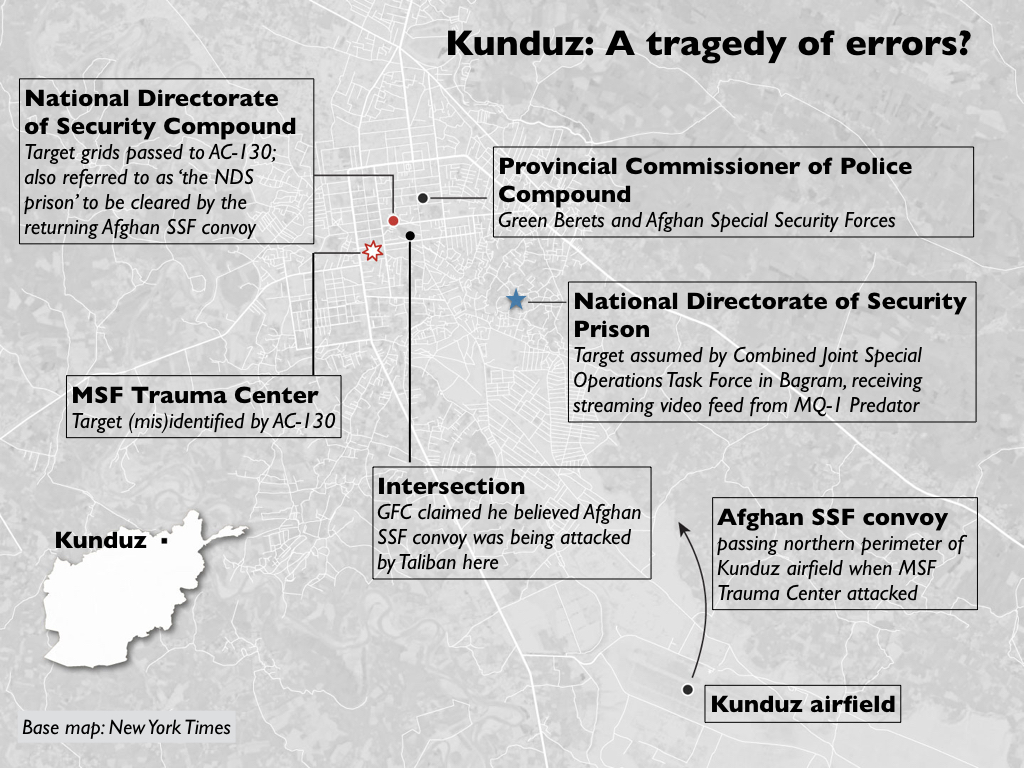
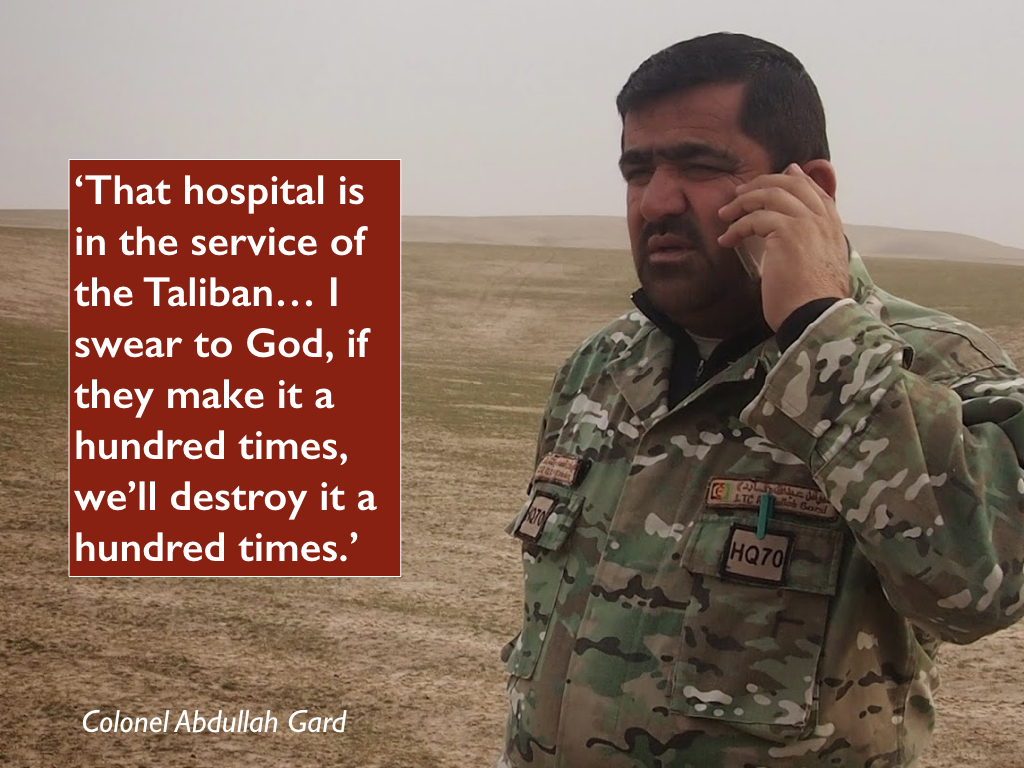
But the suspicions clearly remained, and festered to such a degree that some of those on the ground were convinced that the hospital had been overrun by Taliban fighters.  Associated Press reported that the radio intercepts prompted US analysts to request ‘specific intelligence-gathering flights over the hospital’ – their outcome has never been disclosed – and on 1 October a senior Special Forces commander (whether in Kabul or in Kunduz is unclear) wrote in his daily log that the Trauma Centre was under Taliban control and that he planned to clear it in the coming days.   At least some of the Green Berets in Kunduz agreed with his assessment: ‘They were using it as a C2 node … They had already removed and ransomed the foreign doctors, and they had fired on partnered personnel from there.’  Indeed, after the attack a senior US officer in Kabul was told – by whom has been redacted – that ‘there were three dead Military-Aged Males near the hospital, identified as Taliban by the local population.  They were using the hospital as a command post (using its protected status)’ (275).

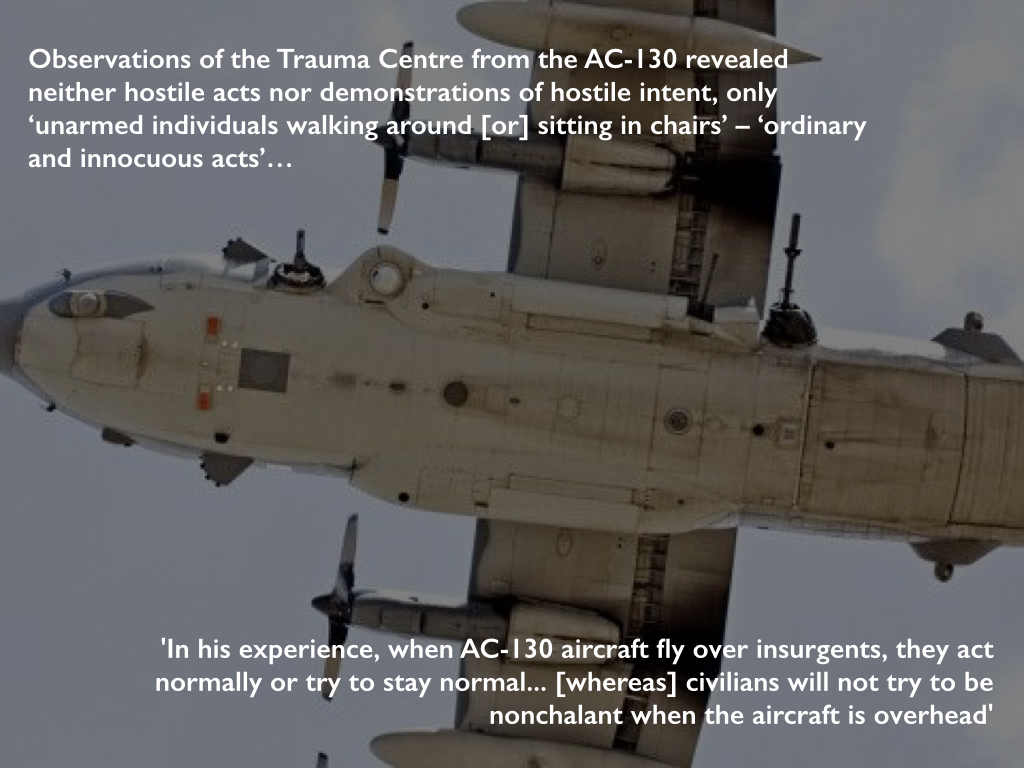
observations-from-ac-130-001

But all of this was fantasy, and the investigation discounted it.  Although US intelligence reported that insurgents were present at the hospital at the time of the strike, the investigation accepted that this was for medical treatment and they could trace ‘no specific intelligence reports that confirm[ed] insurgents were using the MSF Trauma Center as an operational  C2 [command and control] node, weapons cache or base of operations’ (085).  In addition, they determined that observations made from the AC-130 revealed neither substantive hostile acts nor demonstrations of hostile intent –  only ‘unarmed individuals walking around [or] sitting in chairs’ (085).  The report describes these as ‘ordinary and innocuous acts’ (055), but to at least one member of the aircrew that was in itself grounds for suspicion: ‘In his experience, when AC-130 aircraft fly over insurgents, they act normally or try to stay normal… [whereas] civilians will not try to be nonchalant when the aircraft is overhead’ (093, note 304).  Damned if you do, and damned if you don’t: when everything is construed as hostile, even the most innocent acts are transformed into somcething sinister.

The claims made by Afghan forces were even wilder.  Here is May Jeong in The Intercept:

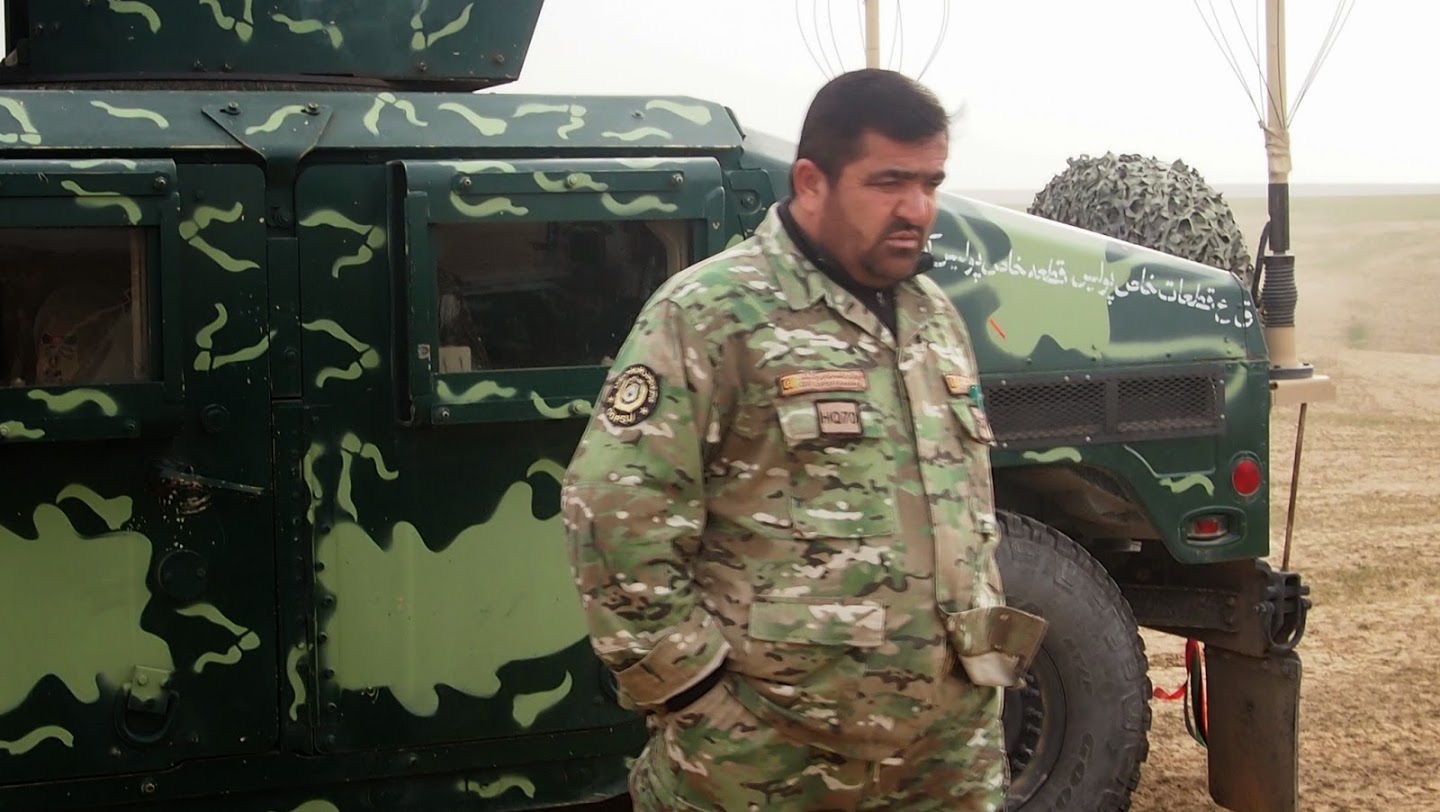
On the night of the hospital strike, a unit commander with the Ministry of Defense special forces was at the police headquarters taking fire from the direction of the hospital. “Vehicles were coming out of there, engaging, then retreating,” he told me. When I pointed out that he couldn’t have seen the gate of the hospital from where he was, several hundred meters away, he said that he was sure because he had personally interrogated a cleaner who told him that the hospital was full of “armed men using it as a cover.” The cleaner told the commander that there were Pakistani generals using the hospital as a recollection point and that they had set up a war room there. When I challenged his line of vision again, he responded, “Anyone can claim anything. The truth is different.”

afghanistan_kunduz_3459341b

[Amrullah] Saleh, [former head of the National Security Directorate and] the author of the 200-page Afghan commission report on the fall of Kunduz … believed that the “hospital sanctity had been violated” and held out as evidence 130 hours of recorded conversations with more than 600 interlocutors. “I spoke with the MSF country director,” Saleh told me recently. “They don’t deny that the hospital was infiltrated by the Taliban.”

But of course they did deny it: repeatedly, emphatically and convincingly.

(3) War crimes?

The US military investigation was unequivocal: it found multiple violations of the military’s own Rules of Engagement and of international humanitarian law.

The first rule of customary international humanitarian law, now codified in the Additional Protocols to the Geneva Conventions, is distinction:

The parties to the conflict must at all times distinguish between civilians and combatants. Attacks may only be directed against combatants. Attacks must not be directed against civilians.

The investigation found that both the Ground Force Commander (GFC) and the aircraft commander failed to exercise this core principle:

Neither commander distinguished between combatants and civilians nor a military objective and protected property. Each commander had a duty to know, and available resources to know that the targeted compound was protected property’ (075-6).

A second core principle is proportionality:

Launching an attack which may be expected to cause incidental loss of civilian life, injury to civilians, damage to civilian objects, or a combination thereof, which would be excessive in relation to the concrete and direct military advantage anticipated, is prohibited.

The investigation found this to have been disregarded too:

The GFC and the aircraft commander failed to exercise the principle of proportionality in relation to the direct military advantage (076).

Both principles are deceptively simple, and in ‘The Passions of Protection: Sovereign Authority and Humanitarian War’ Anne Orford reminds us that IHL ‘immerses its addressees in a world of military calculations.’  In practical terms the distinction between civilians and combatants in today’s conflicts is rarely straightforward, but in this case the No-Strike List plainly recognised the protected status of the Trauma Centre and there is no convincing evidence that its immunity had been compromised.  In addition, the balance between loss of civilian life and military advantage is weighed on the military’s own scales – ‘expected’; ‘excessive’; ‘anticipated’: these are not self-evident calculations – but even if the GFC or the aircraft commander had grounds to believe the Taliban were firing from the hospital the Pentagon’s own Law of War Manual (which is not without its own controversies: see here and, specifically on proportionality, here and here) advises under §7.10.3.2 that

The obligation to refrain from use of force against a medical unit acting in violation of its mission and protected status without due warning does not prohibit the exercise of the right of self-defense. There may be cases in which, in the exercise of the right of self-defense, a warning is not “due” or a reasonable time limit is not appropriate. For example, forces receiving heavy fire from a hospital may exercise their right of self-defense and return fire.  Such use of force in self-defense against medical units or facilities must be proportionate.

Not only was there was no evidence of hostile let alone ‘heavy fire’ from the Trauma Centre but the AC-130 was also monitoring the progress of the Afghan Special Forces convoy that it was tasked with protecting and knew perfectly well that it was still within the perimeter of the airfield.  This was not a time-sensitive target (the report makes that crystal clear) and neither the GFC nor the aircraft commander had reason to believe that any putative threat to Afghan or US forces was so grave and so sustained that it called for an air strike involving multiple passes by the AC-130 – over 30 minutes according to the US military, an hour according to MSF – delivering such intense fires that the building was virtually destroyed.

For these reasons many commentators – and MSF (‘Under the clear presumption that a war crime has been committed, MSF demands that a full and transparent investigation into the event be conducted by an independent international body’) – have insisted that the attack was a war crime.

not-a-war-crime-3-jpeg

not-a-war-crime-2-jpeg

But others (including the US military) have concluded that it was not.  US Central Command’s initial summary – produced before the redacted report was released – accepted that there had been breaches of both the Rules of Engagement and of IHL (‘the law of armed conflict’) but noted that

the investigation did not conclude that these failures amounted to a war crime.  The label “war crimes” is typically reserved for intentional acts – intentionally targeting of civilians or intentionally targeting protected objects.  The investigation found that the tragic incident resulted from a combination of unintentional human errors, process errors and equipment failures, and that none of the personnel knew that they were striking a medical facility.

The report has been so heavily redacted so that this legal discussion is unavailable (see also the commentary by Sarah Knuckey and two of her students here).  We do know that the investigation team included an unnamed legal advisor from US Central Command (CENTCOM) and that its report was subject to legal review by the Staff Judge Advocate, who accepted its findings as ‘legally sufficient’ with several, redacted exceptions  – though there is no way of knowing what they were (007-009).  We know too that General John Campbell, who ordered the investigation as commander of US Forces in Afghanistan, subsequently disapproved a number of findings and recommendations ‘not related to the proximate cause of the strike’ (002) but, again, the details have been excised.

General Votel at Pentagon press briefing on MSF attack

General Joseph Votel, commander of CENTCOM, repeated the summary statement’s disavowal of war crimes at a Pentagon Press Briefing on 29 April 2016, and in responding to a storm of questions from plainly incredulous reporters (above) he elaborated:

… an unintentional action takes it out of the realm of actually being a deliberate war crime against persons or protected locations…. They were absolutely trying to do the right thing; they were trying to support our Afghan partners; there was no intention on any of their parts to take a short cut, or to violate any rules that were laid out for them. And they were attempting to do the right thing.  Unfortunately, they made a wrong judgment in this particular case…

Jens David Ohlin explains the disputation (which Faye Donnelly helpfully re-casts as one between two contending narratives whose speech-acts struggle to realize their performative force):

The problem is that the killing of the innocent civilians was not intentional, it was accidental. As a matter of criminal law, it was either reckless or negligent … but the civilian killings were not performed with purpose.

The Rome Statute of the International Criminal Court provides for war crimes prosecutions for ‘intentionally directing’ or ‘intentionally launching’ attacks that contravene international humanitarian law (in effect, criminalizing the rules of IHL).  Jens discusses this in relation to attacks on civilians, but the Statute also proscribes ‘intentionally directing attacks against buildings, material, medical units and personnel’ or against ‘personnel, installations, material, units or vehicles involved in a humanitarian assistance or peacekeeping mission’.

In every case the emphasis is on intentionality, and yet intentionality – as philosophers have demonstrated time and time again – is not the simple, settled matter some legal scholars assume it to be.  Jens’s central point is that common-law cultures identify intentionality with purpose or knowledge whereas civil-law cultures widen its sphere to include a conscious disregard of risk or ‘recklessness’.  The full argument is here – including an intricate disection of the (geo)politics involved in drafting the Geneva Conventions and the Additional Protocols – but the sharp conclusion is that (for Jens, at least) the strike on the Trauma Centre would not constitute a war crime under the first count (he accepts that neither the GFC nor the aircraft commander possessed the knowledge or the purpose) but could under the second (their actions, and those of others, were reckless).  I should add that he recommends the recognition of a new war crime to explicitly address the second count and thereby signal ‘the moral difference between intentionally killing civilians and recklessly killing them.’

kunduz-msf-a-tragedy-of-errors-001


The investigation report provides endless, explicit examples of a thoroughly compromised ‘risk management process’ by multiple actors at multiple sites, and this dispersal of responsibility in Kunduz (see map above) and Bagram further complicates the legal situation.  Peter Margulies – who does not accept that ‘the lack of intent among US personnel is determinative’ – concedes that ‘the cascading systemic errors in the hospital attack impede the attribution of culpable awareness to one or more specific individuals.’ In his view,

CENTCOM would have been better served by acknowledging that intent was not required [for the commitment of a war crime], but that awareness of risk was distributed among many organizational components, without full awareness concentrated in one or more individuals who could be charged criminally.

Adil Ahmad Haque notes that Additional Protocol I to the Geneva Conventions requires attackers to do ‘everything feasible’ to verify that their target is a military objective and instructs them in cases of doubt to presume that it is civilian – the Law of War Manual doesn’t follow this standard, but the investigation report does –  and here there is such clear evidence of recklessness on the part of many of the US forces involved (whose evidence is shot through with technical failures and radical uncertainty) that, in his view, their decision to press on with the attack ‘was unlawful, irrespective of their good faith.’

(4) Medical neutrality at risk

I noted above that hospitals only lose their protected status if they are used ‘to commit, outside their humanitarian duties, acts harmful to [one of the belligerents]’.  It’s a telling provision because its intermediate clause can be read as a tacit acknowledgement that those humanitarian duties – treating the sick and wounded – could otherwise be construed as acts harmful to their enemies.

And there is evidence that this is exactly how both the Afghan government and its military viewed MSF’s activities.  When Mathieu Aikins visited Kunduz after the air strike he reported:

Some members of the Afghan government and security forces there had little respect for MSF’s neutrality and resented its treatment of wounded Taliban. When I visited Kunduz in November, their anger was still surprisingly raw, despite the recent destruction of the hospital. “They give them medicine; they transport and treat their injured,” [Colonel Abdullah] Gard, the commander of the [Ministry of Interior’s] quick-reaction force, told me. “Their existence is a big problem for us…. The people that work there are traitors, all of them.”

abdullah-gard

Gard (seen above) and one of his colleagues told May Jeong exactly the same:

Gard spoke of MSF with the personal hatred reserved for the truly perfidious. He accused the group of “patching up fighters and sending them back out,” a line I heard repeatedly. Cmdr. Abdul Wahab, head of the unit that guarded the provincial chief of police compound, told me he could not understand why in battle an insurgent could be killed, but the minute he was injured, he would be taken to a hospital and given protective status. Wouldn’t it be easier, he asked, wouldn’t the war be less protracted or bloody if they were allowed to march in and take men when they were most compromised? He had visited the MSF hospital three times to complain. Each time a foreign doctor explained the hospital’s neutral status and its no-weapons policy, which mystified him.

In short, it seems that some (perhaps many) in the Afghan security forces – particularly after the humiliation of being forced out of Kunduz – believed that the Taliban were legitimate targets wherever they were and that the fight against them was being hamstrung by what one officer described to Jeong as a ‘silly rule’.

kunduz-a-silly-rule-001

This becomes material because, as I showed previously, the intended target for the air strike was a National Directorate of Security compound whose co-ordinates had been passed to Major Michael Hutchinson, the Ground Force Commander, by Afghan Special Security Forces (who, like him, were unfamiliar with the city): they had identified the NDS compound as a Taliban command and control node, and planned to clear it on their return from the airfield following a casualty evacuation.  The AC-130 was supposed to provide Close Air Support, but a series of technical difficulties compromised the accuracy of its sensors and several hours after the Afghan Special Security Forces had left in an armoured convoy with their three casualties the aircrew were still unsure of the location of the target and so requested a verbal description of the NDS compound.  This was provided by Afghan forces still inside the Provincial Chief of Police compound: their description matched the MSF Trauma Centre much more closely than the NDS compound, and the aircrew fixed on this as their target.

doctors-with-enemies-nyt

It’s impossible to know whether this was a mistake or misdirection, and the report fails to identify who provided the description.  Hutchinson was shown various photographs but explained that ‘it was dark when everything happened’; he couldn’t remember the name of the Afghan liaison officer and – the redactions make his responses difficult to follow at this point – he wasn’t always sure who he was talking to since he had to rely on interpreters (387-8).  But the description obviously had to come from someone who knew the city (which would include Gard and Wahab), and both Aikins and Jeong clearly believe that misdirection is not only possible but also extremely likely.  ‘That hospital is in the service of the Taliban,’ Gard told Aikins. ‘I swear to God, if they make it a hundred times, we’ll destroy it a hundred times.’  Hence the headline for Aikins’s searching New York Times report (above): ‘Doctors with enemies: did Afghan forces target the MSF hospital?‘ I should note that David Glazier dismisses all this as ‘highly speculative’ and insists that ‘it simply defies logic’.  While the claim is speculative it surely doesn’t defy logic, and Aikins and Jeong make at least a plausible if not definitive case).  They are clearly not alone in their suspicions: MSF’s very first question in response to the investigation report was this:
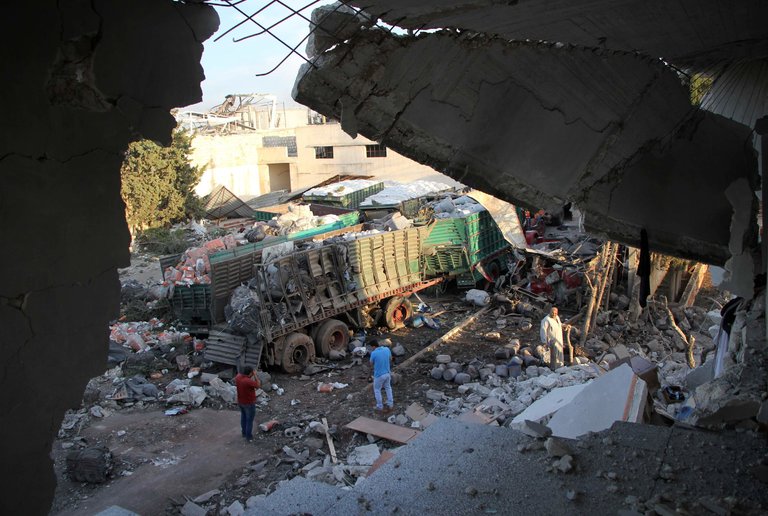
‘What was the physical description of the intended target provided by the Afghan forces and how did it match the description of the MSF hospital?’

gard-that-hospital-is-in-the-service-of-the-taliban-001

The studied refusal to recognise medical neutrality – if that is what this was – emerges from a long history of friction between MSF and the government in Kabul, and it threads its way out into a wider history and geography of deliberate attacks against medical facilities elsewhere in Afghanistan, and – among other recent places – in Gaza (by the Israeli military), in Syria (primarily by the Russian and Syrian Arab Air Forces) and in Yemen (primarily by the Saudi-led coalition which is advised by the United Kingdom on targeting).  In February 2014 Thanassis Cambanis was already writing that ‘medical care is now a tool of war’, and in a report issued in May 2016 the World Health Organisation counted almost 600 attacks against medical facilities, doctors and nurses in 19 countries since then.  These shocking statistics, which are inevitably imperfect, include attacks by non-state actors, among them the Taliban and Islamic State, but I have emphasised the complicity of state actors – including leading members of the UN Security Council – because it is their actions that determine the course of international humanitarian law and because they are ultimately responsible for what MSF’s president Joanne Liu saw in the wake of the attack on its Trauma Centre in Kunduz as  ‘not just an attack on our hospital’ but ‘an attack on the Geneva Conventions.’

msf-kunduz-battlefields-without-doctors

In a letter to the UN Security Council issued on 22 September 2016, after a direct and deliberate attack on a humanitarian convoy delivering aid to eastern Aleppo, more than 100 humanitarian organisations noted that:

‘Each [head of state] that accepts a lack of accountability for perpetrators and facilitators of war crimes colludes in the ongoing dissolution of international humanitarian law.’

That dissolution can be seen as a defiant reassertion of the absolutism of sovereign power, because ‘medical neutrality’ is not a neutral claim.  Adia Benton and Sa’ed Ashtan persuasively argue that:

The health worker’s claim to impartiality may itself be a stance against the state’s insistence that it is the sole arbiter of who can live and who can die. The local health worker’s claim to an international norm … may be understood as a direct challenge to the state’s claim to sovereignty…. Can ‘‘medical neutrality’’ accurately describe a situation where there is no neutral ground upon which to stand? (‘‘‘Even War has Rules’’: On Medical Neutrality and Legitimate Non-violence’ , Cult. Med. Psychiatry 40 (2016) 151-158).

As the spectral presence of Giorgio Agamben in my slide below implies, this has the liveliest implications for how we are to understand the space of exception and the refusal of its victims to be reduced to the passivity of ‘bare life’.

medical-neutrality-sovereign-power-and-biopolitics-001

As I will show in the next post in this series, Syria is the most egregious contemporary case.  If some members of the Afghan security forces wilfully misled the Americans into targeting the MSF Trauma Centre in Kunduz, then it seems clear that they objected to the protection extended by IHL to wounded Taliban combatants and those who treat them (though many of those killed in the attack were civilians, despite Alan Dershowitz‘s tawdry attempt to suggest that MSF ‘favoured Taliban fighters over civilian patients’: see Kevin Jon Heller’s magisterial response here).  But in Syria not only has the provision of medical aid to those in rebel-held areas been explicitly criminalised by the state’s new Counterterrorism Law which came into effect in July 2012 – the space of exception is far from being a ‘legal “black hole” – but the ban extends to those providing medical aid to sick or wounded civilians.  And make no mistake: there have been no mistakes.  The murder of doctors and nurses and the bombing of hospitals and clinics in Syria has been deliberate and systematic.  The exception to the exception contracts to its vanishing point.

To be continued.


The Drone Memos

jaffer-drone-memos

From the New Press on 15 November, Jameel Jaffers The Drone Memos: targeted killing, secrecy and the law:

The Drone Memos collects for the first time the legal and policy documents underlying the U.S. government’s deeply controversial practice of “targeted killing”—the extrajudicial killing of suspected terrorists and militants, typically using remotely piloted aircraft or “drones.” The documents—including the Presidential Policy Guidance that provides the framework for drone strikes today, Justice Department white papers addressing the assassination of an American citizen, and a highly classified legal memo that was published only after a landmark legal battle involving the ACLU, the New York Times, and the CIA—together constitute a remarkable effort to legitimize a practice that most human rights experts consider to be unlawful and that the United States has historically condemned.

In a lucid and provocative introduction, Jameel Jaffer, who led the ACLU legal team that secured the release of many of the documents, evaluates the “drone memos” in light of domestic and international law. He connects the documents’ legal abstractions to the real-world violence they allow, and makes the case that we are trading core principles of democracy and human rights for the illusion of security.

From Jameel’s introduction:

This book is possible because the secrecy surrounding American drone strikes has begun, at the margins, to erode. The documents collected here shed light on how a president committed to ending the abuses associated with the Bush administration’s “war on terror” came to dramatically expand one of the practices most identified with that war, and they supply a partial view of the legal and policy framework that underlies that practice. But while many of the documents collected here were meant to be defenses of the drone campaign, ultimately they complicate, at the very least, the government’s oft-repeated argument that the campaign is lawful.

To be sure, even the existence of these documents is an indication of the extent to which the drone campaign is saturated with the language of law. Perhaps no administration before this one has tried so assiduously to justify its resort to the weapons of war. But the rules that purportedly limit the government’s actions are imprecise and elastic; they are cherry picked from different legal regimes; the government regards some of them to be discretionary rather than binding; and even the rules the government concedes to be binding cannot, in the government’s view, be enforced in any court. If this is law, it is law without limits—law without constraint.

Ryan Goodman provides ’10 Questions to Ask Yourself When Reading Jameel Jaffer’s “The Drone Memos”’ here.  For me, the two most crucial on the list – which anyone writing about drones and limiting the discussion to targeted killing needs to ask themselves (and rarely does) – are these:

Despite the title of the book, how much of the discussion and issues raised are really about drones per se? How much applies to cruise missiles, night raids, and other forms of direct lethal action? What analytic or rhetorical work is being done by focusing on “drones”?

Despite the title of the book, how much of the discussion and issues raised are limited to pre-planned targeted killing? What about dynamic strikes when a moment of opportunity arises, or so-called signature strikes? What analytic or rhetorical work is being done by focusing on “targeted killing”?

UPDATE:  For an excerpt from Jameel’s introduction, see this article, ‘How the US justifies drone strikes: targeted killing, secrecy and the law‘, from The Guardian:

As the 2016 presidential primaries were getting under way, sporadic and sketchy reports of strikes in remote regions of the world provided a kind of background noise – a drone in a different sense of the word – to which Americans had become inured.

Senior officials in the administration of President Barack Obama variously described drone strikes as “precise,” “closely supervised,” “effective,” “indispensable,” and even the “only game in town” – but what they emphasized most of all is that the drone strikes they authorized were lawful.

In this context, though, “lawful” had a specialized meaning. Except at the highest level of abstraction, the law of the drone campaign had not been enacted by Congress or published in the US Code. No federal agency had issued regulations relating to drone strikes, and no federal court had adjudicated their legality. Obama administration officials insisted that drone strikes were lawful, but the “law” they invoked was their own. It was written by executive branch lawyers behind closed doors, withheld from the public and even from Congress, and shielded from judicial review…

Now the lethal bureaucracy whose growth Obama personally oversaw will be turned over to a new administration. The powers Obama claimed will be wielded by another president. Perhaps as significant is the jarring fact that the practice of targeted killing – assassination, as it would once have been called, without a second thought – no longer seems remarkable, and the fact that the United States now boasts a legal and bureaucratic infrastructure to sustain this practice. Eight years ago the targeted-killing campaign required a legal and bureaucratic infrastructure, but now that infrastructure will demand a targeted-killing campaign. The question the next president will ask is not whether the powers Obama claimed should be exploited, but where, and against whom.

The hospital raids

This is the first in a new series of posts on military violence against hospitals and medical personnel in conflict zones.  I’ve discussed these issues on multiple occasions in the past – in relation to Afghanistan, Gaza and Syria – but I’m now working towards a presentation – and ultimately an extended essay – that brings this all together (including a detailed analysis of the US air strike on the MSF Trauma Centre in Kunduz).  It will have its first outing (“Surgical Strikes and Modern War”) at NUI Galway next month.

It was a clear, moonlit night and the hospitals – many of them provided by humanitarian organisations – were brightly lit as the nurses moved about the wards caring for their patients; elsewhere the hard-pressed surgeons were still operating on the maimed bodies of the wounded.  At 10 p.m. they heard the sound of approaching aircraft: first the clatter of gunfire and then, after the hospitals were plunged into precautionary darkness, the whistle of bombs falling.  The hospitals were hit repeatedly, and two hours later – when the flames had burned themselves out and the smoke cleared – several nurses had been killed and hundreds of patients had been killed or injured; multiple wards had been severely damaged.  Ten days later the aircraft returned; one hospital was totally destroyed and elsewhere operating rooms and wards were destroyed or damaged.

The scene is all too familiar: but this is not Gaza in 2014, Afghanistan in 2015 or Syria in 2016.  This is Étaples on the coast of France, 25 km south of Boulogne, in May 1918.

etaples-bombing-2-lowe_field_hospital_bombed_lac_pa_003747_a003747_v8-jpg_pv4a5fab25f240997c

On the Western Front it was common for stretcher-bearers to come under fire as they retrieved the wounded from No Man’s Land or carried them through the trenches and down the roads to aid posts and dressing stations; those places were often shelled since they were close to the front lines.  On 13 September 1914 Travis Hampson – a Medical Officer with a Field Ambulance – noted:

As one of our buses drove out onto the road to pick up some wounded gunners from the battery opposite, one landed on the road in front of it, and one behind, but not near enough to do any damage. With their glasses they must have been able to distinguish the white tilt and red cross, but we can’t grumble about being shelled if we are put amongst ammunition columns and batteries.

So too with the Casualty Clearing Stations (CCS) which had moved close to the front lines to speed up the treatment of what were often catastrophic wounds and to minimise the risk of infection.  Here is Kate Luard writing in her diary at Brandhoek on 18 August 1917:

He [the enemy] played about all night till daylight. There were several of him. He went to C.C.S.’s behind us. At one he wounded three Sisters and blew their cook-boy to pieces. The Sisters went to the Base by Ambulance Train this morning. At the other he wounded six Medical Officers among other casualties. A dirty trick, because he has maps and knows which are hospitals back there. Here we are in a continuous line of camps, batteries, dumps, etc., and he may not know.

In fact, her CCS was judged to be too close for comfort  and was ordered to evacuate a few days later.

Luard’s last sentence reinforces Hampson’s; in general (so she suggests) the Red Cross was respected.  The following year she wrote about German air raids on the CCS:

Jerry comes every night again and drops below the barrage, seeking whom he may devour: I think he gets low enough to see our huge Red Cross, as even when some of our lads butt in and engage him with their machine-guns, he hasn’t dropped anything on us.

For the most part, then, it seems that attacks on medical sites and personnel were the result of the inaccuracy of shellfire and bombing (especially at night) compounded by the close proximity of aid posts, dressing stations, CCS and ambulance trains to the fighting.

Yet the hospital raids in the last year of the war seemed to be something else.  Étaples was distant from the fighting, the site of a vast collection of ‘base hospitals’ – ‘the Land of Hospitals’, Sister Elsie Tranter called it, ‘a stretch of six kilometres of hospitals’ – to which wounded soldiers were sent from casualty clearing stations near the rapidly moving front: some to be treated and returned to active service, others to be evacuated across the Channel on hospital ships.

etaples-map

As soon as the news broke, the British press were up in arms at what the Times lost no time in calling ‘German savagery at its worst’:

‘During the recent fine weather our airmen have … made every use of the still air and the good visibility to attack and harass the enemy by bombing his camps, billets, rail-heads, batteries, dumps, roads and all points of military importance in the battle area and immediately behind.  At the same time, the German airmen have also been making use of the favourable conditions by having recourse to their old trick of bombing hospitals.

‘There is one place in France, faraway from the battle area, where we have a large group of hospitals.  The hospital tents there cover a great area of ground.  The Germans are perfectly aware of the character of the place, and they selected it as the object of a bombing raid last year.  They have again been attacking it, and the size of the tract of ground covered with hospital outfits and the entire absence of any concealment make it a mark which no airman could possibly miss.  An airman blind and drunk could let bombs fall from any height in any wind and weather, and they must land somewhere amongst the attendants’ quarters or on the tents where the nursing sisters move among the rows of cots with their helpless occupants.

‘On Sunday night the Germans attacked the place with all the ferocity of which they are capable… The scenes inside the tents were of the most piteous description, and the total casualties to patients, sisters, medical officers and attendants must have far exceeded those of any London air raid.  The redeeming feature of the whole horrible affair was the magnificent behaviour of the hospital staff…’ [Times, 24 May 1918]

This too is a familiar narrative, and one that would be repeated in countless wars to come: ‘we’ attack military targets with precision, ‘they’ attack civilian targets with abandon; their aircrew are cowards, our victims are heroes.

The press provided photographic evidence of the aftermath of the raids:

sjab-ward-destroyed-by-air-raids-etaples-may-1918

One of the German pilots was shot down – ‘and is now being cared for in the hospital he bombed’, thundered the Times – and his protestations were summarily dismissed:

‘He tried at first to excuse himself by saying that he saw no Red Cross.  When challenged with the fact that he knew that he was attacking hospitals he endeavoured to plead that hospitals should not be placed near railways, or if they are, they must take the consequences.  Apart from the fact that hospitals must be near railways for the transport of their patients, in this case, as in the others, the raiders were not attacking the railway but came deliberately to bomb the hospital.’

Punch dismissed German remorse as crocodile tears:

punch-26-june-1918

There were repeated angry calls for reprisals. Arthur Conan Doyle urged that the captured pilot be shot ‘with a notice that such will be the fate of all airmen who are captured in such attempts’ and recommended that German prisoners of war ‘at once be picketed among the tents’ to deter future raids [Times, 27 May 1918].  Sir James Bell went further.  Although his son had been killed in one of the raids, reprisals were not about revenge, he said, but were a strictly ‘military matter’.  He recommended ‘bombing German hospitals and killing their wounded’ to stop the outrages [Times, 5 June 1918].

Finally, the press trumped arguments about the presence of Red Crosses on the hospitals.  The Hague Convention required belligerents to take ‘all the necessary measures … to spare, as far as possible, … hospitals, and places where the sick and wounded are collected, on the understanding that they are not being used at the same time for military purposes’ and required them to mark such places with ‘distinctive and visible signs’.

But far from respecting these protocols there was photographic evidence that the Germans were abusing the Red Cross to protect their own military installations:

dm-27-may-1918

The aerial photograph was taken on 15 May 1918, and the caption described this as an active aerodrome at Thionville; the large building displaying the Red Cross ‘might house one or two sick’ but the Mirror insisted it ‘could not possibly be a hospital in any sense that would enable it to claim Red Cross immunity.’

And so, in her diary entry for 24 June 1918, Sister Edith Appleton wondered

‘if there is any truth in what they say about the bombing of hospitals – that in German territory the flying men have seen what are without doubt aeroplane hangers and ammunition dumps marked with huge red crosses. They are not near a railway and are so placed that they simply cannot be hospitals. I suppose they think we do the same and they bomb us on the chance of it. Of course we bomb their hangers and dumps – we should be fools if we didn’t! I am quite sure though that they do know what is a real hospital. They can see the wounded men walking about and some lying out in beds.’

Yet the press reports were studiedly disingenuous.  Étaples was indeed physically removed from the fighting – ‘far away from the battle’, as the Times‘s correspondent noted – but it was functionally and logistically absolutely central to the Allied military machine because it was the site of multiple Infantry Base Depots.  It was a vital transit and training camp – all those ‘TCs’ scattered across the map (above).

‘The Base!’ Edmund Blunden exclaimed in Undertones of War: ‘dismal tents, huge wooden warehouses, glum roadways, prisoning wire.’  He associated it, ‘as millions do, with “The Bull-Ring”, that thirsty, savage, interminable training-ground’ among the dunes where new recruits and newly discharged patients were put through their paces and ‘toughened up’ by unrelenting instructors.  When American military surgeon Harvey Cushing drove past its camps in 1917 they were ‘full of men rushing about like so many ants and all the color of the soil; drilling in the sand, practicing with machine guns, throwing bombs [grenades], having bayonet exercise, digging trenches and I know not what all.’  [For a thoughtful account of the oppressive conditions endured by troops during their two-week stints at the base and their contribution to the mutiny of 1917, see Douglas Gill and Gloden Dallas, ‘Mutiny at Étaples base 1917’, Past and Present 69 (1975) 88-112: ‘A corporal encountered several men returning to the front with wounds which were far from being healed. “When I asked why they had returned in that condition they invariably replied: ‘To get away from the Bull Ring’.”‘]

pe-in-the-bull-ring-at-etaples

bayonet-practice-in-bull-ring-at-etaples-iwm

troops-practice-bayonet-charge-in-the-bull-ring-at-etaples

In a letter to his mother Wilfred Owen described the base as ‘a vast, dreadful encampment’:

It seemed neither France nor England, but a kind of paddock where the beasts are kept a few days before the shambles [slaughter] … Chiefly I thought of the very strange look on all the faces in that camp; an incomprehensible look, which a man will never see in England …; nor can it be seen in any battle.  But only in Étaples. It was not despair, or terror, it was more terrible than terror, for it was a blindfold look, and without expression, like a dead rabbit’s.

The training camps were a sea of bell tents (below) – like many of the hospitals – and the captured airmen insisted that this had been their objective: ‘the number of bell tents convinced them this was not [a hospital] as patients would not be in bell tents.’

etaples-2

Étaples had been targeted before.  Vera Brittain, who was a nurse with the Voluntary Aid Detachment at No 24 General Hospital, described the ‘ceaseless and deafening roar [that] filled the air’ during the German  offensive in the spring: ‘Motor lorries and ammunition waggons crashed endlessly along the road; trains with reinforcements thundered all day up the line, or lumbered down more slowly with their heavy freight of wounded…’

olive-mudie-cooke-unloading-ambulance-train-at-etaples-by-night

Images like this painting (above) by Olive Mudie-Cooke – a VAD convoy unloading an ambulance train at Étaples – are immensely powerful, but they ought not to blind us to the movement of men and matériel in the other direction.  As Vera Brittain knew only too well, there were in consequence frequent air raids on the lines of communication:

Certainly no Angels of Mons were watching over Etaples, or they would not have allowed mutilated men and exhausted women to be further oppressed by the series of nocturnal air-raids which for over a month supplied the camps beside the railway with periodic intimations of the less pleasing characteristics of a front-line trench.  The offensive seemed to have lasted since the beginning of creation, but must have actually been on for less than a fortnight, when the lights suddenly went out one evening…  Instead of the usual interval of silence followed by the return of the lights, an almost immediate series of crashes showed this alarm to be real…

Gradually, after another brief burst of firing, the camp became quiet, though the lights were not turned on again that night.  Next day we were told that most of the bombs had fallen on the village; the bridge over the Canche, it was reported, had been smashed, and the train service had to be suspended while the engineers performed the exciting feat of mending it in less than twelve hours.

bridge-over-the-canche-at-etaples

The bridge was of overwhelming strategic importance: by the time of the spring offensive a hundred military trains were passing over it every day.  Here is H.A. Jones in the official history of The war in the air (citing Colonel M.G. Taylor):

The enemy advance against the British on the Somme and on the Lys in March and April had endangered the railway system. ‘The culmination was reached in May 1918, when the great lateral line from St. Just, via Amiens, to Hazebrouck had to be abandoned as a railway route owing to enemy shell fire. Our armies were then penned into a narrow strip of country, possessing only one lateral railway communication, through Abbeville and Boulogne. Most of the forward engine depots had been lost, and several of the important engine depots remaining were so close to the enemy as to be practically useless, and our one lateral, along which all reserves and reinforcements drawn from one part of the front to be thrown in at another had to be moved, was threatened daily and nightly by persistent air attacks on the bridge over the Canche river at Etaples.

The Germans knew the importance of destroying, and the British of protecting, this line of communications.

bridge-over-river-canche-at-etaples-damage-from-enemy-bombing-at-south-end-1918

Vera Brittain had returned to London when the Times published its report on the air raids in May. ‘It was clear from the guarded communiqué that this time the bombs had dropped on the hospitals themselves,’ she wrote, ‘causing many casualties and far more damage than the breaking of the bridge over the Canche in the first big raid.’  Cushing also recorded the enormity of the raid:

Étaples has had a bad hit – much worse than we had supposed… For two hours the raiders kept it up, returning again and again like moths around a flame.

But he knew Étaples of old and reckoned the objective was the same as before: not even the camps but the railway. ‘They were doubtless after the railroad and perhaps the bridge half a mile below.’

The official British history was similarly unequivocal:

During the night of the 19th/20th of May, at the time when the last of the German aeroplane raids was being made on London, fifteen bombers attacked the Etaples bridge. Only one bomb fell close and this did no damage: most of them exploded in neighbouring hospitals and camps with terrible effect… One of the German bombers was shot down, and the captured crew insisted that they did not know that hospitals were situated near the railway. They also expressed surprise, not without reason, that large hospitals should be placed close to air targets of first-rate military importance.

Certainly, the casualties were not confined to the hospital area:

casualties-from-etaples-bombing-1920-may-1918

Two Infantry Base Depots suffered direct hits; 53 per cent of military casualties were outside the hospital area.

In fact, behind the scenes the British military and the intelligence service accepted that the hospitals were probably not the intended targets of the raid on 19-20 May or the second raid on 31 May/1 June. Here is the aftermath of that second raid on one Canadian hospital:

no-9-canadian-stationary-hospital-etaples-31-may-1918-iwm

major-general_john_maitland_salmondAlthough Sir Douglas Haig firmly believed the hospitals were deliberately targeted in the second raid – he complained that ‘special measures’ had been taken after the air raid on the night of 19-20 May, with ‘Red Crosses repainted so that there could be no possible doubt as to the hospital area’ [see the image below] – Major-General John Salmond [right], who commanded the newly designated Royal Air Force in France, ‘considered it extremely improbable that Red or White Crosses would be distinctly visible at the height from which hostile pilots drop their bombs, usually 5,000 feet or over.’

etaples-hospital-after-bombing-may-1918-iwm

The same (classified) report dated 29 June 1918 conceded that no definitive conclusion could be reached, but its author, the Director of Military Operations at the War Office Sir Percy Radcliffe, was none the less adamant that

We have no right to have hospitals mixed up with reinforcement camps, and close to railways and important bombing objectives, and until we remove the hospitals from vicinity of these objectives and place them in a region where there are no important objectives. I do not think we can reasonably accuse the Germans.

Indeed, Vera Brittain had prefaced her account of the May raids with a revealing rider.  ‘The persistent German raiders,’ she wrote, ‘had at last succeeded in their intention of smashing up the Étaples hospitals’ which ‘had so satisfactorily protected the railway line for three years without further trouble or expense to the military authorities‘ (my emphasis).  Now she was scarcely a spokeswoman for the British military, but her remark gestures towards the possibility of a remarkably cynical extension of the medical exemption to cover military objectives.

A hundred years later these same arguments about intentionality, accuracy, co-location and the protection (or otherwise) of a Red Cross would reappear in different guises.  But they would also be joined by others that revealed an aggressive refusal to accept the principle of medical neutrality at all.

To be continued

Whitewashing

whitewash-protocol

Regular readers will remember my series of commentaries on Israel’s punitive and reckless assault on Gaza during the summer of 2014 (see, for example, here, here and here).

In the debates over what Israel called ‘Operation Protective Edge’ – and over later modern military violence more generally – questions of law have come to the fore: partly because law is now closely implicated in the conduct of military operations (‘operational law’), as Craig Jones‘s wonderful work has demonstrated, and partly because its legitimating narrative requires (and indeed rests on) militaries investigating their own alleged breaches of international law and their rules of engagement.

B’Tselem: The Israeli Information Center for Human Rights in the Occupied Territories has now published Whitewash Protocol: the so-called investigation into Operation Protective Edge.  It’s a complex, forensic investigation, but here is one of the key findings about the Israeli military investigation of its own actions:

The MAG [Military Advocate General’s Corps] examined only several of dozens of almost identical attacks that took place over the fifty days of hostilities, time after time ending with terrible human tall. Given these recurring results, one cannot accept the MAG’s position, that those responsible for these attacks could reasonably base their assessments of the anticipated harm to civilians on assumptions that were repeatedly proven unfounded, and debunked by their own actions or the actions of their colleagues – at a heavy death toll.

The interpretation adopted by the MAG has a far reaching implication that applies to all strikes carried out during the operation: It absolves every level of officials involved in the attacks – from the prime minister, through the MAG himself through to the persons who ultimately fired – of the duty to do everything in their power to minimize harm to civilians. In fact, the MAG sets the bar very low in terms of what is required of those responsible for the attacks – including senior military officers and the MAG (who are not under investigation in any case) – by doing no more than examining what they claimed to know prior to the attacks, while entirely disregarding the question of whether their assessment was reasonable. In doing so, the MAG utterly overlooks the issue of what those responsible for the attacks should have known, including the obligation to learn from their own experience.
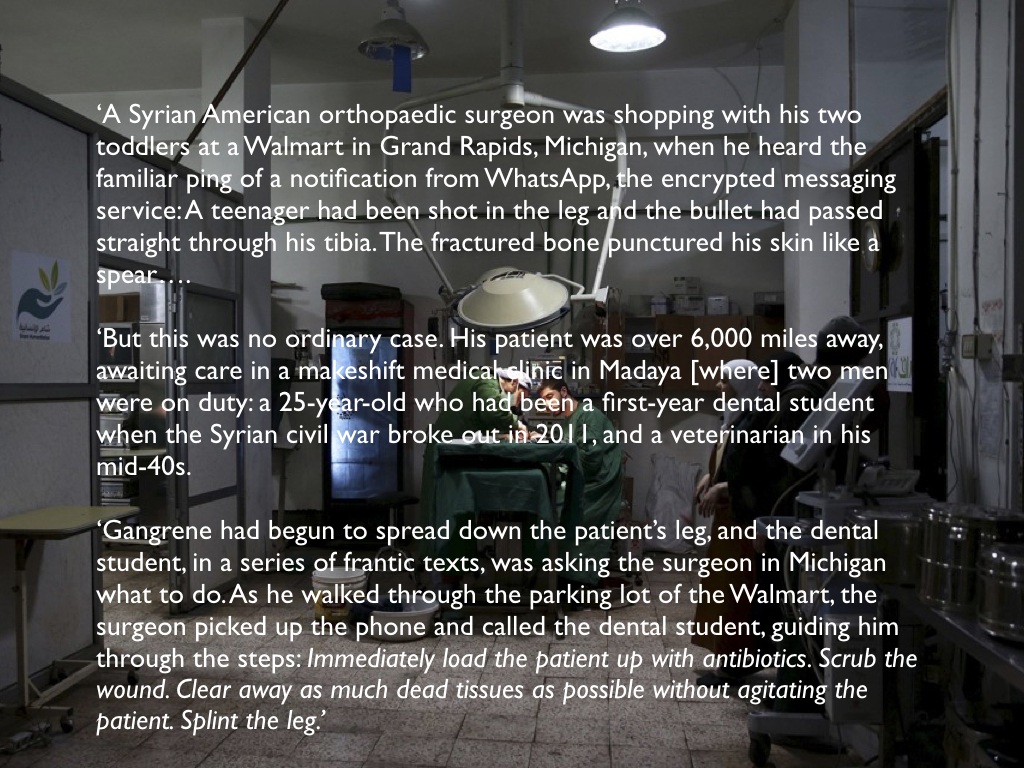
And the reason this matters is made plain in the summary:

The fighting during Operation Protective Edge was brutal and violent. Israel implemented a policy of air strikes against homes, which killed hundreds of people, including entire families. Tens of thousands of people were left homeless, losing all they held dear. Genuine, effective investigations are needed not just for the sake of achieving justice for the victims and their loved ones. They are needed as a deterrent to forestall future actions of this sort and to avert further losses. When nothing is investigated, when the consensus is that everything done during the fighting was moral and legal – the stage is set for actions such as these, or even worse, to recur. There was no accountability after Operation Cast Lead, only whitewashing. Now, after Operation Protective Edge, there is no accountability either, only whitewashing. This is not a theoretical legal issue: we are talking about human lives.

The full report can be downloaded as a pdf here.  It needs to be read in conjunction with B’Tselem’s report from May 2016, The Occupation’s Fig Leaf: Israel’s Military Law Enforcement System as a Whitewash Mechanism available here.

201605_occupations_fig_leaf_eng 

Yael Stein, B’Tselem’s Research Director, writes:

In his response to the report, the [Israeli military] spokesperson said that B’Tselem is waging a “delegitimization campaign” against the military law enforcement system. Yet this system cannot be considered legitimate until it ensures justice for victims and unless its investigations seek to uncover the truth and hold those responsible accountable…. What may appear at times to be an independent, efficient law enforcement system is in fact a mechanism for covering up suspected offenses and protecting the real culprits.

To be sure, the IDF shoots more than the messenger…

Zombie law

Britain's Kill List cover JPEGOver at ESIL [European Society of International Law] Reflections [5 (7) 2016], Jochen von Bernstorff has a succinct commentary on ‘Drone strikes, terrorism and the zombie: on the construction of an administrative law of transnational executions‘.

His starting-point is the UK report on the government’s policy on the use of drones for targeted killing that was published in May 2016 in response to the killing of Reyad Khan in Syria last August: you can find more in REPRIEVE’s report on Britain’s Kill List (April 2016) and in two commentaries at Just Security from Noam Lubell here and Kate Martin here.

In Jochen’s view, the UK has effectively endorsed the policies of the Obama administration and in doing so has hollowed out fundamental legal regimes that supposedly constrain state violence.

First is the concerted attempt to legitimise the unilateral killing of suspected terrorists outside ‘hot’ battlefields – in the Federally Administered Tribal Areas of Pakistan, for example – as a new form of pre-emptive self-defence to be invoked whenever the state whose sovereignty is transgressed is ‘unwilling or unable’ to take appropriate counter-measures.  I discuss other dimensions of this in ‘Dirty dancing’ (DOWNLOADS tab), and pay attention to its colonial genealogy, but Jochen emphasises another even more starkly colonial inflection:

‘The main protagonists in this discursive effort take it for granted that the new legal regime will not be applied among us, which is among Western states and the five permanent Security Council members. There will be no US-drone attacks in Brussels or Paris to kill ISIS-terrorists without the consent of the Belgian or French government, even if these governments proved to be unable to find and arrest terrorists. The new regime is a legal framework for what can be called the “semi-periphery”, consisting of states that do not belong to the inner circle or are not powerful enough to resist the application of the regime.’

Second, and closely connected, is the claim that armed conflict follows the suspect – that the individuation of warfare (‘the body becomes the battlefield’, as Grégoire Chamayou has it) licenses the everywhere war: simply, wherever the suspect seeks refuge s/he becomes a legitimate target of military violence.  But there is nothing ‘simple’ about it, Jochen contends, because this involves a wholesale exorbitation of the very meaning of armed conflict that completely trashes the role of international human rights law in limiting violence against those suspected of criminal wrong-doing.

Finally, Jochen concludes that the arguments adduced by the UK and the USA (and, I would add, Israel) demonstrate that international law is so often transformed through its violation: in Eyal Weizman‘s ringing phrase, ‘violence legislates‘.  Here is Jochen:

 ‘The Zombie is created by a fundamental reconceptualization of the notion of self- defence and armed conflict in international law with the aim to get rid of all legal constraints on state violence imposed by the law enforcement paradigm. Is this a new legal regime? Are we really moving towards an administrative law of transnational executions? It is an inherent problem of international legal discourse that measures of Great Powers violating the law will often be reformulated as an evolving new legal regime and legal scholars should be extremely sceptical of any such claims, since whoever says “emerging” in an international legal context very likely wants to cheat.’