Collateral damage

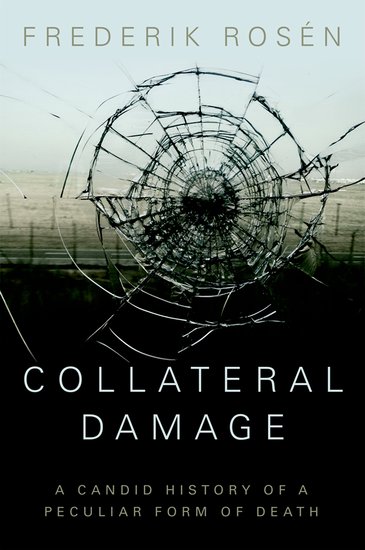
A gracious note from Antipode prompts me to add that today is also a day to remember the countless others who are victims of war and military/paramilitary violence.  And so to a new book due at the end of the month from Frederik RosénCollateral Damage: a candid history of a peculiar form of death (Hurst/Oxford University Press):

ROSEN Collateral damageThe dilemmas precipitated by the unintentional killing of civilians in war, or ‘collateral damage’, shape many aspects of military conduct, yet noticeable by its absence has been a methodical examination of the place and role of this phenomenon in modern warfare. This book offers a fresh perspective on a distressing consequence of conflict.

Rosén explains how collateral damage is linked to ideas of authority, thereby anchoring it to the existential riddles of our individual and collective lives, and that this peculiar form of death constitutes an image of what it means to be human.

His investigation of collateral damage is notable too for how the death of non-combatants sheds light on some of today’s critical challenges to war and global governance, such as the growing role of non-state actors, mercenary contractors and the impact of military privatization.

In the ethical realm those who successfully prove that collateral damage has occurred also enter the debate about which institutions may exert authority and thus how a truly decentralized world might be organized. This is why the in many ways underrepresented victims of collateral damage appear on closer inspection to have experienced a most significant form of death.

Contents:

Introduction
1. The Third Category of Death
2. Urban Warfare and Collateral Damage
3. Collateral Damage and the Question of Legal Responsibility
4. Collateral Damage and Compensation
5. Lifting the Fog of War and Collateral Damage
6. How Bad Can Be Good
7. A Death Without Sacrifice
8. Collateral Damage or Accident?
9. A Private Call for Collateral Damage?
10. A Place Between it All

This is a good moment to remember Patricia Owens’ classic and still vitally important essay, ‘Accidents don’t just happen: the liberal politics of high-technology “humanitarian” war’, Millennium 32 (3) (2003) 596-616, and to reflect on what is surely a classic-in-the-making: Emily Gilbert‘s brilliant new essay, ‘The gift of war: cash, counterinsurgency and “collateral damage”‘, Security dialogue (online early).

Then there is the intentional killing of civilians in war….

Surgical strike

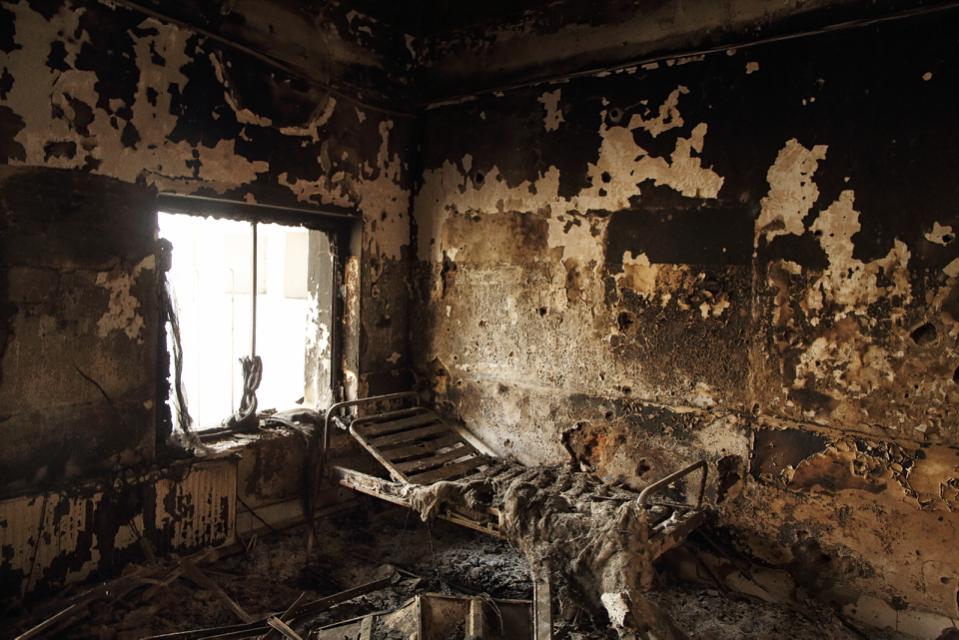
Kunduz Trauma Center (Andrew Quilty)

An update to my post (which I’ve updated several times) on the US air strike on the hospital in Kunduz early last month: MSF has released an internal review of the events that took place that night.  It’s only a preliminary report – the inquiry is ongoing – but it makes for grim reading.

MSF opened its Kunduz Trauma Center in August 2011, providing free, high-quality surgical care to all those who needed it (for more on MSF and other medical charities in Afghanistan, see my post on ‘The prosthetics of military violence’ here).

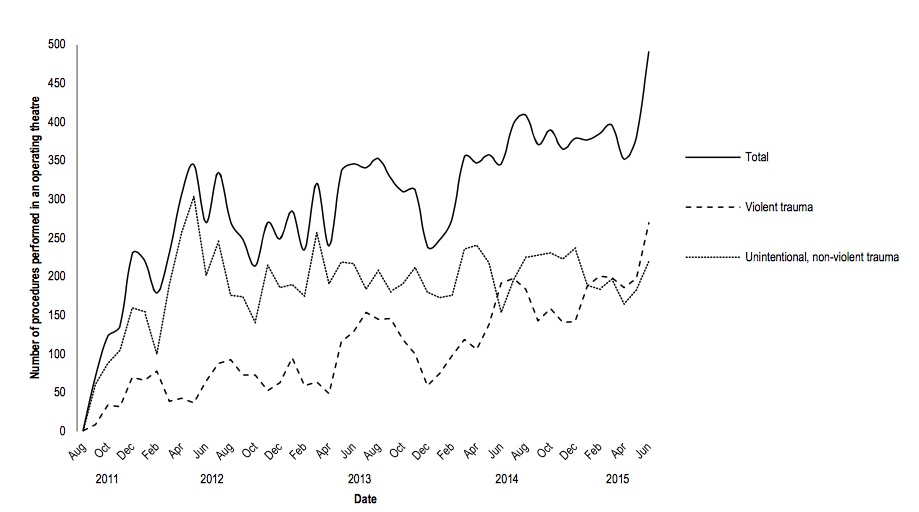
By the end of September 2015 the original 92 beds had grown to 140 as the numbers being treated grew:

Case load Kunduz Trauma Center 2011-2015 (MSF)

MSF is an experienced, highly regarded relief organisation and so it comes as no surprise to learn that it was fully aware of the cardinal principle of medical neutrality and took all possible steps to secure the legal and military foundations on which it operated:

MSF activities in Kunduz were based on a thorough process to reach an agreement with all parties to the conflict to respect the neutrality of our medical facility. In Afghanistan, agreements were reached with the health authorities of both the government of Afghanistan and health authorities affiliated with the relevant armed opposition groups. These agreements contain specific reference to the applicable sections of International Humanitarian Law including:

  • –  Guaranteeing the right to treat all wounded and sick without discrimination
  • –  Protection of patients and staff guaranteeing non-harassment whilst under medical care
  • –  Immunity from prosecution for performing their medical duties for our staff
  • –  Respect for medical and patient confidentiality
  • –  Respect of a ‘no-weapon’ policy within the hospital compound

The report makes it clear that this had been clearly endorsed by all the military and paramilitary parties to the conflict.

Fighting intensified in the week before the air strike.  Most of those treated since the Trauma Center opened had been from the Afghan government side, but from Monday 28 September ‘this shifted to primarily wounded Taliban combatants.’  The Afghan government speedily arranged the transfer of all its patients (apart from the most severely wounded cases) to another hospital.  By that night the Taliban announced that it was in control of the district.

The next day, as the numbers seeking treatment increased yet again, MSF reconfirmed the GPS co-ordinates of the Trauma Center with both the Afghan authorities and the US military.

On Thursday 1 October MSF was asked by Carter Malkasian, a a special adviser to the Chairman of the Joint Chiefs of Staff, whether the hospital ‘had a large number of Taliban “holed up” and enquired about the safety of [MSF] staff’ and was told that its staff ‘were working at full capacity’ and that the hospital ‘was full of patients including wounded Taliban combatants’.  And because the Taliban were hors de combat they were not a legitimate military target: there is absolutely no ambiguity about this.

That same day a UN civilian/military liason ‘advised MSF to remain within the GPS coordinates provided to all parties to the conflict as “bombing is ongoing in Kunduz.”’

On Friday 2 October two large MSF flags were placed on the roof of the hospital.  That night the hospital was calm, there was no fighting taking place within the vicinity and MSF insists that there were no armed combatants in the buildings or the grounds of the hospital.

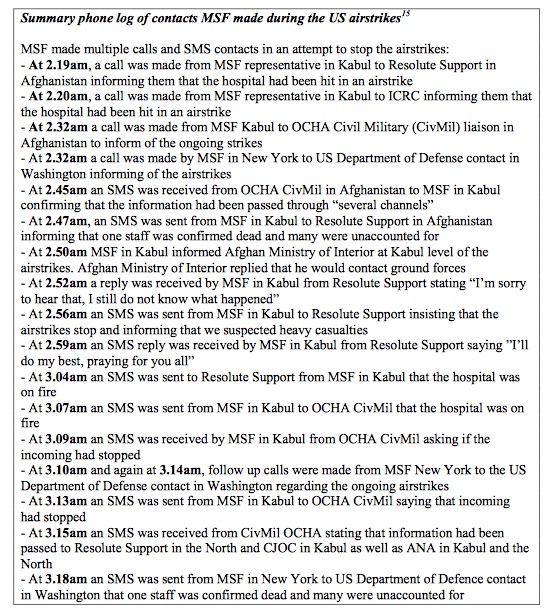
The air strikes began soon after 2 a.m. on Saturday 3 October, and throughout the attack – which lasted for over an hour – MSF made repeated attempts to stop the assault:

MSF Kunduz phone log

And yet, despite everything the US military had been told in advance and despite these repeated attempts to stop the air strikes, an AC-130 gunship made five repeated passes:

A series of multiple, precise and sustained airstrikes targeted the main hospital building, leaving the rest of the buildings in the MSF compound comparatively untouched. This specific building of the hospital correlates exactly with the GPS coordinates provided to the parties to the conflict [my emphasis].

Bombing of Kunduz Trauma Center

As MSF’s Director concludes,

‘The question remains as to whether our hospital lost its protected status in the eyes of the military forces engaged in this attack – and if so, why. The answer does not lie within the MSF hospital. Those responsible for requesting, ordering and approving the airstrikes hold these answers’.

And, as the report notes, this is the view from the inside: ‘What we lack is the view from outside the hospital – what happened within the military chains of command.’

So far, controlled leaks from the US military investigation have suggested that an Afghan ‘rapid reaction force’ requested the attack, that it had been rushed to Kunduz from elsewhere in Afghanistan, arriving ‘just days before the air strike’, and that it had no experience in working with the US ground troops from the Third Special Forces Group who relayed the request for ‘aerial fires’ to the Joint Operations Center at Kunduz airfield.  The Green Berets ‘were aware it was a functioning hospital,’ AP reported, ‘but believed it was under Taliban control.’  The report continues:

The Green Berets had asked for Air Force intelligence-gathering flights over the hospital, and both Green Berets and Air Force personnel were aware it was a protected medical facility, the records show, according to the two people who have seen the documents.

The analysts’ dossier included maps with the hospital circled, along with indications that intelligence agencies were tracking the location of [an] … operative [from Pakistan’s Inter-Services Intelligence directorate who was allegedly co-ordinating Taliban operations in the area] and activity reports based on overhead surveillance, according to a former intelligence official who is familiar with some of the documents. The intelligence suggested the hospital was being used as a Taliban command and control center and may have housed heavy weapons.

According to the Washington Post,

… the crew of the AC-130, call sign Hammer, verified their permission to fire twice before engaging the hospital. AC-130Us carry a crew of 14, often including a special forces liaison officer responsible for communicating with ground units.

And the US troops remained in contact with the AC-130 gunship throughout the attacks.

So even if you accept all these unverified claims about the intelligence (or lack of it) behind the air strikes, you surely have to wonder about the studied lack of response to the repeated calls to have the attacks stopped.  Bear in mind, too, that the AC-130 has a sophisticated sensor suite on board, including IR and low-light cameras, that the hospital kept its lights on throughout the night (it was one of the few buildings in the city whose electricity was still working), and that MSF staff were advised to remain inside the co-ordinate grid they had given to the military: which turned out to be the very co-ordinates used for the attack.  It seems dismally clear that the trauma center was precisely targeted and that it could not have been mistaken for any other building.

Regular readers will know that the US military has repeatedly relied on an elaborate bio-medical discourse to legitimise its actions (for a brilliant recent discussion, see Elke Schwarz‘s ‘Prescription drones: on the techno-biopolitical regimes of contemporary ‘ethical killing’’, online early at Security Dialogue); the most familiar version, hideously ironic given the events in Kunduz, is the claim that the US military has an unprecedented ability to carry out ‘surgical strikes’…

UPDATE:  For an excellent analysis, see Kate Clark at the Afghan Analysts Network here

Archives of the Insensible

9780226277332News from the ever interesting Allen Feldman of his new book, Archives of the Insensible: of war, photopolitics and dead memory, coming from Chicago in December:

In this jarring look at contemporary warfare and political visuality, renowned anthropologist of violence Allen Feldman provocatively argues that contemporary sovereign power mobilizes asymmetric, clandestine, and ultimately unending war as a will to truth. Whether responding to the fantasy of weapons of mass destruction or an existential threat to civilization, Western political sovereignty seeks to align justice, humanitarian right, and democracy with technocratic violence and visual dominance. Connecting Guantánamo tribunals to the South African Truth and Reconciliation Commission, American counterfeit killings in Afghanistan to the Baader-Meinhof paintings of Gerhard Richter, and the video erasure of Rodney King to lynching photography and political animality, among other scenes of terror, Feldman contests sovereignty’s claims to transcendental right — whether humanitarian, neoliberal, or democratic—by showing how dogmatic truth is crafted and terror indemnified by the prosecutorial media and materiality of war.

Excavating a scenography of trials —formal or covert, orchestrated or improvised, criminalizing or criminal — Feldman shows how the will to truth disappears into the very violence it interrogates. He maps the sensory inscriptions and erasures of war, highlighting war as a media that severs factuality from actuality to render violence just. He proposes that war promotes an anesthesiology that interdicts the witness of a sensory and affective commons that has the capacity to speak truth to war. Feldman uses layered deconstructive description to decelerate the ballistical tempo of war to salvage the embodied actualities and material histories that war reduces to the ashes of collateral damage, the automatism of drones, and the opacities of black sites. The result is a penetrating work that marries critical visual theory, political philosophy, anthropology, and media archeology into a trenchant dissection of emerging forms of sovereignty and state power that war now makes possible.

Here is the wonderful Talal Asad on the book:

Archives of the Insensible is a remarkable diagnosis of our time, tracing with great subtlety the multiple ways in which violence is transformed into justice and justice gives birth to destruction. This is a startling book written with passion and insight, and a valuable contribution to our understanding of the relationship of violence to international law in the contemporary world.

You can see why I’m so interested…

Watching the detectives

Hospital bombing, Kunduz, October 2015 MSF

I wrote about medical neutrality earlier this year (see here).  As I noted then, Physicians for Human Rights stipulates that medical neutrality requires:

The protection of medical personnel, patients, facilities, and transport from attack or interference;
Unhindered access to medical care and treatment;
The humane treatment of all civilians; and
Nondiscriminatory treatment of the sick and injured.

In the wake of the US air strike on a hospital operated by Médecins Sans Frontières  (MSF) in Kunduz on 3 October, that first requirement assumes even greater significance: the obligation is not merely to exempt medical personnel, patients and infrastructure from military and paramilitary violence but to protect them from attack.

MSF provides details and updates on the strike here.  As I write, far and away the most substantial commentary on what happened – given what we know so far – is Kate Clark‘s detailed analysis at the Afghan Analysts Network here (though Matt Lee‘s angry comparison with an Israeli military attack on a hospital in Gaza is worth reading too).  As Kate notes,

Expressing distrust in the US military, NATO or Afghan government to uncover the truth, [MSF] said it wants an investigation by the International Humanitarian Fact-Finding Commission (IHFFC), a body set up by the Additional Protocols of the Geneva Conventions and, says MSF, is the only permanent body set up specifically to investigate violations of international humanitarian law. It has never been used before and, as neither Afghanistan or the United States have formally recognized the Commission, any investigation would have to be voluntary.

logo_ihffcThe IHFFC issued this statement today:

The International Humanitarian Fact-Finding Commission (IHFFC) has been contacted by Médecins Sans Frontières (MSF, Doctors Without Borders) in relation to the events in Kunduz, Afghanistan, on 3 October 2015.

The IHFFC stands ready to undertake an investigation but can only do so based on the consent of the concerned State or States. The IHFFC has taken appropriate steps and is in contact with MSF. It cannot give any further information at this stage.

Alex Jeffrey has commented briefly on the geopolitics of any investigation by the IHFFC, but there has been little or no commentary on how the US military investigates civilian casualty incidents – and this merits discussion because the Obama administration has insisted that the inquiry already under way by the Pentagon will be ‘transparent’, ‘thorough’ and ‘objective’.  And whatever may or may not transpire with respect to the IHFFC, it’s exceptionally unlikely that the US military investigation will be stopped.

I’ve worked through five investigations of so-called ‘CIVCAS’ in Afghanistan that have been released through Freedom of Information Act requests.  Each branch of the US military is required to maintain its own digital FOIA Reading Room, so that any documentation supplied in response to these requests is released into the public domain.  I should say that you need to be adept at using the search function, and to have a very good idea of what you are looking for before you start (though the Pentagon has been remarkably helpful in responding to my inquiries and questions).

It’s also fair to say that the release of investigation reports is uneven.  In the immediate aftermath of an earlier, devastating air strike on two tankers hijacked by the Taliban near Kunduz, called in by the German Bundeswehr but carried out by two US aircraft (see my extended discussion here), the United States repeatedly promised to release the investigation report: but it never did, even to the German Bundestag’s committee of inquiry, and despite repeated requests it remains classified.

There is also considerable variation in the transparency and quality of the reports that have been released: some are so heavily redacted that it is extremely (and no doubt intentionally) difficult to construct a reasonably comprehensive narrative, while others are the product of inquiries that seem to have been, at best, perfunctory.

AR 15-6 CIVCAS Uruzgan February 2010

The report into the airstrike in Uruzgan that I have been using for my analysis of the US air strike in Uruzgan in February 2010 – see ‘Angry Eyes (1)‘ and ‘Angry Eyes (2)‘: more to come – is neither.  It has been redacted, presumably for reasons of national, operational or personal security, but its 2,000 pages provide enough detail to reconstruct most of what happened.  And the investigation team was remarkably thorough: by turns forensic, sympathetic, exasperated and eventually blisteringly angry at what they found.  Whether this provides an indication of what we can expect from the present inquiry I don’t know, but it does provide a benchmark of sorts for what we (and, crucially, MSF) ought to expect.  (There are also ongoing investigations by NATO and by the Afghan authorities, but no details have been released about them either).

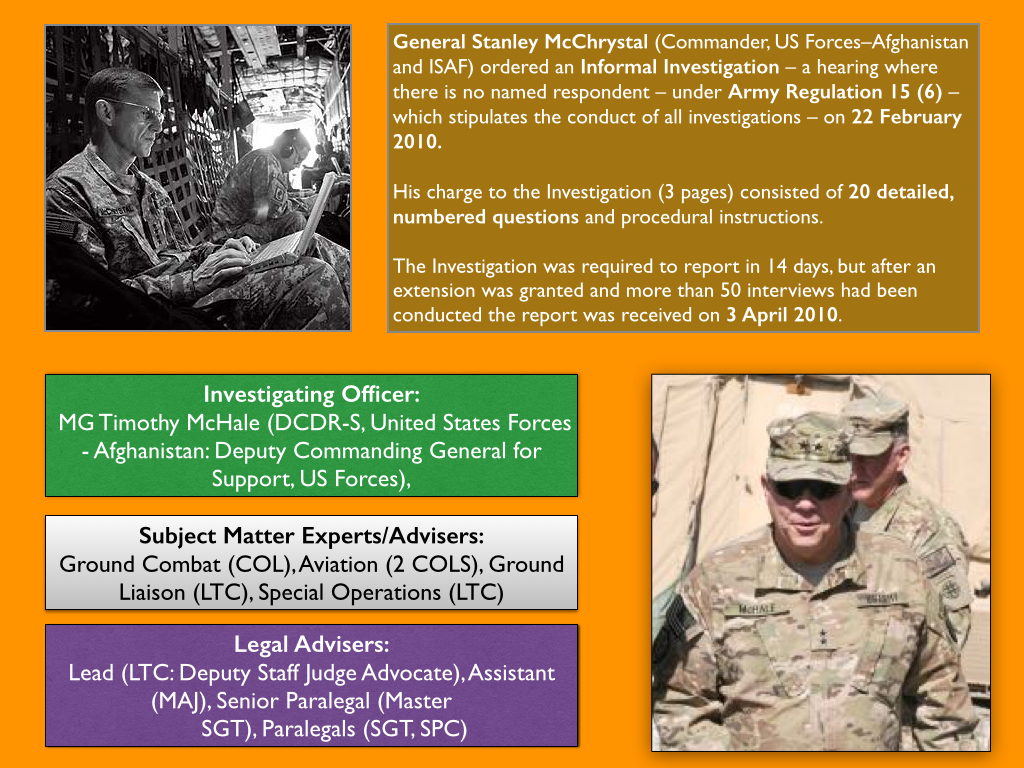
The strike took place on 21 February 2010, and the very next day General Stanley McChrystal (Commander US Forces – Afghanistan and ISAF, Afghanistan) appointed Major-General Timothy McHale to conduct what the US Army calls ‘an informal investigation’ into the incident that ‘allegedly resulted in the deaths of 12-15 local Afghan nationals and caused injured to others’; McHale was assisted by a team of senior officers, including subject matter experts and legal advisers:

GREGORY Angry Eyes 2015 IMAGES.139

There are two points to note here.

First, this was an investigation conducted by the US Army because the airstrike had been called in by US Special Forces and had been carried out by two US Army helicopter crews.  But the strike was orchestrated in large measure by a US Air Force Predator crew from Creech Air Force Base in Nevada; in addition to questioning the soldiers and helicopter crews involved, McHale’s team also questioned the Predator flight crew together with the screeners and video analysts at Air Force Special Operations Command at Hurlburt Field in Florida.  McHale’s report triggered a second ‘Commander-Directed Investigation’ by US Air Force Brigadier-General Robert Otto into the actions and assessments of the Predator crew; that report was submitted on 30 June 2010.  As I write, it’s not known who is leading the US investigation into the bombing of the hospital in Kunduz.  Since (on the fourth telling) the strike appears to have been called in by US Special Forces (at the request of Afghan forces) and carried out by a US Air Force AC-130 gunship this will presumably be a joint investigation.

Second, the term ‘informal investigation’ is a technical one; certainly, on McHale’s watch the conduct of the inquiry was remarkably rigorous.  US Army Regulation 15-6 sets out how the Army is to conduct an investigation:

‘The primary function of any investigation or board of officers is to ascertain facts and to report them to the appointing authority. It is the duty of the investigating officer or board to ascertain and consider the evidence on all sides of each issue, thoroughly and impartially, and to make findings and recommendations that are warranted by the facts and that comply with the instructions of the appointing authority.’

Here is the distinction between informal and formal investigations (I’ve taken this summary from a US Army Legal Guide here; the full version, specifying the conduct of an informal investigation, is here and here):

Informal investigations may be used to investigate any matter, to include individual conduct. The fact that an individual may have an interest in the matter under investigation or that the information may reflect adversely on that individual does not require that the proceedings constitute a hearing for that individual. Even if the purpose of the investigation is to inquire into the conduct or performance of a particular individual, formal procedures are not mandatory unless required by other regulations or by higher authority. Informal investigations provide great flexibility. Generally, only one investigating officer is appointed (though multiple officers could be appointed); there is no formal hearing that is open to the public; statements are taken at informal sessions; and there is no named respondent with a right to counsel (unless required by Art 31(b), UCMJ); right to cross-examine witnesses; etc….

“Generally, formal boards are used to provide a hearing for a named respondent. The board offers extensive due process rights to respondents (notice and time to prepare, right to be present at all open sessions, representation by counsel, ability to challenge members for cause, to present evidence and object to evidence, to cross examine witnesses, and to make argument). Formal boards include a president, voting members, and a recorder who presents evidence on behalf of the government. A Judge Advocate (JA) is normally appointed as recorder but is not a voting member. If a recorder is not appointed, the junior member of the board acts as recorder and is a voting member. Additionally, a non-voting legal advisor may be appointed to the board. Formal AR 15-6 investigations are not normally used unless required by regulation.’

In setting all this out, I should add two riders.  In treating MG McHale’s investigation in such detail, I don’t mean to imply that I fully concur with its analysis.  This is a judgement call, of course: the redactions make it difficult to press on several key issues, all of which relate to who knew what when and where (more to come on this).  And neither do I mean to suggest that any US military investigation into what happened in Kunduz, however probing, would be adequate. As MSF’s Chris Stokes has said, ‘relying only on an internal investigation by a party to the conflict would be wholly insufficient.’  But if the report is conducted with the same careful attention to detail – and if it is released with minimal redactions – it would provide a necessary resource for all those involved in and affected by this truly appalling incident.

More to come – I hope.

UPDATE (1):  The US investigation is headed by Brigadier-General Richard Kim.  Nancy Youssef reports that his arrival in Kunduz was delayed ‘because of instability in the northern Afghan city.’ As with the Uruzgan air strike in 2010, the video recording from the AC-130 gunship that carried out the attack, together with audio recordings of conversations between the air crew and ground troops, will be of great importance.  According to Youssef, these show that ‘rules of engagement—the guidelines for the use of force—were misapplied.’  (In the Uruzgan case, the radio conversations between the air crew(s) and the Joint Terminal Attack Controller on the ground were released in redacted form in response to a FOIA request; apart from a single image of the strike, however, the video remains classified.)

I’ve previously noted the debate surrounding the Pentagon’s new Law of War manual which was issued in June 2015; since the US has admitted that the strike on the hospital was carried out within the US chain of command, section 7.17 on ‘Civilian hospitals and their personnel’ is particularly relevant (see also the Guardian report here):

During international armed conflict, civilian hospitals organized to give care to the wounded and sick, the infirm, and maternity cases, may in no circumstances be the object of attack, but shall at all times be respected and protected by the parties to the conflict.

7.17.1 Loss of Protection for Civilian Hospitals Used to Commit Acts Harmful to the Enemy. The protection to which civilian hospitals are entitled shall not cease unless they are used to commit, outside their humanitarian duties, acts harmful to the enemy.

7.17.1.1 Acts Harmful to the Enemy. Civilian hospitals must avoid any interference, direct or indirect, in military operations, such as the use of a hospital as a shelter for able-bodied combatants or fugitives, as an arms or ammunition store, as a military observation post, or as a center for liaison with combat forces. However, the fact that sick or wounded members of the armed forces are nursed in these hospitals, or the presence of small arms and ammunition taken from such combatants and not yet handed to the proper service, shall not be considered acts harmful to the enemy.

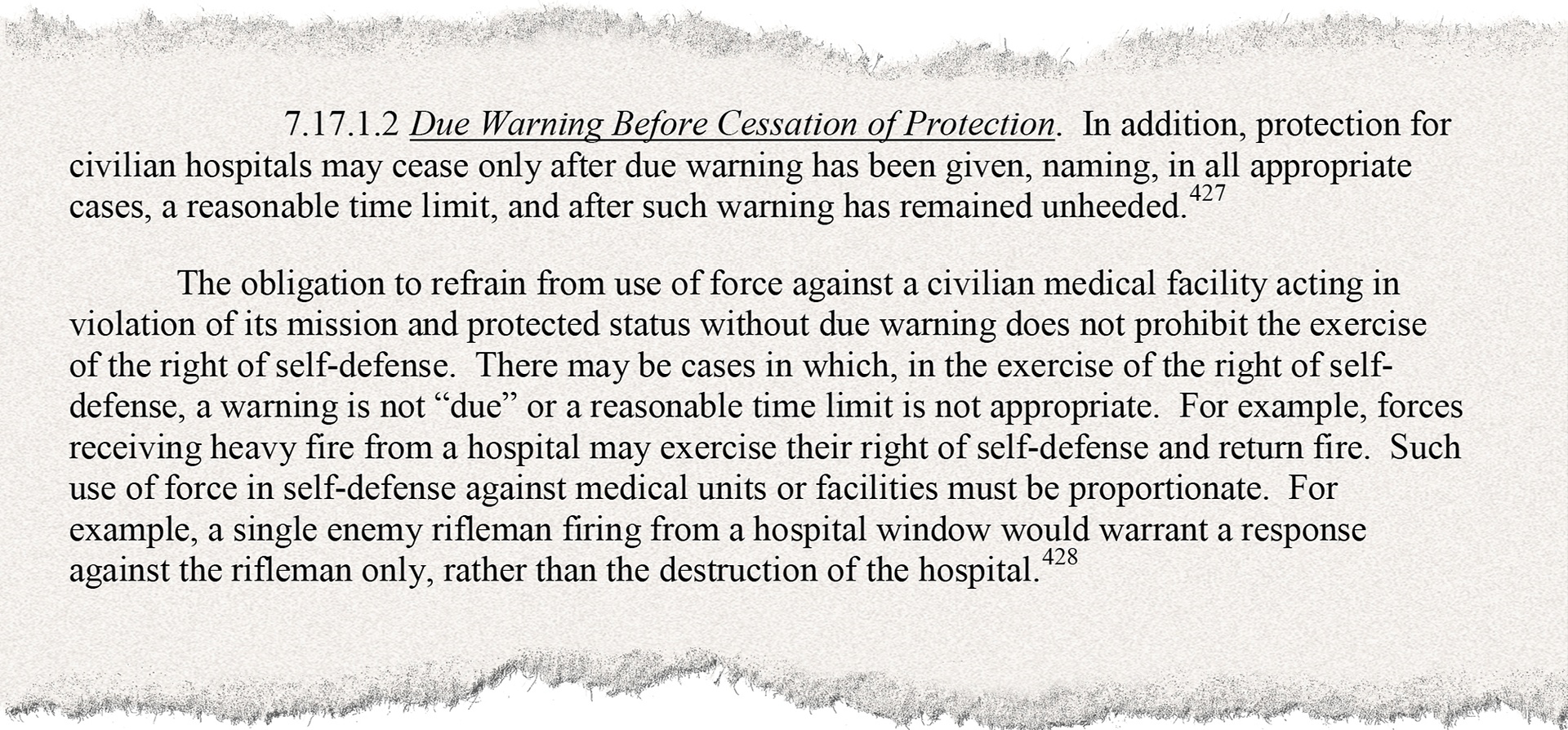
7.17.1.2 Due Warning Before Cessation of Protection. In addition, protection for civilian hospitals may cease only after due warning has been given, naming, in all appropriate cases, a reasonable time limit, and after such warning has remained unheeded.

2008-1

The obligation to refrain from use of force against a civilian medical facility acting in violation of its mission and protected status without due warning does not prohibit the exercise of the right of self-defense. There may be cases in which, in the exercise of the right of self- defense, a warning is not “due” or a reasonable time limit is not appropriate. For example, forces receiving heavy fire from a hospital may exercise their right of self-defense and return fire. Such use of force in self-defense against medical units or facilities must be proportionate. For example, a single enemy rifleman firing from a hospital window would warrant a response against the rifleman only, rather than the destruction of the hospital.

MSF has consistently denied that anyone was firing from the hospital; it has also insisted that it received no advance warning of the attack – on the contrary, MSF ensured that all US and Afghan forces had the co-ordinates of the hospital, and made frantic phone calls to try to stop the bombing once it started.

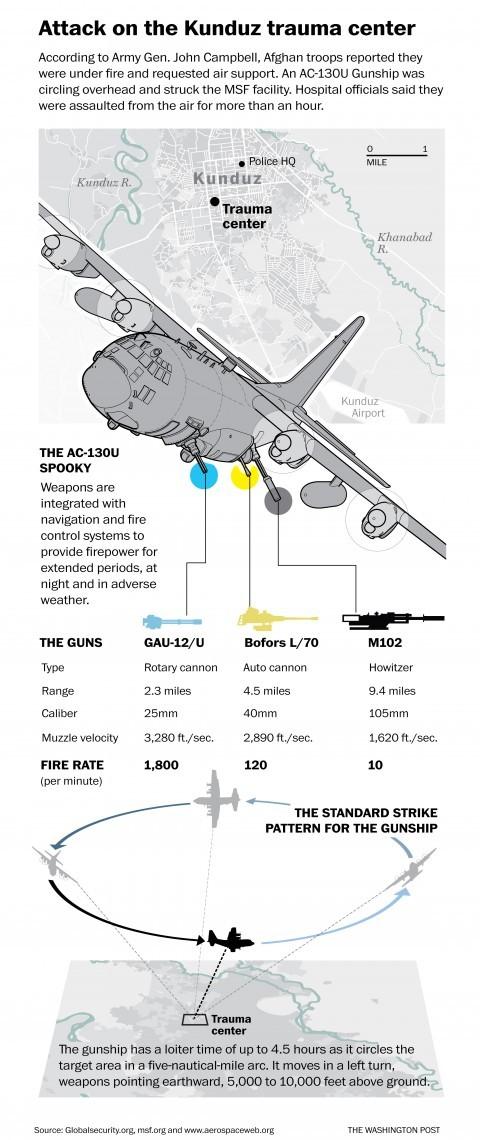
UPDATE (2):  A team from the Washington Post has produced a remarkably detailed report, ‘based on multiple interviews in Afghanistan and the United States with U.S. and Afghan military officials, Doctors Without Borders personnel and local Kunduz residents’; it includes maps and a graphic showing exactly what an AC-130 is capable of.

w512

As you can see, the illustration makes much of the aircraft’s concentrated firepower, unleashed as it circles counter-clockwise around the target in a five-mile orbit, but the AC-130 also has an extensive sensor suite on board (see ‘Angry Eyes (1)‘: an AC-130 was involved in the early stages of the Uruzgan incident).  The reporters do note that the aircraft is equipped with ‘low-light and thermal sensors that give it a “God’s eye [view]” of the battlefield in almost all weather conditions’ – but, as I’ve tried to show in my posts on Uruzgan (and as we know from other sources!), there’s no such thing as a God’s eye view.  Even so, the aircrew can surely have been in no doubt that they were bombing a hospital.

The Platform Edge

I should have drawn attention to these two further, vital resources in my post on Black Friday, Israel’s assault on Rafah during ‘Operation Protective Edge‘.

Gaza Platform INTRO SCREEN

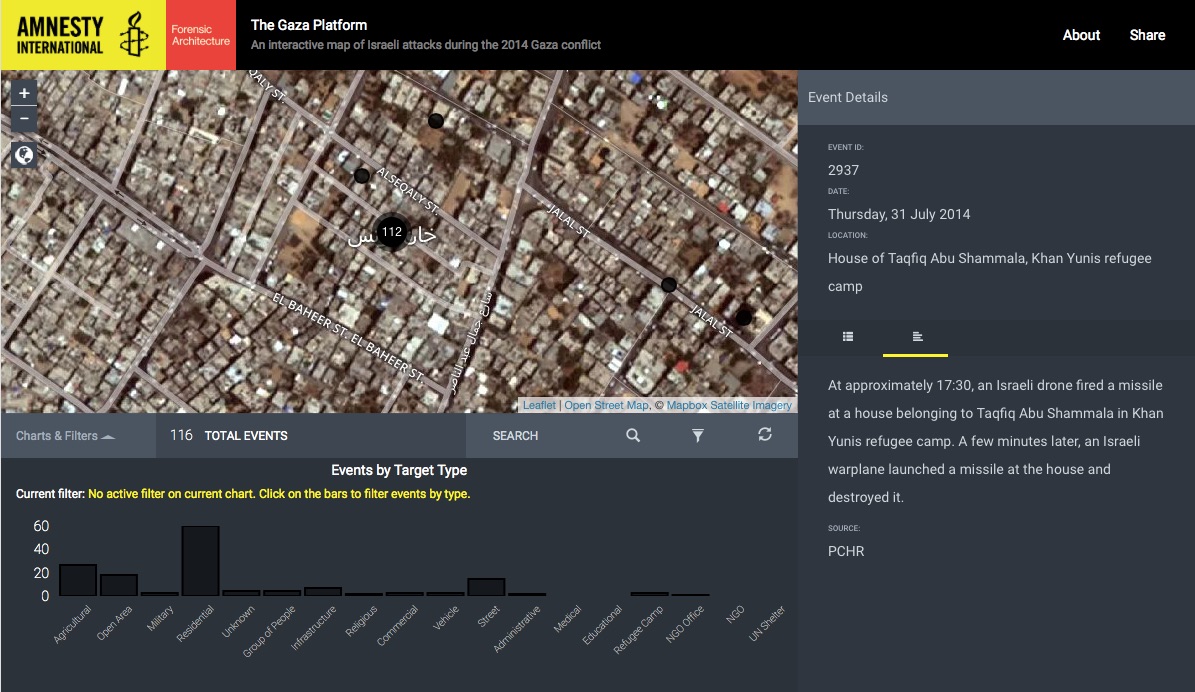
First, Forensic Architecture‘s wider collaboration with Amnesty International (in association with the Al-Mezan Centre for Human Rights/Palestinian Centre for Human Rights) has produced The Gaza Platform:

The Gaza Platform is an interactive map of attacks by Israeli forces on Gaza between 8 July and 26 August 2014.

It enables its users to explore a vast collection of data, collected on the ground by the Al Mezan Center for Human Rights and the Palestinian Centre for Human Rights (PCHR), as well as Amnesty International, during and after the conflict.

Produced through a year-long collaboration between Forensic Architecture and Amnesty International, the Gaza Platform is a new gateway to this precious, first-hand information: it not only gives access to a large quantity of otherwise dispersed data, but helps make sense of it.

The Gaza Platform is the most comprehensive public repository of information about attacks carried out during the 2014 Gaza conflict to date. At the time of its launch on 8 July 2015, it featured over 2,750 individual events, recording the deaths of more than 2,200 people, including 1,800 civilians and 600 children. As a digital interface, it enables access not only to text reports, but also to photos, videos, audio recordings and satellite imagery documenting the war – all in one place.

It is important to note that the Gaza Platform does not provide a complete record of the impact of Israeli attacks during the 2014 conflict. It does not cover every single attack that took place during the conflict, but only those for which a report is available. Therefore, the total number of casualties presented in the Gaza Platform falls short of the one recorded by the UN across the entire conflict.

However, the Gaza Platform does more than provide overall figures and statistics about the conflict. Each death is linked to a specific event, for which all available details and context are given, thus providing the granular details of each individual event recorded. It also helps to reveal trends by making links between dispersed individual events and detecting patterns of attacks across the 50-day time span of the conflict, thereby contributing to an assessment of the conduct of Israeli forces and its conformity or otherwise with the provisions of international humanitarian law (the laws of war). As such, the Gaza Platform is a tool aimed at uncovering the truth about the attacks on Gaza and contributing to accountability efforts for crimes under international law committed by both sides during the 2014 conflict, the third such conflict in six years.

According to Doug Bolton writing in the Independent:

Phillip Luther, the Director of Amnesty International‘s Middle East and North Africa programme, said it “has the potential to expose the systematic nature of Israeli violations committed during the conflict.”

He added: “Our aim it for it to become an invaluable resource for human rights investigators pushing for accountability for violations committed during the conflict.”…

Francesco Sebregondi, the director of the project at Forensic Architecture, said the map “exploits the power of new digital tools to shed light on complex events such as the latest war in Gaza.”

“It enables users to move across scales, from the granular details of each incident to the big picture of the overall conflict, by revealing connections between scattered events.”

I’m not going to link to them, but the hysterical response from apologists for the indiscriminate violence of the Israeli assault on Gaza shows that the Gaza Platform has hit a nerve: as it should.

Incidentally, there’s a short article in today’s Guardian about the ongoing transformation of humanities research: the growth of the ‘digital humanities’,  ‘tech-savvy’ analysis of large data sets, collaborations with non-academic professionals, and a determination to show how ‘research can benefit society’.  The Gaza Platform isn’t mentioned, but it surely exemplifies exactly what the author has in mind.

BLUMENTHAL 51 Day War

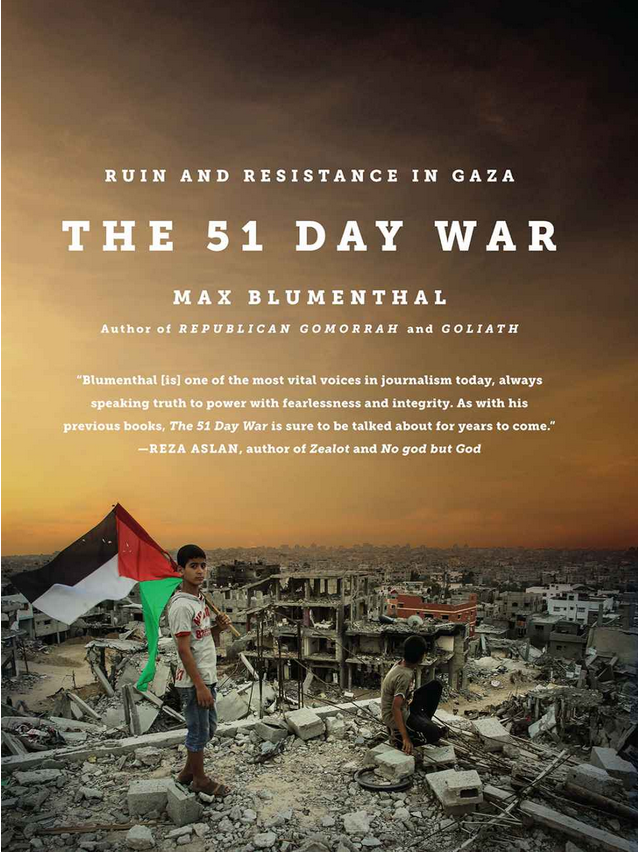
Second, Max Blumenthal‘s coruscating chronicle of The 51 Day War: ruin and resistance in Gaza, out now from Verso.  As Juan Cole put it, ‘Max Blumenthal audaciously takes in-your-face, on-the-ground journalism into the realm of geopolitics.’  You can find Glenn Greenwald‘s interview with Max at The Intercept here:

What shook me the most was how well I was treated in the rubble. How after interviewing families who would tell me about witnessing their neighbors being destroyed by a missile, that they would beseech me to have lunch with them. I didn’t even know where the lunch would come from. They would chase me down after denouncing my government and insisting that the Obama administration was no better than Netanyahu, and hand me sweets, and tell me that they see a clear difference between the American people and the American government. I mean, that kind of treatment showed me how impeccable the character of these people was, even as they were facing their own immiseration and ruin.

That was kind of deceptive, because I started to adjust, in a weird way, to being in the rubble with these people. Then the bombing started again, and then I had to deal with the terror of night after night of bombings, and naval shelling throughout the day, and drones swooping closely overhead, searching for targets. And I became shell-shocked. So I couldn’t have even imagined going through 51 days of that, especially as a child under the age of seven.

We have to recognize that the Gaza Strip is a ghetto of children. The majority of the people in the Gaza strip are under age 18, and a substantial percentage of those under 18 are under the age of seven, which means they have known nothing in their lives but these three atrocious wars, which have left almost 20 percent of the entire area of the Gaza Strip in ruins.

What’s on those children’s mind? What kind of lives can they have? Can they ever be normal as they go through life without therapy, without relief, without recourse and without justice, with continuous traumatic stress disorder?

Black Friday

Just released: a joint investigation by Amnesty International and Forensic Architecture reconstructs Israel’s siege of Rafah during its assault on Gaza in 2014.  You can read the Executive Summary here and access the full report, Black Friday: carnage in Rafah, here.

In Rafah, the southernmost city in the Gaza Strip, a group of Israeli soldiers patrolling an agricultural area west of the border encountered a group of Hamas fighters posted there. A fire fight ensued, resulting in the death of two Israeli soldiers and one Palestinian fighter. The Hamas fighters captured an Israeli officer, Lieutenant Hadar Goldin, and took him into a tunnel. What followed became one of the deadliest episodes of the war; an intensive use of firepower by Israel, which lasted four days and killed scores of civilians (reports range from at least 135 to over 200), injured many more and destroyed or damaged hundreds of homes and other civilian structures, mostly on 1 August.

In this report, Amnesty International and Forensic Architecture, a research team based at Goldsmiths, University of London, provide a detailed reconstruction of the events in Rafah from 1 August until 4 August 2014, when a ceasefire came into effect. The report examines the Israeli army’s response to the capture of Lieutenant Hadar Goldin and its implementation of the Hannibal Directive – a controversial command designed to deal with captures of soldiers by unleashing massive firepower on persons, vehicles and buildings in the vicinity of the attack, despite the risk to civilians and the captured soldier(s).

The report recounts events by connecting various forms of information including: testimonies from victims and witnesses including medics, journalists, and human rights defenders in Rafah; reports by human rights and other organizations; news and media feeds, public statements and other information from Israeli and Palestinian official sources; and videos and photographs collected on the ground and from the media.

Satellite imagery Rafah 1 August 2014

Amnesty International and Forensic Architecture worked with a number of field researchers and photographers who documented sites where incidents took place using protocols for forensic photography. Forensic Architecture located elements of witness testimonies in space and time and plotted the movement of witnesses through a three-dimensional model of urban spaces. It also modelled and animated the testimony of several witnesses, combining spatial information obtained from separate testimonies and other sources in order to reconstruct incidents. Three satellite images of the area, dated 30 July, 1 August and 14 August, were obtained and analysed in detail; the image of 1 August reveals a rare overview of a moment within the conflict. Forensic Architecture also retrieved a large amount of audiovisual material on social media and employed digital maps and models to locate evidence such as oral description, photography, video and satellite imagery in space and time. When audiovisual material from social media came with inadequate metadata, Forensic Architecture used time indicators in the image, such as shadow and smoke plumes analysis, to locate sources in space and time….

Public statements by Israeli army commanders and soldiers after the conflict provide compelling reasons to conclude that some attacks that killed civilians and destroyed homes and property were intentionally carried out and motivated by a desire for revenge – to teach a lesson to, or punish, the population of Rafah for the capture of Lieutenant Goldin.

There is consequently strong evidence that many such attacks in Rafah between 1 and 4 August were serious violations of international humanitarian law and constituted grave breaches of the Fourth Geneva Convention or other war crimes.

It really is worth accessing the full report and closely examining the video animations produced by Forensic Architecture.

Lambert Hannibal Directive JPEG

You can find a commentary on the project and its wider implications, which also draws on a lecture FA’s Eyal Weizman gave at Médecins sans Frontières in Paris earlier this month, by Léopold Lambert over at Warscapes here: ‘The Hannibal Directive and the economy of lives: making sense of Black Friday in Gaza‘.

The Hannibal Directive exists because of the historical asymmetrical characteristics of prisoner exchanges between the Israeli government and Palestinian and Lebanese political groups like Hamas and Hezbollah. The armed sections of these groups evidently rely on this precise asymmetrical relationship and undertake kidnappings of one or multiple Israeli soldiers when possible to negotiate the liberation of several Palestinians held in Israeli prisons. However, the economy of lives that can be perceived through this asymmetry is profoundly disturbing. The hidden message in the enunciation of the 2011 Shalit exchange is the following: One Israeli life is worth 1,027 Palestinian lives. The very fact that many of us know Shalit’s name, but not one of the 1,027 liberated Palestinian prisoners’, is symptomatic. In the case of “Black Friday,” this economy of lives exposes its violence through even more extreme and perverse forms: for the Israeli army, 135 to 200 Palestinian lives are worth ending in order to end an Israeli one, so to avoid freeing Palestinian prisoners.

We should not think of the concept of economy of lives as a retrospective reading of the Israeli Army’s crimes: This logic is at work in most Western military decision making, as Weizman shows in his book The Least of All Possible Evils (Verso 2011) through interviews with Human Rights Watch consultant Marc Garlasco, a former Pentagon “chief of high-value targeting” during the first years of the 2003 US war in Iraq. For each airstrike against an Iraqi political or military figure that Garlasco designed, he had to follow a “correct balance of civilian casualties in relation to the military value of a mission. ” In other words, there is a number of civilians the US army allows itself to kill as “collateral damage” when targeting a strategic assassination. In Iraq, this number was 30, Garlasco reveals. “In this system of calculation,” writes Weizman, “twenty-nine deaths designates a threshold. Above it, in the eyes of the US military lawyers, is potentially ‘unlawful killing’; below it, ‘necessary sacrifice.’” Here, again, lives are disincarnated into statistics calculated in relation to military and ideological objectives.

AI Unlawful and deadly JPEGI should not that there are also important critiques of Amnesty’s other investigations into ‘Operation Protective Edge’, most significantly from Normal Finkelstein at Jadaliyya.  

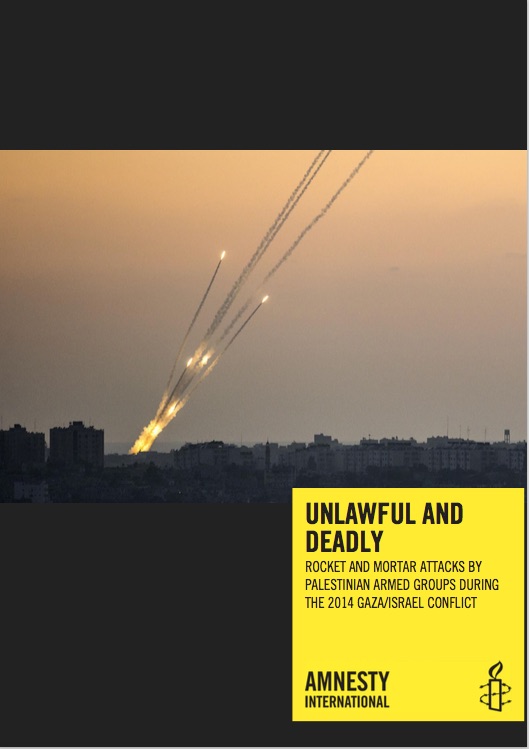
He takes particular exception to Amnesty’s Unlawful and Deadly: Rocket and mortar attacks by Palestinian armed groups during the 2014 Gaza/Israel conflict.

He insists that Amnesty too often cites official Israeli sources in ways that ‘magnify Hamas’s and diminish Israel’s criminal culpability’. You can access what he describes as his ‘forensic analysis’ of that report in two parts, here and here.

My own posts on ‘Operation Protective Edge’ are here, here, here, here, here (my own attempt at a forensic analysis of sorts), and here.

Legal battles

DoD Law of War ManualFollowing up my comments on the Pentagon’s new Law of War Manual, issued last month: commentaries are starting to appear (it’s not surprising these are taking so long: the new version runs to 1200 pages).

Just Security is hosting a forum on the Manual, organised by Eric Jensen and Sean Watts.  They are both deeply embedded in the debate: Eric is a Professor at Brigham Young Law School and was formerly Chief of the Army’s International Law Branch and Legal Advisor to US military forces in Iraq and Bosnia, while Sean is a Professor at Creighton University Law School and on the Department of Law faculty at the United States Military Academy at West Point; he is also Senior Fellow at the NATO Cooperative Cyber Defence Centre of Excellence and served in the US Army’s Judge Advocate General’s Corps.

In the opening salvo, Sean focuses on the Manual‘s identification of three core principles:

“Three interdependent principles – military necessity, humanity, and honor – provide the foundation for other law of war principles, such as proportionality and distinction, and most of the treaty and customary rules of the law of war.”

The implications of this formulation are more far reaching than you might think.  Necessity, proportionality and distinction have long been watchwords, but the inclusion – more accurately, Sean suggests, the resurrection – of ‘humanity’ and ‘honor’ is more arresting: in his view, the first extends the protection from ‘unnecessary suffering’ while the second ‘marks an important, if abstract revival of good faith as a legal restraint on military operations’.

Watch that space for more commentaries, inside and outside the armed camp.

Others have already taken a much more critical view of the Manual.

Claire Bernish draws attention to two particularly disturbing elements here.  First, like several other commentators, she notes passages that allow journalists to be construed as legitimate targets.  While the Manual explains that ‘journalists are civilians’ it also insists there are cases in which journalists may be ‘members of the armed forces […] or unprivileged belligerents.’   Apparently, Claire argues,

‘reporters have joined the ranks of al-Qaeda in this new “unprivileged belligerent” designation, which replaces the Bush-era term, “unlawful combatants.” What future repercussions this categorization could bring are left to the imagination, even though the cited reasoning—the possibility terrorists might impersonate journalists—seems legitimate. This confounding label led a civilian lawyer to say it was “an odd and provocative thing for them to write.”‘

Other commentators, mindful of incidents in which the US military has been accused of targeting independent (non-embedded) journalists, have read this as far more than provocation.  Like other claims registered in the Manual, this has implications for other armed forces – and in this particular case, for example, Ken Hanly points out that ‘what is allowed for NATO and the US is surely legitimate for Israel.’

This is not as straightforward as he implies, though.  Eric Jensen agrees that

‘[T]he writers had to be aware this manual would also be looked to far beyond the US military, including by other nations who are formulating their own law of war (LOW) policies, allies who are considering US policy for purposes of interoperability during combined military operations, transnational and international organizations such as the International Committee of the Red Cross (ICRC) who look to such manuals when considering the development of customary practice, and even national and international tribunals who adjudicate LOW questions with respect to the criminality of individual actions.

While Eric acknowledges ‘the inevitable use of [the Manual] in the determination of customary practice.’ however, he also argues that the authors of the Manual go out of their way to preclude this possibility: they ‘wanted to be very clear that they did not anticipate they were writing into law the US position on the law of war.’

Second, Claire draws attention to a list of weapons with specific rules on use’ (Section 6.5.1), which includes cluster munitions, herbicides and explosive ordnance, and a following list of other ‘lawful weapons’ (Section 6.5.2) for which ‘there are no law of war rules specifically prohibiting or restricting the following types of weapons by the U.S. armed forces’; the list includes drones and Depleted Uranium munitions.  These designations are all perfectly accurate, but Claire’s commentary fastens on the fact that at least two of these weapons have been outlawed by many states.  She draws attention to the hideous consequences of DU and cluster bombs, and explains that cluster bombs:

‘are delineated in the manual as having “Specific Rules on Use”— notably, such weapons’ use “may reflect U.S. obligations under international law” [emphasis added]. While this is technically apt, cluster bombs have been banned by the 2008 Convention on Cluster Munitions—which was agreed to by 116 countries around the world. The U.S. stands out in joining infamous human rights violator, Saudi Arabia, in its refusal to sign. These insidious munitions leave unexploded ordnance for months, or even decades, after the originating bomb was dropped. Children are often maimed or killed when they unwittingly mistake them for toys.’

Meanwhile, also at Just Security but seemingly not part of the Forum, Adil Ahmad Haque has attacked the Manual‘s discussion of ‘human shields’:

The Defense Department apparently thinks that it may lawfully kill an unlimited number of civilians forced to serve as involuntary human shields in order to achieve even a trivial military advantage. According to the DOD’s recently released Law of War Manual, harm to human shields, no matter how extensive, cannot render an attack unlawfully disproportionate. The Manual draws no distinction between civilians who voluntarily choose to serve as human shields and civilians who are involuntarily forced to serve as human shields. The Manual draws no distinction between civilians who actively shield combatants carrying out an attack and civilians who passively shield military objectives from attack. Finally, the Manual draws no distinction between civilians whose presence creates potential physical obstacles to military operations and civilians whose presence creates potential legal obstacles to military operations. According to the Manual, all of these count for nothing in determining proportionality under international law.

If true, this would dramatically qualify the discussion of ‘humanity’ and ‘honor’ above; but, not surprisingly, Charles Dunlap will have none of it.  He objects not only to Adil’s reading of the Manual, but also the logic that lies behind his criticism:

Killing those who do the vast majority of the killing of civilians can save lives. It really can be that simple.

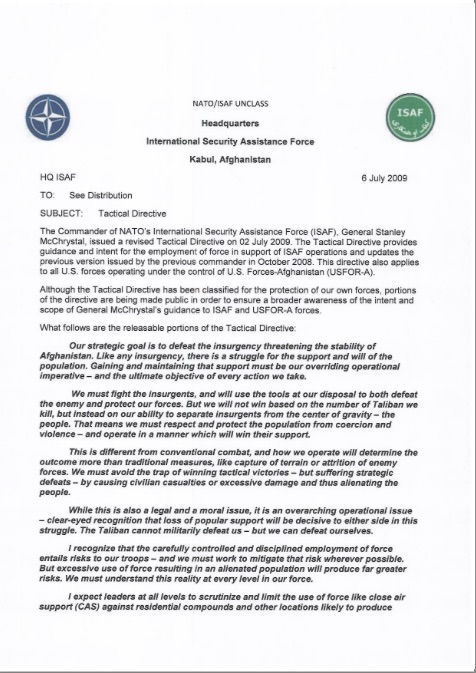
Experience shows that well-meaning efforts to curb the use of force can have disastrous effects on civilians. Think about the restrictions on airstrikes imposed by Gen. Stanley McChrystal in Afghanistan in mid-2009. The result? By the time he was fired a year later in June 2010, civilian casualties had jumped a heart-rending 31% entirely because of increased killings by anti-government forces. (In addition, casualties among friendly troops hit an all-time high in 2010.)
McChrystal Tactical Directive 1

[The unclassified section of McChrystal’s Tactical Directive (above) is here]

When Gen. David Petraeus took command in mid-2010, he took a different, more aggressive approach. While still scrupulously adhering to the law of war, he clarified the rules of engagement in a way that produced a tripling of the number of airstrikes. The result? The increase in civilian casualties was cut in half to 15% by the end of 2010. Under Petraeus’ more permissive interpretation of the use of force against the Taliban and other anti-government forces, the increase the following year was cut almost in half again to 8% (and losses of friendly troops fell 20%). To reiterate, although counterintuitive to some critics, restricting force by law or policy can actually jeopardize the lives of the civilians everyone wants to protect.

Michael O’Hanlon at the Brookings Institue makes exactly the same argument about the Manual here (scroll down), but Dunlap’s sense is much sharper: the Manual, he says, ‘is designed to win wars in a lawful way that fully internalizes, as it says itself on several occasions, the “realties of war.”’  This is immensely important because in effect it acknowledges that neither the Manual nor the laws of war are above the fray.  If the Manual ‘is designed to win wars in a lawful way’ that is precisely because law is in the army’s baggage train, fully incorporated into the juridification of later modern war.  Law is at once a powerful weapon and a moving target.
Future imperfect and tense

A clutch of forthcoming books on war that seek, in different ways, to illuminate dimensions of what I’ve been calling ‘later modern war’:

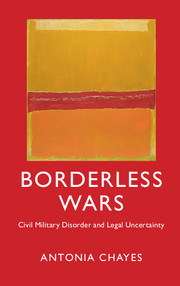
Antonia ChayesBorderless Wars (due in August at an eye-popping price from Cambridge University Press):

9781107109346In 2011, Nasser Al-Awlaki, a terrorist on the US ‘kill list’ in Yemen, was targeted by the CIA. A week later, a military strike killed his son. The following year, the US Ambassador to Pakistan resigned, undermined by CIA-conducted drone strikes of which he had no knowledge or control. The demands of the new, borderless ‘gray area’ conflict have cast civilians and military into unaccustomed roles with inadequate legal underpinning. As the Department of Homeland Security defends against cyber threats and civilian contractors work in paramilitary roles abroad, the legal boundaries of war demand to be outlined. In this book, former Under Secretary of the Air Force Antonia Chayes examines these new ‘gray areas’ in counterinsurgency, counter-terrorism and cyber warfare. Her innovative solutions for role definition and transparency will establish new guidelines in a rapidly evolving military-legal environment.

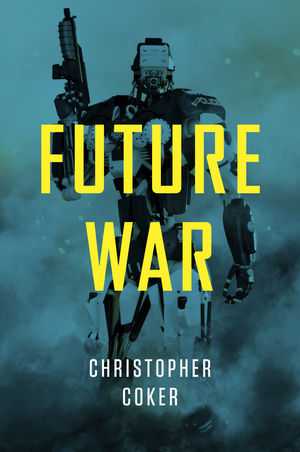
Christopher Coker‘s Future War (due in September from Polity):

COKER Future WarWill tomorrow’s wars be dominated by autonomous drones, land robots and warriors wired into a cybernetic network which can read their thoughts? Will war be fought with greater or lesser humanity? Will it be played out in cyberspace and further afield in Low Earth Orbit? Or will it be fought more intensely still in the sprawling cities of the developing world, the grim black holes of social exclusion on our increasingly unequal planet? Will the Great Powers reinvent conflict between themselves or is war destined to become much ‘smaller’ both in terms of its actors and the beliefs for which they will be willing to kill?

In this illuminating new book Christopher Coker takes us on an incredible journey into the future of warfare. Focusing on contemporary trends that are changing the nature and dynamics of armed conflict, he shows how conflict will continue to evolve in ways that are unlikely to render our century any less bloody than the last. With insights from philosophy, cutting-edge scientific research and popular culture, Future War is a compelling and thought-provoking meditation on the shape of war to come.

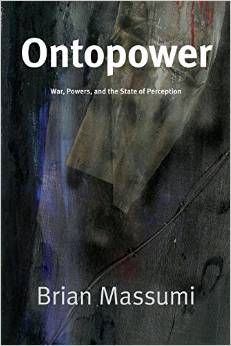
Brian Massumi‘s Ontopower: War, Powers, and the State of Perception (due in September from Duke University Press):

MASSUMI OntopowerColor coded terror alerts, invasion, drone war, rampant surveillance: all manifestations of the type of new power Brian Massumi theorizes in Ontopower. Through an in-depth examination of the War on Terror and the culture of crisis, Massumi identifies the emergence of preemption, which he characterizes as the operative logic of our time. Security threats, regardless of the existence of credible intelligence, are now felt into reality. Whereas nations once waited for a clear and present danger to emerge before using force, a threat’s felt reality now demands launching a preemptive strike. Power refocuses on what may emerge, as that potential presents itself to feeling. This affective logic of potential washes back from the war front to become the dominant mode of power on the home front as well. This is ontopower—the mode of power embodying the logic of preemption across the full spectrum of force, from the “hard” (military intervention) to the “soft” (surveillance). With Ontopower, Massumi provides an original theory of power that explains not only current practices of war but the culture of insecurity permeating our contemporary neoliberal condition.

Wars over the laws of war

DoD Law of War Manual

The Pentagon has just published a new edition of its Law of War Manual: you can download all 1200 pages here.  From the Foreword by Stephen Preston, the Pentagon’s General Counsel:

The law of war is a part of our military heritage, and obeying it is the right thing to do. But we also know that the law of war poses no obstacle to fighting well and prevailing. Nations have developed the law of war to be fundamentally consistent with the military doctrines that are the basis for effective combat operations. For example, the self-control needed to refrain from violations of the law of war under the stresses of combat is the same good order and discipline necessary to operate cohesively and victoriously in battle. Similarly, the law of war’s prohibitions on torture and unnecessary destruction are consistent with the practical insight that such actions ultimately frustrate rather than accomplish the mission.

Thanks to Marty Lederman at Just Security: watch that space for more commentary (I think….)

W Hays Parks 2003In the meantime, for some of the politics involved in the protracted publication process of the new manual (and an explanation of the title of Marty’s post), see Edwin Williamson and Hays Parks [right] writing in the neo-conservative standard bearer the Weekly Standard in July 2013 here, who – even as they insist on their non-partisan, apolitical and thoroughly objective perspective – nailed their colours to the mast in no uncertain terms:

From the outset it was agreed that the manual would be apolitical—it would be based on the law rather than political arguments inconsistent with the law of war. For example, the working group rejected arguments by some Bush administration officials that the law of war did not protect captured al Qaeda and that “enhanced interrogation procedures,” including waterboarding, should not be banned.

Obama administration political appointees, though, have aggressively sought changes in the manual to conform to their political philosophies or legal arguments in detainee litigation, pushing for rules and principles that vary from longstanding law of war treaty-based terminology and norms previously accepted by Republican and Democratic administrations.

One of the more egregious changes proposed by State Department political appointees and human rights activists on the National Security Council was the removal of a paragraph acknowledging that the law of war is lex specialis—the controlling law in armed conflict. Denying the lex specialis status of the law of war would enable activists to inject human rights law into the manual and onto the battlefield. Deletion of the lex specialis text was apparently not sought on the basis that it was legally incorrect, but, we suspect, because it was inconsistent with their political agenda.

Such a change would impose restrictions on U.S. forces in combat so that deadly force could be used only against an enemy who had refused a surrender opportunity or who posed an “imminent threat.” These requirements would place our fighters on a footing comparable to a police officer in the United States in a peacetime environment and at an extreme and unprecedented risk of being killed by the enemy or facing “war crimes” allegations by human rights activists.

Justice Department efforts toward the draft manual echo its continued post-9/11 view of the battle with al Qaeda entirely (and incorrectly) from a law enforcement perspective. It seeks to bring the manual text into conformity with terms and arguments it uses in court (many of which are inconsistent with the law of war).

A change Justice Department lawyers sought involved civilians on the battlefield. Under the law of war, a civilian loses immunity from direct attack if he or she “takes a direct part in hostilities.” The working group agreed that this participation does not, however, necessarily constitute criminal activity. Without consulting with working group experts or senior DoD or State policymakers, Justice Department attorneys have asserted that it does. This extreme (and incorrect) position would place at risk of enemy prosecution the substantial number of U.S. and foreign civilians who accompany our armed forces in the field in time of war and whose support is a major basis for the way in which the United States—with congressional approval—determines its military force structure. Justice Department lawyers created new law to enable the department to win its cases against al Qaeda, disregarding battlefield consequences for civilians lawfully accompanying our own forces.

More from Charles Kels here.

Playing a blinder

A characteristically smart post from Larry Lewis at War on the Rocks about Obama’s promise to investigate the mistakes made in the CIA-directed drone strike that unwittingly killed two hostages in Pakistan in January 2015.  ‘We’ve been on that path before, in Afghanistan,’ he writes, ‘and we know where it leads: more promises followed by a repeat of similar mistakes.’

Larry explains that the US military was causing an ‘unacceptable number’ of civilian casualties in Afghanistan between 2006 and 2009:

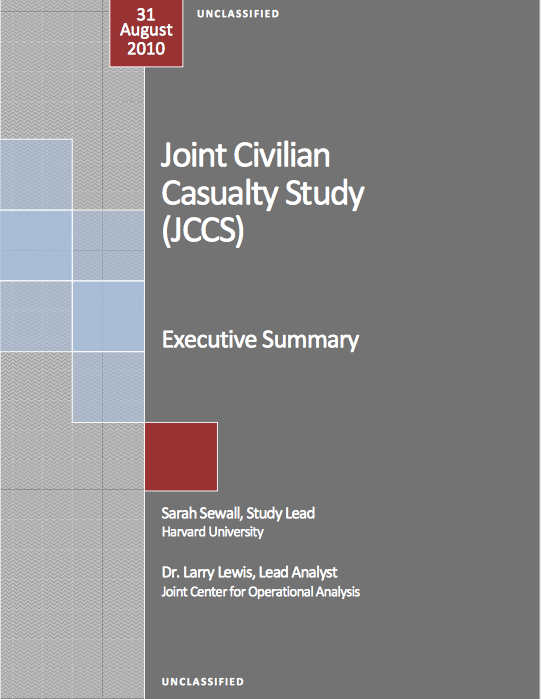
JCCSWhen an incident occurred, they investigated the incident, made changes to guidance, and promised to keep such an incident from happening again. But these incidents kept happening. So the military repeated this ineffective review process again and again. This “repeat” cycle was only broken when military leaders approved the Joint Civilian Casualty Study, a classified outside review requested by General Petraeus. This effort had two key differences from earlier efforts. First, it was independent, so it was able to overcome false assumptions held by operating forces that contributed to their challenges. And second, the study looked at all potential civilian casualty incidents over a period of years, not just the latest incident. This approach helped identify systemic issues with current tactics and policies as the analysis examined the forest and not just the nearest tree. This study also considered different sets of forces operating within Afghanistan and their relative propensity for causing civilian casualties.

You can access the unclassified Executive Summary – co-written by Larry with Sarah Sewell – here.  I’ve noted Larry’s important work on civilian casualties before – here, here and here – but his short Op-Ed raises two issues that bear emphasis.

The first is that it is a mistake to abstract strikes carried out by a Predator or a Reaper from air strikes carried out from conventional platforms; the latter are often facilitated and even orchestrated by a UAV – as in the ‘signature’ case of the Uruzgan strike in 2010 – but, pace some drone activists, our central concern should surely be the wider matrix of military violence.  This also implies the need to articulate any critique of CIA-directed drone strikes in Pakistan with the use of air power in Afghanistan (and not only because USAF pilots fly the ‘covert’ missions across the border).  Here General Stanley McChrystal‘s Tactical Directive issued in July 2009 that directly addressed civilian casualties is a crucial divide.   As Chris Woods emphasizes in Sudden Justice,

‘Radically different tactics were now being pursued on either side of the “AfPak” border…. Even as Stanley McChrystal was cutting back on airstrikes in Afghanistan, the CIA was escalating its secret air war in Pakistan’s tribal areas.’

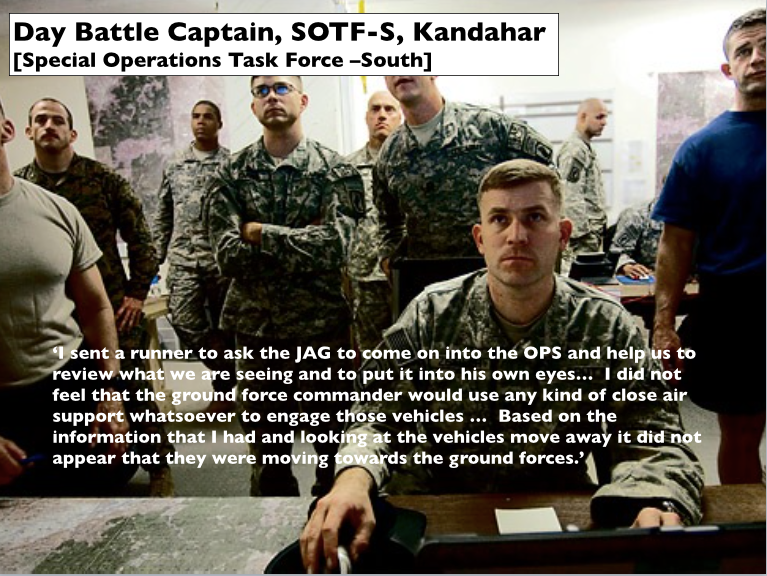
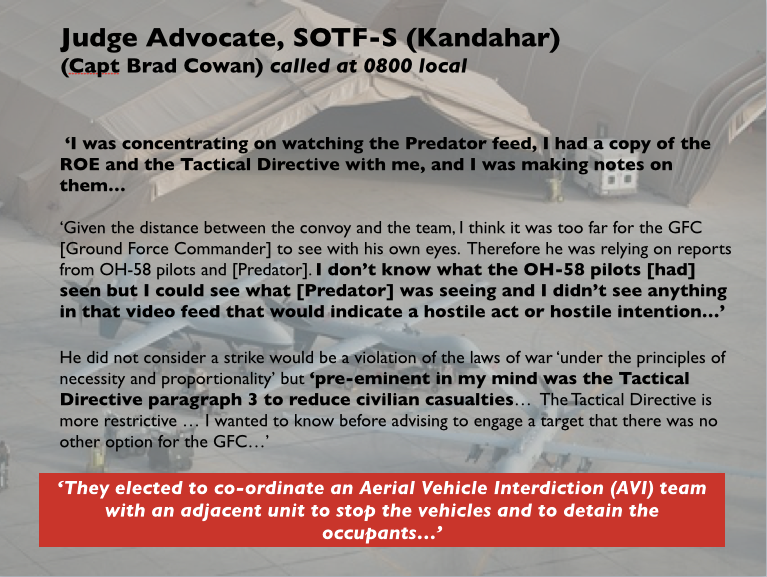
The second issue is the extraordinary partitions – blinkers might be more accurate – that seem to be imposed on military operations and investigations.  In the case of the Uruzgan attack, for example, a military lawyer was called in at the eleventh hour to monitor the video feeds from the Predator as it tracked a ‘convoy’ (a term surely as leading as ‘Military-Aged Male’) in the early morning.  As the next two slides show, taken from my ‘Angry Eyes’ presentation, the JAG knew the Rules of Engagement (ROE) and the Tactical Directive; he obviously also knew the legal requirements of proportionality,  distinction and the rest.

Angry Eyes:1

Angry Eyes:2

Knowing the ROE, the Tactical Directive and the formal obligations of international law is one thing (or several things): but what about ‘case law’, so to speak?  What about knowledge of other, similar incidents that could have informed and even accelerated the decision-making process?  In this case, before the alternative course of action could be put into effect and an ‘Aerial Vehicle Interdiction’ set in motion – using helicopters to halt the three vehicles and determine what they were up to – two attack helicopters struck the wholly innocent ‘convoy’ and killed 15-21 civilians.  Fast forward to the subsequent, I think forensic Army investigation.  This is the most detailed accounting of a ‘CIVCAS’ incident I have read (and you’ll be able to read my analysis of it shortly), and yet here too – even with senior military legal advisers and other ‘subject experts’ on the investigating team – there appears to be no reference to other, similar incidents that could have revealed more of the ‘systemic issues’ to which Larry so cogently refers.

This is made all the stranger because there is no doubt – to me, anyway – that the US military takes the issue of civilian casualties far more seriously than many of its critics allow.

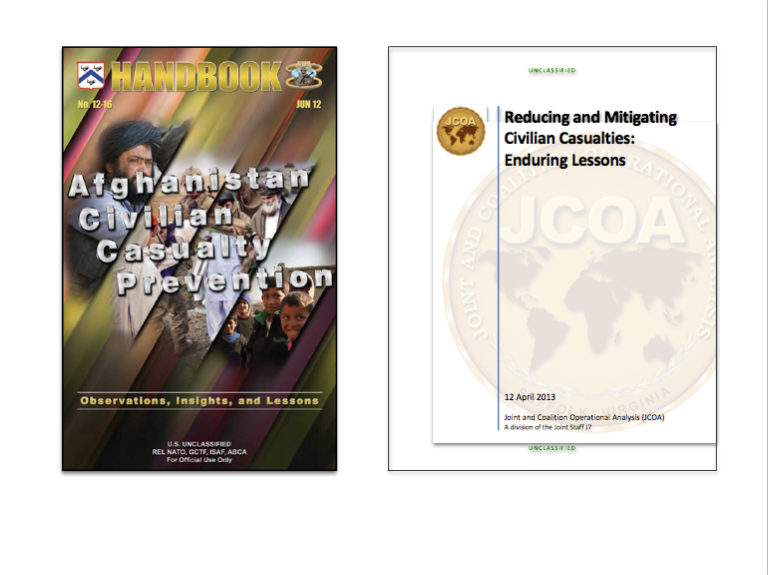
CIVCAS