The Long War

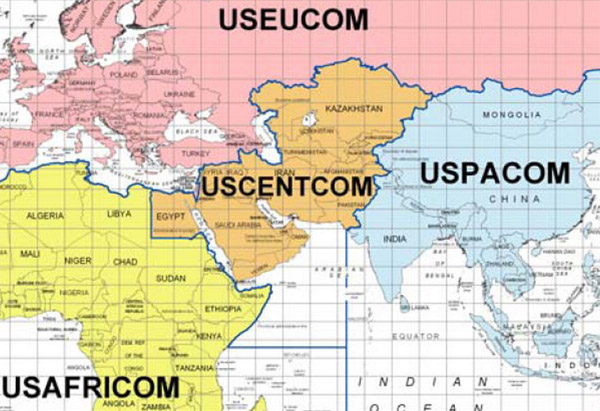
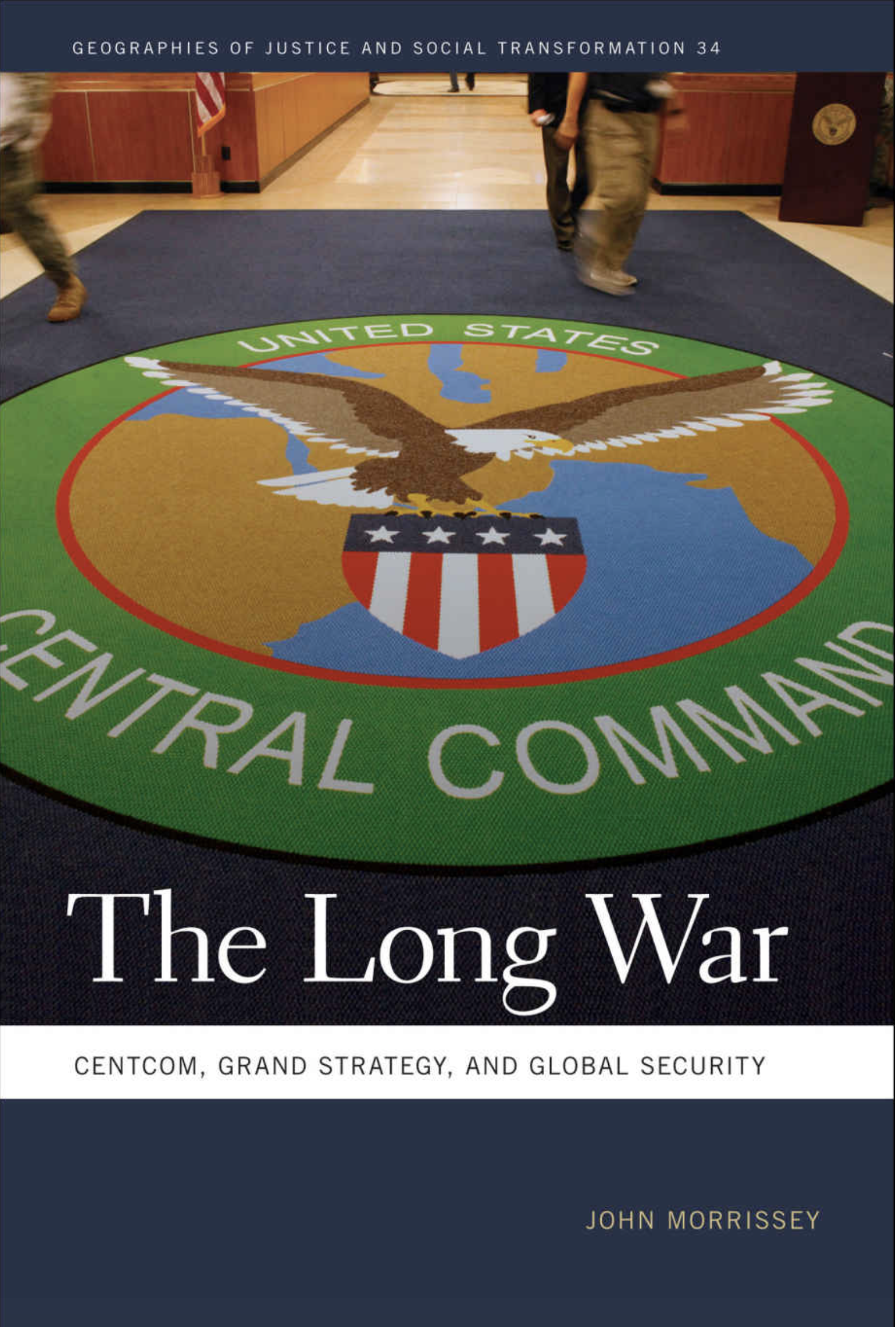
I’m just back from much needed R&R in Croatia – hence the long silence – and I’m hoping to resume normal service now…  Waiting for me on my return was a copy of John Morrissey‘s new book, The Long War: CENTCOM, grand strategy and global war, published by the University of Georgia Press in its Geographies of Justice and Social Transformation series.

Many readers will be familiar with John’s penetrating essays on US Central Command – and if you’re not a visit to Google Scholar will do the trick – but this is a plenary edition:

Nowhere has the U.S. military established more bases, lost more troops, or spent more money in the last thirty years than in the Middle East and Central Asia. These regions fall under the purview of United States Central Command (CENTCOM); not coincidentally, they include the most energy-rich places on earth. From its inception, CENTCOM was tasked with the military and economic security of this key strategic area, the safeguarding of commercial opportunities therein, and ultimately the policing of a pivotal yet precarious space in the broader global economy. CENTCOM calls this mission its “Long War.” This book tells the story of that long war: a war underpinned by a range of entangled geopolitical and geoeconomic visions and involving the use of the most devastating Western interventionary violence of our time.

Starting with a historical perspective, John Morrissey explores CENTCOM’s Cold War origins and evolution, before addressing key elements of the command’s grand strategy, including its interventionary rationales and use of the law in war. Engaging a wide range of scholarship on neoliberalism, imperialism, geopolitics, and Orientalism, the book then looks in-depth at the military interventions CENTCOM has spearheaded and critically assesses their consequences in terms of human geography.

Recent books on CENTCOM have focused on command structures, intelligence issues, and interpersonal rivalries. In contrast, The Long War asks critical questions about CENTCOM’s leading role in shaping and enacting U.S. foreign policy over the last thirty years. The book positions CENTCOM pivotally in the story of U.S. global ambition over this period by documenting its efforts to oversee a global security strategy defined in military-economic terms and enabled via specific legal-territorial tactics. This is an important new study on the blurring of war and economic aims on a global scale.

Here are two endorsements.  First, Simon Dalby (Balsillie School):

“This book is a compelling geographic analysis of the role of law and its geopolitical correlates in the current American global security policy that perpetuates so many violent practices in the ‘distant’ places of South West Asia.”

Second, Rosalind Petchesky (CUNY):

“Morrissey’s impeccably researched history of CENTCOM uncovers the roots of ‘national security’ as the sacred mantra of U.S. foreign and domestic policy—roots that long predate Donald Trump or even the post-9/11 ‘war on terror.’ The Long War not only sheds critical light on why the U.S. has remained bogged down for a quarter-century in the Middle East and Central Asia in unending war and fossil fuel mania, it also helps us to understand why an ex-CEO of Exxon became U.S. Secretary of State and why Israel remains the U.S.’s closest and perhaps last strategic partner in the disastrous global security game. An invaluable book for today.”

And the Contents List:

1  Shaping the Central Region for the 21st Century: CENTCOM’s Long War

2  CENTCOMN Activates: Cold War geopolitics and global ambition

3  Envisioning the Middle East: New imperial regimes of truth

4  Posturing for global security: Territory, law fare, and biopolitics

5  Military-economic securitization: Closing the neoliberal gap

6  No Endgame: the long war for global security

‘I saw my city die’

I’ve been in Copenhagen and in Nijmegen talking about the war in Syria, presenting both updated versions of The Death of the Clinic (on attacks on hospitals and medical facilities: see here, here and – for my first update – here) and a new presentation, Cities under siege in Syria.

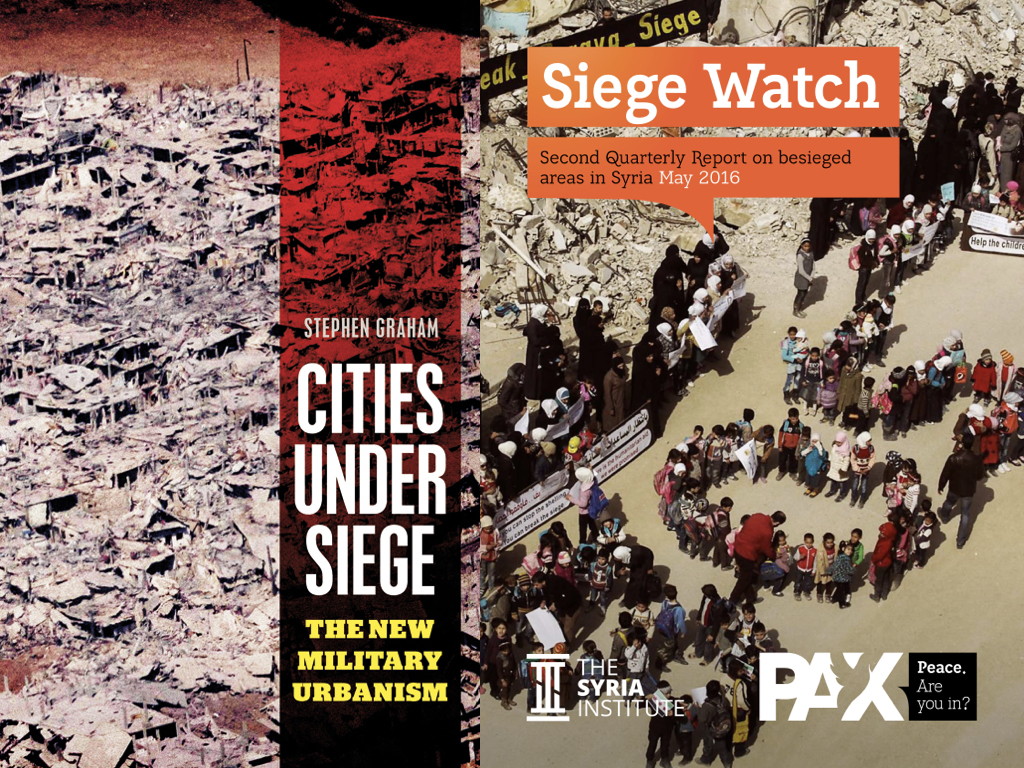
The new presentation ties those violations of medical neutrality – bluntly, war crimes – into the conduct of siege warfare in Syria and elsewhere and tries to recover the experiences and survival strategies of people and communities living under those desperate conditions (a far cry from my good friend Steve Graham‘s ‘new military urbanism‘, and a catastrophic combination of spectacular, episodic violence through bombing and shelling, and the slow violence of deprivation, dislocation and starvation).

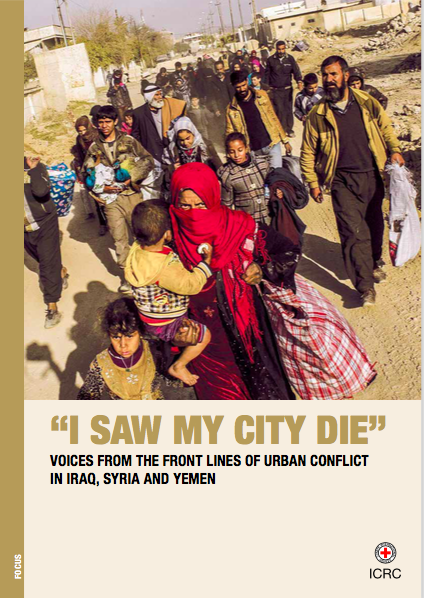
More on this soon, but on Thursday the International Committee of the Red Cross issued a remarkable report, I saw my city die, which is accompanied by an immersive microsite.  If you scroll to the end of the microsite, you’ll be asked to submit your e-mail for a link to the downloadable pdf of the report (I’ve just discovered you can also access it here).  More from the ICRC on the report here and here.

The report focuses on Iraq, Syria and Yemen, and includes wrenching first-hand testimonies:

The three conflicts in the report – Iraq, Syria and Yemen – account for around half of all conflict-related casualties worldwide between 2010 and 2015.

Some 17.5 million people have fled their homes, creating the largest global refugee and migration crisis since World War II.  11.5 million people – more than three people per minute – have fled their homes in Syria alone, since the start of the war.

It is not only lives and homes that are destroyed in these conflicts. The increasing use of explosive weapons that have wide impact areas, decimate the complex systems of services such as electricity, water, sanitation, garbage collection and health-care that civilians rely on to survive, making an eventual return to these cities even harder for those who have fled.

“The majority of people had very little choice and felt it was best to leave,” said Marianne Gasser, Head of ICRC’s Delegation in Syria. “Their houses were turned to rubble; there was very little food and no water or electricity. Not to mention the violence they had been witnessing for so long; no one could be expected to endure such suffering.”

This is a just preliminary notice: I’ll have much more to say when I’ve had a chance to read all this and think some more, so watch this space (and their space).

Unimaginative geographies

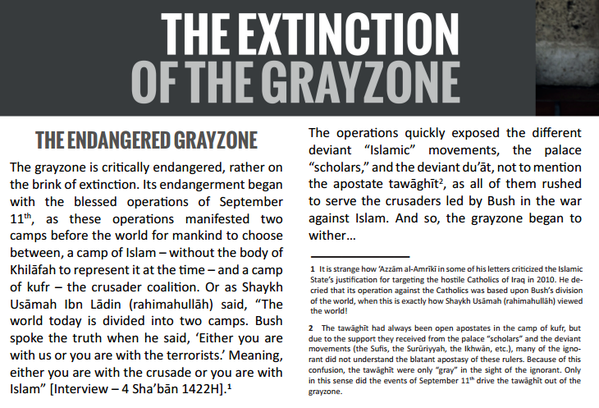
In my commentary on the terrorist attacks in Beirut and Paris in November 2015, I drew attention to Islamic State’s desire to extinguish what it called ‘the grey zone’.  As Jason Burke explained at the time:

In February this year, in a chilling editorial in its propaganda magazine, Dabiq, Isis laid out its own strategy to eliminate what the writer, or writers, called “the grey zone”.

This was, Isis said, what lay between belief and unbelief, good and evil, the righteous and the damned. It was home, too, to all those who had yet to commit to the forces of either side.

The grey zone, Isis claimed, had been “critically endangered [since] the blessed operations of September 11th”, as “these operations showed the world” the two camps that mankind must choose between.

Over the years, since successive violent acts had narrowed the grey zone to the point where by the end of 2014 “the time had come for another event to … bring division to the world and destroy the grey zone everywhere”.

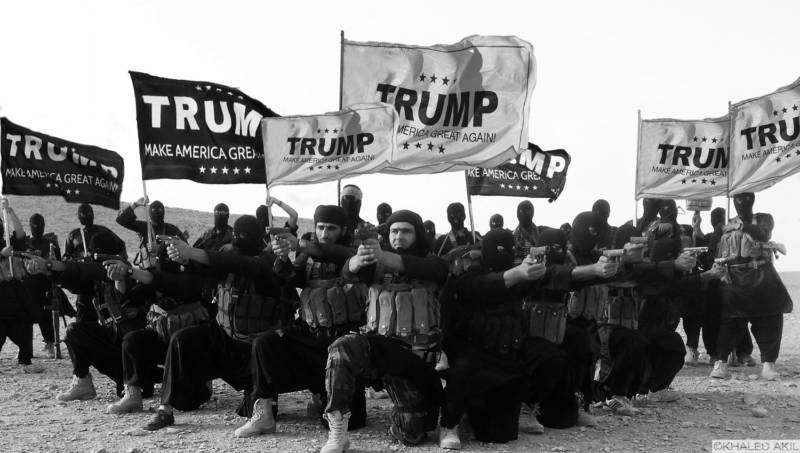
I noted then that ‘The imaginative geographies of Islamic State overlap with those spewed by the extreme right in Europe and North America and, like all imaginative geographies, they have palpable effects: not fifty shades of grey but fifty versions of supposedly redemptive violence.’

Syrian artist Khaled Akil has captured this congruence perfectly in “Hate Loves Hate“:

khaled-akil-hate-loves-hate

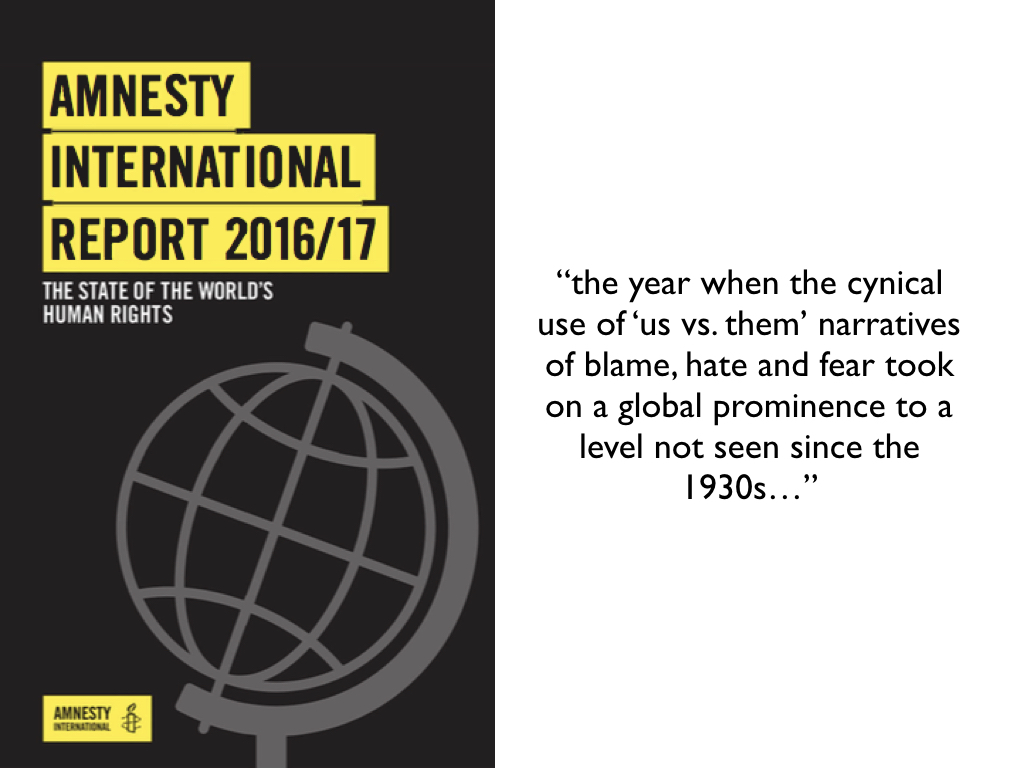
Amnesty International‘s latest report (2016/17) on Human Rights around the world confirms that this is fast becoming generalised:

Politicians wielding a toxic, dehumanizing “us vs them” rhetoric are creating a more divided and dangerous world, warned Amnesty International today as it launched its annual assessment of human rights around the world.

The report, The State of the World’s Human Rights, delivers the most comprehensive analysis of the state of human rights around the world, covering 159 countries. It warns that the consequences of “us vs them” rhetoric setting the agenda in Europe, the United States and elsewhere is fuelling a global pushback against human rights and leaving the global response to mass atrocities perilously weak.

“2016 was the year when the cynical use of ‘us vs them’ narratives of blame, hate and fear took on a global prominence to a level not seen since the 1930s. Too many politicians are answering legitimate economic and security fears with a poisonous and divisive manipulation of identity politics in an attempt to win votes,” said Salil Shetty, Secretary General of Amnesty International.

2016-us-vs-them-001

“Divisive fear-mongering has become a dangerous force in world affairs. Whether it is Trump, Orban, Erdoğan or Duterte, more and more politicians calling themselves anti-establishment are wielding a toxic agenda that hounds, scapegoats and dehumanizes entire groups of people.

“Today’s politics of demonization shamelessly peddles a dangerous idea that some people are less human than others, stripping away the humanity of entire groups of people. This threatens to unleash the darkest aspects of human nature.”…

“In 2016, these most toxic forms of dehumanization became a dominant force in mainstream global politics. The limits of what is acceptable have shifted. Politicians are shamelessly and actively legitimizing all sorts of hateful rhetoric and policies based on people’s identity: misogyny, racism and homophobia.

“The first target has been refugees and, if this continues in 2017, others will be in the cross-hairs. The reverberations will lead to more attacks on the basis of race, gender, nationality and religion. When we cease to see each other as human beings with the same rights, we move closer to the abyss.”

Whitewashing

whitewash-protocol

Regular readers will remember my series of commentaries on Israel’s punitive and reckless assault on Gaza during the summer of 2014 (see, for example, here, here and here).

In the debates over what Israel called ‘Operation Protective Edge’ – and over later modern military violence more generally – questions of law have come to the fore: partly because law is now closely implicated in the conduct of military operations (‘operational law’), as Craig Jones‘s wonderful work has demonstrated, and partly because its legitimating narrative requires (and indeed rests on) militaries investigating their own alleged breaches of international law and their rules of engagement.

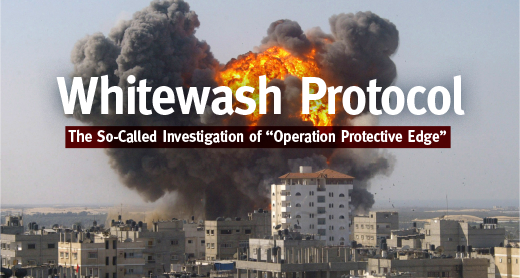
B’Tselem: The Israeli Information Center for Human Rights in the Occupied Territories has now published Whitewash Protocol: the so-called investigation into Operation Protective Edge.  It’s a complex, forensic investigation, but here is one of the key findings about the Israeli military investigation of its own actions:

The MAG [Military Advocate General’s Corps] examined only several of dozens of almost identical attacks that took place over the fifty days of hostilities, time after time ending with terrible human tall. Given these recurring results, one cannot accept the MAG’s position, that those responsible for these attacks could reasonably base their assessments of the anticipated harm to civilians on assumptions that were repeatedly proven unfounded, and debunked by their own actions or the actions of their colleagues – at a heavy death toll.

The interpretation adopted by the MAG has a far reaching implication that applies to all strikes carried out during the operation: It absolves every level of officials involved in the attacks – from the prime minister, through the MAG himself through to the persons who ultimately fired – of the duty to do everything in their power to minimize harm to civilians. In fact, the MAG sets the bar very low in terms of what is required of those responsible for the attacks – including senior military officers and the MAG (who are not under investigation in any case) – by doing no more than examining what they claimed to know prior to the attacks, while entirely disregarding the question of whether their assessment was reasonable. In doing so, the MAG utterly overlooks the issue of what those responsible for the attacks should have known, including the obligation to learn from their own experience.

And the reason this matters is made plain in the summary:

The fighting during Operation Protective Edge was brutal and violent. Israel implemented a policy of air strikes against homes, which killed hundreds of people, including entire families. Tens of thousands of people were left homeless, losing all they held dear. Genuine, effective investigations are needed not just for the sake of achieving justice for the victims and their loved ones. They are needed as a deterrent to forestall future actions of this sort and to avert further losses. When nothing is investigated, when the consensus is that everything done during the fighting was moral and legal – the stage is set for actions such as these, or even worse, to recur. There was no accountability after Operation Cast Lead, only whitewashing. Now, after Operation Protective Edge, there is no accountability either, only whitewashing. This is not a theoretical legal issue: we are talking about human lives.

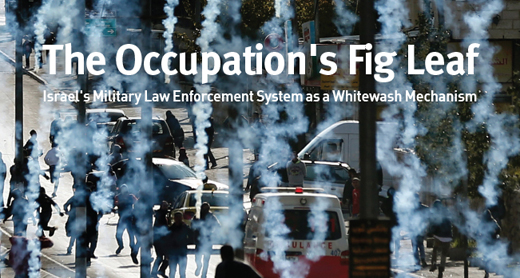
The full report can be downloaded as a pdf here.  It needs to be read in conjunction with B’Tselem’s report from May 2016, The Occupation’s Fig Leaf: Israel’s Military Law Enforcement System as a Whitewash Mechanism available here.

201605_occupations_fig_leaf_eng 

Yael Stein, B’Tselem’s Research Director, writes:

In his response to the report, the [Israeli military] spokesperson said that B’Tselem is waging a “delegitimization campaign” against the military law enforcement system. Yet this system cannot be considered legitimate until it ensures justice for victims and unless its investigations seek to uncover the truth and hold those responsible accountable…. What may appear at times to be an independent, efficient law enforcement system is in fact a mechanism for covering up suspected offenses and protecting the real culprits.

To be sure, the IDF shoots more than the messenger…

#PortesOuvertes

Like many other people, I’ve been trying to make sense of the horrific attack in Nice on 14 July. I’ve delayed writing about it because so much remains unknown – though that has not stopped a cascade of malignant certainties spewing from those on the Right who see every event as an opportunity to foment fear, harness hatred and deepen division.

A Tunisian man with no known history of political activism or religious affirmation kills 84 people by deliberately driving a truck through crowds along the Promenade des Anglais who were celebrating Bastille Day; a man who lived on the margins with a record of petty crime and domestic abuse; somebody with precious few resources, yet able to rent a truck and acquire weapons; and a claim to have ‘inspired’ the attack from Islamic State, which then hailed him as a ‘soldier’.

No wonder that Peter Beaumont agonises over ‘a new kind of terror – one we can’t define‘, where the systematic recruitment, training and organisation of other terrorist attacks bleeds into the savage violence of the ‘lone wolf’ prowling undetected in the darkness.  The incorporation and adulation of individuals and small groups with no previous connection to IS or other jihadi groups reverses what he calls the standard ‘polarity of responsibility: encouraging acts of violence that it accepts as bloody tributes thrown at its feet.’

The link with petty crime is not surprising.  Scott Atran notes that

Serious jihadi involvement with petty criminal networks began after the September 11 attacks as an unintended consequence of the ability of the United States and allies to cut off the flow of funding to suspect groups, especially through Islamic charities. So al-Qaeda and others began looking for funding and arms in criminal networks instead. And in these networks there were large numbers of marginalized immigrant youth, especially in France.

Indeed, Joseph Micallef makes a plausible case for IS expanding its involvement in criminality as its territorial hold on Iraq and Syria comes under intensifying assault: ‘The smuggling networks that are used to bring in armaments and militants can be just as easily be used to traffic in drugs and illegal immigrants.’  His inclusion of ‘illegal immigrants’ should give us pause for thought; I have no idea if he intends this to include refugees from the turmoil in Iraq, Syria and Libya (it shouldn’t).  But to the extent that IS is involved in human trafficking then this is a double victimisation of its prey.

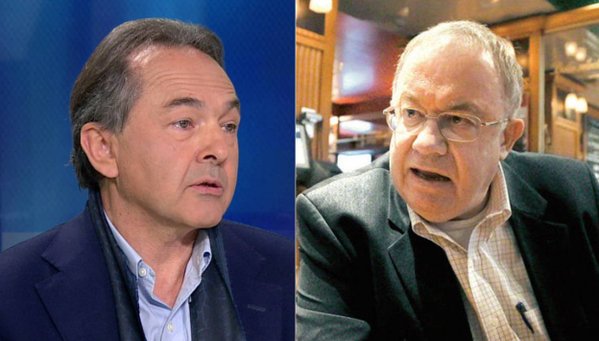
All of this may be granted; but a causal link between Lahouaiej-Bouhlel’s murderous drive through crowds of innocent people and the designs of IS or any other radical version of political Islam is proving remarkably elusive.  There is a wider debate in France about whether the terrorism serially inflicted upon its people is at root about ‘the radicalization of Islam’ (Gilles Kepel – below left) or the ‘Islamicization of radicalism’ (Olivier Roy – below right) – there is a good summary here – but in this instance it is far from clear that either of them is relevant.

Gilles Keppel and Olivier Roy

Indeed, Farhad Khorokhavar, a sociologist at the École des Hautes Etudes en Sciences Sociales, doubts that ‘radicalisation’ is the appropriate term at all:

“I don’t think he was radicalised at all… It’s a case of raw violence. He took a decision to kill in a moment of despair. My guess is that it’s much more like a mass shooting in the US than [Islamist] radicalisation.”

He speaks instead of ‘mimetic violence’, where previous attacks have furnished ‘a model that fragile people can imitate.’

So I don’t know whether the atrocity in Nice can be attributed to IS or not – but I have no doubt that the precipitate rush to do so has substantive consequences.

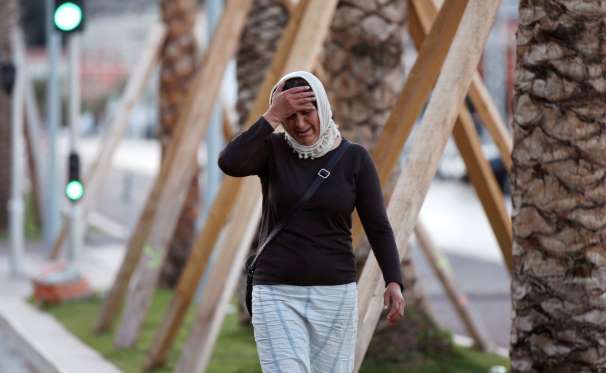
One place to start thinking critically about them is this photograph of a woman consumed by grief as she searches for her son after the attack:

Nice July 2016

The image serves to remind us that – if, to repeat, this does prove to be an attack whose trail can be traced back, however indirectly, to the dismal doors of Islamic State – the victims of such atrocities include people of many cultures and faiths.  Theirs is not a ‘war’ against a single, monolithic enemy; Nice is far from being a homogeneous city – like France, like the rest of Europe – and Alissa Rubin captures what she calls its ‘many-layered’ geography better than most:

There is the Nice of popular imagination, the old-world resort dotted with palm trees and cafes that look out on the Mediterranean Sea, suffused with an incandescent light prized for centuries by artists.

Then there is the other Nice, one that begins to show its face a few blocks inland from the seaside Promenade des Anglais, the majestic arc of a boulevard where 84 people were killed by a 31-year-old Tunisian immigrant at the wheel of a 19-ton truck. This Nice is home to many Muslim immigrants from North Africa, including a secular middle-class that has lived alongside non-Muslim French, and is also a place that local officials estimate has sent as many as 100 young people to fight in Syria with extremists.

“It is rare that these two worlds mix with each other except at the moment of festivities or of agreement, like the gatherings on Saturday,” said Feiza Ben Mohamed of the Muslims of the South, an organization that fights radicalization, referring to the public mourning for those killed in the truck attack.

“Yet the first victim was Muslim, and a good number of the victims were Muslims,” Ms. Mohamed added. “Just yesterday I was on the promenade reflecting on what had happened, and a journalist asked me if I was there to apologize in the name of Muslims. I said to him, ‘No, I came to weep for the dead like everyone else.’”

You can read another (short) essay by Farhad Khorokhavar on these divisions in France, ‘Jihad and the French exception’, here.  In Nice they have been intensified, not only by recruiters for the butchery in Syria – and there is no doubt of their success in Nice: Alpes-Maritimes was one of the first French départements to implement a counter-radicalisation strategy of sorts – but also by the advance of the far right National Front, and no doubt by memories of France’s colonial adventures in North Africa and the Levant and its deepening military involvement in Syria.

For now, France seems under repeated attack: the Charlie Hebdo murders in Paris in January 2015; the attacks on the Bataclan and other public places in Paris last November; and now the murder of more than 80 people in Nice.

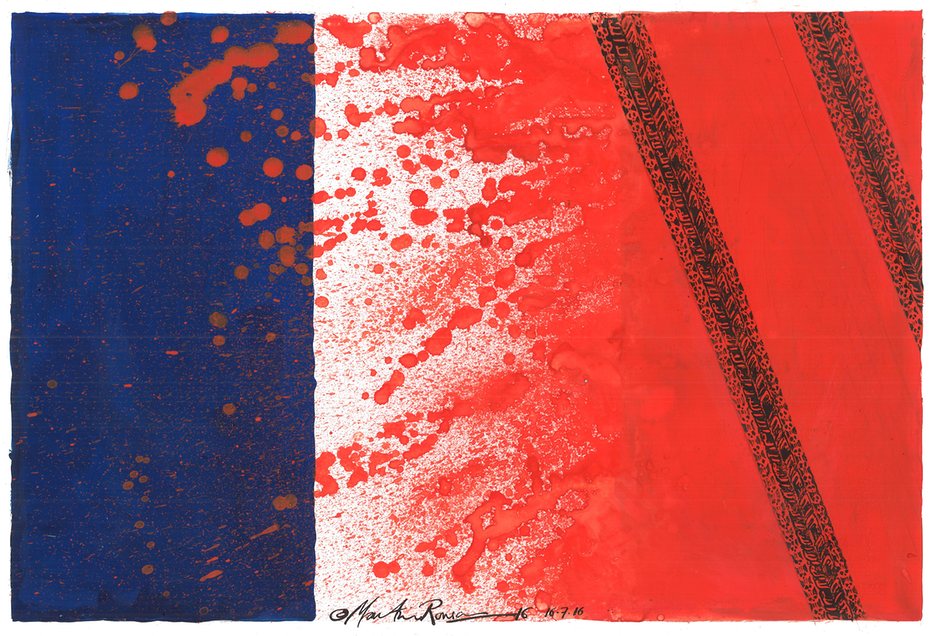
Martin Rowson cartoon Guardian

Each of these mass murders is truly, wrenchingly shocking: but those of us who live in Europe or North America cannot afford to allow those shock-waves to be refracted by geography because this would erect the bloody partition that is one of IS’s central objectives.  Nihilism meets narcissism.

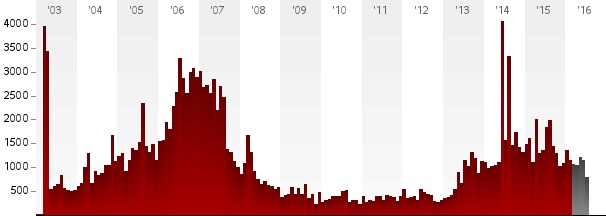
I made much the same point about Paris and Beirut last year.  Now we might twin Nice with Baghdad. Like Nice – like all cities worthy of the name – Baghdad is far from homogeneous, for all the ethno-sectarian ‘cleansing’ that occurred during the US occupation (see my account of ‘The Biopolitics of Baghdad’: DOWNLOADS tab), and those tensions continue to roil.  The truck bombing and subsequent fire that killed 300 people in the Karrada district as they broke their Ramadan fast at the end of the day on 3 July may have seemed like the ‘new normal’ to commentators watching the rising tide of violence in post-occupation Iraq; it too was claimed by IS.  So too many of us doubtless shrugged our shoulders.

Documented civilian deaths from violence in Iraq 2003-July 2016 (Iraq Body Count)

Documented civilian deaths from violence in Iraq 2003-July 2016 (Iraq Body Count)

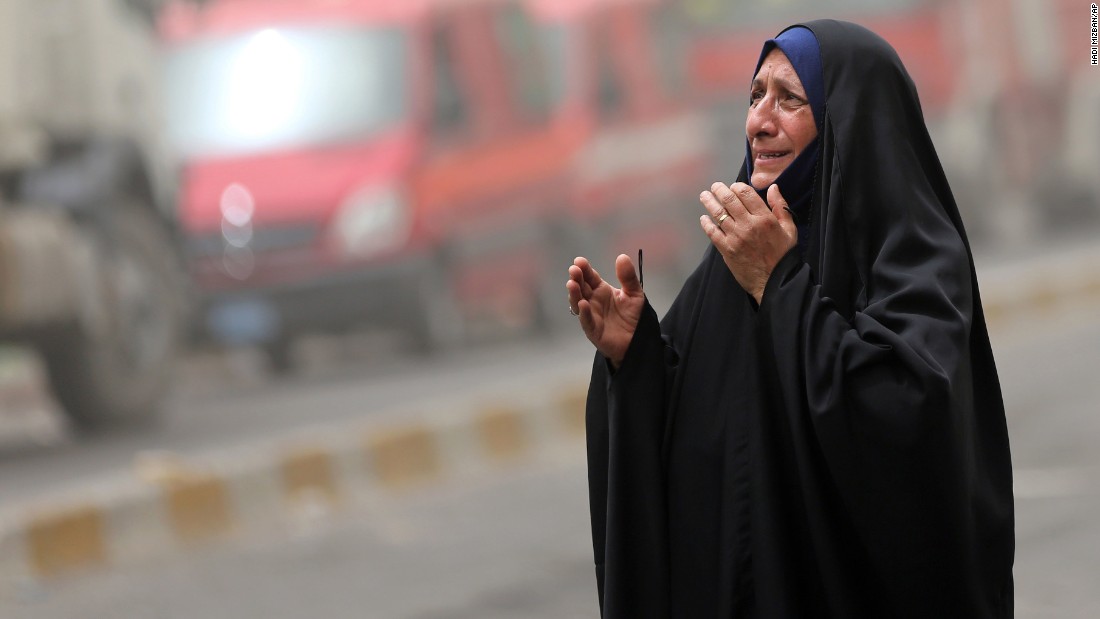
And yet, as Walaa Chahine so movingly testified after another bombing there on 12 July, ‘We may be used to bombings in Baghdad, but Baghdad isn’t‘:

We are used to it, so we don’t make hashtags, change our profile pictures, or memorize their names. By taking away these rights away from them, and yes, they have become rights, as long as other victims are given them, we are taking away their connection to us as humans. We forget that we would probably never get used to having our hometowns bombed every day, that just like us, they are humans who don’t forget, can’t forget.

No, the eleven people killed today weren’t used to dying. The 292 killed last week were not used to it. Their families will never get used to it. No matter how long you spend in a war area, you never get used to it. Ask a soldier, ask a refugee, ask someone who experiences violence and pain on the daily if they ever truly get used to it. We might be able to tune out their screams, but we weren’t the ones screaming in the first place.

Iraqi woman grieving in Karrada July 2016

And so, as this contrapuntal geography shows, it bears repeating – until even the tone-deaf Donald Trump gets it – that most of the victims of Islamic State’s terrible violence are other, innocent Muslims.  And they live – and die – outside Europe and North America too.

Standing on occupied ground

This is Reading Week at UBC, so I’m doing just that…  At the AAG Annual Meeting in San Francisco there is a Plenary Session on Friday 1 April (sic) on Forging Solidarity: Taking a stand on Palestine:

In July 2015 the International Critical Geography Group convened its seventh conference in the occupied city of Ramallah, Palestine. The conference brought together scholars and activists committed to combating social exploitation and oppression. Altogether four hundred participants from over forty countries energetically took up issues on and beyond the violent frontlines of class, gender, race, sexual, and colonial divisions. Yet they also took critical steps beyond discussion and debate of our intellectual work towards concrete collective action. An example of this was the overwhelmingly vote of conference participants for a strong resolution to sign onto the Palestinian Academic and Cultural Boycott and the broader Boycott Divestment and Sanctions (BDS) campaign against Israel. The resolution adopted is both a political statement in solidarity with the anti-colonial struggle of our Palestinian comrades but also an agenda for a broader commitment to anti-capitalist, decolonial, anti-racist, feminist and queer social movements and struggles around the world against growing social, economic and political precarity, rising authoritarianism, encroachment of fundamental rights, dispossession, structural adjustment in the south and north, revanchism, ongoing colonization of public space, land and resources, the privatization of the commons, as well as structural and state-sanctioned violence against racialized, gendered, queer bodies, and other targeted bodies and communities.

Building on the momentum generated by the conference and this resolution, this discussion panel aims to open up a serious discussion about BDS and the academic boycott of Israel within the Association of American Geographers. This is, we believe, particularly relevant in light of the current situation in Palestine/Israel but also taking into consideration how academics from other professional organisations such as the American Anthropological Association, the Association for Asian American Studies, the American Studies Association and the Native American Studies Association, as well as a number of student councils worldwide, have already endorsed this call for solidarity. Our distinguished panel of scholars and activists will speak out about the importance and the urgency to adopt a political stand on Palestine and to further the work of decolonizing the discipline of geography. In doing so, we hope to reaffirm a commitment to critical scholarship and praxis by encouraging and enabling spaces of political and conceptual possibility for geographers in solidarity with ongoing socio-political, economic and environmental struggles around the globe.

w512

In the wake of that ICG Conference in Ramallah, David Lloyd‘s moving reflections on another conference/workshop in the same city, ‘Walter Benjamin in Palestine‘, repay careful reading:

Activism is in fact the antagonist of complacency and of the satisfaction with familiar protocols that dulls thinking and makes the institutionalized academic a little stupid. But activism is not always expressed in headlong mobilization or fervent debates, nor is thought only the forethought that shapes or the afterthought that reflects on practice. As “Benjamin in Palestine” exemplified, it can also take the form of deliberate thinking in common whose very exercise is a form of resistance, however limited. As the BDS movement continues to advance, perhaps workshops like these, which step beyond mere “severance of relations” (as Benjamin described the act of striking) to shape conditions for new modes of relation, may offer a way to think the future of our resistance to Israeli apartheid. Perhaps too it offers a model also for an alternative to the insidious corporatization of our intellectual and creative lives under the neoliberal dispensation we all confront, wherever we reside, and not only in occupied Palestine. That, indeed, may be the insight we have been gifted by those who daily struggle for the right to education in the face of dispossession.

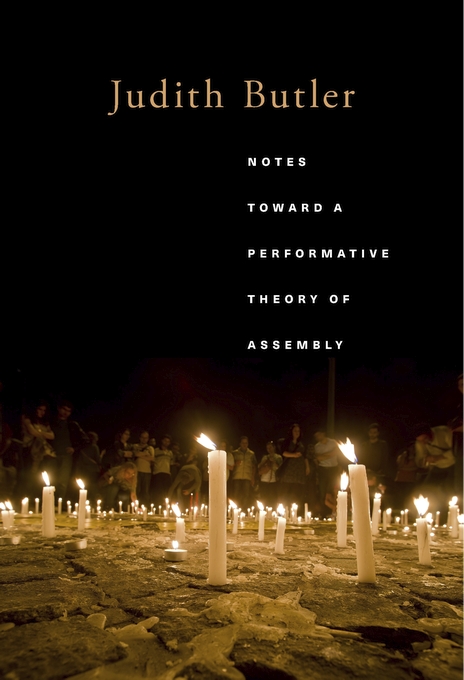
BUTLER NotesIn its way this, too, is a modestly performative politics of assembly.  So it’s good to see that panelists at the AAG plenary include this year’s Honorary Geographer, Judith Butler; full list is here.  You can find Judith’s previous remarks on BDS (at Brooklyn College) here.

You can also find out much more about the American Anthropological Association’s stand (last year) here; the statement that accompanied the successful resolution is here; a series of FAQs (“Yes, but…”) is here; and other resources are here.

It’s opportune, too, that the latest issue of borderlands should be devoted to The politics of suffering – with a special focus on occupied Palestine.  Among the many truly excellent essays three stand out for me.

First, Suvendrini Perera‘s accomplished contrapuntal reading of transnational justice, ‘Visibility, Atrocity and the Subject of Postcolonial Justice‘, which proceeds’ through a series of key sites – Congo, Belgium, Nuremberg, Israel, Gaza – that links past and present, colonial and colonizing worlds’, and then focuses on the deaths of tens of thousands of civilians on the beaches of Mullivaikkal in northeast Sri Lanka:

In the context of the 2009 atrocities in Lanka, in this paper I attempt to think through a set of questions about visibility, witness, suffering, accountability and disposability as they are played out in the relations between the necro-geo-politics of global institutions and the patchworks of local and transnational movements that attempt to materialize peoples’ suffering and realize the possibility of justice within fragile and compromised frameworks.

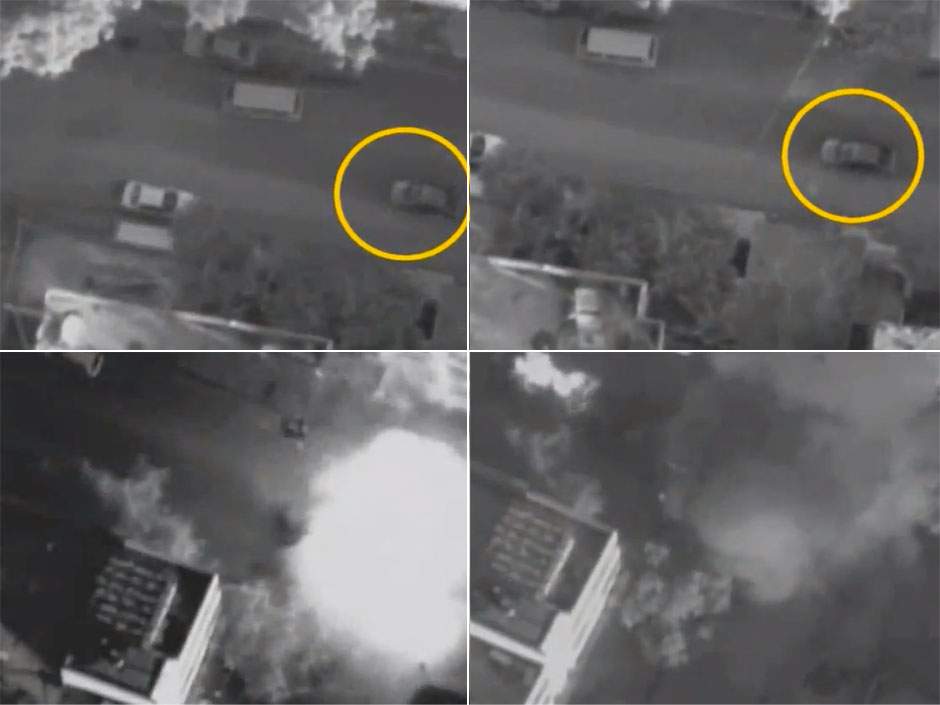
Drone feed Gaza city November 2012

Second, Joseph Pugliese‘s characteristically innovative ‘Forensic ecologies of occupied zones and Geographies of dispossession: Gaza and occupied East Jerusalem‘:

In this essay, I work to develop what I term multi-dimensional matrices of suffering that envisage the understanding of suffering beyond the locus of the human subject. In my theorising of multi-dimensional matrices of suffering, I proceed to conceptualise the suffering experienced in occupied zones as both relational and distributed. In the occupied zone, suffering encompasses complex, multi-dimensional vectors that bind humans, animals, animate and non-animate objects and entities, buildings and land. In the context of the regimes of violence that inscribe occupied zones, I situate suffering, and a range of other affects, in ecological configurations that, through a range of forensic indices, evidence the impact of these regimes of violence on the broad spectrum of entities that comprise a particular occupied zone. The conceptualisation of suffering and trauma in occupied zones in terms of its relational multi-dimensionality, its site-specific matrices and relational distribution across ecologies, I conclude, enables an understanding of suffering that moves beyond anthropocentric approaches. I situate my analysis in the context of Israel’s drone-enabled regime of unrelenting surveillance, occupation and military control over Gaza [see image above] and its continuing occupation of East Jerusalem.

It really is a tour de force, only too literally so, and builds not only on Joe’s brilliant State violence and the execution of law and his previous research but also on Jane Bennett‘s work and – as the title signposts – on Eyal Weizman‘s project of forensic architecture.  It’s doubly important because so much critical writing on military drones has virtually nothing to say about Israel’s use (and sale) of them.

Finally, Jasbir Puar‘s ‘The ‘right’ to maim: Disablement and inhumanist biopolitics in Palestine‘:

This essay argues that Israel manifests an implicit claim to the ‘right to maim’ and debilitate Palestinian bodies and environments as a form of biopolitical control and as central to a scientifically authorized humanitarian economy. In this context, the essay tracks the permeating relations between living and dying that complicate Michel Foucault’s foundational mapping of biopower, in this case, the practice of deliberate maiming. In doing so it demonstrates the limitations of the idea of ‘collateral damage’ that disarticulates the effects of warfare from the perpetration of violence, and notes that the policy of maiming is a productive one, a form of weaponized epigenetics through the profitability of a speculative rehabilitative economy.

This too is meticulously argued and imaginatively constructed, and adds important dimensions to my posts about Israel’s war on Gaza and, in particular, my preliminary speculations about the prosthetics of military violence.

The Roundabout Revolutions

CSP6_Weizman_364

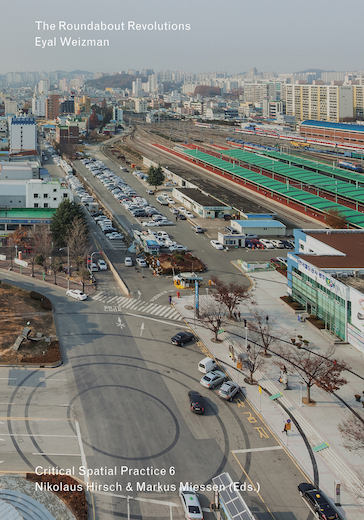
In ‘Tahrir: politics, publics and performances of space’ (DOWNLOADS tab) I tried to sketch out a preliminary analysis of Tahrir Square as a spatial instantiation of the Arab uprisings – it was, in part, also an attempt to work with Judith Butler‘s ideas about performative spaces in “Bodies in Alliance”. Now Eyal Weizman‘s latest extended essay puts all this in a wider context but a similar spatial frame: The roundabout revolutions from Sternberg Press.

One common feature of the wave of recent revolutions and revolts around the world is not political but rather architectural: many erupted on inner-city roundabouts. In thinking about the relation between protest and urban form, Eyal Weizman starts with the May 1980 uprising in Gwangju, South Korea, the first of the “roundabout revolutions,” and traces its lineage to the Arab Spring and its hellish aftermath.

Rereading the history of the roundabout through the vortices of history that traverse it, the book follows the development of the roundabout in Europe and North America in the early twentieth century, to its subsequent export to the colonial world in the context of attempts to discipline and police the “chaotic” non-Western city. How did an urban apparatus put in the service of authoritarian power became the locus of its undoing?

Today, as the tide of revolt that characterized the Arab Spring seems to ebb, when nations and societies disintegrate by brutal civil wars and military oppression, the series of revolutions might seem like Dante’s circles of hell. To counter this counter-revolution, Weizman proposes that the immanent power of the people at the roundabouts will need to find its corollary in sustained work at round tables—the ongoing formation of political movements able to enact political change.

The sixth volume of the Critical Spatial Practice series stems from Eyal Weizman’s contribution to the Gwangju Folly II in 2013, an exhibition curated by Nikolaus Hirsch with Philipp Misselwitz and Eui Young Chun for the Gwangju Biennale. Weizman and the architect Samaneh Moafi constructed a folly composed of seven roundabouts and a round table in front of the Gwangju train station, one of the central points in the events of May 1980.

There’s a review by Pranav Kohli over at Warscapes here:

Weizman’s description is reminiscent of Michel Foucault’s theorization of power. Foucault theorized power not as something that is hierarchically exercised but as a force that circuitously flows and passes through individuals, networks and organizations. Weizman recognizes the emerging character of power as a circle, describing the concentric arrangements of crowds as a “political collective in becoming.” These concentric crowd circles can be seen as a diagram of the fields of power emanating from the roundabout, with the roundabout itself becoming a beacon of a newfound people’s power.

Weizman’s analysis has a special focus on the Arab Spring and in a later section he returns to this idea of an interconnected collective while describing the protestors at Tahrir Square. They are linked not only by physical space and communication technologies but also by “an “Internet of things”—a form of connectivity that entangles organizations, individuals, material objects, and urban spaces such as roundabouts together: sites and websites, proximity and distance, remote solidarity and physical corporality” …

Weizman locates the true reason for the revolutionary turn in the roundabout’s history, within the spatial peculiarities of the roundabout itself. The roundabout’s attraction lies in the fact that it is an expansive public space that serves an integral function in the city’s infrastructure. In this sense, the roundabout can be seen as one of the last remaining public spaces where large crowds can gather in the congested modern city…. Weizman doesn’t regard the occupation of the roundabout as the moment when the public reclaimed public ownership of the republic. In his view, it was when the protestors at Tahrir Square began cleaning up the square, shortly after Mubarak’s deposition, that they truly assumed public ownership of the roundabout, and thereby the republic.

Paris of/in the Middle East

Paris:Peace

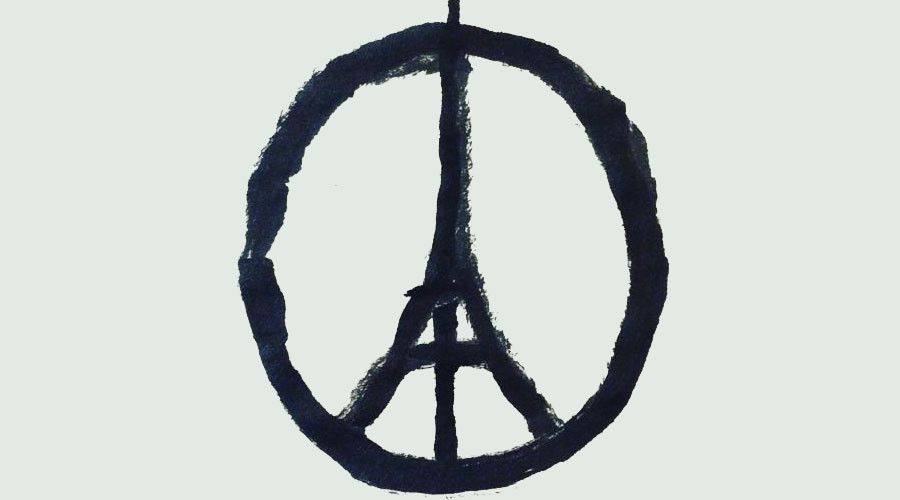
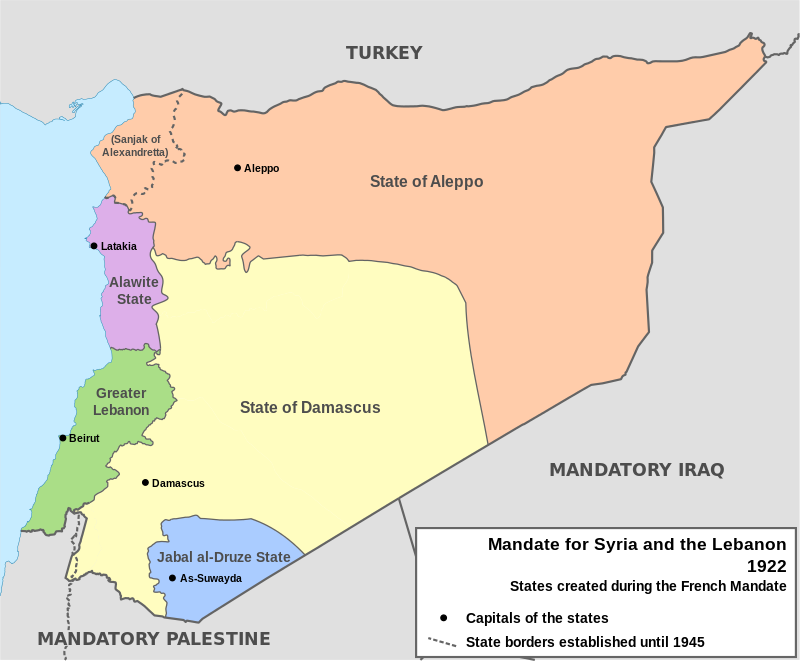
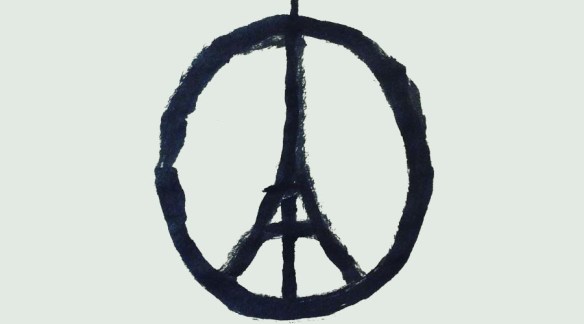
Islamic State has claimed responsibility for last night’s co-ordinated terrorist attacks in Paris, calling them the ‘first of the storm’ and castigating the French capital as ‘the capital of prostitution and obscenity’.   Walter Benjamin‘s celebrated ‘capital of the nineteenth century’ has been called many things, of course, and as I contemplated the symbol that has now gone viral (above), designed by Jean Jullien, I realised that Paris had been the stage for the 1919 Peace Conference that not only established the geopolitical settlement after the First World War but also accelerated the production of today’s ‘Middle East’ by awarding ‘mandates’ to both Britain and France and crystallising the secret Sykes-Picot agreement struck between the two powers in 1916 (more on that from the Smithsonian here).

Margaret MacMillan has a spirited summary of the conference here, with some lively side-swipes at the astonishing lack of geographical knowledge displayed by the principal protagonists.  Much on my mind was the French mandate for Syria and Lebanon:

French Mandate for Syria and Lebanon

For as I watched Friday night’s terrifying events in Paris unfold, I had also been reminded of the horrors visited upon Beirut the evening before.

Two suicide bombers detonated their explosives in Burj el-Barajneh in the city’s southern suburbs; the attacks were carefully timed for the early evening, when the streets were full of families gathering after work and crowds were leaving mosques after prayers: they killed 43 people and injured more than 200 others.

Islamic State issued a statement saying that ’40 rafideen– a pejorative term for Shiite Muslims used by Sunni Islamists – were killed in the “security operation”’ and claimed the attacks were in retaliation for Hezbollah’s role in the Syrian war.

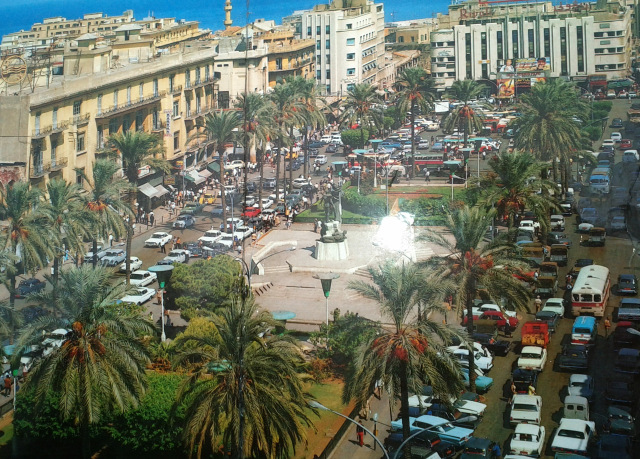
beirut60s

In the 1950s and 60s Beirut was known as ‘the Paris of the Middle East’ (above) – widely seen as more chic, more cosmopolitan than the ‘Paris-on-the-Nile’ created by Francophile architects and planners west of the old city of Cairo in the late nineteenth and early twentieth centuries.

Now I’ve always been troubled by these city switchings – the ‘Venice of the North’ is another example – because they marginalise what is so distinctive about the cities in question and crush the creativity that is surely at the very heart of their urbanity.

And yet, after last night, I can see a different point in the politics of comparison (from Kennedy’s Ich bin ein Berliner to the post 9/11 insistence that “we are all New Yorkers…”).  More accurately, in the politics of non-comparison: as Chris Graham asks (and answers): why the silence over what happened in Beirut on Thursday?  Why no mobilisation of the news media and no interruptions to regular programmes on TV or radio?  Why no anguished personal statements from Obama, Cameron or, yes, Hollande?
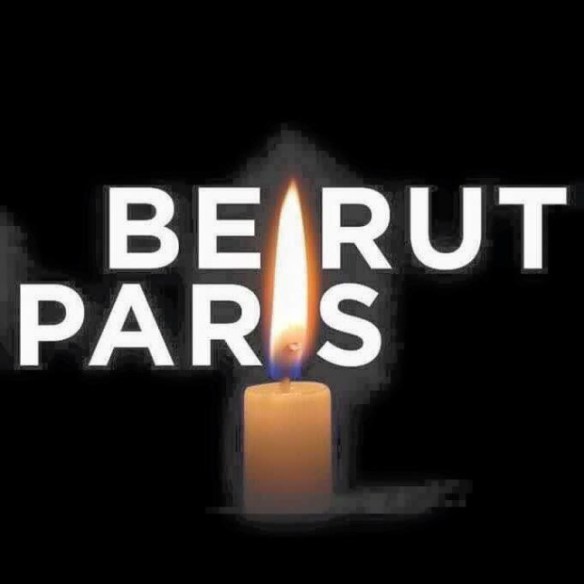
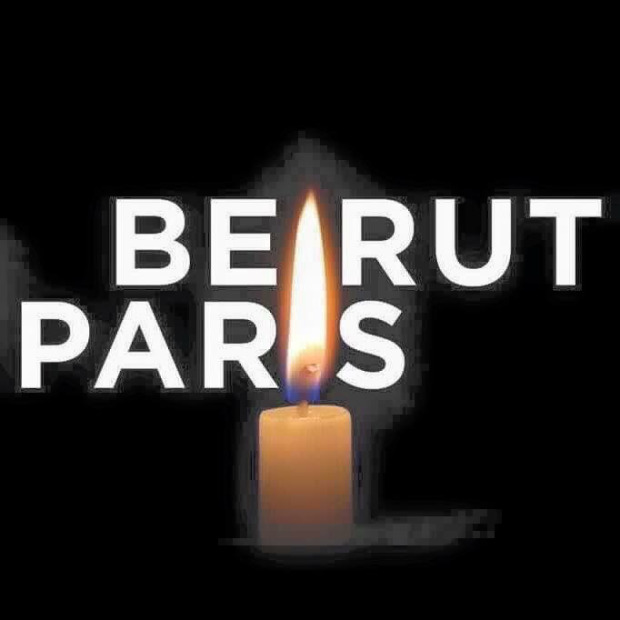
Beirut:Paris

Nobody has put those questions with more passion and justice than Elie Fares writing from Beirut:

I woke up this morning to two broken cities. My friends in Paris who only yesterday were asking what was happening in Beirut were now on the opposite side of the line. Both our capitals were broken and scarred, old news to us perhaps but foreign territory to them….

Amid the chaos and tragedy of it all, one nagging thought wouldn’t leave my head. It’s the same thought that echoes inside my skull at every single one of these events, which are becoming sadly very recurrent: we don’t really matter.

When my people were blown to pieces on the streets of Beirut on November 12th, the headlines read: explosion in Hezbollah stronghold, as if delineating the political background of a heavily urban area somehow placed the terrorism in context.

When my people died on the streets of Beirut on November 12th, world leaders did not rise in condemnation. There were no statements expressing sympathy with the Lebanese people. There was no global outrage that innocent people whose only fault was being somewhere at the wrong place and time should never have to go that way or that their families should never be broken that way or that someone’s sect or political background should never be a hyphen before feeling horrified at how their corpses burned on cement. Obama did not issue a statement about how their death was a crime against humanity; after all what is humanity but a subjective term delineating the worth of the human being meant by it?

Here we might pause to remind ourselves that most of the victims of Islamic State have been Muslims (see, for example, here and here).

Here Hamid Dabashi‘s reflections are no less acute:

In a speech expressing his solidarity and sympathy with the French, US President Barack Obama said, “This is an attack not just on Paris, it’s an attack not just on the people of France, but this is an attack on all of humanity and the universal values that we share.”

Of course, the attack on the French is an attack on humanity, but is an attack on a Lebanese, an Afghan, a Yazidi, a Kurd, an Iraqi, a Somali, or a Palestinian any less an attack “on all of humanity and the universal values that we share”? What is it exactly that a North American and a French share that the rest of humanity is denied sharing?

In his speech, UK Prime Minister David Cameron, speaking as a European, was emphatic about “our way of life”, and then addressing the French he added: “Your values are our values, your pain is our pain, your fight is our fight, and together, we will defeat these terrorists.”

What exactly are these French and British values? Can, may, a Muslim share them too – while a Muslim? Or must she or he first denounce being a Muslim and become French or British before sharing those values?

These are loaded terms, civilisational terms, and culturally coded registers. Both Obama and Cameron opt to choose terms that decidedly and deliberately turn me and millions of Muslims like me to their civilisational other.

They make it impossible for me to remain the Muslim that I am and join them and millions of other people in the US and the UK and the EU in sympathy and solidarity with the suffering of the French.

As a Muslim I defy their provincialism, and I declare my sympathy and solidarity with the French; and I do so, decidedly, pointedly, defiantly, as a Muslim.

When Arabs or Muslims die in the hands of the selfsame criminal Islamic State of Iraq and the Levant (ISIL) gangs in Afghanistan, Iraq, Syria, or Lebanon, they are reduced to their lowest common denominator and presumed sectarian denominations, overcoming and camouflaging our humanity. But when French or British or US citizens are murdered, they are raised to their highest common abstractions and become the universal icons of humanity at large.

Why? Are we Muslims not human? Does the murder of one of us not constitute harm to the entire body of humanity?
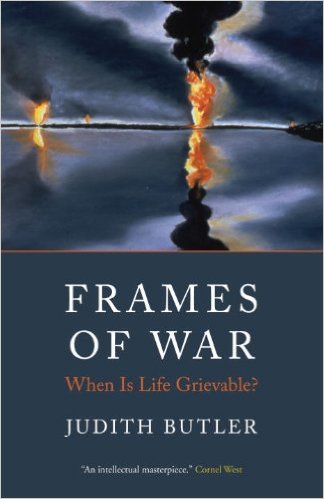
BUTLER Frames of WarElie’s and Hamid’s questions are multiple anguished variations of Judith Butler‘s trenchant demand: why are these lives deemed grievable and not those others?

To ask this is not to minimise the sheer bloody horror of mass terrorism in Paris nor to marginalise the terror, pain and suffering inflicted last night on hundreds of innocents – and also affecting directly or indirectly thousands and thousands of others.

In fact the question assumes a new urgency in the wake of what happened in Paris – where I think the most telling comparison is with Beirut and not with the attacks on Charlie Hebdo (see my commentary here) – because the extreme right (the very same people who once elected to stuff “Freedom Fries” down their throats) has lost no time in using last night’s events to ramp up their denigration of Syrian refugees and their demands for yet more bombing (and dismally failing to see any connection between the two).  You can see something of what I mean here.

And so I suggest we reflect on Jason Burke‘s commentary on Islamic State’s decision to ‘go global’ and its tripartite strategy of what he calls ‘terrorise, mobilise, polarise’.  The three are closely connected, but it’s the last term that is crucial:

In February this year, in a chilling editorial in its propaganda magazine, Dabiq, Isis laid out its own strategy to eliminate what the writer, or writers, called “the grey zone”.

This was, Isis said, what lay between belief and unbelief, good and evil, the righteous and the damned. It was home, too, to all those who had yet to commit to the forces of either side.

The grey zone, Isis claimed, had been “critically endangered [since] the blessed operations of September 11th”, as “these operations showed the world” the two camps that mankind must choose between.

Over the years, since successive violent acts had narrowed the grey zone to the point where by the end of 2014 “the time had come for another event to … bring division to the world and destroy the grey zone everywhere”.
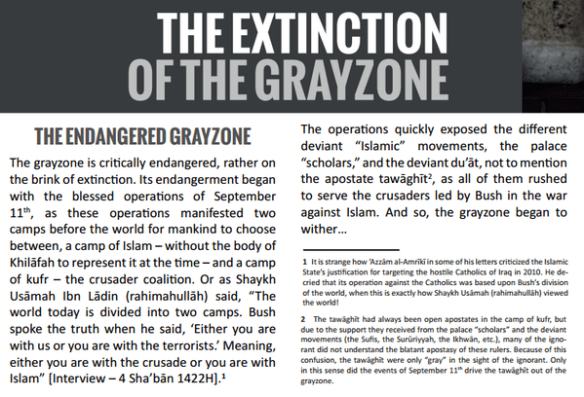
extinction-of-the-grayzone

More from Ben Norton here.  The imaginative geographies of Islamic State overlap with those spewed by the extreme right in Europe and North America and, like all imaginative geographies, they have palpable effects: not fifty shades of grey but fifty versions of supposedly redemptive violence.

UPDATE (1):  For more on these questions – and the relevance of Butler’s work– see Carolina Yoko Furusho‘s essay ‘On Selective Grief’ at Critical Legal Thinking here.

As it happens, Judith is in Paris, and posted a short reflection on Verso’s blog here.  She ends with these paragraphs:

My wager is that the discourse on liberty will be important to track in the coming days and weeks, and that it will have implications for the security state and the narrowing versions of democracy before us. One version of liberty is attacked by the enemy, another version is restricted by the state. The state defends the version of liberty attacked as the very heart of France, and yet suspends freedom of assembly (“the right to demonstrate”) in the midst of its mourning and prepares for an even more thorough militarization of the police. The political question seems to be, what version of the right-wing will prevail in the coming elections? And what now becomes a permissable right-wing once le Pen becomes the “center”. Horrific, sad, and foreboding times, but hopefully we can still think and speak and act in the midst of it.

Mourning seems fully restricted within the national frame. The nearly 50 dead in Beirut from the day before are barely mentioned, and neither are the 111 in Palestine killed in the last weeks alone, or the scores in Ankara. Most people I know describe themseves as “at an impasse”, not able to think the situation through. One way to think about it may be to come up with a concept of transversal grief, to consider how the metrics of grievability work, why the cafe as target pulls at my heart in ways that other targets cannot. It seems that fear and rage may well turn into a fierce embrace of a police state. I suppose this is why I prefer those who find themselves at an impasse. That means that this will take some time to think through. It is difficult to think when one is appalled. It requires time, and those who are willing to take it with you – something that has a chance of happening in an unauthorized “rassemblement” [gathering].

UPDATE (2): At Open Democracy Nafeez Mossadeq Ahmed has a helpful essay, ‘ISIS wants to destroy the “grey zone”: Here’s how we defend it’: access here.

Unimaginative geographies

Last week I was asked to contribute a 6-700 word Op-Ed to the Washington Post‘s In Theory series on ‘othering’ and the Middle East.  They wanted me to write about Edward Said‘s concept of ‘imaginative geographies’ and its implications for US foreign policy.

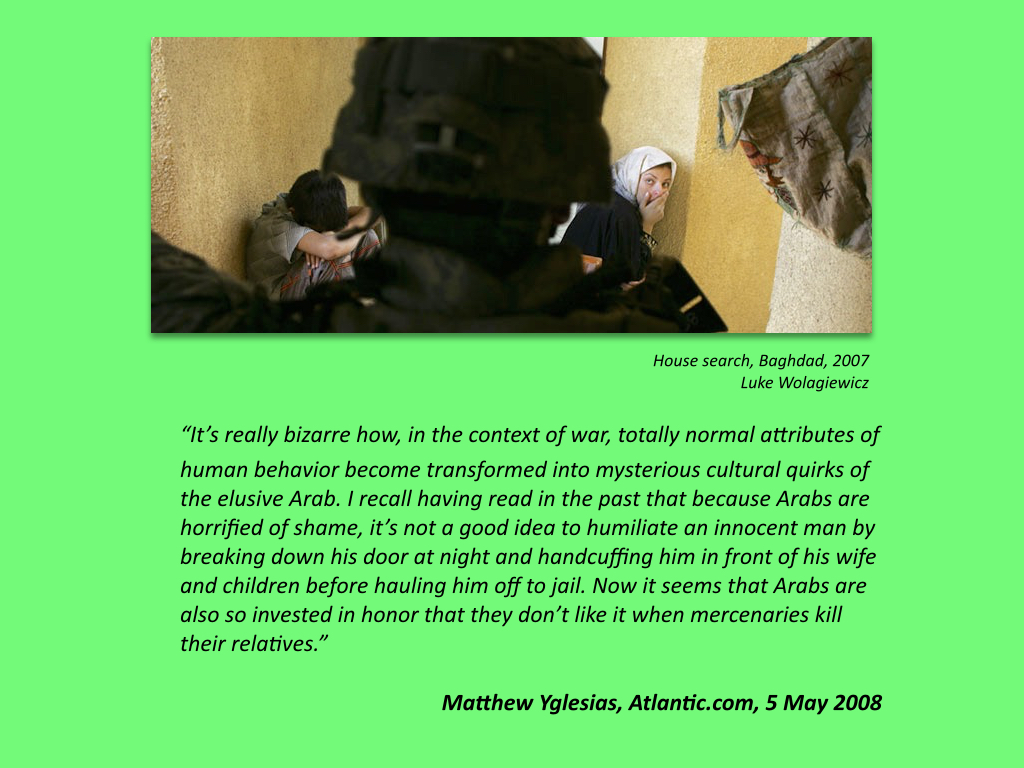
I wrote a quick draft and sent it off.  The core argument was that one of the most debilitating consequences of these bipolar imaginative geographies is their refusal to recognize and value those things that we have in common with others.  This wasn’t a clarion call for the reinstatement of the supposedly universal subject of humanism, of course: just a reminder that the accent on difference can blind us to the co-presence of commonality.  Nothing new about that, really, and like Matthew Yglesias (below) I’ve been arguing this for an age:

YGLESIAS Commonality.001

Then I took the dog for a walk.  By the time I returned, I had an idea for a conclusion, which was about radical narcissism, so I sent it off:

At best, we are offered a radical narcissism in which we imagine what it would be like if the suburbs of Washington, D.C., suffered air raids night after night, or if our skies were full of the sound of drones, watching and waiting to strike without warning. In imagining our lives made newly vulnerable to military violence, however, we continue to privilege “our” space and separate it from “their” space. If we can imagine such horrors happening to us, why is it so difficult to imagine them being visited on others?

This follows more or less directly from what I’d been thinking about the ways in which, in the wake of Hiroshima and Nagasaki, the United States collectively imagined itself as newly vulnerable: hence the stream of articles and illustrations in the 1940s and 50s imagining a nuclear strike on New York or Washington.

But over the weekend I took the dog for another walk, and had another thought – about the politics of affect.   If we limit our understanding of imaginative geographies to the interpretative frameworks of ‘the other’ – the assumptions and conventions through which they make sense of the world – then we marginalise the affective: in particular those visceral responses to the experience of violent death and destruction which we also share to varying degrees.  So it is that too often we fail to grasp the anger of somebody desperately seeking shelter from yet another air strike, the anguish of a mother or father cradling the body of their dead child, the despair of a family as they watch their home bulldozed to the ground, or the humiliation of a young man made to lower his trousers and raise his shirt by soldiers at a checkpoint.  And as we attribute their response to ‘their’ unreason we continue to inflict our own, always ‘rational’ – read ‘precise’, ‘measured’, ‘scientific’ – violence upon them.

Too late for the published version, which you can find here.

The nuclear wastelands and cyberwar

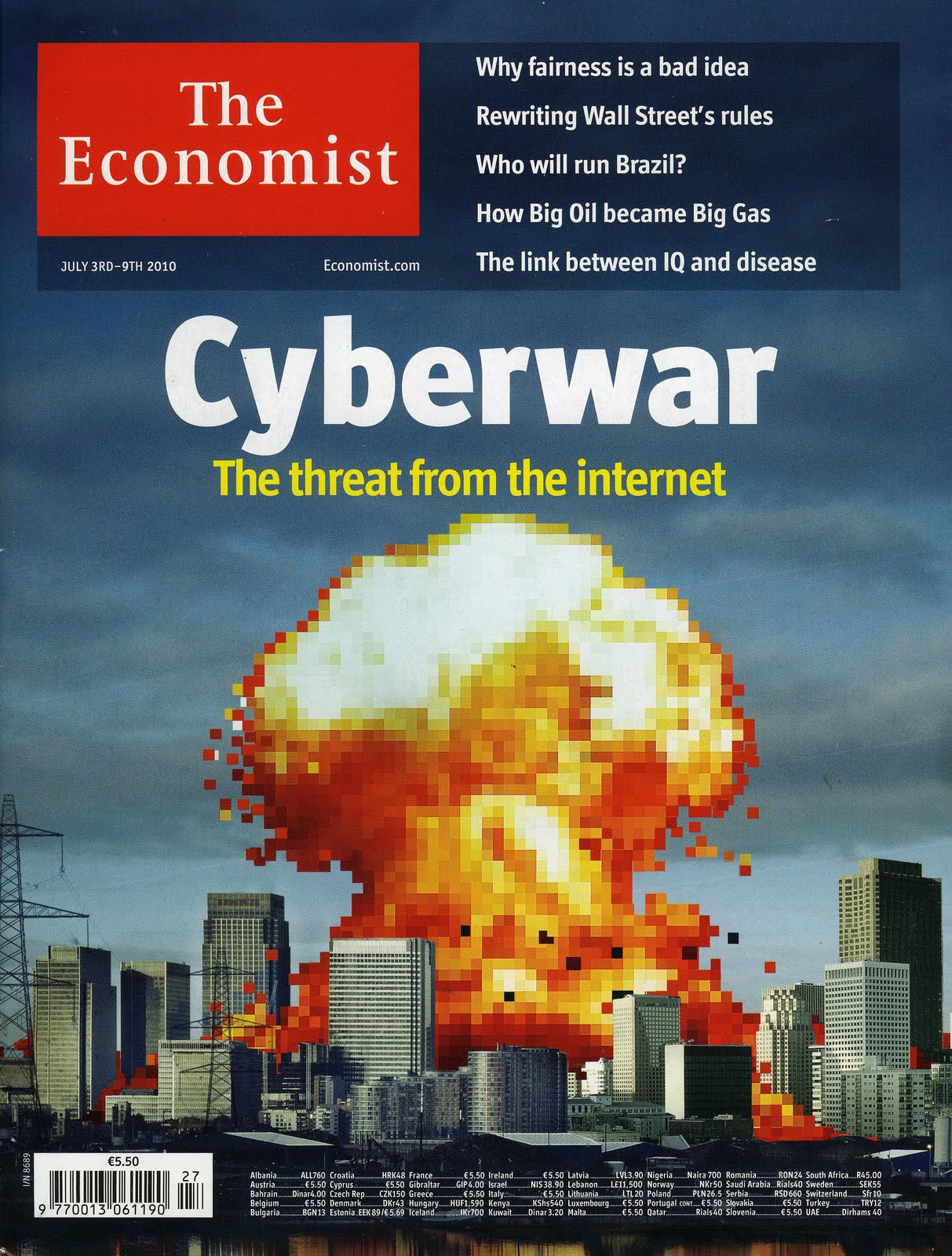
I’m in Toronto, enjoying ‘Through Post-Atomic Eyes‘ enormously: wide-ranging yet focused, creative and critical, and above all wonderfully welcoming.  I’m also relieved – I’ve only been wandering in the nuclear wastelands for a matter of months, and being surrounded by scholars and artists who know so much more about these vexed issues has been truly invigorating.  I’ll post the slides from my presentation shortly – in the meantime, see here and here – but while I was searching for images I re-discovered this cover from The Economist:

economist_cyberwar

Since my own presentation tried to sort out the entangled geographies of nuclear weapons and drones, I would be the very last person to object to the continuity conjured up by The Economist‘s apocalyptic vision: in fact yesterday both Joseph Masco and James Bridle in two sparkling presentations emphasised the intimacy of  the connections between computing, nuclear testing and the security state.

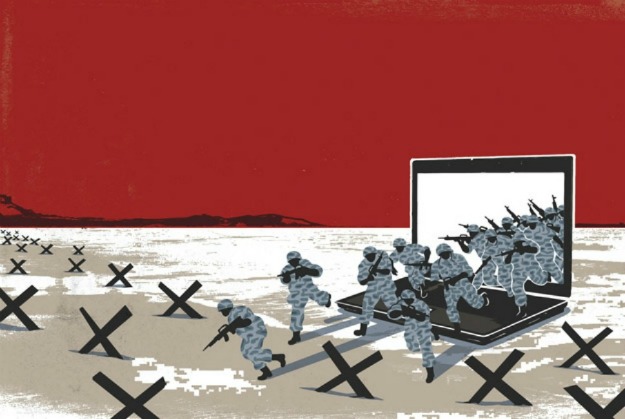
So it seems appropriate that my  e-flânerie should also have led me to a special issue of CyberOrient, edited by Helga Tawil-Souri, is appropriately online now (and open access), devoted to cyberwarfare:

This special issue of CyberOrient engages with the relationships between “cyber” and “real” battlespaces, the mediatization of war, the need to expand our definition of warzones, and the importance of asking who participates in wars, to what ends, using what kinds of technologies, and for what purposes. Taken together, the five essays demonstrate the expansion and blurring of the spaces of war. As importantly, they highlight that even warfare that is “only” fought in the virtual realm is laced with violent intents and real-life repercussions. Not only can we not separate the cyber from the real so neatly, but we must not overlook that no matter how we wish to classify “new” or cyber wars, it is citizens, along with their ways of life and their cultural records, that continue to be by far the largest losers.

fp

Contents:

Helga Tawil-Souri, Problematizing Cyberwarfare

Donatella Della Ratta, Violence and visibility in contemporary Syria: an ethnography of the “expanded places

Ruth Tsuria, Islamophobia in online Arab media

Emily Fekete, The shifting nature of cyberwarfare in Middle Eastern states

Attila Kovacs, Visual representation, propaganda and cyberspace: the case of the Palestinian Islamist movements

Christoph Günter, Presenting the glossy look of warfare in cyberspace – the Islamic State’s magazine Dabiq