The camp and geographical imaginations

Last Thursday, the last full day of my visit to Ostrava, Tomas took me to visit the Auschwitz-Birkenau Memorial and Museum in the Polish town of Oswiecim: I’m still trying to come to terms with what I saw and felt.

It was Tomas’s third visit.  Last time, he said, it was in the depth of winter, with the ground covered in snow: Auschwitz rendered in the sombre black and white tones we’ve come to expect.  On Thursday it all seemed so incongruous: full colour on an unexpectedly sunny day – brilliant blue sky, flowers coming in to bloom and birds singing – and made even more unsettling by the new housing at the edge of the town and the supermarket up the road.  To say that is at once to invoke a moral geography of sorts, and in a series of revealing essays Andrew Charlesworth, Robert Guzik, Michal Paskowski and Alison Stenning have documented the controversies that have shaped the site since the establishment of the State Museum in 1947 and the subsequent development before and after the fall of Communism: see ‘”Out of Place” in Auschwitz?’ [in Ethics, place and environment 9 (2) (2006) 149-72] and ‘A tale of two institutions: shaping Oswiecim-Auschwitz’ [in Geoforum 39 (2008) 401-413].

Auschwitz then and now

But as soon as we entered the complex a different (though related) series of moral geographies were invoked, also about the dissonance between Auschwitz then and now but more directly bound up with what Chris Keil calls ‘Sightseeing in the mansions of the dead’ [in Social & Cultural Geography 6 (40(2005) 479-494] or what is variously called ‘thanato-tourism’ or  ‘dark tourism’: the tourism of death.  You can find other fine reflections, following in Keil’s footsteps, in Derek Dalton‘s ‘Encountering Auschwitz: the possibilities and limitations of witnessing/remembering trauma in memorial space’ [in Law, Text, Culture 13 (1) (2009) 187-225] here.  Significantly, Dalton argues that current theorising ‘fails to highlight the vital role of the imagination in animating the artefacts and geography of a place and investing them with meaning’.

AUSCHWITZ3 April 2013

For the tour is, of course, both pre-scripted (it is surely impossible for most visitors to come to what was the largest extermination camp in Europe without prior expectations and understandings) and scripted (it invites and even licenses a particular range of performances and responses). It takes in Auschwitz I (above), the original site more or less at the centre of Oswiecim that was established in the spring of 1940, and the sprawling open/closed space of Auschwitz II at Birkenau beyond the perimeter established the following year.  (Auschwitz III, the labour camp at Monowitz linked to the IG Farben works, is not part of the memorial complex; neither are any of the 40-odd satellite camps).

Auschwitz 1944

We started by walking through the gates, their hideous sign Arbeit macht frei silhouetted against the sky, and filed into a series of prison blocks in a silence broken only by the guide’s voice whispering through our headphones and the shuffle of feet on stone and stair.

AUSCHWITZ April 2013

Inside we saw the collections of suitcases and shoes stripped from those who were murdered inside the camp: signs of movement from all over occupied Europe to the dead stop of the gas chambers.  The first, experimental ones killed people in their hundreds; the later ones killed them in their thousands.  We will never know the exact number nor all their names, but we do know more than 1,100,000 people were murdered at Auschwitz-Birkenau, around 960,000 of them Jews.

AUSCHWITZ Suitcases

AUSCHWITZ Shoes

Dalton’s attention was also captured by these collections: a fraction of the total, yet the sheer number of shoes confounded any attempt ‘to posit individual histories’; and even though the suitcases had names and sometimes dates on them, Dalton was numbed by his inability ‘to focus on an individual case; my eye took them in as a mass despite their differences.’  This is a recurrent theme in his essay, but I saw the artefacts differently.  As I looked at the collections behind the glass, I started to wonder about the aestheticisation of suffering – about what Keil calls ‘a Hall of Mirrors, a half-world between history and art’ (and in my photographs you can just about see the spectral reflections of the visitors in the glass) – and the ways in which these everyday objects had been turned into a vast still life that none the less could evoke such unutterable terror.

‘I have nothing to say, only to show,’ wrote Walter Benjamin (about his working method).  Perhaps that is the best way to apprehend the museum; perhaps, too, this begins to explain Theodor Adorno‘s insistence in Negative Dialectics that ‘to write poetry after Auschwitz is barbaric.’ And yet he later qualified his remark:

‘Perennial suffering has as much right to expression as the tortured have to scream … hence it may have been wrong to say that no poem could be written after Auschwitz.’ 

He said his objection was to lyric poetry; perhaps, then, we need to reaffirm what Michael Peters [in Educational Philosophy & Theory 44 (2) (2012) 129-32] calls ‘poetry as offence’: a notice inside Dachau declared that anyone found writing or sharing poetry would be summarily executed. For as I trudged across the vast expanse of Birkenau, alongside the railway tracks and the infamous ramp and around the ruins of the gas chambers and crematoria, I began to think that Auschwitz made poetry all the more necessary – as defiant affirmation.

My visit also prompted me to re-visit Giorgio Agamben‘s meditations on Auschwitz in Homo Sacer: sovereign power and bare life and Remnants of Auschwitz: the witness and the archive (which is Homo Sacer III).   If you’re not familiar with his work, Andrew Robinson provides a short and accessible summary that speaks directly to his incorporation of the Nazi concentration camp here.

Auschwitz master plan (summer 1942)

AGAMBEN Homo sacerAlthough the cover of the English-language translation of Homo Sacer (right) shows part of the second master plan for Auschwitz (February 1942), which I’ve reproduced above (and you can find more maps and plans here), Agamben’s discussion is brief, confined to Part III and most of it in §7, where he treats ‘The camp as the nomos of the modern’ and, specifically, as ‘the materialization of the state of exception’ and ‘the most absolute biopolitical space ever to have been realized.’ The plan provided for the expansion of the camp, and van Pelt explains it thus:

The left side of the drawing depicts the concentration camp. Its center is the enormous roll-call place, designed to hold thirty thousand inmates. To the south are the barracks of the original camp, a group of brick buildings built in 1916 as a labor exchange center for Polish seasonal workers in Germany. To the east (on the right side), are the SS base and a Siedlung for the married SS men and their families. The center of town includes a hotel and shops.

Given what Agamben subsequently argued about the witness and the archive in Remnants, it is worth remembering that these detailed plans constituted important legal evidence against David Irving‘s notorious dismissal of Auschwitz’s function as an extermination camp as ‘baloney’ (in a Calgary lecture); you can find a detailed account of this early instance of forensic architecture in Robert Jan van Pelt‘s The case for Auschwitz: evidence from the Irving trial (2002) and a suggestive discussion of the plans (including an account in the appendix of the geographical selection of Auschwitz as a ‘central place’: given what we know of Walter Christaller‘s involvement in the spatial planning of Eastern Europe under the Third Reich, I wonder whether this was used in a technical sense?) in van Pelt’s ‘Auschwitz: from architect’s promise to inmate’s perdition’ [in Modernism/Modernity 1 (1) (1994) 80-120], from which I took the plan and explanation above. In our imaginations Auschwitz is full of people, and the plans are naturally as empty of the prisoners as today’s buildings: and yet through van Pelt’s patient, methodical commentary, they become redolent of the horrors they were intended to instil.

agamben_remnantsofauschwitz64In Remnants, Agamben does not attempt to make the plans and stones – the spaces – speak, but he is concerned, in quite another register, to erect ‘some signposts allowing future cartographers of the new [post-Auschwitz] ethical territory to orient themselves.’  Still, I’m left puzzled by the closed geography that captures his attention.  The nearest he comes to transcending this is his brief discussion of Hitler’s insistence on the production in central Europe of a volkloser Raum, ‘a space empty of people’, which Agamben glosses as a ‘fundamental biopolitical intensity’ that ‘can persist in every space and through which peoples pass into populations and populations pass into Musselmänner’, the ‘living dead’ of the camps (p. 85).  The sequence of transformations evidently stops short – there is, as Agamben says himself, a ‘central non-place’ at the heart of Auschwitz: the gas chamber – but Agamben’s reluctance to go there is in part a product of his interest in bare life and in part a product of an argument directed towards elucidating the position of the witness (even then his selection and examination of witnesses is, as Jeffrey Mehlman shows, strikingly arbitrary).  It’s a profound absence, but even Agamben’s abbreviated sequence shows that to make sense of Auschwitz-Birkenau and that still space at its centre you have to turn outwards and imagine spaces of exception that spiral far beyond and converge upon the dread confines of the camp: the contraction of the spaces of everyday life, the confinement of the ghettoes, the transit camps, the railway lines snaking across the dark continent.  Their absence from Remnants has acutely political and ethical consequences, because it threatens to turn the act of witnessing into a purified aesthetic act; the best discussion of this that I know is J.M. Bernstein‘s ‘Bare life, bearing witness: Auschwitz and the pornography of horror’ [in parallax 10 (1) (2004) pp. 2-16], which I drew on in my discussion of Agamben and Auschwitz in ‘Vanishing points’. Paolo Giacarria and Claudio Minca have more recently emphasised in their ‘Topographies/topologies of the camp’ [in Political geography 30 (2011) 3-12] that

‘what will eventually become the most infamous extermination camp was … not located in a void; quite the contrary, it was fully embedded within the broader spatialities and territorialities that were implemented by the Nazi imperial project.’

I sketched some of these geographies in my entry on holocaust in the Dictionary of Human Geography, and for me all this means that the immediate struggle during my visit to Auschwitz-Birkenau was an effort of the imagination: to focus in on the individual lives lost in the mass murder while simultaneously panning out to the wider spaces of terror set in motion far beyond and, crucially, constitutive of the site of the camp itself.

REES AuschwitzBut the ongoing, far greater conundrum is to understand how it all was possible: how could people do such things?  Agamben himself portrays this as the ‘incorrect’, even ‘hypocritical’ question….  As with his more general argument about homo sacer, responsibility plainly does not lie solely with those who used political and legal artifice to put so many people to death; mass murder on an industrial scale, surely the most exorbitant of all the grim termini of Fordist war, required more than Hitler and Himmler.  Neither can the willingness of so many men and women to be party to these murders be explained by their “following orders” and being “fearful of punishment”, a putrid defence that most historians have exposed as a lie.  What is so extraordinary, after all, is the way in which, under general directives, so much was left to local improvisation and ‘ordinary’ functionaries.  The ‘prison within the prison’, Auschwitz’s Block 11, is an exemplary instance: here punishments were devised for people who were already destined for death.  I have no answer, but I do think that the key is not only in turning ‘ordinary’ people into ‘functionaries’ but also in luring and licensing the transformation of base imaginations into physical realities.

Note: There’s a vast specialist and a general literature on Auschwitz, but for a book that brilliantly bridges the two I recommend Laurence Rees‘s authoritative and accessible Auschwitz: the Nazis and the final solution, also published as Auschwitz: a new history (available in a Kindle edition).

ADDENDUM:  This post continues to attract many readers several years after I wrote it, so I should probably add that I’ve since become even more critical of Agamben’s views on the exception.  If we think of a space of exception as one in which groups of people are knowingly and deliberately exposed to death through the removal of ordinary legal protections then the conflict zone is surely a paradigmatic case (and its indistinction has become ever clearer [sic] since the ‘deconstruction of the battlefield’ from the First World War on); but this is not a legal void, since the right of combatants to kill one another – and the concomitant obligation to afford at least minimal protection to civilians – is regulated by international law (Agamben’s concern in State of exception is entirely with the suspension of national laws).  It is sadly the case that the invocation of international law as anything other than a rhetorical gesture has become all too common, but the failure to respect its norms or to sanction those responsible for its transgression has not reduced civilians crouching under the bombs or caught in the cross-fire to ‘bare life’.  For an indication of what I have in mind, see ‘The Death of the Clinic‘.
City of Ruins

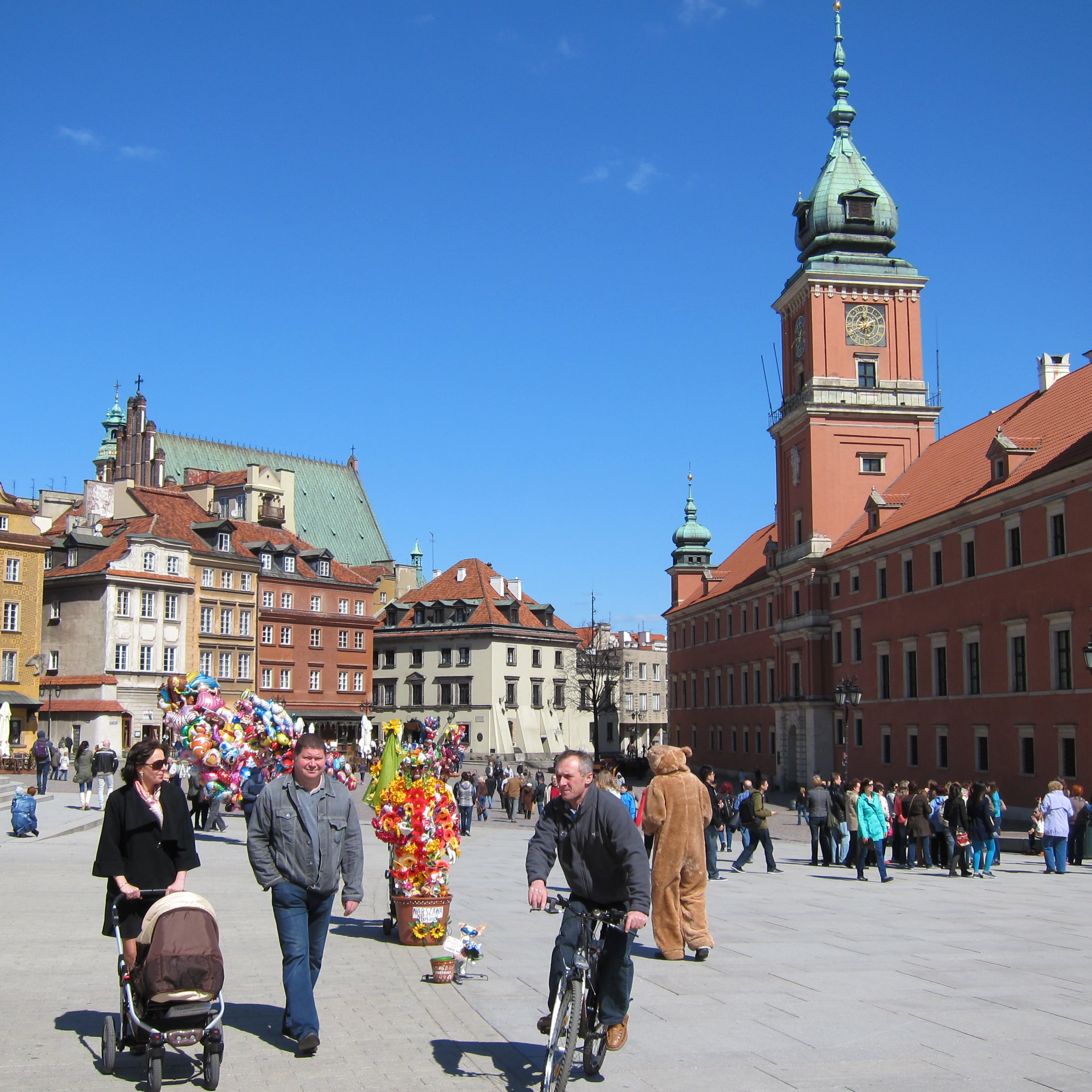
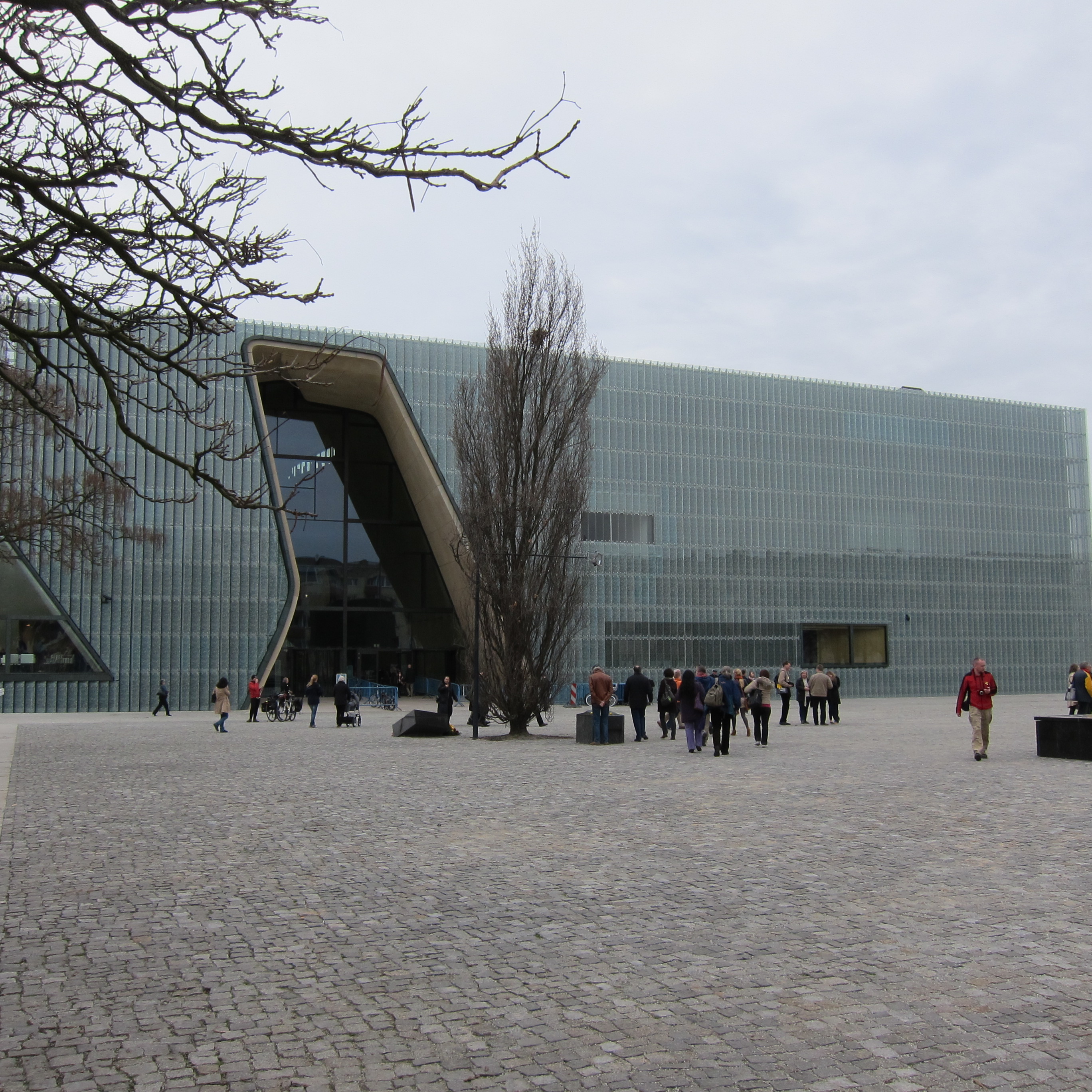
I was in Warsaw over the week-end, and my visit coincided with the opening of the new building for the Museum of the History of Polish Jews on the 70th anniversary of the Warsaw Ghetto Uprising. Even in its presently empty state, it’s a stunning place.

IMG_0525

Its Core Exhibition, developed under the supervision of Barbara Kirshenblatt-Gimblett, will display the thousand-year history of Jews in Poland, but the Museum has been built on the site of a pre-war Jewish neighbourhood where in October-November 1940 the Germans established the largest Jewish ghetto in Nazi-occupied Europe and razed it to the ground less than three years later.  And it’s this recent catastrophe (along with others) that invests so much of Warsaw with its contemporary historicity.

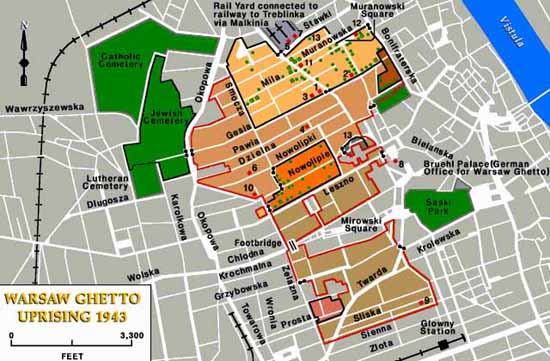
Warsaw Ghetto

You can find a sequence of other chilling maps of the Ghetto (and a helpful critical discussion of them) here, basic accounts of the process of its formation here, an excellent summary survey of the Uprising here and a shorter one here.  By 1943 hundreds of thousands of Jews had been deported from the Ghetto to concentration camps, and according to Deutsche Welle:

In early 1943, Heinrich Himmler ordered the final liquidation of the ghetto. Until then, most Jews had rejected armed resistance, including for religious reasons. But when the last mass deportation was about to begin, hundreds of young Jews decided to fight.

On April 19, 1943, the approaching German units met unexpected resistance. The young Jews were aware of their hopeless situation – they had no weapons, food or support. Yet they endured for three weeks, delivering a fierce battle. When the Germans surrounded the insurgents’ bunker in early May, they collectively committed suicide.

“They wanted to decide themselves how to die,” said Zygmunt Stepinski, director of the Museum of the History of Polish Jews in Warsaw. He called their deaths a political manifesto. “They wanted to show that Jews could defend themselves and that they organized the first-ever uprising against the Nazis,” he said.

13,000 Jews were killed during the Uprising, and most of the surviving 50,000 were deported to concentration and extermination camps.

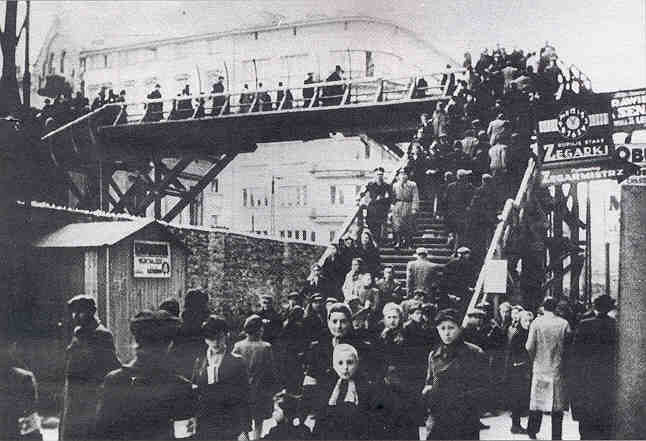
The Museum has been designed by a Finnish architect, Rainer Mahlamäki, and his studio.  To some degree, in its bridge suspended over the Main Hall, defined by the soaring, undulating walls that divide the Museum into its two parts,  the building reinscribes the division of the ghetto into two and the bridge that joined the one to the other (over Chlodna Street, an ‘Aryan’ thoroughfare), but more significantly it’s intended as ‘a bridge across the chasm created by the Holocaust – a bridge across time, continents and people.’

bridge2

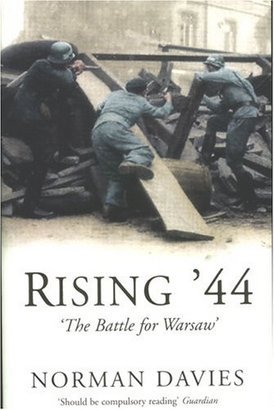
DAVIES Rising '44Many of those involved in the Museum project have suggested that the 1943 Uprising was a crucial inspiration for the general Warsaw Rising in 1944. This started on 1 August, and the insurgent Polish Home Army held out for 63 days of intensive urban warfare which left 16,000 of them dead along with 150-200,00 civilians.  The best English-language narrative of these courageous and horrifying events is probably Norman Davies‘s Rising ’44.

To make sense of this on the ground and to recover its material traces, we turned to the Warsaw Rising Museum, which included City of Ruins, an extraordinary 3-D simulation of American Liberator flights over the city in 1945 (advertised as the world’s first digital stereoscopic simulation of a city destroyed during the war: more on the project and how it was achieved here) –

– and to an outdoor/indoor exhibition of colour photographs of the ruined city taken by a young American architectural student, Henry N. Cobb, in 1947: The Colors of Ruin.  You can see some of Cobb’s photographs here, and Vimeo has this interview with him which includes a number of incredible images too:

Why such wholesale destruction? Under the terms of the surrender document agreed by the Polish Home Army in October 1944, the insurgents and the civilian population were expelled from the city into transit camps, from where they were deported to concentration camps.  According to some accounts, Hitler issued Command #2 on 11 October, realizing his pre-war dream of the total destruction of the city: ‘Warsaw is to be razed to the ground while the war proceeds.’  Six days later Himmler made sure his officers understood exactly what was intended:

‘The city must completely disappear from the surface of the earth… No stone can remain standing. Every building must be razed to its foundation.’

Special Verbrennungskommandos (‘annihilation detachments’) began the systematic destruction of what was left of the city with mathematical precision, using high explosives and flame-throwers.  According to the Museum guide,

‘They divided the city into regions, numbered the corner buildings and methodically destroyed the capital.  On the walls they put instructions concerning the method of destruction.  The Germans destroyed historical monuments and burned to ashes the biggest Polish libraries…  They turned archives, museums and their collections into ruins and ashes.  The Old Town became a city of ruins.’

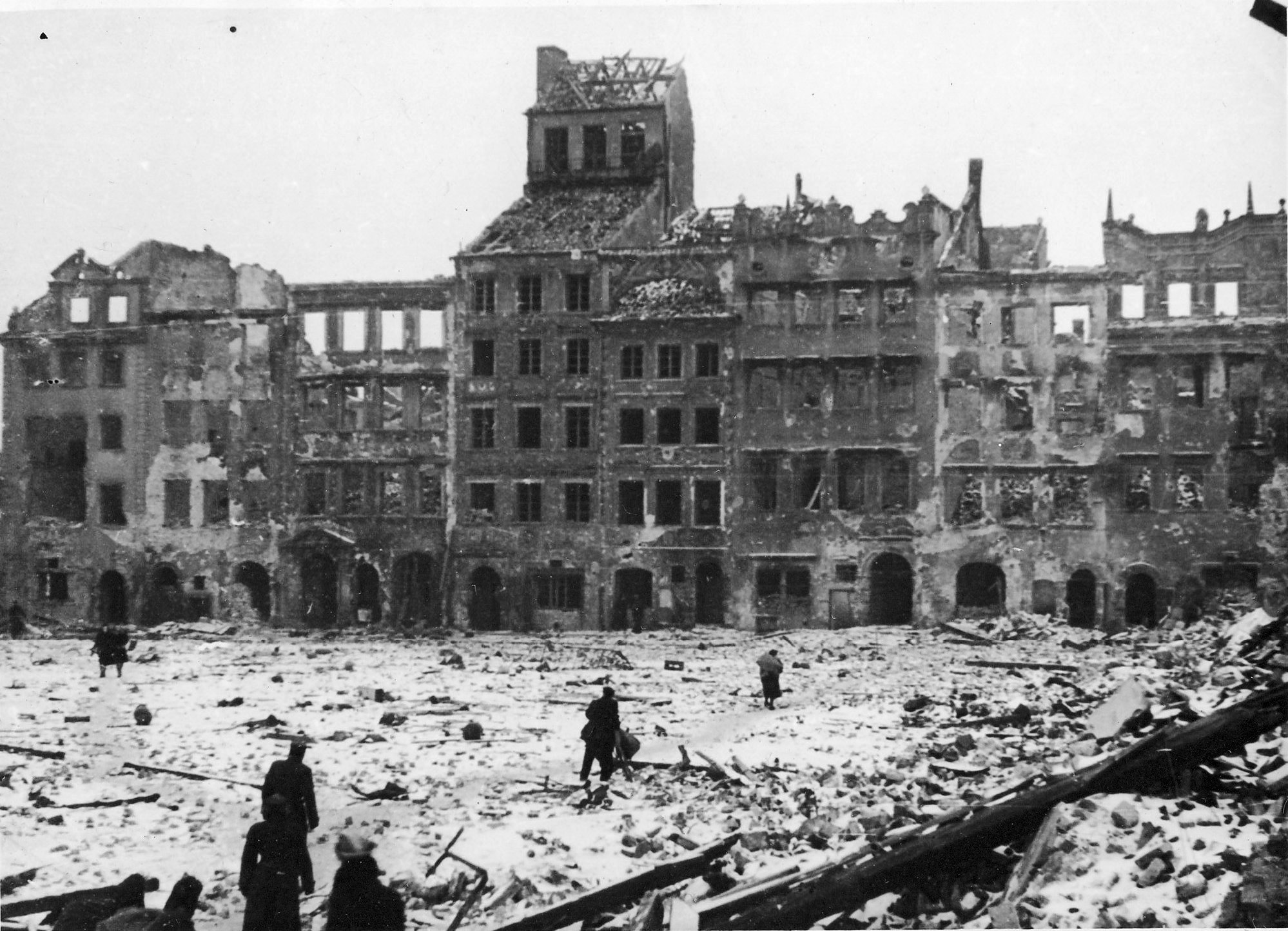
old_town_warsaw_waf-2012-1501-311945

Less than 5 per cent of pre-war Warsaw remained intact – about 12 per cent had been totally destroyed during the 1939 bombing and siege of the city, a further 17 per cent with the destruction of the Ghetto and 25 per cent during the Rising of 1944 – but it’s the systematicity as much as the scale that is so shocking.  And the sense of shock remains even as – in fact precisely because – today you walk around an Old City no less painstakingly restored, its planners, architects and builders working from old plans, photographs and drawings and using the original materials as far as possible.  It adds another dimension to what Steve Graham calls the post-mortem city: the resurrection of Warsaw is an extraordinary testimony (like the Museum of the History of Polish Jews) to the determination of a people to recover their history, to refuse their erasure, and to remember the enormity of what befell their predecessors.

IMG_0556

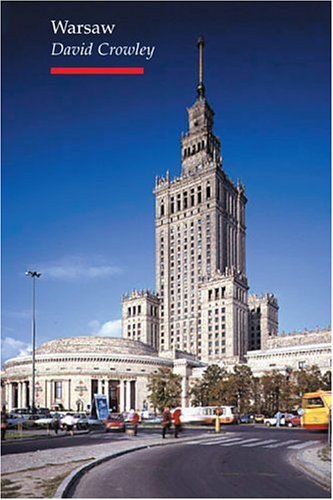
Or so it seemed to me before I started to think (and read) about the politics of memorialisation in post-war Warsaw.  David Crowley‘s essay on ‘Memory in Pieces: the symbolism of the ruin in Warsaw after 1944’ argues that

‘the image of ruin … functioned – unmistakably – as an ideological vent through which to draw patriotic sentiment and indict those who had destroyed the city.  But the powerfully affective image of ruin and the memories that it could arouse had to be contained and its force channelled (quite literally, in the form of voluntary labour to reconstruct parts of the city, like the Old Town).  In effect ruins, in the representational cosmos of socialism during the 1950s, were time-locked in 1944, the moment of destruction.’

Royal Palace 1945But what could the Royal Palace (in particular) re-present within that cosmos?  Tellingly, it was still in ruins in 1956 when a post-Stalinist regime came to power, and existing plans for its reconstruction were abandoned.  ‘In the years that followed,’ Crowley writes, ‘the castle formed an open wound at the heart of the city.  Seeing it as an aristocratic symbol of democracy, Crowley calls it an ‘architectural oxymoron.’  In ruins, the castle could ‘function indexically as evidence of both the glorious Polish past and the ignominious “Soviet” present.’  Finally, in the 1970s its reconstruction was approved as ‘Warsaw Castle’, an attempt to extinguish the aristocratic past and to forestall any democratic future, so that it functioned as what Crowley calls a sort of counter-iconoclasm, working to forget what its absence once signified.

But there was another, more pervasive absence.  The razing of the Ghetto destroyed a significant nineteenth-century fabric, and after the war a still wider nineteenth-century Warsaw disappeared from the landscape of reconstruction altogether.  Jerzy Elzanowski argues that its buildings and structures were seen as emblematic of the repressive class structure of capitalism; they had to be replaced by a radically different fabric ‘adequate to the needs of socialist society’ (‘Manufacturing ruins: architecture and representation in post-catastrophic Warsaw’, Journal of Architecture 15 (1) (2010) 71-86).

CROWLEY WarsawAnd there are, of course, other, ostentatiously modern Warsaws that have been forcibly put in place after the fall of Communism in 1989.

For all that, in the city of ruins, and most of all in the spectral traces of the two war-time uprisings in which images are made to stand for ruins, genocide and urbicide march in lockstep: and we would be foolish not to attend to the sounds and signs of their boots on the street.  Crowley thinks their museumisation and memorialisation is a kind of reversal in which the past (and specifically the Second World War) becomes a ‘lost utopia’.  I see what he means – I saw what he means – and I’m beginning to understand, too, why Elzanowski concludes that, at least in Warsaw (and no doubt elsewhere), images are at once indispensable for historical recovery and yet ‘seem to hinder our ability to observe the reality of here and now.’  It was, in part, an unease about my response to the materiality of the city and to its photographic representations that sent me off to dig out their two essays.  I felt a tension between the affective – the effect the ruins and the reconstructions had on me – and the analytical.  I’m still struggling.

The natures of war

Natures of War

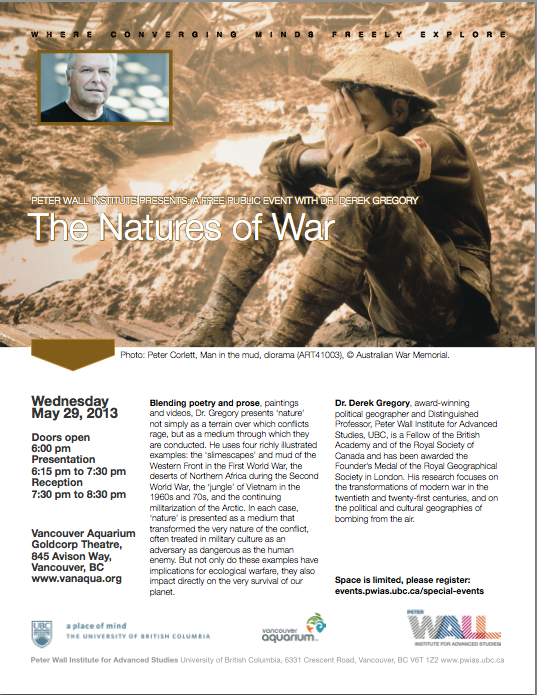
Just about to leave the High Atlas and Morocco, so something like normal service will resume once I’m back in London on Wednesday.  I’ve just received a near-final draft of the poster (above) for my Vancouver talk next month, “The natures of war“.  I’ll explain more of what I’m trying to work out in this presentation in a later post.  You’ll see that the venue is sort of appropriate – though I’ll leave my flippers at home.

More information and registration details here.

The Geopolitics of Dominion

SANSOM Dominion

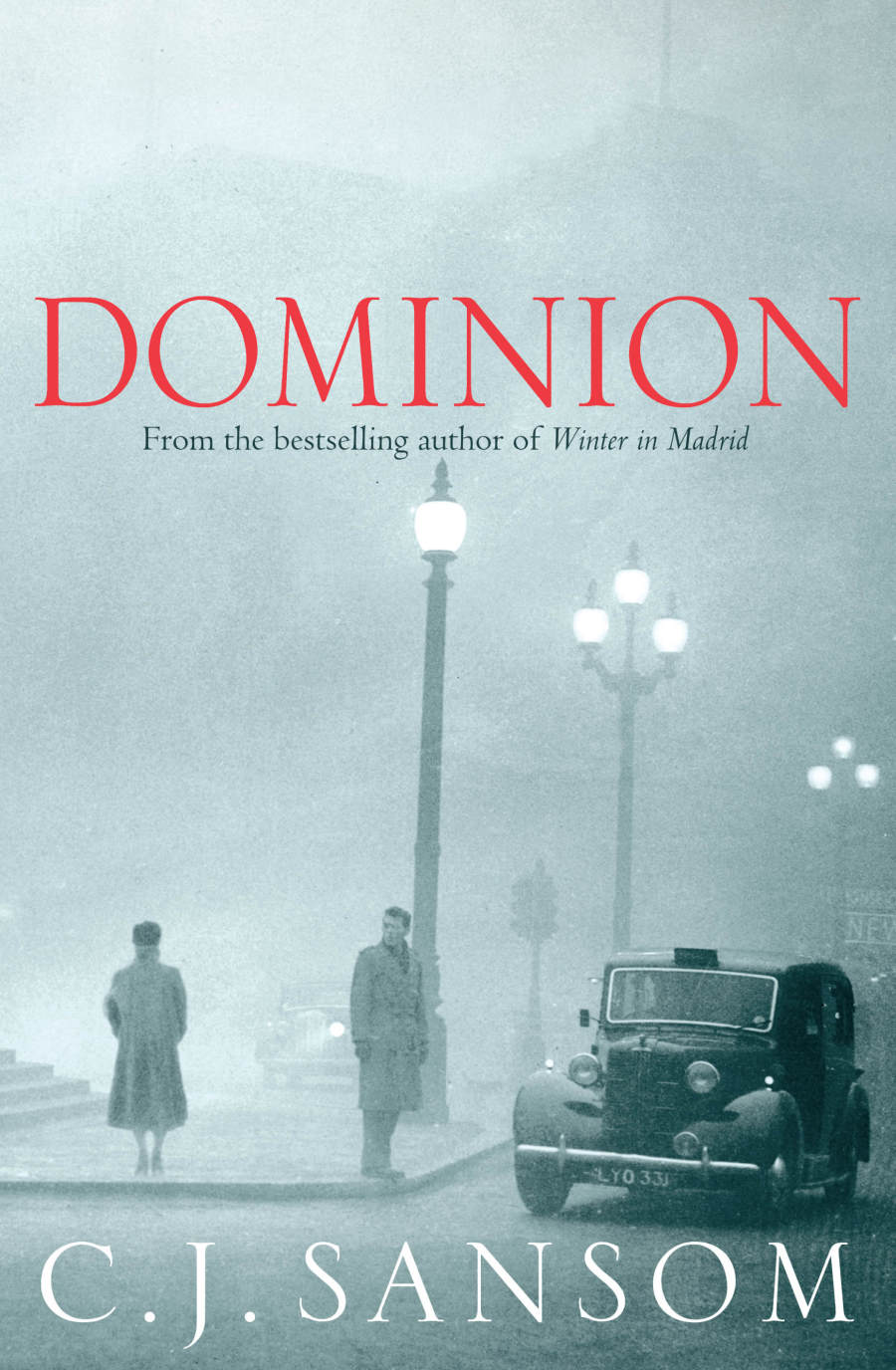
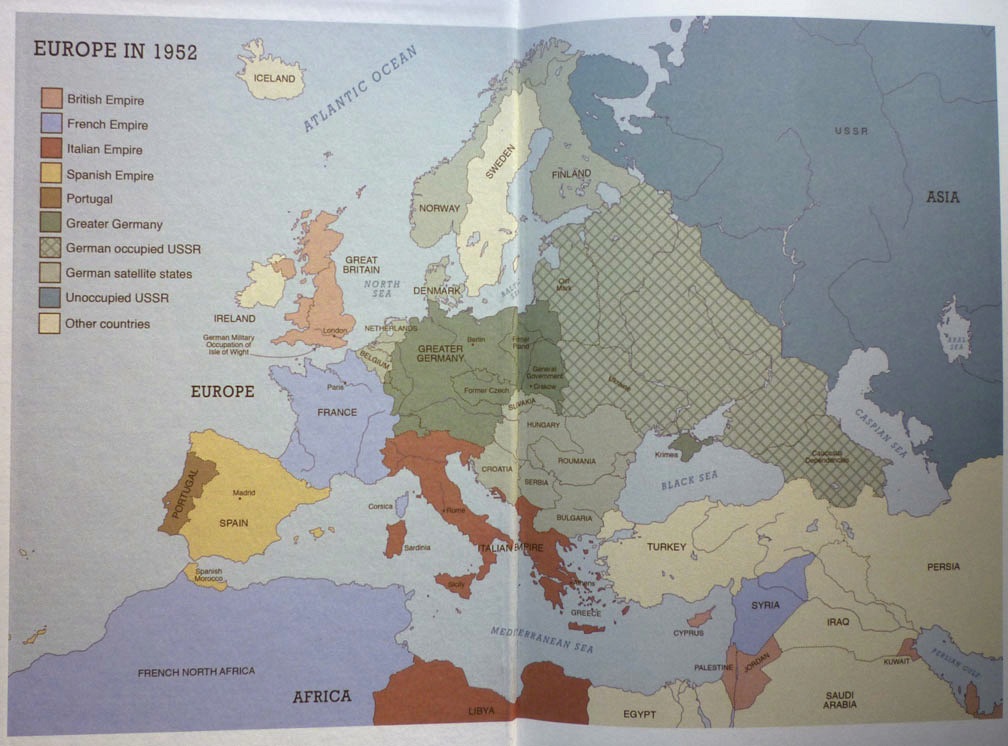
It’s been a long time since I read a novel with maps… and I don’t think I’ve ever read one that ends with an essay explaining its geopolitics.  I’ve just finished C.J. Sansom‘s Dominion (Pan/Macmillan, 2012), which is set in an alternative Britain in 1952.  The premiss is that Churchill never became Prime Minister in May 1940; instead, the British government under Lord Halifax sued for peace with Hitler.  In Sansom’s chillingly plausible vision, Britain became a German satellite state  but retained its nominal independence; it was not placed under military occupation but its government (and especially its police apparatus) became overwhelmingly fascist.  Germany was given carte blanche in Europe, and continued a relentless, remorseless but ultimately unwinnable war against what was left of the Soviet Union; Britain retained its Empire – which, apart from South Africa, became increasingly restive at the absolutist politics that festered at its heart – and the United States remained isolationist until the election of Adlai Stevenson in 1952.

Sansom_Dominion_map1

One of the pleasures of the book (and of Sansom’s closing essay) is his explanation for the historical figures he manoeuvres onto (and off) his stage and the political and geopolitical formations their movements bring into view: Beaverbrook (whom Clement Attlee described as the only evil person he had ever met) as the collaborationist Prime Minister, Oswald Moseley as Home Secretary, Rab Butler as Foreign Secretary, and Enoch Powell (who else?)  as Secretary for India; Churchill, together with Attlee and Harold Macmillan, as key figures in the Resistance; and the appearance of a host of minor figures in the world of ‘light entertainment’, dimly remembered from my childhood (I was born a year before Sansom): Isobel Barnett, Frankie Howerd and, a marvellous conceit, Fanny Craddock showing her audience how to cook sauerkraut….

It is in these minor-key details, in the richly imagined world of a post-war Britain in which – since the Blitz never took place – bomb shelters are relicts of an unrealized past, and everyday life re-assumes the drab mantle of the 1930s – that the genius of the novel lies.  Sansom conveys with a rare sensibility the banality of Fascism (and, yes, of evil): not only its grotesque monumentality (like Sansom I suspect, I take a grim satisfaction in the University of London’s Senate House becoming the new German Embassy), not only the vile exactions of anti-Semitism (a leitmotif of the book, flickering in and out of view in the smog that grips the capital, is the round-up of Britain’s Jews),  but the thousand and one accommodations and submissions made by ordinary people to the extraordinary.

All of this, perhaps inevitably, makes me wonder what I would have done in such circumstances: I’ve been thinking about this ever since I started my history/geography of bombing.  Would I have had the courage to join the RAF and bomb Germany?  Or would I have had the courage to refuse? But Sansom’s novel – which acknowledges its debt to Len Deighton’s SS-GB –  adds another dimension because Dominion is animated not only by its repugnance towards fascism but also, as that closing essay makes clear, by a studied contempt for European nationalisms.

Hide and Seek – and Show

Ever since I heard Isla Forsyth give one of her marvellous presentations on camouflage I’ve been fascinated by the subject – all the more so since it intersects so artfully (and, as Isla would quite rightly insist, scientifically) with my work on aerial reconnaissance, bombing and modern war.  You can get an early sense of Isla’s work from this presentation, ‘Shadow chasers: exploring the vertical and angular geometries of camouflage‘, which includes a gallery of images.  Isla’s Glasgow PhD thesis, From Dazzle to the Desert: A Cultural-Historical Geography of Camouflage, was completed last year – and I hope will appear in book form.

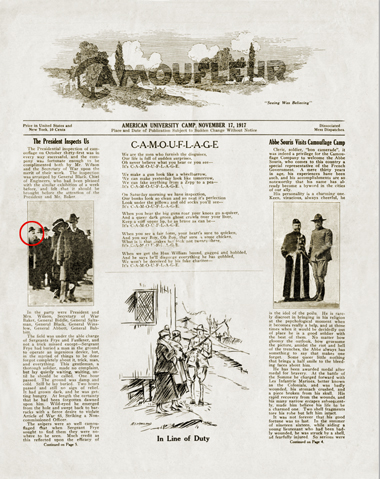
FrontPageCamoufleur

There’s a great blog on camouflage – Camoupedia – which includes an appreciative notice of Isla’s work and, amongst a feast of deceptive riches, a stunning series of posters by graphic design students to advertise a talk by Claudia Covert (that really is her splendid name) on dazzle ship camouflage in World War I, a post about the newspaper of the American Camouflage Corps in 1917 (above), and a remarkable extract from a letter from Reginald Farrer later published as The Void of War: letters from three fronts (1918):

FARRER Void of WarThe real thing about the human side of the war is the sheer fun of it. In certain aspects the war is nothing but a glorious, gigantic game of hide and seek—camouflage is nothing else. It is not only the art of making things invisible, but also of making them look like something else. Even the art of inconspicuousness is subtle and exciting. What glory it must be to splash your tents and lorries all over with wild waggles of orange and emerald and ochre and umber, in a drunken chaos, until you have produced a perfect futurist masterpiece which one would think would pierce the very vaults of heaven with its yells..

But disguise is an even higher branch of the art: you go on to make everything look like something else. Hermit crabs and caddis worms become our masters. Down from the sky peers the microscopic midget of a Boche plane: he sees a tree—but it may be a gun: he sees a gun—but it may be only a tree. And so the game of hide and seek goes on, in a steady acceleration of ingenuity on both sides, till at last the only logical outcome will be to have no camouflage at all. You will simply put out your big guns fair and square in the open, because nobody will ever believe, by that time,  that anything really is what it looks like. As far as the guns go, the war is developing into a colossal fancy dress ball, with immunity for the prize: wolves in sheep’s clothing are nothing to these gentle shepherdesses of the countryside. The more important they are, the more meekly do they shrink from notice under dominos of boughs or sods, or strawberry-netting tagged over with fluffets of green and brown rags. And sometimes they lurk under some undiscoverable knoll in a coppice, and do their barking through a little hole from which you would only expect rabbits, not shells..

And, of course, this fun sense of his [the individual] has full play in this new warfare. It is all “I spy,” on terms of life and death: the other fellow must not spy, or you hear of it instantly, through your skull. Think how it must sharpen up the civilization-sodden intelligence of a man, to have to depend for dear life on noticing every movement in a bush and every opening in a bank. Now we are getting back with one hand what we had lost by giving up the other to machinery. We are growing to make the best of both worlds, the mechanical and the human, without giving up our mental balance by relying exclusively on either. I only wish I could give you an idea of the devices and ingenuities that these grown-up hide-and-seekers have elaborated. All sorts of ludicrously simple things, the more ludicrously simple the better

Every blank-faced trench rampart of sandbags has its hidden eyes—eyes perfectly wide awake all the time, and winking at you wickedly with a rifle. But for your life you could not spot them, until you had had weeks of training, and learned the real meaning of every tiny unevenness or discoloration or bit of darkness. And even then you have to learn to guess which of these is harmless—so as to blind the others with your own fire. Or there is an innocent, untidy, earthy bank, a dump of old boots and tins and bottles and teapots without spouts. But any one of those forlorn oddments may also be the eyelid of a rifle. Only you do not know which—until you have found out! In the beginning of the war you did not find out. Everything was neat and tidy and civilized and well arranged: so you merely got killed.

I’ve quoted this at length because it seems such a radically different view of the new geometries of the First World War to that taken (as I noted here) by Charles Nevinson in his early paintings of the Western Front – at least in its celebratory temper.  And yet, in its acknowledgement of the entanglements of the machine and the human, it’s also subversively the same.  (Not surprisingly, both Isla and the author of the blog – Roy Behrens, who also wrote the book Camoupedia (2009) – pay close attention to camouflage artists, and there’s also a brief blog post on Camouflage as Futurism that notes Nevinson’s work).

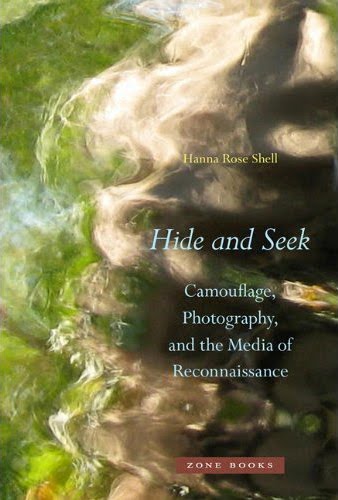
All of this is on my mind today for two reasons.  The first is that Farrer’s letter was published in part under the title ‘Hide and Seek‘, which is also the title of a brilliant book on camouflage I’ve belatedly discovered (perhaps that’s appropriate): Hanna Rose ShellHide and Seek: Camouflage, Photography and the Media of Reconnaissance, published by the ever -inventive Zone Books in March last year.  The more books I buy from Zone, the more I realise that this is a wonderful platform for books that depend on images – not surprising since they are edited by Jonathan Crary,Michel Feher, Hal Foster and Ramona Nadaff.

SHELL Hide and seek

You can get a sense of Hanna’s (early) work from this essay, ‘The crucial moment of deception’, in Cabinet.  There’s also an excellent article on her work in the Paris Review here , another at rhizome here, and a short interview with Hanna here:

The main focus of my book is on the period between the late 19th century and World War II, but I also show how photographic camouflage is present in military research today. What I call an enduring “chameleonic impulse” continues to motivate military R&D of wearable camouflage technologies. There is also an ongoing quest to develop “invisible cloaks” to serve simultaneously as skins and … screens onto which one’s visual environment might be projected.

Many times, people’s first association with camouflage is with the natural world — it’s often the story of the evolution of the “peppered moth” that schoolchildren learn in biology class. But it’s only when humans had to hide from the camera and other optical devices that animal protective concealment began to fascinate people … and then became a model for the development of new human technologies.

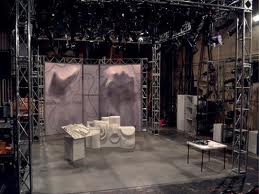
Camouflage Project

There’s a second reason.  I’m presently developing a performance work, provisionally called “The social life of bombs“, where I want (among other things) to integrate the performing and visual arts into the research process (as part of my Killing Space project).  My inspiration is in part Gerry Pratt’s Nanay, but more proximately Boca del Lupo‘s Photog, based on the experiences of four combat photographers and using cutting-edge visual technologies to mesmerising effect (I’m going to talk with them next month), and in part Ohio State University’s  The Camouflage Project (above).  The project involved OSU’s Department of Theater and the Mershon Center for International Security Studies:

The camouflage project/2The goal of The Camouflage Project is to create, organize and execute a three-part interdisciplinary endeavor linked to the theme of secret agents, camouflage, deception and disguise in World War II, specifically the F section (France) of the Special Operations Executive (SOE). The three parts are as follows:

Performance: To devise a new performance work as a collaboration between Ohio State University Theatre and the Advanced Computing Center for the Arts and Design (ACCAD). This will be a multi-media work combining digital animations and video projections with experimental use of 3D printing, 3D scanning and projection mapping.

Exhibition: To create a visual environment parallel to the performance space, which will have a second life as an installation/exhibition. The installation will feature historical background (interviews and soldier training films) on the science and art of camouflage in both World Wars organized around a visual study of selected SOE (principally female) agents and espionage circuits in France, examples of military equipment, devices, disguises, gadgets and weapons of deception.

Symposium: To organize and host an international symposium on the multiple artistic and instrumental meanings of camouflage, to be held in May 2011. The symposium will feature panels of Ohio State and international experts from military history, political science, and the Imperial War Museum addressing the subject of camouflage and the SOE.

The project offers a fresh meaning to the expression ‘theatre of war.’ On one level it theatricalizes the history of military camouflage, particularly the SOE and the role played by women agents in its espionage activity. On another it reveals the artistic dimensions of these activities: a variety of theatre artists—scenic, costume, make-up designers, and vaudeville magicians—were employed to use their theatrical skills to deceive and fool the enemy. Rather than tales of derring-do and spying, this project seeks to look at different and often hidden aspects of the war: the use and creation of camouflage, both literally and metaphorically, by people who had to work secretly behind enemy lines. The performance storyline will highlight the work of women agents, many of whose accomplishments have been concealed, erased or obscured for a variety of reasons. A narrative strategy will be to include elements of the training process involved in preparing agents for the field and the often-disastrous consequences of strategic decisions made by the SOE leadership.

This all came together in May 2011, though the performance work has subsequently been on tour; the programme for the symposium and performance is here, a review of the 90-minute performance here.  My subject is different, of course, but I’m really taken by the tripartite structure of the project and its collaborative nature.  Perhaps I have nothing to say, only to show…

Of Bombs and Men

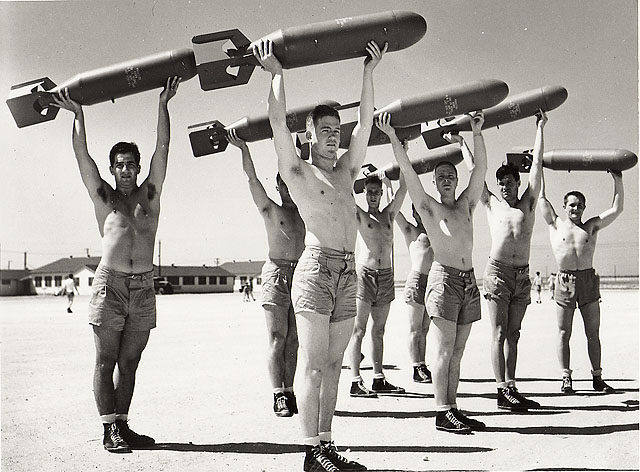
WWII Bombardier Calisthenics

When Stanley Kubrick had Major Kong (Slim Pickens) straddle a nuclear bomb in Dr Strangelove (1964) and ride it exuberantly all the way down to its target – surely the most iconic image from the film – he was making an obvious visual point about masculinism, sexuality and military violence that, as the clean-limbed image above shows, takes many other, non-nuclear forms.  Here a group of US Army Air Force bombardiers in the Second World War practices calisthenics with 100 lb bombs.  A different sort of ‘love-charm of bombs‘, you might think.

Indeed, a contemporary account made much of the ‘hard and rigid training of members of a bomber crew’ – which was supposed to be just like a football or basketball team (‘This is really the Big League in the toughest game we have ever been up against, with the pennant the survival and future of the whole nation’) – and emphasised their collective virility and heteronormativity:

‘They will have played football or basketball, have competed in the field or on the track.  Many of them will have been ardent hunters or fishermen.  Because they are healthy young men they will like girls very well indeed.’

Hunting was important; readers were told to be thankful that ‘frightened civil authorities and specific Ladies Clubs have not managed to eradicate from the country the tradition of the possession and use of firearms’, which ensured that a young man would enter the Air Force ‘with the whole background of aerial gunnery in him before he starts.’

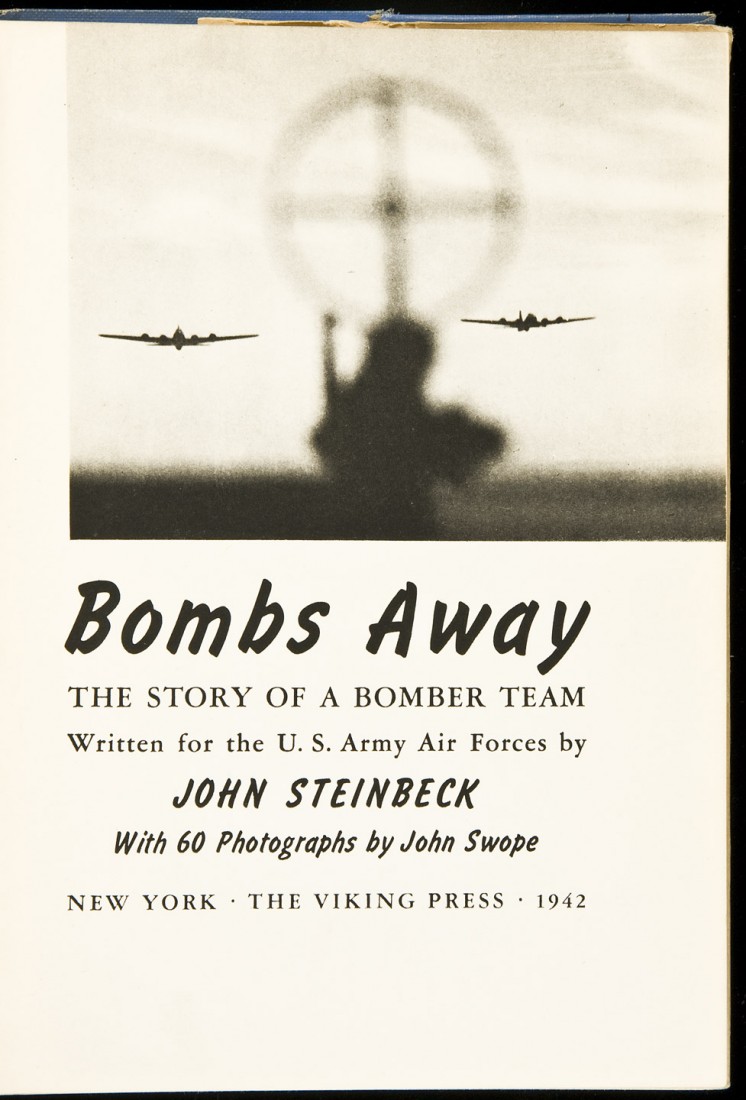
The author of all this was, astonishingly, John Steinbeck, and the book Bombs Away: the story of a bomber team, published in 1942.

STEINBECK Bombs Away

In May 1942 Steinbeck had been summoned to Washington by General Henry A. “Hap” Arnold who explained what he had in mind – an account of the training of a bomber crew that would serve as a recruiting platform – and although Steinbeck was at first reluctant a meeting with President Roosevelt convinced him to accept the assignment.  He spent the summer on the road (in fact, much of the time in the air), travelling from airbase to airbase in the United States with Hollywood photographer John Swope, who provided 60 illustrations for Bombs Away.  Swope would later be tapped by First World War veteran Edward Steichen for his US Navy photographic unit covering the war in the Pacific, where he produced a remarkable photographic portfolio and the accompanying Letter from Japan in 1945.

Steinbeck was no stranger to working with photographers.  In 1937 Horace Bristol, a freelance photographer who regularly contributed to LIFE magazine,

‘proposed a story about migrant farm workers in Calfornia’s Central Valley—a project that would include accompanying text by novelist John Steinbeck. Though LIFE turned down the story, Bristol and Steinbeck agreed to collaborate on a book-length project, and the two men spent several weekends in labor camps during the winter of 1938. Bristol took hundreds of photographs of the suffering farm workers, only to have Steinbeck withdraw from the partnership to write the story as a novel, which became his masterpiece The Grapes of Wrath.’

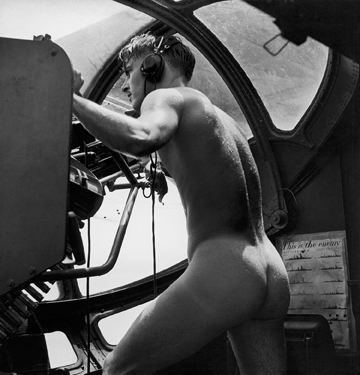
BRISTOL PBYBlisterGunnerBristol was also later recruited by Steichen, and some of his war photographs would not been out of place in Bombs Away: the image on the right, ‘RESCUE: PBY Blister Gunner’, was shot in a Catalina Flying Boat at Rabaul, Papua New Guinea, in 1944, which presumably explains the flying kit.

If Steinbeck’s collaboration with Swope turned out to be more congenial than that with Bristol, however, it was markedly less fruitful. Ernest Hemingway disliked Bombs Away so much that he famously observed that ‘I would rather cut off three fingers off my throwing hand than to have written it.’

He wasn’t alone.  A review in the New Republic declared that Bombs Away bore ‘about the same relationship to literature that a recruiting poster does to art.’  But of course it was supposed to be a recruiting poster, and it had to be written in double-quick time.

In the book Steinbeck assembles the bomber crew man by man, role by role – the bombardier, the aerial gunner, the navigator, the pilot, the aerial engineer/crew chief and the radio engineer – who together ‘must function like a fine watch’.  They are assigned a ‘ship’ – a B-17E Flying Fortress or a B-24 (‘Liberator’) – which will invariably become personalised and almost always feminized.  (There’s a considerable literature on the ‘nose art‘ of bombers, and Steinbeck will later declare that ‘Some of the best writing of the war has been on the noses of bombers’).  But it is the men that count, that constitute the elaborate clock-mechanism: ‘Men are the true weapons of the Air Force,’ Steinbeck insists, ‘and it is an understanding of this that makes our bomber crews what they are.’ Inevitably, he adds: ‘Living and working together too, they played together too.  On the beach in their free time they played football and swam in the warm water of the Gulf.’

Norden bombsightSteinbeck knows, of course, that this is a deadly serious ‘game’: and one that, as he also labours to explain, is objective, scientific: ‘They knew the mathematics of destruction.’   Within this embodied, techno-cultural constellation the Norden bombsight (left) occupied a central place.

‘This bombsight has become the symbol of responsibility.  It is never left unguarded for a moment.  On the ground it is kept in a safe and under constant guard.  It is taken out of its safe only by a bombardier on mission and he never leaves it.  He is responsible not only for its safety but for its secrecy.’

I’ve noted before how often bombing depends on abstraction: on a technical division of labour within the kill-chain, on a rhetoric of scientificity (and, by extension, precision), and on a calculus that transforms places and people into the co-ordinates of a target.  Bombs Away shows this to perfection, but it shows something else even more clearly. For the ability to carry out these deadly missions also depends on an instilled and instinctive sociality (here, naturally, a homosociality) that is far from abstract.

STEINBECK Bombs Away cover

And yet there is something abstract, or at least detached, about Bombs Away, because it ends just before the crew takes off on its first mission.  In the concluding chapter, ‘Missions’, Steinbeck explains that the men ‘looked so carefully at the newspapers, and what they found in the newspapers reassured them.’

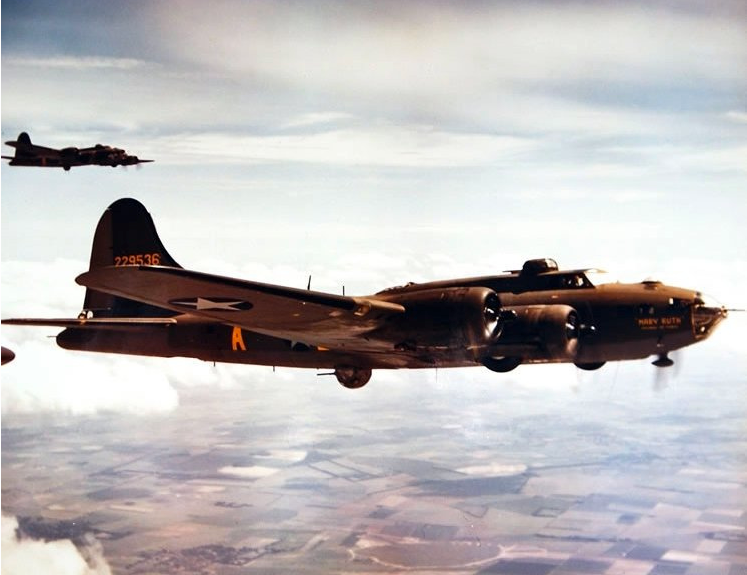
Mary Ruth nose artBut this paper knowledge turned out to be less than satisfactory.  Less than a year later, in June 1943, his request to become an air force intelligence officer refused by the draft board – a US Army intelligence report, mindful of the sympathies of Steinbeck’s pre-war novels, had concluded that there was ‘substantial doubt’ about his ‘loyalty and discretion’ and recommended that he not be offered a commission – Steinbeck was at RAF Bassingbourn (USAAF Station 121) in Cambridgeshire as a war correspondent for the New York Herald Tribune.

An old friend of his, in fact a literary agent before the war, Staff Sergeant Henry (“Maurice”) Crain was stationed there, and Steinbeck wrote nine articles centred on the crew of Crain’s ship, the “Mary Ruth: Memoirs of Mobile“, a Flying Fortress of the 91st Bomb Group of VII Bomber Command.  ‘The closer you get to the action,’ he reports Crain (the ball-turret gunner) saying, ‘the less you read the papers and war news’:

‘I remember before I joined up I used to know everything that was happening… I even had maps with pins and I drew out campaigns with colored pencils. Now I haven’t looked at a paper in two weeks.’

And when the crew did, as often as not they didn’t recognise what they saw.  The waist-gunner had read a newspaper from home:

‘It seems to me that the folks at home are fighting one war and we’re fighting another one. They’ve got theirs nearly won and we’ve just got started on ours. I wish they’d get in the same war we’re in. I wish they’d print the casualties and tell them what it’s like.’

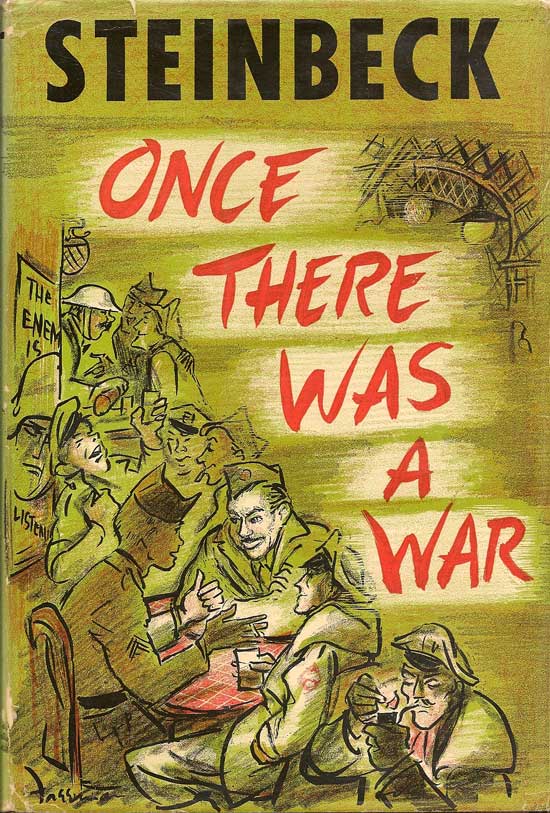
STEINBECK Once there was a warThis is a far cry from the brimming, boastful confidence of Bombs Away, and Steinbeck is clearly concerned not only to change the tone but also to surmount the limitations of his new, temporary profession (some of his despatches were republished in 1958 in Once there was a war).  He does so by invoking the the technical, instrumental armature of the mission: the precision of the briefing (‘The incredible job of getting so many ships to a given point at a given time means almost split-second timing’), the complicated process of kitting up (‘During the process the men have got bigger and bigger as layer on layer of equipment is put on; they walk stiffly, like artificial men’), and the meticulous work of the ground crews who ‘scurry about like rabbits’ as they prepare the aircraft and load the bombs.  But here too it is above all the sociality, the camaraderie that drives and dominates the narrative.

Mary Ruth

And it’s the end of this that brings Steinbeck’s reports to an abrupt end.  He had had in mind a series of 25 articles, but this was cut short when the ‘Mary Ruth’ (shown above) failed to return from a bombing raid on the Ruhr.

But this was not the end of Steinbeck’s interest in (and enthusiasm for) the US military in general and bombing in particular.  He was a vocal supporter of the Vietnam War, and in fact visited the South in December 1966-January 1967.  In private he wrote that ‘I wish the bombing weren’t necessary, but I suspect our people on the ground know more about that than I do’ , and he refused all requests to sign petitions against President Johnson’s Rolling Thunder campaign.  [For more on Steinbeck’s involvement in the two wars, see Thomas Barden, ‘John Steinbeck and the Vietnam War’, Steinbeck Review 5 (1) (2008) 11-24].

Note: Most of the crew of the ‘Mary Ruth’ survived (including Crain) and were taken prisoner of war.  The most detailed account describes the ‘Mary Ruth’ being shot down by a fighter aircraft on 22 June 1943; Steinbeck’s reports for the New York Herald Tribune begin to appear on 26 June. The discrepancy is presumably explained by a combination of the time taken for his despatches to cross the Atlantic and wartime censorship.  Both Bombs Away and Once there was a war are still available as Penguin editions, the latter with an enthusiastic foreword by Mark Bowden.

The sensual history of destruction

I’ve been in Paris this week, first for a presentation to Michel Wieviorka‘s seminar at the École des Hautes Études on Wednesday morning and then for a different presentation to Pauline Guinard‘s seminar at the École Normale Supérieure on Wednesday evening.  I hope this explains my silence!  Lots of good questions at both, and also lively conversations about the French intervention in Mali — which made today a good day to visit the Musée de l’Armée at Les Invalides.

An astonishing building, but I was disappointed at the exhibitions – too many uniforms and muskets and (especially when compared to the Imperial War Museum in London, even before its current reconstruction) remarkably little on the politics and culture of war (though there were some good three-screen videos).  Given my current preoccupation with the First World War, I expected much more from what turned out to be a lifeless series of galleries; appropriate, you might think, but I left with very few impressions of how so many French soldiers managed to survive the trenches and the barrages.  It was a far cry from the new history, anthropology and archaeology of the battlefield that has done so much to recover its raw physicality, its sensuality and even its intimacy.

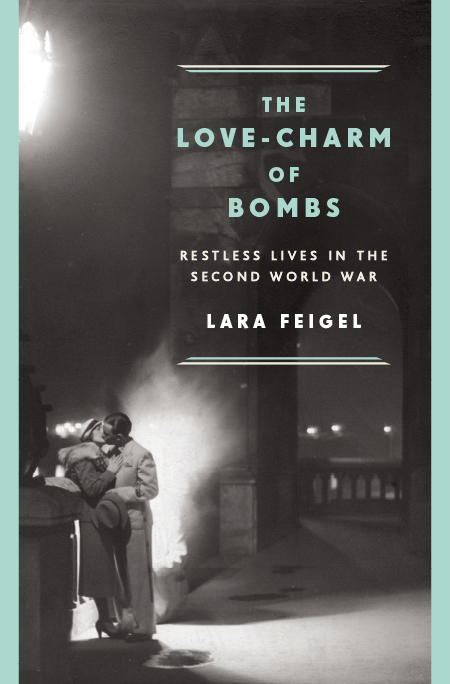
FEIGEL Love-charm of bombs (UK edition)So I returned to the hotel to start Lara Feigel‘s The love-charm of bombs: restless lives in the Second World War (Bloomsbury, 2013) which I picked up at Foyle’s on my way through London (and still the best bookshop in the world).  When people ask me to recommend books that convey the experience of being bombed, my selections always include the opening chapter of Randall Hansen‘s The fire and the fury: the Allied bombing of Germany 1942-1945, where he uses eyewitness accounts to conjure up ‘The day Hamburg died’ with extraordinary power and economy – there is now a rich literature on this in German and in English, most notably Keith Lowe‘s brilliant Inferno: the devastation of Hamburg 1943 – and the central chapters of Sarah Waters‘s stunning novel The Night-Watch.  But I think I may have to add Feigel to the list because The love-charm of bombs traffics in that difficult but vital space between the documentary (Hansen) and the imaginative (Waters).

I say ‘may’ only because I’ve just started.  But Part I, ‘One night in the lives of five writers, 26 September 1940’, uses the work and lives of five writers – Elizabeth Bowen, Graham Greene, Rose Macaulay, Hilda Spiel and Henry Yorke (‘Henry Greene’) – to address, in a remarkably fresh and compelling fashion, the relation between aesthetics and violence.  Feigel does this not in a conventional philosophical fashion, but by engaging directly with the ways in which, for these (and presumably other) writers, there was something thrilling, exhilarating and even sublime about the spectacle of military violence transforming the capital during the Blitz.  This was far more visceral than voyeurism, though Feigel is very, very good on the visuals (and would surely have been even better had she included the work of artists and photographers), because these men and women were profoundly, physically involved in the Blitz as air raid wardens, ambulance drivers, and auxiliary firemen.  The title comes from Graham Greene:

‘The nightly routine of sirens, barrage, the probing raider, the unmistakable engine (“Where are you?  Where are you?  Where are you?”), the bomb-bursts moving nearer and then moving away, hold one like a love-charm.’

FEIGEL The love-charm of bombsFeigel gives the events of that one night a peculiar intensity by beginning with what she calls a ‘newsreel’, a quick and lively summary of the Blitz, and then, as darkness falls, moving in sections from 7 p.m. (Blackout) through 10 p.m. (Fire) and 1 a.m. (Rescue) until 6 a.m., the All Clear, and the blessed arrival (for some, at least) of a new day.  It’s something of a conceit: the five writers were not dutiful scribes each at their separate desks on 26 September , so to bring them into view on this artfully re-imagined night Feigel darts back from their loosely collective present into their pasts, placing them in myriad networks of other writers and friends, inserting them into the narrative arc of the falling bombs, and freely using their writings so that they issue forth as something far more than the usual silhouettes glimpsed against the light of burning buildings.  And their involvements are profoundly sensuous: as the cover of the American edition (right) shows far better than the English edition above, and as the title intimates, even as they were unmoored from their familiar haunts and their old lives, they also sensed (and often seized) new possibilities for love as well as loss.

This is a very different ground to that crunched over by Patrick Deer in the equally brilliant Culture in camouflage: war, empire and modern British literature (still one of my favourite books about this or any other period) or Leo Mellor‘s Reading the ruins: modernism, bomb-sites and British culture (which I found remarkably austere), because its sense of culture is more sensuous, even sensual, because it addresses the erotics of surviving military violence in such an honest way, and – probably another way of saying the same two things – because it’s so close in spirit to Sarah Waters.

It’s also much closer to the way in which the humanities have recovered the Western Front.  In fact, Feigel insist that ‘these writers, firefighting, ambulance-driving, patrolling the streets,were the successors of the soldier poets of the First World War, and their story remains to be told.’  There are of course difficulties in privileging the privileged, and some of the most arresting memorials about life in the trenches were produced not by the gentlemen-officers but by the ordinary soldiers: but as Feigel shows, there are also riches to be recovered by picking their pocket-books.

War and simulation

Antoine Bousquet has an interesting post on War and simulation over at The Disorder of Things, based on a conference “Simulation, Exercise, Operations” at Oxford last summer. Antoine’s narrative locates the origins of military simulation in the Prussian Kriegspiel of the early nineteenth century but then argues that ‘it really comes of age with the Second World War, the early calculating machines that would become the all-purpose computer,  and the efforts to rationalise the conduct of military operations, notably in the areas of aerial bombing, military convoys, radar arrays, and so on – and which quite demonstrably yielded improved performances of those systems.’

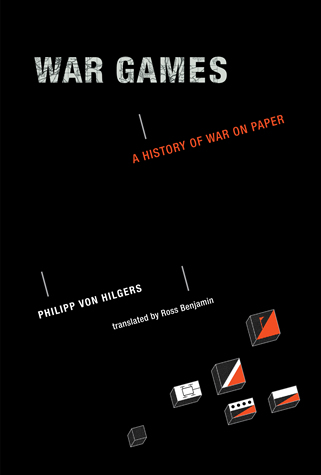
von HILGERS War GamesThis is interesting stuff, and Patrick Crogan‘s Gameplay mode: war, simulation and technoculture (Minnesota, 2011) helps bring the story up to date; if you want to start it earlier, then Philipp von HilgersWar games: a history of war on paper (MIT, 2012; the original German title was Kriegsspiele) is the (brilliant) place to start.  But since I’m still floundering around in the trenches of the First World War, I want to draw attention to the gap in Antoine’s narrative (which reappears in von Hilgers too).

During the First World War the metricisation of the battlefield – the (in)calculability of the space of war – that I spoke about earlier also allowed for simulations of imminent operations (and there are dimensions of that metricisation, including sound ranging, that speak directly to the early attempts at what would later be called operations research too: Roy MacLeod writes of a ‘batttlefield laboratory’ on the Western Front).

So, for example, in Over the top, published in 1917, Arthur Empey describes how

‘Three weeks before the Big Push of July 1st [1916] — as the Battle of the Somme has been called — started, exact duplicates of the German trenches were dug about thirty kilo[metre]s behind our lines. The layout of the trenches were taken from aeroplane photographs submitted by the Royal Flying Corps. The trenches were correct to the foot; they showed dugouts, saps, barbed wire defences, and danger spots. Battalions that were to go over in the first waves were sent back for three days to study these trenches, engage in practice attacks, and have night maneuvers. Each man was required to make a map of the trenches and familiarise himself with the names and location of the parts his battalion was to attack…

‘These imitation trenches, or trench models, were well guarded from observation by numerous allied planes which constantly circled above them. No German aeroplane could approach within observing distance. A restricted area was maintained and no civilian was allowed within three miles, so we felt sure that we had a great surprise in store for Fritz.’

Note here the cascade from aerial photographs and maps to physical models and back to maps again – and remember, as Dick Chorley and Peter Haggett taught some us an age ago in Models in Geography, these are all models…

In Empey’s case, there was a sting in the tail:

 ‘When we took over the front line we received an awful shock. The Germans displayed signboards over the top of their trench showing the names that we had called their trenches. The signs read “Fair,” “Fact,” “Fate,” and “Fancy” and so on, according to the code names on our map. Then to rub it in, they hoisted some more signs which read, “When are you coming over?” or “Come on, we are ready, stupid English.”

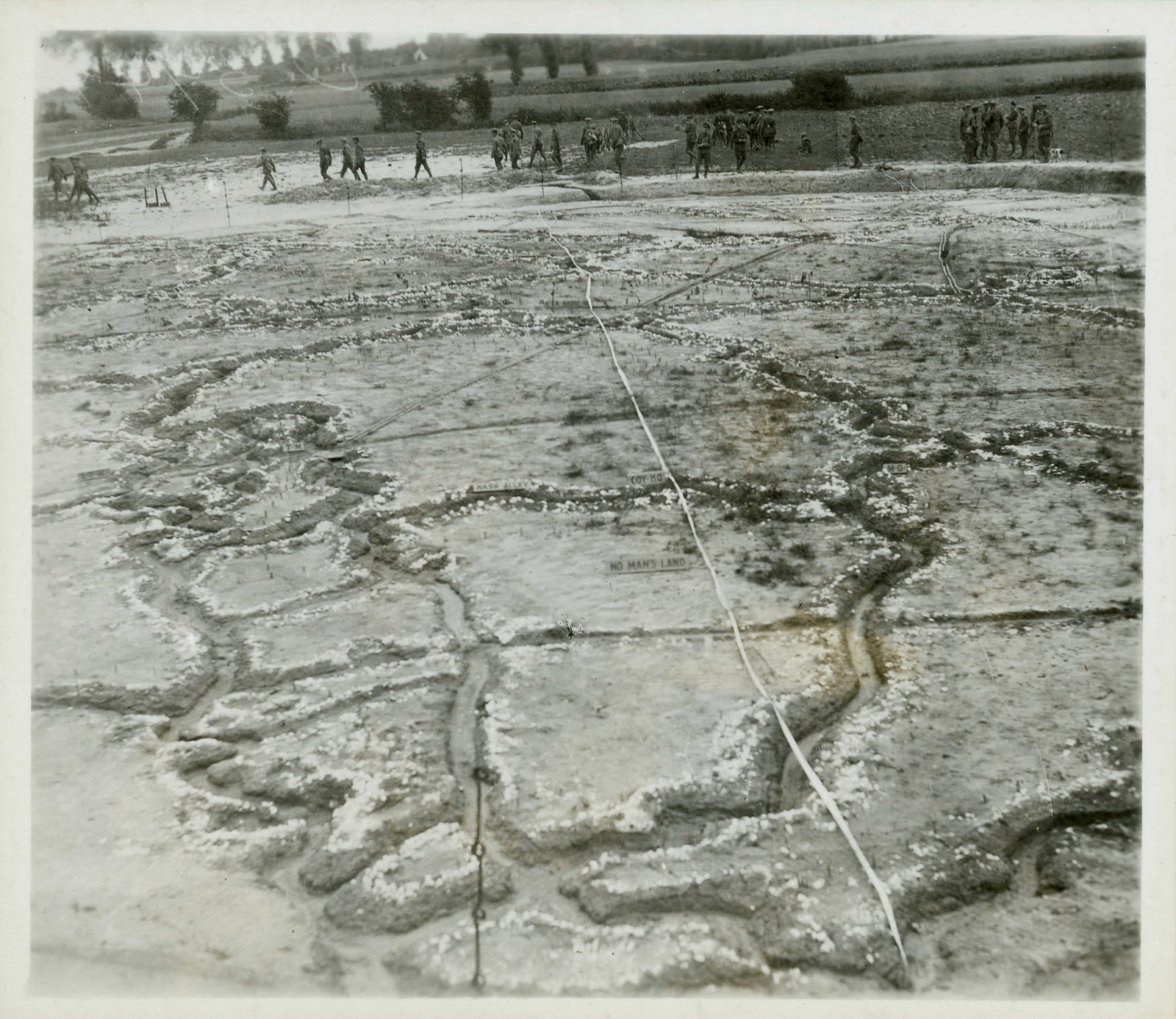
Trench model

This isn’t quite what Antoine has in mind, I realise, but what today would be called ‘mission rehearsal exercises’ are surely simulations.  And in many cases, on the Western Front at least, they took the form of elaborate clay models (see above).  In Undertones of war (1928), Edmund Blunden described – with a rather different sting in the tail – how

‘… an enormous model of the German systems now considered due to Britain was open for inspection, whether from the ground or from step-ladders raised beside, and this was popular, though whether from its charm as a model or value as a military aid is uncertain.’

Here’s A.M. Burrage in War is War:

‘Our brilliant Staff has got every move in the game worked out twenty-four hours ahead. Our jumping-off place is already assigned to us, and we are to advance about five hundred yards, crossing a stream called the Paddebeeke. We are shown a clay model of the landscape, including the roads which are no longer there. We practise the method of attack every morning…’

Danger on the shore

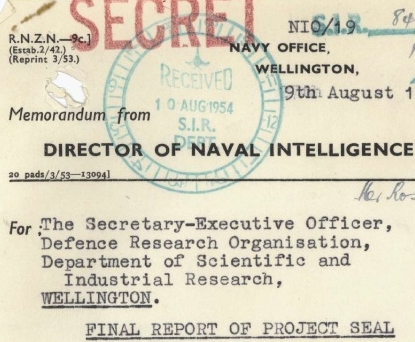
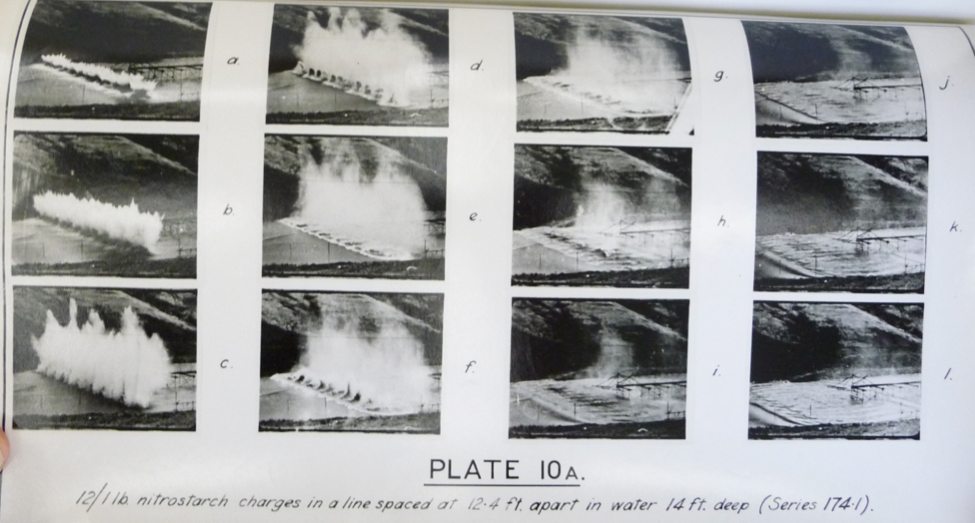
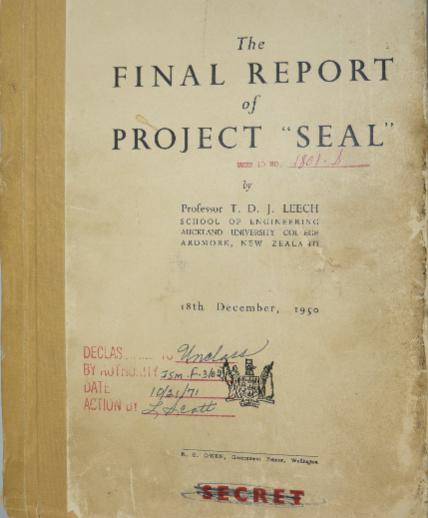
Project Seal DNIAmong other things, I’m still collecting materials about the militarisation of nature (I’m not going to put it in scare-quotes, though it scares me — but we all know that Raymond Williams considered ‘nature’ to be perhaps the most complex word in the English language).  So I was interested to read about a secret US-New Zealand programme to develop a ‘tsunami bomb’ to be used against Japan during the Second World War (the official report talks of ‘an investigation into the potentialities of offensive inundation by waves generated by means of explosives’).

Under the codename Project Seal, the New Zealand Army, working in close cooperation with the Air Force, Navy and the US Navy, set off a series of underwater explosions that triggered tidal waves along the coast of New Caledonia and then the Whangaparaoa Peninsula near Auckland in New Zealand between June 1944 and January 1945.  Some 3,700 bombs (mainly TNT) were detonated during the experiments, and preliminary experimental results suggested that  a cascade of 10 large blasts (two thousand tons in total, 5 miles from the shore) would be sufficient to generate a 30–40 foot tsunami capable of inundating a small coastal city.

Project Seal experiments

Project SealThe project was directed by Professor Thomas Leech, Dean of Engineering at Auckland University, who was seconded to the military for the purpose of developing the bomb.  The final report was released in 1950, and the New Zealand Herald reported that its author’s work was considered sufficiently important for plans to be made for Leech to be sent to observe the US nuclear tests off Bikini Atoll in 1946 and to make direct comparisons between the two (the project was seen by some as a potential rival to the atomic bomb).

The report was declassified in 1999 and reported in New Zealand, but it was picked up by conspiracy theorists in the wake of the Indian Ocean tsunami in 2004 and the Japanese tsunami following the earthquake in 2011 (‘It is unprecedented in recorded history for two major tidal waves to occur less than seven years apart’; more here) and by news media in Britain and the US at the beginning of this year.  More here.

UPDATE: The United States continued to experiment with the possibilities of ‘explosion-generated waves’ in the 1960s, and the Office of Naval Research – which was busily sponsoring all sorts of research projects in spatial science at the same time – cooperated with the Scripps Institution of Oceanography, which initiated the compilation of this handbook-review and its presentation of a ‘procedure for wave predictions based upon the state-of-the-art in the field of explosion-generated waves’.  The review included experimental reports from high-explosive blasts at Mono Lake, field observations in Hawaii and elaborate mathematical modelling.

Interestingly, though, the language of the report – on those occasions when it turns to ‘operational considerations’ – is ostensibly defensive not offensive:

… any prediction method must consider each critical area of the coastline independently, and calculate enough different situations so as to be sure to bracket all critical conditions, before general statements can be made about susceptibility to wave attack from large explosions. Aside from the direct effects of run-up on the shore, large explosions can, under appropriate circumstances, produce very large waves in deep water, which may break upon the continental shelf many miles from shore. Since the wave spectrum for large explosions is peaked at wave periods substantially longer than the longest prevailing swell or surf, the net result is the creation of a breaker zone covering a very large area, and which can persist for several hours. Such waves could pose unusual and potentially severe problems to coastal navigation, not only through direct dynamic effects, but also because of cumulative effects such as inducement of resonant harbor oscillations and the scouring or deposition of sediment in regions ordinarily immune to normal storm conditions.’

Of course, the scenario can be reversed: if the US coast were potentially vulnerable to these effects (the threat of nuclear attack is the ever-present horizon of the report), so too were enemy coasts.  Unlike the earlier experiments, however, the danger now was less that of widespread coastal inundation and more of disruption to naval operations in the vicinity of the blast:

‘The first problem systematically attacked was that of coastal damage due to large explosion-generated waves, since, by analogy with the well-known phenomena of tsunami waves generated by earthquakes, it was initially hypothesized that the explosion of large atomic weapons at sea could result in considerable coastal damage by wave run-up and/or flooding. Later, as theoretical and experimental studies revealed the relatively inefficient wave making potential of large explosions, and that in many cases most wave energy is dissipated by breaking on the continental shelf before reaching shore, concern over run-up per se was replaced by the realization that other more serious wave problems exist. Accordingly, recent emphasis has been directed towards assessing the nature of the breaking wave regime offshore and its implications on the vulnerability of ships and undersea structures to breaking waves in relatively deep water (100 feet). These studies, in turn, have indicated more refined secondary problems. These include harbor oscillations induced by cumulative wave action offshore, and anomalous wave-induced clogging or erosion of harbor entrance channels by sediment transport.’

I suppose this may account for the interest in Hawaii, in which case Japan re-enters the scenario in spectral form, through the prospect of another Pearl Harbor…

Bomb Sight

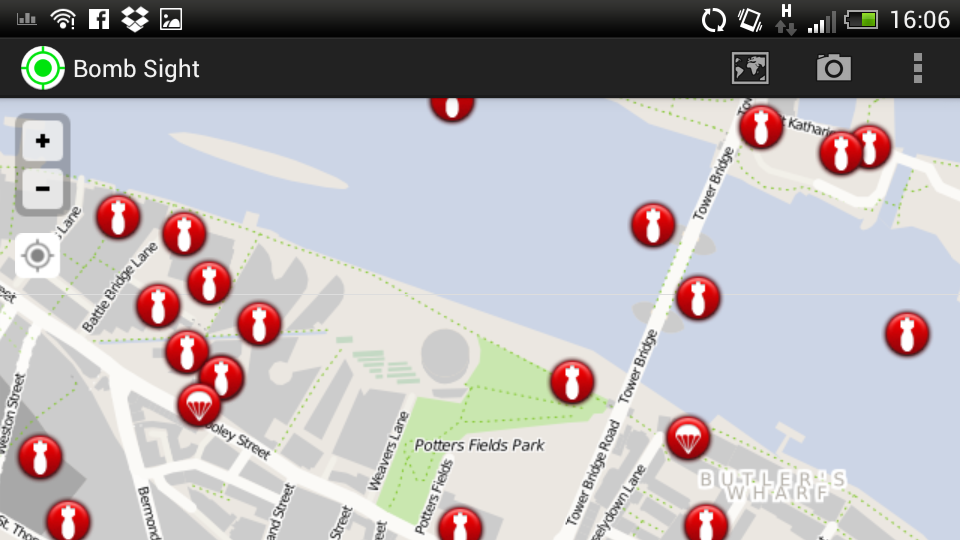
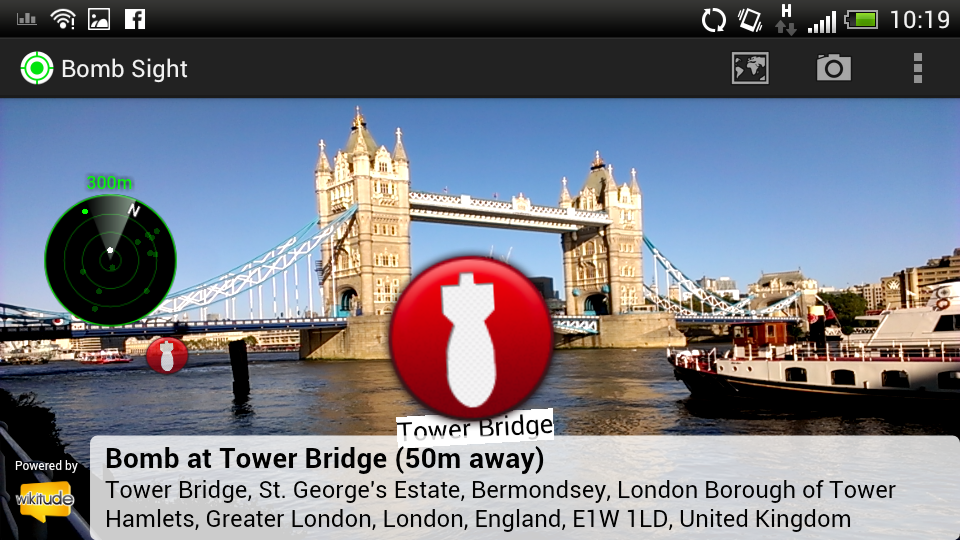
Another pre-script…. Last week I noted two projects that aimed to bring drone strikes to your smart phone, but here’s one that promises to do the same for the London Blitz.  Developed by researchers at the University of Portsmouth led by Kate Jones, in conjunction with the National Archives, and working from the official wartime Bomb Census, Bomb Sight uses web and mobile mapping technology to ‘bring to life [sic] the maps that demarcate the location of [31,000] falling bombs during the London Blitz between October 1940 and June 1941.’  It’s a truly remarkable project that intends to link the sites on the map to photographs, eye-witness accounts and memories.

The project is being developed for the Android platform but there is apparently the future possibility of porting to the iPhone – assuming that Apple doesn’t find this as objectionable as it did Josh Begley‘s Drones+ app (I’m betting it won’t).

The blog recording the development of Bomb Sight includes some screen shots – I’ve pasted some below – showing detailed maps and augmented reality views that give more insight into the intended outcome.

Unlike attempts to plot drone strikes in Pakistan and elsewhere, the Bomb Census Survey maps produced by the Ministry of Home Security make it possible to identify locations with great (though sometimes variable) precision – a capacity that was of course unavailable to those dropping the bombs in the first place – and there is a rich vein of images and testimony to tap into too.

It’s that prospect of multi-media linkage that makes this such a brilliant project.  There have been other attempts to map the Blitz; the Guardian produced this remarkable map of the ‘incidents’ to which the London Fire Brigade responded on the first night of the Blitz, 7 September 1940, for example, and made available an online interactive so that the toll could be followed hour by hideous hour:

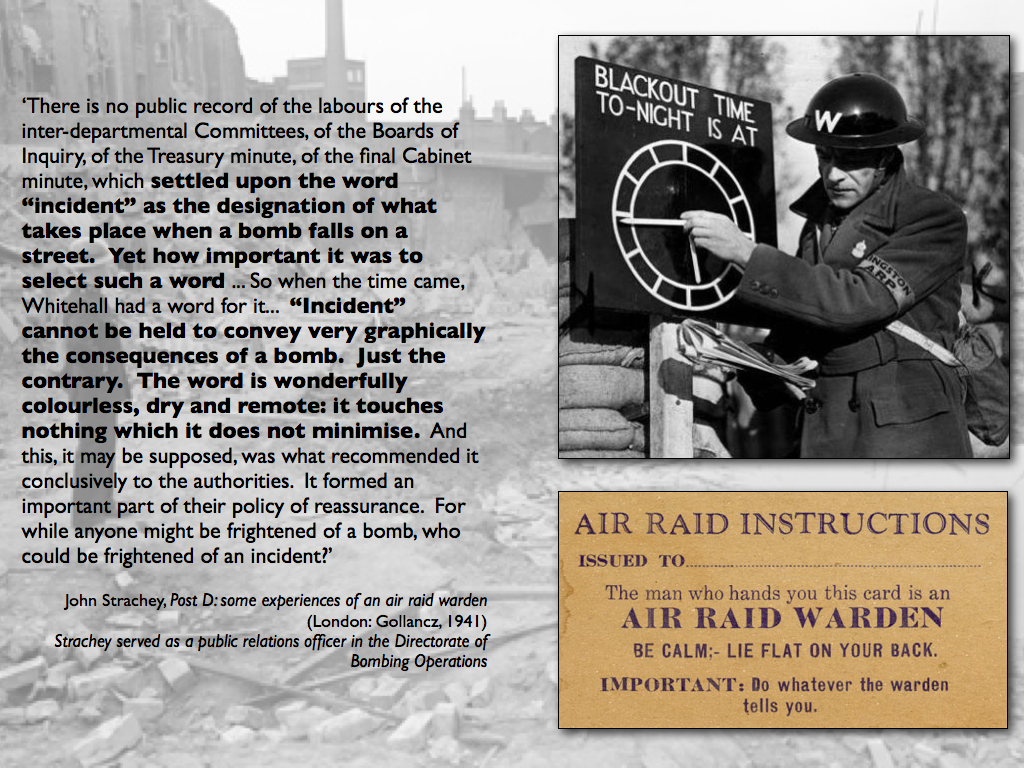
You need to ‘grow’ the markers on the map; the Guardian noted that each ‘incident’ typically involved multiple bombs.  But even more telling is the word itself: ‘incident’.  For, as John Strachey noted in his memoir of his time as an Air Raid Warden, it’s a bureaucratic, bloodless term:

In contrast, what Bomb Sight promises to do is not only to disaggregate each ‘incident’ to show every bomb dropped but, still more importantly, to deconstruct the very term itself: to link the bomb scatter to imagery and testimony and so give the lie to these bloodless abstractions.

Perhaps if something similar could be done for other cities around the world more people would be enraged at the continued recourse to bombing from the air as a legitimate political and military practice, and the politics of  ‘banning the bomb’ might be transformed into a more general demand to ban all bombs.

If you want to see more of Bomb Sight, there’s a very good video up at YouTube: