Footnotes to Gaza 101

gazajuly23

Updates on Gaza 101 (at the risk of stating the obvious, the title for this post is a riff on Joe Sacco‘s brilliant Footnotes in Gaza [2009])

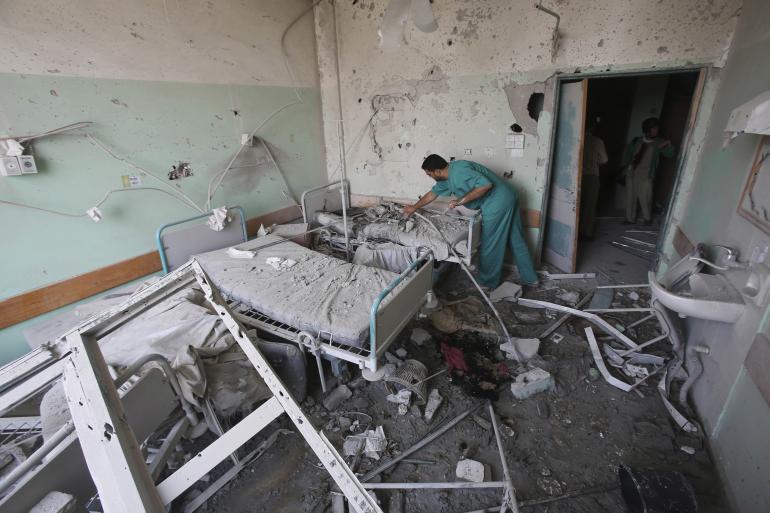
(1) Another powerful interview with Dr Mads Gilbert from al-Shifa Hospital, the main trauma centre in Gaza, and an excellent question:

“What would have happened if Palestinian fighters had bombed an Israeli hospital and killed five patients?  The world would have turned upside down. What is this second-hand, or even third-hand or fourth-hand citizenship in the world for the Palestinians?”

And in Gaza it’s way more than five (though that is clearly how so many governments around the world, including Canada, rank Palestinian citizenship).

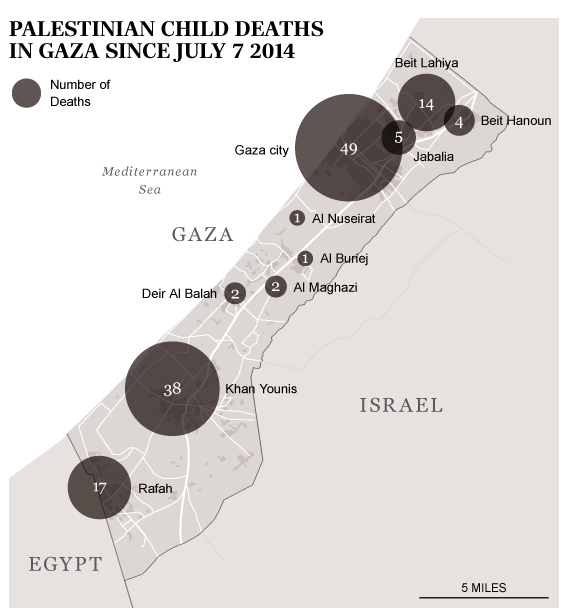
Palestinian child deaths

(2)  By ‘citizenship in the world’ Gilbert is getting at the differential calculus that constitutes what Judith Butler calls ‘a grievable life’, and here Maya Mikdashi sharpens a (different) point I’ve made in relation to air strikes in the Federally Administered Tribal Areas and elsewhere: that not only the dead and injured women and children [see the map above, also available here] but also the dead and injured men are worthy of our grief.

Palestine men and women and children are one people— and they are a people living under siege and within settler colonial conditions. They should not be separated in death according to their genitalia, a separation that reproduces a hierarchy of victims and mournable deaths. Jewish Israelis (including soldiers and settlers) occupy the highest rungs of this macabre ladder, Palestinian men the lowest. This hierarchy is both racialized and gendered, a twinning that allows Palestinian womenandchildren to emerge and be publicly and internationally mourned only in spectacles of violence, or “war”—but never in the slow and muted deaths under settler colonial conditions—the temporality of the “ceasefire.” To insist on publicly mourning all of the Palestinian dead, men and women and children—at moments of military invasion and during the every day space of occupation and colonization— is to insist on their right to have been alive in the first place.

(3) Finally – if only it were the end to all this – here is the splendid Richard Falk on the chronic failure of international law to protect – let alone provide justice for – the Palestinian people.  This is how he begins:

What has been happening in Gaza cannot usefully be described as “warfare”. The daily reports of atrocities situate this latest Israeli assault on common humanity within the domain of what the great Catholic thinker and poet, Thomas Merton, caIled “the unspeakable”. Its horror exceeds our capacity to render the events through language.

Up to  a point; I said something similar but much less eloquently in ‘Gaza 101’.  Trauma ruptures language, to be sure, but these words from Ann Jones are also worth reflecting on (they come from her They were soldiers):

The worst we can say of war is that it is “unspeakable,” which in fact it is not. But we don’t speak of it because that would involve so many nasty words we don’t want to use and elicit so many things we don’t want to know, so many things we think we can’t do anything about now that the government answers only to the powerful few…


Image wars

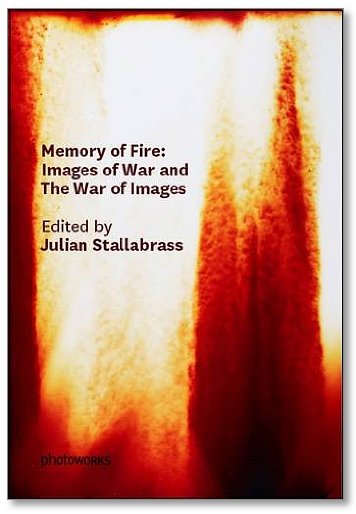
STALLABRASS Memory of FireI’m still putting together the programme for my graduate course this term (I’ll post the full outline under the TEACHING tab as soon as it’s ready), and I plan to spend some time on what I’m calling Militarized vision and imag(in)ing modern war.

Images have become increasingly important to the conduct of war; in Precarious Life Judith Butler argues that ‘there is no way to separate, under present historical conditions, the material reality of war from those representational regimes through which it operates and which rationalize its own operation.’  This requires us to think carefully about two, closely related issues – media representations of military violence and its effects, and the ways in which militaries have incorporated political technologies of vision into their operations.

I’m thinking of beginning with these two readings:

Bernd Hüppauf, ‘Experiences of modern warfare and the crisis of representation’, New German Critique 59 (1993) 41-76.

Lilie Chouliaraki, ‘The humanity of war: iconic photojournalism of the battlefield, 1914-2012’, Visual communication 12 (3) (2013) 315-340

Then I want to turn to the scopic regimes of advanced militaries, via Virilio and transcripts of several US military investigations into air strikes in Afghanistan and Iraq, to open up a discussion of targeting and political technologies of vision.  (This is probably also the place to say that, since I started to think through the relation between technoculture, targeted killing and the individuation of warfare I’ve also been thinking about the work of Bernard Stiegler; more later, but in the meantime you’ll find a truly excellent bibliography by cultural geographer Sam Kinsley here).

All of this opens up wide fields for debate, of course, but as I was putting together a list of supplementary materials I stumbled upon a new collection edited by Julian Stallabrass, Memory of fire: Images of war and the war of images (Photoworks, 2013):

This richly illustrated book is a visual, theoretical and historical resource about the photography of war, and how images are used as instruments of war. It comprises essays and interviews by prominent theorists, artists and photographers and covers the urgent issues of the depiction of war, the use of images of war by the media, various forms of censorship, the military as a PR and image-producing machine, the circulation of unofficial images and the impact of the digital mediascape.

Full details here , a four-pager in which Stallabrass discusses ‘Rearranging corpses, curatorially’ here, and a video in which he explains the project here:

There’s no shortage of work on these issues, I know, but there’s a particularly detailed engagement with Memory of Fire by Susie Linfield  author of The cruel radiance: photography and political violence (University of Chicago Press, 2010) – here and a sharp response from Stallabrass (scroll down).  There’s also a shorter but still informative review by Ashitha Nagesh at the always stimulating bookforum here.

Finally, you can find Stallabrass’s (2006) reaction to Retort’s Afflicted Powers and its engagement with ‘image wars’, ‘Spectacle and Terror’, on open access at the New Left Review here.

Tahrir Squared

I’ve been putting the finishing touches to the extended version of my essay on Tahrir Square and the Egyptian uprisings, which focuses on performance, performativity and space through an engagement with Judith Butler‘s ‘Bodies in alliance and the politics of the street’ essay/lecture (originally delivered in Venice in 2011).

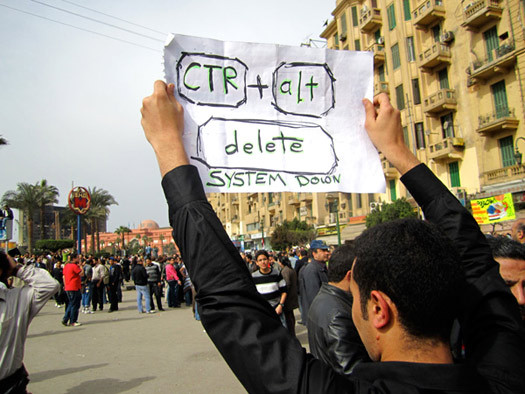
Tahrir Square (Mohamed Elshahed)Much of the existing discussion of Tahrir treats performance in conventional dramaturgical terms, and owes much more to Erving Goffman‘s classic work than to Judith’s recent contributions, so that spatiality is more or less reduced to a stage: see, for example, Charles Tripp, ‘Performing the public: theatres of power in the Middle East’, Constellations (2013) doi: 10.1111/cons.12030 (early view).  Others have preferred to  analyse the spatialities of Tahrir through the work of Henri Lefebvre: I’m thinking of Ahmed Kanna, ‘Urban praxis and the Arab Spring’, City 16 (3) (2012) 360-8; Hussam Hussein Salama, ‘Tahrir Square: a narrative of public space’, Archnet – IJAR 7 (1) (2013) 128-38;and even, en passant, W.J.T.Mitchell, ‘Image, space, revolution: the arts of occupation’, Critical Inquiry 39 (1) (2012) 8-32.

None of these seem to me to convey the way in which, as Judith has it, the presence of bodies in the square becomes the performance of a new spatiality through which people

‘seize upon an already established space permeated by existing power, seeking to sever the relation between the public space, the public square, and the existing regime. So the limits of the political are exposed, and the link between the theatre of legitimacy and public space is severed; that theatre is no longer unproblematically housed in public space, since public space now occurs in the midst of another action, one that displaces the power that claims legitimacy precisely by taking over the field of its effects…. In wresting that power, a new space is created, a new “between” of bodies, as it were, that lays claim to existing space through the action of a new alliance, and those bodies are seized and animated by those existing spaces in the very acts by which they reclaim and resignify their meanings.’

I see a similar conception at work in Adam Ramadan‘s emphasis on Tahrir as at once a space and an act – a space-in-process, if you like – of encampment: ‘From Tahrir to the world: the camp as a political public space’, European Urban and Regional Studies 20 (2013) 145-9.  I’m drawn to these formulations partly because they connect performance to the possibility of performativity through space-in-process, and partly because these ideas, attentive as they are to ‘space’, also pay close attention to ‘time’ (or rather space-time) (for a suggestive discussion of the temporalities of Tahrir, which I think have been marginalised in too many ‘spatialising’ discussions, see Hanan Sabea, ‘A “time out of time”‘, here.)

These comments are little more than place-holders, I realise, and I hope my reworked essay will clarify them; I’ll post the final version on the Downloads page as soon as it’s ready – in the next day or two, I hope. [UPDATE: The manuscript version, to appear in Middle East Critique, is now available under the DOWNLOADS tab: ‘Tahrir: politics, publics and performances of space’]

In the meantime, if you’re interested in the Egyptian uprisings, there’s an excellent online bibliography at Mark Allen Peterson‘s equally excellent Connected in Cairo here; Mark also provides a listing of documentary films here (including YouTube feeds).

Tahrir Squared

Part of my discussion addresses the imbrications of the digital and the physical, the virtual and the visceral.  For a quick overview, see Mohamed Elshahed here (from whom I’ve borrowed the wonderful image at the head of this post), but for a remarkable online platform that, amongst other things, seeks to ‘multiply the Tahir Effect around the globe’, capitalising on the transformations from the digital to the physical and back again, try Tahrir Squared:

‘T2 is a one-stop shop for reliable and enlightening information about the Arab uprisings, revolutions and their effects. It combines both original content by leading analysts, journalists and authoritative commentators, and curated content carefully selected from across the web to provide activists, researchers, observers and policy makers a catch-all source for the latest on the Arab revolutions and related issues through an interactive, virtual multimedia platform.
 
Unattached to governments or political entities, Tahrir Squared is concerned with ‘multiplying the Tahrir Effect around the globe’: an Effect which reawakened civic consciousness and awareness. An Effect which led to neighbourhood protection committees, and created those scenes in Tahrir of different religions, creeds and backgrounds engaging, assisting, and protecting one another. 
 
That Effect still lives inside those who believe in the ongoing revolutions that called for ‘bread, freedom, social justice and human dignity’. This website is a part of that broader initiative, seeking to provide people with the knowledge and information to assist and stimulate that process of reawakening, through the provision of reliable news reports, thoughtful commentary, and useful analysis.

Benhabib on Butler

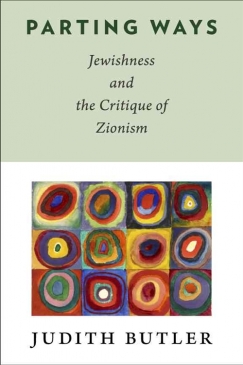
BUTLER Parting waysWhen I first became interested in critical theory (an age ago now), I found Seyla Benhabib‘s work – and especially Critique, norm and utopia (1986) – wonderfully clear and immensely helpful. She has recently published an extended review essay on Judith Butler‘s Parting Ways: Jewishness and the critique of Zionism in Constellations (2012) (open access – at least for now).  It’s a characteristically careful, lapidary essay, which works towards this climactic conclusion:

Is there any hope then? I believe there is but not through boycott, divestment and sanctions movements, which are based upon a false analogy between the Israeli-Palestinian conflict and the South African struggle, but through continued, sustained, and deep engagement with all countries in the region. Even if the Arab Spring in Egypt brought into power a conservative Islamist party, building and drawing upon its years of resistance to the Mubarrak regime, it was a new generation of Egyptians who first put their lives on the line and who showed us one more time that the legacy of revolutions is, as Hannah Arendt would say, “like a fata morgana” that appears to travelers in the desert in unexpected ways. This young literate generation of men and women are present everywhere in the Arab world; they are networked throughout Europe and the USA and in many other countries as well via migratory nets of kin and family. Today this new generation has not yet found its political voice and they continue to fight behind the Islamic flag to the chants of “Allah is great.”

Israelis, who for a long time considered themselves as the sole democratic peoples in the Arab world, have been taken aback by this evolution. But many have rejoiced in it as well. Protests against Israeli government policies, inspired by Tahrir Square erupted in the summer of 2011 in Tel-Aviv, with thousands of young people chanting for social justice, housing, and jobs. Hundreds of Arab citizens of Israel participated in such protests. The number of Arab youth who are now perfectly bi-lingual is growing and, along with it, their political capacity to engage Israeli society directly. Many Palestinian Arabs living in occupied East Jerusalem would much rather become Israeli citizens in an open and gender-egalitarian society than live under the Islamist rule of a Hamas party. The racist attacks by Israeli religious youth this past summer against Palestinians in the old city of Jerusalem galvanized an entire country around anti-racist teach-ins and demonstrations.

Any call for “cohabitation” between the Israeli and Palestinian peoples that does not balance the continuing paranoia of extinction on the part of Israeli Jews with the legitimate claims and aspirations of the Palestinian people is a non-starter. This means that Israelis themselves will need to think hard and fast about the mess they have created in aspiring to maintain a “Jewish state” on the one hand and continuing to occupy the territories of the West Bank on the other. But the facts on the ground are moving in a different direction and much to the chagrin of liberal Zionists who still advocate a two-state solution: given the military and economic dependence of the West Bank territories upon Israel, maybe the time has come to call for a “confederation of Israeli and Palestinian peoples,” with two parliaments and two separate electoral systems but a common defense and security policy over territory and airspace, and shared water and other natural resources. Under such a scenario, the considerable achievements of the Israeli state and society in economic, technological, medical, and intellectual areas would not need to be dismantled but Israeli sovereignty would be disaggregated and nested into a joint confederal model.

My own instincts are closer to Butler than Benhabib, but her problematisation of Israel’s exceptionalist claims to ‘democracy’ and her investment in a wider political geography (including the Arab uprisings) is surely essential for any project of what Butler calls, following in some part Hannah Arendt,’cohabitation’.

But the very term ‘cohabitation’ is also unsettled (the mot juste) by a vital ‘fact on the ground’ that Rashid Khalidi identifies in the New York Times with vigour and precision: ‘The overwhelming dominance of Israel over the Palestinians means that the conflict is not one that demands reciprocal concessions from two equal parties.’

Butler and Bodies on the Street

Judith Butler‘s Wall Exchange ‘Bodies on the street’, delivered at the Vogue Theatre in Vancouver last year, has now been posted on YouTube:

http://www.youtube.com/watch?v=v-bPr7t4tgA&feature=youtu.be

And a Q&A the following day with UBC faculty at the Peter Wall Institute for Advanced Studies is here:

http://www.youtube.com/watch?v=4ECjyoU6kGA

You can access the text of an early version of the lecture here and here.

Judith Butler and the analytics of power

Claire Pagès and Mathieu Trachman conduct a concise but wide-ranging interview with Judith Butler at Books & Ideas, in which she asks this about neo-liberalism and the economic:

‘[I]f we claim that neo-liberalism disposes populations to become disposable, and exposes populations to precarity, we have to ask whether we are speaking about a purely economic rationale and regime of power (by “ neo-liberalism ”), a regime of power that governs the practices of subject-formation, including self-making, and the valorization of the metric of instrumentality in ways that include and exceed the sphere conventionally denoted as “ economic ”.  Indeed, does the power and pervasiveness of “ neo-liberalism” compel us to think about the heteronomy of the economic and the way that the rationalities that govern its operation exceed the purely economic. Must we give up an idea of the purely economic by virtue of neo-liberalism at the same time that we cannot do without the economic?’

Judith Butler, Parting Ways (2012)Incidentally, readers who have followed the sometimes repellent response to Judith’s receipt of the Adorno Prize can find her speech at the award ceremony in Frankfurt on 11 September  – ‘Can one lead a good life in a bad life?’ – here (I think this is the Radical Philosophy version, with images that speak to the controversy) or, in unadorned form, here.

You can also find details of her new book, Parting ways: Jewishness and the critique of Zionism (Columbia University Press) – which, in its closing chapter, engages with Edward Said and Mahmoud Darwishhere.  Like all her work, this book – which also includes reflections around Arendt, Benjamin and Levinas – admirably fulfils her own beautifully understated view of what it is to be critical: that is, to be ‘willing to examine what we sometimes presuppose in our way of thinking, and that gets in the way of making a more livable world.’

The politics of seeing and the New Aesthetic

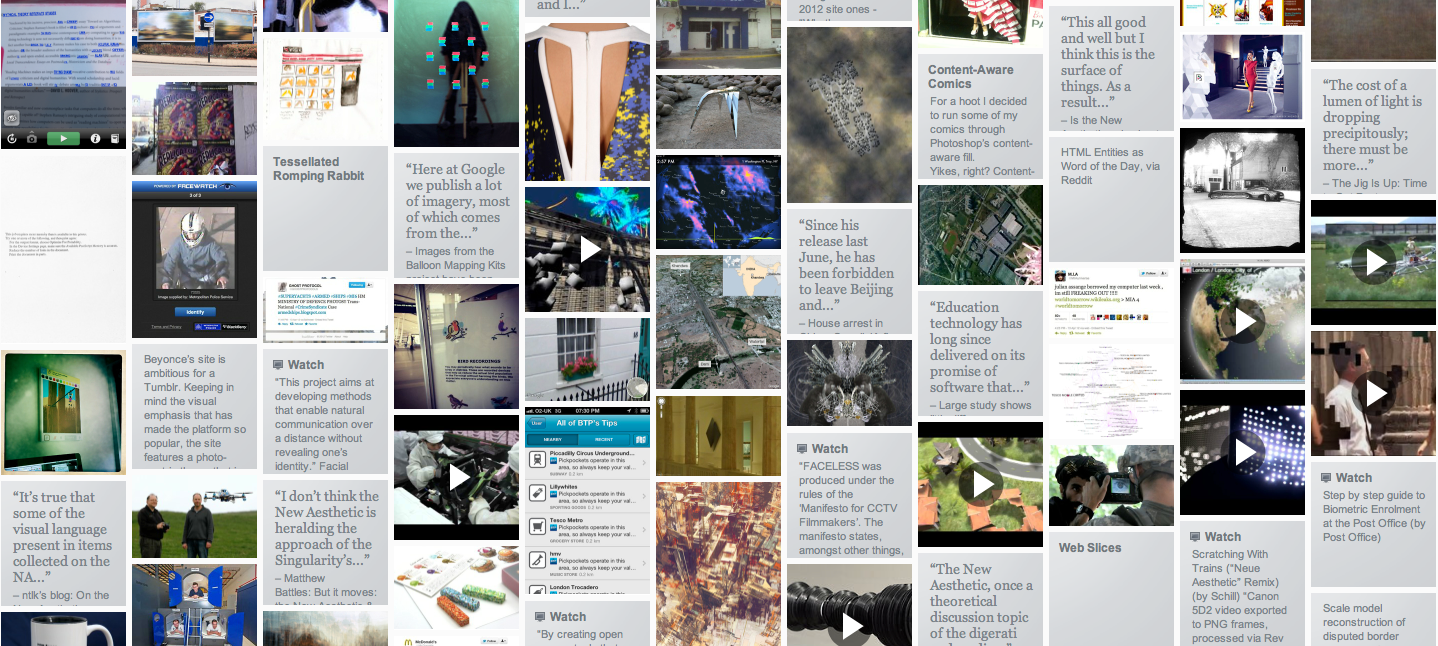
The New Aesthetic began to create its public at the Really Interesting Group in May 2011 with this post from James Bridle:

For a while now, I’ve been collecting images and things that seem to approach a new aesthetic of the future, which sounds more portentous than I mean. What I mean is that we’ve got frustrated with the NASA extropianism space-future, the failure of jetpacks, and we need to see the technologies we actually have with a new wonder. Consider this a mood-board for unknown products.

(Some of these things might have appeared here, or nearby, before. They are not necessarily new new, but I want to put them together.)

For so long we’ve stared up at space in wonder, but with cheap satellite imagery and cameras on kites and RC helicopters, we’re looking at the ground with new eyes, to see structures and infrastructures…

The post digitally curated a series of images – a sort of wunder-camera (hah!) – and soon afterwards James’s first post appeared on tumblr as The New Aesthetic.  The site grew and grew, though not quite like Topsy, and this is is how he now explains his experimental project:

Since May 2011 I have been collecting material which points towards new ways of seeing the world, an echo of the society, technology, politics and people that co-produce them.  The New Aesthetic is not a movement, it is not a thing which can be done. It is a series of artefacts of the heterogeneous network, which recognises differences, the gaps in our overlapping but distant realities.

Bruce Sterling described James as ‘a Walter Benjamin critic in an “age of digital accumulation”’ carrying out ‘a valiant cut-and-paste campaign that looks sorta like traditional criticism, but is actually blogging and tumblring.’  His site is well worth a visit, not least to wander through the back catalogue of objets trouvés (or vues):
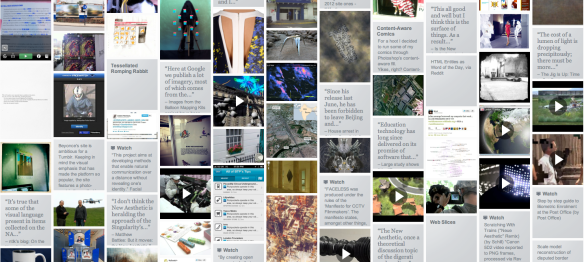
I say ‘objet’ deliberately: for Graham Harman fans, and even for those who aren’t, there are some remarkably interesting discussions that link the New Aesthetic to object-oriented ontology: see Ian Bogost, ‘The New Aesthetic needs to get weirder‘ (not as weird as the cutesy title suggests), Robert Jackson, ‘The banality of the new aesthetic‘ (a really helpful essay for other reasons too) and Greg Borenstein, ‘What it’s like to be a 21st century thing‘ (scroll down – much more there too).

I started to follow the blog while I was working on a contribution to a conference on the Arab Uprisings [‘the Arab Spring’] held in Lund earlier this year: I’d been puzzled at the polarizing debate about whether (in the case of Tahrir Square in Cairo which most interested me, but much more generally too) whether this was ‘a Twitter revolution’ or whether it depended on what Judith Butler called (in a vitally important essay on the politics of the street to which I’ll return in a later post) ‘Bodies in Alliance‘.  It seemed clear to me – and to her, as I discovered in a series of wonderfully helpful conversations when she visited Vancouver for the Wall Exchange in May) – that this was a false choice: that the activation of a digital public sphere was important, but so too, obviously, was the animation of a public space, and that the two were intimately – virtually and viscerally – entangled.
Here (in part) is what I wrote:

Writing from Cairo in March 2011, Brian Edwards recalled that when the Internet was blocked ‘the sense of being cut off from their sources of information led many back out on to the street, and especially to Tahrir.  With the Internet down, several told me, there was nowhere else to go but outdoors.’  The reverse was also true.  ‘The irony of the curfew is that it might succeed in getting people off the streets and out of downtown, but in doing so it delivers them back to the Internet… Many of my friends are on Facebook through the night, as are those I follow on Twitter, a steady stream of tweets and links.  Active public discussions and debates about the meanings of what is taking place during the day carry on in cyberspace long after curfew.’  

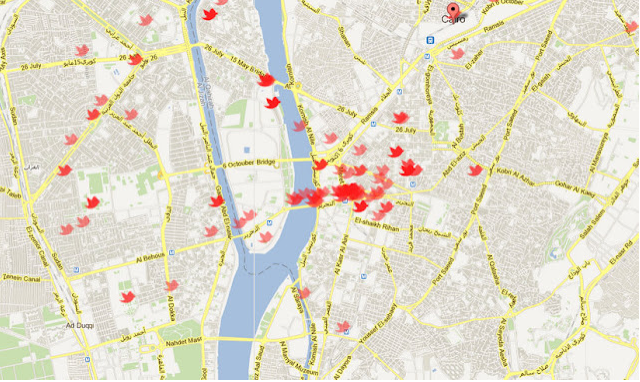
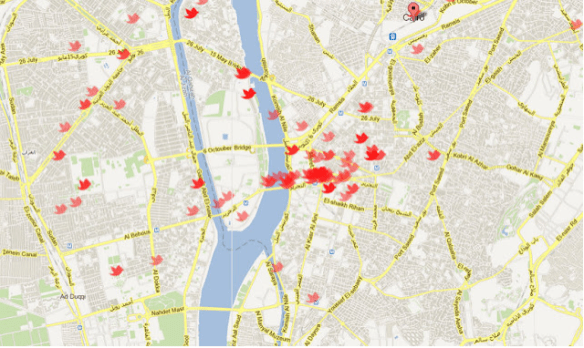
In the same essay Edwards reflects on the compression of meaning imposed by the 140-character limit of each tweet, and he suggests that the immediacy and urgency that this form implies – even imposes – ‘calls forth an immediate, almost unmediated response, point, counterpoint and so on.’This is a persuasive suggestion, I think, but that response is surely to be found not only virtually (from tweets in cyberspace) but also viscerally (from bodies in the streets).  When we see maps … showing tweets in Cairo, we need to recognize that that these are not merely symbols in cartographic space or even messages in cyberspace: they are also markers of a corporeal presence.

This matters because the urban space where ‘newness’ might enter the world does not pre-exist its performance.  Some writers examine what, following Henri Lefebvre and David Harvey, we might call the production of space, which would include the construction and re-development of Tahrir Square.  Others, also following in some part Lefebvre, prefer to emphasize spatial practices, which would include the rhythms and routines that compose everyday life for a myriad of people in Cairo.  But to emphasize the performance of space is to focus on the ways in which, as Judith Butler put it in direct reference to Tahrir Square, ‘the collective actions [of the crowd] collect the space itself, gather the pavement, and animate and organize the architecture.’  

So I started to wonder about the politics of the New Aesthetic – especially when I returned from Lund to resume my work on the techno-cultural gaze that has been my preoccupation for even longer: the surveillance platforms of remotely piloted aircraft (and killing machines) like the Predator and the Reaper.  (For a time the New Aesthetic was associated with the image of a pixellated Predator supported by balloons, ‘a bright cluster … tied to some huge, dark and lethal weight’, as Sterling put it).
And now I’ve found a revealing essay by Will Wiles on the New Aesthetic, ‘The machine gaze’, at aeon (from which I’ve also taken Sterling’s remark).  He begins with a remark that took me right back to Tahrir (though in fact he’s talking about digital media labs in east London): ‘It’s in these streets that the boundary between the digital and the physical is at its most porous — in the devices and the minds of a far-seeing local population who are among the first to understand that there might not be a boundary at all.’
So to the money question: ‘As the boundaries between digital and physical dissolve, can the New Aesthetic help us see things more clearly?’  Here is part of Wiles’s answer:

The virtual world is being integrated with the physical world and this seamlessness is presented as inherently good. No harm may be intended: it’s natural for a designer to want to smooth away the edges and conceal the joins. But in making these connections invisible and silent, the status quo is hard-wired into place, consent is bypassed and alternatives are deleted. This is, if you will, the New Anaesthetic. Instances of the New Aesthetic are often places where a glitch has exposed the underlying structure — the hardware and software. Or it is an oddity that has the unintended side effect of causing us to consider that structure. Part of a plane appearing in Google Maps makes us realise that we are looking at a mosaic of images taken by cameras far above us. We knew that already, right? Maybe we did. But a reminder may still be salutary.

This is political. The New Aesthetic was accused of being apolitical — fascinated by the oddities and wonders being thrown up by drones and surveillance cameras without thinking about the politics behind them. This is plain wrong: politics seeps from nearly every pore of the New Aesthetic. It was often hard to see, but that’s what Bridle wanted to expose.

The question is one of viewpoint. ‘As soon as you get CCTV, drones, satellite views and maps and all that kind of stuff,’ Bridle said, ‘you’re setting up an inherent inequality in how things are seen, and between the position of the viewer and the viewed. There are inherent power relations in that and technology makes them invisible. When you have a man in a watchtower, you look up at him, and that’s an obvious vision of power. When the man is in a bunker far away and you have just a little camera on a stalk … most people seem to be fine with that.’

The New Aesthetic is about seeing, then. And to see and be seen is to engage in those power relations.

More to come – watch this space….

Grief, tragedy and translation

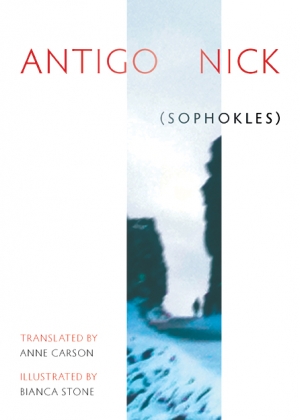
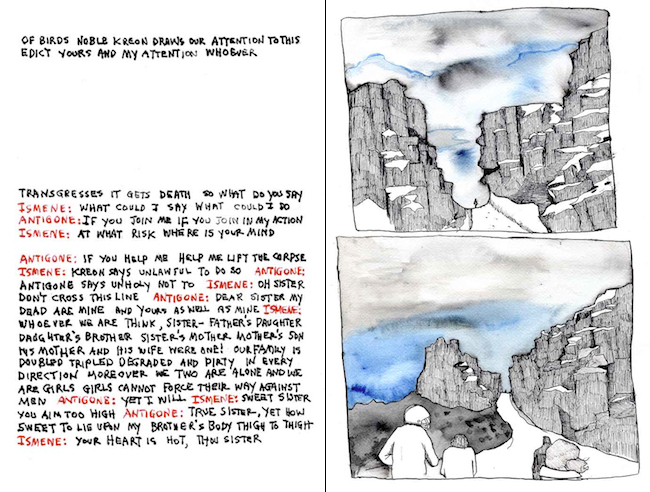
It’s been over a decade since Judith Butler reflected on Antigone, ‘the renowned insurgent’ from Sophocles’ Oedipus, in Antigone’s Claim: kinship between life and death (Columbia, 2000), but I’ve been reading and re-reading her latest thoughts, inspired by Anne Carson‘s visual-textual translation Antigonick (or is it Antigo Nick?) (New Directions, 2012) at Public Books here.

Carson’s project – she’s both a poet and a classicist – raises a series of urgent questions about translation and tragedy, and about the connective imperatives between the two.

Those links spiral in and out of Butler’s recent work too, and this is how she concludes her review-reflection:

Antigone rages forth from grief, causing new destruction, and so, too, does Kreon; they mirror each other in the midst of their opposition. So, too, do you, apparently, and everyone else as well, nodding and driving off, unless we catch ourselves in time. The reader is implicated in this recurrent alteration of grief and rage, subject to the destruction she or he is capable of inflicting, if there is no timely intervention.

Apparently “you” already know why tragedy exists. What Carson writes of Paul Celan’s direct address to the “you” offers us a formulation that may well apply to her Antigonick: “But you, by the time we reach you, are just folding yourself away into a place we cannot go: sleep. Blank spaces instead of words fill out the verses around you as if to suggest your gradual recession down and away from our grasp. What could your hands teach us if you had not vanished?”  It is a cry of grief posed in question form, emphatic, handwritten, excessive and abbreviated and, in this sense, a measured scream that gives us some sense of who or what lives on when it is all too late.

If that seems too general – I don’t think it is at all – then read Nicholas Mirzoeff‘s take on Antigo Nick on his Occupy 2012 blog here.

As predicted, Greece is having its Antigone revolution in refusing to abide by the Law in favor of kinship. For the majority who voted for Syriza and other anti-memorandum parties, mutual aid outweighs obligations to creditors. In the first days of this project, you may recall, I was very taken with a reworking of the Antigone legend in the context of the global social movements by Italian performance group Motus. The proper treatment of the dead body was later visualized by the Egyptian video collective Mosireen. And so when the chant “A-Anti-Anticapitalista” became the subject of a later post, I rewrote it in my head in my geeky way to go “A-Anti-Antigone.”

And if it’s still too elliptical, try Brian Patrick Eha‘s review of Antigonick at New Inquiry (he brilliantly describes it as ‘Antigone after Sarah Kane’, who wrote Blasted):

Never have we had so much direct access to grief. Photographs, television, and the Internet all promise to bridge the unbridgeable gap—to give us, our isolated egos, a means of ingress into the walled city of another’s suffering. What they deliver is an endless series of images like the one of the girl in the green dress that recently won a Pulitzer Prize. The photographer, Massoud Hossaini, captured the aftermath of a vicious bomb blast in Kabul, and in his picture the now-famous “girl in green,” who is eleven years old, stands amid the mangled bodies of the dead, stands crying out, in her utter anguish, as if from the bottom of a well, beyond our power to console. She screams noiselessly in the silence of the photograph, forever.

It’s easy to see why this picture won prizes. One can hardly fail to be moved by it. But at the same time that we are bombarded with compelling photographs and video footage that seem to give us access to emotions not our own, these images remain intrinsically mediated, revealing only surfaces, and our sympathy pains too often serve no utility.

Along with our hunger for grief comes impatience with emotional restraint. From the tearful confrontations of Intervention to the acting out of The Bad Girls Club, in our popular entertainments—period dramas like Downton Abbeybeing the rare exception—there’s nary a stiff upper lip in sight. Our age doesn’t do restraint, full stop. Emotions are expressed to their fullest, and these expressions are broadcast for consumption. Understated expressions of grief have largely vanished from society. We no longer dress for mourning except at hasty funerals, and even there the custom survives only in cheap black suits no less shabby than the rented tuxedos that now make our weddings feel forced. When did you last see a man wearing a black armband in remembrance of a fallen friend?

So Anne Carson’s blunt Antigonick has arrived at the right cultural moment, if not for poetry than for grief….

The Guantanamo Bay Museum of Art and History

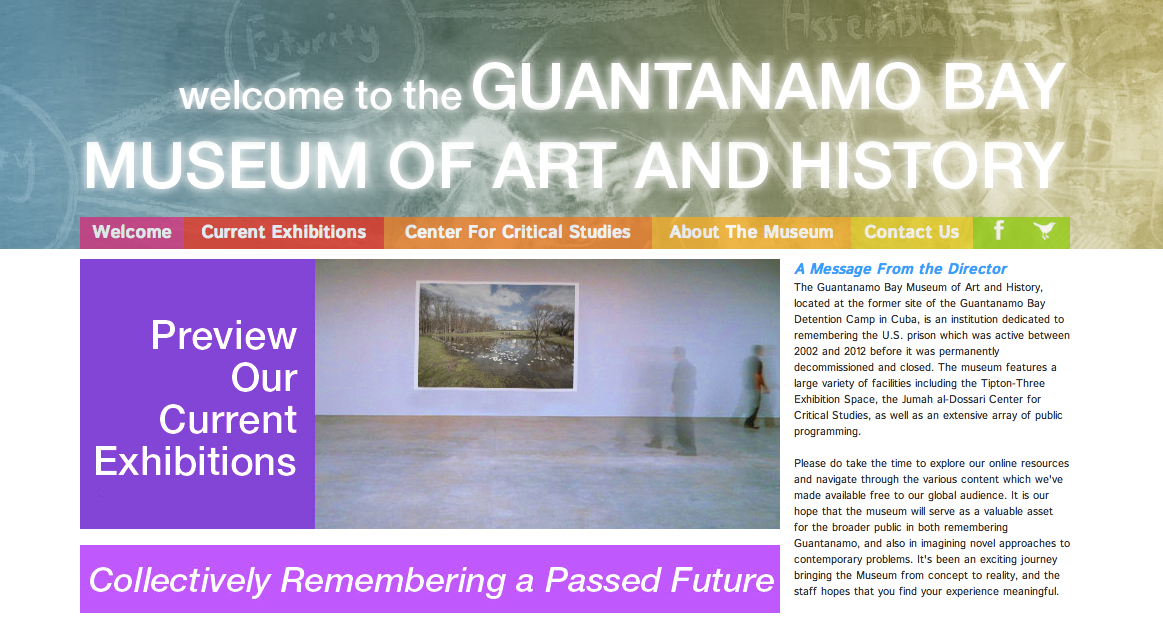
While I was in Cologne I had an e-mail from Ian Paul, an artist/theorist in San Francisco who works around issues of border violence and post-national human rights.  He wanted to include my essay “The Black Flag” in an online project on Guantanamo Bay:

“The Guantanamo Bay Museum of Art and History is a project which hopes to bring together artists and writers from around the world to examine the current conditions of the Guantanamo Bay Prison as well as the possibility of its closure.  The project takes the form of a ‘speculative present’, and posits that the prison itself has been closed and has been replaced by a museum that features exhibitions and public programs which document/interrogate/examine the history of the prison. The project seeks to draw a transnational/transdisciplinary group together to critique the prison, and artists/theorists from 5 different countries have already agreed to participate.”

The Guantanamo Bay Museum of Art and History  has now opened its virtual doors here.  Well worth a visit. (It’s also on Facebook).

Current Exhibitions includes a specially commissioned video montage by Adam Harms, “Performing the Torture List”, while  the Jumah al-Dossari Center for Critical Studies includes “The Black Flag” and contributions from Judith Butler, Martin Puchner, Harsha Walia (and more to come).

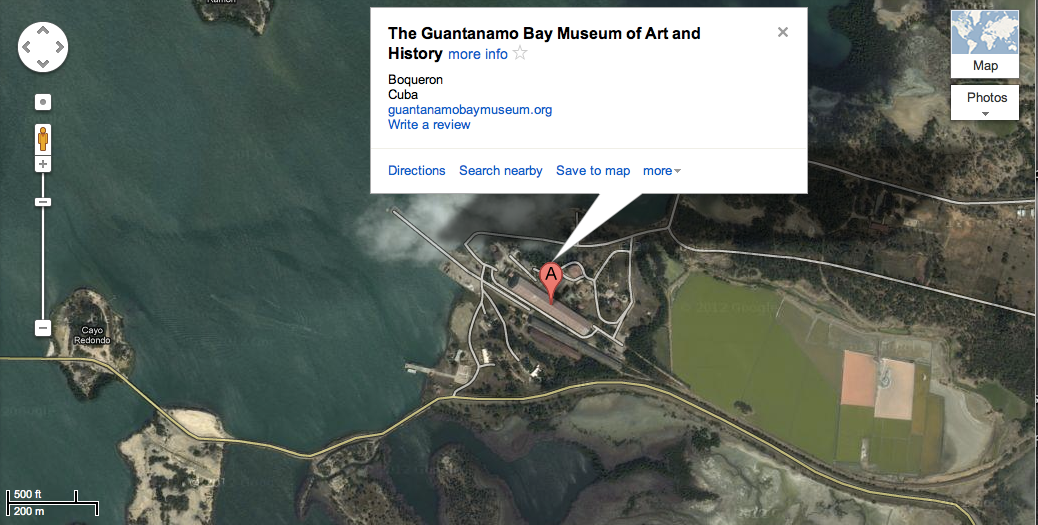
As I say, worth a visit.  As Alexis Madrigal at the Atlantic blog notes, you can find the Museum on Google maps (really) –

– and he’s captivated by the conceit:

The imaginary museum draws its power from this resonance: If Gitmo exists because of one fiction, perhaps it can be closed by another? Or put another (augmented) way, germane to this digital project: if we change Gitmo’s website, can it actually change its physical and legal reality? That’s what the museum’s organizers are hoping. 

“The museum is the result of a collaboration between artists/theorists and is meant to act as both a critique of the Guantanamo Bay Detention Facility as well as assert the possibility of its closure,” Rene Guerne, one of its organizers, told me in an email. “In this sense, it is a ‘real’ museum, although I cannot promise that there is a physical building in Guantanamo Bay.”

Benjamin Wittes at Lawfare is also intrigued by the project, and published the artists’ opening statement:

On August 29th, 2012, the website of the Guantanamo Bay Museum of Art and History was publicly launched. Designed by a group of artists from around the globe, the project creates a ‘speculative present’ in which the Guantanamo Bay Detention Facilities have been closed and replaced by an art museum whose purpose is to reflect on the history of the site.

The museum was listed as an official place on google maps ( http://goo.gl/tg72v ) and features original artworks from 6 different contemporary artists, as well as essays on Guantanamo Bay from leading contemporary scholars including Judith Butler and Derek Gregory.

Ian Alan Paul, an artist from San Francisco who coordinated and curated the project, states:

“The purpose of the project is both to explore the human rights abuses that occurred and continue to occur in Guantanamo Bay, but also to provide a space for radical imagination and potential openings and to insist that it is both possible and necessary to close the prison facility.”

The project was the result of large collaboration, with over 25 artists, writers and other volunteers contributing to the project in some way from Europe, North America and South America. Visitors to the museum were invited to plan their trip to Guantanamo Bay, become a member of the museum, apply to be an artist in residence, as well as read about the history of the museum itself.

There were over 3000 visits to the museum on the first day from 42 different countries.

In January 2009, interestingly, Florence Waters – anticipating Obama’s closure of the war prison (I wonder if she still does?) – proposed the creation of a (physical) museum on the site:

Transforming what will become an important site of memory into a museum could be an opportunity to present the facts from multiple points of view and give the subject transparency. Guantanamo detainees and guards would have the opportunity to present their stories alongside one another.

America has led the way in the post-modern world in erecting museums and sites of memory. They serve not only as burial sites of the past but also to affirm the symbolic order of a society, and head warnings to future generations…. Guantanamo Bay Museum would be a cultural and historical showcase dedicated to reinstating America’s most important values, liberty and justice, giving the detainees fair trial in the eyes of the outside world.

If only.  There are, incidentally, several other virtual Guantanamo Bays.  It was one of the founding sites for Mathias Judd and Christoph Wachter‘s  Zone Interdite, and Nonny de la Peña and Peggy Weil created a virtual Gitmo in Second Life (and, ironically, had to launch a campaign to keep Gitmo – their Gitmo – open!).

As the matchless Bryan Finoki put it on the much missed Subtopia, ‘the field guide to military urbanism’ (and still up even though Bryan stopped posting there early this year), referring to and then riffing off Zone Interdite,

 I love the idea of revealing these off-limit places this way, in a sense, de-restricting them in the process of remaking them. Altogether, rendering a de-restricted global fortress. 

What starts off as a few models of detention centers and prison camps could eventually turn into a full on game-world atlas of forbidden cities; a Borgesian labyrinth of illegal walkthroughs and blatantly trespassed border-zones, subverted checkpoints, oblique tunnel architecture, web tourists lost in the intersecting planes of bunker complexity and secret baseworld archipelago urbanism. It becomes a backlash taxonomy of exposed military installations. A virtual military-industrial-complex: “clandestinatopia.” Border fences and security walls give way now to a deterritorialized map of exploratory landscapes, overrun by mad gamers and tribes of sim-squatters preserving the world’s most closed and hidden places as endlessly wandering open space. Like a Subtopianinvoluntary park online, or a virtual spelunker’s paradise. 

So, yeah, I hope to see you there.

And as Bryan reminds us, there are many more black flags to fly over many more prisons and camps all over the world.

Sight-seeing: war and extreme tourism

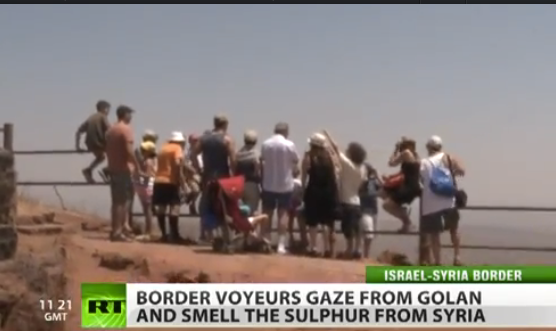
For the last several months there have been dispiriting reports of Israeli tourists travelling to the Golan Heights to gaze across the war zone in Syria: as Allison Good put it over at Foreign Policy, “Many Israelis are foregoing the pool or the beach, flocking instead to the Israel-Syria border for a little action.”

There was a thoughtful response to this voyeurism from Paul Woodward at War in Context – make no mistake, this is spectatorship not witnessing, as the video that prefaces his commentary makes clear – in which he suggested a series of ways in which he thought Israelis watching the war through binoculars was significantly different from Americans watching the war on television:

For Israelis the spectacle of regional violence is self-affirming.

It reinforces the idea that Israel is justifiably obsessed with its own security because it is surrounded by a ‘dangerous neighborhood.’

It confirms Ehud Barak’s racist notion that Israel is a villa in a jungle and that tranquility inside this villa can only be afforded by high walls.

It defines neighbors on the basis of their otherness and legitimizes indifference in preference to empathy.

I’m not so sure; there are, sadly, also American constituencies who surely see things the same way.

There are also close parallels between the voyeurs on the Golan Heights (or in this case Lows) and the ‘hill of shame’ from which the international media looked on at the Israeli attack on Gaza in 2009.  Here too the media were joined by Israeli tourists with cameras, binoculars and picnics: ‘bombing as spectator sport’, as two angry commentators described it.  There’s another personal, passionate report here.  For more on watching Gaza, see Peter Lagerquist, ‘Heard on the Hill of Shame’, at MERIP and – absolutely vital, this – David Campbell‘s  take, ‘Constructed visibility: photographing the catastrophe of Gaza (2009)’, which can be downloaded through his blog here. And Craig Jones has an excellent article culled from his MA thesis on ‘Shooting Gaza: Israel’s visual war’ in Human Geography 4 (1) (2011): abstract here.

There is also now a developing discussion of the wider, militarized landscape of ‘extreme tourism’ in Israel from Matt Carr at Ceasefire.  He pays close attention to the growth of tour companies run by former military officers and settlers, to the inclusion of the illegal settlements on the West Bank in their itineraries, and to the shooting ranges where tourists are encouraged to role play:

The sight of these ignorant, gimlet-eyed tourists in sunglasses and shorts, living out their paramilitary fantasies and teaching even young children to kill imaginary terrorists in a land under Israeli military occupation, is not the most edifying spectacle. But Caliber 3 does not only aim to thrill. Its activities are intended to combine ‘the values of Zionism with the excitement and enjoyment of shooting which makes the activity more meaningful.’ As the school’s director puts it ‘What is key here is not just shooting at targets, but hearing how we fight every day to protect the Jewish state.’

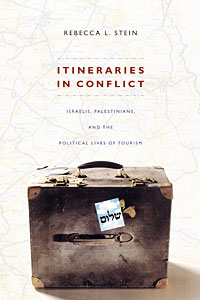
This can all be embedded in an emerging literature on ‘battlefield tourism’ or ‘war tourism’ – Richard Butler and Wantanee Suntikul have an edited collection, Tourism and war, out from Routledge this summer – but I think it’s more usefully connected to Rebecca Steins pathbreaking work on the politics of tourism, especially her book Itineraries in Conflict: Israelis, Palestinians and the political lives of tourism (Duke University Press, 2008). You can find a more recent report from her, ‘An All-Consuming Occupation’, on the fourth Jerusalem Festival of Light in June 2012 and the wretched history of tourism that was concealed in its glare, at MERIP.  She’s also provided an incisive examination of Israeli media coverage of the Gaza war – most eyes have been directed at international coverage –  in ‘Impossible witness: Israeli visuality, Palestinian testimony and the Gaza war’, Journal of cultural research 16 (2-3) (2012) 135-53.

Finally, for faint flickers of hope, there’s Caryn Aviv‘s essay on ‘The emergence of alternative Jewish tourism’, European Review of History 18 (1) (2011) 33-43.  Here’s the abstract:

This article explores the emergence of ‘alternative Jewish travel’ to the West Bank and within Israel. One programme, aimed at diaspora Jews, reframes religious, cultural, and ethnic Jewish identity to include non-violence and solidarity with Palestinians as part of what it means to be Jewish. Another programme, aimed at Israeli citizens (both Jews and non-Jews), reframes Israeli national identity to include post-Zionist solidarity with Palestinians, but is not necessarily Jewish in any religious or ethnic sense. Alternative Jewish travel programme tours explore complicated questions of justice and nationalism in different ways that reflect their simultaneously local and global positions, who organises them, and how they define Jewishness differently.

In Frames of War: when is life grievable? (2009) Judith Butler offered a series of reflections on other, no less violent visualities than those I have discussed here, but Aviv’s essay is worth reading alongside Butler’s response to the Jewish critics of her richly deserved award of the Adorno Prize by the city of Frankfurt: grace under fire.