Forensic architecture

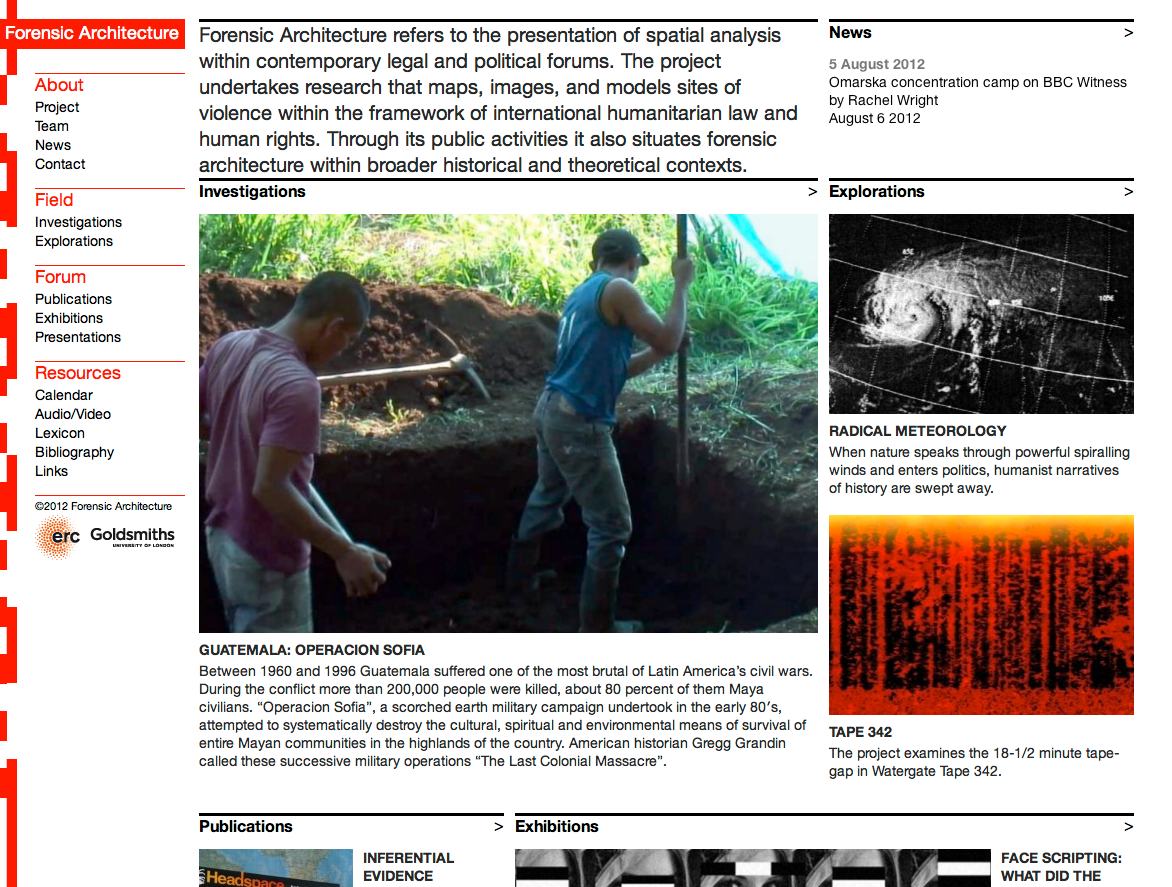
Both Stuart Elden and I have drawn attention to Eyal Weizman‘s Forensic Architecture project – sketched in outline in his The least of all possible evils and the subject of his Society & Space lecture – but for those who want more…

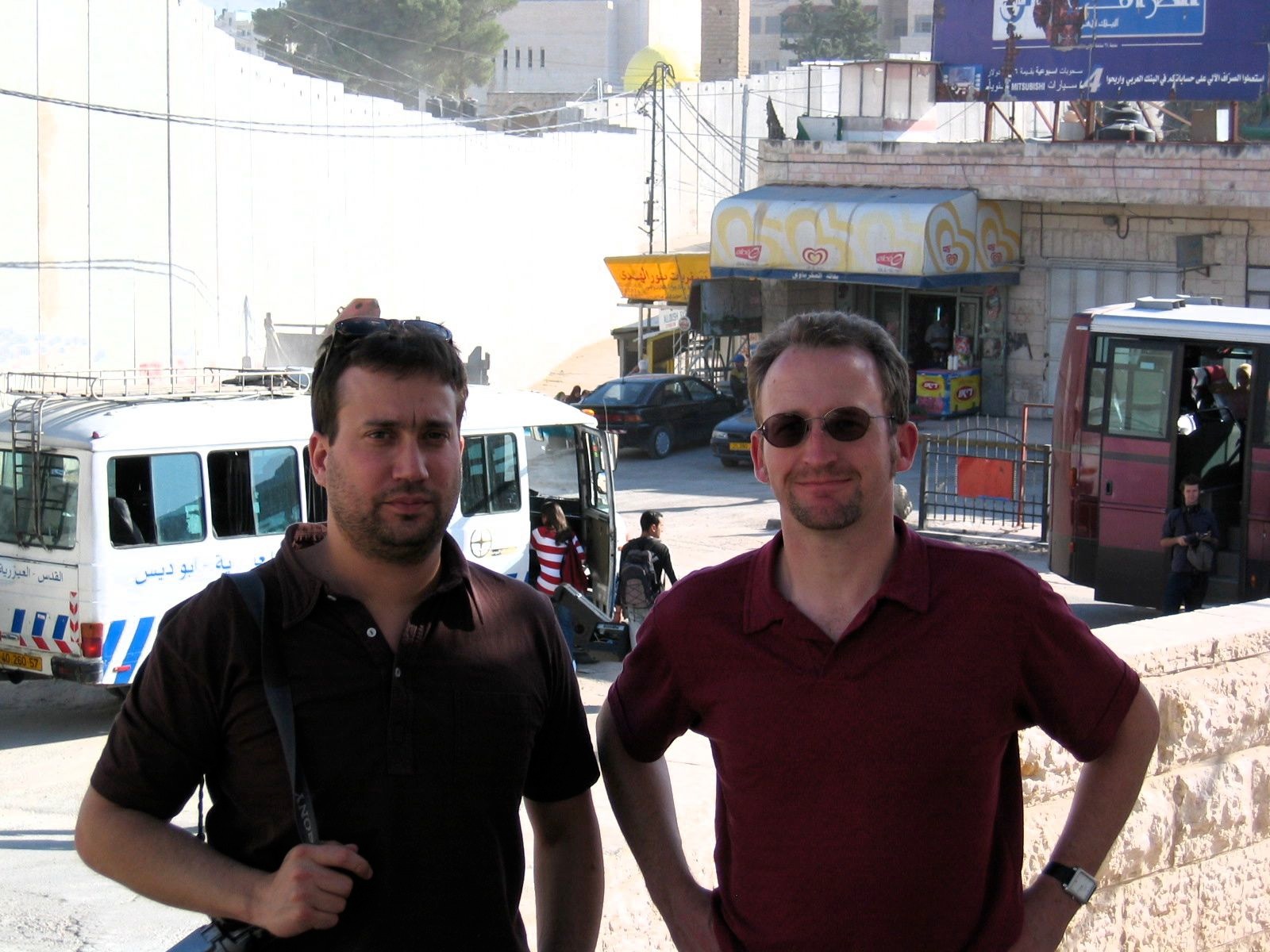
Eyal Weizman (L) and Steve Graham (R) in the occupied West Bank [Derek Gregory]

Michael Schapira and Carla Hung interview Eyal in “Thinking the Present” at  Full Stop. Here’s an extract where Eyal summarises his project:

‘Forensic Architecture is grounded in both field-work and forum-work; fields are the sites of investigation and analysis and forums the political spaces in which analysis is presented and contested. Each of theses sites presents a host of architectural and political problems.

In fields, lets say starting with Territories, I attempted to engage a kind of “archeology” of present conditions as they could be read, or misread, in architecture. This archeology is not always undertaken by direct contact with the materiality under analysis, but with images of it. The spaces that we debate, analyze, or make claims on behalf of, are very often media products. Similarly, drawing a map includes synthesizing satellite and aerial images as well as images from the ground. Some images are created by optics and some by different sensors that register spectrums beyond the visible. One needs sensors to read sensors.

So this is a kind of archaeology of spaces as they are captured in these different forms of capture and registration. You read details, speckles, pixels and patterns, connect them to larger forces, or at least you understand the impossibility of doing so, often noting paradoxes and misrepresentations. We have done this very close reading of aerial images of colonies in the West Bank, we have read almost all elements from architectural through infrastructural archaeological to horticultural ones visible in these images as a set of tools in a battlefield.

Then there is the forum: a site of interpretation, verification, argumentation and decision. International courtrooms, tribunals, and human rights councils are of course the most obvious sites of contemporary forensics. But there are other political and professional forums.

Each forum is different. The third component of forensics, beyond the architectural and aesthetic, is what you need in order to stand between that “thing” and the forum: an “interpreter.” In ancient Rome it would be the orator; in our days it is perhaps the scientist, or the architect, or the geographer — the “expert witness” that translates from the language of space to the language of the forum. This definition of forensics might help expand the meaning of the term from the legal context to all sorts of others. Politics, as it is undertaken, around the problems of space and its interpretations, is a “forensic politics” as far I understand it.

Each of the multiple political and legal forums in use today — professional, scientific, parliamentary or legal — operates by a different set of protocols of representation and debate. They each have another frame of analysis. Each embodies dominant political forces and ideologies — that is to say that each instrumentalizes forensics as a part of a different ideological structure. In the turbulence of a changing world, there are also informal, subversive and ad-hoc and crisis forms of gathering: pop-up assemblies of protest and revolt in which the debate of financial, architectural (the housing or mortgage crisis), and geopolitical issues are often articulated.

Forensic architecture should thus be understood not only as dealing with the interpretation of past events as they register in spatial products, but about the construction of new forums. It is both an act of claim-making on the bases of spatial research and potentially an act of forum-building.’

Eyal edited a special section of Cabinet magazine (#43) on “Forensics”, and there’s an early lecture (May 2010) on ‘Forensic Architecture’ here and an image-rich conversation with Open Democracy’s wonderful Rosemary Belcher on ‘Forensic Architecture and the speech of things’ here.

There is also a truly excellent website for the project, which is hosted by the Centre for Research Architecture at Goldsmiths University of London within the Department of Visual Cultures.

Highlights for me include:

under Investigations, Forensic Oceanography (probing the deaths of more than 1500 people fleeing Libya across the Mediterranean in 2011, including a downloadable report), a report on the effects of airborne White Phosphorus munitions in densely populated urban areas like Gaza, and a challenging (I imagine preliminary) commentary on ways of recording and investigating deaths from drone strikes in Pakistan’s Federally Administered Tribal Areas:

‘The near complete prohibition upon carrying recording equipment into this region of Pakistan, coupled with the non-existence of local maps has made the task of locating and representing the sites and consequences of drone attacks extremely difficult. This inability to produce corroborating evidence has, in turn, severely hampered the pursuit of legal claims. Forensic Architecture is working with human rights and legal justice organisations in both Pakistan and the UK to develop an alternate mapping system that can meet the unique challenges posed by the dilemma of creating accurate maps without relying upon technologies of exact recording, but only upon haptic techniques of observation and recall, or what has been called “transparency cameras”. This system needs to be matched, in turn, with a post-production methodology of transcription and interpretation of recollection data. Survivors and witnesses of drone strikes are typically brought to safe zones outside of Northwest Pakistan in cities such as Islamabad, where they are interviewed by legal staff and their stories cross-referenced and collated.’

under Explorations, a sketch of what the project calls ‘Video-to-space analysis’ derived from the recognition that ‘remote controlled vision machines (satellites and drones) and the handheld devices of citizen journalists working independently of news-desks marks a shift in the ways in which human rights violations will increasingly be charted and mapped and the ways in which the spaces of conflict themselves will increasingly become known or offer up information.’ 

under Presentations, a record of a seminar in March 2012 with Bruno Latour  who comments on a series of investigations (Paulo Tavares, “The Earth-Political”; Nabil Ahmed, “Radical Meteorology'”; John Palmesino, “North – The architecture of a territory open on all sides”): ‘Forensics is the production of public proof’ (with some interesting asides about ‘geopolitics’ and what he calls ‘politics of the earth’), and a tantalising glimpse of a conference presentation by Susan Schuppli under the title ‘War Dialling: Image Transmissions from Saigon’, which discussed the modalities through which, on June 8 1972, ‘a portable picture transmitter, took 14 minutes to relay a series of audio signals from Saigon to Tokyo and then onwards to the US where they were reassembled into a B&W image to reveal a young Vietnamese girl [Kim Phúc] running out of the inferno of an erroneous napalm attack.’

These reflect my own preoccupations, but there’s lots more – it’s a treasure trove of imagination and insight.  Oh – and a reading list.

The death merchants

The opening sequence of Andrew Niccol’s Lord of War (2005), starring Nicholas Cage, provides one of the starkest visualizations of the arms trade as it follows the ‘life of a bullet’ – thousands and thousands of them and one in particular – from the point of view of the bullet itself.   You can watch it (and listen to the wonderful Buffalo Springfield) below:

Here is the script:

MOUNTED ON THE BACK OF A BULLET CASING – ILLUSTRATING THE LIFESPAN OF THE BULLET.

– Gunpowder is poured into a metal casing, lead slug mounted on top.

A BULLET is born.  A perfect 39mm.

– The BULLET travels along a conveyor belt with thousands of identical siblings in a Ukrainian factory so grey it’s monochrome.

– The BULLET, picked up by a ham-fisted UKRAINIAN FACTORY WORKER, is tossed into a crate.

– The BULLET, lying in its open crate, rolls down a chute where it’s inspected by a UKRAINIAN MILITARY OFFICER holding a manifest.  He seems to stare directly at our BULLET.

UKRAINIAN OFFICER (to his SUBORDINATE carrying a manifest, in Ukrainian) Call it “agricultural machinery”.

– The BULLET’s crate rattles around in an open-bed truck along an industrial road, passes a decapitated statue of LENIN. – The crate containing our BULLET is placed on a ship in the cold grey Odessa harbor.  A container door closes, plunging the bullet into darkness.

– The door re-opens.  The BULLET, still in its crate, now basks in bright, tropical sunshine, surrounded by an azure sea.

– The crate is removed by a pair of slim, dark hands, revealing a glimpse of the bustling, weathered port of Abidjan in the Ivory Coast.  The crate is one of dozens unloaded from the ship.

– BULLET’s POV from another open-air truck, now slogging through a mud-clogged road in lush rainforest.

– The BULLET is unloaded from the truck in Freetown, Sierra Leone – immediately grabbed by the young HAND of a RUF soldier.

– The BULLET is loaded into a 30-round magazine which is inserted into an AK-47 machine gun

– The BULLET waits – in the gloomy chamber.  Suddenly, from outside,the sound of raised voices and gunfire.

– The BULLET and its neighbors start to rise quickly up the magazine towards the chamber as the Kalashnikov is fired.

– Our hero BULLET is next.  Will it see action?

– Smack.  The gun’s bolt strikes the explosive cap, gunpowder ignited, the BULLET driven out of the barrel.

– Shed of its casing – now only a slug – the BULLET emerges into bright sunshine.  It is flying down the main street in Freetown.

– The BULLET gives us a perfect point-of-view of the bullet ahead of it.  They are both flying towards their intended target – a wild-eyed CHILD SOLDIER, a boy no more than twelve, firing an AK-47 almost as tall as he is.

– The leading bullet narrowly misses, whistles past the boy’s ear, striking the whitewashed wall behind – one more pock-mark in a building riddled with pock-marks.

– Our BULLET, following close behind, finds its mark, slamming into the boy’s forehead just above his left eye – his expression, oddly relieved.

– The BULLET carves through the lobes of the boy’s brain where it is enveloped in blood, finally plunged into darkness – the bullet’s final resting place.

CUT TO BLACK

I can imagine – I think – all sorts of ways in which today’s object-oriented philosopher-geographers might be interested in this sequence, but there’s also a much more obvious geography embedded in it.  Yet it turns out that it’s not so obvious after all.  One of the liveliest (sic) analyses of the global arms trade is Andrew Feinstein‘s The shadow world: inside the global arms trade (London: Hamish Hamilton, 2011); there are also trenchant analyses in Rachel Stohl and Suzette Grillot, The international arms trade (Cambridge: Polity, 2009).  But if you want to track those shadow geographies and their entanglements with the shifting geographies of military and paramilitary violence, then you have to look elsewhere.  And once you start looking you begin to realise why neither of these books includes any maps.

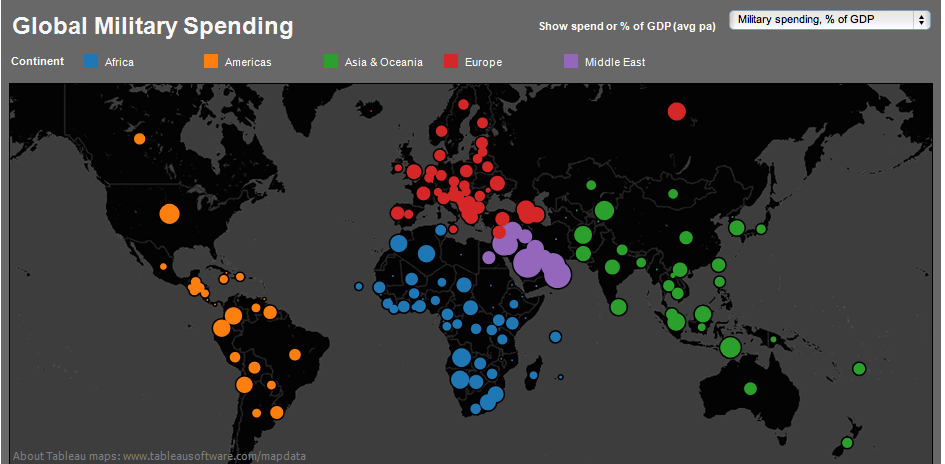
The Stockholm Institute for Peace Research has been tracking global military spending and the arms trade since 1967, and Ian Taylor has converted their recent tabulations into several maps, like the one below that plots military spending in 2011 as a proportion of GDP.

Armsflow has an animated sequence of global arms transfers from 1950 through to 2006, based on the SIPRI database.  And Worldmapper has some maps showing arms exports and arms imports, but these use data from 2003 only and exclude small arms and ammunition.  In fact most investigations of the global arms trade, until at least the end of the Cold War, were directed at major weapons systems – calibrating the ‘arms race’ – but since the 1990s there has been considerable interest in tracking small arms and light weapons (SALW); le monde diplomatique provided a map of small arms for 2002, but this was confined to the legal trade (though it did show the zones where illegal trafficking was most dense), and there is a visualization of the global distribution of small arms here.  In addition, the Norwegian Initiative on Small Arms Transfers (NISAT) has a series of maps ranking exporting and importing states.

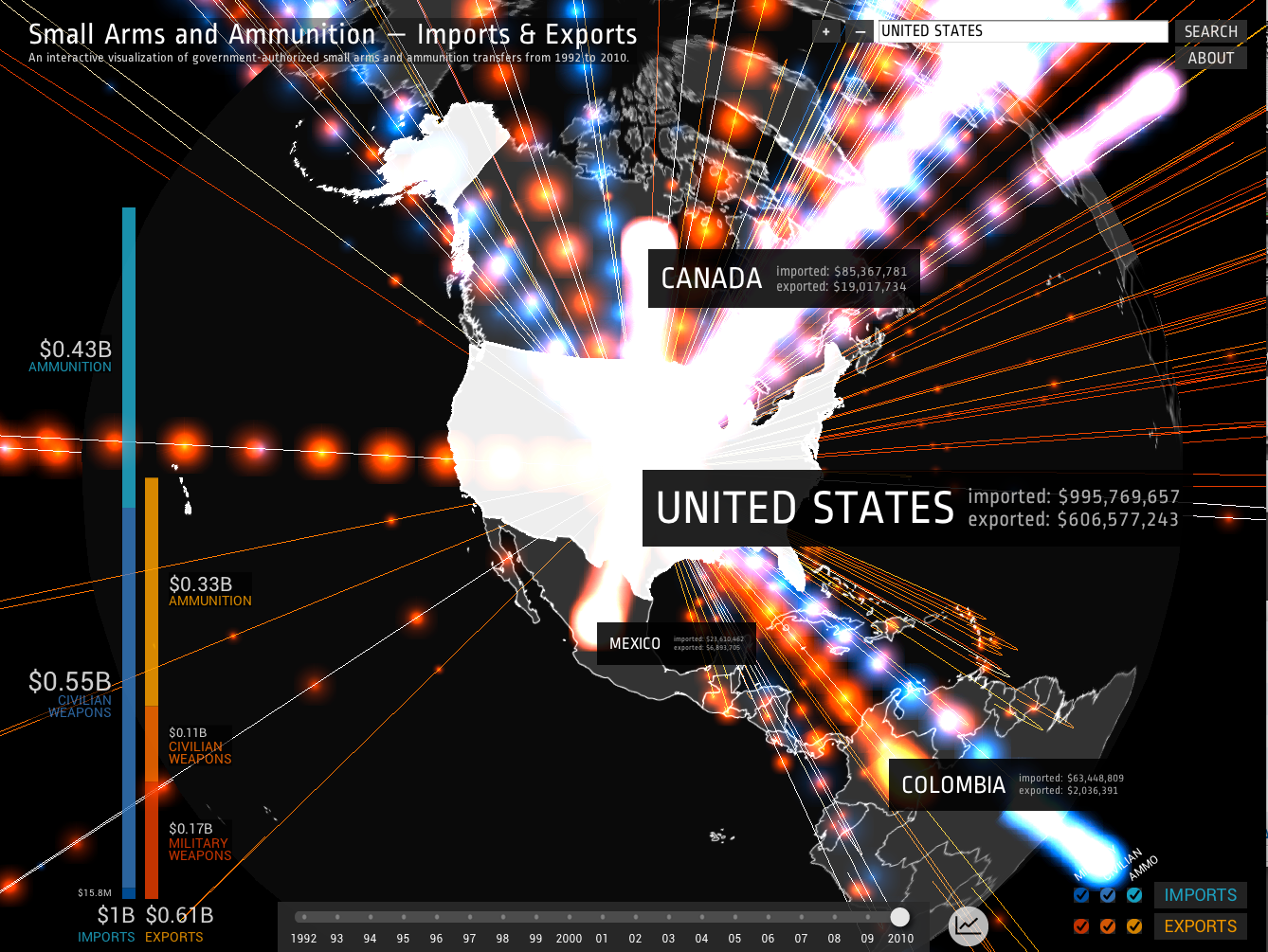
But these maps are static and don’t show the flows involved. But now a new project between the Igarapé Institute in Brazil and Google’s Creative Lab team uses data from the Peace Research Institute in Oslo (one of NISAT’s three partners) to produce an interactive that charts the ‘government-authorised’ global trade in small arms from 1992 to 2010.  I’ve posted a screenshot below but this is an interactive and you really need to move through the image flow. The project claims that 60 per cent of violent deaths in the world are inflicted through the use of small arms and light weapons.  Note: You need Google Chrome to view the interactive.

The Geneva-based Small Arms Survey identifies the major exporters (excluding ammunition) thus:

Austria, Belgium, Brazil, Germany, Italy, and the United States routinely report annual exports of small arms, light weapons, their parts, accessories, and ammunition worth USD 100 million or more. The Small Arms Survey estimates that China and the Russian Federation also routinely achieve this level of activity although Beijing and Moscow do not report doing so. In 2007, customs data alone indicated that these eight countries, along with Canada, Switzerland, Turkey, and the United Kingdom, exceeded USD 100 million in exports.’

And the importers:

‘An analysis of customs data suggests that for the period 2001 to 2007 five countries—Canada, France, Germany, Saudi Arabia, and the United States—routinely imported small arms, light weapons, their parts, accessories, and ammunition worth USD 100 million or more per year. Customs data also suggests that eight additional countries imported at least USD 100 million or more in at least one year during this seven-year period: Australia, Cyprus, Egypt, Japan, the Netherlands, South Korea, Spain, and the United Kingdom. A review of customs data shows that Italy routinely imported more than USD 50 million per year from 2001 to 2007.  The United States is by far the biggest documented importer of small arms.

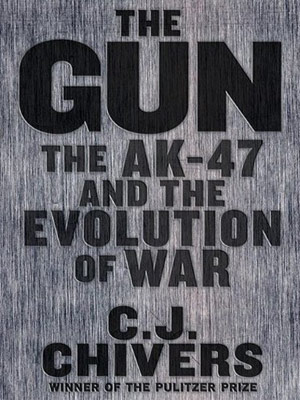
All this matters because, as C.J. Chivers – the author of a remarkable history of the AK-47, The Gun, notes in Foreign Affairs 90 (2011) 110-121 – small arms and ammunition play a central role in ‘fueling the forever war’.  And, as these fragmentary notes suggest, their cascading geographies also explain how they propel what I call ‘the everywhere war’ too. There are two vectors that need to be emphasized.  First – and Chivers is very good on this – there is a layered historical geography to the diffusion of small arms.  As state militaries spasmodically upgrade their stocks so their discarded models typically enter the arms bazaar in what Chivers calls ‘arms cascades’ – which explains how US Marines in Marja seized stocks of both Lee-Enfield bolt-action rifles and World War II ammunition and automatic Kalashnikovs.  What this example shows, too, is that there is no clear line dividing ‘white’  from ‘black’ (illicit) trade, what Mike Bourne – whose work I’ve just stumbled upon – calls an ‘upperworld’ and an ‘underworld’.   There may not be fifty shades of grey, but Bourne insists that there is ‘an important distinction between the greyness that occurs because of unclear or weakly enforced procedures or corrupt individuals and that which arises through covert arms supply by states’ [‘Controlling the shadow trade’, Contemporary security policy 32 (2011) 215-240].

Second, the geographies of small arms transfer are much more heterogeneous than the visualizations shown above imply: purely private black-market transfers are often intensely regionalized rather than globalized (again, Bourne’s Arming conflict: the proliferation of small arms (Palgrave-Macmillan, 2007) is very helpful here, and there is a clutch of revealing regional studies, notably of arms trafficking in sub-Saharan Africa.  I said something about this – all too briefly – in my ‘War and peace’ (see DOWNLOADS tab) but I need to think much more carefully about it.  My discussion of small arms trafficking in that essay was linked to the ‘new wars’ thesis, and Thomas Jackson has provided a much more incisive critique of the claim that the ‘globalization’ of arms supply feeds into intra-state conflicts, and of the importance of ‘domestic procurement’, in ‘From under their noses: rebel groups’ arms acquisition and the importance of leakages from state stockpiles’, International Studies Perspectives 11 (201) 131-147.  It’s a clunky title but an interesting argument: in Jackson’s view, only well organized non-state actors ‘have the organizational strength and external support to access the global arms market’.

But it’s Bourne’s contemplation of ‘an inglorious mess of hybrids and ever evolving assemblages’, and his continuing riffs on heterogeneity, that open up the most interesting theoretical and political possibilities, for me at any rate.  I recommend his reflections on ‘geopolitical imaginations’ (yes) and ‘netwar geopolitics’ [British journal of Politics and International Relations 13 (2011) 490-513] and (especially) ‘Guns don’t kill people, cyborgs do: a Latourian provocation for transformatory arms control and disarmament’ [Global change, peace and security 24 (2012) 141-163].  That last essay loops back to ways of re-envisaging the opening sequence of Lord of War with which I began…

Media, war and political violence

Three forthcoming books that I shall need to read carefully before returning to my discussion of reporting distant wars in “Deadly embrace”…

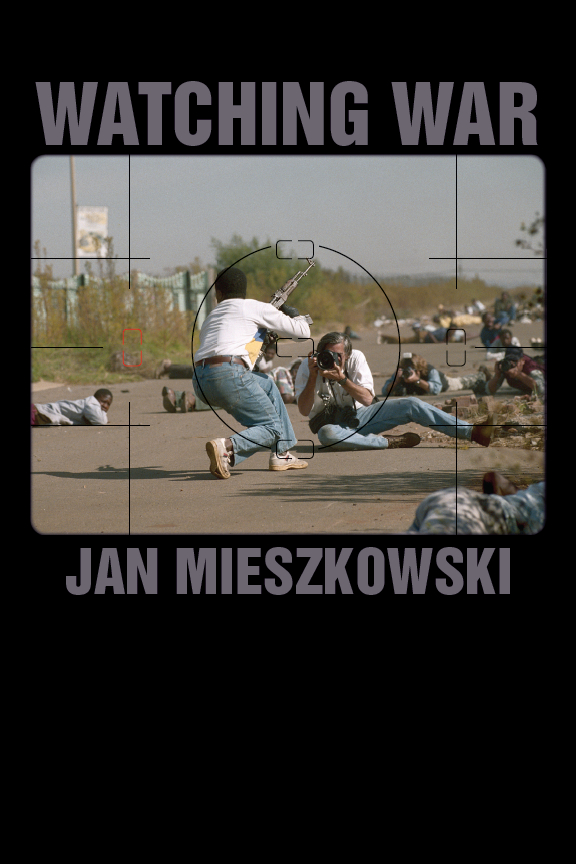
Jan Mieszkowski’s Watching Warforthcoming from Stanford University Press in August 2012: ‘What does it mean to be a spectator to war in an era when the boundaries between witnessing and perpetrating violence have become profoundly blurred?  Arguing that the contemporary dynamics of military spectatorship took shape in Napoleonic Europe, Watching War expores the status of warfare as a spectacle unfolding before a mass audience.  By showing that the battlefield was a virtual phenomenon long before the invention of photography, film or the Internet, this book proposes that the unique character of modern conflicts has been a product of imaginary as much as material forces.’

Continue reading

Bombing Encyclopedia of the World

Bombing from the air re-wrote the geography of war, blurring and blasting the boundaries between ‘civilian’ and ‘military’ spaces.  But it also required a knowledge of geography.  In the Second World War the targeting cycle could extend over several weeks or even months as target folders were compiled, complete with aerial photographs, target maps and intelligence reports, but after the war the United States was determined to accelerate the process. When the US Air Force was separated from the US Army it quickly established its own Directorate of Targets, which was made responsible for the compilation of what was eventually called the ‘Bombing Encyclopedia of the World’.

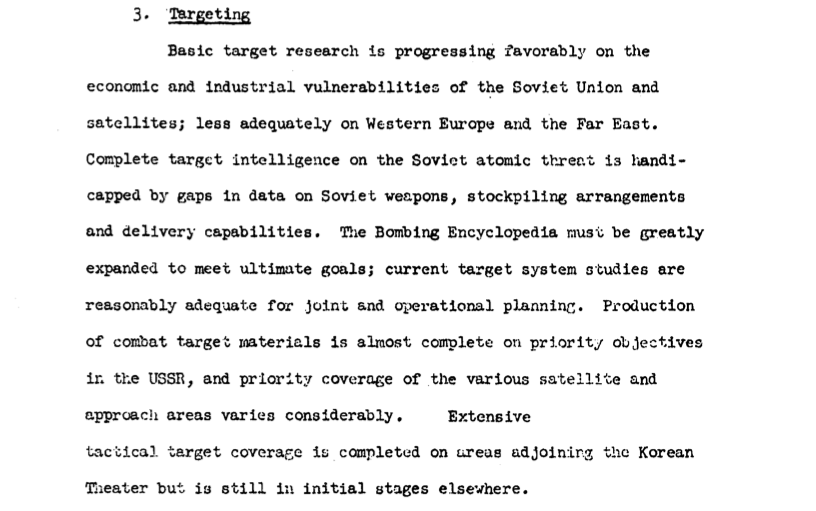
Work started in January 1946 on potential targets in the Soviet Union and in six months IBM cards were punched for 5,594 targets.  In April 1949 a rare press report noted that the volume of work had ‘doubled since last summer’ and that the Air Force was requesting more funds to hire additional intelligence officers and civilian analysts.  The database was extended to Soviet satellites and Korea, but in 1952 the National Security Council was told that while ‘basic target research’ was progressing favourably ‘the Bombing Encyclopedia must be greatly expanded to meet current goals.’

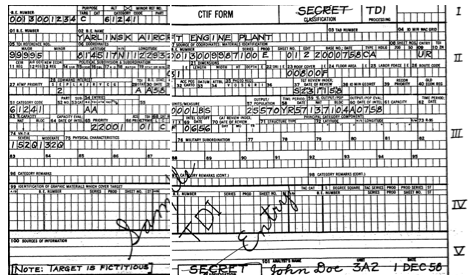
The database soon became global, and by 1960 it contained 80,000 entries. Machine processing was still in its infancy, however, and the project was bedevilled by serious problems of information management that were still unresolved by the time American forces were deployed in Vietnam.  As the number of targets steadily increased, so it became ever more difficult to integrate data from multiple sources.  Standardisation was eventually achieved through the Consolidated Target Intelligence File (shown below; the image is imperfect because it is a composite).  Outten Clinard explained that the form was divided into five sections:

I.    Codes for machine processing and hand processing.
II.  Information identifying and locating the target.
III. Information on the category of the target and its individual characteristics within the category.
IV.  References to graphic coverage on the target.
V.   Sources.

The CTIF shown here is for a fictitious (industrial) target, but Clinard explained its structure thus:

Much of the information is entered on the form uncoded and may be read directly, for example the target’s name (02), location (06), elevation in tens of feet (20), roof cover in thousands of square feet (23), and output in thousands of pounds (57).  Some of it is entered in a simple code for which the IBM 705 is keyed. On the form shown, in the country block (08) “UR” represents the USSR; under command interest (28) the figure 2 in the E block indicates that the target has been nominated by the U.S. European Command; and under category requirements (68) the letters C and F indicate that additional information is needed on capacity/output and labor force, respectively.

The CTIF was more than a resource for planning particular missions.  Stored on magnetic tapes, the data-stream of CTIFs  was also ‘susceptible of rapid and complex manipulation in electronic data-processing machines’.  In 1959, when Clinard published his (then classified) essay in Studies in Intelligence,  the targeting effort was primarily directed towards Strategic Air Command  and the prospect of long-range nuclear strikes against the Soviet Union.  For this reason, the bombing database was used to calibrate (for example) a Damage and Contamination Model:

‘This is a large and complex program, involving 58,000 targets and geographic “cells” and 700,000 to 900,000 computations. With requisite inputs from a war plan, that is, a pattern of ground zeros, weapon types, etc., this program is capable of calculating the probabilities of blast damage to some 9,000 targets, the radiation dose and contamination pattern from the weapons which were ground burst, and the fatalities and other casualties in 40,000 geographic “cells.” It will also give damage and casualty summaries by categories and by regions.’

One of the analysts responsible for ‘nominating’ targets for inclusion in the Encyclopedia was Henry Nash, who described how, ‘in order for a nominated target to win its way into the Bombing Encyclopedia … a Significant Summary Statement was prepared which briefly (roughly 50 words or less) described each target and its strategic importance.’  Years later, as a professor of political science in a liberal arts college in Virginia, Nash wondered ‘What enabled us calmly to plan to incinerate vast numbers of unknown human beings without any sense of moral revulsion?’  This was what he called the ‘bureaucratization of homicide’ I referred to in an earlier post: the compartmentalization of tasks, the collective reinforcement through membership in committees or task forces, and the reward and recognition conferred by ‘special’ security clearances.  Nash also reflected on the powers of abstraction. A preoccupation with ‘the numbers game’ – ‘The strong technological and quantitative orientation of these tasks [clearly shown in the paragraphs above] held the attention of analysts and the relationship of weapons to human life was an incidental consideration’ – was reinforced by carefully sanitized language:

‘As America’s involvement in the Vietnam War grew deeper, the Defense vocabulary expanded and displayed an even greater imaginative and anaesthetizing flair. Targets for attack were given the picturesque name of “strategic hamlets.” Bombing raids became “surgical strikes” and the forced movement and impounding of Vietnamese citizens were part of America’s “pacification program” – terms suggesting images of the hospital operating room or a Quaker meeting.’

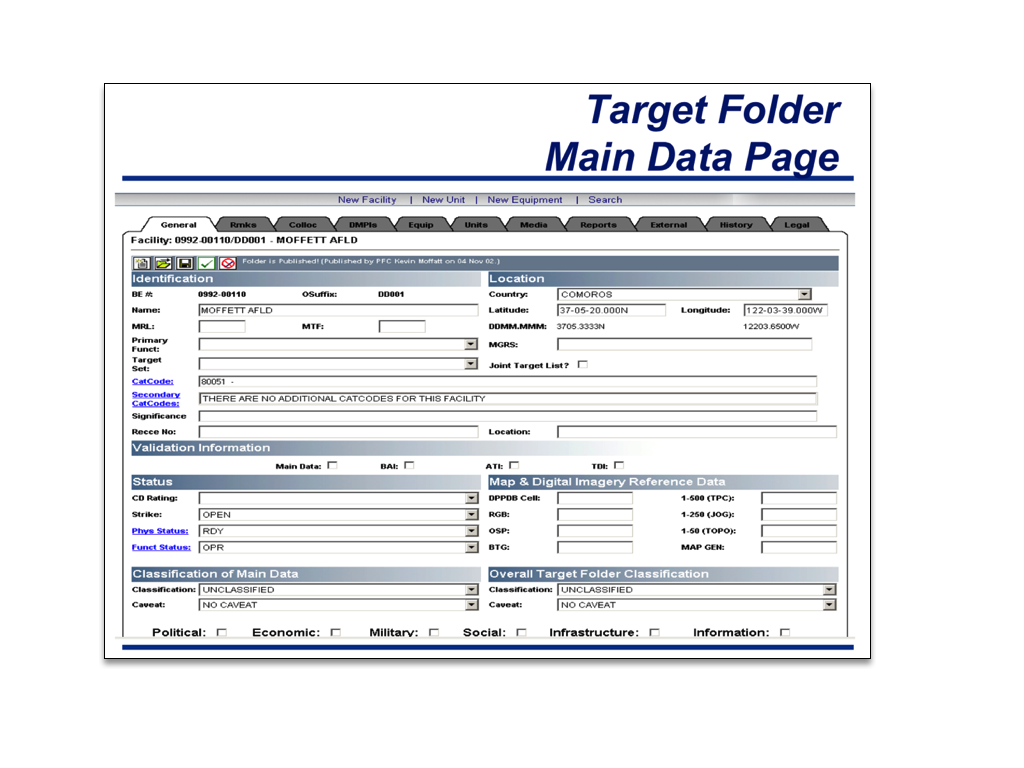
Much of this will be familiar to analysts of bombing today.  The Bombing Encyclopedia has been re-named the Basic Encyclopedia, the targeting process has been refined and the kill-chain has been ‘lawyered up’, but the process still relies on the rapid-fire production, analysis and dissemination of a vast database and on computer modelling of damage and blast effects.  Today, the target folders are computer files but as the example below shows, the BE number is still the key (top left):

Yet there are significant changes.  The BE number refers to an ‘object target’ and its fixed, physical location, and this remains important for active (and fortunately non-nuclear) bombing missions against conventional targets.  But in the counterinsurgency and counterterrorism wars conducted by the US in Iraq, Afghanistan, Pakistan and elsewhere the target is often an individual – sometimes identified, if the person appears on a list of ‘High Value Targets’, but sometimes unknown and un-named – and almost always mobile.  And for named targets, even the CIA requires more than fifty words for inclusion on its hit list (though the dossiers submitted to its lawyers for approval are reportedly only 2-5 pages).

Still, when I was working on ‘Doors into Nowhere’ (see DOWNLOADS tab) I remember encountering elin o’Hara slavick‘s luminous work for the first time, and her remark that she had originally intended to call her series of paintings ‘Everywhere the United States has bombed’ but that, as she learned more about covert action and mis-information, she realised that was an impossible project.  How ironic, then, that behind her critical inclinations there should have been a global database that made all those bombings possible…

But the irony doesn’t end there.  For it turns out that slavick’s project was, until recently, no less difficult for the US Air Force: if not exactly mission impossible then at least mission improbable.

The other side of the Bombing Encyclopedia, verso to its recto, would indeed be a global database recording ‘everywhere the United States has bombed’, but  the data are widely scattered and unsystematic: millions of records, some on paper, some on punchcards and magnetic tape, and more recent ones in various digital forms.  Six years ago Lt Colonel Jenns Robertson started to transcribe, standardise and integrate the available records of individual strike missions from World War I down to the present, incorporating RFC/RAF data for the two World Wars.  The result, announced this week in an article by Bryan Bender in the Boston Globe, is THOR: Theater History of Operations Reports (how the military loves its acronyms).  Robertson started the project in his spare time, working at night and at weekends, but he’s now been assigned to work on it full time at the Air Force Research Institute at Maxwell Air Force Base.  His extraordinary database – which he admits is still incomplete and, in places, in need of scrubbing – can be searched in six main ways listed as follows:

  • When – date, time over target, flying hours, etc.
  • Who – campaign, country, service, unit, call-sign
  • How – aircraft, take-off location, mission type
  • What – weapons used
  • Where – location of target, BE #, release height, speed
  • Why – effects, JTAC reports, Bomb Damage Assessment

The visualizations from the project, displayed and interrogated using GIS, are often stunning – more on this in a later post – and they are designed to answer both historical strategic questions about the conduct of particular campaigns and also contemporary forensic ones about the locations of unexploded ordnance or the remains of missing aircrew killed in action.  I’m hoping that I’ll be able to access the database for my Killing Space project [see DOWNLOADS tab], which focuses on three bombing campaigns: the combined bomber offensive against Germany in World War II, the air wars over Vietnam, Laos and Cambodia, and the ‘drone wars’ over Afghanistan/Pakistan and elsewhere.  But Bender’s description of the visualizations loops back to where I began:

‘The result: a compilation that, at the click of a mouse and a few keystrokes, reveals for the first time the sheer magnitude of destruction inflicted by the US and its allies from the air in the last century…. When plotted on a satellite map, the bombs — from the biplanes of the nascent US Air Service over France in World War I to pilotless drones targeting suspected terrorists in the war in Afghanistan — blanket many thousands of square miles from Europe to Africa, the Middle East and Asia.’

UPDATE:  I returned to the Bombing Encyclopedia here.

Bethlehem to Baghdad

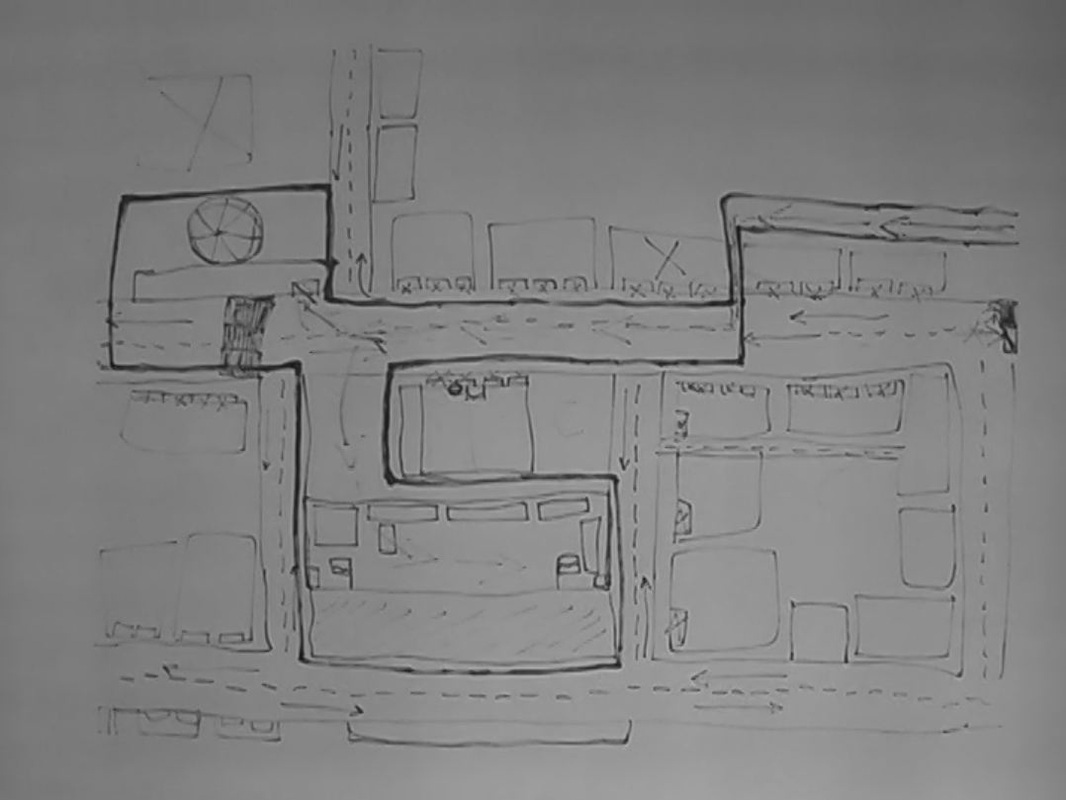
In 2008 the artist Till Roeskens – who describes himself as an ‘amateur of applied geography’ – produced a ‘videocartography’ or ‘videomapping’ based on interviews at the Aida refugee camp in occupied Palestine.  Roeskens explains: ‘I asked residents of the camp to draw with big ink pens so the marks would go through the paper. I filmed from the other side, as they drew, so I didn’t see the person while they were drawing and speaking; I saw only the white screen with the light coming from behind me.’  The mappings, together with the stories told by those who drew them, were recorded on video, and ‘as the film progresses, the viewer is increasingly hemmed in by a complex network of lines, until the reality of the occupation is fully realized on screen’.      There is a revealing interview with the artist at Words without borders here, and you can watch some extracts here (and there are others on YouTube and vimeo).

« On screen: nothing but another screen. At first untouched, a blank sheet of paper is slowly being filled with more or less straight lines. Then these lines grow, push and cross each other, to finally form a drawing, a layout; they unfold a topography, mark places, build houses, give directions, describe in great detail tangles of roads and obstacles. In fact, they are laying down flat biographies. Six sheets slowly come to life that way, one after another, following the rhythm of stories told by children, women or men voices, of people we never get to see. Where are these voices? Behind the sheets. Of course, but where else? Nowhere: that is precisely what the voices are trying to say. Or rather, because even nowhere persists on taking up some space, they say that they are in Palestine. (…) »

Inspired by Rosekens’ work, Antonio Ottomannelli transposed the technique to Baghdad.  The project was carried out between November 2011 and February 2012 with students at the Fine Arts Faculty of the University of Baghdad.  Ottomannelli:

‘Baghdad is a hidden city.  Everything is placed behind anti-explosion walls, from one checkpoint to the next. … The latest map of Baghdad was made by the US military in 2003 for military and strategic purposes…  There is no civilian map of the current configuration… Inspired by the work of Till Roeskens on Palestine, Mapping Identity tries to tell about the city – the whole of it – from the inside.  A snapshot of the ordinary, a minor “Giacometti portrait”, as Baghdad is concealed…’

More details here, and a videomap here (more on vimeo).

These projects are political-artistic versions of the ‘mental maps’ that captured the imagination of many human geographers in the 1960s and 70s – an interest which is usually traced back to Kevin Lynch’s experiments with The image of the city (1960) and that probably climaxed in Peter Gould and Rodney White’s classic little book, Mental maps, originally published in 1974 – but what makes these projects so compelling is their emphasis on the process of mapping (through their use of video) rather than a fixation on the map as finished object.  One of the criticisms of the original ‘mental mapping’ projects was that respondents drew maps only because they were asked to: that this was not how people found their way around their neighbourhoods, which usually turned out to be a much more pragmatic, improvisational practice responding to cues and following routines rather than relying on some imaginary point of overview.  But these two projects are ways of narrating a space – of telling what Michel de Certeau would call ‘spatial stories’ – that are also interventions in (and subversions of) larger narratives of military violence and military occupation.

Drones and military violence: Readings and screenings

I’m working on a presentation that will turn into a long essay that may turn into a short book – one day I will learn how to write in brief! – and I thought I’d share some of the bibliographic resources I’ve been using. This is not an exhaustive list, needless to say, but I hope it will be a useful springboard for others too; I’ve tried to indicate the range of journals and sources available, and some of the key areas of contention and concern.  Much of the debate on drones has focused on the supposedly covert US air campaign directed by the CIA in Pakistan’s Federally Administered Tribal Areas, which plainly raises vital issues of ethics, law and accountability that can also be extended to parallel campaigns in Somalia, Yemen and elsewhere.  But – as I’ve tried to show in my own work – this should not allow the overt air war in Afghanistan to escape scrutiny.  Here the operational questions often become more complex because these platforms are integrated into extended networks in which surveillance is conducted by remote operators but the strikes may be executed by conventional aircraft: the geography of the kill-chain is crucial.  For this, I’ve been drawing on a series of USAF publications and presentations.

But the focus on the US distract should not distract attention from the rapid expansion of remote capabilities by other militaries, including (as the listing below indicates) Israel, where the IDF developed a series of protocols for extra-judicial killing (assassination) long before the USAF or the CIA.

There are also important historical precedents to consider: the use of air power in colonial counterinsurgency operations, particularly by the British in Mesopotamia (Iraq), the North West frontier of India and Palestine, and the emergence of key elements of today’s remote operations in the Second World War and, in particular, during the US air wars over Indochina. For the former, the work of David Omissi, Air power and colonial control: the Royal Air Force 1919-1939 (1990), Priya Satia, Spies in Arabia: the Great war and the cultural foundations of Britain’s covert empire in the Middle east (2008) [see also her essay on ‘The defense of inhumanity: air control in Iraq and the British idea of Arabia’, American historical review 11 (2006)], and Andrew Roe, Waging war in Waziristan (2010) are key sources.  For the latter, see my ‘Lines of descent’ (DOWNLOADS tab).

There are some significant gaps in the listings that follow.  There is already a book that gives a pilot’s view of these remote missions, Matt Martin‘s Predator, and there’s no shortage of media interviews with (American) crewmembers, usually based at Creech Air Force Base in Nevada.  But, with rare exceptions, the media have shown little interest in documenting the victims of drone strikes, apart from (contentious) estimates of their numbers and claims of ‘high-value targets’ being killed.  For preliminary assessments of the distortions of media coverage, see Timothy Jones, Penelope Sheets and Charles Rowling, ‘Differential news framing of unmanned aerial drones: efficient and effective or illegal and inhumane’ (APSA, 2011: available via ssrn.com) and Tara McKelvey in the Columbia Journalism Review (listed below).

There are virtually no ethnographies of life (and death) under the drones: Shahzad Bashir and Robert Crews have recently curated some interesting essays on daily life in the Afghanistan-Pakistan borderlands, but the title Under the drones (Harvard University Press, 2012) is opportunistic.  The editors write of their desire to ‘illuminate aspects of the rich social and cultural worlds that are opaque to cameras mounted on drones flying many thousands of feet above this terrain’ – an admirable project – but not a single contributor illuminates the impact of the drone wars on those worlds.   There are some sharp questions about the missing ethnographies of death – unlike the surgical dissections of sovereignty – in Anthony Allen Marcus, Ananthakrishnan Aiyer and Kirk Dombroiwski, ‘Droning on: the rise of the machines’, Dialectical Anthropology 36 (2012) 105.   Some of the best repor­tage on the effects of drone strikes in the Federally Administered Tribal Areas of Pakistan comes from CIVIC, but its most recent report on Civilian Harm and Conflict in Northwest Pakistan was published in October 2010 (this also documents the suffering caused by Pakistan military action), though there are some updates on its blog (listed below).

Noor Behram has provided an unforgettable photographic record of the aftermath of drone attacks in the same area (200 images from 27 sites) that formed a centrepiece for the Gaming Waziristan exhibition staged in the UK, the US and Pakistan in 2011: for online galleries see here  and here.  And other visual/video artists have not been slow to reflect on these new modalities of killing: see, for example, John Butler’s The ethical governor (available on YouTube and vimeo) or Omer Fast’s Five thousand feet is the best (in which a white American family is killed in a Predator attack).
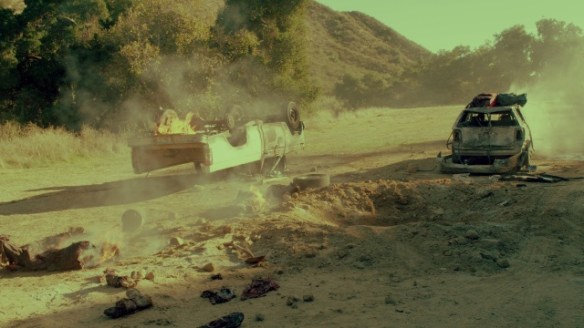
In addition, Jordan Crandall has a performance work, ‘philosophical theatre’, called Unmanned at Eyebeam that I’d love to see…. It involves the crash of a drone in a suburban backyard in the American southwest.

 If you think I’ve missed something that ought to be included, please let me know.

 Note: Most militaries disdain the term ‘drones’ since these aircraft are piloted, and prefer ‘Unmanned Aerial Vehicles’ (UAVs) or ‘Unmanned Aerial Systems’ (UAS) or ‘Remotely Piloted Aircraft’ (RPAs).   Most of the listings below are concerned with the use of these platforms to conduct air strikes; smaller drones are also deployed by ground forces for surveillance and no doubt they too will soon be able to carry out strikes.
Books

Nick Turse and Tom Engelhardt, Terminator planet: the first history of drone warfare 2001-2050 (Dispatch Books, 2012) – a sharp analysis of drone wars, past, present and future, culled from the regular reports of the TomDispatch principals; also available as an e-book

Medea Benjamin, Drone warfare: killing by remote control (OR Books, 2012)– a passionate critique from the co-founder of Code Pink and Global Exchange that also details the rise of activist campaigns against drone warfare; also available as an e-book

Matt Martin and Charles Sasser, Predator: the remote-control air war over Iraq and Afghanistan: a pilot’s story (Zenith Press, 2010) – most of the commentary on drones is concerned with covert campaigns waged by the CIA (with JSOC), but this is an account of USAF operations that also deserve close scrutiny….

Peter Singer, Wired for war: the robotics revolution and conflict in the 21st century (Penguin, 2009) – about much more than drones, but Singer has a series of perceptive observations about them scattered throughout the book.

Websites and blogs

Drone Wars UK – focuses on the British use of drones, but also includes wider commentary and information and a useful Drone Wars briefing pdf by Chris Cole [see also Convenient Killing below]

Drones Watch – advertised as ‘a coalition campaign to monitor and regulate drone use’
Understanding Empire – ‘dispatches on the drone wars: the state of our unmanned planet’ – a brilliant news aggregating source with commentary too

Our bombs – created by Neil Halloran ‘a website and documentary film that looks at the human cost and strategic implications of U.S. air strikes’, including an ‘air strike tracker’ from 9/11 through to January 2011

The Bureau of Investigative Journalism – a not-for-profit organisation based at City University, London, that provides (among many other things) a stream of indispensable reports, investigations and critical commentary on ‘the covert war on terror’ in Pakistan, Somali and Yemen

The #drones daily – what it says:  news and commentary updated daily

The Long War Journal – Bill Roggio’s site, politically distant from the sources above, but providess useful charts, maps and reports on covert US air campaigns in Pakistan and Yemen

New America Foundation – the Year of the Drone, mapping and reporting on US drone strikes in Pakistan 2004-2012 (and continuing): but its estimates of civilian casualties (in particular) have been sharply criticised by the BIJ here.

Also on Pakistan, Amnesty International has ‘Eyes on Pakistan’, focusing on human rights abuses in FATA, including maps of drone strikes, through 2009, while CIVIC (Campaign for Innocent Victims in Conflict) has a field blog that provides reports on war victims in Pakistan (and elsewhere)

Articles and essays

Although (too) many of these are behind a pay-wall, I’ve tried to list publically accessible versions wherever possible.  Please don’t assume that inclusion means agreement!

M.W. Aslam, ‘A critical evaluation of American drone strikes in Pakistan: legality, legitimacy and prudence’, Critical studies on terrorism 4 (2011) 313-29

Chris Cole, Mary Dobbing and Amy Hailwood, Convenient killing: Armed drones and the ‘Playstation’ mentality available here

Jordan Crandall, ‘Ontologies of the wayward drone: a salvage operation’, Theory beyond the codes (2011)available here

Aliya Robin Deri, ‘“Costless war”: American and Pakistani reactions to the US drone war’, Intersect 5 (2011) available here

Christian Enemark, ‘Drones over Pakistan: secrecy, ethics and counterinsurgency’, Asian Security 7 (3) (2011) 218-37

Keith Feldman, ‘Empire’s verticality: the Af/Pak frontier, visual culture and racialization from above’, Comparative American Studies 9 (4) (2011) 325-41

Jenny Garand, ‘Robotic warfare in Afghanistan and Pakistan’ (December 2010) (Medical Association for the Prevention of War, Australia) available here

Derek Gregory, ‘From a view to a kill: Drones and late modern war’, Theory, culture and society 28 (7-8) (2011) 188-215 (see DOWNLOADS tab)

Derek Gregory, ‘The everywhere war’, Geographical Journal 177 (2011) 238-250

Derek Gregory, ‘Lines of descent’, Open Democracy, 2011 (see DOWNLOADS tab)

Leila Hudson, Colin Owens, Matt Flannes, ‘Drone warfare: blowback from the New American way of war’, Middle East Policy 18 92011) 122-132

Human Rights Watch, Precisely wrong: Gaza civilians killed by Israeli drone-launched missiles (2009)

David Jaeger and Zahra Siddique, ‘Are drone strikes effective in Afghanistan and Pakistan? On the dynamics of violence between the United States and the Taliban’ (Forschungsinstitut zur Zukunft der Arbeit, Discussion Paper 6262, December 2011) (available via ssrn.com)

Jake Kosek, ‘Ecologies of empire: on the new uses of the honeybee’, Cultural anthropology 25 (4) (2010) 650-78 (see pp. 666 on)

Katrina Laygo, Thomas Gillespie, Noel Rayo and Erin Garcia, ‘Drone bombings in the Federally Administered Tribal Areas: Remote sensing applications for security monitoring’, Journal of Geographic Information Systems 4 (2012) 136-41

Jane Mayer, ‘The Predator War’, New Yorker, 26 October 2009

Tara McKelvey, ‘Covering Obama’s Secret War’, Columbia Journalism Review, May/June 2011

Avery Plaw, Matthew Fricker and Brian Glyn Williams, ‘Practice makes Perfect? The changing civilian toll of CIA drone strikes in Pakistan’, Perspectives on terrorism 5 (506) (December 2011)

Lambèr Royakkers,  Rinie van Est, ‘The cubicle warrior: the marionette of digitalized warfare’, Ethics & Information Technology 12 (2010) 289-96

Noel Sharkey, ‘The automation and proliferation of military drones and the protection of civilians’, Law, innovation and technology 3 (2) (2011) 229-240

Ian Shaw, The spatial politics of drone warfare (unpublished PhD thesis, University of Arizona, 2011) available via the university’s open repository here

Ian Shaw and Majed Akhter, ‘The unbearable humanness of drone warfare in FATA, Pakistan’, Antipode (2011) [Early View]

Jeffrey Sluka, ‘Death from above: UAVs and losing hearts and minds’, Military Review (May-June 2011) 70-76

Bradley Strawser, ‘Moral Predators: the duty to employ uninhabited aerial vehicles’, Journal of military ethics 9 (2010) 342-68

Tyler Wall and Torin Monahan, ‘Surveillance and violence from afar: the politics of drones and liminal security-scapes’, Theoretical criminology 15 (2011) 239-54

Alison Williams, ‘Enabling persistent presence? Performing the embodied geopolitics of the Unmanned Aerial Vehicle assemblage’, Political Geography [early view] doi:10.1016/j.polgeo.2011.08.002

Brian Glyn Williams, ‘The CIA’s covert Predator drone war in Pakistan, 2004-20010: the history of an assassination campaign’, Studies in conflict and terrorism 3 (2010) 871-92

There is also a rapidly developing literature on international law, lawfare and targeted killing that integrates the use of drones into its discussions:

Philip Alston, ‘The CIA and targeted killings beyond borders’, New York University School of Law Public Law and Legal Theory Research Paper Series, Working Paper 11-64 (2011)

Kenneth Anderson, ‘Targeted killing and drone warfare: how we came to debate whether there is a “legal geography of war”, American University, Washington College of aw Research Paper 2011-16 (available via ssrn.com) [there are multiple papers by Anderson on these issues, usually available via ssrn.com]

Jack Beard, ‘Law and war in the virtual era’, American Journal of International Law 103 (2009) 409-445

O. Ben-Naftali, and Karen Michaeli, ‘We must not make a scarecrow of the law: a legal analysis of the Israeli policy of targeted killings’, Cornell International Law Journal 36 (2003)

Laurie Blank, ‘After “Top Gun”: How drone strikes impact the law of war’, University of Pennsylvania Journal of International Law (2012)

Amitai Etzioni, ‘Unmanned Aircraft Systems: the legal and moral case’, Joint Forces Quarterly (57) (2010)

Neve Gordon, ‘Rationalising extra-judicial executions: the Israeli press and the legitimisation of abuse’, International journal of human rights 8 (2004) 305-24

Kyle Grayson, ‘Six theses on targeted killing’, Politics 32 (2012) 120-8

Kyle Grayson, ‘The ambivalence of assassination: biopolitics, culture and political violence’, Security dialogue 43 (2012) 25-41

Lisa Hajjar, ‘Lawfare and targeted killing: developments in the Israeli and US contexts’, Jadaliyya , 15 January 2012 here.

Chris Jenks, ‘Law from above: unmanned aerial systems, use of force and the law of armed conflict’, North Dakota Law Review 85 (2009) 649-671 [available via ssrn.com]

Sarah Kreps and John Kaag, ‘The use of unmanned aerial vehicles in combat: a legal and ethical analysis’, Polity (2012) 1-1=26 [early view]

Michael Lewis, ‘Drones and the boundaries of the battlefield’, Texas International Law Journal (2012) [available via via ssrn.com]

Nils Melzer, Targeted Killing in International Law (Oxford University Press, 2009)

Mary Ellen O’Connell, ‘Seductive drones: learning from a decade of lethal operations’, Journal of law, information and science [special edition: The law of unmanned vehicles] [available via ssrn.com]

Mary Ellen O’Connell, ‘The international law of drones’, American Society of International Law Insights 14 (36) November 2010

Mary Ellen O’Connell, ‘Unlawful killing with combat drones: a case study of Pakistan, 2004-9), Notre Dame Law School, Legal Studies Research paper 09-43 (2009) available via ssrn.com

Andrew Orr, ‘Unmanned, unprecedented and unresolved: the status of American drone strikes in Pakistan under international law’, Cornell International Law Journal 44 (2011) 729-752 [available here ]

Joseph Pugliese, ‘Prosthetics of law and the anomic violence of drones’, Griffith Law Review 20 (2011) 931-61

Noel Sharkey, ‘Saying “No!” to lethal autonomous targeting’, Journal of military ethics 9 (2010) 369-83

Ryan Vogel, ‘Drone warfare and the law of armed conflict’, available via ssrn.com

Eyal Weizman, ‘Thanato-tactics’, in in Adi Ophir, Michal Givoni and Sari Hanafi (eds), The power of inclusive exclusion: anatomy of Israeli rule in the occupied Palestinian territories (New York: Zone Books, 2009) pp. 543-573 and in Patricia Clough and Craig Willse (eds) Beyond biopolitics: essays on the government of life and death (Durham: Duke University Press, 2011)